The Vedic Rootsof Mathematics: Seeds of
Computation
Numerical Systems
Vedic texts contain early numerical
systems. These texts laid the
foundation for later mathematical
developments.
Geometric Concepts
Vedic rituals involved precise
geometric constructions. These
constructions demonstrate early
geometric understanding.
Computational Procedures
Vedic scholars developed
computational procedures. They
needed these procedures for
astronomy and calendar-making.
3.
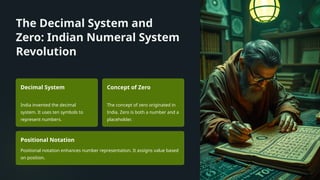
The Decimal Systemand
Zero: Indian Numeral System
Revolution
Decimal System
India invented the decimal
system. It uses ten symbols to
represent numbers.
Concept of Zero
The concept of zero originated in
India. Zero is both a number and a
placeholder.
Positional Notation
Positional notation enhances number representation. It assigns value based
on position.
4.
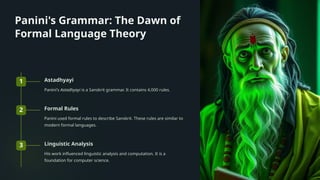
Panini's Grammar: TheDawn of
Formal Language Theory
1 Astadhyayi
Panini's Astadhyayi is a Sanskrit grammar. It contains 4,000 rules.
2 Formal Rules
Panini used formal rules to describe Sanskrit. These rules are similar to
modern formal languages.
3 Linguistic Analysis
His work influenced linguistic analysis and computation. It is a
foundation for computer science.
5.
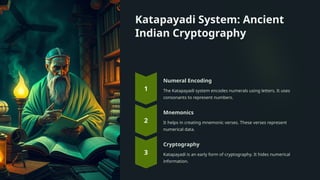
Katapayadi System: Ancient
IndianCryptography
Numeral Encoding
The Katapayadi system encodes numerals using letters. It uses
consonants to represent numbers.
Mnemonics
It helps in creating mnemonic verses. These verses represent
numerical data.
Cryptography
Katapayadi is an early form of cryptography. It hides numerical
information.
6.
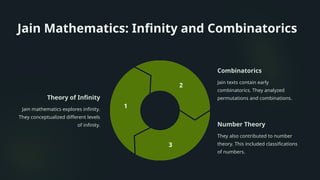
Jain Mathematics: Infinityand Combinatorics
Theory of Infinity
Jain mathematics explores infinity.
They conceptualized different levels
of infinity.
1
Combinatorics
Jain texts contain early
combinatorics. They analyzed
permutations and combinations.
2
Number Theory
They also contributed to number
theory. This included classifications
of numbers.
3
7.
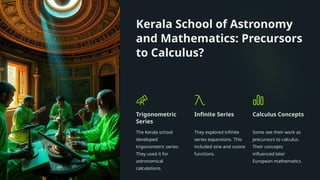
Kerala School ofAstronomy
and Mathematics: Precursors
to Calculus?
Trigonometric
Series
The Kerala school
developed
trigonometric series.
They used it for
astronomical
calculations.
Infinite Series
They explored infinite
series expansions. This
included sine and cosine
functions.
Calculus Concepts
Some see their work as
precursors to calculus.
Their concepts
influenced later
European mathematics.
8.
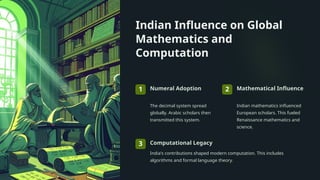
Indian Influence onGlobal
Mathematics and
Computation
1 Numeral Adoption
The decimal system spread
globally. Arabic scholars then
transmitted this system.
2 Mathematical Influence
Indian mathematics influenced
European scholars. This fueled
Renaissance mathematics and
science.
3 Computational Legacy
India's contributions shaped modern computation. This includes
algorithms and formal language theory.
9.
Critiques and Considerations:Reevaluating
Historical Narratives
Eurocentric Bias
Some narratives overlook Indian
contributions. They attribute
advancements solely to Europe.
Source Scarcity
Limited historical sources present
challenges. It makes comprehensive
analysis difficult.
Interdisciplinary Research
New research reevaluates India's role.
It combines history, mathematics,
and linguistics.
10.
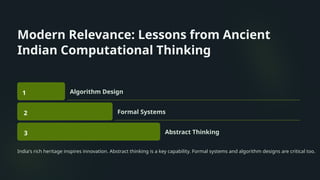
Modern Relevance: Lessonsfrom Ancient
Indian Computational Thinking
1 Algorithm Design
2 Formal Systems
3 Abstract Thinking
India's rich heritage inspires innovation. Abstract thinking is a key capability. Formal systems and algorithm designs are critical too.





![Ancient_India_Math_Contributions_Exact_Text[1].pptx](https://cdn.slidesharecdn.com/ss_thumbnails/ancientindiamathcontributionsexacttext1-250516190525-418a6477-thumbnail.jpg?width=640&height=640&fit=bounds)


