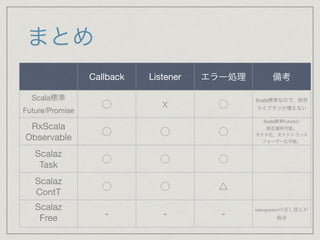
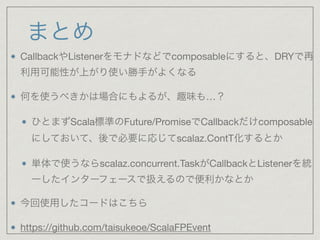
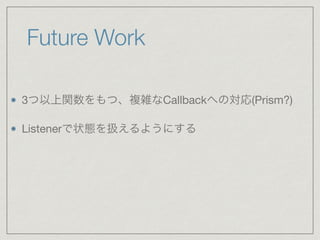
CallbackをFuture化する
def profileImg(imgUrl: String):Future[Array[Byte]] = {
val p = Promise[Array[Byte]]()
val f = p.future
SNSClient.getImageAsync(imgUrl, new SimpleCallback[Array[Byte], Exception] {
override def onSuccess(imgData: Array[Byte]): Unit =
p.success(imgData)
override def onFailure(e: Exception): Unit =
p.failure(e)
})
f
}
19.
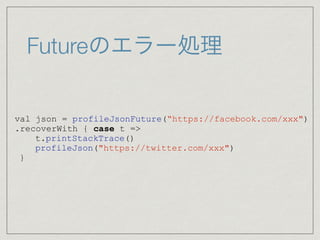
Futureのエラー処理
val json =profileJsonFuture(“https://facebook.com/xxx")
.recoverWith { case t =>
t.printStackTrace()
profileJson("https://twitter.com/xxx")
}
20.
Future化したものを合成
val dataFuture: Future[Array[Byte]]=
for {
json <- profileJsonFuture(“https://facebook.com/xxx")
.recoverWith { case t =>
t.printStackTrace()
profileJsonFuture("https://twitter.com/xxx")
}
imgUrl <- parseFuture(json)
data <- profileImgFuture(imgUrl)
} yield data
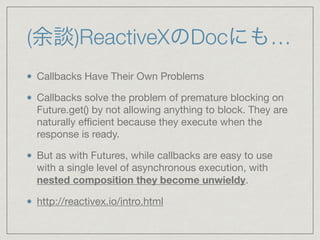
(余談)ReactiveXのDocにも…
Callbacks Have TheirOwn Problems
Callbacks solve the problem of premature blocking on
Future.get() by not allowing anything to block. They are
naturally efficient because they execute when the
response is ready.
But as with Futures, while callbacks are easy to use
with a single level of asynchronous execution, with
nested composition they become unwieldy.
http://reactivex.io/intro.html
Observable同士を合成
val dataObservable: Observable[Array[Byte]]=
for {
_ <- onClick(Button)
json <- Observable.from(profileJson(“https://facebook.com/xxx")
.recoverWith
{ case t =>
t.printStackTrace()
profileJson("https://twitter.com/xxx")
})
imgUrl <- Observable.from(parse(json))
data <- Observable.from(profileImg(imgUrl))
} yield data
Scalaz Task化したCallback
def profileJsonTask(url:String): Task[String] =
Task.async[String] {
f =>
SNSClient.getProfileAsync(url, new SimpleCallback[String, Exception] {
override def onSuccess(json: String): Unit = f(/-(json))
override def onFailure(e: Exception): Unit = f(-/(e))
})
}
dataTask.runAsync {
case /-(data) => println(data)
case -/(e) => e.printStackTrace()
}
Task.async[A](register: ((Throwable / A) => Unit) => Unit): Task[A]
36.
Task化したcallbackを合成
val dataTask: Task[Array[Byte]]= for {
_ <- onClickTask(Button)
json <- profileJsonTask(“https://facebook.com/xxx")
.handleWith { case t =>
t.printStackTrace()
profileJsonTask("https://twitter.com/xxx")
}
imgUrl <- parseTask(json)
data <- profileImgTask(imgUrl)
} yield data
dataTask.runAsync {
case /-(data) => println(data)
case -/(e) => e.printStackTrace()
}
Freeモナド化したCallback
sealed abstract classProgram[A] extends Product with Serializable
final case class OnClick(button: Button) extends Program[Button]
final case class ProfileImage(imageUrl: String) extends Program[Array[Byte]]
final case class ProfileJson(url: String) extends Program[String]
final case class ParseJson(json: String) extends Program[String]
import ScalazTaskExample._
val interpreter: Program ~> Task =
new (Program ~> Task) {
override def apply[A](fa: Program[A]) = fa match {
case OnClick(button) => onClickTask(button)
case ProfileImage(imageUrl) => profileImgTask(imageUrl)
case ProfileJson(url) => profileJsonTask(url)
case ParseJson(json) => parseTask(json)
}
}
val task: Task[String] = Free.runFC(liftFC(ProfileJson(“https://facebook.com/xxx"))(interpreter)
task.runAsync {
case /-(data) => println(data)
case -/(e) => e.printStackTrace()
}
46.
Freeモナド化したCallback
のエラー処理
def getTaskFrom(interpreter: Program~> Task): Task[Array[Byte]] =
for {
json <-
Free.runFC(
for {
_ <- liftFC(OnClick(Button))
json <- liftFC(ProfileJson("https://facebook.com/xxx"))
} yield json
)(interpreter).handleWith { case t =>
t.printStackTrace()
profileJsonTask("https://twitter.com/xxx")
}
data <-
Free.runFC(
for {
imgUrl <- liftFC(ParseJson(json))
dt <- liftFC(ProfileImage(imgUrl))
} yield dt
)(interpreter)
} yield data




![Callback
trait SimpleCallback[-T, -E <: Throwable] {
def onSuccess(t: T): Unit
def onFailure(e: E): Unit
}
trait SNSClient{
def getProfileAsync(url: String, callback: SimpleCallback[String,
Exception]): Unit = ???
}
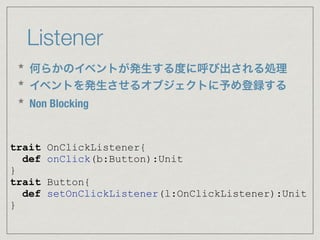
* 何らかのイベントの完了時に、(一般的には?)一度だけ
呼び出される処理。
* 非同期な関数に引数として渡される
* Non Blocking](https://image.slidesharecdn.com/20150725fpscala-150725081153-lva1-app6891/85/Composable-Callbacks-Listeners-4-320.jpg)
![_人人人人人人人人_
> Callback地獄 <
 ̄Y^Y^Y^Y^Y^Y^Y ̄
Button.setOnClickListener(new OnClickListener {
override def onClick(b: Button): Unit = SNSClient.getProfileAsync("https://facebook.com/xxx",
new SimpleCallback[String, Exception] {
override def onSuccess(json: String): Unit =
SNSJSONParser.extractProfileUrlAsync(json, new SimpleCallback[String, Exception] {
override def onSuccess(profileUrl: String): Unit =
SNSClient.getImageAsync(profileUrl, new SimpleCallback[Array[Byte], Exception] {
override def onSuccess(t: Array[Byte]): Unit = println(t)
override def onFailure(e: Exception): Unit = e.printStackTrace()
})
override def onFailure(e: Exception): Unit = e.printStackTrace()
})
override def onFailure(e: Exception): Unit = {
e.printStackTrace()
SNSClient.getProfileAsync("https://twitter.com/xxx", new SimpleCallback[String, Exception] {
override def onSuccess(json: String): Unit =](https://image.slidesharecdn.com/20150725fpscala-150725081153-lva1-app6891/85/Composable-Callbacks-Listeners-7-320.jpg)
![* 1. Buttonがクリックされる
* 2. ユーザーのSNSプロフィールのJSONを取得
* 2-2. 失敗後、他のSNSからJSON取得
* 3. JSONをParseして、プロフィール画像のURL取得
* 4. URLから画像データのByte列を取得
Button.setOnClickListener(new OnClickListener {
override def onClick(b: Button): Unit = SNSClient.getProfileAsync("https://facebook.com/xxx",
new SimpleCallback[String, Exception] {
override def onSuccess(json: String): Unit =
SNSJSONParser.extractProfileUrlAsync(json, new SimpleCallback[String, Exception] {
override def onSuccess(profileUrl: String): Unit =
SNSClient.getImageAsync(profileUrl, new SimpleCallback[Array[Byte], Exception] {
override def onSuccess(t: Array[Byte]): Unit = println(t)
override def onFailure(e: Exception): Unit = e.printStackTrace()
})
override def onFailure(e: Exception): Unit = e.printStackTrace()
})
override def onFailure(e: Exception): Unit = {
e.printStackTrace()
SNSClient.getProfileAsync("https://twitter.com/xxx", new SimpleCallback[String, Exception] {
override def onSuccess(json: String): Unit =](https://image.slidesharecdn.com/20150725fpscala-150725081153-lva1-app6891/85/Composable-Callbacks-Listeners-8-320.jpg)

![_人人人人人人人人_
> Callback地獄 <
 ̄Y^Y^Y^Y^Y^Y^Y ̄
Button.setOnClickListener(new OnClickListener {
override def onClick(b: Button): Unit = SNSClient.getProfileAsync("https://facebook.com/xxx",
new SimpleCallback[String, Exception] {
override def onSuccess(json: String): Unit =
SNSJSONParser.extractProfileUrlAsync(json, new SimpleCallback[String, Exception] {
override def onSuccess(profileUrl: String): Unit =
SNSClient.getImageAsync(profileUrl, new SimpleCallback[Array[Byte], Exception] {
override def onSuccess(t: Array[Byte]): Unit = println(t)
override def onFailure(e: Exception): Unit = e.printStackTrace()
})
override def onFailure(e: Exception): Unit = e.printStackTrace()
})
override def onFailure(e: Exception): Unit = {
e.printStackTrace()
SNSClient.getProfileAsync("https://twitter.com/xxx", new SimpleCallback[String, Exception] {
override def onSuccess(json: String): Unit =](https://image.slidesharecdn.com/20150725fpscala-150725081153-lva1-app6891/85/Composable-Callbacks-Listeners-11-320.jpg)

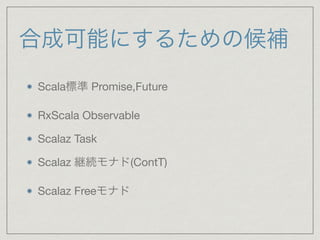
![Scala標準のFuture
scala.concurrent.Future
非同期でNon-Blockingな処理を簡便に行うための便利ツール
Future[+T]#flatMap[S](f:T=>Future[S]):Future[S] により他のFuture同士と合成可能
flatMapなのでfor-comprehensionで合成を表現可能
エラー処理を簡便に行うための関数群(e.g. recoverWith, onFailure)
Future#applyで生成する他、Promiseオブジェクトを通じて値を書き込むことができる](https://image.slidesharecdn.com/20150725fpscala-150725081153-lva1-app6891/85/Composable-Callbacks-Listeners-17-320.jpg)
![CallbackをFuture化する
def profileImg(imgUrl: String): Future[Array[Byte]] = {
val p = Promise[Array[Byte]]()
val f = p.future
SNSClient.getImageAsync(imgUrl, new SimpleCallback[Array[Byte], Exception] {
override def onSuccess(imgData: Array[Byte]): Unit =
p.success(imgData)
override def onFailure(e: Exception): Unit =
p.failure(e)
})
f
}](https://image.slidesharecdn.com/20150725fpscala-150725081153-lva1-app6891/85/Composable-Callbacks-Listeners-18-320.jpg)
![Future化したものを合成
val dataFuture: Future[Array[Byte]] =
for {
json <- profileJsonFuture(“https://facebook.com/xxx")
.recoverWith { case t =>
t.printStackTrace()
profileJsonFuture("https://twitter.com/xxx")
}
imgUrl <- parseFuture(json)
data <- profileImgFuture(imgUrl)
} yield data](https://image.slidesharecdn.com/20150725fpscala-150725081153-lva1-app6891/85/Composable-Callbacks-Listeners-20-320.jpg)

![_人人人人人人人人_
> Callback地獄 <
 ̄Y^Y^Y^Y^Y^Y^Y ̄
Button.setOnClickListener(new OnClickListener {
override def onClick(b: Button): Unit = SNSClient.getProfileAsync("https://facebook.com/xxx",
new SimpleCallback[String, Exception] {
override def onSuccess(json: String): Unit =
SNSJSONParser.extractProfileUrlAsync(json, new SimpleCallback[String, Exception] {
override def onSuccess(profileUrl: String): Unit =
SNSClient.getImageAsync(profileUrl, new SimpleCallback[Array[Byte], Exception] {
override def onSuccess(t: Array[Byte]): Unit = println(t)
override def onFailure(e: Exception): Unit = e.printStackTrace()
})
override def onFailure(e: Exception): Unit = e.printStackTrace()
})
override def onFailure(e: Exception): Unit = {
e.printStackTrace()
SNSClient.getProfileAsync("https://twitter.com/xxx", new SimpleCallback[String, Exception] {
override def onSuccess(json: String): Unit =](https://image.slidesharecdn.com/20150725fpscala-150725081153-lva1-app6891/85/Composable-Callbacks-Listeners-22-320.jpg)

![Future / Promiseの注意点
Promise Futureでも1度しか書き込めないため、複数回呼ばれうるListenerには使えない
def onClickFuture(button:Button): Future[Button] = {
val p = Promise[Button]()
val f = p.future
button.setOnClickListener(new LoggingOnClickListener {
override def onClick(b: Button): Unit = {
super.onClick(b)
p.success(b)
}
})
f
}
val clickFuture:Future[Button] = onClickFuture(Button)
//clickFuture succeeds
Button.click()
Button.click()
/*
[error] (run-main-2) java.lang.IllegalStateException: Promise already completed.
*/](https://image.slidesharecdn.com/20150725fpscala-150725081153-lva1-app6891/85/Composable-Callbacks-Listeners-24-320.jpg)
![RxScala Observable
非同期なイベントストリームを扱うためのライブラリ
Listener及びCallbackを、イベントストリーム(Observable)に見立てる
Observable[+T]#flatMap[U](f:T=>Observable[U]):Observable[U]により
Observable同士で合成可能
onErrorResumeNext[T](f:Throwable => Observable[T]):Observable[T]
で、エラー処理
Observable.from[T](f:Future[T]):Observable[T]で、Futureから
Observable生成可能](https://image.slidesharecdn.com/20150725fpscala-150725081153-lva1-app6891/85/Composable-Callbacks-Listeners-26-320.jpg)
![ListenerをObservable化
def onClickObs(button: Button): Observable[Button] =
Observable { asSubscriber =>
button.setOnClickListener(new OnClickListener {
override def onClick(b: Button): Unit = {
super.onClick(b)
asSubscriber.onNext(b)
}
})
}](https://image.slidesharecdn.com/20150725fpscala-150725081153-lva1-app6891/85/Composable-Callbacks-Listeners-28-320.jpg)
![Observableのエラー処理
val json:Observable[String] =
profileJson(“https://facebook.com/xxx")
.onErrorResumeNext
{ t =>
t.printStackTrace()
profileJson("https://twitter.com/xxx")
}](https://image.slidesharecdn.com/20150725fpscala-150725081153-lva1-app6891/85/Composable-Callbacks-Listeners-29-320.jpg)
![Observable同士を合成
val dataObservable: Observable[Array[Byte]] =
for {
_ <- onClick(Button)
json <- Observable.from(profileJson(“https://facebook.com/xxx")
.recoverWith
{ case t =>
t.printStackTrace()
profileJson("https://twitter.com/xxx")
})
imgUrl <- Observable.from(parse(json))
data <- Observable.from(profileImg(imgUrl))
} yield data](https://image.slidesharecdn.com/20150725fpscala-150725081153-lva1-app6891/85/Composable-Callbacks-Listeners-30-320.jpg)
![Scalaz Task
scalaz.concurrent.Task[+A]
Task.async[A](register: ((Throwable / A) => Unit) => Unit):
Task[A]という、callbackをラップするための関数がある。
Listenerについても使える。
非同期でNon-Blockingな処理を簡便に行うためのモナド
flatMap有り
handleWith[B>:A](f:
PartialFunction[Throwable,Task[B]]):Task[B]などによるエ
ラー処理](https://image.slidesharecdn.com/20150725fpscala-150725081153-lva1-app6891/85/Composable-Callbacks-Listeners-33-320.jpg)
![Scalaz Task化したCallback
def profileJsonTask(url: String): Task[String] =
Task.async[String] {
f =>
SNSClient.getProfileAsync(url, new SimpleCallback[String, Exception] {
override def onSuccess(json: String): Unit = f(/-(json))
override def onFailure(e: Exception): Unit = f(-/(e))
})
}
dataTask.runAsync {
case /-(data) => println(data)
case -/(e) => e.printStackTrace()
}
Task.async[A](register: ((Throwable / A) => Unit) => Unit): Task[A]](https://image.slidesharecdn.com/20150725fpscala-150725081153-lva1-app6891/85/Composable-Callbacks-Listeners-35-320.jpg)
![Task化したcallbackを合成
val dataTask: Task[Array[Byte]] = for {
_ <- onClickTask(Button)
json <- profileJsonTask(“https://facebook.com/xxx")
.handleWith { case t =>
t.printStackTrace()
profileJsonTask("https://twitter.com/xxx")
}
imgUrl <- parseTask(json)
data <- profileImgTask(imgUrl)
} yield data
dataTask.runAsync {
case /-(data) => println(data)
case -/(e) => e.printStackTrace()
}](https://image.slidesharecdn.com/20150725fpscala-150725081153-lva1-app6891/85/Composable-Callbacks-Listeners-36-320.jpg)
![Scalaz ContT
Scalazの継続モナド(のMonad Transformer)
ある処理の後続の処理を継続(Continuation)として渡すス
タイル(継続渡し、CPS)をモナド化したもの
ContT.apply[M[_],R,A](f:(A => M[R]) =>
M[R]) :ContT[M[_],R,A] で生成
エラー処理はM[_] (今回はFuture)に移譲](https://image.slidesharecdn.com/20150725fpscala-150725081153-lva1-app6891/85/Composable-Callbacks-Listeners-38-320.jpg)

![Listener/CallbackをContT化
type Callback[T] = ContT[Future, Unit, T]
object Callback {
def apply[T](f: (T => Future[Unit]) => Future[Unit]): Callback[T] =
ContT.apply[Future, Unit, T](f)
}
def onClickCont(button: Button): Callback[Button] =
Callback { f =>
button.setOnClickListener(new LoggingOnClickListener {
override def onClick(b: Button): Unit = {
super.onClick(b)
f(b)
}
})
Future.successful(Unit)
}
import ScalaStdFutureExample._
def profileImgCont(imgUrl: String): Callback[Array[Byte]] =
Callback(profileImgFuture(imgUrl).flatMap(_))](https://image.slidesharecdn.com/20150725fpscala-150725081153-lva1-app6891/85/Composable-Callbacks-Listeners-40-320.jpg)
![ContTのエラー処理
type Callback[T] = ContT[Future, Unit, T]
object Callback {
def apply[T](f: (T => Future[Unit]) => Future[Unit]): Callback[T] =
ContT.apply[Future, Unit, T](f)
}
def recoverCont[T](failedCont: Callback[T], recover: => Future[T]): Callback[T] =
Callback {
f => failedCont.run(f).recoverWith {
case t => t.printStackTrace()
recover.flatMap(f)
}
}](https://image.slidesharecdn.com/20150725fpscala-150725081153-lva1-app6891/85/Composable-Callbacks-Listeners-41-320.jpg)
![ContT化したCallbackを合成
val dataCont:Callback[Array[Byte]] = for {
b <- onClickCont(Button)
json <- recoverCont(profileJsonCont(“https://facebook.com/xxx"),
profileJsonFuture("https://twitter.com/xxx"))
imgUrl <- parseCont(json)
data <- profileImgCont(imgUrl)
} yield data
dataCont.run { ba =>
println(ba)
Future.successful(Unit)
}](https://image.slidesharecdn.com/20150725fpscala-150725081153-lva1-app6891/85/Composable-Callbacks-Listeners-42-320.jpg)
![Freeモナド化したCallback
sealed abstract class Program[A] extends Product with Serializable
final case class OnClick(button: Button) extends Program[Button]
final case class ProfileImage(imageUrl: String) extends Program[Array[Byte]]
final case class ProfileJson(url: String) extends Program[String]
final case class ParseJson(json: String) extends Program[String]
import ScalazTaskExample._
val interpreter: Program ~> Task =
new (Program ~> Task) {
override def apply[A](fa: Program[A]) = fa match {
case OnClick(button) => onClickTask(button)
case ProfileImage(imageUrl) => profileImgTask(imageUrl)
case ProfileJson(url) => profileJsonTask(url)
case ParseJson(json) => parseTask(json)
}
}
val task: Task[String] = Free.runFC(liftFC(ProfileJson(“https://facebook.com/xxx"))(interpreter)
task.runAsync {
case /-(data) => println(data)
case -/(e) => e.printStackTrace()
}](https://image.slidesharecdn.com/20150725fpscala-150725081153-lva1-app6891/85/Composable-Callbacks-Listeners-45-320.jpg)
![Freeモナド化したCallback
のエラー処理
def getTaskFrom(interpreter: Program ~> Task): Task[Array[Byte]] =
for {
json <-
Free.runFC(
for {
_ <- liftFC(OnClick(Button))
json <- liftFC(ProfileJson("https://facebook.com/xxx"))
} yield json
)(interpreter).handleWith { case t =>
t.printStackTrace()
profileJsonTask("https://twitter.com/xxx")
}
data <-
Free.runFC(
for {
imgUrl <- liftFC(ParseJson(json))
dt <- liftFC(ProfileImage(imgUrl))
} yield dt
)(interpreter)
} yield data](https://image.slidesharecdn.com/20150725fpscala-150725081153-lva1-app6891/85/Composable-Callbacks-Listeners-46-320.jpg)