COMPONENT TWO
LEARNING AIM A:
LATE FOR SCHOOL SKILLS
LOG
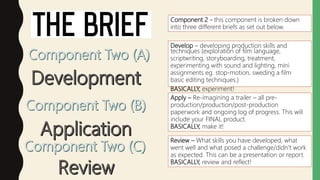
Develop – developing production skills and
techniques (exploration of film language,
scriptwriting, storyboarding, treatment,
experimenting with sound and lighting, mini
assignments eg. stop-motion, sweding a film
basic editing techniques.)
BASICALLY, experiment!
Component 2 - this component is broken down
into three different briefs as set out below.
Apply – Re-imagining a trailer – all pre-
production/production/post-production
paperwork and ongoing log of progress. This will
include your FINAL product.
BASICALLY, make it!
Review – What skills you have developed, what
went well and what posed a challenge/didn’t work
as expected. This can be a presentation or report.
BASICALLY, review and reflect!
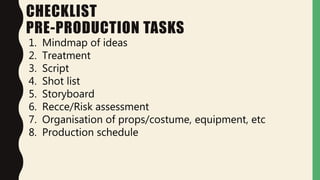
CHECKLIST
PRE-PRODUCTION TASKS
1. Mindmap of ideas
2. Treatment
3. Script
4. Shot list
5. Storyboard
6. Recce/Risk assessment
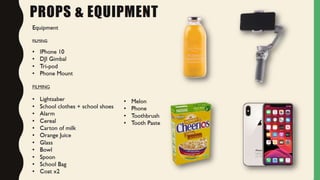
7. Organisation of props/costume, equipment, etc
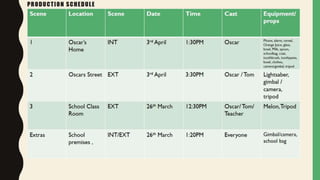
8. Production schedule
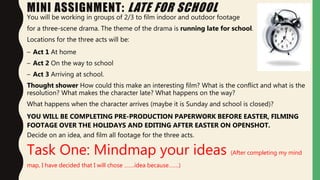
MINI ASSIGNMENT: LATE FOR SCHOOL
You will be working in groups of 2/3 to film indoor and outdoor footage
for a three-scene drama. The theme of the drama is running late for school.
Locations for the three acts will be:
– Act 1 At home
– Act 2 On the way to school
– Act 3 Arriving at school.
Thought shower How could this make an interesting film? What is the conflict and what is the
resolution? What makes the character late? What happens on the way?
What happens when the character arrives (maybe it is Sunday and school is closed)?
YOU WILL BE COMPLETING PRE-PRODUCTION PAPERWORK BEFORE EASTER, FILMING
FOOTAGE OVER THE HOLIDAYS AND EDITING AFTER EASTER ON OPENSHOT.
Decide on an idea, and film all footage for the three acts.
Task One: Mindmap your ideas (After completing my mind
map, I have decided that I will chose …….idea because…….)
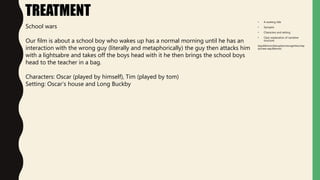
• A working title
• Synopsis
• Characters and setting
• Clear explanation of narrative
structure
(equilibrium/disruption/recognition/rep
air/new equilibrium)
TREATMENT
School wars
Our film is about a school boy who wakes up has a normal morning until he has an
interaction with the wrong guy (literally and metaphorically) the guy then attacks him
with a lightsabre and takes off the boys head with it he then brings the school boys
head to the teacher in a bag.
Characters: Oscar (played by himself), Tim (played by tom)
Setting: Oscar’s house and Long Buckby
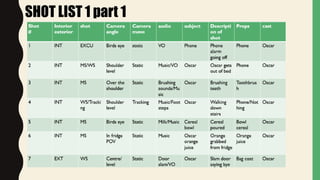
SHOT LIST 1 part 1
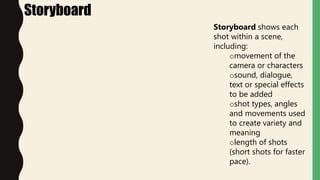
Storyboard
Storyboard shows each
shot within a scene,
including:
omovement of the
camera or characters
osound, dialogue,
text or special effects
to be added
oshot types, angles
and movements used
to create variety and
meaning
olength of shots
(short shots for faster
pace).
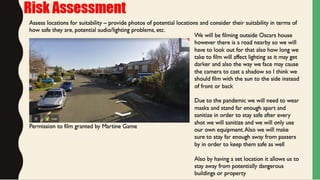
Task Six: Recce/Risk Assessment
Assess locations for suitability – provide photos of potential locations and consider their suitability in
terms of how safe they are, potential audio/lighting problems, etc.
Task Eight: Production Schedule
Assess locations for suitability – provide photos of potential locations and consider their suitability in
terms of how safe they are, potential audio/lighting problems, etc.

Component 2-learning-aim-a Log

  • 1.
    COMPONENT TWO LEARNING AIMA: LATE FOR SCHOOL SKILLS LOG
  • 2.
    Develop – developingproduction skills and techniques (exploration of film language, scriptwriting, storyboarding, treatment, experimenting with sound and lighting, mini assignments eg. stop-motion, sweding a film basic editing techniques.) BASICALLY, experiment! Component 2 - this component is broken down into three different briefs as set out below. Apply – Re-imagining a trailer – all pre- production/production/post-production paperwork and ongoing log of progress. This will include your FINAL product. BASICALLY, make it! Review – What skills you have developed, what went well and what posed a challenge/didn’t work as expected. This can be a presentation or report. BASICALLY, review and reflect!
  • 3.
    CHECKLIST PRE-PRODUCTION TASKS 1. Mindmapof ideas 2. Treatment 3. Script 4. Shot list 5. Storyboard 6. Recce/Risk assessment 7. Organisation of props/costume, equipment, etc 8. Production schedule
  • 4.
    MINI ASSIGNMENT: LATEFOR SCHOOL You will be working in groups of 2/3 to film indoor and outdoor footage for a three-scene drama. The theme of the drama is running late for school. Locations for the three acts will be: – Act 1 At home – Act 2 On the way to school – Act 3 Arriving at school. Thought shower How could this make an interesting film? What is the conflict and what is the resolution? What makes the character late? What happens on the way? What happens when the character arrives (maybe it is Sunday and school is closed)? YOU WILL BE COMPLETING PRE-PRODUCTION PAPERWORK BEFORE EASTER, FILMING FOOTAGE OVER THE HOLIDAYS AND EDITING AFTER EASTER ON OPENSHOT. Decide on an idea, and film all footage for the three acts. Task One: Mindmap your ideas (After completing my mind map, I have decided that I will chose …….idea because…….)
  • 5.
    • A workingtitle • Synopsis • Characters and setting • Clear explanation of narrative structure (equilibrium/disruption/recognition/rep air/new equilibrium) TREATMENT School wars Our film is about a school boy who wakes up has a normal morning until he has an interaction with the wrong guy (literally and metaphorically) the guy then attacks him with a lightsabre and takes off the boys head with it he then brings the school boys head to the teacher in a bag. Characters: Oscar (played by himself), Tim (played by tom) Setting: Oscar’s house and Long Buckby
  • 6.
  • 7.
    Storyboard Storyboard shows each shotwithin a scene, including: omovement of the camera or characters osound, dialogue, text or special effects to be added oshot types, angles and movements used to create variety and meaning olength of shots (short shots for faster pace).
  • 8.
    Task Six: Recce/RiskAssessment Assess locations for suitability – provide photos of potential locations and consider their suitability in terms of how safe they are, potential audio/lighting problems, etc.
  • 10.
    Task Eight: ProductionSchedule Assess locations for suitability – provide photos of potential locations and consider their suitability in terms of how safe they are, potential audio/lighting problems, etc.