Author: Alice Junqueira Terra Caffaro
Date: April 2015
Text originally published in the website Transition Consciousness.
https://transitionconsciousness.wordpress.com/2018/05/20/guest-­‐article-­‐
complexity-­‐systems-­‐thinking-­‐and-­‐sociology-­‐alice-­‐junqueira/	
  
Complexity, Systems thinking and Sociology
When it comes to complexity and sustainability we often come across names such as
Bertalanffy, Ilya Prigogine, Donella Meadows, Fritof Capra, and others, but we rarely
come across complexity and systems theories through the “eyes” of Sociology.
How would we observe society if Sociology saw it as a system? This was one of the
questions a German sociologist tried to answer. His name is Niklas Luhmman1
and he
started where many of others started, precisely in one of those names we often hear
when studying and discussing sustainability: in Bertalanffy. He also read and
incorporated ideas of other renowned authors from many areas of knowledge. He is
known to have read thousands of books from Philosophy to Cybernetics, Sociology to
Biology, Phenomenology to Psychology, and more.
Sounds interesting? It is. And it is also controversial. Many authors criticize
Luhmann, including Humberto Maturana who created along with Francisco Varela
the concept of “autopoiesis”, one of the main concepts in the luhmannian theory.
Maturana claims Luhmman’s theory changed the meaning of autopoiesis when he
used it in a way it excludes “we”, humans beings.
I’ll explain. For Niklas Luhmman society is not made of people as traditional
Sociology postulates. Society is a system made by communications.


1
Luhmann is particularly noteworthy by the book Die Gesellschaft der GesellschaftI. Reference of the
Spanish Translation: Luhmann, N. (2007). La Sociedad de la Sociedad. México D.F., México: Herder
& Universidad Iberoamericana.
So we don’t study people? We don’t observe people to understand society? No. We
study and observe communication, more specifically social systems’ communications.
So criticism’s allegations are right? Not this one (there are other criticisms we can
make, of course). Luhmann does not exclude humans from society, what he does is to
define that the most essential component of society is communication. Why? Because
a group of people itself doesn’t make society exist, it starts existing when there is
communication. Also, because in society not only people communicate, but systems
itself communicate too. When we see a protest, for example, it is not someone (a
person) communicating it is a system communicating.
The logic he uses is that the world is made out of systems and society is the biggest
social system. The “all-encompassing” social system. It’s worth noting the use of the
word “social”; Luhmann uses it on purpose meaning the social system is not the only
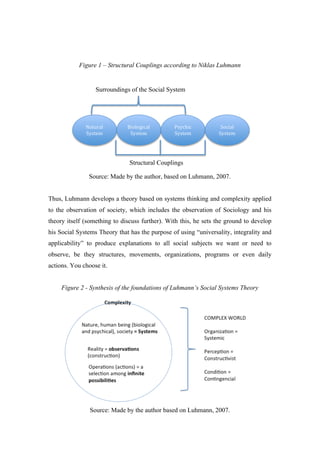
“type” of systems the world is made out. He defines four types of systems: social
systems, psychological systems, biological systems and ecological/natural systems.
All of them operate in its own way and have its own dynamic and characteristics. The
key thing to understand why Luhmann does not “exclude humans” is to understand
that saying humans and society are different systems does not mean they do not
depend on each other and/or are a precondition for the other to exist.
This “dependency” comes, firstly, from the two concepts that are fundamental to his
theory: system and surrounding. There is no system without surrounding. In other
words, to limit what is inside a system you need to define what is not. After, come the
concepts of autopoeisis and operational closure2
. Autopoieseis means the system
autoproduces itself by its own elements and it sustains itself in its own operations;
operational closure means it operates only with its own elements. And finally, there is
the concept of structural coupling, which is how systems “relate”. And when we think
about the four types of systems we understand although they operate differently, they
do depend on each other.


2
Luhmann used theses concepts according to the theory proposed by Humberto Maturana and
Francisco Varela.
Figure 1 – Structural Couplings according to Niklas Luhmann
Source: Made by the author, based on Luhmann, 2007.
Thus, Luhmann develops a theory based on systems thinking and complexity applied
to the observation of society, which includes the observation of Sociology and his
theory itself (something to discuss further). With this, he sets the ground to develop
his Social Systems Theory that has the purpose of using “universality, integrality and
applicability” to produce explanations to all social subjects we want or need to
observe, be they structures, movements, organizations, programs or even daily
actions. You choose it.
Figure 2 - Synthesis of the foundations of Luhmann’s Social Systems Theory
Source: Made by the author based on Luhmann, 2007.
Surroundings of the Social System
Structural Couplings
	
  
Natural	
  
System
Biological	
  
System
Psychic	
  
System
Social	
  
System


Complexity, Systems Thinking and Sociology

  • 1.
    Author: Alice JunqueiraTerra Caffaro Date: April 2015 Text originally published in the website Transition Consciousness. https://transitionconsciousness.wordpress.com/2018/05/20/guest-­‐article-­‐ complexity-­‐systems-­‐thinking-­‐and-­‐sociology-­‐alice-­‐junqueira/   Complexity, Systems thinking and Sociology When it comes to complexity and sustainability we often come across names such as Bertalanffy, Ilya Prigogine, Donella Meadows, Fritof Capra, and others, but we rarely come across complexity and systems theories through the “eyes” of Sociology. How would we observe society if Sociology saw it as a system? This was one of the questions a German sociologist tried to answer. His name is Niklas Luhmman1 and he started where many of others started, precisely in one of those names we often hear when studying and discussing sustainability: in Bertalanffy. He also read and incorporated ideas of other renowned authors from many areas of knowledge. He is known to have read thousands of books from Philosophy to Cybernetics, Sociology to Biology, Phenomenology to Psychology, and more. Sounds interesting? It is. And it is also controversial. Many authors criticize Luhmann, including Humberto Maturana who created along with Francisco Varela the concept of “autopoiesis”, one of the main concepts in the luhmannian theory. Maturana claims Luhmman’s theory changed the meaning of autopoiesis when he used it in a way it excludes “we”, humans beings. I’ll explain. For Niklas Luhmman society is not made of people as traditional Sociology postulates. Society is a system made by communications.                                                                                                                 1 Luhmann is particularly noteworthy by the book Die Gesellschaft der GesellschaftI. Reference of the Spanish Translation: Luhmann, N. (2007). La Sociedad de la Sociedad. México D.F., México: Herder & Universidad Iberoamericana.
  • 2.
    So we don’tstudy people? We don’t observe people to understand society? No. We study and observe communication, more specifically social systems’ communications. So criticism’s allegations are right? Not this one (there are other criticisms we can make, of course). Luhmann does not exclude humans from society, what he does is to define that the most essential component of society is communication. Why? Because a group of people itself doesn’t make society exist, it starts existing when there is communication. Also, because in society not only people communicate, but systems itself communicate too. When we see a protest, for example, it is not someone (a person) communicating it is a system communicating. The logic he uses is that the world is made out of systems and society is the biggest social system. The “all-encompassing” social system. It’s worth noting the use of the word “social”; Luhmann uses it on purpose meaning the social system is not the only “type” of systems the world is made out. He defines four types of systems: social systems, psychological systems, biological systems and ecological/natural systems. All of them operate in its own way and have its own dynamic and characteristics. The key thing to understand why Luhmann does not “exclude humans” is to understand that saying humans and society are different systems does not mean they do not depend on each other and/or are a precondition for the other to exist. This “dependency” comes, firstly, from the two concepts that are fundamental to his theory: system and surrounding. There is no system without surrounding. In other words, to limit what is inside a system you need to define what is not. After, come the concepts of autopoeisis and operational closure2 . Autopoieseis means the system autoproduces itself by its own elements and it sustains itself in its own operations; operational closure means it operates only with its own elements. And finally, there is the concept of structural coupling, which is how systems “relate”. And when we think about the four types of systems we understand although they operate differently, they do depend on each other.                                                                                                                 2 Luhmann used theses concepts according to the theory proposed by Humberto Maturana and Francisco Varela.
  • 3.
    Figure 1 –Structural Couplings according to Niklas Luhmann Source: Made by the author, based on Luhmann, 2007. Thus, Luhmann develops a theory based on systems thinking and complexity applied to the observation of society, which includes the observation of Sociology and his theory itself (something to discuss further). With this, he sets the ground to develop his Social Systems Theory that has the purpose of using “universality, integrality and applicability” to produce explanations to all social subjects we want or need to observe, be they structures, movements, organizations, programs or even daily actions. You choose it. Figure 2 - Synthesis of the foundations of Luhmann’s Social Systems Theory Source: Made by the author based on Luhmann, 2007. Surroundings of the Social System Structural Couplings   Natural   System Biological   System Psychic   System Social   System