75
You have one new message
Unit 8 You have one new message
Unit objectives
• Topics: new technology
• Listening Part 2: deciding which of the two
possible answers is correct
• Reading Part 2: learning verbs and nouns that go
together
• Speaking Part 2: asking correct questions
• Writing Part 7: deciding which kind of word goes
in each space
• Grammar: past continuous, can / can’t, could /
couldn’t
• Vocabulary: technology verbs; music
Starting off
As a warmer On the board, write the question from the
technology quiz Are you crazy about technology? Invite a
brief discussion with the class on what this question means
and encourage the students to answer it. Explain to the
class that they are going to do a quiz to find out if they are
crazy about technology.
Encourage the pairs of students to take turns to read out
the quiz questions and answers and to help each other
with new words in English, I don’t understand, What
does this mean? Point out that they should either circle
their answers in the book or write them down.
Alternative treatment Students do Exercise 2 first and
match the words in bold with the photos (A–G). Then do
the quiz as a class by asking different students to read
out the quiz questions and answers. Help the students
with any more new vocabulary.
Make sure that the students can find the seven words
in the quiz.
Answers
A computer game B Internet C laptop D mobile
E MP3 player F chat online G email addresses
Alternative treatment Ask the students to identify the
photos first and then to check their answers with the
words in the quiz.
Help the students to calculate their scores. Read
through the score descriptions as a class and
encourage reactions. Encourage the students to use:
I agree! I’m not sure! I don’t agree at all! and to give
reasons: because …
1
2
3
Listening Part 2
Ask the students to name the items first: a technical
book, a digital camera, a laptop case, a computer
game, a laptop, a computer magazine, a mouse and a
keyboard. Explain item and encourage the students to
answer in full sentences and to give a reason.
Suggested answer
I want a laptop case because I haven’t got a case for
my laptop. I also want a new mouse because my
mouse is quite old.
Alternative treatment Tell the students that they are
going to live on an island for a month which has an
internet connection but it doesn’t have any shops or a
postal service (for internet orders). Which two items
would they take and why?
Encourage the students to tell you what they remember
about this part and read the exam advice as a class.
Remind the students that, as in other parts of
the Listening paper, they will hear two possible
answers for each person but only one is correct. In
this exercise, the students should write down the two
possible answers even if one is obviously incorrect.
Point out that in the exam, the students can write
these two possible answers on the exam paper.
Answers
2 E and C 3 E and F 4 A and B 5 A and B
6 H and G
Recording script CD 2 Track 2
Woman: How was your trip to the computer store,
Joshua? Did you get the game you wanted?
Boy: Yes I did. We all bought something.
Woman: What did Sam get?
Boy: His dad gave him his old laptop. Sam bought a
new case for it.
Woman: Was it expensive?
Boy: Yes – he spent all his birthday money on it. Jake
wanted a new laptop, but he didn’t have enough
money. So in the end he just bought a computer
magazine.
Woman: What did Marie buy?
Boy: She bought a book about digital photography
because her mum gave her a camera.
Woman: Lucky girl!
1
2
76 Unit 8
Boy: Yes, and you know how Emily always copies
Marie?
Woman: Did Emily buy a book too?
Boy: No, she bought a digital camera!
Woman: Did Anna find a present for her brother’s
birthday?
Boy: She was looking at keyboards, but they were
expensive. I think he’ll like the mouse she bought.
Woman: How much did she pay for that?
Boy: Fifteen pounds!
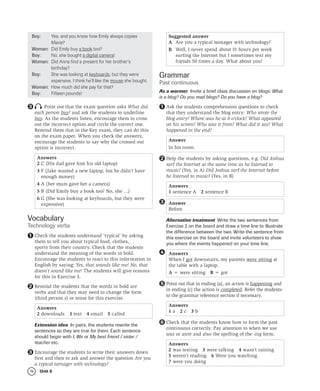
Point out that the exam question asks What did
each person buy? and ask the students to underline
buy. As the students listen, encourage them to cross
out the incorrect option and circle the correct one.
Remind them that in the Key exam, they can do this
on the exam paper. When you check the answers,
encourage the students to say why the crossed out
option is incorrect.
Answers
2 C (His dad gave him his old laptop)
3 F (Jake wanted a new laptop, but he didn’t have
enough money)
4 A (her mum gave her a camera)
5 B (Did Emily buy a book too? No, she …)
6 G (She was looking at keyboards, but they were
expensive)
Vocabulary
Technology verbs
Check the students understand ‘typical’ by asking
them to tell you about typical food, clothes,
sports from their country. Check that the students
understand the meaning of the words in bold.
Encourage the students to react to this information in
English by saying: Yes, that sounds like me! No, that
doesn’t sound like me! The students will give reasons
for this in Exercise 3.
Remind the students that the words in bold are
verbs and that they may need to change the form
(third person s) or tense for this exercise.
Answers
2 downloads 3 text 4 email 5 called
Extension idea In pairs, the students rewrite the
sentences so they are true for them. Each sentence
should begin with I, We or My best friend / sister /
teacher etc.
Encourage the students to write their answers down
first and then to ask and answer the question Are you
a typical teenager with technology?
3
1
2
3
Suggested answer
A Are you a typical teenager with technology?
B Well, I never spend about 31 hours per week
surfing the Internet but I sometimes text my
friends 50 times a day. What about you?
Grammar
Past continuous
As a warmer Invite a brief class discussion on blogs: What
is a blog? Do you read blogs? Do you have a blog?
Ask the students comprehension questions to check
that they understand the blog entry: Who wrote the
blog entry? Where was he at 8 o’clock? What appeared
on his screen? Who was it from? What did it say? What
happened in the end?
Answer
In his room.
Help the students by asking questions, e.g. Did Joshua
surf the Internet at the same time as he listened to
music? (Yes, in A) Did Joshua surf the Internet before
he listened to music? (Yes, in B)
Answers
1 sentence A 2 sentence B
Answer
Before
3
Alternative treatment Write the two sentences from
Exercise 2 on the board and draw a time line to illustrate
the difference between the two. Write the sentence from
this exercise on the board and invite volunteers to show
you where the events happened on your time line.
Answers
When I got downstairs, my parents were sitting at
the table with a laptop.
A = were sitting B = got
4
Point out that in ending (a), an action is happening and
in ending (c) the action is completed. Refer the students
to the grammar reference section if necessary.
Answers
1 a 2 c 3 b
Check that the students know how to form the past
continuous correctly. Pay attention to when we use
was or were and also the spelling of the -ing form.
Answers
2 was texting 3 were talking 4 wasn’t raining
5 weren’t reading 6 Were you watching
7 were you doing
1
2
5
6
77
You have one new message
Remind the students how to form questions in the
past continuous.
Questions and suggested answers
2 What were you doing at 1 pm yesterday?
I was eating lunch.
3 What were your parents doing at 8 pm yesterday?
They were watching TV.
4 What were you doing ten minutes ago?
I was listening to my teacher.
5 Were you sleeping at 11 pm last night?
Yes, I was. / No, I wasn’t.
6 Were you doing your homework at 7 am this
morning?
Yes, I was. / No, I wasn’t.
Encourage the students to ask the questions in
Exercise 7 and to give complete answers.
Extension idea
• Tell the students about four things you were doing
last night but one should be false, e.g. At 7 pm I was
having dinner, at 8.30 pm I was walking with my dog,
at 9 pm I was watching TV and at 10 pm I was reading
a book in bed.
• The students can ask you three questions to find out
what the false sentence is but they can’t just turn your
sentences into questions, e.g. they can’t ask Were you
walking with your dog at 9 pm? but they can ask Have
you got a dog?
• In small groups, the students do the same thing.
Reading Part 2
Encourage the students to ask this question in small
groups. Remind them to use full answers and to
explain why.
Read the exam advice as a class. Point out that this
section will focus on these verbs and nouns that go
together.
Encourage the students to do this exercise on
their own first and then compare their answers with
a partner. At this stage they should choose the word
that sounds best even if they are not sure.
Answers
1 a left; b forgot 2 a pay; b spend 3 a listen;
b hear 4 a go; b do 5 a fail; b lose
Extension idea The students copy the verbs in this
exercise into their notebooks, including the preposition if
the verb takes one. Next to each verb, they should write
the noun that appears in the exercise and try to write
two more possible nouns, e.g.
left: my hat at home, my homework on the bus,
my keys at school
7
8
1
2
forgot: your birthday, my sports clothes, my books
pay for: that keyboard, your trainers, a ticket etc.
Remind the students to read the first instruction
of Part 2 carefully as this will tell them what the
sentences are about. Also remind them to read all the
sentences first without writing and to try to think
of the missing word without reading the words A, B
and C.
Answers
2 A 3 C 4 B 5 A 6 B
Extension idea The students rewrite the sentences so
that the other answers are correct.
e.g. 1 Joshua said that the computer club was called
Young Gamers / Joshua told me that the computer club
was called Young Gamers. etc.
Vocabulary
Music
As a warmer Revise the technology verbs and nouns from
this unit as this will help the students answer the questions
in Exercise 1.
Encourage the students to ask and answer these
questions in small groups and to give full answers.
Suggested answer
A Do you listen to a lot of music?
B Yes, I do. I listen to music every day.
A How do you listen to your music?
B I download music on my laptop and then I listen
to it on my mobile phone. What about you?
Point out that the students will listen to pieces of
music and not a conversation.
Answers
classical 3, jazz 5, opera 6, pop 1, rap 2, rock 4
Recording script CD 2 Track 3
1 [pop music]
2 [rap]
3 [classical]
4 [rock]
5 [jazz]
6 [opera]
Encourage the students to use the question, Can you
think of a classical/jazz/opera etc. singer/band/musician?
Suggested answers
classical: Beethoven; jazz: Miles Davis; opera:
Pavarotti; pop: Justin Bieber; rap: Eminem; rock:
Metallica
3
1
2
3
78 Unit 8
Encourage the students to ask questions and answer
in full answers explaining why.
Suggested answer
AWhat’s your favourite music?
B I love rap because it’s noisy and exciting. Do you
like rap music?
Alternative treatment Play the recording again in
Exercise 2. Stop after each piece of music and invite
reactions, e.g. I like classical music because it’s quiet.
Grammar
can / can’t, could / couldn’t
Invite a brief class discussion on technology using the
questions in the book. Remind the students to give
complete answers and explain why.
Encourage the students to look at the cartoons first
and say what is happening in each one before they
start matching the sentences.
Answers
1 F 2 A 3 D 4 H 5 E 6 B 7 C 8 G
Before the students complete the rules, ask them
what the sentences 1–8 have in common apart from
beginning with You (They all have a form of can).
Answers
1 present 2 past 3 infinitive
Remind the students that can / can’t and could /
couldn’t are always followed by the infinitive without
to.
Answers
2 playing = play 3 sent = send 4 found = find
5 singing = sing 6 couldn’t to swim
Pronunciation
can / can’t
Point out that the students will listen to a
complete sentence with can. The students should
listen to how the can is pronounced and repeat the
sentence.
Alternative treatment Write the sentences in the
recording script on the board before the students listen.
This will help the students to repeat the whole sentence.
Recording script CD 2 Track 4
1 It can do lots of things. /kən/
2 Can it take photos? /kən/
3 Yes, it can. /kæn/
4 It can’t do my homework. /kɑ:nt/
4
1
2
3
4
a
Say the example sentences aloud and encourage the
students to repeat them as this will help them to hear
how can is pronounced.
Answers
1 b 2 c 3 a
Demonstrate this activity first by writing Now and
When I was four in two columns on the board. Invite
suggestions from the class and write them on the
board. The students then write their own lists.
Encourage the students to ask you questions about
your examples on the board. Make sure they ask the
question in the correct tense; Can you …? (Now) and
Could you …? (When you were four?)
Alternative treatment Introduce some useful
language to make these conversations more interesting,
e.g. Really? Are you sure? How about you? Oh yes?
Answer
A Can you play an instrument?
B Yes, I can. I can play the piano.
A Really? Could you play an instrument when you
were four?
B No, I couldn’t. How about you?
Writing Part 7
Remind the students about what they have to do in this
part. Read through the exam advice as a class.
Point out that the students should look at the word in
brackets to see what sort of word is missing and then
choose one of the three words in the relevant column.
Alternative treatment Books closed. Read the
sentence with the gap slowly to the students. Ask the
students to tell you what sort of word is missing and if
possible, tell you what the word is. The students then do
the exercise in the book.
Answers
2 were 3 off 4 many 5 me 6 a
Encourage the students to read the complete email
first before they think about what type of word is
missing. Remind the students that they only need to
think about the type of word in this exercise.
Answers
1 verb 2 preposition 3 pronoun 4 verb
5 preposition 6 verb 7 preposition 8 quantifier
9 verb 10 pronoun
b
5
6
1
2
79
You have one new message
Answers
1 was 2 on 3 he 4 Are 5 at 6 Do 7 to
8 much 9 hope 10 me
3
Speaking Part 2
As a warmer Invite a brief discussion on what the students
have to do in this part of the Speaking test.
Alternative treatment The students listen to the
examiner’s instructions at the beginning of the recording in
Exercise 1 and say what they have to do in this part.
Remind the students that they need to ask both
complete questions and answer with full sentences to
do well in this part.
Answer
The student answering (Tina) is better. (Jaime
doesn’t ask complete correct questions. Tina
answers with full sentences.)
Recording script CD 2 Track 5
Examiner: In the next part you are going to talk to each
other. Tina, here’s some information about
a new internet café. Jaime, you don’t know
anything about the new internet café, so
ask Tina some questions about it. Use these
words to help you. Do you understand?
Tina/Jaime: Yes.
Jaime: Is where new internet café?
Tina: It’s at 35 Queen Street.
Jaime: What name is café?
Tina: Its name is ‘Blue Electric’.
Jaime: It’s sell food?
Tina: Yes, it does. It sells drinks and snacks.
Jaime: Is open weekend?
Tina: Yes, it’s open seven days a week.
Jaime: How’s cost?
Tina: It costs four pounds per hour for a
computer.
Remind the students that they should use the
question prompts on the card to do this.
Suggested answers
Where is the new internet café?; What’s the café
called?; Does it sell food?; Is it open at weekends?;
How much does it cost?
Encourage the students to cover the questions and
answers in Exercise 1 while they do this. Point out
that the student answering the questions should use
the information on the card.
1
2
3
Extension idea Invite pairs of students to perform their
conversation in front of the class. Ask the students who
are listening to check that student A is asking complete
questions and B is answering with full sentences.
Say it right
Objectives
• To learn and practise how to rephrase questions
• Sounds and spelling: to learn and practise the
different pronunciations of the ending -tion
• To practise forming questions
As a warmer
• Play Guess the place with the class.
• Tell students you are thinking of a place to go which can
be found in any town (e.g. library, café, bank).
• Tell them to ask questions to guess which place it is. The
questions can only be yes/no questions.
• Remind them to listen carefully to your answers to build
up the information.
• Encourage questions and don’t correct too much at this
point.
• If a student thinks they know the answer but guesses
wrongly, they can’t guess again. Keep answering until
they guess the place.
Speaking tip Read the tip with the class. Explain to
students that it is important to know different ways of
asking the same thing, as they may have to rephrase the
question in the exam.
Ask the students to do the exercise alone and then
check in pairs.
Answers
2 e 3 a 4 b 5 c
Extension idea
• Divide the class in pairs.
• One of the students closes their book. The other says
one of the questions from Exercise 1. Their partner
must think of the/an alternative way to ask the same
thing.
• Pairs swap roles after a few minutes.
Do the first one as a class.
Answers
1 Can we buy food there?
2 Which days does it open?
3 What can you win?
4 How much does it cost?
1
2
80 Unit 8
Spelling and sounds
Read the instructions with the class. Tell them
to read the words to themselves before you play the
recording. After playing the recording twice, ask
students why there are two different sounds for -tion.
Check students can produce the different sounds: ask
individuals to say the words, checking for the correct
pronunciation.
Recording script CD 2 Track 6
1 question 2 invitation 3 celebration 4 suggestion
5 conversation 6 instruction
Pronunciation tip Read the tip with the class. Point out
to students the different pronunciation of -tion /ʃən/ and
-stion /stʃən/. Encourage student to practise the sounds.
Ask the students to practise saying the sentences
in pairs. Play the recording for them to listen and
compare to their pronunciation. Play again for them
to listen and repeat.
Recording script CD 2 Track 7
1 What’s your suggestion for our next vacation?
2 I have a question about my position.
3 What action can I take for indigestion?
Extension idea Ask pairs to make up their own tongue
twisters with words ending in -tion and -stion from this
lesson or others they know. Tell them to say them out
loud to the class.
Suggested answers
1 Where does it take place?
2 When does it open?
3 How much is it?
4 Is it cheaper for students?
5 Can you buy new gadgets there?
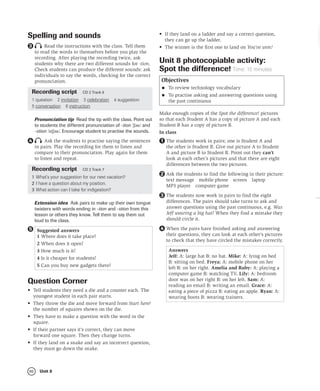
5
Question Corner
• Tell students they need a die and a counter each. The
youngest student in each pair starts.
• They throw the die and move forward from Start here!
the number of squares shown on the die.
• They have to make a question with the word in the
square.
• If their partner says it’s correct, they can move
forward one square. Then they change turns.
• If they land on a snake and say an incorrect question,
they must go down the snake.
3
4
• If they land on a ladder and say a correct question,
they can go up the ladder.
• The winner is the first one to land on You’ve won!
Unit 8 photocopiable activity:
Spot the difference! Time: 15 minutes
Objectives
• To review technology vocabulary
• To practise asking and answering questions using
the past continuous
Make enough copies of the Spot the difference! pictures
so that each Student A has a copy of picture A and each
Student B has a copy of picture B.
In class
The students work in pairs; one is Student A and
the other is Student B. Give out picture A to Student
A and picture B to Student B. Point out they can’t
look at each other’s pictures and that there are eight
differences between the two pictures.
Ask the students to find the following in their picture:
text message mobile phone screen laptop
MP3 player computer game
The students now work in pairs to find the eight
differences. The pairs should take turns to ask and
answer questions using the past continuous, e.g. Was
Jeff wearing a big hat? When they find a mistake they
should circle it.
When the pairs have finished asking and answering
their questions, they can look at each other’s pictures
to check that they have circled the mistakes correctly.
Answers
Jeff: A: large hat B: no hat. Mike: A: lying on bed
B: sitting on bed. Freya: A: mobile phone on her
left B: on her right. Amelia and Ruby: A: playing a
computer game B: watching TV. Lily: A: bedroom
door was on her right B: on her left. Sam: A:
reading an email B: writing an email. Grace: A:
eating a piece of pizza B: eating an apple. Ryan: A:
wearing boots B: wearing trainers.
1
2
3
4
81
Complete Key for Schools by Emma Heyderman © Cambridge University Press 2014 PHOTOCOPIABLE
Student A
Find these things in your picture:
text message mobile phone screen laptop MP3 player computer game
Can you find eight differences between your picture and your partner’s picture? Take turns to ask and answer
questions in the past continuous.
Student B
Find these things in your picture:
text message mobile phone screen laptop MP3 player computer game
Can you find eight differences between your picture and your partner’s picture? Take turns to ask and answer
questions in the past continuous.
1
2
1
2
Unit 8 photocopiable activity
Spot the difference!
✂
Amelia & Ruby
James & Ryan Grace
Sam
Freya
Mike
Jeff
Lily
Amelia & Ruby
James & Ryan Grace
Sam
Freya
Mike
Jeff
Lily
82 Complete Key for Schools by Emma Heyderman © Cambridge University Press 2014 PHOTOCOPIABLE
Word list
Unit 8
bill n (67) a piece of paper that tells you how much you
must pay for something
borrow v (67) to use something that belongs to someone
else
call v (65) to telephone someone
careful adj (64) giving a lot of attention to what you are
doing so that you do not have an accident or make a
mistake
case n (65) a container for storing or protecting
something
classical adj (67) traditional in style
crazy about adj (64) to be very interested in something
fix v (69) to repair something
full adj (67) if a container or a space is full, it contains as
many things or people as possible
instead adv (65) in the place of someone or something
else
jazz n (67) music with a strong beat that people often
play without looking at written music
journey n (64) when you travel from one place to
another
keyboard n (65) a set of keys on a computer, which you
press to make it work, or the rows of keys on a piano
laptop n (64) a small computer that you can carry
around with you
lend v (67) to give something to someone for a period of
time
lose v (67) to not be able to find someone or something
magazine n (64) a big, thin book that you can buy every
week or month, that has pictures and writing
mouse n (65) a thing that is connected to a computer
that you move with your hand to control what the
computer does
opera n (67) a musical play in which most of the words
are sung
pocket n (68) a part of a piece of clothing that you can
put things in
pop n (67) modern music with a strong beat which is
popular with young people
rap n (67) a type of music in which the words are spoken
and there is a strong beat
rock (music) n (67) loud, modern music with a strong
beat, often played with electric guitars and drums
song n (68) words that go with a short piece of music
spend v (67) to use money to buy or pay for something
spend v (64) to use time doing something or being
somewhere
strong adj (67) a strong person or animal is physically
powerful
surfing n (65) the activity of looking at a lot of different
things on the Internet
technology n (64) knowledge, equipment, and methods
that are used in science and industry
text v (65) to send a text message (= written message
from a mobile phone)
waste n (65) a bad use of something useful, such as time
or money
Note: the numbers show which page the word or phrase first appears in the unit.
83
Complete Key for Schools by Emma Heyderman © Cambridge University Press 2014 PHOTOCOPIABLE
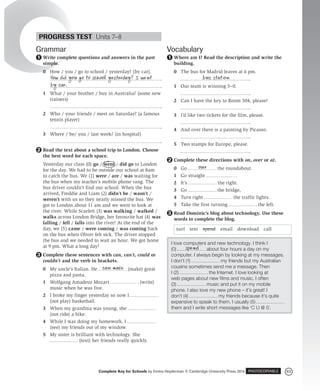
Grammar
Write complete questions and answers in the past
simple.
0 How / you / go to school / yesterday? (by car).
1 What / your brother / buy in Australia? (some new
trainers)
2 Who / your friends / meet on Saturday? (a famous
tennis player)
3 Where / be/ you / last week? (in hospital)
Read the text about a school trip to London. Choose
the best word for each space.
Yesterday our class (0) go / went / did go to London
for the day. We had to be outside our school at 8am
to catch the bus. We (1) were / are / was waiting for
the bus when my teacher’s mobile phone rang. The
bus driver couldn’t find our school. When the bus
arrived, Freddie and Liam (2) didn’t be / wasn’t /
weren’t with us so they nearly missed the bus. We
got to London about 11 am and we went to look at
the river. While Scarlett (3) was walking / walked /
walks across London Bridge, her favourite hat (4) was
falling / fell / falls into the river! At the end of the
day, we (5) came / were coming / was coming back
on the bus when Oliver felt sick. The driver stopped
the bus and we needed to wait an hour. We got home
at 9 pm. What a long day!
Complete these sentences with can, can’t, could or
couldn’t and the verb in brackets.
0 My uncle’s Italian. He (make) great
pizza and pasta.
1 Wolfgang Amadeus Mozart (write)
music when he was five.
2 I broke my finger yesterday so now I
(not play) basketball.
3 When my grandma was young, she
(not ride) a bike.
4 While I was doing my homework, I
(see) my friends out of my window.
5 My sister is brilliant with technology. She
(text) her friends really quickly.
1
How did you go to school yesterday? I went
by car.
2
3
can make
Vocabulary
Where am I? Read the description and write the
building.
0 The bus for Madrid leaves at 6 pm.
1 Our team is winning 5–0.
2 Can I have the key to Room 504, please?
3 I’d like two tickets for the film, please.
4 And over there is a painting by Picasso.
5 Two stamps for Europe, please.
Complete these directions with on, over or at.
0 Go the roundabout.
1 Go straight .
2 It’s the right.
3 Go the bridge,
4 Turn right the traffic lights.
5 Take the first turning the left.
Read Dominic’s blog about technology. Use these
words to complete the blog.
surf text spend email download call
I love computers and new technology. I think I
(0) about four hours a day on my
computer. I always begin by looking at my messages.
I don’t (1) my friends but my Australian
cousins sometimes send me a message. Then
I (2) the Internet. I love looking at
web pages about new films and music. I often
(3) music and put it on my mobile
phone. I also love my new phone – it’s great! I
don’t (4) my friends because it’s quite
expensive to speak to them. I usually (5)
them and I write short messages like ‘C U @ 5’.
spend
1
bus station
2
over
3
PROGRESS TEST Units 7–8

CompleteKeyforSchools_TeachersBook_sample.pdf

  • 1.
    75 You have onenew message Unit 8 You have one new message Unit objectives • Topics: new technology • Listening Part 2: deciding which of the two possible answers is correct • Reading Part 2: learning verbs and nouns that go together • Speaking Part 2: asking correct questions • Writing Part 7: deciding which kind of word goes in each space • Grammar: past continuous, can / can’t, could / couldn’t • Vocabulary: technology verbs; music Starting off As a warmer On the board, write the question from the technology quiz Are you crazy about technology? Invite a brief discussion with the class on what this question means and encourage the students to answer it. Explain to the class that they are going to do a quiz to find out if they are crazy about technology. Encourage the pairs of students to take turns to read out the quiz questions and answers and to help each other with new words in English, I don’t understand, What does this mean? Point out that they should either circle their answers in the book or write them down. Alternative treatment Students do Exercise 2 first and match the words in bold with the photos (A–G). Then do the quiz as a class by asking different students to read out the quiz questions and answers. Help the students with any more new vocabulary. Make sure that the students can find the seven words in the quiz. Answers A computer game B Internet C laptop D mobile E MP3 player F chat online G email addresses Alternative treatment Ask the students to identify the photos first and then to check their answers with the words in the quiz. Help the students to calculate their scores. Read through the score descriptions as a class and encourage reactions. Encourage the students to use: I agree! I’m not sure! I don’t agree at all! and to give reasons: because … 1 2 3 Listening Part 2 Ask the students to name the items first: a technical book, a digital camera, a laptop case, a computer game, a laptop, a computer magazine, a mouse and a keyboard. Explain item and encourage the students to answer in full sentences and to give a reason. Suggested answer I want a laptop case because I haven’t got a case for my laptop. I also want a new mouse because my mouse is quite old. Alternative treatment Tell the students that they are going to live on an island for a month which has an internet connection but it doesn’t have any shops or a postal service (for internet orders). Which two items would they take and why? Encourage the students to tell you what they remember about this part and read the exam advice as a class. Remind the students that, as in other parts of the Listening paper, they will hear two possible answers for each person but only one is correct. In this exercise, the students should write down the two possible answers even if one is obviously incorrect. Point out that in the exam, the students can write these two possible answers on the exam paper. Answers 2 E and C 3 E and F 4 A and B 5 A and B 6 H and G Recording script CD 2 Track 2 Woman: How was your trip to the computer store, Joshua? Did you get the game you wanted? Boy: Yes I did. We all bought something. Woman: What did Sam get? Boy: His dad gave him his old laptop. Sam bought a new case for it. Woman: Was it expensive? Boy: Yes – he spent all his birthday money on it. Jake wanted a new laptop, but he didn’t have enough money. So in the end he just bought a computer magazine. Woman: What did Marie buy? Boy: She bought a book about digital photography because her mum gave her a camera. Woman: Lucky girl! 1 2
  • 2.
    76 Unit 8 Boy:Yes, and you know how Emily always copies Marie? Woman: Did Emily buy a book too? Boy: No, she bought a digital camera! Woman: Did Anna find a present for her brother’s birthday? Boy: She was looking at keyboards, but they were expensive. I think he’ll like the mouse she bought. Woman: How much did she pay for that? Boy: Fifteen pounds! Point out that the exam question asks What did each person buy? and ask the students to underline buy. As the students listen, encourage them to cross out the incorrect option and circle the correct one. Remind them that in the Key exam, they can do this on the exam paper. When you check the answers, encourage the students to say why the crossed out option is incorrect. Answers 2 C (His dad gave him his old laptop) 3 F (Jake wanted a new laptop, but he didn’t have enough money) 4 A (her mum gave her a camera) 5 B (Did Emily buy a book too? No, she …) 6 G (She was looking at keyboards, but they were expensive) Vocabulary Technology verbs Check the students understand ‘typical’ by asking them to tell you about typical food, clothes, sports from their country. Check that the students understand the meaning of the words in bold. Encourage the students to react to this information in English by saying: Yes, that sounds like me! No, that doesn’t sound like me! The students will give reasons for this in Exercise 3. Remind the students that the words in bold are verbs and that they may need to change the form (third person s) or tense for this exercise. Answers 2 downloads 3 text 4 email 5 called Extension idea In pairs, the students rewrite the sentences so they are true for them. Each sentence should begin with I, We or My best friend / sister / teacher etc. Encourage the students to write their answers down first and then to ask and answer the question Are you a typical teenager with technology? 3 1 2 3 Suggested answer A Are you a typical teenager with technology? B Well, I never spend about 31 hours per week surfing the Internet but I sometimes text my friends 50 times a day. What about you? Grammar Past continuous As a warmer Invite a brief class discussion on blogs: What is a blog? Do you read blogs? Do you have a blog? Ask the students comprehension questions to check that they understand the blog entry: Who wrote the blog entry? Where was he at 8 o’clock? What appeared on his screen? Who was it from? What did it say? What happened in the end? Answer In his room. Help the students by asking questions, e.g. Did Joshua surf the Internet at the same time as he listened to music? (Yes, in A) Did Joshua surf the Internet before he listened to music? (Yes, in B) Answers 1 sentence A 2 sentence B Answer Before 3 Alternative treatment Write the two sentences from Exercise 2 on the board and draw a time line to illustrate the difference between the two. Write the sentence from this exercise on the board and invite volunteers to show you where the events happened on your time line. Answers When I got downstairs, my parents were sitting at the table with a laptop. A = were sitting B = got 4 Point out that in ending (a), an action is happening and in ending (c) the action is completed. Refer the students to the grammar reference section if necessary. Answers 1 a 2 c 3 b Check that the students know how to form the past continuous correctly. Pay attention to when we use was or were and also the spelling of the -ing form. Answers 2 was texting 3 were talking 4 wasn’t raining 5 weren’t reading 6 Were you watching 7 were you doing 1 2 5 6
  • 3.
    77 You have onenew message Remind the students how to form questions in the past continuous. Questions and suggested answers 2 What were you doing at 1 pm yesterday? I was eating lunch. 3 What were your parents doing at 8 pm yesterday? They were watching TV. 4 What were you doing ten minutes ago? I was listening to my teacher. 5 Were you sleeping at 11 pm last night? Yes, I was. / No, I wasn’t. 6 Were you doing your homework at 7 am this morning? Yes, I was. / No, I wasn’t. Encourage the students to ask the questions in Exercise 7 and to give complete answers. Extension idea • Tell the students about four things you were doing last night but one should be false, e.g. At 7 pm I was having dinner, at 8.30 pm I was walking with my dog, at 9 pm I was watching TV and at 10 pm I was reading a book in bed. • The students can ask you three questions to find out what the false sentence is but they can’t just turn your sentences into questions, e.g. they can’t ask Were you walking with your dog at 9 pm? but they can ask Have you got a dog? • In small groups, the students do the same thing. Reading Part 2 Encourage the students to ask this question in small groups. Remind them to use full answers and to explain why. Read the exam advice as a class. Point out that this section will focus on these verbs and nouns that go together. Encourage the students to do this exercise on their own first and then compare their answers with a partner. At this stage they should choose the word that sounds best even if they are not sure. Answers 1 a left; b forgot 2 a pay; b spend 3 a listen; b hear 4 a go; b do 5 a fail; b lose Extension idea The students copy the verbs in this exercise into their notebooks, including the preposition if the verb takes one. Next to each verb, they should write the noun that appears in the exercise and try to write two more possible nouns, e.g. left: my hat at home, my homework on the bus, my keys at school 7 8 1 2 forgot: your birthday, my sports clothes, my books pay for: that keyboard, your trainers, a ticket etc. Remind the students to read the first instruction of Part 2 carefully as this will tell them what the sentences are about. Also remind them to read all the sentences first without writing and to try to think of the missing word without reading the words A, B and C. Answers 2 A 3 C 4 B 5 A 6 B Extension idea The students rewrite the sentences so that the other answers are correct. e.g. 1 Joshua said that the computer club was called Young Gamers / Joshua told me that the computer club was called Young Gamers. etc. Vocabulary Music As a warmer Revise the technology verbs and nouns from this unit as this will help the students answer the questions in Exercise 1. Encourage the students to ask and answer these questions in small groups and to give full answers. Suggested answer A Do you listen to a lot of music? B Yes, I do. I listen to music every day. A How do you listen to your music? B I download music on my laptop and then I listen to it on my mobile phone. What about you? Point out that the students will listen to pieces of music and not a conversation. Answers classical 3, jazz 5, opera 6, pop 1, rap 2, rock 4 Recording script CD 2 Track 3 1 [pop music] 2 [rap] 3 [classical] 4 [rock] 5 [jazz] 6 [opera] Encourage the students to use the question, Can you think of a classical/jazz/opera etc. singer/band/musician? Suggested answers classical: Beethoven; jazz: Miles Davis; opera: Pavarotti; pop: Justin Bieber; rap: Eminem; rock: Metallica 3 1 2 3
  • 4.
    78 Unit 8 Encouragethe students to ask questions and answer in full answers explaining why. Suggested answer AWhat’s your favourite music? B I love rap because it’s noisy and exciting. Do you like rap music? Alternative treatment Play the recording again in Exercise 2. Stop after each piece of music and invite reactions, e.g. I like classical music because it’s quiet. Grammar can / can’t, could / couldn’t Invite a brief class discussion on technology using the questions in the book. Remind the students to give complete answers and explain why. Encourage the students to look at the cartoons first and say what is happening in each one before they start matching the sentences. Answers 1 F 2 A 3 D 4 H 5 E 6 B 7 C 8 G Before the students complete the rules, ask them what the sentences 1–8 have in common apart from beginning with You (They all have a form of can). Answers 1 present 2 past 3 infinitive Remind the students that can / can’t and could / couldn’t are always followed by the infinitive without to. Answers 2 playing = play 3 sent = send 4 found = find 5 singing = sing 6 couldn’t to swim Pronunciation can / can’t Point out that the students will listen to a complete sentence with can. The students should listen to how the can is pronounced and repeat the sentence. Alternative treatment Write the sentences in the recording script on the board before the students listen. This will help the students to repeat the whole sentence. Recording script CD 2 Track 4 1 It can do lots of things. /kən/ 2 Can it take photos? /kən/ 3 Yes, it can. /kæn/ 4 It can’t do my homework. /kɑ:nt/ 4 1 2 3 4 a Say the example sentences aloud and encourage the students to repeat them as this will help them to hear how can is pronounced. Answers 1 b 2 c 3 a Demonstrate this activity first by writing Now and When I was four in two columns on the board. Invite suggestions from the class and write them on the board. The students then write their own lists. Encourage the students to ask you questions about your examples on the board. Make sure they ask the question in the correct tense; Can you …? (Now) and Could you …? (When you were four?) Alternative treatment Introduce some useful language to make these conversations more interesting, e.g. Really? Are you sure? How about you? Oh yes? Answer A Can you play an instrument? B Yes, I can. I can play the piano. A Really? Could you play an instrument when you were four? B No, I couldn’t. How about you? Writing Part 7 Remind the students about what they have to do in this part. Read through the exam advice as a class. Point out that the students should look at the word in brackets to see what sort of word is missing and then choose one of the three words in the relevant column. Alternative treatment Books closed. Read the sentence with the gap slowly to the students. Ask the students to tell you what sort of word is missing and if possible, tell you what the word is. The students then do the exercise in the book. Answers 2 were 3 off 4 many 5 me 6 a Encourage the students to read the complete email first before they think about what type of word is missing. Remind the students that they only need to think about the type of word in this exercise. Answers 1 verb 2 preposition 3 pronoun 4 verb 5 preposition 6 verb 7 preposition 8 quantifier 9 verb 10 pronoun b 5 6 1 2
  • 5.
    79 You have onenew message Answers 1 was 2 on 3 he 4 Are 5 at 6 Do 7 to 8 much 9 hope 10 me 3 Speaking Part 2 As a warmer Invite a brief discussion on what the students have to do in this part of the Speaking test. Alternative treatment The students listen to the examiner’s instructions at the beginning of the recording in Exercise 1 and say what they have to do in this part. Remind the students that they need to ask both complete questions and answer with full sentences to do well in this part. Answer The student answering (Tina) is better. (Jaime doesn’t ask complete correct questions. Tina answers with full sentences.) Recording script CD 2 Track 5 Examiner: In the next part you are going to talk to each other. Tina, here’s some information about a new internet café. Jaime, you don’t know anything about the new internet café, so ask Tina some questions about it. Use these words to help you. Do you understand? Tina/Jaime: Yes. Jaime: Is where new internet café? Tina: It’s at 35 Queen Street. Jaime: What name is café? Tina: Its name is ‘Blue Electric’. Jaime: It’s sell food? Tina: Yes, it does. It sells drinks and snacks. Jaime: Is open weekend? Tina: Yes, it’s open seven days a week. Jaime: How’s cost? Tina: It costs four pounds per hour for a computer. Remind the students that they should use the question prompts on the card to do this. Suggested answers Where is the new internet café?; What’s the café called?; Does it sell food?; Is it open at weekends?; How much does it cost? Encourage the students to cover the questions and answers in Exercise 1 while they do this. Point out that the student answering the questions should use the information on the card. 1 2 3 Extension idea Invite pairs of students to perform their conversation in front of the class. Ask the students who are listening to check that student A is asking complete questions and B is answering with full sentences. Say it right Objectives • To learn and practise how to rephrase questions • Sounds and spelling: to learn and practise the different pronunciations of the ending -tion • To practise forming questions As a warmer • Play Guess the place with the class. • Tell students you are thinking of a place to go which can be found in any town (e.g. library, café, bank). • Tell them to ask questions to guess which place it is. The questions can only be yes/no questions. • Remind them to listen carefully to your answers to build up the information. • Encourage questions and don’t correct too much at this point. • If a student thinks they know the answer but guesses wrongly, they can’t guess again. Keep answering until they guess the place. Speaking tip Read the tip with the class. Explain to students that it is important to know different ways of asking the same thing, as they may have to rephrase the question in the exam. Ask the students to do the exercise alone and then check in pairs. Answers 2 e 3 a 4 b 5 c Extension idea • Divide the class in pairs. • One of the students closes their book. The other says one of the questions from Exercise 1. Their partner must think of the/an alternative way to ask the same thing. • Pairs swap roles after a few minutes. Do the first one as a class. Answers 1 Can we buy food there? 2 Which days does it open? 3 What can you win? 4 How much does it cost? 1 2
  • 6.
    80 Unit 8 Spellingand sounds Read the instructions with the class. Tell them to read the words to themselves before you play the recording. After playing the recording twice, ask students why there are two different sounds for -tion. Check students can produce the different sounds: ask individuals to say the words, checking for the correct pronunciation. Recording script CD 2 Track 6 1 question 2 invitation 3 celebration 4 suggestion 5 conversation 6 instruction Pronunciation tip Read the tip with the class. Point out to students the different pronunciation of -tion /ʃən/ and -stion /stʃən/. Encourage student to practise the sounds. Ask the students to practise saying the sentences in pairs. Play the recording for them to listen and compare to their pronunciation. Play again for them to listen and repeat. Recording script CD 2 Track 7 1 What’s your suggestion for our next vacation? 2 I have a question about my position. 3 What action can I take for indigestion? Extension idea Ask pairs to make up their own tongue twisters with words ending in -tion and -stion from this lesson or others they know. Tell them to say them out loud to the class. Suggested answers 1 Where does it take place? 2 When does it open? 3 How much is it? 4 Is it cheaper for students? 5 Can you buy new gadgets there? 5 Question Corner • Tell students they need a die and a counter each. The youngest student in each pair starts. • They throw the die and move forward from Start here! the number of squares shown on the die. • They have to make a question with the word in the square. • If their partner says it’s correct, they can move forward one square. Then they change turns. • If they land on a snake and say an incorrect question, they must go down the snake. 3 4 • If they land on a ladder and say a correct question, they can go up the ladder. • The winner is the first one to land on You’ve won! Unit 8 photocopiable activity: Spot the difference! Time: 15 minutes Objectives • To review technology vocabulary • To practise asking and answering questions using the past continuous Make enough copies of the Spot the difference! pictures so that each Student A has a copy of picture A and each Student B has a copy of picture B. In class The students work in pairs; one is Student A and the other is Student B. Give out picture A to Student A and picture B to Student B. Point out they can’t look at each other’s pictures and that there are eight differences between the two pictures. Ask the students to find the following in their picture: text message mobile phone screen laptop MP3 player computer game The students now work in pairs to find the eight differences. The pairs should take turns to ask and answer questions using the past continuous, e.g. Was Jeff wearing a big hat? When they find a mistake they should circle it. When the pairs have finished asking and answering their questions, they can look at each other’s pictures to check that they have circled the mistakes correctly. Answers Jeff: A: large hat B: no hat. Mike: A: lying on bed B: sitting on bed. Freya: A: mobile phone on her left B: on her right. Amelia and Ruby: A: playing a computer game B: watching TV. Lily: A: bedroom door was on her right B: on her left. Sam: A: reading an email B: writing an email. Grace: A: eating a piece of pizza B: eating an apple. Ryan: A: wearing boots B: wearing trainers. 1 2 3 4
  • 7.
    81 Complete Key forSchools by Emma Heyderman © Cambridge University Press 2014 PHOTOCOPIABLE Student A Find these things in your picture: text message mobile phone screen laptop MP3 player computer game Can you find eight differences between your picture and your partner’s picture? Take turns to ask and answer questions in the past continuous. Student B Find these things in your picture: text message mobile phone screen laptop MP3 player computer game Can you find eight differences between your picture and your partner’s picture? Take turns to ask and answer questions in the past continuous. 1 2 1 2 Unit 8 photocopiable activity Spot the difference! ✂ Amelia & Ruby James & Ryan Grace Sam Freya Mike Jeff Lily Amelia & Ruby James & Ryan Grace Sam Freya Mike Jeff Lily
  • 8.
    82 Complete Keyfor Schools by Emma Heyderman © Cambridge University Press 2014 PHOTOCOPIABLE Word list Unit 8 bill n (67) a piece of paper that tells you how much you must pay for something borrow v (67) to use something that belongs to someone else call v (65) to telephone someone careful adj (64) giving a lot of attention to what you are doing so that you do not have an accident or make a mistake case n (65) a container for storing or protecting something classical adj (67) traditional in style crazy about adj (64) to be very interested in something fix v (69) to repair something full adj (67) if a container or a space is full, it contains as many things or people as possible instead adv (65) in the place of someone or something else jazz n (67) music with a strong beat that people often play without looking at written music journey n (64) when you travel from one place to another keyboard n (65) a set of keys on a computer, which you press to make it work, or the rows of keys on a piano laptop n (64) a small computer that you can carry around with you lend v (67) to give something to someone for a period of time lose v (67) to not be able to find someone or something magazine n (64) a big, thin book that you can buy every week or month, that has pictures and writing mouse n (65) a thing that is connected to a computer that you move with your hand to control what the computer does opera n (67) a musical play in which most of the words are sung pocket n (68) a part of a piece of clothing that you can put things in pop n (67) modern music with a strong beat which is popular with young people rap n (67) a type of music in which the words are spoken and there is a strong beat rock (music) n (67) loud, modern music with a strong beat, often played with electric guitars and drums song n (68) words that go with a short piece of music spend v (67) to use money to buy or pay for something spend v (64) to use time doing something or being somewhere strong adj (67) a strong person or animal is physically powerful surfing n (65) the activity of looking at a lot of different things on the Internet technology n (64) knowledge, equipment, and methods that are used in science and industry text v (65) to send a text message (= written message from a mobile phone) waste n (65) a bad use of something useful, such as time or money Note: the numbers show which page the word or phrase first appears in the unit.
  • 9.
    83 Complete Key forSchools by Emma Heyderman © Cambridge University Press 2014 PHOTOCOPIABLE Grammar Write complete questions and answers in the past simple. 0 How / you / go to school / yesterday? (by car). 1 What / your brother / buy in Australia? (some new trainers) 2 Who / your friends / meet on Saturday? (a famous tennis player) 3 Where / be/ you / last week? (in hospital) Read the text about a school trip to London. Choose the best word for each space. Yesterday our class (0) go / went / did go to London for the day. We had to be outside our school at 8am to catch the bus. We (1) were / are / was waiting for the bus when my teacher’s mobile phone rang. The bus driver couldn’t find our school. When the bus arrived, Freddie and Liam (2) didn’t be / wasn’t / weren’t with us so they nearly missed the bus. We got to London about 11 am and we went to look at the river. While Scarlett (3) was walking / walked / walks across London Bridge, her favourite hat (4) was falling / fell / falls into the river! At the end of the day, we (5) came / were coming / was coming back on the bus when Oliver felt sick. The driver stopped the bus and we needed to wait an hour. We got home at 9 pm. What a long day! Complete these sentences with can, can’t, could or couldn’t and the verb in brackets. 0 My uncle’s Italian. He (make) great pizza and pasta. 1 Wolfgang Amadeus Mozart (write) music when he was five. 2 I broke my finger yesterday so now I (not play) basketball. 3 When my grandma was young, she (not ride) a bike. 4 While I was doing my homework, I (see) my friends out of my window. 5 My sister is brilliant with technology. She (text) her friends really quickly. 1 How did you go to school yesterday? I went by car. 2 3 can make Vocabulary Where am I? Read the description and write the building. 0 The bus for Madrid leaves at 6 pm. 1 Our team is winning 5–0. 2 Can I have the key to Room 504, please? 3 I’d like two tickets for the film, please. 4 And over there is a painting by Picasso. 5 Two stamps for Europe, please. Complete these directions with on, over or at. 0 Go the roundabout. 1 Go straight . 2 It’s the right. 3 Go the bridge, 4 Turn right the traffic lights. 5 Take the first turning the left. Read Dominic’s blog about technology. Use these words to complete the blog. surf text spend email download call I love computers and new technology. I think I (0) about four hours a day on my computer. I always begin by looking at my messages. I don’t (1) my friends but my Australian cousins sometimes send me a message. Then I (2) the Internet. I love looking at web pages about new films and music. I often (3) music and put it on my mobile phone. I also love my new phone – it’s great! I don’t (4) my friends because it’s quite expensive to speak to them. I usually (5) them and I write short messages like ‘C U @ 5’. spend 1 bus station 2 over 3 PROGRESS TEST Units 7–8