How to Build a Taxi Booking App from Scratch
The taxi booking industry has transformed how people travel, offering faster connections
between riders and drivers through mobile technology.
Building your taxi booking app from scratch with the right taxi app development services
opens the door to a high-demand market where convenience and speed define customer loyalty.
Whether you’re targeting a local audience or planning to operate in multiple cities, a well-
planned app can help you stand out.
This journey involves more than just coding—it’s about creating a platform that balances smooth
functionality with user-friendly design, strong security, and reliable performance.
Step-by-Step Guide to Creating a Taxi Booking App
Building a taxi booking app from scratch involves more than coding — it’s a structured process
that blends market research, design, and technology choices.
By following a clear set of steps, you can create an app that meets user expectations while
staying competitive.
This guide walks you through each stage, from concept validation to launch, ensuring your
product is both functional and market-ready.
1. Define Your App’s Purpose and Target Audience
Before writing a single line of code, it’s essential to understand why you’re building the app and
for whom it’s intended.
Key actions to take:
● Identify the specific transportation problem your app will solve.
● Choose whether to focus on local, regional, or global markets.
● Understand the needs of both passengers and drivers through surveys and interviews.
● Analyze current ride-hailing trends to find your competitive edge.
Clear objectives will help you make the right feature and design decisions later in the
development process.
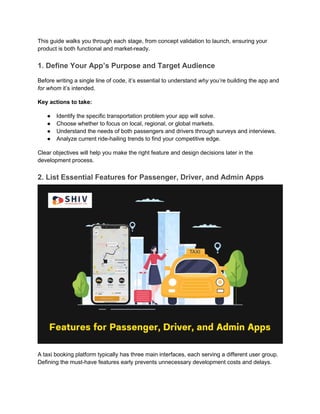
2. List Essential Features for Passenger, Driver, and Admin Apps
A taxi booking platform typically has three main interfaces, each serving a different user group.
Defining the must-have features early prevents unnecessary development costs and delays.
Passenger App Features:
● Easy sign-up/login options.
● Ride booking with location input and fare estimates.
● Real-time driver tracking on a map.
● Multiple payment methods (card, wallet, cash).
● Trip history and ride rating options.
Driver App Features:
● Profile creation and document verification.
● Ride request alerts and acceptance options.
● Navigation integration for route guidance.
● Earnings and trip history overview.
Admin Panel Capabilities:
● Manage passengers, drivers, and rides.
● Monitor payments and commissions.
● Access to analytics and performance reports.
● Handle disputes and customer support tickets.
A well-balanced feature list makes the app functional for all users and sets a strong foundation
for further improvements.
Also read: Chauffeur App Development
3. Plan the Development Process and Tech Stack
Selecting the right technologies and mapping out the workflow is crucial for building a stable and
scalable taxi booking app. A clear development plan also helps the team stay on track with
timelines and budgets.
Key steps to plan:
● Create a detailed project roadmap with milestones.
● Choose between native (Swift, Kotlin) or cross-platform (Flutter, React Native)
development.
● Select a backend framework such as Node.js, Django, or Spring Boot.
● Integrate third-party APIs for maps, payments, and notifications.
● Decide on database solutions like PostgreSQL, MySQL, or MongoDB.
The right tech stack not only supports current features but also allows easy scaling when your
user base grows.
4. Design a User-Friendly Interface
A taxi booking app’s success depends heavily on how easy it is for passengers and drivers to
use. A clear, intuitive design keeps users engaged and reduces the learning curve.
Key design considerations:
● Keep navigation simple with clearly labeled buttons and menus.
● Use consistent color schemes and fonts for a professional look.
● Ensure key actions like “Book Ride” or “Accept Ride” are easily accessible.
● Optimize the interface for both iOS and Android devices.
● Add visual cues like icons and progress indicators for better guidance.
An effective UI/UX design builds trust and encourages users to return, which is critical in the
competitive ride-hailing market.
5. Develop and Integrate Core Features
Once the design is finalized, it’s time to bring the app to life by coding and connecting all
essential functionalities. This stage ensures each component works smoothly for passengers,
drivers, and admins.
Core development tasks:
● Implement ride booking, fare calculation, and real-time tracking.
● Set up secure payment gateways for multiple payment methods.
● Integrate GPS and mapping services for accurate location detection.
● Build push notification systems for ride updates and alerts.
● Connect all modules to the backend and database.
Well-executed feature integration results in a reliable app that delivers consistent performance
under real-world conditions.
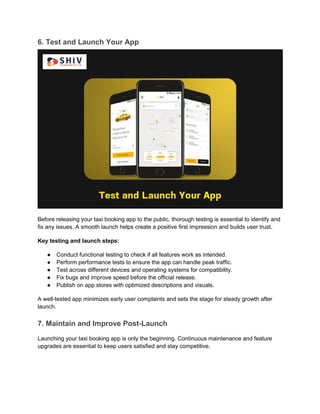
6. Test and Launch Your App
Before releasing your taxi booking app to the public, thorough testing is essential to identify and
fix any issues. A smooth launch helps create a positive first impression and builds user trust.
Key testing and launch steps:
● Conduct functional testing to check if all features work as intended.
● Perform performance tests to ensure the app can handle peak traffic.
● Test across different devices and operating systems for compatibility.
● Fix bugs and improve speed before the official release.
● Publish on app stores with optimized descriptions and visuals.
A well-tested app minimizes early user complaints and sets the stage for steady growth after
launch.
7. Maintain and Improve Post-Launch
Launching your taxi booking app is only the beginning. Continuous maintenance and feature
upgrades are essential to keep users satisfied and stay competitive.
Post-launch priorities:
● Monitor app performance and fix bugs promptly.
● Release updates with new features or UI improvements.
● Track user feedback to understand pain points and expectations.
● Analyze ride data to improve matching speed and pricing accuracy.
● Keep security measures updated to protect user information.
Consistent improvements not only retain existing users but also attract new ones through better
functionality and user experience.
Shiv Technolabs - Taxi Booking App Development Company
At Shiv Technolabs, we specialize in crafting high-performance taxi booking applications
tailored to your business model.
Our team covers everything from concept validation to deployment, ensuring your app is secure,
scalable, and user-friendly.
With expertise in advanced technologies, API integrations, and intuitive UI/UX design, we
deliver solutions that help you stand out in a competitive market. Whether you’re building an
MVP or a fully-featured platform, we can bring your vision to life with precision and reliability.
Conclusion
Building a taxi booking app from scratch requires careful planning, the right technology, and an
experienced development partner.
By following a structured process—research, design, development, testing, and post-launch
support—you can create an app that delivers value to both riders and drivers.
Contact us to discuss your project and start developing a taxi booking app that meets your
business goals.

Complete Guide to Making a Taxi Booking App

  • 1.
    How to Builda Taxi Booking App from Scratch The taxi booking industry has transformed how people travel, offering faster connections between riders and drivers through mobile technology. Building your taxi booking app from scratch with the right taxi app development services opens the door to a high-demand market where convenience and speed define customer loyalty. Whether you’re targeting a local audience or planning to operate in multiple cities, a well- planned app can help you stand out. This journey involves more than just coding—it’s about creating a platform that balances smooth functionality with user-friendly design, strong security, and reliable performance. Step-by-Step Guide to Creating a Taxi Booking App Building a taxi booking app from scratch involves more than coding — it’s a structured process that blends market research, design, and technology choices. By following a clear set of steps, you can create an app that meets user expectations while staying competitive.
  • 2.
    This guide walksyou through each stage, from concept validation to launch, ensuring your product is both functional and market-ready. 1. Define Your App’s Purpose and Target Audience Before writing a single line of code, it’s essential to understand why you’re building the app and for whom it’s intended. Key actions to take: ● Identify the specific transportation problem your app will solve. ● Choose whether to focus on local, regional, or global markets. ● Understand the needs of both passengers and drivers through surveys and interviews. ● Analyze current ride-hailing trends to find your competitive edge. Clear objectives will help you make the right feature and design decisions later in the development process. 2. List Essential Features for Passenger, Driver, and Admin Apps A taxi booking platform typically has three main interfaces, each serving a different user group. Defining the must-have features early prevents unnecessary development costs and delays.
  • 3.
    Passenger App Features: ●Easy sign-up/login options. ● Ride booking with location input and fare estimates. ● Real-time driver tracking on a map. ● Multiple payment methods (card, wallet, cash). ● Trip history and ride rating options. Driver App Features: ● Profile creation and document verification. ● Ride request alerts and acceptance options. ● Navigation integration for route guidance. ● Earnings and trip history overview. Admin Panel Capabilities: ● Manage passengers, drivers, and rides. ● Monitor payments and commissions. ● Access to analytics and performance reports. ● Handle disputes and customer support tickets. A well-balanced feature list makes the app functional for all users and sets a strong foundation for further improvements. Also read: Chauffeur App Development 3. Plan the Development Process and Tech Stack Selecting the right technologies and mapping out the workflow is crucial for building a stable and scalable taxi booking app. A clear development plan also helps the team stay on track with timelines and budgets. Key steps to plan: ● Create a detailed project roadmap with milestones. ● Choose between native (Swift, Kotlin) or cross-platform (Flutter, React Native) development. ● Select a backend framework such as Node.js, Django, or Spring Boot. ● Integrate third-party APIs for maps, payments, and notifications. ● Decide on database solutions like PostgreSQL, MySQL, or MongoDB. The right tech stack not only supports current features but also allows easy scaling when your user base grows.
  • 4.
    4. Design aUser-Friendly Interface A taxi booking app’s success depends heavily on how easy it is for passengers and drivers to use. A clear, intuitive design keeps users engaged and reduces the learning curve. Key design considerations: ● Keep navigation simple with clearly labeled buttons and menus. ● Use consistent color schemes and fonts for a professional look. ● Ensure key actions like “Book Ride” or “Accept Ride” are easily accessible. ● Optimize the interface for both iOS and Android devices. ● Add visual cues like icons and progress indicators for better guidance. An effective UI/UX design builds trust and encourages users to return, which is critical in the competitive ride-hailing market. 5. Develop and Integrate Core Features Once the design is finalized, it’s time to bring the app to life by coding and connecting all essential functionalities. This stage ensures each component works smoothly for passengers, drivers, and admins. Core development tasks: ● Implement ride booking, fare calculation, and real-time tracking. ● Set up secure payment gateways for multiple payment methods. ● Integrate GPS and mapping services for accurate location detection. ● Build push notification systems for ride updates and alerts. ● Connect all modules to the backend and database. Well-executed feature integration results in a reliable app that delivers consistent performance under real-world conditions.
  • 5.
    6. Test andLaunch Your App Before releasing your taxi booking app to the public, thorough testing is essential to identify and fix any issues. A smooth launch helps create a positive first impression and builds user trust. Key testing and launch steps: ● Conduct functional testing to check if all features work as intended. ● Perform performance tests to ensure the app can handle peak traffic. ● Test across different devices and operating systems for compatibility. ● Fix bugs and improve speed before the official release. ● Publish on app stores with optimized descriptions and visuals. A well-tested app minimizes early user complaints and sets the stage for steady growth after launch. 7. Maintain and Improve Post-Launch Launching your taxi booking app is only the beginning. Continuous maintenance and feature upgrades are essential to keep users satisfied and stay competitive.
  • 6.
    Post-launch priorities: ● Monitorapp performance and fix bugs promptly. ● Release updates with new features or UI improvements. ● Track user feedback to understand pain points and expectations. ● Analyze ride data to improve matching speed and pricing accuracy. ● Keep security measures updated to protect user information. Consistent improvements not only retain existing users but also attract new ones through better functionality and user experience. Shiv Technolabs - Taxi Booking App Development Company At Shiv Technolabs, we specialize in crafting high-performance taxi booking applications tailored to your business model. Our team covers everything from concept validation to deployment, ensuring your app is secure, scalable, and user-friendly. With expertise in advanced technologies, API integrations, and intuitive UI/UX design, we deliver solutions that help you stand out in a competitive market. Whether you’re building an MVP or a fully-featured platform, we can bring your vision to life with precision and reliability. Conclusion Building a taxi booking app from scratch requires careful planning, the right technology, and an experienced development partner. By following a structured process—research, design, development, testing, and post-launch support—you can create an app that delivers value to both riders and drivers. Contact us to discuss your project and start developing a taxi booking app that meets your business goals.