What Businesses Expect from Flutter Developers
Today
Flutter has become a top choice for building mobile applications. Businesses now want fast
development, better design control, and reliable app performance. Many companies now
look to hire dedicated Flutter developers who can deliver all these without delay. This article
outlines what businesses expect from Flutter developers in 2025.
Flutter's rise is no accident. It provides a single codebase for Android and iOS, which saves
time and cost. With regular updates and strong community support, Flutter continues to stay
relevant. If you're planning to build a high-quality mobile app, it's important to understand what
makes a Flutter developer valuable. These expectations help filter candidates who can truly
support your business goals.
A qualified Flutter developer brings more than technical skills—they help reduce development
time, minimize bugs, and align with your vision.
Key Skills and Qualities Businesses Seek in Flutter
Developers
To meet business demands, Flutter developers need more than coding experience. They should
bring a deep understanding of app performance, interface design, and backend integration.
Clear communication and a structured approach to development also play a big part. In the
sections below, we break down the core qualities that businesses expect from top-tier Flutter
professionals.
1. Strong Command of Dart and Flutter Basics
Every Flutter developer must know Dart well. This includes object-oriented concepts,
asynchronous programming, and error handling. Businesses expect developers to write clean,
readable code that avoids bugs. A strong grasp of Flutter widgets, layout rules, and build
methods is essential.
Developers should be confident using stateful and stateless widgets. They must know how to
manage state using methods like Provider or Bloc. Without these basics, it’s hard to deliver
reliable apps. They should also understand widget lifecycles and how to debug UI issues.
Regular practice with Flutter’s official documentation helps improve their approach.
2. Ability to Deliver Cross-Platform Apps
Flutter offers one codebase for Android and iOS. Businesses hire Flutter developers to cut costs
and time. However, they expect consistency across platforms. Text, images, buttons, and
transitions must look and behave the same.
Flutter developers need to test the UI on both platforms. This includes checking device-specific
behavior and layout differences. The goal is a single app experience, not two separate products.
They should test with physical devices in addition to emulators. Proper testing reduces post-
launch issues and improves user feedback.
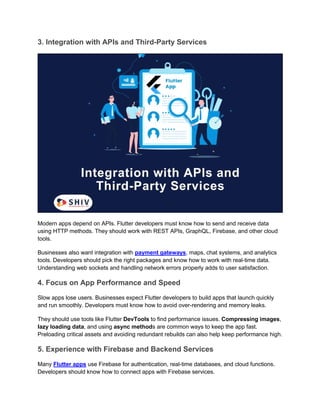
3. Integration with APIs and Third-Party Services
Modern apps depend on APIs. Flutter developers must know how to send and receive data
using HTTP methods. They should work with REST APIs, GraphQL, Firebase, and other cloud
tools.
Businesses also want integration with payment gateways, maps, chat systems, and analytics
tools. Developers should pick the right packages and know how to work with real-time data.
Understanding web sockets and handling network errors properly adds to user satisfaction.
4. Focus on App Performance and Speed
Slow apps lose users. Businesses expect Flutter developers to build apps that launch quickly
and run smoothly. Developers must know how to avoid over-rendering and memory leaks.
They should use tools like Flutter DevTools to find performance issues. Compressing images,
lazy loading data, and using async methods are common ways to keep the app fast.
Preloading critical assets and avoiding redundant rebuilds can also help keep performance high.
5. Experience with Firebase and Backend Services
Many Flutter apps use Firebase for authentication, real-time databases, and cloud functions.
Developers should know how to connect apps with Firebase services.
Besides Firebase, businesses may want other backend systems. Developers must understand
JSON, manage tokens, and handle login flows. These features are now expected, not extra.
Working with APIs like Supabase or Hasura is also becoming more common.
6. Responsive Design and Pixel-Perfect UI
Flutter allows full control over the interface. But with this freedom comes responsibility.
Businesses want apps to look sharp on all screen sizes.
Developers must design for different devices. They should use layout widgets like MediaQuery,
LayoutBuilder, and Flex wisely. Padding, alignment, and font sizes should match the design
plan. Testing across devices ensures all screens provide a consistent user experience.
7. Use of Popular Libraries and Plugins
Businesses expect developers to save time without cutting corners. This is where Flutter’s
plugins help. Developers must know which plugins are safe and well-supported.
Popular examples include:
● http for network calls
● shared_preferences for local storage
● firebase_auth for login
● provider or riverpod for state management
● flutter_local_notifications for push alerts
Choosing the right plugin can reduce bugs and shorten the timeline. Developers should check
plugin popularity and maintenance before adding them to a project.
Also read: How to Create a Custom Flutter Plugin: Step-by-Step Guide
8. Testing and Quality Checks
Testing is no longer optional. Flutter developers must test their apps before release. This
includes unit tests, widget tests, and integration tests.
Businesses expect fewer bugs and stable updates. Developers must use test frameworks and
write readable test cases. Mocking, stubs, and test coverage are now part of the job. They
should also be familiar with CI tools that automate test cycles.
9. App Deployment Skills
Publishing apps to the Play Store or App Store involves many steps. Flutter developers must
handle app signing, build flavors, and release configurations.
They must also handle updates and patch releases. Businesses want someone to finish the
project and get it live on both stores. Familiarity with versioning, crash reporting, and A/B testing
tools adds value.
10. Code Structure and Clean Architecture
Code must be easy to follow and scale. Flutter developers should avoid writing all logic in one
file. They must break code into services, models, views, and controllers.
Architectures like MVVM, Clean Architecture, or Bloc help here. Businesses prefer working
with teams that maintain clear codebases that others can pick up later. Keeping the codebase
modular also makes it easier to introduce new features.
11. Communication and Collaboration
Businesses now want more than just coding skills. Developers should know how to work with
UI/UX designers, testers, and project managers.
They must explain technical choices in simple terms. Clear comments, documentation, and
regular updates help teams move faster. Developers should also be available during team
standups and sprint meetings.
12. Knowledge of Security Best Practices
Security matters to every business. Flutter developers should not store sensitive data in plain
text. They should use encrypted storage and follow secure login practices.
Token handling, session expiry, and validation must be done correctly. Businesses expect
developers to reduce risks, not add them. Understanding certificate pinning and data
sanitization helps avoid potential threats.
13. Willingness to Learn New Tools and Features
Flutter keeps evolving. From Impeller rendering engine to updates in Dart, things change often.
Businesses want developers who stay current.
Joining forums, reading official updates, and testing beta features shows that a developer stays
ready for new demands. Developers should attend webinars and contribute to open-source
projects to build their skills further.
Why Businesses Choose Shiv Technolabs
At Shiv Technolabs, we work closely with our clients to deliver strong, fast, and reliable Flutter
apps. Our team follows a well-planned process, from wireframes to app launch. We keep our
communication clear and our code clean. Whether you need an MVP or a full-scale app, we
bring the skills to the table.
We build apps that work well, look great, and solve real business needs. If you're planning to
get Flutter app developers who understand your goals and deliver real value, our experts are
ready to help you move forward.
Conclusion
In 2025, businesses expect more than just basic app development. They want developers who
can manage performance, quality, backend connections, and design. Communication and
security also play a big role.
If you're looking to hire dedicated Flutter developers, make sure they meet these
expectations. And if you want a team that delivers exactly what modern businesses need, Shiv
Technolabs can help. Contact us today to find the right team for your project.

Detailed Guide on Skills Businesses Expect from Flutter Developers

  • 1.
    What Businesses Expectfrom Flutter Developers Today Flutter has become a top choice for building mobile applications. Businesses now want fast development, better design control, and reliable app performance. Many companies now look to hire dedicated Flutter developers who can deliver all these without delay. This article outlines what businesses expect from Flutter developers in 2025. Flutter's rise is no accident. It provides a single codebase for Android and iOS, which saves time and cost. With regular updates and strong community support, Flutter continues to stay relevant. If you're planning to build a high-quality mobile app, it's important to understand what makes a Flutter developer valuable. These expectations help filter candidates who can truly support your business goals. A qualified Flutter developer brings more than technical skills—they help reduce development time, minimize bugs, and align with your vision.
  • 2.
    Key Skills andQualities Businesses Seek in Flutter Developers To meet business demands, Flutter developers need more than coding experience. They should bring a deep understanding of app performance, interface design, and backend integration. Clear communication and a structured approach to development also play a big part. In the sections below, we break down the core qualities that businesses expect from top-tier Flutter professionals. 1. Strong Command of Dart and Flutter Basics Every Flutter developer must know Dart well. This includes object-oriented concepts, asynchronous programming, and error handling. Businesses expect developers to write clean, readable code that avoids bugs. A strong grasp of Flutter widgets, layout rules, and build methods is essential. Developers should be confident using stateful and stateless widgets. They must know how to manage state using methods like Provider or Bloc. Without these basics, it’s hard to deliver reliable apps. They should also understand widget lifecycles and how to debug UI issues. Regular practice with Flutter’s official documentation helps improve their approach. 2. Ability to Deliver Cross-Platform Apps Flutter offers one codebase for Android and iOS. Businesses hire Flutter developers to cut costs and time. However, they expect consistency across platforms. Text, images, buttons, and transitions must look and behave the same. Flutter developers need to test the UI on both platforms. This includes checking device-specific behavior and layout differences. The goal is a single app experience, not two separate products. They should test with physical devices in addition to emulators. Proper testing reduces post- launch issues and improves user feedback.
  • 3.
    3. Integration withAPIs and Third-Party Services Modern apps depend on APIs. Flutter developers must know how to send and receive data using HTTP methods. They should work with REST APIs, GraphQL, Firebase, and other cloud tools. Businesses also want integration with payment gateways, maps, chat systems, and analytics tools. Developers should pick the right packages and know how to work with real-time data. Understanding web sockets and handling network errors properly adds to user satisfaction. 4. Focus on App Performance and Speed Slow apps lose users. Businesses expect Flutter developers to build apps that launch quickly and run smoothly. Developers must know how to avoid over-rendering and memory leaks. They should use tools like Flutter DevTools to find performance issues. Compressing images, lazy loading data, and using async methods are common ways to keep the app fast. Preloading critical assets and avoiding redundant rebuilds can also help keep performance high. 5. Experience with Firebase and Backend Services Many Flutter apps use Firebase for authentication, real-time databases, and cloud functions. Developers should know how to connect apps with Firebase services.
  • 4.
    Besides Firebase, businessesmay want other backend systems. Developers must understand JSON, manage tokens, and handle login flows. These features are now expected, not extra. Working with APIs like Supabase or Hasura is also becoming more common. 6. Responsive Design and Pixel-Perfect UI Flutter allows full control over the interface. But with this freedom comes responsibility. Businesses want apps to look sharp on all screen sizes. Developers must design for different devices. They should use layout widgets like MediaQuery, LayoutBuilder, and Flex wisely. Padding, alignment, and font sizes should match the design plan. Testing across devices ensures all screens provide a consistent user experience. 7. Use of Popular Libraries and Plugins Businesses expect developers to save time without cutting corners. This is where Flutter’s plugins help. Developers must know which plugins are safe and well-supported. Popular examples include: ● http for network calls ● shared_preferences for local storage ● firebase_auth for login ● provider or riverpod for state management ● flutter_local_notifications for push alerts Choosing the right plugin can reduce bugs and shorten the timeline. Developers should check plugin popularity and maintenance before adding them to a project. Also read: How to Create a Custom Flutter Plugin: Step-by-Step Guide 8. Testing and Quality Checks Testing is no longer optional. Flutter developers must test their apps before release. This includes unit tests, widget tests, and integration tests. Businesses expect fewer bugs and stable updates. Developers must use test frameworks and write readable test cases. Mocking, stubs, and test coverage are now part of the job. They should also be familiar with CI tools that automate test cycles.
  • 5.
    9. App DeploymentSkills Publishing apps to the Play Store or App Store involves many steps. Flutter developers must handle app signing, build flavors, and release configurations. They must also handle updates and patch releases. Businesses want someone to finish the project and get it live on both stores. Familiarity with versioning, crash reporting, and A/B testing tools adds value. 10. Code Structure and Clean Architecture Code must be easy to follow and scale. Flutter developers should avoid writing all logic in one file. They must break code into services, models, views, and controllers. Architectures like MVVM, Clean Architecture, or Bloc help here. Businesses prefer working with teams that maintain clear codebases that others can pick up later. Keeping the codebase modular also makes it easier to introduce new features. 11. Communication and Collaboration Businesses now want more than just coding skills. Developers should know how to work with UI/UX designers, testers, and project managers.
  • 6.
    They must explaintechnical choices in simple terms. Clear comments, documentation, and regular updates help teams move faster. Developers should also be available during team standups and sprint meetings. 12. Knowledge of Security Best Practices Security matters to every business. Flutter developers should not store sensitive data in plain text. They should use encrypted storage and follow secure login practices. Token handling, session expiry, and validation must be done correctly. Businesses expect developers to reduce risks, not add them. Understanding certificate pinning and data sanitization helps avoid potential threats. 13. Willingness to Learn New Tools and Features Flutter keeps evolving. From Impeller rendering engine to updates in Dart, things change often. Businesses want developers who stay current. Joining forums, reading official updates, and testing beta features shows that a developer stays ready for new demands. Developers should attend webinars and contribute to open-source projects to build their skills further. Why Businesses Choose Shiv Technolabs At Shiv Technolabs, we work closely with our clients to deliver strong, fast, and reliable Flutter apps. Our team follows a well-planned process, from wireframes to app launch. We keep our communication clear and our code clean. Whether you need an MVP or a full-scale app, we bring the skills to the table. We build apps that work well, look great, and solve real business needs. If you're planning to get Flutter app developers who understand your goals and deliver real value, our experts are ready to help you move forward. Conclusion In 2025, businesses expect more than just basic app development. They want developers who can manage performance, quality, backend connections, and design. Communication and security also play a big role. If you're looking to hire dedicated Flutter developers, make sure they meet these expectations. And if you want a team that delivers exactly what modern businesses need, Shiv Technolabs can help. Contact us today to find the right team for your project.