An Assessment of Pricing & Competition
Concerns in Broadcast & Multimedia
Markets in Uganda
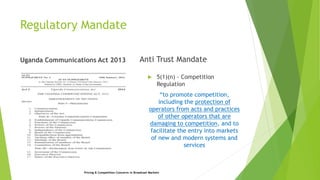
Regulatory Mandate
Uganda Communications Act 2013 Anti Trust Mandate
 5(1)(n) - Competition
Regulation
“to promote competition,
including the protection of
operators from acts and practices
of other operators that are
damaging to competition, and to
facilitate the entry into markets
of new and modern systems and
services
Pricing & Competition Concerns in Broadcast Markets
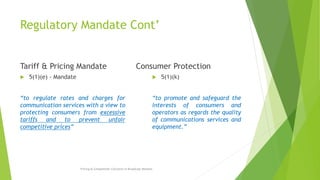
Regulatory Mandate Cont’
Tariff & Pricing Mandate
 5(1)(e) - Mandate
“to regulate rates and charges for
communication services with a view to
protecting consumers from excessive
tariffs and to prevent unfair
competitive prices”
Consumer Protection
 5(1)(k)
“to promote and safeguard the
interests of consumers and
operators as regards the quality
of communications services and
equipment.”
Pricing & Competition Concerns in Broadcast Markets
What we see in the market today
 Liberalization of the market has led
to the proliferation of actors in the
broadcast space
 More than 250 FM radio & 28 TV
Licensees
 Take the form of community &
commercial radios - Terrestrial FTA
TV, Satellite Pay TV, cable TV etc.
 The ecosystem also has a number of
emergent independent production
houses and a number of foreign
based FTA streams like Star times,
Kwese, Multichoice among others
Pricing & Competition Concerns in Broadcast Markets
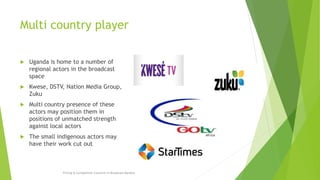
Multi country player
 Uganda is home to a number of
regional actors in the broadcast
space
 Kwese, DSTV, Nation Media Group,
Zuku
 Multi country presence of these
actors may position them in
positions of unmatched strength
against local actors
 The small indigenous actors may
have their work cut out
Pricing & Competition Concerns in Broadcast Markets
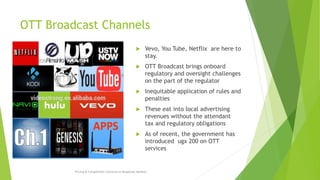
OTT Broadcast Channels
 Vevo, You Tube, Netflix are here to
stay.
 OTT Broadcast brings onboard
regulatory and oversight challenges
on the part of the regulator
 Inequitable application of rules and
penalties
 These eat into local advertising
revenues without the attendant
tax and regulatory obligations
 As of recent, the government has
introduced ugx 200 on OTT
services
Pricing & Competition Concerns in Broadcast Markets
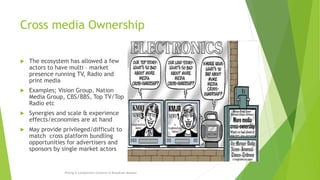
Cross media Ownership
 The ecosystem has allowed a few
actors to have multi – market
presence running TV, Radio and
print media
 Examples; Vision Group, Nation
Media Group, CBS/BBS, Top TV/Top
Radio etc
 Synergies and scale & experience
effects/economies are at hand
 May provide privileged/difficult to
match cross platform bundling
opportunities for advertisers and
sponsors by single market actors
Pricing & Competition Concerns in Broadcast Markets
Content Resale Obligations
 There is no framework for the
resale of media rights of premium
content in Uganda
 Rights to premium content like live
sport and entertainment are often
times obtained on commercial
exclusive agreements.
 exclusive ownership of premium
rights is the most important entry
barrier e.g Startimes exclusivity on
Ugandan Premier League rights
 Other competition authorities like
COMESA are probing the ownership
and sale of premium content like
CAF tournaments
Pricing & Competition Concerns in Broadcast Markets
Limited Pricing Transparency
 non- rate card offers by different
media houses are being offered to
consumers
 Bundled/Tied price offerings (One
price bundle for print & radio)
 Possible predatory pricing behavior
 National Association of Advertisers
(NAB) and Uganda Media Owners
Association (UMOA) have made
attempts to guide their members
Pricing & Competition Concerns in Broadcast Markets
Broadcast Mergers and Acquisitions
 The market has witnessed a couple
of M&As, strategic partnerships and
Exits
 Ex: WBS, NMG – Dembe FM, Capital
– Buddu FM
 Few leverage scale and experience
economies while many are simply
borne of the need to survive
 May lead to unintended abusive
conduct in the market like price
excessiveness, foreclosures, price
discrimination among others
Pricing & Competition Concerns in Broadcast Markets
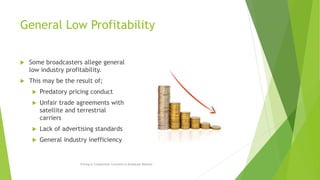
General Low Profitability
 Some broadcasters allege general
low industry profitability.
 This may be the result of;
 Predatory pricing conduct
 Unfair trade agreements with
satellite and terrestrial
carriers
 Lack of advertising standards
 General industry inefficiency
Pricing & Competition Concerns in Broadcast Markets
Methodology
 Choice of regulatory intervention
must be founded in good
understanding of the ecosystem
and the inherent lines of
commerce
 This is usually through an in-depth
market definition and market
power assessment exercise
 Market Definition: identification of
competing services
 Markets can be defined in 3
dimensions; structure-conduct-
Performance
 Time, geography and product-other
dimensions that can be used
 Market Power Assessment – extent
to which a firm or group of firms
can profitably act independent of
others
 A SSNIP test is used
Pricing & Competition Concerns in Broadcast Markets
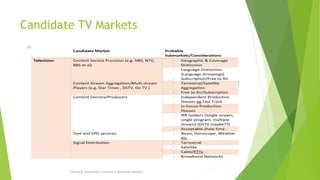
Candidate TV Markets
Pricing & Competition Concerns in Broadcast Markets
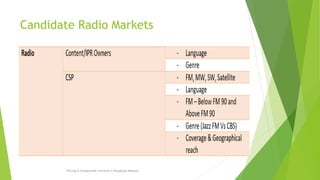
Candidate Radio Markets
Pricing & Competition Concerns in Broadcast Markets
Preliminary Regulatory Options
 Reference signal distribution
prices(satellite, terrestrial,
fibre/cable)
 Model carriage agreements
(Commercial FTAs and Satellite
carriers)
 Retail Price Floors
 Must Offer Must Carry Obligations
 Mergers and transfer guidelines
 Regulatory Guidance on cross
media ownership
 License amendment proposals
Pricing & Competition Concerns in Broadcast Markets
References
 Uganda Communications Act 2013
 Tariff and Accounting Regulations 2005
 Standards for general broadcasting programming in Uganda 2015
 https://www.mtn.co.ug/en/products/internet/Pages/OTT-Services-.aspx
 Common Market for East & Southern Africa(COMESA) Competition Commission.
www.comesacompetition.org
Pricing & Competition Concerns in Broadcast Markets
Created for GSMA, Competition
policy in the digital age course
By Umar Billy Ssemakula
Pricing & Competition Concerns in Broadcast Markets

Competition policy in digital era course

  • 1.
    An Assessment ofPricing & Competition Concerns in Broadcast & Multimedia Markets in Uganda
  • 2.
    Regulatory Mandate Uganda CommunicationsAct 2013 Anti Trust Mandate  5(1)(n) - Competition Regulation “to promote competition, including the protection of operators from acts and practices of other operators that are damaging to competition, and to facilitate the entry into markets of new and modern systems and services Pricing & Competition Concerns in Broadcast Markets
  • 3.
    Regulatory Mandate Cont’ Tariff& Pricing Mandate  5(1)(e) - Mandate “to regulate rates and charges for communication services with a view to protecting consumers from excessive tariffs and to prevent unfair competitive prices” Consumer Protection  5(1)(k) “to promote and safeguard the interests of consumers and operators as regards the quality of communications services and equipment.” Pricing & Competition Concerns in Broadcast Markets
  • 4.
    What we seein the market today  Liberalization of the market has led to the proliferation of actors in the broadcast space  More than 250 FM radio & 28 TV Licensees  Take the form of community & commercial radios - Terrestrial FTA TV, Satellite Pay TV, cable TV etc.  The ecosystem also has a number of emergent independent production houses and a number of foreign based FTA streams like Star times, Kwese, Multichoice among others Pricing & Competition Concerns in Broadcast Markets
  • 5.
    Multi country player Uganda is home to a number of regional actors in the broadcast space  Kwese, DSTV, Nation Media Group, Zuku  Multi country presence of these actors may position them in positions of unmatched strength against local actors  The small indigenous actors may have their work cut out Pricing & Competition Concerns in Broadcast Markets
  • 6.
    OTT Broadcast Channels Vevo, You Tube, Netflix are here to stay.  OTT Broadcast brings onboard regulatory and oversight challenges on the part of the regulator  Inequitable application of rules and penalties  These eat into local advertising revenues without the attendant tax and regulatory obligations  As of recent, the government has introduced ugx 200 on OTT services Pricing & Competition Concerns in Broadcast Markets
  • 7.
    Cross media Ownership The ecosystem has allowed a few actors to have multi – market presence running TV, Radio and print media  Examples; Vision Group, Nation Media Group, CBS/BBS, Top TV/Top Radio etc  Synergies and scale & experience effects/economies are at hand  May provide privileged/difficult to match cross platform bundling opportunities for advertisers and sponsors by single market actors Pricing & Competition Concerns in Broadcast Markets
  • 8.
    Content Resale Obligations There is no framework for the resale of media rights of premium content in Uganda  Rights to premium content like live sport and entertainment are often times obtained on commercial exclusive agreements.  exclusive ownership of premium rights is the most important entry barrier e.g Startimes exclusivity on Ugandan Premier League rights  Other competition authorities like COMESA are probing the ownership and sale of premium content like CAF tournaments Pricing & Competition Concerns in Broadcast Markets
  • 9.
    Limited Pricing Transparency non- rate card offers by different media houses are being offered to consumers  Bundled/Tied price offerings (One price bundle for print & radio)  Possible predatory pricing behavior  National Association of Advertisers (NAB) and Uganda Media Owners Association (UMOA) have made attempts to guide their members Pricing & Competition Concerns in Broadcast Markets
  • 10.
    Broadcast Mergers andAcquisitions  The market has witnessed a couple of M&As, strategic partnerships and Exits  Ex: WBS, NMG – Dembe FM, Capital – Buddu FM  Few leverage scale and experience economies while many are simply borne of the need to survive  May lead to unintended abusive conduct in the market like price excessiveness, foreclosures, price discrimination among others Pricing & Competition Concerns in Broadcast Markets
  • 11.
    General Low Profitability Some broadcasters allege general low industry profitability.  This may be the result of;  Predatory pricing conduct  Unfair trade agreements with satellite and terrestrial carriers  Lack of advertising standards  General industry inefficiency Pricing & Competition Concerns in Broadcast Markets
  • 12.
    Methodology  Choice ofregulatory intervention must be founded in good understanding of the ecosystem and the inherent lines of commerce  This is usually through an in-depth market definition and market power assessment exercise  Market Definition: identification of competing services  Markets can be defined in 3 dimensions; structure-conduct- Performance  Time, geography and product-other dimensions that can be used  Market Power Assessment – extent to which a firm or group of firms can profitably act independent of others  A SSNIP test is used Pricing & Competition Concerns in Broadcast Markets
  • 13.
    Candidate TV Markets Pricing& Competition Concerns in Broadcast Markets
  • 14.
    Candidate Radio Markets Pricing& Competition Concerns in Broadcast Markets
  • 15.
    Preliminary Regulatory Options Reference signal distribution prices(satellite, terrestrial, fibre/cable)  Model carriage agreements (Commercial FTAs and Satellite carriers)  Retail Price Floors  Must Offer Must Carry Obligations  Mergers and transfer guidelines  Regulatory Guidance on cross media ownership  License amendment proposals Pricing & Competition Concerns in Broadcast Markets
  • 16.
    References  Uganda CommunicationsAct 2013  Tariff and Accounting Regulations 2005  Standards for general broadcasting programming in Uganda 2015  https://www.mtn.co.ug/en/products/internet/Pages/OTT-Services-.aspx  Common Market for East & Southern Africa(COMESA) Competition Commission. www.comesacompetition.org Pricing & Competition Concerns in Broadcast Markets
  • 17.
    Created for GSMA,Competition policy in the digital age course By Umar Billy Ssemakula Pricing & Competition Concerns in Broadcast Markets