T
A
B
L
E
O
F
C
O
N
T
E
N
T
S
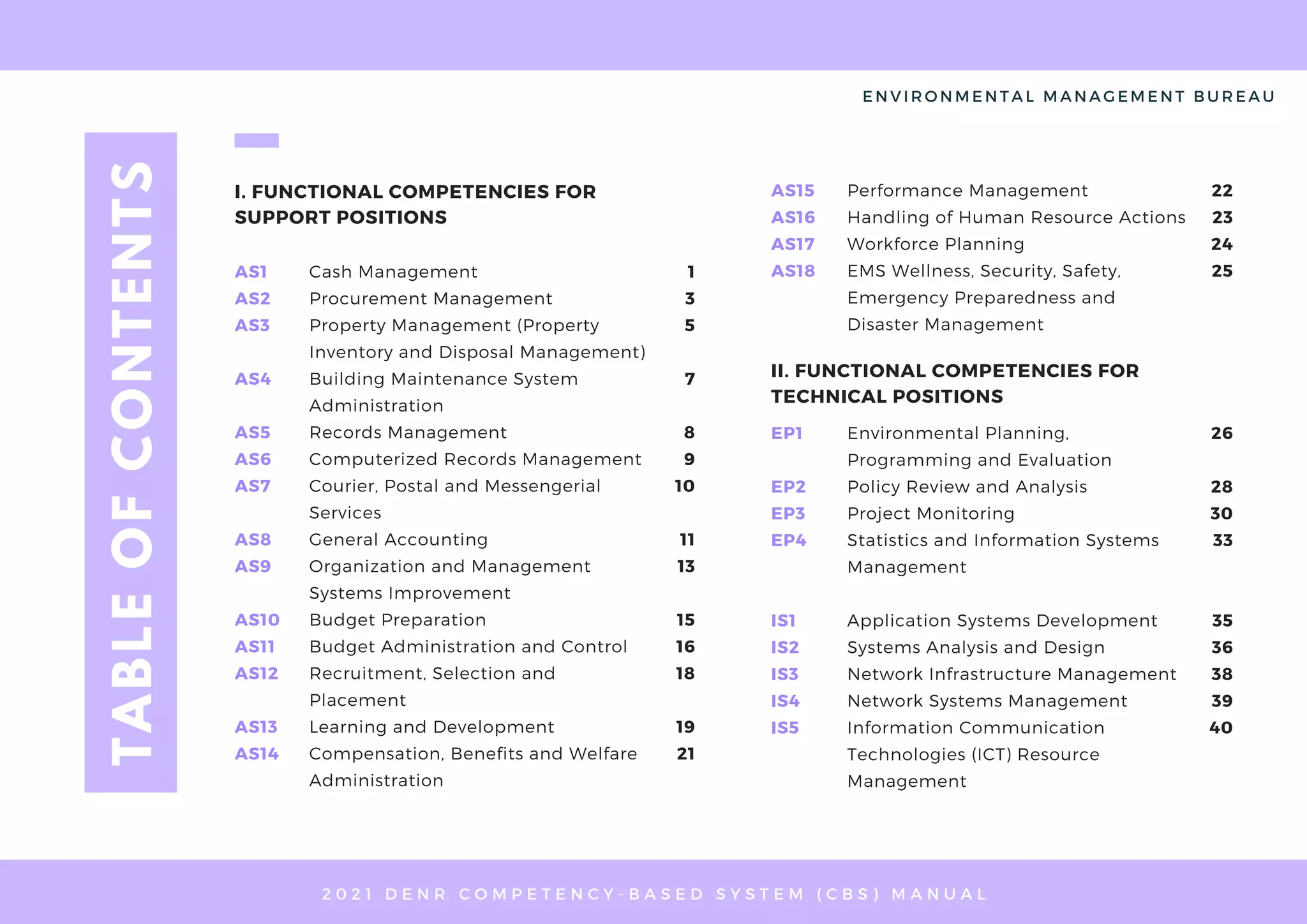
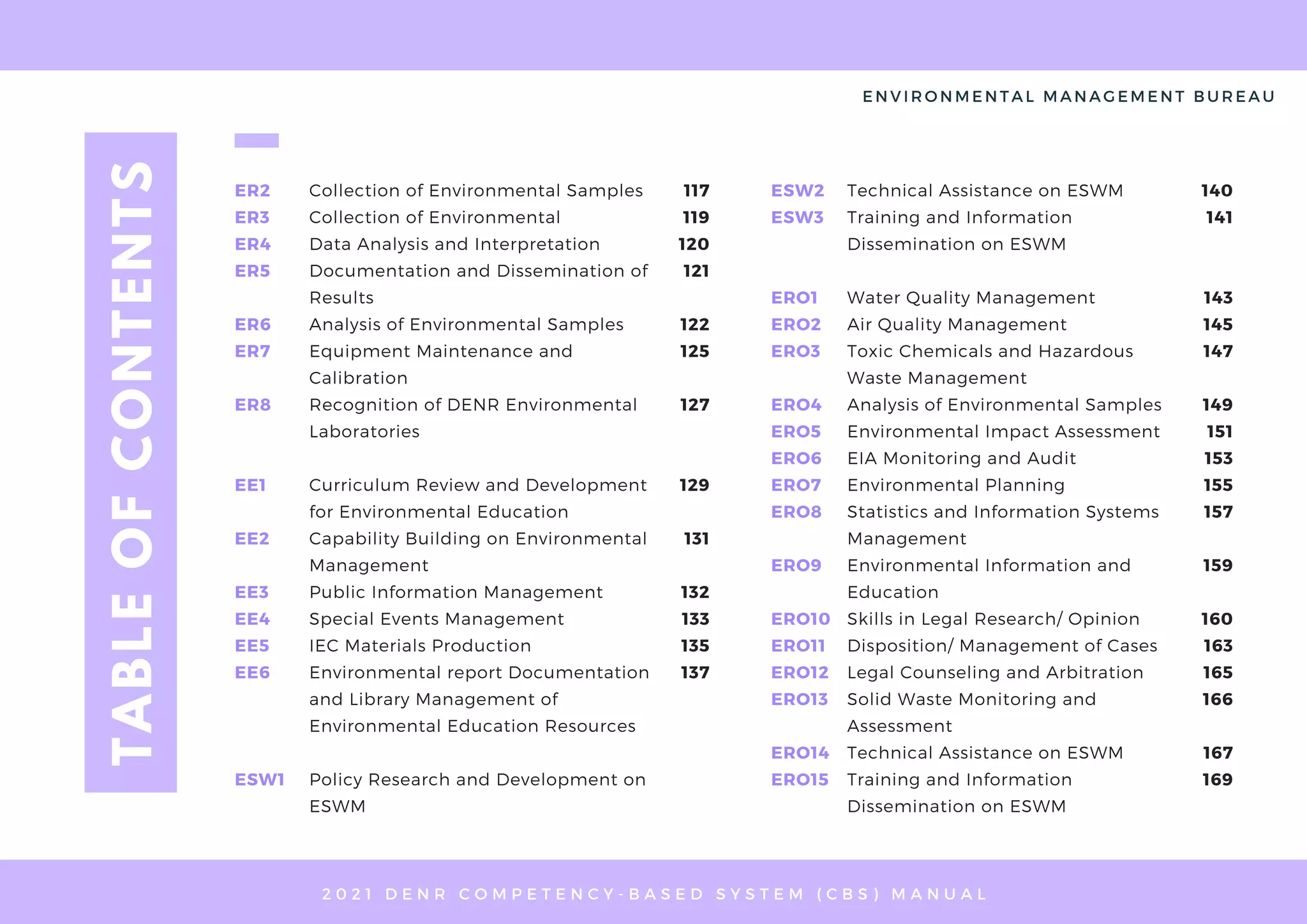
I. FUNCTIONAL COMPETENCIES FOR
SUPPORT POSITIONS
E N V I R O N M E N T A L M A N A G E M E N T B U R E A U
2 0 2 1 D E N R C O M P E T E N C Y - B A S E D S Y S T E M ( C B S ) M A N U A L
Cash Management
Procurement Management
Property Management (Property
Inventory and Disposal Management)
Building Maintenance System
Administration
Records Management
Computerized Records Management
Courier, Postal and Messengerial
Services
General Accounting
Organization and Management
Systems Improvement
Budget Preparation
Budget Administration and Control
Recruitment, Selection and
Placement
Learning and Development
Compensation, Benefits and Welfare
Administration
1
3
5
7
8
9
10
11
13
15
16
18
19
21
AS1
AS2
AS3
AS4
AS5
AS6
AS7
AS8
AS9
AS10
AS11
AS12
AS13
AS14
Performance Management
Handling of Human Resource Actions
Workforce Planning
EMS Wellness, Security, Safety,
Emergency Preparedness and
Disaster Management
22
23
24
25
AS15
AS16
AS17
AS18
II. FUNCTIONAL COMPETENCIES FOR
TECHNICAL POSITIONS
Environmental Planning,
Programming and Evaluation
Policy Review and Analysis
Project Monitoring
Statistics and Information Systems
Management
Application Systems Development
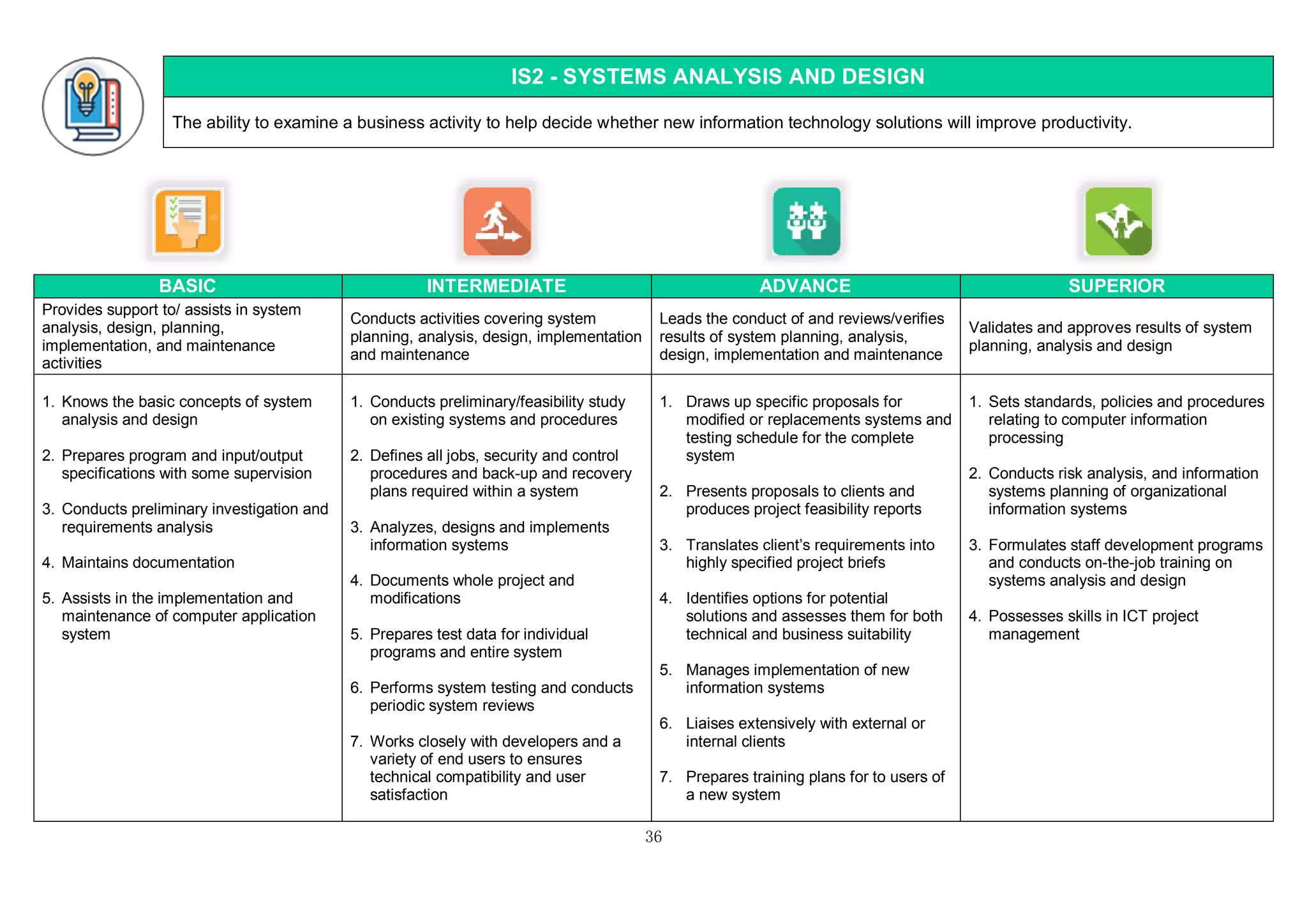
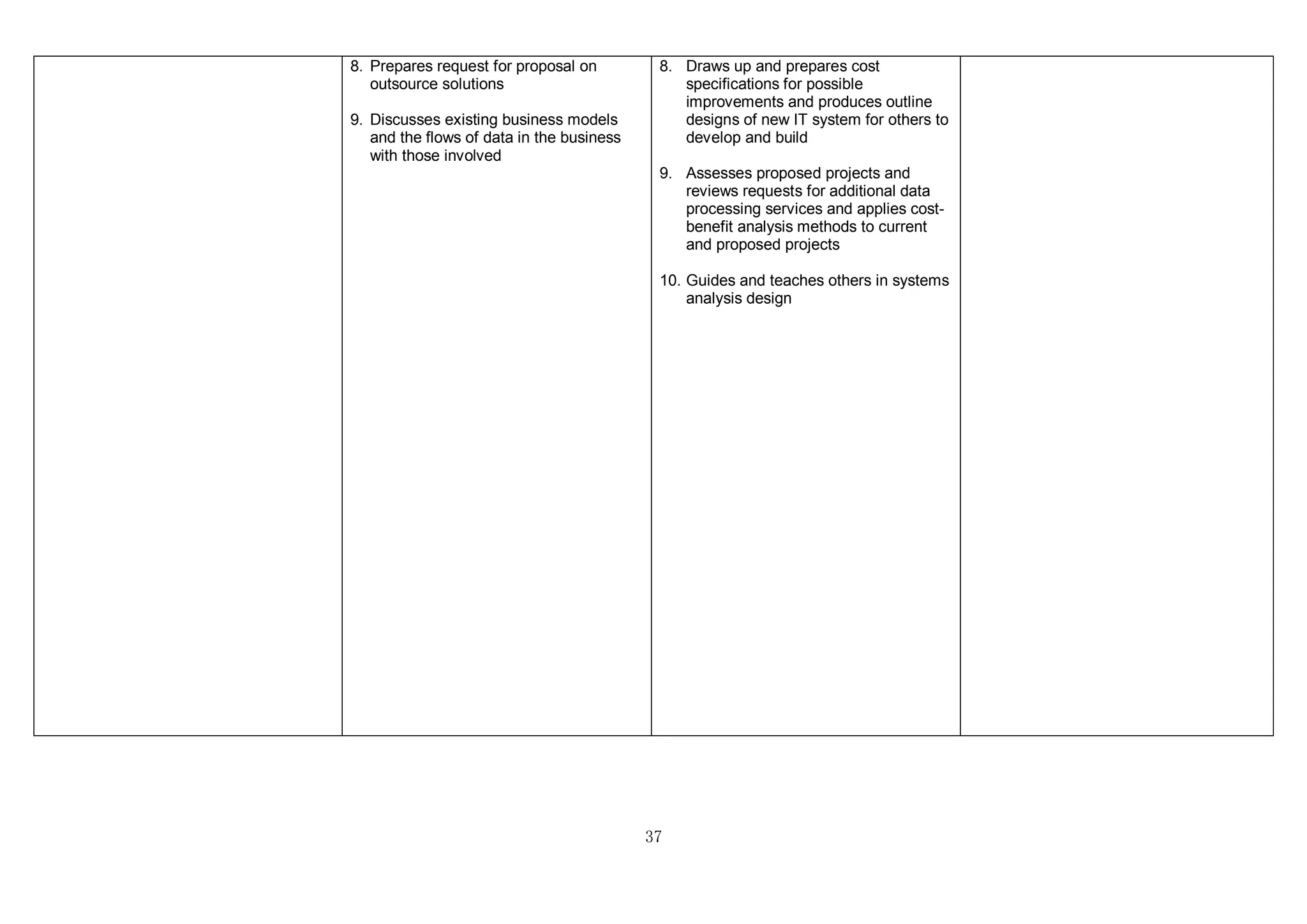
Systems Analysis and Design
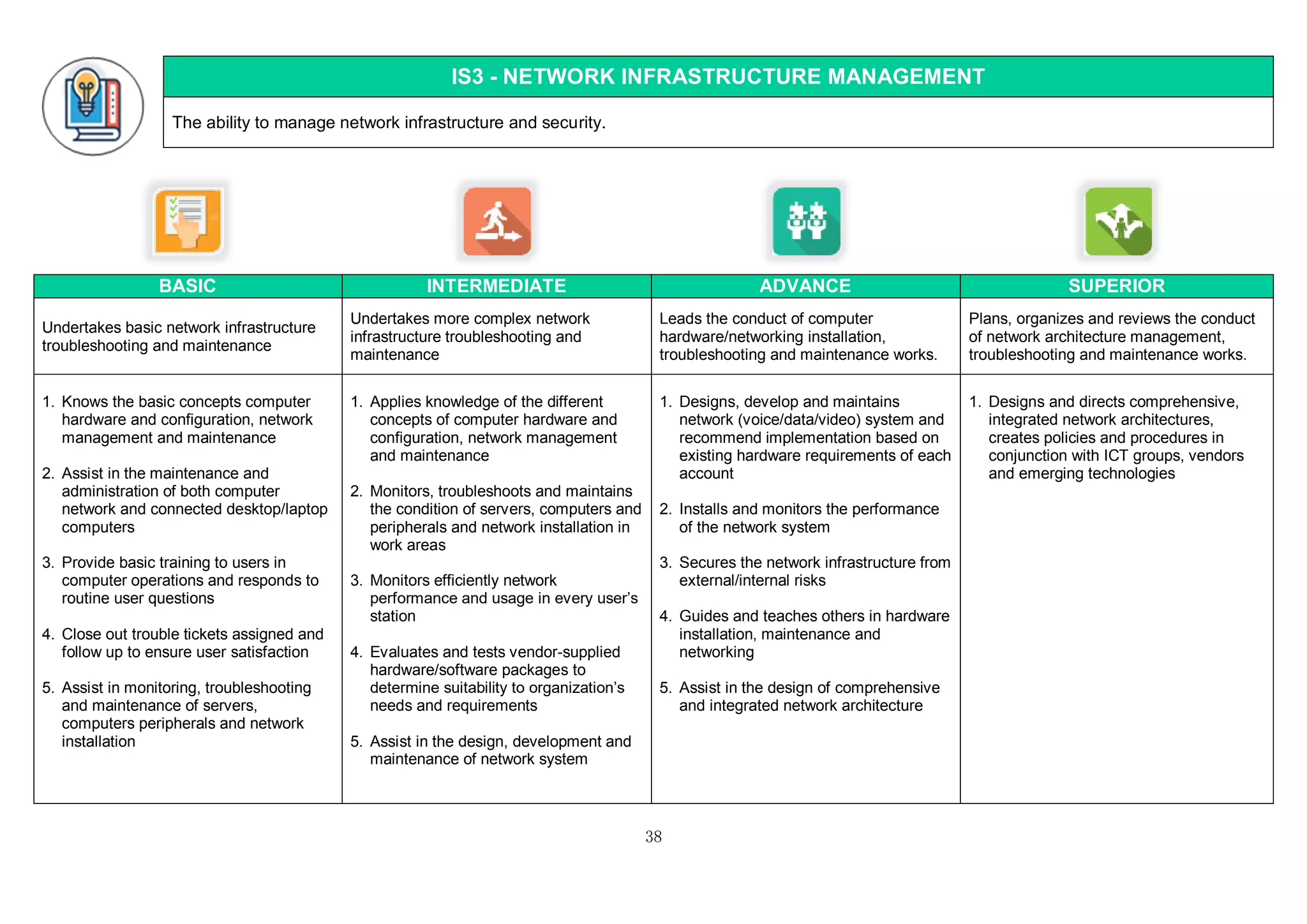
Network Infrastructure Management
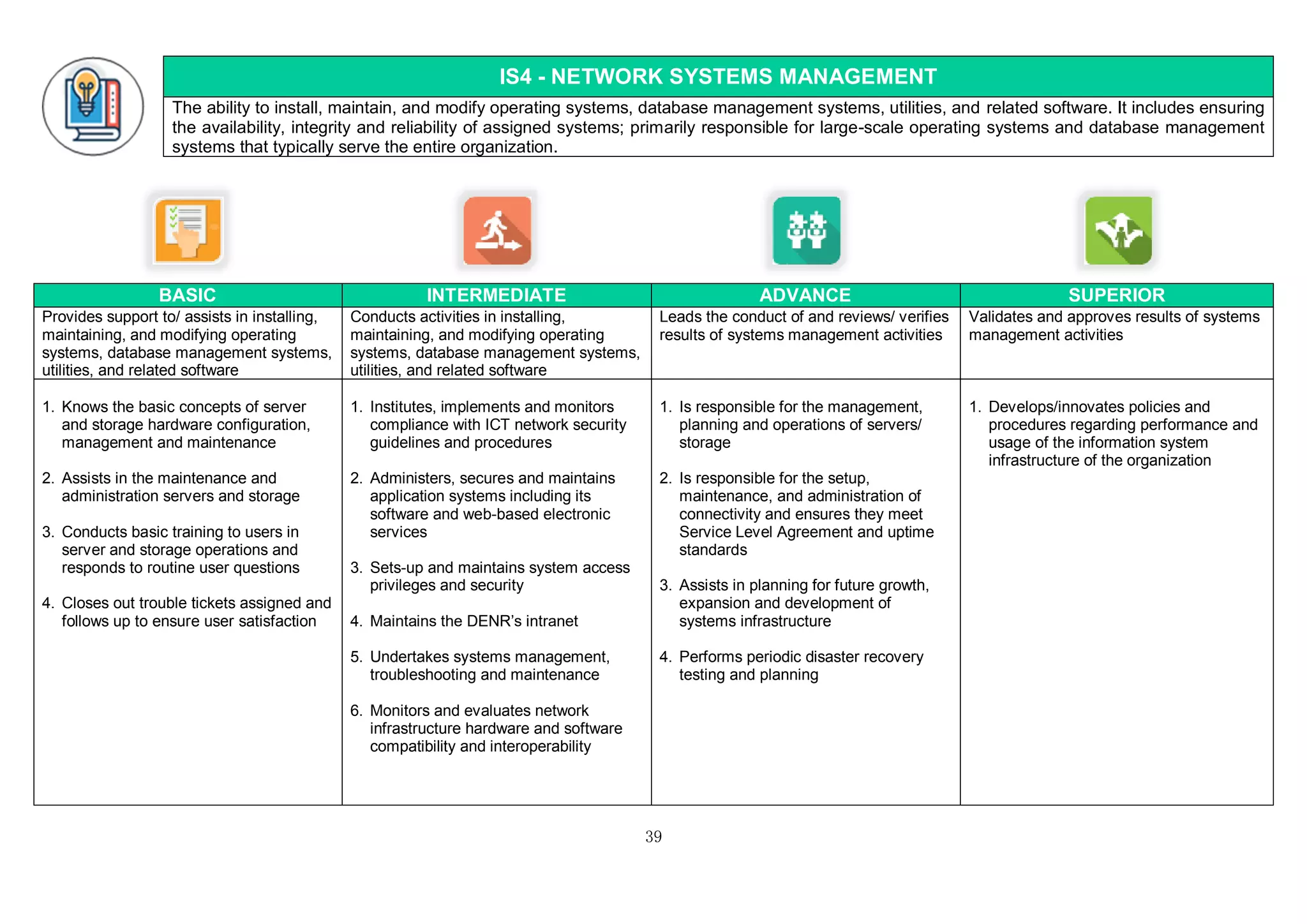
Network Systems Management
Information Communication
Technologies (ICT) Resource
Management
26
28
30
33
35
36
38
39
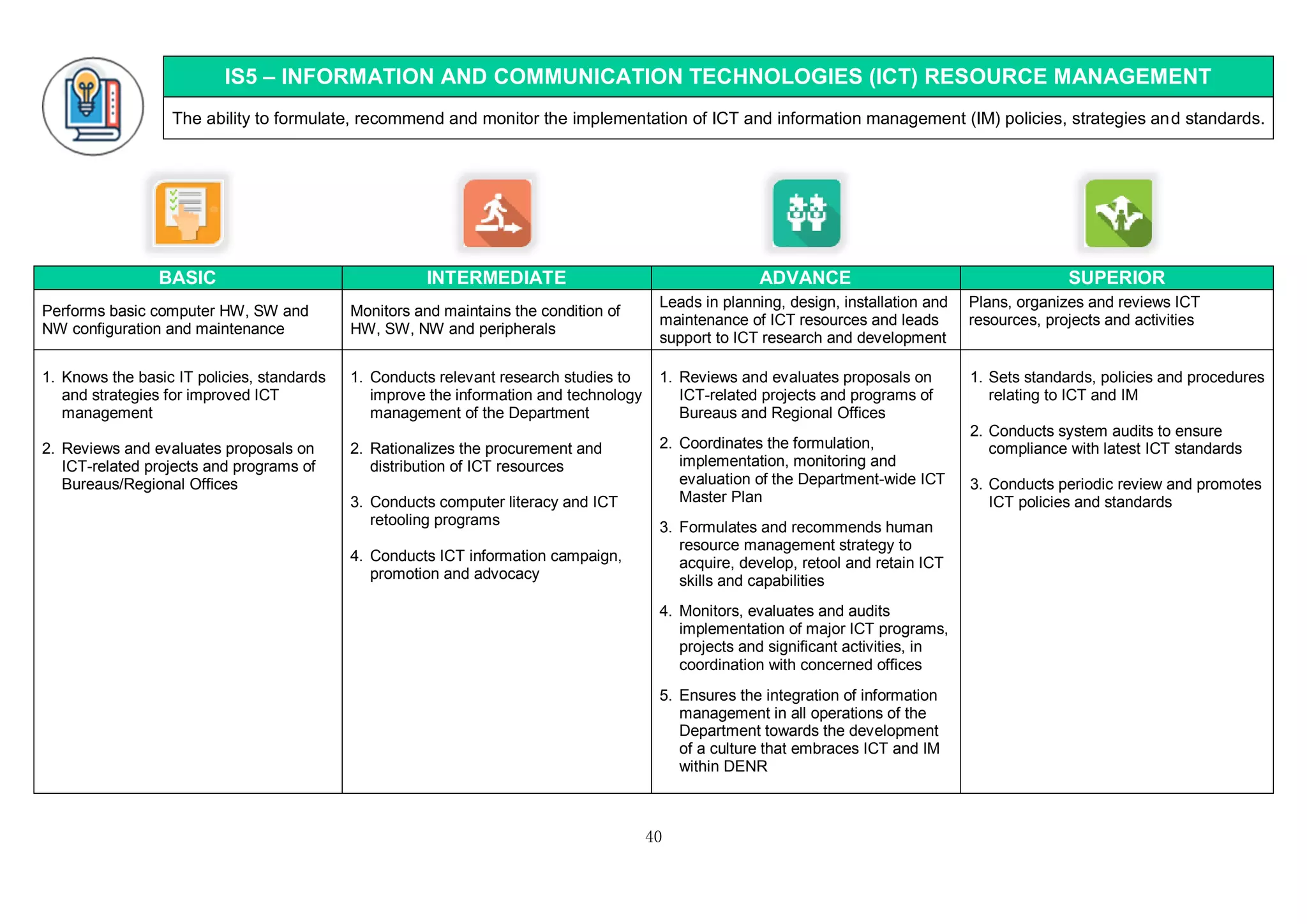
40
EP1
EP2
EP3
EP4
IS1
IS2
IS3
IS4
IS5
T
A
B
L
E
O
F
C
O
N
T
E
N
T
S
E N V I R O N M E N T A L M A N A G E M E N T B U R E A U
2 0 2 1 D E N R C O M P E T E N C Y - B A S E D S Y S T E M ( C B S ) M A N U A L
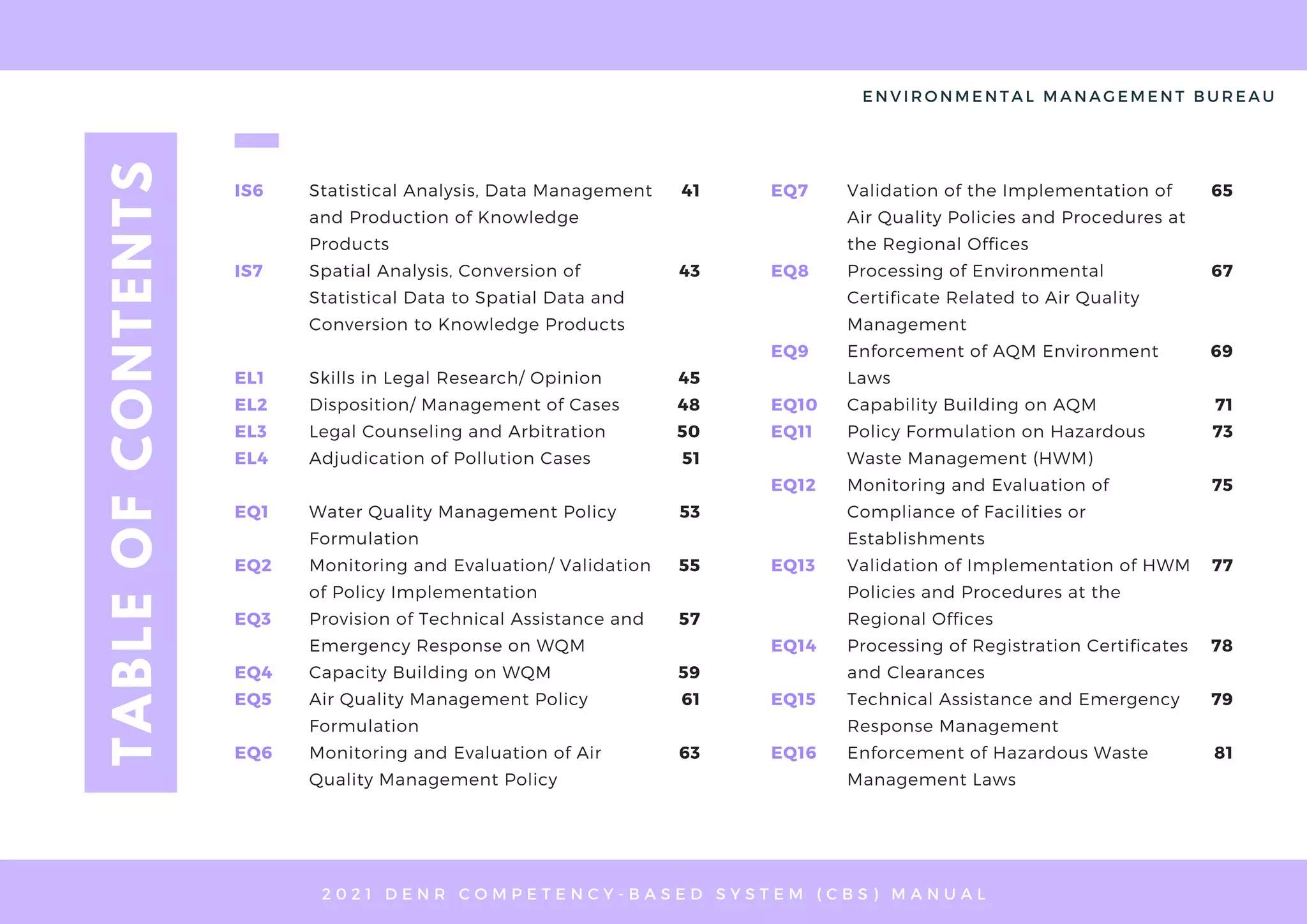
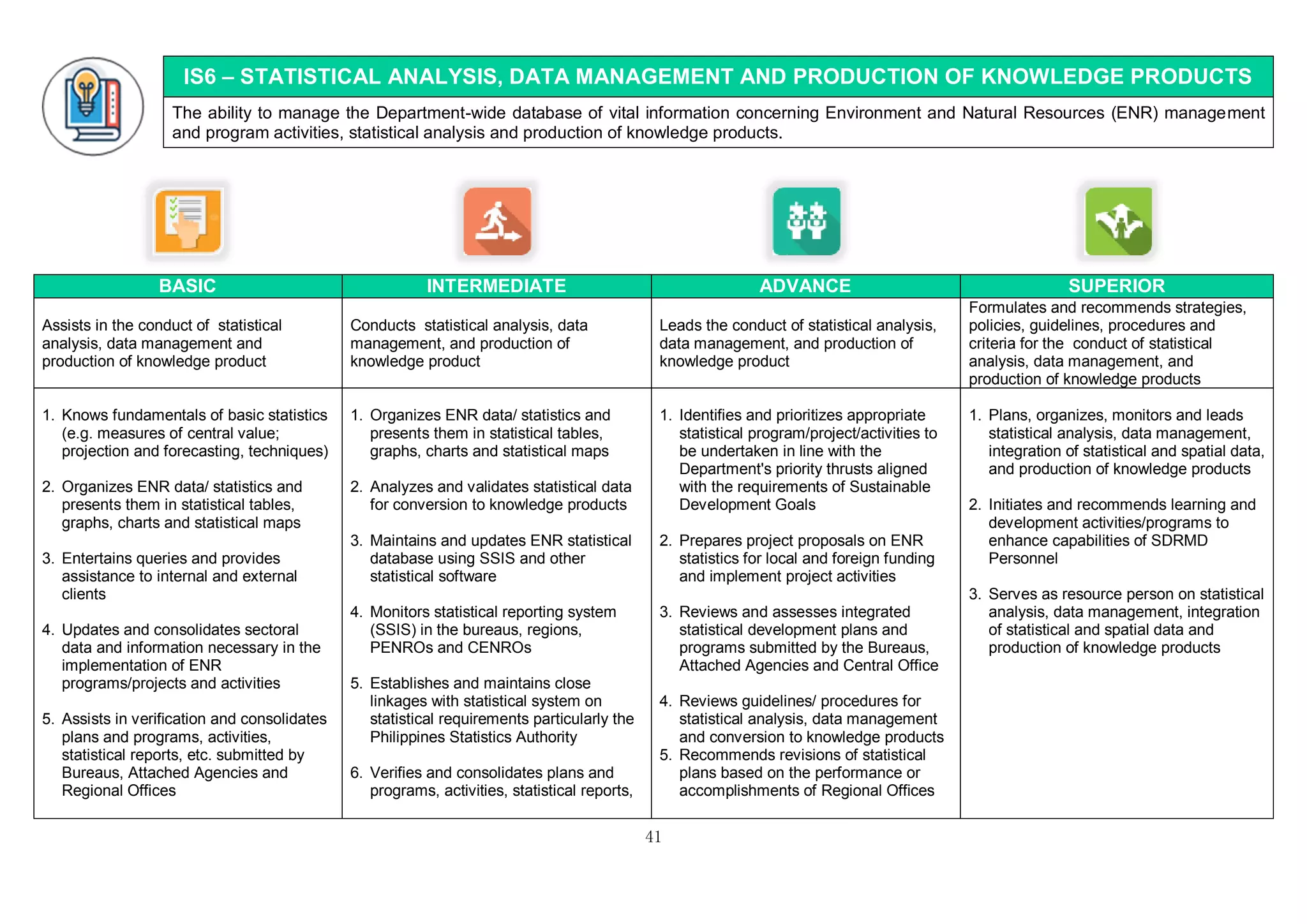
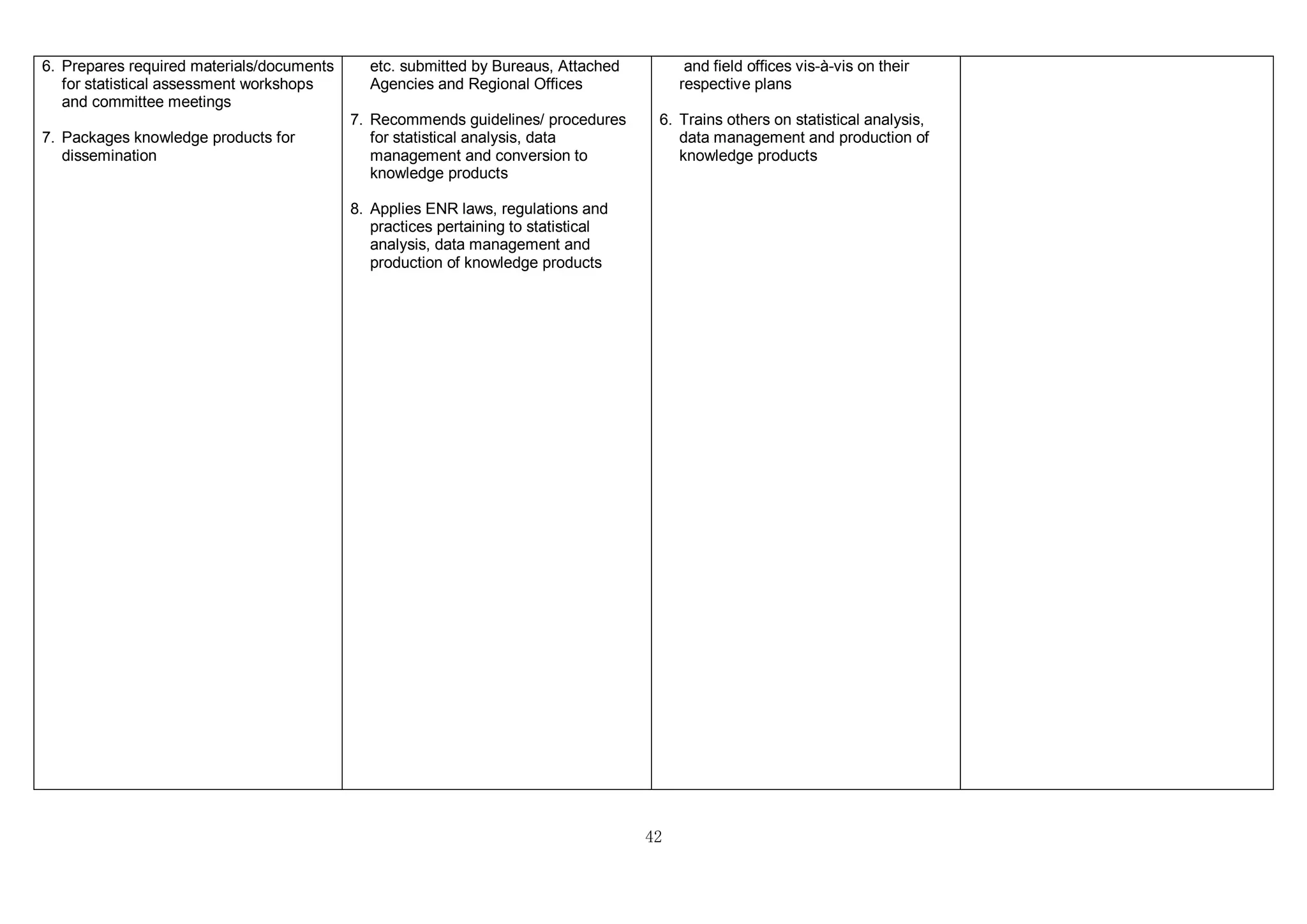
Statistical Analysis, Data Management
and Production of Knowledge
Products
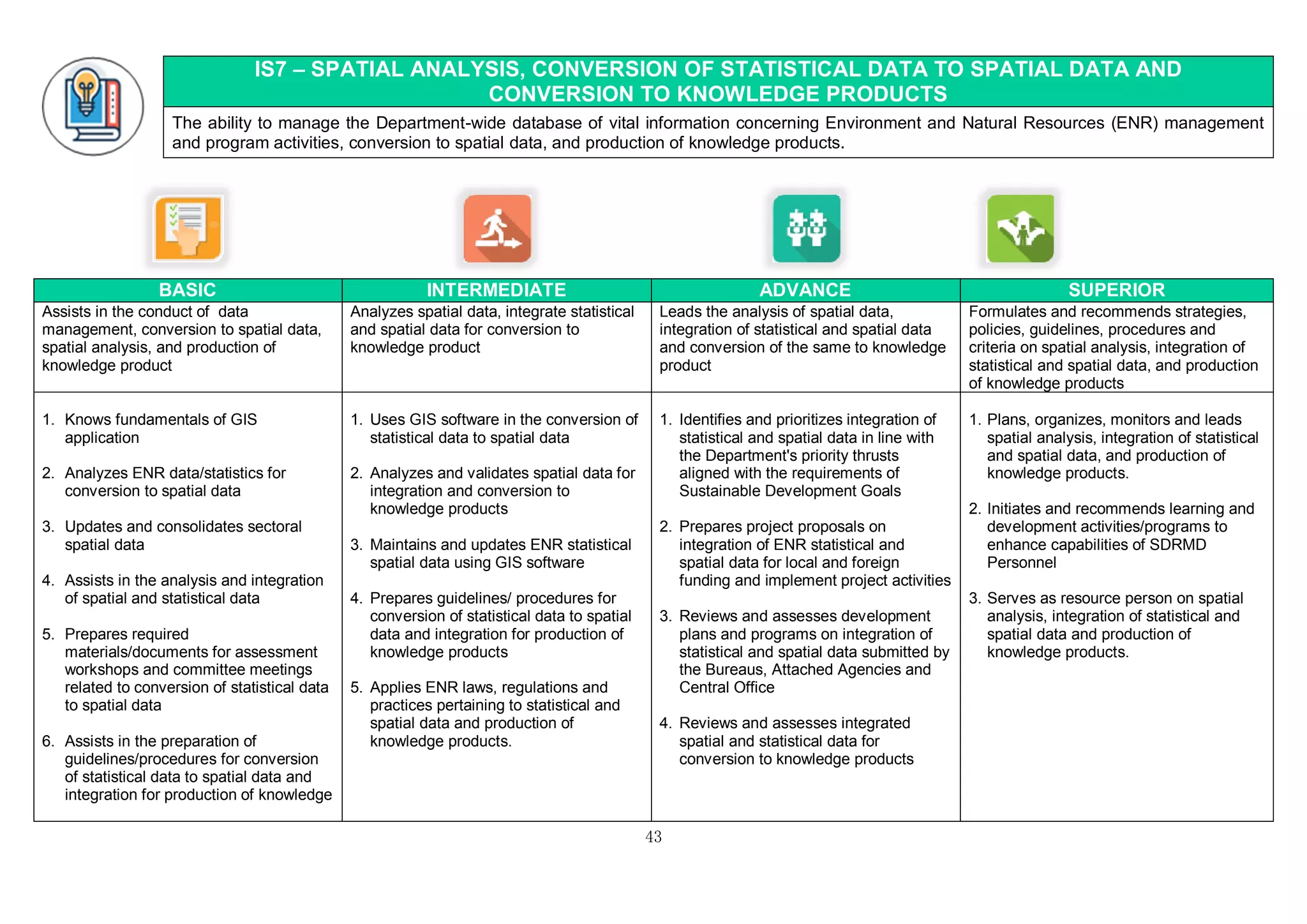
Spatial Analysis, Conversion of
Statistical Data to Spatial Data and
Conversion to Knowledge Products
Skills in Legal Research/ Opinion
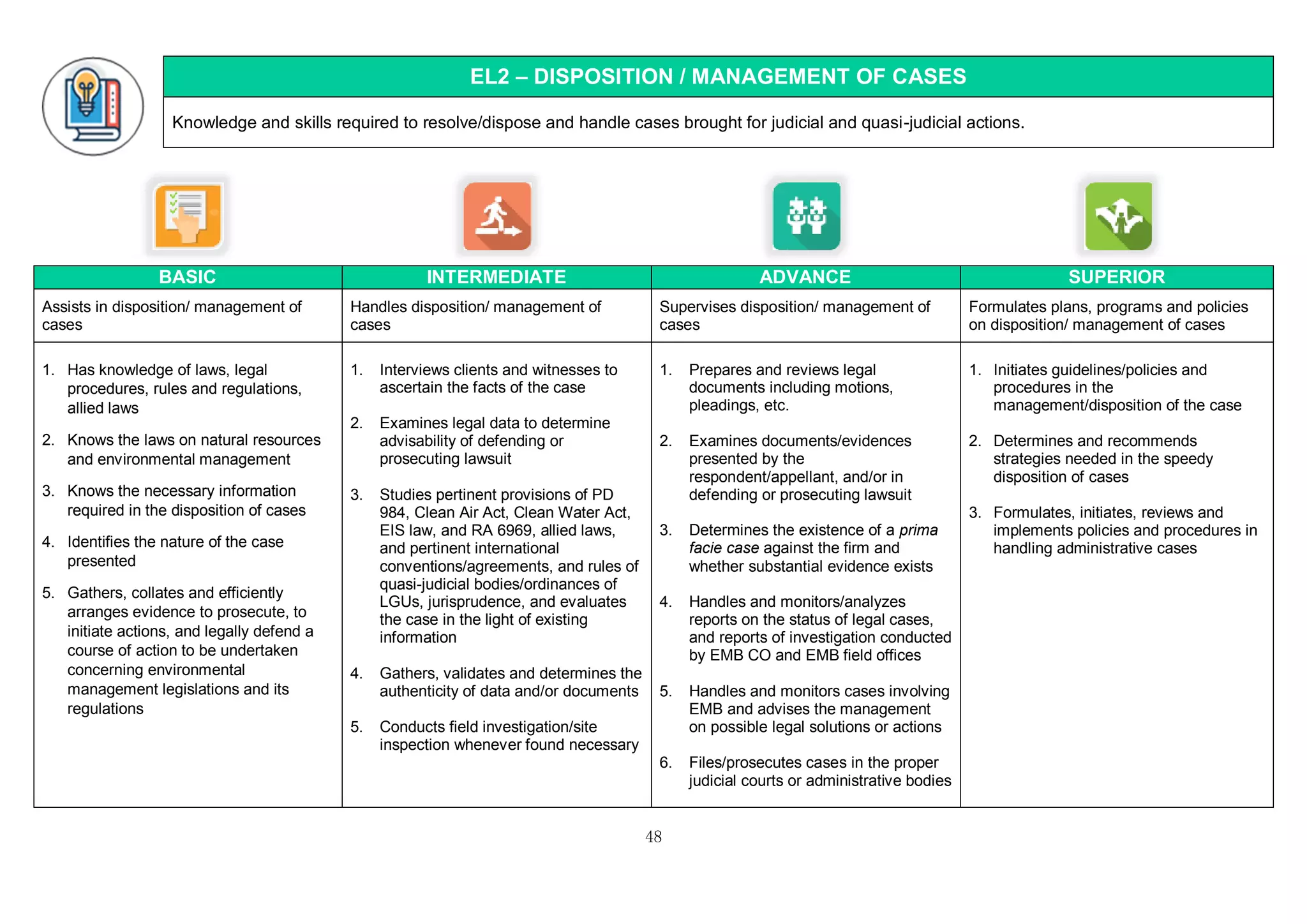
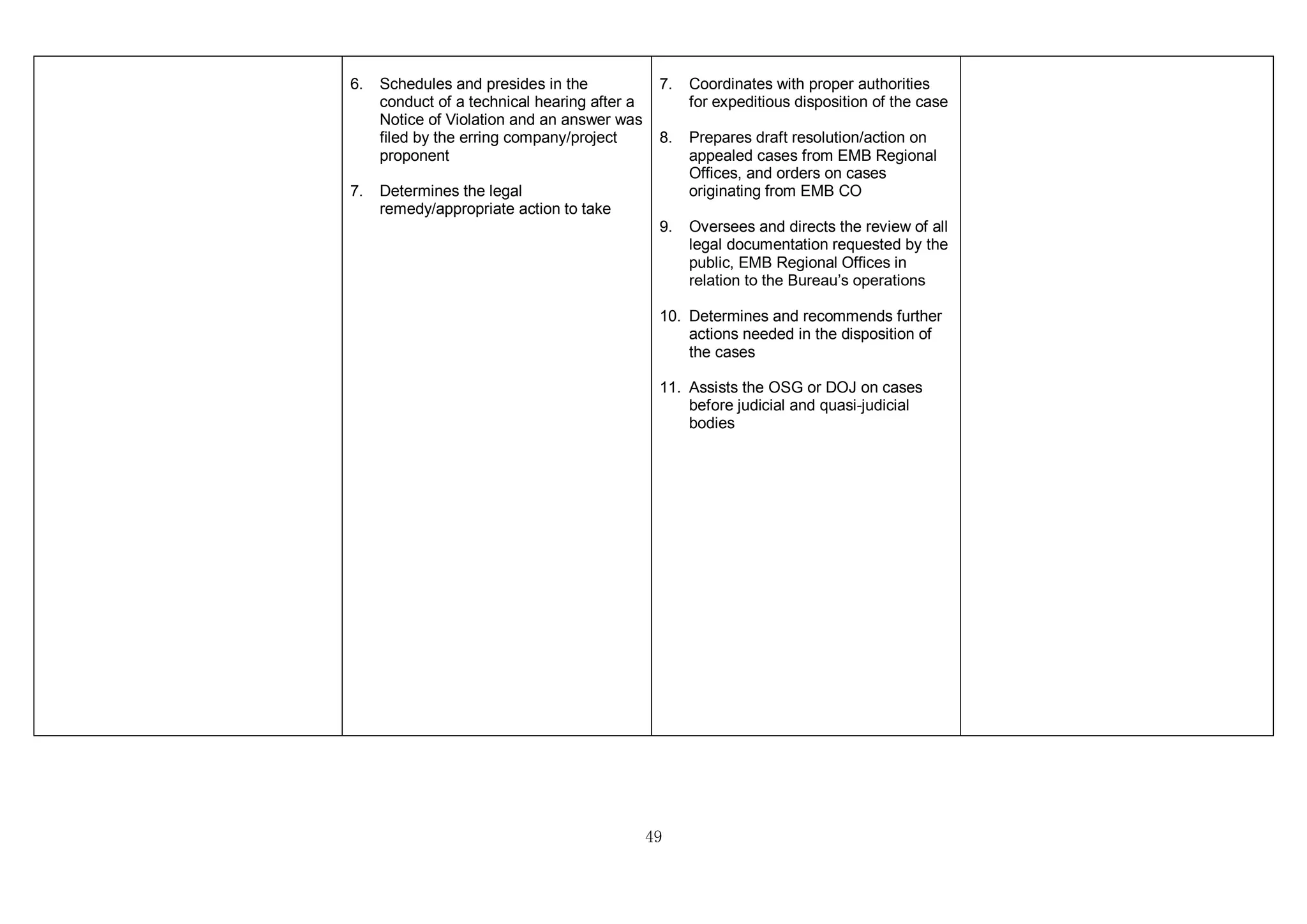
Disposition/ Management of Cases
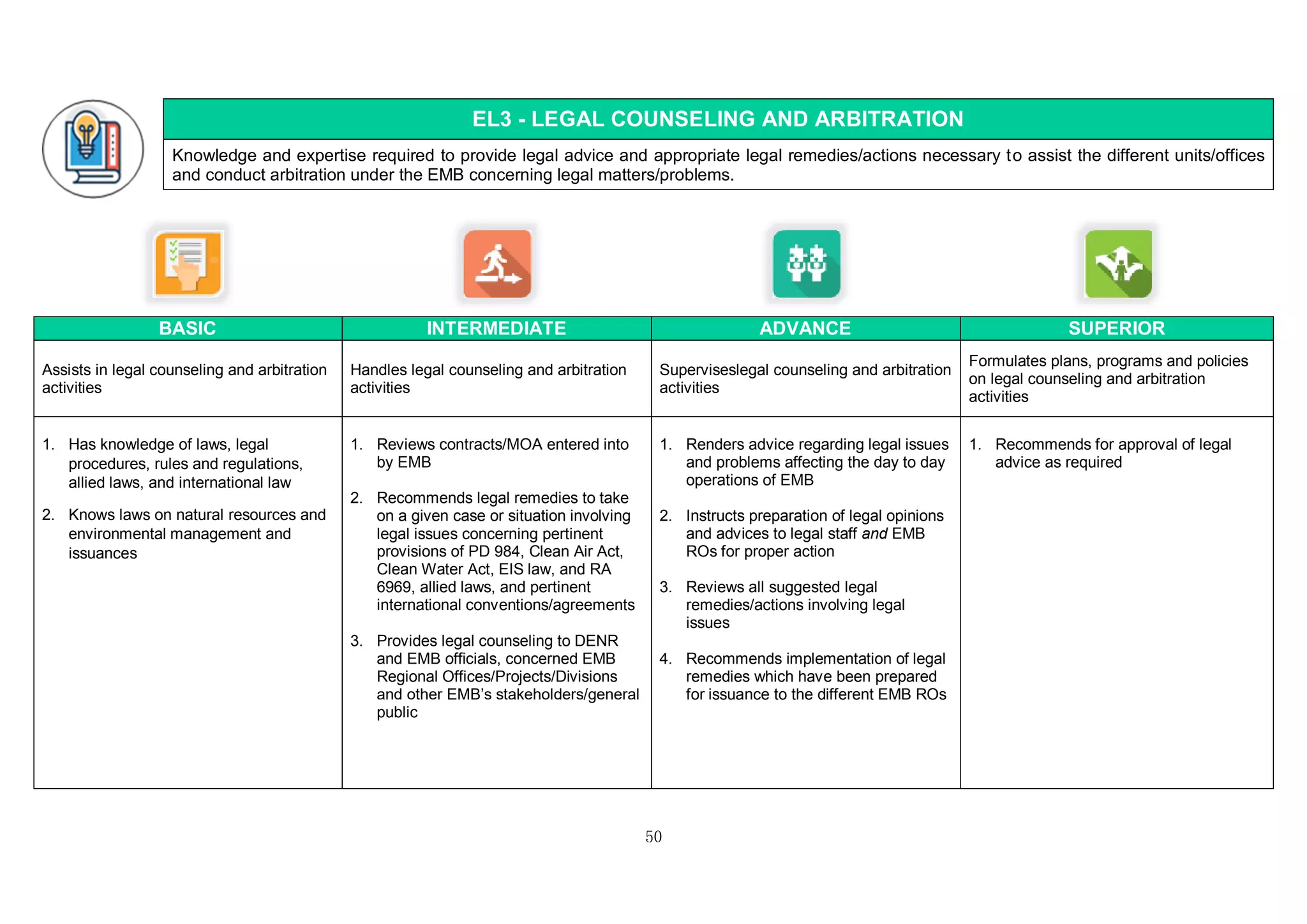
Legal Counseling and Arbitration
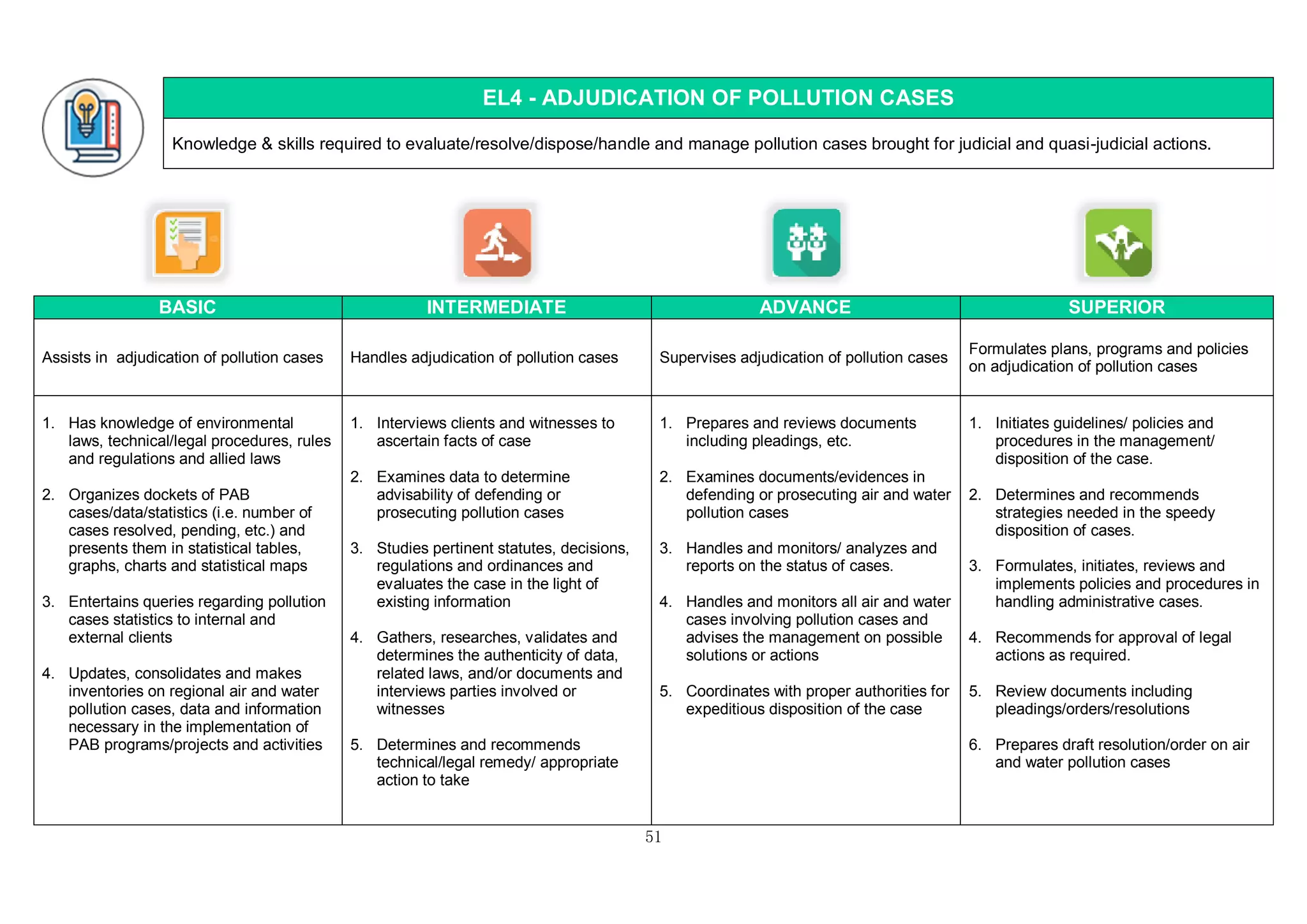
Adjudication of Pollution Cases
Water Quality Management Policy
Formulation
Monitoring and Evaluation/ Validation
of Policy Implementation
Provision of Technical Assistance and
Emergency Response on WQM
Capacity Building on WQM
Air Quality Management Policy
Formulation
Monitoring and Evaluation of Air
Quality Management Policy
41
43
45
48
50
51
53
55
57
59
61
63
IS6
IS7
EL1
EL2
EL3
EL4
EQ1
EQ2
EQ3
EQ4
EQ5
EQ6
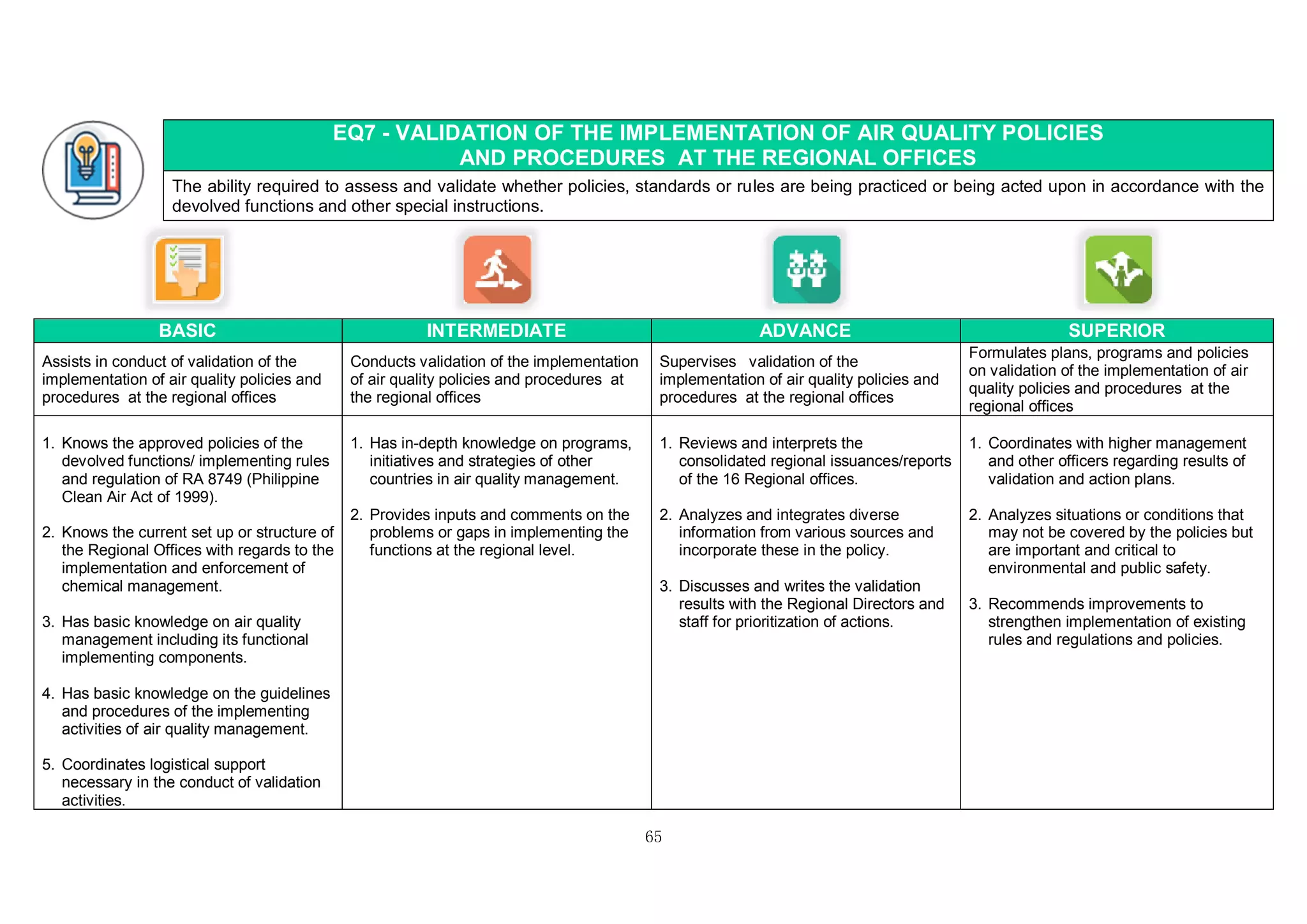
Validation of the Implementation of
Air Quality Policies and Procedures at
the Regional Offices
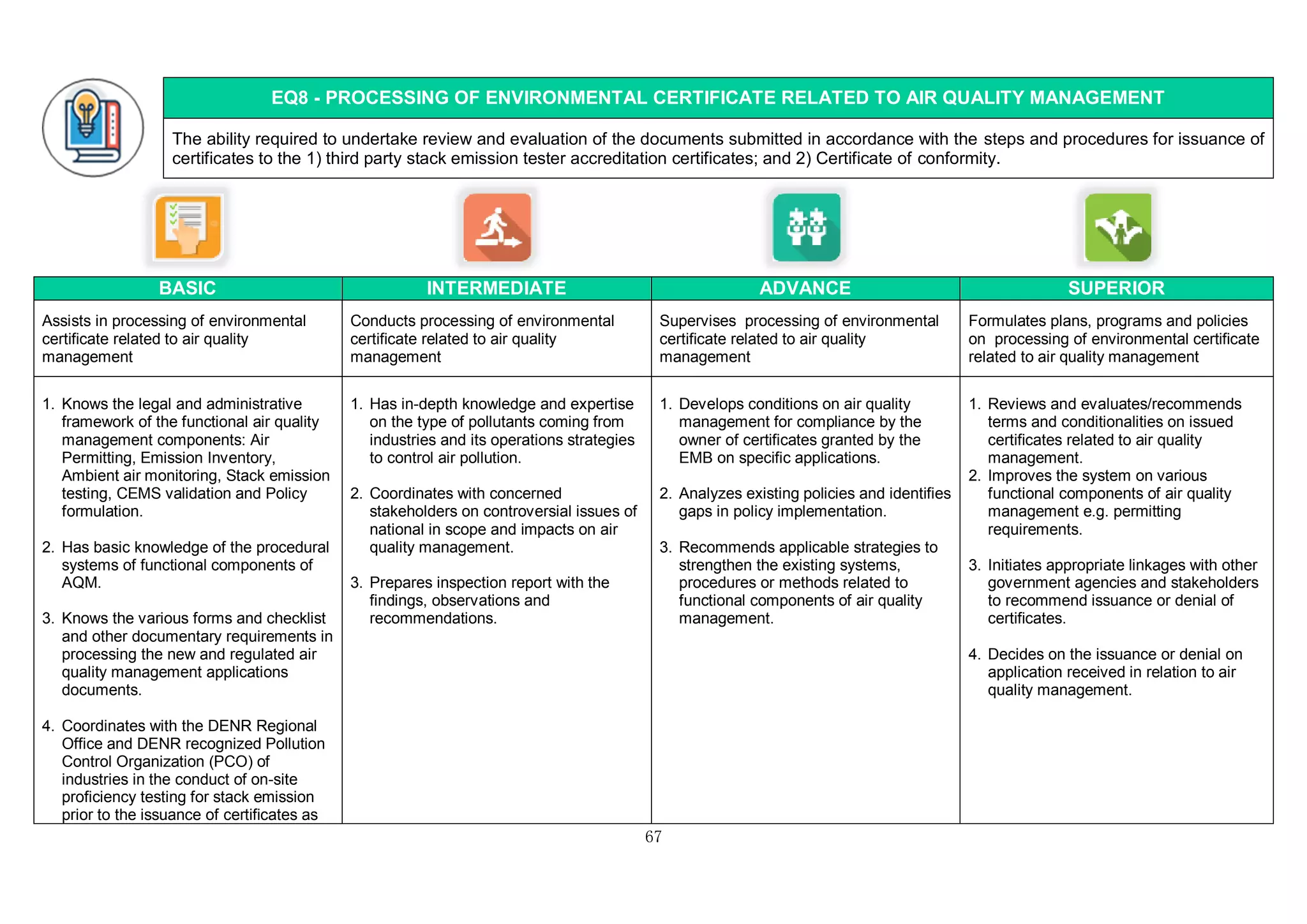
Processing of Environmental
Certificate Related to Air Quality
Management
Enforcement of AQM Environment
Laws
Capability Building on AQM
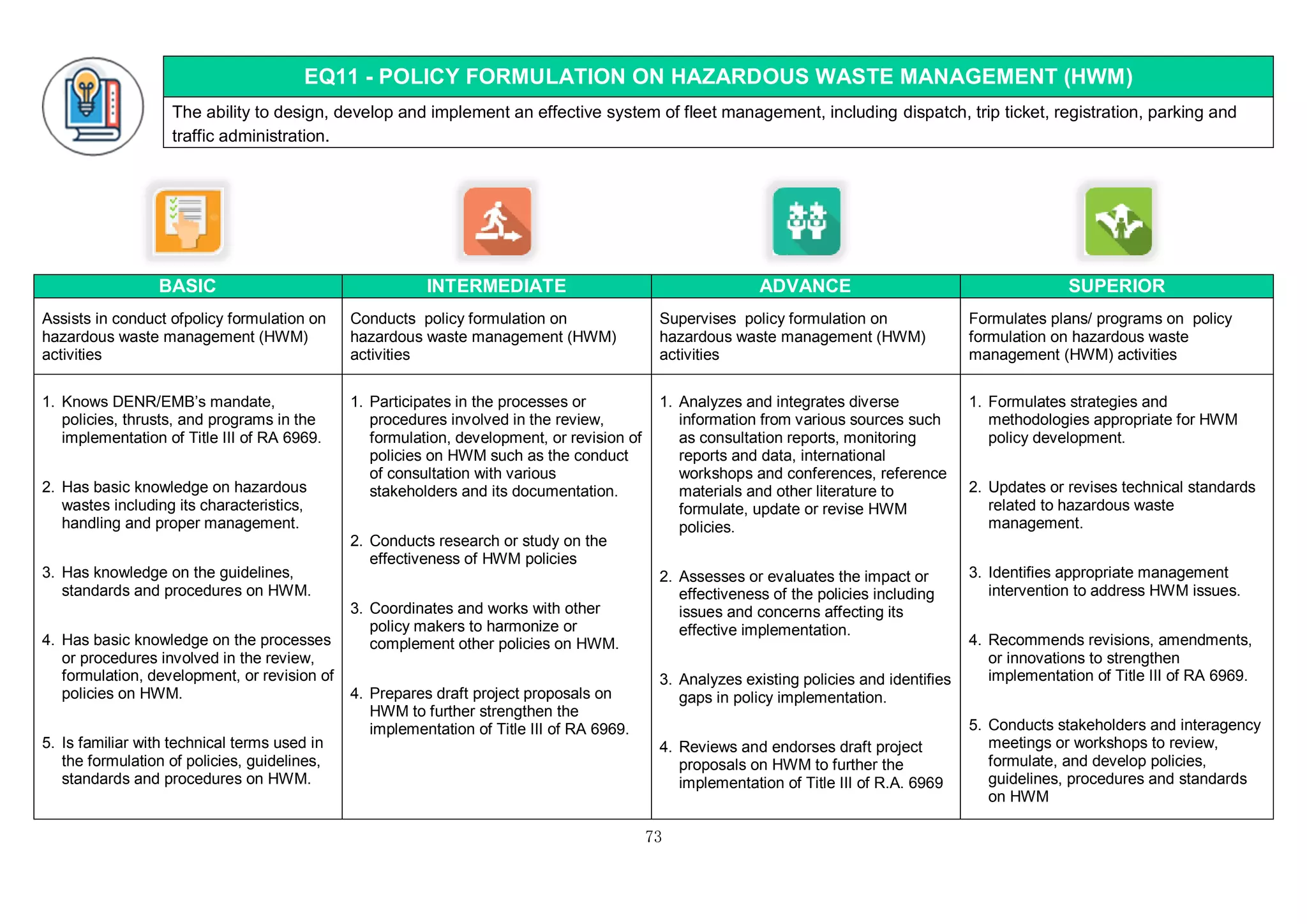
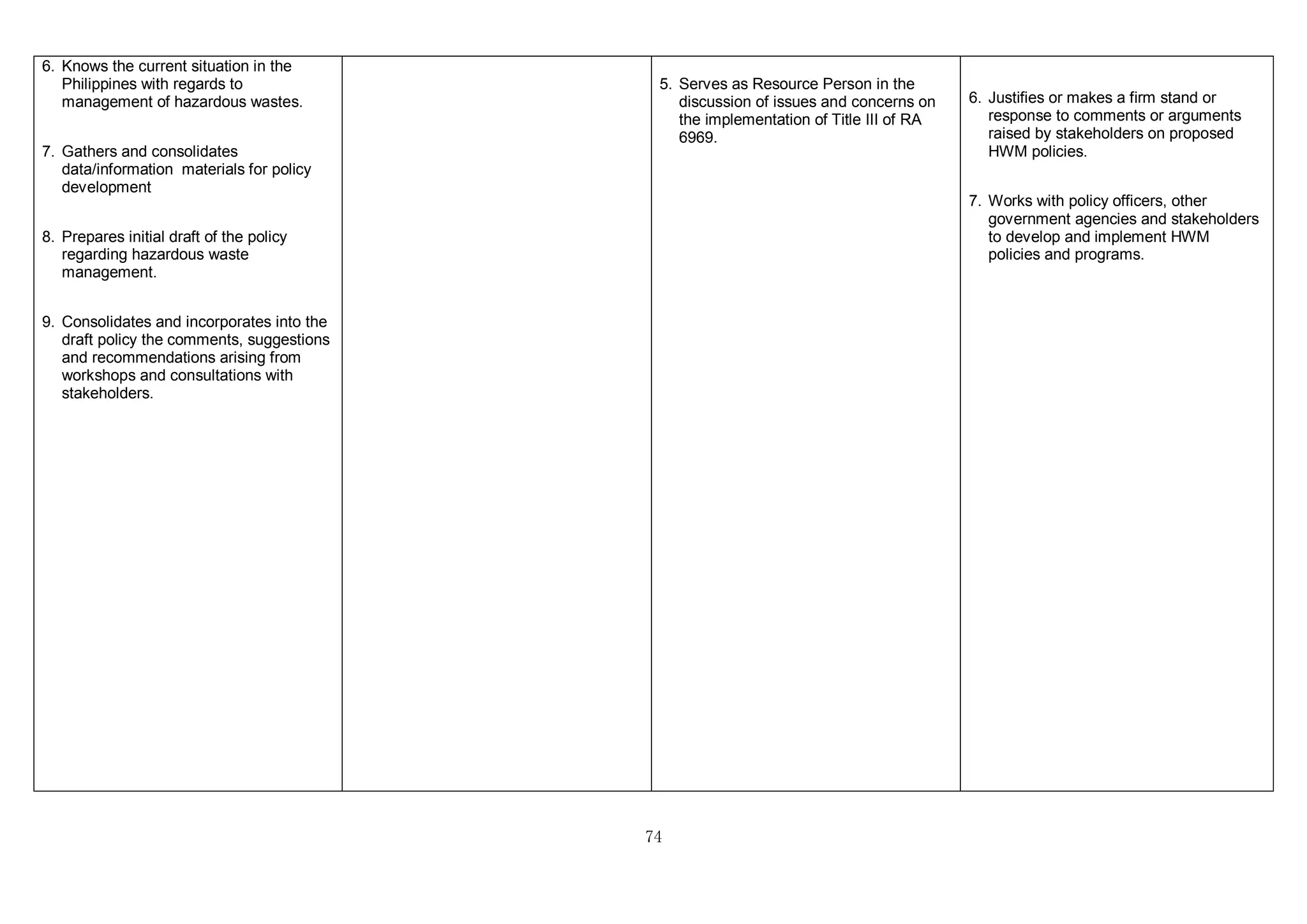
Policy Formulation on Hazardous
Waste Management (HWM)
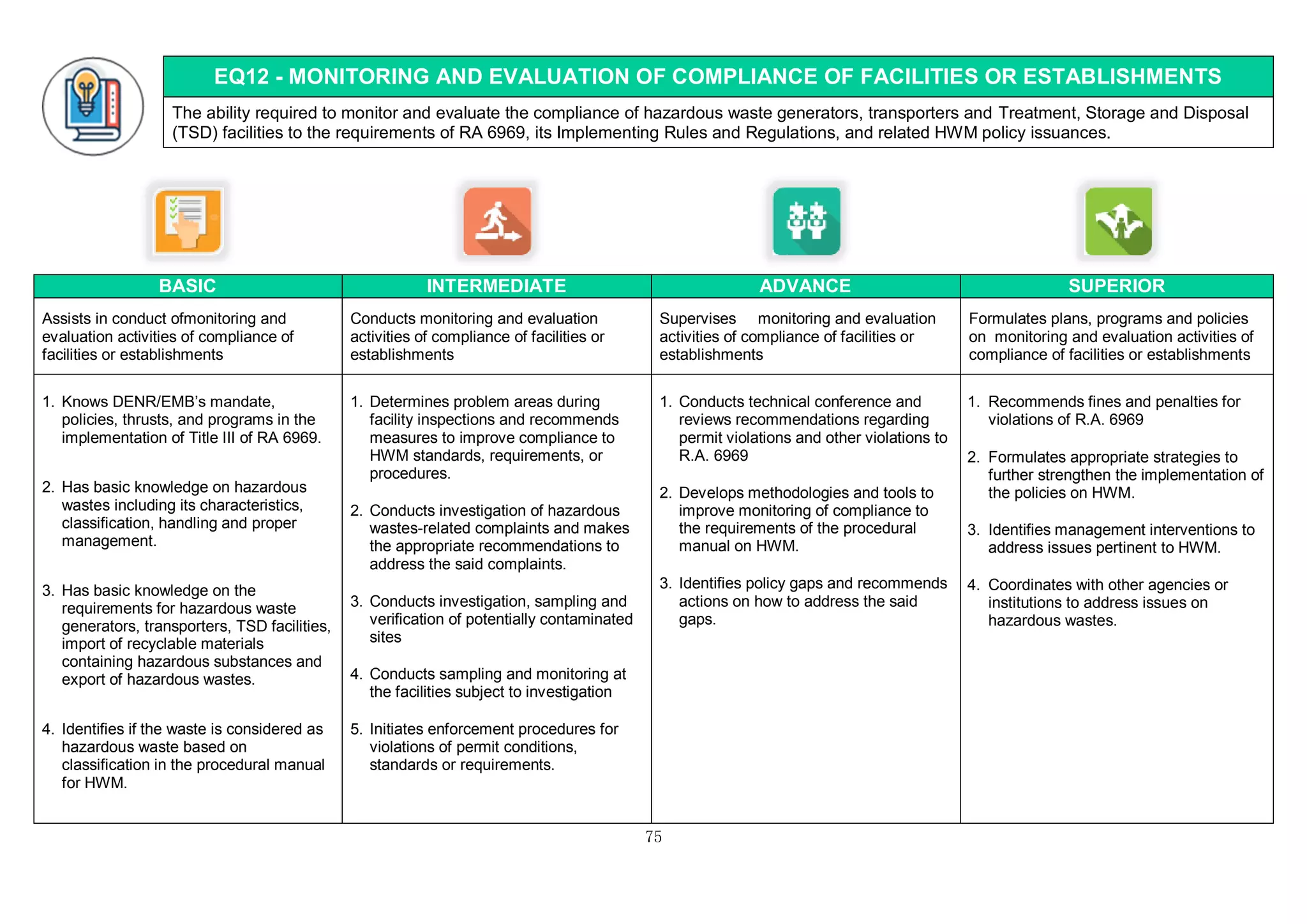
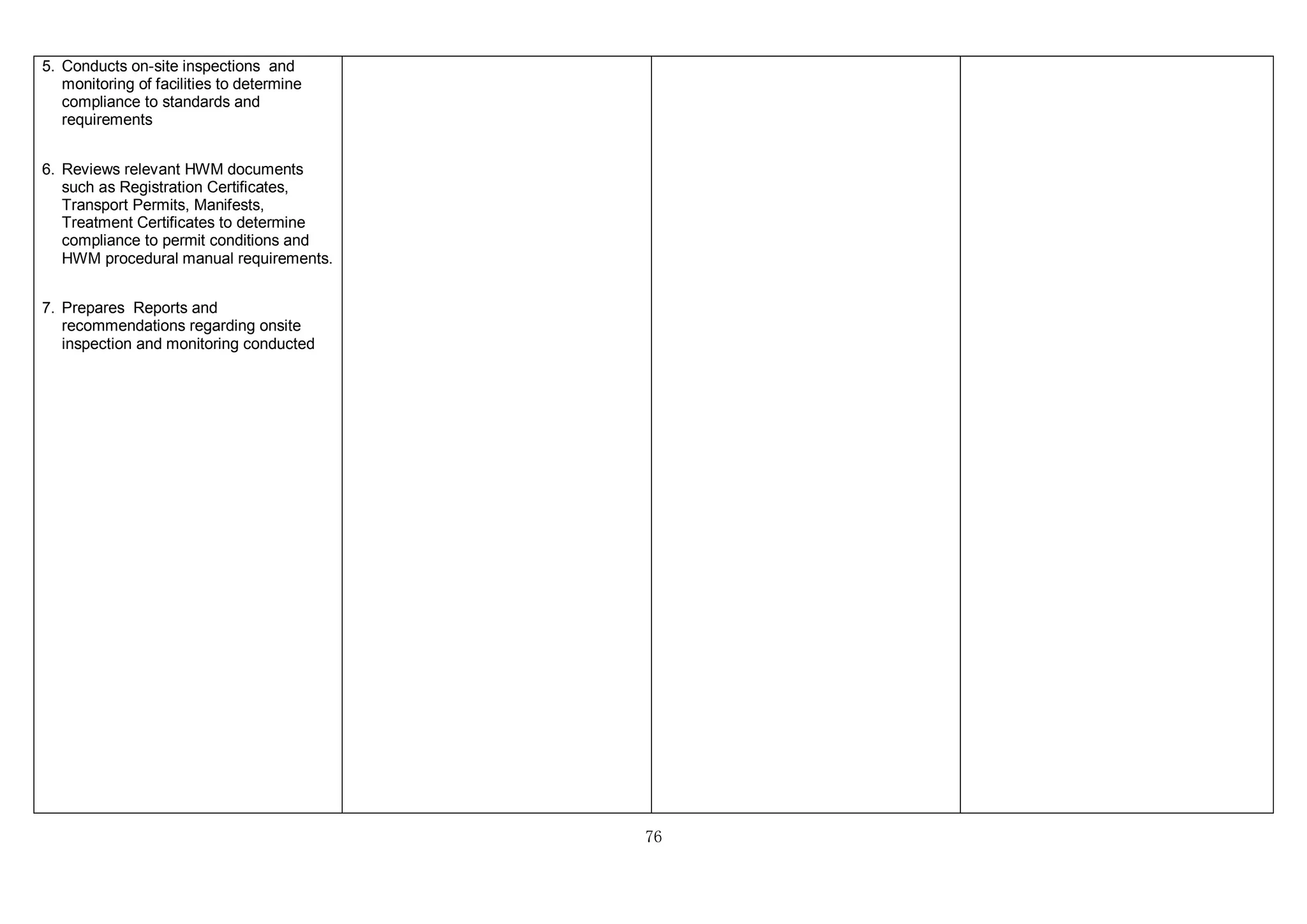
Monitoring and Evaluation of
Compliance of Facilities or
Establishments
Validation of Implementation of HWM
Policies and Procedures at the
Regional Offices
Processing of Registration Certificates
and Clearances
Technical Assistance and Emergency
Response Management
Enforcement of Hazardous Waste
Management Laws
65
67
69
71
73
75
77
78
79
81
EQ7
EQ8
EQ9
EQ10
EQ11
EQ12
EQ13
EQ14
EQ15
EQ16
T
A
B
L
E
O
F
C
O
N
T
E
N
T
S
E N V I R O N M E N T A L M A N A G E M E N T B U R E A U
2 0 2 1 D E N R C O M P E T E N C Y - B A S E D S Y S T E M ( C B S ) M A N U A L
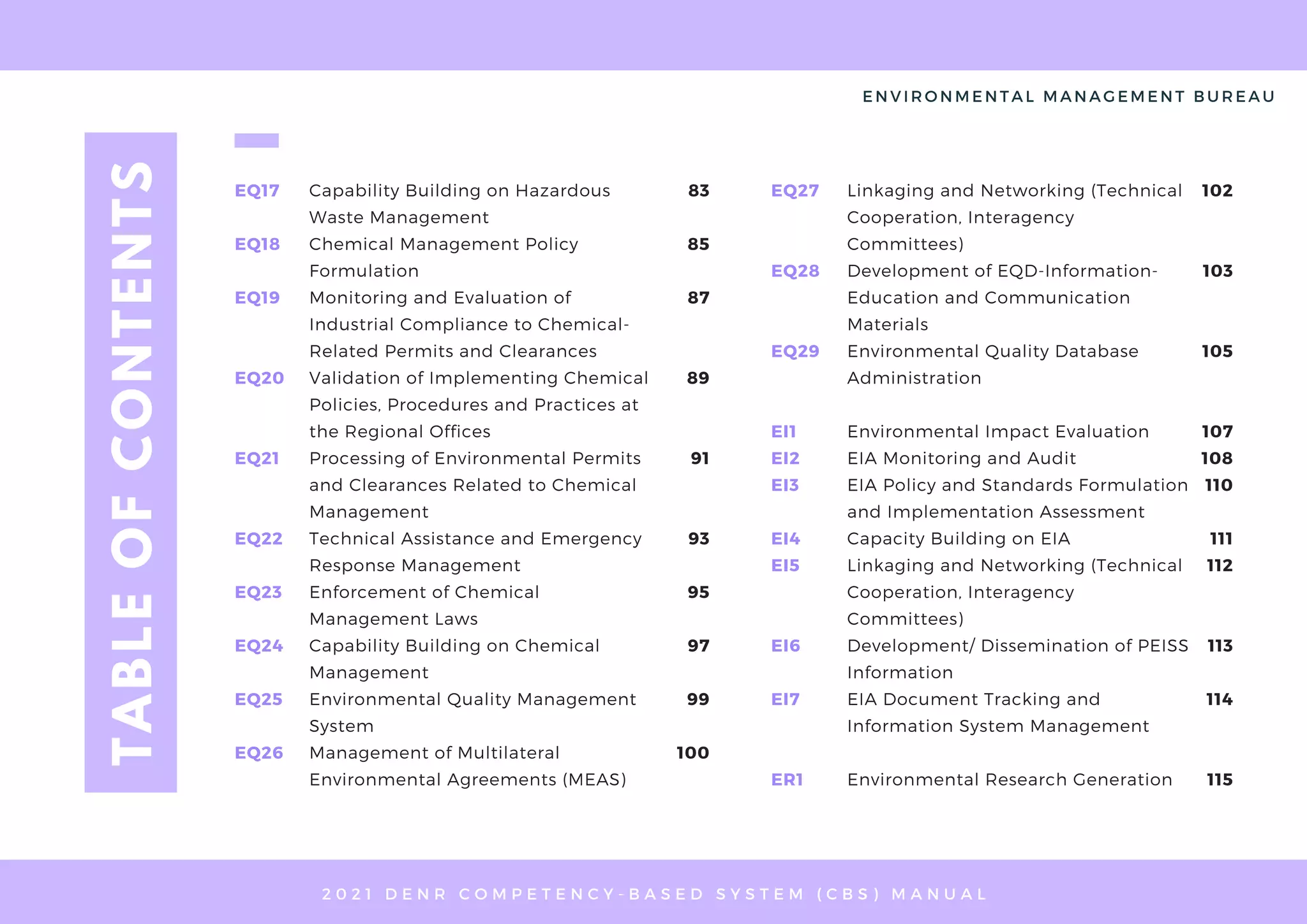
Capability Building on Hazardous
Waste Management
Chemical Management Policy
Formulation
Monitoring and Evaluation of
Industrial Compliance to Chemical-
Related Permits and Clearances
Validation of Implementing Chemical
Policies, Procedures and Practices at
the Regional Offices
Processing of Environmental Permits
and Clearances Related to Chemical
Management
Technical Assistance and Emergency
Response Management
Enforcement of Chemical
Management Laws
Capability Building on Chemical
Management
Environmental Quality Management
System
Management of Multilateral
Environmental Agreements (MEAS)
83
85
87
89
91
93
95
97
99
100
EQ17
EQ18
EQ19
EQ20
EQ21
EQ22
EQ23
EQ24
EQ25
EQ26
Linkaging and Networking (Technical
Cooperation, Interagency
Committees)
Development of EQD-Information-
Education and Communication
Materials
Environmental Quality Database
Administration
Environmental Impact Evaluation
EIA Monitoring and Audit
EIA Policy and Standards Formulation
and Implementation Assessment
Capacity Building on EIA
Linkaging and Networking (Technical
Cooperation, Interagency
Committees)
Development/ Dissemination of PEISS
Information
EIA Document Tracking and
Information System Management
Environmental Research Generation
102
103
105
107
108
110
111
112
113
114
115
EQ27
EQ28
EQ29
EI1
EI2
EI3
EI4
EI5
EI6
EI7
ER1
T
A
B
L
E
O
F
C
O
N
T
E
N
T
S
E N V I R O N M E N T A L M A N A G E M E N T B U R E A U
2 0 2 1 D E N R C O M P E T E N C Y - B A S E D S Y S T E M ( C B S ) M A N U A L
Collection of Environmental Samples
Collection of Environmental
Data Analysis and Interpretation
Documentation and Dissemination of
Results
Analysis of Environmental Samples
Equipment Maintenance and
Calibration
Recognition of DENR Environmental
Laboratories
Curriculum Review and Development
for Environmental Education
Capability Building on Environmental
Management
Public Information Management
Special Events Management
IEC Materials Production
Environmental report Documentation
and Library Management of
Environmental Education Resources
Policy Research and Development on
ESWM
117
119
120
121
122
125
127
129
131
132
133
135
137
ER2
ER3
ER4
ER5
ER6
ER7
ER8
EE1
EE2
EE3
EE4
EE5
EE6
ESW1
Technical Assistance on ESWM
Training and Information
Dissemination on ESWM
Water Quality Management
Air Quality Management
Toxic Chemicals and Hazardous
Waste Management
Analysis of Environmental Samples
Environmental Impact Assessment
EIA Monitoring and Audit
Environmental Planning
Statistics and Information Systems
Management
Environmental Information and
Education
Skills in Legal Research/ Opinion
Disposition/ Management of Cases
Legal Counseling and Arbitration
Solid Waste Monitoring and
Assessment
Technical Assistance on ESWM
Training and Information
Dissemination on ESWM
140
141
143
145
147
149
151
153
155
157
159
160
163
165
166
167
169
ESW2
ESW3
ERO1
ERO2
ERO3
ERO4
ERO5
ERO6
ERO7
ERO8
ERO9
ERO10
ERO11
ERO12
ERO13
ERO14
ERO15
T
A
B
L
E
O
F
C
O
N
T
E
N
T
S
E N V I R O N M E N T A L M A N A G E M E N T B U R E A U
2 0 2 1 D E N R C O M P E T E N C Y - B A S E D S Y S T E M ( C B S ) M A N U A L
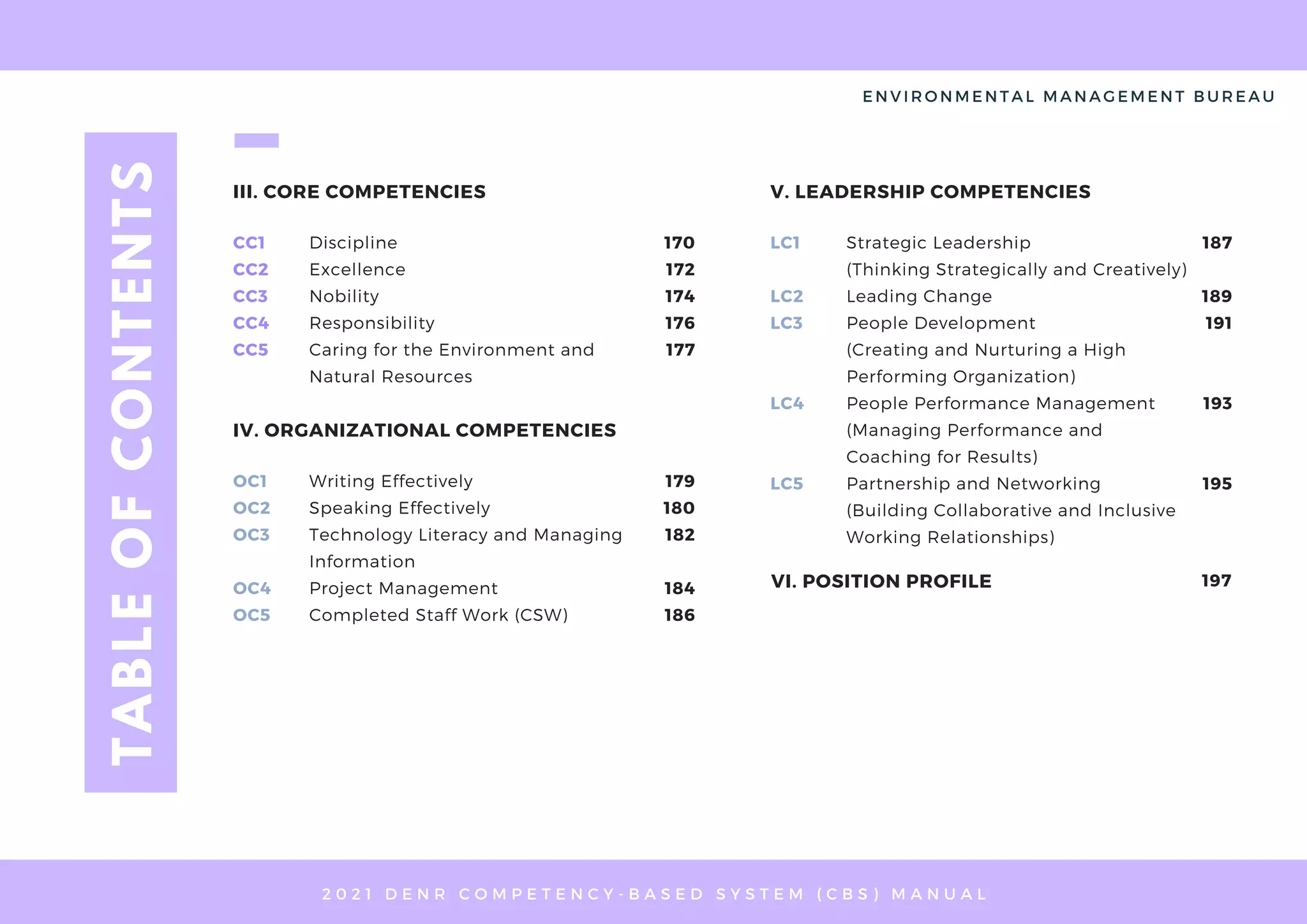
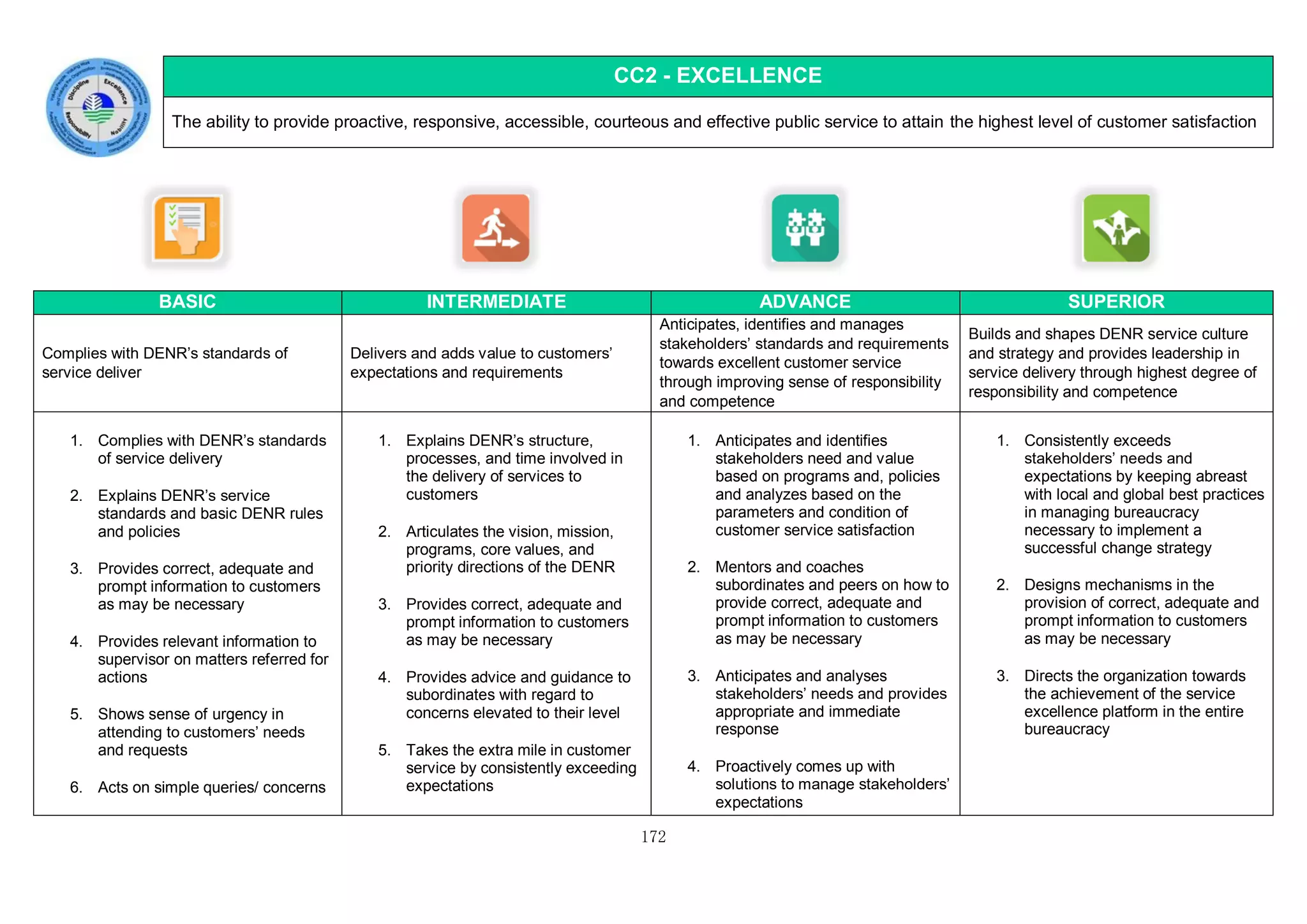
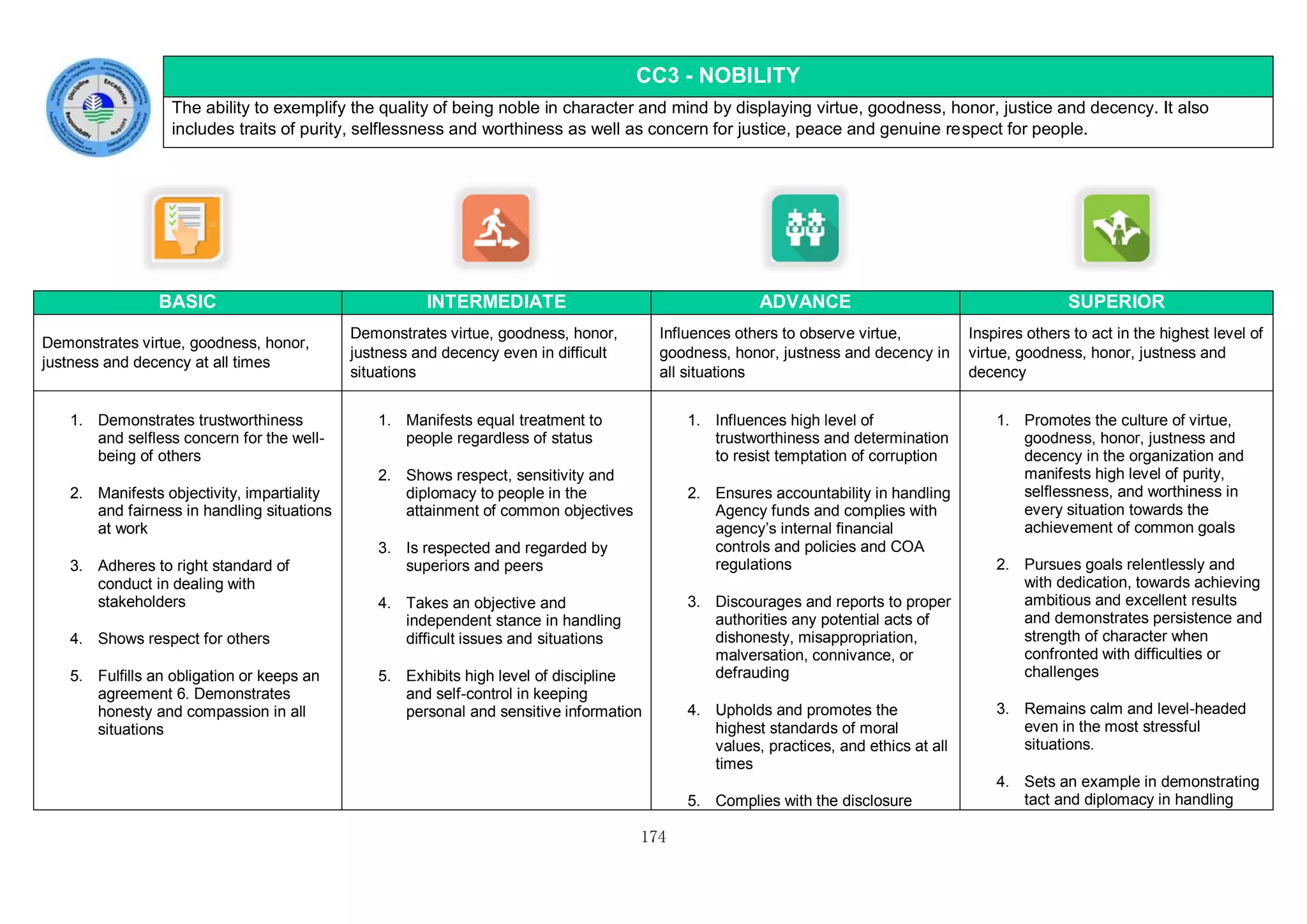
III. CORE COMPETENCIES
Discipline
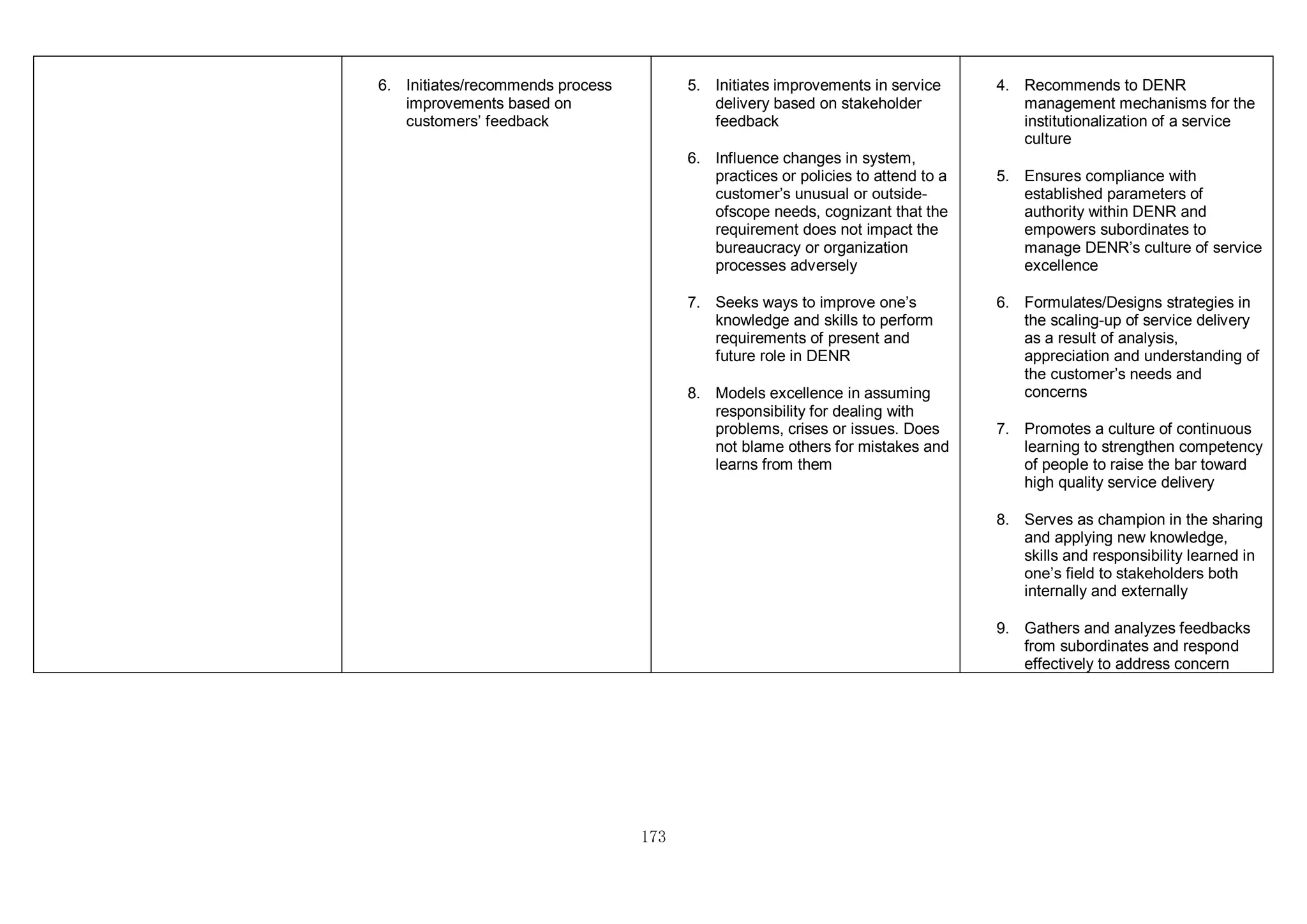
Excellence
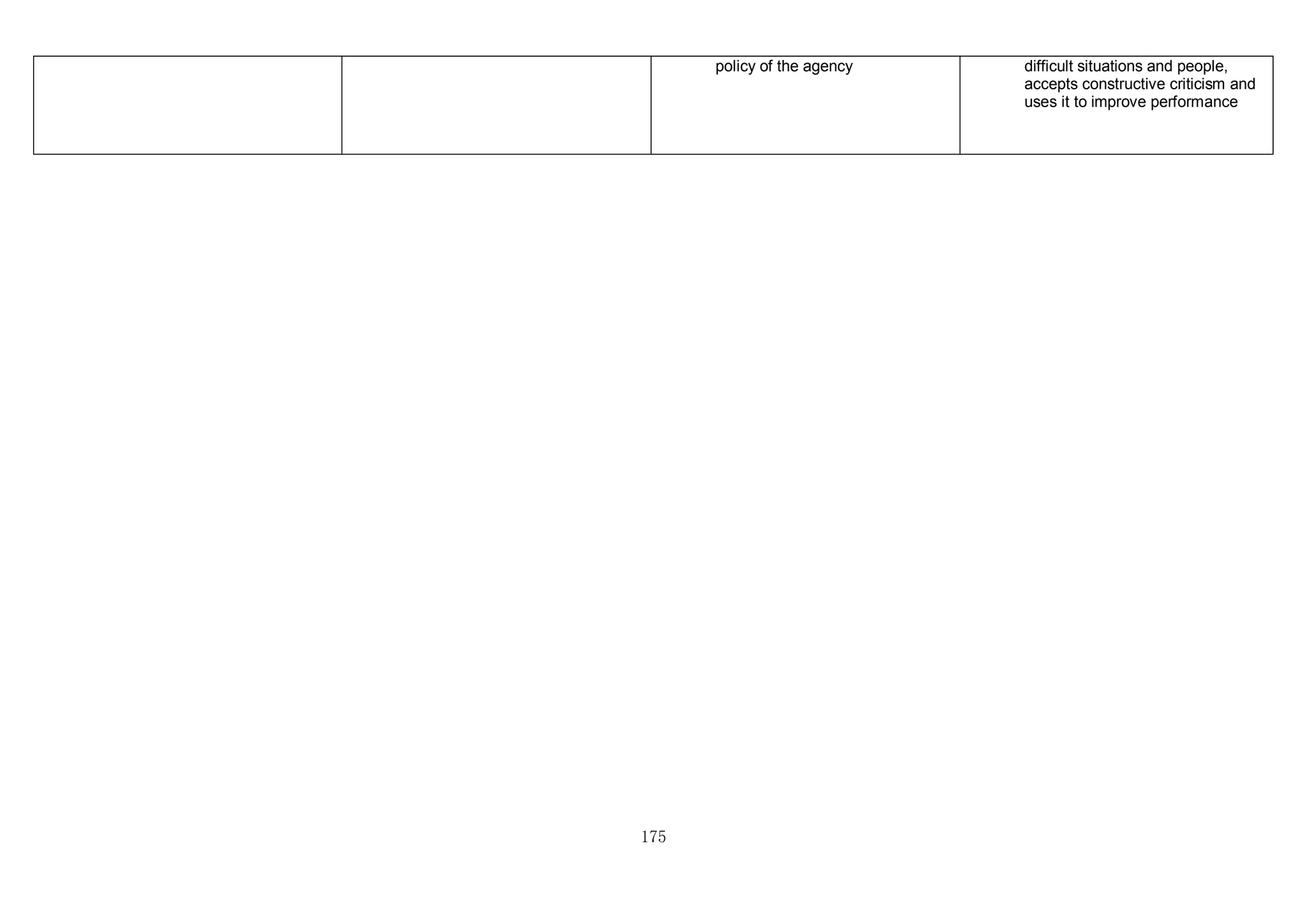
Nobility
Responsibility
Caring for the Environment and
Natural Resources
170
172
174
176
177
CC1
CC2
CC3
CC4
CC5
IV. ORGANIZATIONAL COMPETENCIES
Writing Effectively
Speaking Effectively
Technology Literacy and Managing
Information
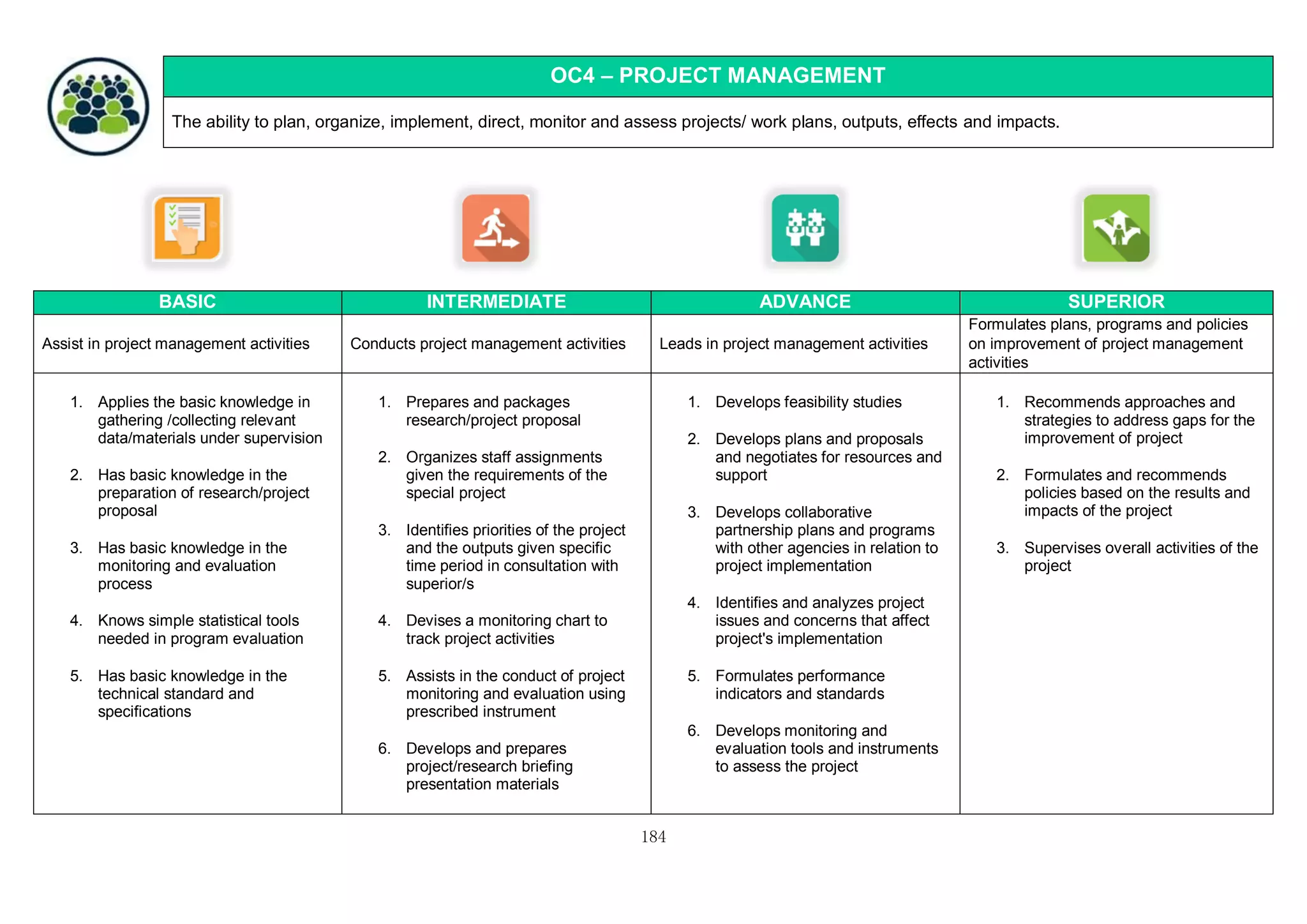
Project Management
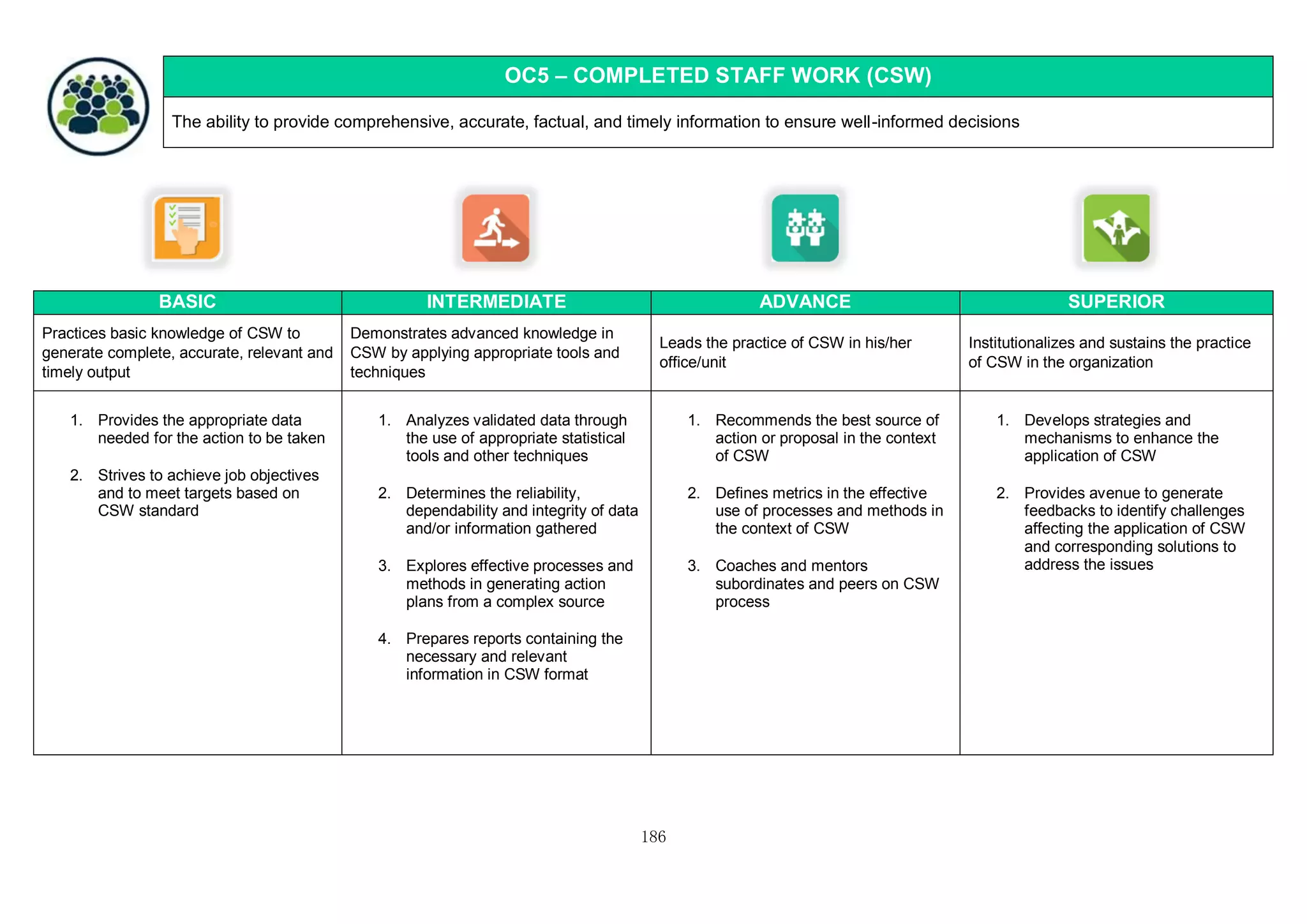
Completed Staff Work (CSW)
179
180
182
184
186
OC1
OC2
OC3
OC4
OC5
V. LEADERSHIP COMPETENCIES
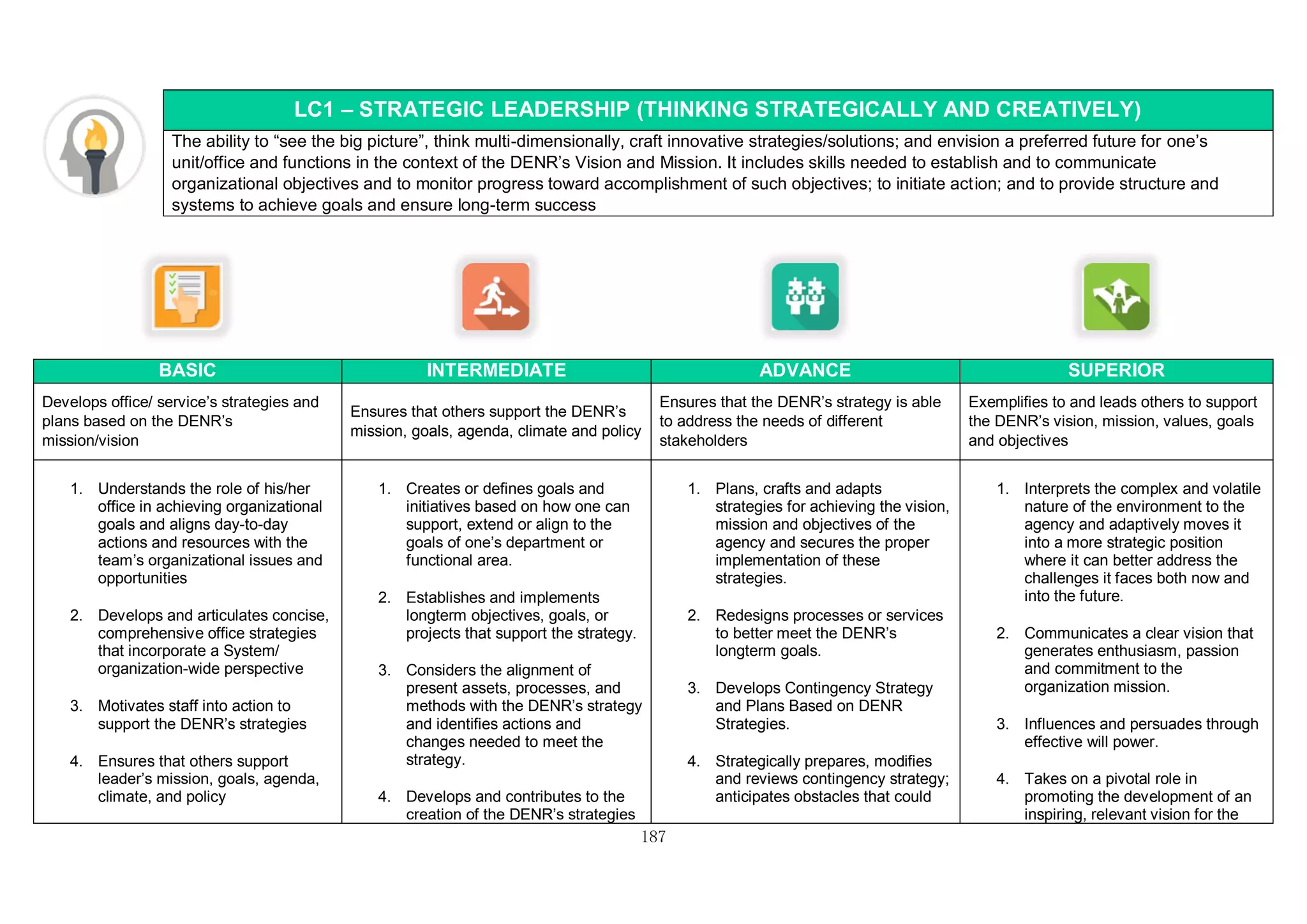
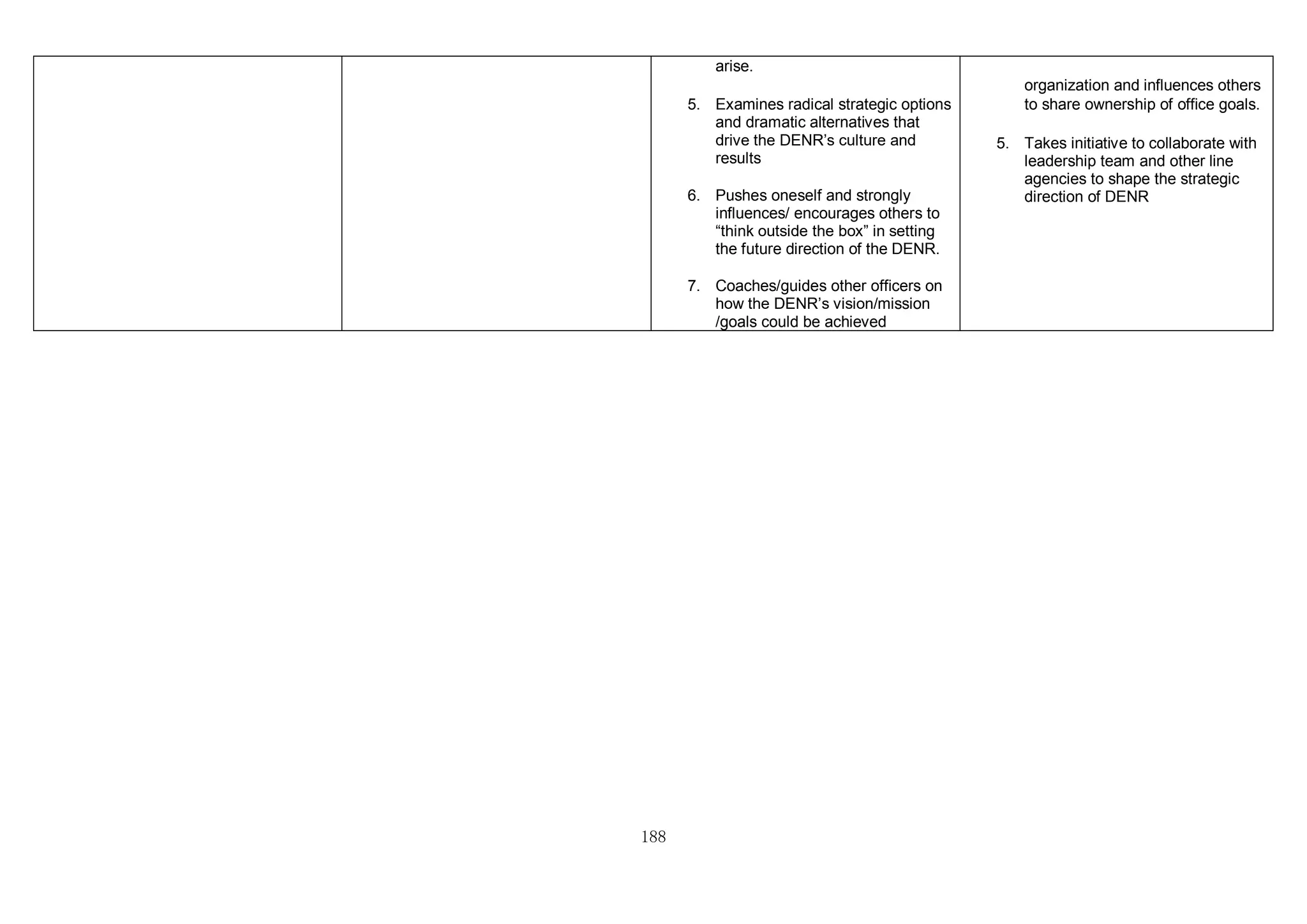
Strategic Leadership
(Thinking Strategically and Creatively)
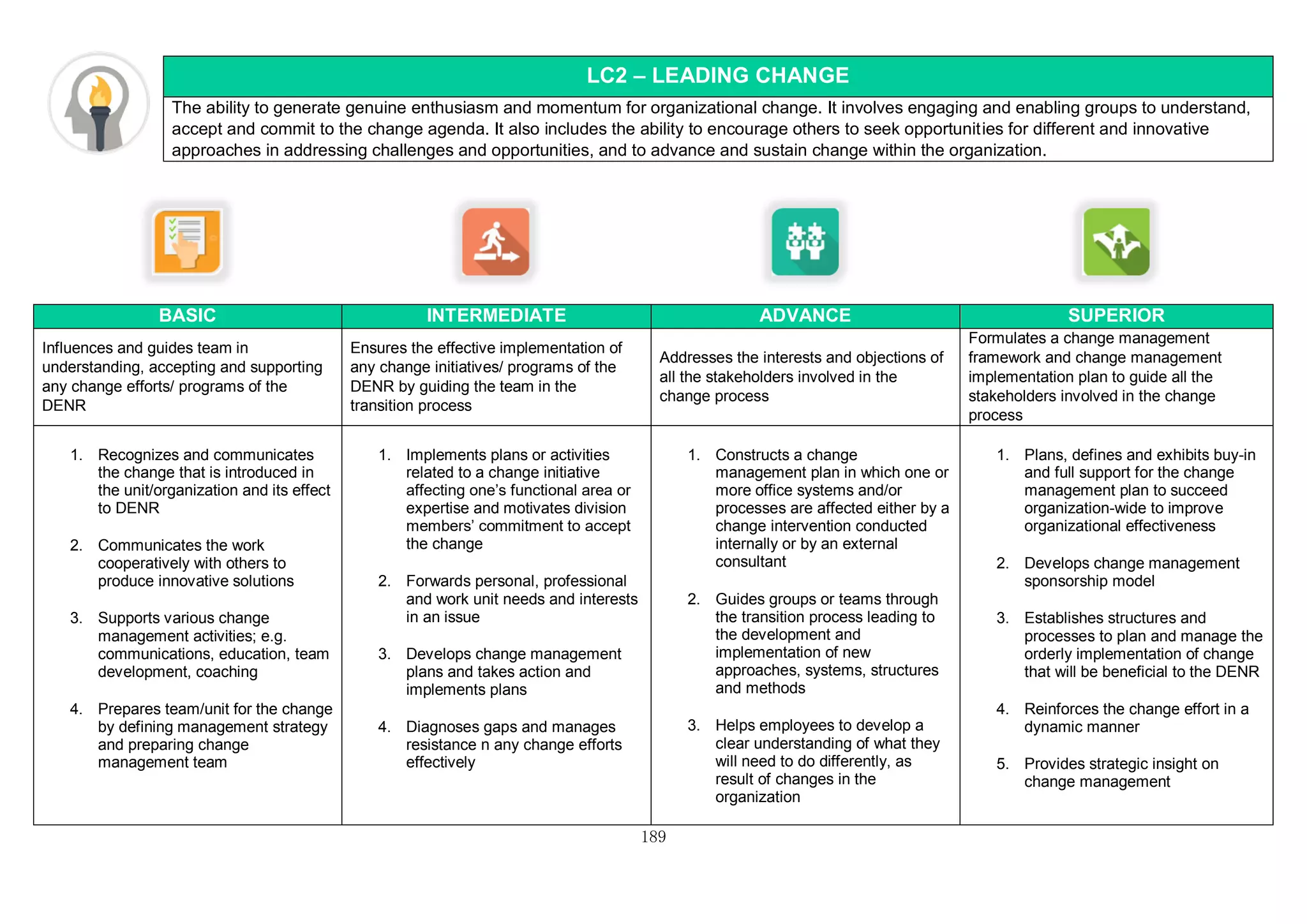
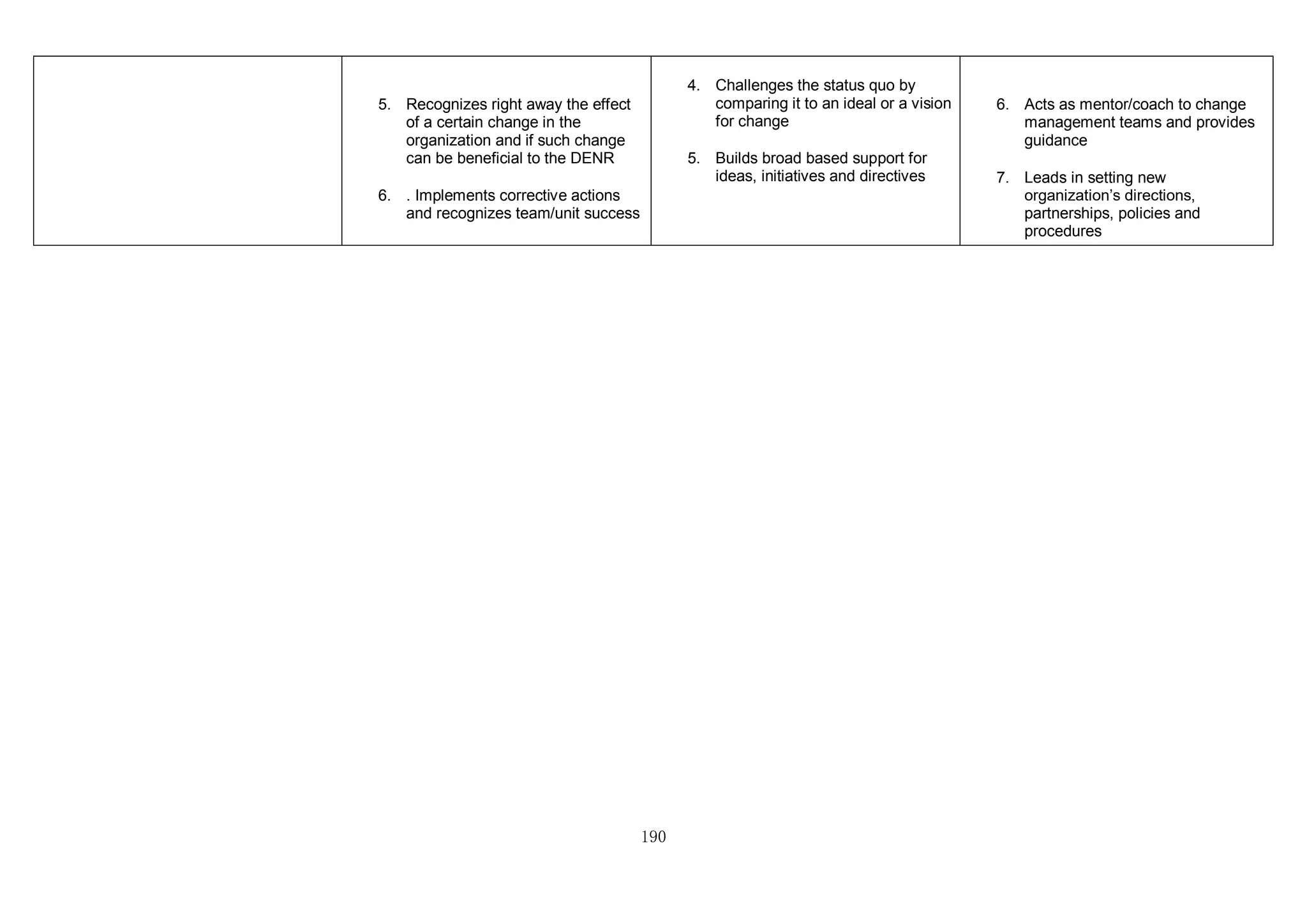
Leading Change
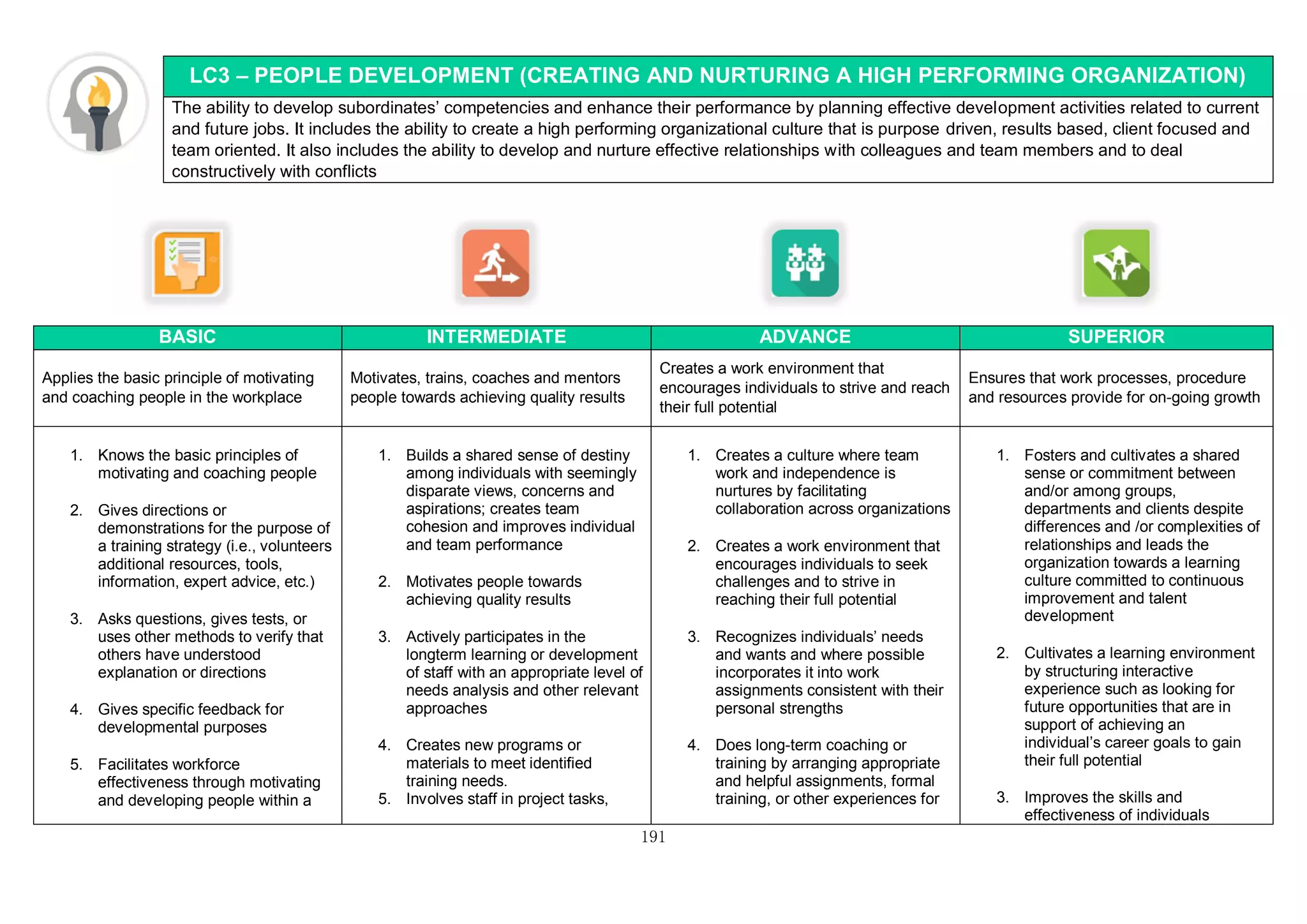
People Development
(Creating and Nurturing a High
Performing Organization)
People Performance Management
(Managing Performance and
Coaching for Results)
Partnership and Networking
(Building Collaborative and Inclusive
Working Relationships)
187
189
191
193
195
LC1
LC2
LC3
LC4
LC5
VI. POSITION PROFILE 197
I
N
T
R
O
D
U
C
T
I
O
N
E
N
V
I
R
O
N
M
E
N
T
A
L
M
A
N
A
G
E
M
E
N
T
B
U
R
E
A
U
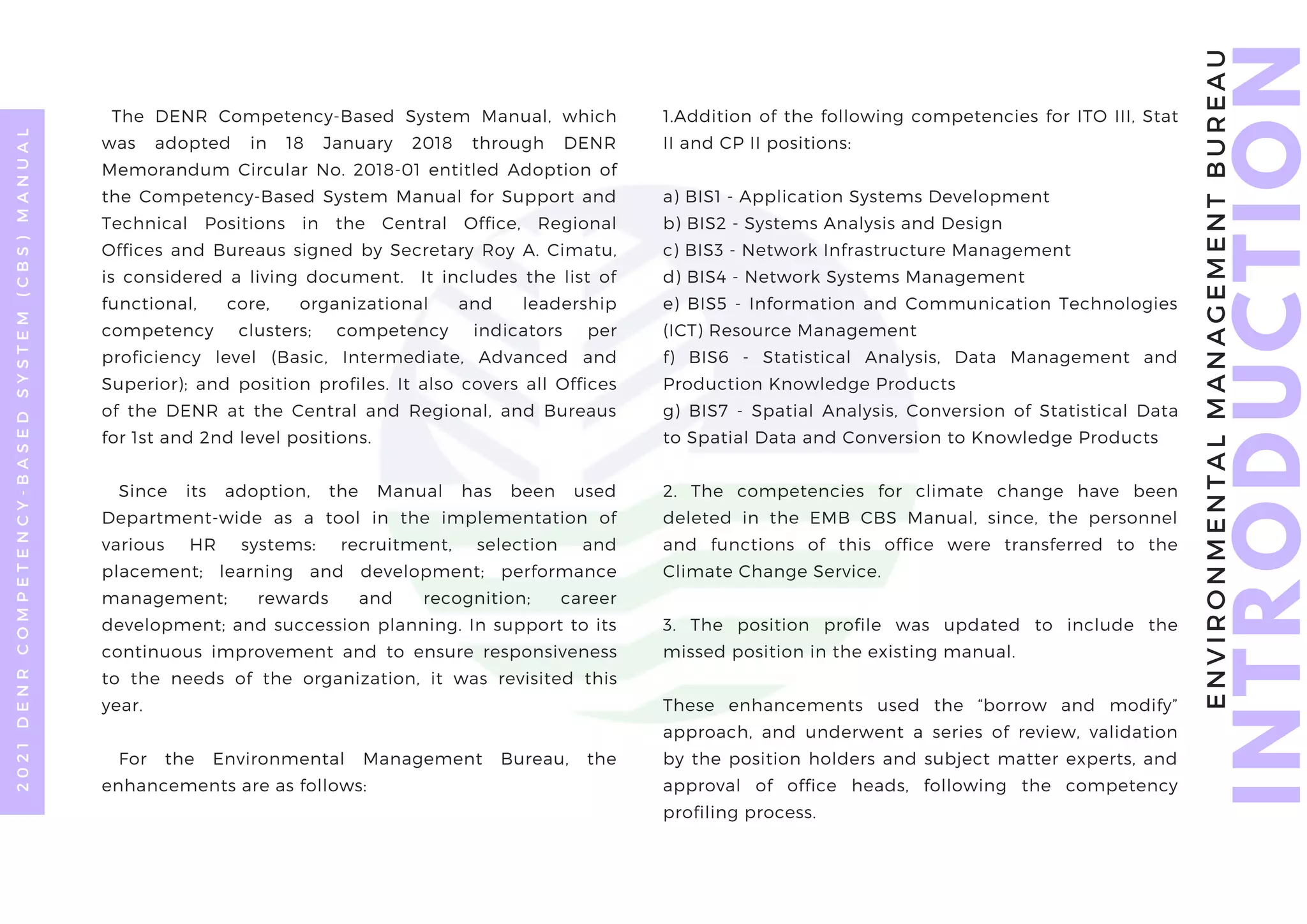
The DENR Competency-Based System Manual, which
was adopted in 18 January 2018 through DENR
Memorandum Circular No. 2018-01 entitled Adoption of
the Competency-Based System Manual for Support and
Technical Positions in the Central Office, Regional
Offices and Bureaus signed by Secretary Roy A. Cimatu,
is considered a living document. It includes the list of
functional, core, organizational and leadership
competency clusters; competency indicators per
proficiency level (Basic, Intermediate, Advanced and
Superior); and position profiles. It also covers all Offices
of the DENR at the Central and Regional, and Bureaus
for 1st and 2nd level positions.
Since its adoption, the Manual has been used
Department-wide as a tool in the implementation of
various HR systems: recruitment, selection and
placement; learning and development; performance
management; rewards and recognition; career
development; and succession planning. In support to its
continuous improvement and to ensure responsiveness
to the needs of the organization, it was revisited this
year.
For the Environmental Management Bureau, the
enhancements are as follows:
2
0
2
1
D
E
N
R
C
O
M
P
E
T
E
N
C
Y
-
B
A
S
E
D
S
Y
S
T
E
M
(
C
B
S
)
M
A
N
U
A
L
1.Addition of the following competencies for ITO III, Stat
II and CP II positions:
a) BIS1 - Application Systems Development
b) BIS2 - Systems Analysis and Design
c) BIS3 - Network Infrastructure Management
d) BIS4 - Network Systems Management
e) BIS5 - Information and Communication Technologies
(ICT) Resource Management
f) BIS6 - Statistical Analysis, Data Management and
Production Knowledge Products
g) BIS7 - Spatial Analysis, Conversion of Statistical Data
to Spatial Data and Conversion to Knowledge Products
2. The competencies for climate change have been
deleted in the EMB CBS Manual, since, the personnel
and functions of this office were transferred to the
Climate Change Service.
3. The position profile was updated to include the
missed position in the existing manual.
These enhancements used the “borrow and modify”
approach, and underwent a series of review, validation
by the position holders and subject matter experts, and
approval of office heads, following the competency
profiling process.
1
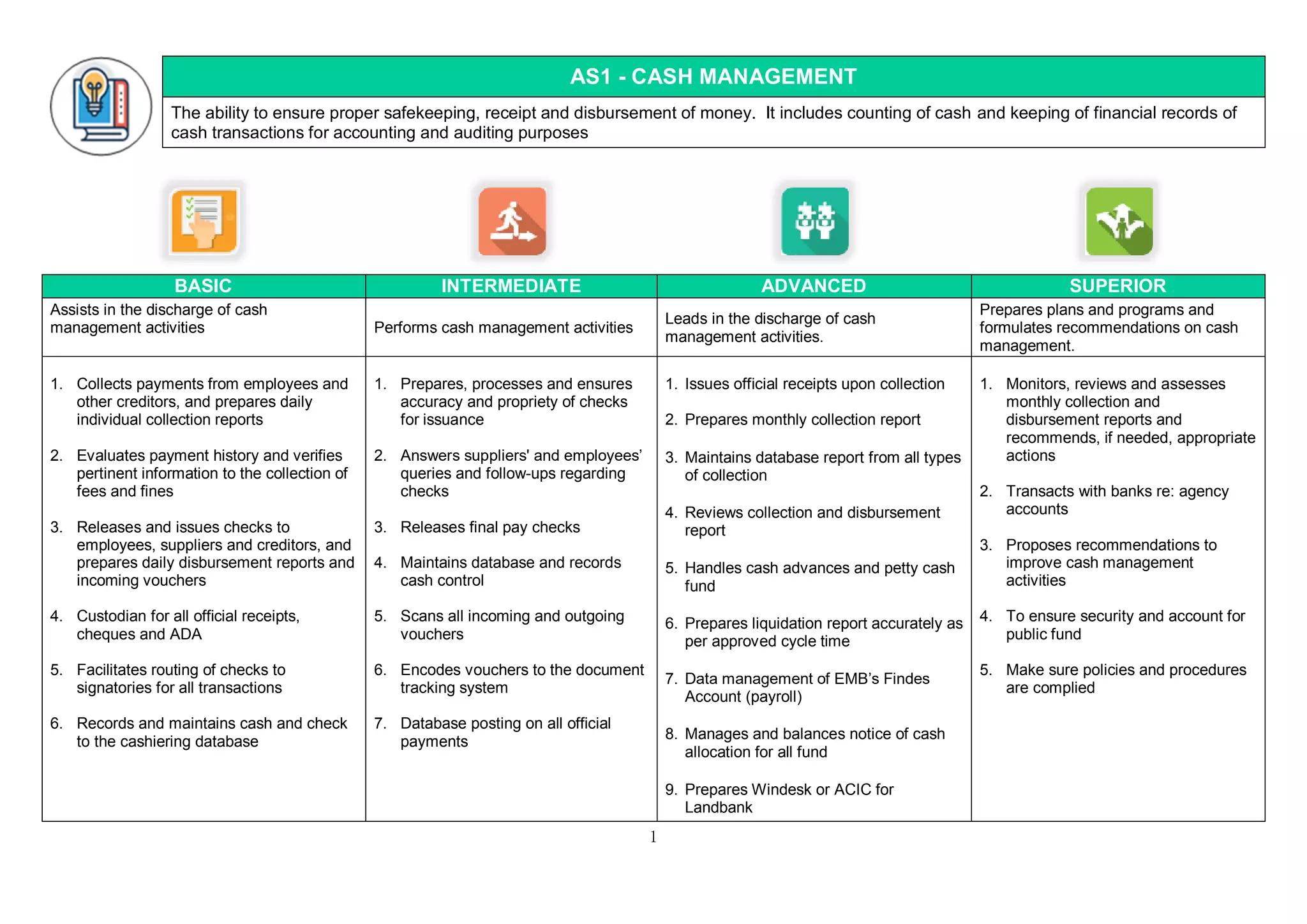
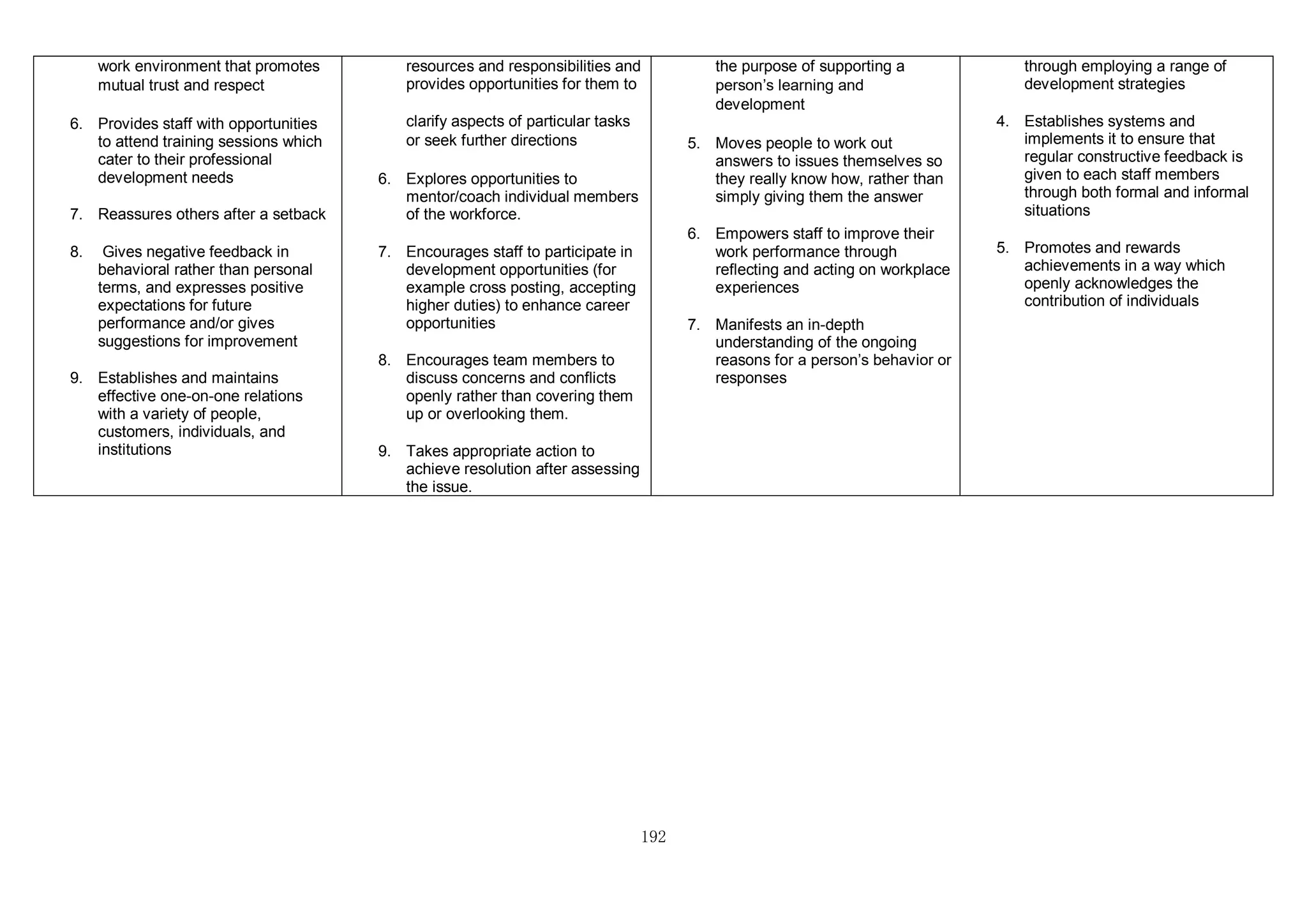
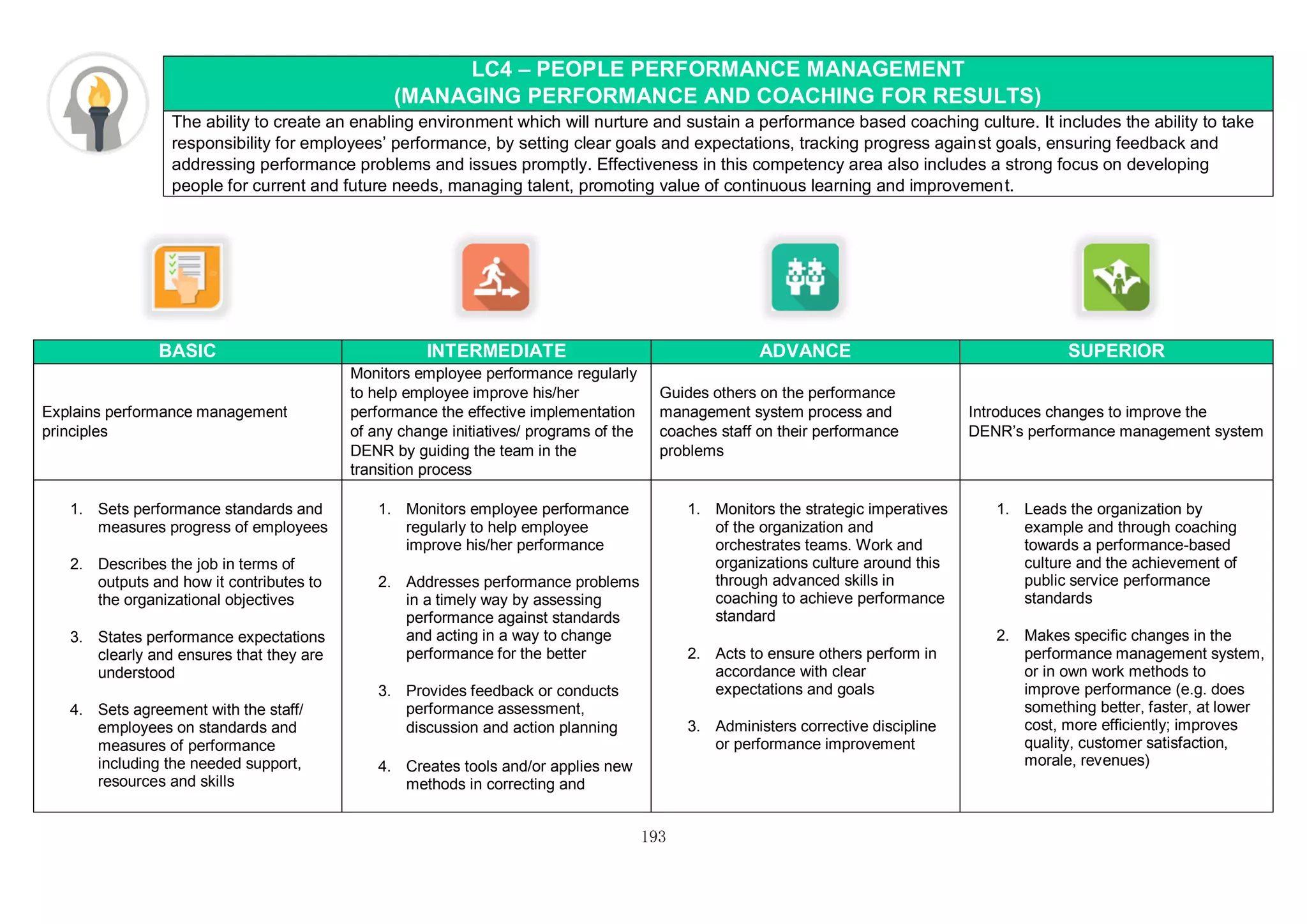
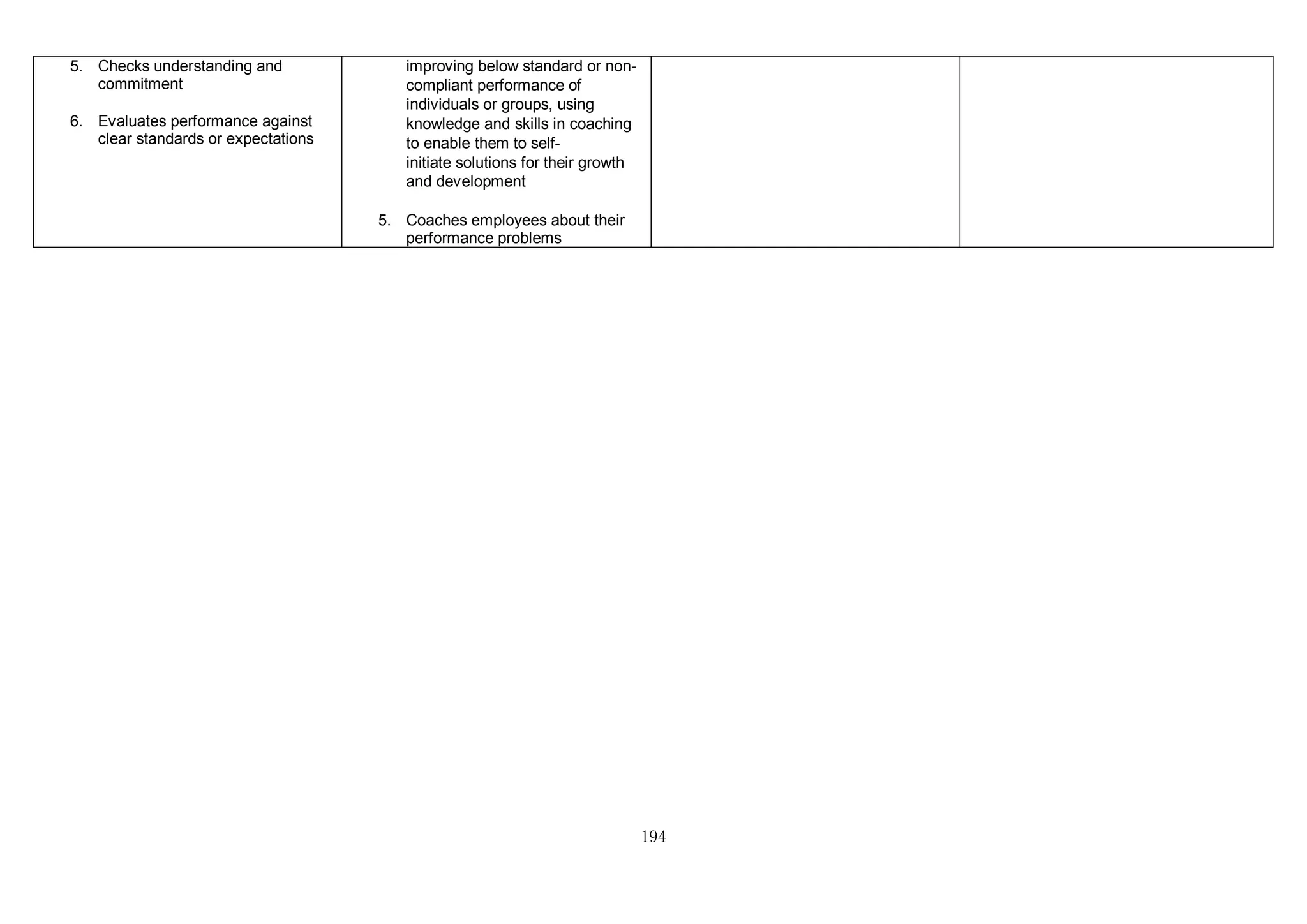
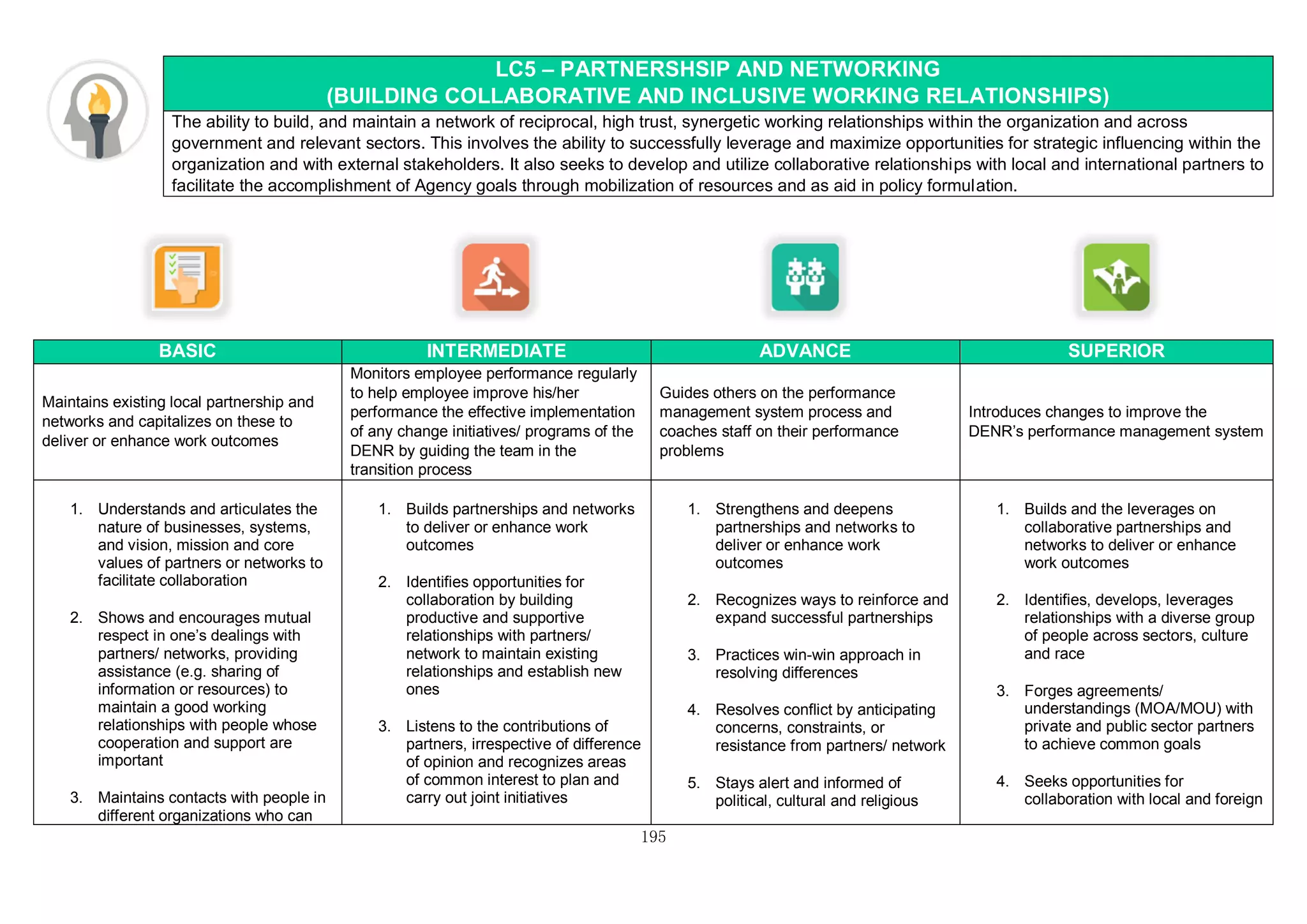
AS1 - CASH MANAGEMENT
The ability to ensure proper safekeeping, receipt and disbursement of money. It includes counting of cash and keeping of financial records of
cash transactions for accounting and auditing purposes
BASIC INTERMEDIATE ADVANCED SUPERIOR
Assists in the discharge of cash
management activities Performs cash management activities
Leads in the discharge of cash
management activities.
Prepares plans and programs and
formulates recommendations on cash
management.
1. Collects payments from employees and
other creditors, and prepares daily
individual collection reports
2. Evaluates payment history and verifies
pertinent information to the collection of
fees and fines
3. Releases and issues checks to
employees, suppliers and creditors, and
prepares daily disbursement reports and
incoming vouchers
4. Custodian for all official receipts,
cheques and ADA
5. Facilitates routing of checks to
signatories for all transactions
6. Records and maintains cash and check
to the cashiering database
1. Prepares, processes and ensures
accuracy and propriety of checks
for issuance
2. Answers suppliers' and employees’
queries and follow-ups regarding
checks
3. Releases final pay checks
4. Maintains database and records
cash control
5. Scans all incoming and outgoing
vouchers
6. Encodes vouchers to the document
tracking system
7. Database posting on all official
payments
1. Issues official receipts upon collection
2. Prepares monthly collection report
3. Maintains database report from all types
of collection
4. Reviews collection and disbursement
report
5. Handles cash advances and petty cash
fund
6. Prepares liquidation report accurately as
per approved cycle time
7. Data management of EMB’s Findes
Account (payroll)
8. Manages and balances notice of cash
allocation for all fund
9. Prepares Windesk or ACIC for
Landbank
1. Monitors, reviews and assesses
monthly collection and
disbursement reports and
recommends, if needed, appropriate
actions
2. Transacts with banks re: agency
accounts
3. Proposes recommendations to
improve cash management
activities
4. To ensure security and account for
public fund
5. Make sure policies and procedures
are complied
2
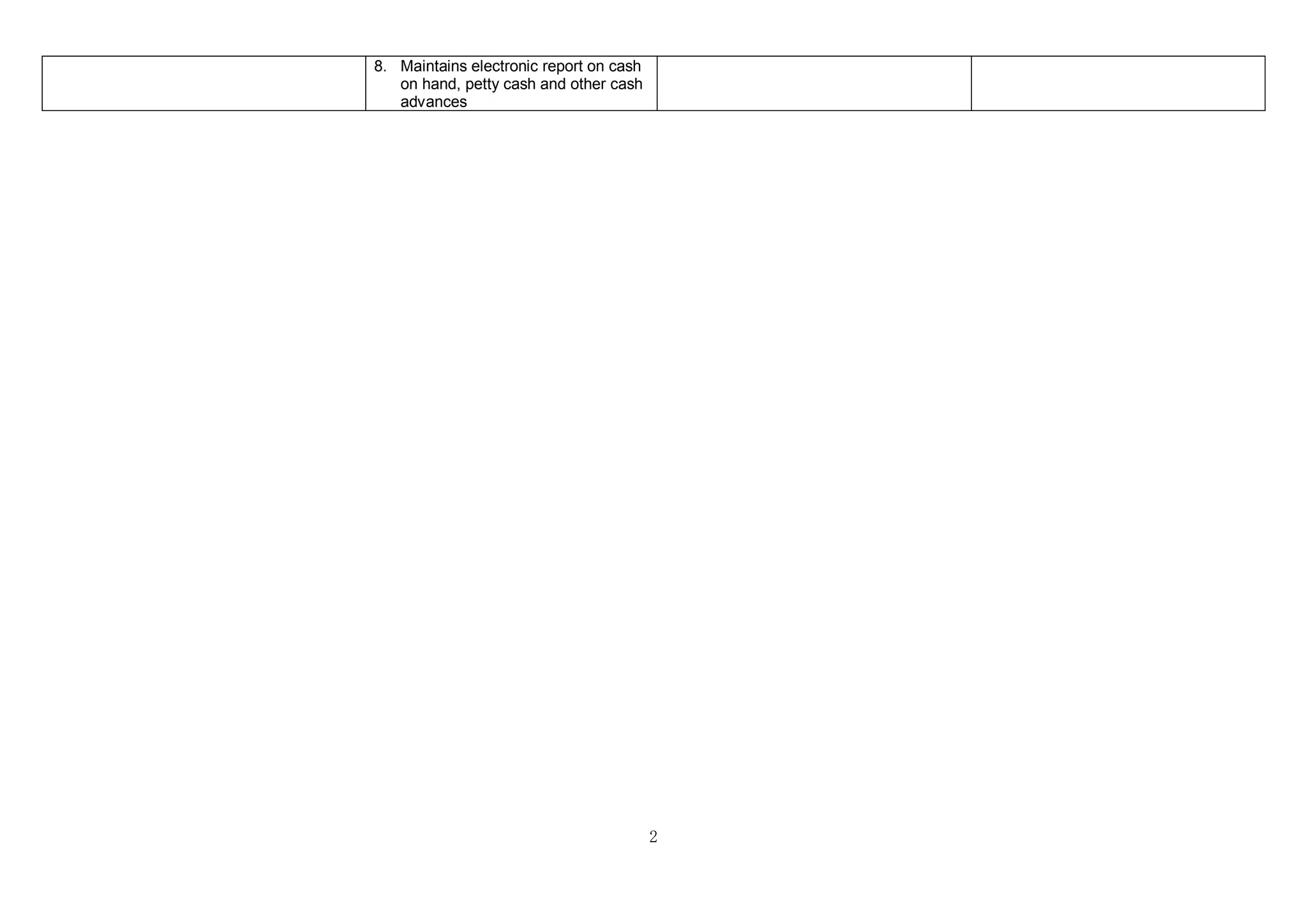
8. Maintains electronic report on cash
on hand, petty cash and other cash
advances
3
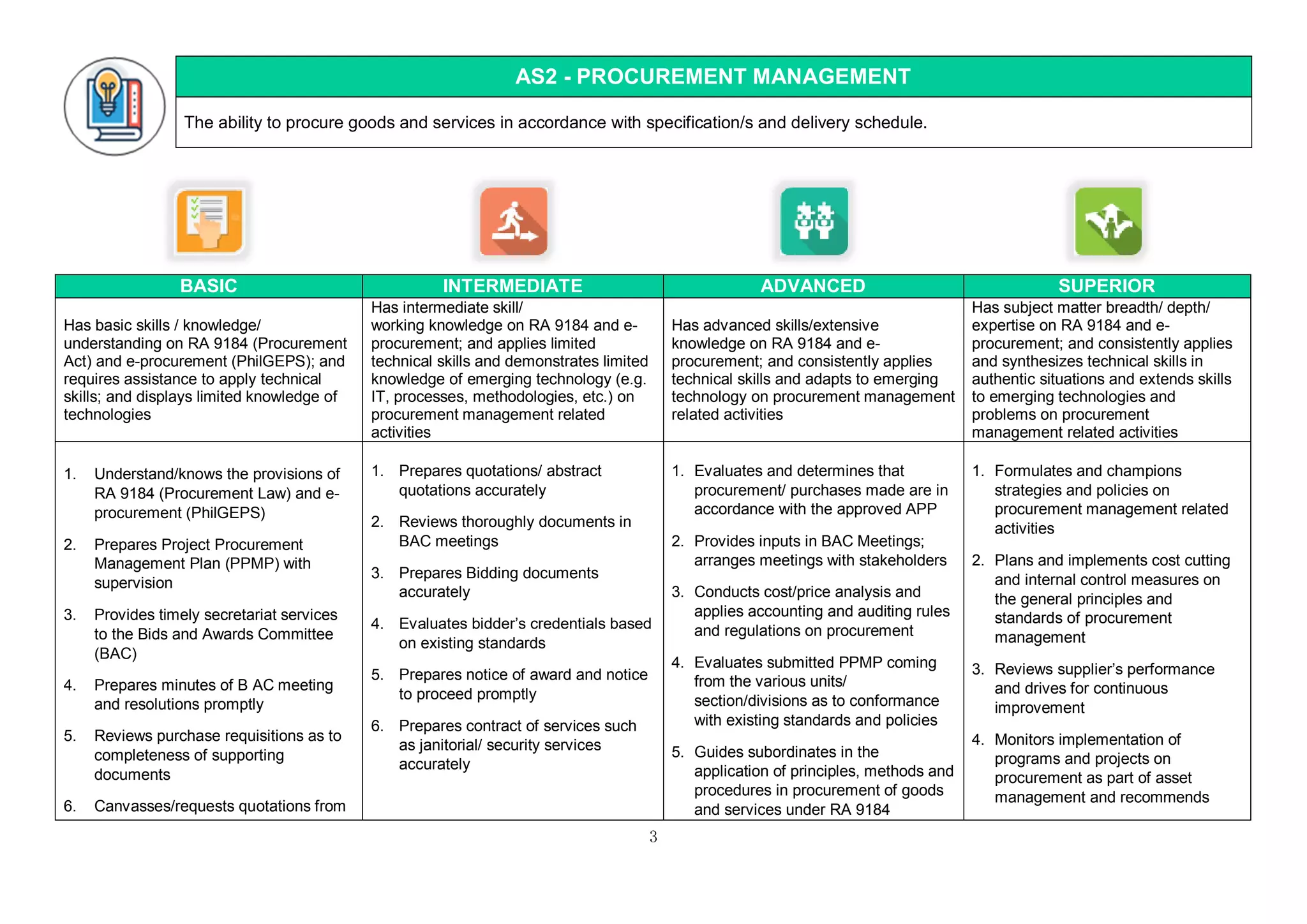
AS2 - PROCUREMENT MANAGEMENT
The ability to procure goods and services in accordance with specification/s and delivery schedule.
BASIC INTERMEDIATE ADVANCED SUPERIOR
Has basic skills / knowledge/
understanding on RA 9184 (Procurement
Act) and e-procurement (PhilGEPS); and
requires assistance to apply technical
skills; and displays limited knowledge of
technologies
Has intermediate skill/
working knowledge on RA 9184 and e-
procurement; and applies limited
technical skills and demonstrates limited
knowledge of emerging technology (e.g.
IT, processes, methodologies, etc.) on
procurement management related
activities
Has advanced skills/extensive
knowledge on RA 9184 and e-
procurement; and consistently applies
technical skills and adapts to emerging
technology on procurement management
related activities
Has subject matter breadth/ depth/
expertise on RA 9184 and e-
procurement; and consistently applies
and synthesizes technical skills in
authentic situations and extends skills
to emerging technologies and
problems on procurement
management related activities
1. Understand/knows the provisions of
RA 9184 (Procurement Law) and e-
procurement (PhilGEPS)
2. Prepares Project Procurement
Management Plan (PPMP) with
supervision
3. Provides timely secretariat services
to the Bids and Awards Committee
(BAC)
4. Prepares minutes of B AC meeting
and resolutions promptly
5. Reviews purchase requisitions as to
completeness of supporting
documents
6. Canvasses/requests quotations from
1. Prepares quotations/ abstract
quotations accurately
2. Reviews thoroughly documents in
BAC meetings
3. Prepares Bidding documents
accurately
4. Evaluates bidder’s credentials based
on existing standards
5. Prepares notice of award and notice
to proceed promptly
6. Prepares contract of services such
as janitorial/ security services
accurately
1. Evaluates and determines that
procurement/ purchases made are in
accordance with the approved APP
2. Provides inputs in BAC Meetings;
arranges meetings with stakeholders
3. Conducts cost/price analysis and
applies accounting and auditing rules
and regulations on procurement
4. Evaluates submitted PPMP coming
from the various units/
section/divisions as to conformance
with existing standards and policies
5. Guides subordinates in the
application of principles, methods and
procedures in procurement of goods
and services under RA 9184
1. Formulates and champions
strategies and policies on
procurement management related
activities
2. Plans and implements cost cutting
and internal control measures on
the general principles and
standards of procurement
management
3. Reviews supplier’s performance
and drives for continuous
improvement
4. Monitors implementation of
programs and projects on
procurement as part of asset
management and recommends
4
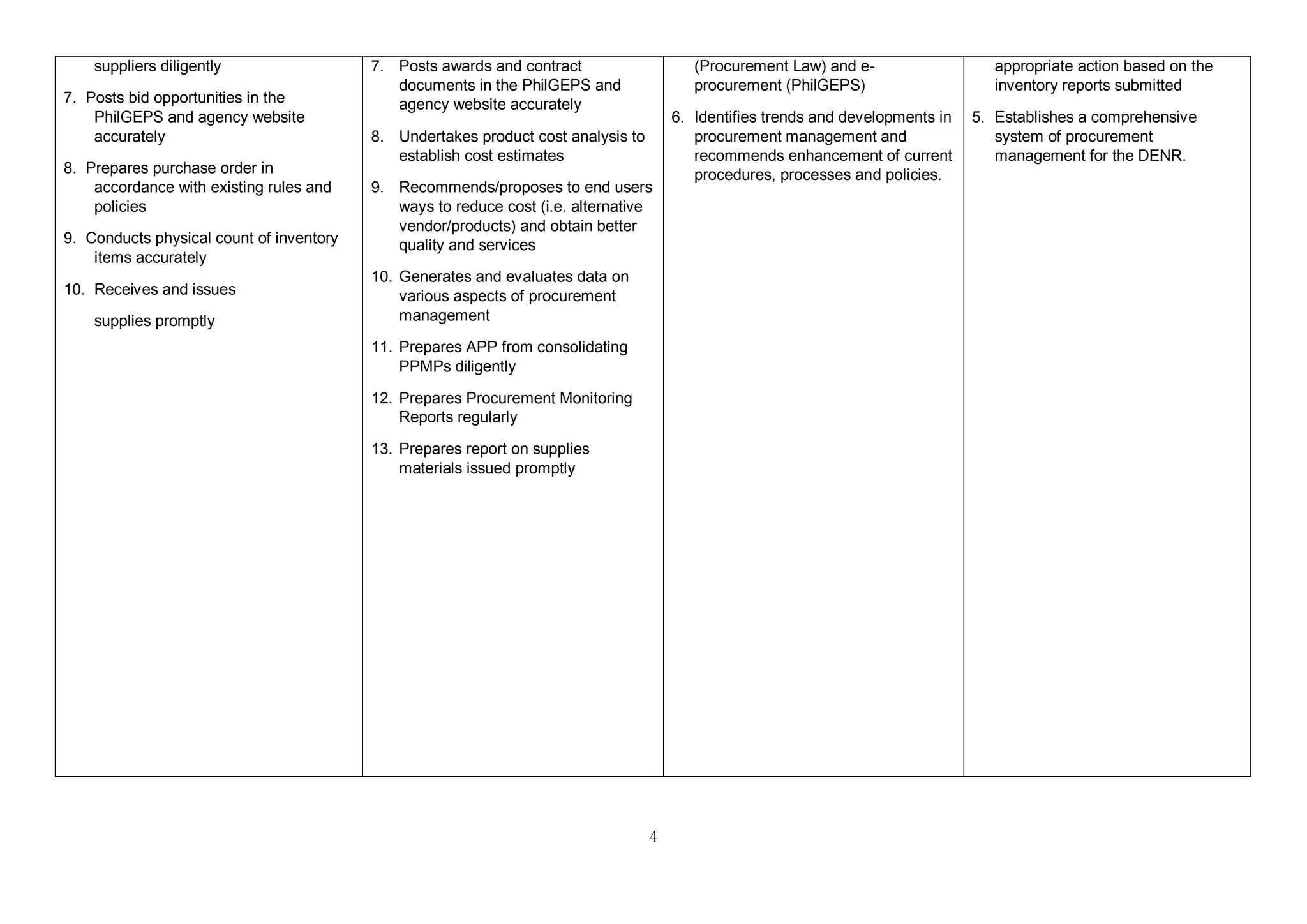
suppliers diligently
7. Posts bid opportunities in the
PhilGEPS and agency website
accurately
8. Prepares purchase order in
accordance with existing rules and
policies
9. Conducts physical count of inventory
items accurately
10. Receives and issues
supplies promptly
7. Posts awards and contract
documents in the PhilGEPS and
agency website accurately
8. Undertakes product cost analysis to
establish cost estimates
9. Recommends/proposes to end users
ways to reduce cost (i.e. alternative
vendor/products) and obtain better
quality and services
10. Generates and evaluates data on
various aspects of procurement
management
11. Prepares APP from consolidating
PPMPs diligently
12. Prepares Procurement Monitoring
Reports regularly
13. Prepares report on supplies
materials issued promptly
(Procurement Law) and e-
procurement (PhilGEPS)
6. Identifies trends and developments in
procurement management and
recommends enhancement of current
procedures, processes and policies.
appropriate action based on the
inventory reports submitted
5. Establishes a comprehensive
system of procurement
management for the DENR.
5
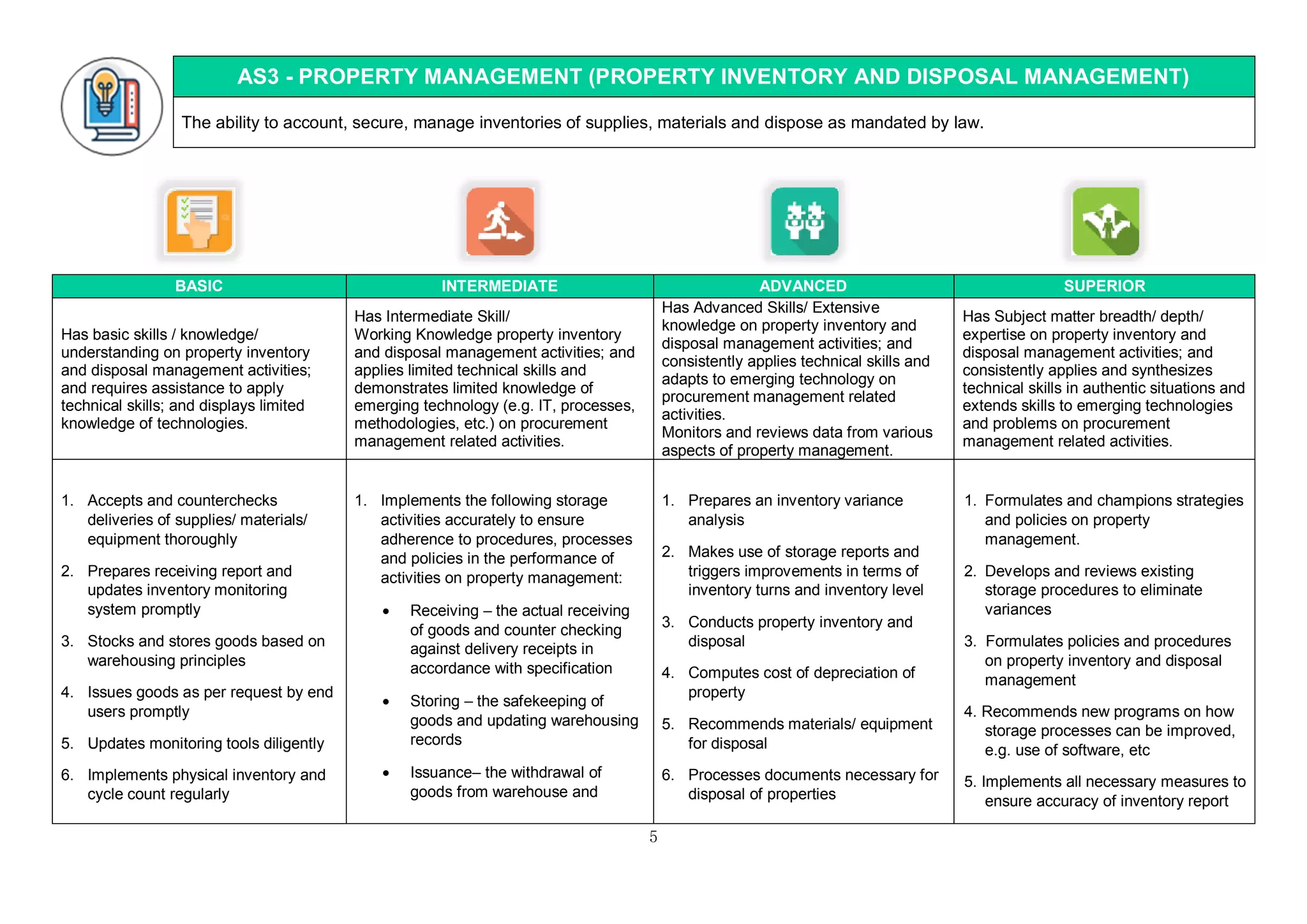
AS3 - PROPERTY MANAGEMENT (PROPERTY INVENTORY AND DISPOSAL MANAGEMENT)
The ability to account, secure, manage inventories of supplies, materials and dispose as mandated by law.
BASIC INTERMEDIATE ADVANCED SUPERIOR
Has basic skills / knowledge/
understanding on property inventory
and disposal management activities;
and requires assistance to apply
technical skills; and displays limited
knowledge of technologies.
Has Intermediate Skill/
Working Knowledge property inventory
and disposal management activities; and
applies limited technical skills and
demonstrates limited knowledge of
emerging technology (e.g. IT, processes,
methodologies, etc.) on procurement
management related activities.
Has Advanced Skills/ Extensive
knowledge on property inventory and
disposal management activities; and
consistently applies technical skills and
adapts to emerging technology on
procurement management related
activities.
Monitors and reviews data from various
aspects of property management.
Has Subject matter breadth/ depth/
expertise on property inventory and
disposal management activities; and
consistently applies and synthesizes
technical skills in authentic situations and
extends skills to emerging technologies
and problems on procurement
management related activities.
1. Accepts and counterchecks
deliveries of supplies/ materials/
equipment thoroughly
2. Prepares receiving report and
updates inventory monitoring
system promptly
3. Stocks and stores goods based on
warehousing principles
4. Issues goods as per request by end
users promptly
5. Updates monitoring tools diligently
6. Implements physical inventory and
cycle count regularly
1. Implements the following storage
activities accurately to ensure
adherence to procedures, processes
and policies in the performance of
activities on property management:
 Receiving – the actual receiving
of goods and counter checking
against delivery receipts in
accordance with specification
 Storing – the safekeeping of
goods and updating warehousing
records
 Issuance– the withdrawal of
goods from warehouse and
1. Prepares an inventory variance
analysis
2. Makes use of storage reports and
triggers improvements in terms of
inventory turns and inventory level
3. Conducts property inventory and
disposal
4. Computes cost of depreciation of
property
5. Recommends materials/ equipment
for disposal
6. Processes documents necessary for
disposal of properties
1. Formulates and champions strategies
and policies on property
management.
2. Develops and reviews existing
storage procedures to eliminate
variances
3. Formulates policies and procedures
on property inventory and disposal
management
4. Recommends new programs on how
storage processes can be improved,
e.g. use of software, etc
5. Implements all necessary measures to
ensure accuracy of inventory report
6
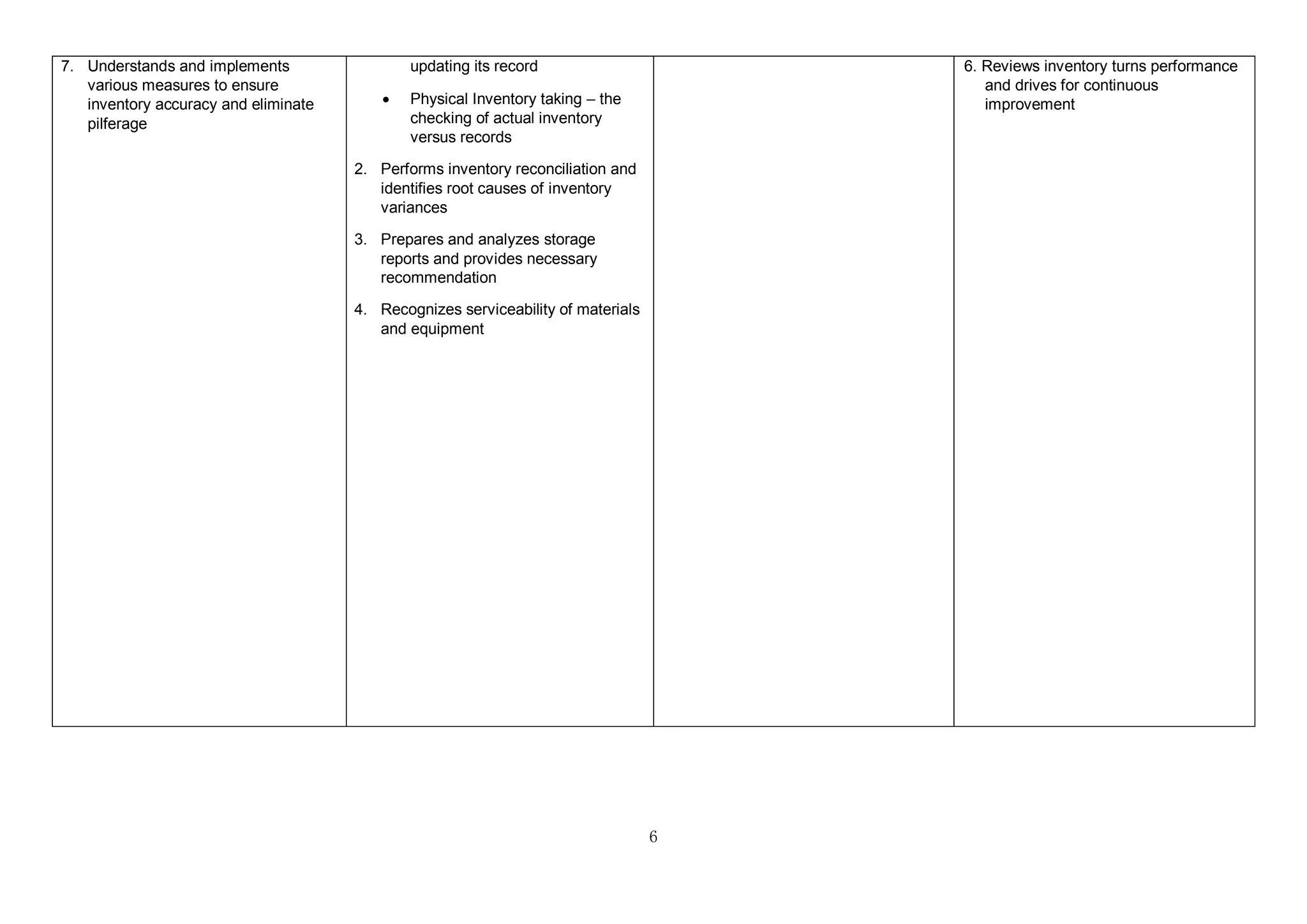
7. Understands and implements
various measures to ensure
inventory accuracy and eliminate
pilferage
updating its record
 Physical Inventory taking – the
checking of actual inventory
versus records
2. Performs inventory reconciliation and
identifies root causes of inventory
variances
3. Prepares and analyzes storage
reports and provides necessary
recommendation
4. Recognizes serviceability of materials
and equipment
6. Reviews inventory turns performance
and drives for continuous
improvement
7
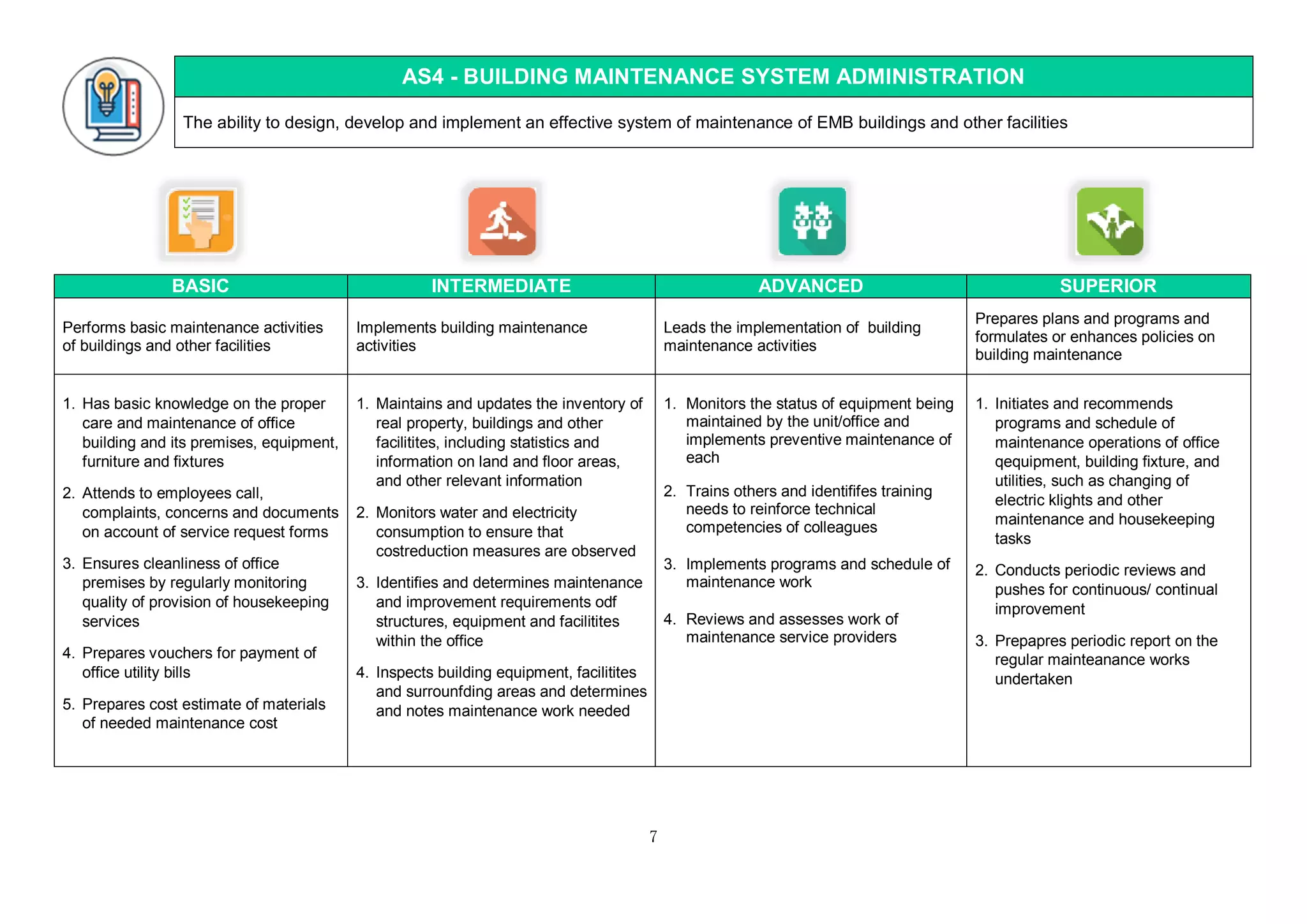
AS4 - BUILDING MAINTENANCE SYSTEM ADMINISTRATION
The ability to design, develop and implement an effective system of maintenance of EMB buildings and other facilities
BASIC INTERMEDIATE ADVANCED SUPERIOR
Performs basic maintenance activities
of buildings and other facilities
Implements building maintenance
activities
Leads the implementation of building
maintenance activities
Prepares plans and programs and
formulates or enhances policies on
building maintenance
1. Has basic knowledge on the proper
care and maintenance of office
building and its premises, equipment,
furniture and fixtures
2. Attends to employees call,
complaints, concerns and documents
on account of service request forms
3. Ensures cleanliness of office
premises by regularly monitoring
quality of provision of housekeeping
services
4. Prepares vouchers for payment of
office utility bills
5. Prepares cost estimate of materials
of needed maintenance cost
1. Maintains and updates the inventory of
real property, buildings and other
facilitites, including statistics and
information on land and floor areas,
and other relevant information
2. Monitors water and electricity
consumption to ensure that
costreduction measures are observed
3. Identifies and determines maintenance
and improvement requirements odf
structures, equipment and facilitites
within the office
4. Inspects building equipment, facilitites
and surrounfding areas and determines
and notes maintenance work needed
1. Monitors the status of equipment being
maintained by the unit/office and
implements preventive maintenance of
each
2. Trains others and identififes training
needs to reinforce technical
competencies of colleagues
3. Implements programs and schedule of
maintenance work
4. Reviews and assesses work of
maintenance service providers
1. Initiates and recommends
programs and schedule of
maintenance operations of office
qequipment, building fixture, and
utilities, such as changing of
electric klights and other
maintenance and housekeeping
tasks
2. Conducts periodic reviews and
pushes for continuous/ continual
improvement
3. Prepapres periodic report on the
regular mainteanance works
undertaken
8
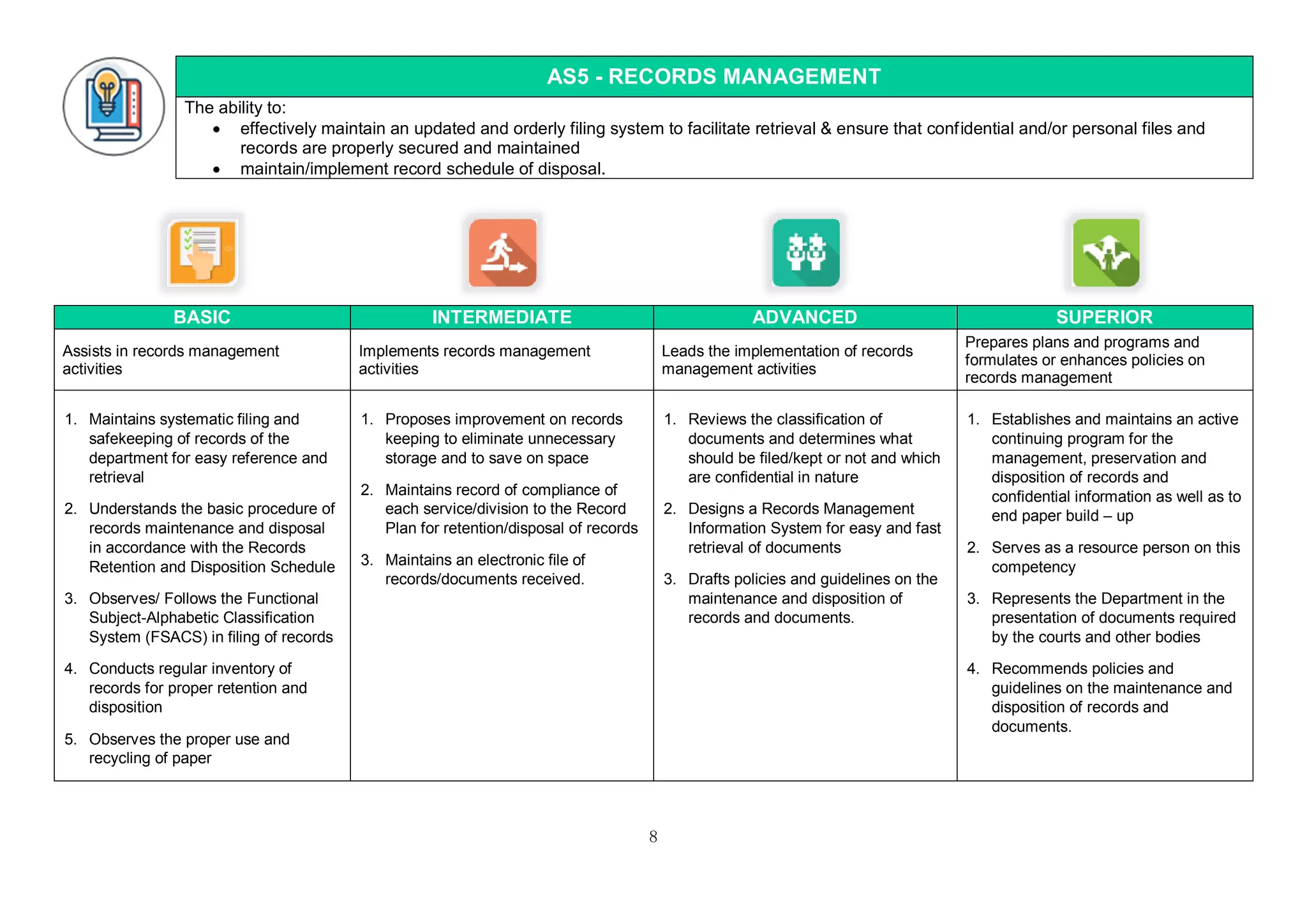
AS5 - RECORDS MANAGEMENT
The ability to:
 effectively maintain an updated and orderly filing system to facilitate retrieval & ensure that confidential and/or personal files and
records are properly secured and maintained
 maintain/implement record schedule of disposal.
BASIC INTERMEDIATE ADVANCED SUPERIOR
Assists in records management
activities
Implements records management
activities
Leads the implementation of records
management activities
Prepares plans and programs and
formulates or enhances policies on
records management
1. Maintains systematic filing and
safekeeping of records of the
department for easy reference and
retrieval
2. Understands the basic procedure of
records maintenance and disposal
in accordance with the Records
Retention and Disposition Schedule
3. Observes/ Follows the Functional
Subject-Alphabetic Classification
System (FSACS) in filing of records
4. Conducts regular inventory of
records for proper retention and
disposition
5. Observes the proper use and
recycling of paper
1. Proposes improvement on records
keeping to eliminate unnecessary
storage and to save on space
2. Maintains record of compliance of
each service/division to the Record
Plan for retention/disposal of records
3. Maintains an electronic file of
records/documents received.
1. Reviews the classification of
documents and determines what
should be filed/kept or not and which
are confidential in nature
2. Designs a Records Management
Information System for easy and fast
retrieval of documents
3. Drafts policies and guidelines on the
maintenance and disposition of
records and documents.
1. Establishes and maintains an active
continuing program for the
management, preservation and
disposition of records and
confidential information as well as to
end paper build – up
2. Serves as a resource person on this
competency
3. Represents the Department in the
presentation of documents required
by the courts and other bodies
4. Recommends policies and
guidelines on the maintenance and
disposition of records and
documents.
9
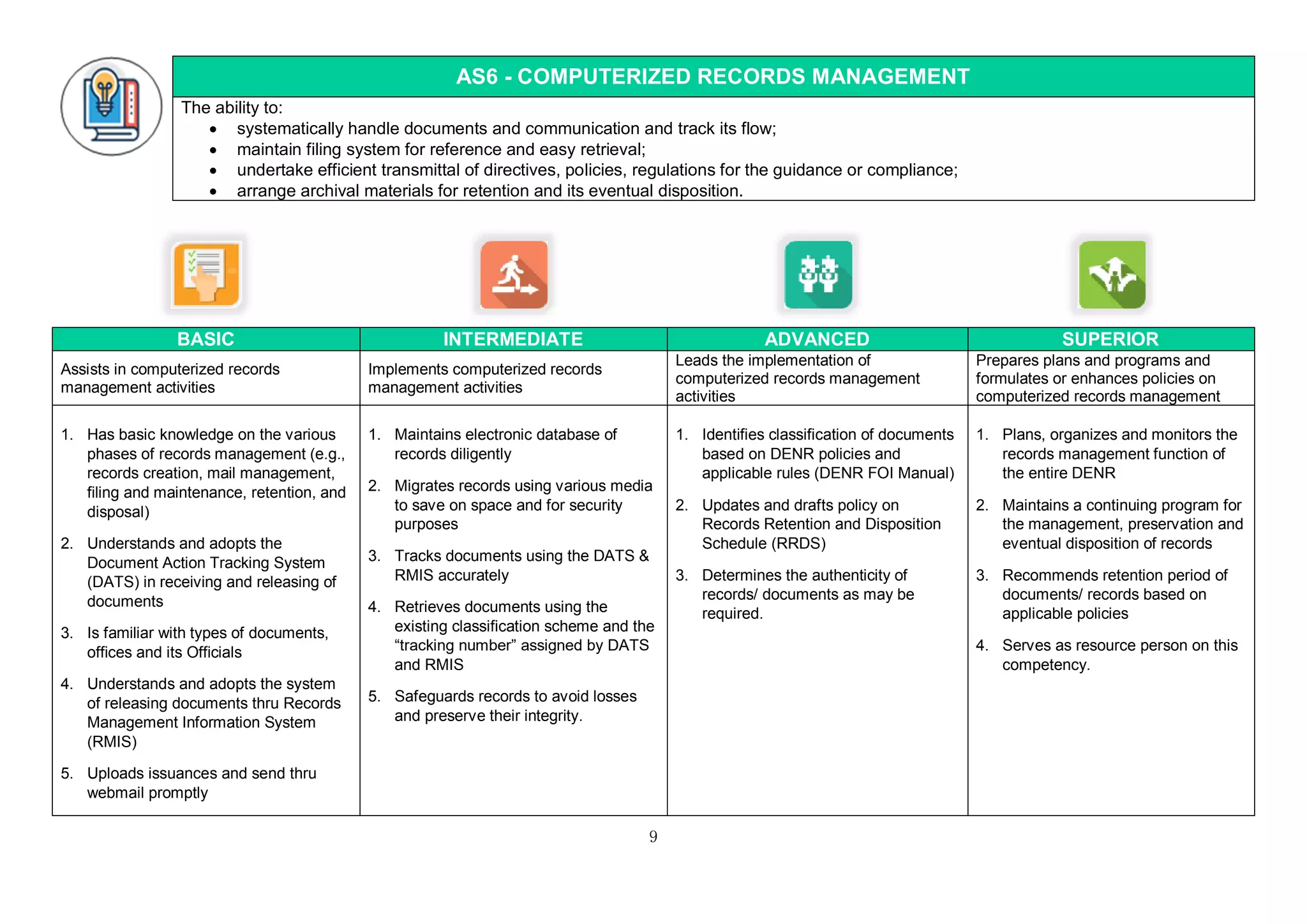
AS6 - COMPUTERIZED RECORDS MANAGEMENT
The ability to:
 systematically handle documents and communication and track its flow;
 maintain filing system for reference and easy retrieval;
 undertake efficient transmittal of directives, policies, regulations for the guidance or compliance;
 arrange archival materials for retention and its eventual disposition.
BASIC INTERMEDIATE ADVANCED SUPERIOR
Assists in computerized records
management activities
Implements computerized records
management activities
Leads the implementation of
computerized records management
activities
Prepares plans and programs and
formulates or enhances policies on
computerized records management
1. Has basic knowledge on the various
phases of records management (e.g.,
records creation, mail management,
filing and maintenance, retention, and
disposal)
2. Understands and adopts the
Document Action Tracking System
(DATS) in receiving and releasing of
documents
3. Is familiar with types of documents,
offices and its Officials
4. Understands and adopts the system
of releasing documents thru Records
Management Information System
(RMIS)
5. Uploads issuances and send thru
webmail promptly
1. Maintains electronic database of
records diligently
2. Migrates records using various media
to save on space and for security
purposes
3. Tracks documents using the DATS &
RMIS accurately
4. Retrieves documents using the
existing classification scheme and the
“tracking number” assigned by DATS
and RMIS
5. Safeguards records to avoid losses
and preserve their integrity.
1. Identifies classification of documents
based on DENR policies and
applicable rules (DENR FOI Manual)
2. Updates and drafts policy on
Records Retention and Disposition
Schedule (RRDS)
3. Determines the authenticity of
records/ documents as may be
required.
1. Plans, organizes and monitors the
records management function of
the entire DENR
2. Maintains a continuing program for
the management, preservation and
eventual disposition of records
3. Recommends retention period of
documents/ records based on
applicable policies
4. Serves as resource person on this
competency.
10
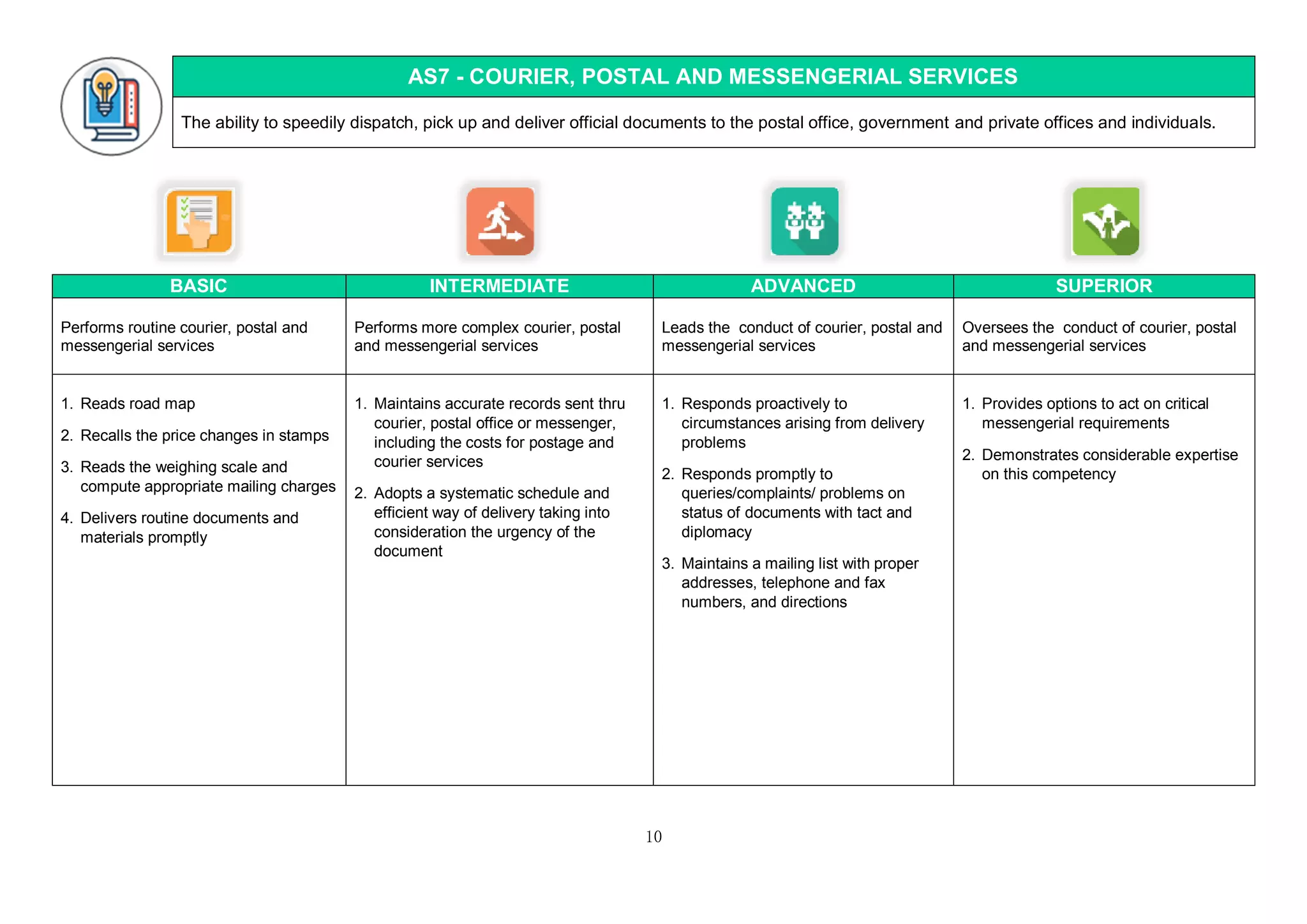
AS7 - COURIER, POSTAL AND MESSENGERIAL SERVICES
The ability to speedily dispatch, pick up and deliver official documents to the postal office, government and private offices and individuals.
BASIC INTERMEDIATE ADVANCED SUPERIOR
Performs routine courier, postal and
messengerial services
Performs more complex courier, postal
and messengerial services
Leads the conduct of courier, postal and
messengerial services
Oversees the conduct of courier, postal
and messengerial services
1. Reads road map
2. Recalls the price changes in stamps
3. Reads the weighing scale and
compute appropriate mailing charges
4. Delivers routine documents and
materials promptly
1. Maintains accurate records sent thru
courier, postal office or messenger,
including the costs for postage and
courier services
2. Adopts a systematic schedule and
efficient way of delivery taking into
consideration the urgency of the
document
1. Responds proactively to
circumstances arising from delivery
problems
2. Responds promptly to
queries/complaints/ problems on
status of documents with tact and
diplomacy
3. Maintains a mailing list with proper
addresses, telephone and fax
numbers, and directions
1. Provides options to act on critical
messengerial requirements
2. Demonstrates considerable expertise
on this competency
11
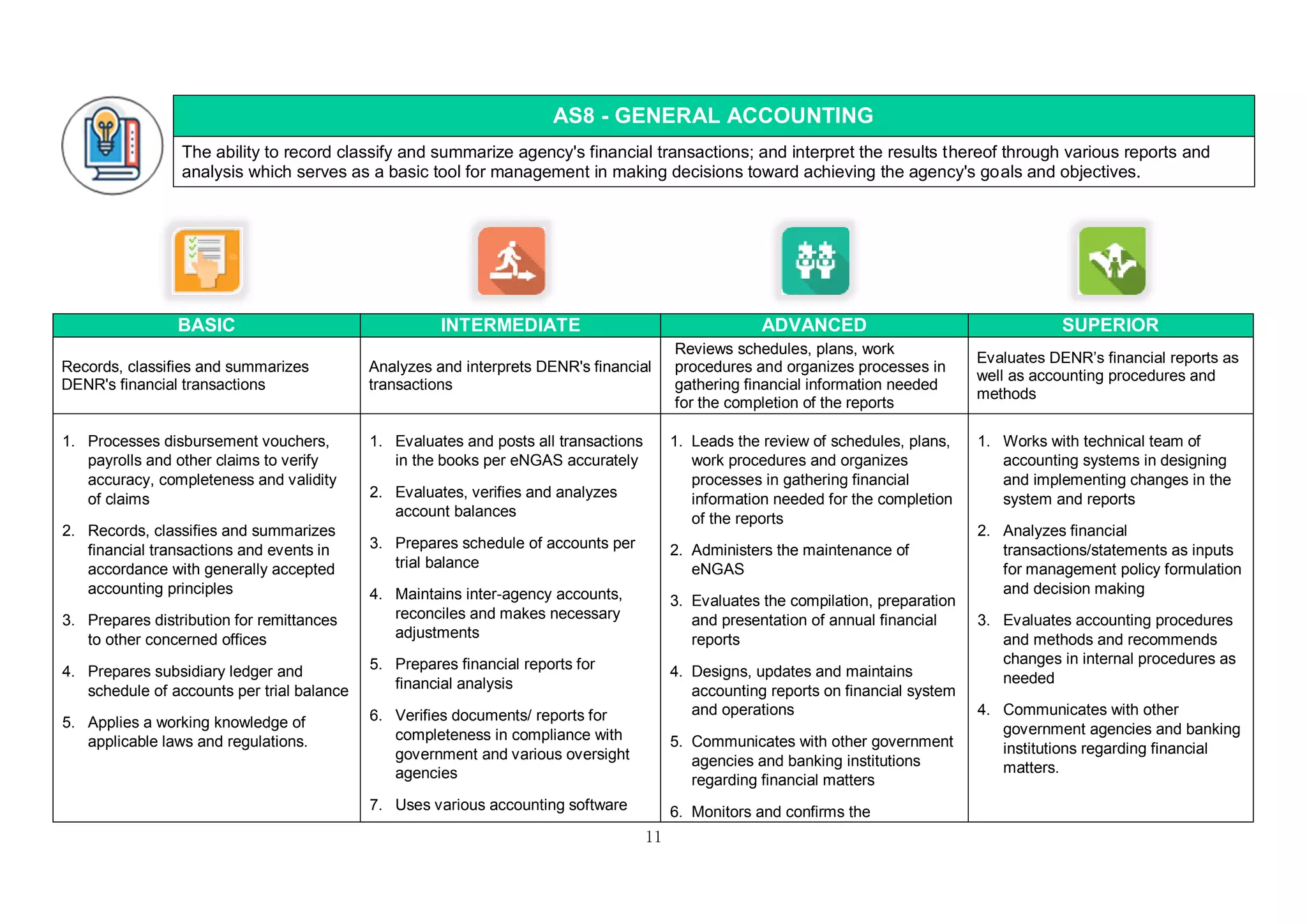
AS8 - GENERAL ACCOUNTING
The ability to record classify and summarize agency's financial transactions; and interpret the results thereof through various reports and
analysis which serves as a basic tool for management in making decisions toward achieving the agency's goals and objectives.
BASIC INTERMEDIATE ADVANCED SUPERIOR
Records, classifies and summarizes
DENR's financial transactions
Analyzes and interprets DENR's financial
transactions
Reviews schedules, plans, work
procedures and organizes processes in
gathering financial information needed
for the completion of the reports
Evaluates DENR’s financial reports as
well as accounting procedures and
methods
1. Processes disbursement vouchers,
payrolls and other claims to verify
accuracy, completeness and validity
of claims
2. Records, classifies and summarizes
financial transactions and events in
accordance with generally accepted
accounting principles
3. Prepares distribution for remittances
to other concerned offices
4. Prepares subsidiary ledger and
schedule of accounts per trial balance
5. Applies a working knowledge of
applicable laws and regulations.
1. Evaluates and posts all transactions
in the books per eNGAS accurately
2. Evaluates, verifies and analyzes
account balances
3. Prepares schedule of accounts per
trial balance
4. Maintains inter-agency accounts,
reconciles and makes necessary
adjustments
5. Prepares financial reports for
financial analysis
6. Verifies documents/ reports for
completeness in compliance with
government and various oversight
agencies
7. Uses various accounting software
1. Leads the review of schedules, plans,
work procedures and organizes
processes in gathering financial
information needed for the completion
of the reports
2. Administers the maintenance of
eNGAS
3. Evaluates the compilation, preparation
and presentation of annual financial
reports
4. Designs, updates and maintains
accounting reports on financial system
and operations
5. Communicates with other government
agencies and banking institutions
regarding financial matters
6. Monitors and confirms the
1. Works with technical team of
accounting systems in designing
and implementing changes in the
system and reports
2. Analyzes financial
transactions/statements as inputs
for management policy formulation
and decision making
3. Evaluates accounting procedures
and methods and recommends
changes in internal procedures as
needed
4. Communicates with other
government agencies and banking
institutions regarding financial
matters.
12
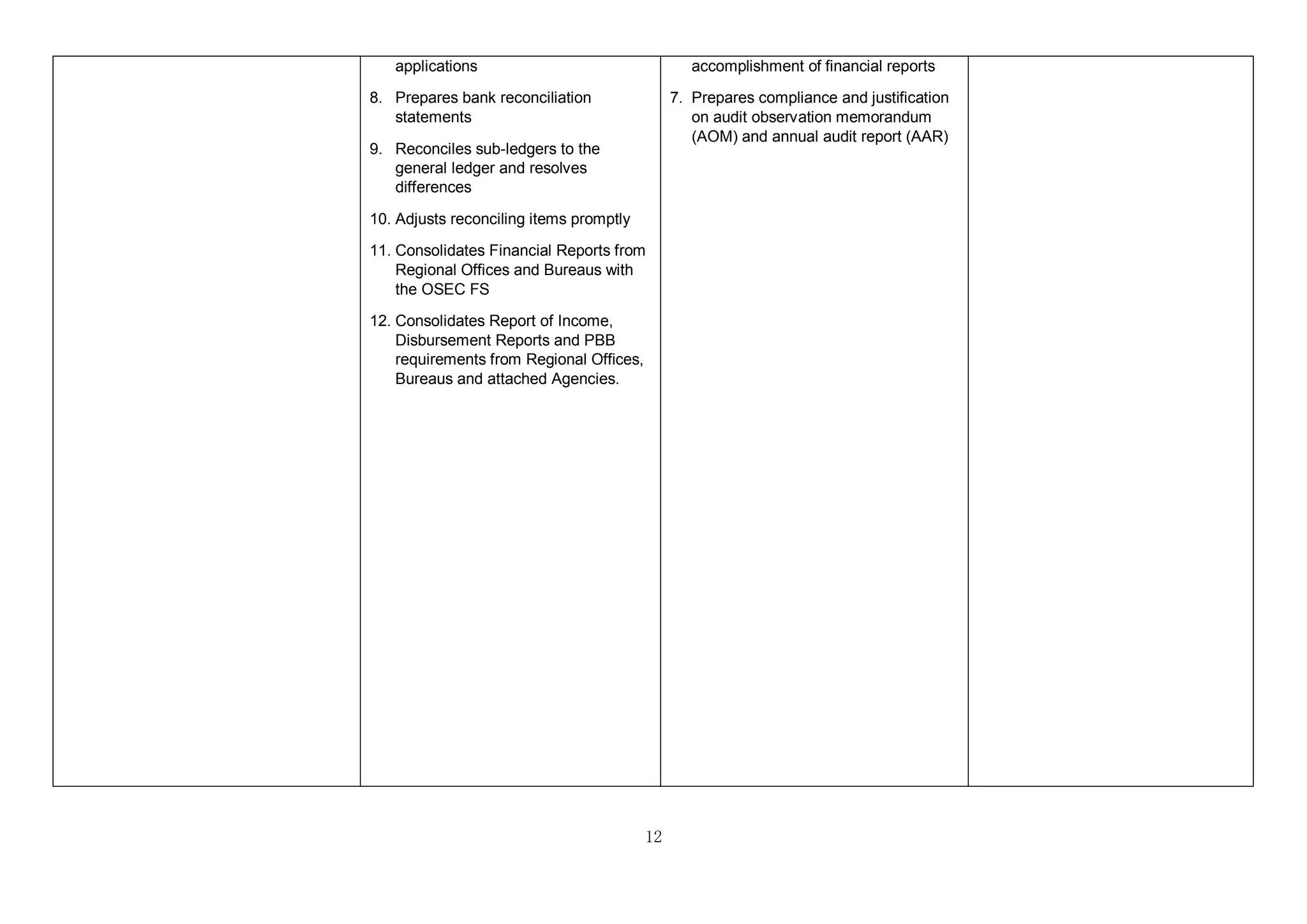
applications
8. Prepares bank reconciliation
statements
9. Reconciles sub-ledgers to the
general ledger and resolves
differences
10. Adjusts reconciling items promptly
11. Consolidates Financial Reports from
Regional Offices and Bureaus with
the OSEC FS
12. Consolidates Report of Income,
Disbursement Reports and PBB
requirements from Regional Offices,
Bureaus and attached Agencies.
accomplishment of financial reports
7. Prepares compliance and justification
on audit observation memorandum
(AOM) and annual audit report (AAR)
13
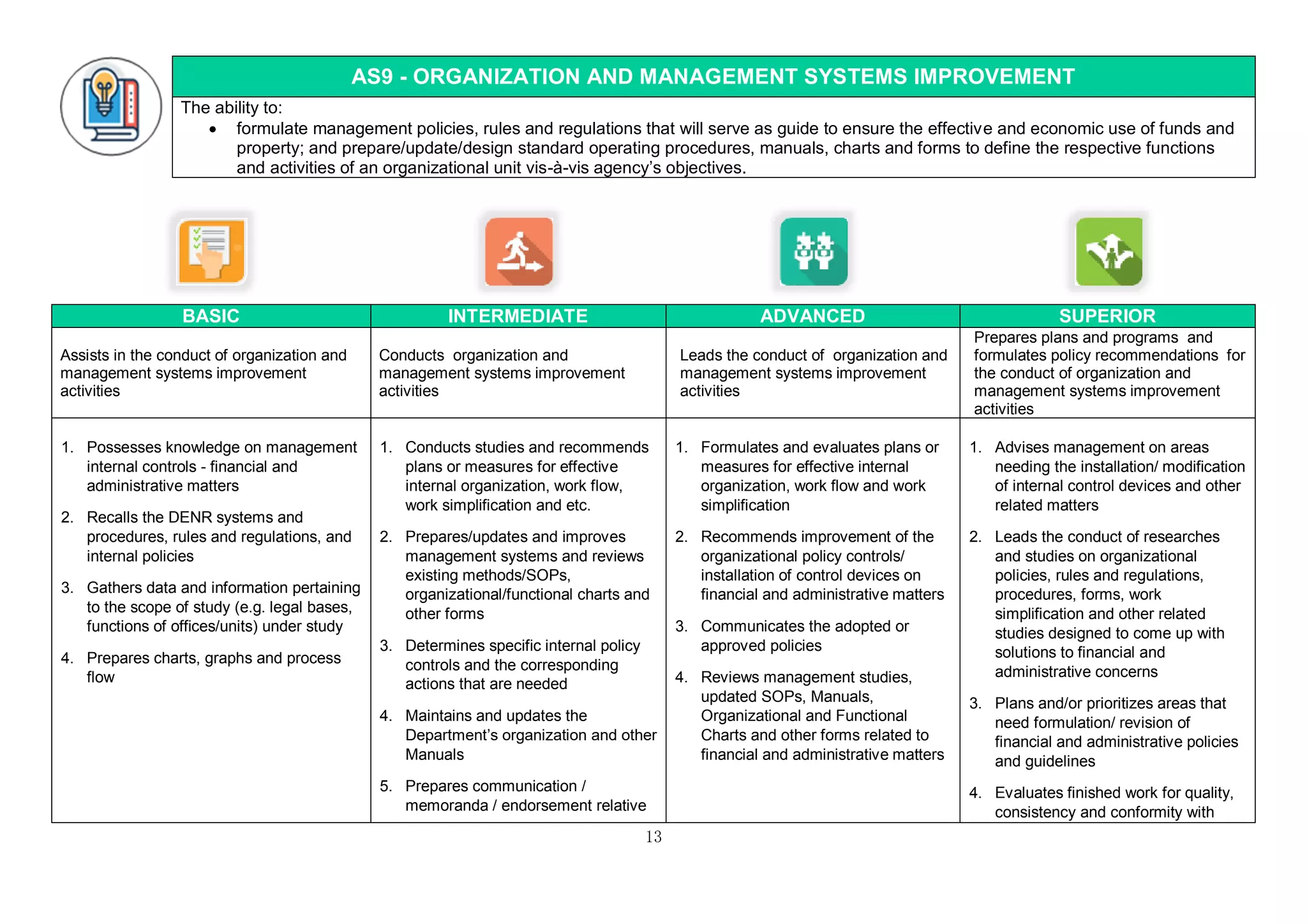
AS9 - ORGANIZATION AND MANAGEMENT SYSTEMS IMPROVEMENT
The ability to:
 formulate management policies, rules and regulations that will serve as guide to ensure the effective and economic use of funds and
property; and prepare/update/design standard operating procedures, manuals, charts and forms to define the respective functions
and activities of an organizational unit vis-à-vis agency’s objectives.
BASIC INTERMEDIATE ADVANCED SUPERIOR
Assists in the conduct of organization and
management systems improvement
activities
Conducts organization and
management systems improvement
activities
Leads the conduct of organization and
management systems improvement
activities
Prepares plans and programs and
formulates policy recommendations for
the conduct of organization and
management systems improvement
activities
1. Possesses knowledge on management
internal controls - financial and
administrative matters
2. Recalls the DENR systems and
procedures, rules and regulations, and
internal policies
3. Gathers data and information pertaining
to the scope of study (e.g. legal bases,
functions of offices/units) under study
4. Prepares charts, graphs and process
flow
1. Conducts studies and recommends
plans or measures for effective
internal organization, work flow,
work simplification and etc.
2. Prepares/updates and improves
management systems and reviews
existing methods/SOPs,
organizational/functional charts and
other forms
3. Determines specific internal policy
controls and the corresponding
actions that are needed
4. Maintains and updates the
Department’s organization and other
Manuals
5. Prepares communication /
memoranda / endorsement relative
1. Formulates and evaluates plans or
measures for effective internal
organization, work flow and work
simplification
2. Recommends improvement of the
organizational policy controls/
installation of control devices on
financial and administrative matters
3. Communicates the adopted or
approved policies
4. Reviews management studies,
updated SOPs, Manuals,
Organizational and Functional
Charts and other forms related to
financial and administrative matters
1. Advises management on areas
needing the installation/ modification
of internal control devices and other
related matters
2. Leads the conduct of researches
and studies on organizational
policies, rules and regulations,
procedures, forms, work
simplification and other related
studies designed to come up with
solutions to financial and
administrative concerns
3. Plans and/or prioritizes areas that
need formulation/ revision of
financial and administrative policies
and guidelines
4. Evaluates finished work for quality,
consistency and conformity with
14
to financial and administrative
matters
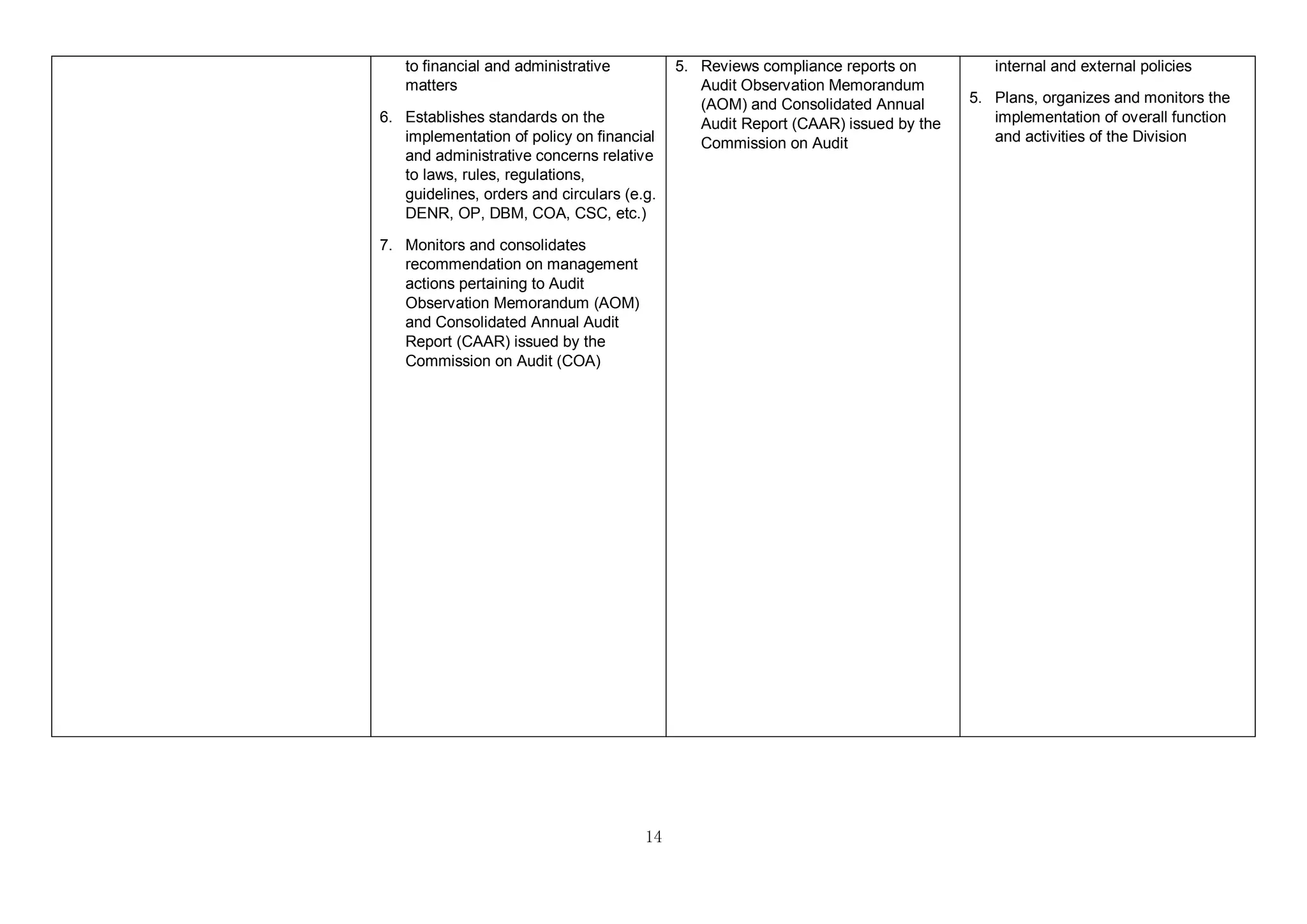
6. Establishes standards on the
implementation of policy on financial
and administrative concerns relative
to laws, rules, regulations,
guidelines, orders and circulars (e.g.
DENR, OP, DBM, COA, CSC, etc.)
7. Monitors and consolidates
recommendation on management
actions pertaining to Audit
Observation Memorandum (AOM)
and Consolidated Annual Audit
Report (CAAR) issued by the
Commission on Audit (COA)
5. Reviews compliance reports on
Audit Observation Memorandum
(AOM) and Consolidated Annual
Audit Report (CAAR) issued by the
Commission on Audit
internal and external policies
5. Plans, organizes and monitors the
implementation of overall function
and activities of the Division
15
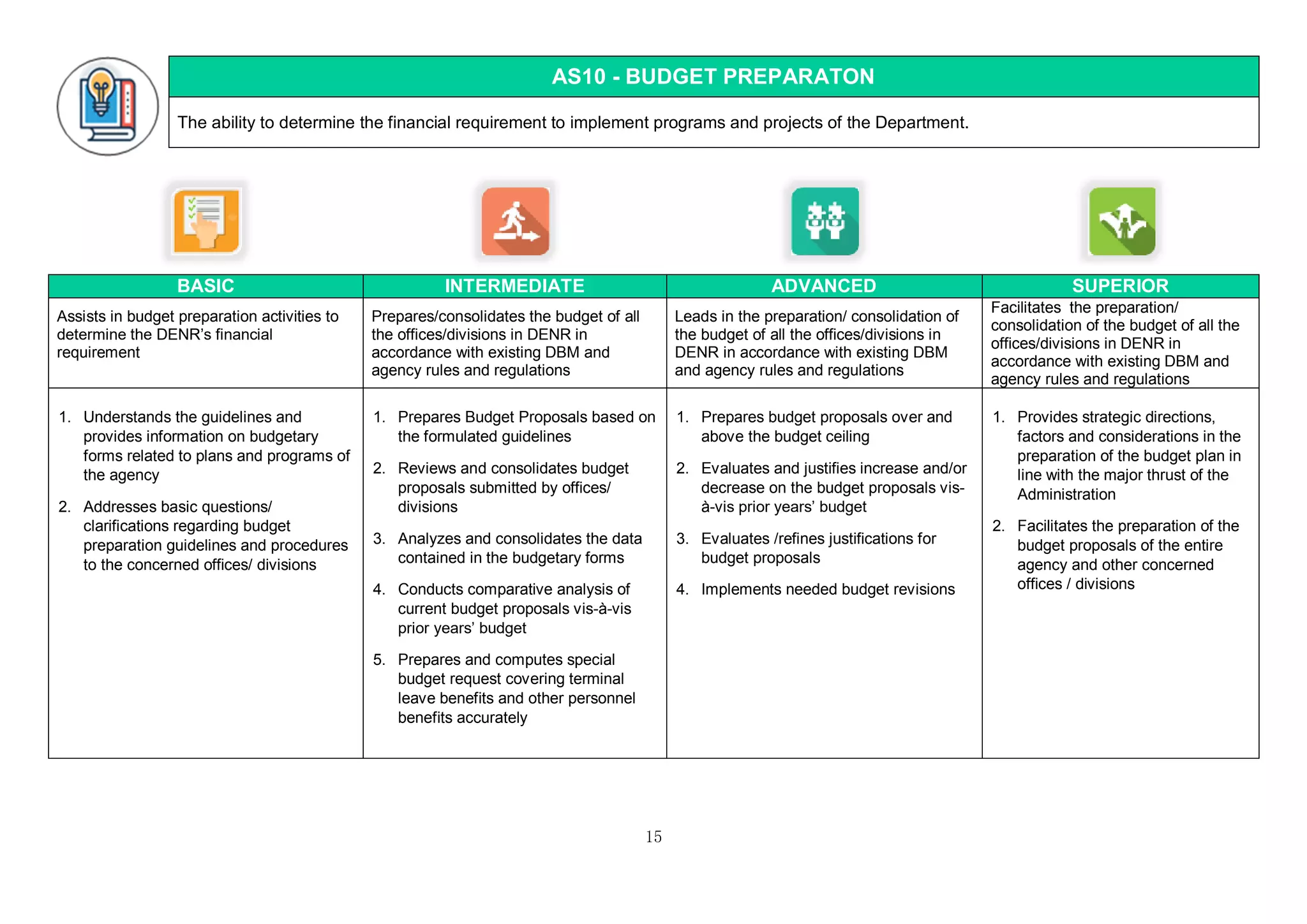
AS10 - BUDGET PREPARATON
The ability to determine the financial requirement to implement programs and projects of the Department.
BASIC INTERMEDIATE ADVANCED SUPERIOR
Assists in budget preparation activities to
determine the DENR’s financial
requirement
Prepares/consolidates the budget of all
the offices/divisions in DENR in
accordance with existing DBM and
agency rules and regulations
Leads in the preparation/ consolidation of
the budget of all the offices/divisions in
DENR in accordance with existing DBM
and agency rules and regulations
Facilitates the preparation/
consolidation of the budget of all the
offices/divisions in DENR in
accordance with existing DBM and
agency rules and regulations
1. Understands the guidelines and
provides information on budgetary
forms related to plans and programs of
the agency
2. Addresses basic questions/
clarifications regarding budget
preparation guidelines and procedures
to the concerned offices/ divisions
1. Prepares Budget Proposals based on
the formulated guidelines
2. Reviews and consolidates budget
proposals submitted by offices/
divisions
3. Analyzes and consolidates the data
contained in the budgetary forms
4. Conducts comparative analysis of
current budget proposals vis-à-vis
prior years’ budget
5. Prepares and computes special
budget request covering terminal
leave benefits and other personnel
benefits accurately
1. Prepares budget proposals over and
above the budget ceiling
2. Evaluates and justifies increase and/or
decrease on the budget proposals vis-
à-vis prior years’ budget
3. Evaluates /refines justifications for
budget proposals
4. Implements needed budget revisions
1. Provides strategic directions,
factors and considerations in the
preparation of the budget plan in
line with the major thrust of the
Administration
2. Facilitates the preparation of the
budget proposals of the entire
agency and other concerned
offices / divisions
16
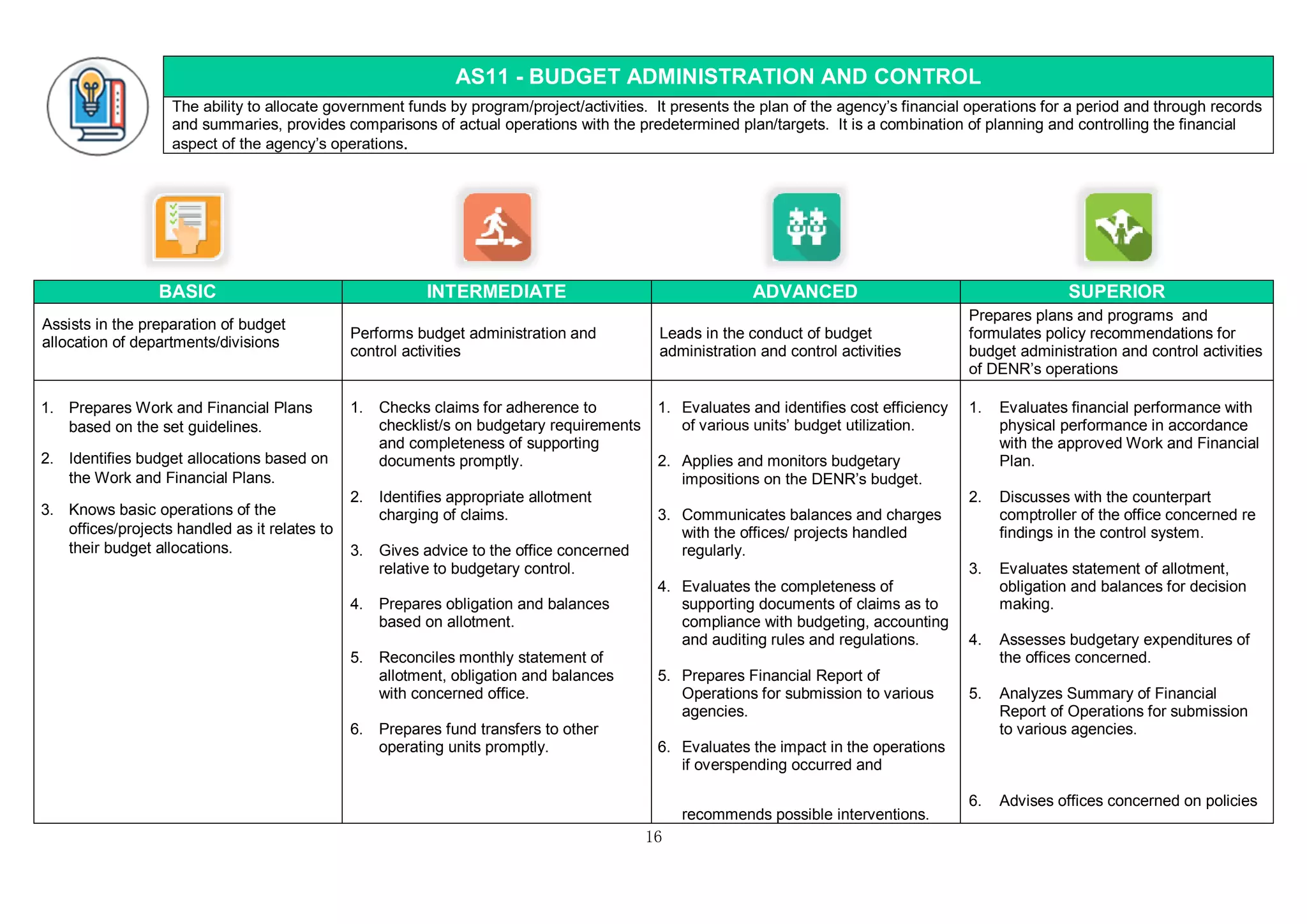
AS11 - BUDGET ADMINISTRATION AND CONTROL
The ability to allocate government funds by program/project/activities. It presents the plan of the agency’s financial operations for a period and through records
and summaries, provides comparisons of actual operations with the predetermined plan/targets. It is a combination of planning and controlling the financial
aspect of the agency’s operations.
BASIC INTERMEDIATE ADVANCED SUPERIOR
Assists in the preparation of budget
allocation of departments/divisions
Performs budget administration and
control activities
Leads in the conduct of budget
administration and control activities
Prepares plans and programs and
formulates policy recommendations for
budget administration and control activities
of DENR’s operations
1. Prepares Work and Financial Plans
based on the set guidelines.
2. Identifies budget allocations based on
the Work and Financial Plans.
3. Knows basic operations of the
offices/projects handled as it relates to
their budget allocations.
1. Checks claims for adherence to
checklist/s on budgetary requirements
and completeness of supporting
documents promptly.
2. Identifies appropriate allotment
charging of claims.
3. Gives advice to the office concerned
relative to budgetary control.
4. Prepares obligation and balances
based on allotment.
5. Reconciles monthly statement of
allotment, obligation and balances
with concerned office.
6. Prepares fund transfers to other
operating units promptly.
1. Evaluates and identifies cost efficiency
of various units’ budget utilization.
2. Applies and monitors budgetary
impositions on the DENR’s budget.
3. Communicates balances and charges
with the offices/ projects handled
regularly.
4. Evaluates the completeness of
supporting documents of claims as to
compliance with budgeting, accounting
and auditing rules and regulations.
5. Prepares Financial Report of
Operations for submission to various
agencies.
6. Evaluates the impact in the operations
if overspending occurred and
recommends possible interventions.
1. Evaluates financial performance with
physical performance in accordance
with the approved Work and Financial
Plan.
2. Discusses with the counterpart
comptroller of the office concerned re
findings in the control system.
3. Evaluates statement of allotment,
obligation and balances for decision
making.
4. Assesses budgetary expenditures of
the offices concerned.
5. Analyzes Summary of Financial
Report of Operations for submission
to various agencies.
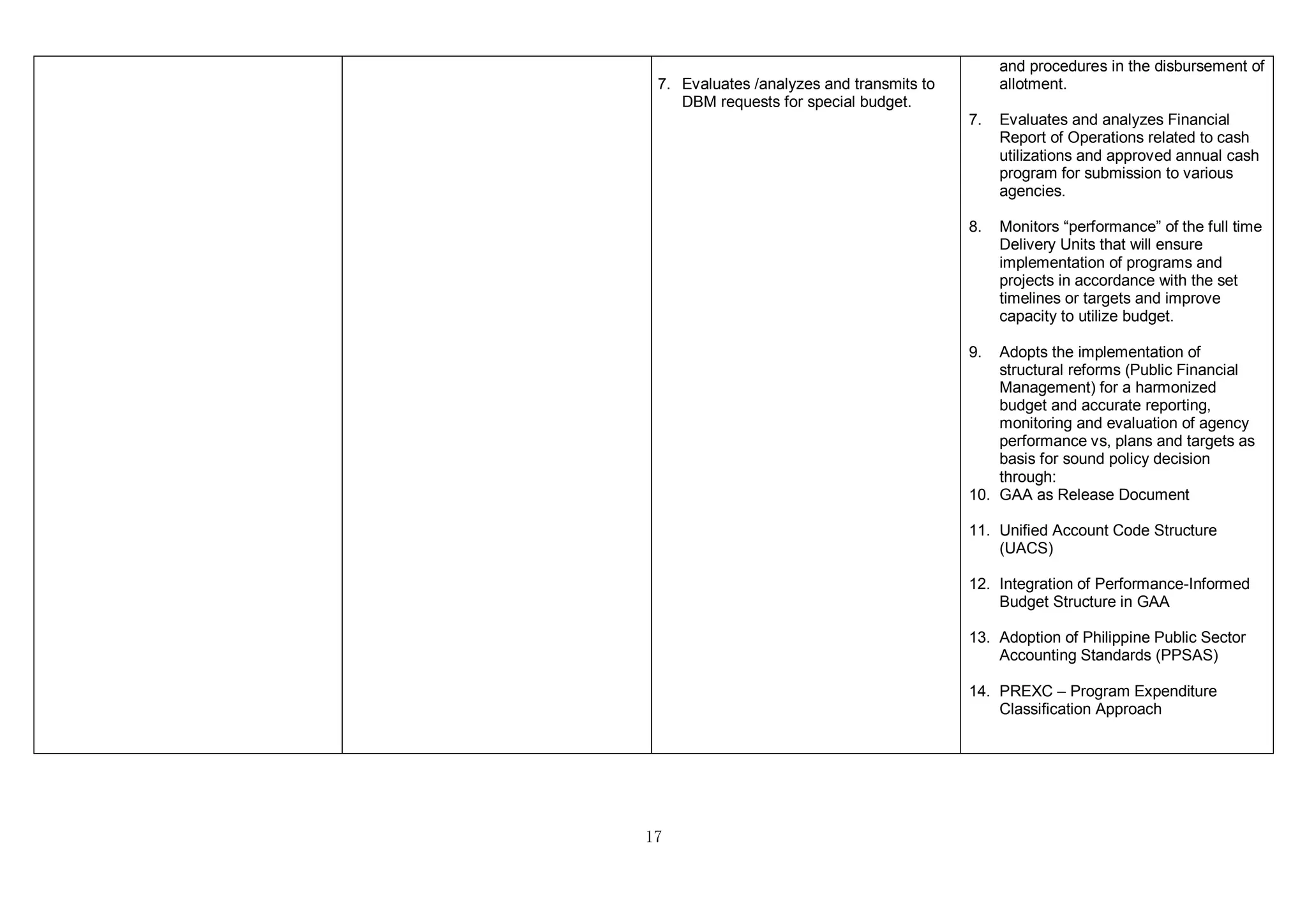
6. Advises offices concerned on policies
17
7. Evaluates /analyzes and transmits to
DBM requests for special budget.
and procedures in the disbursement of
allotment.
7. Evaluates and analyzes Financial
Report of Operations related to cash
utilizations and approved annual cash
program for submission to various
agencies.
8. Monitors “performance” of the full time
Delivery Units that will ensure
implementation of programs and
projects in accordance with the set
timelines or targets and improve
capacity to utilize budget.
9. Adopts the implementation of
structural reforms (Public Financial
Management) for a harmonized
budget and accurate reporting,
monitoring and evaluation of agency
performance vs, plans and targets as
basis for sound policy decision
through:
10. GAA as Release Document
11. Unified Account Code Structure
(UACS)
12. Integration of Performance-Informed
Budget Structure in GAA
13. Adoption of Philippine Public Sector
Accounting Standards (PPSAS)
14. PREXC – Program Expenditure
Classification Approach
18
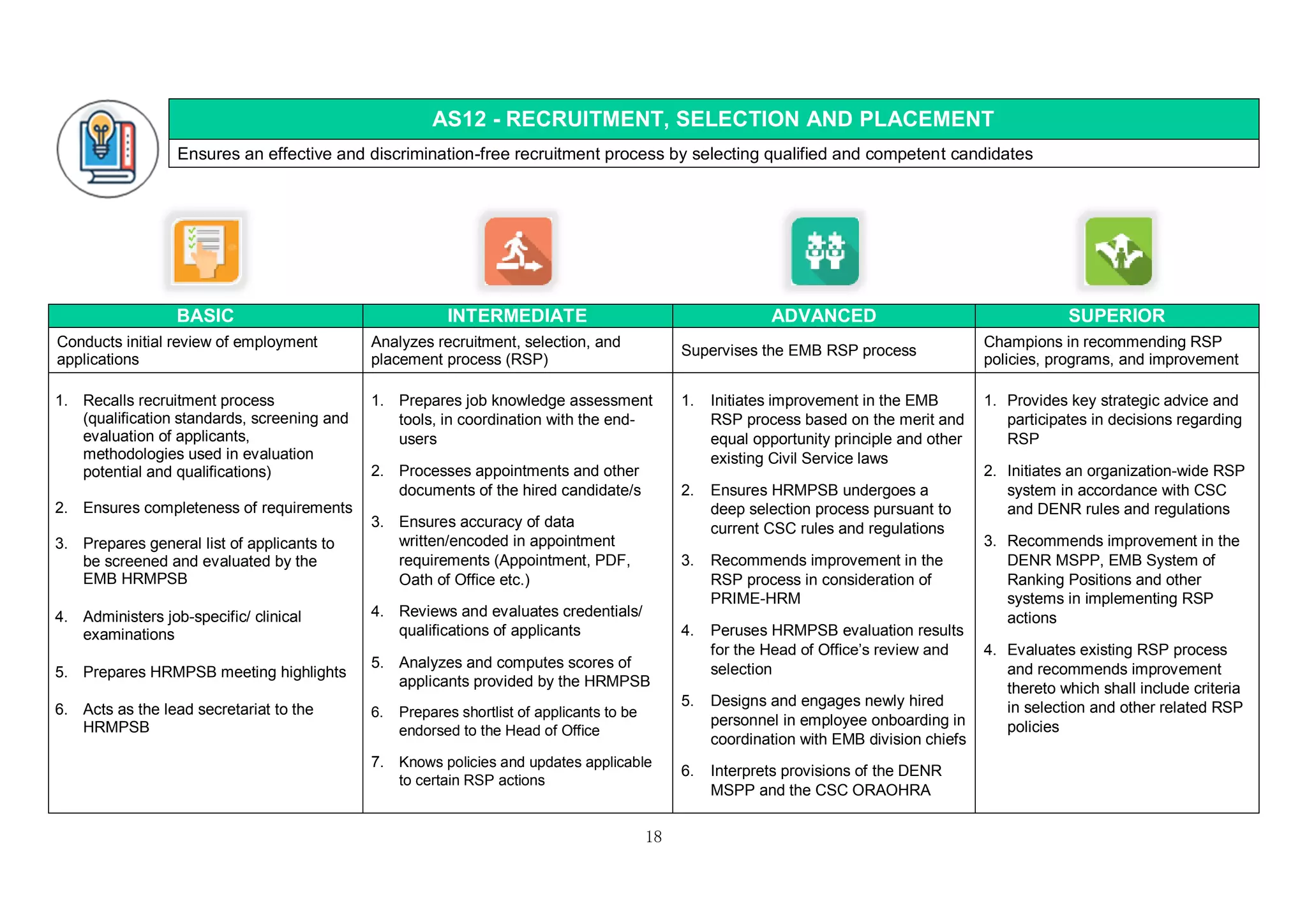
AS12 - RECRUITMENT, SELECTION AND PLACEMENT
Ensures an effective and discrimination-free recruitment process by selecting qualified and competent candidates
BASIC INTERMEDIATE ADVANCED SUPERIOR
Conducts initial review of employment
applications
Analyzes recruitment, selection, and
placement process (RSP)
Supervises the EMB RSP process
Champions in recommending RSP
policies, programs, and improvement
1. Recalls recruitment process
(qualification standards, screening and
evaluation of applicants,
methodologies used in evaluation
potential and qualifications)
2. Ensures completeness of requirements
3. Prepares general list of applicants to
be screened and evaluated by the
EMB HRMPSB
4. Administers job-specific/ clinical
examinations
5. Prepares HRMPSB meeting highlights
6. Acts as the lead secretariat to the
HRMPSB
1. Prepares job knowledge assessment
tools, in coordination with the end-
users
2. Processes appointments and other
documents of the hired candidate/s
3. Ensures accuracy of data
written/encoded in appointment
requirements (Appointment, PDF,
Oath of Office etc.)
4. Reviews and evaluates credentials/
qualifications of applicants
5. Analyzes and computes scores of
applicants provided by the HRMPSB
6. Prepares shortlist of applicants to be
endorsed to the Head of Office
7. Knows policies and updates applicable
to certain RSP actions
1. Initiates improvement in the EMB
RSP process based on the merit and
equal opportunity principle and other
existing Civil Service laws
2. Ensures HRMPSB undergoes a
deep selection process pursuant to
current CSC rules and regulations
3. Recommends improvement in the
RSP process in consideration of
PRIME-HRM
4. Peruses HRMPSB evaluation results
for the Head of Office’s review and
selection
5. Designs and engages newly hired
personnel in employee onboarding in
coordination with EMB division chiefs
6. Interprets provisions of the DENR
MSPP and the CSC ORAOHRA
1. Provides key strategic advice and
participates in decisions regarding
RSP
2. Initiates an organization-wide RSP
system in accordance with CSC
and DENR rules and regulations
3. Recommends improvement in the
DENR MSPP, EMB System of
Ranking Positions and other
systems in implementing RSP
actions
4. Evaluates existing RSP process
and recommends improvement
thereto which shall include criteria
in selection and other related RSP
policies
19
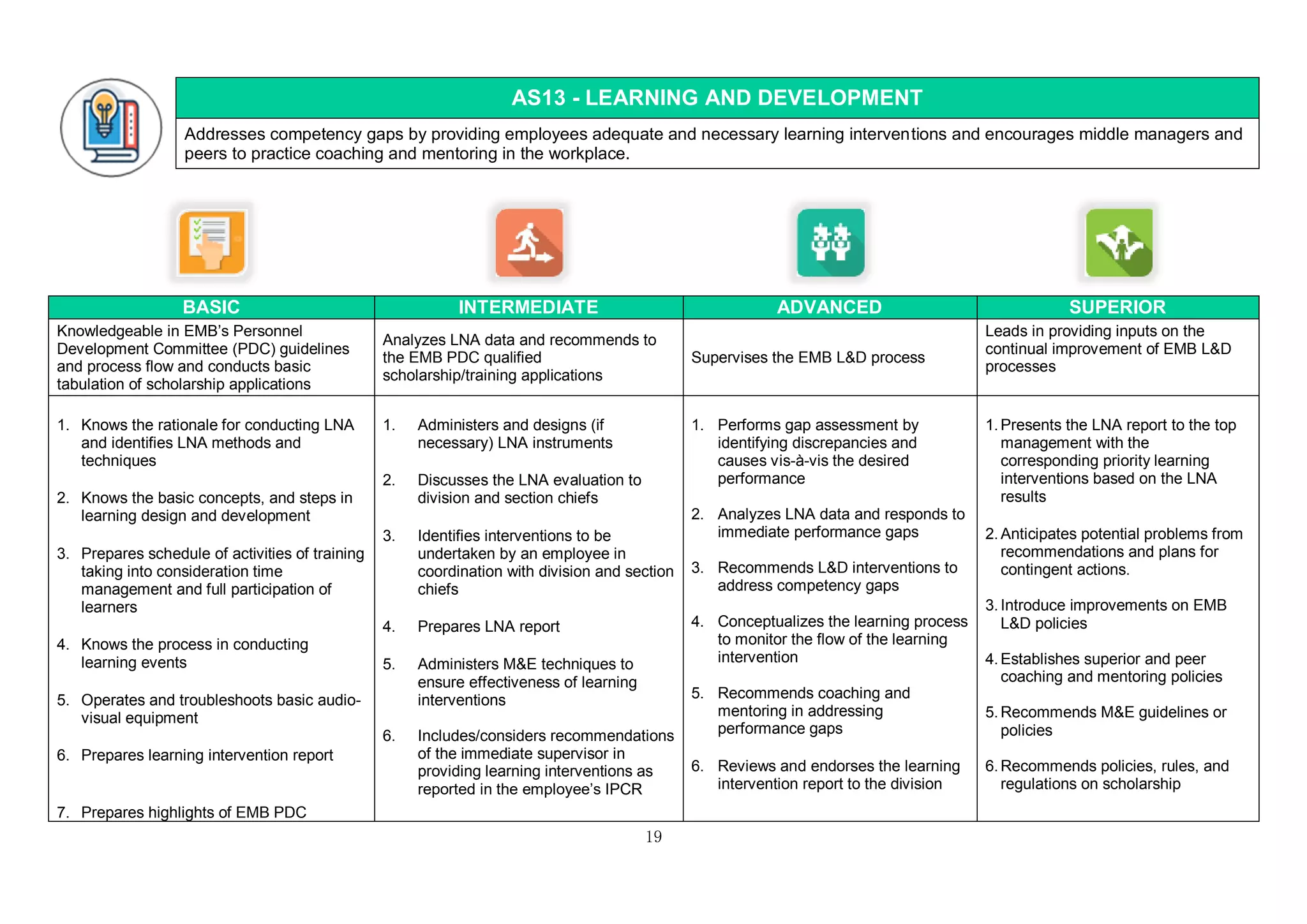
AS13 - LEARNING AND DEVELOPMENT
Addresses competency gaps by providing employees adequate and necessary learning interventions and encourages middle managers and
peers to practice coaching and mentoring in the workplace.
BASIC INTERMEDIATE ADVANCED SUPERIOR
Knowledgeable in EMB’s Personnel
Development Committee (PDC) guidelines
and process flow and conducts basic
tabulation of scholarship applications
Analyzes LNA data and recommends to
the EMB PDC qualified
scholarship/training applications
Supervises the EMB L&D process
Leads in providing inputs on the
continual improvement of EMB L&D
processes
1. Knows the rationale for conducting LNA
and identifies LNA methods and
techniques
2. Knows the basic concepts, and steps in
learning design and development
3. Prepares schedule of activities of training
taking into consideration time
management and full participation of
learners
4. Knows the process in conducting
learning events
5. Operates and troubleshoots basic audio-
visual equipment
6. Prepares learning intervention report
7. Prepares highlights of EMB PDC
1. Administers and designs (if
necessary) LNA instruments
2. Discusses the LNA evaluation to
division and section chiefs
3. Identifies interventions to be
undertaken by an employee in
coordination with division and section
chiefs
4. Prepares LNA report
5. Administers M&E techniques to
ensure effectiveness of learning
interventions
6. Includes/considers recommendations
of the immediate supervisor in
providing learning interventions as
reported in the employee’s IPCR
1. Performs gap assessment by
identifying discrepancies and
causes vis-à-vis the desired
performance
2. Analyzes LNA data and responds to
immediate performance gaps
3. Recommends L&D interventions to
address competency gaps
4. Conceptualizes the learning process
to monitor the flow of the learning
intervention
5. Recommends coaching and
mentoring in addressing
performance gaps
6. Reviews and endorses the learning
intervention report to the division
1. Presents the LNA report to the top
management with the
corresponding priority learning
interventions based on the LNA
results
2. Anticipates potential problems from
recommendations and plans for
contingent actions.
3. Introduce improvements on EMB
L&D policies
4. Establishes superior and peer
coaching and mentoring policies
5. Recommends M&E guidelines or
policies
6. Recommends policies, rules, and
regulations on scholarship
20
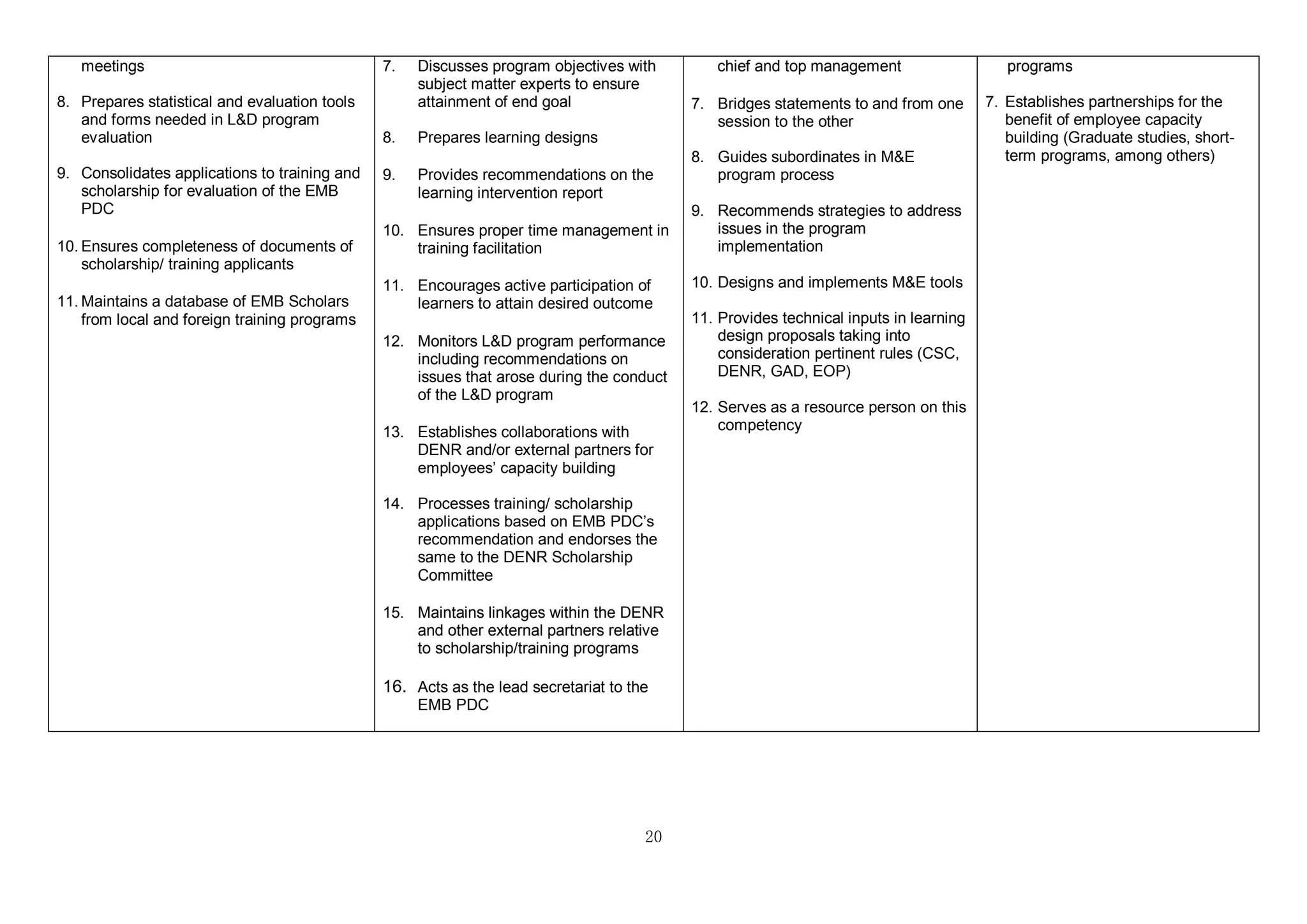
meetings
8. Prepares statistical and evaluation tools
and forms needed in L&D program
evaluation
9. Consolidates applications to training and
scholarship for evaluation of the EMB
PDC
10. Ensures completeness of documents of
scholarship/ training applicants
11. Maintains a database of EMB Scholars
from local and foreign training programs
7. Discusses program objectives with
subject matter experts to ensure
attainment of end goal
8. Prepares learning designs
9. Provides recommendations on the
learning intervention report
10. Ensures proper time management in
training facilitation
11. Encourages active participation of
learners to attain desired outcome
12. Monitors L&D program performance
including recommendations on
issues that arose during the conduct
of the L&D program
13. Establishes collaborations with
DENR and/or external partners for
employees’ capacity building
14. Processes training/ scholarship
applications based on EMB PDC’s
recommendation and endorses the
same to the DENR Scholarship
Committee
15. Maintains linkages within the DENR
and other external partners relative
to scholarship/training programs
16. Acts as the lead secretariat to the
EMB PDC
chief and top management
7. Bridges statements to and from one
session to the other
8. Guides subordinates in M&E
program process
9. Recommends strategies to address
issues in the program
implementation
10. Designs and implements M&E tools
11. Provides technical inputs in learning
design proposals taking into
consideration pertinent rules (CSC,
DENR, GAD, EOP)
12. Serves as a resource person on this
competency
programs
7. Establishes partnerships for the
benefit of employee capacity
building (Graduate studies, short-
term programs, among others)
21
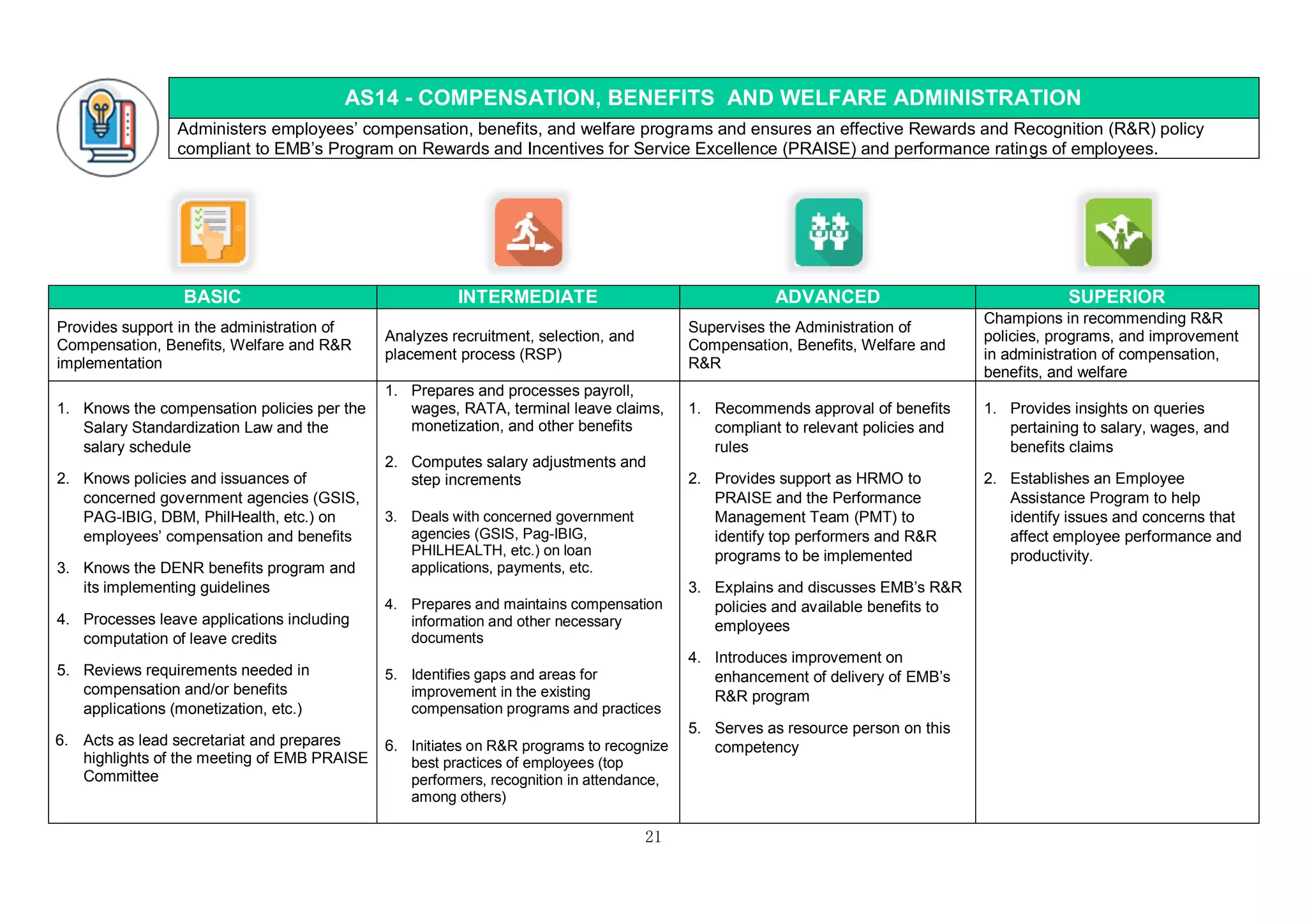
AS14 - COMPENSATION, BENEFITS AND WELFARE ADMINISTRATION
Administers employees’ compensation, benefits, and welfare programs and ensures an effective Rewards and Recognition (R&R) policy
compliant to EMB’s Program on Rewards and Incentives for Service Excellence (PRAISE) and performance ratings of employees.
BASIC INTERMEDIATE ADVANCED SUPERIOR
Provides support in the administration of
Compensation, Benefits, Welfare and R&R
implementation
Analyzes recruitment, selection, and
placement process (RSP)
Supervises the Administration of
Compensation, Benefits, Welfare and
R&R
Champions in recommending R&R
policies, programs, and improvement
in administration of compensation,
benefits, and welfare
1. Knows the compensation policies per the
Salary Standardization Law and the
salary schedule
2. Knows policies and issuances of
concerned government agencies (GSIS,
PAG-IBIG, DBM, PhilHealth, etc.) on
employees’ compensation and benefits
3. Knows the DENR benefits program and
its implementing guidelines
4. Processes leave applications including
computation of leave credits
5. Reviews requirements needed in
compensation and/or benefits
applications (monetization, etc.)
6. Acts as lead secretariat and prepares
highlights of the meeting of EMB PRAISE
Committee
1. Prepares and processes payroll,
wages, RATA, terminal leave claims,
monetization, and other benefits
2. Computes salary adjustments and
step increments
3. Deals with concerned government
agencies (GSIS, Pag-IBIG,
PHILHEALTH, etc.) on loan
applications, payments, etc.
4. Prepares and maintains compensation
information and other necessary
documents
5. Identifies gaps and areas for
improvement in the existing
compensation programs and practices
6. Initiates on R&R programs to recognize
best practices of employees (top
performers, recognition in attendance,
among others)
1. Recommends approval of benefits
compliant to relevant policies and
rules
2. Provides support as HRMO to
PRAISE and the Performance
Management Team (PMT) to
identify top performers and R&R
programs to be implemented
3. Explains and discusses EMB’s R&R
policies and available benefits to
employees
4. Introduces improvement on
enhancement of delivery of EMB’s
R&R program
5. Serves as resource person on this
competency
1. Provides insights on queries
pertaining to salary, wages, and
benefits claims
2. Establishes an Employee
Assistance Program to help
identify issues and concerns that
affect employee performance and
productivity.
22
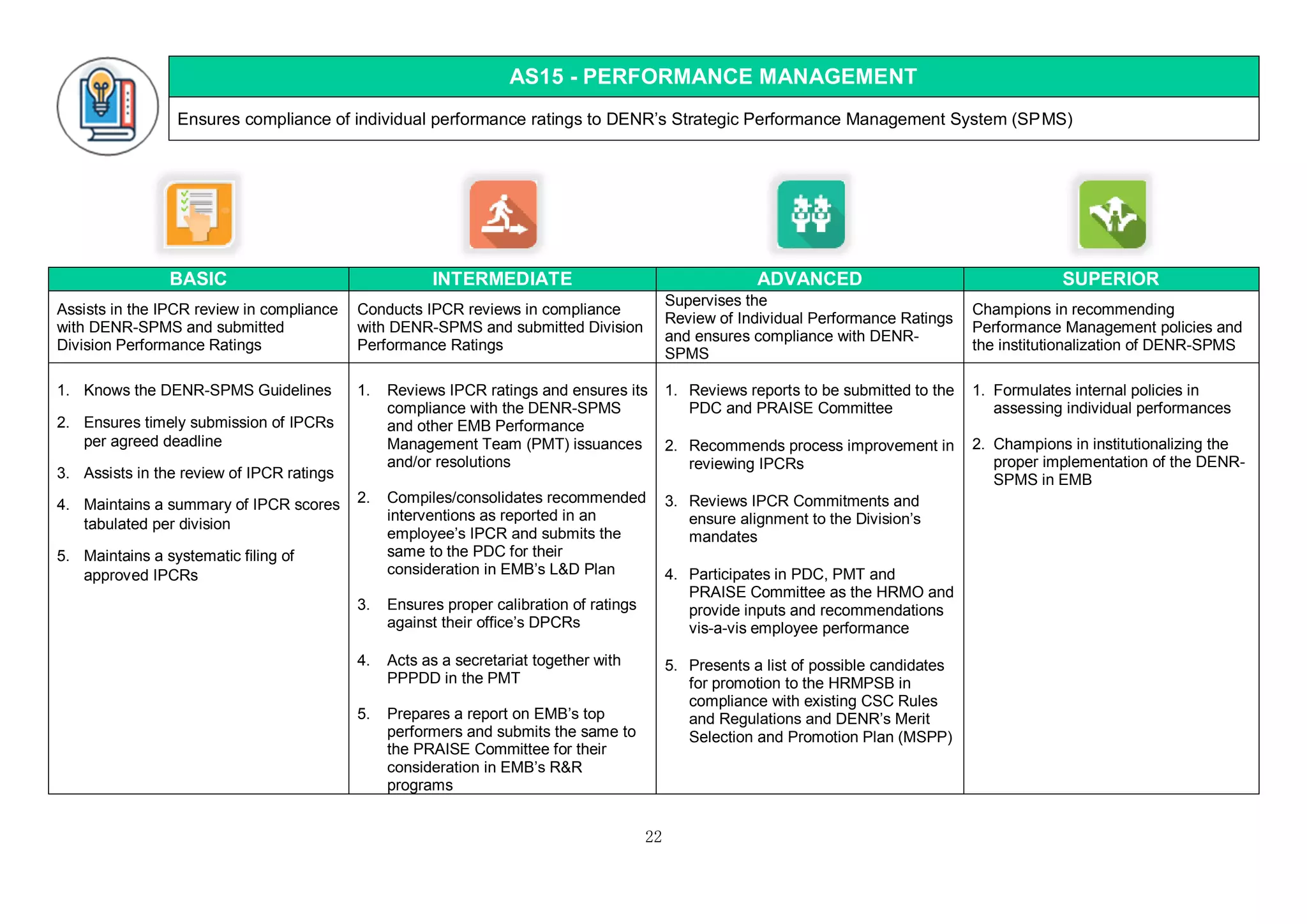
AS15 - PERFORMANCE MANAGEMENT
Ensures compliance of individual performance ratings to DENR’s Strategic Performance Management System (SPMS)
BASIC INTERMEDIATE ADVANCED SUPERIOR
Assists in the IPCR review in compliance
with DENR-SPMS and submitted
Division Performance Ratings
Conducts IPCR reviews in compliance
with DENR-SPMS and submitted Division
Performance Ratings
Supervises the
Review of Individual Performance Ratings
and ensures compliance with DENR-
SPMS
Champions in recommending
Performance Management policies and
the institutionalization of DENR-SPMS
1. Knows the DENR-SPMS Guidelines
2. Ensures timely submission of IPCRs
per agreed deadline
3. Assists in the review of IPCR ratings
4. Maintains a summary of IPCR scores
tabulated per division
5. Maintains a systematic filing of
approved IPCRs
1. Reviews IPCR ratings and ensures its
compliance with the DENR-SPMS
and other EMB Performance
Management Team (PMT) issuances
and/or resolutions
2. Compiles/consolidates recommended
interventions as reported in an
employee’s IPCR and submits the
same to the PDC for their
consideration in EMB’s L&D Plan
3. Ensures proper calibration of ratings
against their office’s DPCRs
4. Acts as a secretariat together with
PPPDD in the PMT
5. Prepares a report on EMB’s top
performers and submits the same to
the PRAISE Committee for their
consideration in EMB’s R&R
programs
1. Reviews reports to be submitted to the
PDC and PRAISE Committee
2. Recommends process improvement in
reviewing IPCRs
3. Reviews IPCR Commitments and
ensure alignment to the Division’s
mandates
4. Participates in PDC, PMT and
PRAISE Committee as the HRMO and
provide inputs and recommendations
vis-a-vis employee performance
5. Presents a list of possible candidates
for promotion to the HRMPSB in
compliance with existing CSC Rules
and Regulations and DENR’s Merit
Selection and Promotion Plan (MSPP)
1. Formulates internal policies in
assessing individual performances
2. Champions in institutionalizing the
proper implementation of the DENR-
SPMS in EMB
23
AS16 - HANDLING OF HUMAN RESOURCE ACTIONS
Applies DENR, CSC, DBM, and CESB laws, rules, and regulations in the preparation of HR actions including resolving conflicts in the
workplace.
BASIC INTERMEDIATE ADVANCED SUPERIOR
Provides support/assists in processing of
personnel actions
Implements applicable policies in the
processing of HR actions
Supervises the Processing of HR actions
Plans, enhances, and formulates
policies in the processing of HR actions
1. Knows the pertinent provisions of the
DENR, CSC, DBM, and CESB in the
preparation of various HR actions
2. Prepares documentation of HR
actions
3. Maintains a systematic filing of 201
files and other HR records and
documents
4. Understands RA 6713, the Omnibus
Rules on Appointments and Other HR
Actions (ORAOHRA), and other
related issuances
5. Assists in resolving employee conflicts
1. Ensures completeness of HR records
and 201 files
2. Prepares and updates EMB’s plantilla
and PSIPOP
3. Prepares the CES Occupancy Report
of EMB third level officials
4. Reviews and prepares a consolidated
HR Statistics Report (Central and
Regional Office)
5. Conducts initial assessment of
employee conflict
1. Ensures accuracy of the HR
Statistics Report
2. Maintains an employee database for
all EMB employees including
Contract of Service personnel
3. Prepares a report on HR actions and
submits the same to the CSC
4. Prepares a report on employee
conflict based on information
submitted/ gathered from both
parties
5. Implements programs to promote a
conducive work environment
6. Reviews the accuracy of EMB’s
plantilla and PSIPOP
7. Acts as secretariat or as HRMO to
the Grievance Committee with the
Legal Division
1. Evaluates effectiveness of existing
HR programs and recommends
improvement to address changes
in human resource management
2. Institutionalizes the Grievance
Machinery to help build a good
management- employee
relationship
3. Recommends improvement in
grievance procedures and other
employee related issues in EMB
24
AS17 - WORKFORCE PLANNING
Determines long-term HR needs and assesses current human resources. It also ensures EMB competencies are up-to-date and still relevant.
BASIC INTERMEDIATE ADVANCED SUPERIOR
Assists in workforce planning activities Conducts workforce planning activities Leads workforce planning activities
Recommends enhancement to current
workforce planning policies
1. Knows the composition of DENR and
EMB’s workforce and assists in
planning for projected shortages and
surpluses in specific units and
competencies
2. Prepares documents needed in
conducting research on workforce
planning processes
1. Gathers data on current human
resources and necessary updates on
position competencies
2. Assesses the human resource capacity
based on their competencies vis-a-vis
the needed capacity to maintain
efficiency in EMB
3. Identifies issues which may affect HR
capacity and the attainment of
organizational goals
4. Assists in the conduct of workforce
analysis and HR supply forecasting
(data on workforce turnover; reports on
flow out and flow in)
1. Conducts workforce planning
2. Develops workforce planning tools,
templates, and policies considering the
DENR CBS
3. Develops HR strategies and programs
to address gaps (e.g. career
development, recruitment etc.) based
on DENR and EMB’s priority programs
and performance ratings
1. Recommends strategic and
operational plans and policies to
support HR planning
2. Advices and participates in decision
making on short and long term
workforce planning
25
AS18 - EMS, WELLNESS, SECURITY, SAFETY, EMERGENCY PREPAREDNESS
AND DISASTER MANAGEMENT
The ability to manage significant environmental aspects, monitor environmental performance, secure occupational health and safety,
security and conduct emergency and evacuation drills on emergency situations.
BASIC INTERMEDIATE ADVANCED SUPERIOR
Gathers data and other information relative
to the Environmental Management
System, security and emergency
situations.
Consolidates data and information
gathered and identifies significant
environmental aspects, security and
emergency situations.
Monitors legal compliance and safety
requirements, and assesses hazards
and risks of DENR projects, programs
and activities.
Interprets data, generates information,
prepares reports and formulates or
enhances programs and activities.
1. Has basic knowledge on Environmental
Management System program of the
Department, especially the significant
environmental aspects
2. Gathers data and information from
sources for the different environmental
aspects
3. Has basic knowledge and ability on the
standard operating procedures on the
Disaster Risk Reduction program
4. Knows the necessary fire and safety
equipment
5. Knows the passage, exit point in the
building, place of evacuation and all
structural installationswithin the DENR
and other installation
1. Receives, identifies, analyzes and
consolidates data for the different
environmental performance
2. Assists in the coordination with
various stakeholders on the disaster
risk reduction/emergency
preparedness program.
3. Is familiar with the Disaster Risk
Reduction program
1. Identifies and monitors applicable
legal compliance for all construction,
maintenance of facilities,
transportation and security as
required under EMS
2. Conducts periodic inspection to
determine and assess hazards and
risks relative to occupational health
and safety standards
3. Coordinates and organizes with
other agencies, organization and
groups on disaster risk
reduction/emergency preparedness
programs and activities
4. Recommends logistics, equipment
suitable for the operation
1. Proposes programs as required
under the DENR Environmental
Management System
2. Evaluates effectiveness of existing
programs on health and safety,
disaster risk reduction and security,
and initiates improvements to adapt
to the present situation
3. Prepares periodic reports and
documentation on the significant
environmental aspects, security and
disaster preparedness
26
EP1 - ENVIRONMENTAL PLANNING, PROGRAMMING AND EVALUATION
The ability required to:
 determine schemes/strategies to come up with specific projects/activities that will be implemented in a given period in accordance
with the EMB’s thrust priorities, and budget appropriation;
 evaluate the operations activities using output/outcome indicators towards achieving the mandate of the EMB;
 formulate criteria for determining priorities for proposed projects and selects the appropriate programs/projects/activities for funding
and execution; and
 determine the selected programs which are in consonance with DENR plans (MTPDP/MTPIP) to be integrated for NEDA the EMB’s
short, medium and long range plans.
BASIC INTERMEDIATE ADVANCED SUPERIOR
Assists in environmental planning,
programming and evaluation activities
Conducts environmental planning,
programming and evaluation activities
Supervises environmental planning,
programming and evaluation activities
Formulates plans, programs and
policies on environmental planning,
programming and evaluation
activities
1. Reviews work and financial plans in
support of the DENR/EMB thrusts and
priorities
2. Provides technical assistance in the
formulation of plans/ programs and
monitoring system for all planning/
programming activities of the Bureau
and the Regional Offices
3. Prepares budget proposals, budget
presentations and other support
documents requested by the DBM
1. Prepares, consolidates and reviews
PDP/PIP in coordination with regional
offices
2. Translates broad strategic goals and
plans into regional objectives and
targets
3. Evaluates plans and programs of the
Bureau and the 16 ROs to ensure that
its implementation is proceeding in
accordance with its thrusts and
priorities
4. Undertakes studies and research
towards enhanced strategies and
planning methodologies
1. Formulates planning standards and
guidelines
2. Supervises the monitoring and
evaluation of all the EMB programs,
local and foreign-assisted projects
and international commitments
3. Provides technical assistance to
regional operations in initiating
different activities to achieve
output/outcome of the Bureau
4. Prepares short, medium and long
term plans with appropriate
allocation of resources
1. Integrates and recommends
short, medium and long range
environment plans and programs
2. Develops criteria in order to
rationalize and streamline
program operations and
prioritization of proposed
program and projects
3. Directs and oversees the
monitoring and evaluation of all
the EMB programs
4. Conducts comprehensive review
of Central and Regional
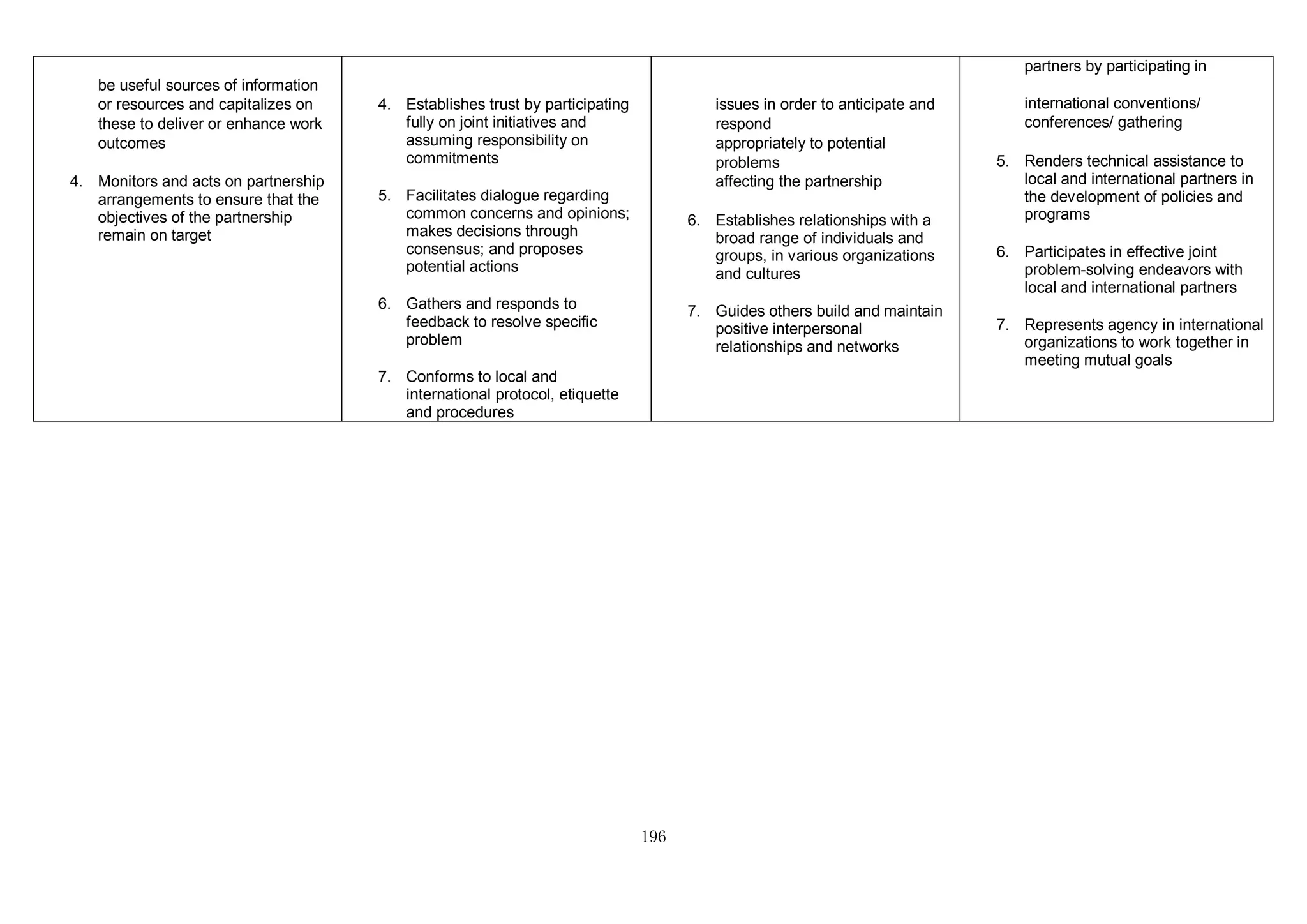
27
4. Liaises with DBM, Congress, and
Senate to facilitate submission of
required documents and or reports
5. Coordinates with the regional offices’
operations regarding queries and
conveys instructions or information
accurately
6. Submits periodic accomplishment
reports and such other reports as may
be required by immediate supervisor
7. Facilitates and reviews proceedings of
the meetings/workshops/ conferences
conducted by the office
8. Gathers/collects and organizes
relevant data/materials (NEDA/DBM
pronouncements and other relevant
agencies both private and government)
9. Knows basic statistics
5. Coordinates the validation of regional
activities on the implementation and
enforcement of environmental laws
and policies nationwide
6. Makes presentations to
clients/stakeholders and other
government agencies
7. Monitors plans, programs and
accomplishments of the Bureau
8. Prepares inputs for Agency
Performance Reports for submission to
Oversight Agencies such as NEDA,
PMS, DBM, Senate, Congress and
other agencies
9. Maintains strong linkages among
government agencies and other
concerned parties on environmental
issues to facilitate activities related to
planning and programming
10. Discusses priority programs of the
Bureau
5. Recommends the adoption of
approaches and strategies to
address gaps identified in the
implementation of policies related to
the Bureau’s programs, local and
foreign-assisted projects, MEAs and
International Commitments
6. Develops and updates the efficient
and effective process/procedure for
coordination mechanisms and
financial mechanisms
7. Represents the Planning Chief on
various activities related to planning
and programming
8. Assesses and validates the
performance of Central and 16 ROs
based on the goals and PPA
9. Identifies priority programs of the
EMB
10. Guides and coaches others in the
review of WFP in line with MFOs
activities/project/programs
5. Provides mechanisms and
strategies for improvement of
plans and programs based on
the changing needs of the EMB
and the environment
6. Recommends innovative/
creative use of resources to
meet strategic goals
7. Serves as resource person in
dealing with planning issues
8. Undertakes continuing dialogues
among government agencies
and other concerned parties on
environmental issues
28
EP2 - POLICY REVIEW AND ANALYSIS
The ability required to:
 conduct policy studies affecting the EMB; and
 review, analyze and evaluate the implementation of existing and proposed environmental policies.
BASIC INTERMEDIATE ADVANCED SUPERIOR
Assists in policy review and analysis
activities
Conducts policy review and analysis
activities
Supervises policy review and analysis
activities
Formulates plans, programs on policy
review and analysis activities
1. Applies the protocols in crafting
policy directive.
2. Assists in the formulation and
conduct of policy researches
3. Consolidates and incorporates
inputs/ comments gathered during
TWG meetings, consultation
meetings and workshops on policy
matters
4. Prepares periodic assessment
reports on the implementation of
EMB programs and projects based
on requirements of DENR
units/offices and appropriate
government agencies (e.g. NEDA,
PMS, DBM, Senate, Congress)
1. Conducts and prepares policy
research report for improved
management of the environment
2. Participates in the processes
involved in the review, formulation,
development or revision of
environmental policies
3. Prepares project proposals to further
strengthen the implementation of
environmental policies
4. Assesses and validates the
performance of Central and 16 ROs
in the uniform implementation of
environmental policies
5. Prepares assessment reports on
EMB activities/programs for the
development of effective measures
1. Provides mechanisms for review
process to come up with a dynamic
policies for Air, Water, Toxic
Chemicals and Hazardous Waste,
EIA, Solid Wastes and Climate
Change
2. Analyzes existing environmental
policies and identify gaps in its
implementation
3. Maintains strong linkages among
government agencies and other
concerned parties on environmental
issues to facilitate activities related
to policy formulation and review
4. Serves as resource person in the
discussion of issues and concerns
on the implementation of EMB
policies
5. Represents the Planning Chief on
1. Formulates corresponding
management intervention on EMB
policies
2. Analyzes and recommends policy
directives on EMB management
systems
3. Reviews prepared brown
environment policy agenda
4. Provides mechanisms for R&C
process to come up with a dynamic
policies for Air, Water, Toxic
Chemicals and Hazardous Waste,
EIA, Solid Waste and Climate
Change
5. Develops and administers policies
and procedures to carry out the plan
29
5. Assists in the conduct of continuing
dialogues/ conferences among
government agencies, other private
groups and concerned parties on
environmental issues
6. Coordinates and maintains linkages
with other government agencies on
policy matters affecting environment
on environmental protection and
pollution control
6. Maintains linkages with Congress
and Senate regarding legislative
inquiries and enactment of
environmental laws
7. Coordinates and maintains linkages
with other government agencies on
policy matters affecting environment
8. Facilitates and reviews proceedings
of the meetings/ workshops/
conferences conducted by the office.
various activities related to policy
reviews
6. Reviews and analyzes current and
proposed organization and strategic
policies
7. Understands the policy implications
of a particular research result
8. Guides and coaches others on this
competency
6. Provides technical support to
Congress hearing on policy matters
30
EP3 - PROJECT MONITORING
The ability to:
 to formulate standards and criteria for project identification, prioritization and implementation;
 to coordinate with field operations on the progress of EMB local and foreign assisted programs and projects in accordance with approved
priority areas;
 to evaluate and assess periodically performance reports and project implications; and
 to prepare periodically monitoring and evaluation reports of the EMB programs and projects including international commitments.
BASIC INTERMEDIATE ADVANCE SUPERIOR
Assists in the project monitoring activities Conducts project monitoring activities Supervises project monitoring activities
Formulates plans, programs and policies
on project monitoring activities
1. Assists in the review and evaluation
on the development and progress of
local, foreign-assisted projects and
international commitments and
prepares corresponding report
2. Assists in the Identifying and
analyzing project issues and concerns
that affect project’s implementation
3. Assists in developing monitoring and
evaluation tools to assess the project
implementation
4. Develops collaborative partnership
plans and programs with other
agencies in relation to project
implementation
1. Undertakes review and assessment of
the Bureau’s local, foreign-assisted
projects, multilateral environmental
agreements and international
treaties/agreements
2. Develops and updates the efficient
and effective process/procedure for
coordination mechanisms, database
management systems with EMB
Managers (i.e., Dir, Asst. Dir,
Div/Section Chiefs, and Regional
Directors) on activities and programs
and coordinates the various activities
related to the effective implementation
of the Bureau’s local, foreign-assisted
projects and international
commitments
3. Supervises the monitoring and
evaluation of all the EMB
programs, local and foreign-
assisted projects and international
commitments
4. Maintains strong linkages among
government agencies and other
concerned parties on environmental
issues to facilitate activities related to
implementation of local and foreign-
assisted projects
5. Represents the Planning Chief on
various activities related to local and
foreign-assisted projects, MEAs and
international commitments of the
Bureaus
6. Prioritizes projects for local and
foreign assistance
1. Directs and oversees the monitoring
and evaluation of all the EMB
programs, local and foreign-assisted
and international commitments
2. Develops and manages M & E System
for foreign-assisted projects including
the setting up of appropriate data base
and information management systems
3. Initiates/recommends project
proposals for local and foreign funding
4. Oversees and supervises the various
activities related to the effective
implementation of the Bureau’s local
and foreign-assisted projects
5. Initiates the adoption of approaches
and strategies to address gaps in
project implementation.
31
5. Provides technical assistance in the
local, foreign-assisted projects and
international commitments’ various
activities
6. Prepares draft position papers to be
presented in the Ministerial Forum
and international conferences
7. Keeps track of the position of the
Bureau in the various issues related to
international conventions and
agreements to ensure coherence and
responsiveness of national policies
8. Provides technical assistance on
various activities related to local,
foreign-assisted projects and
international commitments
9. Consolidates/prepares
monitoring/performance reports of the
Bureau’s programs and projects
10. Gathers project documents and
maintains/updates project databases
for reference in monitoring and
evaluation
11. Coordinates with central and regional
offices regarding the progress of EMB
programs and projects
3. Initiates the adoption of approaches
and strategies to address gaps
identified in the implementation of
policies related to the Bureau’s MEAs
and International Commitments.
4. Represents the Office on various
activities related to the local (relating
to MEAs) and international
commitments and foreign-assisted
projects of the Bureau
5. Prepares and packages
research/project proposals
6. Organizes project orientation and
management consultations regarding
the Bureau’s local and foreign-
assisted projects
7. Develops and prepares
project/program briefing presentation
materials
8. Conducts periodic fieldwork in
ROs/PENROs/CENROs to identify
problems encountered in field
implementation and presents
programs of action, strategies and
mechanisms to ensure the generation
of desired outputs
9. Participates in meetings/ workshops
on project review/assessment and
prepares corresponding reports
10. Monitors and prepares assessment
report on the implementation of EMB
programs and projects based on
requirements of DENR units/offices
and appropriate government agencies
7. Reviews and edits assessment
reports on the implementation of
EMB programs and projects (by
sector) vis-à-vis financial reports of
operation based on requirements of
DENR units/offices and appropriate
government agencies and
international funding institutions (e.g.
NEDA, PMS, DBM, Senate,
Congress, World Bank, GTZ, etc.)
8. Develops collaborative partnership
with stakeholders in relation to
project/program formulation and
implementation
9. Reviews project proposals and
conducts evaluation and impact
studies of selected EMB programs
and projects based on guidelines
10. Evaluates the development and
progress of a program/project and
prepares corresponding report
11. Identifies gaps in project
implementation and recommends
actions to address the identified gaps
12. Conducts impact studies of selected
EMB programs and projects
13. Guides others in monitoring and
evaluation of program processes
6. Represents the Office on various
activities related to the effective
implementation of local and foreign
projects such as fora, national and
international conventions
32
and international funding institutions
(e.g. NEDA, PMS, DBM, Senate,
Congress, World Bank, GTZ, etc.)
11. Integrates/ensures a systematic
project packaging and liaises with
NEDA, donor agencies
12. Coordinates/liaises with donor
agencies, project consultants,
concerned implementing offices/units
and other project stakeholders to
facilitate project implementation
33
EP4 - STATISTICS AND INFORMATION SYSTEM S MANAGEMENT
The ability to collect, analyze, and disseminate quality and timely EMB data/information to internal and external clients and maintain such for
efficient and effective development planning, policy formulation and decision-making purposes.
BASIC INTERMEDIATE ADVANCE SUPERIOR
Assists in the information systems
management and statistics activities
Conducts information systems
management and statistics activities
Supervises the management of
information systems and statistics
activities
Formulates plans, programs and policies
on management and information and
statistics activities
1. Maintains the IT equipment, network
infrastructure and provides IT support to
central office users and technical
assistance to regional offices
2. Monitors network activity and conducts
diagnostic and immediate
troubleshooting of any network issues
encountered from end point to terminal
3. Maintains the inventory of ICT resources
and assist in determining specifications
and drafting of IT equipment
replacement plan
4. Installs client software to user’s
computers, deploys appropriate updates
and patches and maintains the Bureau’s
active directory and domain account
registry
1. Reviews user functional requirements
and database network systems and
front-end application designed and
architectures based on standard,
quality assurance procedures and
best practices
2. Reviews network utilization, support
services provided and inventory of
ICT resources and recommends
necessary enhancement and
acquisition of appropriate hardware
and software
3. Performs periodic backup of
databases, server and fail-over
health monitoring, performance
optimization integration of security
patches
4. Performs user acceptance testing,
system vulnerability and penetration
testing and audits
1. Supervises the overall activities of
the statistics and information systems
management unit
2. Recommends IT standards, policies
and adopts best practices for the
maintenance and effective utilization
of ICT resources and implementation
of ICT Project
3. Manages the Bureau’s data center
internal network infrastructures,
servers, databases and enterprise
licenses
4. Designs and implements redundant
systems, policies, and procedures for
disaster recovery and data archiving
5. Recommends guidelines and
procedures for the identified problem
areas on data collection
1. Develops and recommends strategic
information system plan and policies,
coordinates the over-all IT activities of
the Bureau and provide up-to-date
information necessary for
management’s policy formulation and
decision-making functions
2. Introduces innovations,
enhancements and recommends
more improved processes and
procedures in the management, use
of Bureau’s data systems and
seamless integration of information
system solutions
3. Reviews Annual Statistics Updates
and Annual Assessment Report of the
Bureaus’ statistical data
4. Presents to management and confers
with different divisions the proposed
information systems and improvement
34
5. Conducts system functional scoping,
requirements and process analysis and
designs prototypes based on approved
specifications
6. Develops databases and front-end
systems (Dashboard, GIS Maps, etc.)
based on system specifications and
conducts code mapping, testing and
reviews
7. Coordinates and monitors the
compliance of the concerned units in the
use of online systems and updating of
databases and prepares periodic
assessment reports
8. Conducts data-mining and prepares
statistical reports with the use of
RDBMS, GIS, statistical software and
other business intelligent (BI) tools
9. Manages web-contents using CMS
platform, and conduct periodic
assessment in the updating of central
and regional websites
10. Creates maps using various GIS tools
and integrates geographical data from
variety of sources including satellite
imagery, aerial photographs and
existing maps to GIS Online map server
11. Prepares media kits and statistical data
for presentations during budget hearing
and meetings with other agencies
12. Prepares proceedings of the meetings,
conferences, and workshops conducted
by the Office
5. Capacitates the MIS personnel in
Central and Regional Offices in the
management and administration of
network infrastructure and security
appliance, IT equipment and
information systems and databases
6. Prepares test modules and training
materials for end-user acceptance
testing, system user trainings and
other IT capacity building
7. Performs statistical data analysis,
validation of data and forecasting
with the use of RDBMS, GIS,
statistical software and other
business intelligent (BI) tools
8. Analyzes geographic relationships
among varying types of data and
statistical data in aid of planning and
policy formulation
6. Identifies priority projects, information
system requirements and activities
and prepares the unit’s work and
financial plan
7. Participates and provides inputs in
Technical Committee meetings and
workshops related to environmental
statistics
8. Reviews the assessment and
accomplishment reports submitted by
subordinates
of the bureau’s network infrastructure
5. Conducts relevant research studies to
improve the information and
technology management of the
Bureau
6. Serve as resource person on this
competency
35
IS1- APPLICATION SYSTEMS DEVELOPMENT
The ability to operate and utilize system development tools.
BASIC INTERMEDIATE ADVANCE SUPERIOR
Develops simple application systems
Develops medium to complex application
systems
Leads and provides instructions to
programmers and reviews results of
system development
Validates and approves results of system
implementation and maintenance
1. Demonstrates familiarity in operating
and utilizing software development
tools
2. Knows software compatibility which
can operate together on different
environment such as SQL and
Windows Serve
3. Develops simple applications systems
(web-based, client-based, mobile
application, etc.) per end-user’s
requirements
4. Performs unit testing on information
systems during development
1. Demonstrates proficiency in operating
and utilizing software development
tools
2. Develops medium to complex
applications systems per end user’s
requirements
3. Maintains software library and
periodically monitors memory
management
4. Immediately fix reported/encountered
system errors and bugs
1. Demonstrates mastery in operating
and utilizing software development
tools
2. Efficiently implements system
integration of modules developed by
each team member
3. Demonstrates effective organization
and motivation to each team member
ensuring assigned projects are
completed
4. Proficient in database management
1. Plans, directs and organizes the
overall activities on implementation,
coordination and management of
systems development projects
2. Is responsible for each phase of the
systems development life cycle namely
analysis and requirements, design and
development, testing, implementation
and maintenance cycles including
possible reports and deliverables for
each
3. Develops/innovates policies and
procedures regarding performance and
maintenance of DENR website
36
IS2 - SYSTEMS ANALYSIS AND DESIGN
The ability to examine a business activity to help decide whether new information technology solutions will improve productivity.
BASIC INTERMEDIATE ADVANCE SUPERIOR
Provides support to/ assists in system
analysis, design, planning,
implementation, and maintenance
activities
Conducts activities covering system
planning, analysis, design, implementation
and maintenance
Leads the conduct of and reviews/verifies
results of system planning, analysis,
design, implementation and maintenance
Validates and approves results of system
planning, analysis and design
1. Knows the basic concepts of system
analysis and design
2. Prepares program and input/output
specifications with some supervision
3. Conducts preliminary investigation and
requirements analysis
4. Maintains documentation
5. Assists in the implementation and
maintenance of computer application
system
1. Conducts preliminary/feasibility study
on existing systems and procedures
2. Defines all jobs, security and control
procedures and back-up and recovery
plans required within a system
3. Analyzes, designs and implements
information systems
4. Documents whole project and
modifications
5. Prepares test data for individual
programs and entire system
6. Performs system testing and conducts
periodic system reviews
7. Works closely with developers and a
variety of end users to ensures
technical compatibility and user
satisfaction
1. Draws up specific proposals for
modified or replacements systems and
testing schedule for the complete
system
2. Presents proposals to clients and
produces project feasibility reports
3. Translates client’s requirements into
highly specified project briefs
4. Identifies options for potential
solutions and assesses them for both
technical and business suitability
5. Manages implementation of new
information systems
6. Liaises extensively with external or
internal clients
7. Prepares training plans for to users of
a new system
1. Sets standards, policies and procedures
relating to computer information
processing
2. Conducts risk analysis, and information
systems planning of organizational
information systems
3. Formulates staff development programs
and conducts on-the-job training on
systems analysis and design
4. Possesses skills in ICT project
management
37
8. Prepares request for proposal on
outsource solutions
9. Discusses existing business models
and the flows of data in the business
with those involved
8. Draws up and prepares cost
specifications for possible
improvements and produces outline
designs of new IT system for others to
develop and build
9. Assesses proposed projects and
reviews requests for additional data
processing services and applies cost-
benefit analysis methods to current
and proposed projects
10. Guides and teaches others in systems
analysis design
38
IS3 - NETWORK INFRASTRUCTURE MANAGEMENT
The ability to manage network infrastructure and security.
BASIC INTERMEDIATE ADVANCE SUPERIOR
Undertakes basic network infrastructure
troubleshooting and maintenance
Undertakes more complex network
infrastructure troubleshooting and
maintenance
Leads the conduct of computer
hardware/networking installation,
troubleshooting and maintenance works.
Plans, organizes and reviews the conduct
of network architecture management,
troubleshooting and maintenance works.
1. Knows the basic concepts computer
hardware and configuration, network
management and maintenance
2. Assist in the maintenance and
administration of both computer
network and connected desktop/laptop
computers
3. Provide basic training to users in
computer operations and responds to
routine user questions
4. Close out trouble tickets assigned and
follow up to ensure user satisfaction
5. Assist in monitoring, troubleshooting
and maintenance of servers,
computers peripherals and network
installation
1. Applies knowledge of the different
concepts of computer hardware and
configuration, network management
and maintenance
2. Monitors, troubleshoots and maintains
the condition of servers, computers and
peripherals and network installation in
work areas
3. Monitors efficiently network
performance and usage in every user’s
station
4. Evaluates and tests vendor-supplied
hardware/software packages to
determine suitability to organization’s
needs and requirements
5. Assist in the design, development and
maintenance of network system
1. Designs, develop and maintains
network (voice/data/video) system and
recommend implementation based on
existing hardware requirements of each
account
2. Installs and monitors the performance
of the network system
3. Secures the network infrastructure from
external/internal risks
4. Guides and teaches others in hardware
installation, maintenance and
networking
5. Assist in the design of comprehensive
and integrated network architecture
1. Designs and directs comprehensive,
integrated network architectures,
creates policies and procedures in
conjunction with ICT groups, vendors
and emerging technologies
39
IS4 - NETWORK SYSTEMS MANAGEMENT
The ability to install, maintain, and modify operating systems, database management systems, utilities, and related software. It includes ensuring
the availability, integrity and reliability of assigned systems; primarily responsible for large-scale operating systems and database management
systems that typically serve the entire organization.
BASIC INTERMEDIATE ADVANCE SUPERIOR
Provides support to/ assists in installing,
maintaining, and modifying operating
systems, database management systems,
utilities, and related software
Conducts activities in installing,
maintaining, and modifying operating
systems, database management systems,
utilities, and related software
Leads the conduct of and reviews/ verifies
results of systems management activities
Validates and approves results of systems
management activities
1. Knows the basic concepts of server
and storage hardware configuration,
management and maintenance
2. Assists in the maintenance and
administration servers and storage
3. Conducts basic training to users in
server and storage operations and
responds to routine user questions
4. Closes out trouble tickets assigned and
follows up to ensure user satisfaction
1. Institutes, implements and monitors
compliance with ICT network security
guidelines and procedures
2. Administers, secures and maintains
application systems including its
software and web-based electronic
services
3. Sets-up and maintains system access
privileges and security
4. Maintains the DENR’s intranet
5. Undertakes systems management,
troubleshooting and maintenance
6. Monitors and evaluates network
infrastructure hardware and software
compatibility and interoperability
1. Is responsible for the management,
planning and operations of servers/
storage
2. Is responsible for the setup,
maintenance, and administration of
connectivity and ensures they meet
Service Level Agreement and uptime
standards
3. Assists in planning for future growth,
expansion and development of
systems infrastructure
4. Performs periodic disaster recovery
testing and planning
1. Develops/innovates policies and
procedures regarding performance and
usage of the information system
infrastructure of the organization
40
IS5 – INFORMATION AND COMMUNICATION TECHNOLOGIES (ICT) RESOURCE MANAGEMENT
The ability to formulate, recommend and monitor the implementation of ICT and information management (IM) policies, strategies and standards.
BASIC INTERMEDIATE ADVANCE SUPERIOR
Performs basic computer HW, SW and
NW configuration and maintenance
Monitors and maintains the condition of
HW, SW, NW and peripherals
Leads in planning, design, installation and
maintenance of ICT resources and leads
support to ICT research and development
Plans, organizes and reviews ICT
resources, projects and activities
1. Knows the basic IT policies, standards
and strategies for improved ICT
management
2. Reviews and evaluates proposals on
ICT-related projects and programs of
Bureaus/Regional Offices
1. Conducts relevant research studies to
improve the information and technology
management of the Department
2. Rationalizes the procurement and
distribution of ICT resources
3. Conducts computer literacy and ICT
retooling programs
4. Conducts ICT information campaign,
promotion and advocacy
1. Reviews and evaluates proposals on
ICT-related projects and programs of
Bureaus and Regional Offices
2. Coordinates the formulation,
implementation, monitoring and
evaluation of the Department-wide ICT
Master Plan
3. Formulates and recommends human
resource management strategy to
acquire, develop, retool and retain ICT
skills and capabilities
4. Monitors, evaluates and audits
implementation of major ICT programs,
projects and significant activities, in
coordination with concerned offices
5. Ensures the integration of information
management in all operations of the
Department towards the development
of a culture that embraces ICT and IM
within DENR
1. Sets standards, policies and procedures
relating to ICT and IM
2. Conducts system audits to ensure
compliance with latest ICT standards
3. Conducts periodic review and promotes
ICT policies and standards
41
IS6 – STATISTICAL ANALYSIS, DATA MANAGEMENT AND PRODUCTION OF KNOWLEDGE PRODUCTS
The ability to manage the Department-wide database of vital information concerning Environment and Natural Resources (ENR) management
and program activities, statistical analysis and production of knowledge products.
BASIC INTERMEDIATE ADVANCE SUPERIOR
Assists in the conduct of statistical
analysis, data management and
production of knowledge product
Conducts statistical analysis, data
management, and production of
knowledge product
Leads the conduct of statistical analysis,
data management, and production of
knowledge product
Formulates and recommends strategies,
policies, guidelines, procedures and
criteria for the conduct of statistical
analysis, data management, and
production of knowledge products
1. Knows fundamentals of basic statistics
(e.g. measures of central value;
projection and forecasting, techniques)
2. Organizes ENR data/ statistics and
presents them in statistical tables,
graphs, charts and statistical maps
3. Entertains queries and provides
assistance to internal and external
clients
4. Updates and consolidates sectoral
data and information necessary in the
implementation of ENR
programs/projects and activities
5. Assists in verification and consolidates
plans and programs, activities,
statistical reports, etc. submitted by
Bureaus, Attached Agencies and
Regional Offices
1. Organizes ENR data/ statistics and
presents them in statistical tables,
graphs, charts and statistical maps
2. Analyzes and validates statistical data
for conversion to knowledge products
3. Maintains and updates ENR statistical
database using SSIS and other
statistical software
4. Monitors statistical reporting system
(SSIS) in the bureaus, regions,
PENROs and CENROs
5. Establishes and maintains close
linkages with statistical system on
statistical requirements particularly the
Philippines Statistics Authority
6. Verifies and consolidates plans and
programs, activities, statistical reports,
1. Identifies and prioritizes appropriate
statistical program/project/activities to
be undertaken in line with the
Department's priority thrusts aligned
with the requirements of Sustainable
Development Goals
2. Prepares project proposals on ENR
statistics for local and foreign funding
and implement project activities
3. Reviews and assesses integrated
statistical development plans and
programs submitted by the Bureaus,
Attached Agencies and Central Office
4. Reviews guidelines/ procedures for
statistical analysis, data management
and conversion to knowledge products
5. Recommends revisions of statistical
plans based on the performance or
accomplishments of Regional Offices
1. Plans, organizes, monitors and leads
statistical analysis, data management,
integration of statistical and spatial data,
and production of knowledge products
2. Initiates and recommends learning and
development activities/programs to
enhance capabilities of SDRMD
Personnel
3. Serves as resource person on statistical
analysis, data management, integration
of statistical and spatial data and
production of knowledge products
42
6. Prepares required materials/documents
for statistical assessment workshops
and committee meetings
7. Packages knowledge products for
dissemination
etc. submitted by Bureaus, Attached
Agencies and Regional Offices
7. Recommends guidelines/ procedures
for statistical analysis, data
management and conversion to
knowledge products
8. Applies ENR laws, regulations and
practices pertaining to statistical
analysis, data management and
production of knowledge products
and field offices vis-à-vis on their
respective plans
6. Trains others on statistical analysis,
data management and production of
knowledge products
43
IS7 – SPATIAL ANALYSIS, CONVERSION OF STATISTICAL DATA TO SPATIAL DATA AND
CONVERSION TO KNOWLEDGE PRODUCTS
The ability to manage the Department-wide database of vital information concerning Environment and Natural Resources (ENR) management
and program activities, conversion to spatial data, and production of knowledge products.
BASIC INTERMEDIATE ADVANCE SUPERIOR
Assists in the conduct of data
management, conversion to spatial data,
spatial analysis, and production of
knowledge product
Analyzes spatial data, integrate statistical
and spatial data for conversion to
knowledge product
Leads the analysis of spatial data,
integration of statistical and spatial data
and conversion of the same to knowledge
product
Formulates and recommends strategies,
policies, guidelines, procedures and
criteria on spatial analysis, integration of
statistical and spatial data, and production
of knowledge products
1. Knows fundamentals of GIS
application
2. Analyzes ENR data/statistics for
conversion to spatial data
3. Updates and consolidates sectoral
spatial data
4. Assists in the analysis and integration
of spatial and statistical data
5. Prepares required
materials/documents for assessment
workshops and committee meetings
related to conversion of statistical data
to spatial data
6. Assists in the preparation of
guidelines/procedures for conversion
of statistical data to spatial data and
integration for production of knowledge
1. Uses GIS software in the conversion of
statistical data to spatial data
2. Analyzes and validates spatial data for
integration and conversion to
knowledge products
3. Maintains and updates ENR statistical
spatial data using GIS software
4. Prepares guidelines/ procedures for
conversion of statistical data to spatial
data and integration for production of
knowledge products
5. Applies ENR laws, regulations and
practices pertaining to statistical and
spatial data and production of
knowledge products.
1. Identifies and prioritizes integration of
statistical and spatial data in line with
the Department's priority thrusts
aligned with the requirements of
Sustainable Development Goals
2. Prepares project proposals on
integration of ENR statistical and
spatial data for local and foreign
funding and implement project activities
3. Reviews and assesses development
plans and programs on integration of
statistical and spatial data submitted by
the Bureaus, Attached Agencies and
Central Office
4. Reviews and assesses integrated
spatial and statistical data for
conversion to knowledge products
1. Plans, organizes, monitors and leads
spatial analysis, integration of statistical
and spatial data, and production of
knowledge products.
2. Initiates and recommends learning and
development activities/programs to
enhance capabilities of SDRMD
Personnel
3. Serves as resource person on spatial
analysis, integration of statistical and
spatial data and production of
knowledge products.
44
products. 5. Reviews and recommends guidelines/
procedures for integration of statistical
and spatial data for conversion to
knowledge products
6. Trains others on data integration and
conversion to knowledge products.
45
EL1 - SKILLS IN LEGAL RESEARCH/OPINION
The ability required to research legal precedent, investigate/evaluate facts, determine the existence of prima facie case and preparation of legal
documents. It includes the conduct of research to support a decision or legal proceeding, to formulate a defense, to prepare the
pleadings/petitions/motions, or to initiate legal action in connection with legal issues and concerns affecting the mandates of EMB-DENR.
BASIC INTERMEDIATE ADVANCE SUPERIOR
Assists in conduct of legal research and
prBeparation of legal documents
Conducts legal research and prepares
legal documents
Supervises conduct of legal research and
preparation of legal documents
Formulates plans, programs and policies
on conduct of legal research and
preparation of legal documents
1. Has knowledge of laws, legal
procedures, rules and regulations,
and international law
2. Knows the laws on natural resources
and environmental management
3. Knows the general procedures in
legal research work
4. Ascertains the subject matter and
notes preliminary issues to be
researched
(Under what jurisdiction does the
problem fall? Is the question governed
by local law/Philippine laws and/or
international
convention/agreements/treaties?
Is the problem governed by
legislation (statutes or EMB policies,
1. Prepares research plan and spends
time “brainstorming” the problem
2. Gathers and compiles and collates
materials and data needed in the
conduct of legal research on
environmental management issues on
the resolution of the case/opinion
3. Browses a subject thru CD/ROM
and/or uses Supreme Court and other
local/international legal web sites,
including libraries of the DENR and
UP Law Center
4. Conducts researches and studies on
various laws, court decisions,
significant opinions, circulars,
regulations, and other relevant legal
information to determine and assess
their effects on the
1. Synthesize the arguments.
(How does the
argument/discussion of issues fit
together? Are they logically organized,
such that discussion of certain issues
logically precede subsequent issues?
What are the weaknesses in the
argument/s, if any? Can the leading
cases be incorporated(e.g. on the
facts;not binding in the local Philippine
environmental management
laws/jurisdiction; if binding, can it be
restricted to a narrow ration; can an
orbiter dictate or strong dissents be
utilized; are other cases more
persuasive?). Are the CAA, CWA, EIS
law, RA 6969 and their corresponding
policies and/or regulations correctly
and properly incorporated? Can the
policies and/or regulations of said
1. Formulates policies and procedures
for efficient legal research/background
investigation
Drafts proposed revisions/amendments to
existing laws, regulations and policies
46
regulations) or by judicial decisions?
Do both apply? )
5. Develops a detailed written outline on
how Legal Division plans to analyze
the legal issues presented by the fact
situation.
6. (The outline will indicate where the
analysis is strong (no further research
is required) and where the analysis is
weak (further research is required).
7. Identifies preliminary issues and key
facts.
operations/enforcement of the Clean
Air Act, Clean Water Act, EIS law, and
RA 6969
2. Conducts researches and studies
on international environmental
conventions and agreements and
their relevance toEIS law, and RA
6969 such as the Stockholm
Declaration of the United Nations
Conference on the Human
Environment (16 June 1972),
Agenda 21, Chapters 38 and 39
(UN Conference on Environment
and Development, 16 June 1992),
Convention on the Protection of
the Ozone Layer, UN Framework
Convention on Climate Change,
Convention on the Control of
Transboundary Movements of
Hazardous Wastes and Their
Disposal, 22 March 1989
3. Arranges documentary
evidences/data orderly and efficiently
4. Analyzes research data, such as
relevant provisions of RA 6969, P.D.
1586, Clean Water Act, Clean Air Act,
and applicable international
conventions/agreements/treaties,
judicial decisions, legal articles, codes,
and documents
5. Identifies which cases are binding and
which are merely persuasive; what are
the possible defenses and remedies;
the need to find more analogous
cases, to make policy arguments; and
areas in the analysis that needs
further research
6. Investigates/evaluates facts and law
laws be extended a liberal or strict
interpretation, or rendered not
applicable on the facts?)
2. Prepares draft opinions on legal
issues touching on Clean Air Act,
Clean Water Act, EIS law, and RA
6969 and pertinent international
agreements/conventions/treaties
3. Supervises and reviews the
conduct of studies and
researches on legal matters
affecting EMB
4. Guides the Bureau’s decision
makers and oversees the legality
of the proposed legal course of
actions to be undertaken
5. Monitors progress and results of
legal research/investigation
6. Edits, reviews, revises/amends
the draft policies, rules and
regulations, Notices of Violation,
and other communication
prepared by the different EMB
Divisions/Sections/Projects
related to the legal enforcement of
Clean Air Act, Clean Water Act,
EIS law, and RA 6969, and
pertinent international
agreements/ conventions/treaties
47
of cases to determine causes of action
and to prepare draft decision or
necessary communication
7. Revises the preliminary legal issue/s
identified
48
EL2 – DISPOSITION / MANAGEMENT OF CASES
Knowledge and skills required to resolve/dispose and handle cases brought for judicial and quasi-judicial actions.
BASIC INTERMEDIATE ADVANCE SUPERIOR
Assists in disposition/ management of
cases
Handles disposition/ management of
cases
Supervises disposition/ management of
cases
Formulates plans, programs and policies
on disposition/ management of cases
1. Has knowledge of laws, legal
procedures, rules and regulations,
allied laws
2. Knows the laws on natural resources
and environmental management
3. Knows the necessary information
required in the disposition of cases
4. Identifies the nature of the case
presented
5. Gathers, collates and efficiently
arranges evidence to prosecute, to
initiate actions, and legally defend a
course of action to be undertaken
concerning environmental
management legislations and its
regulations
1. Interviews clients and witnesses to
ascertain the facts of the case
2. Examines legal data to determine
advisability of defending or
prosecuting lawsuit
3. Studies pertinent provisions of PD
984, Clean Air Act, Clean Water Act,
EIS law, and RA 6969, allied laws,
and pertinent international
conventions/agreements, and rules of
quasi-judicial bodies/ordinances of
LGUs, jurisprudence, and evaluates
the case in the light of existing
information
4. Gathers, validates and determines the
authenticity of data and/or documents
5. Conducts field investigation/site
inspection whenever found necessary
1. Prepares and reviews legal
documents including motions,
pleadings, etc.
2. Examines documents/evidences
presented by the
respondent/appellant, and/or in
defending or prosecuting lawsuit
3. Determines the existence of a prima
facie case against the firm and
whether substantial evidence exists
4. Handles and monitors/analyzes
reports on the status of legal cases,
and reports of investigation conducted
by EMB CO and EMB field offices
5. Handles and monitors cases involving
EMB and advises the management
on possible legal solutions or actions
6. Files/prosecutes cases in the proper
judicial courts or administrative bodies
1. Initiates guidelines/policies and
procedures in the
management/disposition of the case
2. Determines and recommends
strategies needed in the speedy
disposition of cases
3. Formulates, initiates, reviews and
implements policies and procedures in
handling administrative cases
49
6. Schedules and presides in the
conduct of a technical hearing after a
Notice of Violation and an answer was
filed by the erring company/project
proponent
7. Determines the legal
remedy/appropriate action to take
7. Coordinates with proper authorities
for expeditious disposition of the case
8. Prepares draft resolution/action on
appealed cases from EMB Regional
Offices, and orders on cases
originating from EMB CO
9. Oversees and directs the review of all
legal documentation requested by the
public, EMB Regional Offices in
relation to the Bureau’s operations
10. Determines and recommends further
actions needed in the disposition of
the cases
11. Assists the OSG or DOJ on cases
before judicial and quasi-judicial
bodies
50
EL3 - LEGAL COUNSELING AND ARBITRATION
Knowledge and expertise required to provide legal advice and appropriate legal remedies/actions necessary to assist the different units/offices
and conduct arbitration under the EMB concerning legal matters/problems.
BASIC INTERMEDIATE ADVANCE SUPERIOR
Assists in legal counseling and arbitration
activities
Handles legal counseling and arbitration
activities
Superviseslegal counseling and arbitration
activities
Formulates plans, programs and policies
on legal counseling and arbitration
activities
1. Has knowledge of laws, legal
procedures, rules and regulations,
allied laws, and international law
2. Knows laws on natural resources and
environmental management and
issuances
1. Reviews contracts/MOA entered into
by EMB
2. Recommends legal remedies to take
on a given case or situation involving
legal issues concerning pertinent
provisions of PD 984, Clean Air Act,
Clean Water Act, EIS law, and RA
6969, allied laws, and pertinent
international conventions/agreements
3. Provides legal counseling to DENR
and EMB officials, concerned EMB
Regional Offices/Projects/Divisions
and other EMB’s stakeholders/general
public
1. Renders advice regarding legal issues
and problems affecting the day to day
operations of EMB
2. Instructs preparation of legal opinions
and advices to legal staff and EMB
ROs for proper action
3. Reviews all suggested legal
remedies/actions involving legal
issues
4. Recommends implementation of legal
remedies which have been prepared
for issuance to the different EMB ROs
1. Recommends for approval of legal
advice as required
51
EL4 - ADJUDICATION OF POLLUTION CASES
Knowledge & skills required to evaluate/resolve/dispose/handle and manage pollution cases brought for judicial and quasi-judicial actions.
BASIC INTERMEDIATE ADVANCE SUPERIOR
Assists in adjudication of pollution cases Handles adjudication of pollution cases Supervises adjudication of pollution cases
Formulates plans, programs and policies
on adjudication of pollution cases
1. Has knowledge of environmental
laws, technical/legal procedures, rules
and regulations and allied laws
2. Organizes dockets of PAB
cases/data/statistics (i.e. number of
cases resolved, pending, etc.) and
presents them in statistical tables,
graphs, charts and statistical maps
3. Entertains queries regarding pollution
cases statistics to internal and
external clients
4. Updates, consolidates and makes
inventories on regional air and water
pollution cases, data and information
necessary in the implementation of
PAB programs/projects and activities
1. Interviews clients and witnesses to
ascertain facts of case
2. Examines data to determine
advisability of defending or
prosecuting pollution cases
3. Studies pertinent statutes, decisions,
regulations and ordinances and
evaluates the case in the light of
existing information
4. Gathers, researches, validates and
determines the authenticity of data,
related laws, and/or documents and
interviews parties involved or
witnesses
5. Determines and recommends
technical/legal remedy/ appropriate
action to take
1. Prepares and reviews documents
including pleadings, etc.
2. Examines documents/evidences in
defending or prosecuting air and water
pollution cases
3. Handles and monitors/ analyzes and
reports on the status of cases.
4. Handles and monitors all air and water
cases involving pollution cases and
advises the management on possible
solutions or actions
5. Coordinates with proper authorities for
expeditious disposition of the case
1. Initiates guidelines/ policies and
procedures in the management/
disposition of the case.
2. Determines and recommends
strategies needed in the speedy
disposition of cases.
3. Formulates, initiates, reviews and
implements policies and procedures in
handling administrative cases.
4. Recommends for approval of legal
actions as required.
5. Review documents including
pleadings/orders/resolutions
6. Prepares draft resolution/order on air
and water pollution cases
52
5. Coordinates with statistical
coordinators of the different
sectors/Regional Offices statistical
concerns (e.g. plans and programs,
activities, statistical reports etc.)
6. Identifies the nature of the case
presented
7. Gathers evidence to prosecute and to
initiate legal actions
8. Knows the necessary information
required in the disposition of cases.
7. Handles/ monitors air and water cases
involving pollution cases and advises
management on possible legal
solutions/action
8. Oversees and directs the review of all
technical/legal documentation
requested by DENR Regional Offices,
attached agencies, line bureaus or
other offices in relation to ENR
operations
9. Determines and recommends further
actions needed in the disposition of the
cases
10. Appears in court in behalf of the
DENR-PAB, whenever deputized by
OSG/DOJ
11. Appears and participates in court
cases in behalf of DENR under the
supervision and control of the Office of
the Solicitor General in civil cases and
the DOJ in criminal cases
12. Assists the OSG/ DOJ on cases before
judicial and quasi-judicial bodies
13. Renders recommendations pertinent to
the disposition of air and water
pollution cases
53
EQ1 - WATER QUALITY MANAGEMENT POLICY FORMULATION
Knowledge and skills required to formulate technical policies and develop/ review water quality criteria/guidelines and effluent standards as well
as classification of all water bodies for effective management of the country’s water bodies.
BASIC INTERMEDIATE ADVANCE SUPERIOR
Assists in water quality management
activities
Conducts water quality management and
policy formulation activities
Supervises water quality management
and policy formulation activities
Formulates plans, programs on water
quality management and policy formulation
activities
1. Knows the DENR/ EMB vision,
mission, thrusts, mandates/functions,
policies, and programs in the
implementation of the Philippine
Clean Water Act of 2004.
2. Has knowledge on ambient and
effluent quality monitoring.
3. Has knowledge on aspects of water
quality management (WQM).
4. Has knowledge on the WQ
standards/guidelines and procedures/
protocols.
5. Has knowledge on the processes
involved in the development of WQM
policies.
6. Has knowledge in sample
1. Evaluates and interprets water quality
data.
2. Prepares reports on water quality
management for policy formulation/
enhancement purposes.
3. Validates and assesses implementation
of policies in the field for purposes of
policy implementation enhancement.
4. Justifies formulation or amendment of
policies based on issues and concerns
affecting its effective implementation
and WQM best practices.
1. Consolidates, analyzes, and
synthesizes information from
monitoring reports, international
workshops and conferences, reference
materials, journals and other literature,
public hearings and consultations, and
other sources to formulate WQM
policies recommendations, guidelines
and procedures.
2. Analyzes policies and identifies gaps in
policy implementation.
3. Prepares project proposals on water
quality management to develop policies
for the effective implementation of the
CWA.
4. Serves as resource person in the
discussion of issues and concerns
on the implementation of the CWA.
1. Formulates strategies and
methodologies appropriate for policy
development.
2. Identifies appropriate management
intervention to address water quality
management issues.
3. Initiates activities necessary for the
updating or revision of technical
standards, procedures and
requirements relevant to WQM.
4. Conducts stakeholders and interagency
meetings/workshops to develop
policies, strategies, guidelines,
procedural requirements on WQM.
5. Recommends amendments or revisions
to strengthen implementation of the
CWA.
54
preservation, storage and transport
7. Conducts ambient and effluent water
quality sampling.
8. Conducts sampling and field test
methods and tools.
9. Processes and analyzes water quality
data.
10. Determines and gathers pertinent
information to assist in the preparation
of water quality reports.
11. Consolidates comments, suggestions
and recommendations arising from
stakeholder consultation
workshops/meetings for incorporation
into draft policies in WQM.
12. Prepares presentations and other
materials for the conduct of
stakeholder consultative meetings and
workshops.
6. Organizes for involving other
government agencies, non-government
organizations, industries and civil
societies to discuss issues and
concerns as well as recommendations
on enhancing the implementation of the
CWA.
55
EQ2 - MONITORING AND EVALUATION/ VALIDATION OF POLICY IMPLEMENTATION
The ability required to:
 validate compliance with environmental standards/requirements to ensure effective implementation of water quality management policies
and guidelines; and
 monitor and assess water quality management program and identify critical water bodies that need rehabilitation.
BASIC INTERMEDIATE ADVANCE SUPERIOR
Assists in M&E, validation of policy and
implementation activities
Conducts M&E, validation of policy and
implementation activities
Supervises M&E, validation of policy
and implementation activities
Formulates plans, programs and policies
on M&E, validation of policy and
implementation activities
1. Knows the DENR/ EMB vision,
mission, thrusts, mandates/functions,
policies, and programs in the
implementation of the Philippine Clean
Water Act of 2004.
2. Has basic knowledge of the ambient
and effluent quality monitoring process.
3. Has basic knowledge of wastewater
discharge permitting system.
4. Knows the WQ standards/guidelines
and procedures/protocols.
5. Conducts ambient water and effluent
quality monitoring based on existing
monitoring protocols in determining
compliance to standards/guidelines.
1. Validates industry/ stakeholders
compliance to WQM
standards/guidelines.
2. Validates and assesses
implementation of policies in the field
for purposes of policy implementation
enhancement.
3. Conducts validation of complaints and
recommend appropriate management
approaches to address the said
complaints.
4. Evaluates and interprets monitoring
data/results.
5. Prepares reports on the
implementation of CWA through the
WQM plans, programs and projects
implementation.
1. Reviews and monitors implementation
of policies, guidelines, and procedures.
2. Consolidates and analyzes water
quality monitoring data from various
sources for policy synthesis or
enhancement purposes.
3. Applies methodologies and tools (e.g.,
water quality modeling) to improve
ambient and effluent quality monitoring
system.
4. Reviews/assesses WQM-related
plans, programs and projects for
funding under the National and Area
Water Quality Management Funds and
for possible granting of rewards and
incentives under the CWA.
1. Formulates appropriate strategies to
enhance policy implementation on
water quality management.
2. Recommends amendments or
revisions to strengthen implementation
of the CWA.
3. Identifies management interventions to
address issues pertinent to water
quality management.
4. Participates actively in the discussions
among officers of other government
agencies, non-government
organizations, industries and other
relevant stakeholders on WQ issues
and identification of strategic actions to
address them.
56
6. Determines problem areas and
recommends mitigating/management
measures to improve compliance to
water quality guidelines/standards
7. Prepares memoranda-instructions to
the Regional Offices for purposes of
improving enforcement of WQM
policies/guidelines/standards
8. Assists in the review of reports by
pointing out apparent deviations from
the standards and procedures.
6. Contributes inputs in the design or
improvement of WQ monitoring
protocols, procedures, and tools.
5. Identifies policy gaps and formulates
action plans/project proposals on water
quality management to enhance
implementation of CWA.
6. Assesses performance of WQM
programs and projects vis-à-vis the
objectives of the CWA.
5. Coordinates with other
agencies/institutions to ensure that
sectoral action plans on WQM are
being implemented.
6. Comes up with necessary amendment/
revisions to policies to strengthen
compliance to WQ standards and
guidelines.
57
EQ3 - PROVISION OF TECHNICAL ASSISTANCE AND EMERGENCY RESPONSE ON WQM
The ability required to conduct inspection/surveillance on potential sources and causes of pollution and to come up with appropriate and
adequate management strategies to address pollution problems.
BASIC INTERMEDIATE ADVANCE SUPERIOR
Records, classifies and summarizes
Bureau’s financial transactions in
accordance with the latest generally
accepted accounting standard and
principle.
Analyzes and interprets Bureau’s financial
transactions including prior period errors
and adjustments.
Reviews schedules, plans, and work
procedures and organizes processes in
gathering financial information needed for
the completion of reports
Evaluates LMB’s financial reports as well
as accounting procedures and methods
1. Knows the DENR/EMB vision, mission,
thrusts, mandates/functions, policies,
and programs in the implementation of
the Philippine Clean Water Act of 2004.
2. Has basic knowledge on ambient and
effluent quality monitoring.
3. Has basic knowledge on aspects of
water quality management (WQM).
4. Has knowledge on the WQ
standards/guidelines and procedures/
protocols.
5. Has basic knowledge on emergency
response strategies.
6. Conducts ambient water and effluent
quality monitoring based on existing
monitoring protocols in determining
compliance to standards/guidelines.
1. Conducts validation of complaints and
devises appropriate management
approach to address the said
complaints.
2. Analyzes and interprets monitoring
data/results.
3. Prepares reports on the complaints and
recommends management
interventions to address the said
complaints or mitigate emergency
pollution problems.
4. Prepares memoranda instructing
regional offices on their courses of
action to address emergency problem
situations.
1. Recommends methodologies,
procedures and tools to improve
emergency response actions.
2. Identifies policy gaps and formulates
policy measures to improve emergency
response on WQM.
3. Assesses performance on emergency
response to enhance implementation.
1. Formulates appropriate strategies to
enhance policy implementation on
emergency response.
2. Identifies management interventions to
address emergency situation on WQM.
3. Participates actively in the discussions
among officers of other government
agencies, non-government
organizations, industries and other
relevant stakeholders on WQ
emergency situations and
corresponding management strategies.
4. Comes up with necessary amendment/
revisions to policies to strengthen
emergency response actions.
58
7. Determines problem areas and
recommends mitigating/management
measures to address complaints/water
pollution emergency issues.
8. Assists in the review of reports by
pointing out apparent deviations from
the standards and procedures.
59
EQ4 - CAPACITY BUILDING ON WQM
The ability required to design training modules and provide the necessary training support to enhance the capacity of Regional Offices and other
relevant stakeholders in implementing CWA for the effective implementation of the water quality management policies and guidelines.
BASIC INTERMEDIATE ADVANCE SUPERIOR
Assists in conduct of capacity building
activities on WQM
Conducts capacity building activities on
WQM
Supervises capacity building activities
on WQM
Formulates plans, programs and policies
on capacity building activities on WQM
1. Knows the DENR/EMB vision, mission,
thrusts, mandates/functions, policies,
and programs in the implementation of
the Philippine Clean Water Act of 2004.
2. Has basic knowledge on ambient and
effluent quality monitoring.
3. Has basic knowledge on aspects of
water quality management (WQM).
4. Has knowledge on the WQ
standards/guidelines and procedures/
protocols.
5. Prepares presentation and training
materials on the Clean Water Act and
WQM policies.
6. Assembles necessary information in
the review of training materials for the
Regional Offices and stakeholders.
1. Designs training programs and
develops training materials on WQM.
2. Transforms technical materials into
documents which stakeholders could
understand to be able to participate in
WQM implementation.
3. Assesses/evaluates training
programs/modules on WQM to
increase its effectiveness.
1. Synthesizes improvements of training
programs based on results of training
assessments on WQM.
2. Transforms learning/insights from
training assessment results into
recommendations to enhance
institutional capacity of EMB and
stakeholders in the implementation of
the CWA.
3. Serves as resource person in WQM
training.
4. Guides and coaches others on this
competency.
5. Formulates strategies to address
institutional gaps in the implementation
of CWA and its policies.
1. Prescribes appropriate strategies to
enhance institutional capacities of EMB
and stakeholders to effectively
implement the CWA.
2. Identifies requirements to enhance
institutional capacities.
3. Prescribes performance standards in
the performance of WQM tasks and
functions.
4. Plans for contingencies and
recommends accordingly.
60
7. Assists the Training Officer in the
documentation and general order of
the workshop.
61
EQ5 - AIR QUALITY MANAGEMENT POLICY FORMULATION
The ability to allocate government funds by program/project/activities. It presents the plan of the Bureau’s financial operations for a period and
through records and summaries, provides comparisons of actual operations with the predetermined plan/targets. It is a combination of planning
and controlling the financial aspect of the bureau’s operations
BASIC INTERMEDIATE ADVANCE SUPERIOR
Assists in conduct of air quality
management policy formulation activities
Conducts air quality management policy
formulation activities
Supervises air quality management
policy formulation activities
Formulates plans/ programs on air quality
management policy formulation activities
1. Knows the mandates and air policies
and provisions of the R.A.8749.
2. Is familiar with the procedures and
methods in the formulation of air
quality management policies.
3. Knows the relevant documents to be
used in the preparation of air quality
policies.
4. Has basic knowledge on different
phases of air quality management.
5. Has basic knowledge on occupational
health and safety policies and
procedures relevant to air quality
management.
6. Has basic knowledge on writing
technical terms in the formulation or
amendments of air quality
1. Reviews plans and programs of air
quality management policy in
conformance to QA/QC standards.
2. Drafts the proposed policies on air
quality management.
3. Implements guidelines on policy
formulation such as identification of
affected stakeholders on the proposed
policy, the conduct of consultation and
its documentation.
4. Conducts research or study on the
impact and effectiveness of the policy.
5. Conceptualizes new policies from
existing policies to address the gaps of
existing policies.
1. Reviews plans and programs of air
quality management policy in
conformance to QA/QC standards.
2. Drafts the proposed policies on air
quality management.
3. Implements guidelines on policy
formulation such as identification of
affected stakeholders on the proposed
policy, the conduct of consultation and
its documentation.
4. Conducts research or study on the
impact and effectiveness of the policy.
5. Conceptualizes new policies from
existing policies to address the gaps of
existing policies.
1. Envisions the desired outcomes of
policies to be formulated for air quality
management.
2. Decides on appropriate contents of
policy based on gathered stakeholders’
responses.
3. Makes firm stand or response to
stakeholder comments or arguments on
policies formulated or to be formulated.
4. Proposes the needed air quality
management policies to be formulated
based on the result of policy researches
or studies.
62
management policies i.e. minute of
meetings proceeding, special orders,
invitation letters to workshops, forum
and other correspondence.
7. Knows the documentary requirements
and forms in the conduct of technical
conference, meetings and workshops
for the formulation of air quality
management.
8. Applies quality approaches used in
the formulation policies, as provided
for under R.A.8749.
9. Prepares and provides the applicable
documents for different phases in air
quality management to be used in the
formulation of appropriate policy.
10. Applies occupational health and
safety policies and procedures
relevant to air quality management
programs or policies.
11. Prepares minutes of the meeting,
proceedings, special orders, invitation
letter to workshops, fora and other
correspondence to be used in the
formulation or amendments of air
quality policies.
6. Coordinates and works with other
policy makers to avoid duplication of
programs in order to formulate
appropriate policies.
6. Coordinates and works with other
policy makers to avoid duplication of
programs in order to formulate
appropriate policies.
63
EQ6 - MONITORING AND EVALUATION OF AIR QUALITY MANAGEMENT POLICY
The ability required on setting framework, monitoring guidelines, procedures, applicable values or standards, evaluation criteria/requirements,
quality systems for all sources of emission in compliance to the implementation of approved air quality management policies.
BASIC INTERMEDIATE ADVANCE SUPERIOR
Assists in conduct of M&E ofair quality
management policy
Conducts M&E ofair quality management
policy
Supervises M&E ofair quality
management policy
Formulates plans, programs and policies
on M&E ofair quality management policy
1. Knows the goals and objectives in
monitoring of compliance to air quality
management policies.
2. Has basic knowledge on the applicable
requirements and document format of
various phases of air quality
management policies.
3. Has basic knowledge on materials and
methods of communication to initiate
and to complete monitoring of
compliance of air quality management
policies among stakeholders such as:
notice of meetings, special orders and
concept paper of policies, verbatim
minutes of the meeting/proceedings for
information to concerned stakeholders
and collaborators.
4. Has basic knowledge on the
requirements /criteria being used for
the evaluation of applications for permit
to operate of air pollution sources,
1. Prepares guidelines to monitor for
compliance to air quality management
policies.
2. Validates the veracity of comments,
suggestions and recommendations
arising from consultative meetings,
workshops and consultations with
stakeholders in relation to the
monitoring of compliance to AQM
policy.
3. Reviews programs, concept paper and
other materials for stakeholder
consultative meetings, workshops and
fora relative to the monitoring of
compliance to AQM policy.
1. Analyzes and determines the validity of
information gathered from stakeholders
in the consultative meeting/workshop in
compliance to AQM policies.
2. Leads the development of appropriate
system, measures/ strategies to
address significant systems to attain
compliance with AQM policies.
3. Makes appropriate decisions on the
recommended actions suited to
strengthen compliance to AQM
policies.
4. Coordinates efforts of others to attain
the expected outputs on the
implemented program of activities.
1. Directs and coordinates the work of
others, works with tight deadlines and
obtains outputs of multiple concurrent
projects or activities.
2. Works with M& E officers, other
government agencies and stakeholders
to develop and implement suitable M&E
programs on air quality management
policies.
3. Recommends amendment/revisions of
M&E programs to strengthen the
compliance to AQM policies.
64
certificate of conformity for motor
vehicles and certification for the third
party emission testers policies.
5. Knows the handling of the equipment
and chemicals to be used in the
evaluation of applications for permit to
operate, third party emission tester
accreditations, and certificate of
conformity for motor vehicles policies.
6. Applies the intended objectives and
goals, guidelines in monitoring of
compliance to air quality management
policies.
7. Collects the scientific and technical
information relevant to the policy.
8. Integrates comments, suggestions and
recommendations arising from
consultative meetings, workshops and
consultations with stakeholders in
relation to the monitoring of compliance
to AQM policy.
9. Prepares programs, concept paper and
other materials for consultative
meetings, workshops and fora with the
concerned stakeholders relative to the
monitoring of compliance to AQM
policy.
10. Differentiates appropriate
documentary requirements and format
for each phase of air quality
management policies.
65
EQ7 - VALIDATION OF THE IMPLEMENTATION OF AIR QUALITY POLICIES
AND PROCEDURES AT THE REGIONAL OFFICES
The ability required to assess and validate whether policies, standards or rules are being practiced or being acted upon in accordance with the
devolved functions and other special instructions.
BASIC INTERMEDIATE ADVANCE SUPERIOR
Assists in conduct of validation of the
implementation of air quality policies and
procedures at the regional offices
Conducts validation of the implementation
of air quality policies and procedures at
the regional offices
Supervises validation of the
implementation of air quality policies and
procedures at the regional offices
Formulates plans, programs and policies
on validation of the implementation of air
quality policies and procedures at the
regional offices
1. Knows the approved policies of the
devolved functions/ implementing rules
and regulation of RA 8749 (Philippine
Clean Air Act of 1999).
2. Knows the current set up or structure of
the Regional Offices with regards to the
implementation and enforcement of
chemical management.
3. Has basic knowledge on air quality
management including its functional
implementing components.
4. Has basic knowledge on the guidelines
and procedures of the implementing
activities of air quality management.
5. Coordinates logistical support
necessary in the conduct of validation
activities.
1. Has in-depth knowledge on programs,
initiatives and strategies of other
countries in air quality management.
2. Provides inputs and comments on the
problems or gaps in implementing the
functions at the regional level.
1. Reviews and interprets the
consolidated regional issuances/reports
of the 16 Regional offices.
2. Analyzes and integrates diverse
information from various sources and
incorporate these in the policy.
3. Discusses and writes the validation
results with the Regional Directors and
staff for prioritization of actions.
1. Coordinates with higher management
and other officers regarding results of
validation and action plans.
2. Analyzes situations or conditions that
may not be covered by the policies but
are important and critical to
environmental and public safety.
3. Recommends improvements to
strengthen implementation of existing
rules and regulations and policies.
66
6. Integrates comments, suggestions and
recommendations arising from
preliminary discussion meetings before
and after the validation.
7. Evaluates air pollution control officers’
reports and records.
8. Conducts on-site validation of issued
permits and clearances.
67
EQ8 - PROCESSING OF ENVIRONMENTAL CERTIFICATE RELATED TO AIR QUALITY MANAGEMENT
The ability required to undertake review and evaluation of the documents submitted in accordance with the steps and procedures for issuance of
certificates to the 1) third party stack emission tester accreditation certificates; and 2) Certificate of conformity.
BASIC INTERMEDIATE ADVANCE SUPERIOR
Assists in processing of environmental
certificate related to air quality
management
Conducts processing of environmental
certificate related to air quality
management
Supervises processing of environmental
certificate related to air quality
management
Formulates plans, programs and policies
on processing of environmental certificate
related to air quality management
1. Knows the legal and administrative
framework of the functional air quality
management components: Air
Permitting, Emission Inventory,
Ambient air monitoring, Stack emission
testing, CEMS validation and Policy
formulation.
2. Has basic knowledge of the procedural
systems of functional components of
AQM.
3. Knows the various forms and checklist
and other documentary requirements in
processing the new and regulated air
quality management applications
documents.
4. Coordinates with the DENR Regional
Office and DENR recognized Pollution
Control Organization (PCO) of
industries in the conduct of on-site
proficiency testing for stack emission
prior to the issuance of certificates as
1. Has in-depth knowledge and expertise
on the type of pollutants coming from
industries and its operations strategies
to control air pollution.
2. Coordinates with concerned
stakeholders on controversial issues of
national in scope and impacts on air
quality management.
3. Prepares inspection report with the
findings, observations and
recommendations.
1. Develops conditions on air quality
management for compliance by the
owner of certificates granted by the
EMB on specific applications.
2. Analyzes existing policies and identifies
gaps in policy implementation.
3. Recommends applicable strategies to
strengthen the existing systems,
procedures or methods related to
functional components of air quality
management.
1. Reviews and evaluates/recommends
terms and conditionalities on issued
certificates related to air quality
management.
2. Improves the system on various
functional components of air quality
management e.g. permitting
requirements.
3. Initiates appropriate linkages with other
government agencies and stakeholders
to recommend issuance or denial of
certificates.
4. Decides on the issuance or denial on
application received in relation to air
quality management.
68
3rd
party emission tester or Certificate of
Conformity.
5. Interviews and responds to queries of
stakeholders e.g. companies, media
and public on the environmental
compliance.
6. Prepares the initial review and
evaluation report on the processing of
application for COC and Accreditations
of 3rd
party emission tester, pollution
control reports in collaboration with the
regional office, air quality monitoring
reports, etc, related to air quality
management.
7. Communicates results/findings to
concerned industry and other sectors
to convey inspections results and the
necessary actions.
8. Makes preliminary recommendations
based on the report of inspections of
the regional officer or other sectors in
relation to applications for issuance of
certificates related to air quality
management.
69
EQ9 - ENFORCEMENT OF AQM ENVIRONMENT LAWS
The ability required to determine, consult and analyze to enforce compliance to the rules, regulations, orders, circulars, international
commitments and policies and provisions of RA 8749 and to the requirements/conditionalities stipulated in the AQM related to permits/
clearances/ certificates.
BASIC INTERMEDIATE ADVANCE SUPERIOR
Assists in enforcement of AQM
environment laws
Conducts enforcement of AQM
environment laws
Supervises enforcement of AQM
environment laws
Formulates plans, programs and policies
on enforcement of AQM environment
laws
1. Knows the approved policies,
procedures and requirements
implementing Title II of RA 8749.
2. Has basic knowledge on conditions
stipulated in the issued AQM related
permits and clearances.
3. Has basic knowledge on AQM
Monitoring, CEMS, Emission
Inventory.
4. Knows communications format on
AQM letter , memoranda, CSW,
survey reports, inspection, notice of
technical meetings for non-
compliance of industry to Certificates
or permit conditions.
5. Gathers the historical or chronology of
events starting from the file
documents of issued permits and
1. Conducts technical conferences and
hearings on matters of non-
compliances or violations including
issues and concerns affecting its
effective implementation.
2. Prepares the necessary endorsement
for violation on AQM permitting system.
3. Conducts quality assurance and quality
control of AQM Monitoring data.
4. Identifies gaps in the enforcement of
laws for action plan formulation.
5. Conducts quality assurance on data
gathered for the documents on airshed
designation.
6. Participates in the meetings of Airshed
Governing Board.
7. Has knowledge on Air Dispersion
models.
1. Reviews and interprets the
consolidated regional
issuances/reports for the 16 Regional
offices.
2. Analyzes and integrates diverse
information from various sources and
incorporates these in the policy.
3. Discusses and writes the validation
results as basis for addressing
implementation gaps of AQM policies,
instruction or the Law.
4. Participates in the oversight meetings
for RA 8749.
5. Reviews action plans of Airshed
Governing Board.
1. Develops action plans to address gaps
on implementation of RA 8749.
2. Coordinates with higher management
and other officers to facilitate actions on
measures to be implemented to address
air pollution issues and realization of
action plans.
3. Reviews and recommends imposition of
fines and penalties for violating the
provisions of RA 8749
4. Decides on the acceptability of air
dispersion models based on the
validated results.
70
clearances.
6. Has basic knowledge of motor
vehicles standards and testing
requirements
7. Has basic knowledge in the operation
and calibration of motor vehicles
emission testing equipment and
ambient air quality analyzers.
8. Prepares materials for air quality
monitoring.
9. Examines the records and filed
documents of applicants for permit or
certificates of AQM related programs.
10. Integrates comments and
recommendations on the result of
Inspection-validation and review and
evaluation of documents.
11. Conducts investigation inspection of
application of permits/certificates or
issued permits /clearances with doubtful
information and complaints.
12. Gathers data as required by the criteria
for airshed designation.
13. Prepares test plans for motor vehicles
emission testing activities
14. Identifies the parts and functions of the
motor vehicle emission testing
equipment and ambient air quality
analyzers.
8. Conducts motor vehicles emission
testing and diagnose and read basic
diagram and layout of the said
equipment.
9. Analyzes and conducts QA/QC of
ambient air quality data.
6. Reviews documents of airshed
designation of the regional office.
7. Operates at least one air dispersion
models.
8. Evaluates and interprets motor vehicle
emission testing results.
9. Prepares ambient air quality report or
status report.
5. Recommends appropriate measures of
compliance based on the motor vehicle
emission test results.
6.
7. Assesses the effectiveness of the air
quality management program based on
the ambient monitoring report.
71
EQ10 - CAPABILITY BUILDING ON AQM
The ability required to have a systematic management approach in the conduct of training/ seminar/ workshop/ IEC to capacitate the
workforce/personnel at the Regional level and other relevant stakeholders in implementing AQM
BASIC INTERMEDIATE ADVANCE SUPERIOR
Assists in conduct ofcapability building
activities on AQM
Conducts capability building activities on
AQM
Supervises capability building activities
on AQM
Formulates plans, programs and policies
on capability building activities on AQM
1. Has knowledge on the various
concepts and components on AQM
including enforcement and
implementation as well as the policies
and programs of EMB and DENR.
2. Knows the EMB’s IEC program to
enhance public participation on the
enforcement and implementation of
AQM policies and procedures.
3. Has basic knowledge on various data
gathering techniques to collect
information needed in the development
of IEC materials and training programs.
4. Knows the process of conducting
training program.
1. Determines type of IEC materials and
training programs to be developed
taking into consideration factors like
communication objectives, target
audience, and availability of
communication technologies.
2. Develops IEC materials and training
programs on the enforcement and
implementation AQM.
3. Laymanizes scientific and technical
literature on the enforcement and
implementation of AQM.
4. Implements contingency plans to
address critical situations during
training.
1. Presents AQM lectures, synthesizes
lessons and relates them to current
environmental issues and concerns.
2. Integrates the program and plans to
attain objectives and goals to address
the issues and concerns arising from
interactions/discussions.
3. Guides the activity flow and
proceedings in a group activity for
consensus building and sound decision
making in crafting a
recommendation/strategy.
1. Conducts participatory strategic
planning activities to develop IEC
materials and training programs.
2. Introduces innovations and techniques
in developing IEC materials and
conducting training programs.
3. Formulates training standards and
policies in implementing training
programs.
4. Plans contingencies and recommends
accordingly.
5. Serves as a resource person in various
training, briefing, orientation seminars
for AQM.
72
5. Operates basic training equipment.
6. Prepares presentation of IEC and
training materials.
7. Reviews IEC materials and training
programs on the enforcement and
implementation of RA 8749.
8. Meets all training requirements needed
within the specified time frame.
9. Facilitates workshop, training and other
similar activities to gather needed
information for development of an
appropriate AQM program.
73
EQ11 - POLICY FORMULATION ON HAZARDOUS WASTE MANAGEMENT (HWM)
The ability to design, develop and implement an effective system of fleet management, including dispatch, trip ticket, registration, parking and
traffic administration.
BASIC INTERMEDIATE ADVANCE SUPERIOR
Assists in conduct ofpolicy formulation on
hazardous waste management (HWM)
activities
Conducts policy formulation on
hazardous waste management (HWM)
activities
Supervises policy formulation on
hazardous waste management (HWM)
activities
Formulates plans/ programs on policy
formulation on hazardous waste
management (HWM) activities
1. Knows DENR/EMB’s mandate,
policies, thrusts, and programs in the
implementation of Title III of RA 6969.
2. Has basic knowledge on hazardous
wastes including its characteristics,
handling and proper management.
3. Has knowledge on the guidelines,
standards and procedures on HWM.
4. Has basic knowledge on the processes
or procedures involved in the review,
formulation, development, or revision of
policies on HWM.
5. Is familiar with technical terms used in
the formulation of policies, guidelines,
standards and procedures on HWM.
1. Participates in the processes or
procedures involved in the review,
formulation, development, or revision of
policies on HWM such as the conduct
of consultation with various
stakeholders and its documentation.
2. Conducts research or study on the
effectiveness of HWM policies
3. Coordinates and works with other
policy makers to harmonize or
complement other policies on HWM.
4. Prepares draft project proposals on
HWM to further strengthen the
implementation of Title III of RA 6969.
1. Analyzes and integrates diverse
information from various sources such
as consultation reports, monitoring
reports and data, international
workshops and conferences, reference
materials and other literature to
formulate, update or revise HWM
policies.
2. Assesses or evaluates the impact or
effectiveness of the policies including
issues and concerns affecting its
effective implementation.
3. Analyzes existing policies and identifies
gaps in policy implementation.
4. Reviews and endorses draft project
proposals on HWM to further the
implementation of Title III of R.A. 6969
1. Formulates strategies and
methodologies appropriate for HWM
policy development.
2. Updates or revises technical standards
related to hazardous waste
management.
3. Identifies appropriate management
intervention to address HWM issues.
4. Recommends revisions, amendments,
or innovations to strengthen
implementation of Title III of RA 6969.
5. Conducts stakeholders and interagency
meetings or workshops to review,
formulate, and develop policies,
guidelines, procedures and standards
on HWM
74
6. Knows the current situation in the
Philippines with regards to
management of hazardous wastes.
7. Gathers and consolidates
data/information materials for policy
development
8. Prepares initial draft of the policy
regarding hazardous waste
management.
9. Consolidates and incorporates into the
draft policy the comments, suggestions
and recommendations arising from
workshops and consultations with
stakeholders.
5. Serves as Resource Person in the
discussion of issues and concerns on
the implementation of Title III of RA
6969.
6. Justifies or makes a firm stand or
response to comments or arguments
raised by stakeholders on proposed
HWM policies.
7. Works with policy officers, other
government agencies and stakeholders
to develop and implement HWM
policies and programs.
75
EQ12 - MONITORING AND EVALUATION OF COMPLIANCE OF FACILITIES OR ESTABLISHMENTS
The ability required to monitor and evaluate the compliance of hazardous waste generators, transporters and Treatment, Storage and Disposal
(TSD) facilities to the requirements of RA 6969, its Implementing Rules and Regulations, and related HWM policy issuances.
BASIC INTERMEDIATE ADVANCE SUPERIOR
Assists in conduct ofmonitoring and
evaluation activities of compliance of
facilities or establishments
Conducts monitoring and evaluation
activities of compliance of facilities or
establishments
Supervises monitoring and evaluation
activities of compliance of facilities or
establishments
Formulates plans, programs and policies
on monitoring and evaluation activities of
compliance of facilities or establishments
1. Knows DENR/EMB’s mandate,
policies, thrusts, and programs in the
implementation of Title III of RA 6969.
2. Has basic knowledge on hazardous
wastes including its characteristics,
classification, handling and proper
management.
3. Has basic knowledge on the
requirements for hazardous waste
generators, transporters, TSD facilities,
import of recyclable materials
containing hazardous substances and
export of hazardous wastes.
4. Identifies if the waste is considered as
hazardous waste based on
classification in the procedural manual
for HWM.
1. Determines problem areas during
facility inspections and recommends
measures to improve compliance to
HWM standards, requirements, or
procedures.
2. Conducts investigation of hazardous
wastes-related complaints and makes
the appropriate recommendations to
address the said complaints.
3. Conducts investigation, sampling and
verification of potentially contaminated
sites
4. Conducts sampling and monitoring at
the facilities subject to investigation
5. Initiates enforcement procedures for
violations of permit conditions,
standards or requirements.
1. Conducts technical conference and
reviews recommendations regarding
permit violations and other violations to
R.A. 6969
2. Develops methodologies and tools to
improve monitoring of compliance to
the requirements of the procedural
manual on HWM.
3. Identifies policy gaps and recommends
actions on how to address the said
gaps.
1. Recommends fines and penalties for
violations of R.A. 6969
2. Formulates appropriate strategies to
further strengthen the implementation of
the policies on HWM.
3. Identifies management interventions to
address issues pertinent to HWM.
4. Coordinates with other agencies or
institutions to address issues on
hazardous wastes.
76
5. Conducts on-site inspections and
monitoring of facilities to determine
compliance to standards and
requirements
6. Reviews relevant HWM documents
such as Registration Certificates,
Transport Permits, Manifests,
Treatment Certificates to determine
compliance to permit conditions and
HWM procedural manual requirements.
7. Prepares Reports and
recommendations regarding onsite
inspection and monitoring conducted
77
EQ13 - VALIDATION OF IMPLEMENTATION OF HWM POLICIES AND PROCEDURES AT THE REGIONAL
OFFICES
The ability required to validate or check policy implementation of the Regional Offices based on the requirements set forth in RA 6969, its
Implementing Rules and Regulations, and related policy issuances on hazardous wastes.
BASIC INTERMEDIATE ADVANCE SUPERIOR
Assists in validation of implementation of
HWM policies and procedures at the
regional offices
Conducts validation of implementation of
HWM policies and procedures at the
regional offices
Supervises validation of implementation
of HWM policies and procedures at the
regional offices
Formulates plans, programs and policies
on validation of implementation of HWM
policies and procedures at the regional
offices
1. Knows the devolved functions related
to the implementation of Title III of RA
6969.
2. Knows the current set up or structure of
the Regional Offices with regards to the
implementation and enforcement of
HWM.
3. Has basic knowledge on the guidelines
and procedures of the implementing
activities of HWM.
4. Integrates comments, suggestions and
recommendations arising from meetings
before and after the validation.
5. Evaluates self-monitoring reports,
manifests, certificate of treatment and
other reports or records relevant to
HWM.
1. Provides inputs and comments on the
identified problems or gaps in
implementing the functions at the
regional level.
1. Reviews and interprets the
consolidated regional accomplishment
reports.
2. Documents the results of validation and
discusses these with the concerned
Officers.
1. Coordinates with higher management
regarding results of validation and
action plans.
2. Analyzes situations or conditions that
may not be covered by the policies but
are important and critical to
environmental and public safety.
3. Recommends improvements to
strengthen implementation of existing
rules and regulations and policies.
78
EQ14 - PROCESSING OF REGISTRATION CERTIFICATES AND CLEARANCES
The ability required to review and evaluate the following applications based on the requirements of RA 6969, its Implementing Rules and
Regulations, and related policy issuances on hazardous wastes: 1) registration as hazardous waste transporter, 2) registration as Treatment,
Storage and Disposal (TSD) facility for hazardous wastes, 3) importation clearance for recyclable materials containing hazardous substances,
and 4) notification and export clearance for hazardous wastes.
BASIC INTERMEDIATE ADVANCE SUPERIOR
Assists in processing of registration
certificates and clearances
Conducts processing of registration
certificates and clearances
Supervises processing of registration
certificates and clearances
Formulates plans, programs and policies
on processing of registration certificates
and clearances
1. Has basic knowledge on the various
forms and documentary requirements
for processing applications for the
following:
 registration as hazardous waste
transporter,
 registration as Treatment, Storage
and Disposal (TSD) facility for
hazardous wastes,
 registration as importer and
importation clearance for recyclable
materials containing hazardous
substances, and notification and
export clearance for hazardous
wastes.
2. Undertakes initial review of submitted
documents vis-à-vis the documentary
requirements.
3. Prepares technical evaluation reports on
the completeness and relevance of
documents submitted.
1. Conducts on-site inspections of
facilities to determine compliance
standards and requirements and
validates its capability to handle
hazardous wastes.
2. Prepares inspection reports
documenting the findings and
observations and provides
recommendations.
3. Recommends issuance or denial of
clearance or registration certificate
4. Prepares registration certificates and
clearances with recommended
conditions and requirements.
1. Acts or recommends for issues
requiring clarification or those that are
identified as policy gaps.
2. Recommends applicable strategies to
further strengthen existing system or
procedures on HWM.
3. Reviews and endorses registration
certificate and clearances.
1. Reviews, evaluates and recommends
terms and conditions on registration
certificates and clearances.
2. Decides on the approval or denial of the
application.
79
EQ15 - TECHNICAL ASSISTANCE AND EMERGENCY RESPONSE MANAGEMENT
The ability required to determine, analyze and undertake technical assistance related to policies and programs of Title III of RA 6969 and provide
technical assistance in storage and handling of toxic chemicals to concerned stakeholders in the implementation and enforcement of Title III of
RA 6969.
BASIC INTERMEDIATE ADVANCE SUPERIOR
Assists in the recruitment, selection and
placement processes
Implements recruitment, selection and
placement processes
Leads the recruitment, selection and
placement processes in the Bureau
Plans programs and recommends policies
on recruitment, selection and placement
1. Has basic knowledge on the
enforcement and implementation of
hazardous waste management.
2. Knows the policies and programs on
hazardous waste management of EMB
and DENR.
3. Prepares monitoring/performance
reports on hazardous waste
management programs.
4. Coordinates within EMB Regional
Offices, other government agencies,
LGUs, NGAs, NGOs, Academes,
Private Sectors and other stakeholders
regarding the enforcement and
implementation of hazardous waste
management policies, programs and
projects.
1. Reviews and assesses reports on the
implementation of hazardous waste
management projects and programs.
2. Conducts inspection of emergency
situations and evaluates the extent of
support for proper handling and
disposal of hazardous wastes.
3. Identifies appropriate hazardous waste
policies and local programs to be
undertaken in line with the provisions of
Title III of RA 6969.
4. Clarifies glaring policy issues and
implementation.
5. Coordinates with foreign
representatives for international
convention and agreements on
hazardous waste management
1. Coordinates with foreign
representatives for international
convention and agreements on
hazardous waste management
programs for possible funding and
implementation.
2. Reviews and evaluates the processing
of issued permits and clearances and
monitoring of plans and programs on
hazardous waste management.
1. Directs and coordinates enforcement
and implementation of hazardous waste
management programs.
2. Provides inputs on the hazardous waste
management programs for funding and
implementation.
3. Approves measures that will effectively
address the gaps in the enforcement
and implementation of hazardous waste
management programs.
80
5. Provides technical assistance to LGUs,
NGAs, NGOs, Academes, Private
Sectors and other stakeholders
regarding the enforcement and
implementation of hazardous waste
management programs and projects.
6. Prepare comprehensive reports on the
implementation and enforcement of
hazardous waste management
policies, programs and projects based
on the requirements of DENR
units/offices and other appropriate
Government Agencies.
7. Identifies problem areas and
recommends procedures for effective
and efficient implementation of
hazardous waste management projects
and programs.
programs for possible funding and
implementation.
6. Reviews and evaluates the processing
of issued permits and clearances and
monitoring of plans and programs on
hazardous waste management.
81
EQ16 - ENFORCEMENT OF HAZARDOUS WASTE MANAGEMENT LAWS
The ability required to determine, consult and analyze enforcement of compliance to the rules, regulations and policy provisions of Title III RA
6969 and to the Terms and Conditions stipulated in the chemical permits and clearances.
BASIC INTERMEDIATE ADVANCE SUPERIOR
Assists in the enforcement of hazardous
waste management laws
Conducts enforcement of hazardous
waste management laws
Supervises enforcement of hazardous
waste management laws
Formulates plans, programs and policies
on enforcement of hazardous waste
management laws
1. Knows the approved policies,
procedures and requirements
implementing Title III of RA 6969
(Hazardous Waste Management).
2. Has basic knowledge on the Terms
and Conditions stipulated in the issued
chemical permits and clearances.
3. Prepares communication letters and
memoranda for the compliance and
non-compliance of industry to the
permit conditions.
4. Gathers the historical or chronology of
events starting from the file documents
of issued permits and clearances
5. Examines the records and filed
documents.
6. Integrates comments and
recommendations on the result of
Inspection-validation and review and
1. Conducts technical conferences and
hearings on matters of non-
compliances or violations.
2. Prepares the necessary endorsement
to Legal Division and/or concerned
Division on hazardous waste
management.
3. Reviews and interprets the
consolidated regional issuances/reports
for the 16 Regional offices.
4. Analyzes and integrates diverse
information from various sources and
incorporates these in the policy.
5. Discusses and writes the validation
results with the 16 Regional Directors
and staff for prioritization of actions.
1. Reviews and interprets the
consolidated regional issuances/reports
for the 16 Regional offices.
2. Analyzes and integrates diverse
information from various sources and
incorporates these in the policy.
3. Discusses and writes the validation
results with the 16 Regional Directors
and staff for prioritization of actions.
1. Coordinate with higher management
and other officers regarding results of
validation and action plans.
2. Reviews and recommends imposition of
fines and penalties for violating
provision of Title III of RA 6969.
82
evaluation of documents.
7. Conducts investigation inspection of
issued permits and clearances with
doubtful information and complaints.
83
EQ17 - CAPABILITY BUILDING ON HAZARDOUS WASTE MANAGEMENT
The ability required to have a systematic management approach in the conduct of training/seminar/ workshop to capacitate the workforce/
personnel at the Regional level related to hazardous waste management.
BASIC INTERMEDIATE ADVANCE SUPERIOR
Assists in conduct ofcapability building
activities on hazardous waste
management
Conducts capability building activities on
hazardous waste management
Supervises capability building activities
on hazardous waste management
Formulates plans, programs and policies
on capability building activities on
hazardous waste management
1. Knows the various concepts and
components on hazardous waste
management including enforcement
and implementation as well as the
policies and programs of EMB and the
DENR.
2. Knows the process of conducting
training program.
3. Knows the role of the training team as
to: training coordinator, administrative
coordinator, facilitator, evaluator and
documenter.
4. Knows the physical requirements,
equipment, transportation service and
all other activities related to the
conduct of the training.
5. Operates basic training equipment.
6. Prepares a training checklist.
6. Facilitates the workshop group
dynamics.
7. Determines type of IEC materials
and training programs to be
developed taking into
consideration factors like
communication objectives, target
audience, and availability of
communication technologies.
8. Develops training
programs/modules on hazardous
waste management and relevant
procedural guidelines.
9. Laymanizes scientific and
technical literature on the
enforcement and implementation
of hazardous waste management.
10. Employs the process
documentation technique.
1. Presents hazardous waste
management lectures, synthesizes
lessons and relates them to current
environmental issues and concerns.
2. Integrates the program objectives,
issues and concerns arising from
interactions/discussions.
3. Guides the activity flow and
proceedings in a group activity for
consensus building and sound decision
making in crafting a
recommendation/strategy.
4. Develops operational plans, e.g.
schedules, budget, participants and
resource person directory, etc. in
managing a training program.
5. Implements contingency plans to
address critical situations during
training program.
1. Initiates the development of holistic
program for capacitating the personnel
and staff for effective hazardous waste
management.
2. Oversees the overall conduct and
management of a learning activity by
organizing and utilizing the resources
wisely.
3. Introduces innovations and techniques
in training management.
4. Formulates training standards and
policies in implementing training
programs.
5. Initiates and establish network and
linkages with hazardous waste
management experts.
84
7. Assists in the preparation and
presentation of training materials on
hazardous waste management.
8. Coordinates with participants and
speakers related to the training
programs.
9. Prepares an action plan for conduct of
training.
10. Handles venue arrangements
effectively.
11. Meets all training requirements
needed within the specified time
frame.
12. Administers and explains pre/post
evaluation questionnaires.
13. Prepares basic communication such
as invitation letters, confirmation of
participants and resource persons,
office order, etc.
14. Documents the highlights of program
activity.
15. Facilitates the workshop group
dynamics.
16. Determines type of IEC materials and
training programs to be developed
taking into consideration factors like
communication objectives, target
audience, and availability of
communication technologies.
17. Develops training programs/modules
on hazardous waste management and
relevant procedural guidelines
11. Prepares post activity report or
the proceedings.
6. Acts as resource person/ speakers to
discuss revised policies and guidelines.
85
EQ18 - CHEMICAL MANAGEMENT POLICY FORMULATION
The ability required to undertake the process of a systematic preparation and review of rules, regulations, procedural guidelines and other
agency actions consistent with the objectives of proper management in the importation, transport, distribution, storage, handling, use and
manufacture of chemicals under Title II of RA 6969.
BASIC INTERMEDIATE ADVANCE SUPERIOR
Assists in chemical management policy
formulation activities
Conducts chemical management policy
formulation activities
Supervises chemical management policy
formulation activities
Formulates plans/ programs on chemical
management policy formulation activities
1. Knows the DENR and EMB vision,
mission, policies, programs and
projects with regards to implementing
Title II of RA 6969.
2. Is familiar with the various forms of
documentation to regulate and manage
industrial chemicals.
3. Knows the various components of
chemical management: Philippine
Inventory of Chemicals and Chemical
Substances (PICCS), Pre-Manufacture
and Pre-Importation Notification
(PMPIN), Small Quantity Importation
(SQI), Priority Chemical List (PCL) and
Chemical Control Orders (CCOs).
4. Knows and understands the guidelines
and procedures in the development of
policies and its approval at the EMB
1. Prepares the initial draft of the chemical
policy.
2. Integrates the consolidated comments
and recommendations of the proposed
policy.
3. Determines the current local and
international policies related to
chemical management.
4. Researches the initiatives and
strategies of other countries in relation
to policies for chemical management.
5. Prepares and presents the rationale
and other justification for policy
deliberations and approval.
1. Analyzes the integrated diverse
information from various sources of
information from monitoring and
evaluation results, environmental
issues and concerns, public safety,
international practice and standards,
stakeholder consultations, inter-agency
coordination and agreements and
researches.
2. Initiates and leads the public and
stakeholders’ consultation and plenary
sessions on the proposed policies to
solicit expert opinions.
3. Analyzes and identifies gaps in policy
implementation of existing policies.
4. Identifies and evaluates priority issues
on chemical management and health
risk assessment appropriate for
1. Participates and networks with focal
persons or representative officers of
other government agencies, industry,
academe and non-government
organizations and other stakeholders to
develop strategies and formulate
policies, guidelines, procedural
requirements on chemical
management.
2. Reviews the updated or revised
technical standards, procedures and
requirements related to chemical
management.
3. Initiates and recommends the adoption
of new strategies and procedural
guidelines on chemical management.
4. Reviews and recommends
amendments or revisions to strengthen
86
and DENR levels.
5. Disseminates information and prepares
communication letters to concerned
stakeholders and collaborators.
6. Collects the scientific and technical
information and research relevant to
the proposed chemical policy.
7. Consolidates comments, suggestions
and recommendations arising from
consultative meetings and workshops
with stakeholders.
8. Prepares presentations and other
materials needed for the conduct of
consultative meetings and workshops
of chemical policy with stakeholders.
9. Facilitates the conduct of the
consultation meetings together with the
Presiding Officer.
chemical management policies. implementation of Chemical
Management under Title II of RA 6969
based on lessons learned.
5. Presents in the deliberation meetings
from the Secretary’s approval of the
policy.
6. Prepares and reviews position papers
and other relevant documents for the
DENR Secretary, Congress /Senate.
87
EQ19 - MONITORING AND EVALUATION OF INDUSTRIAL COMPLIANCE TO
CHEMICAL-RELATED PERMITS & CLEARANCES
The ability required to set the framework, criteria and procedures for a regular review and monitoring of industrial compliance to the issued
chemical-related permits and clearances.
BASIC INTERMEDIATE ADVANCE SUPERIOR
Assists in monitoring and evaluation of
industrial compliance to chemical-related
permits & clearances
Conducts monitoring and evaluation of
industrial compliance to chemical-related
permits & clearances
Supervises monitoring and evaluation of
industrial compliance to chemical-related
permits & clearances
Formulates plans, programs and policies
on monitoring and evaluation of industrial
compliance to chemical-related permits &
clearances
1. Knows and understands various
Terms and Conditions of permits and
clearances under Title II of RA 6969.
2. Knows and understands the
monitoring and evaluation principles
and criteria of permitting requirements
of PMPIN and PCL Compliance
Certificates, CCO Registration.
3. Knows the industry profile and
historical background pertaining to
industrial importation, storage,
handling, use and disposal for proper
management of chemicals.
4. Gathers and organizes document
applications with granted permits and
clearances.
5. Coordinates with implementing units
1. Develops inspection protocols for
compliance monitoring of PMPIN
Compliance Certificate, PCL
Compliance Certificate and CCO
Registration and Clearances.
2. Validates matters related to cases of
chemical complaints of national
importance.
3. Conducts technical conferences and
hearings to discuss any violations of
non-compliances regarding related
chemical permits and clearances.
4. Monitors and prepares periodic
evaluation/assessment reports on the
industrial compliance as required in the
Terms and Conditions.
1. Analyzes and integrates the monitored
data information from various
industries.
2. Formulates pertinent criteria and
guidelines and the required
mechanisms to strengthen the
evaluation system and compliance
monitoring.
3. Makes on the spot decisions on day-to-
day management and operational
matters regarding assessment and
compliance.
4. Recommends improvements to existing
monitoring and evaluation system
based on various monitoring and
evaluation approaches and trends.
1. Identifies new trends and developments
on chemical monitoring and evaluation
and introduces changes for
improvement of existing M & E system.
2. Develops and manages M & E system
for chemical management, including the
setting up of appropriate data base and
information management systems.
3. Provides technical assistance and
serves as resource person in monitoring
and evaluation on chemical
management.
4. Recommends amendment/ revisions to
strengthen the compliance of industries.
88
to facilitate submission of required
post conditions.
6. Conducts inspection and monitoring of
industrial chemicals with controversy
or with complaints upon the instruction
of the top management.
7. Prepares memoranda to the Regional
Offices for clarifications and
instructions regarding precautionary
and corrective measures.
8. Prepares communication for notice of
violations to the monitored industries
in relation to Pre Manufacture and Pre
Importation Notification (PMPIN).
Priority Chemical List (PCL) and
Chemical Control Order (CCO).
9. Coordinates with Pollution Control
Officer (PCO) and discusses results of
on-site inspection.
5. Arranges and facilitates meetings to
address and resolve issues and
concerns.
6. Prepares proceedings and minutes of
the meeting.
5. Oversees and coordinates the
monitoring of industrial compliance and
determines the effectiveness of
chemical policy implementation.
6. Guides/coaches the staff in the
preparation of on-site inspection and
monitoring reports.
5. Initiates the incorporation of the impacts
of M & E in the policy formulation.
89
EQ20 - VALIDATION OF IMPLEMENTING CHEMICAL POLICIES, PROCEDURES AND
PRACTICES AT THE REGIONAL OFFICES
The ability required to assess and validate whether policies, standards or rules are being practiced or being acted upon in accordance with the
devolved functions and other special instructions.
BASIC INTERMEDIATE ADVANCE SUPERIOR
Assists in conduct of validation of the
implementation of chemical policies,
procedures and practices at the regional
offices
Conducts validation of the implementation
of chemical policies, procedures and
practices at the regional offices
Supervises validation of the
implementation of chemical policies,
procedures and practices at the regional
offices
Formulates plans, programs and policies
on validation of the implementation of
chemical policies, procedures and
practices at the regional offices
1. Integrates comments, suggestions and
recommendations arising from
preliminary discussion meetings before
and after the validation.
2. Validates records and files of on
Chemical Management/ Pollution
Control.
3. Conducts on-site validation of
industries with issued permits and
clearances.
4. Prepares initial validation findings and
observation of the Regional Offices.
5. Knows the approved policies of the
devolved functions implementing Title II
of RA 6969 (Chemical Management).
6. Knows the current set up or
1. Finalizes the validation report of the
Regional Offices with
recommendations.
2. Provides inputs and comments on the
problems or gaps in implementing and
enforcing the devolved functions to the
16 Regional Offices.
3. Guides and coaches other staff in this
competency.
1. Reviews and interprets the
consolidated regional issuances/reports
for the 16 Regional offices.
2. Analyzes and integrates diverse
information from various sources and
incorporates these in the policy.
3. Identifies and recommends the
required improvements.
4. Discusses and writes the validation
results with the Regional Directors and
staff for proper prioritization of actions.
1. Coordinates with higher management
and other representatives regarding
results of validation and proposes
action plan.
2. Analyzes situations or conditions that
may not be covered by the chemical
policies but are important and critical to
environment, health and public safety.
3. Initiates the adoption of improvements
to strengthen implementation of existing
rules and regulations and policies.
90
organizational structure of the Regional
Offices with regards to the
implementation and enforcement of
chemical management.
7. Knows the guidelines and procedures
of chemical management including its
labeling, packaging, storage, handling,
use/ manufacture and proper disposal
under those selected controlled
chemical substances (CCOs) and with
small quantity importation (SQI) not to
exceed 1000 kg per year.
8. Coordinates logistical support
necessary in the conduct of validation
activities.
91
EQ21 - PROCESSING OF ENVIRONMENTAL PERMITS AND CLEARANCES RELATED TO CHEMICAL
MANAGEMENT
The ability to effectively and efficiently manage a learning event during all its phases from planning to implementation and post-implementation
BASIC INTERMEDIATE ADVANCE SUPERIOR
Assists in the processing of environmental
permits and clearances related to
chemical management
Conducts processing of environmental
permits and clearances related to
chemical management
Supervises processing of environmental
permits and clearances related to
chemical management
Formulates plans, programs and policies
on processing of environmental permits
and clearances related to chemical
management
1. Knows the legal and administrative
framework of the chemical
components: PMPIN, PCL and CCOs.
2. Knows the various forms, checklists
and other documentary requirements in
processing the new and regulated
chemical application documents.
3. Knows the screening process in
accordance with the review and
evaluation guidelines.
4. Coordinates with the industrial
establishment’s representative in the
conduct of on-site inspections prior to
the issuance of the permits and
clearances.
5. Interviews and responds to companies/
representatives on environmental
compliance.
1. Determines the current or best
practices and analyzes how to apply
appropriately on labeling, handling and
use of chemicals.
2. Interviews stakeholders on
controversial issues of national in
scope and impacts.
3. Prepares the Inspection Report with
reliable findings and observation and
comments.
1. Develops the Terms and Conditions
relevant to the various applications.
2. Analyzes existing policies and
identifies gaps in policy
implementation.
3. Identifies strategies and
methodologies appropriate to
streamline the system of processing.
1. Revises the Terms and Conditions of
the permits and clearances.
2. Recommends improvements in the
system of permitting and clearances
requirements.
3. Works with Division Heads, Director
and other government agencies and
stakeholders to solicit comments and
recommendations for the issuance or
denial of permits and clearances.
4. Approves and issues permits and
clearances relevant to chemical
management: PMPIN Compliance
Certificate, PCL Compliance Certificate,
and the new CCOs Registration and
Importance Clearance.
92
6. Prepares communication to the
industry.
7. Prepares the initial review and
evaluation sheet/report for the
processing of application in
collaboration with the Senior
Evaluation Officer.
8. Prepares report to concerned industry
and other sectors if necessary to
convey inspections results and the
necessary additional information
requirements.
9. Makes preliminary recommendations
based on the report of inspections of
PCL, PMPIN and CCO applications.
93
EQ22 - TECHNICAL ASSISTANCE AND EMERGENCY RESPONSE MANAGEMENT
The ability required to determine, analyze and undertake technical assistance related to policies and programs of Title II of RA 6969 and provide technical
assistance in storage and handling of toxic chemicals to concerned stakeholders in the implementation and enforcement of Title II of RA 6969.
BASIC INTERMEDIATE ADVANCE SUPERIOR
Assists in the provision of technical
assistance and emergency response
management activities
Provides technical assistance and
emergency response management
Supervises technical assistance and
emergency response management
activities
Formulates plans, programs and policies
on technical assistance and emergency
response management activities
1. Has basic knowledge on the
enforcement and implementation of
chemical management.
2. Knows the policies and programs on
chemical management EMB and
DENR.
3. Prepares monitoring/performance
reports on chemical programs.
4. Coordinates within EMB Regional
Offices, other government agencies,
LGUs, NGAs, NGOs, Academes,
Private Sectors and other stakeholders
regarding the enforcement and
implementation of chemical
management policies, programs and
projects.
5. Provides technical assistance to LGUs,
NGAs, NGOs, Academes, Private
Sectors and other stakeholders
1. Reviews and assesses reports on the
implementation of chemical projects
and programs.
2. Conducts inspection of emergency
situations and evaluates the extent of
support for proper handling and
disposal requirements on chemical
management.
3. Identifies appropriate chemical policies
and local programs to be undertaken in
line with the provisions of Title II of RA
6969.
4. Clarifies glaring policy issues and
implementation.
1. Coordinates with foreign
representatives for international
convention and agreements on
chemical management programs for
possible funding and implementation.
2. Reviews and evaluates the processing
of issued permits and clearances and
monitoring of plans and programs on
chemical management.
1. Directs and coordinates enforcement
and implementation of chemical
management programs.
2. Provides inputs on the chemical
programs for funding and
implementation.
3. Approves measures that will effectively
address the gaps in the enforcement
and implementation of chemical
management programs.
94
regarding the enforcement and
implementation of chemical
management programs and projects.
6. Prepare comprehensive reports on the
implementation and enforcement of
chemical management policies,
programs and projects based on the
requirements of DENR units/offices
and other appropriate Government
Agencies.
7. Identifies problem areas and
recommends procedures for effective
and efficient implementation of
chemical management projects and
programs.
95
EQ23 - ENFORCEMENT OF CHEMICAL MANAGEMENT LAWS
The ability required to determine, consult and analyze enforcement of compliance to the rules, regulations and policy provisions of Title II RA
6969 and to the Terms and Conditions stipulated in the chemical permits and clearances.
BASIC INTERMEDIATE ADVANCE SUPERIOR
Assists in the enforcement of chemical
management laws
Conducts enforcement of chemical
management laws
Supervises enforcement of chemical
management laws
Formulates plans, programs and policies
on enforcement of chemical management
laws
1. Knows the approved policies,
procedures and requirements
implementing Title II of RA 6969
(Chemical Management).
2. Has basic knowledge on the Terms
and Conditions stipulated in the issued
chemical permits and clearances.
3. Prepares communication letters and
memoranda for the compliance and
non-compliance of industry to the
permit conditions.
4. Gathers the historical or chronology of
events starting from the file documents
of issued permits and clearances.
5. Examines the records and filed
documents.
1. Conducts technical conferences and
hearings on matters of non-
compliances or violations.
2. Prepares the necessary endorsement
to Legal Division and/or concerned
Water and Air Quality Management
Division on chemical management.
1. Reviews and interprets the
consolidated regional issuances/reports
for the 16 Regional offices.
2. Analyzes and integrates diverse
information from various sources and
incorporates these in the policy.
3. Discusses and writes the validation
results with the 16 Regional Directors
and staff for prioritization of actions.
1. Coordinate with higher management
and other officers regarding results of
validation and action plans.
2. Reviews and recommends imposition of
fines and penalties for violating
provision of Title II of RA 6969.
96
6. Integrates comments and
recommendations on the result of
Inspection-validation and review and
evaluation of documents.
7. Conducts investigation inspection of
issued permits and clearances with
doubtful information and complaints.
97
EQ24 - CAPABILITY BUILDING ON CHEMICAL MANAGEMENT
The ability required to have a systematic management approach in the conduct of training/seminar/ workshop to capacitate the workforce/
personnel at the Regional level related to chemical management.
BASIC INTERMEDIATE ADVANCE SUPERIOR
Assists in conduct ofcapability building
activities on chemical management
Conducts capability building activities on
chemical management
Supervises capability building activities
on chemical management
Formulates plans, programs and policies
on capability building activities on
chemical management
1. Knows the various concepts and
components on chemical
management including enforcement
and implementation as well as the
policies and programs of EMB and the
DENR.
2. Knows the process of conducting
training program.
3. Knows the role of the training team as
to: training coordinator, administrative
coordinator, facilitator, evaluator and
documenter.
4. Knows the physical requirements,
equipment, transportation service and
all other activities related to the
conduct of the training.
5. Operates basic training equipment.
1. Facilitates the workshop group
dynamics.
2. Determines type of IEC materials and
training programs to be developed
taking into consideration factors like
communication objectives, target
audience, and availability of
communication technologies.
3. Develops training programs/modules
on chemical management and relevant
procedural guidelines.
4. Laymanizes scientific and technical
literature on the enforcement and
implementation of chemical
management.
5. Employs the process documentation
technique.
1. Presents chemical management
lectures, synthesizes lessons and
relates them to current environmental
issues and concerns.
2. Integrates the program objectives,
issues and concerns arising from
interactions/discussions.
3. Guides the activity flow and
proceedings in a group activity for
consensus building and sound decision
making in crafting a
recommendation/strategy.
4. Develops operational plans, e.g.
schedules, budget, participants and
resource person directory, etc. in
managing a training program.
5. Implements contingency plans to
address critical situations during
training program.
1. Initiates the development of holistic
program for capacitating the personnel
and staff for effective chemical
management.
2. Oversees the overall conduct and
management of a learning activity by
organizing and utilizing the resources
wisely.
3. Introduces innovations and techniques
in training management.
4. Formulates training standards and
policies in implementing training
programs.
5. Initiates and establish network and
linkages with chemical management
experts.
98
6. Prepares a training checklist.
7. Prepares an action plan for conduct of
training.
8. Handles venue arrangements
effectively.
9. Meets all training requirements
needed within the specified time
frame.
10. Administers and explains pre/post
evaluation questionnaires.
11. Prepares basic communication such
as invitation letters, confirmation of
participants and resource persons,
office order, etc.
12. Documents the highlights of program
activity.
13. Assists in the preparation and
presentation of training materials of
chemical management.
14. Coordinates with participants and
speakers related to the training
programs.
6. Prepares post activity report or the
proceedings.
6. Acts as resource person/ speakers to
discuss revised policies and guidelines.
99
EQ25 - ENVIRONMENTAL QUALITY MANAGEMENT SYSTEM
The ability required to review, maintain and update the organizational structure, responsibilities, practices, procedures, processes and resources
for determining and implementing environmental quality related policies.
BASIC INTERMEDIATE ADVANCE SUPERIOR
Assists in conduct ofenvironmental quality
management system activities
Conducts environmental quality
management system activities
Supervises environmental quality
management system activities
Formulates plans, programs and policies
on environmental quality management
system activities
1. Knows the organizational structure of the
EMB and its mandate/thrusts.
2. Knows the chemical management
policies, standards and strategies.
3. Understands the EMS principles and
standards.
4. Is familiar with the standard operating
procedures on the implementation and
enforcement of the various components
under the Chemical Management (Title II
of RA 6969).
5. Supports and commits to the
conservation practices and measures in
implementing the EQMS programs in
accordance to the stated policy and
objectives.
6. Conducts EQMS information campaign,
promotion and advocacy.
1. Reviews and evaluates proposals on
EQMS-related projects and programs
of bureaus and regional offices.
2. Coordinates the formulation,
implementation, monitoring and
evaluation of the Bureau-wide EQMS
Master Plan.
3. Formulates and recommends human
resource management strategy to
acquire, develop, retool and retain
EQMS skills and capabilities.
1. Monitors, evaluates and audits
implementation of EQMS programs and
its significant effects in coordination
with Environmental Management
Representatives in coordination with
concerned offices.
2. Ensures the integration of
environmental quality management in
all operations of the Bureau towards
the attainment of EQMS objectives
within EMB.
1. Sets and develops policies and
procedures relating to EQMS policy.
2. Conducts system audits to ensure
compliance with ISO standards and
operational control procedures.
3. Conducts periodic management review
for continual improvement.
100
EQ 26 - MANAGEMENT OF MULTILATERAL ENVIRONMENTAL AGREEMENTS (MEAS)
The ability required to participate, involve, manage and act as secretariats to various chemical management-related initiatives with the
international conventions and agreements for strategic approach and/or proper chemical management.
BASIC INTERMEDIATE ADVANCE SUPERIOR
Assists in management of multilateral
environmental agreements (MEAs)
Participates in the management of
multilateral environmental agreements
(MEAs)
Supervises management of multilateral
environmental agreements (MEAs)
Formulates plans, programs and policies
on management of multilateral
environmental agreements (MEAs)
1. Sets and develops policies and
procedures relating to EQMS policy.
2. Conducts system audits to ensure
compliance with ISO standards and
operational control procedures.
3. Conducts periodic management review
for continual improvement.
4. Organizes project orientation and
management consultations regarding
the chemical project with international
commitments.
5. Develops and prepares
project/program briefing presentation
materials.
6. Conducts field visits to inspect
proposed project and /or validate
accomplishments and identifies factors
1. Prepares Terms of Reference (TORs)
for project consultants.
2. Devises a monitoring chart to keep
track project/program activities and
progress.
3. Identifies and analyzes issues and
concerns that affect project
implementation.
4. Presents project/program briefing to
stakeholders/management to ensure
support and sustainability.
5. Coordinates/liaises with donor
agencies, project consultants,
concerned implementing offices/units
and other project stakeholders to
facilitate project implementation.
6. Analyzes project design/plans and
identifies the corresponding
organizational and operational
1. Negotiates for resources and support
for a chemicals assisted project i.e.
PCB Management. POPs Integrated
Project.
2. Identifies and anticipates potential
project/problems and recommends the
corresponding organizational structure,
implementation arrangement and
operational procedures.
3. Monitors and evaluates the
development and progress of a
project/program and prepares
corresponding report.
4. Prepares communication letters to be
transmitted to concerned stakeholders
and collaborators.
5. Presents project briefing to
stakeholders/management to ensure
support and sustainability.
1. Initiates the adoption of approaches and
strategies to address gaps in project
implementation.
2. Serves as focal person/national
authorities or alternates and attends in
various international conventions and
agreements.
3. Reviews and recommends operational
approaches, policies, and procedures
for improving the management and
implementation of chemical-related
projects based on the lesson learned.
4. Oversees and supervises various
activities under the chemical related
projects i.e. POPs Enabling Activity,
POPs Integrated Projects, Global
Mercury Assessment.
5. Oversees and supervises the various
chemical-related conventions and
commitments: Stockholm Convention,
101
affecting project performance.
7. Participates in meetings/workshops on
project review/assessment and
prepares corresponding reports.
requirements to effectively implement
the chemical project.
Chemical Weapon Convention (CWC).
Montreal Protocol, Rotterdam
Convention, Globally Harmonized
System, Strategic Approach for
International Chemical Management
102
EQ 27 - LINKAGING AND NETWORKING (TECHNICAL COOPERATION , INTERAGENCY COMMITTEES)
The ability required to participate, coordinate and network with other government agencies, institutions, industry and individual in relation to
common issues and concerns, goal and policy objectives on the environmental-related matters.
BASIC INTERMEDIATE ADVANCE SUPERIOR
Assists in linkaging and networking
(Technical Cooperation , Interagency
Committees) activities
Conducts linkaging and networking
(Technical Cooperation , Interagency
Committees) activities
Supervises linkaging and networking
(Technical Cooperation , Interagency
Committees) activities
Formulates plans, programs and policies
on linkaging and networking (Technical
Cooperation , Interagency Committees)
activities
1. Knows the group composition and
dynamics.
2. Knows the procedures and
approaches in facilitating or conducting
meetings.
3. Has basic knowledge on consensus
building.
4. Has basic knowledge in communication
skills.
5. Establishes, develops and maintains
links with multi-sectoral/multi-
agency,multi-regional partnerships e.e
industry group, government
agencies, academe, non-government
organizations, local government units,
among others.
1. Facilitates meetings/workshops to
address and resolve project issues/
concerns, synthesizes and prepares
corresponding reports
2. Uses network to seek and gain access
to information from various sources to
support agency’s objectives.
3. Articulates the section’s (chemicals)
position in a particular issue.
4. Provides technical assistance in
accordance with the target objectives.
1. Drives consensus and collective
decisions.
2. Interprets indicators/inputs during
interactions that signify significant
challenges to various interagency
committees:
- Interagency Committee for
Environmental Health (ACEH]
- Interagency Committee on Fuel
Additives
- Interagency Committee for
NALECC
- Interagency Committee for Tariff
and Related Matters
- Interagency Committee on Globally
Harmonized System
- Interagency Committee on
Transnational Crimes and
- Interagency on Precursors (PDEA).
3. Broadens network of relationships to
promote the image of the agency.
1. Mobilizes stakeholders to support
agency’s mandates.
2. Articulates the agency’s position on
sensitive issues involving decision-
making and policy formulation.
3. Promotes the agency’s goals, priorities
and achievements in the interests of
the greater public good.
103
EQ 28 - DEVELOPMENT OF EQD- INFORMATION-EDUCATION AND COMMUNICATION MATERIALS
The ability required to develop the appropriate technical and management materials and reference guidance documents relating to proper
environmental quality management.
BASIC INTERMEDIATE ADVANCE SUPERIOR
Assists in development of EQD-
information-education and communication
materials
Develops EQD- information-education and
communication materials
Supervises development of EQD-
information-education and communication
materials
Formulates plans, programs and policies
on development of EQD- information-
education and communication materials
1. Is familiar with the various components
of EQD and its rationale, the EMB’s
mandate and program.
2. Knows the use of multi–media tools
and has good communication skills.
3. Knows the state of the Philippine
environment, including issues and
concerns affecting it.
4. Identifies relevant beneficiaries and
stakeholders for development
communication activities on EMB
programs.
5. Distributes IEC materials for industrial
and regional staff as well as the public
distribution during the conduct of
seminars, lectures and stakeholder
meetings.
1. Conducts researches and develops the
initial draft of the IEC materials needed
for dissemination.
2. Determines appropriate print and
electronic resources to be used for IEC
activities.
3. Conducts meetings with LGUs, NGOs,
schools lectures, and other
interpersonal communication activities.
4. Prepares communication plan.
1. Guides and coaches others in IEC
materials development.
2. Identifies and conceptualizes
development of communication
activities to encourage and gain
industrial compliance and public
awareness.
3. Coordinates with the education and
information group within EMB and/or
DENR and other concerned offices to
develop and finalize the IEC materials
i.e. CCOs Primer, Guidance
Document, Brochure, etc.
4. Reviews and recommends the
communication plan and Work and
Financial Plan.
1. Initiates and recommends the IEC
materials for printing and reproduction.
2. Initiates the provision for funding the
IEC materials.
3. Oversees the development of IEC to
provide technical guidance to EMB’s
various stakeholders.
104
6. Prepares appropriate IEC materials in
relation to the EQM functions to be
devolved to the Regional Offices.
7. Operates multi-media tools and
equipment for IEC presentation.
8. Coordinates closely with other
government agencies, other DENR
partners and industrial community on
the IEC materials to be incorporated.
9. Facilitates meetings with stakeholders
such as LGUs, industry, academe,
NGOs and other government agencies.
105
EQ29 - ENVIRONMENTAL QUALITY DATABASE ADMINISTRATION
The ability required to operate, access, maintain, store, and process data/information of the office/unit’s (chemical and hazardous waste management)
database software.
BASIC INTERMEDIATE ADVANCE SUPERIOR
Assists in environmental quality database
administration activities
Undertakes environmental quality
database administration activities
Supervises environmental quality
database administration activities
Formulates plans, programs and policies
on environmental quality database
administration activities
1. Knows the basic IT policies, standards
and strategies for ICT management
2. Identifies technology to be used
3. Collects and organizes data and
encodes them into the PICCS, PCL,
and CCOs, HW/On-line Manifest
database
4. Updates data and makes data back-
ups
5. Coordinates with sources of data and
extracts data from source
6. Processes information and data using
simple data processing tools
7. Performs data validation and
manipulation/processing
1. Presents reports generated from
database using different techniques.
2. Recommends based on data analysis
and forecasting.
3. Coordinates the implementation,
monitoring and evaluation of the
inputs/encoded data made.
4. Communicates, shares and accesses
information to and from other
stakeholders.
1. Updates and manages database
information system on PICCS, PCL,
2. CCOs, HW/On-line Manifest.
3. Provides inputs to the design of the EQ
database system for effective
information management.
4. Identifies information requirements to
enhance quality of reports generated.
5. Guides and coaches others in
database administration.
1. Develops and conceptualizes
information system that will support the
goal of the office/unit.
2. Recommends strategy to acquire,
develop, retool and retain IT skills.
3. Introduces and initiates innovations and
enhancements in the data system.
4. Designs and interprets data and process
flow
106
8. Uses appropriate software and
hardware in transforming information
for all environmental related
information data for monitoring
purposes
9. Maintains, retrieves and generates
report using/based on existing
data/information
10. Organizes information into specific
need and purpose.
107
EI1 – ENVIRONMENTAL IMPACT EVALUATION
The ability required to evaluate Environmental Impacts for different types of proposed projects and programs submitted in support of ECC
Applications.
BASIC INTERMEDIATE ADVANCE SUPERIOR
Assists in environmental impact
evaluation related activities
Conducts environmental impact
assessment (EIA) report evaluation
activities
Supervises environmental impact
assessment (EIA) report evaluation
activities
Formulates plans, programs and policies
on environmental impact assessment
(EIA) report evaluation activities
1. Knows the Basic EIA Process and
Concepts.
2. Understands the Rationale for
requiring EIA and ECC for proposed
projects.
3. Screens whether a project is required
to secure ECC or not and classify
projects as ECP or Non-ECP in ECA.
4. Handles processing of CNC
Applications
5. Assists in the review of ECC
applications and other related activities
1. Determines the type of EIA Report to
be required for new ECC applications
and ECC amendments based on the
project classification.
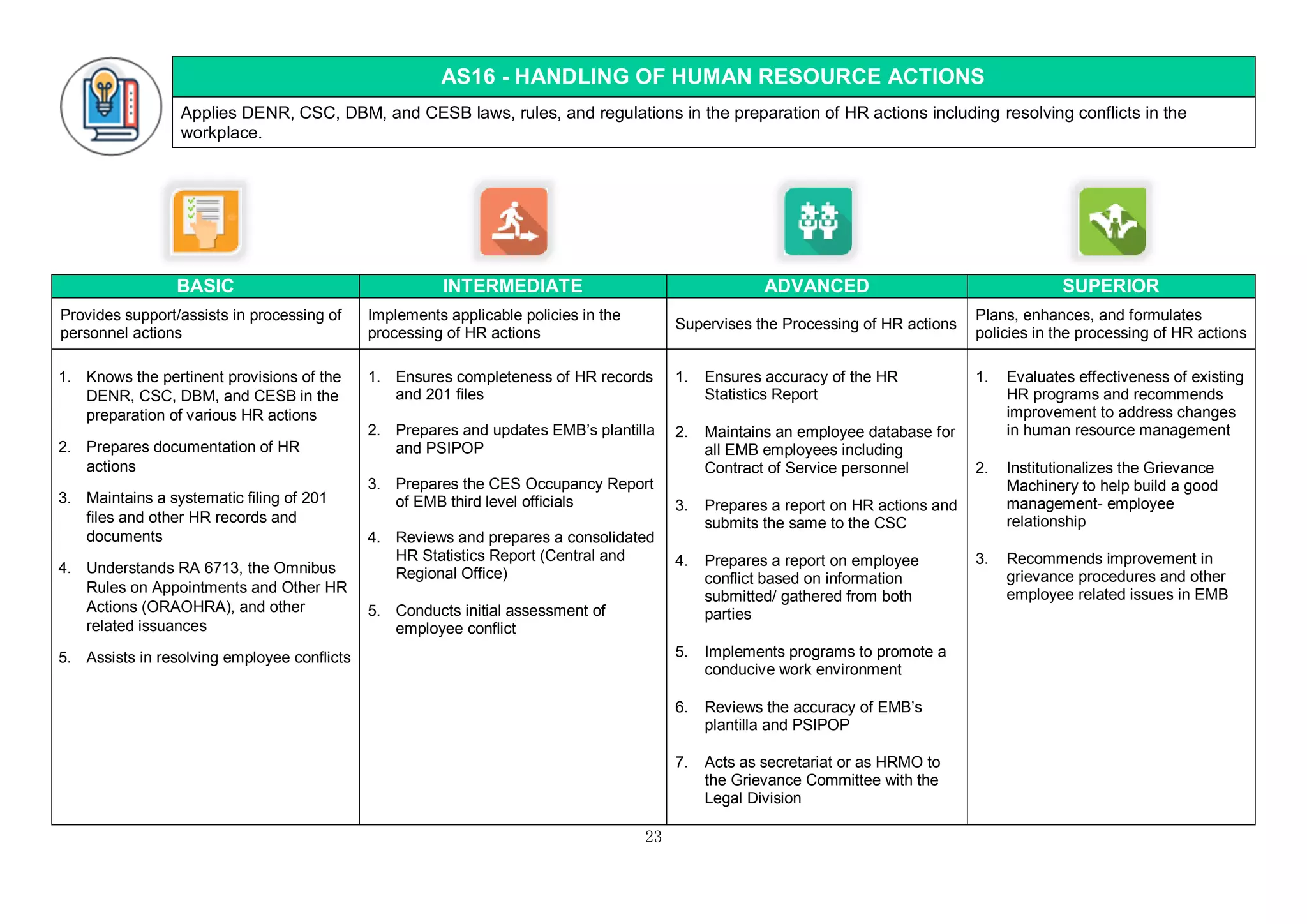
2. Facilitates scoping, procedural and
substantive review of EIA Reports
3. Prepares minutes of meetings, site
inspection reports PEMAPs scoring and
other similar technical reports and
communications in relation to the
review of EIA Reports
4. Identifies key environmental impacts
related to his educational background
1. Identifies key environmental impacts
for the following project types:
a. mining projects
b. forestry projects
c. infrastructure projects
d. process industry projects
2. Prepares process documentation, draft
ECC and other major technical reports
and communications in relation to the
EIA Report Review.
3. Identifies problem areas and propose
action in the ECC application review
process.
4. Provides technical inputs in the policy
formulation on EIA Report Review and
ECC application processing matters.
5. Guides and coaches others on this
competency.
1. Oversees the technical evaluation ECC
applications;
2. Oversees the management of the EIS
Preparation & Review including the
maintenance and updating of the EIA
Practitioners Registry;
3. Renders expert opinion and
recommendations as an input for Policy
Formulation, Trainings and other
Special Projects/Activities for systems
improvement;
4. Develops and formulates plans and
programs for ECC application/EIA
Review for the continuous improvement
of environmental Impact evaluation
function of the Division
5. 5. Acts as Resource person on matters
related to environmental impact
evaluation
108
EI2 - EIA MONITORING AND AUDIT
The ability required to determine compliance of projects issued ECCs to related environmental standards and commitments as a result of the
EIA process and to assess performance of monitoring partners.
BASIC INTERMEDIATE ADVANCE SUPERIOR
Assists in EIA monitoring and audit
activities
Conducts EIA monitoring and audit
activities
Supervises EIA monitoring and audit
activities
Formulates plans, programs and policies
on EIA monitoring and audit activities
1. Knows the EIA Process and Concepts.
2. Understands the Rationale for ECC
Compliance Monitoring.
3. Accesses and understands the
database input information on projects
issued ECCs.
4. Assists in the conduct of desk review of
compliance of projects to the conditions
of ECC issued and in the preparation
of corresponding communications
1. Prioritizes projects for monitoring using
the Project Environmental Monitoring
and Audit Prioritization Scheme
(PEMAPS).
2. Conducts desk review of compliance of
projects to the conditions of ECCs
issued and prepares corresponding
reports/communications (i.e. NAF,
assessment letters, etc).
3. Reviews Compliance Monitoring
Reports and prepares Compliance
Evaluation Reports in relation to ECC
compliance monitoring.
4. Processes application for minor ECC
amendments.
5. Conducts field monitoring and
assessment of environmentally critical
projects and prepares the required
1. Provides technical inputs to
administrative investigations of
environmental performance issues
2. Acts as the hearing officer in the
conduct of technical
conference/meeting
3. Manages and organizes the creation of
the Multipartite Monitoring Teams of
the project proponents
4. Conducts technical performance audit
of ROs and other monitoring partners
(i.e. MMTs, holders of programmatic
ECC, etc.)
5. Oversees the ECC Compliance
Monitoring and related activities
1. Oversees the implementation of the
environmental monitoring and audit
functions of EMB ROs and other
partners (LGUs, MMT, and other GOs).
2. Interprets and summarizes basic
statistical as well as technical reports in
relation to EIA Monitoring and Audit
nationwide as input to policy
development.
3. Initiates and reviews actions, plans and
policies for the continuous improvement
of the EIA Monitoring and Audit.
109
reports within the specified timelines.
6. Conducts overall assessment of the
proponents’ compliance with ECC
conditions and related commitments
and prepares necessary action
documents (i.e. NOVs, Penalty Orders,
CDO, etc.).
7. Conducts review of related EIA
documents (e.g. MOA on MMT, EGF
and EMF)
8. Coordinates the establishment of
MMTs
6. Prepares statistical as well as technical
reports in relation to the EIA Monitoring
and Audit
7. Identifies problem areas in the EIA
Monitoring and Audit
8. Provides technical inputs in the policy
formulation on EIA Monitoring and
Audit
9. Guides and coaches others on this
competency.
110
EI3 - EIA POLICY AND STANDARDS FORMULATION AND IMPLEMENTATION ASSESSMENT
The ability required to formulate policies and standards in Environmental Impact Assessment (EIA) Review, Monitoring and Audit and assess its
implementation
BASIC INTERMEDIATE ADVANCE SUPERIOR
Assists in formulation and implementation
assessment of standards and policies
Facilitates EIA policy and standards
formulation and implementation
assessment activities
Supervises EIA policy and standards
formulation and implementation
assessment activities
Manages EIA policy and standards
formulation and implementation
assessment activities
1. Knows the DENR/ EMB vision,
mission, thrusts, mandates/functions,
policies, and programs in the
implementation of the Philippine EIS
System.
2. Has basic knowledge on environmental
science and management.
3. Assists in organizing consultations for
policy and standards formulation and
assessment
4. Assists in organizing audits/surveys
related to implementation assessment
1. Has basic knowledge on the sciences
related to EIA.
2. Prepares necessary
materials/documents for policy and
standards formulation consultation or
implementation audit/survey activities.
3. Documents consultation and
audit/survey activities
4. Identifies gaps in policy and
implementation.
1. Has an advanced knowledge on the
science and technology related to EIA.
2. Consolidates and analyzes policy
recommendations from consultation
and audit activities.
3. Recommends new and revision of
policies and standards.
4. Prepares project proposals for policy
and standards formulation and
implementation assessment.
5. Serves as resource person in the
discussions on the implementation of
the PEISS in inter-division meetings.
1. Formulates strategies and
methodologies appropriate for policy
development
2. Identifies appropriate management
intervention to address PEISS issues
3. Initiates and manages activities
necessary for the updating or revision
of policies and standards
4. Initiates and manages consultation,
survey, and audit activities related to
policy and standards formulation and
implementation assessment
5. Drafts policies, procedures and
standards based on results of
implementation assessment
6. Serves as a resource person in the
discussions of issues and concerns on
the implementation of the PEISS in
interagency/sectoral fora.
111
EI4 - CAPACITY BUILDING ON EIA
The ability required to design training modules and provide the necessary training support to enhance the capacity of Regional Offices and other
relevant stakeholders for the effective implementation of the Philippine EIS System policies and guidelines.
BASIC INTERMEDIATE ADVANCE SUPERIOR
Assists in conduct of capacity building
activities on PEISS
Facilitates capacity building activities on
PEISS
Supervises capacity building activities
on PEISS
Manages capacity building activities on
PEISS
1. Knows the DENR/EMB vision, mission,
thrusts, mandates/functions, policies,
and programs in the implementation of
the Philippine EIS System.
2. Has basic knowledge on the PEISS
and environmental management.
Assists in the preparations and conduct
of capacity building activities including
preparation of necessary documents
for administrative arrangements
1. Prepares necessary
materials/documents in the conduct of
capacity building activities.
2. Documents the capacity building
activities including issues and concerns
during capacity building and identifies
policy development, updating and
revision needs.
3. Prepares presentation and training
materials.
4. Identifies information materials needed
for the conduct of the capacity building
5. Act as facilitator during the conduct of
capacity building activity
1. Plans and supervises Capacity Building
Activities.
2. Identifies training needs, designs
training programs and develops training
materials.
3. Assesses/evaluates training programs/
modules.
4. Synthesizes improvements of training
programs based on results of training
assessments.
5. Prepares capacity building evaluation
tools.
6. Guides and coaches others on this
competency.
1. Prepares training plan, design and
modules.
2. Formulates appropriate strategies to
enhance capacity building in the PEISS.
3. Manages the conduct, documentation
and assessment of Capacity building
activities.
4. Serves as Resource Person.
5. Transforms learning/ insights from
training assessment results into
recommendations to enhance
implementation of the PEISS.
112
EI5 - LINKAGING AND NETWORKING (TECHNICAL COOPERATION , INTERAGENCY COMMITTEES)
The ability required to participate, coordinate and network with other government agencies, institutions, industry and individual in relation to
common issues and concerns, goal and policy objectives in the implementation of PEISS.
BASIC INTERMEDIATE ADVANCE SUPERIOR
Assists in linkaging and networking
activities
Facilitates linkaging and networking
activities
Supervises linkaging and networking
activities
Formulates plans, programs and policies
on linkaging and networking activities
1. Knows the group composition and
dynamics.
2. Knows the procedures and approaches
in facilitating or conducting meetings.
3. Has basic knowledge on consensus
building.
4. Has basic knowledge in communication
skills.
1. Identifies necessary lingkages and
netwoks.
2. Establishes, develops and maintains
links with multi-sectoral/multi-
agency,multi-regional partnerships e.g
industry group, government agencies,
academe, non-government
organizations, local government units,
among others.
3. Facilitates meetings/ workshops to
address and resolve issues/ concerns,
synthesizes and prepares
corresponding reports.
4. Uses network to seek and gain access
to information from various sources to
support PEISS objectives.
1. Articulates the position in a particular
issue related to the implementation of
the PEISS.
2. Provides technical assistance in
accordance with the target objectives.
3. Drives consensus and collective
decisions.
4. Interprets indicators/inputs during
interactions that signify significant
challenges to various interagency
committees.
5. Supervises the conduct of necessary
interagency meetings/fora.
6. Broadens network of relationships to
promote the image of the agency.
1.Mobilizes stakeholders to support PEISS
mandates.
2.Articulates the agency’s position on
sensitive issues involving decision-
making and policy formulation related to
PEISS
3.Promotes the PEISS and agency’s
goals, priorities and achievements in the
interests of the greater public good.
4.Manages the conduct of necessary
interagency meetings/fora.
113
EI6 - DEVELOPMENT/DISSEMINATION OF PEISS INFORMATION
The ability required to develop/disseminate information relating to the implementation of the PEISS
BASIC INTERMEDIATE ADVANCE SUPERIOR
Assists in development / dissemination of
PEISS information
Develops/disseminates release of PEISS
information
Reviews release of PEISS information
Approves/Recommends release of PEISS
information
1. Drafts articles on activities of the
EIAMD for posting in the Website.
2. Identifies information materials in the
Website which needs to be archived.
3. Coordinates with the sections
regarding information materials to be
uploaded in the Website.
4. Drafts response to routine policy and
implementation related queries raised
by Regional Offices or the public.
1. Drafts articles regarding issuance of
new EIA policies, guidelines, standards
highlighting the expected outcome of
the issuances in relation to the overall
mandate of EMB.
2. Manages the information in and
structure of the Website.
3. Drafts and recommends response to
policy and implementation-related
queries raised by Regional Offices or
by the public.
1. Reviews and approves release of
standard PEISS Information and of
response to simple policy and
implementation-related queries.
1. Reviews and approves release of major
PEISS Information and of response to
complex policy and implementation-
related queries.
114
EI7 - EIA DOCUMENT TRACKING AND INFORMATION SYSTEM MANAGEMENT
The ability required to operate, access, store, and process data/information in the EIA Information System (EIA-IS) and document tracking
system
BASIC INTERMEDIATE ADVANCE SUPERIOR
Encoding uploading of basic information
in the existing System
Encoding/uploading of technical
information/materials in the existing
system
Supervises EIA-IS Database and Website
Administration
Oversees EIA-IS Database and Website
Management
1. Encodes instructions in the disposition
form in the document tracking system.
2. Encodes basic project Information in
the EIA-IS.
3. Scans signed documents and attaches
in the EIA-IS.
4. Updates Status of ECC applications in
the EIA-IS.
1. Encodes/Uploads technical
information/materials in the EIA-IS
such as review process reports,
inspection reports and compliance
evaluation reports.
2. Retrieves status updates on ECC
applications and compliance in the
EIA-IS.
3. Generates ready printable reports from
the EIA-IS.
4. Maintains the proper handling of
documents/records as filed with the
Office.
1. Generates customized reports from the
EIA-IS.
2. Updates the ECA Map.
3. Updates the EIA Website.
4. Analyzes summary of EIA-IS data
inputs including inputs from EMB ROs.
5. Coordinates with MIS regarding
necessary systems upgrading and
updating.
1.Develops and conceptualizes
information system that will support the
goal of the EIAMD.
2.Recommends strategy to acquire,
develop, retool and retain IT skills.
3.Introduces and initiates innovations and
enhancements in the data system.
115
ER1 - ENVIRONMENTAL RESEARCH GENERATION
The ability required in generating researches and scientific data on various environmental issues, existing environmental laws and international
commitments in support of formulation and enforcement of environmental policies/standards/criteria and guidelines.
BASIC INTERMEDIATE ADVANCE SUPERIOR
Assists in environmental research
generation activities
Conducts environmental research
generation activities
Supervises environmental research
generation activities
Formulates plans, programs and policies
on environmental research generation
activities
1. Understands the present state of the
Philippine environment.
2. Knows basic applied research
concepts and procedures for
generating scientific data/information.
3. Knows the basic statistical and
mathematical tools in the conduct of
research and understands the
precautions taken to ensure
confidentiality in storing data.
4. Gathers data and references relevant
to pollution concerns and other
environmental issues, both manually
and electronically.
1. Uses statistical and mathematical
computer software and analyzes/
interprets results of processed data
and properly secures data (e.g., usage
of electronic passwords, secured
access to databases, locked file
cabinets, etc.).
2. Identifies the objectives of the research
projects and applies the particular
research approaches i.e., creates
research design; frames
data/information sheets/forms;
identifies appropriate measurement
techniques; apply quantitative,
qualitative, and/ or mixed methods,
and establishes a shared
understanding of the concept of the
research work with the clients and
stakeholders.
3. Conceptualizes and prepares initial
environmental R&D proposals.
1. Provides inputs to research database
development and management.
2. Plans and conducts research work in
collaboration with academe, research
institutions/monitoring networks and
various stakeholders, with the
anticipation of different positions of
various interest groups in order to
encourage cooperation and avert or
counteract any groups’ attempts to bias
or misapply the results or to curtail
research operations.
3. Plans and formulates environmental
R&D framework/agenda relevant to
environmental management and
pollution control.
4. Oversees environmental research
generation activities.
5. Establishes environmental R & D
linkages/networking for collaboration
1. Formulates and develops integrated
environmental R&D agenda, programs
and framework.
2. Formulates corresponding research-
based management interventions on
certain environmental issues.
3. Institutes measures to eliminate lapses,
deficiencies, shortfalls and/or slippages
of all future environmental R&D
activities.
4. Analyzes/recommends research-based
directives on environmental matters.
116
4. Reviews all data collection,
processing, and reporting functions so
that any error found will be corrected
and identifies critical data and/or
results, and effectively explains and
communicates the importance of
findings.
5. Develops and implements
environmental researches, e.g.,
conduct of ecotoxicological studies/
toxicity testing, cause-and- effect
analyses, and risk assessment.
6. Prepares scientific/ technical/popular
papers/ reports.
and/or funding.
6. Evaluates and reviews environmental
R&D proposals, scientific and technical
reports and papers.
7. Establishes clear working agreements
with clients to ensure efficient
collaboration and protects involved
parties’ rights.
8. Guides and coaches others on this
competency.
117
ER2 - COLLECTION OF ENVIRONMENTAL SAMPLES
The ability required in the collection of environmental samples in connection with the conduct of environmental research.
BASIC INTERMEDIATE ADVANCE SUPERIOR
Assists in collection of environmental
samples activities
Conducts collection of environmental
samples activities
Supervises collection of environmental
samples activities
Formulates plans, programs and policies
on collection of environmental samples
activities
1. Knows the basic principles on the
quality of the environment.
2. Knows the basic principles and
procedures in collecting, handling,
preservation, transport, submission of
environmental samples and field data
recording.
3. Prepares field supplies and materials
and operates field sampling
equipment/instruments with assistance.
4. Records field data; collect, handle,
preserve, transport; and submit
environmental samples.
1. Conducts sample integrity and
standard procedures for sample
collection, handling, storage and
transport.
2. Adheres strictly to established
sampling protocols.
3. Conducts environmental sampling and
monitoring.
1. Operates various environmental
sampling equipment and field
instruments with mastery.
2. Develops and implements an
environmental monitoring and sampling
plan, including but not limited to the
following:
(a) sampling procedure and quality
assurance plan;
(b) sample analysis plan;
(c) data assessment and data quality
procedures,
(d) operation and maintenance of
sampling equipment and field
instrumentation.
3. Oversees and monitors the conduct of
environmental sampling.
1. Directs and coordinates the
implementation of all activities relative
to environmental monitoring and
sampling.
2. Formulates strategies to institutionalize
registration of environmental sample
collectors.
118
4. Monitors and reviews the development
and implementation of the
environmental monitoring and sampling
plan.
5. Formulates strategies to
professionalize the collection of
environmental samples.
6. Guides and coaches others on this
competency.
119
ER3 - COLLECTION OF ENVIRONMENTAL DATA
The ability required to collect data needed in the conduct of environmental research.
BASIC INTERMEDIATE ADVANCE SUPERIOR
Assists in collection of environmental data
activities
Conducts collection of environmental data
activities
Supervises collection of environmental
data activities
Formulates plans, programs and policies
on collection of environmental data
activities
1. Knows about the potential sources of
environmental and related
data/information.
2. Plans ways to collect environmental
and related data/information.
1. Formulates questions that can be
addressed with data and collects,
organizes and displays relevant data to
answer them.
2. Identifies data fit for appropriate
statistical methods e.g., randomization,
number and combination of
experimental intervention, the timing
and measurement of visits.
1. Develops survey questionnaires that
yield clear answers and useful
information.
2. Oversees the carrying out of surveys
and data tabulation.
1. Identifies ways to maximize efficient
use of available resources.
2. Identifies design methods to collect
information including the design of
analysis plans following the
development of the research program.
3. Conducts routine checks for threats to
validity that might ruin a project.
120
ER4 - DATA ANALYSIS AND INTERPRETATION
The ability required in translating results of collected environmental and other related data/information.
BASIC INTERMEDIATE ADVANCE SUPERIOR
Assists in data analysis and interpretation
activities
Conducts data analysis and
interpretation activities
Supervises data analysis and
interpretation activities
Formulates plans, programs and policies
on data analysis and interpretation
activities
1. Knows how to establish environmental
data/information needs within an
analytical context.
2. Understands basic data analysis
methods that are appropriate and
effective for the types of data produced
by the study.
1. Translates needs into tailored
analytical solution through the
preparation of a complete, detailed
description of the study design as well
as a clear exposition of the questions
to be addressed.
2. Prepares preliminary plan for analysis
of a research study.
3. Provides feedback to plans format.
1. Reviews, edit final analysis plans
based on team input.
2. Implements planned analysis including
data verification and data correction as
necessary using one or more systems
of computer hardware and statistical
analysis software for the management
and analysis of data.
3. Examines the data for threats to
validity, ranging from missing data to
questionable outliers to confounders.
1. Interprets to an audience and
environmental stakeholders the results
of statistical outputs.
2. Identifies the best way to describe and
display data that will fit the conclusions
and the results of analysis.
3. Oversees that there is no erroneous or
incomplete statements about the
findings.
4. Re-analyzes the data using other
appropriate related methods.
121
ER5 - DOCUMENTATION AND DISSEMINATION OF RESULTS
The ability required in translating results of collected environmental and other related data/information.
BASIC INTERMEDIATE ADVANCE SUPERIOR
Assists in documentation and
dissemination of results activities
Conducts documentation and
dissemination of results activities
Supervises documentation and
dissemination of results activities
Formulates plans, programs and policies
on documentation and dissemination of
results activities
1. Has basic knowledge on summarizing
data warehouse, data analysis results,
statistical methods and synthesis of
conclusion from summary tables.
1. Prepares written technical reports and
oral presentations summarizing data
warehouse, data analysis results
including detailed description of
statistical methods, detailed analysis of
results and synthesis of conclusion
from summary tables.
1. Prepares graphic presentation of
findings for reports, presentations, and
publications.
2. Ensures confidentiality of data without
the stakeholders’ expressed
permission.
3. Ensures full acknowledgement of
reference materials cited in the report.
1. Directs and coordinates documentation
and dissemination of research
activities/ result outputs.
2. Initiates and recommends relevant
trainings to enhance workforce
capability on statistical analysis, data
interpretation, technical report writing,
etc.
122
ER6 - ANALYSIS OF ENVIRONMENTAL SAMPLES
The ability required in the:
 generation of data that will be used in the formulation of policies, criteria, standards; in the adjudication of pollution cases; in the determination of
compliance to rules and regulation and in assessing the quality of environment.
 analysis of environmental samples (water, wastewater ambient air, stationary source emission, sediment, soil biota and organics pollutants) for
parameters spelled out in the environmental laws, IRRs, standards, and rules and regulations.
 conduct of relevant tests to characterize the toxicity of effluents and other wastes.
 validation and recommendation of up-to-date analytical methods for inclusion in environmental policies, standards and criteria to be adopted and
approved by the DENR.
BASIC INTERMEDIATE ADVANCE SUPERIOR
Assists in analysis of environmental
samples activities
Conducts analysis of environmental
samples activities
Supervises analysis of environmental
samples activities
Formulates plans, programs and policies
on analysis of environmental samples
activities
1. Knows sample receiving protocol from
field samplers (sign-on to Chain-of-
Custody and Analytical Request Report
Forms, etc).
2. Has basic knowledge on laboratory
analysis and equipment
3. Assigns unique laboratory sample
identification (ID) codes to samples.
4. Creates hardcopy file for each project
(planning notes/field notes/field
measurements).
5. Logs-in sample ID and required
parameters into a master file laboratory
logbook
6. Prepares sample pre-handling where
1. Performs sample handling prior to
sample preparation (homogenization/
filtration/foreign object sub- sampling/
moisture determinations).
2. Prepares samples for analysis
(digestion/extraction/clean-up
procedures.)
3. Conducts optimization and calibration
of basic analytical laboratory
equipment / instruments (pH,
analytical balance/ TDS/Conductivity
meter/ waterbath/ oven/ incubator/
etc).
4. Prepares sample treatment and other
requirements needed in the analysis of
environmental samples: (water,
wastewater, ambient air, stationary
source emissions, sediment, soil,
1. Checks calibration standards integrity
with secondary and whether
calibration and instrument
performance are acceptable.
2. Calculates and tabulates all results
and generates preliminary reports of
results (sample results/QC/sample
results/sample information/ methods/
interpretation of results).
3. Archives all data and physical samples
(electronic data files/strip
charts/chromatograms/lab. notes).
4. Reviews sample and QC data.
5. Conducts training of laboratory staff
1. Reviews and maintains laboratory’s
quality system, procedures and work
instructions manuals.
2. Verifies and validates all data
generated and reported by the
laboratory.
3. Coordinates and integrates the work of
all laboratory units into a completed
work product.
4. Devises ways to accommodate
laboratory work operations to new and
changing programs or requirements
such as studies of work practices and
procedures, staffing and budget
requirements and similar matters.
5. Serves as the division/EMB’s
expert/resource person in implementing
123
necessary (compositing/ preservation)
.
7. Prepares glassware and sample
containers using the established
protocols.
8. Stores samples appropriately (correct
temperatures/exclude light where
necessary).
biota and organics pollutants)
5. Prepares basic chemical solutions.
6. Maintains on file all records pertaining
to laboratory activities.
7. Conducts inventory of chemicals,
glassware and other laboratory
supplies.
8. Analyzes environmental samples as
well as internal and external quality
control samples.
9. Performs validation of analytical
methods.
10. Analyzes “national and international
proficiency testing/ inter-laboratory
comparison exercises” samples.
11. Completes documentation of analysis
(sample ID/data file name/ weights/
volumes/ laboratory notes).
12. Conducts optimization and calibration
of specialized analytical laboratory
equipment / instruments
(AAS/IC/GC/GCMS/UVVis/Laser
Defraction Particle Size
Analyzer/Organic Halide
Analyzer/Spectrofluorophotometer,
etc)
13. Prepares laboratory QC samples
(blanks, certified reference materials/
spikes/duplicates)
14. Implements QA/QC health and safety
and other EMB program
from EMB Regional Office, Schools,
Industries and other government
agencies.
6. Acts as "troubleshooter"/ adviser to
others regarding laboratory activities.
7. Monitors conformance to expected
results.
8. Prepares, reviews and documents
laboratory quality laboratory system,
procedures and work instructions
manuals.
9. Establishes and maintains quality
assurance and quality control (QA/QC)
programs, good laboratory practices,
and safety programs.
10.Reviews and validates all analytical /
technical reports.
11.Schedules analysis in priority
according to due dates, holding times.
12.Selects appropriate analytical methods
(for sample preparation/
instrumentation).
13. Checks methods are validated and
documented.
14. Evaluates performance in proficiency
testing/ inter-laboratory comparison
exercises.
15. Reviews final results of analysis for
errors (consistency with field
measurements/field notes/historical
ERD’s programs/ resolving problems.
6. Devises new work methods and
procedures or improvements in existing
work practices, and getting the
cooperation of employees in applying
the new methods and practices.
7. Reviews laboratory operations to
develop or improve methods,
procedures, or controls/ plans new
programs to bring about major changes
in laboratory operations and
procedures.
8. Reviews research/study proposals and
checks, evaluates research/study
output.
124
15. Documents sample preparation steps
(methods/ weights/ volumes/ lab notes)
16. Prepares calibration and control
standard solutions if necessary
(document in logbooks)
17. Performs instrument performance
check(s)
18. Documents instrument performance
and control standard results in
instruments log books and control
charts.
site data/inter-parameter
relationships).
16. Serves as resource person for clients/
lecturer.
17. Monitors the implementation of
laboratory QA program, Health and
18. Safety program and other EMB
programs.
19. Organizes seminars/workshops on
laboratory and other related activities.
20. Prepares research/study proposals.
125
ER7 - EQUIPMENT MAINTENANCE AND CALIBRATION
The ability required in the operations, maintenance and calibration of field and laboratory equipment/instruments.
BASIC INTERMEDIATE ADVANCE SUPERIOR
Assists in equipment maintenance and
calibration activities
Conducts equipment maintenance and
calibration activities
Supervises equipment maintenance and
calibration activities
Formulates plans, programs and policies
on equipment maintenance and
calibration activities
1. Knows all equipment and apparatus.
2. Secures and monitors instruction
manuals, schematic diagrams and
drawings of all equipment.
3. Maintains equipment logbook.
4. Maintains all forms to be used in
relation to maintenance and calibration
including storage and disposal.
1. Conducts basic maintenance and
troubleshooting of field and laboratory
equipment
2. Conducts inventory of equipment and
spare parts
3. Prepares purchase orders, track
orders of equipment and parts
4. Keeps record of equipment purchase
orders and receipts
5. Conducts calibration of field and
laboratory equipment
6. Handles labeling, coding and
identification of equipment to indicate
the status of calibration
7. Checks equipment if it complies with
the specification
1. Conducts pre and post test preparation
of field and laboratory equipment
2. Implements and monitor the health and
safety program.
3. Conducts quality control guidelines on
procurement of equipment and spare
parts.
4. Conducts pre- and post inspectionof
equipment.
5. Prepares guidelines and procedures
for preventive and corrective actions
6. Prepares calibration and maintenance
program
7. Prepares procedure for safe handling,
transport, storage, use and planned
maintenance and calibration of
equipment
1. Directs all operations, implementation
of the calibration and maintenance
programs.
2. Oversees storage and disposal of
equipment and ensures compliance
with government regulations on
disposal.
3. Reviews and maintains the
maintenance and calibration programs.
4. Verifies and validates all maintenance
and calibration data generated and
reported.
5. Coordinates the programs in all
laboratory units into a completed work
product.
6. Works closely with other EMB
organizational units to implement
programs, resolve problems and
coordinate activities
126
8. Trains technical and non-technical
personnel using the equipment.
8. Prepares training manual for calibration
and maintenance of equipment.
127
ER8 - RECOGNITION OF DENR ENVIRONMENTAL LABORATORIES
The ability required in the assessment, surveillance/ monitoring of environmental laboratories based on DENR Administrative Order 98-63:
Guidelines for the Designation of DENR Recognized Environmental Laboratories.
BASIC INTERMEDIATE ADVANCE SUPERIOR
Assists in recognition of DENR
environmental laboratories activities
Conducts recognition of DENR
environmental laboratories activities
Supervises recognition of DENR
environmental laboratories activities
Formulates plans, programs and policies
on recognition of DENR environmental
laboratories activities
1. Knows the procedures in recognition of
environmental laboratory.
2. Checks the completeness and
correctness of entries in the application
document submitted by environmental
laboratory applicants.
3. Prepares contract of external
assessors, laboratory inspection and
assessment forms, assessment/travel
itineraries and documents.
4. Conducts PT surveys and consolidates
survey results.
5. Prepares and follows-up purchase
request of proficiency test samples.
6. Consolidates proficiency test results.
1. Prepares laboratory assessment
schedules/ activities.
2. Identifies and informs assessors based
on expertise, experience and affiliation.
3. Informs/communicates with the
environmental laboratory applicants
the status of their application
documents.
4. Evaluates application documents
submitted by environmental laboratory
applicants.
5. Prepares list of assessors and
endorses list to EMB Director.
6. Conducts on-site assessments of
environmental laboratory applicants.
7. Verifies track records, personnel,
physical layout and safety procedures,
quality control programs, laboratory
1. Discusses findings with the laboratory
personnel.
2. Prepares non-compliance,
recommendation and assessment
reports.
3. Prepares list of Certified Reference
Material for purchasing.
4. Prepares and distributes proficiency
test samples, protocols, results and
method forms.
5. Check proficiency test data transfers,
computation and final reports.
6. Checks and verifies completeness of
accomplished Non-Compliance and
Recommendation Reports.
7. Searches for proficiency test providers
based on established requirements.
1. Reviews non-compliance,
recommendation and assessment
reports.
2. Prepares recommendation reports to
the Technical Advisory Group for
Laboratory Recognition.
3. Checks implementation of the ELR
scheme.
4. Reviews research of proficiency testing
128
procedures, reagents equipment and
instrument calibration/maintenance,
and laboratory waste management.
8. Prepares protocol for proficiency
testing.
9. Evaluates proficiency test results in
accordance with ISO 1994-5725
(Accuracy, trueness and precision of
measurement methods and results)
and ISO 43 (Proficiency testing by inter
laboratory comparisons).
10. Prepares test report certificates and z-
score charts.
11. Conducts assessment of
environmental laboratory.
129
EE1 - CURRICULUM REVIEW AND DEVELOPMENT FOR ENVIRONMENTAL EDUCATION
The ability required to develop and implement environmental education programs specifically in the preparation of environmental education
course design and contents, and for use in the institutionalization / professionalization of key stakeholders in environmental education for
sustainable development.
BASIC INTERMEDIATE ADVANCE SUPERIOR
Assists in curriculum review and
development for environmental education
activities
Conducts curriculum review and
development for environmental education
activities
Supervises curriculum review and
development for environmental education
activities
Formulates plans, programs and policies
on curriculum review and development
for environmental education activities
1. Knows DENR/EMB’s mandate,
policies, programs and projects on
environmental education and education
for sustainable development.
2. Knows DENR/EMB’s environmental
information, education, and
communication (IEC)
programs/policies.
3. Has basic knowledge on the State of
Philippine environment particularly the
brown environment.
4. Has basic knowledge and skills in
environmental education curriculum
development.
1. Monitors and evaluates environmental
education-related reports.
2. Coordinates environmental education
seminars, orientations, workshops, and
trainings.
3. Prepares and develops environmental
education project proposals,
curriculum / training module designs
on environmental education for
seminars, orientations, workshops and
trainings.
4. Handles environmental education-
related projects/ activities particularly
in curriculum development.
5. Initiates/ recommends environmental
education programs and projects on a
regional to national scale application.
1. Plans and monitors environmental
education program/activities.
2. Drafts/recommends new policies or
improves existing environmental
education programs / projects, updates
and develops new curriculum on
environmental education-related
courses, based from research and
development results.
3. Writes/drafts training course designs
and content for use of multi-education
levels and sectors/linkages.
4. Drafts/recommends environmental
education materials for advocacy, and
updates the same for future use.
5. Analyzes and evaluates environmental
education-related, environmental
research and development studies and
1. Directs and coordinates the overall
implementation of environmental
education policies, programs and
projects / activities in the Bureau.
2. Conducts strategic planning,
programming and monitoring of
environmental education programs /
projects.
3. Contributes/updates the development
of environmental education
interventions on the overall objectives,
visions and missions of the Bureau.
4. Recommends major
revisions/enhancements of existing
environmental education mandates,
policies, programs/projects based on
research and development studies.
5. Serves as expert or resource person in
130
translates these into information
materials.
6. Conducts environmental education and
education for sustainable development-
related trainings, seminars and
orientation workshops.
7. Acts as resource person during any
environmental education seminars,
orientation, workshops and trainings.
EE/EESD-related programs/activities.
131
EE2 - CAPABILITY BUILDING ON ENVIRONMENTAL MANAGEMENT
The ability required to have a systematic management approach in the conduct of trainings/ seminars/ workshops to capacitate the relevant key
stakeholders and workforce/personnel at the EMB Regional Offices in implementing environmental management.
BASIC INTERMEDIATE ADVANCE SUPERIOR
Assists in capability building on
environmental management activities
Conducts capability building on
environmental management activities
Supervises capability building on
environmental management activities
Formulates plans, programs and policies
on capability building on environmental
management activities
1. Has knowledge on the various
concepts and components on
environmental management, including
enforcement and implementation as
well as the policies and programs of
EMB and DENR.
2. Knows the EMB’s public awareness
and education program to enhance
public participation on the enforcement
and implementation of environmental
management policies and procedures.
3. Has basic knowledge on various data
gathering techniques to collect
information needed in the development
of training programs
4. Knows the process of conducting
training programs.
5. Operates basic equipment for training,
seminars and conferences.
1. Prepares presentation materials for
training.
2. Reviews IEC materials and training
programs on environment.
3. Meets all training requirements needed
within the specified time frame.
4. Facilitates workshop, training and other
similar activities to gather needed
information for development of an
appropriate environmental
management program.
5. Determines type of IEC materials and
training programs to be developed
taking into consideration factors like
communication objectives, target
audience, and availability of
communication technologies.
6. Develops IEC materials and training
programs on environmental
management.
1. Simplifies scientific and technical
literature on the implementation of
environmental management.
2. Implements contingency plans to
address critical situations during
training.
3. Delivers environmental lectures,
synthesizes lessons and relates them
to current environmental issues and
concerns.
4. Integrates the program objectives,
issues and concerns arising from
interactions/discussions.
5. Guides the activity flow and
proceedings in a group activity for
consensus building and sound decision
making in crafting a recommendation/
strategy.
1.Conducts participatory planning activities
to develop training programs.
2.Introduces innovations and techniques in
developing training programs.
3.Formulates training standards and
policies in implementing training
programs.
4.Plans contingencies and recommends
accordingly.
5.Serves as a resource person in various
trainings, briefings, orientation seminars
for environmental management.
132
EE3 - PUBLIC INFORMATION MANAGEMENT
The ability required to develop and implement public information programs to enhance public understanding and participation in environmental
protection and management to attain sustainable development.
BASIC INTERMEDIATE ADVANCE SUPERIOR
Assists in public information
management activities
Conducts public information management
activities
Supervises public information
management activities
Formulates plans, programs and policies
on public information
management activities
1. Knows DENR/EMB’s mandate,
policies, programs and projects.
2. Knows the state of the Philippine
environment, with emphasis on the
brown environment sector.
3. Has basic knowledge in journalism.
4. Operates fax machine, overhead
projector, multi-media projector,
photocopier, digital camera, etc.
5. Encodes and proofreads digital copy of
editorial materials on environment.
6. Distributes IEC materials to various
stakeholders.
7. Assists walk-in clients for their
information needs.
1. Gathers information needed in the
development of feature and editorial
materials.
2. Writes / edits / proofreads press
releases, fact sheets, photo captions
for exhibit materials and photo
releases.
3. Prepares storyline for exhibit materials,
4. Undertakes photo-documentation of
EMB events and status of programs
and projects.
5. Writes feature articles, column feeds
and TV releases on environmental
management programs and policies.
6. Prepares fact sheets, primers,
brochures, exhibit materials on brown
environmental issues.
1. Establishes partnership with the tri-
media.
2. Prepares a communication plan in
support to EMB programs and
projects.
3. Edits press releases, editorial and
feature articles written by staff.
4. Coordinates with information officers of
the EMB regional offices for a unified
information campaign.
5. Manages the timely release of press
releases and editorial materials.
6. Oversees the implementation of IEC
campaigns.
7. Identifies strategies to implement high-
impact IEC campaigns vis-à-vis limited
funds.
1. Reviews and monitors the IEC
programs / projects.
2. Oversees the conduct of IEC
programs, projects of the office /
Bureau.
3. Serves as expert or resource person in
IEC program implementation
133
EE4 - SPECIAL EVENTS MANAGEMENT
The ability required to conceptualize and manage special environmental events and generate the corresponding resources needed to implement
the event.
BASIC INTERMEDIATE ADVANCE SUPERIOR
Assists in special events
management activities
Conducts special events
management activities
Supervises special events
management activities
Formulates plans, programs and policies
on special events management activities
1. Knows how to manage an event.
2. Has basic understanding with the
required resources to implement a
particular event.
3. Knows the physical arrangement and
equipment required by an event.
4. Has basic knowledge on templates for
resource requirements of an event, to
include, physical arrangements,
logistics, human power, etc.
5. Makes a listing of institutional partners,
resource persons, caterers, sounds
and equipment rental, etc.
1. Assists by serving as facilitator in the
management of a special
environmental event.
2. Coordinates the logistical
arrangements required to implement a
special environmental event.
3. Conducts ocular inspection of a venue.
4. Conducts a dry run of an event.
5. Drafts invitation letters to event guests
and participants.
6. Conceptualizes an environmental
special event.
7. Identifies appropriate medium or
approach to create a high impact
1. Leads the management of an event.
2. Coordinates the implementation of the
event with the various team members.
3. Mobilizes various stakeholders to
participate and support in special
environmental events.
4. Plans contingencies occasions when
plans do not run as planned.
5. Evaluates and assesses a completed
event.
6. Develops recommendations for issues
that have arisen out of the
assessment.
1. Oversees the overall conduct and
management of an event.
2. Recommends new / updated policies,
programs on celebration of special
events.
134
event.
8. Develops promotional materials for the
special environmental event.
135
EE5 - IEC MATERIALS PRODUCTION
The ability required to document programs and projects of the bureau as well as environment issues to serve as input in the conceptualization,
development, and production of printed IEC and visual materials to promote understanding of environmental issues among the various
stakeholders.
BASIC INTERMEDIATE ADVANCE SUPERIOR
Assists IEC materials
production activities
Conducts IEC materials
production activities
Supervises IEC materials
production activities
Formulates plans, programs and policies
on IEC materials production activities
1. Knows the EMB’s mandate, programs,
projects and activities.
2. Knows the state of the brown
environment.
3. Operates various types of printing or
copying equipment including routine
maintenance of the equipment.
4. Duplicates and reproduces printed
documents/materials and packages
services that include cutting, binding
and distribution.
5. Downloads and stores raw photo
images and undertakes proper
identification in the designated
photobank.
1. Covers, through photography, official
functions and events, as well as field
activities of programs and projects of
the bureau.
2. Prints photo images using appropriate
imaging software.
3. Classifies types of photos relating to
various environmental concerns.
4. Gathers data/information regarding
photo subjects.
5. Enhances photo images using
appropriate computer software (e.g.
Adobe photoshop).
6. Writes photo caption.
1. Designs concept and presentation
approaches for visual communication
materials – for both printed IEC
materials, exhibits and other forms of
display.
2. Produces exhibit material based on
given concept and purpose.
3. Implements lay-out plan of exhibit
materials.
4. Coordinates with printing house to
ensure conformity to specifications.
5. Oversees delivery and execution of
creative artworks.
6. Formulates design concept and
presentation of approaches for visual
communication materials – for printed
1. Directs the overall operations of the IEC
materials / production.
2. Serves as expert/ resource person in
IEC materials development.
136
6. Facilitates the printing of photos,
digitization of photos, etc.
7. Evaluates photo images to meet media
requirements.
IEC materials and for exhibits and
other form of display.
7. Designs visual communication training
and workshops for regional
environmental information officers.
8. Keeps current on the latest
approaches and forms of visual
communication.
137
EE6 - ENVIRONMENTAL REPORT DOCUMENTATION AND LIBRARY MANAGEMENT
OF ENVIRONMENTAL EDUCATION RESOURCES
The ability required to consolidate and package sectoral and national environmental reports and to efficiently update an inventory of
environmental education resources.
BASIC INTERMEDIATE ADVANCE SUPERIOR
Assists in environmental report
documentation and library management of
environmental education resources
Undertakes environmental report
documentation and library management of
environmental education resources
Supervises environmental report
documentation and library management of
environmental education resources
Formulates plans, programs and policies
on environmental report documentation
and library management of environmental
education resources
1. Knows Philippine environmental laws
and policies, rules and regulations.
2. Knows the EMB’s mandate, policies,
programs and projects.
3. Has basic knowledge in
environmental education and
sustainable development.
4. Knows the list of individuals,
organizations, and networks
performing environmental education
or related-environment concerns
.
5. Operates simple
information/communication equipment
(e.g. fax machine, photocopier
machine, etc.).
6. Orients library users on existing library
1. Identifies linkages and areas of
cooperation, facilitates improved
coordination among implementing
agencies and enhances
communication among various sectors.
2. Packages a compendium of
environmental education resources.
3. Acquires additional reading materials
through donations, book showers, etc.
4. Indexes and catalogues book and non-
book materials, such as journals and
audio-visual materials.
5. Updates and maintains database on
sectoral environmental issues, etc.
6. Prepares a system of report
documentation and inventory of
1. Conducts inventory of library
equipment and library holdings.
2. Coordinates the website development
on environmental reports and
environmental education resources.
3. Oversees the selection and
classification of maps, clippings,
graphics, audio-visual materials, etc.
4. Assists learners in the use of
interactive media.
5. Manages the accessioning, recording,
and control of multimedia educational
resources on the environment.
6. Recommends new acquisitions,
subscription of journals, magazines
and paraphernalia for the
1. Oversees the implementation of library
activities.
2. Recommends library policies and
methods, programs and activities.
138
policies, rules and regulations.
7. Keeps accession records in books
and other reading materials including
stamping ownership, typing book
cards, etc.
8. Undertakes daily newsclippings on
environment and natural resources.
9. Keeps books and other reading
materials organized and in good
condition.
10. Maintains IEC materials for
distribution.
11. Prepares routine library
correspondence.
environmental education resources.
7. Monitors / evaluates
documentation/inventory of resources.
8. Maintains library holdings and
collections using appropriate software.
9. Keeps track on book circulation such
as lending and recalling of books to
users.
10.Maintains files for environment-related
periodicals.
Environmental Resource.
139
ESW1 - POLICY RESEARCH AND DEVELOPMENT ON ESWM
The ability required to enforce and implement RA 9003; and to draft and recommend programs and policies for the approval of the Commission.
BASIC INTERMEDIATE ADVANCE SUPERIOR
Assists in policy research and
development on ESWM activities
Conducts policy research and
development on ESWM activities
Formulates plans, programs and policies
on policy research and development on
ESWM activities
Supervises policy research and
development on ESWM activities
1. Knows the basic principles/concepts on
policy formulation and implication to
management.
2. Has knowledge on DENR/ EMB/
NSWMC’s mandate, vision, functions
and priorities and thrusts.
3. Knows the concept of ESWM including
enforcement and implementation;
4. Understands the relevant policies and
other information on ESWM
1. Knows the protocols in crafting policy
directives.
2. Gathers data needed in the formulation
and conduct of policy researches.
3. Prepares policy research report.
4. Consolidates inputs of different
stakeholders
1. Formulates and implements policy
research reports.
2. Evaluates and interprets policy
directives on ESWM.
3. Develops and administers policies and
procedures to carry out plan
4. Identifies policy gaps and the policy
implications of a particular research
result.
5. Formulates policy recommendations on
ESWM.
1.Devises corresponding strategies for
implementation of management
intervention on ESWM policies.
2.Analyzes and recommends policy
directives on the enforcement and
implementation of ESWM.
3.Represents the Office on ESWM
activities, fora, national and international
conventions.
4.Guides and coaches others on this
competency.
140
ESW2 - TECHNICAL ASSISTANCE ON ESWM
The ability required to render technical expertise on RA 9003 as well as on the policies and programs adopted by the Commission and the
Department/Bureau on ESWM to LGUs, NGAs, NGOs, Academes, Private Sectors and other stakeholders with regards to the enforcement and
implementation of the provisions of the Act.
BASIC INTERMEDIATE ADVANCE SUPERIOR
Assists in provision of technical
assistance on ESWM activities
Provides technical assistance on ESWM
Formulates plans, programs and policies
on provision of technical assistance on
ESWM
Supervises the provision of technical
assistance on ESWM
1. Has knowledge on the enforcement
and implementation of ESWM.
2. Knows the policies and programs on
ESWM adopted by the Commission,
EMB and DENR.
3. Prepares monitoring/ performance
reports on ESWM programs and
projects with simple pro-forma.
1. Coordinates with LGUs, NGAs, NGOs,
Academes, Private Sectors and other
stakeholders regarding the enforcement
and implementation of ESWM programs
and projects.
2. Provides technical assistance to LGUs,
NGAs, NGOs, Academes, Private
Sectors and other stakeholders
regarding the enforcement and
implementation of ESWM programs and
projects.
3. Prepares comprehensive reports on the
implementation and enforcement of
ESWM programs and projects based on
the requirements of DENR units/offices
and other appropriate Government
Agencies.
4. Identifies problem areas and
recommends procedures for effective
and efficient implementation of ESWM
projects and programs.
1. Reviews and assesses reports on the
implementation of ESWM projects and
programs.
2. Prepares monitoring and evaluation
design on ESWM projects and
programs.
3. Identifies appropriate ESWM
projects/programs/activities to be
undertaken in line with the
Department’s priority thrusts aligned
with the provisions of RA 9003.
4. Prepares project proposals on ESWM
projects and programs for funding and
implementation.
5. Reviews and evaluates ESWM plans
and programs submitted by different
LGUs nationwide.
6. Conducts impact studies on ESWM
projects and programs.
1.Directs and coordinates enforcement
and implementation of ESWM projects
and programs.
2.Initiates/ recommends the proposals on
ESWM projects and programs for
funding and implementation.
3.Evaluates measures that will effectively
address the gaps in the enforcement
and implementation of ESWM projects
and programs.
4.Represents the Office on ESWM
activities, fora, national and international
conventions.
141
ESW3 - TRAINING AND INFORMATION DISSEMINATION ON ESWM
The ability required to conduct and facilitate trainings and information dissemination on RA 9003 as well as on the policies and programs
adopted by the Commission and the Department/Bureau on ESWM.
BASIC INTERMEDIATE ADVANCE SUPERIOR
Assists in the conduct of training and
information dissemination on ESWM
Conducts training and information
dissemination on ESWM
Formulates plans, programs and policies
on training and information dissemination
on ESWM
Supervises training and information
dissemination on ESWM
1. Knows the concept on ESWM including
enforcement and implementation as
well as the policies and programs
adopted by the Commission, the
Bureau and Department.
2. Knows the organization’s IEC program
to enhance public participation on the
enforcement and implementation of
ESWM;
3. Collects information needed in the
development of IEC materials and
training programs.
4. Knows the process of conducting a
training program.
5. Operates basic training equipment.
6. Assists in the preparation and
presentation of IEC and training
1. Review IEC materials and training
programs on the enforcement and
implementation of RA 9003;
2. Meet all training requirements needed
within the specified time frame;
3. Determines type of IEC materials and
training programs to be developed
taking into consideration factors like
communication objectives, target
audience, and availability of
communication technologies.
4. Develops IEC materials and training
programs on the enforcement and
implementation ESWM.
5. Laymanizes scientific and technical
literature on the enforcement and
implementation of ESWM;
1. Serves as a resource person on
lectures and trainings dealing with
ESWM and other relevant issue.
2. Presents ESWM lectures, synthesizes
lessons and relates them to current
environmental issues and concerns.
3. Integrates the program objectives,
issues and concerns arising from
interactions/discussions.
4. Formulates training standards and
policies in implementing training
programs.
5. Facilitate workshop, training and other
similar activities to gather needed
information for development of an
appropriate ESWM program.
6. Implements contingency plans to
address critical situations during
1.Conducts participatory planning activities
to develop IEC materials and training
programs.
2.Introduces innovations and techniques in
developing IEC materials and training
programs.
3.Guides the activity flow and proceedings
in a group activity for consensus building
and sound decision making in crafting a
recommendation/strategy.
4.Plans contingencies and recommends
accordingly.
142
materials in terms of gathering data
and crafting the materials
training.
143
ERO1 - WATER QUALITY MANAGEMENT
The ability required in the monitoring, evaluation and enforcement in the control of water pollution from point and non point sources.
BASIC INTERMEDIATE ADVANCE SUPERIOR
Assists in water quality management
activities
Conducts water quality management
activities
Supervises water quality management
activities
Formulates plans, programs and policies
on water quality management activities
1. Knows the DENR /EMB vision,
mission, trusts, mandated/functions,
policies and programs in the
implementation on the PCWA.
2. Knows water quality monitoring
procedures and inspectionprotocols.
3. Has basic knowledge in identifying
different water quality monitoring
equipment for in situ analysis (pH
meter, secchi disc, grab sampler and
other related water quality monitoring
equipment).
4. Has basic knowledge in differentiating
point source from non-point source of
water pollution.
1. Facilitates the arrangement of
equipment, transportation service and
all other related requirements in the
conduct of water quality monitoring.
2. Uses different water quality monitoring
equipment and other meteorological
equipment such as GPS as necessary
.
3. Accomplishes water quality monitoring
report for both ambient and effluent
using standard form.
4. Screens and evaluates application(s)
of Discharge Permits.
5. Conducts ambient and effluent quality
monitoring.
6. Conducts sampling and field test
methods and tools.
1. Provides graphical and visual analysis
of the water quality monitoring results.
2. Coaches other staff how to use water
quality monitoring equipment.
3. Identifies the effect of water pollution to
human health and ecosystem.
4. Recommends measure to comply with
water quality standards.
5. Determines the penalties imposed on
water quality standard violation.
6. Identifies and updates concerned
superiors on emerging water pollution
issues/concerns of interest to business,
church, NGOs and LGUs.
7. Evaluates water quality monitoring
report by third party and business
(Self Monitoring Report, water
1.Prepares contingency measures in case
of water pollution accident/s and
recommends appropriate measures.
2.Oversees projects pertaining to
enhancement/improvement of water
quality.
3.Linkages/networks with other
government agencies, NGO’s, LGU’s
and stakeholders.
4.Presides technical meetings regarding
pollution control matters.
5.Recommends endorsements of pollution
cases to the PAB.
144
7. Processes and analyzes water quality
data.
8. Conducts survey, inspection and
investigation.
sampling report, engineers report etc).
8. Calibrates water quality monitoring
equipment.
9. Prepares water body classification
reports.
10. Guides LGUs and other stakeholders
in the establishment of Water Quality
Management Board.
11. Reviews/recommends the drafting of
WDP, reports of inspection/
monitoring/investigation for
submission to the Section Chief.
12. Designs strategies to increase
business and industrial compliance
with water quality standards.
13. Responds quickly to water pollution
crisis situations and recommends
appropriate measures in dealing with
it.
14. Establishes temporal and spatial
pattern on the status of water quality
in water bodies in the Region.
15. Establishes Water Quality
Management Area.
16. Reviews/recommends the drafting of
WDP and reports of inspection/
monitoring/investigation.
145
ERO2 - AIR QUALITY MANAGEMENT
The ability required in the control of air pollution from mobile and stationary sources.
BASIC INTERMEDIATE ADVANCE SUPERIOR
Assists in air quality management
activities
Conducts air quality management
activities
Supervises air quality management
activities
Formulates plans, programs and policies
on air quality management activities
1. Knows the DENR /EMB vision,
mission, thrusts, mandates/functions,
policies, and programs in the
implementation of the Clean Air Act
and its IRR.
2. Knows how to identify air quality
monitoring equipment.
3. Knows how to prepare necessary
equipment to be used in field.
4. Knows how to fill up forms with regards
to equipment to be used on field.
5. Has knowledge in identifying stationary
and mobile source.
1. Facilitates the arrangement of the air
quality monitoring equipment and all
other requirement related to the
conduct of air quality monitoring.
2. Identifies location of ambient air
sampling stations and source sampling
ports.
3. Operates different air quality
monitoring equipment and other
meteorological equipment such as
GPS as necessary.
4. Prepares drafts and finalizes air quality
monitoring report.
5. Screens and evaluates Permit to
Operate applications.
6. Gathers data and prepares emission
inventory reports.
1. Interprets air quality monitoring results.
2. Conducts survey, investigation,
inspection, stack sampling, emission
testing and ambient air quality
monitoring and prepare the
corresponding reports.
3. Coaches other staff on the proper use
of air quality monitoring equipment.
4. Recommends measures to comply with
air quality standards (such as
appropriate pollution control device,
use of clean fuel and proper
maintenance).
5. Recommends mitigating measures in
the reduction of greenhouse gases.
6. Recommends fines and penalties with
regards to administrative violations and
those that exceed thestandards.
1. Oversees the operation of pollution
control in the region.
2. Plans and recommends actions on
contingencies for emergency situation.
3. Conceptualizes innovative
environmental management tools that
support air quality management.
4. Optimizes outcome of air quality
management through the identification
of industry best practices in air quality
management, establishment of
benchmarks and identification of good
material for research.
5. Recommends for the
approval/disapproval of PO.
6. Reviews, evaluates and recommends
policy change on air quality.
146
7. Calibrates air quality monitoring
equipment. 7. Provides updates on emerging air
pollution issues/concerns of interest to
business, church, NGOs and LGUs.
8. Evaluates air quality monitoring report/s
by third party and industries (SMR,
stack sampling report, engineers report
etc).
9. Recommends strategies to increase
business and transport industry
compliance with air quality standards.
10. Guides and coaches others on the
quick response mechanism and
proper coordination with other
concerned parties on accidental
release of air pollutants detrimental to
public health.
11. Prepares technical reports with
regards to air quality monitoring
data/requirements.
12. Serves as resource person in the
establishment and operationalization
of an airshed.
13. Reviews and evaluates PTO
applications.
147
ERO3 - TOXIC CHEMICALS AND HAZARDOUS WASTE MANAGEMENT
The ability required in the monitoring, evaluation, and enforcement in the use of toxic chemicals and hazardous wastes.
BASIC INTERMEDIATE ADVANCE SUPERIOR
Assists intoxic chemicals and hazardous
waste management activities
Conducts toxic chemicals and hazardous
waste management activities
Supervises toxic chemicals and
hazardous waste management activities
Formulates plans, programs and policies
on toxic chemicals and hazardous waste
management activities
1. Has basic knowledge of the Clean
Water Act, Clean Air Act and Toxic
Substances, Hazardous and Nuclear
Waste Control Act and their IRRs and
related DAOs and MCs.
2. Knows the effects of toxic substances
and hazardous waste to human health.
3. Identifies the requirements in securing
importation clearance, SQI, HWG
registration, TSDs, CCOs, PICCS,
PCLs and permit to transport and
others.
1. Evaluates the request for importation
clearance, SQI, HWG registration,
TSDs, CCOs, PICCS, PCLs and
permit to transport and others.
2. Evaluates submitted inventory reports
substances/compounds included in the
chemical control order, manifest forms,
SMRs and other related documents.
3. Conducts survey and inspection of
hazardous waste generators/TSDs/
industries using chemicals under
CCOs.
4. Monitors hauler vehicles of waste
transporters.
5. Investigates complaints and
recommends appropriate action.
1. Coaches concerned staff on the
evaluation of requests for importation,
permit to transport, SQI, HWG
registration, TSDs, CCOs, PICCS,
PCLs and permit to transport and
others.
2. Establishes networks with concerned
government agencies and other
stakeholders.
3. Designs strategies to increase the
efficiency in monitoring and controlling
the use of toxic substances and
hazardous waste.
4. Prepares the technical capability
building plan of technical staff.
1.Oversees conduct of monitoring and
control of toxic substances and
hazardous waste.
2.Proposes research studies for the
replacement of toxic/ hazardous
substances used in the industry.
3.Recommends policy changes as
needed.
4.Serves as the regional expert on toxic
chemicals and hazardous wastes in the
region.
148
5. Responds quickly to toxic substances
and hazardous waste crisis such as
accidental disposal.
6. Recommends action on applications,
investigation, survey, inspection,
evaluation reports and other related
matters requiring management
decision.
149
ERO4 - ANALYSIS OF ENVIRONMENTAL SAMPLES
The ability required in determining the quality and quantity of pollutants.
BASIC INTERMEDIATE ADVANCE SUPERIOR
Assists in conduct of analysis of
environmental samples
Conducts analysis of environmental
samples
Supervises analysis of environmental
samples
Formulates plans, programs and policies
on analysis of environmental samples
1. Has basic knowledge on DENR-EMB
mandates on the Clean Water Act,
Clean Air Act and Toxic Substances,
Hazardous and Nuclear Waste Control
Act, and their IRRs.
2. Knows basic sampling procedures and
protocols.
3. Has basic knowledge on the operation
of laboratory equipment (in situ
checkers, pH meter, DO meter,
analytical balance, oven, incubator, UV
spectrophotometer, ASS).
4. Has basic knowledge on laboratory
analysis (e.g., methods and
procedures, chemical reagents,
glasswares, and other laboratory
apparatus).
1. Operates and calibrates basic
laboratory equipment (e.g. analytical
balance, oven, autoclave, pH meter,
DO meter, etc.).
2. Prepares the reagent and equipment
inventory and prepares the
corresponding report.
3. Undertakes sample treatment (e.g.
filtration, digestion, extraction, clean-up
procedures, etc.) and other tasks
needed in the analysis of
environmental samples.
4. Conducts qualitative and quantitative
laboratory analysis according to
approved method of analysis.
1. Coaches concerned staff how to
conduct laboratory analysis.
2. Prepares and updates quality control
chart for BOD, TSS, TDS, Phosphate,
Ammonia, Chloride and Oil and Grease
and other related parameters for air
and water.
3. Attends technical capacity building for
laboratory upgrading on methods and
procedures.
4. Assesses and monitors 3rd
applicant/recognized laboratory.
5. Prepares laboratory results.
6. Evaluates reagent and equipment
inventory report
1. Oversees the conduct of laboratory
analysis.
2. Verifies and validates laboratory results.
3. Conceptualizes innovative scientific tools
that support laboratory services.
4. Prepares the equipment and glassware
calibration plan.
5. Prepares the continual upgrading plan
on the laboratory.
150
5. Undertakes basic equipment cleaning,
glassware washing, and general
laboratory housekeeping.
6. Has knowledge on sample screening
and receiving protocols.
7. Optimizes and calibrates specialized
analytical laboratory equipment (e.g.
AAS, IC, GC, GCMS, UV VIS
spectrophotometer, etc).
8. Designs strategies to increase the
efficiency of laboratory services.
9. Prepares laboratory waste disposal
system.
10. Designs trickling filter drum for BOD
and other locally devised disposal
system.
11. Reviews and checks laboratory
results.
12. Conducts technical capacity building
for laboratory upgrading on methods
and procedures.
13. Formulates findings on the
assessment of 3rd
party laboratory.
14. Reviews the reagent and equipment
inventory report and recommends
necessary action.
151
ERO5 - ENVIRONMENTAL IMPACT ASSESSMENT
The ability required in evaluating the environmental consequences of a proposed activity and providing the means to reduce adverse impact.
BASIC INTERMEDIATE ADVANCE SUPERIOR
Assists in environmental impact
assessment activities
Conducts environmental impact
assessment activities
Supervises environmental impact
assessment activities
Formulates plans, programs and policies
on environmental impact assessment
activities
1. Knows the basic Environmental Impact
Assessment Process and concepts i.e.:
 Differentiates an environmentally
critical project from a project located in
an environmentally critical area
 Identifies an ECC, NOV, CDO and
CNC
 Knows the levels/category/grouping of
projects applied for.
2. Prepares and updates the directory of
project proponent and pool of experts
for the RevCom.
3. Knows all the necessary requirements
for EIA documents for all types of
ECC/CNC application.
4. Knows the jurisdiction authority and
limitation of the region with regards to
the scale and type of project to be
evaluated.
1. Conducts site inspection of project.
2. Prepares inspection report and Review
Processing Report.
3. Reviews/ evaluates IEE Checklist,
IEER-based ECC applications, PDR
for CNC, IEE based EPRMP including
ECC amendment.
4. Identifies violations and the imposable
penalties.
1. Evaluates EIS and EIS based EPRMP
for ECC applications.
2. Identifies adverse/negative
environmental impacts and the
corresponding/appropriate mitigation
measures for the evaluated project.
3. Knows the parameters to be monitored
to address the identified impacts in the
evaluation of EMoP.
4. Prepares the work and financial plan
for environmental review fund.
5. Identifies the major issues of the
following stakeholders such as the
church, NGO, LGUs, etc. for
determination of concerned
government agencies mandated to
address such issues.
1. Responds quickly to crisis situation and
deal with it.
2. Assesses the review output of case
handler, review committee and
recommends for the approval/denial of
ECC.
3. Oversees the operation of the EIA
through the wise use of resources.
4. Plans for contingencies and
recommends accordingly.
5. Conceptualizes innovative
environmental management tools that
support environmental impact
assessment.
6. Optimizes outcome of assessments
through the identification of responsible
proponents/accountable preparers,
establishing benchmarks, identification
of good material for research.
152
5. Knows the role of each member of the
environmental impact assessment
team; e.g. review committee, project
evaluator, evaluation team etc.
6. Presides over technical conference to
resolve issues/penalties, complaints
raised by concerned stakeholders.
7. Recommends the issuance or denial of
the ECC for a certain project.
8. Guides and leads others in the effective
environmental impact assessment
management.
153
ERO6 - EIA MONITORING AND AUDIT
The ability required to determine compliance of projects issued ECCs to related environmental standards and commitments as a result of the
EIA process and to assess performance of monitoring partners.
BASIC INTERMEDIATE ADVANCE SUPERIOR
Assists in EIA monitoring and audit
activities
Conducts EIA monitoring and audit
activities
Supervises EIA monitoring and audit
activities
Formulates plans, programs and policies
on EIA monitoring and audit activities
1. Knows the EIA Process and Concepts.
2. Knows and Understands the Rationale
for ECC Compliance Monitoring.
3. Knows how to access the database
input information on projects issued
ECCs.
4. Knows the protocol and the basic
references/documents needed in the
conduct of monitoring including the
relevant parameters.
1. Prioritizes projects for monitoring using
the Project Environmental Monitoring
and Audit Prioritization Scheme
(PEMAPS).
2. Conducts desk review of compliance of
projects to the conditions of ECCs
issued and prepares corresponding
reports/communications (i.e.CMVR,
NAF, assessment letters, etc).
3. Prepares minutes of meetings
conducted in relation to ECC
compliance monitoring.
4. Conducts field monitoring and
assessment of environmentally critical
projects and prepares the required
reports within the specified timelines.
1. Leads and orients MMT members.
2. Undertakes multi-media
monitoring/MMT.
3. Conducts overall assessment of the
proponents’ compliance to ECC
conditions and related commitments
and prepares necessary action
documents (i.e. NOVs, Penalty
Orders, CDO, etc.).
4. Provides technical and legal inputs to
administrative investigations of
environmental performance issues.
5. Manages and organizes the creation
of the Multipartite Monitoring Teams of
the project proponents.
6. Conducts technical performance audit
of ROs and other monitoring partners
(i.e. MMTs, holders of programmatic
ECC, etc).
1. Oversees the implementation of the
environmental monitoring and audit
functions of the region and other
partners (LGUs, MMT, and other GOs).
2. Reviews statistical and technical
reports in relation to EIA Monitoring and
Audit as input to policy development.
3. Initiates and reviews actions, plans and
policies for the continuous improvement
of the EIA Monitoring and Audit.
4. Conducts technical
hearings/conference on projects in
violation.
154
7. Oversees the ECC Compliance
Monitoring and related activities.
8. Resolves the identified problems in
the EIA Monitoring and Audit.
155
ERO7 - ENVIRONMENTAL PLANNING
The ability required to:
 determine scheme/strategy to effectively implement specific projects/activities in a given period in accordance with the EMB’s thrust
priorities, and budget appropriation.
 evaluate the operations activities using output/outcome indicators towards achieving the mandate of the EMB.
 identify and recommend projects for funding.
BASIC INTERMEDIATE ADVANCE SUPERIOR
Assists in environmental planning
activities
Conducts environmental planning
activities
Supervises environmental planning
activities
Formulates plans, programs and policies
on environmental planning activities
1. Has knowledge on the President’s
thrust and priorities including the
secretary’s and regional thrusts and
priorities.
2. Gathers/collects relevant data/
materials (NEDA/ DBM
pronouncements and other
relevant agencies both private and
government).
3. Assists in the preparation of work
and financial plans; budget
proposals and documents for
budget deliberations.
4. Gathers reports/data/ information
and consolidates provincial work
and financial plans and
accomplishment reports.
5. Knows the DENR/EMB’s mandate,
mission, vision and functions based on
1. Formulates Regional Development Plans
based on the President’s thrusts and
priorities (PDP) for submission to RDC,
EDC and other oversight Committees
2. Consolidates, analyzes, validates and
prepares comprehensive
report/data/information of the
NEDA/DBM or other relevant
government agencies/ entities’
requirements, e.g. MDG targets and
accomplishments.
3. Prepares work and financial plans in
support of the DENR/EMB thrusts and
priorities in accordance with existing
reprogramming / programming
guidelines with some guidance/
coordination with EMB Technical
Divisions; prepares budget proposals
and documents.
1. Coordinates with EMB Technical
Divisions and supervises/assists the
formulation of regional targets to the
Regional Development Plans; coordinate
with other government agencies/entities
for input into the agency targets to RDP.
2. Represents EMB-RD in Committees and
Councils, especially in terms of
gathering, analysis, validation,
updating/reporting of data and
information and attend its periodic
meetings, e.g. MDG targets, EDC,
RDRRMC, RCC, etc.
3. Formulates programming/
reprogramming guidelines for WFP and
budget proposal preparation in
conjunction with the DBM/national
guidelines.
4. Monitors and validates the
implementation of provincial and
1. Conducts comprehensive review and
evaluation, oversees the preparation of
consolidated accomplishments,
tracking of developments/updates/
amendments of the regional targets on
the Regional Development Plans and
be able to orient/assist the Regional
Director in its deliberation/presentation
to the RDC/EDC and other oversight
Committees.
2. Provides mechanisms and strategies
for networking, coordinating,
collaborating and improvement of the
office mechanisms addressing the
frequent and changing needs of
oversight agencies/Committees/
Councils, e.g. NEDA and DBM.
3. Integrates and recommends short,
medium and long range environment
plans; and serves as expert/ resources
person in dealing with regional planning
156
Major Final Outputs (MFOs).
6. Knows basic planning concepts and
processes in making operational plans
for a work group – e.g. scheduling,
budgeting; project plans or technical
plans for an office/department.
4. Reviews consolidated provincial and
Division’s work and financial plans and
accomplishment reports.
4.aCoordinates with the provincial
environment management units’
operations regarding queries and
conveys instructions or information
accurately.
4.bCoordinates with different
divisions and provincial
environmental management
units on the status of
accomplishments and other
issues and concerns for
submission to Central Office
and other government
agencies.
5. Relates priority programs of the EMB-
ROs with its mandate, mission, vision
and functions based on MFOs.
6. Builds expertise of subordinates/
planning staff on the basic planning
concepts and processes in the
preparation of operational/technical
plans.
Division’s and other local WFPs and
formulates validation/assessment
guidelines; monitors status of
accomplishments and financial
utilizations to be within the target.
4.a Prepares necessary formats and
templates for a more effective way
in the submission of reports.
4.b Presents to clients/stakeholders
and other government agencies on
the EMB PAPs.
4.c Assesses and validates the
performance of regional and
provincial offices based on
approved WFP.
5. Provides inputs to the Regional
Development Council in the formulation
of PDP and other related development
plans.
6. Analyzes/assesses/validates the work
plans – e.g the scheduling, budgeting,
implementing, monitoring and
evaluation of operational/technical
plans for a work group or a local
project.
issues.
4. Recommends innovative/ creative use
of resources to meet regional strategic
goals.
4.a Provides technical assistance to
provincial operations in initiating
different activities to achieve
output/outcome.
4.b Provides guidance to other
divisions in the review of WFP in
line with MFOs.
5. Tracks accomplishments,
updating/amending of targets and
prepares agency accomplishment
report and presentations during PDP
Midterm and Final review.
6. Reviews/evaluates final reports for
operational/ technical/local plans and
presents the findings and
recommendations.
157
ERO8 - STATISTICS AND INFORMATION SYSTEMS MANAGEMENT
The ability required to collect, analyze, and disseminate quality and timely EMB data/information to internal and external clients and maintain
such for efficient and effective development planning, policy formulation and decision-making purposes.
BASIC INTERMEDIATE ADVANCE SUPERIOR
Assist in the information systems
management and statistics activities
Conduct information systems
management and statistics activities
Supervise the management of information
systems and statistics activities
Formulate plans, programs and policies on
management and information and statistics
activities
1. Manages the IT equipment, network
infrastructure and inventory of the
region’s ICT resources and provide IT
user supports.
2. Monitors network activity and conducts
diagnostic and immediate
troubleshooting of any network issues
encountered from end point to terminal.
3. Installs client software to users
computers, deploys appropriate
updates and patches.
4. Manages the regional website and
confers with various units the updating
and uploading of web-contents.
5. Creates statistical reports and maps
using various GIS tools and integrates
geographical data from existing data
sources.
1. Reviews the network utilization, support
services provided and inventory of ICT
resources and recommend the
necessary improvement.
2. Performs statistical data analysis,
validation of data and forecasting with
the use of RDBMS, GIS, statistical
software and other business intelligent
(BI) tools.
3. Analyzes geographic relationships
among varying types of data and
statistical data in aid of planning and
policy formulation.
4. Prepares test modules and training
materials for system user trainings and
other IT capacity building.
1. Supervises the overall activities of the
statistics and information systems
management unit.
2. Recommends IT standards, policies
and adopt best practices for the
maintenance and effective utilization of
ICT resources and implementation of
ICT Project.
3. Manages the regional servers,
performs periodic backup of databases
and monitors server health.
4. Recommends guidelines and
procedures for the identified problem
areas on data collection.
5. Reviews the assessment and
accomplishment reports submitted by
subordinates.
1. Develops and recommends strategic
information system plan and policies,
coordinates the over-all IT activities of
the region and provides up-to-date
information necessary for
management’s policy formulation and
decision-making functions.
2. Introduces innovations, enhancements
and recommends more improved
processes and procedures in the use of
region’s data systems.
3. Conducts relevant research studies to
improve the information and technology
management of the Bureau.
4. Serves as resource person on this
competency.
158
6. Manages and maintains the regional
information systems and databases
and monitors the updating performance
of the concerned units.
7. Prepares proceedings of the meetings,
conferences, and workshops
conducted by the Office.
159
ERO9 - ENVIRONMENTAL INFORMATION AND EDUCATION
The ability required to implement public information programs to enhance public understanding and participation in environmental protection and
management to attain sustainable development.
BASIC INTERMEDIATE ADVANCE SUPERIOR
Assists in environmental information and
education activities
Conducts environmental information and
education activities
Supervises environmental information
and education activities
Formulates plans, programs and policies
on environmental information and
education activities
1. Knows DENR/EMB’s mandate,
policies, programs and projects.
2. Knows the state of the Philippine
environment, with emphasis on the
brown environment sector.
3. Distributes IEC materials and
disseminates relevant information and
facts of the Bureau’s plans, programs
and activities to public and to various
stakeholders.
4. Assists academic institutions,
government agencies and other
stakeholders related to environmental
education campaign.
5. Keeps reading materials and daily
news clippings on environment and
natural resources.
1.Gathers information needed in the
development of IEC materials.
2.Prepares fact sheets, primers,
brochures, exhibit materials on brown
environmental issues.
3.Writes feature articles, column feeds
and TV releases on environmental
management programs and policies.
1. Establishes partnership with the tri-
media.
2. Prepares and implements the regional
communication plan on environment
sector.
3. Edits press releases, editorial and
feature articles written by staff.
4. Manages the timely release of press
releases and editorial materials.
5. Plans and supervises the
implementation of environmental events
and activities.
1. Identifies strategies to implement high-
impact IEC campaigns vis-à-vis limited
funds.
2. Reviews and monitors the
implementation of IEC programs /
projects.
3. Oversees the conduct of IEC programs,
projects of the office.
4. Serves as expert/ resource person in
advocacy programs of EMB.
160
ERO10 - SKILLS IN LEGAL RESEARCH/OPINION
The ability required to research legal precedent, investigate/evaluate facts, determine the existence of prima facie case and preparation of legal
documents. It includes the conduct of research to: 1) support a decision or legal proceeding, 2) formulate a defense, 3) prepare the
pleadings/petitions/motions, or 4) initiate legal action in connection with legal issues and concerns affecting the mandates of DENR-EMB.
BASIC INTERMEDIATE ADVANCE SUPERIOR
Assists in conduct oflegal research and
preparation of legal documents
Conducts legal research and prepares
legal documents
Supervises conduct oflegal research
and preparation of legal documents
Formulates plans, programs and policies
on conduct oflegal research and
preparation of legal documents
1. Has knowledge of environmental laws,
legal procedures, rules and regulations,
and international
agreements/commitments.
2. Knows the laws on natural resources
and environmental management.
3. Knows the general procedures in legal
research work.
1.Ascertains the subject matter and notes
preliminary issues to be researched.
(- Under what jurisdiction does the
problem fall? Is the question governed
by local law/Philippine laws and/or
international
convention/agreements/treaties?
Is the problem governed by legislation
(statutes or EMB policies, regulations)
or by judicial decisions?
Do both apply? )
2.Develops a detailed written outline on
how Legal Division plans to analyze the
legal issues presented by the fact
situation.
(The outline will indicate where the
analysis is strong (no further research is
required) and where the analysis is
weak (further research is required).
3.Identifies preliminary issues and key
1. Analyzes research data, such as
relevant provisions of RA 6969, P.D.
1586, Clean Water Act, Clean Air Act,
RA 9003 and applicable international
conventions/agreements/treaties,
judicial decisions, legal articles, codes,
and documents.
2. Identifies which cases are binding and
which are merely persuasive; what are
the possible defences and remedies;
the need to find more analogous cases,
to make policy arguments; and areas in
the analysis that needs further
research.
3. Investigates/evaluates facts and law of
cases to determine
causes of action and to prepare draft
decision or necessary communication.
4. Revises the preliminary legal issue/s
identified.
1.Formulates policies and procedures for
efficient legal research/background
investigation.
2.Drafts proposed revisions/amendments
to existing laws, regulations and policies.
161
facts.
4.Prepares research plan and spends
time “brainstorming” the problem.
5.Gathers and compiles and collates
materials and data needed in the
conduct of legal research on
environmental management issues on
the resolution of the case/opinion.
6.Browses a subject thru CD/ROM and/or
uses Supreme Court and other
local/international legal web sites,
including libraries of the DENR and UP
Law Center.
7.Conducts researches and studies on
various laws, court decisions, significant
opinions, circulars, regulations, and
other relevant legal information to
determine and assess their effects on
the operations/enforcement of the Clean
Air Act, Clean Water Act, EIS law, and
RA 6969.
8.Conducts researches and studies on
international environmental conventions
and agreements and their relevance to
(PD 1586, RA 6969, RA 8749, RA 9003
& RA 9275)EIS law, and RA 6969 such
as the Stockholm Declaration of the
United Nations Conference on the
Human Environment (16 June 1972),
Agenda 21, Chapters 38 and 39 (UN
Conference on Environment and
Development, 16 June 1992),
Convention on the Protection of the
Ozone Layer, UN Framework
Convention on Climate Change,
Convention on the Control of Trans-
boundary Movements of Hazardous
Wastes and Their Disposal, 22 March
5. Synthesizes the arguments.
(How does the argument/discussion of
issues fit together? Are they logically
organized, such that discussions of
certain issues logically precede
subsequent issues? What are the
weaknesses in the argument/s, if any?
Can the leading cases be incorporated
(e.g. on the facts; not binding in local
Philippine environmental management
laws/jurisdiction; if binding, can it be
restricted to a narrow ratio; can an
obiter dicta or strong dissents be
utilized; are other cases more
persuasive?). Are the CAA, CWA, EIS
law, RA 6969, RA 9003 and their
corresponding policies and/or
regulations correctly and properly
incorporated? Can the policies and/or
regulations of said laws be extended a
liberal or strict interpretation, or
rendered not applicable on the facts?)
6. Prepares draft opinions on legal issues
touching on Clean Air Act, Clean Water
Act, EIS law, and RA 6969, RA 9003
and pertinent international
agreements/conventions/treaties.
7. Supervises and reviews the conduct of
studies and researches on legal
matters affecting EMB.
8. Guides the Bureau’s decision makers
and oversees the legality of the
proposed legal course of actions to be
undertaken.
9. Monitors progress and results of legal
research/investigation.
162
1989.
9.Arranges documentary evidences/data
orderly and efficiently.
10. Edits, reviews, revises/amends the
draft policies, rules and regulations,
and other communication prepared by
the different EMB
Divisions/Sections/Projects related to
the legal enforcement of Clean Air
Act, Clean Water Act, EIS law, and
RA 6969, RA 9003 and pertinent
international agreements/
conventions/treaties.
163
ERO11 - DISPOSITION/MANAGEMENT OF CASES
The ability required to resolve/dispose and handle cases brought for judicial and quasi-judicial actions.
BASIC INTERMEDIATE ADVANCE SUPERIOR
Assists in disposition/ management of
cases
Handles disposition/ management of
cases
Supervises disposition/ management of
cases
Formulates plans, programs and policies
on disposition/ management of cases
1. Has knowledge of laws, legal
procedures, rules and regulations, and
allied laws.
2. Knows the laws on natural resources
and environmental management.
3. Knows the necessary information
required in the disposition of cases.
4. Identifies the nature of the case
presented.
5. Gathers, collates and efficiently
arrange evidences to prosecute, to
initiate actions, and legally defend a
course of action to be undertaken
concerning environmental
management legislations and its
regulations.
1. Examines legal data to determine
advisability of defending or prosecuting
lawsuit.
2. Gathers, validates and determines the
authenticity of data and/or documents.
3. Applies pertinent provisions of PD 984,
Clean Air Act, Clean Water Act, EIS
law, and RA 6969, RA 9003, allied
laws, and pertinent international
conventions/agreements, and rules of
quasi-judicial bodies/ordinances of
LGUs, jurisprudence
4. Conducts field investigation/site
inspection and validation, whenever
necessary.
5. Schedules and presides in the conduct
of a technical conference/hearing.
6. Determines the legal
remedy/appropriate action to take.
7. Prepares and reviews legal documents
1. Coordinates with proper authorities for
expeditious disposition of the case.
2. Prepares draft resolution/action on
appealed cases from EMB Regional
Offices, and orders on cases
originating from EMB ROs.
3. Oversees and directs the review of all
legal documentation requested by the
public in relation to the Bureau’s
operations.
4. Review and evaluate pollution cases
prior to its elevation to the PAB.
5. Determines and recommends further
actions needed in the disposition of the
cases.
6. Handles and monitors cases involving
EMB and advises the management on
possible legal solutions or actions.
7. Files/prosecutes cases in the proper
judicial courts or administrative bodies.
1.Initiates guidelines/policies and
procedures in the
management/disposition of the case.
2.Determines and recommends strategies
needed in the speedy disposition of
cases.
164
including motions, pleadings, etc.
8. Examines documents/evidences
presented by the respondent/appellant,
and/or in defending or prosecuting
lawsuit.
9. Determines the existence of a prima
facie case against the firm and
whether substantial evidence exists.
10.Handles and monitors/analyzes reports
on the status of legal cases, and
reports of investigation conducted by
EMB field offices.
8. Appears and participates in court cases
in behalf of EMB Regional Office under
the supervision and control of the
Office of the Solicitor General in civil
and special civil actions and the
Department of Justice in criminal
cases.
9. Appears in court in behalf of EMB or as
in per curiam/legal expert on PD 984,
RA 8749, Clean Air Act, Clean Water
Act, EIS law, and RA 6969, allied laws,
and pertinent international
conventions/agreements.
10. Prepares pleadings and assists the
OSG or DOJ on cases that originate
from EMB regional office before
judicial and quasi-judicial bodies.
165
ERO12 - LEGAL COUNSELING AND ARBITRATION
The ability required to provide legal advice and appropriate legal remedies/actions necessary to assist the different units/offices and conduct
arbitration under the EMB concerning legal matters/problems.
BASIC INTERMEDIATE ADVANCE SUPERIOR
Assists in legal counseling and arbitration
activities
Handles legal counseling and arbitration
activities
Supervises legal counseling and
arbitration activities
Formulates plans, programs and policies
on legal counseling and arbitration
activities
1. Has knowledge of laws, legal
procedures, rules and regulations,
allied laws, and international law.
2. Knows laws on natural resources and
environmental management and
issuances.
1. Reviews contracts/MOA entered into
by EMB.
2. Recommends legal remedies to take
on a given case or situation involving
legal issues concerning pertinent
provisions of PD 984, Clean Air Act,
Clean Water Act, EIS law, and RA
6969, allied laws, and pertinent
international conventions/agreements.
3. Provides legal counseling to DENR
and EMB officials, concerned EMB
Regional Offices/Projects/Divisions
and other EMB’s stakeholders/general
public.
1. Renders advice regarding legal issues
and problems affecting the day to day
operations of EMB.
2. Conducts use and practices
arbitration/mediation on claims and
conflicts as mandated by the Arbitration
Law affecting environmental
management concerns.
3. Instructs preparation of legal opinions
and advices to legal staff for proper
action.
4. Reviews all suggested legal
remedies/actions involving legal issues.
5. Recommends implementation of legal
remedies which have been prepared
for issuance to the different EMB ROs.
1. Recommends for approval of legal
advice as required.
2. Initiates guidelines/ policies and
procedures in the management/
disposition of the case.
3. Determines and recommends
strategies needed in the speedy
disposition of cases.
4. Formulates, initiates, reviews and
implements policies and procedures in
handling administrative cases.
5. Recommends for approval of legal
actions as required.
166
ERO13 - SOLID WASTE MONITORING AND ASSESSMENT
The ability required to enforce, implement and monitor compliance to RA 9003.
BASIC INTERMEDIATE ADVANCE SUPERIOR
Assists in conduct of solid waste
monitoring and assessment activities
Conducts solid waste monitoring and
assessment activities
Formulates plans, programs and policies
on solid waste monitoring and
assessment activities
Supervises solid waste monitoring and
assessment activities
1. Has basic knowledge of the RA 9003.
2. Understands the basic principles of
Ecological Solid Waste Management
(segregation at source, segregated
collection, Material Recovery Facility,
Composting).
3. Knows the protocols, standards and
items to be monitored in SWM.
4. Knows the delineation of
responsibilities between the DENR and
LGUs.
5. Knows how to communicate to the
LGU without being misunderstood to
foster strong coordination.
1. Develops and maintains a database on
the level of compliance of the LGU’s as
basis for prioritizing monitoring activity
2. Prepares the requirement of local
government protocols.
3. Documents the findings and
observations during the conduct of
SWM assessment and monitoring.
1. Monitors the compliance of LGUs and
private operators to RA 9003 and other
relevant guidelines.
2. Evaluates the closure and
rehabilitation plans of LGUs and
private operators.
3. Prepares plan to upgrade and
strengthen the existing ESWM
practices.
4. Orients newly hired staff on the
operations of the office.
5. Prepares training module/training
design on SWM.
6. Designs strategies for a better ESWM
System.
7. Guides LGUs in the establishment and
operationalization of MRF.
8. Responds quickly to any SWM
crisis/concerns.
1. Oversees the conduct of solid waste
monitoring and assessment in the
region.
2. Conceptualizes innovative tools that
support the SWM system.
3. Plans for contingencies and implement
accordingly.
167
ERO14 - TECHNICAL ASSISTANCE ON ESWM
The ability required to render technical expertise/assistance on RA 9003 including the IRRs as well as on the policies and programs adopted by
the Commission and the Department/Bureau on ESWM to LGUs, NGAs, NGOs, Academes, Private Sectors and other stakeholders with regards
to the enforcement and implementation of the provisions of the Act.
BASIC INTERMEDIATE ADVANCE SUPERIOR
Assists in provision of technical
assistance on ESWM activities
Provides technical assistance on ESWM
Formulates plans, programs and policies
on provision of technical assistance on
ESWM
Supervises the provision of technical
assistance on ESWM
1. Has knowledge on the monitoring and
implementation of ESWM.
2. Is familiar with the policies and
programs on ESWM adopted by the
Commission, EMB and DENR.
3. Prepares monitoring/ performance
reports on ESWM programs and
projects with simple pro-forma.
4. Recommends P/P/A to LGUs or other
stakeholders for better ESWM
implementation.
1. Coordinates with LGUs, NGAs, NGOs,
Academes, Private Sectors and other
stakeholders regarding the
enforcement, monitoring and
implementation of ESWM programs
and projects.
2. Provides technical assistance to LGUs,
NGAs, NGOs, Academes, Private
Sectors and other stakeholders
regarding the enforcement and
implementation of ESWM programs
and projects. Ex. Ecological site
assessment; SCRP prep; prep of 10-yr
SWMP; organization of MSWMB or
BESMC; conduct of WACS;
establishment of MRF and SLF.
3. Prepares comprehensive reports on
the implementation and enforcement of
ESWM programs and projects based
on the requirements of DENR
units/offices and other appropriate
Government Agencies.
4. Identifies problem areas and
1. Reviews and assesses reports
submitted with regards to the
implementation of ESWM projects and
programs.
2. Prepares monitoring and evaluation
design/reports on ESWM projects and
programs.
3. Identifies appropriate ESWM
projects/programs/activities to be
undertaken in line with the
Department’s priority thrusts aligned
with the provisions of RA 9003.
4. Prepares project proposals on ESWM
projects and programs for funding and
implementation.
5. Reviews and evaluates ESWM plans
and programs submitted by different
LGUs regionwide.
6. Conducts impact studies on ESWM
projects and programs.
1. Coordinates enforcement and
implementation of ESWM projects and
programs.
2. Initiates/ recommends the proposals on
ESWM projects and programs for
funding and implementation.
3. Evaluates measures that will effectively
address the gaps in the enforcement
and implementation of ESWM projects
and programs.
4. Represents the Office on ESWM
activities, fora , national and
conventions.
168
recommends procedures for effective
and efficient implementation of ESWM
projects and programs.
169
ERO15 - TRAINING AND INFORMATION DISSEMINATION ON ESWM
The ability required to conduct and facilitate trainings and information dissemination on RA 9003 as well as on the policies and programs
adopted by the Commission and the Department/Bureau on ESWM.
BASIC INTERMEDIATE ADVANCE SUPERIOR
Assists in the conduct of training and
information dissemination on ESWM
Conducts training and information
dissemination on ESWM
Formulates plans, programs and policies
on training and information dissemination
on ESWM
Supervises training and information
dissemination on ESWM
1. Knows the concept on ESWM including
enforcement, monitoring and
implementation as well as the policies
and programs adopted by the
Commission, the Bureau and
Department.
2. Knows the organization’s IEC program
to enhance public awareness and
participation on the enforcement and
implementation of ESWM;
3. Collects information needed in the
development of IEC materials and
training programs.
4. Knows the process of conducting a
training program including the
preparation of training designs.
5. Operates basic training equipment.
6. Assists in the preparation and
presentation of IEC and training
materials in terms of gathering data
and crafting the materials
1. Reviews IEC/training materials and
training programs on the enforcement
and implementation of RA 9003;
2. Meets all training requirements needed
within the specified time frame;
3. Determines type of IEC materials and
training programs to be developed
taking into consideration factors like
communication objectives, target
audience, and availability of funds and
communication technologies.
4. Develops IEC materials and training
programs on the enforcement and
implementation ESWM.
5. Laymanizes scientific and technical
literature on the enforcement and
implementation of ESWM;
1. Implements contingency plans to
address critical situations during
training.
2. Presents ESWM lectures, synthesizes
lessons and relates them to current
environmental issues and concerns.
3. Integrates the program objectives,
issues and concerns arising from
interactions/discussions.
4. Facilitates workshop, training and
other similar activities to gather
needed information for development of
an appropriate ESWM program.
5. Formulates training standards and
policies in implementing training
programs.
6. Serves as a resource person on
lectures and trainings dealing with
ESWM and other relevant issue.
1. Conducts participatory planning
activities to develop IEC materials and
training programs.
2. Introduces innovations and techniques
in developing IEC materials and training
programs.
3. Guides the activity flow and proceedings
in a group activity for consensus building
and sound decision making in crafting a
recommendation/ strategy.
4. Plans contingencies and recommends
accordingly.
170
CC1 - DISCIPLINE
The ability to:
 uphold the values and principles of Ethical Standards for Government Employees (RA 6713) taking into account the social and
environmental impact of one’s actions and decisions;
 exemplify high standards of professional behavior as DENR employees, adhering to ethical as well as moral principles, values and
standards of the Agency;  be motivated by organizational rather than personal concerns;
 utilize time efficiently and productively to attain desired results;
 show fulfillment in work and achievements;
 exercise persistence when faced with difficult problems and challenges; and c
 communicate/observe DENR mission, quality policy, values, rules and regulations in the discharge of one’s functions.
BASIC INTERMEDIATE ADVANCE SUPERIOR
Practices ethical and professional
behaviors
Upholds the values of DENR in every
action and decision
Serves as a good role model on DENR
values and ethics to staff/peers
Sponsors/ initiates development of
proactive programs promoting DENR
values and ethics
1. Abides by Ethical Standards for
Government Employees (RA
6713) by practicing ethical and
professional behaviors
2. Demonstrates trustworthiness by
protecting sensitive or confidential
information, following required
procedures, and honoring one's
commitment to others or the
organization
3. Plans and organizes tasks and
produces results
1. Maintains a professional image
and can be depended upon
2. Respects and supports
management in its decision and is
able to guard and build the
Agency’s reputation and image
3. Acts with a sense of urgency and
responsibility to meet the
organization’s needs and
prioritizes tasks to attain results
1. Inspires confidence and respect
from peers/ staff
2. Serves as a good role model on
professionalism to staff/ peers by
coming to work on time and
producing outputs before the
deadline
3. Engages consultation with peers,
subordinates, partners, and
stakeholders in decision-making
1. Influences confidence and trust in
the discharge of one’s duties
through personal example and
DENR policies, procedures,
products and services that
deserve such appreciation,
confidence and trust
2. Demonstrates accountability,
responsibility, ethical practice and
conformity to the principles of
natural justice in decision making
171
4. Comes to work on time and
attends meetings on time
5. Projects a positive outlook and
attitude toward work
6. Is knowledgeable about DENR
goals and directions, services,
culture, history, structure, basic
systems and processes and key
personnel
4. Undertakes personal actions and
behaviors congruent to that of the
values and goals
5. Makes personal sacrifices to meet
organizational needs
6. Maintains confidentiality and
protects the privacy of employees,
customers, and other
stakeholders of DENR
4. Shows moral courage by doing
the right thing or by expressing
dissent on actions or pending
decisions which would violate
organizational values, laws, and
regulations
5. Aligns organizational and
personal values and guides
others on DENR/office goals and
directions, services and culture
3. Calls attention of peers and or
offices regarding ethical problems
or issues and deals proactively
with conflict when addressing
professional behavior with others
4. Contributes to the development of
the Agency’s values and
professionalism/ ethical standards
and program
172
CC2 - EXCELLENCE
The ability to provide proactive, responsive, accessible, courteous and effective public service to attain the highest level of customer satisfaction
BASIC INTERMEDIATE ADVANCE SUPERIOR
Complies with DENR’s standards of
service deliver
Delivers and adds value to customers’
expectations and requirements
Anticipates, identifies and manages
stakeholders’ standards and requirements
towards excellent customer service
through improving sense of responsibility
and competence
Builds and shapes DENR service culture
and strategy and provides leadership in
service delivery through highest degree of
responsibility and competence
1. Complies with DENR’s standards
of service delivery
2. Explains DENR’s service
standards and basic DENR rules
and policies
3. Provides correct, adequate and
prompt information to customers
as may be necessary
4. Provides relevant information to
supervisor on matters referred for
actions
5. Shows sense of urgency in
attending to customers’ needs
and requests
6. Acts on simple queries/ concerns
1. Explains DENR’s structure,
processes, and time involved in
the delivery of services to
customers
2. Articulates the vision, mission,
programs, core values, and
priority directions of the DENR
3. Provides correct, adequate and
prompt information to customers
as may be necessary
4. Provides advice and guidance to
subordinates with regard to
concerns elevated to their level
5. Takes the extra mile in customer
service by consistently exceeding
expectations
1. Anticipates and identifies
stakeholders need and value
based on programs and, policies
and analyzes based on the
parameters and condition of
customer service satisfaction
2. Mentors and coaches
subordinates and peers on how to
provide correct, adequate and
prompt information to customers
as may be necessary
3. Anticipates and analyses
stakeholders’ needs and provides
appropriate and immediate
response
4. Proactively comes up with
solutions to manage stakeholders’
expectations
1. Consistently exceeds
stakeholders’ needs and
expectations by keeping abreast
with local and global best practices
in managing bureaucracy
necessary to implement a
successful change strategy
2. Designs mechanisms in the
provision of correct, adequate and
prompt information to customers
as may be necessary
3. Directs the organization towards
the achievement of the service
excellence platform in the entire
bureaucracy
173
6. Initiates/recommends process
improvements based on
customers’ feedback
5. Initiates improvements in service
delivery based on stakeholder
feedback
6. Influence changes in system,
practices or policies to attend to a
customer’s unusual or outside-
ofscope needs, cognizant that the
requirement does not impact the
bureaucracy or organization
processes adversely
7. Seeks ways to improve one’s
knowledge and skills to perform
requirements of present and
future role in DENR
8. Models excellence in assuming
responsibility for dealing with
problems, crises or issues. Does
not blame others for mistakes and
learns from them
4. Recommends to DENR
management mechanisms for the
institutionalization of a service
culture
5. Ensures compliance with
established parameters of
authority within DENR and
empowers subordinates to
manage DENR’s culture of service
excellence
6. Formulates/Designs strategies in
the scaling-up of service delivery
as a result of analysis,
appreciation and understanding of
the customer’s needs and
concerns
7. Promotes a culture of continuous
learning to strengthen competency
of people to raise the bar toward
high quality service delivery
8. Serves as champion in the sharing
and applying new knowledge,
skills and responsibility learned in
one’s field to stakeholders both
internally and externally
9. Gathers and analyzes feedbacks
from subordinates and respond
effectively to address concern
174
CC3 - NOBILITY
The ability to exemplify the quality of being noble in character and mind by displaying virtue, goodness, honor, justice and decency. It also
includes traits of purity, selflessness and worthiness as well as concern for justice, peace and genuine respect for people.
BASIC INTERMEDIATE ADVANCE SUPERIOR
Demonstrates virtue, goodness, honor,
justness and decency at all times
Demonstrates virtue, goodness, honor,
justness and decency even in difficult
situations
Influences others to observe virtue,
goodness, honor, justness and decency in
all situations
Inspires others to act in the highest level of
virtue, goodness, honor, justness and
decency
1. Demonstrates trustworthiness
and selfless concern for the well-
being of others
2. Manifests objectivity, impartiality
and fairness in handling situations
at work
3. Adheres to right standard of
conduct in dealing with
stakeholders
4. Shows respect for others
5. Fulfills an obligation or keeps an
agreement 6. Demonstrates
honesty and compassion in all
situations
1. Manifests equal treatment to
people regardless of status
2. Shows respect, sensitivity and
diplomacy to people in the
attainment of common objectives
3. Is respected and regarded by
superiors and peers
4. Takes an objective and
independent stance in handling
difficult issues and situations
5. Exhibits high level of discipline
and self-control in keeping
personal and sensitive information
1. Influences high level of
trustworthiness and determination
to resist temptation of corruption
2. Ensures accountability in handling
Agency funds and complies with
agency’s internal financial
controls and policies and COA
regulations
3. Discourages and reports to proper
authorities any potential acts of
dishonesty, misappropriation,
malversation, connivance, or
defrauding
4. Upholds and promotes the
highest standards of moral
values, practices, and ethics at all
times
5. Complies with the disclosure
1. Promotes the culture of virtue,
goodness, honor, justness and
decency in the organization and
manifests high level of purity,
selflessness, and worthiness in
every situation towards the
achievement of common goals
2. Pursues goals relentlessly and
with dedication, towards achieving
ambitious and excellent results
and demonstrates persistence and
strength of character when
confronted with difficulties or
challenges
3. Remains calm and level-headed
even in the most stressful
situations.
4. Sets an example in demonstrating
tact and diplomacy in handling
175
policy of the agency difficult situations and people,
accepts constructive criticism and
uses it to improve performance
176
CC4 - RESPONSIBILITY
The ability to:
 take full responsibility in delivering what has been agreed;
 take care of entrusted human, material resources and information;
 disclose all transactions and welcome reviews, audits, assessments, comments and monitoring of one’s actions; and • avoid wasteful
and personal use of agency’s resources.
BASIC INTERMEDIATE ADVANCE SUPERIOR
Observes the principle of transparency
and accountability in the workplace with
supervision and guidance
Practices the principle of transparency
and accountability in the workplace
Leads in the observance of the principle of
transparency and accountability in the
workplace
Champions the principle of transparency
and accountability in the agency
1. Understands the principle of
transparency and accountability in
organizations
2. Implements the required tasks
and produces the deliverables
3. Makes information available in a
manner appropriate to different
stakeholders as instructed
4. Observes proper use of office
resources and applies the 5Rs in
wastes segregation
1. Applies the value of transparency
and prudence in disclosing
accurate material information in a
timely manner
2. Takes full responsibility for all
business decisions,
actions/inactions, and conduct
3. Makes information available to
permit timely analysis, and
evaluation by relevant
stakeholders
4. Shows concern and serve
excellently to the agency and its
stakeholders
1. Manages information so that it is
timely, accurate, and complete
2. Coaches, mentors, and monitors
to ensure others deliver their
responsibilities as expected
3. Models the behavior expected of
the employees and the criteria by
which they will be assessed
4. Ensures that there is a process in
which employees issues and
concerns are heard and
deliberated
1. Reviews employees/ unit’s
accountabilities and provides
guidance to ensure attainment of
targets
2. Takes corrective action to address
office problems in a timely and
consultative manner
3. Empowers employees to hold
themselves accountable and
responsible of their decisions
4. Sets up systems and processes to
ensure that the agency’s
stakeholders are served with
transparency and accountability
177
CC5 – CARING FOR THE ENVIRONMENT AND NATURAL RESOURCES
The ability to demonstrate its concern for the preservation and conservation of the natural environment (not just as a job) but more as a way of
life. It includes (but not limited to) the following behavioral manifestations:
 takes care of the environment by throwing their garbage in the proper place and turns off light, air conditioners, computers and other
electrical appliances when not in use;
 uses less of the earth's resources and uses carefully those that they have to use;
 reuses stuff - bags, containers, etc. and recycles materials as much as possible; and
 plants/replants trees and joins/advocates environment related activities.
BASIC INTERMEDIATE ADVANCE SUPERIOR
Has knowledge of concepts and
application of preservation and
conservation of the environment
Applies knowledge and understanding of
the environment to further the aims of
sustainability
Serves as a good role model in
conserving and preserving the
environment to peers and staff
Sponsors development of proactive
programs promoting the preservation and
conservation of the environment
1. Understands the wider
environmental context/
importance of preserving and
conserving the environment
2. Complies with relevant agency
codes of conduct and practices
on preserving and conserving the
environment without being told
3. Demonstrates personal
commitment to DENR mission
and mandate, recognizing his/her
obligations to society/ community
1. Demonstrates a critical
awareness of current
environmental problems and
anticipates the impact of future
environmental trends
2. Addresses and resolves problems
arising from questionable
environmental practice
3. Demonstrates self-direction and
originality in tackling and
addressing problems
1. Influences others to promote
behavioral and cultural changes
to secure environmental
improvements beyond Agency
compliance
2. Encourages others to promote
and advance a sustainable and
resilient approach by
understanding their responsibility
for environmental damage and
improvement
3. Critically evaluate actions,
methods and results and their
short and long-term implications
e.g. the impact and role of
1. Develops good practices, by
actively learning from results to
improve future environmental
solutions and approaches
2. Advocates sustainability concerns
and environmental issues,
encourages others to actively
contribute to environmental
protection and sustainability
3. Demonstrates self-direction and
originality in developing strategies
for sustainable development and
environmental improvement
4. Analyzes and evaluates problems
from an environmental
178
ecology and biodiversity in
relation to new development/
construction
4. Actively learns from results to
improve environmental solutions
and approaches, and build best
practice
perspective, develops practical
sustainable solutions and
anticipates environmental trends
to develop practical solutions
179
OC1 – WRITING EFFECTIVELY
The ability to write in a clear, concise and coherent manner using different tools to convey information or express ideas effectively.
BASIC INTERMEDIATE ADVANCE SUPERIOR
Refers to and/or uses existing
communication materials or templates to
produce own written work
Edits existing or customizes available
communication materials to produce an
appropriate written work
Produces written work from scratch with
some guidance while complying to agreed
or prescribed standards of communicating
with the bureaucracy
Designs and/or sets standards for a written
material used within the bureaucracy while
demonstrating independence producing
written work
1. Knows and uses basic business
writing rules such as sentence
structure, rules in grammar and
techniques in word use and
spelling
2. Seeks, identifies and is able to
distinguish the appropriate
template or reference material
that will be used as basis for
one’s written document
3. Writes simple pro-forma
communications such as
acknowledgement, transmittal
letters and forms
1. Knows and uses appropriate
vocabulary, formats, correct order
in sentence formation to achieve
cohesion in the composition of
sentences
2. Understands the advantages and
limitations of email and designs
written work to capitalize on such
advantages and mitigate the
limitations
3. Solicits feedback from those able
to judge the appropriateness of
the written material for a given
audience
4. Replies to queries and prepares
Memoranda, presentations,
position papers, taking points and
reports using references and
research tools
1. Knows and uses appropriate
content, clarity, logic and
presentation of written
communications
2. Recognizes the legal and
regulatory requirements in written
communications, and tailors
written work for the intended
purpose and audience
3. Drafts resolutions, pleadings,
terminal reports, and speeches in
compliance with agreed or
prescribed communication
standards
4. Utilizes variety of visual elements
such as graphs, charts and
illustrations to enhance
understanding of the written
content
1. Understands and uses current
trends in business writing styles
and written marketing collaterals
2. Identifies benchmark examples of
effective written communication
that can be used by the
organization, and applies these
best practices in developing
communication standards for the
organization
3. Undertakes in-depth research to
develop policy guidelines for
written work and related products
4. Keeps people informed about the
changes and developments in
organizational goals, strategies
and performance through written
documentation
180
OC2 – SPEAKING EFFECTIVELY
The ability to actively listen, understand and respond appropriately when interacting with individuals and groups
BASIC INTERMEDIATE ADVANCE SUPERIOR
Effectively delivers messages that simply
focus on data, facts or information and
requires minimal preparation or can be
supported by available communication
materials. Focus of communication is to
relay information and/or data
Effectively delivers messages that require
some planning for the Method used and
the possible reception to the message
(audience may be a controlled group, i.e.,
team/s, divisions) Focus of communication
is to relay information and to build
motivation
Effectively delivers messages that require
careful planning for the method used and
the possible impact of the message
(audience may be a large group, i.e.,
office, organization) Focus of
communication is to relay information and
to build motivation
Facilitates and influences target audience
such as the Heads of the Agency and
External Partners/Clients. Focus of
communication is to relay information, to
build motivation and call for action
1. Effectively listens to and
understands instructions and can
understand the information needs
of self and others
2. Actively participates in
discussions and is appropriately
assertive in expressing own ideas
3. Knows where and how to get
information in order to
substantiate or prepare for one's
communication agenda
1. Clarifies as well as summarizes
discussions, providing insights on
underlying issues not readily
obvious to the audience
2. Adjusts communication style
according to the needs of the
audience and/or situation
3. Takes into account others’ point of
view, listening actively and asking
questions to check for
understanding of others’ inputs,
acting appropriately to nonverbal
cues
1. Understands common
conventions of language and
grammar appropriate to
professional settings and
audience
2. Chooses and uses the
appropriate medium for the
message and adapts spoken
language to that medium
3. Presents and discusses
suggestions and proposals in
English to superiors for the
improvement of processes and
procedures fluently
1. States complex technical concepts
in an understandable manner and
uses appropriate supporting
materials
2. Advocates DENR goals effectively
and operationalizes broad
objectives into accessible and
understandable language to help
people identify their contribution in
the organization
3. Promotes an open line and
ongoing communication to
address issues and align efforts to
organizational goals
181
4. Disseminates information
accurately, sharing information
and using established methods or
channels to keep appropriate
parties informed
4. Anticipates possible questions,
objections from the audience and
prepares materials or means to
address or attend to such
5. Disseminates policy guidelines
and resolutions to subordinate
6. Confidently explains DENR laws,
rules and programs to external
partners/client
7. Devises improvements to
communication systems and
practices within and across
teams/ units/ offices in order to
improve clarity and reception of
messages
4. Presents to the Heads of Agency
programs, projects and issues
relative to their areas of
responsibility for
decision/resolution
5. Responds appropriately,
accurately, and with composure to
challenging questions or comment
182
OC3 – TECHNOLOGY LITERACY AND MANAGING NFORMATION
Makes effective use of technology to contribute to the improvement of the system’s performance. The ability to organize, process , distribute and
manage information in order to support or facilitate the learning and data requirements of DENR
BASIC INTERMEDIATE ADVANCE SUPERIOR
Applies basic technology (office software
and equipment) in the performance of the
assigned tasks. Collects, organizes and
maintains data
Demonstrates the use of available
equipment and software/s and
application/s that can be utilized in the
performance of the assigned tasks. Works
with data to generate relevant information
Analyzes appropriateness of office
software and equipment in the
performance of assigned tasks. Develops
information assets to achieve
organizational goals
Maximizes the use of equipment and office
software/s and applications in the
performance of the assigned tasks.
Strategizes the method and use of
information that adds value to the
organization and the public sector
1. Uses basic technology with
supervision in performing tasks
2. Understands and complies with
the set standards, policies and
guidelines on the information
management processes of the
organization
3. Describes and distinguishes data
or information that is relevant to
the job and the value this brings
to one’s functional role, group or
the organization
4. Uses information channels and
sources relevant to the job in
order to identify data and
transactions that need to be
captured or recorded
1. Applies advanced technology
tools in performing tasks
2. Knows and can articulate the
importance of having accurate,
readily available, timely and
relevant information
3. Analyzes and corrects
discrepancies and assesses the
accuracy, validity, and integrity of
the information
4. Evaluates information of
distortions, personal bias or
conflicts of interests using
effective information management
processes, tools and standards
1. Keeps abreast of technological
changes to develop new skills and
knowledge required to perform
tasks
2. Identifies and implements
improvements to information
management processes and
techniques through observation of
information management
competence of others
3. Facilitates the design,
development or acquisition of
information management tools
based on the analyzed needs and
gaps of an individual, group or the
organization
1. Identifies gaps and recommends
enhancement of office software/s
and applications in performing
tasks
2. Fosters the development of
appropriate information assets and
protocol to effectively manage and
capitalize on information
3. Identifies, develops and articulates
information management
strategies and ensures that these
are embedded within key
organizational processes
4. Ensures information management
activities are coordinated across
the organization
183
5. Uses available tools such as
notebooks or computers to
document, manage, retrieve
and/or distribute data or
information to appropriate
individuals, groups or parties
5. Provides information on a timely
basis and in a usable form
ensuring the availability and
accessibility of organizational
information resources
4. Ensures that resources are
available and effectively deployed
to sustain service delivery and to
address information needs of an
individual, group or the
organization
5. Drives value and constantly
reviews the impact of information
management strategies and
policies into the organization and
the public sector, in general
184
OC4 – PROJECT MANAGEMENT
The ability to plan, organize, implement, direct, monitor and assess projects/ work plans, outputs, effects and impacts.
BASIC INTERMEDIATE ADVANCE SUPERIOR
Assist in project management activities Conducts project management activities Leads in project management activities
Formulates plans, programs and policies
on improvement of project management
activities
1. Applies the basic knowledge in
gathering /collecting relevant
data/materials under supervision
2. Has basic knowledge in the
preparation of research/project
proposal
3. Has basic knowledge in the
monitoring and evaluation
process
4. Knows simple statistical tools
needed in program evaluation
5. Has basic knowledge in the
technical standard and
specifications
1. Prepares and packages
research/project proposal
2. Organizes staff assignments
given the requirements of the
special project
3. Identifies priorities of the project
and the outputs given specific
time period in consultation with
superior/s
4. Devises a monitoring chart to
track project activities
5. Assists in the conduct of project
monitoring and evaluation using
prescribed instrument
6. Develops and prepares
project/research briefing
presentation materials
1. Develops feasibility studies
2. Develops plans and proposals
and negotiates for resources and
support
3. Develops collaborative
partnership plans and programs
with other agencies in relation to
project implementation
4. Identifies and analyzes project
issues and concerns that affect
project's implementation
5. Formulates performance
indicators and standards
6. Develops monitoring and
evaluation tools and instruments
to assess the project
1. Recommends approaches and
strategies to address gaps for the
improvement of project
2. Formulates and recommends
policies based on the results and
impacts of the project
3. Supervises overall activities of the
project
185
7. Monitors and evaluates the
development and progress of the
project and prepares
8. Provides technical assistance in
project management to
stakeholders
9. Guides others in monitoring and
evaluation of program processes
10. Prepares project terminal report
186
OC5 – COMPLETED STAFF WORK (CSW)
The ability to provide comprehensive, accurate, factual, and timely information to ensure well-informed decisions
BASIC INTERMEDIATE ADVANCE SUPERIOR
Practices basic knowledge of CSW to
generate complete, accurate, relevant and
timely output
Demonstrates advanced knowledge in
CSW by applying appropriate tools and
techniques
Leads the practice of CSW in his/her
office/unit
Institutionalizes and sustains the practice
of CSW in the organization
1. Provides the appropriate data
needed for the action to be taken
2. Strives to achieve job objectives
and to meet targets based on
CSW standard
1. Analyzes validated data through
the use of appropriate statistical
tools and other techniques
2. Determines the reliability,
dependability and integrity of data
and/or information gathered
3. Explores effective processes and
methods in generating action
plans from a complex source
4. Prepares reports containing the
necessary and relevant
information in CSW format
1. Recommends the best source of
action or proposal in the context
of CSW
2. Defines metrics in the effective
use of processes and methods in
the context of CSW
3. Coaches and mentors
subordinates and peers on CSW
process
1. Develops strategies and
mechanisms to enhance the
application of CSW
2. Provides avenue to generate
feedbacks to identify challenges
affecting the application of CSW
and corresponding solutions to
address the issues
187
LC1 – STRATEGIC LEADERSHIP (THINKING STRATEGICALLY AND CREATIVELY)
The ability to “see the big picture”, think multi-dimensionally, craft innovative strategies/solutions; and envision a preferred future for one’s
unit/office and functions in the context of the DENR’s Vision and Mission. It includes skills needed to establish and to communicate
organizational objectives and to monitor progress toward accomplishment of such objectives; to initiate action; and to provide structure and
systems to achieve goals and ensure long-term success
BASIC INTERMEDIATE ADVANCE SUPERIOR
Develops office/ service’s strategies and
plans based on the DENR’s
mission/vision
Ensures that others support the DENR’s
mission, goals, agenda, climate and policy
Ensures that the DENR’s strategy is able
to address the needs of different
stakeholders
Exemplifies to and leads others to support
the DENR’s vision, mission, values, goals
and objectives
1. Understands the role of his/her
office in achieving organizational
goals and aligns day-to-day
actions and resources with the
team’s organizational issues and
opportunities
2. Develops and articulates concise,
comprehensive office strategies
that incorporate a System/
organization-wide perspective
3. Motivates staff into action to
support the DENR’s strategies
4. Ensures that others support
leader’s mission, goals, agenda,
climate, and policy
1. Creates or defines goals and
initiatives based on how one can
support, extend or align to the
goals of one’s department or
functional area.
2. Establishes and implements
longterm objectives, goals, or
projects that support the strategy.
3. Considers the alignment of
present assets, processes, and
methods with the DENR’s strategy
and identifies actions and
changes needed to meet the
strategy.
4. Develops and contributes to the
creation of the DENR’s strategies
1. Plans, crafts and adapts
strategies for achieving the vision,
mission and objectives of the
agency and secures the proper
implementation of these
strategies.
2. Redesigns processes or services
to better meet the DENR’s
longterm goals.
3. Develops Contingency Strategy
and Plans Based on DENR
Strategies.
4. Strategically prepares, modifies
and reviews contingency strategy;
anticipates obstacles that could
1. Interprets the complex and volatile
nature of the environment to the
agency and adaptively moves it
into a more strategic position
where it can better address the
challenges it faces both now and
into the future.
2. Communicates a clear vision that
generates enthusiasm, passion
and commitment to the
organization mission.
3. Influences and persuades through
effective will power.
4. Takes on a pivotal role in
promoting the development of an
inspiring, relevant vision for the
188
arise.
5. Examines radical strategic options
and dramatic alternatives that
drive the DENR’s culture and
results
6. Pushes oneself and strongly
influences/ encourages others to
“think outside the box” in setting
the future direction of the DENR.
7. Coaches/guides other officers on
how the DENR’s vision/mission
/goals could be achieved
organization and influences others
to share ownership of office goals.
5. Takes initiative to collaborate with
leadership team and other line
agencies to shape the strategic
direction of DENR
189
LC2 – LEADING CHANGE
The ability to generate genuine enthusiasm and momentum for organizational change. It involves engaging and enabling groups to understand,
accept and commit to the change agenda. It also includes the ability to encourage others to seek opportunities for different and innovative
approaches in addressing challenges and opportunities, and to advance and sustain change within the organization.
BASIC INTERMEDIATE ADVANCE SUPERIOR
Influences and guides team in
understanding, accepting and supporting
any change efforts/ programs of the
DENR
Ensures the effective implementation of
any change initiatives/ programs of the
DENR by guiding the team in the
transition process
Addresses the interests and objections of
all the stakeholders involved in the
change process
Formulates a change management
framework and change management
implementation plan to guide all the
stakeholders involved in the change
process
1. Recognizes and communicates
the change that is introduced in
the unit/organization and its effect
to DENR
2. Communicates the work
cooperatively with others to
produce innovative solutions
3. Supports various change
management activities; e.g.
communications, education, team
development, coaching
4. Prepares team/unit for the change
by defining management strategy
and preparing change
management team
1. Implements plans or activities
related to a change initiative
affecting one’s functional area or
expertise and motivates division
members’ commitment to accept
the change
2. Forwards personal, professional
and work unit needs and interests
in an issue
3. Develops change management
plans and takes action and
implements plans
4. Diagnoses gaps and manages
resistance n any change efforts
effectively
1. Constructs a change
management plan in which one or
more office systems and/or
processes are affected either by a
change intervention conducted
internally or by an external
consultant
2. Guides groups or teams through
the transition process leading to
the development and
implementation of new
approaches, systems, structures
and methods
3. Helps employees to develop a
clear understanding of what they
will need to do differently, as
result of changes in the
organization
1. Plans, defines and exhibits buy-in
and full support for the change
management plan to succeed
organization-wide to improve
organizational effectiveness
2. Develops change management
sponsorship model
3. Establishes structures and
processes to plan and manage the
orderly implementation of change
that will be beneficial to the DENR
4. Reinforces the change effort in a
dynamic manner
5. Provides strategic insight on
change management
190
5. Recognizes right away the effect
of a certain change in the
organization and if such change
can be beneficial to the DENR
6. . Implements corrective actions
and recognizes team/unit success
4. Challenges the status quo by
comparing it to an ideal or a vision
for change
5. Builds broad based support for
ideas, initiatives and directives
6. Acts as mentor/coach to change
management teams and provides
guidance
7. Leads in setting new
organization’s directions,
partnerships, policies and
procedures
191
LC3 – PEOPLE DEVELOPMENT (CREATING AND NURTURING A HIGH PERFORMING ORGANIZATION)
The ability to develop subordinates’ competencies and enhance their performance by planning effective development activities related to current
and future jobs. It includes the ability to create a high performing organizational culture that is purpose driven, results based, client focused and
team oriented. It also includes the ability to develop and nurture effective relationships with colleagues and team members and to deal
constructively with conflicts
BASIC INTERMEDIATE ADVANCE SUPERIOR
Applies the basic principle of motivating
and coaching people in the workplace
Motivates, trains, coaches and mentors
people towards achieving quality results
Creates a work environment that
encourages individuals to strive and reach
their full potential
Ensures that work processes, procedure
and resources provide for on-going growth
1. Knows the basic principles of
motivating and coaching people
2. Gives directions or
demonstrations for the purpose of
a training strategy (i.e., volunteers
additional resources, tools,
information, expert advice, etc.)
3. Asks questions, gives tests, or
uses other methods to verify that
others have understood
explanation or directions
4. Gives specific feedback for
developmental purposes
5. Facilitates workforce
effectiveness through motivating
and developing people within a
1. Builds a shared sense of destiny
among individuals with seemingly
disparate views, concerns and
aspirations; creates team
cohesion and improves individual
and team performance
2. Motivates people towards
achieving quality results
3. Actively participates in the
longterm learning or development
of staff with an appropriate level of
needs analysis and other relevant
approaches
4. Creates new programs or
materials to meet identified
training needs.
5. Involves staff in project tasks,
1. Creates a culture where team
work and independence is
nurtures by facilitating
collaboration across organizations
2. Creates a work environment that
encourages individuals to seek
challenges and to strive in
reaching their full potential
3. Recognizes individuals’ needs
and wants and where possible
incorporates it into work
assignments consistent with their
personal strengths
4. Does long-term coaching or
training by arranging appropriate
and helpful assignments, formal
training, or other experiences for
1. Fosters and cultivates a shared
sense or commitment between
and/or among groups,
departments and clients despite
differences and /or complexities of
relationships and leads the
organization towards a learning
culture committed to continuous
improvement and talent
development
2. Cultivates a learning environment
by structuring interactive
experience such as looking for
future opportunities that are in
support of achieving an
individual’s career goals to gain
their full potential
3. Improves the skills and
effectiveness of individuals
192
work environment that promotes
mutual trust and respect
6. Provides staff with opportunities
to attend training sessions which
cater to their professional
development needs
7. Reassures others after a setback
8. Gives negative feedback in
behavioral rather than personal
terms, and expresses positive
expectations for future
performance and/or gives
suggestions for improvement
9. Establishes and maintains
effective one-on-one relations
with a variety of people,
customers, individuals, and
institutions
resources and responsibilities and
provides opportunities for them to
clarify aspects of particular tasks
or seek further directions
6. Explores opportunities to
mentor/coach individual members
of the workforce.
7. Encourages staff to participate in
development opportunities (for
example cross posting, accepting
higher duties) to enhance career
opportunities
8. Encourages team members to
discuss concerns and conflicts
openly rather than covering them
up or overlooking them.
9. Takes appropriate action to
achieve resolution after assessing
the issue.
the purpose of supporting a
person’s learning and
development
5. Moves people to work out
answers to issues themselves so
they really know how, rather than
simply giving them the answer
6. Empowers staff to improve their
work performance through
reflecting and acting on workplace
experiences
7. Manifests an in-depth
understanding of the ongoing
reasons for a person’s behavior or
responses
through employing a range of
development strategies
4. Establishes systems and
implements it to ensure that
regular constructive feedback is
given to each staff members
through both formal and informal
situations
5. Promotes and rewards
achievements in a way which
openly acknowledges the
contribution of individuals
193
LC4 – PEOPLE PERFORMANCE MANAGEMENT
(MANAGING PERFORMANCE AND COACHING FOR RESULTS)
The ability to create an enabling environment which will nurture and sustain a performance based coaching culture. It includes the ability to take
responsibility for employees’ performance, by setting clear goals and expectations, tracking progress against goals, ensuring feedback and
addressing performance problems and issues promptly. Effectiveness in this competency area also includes a strong focus on developing
people for current and future needs, managing talent, promoting value of continuous learning and improvement.
BASIC INTERMEDIATE ADVANCE SUPERIOR
Explains performance management
principles
Monitors employee performance regularly
to help employee improve his/her
performance the effective implementation
of any change initiatives/ programs of the
DENR by guiding the team in the
transition process
Guides others on the performance
management system process and
coaches staff on their performance
problems
Introduces changes to improve the
DENR’s performance management system
1. Sets performance standards and
measures progress of employees
2. Describes the job in terms of
outputs and how it contributes to
the organizational objectives
3. States performance expectations
clearly and ensures that they are
understood
4. Sets agreement with the staff/
employees on standards and
measures of performance
including the needed support,
resources and skills
1. Monitors employee performance
regularly to help employee
improve his/her performance
2. Addresses performance problems
in a timely way by assessing
performance against standards
and acting in a way to change
performance for the better
3. Provides feedback or conducts
performance assessment,
discussion and action planning
4. Creates tools and/or applies new
methods in correcting and
1. Monitors the strategic imperatives
of the organization and
orchestrates teams. Work and
organizations culture around this
through advanced skills in
coaching to achieve performance
standard
2. Acts to ensure others perform in
accordance with clear
expectations and goals
3. Administers corrective discipline
or performance improvement
1. Leads the organization by
example and through coaching
towards a performance-based
culture and the achievement of
public service performance
standards
2. Makes specific changes in the
performance management system,
or in own work methods to
improve performance (e.g. does
something better, faster, at lower
cost, more efficiently; improves
quality, customer satisfaction,
morale, revenues)
194
5. Checks understanding and
commitment
6. Evaluates performance against
clear standards or expectations
improving below standard or non-
compliant performance of
individuals or groups, using
knowledge and skills in coaching
to enable them to self-
initiate solutions for their growth
and development
5. Coaches employees about their
performance problems
195
LC5 – PARTNERSHSIP AND NETWORKING
(BUILDING COLLABORATIVE AND INCLUSIVE WORKING RELATIONSHIPS)
The ability to build, and maintain a network of reciprocal, high trust, synergetic working relationships within the organization and across
government and relevant sectors. This involves the ability to successfully leverage and maximize opportunities for strategic influencing within the
organization and with external stakeholders. It also seeks to develop and utilize collaborative relationships with local and international partners to
facilitate the accomplishment of Agency goals through mobilization of resources and as aid in policy formulation.
BASIC INTERMEDIATE ADVANCE SUPERIOR
Maintains existing local partnership and
networks and capitalizes on these to
deliver or enhance work outcomes
Monitors employee performance regularly
to help employee improve his/her
performance the effective implementation
of any change initiatives/ programs of the
DENR by guiding the team in the
transition process
Guides others on the performance
management system process and
coaches staff on their performance
problems
Introduces changes to improve the
DENR’s performance management system
1. Understands and articulates the
nature of businesses, systems,
and vision, mission and core
values of partners or networks to
facilitate collaboration
2. Shows and encourages mutual
respect in one’s dealings with
partners/ networks, providing
assistance (e.g. sharing of
information or resources) to
maintain a good working
relationships with people whose
cooperation and support are
important
3. Maintains contacts with people in
different organizations who can
1. Builds partnerships and networks
to deliver or enhance work
outcomes
2. Identifies opportunities for
collaboration by building
productive and supportive
relationships with partners/
network to maintain existing
relationships and establish new
ones
3. Listens to the contributions of
partners, irrespective of difference
of opinion and recognizes areas
of common interest to plan and
carry out joint initiatives
1. Strengthens and deepens
partnerships and networks to
deliver or enhance work
outcomes
2. Recognizes ways to reinforce and
expand successful partnerships
3. Practices win-win approach in
resolving differences
4. Resolves conflict by anticipating
concerns, constraints, or
resistance from partners/ network
5. Stays alert and informed of
political, cultural and religious
1. Builds and the leverages on
collaborative partnerships and
networks to deliver or enhance
work outcomes
2. Identifies, develops, leverages
relationships with a diverse group
of people across sectors, culture
and race
3. Forges agreements/
understandings (MOA/MOU) with
private and public sector partners
to achieve common goals
4. Seeks opportunities for
collaboration with local and foreign
196
be useful sources of information
or resources and capitalizes on
these to deliver or enhance work
outcomes
4. Monitors and acts on partnership
arrangements to ensure that the
objectives of the partnership
remain on target
4. Establishes trust by participating
fully on joint initiatives and
assuming responsibility on
commitments
5. Facilitates dialogue regarding
common concerns and opinions;
makes decisions through
consensus; and proposes
potential actions
6. Gathers and responds to
feedback to resolve specific
problem
7. Conforms to local and
international protocol, etiquette
and procedures
issues in order to anticipate and
respond
appropriately to potential
problems
affecting the partnership
6. Establishes relationships with a
broad range of individuals and
groups, in various organizations
and cultures
7. Guides others build and maintain
positive interpersonal
relationships and networks
partners by participating in
international conventions/
conferences/ gathering
5. Renders technical assistance to
local and international partners in
the development of policies and
programs
6. Participates in effective joint
problem-solving endeavors with
local and international partners
7. Represents agency in international
organizations to work together in
meeting mutual goals
197
POSITIONS PROFILE
198
SUPPORT POSITIONS
I. Administrative and Finance
LEGEND : Competency Level (B – basic; I – intermediate; A – advance; S – superior)
POSITION
TITLE
FUNCTIONAL
AS1 AS2 AS3 AS4 AS5 AS6 AS7 AS8 AS9 AS10 AS11 AS12 AS13 AS14 AS15 AS16 AS17
CHIEF AO S S S S S S S S S S S S S S S S S
SUPVG AO A A A A A A A A A A A A A A A A A
AO V A A A A A A A A A A A A A
AO IV I I I I I I I I I I I I I
AO III I I I I I I I I I I I I I
AO II I I I I I I I I I I I I I
AO I B B
ACCT III A A A A
ACCT II I I I I
ACCT I I I I I
ADAS III B B
ADAS II B B
POSITION
TITLE
CORE ORGANIZATIONAL LEADERSHIP
CC1 CC2 CC3 CC4 CC5 OC1 OC2 OC3 OC4 OC5 LC1 LC2 LC3 LC4 LC5
CHIEF AO S S S S S S S S S S I I I I I
SUPVG AO A A A A A A A A A A B B B B B
AO V A A A A A A A A A A B B B B B
AO IV A A A A A A A A A A
AO III I I I I I I I I I I
AO II I I I I I I I I I I
AO I B B B B B B B B B B
ADA IV (DRIVER) B B B B B B B B B B
ACCT III A A A A A A A A A A
ACCT II I I I I I I I I I I
ACCT I I I I I I I I I I I
ADAS III B B B B B B B B B B
ADAS II B B B B B B B B B B
199
II. Policy, Planning and Program Development
LEGEND : Competency Level (B – basic; I – intermediate; A – advance; S – superior)
POSITION
TITLE EP1 EP2 EP3 EP4 CC1 CC2 CC3 CC4 CC5 OC1 OC2 OC3 OC4 OC5 LC1 LC2 LC3 LC4 LC5
DMO V S S S S S S S S S S S S S S I I I I I
DMO IV A A A A A A A A A A A A A A B B B B B
DMO III A A A A A A A A A A A A A A B B B B B
DMO II I I I I I I I I I I I I I I
DMO I I I I I I I I I I I I I I I
PEO V S S S S S S S S S S S S S S I I I I I
PEO IV A A A A A A A A A A A A A A B B B B B
PEO III A A A A A A A A A A A A A A B B B B B
PEO II I I I I I I I I I I I I I I
PEO I I I I I I I I I I I I I I I
PO V S S S S S S S S S S S S S S I I I I I
PO IV A A A A A A A A A A A A A A B B B B B
PO III A A A A A A A A A A A A A A B B B B B
PO II I I I I I I I I I I I I I I
PO I I I I I I I I I I I I I I I
ADMIN AIDE VI B B B B B B B B B B B
III. Statistics and Information Systems Management Section
LEGEND : Competency Level (B – basic; I – intermediate; A – advance; S – superior)
POSITION
TITLE
FUNCTIONAL CORE ORGANIZATIONAL LEADERSHIP
EP4 IS1 IS2 IS3 IS4 IS5 IS6 IS7 CC1 CC2 CC3 CC4 CC5 OC1 OC2 OC3 OC4 OC5 LC1 LC2 LC3 LC4 LC5
ITO I S S S S S S S S A A A A A A A A A A B B B B B
ISA II A B I A A A B I I I I I I I I I I
STAT II A B I B B B A A I I I I I I I I I I
COMPRO II I I I B B B B I I I I I I I I I I
200
IV. Knowledge Information Systems
LEGEND : Competency Level (B – basic; I – intermediate; A – advance; S – superior)
POSITION
TITLE
FUNCTIONAL CORE ORGANIZATIONAL LEADERSHIP
IS1 IS2 IS3 IS4 IS5 IS6 IS7
CC
1
CC
2
CC
3
CC
4
CC
5
OC
1
OC
2
OC
3
OC
4
OC
5
LC
1
LC
2
LC
3
LC
4
LC
5
INFORMATION SYSTEMS DIVISION
ITO III S S S S S S S S S S S S I I I I I
ITO II A A A A A A A A A A A A B B B B B
ISA III A A A A A A A A A A A A B B B B B
CP III A A A A A A A A A A A A B B B B B
ISA II I I I I I I I I I I I I
CP II I I I I I I I I I I I I
ADMIN ASST III
(COMPUTER
OPERATOR II)
B B B B B B B B B B B B
NETWORK INFRASTUCTURE MANAGEMENT DIVISION
ITO III S S S S S S S S S S S S S I I I I I
ITO II A A A A A A A A A A A A A B B B B B
ISA III A A A A A A A A A A A A A B B B B B
CP III A A A A A A A A A A A A A B B B B B
ISA II I I I I I I I I I I I I I
CP II I I I I I I I I I I I I I
ADMIN ASST III
(COMPUTER
OPERATOR II)
B B B B B B B B B B B B B
STATISTICS AND DATA RESOURCE MANAGEMENT DIVISION
STAT V S S S S S S S S S S S S I I I I I
STAT IV A A A A A A A A A A A A B B B B B
STAT III A A A A A A A A A A A A B B B B B
STAT III I I I I I I I I I I I I
STAT I I I I I I I I I I I I I
ASST STAT B B B B B B B B B B B B
IO III A A A A A A A A A A A A B B B B B
IO II I I I I I I I I I I I I
IO I I I I I I I I I I I I I
201
V. Legal Affairs
LEGEND : Competency Level (B – basic; I – intermediate; A – advance; S – superior)
POSITION
TITLE
FUNCTIONAL CORE ORGANIZATIONAL LEADERSHIP
EL1 EL2 EL3 EL4 CC1 CC2 CC3 CC4 CC5 OC1 OC2 OC3 OC4 OC5 LC1 LC2 LC3 LC4 LC5
ATTY V S S S S S S S S S S S S S S I I I I I
ATTY IV A A A A A A A A A A A A A A B B B B B
ATTY III A A A A A A A A A A A A A A B B B B B
ATTY I I I I I I I I I I I I I I I
S III A A A A A A A A A A A A A A B B B B B
S II I I I I I I I I I I I I I I
LEGAL
ASST II
I I I I I I I I I I I I I I
ADAS II B B B B B B B B B B B B B B
202
TECHNICAL POSITIONS
Environmental Quality Management Division
I. Water Quality Management Section
POSITION
FUNCTIONAL CORE ORGANIZATIONAL LEADERSHIP
EQ
1
EQ
2
EQ
3
EQ
4
EQ
25
EQ
26
EQ
27
EQ
28
EQ
29
CC1 CC2 CC3 CC4 CC5 OC1 OC2 OC3 OC4 OC5 LC1 LC2 LC3 LC4 LC5
CHIEF EMS S S S S S S S S S S S S S S S S S S S I I I I I
SUPVG/
SR EMS
A A A A A A A A A A A A A A A A A A A B B B B B
ENGR III A A A A A A A A A A A A A A A A A A A B B B B B
ENGR II I I I I I I I I I I I I I I I I I I I
EMS II I I I I I I I I I I I I I I I I I I I
II. Air Quality Management Section
POSITION
TITLE
FUNCTIONAL CORE ORGANIZATIONAL LEADERSHIP
EQ
5
EQ
6
EQ
7
EQ
8
EQ
9
EQ
10
EQ
25
EQ
26
EQ
27
EQ
28
EQ
29
CC
1
CC
2
CC
3
CC
4
CC
5
OC
1
OC
2
OC
3
OC
4
OC
5
LC
1
LC
2
LC
3
LC
4
LC
5
CHIEF EMS S S S S S S S S S S S S S S S S S S S S S I I I I I
ENGR III A A A A A A A A A A A A A A A A A A A A A B B B B B
ENGR II I I I I I I I I I I I I I I I I I I I I I
SUPVG EMS A A A A A A A A A A A A A A A A A A A A A B B B B B
SEMS A A A A A A A A A A A A A A A A A A A A A B B B B B
EMS II I I I I I I I I I I I I I I I I I I I I I
III. Hazardous Waste Management Section
203
POSITION
TITLE
FUNCTIONAL CORE ORGANIZATIONAL LEADERSHIP
EQ
11
EQ
12
EQ
13
EQ
14
EQ
15
EQ
16
EQ
17
EQ
25
EQ
26
EQ
27
EQ
28
EQ
29
CC
1
CC
2
CC
3
CC
4
CC
5
OC
1
OC
2
OC
3
OC
4
OC
5
LC
1
LC
2
LC
3
LC
4
LC
5
CHIEF EMS S S S S S S S S S S S S S S S S S S S S S S I I I I I
ENGR IV A A A A A A A A A A A A A A A A A A A A A A B B B B B
ENGR III A A A A A A A A A A A A A A A A A A A A A A B B B B B
ENGR II I I I I I I I I I I I I I I I I I I I I I
SUPVG SRS A A A A A A A A A A A A A A A A A A A A A A B B B B B
SR SRS A A A A A A A A A A A A A A A A A A A A A A B B B B B
EMS II I I I I I I I I I I I I I I I I I I I I I I
EMS I I I I I I I I I I I I I I I I I I I I I I I
SRS II I I I I I I I I I I I I I I I I I I I I I I
IV. Chemical Management Section
POSITION
TITLE
FUNCTIONAL CORE ORGANIZATIONAL LEADERSHIP
EQ
18
EQ
19
EQ
20
EQ
21
EQ
22
EQ
23
EQ
24
EQ
25
EQ
26
EQ
27
EQ
28
EQ
29
CC
1
CC
2
CC
3
CC
4
CC
5
OC
1
OC
2
OC
3
OC
4
OC
5
LC
1
LC
2
LC
3
LC
4
LC
5
CHIEF EMS S S S S S S S S S S S S S S S S S S S S S S I I I I I
ENGR IV A A A A A A A A A A A A A A A A A A A A A A B B B B B
ENGR III A A A A A A A A A A A A A A A A A A A A A A B B B B B
ENGR II I I I I I I I I I I I I I I I I I I I I I
SUPVG SRS A A A A A A A A A A A A A A A A A A A A A A B B B B B
SR SRS A A A A A A A A A A A A A A A A A A A A A A B B B B B
EMS II I I I I I I I I I I I I I I I I I I I I I I
EMS I I I I I I I I I I I I I I I I I I I I I I I
SRS II I I I I I I I I I I I I I I I I I I I I I I
Environmental Impact Assessment and Management Division
204
POSITION
FUNCTIONAL CORE ORGANIZATIONAL LEADERSHIP
EI1 EI2 EI3 EI4 CC1 CC2 CC3 CC4 CC5 OC1 OC2 OC3 OC4 OC5 LC1 LC2 LC3 LC4 LC5
CHIEF EMS S S S S S S S S S S S S S S I I I I I
SUPVG/
SR EMS
A A A A A A A A A A A A A A B B B B B
ENGR IV/III A A A A A A A A A A A A A A B B B B B
ENGR II I I I I I I I I I I I I I I
EMS II I I I I I I I I I I I I I I
Environmental Research Division
POSITION
FUNCTIONAL CORE ORGANIZATIONAL LEADERSHIP
ER1 ER2 ER3 ER4 ER5 ER6 ER7 ER8 CC1 CC2 CC3 CC4 CC5 OC1 OC2 OC3 OC4 OC5 LC1 LC2 LC3 LC4 LC5
CHIEF SRS S S S S S S S S S S S S S S S S S S I I I I I
SUPVG/
SR SRS
A A A A A A A A A A A A A A A A A A B B B B B
SR SRS/EMS A A A A A A A A A A A A A A A A A A B B B B B
SRS II/I I I I I I I I I I I I I I I I I I I
Environmental Education and Information Division
POSITION
FUNCTIONAL CORE ORGANIZATIONAL LEADERSHIP
EE1 EE2 EE3 EE4 EE5 EE6 CC1 CC2 CC3 CC4 CC5 OC1 OC2 OC3 OC4 OC5 LC1 LC2 LC3 LC4 LC5
205
CHIEF EMS S S S S S S S S S S S S S S S S I I I I I
SUPVG /
SR EMS
A A A A A A A A A A A A A A A A B B B B B
MPS III NA A A A A NA A A A A A A A A A A B B B B B
IO III I A A A A NA A A A A A A A A A A
EMS II I I I I I NA I I I I I I I I I I
LIBRARIAN
II/I
NA NA NA NA NA I I I I I I I I I I I
AA VI (AI I) NA NA NA NA I NA B B B B B B B B B B
Solid Waste Management Division
POSITION
FUNCTIONAL CORE ORGANIZATIONAL LEADERSHIP
ESW1 ESW2 ESW3 CC1 CC2 CC3 CC4 CC5 OC1 OC2 OC3 OC4 OC5 LC1 LC2 LC3 LC4 LC5
CHIEF EMS S S S S S S S S S S S S S I I I I I
SUPVG/
SR EMS
A A A A A A A A A A A A A B B B B B
EMS II/I I I I I I I I I I I I I I
EMB Regional Offices
Clearance and Permitting Division
POSITION FUNCTIONAL CORE ORGANIZATIONAL LEADERSHIP
206
ERO1 ERO2 ERO3 ER04 CC1 CC2 CC3 CC4 CC5 OC1 OC2 OC3 OC4 OC5 LC1 LC2 LC3 LC4 LC5
CHIEF EMS S S S S S S S S S S S S S S I I I I I
SUPVG EMS/
ENGR IV
A A A A A A A A A A A A A A B B B B B
SR EMS A A A I I I I I I I I I I I B B B B B
ENGR II/ I I I I I I I I I I I I I I
EMS II/I I I I I I I I I I I I I I I
Environmental Monitoring & Enforcement Division
POSITION
FUNCTIONAL CORE ORGANIZATIONAL LEADERSHIP
ERO5 ERO6 CC1 CC2 CC3 CC4 CC5 OC1 OC2 OC3 OC4 OC5 LC1 LC2 LC3 LC4 LC5
CHIEF EMS S S S S S S S S S S S S I I I I I
SUPVG EMS/
SR EMS
A A A A A A A A A A A A B B B B B
ENGR IV A A A A A A A A A A A A B B B B B
IO III A A A A A A A A A A A A
ENGR II/ EMS
II/I
I I I I I I I I I I I I
IO II I I I I I I I I I I I I
CHEMIST III I I I I I I I I I I I I
CHEMIST II I I I I I I I I I I I I
LAB AIDE/
ENGG AIDE
B B B B B B B B B B B B
Regional Planning and Education Division
POSITION
FUNCTIONAL CORE ORGANIZATIONAL LEADERSHIP
ERO7 ERO8 ERO9 CC1 CC2 CC3 CC4 CC5 OC1 OC2 OC3 OC4 OC5 LC1 LC2 LC3 LC4 LC5
PO V S S S S S S S S S S S S S B B B B B
PO IV A A A A A A A A A A A A A
207
PO III/ SR EMS A A I I I I I I I I I I I
ISA III NA I NA I I I I I I I I I I
IO III NA NA A A A A A A A A A A A
PO II I I I I I I I I I I I I I
STATISTICIAN
II
NA I NA I I I I I I I I I I
Regional Legal
POSITION
FUNCTIONAL CORE ORGANIZATIONAL LEADERSHIP
ERO10 ERO11 ERO12 CC1 CC2 CC3 CC4 CC5 OC1 OC2 OC3 OC4 OC5 LC1 LC2 LC3 LC4 LC5
ATTY V S S S S S S S S S S S S S I I I I I
ATTY IV/III A A A A A A A A A A A A A B B B B B
Regional Ecology Center
POSITION
FUNCTIONAL CORE ORGANIZATIONAL LEADERSHIP
ERO13 ERO14 ERO15 CC1 CC2 CC3 CC4 CC5 OC1 OC2 OC3 OC4 OC5 LC1 LC2 LC3 LC4 LC5
SR EMS A A A A A A A A A A A A A B B B B B
EMS II I I I I I I I I I I I I I
Competency Based Manual 2021.pdf

Competency Based Manual 2021.pdf

  • 2.
    T A B L E O F C O N T E N T S I. FUNCTIONAL COMPETENCIESFOR SUPPORT POSITIONS E N V I R O N M E N T A L M A N A G E M E N T B U R E A U 2 0 2 1 D E N R C O M P E T E N C Y - B A S E D S Y S T E M ( C B S ) M A N U A L Cash Management Procurement Management Property Management (Property Inventory and Disposal Management) Building Maintenance System Administration Records Management Computerized Records Management Courier, Postal and Messengerial Services General Accounting Organization and Management Systems Improvement Budget Preparation Budget Administration and Control Recruitment, Selection and Placement Learning and Development Compensation, Benefits and Welfare Administration 1 3 5 7 8 9 10 11 13 15 16 18 19 21 AS1 AS2 AS3 AS4 AS5 AS6 AS7 AS8 AS9 AS10 AS11 AS12 AS13 AS14 Performance Management Handling of Human Resource Actions Workforce Planning EMS Wellness, Security, Safety, Emergency Preparedness and Disaster Management 22 23 24 25 AS15 AS16 AS17 AS18 II. FUNCTIONAL COMPETENCIES FOR TECHNICAL POSITIONS Environmental Planning, Programming and Evaluation Policy Review and Analysis Project Monitoring Statistics and Information Systems Management Application Systems Development Systems Analysis and Design Network Infrastructure Management Network Systems Management Information Communication Technologies (ICT) Resource Management 26 28 30 33 35 36 38 39 40 EP1 EP2 EP3 EP4 IS1 IS2 IS3 IS4 IS5
  • 3.
    T A B L E O F C O N T E N T S E N VI R O N M E N T A L M A N A G E M E N T B U R E A U 2 0 2 1 D E N R C O M P E T E N C Y - B A S E D S Y S T E M ( C B S ) M A N U A L Statistical Analysis, Data Management and Production of Knowledge Products Spatial Analysis, Conversion of Statistical Data to Spatial Data and Conversion to Knowledge Products Skills in Legal Research/ Opinion Disposition/ Management of Cases Legal Counseling and Arbitration Adjudication of Pollution Cases Water Quality Management Policy Formulation Monitoring and Evaluation/ Validation of Policy Implementation Provision of Technical Assistance and Emergency Response on WQM Capacity Building on WQM Air Quality Management Policy Formulation Monitoring and Evaluation of Air Quality Management Policy 41 43 45 48 50 51 53 55 57 59 61 63 IS6 IS7 EL1 EL2 EL3 EL4 EQ1 EQ2 EQ3 EQ4 EQ5 EQ6 Validation of the Implementation of Air Quality Policies and Procedures at the Regional Offices Processing of Environmental Certificate Related to Air Quality Management Enforcement of AQM Environment Laws Capability Building on AQM Policy Formulation on Hazardous Waste Management (HWM) Monitoring and Evaluation of Compliance of Facilities or Establishments Validation of Implementation of HWM Policies and Procedures at the Regional Offices Processing of Registration Certificates and Clearances Technical Assistance and Emergency Response Management Enforcement of Hazardous Waste Management Laws 65 67 69 71 73 75 77 78 79 81 EQ7 EQ8 EQ9 EQ10 EQ11 EQ12 EQ13 EQ14 EQ15 EQ16
  • 4.
    T A B L E O F C O N T E N T S E N VI R O N M E N T A L M A N A G E M E N T B U R E A U 2 0 2 1 D E N R C O M P E T E N C Y - B A S E D S Y S T E M ( C B S ) M A N U A L Capability Building on Hazardous Waste Management Chemical Management Policy Formulation Monitoring and Evaluation of Industrial Compliance to Chemical- Related Permits and Clearances Validation of Implementing Chemical Policies, Procedures and Practices at the Regional Offices Processing of Environmental Permits and Clearances Related to Chemical Management Technical Assistance and Emergency Response Management Enforcement of Chemical Management Laws Capability Building on Chemical Management Environmental Quality Management System Management of Multilateral Environmental Agreements (MEAS) 83 85 87 89 91 93 95 97 99 100 EQ17 EQ18 EQ19 EQ20 EQ21 EQ22 EQ23 EQ24 EQ25 EQ26 Linkaging and Networking (Technical Cooperation, Interagency Committees) Development of EQD-Information- Education and Communication Materials Environmental Quality Database Administration Environmental Impact Evaluation EIA Monitoring and Audit EIA Policy and Standards Formulation and Implementation Assessment Capacity Building on EIA Linkaging and Networking (Technical Cooperation, Interagency Committees) Development/ Dissemination of PEISS Information EIA Document Tracking and Information System Management Environmental Research Generation 102 103 105 107 108 110 111 112 113 114 115 EQ27 EQ28 EQ29 EI1 EI2 EI3 EI4 EI5 EI6 EI7 ER1
  • 5.
    T A B L E O F C O N T E N T S E N VI R O N M E N T A L M A N A G E M E N T B U R E A U 2 0 2 1 D E N R C O M P E T E N C Y - B A S E D S Y S T E M ( C B S ) M A N U A L Collection of Environmental Samples Collection of Environmental Data Analysis and Interpretation Documentation and Dissemination of Results Analysis of Environmental Samples Equipment Maintenance and Calibration Recognition of DENR Environmental Laboratories Curriculum Review and Development for Environmental Education Capability Building on Environmental Management Public Information Management Special Events Management IEC Materials Production Environmental report Documentation and Library Management of Environmental Education Resources Policy Research and Development on ESWM 117 119 120 121 122 125 127 129 131 132 133 135 137 ER2 ER3 ER4 ER5 ER6 ER7 ER8 EE1 EE2 EE3 EE4 EE5 EE6 ESW1 Technical Assistance on ESWM Training and Information Dissemination on ESWM Water Quality Management Air Quality Management Toxic Chemicals and Hazardous Waste Management Analysis of Environmental Samples Environmental Impact Assessment EIA Monitoring and Audit Environmental Planning Statistics and Information Systems Management Environmental Information and Education Skills in Legal Research/ Opinion Disposition/ Management of Cases Legal Counseling and Arbitration Solid Waste Monitoring and Assessment Technical Assistance on ESWM Training and Information Dissemination on ESWM 140 141 143 145 147 149 151 153 155 157 159 160 163 165 166 167 169 ESW2 ESW3 ERO1 ERO2 ERO3 ERO4 ERO5 ERO6 ERO7 ERO8 ERO9 ERO10 ERO11 ERO12 ERO13 ERO14 ERO15
  • 6.
    T A B L E O F C O N T E N T S E N VI R O N M E N T A L M A N A G E M E N T B U R E A U 2 0 2 1 D E N R C O M P E T E N C Y - B A S E D S Y S T E M ( C B S ) M A N U A L III. CORE COMPETENCIES Discipline Excellence Nobility Responsibility Caring for the Environment and Natural Resources 170 172 174 176 177 CC1 CC2 CC3 CC4 CC5 IV. ORGANIZATIONAL COMPETENCIES Writing Effectively Speaking Effectively Technology Literacy and Managing Information Project Management Completed Staff Work (CSW) 179 180 182 184 186 OC1 OC2 OC3 OC4 OC5 V. LEADERSHIP COMPETENCIES Strategic Leadership (Thinking Strategically and Creatively) Leading Change People Development (Creating and Nurturing a High Performing Organization) People Performance Management (Managing Performance and Coaching for Results) Partnership and Networking (Building Collaborative and Inclusive Working Relationships) 187 189 191 193 195 LC1 LC2 LC3 LC4 LC5 VI. POSITION PROFILE 197
  • 7.
    I N T R O D U C T I O N E N V I R O N M E N T A L M A N A G E M E N T B U R E A U The DENR Competency-BasedSystem Manual, which was adopted in 18 January 2018 through DENR Memorandum Circular No. 2018-01 entitled Adoption of the Competency-Based System Manual for Support and Technical Positions in the Central Office, Regional Offices and Bureaus signed by Secretary Roy A. Cimatu, is considered a living document. It includes the list of functional, core, organizational and leadership competency clusters; competency indicators per proficiency level (Basic, Intermediate, Advanced and Superior); and position profiles. It also covers all Offices of the DENR at the Central and Regional, and Bureaus for 1st and 2nd level positions. Since its adoption, the Manual has been used Department-wide as a tool in the implementation of various HR systems: recruitment, selection and placement; learning and development; performance management; rewards and recognition; career development; and succession planning. In support to its continuous improvement and to ensure responsiveness to the needs of the organization, it was revisited this year. For the Environmental Management Bureau, the enhancements are as follows: 2 0 2 1 D E N R C O M P E T E N C Y - B A S E D S Y S T E M ( C B S ) M A N U A L 1.Addition of the following competencies for ITO III, Stat II and CP II positions: a) BIS1 - Application Systems Development b) BIS2 - Systems Analysis and Design c) BIS3 - Network Infrastructure Management d) BIS4 - Network Systems Management e) BIS5 - Information and Communication Technologies (ICT) Resource Management f) BIS6 - Statistical Analysis, Data Management and Production Knowledge Products g) BIS7 - Spatial Analysis, Conversion of Statistical Data to Spatial Data and Conversion to Knowledge Products 2. The competencies for climate change have been deleted in the EMB CBS Manual, since, the personnel and functions of this office were transferred to the Climate Change Service. 3. The position profile was updated to include the missed position in the existing manual. These enhancements used the “borrow and modify” approach, and underwent a series of review, validation by the position holders and subject matter experts, and approval of office heads, following the competency profiling process.
  • 8.
    1 AS1 - CASHMANAGEMENT The ability to ensure proper safekeeping, receipt and disbursement of money. It includes counting of cash and keeping of financial records of cash transactions for accounting and auditing purposes BASIC INTERMEDIATE ADVANCED SUPERIOR Assists in the discharge of cash management activities Performs cash management activities Leads in the discharge of cash management activities. Prepares plans and programs and formulates recommendations on cash management. 1. Collects payments from employees and other creditors, and prepares daily individual collection reports 2. Evaluates payment history and verifies pertinent information to the collection of fees and fines 3. Releases and issues checks to employees, suppliers and creditors, and prepares daily disbursement reports and incoming vouchers 4. Custodian for all official receipts, cheques and ADA 5. Facilitates routing of checks to signatories for all transactions 6. Records and maintains cash and check to the cashiering database 1. Prepares, processes and ensures accuracy and propriety of checks for issuance 2. Answers suppliers' and employees’ queries and follow-ups regarding checks 3. Releases final pay checks 4. Maintains database and records cash control 5. Scans all incoming and outgoing vouchers 6. Encodes vouchers to the document tracking system 7. Database posting on all official payments 1. Issues official receipts upon collection 2. Prepares monthly collection report 3. Maintains database report from all types of collection 4. Reviews collection and disbursement report 5. Handles cash advances and petty cash fund 6. Prepares liquidation report accurately as per approved cycle time 7. Data management of EMB’s Findes Account (payroll) 8. Manages and balances notice of cash allocation for all fund 9. Prepares Windesk or ACIC for Landbank 1. Monitors, reviews and assesses monthly collection and disbursement reports and recommends, if needed, appropriate actions 2. Transacts with banks re: agency accounts 3. Proposes recommendations to improve cash management activities 4. To ensure security and account for public fund 5. Make sure policies and procedures are complied
  • 9.
    2 8. Maintains electronicreport on cash on hand, petty cash and other cash advances
  • 10.
    3 AS2 - PROCUREMENTMANAGEMENT The ability to procure goods and services in accordance with specification/s and delivery schedule. BASIC INTERMEDIATE ADVANCED SUPERIOR Has basic skills / knowledge/ understanding on RA 9184 (Procurement Act) and e-procurement (PhilGEPS); and requires assistance to apply technical skills; and displays limited knowledge of technologies Has intermediate skill/ working knowledge on RA 9184 and e- procurement; and applies limited technical skills and demonstrates limited knowledge of emerging technology (e.g. IT, processes, methodologies, etc.) on procurement management related activities Has advanced skills/extensive knowledge on RA 9184 and e- procurement; and consistently applies technical skills and adapts to emerging technology on procurement management related activities Has subject matter breadth/ depth/ expertise on RA 9184 and e- procurement; and consistently applies and synthesizes technical skills in authentic situations and extends skills to emerging technologies and problems on procurement management related activities 1. Understand/knows the provisions of RA 9184 (Procurement Law) and e- procurement (PhilGEPS) 2. Prepares Project Procurement Management Plan (PPMP) with supervision 3. Provides timely secretariat services to the Bids and Awards Committee (BAC) 4. Prepares minutes of B AC meeting and resolutions promptly 5. Reviews purchase requisitions as to completeness of supporting documents 6. Canvasses/requests quotations from 1. Prepares quotations/ abstract quotations accurately 2. Reviews thoroughly documents in BAC meetings 3. Prepares Bidding documents accurately 4. Evaluates bidder’s credentials based on existing standards 5. Prepares notice of award and notice to proceed promptly 6. Prepares contract of services such as janitorial/ security services accurately 1. Evaluates and determines that procurement/ purchases made are in accordance with the approved APP 2. Provides inputs in BAC Meetings; arranges meetings with stakeholders 3. Conducts cost/price analysis and applies accounting and auditing rules and regulations on procurement 4. Evaluates submitted PPMP coming from the various units/ section/divisions as to conformance with existing standards and policies 5. Guides subordinates in the application of principles, methods and procedures in procurement of goods and services under RA 9184 1. Formulates and champions strategies and policies on procurement management related activities 2. Plans and implements cost cutting and internal control measures on the general principles and standards of procurement management 3. Reviews supplier’s performance and drives for continuous improvement 4. Monitors implementation of programs and projects on procurement as part of asset management and recommends
  • 11.
    4 suppliers diligently 7. Postsbid opportunities in the PhilGEPS and agency website accurately 8. Prepares purchase order in accordance with existing rules and policies 9. Conducts physical count of inventory items accurately 10. Receives and issues supplies promptly 7. Posts awards and contract documents in the PhilGEPS and agency website accurately 8. Undertakes product cost analysis to establish cost estimates 9. Recommends/proposes to end users ways to reduce cost (i.e. alternative vendor/products) and obtain better quality and services 10. Generates and evaluates data on various aspects of procurement management 11. Prepares APP from consolidating PPMPs diligently 12. Prepares Procurement Monitoring Reports regularly 13. Prepares report on supplies materials issued promptly (Procurement Law) and e- procurement (PhilGEPS) 6. Identifies trends and developments in procurement management and recommends enhancement of current procedures, processes and policies. appropriate action based on the inventory reports submitted 5. Establishes a comprehensive system of procurement management for the DENR.
  • 12.
    5 AS3 - PROPERTYMANAGEMENT (PROPERTY INVENTORY AND DISPOSAL MANAGEMENT) The ability to account, secure, manage inventories of supplies, materials and dispose as mandated by law. BASIC INTERMEDIATE ADVANCED SUPERIOR Has basic skills / knowledge/ understanding on property inventory and disposal management activities; and requires assistance to apply technical skills; and displays limited knowledge of technologies. Has Intermediate Skill/ Working Knowledge property inventory and disposal management activities; and applies limited technical skills and demonstrates limited knowledge of emerging technology (e.g. IT, processes, methodologies, etc.) on procurement management related activities. Has Advanced Skills/ Extensive knowledge on property inventory and disposal management activities; and consistently applies technical skills and adapts to emerging technology on procurement management related activities. Monitors and reviews data from various aspects of property management. Has Subject matter breadth/ depth/ expertise on property inventory and disposal management activities; and consistently applies and synthesizes technical skills in authentic situations and extends skills to emerging technologies and problems on procurement management related activities. 1. Accepts and counterchecks deliveries of supplies/ materials/ equipment thoroughly 2. Prepares receiving report and updates inventory monitoring system promptly 3. Stocks and stores goods based on warehousing principles 4. Issues goods as per request by end users promptly 5. Updates monitoring tools diligently 6. Implements physical inventory and cycle count regularly 1. Implements the following storage activities accurately to ensure adherence to procedures, processes and policies in the performance of activities on property management:  Receiving – the actual receiving of goods and counter checking against delivery receipts in accordance with specification  Storing – the safekeeping of goods and updating warehousing records  Issuance– the withdrawal of goods from warehouse and 1. Prepares an inventory variance analysis 2. Makes use of storage reports and triggers improvements in terms of inventory turns and inventory level 3. Conducts property inventory and disposal 4. Computes cost of depreciation of property 5. Recommends materials/ equipment for disposal 6. Processes documents necessary for disposal of properties 1. Formulates and champions strategies and policies on property management. 2. Develops and reviews existing storage procedures to eliminate variances 3. Formulates policies and procedures on property inventory and disposal management 4. Recommends new programs on how storage processes can be improved, e.g. use of software, etc 5. Implements all necessary measures to ensure accuracy of inventory report
  • 13.
    6 7. Understands andimplements various measures to ensure inventory accuracy and eliminate pilferage updating its record  Physical Inventory taking – the checking of actual inventory versus records 2. Performs inventory reconciliation and identifies root causes of inventory variances 3. Prepares and analyzes storage reports and provides necessary recommendation 4. Recognizes serviceability of materials and equipment 6. Reviews inventory turns performance and drives for continuous improvement
  • 14.
    7 AS4 - BUILDINGMAINTENANCE SYSTEM ADMINISTRATION The ability to design, develop and implement an effective system of maintenance of EMB buildings and other facilities BASIC INTERMEDIATE ADVANCED SUPERIOR Performs basic maintenance activities of buildings and other facilities Implements building maintenance activities Leads the implementation of building maintenance activities Prepares plans and programs and formulates or enhances policies on building maintenance 1. Has basic knowledge on the proper care and maintenance of office building and its premises, equipment, furniture and fixtures 2. Attends to employees call, complaints, concerns and documents on account of service request forms 3. Ensures cleanliness of office premises by regularly monitoring quality of provision of housekeeping services 4. Prepares vouchers for payment of office utility bills 5. Prepares cost estimate of materials of needed maintenance cost 1. Maintains and updates the inventory of real property, buildings and other facilitites, including statistics and information on land and floor areas, and other relevant information 2. Monitors water and electricity consumption to ensure that costreduction measures are observed 3. Identifies and determines maintenance and improvement requirements odf structures, equipment and facilitites within the office 4. Inspects building equipment, facilitites and surrounfding areas and determines and notes maintenance work needed 1. Monitors the status of equipment being maintained by the unit/office and implements preventive maintenance of each 2. Trains others and identififes training needs to reinforce technical competencies of colleagues 3. Implements programs and schedule of maintenance work 4. Reviews and assesses work of maintenance service providers 1. Initiates and recommends programs and schedule of maintenance operations of office qequipment, building fixture, and utilities, such as changing of electric klights and other maintenance and housekeeping tasks 2. Conducts periodic reviews and pushes for continuous/ continual improvement 3. Prepapres periodic report on the regular mainteanance works undertaken
  • 15.
    8 AS5 - RECORDSMANAGEMENT The ability to:  effectively maintain an updated and orderly filing system to facilitate retrieval & ensure that confidential and/or personal files and records are properly secured and maintained  maintain/implement record schedule of disposal. BASIC INTERMEDIATE ADVANCED SUPERIOR Assists in records management activities Implements records management activities Leads the implementation of records management activities Prepares plans and programs and formulates or enhances policies on records management 1. Maintains systematic filing and safekeeping of records of the department for easy reference and retrieval 2. Understands the basic procedure of records maintenance and disposal in accordance with the Records Retention and Disposition Schedule 3. Observes/ Follows the Functional Subject-Alphabetic Classification System (FSACS) in filing of records 4. Conducts regular inventory of records for proper retention and disposition 5. Observes the proper use and recycling of paper 1. Proposes improvement on records keeping to eliminate unnecessary storage and to save on space 2. Maintains record of compliance of each service/division to the Record Plan for retention/disposal of records 3. Maintains an electronic file of records/documents received. 1. Reviews the classification of documents and determines what should be filed/kept or not and which are confidential in nature 2. Designs a Records Management Information System for easy and fast retrieval of documents 3. Drafts policies and guidelines on the maintenance and disposition of records and documents. 1. Establishes and maintains an active continuing program for the management, preservation and disposition of records and confidential information as well as to end paper build – up 2. Serves as a resource person on this competency 3. Represents the Department in the presentation of documents required by the courts and other bodies 4. Recommends policies and guidelines on the maintenance and disposition of records and documents.
  • 16.
    9 AS6 - COMPUTERIZEDRECORDS MANAGEMENT The ability to:  systematically handle documents and communication and track its flow;  maintain filing system for reference and easy retrieval;  undertake efficient transmittal of directives, policies, regulations for the guidance or compliance;  arrange archival materials for retention and its eventual disposition. BASIC INTERMEDIATE ADVANCED SUPERIOR Assists in computerized records management activities Implements computerized records management activities Leads the implementation of computerized records management activities Prepares plans and programs and formulates or enhances policies on computerized records management 1. Has basic knowledge on the various phases of records management (e.g., records creation, mail management, filing and maintenance, retention, and disposal) 2. Understands and adopts the Document Action Tracking System (DATS) in receiving and releasing of documents 3. Is familiar with types of documents, offices and its Officials 4. Understands and adopts the system of releasing documents thru Records Management Information System (RMIS) 5. Uploads issuances and send thru webmail promptly 1. Maintains electronic database of records diligently 2. Migrates records using various media to save on space and for security purposes 3. Tracks documents using the DATS & RMIS accurately 4. Retrieves documents using the existing classification scheme and the “tracking number” assigned by DATS and RMIS 5. Safeguards records to avoid losses and preserve their integrity. 1. Identifies classification of documents based on DENR policies and applicable rules (DENR FOI Manual) 2. Updates and drafts policy on Records Retention and Disposition Schedule (RRDS) 3. Determines the authenticity of records/ documents as may be required. 1. Plans, organizes and monitors the records management function of the entire DENR 2. Maintains a continuing program for the management, preservation and eventual disposition of records 3. Recommends retention period of documents/ records based on applicable policies 4. Serves as resource person on this competency.
  • 17.
    10 AS7 - COURIER,POSTAL AND MESSENGERIAL SERVICES The ability to speedily dispatch, pick up and deliver official documents to the postal office, government and private offices and individuals. BASIC INTERMEDIATE ADVANCED SUPERIOR Performs routine courier, postal and messengerial services Performs more complex courier, postal and messengerial services Leads the conduct of courier, postal and messengerial services Oversees the conduct of courier, postal and messengerial services 1. Reads road map 2. Recalls the price changes in stamps 3. Reads the weighing scale and compute appropriate mailing charges 4. Delivers routine documents and materials promptly 1. Maintains accurate records sent thru courier, postal office or messenger, including the costs for postage and courier services 2. Adopts a systematic schedule and efficient way of delivery taking into consideration the urgency of the document 1. Responds proactively to circumstances arising from delivery problems 2. Responds promptly to queries/complaints/ problems on status of documents with tact and diplomacy 3. Maintains a mailing list with proper addresses, telephone and fax numbers, and directions 1. Provides options to act on critical messengerial requirements 2. Demonstrates considerable expertise on this competency
  • 18.
    11 AS8 - GENERALACCOUNTING The ability to record classify and summarize agency's financial transactions; and interpret the results thereof through various reports and analysis which serves as a basic tool for management in making decisions toward achieving the agency's goals and objectives. BASIC INTERMEDIATE ADVANCED SUPERIOR Records, classifies and summarizes DENR's financial transactions Analyzes and interprets DENR's financial transactions Reviews schedules, plans, work procedures and organizes processes in gathering financial information needed for the completion of the reports Evaluates DENR’s financial reports as well as accounting procedures and methods 1. Processes disbursement vouchers, payrolls and other claims to verify accuracy, completeness and validity of claims 2. Records, classifies and summarizes financial transactions and events in accordance with generally accepted accounting principles 3. Prepares distribution for remittances to other concerned offices 4. Prepares subsidiary ledger and schedule of accounts per trial balance 5. Applies a working knowledge of applicable laws and regulations. 1. Evaluates and posts all transactions in the books per eNGAS accurately 2. Evaluates, verifies and analyzes account balances 3. Prepares schedule of accounts per trial balance 4. Maintains inter-agency accounts, reconciles and makes necessary adjustments 5. Prepares financial reports for financial analysis 6. Verifies documents/ reports for completeness in compliance with government and various oversight agencies 7. Uses various accounting software 1. Leads the review of schedules, plans, work procedures and organizes processes in gathering financial information needed for the completion of the reports 2. Administers the maintenance of eNGAS 3. Evaluates the compilation, preparation and presentation of annual financial reports 4. Designs, updates and maintains accounting reports on financial system and operations 5. Communicates with other government agencies and banking institutions regarding financial matters 6. Monitors and confirms the 1. Works with technical team of accounting systems in designing and implementing changes in the system and reports 2. Analyzes financial transactions/statements as inputs for management policy formulation and decision making 3. Evaluates accounting procedures and methods and recommends changes in internal procedures as needed 4. Communicates with other government agencies and banking institutions regarding financial matters.
  • 19.
    12 applications 8. Prepares bankreconciliation statements 9. Reconciles sub-ledgers to the general ledger and resolves differences 10. Adjusts reconciling items promptly 11. Consolidates Financial Reports from Regional Offices and Bureaus with the OSEC FS 12. Consolidates Report of Income, Disbursement Reports and PBB requirements from Regional Offices, Bureaus and attached Agencies. accomplishment of financial reports 7. Prepares compliance and justification on audit observation memorandum (AOM) and annual audit report (AAR)
  • 20.
    13 AS9 - ORGANIZATIONAND MANAGEMENT SYSTEMS IMPROVEMENT The ability to:  formulate management policies, rules and regulations that will serve as guide to ensure the effective and economic use of funds and property; and prepare/update/design standard operating procedures, manuals, charts and forms to define the respective functions and activities of an organizational unit vis-à-vis agency’s objectives. BASIC INTERMEDIATE ADVANCED SUPERIOR Assists in the conduct of organization and management systems improvement activities Conducts organization and management systems improvement activities Leads the conduct of organization and management systems improvement activities Prepares plans and programs and formulates policy recommendations for the conduct of organization and management systems improvement activities 1. Possesses knowledge on management internal controls - financial and administrative matters 2. Recalls the DENR systems and procedures, rules and regulations, and internal policies 3. Gathers data and information pertaining to the scope of study (e.g. legal bases, functions of offices/units) under study 4. Prepares charts, graphs and process flow 1. Conducts studies and recommends plans or measures for effective internal organization, work flow, work simplification and etc. 2. Prepares/updates and improves management systems and reviews existing methods/SOPs, organizational/functional charts and other forms 3. Determines specific internal policy controls and the corresponding actions that are needed 4. Maintains and updates the Department’s organization and other Manuals 5. Prepares communication / memoranda / endorsement relative 1. Formulates and evaluates plans or measures for effective internal organization, work flow and work simplification 2. Recommends improvement of the organizational policy controls/ installation of control devices on financial and administrative matters 3. Communicates the adopted or approved policies 4. Reviews management studies, updated SOPs, Manuals, Organizational and Functional Charts and other forms related to financial and administrative matters 1. Advises management on areas needing the installation/ modification of internal control devices and other related matters 2. Leads the conduct of researches and studies on organizational policies, rules and regulations, procedures, forms, work simplification and other related studies designed to come up with solutions to financial and administrative concerns 3. Plans and/or prioritizes areas that need formulation/ revision of financial and administrative policies and guidelines 4. Evaluates finished work for quality, consistency and conformity with
  • 21.
    14 to financial andadministrative matters 6. Establishes standards on the implementation of policy on financial and administrative concerns relative to laws, rules, regulations, guidelines, orders and circulars (e.g. DENR, OP, DBM, COA, CSC, etc.) 7. Monitors and consolidates recommendation on management actions pertaining to Audit Observation Memorandum (AOM) and Consolidated Annual Audit Report (CAAR) issued by the Commission on Audit (COA) 5. Reviews compliance reports on Audit Observation Memorandum (AOM) and Consolidated Annual Audit Report (CAAR) issued by the Commission on Audit internal and external policies 5. Plans, organizes and monitors the implementation of overall function and activities of the Division
  • 22.
    15 AS10 - BUDGETPREPARATON The ability to determine the financial requirement to implement programs and projects of the Department. BASIC INTERMEDIATE ADVANCED SUPERIOR Assists in budget preparation activities to determine the DENR’s financial requirement Prepares/consolidates the budget of all the offices/divisions in DENR in accordance with existing DBM and agency rules and regulations Leads in the preparation/ consolidation of the budget of all the offices/divisions in DENR in accordance with existing DBM and agency rules and regulations Facilitates the preparation/ consolidation of the budget of all the offices/divisions in DENR in accordance with existing DBM and agency rules and regulations 1. Understands the guidelines and provides information on budgetary forms related to plans and programs of the agency 2. Addresses basic questions/ clarifications regarding budget preparation guidelines and procedures to the concerned offices/ divisions 1. Prepares Budget Proposals based on the formulated guidelines 2. Reviews and consolidates budget proposals submitted by offices/ divisions 3. Analyzes and consolidates the data contained in the budgetary forms 4. Conducts comparative analysis of current budget proposals vis-à-vis prior years’ budget 5. Prepares and computes special budget request covering terminal leave benefits and other personnel benefits accurately 1. Prepares budget proposals over and above the budget ceiling 2. Evaluates and justifies increase and/or decrease on the budget proposals vis- à-vis prior years’ budget 3. Evaluates /refines justifications for budget proposals 4. Implements needed budget revisions 1. Provides strategic directions, factors and considerations in the preparation of the budget plan in line with the major thrust of the Administration 2. Facilitates the preparation of the budget proposals of the entire agency and other concerned offices / divisions
  • 23.
    16 AS11 - BUDGETADMINISTRATION AND CONTROL The ability to allocate government funds by program/project/activities. It presents the plan of the agency’s financial operations for a period and through records and summaries, provides comparisons of actual operations with the predetermined plan/targets. It is a combination of planning and controlling the financial aspect of the agency’s operations. BASIC INTERMEDIATE ADVANCED SUPERIOR Assists in the preparation of budget allocation of departments/divisions Performs budget administration and control activities Leads in the conduct of budget administration and control activities Prepares plans and programs and formulates policy recommendations for budget administration and control activities of DENR’s operations 1. Prepares Work and Financial Plans based on the set guidelines. 2. Identifies budget allocations based on the Work and Financial Plans. 3. Knows basic operations of the offices/projects handled as it relates to their budget allocations. 1. Checks claims for adherence to checklist/s on budgetary requirements and completeness of supporting documents promptly. 2. Identifies appropriate allotment charging of claims. 3. Gives advice to the office concerned relative to budgetary control. 4. Prepares obligation and balances based on allotment. 5. Reconciles monthly statement of allotment, obligation and balances with concerned office. 6. Prepares fund transfers to other operating units promptly. 1. Evaluates and identifies cost efficiency of various units’ budget utilization. 2. Applies and monitors budgetary impositions on the DENR’s budget. 3. Communicates balances and charges with the offices/ projects handled regularly. 4. Evaluates the completeness of supporting documents of claims as to compliance with budgeting, accounting and auditing rules and regulations. 5. Prepares Financial Report of Operations for submission to various agencies. 6. Evaluates the impact in the operations if overspending occurred and recommends possible interventions. 1. Evaluates financial performance with physical performance in accordance with the approved Work and Financial Plan. 2. Discusses with the counterpart comptroller of the office concerned re findings in the control system. 3. Evaluates statement of allotment, obligation and balances for decision making. 4. Assesses budgetary expenditures of the offices concerned. 5. Analyzes Summary of Financial Report of Operations for submission to various agencies. 6. Advises offices concerned on policies
  • 24.
    17 7. Evaluates /analyzesand transmits to DBM requests for special budget. and procedures in the disbursement of allotment. 7. Evaluates and analyzes Financial Report of Operations related to cash utilizations and approved annual cash program for submission to various agencies. 8. Monitors “performance” of the full time Delivery Units that will ensure implementation of programs and projects in accordance with the set timelines or targets and improve capacity to utilize budget. 9. Adopts the implementation of structural reforms (Public Financial Management) for a harmonized budget and accurate reporting, monitoring and evaluation of agency performance vs, plans and targets as basis for sound policy decision through: 10. GAA as Release Document 11. Unified Account Code Structure (UACS) 12. Integration of Performance-Informed Budget Structure in GAA 13. Adoption of Philippine Public Sector Accounting Standards (PPSAS) 14. PREXC – Program Expenditure Classification Approach
  • 25.
    18 AS12 - RECRUITMENT,SELECTION AND PLACEMENT Ensures an effective and discrimination-free recruitment process by selecting qualified and competent candidates BASIC INTERMEDIATE ADVANCED SUPERIOR Conducts initial review of employment applications Analyzes recruitment, selection, and placement process (RSP) Supervises the EMB RSP process Champions in recommending RSP policies, programs, and improvement 1. Recalls recruitment process (qualification standards, screening and evaluation of applicants, methodologies used in evaluation potential and qualifications) 2. Ensures completeness of requirements 3. Prepares general list of applicants to be screened and evaluated by the EMB HRMPSB 4. Administers job-specific/ clinical examinations 5. Prepares HRMPSB meeting highlights 6. Acts as the lead secretariat to the HRMPSB 1. Prepares job knowledge assessment tools, in coordination with the end- users 2. Processes appointments and other documents of the hired candidate/s 3. Ensures accuracy of data written/encoded in appointment requirements (Appointment, PDF, Oath of Office etc.) 4. Reviews and evaluates credentials/ qualifications of applicants 5. Analyzes and computes scores of applicants provided by the HRMPSB 6. Prepares shortlist of applicants to be endorsed to the Head of Office 7. Knows policies and updates applicable to certain RSP actions 1. Initiates improvement in the EMB RSP process based on the merit and equal opportunity principle and other existing Civil Service laws 2. Ensures HRMPSB undergoes a deep selection process pursuant to current CSC rules and regulations 3. Recommends improvement in the RSP process in consideration of PRIME-HRM 4. Peruses HRMPSB evaluation results for the Head of Office’s review and selection 5. Designs and engages newly hired personnel in employee onboarding in coordination with EMB division chiefs 6. Interprets provisions of the DENR MSPP and the CSC ORAOHRA 1. Provides key strategic advice and participates in decisions regarding RSP 2. Initiates an organization-wide RSP system in accordance with CSC and DENR rules and regulations 3. Recommends improvement in the DENR MSPP, EMB System of Ranking Positions and other systems in implementing RSP actions 4. Evaluates existing RSP process and recommends improvement thereto which shall include criteria in selection and other related RSP policies
  • 26.
    19 AS13 - LEARNINGAND DEVELOPMENT Addresses competency gaps by providing employees adequate and necessary learning interventions and encourages middle managers and peers to practice coaching and mentoring in the workplace. BASIC INTERMEDIATE ADVANCED SUPERIOR Knowledgeable in EMB’s Personnel Development Committee (PDC) guidelines and process flow and conducts basic tabulation of scholarship applications Analyzes LNA data and recommends to the EMB PDC qualified scholarship/training applications Supervises the EMB L&D process Leads in providing inputs on the continual improvement of EMB L&D processes 1. Knows the rationale for conducting LNA and identifies LNA methods and techniques 2. Knows the basic concepts, and steps in learning design and development 3. Prepares schedule of activities of training taking into consideration time management and full participation of learners 4. Knows the process in conducting learning events 5. Operates and troubleshoots basic audio- visual equipment 6. Prepares learning intervention report 7. Prepares highlights of EMB PDC 1. Administers and designs (if necessary) LNA instruments 2. Discusses the LNA evaluation to division and section chiefs 3. Identifies interventions to be undertaken by an employee in coordination with division and section chiefs 4. Prepares LNA report 5. Administers M&E techniques to ensure effectiveness of learning interventions 6. Includes/considers recommendations of the immediate supervisor in providing learning interventions as reported in the employee’s IPCR 1. Performs gap assessment by identifying discrepancies and causes vis-à-vis the desired performance 2. Analyzes LNA data and responds to immediate performance gaps 3. Recommends L&D interventions to address competency gaps 4. Conceptualizes the learning process to monitor the flow of the learning intervention 5. Recommends coaching and mentoring in addressing performance gaps 6. Reviews and endorses the learning intervention report to the division 1. Presents the LNA report to the top management with the corresponding priority learning interventions based on the LNA results 2. Anticipates potential problems from recommendations and plans for contingent actions. 3. Introduce improvements on EMB L&D policies 4. Establishes superior and peer coaching and mentoring policies 5. Recommends M&E guidelines or policies 6. Recommends policies, rules, and regulations on scholarship
  • 27.
    20 meetings 8. Prepares statisticaland evaluation tools and forms needed in L&D program evaluation 9. Consolidates applications to training and scholarship for evaluation of the EMB PDC 10. Ensures completeness of documents of scholarship/ training applicants 11. Maintains a database of EMB Scholars from local and foreign training programs 7. Discusses program objectives with subject matter experts to ensure attainment of end goal 8. Prepares learning designs 9. Provides recommendations on the learning intervention report 10. Ensures proper time management in training facilitation 11. Encourages active participation of learners to attain desired outcome 12. Monitors L&D program performance including recommendations on issues that arose during the conduct of the L&D program 13. Establishes collaborations with DENR and/or external partners for employees’ capacity building 14. Processes training/ scholarship applications based on EMB PDC’s recommendation and endorses the same to the DENR Scholarship Committee 15. Maintains linkages within the DENR and other external partners relative to scholarship/training programs 16. Acts as the lead secretariat to the EMB PDC chief and top management 7. Bridges statements to and from one session to the other 8. Guides subordinates in M&E program process 9. Recommends strategies to address issues in the program implementation 10. Designs and implements M&E tools 11. Provides technical inputs in learning design proposals taking into consideration pertinent rules (CSC, DENR, GAD, EOP) 12. Serves as a resource person on this competency programs 7. Establishes partnerships for the benefit of employee capacity building (Graduate studies, short- term programs, among others)
  • 28.
    21 AS14 - COMPENSATION,BENEFITS AND WELFARE ADMINISTRATION Administers employees’ compensation, benefits, and welfare programs and ensures an effective Rewards and Recognition (R&R) policy compliant to EMB’s Program on Rewards and Incentives for Service Excellence (PRAISE) and performance ratings of employees. BASIC INTERMEDIATE ADVANCED SUPERIOR Provides support in the administration of Compensation, Benefits, Welfare and R&R implementation Analyzes recruitment, selection, and placement process (RSP) Supervises the Administration of Compensation, Benefits, Welfare and R&R Champions in recommending R&R policies, programs, and improvement in administration of compensation, benefits, and welfare 1. Knows the compensation policies per the Salary Standardization Law and the salary schedule 2. Knows policies and issuances of concerned government agencies (GSIS, PAG-IBIG, DBM, PhilHealth, etc.) on employees’ compensation and benefits 3. Knows the DENR benefits program and its implementing guidelines 4. Processes leave applications including computation of leave credits 5. Reviews requirements needed in compensation and/or benefits applications (monetization, etc.) 6. Acts as lead secretariat and prepares highlights of the meeting of EMB PRAISE Committee 1. Prepares and processes payroll, wages, RATA, terminal leave claims, monetization, and other benefits 2. Computes salary adjustments and step increments 3. Deals with concerned government agencies (GSIS, Pag-IBIG, PHILHEALTH, etc.) on loan applications, payments, etc. 4. Prepares and maintains compensation information and other necessary documents 5. Identifies gaps and areas for improvement in the existing compensation programs and practices 6. Initiates on R&R programs to recognize best practices of employees (top performers, recognition in attendance, among others) 1. Recommends approval of benefits compliant to relevant policies and rules 2. Provides support as HRMO to PRAISE and the Performance Management Team (PMT) to identify top performers and R&R programs to be implemented 3. Explains and discusses EMB’s R&R policies and available benefits to employees 4. Introduces improvement on enhancement of delivery of EMB’s R&R program 5. Serves as resource person on this competency 1. Provides insights on queries pertaining to salary, wages, and benefits claims 2. Establishes an Employee Assistance Program to help identify issues and concerns that affect employee performance and productivity.
  • 29.
    22 AS15 - PERFORMANCEMANAGEMENT Ensures compliance of individual performance ratings to DENR’s Strategic Performance Management System (SPMS) BASIC INTERMEDIATE ADVANCED SUPERIOR Assists in the IPCR review in compliance with DENR-SPMS and submitted Division Performance Ratings Conducts IPCR reviews in compliance with DENR-SPMS and submitted Division Performance Ratings Supervises the Review of Individual Performance Ratings and ensures compliance with DENR- SPMS Champions in recommending Performance Management policies and the institutionalization of DENR-SPMS 1. Knows the DENR-SPMS Guidelines 2. Ensures timely submission of IPCRs per agreed deadline 3. Assists in the review of IPCR ratings 4. Maintains a summary of IPCR scores tabulated per division 5. Maintains a systematic filing of approved IPCRs 1. Reviews IPCR ratings and ensures its compliance with the DENR-SPMS and other EMB Performance Management Team (PMT) issuances and/or resolutions 2. Compiles/consolidates recommended interventions as reported in an employee’s IPCR and submits the same to the PDC for their consideration in EMB’s L&D Plan 3. Ensures proper calibration of ratings against their office’s DPCRs 4. Acts as a secretariat together with PPPDD in the PMT 5. Prepares a report on EMB’s top performers and submits the same to the PRAISE Committee for their consideration in EMB’s R&R programs 1. Reviews reports to be submitted to the PDC and PRAISE Committee 2. Recommends process improvement in reviewing IPCRs 3. Reviews IPCR Commitments and ensure alignment to the Division’s mandates 4. Participates in PDC, PMT and PRAISE Committee as the HRMO and provide inputs and recommendations vis-a-vis employee performance 5. Presents a list of possible candidates for promotion to the HRMPSB in compliance with existing CSC Rules and Regulations and DENR’s Merit Selection and Promotion Plan (MSPP) 1. Formulates internal policies in assessing individual performances 2. Champions in institutionalizing the proper implementation of the DENR- SPMS in EMB
  • 30.
    23 AS16 - HANDLINGOF HUMAN RESOURCE ACTIONS Applies DENR, CSC, DBM, and CESB laws, rules, and regulations in the preparation of HR actions including resolving conflicts in the workplace. BASIC INTERMEDIATE ADVANCED SUPERIOR Provides support/assists in processing of personnel actions Implements applicable policies in the processing of HR actions Supervises the Processing of HR actions Plans, enhances, and formulates policies in the processing of HR actions 1. Knows the pertinent provisions of the DENR, CSC, DBM, and CESB in the preparation of various HR actions 2. Prepares documentation of HR actions 3. Maintains a systematic filing of 201 files and other HR records and documents 4. Understands RA 6713, the Omnibus Rules on Appointments and Other HR Actions (ORAOHRA), and other related issuances 5. Assists in resolving employee conflicts 1. Ensures completeness of HR records and 201 files 2. Prepares and updates EMB’s plantilla and PSIPOP 3. Prepares the CES Occupancy Report of EMB third level officials 4. Reviews and prepares a consolidated HR Statistics Report (Central and Regional Office) 5. Conducts initial assessment of employee conflict 1. Ensures accuracy of the HR Statistics Report 2. Maintains an employee database for all EMB employees including Contract of Service personnel 3. Prepares a report on HR actions and submits the same to the CSC 4. Prepares a report on employee conflict based on information submitted/ gathered from both parties 5. Implements programs to promote a conducive work environment 6. Reviews the accuracy of EMB’s plantilla and PSIPOP 7. Acts as secretariat or as HRMO to the Grievance Committee with the Legal Division 1. Evaluates effectiveness of existing HR programs and recommends improvement to address changes in human resource management 2. Institutionalizes the Grievance Machinery to help build a good management- employee relationship 3. Recommends improvement in grievance procedures and other employee related issues in EMB
  • 31.
    24 AS17 - WORKFORCEPLANNING Determines long-term HR needs and assesses current human resources. It also ensures EMB competencies are up-to-date and still relevant. BASIC INTERMEDIATE ADVANCED SUPERIOR Assists in workforce planning activities Conducts workforce planning activities Leads workforce planning activities Recommends enhancement to current workforce planning policies 1. Knows the composition of DENR and EMB’s workforce and assists in planning for projected shortages and surpluses in specific units and competencies 2. Prepares documents needed in conducting research on workforce planning processes 1. Gathers data on current human resources and necessary updates on position competencies 2. Assesses the human resource capacity based on their competencies vis-a-vis the needed capacity to maintain efficiency in EMB 3. Identifies issues which may affect HR capacity and the attainment of organizational goals 4. Assists in the conduct of workforce analysis and HR supply forecasting (data on workforce turnover; reports on flow out and flow in) 1. Conducts workforce planning 2. Develops workforce planning tools, templates, and policies considering the DENR CBS 3. Develops HR strategies and programs to address gaps (e.g. career development, recruitment etc.) based on DENR and EMB’s priority programs and performance ratings 1. Recommends strategic and operational plans and policies to support HR planning 2. Advices and participates in decision making on short and long term workforce planning
  • 32.
    25 AS18 - EMS,WELLNESS, SECURITY, SAFETY, EMERGENCY PREPAREDNESS AND DISASTER MANAGEMENT The ability to manage significant environmental aspects, monitor environmental performance, secure occupational health and safety, security and conduct emergency and evacuation drills on emergency situations. BASIC INTERMEDIATE ADVANCED SUPERIOR Gathers data and other information relative to the Environmental Management System, security and emergency situations. Consolidates data and information gathered and identifies significant environmental aspects, security and emergency situations. Monitors legal compliance and safety requirements, and assesses hazards and risks of DENR projects, programs and activities. Interprets data, generates information, prepares reports and formulates or enhances programs and activities. 1. Has basic knowledge on Environmental Management System program of the Department, especially the significant environmental aspects 2. Gathers data and information from sources for the different environmental aspects 3. Has basic knowledge and ability on the standard operating procedures on the Disaster Risk Reduction program 4. Knows the necessary fire and safety equipment 5. Knows the passage, exit point in the building, place of evacuation and all structural installationswithin the DENR and other installation 1. Receives, identifies, analyzes and consolidates data for the different environmental performance 2. Assists in the coordination with various stakeholders on the disaster risk reduction/emergency preparedness program. 3. Is familiar with the Disaster Risk Reduction program 1. Identifies and monitors applicable legal compliance for all construction, maintenance of facilities, transportation and security as required under EMS 2. Conducts periodic inspection to determine and assess hazards and risks relative to occupational health and safety standards 3. Coordinates and organizes with other agencies, organization and groups on disaster risk reduction/emergency preparedness programs and activities 4. Recommends logistics, equipment suitable for the operation 1. Proposes programs as required under the DENR Environmental Management System 2. Evaluates effectiveness of existing programs on health and safety, disaster risk reduction and security, and initiates improvements to adapt to the present situation 3. Prepares periodic reports and documentation on the significant environmental aspects, security and disaster preparedness
  • 33.
    26 EP1 - ENVIRONMENTALPLANNING, PROGRAMMING AND EVALUATION The ability required to:  determine schemes/strategies to come up with specific projects/activities that will be implemented in a given period in accordance with the EMB’s thrust priorities, and budget appropriation;  evaluate the operations activities using output/outcome indicators towards achieving the mandate of the EMB;  formulate criteria for determining priorities for proposed projects and selects the appropriate programs/projects/activities for funding and execution; and  determine the selected programs which are in consonance with DENR plans (MTPDP/MTPIP) to be integrated for NEDA the EMB’s short, medium and long range plans. BASIC INTERMEDIATE ADVANCED SUPERIOR Assists in environmental planning, programming and evaluation activities Conducts environmental planning, programming and evaluation activities Supervises environmental planning, programming and evaluation activities Formulates plans, programs and policies on environmental planning, programming and evaluation activities 1. Reviews work and financial plans in support of the DENR/EMB thrusts and priorities 2. Provides technical assistance in the formulation of plans/ programs and monitoring system for all planning/ programming activities of the Bureau and the Regional Offices 3. Prepares budget proposals, budget presentations and other support documents requested by the DBM 1. Prepares, consolidates and reviews PDP/PIP in coordination with regional offices 2. Translates broad strategic goals and plans into regional objectives and targets 3. Evaluates plans and programs of the Bureau and the 16 ROs to ensure that its implementation is proceeding in accordance with its thrusts and priorities 4. Undertakes studies and research towards enhanced strategies and planning methodologies 1. Formulates planning standards and guidelines 2. Supervises the monitoring and evaluation of all the EMB programs, local and foreign-assisted projects and international commitments 3. Provides technical assistance to regional operations in initiating different activities to achieve output/outcome of the Bureau 4. Prepares short, medium and long term plans with appropriate allocation of resources 1. Integrates and recommends short, medium and long range environment plans and programs 2. Develops criteria in order to rationalize and streamline program operations and prioritization of proposed program and projects 3. Directs and oversees the monitoring and evaluation of all the EMB programs 4. Conducts comprehensive review of Central and Regional
  • 34.
    27 4. Liaises withDBM, Congress, and Senate to facilitate submission of required documents and or reports 5. Coordinates with the regional offices’ operations regarding queries and conveys instructions or information accurately 6. Submits periodic accomplishment reports and such other reports as may be required by immediate supervisor 7. Facilitates and reviews proceedings of the meetings/workshops/ conferences conducted by the office 8. Gathers/collects and organizes relevant data/materials (NEDA/DBM pronouncements and other relevant agencies both private and government) 9. Knows basic statistics 5. Coordinates the validation of regional activities on the implementation and enforcement of environmental laws and policies nationwide 6. Makes presentations to clients/stakeholders and other government agencies 7. Monitors plans, programs and accomplishments of the Bureau 8. Prepares inputs for Agency Performance Reports for submission to Oversight Agencies such as NEDA, PMS, DBM, Senate, Congress and other agencies 9. Maintains strong linkages among government agencies and other concerned parties on environmental issues to facilitate activities related to planning and programming 10. Discusses priority programs of the Bureau 5. Recommends the adoption of approaches and strategies to address gaps identified in the implementation of policies related to the Bureau’s programs, local and foreign-assisted projects, MEAs and International Commitments 6. Develops and updates the efficient and effective process/procedure for coordination mechanisms and financial mechanisms 7. Represents the Planning Chief on various activities related to planning and programming 8. Assesses and validates the performance of Central and 16 ROs based on the goals and PPA 9. Identifies priority programs of the EMB 10. Guides and coaches others in the review of WFP in line with MFOs activities/project/programs 5. Provides mechanisms and strategies for improvement of plans and programs based on the changing needs of the EMB and the environment 6. Recommends innovative/ creative use of resources to meet strategic goals 7. Serves as resource person in dealing with planning issues 8. Undertakes continuing dialogues among government agencies and other concerned parties on environmental issues
  • 35.
    28 EP2 - POLICYREVIEW AND ANALYSIS The ability required to:  conduct policy studies affecting the EMB; and  review, analyze and evaluate the implementation of existing and proposed environmental policies. BASIC INTERMEDIATE ADVANCED SUPERIOR Assists in policy review and analysis activities Conducts policy review and analysis activities Supervises policy review and analysis activities Formulates plans, programs on policy review and analysis activities 1. Applies the protocols in crafting policy directive. 2. Assists in the formulation and conduct of policy researches 3. Consolidates and incorporates inputs/ comments gathered during TWG meetings, consultation meetings and workshops on policy matters 4. Prepares periodic assessment reports on the implementation of EMB programs and projects based on requirements of DENR units/offices and appropriate government agencies (e.g. NEDA, PMS, DBM, Senate, Congress) 1. Conducts and prepares policy research report for improved management of the environment 2. Participates in the processes involved in the review, formulation, development or revision of environmental policies 3. Prepares project proposals to further strengthen the implementation of environmental policies 4. Assesses and validates the performance of Central and 16 ROs in the uniform implementation of environmental policies 5. Prepares assessment reports on EMB activities/programs for the development of effective measures 1. Provides mechanisms for review process to come up with a dynamic policies for Air, Water, Toxic Chemicals and Hazardous Waste, EIA, Solid Wastes and Climate Change 2. Analyzes existing environmental policies and identify gaps in its implementation 3. Maintains strong linkages among government agencies and other concerned parties on environmental issues to facilitate activities related to policy formulation and review 4. Serves as resource person in the discussion of issues and concerns on the implementation of EMB policies 5. Represents the Planning Chief on 1. Formulates corresponding management intervention on EMB policies 2. Analyzes and recommends policy directives on EMB management systems 3. Reviews prepared brown environment policy agenda 4. Provides mechanisms for R&C process to come up with a dynamic policies for Air, Water, Toxic Chemicals and Hazardous Waste, EIA, Solid Waste and Climate Change 5. Develops and administers policies and procedures to carry out the plan
  • 36.
    29 5. Assists inthe conduct of continuing dialogues/ conferences among government agencies, other private groups and concerned parties on environmental issues 6. Coordinates and maintains linkages with other government agencies on policy matters affecting environment on environmental protection and pollution control 6. Maintains linkages with Congress and Senate regarding legislative inquiries and enactment of environmental laws 7. Coordinates and maintains linkages with other government agencies on policy matters affecting environment 8. Facilitates and reviews proceedings of the meetings/ workshops/ conferences conducted by the office. various activities related to policy reviews 6. Reviews and analyzes current and proposed organization and strategic policies 7. Understands the policy implications of a particular research result 8. Guides and coaches others on this competency 6. Provides technical support to Congress hearing on policy matters
  • 37.
    30 EP3 - PROJECTMONITORING The ability to:  to formulate standards and criteria for project identification, prioritization and implementation;  to coordinate with field operations on the progress of EMB local and foreign assisted programs and projects in accordance with approved priority areas;  to evaluate and assess periodically performance reports and project implications; and  to prepare periodically monitoring and evaluation reports of the EMB programs and projects including international commitments. BASIC INTERMEDIATE ADVANCE SUPERIOR Assists in the project monitoring activities Conducts project monitoring activities Supervises project monitoring activities Formulates plans, programs and policies on project monitoring activities 1. Assists in the review and evaluation on the development and progress of local, foreign-assisted projects and international commitments and prepares corresponding report 2. Assists in the Identifying and analyzing project issues and concerns that affect project’s implementation 3. Assists in developing monitoring and evaluation tools to assess the project implementation 4. Develops collaborative partnership plans and programs with other agencies in relation to project implementation 1. Undertakes review and assessment of the Bureau’s local, foreign-assisted projects, multilateral environmental agreements and international treaties/agreements 2. Develops and updates the efficient and effective process/procedure for coordination mechanisms, database management systems with EMB Managers (i.e., Dir, Asst. Dir, Div/Section Chiefs, and Regional Directors) on activities and programs and coordinates the various activities related to the effective implementation of the Bureau’s local, foreign-assisted projects and international commitments 3. Supervises the monitoring and evaluation of all the EMB programs, local and foreign- assisted projects and international commitments 4. Maintains strong linkages among government agencies and other concerned parties on environmental issues to facilitate activities related to implementation of local and foreign- assisted projects 5. Represents the Planning Chief on various activities related to local and foreign-assisted projects, MEAs and international commitments of the Bureaus 6. Prioritizes projects for local and foreign assistance 1. Directs and oversees the monitoring and evaluation of all the EMB programs, local and foreign-assisted and international commitments 2. Develops and manages M & E System for foreign-assisted projects including the setting up of appropriate data base and information management systems 3. Initiates/recommends project proposals for local and foreign funding 4. Oversees and supervises the various activities related to the effective implementation of the Bureau’s local and foreign-assisted projects 5. Initiates the adoption of approaches and strategies to address gaps in project implementation.
  • 38.
    31 5. Provides technicalassistance in the local, foreign-assisted projects and international commitments’ various activities 6. Prepares draft position papers to be presented in the Ministerial Forum and international conferences 7. Keeps track of the position of the Bureau in the various issues related to international conventions and agreements to ensure coherence and responsiveness of national policies 8. Provides technical assistance on various activities related to local, foreign-assisted projects and international commitments 9. Consolidates/prepares monitoring/performance reports of the Bureau’s programs and projects 10. Gathers project documents and maintains/updates project databases for reference in monitoring and evaluation 11. Coordinates with central and regional offices regarding the progress of EMB programs and projects 3. Initiates the adoption of approaches and strategies to address gaps identified in the implementation of policies related to the Bureau’s MEAs and International Commitments. 4. Represents the Office on various activities related to the local (relating to MEAs) and international commitments and foreign-assisted projects of the Bureau 5. Prepares and packages research/project proposals 6. Organizes project orientation and management consultations regarding the Bureau’s local and foreign- assisted projects 7. Develops and prepares project/program briefing presentation materials 8. Conducts periodic fieldwork in ROs/PENROs/CENROs to identify problems encountered in field implementation and presents programs of action, strategies and mechanisms to ensure the generation of desired outputs 9. Participates in meetings/ workshops on project review/assessment and prepares corresponding reports 10. Monitors and prepares assessment report on the implementation of EMB programs and projects based on requirements of DENR units/offices and appropriate government agencies 7. Reviews and edits assessment reports on the implementation of EMB programs and projects (by sector) vis-à-vis financial reports of operation based on requirements of DENR units/offices and appropriate government agencies and international funding institutions (e.g. NEDA, PMS, DBM, Senate, Congress, World Bank, GTZ, etc.) 8. Develops collaborative partnership with stakeholders in relation to project/program formulation and implementation 9. Reviews project proposals and conducts evaluation and impact studies of selected EMB programs and projects based on guidelines 10. Evaluates the development and progress of a program/project and prepares corresponding report 11. Identifies gaps in project implementation and recommends actions to address the identified gaps 12. Conducts impact studies of selected EMB programs and projects 13. Guides others in monitoring and evaluation of program processes 6. Represents the Office on various activities related to the effective implementation of local and foreign projects such as fora, national and international conventions
  • 39.
    32 and international fundinginstitutions (e.g. NEDA, PMS, DBM, Senate, Congress, World Bank, GTZ, etc.) 11. Integrates/ensures a systematic project packaging and liaises with NEDA, donor agencies 12. Coordinates/liaises with donor agencies, project consultants, concerned implementing offices/units and other project stakeholders to facilitate project implementation
  • 40.
    33 EP4 - STATISTICSAND INFORMATION SYSTEM S MANAGEMENT The ability to collect, analyze, and disseminate quality and timely EMB data/information to internal and external clients and maintain such for efficient and effective development planning, policy formulation and decision-making purposes. BASIC INTERMEDIATE ADVANCE SUPERIOR Assists in the information systems management and statistics activities Conducts information systems management and statistics activities Supervises the management of information systems and statistics activities Formulates plans, programs and policies on management and information and statistics activities 1. Maintains the IT equipment, network infrastructure and provides IT support to central office users and technical assistance to regional offices 2. Monitors network activity and conducts diagnostic and immediate troubleshooting of any network issues encountered from end point to terminal 3. Maintains the inventory of ICT resources and assist in determining specifications and drafting of IT equipment replacement plan 4. Installs client software to user’s computers, deploys appropriate updates and patches and maintains the Bureau’s active directory and domain account registry 1. Reviews user functional requirements and database network systems and front-end application designed and architectures based on standard, quality assurance procedures and best practices 2. Reviews network utilization, support services provided and inventory of ICT resources and recommends necessary enhancement and acquisition of appropriate hardware and software 3. Performs periodic backup of databases, server and fail-over health monitoring, performance optimization integration of security patches 4. Performs user acceptance testing, system vulnerability and penetration testing and audits 1. Supervises the overall activities of the statistics and information systems management unit 2. Recommends IT standards, policies and adopts best practices for the maintenance and effective utilization of ICT resources and implementation of ICT Project 3. Manages the Bureau’s data center internal network infrastructures, servers, databases and enterprise licenses 4. Designs and implements redundant systems, policies, and procedures for disaster recovery and data archiving 5. Recommends guidelines and procedures for the identified problem areas on data collection 1. Develops and recommends strategic information system plan and policies, coordinates the over-all IT activities of the Bureau and provide up-to-date information necessary for management’s policy formulation and decision-making functions 2. Introduces innovations, enhancements and recommends more improved processes and procedures in the management, use of Bureau’s data systems and seamless integration of information system solutions 3. Reviews Annual Statistics Updates and Annual Assessment Report of the Bureaus’ statistical data 4. Presents to management and confers with different divisions the proposed information systems and improvement
  • 41.
    34 5. Conducts systemfunctional scoping, requirements and process analysis and designs prototypes based on approved specifications 6. Develops databases and front-end systems (Dashboard, GIS Maps, etc.) based on system specifications and conducts code mapping, testing and reviews 7. Coordinates and monitors the compliance of the concerned units in the use of online systems and updating of databases and prepares periodic assessment reports 8. Conducts data-mining and prepares statistical reports with the use of RDBMS, GIS, statistical software and other business intelligent (BI) tools 9. Manages web-contents using CMS platform, and conduct periodic assessment in the updating of central and regional websites 10. Creates maps using various GIS tools and integrates geographical data from variety of sources including satellite imagery, aerial photographs and existing maps to GIS Online map server 11. Prepares media kits and statistical data for presentations during budget hearing and meetings with other agencies 12. Prepares proceedings of the meetings, conferences, and workshops conducted by the Office 5. Capacitates the MIS personnel in Central and Regional Offices in the management and administration of network infrastructure and security appliance, IT equipment and information systems and databases 6. Prepares test modules and training materials for end-user acceptance testing, system user trainings and other IT capacity building 7. Performs statistical data analysis, validation of data and forecasting with the use of RDBMS, GIS, statistical software and other business intelligent (BI) tools 8. Analyzes geographic relationships among varying types of data and statistical data in aid of planning and policy formulation 6. Identifies priority projects, information system requirements and activities and prepares the unit’s work and financial plan 7. Participates and provides inputs in Technical Committee meetings and workshops related to environmental statistics 8. Reviews the assessment and accomplishment reports submitted by subordinates of the bureau’s network infrastructure 5. Conducts relevant research studies to improve the information and technology management of the Bureau 6. Serve as resource person on this competency
  • 42.
    35 IS1- APPLICATION SYSTEMSDEVELOPMENT The ability to operate and utilize system development tools. BASIC INTERMEDIATE ADVANCE SUPERIOR Develops simple application systems Develops medium to complex application systems Leads and provides instructions to programmers and reviews results of system development Validates and approves results of system implementation and maintenance 1. Demonstrates familiarity in operating and utilizing software development tools 2. Knows software compatibility which can operate together on different environment such as SQL and Windows Serve 3. Develops simple applications systems (web-based, client-based, mobile application, etc.) per end-user’s requirements 4. Performs unit testing on information systems during development 1. Demonstrates proficiency in operating and utilizing software development tools 2. Develops medium to complex applications systems per end user’s requirements 3. Maintains software library and periodically monitors memory management 4. Immediately fix reported/encountered system errors and bugs 1. Demonstrates mastery in operating and utilizing software development tools 2. Efficiently implements system integration of modules developed by each team member 3. Demonstrates effective organization and motivation to each team member ensuring assigned projects are completed 4. Proficient in database management 1. Plans, directs and organizes the overall activities on implementation, coordination and management of systems development projects 2. Is responsible for each phase of the systems development life cycle namely analysis and requirements, design and development, testing, implementation and maintenance cycles including possible reports and deliverables for each 3. Develops/innovates policies and procedures regarding performance and maintenance of DENR website
  • 43.
    36 IS2 - SYSTEMSANALYSIS AND DESIGN The ability to examine a business activity to help decide whether new information technology solutions will improve productivity. BASIC INTERMEDIATE ADVANCE SUPERIOR Provides support to/ assists in system analysis, design, planning, implementation, and maintenance activities Conducts activities covering system planning, analysis, design, implementation and maintenance Leads the conduct of and reviews/verifies results of system planning, analysis, design, implementation and maintenance Validates and approves results of system planning, analysis and design 1. Knows the basic concepts of system analysis and design 2. Prepares program and input/output specifications with some supervision 3. Conducts preliminary investigation and requirements analysis 4. Maintains documentation 5. Assists in the implementation and maintenance of computer application system 1. Conducts preliminary/feasibility study on existing systems and procedures 2. Defines all jobs, security and control procedures and back-up and recovery plans required within a system 3. Analyzes, designs and implements information systems 4. Documents whole project and modifications 5. Prepares test data for individual programs and entire system 6. Performs system testing and conducts periodic system reviews 7. Works closely with developers and a variety of end users to ensures technical compatibility and user satisfaction 1. Draws up specific proposals for modified or replacements systems and testing schedule for the complete system 2. Presents proposals to clients and produces project feasibility reports 3. Translates client’s requirements into highly specified project briefs 4. Identifies options for potential solutions and assesses them for both technical and business suitability 5. Manages implementation of new information systems 6. Liaises extensively with external or internal clients 7. Prepares training plans for to users of a new system 1. Sets standards, policies and procedures relating to computer information processing 2. Conducts risk analysis, and information systems planning of organizational information systems 3. Formulates staff development programs and conducts on-the-job training on systems analysis and design 4. Possesses skills in ICT project management
  • 44.
    37 8. Prepares requestfor proposal on outsource solutions 9. Discusses existing business models and the flows of data in the business with those involved 8. Draws up and prepares cost specifications for possible improvements and produces outline designs of new IT system for others to develop and build 9. Assesses proposed projects and reviews requests for additional data processing services and applies cost- benefit analysis methods to current and proposed projects 10. Guides and teaches others in systems analysis design
  • 45.
    38 IS3 - NETWORKINFRASTRUCTURE MANAGEMENT The ability to manage network infrastructure and security. BASIC INTERMEDIATE ADVANCE SUPERIOR Undertakes basic network infrastructure troubleshooting and maintenance Undertakes more complex network infrastructure troubleshooting and maintenance Leads the conduct of computer hardware/networking installation, troubleshooting and maintenance works. Plans, organizes and reviews the conduct of network architecture management, troubleshooting and maintenance works. 1. Knows the basic concepts computer hardware and configuration, network management and maintenance 2. Assist in the maintenance and administration of both computer network and connected desktop/laptop computers 3. Provide basic training to users in computer operations and responds to routine user questions 4. Close out trouble tickets assigned and follow up to ensure user satisfaction 5. Assist in monitoring, troubleshooting and maintenance of servers, computers peripherals and network installation 1. Applies knowledge of the different concepts of computer hardware and configuration, network management and maintenance 2. Monitors, troubleshoots and maintains the condition of servers, computers and peripherals and network installation in work areas 3. Monitors efficiently network performance and usage in every user’s station 4. Evaluates and tests vendor-supplied hardware/software packages to determine suitability to organization’s needs and requirements 5. Assist in the design, development and maintenance of network system 1. Designs, develop and maintains network (voice/data/video) system and recommend implementation based on existing hardware requirements of each account 2. Installs and monitors the performance of the network system 3. Secures the network infrastructure from external/internal risks 4. Guides and teaches others in hardware installation, maintenance and networking 5. Assist in the design of comprehensive and integrated network architecture 1. Designs and directs comprehensive, integrated network architectures, creates policies and procedures in conjunction with ICT groups, vendors and emerging technologies
  • 46.
    39 IS4 - NETWORKSYSTEMS MANAGEMENT The ability to install, maintain, and modify operating systems, database management systems, utilities, and related software. It includes ensuring the availability, integrity and reliability of assigned systems; primarily responsible for large-scale operating systems and database management systems that typically serve the entire organization. BASIC INTERMEDIATE ADVANCE SUPERIOR Provides support to/ assists in installing, maintaining, and modifying operating systems, database management systems, utilities, and related software Conducts activities in installing, maintaining, and modifying operating systems, database management systems, utilities, and related software Leads the conduct of and reviews/ verifies results of systems management activities Validates and approves results of systems management activities 1. Knows the basic concepts of server and storage hardware configuration, management and maintenance 2. Assists in the maintenance and administration servers and storage 3. Conducts basic training to users in server and storage operations and responds to routine user questions 4. Closes out trouble tickets assigned and follows up to ensure user satisfaction 1. Institutes, implements and monitors compliance with ICT network security guidelines and procedures 2. Administers, secures and maintains application systems including its software and web-based electronic services 3. Sets-up and maintains system access privileges and security 4. Maintains the DENR’s intranet 5. Undertakes systems management, troubleshooting and maintenance 6. Monitors and evaluates network infrastructure hardware and software compatibility and interoperability 1. Is responsible for the management, planning and operations of servers/ storage 2. Is responsible for the setup, maintenance, and administration of connectivity and ensures they meet Service Level Agreement and uptime standards 3. Assists in planning for future growth, expansion and development of systems infrastructure 4. Performs periodic disaster recovery testing and planning 1. Develops/innovates policies and procedures regarding performance and usage of the information system infrastructure of the organization
  • 47.
    40 IS5 – INFORMATIONAND COMMUNICATION TECHNOLOGIES (ICT) RESOURCE MANAGEMENT The ability to formulate, recommend and monitor the implementation of ICT and information management (IM) policies, strategies and standards. BASIC INTERMEDIATE ADVANCE SUPERIOR Performs basic computer HW, SW and NW configuration and maintenance Monitors and maintains the condition of HW, SW, NW and peripherals Leads in planning, design, installation and maintenance of ICT resources and leads support to ICT research and development Plans, organizes and reviews ICT resources, projects and activities 1. Knows the basic IT policies, standards and strategies for improved ICT management 2. Reviews and evaluates proposals on ICT-related projects and programs of Bureaus/Regional Offices 1. Conducts relevant research studies to improve the information and technology management of the Department 2. Rationalizes the procurement and distribution of ICT resources 3. Conducts computer literacy and ICT retooling programs 4. Conducts ICT information campaign, promotion and advocacy 1. Reviews and evaluates proposals on ICT-related projects and programs of Bureaus and Regional Offices 2. Coordinates the formulation, implementation, monitoring and evaluation of the Department-wide ICT Master Plan 3. Formulates and recommends human resource management strategy to acquire, develop, retool and retain ICT skills and capabilities 4. Monitors, evaluates and audits implementation of major ICT programs, projects and significant activities, in coordination with concerned offices 5. Ensures the integration of information management in all operations of the Department towards the development of a culture that embraces ICT and IM within DENR 1. Sets standards, policies and procedures relating to ICT and IM 2. Conducts system audits to ensure compliance with latest ICT standards 3. Conducts periodic review and promotes ICT policies and standards
  • 48.
    41 IS6 – STATISTICALANALYSIS, DATA MANAGEMENT AND PRODUCTION OF KNOWLEDGE PRODUCTS The ability to manage the Department-wide database of vital information concerning Environment and Natural Resources (ENR) management and program activities, statistical analysis and production of knowledge products. BASIC INTERMEDIATE ADVANCE SUPERIOR Assists in the conduct of statistical analysis, data management and production of knowledge product Conducts statistical analysis, data management, and production of knowledge product Leads the conduct of statistical analysis, data management, and production of knowledge product Formulates and recommends strategies, policies, guidelines, procedures and criteria for the conduct of statistical analysis, data management, and production of knowledge products 1. Knows fundamentals of basic statistics (e.g. measures of central value; projection and forecasting, techniques) 2. Organizes ENR data/ statistics and presents them in statistical tables, graphs, charts and statistical maps 3. Entertains queries and provides assistance to internal and external clients 4. Updates and consolidates sectoral data and information necessary in the implementation of ENR programs/projects and activities 5. Assists in verification and consolidates plans and programs, activities, statistical reports, etc. submitted by Bureaus, Attached Agencies and Regional Offices 1. Organizes ENR data/ statistics and presents them in statistical tables, graphs, charts and statistical maps 2. Analyzes and validates statistical data for conversion to knowledge products 3. Maintains and updates ENR statistical database using SSIS and other statistical software 4. Monitors statistical reporting system (SSIS) in the bureaus, regions, PENROs and CENROs 5. Establishes and maintains close linkages with statistical system on statistical requirements particularly the Philippines Statistics Authority 6. Verifies and consolidates plans and programs, activities, statistical reports, 1. Identifies and prioritizes appropriate statistical program/project/activities to be undertaken in line with the Department's priority thrusts aligned with the requirements of Sustainable Development Goals 2. Prepares project proposals on ENR statistics for local and foreign funding and implement project activities 3. Reviews and assesses integrated statistical development plans and programs submitted by the Bureaus, Attached Agencies and Central Office 4. Reviews guidelines/ procedures for statistical analysis, data management and conversion to knowledge products 5. Recommends revisions of statistical plans based on the performance or accomplishments of Regional Offices 1. Plans, organizes, monitors and leads statistical analysis, data management, integration of statistical and spatial data, and production of knowledge products 2. Initiates and recommends learning and development activities/programs to enhance capabilities of SDRMD Personnel 3. Serves as resource person on statistical analysis, data management, integration of statistical and spatial data and production of knowledge products
  • 49.
    42 6. Prepares requiredmaterials/documents for statistical assessment workshops and committee meetings 7. Packages knowledge products for dissemination etc. submitted by Bureaus, Attached Agencies and Regional Offices 7. Recommends guidelines/ procedures for statistical analysis, data management and conversion to knowledge products 8. Applies ENR laws, regulations and practices pertaining to statistical analysis, data management and production of knowledge products and field offices vis-à-vis on their respective plans 6. Trains others on statistical analysis, data management and production of knowledge products
  • 50.
    43 IS7 – SPATIALANALYSIS, CONVERSION OF STATISTICAL DATA TO SPATIAL DATA AND CONVERSION TO KNOWLEDGE PRODUCTS The ability to manage the Department-wide database of vital information concerning Environment and Natural Resources (ENR) management and program activities, conversion to spatial data, and production of knowledge products. BASIC INTERMEDIATE ADVANCE SUPERIOR Assists in the conduct of data management, conversion to spatial data, spatial analysis, and production of knowledge product Analyzes spatial data, integrate statistical and spatial data for conversion to knowledge product Leads the analysis of spatial data, integration of statistical and spatial data and conversion of the same to knowledge product Formulates and recommends strategies, policies, guidelines, procedures and criteria on spatial analysis, integration of statistical and spatial data, and production of knowledge products 1. Knows fundamentals of GIS application 2. Analyzes ENR data/statistics for conversion to spatial data 3. Updates and consolidates sectoral spatial data 4. Assists in the analysis and integration of spatial and statistical data 5. Prepares required materials/documents for assessment workshops and committee meetings related to conversion of statistical data to spatial data 6. Assists in the preparation of guidelines/procedures for conversion of statistical data to spatial data and integration for production of knowledge 1. Uses GIS software in the conversion of statistical data to spatial data 2. Analyzes and validates spatial data for integration and conversion to knowledge products 3. Maintains and updates ENR statistical spatial data using GIS software 4. Prepares guidelines/ procedures for conversion of statistical data to spatial data and integration for production of knowledge products 5. Applies ENR laws, regulations and practices pertaining to statistical and spatial data and production of knowledge products. 1. Identifies and prioritizes integration of statistical and spatial data in line with the Department's priority thrusts aligned with the requirements of Sustainable Development Goals 2. Prepares project proposals on integration of ENR statistical and spatial data for local and foreign funding and implement project activities 3. Reviews and assesses development plans and programs on integration of statistical and spatial data submitted by the Bureaus, Attached Agencies and Central Office 4. Reviews and assesses integrated spatial and statistical data for conversion to knowledge products 1. Plans, organizes, monitors and leads spatial analysis, integration of statistical and spatial data, and production of knowledge products. 2. Initiates and recommends learning and development activities/programs to enhance capabilities of SDRMD Personnel 3. Serves as resource person on spatial analysis, integration of statistical and spatial data and production of knowledge products.
  • 51.
    44 products. 5. Reviewsand recommends guidelines/ procedures for integration of statistical and spatial data for conversion to knowledge products 6. Trains others on data integration and conversion to knowledge products.
  • 52.
    45 EL1 - SKILLSIN LEGAL RESEARCH/OPINION The ability required to research legal precedent, investigate/evaluate facts, determine the existence of prima facie case and preparation of legal documents. It includes the conduct of research to support a decision or legal proceeding, to formulate a defense, to prepare the pleadings/petitions/motions, or to initiate legal action in connection with legal issues and concerns affecting the mandates of EMB-DENR. BASIC INTERMEDIATE ADVANCE SUPERIOR Assists in conduct of legal research and prBeparation of legal documents Conducts legal research and prepares legal documents Supervises conduct of legal research and preparation of legal documents Formulates plans, programs and policies on conduct of legal research and preparation of legal documents 1. Has knowledge of laws, legal procedures, rules and regulations, and international law 2. Knows the laws on natural resources and environmental management 3. Knows the general procedures in legal research work 4. Ascertains the subject matter and notes preliminary issues to be researched (Under what jurisdiction does the problem fall? Is the question governed by local law/Philippine laws and/or international convention/agreements/treaties? Is the problem governed by legislation (statutes or EMB policies, 1. Prepares research plan and spends time “brainstorming” the problem 2. Gathers and compiles and collates materials and data needed in the conduct of legal research on environmental management issues on the resolution of the case/opinion 3. Browses a subject thru CD/ROM and/or uses Supreme Court and other local/international legal web sites, including libraries of the DENR and UP Law Center 4. Conducts researches and studies on various laws, court decisions, significant opinions, circulars, regulations, and other relevant legal information to determine and assess their effects on the 1. Synthesize the arguments. (How does the argument/discussion of issues fit together? Are they logically organized, such that discussion of certain issues logically precede subsequent issues? What are the weaknesses in the argument/s, if any? Can the leading cases be incorporated(e.g. on the facts;not binding in the local Philippine environmental management laws/jurisdiction; if binding, can it be restricted to a narrow ration; can an orbiter dictate or strong dissents be utilized; are other cases more persuasive?). Are the CAA, CWA, EIS law, RA 6969 and their corresponding policies and/or regulations correctly and properly incorporated? Can the policies and/or regulations of said 1. Formulates policies and procedures for efficient legal research/background investigation Drafts proposed revisions/amendments to existing laws, regulations and policies
  • 53.
    46 regulations) or byjudicial decisions? Do both apply? ) 5. Develops a detailed written outline on how Legal Division plans to analyze the legal issues presented by the fact situation. 6. (The outline will indicate where the analysis is strong (no further research is required) and where the analysis is weak (further research is required). 7. Identifies preliminary issues and key facts. operations/enforcement of the Clean Air Act, Clean Water Act, EIS law, and RA 6969 2. Conducts researches and studies on international environmental conventions and agreements and their relevance toEIS law, and RA 6969 such as the Stockholm Declaration of the United Nations Conference on the Human Environment (16 June 1972), Agenda 21, Chapters 38 and 39 (UN Conference on Environment and Development, 16 June 1992), Convention on the Protection of the Ozone Layer, UN Framework Convention on Climate Change, Convention on the Control of Transboundary Movements of Hazardous Wastes and Their Disposal, 22 March 1989 3. Arranges documentary evidences/data orderly and efficiently 4. Analyzes research data, such as relevant provisions of RA 6969, P.D. 1586, Clean Water Act, Clean Air Act, and applicable international conventions/agreements/treaties, judicial decisions, legal articles, codes, and documents 5. Identifies which cases are binding and which are merely persuasive; what are the possible defenses and remedies; the need to find more analogous cases, to make policy arguments; and areas in the analysis that needs further research 6. Investigates/evaluates facts and law laws be extended a liberal or strict interpretation, or rendered not applicable on the facts?) 2. Prepares draft opinions on legal issues touching on Clean Air Act, Clean Water Act, EIS law, and RA 6969 and pertinent international agreements/conventions/treaties 3. Supervises and reviews the conduct of studies and researches on legal matters affecting EMB 4. Guides the Bureau’s decision makers and oversees the legality of the proposed legal course of actions to be undertaken 5. Monitors progress and results of legal research/investigation 6. Edits, reviews, revises/amends the draft policies, rules and regulations, Notices of Violation, and other communication prepared by the different EMB Divisions/Sections/Projects related to the legal enforcement of Clean Air Act, Clean Water Act, EIS law, and RA 6969, and pertinent international agreements/ conventions/treaties
  • 54.
    47 of cases todetermine causes of action and to prepare draft decision or necessary communication 7. Revises the preliminary legal issue/s identified
  • 55.
    48 EL2 – DISPOSITION/ MANAGEMENT OF CASES Knowledge and skills required to resolve/dispose and handle cases brought for judicial and quasi-judicial actions. BASIC INTERMEDIATE ADVANCE SUPERIOR Assists in disposition/ management of cases Handles disposition/ management of cases Supervises disposition/ management of cases Formulates plans, programs and policies on disposition/ management of cases 1. Has knowledge of laws, legal procedures, rules and regulations, allied laws 2. Knows the laws on natural resources and environmental management 3. Knows the necessary information required in the disposition of cases 4. Identifies the nature of the case presented 5. Gathers, collates and efficiently arranges evidence to prosecute, to initiate actions, and legally defend a course of action to be undertaken concerning environmental management legislations and its regulations 1. Interviews clients and witnesses to ascertain the facts of the case 2. Examines legal data to determine advisability of defending or prosecuting lawsuit 3. Studies pertinent provisions of PD 984, Clean Air Act, Clean Water Act, EIS law, and RA 6969, allied laws, and pertinent international conventions/agreements, and rules of quasi-judicial bodies/ordinances of LGUs, jurisprudence, and evaluates the case in the light of existing information 4. Gathers, validates and determines the authenticity of data and/or documents 5. Conducts field investigation/site inspection whenever found necessary 1. Prepares and reviews legal documents including motions, pleadings, etc. 2. Examines documents/evidences presented by the respondent/appellant, and/or in defending or prosecuting lawsuit 3. Determines the existence of a prima facie case against the firm and whether substantial evidence exists 4. Handles and monitors/analyzes reports on the status of legal cases, and reports of investigation conducted by EMB CO and EMB field offices 5. Handles and monitors cases involving EMB and advises the management on possible legal solutions or actions 6. Files/prosecutes cases in the proper judicial courts or administrative bodies 1. Initiates guidelines/policies and procedures in the management/disposition of the case 2. Determines and recommends strategies needed in the speedy disposition of cases 3. Formulates, initiates, reviews and implements policies and procedures in handling administrative cases
  • 56.
    49 6. Schedules andpresides in the conduct of a technical hearing after a Notice of Violation and an answer was filed by the erring company/project proponent 7. Determines the legal remedy/appropriate action to take 7. Coordinates with proper authorities for expeditious disposition of the case 8. Prepares draft resolution/action on appealed cases from EMB Regional Offices, and orders on cases originating from EMB CO 9. Oversees and directs the review of all legal documentation requested by the public, EMB Regional Offices in relation to the Bureau’s operations 10. Determines and recommends further actions needed in the disposition of the cases 11. Assists the OSG or DOJ on cases before judicial and quasi-judicial bodies
  • 57.
    50 EL3 - LEGALCOUNSELING AND ARBITRATION Knowledge and expertise required to provide legal advice and appropriate legal remedies/actions necessary to assist the different units/offices and conduct arbitration under the EMB concerning legal matters/problems. BASIC INTERMEDIATE ADVANCE SUPERIOR Assists in legal counseling and arbitration activities Handles legal counseling and arbitration activities Superviseslegal counseling and arbitration activities Formulates plans, programs and policies on legal counseling and arbitration activities 1. Has knowledge of laws, legal procedures, rules and regulations, allied laws, and international law 2. Knows laws on natural resources and environmental management and issuances 1. Reviews contracts/MOA entered into by EMB 2. Recommends legal remedies to take on a given case or situation involving legal issues concerning pertinent provisions of PD 984, Clean Air Act, Clean Water Act, EIS law, and RA 6969, allied laws, and pertinent international conventions/agreements 3. Provides legal counseling to DENR and EMB officials, concerned EMB Regional Offices/Projects/Divisions and other EMB’s stakeholders/general public 1. Renders advice regarding legal issues and problems affecting the day to day operations of EMB 2. Instructs preparation of legal opinions and advices to legal staff and EMB ROs for proper action 3. Reviews all suggested legal remedies/actions involving legal issues 4. Recommends implementation of legal remedies which have been prepared for issuance to the different EMB ROs 1. Recommends for approval of legal advice as required
  • 58.
    51 EL4 - ADJUDICATIONOF POLLUTION CASES Knowledge & skills required to evaluate/resolve/dispose/handle and manage pollution cases brought for judicial and quasi-judicial actions. BASIC INTERMEDIATE ADVANCE SUPERIOR Assists in adjudication of pollution cases Handles adjudication of pollution cases Supervises adjudication of pollution cases Formulates plans, programs and policies on adjudication of pollution cases 1. Has knowledge of environmental laws, technical/legal procedures, rules and regulations and allied laws 2. Organizes dockets of PAB cases/data/statistics (i.e. number of cases resolved, pending, etc.) and presents them in statistical tables, graphs, charts and statistical maps 3. Entertains queries regarding pollution cases statistics to internal and external clients 4. Updates, consolidates and makes inventories on regional air and water pollution cases, data and information necessary in the implementation of PAB programs/projects and activities 1. Interviews clients and witnesses to ascertain facts of case 2. Examines data to determine advisability of defending or prosecuting pollution cases 3. Studies pertinent statutes, decisions, regulations and ordinances and evaluates the case in the light of existing information 4. Gathers, researches, validates and determines the authenticity of data, related laws, and/or documents and interviews parties involved or witnesses 5. Determines and recommends technical/legal remedy/ appropriate action to take 1. Prepares and reviews documents including pleadings, etc. 2. Examines documents/evidences in defending or prosecuting air and water pollution cases 3. Handles and monitors/ analyzes and reports on the status of cases. 4. Handles and monitors all air and water cases involving pollution cases and advises the management on possible solutions or actions 5. Coordinates with proper authorities for expeditious disposition of the case 1. Initiates guidelines/ policies and procedures in the management/ disposition of the case. 2. Determines and recommends strategies needed in the speedy disposition of cases. 3. Formulates, initiates, reviews and implements policies and procedures in handling administrative cases. 4. Recommends for approval of legal actions as required. 5. Review documents including pleadings/orders/resolutions 6. Prepares draft resolution/order on air and water pollution cases
  • 59.
    52 5. Coordinates withstatistical coordinators of the different sectors/Regional Offices statistical concerns (e.g. plans and programs, activities, statistical reports etc.) 6. Identifies the nature of the case presented 7. Gathers evidence to prosecute and to initiate legal actions 8. Knows the necessary information required in the disposition of cases. 7. Handles/ monitors air and water cases involving pollution cases and advises management on possible legal solutions/action 8. Oversees and directs the review of all technical/legal documentation requested by DENR Regional Offices, attached agencies, line bureaus or other offices in relation to ENR operations 9. Determines and recommends further actions needed in the disposition of the cases 10. Appears in court in behalf of the DENR-PAB, whenever deputized by OSG/DOJ 11. Appears and participates in court cases in behalf of DENR under the supervision and control of the Office of the Solicitor General in civil cases and the DOJ in criminal cases 12. Assists the OSG/ DOJ on cases before judicial and quasi-judicial bodies 13. Renders recommendations pertinent to the disposition of air and water pollution cases
  • 60.
    53 EQ1 - WATERQUALITY MANAGEMENT POLICY FORMULATION Knowledge and skills required to formulate technical policies and develop/ review water quality criteria/guidelines and effluent standards as well as classification of all water bodies for effective management of the country’s water bodies. BASIC INTERMEDIATE ADVANCE SUPERIOR Assists in water quality management activities Conducts water quality management and policy formulation activities Supervises water quality management and policy formulation activities Formulates plans, programs on water quality management and policy formulation activities 1. Knows the DENR/ EMB vision, mission, thrusts, mandates/functions, policies, and programs in the implementation of the Philippine Clean Water Act of 2004. 2. Has knowledge on ambient and effluent quality monitoring. 3. Has knowledge on aspects of water quality management (WQM). 4. Has knowledge on the WQ standards/guidelines and procedures/ protocols. 5. Has knowledge on the processes involved in the development of WQM policies. 6. Has knowledge in sample 1. Evaluates and interprets water quality data. 2. Prepares reports on water quality management for policy formulation/ enhancement purposes. 3. Validates and assesses implementation of policies in the field for purposes of policy implementation enhancement. 4. Justifies formulation or amendment of policies based on issues and concerns affecting its effective implementation and WQM best practices. 1. Consolidates, analyzes, and synthesizes information from monitoring reports, international workshops and conferences, reference materials, journals and other literature, public hearings and consultations, and other sources to formulate WQM policies recommendations, guidelines and procedures. 2. Analyzes policies and identifies gaps in policy implementation. 3. Prepares project proposals on water quality management to develop policies for the effective implementation of the CWA. 4. Serves as resource person in the discussion of issues and concerns on the implementation of the CWA. 1. Formulates strategies and methodologies appropriate for policy development. 2. Identifies appropriate management intervention to address water quality management issues. 3. Initiates activities necessary for the updating or revision of technical standards, procedures and requirements relevant to WQM. 4. Conducts stakeholders and interagency meetings/workshops to develop policies, strategies, guidelines, procedural requirements on WQM. 5. Recommends amendments or revisions to strengthen implementation of the CWA.
  • 61.
    54 preservation, storage andtransport 7. Conducts ambient and effluent water quality sampling. 8. Conducts sampling and field test methods and tools. 9. Processes and analyzes water quality data. 10. Determines and gathers pertinent information to assist in the preparation of water quality reports. 11. Consolidates comments, suggestions and recommendations arising from stakeholder consultation workshops/meetings for incorporation into draft policies in WQM. 12. Prepares presentations and other materials for the conduct of stakeholder consultative meetings and workshops. 6. Organizes for involving other government agencies, non-government organizations, industries and civil societies to discuss issues and concerns as well as recommendations on enhancing the implementation of the CWA.
  • 62.
    55 EQ2 - MONITORINGAND EVALUATION/ VALIDATION OF POLICY IMPLEMENTATION The ability required to:  validate compliance with environmental standards/requirements to ensure effective implementation of water quality management policies and guidelines; and  monitor and assess water quality management program and identify critical water bodies that need rehabilitation. BASIC INTERMEDIATE ADVANCE SUPERIOR Assists in M&E, validation of policy and implementation activities Conducts M&E, validation of policy and implementation activities Supervises M&E, validation of policy and implementation activities Formulates plans, programs and policies on M&E, validation of policy and implementation activities 1. Knows the DENR/ EMB vision, mission, thrusts, mandates/functions, policies, and programs in the implementation of the Philippine Clean Water Act of 2004. 2. Has basic knowledge of the ambient and effluent quality monitoring process. 3. Has basic knowledge of wastewater discharge permitting system. 4. Knows the WQ standards/guidelines and procedures/protocols. 5. Conducts ambient water and effluent quality monitoring based on existing monitoring protocols in determining compliance to standards/guidelines. 1. Validates industry/ stakeholders compliance to WQM standards/guidelines. 2. Validates and assesses implementation of policies in the field for purposes of policy implementation enhancement. 3. Conducts validation of complaints and recommend appropriate management approaches to address the said complaints. 4. Evaluates and interprets monitoring data/results. 5. Prepares reports on the implementation of CWA through the WQM plans, programs and projects implementation. 1. Reviews and monitors implementation of policies, guidelines, and procedures. 2. Consolidates and analyzes water quality monitoring data from various sources for policy synthesis or enhancement purposes. 3. Applies methodologies and tools (e.g., water quality modeling) to improve ambient and effluent quality monitoring system. 4. Reviews/assesses WQM-related plans, programs and projects for funding under the National and Area Water Quality Management Funds and for possible granting of rewards and incentives under the CWA. 1. Formulates appropriate strategies to enhance policy implementation on water quality management. 2. Recommends amendments or revisions to strengthen implementation of the CWA. 3. Identifies management interventions to address issues pertinent to water quality management. 4. Participates actively in the discussions among officers of other government agencies, non-government organizations, industries and other relevant stakeholders on WQ issues and identification of strategic actions to address them.
  • 63.
    56 6. Determines problemareas and recommends mitigating/management measures to improve compliance to water quality guidelines/standards 7. Prepares memoranda-instructions to the Regional Offices for purposes of improving enforcement of WQM policies/guidelines/standards 8. Assists in the review of reports by pointing out apparent deviations from the standards and procedures. 6. Contributes inputs in the design or improvement of WQ monitoring protocols, procedures, and tools. 5. Identifies policy gaps and formulates action plans/project proposals on water quality management to enhance implementation of CWA. 6. Assesses performance of WQM programs and projects vis-à-vis the objectives of the CWA. 5. Coordinates with other agencies/institutions to ensure that sectoral action plans on WQM are being implemented. 6. Comes up with necessary amendment/ revisions to policies to strengthen compliance to WQ standards and guidelines.
  • 64.
    57 EQ3 - PROVISIONOF TECHNICAL ASSISTANCE AND EMERGENCY RESPONSE ON WQM The ability required to conduct inspection/surveillance on potential sources and causes of pollution and to come up with appropriate and adequate management strategies to address pollution problems. BASIC INTERMEDIATE ADVANCE SUPERIOR Records, classifies and summarizes Bureau’s financial transactions in accordance with the latest generally accepted accounting standard and principle. Analyzes and interprets Bureau’s financial transactions including prior period errors and adjustments. Reviews schedules, plans, and work procedures and organizes processes in gathering financial information needed for the completion of reports Evaluates LMB’s financial reports as well as accounting procedures and methods 1. Knows the DENR/EMB vision, mission, thrusts, mandates/functions, policies, and programs in the implementation of the Philippine Clean Water Act of 2004. 2. Has basic knowledge on ambient and effluent quality monitoring. 3. Has basic knowledge on aspects of water quality management (WQM). 4. Has knowledge on the WQ standards/guidelines and procedures/ protocols. 5. Has basic knowledge on emergency response strategies. 6. Conducts ambient water and effluent quality monitoring based on existing monitoring protocols in determining compliance to standards/guidelines. 1. Conducts validation of complaints and devises appropriate management approach to address the said complaints. 2. Analyzes and interprets monitoring data/results. 3. Prepares reports on the complaints and recommends management interventions to address the said complaints or mitigate emergency pollution problems. 4. Prepares memoranda instructing regional offices on their courses of action to address emergency problem situations. 1. Recommends methodologies, procedures and tools to improve emergency response actions. 2. Identifies policy gaps and formulates policy measures to improve emergency response on WQM. 3. Assesses performance on emergency response to enhance implementation. 1. Formulates appropriate strategies to enhance policy implementation on emergency response. 2. Identifies management interventions to address emergency situation on WQM. 3. Participates actively in the discussions among officers of other government agencies, non-government organizations, industries and other relevant stakeholders on WQ emergency situations and corresponding management strategies. 4. Comes up with necessary amendment/ revisions to policies to strengthen emergency response actions.
  • 65.
    58 7. Determines problemareas and recommends mitigating/management measures to address complaints/water pollution emergency issues. 8. Assists in the review of reports by pointing out apparent deviations from the standards and procedures.
  • 66.
    59 EQ4 - CAPACITYBUILDING ON WQM The ability required to design training modules and provide the necessary training support to enhance the capacity of Regional Offices and other relevant stakeholders in implementing CWA for the effective implementation of the water quality management policies and guidelines. BASIC INTERMEDIATE ADVANCE SUPERIOR Assists in conduct of capacity building activities on WQM Conducts capacity building activities on WQM Supervises capacity building activities on WQM Formulates plans, programs and policies on capacity building activities on WQM 1. Knows the DENR/EMB vision, mission, thrusts, mandates/functions, policies, and programs in the implementation of the Philippine Clean Water Act of 2004. 2. Has basic knowledge on ambient and effluent quality monitoring. 3. Has basic knowledge on aspects of water quality management (WQM). 4. Has knowledge on the WQ standards/guidelines and procedures/ protocols. 5. Prepares presentation and training materials on the Clean Water Act and WQM policies. 6. Assembles necessary information in the review of training materials for the Regional Offices and stakeholders. 1. Designs training programs and develops training materials on WQM. 2. Transforms technical materials into documents which stakeholders could understand to be able to participate in WQM implementation. 3. Assesses/evaluates training programs/modules on WQM to increase its effectiveness. 1. Synthesizes improvements of training programs based on results of training assessments on WQM. 2. Transforms learning/insights from training assessment results into recommendations to enhance institutional capacity of EMB and stakeholders in the implementation of the CWA. 3. Serves as resource person in WQM training. 4. Guides and coaches others on this competency. 5. Formulates strategies to address institutional gaps in the implementation of CWA and its policies. 1. Prescribes appropriate strategies to enhance institutional capacities of EMB and stakeholders to effectively implement the CWA. 2. Identifies requirements to enhance institutional capacities. 3. Prescribes performance standards in the performance of WQM tasks and functions. 4. Plans for contingencies and recommends accordingly.
  • 67.
    60 7. Assists theTraining Officer in the documentation and general order of the workshop.
  • 68.
    61 EQ5 - AIRQUALITY MANAGEMENT POLICY FORMULATION The ability to allocate government funds by program/project/activities. It presents the plan of the Bureau’s financial operations for a period and through records and summaries, provides comparisons of actual operations with the predetermined plan/targets. It is a combination of planning and controlling the financial aspect of the bureau’s operations BASIC INTERMEDIATE ADVANCE SUPERIOR Assists in conduct of air quality management policy formulation activities Conducts air quality management policy formulation activities Supervises air quality management policy formulation activities Formulates plans/ programs on air quality management policy formulation activities 1. Knows the mandates and air policies and provisions of the R.A.8749. 2. Is familiar with the procedures and methods in the formulation of air quality management policies. 3. Knows the relevant documents to be used in the preparation of air quality policies. 4. Has basic knowledge on different phases of air quality management. 5. Has basic knowledge on occupational health and safety policies and procedures relevant to air quality management. 6. Has basic knowledge on writing technical terms in the formulation or amendments of air quality 1. Reviews plans and programs of air quality management policy in conformance to QA/QC standards. 2. Drafts the proposed policies on air quality management. 3. Implements guidelines on policy formulation such as identification of affected stakeholders on the proposed policy, the conduct of consultation and its documentation. 4. Conducts research or study on the impact and effectiveness of the policy. 5. Conceptualizes new policies from existing policies to address the gaps of existing policies. 1. Reviews plans and programs of air quality management policy in conformance to QA/QC standards. 2. Drafts the proposed policies on air quality management. 3. Implements guidelines on policy formulation such as identification of affected stakeholders on the proposed policy, the conduct of consultation and its documentation. 4. Conducts research or study on the impact and effectiveness of the policy. 5. Conceptualizes new policies from existing policies to address the gaps of existing policies. 1. Envisions the desired outcomes of policies to be formulated for air quality management. 2. Decides on appropriate contents of policy based on gathered stakeholders’ responses. 3. Makes firm stand or response to stakeholder comments or arguments on policies formulated or to be formulated. 4. Proposes the needed air quality management policies to be formulated based on the result of policy researches or studies.
  • 69.
    62 management policies i.e.minute of meetings proceeding, special orders, invitation letters to workshops, forum and other correspondence. 7. Knows the documentary requirements and forms in the conduct of technical conference, meetings and workshops for the formulation of air quality management. 8. Applies quality approaches used in the formulation policies, as provided for under R.A.8749. 9. Prepares and provides the applicable documents for different phases in air quality management to be used in the formulation of appropriate policy. 10. Applies occupational health and safety policies and procedures relevant to air quality management programs or policies. 11. Prepares minutes of the meeting, proceedings, special orders, invitation letter to workshops, fora and other correspondence to be used in the formulation or amendments of air quality policies. 6. Coordinates and works with other policy makers to avoid duplication of programs in order to formulate appropriate policies. 6. Coordinates and works with other policy makers to avoid duplication of programs in order to formulate appropriate policies.
  • 70.
    63 EQ6 - MONITORINGAND EVALUATION OF AIR QUALITY MANAGEMENT POLICY The ability required on setting framework, monitoring guidelines, procedures, applicable values or standards, evaluation criteria/requirements, quality systems for all sources of emission in compliance to the implementation of approved air quality management policies. BASIC INTERMEDIATE ADVANCE SUPERIOR Assists in conduct of M&E ofair quality management policy Conducts M&E ofair quality management policy Supervises M&E ofair quality management policy Formulates plans, programs and policies on M&E ofair quality management policy 1. Knows the goals and objectives in monitoring of compliance to air quality management policies. 2. Has basic knowledge on the applicable requirements and document format of various phases of air quality management policies. 3. Has basic knowledge on materials and methods of communication to initiate and to complete monitoring of compliance of air quality management policies among stakeholders such as: notice of meetings, special orders and concept paper of policies, verbatim minutes of the meeting/proceedings for information to concerned stakeholders and collaborators. 4. Has basic knowledge on the requirements /criteria being used for the evaluation of applications for permit to operate of air pollution sources, 1. Prepares guidelines to monitor for compliance to air quality management policies. 2. Validates the veracity of comments, suggestions and recommendations arising from consultative meetings, workshops and consultations with stakeholders in relation to the monitoring of compliance to AQM policy. 3. Reviews programs, concept paper and other materials for stakeholder consultative meetings, workshops and fora relative to the monitoring of compliance to AQM policy. 1. Analyzes and determines the validity of information gathered from stakeholders in the consultative meeting/workshop in compliance to AQM policies. 2. Leads the development of appropriate system, measures/ strategies to address significant systems to attain compliance with AQM policies. 3. Makes appropriate decisions on the recommended actions suited to strengthen compliance to AQM policies. 4. Coordinates efforts of others to attain the expected outputs on the implemented program of activities. 1. Directs and coordinates the work of others, works with tight deadlines and obtains outputs of multiple concurrent projects or activities. 2. Works with M& E officers, other government agencies and stakeholders to develop and implement suitable M&E programs on air quality management policies. 3. Recommends amendment/revisions of M&E programs to strengthen the compliance to AQM policies.
  • 71.
    64 certificate of conformityfor motor vehicles and certification for the third party emission testers policies. 5. Knows the handling of the equipment and chemicals to be used in the evaluation of applications for permit to operate, third party emission tester accreditations, and certificate of conformity for motor vehicles policies. 6. Applies the intended objectives and goals, guidelines in monitoring of compliance to air quality management policies. 7. Collects the scientific and technical information relevant to the policy. 8. Integrates comments, suggestions and recommendations arising from consultative meetings, workshops and consultations with stakeholders in relation to the monitoring of compliance to AQM policy. 9. Prepares programs, concept paper and other materials for consultative meetings, workshops and fora with the concerned stakeholders relative to the monitoring of compliance to AQM policy. 10. Differentiates appropriate documentary requirements and format for each phase of air quality management policies.
  • 72.
    65 EQ7 - VALIDATIONOF THE IMPLEMENTATION OF AIR QUALITY POLICIES AND PROCEDURES AT THE REGIONAL OFFICES The ability required to assess and validate whether policies, standards or rules are being practiced or being acted upon in accordance with the devolved functions and other special instructions. BASIC INTERMEDIATE ADVANCE SUPERIOR Assists in conduct of validation of the implementation of air quality policies and procedures at the regional offices Conducts validation of the implementation of air quality policies and procedures at the regional offices Supervises validation of the implementation of air quality policies and procedures at the regional offices Formulates plans, programs and policies on validation of the implementation of air quality policies and procedures at the regional offices 1. Knows the approved policies of the devolved functions/ implementing rules and regulation of RA 8749 (Philippine Clean Air Act of 1999). 2. Knows the current set up or structure of the Regional Offices with regards to the implementation and enforcement of chemical management. 3. Has basic knowledge on air quality management including its functional implementing components. 4. Has basic knowledge on the guidelines and procedures of the implementing activities of air quality management. 5. Coordinates logistical support necessary in the conduct of validation activities. 1. Has in-depth knowledge on programs, initiatives and strategies of other countries in air quality management. 2. Provides inputs and comments on the problems or gaps in implementing the functions at the regional level. 1. Reviews and interprets the consolidated regional issuances/reports of the 16 Regional offices. 2. Analyzes and integrates diverse information from various sources and incorporate these in the policy. 3. Discusses and writes the validation results with the Regional Directors and staff for prioritization of actions. 1. Coordinates with higher management and other officers regarding results of validation and action plans. 2. Analyzes situations or conditions that may not be covered by the policies but are important and critical to environmental and public safety. 3. Recommends improvements to strengthen implementation of existing rules and regulations and policies.
  • 73.
    66 6. Integrates comments,suggestions and recommendations arising from preliminary discussion meetings before and after the validation. 7. Evaluates air pollution control officers’ reports and records. 8. Conducts on-site validation of issued permits and clearances.
  • 74.
    67 EQ8 - PROCESSINGOF ENVIRONMENTAL CERTIFICATE RELATED TO AIR QUALITY MANAGEMENT The ability required to undertake review and evaluation of the documents submitted in accordance with the steps and procedures for issuance of certificates to the 1) third party stack emission tester accreditation certificates; and 2) Certificate of conformity. BASIC INTERMEDIATE ADVANCE SUPERIOR Assists in processing of environmental certificate related to air quality management Conducts processing of environmental certificate related to air quality management Supervises processing of environmental certificate related to air quality management Formulates plans, programs and policies on processing of environmental certificate related to air quality management 1. Knows the legal and administrative framework of the functional air quality management components: Air Permitting, Emission Inventory, Ambient air monitoring, Stack emission testing, CEMS validation and Policy formulation. 2. Has basic knowledge of the procedural systems of functional components of AQM. 3. Knows the various forms and checklist and other documentary requirements in processing the new and regulated air quality management applications documents. 4. Coordinates with the DENR Regional Office and DENR recognized Pollution Control Organization (PCO) of industries in the conduct of on-site proficiency testing for stack emission prior to the issuance of certificates as 1. Has in-depth knowledge and expertise on the type of pollutants coming from industries and its operations strategies to control air pollution. 2. Coordinates with concerned stakeholders on controversial issues of national in scope and impacts on air quality management. 3. Prepares inspection report with the findings, observations and recommendations. 1. Develops conditions on air quality management for compliance by the owner of certificates granted by the EMB on specific applications. 2. Analyzes existing policies and identifies gaps in policy implementation. 3. Recommends applicable strategies to strengthen the existing systems, procedures or methods related to functional components of air quality management. 1. Reviews and evaluates/recommends terms and conditionalities on issued certificates related to air quality management. 2. Improves the system on various functional components of air quality management e.g. permitting requirements. 3. Initiates appropriate linkages with other government agencies and stakeholders to recommend issuance or denial of certificates. 4. Decides on the issuance or denial on application received in relation to air quality management.
  • 75.
    68 3rd party emission testeror Certificate of Conformity. 5. Interviews and responds to queries of stakeholders e.g. companies, media and public on the environmental compliance. 6. Prepares the initial review and evaluation report on the processing of application for COC and Accreditations of 3rd party emission tester, pollution control reports in collaboration with the regional office, air quality monitoring reports, etc, related to air quality management. 7. Communicates results/findings to concerned industry and other sectors to convey inspections results and the necessary actions. 8. Makes preliminary recommendations based on the report of inspections of the regional officer or other sectors in relation to applications for issuance of certificates related to air quality management.
  • 76.
    69 EQ9 - ENFORCEMENTOF AQM ENVIRONMENT LAWS The ability required to determine, consult and analyze to enforce compliance to the rules, regulations, orders, circulars, international commitments and policies and provisions of RA 8749 and to the requirements/conditionalities stipulated in the AQM related to permits/ clearances/ certificates. BASIC INTERMEDIATE ADVANCE SUPERIOR Assists in enforcement of AQM environment laws Conducts enforcement of AQM environment laws Supervises enforcement of AQM environment laws Formulates plans, programs and policies on enforcement of AQM environment laws 1. Knows the approved policies, procedures and requirements implementing Title II of RA 8749. 2. Has basic knowledge on conditions stipulated in the issued AQM related permits and clearances. 3. Has basic knowledge on AQM Monitoring, CEMS, Emission Inventory. 4. Knows communications format on AQM letter , memoranda, CSW, survey reports, inspection, notice of technical meetings for non- compliance of industry to Certificates or permit conditions. 5. Gathers the historical or chronology of events starting from the file documents of issued permits and 1. Conducts technical conferences and hearings on matters of non- compliances or violations including issues and concerns affecting its effective implementation. 2. Prepares the necessary endorsement for violation on AQM permitting system. 3. Conducts quality assurance and quality control of AQM Monitoring data. 4. Identifies gaps in the enforcement of laws for action plan formulation. 5. Conducts quality assurance on data gathered for the documents on airshed designation. 6. Participates in the meetings of Airshed Governing Board. 7. Has knowledge on Air Dispersion models. 1. Reviews and interprets the consolidated regional issuances/reports for the 16 Regional offices. 2. Analyzes and integrates diverse information from various sources and incorporates these in the policy. 3. Discusses and writes the validation results as basis for addressing implementation gaps of AQM policies, instruction or the Law. 4. Participates in the oversight meetings for RA 8749. 5. Reviews action plans of Airshed Governing Board. 1. Develops action plans to address gaps on implementation of RA 8749. 2. Coordinates with higher management and other officers to facilitate actions on measures to be implemented to address air pollution issues and realization of action plans. 3. Reviews and recommends imposition of fines and penalties for violating the provisions of RA 8749 4. Decides on the acceptability of air dispersion models based on the validated results.
  • 77.
    70 clearances. 6. Has basicknowledge of motor vehicles standards and testing requirements 7. Has basic knowledge in the operation and calibration of motor vehicles emission testing equipment and ambient air quality analyzers. 8. Prepares materials for air quality monitoring. 9. Examines the records and filed documents of applicants for permit or certificates of AQM related programs. 10. Integrates comments and recommendations on the result of Inspection-validation and review and evaluation of documents. 11. Conducts investigation inspection of application of permits/certificates or issued permits /clearances with doubtful information and complaints. 12. Gathers data as required by the criteria for airshed designation. 13. Prepares test plans for motor vehicles emission testing activities 14. Identifies the parts and functions of the motor vehicle emission testing equipment and ambient air quality analyzers. 8. Conducts motor vehicles emission testing and diagnose and read basic diagram and layout of the said equipment. 9. Analyzes and conducts QA/QC of ambient air quality data. 6. Reviews documents of airshed designation of the regional office. 7. Operates at least one air dispersion models. 8. Evaluates and interprets motor vehicle emission testing results. 9. Prepares ambient air quality report or status report. 5. Recommends appropriate measures of compliance based on the motor vehicle emission test results. 6. 7. Assesses the effectiveness of the air quality management program based on the ambient monitoring report.
  • 78.
    71 EQ10 - CAPABILITYBUILDING ON AQM The ability required to have a systematic management approach in the conduct of training/ seminar/ workshop/ IEC to capacitate the workforce/personnel at the Regional level and other relevant stakeholders in implementing AQM BASIC INTERMEDIATE ADVANCE SUPERIOR Assists in conduct ofcapability building activities on AQM Conducts capability building activities on AQM Supervises capability building activities on AQM Formulates plans, programs and policies on capability building activities on AQM 1. Has knowledge on the various concepts and components on AQM including enforcement and implementation as well as the policies and programs of EMB and DENR. 2. Knows the EMB’s IEC program to enhance public participation on the enforcement and implementation of AQM policies and procedures. 3. Has basic knowledge on various data gathering techniques to collect information needed in the development of IEC materials and training programs. 4. Knows the process of conducting training program. 1. Determines type of IEC materials and training programs to be developed taking into consideration factors like communication objectives, target audience, and availability of communication technologies. 2. Develops IEC materials and training programs on the enforcement and implementation AQM. 3. Laymanizes scientific and technical literature on the enforcement and implementation of AQM. 4. Implements contingency plans to address critical situations during training. 1. Presents AQM lectures, synthesizes lessons and relates them to current environmental issues and concerns. 2. Integrates the program and plans to attain objectives and goals to address the issues and concerns arising from interactions/discussions. 3. Guides the activity flow and proceedings in a group activity for consensus building and sound decision making in crafting a recommendation/strategy. 1. Conducts participatory strategic planning activities to develop IEC materials and training programs. 2. Introduces innovations and techniques in developing IEC materials and conducting training programs. 3. Formulates training standards and policies in implementing training programs. 4. Plans contingencies and recommends accordingly. 5. Serves as a resource person in various training, briefing, orientation seminars for AQM.
  • 79.
    72 5. Operates basictraining equipment. 6. Prepares presentation of IEC and training materials. 7. Reviews IEC materials and training programs on the enforcement and implementation of RA 8749. 8. Meets all training requirements needed within the specified time frame. 9. Facilitates workshop, training and other similar activities to gather needed information for development of an appropriate AQM program.
  • 80.
    73 EQ11 - POLICYFORMULATION ON HAZARDOUS WASTE MANAGEMENT (HWM) The ability to design, develop and implement an effective system of fleet management, including dispatch, trip ticket, registration, parking and traffic administration. BASIC INTERMEDIATE ADVANCE SUPERIOR Assists in conduct ofpolicy formulation on hazardous waste management (HWM) activities Conducts policy formulation on hazardous waste management (HWM) activities Supervises policy formulation on hazardous waste management (HWM) activities Formulates plans/ programs on policy formulation on hazardous waste management (HWM) activities 1. Knows DENR/EMB’s mandate, policies, thrusts, and programs in the implementation of Title III of RA 6969. 2. Has basic knowledge on hazardous wastes including its characteristics, handling and proper management. 3. Has knowledge on the guidelines, standards and procedures on HWM. 4. Has basic knowledge on the processes or procedures involved in the review, formulation, development, or revision of policies on HWM. 5. Is familiar with technical terms used in the formulation of policies, guidelines, standards and procedures on HWM. 1. Participates in the processes or procedures involved in the review, formulation, development, or revision of policies on HWM such as the conduct of consultation with various stakeholders and its documentation. 2. Conducts research or study on the effectiveness of HWM policies 3. Coordinates and works with other policy makers to harmonize or complement other policies on HWM. 4. Prepares draft project proposals on HWM to further strengthen the implementation of Title III of RA 6969. 1. Analyzes and integrates diverse information from various sources such as consultation reports, monitoring reports and data, international workshops and conferences, reference materials and other literature to formulate, update or revise HWM policies. 2. Assesses or evaluates the impact or effectiveness of the policies including issues and concerns affecting its effective implementation. 3. Analyzes existing policies and identifies gaps in policy implementation. 4. Reviews and endorses draft project proposals on HWM to further the implementation of Title III of R.A. 6969 1. Formulates strategies and methodologies appropriate for HWM policy development. 2. Updates or revises technical standards related to hazardous waste management. 3. Identifies appropriate management intervention to address HWM issues. 4. Recommends revisions, amendments, or innovations to strengthen implementation of Title III of RA 6969. 5. Conducts stakeholders and interagency meetings or workshops to review, formulate, and develop policies, guidelines, procedures and standards on HWM
  • 81.
    74 6. Knows thecurrent situation in the Philippines with regards to management of hazardous wastes. 7. Gathers and consolidates data/information materials for policy development 8. Prepares initial draft of the policy regarding hazardous waste management. 9. Consolidates and incorporates into the draft policy the comments, suggestions and recommendations arising from workshops and consultations with stakeholders. 5. Serves as Resource Person in the discussion of issues and concerns on the implementation of Title III of RA 6969. 6. Justifies or makes a firm stand or response to comments or arguments raised by stakeholders on proposed HWM policies. 7. Works with policy officers, other government agencies and stakeholders to develop and implement HWM policies and programs.
  • 82.
    75 EQ12 - MONITORINGAND EVALUATION OF COMPLIANCE OF FACILITIES OR ESTABLISHMENTS The ability required to monitor and evaluate the compliance of hazardous waste generators, transporters and Treatment, Storage and Disposal (TSD) facilities to the requirements of RA 6969, its Implementing Rules and Regulations, and related HWM policy issuances. BASIC INTERMEDIATE ADVANCE SUPERIOR Assists in conduct ofmonitoring and evaluation activities of compliance of facilities or establishments Conducts monitoring and evaluation activities of compliance of facilities or establishments Supervises monitoring and evaluation activities of compliance of facilities or establishments Formulates plans, programs and policies on monitoring and evaluation activities of compliance of facilities or establishments 1. Knows DENR/EMB’s mandate, policies, thrusts, and programs in the implementation of Title III of RA 6969. 2. Has basic knowledge on hazardous wastes including its characteristics, classification, handling and proper management. 3. Has basic knowledge on the requirements for hazardous waste generators, transporters, TSD facilities, import of recyclable materials containing hazardous substances and export of hazardous wastes. 4. Identifies if the waste is considered as hazardous waste based on classification in the procedural manual for HWM. 1. Determines problem areas during facility inspections and recommends measures to improve compliance to HWM standards, requirements, or procedures. 2. Conducts investigation of hazardous wastes-related complaints and makes the appropriate recommendations to address the said complaints. 3. Conducts investigation, sampling and verification of potentially contaminated sites 4. Conducts sampling and monitoring at the facilities subject to investigation 5. Initiates enforcement procedures for violations of permit conditions, standards or requirements. 1. Conducts technical conference and reviews recommendations regarding permit violations and other violations to R.A. 6969 2. Develops methodologies and tools to improve monitoring of compliance to the requirements of the procedural manual on HWM. 3. Identifies policy gaps and recommends actions on how to address the said gaps. 1. Recommends fines and penalties for violations of R.A. 6969 2. Formulates appropriate strategies to further strengthen the implementation of the policies on HWM. 3. Identifies management interventions to address issues pertinent to HWM. 4. Coordinates with other agencies or institutions to address issues on hazardous wastes.
  • 83.
    76 5. Conducts on-siteinspections and monitoring of facilities to determine compliance to standards and requirements 6. Reviews relevant HWM documents such as Registration Certificates, Transport Permits, Manifests, Treatment Certificates to determine compliance to permit conditions and HWM procedural manual requirements. 7. Prepares Reports and recommendations regarding onsite inspection and monitoring conducted
  • 84.
    77 EQ13 - VALIDATIONOF IMPLEMENTATION OF HWM POLICIES AND PROCEDURES AT THE REGIONAL OFFICES The ability required to validate or check policy implementation of the Regional Offices based on the requirements set forth in RA 6969, its Implementing Rules and Regulations, and related policy issuances on hazardous wastes. BASIC INTERMEDIATE ADVANCE SUPERIOR Assists in validation of implementation of HWM policies and procedures at the regional offices Conducts validation of implementation of HWM policies and procedures at the regional offices Supervises validation of implementation of HWM policies and procedures at the regional offices Formulates plans, programs and policies on validation of implementation of HWM policies and procedures at the regional offices 1. Knows the devolved functions related to the implementation of Title III of RA 6969. 2. Knows the current set up or structure of the Regional Offices with regards to the implementation and enforcement of HWM. 3. Has basic knowledge on the guidelines and procedures of the implementing activities of HWM. 4. Integrates comments, suggestions and recommendations arising from meetings before and after the validation. 5. Evaluates self-monitoring reports, manifests, certificate of treatment and other reports or records relevant to HWM. 1. Provides inputs and comments on the identified problems or gaps in implementing the functions at the regional level. 1. Reviews and interprets the consolidated regional accomplishment reports. 2. Documents the results of validation and discusses these with the concerned Officers. 1. Coordinates with higher management regarding results of validation and action plans. 2. Analyzes situations or conditions that may not be covered by the policies but are important and critical to environmental and public safety. 3. Recommends improvements to strengthen implementation of existing rules and regulations and policies.
  • 85.
    78 EQ14 - PROCESSINGOF REGISTRATION CERTIFICATES AND CLEARANCES The ability required to review and evaluate the following applications based on the requirements of RA 6969, its Implementing Rules and Regulations, and related policy issuances on hazardous wastes: 1) registration as hazardous waste transporter, 2) registration as Treatment, Storage and Disposal (TSD) facility for hazardous wastes, 3) importation clearance for recyclable materials containing hazardous substances, and 4) notification and export clearance for hazardous wastes. BASIC INTERMEDIATE ADVANCE SUPERIOR Assists in processing of registration certificates and clearances Conducts processing of registration certificates and clearances Supervises processing of registration certificates and clearances Formulates plans, programs and policies on processing of registration certificates and clearances 1. Has basic knowledge on the various forms and documentary requirements for processing applications for the following:  registration as hazardous waste transporter,  registration as Treatment, Storage and Disposal (TSD) facility for hazardous wastes,  registration as importer and importation clearance for recyclable materials containing hazardous substances, and notification and export clearance for hazardous wastes. 2. Undertakes initial review of submitted documents vis-à-vis the documentary requirements. 3. Prepares technical evaluation reports on the completeness and relevance of documents submitted. 1. Conducts on-site inspections of facilities to determine compliance standards and requirements and validates its capability to handle hazardous wastes. 2. Prepares inspection reports documenting the findings and observations and provides recommendations. 3. Recommends issuance or denial of clearance or registration certificate 4. Prepares registration certificates and clearances with recommended conditions and requirements. 1. Acts or recommends for issues requiring clarification or those that are identified as policy gaps. 2. Recommends applicable strategies to further strengthen existing system or procedures on HWM. 3. Reviews and endorses registration certificate and clearances. 1. Reviews, evaluates and recommends terms and conditions on registration certificates and clearances. 2. Decides on the approval or denial of the application.
  • 86.
    79 EQ15 - TECHNICALASSISTANCE AND EMERGENCY RESPONSE MANAGEMENT The ability required to determine, analyze and undertake technical assistance related to policies and programs of Title III of RA 6969 and provide technical assistance in storage and handling of toxic chemicals to concerned stakeholders in the implementation and enforcement of Title III of RA 6969. BASIC INTERMEDIATE ADVANCE SUPERIOR Assists in the recruitment, selection and placement processes Implements recruitment, selection and placement processes Leads the recruitment, selection and placement processes in the Bureau Plans programs and recommends policies on recruitment, selection and placement 1. Has basic knowledge on the enforcement and implementation of hazardous waste management. 2. Knows the policies and programs on hazardous waste management of EMB and DENR. 3. Prepares monitoring/performance reports on hazardous waste management programs. 4. Coordinates within EMB Regional Offices, other government agencies, LGUs, NGAs, NGOs, Academes, Private Sectors and other stakeholders regarding the enforcement and implementation of hazardous waste management policies, programs and projects. 1. Reviews and assesses reports on the implementation of hazardous waste management projects and programs. 2. Conducts inspection of emergency situations and evaluates the extent of support for proper handling and disposal of hazardous wastes. 3. Identifies appropriate hazardous waste policies and local programs to be undertaken in line with the provisions of Title III of RA 6969. 4. Clarifies glaring policy issues and implementation. 5. Coordinates with foreign representatives for international convention and agreements on hazardous waste management 1. Coordinates with foreign representatives for international convention and agreements on hazardous waste management programs for possible funding and implementation. 2. Reviews and evaluates the processing of issued permits and clearances and monitoring of plans and programs on hazardous waste management. 1. Directs and coordinates enforcement and implementation of hazardous waste management programs. 2. Provides inputs on the hazardous waste management programs for funding and implementation. 3. Approves measures that will effectively address the gaps in the enforcement and implementation of hazardous waste management programs.
  • 87.
    80 5. Provides technicalassistance to LGUs, NGAs, NGOs, Academes, Private Sectors and other stakeholders regarding the enforcement and implementation of hazardous waste management programs and projects. 6. Prepare comprehensive reports on the implementation and enforcement of hazardous waste management policies, programs and projects based on the requirements of DENR units/offices and other appropriate Government Agencies. 7. Identifies problem areas and recommends procedures for effective and efficient implementation of hazardous waste management projects and programs. programs for possible funding and implementation. 6. Reviews and evaluates the processing of issued permits and clearances and monitoring of plans and programs on hazardous waste management.
  • 88.
    81 EQ16 - ENFORCEMENTOF HAZARDOUS WASTE MANAGEMENT LAWS The ability required to determine, consult and analyze enforcement of compliance to the rules, regulations and policy provisions of Title III RA 6969 and to the Terms and Conditions stipulated in the chemical permits and clearances. BASIC INTERMEDIATE ADVANCE SUPERIOR Assists in the enforcement of hazardous waste management laws Conducts enforcement of hazardous waste management laws Supervises enforcement of hazardous waste management laws Formulates plans, programs and policies on enforcement of hazardous waste management laws 1. Knows the approved policies, procedures and requirements implementing Title III of RA 6969 (Hazardous Waste Management). 2. Has basic knowledge on the Terms and Conditions stipulated in the issued chemical permits and clearances. 3. Prepares communication letters and memoranda for the compliance and non-compliance of industry to the permit conditions. 4. Gathers the historical or chronology of events starting from the file documents of issued permits and clearances 5. Examines the records and filed documents. 6. Integrates comments and recommendations on the result of Inspection-validation and review and 1. Conducts technical conferences and hearings on matters of non- compliances or violations. 2. Prepares the necessary endorsement to Legal Division and/or concerned Division on hazardous waste management. 3. Reviews and interprets the consolidated regional issuances/reports for the 16 Regional offices. 4. Analyzes and integrates diverse information from various sources and incorporates these in the policy. 5. Discusses and writes the validation results with the 16 Regional Directors and staff for prioritization of actions. 1. Reviews and interprets the consolidated regional issuances/reports for the 16 Regional offices. 2. Analyzes and integrates diverse information from various sources and incorporates these in the policy. 3. Discusses and writes the validation results with the 16 Regional Directors and staff for prioritization of actions. 1. Coordinate with higher management and other officers regarding results of validation and action plans. 2. Reviews and recommends imposition of fines and penalties for violating provision of Title III of RA 6969.
  • 89.
    82 evaluation of documents. 7.Conducts investigation inspection of issued permits and clearances with doubtful information and complaints.
  • 90.
    83 EQ17 - CAPABILITYBUILDING ON HAZARDOUS WASTE MANAGEMENT The ability required to have a systematic management approach in the conduct of training/seminar/ workshop to capacitate the workforce/ personnel at the Regional level related to hazardous waste management. BASIC INTERMEDIATE ADVANCE SUPERIOR Assists in conduct ofcapability building activities on hazardous waste management Conducts capability building activities on hazardous waste management Supervises capability building activities on hazardous waste management Formulates plans, programs and policies on capability building activities on hazardous waste management 1. Knows the various concepts and components on hazardous waste management including enforcement and implementation as well as the policies and programs of EMB and the DENR. 2. Knows the process of conducting training program. 3. Knows the role of the training team as to: training coordinator, administrative coordinator, facilitator, evaluator and documenter. 4. Knows the physical requirements, equipment, transportation service and all other activities related to the conduct of the training. 5. Operates basic training equipment. 6. Prepares a training checklist. 6. Facilitates the workshop group dynamics. 7. Determines type of IEC materials and training programs to be developed taking into consideration factors like communication objectives, target audience, and availability of communication technologies. 8. Develops training programs/modules on hazardous waste management and relevant procedural guidelines. 9. Laymanizes scientific and technical literature on the enforcement and implementation of hazardous waste management. 10. Employs the process documentation technique. 1. Presents hazardous waste management lectures, synthesizes lessons and relates them to current environmental issues and concerns. 2. Integrates the program objectives, issues and concerns arising from interactions/discussions. 3. Guides the activity flow and proceedings in a group activity for consensus building and sound decision making in crafting a recommendation/strategy. 4. Develops operational plans, e.g. schedules, budget, participants and resource person directory, etc. in managing a training program. 5. Implements contingency plans to address critical situations during training program. 1. Initiates the development of holistic program for capacitating the personnel and staff for effective hazardous waste management. 2. Oversees the overall conduct and management of a learning activity by organizing and utilizing the resources wisely. 3. Introduces innovations and techniques in training management. 4. Formulates training standards and policies in implementing training programs. 5. Initiates and establish network and linkages with hazardous waste management experts.
  • 91.
    84 7. Assists inthe preparation and presentation of training materials on hazardous waste management. 8. Coordinates with participants and speakers related to the training programs. 9. Prepares an action plan for conduct of training. 10. Handles venue arrangements effectively. 11. Meets all training requirements needed within the specified time frame. 12. Administers and explains pre/post evaluation questionnaires. 13. Prepares basic communication such as invitation letters, confirmation of participants and resource persons, office order, etc. 14. Documents the highlights of program activity. 15. Facilitates the workshop group dynamics. 16. Determines type of IEC materials and training programs to be developed taking into consideration factors like communication objectives, target audience, and availability of communication technologies. 17. Develops training programs/modules on hazardous waste management and relevant procedural guidelines 11. Prepares post activity report or the proceedings. 6. Acts as resource person/ speakers to discuss revised policies and guidelines.
  • 92.
    85 EQ18 - CHEMICALMANAGEMENT POLICY FORMULATION The ability required to undertake the process of a systematic preparation and review of rules, regulations, procedural guidelines and other agency actions consistent with the objectives of proper management in the importation, transport, distribution, storage, handling, use and manufacture of chemicals under Title II of RA 6969. BASIC INTERMEDIATE ADVANCE SUPERIOR Assists in chemical management policy formulation activities Conducts chemical management policy formulation activities Supervises chemical management policy formulation activities Formulates plans/ programs on chemical management policy formulation activities 1. Knows the DENR and EMB vision, mission, policies, programs and projects with regards to implementing Title II of RA 6969. 2. Is familiar with the various forms of documentation to regulate and manage industrial chemicals. 3. Knows the various components of chemical management: Philippine Inventory of Chemicals and Chemical Substances (PICCS), Pre-Manufacture and Pre-Importation Notification (PMPIN), Small Quantity Importation (SQI), Priority Chemical List (PCL) and Chemical Control Orders (CCOs). 4. Knows and understands the guidelines and procedures in the development of policies and its approval at the EMB 1. Prepares the initial draft of the chemical policy. 2. Integrates the consolidated comments and recommendations of the proposed policy. 3. Determines the current local and international policies related to chemical management. 4. Researches the initiatives and strategies of other countries in relation to policies for chemical management. 5. Prepares and presents the rationale and other justification for policy deliberations and approval. 1. Analyzes the integrated diverse information from various sources of information from monitoring and evaluation results, environmental issues and concerns, public safety, international practice and standards, stakeholder consultations, inter-agency coordination and agreements and researches. 2. Initiates and leads the public and stakeholders’ consultation and plenary sessions on the proposed policies to solicit expert opinions. 3. Analyzes and identifies gaps in policy implementation of existing policies. 4. Identifies and evaluates priority issues on chemical management and health risk assessment appropriate for 1. Participates and networks with focal persons or representative officers of other government agencies, industry, academe and non-government organizations and other stakeholders to develop strategies and formulate policies, guidelines, procedural requirements on chemical management. 2. Reviews the updated or revised technical standards, procedures and requirements related to chemical management. 3. Initiates and recommends the adoption of new strategies and procedural guidelines on chemical management. 4. Reviews and recommends amendments or revisions to strengthen
  • 93.
    86 and DENR levels. 5.Disseminates information and prepares communication letters to concerned stakeholders and collaborators. 6. Collects the scientific and technical information and research relevant to the proposed chemical policy. 7. Consolidates comments, suggestions and recommendations arising from consultative meetings and workshops with stakeholders. 8. Prepares presentations and other materials needed for the conduct of consultative meetings and workshops of chemical policy with stakeholders. 9. Facilitates the conduct of the consultation meetings together with the Presiding Officer. chemical management policies. implementation of Chemical Management under Title II of RA 6969 based on lessons learned. 5. Presents in the deliberation meetings from the Secretary’s approval of the policy. 6. Prepares and reviews position papers and other relevant documents for the DENR Secretary, Congress /Senate.
  • 94.
    87 EQ19 - MONITORINGAND EVALUATION OF INDUSTRIAL COMPLIANCE TO CHEMICAL-RELATED PERMITS & CLEARANCES The ability required to set the framework, criteria and procedures for a regular review and monitoring of industrial compliance to the issued chemical-related permits and clearances. BASIC INTERMEDIATE ADVANCE SUPERIOR Assists in monitoring and evaluation of industrial compliance to chemical-related permits & clearances Conducts monitoring and evaluation of industrial compliance to chemical-related permits & clearances Supervises monitoring and evaluation of industrial compliance to chemical-related permits & clearances Formulates plans, programs and policies on monitoring and evaluation of industrial compliance to chemical-related permits & clearances 1. Knows and understands various Terms and Conditions of permits and clearances under Title II of RA 6969. 2. Knows and understands the monitoring and evaluation principles and criteria of permitting requirements of PMPIN and PCL Compliance Certificates, CCO Registration. 3. Knows the industry profile and historical background pertaining to industrial importation, storage, handling, use and disposal for proper management of chemicals. 4. Gathers and organizes document applications with granted permits and clearances. 5. Coordinates with implementing units 1. Develops inspection protocols for compliance monitoring of PMPIN Compliance Certificate, PCL Compliance Certificate and CCO Registration and Clearances. 2. Validates matters related to cases of chemical complaints of national importance. 3. Conducts technical conferences and hearings to discuss any violations of non-compliances regarding related chemical permits and clearances. 4. Monitors and prepares periodic evaluation/assessment reports on the industrial compliance as required in the Terms and Conditions. 1. Analyzes and integrates the monitored data information from various industries. 2. Formulates pertinent criteria and guidelines and the required mechanisms to strengthen the evaluation system and compliance monitoring. 3. Makes on the spot decisions on day-to- day management and operational matters regarding assessment and compliance. 4. Recommends improvements to existing monitoring and evaluation system based on various monitoring and evaluation approaches and trends. 1. Identifies new trends and developments on chemical monitoring and evaluation and introduces changes for improvement of existing M & E system. 2. Develops and manages M & E system for chemical management, including the setting up of appropriate data base and information management systems. 3. Provides technical assistance and serves as resource person in monitoring and evaluation on chemical management. 4. Recommends amendment/ revisions to strengthen the compliance of industries.
  • 95.
    88 to facilitate submissionof required post conditions. 6. Conducts inspection and monitoring of industrial chemicals with controversy or with complaints upon the instruction of the top management. 7. Prepares memoranda to the Regional Offices for clarifications and instructions regarding precautionary and corrective measures. 8. Prepares communication for notice of violations to the monitored industries in relation to Pre Manufacture and Pre Importation Notification (PMPIN). Priority Chemical List (PCL) and Chemical Control Order (CCO). 9. Coordinates with Pollution Control Officer (PCO) and discusses results of on-site inspection. 5. Arranges and facilitates meetings to address and resolve issues and concerns. 6. Prepares proceedings and minutes of the meeting. 5. Oversees and coordinates the monitoring of industrial compliance and determines the effectiveness of chemical policy implementation. 6. Guides/coaches the staff in the preparation of on-site inspection and monitoring reports. 5. Initiates the incorporation of the impacts of M & E in the policy formulation.
  • 96.
    89 EQ20 - VALIDATIONOF IMPLEMENTING CHEMICAL POLICIES, PROCEDURES AND PRACTICES AT THE REGIONAL OFFICES The ability required to assess and validate whether policies, standards or rules are being practiced or being acted upon in accordance with the devolved functions and other special instructions. BASIC INTERMEDIATE ADVANCE SUPERIOR Assists in conduct of validation of the implementation of chemical policies, procedures and practices at the regional offices Conducts validation of the implementation of chemical policies, procedures and practices at the regional offices Supervises validation of the implementation of chemical policies, procedures and practices at the regional offices Formulates plans, programs and policies on validation of the implementation of chemical policies, procedures and practices at the regional offices 1. Integrates comments, suggestions and recommendations arising from preliminary discussion meetings before and after the validation. 2. Validates records and files of on Chemical Management/ Pollution Control. 3. Conducts on-site validation of industries with issued permits and clearances. 4. Prepares initial validation findings and observation of the Regional Offices. 5. Knows the approved policies of the devolved functions implementing Title II of RA 6969 (Chemical Management). 6. Knows the current set up or 1. Finalizes the validation report of the Regional Offices with recommendations. 2. Provides inputs and comments on the problems or gaps in implementing and enforcing the devolved functions to the 16 Regional Offices. 3. Guides and coaches other staff in this competency. 1. Reviews and interprets the consolidated regional issuances/reports for the 16 Regional offices. 2. Analyzes and integrates diverse information from various sources and incorporates these in the policy. 3. Identifies and recommends the required improvements. 4. Discusses and writes the validation results with the Regional Directors and staff for proper prioritization of actions. 1. Coordinates with higher management and other representatives regarding results of validation and proposes action plan. 2. Analyzes situations or conditions that may not be covered by the chemical policies but are important and critical to environment, health and public safety. 3. Initiates the adoption of improvements to strengthen implementation of existing rules and regulations and policies.
  • 97.
    90 organizational structure ofthe Regional Offices with regards to the implementation and enforcement of chemical management. 7. Knows the guidelines and procedures of chemical management including its labeling, packaging, storage, handling, use/ manufacture and proper disposal under those selected controlled chemical substances (CCOs) and with small quantity importation (SQI) not to exceed 1000 kg per year. 8. Coordinates logistical support necessary in the conduct of validation activities.
  • 98.
    91 EQ21 - PROCESSINGOF ENVIRONMENTAL PERMITS AND CLEARANCES RELATED TO CHEMICAL MANAGEMENT The ability to effectively and efficiently manage a learning event during all its phases from planning to implementation and post-implementation BASIC INTERMEDIATE ADVANCE SUPERIOR Assists in the processing of environmental permits and clearances related to chemical management Conducts processing of environmental permits and clearances related to chemical management Supervises processing of environmental permits and clearances related to chemical management Formulates plans, programs and policies on processing of environmental permits and clearances related to chemical management 1. Knows the legal and administrative framework of the chemical components: PMPIN, PCL and CCOs. 2. Knows the various forms, checklists and other documentary requirements in processing the new and regulated chemical application documents. 3. Knows the screening process in accordance with the review and evaluation guidelines. 4. Coordinates with the industrial establishment’s representative in the conduct of on-site inspections prior to the issuance of the permits and clearances. 5. Interviews and responds to companies/ representatives on environmental compliance. 1. Determines the current or best practices and analyzes how to apply appropriately on labeling, handling and use of chemicals. 2. Interviews stakeholders on controversial issues of national in scope and impacts. 3. Prepares the Inspection Report with reliable findings and observation and comments. 1. Develops the Terms and Conditions relevant to the various applications. 2. Analyzes existing policies and identifies gaps in policy implementation. 3. Identifies strategies and methodologies appropriate to streamline the system of processing. 1. Revises the Terms and Conditions of the permits and clearances. 2. Recommends improvements in the system of permitting and clearances requirements. 3. Works with Division Heads, Director and other government agencies and stakeholders to solicit comments and recommendations for the issuance or denial of permits and clearances. 4. Approves and issues permits and clearances relevant to chemical management: PMPIN Compliance Certificate, PCL Compliance Certificate, and the new CCOs Registration and Importance Clearance.
  • 99.
    92 6. Prepares communicationto the industry. 7. Prepares the initial review and evaluation sheet/report for the processing of application in collaboration with the Senior Evaluation Officer. 8. Prepares report to concerned industry and other sectors if necessary to convey inspections results and the necessary additional information requirements. 9. Makes preliminary recommendations based on the report of inspections of PCL, PMPIN and CCO applications.
  • 100.
    93 EQ22 - TECHNICALASSISTANCE AND EMERGENCY RESPONSE MANAGEMENT The ability required to determine, analyze and undertake technical assistance related to policies and programs of Title II of RA 6969 and provide technical assistance in storage and handling of toxic chemicals to concerned stakeholders in the implementation and enforcement of Title II of RA 6969. BASIC INTERMEDIATE ADVANCE SUPERIOR Assists in the provision of technical assistance and emergency response management activities Provides technical assistance and emergency response management Supervises technical assistance and emergency response management activities Formulates plans, programs and policies on technical assistance and emergency response management activities 1. Has basic knowledge on the enforcement and implementation of chemical management. 2. Knows the policies and programs on chemical management EMB and DENR. 3. Prepares monitoring/performance reports on chemical programs. 4. Coordinates within EMB Regional Offices, other government agencies, LGUs, NGAs, NGOs, Academes, Private Sectors and other stakeholders regarding the enforcement and implementation of chemical management policies, programs and projects. 5. Provides technical assistance to LGUs, NGAs, NGOs, Academes, Private Sectors and other stakeholders 1. Reviews and assesses reports on the implementation of chemical projects and programs. 2. Conducts inspection of emergency situations and evaluates the extent of support for proper handling and disposal requirements on chemical management. 3. Identifies appropriate chemical policies and local programs to be undertaken in line with the provisions of Title II of RA 6969. 4. Clarifies glaring policy issues and implementation. 1. Coordinates with foreign representatives for international convention and agreements on chemical management programs for possible funding and implementation. 2. Reviews and evaluates the processing of issued permits and clearances and monitoring of plans and programs on chemical management. 1. Directs and coordinates enforcement and implementation of chemical management programs. 2. Provides inputs on the chemical programs for funding and implementation. 3. Approves measures that will effectively address the gaps in the enforcement and implementation of chemical management programs.
  • 101.
    94 regarding the enforcementand implementation of chemical management programs and projects. 6. Prepare comprehensive reports on the implementation and enforcement of chemical management policies, programs and projects based on the requirements of DENR units/offices and other appropriate Government Agencies. 7. Identifies problem areas and recommends procedures for effective and efficient implementation of chemical management projects and programs.
  • 102.
    95 EQ23 - ENFORCEMENTOF CHEMICAL MANAGEMENT LAWS The ability required to determine, consult and analyze enforcement of compliance to the rules, regulations and policy provisions of Title II RA 6969 and to the Terms and Conditions stipulated in the chemical permits and clearances. BASIC INTERMEDIATE ADVANCE SUPERIOR Assists in the enforcement of chemical management laws Conducts enforcement of chemical management laws Supervises enforcement of chemical management laws Formulates plans, programs and policies on enforcement of chemical management laws 1. Knows the approved policies, procedures and requirements implementing Title II of RA 6969 (Chemical Management). 2. Has basic knowledge on the Terms and Conditions stipulated in the issued chemical permits and clearances. 3. Prepares communication letters and memoranda for the compliance and non-compliance of industry to the permit conditions. 4. Gathers the historical or chronology of events starting from the file documents of issued permits and clearances. 5. Examines the records and filed documents. 1. Conducts technical conferences and hearings on matters of non- compliances or violations. 2. Prepares the necessary endorsement to Legal Division and/or concerned Water and Air Quality Management Division on chemical management. 1. Reviews and interprets the consolidated regional issuances/reports for the 16 Regional offices. 2. Analyzes and integrates diverse information from various sources and incorporates these in the policy. 3. Discusses and writes the validation results with the 16 Regional Directors and staff for prioritization of actions. 1. Coordinate with higher management and other officers regarding results of validation and action plans. 2. Reviews and recommends imposition of fines and penalties for violating provision of Title II of RA 6969.
  • 103.
    96 6. Integrates commentsand recommendations on the result of Inspection-validation and review and evaluation of documents. 7. Conducts investigation inspection of issued permits and clearances with doubtful information and complaints.
  • 104.
    97 EQ24 - CAPABILITYBUILDING ON CHEMICAL MANAGEMENT The ability required to have a systematic management approach in the conduct of training/seminar/ workshop to capacitate the workforce/ personnel at the Regional level related to chemical management. BASIC INTERMEDIATE ADVANCE SUPERIOR Assists in conduct ofcapability building activities on chemical management Conducts capability building activities on chemical management Supervises capability building activities on chemical management Formulates plans, programs and policies on capability building activities on chemical management 1. Knows the various concepts and components on chemical management including enforcement and implementation as well as the policies and programs of EMB and the DENR. 2. Knows the process of conducting training program. 3. Knows the role of the training team as to: training coordinator, administrative coordinator, facilitator, evaluator and documenter. 4. Knows the physical requirements, equipment, transportation service and all other activities related to the conduct of the training. 5. Operates basic training equipment. 1. Facilitates the workshop group dynamics. 2. Determines type of IEC materials and training programs to be developed taking into consideration factors like communication objectives, target audience, and availability of communication technologies. 3. Develops training programs/modules on chemical management and relevant procedural guidelines. 4. Laymanizes scientific and technical literature on the enforcement and implementation of chemical management. 5. Employs the process documentation technique. 1. Presents chemical management lectures, synthesizes lessons and relates them to current environmental issues and concerns. 2. Integrates the program objectives, issues and concerns arising from interactions/discussions. 3. Guides the activity flow and proceedings in a group activity for consensus building and sound decision making in crafting a recommendation/strategy. 4. Develops operational plans, e.g. schedules, budget, participants and resource person directory, etc. in managing a training program. 5. Implements contingency plans to address critical situations during training program. 1. Initiates the development of holistic program for capacitating the personnel and staff for effective chemical management. 2. Oversees the overall conduct and management of a learning activity by organizing and utilizing the resources wisely. 3. Introduces innovations and techniques in training management. 4. Formulates training standards and policies in implementing training programs. 5. Initiates and establish network and linkages with chemical management experts.
  • 105.
    98 6. Prepares atraining checklist. 7. Prepares an action plan for conduct of training. 8. Handles venue arrangements effectively. 9. Meets all training requirements needed within the specified time frame. 10. Administers and explains pre/post evaluation questionnaires. 11. Prepares basic communication such as invitation letters, confirmation of participants and resource persons, office order, etc. 12. Documents the highlights of program activity. 13. Assists in the preparation and presentation of training materials of chemical management. 14. Coordinates with participants and speakers related to the training programs. 6. Prepares post activity report or the proceedings. 6. Acts as resource person/ speakers to discuss revised policies and guidelines.
  • 106.
    99 EQ25 - ENVIRONMENTALQUALITY MANAGEMENT SYSTEM The ability required to review, maintain and update the organizational structure, responsibilities, practices, procedures, processes and resources for determining and implementing environmental quality related policies. BASIC INTERMEDIATE ADVANCE SUPERIOR Assists in conduct ofenvironmental quality management system activities Conducts environmental quality management system activities Supervises environmental quality management system activities Formulates plans, programs and policies on environmental quality management system activities 1. Knows the organizational structure of the EMB and its mandate/thrusts. 2. Knows the chemical management policies, standards and strategies. 3. Understands the EMS principles and standards. 4. Is familiar with the standard operating procedures on the implementation and enforcement of the various components under the Chemical Management (Title II of RA 6969). 5. Supports and commits to the conservation practices and measures in implementing the EQMS programs in accordance to the stated policy and objectives. 6. Conducts EQMS information campaign, promotion and advocacy. 1. Reviews and evaluates proposals on EQMS-related projects and programs of bureaus and regional offices. 2. Coordinates the formulation, implementation, monitoring and evaluation of the Bureau-wide EQMS Master Plan. 3. Formulates and recommends human resource management strategy to acquire, develop, retool and retain EQMS skills and capabilities. 1. Monitors, evaluates and audits implementation of EQMS programs and its significant effects in coordination with Environmental Management Representatives in coordination with concerned offices. 2. Ensures the integration of environmental quality management in all operations of the Bureau towards the attainment of EQMS objectives within EMB. 1. Sets and develops policies and procedures relating to EQMS policy. 2. Conducts system audits to ensure compliance with ISO standards and operational control procedures. 3. Conducts periodic management review for continual improvement.
  • 107.
    100 EQ 26 -MANAGEMENT OF MULTILATERAL ENVIRONMENTAL AGREEMENTS (MEAS) The ability required to participate, involve, manage and act as secretariats to various chemical management-related initiatives with the international conventions and agreements for strategic approach and/or proper chemical management. BASIC INTERMEDIATE ADVANCE SUPERIOR Assists in management of multilateral environmental agreements (MEAs) Participates in the management of multilateral environmental agreements (MEAs) Supervises management of multilateral environmental agreements (MEAs) Formulates plans, programs and policies on management of multilateral environmental agreements (MEAs) 1. Sets and develops policies and procedures relating to EQMS policy. 2. Conducts system audits to ensure compliance with ISO standards and operational control procedures. 3. Conducts periodic management review for continual improvement. 4. Organizes project orientation and management consultations regarding the chemical project with international commitments. 5. Develops and prepares project/program briefing presentation materials. 6. Conducts field visits to inspect proposed project and /or validate accomplishments and identifies factors 1. Prepares Terms of Reference (TORs) for project consultants. 2. Devises a monitoring chart to keep track project/program activities and progress. 3. Identifies and analyzes issues and concerns that affect project implementation. 4. Presents project/program briefing to stakeholders/management to ensure support and sustainability. 5. Coordinates/liaises with donor agencies, project consultants, concerned implementing offices/units and other project stakeholders to facilitate project implementation. 6. Analyzes project design/plans and identifies the corresponding organizational and operational 1. Negotiates for resources and support for a chemicals assisted project i.e. PCB Management. POPs Integrated Project. 2. Identifies and anticipates potential project/problems and recommends the corresponding organizational structure, implementation arrangement and operational procedures. 3. Monitors and evaluates the development and progress of a project/program and prepares corresponding report. 4. Prepares communication letters to be transmitted to concerned stakeholders and collaborators. 5. Presents project briefing to stakeholders/management to ensure support and sustainability. 1. Initiates the adoption of approaches and strategies to address gaps in project implementation. 2. Serves as focal person/national authorities or alternates and attends in various international conventions and agreements. 3. Reviews and recommends operational approaches, policies, and procedures for improving the management and implementation of chemical-related projects based on the lesson learned. 4. Oversees and supervises various activities under the chemical related projects i.e. POPs Enabling Activity, POPs Integrated Projects, Global Mercury Assessment. 5. Oversees and supervises the various chemical-related conventions and commitments: Stockholm Convention,
  • 108.
    101 affecting project performance. 7.Participates in meetings/workshops on project review/assessment and prepares corresponding reports. requirements to effectively implement the chemical project. Chemical Weapon Convention (CWC). Montreal Protocol, Rotterdam Convention, Globally Harmonized System, Strategic Approach for International Chemical Management
  • 109.
    102 EQ 27 -LINKAGING AND NETWORKING (TECHNICAL COOPERATION , INTERAGENCY COMMITTEES) The ability required to participate, coordinate and network with other government agencies, institutions, industry and individual in relation to common issues and concerns, goal and policy objectives on the environmental-related matters. BASIC INTERMEDIATE ADVANCE SUPERIOR Assists in linkaging and networking (Technical Cooperation , Interagency Committees) activities Conducts linkaging and networking (Technical Cooperation , Interagency Committees) activities Supervises linkaging and networking (Technical Cooperation , Interagency Committees) activities Formulates plans, programs and policies on linkaging and networking (Technical Cooperation , Interagency Committees) activities 1. Knows the group composition and dynamics. 2. Knows the procedures and approaches in facilitating or conducting meetings. 3. Has basic knowledge on consensus building. 4. Has basic knowledge in communication skills. 5. Establishes, develops and maintains links with multi-sectoral/multi- agency,multi-regional partnerships e.e industry group, government agencies, academe, non-government organizations, local government units, among others. 1. Facilitates meetings/workshops to address and resolve project issues/ concerns, synthesizes and prepares corresponding reports 2. Uses network to seek and gain access to information from various sources to support agency’s objectives. 3. Articulates the section’s (chemicals) position in a particular issue. 4. Provides technical assistance in accordance with the target objectives. 1. Drives consensus and collective decisions. 2. Interprets indicators/inputs during interactions that signify significant challenges to various interagency committees: - Interagency Committee for Environmental Health (ACEH] - Interagency Committee on Fuel Additives - Interagency Committee for NALECC - Interagency Committee for Tariff and Related Matters - Interagency Committee on Globally Harmonized System - Interagency Committee on Transnational Crimes and - Interagency on Precursors (PDEA). 3. Broadens network of relationships to promote the image of the agency. 1. Mobilizes stakeholders to support agency’s mandates. 2. Articulates the agency’s position on sensitive issues involving decision- making and policy formulation. 3. Promotes the agency’s goals, priorities and achievements in the interests of the greater public good.
  • 110.
    103 EQ 28 -DEVELOPMENT OF EQD- INFORMATION-EDUCATION AND COMMUNICATION MATERIALS The ability required to develop the appropriate technical and management materials and reference guidance documents relating to proper environmental quality management. BASIC INTERMEDIATE ADVANCE SUPERIOR Assists in development of EQD- information-education and communication materials Develops EQD- information-education and communication materials Supervises development of EQD- information-education and communication materials Formulates plans, programs and policies on development of EQD- information- education and communication materials 1. Is familiar with the various components of EQD and its rationale, the EMB’s mandate and program. 2. Knows the use of multi–media tools and has good communication skills. 3. Knows the state of the Philippine environment, including issues and concerns affecting it. 4. Identifies relevant beneficiaries and stakeholders for development communication activities on EMB programs. 5. Distributes IEC materials for industrial and regional staff as well as the public distribution during the conduct of seminars, lectures and stakeholder meetings. 1. Conducts researches and develops the initial draft of the IEC materials needed for dissemination. 2. Determines appropriate print and electronic resources to be used for IEC activities. 3. Conducts meetings with LGUs, NGOs, schools lectures, and other interpersonal communication activities. 4. Prepares communication plan. 1. Guides and coaches others in IEC materials development. 2. Identifies and conceptualizes development of communication activities to encourage and gain industrial compliance and public awareness. 3. Coordinates with the education and information group within EMB and/or DENR and other concerned offices to develop and finalize the IEC materials i.e. CCOs Primer, Guidance Document, Brochure, etc. 4. Reviews and recommends the communication plan and Work and Financial Plan. 1. Initiates and recommends the IEC materials for printing and reproduction. 2. Initiates the provision for funding the IEC materials. 3. Oversees the development of IEC to provide technical guidance to EMB’s various stakeholders.
  • 111.
    104 6. Prepares appropriateIEC materials in relation to the EQM functions to be devolved to the Regional Offices. 7. Operates multi-media tools and equipment for IEC presentation. 8. Coordinates closely with other government agencies, other DENR partners and industrial community on the IEC materials to be incorporated. 9. Facilitates meetings with stakeholders such as LGUs, industry, academe, NGOs and other government agencies.
  • 112.
    105 EQ29 - ENVIRONMENTALQUALITY DATABASE ADMINISTRATION The ability required to operate, access, maintain, store, and process data/information of the office/unit’s (chemical and hazardous waste management) database software. BASIC INTERMEDIATE ADVANCE SUPERIOR Assists in environmental quality database administration activities Undertakes environmental quality database administration activities Supervises environmental quality database administration activities Formulates plans, programs and policies on environmental quality database administration activities 1. Knows the basic IT policies, standards and strategies for ICT management 2. Identifies technology to be used 3. Collects and organizes data and encodes them into the PICCS, PCL, and CCOs, HW/On-line Manifest database 4. Updates data and makes data back- ups 5. Coordinates with sources of data and extracts data from source 6. Processes information and data using simple data processing tools 7. Performs data validation and manipulation/processing 1. Presents reports generated from database using different techniques. 2. Recommends based on data analysis and forecasting. 3. Coordinates the implementation, monitoring and evaluation of the inputs/encoded data made. 4. Communicates, shares and accesses information to and from other stakeholders. 1. Updates and manages database information system on PICCS, PCL, 2. CCOs, HW/On-line Manifest. 3. Provides inputs to the design of the EQ database system for effective information management. 4. Identifies information requirements to enhance quality of reports generated. 5. Guides and coaches others in database administration. 1. Develops and conceptualizes information system that will support the goal of the office/unit. 2. Recommends strategy to acquire, develop, retool and retain IT skills. 3. Introduces and initiates innovations and enhancements in the data system. 4. Designs and interprets data and process flow
  • 113.
    106 8. Uses appropriatesoftware and hardware in transforming information for all environmental related information data for monitoring purposes 9. Maintains, retrieves and generates report using/based on existing data/information 10. Organizes information into specific need and purpose.
  • 114.
    107 EI1 – ENVIRONMENTALIMPACT EVALUATION The ability required to evaluate Environmental Impacts for different types of proposed projects and programs submitted in support of ECC Applications. BASIC INTERMEDIATE ADVANCE SUPERIOR Assists in environmental impact evaluation related activities Conducts environmental impact assessment (EIA) report evaluation activities Supervises environmental impact assessment (EIA) report evaluation activities Formulates plans, programs and policies on environmental impact assessment (EIA) report evaluation activities 1. Knows the Basic EIA Process and Concepts. 2. Understands the Rationale for requiring EIA and ECC for proposed projects. 3. Screens whether a project is required to secure ECC or not and classify projects as ECP or Non-ECP in ECA. 4. Handles processing of CNC Applications 5. Assists in the review of ECC applications and other related activities 1. Determines the type of EIA Report to be required for new ECC applications and ECC amendments based on the project classification. 2. Facilitates scoping, procedural and substantive review of EIA Reports 3. Prepares minutes of meetings, site inspection reports PEMAPs scoring and other similar technical reports and communications in relation to the review of EIA Reports 4. Identifies key environmental impacts related to his educational background 1. Identifies key environmental impacts for the following project types: a. mining projects b. forestry projects c. infrastructure projects d. process industry projects 2. Prepares process documentation, draft ECC and other major technical reports and communications in relation to the EIA Report Review. 3. Identifies problem areas and propose action in the ECC application review process. 4. Provides technical inputs in the policy formulation on EIA Report Review and ECC application processing matters. 5. Guides and coaches others on this competency. 1. Oversees the technical evaluation ECC applications; 2. Oversees the management of the EIS Preparation & Review including the maintenance and updating of the EIA Practitioners Registry; 3. Renders expert opinion and recommendations as an input for Policy Formulation, Trainings and other Special Projects/Activities for systems improvement; 4. Develops and formulates plans and programs for ECC application/EIA Review for the continuous improvement of environmental Impact evaluation function of the Division 5. 5. Acts as Resource person on matters related to environmental impact evaluation
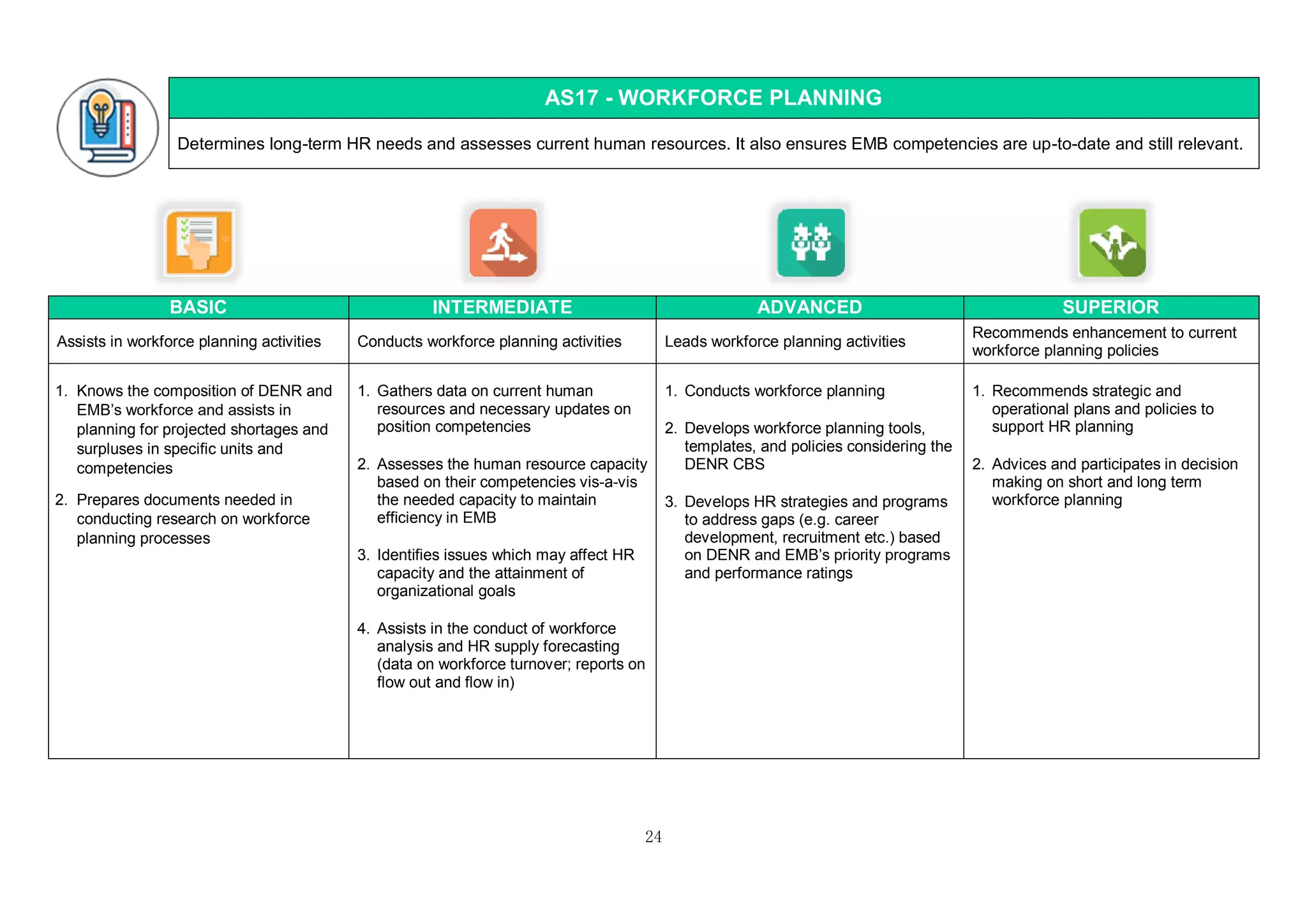
  • 115.
    108 EI2 - EIAMONITORING AND AUDIT The ability required to determine compliance of projects issued ECCs to related environmental standards and commitments as a result of the EIA process and to assess performance of monitoring partners. BASIC INTERMEDIATE ADVANCE SUPERIOR Assists in EIA monitoring and audit activities Conducts EIA monitoring and audit activities Supervises EIA monitoring and audit activities Formulates plans, programs and policies on EIA monitoring and audit activities 1. Knows the EIA Process and Concepts. 2. Understands the Rationale for ECC Compliance Monitoring. 3. Accesses and understands the database input information on projects issued ECCs. 4. Assists in the conduct of desk review of compliance of projects to the conditions of ECC issued and in the preparation of corresponding communications 1. Prioritizes projects for monitoring using the Project Environmental Monitoring and Audit Prioritization Scheme (PEMAPS). 2. Conducts desk review of compliance of projects to the conditions of ECCs issued and prepares corresponding reports/communications (i.e. NAF, assessment letters, etc). 3. Reviews Compliance Monitoring Reports and prepares Compliance Evaluation Reports in relation to ECC compliance monitoring. 4. Processes application for minor ECC amendments. 5. Conducts field monitoring and assessment of environmentally critical projects and prepares the required 1. Provides technical inputs to administrative investigations of environmental performance issues 2. Acts as the hearing officer in the conduct of technical conference/meeting 3. Manages and organizes the creation of the Multipartite Monitoring Teams of the project proponents 4. Conducts technical performance audit of ROs and other monitoring partners (i.e. MMTs, holders of programmatic ECC, etc.) 5. Oversees the ECC Compliance Monitoring and related activities 1. Oversees the implementation of the environmental monitoring and audit functions of EMB ROs and other partners (LGUs, MMT, and other GOs). 2. Interprets and summarizes basic statistical as well as technical reports in relation to EIA Monitoring and Audit nationwide as input to policy development. 3. Initiates and reviews actions, plans and policies for the continuous improvement of the EIA Monitoring and Audit.
  • 116.
    109 reports within thespecified timelines. 6. Conducts overall assessment of the proponents’ compliance with ECC conditions and related commitments and prepares necessary action documents (i.e. NOVs, Penalty Orders, CDO, etc.). 7. Conducts review of related EIA documents (e.g. MOA on MMT, EGF and EMF) 8. Coordinates the establishment of MMTs 6. Prepares statistical as well as technical reports in relation to the EIA Monitoring and Audit 7. Identifies problem areas in the EIA Monitoring and Audit 8. Provides technical inputs in the policy formulation on EIA Monitoring and Audit 9. Guides and coaches others on this competency.
  • 117.
    110 EI3 - EIAPOLICY AND STANDARDS FORMULATION AND IMPLEMENTATION ASSESSMENT The ability required to formulate policies and standards in Environmental Impact Assessment (EIA) Review, Monitoring and Audit and assess its implementation BASIC INTERMEDIATE ADVANCE SUPERIOR Assists in formulation and implementation assessment of standards and policies Facilitates EIA policy and standards formulation and implementation assessment activities Supervises EIA policy and standards formulation and implementation assessment activities Manages EIA policy and standards formulation and implementation assessment activities 1. Knows the DENR/ EMB vision, mission, thrusts, mandates/functions, policies, and programs in the implementation of the Philippine EIS System. 2. Has basic knowledge on environmental science and management. 3. Assists in organizing consultations for policy and standards formulation and assessment 4. Assists in organizing audits/surveys related to implementation assessment 1. Has basic knowledge on the sciences related to EIA. 2. Prepares necessary materials/documents for policy and standards formulation consultation or implementation audit/survey activities. 3. Documents consultation and audit/survey activities 4. Identifies gaps in policy and implementation. 1. Has an advanced knowledge on the science and technology related to EIA. 2. Consolidates and analyzes policy recommendations from consultation and audit activities. 3. Recommends new and revision of policies and standards. 4. Prepares project proposals for policy and standards formulation and implementation assessment. 5. Serves as resource person in the discussions on the implementation of the PEISS in inter-division meetings. 1. Formulates strategies and methodologies appropriate for policy development 2. Identifies appropriate management intervention to address PEISS issues 3. Initiates and manages activities necessary for the updating or revision of policies and standards 4. Initiates and manages consultation, survey, and audit activities related to policy and standards formulation and implementation assessment 5. Drafts policies, procedures and standards based on results of implementation assessment 6. Serves as a resource person in the discussions of issues and concerns on the implementation of the PEISS in interagency/sectoral fora.
  • 118.
    111 EI4 - CAPACITYBUILDING ON EIA The ability required to design training modules and provide the necessary training support to enhance the capacity of Regional Offices and other relevant stakeholders for the effective implementation of the Philippine EIS System policies and guidelines. BASIC INTERMEDIATE ADVANCE SUPERIOR Assists in conduct of capacity building activities on PEISS Facilitates capacity building activities on PEISS Supervises capacity building activities on PEISS Manages capacity building activities on PEISS 1. Knows the DENR/EMB vision, mission, thrusts, mandates/functions, policies, and programs in the implementation of the Philippine EIS System. 2. Has basic knowledge on the PEISS and environmental management. Assists in the preparations and conduct of capacity building activities including preparation of necessary documents for administrative arrangements 1. Prepares necessary materials/documents in the conduct of capacity building activities. 2. Documents the capacity building activities including issues and concerns during capacity building and identifies policy development, updating and revision needs. 3. Prepares presentation and training materials. 4. Identifies information materials needed for the conduct of the capacity building 5. Act as facilitator during the conduct of capacity building activity 1. Plans and supervises Capacity Building Activities. 2. Identifies training needs, designs training programs and develops training materials. 3. Assesses/evaluates training programs/ modules. 4. Synthesizes improvements of training programs based on results of training assessments. 5. Prepares capacity building evaluation tools. 6. Guides and coaches others on this competency. 1. Prepares training plan, design and modules. 2. Formulates appropriate strategies to enhance capacity building in the PEISS. 3. Manages the conduct, documentation and assessment of Capacity building activities. 4. Serves as Resource Person. 5. Transforms learning/ insights from training assessment results into recommendations to enhance implementation of the PEISS.
  • 119.
    112 EI5 - LINKAGINGAND NETWORKING (TECHNICAL COOPERATION , INTERAGENCY COMMITTEES) The ability required to participate, coordinate and network with other government agencies, institutions, industry and individual in relation to common issues and concerns, goal and policy objectives in the implementation of PEISS. BASIC INTERMEDIATE ADVANCE SUPERIOR Assists in linkaging and networking activities Facilitates linkaging and networking activities Supervises linkaging and networking activities Formulates plans, programs and policies on linkaging and networking activities 1. Knows the group composition and dynamics. 2. Knows the procedures and approaches in facilitating or conducting meetings. 3. Has basic knowledge on consensus building. 4. Has basic knowledge in communication skills. 1. Identifies necessary lingkages and netwoks. 2. Establishes, develops and maintains links with multi-sectoral/multi- agency,multi-regional partnerships e.g industry group, government agencies, academe, non-government organizations, local government units, among others. 3. Facilitates meetings/ workshops to address and resolve issues/ concerns, synthesizes and prepares corresponding reports. 4. Uses network to seek and gain access to information from various sources to support PEISS objectives. 1. Articulates the position in a particular issue related to the implementation of the PEISS. 2. Provides technical assistance in accordance with the target objectives. 3. Drives consensus and collective decisions. 4. Interprets indicators/inputs during interactions that signify significant challenges to various interagency committees. 5. Supervises the conduct of necessary interagency meetings/fora. 6. Broadens network of relationships to promote the image of the agency. 1.Mobilizes stakeholders to support PEISS mandates. 2.Articulates the agency’s position on sensitive issues involving decision- making and policy formulation related to PEISS 3.Promotes the PEISS and agency’s goals, priorities and achievements in the interests of the greater public good. 4.Manages the conduct of necessary interagency meetings/fora.
  • 120.
    113 EI6 - DEVELOPMENT/DISSEMINATIONOF PEISS INFORMATION The ability required to develop/disseminate information relating to the implementation of the PEISS BASIC INTERMEDIATE ADVANCE SUPERIOR Assists in development / dissemination of PEISS information Develops/disseminates release of PEISS information Reviews release of PEISS information Approves/Recommends release of PEISS information 1. Drafts articles on activities of the EIAMD for posting in the Website. 2. Identifies information materials in the Website which needs to be archived. 3. Coordinates with the sections regarding information materials to be uploaded in the Website. 4. Drafts response to routine policy and implementation related queries raised by Regional Offices or the public. 1. Drafts articles regarding issuance of new EIA policies, guidelines, standards highlighting the expected outcome of the issuances in relation to the overall mandate of EMB. 2. Manages the information in and structure of the Website. 3. Drafts and recommends response to policy and implementation-related queries raised by Regional Offices or by the public. 1. Reviews and approves release of standard PEISS Information and of response to simple policy and implementation-related queries. 1. Reviews and approves release of major PEISS Information and of response to complex policy and implementation- related queries.
  • 121.
    114 EI7 - EIADOCUMENT TRACKING AND INFORMATION SYSTEM MANAGEMENT The ability required to operate, access, store, and process data/information in the EIA Information System (EIA-IS) and document tracking system BASIC INTERMEDIATE ADVANCE SUPERIOR Encoding uploading of basic information in the existing System Encoding/uploading of technical information/materials in the existing system Supervises EIA-IS Database and Website Administration Oversees EIA-IS Database and Website Management 1. Encodes instructions in the disposition form in the document tracking system. 2. Encodes basic project Information in the EIA-IS. 3. Scans signed documents and attaches in the EIA-IS. 4. Updates Status of ECC applications in the EIA-IS. 1. Encodes/Uploads technical information/materials in the EIA-IS such as review process reports, inspection reports and compliance evaluation reports. 2. Retrieves status updates on ECC applications and compliance in the EIA-IS. 3. Generates ready printable reports from the EIA-IS. 4. Maintains the proper handling of documents/records as filed with the Office. 1. Generates customized reports from the EIA-IS. 2. Updates the ECA Map. 3. Updates the EIA Website. 4. Analyzes summary of EIA-IS data inputs including inputs from EMB ROs. 5. Coordinates with MIS regarding necessary systems upgrading and updating. 1.Develops and conceptualizes information system that will support the goal of the EIAMD. 2.Recommends strategy to acquire, develop, retool and retain IT skills. 3.Introduces and initiates innovations and enhancements in the data system.
  • 122.
    115 ER1 - ENVIRONMENTALRESEARCH GENERATION The ability required in generating researches and scientific data on various environmental issues, existing environmental laws and international commitments in support of formulation and enforcement of environmental policies/standards/criteria and guidelines. BASIC INTERMEDIATE ADVANCE SUPERIOR Assists in environmental research generation activities Conducts environmental research generation activities Supervises environmental research generation activities Formulates plans, programs and policies on environmental research generation activities 1. Understands the present state of the Philippine environment. 2. Knows basic applied research concepts and procedures for generating scientific data/information. 3. Knows the basic statistical and mathematical tools in the conduct of research and understands the precautions taken to ensure confidentiality in storing data. 4. Gathers data and references relevant to pollution concerns and other environmental issues, both manually and electronically. 1. Uses statistical and mathematical computer software and analyzes/ interprets results of processed data and properly secures data (e.g., usage of electronic passwords, secured access to databases, locked file cabinets, etc.). 2. Identifies the objectives of the research projects and applies the particular research approaches i.e., creates research design; frames data/information sheets/forms; identifies appropriate measurement techniques; apply quantitative, qualitative, and/ or mixed methods, and establishes a shared understanding of the concept of the research work with the clients and stakeholders. 3. Conceptualizes and prepares initial environmental R&D proposals. 1. Provides inputs to research database development and management. 2. Plans and conducts research work in collaboration with academe, research institutions/monitoring networks and various stakeholders, with the anticipation of different positions of various interest groups in order to encourage cooperation and avert or counteract any groups’ attempts to bias or misapply the results or to curtail research operations. 3. Plans and formulates environmental R&D framework/agenda relevant to environmental management and pollution control. 4. Oversees environmental research generation activities. 5. Establishes environmental R & D linkages/networking for collaboration 1. Formulates and develops integrated environmental R&D agenda, programs and framework. 2. Formulates corresponding research- based management interventions on certain environmental issues. 3. Institutes measures to eliminate lapses, deficiencies, shortfalls and/or slippages of all future environmental R&D activities. 4. Analyzes/recommends research-based directives on environmental matters.
  • 123.
    116 4. Reviews alldata collection, processing, and reporting functions so that any error found will be corrected and identifies critical data and/or results, and effectively explains and communicates the importance of findings. 5. Develops and implements environmental researches, e.g., conduct of ecotoxicological studies/ toxicity testing, cause-and- effect analyses, and risk assessment. 6. Prepares scientific/ technical/popular papers/ reports. and/or funding. 6. Evaluates and reviews environmental R&D proposals, scientific and technical reports and papers. 7. Establishes clear working agreements with clients to ensure efficient collaboration and protects involved parties’ rights. 8. Guides and coaches others on this competency.
  • 124.
    117 ER2 - COLLECTIONOF ENVIRONMENTAL SAMPLES The ability required in the collection of environmental samples in connection with the conduct of environmental research. BASIC INTERMEDIATE ADVANCE SUPERIOR Assists in collection of environmental samples activities Conducts collection of environmental samples activities Supervises collection of environmental samples activities Formulates plans, programs and policies on collection of environmental samples activities 1. Knows the basic principles on the quality of the environment. 2. Knows the basic principles and procedures in collecting, handling, preservation, transport, submission of environmental samples and field data recording. 3. Prepares field supplies and materials and operates field sampling equipment/instruments with assistance. 4. Records field data; collect, handle, preserve, transport; and submit environmental samples. 1. Conducts sample integrity and standard procedures for sample collection, handling, storage and transport. 2. Adheres strictly to established sampling protocols. 3. Conducts environmental sampling and monitoring. 1. Operates various environmental sampling equipment and field instruments with mastery. 2. Develops and implements an environmental monitoring and sampling plan, including but not limited to the following: (a) sampling procedure and quality assurance plan; (b) sample analysis plan; (c) data assessment and data quality procedures, (d) operation and maintenance of sampling equipment and field instrumentation. 3. Oversees and monitors the conduct of environmental sampling. 1. Directs and coordinates the implementation of all activities relative to environmental monitoring and sampling. 2. Formulates strategies to institutionalize registration of environmental sample collectors.
  • 125.
    118 4. Monitors andreviews the development and implementation of the environmental monitoring and sampling plan. 5. Formulates strategies to professionalize the collection of environmental samples. 6. Guides and coaches others on this competency.
  • 126.
    119 ER3 - COLLECTIONOF ENVIRONMENTAL DATA The ability required to collect data needed in the conduct of environmental research. BASIC INTERMEDIATE ADVANCE SUPERIOR Assists in collection of environmental data activities Conducts collection of environmental data activities Supervises collection of environmental data activities Formulates plans, programs and policies on collection of environmental data activities 1. Knows about the potential sources of environmental and related data/information. 2. Plans ways to collect environmental and related data/information. 1. Formulates questions that can be addressed with data and collects, organizes and displays relevant data to answer them. 2. Identifies data fit for appropriate statistical methods e.g., randomization, number and combination of experimental intervention, the timing and measurement of visits. 1. Develops survey questionnaires that yield clear answers and useful information. 2. Oversees the carrying out of surveys and data tabulation. 1. Identifies ways to maximize efficient use of available resources. 2. Identifies design methods to collect information including the design of analysis plans following the development of the research program. 3. Conducts routine checks for threats to validity that might ruin a project.
  • 127.
    120 ER4 - DATAANALYSIS AND INTERPRETATION The ability required in translating results of collected environmental and other related data/information. BASIC INTERMEDIATE ADVANCE SUPERIOR Assists in data analysis and interpretation activities Conducts data analysis and interpretation activities Supervises data analysis and interpretation activities Formulates plans, programs and policies on data analysis and interpretation activities 1. Knows how to establish environmental data/information needs within an analytical context. 2. Understands basic data analysis methods that are appropriate and effective for the types of data produced by the study. 1. Translates needs into tailored analytical solution through the preparation of a complete, detailed description of the study design as well as a clear exposition of the questions to be addressed. 2. Prepares preliminary plan for analysis of a research study. 3. Provides feedback to plans format. 1. Reviews, edit final analysis plans based on team input. 2. Implements planned analysis including data verification and data correction as necessary using one or more systems of computer hardware and statistical analysis software for the management and analysis of data. 3. Examines the data for threats to validity, ranging from missing data to questionable outliers to confounders. 1. Interprets to an audience and environmental stakeholders the results of statistical outputs. 2. Identifies the best way to describe and display data that will fit the conclusions and the results of analysis. 3. Oversees that there is no erroneous or incomplete statements about the findings. 4. Re-analyzes the data using other appropriate related methods.
  • 128.
    121 ER5 - DOCUMENTATIONAND DISSEMINATION OF RESULTS The ability required in translating results of collected environmental and other related data/information. BASIC INTERMEDIATE ADVANCE SUPERIOR Assists in documentation and dissemination of results activities Conducts documentation and dissemination of results activities Supervises documentation and dissemination of results activities Formulates plans, programs and policies on documentation and dissemination of results activities 1. Has basic knowledge on summarizing data warehouse, data analysis results, statistical methods and synthesis of conclusion from summary tables. 1. Prepares written technical reports and oral presentations summarizing data warehouse, data analysis results including detailed description of statistical methods, detailed analysis of results and synthesis of conclusion from summary tables. 1. Prepares graphic presentation of findings for reports, presentations, and publications. 2. Ensures confidentiality of data without the stakeholders’ expressed permission. 3. Ensures full acknowledgement of reference materials cited in the report. 1. Directs and coordinates documentation and dissemination of research activities/ result outputs. 2. Initiates and recommends relevant trainings to enhance workforce capability on statistical analysis, data interpretation, technical report writing, etc.
  • 129.
    122 ER6 - ANALYSISOF ENVIRONMENTAL SAMPLES The ability required in the:  generation of data that will be used in the formulation of policies, criteria, standards; in the adjudication of pollution cases; in the determination of compliance to rules and regulation and in assessing the quality of environment.  analysis of environmental samples (water, wastewater ambient air, stationary source emission, sediment, soil biota and organics pollutants) for parameters spelled out in the environmental laws, IRRs, standards, and rules and regulations.  conduct of relevant tests to characterize the toxicity of effluents and other wastes.  validation and recommendation of up-to-date analytical methods for inclusion in environmental policies, standards and criteria to be adopted and approved by the DENR. BASIC INTERMEDIATE ADVANCE SUPERIOR Assists in analysis of environmental samples activities Conducts analysis of environmental samples activities Supervises analysis of environmental samples activities Formulates plans, programs and policies on analysis of environmental samples activities 1. Knows sample receiving protocol from field samplers (sign-on to Chain-of- Custody and Analytical Request Report Forms, etc). 2. Has basic knowledge on laboratory analysis and equipment 3. Assigns unique laboratory sample identification (ID) codes to samples. 4. Creates hardcopy file for each project (planning notes/field notes/field measurements). 5. Logs-in sample ID and required parameters into a master file laboratory logbook 6. Prepares sample pre-handling where 1. Performs sample handling prior to sample preparation (homogenization/ filtration/foreign object sub- sampling/ moisture determinations). 2. Prepares samples for analysis (digestion/extraction/clean-up procedures.) 3. Conducts optimization and calibration of basic analytical laboratory equipment / instruments (pH, analytical balance/ TDS/Conductivity meter/ waterbath/ oven/ incubator/ etc). 4. Prepares sample treatment and other requirements needed in the analysis of environmental samples: (water, wastewater, ambient air, stationary source emissions, sediment, soil, 1. Checks calibration standards integrity with secondary and whether calibration and instrument performance are acceptable. 2. Calculates and tabulates all results and generates preliminary reports of results (sample results/QC/sample results/sample information/ methods/ interpretation of results). 3. Archives all data and physical samples (electronic data files/strip charts/chromatograms/lab. notes). 4. Reviews sample and QC data. 5. Conducts training of laboratory staff 1. Reviews and maintains laboratory’s quality system, procedures and work instructions manuals. 2. Verifies and validates all data generated and reported by the laboratory. 3. Coordinates and integrates the work of all laboratory units into a completed work product. 4. Devises ways to accommodate laboratory work operations to new and changing programs or requirements such as studies of work practices and procedures, staffing and budget requirements and similar matters. 5. Serves as the division/EMB’s expert/resource person in implementing
  • 130.
    123 necessary (compositing/ preservation) . 7.Prepares glassware and sample containers using the established protocols. 8. Stores samples appropriately (correct temperatures/exclude light where necessary). biota and organics pollutants) 5. Prepares basic chemical solutions. 6. Maintains on file all records pertaining to laboratory activities. 7. Conducts inventory of chemicals, glassware and other laboratory supplies. 8. Analyzes environmental samples as well as internal and external quality control samples. 9. Performs validation of analytical methods. 10. Analyzes “national and international proficiency testing/ inter-laboratory comparison exercises” samples. 11. Completes documentation of analysis (sample ID/data file name/ weights/ volumes/ laboratory notes). 12. Conducts optimization and calibration of specialized analytical laboratory equipment / instruments (AAS/IC/GC/GCMS/UVVis/Laser Defraction Particle Size Analyzer/Organic Halide Analyzer/Spectrofluorophotometer, etc) 13. Prepares laboratory QC samples (blanks, certified reference materials/ spikes/duplicates) 14. Implements QA/QC health and safety and other EMB program from EMB Regional Office, Schools, Industries and other government agencies. 6. Acts as "troubleshooter"/ adviser to others regarding laboratory activities. 7. Monitors conformance to expected results. 8. Prepares, reviews and documents laboratory quality laboratory system, procedures and work instructions manuals. 9. Establishes and maintains quality assurance and quality control (QA/QC) programs, good laboratory practices, and safety programs. 10.Reviews and validates all analytical / technical reports. 11.Schedules analysis in priority according to due dates, holding times. 12.Selects appropriate analytical methods (for sample preparation/ instrumentation). 13. Checks methods are validated and documented. 14. Evaluates performance in proficiency testing/ inter-laboratory comparison exercises. 15. Reviews final results of analysis for errors (consistency with field measurements/field notes/historical ERD’s programs/ resolving problems. 6. Devises new work methods and procedures or improvements in existing work practices, and getting the cooperation of employees in applying the new methods and practices. 7. Reviews laboratory operations to develop or improve methods, procedures, or controls/ plans new programs to bring about major changes in laboratory operations and procedures. 8. Reviews research/study proposals and checks, evaluates research/study output.
  • 131.
    124 15. Documents samplepreparation steps (methods/ weights/ volumes/ lab notes) 16. Prepares calibration and control standard solutions if necessary (document in logbooks) 17. Performs instrument performance check(s) 18. Documents instrument performance and control standard results in instruments log books and control charts. site data/inter-parameter relationships). 16. Serves as resource person for clients/ lecturer. 17. Monitors the implementation of laboratory QA program, Health and 18. Safety program and other EMB programs. 19. Organizes seminars/workshops on laboratory and other related activities. 20. Prepares research/study proposals.
  • 132.
    125 ER7 - EQUIPMENTMAINTENANCE AND CALIBRATION The ability required in the operations, maintenance and calibration of field and laboratory equipment/instruments. BASIC INTERMEDIATE ADVANCE SUPERIOR Assists in equipment maintenance and calibration activities Conducts equipment maintenance and calibration activities Supervises equipment maintenance and calibration activities Formulates plans, programs and policies on equipment maintenance and calibration activities 1. Knows all equipment and apparatus. 2. Secures and monitors instruction manuals, schematic diagrams and drawings of all equipment. 3. Maintains equipment logbook. 4. Maintains all forms to be used in relation to maintenance and calibration including storage and disposal. 1. Conducts basic maintenance and troubleshooting of field and laboratory equipment 2. Conducts inventory of equipment and spare parts 3. Prepares purchase orders, track orders of equipment and parts 4. Keeps record of equipment purchase orders and receipts 5. Conducts calibration of field and laboratory equipment 6. Handles labeling, coding and identification of equipment to indicate the status of calibration 7. Checks equipment if it complies with the specification 1. Conducts pre and post test preparation of field and laboratory equipment 2. Implements and monitor the health and safety program. 3. Conducts quality control guidelines on procurement of equipment and spare parts. 4. Conducts pre- and post inspectionof equipment. 5. Prepares guidelines and procedures for preventive and corrective actions 6. Prepares calibration and maintenance program 7. Prepares procedure for safe handling, transport, storage, use and planned maintenance and calibration of equipment 1. Directs all operations, implementation of the calibration and maintenance programs. 2. Oversees storage and disposal of equipment and ensures compliance with government regulations on disposal. 3. Reviews and maintains the maintenance and calibration programs. 4. Verifies and validates all maintenance and calibration data generated and reported. 5. Coordinates the programs in all laboratory units into a completed work product. 6. Works closely with other EMB organizational units to implement programs, resolve problems and coordinate activities
  • 133.
    126 8. Trains technicaland non-technical personnel using the equipment. 8. Prepares training manual for calibration and maintenance of equipment.
  • 134.
    127 ER8 - RECOGNITIONOF DENR ENVIRONMENTAL LABORATORIES The ability required in the assessment, surveillance/ monitoring of environmental laboratories based on DENR Administrative Order 98-63: Guidelines for the Designation of DENR Recognized Environmental Laboratories. BASIC INTERMEDIATE ADVANCE SUPERIOR Assists in recognition of DENR environmental laboratories activities Conducts recognition of DENR environmental laboratories activities Supervises recognition of DENR environmental laboratories activities Formulates plans, programs and policies on recognition of DENR environmental laboratories activities 1. Knows the procedures in recognition of environmental laboratory. 2. Checks the completeness and correctness of entries in the application document submitted by environmental laboratory applicants. 3. Prepares contract of external assessors, laboratory inspection and assessment forms, assessment/travel itineraries and documents. 4. Conducts PT surveys and consolidates survey results. 5. Prepares and follows-up purchase request of proficiency test samples. 6. Consolidates proficiency test results. 1. Prepares laboratory assessment schedules/ activities. 2. Identifies and informs assessors based on expertise, experience and affiliation. 3. Informs/communicates with the environmental laboratory applicants the status of their application documents. 4. Evaluates application documents submitted by environmental laboratory applicants. 5. Prepares list of assessors and endorses list to EMB Director. 6. Conducts on-site assessments of environmental laboratory applicants. 7. Verifies track records, personnel, physical layout and safety procedures, quality control programs, laboratory 1. Discusses findings with the laboratory personnel. 2. Prepares non-compliance, recommendation and assessment reports. 3. Prepares list of Certified Reference Material for purchasing. 4. Prepares and distributes proficiency test samples, protocols, results and method forms. 5. Check proficiency test data transfers, computation and final reports. 6. Checks and verifies completeness of accomplished Non-Compliance and Recommendation Reports. 7. Searches for proficiency test providers based on established requirements. 1. Reviews non-compliance, recommendation and assessment reports. 2. Prepares recommendation reports to the Technical Advisory Group for Laboratory Recognition. 3. Checks implementation of the ELR scheme. 4. Reviews research of proficiency testing
  • 135.
    128 procedures, reagents equipmentand instrument calibration/maintenance, and laboratory waste management. 8. Prepares protocol for proficiency testing. 9. Evaluates proficiency test results in accordance with ISO 1994-5725 (Accuracy, trueness and precision of measurement methods and results) and ISO 43 (Proficiency testing by inter laboratory comparisons). 10. Prepares test report certificates and z- score charts. 11. Conducts assessment of environmental laboratory.
  • 136.
    129 EE1 - CURRICULUMREVIEW AND DEVELOPMENT FOR ENVIRONMENTAL EDUCATION The ability required to develop and implement environmental education programs specifically in the preparation of environmental education course design and contents, and for use in the institutionalization / professionalization of key stakeholders in environmental education for sustainable development. BASIC INTERMEDIATE ADVANCE SUPERIOR Assists in curriculum review and development for environmental education activities Conducts curriculum review and development for environmental education activities Supervises curriculum review and development for environmental education activities Formulates plans, programs and policies on curriculum review and development for environmental education activities 1. Knows DENR/EMB’s mandate, policies, programs and projects on environmental education and education for sustainable development. 2. Knows DENR/EMB’s environmental information, education, and communication (IEC) programs/policies. 3. Has basic knowledge on the State of Philippine environment particularly the brown environment. 4. Has basic knowledge and skills in environmental education curriculum development. 1. Monitors and evaluates environmental education-related reports. 2. Coordinates environmental education seminars, orientations, workshops, and trainings. 3. Prepares and develops environmental education project proposals, curriculum / training module designs on environmental education for seminars, orientations, workshops and trainings. 4. Handles environmental education- related projects/ activities particularly in curriculum development. 5. Initiates/ recommends environmental education programs and projects on a regional to national scale application. 1. Plans and monitors environmental education program/activities. 2. Drafts/recommends new policies or improves existing environmental education programs / projects, updates and develops new curriculum on environmental education-related courses, based from research and development results. 3. Writes/drafts training course designs and content for use of multi-education levels and sectors/linkages. 4. Drafts/recommends environmental education materials for advocacy, and updates the same for future use. 5. Analyzes and evaluates environmental education-related, environmental research and development studies and 1. Directs and coordinates the overall implementation of environmental education policies, programs and projects / activities in the Bureau. 2. Conducts strategic planning, programming and monitoring of environmental education programs / projects. 3. Contributes/updates the development of environmental education interventions on the overall objectives, visions and missions of the Bureau. 4. Recommends major revisions/enhancements of existing environmental education mandates, policies, programs/projects based on research and development studies. 5. Serves as expert or resource person in
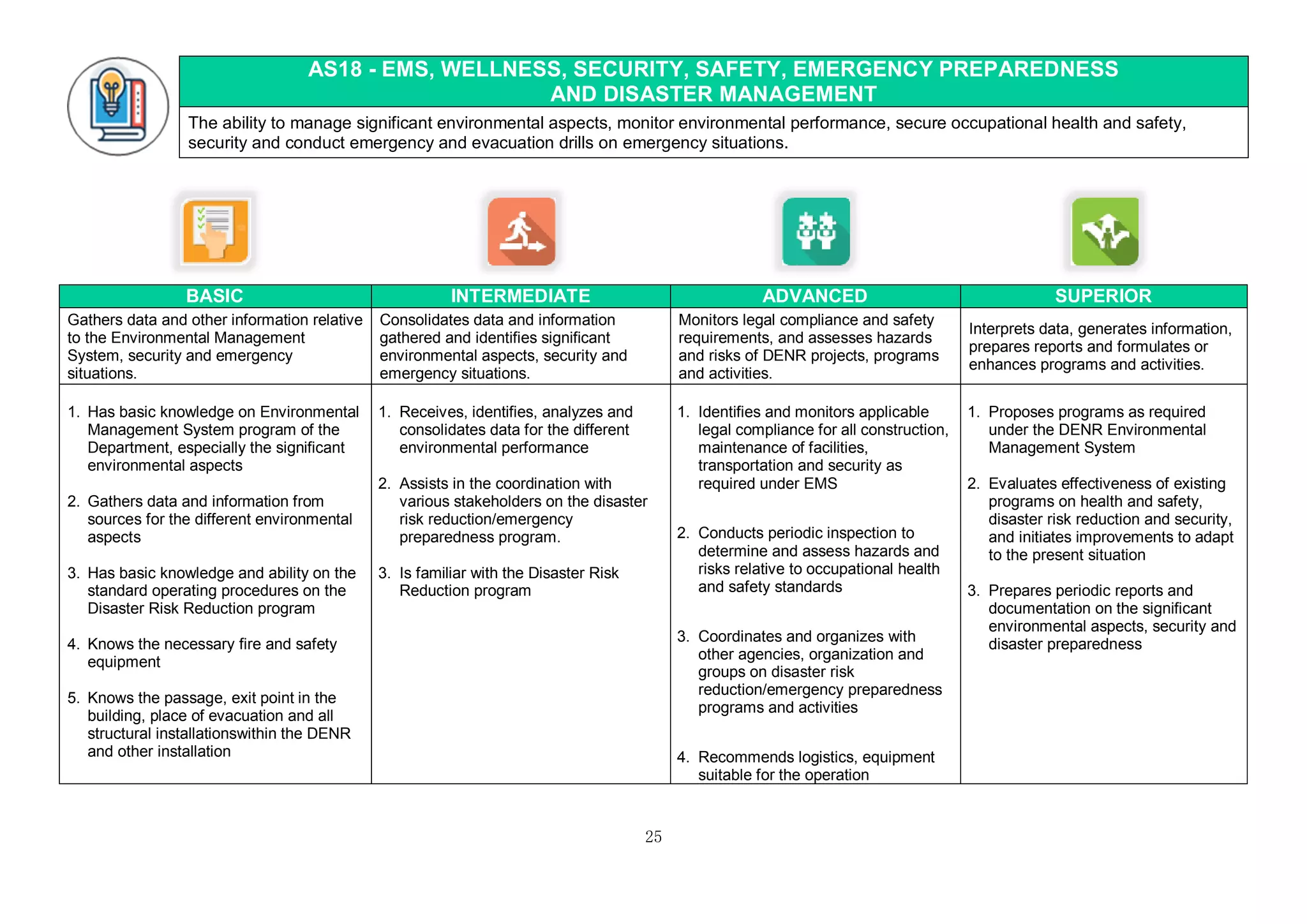
  • 137.
    130 translates these intoinformation materials. 6. Conducts environmental education and education for sustainable development- related trainings, seminars and orientation workshops. 7. Acts as resource person during any environmental education seminars, orientation, workshops and trainings. EE/EESD-related programs/activities.
  • 138.
    131 EE2 - CAPABILITYBUILDING ON ENVIRONMENTAL MANAGEMENT The ability required to have a systematic management approach in the conduct of trainings/ seminars/ workshops to capacitate the relevant key stakeholders and workforce/personnel at the EMB Regional Offices in implementing environmental management. BASIC INTERMEDIATE ADVANCE SUPERIOR Assists in capability building on environmental management activities Conducts capability building on environmental management activities Supervises capability building on environmental management activities Formulates plans, programs and policies on capability building on environmental management activities 1. Has knowledge on the various concepts and components on environmental management, including enforcement and implementation as well as the policies and programs of EMB and DENR. 2. Knows the EMB’s public awareness and education program to enhance public participation on the enforcement and implementation of environmental management policies and procedures. 3. Has basic knowledge on various data gathering techniques to collect information needed in the development of training programs 4. Knows the process of conducting training programs. 5. Operates basic equipment for training, seminars and conferences. 1. Prepares presentation materials for training. 2. Reviews IEC materials and training programs on environment. 3. Meets all training requirements needed within the specified time frame. 4. Facilitates workshop, training and other similar activities to gather needed information for development of an appropriate environmental management program. 5. Determines type of IEC materials and training programs to be developed taking into consideration factors like communication objectives, target audience, and availability of communication technologies. 6. Develops IEC materials and training programs on environmental management. 1. Simplifies scientific and technical literature on the implementation of environmental management. 2. Implements contingency plans to address critical situations during training. 3. Delivers environmental lectures, synthesizes lessons and relates them to current environmental issues and concerns. 4. Integrates the program objectives, issues and concerns arising from interactions/discussions. 5. Guides the activity flow and proceedings in a group activity for consensus building and sound decision making in crafting a recommendation/ strategy. 1.Conducts participatory planning activities to develop training programs. 2.Introduces innovations and techniques in developing training programs. 3.Formulates training standards and policies in implementing training programs. 4.Plans contingencies and recommends accordingly. 5.Serves as a resource person in various trainings, briefings, orientation seminars for environmental management.
  • 139.
    132 EE3 - PUBLICINFORMATION MANAGEMENT The ability required to develop and implement public information programs to enhance public understanding and participation in environmental protection and management to attain sustainable development. BASIC INTERMEDIATE ADVANCE SUPERIOR Assists in public information management activities Conducts public information management activities Supervises public information management activities Formulates plans, programs and policies on public information management activities 1. Knows DENR/EMB’s mandate, policies, programs and projects. 2. Knows the state of the Philippine environment, with emphasis on the brown environment sector. 3. Has basic knowledge in journalism. 4. Operates fax machine, overhead projector, multi-media projector, photocopier, digital camera, etc. 5. Encodes and proofreads digital copy of editorial materials on environment. 6. Distributes IEC materials to various stakeholders. 7. Assists walk-in clients for their information needs. 1. Gathers information needed in the development of feature and editorial materials. 2. Writes / edits / proofreads press releases, fact sheets, photo captions for exhibit materials and photo releases. 3. Prepares storyline for exhibit materials, 4. Undertakes photo-documentation of EMB events and status of programs and projects. 5. Writes feature articles, column feeds and TV releases on environmental management programs and policies. 6. Prepares fact sheets, primers, brochures, exhibit materials on brown environmental issues. 1. Establishes partnership with the tri- media. 2. Prepares a communication plan in support to EMB programs and projects. 3. Edits press releases, editorial and feature articles written by staff. 4. Coordinates with information officers of the EMB regional offices for a unified information campaign. 5. Manages the timely release of press releases and editorial materials. 6. Oversees the implementation of IEC campaigns. 7. Identifies strategies to implement high- impact IEC campaigns vis-à-vis limited funds. 1. Reviews and monitors the IEC programs / projects. 2. Oversees the conduct of IEC programs, projects of the office / Bureau. 3. Serves as expert or resource person in IEC program implementation
  • 140.
    133 EE4 - SPECIALEVENTS MANAGEMENT The ability required to conceptualize and manage special environmental events and generate the corresponding resources needed to implement the event. BASIC INTERMEDIATE ADVANCE SUPERIOR Assists in special events management activities Conducts special events management activities Supervises special events management activities Formulates plans, programs and policies on special events management activities 1. Knows how to manage an event. 2. Has basic understanding with the required resources to implement a particular event. 3. Knows the physical arrangement and equipment required by an event. 4. Has basic knowledge on templates for resource requirements of an event, to include, physical arrangements, logistics, human power, etc. 5. Makes a listing of institutional partners, resource persons, caterers, sounds and equipment rental, etc. 1. Assists by serving as facilitator in the management of a special environmental event. 2. Coordinates the logistical arrangements required to implement a special environmental event. 3. Conducts ocular inspection of a venue. 4. Conducts a dry run of an event. 5. Drafts invitation letters to event guests and participants. 6. Conceptualizes an environmental special event. 7. Identifies appropriate medium or approach to create a high impact 1. Leads the management of an event. 2. Coordinates the implementation of the event with the various team members. 3. Mobilizes various stakeholders to participate and support in special environmental events. 4. Plans contingencies occasions when plans do not run as planned. 5. Evaluates and assesses a completed event. 6. Develops recommendations for issues that have arisen out of the assessment. 1. Oversees the overall conduct and management of an event. 2. Recommends new / updated policies, programs on celebration of special events.
  • 141.
    134 event. 8. Develops promotionalmaterials for the special environmental event.
  • 142.
    135 EE5 - IECMATERIALS PRODUCTION The ability required to document programs and projects of the bureau as well as environment issues to serve as input in the conceptualization, development, and production of printed IEC and visual materials to promote understanding of environmental issues among the various stakeholders. BASIC INTERMEDIATE ADVANCE SUPERIOR Assists IEC materials production activities Conducts IEC materials production activities Supervises IEC materials production activities Formulates plans, programs and policies on IEC materials production activities 1. Knows the EMB’s mandate, programs, projects and activities. 2. Knows the state of the brown environment. 3. Operates various types of printing or copying equipment including routine maintenance of the equipment. 4. Duplicates and reproduces printed documents/materials and packages services that include cutting, binding and distribution. 5. Downloads and stores raw photo images and undertakes proper identification in the designated photobank. 1. Covers, through photography, official functions and events, as well as field activities of programs and projects of the bureau. 2. Prints photo images using appropriate imaging software. 3. Classifies types of photos relating to various environmental concerns. 4. Gathers data/information regarding photo subjects. 5. Enhances photo images using appropriate computer software (e.g. Adobe photoshop). 6. Writes photo caption. 1. Designs concept and presentation approaches for visual communication materials – for both printed IEC materials, exhibits and other forms of display. 2. Produces exhibit material based on given concept and purpose. 3. Implements lay-out plan of exhibit materials. 4. Coordinates with printing house to ensure conformity to specifications. 5. Oversees delivery and execution of creative artworks. 6. Formulates design concept and presentation of approaches for visual communication materials – for printed 1. Directs the overall operations of the IEC materials / production. 2. Serves as expert/ resource person in IEC materials development.
  • 143.
    136 6. Facilitates theprinting of photos, digitization of photos, etc. 7. Evaluates photo images to meet media requirements. IEC materials and for exhibits and other form of display. 7. Designs visual communication training and workshops for regional environmental information officers. 8. Keeps current on the latest approaches and forms of visual communication.
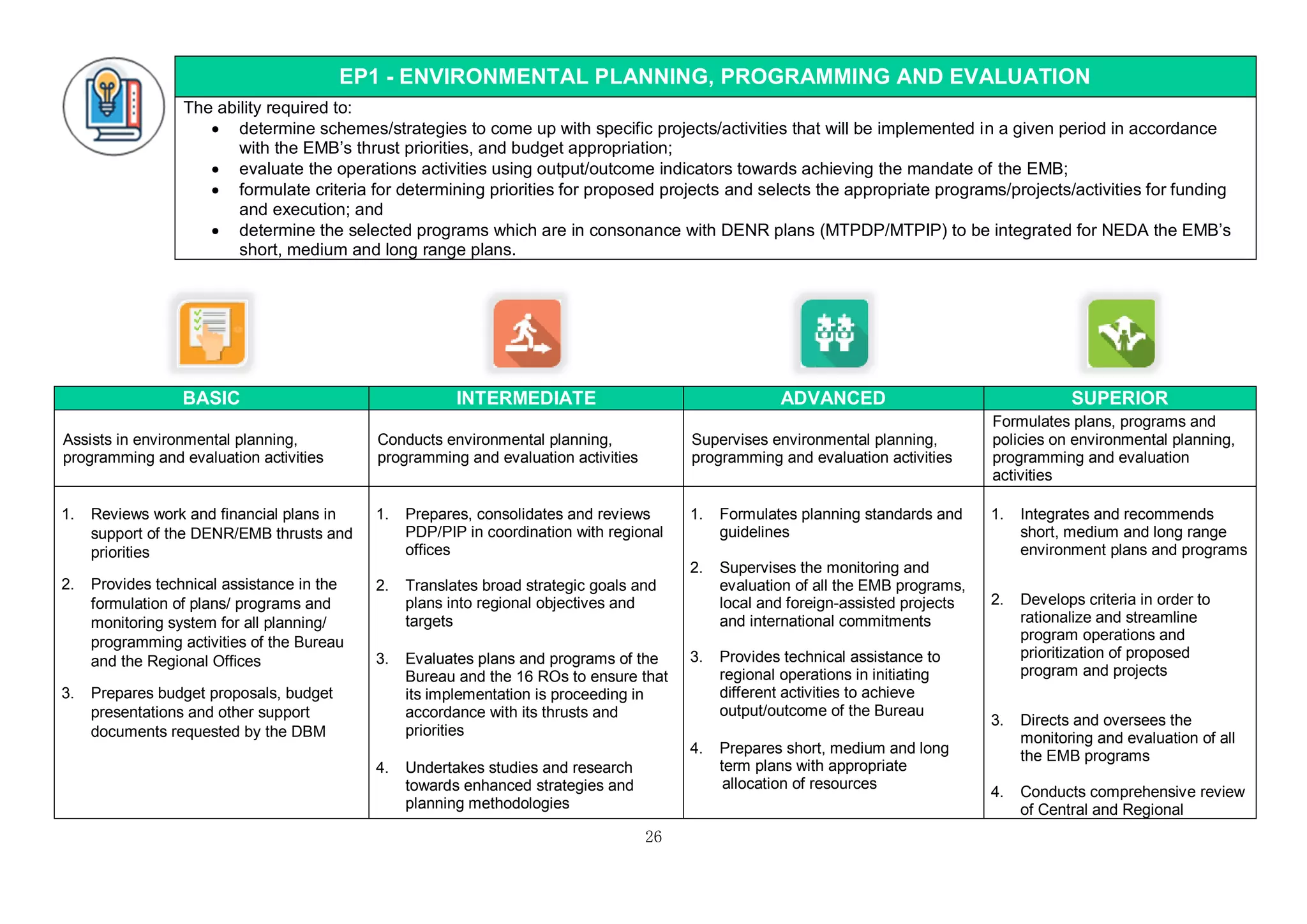
  • 144.
    137 EE6 - ENVIRONMENTALREPORT DOCUMENTATION AND LIBRARY MANAGEMENT OF ENVIRONMENTAL EDUCATION RESOURCES The ability required to consolidate and package sectoral and national environmental reports and to efficiently update an inventory of environmental education resources. BASIC INTERMEDIATE ADVANCE SUPERIOR Assists in environmental report documentation and library management of environmental education resources Undertakes environmental report documentation and library management of environmental education resources Supervises environmental report documentation and library management of environmental education resources Formulates plans, programs and policies on environmental report documentation and library management of environmental education resources 1. Knows Philippine environmental laws and policies, rules and regulations. 2. Knows the EMB’s mandate, policies, programs and projects. 3. Has basic knowledge in environmental education and sustainable development. 4. Knows the list of individuals, organizations, and networks performing environmental education or related-environment concerns . 5. Operates simple information/communication equipment (e.g. fax machine, photocopier machine, etc.). 6. Orients library users on existing library 1. Identifies linkages and areas of cooperation, facilitates improved coordination among implementing agencies and enhances communication among various sectors. 2. Packages a compendium of environmental education resources. 3. Acquires additional reading materials through donations, book showers, etc. 4. Indexes and catalogues book and non- book materials, such as journals and audio-visual materials. 5. Updates and maintains database on sectoral environmental issues, etc. 6. Prepares a system of report documentation and inventory of 1. Conducts inventory of library equipment and library holdings. 2. Coordinates the website development on environmental reports and environmental education resources. 3. Oversees the selection and classification of maps, clippings, graphics, audio-visual materials, etc. 4. Assists learners in the use of interactive media. 5. Manages the accessioning, recording, and control of multimedia educational resources on the environment. 6. Recommends new acquisitions, subscription of journals, magazines and paraphernalia for the 1. Oversees the implementation of library activities. 2. Recommends library policies and methods, programs and activities.
  • 145.
    138 policies, rules andregulations. 7. Keeps accession records in books and other reading materials including stamping ownership, typing book cards, etc. 8. Undertakes daily newsclippings on environment and natural resources. 9. Keeps books and other reading materials organized and in good condition. 10. Maintains IEC materials for distribution. 11. Prepares routine library correspondence. environmental education resources. 7. Monitors / evaluates documentation/inventory of resources. 8. Maintains library holdings and collections using appropriate software. 9. Keeps track on book circulation such as lending and recalling of books to users. 10.Maintains files for environment-related periodicals. Environmental Resource.
  • 146.
    139 ESW1 - POLICYRESEARCH AND DEVELOPMENT ON ESWM The ability required to enforce and implement RA 9003; and to draft and recommend programs and policies for the approval of the Commission. BASIC INTERMEDIATE ADVANCE SUPERIOR Assists in policy research and development on ESWM activities Conducts policy research and development on ESWM activities Formulates plans, programs and policies on policy research and development on ESWM activities Supervises policy research and development on ESWM activities 1. Knows the basic principles/concepts on policy formulation and implication to management. 2. Has knowledge on DENR/ EMB/ NSWMC’s mandate, vision, functions and priorities and thrusts. 3. Knows the concept of ESWM including enforcement and implementation; 4. Understands the relevant policies and other information on ESWM 1. Knows the protocols in crafting policy directives. 2. Gathers data needed in the formulation and conduct of policy researches. 3. Prepares policy research report. 4. Consolidates inputs of different stakeholders 1. Formulates and implements policy research reports. 2. Evaluates and interprets policy directives on ESWM. 3. Develops and administers policies and procedures to carry out plan 4. Identifies policy gaps and the policy implications of a particular research result. 5. Formulates policy recommendations on ESWM. 1.Devises corresponding strategies for implementation of management intervention on ESWM policies. 2.Analyzes and recommends policy directives on the enforcement and implementation of ESWM. 3.Represents the Office on ESWM activities, fora, national and international conventions. 4.Guides and coaches others on this competency.
  • 147.
    140 ESW2 - TECHNICALASSISTANCE ON ESWM The ability required to render technical expertise on RA 9003 as well as on the policies and programs adopted by the Commission and the Department/Bureau on ESWM to LGUs, NGAs, NGOs, Academes, Private Sectors and other stakeholders with regards to the enforcement and implementation of the provisions of the Act. BASIC INTERMEDIATE ADVANCE SUPERIOR Assists in provision of technical assistance on ESWM activities Provides technical assistance on ESWM Formulates plans, programs and policies on provision of technical assistance on ESWM Supervises the provision of technical assistance on ESWM 1. Has knowledge on the enforcement and implementation of ESWM. 2. Knows the policies and programs on ESWM adopted by the Commission, EMB and DENR. 3. Prepares monitoring/ performance reports on ESWM programs and projects with simple pro-forma. 1. Coordinates with LGUs, NGAs, NGOs, Academes, Private Sectors and other stakeholders regarding the enforcement and implementation of ESWM programs and projects. 2. Provides technical assistance to LGUs, NGAs, NGOs, Academes, Private Sectors and other stakeholders regarding the enforcement and implementation of ESWM programs and projects. 3. Prepares comprehensive reports on the implementation and enforcement of ESWM programs and projects based on the requirements of DENR units/offices and other appropriate Government Agencies. 4. Identifies problem areas and recommends procedures for effective and efficient implementation of ESWM projects and programs. 1. Reviews and assesses reports on the implementation of ESWM projects and programs. 2. Prepares monitoring and evaluation design on ESWM projects and programs. 3. Identifies appropriate ESWM projects/programs/activities to be undertaken in line with the Department’s priority thrusts aligned with the provisions of RA 9003. 4. Prepares project proposals on ESWM projects and programs for funding and implementation. 5. Reviews and evaluates ESWM plans and programs submitted by different LGUs nationwide. 6. Conducts impact studies on ESWM projects and programs. 1.Directs and coordinates enforcement and implementation of ESWM projects and programs. 2.Initiates/ recommends the proposals on ESWM projects and programs for funding and implementation. 3.Evaluates measures that will effectively address the gaps in the enforcement and implementation of ESWM projects and programs. 4.Represents the Office on ESWM activities, fora, national and international conventions.
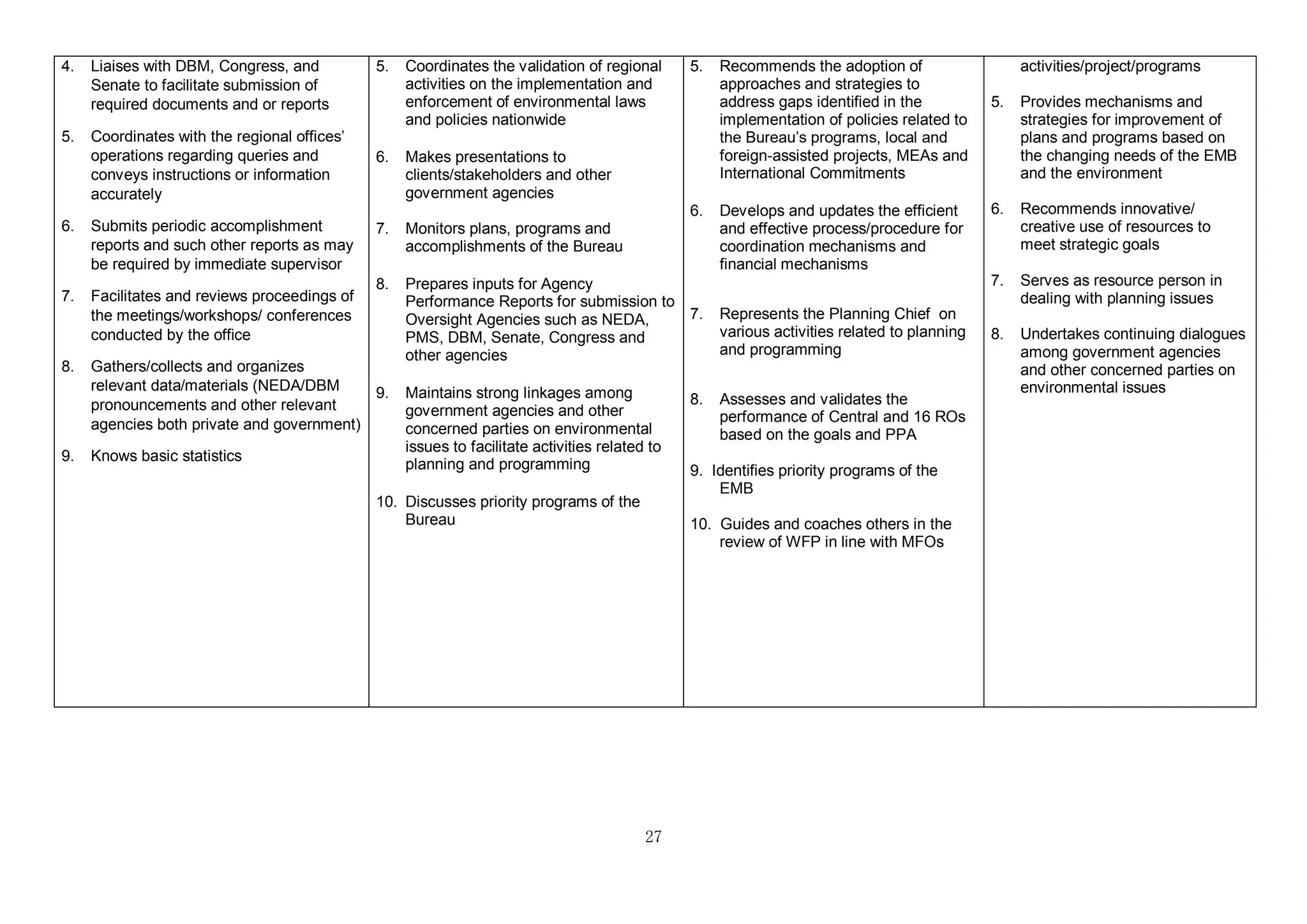
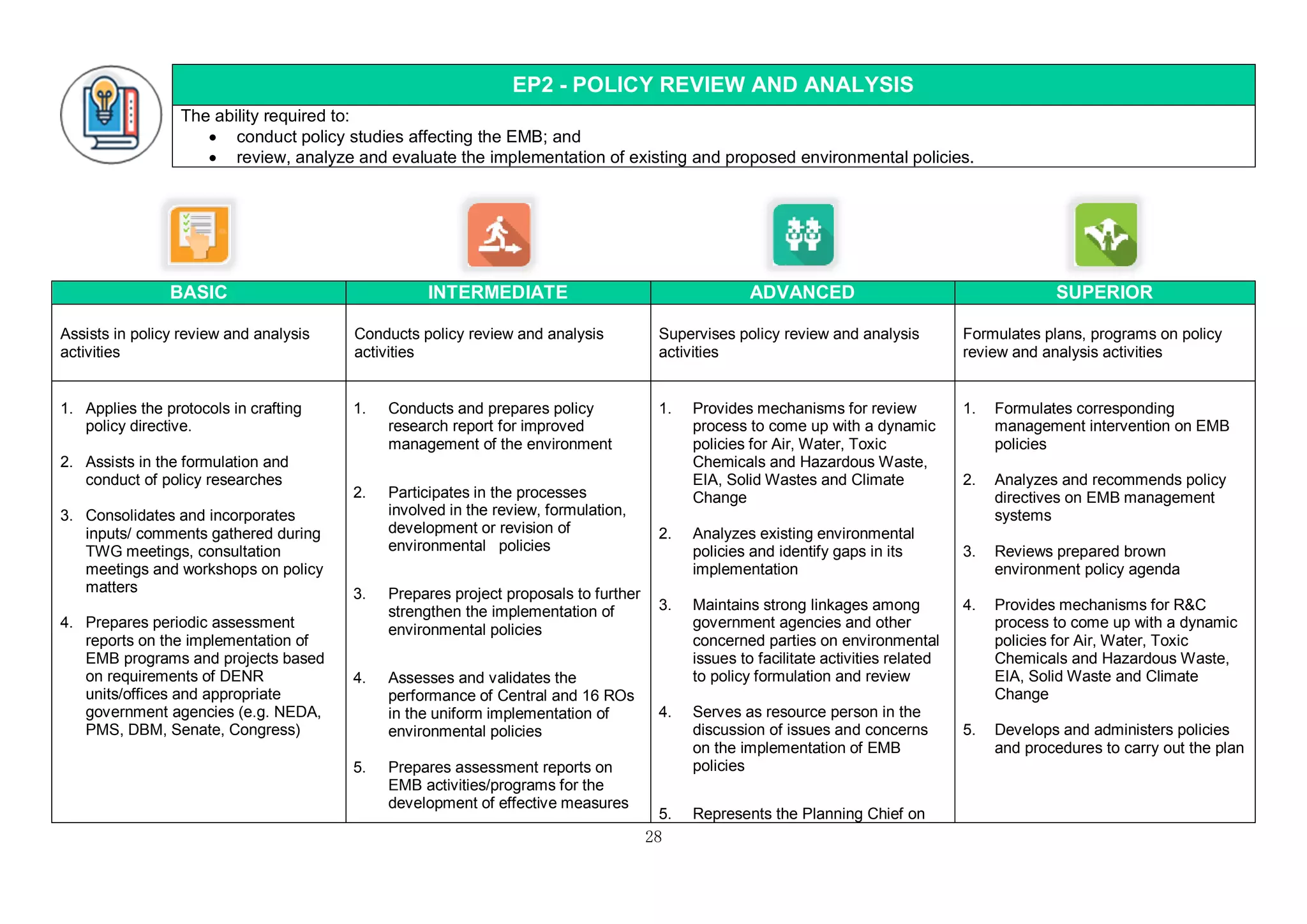
  • 148.
    141 ESW3 - TRAININGAND INFORMATION DISSEMINATION ON ESWM The ability required to conduct and facilitate trainings and information dissemination on RA 9003 as well as on the policies and programs adopted by the Commission and the Department/Bureau on ESWM. BASIC INTERMEDIATE ADVANCE SUPERIOR Assists in the conduct of training and information dissemination on ESWM Conducts training and information dissemination on ESWM Formulates plans, programs and policies on training and information dissemination on ESWM Supervises training and information dissemination on ESWM 1. Knows the concept on ESWM including enforcement and implementation as well as the policies and programs adopted by the Commission, the Bureau and Department. 2. Knows the organization’s IEC program to enhance public participation on the enforcement and implementation of ESWM; 3. Collects information needed in the development of IEC materials and training programs. 4. Knows the process of conducting a training program. 5. Operates basic training equipment. 6. Assists in the preparation and presentation of IEC and training 1. Review IEC materials and training programs on the enforcement and implementation of RA 9003; 2. Meet all training requirements needed within the specified time frame; 3. Determines type of IEC materials and training programs to be developed taking into consideration factors like communication objectives, target audience, and availability of communication technologies. 4. Develops IEC materials and training programs on the enforcement and implementation ESWM. 5. Laymanizes scientific and technical literature on the enforcement and implementation of ESWM; 1. Serves as a resource person on lectures and trainings dealing with ESWM and other relevant issue. 2. Presents ESWM lectures, synthesizes lessons and relates them to current environmental issues and concerns. 3. Integrates the program objectives, issues and concerns arising from interactions/discussions. 4. Formulates training standards and policies in implementing training programs. 5. Facilitate workshop, training and other similar activities to gather needed information for development of an appropriate ESWM program. 6. Implements contingency plans to address critical situations during 1.Conducts participatory planning activities to develop IEC materials and training programs. 2.Introduces innovations and techniques in developing IEC materials and training programs. 3.Guides the activity flow and proceedings in a group activity for consensus building and sound decision making in crafting a recommendation/strategy. 4.Plans contingencies and recommends accordingly.
  • 149.
    142 materials in termsof gathering data and crafting the materials training.
  • 150.
    143 ERO1 - WATERQUALITY MANAGEMENT The ability required in the monitoring, evaluation and enforcement in the control of water pollution from point and non point sources. BASIC INTERMEDIATE ADVANCE SUPERIOR Assists in water quality management activities Conducts water quality management activities Supervises water quality management activities Formulates plans, programs and policies on water quality management activities 1. Knows the DENR /EMB vision, mission, trusts, mandated/functions, policies and programs in the implementation on the PCWA. 2. Knows water quality monitoring procedures and inspectionprotocols. 3. Has basic knowledge in identifying different water quality monitoring equipment for in situ analysis (pH meter, secchi disc, grab sampler and other related water quality monitoring equipment). 4. Has basic knowledge in differentiating point source from non-point source of water pollution. 1. Facilitates the arrangement of equipment, transportation service and all other related requirements in the conduct of water quality monitoring. 2. Uses different water quality monitoring equipment and other meteorological equipment such as GPS as necessary . 3. Accomplishes water quality monitoring report for both ambient and effluent using standard form. 4. Screens and evaluates application(s) of Discharge Permits. 5. Conducts ambient and effluent quality monitoring. 6. Conducts sampling and field test methods and tools. 1. Provides graphical and visual analysis of the water quality monitoring results. 2. Coaches other staff how to use water quality monitoring equipment. 3. Identifies the effect of water pollution to human health and ecosystem. 4. Recommends measure to comply with water quality standards. 5. Determines the penalties imposed on water quality standard violation. 6. Identifies and updates concerned superiors on emerging water pollution issues/concerns of interest to business, church, NGOs and LGUs. 7. Evaluates water quality monitoring report by third party and business (Self Monitoring Report, water 1.Prepares contingency measures in case of water pollution accident/s and recommends appropriate measures. 2.Oversees projects pertaining to enhancement/improvement of water quality. 3.Linkages/networks with other government agencies, NGO’s, LGU’s and stakeholders. 4.Presides technical meetings regarding pollution control matters. 5.Recommends endorsements of pollution cases to the PAB.
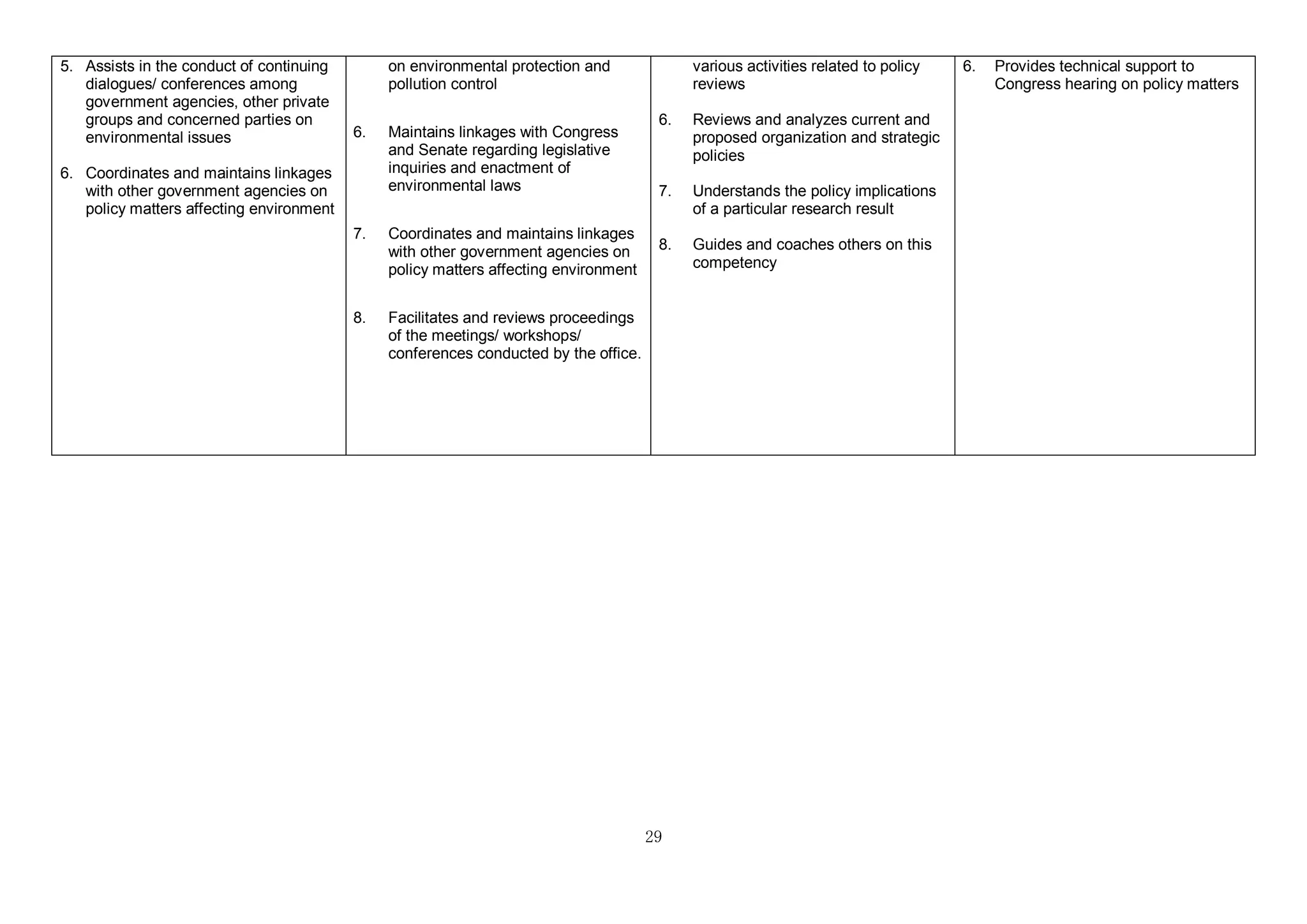
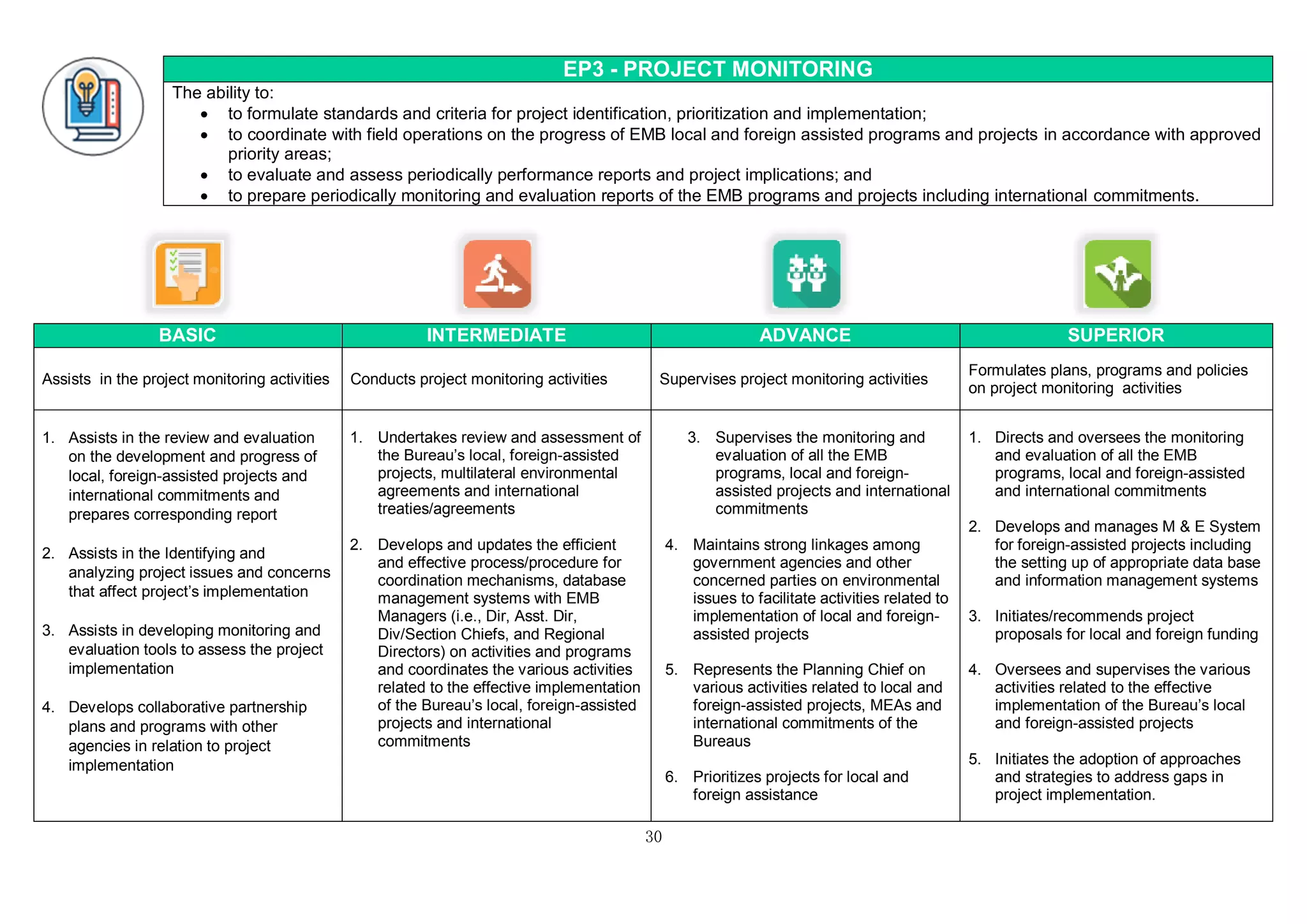
  • 151.
    144 7. Processes andanalyzes water quality data. 8. Conducts survey, inspection and investigation. sampling report, engineers report etc). 8. Calibrates water quality monitoring equipment. 9. Prepares water body classification reports. 10. Guides LGUs and other stakeholders in the establishment of Water Quality Management Board. 11. Reviews/recommends the drafting of WDP, reports of inspection/ monitoring/investigation for submission to the Section Chief. 12. Designs strategies to increase business and industrial compliance with water quality standards. 13. Responds quickly to water pollution crisis situations and recommends appropriate measures in dealing with it. 14. Establishes temporal and spatial pattern on the status of water quality in water bodies in the Region. 15. Establishes Water Quality Management Area. 16. Reviews/recommends the drafting of WDP and reports of inspection/ monitoring/investigation.
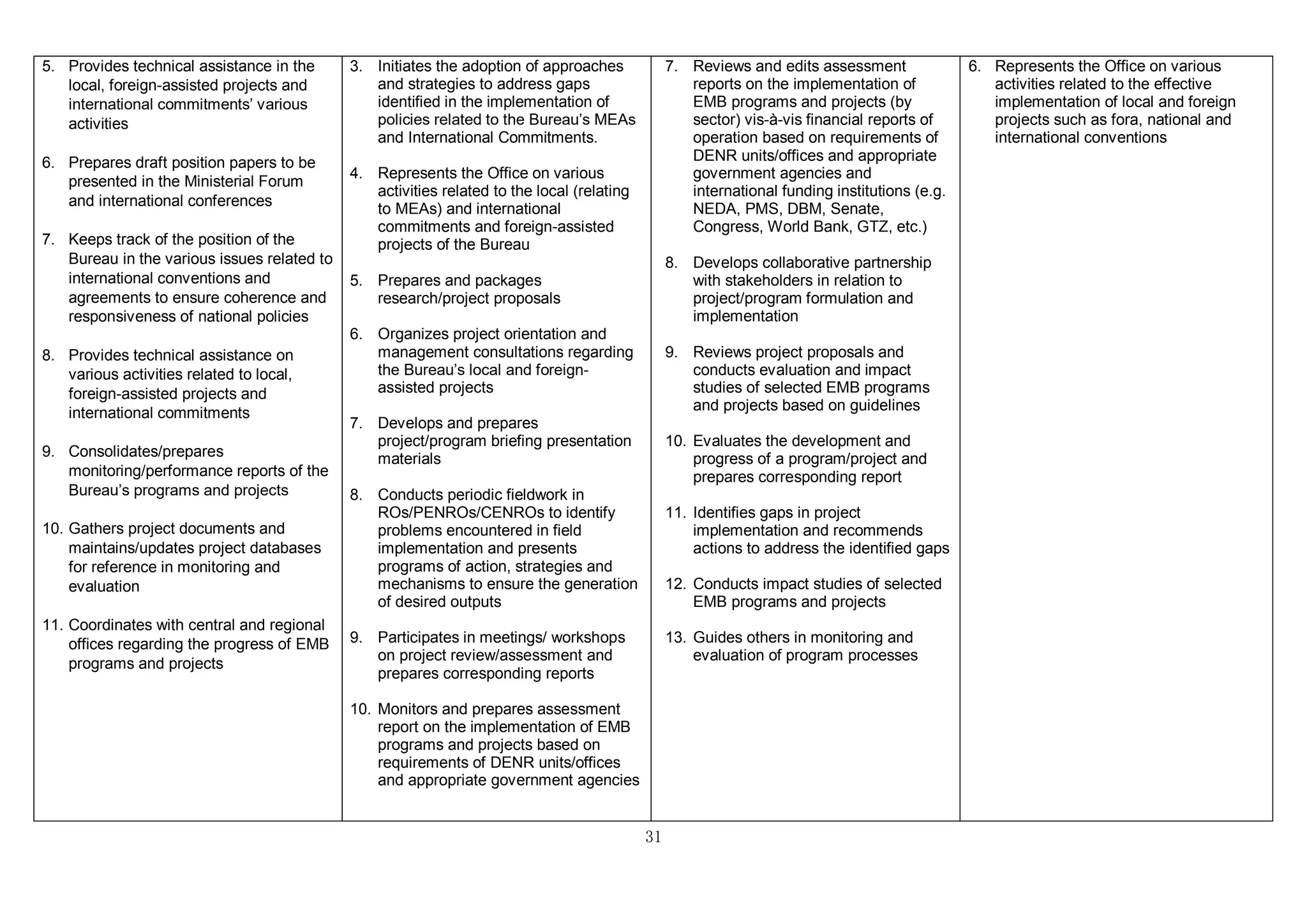
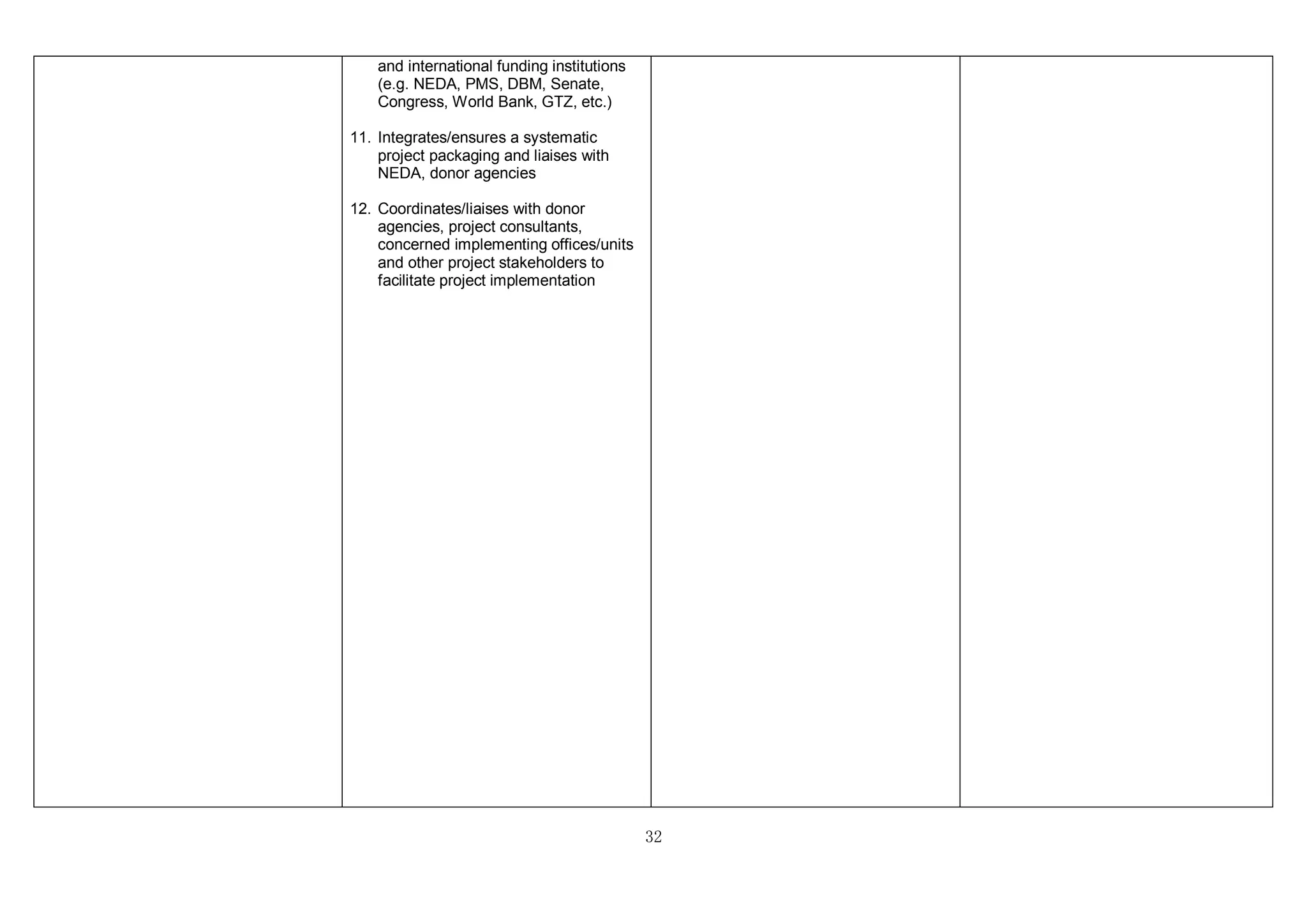
  • 152.
    145 ERO2 - AIRQUALITY MANAGEMENT The ability required in the control of air pollution from mobile and stationary sources. BASIC INTERMEDIATE ADVANCE SUPERIOR Assists in air quality management activities Conducts air quality management activities Supervises air quality management activities Formulates plans, programs and policies on air quality management activities 1. Knows the DENR /EMB vision, mission, thrusts, mandates/functions, policies, and programs in the implementation of the Clean Air Act and its IRR. 2. Knows how to identify air quality monitoring equipment. 3. Knows how to prepare necessary equipment to be used in field. 4. Knows how to fill up forms with regards to equipment to be used on field. 5. Has knowledge in identifying stationary and mobile source. 1. Facilitates the arrangement of the air quality monitoring equipment and all other requirement related to the conduct of air quality monitoring. 2. Identifies location of ambient air sampling stations and source sampling ports. 3. Operates different air quality monitoring equipment and other meteorological equipment such as GPS as necessary. 4. Prepares drafts and finalizes air quality monitoring report. 5. Screens and evaluates Permit to Operate applications. 6. Gathers data and prepares emission inventory reports. 1. Interprets air quality monitoring results. 2. Conducts survey, investigation, inspection, stack sampling, emission testing and ambient air quality monitoring and prepare the corresponding reports. 3. Coaches other staff on the proper use of air quality monitoring equipment. 4. Recommends measures to comply with air quality standards (such as appropriate pollution control device, use of clean fuel and proper maintenance). 5. Recommends mitigating measures in the reduction of greenhouse gases. 6. Recommends fines and penalties with regards to administrative violations and those that exceed thestandards. 1. Oversees the operation of pollution control in the region. 2. Plans and recommends actions on contingencies for emergency situation. 3. Conceptualizes innovative environmental management tools that support air quality management. 4. Optimizes outcome of air quality management through the identification of industry best practices in air quality management, establishment of benchmarks and identification of good material for research. 5. Recommends for the approval/disapproval of PO. 6. Reviews, evaluates and recommends policy change on air quality.
  • 153.
    146 7. Calibrates airquality monitoring equipment. 7. Provides updates on emerging air pollution issues/concerns of interest to business, church, NGOs and LGUs. 8. Evaluates air quality monitoring report/s by third party and industries (SMR, stack sampling report, engineers report etc). 9. Recommends strategies to increase business and transport industry compliance with air quality standards. 10. Guides and coaches others on the quick response mechanism and proper coordination with other concerned parties on accidental release of air pollutants detrimental to public health. 11. Prepares technical reports with regards to air quality monitoring data/requirements. 12. Serves as resource person in the establishment and operationalization of an airshed. 13. Reviews and evaluates PTO applications.
  • 154.
    147 ERO3 - TOXICCHEMICALS AND HAZARDOUS WASTE MANAGEMENT The ability required in the monitoring, evaluation, and enforcement in the use of toxic chemicals and hazardous wastes. BASIC INTERMEDIATE ADVANCE SUPERIOR Assists intoxic chemicals and hazardous waste management activities Conducts toxic chemicals and hazardous waste management activities Supervises toxic chemicals and hazardous waste management activities Formulates plans, programs and policies on toxic chemicals and hazardous waste management activities 1. Has basic knowledge of the Clean Water Act, Clean Air Act and Toxic Substances, Hazardous and Nuclear Waste Control Act and their IRRs and related DAOs and MCs. 2. Knows the effects of toxic substances and hazardous waste to human health. 3. Identifies the requirements in securing importation clearance, SQI, HWG registration, TSDs, CCOs, PICCS, PCLs and permit to transport and others. 1. Evaluates the request for importation clearance, SQI, HWG registration, TSDs, CCOs, PICCS, PCLs and permit to transport and others. 2. Evaluates submitted inventory reports substances/compounds included in the chemical control order, manifest forms, SMRs and other related documents. 3. Conducts survey and inspection of hazardous waste generators/TSDs/ industries using chemicals under CCOs. 4. Monitors hauler vehicles of waste transporters. 5. Investigates complaints and recommends appropriate action. 1. Coaches concerned staff on the evaluation of requests for importation, permit to transport, SQI, HWG registration, TSDs, CCOs, PICCS, PCLs and permit to transport and others. 2. Establishes networks with concerned government agencies and other stakeholders. 3. Designs strategies to increase the efficiency in monitoring and controlling the use of toxic substances and hazardous waste. 4. Prepares the technical capability building plan of technical staff. 1.Oversees conduct of monitoring and control of toxic substances and hazardous waste. 2.Proposes research studies for the replacement of toxic/ hazardous substances used in the industry. 3.Recommends policy changes as needed. 4.Serves as the regional expert on toxic chemicals and hazardous wastes in the region.
  • 155.
    148 5. Responds quicklyto toxic substances and hazardous waste crisis such as accidental disposal. 6. Recommends action on applications, investigation, survey, inspection, evaluation reports and other related matters requiring management decision.
  • 156.
    149 ERO4 - ANALYSISOF ENVIRONMENTAL SAMPLES The ability required in determining the quality and quantity of pollutants. BASIC INTERMEDIATE ADVANCE SUPERIOR Assists in conduct of analysis of environmental samples Conducts analysis of environmental samples Supervises analysis of environmental samples Formulates plans, programs and policies on analysis of environmental samples 1. Has basic knowledge on DENR-EMB mandates on the Clean Water Act, Clean Air Act and Toxic Substances, Hazardous and Nuclear Waste Control Act, and their IRRs. 2. Knows basic sampling procedures and protocols. 3. Has basic knowledge on the operation of laboratory equipment (in situ checkers, pH meter, DO meter, analytical balance, oven, incubator, UV spectrophotometer, ASS). 4. Has basic knowledge on laboratory analysis (e.g., methods and procedures, chemical reagents, glasswares, and other laboratory apparatus). 1. Operates and calibrates basic laboratory equipment (e.g. analytical balance, oven, autoclave, pH meter, DO meter, etc.). 2. Prepares the reagent and equipment inventory and prepares the corresponding report. 3. Undertakes sample treatment (e.g. filtration, digestion, extraction, clean-up procedures, etc.) and other tasks needed in the analysis of environmental samples. 4. Conducts qualitative and quantitative laboratory analysis according to approved method of analysis. 1. Coaches concerned staff how to conduct laboratory analysis. 2. Prepares and updates quality control chart for BOD, TSS, TDS, Phosphate, Ammonia, Chloride and Oil and Grease and other related parameters for air and water. 3. Attends technical capacity building for laboratory upgrading on methods and procedures. 4. Assesses and monitors 3rd applicant/recognized laboratory. 5. Prepares laboratory results. 6. Evaluates reagent and equipment inventory report 1. Oversees the conduct of laboratory analysis. 2. Verifies and validates laboratory results. 3. Conceptualizes innovative scientific tools that support laboratory services. 4. Prepares the equipment and glassware calibration plan. 5. Prepares the continual upgrading plan on the laboratory.
  • 157.
    150 5. Undertakes basicequipment cleaning, glassware washing, and general laboratory housekeeping. 6. Has knowledge on sample screening and receiving protocols. 7. Optimizes and calibrates specialized analytical laboratory equipment (e.g. AAS, IC, GC, GCMS, UV VIS spectrophotometer, etc). 8. Designs strategies to increase the efficiency of laboratory services. 9. Prepares laboratory waste disposal system. 10. Designs trickling filter drum for BOD and other locally devised disposal system. 11. Reviews and checks laboratory results. 12. Conducts technical capacity building for laboratory upgrading on methods and procedures. 13. Formulates findings on the assessment of 3rd party laboratory. 14. Reviews the reagent and equipment inventory report and recommends necessary action.
  • 158.
    151 ERO5 - ENVIRONMENTALIMPACT ASSESSMENT The ability required in evaluating the environmental consequences of a proposed activity and providing the means to reduce adverse impact. BASIC INTERMEDIATE ADVANCE SUPERIOR Assists in environmental impact assessment activities Conducts environmental impact assessment activities Supervises environmental impact assessment activities Formulates plans, programs and policies on environmental impact assessment activities 1. Knows the basic Environmental Impact Assessment Process and concepts i.e.:  Differentiates an environmentally critical project from a project located in an environmentally critical area  Identifies an ECC, NOV, CDO and CNC  Knows the levels/category/grouping of projects applied for. 2. Prepares and updates the directory of project proponent and pool of experts for the RevCom. 3. Knows all the necessary requirements for EIA documents for all types of ECC/CNC application. 4. Knows the jurisdiction authority and limitation of the region with regards to the scale and type of project to be evaluated. 1. Conducts site inspection of project. 2. Prepares inspection report and Review Processing Report. 3. Reviews/ evaluates IEE Checklist, IEER-based ECC applications, PDR for CNC, IEE based EPRMP including ECC amendment. 4. Identifies violations and the imposable penalties. 1. Evaluates EIS and EIS based EPRMP for ECC applications. 2. Identifies adverse/negative environmental impacts and the corresponding/appropriate mitigation measures for the evaluated project. 3. Knows the parameters to be monitored to address the identified impacts in the evaluation of EMoP. 4. Prepares the work and financial plan for environmental review fund. 5. Identifies the major issues of the following stakeholders such as the church, NGO, LGUs, etc. for determination of concerned government agencies mandated to address such issues. 1. Responds quickly to crisis situation and deal with it. 2. Assesses the review output of case handler, review committee and recommends for the approval/denial of ECC. 3. Oversees the operation of the EIA through the wise use of resources. 4. Plans for contingencies and recommends accordingly. 5. Conceptualizes innovative environmental management tools that support environmental impact assessment. 6. Optimizes outcome of assessments through the identification of responsible proponents/accountable preparers, establishing benchmarks, identification of good material for research.
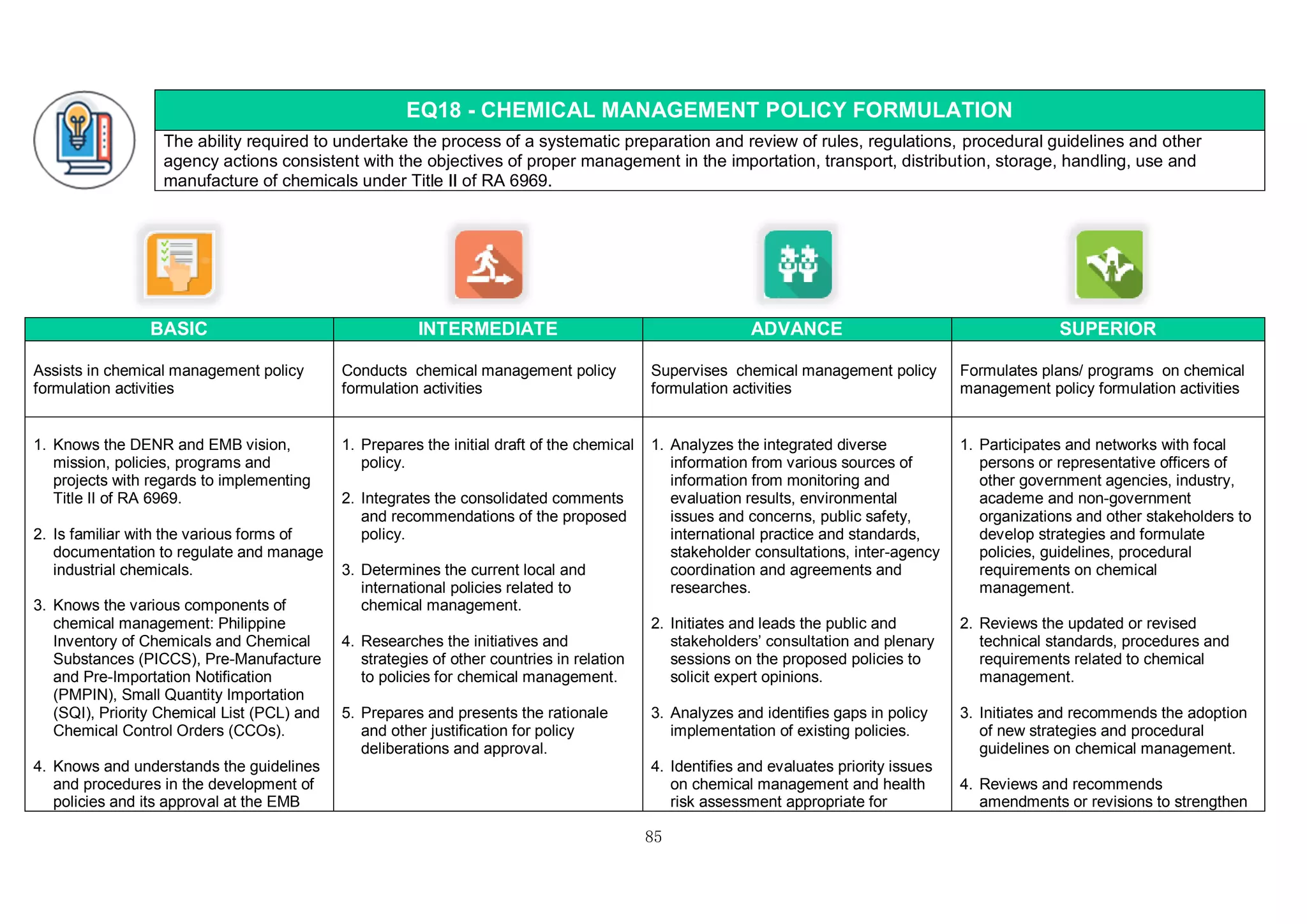
  • 159.
    152 5. Knows therole of each member of the environmental impact assessment team; e.g. review committee, project evaluator, evaluation team etc. 6. Presides over technical conference to resolve issues/penalties, complaints raised by concerned stakeholders. 7. Recommends the issuance or denial of the ECC for a certain project. 8. Guides and leads others in the effective environmental impact assessment management.
  • 160.
    153 ERO6 - EIAMONITORING AND AUDIT The ability required to determine compliance of projects issued ECCs to related environmental standards and commitments as a result of the EIA process and to assess performance of monitoring partners. BASIC INTERMEDIATE ADVANCE SUPERIOR Assists in EIA monitoring and audit activities Conducts EIA monitoring and audit activities Supervises EIA monitoring and audit activities Formulates plans, programs and policies on EIA monitoring and audit activities 1. Knows the EIA Process and Concepts. 2. Knows and Understands the Rationale for ECC Compliance Monitoring. 3. Knows how to access the database input information on projects issued ECCs. 4. Knows the protocol and the basic references/documents needed in the conduct of monitoring including the relevant parameters. 1. Prioritizes projects for monitoring using the Project Environmental Monitoring and Audit Prioritization Scheme (PEMAPS). 2. Conducts desk review of compliance of projects to the conditions of ECCs issued and prepares corresponding reports/communications (i.e.CMVR, NAF, assessment letters, etc). 3. Prepares minutes of meetings conducted in relation to ECC compliance monitoring. 4. Conducts field monitoring and assessment of environmentally critical projects and prepares the required reports within the specified timelines. 1. Leads and orients MMT members. 2. Undertakes multi-media monitoring/MMT. 3. Conducts overall assessment of the proponents’ compliance to ECC conditions and related commitments and prepares necessary action documents (i.e. NOVs, Penalty Orders, CDO, etc.). 4. Provides technical and legal inputs to administrative investigations of environmental performance issues. 5. Manages and organizes the creation of the Multipartite Monitoring Teams of the project proponents. 6. Conducts technical performance audit of ROs and other monitoring partners (i.e. MMTs, holders of programmatic ECC, etc). 1. Oversees the implementation of the environmental monitoring and audit functions of the region and other partners (LGUs, MMT, and other GOs). 2. Reviews statistical and technical reports in relation to EIA Monitoring and Audit as input to policy development. 3. Initiates and reviews actions, plans and policies for the continuous improvement of the EIA Monitoring and Audit. 4. Conducts technical hearings/conference on projects in violation.
  • 161.
    154 7. Oversees theECC Compliance Monitoring and related activities. 8. Resolves the identified problems in the EIA Monitoring and Audit.
  • 162.
    155 ERO7 - ENVIRONMENTALPLANNING The ability required to:  determine scheme/strategy to effectively implement specific projects/activities in a given period in accordance with the EMB’s thrust priorities, and budget appropriation.  evaluate the operations activities using output/outcome indicators towards achieving the mandate of the EMB.  identify and recommend projects for funding. BASIC INTERMEDIATE ADVANCE SUPERIOR Assists in environmental planning activities Conducts environmental planning activities Supervises environmental planning activities Formulates plans, programs and policies on environmental planning activities 1. Has knowledge on the President’s thrust and priorities including the secretary’s and regional thrusts and priorities. 2. Gathers/collects relevant data/ materials (NEDA/ DBM pronouncements and other relevant agencies both private and government). 3. Assists in the preparation of work and financial plans; budget proposals and documents for budget deliberations. 4. Gathers reports/data/ information and consolidates provincial work and financial plans and accomplishment reports. 5. Knows the DENR/EMB’s mandate, mission, vision and functions based on 1. Formulates Regional Development Plans based on the President’s thrusts and priorities (PDP) for submission to RDC, EDC and other oversight Committees 2. Consolidates, analyzes, validates and prepares comprehensive report/data/information of the NEDA/DBM or other relevant government agencies/ entities’ requirements, e.g. MDG targets and accomplishments. 3. Prepares work and financial plans in support of the DENR/EMB thrusts and priorities in accordance with existing reprogramming / programming guidelines with some guidance/ coordination with EMB Technical Divisions; prepares budget proposals and documents. 1. Coordinates with EMB Technical Divisions and supervises/assists the formulation of regional targets to the Regional Development Plans; coordinate with other government agencies/entities for input into the agency targets to RDP. 2. Represents EMB-RD in Committees and Councils, especially in terms of gathering, analysis, validation, updating/reporting of data and information and attend its periodic meetings, e.g. MDG targets, EDC, RDRRMC, RCC, etc. 3. Formulates programming/ reprogramming guidelines for WFP and budget proposal preparation in conjunction with the DBM/national guidelines. 4. Monitors and validates the implementation of provincial and 1. Conducts comprehensive review and evaluation, oversees the preparation of consolidated accomplishments, tracking of developments/updates/ amendments of the regional targets on the Regional Development Plans and be able to orient/assist the Regional Director in its deliberation/presentation to the RDC/EDC and other oversight Committees. 2. Provides mechanisms and strategies for networking, coordinating, collaborating and improvement of the office mechanisms addressing the frequent and changing needs of oversight agencies/Committees/ Councils, e.g. NEDA and DBM. 3. Integrates and recommends short, medium and long range environment plans; and serves as expert/ resources person in dealing with regional planning
  • 163.
    156 Major Final Outputs(MFOs). 6. Knows basic planning concepts and processes in making operational plans for a work group – e.g. scheduling, budgeting; project plans or technical plans for an office/department. 4. Reviews consolidated provincial and Division’s work and financial plans and accomplishment reports. 4.aCoordinates with the provincial environment management units’ operations regarding queries and conveys instructions or information accurately. 4.bCoordinates with different divisions and provincial environmental management units on the status of accomplishments and other issues and concerns for submission to Central Office and other government agencies. 5. Relates priority programs of the EMB- ROs with its mandate, mission, vision and functions based on MFOs. 6. Builds expertise of subordinates/ planning staff on the basic planning concepts and processes in the preparation of operational/technical plans. Division’s and other local WFPs and formulates validation/assessment guidelines; monitors status of accomplishments and financial utilizations to be within the target. 4.a Prepares necessary formats and templates for a more effective way in the submission of reports. 4.b Presents to clients/stakeholders and other government agencies on the EMB PAPs. 4.c Assesses and validates the performance of regional and provincial offices based on approved WFP. 5. Provides inputs to the Regional Development Council in the formulation of PDP and other related development plans. 6. Analyzes/assesses/validates the work plans – e.g the scheduling, budgeting, implementing, monitoring and evaluation of operational/technical plans for a work group or a local project. issues. 4. Recommends innovative/ creative use of resources to meet regional strategic goals. 4.a Provides technical assistance to provincial operations in initiating different activities to achieve output/outcome. 4.b Provides guidance to other divisions in the review of WFP in line with MFOs. 5. Tracks accomplishments, updating/amending of targets and prepares agency accomplishment report and presentations during PDP Midterm and Final review. 6. Reviews/evaluates final reports for operational/ technical/local plans and presents the findings and recommendations.
  • 164.
    157 ERO8 - STATISTICSAND INFORMATION SYSTEMS MANAGEMENT The ability required to collect, analyze, and disseminate quality and timely EMB data/information to internal and external clients and maintain such for efficient and effective development planning, policy formulation and decision-making purposes. BASIC INTERMEDIATE ADVANCE SUPERIOR Assist in the information systems management and statistics activities Conduct information systems management and statistics activities Supervise the management of information systems and statistics activities Formulate plans, programs and policies on management and information and statistics activities 1. Manages the IT equipment, network infrastructure and inventory of the region’s ICT resources and provide IT user supports. 2. Monitors network activity and conducts diagnostic and immediate troubleshooting of any network issues encountered from end point to terminal. 3. Installs client software to users computers, deploys appropriate updates and patches. 4. Manages the regional website and confers with various units the updating and uploading of web-contents. 5. Creates statistical reports and maps using various GIS tools and integrates geographical data from existing data sources. 1. Reviews the network utilization, support services provided and inventory of ICT resources and recommend the necessary improvement. 2. Performs statistical data analysis, validation of data and forecasting with the use of RDBMS, GIS, statistical software and other business intelligent (BI) tools. 3. Analyzes geographic relationships among varying types of data and statistical data in aid of planning and policy formulation. 4. Prepares test modules and training materials for system user trainings and other IT capacity building. 1. Supervises the overall activities of the statistics and information systems management unit. 2. Recommends IT standards, policies and adopt best practices for the maintenance and effective utilization of ICT resources and implementation of ICT Project. 3. Manages the regional servers, performs periodic backup of databases and monitors server health. 4. Recommends guidelines and procedures for the identified problem areas on data collection. 5. Reviews the assessment and accomplishment reports submitted by subordinates. 1. Develops and recommends strategic information system plan and policies, coordinates the over-all IT activities of the region and provides up-to-date information necessary for management’s policy formulation and decision-making functions. 2. Introduces innovations, enhancements and recommends more improved processes and procedures in the use of region’s data systems. 3. Conducts relevant research studies to improve the information and technology management of the Bureau. 4. Serves as resource person on this competency.
  • 165.
    158 6. Manages andmaintains the regional information systems and databases and monitors the updating performance of the concerned units. 7. Prepares proceedings of the meetings, conferences, and workshops conducted by the Office.
  • 166.
    159 ERO9 - ENVIRONMENTALINFORMATION AND EDUCATION The ability required to implement public information programs to enhance public understanding and participation in environmental protection and management to attain sustainable development. BASIC INTERMEDIATE ADVANCE SUPERIOR Assists in environmental information and education activities Conducts environmental information and education activities Supervises environmental information and education activities Formulates plans, programs and policies on environmental information and education activities 1. Knows DENR/EMB’s mandate, policies, programs and projects. 2. Knows the state of the Philippine environment, with emphasis on the brown environment sector. 3. Distributes IEC materials and disseminates relevant information and facts of the Bureau’s plans, programs and activities to public and to various stakeholders. 4. Assists academic institutions, government agencies and other stakeholders related to environmental education campaign. 5. Keeps reading materials and daily news clippings on environment and natural resources. 1.Gathers information needed in the development of IEC materials. 2.Prepares fact sheets, primers, brochures, exhibit materials on brown environmental issues. 3.Writes feature articles, column feeds and TV releases on environmental management programs and policies. 1. Establishes partnership with the tri- media. 2. Prepares and implements the regional communication plan on environment sector. 3. Edits press releases, editorial and feature articles written by staff. 4. Manages the timely release of press releases and editorial materials. 5. Plans and supervises the implementation of environmental events and activities. 1. Identifies strategies to implement high- impact IEC campaigns vis-à-vis limited funds. 2. Reviews and monitors the implementation of IEC programs / projects. 3. Oversees the conduct of IEC programs, projects of the office. 4. Serves as expert/ resource person in advocacy programs of EMB.
  • 167.
    160 ERO10 - SKILLSIN LEGAL RESEARCH/OPINION The ability required to research legal precedent, investigate/evaluate facts, determine the existence of prima facie case and preparation of legal documents. It includes the conduct of research to: 1) support a decision or legal proceeding, 2) formulate a defense, 3) prepare the pleadings/petitions/motions, or 4) initiate legal action in connection with legal issues and concerns affecting the mandates of DENR-EMB. BASIC INTERMEDIATE ADVANCE SUPERIOR Assists in conduct oflegal research and preparation of legal documents Conducts legal research and prepares legal documents Supervises conduct oflegal research and preparation of legal documents Formulates plans, programs and policies on conduct oflegal research and preparation of legal documents 1. Has knowledge of environmental laws, legal procedures, rules and regulations, and international agreements/commitments. 2. Knows the laws on natural resources and environmental management. 3. Knows the general procedures in legal research work. 1.Ascertains the subject matter and notes preliminary issues to be researched. (- Under what jurisdiction does the problem fall? Is the question governed by local law/Philippine laws and/or international convention/agreements/treaties? Is the problem governed by legislation (statutes or EMB policies, regulations) or by judicial decisions? Do both apply? ) 2.Develops a detailed written outline on how Legal Division plans to analyze the legal issues presented by the fact situation. (The outline will indicate where the analysis is strong (no further research is required) and where the analysis is weak (further research is required). 3.Identifies preliminary issues and key 1. Analyzes research data, such as relevant provisions of RA 6969, P.D. 1586, Clean Water Act, Clean Air Act, RA 9003 and applicable international conventions/agreements/treaties, judicial decisions, legal articles, codes, and documents. 2. Identifies which cases are binding and which are merely persuasive; what are the possible defences and remedies; the need to find more analogous cases, to make policy arguments; and areas in the analysis that needs further research. 3. Investigates/evaluates facts and law of cases to determine causes of action and to prepare draft decision or necessary communication. 4. Revises the preliminary legal issue/s identified. 1.Formulates policies and procedures for efficient legal research/background investigation. 2.Drafts proposed revisions/amendments to existing laws, regulations and policies.
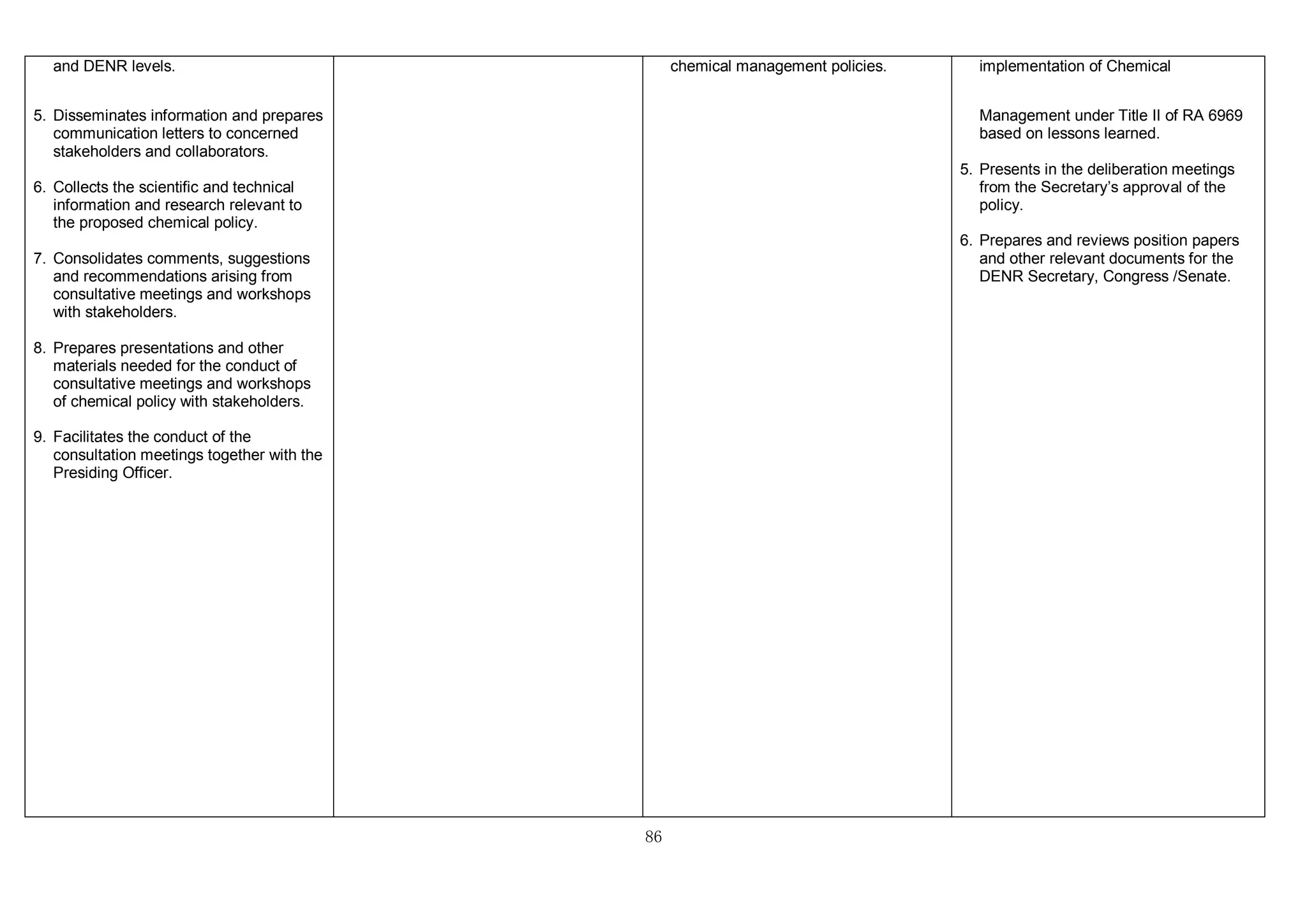
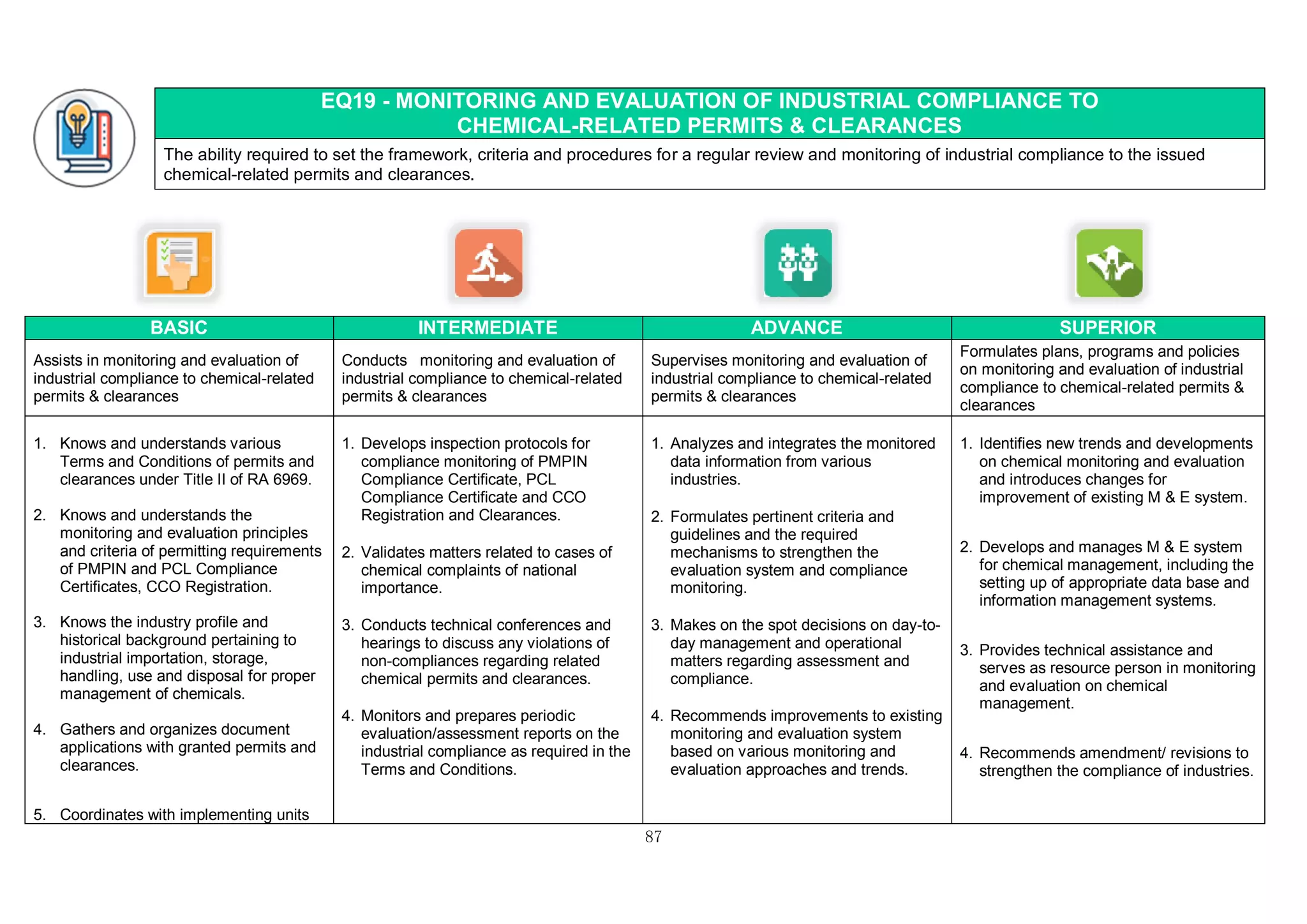
  • 168.
    161 facts. 4.Prepares research planand spends time “brainstorming” the problem. 5.Gathers and compiles and collates materials and data needed in the conduct of legal research on environmental management issues on the resolution of the case/opinion. 6.Browses a subject thru CD/ROM and/or uses Supreme Court and other local/international legal web sites, including libraries of the DENR and UP Law Center. 7.Conducts researches and studies on various laws, court decisions, significant opinions, circulars, regulations, and other relevant legal information to determine and assess their effects on the operations/enforcement of the Clean Air Act, Clean Water Act, EIS law, and RA 6969. 8.Conducts researches and studies on international environmental conventions and agreements and their relevance to (PD 1586, RA 6969, RA 8749, RA 9003 & RA 9275)EIS law, and RA 6969 such as the Stockholm Declaration of the United Nations Conference on the Human Environment (16 June 1972), Agenda 21, Chapters 38 and 39 (UN Conference on Environment and Development, 16 June 1992), Convention on the Protection of the Ozone Layer, UN Framework Convention on Climate Change, Convention on the Control of Trans- boundary Movements of Hazardous Wastes and Their Disposal, 22 March 5. Synthesizes the arguments. (How does the argument/discussion of issues fit together? Are they logically organized, such that discussions of certain issues logically precede subsequent issues? What are the weaknesses in the argument/s, if any? Can the leading cases be incorporated (e.g. on the facts; not binding in local Philippine environmental management laws/jurisdiction; if binding, can it be restricted to a narrow ratio; can an obiter dicta or strong dissents be utilized; are other cases more persuasive?). Are the CAA, CWA, EIS law, RA 6969, RA 9003 and their corresponding policies and/or regulations correctly and properly incorporated? Can the policies and/or regulations of said laws be extended a liberal or strict interpretation, or rendered not applicable on the facts?) 6. Prepares draft opinions on legal issues touching on Clean Air Act, Clean Water Act, EIS law, and RA 6969, RA 9003 and pertinent international agreements/conventions/treaties. 7. Supervises and reviews the conduct of studies and researches on legal matters affecting EMB. 8. Guides the Bureau’s decision makers and oversees the legality of the proposed legal course of actions to be undertaken. 9. Monitors progress and results of legal research/investigation.
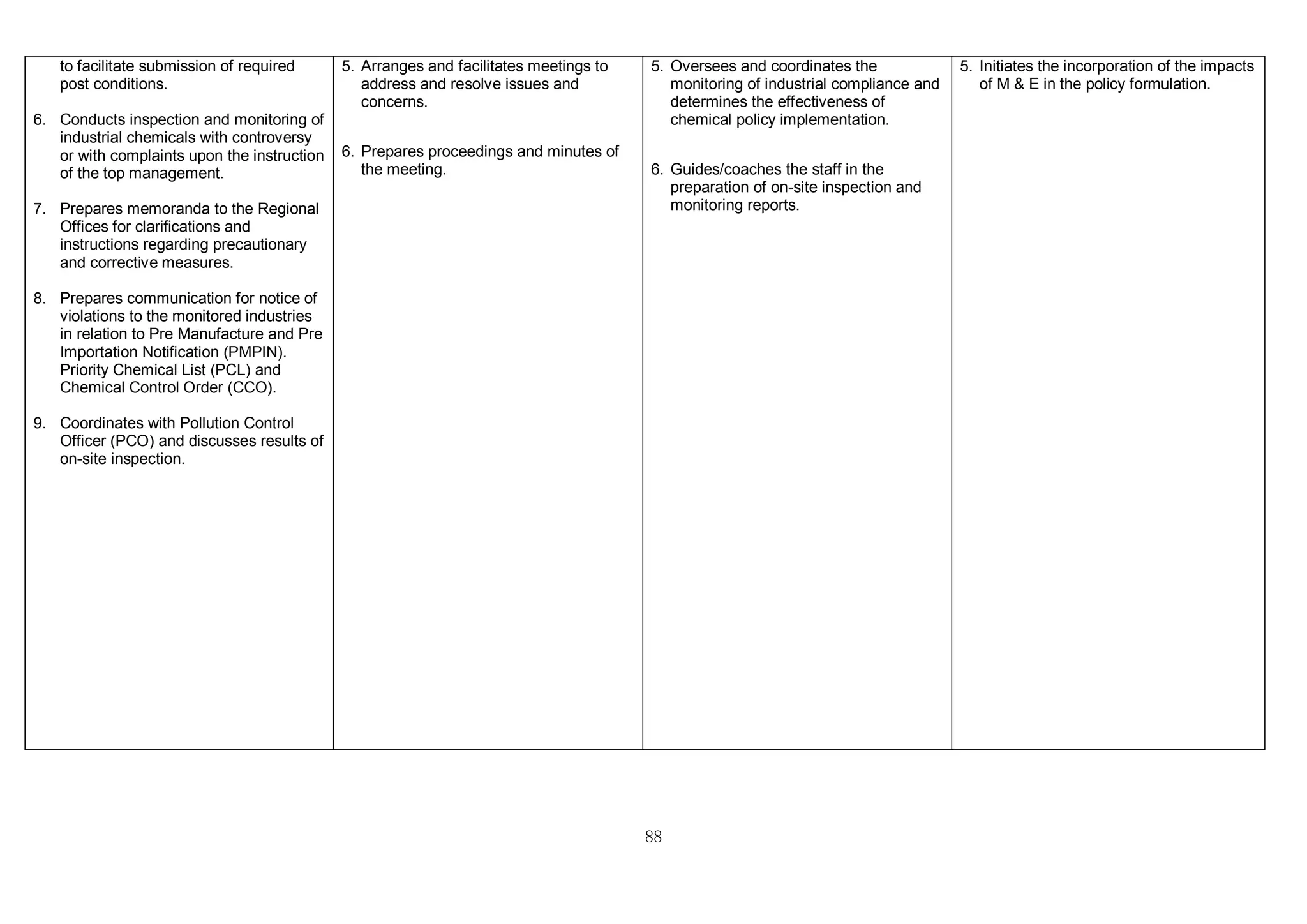
  • 169.
    162 1989. 9.Arranges documentary evidences/data orderlyand efficiently. 10. Edits, reviews, revises/amends the draft policies, rules and regulations, and other communication prepared by the different EMB Divisions/Sections/Projects related to the legal enforcement of Clean Air Act, Clean Water Act, EIS law, and RA 6969, RA 9003 and pertinent international agreements/ conventions/treaties.
  • 170.
    163 ERO11 - DISPOSITION/MANAGEMENTOF CASES The ability required to resolve/dispose and handle cases brought for judicial and quasi-judicial actions. BASIC INTERMEDIATE ADVANCE SUPERIOR Assists in disposition/ management of cases Handles disposition/ management of cases Supervises disposition/ management of cases Formulates plans, programs and policies on disposition/ management of cases 1. Has knowledge of laws, legal procedures, rules and regulations, and allied laws. 2. Knows the laws on natural resources and environmental management. 3. Knows the necessary information required in the disposition of cases. 4. Identifies the nature of the case presented. 5. Gathers, collates and efficiently arrange evidences to prosecute, to initiate actions, and legally defend a course of action to be undertaken concerning environmental management legislations and its regulations. 1. Examines legal data to determine advisability of defending or prosecuting lawsuit. 2. Gathers, validates and determines the authenticity of data and/or documents. 3. Applies pertinent provisions of PD 984, Clean Air Act, Clean Water Act, EIS law, and RA 6969, RA 9003, allied laws, and pertinent international conventions/agreements, and rules of quasi-judicial bodies/ordinances of LGUs, jurisprudence 4. Conducts field investigation/site inspection and validation, whenever necessary. 5. Schedules and presides in the conduct of a technical conference/hearing. 6. Determines the legal remedy/appropriate action to take. 7. Prepares and reviews legal documents 1. Coordinates with proper authorities for expeditious disposition of the case. 2. Prepares draft resolution/action on appealed cases from EMB Regional Offices, and orders on cases originating from EMB ROs. 3. Oversees and directs the review of all legal documentation requested by the public in relation to the Bureau’s operations. 4. Review and evaluate pollution cases prior to its elevation to the PAB. 5. Determines and recommends further actions needed in the disposition of the cases. 6. Handles and monitors cases involving EMB and advises the management on possible legal solutions or actions. 7. Files/prosecutes cases in the proper judicial courts or administrative bodies. 1.Initiates guidelines/policies and procedures in the management/disposition of the case. 2.Determines and recommends strategies needed in the speedy disposition of cases.
  • 171.
    164 including motions, pleadings,etc. 8. Examines documents/evidences presented by the respondent/appellant, and/or in defending or prosecuting lawsuit. 9. Determines the existence of a prima facie case against the firm and whether substantial evidence exists. 10.Handles and monitors/analyzes reports on the status of legal cases, and reports of investigation conducted by EMB field offices. 8. Appears and participates in court cases in behalf of EMB Regional Office under the supervision and control of the Office of the Solicitor General in civil and special civil actions and the Department of Justice in criminal cases. 9. Appears in court in behalf of EMB or as in per curiam/legal expert on PD 984, RA 8749, Clean Air Act, Clean Water Act, EIS law, and RA 6969, allied laws, and pertinent international conventions/agreements. 10. Prepares pleadings and assists the OSG or DOJ on cases that originate from EMB regional office before judicial and quasi-judicial bodies.
  • 172.
    165 ERO12 - LEGALCOUNSELING AND ARBITRATION The ability required to provide legal advice and appropriate legal remedies/actions necessary to assist the different units/offices and conduct arbitration under the EMB concerning legal matters/problems. BASIC INTERMEDIATE ADVANCE SUPERIOR Assists in legal counseling and arbitration activities Handles legal counseling and arbitration activities Supervises legal counseling and arbitration activities Formulates plans, programs and policies on legal counseling and arbitration activities 1. Has knowledge of laws, legal procedures, rules and regulations, allied laws, and international law. 2. Knows laws on natural resources and environmental management and issuances. 1. Reviews contracts/MOA entered into by EMB. 2. Recommends legal remedies to take on a given case or situation involving legal issues concerning pertinent provisions of PD 984, Clean Air Act, Clean Water Act, EIS law, and RA 6969, allied laws, and pertinent international conventions/agreements. 3. Provides legal counseling to DENR and EMB officials, concerned EMB Regional Offices/Projects/Divisions and other EMB’s stakeholders/general public. 1. Renders advice regarding legal issues and problems affecting the day to day operations of EMB. 2. Conducts use and practices arbitration/mediation on claims and conflicts as mandated by the Arbitration Law affecting environmental management concerns. 3. Instructs preparation of legal opinions and advices to legal staff for proper action. 4. Reviews all suggested legal remedies/actions involving legal issues. 5. Recommends implementation of legal remedies which have been prepared for issuance to the different EMB ROs. 1. Recommends for approval of legal advice as required. 2. Initiates guidelines/ policies and procedures in the management/ disposition of the case. 3. Determines and recommends strategies needed in the speedy disposition of cases. 4. Formulates, initiates, reviews and implements policies and procedures in handling administrative cases. 5. Recommends for approval of legal actions as required.
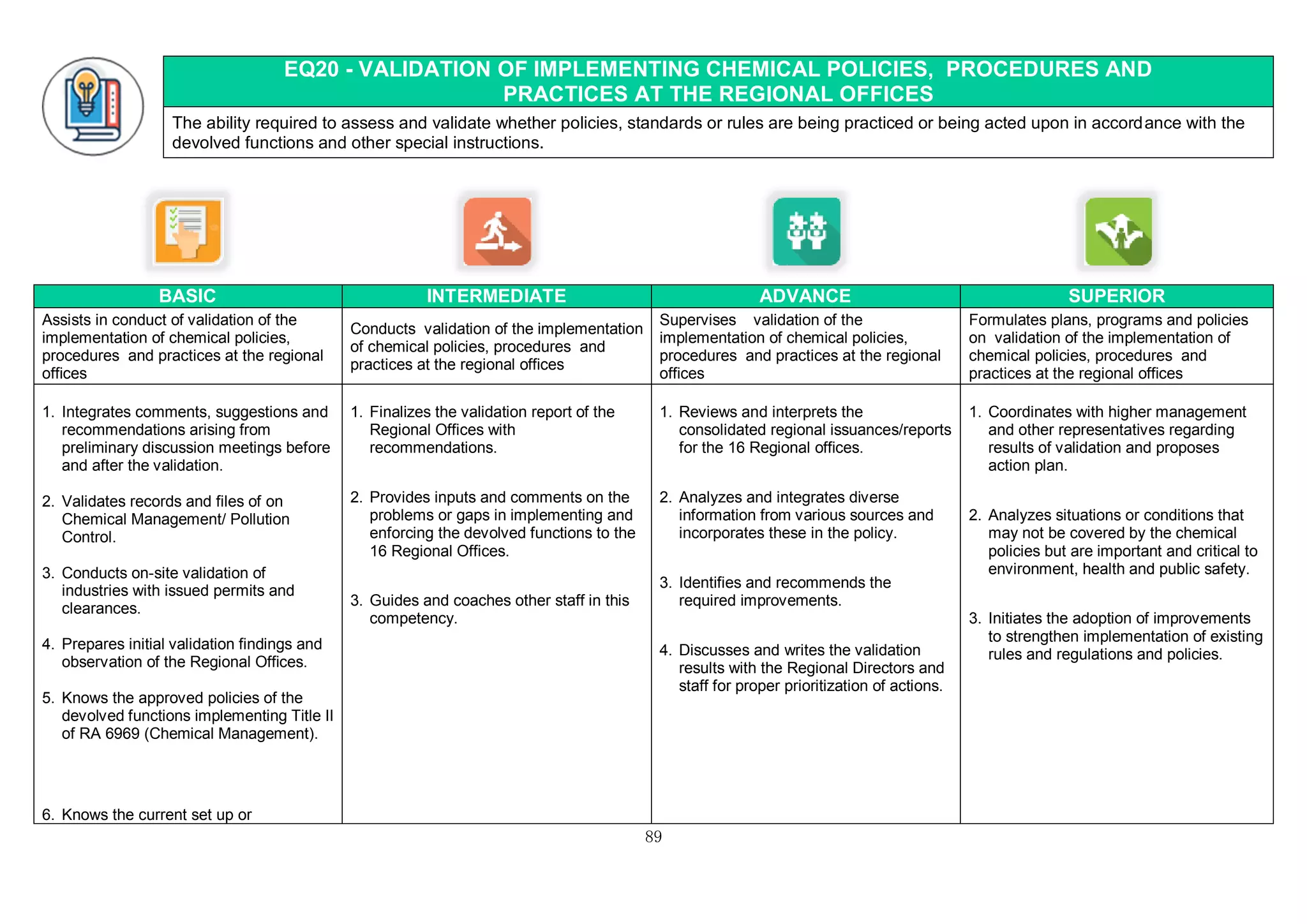
  • 173.
    166 ERO13 - SOLIDWASTE MONITORING AND ASSESSMENT The ability required to enforce, implement and monitor compliance to RA 9003. BASIC INTERMEDIATE ADVANCE SUPERIOR Assists in conduct of solid waste monitoring and assessment activities Conducts solid waste monitoring and assessment activities Formulates plans, programs and policies on solid waste monitoring and assessment activities Supervises solid waste monitoring and assessment activities 1. Has basic knowledge of the RA 9003. 2. Understands the basic principles of Ecological Solid Waste Management (segregation at source, segregated collection, Material Recovery Facility, Composting). 3. Knows the protocols, standards and items to be monitored in SWM. 4. Knows the delineation of responsibilities between the DENR and LGUs. 5. Knows how to communicate to the LGU without being misunderstood to foster strong coordination. 1. Develops and maintains a database on the level of compliance of the LGU’s as basis for prioritizing monitoring activity 2. Prepares the requirement of local government protocols. 3. Documents the findings and observations during the conduct of SWM assessment and monitoring. 1. Monitors the compliance of LGUs and private operators to RA 9003 and other relevant guidelines. 2. Evaluates the closure and rehabilitation plans of LGUs and private operators. 3. Prepares plan to upgrade and strengthen the existing ESWM practices. 4. Orients newly hired staff on the operations of the office. 5. Prepares training module/training design on SWM. 6. Designs strategies for a better ESWM System. 7. Guides LGUs in the establishment and operationalization of MRF. 8. Responds quickly to any SWM crisis/concerns. 1. Oversees the conduct of solid waste monitoring and assessment in the region. 2. Conceptualizes innovative tools that support the SWM system. 3. Plans for contingencies and implement accordingly.
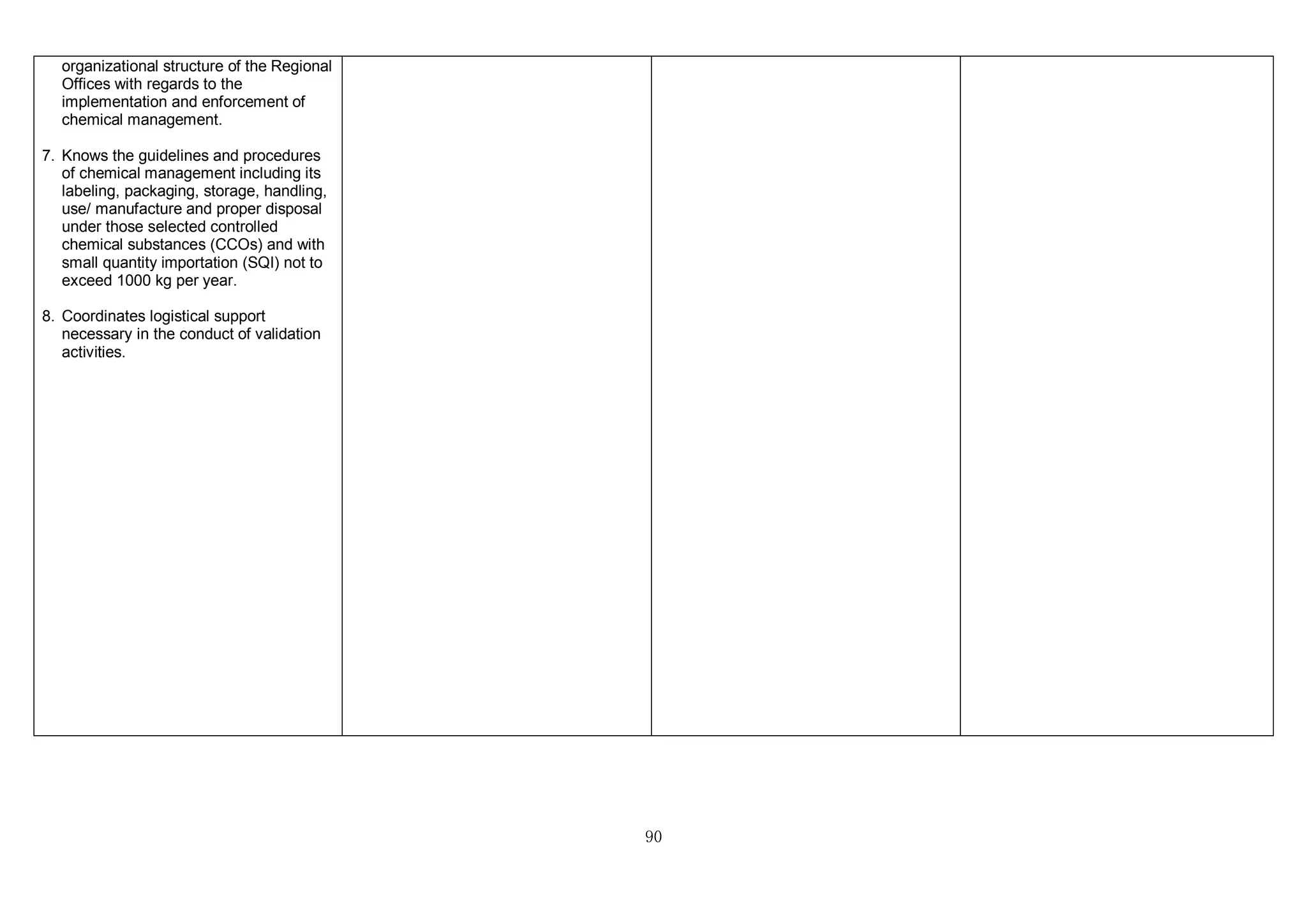
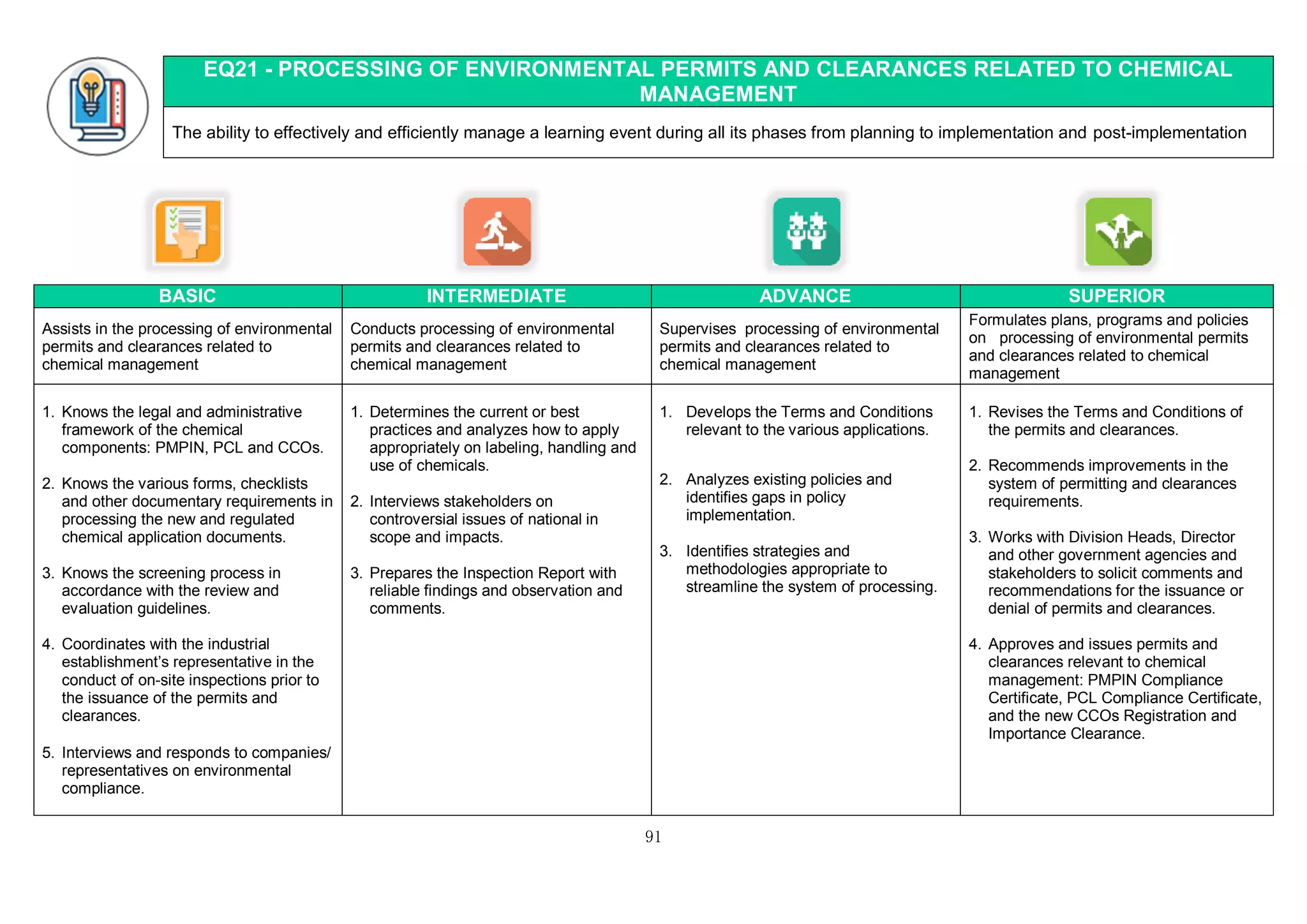
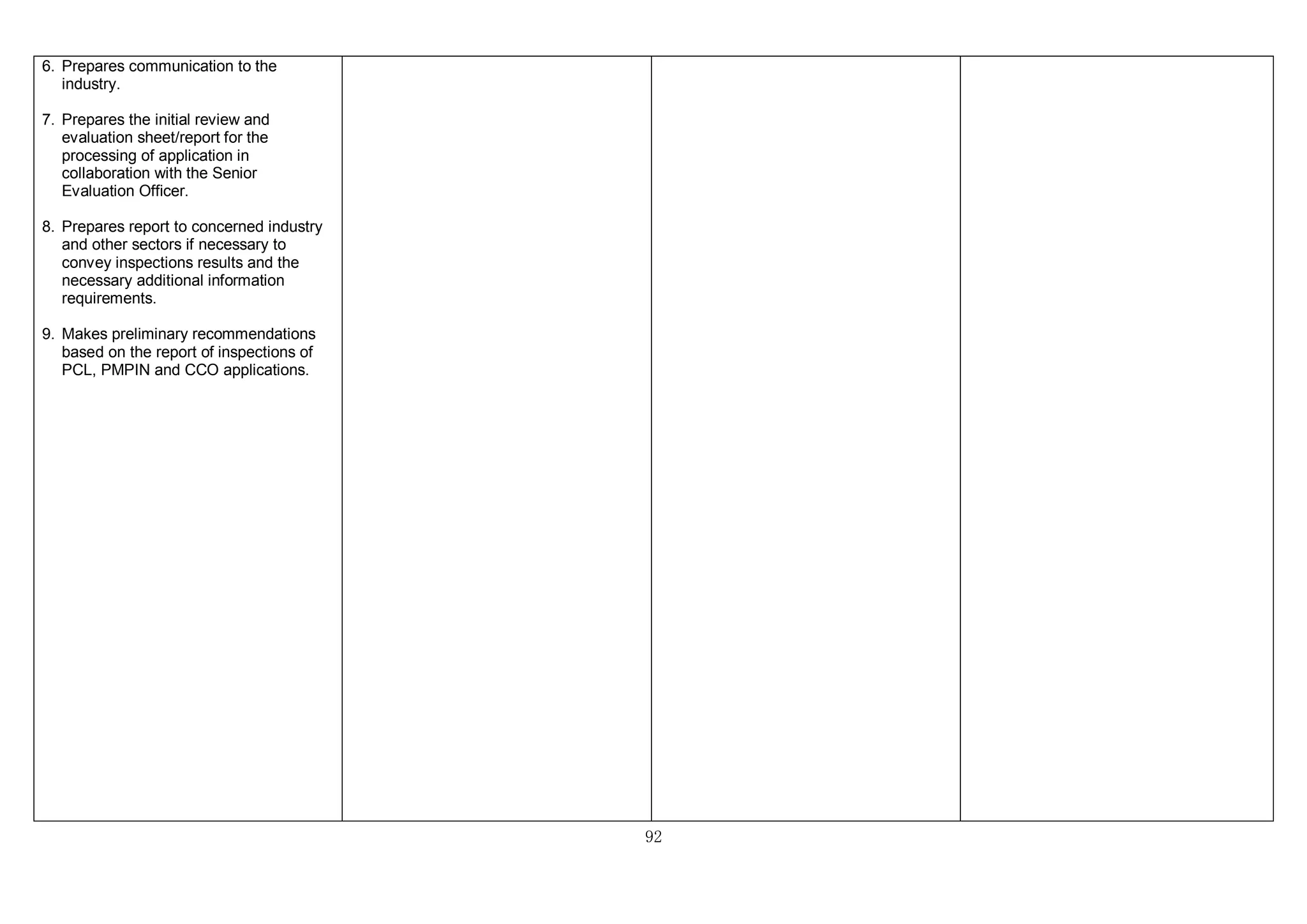
  • 174.
    167 ERO14 - TECHNICALASSISTANCE ON ESWM The ability required to render technical expertise/assistance on RA 9003 including the IRRs as well as on the policies and programs adopted by the Commission and the Department/Bureau on ESWM to LGUs, NGAs, NGOs, Academes, Private Sectors and other stakeholders with regards to the enforcement and implementation of the provisions of the Act. BASIC INTERMEDIATE ADVANCE SUPERIOR Assists in provision of technical assistance on ESWM activities Provides technical assistance on ESWM Formulates plans, programs and policies on provision of technical assistance on ESWM Supervises the provision of technical assistance on ESWM 1. Has knowledge on the monitoring and implementation of ESWM. 2. Is familiar with the policies and programs on ESWM adopted by the Commission, EMB and DENR. 3. Prepares monitoring/ performance reports on ESWM programs and projects with simple pro-forma. 4. Recommends P/P/A to LGUs or other stakeholders for better ESWM implementation. 1. Coordinates with LGUs, NGAs, NGOs, Academes, Private Sectors and other stakeholders regarding the enforcement, monitoring and implementation of ESWM programs and projects. 2. Provides technical assistance to LGUs, NGAs, NGOs, Academes, Private Sectors and other stakeholders regarding the enforcement and implementation of ESWM programs and projects. Ex. Ecological site assessment; SCRP prep; prep of 10-yr SWMP; organization of MSWMB or BESMC; conduct of WACS; establishment of MRF and SLF. 3. Prepares comprehensive reports on the implementation and enforcement of ESWM programs and projects based on the requirements of DENR units/offices and other appropriate Government Agencies. 4. Identifies problem areas and 1. Reviews and assesses reports submitted with regards to the implementation of ESWM projects and programs. 2. Prepares monitoring and evaluation design/reports on ESWM projects and programs. 3. Identifies appropriate ESWM projects/programs/activities to be undertaken in line with the Department’s priority thrusts aligned with the provisions of RA 9003. 4. Prepares project proposals on ESWM projects and programs for funding and implementation. 5. Reviews and evaluates ESWM plans and programs submitted by different LGUs regionwide. 6. Conducts impact studies on ESWM projects and programs. 1. Coordinates enforcement and implementation of ESWM projects and programs. 2. Initiates/ recommends the proposals on ESWM projects and programs for funding and implementation. 3. Evaluates measures that will effectively address the gaps in the enforcement and implementation of ESWM projects and programs. 4. Represents the Office on ESWM activities, fora , national and conventions.
  • 175.
    168 recommends procedures foreffective and efficient implementation of ESWM projects and programs.
  • 176.
    169 ERO15 - TRAININGAND INFORMATION DISSEMINATION ON ESWM The ability required to conduct and facilitate trainings and information dissemination on RA 9003 as well as on the policies and programs adopted by the Commission and the Department/Bureau on ESWM. BASIC INTERMEDIATE ADVANCE SUPERIOR Assists in the conduct of training and information dissemination on ESWM Conducts training and information dissemination on ESWM Formulates plans, programs and policies on training and information dissemination on ESWM Supervises training and information dissemination on ESWM 1. Knows the concept on ESWM including enforcement, monitoring and implementation as well as the policies and programs adopted by the Commission, the Bureau and Department. 2. Knows the organization’s IEC program to enhance public awareness and participation on the enforcement and implementation of ESWM; 3. Collects information needed in the development of IEC materials and training programs. 4. Knows the process of conducting a training program including the preparation of training designs. 5. Operates basic training equipment. 6. Assists in the preparation and presentation of IEC and training materials in terms of gathering data and crafting the materials 1. Reviews IEC/training materials and training programs on the enforcement and implementation of RA 9003; 2. Meets all training requirements needed within the specified time frame; 3. Determines type of IEC materials and training programs to be developed taking into consideration factors like communication objectives, target audience, and availability of funds and communication technologies. 4. Develops IEC materials and training programs on the enforcement and implementation ESWM. 5. Laymanizes scientific and technical literature on the enforcement and implementation of ESWM; 1. Implements contingency plans to address critical situations during training. 2. Presents ESWM lectures, synthesizes lessons and relates them to current environmental issues and concerns. 3. Integrates the program objectives, issues and concerns arising from interactions/discussions. 4. Facilitates workshop, training and other similar activities to gather needed information for development of an appropriate ESWM program. 5. Formulates training standards and policies in implementing training programs. 6. Serves as a resource person on lectures and trainings dealing with ESWM and other relevant issue. 1. Conducts participatory planning activities to develop IEC materials and training programs. 2. Introduces innovations and techniques in developing IEC materials and training programs. 3. Guides the activity flow and proceedings in a group activity for consensus building and sound decision making in crafting a recommendation/ strategy. 4. Plans contingencies and recommends accordingly.
  • 177.
    170 CC1 - DISCIPLINE Theability to:  uphold the values and principles of Ethical Standards for Government Employees (RA 6713) taking into account the social and environmental impact of one’s actions and decisions;  exemplify high standards of professional behavior as DENR employees, adhering to ethical as well as moral principles, values and standards of the Agency;  be motivated by organizational rather than personal concerns;  utilize time efficiently and productively to attain desired results;  show fulfillment in work and achievements;  exercise persistence when faced with difficult problems and challenges; and c  communicate/observe DENR mission, quality policy, values, rules and regulations in the discharge of one’s functions. BASIC INTERMEDIATE ADVANCE SUPERIOR Practices ethical and professional behaviors Upholds the values of DENR in every action and decision Serves as a good role model on DENR values and ethics to staff/peers Sponsors/ initiates development of proactive programs promoting DENR values and ethics 1. Abides by Ethical Standards for Government Employees (RA 6713) by practicing ethical and professional behaviors 2. Demonstrates trustworthiness by protecting sensitive or confidential information, following required procedures, and honoring one's commitment to others or the organization 3. Plans and organizes tasks and produces results 1. Maintains a professional image and can be depended upon 2. Respects and supports management in its decision and is able to guard and build the Agency’s reputation and image 3. Acts with a sense of urgency and responsibility to meet the organization’s needs and prioritizes tasks to attain results 1. Inspires confidence and respect from peers/ staff 2. Serves as a good role model on professionalism to staff/ peers by coming to work on time and producing outputs before the deadline 3. Engages consultation with peers, subordinates, partners, and stakeholders in decision-making 1. Influences confidence and trust in the discharge of one’s duties through personal example and DENR policies, procedures, products and services that deserve such appreciation, confidence and trust 2. Demonstrates accountability, responsibility, ethical practice and conformity to the principles of natural justice in decision making
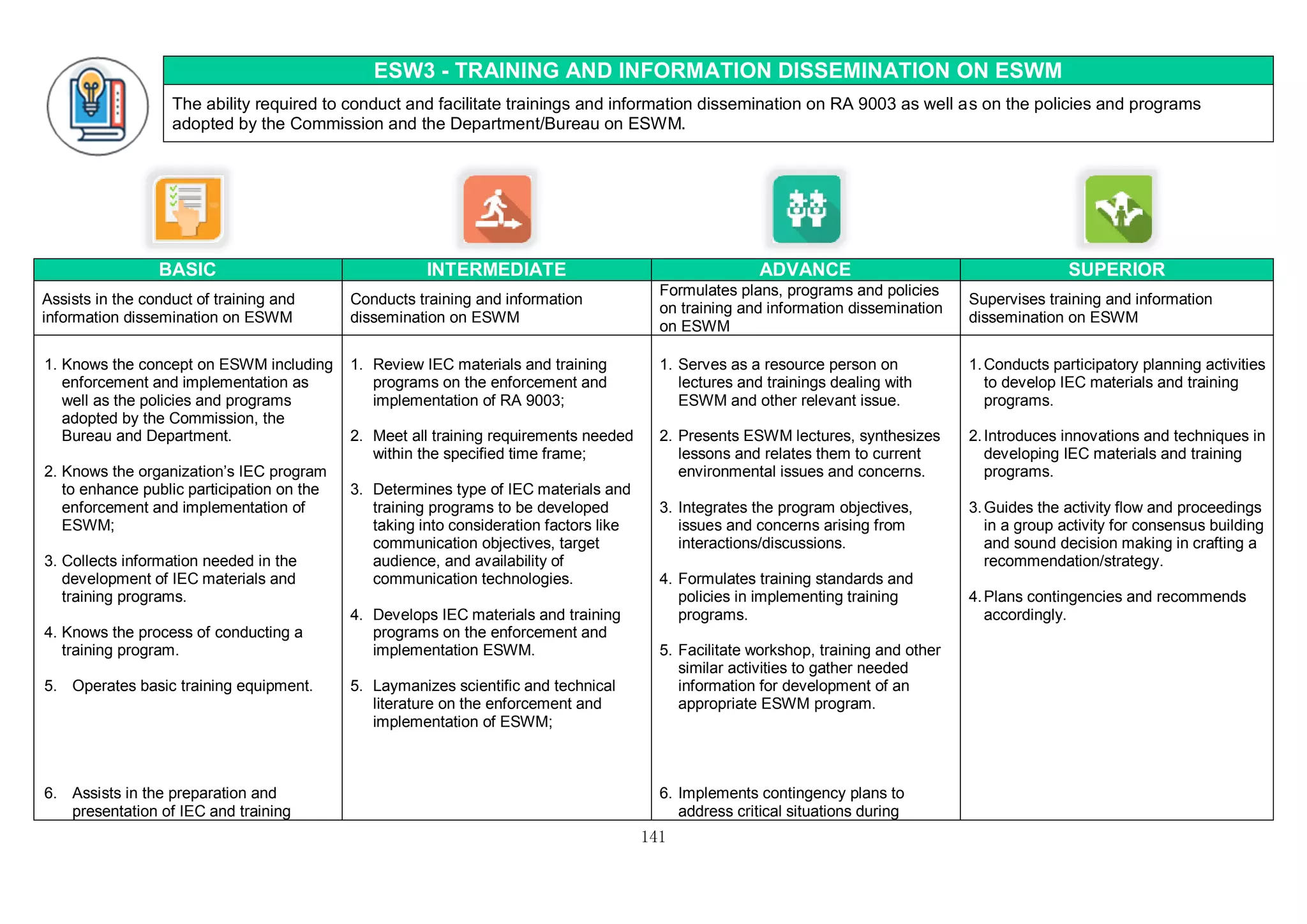
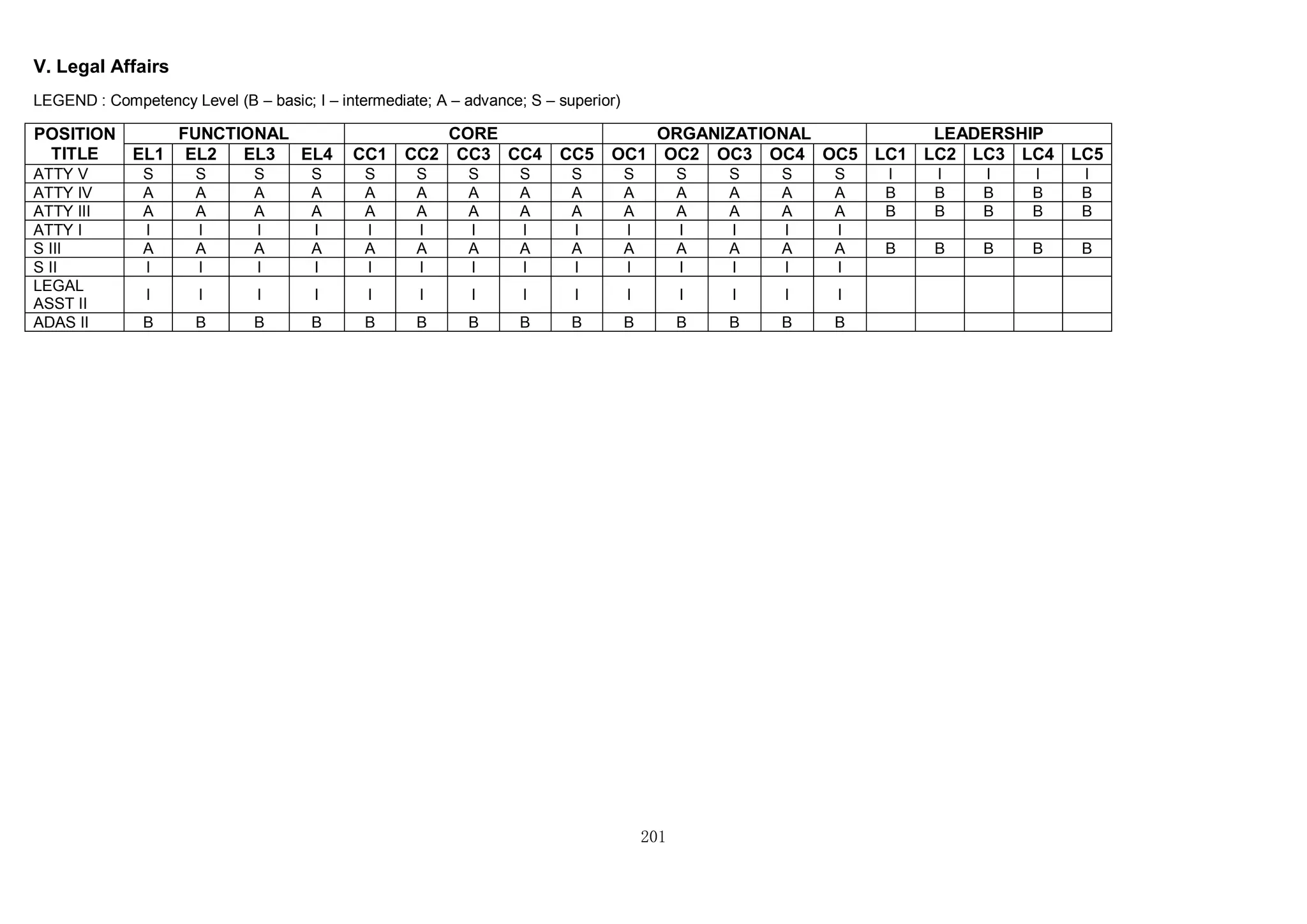
  • 178.
    171 4. Comes towork on time and attends meetings on time 5. Projects a positive outlook and attitude toward work 6. Is knowledgeable about DENR goals and directions, services, culture, history, structure, basic systems and processes and key personnel 4. Undertakes personal actions and behaviors congruent to that of the values and goals 5. Makes personal sacrifices to meet organizational needs 6. Maintains confidentiality and protects the privacy of employees, customers, and other stakeholders of DENR 4. Shows moral courage by doing the right thing or by expressing dissent on actions or pending decisions which would violate organizational values, laws, and regulations 5. Aligns organizational and personal values and guides others on DENR/office goals and directions, services and culture 3. Calls attention of peers and or offices regarding ethical problems or issues and deals proactively with conflict when addressing professional behavior with others 4. Contributes to the development of the Agency’s values and professionalism/ ethical standards and program
  • 179.
    172 CC2 - EXCELLENCE Theability to provide proactive, responsive, accessible, courteous and effective public service to attain the highest level of customer satisfaction BASIC INTERMEDIATE ADVANCE SUPERIOR Complies with DENR’s standards of service deliver Delivers and adds value to customers’ expectations and requirements Anticipates, identifies and manages stakeholders’ standards and requirements towards excellent customer service through improving sense of responsibility and competence Builds and shapes DENR service culture and strategy and provides leadership in service delivery through highest degree of responsibility and competence 1. Complies with DENR’s standards of service delivery 2. Explains DENR’s service standards and basic DENR rules and policies 3. Provides correct, adequate and prompt information to customers as may be necessary 4. Provides relevant information to supervisor on matters referred for actions 5. Shows sense of urgency in attending to customers’ needs and requests 6. Acts on simple queries/ concerns 1. Explains DENR’s structure, processes, and time involved in the delivery of services to customers 2. Articulates the vision, mission, programs, core values, and priority directions of the DENR 3. Provides correct, adequate and prompt information to customers as may be necessary 4. Provides advice and guidance to subordinates with regard to concerns elevated to their level 5. Takes the extra mile in customer service by consistently exceeding expectations 1. Anticipates and identifies stakeholders need and value based on programs and, policies and analyzes based on the parameters and condition of customer service satisfaction 2. Mentors and coaches subordinates and peers on how to provide correct, adequate and prompt information to customers as may be necessary 3. Anticipates and analyses stakeholders’ needs and provides appropriate and immediate response 4. Proactively comes up with solutions to manage stakeholders’ expectations 1. Consistently exceeds stakeholders’ needs and expectations by keeping abreast with local and global best practices in managing bureaucracy necessary to implement a successful change strategy 2. Designs mechanisms in the provision of correct, adequate and prompt information to customers as may be necessary 3. Directs the organization towards the achievement of the service excellence platform in the entire bureaucracy
  • 180.
    173 6. Initiates/recommends process improvementsbased on customers’ feedback 5. Initiates improvements in service delivery based on stakeholder feedback 6. Influence changes in system, practices or policies to attend to a customer’s unusual or outside- ofscope needs, cognizant that the requirement does not impact the bureaucracy or organization processes adversely 7. Seeks ways to improve one’s knowledge and skills to perform requirements of present and future role in DENR 8. Models excellence in assuming responsibility for dealing with problems, crises or issues. Does not blame others for mistakes and learns from them 4. Recommends to DENR management mechanisms for the institutionalization of a service culture 5. Ensures compliance with established parameters of authority within DENR and empowers subordinates to manage DENR’s culture of service excellence 6. Formulates/Designs strategies in the scaling-up of service delivery as a result of analysis, appreciation and understanding of the customer’s needs and concerns 7. Promotes a culture of continuous learning to strengthen competency of people to raise the bar toward high quality service delivery 8. Serves as champion in the sharing and applying new knowledge, skills and responsibility learned in one’s field to stakeholders both internally and externally 9. Gathers and analyzes feedbacks from subordinates and respond effectively to address concern
  • 181.
    174 CC3 - NOBILITY Theability to exemplify the quality of being noble in character and mind by displaying virtue, goodness, honor, justice and decency. It also includes traits of purity, selflessness and worthiness as well as concern for justice, peace and genuine respect for people. BASIC INTERMEDIATE ADVANCE SUPERIOR Demonstrates virtue, goodness, honor, justness and decency at all times Demonstrates virtue, goodness, honor, justness and decency even in difficult situations Influences others to observe virtue, goodness, honor, justness and decency in all situations Inspires others to act in the highest level of virtue, goodness, honor, justness and decency 1. Demonstrates trustworthiness and selfless concern for the well- being of others 2. Manifests objectivity, impartiality and fairness in handling situations at work 3. Adheres to right standard of conduct in dealing with stakeholders 4. Shows respect for others 5. Fulfills an obligation or keeps an agreement 6. Demonstrates honesty and compassion in all situations 1. Manifests equal treatment to people regardless of status 2. Shows respect, sensitivity and diplomacy to people in the attainment of common objectives 3. Is respected and regarded by superiors and peers 4. Takes an objective and independent stance in handling difficult issues and situations 5. Exhibits high level of discipline and self-control in keeping personal and sensitive information 1. Influences high level of trustworthiness and determination to resist temptation of corruption 2. Ensures accountability in handling Agency funds and complies with agency’s internal financial controls and policies and COA regulations 3. Discourages and reports to proper authorities any potential acts of dishonesty, misappropriation, malversation, connivance, or defrauding 4. Upholds and promotes the highest standards of moral values, practices, and ethics at all times 5. Complies with the disclosure 1. Promotes the culture of virtue, goodness, honor, justness and decency in the organization and manifests high level of purity, selflessness, and worthiness in every situation towards the achievement of common goals 2. Pursues goals relentlessly and with dedication, towards achieving ambitious and excellent results and demonstrates persistence and strength of character when confronted with difficulties or challenges 3. Remains calm and level-headed even in the most stressful situations. 4. Sets an example in demonstrating tact and diplomacy in handling
  • 182.
    175 policy of theagency difficult situations and people, accepts constructive criticism and uses it to improve performance
  • 183.
    176 CC4 - RESPONSIBILITY Theability to:  take full responsibility in delivering what has been agreed;  take care of entrusted human, material resources and information;  disclose all transactions and welcome reviews, audits, assessments, comments and monitoring of one’s actions; and • avoid wasteful and personal use of agency’s resources. BASIC INTERMEDIATE ADVANCE SUPERIOR Observes the principle of transparency and accountability in the workplace with supervision and guidance Practices the principle of transparency and accountability in the workplace Leads in the observance of the principle of transparency and accountability in the workplace Champions the principle of transparency and accountability in the agency 1. Understands the principle of transparency and accountability in organizations 2. Implements the required tasks and produces the deliverables 3. Makes information available in a manner appropriate to different stakeholders as instructed 4. Observes proper use of office resources and applies the 5Rs in wastes segregation 1. Applies the value of transparency and prudence in disclosing accurate material information in a timely manner 2. Takes full responsibility for all business decisions, actions/inactions, and conduct 3. Makes information available to permit timely analysis, and evaluation by relevant stakeholders 4. Shows concern and serve excellently to the agency and its stakeholders 1. Manages information so that it is timely, accurate, and complete 2. Coaches, mentors, and monitors to ensure others deliver their responsibilities as expected 3. Models the behavior expected of the employees and the criteria by which they will be assessed 4. Ensures that there is a process in which employees issues and concerns are heard and deliberated 1. Reviews employees/ unit’s accountabilities and provides guidance to ensure attainment of targets 2. Takes corrective action to address office problems in a timely and consultative manner 3. Empowers employees to hold themselves accountable and responsible of their decisions 4. Sets up systems and processes to ensure that the agency’s stakeholders are served with transparency and accountability
  • 184.
    177 CC5 – CARINGFOR THE ENVIRONMENT AND NATURAL RESOURCES The ability to demonstrate its concern for the preservation and conservation of the natural environment (not just as a job) but more as a way of life. It includes (but not limited to) the following behavioral manifestations:  takes care of the environment by throwing their garbage in the proper place and turns off light, air conditioners, computers and other electrical appliances when not in use;  uses less of the earth's resources and uses carefully those that they have to use;  reuses stuff - bags, containers, etc. and recycles materials as much as possible; and  plants/replants trees and joins/advocates environment related activities. BASIC INTERMEDIATE ADVANCE SUPERIOR Has knowledge of concepts and application of preservation and conservation of the environment Applies knowledge and understanding of the environment to further the aims of sustainability Serves as a good role model in conserving and preserving the environment to peers and staff Sponsors development of proactive programs promoting the preservation and conservation of the environment 1. Understands the wider environmental context/ importance of preserving and conserving the environment 2. Complies with relevant agency codes of conduct and practices on preserving and conserving the environment without being told 3. Demonstrates personal commitment to DENR mission and mandate, recognizing his/her obligations to society/ community 1. Demonstrates a critical awareness of current environmental problems and anticipates the impact of future environmental trends 2. Addresses and resolves problems arising from questionable environmental practice 3. Demonstrates self-direction and originality in tackling and addressing problems 1. Influences others to promote behavioral and cultural changes to secure environmental improvements beyond Agency compliance 2. Encourages others to promote and advance a sustainable and resilient approach by understanding their responsibility for environmental damage and improvement 3. Critically evaluate actions, methods and results and their short and long-term implications e.g. the impact and role of 1. Develops good practices, by actively learning from results to improve future environmental solutions and approaches 2. Advocates sustainability concerns and environmental issues, encourages others to actively contribute to environmental protection and sustainability 3. Demonstrates self-direction and originality in developing strategies for sustainable development and environmental improvement 4. Analyzes and evaluates problems from an environmental
  • 185.
    178 ecology and biodiversityin relation to new development/ construction 4. Actively learns from results to improve environmental solutions and approaches, and build best practice perspective, develops practical sustainable solutions and anticipates environmental trends to develop practical solutions
  • 186.
    179 OC1 – WRITINGEFFECTIVELY The ability to write in a clear, concise and coherent manner using different tools to convey information or express ideas effectively. BASIC INTERMEDIATE ADVANCE SUPERIOR Refers to and/or uses existing communication materials or templates to produce own written work Edits existing or customizes available communication materials to produce an appropriate written work Produces written work from scratch with some guidance while complying to agreed or prescribed standards of communicating with the bureaucracy Designs and/or sets standards for a written material used within the bureaucracy while demonstrating independence producing written work 1. Knows and uses basic business writing rules such as sentence structure, rules in grammar and techniques in word use and spelling 2. Seeks, identifies and is able to distinguish the appropriate template or reference material that will be used as basis for one’s written document 3. Writes simple pro-forma communications such as acknowledgement, transmittal letters and forms 1. Knows and uses appropriate vocabulary, formats, correct order in sentence formation to achieve cohesion in the composition of sentences 2. Understands the advantages and limitations of email and designs written work to capitalize on such advantages and mitigate the limitations 3. Solicits feedback from those able to judge the appropriateness of the written material for a given audience 4. Replies to queries and prepares Memoranda, presentations, position papers, taking points and reports using references and research tools 1. Knows and uses appropriate content, clarity, logic and presentation of written communications 2. Recognizes the legal and regulatory requirements in written communications, and tailors written work for the intended purpose and audience 3. Drafts resolutions, pleadings, terminal reports, and speeches in compliance with agreed or prescribed communication standards 4. Utilizes variety of visual elements such as graphs, charts and illustrations to enhance understanding of the written content 1. Understands and uses current trends in business writing styles and written marketing collaterals 2. Identifies benchmark examples of effective written communication that can be used by the organization, and applies these best practices in developing communication standards for the organization 3. Undertakes in-depth research to develop policy guidelines for written work and related products 4. Keeps people informed about the changes and developments in organizational goals, strategies and performance through written documentation
  • 187.
    180 OC2 – SPEAKINGEFFECTIVELY The ability to actively listen, understand and respond appropriately when interacting with individuals and groups BASIC INTERMEDIATE ADVANCE SUPERIOR Effectively delivers messages that simply focus on data, facts or information and requires minimal preparation or can be supported by available communication materials. Focus of communication is to relay information and/or data Effectively delivers messages that require some planning for the Method used and the possible reception to the message (audience may be a controlled group, i.e., team/s, divisions) Focus of communication is to relay information and to build motivation Effectively delivers messages that require careful planning for the method used and the possible impact of the message (audience may be a large group, i.e., office, organization) Focus of communication is to relay information and to build motivation Facilitates and influences target audience such as the Heads of the Agency and External Partners/Clients. Focus of communication is to relay information, to build motivation and call for action 1. Effectively listens to and understands instructions and can understand the information needs of self and others 2. Actively participates in discussions and is appropriately assertive in expressing own ideas 3. Knows where and how to get information in order to substantiate or prepare for one's communication agenda 1. Clarifies as well as summarizes discussions, providing insights on underlying issues not readily obvious to the audience 2. Adjusts communication style according to the needs of the audience and/or situation 3. Takes into account others’ point of view, listening actively and asking questions to check for understanding of others’ inputs, acting appropriately to nonverbal cues 1. Understands common conventions of language and grammar appropriate to professional settings and audience 2. Chooses and uses the appropriate medium for the message and adapts spoken language to that medium 3. Presents and discusses suggestions and proposals in English to superiors for the improvement of processes and procedures fluently 1. States complex technical concepts in an understandable manner and uses appropriate supporting materials 2. Advocates DENR goals effectively and operationalizes broad objectives into accessible and understandable language to help people identify their contribution in the organization 3. Promotes an open line and ongoing communication to address issues and align efforts to organizational goals
  • 188.
    181 4. Disseminates information accurately,sharing information and using established methods or channels to keep appropriate parties informed 4. Anticipates possible questions, objections from the audience and prepares materials or means to address or attend to such 5. Disseminates policy guidelines and resolutions to subordinate 6. Confidently explains DENR laws, rules and programs to external partners/client 7. Devises improvements to communication systems and practices within and across teams/ units/ offices in order to improve clarity and reception of messages 4. Presents to the Heads of Agency programs, projects and issues relative to their areas of responsibility for decision/resolution 5. Responds appropriately, accurately, and with composure to challenging questions or comment
  • 189.
    182 OC3 – TECHNOLOGYLITERACY AND MANAGING NFORMATION Makes effective use of technology to contribute to the improvement of the system’s performance. The ability to organize, process , distribute and manage information in order to support or facilitate the learning and data requirements of DENR BASIC INTERMEDIATE ADVANCE SUPERIOR Applies basic technology (office software and equipment) in the performance of the assigned tasks. Collects, organizes and maintains data Demonstrates the use of available equipment and software/s and application/s that can be utilized in the performance of the assigned tasks. Works with data to generate relevant information Analyzes appropriateness of office software and equipment in the performance of assigned tasks. Develops information assets to achieve organizational goals Maximizes the use of equipment and office software/s and applications in the performance of the assigned tasks. Strategizes the method and use of information that adds value to the organization and the public sector 1. Uses basic technology with supervision in performing tasks 2. Understands and complies with the set standards, policies and guidelines on the information management processes of the organization 3. Describes and distinguishes data or information that is relevant to the job and the value this brings to one’s functional role, group or the organization 4. Uses information channels and sources relevant to the job in order to identify data and transactions that need to be captured or recorded 1. Applies advanced technology tools in performing tasks 2. Knows and can articulate the importance of having accurate, readily available, timely and relevant information 3. Analyzes and corrects discrepancies and assesses the accuracy, validity, and integrity of the information 4. Evaluates information of distortions, personal bias or conflicts of interests using effective information management processes, tools and standards 1. Keeps abreast of technological changes to develop new skills and knowledge required to perform tasks 2. Identifies and implements improvements to information management processes and techniques through observation of information management competence of others 3. Facilitates the design, development or acquisition of information management tools based on the analyzed needs and gaps of an individual, group or the organization 1. Identifies gaps and recommends enhancement of office software/s and applications in performing tasks 2. Fosters the development of appropriate information assets and protocol to effectively manage and capitalize on information 3. Identifies, develops and articulates information management strategies and ensures that these are embedded within key organizational processes 4. Ensures information management activities are coordinated across the organization
  • 190.
    183 5. Uses availabletools such as notebooks or computers to document, manage, retrieve and/or distribute data or information to appropriate individuals, groups or parties 5. Provides information on a timely basis and in a usable form ensuring the availability and accessibility of organizational information resources 4. Ensures that resources are available and effectively deployed to sustain service delivery and to address information needs of an individual, group or the organization 5. Drives value and constantly reviews the impact of information management strategies and policies into the organization and the public sector, in general
  • 191.
    184 OC4 – PROJECTMANAGEMENT The ability to plan, organize, implement, direct, monitor and assess projects/ work plans, outputs, effects and impacts. BASIC INTERMEDIATE ADVANCE SUPERIOR Assist in project management activities Conducts project management activities Leads in project management activities Formulates plans, programs and policies on improvement of project management activities 1. Applies the basic knowledge in gathering /collecting relevant data/materials under supervision 2. Has basic knowledge in the preparation of research/project proposal 3. Has basic knowledge in the monitoring and evaluation process 4. Knows simple statistical tools needed in program evaluation 5. Has basic knowledge in the technical standard and specifications 1. Prepares and packages research/project proposal 2. Organizes staff assignments given the requirements of the special project 3. Identifies priorities of the project and the outputs given specific time period in consultation with superior/s 4. Devises a monitoring chart to track project activities 5. Assists in the conduct of project monitoring and evaluation using prescribed instrument 6. Develops and prepares project/research briefing presentation materials 1. Develops feasibility studies 2. Develops plans and proposals and negotiates for resources and support 3. Develops collaborative partnership plans and programs with other agencies in relation to project implementation 4. Identifies and analyzes project issues and concerns that affect project's implementation 5. Formulates performance indicators and standards 6. Develops monitoring and evaluation tools and instruments to assess the project 1. Recommends approaches and strategies to address gaps for the improvement of project 2. Formulates and recommends policies based on the results and impacts of the project 3. Supervises overall activities of the project
  • 192.
    185 7. Monitors andevaluates the development and progress of the project and prepares 8. Provides technical assistance in project management to stakeholders 9. Guides others in monitoring and evaluation of program processes 10. Prepares project terminal report
  • 193.
    186 OC5 – COMPLETEDSTAFF WORK (CSW) The ability to provide comprehensive, accurate, factual, and timely information to ensure well-informed decisions BASIC INTERMEDIATE ADVANCE SUPERIOR Practices basic knowledge of CSW to generate complete, accurate, relevant and timely output Demonstrates advanced knowledge in CSW by applying appropriate tools and techniques Leads the practice of CSW in his/her office/unit Institutionalizes and sustains the practice of CSW in the organization 1. Provides the appropriate data needed for the action to be taken 2. Strives to achieve job objectives and to meet targets based on CSW standard 1. Analyzes validated data through the use of appropriate statistical tools and other techniques 2. Determines the reliability, dependability and integrity of data and/or information gathered 3. Explores effective processes and methods in generating action plans from a complex source 4. Prepares reports containing the necessary and relevant information in CSW format 1. Recommends the best source of action or proposal in the context of CSW 2. Defines metrics in the effective use of processes and methods in the context of CSW 3. Coaches and mentors subordinates and peers on CSW process 1. Develops strategies and mechanisms to enhance the application of CSW 2. Provides avenue to generate feedbacks to identify challenges affecting the application of CSW and corresponding solutions to address the issues
  • 194.
    187 LC1 – STRATEGICLEADERSHIP (THINKING STRATEGICALLY AND CREATIVELY) The ability to “see the big picture”, think multi-dimensionally, craft innovative strategies/solutions; and envision a preferred future for one’s unit/office and functions in the context of the DENR’s Vision and Mission. It includes skills needed to establish and to communicate organizational objectives and to monitor progress toward accomplishment of such objectives; to initiate action; and to provide structure and systems to achieve goals and ensure long-term success BASIC INTERMEDIATE ADVANCE SUPERIOR Develops office/ service’s strategies and plans based on the DENR’s mission/vision Ensures that others support the DENR’s mission, goals, agenda, climate and policy Ensures that the DENR’s strategy is able to address the needs of different stakeholders Exemplifies to and leads others to support the DENR’s vision, mission, values, goals and objectives 1. Understands the role of his/her office in achieving organizational goals and aligns day-to-day actions and resources with the team’s organizational issues and opportunities 2. Develops and articulates concise, comprehensive office strategies that incorporate a System/ organization-wide perspective 3. Motivates staff into action to support the DENR’s strategies 4. Ensures that others support leader’s mission, goals, agenda, climate, and policy 1. Creates or defines goals and initiatives based on how one can support, extend or align to the goals of one’s department or functional area. 2. Establishes and implements longterm objectives, goals, or projects that support the strategy. 3. Considers the alignment of present assets, processes, and methods with the DENR’s strategy and identifies actions and changes needed to meet the strategy. 4. Develops and contributes to the creation of the DENR’s strategies 1. Plans, crafts and adapts strategies for achieving the vision, mission and objectives of the agency and secures the proper implementation of these strategies. 2. Redesigns processes or services to better meet the DENR’s longterm goals. 3. Develops Contingency Strategy and Plans Based on DENR Strategies. 4. Strategically prepares, modifies and reviews contingency strategy; anticipates obstacles that could 1. Interprets the complex and volatile nature of the environment to the agency and adaptively moves it into a more strategic position where it can better address the challenges it faces both now and into the future. 2. Communicates a clear vision that generates enthusiasm, passion and commitment to the organization mission. 3. Influences and persuades through effective will power. 4. Takes on a pivotal role in promoting the development of an inspiring, relevant vision for the
  • 195.
    188 arise. 5. Examines radicalstrategic options and dramatic alternatives that drive the DENR’s culture and results 6. Pushes oneself and strongly influences/ encourages others to “think outside the box” in setting the future direction of the DENR. 7. Coaches/guides other officers on how the DENR’s vision/mission /goals could be achieved organization and influences others to share ownership of office goals. 5. Takes initiative to collaborate with leadership team and other line agencies to shape the strategic direction of DENR
  • 196.
    189 LC2 – LEADINGCHANGE The ability to generate genuine enthusiasm and momentum for organizational change. It involves engaging and enabling groups to understand, accept and commit to the change agenda. It also includes the ability to encourage others to seek opportunities for different and innovative approaches in addressing challenges and opportunities, and to advance and sustain change within the organization. BASIC INTERMEDIATE ADVANCE SUPERIOR Influences and guides team in understanding, accepting and supporting any change efforts/ programs of the DENR Ensures the effective implementation of any change initiatives/ programs of the DENR by guiding the team in the transition process Addresses the interests and objections of all the stakeholders involved in the change process Formulates a change management framework and change management implementation plan to guide all the stakeholders involved in the change process 1. Recognizes and communicates the change that is introduced in the unit/organization and its effect to DENR 2. Communicates the work cooperatively with others to produce innovative solutions 3. Supports various change management activities; e.g. communications, education, team development, coaching 4. Prepares team/unit for the change by defining management strategy and preparing change management team 1. Implements plans or activities related to a change initiative affecting one’s functional area or expertise and motivates division members’ commitment to accept the change 2. Forwards personal, professional and work unit needs and interests in an issue 3. Develops change management plans and takes action and implements plans 4. Diagnoses gaps and manages resistance n any change efforts effectively 1. Constructs a change management plan in which one or more office systems and/or processes are affected either by a change intervention conducted internally or by an external consultant 2. Guides groups or teams through the transition process leading to the development and implementation of new approaches, systems, structures and methods 3. Helps employees to develop a clear understanding of what they will need to do differently, as result of changes in the organization 1. Plans, defines and exhibits buy-in and full support for the change management plan to succeed organization-wide to improve organizational effectiveness 2. Develops change management sponsorship model 3. Establishes structures and processes to plan and manage the orderly implementation of change that will be beneficial to the DENR 4. Reinforces the change effort in a dynamic manner 5. Provides strategic insight on change management
  • 197.
    190 5. Recognizes rightaway the effect of a certain change in the organization and if such change can be beneficial to the DENR 6. . Implements corrective actions and recognizes team/unit success 4. Challenges the status quo by comparing it to an ideal or a vision for change 5. Builds broad based support for ideas, initiatives and directives 6. Acts as mentor/coach to change management teams and provides guidance 7. Leads in setting new organization’s directions, partnerships, policies and procedures
  • 198.
    191 LC3 – PEOPLEDEVELOPMENT (CREATING AND NURTURING A HIGH PERFORMING ORGANIZATION) The ability to develop subordinates’ competencies and enhance their performance by planning effective development activities related to current and future jobs. It includes the ability to create a high performing organizational culture that is purpose driven, results based, client focused and team oriented. It also includes the ability to develop and nurture effective relationships with colleagues and team members and to deal constructively with conflicts BASIC INTERMEDIATE ADVANCE SUPERIOR Applies the basic principle of motivating and coaching people in the workplace Motivates, trains, coaches and mentors people towards achieving quality results Creates a work environment that encourages individuals to strive and reach their full potential Ensures that work processes, procedure and resources provide for on-going growth 1. Knows the basic principles of motivating and coaching people 2. Gives directions or demonstrations for the purpose of a training strategy (i.e., volunteers additional resources, tools, information, expert advice, etc.) 3. Asks questions, gives tests, or uses other methods to verify that others have understood explanation or directions 4. Gives specific feedback for developmental purposes 5. Facilitates workforce effectiveness through motivating and developing people within a 1. Builds a shared sense of destiny among individuals with seemingly disparate views, concerns and aspirations; creates team cohesion and improves individual and team performance 2. Motivates people towards achieving quality results 3. Actively participates in the longterm learning or development of staff with an appropriate level of needs analysis and other relevant approaches 4. Creates new programs or materials to meet identified training needs. 5. Involves staff in project tasks, 1. Creates a culture where team work and independence is nurtures by facilitating collaboration across organizations 2. Creates a work environment that encourages individuals to seek challenges and to strive in reaching their full potential 3. Recognizes individuals’ needs and wants and where possible incorporates it into work assignments consistent with their personal strengths 4. Does long-term coaching or training by arranging appropriate and helpful assignments, formal training, or other experiences for 1. Fosters and cultivates a shared sense or commitment between and/or among groups, departments and clients despite differences and /or complexities of relationships and leads the organization towards a learning culture committed to continuous improvement and talent development 2. Cultivates a learning environment by structuring interactive experience such as looking for future opportunities that are in support of achieving an individual’s career goals to gain their full potential 3. Improves the skills and effectiveness of individuals
  • 199.
    192 work environment thatpromotes mutual trust and respect 6. Provides staff with opportunities to attend training sessions which cater to their professional development needs 7. Reassures others after a setback 8. Gives negative feedback in behavioral rather than personal terms, and expresses positive expectations for future performance and/or gives suggestions for improvement 9. Establishes and maintains effective one-on-one relations with a variety of people, customers, individuals, and institutions resources and responsibilities and provides opportunities for them to clarify aspects of particular tasks or seek further directions 6. Explores opportunities to mentor/coach individual members of the workforce. 7. Encourages staff to participate in development opportunities (for example cross posting, accepting higher duties) to enhance career opportunities 8. Encourages team members to discuss concerns and conflicts openly rather than covering them up or overlooking them. 9. Takes appropriate action to achieve resolution after assessing the issue. the purpose of supporting a person’s learning and development 5. Moves people to work out answers to issues themselves so they really know how, rather than simply giving them the answer 6. Empowers staff to improve their work performance through reflecting and acting on workplace experiences 7. Manifests an in-depth understanding of the ongoing reasons for a person’s behavior or responses through employing a range of development strategies 4. Establishes systems and implements it to ensure that regular constructive feedback is given to each staff members through both formal and informal situations 5. Promotes and rewards achievements in a way which openly acknowledges the contribution of individuals
  • 200.
    193 LC4 – PEOPLEPERFORMANCE MANAGEMENT (MANAGING PERFORMANCE AND COACHING FOR RESULTS) The ability to create an enabling environment which will nurture and sustain a performance based coaching culture. It includes the ability to take responsibility for employees’ performance, by setting clear goals and expectations, tracking progress against goals, ensuring feedback and addressing performance problems and issues promptly. Effectiveness in this competency area also includes a strong focus on developing people for current and future needs, managing talent, promoting value of continuous learning and improvement. BASIC INTERMEDIATE ADVANCE SUPERIOR Explains performance management principles Monitors employee performance regularly to help employee improve his/her performance the effective implementation of any change initiatives/ programs of the DENR by guiding the team in the transition process Guides others on the performance management system process and coaches staff on their performance problems Introduces changes to improve the DENR’s performance management system 1. Sets performance standards and measures progress of employees 2. Describes the job in terms of outputs and how it contributes to the organizational objectives 3. States performance expectations clearly and ensures that they are understood 4. Sets agreement with the staff/ employees on standards and measures of performance including the needed support, resources and skills 1. Monitors employee performance regularly to help employee improve his/her performance 2. Addresses performance problems in a timely way by assessing performance against standards and acting in a way to change performance for the better 3. Provides feedback or conducts performance assessment, discussion and action planning 4. Creates tools and/or applies new methods in correcting and 1. Monitors the strategic imperatives of the organization and orchestrates teams. Work and organizations culture around this through advanced skills in coaching to achieve performance standard 2. Acts to ensure others perform in accordance with clear expectations and goals 3. Administers corrective discipline or performance improvement 1. Leads the organization by example and through coaching towards a performance-based culture and the achievement of public service performance standards 2. Makes specific changes in the performance management system, or in own work methods to improve performance (e.g. does something better, faster, at lower cost, more efficiently; improves quality, customer satisfaction, morale, revenues)
  • 201.
    194 5. Checks understandingand commitment 6. Evaluates performance against clear standards or expectations improving below standard or non- compliant performance of individuals or groups, using knowledge and skills in coaching to enable them to self- initiate solutions for their growth and development 5. Coaches employees about their performance problems
  • 202.
    195 LC5 – PARTNERSHSIPAND NETWORKING (BUILDING COLLABORATIVE AND INCLUSIVE WORKING RELATIONSHIPS) The ability to build, and maintain a network of reciprocal, high trust, synergetic working relationships within the organization and across government and relevant sectors. This involves the ability to successfully leverage and maximize opportunities for strategic influencing within the organization and with external stakeholders. It also seeks to develop and utilize collaborative relationships with local and international partners to facilitate the accomplishment of Agency goals through mobilization of resources and as aid in policy formulation. BASIC INTERMEDIATE ADVANCE SUPERIOR Maintains existing local partnership and networks and capitalizes on these to deliver or enhance work outcomes Monitors employee performance regularly to help employee improve his/her performance the effective implementation of any change initiatives/ programs of the DENR by guiding the team in the transition process Guides others on the performance management system process and coaches staff on their performance problems Introduces changes to improve the DENR’s performance management system 1. Understands and articulates the nature of businesses, systems, and vision, mission and core values of partners or networks to facilitate collaboration 2. Shows and encourages mutual respect in one’s dealings with partners/ networks, providing assistance (e.g. sharing of information or resources) to maintain a good working relationships with people whose cooperation and support are important 3. Maintains contacts with people in different organizations who can 1. Builds partnerships and networks to deliver or enhance work outcomes 2. Identifies opportunities for collaboration by building productive and supportive relationships with partners/ network to maintain existing relationships and establish new ones 3. Listens to the contributions of partners, irrespective of difference of opinion and recognizes areas of common interest to plan and carry out joint initiatives 1. Strengthens and deepens partnerships and networks to deliver or enhance work outcomes 2. Recognizes ways to reinforce and expand successful partnerships 3. Practices win-win approach in resolving differences 4. Resolves conflict by anticipating concerns, constraints, or resistance from partners/ network 5. Stays alert and informed of political, cultural and religious 1. Builds and the leverages on collaborative partnerships and networks to deliver or enhance work outcomes 2. Identifies, develops, leverages relationships with a diverse group of people across sectors, culture and race 3. Forges agreements/ understandings (MOA/MOU) with private and public sector partners to achieve common goals 4. Seeks opportunities for collaboration with local and foreign
  • 203.
    196 be useful sourcesof information or resources and capitalizes on these to deliver or enhance work outcomes 4. Monitors and acts on partnership arrangements to ensure that the objectives of the partnership remain on target 4. Establishes trust by participating fully on joint initiatives and assuming responsibility on commitments 5. Facilitates dialogue regarding common concerns and opinions; makes decisions through consensus; and proposes potential actions 6. Gathers and responds to feedback to resolve specific problem 7. Conforms to local and international protocol, etiquette and procedures issues in order to anticipate and respond appropriately to potential problems affecting the partnership 6. Establishes relationships with a broad range of individuals and groups, in various organizations and cultures 7. Guides others build and maintain positive interpersonal relationships and networks partners by participating in international conventions/ conferences/ gathering 5. Renders technical assistance to local and international partners in the development of policies and programs 6. Participates in effective joint problem-solving endeavors with local and international partners 7. Represents agency in international organizations to work together in meeting mutual goals
  • 204.
  • 205.
    198 SUPPORT POSITIONS I. Administrativeand Finance LEGEND : Competency Level (B – basic; I – intermediate; A – advance; S – superior) POSITION TITLE FUNCTIONAL AS1 AS2 AS3 AS4 AS5 AS6 AS7 AS8 AS9 AS10 AS11 AS12 AS13 AS14 AS15 AS16 AS17 CHIEF AO S S S S S S S S S S S S S S S S S SUPVG AO A A A A A A A A A A A A A A A A A AO V A A A A A A A A A A A A A AO IV I I I I I I I I I I I I I AO III I I I I I I I I I I I I I AO II I I I I I I I I I I I I I AO I B B ACCT III A A A A ACCT II I I I I ACCT I I I I I ADAS III B B ADAS II B B POSITION TITLE CORE ORGANIZATIONAL LEADERSHIP CC1 CC2 CC3 CC4 CC5 OC1 OC2 OC3 OC4 OC5 LC1 LC2 LC3 LC4 LC5 CHIEF AO S S S S S S S S S S I I I I I SUPVG AO A A A A A A A A A A B B B B B AO V A A A A A A A A A A B B B B B AO IV A A A A A A A A A A AO III I I I I I I I I I I AO II I I I I I I I I I I AO I B B B B B B B B B B ADA IV (DRIVER) B B B B B B B B B B ACCT III A A A A A A A A A A ACCT II I I I I I I I I I I ACCT I I I I I I I I I I I ADAS III B B B B B B B B B B ADAS II B B B B B B B B B B
  • 206.
    199 II. Policy, Planningand Program Development LEGEND : Competency Level (B – basic; I – intermediate; A – advance; S – superior) POSITION TITLE EP1 EP2 EP3 EP4 CC1 CC2 CC3 CC4 CC5 OC1 OC2 OC3 OC4 OC5 LC1 LC2 LC3 LC4 LC5 DMO V S S S S S S S S S S S S S S I I I I I DMO IV A A A A A A A A A A A A A A B B B B B DMO III A A A A A A A A A A A A A A B B B B B DMO II I I I I I I I I I I I I I I DMO I I I I I I I I I I I I I I I PEO V S S S S S S S S S S S S S S I I I I I PEO IV A A A A A A A A A A A A A A B B B B B PEO III A A A A A A A A A A A A A A B B B B B PEO II I I I I I I I I I I I I I I PEO I I I I I I I I I I I I I I I PO V S S S S S S S S S S S S S S I I I I I PO IV A A A A A A A A A A A A A A B B B B B PO III A A A A A A A A A A A A A A B B B B B PO II I I I I I I I I I I I I I I PO I I I I I I I I I I I I I I I ADMIN AIDE VI B B B B B B B B B B B III. Statistics and Information Systems Management Section LEGEND : Competency Level (B – basic; I – intermediate; A – advance; S – superior) POSITION TITLE FUNCTIONAL CORE ORGANIZATIONAL LEADERSHIP EP4 IS1 IS2 IS3 IS4 IS5 IS6 IS7 CC1 CC2 CC3 CC4 CC5 OC1 OC2 OC3 OC4 OC5 LC1 LC2 LC3 LC4 LC5 ITO I S S S S S S S S A A A A A A A A A A B B B B B ISA II A B I A A A B I I I I I I I I I I STAT II A B I B B B A A I I I I I I I I I I COMPRO II I I I B B B B I I I I I I I I I I
  • 207.
    200 IV. Knowledge InformationSystems LEGEND : Competency Level (B – basic; I – intermediate; A – advance; S – superior) POSITION TITLE FUNCTIONAL CORE ORGANIZATIONAL LEADERSHIP IS1 IS2 IS3 IS4 IS5 IS6 IS7 CC 1 CC 2 CC 3 CC 4 CC 5 OC 1 OC 2 OC 3 OC 4 OC 5 LC 1 LC 2 LC 3 LC 4 LC 5 INFORMATION SYSTEMS DIVISION ITO III S S S S S S S S S S S S I I I I I ITO II A A A A A A A A A A A A B B B B B ISA III A A A A A A A A A A A A B B B B B CP III A A A A A A A A A A A A B B B B B ISA II I I I I I I I I I I I I CP II I I I I I I I I I I I I ADMIN ASST III (COMPUTER OPERATOR II) B B B B B B B B B B B B NETWORK INFRASTUCTURE MANAGEMENT DIVISION ITO III S S S S S S S S S S S S S I I I I I ITO II A A A A A A A A A A A A A B B B B B ISA III A A A A A A A A A A A A A B B B B B CP III A A A A A A A A A A A A A B B B B B ISA II I I I I I I I I I I I I I CP II I I I I I I I I I I I I I ADMIN ASST III (COMPUTER OPERATOR II) B B B B B B B B B B B B B STATISTICS AND DATA RESOURCE MANAGEMENT DIVISION STAT V S S S S S S S S S S S S I I I I I STAT IV A A A A A A A A A A A A B B B B B STAT III A A A A A A A A A A A A B B B B B STAT III I I I I I I I I I I I I STAT I I I I I I I I I I I I I ASST STAT B B B B B B B B B B B B IO III A A A A A A A A A A A A B B B B B IO II I I I I I I I I I I I I IO I I I I I I I I I I I I I
  • 208.
    201 V. Legal Affairs LEGEND: Competency Level (B – basic; I – intermediate; A – advance; S – superior) POSITION TITLE FUNCTIONAL CORE ORGANIZATIONAL LEADERSHIP EL1 EL2 EL3 EL4 CC1 CC2 CC3 CC4 CC5 OC1 OC2 OC3 OC4 OC5 LC1 LC2 LC3 LC4 LC5 ATTY V S S S S S S S S S S S S S S I I I I I ATTY IV A A A A A A A A A A A A A A B B B B B ATTY III A A A A A A A A A A A A A A B B B B B ATTY I I I I I I I I I I I I I I I S III A A A A A A A A A A A A A A B B B B B S II I I I I I I I I I I I I I I LEGAL ASST II I I I I I I I I I I I I I I ADAS II B B B B B B B B B B B B B B
  • 209.
    202 TECHNICAL POSITIONS Environmental QualityManagement Division I. Water Quality Management Section POSITION FUNCTIONAL CORE ORGANIZATIONAL LEADERSHIP EQ 1 EQ 2 EQ 3 EQ 4 EQ 25 EQ 26 EQ 27 EQ 28 EQ 29 CC1 CC2 CC3 CC4 CC5 OC1 OC2 OC3 OC4 OC5 LC1 LC2 LC3 LC4 LC5 CHIEF EMS S S S S S S S S S S S S S S S S S S S I I I I I SUPVG/ SR EMS A A A A A A A A A A A A A A A A A A A B B B B B ENGR III A A A A A A A A A A A A A A A A A A A B B B B B ENGR II I I I I I I I I I I I I I I I I I I I EMS II I I I I I I I I I I I I I I I I I I I II. Air Quality Management Section POSITION TITLE FUNCTIONAL CORE ORGANIZATIONAL LEADERSHIP EQ 5 EQ 6 EQ 7 EQ 8 EQ 9 EQ 10 EQ 25 EQ 26 EQ 27 EQ 28 EQ 29 CC 1 CC 2 CC 3 CC 4 CC 5 OC 1 OC 2 OC 3 OC 4 OC 5 LC 1 LC 2 LC 3 LC 4 LC 5 CHIEF EMS S S S S S S S S S S S S S S S S S S S S S I I I I I ENGR III A A A A A A A A A A A A A A A A A A A A A B B B B B ENGR II I I I I I I I I I I I I I I I I I I I I I SUPVG EMS A A A A A A A A A A A A A A A A A A A A A B B B B B SEMS A A A A A A A A A A A A A A A A A A A A A B B B B B EMS II I I I I I I I I I I I I I I I I I I I I I III. Hazardous Waste Management Section
  • 210.
    203 POSITION TITLE FUNCTIONAL CORE ORGANIZATIONALLEADERSHIP EQ 11 EQ 12 EQ 13 EQ 14 EQ 15 EQ 16 EQ 17 EQ 25 EQ 26 EQ 27 EQ 28 EQ 29 CC 1 CC 2 CC 3 CC 4 CC 5 OC 1 OC 2 OC 3 OC 4 OC 5 LC 1 LC 2 LC 3 LC 4 LC 5 CHIEF EMS S S S S S S S S S S S S S S S S S S S S S S I I I I I ENGR IV A A A A A A A A A A A A A A A A A A A A A A B B B B B ENGR III A A A A A A A A A A A A A A A A A A A A A A B B B B B ENGR II I I I I I I I I I I I I I I I I I I I I I SUPVG SRS A A A A A A A A A A A A A A A A A A A A A A B B B B B SR SRS A A A A A A A A A A A A A A A A A A A A A A B B B B B EMS II I I I I I I I I I I I I I I I I I I I I I I EMS I I I I I I I I I I I I I I I I I I I I I I I SRS II I I I I I I I I I I I I I I I I I I I I I I IV. Chemical Management Section POSITION TITLE FUNCTIONAL CORE ORGANIZATIONAL LEADERSHIP EQ 18 EQ 19 EQ 20 EQ 21 EQ 22 EQ 23 EQ 24 EQ 25 EQ 26 EQ 27 EQ 28 EQ 29 CC 1 CC 2 CC 3 CC 4 CC 5 OC 1 OC 2 OC 3 OC 4 OC 5 LC 1 LC 2 LC 3 LC 4 LC 5 CHIEF EMS S S S S S S S S S S S S S S S S S S S S S S I I I I I ENGR IV A A A A A A A A A A A A A A A A A A A A A A B B B B B ENGR III A A A A A A A A A A A A A A A A A A A A A A B B B B B ENGR II I I I I I I I I I I I I I I I I I I I I I SUPVG SRS A A A A A A A A A A A A A A A A A A A A A A B B B B B SR SRS A A A A A A A A A A A A A A A A A A A A A A B B B B B EMS II I I I I I I I I I I I I I I I I I I I I I I EMS I I I I I I I I I I I I I I I I I I I I I I I SRS II I I I I I I I I I I I I I I I I I I I I I I Environmental Impact Assessment and Management Division
  • 211.
    204 POSITION FUNCTIONAL CORE ORGANIZATIONALLEADERSHIP EI1 EI2 EI3 EI4 CC1 CC2 CC3 CC4 CC5 OC1 OC2 OC3 OC4 OC5 LC1 LC2 LC3 LC4 LC5 CHIEF EMS S S S S S S S S S S S S S S I I I I I SUPVG/ SR EMS A A A A A A A A A A A A A A B B B B B ENGR IV/III A A A A A A A A A A A A A A B B B B B ENGR II I I I I I I I I I I I I I I EMS II I I I I I I I I I I I I I I Environmental Research Division POSITION FUNCTIONAL CORE ORGANIZATIONAL LEADERSHIP ER1 ER2 ER3 ER4 ER5 ER6 ER7 ER8 CC1 CC2 CC3 CC4 CC5 OC1 OC2 OC3 OC4 OC5 LC1 LC2 LC3 LC4 LC5 CHIEF SRS S S S S S S S S S S S S S S S S S S I I I I I SUPVG/ SR SRS A A A A A A A A A A A A A A A A A A B B B B B SR SRS/EMS A A A A A A A A A A A A A A A A A A B B B B B SRS II/I I I I I I I I I I I I I I I I I I I Environmental Education and Information Division POSITION FUNCTIONAL CORE ORGANIZATIONAL LEADERSHIP EE1 EE2 EE3 EE4 EE5 EE6 CC1 CC2 CC3 CC4 CC5 OC1 OC2 OC3 OC4 OC5 LC1 LC2 LC3 LC4 LC5
  • 212.
    205 CHIEF EMS SS S S S S S S S S S S S S S S I I I I I SUPVG / SR EMS A A A A A A A A A A A A A A A A B B B B B MPS III NA A A A A NA A A A A A A A A A A B B B B B IO III I A A A A NA A A A A A A A A A A EMS II I I I I I NA I I I I I I I I I I LIBRARIAN II/I NA NA NA NA NA I I I I I I I I I I I AA VI (AI I) NA NA NA NA I NA B B B B B B B B B B Solid Waste Management Division POSITION FUNCTIONAL CORE ORGANIZATIONAL LEADERSHIP ESW1 ESW2 ESW3 CC1 CC2 CC3 CC4 CC5 OC1 OC2 OC3 OC4 OC5 LC1 LC2 LC3 LC4 LC5 CHIEF EMS S S S S S S S S S S S S S I I I I I SUPVG/ SR EMS A A A A A A A A A A A A A B B B B B EMS II/I I I I I I I I I I I I I I EMB Regional Offices Clearance and Permitting Division POSITION FUNCTIONAL CORE ORGANIZATIONAL LEADERSHIP
  • 213.
    206 ERO1 ERO2 ERO3ER04 CC1 CC2 CC3 CC4 CC5 OC1 OC2 OC3 OC4 OC5 LC1 LC2 LC3 LC4 LC5 CHIEF EMS S S S S S S S S S S S S S S I I I I I SUPVG EMS/ ENGR IV A A A A A A A A A A A A A A B B B B B SR EMS A A A I I I I I I I I I I I B B B B B ENGR II/ I I I I I I I I I I I I I I EMS II/I I I I I I I I I I I I I I I Environmental Monitoring & Enforcement Division POSITION FUNCTIONAL CORE ORGANIZATIONAL LEADERSHIP ERO5 ERO6 CC1 CC2 CC3 CC4 CC5 OC1 OC2 OC3 OC4 OC5 LC1 LC2 LC3 LC4 LC5 CHIEF EMS S S S S S S S S S S S S I I I I I SUPVG EMS/ SR EMS A A A A A A A A A A A A B B B B B ENGR IV A A A A A A A A A A A A B B B B B IO III A A A A A A A A A A A A ENGR II/ EMS II/I I I I I I I I I I I I I IO II I I I I I I I I I I I I CHEMIST III I I I I I I I I I I I I CHEMIST II I I I I I I I I I I I I LAB AIDE/ ENGG AIDE B B B B B B B B B B B B Regional Planning and Education Division POSITION FUNCTIONAL CORE ORGANIZATIONAL LEADERSHIP ERO7 ERO8 ERO9 CC1 CC2 CC3 CC4 CC5 OC1 OC2 OC3 OC4 OC5 LC1 LC2 LC3 LC4 LC5 PO V S S S S S S S S S S S S S B B B B B PO IV A A A A A A A A A A A A A
  • 214.
    207 PO III/ SREMS A A I I I I I I I I I I I ISA III NA I NA I I I I I I I I I I IO III NA NA A A A A A A A A A A A PO II I I I I I I I I I I I I I STATISTICIAN II NA I NA I I I I I I I I I I Regional Legal POSITION FUNCTIONAL CORE ORGANIZATIONAL LEADERSHIP ERO10 ERO11 ERO12 CC1 CC2 CC3 CC4 CC5 OC1 OC2 OC3 OC4 OC5 LC1 LC2 LC3 LC4 LC5 ATTY V S S S S S S S S S S S S S I I I I I ATTY IV/III A A A A A A A A A A A A A B B B B B Regional Ecology Center POSITION FUNCTIONAL CORE ORGANIZATIONAL LEADERSHIP ERO13 ERO14 ERO15 CC1 CC2 CC3 CC4 CC5 OC1 OC2 OC3 OC4 OC5 LC1 LC2 LC3 LC4 LC5 SR EMS A A A A A A A A A A A A A B B B B B EMS II I I I I I I I I I I I I I