Compensation Design
Compensation Design
Money that is received under
Money that is received under Employer-Employee
Employer-Employee
relationship
relationship is called
is called Salary.
Salary. If one is freelancer or are hired
If one is freelancer or are hired
by an organization on contract basis, their income would not
be treated as salary income.( In such case your income would
be treated as income from business and profession).
The salary consists of following parts:
Basic Salary
Basic Salary: This is the core of salary, and many other components may
: This is the core of salary, and many other components may
be calculated based on this amount. It usually depends on one’s grade
within the company’s salary structure. It is a
within the company’s salary structure. It is a fixed
fixed part of one’s
part of one’s
compensation structure.
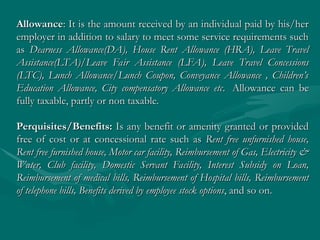
Allowance
Allowance: It is the amount received by an individual paid by his/her
: It is the amount received by an individual paid by his/her
employer in addition to salary to meet some service requirements such
as
as Dearness Allowance(DA), House Rent Allowance (HRA), Leave Travel
Dearness Allowance(DA), House Rent Allowance (HRA), Leave Travel
Assistance(LTA)/Leave Fair Assistance (LFA), Leave Travel Concessions
(LTC), Lunch Allowance/Lunch Coupon, Conveyance Allowance , Children’s
Education Allowance, City compensatory Allowance etc
Education Allowance, City compensatory Allowance etc. Allowance can be
. Allowance can be
fully taxable, partly or non taxable.
Perquisites/Benefits:
Perquisites/Benefits: Is any benefit or amenity granted or provided
Is any benefit or amenity granted or provided
free of cost or at concessional rate such as
free of cost or at concessional rate such as Rent free unfurnished house,
Rent free unfurnished house,
Rent free furnished house, Motor car facility, Reimbursement of Gas, Electricity &
Water, Club facility, Domestic Servant Facility, Interest Subsidy on Loan,
Reimbursement of medical bills, Reimbursement of Hospital bills, Reimbursement
of telephone bills, Benefits derived by employee stock options
of telephone bills, Benefits derived by employee stock options, and so on.
, and so on.
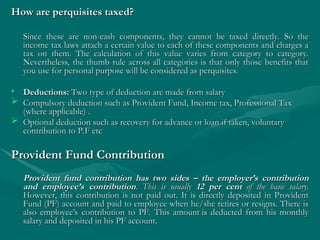
How are perquisites taxed?
Since these are non-cash components, they cannot be taxed directly. So the
income tax laws attach a certain value to each of these components and charges a
tax on them. The calculation of this value varies from category to category.
Nevertheless, the thumb rule across all categories is that only those benefits that
you use for personal purpose will be considered as perquisites.
• Deductions:
Deductions: Two type of deduction are made from salary
Two type of deduction are made from salary
 Compulsory deduction such as Provident Fund, Income tax, Professional Tax
Compulsory deduction such as Provident Fund, Income tax, Professional Tax
(where applicable) .
 Optional deduction such as recovery for advance or loan if taken, voluntary
Optional deduction such as recovery for advance or loan if taken, voluntary
contribution to P.F etc
Provident Fund Contribution
Provident fund contribution has two sides – the employer’s contribution
and employee’s contribution
and employee’s contribution.
. This is usually
This is usually 12 per cent
12 per cent of the basic salary
of the basic salary.
.
However, this contribution is not paid out. It is directly deposited in Provident
Fund (PF) account and paid to employee when he/she retires or resigns. There is
also employee’s contribution to PF. This amount is deducted from his monthly
salary and deposited in his PF account.
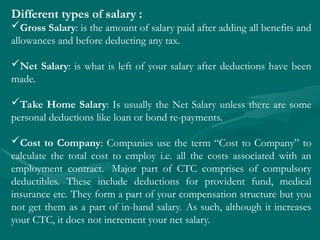
Different types of salary :
Gross Salary: is the amount of salary paid after adding all benefits and
allowances and before deducting any tax.
Net Salary: is what is left of your salary after deductions have been
made.
Take Home Salary: Is usually the Net Salary unless there are some
personal deductions like loan or bond re-payments.
Cost to Company: Companies use the term “Cost to Company” to
calculate the total cost to employ i.e. all the costs associated with an
employment contract. Major part of CTC comprises of compulsory
deductibles. These include deductions for provident fund, medical
insurance etc. They form a part of your compensation structure but you
not get them as a part of in-hand salary. As such, although it increases
your CTC, it does not increment your net salary.
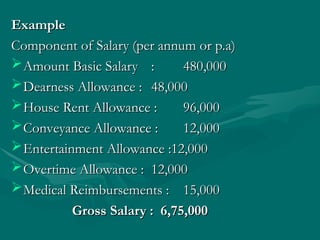
Example
Example
Component of Salary (per annum or p.a)
Amount Basic Salary
Amount Basic Salary :
: 480,000
480,000
Dearness Allowance :
Dearness Allowance : 48,000
48,000
House Rent Allowance :
House Rent Allowance : 96,000
96,000
Conveyance Allowance :
Conveyance Allowance : 12,000
12,000
Entertainment Allowance :12,000
Entertainment Allowance :12,000
Overtime Allowance :
Overtime Allowance : 12,000
12,000
Medical Reimbursements :
Medical Reimbursements : 15,000
15,000
Gross Salary : 6,75,000
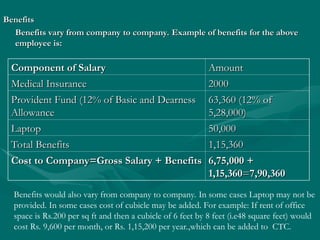
Benefits
Benefits
Benefits vary from company to company. Example of benefits for the above
employee is:
employee is:
Component of Salary
Component of Salary Amount
Amount
Medical Insurance
Medical Insurance 2000
2000
Provident Fund (12% of Basic and Dearness
Allowance
Allowance
63,360 (12% of
63,360 (12% of
5,28,000)
5,28,000)
Laptop
Laptop 50,000
50,000
Total Benefits
Total Benefits 1,15,360
1,15,360
Cost to Company=Gross Salary + Benefits
Cost to Company=Gross Salary + Benefits 6,75,000 +
6,75,000 +
1,15,360
1,15,360=
=7,90,360
7,90,360
Benefits would also vary from company to company. In some cases Laptop may not be
provided. In some cases cost of cubicle may be added. For example: If rent of office
space is Rs.200 per sq ft and then a cubicle of 6 feet by 8 feet (i.e48 square feet) would
cost Rs. 9,600 per month, or Rs. 1,15,200 per year.,which can be added to CTC.
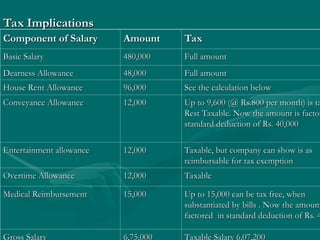
Tax Implications
Tax Implications
Component of Salary
Component of Salary Amount
Amount Tax
Tax
Basic Salary
Basic Salary 480,000
480,000 Full amount
Full amount
Dearness Allowance
Dearness Allowance 48,000
48,000 Full amount
Full amount
House Rent Allowance
House Rent Allowance 96,000
96,000 See the calculation below
See the calculation below
Conveyance Allowance
Conveyance Allowance 12,000
12,000 Up to 9,600 (@ Rs.800 per month) is ta
Up to 9,600 (@ Rs.800 per month) is ta
Rest Taxable. Now the amount is factor
standard deduction of Rs. 40,000
Entertainment allowance
Entertainment allowance 12,000
12,000 Taxable, but company can show is as
Taxable, but company can show is as
reimbursable for tax exemption
Overtime Allowance
Overtime Allowance 12,000
12,000 Taxable
Taxable
Medical Reimbursement
Medical Reimbursement 15,000
15,000 Up to 15,000 can be tax free, when
Up to 15,000 can be tax free, when
substantiated by bills . Now the amount
factored in standard deduction of Rs. 4
Gross Salary 6,75,000 Taxable Salary 6,07,200
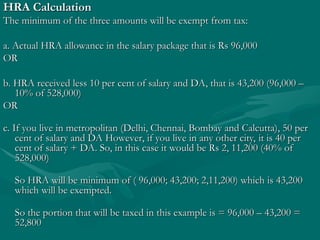
HRA Calculation
HRA Calculation
The minimum of the three amounts will be exempt from tax:
a. Actual HRA allowance in the salary package that is Rs 96,000
OR
OR
b. HRA received less 10 per cent of salary and DA, that is 43,200 (96,000 –
10% of 528,000)
10% of 528,000)
OR
OR
c. If you live in metropolitan (Delhi, Chennai, Bombay and Calcutta), 50 per
cent of salary and DA However, if you live in any other city, it is 40 per
cent of salary + DA. So, in this case it would be Rs 2, 11,200 (40% of
528,000)
528,000)
So HRA will be minimum of ( 96,000; 43,200; 2,11,200) which is 43,200
which will be exempted.
So the portion that will be taxed in this example is = 96,000 – 43,200 =
52,800
52,800
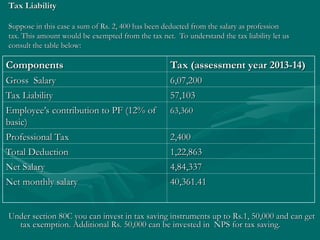
Tax Liability
Tax Liability
Suppose in this case a sum of Rs. 2, 400 has been deducted from the salary as profession
tax. This amount would be exempted from the tax net. To understand the tax liability let us
consult the table below:
Under section 80C you can invest in tax saving instruments up to Rs.1, 50,000 and can get
tax exemption. Additional Rs. 50,000 can be invested in NPS for tax saving.
Components
Components Tax (assessment year 2013-14)
Tax (assessment year 2013-14)
Gross Salary
Gross Salary 6,07,200
6,07,200
Tax Liability
Tax Liability 57,103
57,103
Employee’s contribution to PF (12% of
basic)
basic)
63,360
63,360
Professional Tax
Professional Tax 2,400
2,400
Total Deduction
Total Deduction 1,22,863
1,22,863
Net Salary
Net Salary 4,84,337
4,84,337
Net monthly salary
Net monthly salary 40,361.41
40,361.41
Compensation Design Sample presentations

  • 1.
    Compensation Design Compensation Design Moneythat is received under Money that is received under Employer-Employee Employer-Employee relationship relationship is called is called Salary. Salary. If one is freelancer or are hired If one is freelancer or are hired by an organization on contract basis, their income would not by an organization on contract basis, their income would not be treated as salary income.( In such case your income would be treated as salary income.( In such case your income would be treated as income from business and profession). be treated as income from business and profession). The salary consists of following parts: The salary consists of following parts: Basic Salary Basic Salary: This is the core of salary, and many other components may : This is the core of salary, and many other components may be calculated based on this amount. It usually depends on one’s grade be calculated based on this amount. It usually depends on one’s grade within the company’s salary structure. It is a within the company’s salary structure. It is a fixed fixed part of one’s part of one’s compensation structure. compensation structure.
  • 2.
    Allowance Allowance: It isthe amount received by an individual paid by his/her : It is the amount received by an individual paid by his/her employer in addition to salary to meet some service requirements such employer in addition to salary to meet some service requirements such as as Dearness Allowance(DA), House Rent Allowance (HRA), Leave Travel Dearness Allowance(DA), House Rent Allowance (HRA), Leave Travel Assistance(LTA)/Leave Fair Assistance (LFA), Leave Travel Concessions Assistance(LTA)/Leave Fair Assistance (LFA), Leave Travel Concessions (LTC), Lunch Allowance/Lunch Coupon, Conveyance Allowance , Children’s (LTC), Lunch Allowance/Lunch Coupon, Conveyance Allowance , Children’s Education Allowance, City compensatory Allowance etc Education Allowance, City compensatory Allowance etc. Allowance can be . Allowance can be fully taxable, partly or non taxable. fully taxable, partly or non taxable. Perquisites/Benefits: Perquisites/Benefits: Is any benefit or amenity granted or provided Is any benefit or amenity granted or provided free of cost or at concessional rate such as free of cost or at concessional rate such as Rent free unfurnished house, Rent free unfurnished house, Rent free furnished house, Motor car facility, Reimbursement of Gas, Electricity & Rent free furnished house, Motor car facility, Reimbursement of Gas, Electricity & Water, Club facility, Domestic Servant Facility, Interest Subsidy on Loan, Water, Club facility, Domestic Servant Facility, Interest Subsidy on Loan, Reimbursement of medical bills, Reimbursement of Hospital bills, Reimbursement Reimbursement of medical bills, Reimbursement of Hospital bills, Reimbursement of telephone bills, Benefits derived by employee stock options of telephone bills, Benefits derived by employee stock options, and so on. , and so on.
  • 3.
    How are perquisitestaxed? How are perquisites taxed? Since these are non-cash components, they cannot be taxed directly. So the Since these are non-cash components, they cannot be taxed directly. So the income tax laws attach a certain value to each of these components and charges a income tax laws attach a certain value to each of these components and charges a tax on them. The calculation of this value varies from category to category. tax on them. The calculation of this value varies from category to category. Nevertheless, the thumb rule across all categories is that only those benefits that Nevertheless, the thumb rule across all categories is that only those benefits that you use for personal purpose will be considered as perquisites. you use for personal purpose will be considered as perquisites. • Deductions: Deductions: Two type of deduction are made from salary Two type of deduction are made from salary  Compulsory deduction such as Provident Fund, Income tax, Professional Tax Compulsory deduction such as Provident Fund, Income tax, Professional Tax (where applicable) . (where applicable) .  Optional deduction such as recovery for advance or loan if taken, voluntary Optional deduction such as recovery for advance or loan if taken, voluntary contribution to P.F etc contribution to P.F etc Provident Fund Contribution Provident Fund Contribution Provident fund contribution has two sides – the employer’s contribution Provident fund contribution has two sides – the employer’s contribution and employee’s contribution and employee’s contribution. . This is usually This is usually 12 per cent 12 per cent of the basic salary of the basic salary. . However, this contribution is not paid out. It is directly deposited in Provident However, this contribution is not paid out. It is directly deposited in Provident Fund (PF) account and paid to employee when he/she retires or resigns. There is Fund (PF) account and paid to employee when he/she retires or resigns. There is also employee’s contribution to PF. This amount is deducted from his monthly also employee’s contribution to PF. This amount is deducted from his monthly salary and deposited in his PF account. salary and deposited in his PF account.
  • 4.
    Different types ofsalary : Gross Salary: is the amount of salary paid after adding all benefits and allowances and before deducting any tax. Net Salary: is what is left of your salary after deductions have been made. Take Home Salary: Is usually the Net Salary unless there are some personal deductions like loan or bond re-payments. Cost to Company: Companies use the term “Cost to Company” to calculate the total cost to employ i.e. all the costs associated with an employment contract. Major part of CTC comprises of compulsory deductibles. These include deductions for provident fund, medical insurance etc. They form a part of your compensation structure but you not get them as a part of in-hand salary. As such, although it increases your CTC, it does not increment your net salary.
  • 5.
    Example Example Component of Salary(per annum or p.a) Component of Salary (per annum or p.a) Amount Basic Salary Amount Basic Salary : : 480,000 480,000 Dearness Allowance : Dearness Allowance : 48,000 48,000 House Rent Allowance : House Rent Allowance : 96,000 96,000 Conveyance Allowance : Conveyance Allowance : 12,000 12,000 Entertainment Allowance :12,000 Entertainment Allowance :12,000 Overtime Allowance : Overtime Allowance : 12,000 12,000 Medical Reimbursements : Medical Reimbursements : 15,000 15,000 Gross Salary : 6,75,000 Gross Salary : 6,75,000
  • 6.
    Benefits Benefits Benefits vary fromcompany to company. Example of benefits for the above Benefits vary from company to company. Example of benefits for the above employee is: employee is: Component of Salary Component of Salary Amount Amount Medical Insurance Medical Insurance 2000 2000 Provident Fund (12% of Basic and Dearness Provident Fund (12% of Basic and Dearness Allowance Allowance 63,360 (12% of 63,360 (12% of 5,28,000) 5,28,000) Laptop Laptop 50,000 50,000 Total Benefits Total Benefits 1,15,360 1,15,360 Cost to Company=Gross Salary + Benefits Cost to Company=Gross Salary + Benefits 6,75,000 + 6,75,000 + 1,15,360 1,15,360= =7,90,360 7,90,360 Benefits would also vary from company to company. In some cases Laptop may not be provided. In some cases cost of cubicle may be added. For example: If rent of office space is Rs.200 per sq ft and then a cubicle of 6 feet by 8 feet (i.e48 square feet) would cost Rs. 9,600 per month, or Rs. 1,15,200 per year.,which can be added to CTC.
  • 7.
    Tax Implications Tax Implications Componentof Salary Component of Salary Amount Amount Tax Tax Basic Salary Basic Salary 480,000 480,000 Full amount Full amount Dearness Allowance Dearness Allowance 48,000 48,000 Full amount Full amount House Rent Allowance House Rent Allowance 96,000 96,000 See the calculation below See the calculation below Conveyance Allowance Conveyance Allowance 12,000 12,000 Up to 9,600 (@ Rs.800 per month) is ta Up to 9,600 (@ Rs.800 per month) is ta Rest Taxable. Now the amount is factor Rest Taxable. Now the amount is factor standard deduction of Rs. 40,000 standard deduction of Rs. 40,000 Entertainment allowance Entertainment allowance 12,000 12,000 Taxable, but company can show is as Taxable, but company can show is as reimbursable for tax exemption reimbursable for tax exemption Overtime Allowance Overtime Allowance 12,000 12,000 Taxable Taxable Medical Reimbursement Medical Reimbursement 15,000 15,000 Up to 15,000 can be tax free, when Up to 15,000 can be tax free, when substantiated by bills . Now the amount substantiated by bills . Now the amount factored in standard deduction of Rs. 4 factored in standard deduction of Rs. 4 Gross Salary 6,75,000 Taxable Salary 6,07,200
  • 8.
    HRA Calculation HRA Calculation Theminimum of the three amounts will be exempt from tax: The minimum of the three amounts will be exempt from tax: a. Actual HRA allowance in the salary package that is Rs 96,000 a. Actual HRA allowance in the salary package that is Rs 96,000 OR OR b. HRA received less 10 per cent of salary and DA, that is 43,200 (96,000 – b. HRA received less 10 per cent of salary and DA, that is 43,200 (96,000 – 10% of 528,000) 10% of 528,000) OR OR c. If you live in metropolitan (Delhi, Chennai, Bombay and Calcutta), 50 per c. If you live in metropolitan (Delhi, Chennai, Bombay and Calcutta), 50 per cent of salary and DA However, if you live in any other city, it is 40 per cent of salary and DA However, if you live in any other city, it is 40 per cent of salary + DA. So, in this case it would be Rs 2, 11,200 (40% of cent of salary + DA. So, in this case it would be Rs 2, 11,200 (40% of 528,000) 528,000) So HRA will be minimum of ( 96,000; 43,200; 2,11,200) which is 43,200 So HRA will be minimum of ( 96,000; 43,200; 2,11,200) which is 43,200 which will be exempted. which will be exempted. So the portion that will be taxed in this example is = 96,000 – 43,200 = So the portion that will be taxed in this example is = 96,000 – 43,200 = 52,800 52,800
  • 9.
    Tax Liability Tax Liability Supposein this case a sum of Rs. 2, 400 has been deducted from the salary as profession Suppose in this case a sum of Rs. 2, 400 has been deducted from the salary as profession tax. This amount would be exempted from the tax net. To understand the tax liability let us tax. This amount would be exempted from the tax net. To understand the tax liability let us consult the table below: consult the table below: Under section 80C you can invest in tax saving instruments up to Rs.1, 50,000 and can get Under section 80C you can invest in tax saving instruments up to Rs.1, 50,000 and can get tax exemption. Additional Rs. 50,000 can be invested in NPS for tax saving. tax exemption. Additional Rs. 50,000 can be invested in NPS for tax saving. Components Components Tax (assessment year 2013-14) Tax (assessment year 2013-14) Gross Salary Gross Salary 6,07,200 6,07,200 Tax Liability Tax Liability 57,103 57,103 Employee’s contribution to PF (12% of Employee’s contribution to PF (12% of basic) basic) 63,360 63,360 Professional Tax Professional Tax 2,400 2,400 Total Deduction Total Deduction 1,22,863 1,22,863 Net Salary Net Salary 4,84,337 4,84,337 Net monthly salary Net monthly salary 40,361.41 40,361.41