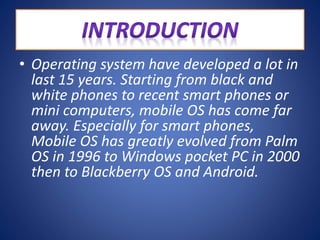
• Operating system have developed a lot in
last 15 years. Starting from black and
white phones to recent smart phones or
mini computers, mobile OS has come far
away. Especially for smart phones,
Mobile OS has greatly evolved from Palm
OS in 1996 to Windows pocket PC in 2000
then to Blackberry OS and Android.
• One of the most widely used mobile OS these
days is ANDROID. Android is a software bunch
comprising not only operating system but also
middleware and key applications. Android Inc
was founded in California, U.S. by Andy Rubin,
Rich miner, Nick sears and Chris White in 2003.
Later Android Inc. was acquired by Google in
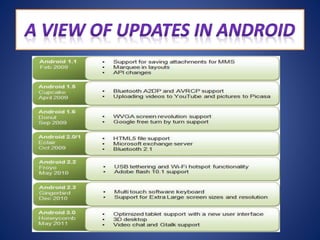
2005. After original release there have been
number of updates in the original version of
Android.
• Android is a powerful Operating
System supporting a large number of
applications in smart phones. These
applications make life more
comfortable and advanced for the
users.
• Architecture.
• Virtual machines.
• Open source app.
• Android comes with an Android market
which is an online software store. It was
developed by Google. It allows Android
users to select, and download
applications. There are around 2.0 lack+
games, application and widgets available
on the market for users.
• An operating system (OS) is a collection
of software that manages computer
hardware resources and provides
common services for computer programs.
• Real-time operating system (RTOS)
• Single-user, single task
• Single-user, multi-tasking
• Multi-user
• Microsoft introduced an operating environment named Windows
on November 20, 1985.
• 1982–1985: Introducing Windows 1.0
• 1987–1992: Windows 2.0–2.11—More windows, more speed
• 1990–1994: Windows 3.0–Windows NT—Getting the graphics
• 1995–2001: Windows 95—the PC comes of age
• 1998..2000: Windows 98, Windows 2000, Windows Me
• 2001–2005: Windows XP—Stable, usable, and fast
• 2006–2008: Windows Vista—Smart on security
• 2009: Windows 7
• 2012: Windows 8 & after that 8.1 bugs removed version
• Currently Windows 10
• Windows easy transfer
• Windows anytime upgrade
• Windows basics
• Searching and organizing
• Parental controls
• Ease of access center
• Default programs
• Remote desktop connection
• User friendly
• Readymade solutions
• Versions upgradations
• Wide range of applications
• Security improvements
• Online help desk
• Supporting issues with old hardware
• High source requirement
• Hijacking threats
• Not efficient in protection from viruses
• End of presentation .
• Thank you .

Comparison between Android and windows operating system.

  • 4.
    • Operating systemhave developed a lot in last 15 years. Starting from black and white phones to recent smart phones or mini computers, mobile OS has come far away. Especially for smart phones, Mobile OS has greatly evolved from Palm OS in 1996 to Windows pocket PC in 2000 then to Blackberry OS and Android.
  • 5.
    • One ofthe most widely used mobile OS these days is ANDROID. Android is a software bunch comprising not only operating system but also middleware and key applications. Android Inc was founded in California, U.S. by Andy Rubin, Rich miner, Nick sears and Chris White in 2003. Later Android Inc. was acquired by Google in 2005. After original release there have been number of updates in the original version of Android.
  • 7.
    • Android isa powerful Operating System supporting a large number of applications in smart phones. These applications make life more comfortable and advanced for the users.
  • 8.
    • Architecture. • Virtualmachines. • Open source app.
  • 9.
    • Android comeswith an Android market which is an online software store. It was developed by Google. It allows Android users to select, and download applications. There are around 2.0 lack+ games, application and widgets available on the market for users.
  • 12.
    • An operatingsystem (OS) is a collection of software that manages computer hardware resources and provides common services for computer programs.
  • 13.
    • Real-time operatingsystem (RTOS) • Single-user, single task • Single-user, multi-tasking • Multi-user
  • 14.
    • Microsoft introducedan operating environment named Windows on November 20, 1985. • 1982–1985: Introducing Windows 1.0 • 1987–1992: Windows 2.0–2.11—More windows, more speed • 1990–1994: Windows 3.0–Windows NT—Getting the graphics • 1995–2001: Windows 95—the PC comes of age • 1998..2000: Windows 98, Windows 2000, Windows Me • 2001–2005: Windows XP—Stable, usable, and fast • 2006–2008: Windows Vista—Smart on security • 2009: Windows 7 • 2012: Windows 8 & after that 8.1 bugs removed version • Currently Windows 10
  • 15.
    • Windows easytransfer • Windows anytime upgrade • Windows basics • Searching and organizing • Parental controls • Ease of access center • Default programs • Remote desktop connection
  • 16.
    • User friendly •Readymade solutions • Versions upgradations • Wide range of applications • Security improvements • Online help desk
  • 17.
    • Supporting issueswith old hardware • High source requirement • Hijacking threats • Not efficient in protection from viruses
  • 18.
    • End ofpresentation . • Thank you .