ThoughtWorks


               comparing
          groovy & jruby *
* please check all knives, guns, pitchforks, and torches at the door


                             NEAL FORD        software architect / meme wrangler


                                       ThoughtWorks
                           nford@thoughtworks.com
                           3003 Summit Boulevard, Atlanta, GA 30319
                           www.nealford.com
                           www.thoughtworks.com
                           blog: memeagora.blogspot.com
                           twitter: neal4d
housekeeping
ask questions at the end
(insane amount of material!)


download slides from
nealford.com


download samples from github.com/nealford
agenda:
syntax

closures

eigenclass approaches

meta-programming

framework approach
geek fu test:
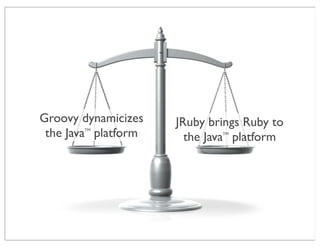
Groovy dynamicizes   JRuby brings Ruby to
 the Java platform
       TM

                       the Java platform
                             TM
differences & observations
syntax
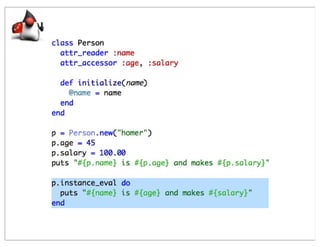
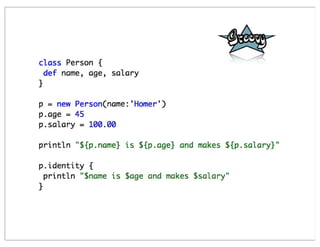
sigils
this.name

   vs

 @name
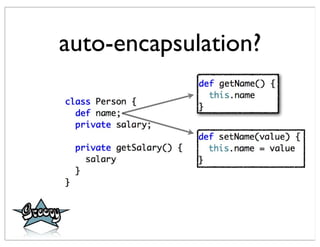
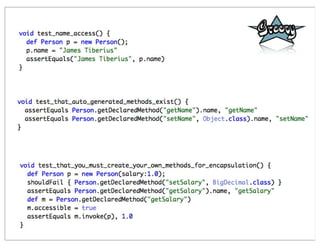
auto-encapsulation?
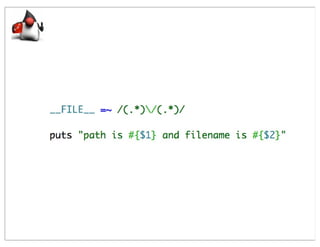
Perl !!!!!!!!!
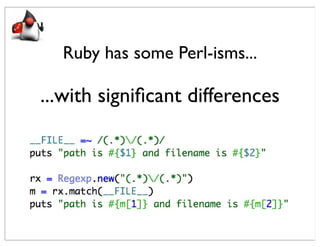
Ruby has some Perl-isms...

...with significant differences
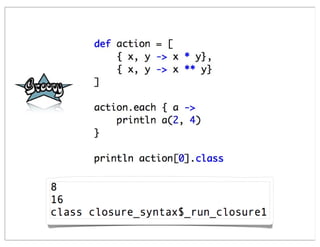
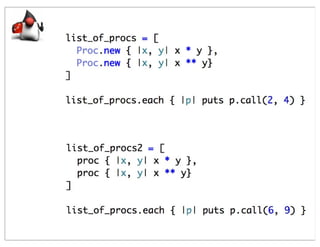
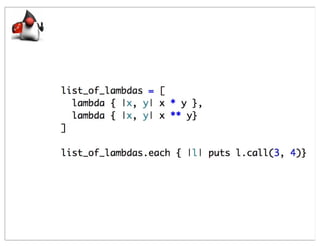
closures
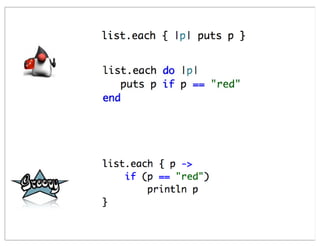
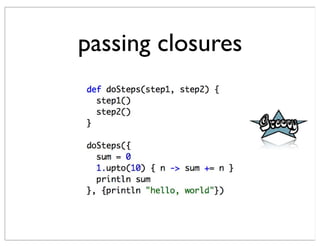
passing closures
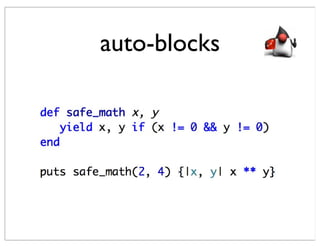
auto-blocks
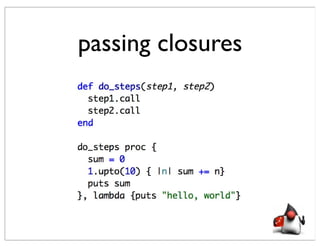
passing closures
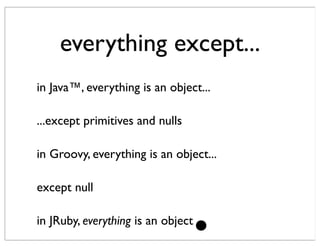
everything except...
in Java™, everything is an object...

...except primitives and nulls

in Groovy, everything is an object...

except null

in JRuby, everything is an object.
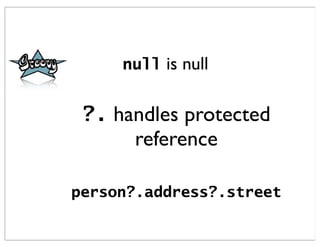
null is null


 ?. handles protected
      reference

person?.address?.street
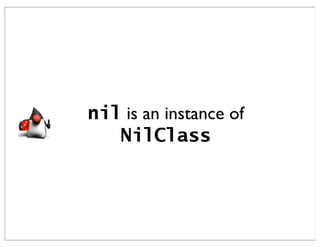
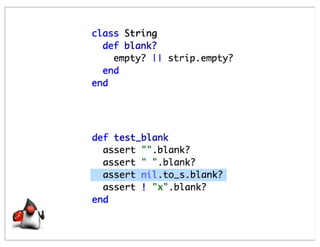
nil is an instance of
   NilClass
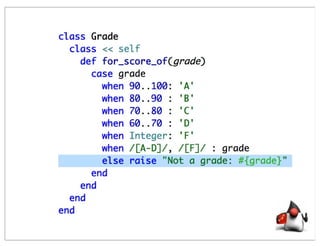
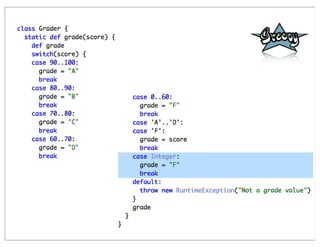
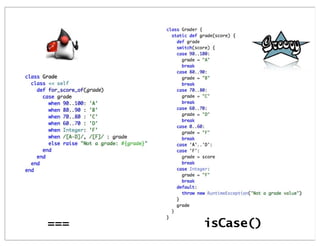
switch/case statement
===   isCase()
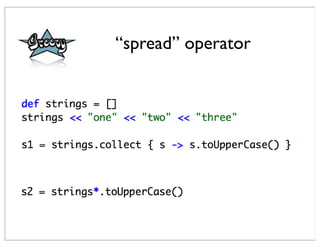
“spread” operator
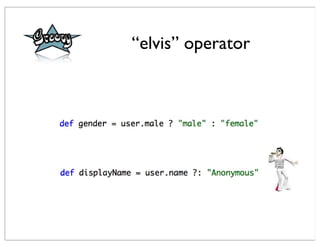
“elvis” operator
side effects of
encapsulating
    Java™
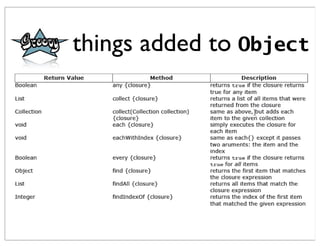
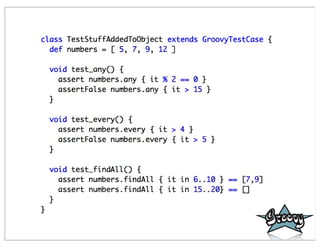
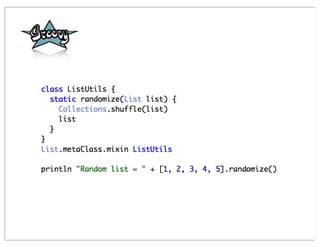
things added to Object
supporting collections
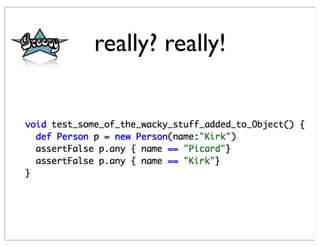
really? really!
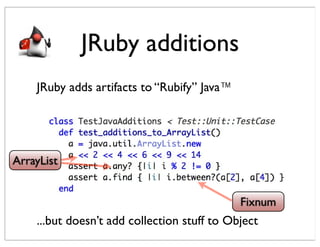
JRuby additions
    JRuby adds artifacts to “Rubify” Java™


ArrayList


                                             Fixnum
    ...but doesn’t add collection stuff to Object
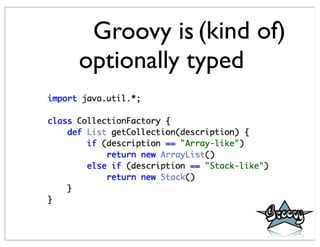
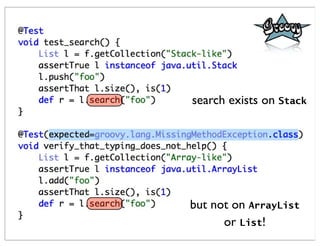
Groovy is (kind of)
optionally typed
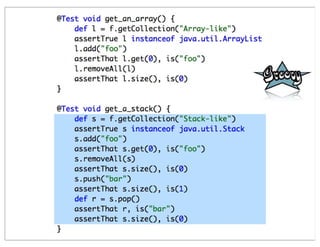
search exists on Stack


but not on ArrayList
      or List!
interfaces & mixins
Groovy & interfaces

allows you to interact with Java™ interfaces


can wrap proxies around them if needed


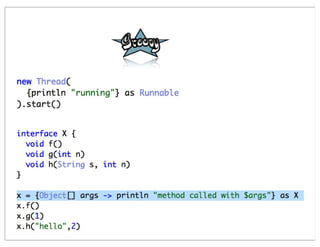
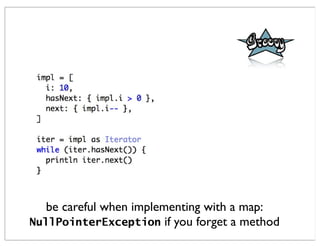
“fake out” interfaces via closures using as
be careful when implementing with a map:
NullPointerException if you forget a method
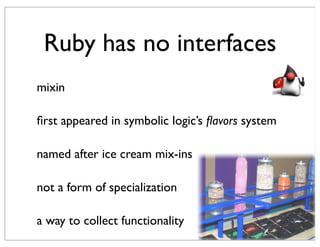
Ruby has no interfaces
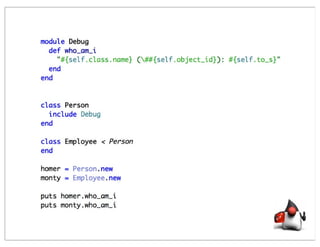
mixin

first appeared in symbolic logic’s flavors system

named after ice cream mix-ins

not a form of specialization

a way to collect functionality
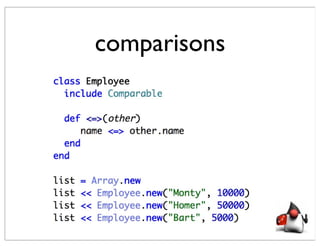
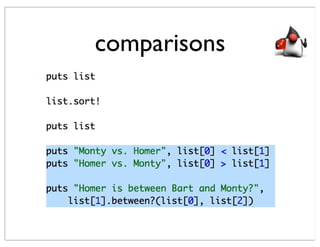
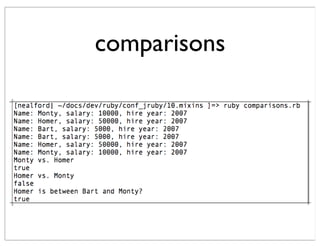
comparisons
comparisons
comparisons
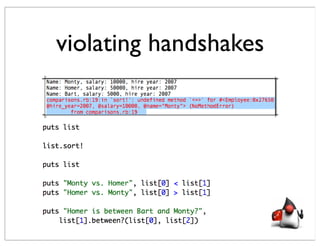
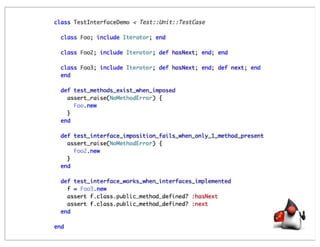
violating handshakes
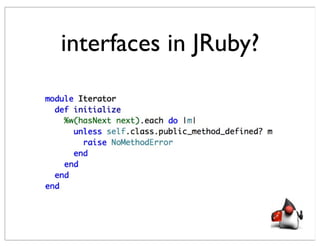
mixins in Groovy,
interfaces in JRuby
interfaces in JRuby?
meta-programming
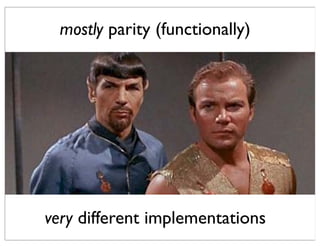
mostly parity (functionally)


very different implementations
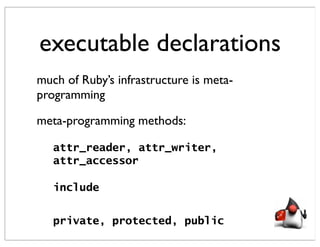
executable declarations
much of Ruby’s infrastructure is meta-
programming

meta-programming methods:

   attr_reader, attr_writer,
   attr_accessor

   include


   private, protected, public
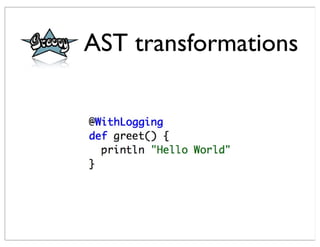
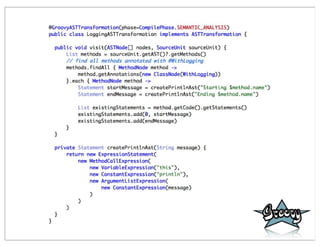
AST transformations
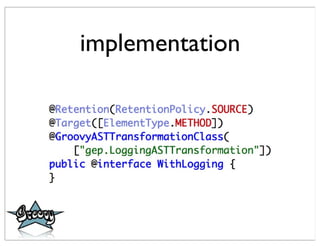
implementation
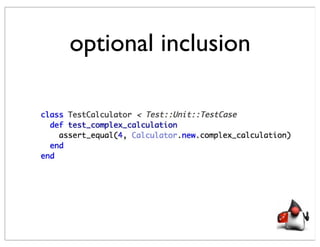
optional inclusion
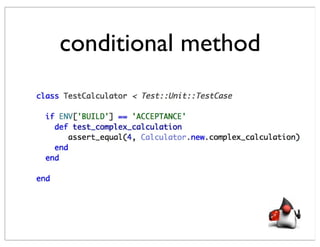
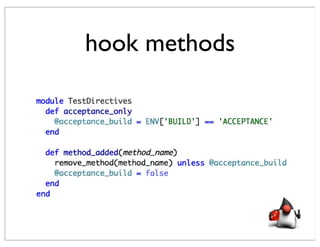
conditional method
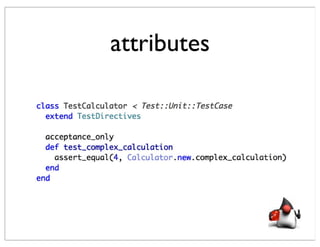
attributes
hook methods
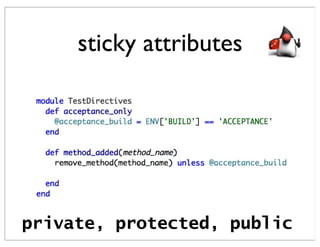
sticky attributes


private, protected, public
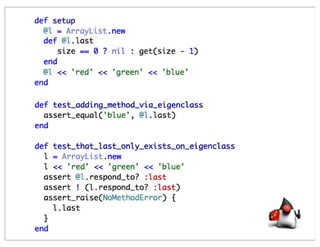
eigenclass
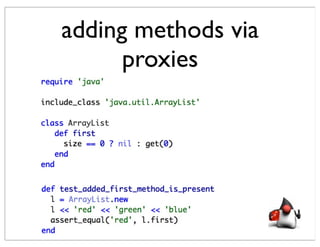
adding methods via
      proxies
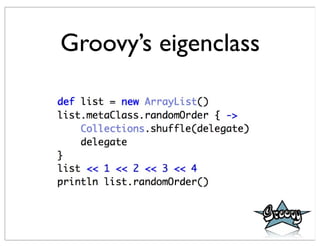
Groovy’s eigenclass
framework
 approach
encapsulate
 & extend
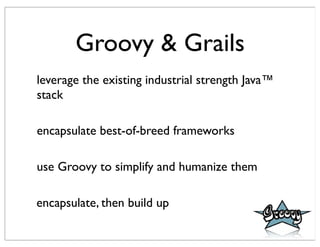
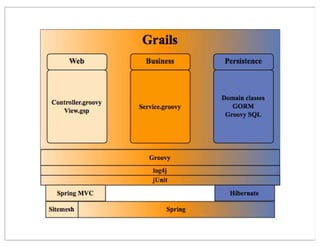
Groovy & Grails
leverage the existing industrial strength Java™
stack

encapsulate best-of-breed frameworks

use Groovy to simplify and humanize them

encapsulate, then build up
abstraction
layers
via
meta || dsl
Ruby

tends to build things as abstraction layers atop
Ruby using meta-programming & dsl techniques

Ruby on Rails = software factories + dsl’s

Ruby language is always 1 abstraction layer
down

lightweight abstraction layers
case study: builders
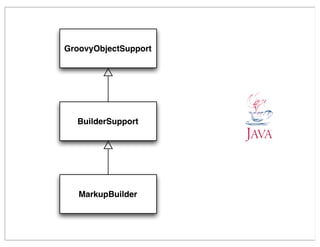
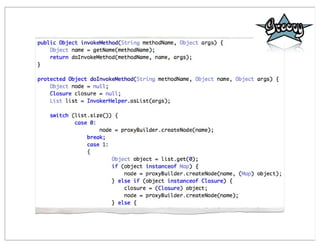
GroovyObjectSupport


  BuilderSupport


   MarkupBuilder
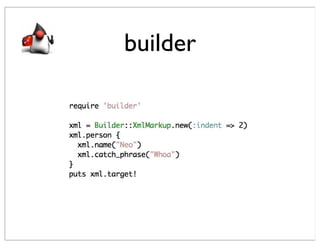
builder
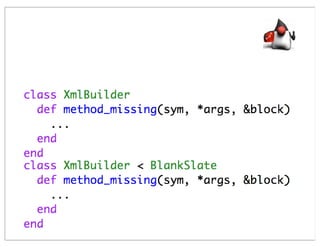
builder works via
method_missing

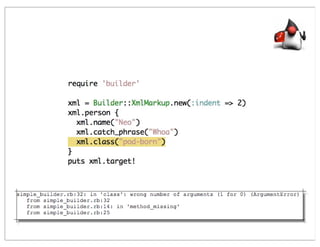
 but what about this?
the problem:

how do you inherit from object...

 ...with inheriting from object?
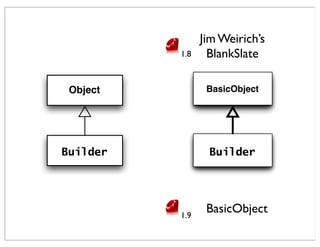
Jim Weirich’s
           1.8     BlankSlate

 Object           BasicObject
                  BlankSlate


Builder
Recorder          Builder
                  Recorder
                  Recorder


           1.9
                  BasicObject
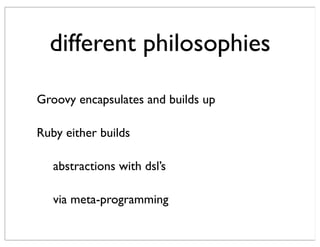
different philosophies

Groovy encapsulates and builds up

Ruby either builds

   abstractions with dsl’s

   via meta-programming
summary
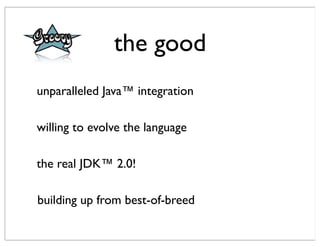
the good
unparalleled Java™ integration

willing to evolve the language

the real JDK™ 2.0!

building up from best-of-breed
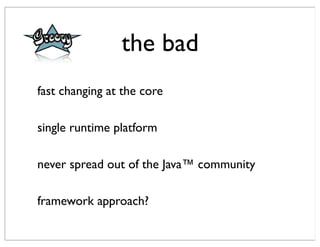
the bad
fast changing at the core

single runtime platform

never spread out of the Java™ community

framework approach?
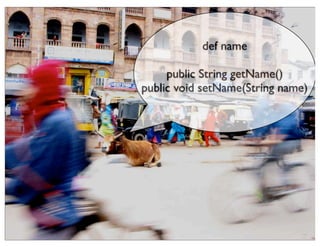
def name

     public String getName()
public void setName(String name)
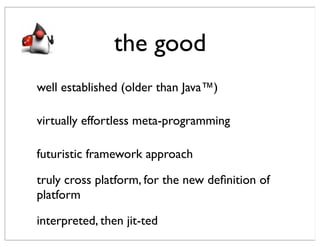
the good
well established (older than Java™)

virtually effortless meta-programming

futuristic framework approach

truly cross platform, for the new definition of
platform

interpreted, then jit-ted
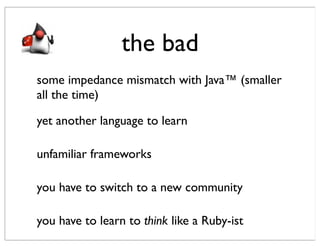
the bad
some impedance mismatch with Java™ (smaller
all the time)

yet another language to learn

unfamiliar frameworks

you have to switch to a new community

you have to learn to think like a Ruby-ist
ThoughtWorks


                                ?’s
            please fill out the session evaluations
             samples at github.com/nealford
                                                       NEAL FORD        software architect / meme wrangler


                                                                 ThoughtWorks
                                                     nford@thoughtworks.com
This work is licensed under the Creative Commons     3003 Summit Boulevard, Atlanta, GA 30319
                                                     www.nealford.com
       Attribution-Share Alike 3.0 License.          www.thoughtworks.com
                                                     blog: memeagora.blogspot.com
 http://creativecommons.org/licenses/by-sa/3.0/us/   twitter: neal4d
ThoughtWorks


                    resources
Cow in the Road photo by Sophia Huda, from
Flickr, under a Creative Commons license
groovy web site
http://groovy.codehaus.org

jruby site
http://jruby.codehaus.org

ola bini’s blog
http://olabini.blogspot.com/

charles nutter’s blog
http://headius.blogspot.com/
ThoughtWorks


                     resources
jeff brown’s blog
http://javajeff.blogspot.com/

graeme rocher’s blog
http://graemerocher.blogspot.com/

aboutGroovy
http://aboutGroovy.com

venkat subramaniam’s blog
http://www.agiledeveloper.com/blog/

Comparing groovy and_j_ruby(neal_ford)