ENGLISH 4
Look at the picture. Write 3 things
about apple and 3 things about
oranges.
Compare and
Contrast
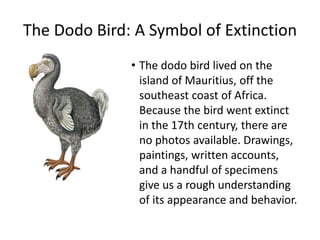
The Dodo Bird: A Symbol of Extinction
• The dodo bird lived on the
island of Mauritius, off the
southeast coast of Africa.
Because the bird went extinct
in the 17th century, there are
no photos available. Drawings,
paintings, written accounts,
and a handful of specimens
give us a rough understanding
of its appearance and behavior.
• What we do know about the dodo bird is that
it stood more than three feet tall, weighed
about 40 lbs., and was flightless. It most likely
lost this trait because it didn’t need to fly:
There were no predators on the island, and
fruit and seeds provided abundant food
sources. Things started to change for the dodo
bird in 1505 when the Portuguese arrived on
the island. After that, the bird, which weighed
about 50 lbs, became a welcome source of
food for sailors.
• Along with humans came pigs,
monkeys and rats, which made meals
of the dodo bird eggs. Since the
species had never seen humans
before, none of the dodo birds on
the island were afraid of humans, yet
another reason they became such
easy prey.
• The last reported sighting of a dodo bird was in 1688,
in the hunting records of Isaac Johannes Lamotius,
who was the governor of Mauritius. All that remains
of the dodo bird today are a dried head and foot at
the Oxford University Museum of Natural History and
skeletal remains. In recent decades, several
excavations on the island have allowed scientists to
assemble complete skeletons of the dodo bird.
Because it took so little time after human contact for
this animal to go extinct, the dodo bird has become a
symbol of the role of humans in protecting
endangered animals.
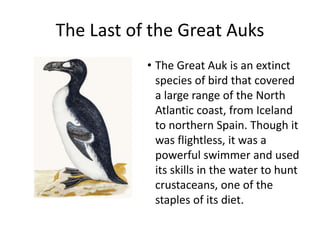
The Last of the Great Auks
• The Great Auk is an extinct
species of bird that covered
a large range of the North
Atlantic coast, from Iceland
to northern Spain. Though it
was flightless, it was a
powerful swimmer and used
its skills in the water to hunt
crustaceans, one of the
staples of its diet.
It stood a little under 3 feet tall and
weighed about 11 pounds. It nested along
the coast in colonies consisting of
thousands of birds. The colonies were so
dense that sailors reported being able to
spot the shore based on the sight of the
black and white birds. The Great Auk was
hunted by sailors and fisherman for more
than 100,000 years. Because they were
flightless and rather clumsy on land, they
were easy to catch.
• The bird’s eggs and feathers were also in high
demand in Europe, further reducing the bird’s
population. By the early-1800’s, the
population of Gr eat Auk colonies had
dwindled significantly. Iceland was the home
of the last known colony of Auks, who were
killed for their skins in 1835. One of the very
last birds was caught on St. Kilda island in
Scotland in 1844 by three sailors. A large
storm passed through the area and the men
killed the Great Auk, believing it was a witch
who caused the storm.
• The cultural significance of the bird has been
discovered in recent history. Cave paintings
featuring Great Auks were found in France
dating back 20,000 years. The Great Auk was
also an important symbol for Native
Americans. A person buried in Newfoundland
around 2000 BC was found surrounded by
more than 200 Great Auk beaks, believed to
be part of a ceremonial burial. About 80
specimens of the Great Auk exist today, found
in museums around the world.
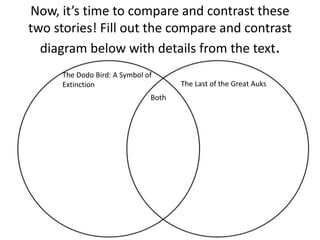
Now, it’s time to compare and contrast these
two stories! Fill out the compare and contrast
diagram below with details from the text.
The Last of the Great Auks
The Dodo Bird: A Symbol of
Extinction
Both

compare & contrast-Kate march 29.pptx

  • 1.
  • 2.
    Look at thepicture. Write 3 things about apple and 3 things about oranges.
  • 3.
  • 5.
    The Dodo Bird:A Symbol of Extinction • The dodo bird lived on the island of Mauritius, off the southeast coast of Africa. Because the bird went extinct in the 17th century, there are no photos available. Drawings, paintings, written accounts, and a handful of specimens give us a rough understanding of its appearance and behavior.
  • 6.
    • What wedo know about the dodo bird is that it stood more than three feet tall, weighed about 40 lbs., and was flightless. It most likely lost this trait because it didn’t need to fly: There were no predators on the island, and fruit and seeds provided abundant food sources. Things started to change for the dodo bird in 1505 when the Portuguese arrived on the island. After that, the bird, which weighed about 50 lbs, became a welcome source of food for sailors.
  • 7.
    • Along withhumans came pigs, monkeys and rats, which made meals of the dodo bird eggs. Since the species had never seen humans before, none of the dodo birds on the island were afraid of humans, yet another reason they became such easy prey.
  • 8.
    • The lastreported sighting of a dodo bird was in 1688, in the hunting records of Isaac Johannes Lamotius, who was the governor of Mauritius. All that remains of the dodo bird today are a dried head and foot at the Oxford University Museum of Natural History and skeletal remains. In recent decades, several excavations on the island have allowed scientists to assemble complete skeletons of the dodo bird. Because it took so little time after human contact for this animal to go extinct, the dodo bird has become a symbol of the role of humans in protecting endangered animals.
  • 9.
    The Last ofthe Great Auks • The Great Auk is an extinct species of bird that covered a large range of the North Atlantic coast, from Iceland to northern Spain. Though it was flightless, it was a powerful swimmer and used its skills in the water to hunt crustaceans, one of the staples of its diet.
  • 10.
    It stood alittle under 3 feet tall and weighed about 11 pounds. It nested along the coast in colonies consisting of thousands of birds. The colonies were so dense that sailors reported being able to spot the shore based on the sight of the black and white birds. The Great Auk was hunted by sailors and fisherman for more than 100,000 years. Because they were flightless and rather clumsy on land, they were easy to catch.
  • 11.
    • The bird’seggs and feathers were also in high demand in Europe, further reducing the bird’s population. By the early-1800’s, the population of Gr eat Auk colonies had dwindled significantly. Iceland was the home of the last known colony of Auks, who were killed for their skins in 1835. One of the very last birds was caught on St. Kilda island in Scotland in 1844 by three sailors. A large storm passed through the area and the men killed the Great Auk, believing it was a witch who caused the storm.
  • 12.
    • The culturalsignificance of the bird has been discovered in recent history. Cave paintings featuring Great Auks were found in France dating back 20,000 years. The Great Auk was also an important symbol for Native Americans. A person buried in Newfoundland around 2000 BC was found surrounded by more than 200 Great Auk beaks, believed to be part of a ceremonial burial. About 80 specimens of the Great Auk exist today, found in museums around the world.
  • 13.
    Now, it’s timeto compare and contrast these two stories! Fill out the compare and contrast diagram below with details from the text. The Last of the Great Auks The Dodo Bird: A Symbol of Extinction Both