Corporate Organization:
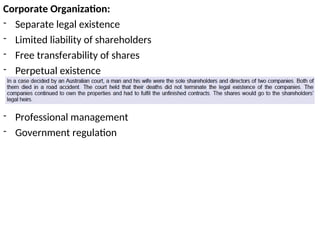
- Separatelegal existence
- Limited liability of shareholders
- Free transferability of shares
- Perpetual existence
- Professional management
- Government regulation
3.
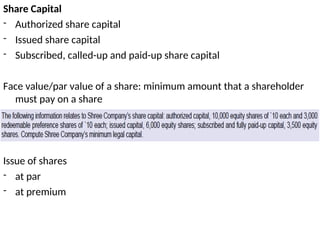
Share Capital
- Authorizedshare capital
- Issued share capital
- Subscribed, called-up and paid-up share capital
Face value/par value of a share: minimum amount that a shareholder
must pay on a share
Issue of shares
- at par
- at premium
4.
Type of shares
-Equity share
- Preference share
two preferential rights over equity shareholders
- dividend
- redemption at the time of liquidation of the company
type of preference shares:
- Cumulative and Non-cumulative preference shares
- Redeemable and Irredeemable preference shares
- Convertible and Non-convertible preference shares
- Participating and Non-participating preference shares
5.
Dividend
Distribution of profitto shareholders
Final and interim dividend
In addition to profits, the company must have sufficient cash
Certain percentage of paid-up capital or certain rupees per share
A company's ability to pay out regular dividends goes a long way
towards communicating its fundamental strength and sustainability
to shareholders
In general, mature, slower-growing companies tend to pay regular
dividends
Is it true that companies that do not pay dividends are not necessarily
without profits?
Younger, faster-growing companies would reinvest the money toward
growth. If a company thinks that its own growth opportunities are
better, it often keeps the profits and reinvests them into the
business.
6.
Issue and allotmentof shares
- A public company must file a prospectus inviting offers from public for
the purchase of shares in the company
A company can ask for issue price of the share to be paid in full
along with the application or it can be payable in installments as
share application money, share allotment money, share first call,
share second call and so on.
- After studying the prospectus public applies for shares of the
company
Over subscription/under subscription
- Amount of share application money must be deposited in a separate
bank account
- After receipt of application money, the company makes allotment of
shares
No allotment of shares can be made unless Minimum
Subscription has been received.
7.
Issue and allotmentof shares
If the minimum subscription of 90% of the issue is not achieved by
the company within 60 days from the date of closure of the
issue, the company has to refund the entire subscription amount.
- Listing of shares on recognized stock exchange/s
- Call money (only when the offer price is to be collected in
installments)
Forfeiture of shares
8.
Issue of sharesfor the consideration other than cash
- For purchase of assets and services
- Sweat equity shares: directors/employees for providing intangible
assets; can be issued at discount; lock-in period
9.
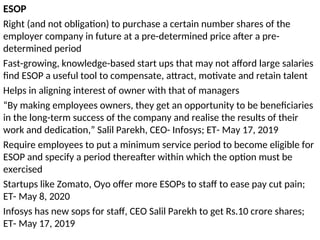
ESOP
Right (and notobligation) to purchase a certain number shares of the
employer company in future at a pre-determined price after a pre-
determined period
Fast-growing, knowledge-based start ups that may not afford large salaries
find ESOP a useful tool to compensate, attract, motivate and retain talent
Helps in aligning interest of owner with that of managers
“By making employees owners, they get an opportunity to be beneficiaries
in the long-term success of the company and realise the results of their
work and dedication,” Salil Parekh, CEO- Infosys; ET- May 17, 2019
Require employees to put a minimum service period to become eligible for
ESOP and specify a period thereafter within which the option must be
exercised
Startups like Zomato, Oyo offer more ESOPs to staff to ease pay cut pain;
ET- May 8, 2020
Infosys has new sops for staff, CEO Salil Parekh to get Rs.10 crore shares;
ET- May 17, 2019
10.
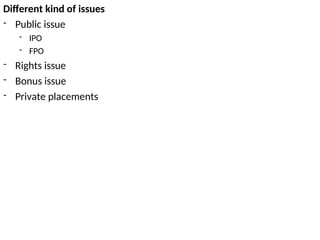
Different kind ofissues
- Public issue
- IPO
- FPO
- Rights issue
- Bonus issue
- Private placements
11.
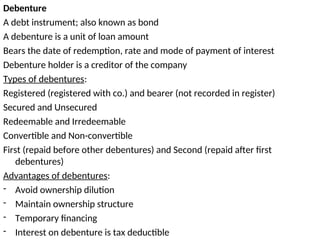
Debenture
A debt instrument;also known as bond
A debenture is a unit of loan amount
Bears the date of redemption, rate and mode of payment of interest
Debenture holder is a creditor of the company
Types of debentures:
Registered (registered with co.) and bearer (not recorded in register)
Secured and Unsecured
Redeemable and Irredeemable
Convertible and Non-convertible
First (repaid before other debentures) and Second (repaid after first
debentures)
Advantages of debentures:
- Avoid ownership dilution
- Maintain ownership structure
- Temporary financing
- Interest on debenture is tax deductible
Bonus Shares
Additional sharesto existing shareholders without payment
In 2018, Infosys 1:1
July 2023, Power Grid Corp 1:3
Company’s accumulated earnings which are not given in form of
dividends
Does not affect assets or equity (shareholders’ funds)
Capitalization of reserves
Why a company may issue bonus shares:
- Company engaged in major capital expenditure programme prefer
bonus issue rather than payment of current dividend
- To reduce market price per share
(when price per share is high, it becomes difficult for new investors
to buy shares of that particular company)
- To signal confidence in company’s prospects
14.
Stock Split
Face valueof share is reduced (subdivision of existing shares into
multiple shares)
Number of shares increases
e.g. A company has 1,00,000 shares of Rs. 10 each. Share capital is
Rs.10,00,000. Share is split into 5 shares of Rs.2 each.
After split, number of shares are 5,00,000 of Rs.2 each. Share capital
remains same, Rs.10,00,000.
Equity remains same
Market cap remains same. Market price decreases.
When a company believes that the market price of its stock is relatively
high and this is stopping traders to buy and sell such a highly valued
stock, then the company go ahead with stock split
Hero Motocorp: Rs.10 to Rs.5
TVS Motor: Rs.10 to Re.1
HDFC Bank: Rs.10 to Rs.2
15.
Buyback of shares
Corporateaction, in which a company buys back its shares from existing
shareholders, usually at a price higher than the prevailing market
price
Company reacquire its own shares for cancellation
Reduce number of outstanding shares
- Surplus cash and no plans for capital expenditure
- To prevent unwelcomed takeover bids
- Company is overcapitalized and dividend outgo is large
- To provide an additional exit route to shareholders when shares are
undervalued or thinly traded in stock market
- To enhance long-term shareholder value
- To improve EPS
- To improve return on capital
Wipro Ltd., June 2023, prevailing MP Rs.414.80, buyback price Rs.445
16.
Treasury stock operation
Ownshares reacquired by a company as an investment
Dividend not paid on treasury stock
Does not change issued share capital
Not allowed in India