Community Modeling
Workshop
Federico Baldini & Eugen Bauer
What are we going to do today?
1. Motivation – Eugen
2. Introduction – Federico
3. Theory of BacArena – Eugen
4. BacArena practical – Eugen
5. Social event – Susanne
Why I study Science
Jeong et al, Nature, 2011
Why I study Systems Biology
Emergence: Phenomenon in which
larger components arise through local
interactions of smaller components such
that larger components have additional
properties
Systems biology: Study of the
interactions between the components of
biological systems, and how these
interactions give rise to the function of
that system
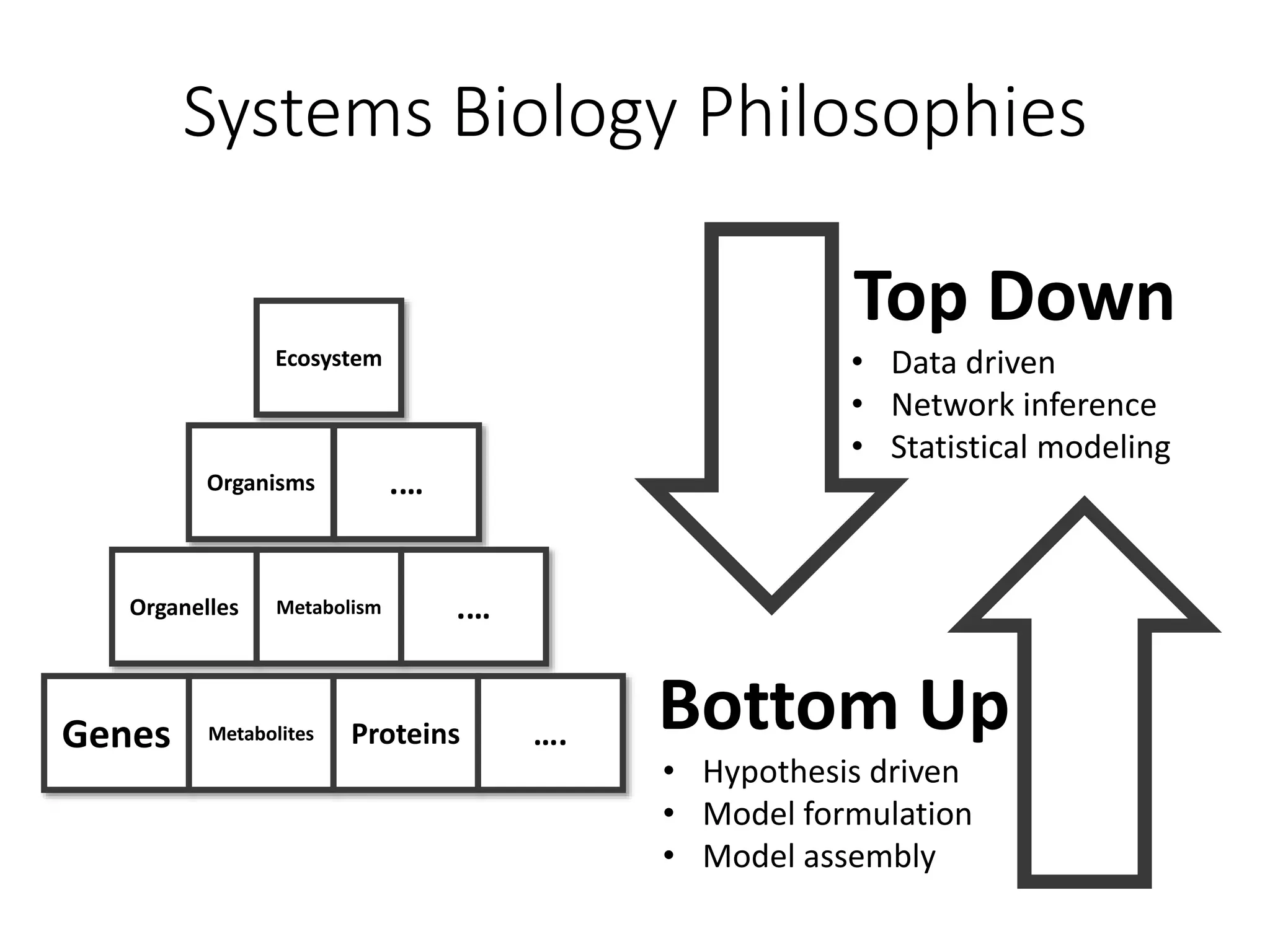
Systems Biology Philosophies
Top Down
• Data driven
• Network inference
• Statistical modeling
Bottom Up
• Hypothesis driven
• Model formulation
• Model assembly
Genes Metabolites Proteins ….
Organelles Metabolism .…
Organisms .…
Ecosystem
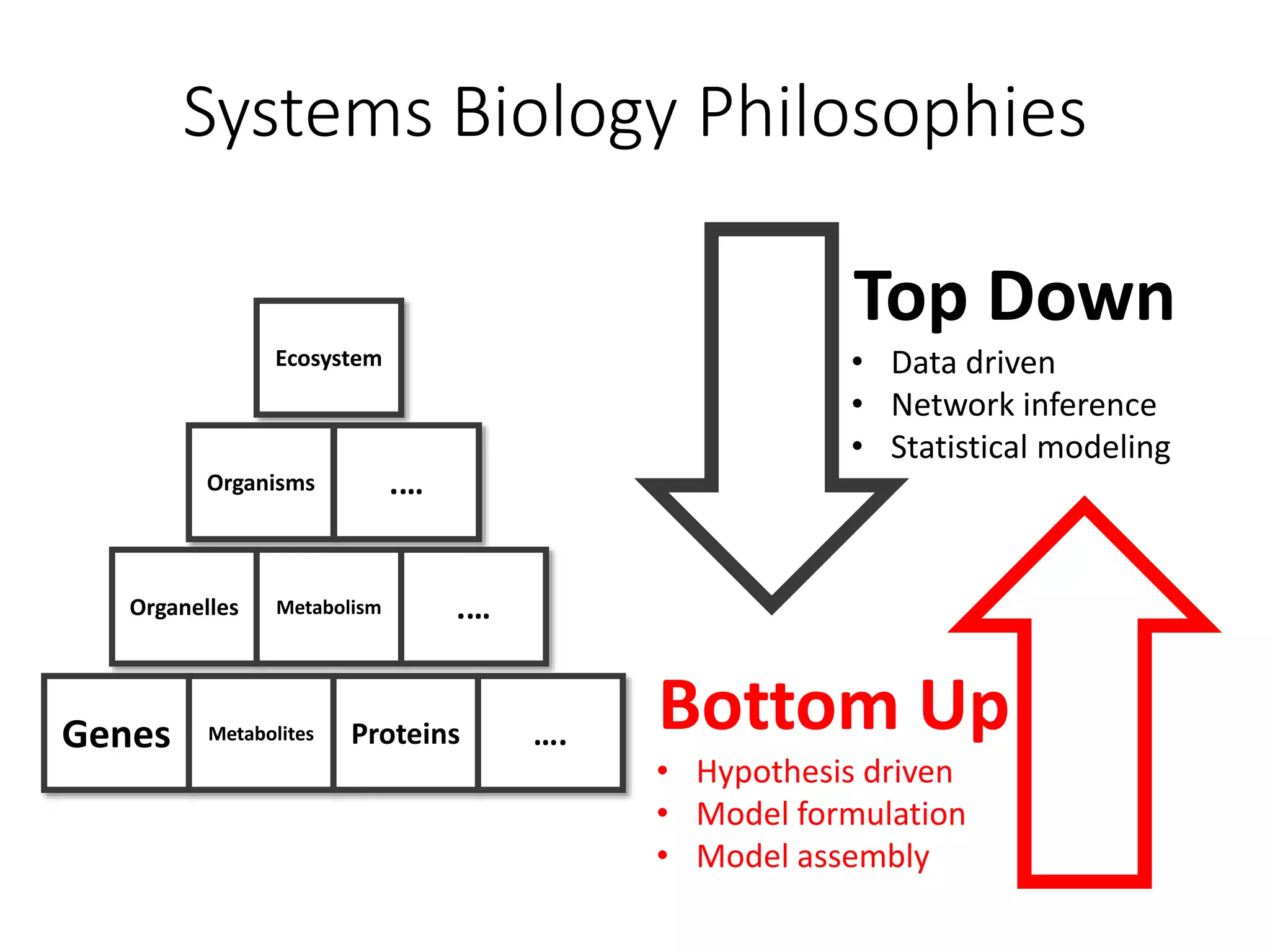
Systems Biology Philosophies
Top Down
• Data driven
• Network inference
• Statistical modeling
Bottom Up
• Hypothesis driven
• Model formulation
• Model assembly
Genes Metabolites Proteins ….
Organelles Metabolism .…
Organisms .…
Ecosystem
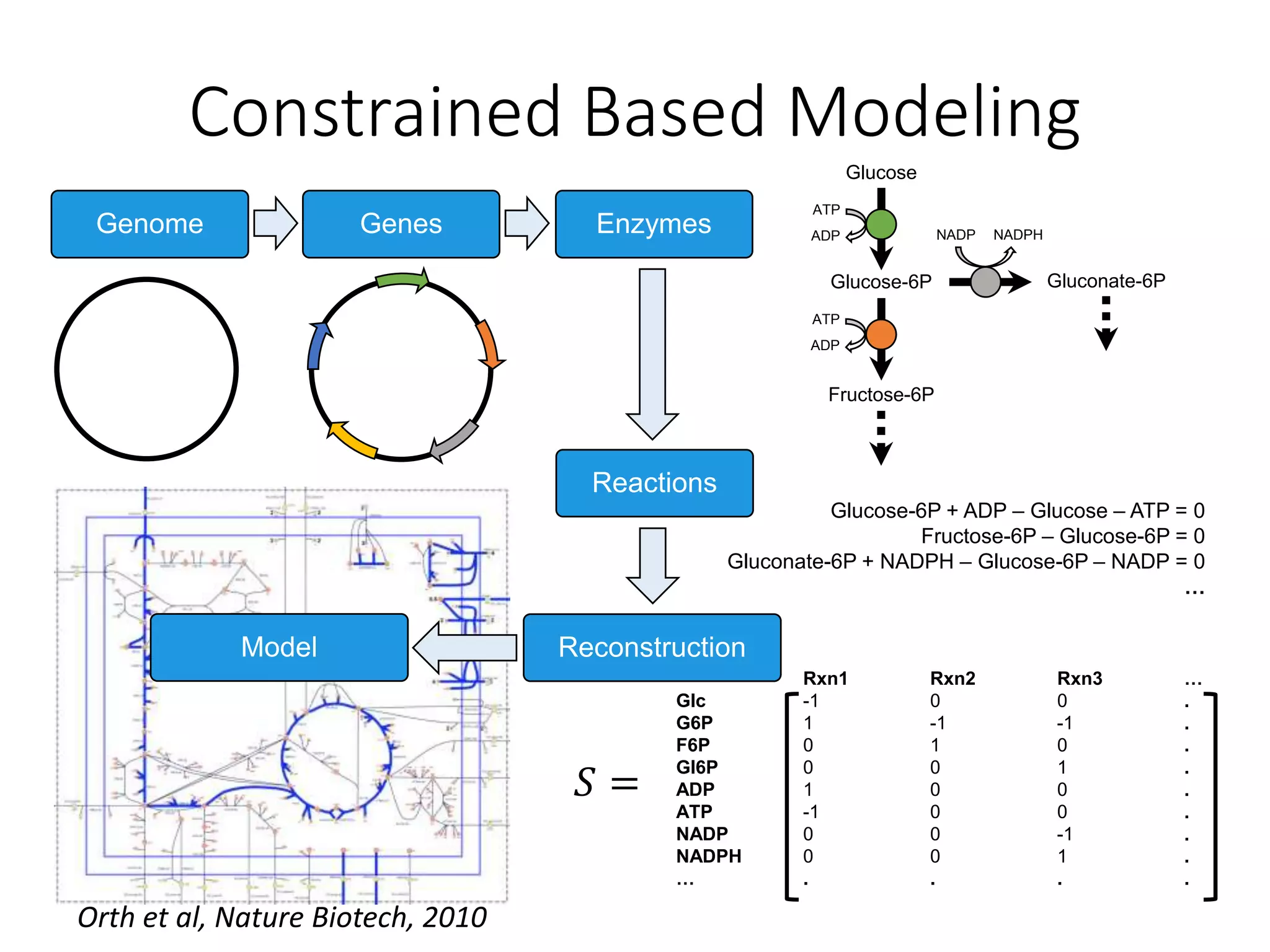
Genome GenomeGenes Enzymes
Glucose
Glucose-6P
Fructose-6P
Gluconate-6P
ATP
ADP
ATP
ADP
NADP NADPH
Constrained Based Modeling
Glucose-6P + ADP – Glucose – ATP = 0
Fructose-6P – Glucose-6P = 0
Gluconate-6P + NADPH – Glucose-6P – NADP = 0
…
Genome GenomeGenes Enzymes
Reactions
Reconstruction
Glucose
Glucose-6P
Fructose-6P
Gluconate-6P
ATP
ADP
ATP
ADP
NADP NADPH
Rxn1 Rxn2 Rxn3 …
Glc -1 0 0 .
G6P 1 -1 -1 .
F6P 0 1 0 .
Gl6P 0 0 1 .
ADP 1 0 0 .
ATP -1 0 0 .
NADP 0 0 -1 .
NADPH 0 0 1 .
… . . . .
𝑆 =
Model
Orth et al, Nature Biotech, 2010
Constrained Based Modeling
Now it’s Federicos turn
Mathematical formulation
A
B
Cr1
r2 r3
e1
e2
e3
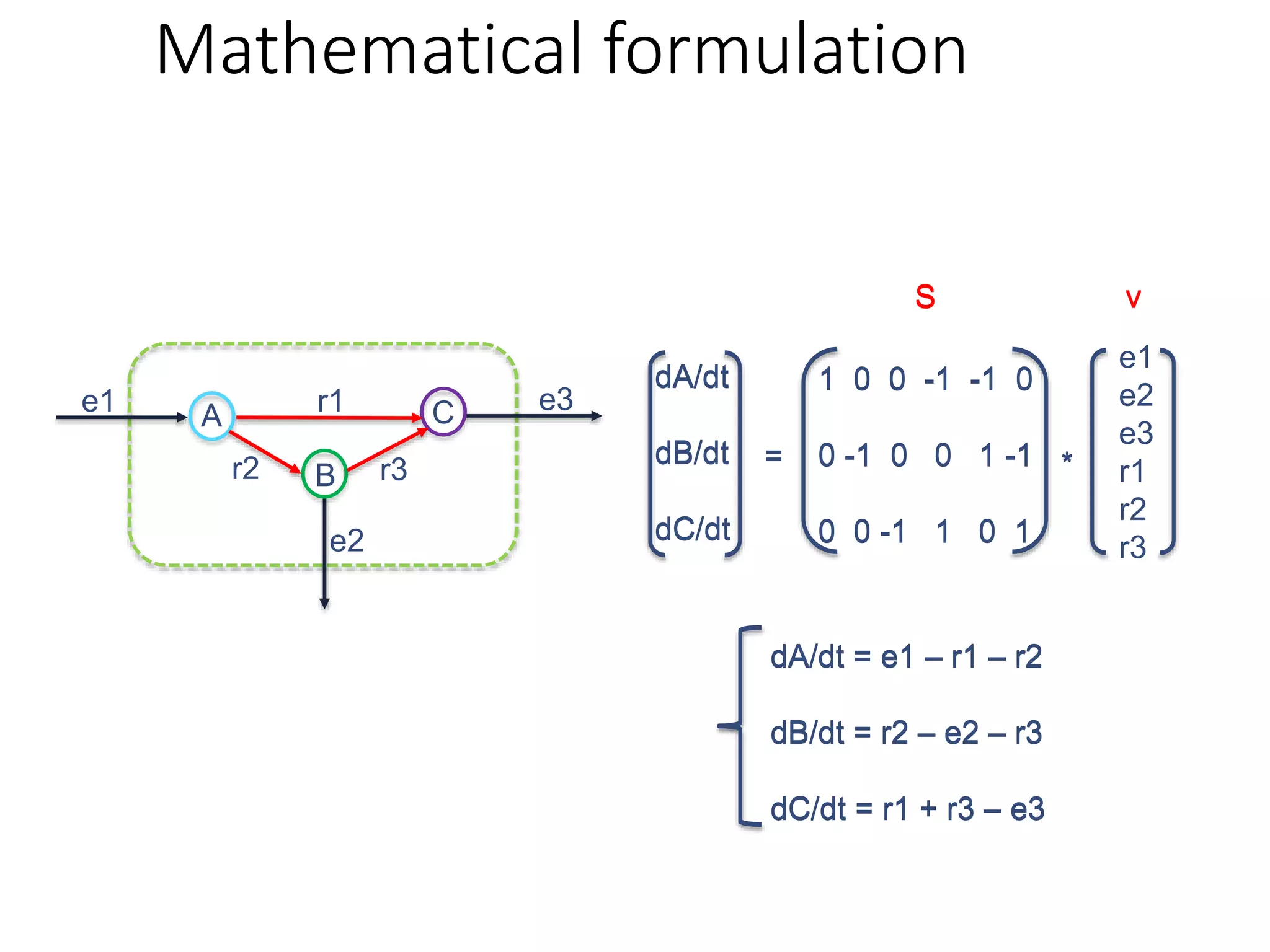
Mathematical formulation
dA/dt
dB/dt
dC/dt
e1
e2
e3
r1
r2
r3
1 0 0 -1 -1 0
0 -1 0 0 1 -1
0 0 -1 1 0 1
= *
S v
dA/dt = e1 – r1 – r2
dB/dt = r2 – e2 – r3
dC/dt = r1 + r3 – e3
dA/dt
dB/dt
dC/dt
1 0 0 -1 -1 0
0 -1 0 0 1 -1
0 0 -1 1 0 1
= *
S v
dA/dt = e1 – r1 – r2
dB/dt = r2 – e2 – r3
dC/dt = r1 + r3 – e3
A
B
Cr1
r2 r3
e1
e2
e3
Simulation
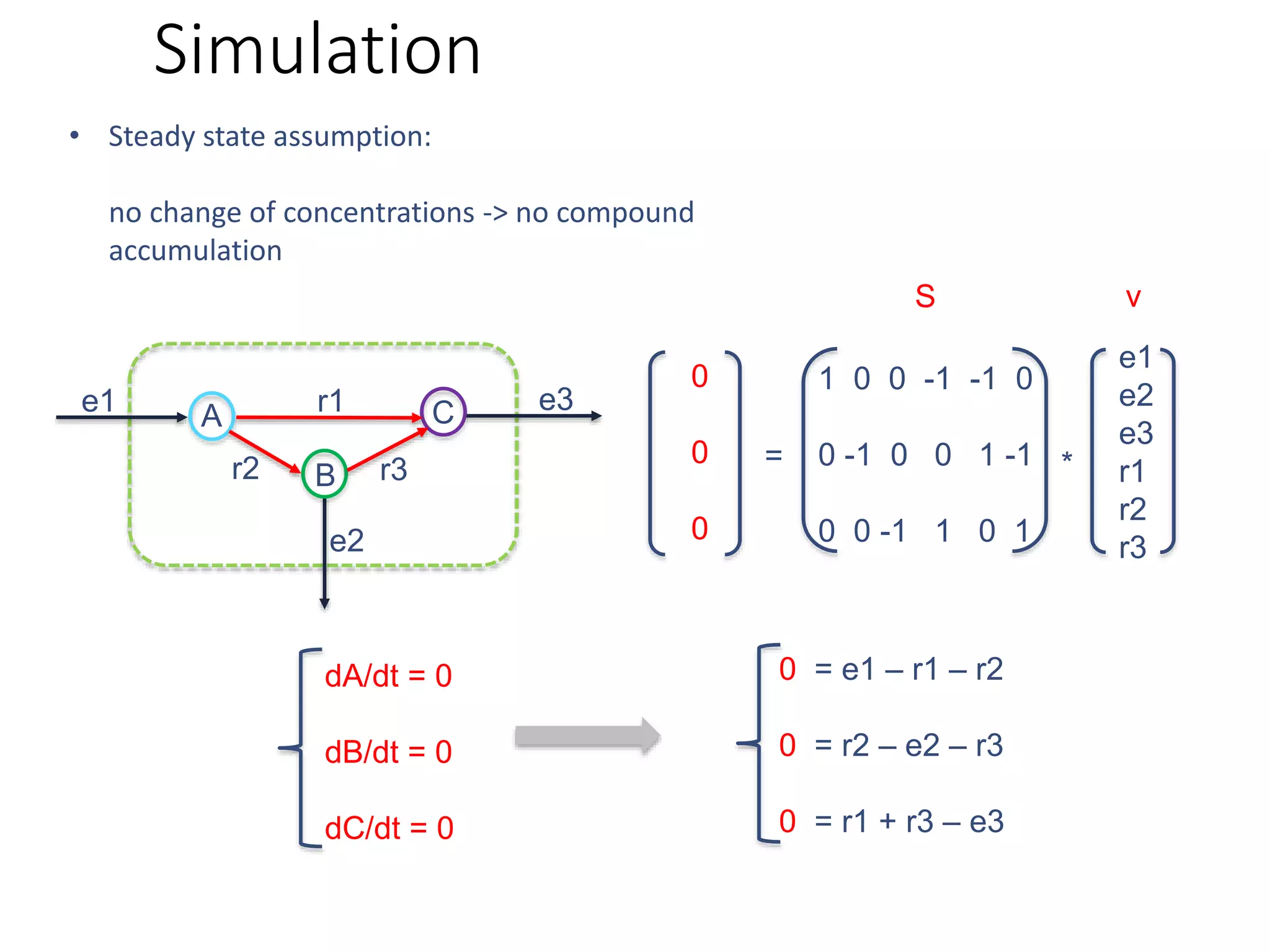
• Steady state assumption:
no change of concentrations -> no compound
accumulation
0
0
0
e1
e2
e3
r1
r2
r3
1 0 0 -1 -1 0
0 -1 0 0 1 -1
0 0 -1 1 0 1
= *
S v
0 = e1 – r1 – r2
0 = r2 – e2 – r3
0 = r1 + r3 – e3
dA/dt = 0
dB/dt = 0
dC/dt = 0
A
B
Cr1
r2 r3
e1
e2
e3
A
B
Cr1
r2 r3
e1
e2
e3
1 0 0 -1 -1 0
0 -1 0 0 1 -1
0 0 -1 1 0 1
= *
S v
• Steady state assumption
• Constrained flux assumption
0
0
0
0 = e1 – r1 – r2
0 = r2 – e2 – r3
0 = r1 + r3 – e3
e1
e2
e3
r1
r2
r3
Simulation
Simulation: Flux Balance Analysis
e1
e2
e3
r1
r2
r3
1 0 0 -1 -1 0
0 -1 0 0 1 -1
0 0 -1 1 0 1
= *
S v
• Steady state assumption
• Constrained flux assumption
• Objective function (biomass) optimization
0 = e1 – r1 – r2
0 = r2 – e2 – r3
0 = r1 + r3 – e3
0
0
0
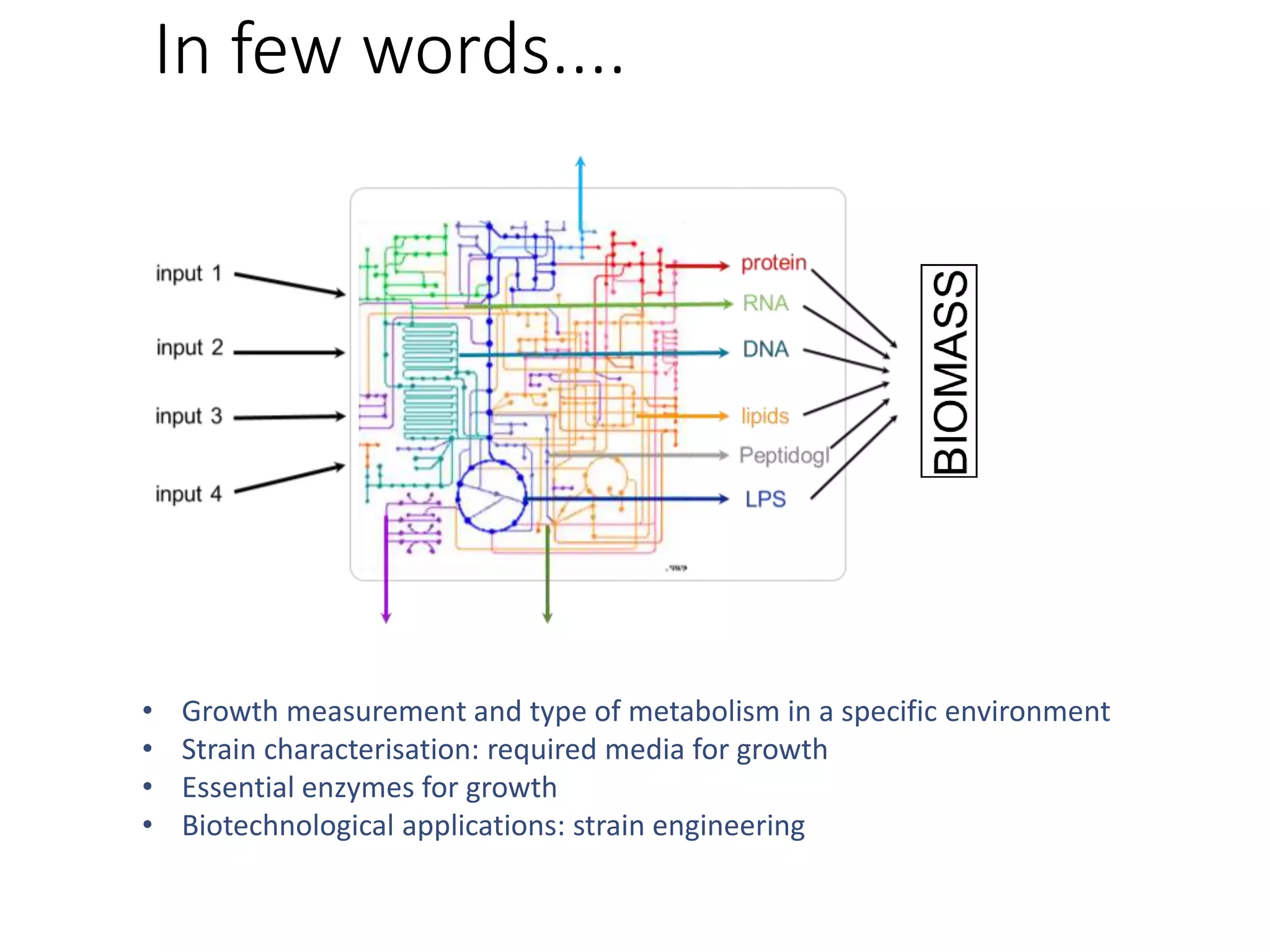
In few words....
• Growth measurement and type of metabolism in a specific environment
• Strain characterisation: required media for growth
• Essential enzymes for growth
• Biotechnological applications: strain engineering
Examples of applications
Biofilm Gut microbiota
http://ausubellab.mgh.harvard.edu/picturehtml/pic20.html
Zoetendal, Raes et al. (2012)
Pseudomonas aeruginosa biofilm
Biofilm microcolony formed by P. aeruginosa strain PA14
carrying GFP. Biofilms were cultivated in flow chambers under
continuous culture conditions. Analysis of biofilm spatial
structures were done using confocal scanning laser microscopy
after 9 hours of incubation.
From single organism to community modeling
Enzyme soup
A
B
Cr1
r2 r3
e1
e2
e3
Model 1
A Cr1e1 e3
D
e4
r4 r5
Model 2
Enzyme soup
A
B
Cr1
r2 r3
e1
e2
e3
D
e4
r4 r5
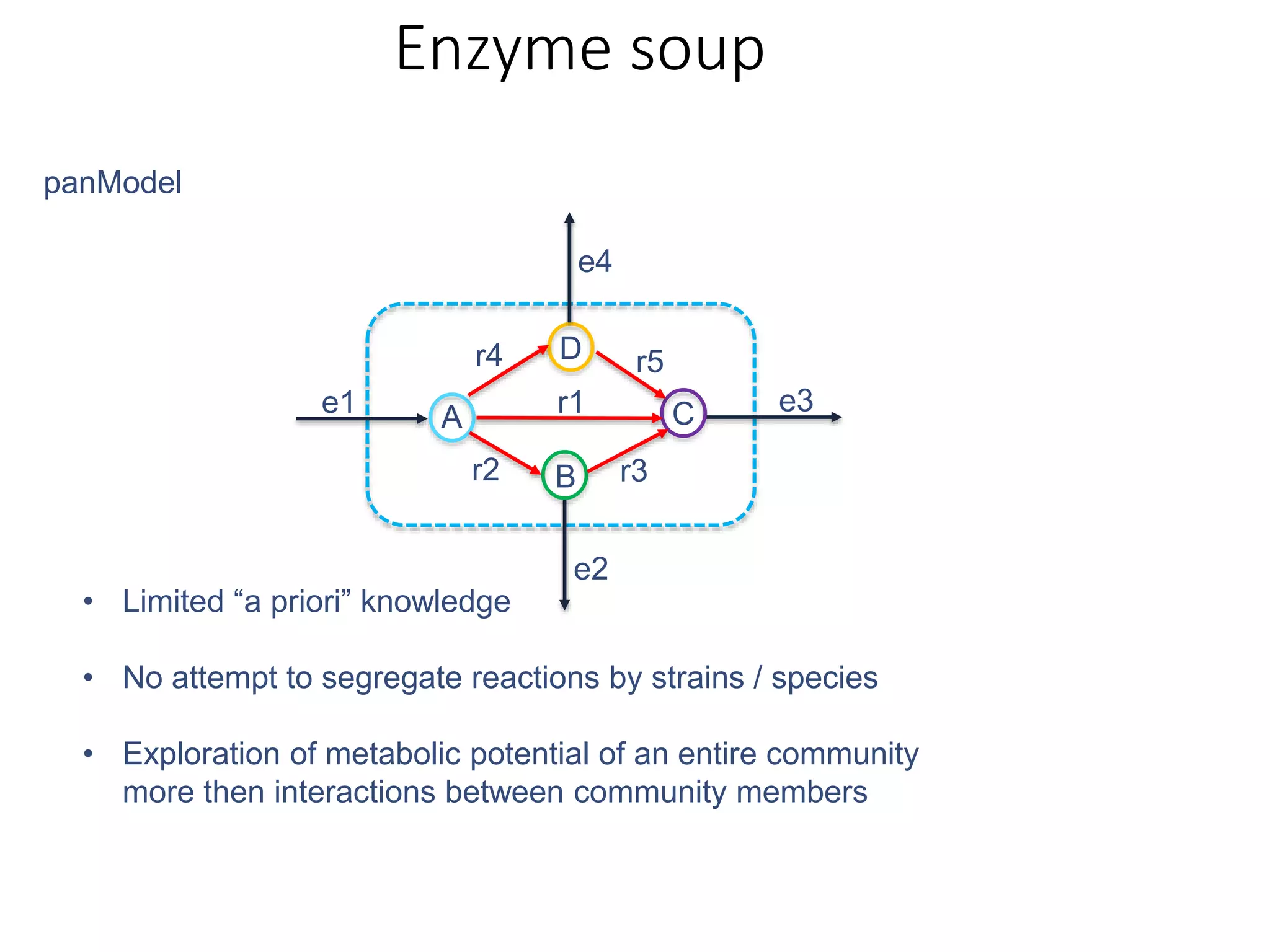
panModel
• Limited “a priori” knowledge
• No attempt to segregate reactions by strains / species
• Exploration of metabolic potential of an entire community
more then interactions between community members
Enzyme soup
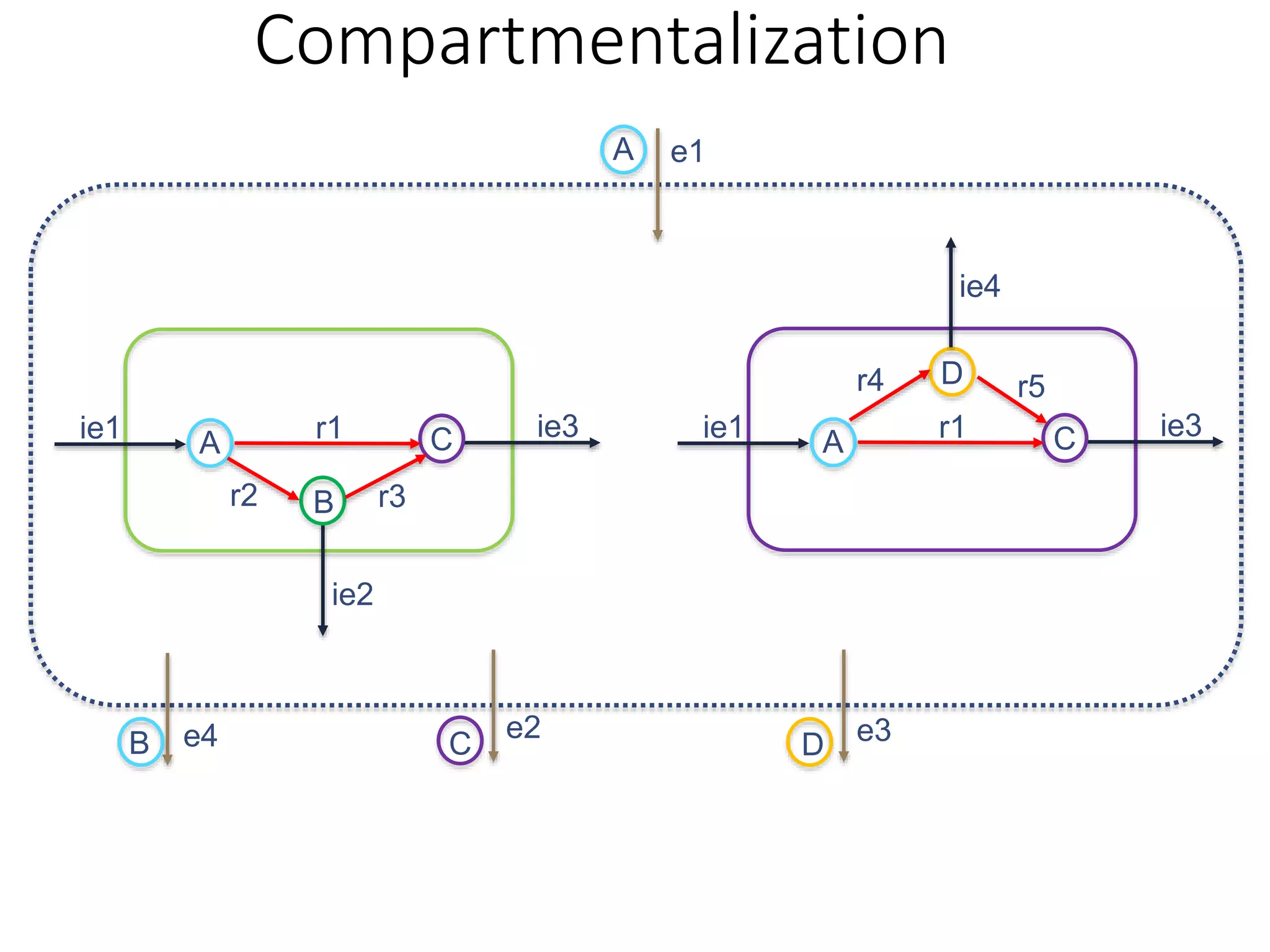
Compartmentalization
A
B
Cr1
r2 r3
e1
e2
e3 A Cr1e1 e3
D
e4
r4 r5
A
B
Cr1
r2 r3
ie1
ie2
ie3 A Cr1ie1 ie3
D
ie4
r4 r5
e1
e2 e3e4
A
B C D
Compartmentalization
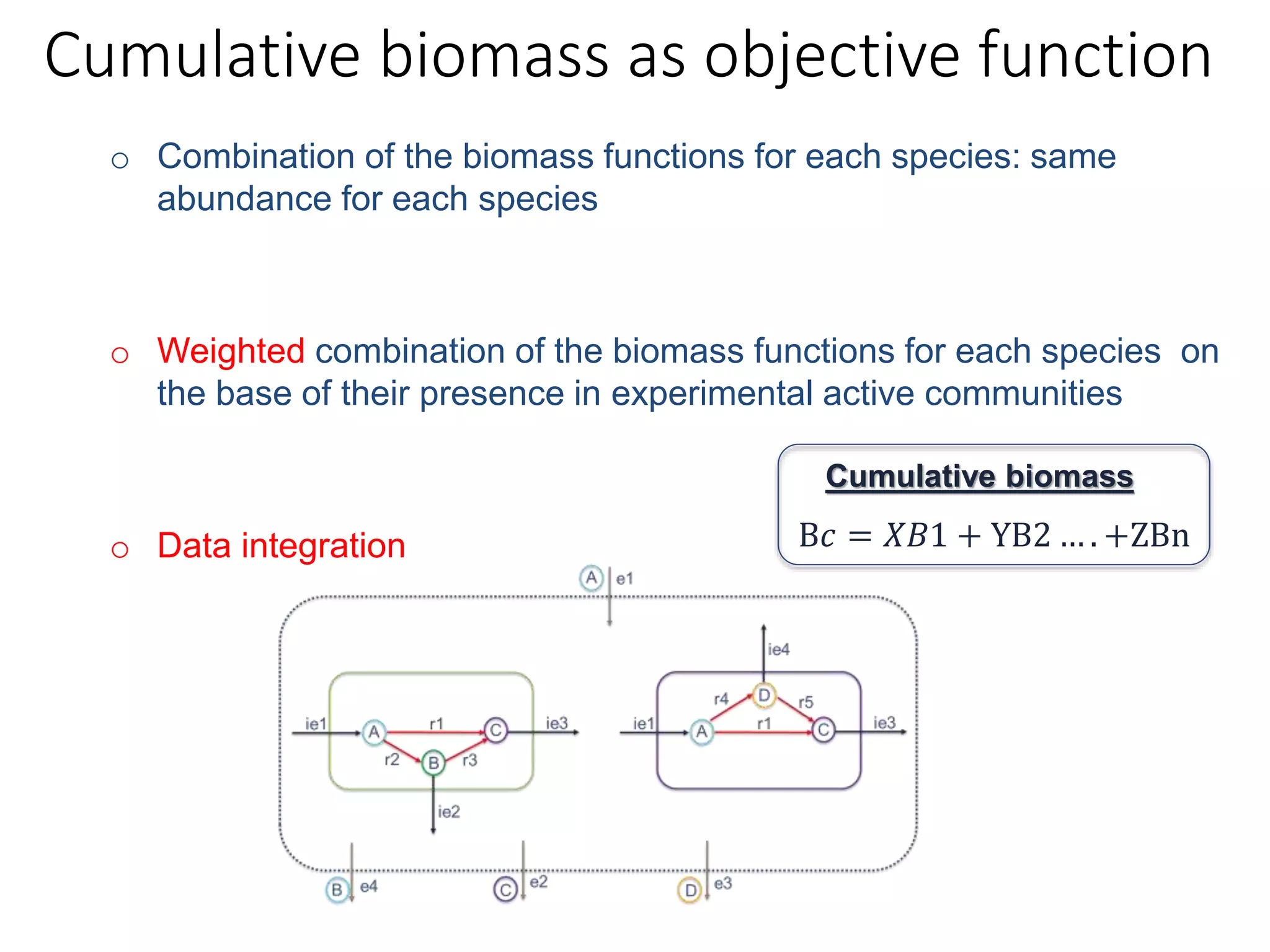
Cumulative biomass as objective function
o Combination of the biomass functions for each species: same
abundance for each species
o Weighted combination of the biomass functions for each species on
the base of their presence in experimental active communities
o Data integration B𝑐 = 𝑋𝐵1 + YB2 … . +ZBn
Cumulative biomass
Simulating ecosystems: modeling bacteria communities
o Enzyme soup
Exploring community potential
No Individuals representation
o Compartmentalization
Abundances fixed and not changing
No concentrations
No time and space resolved simulation
Variable control problem
predict uptake and secretion of
metabolites with known species
abundances
predict community growth
with known uptake and secretion rates
o Agent Based modeling integration
Now it’s Eugens turn
What is BacArena?
BacArena = Bac + Arena
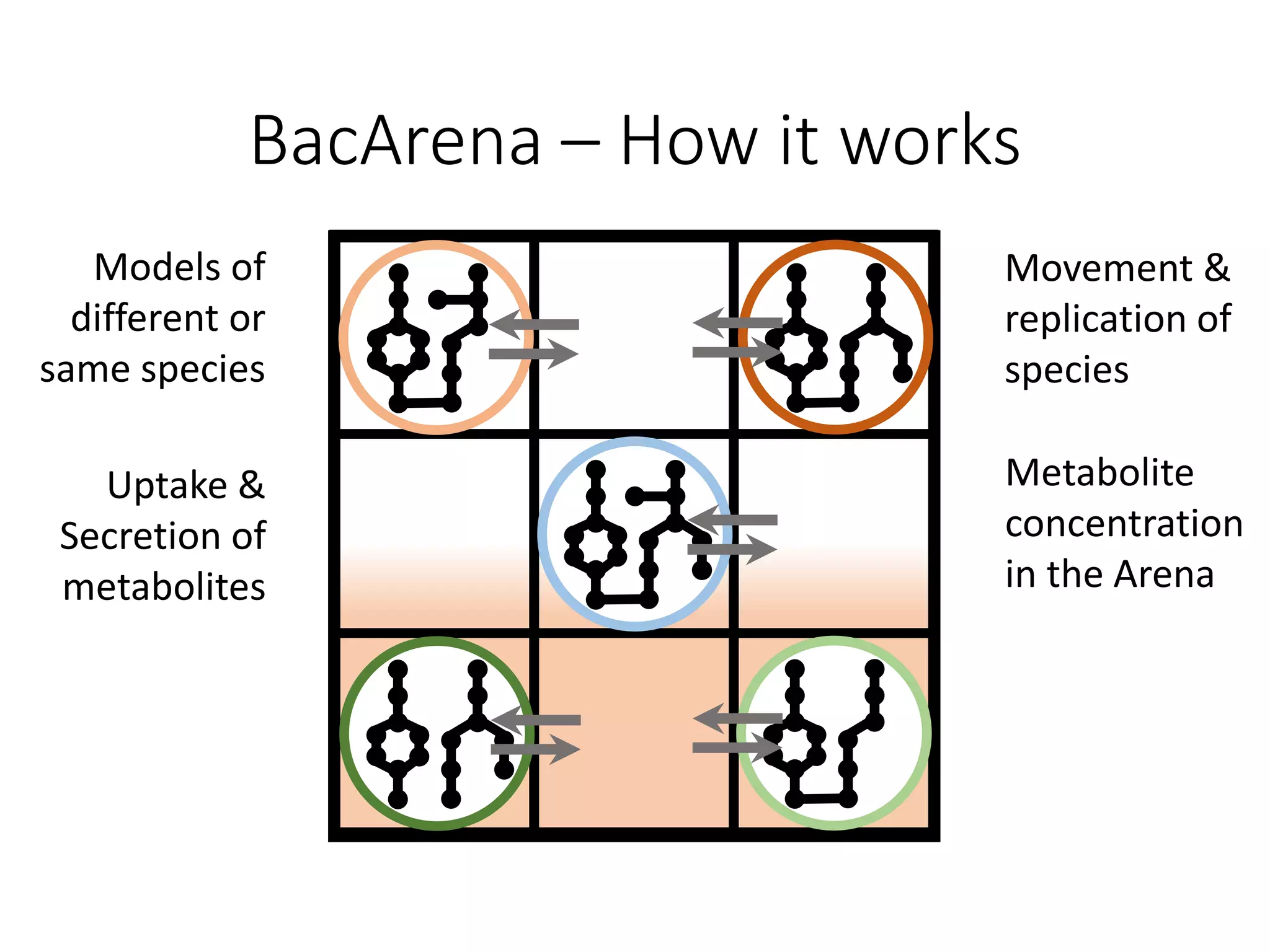
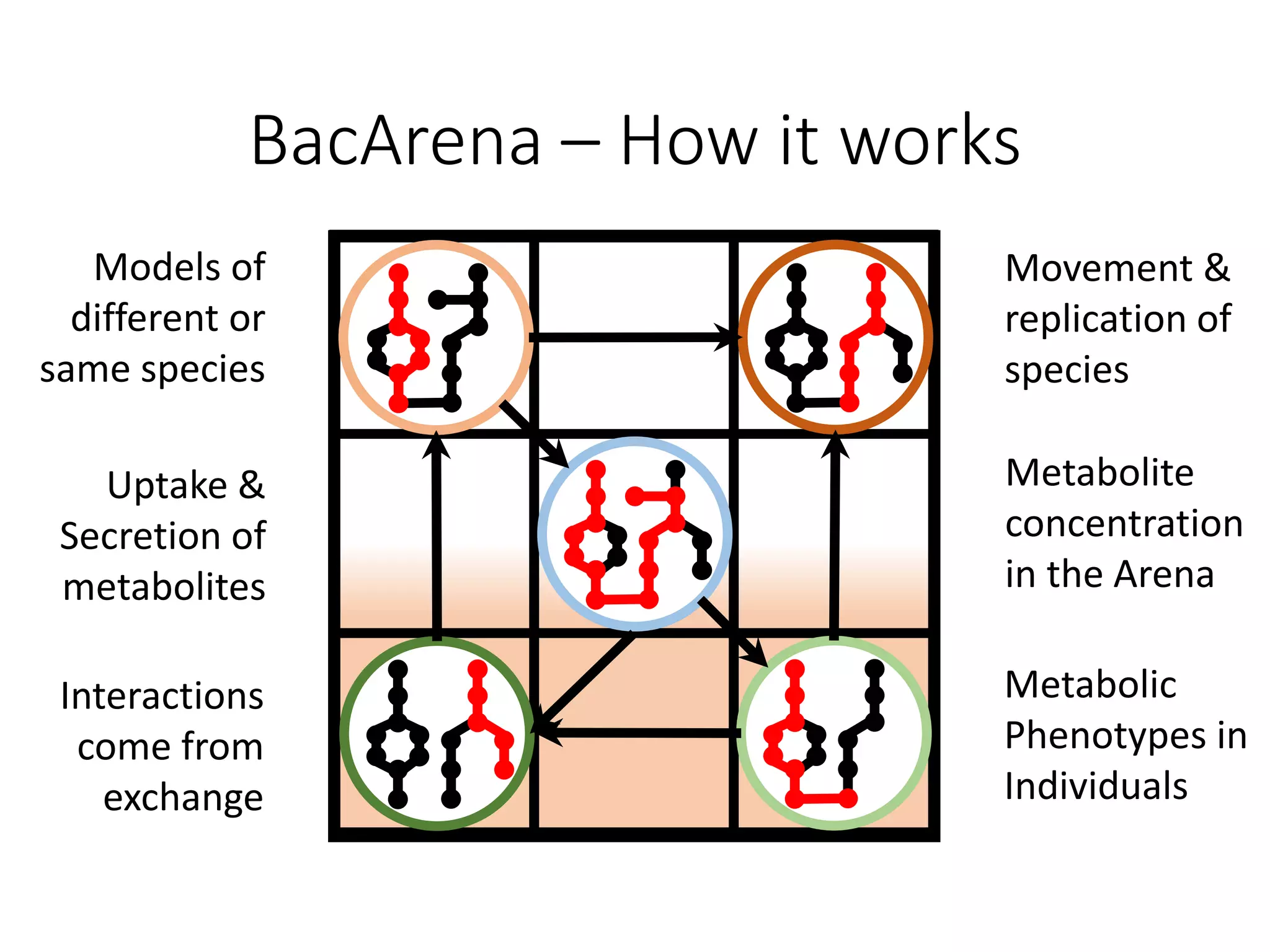
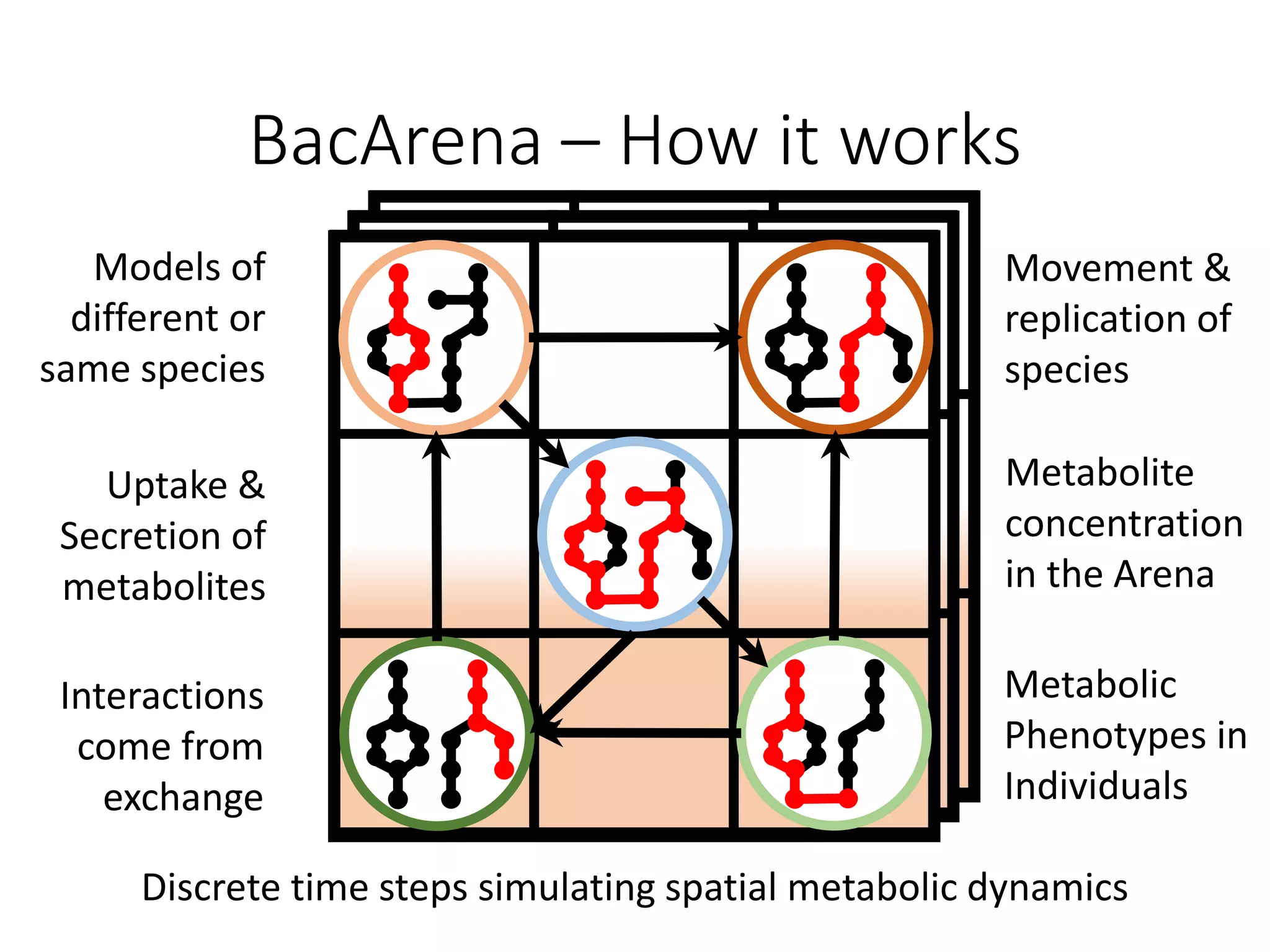
BacArena – How it works
Models of
different or
same species
Integration of constrained and agent based modeling
BacArena – How it works
Models of
different or
same species
Movement &
Replication of
species
BacArena – How it works
Models of
different or
same species
Movement &
Replication of
species
Metabolite
concentration
in the Arena
BacArena – How it works
Models of
different or
same species
Movement &
replication of
species
Metabolite
concentration
in the Arena
Uptake &
Secretion of
metabolites
BacArena – How it works
Models of
different or
same species
Movement &
replication of
species
Metabolite
concentration
in the Arena
Uptake &
Secretion of
metabolites
Interactions
come from
exchange
BacArena – How it works
Models of
different or
same species
Movement &
replication of
species
Metabolite
concentration
in the Arena
Uptake &
Secretion of
metabolites
Interactions
come from
exchange
Metabolic
Phenotypes in
Individuals
BacArena – How it works
Models of
different or
same species
Movement &
replication of
species
Metabolite
concentration
in the Arena
Uptake &
Secretion of
metabolites
Interactions
come from
exchange
Metabolic
Phenotypes in
Individuals
Discrete time steps simulating spatial metabolic dynamics
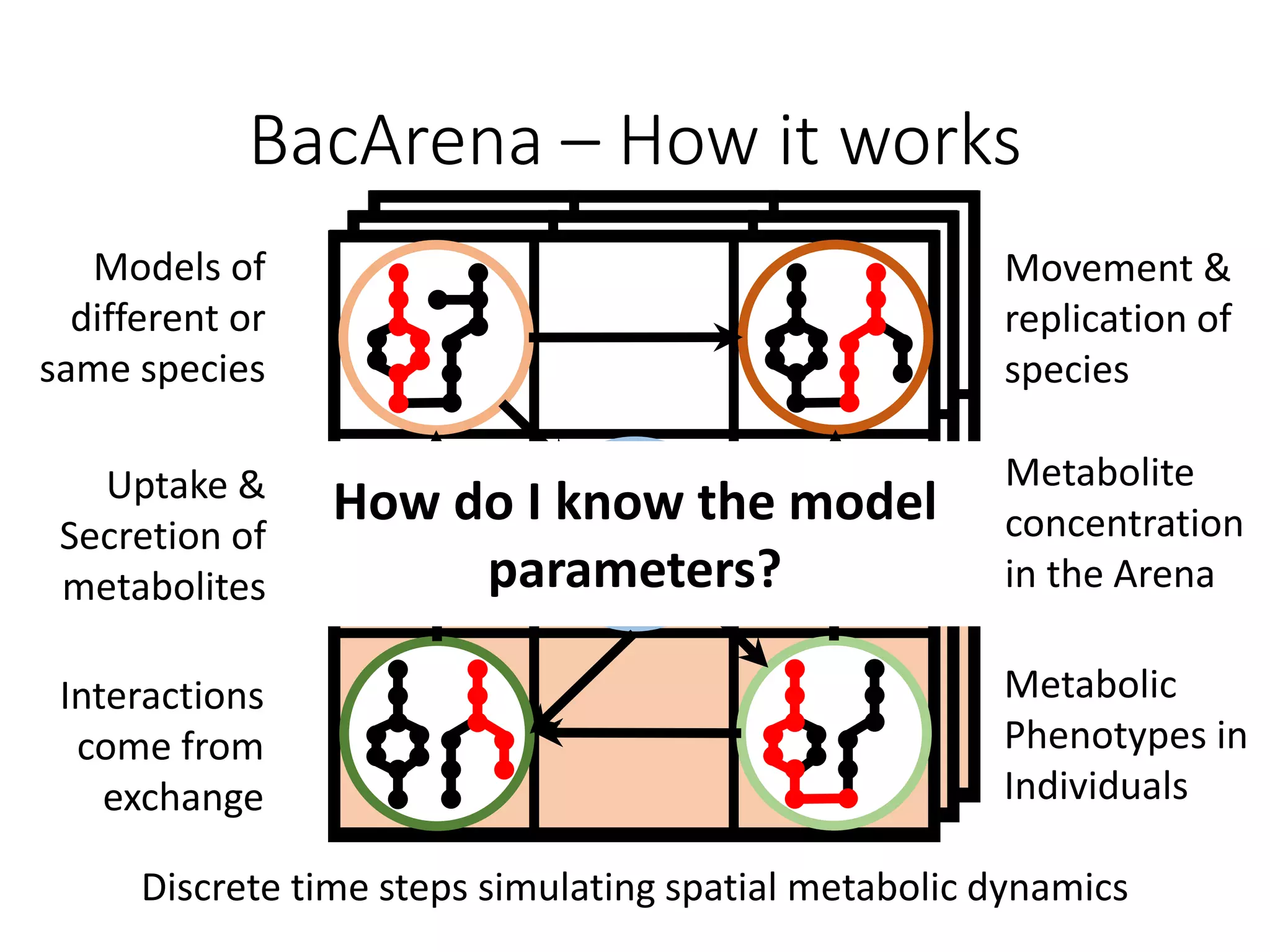
BacArena – How it works
Models of
different or
same species
Movement &
replication of
species
Metabolite
concentration
in the Arena
Uptake &
Secretion of
metabolites
Interactions
come from
exchange
Metabolic
Phenotypes in
Individuals
Discrete time steps simulating spatial metabolic dynamics
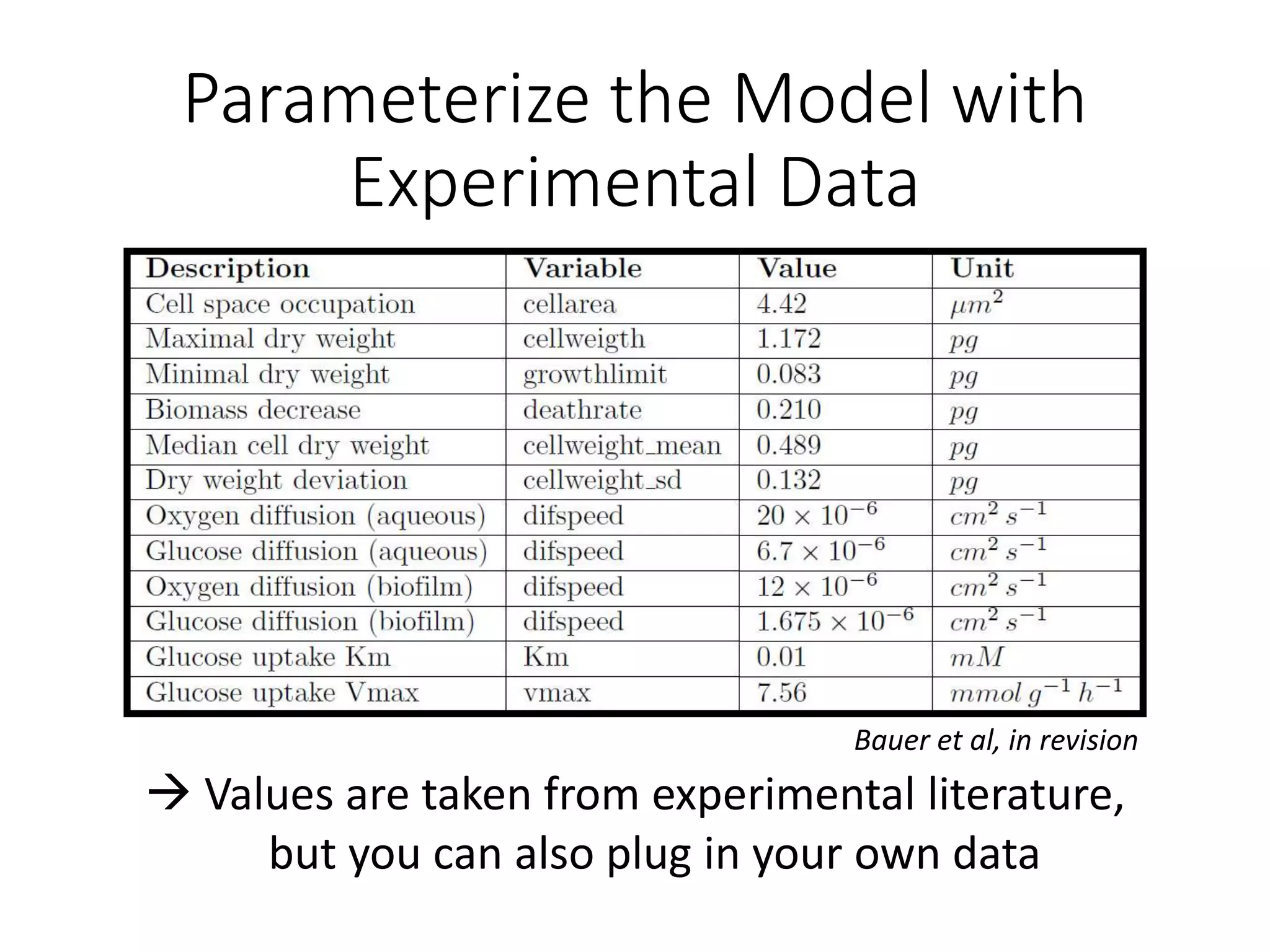
How do I know the model
parameters?
Parameterize the Model with
Experimental Data
Bauer et al, in revision
 Values are taken from experimental literature,
but you can also plug in your own data
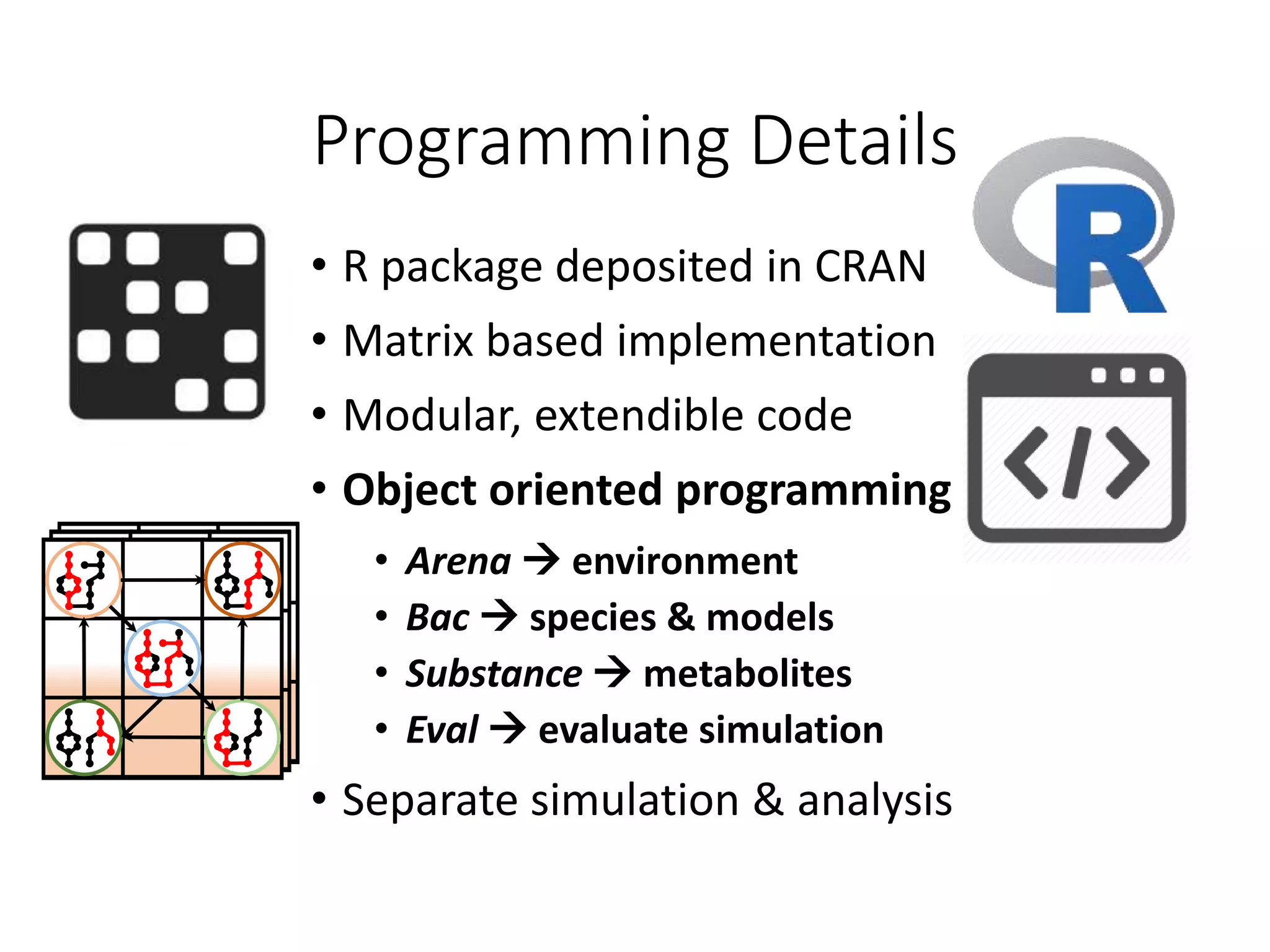
Programming Details
• R package deposited in CRAN
• Matrix based implementation
• Modular, extendible code
• Object oriented programming
• Arena  environment
• Bac  species & models
• Substance  metabolites
• Eval  evaluate simulation
• Separate simulation & analysis
Programming Details
• R package deposited in CRAN
• Matrix based implementation
• Modular, extendible code
• Object oriented programming
• Arena  environment
• Bac  species & models
• Substance  metabolites
• Eval  evaluate simulation
• Separate simulation & analysis
Programming Details
• R package deposited in CRAN
• Matrix based implementation
• Modular, extendible code
• Object oriented programming
• Arena  environment
• Bac  species & models
• Substance  metabolites
• Eval  evaluate simulation
• Separate simulation & analysis
Programming Details
• R package deposited in CRAN
• Matrix based implementation
• Modular, extendible code
• Object oriented programming
• Arena  environment
• Bac  species & models
• Substance  metabolites
• Eval  evaluate simulation
• Separate simulation & analysis
Programming Details
• R package deposited in CRAN
• Matrix based implementation
• Modular, extendible code
• Object oriented programming
• Arena  environment
• Bac  species & models
• Substance  metabolites
• Eval  evaluate simulation
• Separate simulation & analysis
Now let’s start the
Demonstration
Everything will be uploaded here:
http://rsg-luxembourg.iscbsc.org/
Availability of BacArena
• Paper is currently under revision
• Official version is on CRAN:
• https://CRAN.R-project.org/package=BacArena
• Development version is hosted on GitHub:
• https://github.com/euba/BacArena
Compare with Experiments
Photomicrograph
of P. aeruginosa
biofilm cross
sections stained
for APase activity
Xu et al, Appl Environ Microbiol, 1998
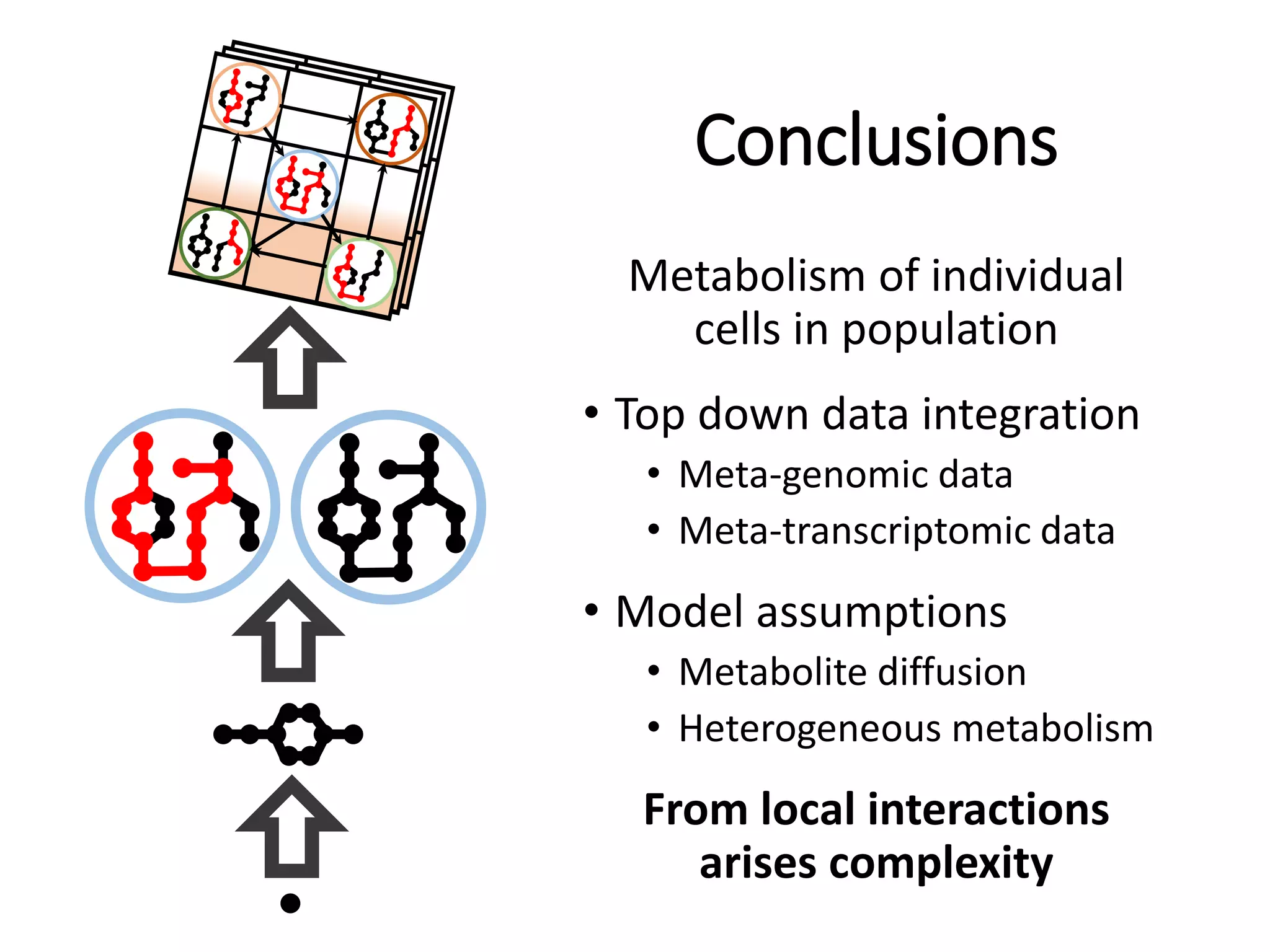
Conclusions
Metabolism of individual
cells in population
• Top down data integration
• Meta-genomic data
• Meta-transcriptomic data
• Model assumptions
• Metabolite diffusion
• Heterogeneous metabolism
From local interactions
arises complexity
Acknowledgments
Molecular Systems
Physiology Group:
Ines Thiele (PI)
Stefania Magnusdottir
Marouen Guebilla
Dmitry Ravcheev
Laurent Heirendt
Alberto Noronha
Federico Baldini
Almut Heinken
Maike Aurich
Christian-Albrechts-Universität Kiel:
Christoph Kaleta
Johannes Zimmermann
Thanks to the HPC facilities of the University of Luxembourg
The RSG Luxembourg Board
… the RSG spirit
More RSG Courses – Stay Tuned!
20.03. B'RAIN Company Presentation
When? Monday 20.03.2017 from 17:00 to 19:00
Where? Maison du Savoir Room 4.410
05.04. Latex Workshop
When? Monday 05.04.2017 from 17:00 to 19:00
Where? Maison du Savoir Room 4.410
12.04. Git Workshop
When? Wednesday 12.04.2017 from 17:00 to 19:00
Where? TBA
Further Acknowledgments
Join us as a RSG Luxembourg member!
Thank you for attention
THE END

Community Modeling Workshop

  • 1.
  • 2.
    What are wegoing to do today? 1. Motivation – Eugen 2. Introduction – Federico 3. Theory of BacArena – Eugen 4. BacArena practical – Eugen 5. Social event – Susanne
  • 3.
    Why I studyScience
  • 4.
    Jeong et al,Nature, 2011 Why I study Systems Biology Emergence: Phenomenon in which larger components arise through local interactions of smaller components such that larger components have additional properties Systems biology: Study of the interactions between the components of biological systems, and how these interactions give rise to the function of that system
  • 5.
    Systems Biology Philosophies TopDown • Data driven • Network inference • Statistical modeling Bottom Up • Hypothesis driven • Model formulation • Model assembly Genes Metabolites Proteins …. Organelles Metabolism .… Organisms .… Ecosystem
  • 6.
    Systems Biology Philosophies TopDown • Data driven • Network inference • Statistical modeling Bottom Up • Hypothesis driven • Model formulation • Model assembly Genes Metabolites Proteins …. Organelles Metabolism .… Organisms .… Ecosystem
  • 7.
  • 8.
    Glucose-6P + ADP– Glucose – ATP = 0 Fructose-6P – Glucose-6P = 0 Gluconate-6P + NADPH – Glucose-6P – NADP = 0 … Genome GenomeGenes Enzymes Reactions Reconstruction Glucose Glucose-6P Fructose-6P Gluconate-6P ATP ADP ATP ADP NADP NADPH Rxn1 Rxn2 Rxn3 … Glc -1 0 0 . G6P 1 -1 -1 . F6P 0 1 0 . Gl6P 0 0 1 . ADP 1 0 0 . ATP -1 0 0 . NADP 0 0 -1 . NADPH 0 0 1 . … . . . . 𝑆 = Model Orth et al, Nature Biotech, 2010 Constrained Based Modeling
  • 9.
  • 10.
  • 11.
    Mathematical formulation dA/dt dB/dt dC/dt e1 e2 e3 r1 r2 r3 1 00 -1 -1 0 0 -1 0 0 1 -1 0 0 -1 1 0 1 = * S v dA/dt = e1 – r1 – r2 dB/dt = r2 – e2 – r3 dC/dt = r1 + r3 – e3 dA/dt dB/dt dC/dt 1 0 0 -1 -1 0 0 -1 0 0 1 -1 0 0 -1 1 0 1 = * S v dA/dt = e1 – r1 – r2 dB/dt = r2 – e2 – r3 dC/dt = r1 + r3 – e3 A B Cr1 r2 r3 e1 e2 e3
  • 12.
    Simulation • Steady stateassumption: no change of concentrations -> no compound accumulation 0 0 0 e1 e2 e3 r1 r2 r3 1 0 0 -1 -1 0 0 -1 0 0 1 -1 0 0 -1 1 0 1 = * S v 0 = e1 – r1 – r2 0 = r2 – e2 – r3 0 = r1 + r3 – e3 dA/dt = 0 dB/dt = 0 dC/dt = 0 A B Cr1 r2 r3 e1 e2 e3
  • 13.
    A B Cr1 r2 r3 e1 e2 e3 1 00 -1 -1 0 0 -1 0 0 1 -1 0 0 -1 1 0 1 = * S v • Steady state assumption • Constrained flux assumption 0 0 0 0 = e1 – r1 – r2 0 = r2 – e2 – r3 0 = r1 + r3 – e3 e1 e2 e3 r1 r2 r3 Simulation
  • 14.
    Simulation: Flux BalanceAnalysis e1 e2 e3 r1 r2 r3 1 0 0 -1 -1 0 0 -1 0 0 1 -1 0 0 -1 1 0 1 = * S v • Steady state assumption • Constrained flux assumption • Objective function (biomass) optimization 0 = e1 – r1 – r2 0 = r2 – e2 – r3 0 = r1 + r3 – e3 0 0 0
  • 15.
    In few words.... •Growth measurement and type of metabolism in a specific environment • Strain characterisation: required media for growth • Essential enzymes for growth • Biotechnological applications: strain engineering
  • 16.
  • 17.
  • 18.
    Biofilm Gut microbiota http://ausubellab.mgh.harvard.edu/picturehtml/pic20.html Zoetendal,Raes et al. (2012) Pseudomonas aeruginosa biofilm Biofilm microcolony formed by P. aeruginosa strain PA14 carrying GFP. Biofilms were cultivated in flow chambers under continuous culture conditions. Analysis of biofilm spatial structures were done using confocal scanning laser microscopy after 9 hours of incubation. From single organism to community modeling
  • 19.
  • 20.
    A Cr1e1 e3 D e4 r4r5 Model 2 Enzyme soup
  • 21.
    A B Cr1 r2 r3 e1 e2 e3 D e4 r4 r5 panModel •Limited “a priori” knowledge • No attempt to segregate reactions by strains / species • Exploration of metabolic potential of an entire community more then interactions between community members Enzyme soup
  • 22.
  • 23.
    A B Cr1 r2 r3 ie1 ie2 ie3 ACr1ie1 ie3 D ie4 r4 r5 e1 e2 e3e4 A B C D Compartmentalization
  • 24.
    Cumulative biomass asobjective function o Combination of the biomass functions for each species: same abundance for each species o Weighted combination of the biomass functions for each species on the base of their presence in experimental active communities o Data integration B𝑐 = 𝑋𝐵1 + YB2 … . +ZBn Cumulative biomass
  • 25.
    Simulating ecosystems: modelingbacteria communities o Enzyme soup Exploring community potential No Individuals representation o Compartmentalization Abundances fixed and not changing No concentrations No time and space resolved simulation Variable control problem predict uptake and secretion of metabolites with known species abundances predict community growth with known uptake and secretion rates o Agent Based modeling integration
  • 26.
    Now it’s Eugensturn What is BacArena?
  • 27.
  • 28.
    BacArena – Howit works Models of different or same species Integration of constrained and agent based modeling
  • 29.
    BacArena – Howit works Models of different or same species Movement & Replication of species
  • 30.
    BacArena – Howit works Models of different or same species Movement & Replication of species Metabolite concentration in the Arena
  • 31.
    BacArena – Howit works Models of different or same species Movement & replication of species Metabolite concentration in the Arena Uptake & Secretion of metabolites
  • 32.
    BacArena – Howit works Models of different or same species Movement & replication of species Metabolite concentration in the Arena Uptake & Secretion of metabolites Interactions come from exchange
  • 33.
    BacArena – Howit works Models of different or same species Movement & replication of species Metabolite concentration in the Arena Uptake & Secretion of metabolites Interactions come from exchange Metabolic Phenotypes in Individuals
  • 34.
    BacArena – Howit works Models of different or same species Movement & replication of species Metabolite concentration in the Arena Uptake & Secretion of metabolites Interactions come from exchange Metabolic Phenotypes in Individuals Discrete time steps simulating spatial metabolic dynamics
  • 35.
    BacArena – Howit works Models of different or same species Movement & replication of species Metabolite concentration in the Arena Uptake & Secretion of metabolites Interactions come from exchange Metabolic Phenotypes in Individuals Discrete time steps simulating spatial metabolic dynamics How do I know the model parameters?
  • 36.
    Parameterize the Modelwith Experimental Data Bauer et al, in revision  Values are taken from experimental literature, but you can also plug in your own data
  • 37.
    Programming Details • Rpackage deposited in CRAN • Matrix based implementation • Modular, extendible code • Object oriented programming • Arena  environment • Bac  species & models • Substance  metabolites • Eval  evaluate simulation • Separate simulation & analysis
  • 38.
    Programming Details • Rpackage deposited in CRAN • Matrix based implementation • Modular, extendible code • Object oriented programming • Arena  environment • Bac  species & models • Substance  metabolites • Eval  evaluate simulation • Separate simulation & analysis
  • 39.
    Programming Details • Rpackage deposited in CRAN • Matrix based implementation • Modular, extendible code • Object oriented programming • Arena  environment • Bac  species & models • Substance  metabolites • Eval  evaluate simulation • Separate simulation & analysis
  • 40.
    Programming Details • Rpackage deposited in CRAN • Matrix based implementation • Modular, extendible code • Object oriented programming • Arena  environment • Bac  species & models • Substance  metabolites • Eval  evaluate simulation • Separate simulation & analysis
  • 41.
    Programming Details • Rpackage deposited in CRAN • Matrix based implementation • Modular, extendible code • Object oriented programming • Arena  environment • Bac  species & models • Substance  metabolites • Eval  evaluate simulation • Separate simulation & analysis
  • 42.
    Now let’s startthe Demonstration Everything will be uploaded here: http://rsg-luxembourg.iscbsc.org/
  • 43.
    Availability of BacArena •Paper is currently under revision • Official version is on CRAN: • https://CRAN.R-project.org/package=BacArena • Development version is hosted on GitHub: • https://github.com/euba/BacArena
  • 44.
    Compare with Experiments Photomicrograph ofP. aeruginosa biofilm cross sections stained for APase activity Xu et al, Appl Environ Microbiol, 1998
  • 45.
    Conclusions Metabolism of individual cellsin population • Top down data integration • Meta-genomic data • Meta-transcriptomic data • Model assumptions • Metabolite diffusion • Heterogeneous metabolism From local interactions arises complexity
  • 46.
    Acknowledgments Molecular Systems Physiology Group: InesThiele (PI) Stefania Magnusdottir Marouen Guebilla Dmitry Ravcheev Laurent Heirendt Alberto Noronha Federico Baldini Almut Heinken Maike Aurich Christian-Albrechts-Universität Kiel: Christoph Kaleta Johannes Zimmermann Thanks to the HPC facilities of the University of Luxembourg
  • 47.
    The RSG LuxembourgBoard … the RSG spirit
  • 48.
    More RSG Courses– Stay Tuned! 20.03. B'RAIN Company Presentation When? Monday 20.03.2017 from 17:00 to 19:00 Where? Maison du Savoir Room 4.410 05.04. Latex Workshop When? Monday 05.04.2017 from 17:00 to 19:00 Where? Maison du Savoir Room 4.410 12.04. Git Workshop When? Wednesday 12.04.2017 from 17:00 to 19:00 Where? TBA
  • 49.
    Further Acknowledgments Join usas a RSG Luxembourg member! Thank you for attention
  • 50.