1
Citizens’ empowerment for improved water, sanitation and
hygiene standards.
A Guide to community led advocacy
May 2015
By Rosemary Imagoro,
Program coordinator Advocacy, WaterAid Uganda.
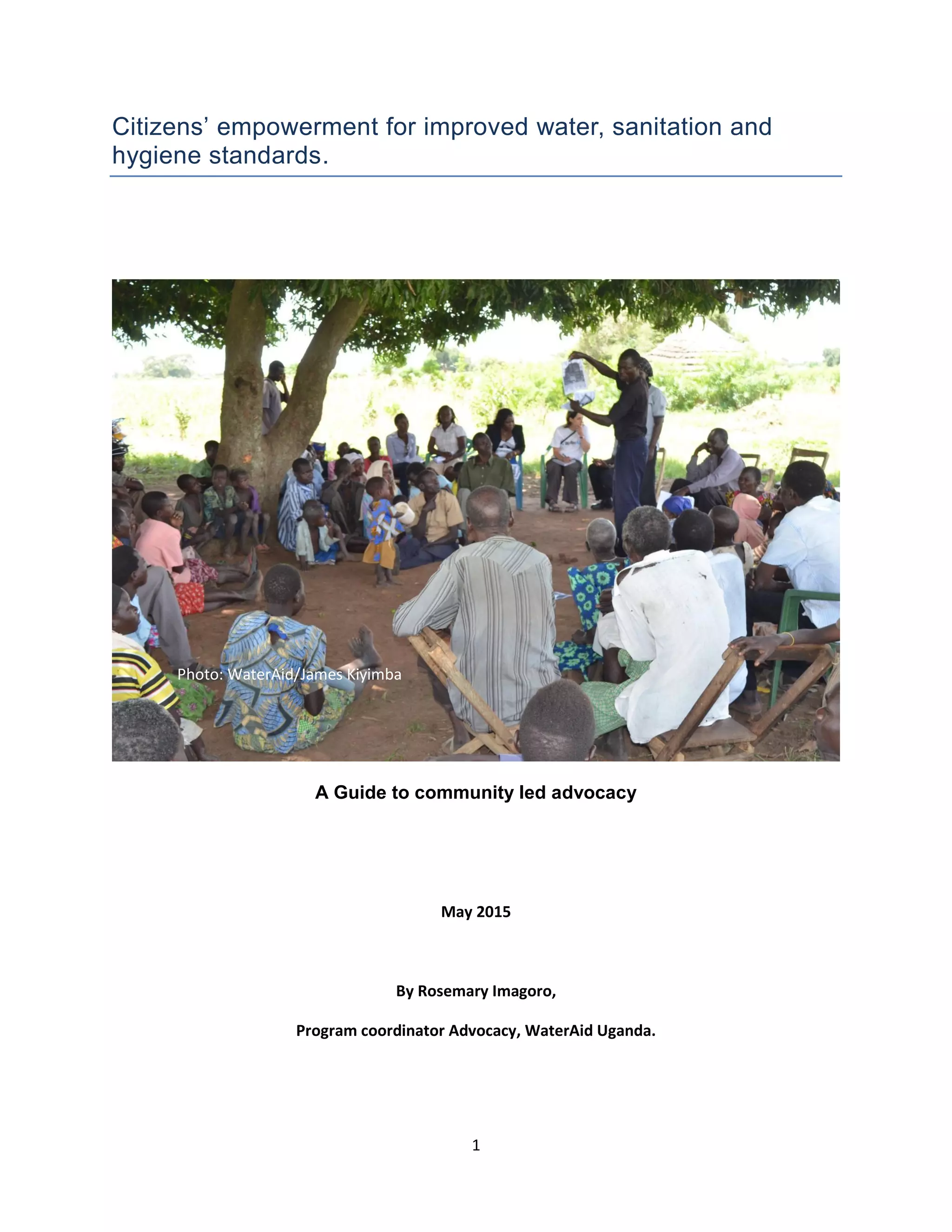
Photo: WaterAid/James Kiyimba
2
Acknowledgement:
Sincere appreciation goes to Jacinta Nekesa Head of Programmes, Water Aid Uganda
for her strategic support in shaping the thinking and making input during this write up.
Special recognition goes to James Kiyimba, Voices from the field, WaterAid Uganda for
providing photos and reviewing this document, Grace Alupo-Head policy and
campaigns WaterAid Uganda, Implementing partners –Church of Uganda Teso
Dioceses Planning and Development Office under the leadership of Francis Ediau ,
Civil society budget Advocacy group under the leadership of Carol Namagembe and
vision Terudo. The district local governments of Pallisa, Kibuku, Amuria and Amuria
Town council for the learnings shared that informed this piece.
3
Contents
Acknowledgement:...................................................................................................................................2
Introduction: ............................................................................................................................................5
Rationale for Community led Advocacy:.............................................................................................5
Other Advocacy WASH issues:............................................................................................................6
Purpose of the Guide:............................................................................................................................6
Why citizen empowerment....................................................................................................................7
The change we want to see:.................................................................................................................8
Enablers of Community Led advocacy: ..............................................................................................8
Steps to be followed in promoting community led advocacy:........................................................11
Conclusion:............................................................................................................................................15
4
5
Introduction:
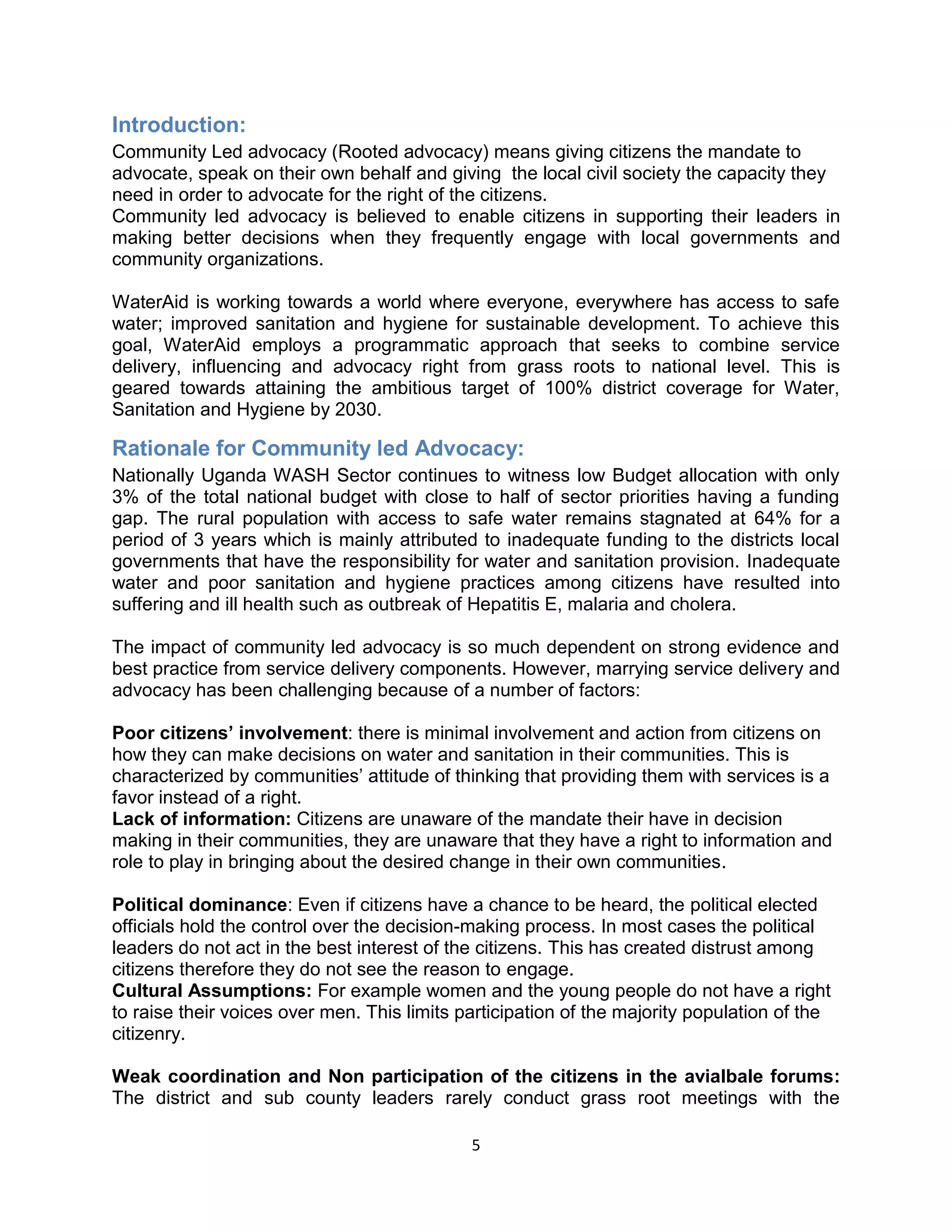
Community Led advocacy (Rooted advocacy) means giving citizens the mandate to
advocate, speak on their own behalf and giving the local civil society the capacity they
need in order to advocate for the right of the citizens.
Community led advocacy is believed to enable citizens in supporting their leaders in
making better decisions when they frequently engage with local governments and
community organizations.
WaterAid is working towards a world where everyone, everywhere has access to safe
water; improved sanitation and hygiene for sustainable development. To achieve this
goal, WaterAid employs a programmatic approach that seeks to combine service
delivery, influencing and advocacy right from grass roots to national level. This is
geared towards attaining the ambitious target of 100% district coverage for Water,
Sanitation and Hygiene by 2030.
Rationale for Community led Advocacy:
Nationally Uganda WASH Sector continues to witness low Budget allocation with only
3% of the total national budget with close to half of sector priorities having a funding
gap. The rural population with access to safe water remains stagnated at 64% for a
period of 3 years which is mainly attributed to inadequate funding to the districts local
governments that have the responsibility for water and sanitation provision. Inadequate
water and poor sanitation and hygiene practices among citizens have resulted into
suffering and ill health such as outbreak of Hepatitis E, malaria and cholera.
The impact of community led advocacy is so much dependent on strong evidence and
best practice from service delivery components. However, marrying service delivery and
advocacy has been challenging because of a number of factors:
Poor citizens’ involvement: there is minimal involvement and action from citizens on
how they can make decisions on water and sanitation in their communities. This is
characterized by communities’ attitude of thinking that providing them with services is a
favor instead of a right.
Lack of information: Citizens are unaware of the mandate their have in decision
making in their communities, they are unaware that they have a right to information and
role to play in bringing about the desired change in their own communities.
Political dominance: Even if citizens have a chance to be heard, the political elected
officials hold the control over the decision-making process. In most cases the political
leaders do not act in the best interest of the citizens. This has created distrust among
citizens therefore they do not see the reason to engage.
Cultural Assumptions: For example women and the young people do not have a right
to raise their voices over men. This limits participation of the majority population of the
citizenry.
Weak coordination and Non participation of the citizens in the avialbale forums:
The district and sub county leaders rarely conduct grass root meetings with the
6
community members. Actors at the grass roots are not involved in coordinating WASH
promotion. Coordination meetings are only done at the district with limited participation
of the citizens. Therefor decisions are made without involving citizens.
Other Advocacy WASH issues:
Low prioritization of water, sanitation and hygiene services: The sector continues
to suffer from low budget allocations from the national budget which has trickled down
to the districts where service delivery takes place jeopardizing access to safe, clean
water and improved sanitation. Unless citizens show need and demand for safe water
and improved sanitation and engage with duty bearers, Water, sanitation and hygiene
will remain low priority.
Capacity building: The responsibility to provide water and sanitation services is often
devolved to local government and service providers, but they frequently lack the
capacity to deliver due to inadequate skills or inadequate staff as some districts operate
at less that 50% of the staffing requirements. The communities as well do not have the
skills to hold the local government and the service providers accountable, neither do
they have the capacity to ensure that the few WASH services provided in their
communities are carried out well, this has led to shoddy work and a breakdown of
facilities, thus the average functionality of rural water supply stands at 85%.
Sustainability: little attention is given to ensure that policies that are in place are
implemented and enforced to achieve sustainable services at community level; little is
being done to ensure that communities form and enforce own their by-laws. A number
of factors have contributed to failure of the water points. WaterAid investigated why
some boreholes in Amuria and Katakwi districts were abandoned by communities. The
field investigation revealed among other factors high concentration of iron which
eventually leads to the corrosion of the pipes and subsequently breaking down of the
boreholes. This is coupled with non-functionality of the user committees that has
stagnated at 71% for the last 3 years.
Equity: Equity refers to those marginalized people living in hard to reach areas and who
cannot speak for themselves for government to provide services. According to the
research conducted by WaterAid and Appropriate Technology Center in the north
eastern part of Uganda in 2013, 24.3% of the vulnerable household members out of
45.4% of the 169 cases reported that they do not share the same latrine facility with
other household members due to the time it takes to reach the facility, lack of privacy
provided by the facility and the physical inaccessibility.
Purpose of the Guide:
This guide therefore reflects on the crucial importance of ensuring lasting behavior
change and increased access to safe and clean water through community participation
and empowerment.
7
The guide offers guidance on how citizens can engage and support Government at the
district and sub county in making better decisions.
This guide highlight ways in which WaterAid Uganda and partners will contribute to
creating an enabling environment that will encourage consistent and long-term
engagement of the citizens, break through the barriers to citizens’ engagement and
bring about the desired change in WASH promotion.
Potential users of this guide include WaterAid staff, District community extension
workers, local leaders, implementing partners, community advocacy structures.
Why citizen empowerment
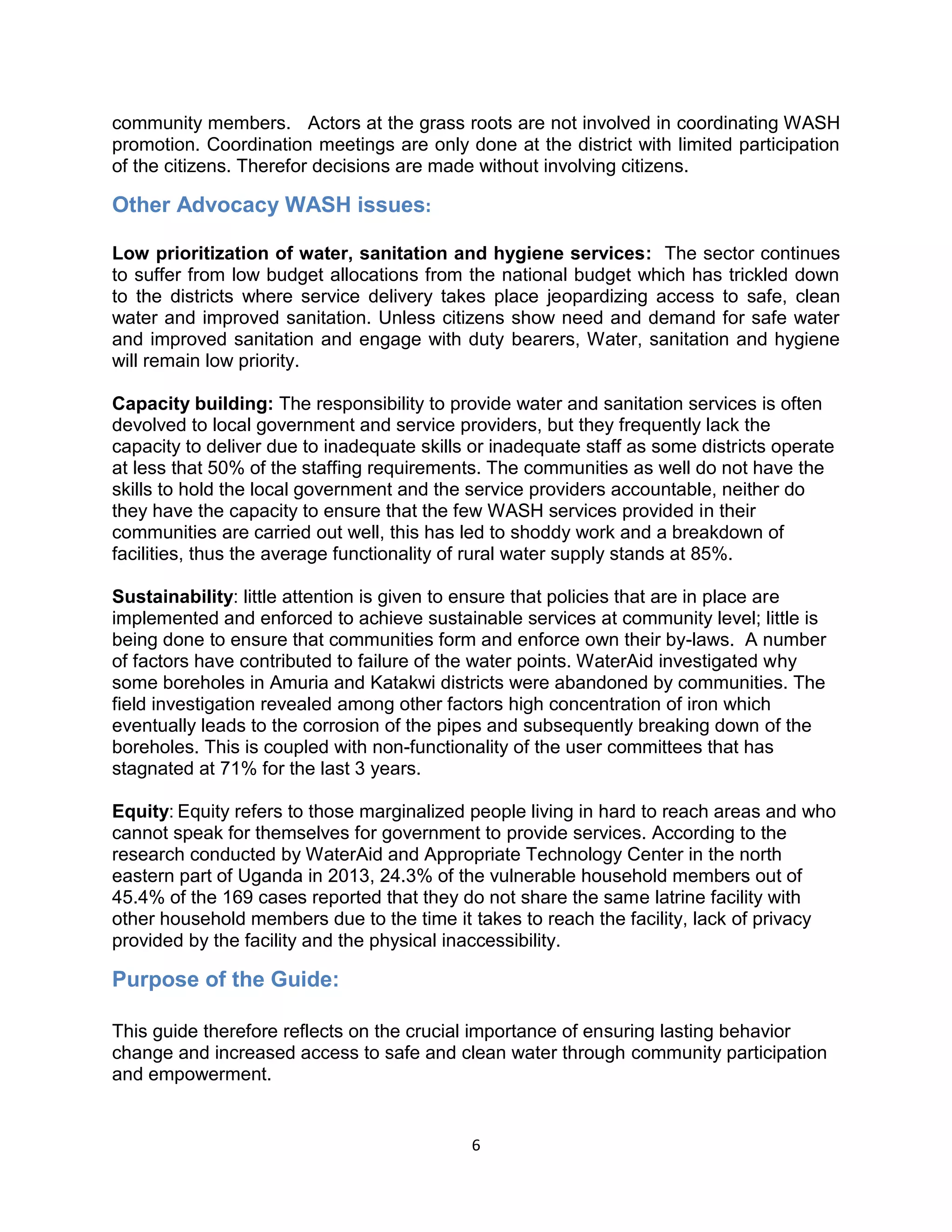
When citizens are empowered they are able to engage and articulate issues from the rights perspective,
holding service duty bearers to account for the WASH decisions they make.
WaterAid believes community led advocacy should empower citizens to demand for
their right to water, sanitation and hygiene as well as build their capacity to deliver on
their roles and responsibilities for the attainment of universal access. It also encourages
citizens and local Officials to interact regularly, increase their knowledge of each other,
and develop trust for each other.
Photo: WaterAid/James Kiyimba
8
By empowering citizens, ability to analyze, determine, prioritize and act on their own
situation with regard to Water and Sanitation issues from their own analysis is gained.
Community led advocacy helps to create more effective solutions to water, sanitation
and hygiene problems since it draws on local knowledge from a diverse group of
people, creates solutions that are practical and effective and helps Improve citizens’
knowledge and skills in problem solving. Citizens learn about the WASH issues in-depth
which allows them to see the different sides of the problem.
Community led advocacy also empowers and integrates people from different
backgrounds; and groups that feel ignored can gain greater control over their lives and
their community. It creates local networks of community members and Create several
opportunities for discussing those concerns.
The citizens learn from and inform government representatives in decision making.
Citizens gain skills for activist; they become citizen experts in understanding technically
difficult situations and seeing holistic community-wide solutions. Engagement of the
citizens promotes the well-being and development of citizens as they question, express
their views and have their opinions taken seriously that citizens develop skills, build
competencies, acquire confidence and form aspirations.
The change we want to see:
Citizens able to demand and hold the duty bearers accountable for their own actions.
The duty bearers being responsive in terms of equitable and increased service delivery.
The duty bearers and rights holders coming together to discuss, share challenges and
coming up with lasting solutions to their own problems thus more trust built.
Enablers of Community Led advocacy:
WaterAid believes that for community led advocacy to happen it involves a long-term
commitment to developing skills and to achieve change which will result in a better
outcome in the long run. The following are aspects that lead to successful citizen
engagement.
Experiential exposure:
Exposing citizens to different learning environments where other citizens have been
able to take up their own initiatives to promote WASH for sustainable development.
9
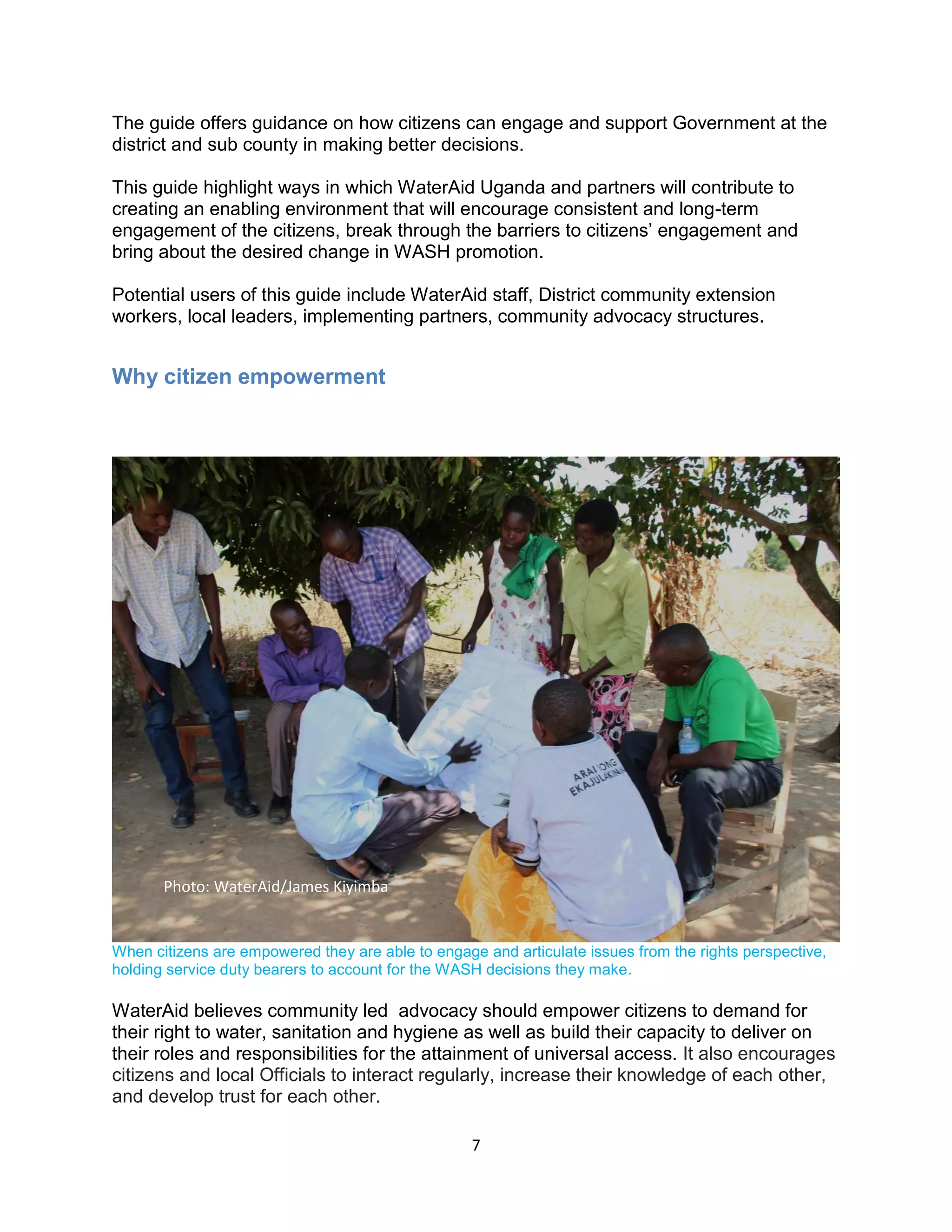
Once the capacity of citizens is built, they gain more and better skills to engage the duty bearers.
Capacity building of the Citizens:
Building the skills of the Citizens to engage with the duty bearers helps them in
enhancing their knowledge in promoting their right to be heard. The capacity can be
built through mentoring, information sharing, exposure to different platforms for
engagement and training them on community led advocacy.
Committed leadership:
Committed leadership Involves leaders that are able to articulate, sometimes forcefully
on behalf of the people they represent, as well as the means through which those
leaders can communicate the information to those with power to change policy.
Commitment in leadership promotes community unity and community decision making
in promoting sustainable development through water, sanitation and hygiene promotion.
Photo: WaterAid/Rosemary Imagoro
10
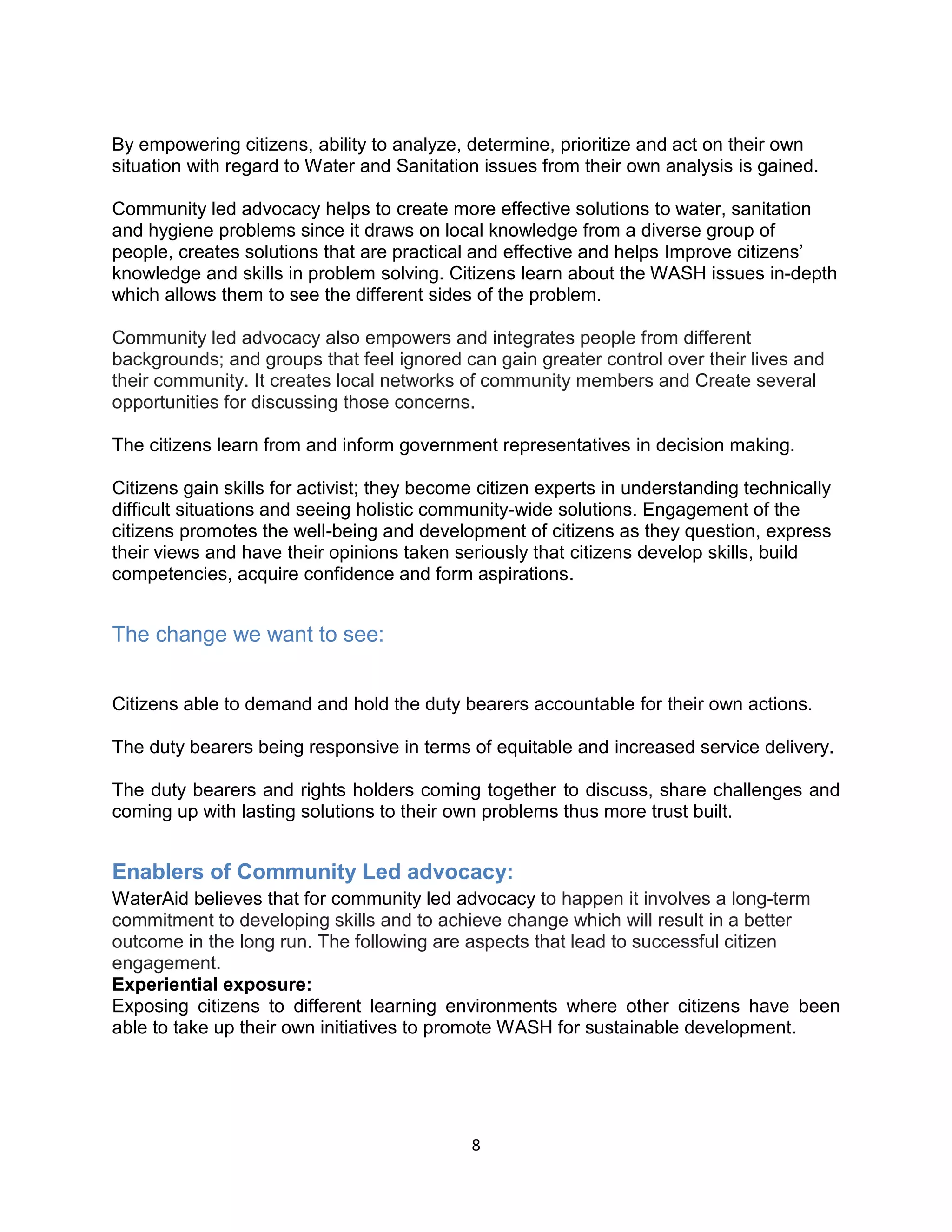
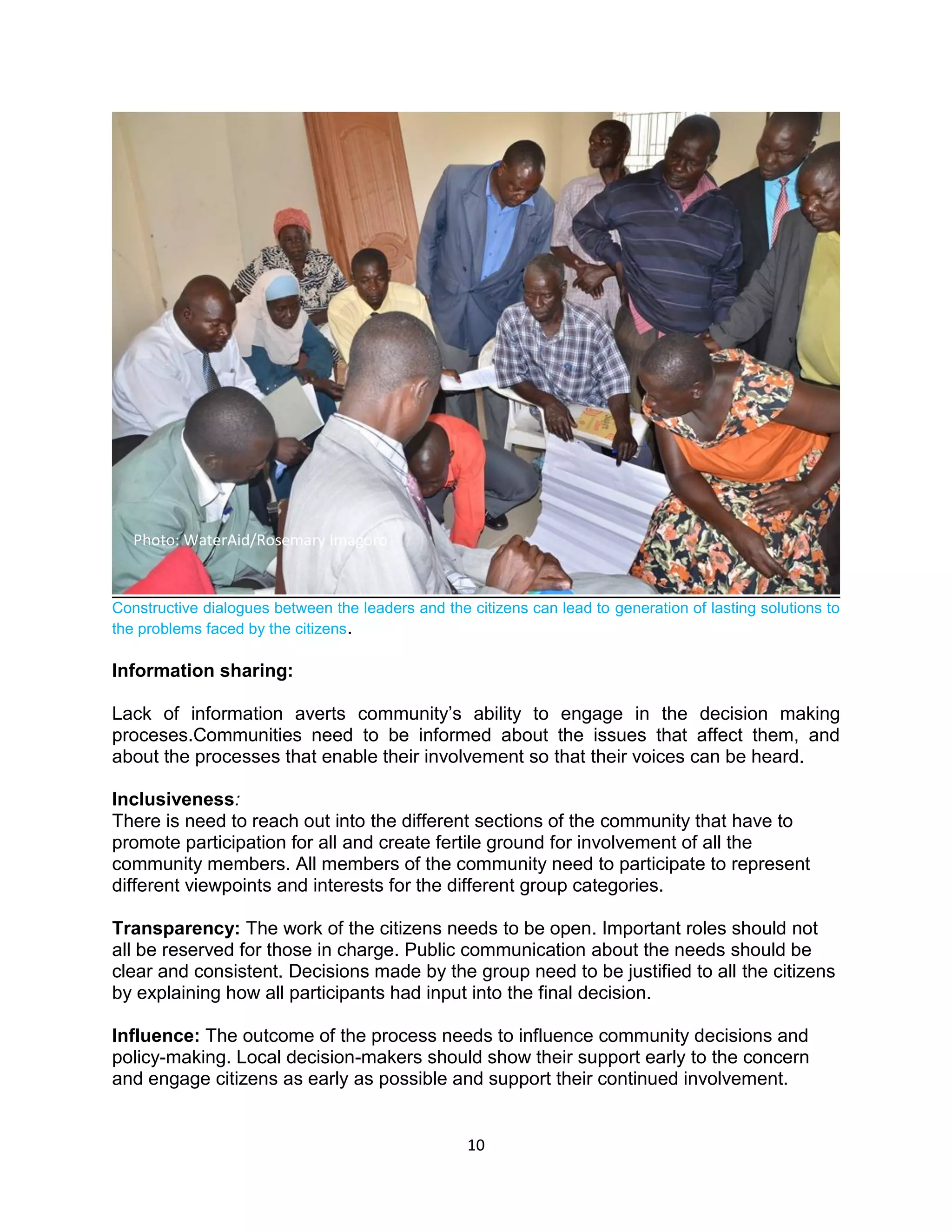
Constructive dialogues between the leaders and the citizens can lead to generation of lasting solutions to
the problems faced by the citizens.
Information sharing:
Lack of information averts community’s ability to engage in the decision making
proceses.Communities need to be informed about the issues that affect them, and
about the processes that enable their involvement so that their voices can be heard.
Inclusiveness:
There is need to reach out into the different sections of the community that have to
promote participation for all and create fertile ground for involvement of all the
community members. All members of the community need to participate to represent
different viewpoints and interests for the different group categories.
Transparency: The work of the citizens needs to be open. Important roles should not
all be reserved for those in charge. Public communication about the needs should be
clear and consistent. Decisions made by the group need to be justified to all the citizens
by explaining how all participants had input into the final decision.
Influence: The outcome of the process needs to influence community decisions and
policy-making. Local decision-makers should show their support early to the concern
and engage citizens as early as possible and support their continued involvement.
Photo: WaterAid/Rosemary Imagoro
11
Equality: Everyone participates on an equal basis. It should be clear that decisions are
not controlled by a Small group. Community leaders need to ensure that open
discussion occurs among the citizens and all ideas are treated with equal respect.
On-going: The process should consist of more than one meeting to allow citizens time
to think about the issue before making decisions. After a decision has been made, the
engagement with the policy makers should be continuous until the desired change is
achieved.
Steps to be followed in promoting community led advocacy:
It’s important to note that each step leads to another thus linear in nature.
Step 1: Identify issues and purpose of engagement: What is the specific community
problem or issue you want to address? It’s often helpful to frame the problem as an
issue for which the citizens needs to discuss alternatives, solutions, and consequences.
This allows multiple community groups to define the issue and identify a wider range of
solutions. Without knowing the issue, engagement becomes difficult.
To clearly define what you want to achieve and audience; find out why you need or want
people to get involved in is important right from the onset. You need to identify what you
want to accomplish by getting people involved. You should also choose a method that is
suitable to the goal and your target audience.
Step 2: capacity building: It’s important to build the capacity of the citizens such that
when they are engaging, they do it for the informed point of view. The capacity can be
through mentoring sensitization, exposure among others.
Step 3: Strategizing to engage: (This involves tool identification, knowing the target
Audience and action planning) There are a number of tools that can be used to engage
citizens, in terms of informing, consulting, and engaging and to collaborate.
In order to inform the following tools can be explored:
 Community scorecards: Local citizens can rank or score the range of their
services at a communal level to know which the most pressing need is. They then
refer to these ratings in their meetings with service providers or government officials.
 Interviews: Interviews and surveys are methods for identifying and prioritizing
issues within a community. The information provides decision-makers with broad-
based, reliable, and valid data to craft policies and programs and gauge the impact
of these policies and programs on community groups.
 Surveys: The purpose of surveys is to systematically collect data from a set of
community. Information is gathered through a carefully designed questionnaire.
Surveys can be used to learn more about your community, such as: Demographic
characteristics, access to community resources, opinions, attitudes, or beliefs about
community issues or policies; and behaviors in relation to community services or
programs.
12
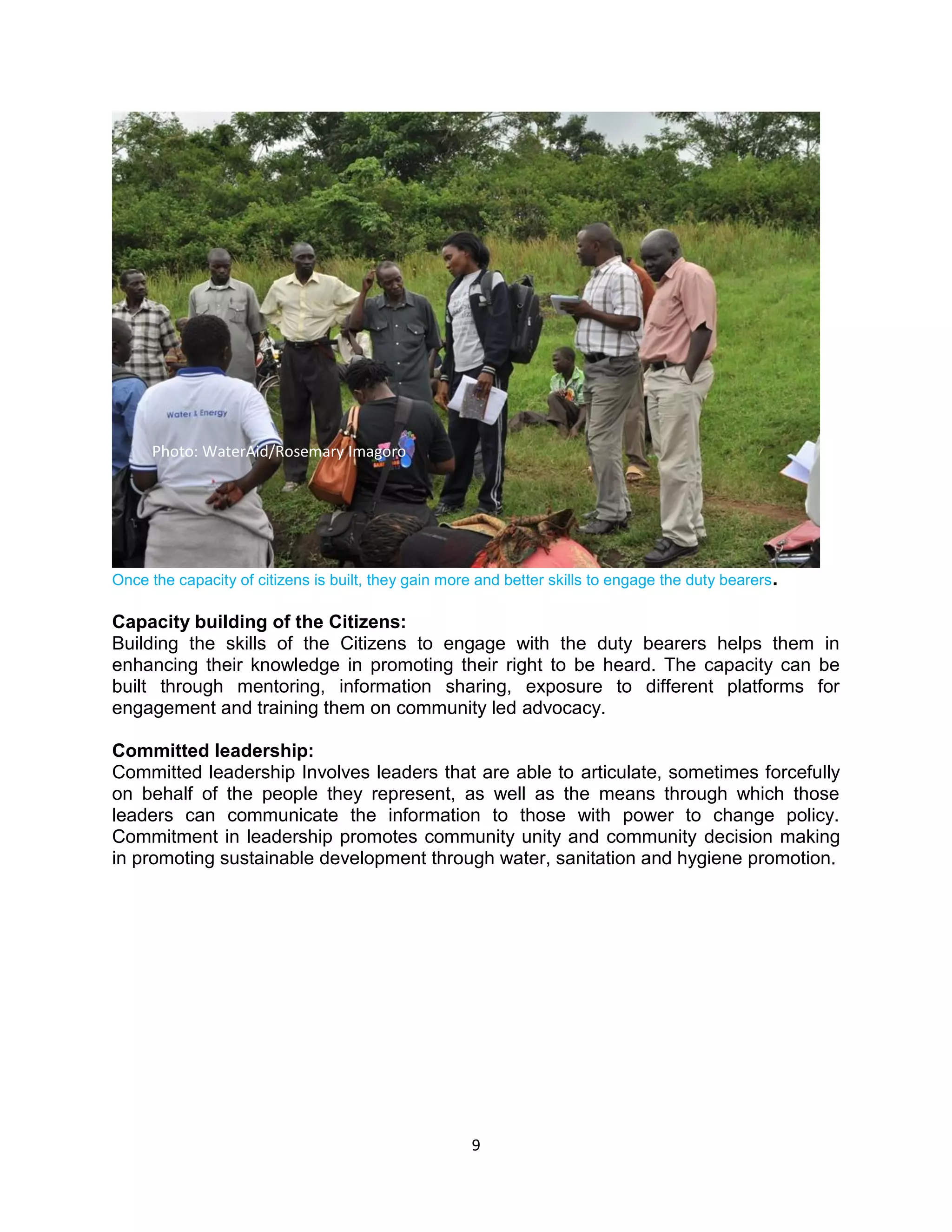
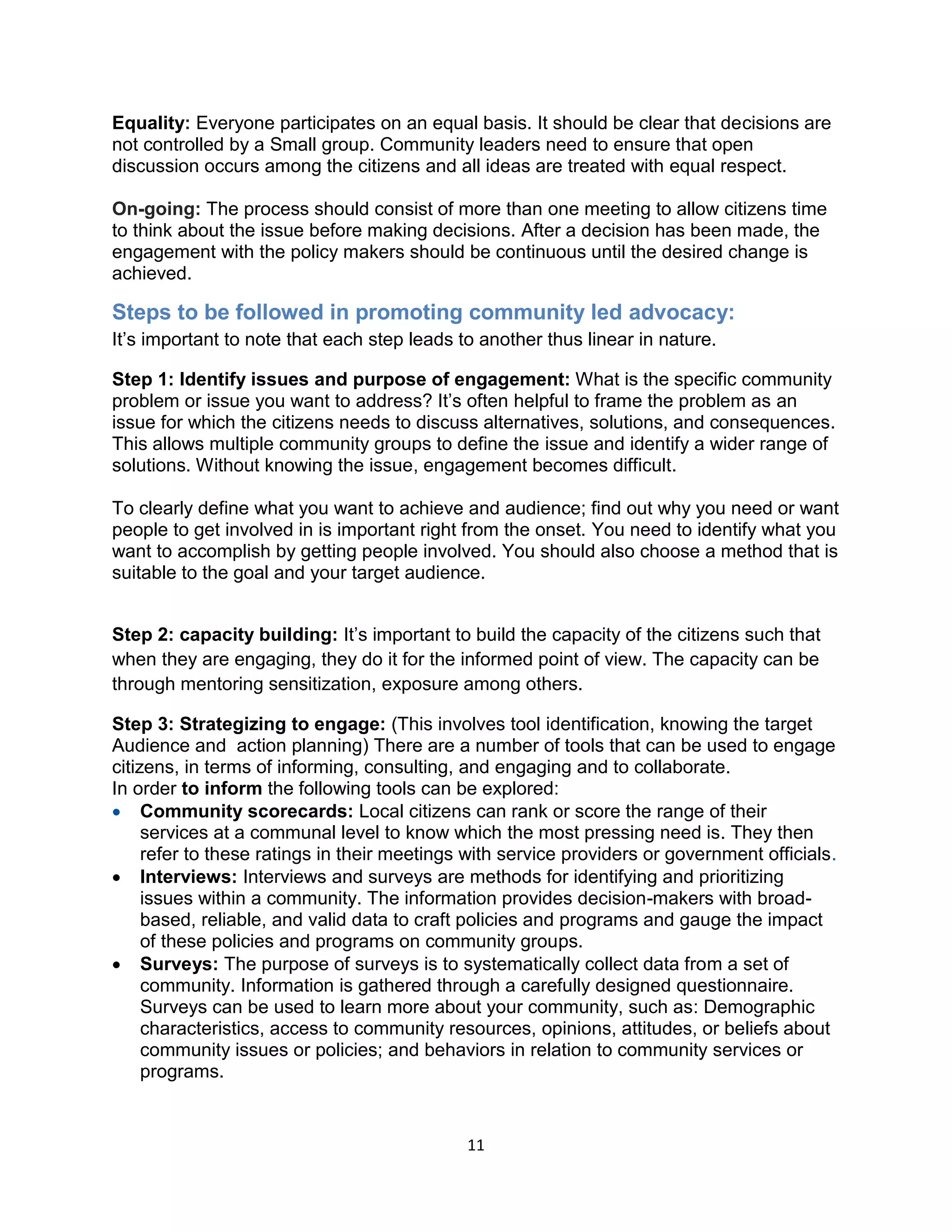
Involvement of all categories of people in the community builds confidence and control of the citizens
on issues affecting them.
 Public Hearings:
Public hearings are formal meetings at which citizens present official statements, their
personal positions, or the positions of their organizations. These types of hearings are
often required when an agency or organization is creating or changing policies or rules.
Public hearings offer the opportunity for statements to be included as part of the legal
proceedings. Public hearings are useful forums for hearing the range of community
opinions about an issue. Typical public hearings consist of formal testimony and
statements by individuals and organizations. Example of public hearings is: National
budget conference. At the district and sub county level, advocacy coordination
meetings, Budget conferences, Barazas, District water and sanitation coordination
meetings can be used to provide such opportunity if citizens are engaged.
In order to consult the following can be explored :
Nominal Group Process:
The nominal group process is a good method to use when you want to brainstorm,
gather ideas, and prioritize issues. This process works best when a larger group of
people is first brought together to discuss a community issue or problem. Citizens then
Photo: WaterAid/Rosemary Imagoro
13
break into small groups of about six to 10 people. Each small group is given a question
and the group members spend a few minutes writing down their ideas. After everyone
has a chance to think about the question, they share their ideas with each other, each
taking a turn, until all ideas are listed. A moderator or note-taker keeps track of all the
ideas mentioned.
Roundtable Discussions (focused groups)
Focused groups are facilitated discussions with a small group of people (8-10). Focus
groups are a powerful way to collect ideas, opinions, experiences, or beliefs about
community issues. Focus groups allow for in-depth discussion of an issue, and the
opportunity to clarify ideas and statements.
To engage the following tools are important:
Dialogue: Citizens can start negotiation with those responsible for providing services or
who are responsible for developing policy while implementing Partners give support for
as long as necessary. These dialogues can also happen through advocacy forums and
radio engagements.
Public Issues Forums:
Public issues forums bring together a group of citizens to explore an issue of local or
regional interest. The idea behind this approach is that most people may not have had
the opportunity to learn and form an opinion about the issue. The forum approach
allows each person to learn and think about the issue through moderated small group
discussions with other community members who may have differing viewpoints.
Policymakers use this information to guide decision making. The size and duration of
issues forums vary.
Citizens Panels:
14
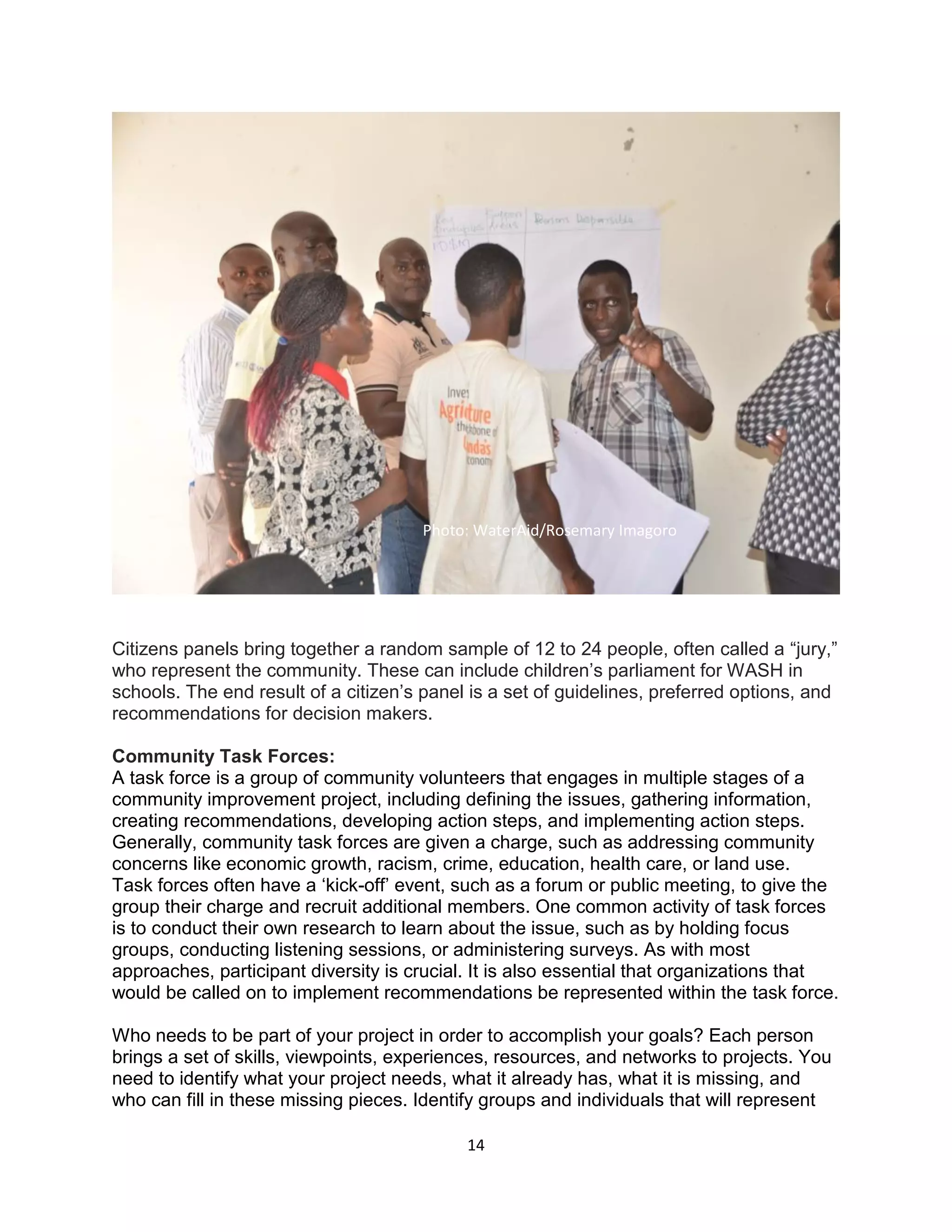
Citizens panels bring together a random sample of 12 to 24 people, often called a “jury,”
who represent the community. These can include children’s parliament for WASH in
schools. The end result of a citizen’s panel is a set of guidelines, preferred options, and
recommendations for decision makers.
Community Task Forces:
A task force is a group of community volunteers that engages in multiple stages of a
community improvement project, including defining the issues, gathering information,
creating recommendations, developing action steps, and implementing action steps.
Generally, community task forces are given a charge, such as addressing community
concerns like economic growth, racism, crime, education, health care, or land use.
Task forces often have a ‘kick-off’ event, such as a forum or public meeting, to give the
group their charge and recruit additional members. One common activity of task forces
is to conduct their own research to learn about the issue, such as by holding focus
groups, conducting listening sessions, or administering surveys. As with most
approaches, participant diversity is crucial. It is also essential that organizations that
would be called on to implement recommendations be represented within the task force.
Who needs to be part of your project in order to accomplish your goals? Each person
brings a set of skills, viewpoints, experiences, resources, and networks to projects. You
need to identify what your project needs, what it already has, what it is missing, and
who can fill in these missing pieces. Identify groups and individuals that will represent
Photo: WaterAid/Rosemary Imagoro
15
the diversity of your community, especially those who may traditionally be under-
represented in community efforts. It’s particularly important to include stakeholders:
those people who can influence how a decision is implemented, and who may be
affected by the decision. It is crucial to include all stakeholders in the process from the
beginning. They can help make things happen (or stop them from happening), and
provide important information about the potential impacts of
To encourage continued participation, you must continue offering worthwhile
experiences and opportunities. Part of this is organizing and running effective and
efficient meetings and resolving any conflict fairly and efficiently. Another important part
is making sure that the participants feel comfortable talking about and sharing their
ideas during meetings and that their ideas are seriously considered.
Step 4: Identify monitoring, Evaluation Criteria and Decide On Next Steps
Success leads to more success so it is essential to create benchmarks to track progress
of the action plan toward goals. Small, initial successes point to what can be achieved
by the group and boost motivation for future efforts. Celebrate these successes, and
remind participants of the role they played in getting to that point. Re-evaluate your
action steps in light of accomplishments.
Evaluation criteria should include not only the group’s ultimate goals, but also the
experiences of participants. Has the group been able to attract members, and have
these members’ experiences been positive? What have they learned in the process,
and have they been able to use these new skills in other arenas? Having this
information will allow you to tell a complete story of your success to participants and to
potential funding organization.
Step 5: Maintain Open Lines of Communication
On-going, regular communication about the citizens’ issues is important. It can keep
your issue fresh in the minds of the citizens, raise awareness about the citizens and
improve the citizens’ credibility. This can be strengthening through periodic Review no
matter what communication.
Conclusion:
A more engaged citizenry can result into better community/organizational decisions,
more efficient resource allocation, reduced conflict, enhanced quality of life for
community members, increased demand and supply thus overcoming the key WASH
issues.

Community led Advocacy Guide

  • 1.
    1 Citizens’ empowerment forimproved water, sanitation and hygiene standards. A Guide to community led advocacy May 2015 By Rosemary Imagoro, Program coordinator Advocacy, WaterAid Uganda. Photo: WaterAid/James Kiyimba
  • 2.
    2 Acknowledgement: Sincere appreciation goesto Jacinta Nekesa Head of Programmes, Water Aid Uganda for her strategic support in shaping the thinking and making input during this write up. Special recognition goes to James Kiyimba, Voices from the field, WaterAid Uganda for providing photos and reviewing this document, Grace Alupo-Head policy and campaigns WaterAid Uganda, Implementing partners –Church of Uganda Teso Dioceses Planning and Development Office under the leadership of Francis Ediau , Civil society budget Advocacy group under the leadership of Carol Namagembe and vision Terudo. The district local governments of Pallisa, Kibuku, Amuria and Amuria Town council for the learnings shared that informed this piece.
  • 3.
    3 Contents Acknowledgement:...................................................................................................................................2 Introduction: ............................................................................................................................................5 Rationale forCommunity led Advocacy:.............................................................................................5 Other Advocacy WASH issues:............................................................................................................6 Purpose of the Guide:............................................................................................................................6 Why citizen empowerment....................................................................................................................7 The change we want to see:.................................................................................................................8 Enablers of Community Led advocacy: ..............................................................................................8 Steps to be followed in promoting community led advocacy:........................................................11 Conclusion:............................................................................................................................................15
  • 4.
  • 5.
    5 Introduction: Community Led advocacy(Rooted advocacy) means giving citizens the mandate to advocate, speak on their own behalf and giving the local civil society the capacity they need in order to advocate for the right of the citizens. Community led advocacy is believed to enable citizens in supporting their leaders in making better decisions when they frequently engage with local governments and community organizations. WaterAid is working towards a world where everyone, everywhere has access to safe water; improved sanitation and hygiene for sustainable development. To achieve this goal, WaterAid employs a programmatic approach that seeks to combine service delivery, influencing and advocacy right from grass roots to national level. This is geared towards attaining the ambitious target of 100% district coverage for Water, Sanitation and Hygiene by 2030. Rationale for Community led Advocacy: Nationally Uganda WASH Sector continues to witness low Budget allocation with only 3% of the total national budget with close to half of sector priorities having a funding gap. The rural population with access to safe water remains stagnated at 64% for a period of 3 years which is mainly attributed to inadequate funding to the districts local governments that have the responsibility for water and sanitation provision. Inadequate water and poor sanitation and hygiene practices among citizens have resulted into suffering and ill health such as outbreak of Hepatitis E, malaria and cholera. The impact of community led advocacy is so much dependent on strong evidence and best practice from service delivery components. However, marrying service delivery and advocacy has been challenging because of a number of factors: Poor citizens’ involvement: there is minimal involvement and action from citizens on how they can make decisions on water and sanitation in their communities. This is characterized by communities’ attitude of thinking that providing them with services is a favor instead of a right. Lack of information: Citizens are unaware of the mandate their have in decision making in their communities, they are unaware that they have a right to information and role to play in bringing about the desired change in their own communities. Political dominance: Even if citizens have a chance to be heard, the political elected officials hold the control over the decision-making process. In most cases the political leaders do not act in the best interest of the citizens. This has created distrust among citizens therefore they do not see the reason to engage. Cultural Assumptions: For example women and the young people do not have a right to raise their voices over men. This limits participation of the majority population of the citizenry. Weak coordination and Non participation of the citizens in the avialbale forums: The district and sub county leaders rarely conduct grass root meetings with the
  • 6.
    6 community members. Actorsat the grass roots are not involved in coordinating WASH promotion. Coordination meetings are only done at the district with limited participation of the citizens. Therefor decisions are made without involving citizens. Other Advocacy WASH issues: Low prioritization of water, sanitation and hygiene services: The sector continues to suffer from low budget allocations from the national budget which has trickled down to the districts where service delivery takes place jeopardizing access to safe, clean water and improved sanitation. Unless citizens show need and demand for safe water and improved sanitation and engage with duty bearers, Water, sanitation and hygiene will remain low priority. Capacity building: The responsibility to provide water and sanitation services is often devolved to local government and service providers, but they frequently lack the capacity to deliver due to inadequate skills or inadequate staff as some districts operate at less that 50% of the staffing requirements. The communities as well do not have the skills to hold the local government and the service providers accountable, neither do they have the capacity to ensure that the few WASH services provided in their communities are carried out well, this has led to shoddy work and a breakdown of facilities, thus the average functionality of rural water supply stands at 85%. Sustainability: little attention is given to ensure that policies that are in place are implemented and enforced to achieve sustainable services at community level; little is being done to ensure that communities form and enforce own their by-laws. A number of factors have contributed to failure of the water points. WaterAid investigated why some boreholes in Amuria and Katakwi districts were abandoned by communities. The field investigation revealed among other factors high concentration of iron which eventually leads to the corrosion of the pipes and subsequently breaking down of the boreholes. This is coupled with non-functionality of the user committees that has stagnated at 71% for the last 3 years. Equity: Equity refers to those marginalized people living in hard to reach areas and who cannot speak for themselves for government to provide services. According to the research conducted by WaterAid and Appropriate Technology Center in the north eastern part of Uganda in 2013, 24.3% of the vulnerable household members out of 45.4% of the 169 cases reported that they do not share the same latrine facility with other household members due to the time it takes to reach the facility, lack of privacy provided by the facility and the physical inaccessibility. Purpose of the Guide: This guide therefore reflects on the crucial importance of ensuring lasting behavior change and increased access to safe and clean water through community participation and empowerment.
  • 7.
    7 The guide offersguidance on how citizens can engage and support Government at the district and sub county in making better decisions. This guide highlight ways in which WaterAid Uganda and partners will contribute to creating an enabling environment that will encourage consistent and long-term engagement of the citizens, break through the barriers to citizens’ engagement and bring about the desired change in WASH promotion. Potential users of this guide include WaterAid staff, District community extension workers, local leaders, implementing partners, community advocacy structures. Why citizen empowerment When citizens are empowered they are able to engage and articulate issues from the rights perspective, holding service duty bearers to account for the WASH decisions they make. WaterAid believes community led advocacy should empower citizens to demand for their right to water, sanitation and hygiene as well as build their capacity to deliver on their roles and responsibilities for the attainment of universal access. It also encourages citizens and local Officials to interact regularly, increase their knowledge of each other, and develop trust for each other. Photo: WaterAid/James Kiyimba
  • 8.
    8 By empowering citizens,ability to analyze, determine, prioritize and act on their own situation with regard to Water and Sanitation issues from their own analysis is gained. Community led advocacy helps to create more effective solutions to water, sanitation and hygiene problems since it draws on local knowledge from a diverse group of people, creates solutions that are practical and effective and helps Improve citizens’ knowledge and skills in problem solving. Citizens learn about the WASH issues in-depth which allows them to see the different sides of the problem. Community led advocacy also empowers and integrates people from different backgrounds; and groups that feel ignored can gain greater control over their lives and their community. It creates local networks of community members and Create several opportunities for discussing those concerns. The citizens learn from and inform government representatives in decision making. Citizens gain skills for activist; they become citizen experts in understanding technically difficult situations and seeing holistic community-wide solutions. Engagement of the citizens promotes the well-being and development of citizens as they question, express their views and have their opinions taken seriously that citizens develop skills, build competencies, acquire confidence and form aspirations. The change we want to see: Citizens able to demand and hold the duty bearers accountable for their own actions. The duty bearers being responsive in terms of equitable and increased service delivery. The duty bearers and rights holders coming together to discuss, share challenges and coming up with lasting solutions to their own problems thus more trust built. Enablers of Community Led advocacy: WaterAid believes that for community led advocacy to happen it involves a long-term commitment to developing skills and to achieve change which will result in a better outcome in the long run. The following are aspects that lead to successful citizen engagement. Experiential exposure: Exposing citizens to different learning environments where other citizens have been able to take up their own initiatives to promote WASH for sustainable development.
  • 9.
    9 Once the capacityof citizens is built, they gain more and better skills to engage the duty bearers. Capacity building of the Citizens: Building the skills of the Citizens to engage with the duty bearers helps them in enhancing their knowledge in promoting their right to be heard. The capacity can be built through mentoring, information sharing, exposure to different platforms for engagement and training them on community led advocacy. Committed leadership: Committed leadership Involves leaders that are able to articulate, sometimes forcefully on behalf of the people they represent, as well as the means through which those leaders can communicate the information to those with power to change policy. Commitment in leadership promotes community unity and community decision making in promoting sustainable development through water, sanitation and hygiene promotion. Photo: WaterAid/Rosemary Imagoro
  • 10.
    10 Constructive dialogues betweenthe leaders and the citizens can lead to generation of lasting solutions to the problems faced by the citizens. Information sharing: Lack of information averts community’s ability to engage in the decision making proceses.Communities need to be informed about the issues that affect them, and about the processes that enable their involvement so that their voices can be heard. Inclusiveness: There is need to reach out into the different sections of the community that have to promote participation for all and create fertile ground for involvement of all the community members. All members of the community need to participate to represent different viewpoints and interests for the different group categories. Transparency: The work of the citizens needs to be open. Important roles should not all be reserved for those in charge. Public communication about the needs should be clear and consistent. Decisions made by the group need to be justified to all the citizens by explaining how all participants had input into the final decision. Influence: The outcome of the process needs to influence community decisions and policy-making. Local decision-makers should show their support early to the concern and engage citizens as early as possible and support their continued involvement. Photo: WaterAid/Rosemary Imagoro
  • 11.
    11 Equality: Everyone participateson an equal basis. It should be clear that decisions are not controlled by a Small group. Community leaders need to ensure that open discussion occurs among the citizens and all ideas are treated with equal respect. On-going: The process should consist of more than one meeting to allow citizens time to think about the issue before making decisions. After a decision has been made, the engagement with the policy makers should be continuous until the desired change is achieved. Steps to be followed in promoting community led advocacy: It’s important to note that each step leads to another thus linear in nature. Step 1: Identify issues and purpose of engagement: What is the specific community problem or issue you want to address? It’s often helpful to frame the problem as an issue for which the citizens needs to discuss alternatives, solutions, and consequences. This allows multiple community groups to define the issue and identify a wider range of solutions. Without knowing the issue, engagement becomes difficult. To clearly define what you want to achieve and audience; find out why you need or want people to get involved in is important right from the onset. You need to identify what you want to accomplish by getting people involved. You should also choose a method that is suitable to the goal and your target audience. Step 2: capacity building: It’s important to build the capacity of the citizens such that when they are engaging, they do it for the informed point of view. The capacity can be through mentoring sensitization, exposure among others. Step 3: Strategizing to engage: (This involves tool identification, knowing the target Audience and action planning) There are a number of tools that can be used to engage citizens, in terms of informing, consulting, and engaging and to collaborate. In order to inform the following tools can be explored:  Community scorecards: Local citizens can rank or score the range of their services at a communal level to know which the most pressing need is. They then refer to these ratings in their meetings with service providers or government officials.  Interviews: Interviews and surveys are methods for identifying and prioritizing issues within a community. The information provides decision-makers with broad- based, reliable, and valid data to craft policies and programs and gauge the impact of these policies and programs on community groups.  Surveys: The purpose of surveys is to systematically collect data from a set of community. Information is gathered through a carefully designed questionnaire. Surveys can be used to learn more about your community, such as: Demographic characteristics, access to community resources, opinions, attitudes, or beliefs about community issues or policies; and behaviors in relation to community services or programs.
  • 12.
    12 Involvement of allcategories of people in the community builds confidence and control of the citizens on issues affecting them.  Public Hearings: Public hearings are formal meetings at which citizens present official statements, their personal positions, or the positions of their organizations. These types of hearings are often required when an agency or organization is creating or changing policies or rules. Public hearings offer the opportunity for statements to be included as part of the legal proceedings. Public hearings are useful forums for hearing the range of community opinions about an issue. Typical public hearings consist of formal testimony and statements by individuals and organizations. Example of public hearings is: National budget conference. At the district and sub county level, advocacy coordination meetings, Budget conferences, Barazas, District water and sanitation coordination meetings can be used to provide such opportunity if citizens are engaged. In order to consult the following can be explored : Nominal Group Process: The nominal group process is a good method to use when you want to brainstorm, gather ideas, and prioritize issues. This process works best when a larger group of people is first brought together to discuss a community issue or problem. Citizens then Photo: WaterAid/Rosemary Imagoro
  • 13.
    13 break into smallgroups of about six to 10 people. Each small group is given a question and the group members spend a few minutes writing down their ideas. After everyone has a chance to think about the question, they share their ideas with each other, each taking a turn, until all ideas are listed. A moderator or note-taker keeps track of all the ideas mentioned. Roundtable Discussions (focused groups) Focused groups are facilitated discussions with a small group of people (8-10). Focus groups are a powerful way to collect ideas, opinions, experiences, or beliefs about community issues. Focus groups allow for in-depth discussion of an issue, and the opportunity to clarify ideas and statements. To engage the following tools are important: Dialogue: Citizens can start negotiation with those responsible for providing services or who are responsible for developing policy while implementing Partners give support for as long as necessary. These dialogues can also happen through advocacy forums and radio engagements. Public Issues Forums: Public issues forums bring together a group of citizens to explore an issue of local or regional interest. The idea behind this approach is that most people may not have had the opportunity to learn and form an opinion about the issue. The forum approach allows each person to learn and think about the issue through moderated small group discussions with other community members who may have differing viewpoints. Policymakers use this information to guide decision making. The size and duration of issues forums vary. Citizens Panels:
  • 14.
    14 Citizens panels bringtogether a random sample of 12 to 24 people, often called a “jury,” who represent the community. These can include children’s parliament for WASH in schools. The end result of a citizen’s panel is a set of guidelines, preferred options, and recommendations for decision makers. Community Task Forces: A task force is a group of community volunteers that engages in multiple stages of a community improvement project, including defining the issues, gathering information, creating recommendations, developing action steps, and implementing action steps. Generally, community task forces are given a charge, such as addressing community concerns like economic growth, racism, crime, education, health care, or land use. Task forces often have a ‘kick-off’ event, such as a forum or public meeting, to give the group their charge and recruit additional members. One common activity of task forces is to conduct their own research to learn about the issue, such as by holding focus groups, conducting listening sessions, or administering surveys. As with most approaches, participant diversity is crucial. It is also essential that organizations that would be called on to implement recommendations be represented within the task force. Who needs to be part of your project in order to accomplish your goals? Each person brings a set of skills, viewpoints, experiences, resources, and networks to projects. You need to identify what your project needs, what it already has, what it is missing, and who can fill in these missing pieces. Identify groups and individuals that will represent Photo: WaterAid/Rosemary Imagoro
  • 15.
    15 the diversity ofyour community, especially those who may traditionally be under- represented in community efforts. It’s particularly important to include stakeholders: those people who can influence how a decision is implemented, and who may be affected by the decision. It is crucial to include all stakeholders in the process from the beginning. They can help make things happen (or stop them from happening), and provide important information about the potential impacts of To encourage continued participation, you must continue offering worthwhile experiences and opportunities. Part of this is organizing and running effective and efficient meetings and resolving any conflict fairly and efficiently. Another important part is making sure that the participants feel comfortable talking about and sharing their ideas during meetings and that their ideas are seriously considered. Step 4: Identify monitoring, Evaluation Criteria and Decide On Next Steps Success leads to more success so it is essential to create benchmarks to track progress of the action plan toward goals. Small, initial successes point to what can be achieved by the group and boost motivation for future efforts. Celebrate these successes, and remind participants of the role they played in getting to that point. Re-evaluate your action steps in light of accomplishments. Evaluation criteria should include not only the group’s ultimate goals, but also the experiences of participants. Has the group been able to attract members, and have these members’ experiences been positive? What have they learned in the process, and have they been able to use these new skills in other arenas? Having this information will allow you to tell a complete story of your success to participants and to potential funding organization. Step 5: Maintain Open Lines of Communication On-going, regular communication about the citizens’ issues is important. It can keep your issue fresh in the minds of the citizens, raise awareness about the citizens and improve the citizens’ credibility. This can be strengthening through periodic Review no matter what communication. Conclusion: A more engaged citizenry can result into better community/organizational decisions, more efficient resource allocation, reduced conflict, enhanced quality of life for community members, increased demand and supply thus overcoming the key WASH issues.