{
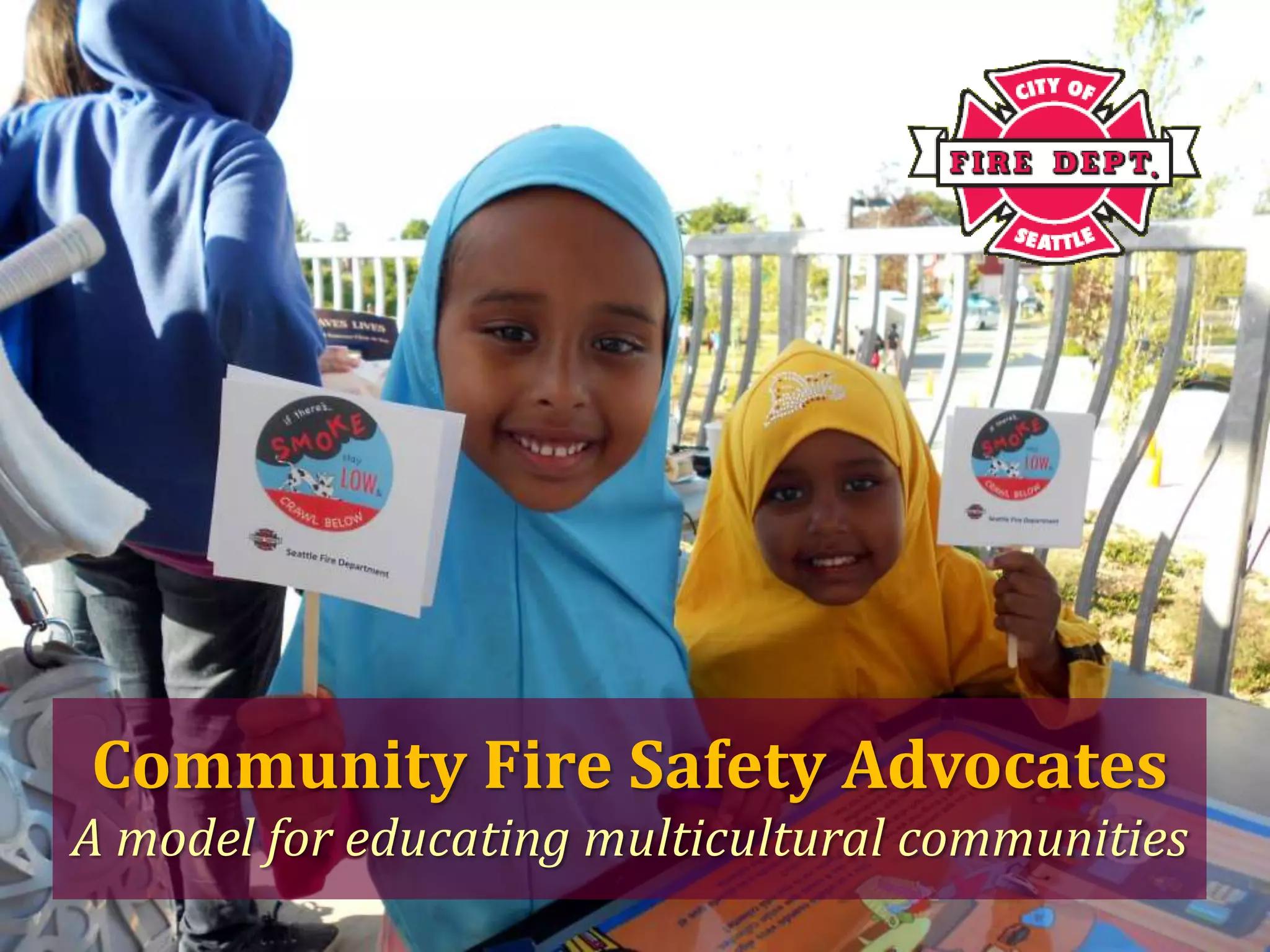
Community Fire Safety Advocates
A model for educating multicultural communities
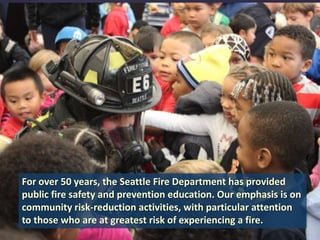
For over 50 years, the Seattle Fire Department has provided
public fire safety and prevention education. Our emphasis is on
community risk-reduction activities, with particular attention
to those who are at greatest risk of experiencing a fire.
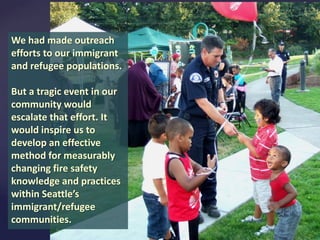
We had made outreach
efforts to our immigrant
and refugee populations.
But a tragic event in our
community would
escalate that effort. It
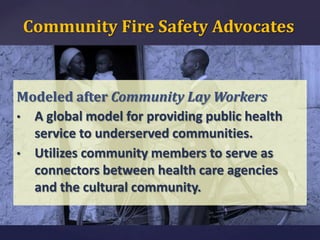
would inspire us to
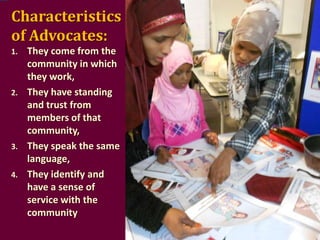
develop an effective
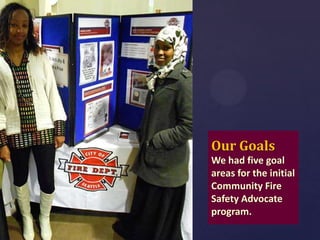
method for measurably
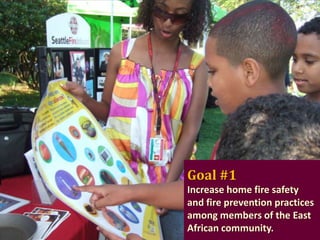
changing fire safety
knowledge and practices
within Seattle’s
immigrant/refugee
communities.
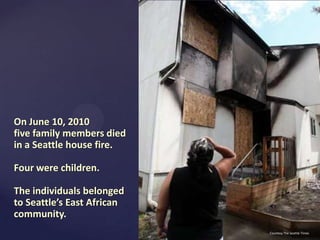
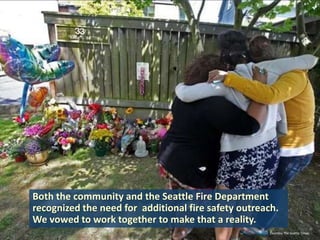
On June 10, 2010
five family members died
in a Seattle house fire.
Four were children.

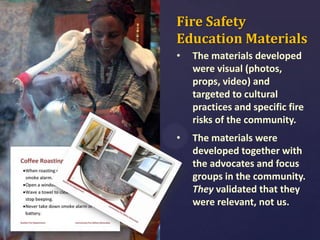
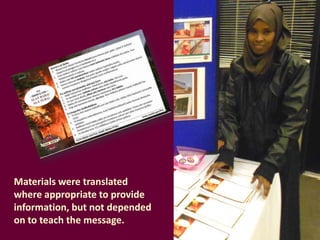
The individuals belonged
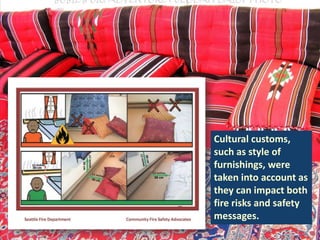
to Seattle’s East African
community.
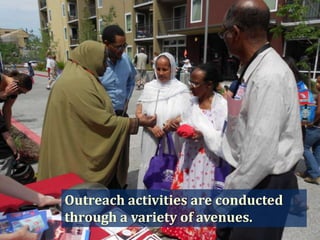
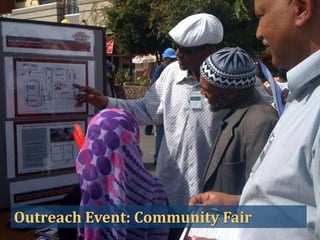
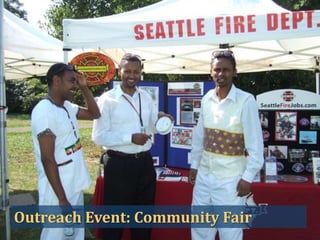
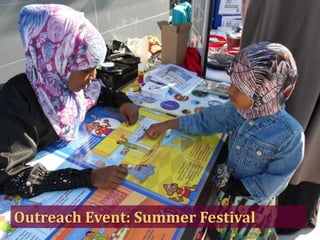
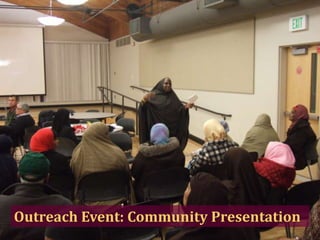
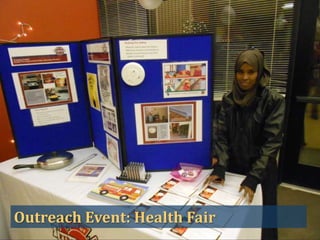
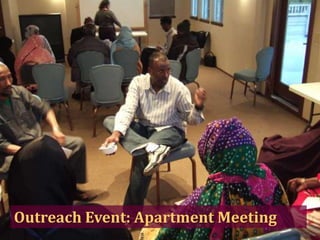
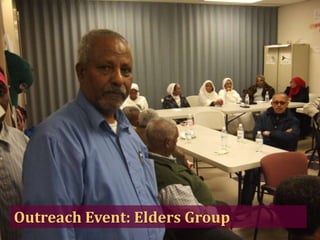
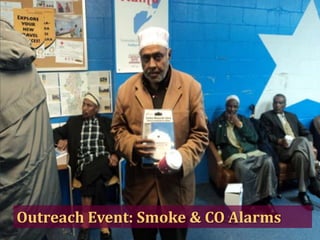
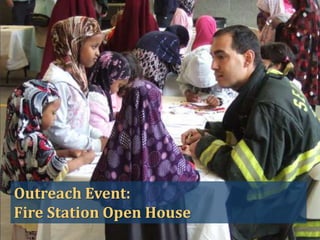
Courtesy The Seattle Times
Both the community and the Seattle Fire Department
recognized the need for additional fire safety outreach.
We vowed to work together to make that a reality.
Courtesy The Seattle Times
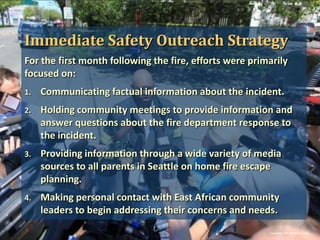
Immediate Safety Outreach Strategy
For the first month following the fire, efforts were primarily
focused on:
1.

Communicating factual information about the incident.

2.

Holding community meetings to provide information and
answer questions about the fire department response to
the incident.

3.

Providing information through a wide variety of media
sources to all parents in Seattle on home fire escape
planning.

4.

Making personal contact with East African community
leaders to begin addressing their concerns and needs.
Courtesy The Seattle Times

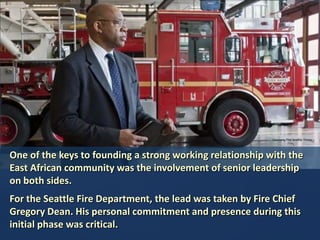
One of the keys to founding a strong working relationship with the
East African community was the involvement of senior leadership
on both sides.
For the Seattle Fire Department, the lead was taken by Fire Chief
Gregory Dean. His personal commitment and presence during this
initial phase was critical.
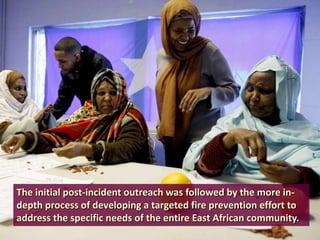
The initial post-incident outreach was followed by the more indepth process of developing a targeted fire prevention effort to
address the specific needs of the entire East African community.
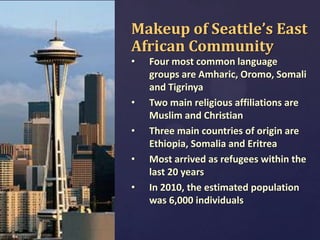
Makeup of Seattle’s East
African Community
•

•

•
•

•

Four most common language
groups are Amharic, Oromo, Somali
and Tigrinya
Two main religious affiliations are
Muslim and Christian
Three main countries of origin are
Ethiopia, Somalia and Eritrea
Most arrived as refugees within the
last 20 years
In 2010, the estimated population
was 6,000 individuals
Our Challenge
To deliver culturally relevant fire safety education targeted to the
risks of the identified community.

To be successful, we needed
1.
2.
3.
4.
5.

Culturally competent educators & delivery methods.
An understanding of the target groups’ fire risks.
Partnership with agencies and groups already engaged with
the target communities.
Access to the target communities.
Motivation by the target communities to learn fire safe
behaviors.

CULTURAL COMPETENCE refers to an ability to successfully negotiate crosscultural differences in order to accomplish practical goals.
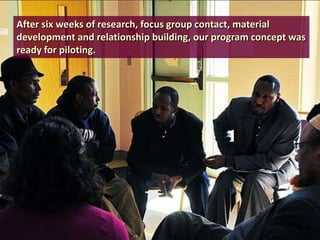
After six weeks of research, focus group contact, material
development and relationship building, our program concept was
ready for piloting.
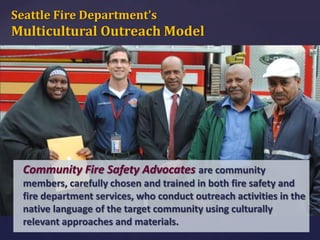
Seattle Fire Department’s

Multicultural Outreach Model

Community Fire Safety Advocates are community
members, carefully chosen and trained in both fire safety and
fire department services, who conduct outreach activities in the
native language of the target community using culturally
relevant approaches and materials.
Community Fire Safety Advocates

Modeled after Community Lay Workers
• A global model for providing public health
service to underserved communities.
• Utilizes community members to serve as
connectors between health care agencies
and the cultural community.
Characteristics
of Advocates:
1.

2.

3.
4.

They come from the
community in which
they work,
They have standing
and trust from
members of that
community,
They speak the same
language,
They identify and
have a sense of
service with the
community
Our Goals
We had five goal
areas for the initial
Community Fire
Safety Advocate
program.
Goal #1
Increase home fire safety
and fire prevention practices
among members of the East
African community.
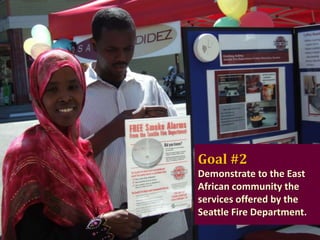
Goal #2
Demonstrate to the East
African community the
services offered by the
Seattle Fire Department.
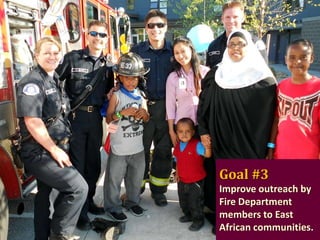
Goal #3
Improve outreach by
Fire Department
members to East
African communities.
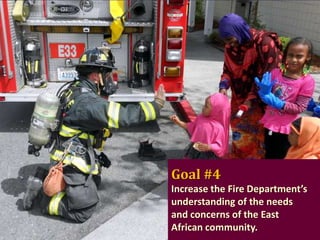
Goal #4
Increase the Fire Department’s
understanding of the needs
and concerns of the East
African community.
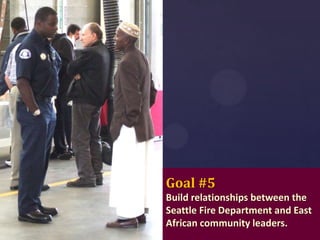
Goal #5
Build relationships between the
Seattle Fire Department and East
African community leaders.
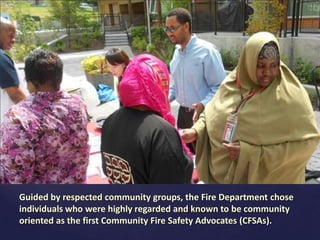
Guided by respected community groups, the Fire Department chose
individuals who were highly regarded and known to be community
oriented as the first Community Fire Safety Advocates (CFSAs).
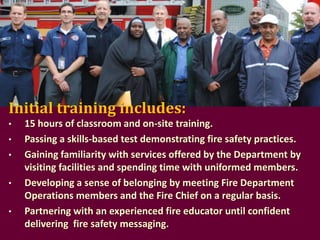
Initial training includes:
•

•
•
•
•

15 hours of classroom and on-site training.
Passing a skills-based test demonstrating fire safety practices.
Gaining familiarity with services offered by the Department by
visiting facilities and spending time with uniformed members.
Developing a sense of belonging by meeting Fire Department
Operations members and the Fire Chief on a regular basis.
Partnering with an experienced fire educator until confident
delivering fire safety messaging.
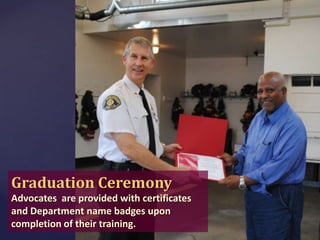
Graduation Ceremony
Advocates are provided with certificates
and Department name badges upon
completion of their training.
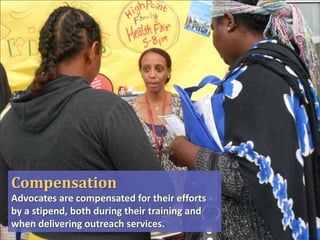
Compensation
Advocates are compensated for their efforts
by a stipend, both during their training and
when delivering outreach services.
Fire Safety
Education Materials
•

The materials developed
were visual (photos,
props, video) and
targeted to cultural
practices and specific fire
risks of the community.

•

The materials were
developed together with
the advocates and focus
groups in the community.
They validated that they
were relevant, not us.
Cultural customs,
such as style of
furnishings, were
taken into account as
they can impact both
fire risks and safety
messages.
Materials were translated
where appropriate to provide
information, but not depended
on to teach the message.
Outreach activities are conducted
through a variety of avenues.
Outreach Event: Community Fair
Outreach Event: Summer Festival
Outreach Event: Community Presentation
Outreach Event: Health Fair
Outreach Event: Apartment Meeting
Outreach Event: Elders Group
Outreach Event: Smoke & CO Alarms
Outreach Event:
Fire Station Open House
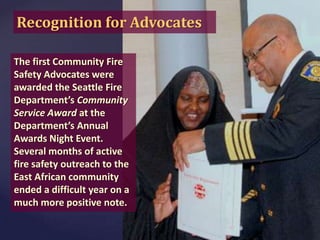
Recognition for Advocates
The first Community Fire
Safety Advocates were
awarded the Seattle Fire
Department’s Community
Service Award at the
Department’s Annual
Awards Night Event.
Several months of active
fire safety outreach to the
East African community
ended a difficult year on a
much more positive note.
Pilot Project Results (2010-2011)
•

Ten East African community members received capacitybuilding skills and knowledge in fire safety and
prevention.

•

Community Fire Safety Advocates conducted 408 hours of
outreach activity between September 2010 and December
2011.

•

Over 4,000 East African community members were
reached with culturally relevant fire safety information by
December 2011.

•

Positive relationships were established between Seattle
Fire Department members and East African community
leaders and agencies.

Fire Prevention Report: Community Fire Safety Advocate Pilot Project may be viewed here.
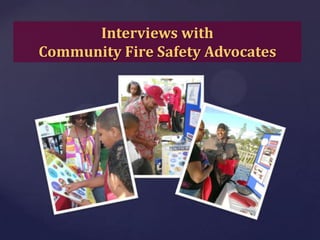
Interviews with
Community Fire Safety Advocates
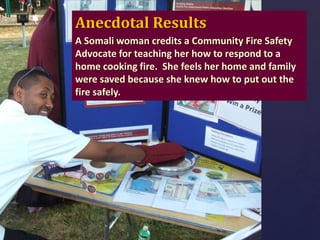
Anecdotal Results
A Somali woman credits a Community Fire Safety
Advocate for teaching her how to respond to a
home cooking fire. She feels her home and family
were saved because she knew how to put out the
fire safely.
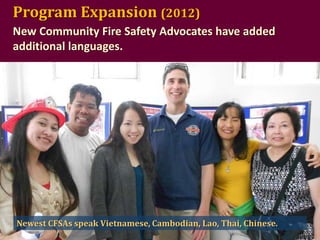
Program Expansion (2012)
New Community Fire Safety Advocates have added
additional languages.

Newest CFSAs speak Vietnamese, Cambodian, Lao, Thai, Chinese.
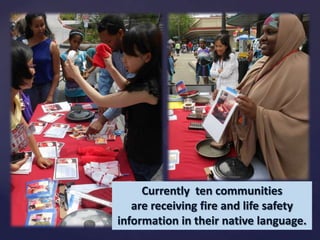
Currently ten communities
are receiving fire and life safety
information in their native language.
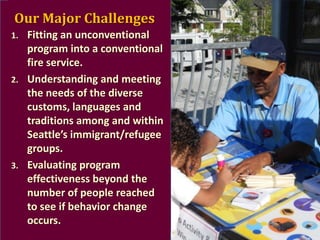
Our Major Challenges
1.

2.

3.

Fitting an unconventional
program into a conventional
fire service.
Understanding and meeting
the needs of the diverse
customs, languages and
traditions among and within
Seattle’s immigrant/refugee
groups.
Evaluating program
effectiveness beyond the
number of people reached
to see if behavior change
occurs.
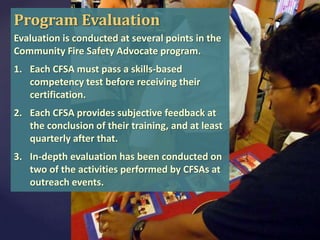
Program Evaluation
Evaluation is conducted at several points in the
Community Fire Safety Advocate program.
1. Each CFSA must pass a skills-based
competency test before receiving their
certification.
2. Each CFSA provides subjective feedback at
the conclusion of their training, and at least
quarterly after that.
3. In-depth evaluation has been conducted on
two of the activities performed by CFSAs at
outreach events.
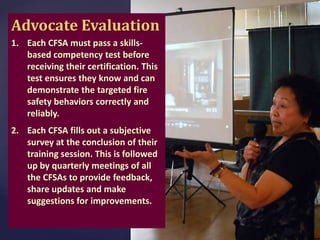
Advocate Evaluation
1. Each CFSA must pass a skillsbased competency test before
receiving their certification. This
test ensures they know and can
demonstrate the targeted fire
safety behaviors correctly and
reliably.
2. Each CFSA fills out a subjective
survey at the conclusion of their
training session. This is followed
up by quarterly meetings of all
the CFSAs to provide feedback,
share updates and make
suggestions for improvements.
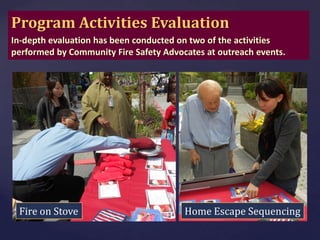
Program Activities Evaluation
In-depth evaluation has been conducted on two of the activities
performed by Community Fire Safety Advocates at outreach events.

Fire on Stove

Home Escape Sequencing
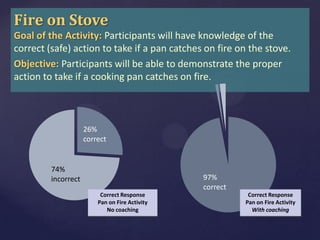
Fire on Stove
Goal of the Activity: Participants will have knowledge of the
correct (safe) action to take if a pan catches on fire on the stove.
Objective: Participants will be able to demonstrate the proper
action to take if a cooking pan catches on fire.

26%
correct

74%
incorrect

97%
correct
Correct Response
Pan on Fire Activity
No coaching

Correct Response
Pan on Fire Activity
With coaching
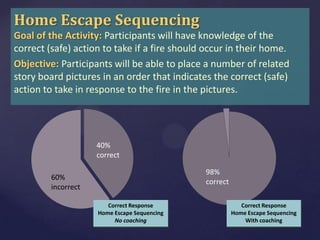
Home Escape Sequencing
Goal of the Activity: Participants will have knowledge of the
correct (safe) action to take if a fire should occur in their home.
Objective: Participants will be able to place a number of related
story board pictures in an order that indicates the correct (safe)
action to take in response to the fire in the pictures.

40%
correct
98%
correct

60%
incorrect
Correct Response
Home Escape Sequencing
No coaching

Correct Response
Home Escape Sequencing
With coaching
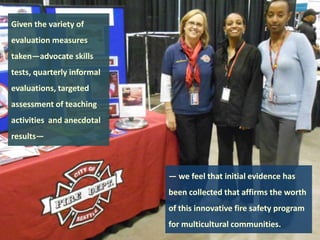
Given the variety of
evaluation measures
taken—advocate skills
tests, quarterly informal

evaluations, targeted
assessment of teaching
activities and anecdotal
results—

— we feel that initial evidence has

been collected that affirms the worth
of this innovative fire safety program
for multicultural communities.
Seattle Fire Department’s Keys to Successful
Multicultural Fire Safety Education:
1.

Aim to address the target groups’ actual fire risks.

2.

Teach behaviors that are do-able and targeted to the
risks.

3.

Develop program parameters and materials in
collaboration with local native language speakers.

4.

Provide education that is culturally relevant in its
methods, delivery and materials.

5.

Appeal to the target communities’ motivation to learn
safe behaviors.

6.

Deliver educational services in the primary language of
the learner.
SEATTLE FIRE DEPARTMENT
Fire Prevention Division
Public Education Section
Seattle.gov/fire
fireinfo@seattle.gov

Community Fire Safety Advocate Program

  • 1.
    { Community Fire SafetyAdvocates A model for educating multicultural communities
  • 2.
    For over 50years, the Seattle Fire Department has provided public fire safety and prevention education. Our emphasis is on community risk-reduction activities, with particular attention to those who are at greatest risk of experiencing a fire.
  • 3.
    We had madeoutreach efforts to our immigrant and refugee populations. But a tragic event in our community would escalate that effort. It would inspire us to develop an effective method for measurably changing fire safety knowledge and practices within Seattle’s immigrant/refugee communities.
  • 4.
    On June 10,2010 five family members died in a Seattle house fire. Four were children. The individuals belonged to Seattle’s East African community. Courtesy The Seattle Times
  • 5.
    Both the communityand the Seattle Fire Department recognized the need for additional fire safety outreach. We vowed to work together to make that a reality. Courtesy The Seattle Times
  • 6.
    Immediate Safety OutreachStrategy For the first month following the fire, efforts were primarily focused on: 1. Communicating factual information about the incident. 2. Holding community meetings to provide information and answer questions about the fire department response to the incident. 3. Providing information through a wide variety of media sources to all parents in Seattle on home fire escape planning. 4. Making personal contact with East African community leaders to begin addressing their concerns and needs. Courtesy The Seattle Times
  • 7.
    Courtesy The SeattleTimes One of the keys to founding a strong working relationship with the East African community was the involvement of senior leadership on both sides. For the Seattle Fire Department, the lead was taken by Fire Chief Gregory Dean. His personal commitment and presence during this initial phase was critical.
  • 8.
    The initial post-incidentoutreach was followed by the more indepth process of developing a targeted fire prevention effort to address the specific needs of the entire East African community.
  • 9.
    Makeup of Seattle’sEast African Community • • • • • Four most common language groups are Amharic, Oromo, Somali and Tigrinya Two main religious affiliations are Muslim and Christian Three main countries of origin are Ethiopia, Somalia and Eritrea Most arrived as refugees within the last 20 years In 2010, the estimated population was 6,000 individuals
  • 10.
    Our Challenge To deliverculturally relevant fire safety education targeted to the risks of the identified community. To be successful, we needed 1. 2. 3. 4. 5. Culturally competent educators & delivery methods. An understanding of the target groups’ fire risks. Partnership with agencies and groups already engaged with the target communities. Access to the target communities. Motivation by the target communities to learn fire safe behaviors. CULTURAL COMPETENCE refers to an ability to successfully negotiate crosscultural differences in order to accomplish practical goals.
  • 11.
    After six weeksof research, focus group contact, material development and relationship building, our program concept was ready for piloting.
  • 12.
    Seattle Fire Department’s MulticulturalOutreach Model Community Fire Safety Advocates are community members, carefully chosen and trained in both fire safety and fire department services, who conduct outreach activities in the native language of the target community using culturally relevant approaches and materials.
  • 13.
    Community Fire SafetyAdvocates Modeled after Community Lay Workers • A global model for providing public health service to underserved communities. • Utilizes community members to serve as connectors between health care agencies and the cultural community.
  • 14.
    Characteristics of Advocates: 1. 2. 3. 4. They comefrom the community in which they work, They have standing and trust from members of that community, They speak the same language, They identify and have a sense of service with the community
  • 15.
    Our Goals We hadfive goal areas for the initial Community Fire Safety Advocate program.
  • 16.
    Goal #1 Increase homefire safety and fire prevention practices among members of the East African community.
  • 17.
    Goal #2 Demonstrate tothe East African community the services offered by the Seattle Fire Department.
  • 18.
    Goal #3 Improve outreachby Fire Department members to East African communities.
  • 19.
    Goal #4 Increase theFire Department’s understanding of the needs and concerns of the East African community.
  • 20.
    Goal #5 Build relationshipsbetween the Seattle Fire Department and East African community leaders.
  • 21.
    Guided by respectedcommunity groups, the Fire Department chose individuals who were highly regarded and known to be community oriented as the first Community Fire Safety Advocates (CFSAs).
  • 22.
    Initial training includes: • • • • • 15hours of classroom and on-site training. Passing a skills-based test demonstrating fire safety practices. Gaining familiarity with services offered by the Department by visiting facilities and spending time with uniformed members. Developing a sense of belonging by meeting Fire Department Operations members and the Fire Chief on a regular basis. Partnering with an experienced fire educator until confident delivering fire safety messaging.
  • 23.
    Graduation Ceremony Advocates areprovided with certificates and Department name badges upon completion of their training.
  • 24.
    Compensation Advocates are compensatedfor their efforts by a stipend, both during their training and when delivering outreach services.
  • 25.
    Fire Safety Education Materials • Thematerials developed were visual (photos, props, video) and targeted to cultural practices and specific fire risks of the community. • The materials were developed together with the advocates and focus groups in the community. They validated that they were relevant, not us.
  • 26.
    Cultural customs, such asstyle of furnishings, were taken into account as they can impact both fire risks and safety messages.
  • 27.
    Materials were translated whereappropriate to provide information, but not depended on to teach the message.
  • 28.
    Outreach activities areconducted through a variety of avenues.
  • 29.
  • 30.
  • 31.
  • 32.
  • 33.
  • 34.
  • 35.
  • 36.
  • 37.
  • 38.
    Recognition for Advocates Thefirst Community Fire Safety Advocates were awarded the Seattle Fire Department’s Community Service Award at the Department’s Annual Awards Night Event. Several months of active fire safety outreach to the East African community ended a difficult year on a much more positive note.
  • 39.
    Pilot Project Results(2010-2011) • Ten East African community members received capacitybuilding skills and knowledge in fire safety and prevention. • Community Fire Safety Advocates conducted 408 hours of outreach activity between September 2010 and December 2011. • Over 4,000 East African community members were reached with culturally relevant fire safety information by December 2011. • Positive relationships were established between Seattle Fire Department members and East African community leaders and agencies. Fire Prevention Report: Community Fire Safety Advocate Pilot Project may be viewed here.
  • 40.
  • 41.
    Anecdotal Results A Somaliwoman credits a Community Fire Safety Advocate for teaching her how to respond to a home cooking fire. She feels her home and family were saved because she knew how to put out the fire safely.
  • 42.
    Program Expansion (2012) NewCommunity Fire Safety Advocates have added additional languages. Newest CFSAs speak Vietnamese, Cambodian, Lao, Thai, Chinese.
  • 43.
    Currently ten communities arereceiving fire and life safety information in their native language.
  • 44.
    Our Major Challenges 1. 2. 3. Fittingan unconventional program into a conventional fire service. Understanding and meeting the needs of the diverse customs, languages and traditions among and within Seattle’s immigrant/refugee groups. Evaluating program effectiveness beyond the number of people reached to see if behavior change occurs.
  • 45.
    Program Evaluation Evaluation isconducted at several points in the Community Fire Safety Advocate program. 1. Each CFSA must pass a skills-based competency test before receiving their certification. 2. Each CFSA provides subjective feedback at the conclusion of their training, and at least quarterly after that. 3. In-depth evaluation has been conducted on two of the activities performed by CFSAs at outreach events.
  • 46.
    Advocate Evaluation 1. EachCFSA must pass a skillsbased competency test before receiving their certification. This test ensures they know and can demonstrate the targeted fire safety behaviors correctly and reliably. 2. Each CFSA fills out a subjective survey at the conclusion of their training session. This is followed up by quarterly meetings of all the CFSAs to provide feedback, share updates and make suggestions for improvements.
  • 47.
    Program Activities Evaluation In-depthevaluation has been conducted on two of the activities performed by Community Fire Safety Advocates at outreach events. Fire on Stove Home Escape Sequencing
  • 48.
    Fire on Stove Goalof the Activity: Participants will have knowledge of the correct (safe) action to take if a pan catches on fire on the stove. Objective: Participants will be able to demonstrate the proper action to take if a cooking pan catches on fire. 26% correct 74% incorrect 97% correct Correct Response Pan on Fire Activity No coaching Correct Response Pan on Fire Activity With coaching
  • 49.
    Home Escape Sequencing Goalof the Activity: Participants will have knowledge of the correct (safe) action to take if a fire should occur in their home. Objective: Participants will be able to place a number of related story board pictures in an order that indicates the correct (safe) action to take in response to the fire in the pictures. 40% correct 98% correct 60% incorrect Correct Response Home Escape Sequencing No coaching Correct Response Home Escape Sequencing With coaching
  • 50.
    Given the varietyof evaluation measures taken—advocate skills tests, quarterly informal evaluations, targeted assessment of teaching activities and anecdotal results— — we feel that initial evidence has been collected that affirms the worth of this innovative fire safety program for multicultural communities.
  • 51.
    Seattle Fire Department’sKeys to Successful Multicultural Fire Safety Education: 1. Aim to address the target groups’ actual fire risks. 2. Teach behaviors that are do-able and targeted to the risks. 3. Develop program parameters and materials in collaboration with local native language speakers. 4. Provide education that is culturally relevant in its methods, delivery and materials. 5. Appeal to the target communities’ motivation to learn safe behaviors. 6. Deliver educational services in the primary language of the learner.
  • 52.
    SEATTLE FIRE DEPARTMENT FirePrevention Division Public Education Section Seattle.gov/fire fireinfo@seattle.gov

Editor's Notes

  • #2 Goal—tell the story of our multicultural community outreach program and share ideas for successful multicultural fire safety education.
  • #7 Immediate focus areas for SFD—Accountability of SFD Operations, Community relationship with grieving and angry East African community and Prevention outreach to empower communities fear and concerns.Slide shows the items included in the immediate prevention outreach that occurred. The main topic areas were 1) having working smoke alarms and 2) having an escape plan, practicing it, and using it if the smoke alarm sounds.
  • #9 After the initial period of response (about one month), we needed to develop a more long term strategy to address the fire safety needs of the EA community. We had a window of opportunity as the community was highly motivated and asking for services.
  • #10 First we needed to develop our knowledge about our local East African community.
  • #11 We identified our main challenge, as well as the primary needs of our outreach program.(Provide definition of cultural competence as many may not have familiarity with this term)
  • #14 Program developed was called Community Fire Safety Advocates.Modeled after successful global public health model.
  • #15 We identified key characteristics we desired the Advocates to have.
  • #17 We had multiple layers of goals—To increase the fire safety skills of the EA communityTo develop a more interactive and supportive relationship between the SFD and the EA communityTo make sure the EA community was informed of what the FD services were.
  • #22 We felt we needed to chose advocates that were well respected by the communities they would serve. A bonus for us would be that they would hopefully bring their existing personal/professional/community connections to the program.
  • #23 After selection, advocates were trained. We paid #15/hr for the training, $20/hr for advocacy work. They are currently employed as contract workers for the city of Seattle.First evaluative challenge—how do you know that what someone is teaching is correct if it is in a language that you don’t understand? Our answer—skills-based testing. Each advocate had to pass a battery of recorded skills-based tests to graduate.
  • #24 We gave all aspects of the program a lot of formality and high profile. The graduation featured cake, refreshments, their families were invited, the Fire Chief (acting) presented nice certificates.Kidane=grandfather=connection to the Fremont Fire (mention this orally only, do not put it in any written record)
  • #26 Materials developed were visual (photos, props, video) and targeted to cultural practices and specific fire risks.Materials were developed in consort with the CFSAs and other focus groups of the EA community.They validated that they were relevant, not us.
  • #27 Significant fire risks in this communitycoffee roasting & smoke alarmsincense & smoke alarmsstove fires w/lots of greasefurnishings against baseboard heaters.
  • #30 Advocates conducted outreach to the East African community through a variety of venues. (next several slides)
  • #31 Community FairsNotice that CFSA has a name badge the same as any other SFD member.
  • #32 These may be gender segregated, depending on the community.
  • #35 Some multi-residential housing sites have large East African populations. We approached the apartment manager or resident council to host the advocates. This shows small groups, by language, with advocate leading discussion.
  • #36 Having advocates of various ages helps to reach and have credibility with a diversity of ages within the target community.
  • #37 Traditional use of combustion sources inside homes led us to include CO awareness and alarm distribution in our messaging.
  • #38 EA leaders indicated that in order to build relationships with them, the SFD should invite the East African community to visit “our house”. We held a fire station open house and invited a number of EA agencies, mosques, churches, community centers, individuals to visit. It was hosted by the newly graduated advocates. Approx. 500 individuals attended, many of them from our target community.
  • #39 Continuing the high profile aspect of the initial program, we presented community service awards to the CFSAs at the Fire Dept. annual awards night. The Fire Chief, Mayor and 200 SFD members were present. The CFSAs were invited to visit the mayor’s office, thus making a valuable connection for us to city leaders.
  • #40 Definition of capacity building=often refers to strengthening the skills, competencies and abilities of people and communities in developing societies so they can overcome the causes of their exclusion
  • #42 While concise evaluation of the program has been difficult, feedback has been very positive from both the East African community. SFD members and city leaders.
  • #45 SFD members have been very supportive of this program and of the CFSAs. However, we are still working on helping members see their role in multicultural outreach.East African groups are very diverse. Tribal issues. Religious issues can insert barriers (ex: CFSA from too conservative sect of Islam)Challenges—language X2, fluid collective settings, non-literal subjects
  • #52 Some tenets of successful multicultural education that we have identified through the first full year of this program.