Community Assessment and Representative Interview Analysis (16 slides).pptx
The delegate, a committed community health worker, gave a distinctive viewpoint on common health concerns and emphasized the advantages and disadvantages that our community confronts.
Introduction
This evaluation seeksto understand
community health dynamics.
It is the basis for recognizing
requirements and challenges.
Understanding community traits is
essential to tailoring health
interventions.
The evaluation informs focused and
successful health program design.
3.
Key Questions andResponses
Key Questions
What part do you play in the community?
Could you provide your thoughts on common health issues?
What are the community's issues, and what are its strengths?
Which elements, in your experience, have the greatest impact on health
outcomes?
Representative's Role & Response
The community health worker promotes well-being, health education
programs and connecting people to health services.
Found a community need for mental health care.
Noted healthcare accessibility issues, especially for underprivileged
people.
Recognized the excellent community support throughout emergencies.
Identified economic inequities as a severe health issue.
4.
Representative's Role andExperiences
Role in the Community
Serves as a community health professional on preventive
care.
Works together with local health clinics to increase
health literacy.
Facilitates health education workshops Acts as a bridge
between citizens and health providers
Experiences Shared
Shared experiences of effectively organizing community
members during health awareness initiatives.
Noted obstacles in overcoming language gaps and
achieving diversity in health programs.
5.
Community Overview
Geographicsetting includes densely populated urban
neighborhoods.
Geographical area vulnerability to natural catastrophes.
Local government and urban development plans affect
geopolitics.
Community well-being is done via local government
collaborations.
Economics affects health access and results.
Community education levels vary.
A diverse ethnic mix enriches culture.
Effective health communication requires cultural awareness.
6.
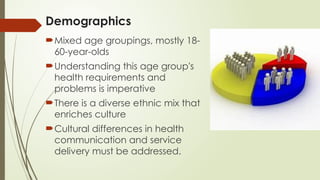
Demographics
Mixed age groupings,mostly 18-
60-year-olds
Understanding this age group's
health requirements and
problems is imperative
There is a diverse ethnic mix that
enriches culture
Cultural differences in health
communication and service
delivery must be addressed.
7.
Social Interactions
Participating inhealth requires understanding social
dynamics and connections, including community
events and online platforms.
Promoting health through social institutions like
local clubs.
Objectives such as disaster resiliency and health
awareness foster community through shared
interests.
Recognizing the source of community togetherness
helps health activities align with community
interests.
Overview of FundingSources
Government Grants: Obtaining
funds for community health
initiatives from the federal and
state levels.
Private Donations: Contributions
from nearby companies and
benefactors.
Fundraising Events: Inviting locals
to support their health-related
projects.
10.
Partnerships Contributing toCommunity Health
Partnership with local clinics and educational
institutions for health education projects.
Curriculum-based health promotion literacy.
Working Together with community-focused
organizations.
Joining forces with like-minded agencies to
combat health issues.
11.
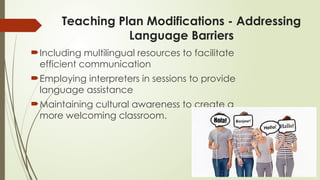
Teaching Plan Modifications- Addressing
Language Barriers
Including multilingual resources to facilitate
efficient communication
Employing interpreters in sessions to provide
language assistance
Maintaining cultural awareness to create a
more welcoming classroom.
12.
Teaching Plan Modifications- Flexible
Approaches for Time Constraints
Adaptable Timing: Offering many sessions at
various times to suit varying schedules.
Condensed Information: Streamlining material to
provide key information effectively.
Leveraging Online Platforms: Combining
webinars and internet-based tools for simple
access.
13.
Addressing Socio-Economic Factorsin
Disaster Preparedness
Determining At-Risk Populations: Identifying the
community's socioeconomically disadvantaged
groups.
Inclusive Preparedness Programs: Creating
initiatives that take budgetary limitations into
account.
Community Partnerships: Working together to
pool resources from nearby companies.
14.
Ensuring Inclusivity andAccessibility in
Health Promotion
Implementing affordable health
promotion programs
Use community centers and
public areas for health activities.
Customized Health Education:
Creating resources for varied
socioeconomic groups.
15.
Future Health Initiatives- Strengthening
Community Resilience
Mental Health Needs: identify and treat
community mental health issues.
Mental health assistance services should be
introduced.
Empower locals: Prepare for disasters with locals.
Promote communal ownership and
accountability in the preparedness strategy.
16.
Building Sustainable HealthPartnerships
Deepen Partnerships: Work with
local health clinics and schools.
Improve health initiative
incorporation into community
institutions.
Locate and empower community
leaders to promote health
initiatives.
Use local leaders to engage the
community.
#2 Today, we set out on an expedition to explore the core of our community in an effort to get a better grasp of its health landscape. This survey is a deliberate attempt to identify the peculiarities that distinguish our community, not merely a data gathering exercise. By doing this, we put ourselves in a position to customize health programs that specifically meet the needs and difficulties that our people encounter. This is an essential step in making sure that our efforts are accurately focused for maximum effect, in addition to being well-intentioned.
#3 We delved into important facets of the representative's duties during our interview and learned a lot about the state of the community's health. The delegate, a committed community health worker, gave a distinctive viewpoint on common health concerns and emphasized the advantages and disadvantages that our community confronts. Observe the subtle answers carefully, as they serve as the foundation for our comprehension and will direct our specialized health programs.
#4 This slide offers a thorough examination of the representative's responsibilities and experiences in our community. Among their duties as a community health worker are encouraging partnerships with nearby institutions and advocating for preventative care. We'll examine the first-hand accounts that have been shared, learning important lessons about effective community mobilization initiatives and identifying enduring issues that require our attention in order to develop health programs that work.
#5 Geographically, we are situated in an urban area that is heavily inhabited, which presents both benefits and disadvantages. Comprehending the geopolitical terrain is vital, given its impact on the growth of our community and our partnerships with local authorities. We see a wide range of economic conditions in terms of money, which has an immediate effect on health access. Our community also has a diverse range of ethnic backgrounds and educational attainment, which highlights the need for efforts that are specifically designed to address health literacy and cultural subtle differences.
#6 This section explores our community's demographic composition, which is important information when customizing our health programs. We observe a wide range of ages, but we pay particular attention to people between the ages of 18 and 60 since they are crucial in determining the state of health in the community. Our community's diverse ethnic and cultural makeup also contributes to its liveliness and calls for a multifaceted approach to health communication and service delivery. Examining the ways in which these demographic demographics impact our approaches to fostering communal well-being is integral.
#7 It is critical to examine our community's complex social structure, which plays a key role in determining the direction of our health programs. From conventional community gatherings to online participation, we witness a dynamic spectrum of social interactions. Comprehending these dynamics is essential for successful engagement with health experts. We'll also explore the shared interests and aspirations that unite our community, highlighting the significance of coordinating our health initiatives with these common goals. We must keep investigating ways to use the social cohesiveness of our community to promote health effectively.
#8 When we examine the obstacles and difficulties in our community, we find that social determinants of health are intricately intertwined. For example, differences in income and education have a significant impact on health literacy and access. Financial hardships also create a barrier to the general well-being of the community. Time constraints and linguistic diversity also create unique challenges. For example, hectic lives make it difficult for people to participate actively in health initiatives, so flexible health plans are necessary. Finally, linguistic diversity calls for a strategic approach to get past language barriers and guarantee inclusive health communication. Let's examine how we can get around these obstacles for successful health promotion.
#9 It's critical to understand the variety of financing options available as we negotiate the financial aspects of our community health programs. Federal and state government funds are essential to the operation of our services. Private contributions from nearby companies and donors are as important because they create meaningful alliances for ongoing financial support. Furthermore, our community actively engages in fundraising activities, highlighting the teamwork required to get funding for our health-related projects.
#10 This section provides insight into the cooperative activities that support our community's general well-being. Our collaborations with neighborhood clinics provide vital health checks and services, guaranteeing more people have access to medical resources. Due to collaborative activities that are included into the curriculum, educational institutions are important allies in our efforts to promote health. Furthermore, our community regularly collaborates with other organizations, building partnerships to solve certain health issues. These alliances improve our community health programs.
#11 One of our top priorities as we continue to improve our lesson plan is to work with our varied community's linguistic difficulties. Multilingual resources are being integrated to improve accessibility and communication. Additionally, having interpreters present throughout sessions would help our multilingual audience understand one another better. Our instructional materials are also being modified to take into account cultural quirks, guaranteeing an inclusive and culturally aware learning environment. These adjustments improve our lesson plan's efficacy.
#12 As a result of time restrictions that our community has recognized, we strategically adjust our lesson plan. We understand that schedules vary, which is why we are providing many classes at various times to meet the needs of our varied clientele. We're also condensing material to effectively convey important information and maximize impact in a condensed amount of time. We're using internet tools, like webinars, to improve accessibility even further and make sure community involvement happens outside of conventional venues. These modifications demonstrate our dedication to meeting deadlines and guaranteeing the widest possible audience for our health education campaigns.
#13 It's important to keep our community's socioeconomic makeup in mind as we prepare for disasters. We're recognizing the socioeconomic weaknesses that might affect preparedness for disasters and identifying communities who are at risk. Our programs are inclusive, acknowledging that not everyone has unlimited resources, and making sure that everyone in the community can access disaster preparation materials. Furthermore, we're supporting joint disaster preparation work with neighborhood businesses to strengthen our community's resilience. These tactics support a more comprehensive approach for disaster preparation.
#14 Our approach is guided by the two pillars of accessibility and inclusivity as we turn our attention to health promotion. We are launching affordable health initiatives and removing financial obstacles to promote broad community involvement. We are using local facilities and public spaces for health activities in order to maximize accessibility and make sure that residents can participate regardless of their socioeconomic status. We design our educational outreach with a range of socioeconomic backgrounds in mind, so that health messages are approachable and relevant to the whole community. These actions improve the accessibility and inclusivity of our health promotion programs.
#15 The incorporation of focused on mental health support is a key recommendation for future health initiatives. We can introduce meaningful support programs by acknowledging and dealing with the community's psychological issues. We also recommend involving residents in disaster planning. Community ownership and responsibility boost resilience. We can use these recommendations to tailor future health initiatives to our community's needs.
#16 For health efforts to remain relevant in the future, establishing long-lasting relationships is crucial. To guarantee that health programs are seamlessly incorporated into the current community structures, it is highly recommended that deeper partnerships be established with nearby health facilities and educational institutions. Furthermore, we propose enabling community leaders to spearhead health initiatives. We may use the power of local leaders to increase community involvement by finding and assisting them. These suggestions set the stage for a long-lasting and neighborhood-focused strategy for health programs.
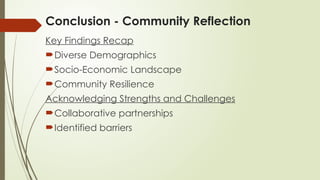
#17 It's critical to consider our main conclusions as we wrap up the study of the representative interviews and the community evaluation. Our community is made up of a complicated mix of many ethnic and cultural origins, with the majority of its members being in the 18–60 age range. The socioeconomic environment affects health access and literacy and offers both advantages and disadvantages. Even with obstacles like time limits and language differences, our society is resilient because of its active social life and common objectives. While acknowledging issues like socioeconomic inequities and mental health concerns, we also recognize our assets, such as strong community participation and collaborative collaborations. Our next health efforts will be guided by these findings to make sure they meet the specific requirements of our community.