Conducting a  Community Assessment Addressing DV and/or SA Presented by  Vicki Ybanez Red Wind Consulting, Inc.  www.red-wind.net
A broad look across agencies, systems, and community members to learn more about the circumstances.  It gathers information from many different individuals and groups in the community; the types of information depend on the partnership's focus and the resources it can draw on to conduct the assessment.
Building collaborative partnership Clearly  understand the context  in which sexual assault is being addressed or not addressed and the issues the community want/need to address;  Locate  hidden strengths or underutilized resources  that could be developed;  Determine which resources could  contribute to comprehensive strategies , and in what way;  Design  effective, collaborative strategies  that engage the community because they respond to real and important conditions; and  Empower the community  members by giving them a role in designing and implementing the strategies.
The process of conducting a community assessment Scanning the community  to locate existing information  Developing a  focus Identifying  community assets  and the degree to which they are accessible to the people who can benefit from them Analyzing the information  obtained through the first three steps
Guiding Principles  of Community Assessments A clear vision statement should guide the assessment  An assessment should focus on  specific topics Assessment is an ongoing process.  An accurate assessment views the community from multiple perspectives  An effective assessment takes an in-depth look at diversity within a community
Initial Information Gathering Identify characteristics of your community  Who has criminal jurisdiction over (sex crimes) committed in your community? Which agencies are involved? What is the incidence of (sexual assault) within your community? Are community members aware of what to do if a (sexual assault) occurs? What are the barriers to getting and providing immediate help?
Agency/Discipline Specific and Coordination Information Note that questions for criminal justice agencies apply to response described in the “focus”. How does each discipline/agency respond? If more than one agency within a discipline responds, consider each agency’s response. Victim Advocacy Law Enforcement Healthcare Prosecution Other services
Matching (Comparing) Information 
 Use multiple sources/methods for informing the assessment Comparisons of information collected from several sources can reveal important trends.
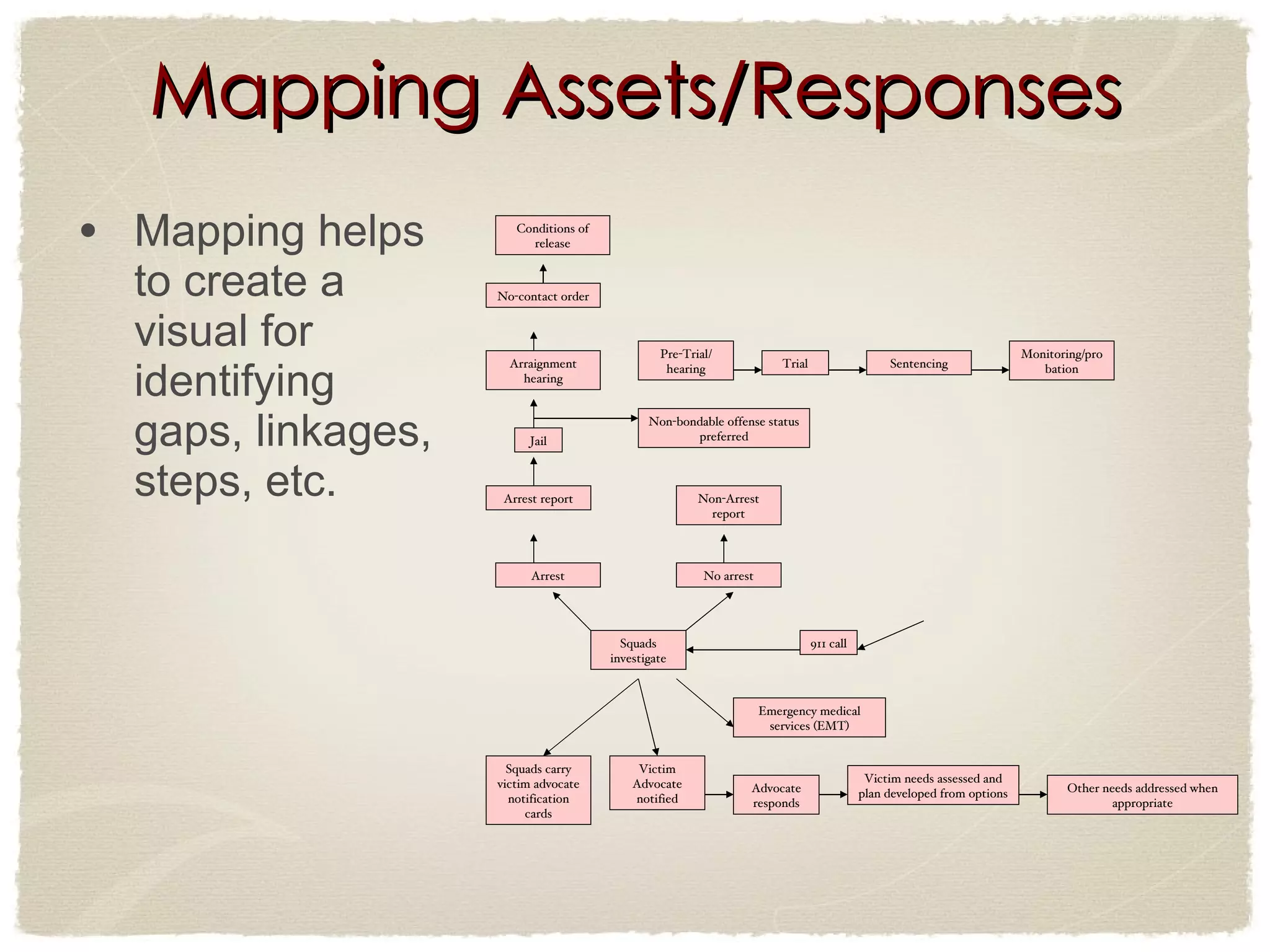
Mapping Assets/Responses Mapping helps to create a visual for identifying gaps, linkages, steps, etc. 911 call Squads investigate Arrest No arrest Arrest report Non-Arrest report Jail Arraignment hearing No-contact order Conditions of release Pre-Trial/ hearing Trial Sentencing Monitoring/probation Non-bondable offense status preferred Victim needs assessed and plan developed from options Squads carry victim advocate notification cards Victim Advocate notified Advocate responds Other needs addressed when appropriate Emergency medical services (EMT)
Strengths and Areas for Improvement Identified Define and evaluate the success of current response within the “focus” Create recommendations for enhancing or improving responses
A Good Community Assessment Is guided by its vision statement.  Reviewing the principles and goals expressed in your vision statement will help your partnership keep on track.  Has comprehensive strategies that are victim-centered/survivor-centered.  You can prioritize and differentiate the information you have collected by starting with information gathered from victims/survivors.  Has collaborative partnerships and comprehensive strategies that respond to multiple perspectives.  Comparing information on the same assets and issues collected from various sources will help you see patterns, trends, and disparities.
Vicki Ybanez Phone (866) 599-9650 ext. 214 Fax (866) 804-6305 eMail  [email_address] www.red-wind.net

Conducting a community assessment 7-2011

  • 1.
    Conducting a Community Assessment Addressing DV and/or SA Presented by Vicki Ybanez Red Wind Consulting, Inc. www.red-wind.net
  • 2.
    A broad lookacross agencies, systems, and community members to learn more about the circumstances. It gathers information from many different individuals and groups in the community; the types of information depend on the partnership's focus and the resources it can draw on to conduct the assessment.
  • 3.
    Building collaborative partnershipClearly understand the context in which sexual assault is being addressed or not addressed and the issues the community want/need to address; Locate hidden strengths or underutilized resources that could be developed; Determine which resources could contribute to comprehensive strategies , and in what way; Design effective, collaborative strategies that engage the community because they respond to real and important conditions; and Empower the community members by giving them a role in designing and implementing the strategies.
  • 4.
    The process ofconducting a community assessment Scanning the community to locate existing information Developing a focus Identifying community assets and the degree to which they are accessible to the people who can benefit from them Analyzing the information obtained through the first three steps
  • 5.
    Guiding Principles of Community Assessments A clear vision statement should guide the assessment An assessment should focus on specific topics Assessment is an ongoing process. An accurate assessment views the community from multiple perspectives An effective assessment takes an in-depth look at diversity within a community
  • 6.
    Initial Information GatheringIdentify characteristics of your community Who has criminal jurisdiction over (sex crimes) committed in your community? Which agencies are involved? What is the incidence of (sexual assault) within your community? Are community members aware of what to do if a (sexual assault) occurs? What are the barriers to getting and providing immediate help?
  • 7.
    Agency/Discipline Specific andCoordination Information Note that questions for criminal justice agencies apply to response described in the “focus”. How does each discipline/agency respond? If more than one agency within a discipline responds, consider each agency’s response. Victim Advocacy Law Enforcement Healthcare Prosecution Other services
  • 8.
    Matching (Comparing) Information
 Use multiple sources/methods for informing the assessment Comparisons of information collected from several sources can reveal important trends.
  • 9.
    Mapping Assets/Responses Mappinghelps to create a visual for identifying gaps, linkages, steps, etc. 911 call Squads investigate Arrest No arrest Arrest report Non-Arrest report Jail Arraignment hearing No-contact order Conditions of release Pre-Trial/ hearing Trial Sentencing Monitoring/probation Non-bondable offense status preferred Victim needs assessed and plan developed from options Squads carry victim advocate notification cards Victim Advocate notified Advocate responds Other needs addressed when appropriate Emergency medical services (EMT)
  • 10.
    Strengths and Areasfor Improvement Identified Define and evaluate the success of current response within the “focus” Create recommendations for enhancing or improving responses
  • 11.
    A Good CommunityAssessment Is guided by its vision statement. Reviewing the principles and goals expressed in your vision statement will help your partnership keep on track. Has comprehensive strategies that are victim-centered/survivor-centered. You can prioritize and differentiate the information you have collected by starting with information gathered from victims/survivors. Has collaborative partnerships and comprehensive strategies that respond to multiple perspectives. Comparing information on the same assets and issues collected from various sources will help you see patterns, trends, and disparities.
  • 12.
    Vicki Ybanez Phone(866) 599-9650 ext. 214 Fax (866) 804-6305 eMail [email_address] www.red-wind.net

Editor's Notes

  • #6 A partnership's vision statement should guide the assessment . The vision points you toward the information you need in order to take action; the clearer your vision statement, the more focused and useful your assessment will be. Refer to your vision statement as you make choices about what information to look for and how to interpret what you learn. If your vision statement emphasizes prevention, your assessment will focus on, among other things, young children's health and nutrition.
 An assessment should focus on specific information topics such as safety of children or resources for families. Don't try to address all topics at once or you may be overwhelmed by the process and lose sight of what you are trying to accomplish.
 Assessment is an ongoing process . Continuing your review of the community's assets and needs over time will help you fine-tune your activities. In this sense, assessment is closely tied to evaluation (see Chapter 4). Ongoing assessment enables your partnership to respond to changing conditions--both those changed by your partnership and those that are beyond your control.
 An accurate assessment views the community from multiple perspectives . It recognizes cultural, linguistic, ethnic, and economic diversity as well as special needs. Information from diverse stakeholders including families, community members, and agency staff produces a more complete picture of the community. People's views vary regarding programs, agencies, services, and the relationships between agency staff and community members. People may also have different views on the issues strategies should address. 
 An effective assessment takes an in-depth look at diversity within a community . Because ethnic groups often differ in their opinions about services, you may want to separate some information by ethnicity. You should also note differences among people who may be ethnically similar but culturally or linguistically different--for example, the many groups of people of Hispanic heritage. There may be differences among first-, second- and third-generation immigrants. And don't forget that people who share racial or ethnic backgrounds may or may not live in similar economic and social circumstances.
 An information coordinator can facilitate information gathering by many participants . This role is often filled by a staff member from one of the partner organizations--perhaps the school district or the department of health and human services. The coordinator should have first-hand knowledge of the community and a thorough understanding of the partnership's vision.