 (A functional approach since 1970s):
 it is an approach, not a method; a unified but broadly based
theoretical position about the nature of language and of
language learning and teaching.
 This approach is found in the changes in the
British language teaching tradition dating from
the late 1960s. A lot of British linguists
contributed to the formation of the
Communicative Approach which aims to make
communicative competence (Hymes, 1972) the
goal of language teaching and develop
procedures for the teaching of the four language
skills that acknowledge the interdependence of
language and communication. Communicative
competence is what a speaker needs to know in
order to be communicatively competent in a
speech community.
 Richards and Rodgers (1986) described CLT as an approach
rather than a method, since it represents a philosophy of
teaching that is based on communicative lg use. Advocated by
many applied linguists, CLT in their views emphasizes
notional-functional concepts and communicative competence,
rather than grammatical structures, as central to teaching.
The major characteristics are:
 Meaning is primary; contextualization is basic.
 Attempts to communicate in CLT are
encouraged in the beginning of instruction.
 Material sequencing is determined by the
content, meaning, and function.
 L1 is acceptable when feasible.
 Activities and strategies for learning are varied.
 Communicative competence is the goal of
instruction.
 In Hyme’s view, a person who acquires communicative
competence acquires both knowledge and ability for language
use
 whether something is formally possible;
 whether something is feasible in virtue of the means of
implementation available;
 whether something is appropriate in relation to a context in
which it is used and evaluated;
 whether something is in fact done, actually performed and
what its doing entails
Canale and Swain (1998) identify
four dimensions of communicative
competence:
 Grammatical competence- similar to linguistic competence by
Chomsky by what is formally possible
 Sociolinguistic competence- understanding of the social context
in which communication takes place, including role
relationships, the shared information of the participants, and
the purpose for their interaction
 Discourse competence- the interpretation of individual
message elements in terms of cohesion and coherence
 Strategic competence- the coping strategies to initiate,
terminate, maintain, repair, and redirect communication
 communication, task, meaningfulness principles
 the communication principle: Activities that involve
communication promote language learning.
 the task principle: Activities that involve the completion of real-
world tasks promote learning.
 the meaningfulness principle: Learners must be engaged in
meaningful and authentic language use for learning to take place.
 The primary function of language is for interaction
and communication.
 Language is a system for the expression of meaning.
 The activities that truly communicative have
features of information gap, choice, and feedback;
they must be guided by the teacher for unrehearsed
situations.
 Authentic materials should be used.
 True communication is purposeful.
 Activities are better carried out in small groups in
which interaction among students are maximized.
Being prejudiced in favor of native-speaker
teachers by demanding a relatively
uncontrolled range of language use and
expecting the teacher to be able to respond
to any and every language problem which
may come up.
A basis of group and pair work and less
teacher intervention against education
traditions
Lack of the explicit teaching of grammar -> a
consequent loss among students in accuracy
in the pursuit of fluency
Grammatical structures had better be
subsumed under various functional
categories.
Authentic materials are preferred.
There should be less attention to
grammatical rules but fluency should never
be encouraged at the expense of clear,
unambiguous, direct communication.
Technology and increased teachers’ lg
proficiency now make achieving the goals of
CLT possible.
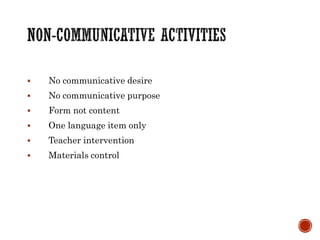
 No communicative desire
 No communicative purpose
 Form not content
 One language item only
 Teacher intervention
 Materials control
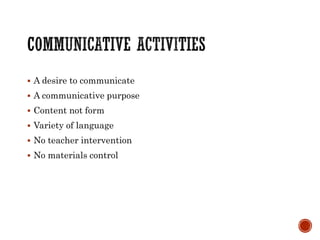
 A desire to communicate
 A communicative purpose
 Content not form
 Variety of language
 No teacher intervention
 No materials control

Communicative Language Teaching (Overview) (1).ppt

  • 2.
     (A functionalapproach since 1970s):  it is an approach, not a method; a unified but broadly based theoretical position about the nature of language and of language learning and teaching.
  • 3.
     This approachis found in the changes in the British language teaching tradition dating from the late 1960s. A lot of British linguists contributed to the formation of the Communicative Approach which aims to make communicative competence (Hymes, 1972) the goal of language teaching and develop procedures for the teaching of the four language skills that acknowledge the interdependence of language and communication. Communicative competence is what a speaker needs to know in order to be communicatively competent in a speech community.
  • 4.
     Richards andRodgers (1986) described CLT as an approach rather than a method, since it represents a philosophy of teaching that is based on communicative lg use. Advocated by many applied linguists, CLT in their views emphasizes notional-functional concepts and communicative competence, rather than grammatical structures, as central to teaching.
  • 5.
    The major characteristicsare:  Meaning is primary; contextualization is basic.  Attempts to communicate in CLT are encouraged in the beginning of instruction.  Material sequencing is determined by the content, meaning, and function.  L1 is acceptable when feasible.  Activities and strategies for learning are varied.  Communicative competence is the goal of instruction.
  • 6.
     In Hyme’sview, a person who acquires communicative competence acquires both knowledge and ability for language use  whether something is formally possible;  whether something is feasible in virtue of the means of implementation available;  whether something is appropriate in relation to a context in which it is used and evaluated;  whether something is in fact done, actually performed and what its doing entails
  • 7.
    Canale and Swain(1998) identify four dimensions of communicative competence:  Grammatical competence- similar to linguistic competence by Chomsky by what is formally possible  Sociolinguistic competence- understanding of the social context in which communication takes place, including role relationships, the shared information of the participants, and the purpose for their interaction  Discourse competence- the interpretation of individual message elements in terms of cohesion and coherence  Strategic competence- the coping strategies to initiate, terminate, maintain, repair, and redirect communication
  • 8.
     communication, task,meaningfulness principles  the communication principle: Activities that involve communication promote language learning.  the task principle: Activities that involve the completion of real- world tasks promote learning.  the meaningfulness principle: Learners must be engaged in meaningful and authentic language use for learning to take place.
  • 9.
     The primaryfunction of language is for interaction and communication.  Language is a system for the expression of meaning.  The activities that truly communicative have features of information gap, choice, and feedback; they must be guided by the teacher for unrehearsed situations.  Authentic materials should be used.  True communication is purposeful.  Activities are better carried out in small groups in which interaction among students are maximized.
  • 10.
    Being prejudiced infavor of native-speaker teachers by demanding a relatively uncontrolled range of language use and expecting the teacher to be able to respond to any and every language problem which may come up. A basis of group and pair work and less teacher intervention against education traditions Lack of the explicit teaching of grammar -> a consequent loss among students in accuracy in the pursuit of fluency
  • 11.
    Grammatical structures hadbetter be subsumed under various functional categories. Authentic materials are preferred. There should be less attention to grammatical rules but fluency should never be encouraged at the expense of clear, unambiguous, direct communication. Technology and increased teachers’ lg proficiency now make achieving the goals of CLT possible.
  • 12.
     No communicativedesire  No communicative purpose  Form not content  One language item only  Teacher intervention  Materials control
  • 13.
     A desireto communicate  A communicative purpose  Content not form  Variety of language  No teacher intervention  No materials control