







Communicating 
with Children 
Principles and Practices to Nurture, 
Inspire, Excite, Educate and Heal 
Barbara Kolucki, MA 
Dafna Lemish, PhD
© United Nations Children’s Fund (UNICEF) 
November 2011 
ISBN: 978-0-578-09512-7
i 
Contents 
Foreword ................................................................................................... iii 
Acknowledgements ................................................................................... v 
Introduction ............................................................................................. vii 
Executive Summary ................................................................................. ix 
About the Authors ................................................................................... xi 
PART ONE: WHY CHILDREN, WHY COMMUNICATION? ........................ 1 
• Children Are Full Human Beings in Their Own Right ....................... 3 
• Children’s Communication Rights ..................................................... 3 
• Children’s Diverse Media Environments ........................................... 5 
PART TWO: WHAT WE ALREADY KNOW ABOUT 
CHILDREN AND MEDIA ............................................................................. 7 
• Media Can Have Both Positive and Negative Influences ................ 9 
• Media’s Potential for Making a Difference ...................................... 12 
PART THREE: CHILD DEVELOPMENT AND COMMUNICATION 
NEEDS AND SKILLS ................................................................................ 13 
• Major Age Groups: Early Years, Middle Years, 
Early Adolescent Years ..................................................................... 16 
• Early Years (Birth through 6 years) .................................................. 17 
• Middle Years (7 through 10 years) ................................................... 20 
• Early Adolescent Years (11 through 14 years) ................................ 22 
PART FOUR: PRINCIPLES AND GUIDELINES 
FOR COMMUNICATION FOR CHILDREN ............................................... 25 
• Principle 1: Communication for Children 
Should Be Age-Appropriate and Child-Friendly ............................. 28 
• Principle 2: Communication for Children 
Should Address the Child Holistically ............................................. 32 
• Principle 3: Communication for Children 
Should Be Positive and Strengths-Based ....................................... 36 
• Principle 4: Communication for Children 
Should Address the Needs of All, Including 
Those Who Are Most Disadvantaged .............................................. 42 
PART FIVE: HOW TO AVOID COMMON PITFALLS 
IN DEVELOPING COMMUNICATION FOR CHILDREN .......................... 47 
PART SIX: MORE POSITIVE EXAMPLES AND RESOURCES ................ 57 
Endnotes .................................................................................................. 75 
User’s Feedback ....................................................................................... 77
ii
A 
Communicating with Children: Foreword Foreword 
iii 
As a young development professional working in the slums of New 
Delhi and Bombay, I witnessed the power of children as agents of 
change within both their own families and their communities. Children 
as young as eight were not just promoting hand washing but were 
getting their parents to accept the idea of them studying, playing 
and eating with children from other communities and caste groups. 
Anyone who has seen the tenacity of discriminatory practices around 
the world will understand the significance of this social change. I was 
convinced that if we were serious about transforming the world in one 
generation, we needed to communicate not just with adults (whose 
attitudes and habits are often firmly entrenched) but also with children. 
As we know, children are open, receptive, curious, eager to try out new 
things, infinitely resourceful and tenacious in pursuit of a cause. 
What I wasn’t so sure about was how to communicate with children 
in ways that are age-appropriate, culturally sensitive, inclusive and 
positive, that help build self-esteem and confidence, and perhaps most 
importantly, are interesting and engaging. The guidance and tools 
that I found provided a considerable amount of theory but hardly any 
concrete advice on how to translate that theory into practice. When 
I looked for child-oriented communication materials from within the 
development community, I found that the focus was primarily on 
reaching adolescents. In addition, even when an entertaining medium 
(such as animation) was used, the results were often dull and didactic. 
Younger children, especially those under age ten, seemed to be 
forgotten altogether. The rich and varied cultural contexts in which 
children live and learn, tended to be neglected in favour of western-oriented 
global prototypes that were adopted across all regions. 
On joining UNICEF in the mid-1980s, I decided to work on closing the 
gap between theory and practice, and help develop the guidance and 
tools that I so sorely missed when I needed them most. Fortunately, 
UNICEF is an organization that encourages, and is willing to invest 
in, innovation. The journey has taken 25 long years of constant
iv Communicating with Children: Foreword 
experimentation. It has involved interacting with, and being guided by, 
children. Of learning as much from failures as from successes. It has 
also meant identifying experts who combine technical knowledge with 
creativity and experience in children’s media production; practitioners 
who understand different cultural contexts; and the rare adults who 
still remember how it felt to be a child. My search ended with Barbara 
Kolucki, the primary author of this publication. The next challenge was 
to find a scholar and expert in children’s media, who could provide the 
academic rigour required to anchor rich practical experience in solid 
theory. Dafna Lemish, the co-author, was a perfect fit for the role. Our 
journey together has been exciting, challenging, sometimes frustrating 
– but always fun. 
The product of this effort is this resource pack, Communicating with 
Children. It combines knowledge from the fields of child development 
and media studies with insights from children’s media production, 
to provide simple information on developmental norms at different 
stages of a child’s life. It helps us understand the implications these 
norms have on what and how we can communicate most effectively 
with children of different age groups. It shares examples of good 
practice, many produced at very low cost by young professionals from 
around the world, to show how we can adhere to human rights and 
child rights principles, and address the child more holistically, while 
also creating communication that is engaging and enjoyable. 
So the next time a development professional asks: “How can I harness 
the power of communication to help fulfil the survival, development, 
participation and protection rights of children in a manner that is 
positive, respectful, stimulating and fun for children and their families?”, 
they can start by opening the pages of this resource pack or accessing 
the related website http://www.unicef.org/cwc/ to get guidance. 
UNICEF and its partners continue to strengthen their focus on 
communication and child participation as critical factors in fulfilling 
the rights of all children. They are working in particular, towards more 
effective action on article 17 of the UN Convention on the Rights of the 
Child (CRC), which recognizes the child’s right to access “information 
and material from a diversity of national and international sources, 
especially those aimed at the promotion of his or her social, spiritual 
and moral well-being and physical and mental health”. Understanding 
how children of different age groups process information, how they 
perceive, learn from, conceptualize and act upon what they see 
and hear, will go a long way in ensuring that what – and how – we 
communicate with children, is effective and empowering. This resource 
pack is a contribution towards building that understanding within the 
spirit of the CRC. We hope you enjoy using it and will benefit from it as 
much as all of us have benefited from the process of developing it. 
Rina Gill 
Associate Director, Division of Policy and Practice 
UNICEF New York
T 
Communicating with Children: Acknowedgements 
v 
Acknowledegments 
This resource pack would not have been possible without the support 
of many individuals inside and outside UNICEF. 
From originally conceptualizing and initiating this project, to its 
final steps, Rina Gill has been instrumental in providing leadership 
and guidance through the many stages of its development. Paula 
Claycomb’s dedication and talents brought it to its final stages and 
oversaw its publication and launch. And Jim Dawson gave unstintingly 
of his ideas, technical expertise and time for the Web version. 
Independent experts who contributed generously of their time in 
reviewing the draft document include Dr. S. Anandalakshmy (Early 
Childhood Development and Social Development Advisor, India); 
Ms. Glynis Clacherty (Researcher, specialist in participatory work with 
children and Founder, Suitcase Project, South Africa); Dr. Charlotte 
Cole (Senior Vice President, Global Education, Sesame Workshop, 
USA); and Dr. Michael Rich (Director, Center on Media and Child Health, 
Harvard University). 
Overall advice, guidance and critical inputs were provided by the 
UNICEF Communication for Development team of Anna Burlyaeva, 
Akiko Sakaedani Petrovic, Neha Kapil and Tess Stuart. Lea Girma- 
Mengistu and RyAnn Waldemarsen provided gentle and efficient 
administrative support. The UNICEF Division of Communication’s 
Web team helped give the Web version its vibrant look. Regina Doyle 
assisted with the editing and Kersten Vogdes Diehn combined her 
creativity and design expertise to give the document its vibrant and 
joyful look. 
We thank all the authors, editors, producers, publishers, educators and 
others who have graciously agreed to the use of, or access to, their 
materials. We hope they will be pleased with the interest and use of 
this resource pack that we anticipate from people all over the world.
vi Communicating with Children: Acknowedgements 
To the UNICEF staff and governments in the many countries that have 
conducted participatory workshops with civil society organizations, 
media professionals and other partners, and whose materials are 
supporting children to develop to their full potential, a rousing cheer of 
congratulations and a wish for continued success. 
And to the children and their families who provided the inspiration, 
feedback and time during and pre- and post-production stages, our 
hopes that you will see your love of your children reflected in this 
resource pack and that this will be a useful resource in supporting the 
fulfilment of all their rights. 
Note: Links to private publishers of the materials included in this 
resource pack do not necessarily imply endorsement of all their 
products.
W Communicating with Children: Introduction 
vii 
Introduction 
We hope this resource pack will encourage and facilitate the 
production of quality communication products to improve the lives of 
children globally. In these pages, we hope to further nurture the belief 
that communication is one of the most empowering ways to improve 
the lives of children and their families. 
The work is meant to inspire you to seek out and use the best of 
appropriate communication tools, channels and approaches. It is 
based on extensive collective field experience: We have listened and 
talked to children, parents, child development experts, caretakers, 
teachers, programme staff and others. We have worked at village, 
city and international levels. Above all, we have had the privilege 
of reviewing a wealth of materials, including teaching and training 
aids, guides, books, videos, research papers, Web links, posters and 
evaluations. From this, “positive examples” have been gleaned 
to illustrate principles and guidelines, and a comprehensive list of 
inspiring resources representing a wide range of countries, media and 
experience are provided. 
These principles and guidelines will, we hope, excite you to 
better listen to, discuss with and learn from children, families 
and communities, explore proven communication research and 
programmes, and systematically plan your own positive, measurable 
communication for development strategies. We believe that effective 
communication involves understanding people: their needs, skills, 
beliefs, values, societies and cultures, and that communication is a 
two-way process for sharing ideas and knowledge. We are excited to 
share our ideas with you and hope you are eager to use them. 
Finally, this resource pack should facilitate the process of learning 
about the critical importance of communication that is age-appropriate 
and child-friendly, holistic, positive, strengths-based and inclusive. 
As a part of this learning process, and to establish better two-way 
communication, a list of common pitfalls has been provided.
Communicating with Children: Introduction viii 
Communication for Development (C4D) strategies promote behaviour 
and social change that are particularly relevant, and in many cases, 
essential to development programmes as they seek the achievement 
of the MDGs and the broader realization of the rights of children 
and women. (www.un.org/millenniumgoals) However, anyone in 
development or humanitarian work who wants to positively influence 
children’s economic, cultural, social and political worlds through 
communication will find shared interests with C4D. This includes 
helping heal the wounds of injustice, prejudice and poverty inflicted 
on children. Healing can be accelerated where the marginalized, 
vulnerable and most disadvantaged are specifically included, and 
where communication tries to restore dignity, give due respect to 
culture and tradition, eliminate stereotypes, reduce gender disparities 
and promote child, women’s and human rights. 
We thank everyone – adults and children, anonymous and acknowl-edged, 
experts and laypersons – who proposed, contributed and sup-ported 
the making of this resource pack.
T 
Communicating with Children: Executive Summary 
ix 
Executive Summary 
This resource package supports the development priorities of UNICEF 
to improve the survival, development and protection of infants, young 
children and their families. Specifically, it is designed for use by anyone 
interested in communication for the holistic development of children. 
In Parts One and Two, we explain how our approach recognizes the 
diverse conditions in which children around the world live and the 
media environments to which they have access. In Part Three, we map 
the different developmental characteristics and needs of children at 
different ages, distinguishing generally between: early years (birth 
through 6 years), middle years (7 to 10 years), and early adolescent 
years (11 to14 years). While all children share some universal needs for 
a loving, supportive and stimulating social and physical environment, 
their cognitive, emotional, physical and social skills develop over 
time. Thus, as they grow and mature, their needs change, as do their 
abilities, interests and challenges. We outline the implications these 
changes have for children’s communication needs and how these 
might be addressed in beneficial ways. 
The document draws upon available global literature on the role of 
media in all aspects of children’s lives, with potential for positive as 
well as negative outcomes. It suggests that media are not inherently 
good or bad, but are technologies at our disposal. 
Using this academic rationale, in Part Four, we present four central 
principles for producing communication for children, each supported 
by guidelines. The guidelines serve as a “checklist” for producing 
children’s media and for evaluating existing materials. They are 
illustrated by positive examples from a range of countries and media, 
and address different age groups. 
• Principle 1 states that, “communication for children should be 
age-appropriate and child-friendly,” and is supported by guidelines 
to: use child-appropriate language, characters, stories, music and
Communicating with Children: Introduction x 
humour; encourage and model positive interaction and critical 
thinking; and use special effects judiciously and wisely. 
• Principle 2 states that, “communication for children should 
address the child holistically,” and is supported by guidelines 
to: use an integrated rather than single-issue approach to 
communication; offer positive models for adults in their 
relationships with children as full human beings in their own right; 
and create “safe havens.” 
• Principle 3 states that, “communication for children should be 
positive and strengths-based,” and is supported by guidelines 
to: build self-confidence as well as competence; use positive 
modelling; include children as active citizens learning about and 
modelling social justice; and do no harm. 
• Principle 4 states that, “communication for children should 
address the needs of all, including those who are most 
disadvantaged,” and is supported by guidelines to: reflect the 
dignity of each and every child and adult; be inclusive: celebrate 
and value all types of diversity; ensure communication is free of 
stereotypes; and reflect and nurture the positive aspects of local 
cultures and traditions. 
In Part Five, ways to avoid common pitfalls in developing 
communication for children are summarized. Ten tips for preventing 
pitfalls are presented in a question-and-answer style. 
Finally, in Part Six, a veritable treasure chest of additional positive 
examples and supplementary resources (audio-visual materials, books, 
academic sources, etc.) is provided. Readers are also invited to provide 
feedback about their favourite examples of communication for children, 
with a view to improving this document.
B 
Communicating with Children: About the Authors 
xi 
About the Authors 
BARBARA KOLUCKI (MA, Teacher’s College, Columbia University, 
1975) is a trainer and educator in children’s media, holistic child 
development, child protection, disability awareness and prejudice 
reduction. With over 25 years experience in more than 20 countries 
in the developing world, she focuses on building local media and 
staff capacity, primarily for UNICEF, the World Bank and other UN 
organizations. Barbara helped develop or facilitate several landmark 
communication for development projects, including in the Maldives, 
Kyrgyzstan, Myanmar and Mozambique. She worked for Children’s 
Television Workshop (now Sesame Workshop) for six years, focusing 
on the inclusion of children and adults with disabilities and on 
prejudice reduction, and wrote the award-winning book, Sharing the 
Street: Activities for ALL Children. 
Barbara has written several UNICEF reports, including The Face of 
Early Childhood Development Communication (UNICEF, 2006, primary 
author) and Something to Read, Something to Learn: Print Media for 
and about Children (CEE-CIS/UNICEF, 2006, co-author), as well as over 
40 articles and media reviews for http://www.disabilityworld.org. She 
also developed and taught some of the first courses on Children and 
Media at Hong Kong University and Fordham University.
xii Communicating with Children: About the Authors 
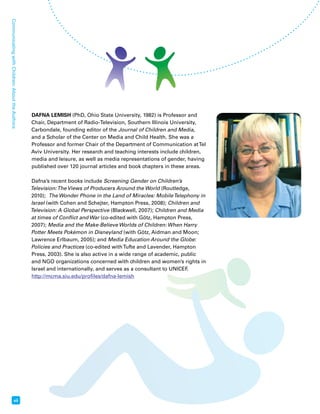
DAFNA LEMISH (PhD, Ohio State University, 1982) is Professor and 
Chair, Department of Radio-Television, Southern Illinois University, 
Carbondale, founding editor of the Journal of Children and Media, 
and a Scholar of the Center on Media and Child Health. She was a 
Professor and former Chair of the Department of Communication at Tel 
Aviv University. Her research and teaching interests include children, 
media and leisure, as well as media representations of gender, having 
published over 120 journal articles and book chapters in these areas. 
Dafna’s recent books include Screening Gender on Children’s 
Television: The Views of Producers Around the World (Routledge, 
2010); The Wonder Phone in the Land of Miracles: Mobile Telephony in 
Israel (with Cohen and Schejter, Hampton Press, 2008); Children and 
Television: A Global Perspective (Blackwell, 2007); Children and Media 
at times of Conflict and War (co-edited with Götz, Hampton Press, 
2007); Media and the Make-Believe Worlds of Children: When Harry 
Potter Meets Pokémon in Disneyland (with Götz, Aidman and Moon; 
Lawrence Erlbaum, 2005); and Media Education Around the Globe: 
Policies and Practices (co-edited with Tufte and Lavender, Hampton 
Press, 2003). She is also active in a wide range of academic, public 
and NGO organizations concerned with children and women’s rights in 
Israel and internationally, and serves as a consultant to UNICEF. 
http://mcma.siu.edu/profiles/dafna-lemish
Part One Why Children, Why Communication?
C Communicating with Children: Part One – Why Children, Why Communication? 
3 
Children Are Full Human Beings in Their 
Own Right 
Children and young people occupy a very unique time in the human 
cycle that deserves our special attention, and the best of our resources 
and investments. They are the major “social capital” of every 
society concerned with change for a better today and for the future 
of its members: Their education promises the chance of improving 
economic and social conditions; their positive socialization for conflict 
resolution can help manage social clashes; their health and good 
nutrition can promote longevity, lower social costs and lead to a better 
quality of life; and their psychological well-being has the promise of a 
more resilient and culturally rich society. Most parents hope that their 
children will have a better quality of life than they have, and most of 
them work hard towards achieving this goal. The 1989 United Nations 
Convention on the Rights of the Child (CRC) (www.unicef.org/crc/) 
reminds us that children are full human beings in their own right, who 
deserve the best that life can provide at every single stage of their 
development. 
Children and young people, however, are not a homogenous group. At 
the beginning of the third millennium, children are being raised in a 
great variety of social arrangements, facing very different challenges 
in their daily lives. They have different dreams and aspirations for their 
futures. Many children in the world today do not live in an environment 
where they are protected by a loving family or can exercise their right 
to go to school. Others have had to deal with unimaginable situations 
and catastrophes as well as extremely difficult daily lives. They have 
experienced trauma, discrimination, suffering, atrocities and abuse 
and have responsibilities well beyond their years http://ww.unicef.org/ 
rightsite/sowc. Despite this, most children are capable of responding to 
positive communication, and of developing to their full potential. 
Children’s Communication Rights 
This document is specifically concerned with the role communication 
plays in improving the lives of children worldwide. How can 
communication help children, especially the most disadvantaged and 
Most children 
are capable 
of responding 
to positive 
communication, 
and of developing 
to their full 
potential.
Communicating with Children: Part One – Why Children, Why Communication? 4 
vulnerable, to survive, develop and thrive? How can communicating 
with children bridge generational and cultural divides and help reach 
the goals of social development? 
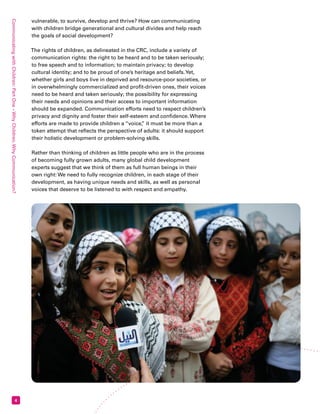
The rights of children, as delineated in the CRC, include a variety of 
communication rights: the right to be heard and to be taken seriously; 
to free speech and to information; to maintain privacy; to develop 
cultural identity; and to be proud of one’s heritage and beliefs. Yet, 
whether girls and boys live in deprived and resource-poor societies, or 
in overwhelmingly commercialized and profit-driven ones, their voices 
need to be heard and taken seriously; the possibility for expressing 
their needs and opinions and their access to important information 
should be expanded. Communication efforts need to respect children’s 
privacy and dignity and foster their self-esteem and confidence. Where 
efforts are made to provide children a “voice,” it must be more than a 
token attempt that reflects the perspective of adults: it should support 
their holistic development or problem-solving skills. 
Rather than thinking of children as little people who are in the process 
of becoming fully grown adults, many global child development 
experts suggest that we think of them as full human beings in their 
own right: We need to fully recognize children, in each stage of their 
development, as having unique needs and skills, as well as personal 
voices that deserve to be listened to with respect and empathy.
Communicating with Children: Part One – Why Children, Why Communication? 
5 
For example, it is not enough to have children appear in television 
or radio programmes, book illustrations, posters, or another forms 
of media in order to make the materials “child-friendly”. Messages 
need to be tailored for the specific child audience, and have to include 
their needs, perspectives and points of view in order to relate to 
them in effective and helpful ways. The accumulated knowledge from 
years of studying children and media demonstrates that children are 
active users of media: They react to, think, feel and create their own 
meanings out of them. They bring to their media encounters a host 
of predispositions, abilities, desires and experiences. They watch 
television or listen to stories in diverse personal, social and cultural 
circumstances that also influence what they get out of the experience. 
We must never assume that what we as adults need and take from 
media (such as television programmes, magazine articles, oral stories, 
card games, posters), is the same as what children will get out of it. 
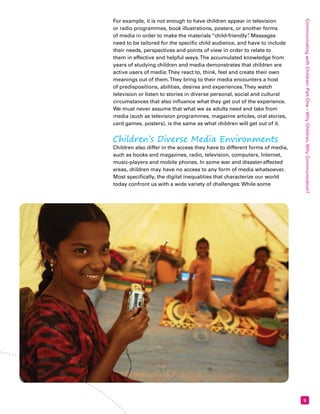
Children’s Diverse Media Environments 
Children also differ in the access they have to different forms of media, 
such as books and magazines, radio, television, computers, Internet, 
music-players and mobile phones. In some war and disaster-affected 
areas, children may have no access to any form of media whatsoever. 
Most specifically, the digital inequalities that characterize our world 
today confront us with a wide variety of challenges: While some
Communicating with Children: Part One – Why Children, Why Communication? 6 
children live in media-rich environments and many media converge 
into a “screen culture” that dominates their lives, others are still 
deprived of the most basic forms of communication technology that 
characterize our global world. 
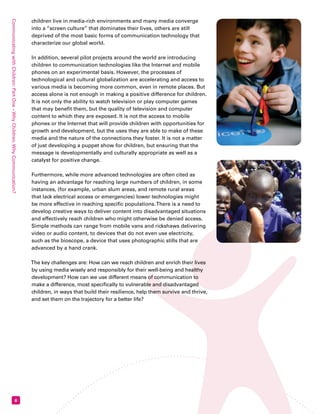
In addition, several pilot projects around the world are introducing 
children to communication technologies like the Internet and mobile 
phones on an experimental basis. However, the processes of 
technological and cultural globalization are accelerating and access to 
various media is becoming more common, even in remote places. But 
access alone is not enough in making a positive difference for children. 
It is not only the ability to watch television or play computer games 
that may benefit them, but the quality of television and computer 
content to which they are exposed. It is not the access to mobile 
phones or the Internet that will provide children with opportunities for 
growth and development, but the uses they are able to make of these 
media and the nature of the connections they foster. It is not a matter 
of just developing a puppet show for children, but ensuring that the 
message is developmentally and culturally appropriate as well as a 
catalyst for positive change. 
Furthermore, while more advanced technologies are often cited as 
having an advantage for reaching large numbers of children, in some 
instances, (for example, urban slum areas, and remote rural areas 
that lack electrical access or emergencies) lower technologies might 
be more effective in reaching specific populations. There is a need to 
develop creative ways to deliver content into disadvantaged situations 
and effectively reach children who might otherwise be denied access. 
Simple methods can range from mobile vans and rickshaws delivering 
video or audio content, to devices that do not even use electricity, 
such as the bioscope, a device that uses photographic stills that are 
advanced by a hand crank. 
The key challenges are: How can we reach children and enrich their lives 
by using media wisely and responsibly for their well-being and healthy 
development? How can we use different means of communication to 
make a difference, most specifically to vulnerable and disadvantaged 
children, in ways that build their resilience, help them survive and thrive, 
and set them on the trajectory for a better life?
Part Tw0 What We Already Know About 
Children and Media
T Media themselves 
are not inherently 
good or bad: they 
are technologies 
that can be used 
in multiple ways. 
Communicating with Children: Part Two – What We Already Know About Children and Media 
9 
The vast scholarly work on the role of media in children’s lives 
suggests that media (such as books, newspapers, magazines, 
television, radio, cinema, computers, Internet, mobile phones) 
serve today as one of the most central socializing agents, informing 
behaviours, attitudes and world views (1). They are the central story 
tellers of our time, serving as an array of sources of information and 
entertainment for all ages in all cultures around the globe. Media 
are often treated by both scholars and the general public in dualistic 
ways. On the one hand, we think of them as very positive. There are 
high hopes and great expectations for media to enrich children’s lives, 
change unhealthy behaviours, stimulate imagination and creativity, 
widen education and knowledge, encourage inclusion and tolerance, 
narrow social gaps and stimulate development and civil society. On 
the other hand, there is also great anxiety associated with media’s 
ability to numb the senses, inhibit imagination or free play, develop 
indifference to the pain of others, encourage destructive behaviours, 
perpetuate stereotypes, lead to a deterioration of moral values, 
suppress local cultures and contribute to social estrangement. 
Media Can Have Both Positive and 
Negative Influences 
Indeed, our accumulated knowledge about the role of media in 
children’s lives suggests that they can have both positive as well as 
negative effects on children, depending on the content we fill them 
with; the context in which they are enjoyed; the use we make of them; 
and the individual characteristics of the children using them. Media 
themselves are not inherently good or bad: they are technologies that 
can be used in multiple ways. Research conducted around the world 
suggests that good-quality media products produced for children 
(television and radio programmes, books, Internet sites, mobile-phone 
information services, public-education street-sign campaigns, 
puppet shows, dramas, etc.), can be effective in promoting a host 
of development goals (2). For example, educational television has 
been proven to encourage school preparedness among preschoolers, 
to encourage early literacy and to teach specific school curricula 
effectively. This approach is strongly tied to the field of development
Communicating with Children: Part Two – What We Already Know About Children and Media 10 
communication, which systematically applies processes and strategies 
of communication to promote social development and change. 
UNICEF has also experimented with developing creative materials 
through landmark projects (including the Meena communication 
initiative in South Asia and Sara communication initiative developed in 
Africa to promote gender equality; supporting co-productions of local 
adaptations of Sesame Street in Mexico and Kosovo; and culturally 
specific series like The Magic Journey animation, Kyrgyzstan). What 
has been of particular value for children are strategies bridging 
entertainment and education (known as “edutainment”), combining 
their benefits and strengths. In this manner, the appeal and popularity 
of entertainment is used to bring about social change to promote well-being 
at individual and social levels (3). 
Evaluating the effectiveness of such interventions is a complicated 
endeavour, as it depends to a large degree on the goals of the project 
and how one defines effectiveness. For example, a project may serve 
to open people to think about an issue differently or to be more 
predisposed to messages about it. It can serve as a role model, or 
attempt to influence norms by cultivating a different perspective on 
it. Or it may change the framing of the perspective through which the 
issue is being viewed. (See Prasad, 2009 and Singhal et al., 2004.) 
Several valuable initiatives also exist that promote reading to young 
children specifically to improve their healthy development. Reading 
to children from books that portray or promote healthy lifestyles 
strengthens the communication between them and their caregivers, 
supports their confidence and learning, enhances their language 
development and school readiness, and sustains literacy skills among 
older siblings and adults (4). Still, there is always a need for further 
reflection and new thinking about better strategies in communicating 
with children that will help promote their well-being.
Communicating with Children: Part Two – What We Already Know About Children and Media 
11 
At the same time that we find some success through new avenues 
of communication, there is also mounting evidence that media can 
have very negative influences on children and young people. For 
example, routine violence on television, films and video games which 
is common to media content around the globe, has been found to 
affect children at multiple levels: behaviourally (increased aggressive 
behaviour), mentally (heightened fear and anxiety towards the 
world they live in) and socially (desensitization to the suffering of 
fellow humans and legitimization of violence as the primary way for 
resolving human conflict). Even violence portrayed in order to make 
a moral or educational point, to present social conflicts or children’s 
rights being abrogated can have negative impacts on viewers. Media 
violence affects children differently, depending on their personalities, 
their gender, the nature of their home and social environments, and 
their life experiences. But cumulatively, it has been associated with 
many anti-social processes which are not conducive to children’s well-being 
and healthy development (5). 
A second and much researched area of negative effects relates to 
the short- and long-term influences of human stereotyping in media 
content. Stereotypical images of boys (as mainly violent and sexually 
lustful, or as rational leaders, primary problem solvers or more 
physically active) and girls (as mainly sexy and concerned with their 
appearance and with romance, and as gentle and emotional and 
in submissive and passive roles) influence the way boys and girls 
develop their gender identities, their expectations from themselves 
and from the opposite sex, their self-confidence, their body image and 
their early sexual experiences (6). The absence of fair representations 
of diversity of race, ethnicity, class, religion, disability, geography, age, 
etc., has been associated with promoting a limited and discriminatory 
world view among children and young people that affects the way they 
perceive themselves and others (7).
Communicating with Children: Part Two – What We Already Know About Children and Media 12 
The question of inclusion in media products is a central one. As media 
reflect who and what is of value in their societies, children and adults 
may ask: Do I see myself represented regularly? If not, what does this 
say to me? If and when I do see myself, how am I portrayed, especially 
if I am a girl, disadvantaged, disabled, from a minority group, or living 
in an extremely vulnerable situation? So many children in a variety 
of difficult circumstances rarely, if ever, see themselves reflected 
in the media. If and when they do, they are often represented as 
disempowered victims in need of rescuing by the so-called “developed 
first world”. 
Media’s Potential for Making a Difference 
These examples show us the potential of media, positive and 
negative, to make a difference in children’s lives in all areas of their 
development: behaviourally (imitating sharing or imitating aggression), 
socially (making friends or bullying their classmates in school or 
on the Internet); cognitively (learning school preparedness skills 
or developing short attention spans) and even physically (learning 
balanced nutrition or developing bad eating habits). Clearly, media 
influences are not simply either good or bad. They are complicated 
and interlinked with many grey areas open to multiple interpretations, 
depending upon different cultural value systems and world views. For 
example, is corresponding with strangers on the Internet dangerous or 
does it widen horizons? Is sex education for adolescents in the media 
life-saving or morally inappropriate? Does watching an American TV 
series expand cultural experiences or damage other cultural identities? 
Does addressing topics like trauma or death help children cope with 
difficult experiences or traumatize them and make them even more 
fearful and distrustful of adults? Do productions documenting the 
abrogation of children’s “rights” help improve their lives or do they 
present the worst rather than the best in families, communities and 
societies to these same groups and to the wider world? 
The answers to these and similar questions are not clear-cut, but 
value driven, to a large degree, and depend on many personal and 
social variables and should be examined with the specific child and 
circumstances in mind. More than ever, there is also a need for more 
research on the positive and negative influences of media in the lives 
of children in low-resource societies and in emergencies in order 
to better understand these processes and to better children’s lives 
worldwide (8).
Part Three Child Development and 
Communication Needs and Skills
Communicating with Children: Introduction 14
GreaterW emphasis 
is now put on the 
context in which 
children grow 
and develop both 
in the micro-environment 
of 
their home, as 
well as in the 
more macro-environments 
of the society 
and the culture 
around them. 
Communicating with Children: Part Three – Child Development and Communication Needs and Skills 
15 
When discussing the influences of media on children, it is critical to 
remember their age and developmental stage. Children’s cognitive, 
emotional, physical and social skills develop as they go through 
life. As they grow and mature, their needs, abilities, interests and 
challenges change (9). The child’s development has direct implications 
to the way she or he may be able to benefit from media. For example, 
the older children get, the longer their attention span grows. So while 
toddlers may be able to listen to a story for only a few minutes at a 
time, preschoolers may be more attentive and older children stay 
attuned for much longer. Similarly, while younger children may be 
able to comprehend very simple language and concrete images, older 
children are able to process more complicated linguistic and visual 
expressions. 
Various psychological theories on human development are based on 
the concept of “stage”. The key to stage theories is the understanding 
of stages as unique periods of development, with each stage typified 
by its own special behavioural and cognitive characteristics. According 
to child development and psychological research, all individuals 
progress through the same stages in a fixed chronological order, 
although genetic and/or environmental factors can speed up or slow 
down the rate from one stage to another. 
Stages are perceived to be both hierarchical and integrative. This 
means that more advanced stages are based on earlier ones and 
advancement results in a “reorganizing” of various skills. Furthermore, 
these stages are also perceived as universal: Though children grow up 
in very different cultures and environments and possess very different 
genetic maps, they seem to generally proceed through the same 
stages in the same order. 
There are various stage theories that highlight cognitive, physical, 
emotional, social and moral child development. More current 
theories, based on new research in child development, demonstrate 
that children have better capabilities and understanding than was 
previously thought. The new research challenges the concept of stage 
and offers alternative ways of explaining developmental differences.
Communicating with Children: Part Three – Child Development and Communication Needs and Skills 16 
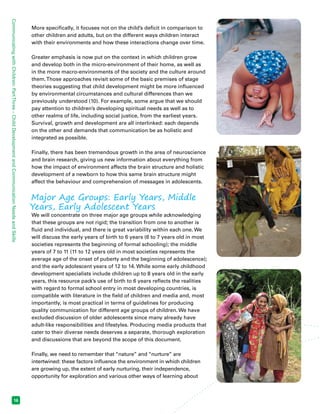
More specifically, it focuses not on the child’s deficit in comparison to 
other children and adults, but on the different ways children interact 
with their environments and how these interactions change over time. 
Greater emphasis is now put on the context in which children grow 
and develop both in the micro-environment of their home, as well as 
in the more macro-environments of the society and the culture around 
them. Those approaches revisit some of the basic premises of stage 
theories suggesting that child development might be more influenced 
by environmental circumstances and cultural differences than we 
previously understood (10). For example, some argue that we should 
pay attention to children’s developing spiritual needs as well as to 
other realms of life, including social justice, from the earliest years. 
Survival, growth and development are all interlinked: each depends 
on the other and demands that communication be as holistic and 
integrated as possible. 
Finally, there has been tremendous growth in the area of neuroscience 
and brain research, giving us new information about everything from 
how the impact of environment affects the brain structure and holistic 
development of a newborn to how this same brain structure might 
affect the behaviour and comprehension of messages in adolescents. 
Major Age Groups: Early Years, Middle 
Years, Early Adolescent Years 
We will concentrate on three major age groups while acknowledging 
that these groups are not rigid; the transition from one to another is 
fluid and individual, and there is great variability within each one. We 
will discuss the early years of birth to 6 years (6 to 7 years old in most 
societies represents the beginning of formal schooling); the middle 
years of 7 to 11 (11 to 12 years old in most societies represents the 
average age of the onset of puberty and the beginning of adolescence); 
and the early adolescent years of 12 to 14. While some early childhood 
development specialists include children up to 8 years old in the early 
years, this resource pack’s use of birth to 6 years reflects the realities 
with regard to formal school entry in most developing countries, is 
compatible with literature in the field of children and media and, most 
importantly, is most practical in terms of guidelines for producing 
quality communication for different age groups of children. We have 
excluded discussion of older adolescents since many already have 
adult-like responsibilities and lifestyles. Producing media products that 
cater to their diverse needs deserves a separate, thorough exploration 
and discussions that are beyond the scope of this document. 
Finally, we need to remember that “nature” and “nurture” are 
intertwined: these factors influence the environment in which children 
are growing up, the extent of early nurturing, their independence, 
opportunity for exploration and various other ways of learning about
Communicating with Children: Part Three – Child Development and Communication Needs and Skills 
17 
self and the world around them, as well as subsequent actions they 
might be able to take. 
Let us examine these three age groups by summarizing the unique 
characteristics of each one, the communication needs that are derived 
from them and the implications they might have for using media for 
their healthy development and well-being. 
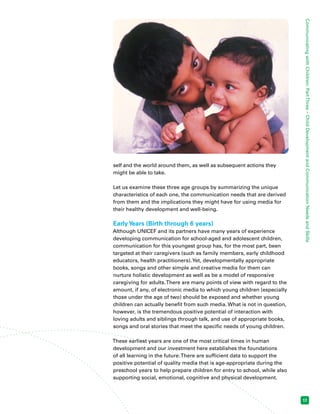
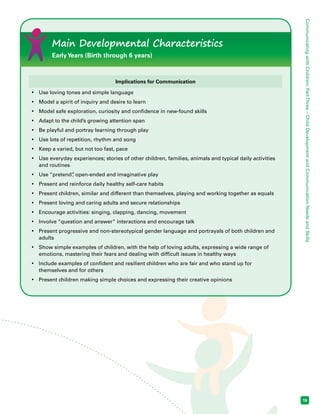
Early Years (Birth through 6 years) 
Although UNICEF and its partners have many years of experience 
developing communication for school-aged and adolescent children, 
communication for this youngest group has, for the most part, been 
targeted at their caregivers (such as family members, early childhood 
educators, health practitioners). Yet, developmentally appropriate 
books, songs and other simple and creative media for them can 
nurture holistic development as well as be a model of responsive 
caregiving for adults. There are many points of view with regard to the 
amount, if any, of electronic media to which young children (especially 
those under the age of two) should be exposed and whether young 
children can actually benefit from such media. What is not in question, 
however, is the tremendous positive potential of interaction with 
loving adults and siblings through talk, and use of appropriate books, 
songs and oral stories that meet the specific needs of young children. 
These earliest years are one of the most critical times in human 
development and our investment here establishes the foundations 
of all learning in the future. There are sufficient data to support the 
positive potential of quality media that is age-appropriate during the 
preschool years to help prepare children for entry to school, while also 
supporting social, emotional, cognitive and physical development.
Communicating with Children: Part Three – Child Development and Communication Needs and Skills 18 
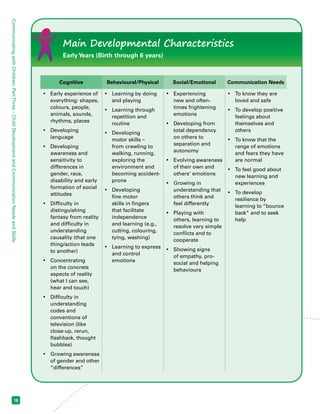
Cognitive Behavioural/Physical Social/Emotional Communication Needs 
• Early experience of 
everything: shapes, 
colours, people, 
animals, sounds, 
rhythms, places 
• Developing 
language 
• Developing 
awareness and 
sensitivity to 
differences in 
gender, race, 
disability and early 
formation of social 
attitudes 
• Difficulty in 
distinguishing 
fantasy from reality 
and difficulty in 
understanding 
causality (that one 
thing/action leads 
to another) 
• Concentrating 
on the concrete 
aspects of reality 
(what I can see, 
hear and touch) 
• Difficulty in 
understanding 
codes and 
conventions of 
television (like 
close-up, rerun, 
flashback, thought 
bubbles) 
• Growing awareness 
of gender and other 
“differences” 
• Learning by doing 
and playing 
• Learning through 
repetition and 
routine 
• Developing 
motor skills – 
from crawling to 
walking, running, 
exploring the 
environment and 
becoming accident-prone 
• Developing 
fine motor 
skills in fingers 
that facilitate 
independence 
and learning (e.g., 
cutting, colouring, 
tying, washing) 
• Learning to express 
and control 
emotions 
• Experiencing 
new and often-times 
frightening 
emotions 
• Developing from 
total dependency 
on others to 
separation and 
autonomy 
• Evolving awareness 
of their own and 
others’ emotions 
• Growing in 
understanding that 
others think and 
feel differently 
• Playing with 
others, learning to 
resolve very simple 
conflicts and to 
cooperate 
• Showing signs 
of empathy, pro-social 
and helping 
behaviours 
• To know they are 
loved and safe 
• To develop positive 
feelings about 
themselves and 
others 
• To know that the 
range of emotions 
and fears they have 
are normal 
• To feel good about 
new learning and 
experiences 
• To develop 
resilience by 
learning to “bounce 
back” and to seek 
help 
Main Developmental Characteristics 
Early Years (Birth through 6 years)
Communicating with Children: Part Three – Child Development and Communication Needs and Skills 
19 
Main Developmental Characteristics 
Early Years (Birth through 6 years) 
Implications for Communication 
• Use loving tones and simple language 
• Model a spirit of inquiry and desire to learn 
• Model safe exploration, curiosity and confidence in new-found skills 
• Adapt to the child’s growing attention span 
• Be playful and portray learning through play 
• Use lots of repetition, rhythm and song 
• Keep a varied, but not too fast, pace 
• Use everyday experiences; stories of other children, families, animals and typical daily activities 
and routines 
• Use “pretend”, open-ended and imaginative play 
• Present and reinforce daily healthy self-care habits 
• Present children, similar and different than themselves, playing and working together as equals 
• Present loving and caring adults and secure relationships 
• Encourage activities: singing, clapping, dancing, movement 
• Involve “question and answer” interactions and encourage talk 
• Present progressive and non-stereotypical gender language and portrayals of both children and 
adults 
• Show simple examples of children, with the help of loving adults, expressing a wide range of 
emotions, mastering their fears and dealing with difficult issues in healthy ways 
• Include examples of confident and resilient children who are fair and who stand up for 
themselves and for others 
• Present children making simple choices and expressing their creative opinions
Communicating with Children: Part Three – Child Development and Communication Needs and Skills 20 
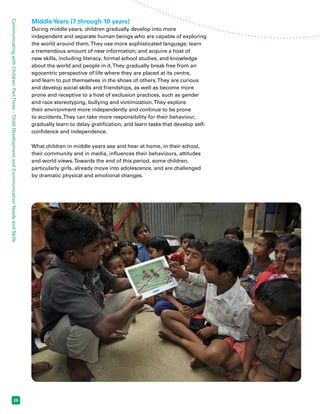
Middle Years (7 through 10 years) 
During middle years, children gradually develop into more 
independent and separate human beings who are capable of exploring 
the world around them. They use more sophisticated language; learn 
a tremendous amount of new information; and acquire a host of 
new skills, including literacy, formal school studies, and knowledge 
about the world and people in it. They gradually break free from an 
egocentric perspective of life where they are placed at its centre, 
and learn to put themselves in the shoes of others. They are curious 
and develop social skills and friendships, as well as become more 
prone and receptive to a host of exclusion practices, such as gender 
and race stereotyping, bullying and victimization. They explore 
their environment more independently and continue to be prone 
to accidents. They can take more responsibility for their behaviour, 
gradually learn to delay gratification, and learn tasks that develop self-confidence 
and independence. 
What children in middle years see and hear at home, in their school, 
their community and in media, influences their behaviours, attitudes 
and world views. Towards the end of this period, some children, 
particularly girls, already move into adolescence, and are challenged 
by dramatic physical and emotional changes.
Communicating with Children: Part Three – Child Development and Communication Needs and Skills 
21 
Cognitive Behavioural/Physical Social/Emotional Communication Needs 
• Better 
distinguishing 
between fantasy 
and reality 
• Understanding 
inner motivation of 
characters 
• Understanding 
causality (that 
“one thing leads to 
another”) 
• Using more 
sophisticated 
language 
• Developing 
problem-solving and 
critical thinking skills 
• Developing the 
ability to understand 
television and other 
media codes and 
conventions (use of 
camera shots and 
editing, sound and 
music cues, etc.) 
• Gradually becoming 
more independent 
in taking care of 
daily needs such as 
personal hygiene, 
feeding, taking care 
of possessions 
• Learning to follow 
rules of play and 
interactions 
• More interested in 
taking part in drama 
and playing sports 
• More concerned 
about body image 
and appearance 
• Taking more 
responsibility for 
their own actions 
• Friends gradually 
taking a more 
central role in their 
lives 
• Continuing to need 
supportive adults 
and positive role 
models 
• Clearly preferring 
same-sex friends 
• Learning about 
right and wrong 
and making moral 
choices 
• Developing 
exclusionary 
and stereotyping 
behaviours 
• To nurture positive 
feelings about 
themselves, others 
and the larger world 
• To explore and test 
their own ideas, 
skills and talents 
• To be guided in 
using their potential 
in positive ways 
• To have their 
feelings and worries 
understood and 
respected 
Main Developmental Characteristics 
Middle Years (7 through 10 years) 
Implications for Communication 
• Present longer and more dramatic stories 
• Offer child-centred stories and characters 
• Portray learning and school achievement as 
an opportunity to develop new, interesting 
skills and talents 
• Use strategies such as visual and auditory 
humour and cognitive challenges (e.g., brain 
teasers, riddles, tongue twisters, etc.) 
• Include interactive problem-solving and 
critical thinking 
• Model pro-social actions such as kindness, 
conflict resolution and caring about others 
• Offer strong, positive adult and child role 
models with high moral standards 
• Introduce sensitive topics that show other 
children dealing with social justice or difficult 
issues like death, anger, abuse, disability, etc., 
in creative and healthy ways 
• Show children making a difference in their 
own and other’s lives, even in difficult 
circumstances (realistic heroines and heroes) 
• Present stories about friendship, loyalty and 
“doing the right thing”
Communicating with Children: Part Three – Child Development and Communication Needs and Skills 22 
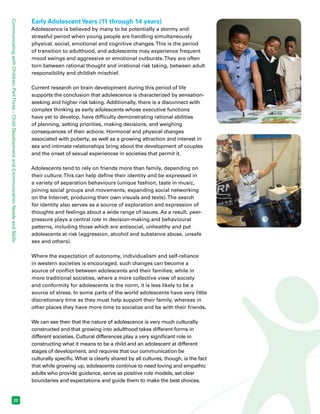
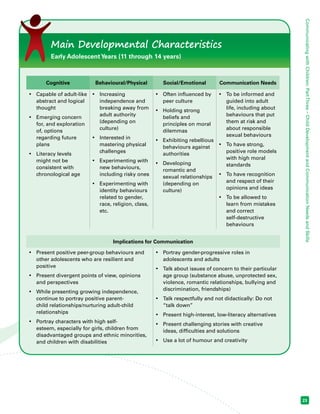
Early Adolescent Years (11 through 14 years) 
Adolescence is believed by many to be potentially a stormy and 
stressful period when young people are handling simultaneously 
physical, social, emotional and cognitive changes. This is the period 
of transition to adulthood, and adolescents may experience frequent 
mood swings and aggressive or emotional outbursts. They are often 
torn between rational thought and irrational risk taking, between adult 
responsibility and childish mischief. 
Current research on brain development during this period of life 
supports the conclusion that adolescence is characterized by sensation-seeking 
and higher risk taking. Additionally, there is a disconnect with 
complex thinking as early adolescents whose executive functions 
have yet to develop, have difficulty demonstrating rational abilities 
of planning, setting priorities, making decisions, and weighing 
consequences of their actions. Hormonal and physical changes 
associated with puberty, as well as a growing attraction and interest in 
sex and intimate relationships bring about the development of couples 
and the onset of sexual experiences in societies that permit it. 
Adolescents tend to rely on friends more than family, depending on 
their culture: This can help define their identity and be expressed in 
a variety of separation behaviours (unique fashion, taste in music, 
joining social groups and movements, expanding social networking 
on the Internet, producing their own visuals and texts). The search 
for identity also serves as a source of exploration and expression of 
thoughts and feelings about a wide range of issues. As a result, peer-pressure 
plays a central role in decision-making and behavioural 
patterns, including those which are antisocial, unhealthy and put 
adolescents at risk (aggression, alcohol and substance abuse, unsafe 
sex and others). 
Where the expectation of autonomy, individualism and self-reliance 
in western societies is encouraged, such changes can become a 
source of conflict between adolescents and their families; while in 
more traditional societies, where a more collective view of society 
and conformity for adolescents is the norm, it is less likely to be a 
source of stress. In some parts of the world adolescents have very little 
discretionary time as they must help support their family, whereas in 
other places they have more time to socialize and be with their friends. 
We can see then that the nature of adolescence is very much culturally 
constructed and that growing into adulthood takes different forms in 
different societies. Cultural differences play a very significant role in 
constructing what it means to be a child and an adolescent at different 
stages of development, and requires that our communication be 
culturally specific. What is clearly shared by all cultures, though, is the fact 
that while growing up, adolescents continue to need loving and empathic 
adults who provide guidance, serve as positive role models, set clear 
boundaries and expectations and guide them to make the best choices.
Communicating with Children: Part Three – Child Development and Communication Needs and Skills 
23 
Cognitive Behavioural/Physical Social/Emotional Communication Needs 
• Capable of adult-like 
abstract and logical 
thought 
• Emerging concern 
for, and exploration 
of, options 
regarding future 
plans 
• Literacy levels 
might not be 
consistent with 
chronological age 
• Increasing 
independence and 
breaking away from 
adult authority 
(depending on 
culture) 
• Interested in 
mastering physical 
challenges 
• Experimenting with 
new behaviours, 
including risky ones 
• Experimenting with 
identity behaviours 
related to gender, 
race, religion, class, 
etc. 
• Often influenced by 
peer culture 
• Holding strong 
beliefs and 
principles on moral 
dilemmas 
• Exhibiting rebellious 
behaviours against 
authorities 
• Developing 
romantic and 
sexual relationships 
(depending on 
culture) 
• To be informed and 
guided into adult 
life, including about 
behaviours that put 
them at risk and 
about responsible 
sexual behaviours 
• To have strong, 
positive role models 
with high moral 
standards 
• To have recognition 
and respect of their 
opinions and ideas 
• To be allowed to 
learn from mistakes 
and correct 
self-destructive 
behaviours 
Main Developmental Characteristics 
Early Adolescent Years (11 through 14 years) 
Implications for Communication 
• Present positive peer-group behaviours and 
other adolescents who are resilient and 
positive 
• Present divergent points of view, opinions 
and perspectives 
• While presenting growing independence, 
continue to portray positive parent-child 
relationships/nurturing adult-child 
relationships 
• Portray characters with high self-esteem, 
especially for girls, children from 
disadvantaged groups and ethnic minorities, 
and children with disabilities 
• Portray gender-progressive roles in 
adolescents and adults 
• Talk about issues of concern to their particular 
age group (substance abuse, unprotected sex, 
violence, romantic relationships, bullying and 
discrimination, friendships) 
• Talk respectfully and not didactically: Do not 
“talk down” 
• Present high-interest, low-literacy alternatives 
• Present challenging stories with creative 
ideas, difficulties and solutions 
• Use a lot of humour and creativity
Communicating with Children: Part Three – Child Development and Communication Needs and Skills 24
Part Four Principles and Guidelines for 
Communication for Children
A Communicating with Children: Part Four – Principles and Guidelines for Communication for Children 
27 
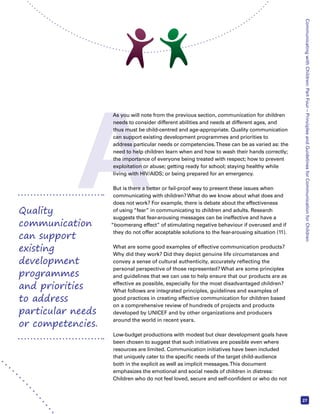
As you will note from the previous section, communication for children 
needs to consider different abilities and needs at different ages, and 
thus must be child-centred and age-appropriate. Quality communication 
can support existing development programmes and priorities to 
address particular needs or competencies. These can be as varied as: the 
need to help children learn when and how to wash their hands correctly; 
the importance of everyone being treated with respect; how to prevent 
exploitation or abuse; getting ready for school; staying healthy while 
living with HIV/AIDS; or being prepared for an emergency. 
But is there a better or fail-proof way to present these issues when 
communicating with children? What do we know about what does and 
does not work? For example, there is debate about the effectiveness 
of using “fear” in communicating to children and adults. Research 
suggests that fear-arousing messages can be ineffective and have a 
“boomerang effect” of stimulating negative behaviour if overused and if 
they do not offer acceptable solutions to the fear-arousing situation (11). 
What are some good examples of effective communication products? 
Why did they work? Did they depict genuine life circumstances and 
convey a sense of cultural authenticity, accurately reflecting the 
personal perspective of those represented? What are some principles 
and guidelines that we can use to help ensure that our products are as 
effective as possible, especially for the most disadvantaged children? 
What follows are integrated principles, guidelines and examples of 
good practices in creating effective communication for children based 
on a comprehensive review of hundreds of projects and products 
developed by UNICEF and by other organizations and producers 
around the world in recent years. 
Low-budget productions with modest but clear development goals have 
been chosen to suggest that such initiatives are possible even where 
resources are limited. Communication initiatives have been included 
that uniquely cater to the specific needs of the target child-audience 
both in the explicit as well as implicit messages. This document 
emphasizes the emotional and social needs of children in distress: 
Children who do not feel loved, secure and self-confident or who do not 
Quality 
communication 
can support 
existing 
development 
programmes 
and priorities 
to address 
particular needs 
or competencies.
Communicating with Children: Part Four – Principles and Guidelines for Communication for Children 28 
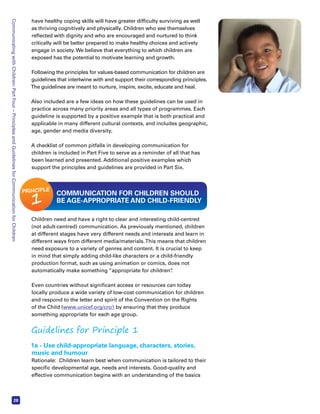
have healthy coping skills will have greater difficulty surviving as well 
as thriving cognitively and physically. Children who see themselves 
reflected with dignity and who are encouraged and nurtured to think 
critically will be better prepared to make healthy choices and actively 
engage in society. We believe that everything to which children are 
exposed has the potential to motivate learning and growth. 
Following the principles for values-based communication for children are 
guidelines that intertwine with and support their corresponding principles. 
The guidelines are meant to nurture, inspire, excite, educate and heal. 
Also included are a few ideas on how these guidelines can be used in 
practice across many priority areas and all types of programmes. Each 
guideline is supported by a positive example that is both practical and 
applicable in many different cultural contexts, and includes geographic, 
age, gender and media diversity. 
A checklist of common pitfalls in developing communication for 
children is included in Part Five to serve as a reminder of all that has 
been learned and presented. Additional positive examples which 
support the principles and guidelines are provided in Part Six. 
PRINCIPLE 1 COMMUNICATION FOR CHILDREN SHOULD 
BE AGE-APPROPRIATE AND CHILD-FRIENDLY 
Children need and have a right to clear and interesting child-centred 
(not adult-centred) communication. As previously mentioned, children 
at different stages have very different needs and interests and learn in 
different ways from different media/materials. This means that children 
need exposure to a variety of genres and content. It is crucial to keep 
in mind that simply adding child-like characters or a child-friendly 
production format, such as using animation or comics, does not 
automatically make something “appropriate for children”. 
Even countries without significant access or resources can today 
locally produce a wide variety of low-cost communication for children 
and respond to the letter and spirit of the Convention on the Rights 
of the Child (www.unicef.org/crc/) by ensuring that they produce 
something appropriate for each age group. 
Guidelines for Principle 1 
1a - Use child-appropriate language, characters, stories, 
music and humour 
Rationale: Children learn best when communication is tailored to their 
specific developmental age, needs and interests. Good-quality and 
effective communication begins with an understanding of the basics
Communicating with Children: Part Four – Principles and Guidelines for Communication for Children 
29 
Turning Theory into Practice 
1a: Use child-appropriate language, characters, stories, 
music and humour 
This guideline can be translated into communication in many ways, including: 
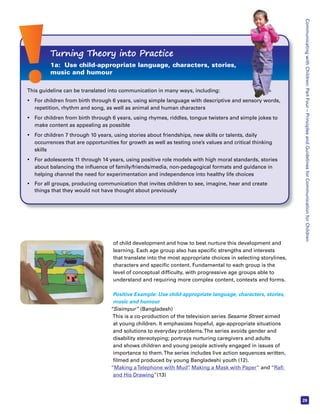
• For children from birth through 6 years, using simple language with descriptive and sensory words, 
repetition, rhythm and song, as well as animal and human characters 
• For children from birth through 6 years, using rhymes, riddles, tongue twisters and simple jokes to 
make content as appealing as possible 
• For children 7 through 10 years, using stories about friendships, new skills or talents, daily 
occurrences that are opportunities for growth as well as testing one’s values and critical thinking 
skills 
• For adolescents 11 through 14 years, using positive role models with high moral standards, stories 
about balancing the influence of family/friends/media, non-pedagogical formats and guidance in 
helping channel the need for experimentation and independence into healthy life choices 
• For all groups, producing communication that invites children to see, imagine, hear and create 
things that they would not have thought about previously 
of child development and how to best nurture this development and 
learning. Each age group also has specific strengths and interests 
that translate into the most appropriate choices in selecting storylines, 
characters and specific content. Fundamental to each group is the 
level of conceptual difficulty, with progressive age groups able to 
understand and requiring more complex content, contexts and forms. 
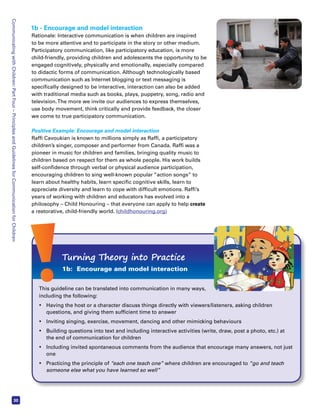
Positive Example: Use child-appropriate language, characters, stories, 
music and humour 
“Sisimpur” (Bangladesh) 
This is a co-production of the television series Sesame Street aimed 
at young children. It emphasizes hopeful, age-appropriate situations 
and solutions to everyday problems. The series avoids gender and 
disability stereotyping; portrays nurturing caregivers and adults 
and shows children and young people actively engaged in issues of 
importance to them. The series includes live action sequences written, 
filmed and produced by young Bangladeshi youth (12). 
“Making a Telephone with Mud”, Making a Mask with Paper” and “Rafi 
and His Drawing”(13)
Communicating with Children: Part Four – Principles and Guidelines for Communication for Children 30 
1b - Encourage and model interaction 
Rationale: Interactive communication is when children are inspired 
to be more attentive and to participate in the story or other medium. 
Participatory communication, like participatory education, is more 
child-friendly, providing children and adolescents the opportunity to be 
engaged cognitively, physically and emotionally, especially compared 
to didactic forms of communication. Although technologically based 
communication such as Internet blogging or text messaging is 
specifically designed to be interactive, interaction can also be added 
with traditional media such as books, plays, puppetry, song, radio and 
television. The more we invite our audiences to express themselves, 
use body movement, think critically and provide feedback, the closer 
we come to true participatory communication. 
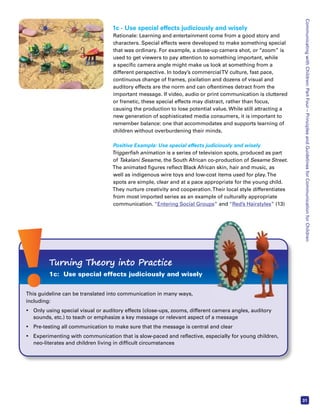
Positive Example: Encourage and model interaction 
Raffi Cavoukian is known to millions simply as Raffi, a participatory 
children’s singer, composer and performer from Canada. Raffi was a 
pioneer in music for children and families, bringing quality music to 
children based on respect for them as whole people. His work builds 
self-confidence through verbal or physical audience participation, 
encouraging children to sing well-known popular “action songs” to 
learn about healthy habits, learn specific cognitive skills, learn to 
appreciate diversity and learn to cope with difficult emotions. Raffi’s 
years of working with children and educators has evolved into a 
philosophy – Child Honouring – that everyone can apply to help create 
a restorative, child-friendly world. (childhonouring.org) 
Turning Theory into Practice 
1b: Encourage and model interaction 
This guideline can be translated into communication in many ways, 
including the following: 
• Having the host or a character discuss things directly with viewers/listeners, asking children 
questions, and giving them sufficient time to answer 
• Inviting singing, exercise, movement, dancing and other mimicking behaviours 
• Building questions into text and including interactive activities (write, draw, post a photo, etc.) at 
the end of communication for children 
• Including invited spontaneous comments from the audience that encourage many answers, not just 
one 
• Practicing the principle of “each one teach one” where children are encouraged to “go and teach 
someone else what you have learned so well”
Communicating with Children: Part Four – Principles and Guidelines for Communication for Children 
31 
1c - Use special effects judiciously and wisely 
Rationale: Learning and entertainment come from a good story and 
characters. Special effects were developed to make something special 
that was ordinary. For example, a close-up camera shot, or “zoom” is 
used to get viewers to pay attention to something important, while 
a specific camera angle might make us look at something from a 
different perspective. In today’s commercial TV culture, fast pace, 
continuous change of frames, pixilation and dozens of visual and 
auditory effects are the norm and can oftentimes detract from the 
important message. If video, audio or print communication is cluttered 
or frenetic, these special effects may distract, rather than focus, 
causing the production to lose potential value. While still attracting a 
new generation of sophisticated media consumers, it is important to 
remember balance: one that accommodates and supports learning of 
children without overburdening their minds. 
Positive Example: Use special effects judiciously and wisely 
Triggerfish animation is a series of television spots, produced as part 
of Takalani Sesame, the South African co-production of Sesame Street. 
The animated figures reflect Black African skin, hair and music, as 
well as indigenous wire toys and low-cost items used for play. The 
spots are simple, clear and at a pace appropriate for the young child. 
They nurture creativity and cooperation. Their local style differentiates 
from most imported series as an example of culturally appropriate 
communication. “Entering Social Groups” and “Red’s Hairstyles” (13) 
Turning Theory into Practice 
1c: Use special effects judiciously and wisely 
This guideline can be translated into communication in many ways, 
including: 
• Only using special visual or auditory effects (close-ups, zooms, different camera angles, auditory 
sounds, etc.) to teach or emphasize a key message or relevant aspect of a message 
• Pre-testing all communication to make sure that the message is central and clear 
• Experimenting with communication that is slow-paced and reflective, especially for young children, 
neo-literates and children living in difficult circumstances
Communicating with Children: Part Four – Principles and Guidelines for Communication for Children 32 
COMMUNICATION FOR CHILDREN SHOULD 
ADDRESS THE CHILD HOLISTICALLY 
Research from the fields of health, nutrition, psychology, child 
development and anthropology, among others, confirms that all 
aspects of child development are interconnected. Physical, social, 
emotional and cognitive development are inextricably linked. A child 
can be bright, but live with neglect or abuse. A child can be well fed, 
and yet yearn for love. A child can be loved, but can be physically 
or emotionally fragile. Communication that balances and gives 
complementary attention to all their developmental needs best serves 
all children, from infants to adolescents. In many countries, producing 
holistic communication has been a cost-effective way of meeting the 
needs of children and caregivers on several cross-sectoral issues. 
Guidelines for Principle 2 
2a - Use an integrated rather than single-issue approach to 
communication 
Rationale: Communicators are often told to “stick with one message”. 
This is true insofar as it brings focus, but there are simple ways to 
integrate holistic aspects of child development even when focusing on 
Turning Theory into Practice 
2a: Use an integrated approach to communication 
This guideline can be translated into communication in many ways, including modelling different ways 
of coping with a single issue. For example, in communication about: 
• Immunization – include ways children can calm themselves (think happy thoughts, choose the arm 
to be injected, squeeze a toy, sing a song) to integrate health, self-esteem, choices and emotional 
resilience 
• Hand washing – use a song that lasts the length of “happy birthday” sung twice over; count words 
for each finger (using relational words like front/back, up/down; use interesting words like cuticle 
and epidermis; and use congratulatory phrases (such as “great job” and “every germ washed 
away”) to integrate health, hygiene, school-preparedness, self-confidence 
 Nutrition – use a phrase such as “eating a rainbow of foods to make us strong and clever” to 
integrate health, nutrition, school-preparedness, self-confidence 
 Gender-progressive attitudes and practices – model older men and women encouraging and 
praising adolescent girls and boys when they protect rather than bully and when they band 
together against negative peers, to integrate gender equity, child protection, self-confidence, 
life skills 
PRINCIPLE 2
Communicating with Children: Part Four – Principles and Guidelines for Communication for Children 
33 
a single issue. Children process and experience learning in integrated 
ways using all their senses and mental processes. Developing 
communication that simultaneously meets their emotional, social, 
cognitive and physical needs makes scientific and practical sense. 
In addition to paying attention to the main or intended messages, 
children learn from incidental and unintended elements of a story 
(for example, whether the characters behave according to traditional 
gender-prescribed roles, how caregivers visually react to children’s 
fears or mistakes, etc.). It is, therefore, important to pay careful 
attention to all aspects of a message, the obvious and the subliminal. 
Positive Example: Using an integrated approach to communication 
The poster “Let’s Wash Hands” was developed for school-aged 
children during a capacity-building workshop on holistic child 
development in Indonesia. The group chose a girl to be the model for 
a photo-based poster; broke down steps for a correct hand-washing 
sequence (wet, soap, scrub well, rinse); used a catchy rhyme with each 
photo; and finished with the girl proudly holding out her clean hands. 
Supplementary activities included adapting the rhyme to a song to be 
sung at school or at home when washing hands. The poster integrated 
hygiene, early learning through rhyme and building self-confidence, 
especially of girls. It can be used as a model to teach a variety of skills 
to children as well as adults.
Communicating with Children: Part Four – Principles and Guidelines for Communication for Children 34 
2b - Offer positive models for adults in their relationships 
with children 
Rationale: Communication for children should be a positive model 
for caregivers and all adults in their interactions with children. This is 
always important, but especially so in communities where children live 
in difficult circumstances and for various reasons do not have access 
to nurturing and attentive caregivers; or where there are few positive 
media alternatives (where media present primarily negative images 
of caregivers who scold, fight or are abusive). The adults targeted 
by these communications include parents, other family members, 
teachers, health-care workers, child protection officers and others. If 
communication primarily models unsupportive or abusive adults, this 
can be construed as the “norm”, even when there are many adults 
around the world who support and take good care of their children. 
In every community there are models of caregivers who nurture 
development and resilience, and who build skills in children that 
will help them cope with everyday crises, such as being bullied or 
exploited, living with illnesses like HIV/AIDS, or surviving disasters and 
emergencies. 
Positive Example: Models for adults in their relationships with children 
“At School, What If…?” (Early Learning Resource Unit, South Africa, 
www.elru.co.za) is a children’s book about a girl named Ncebakazi, 
who uses crutches. She and her mother talk while they get her uniform 
Turning Theory into Practice 
2b: Offer positive models for adults in their 
relationships with children 
This guideline can be translated into communication in many ways, including showing positive adult/ 
child interactions, for example: 
• Orphans and vulnerable children being told the truth about their sick or dying parents by kind, 
loving adults who accept their range of emotions and help them grieve 
• A father using simple conversation and games about healthy eating colours, counting, classifying, 
sharing, etc., to combine stories with fun, learning concepts and values 
• Parents, educators and other community members diffusing their own tensions and addressing 
anger in healthy ways to model stress management 
• Real-life “positive deviance” caregivers addressing sensitive and difficult topics like exploitation, 
HIV/AIDS and violence by listening, following the child’s lead, and building confidence and 
resilience 
• Young adolescents are provided contacts with trusted adults via instant text messaging, websites, 
radio, posters, call centres, etc., to help them survive and cope with abuse and exploitation
Communicating with Children: Part Four – Principles and Guidelines for Communication for Children 
35 
and pencils ready for the first day of primary school: Ncebakazi 
wonders if her teacher will shout, if children will laugh at her, and 
what will happen if she cannot get to the toilet. Using calming words 
matched with humorous and imaginative illustrations, the story 
acknowledges and respects a child’s real fears, and supports her while 
she creatively imagines both problems and solutions. It also suggests 
simple preparations and adaptations that teachers and students can 
make to include children who are disabled. http://www.unicef.org/cwc/ 
files/At_School_What_If(1).pdf 
2c - Create “safe havens” as part of communication 
Rationale: “Safe havens” are spaces where vulnerable children can go 
in a time of crisis. They can be physical, mental or emotional places 
where children feel that they are listened to and someone knows how 
they feel. They are places where children feel protected and safe from 
harm and can gain a sense of trust in the world and optimism about 
their lives. The need for a “safe haven” can range from children living 
in emergencies, those experiencing abuse, and those whose wounds 
or fears emanate from discrimination based on disability, ethnicity, 
gender, race, religion, caste, etc. Children need safe havens in order 
to survive and thrive. Across the developing world, it can sometimes 
be difficult for overworked and overwhelmed adults and families to 
provide such spaces for children. “Safe haven” communication is 
important because safety and security are foundations for developing 
and learning well. Even if young children do not talk about sensitive 
or difficult issues they can still feel many emotions that can have 
a negative impact on all areas of their development. Although 
communication cannot replace human interaction or special therapy, 
it can help children understand that they are not alone and provide 
examples of how they and others can cope and be comforted. Safe 
havens can soothe and create a respite from existing pain, even for 
short periods of time. 
Turning Theory into Practice 
2c: Create “safe havens” as part of communication 
This can be translated into communication in many ways, for example: 
• Emphasizing the good in people, modelling warmth, care and joy found in small things 
• Using stories told in first person about difficult emotions and experiences such as fear, illness or 
death (e.g., “My mum died from AIDS and I would like to share my story with you,” “There is lots 
of fighting in my town these days. I get very afraid. Here are some things I do when I am afraid,” “I 
learned to be a bully because I could never tell others what I really needed. I was bullied at home. I 
need your help to stop being a bully,” “When I was abused I felt all alone. I learned to be assertive, 
to not blame myself, to reach out for help, and to say ‘no.’”)
Communicating with Children: Part Four – Principles and Guidelines for Communication for Children 36 
Positive Example: Create “safe havens” as part of communication 
“See Something Say Something” (Bold Creative for Nickelodeon UK, 
http://boldcreative.co.uk/) is a series of short films about bullying, 
produced for an anti-bullying campaign in the U.K. Developed after 
research, including workshops in primary schools and interviews 
with children, the series presents different perspectives: the bully, 
the bullied and the witness to bullying. The first story is narrated by 
Marcus, a young boy who bullies another boy until the boy’s mother 
talks to him about the consequences of bullying and he reconsiders 
his behaviour. Alaskah, a 10-year-old girl, is the victim of bullying on 
the playground, trying to understand why another child would harbour 
angry feelings. Kelly is a witness to bullying and takes action to have 
an adult teacher intervene. Mark describes being bullied as having a 
cage put around him that becomes smaller and smaller. All offer ways 
that children can end bullying, including asking for help from teachers 
and by calling a “hotline” telephone number. They are a model of a 
“safe haven,” where both children who bully and those who are bullied 
can find identification, help in understanding different perspectives 
and practical suggestions for changing and healing. 
• Markus: http://vimeo.com/25831536 
• Mark: http://vimeo.com/25831585 
• Kelly: http://vimeo.com/25831475 
• Alaskah: http://vimeo.com/25831275 
(child protection, resiliency, healthy life skills) 
COMMUNICATION FOR CHILDREN SHOULD 
BE POSITIVE AND STRENGTHS-BASED 
PRINCIPLE 3 
Strengths-based communication focuses on portraying and nurturing 
the strengths and potential in every child rather than focusing on the 
deficits or problems. Using this principle, the goal is not only to teach 
but also to develop resilience and the capacity to cope. It does this in 
a healthy way for both large and small struggles in life. It helps move 
communication from focusing only on problems to suggesting and 
presenting options and possibilities. Regardless of country or situation, 
it means developing communication that invites children to imagine or 
be transported to seeing things they have not previously experienced; 
that excites children about possibilities of what they can do today or 
become in the future; and channels their energy into positive thought 
and action. Such communication can be transformative. 
Guidelines for Principle 3 
3a - Build self-confidence as well as competence 
Rationale: A confident child might not only learn better, but will more 
likely want to learn more. In most development communication to 
date and specifically in communication for children, the focus has been 
almost solely on raising awareness and building skills. However, where
Communicating with Children: Part Four – Principles and Guidelines for Communication for Children 
37 
Turning Theory into Practice 
3a: Build self-confidence as well as competence 
This guideline can be translated into communication in many ways, for example: 
• Using stories, words, visuals and models that build confidence as well as competence by including 
language that supports self-confidence (“I am so proud that you stayed away from those chickens,” 
“I was scared but I knew just what to do to help myself when someone offered drugs to me,” “Look 
how well I cleaned my hands,” “You are a role model to others for not being pressured to have 
unsafe sex.”) 
• Including ideas about “the big things that little children can do to make a difference,” particularly in 
communication for children in emergencies (e.g., knowing a safe place to go for help, knowing what 
to take when leaving home or school, remembering their name and address) 
• Presenting ways that everyday children and adults comfort and support one another through simple 
children repeatedly see and hear that they are valued and important, 
they learn to build a foundation for critical thinking and a lifetime love of 
learning. More important than what children need to learn is what they 
can be. Self-confidence promotes coping skills, solution-finding and the 
full potential of every child regardless of their situation. Self-confidence 
is displayed in resilient individuals who show resourcefulness, 
perseverance, optimism, determination and creativity. 
Positive example: Build self-confidence as well as competence 
“Fatma” (Egyptian Television and Radio) is a TV drama about a 10-year-old 
girl who desperately wants to go to school. Her father is against 
this but Fatma stands up to him in a confident, forceful yet respectful 
and resourceful manner. She addresses all of his arguments through 
investigation and adept conflict resolution skills. After negotiation, her 
father finally agrees, and we watch how Fatma is determined to study 
despite the odds. With all of her chores she is tired and her schoolwork 
initially suffers. We watch how she achieves and develops confidence 
and pride with a little family and school support. This low-budget 
film addresses basic education, gender equality, child protection and 
conflict resolution/life skills. It can be used as a model for finding 
and presenting a “positive deviant”, someone who has the courage 
to stand up for what they believe is right for themselves and others, 
do the right thing and work to achieve their goals. This video was 
produced as part of the European Broadcasting Union’s international 
co-production of the Eurovision Children Documentary series. 
http://vimeo.com/24881635 
words, deeds, play and learning 
• Modelling adults and children thanking one another for “being the best grown-up” or “being the 
best child,” regardless of living circumstances
Communicating with Children: Part Four – Principles and Guidelines for Communication for Children 38 
3b - Use positive modelling 
Rationale: Children and adults learn best from repeatedly seeing 
and hearing actions or ways of thinking that we would like them 
to emulate or “model,” however a lot of communication presents 
negative models (such as violence, stereotypes, name-calling, unsafe 
or unhealthy behaviours and practices), with brief messages at the end 
telling audiences not to do what has been shown. Rather than telling 
children what not to do and portraying only the problem itself, it is 
more effective to portray positive models for what we want children 
to do (such as being generous, fair, honest, caring and responsible) to 
reinforce positive action and thought. 
Turning Theory into Practice 
3b: Use positive modelling 
This guideline can be translated into communication in many ways, including: 
• Rather than showing children engaged in dangerous behaviour and suffering the consequences 
(e.g., lighting a match and getting burned), show children taking positive action to prevent 
harm (e.g., seeing a box of matches, discussing whether to walk away or tell a grown-up, doing 
something that prevents them from injury) 
• Rather than depicting scary situations or images, show ways children can help themselves when 
they are afraid (talking to a trusted adult, singing a song, thinking of a happy memory, etc.) 
• Modelling children mobilizing their communities (e.g., on a trash-strewn street everyone from the 
youngest child to oldest adult gets together to create a central disposal area; a child who is blind 
teaches her peers how they can safely cross streets by carefully listening to sounds on both sides 
and in front of themselves) 
• Modelling adolescents being supported by adult mentors, women and men (e.g., adolescent girls 
living in difficult circumstances are helped in their fight against sexual exploitation) 
• Model nurturing men who make early or basic child education exciting and demonstrate how 
children can learn a tremendous amount with limited resources 
Positive Example: Use positive modelling 
“Talking with Young People: Montage” (The Heroes Project, Kaiser 
Family Foundation, Gates Foundation’s Avahan Initiative, India, 
www.kff.org) is an HIV/AIDS (prevention, stigma and discrimination 
reduction) TV campaign in which a variety of adults are shown 
creatively opening up a dialogue with their adolescent children. 
Mothers and sons, fathers and daughters all model the importance of 
talking openly. http://vimeo.com/24890440
Communicating with Children: Part Four – Principles and Guidelines for Communication for Children 
39 
A Lesson in Positive Modelling 
“Sesame Street: Fear of Monsters” (Sesame Workshop, USA) is a TV series with a recurring cast of pup-pets. 
In one episode, the character Ernie cannot sleep because he imagines a monster is in his room 
(which viewers do not see). Then he sings a song about bad things going away. Even though Ernie 
ends up going to sleep, research found that children focused on the monster and fear rather than on 
the soothing song. This experience taught everyone involved that, “You have to make the resolution 
just as salient as the conflict or else the resolution is just not going to be remembered.” 
www.sesameworkshop.org 
3c - Include children as active citizens who model social 
justice and mobilization 
Rationale: Child participation is not only a right but also an incredible 
opportunity for children to show their strengths and the contributions 
they make to family, peers, community and the world. But how 
we guide and nurture children to participate in programmes and to 
produce communication will make a difference in the success of that 
communication. Children should be guided to share their strengths 
and their solutions, not only their problems. They should also be 
encouraged to think and act both locally and globally. While teaching 
them to develop their own communication, they can be nurtured to 
develop values, morals and principles of equality, fairness and respect 
for others. Children can be models and ambassadors to their younger 
peers when they are encouraged to think and act “outside the box” in 
non-stereotypical, creative ways.
Communicating with Children: Part Four – Principles and Guidelines for Communication for Children 40 
Positive examples: Including children as active citizens learning about 
and modelling social justice and mobilization 
“No Fair to Tigers”/”No Es Justo los Tigres” (Eric Hoffman, Redleaf Press, 
USA) is part of a collection of “Anti-bias Books for Kids” for preschool 
and primary grades that are available in Spanish and English. It features 
a girl named Mandy, who uses a wheelchair, and her stuffed tiger that 
is dirty and messy because of his “adventures with wild animals”. When 
Mandy goes to get “food” for her tiger, she finds three big stairs to 
the shop and wonders how she will get inside with her wheelchair. 
Mandy (and her tiger) agree that this is “no fair/no es justo”. She tells 
the storekeeper that she would like to come inside and can only do this 
if there is a ramp for her. Children learn about fairness, standing up for 
themselves and problem-solving, and that they can make a difference, 
even at a young age. Mandy is a positive, strong character helping 
children learn a lesson about her specific difficulty but also general 
principles of discrimination. The book is a model for introducing social 
justice issues and for encouraging self-confidence in speaking up when 
an injustice occurs. It is also a good example of how a bilingual book 
can be used to promote second and indigenous languages. http://www. 
unicef.org/cwc/files/No_Fair_To_Tigers(1).pdf 
Turning Theory into Practice 
3c: Include children as active citizens who model 
social justice and mobilization 
This guideline can be translated into communication in many ways, for example: 
• Challenging and training young adolescents to report through various media about peers in their 
community who “stand up” for others (e.g., they defend girls who are mocked because they play 
with trucks, or boys who are bullied because they play with dolls) 
• Showing adolescents learning about discrimination and social justice from strong resilient adults 
who were previously marginalized (people with disabilities, people living with HIV/AIDS, survivors 
of abuse, etc.) 
• Supporting children to produce stories about kids who have been in difficult situations (diagnosed 
with cancer or HIV, have a disability, been through a disaster, lost a loved one) but have survived 
and are thriving 
• Modelling groups of children who make the “right” decisions (e.g., make lists of peers who do not 
bully, invite a new girl to join in a game, ask a shy but talented classmate to lead their after-school 
band) 
3d – “Do no harm” 
Rationale: There is a fine line between showing children accurate 
depictions of reality along with useful information to teach or protect, 
and sharing too-explicit or graphic information which inadvertently 
harms or further traumatizes them. Even as children grow older, it is
Communicating with Children: Part Four – Principles and Guidelines for Communication for Children 
41 
always better to err on the side of presenting positive solutions and 
caring adults providing physical and emotional “protection” when 
presenting sensitive issues (such as armed conflict, sexual or other 
abuse, emergencies, etc.) 
Positive Example: Do no harm 
“Nozipho’s Story” (Soul Buddyz TV, South Africa, www.soulcity.org.za) 
is part of a community programme and learning package about a girl 
witnessing a violent robbery. The photo-based comic is aimed at Grade 
7 learners. Using minimal but important text, it shows an adolescent 
girl going to school and being threatened with a knife on her way to 
choir practice. Rather than being too explicit about the crime or simply 
preaching about a child’s right to protection, the comic focuses on 
the emotional and learning impact on Nozipho, how she shares the 
experience with her friend and how a kind teacher helps her. It takes 
into account the reflective thinking abilities of the adolescents as 
well as the importance of guiding them through difficult times and 
decisions. The comic continually asks questions of the reader while 
also providing simple and child-friendly facts about how one can 
be affected when bad things happen. It also suggests many ways 
to deal with feelings and emotions. It ends with a story about “All 
Stars”, a trauma peer-support group for children. The comic inspires, 
motivates and stimulates problem-solving while presenting a difficult 
topic in a gentle manner. It is a model for presenting a wide range of 
sensitive issues related to child protection, response to violence, and 
exploitation and abuse. 
http://www.unicef.org/cwc/files/Nozipho_Story(2).pdf 
When bad things happen 
Life Orientation Learning Outcomes covered in this unit 
(Only relevant outcomes are listed) 
Learning Outcome 3: Personal Development 
The learner will be able to use acquired life skills to achieve and extend personal 
potential to respond effectively to challenges in his or her world 
Look in the Educator’s Guide for information about Assessment 
Standards and how they link to the activities. 
 Find out how you can 
be affected by frightening 
or sad things that happen 
to you. 
 Learn how you can help 
yourself to feel better over 
time. 
 Be committed to finding 
people who you trust who 
can listen to you. 
Turning Theory into Practice 
3d: “Do no harm” 
This guideline can be translated into communication in many ways, 
including: 
• Presenting communication about children’s common fears (of abuse, abandonment, living through 
an emergency, going to the doctor or to school, being bullied, etc.), but refrain from explicit, violent, 
over-dramatized scenes, and minimize the “scary” action to less than 10 percent of the production 
• Modelling loving and gentle adults, who listen to children’s and adolescents’ stories of difficult 
experiences and feelings, and who empathize with them, absolve them of blame, affirm their 
fear, shame and guilt as well as their resilience and worth, and “brainstorm” with them regarding 
various coping strategies 
• Modelling change agents in communities living in distress (conflict, disaster, etc.), including other 
children, without over-dramatizing pain and suffering
Communicating with Children: Part Four – Principles and Guidelines for Communication for Children 42 
COMMUNICATION FOR CHILDREN SHOULD 
ADDRESS THE NEEDS AND ABILITIES OF 
ALL, INCLUDING THOSE WHO ARE MOST 
DISADVANTAGED 
PRINCIPLE 4 
Media reflects who and what is valued by society. This is true in 
presentations of people and of culture and traditions. It is critical 
that communication allows all children to hear and see themselves 
reflected positively, as opposed to communication that focuses on 
marginalization, shame, or negative or patronizing portrayals. Good 
communication includes positive portrayals of children from different 
cultures and ethnic groups and all socio-economic backgrounds, 
those with disabilities, and children who have or are experiencing 
trauma, grief or living through emergencies. Creative solutions and 
competencies should come from marginalized groups themselves, 
not just from those in positions of authority or from privileged 
backgrounds. Conscious decisions should be made to include the most 
vulnerable and disadvantaged children as a regular part of all types 
and forms of communication. Whether it is a PSA about hand washing, 
a documentary about HIV/AIDS prevention, a puppet show about 
resisting bullies, a board game teaching life skills, or a live action 
drama about emergency preparedness, boundaries need to be pushed 
to ensure that the needs and abilities of all are portrayed. 
Guidelines for Principle 4 
4a - Reflect the dignity of each and every child and adult 
Rationale: It is important to make a conscious effort to include 
all children, but it is equally important to pay attention to how 
they are included: in what types of communication, how they are 
presented, how others are presented in relation to them, etc. Often, 
communication developed for children, even in the most resource-poor 
countries, includes the most disadvantaged children as victims 
in need of help, and only in situations that portray their problems, 
difficulties, and what they need to change. This applies to children 
affected by poverty, disability, living in emergencies, or those in need 
of special protection from violence, exploitation and abuse. Likewise, 
communication for children on topics ranging from hygiene, early 
learning or life skills include, as a matter of course, more boys than 
girls, more middle or upper-class children and children who are 
considered better-looking, rather than those who are average and 
more representative of a given community. This misrepresentation 
needs to be changed. We must make a conscious effort to ensure that 
we do not reinforce already poor self-esteem or feelings of disparity 
among the most vulnerable and disadvantaged children and youth.
Communicating with Children: Part Four – Principles and Guidelines for Communication for Children 
43 
Turning Theory into Practice 
4a: Reflect the dignity of each and every child and adult 
This guideline can be translated into communication in many ways, including 
showing positive adult/child interaction, for example: 
• Supporting students from ethnic minorities in starring or leadership roles of school-based dramas 
• Helping economically disadvantaged youth produce blogs for younger children in their 
Positive Example: Reflecting the dignity of each and every child and adult 
“Happy to be Nappy and Other Stories of Me” (HBO television, USA) 
is a “family special” designed to promote self-confidence and respect 
for others. In it, each child celebrates her/his own uniqueness through 
animated stories or live action sequences. Included are African- 
American children, children with disabilities, a boy who likes to dance 
and stories about being strong when one is teased or bullied. Children 
themselves answer questions about how they cope and thrive. 
http://www.hbofamily.com/programs/happy-to-be-nappy.html 
4b - Be inclusive: Celebrate and value all types of diversity 
Rationale: Children are aware of differences at a very early age. 
Some of this comes from real-life experiences in their families and 
communities, and some comes from their exposure to media in its 
many forms. If someone is missing from our communication and 
media, it often implies their absence from social consciousness; if 
someone is portrayed negatively or solely as a stereotype, it sends 
a message as well. Complementary ways in which inclusion can 
be achieved are explicit (direct) and implicit (indirect) images and 
messages. It is important to explicitly provide practical information, 
answer questions honestly and accurately, address and include special 
stories about differences. It is equally important to implicitly include, 
as a matter of fact, a diverse world without any mention of difference. 
Often, children who view positive and inclusive communication have 
an easier time discussing sensitive topics such as gender, disability, 
ethnicity and race. They are also more likely to be interested in 
communities 
• Presenting stories about parents with disabilities carrying their children to the market or school and 
pretending their wheelchairs are airplanes or boats 
• Producing dramas about poorer adolescents who have recently lost parents, teaching a more 
privileged child how to grieve and cope 
• Showing that children who are deaf and use sign language have and are proud of their own “deaf 
culture”
Communicating with Children: Part Four – Principles and Guidelines for Communication for Children 44 
Turning Theory into Practice 
4b: Be inclusive: Celebrate and value all types 
of diversity 
This guideline can be translated into communication in many ways to demonstrate explicit and implicit 
inclusion, using formal and informal media, featuring girls and boys, able and disabled, of various 
economic levels, of differing national groups and ethnicities, living in homes and on the streets – but 
all of them equally engaged in various learning activities. For example: 
• Implicit – children with amputated limbs coping with life in conflict/post-conflict situations with no 
mention of their disability; an H1N1 prevention campaign that includes boys and girls of varying 
abilities and social groups; introducing a girl who loves school, her friends and community, and 
coincidentally happens to be deaf 
• Explicit – a competitive quiz with different children shouting out correct answers while a narrator 
explains that, “All children have the potential to do well if they are given a chance and work hard,” 
and concluding with a minority group child winning; a boy living with AIDS sitting with younger 
children, answering questions about his disease, life and lessons learned, and giving them advice 
cultivating relationships with others and respecting them as equals. 
Just as one should strive to have a fifty-fifty gender balance in all 
communication, a good “rule of thumb” for implicit inclusion is at 
least 10 per cent. For example, to ensure fair representation on the 
topic of disability, ensure that at least 1 out of every 10 children and 
adults living with a disability, particularly the disabilities common to 
that particular society, is portrayed. 
Positive Example: Be inclusive by celebrating and valuing all types of 
diversity 
“Media Initiatives for Children” (Peace Initiatives Institute, USA) is a 
series of television public service announcements and other media 
about accepting and appreciating differences, “to create greater 
understanding and less strife among conflicted societies.” Its first 
project was based in Northern Ireland and the Republic of Ireland and 
proved successful by combining short television cartoons and other 
mass media, matched with curricula to help preschool children accept 
and respect others. Various forms of inclusion and diversity presented 
in the cartoons include: children who are Catholic and Protestant, 
children from different ethnic groups and a child who is disabled. 
Impact evaluation on this project showed that children exposed to 
the cartoons and classroom intervention made positive changes in 
recognizing differences and showing a willingness to play with all 
children. It also indicated that children who participated were more 
likely to recognize exclusion, to know how an excluded child feels, and 
were more willing to play with a previously excluded child (14). 
www.pii-mifc.org
Communicating with Children: Part Four – Principles and Guidelines for Communication for Children 
45 
4c - Ensure communication is free of stereotypes 
Rationale: From traditional stories to modern media, stereotypes of all 
forms are found in nearly every country. They include class, ethnicity, 
illness, disability, religion, age and gender. Even if it has nothing to do 
with the main message, stereotypes subtly and unconsciously reinforce 
people’s beliefs about themselves and others. The stereotype could 
be about mothers-in-law who are depicted as shrews, older men with 
vicious tempers, the poor as dirty, boys who are bullies, people with 
disabilities as always in need of help, or unattractive and fat children 
as “bad” or unintelligent. Yet when these stereotypes are challenged 
and consciously changed, it changes the frame of development 
communication: we create good practices and break out of stereotypical 
moulds. We humanize, inspire and create respect for diversity. 
Positive Example: Ensure communication is free of stereotypes 
“Maldivian Babies” (UNICEF Maldives) is a photo book about all kinds 
of babies. It was designed to implicitly celebrate each and every infant 
and young child in the country, while also giving ideas to caregivers 
about how all children should be healthy as well as loved, and can be 
confident and beautiful. A conscious decision was made to include 
dark-skinned children, especially girls, in a country where being light-skinned 
is considered a sign of beauty. On a page of “beautiful babies,” 
a young child with learning difficulties was included along with a baby 
who was premature. The project team discussed how the parents of 
sick, low-birth weight or disabled children were usually treated with 
pity: they were rarely if ever told, “Your baby is beautiful!” The book 
ensured that every baby and family portrayed would hear these words. 
It is a model in presenting and celebrating a wide range of differences 
found in any community and supports child survival, development and 
protection. http://www.unicef.org/cwc/files/Maldivian_Babies(1).pdf 
Turning Theory into Practice 
4c: Ensure communication is free of stereotypes 
This guideline can be translated into communication in many ways by supporting and advocating for 
communication that is progressive, non-stereotypical and respectful of all cultures. For example: 
• A physically active grandmother teaching both her granddaughters and grandsons to play soccer as 
well as to bake traditional bread 
• A boy or girl bullying others but learning from a parent that it is better to become a leader who is 
admired by friends and community 
• An adolescent boy learning the true meaning of the word “man” by seeing a gentle and caring uncle 
share his meagre possessions to help someone from another ethnic group after an emergency 
• A father who is blind caring for his infant daughter in the same loving, capable way as a non-disabled 
father 
fifiles/
Communicating with Children: Part Four – Principles and Guidelines for Communication for Children 46 
4d - Reflect and nurture the positive aspects of indigenous 
cultures and traditions 
Rationale: It is easy to impose a “master narrative” where images and 
solutions from the west, the educated or the important in a community 
are presented as the main or only point of view. But it is important to 
celebrate and promote the positive practices of all cultures and people: 
Practical and logical reasons can be found for many practices that are 
now deemed “outmoded”. In fact, the circle of life often goes round to 
where a very old traditional practice (such as infant massage) is once 
again marketed as a modern medical marvel. In fact, some Anglo-centric 
or western solutions often have origins in old, rich cultures: local, oral 
stories promoted literacy and kept relationships alive; group consensus 
at community meetings formed some of the standard practices for 
today’s conflict resolution; stories from Africa, South American, Asia, 
the Arab world and indeed every region of the globe open vistas and 
celebrate local and international strengths. 
Positive Example: Reflecting and nurturing positive aspects of 
indigenous cultures and traditions 
“I Am Raven” (David Bouchard, MTW Publishers, British Columbia) 
is a book from a series about the First Nation People of Canada, 
developed for primary and older school-age children. The series was 
designed to promote the culture and pride of people formerly called 
“Indians”. This particular book is the story of a wise chief who erects 
a new totem pole. He wants the pole to reflect not only who he is 
but also others who have been important in his life. As he travels, he 
meets several people who try to convince him of the importance of 
their image. But in the end, the chief learns of his own very special and 
unique totem spirit. He inspires children to find their own “totem” and 
their unique strengths. The book is a model to celebrate individuals 
and communities who are not part of the typical global narrative. 
http://www.unicef.org/cwc/files/I_am_Raven(1).pdf 
Turning Theory into Practice 
4d: Reflect and nurture the positive aspects of indigenous 
cultures and traditions 
This guideline can be translated into communication in many ways by modelling indigenous 
knowledge, local resilience, positive practices and cultural identity as complementing new facts and 
knowledge. For example: 
• Presenting elderly people in society as wise and with fascinating knowledge and insights to convey 
to young people that they really DO understand what it was like 
• Producing media for all age groups of children about the role of pioneering women from local communities 
• Developing materials and scripts about wise children and adults who helped communities in times of 
crisis using positive traditional practices 
• Guiding children to become “mini-anthropologists” exploring “the good old days” and discovering 
how much they have benefited from the culture and heritage of their ancestors
Part Five How to Avoid Common Pitfalls 
in Developing Communication 
for Children
A good rule I 
of thumb is to 
portray the 
daily lives of 
children, their 
interests, wants 
and experiences, 
as bases for 
appropriate 
content, and 
to pre-test 
communication 
ideas with 
children prior to 
final production. 
Communicating with Children: Part Five – How to Avoid Common Pitfalls in Developing Communication for Children 
49 
1. How do I ensure that my 
communication is child-appropriate? 
It is often difficult for adults to refrain from imposing what they think 
is critically important information and from presenting messages in 
media formats that are interesting to children. They think that this 
will make them appropriate for children. Numerous examples exist 
of child-appropriate communication that addresses: the prevention 
of child abuse and exploitation, sanitation and hygiene, poverty, 
violence, death and illness and other difficult issues. Those responsible 
for producing such important messages need to be aware of what 
children can understand at given ages, and also be clear regarding 
the responsibility of adults versus messages that meet the needs of 
children and adolescents. 
We can best support and protect children’s rights by ensuring 
that communication is age-appropriate while encouraging new 
skills to support their development and learning, by consulting 
child development experts and by keenly observing real children 
to determine the appropriateness of a message. A good rule of 
thumb is to portray the daily lives of children, their interests, wants 
and experiences, as bases for appropriate content, and to pre-test 
communication ideas with children prior to final production. 
For example, it is important to teach everyone about the importance 
of vitamins, but adults are responsible for ensuring that children are 
healthy. So instead of a message to children about the importance 
of vitamin A, a child-appropriate message would be about how one 
can become strong, clever and have more energy when “I try to eat 
all the colours of a rainbow”. Instead of a message about the rights 
of a child, a child-appropriate message on social justice could show 
children learning to share and be fair at home and in school. Instead of 
a didactic lesson about girls and boys being equal, a child-appropriate 
message on gender equality could model a gender-progressive boy as 
gentle and fair as well as a girl who is a physically active leader.
Communicating with Children: Part Five – How to Avoid Common Pitfalls in Developing Communication for Children 50 
2. What is the best strategy to use when 
trying to help prevent or change a 
negative behaviour? 
We all learn through imitation. Positive modelling can help us learn 
good values and behaviours and unfortunately, negative modelling 
can teach and reinforce values and behaviours that we are trying to 
change or avoid. It is important to make sure that our communication 
shows and tells children what we want them to do, rather than what we 
do not want them to do. Portraying the negative, visually and verbally, 
can lead to sometimes dangerous and unintended negative results. It 
is safer and more appropriate to show positive actions and solutions. 
Communication, especially for young children, should also be checked 
and re-checked to ensure the inclusion of good safety practices, and to 
avoid name-calling or any kind of violence, even in jest. 
In examining typical examples of development communication, the 
materials and media often included a greater percentage of stories that 
dealt with problems (or what was to be avoided). A smaller number 
dealt with solutions. In addition, the materials often devoted a greater 
percentage of their stories to the “problem”. Likewise, problems 
were often presented in dramatically exciting ways both visually 
and verbally, so they became stronger and more easily remembered. 
We suggest reversing this trend to ensure that a greater number of 
stories focus on visually and verbally interesting solutions while also 
promoting positive action. 
For example, instead of showing a child playing with a landmine and 
having a horrific accident, a child can be shown seeing a device and 
immediately giving a warning, modelling the steps to stay away from 
it and informing an adult. Instead of showing a girl being harassed, 
exploited or abused, model a confident and proactive girl dealing 
successfully with the first signs of harassment. 
3. Is the use of fear justified or effective 
in communicating with children? 
Fear is a common human emotion in both children and adults. It is 
important to name, present and support healthy ways of dealing 
with the small and large fears that are part of life, but care should 
always be taken when using fear arousal in any communication for 
children. When evil characters and monsters, over-sized medical 
equipment and germs and frightening abuses are presented visually 
and with dramatic music or special effects, there is a risk that fear will 
overwhelm children’s ability to see and hear the message. Even older 
children can be affected by realistically portrayed abuse, violence or 
injury: this can immobilize or traumatize them. 
It is important to ensure that communication focuses on healthy ways 
children and adolescents can cope with a range of fears and emotions.
Communicating with Children: Part Five – How to Avoid Common Pitfalls in Developing Communication for Children 
51 
When presenting conflict or emotions such as anger, present the 
problem verbally and in as short a time as necessary. Push the 
boundaries and expand the use of creative and positive models that 
do not frighten, but that offer solutions. 
For example, in accident prevention communication, instead of 
showing a child sticking a finger into an electric socket and getting 
electrocuted, show a child seeing the socket and remembering and 
modelling a catchy phrase that tells the child to stay away. Instead 
of presenting a big mosquito, a large needle or the HIV virus as a 
monster, show children and adolescents verbally acknowledging their 
fears and saying and doing appropriate things to allay fears and stay 
healthy. Instead of communication portraying the “horrible fate” of 
a child with polio or other immunizable disease, show children and 
adults speaking in matter-of-fact ways about not wanting their siblings, 
children or grandchildren to get the same disease and resolving to 
have them immunized. 
4. How can I ensure that my 
communication is entertaining as well as 
educational? 
Everyone learns best when content is presented in interesting ways 
and through good stories. No one, especially a child, learns best from 
a didactic or preachy presentation of information. The principles of 
child-friendly education apply equally to child-friendly communication. 
These include, among other things, active learning where children’s 
needs and opinions are included. In designing communication for 
children, it is a “gold standard” that “a good story is a good story”, and 
that this is the best way to engage learners. Make the communication 
fun and inspiring: children will be more likely to return to such 
stories and repeat the lesson. Create stories about children’s lives 
and interests and about people important to them; appeal to their 
imagination and curiosity; make characters multidimensional; and 
encourage critical thinking, play, learning and action during and after 
communication. 
For example, instead of communication that teaches children early 
literacy or numeracy skills by rote, develop games, songs, poems and 
tongue-twisters to help prepare them for entry to school. Instead of a 
pamphlet that lists facts about exploitation or abuse, develop a story 
about a young girl with tremendous resilience or a boy who did not 
follow his peers when they bully another child. 
5. How can I be more creative and 
child-friendly in my presenting “lessons 
to be learned”? 
Children are often better motivated when they learn from their own 
experiences and the experiences of children like them. Communication
Communicating with Children: Part Five – How to Avoid Common Pitfalls in Developing Communication for Children 52 
where adults are the experts, talk down and preach to children 
and emphasize what they did wrong will not be as successful as 
communication that inspires children to learn from problem-solving, 
exploration and imagination. It is very important to present adults as 
nurturing, supportive, trusted and affirming, regardless of the age of 
the children. Adults should be seen in a range of relationships with 
children, exchanging ideas and experiences and even learning from 
them. Children and young people should sometimes also be shown as 
having the answers, much to the astonishment and pride of the adults. 
For example, instead of a child being scolded for not crossing a street 
safely, show an adult who asks a child to teach them the correct and 
safe way to cross a street. Instead of a child behaving like a bully and 
an adult coming to “teach them a lesson”, show a group of children not 
giving up but working together using simple conflict resolution skills 
to stand up for themselves while not demeaning anyone else. 
6. What are some stereotypes I 
need to challenge and avoid in my 
communication? 
It is important to look at each and every character in a story to avoid 
stereotyped roles. Review every word and action to make sure that: 
naughty or bad people are not always shown as ugly or unattractive; 
old people are not always shown as helpless or inactive; poor children 
are not always sad; educated people do not always have the answers; 
people with disabilities are not always isolated; or that people 
from a particular ethnic or cultural group are not always inferior in 
mannerisms, tastes or interests. 
In communication for children, find ways to present males, boys and 
men in nurturing roles such as teachers of young children and as 
expressing emotions. Present females, girls and women as leaders, 
playing non-traditional sports, driving motor vehicles or running 
businesses. Portray both men and women helping in the house and 
taking part in child care. Show children and adults with a wide variety
Communicating with Children: Part Five – How to Avoid Common Pitfalls in Developing Communication for Children 
53 
of disabilities as able to speak up on their own behalf and as providers 
rather than solely as recipients of charity or support. Include people from 
local ethnic or minority groups in a manner equal to the dominant group. 
Present varied and multidimensional characters as often as 
possible. For example, instead of always presenting older people 
with crackling voices and limited movement, show a grandmother 
playing soccer with her granddaughter and a grandfather cuddling, 
singing and dancing to his grandchild. Instead of presenting the most 
disadvantaged people being helped by more well-off children or 
adults, portray survival skills that the most disadvantaged can teach to 
everyone else. Or model a less well-off child helping or standing up for 
a better-off child. 
Finally, keep in mind that it is important to provide varied and multiple 
representations of children and adults from a given group in order 
to avoid stereotypes. This within group diversity is as important as 
between group diversity. 
7. How can I make sure that children 
understand my communication? 
Less is often more, simple could be best and often low-literacy 
productions, especially print, ensure that communication reaches 
all, especially the most disadvantaged. Even though our work is 
aimed at children and youth with a wide range of literacy skills, print 
communication often has visual and verbal clutter, making it hard to 
understand. We can show what we want children to model without 
words: this improves the chances of reaching children with low-literacy 
levels, no literacy and those from different linguistic groups. Simplicity, 
clarity and the use of everyday words is more likely to be understood 
by all. 
For example, instead of using a beautiful photo with slogans and 
many facts about the impact of HIV/AIDS, depict a survivor taking 
medication, and eating nourishing food with the support of family and
Communicating with Children: Part Five – How to Avoid Common Pitfalls in Developing Communication for Children 54 
friends. Instead of communication with lots of words about emergency 
preparedness, show efforts that everyone, from small children to older 
adults, can make in their own homes and communities. 
Encouraging stories and ideas that come from children themselves, 
presenting real-life positive situations, and the actual participation 
of children in productions are all examples of helping to ensure both 
authenticity and comprehension. 
8. Is copying a successful commercial 
formula always the best approach? 
There are many successes in various types of low- and high-cost 
communication for children. Children’s television and radio in 
particular have a range of excellent programmes from many parts 
of the world. They have much to teach everyone, especially with 
regard to professional rigour. But children need a variety of media 
genres and content just as they need a balanced diet to develop 
fully. We also need to be aware that “success” as measured by 
popularity and viewer ratings does not necessarily mean good-quality 
communication for children. Each country and region has indigenous 
talent and a history on which to build local communication. While 
there is a growing need to compete with international productions, 
many countries have found a niche in developing something unique to 
themselves, using their own stories, culture and traditions. Experience 
has shown that these can be of high quality while costing very little. 
For example, instead of developing fast paced cartoons with 
sophisticated visual effects, seek out a personable and gentle host who 
tells traditional and modern stories to children to help them overcome 
everyday fears and difficult emotions. Instead of copying “western” 
pop music, modernise traditional tunes and portray different family 
members singing them with new words about healthy behaviours. 
9. Is pre-testing necessary? 
Yes. The best communication for children is often guided by what 
we can learn from children. Therefore, the most important thing we 
can do is to spend time with them, observe them and ask them for 
feedback on our communication. There are many types of research 
that can support, inform and improve work in this area. In addition 
to baseline information prior to production, formative research is 
invaluable. In the context of communication for children, formative 
research can take place while one tries out “drafts” of communication. 
Use it to find out if children like particular characters, if they 
understand the intended message, if they are paying attention, and so 
forth. Formative research helps us to know the audience and ensure 
that what is being produced meets the needs and interests of children 
and is effective in teaching a given message. It also helps to prevent 
“production mistakes” and the inadvertently teaching of wrong or 
negative messages.
Communicating with Children: Part Five – How to Avoid Common Pitfalls in Developing Communication for Children 
55 
Sometimes, individual pieces of communication are developed for 
an emergency (a poster or a television spot on H1N1 prevention or a 
booklet on being prepared for a hurricane or earthquake). But more 
often, we should make a commitment to produce a television or radio 
series or to develop a multimedia campaign in support of an overall 
programme strategy, and ensure that both research and pre-testing 
are conducted. 
For example, instead of you and a small group of adults deciding the 
content of communication on a given topic, it is better to spend time 
with children prior to production. Ask them simple questions about 
their interests, find out what they know and would like to learn on 
that particular topic. Instead of producing finalized materials, develop 
prototype scripts and drafts of materials and ask children simple 
questions about the format, style, interest and comprehension. 
If at all possible, include two or more trusted advisers to review 
material prior to final production. Someone knowledgeable in 
child development or with extensive experience in producing 
communication for children can review materials as they are being 
developed. This methodology has proven to be both cost-effective and 
a learning process for producers. 
10. Do I have to have special training 
to develop quality communication for 
children? 
Communication for children requires special skills, talent and training. 
Although capacity-building in producing for children has not been a 
priority in many countries, it has proven to be a wise investment. For 
example, up to now, UNICEF C4D (Communication for Development) 
staff often have greater expertise and experience in developing 
communication about rather than with and for children. A person 
working in social marketing who does not know children, or someone 
who produces television, radio or live dramas for adults cannot 
often make the transition to producing effective and high-quality 
communication that is appropriate for children, without first being 
oriented on how to develop and produce media for children. 
In many countries, an approach has been used to hold capacity-building 
workshops that include local communication and programme 
staff, participants working in a variety of media and from all sectors, 
and people who have experience working directly with children 
(teachers and those working in NGOs). The workshops tap into the 
strengths of all groups while building their awareness and competence 
on how to produce effective communication for children of all ages. 
These workshops work best when participants gain direct experience 
in developing prototype productions and exploring good practices 
from around the world.
Communicating with Children: Part Five – How to Avoid Common Pitfalls in Developing Communication for Children 56 
A successful method includes involving communication for 
development staff in the planning phase of new initiatives or projects. 
This ensures that communication is integral to and supportive of 
every aspect of programming. It ensures that important research on 
knowledge, attitudes and practices about the critical behaviours, as 
well as communication access and use, are included. 
Capacity-building on communication for development, as well as 
exploring ways to “think outside the box”, enriches projects and 
ensures more strategic and innovative outcomes. Nurturing a cadre of 
dedicated, creative producers with skill, talent and a solid foundation 
in developing communication specifically for children is an asset. It not 
only strengthens the specific project, but adds innovation and value 
to communication in support of a wide variety of programmes. For 
example, instead of contracting out communication (a single piece or 
a campaign) to a company primarily responsible for social marketing 
or communication for adults, support a capacity-building workshop 
for local people working in the media and from all sectors. Train 
participants about age-appropriate communication and work together 
to produce new culturally appropriate communication. 
A Few Final Tips 
Recommendation 1: If you have limited resources, begin with producing high-quality developmentally 
and culturally appropriate books for young children based on the suggested Principles and Guidelines. 
These books can eventually be adapted to electronic, digital or interpersonal media. 
Recommendation 2: Screen ALL media neutrally and through the same lens. Not all books are good 
and not all television is bad. Each material should support the holistic development of children, 
complement interpersonal relationships and uphold the highest standards based on the rights of ALL 
children. 
Recommendation 3: It is important to build local capacity to produce communication for children. An 
inter-sectoral approach with health, education, children protection and child development experts and 
creative artists working and creating together often yields the most effective results. 
Recommendation 4: Children are the central guides in producing quality communication. Observe 
them, pre-test prototypes with them and include them in the production process – this helps ensure 
both authenticity and comprehension. 
Recommendation 5: More research on the impact of various media on the lives of children is needed. 
Research topics should include examining the impact of different media and materials on a wide range 
of behaviours and attitudes, not just on academic learning objectives.
Part Six More Positive Examples and 
Resources
H Communicating with Children: Part Six – More Positive Examples and Resources 
59 
Here are some additional positive examples and resources from 
various media representing a wide range of countries. They are 
organized by age groups rather than principles because of their 
integrative nature: They encompass many of the principles and 
guidelines in this guide and treat children’s development holistically. 
Though there is an occasional deviation, they all offer, on the whole, 
good models. 
Where available, any research associated with the example is included. 
Formative testing was undertaken during production more frequently 
for series than for individual products, but examples of both individual 
and series monitoring and evaluation have been included. 
(After each entry, in parentheses, we list the main UNICEF priority areas or 
child development goals addressed in each good practice.) 
Books, Films, Television Spots and Series 
FOR EARLY YEARS 
The Magic Journey/Keremet Koch 
Animated television series, first broadcast in 2006, produced by 
Kyrgyz Television and Radio Corporation (NTRC) with assistance from 
UNICEF Kyrgyzstan (first children’s production in local Kyrgyz language, 
also broadcast in Turkey through Turkish Radio and Television (TRT), 
reaching 250 million people from the Balkans to China) 
Traditional characters, Akylai and Aktan, together with cast of extended 
family members and a diverse set of friends, invite children to learn 
about topics as varied as school-preparedness skills, positive gender 
roles, dealing with emotions in healthy ways, and health/hygiene 
habits. Queen’s University’s School of Education in Belfast, Ireland, has 
just completed a research study with both qualitative and quantitative 
components (15). 
http://www.vimeo.com/24185412, www.youtube.com/user/KeremetKoch 
(school-preparedness, health, child protection, gender equality, inclusion, 
resilience)
Communicating with Children: Part Six – More Positive Examples and Resources 60 
Tsehai Loves Learning 
Low-budget television series for young children, 2005, produced by 
Whiz Kids Workshop in Ethiopia 
Low-cost puppets and simple animation used to present topics ranging 
from the loss of a parent, gender, caring for the environment, difficult 
emotions, early learning and personal values in Amharic language, 
depicting local Ethiopian culture. Some formative evaluation of 
comprehension prior to broadcast. Awards include Prix Jeunesse and 
Japan Prize. www.tsehai.com 
(child survival and development, basic education, gender equality, HIV/AIDS, 
child protection) 
Mr. Rogers’ Neighborhood 
Television series for preschoolers, first broadcast in 1971, produced by 
Family Communications, Inc., USA 
One of the first children’s series to tackle sensitive issues in child-appropriate 
ways, including illness, divorce, death, disability, diversity, 
wide range of fears and emotions. Focus on building self-confidence 
of every child, including the most disadvantaged and marginalized. 
Several research studies available on series. Reruns and FCI website 
used as model for “safe haven” communication for children since 
inception (FCI develops projects in variety of media, trains caregivers, 
others working with young children on variety of issues affecting 
families). www.fci.org 
(child protection, health, disability, conflict resolution) 
1,2,3,4 
Animated television spot, 2006, produced for UNICEF Myanmar 
Story of young girl walking to local market, singing, counting and 
naming animals, fruits and vegetables, encouraged and praised by 
nurturing father. Repetitive format, catchy song, simple innovative 
animation, model of child-friendly learning and developmentally 
appropriate communication. www.vimeo.com/24175110 
(holistic early child development, nutrition, school preparedness, gender 
equality, responsive caregiving) 
Elliot the Budgie 
Animation episode from BBC/CBeebies series “3rd and Bird”, 2008, 
Little Airplane Productions, USA 
Story of Elliot the worm, who wants to join “The Budgies” scouting 
group with motto: “never give up”, and rule: “only birds allowed”. El-liot 
and bird friends exemplify “never give up” through perseverance, 
healthy social skills. Elliot’s “difference” does not make a difference, 
becomes a Budgie, and breaks a barrier for others to follow. All series 
scripts pre-tested with young children for attention, appeal and com-prehension. 
www.bbc.co.uk/cbeebies/3rdandbird/ 
(diversity, resilience)
Communicating with Children: Part Six – More Positive Examples and Resources 
61 
Cultural Diversity 
Animated television spot, 2008, developed at capacity-building 
workshop supported by UNICEF Kyrgyzstan 
Story with song of the sun playing “hide-and-seek” with children of 
different races and abilities from around the world. Child with curly 
hair hides behind curly haired sheep; girl who is blind hides behind 
curtain; child with white hat hides behind mountain cap of snow, etc. 
Song about all children playing together, each one important and 
valued. www.vimeo.com/24118963 
(child protection, diversity, disability) 
Medine 
Book, 2009, produced at capacity-building workshop supported by 
UNICEF Turkmenistan 
Story of a young girl and her grandfather who want to go fishing, but 
first make preparations so as not to get bitten by mosquitoes: They 
put on lotion, wear long-sleeved clothes and are careful not to walk 
on puddles of water. When they return and eat the delicious fish they 
caught, they fall asleep under a mosquito net and pretend they are 
sailing on the beautiful seas. http://www.unicef.org/cwc/files/Medine_ 
Malaria.pdf 
(health, gender equality) 
Remembering Mommy 
Book for preschool and school-age children, 2006, developed at 
capacity-building workshop supported by UNICEF South Africa, 
published for First Words in Print by New Africa Books, Ltd., SA 
Communication for orphans and vulnerable children introducing the 
topic of death of a parent in a child-friendly, culturally-appropriate 
way: includes several examples of how a young girl and boy miss 
their mother, and how their father, teacher, grandmother and other 
children are there to comfort them when they grieve. A model for 
sharing memories and maintaining routines that support children 
who experience loss or death; and a model for local adaptation to 
introduce topics such as illness, death, trauma, emergency and other 
difficult circumstances. http://www.unicef.org/cwc/files/Remembering_ 
Mommy-Sithmebele_and_Themba.pdf 
(child protection, HIV/AIDS, emergencies, resilience) 
Thar Thar Takes a Bath 
Book for children in emergencies, 2005, developed at a capacity-building 
workshop supported by UNICEF Myanmar 
Developed to address communication for children who experienced 
the Asian tsunami, it shows a child who fears taking a bath and how 
a nurturing and responsive mother uses play and imagination to 
help her child overcome his fear. Formative research on interest and 
comprehension with young children was conducted prior to final 
production. http://www.unicef.org/cwc/files/Thar_Thar_Takes_a_Bath.pdf 
(holistic early child development, emergencies, child protection) 
Remembering 
Mommy 
Carole Bloch • Boyce Boulix Mgcina • Rafeekah Patel • 
Juliana Seleti • Ethel Sithole • Robert Hichens 
English
Communicating with Children: Part Six – More Positive Examples and Resources 62 
My Mommy My Blanket 
Book, produced in 2010 at a capacity-building workshop supported by 
UNICEF Lesotho 
Story told from a preschool child about her mother – who happens 
to be deaf. Using the traditional Lesotho wool “blanket”, she shares 
through a poem about her mother’s warmth, care, humour and 
love. The book is an example of ensuring that, while presenting and 
promoting the confidence of caregivers, those with disability are also 
included. http://www.unicef.org/cwc/files/My_Mommy_My_Blanket.pdf 
(early child development, child protection, disability) 
FOR EARLY YEARS AND MIDDLE YEARS 
No More Playing with Chickens 
Public service television announcement on Avian Influenza, 2001, 
produced by UNICEF Moldova 
Presented from a child’s point of view and interest, combining live 
action and animation: story of a girl whose grandfather respectfully 
explains why she cannot play with chickens anymore. Treats animals 
respectfully by choosing to humanely address “protecting the 
chickens,” rather than portraying them as the source of the “problem”. 
www.vimeo.com/24175028 
(child survival, health/hygiene, gender equality) 
Perspectiva Accessible School TV Spots 
Public Service Spots on access by children who are disabled to schools, 
produced by Perspectiva, a Russian NGO that supports inclusion of 
children and adults with disability. 
These three short animated spots were produced to demonstrate the 
simple adaptations that need to be made to integrate blind, deaf and 
physically disabled children. http://www.vimeo.com/26237643 
(disability, self-confidence, life skills) 
Trinidad Kids on Stilts 
Television spot from Sesame Street, USA 
First-person story of a girl from Trinidad who wants to learn to walk 
on stilts like other children from her community. Her stepdad supports 
and guides her while building her confidence and resiliency. Slowly, 
she learns this difficult task and joins other friends in a parade. 
www.vimeo.com/24629947 
(resiliency, self-confidence, cultural pride) 
This is Daniel Cook: Visiting a Doctor, produced by 
Marblemedia and Sinking Ship Productions. 
Live-action television series episode, 2004, Canada 
Series about young boy explores his world and shares his new 
experiences with viewers. In this episode, Daniel visits a doctor who,
Communicating with Children: Part Six – More Positive Examples and Resources 
63 
in a kind and child-friendly way, explains how and why he is being 
examined. Daniel is afraid of getting an injection but the doctor is 
honest and calm. Good portrayal of a child’s natural fears, curiosity 
and how health workers can educate children, support their coping 
skills and keep them healthy. www.thisisdanielcook.com/#intro, 
mcontact@thisisdanielcook.com, www.vimeo.com/24125953 
(child survival, gender equality) 
My Little Golden Treasure Box 
Book, produced in 2010 at a capacity-building workshop supported by 
UNICEF Pacific Islands in Fiji 
This story was adapted from the real-life experience of one of the 
workshop participants who is deaf. It depicts a child’s dream, family 
relationships and a life lesson in how to save and share money. It also 
encourages young readers to pursue their dreams. 
http://www.vimeo.com/26307516 
(life skills, resilience, disability) 
Owen and Mzee: The True Story of a Remarkable Friendship 
Co-written following the Asian tsunami by six-year-old Isabella Hatkoff, 
her father, Craig Hatkoff, and Dr. Paula Kahumbu, this book is a model 
of a “safe haven” story for children who have experienced loss or 
need a new family. The book relates the story of what happens to 
Owen, a baby hippo, separated from his family during the tsunami. 
Local people in Kenya help the stranded hippo and take him to a park 
in Mombasa. Once there, Owen is confused and angry until Mzee, an 
old giant tortoise, comforts him by snuggling up to Owen. The two 
become inseparable and Mzee teaches Owen how to live with the 
other animals. The book was published by Scholastic Press in 2006. It 
was also adapted in Myanmar after Typhoon Nargis 2006. 
www.scholastic.com/owenmzee/ 
(emergency, child protection, resilience, early literacy) 
FOR MIDDLE YEARS 
Meena: Dividing the Mango 
Animated series, Meena Communication Initiative (ongoing), UNICEF 
Episode from a series about a nine-year-old girl from South Asia, 
promoting the status of girls and child rights. Meena and her younger 
brother learn about equality and fairness when they exchange roles 
with each other for a day. Using humour and child-appropriate images 
and emotions to portray everyday discrimination against girls, Meena’s 
mother and grandmother recognize the need to feed girls and boys 
equally, and adults see that both have the same physical and learning 
needs. (Qualitative research was part of the Meena Initiative.) 
www.unicef.org/rosa/media_2479.htm 
(gender equality, child rights, nutrition)
Communicating with Children: Part Six – More Positive Examples and Resources 64 
Landmine Injury Reduction Education 
Animated television spot, 2005, produced by UNICEF Iraq 
The story of two Iraqi boys playing with a kite, modelling positive 
behaviour in the presence of landmines or unexploded ordnances 
(UXO), in a child-like and developmentally appropriate situation and 
with appropriate information and correct behaviours. 
www.vimeo.com/24174880 
(child survival, child protection, emergencies) 
What Makes Me Happy 
Short live-action drama series, 2006/2007, produced by Ragdoll 
Foundation in cooperation with Save the Children, UK 
Series of six positive true-life films portraying lives of children from 
Nepal, China, Sri Lanka, Ethiopia, the UK and the occupied Palestinian 
Territories, stressing strengths, power, resilience, child-like wonder and 
fun, despite adverse conditions. Powerful messages about children’s 
potential rather than what they lack, using simple production formats, 
local film-makers and personnel. www.whatmakesmehappy.tv 
(child protection, resilience) 
The World We Want 
Television documentary on children’s experiences with conflict, 2007, 
developed at a workshop for 7–12-year-olds with Spacetoons Kids TV, 
UNICEF Iraq and UNICEF Jordan 
Story portraying real experiences of Sunni and Shia’a children dealing 
with armed conflict, while showing daily fun activities and friendship 
during difficult times. Accompanying documentary about the project 
shows how the production team (camera work, editing, script and 
acting) included children, both boys and girls. 
www.vimeo.com/24175875 
(child protection, emergencies, resilience, gender equality)
Communicating with Children: Part Six – More Positive Examples and Resources 
65 
Heading for Peace 
Film, 2006, produced by KRO Netherlands 
Story of a Serbian girl who loves football (soccer), and breaks the 
window of a home of a local Croatian Muslim family, whose son also 
loves football. Both children want to attend a local football camp, but 
neither family will allow interacting or friendship with someone from 
the “other side”. When the girl’s little sister plays near a landmine, and 
the two children end up attending the camp, the families learn about 
healing divisions after a war. The film won several prizes at children’s 
film festivals. www.vimeo.com/24175372 
(child protection, gender equality, conflict resolution, resilience, life skills) 
On the Block 
Film drama for 8–12-year-olds, 2006, Dublin, Ireland 
Story of disadvantaged youth in Dublin whose flats (apartment 
blocks) are being torn down to make space for modern homes, 
how this impacts their lives and how, despite the difficulties of 
life in an apartment complex, it was still their “home”. Shows the 
multidimensional lives of children living among drugs and other 
urban challenges, but also playing and helping one another as friends 
and competent, resilient individuals. Winner, “Heart Prize,” 2008 Prix 
Jeunesse International Film Festival for Children’s Television. 
www.vimeo.com/24175061 
(child protection, life skills, resilience) 
My Wonderful Grandpa 
Book, 2003, developed at a capacity-building workshop supported by 
UNICEF Vietnam 
Minh, a girl with polio, becomes the “best student” in a village school 
with her grandfather’s physical and emotional support. Provides a low-cost 
indigenous solution to a problem which builds self-confidence 
of local, disadvantaged people and models effective holistic 
communication for children. Formative research was conducted with 
children and caregivers prior to final production of the book. 
http://www.unicef.org/cwc/files/Wonderful_Grandpa.pdf 
(child survival, child protection, basic education, disability) 
I Heard Your Daddy Died / I Heard Your Mommy Died 
Books, 1994, by Mark Scrivani, published and distributed by 
Compassion Books, Inc., USA 
Examples of “safe haven” literature for children experiencing loss and 
death of a loved one. In direct and gentle words, the author speaks 
to the child, acknowledging a range of feelings, and suggests simple 
ways to cope and heal. Multicultural illustrations complement the texts. 
Models for developing communication for children on a wide range of 
difficult issues from emergencies, illness, abandonment, etc. 
www.compassionbooks.com, http://www.unicef.org/cwc/files/I_heard_ 
Your_Mommy_Died.pdf 
(holistic child development, child protection, HIV/AIDS)
Communicating with Children: Part Six – More Positive Examples and Resources 66 
FOR MIDDLE YEARS AND EARLY ADOLESCENT YEARS 
Deaf People Can Do Anything But Hear 
Public-service television announcements, 2003, developed with the 
support of UNICEF China 
Series designed to provide children and youth with positive deaf role 
models: e.g., a teacher who is deaf signs the story of her life and 
excited young students all sign about their varied dreams of what 
they would like to be when they grow up; a deaf ballerina signs and 
shares how “beautiful” sign language is; viewers are asked, “Who is 
the deaf person in these pictures?” and are shown doctors, professors, 
politicians, firemen, an actress and a skydiver, all of whom are deaf. 
www.vimeo.com/24167654 
(child protection, diversity, disability) 
It’s Normal to Be Different 
Television spot, produced in 2011 by Brazilian NGO, Instituto 
MetaSocial 
The spot is part of a campaign called “It’s Normal to be Different,” 
focusing on celebrating diversity in the world and including children 
and youth with Down Syndrome and other disabilities. In this 
particular spot, an adolescent girl talks about how she is the same and 
different as other girls – with a surprise ending. 
www.vimeo.com/26113896 
(child protection, diversity, disability) 
The Gift 
Television programme, 2007, produced by the Norwegian Broadcasting 
Corporation (NRK) 
Story about the importance of friendship and support to a young 
girl living with cancer whose friends want to give her a gift. They 
want to give her a “perfect day”. Since she wants to be a model, her 
friends surprise her with a photo shoot and lessons from a real model, 
culminating in applauding her as she makes her debut in a fashion 
show. Message of true friendship, resilience and survival, which 
serves as a model for other topics related to illness, death, HIV/AIDS, 
emergencies, etc. www.vimeo.com/24175760 
(child protection, emergencies, HIV/AIDS) 
A Leg Up 
Short (two-minute) animated spot, 2007, created and produced by 
Bevin Carnes 
Story without words based on creator/producer’s real-life experiences 
being teased and harassed for her differences as a child. A robot 
character cannot march along with other robots because one leg 
falls off. At first frustrated, trying to snap it back together, the robot 
eventually discovers that her leg can be a propeller and take her
Communicating with Children: Part Six – More Positive Examples and Resources 
67 
farther and faster than everyone else. Winner 2007 US Student 
Academy Award. www.vimeo.com/24118292 
(child protection, resilience, disability) 
Sports not Smoking 
Radio spot, produced in 2010 at a capacity-building workshop 
supported by UNICEF Pacific Islands in Fiji 
This is a public-service spot where several young adolescents share 
their advice on why teens should not smoke. It is positive, with an 
inclusive group of teens stressing the importance of being physically 
active, strong, obedient to their parents, and being in charge of taking 
care of their own bodies. http://youtu.be/IeZiPa9e3Wg 
(life skills, health, diversity, disability) 
When Juhi was Growing Up 
Book, 2000, by Jan Madyham 
A low-literacy, high-interest book about sexual harassment developed 
specifically for young girls and adolescents with learning or 
intellectual difficulties and economic disadvantages who are on the 
verge of facing adulthood. The book has been used together with local 
workshops and puppet shows to help girls gain confidence and skills 
when faced with harassment. Questions based on real-life situations 
are posed to support animated text. It is unique in that communication 
about sexual harassment and exploitation often do not include the 
needs or developmental levels of girls who are disabled. 
http://www.unicef.org/cwc/files/When_Juhi_Was_Growing_Up(1).pdf 
(child survival, gender equality, disability, literacy)
Communicating with Children: Part Six – More Positive Examples and Resources 68 
Becoming the World 
Storytelling Training Project (ongoing), created by Laura Simms, 
originally for Mercy Corps 
Project combining traditional and modern stories to help children find 
safe places within themselves, especially those who have experienced 
trauma or natural disaster. Trains people to use ancient myth, fairytales 
and personal narrative on issues related to loss, trauma, peacemaking, 
tolerance and exploring social issues. Storytellers work with children 
who are or have lived as refugees and those surviving natural 
disasters. Used in Romania, Sierra Leone, Haiti, Winnipeg and New 
York City (post-September 11, 2001). www.laurasimms.com 
(child protection, resilience) 
FOR EARLY ADOLESCENT YEARS 
Polio Prevention 
Television public service announcements, 1989, UNICEF Nepal 
Part of a research project on polio immunization showing alternative 
ways to present information to children and adults. Study comparing 
negative, stereotypical, fear-based announcements with positive ones 
where children and adults with polio speak on their own behalf. People 
speak of living with polio in a matter-of-fact way, while stressing 
the importance of immunization. Research shows that viewers liked 
the confidence of those who were disabled, and prefer this to spots 
where non-disabled people use fear as a motivation for immunization. 
Selected spots target older children who often are responsible for care 
of younger siblings, and portray gender-progressive images (older 
boys caring for young children). Despite the age of the series, these 
are landmark examples using positive deviance and confidence-building 
in health awareness and disease/disability prevention. 
www.vimeo.com/24175313 
(child survival, immunisation, child protection, disability) 
Oneminutejrs 
Short (one-minute) television spots (various years), produced by 
UNICEF and the European Commission Foundation 
Spots developed by youth trained to creatively express themselves, 
which exemplify principles of communicating with children and are 
appropriate for youth/young adolescent audiences – e.g., “Cleaning 
Earth” (Lebanon): a boy changes cartoons and other programmes 
from being violent to being child-friendly and positive; “Heart of Gold” 
(Taiwan): a boy looks through binoculars and takes “snapshots” of 
people, such as a poor mother and child who hold each other in their 
hearts; “Sarajevo by Night” (Sarajevo): three boys meet for coffee next 
to a mosque, an Orthodox and a Catholic church, after which each goes 
to their respective place of worship, then meet again as friends. 
• Cleaning Earth: http://vimeo.com/26073661 
• Heart of Gold: http://vimeo.com/26073661 
• Sarajevo by Night: http://vimeo.com/26723722 
(child survival and development, child protection, diversity)
Communicating with Children: Part Six – More Positive Examples and Resources 
69 
Ten Terrific Things for BIG Kids to do with Little Kids! 
Book for youth, 2000, produced by Ministry of Education and UNICEF 
Maldives 
Child-to-child, integrative, gender-progressive approach to activities 
for older Maldivian children who “watch over” younger siblings 
(including modelling older children with disabilities caring for younger 
ones), in which both have fun and learn. Research on appeal, interest 
and comprehension conducted with youth, and impact evaluation of 
the project up to three years after the campaign. Part of an early child 
development communication strategy aimed at children, older siblings 
and adults (16). 
http://www.unicef.org/cwc/files/Ten_Terrific_Things-Maldives.PDF 
(child survival and development, child protection, gender equality, disability) 
Be Prepared/Let’s Sell Together 
Series of books, 2007, written by Myanmar adolescents, produced by 
UNICEF Myanmar 
Based on real experiences of disadvantaged and vulnerable youth to 
support “life skills and literacy development”. Topics include: bullying, 
disaster preparedness, HIV risk and peer pressure. Low-literacy, high-interest 
and appropriate for non-formal education and out-of-school 
children. 
http://www.unicef.org/cwc/files/Be_Prepared-Disaster_Preparadness.pdf 
http://www.unicef.org/cwc/files/Lets_Sell_Together.pdf 
(child protection, basic education, gender equality, emergencies, resilience) 
Web Resources 
AUDIO-VISUAL MEDIA 
RadiJoJo 
Website founded in 2003, featuring educational/entertaining radio 
programmes, other activities, and online content for and with children 
ages 3–13, supporting German-based radio series for and with children 
Children and adolescents, with adult facilitation, produce their own 
shows and are encouraged to send in audio files, photos, videos, 
drawings, include local cultural content, interview peers in other 
countries, learn about themselves and others and become active, 
global citizens. Scripts focus on the equal status of children from all 
parts of the world: bilateral and multilateral projects in Afghanistan, 
Sudan, Uganda, Turkey, China, Ukraine, Viet Nam, Brazil, Ghana, 
Russia and others, encouraging global education and cultural 
exchange. Topics include: health education, peace education, children’s 
literature, world music and political awareness. Winner: UNICEF’s 2009 
International Day of Broadcasting. 
www.radijojo.de or htroehlinger@radijojo.de 
(child survival and development, basic education, gender equality, child 
protection)
Communicating with Children: Part Six – More Positive Examples and Resources 70 
Youth Radio for Peacebuilding 
Website (2004), with practical information about communication 
project, “Search for Common Ground (SFCG)” 
“Youth Radio for Peacebuilding” is one in a series of guidebooks 
developed for radio producers and others who create positive radio 
in Africa for and with children (produced by Radio for Peacebuilding, 
Africa Project). Emphasis on “do no harm”, especially when working 
with children in armed conflict zones, and in violent, abusive situations. 
Most examples are from Africa, but can be adapted by anyone 
involved in youth peace-building programmes. 
www.radiopeaceafrica.org/assets/texts/pdf/manual_03_EN_color.pdf 
(child protection, basic education) 
CREATE (Communication Resources, Essentials and Tools 
for Emergency) Website 
Launched 2005 (after Asian tsunami), by Susan Mackay (former 
UNICEF Regional Programme Communication Officer, Thailand) 
A process and set of tools, to design and develop materials rapidly 
for local communities and communication teams working in areas 
with high risk for disaster. Of note: picture books designed locally 
using “clip art” images used in Thailand, Vietnam, Cambodia, Fiji and 
Solomon Islands on Avian flu, with child-like poems and rhymes used 
to reinforce messages, primarily distributed through schools. A model 
for local adaptation and use by other sectors for other important 
health/hygiene messages replicated in many countries in East Asia and 
the Pacific. www.createforchildren.org/ 
(emergencies, health/hygiene, disaster preparedness, life skills) 
Smart Girls at the Party 
Web-based digital TV series, 2009, hosted by Amy Poehler, with a focus 
on young adolescent girls (8–13 years) and their families 
Each “webisode” includes an introduction to an extraordinary/ordinary 
girl who has a passion for something (e.g., writing, gardening, dance, 
mediation and feminism). The show is a fun reminder that girls don’t 
have to be famous to matter or to make a difference. Web-based 
games also included. www.hulu.com/smart-girls-at-the-party 
(girls’ education, gender equality, life skills, basic education, resilience) 
The Scrub Club 
Website, supported by the National Science Foundation and the 
American Red Cross 
Provides a variety of communication tools to raise awareness about 
the benefits of hand washing and personal hygiene: educational, 
interactive and includes games, songs, animated webisodes and 
materials. www.scrubclub.org/home.aspx 
(child survival, hygiene, basic education)
Communicating with Children: Part Six – More Positive Examples and Resources 
71 
Sesame Workshop 
Website, home of USA-based non-profit corporation with 40 years’ 
experience of exceptional children’s television to children in USA and 
in over 140 countries 
Key priority/curriculum areas of website and landmark “Sesame 
Street” series include: health and wellness, respect and understanding, 
literacy and numeracy, and emotional well-being. Includes numerous 
games and activities that support holistic child development, and 
links to the series which continuously evolve with current priorities of 
preschool children. Formative research is integral to the production 
process and the series is one of the most independently evaluated in 
all of children’s television. www.sesameworkshop.org 
(health/hygiene, school preparedness, gender equality, diversity, disability) 
MIDIAQ-MIDIATIVA Project 
Website supporting an NGO project aimed at educating families and 
the general public about quality television for children and youth in 
Brazil 
The website, links to research and other information are all part of 
advocating for local productions that meet unique cultural and value 
needs of Brazilian children. Particularly useful clearinghouse for 
Portuguese speakers who wish to network with other organizations, be 
included in meetings and festivals, etc. www.midiativa.tv/blog/ 
(basic education, child protection) 
BOOKS 
Compassion Books 
A website that includes numerous resources for children and adults 
on the topics of illness, death, grief and a variety of losses, including 
divorce, violence, trauma and suicide. Books, videos and audiotapes 
can be purchased. The materials have been reviewed by trauma 
professionals and others who have experienced similar losses. This 
website is included because it is often very difficult to find resource 
materials that are developmentally appropriate for children on these 
topics. www.compassionbooks.com/store/index.php 
(child protection, life skills, early literacy) 
Banco del Libro (Book Bank) 
A website devoted to promoting reading and children’s literature 
in Venezuela and Latin America. It was created in 1960 and had 
developed into a unique resource for Spanish speakers interested in 
culturally appropriate books for children. One supported project, “Read 
to Live,” began in 1999 after torrential rains and mudslides killed an 
estimated 30,000 people in Venezuela. Together with Ekare Publishers, 
bags of books were distributed and volunteers read stories to children. 
Some children told volunteers that they slept for the first time after 
someone read to them. www.bancodellibro.org.ve (in Spanish) 
(basic education, school preparedness, emergencies, resiliency)
Communicating with Children: Part Six – More Positive Examples and Resources 72 
Ekare Publishers 
A small independent publisher founded in 1978, producing children’s 
books in Spanish. One of the first children’s book publishers in Latin 
America, their focus is books for children and young people, primarily 
from their own culture and other ethnic backgrounds. Their work is 
related to the experiences of Banco del Libro, a Venezuelan reading 
promotion programme. www.ekare.com.ve/index.html 
(basic education, school preparedness, child protection) 
Little Books for Little Hands 
A website including information about several early literacy projects 
coordinated by the Project for the Study of Alternative Education 
in South Africa (PRAESA)’s Early Literacy Unit. One such project is 
“Stories Across Africa,” where books were produced in local African 
languages and with local illustrations. This series includes picture 
books for young children where the books themselves are 10 cm x 10 
cm to fit into their “little hands”. 
• Rwanda’s Fruit Salad: http://littlehands.bookslive.co.za/ 
files/2007/08/fruit_salad.pdf 
• Other books found at PRAESA: www.praesa.org.za 
(basic education, school preparedness, health/nutrition, child protection) 
Reading Corner 
A website which is a virtual bookstore of the International Step by Step 
Association (ISSA). The goal of this initiative is to create high-quality, 
developmentally appropriate children’s books in a variety of languages. 
The website includes a wide range of books developed in countries 
where ISSA is active (primarily in Central and Eastern Europe and 
the Commonwealth of Independent States) by local authors and 
illustrators. Books are available in 15 languages. www.issa.nl/rc.html 
(basic education, life skills, school preparedness) 
Getting Ready for School 
Set of home-based learning materials, developed by the Open Society 
Institute, focusing on school readiness skills. They provide lessons and 
simple materials for families and other caregivers to support children’s 
early literacy and numeracy during daily routines and activities. The 
work is research-based and has a proven track record with both 
parents and teachers of young children. Interested parties can write to 
the following for a set of the materials: 
Olena.vinareva@osf-eu.org or earlychildhood@osf-eu.org 
(basic education, child protection) 
International Board on Books for Young People (IBBY) 
A website including a digital library of outstanding children’s books 
from around the world. IBBY is a non-profit organization representing 
an international network of people around the world, advocating 
for the publication and distribution of quality children’s books 
representing every culture and language. Beginning in 2007, IBBY has
Communicating with Children: Part Six – More Positive Examples and Resources 
73 
also supported a Virtual Exhibition, beginning with “A Celebration of 
African Publishing for Children”. www.ibby.org/ 
(basic education, school preparedness, gender equality, child protection) 
CODE 
A website dedicated to the work of supporting literacy in the 
developing world. Formerly the Canadian Organisation for 
Development through Education, CODE works with local organizations 
in developing countries to support learning, libraries and teacher 
training. For 50 years, they have worked to encourage indigenous 
publishing, including distributing books for children written in local 
languages in 45 countries in Asia, Africa, Latin America and Oceania 
in 60 languages and dialects, including Braille. The website regularly 
features a book important to children’s survival and development. 
They have won UNESCO’s International Literacy Award. Their motto is: 
When a child can read and write, they can learn anything, and promote 
change for themselves, their community and their country. 
www.codecan.org/en/code 
(basic education, school preparedness, child protection, HIV/AIDS, gender 
equity, cultural diversity) 
International Children’s Digital Library (ICDL) 
A website that is a digital library of outstanding children’s books 
from around the world. ICDL aims to promote children’s tolerance 
and respect for diverse cultures, languages and ideas. Created at the 
University of Maryland, it now has a collection of over 1,000 books in 
at least 100 languages. en.childrenslibrary.org/ 
(basic education, school preparedness, cultural diversity) 
ACADEMIC 
International Clearinghouse on Children, Youth  Media 
International knowledge centre publishing newsletters and books on 
media and children, research, practices, policies and interventions 
around the world, as well as updates about related events and 
networking opportunities. www.nordicom.gu.se/clearinghouse.php 
International Central Institute for Youth and Educational 
Television (IZI) 
Database on children’s, youth and educational television, as well as 
research reports, articles, conference papers, guidelines for producers 
and more, based at the Bavarian Broadcasting Corporation in Munich, 
Germany The site is in both German and English. www.IZI-Datenbank. 
de and http://www.br-online.de/jugend/izi/english/about_us.htm# 
Prix Jeunesse International 
Website to provide information on winning television programs 
and websites from around the world and networking and learning 
opportunities for professionals. Every two years, organizer of a festival 
of quality television for children hosted by the Bavarian Broadcasting 
Corporation, Munich, Germany. www.prixjeunesse.de
Journal of Children and Media 
www.tandf.co.uk/journals/jocam 
Communicating with Children: Part Six – More Positive Examples and Resources 74 
Center on Media and Child Health (CMCH) 
Website from Children’s Hospital Boston, Massachusetts (affiliated 
with the Harvard School of Public Health and Harvard Medical School), 
offering the widest free database of research in the area of children, 
media and health; news about development in the field and current 
concerns and issues; as well as practical advice for parents, educators 
and caregivers. www.cmch.tv, http://cmch.typepad.com/mediatrician/ 
The Journal of Children and Media 
An academic, refereed, multidisciplinary international journal 
published four times a year. Includes academic research articles as 
well as “Review  Commentary” section on professional and policy-related 
issues on media and children around the world. 
www.tandf.co.uk/journals/titles/17482798.asp 
Scope/In the Picture 
Website/training project with the objective to promote positive and 
natural inclusion of children with disabilities in picture books. Part of 
the SCOPE project in the United Kingdom which promotes equality 
for people with cerebral palsy. Works with writers, illustrators and 
publishers, encouraging them to include children who are disabled 
together with other children in storylines and illustrations. A 
valuable resource to professionals working on communication for 
children, including: an image bank, tips for writers and illustrators, 
personal experiences from people working in this field, and personal 
stories from children and adults with disability. www.scope.org.uk/ 
inthepicture 
The Joan Ganz Cooney Center Initiative 
A resource centre started by the creator of children’s television series 
Sesame Street, to help advance knowledge on how children learn in 
the digital age. Through research, innovation, building partnerships 
and dissemination, stimulates learning and helps children grow up as 
literate and responsible global citizens. Partnerships include The Global 
Schoolhouse Project and First Book Literacy Initiative. A recent report, 
“Game Changer: Investing in Digital Play to Advance Children’s Learning 
and Health”, looked at children’s interest in games and digital media and 
how to harness this potential. www.joanganzcooneycenter.org 
Teaching Tolerance 
Website/magazine dedicated to helping educators facilitate children’s 
learning about social justice, discrimination and diversity, including 
reviews and recommendations of books and audio-visual media. 
Recently launched a “Teaching Diverse Students Initiative”. 
www.teachingtolerance.org
F 
Communicating with Children: Endnotes 
75 
Endnotes 
1. For integrated summaries, see, for example Drotner, K.  Livingstone, S. 
(Eds.) (2008), The international handbook of children, media and culture. 
Los Angeles: Sage; Kirsh, S.J. (2009), Media and youth: A developmental 
perspective. West Sussex, UK: Wiley-Blackwell; Lemish, D. (2007). Children 
and television: A global perspective. Oxford: Blackwell; Mazzarella, S.R. 
(Ed.) (2007). 20 questions about youth  the media. New York: Peter 
Lang; Pecora, N., Murray, J.P.,  Wartella, E. (Eds.) (2007). Children and 
television: Fifty years of research. Mahwah, NJ: Lawrence Erlbaum; 
Strasburger, V.C., Wilson, B.J.,  Jordan, A. (Eds) (2008). Children, 
adolescents and the media. Thousand Oaks, CA: Sage. For specific 
research articles and reviews, see the Journal of Children and Media www. 
tandf.co.uk/journals/titles/17482798.asp 
2. See, for example, Fisch, S. (2004). Children’s learning from educational 
television: Sesame Street and beyond. Mahwah, NJ: Lawrence Erlbaum; 
Lemish, D. (2007). Children and television: A global perspective. Oxford: 
Blackwell (chapter 5). 
3. See, for example, Singhal, A., Cody, M., Rogers, E.,  Sabido, M. (eds.) 
(2004). Entertainment-Education and social change: History, research, and 
practice. Mahwah, NJ: Lawrence Erlbaum. 
4. See, for example, projects such as Reach out and Read 
(www.reachoutandread.org) and Reading with Children, Save the 
Children/Bangladesh and Something to read, something to learn: Print 
media for and about young children. An example from the Kyrgyz Republic. 
UNICEF CEE-CIS Regional Office. www.unicef.org/ceecis/Print_Media_for_ 
and_about_Young_Children._Kyrgyz_Republic.pdf 
5. See in sources in endnote 1, and also, for example, Kamalipour, Y.R.  
Rampal, K.R. (Eds.) (2001). Media, sex, violence, and drugs in the global 
village. Boston: Rowman  Littlefield; Potter, W.J. (1999). On media 
violence. Thousand Oaks, CA: Sage. 
6. See in sources in endnote 1, and also, for example, Durham, M.G. (2008). 
The Lolita effect: The media sexualisation of young girls and what we can 
do about it. Woodstock  New York: The Overlook Press; Lemish, D. (2010). 
Screening gender on children’s television: The views of producers around 
the world. NY: Routledge. (Chapter one); Levin, D.E.  Kilbourne, J. (2008). 
So sexy so soon: The new sexualized childhood and what parents can do 
to protect their kids. NY: Balantine Books.
76 Communicating with Children: Endnotes 
7. See sources in endnote 1 and also, for example Asamen, J.K., Ellis, M.L., 
 Berry, G.L. (Eds.) (2008). The Sage handbook of child development, 
multiculturalism, and media. Los Angeles: Sage. 
8. See The International Clearinghouse on Children, Youth  Media at the 
Nordicom, University of Gothenburg, Sweden. www.nordicom.gu.se/ 
clearinghouse.php 
9. See, for example, Brazelton, T. Berry, M.D.  Greenspan, Stanley, I., 
M.D. (2000). The Irreducible Needs of Children: What Every Child Must 
Have to Grow, Learn and Flourish, Perseus Publishing; www.unicef.org/ 
earlychildhood/files/FINAL_Prog_Comm_for_ECD_Nov06.pdf. 
10. See, for example, Arnett, J.J. (2010). Adolescence and emerging 
adulthood: A cultural approach. NJ: Prentice Hall, Berk, L.E. (2003). Child 
development. NY: Allyn  Bacon; Casper, V. and Theilheimer, R. (2009). 
Early Childhood Education: Learning Together. NY: McGraw-Hill; Korczak, J. 
(2007). Loving every child: Wisdom for parents. Chapel Hill, NC: Algonquin 
Books. Trawick-Smith, J. (2006). Early child development: A multicultural 
perspective. Pearson Education, Inc. 
11. Witte, K.  Allen, M. (2000). A meta-analysis of fear appeals: Implications 
for effective public health campaigns. Health Education  Behavior 
(formerly Health Education Quarterly), 27, 608-632. 
12. Sisimpur’s Reach and Educational Impact: Evidence from a National 
Longitudinal Survey of a Sesame Street Project in Bangladesh. Sesame 
Workshop February 2009. 
13. Sesame Street ® and its international coproductions (Sisumpur and 
Takalani Sesame), associated characters, trademarks and design elements 
are owned and licensed by Sesame Workshop. ©2011 Sesame Workshop. 
All Rights Reserved. Children’s Live Action Films and Animations provided 
courtesy of Sesame Workshop (New York, New York). 
14. Connolly, P., Fitzpatrick, S., Gallagher, T.,  Harris, P. (2006). Addressing 
diversity and inclusion in the early years in conflict-affected societies: 
a case study of the Media Initiative for Children—Northern Ireland. 
International Journal of Early Years Education, 14(3), 263–278; Connolly, 
P. (2009) Developing Programmes to Promote Ethnic Diversity in Early 
Childhood: Lessons from Northern Ireland. Working Paper No. 52. The 
Hague, The Netherlands: Bernard van Leer Foundation. 
15. Eakin, A. and Connolly, P. (2011). A Formative Evaluation of the Animated 
Children’s Television Series Magic Journey, Kyrgyzstan, Belfast: Centre for 
Effective Education, Queen’s University, Belfast. 
16. Acharya, S.; Bhargava, V. (2004). First Steps…Maldives: A Giant Leap 
for Mankind! Evaluation of the ECCD Multi-media Campaign. UNICEF, 
Government of the Maldives.
T 
Communicating with Children: User’s Feedback 
77 
User’s Feedback 
This resource pack is a work in progress. We would like to know how 
you were able to use this set of principles and whether the referenced 
materials were helpful. Also, as we receive suggestions for more 
materials, we hope to update it with additional positive examples from 
work produced around the world. 
We would greatly appreciate your responses to the questions below. 
Kindly send them to: 
UNICEF C4D Unit / “Communicating with Children” 
3 UN Plaza, New York NY 10017, USA 
Or send them by e-mail to c4dhq@unicef.org. 
A. Your evaluation of this resource pack 
1. How did you learn about this resource pack? 
2. In a few words (and in any language!), please tell us your 
impressions of the resource pack. For example, we would 
be interested in learning whether you find it helpful to you, 
and if so, in what ways (in the classroom, in your work)? Is it 
easy to read? What do you like about it? Is there anything you 
do not like about it? What would you like to see different or 
additional? 
3. How have you been able to use it or plan to use it? 
4. Any other comments? 
B. Your own example of a good material for communicating with 
children 
1. Title of positive example: 
2. Country of origin: 
3. Language(s): 
4. Author(s): 
5. Produced/distributed by: 
6. Type of media (e.g., book, TV or radio programme, website, 
poster):
78 Communicating with Children: User’s Feedback 
7. Target age group (e.g., early years, middle years, early 
adolescent years): 
8. Goals: 
9. Content: 
10. Which principles and guidelines in Part Four does it follow? 
11. Is there anything in your favourite example that you would 
have liked to change/do differently? What and why? 
C. If you accessed this resource pack online and would like a print 
copy, please send a message on how you plan to use the print 
version, with your name, mailing address and e-mail address (for 
confirmation purposes only) to c4dhq@unicef.org. 
D. Optional 
Your name, title, and work/school address and e-mail address: 
Let us hear from you!
Communicating with Children: Credits 
79 
Photo Credits 
COVER (From Left to Right) © UNICEF Macedonia 2011/John McConnico; © UNICEF/ 
NYHQ2007-0776/El Baba; Ten Terrific Things for BIG Kids to do with Little Kids! 
© Maldives 2000/Y. Hameed; © UNICEF Fiji/2010 
iii © UNICEF/NYHQ1996-1460/Pirozzi 
v © UNICEF/INDA2011-00107/Crouch 
vii UNICEF Tanzania/Hiroki Gomi/2011 
viii (Left) Ten Terrific Things for BIG Kids to do with Little Kids! © UNICEF 
Maldives/2000/Y. Hameed 
viii (Middle) © UNICEF Azerbadjan/Pirozzi/2004 
viii (Right) © UNICEF/NYHQ2010-1223/LeMoyne 
ix © UNICEF/NYHQ2009-1680/El-Bahbahani 
x © UNICEF Indonesia/2007 
1 Massage for the Babies © UNICEF Maldives/2000/Y. Hameed 
4 © UNICEF/NYHQ2009-1855/Pirozzi 
5 © UNICEF/NYHQ2006-1602/Noorani 
6 (Top) © UNICEF/NYHQ2010-3038/Pirozzi 
6 (Bottom) © UNICEF S. Sudan/2010/Pirozzi 
7 © UNICEF/NYHQ2006-2537/Pirozzi 
10 (Left) A Good Start Project © UNICEF Macedonia/2010 
10 (Right) © UNICEF/BANA2010-01332/Khan 
11 (Left) © UNICEF/NYHQ2009-1828/Markisz 
11 (Right) © UNICEF/AFGA2009-00736/Noorani 
12 Ten Terrific Things for BIG Kids to do with Little Kids! © UNICEF Maldives/2000/Y. 
Hameed 
13 © UNICEF/NYHQ2009-0223/Estey 
16 (Top) Look how terrific I am (0-3)! © UNICEF Maldives/2000/Y. Hameed 
16 (Middle) © UNICEF/NYHQ2011-0126/Noorani 
16 (Bottom) © UNICEF/NYHQ2009-2314/Uddin 
17 Look how terrific I am (3-5)! © UNICEF Maldives/2000/Y. Hameed 
20 © UNICEF/NYHQ2009-0852/Noorani 
22 (Top) © UNICEF/NYHQ2010-0593/ Pirozzi 
22 (Bottom) To be different isnormal © Brazil 2010/Helena Werneck 
25 Look how terrific I am! © UNICEF Maldives/2000/Y. Hameed 
28 © USA 2011/Sesame Workshop 
29 (Top) © UNICEF Bhutan/2011/Wangdi 
29 (Bottom) © USA 2011/Sesame Workshop 
30 (Top) © UNICEF Macedonia/2011/John McConnico 
30 Keremet Koch (Magic Journey) © Kyrgyz Public Television and Radio Company/ 
UNICEF 2006 
31 (Top) © USA 2011/Sesame Workshop 
31 (Bottom) © USA 2011/Sesame Workshop 
32 Everybody loves me: Yaish’s Story © UNICEF Maldives/2000/Y. Hameed 
32 (Bottom ) © UNICEF Uzbekistan/2007 
33 © UNICEF/NYHQ2009-0157/Pirozzi 
33 © UNICEF Indonesia/2007 
34 (Top) © UNICEF Bhutan/2011/K. Gayleg 
34 (Bottom) © UNICEF Macedonia /2009
80 Communicating with Children: Credits 
35 (Left) © UNICEF/NYHQ2010-2607/LeMoyne 
35 (Bottom) See Something Say Something © UK 2009/Bold Creative for 
Nickelodeon UK 
36 (Top) See Something Say Something © UK 2009/Bold Creative for 
Nickelodeon UK 
36 (Bottom) © UNICEF Lesotho/2010 
37 Fatma © Egypt 2005/Egyptian Television and Radio 
38 © UNICEF Uzbekistan/2007 
39 © UNICEF/NYHQ2009-1926/Pirozzi 
40 (Top) No Fair to Tigers/No Es Justo los Tigres © USA 1999/Redleaf Press 
40 (Bottom) To be different is normal © Brazil 2010/ Helena Werneck 
41 (Left) Nozipho’s Story © South Africa 2007/Soul Buddyz TV 
41 (Right) Nozipho’s Story © South Africa 2007/Soul Buddyz TV 
42 (Top) © UNICEF CEE/CIS/2010 
43 (Bottom) © UNICEF/NYHQ2009-1585/Taha 
43 (Left) © UNICEF Myanmar/2001/U Sein Ohn 
44 (Top) © Media Initiatives for Children/USA 2011/Peace Initiatives Institute 
44 (Bottom) © UNICEF/NYHQ1995-1112/Pirozzi 
45 (Top)© UNICEF/NYHQ2006-0738/Noorani 
45 (Middle) Maldivian Babies © UNICEF Maldives/2000/Y. Hameed 
45 (Bottom) © UNICEF/NYHQ2007-1798/Nesbitt 
46 (Middle) I am Raven © Canada 2010/Bouchard and Everson 
46 (Bottom) © UNICEF Turkmenistan/2009 
47 © UNICEF Fiji/2011 
50 © UNICEF/NYHQ2006-2918/Pirozzi 
51 (Top) Everybody loves me: Yaish’s Story © UNICEF Maldives/2000/Y. Hameed 
51 (Middle) © UNICEF/NYHQ2008-1570/Pirozzi 
51 (Bottom) Ten Terrific Things for BIG Kids to do with Little Kids! © UNICEF 
Maldives/2000/Y. Hameed 
52 (Left) Ten Terrific Things for BIG Kids to do with Little Kids! © UNICEF 
Maldives/2000/Y. Hameed 
52 (Right) © Serbia 2008/Sakaedani Petrovic 
53 (Left) © UNICEF/NYHQ2008-0291/Markisz 
53 (Right) © UNICEF/NYHQ2008-0183/Davey 
54 (Top) © UNICEF/NYHQ2008-1796/Pirozzi 
54 (Middle) Look how terrific I am (3-5)! © UNICEF Maldives/2000/Y. Hameed 
54 (Bottom) Deaf People of China © China 2003 
55 (Top) © Macedonia 2011/J. McConnico 
55 (Middle) © UNICEF/NYHQ2009-1543/Pirozzi 
55 (Bottom) © UNICEF/NYHQ2010-0603/Noorani 
56 © UNICEF Macedonia/2011/J. McConnico 
57 Look how terrific I am (3-5)! © UNICEF Maldives/2000/Y. Hameed 
61 (Top) © UNICEF Turkmenistan/2009 
61 (Middle) © UNICEF South Africa/2006 
61 (Bottom) © UNICEF Myanmar/2005 
62 (Top) © UNICEF Lesotho/2010 
62 (Middle) © UNICEF/NYHQ2010-2963/Noorani 
63 (Top) © UNICEF/NYHQ2007-1292/Asselin 
63 (Middle) © UNICEF ROSA/1990 
64 (Left) © UNICEF Macedonia/2011/John McConnico 
64 (Right) © UNICEF /Tunisia2007-0274/Noorani 
65 © UNICEF Vietnam/2003 
67 When Juhi was Growing Up © India 2000/J. Madyham 
68 Oneminutejrs © Lebanon 2006/European Commission Foundation 
69 (Top) Ten Terrific Things for BIG Kids to do with Little Kids! © UNICEF 
Maldives/2000/Y. Hameed 
69 (Middle) © UNICEF Myanmar/2007 
70 (Top) To be different is normal ©Brazil 2010/Instituto MetaSocial 
70 (Middle) © UNICEF/NYHQ2009-1553/Husseini 
71 (Middle) © UNICEF/NYHQ2008-1571/Pirozzi 
71 (Bottom) © UNICEF/Tunisia2007-0275/Noorani 
72 © UNICEF/NYHQ2010-0753/LeMoyne 
73 Media and Make-Believe World of Children © USA 2005/Lawrence Erlbaum 
Association, Inc 
75 © UNICEF Azerbaijan/Pirozzi/2008 
77 © UNICEF Serbia/2009/J. Maccak 
79 © UNICEF VN/2004/Khanh
Communication for Development Unit 
Gender, Rights and Civic Engagement Section 
Division of Policy and Practice 
UNICEF New York 
Scan this QR code or visit 
www.unicef.org/cwc.

Communication with children

  • 1.
    Communicating with Children Principles and Practices to Nurture, Inspire, Excite, Educate and Heal Barbara Kolucki, MA Dafna Lemish, PhD
  • 2.
    © United NationsChildren’s Fund (UNICEF) November 2011 ISBN: 978-0-578-09512-7
  • 3.
    i Contents Foreword................................................................................................... iii Acknowledgements ................................................................................... v Introduction ............................................................................................. vii Executive Summary ................................................................................. ix About the Authors ................................................................................... xi PART ONE: WHY CHILDREN, WHY COMMUNICATION? ........................ 1 • Children Are Full Human Beings in Their Own Right ....................... 3 • Children’s Communication Rights ..................................................... 3 • Children’s Diverse Media Environments ........................................... 5 PART TWO: WHAT WE ALREADY KNOW ABOUT CHILDREN AND MEDIA ............................................................................. 7 • Media Can Have Both Positive and Negative Influences ................ 9 • Media’s Potential for Making a Difference ...................................... 12 PART THREE: CHILD DEVELOPMENT AND COMMUNICATION NEEDS AND SKILLS ................................................................................ 13 • Major Age Groups: Early Years, Middle Years, Early Adolescent Years ..................................................................... 16 • Early Years (Birth through 6 years) .................................................. 17 • Middle Years (7 through 10 years) ................................................... 20 • Early Adolescent Years (11 through 14 years) ................................ 22 PART FOUR: PRINCIPLES AND GUIDELINES FOR COMMUNICATION FOR CHILDREN ............................................... 25 • Principle 1: Communication for Children Should Be Age-Appropriate and Child-Friendly ............................. 28 • Principle 2: Communication for Children Should Address the Child Holistically ............................................. 32 • Principle 3: Communication for Children Should Be Positive and Strengths-Based ....................................... 36 • Principle 4: Communication for Children Should Address the Needs of All, Including Those Who Are Most Disadvantaged .............................................. 42 PART FIVE: HOW TO AVOID COMMON PITFALLS IN DEVELOPING COMMUNICATION FOR CHILDREN .......................... 47 PART SIX: MORE POSITIVE EXAMPLES AND RESOURCES ................ 57 Endnotes .................................................................................................. 75 User’s Feedback ....................................................................................... 77
  • 4.
  • 5.
    A Communicating withChildren: Foreword Foreword iii As a young development professional working in the slums of New Delhi and Bombay, I witnessed the power of children as agents of change within both their own families and their communities. Children as young as eight were not just promoting hand washing but were getting their parents to accept the idea of them studying, playing and eating with children from other communities and caste groups. Anyone who has seen the tenacity of discriminatory practices around the world will understand the significance of this social change. I was convinced that if we were serious about transforming the world in one generation, we needed to communicate not just with adults (whose attitudes and habits are often firmly entrenched) but also with children. As we know, children are open, receptive, curious, eager to try out new things, infinitely resourceful and tenacious in pursuit of a cause. What I wasn’t so sure about was how to communicate with children in ways that are age-appropriate, culturally sensitive, inclusive and positive, that help build self-esteem and confidence, and perhaps most importantly, are interesting and engaging. The guidance and tools that I found provided a considerable amount of theory but hardly any concrete advice on how to translate that theory into practice. When I looked for child-oriented communication materials from within the development community, I found that the focus was primarily on reaching adolescents. In addition, even when an entertaining medium (such as animation) was used, the results were often dull and didactic. Younger children, especially those under age ten, seemed to be forgotten altogether. The rich and varied cultural contexts in which children live and learn, tended to be neglected in favour of western-oriented global prototypes that were adopted across all regions. On joining UNICEF in the mid-1980s, I decided to work on closing the gap between theory and practice, and help develop the guidance and tools that I so sorely missed when I needed them most. Fortunately, UNICEF is an organization that encourages, and is willing to invest in, innovation. The journey has taken 25 long years of constant
  • 6.
    iv Communicating withChildren: Foreword experimentation. It has involved interacting with, and being guided by, children. Of learning as much from failures as from successes. It has also meant identifying experts who combine technical knowledge with creativity and experience in children’s media production; practitioners who understand different cultural contexts; and the rare adults who still remember how it felt to be a child. My search ended with Barbara Kolucki, the primary author of this publication. The next challenge was to find a scholar and expert in children’s media, who could provide the academic rigour required to anchor rich practical experience in solid theory. Dafna Lemish, the co-author, was a perfect fit for the role. Our journey together has been exciting, challenging, sometimes frustrating – but always fun. The product of this effort is this resource pack, Communicating with Children. It combines knowledge from the fields of child development and media studies with insights from children’s media production, to provide simple information on developmental norms at different stages of a child’s life. It helps us understand the implications these norms have on what and how we can communicate most effectively with children of different age groups. It shares examples of good practice, many produced at very low cost by young professionals from around the world, to show how we can adhere to human rights and child rights principles, and address the child more holistically, while also creating communication that is engaging and enjoyable. So the next time a development professional asks: “How can I harness the power of communication to help fulfil the survival, development, participation and protection rights of children in a manner that is positive, respectful, stimulating and fun for children and their families?”, they can start by opening the pages of this resource pack or accessing the related website http://www.unicef.org/cwc/ to get guidance. UNICEF and its partners continue to strengthen their focus on communication and child participation as critical factors in fulfilling the rights of all children. They are working in particular, towards more effective action on article 17 of the UN Convention on the Rights of the Child (CRC), which recognizes the child’s right to access “information and material from a diversity of national and international sources, especially those aimed at the promotion of his or her social, spiritual and moral well-being and physical and mental health”. Understanding how children of different age groups process information, how they perceive, learn from, conceptualize and act upon what they see and hear, will go a long way in ensuring that what – and how – we communicate with children, is effective and empowering. This resource pack is a contribution towards building that understanding within the spirit of the CRC. We hope you enjoy using it and will benefit from it as much as all of us have benefited from the process of developing it. Rina Gill Associate Director, Division of Policy and Practice UNICEF New York
  • 7.
    T Communicating withChildren: Acknowedgements v Acknowledegments This resource pack would not have been possible without the support of many individuals inside and outside UNICEF. From originally conceptualizing and initiating this project, to its final steps, Rina Gill has been instrumental in providing leadership and guidance through the many stages of its development. Paula Claycomb’s dedication and talents brought it to its final stages and oversaw its publication and launch. And Jim Dawson gave unstintingly of his ideas, technical expertise and time for the Web version. Independent experts who contributed generously of their time in reviewing the draft document include Dr. S. Anandalakshmy (Early Childhood Development and Social Development Advisor, India); Ms. Glynis Clacherty (Researcher, specialist in participatory work with children and Founder, Suitcase Project, South Africa); Dr. Charlotte Cole (Senior Vice President, Global Education, Sesame Workshop, USA); and Dr. Michael Rich (Director, Center on Media and Child Health, Harvard University). Overall advice, guidance and critical inputs were provided by the UNICEF Communication for Development team of Anna Burlyaeva, Akiko Sakaedani Petrovic, Neha Kapil and Tess Stuart. Lea Girma- Mengistu and RyAnn Waldemarsen provided gentle and efficient administrative support. The UNICEF Division of Communication’s Web team helped give the Web version its vibrant look. Regina Doyle assisted with the editing and Kersten Vogdes Diehn combined her creativity and design expertise to give the document its vibrant and joyful look. We thank all the authors, editors, producers, publishers, educators and others who have graciously agreed to the use of, or access to, their materials. We hope they will be pleased with the interest and use of this resource pack that we anticipate from people all over the world.
  • 8.
    vi Communicating withChildren: Acknowedgements To the UNICEF staff and governments in the many countries that have conducted participatory workshops with civil society organizations, media professionals and other partners, and whose materials are supporting children to develop to their full potential, a rousing cheer of congratulations and a wish for continued success. And to the children and their families who provided the inspiration, feedback and time during and pre- and post-production stages, our hopes that you will see your love of your children reflected in this resource pack and that this will be a useful resource in supporting the fulfilment of all their rights. Note: Links to private publishers of the materials included in this resource pack do not necessarily imply endorsement of all their products.
  • 9.
    W Communicating withChildren: Introduction vii Introduction We hope this resource pack will encourage and facilitate the production of quality communication products to improve the lives of children globally. In these pages, we hope to further nurture the belief that communication is one of the most empowering ways to improve the lives of children and their families. The work is meant to inspire you to seek out and use the best of appropriate communication tools, channels and approaches. It is based on extensive collective field experience: We have listened and talked to children, parents, child development experts, caretakers, teachers, programme staff and others. We have worked at village, city and international levels. Above all, we have had the privilege of reviewing a wealth of materials, including teaching and training aids, guides, books, videos, research papers, Web links, posters and evaluations. From this, “positive examples” have been gleaned to illustrate principles and guidelines, and a comprehensive list of inspiring resources representing a wide range of countries, media and experience are provided. These principles and guidelines will, we hope, excite you to better listen to, discuss with and learn from children, families and communities, explore proven communication research and programmes, and systematically plan your own positive, measurable communication for development strategies. We believe that effective communication involves understanding people: their needs, skills, beliefs, values, societies and cultures, and that communication is a two-way process for sharing ideas and knowledge. We are excited to share our ideas with you and hope you are eager to use them. Finally, this resource pack should facilitate the process of learning about the critical importance of communication that is age-appropriate and child-friendly, holistic, positive, strengths-based and inclusive. As a part of this learning process, and to establish better two-way communication, a list of common pitfalls has been provided.
  • 10.
    Communicating with Children:Introduction viii Communication for Development (C4D) strategies promote behaviour and social change that are particularly relevant, and in many cases, essential to development programmes as they seek the achievement of the MDGs and the broader realization of the rights of children and women. (www.un.org/millenniumgoals) However, anyone in development or humanitarian work who wants to positively influence children’s economic, cultural, social and political worlds through communication will find shared interests with C4D. This includes helping heal the wounds of injustice, prejudice and poverty inflicted on children. Healing can be accelerated where the marginalized, vulnerable and most disadvantaged are specifically included, and where communication tries to restore dignity, give due respect to culture and tradition, eliminate stereotypes, reduce gender disparities and promote child, women’s and human rights. We thank everyone – adults and children, anonymous and acknowl-edged, experts and laypersons – who proposed, contributed and sup-ported the making of this resource pack.
  • 11.
    T Communicating withChildren: Executive Summary ix Executive Summary This resource package supports the development priorities of UNICEF to improve the survival, development and protection of infants, young children and their families. Specifically, it is designed for use by anyone interested in communication for the holistic development of children. In Parts One and Two, we explain how our approach recognizes the diverse conditions in which children around the world live and the media environments to which they have access. In Part Three, we map the different developmental characteristics and needs of children at different ages, distinguishing generally between: early years (birth through 6 years), middle years (7 to 10 years), and early adolescent years (11 to14 years). While all children share some universal needs for a loving, supportive and stimulating social and physical environment, their cognitive, emotional, physical and social skills develop over time. Thus, as they grow and mature, their needs change, as do their abilities, interests and challenges. We outline the implications these changes have for children’s communication needs and how these might be addressed in beneficial ways. The document draws upon available global literature on the role of media in all aspects of children’s lives, with potential for positive as well as negative outcomes. It suggests that media are not inherently good or bad, but are technologies at our disposal. Using this academic rationale, in Part Four, we present four central principles for producing communication for children, each supported by guidelines. The guidelines serve as a “checklist” for producing children’s media and for evaluating existing materials. They are illustrated by positive examples from a range of countries and media, and address different age groups. • Principle 1 states that, “communication for children should be age-appropriate and child-friendly,” and is supported by guidelines to: use child-appropriate language, characters, stories, music and
  • 12.
    Communicating with Children:Introduction x humour; encourage and model positive interaction and critical thinking; and use special effects judiciously and wisely. • Principle 2 states that, “communication for children should address the child holistically,” and is supported by guidelines to: use an integrated rather than single-issue approach to communication; offer positive models for adults in their relationships with children as full human beings in their own right; and create “safe havens.” • Principle 3 states that, “communication for children should be positive and strengths-based,” and is supported by guidelines to: build self-confidence as well as competence; use positive modelling; include children as active citizens learning about and modelling social justice; and do no harm. • Principle 4 states that, “communication for children should address the needs of all, including those who are most disadvantaged,” and is supported by guidelines to: reflect the dignity of each and every child and adult; be inclusive: celebrate and value all types of diversity; ensure communication is free of stereotypes; and reflect and nurture the positive aspects of local cultures and traditions. In Part Five, ways to avoid common pitfalls in developing communication for children are summarized. Ten tips for preventing pitfalls are presented in a question-and-answer style. Finally, in Part Six, a veritable treasure chest of additional positive examples and supplementary resources (audio-visual materials, books, academic sources, etc.) is provided. Readers are also invited to provide feedback about their favourite examples of communication for children, with a view to improving this document.
  • 13.
    B Communicating withChildren: About the Authors xi About the Authors BARBARA KOLUCKI (MA, Teacher’s College, Columbia University, 1975) is a trainer and educator in children’s media, holistic child development, child protection, disability awareness and prejudice reduction. With over 25 years experience in more than 20 countries in the developing world, she focuses on building local media and staff capacity, primarily for UNICEF, the World Bank and other UN organizations. Barbara helped develop or facilitate several landmark communication for development projects, including in the Maldives, Kyrgyzstan, Myanmar and Mozambique. She worked for Children’s Television Workshop (now Sesame Workshop) for six years, focusing on the inclusion of children and adults with disabilities and on prejudice reduction, and wrote the award-winning book, Sharing the Street: Activities for ALL Children. Barbara has written several UNICEF reports, including The Face of Early Childhood Development Communication (UNICEF, 2006, primary author) and Something to Read, Something to Learn: Print Media for and about Children (CEE-CIS/UNICEF, 2006, co-author), as well as over 40 articles and media reviews for http://www.disabilityworld.org. She also developed and taught some of the first courses on Children and Media at Hong Kong University and Fordham University.
  • 14.
    xii Communicating withChildren: About the Authors DAFNA LEMISH (PhD, Ohio State University, 1982) is Professor and Chair, Department of Radio-Television, Southern Illinois University, Carbondale, founding editor of the Journal of Children and Media, and a Scholar of the Center on Media and Child Health. She was a Professor and former Chair of the Department of Communication at Tel Aviv University. Her research and teaching interests include children, media and leisure, as well as media representations of gender, having published over 120 journal articles and book chapters in these areas. Dafna’s recent books include Screening Gender on Children’s Television: The Views of Producers Around the World (Routledge, 2010); The Wonder Phone in the Land of Miracles: Mobile Telephony in Israel (with Cohen and Schejter, Hampton Press, 2008); Children and Television: A Global Perspective (Blackwell, 2007); Children and Media at times of Conflict and War (co-edited with Götz, Hampton Press, 2007); Media and the Make-Believe Worlds of Children: When Harry Potter Meets Pokémon in Disneyland (with Götz, Aidman and Moon; Lawrence Erlbaum, 2005); and Media Education Around the Globe: Policies and Practices (co-edited with Tufte and Lavender, Hampton Press, 2003). She is also active in a wide range of academic, public and NGO organizations concerned with children and women’s rights in Israel and internationally, and serves as a consultant to UNICEF. http://mcma.siu.edu/profiles/dafna-lemish
  • 15.
    Part One WhyChildren, Why Communication?
  • 17.
    C Communicating withChildren: Part One – Why Children, Why Communication? 3 Children Are Full Human Beings in Their Own Right Children and young people occupy a very unique time in the human cycle that deserves our special attention, and the best of our resources and investments. They are the major “social capital” of every society concerned with change for a better today and for the future of its members: Their education promises the chance of improving economic and social conditions; their positive socialization for conflict resolution can help manage social clashes; their health and good nutrition can promote longevity, lower social costs and lead to a better quality of life; and their psychological well-being has the promise of a more resilient and culturally rich society. Most parents hope that their children will have a better quality of life than they have, and most of them work hard towards achieving this goal. The 1989 United Nations Convention on the Rights of the Child (CRC) (www.unicef.org/crc/) reminds us that children are full human beings in their own right, who deserve the best that life can provide at every single stage of their development. Children and young people, however, are not a homogenous group. At the beginning of the third millennium, children are being raised in a great variety of social arrangements, facing very different challenges in their daily lives. They have different dreams and aspirations for their futures. Many children in the world today do not live in an environment where they are protected by a loving family or can exercise their right to go to school. Others have had to deal with unimaginable situations and catastrophes as well as extremely difficult daily lives. They have experienced trauma, discrimination, suffering, atrocities and abuse and have responsibilities well beyond their years http://ww.unicef.org/ rightsite/sowc. Despite this, most children are capable of responding to positive communication, and of developing to their full potential. Children’s Communication Rights This document is specifically concerned with the role communication plays in improving the lives of children worldwide. How can communication help children, especially the most disadvantaged and Most children are capable of responding to positive communication, and of developing to their full potential.
  • 18.
    Communicating with Children:Part One – Why Children, Why Communication? 4 vulnerable, to survive, develop and thrive? How can communicating with children bridge generational and cultural divides and help reach the goals of social development? The rights of children, as delineated in the CRC, include a variety of communication rights: the right to be heard and to be taken seriously; to free speech and to information; to maintain privacy; to develop cultural identity; and to be proud of one’s heritage and beliefs. Yet, whether girls and boys live in deprived and resource-poor societies, or in overwhelmingly commercialized and profit-driven ones, their voices need to be heard and taken seriously; the possibility for expressing their needs and opinions and their access to important information should be expanded. Communication efforts need to respect children’s privacy and dignity and foster their self-esteem and confidence. Where efforts are made to provide children a “voice,” it must be more than a token attempt that reflects the perspective of adults: it should support their holistic development or problem-solving skills. Rather than thinking of children as little people who are in the process of becoming fully grown adults, many global child development experts suggest that we think of them as full human beings in their own right: We need to fully recognize children, in each stage of their development, as having unique needs and skills, as well as personal voices that deserve to be listened to with respect and empathy.
  • 19.
    Communicating with Children:Part One – Why Children, Why Communication? 5 For example, it is not enough to have children appear in television or radio programmes, book illustrations, posters, or another forms of media in order to make the materials “child-friendly”. Messages need to be tailored for the specific child audience, and have to include their needs, perspectives and points of view in order to relate to them in effective and helpful ways. The accumulated knowledge from years of studying children and media demonstrates that children are active users of media: They react to, think, feel and create their own meanings out of them. They bring to their media encounters a host of predispositions, abilities, desires and experiences. They watch television or listen to stories in diverse personal, social and cultural circumstances that also influence what they get out of the experience. We must never assume that what we as adults need and take from media (such as television programmes, magazine articles, oral stories, card games, posters), is the same as what children will get out of it. Children’s Diverse Media Environments Children also differ in the access they have to different forms of media, such as books and magazines, radio, television, computers, Internet, music-players and mobile phones. In some war and disaster-affected areas, children may have no access to any form of media whatsoever. Most specifically, the digital inequalities that characterize our world today confront us with a wide variety of challenges: While some
  • 20.
    Communicating with Children:Part One – Why Children, Why Communication? 6 children live in media-rich environments and many media converge into a “screen culture” that dominates their lives, others are still deprived of the most basic forms of communication technology that characterize our global world. In addition, several pilot projects around the world are introducing children to communication technologies like the Internet and mobile phones on an experimental basis. However, the processes of technological and cultural globalization are accelerating and access to various media is becoming more common, even in remote places. But access alone is not enough in making a positive difference for children. It is not only the ability to watch television or play computer games that may benefit them, but the quality of television and computer content to which they are exposed. It is not the access to mobile phones or the Internet that will provide children with opportunities for growth and development, but the uses they are able to make of these media and the nature of the connections they foster. It is not a matter of just developing a puppet show for children, but ensuring that the message is developmentally and culturally appropriate as well as a catalyst for positive change. Furthermore, while more advanced technologies are often cited as having an advantage for reaching large numbers of children, in some instances, (for example, urban slum areas, and remote rural areas that lack electrical access or emergencies) lower technologies might be more effective in reaching specific populations. There is a need to develop creative ways to deliver content into disadvantaged situations and effectively reach children who might otherwise be denied access. Simple methods can range from mobile vans and rickshaws delivering video or audio content, to devices that do not even use electricity, such as the bioscope, a device that uses photographic stills that are advanced by a hand crank. The key challenges are: How can we reach children and enrich their lives by using media wisely and responsibly for their well-being and healthy development? How can we use different means of communication to make a difference, most specifically to vulnerable and disadvantaged children, in ways that build their resilience, help them survive and thrive, and set them on the trajectory for a better life?
  • 21.
    Part Tw0 WhatWe Already Know About Children and Media
  • 23.
    T Media themselves are not inherently good or bad: they are technologies that can be used in multiple ways. Communicating with Children: Part Two – What We Already Know About Children and Media 9 The vast scholarly work on the role of media in children’s lives suggests that media (such as books, newspapers, magazines, television, radio, cinema, computers, Internet, mobile phones) serve today as one of the most central socializing agents, informing behaviours, attitudes and world views (1). They are the central story tellers of our time, serving as an array of sources of information and entertainment for all ages in all cultures around the globe. Media are often treated by both scholars and the general public in dualistic ways. On the one hand, we think of them as very positive. There are high hopes and great expectations for media to enrich children’s lives, change unhealthy behaviours, stimulate imagination and creativity, widen education and knowledge, encourage inclusion and tolerance, narrow social gaps and stimulate development and civil society. On the other hand, there is also great anxiety associated with media’s ability to numb the senses, inhibit imagination or free play, develop indifference to the pain of others, encourage destructive behaviours, perpetuate stereotypes, lead to a deterioration of moral values, suppress local cultures and contribute to social estrangement. Media Can Have Both Positive and Negative Influences Indeed, our accumulated knowledge about the role of media in children’s lives suggests that they can have both positive as well as negative effects on children, depending on the content we fill them with; the context in which they are enjoyed; the use we make of them; and the individual characteristics of the children using them. Media themselves are not inherently good or bad: they are technologies that can be used in multiple ways. Research conducted around the world suggests that good-quality media products produced for children (television and radio programmes, books, Internet sites, mobile-phone information services, public-education street-sign campaigns, puppet shows, dramas, etc.), can be effective in promoting a host of development goals (2). For example, educational television has been proven to encourage school preparedness among preschoolers, to encourage early literacy and to teach specific school curricula effectively. This approach is strongly tied to the field of development
  • 24.
    Communicating with Children:Part Two – What We Already Know About Children and Media 10 communication, which systematically applies processes and strategies of communication to promote social development and change. UNICEF has also experimented with developing creative materials through landmark projects (including the Meena communication initiative in South Asia and Sara communication initiative developed in Africa to promote gender equality; supporting co-productions of local adaptations of Sesame Street in Mexico and Kosovo; and culturally specific series like The Magic Journey animation, Kyrgyzstan). What has been of particular value for children are strategies bridging entertainment and education (known as “edutainment”), combining their benefits and strengths. In this manner, the appeal and popularity of entertainment is used to bring about social change to promote well-being at individual and social levels (3). Evaluating the effectiveness of such interventions is a complicated endeavour, as it depends to a large degree on the goals of the project and how one defines effectiveness. For example, a project may serve to open people to think about an issue differently or to be more predisposed to messages about it. It can serve as a role model, or attempt to influence norms by cultivating a different perspective on it. Or it may change the framing of the perspective through which the issue is being viewed. (See Prasad, 2009 and Singhal et al., 2004.) Several valuable initiatives also exist that promote reading to young children specifically to improve their healthy development. Reading to children from books that portray or promote healthy lifestyles strengthens the communication between them and their caregivers, supports their confidence and learning, enhances their language development and school readiness, and sustains literacy skills among older siblings and adults (4). Still, there is always a need for further reflection and new thinking about better strategies in communicating with children that will help promote their well-being.
  • 25.
    Communicating with Children:Part Two – What We Already Know About Children and Media 11 At the same time that we find some success through new avenues of communication, there is also mounting evidence that media can have very negative influences on children and young people. For example, routine violence on television, films and video games which is common to media content around the globe, has been found to affect children at multiple levels: behaviourally (increased aggressive behaviour), mentally (heightened fear and anxiety towards the world they live in) and socially (desensitization to the suffering of fellow humans and legitimization of violence as the primary way for resolving human conflict). Even violence portrayed in order to make a moral or educational point, to present social conflicts or children’s rights being abrogated can have negative impacts on viewers. Media violence affects children differently, depending on their personalities, their gender, the nature of their home and social environments, and their life experiences. But cumulatively, it has been associated with many anti-social processes which are not conducive to children’s well-being and healthy development (5). A second and much researched area of negative effects relates to the short- and long-term influences of human stereotyping in media content. Stereotypical images of boys (as mainly violent and sexually lustful, or as rational leaders, primary problem solvers or more physically active) and girls (as mainly sexy and concerned with their appearance and with romance, and as gentle and emotional and in submissive and passive roles) influence the way boys and girls develop their gender identities, their expectations from themselves and from the opposite sex, their self-confidence, their body image and their early sexual experiences (6). The absence of fair representations of diversity of race, ethnicity, class, religion, disability, geography, age, etc., has been associated with promoting a limited and discriminatory world view among children and young people that affects the way they perceive themselves and others (7).
  • 26.
    Communicating with Children:Part Two – What We Already Know About Children and Media 12 The question of inclusion in media products is a central one. As media reflect who and what is of value in their societies, children and adults may ask: Do I see myself represented regularly? If not, what does this say to me? If and when I do see myself, how am I portrayed, especially if I am a girl, disadvantaged, disabled, from a minority group, or living in an extremely vulnerable situation? So many children in a variety of difficult circumstances rarely, if ever, see themselves reflected in the media. If and when they do, they are often represented as disempowered victims in need of rescuing by the so-called “developed first world”. Media’s Potential for Making a Difference These examples show us the potential of media, positive and negative, to make a difference in children’s lives in all areas of their development: behaviourally (imitating sharing or imitating aggression), socially (making friends or bullying their classmates in school or on the Internet); cognitively (learning school preparedness skills or developing short attention spans) and even physically (learning balanced nutrition or developing bad eating habits). Clearly, media influences are not simply either good or bad. They are complicated and interlinked with many grey areas open to multiple interpretations, depending upon different cultural value systems and world views. For example, is corresponding with strangers on the Internet dangerous or does it widen horizons? Is sex education for adolescents in the media life-saving or morally inappropriate? Does watching an American TV series expand cultural experiences or damage other cultural identities? Does addressing topics like trauma or death help children cope with difficult experiences or traumatize them and make them even more fearful and distrustful of adults? Do productions documenting the abrogation of children’s “rights” help improve their lives or do they present the worst rather than the best in families, communities and societies to these same groups and to the wider world? The answers to these and similar questions are not clear-cut, but value driven, to a large degree, and depend on many personal and social variables and should be examined with the specific child and circumstances in mind. More than ever, there is also a need for more research on the positive and negative influences of media in the lives of children in low-resource societies and in emergencies in order to better understand these processes and to better children’s lives worldwide (8).
  • 27.
    Part Three ChildDevelopment and Communication Needs and Skills
  • 28.
  • 29.
    GreaterW emphasis isnow put on the context in which children grow and develop both in the micro-environment of their home, as well as in the more macro-environments of the society and the culture around them. Communicating with Children: Part Three – Child Development and Communication Needs and Skills 15 When discussing the influences of media on children, it is critical to remember their age and developmental stage. Children’s cognitive, emotional, physical and social skills develop as they go through life. As they grow and mature, their needs, abilities, interests and challenges change (9). The child’s development has direct implications to the way she or he may be able to benefit from media. For example, the older children get, the longer their attention span grows. So while toddlers may be able to listen to a story for only a few minutes at a time, preschoolers may be more attentive and older children stay attuned for much longer. Similarly, while younger children may be able to comprehend very simple language and concrete images, older children are able to process more complicated linguistic and visual expressions. Various psychological theories on human development are based on the concept of “stage”. The key to stage theories is the understanding of stages as unique periods of development, with each stage typified by its own special behavioural and cognitive characteristics. According to child development and psychological research, all individuals progress through the same stages in a fixed chronological order, although genetic and/or environmental factors can speed up or slow down the rate from one stage to another. Stages are perceived to be both hierarchical and integrative. This means that more advanced stages are based on earlier ones and advancement results in a “reorganizing” of various skills. Furthermore, these stages are also perceived as universal: Though children grow up in very different cultures and environments and possess very different genetic maps, they seem to generally proceed through the same stages in the same order. There are various stage theories that highlight cognitive, physical, emotional, social and moral child development. More current theories, based on new research in child development, demonstrate that children have better capabilities and understanding than was previously thought. The new research challenges the concept of stage and offers alternative ways of explaining developmental differences.
  • 30.
    Communicating with Children:Part Three – Child Development and Communication Needs and Skills 16 More specifically, it focuses not on the child’s deficit in comparison to other children and adults, but on the different ways children interact with their environments and how these interactions change over time. Greater emphasis is now put on the context in which children grow and develop both in the micro-environment of their home, as well as in the more macro-environments of the society and the culture around them. Those approaches revisit some of the basic premises of stage theories suggesting that child development might be more influenced by environmental circumstances and cultural differences than we previously understood (10). For example, some argue that we should pay attention to children’s developing spiritual needs as well as to other realms of life, including social justice, from the earliest years. Survival, growth and development are all interlinked: each depends on the other and demands that communication be as holistic and integrated as possible. Finally, there has been tremendous growth in the area of neuroscience and brain research, giving us new information about everything from how the impact of environment affects the brain structure and holistic development of a newborn to how this same brain structure might affect the behaviour and comprehension of messages in adolescents. Major Age Groups: Early Years, Middle Years, Early Adolescent Years We will concentrate on three major age groups while acknowledging that these groups are not rigid; the transition from one to another is fluid and individual, and there is great variability within each one. We will discuss the early years of birth to 6 years (6 to 7 years old in most societies represents the beginning of formal schooling); the middle years of 7 to 11 (11 to 12 years old in most societies represents the average age of the onset of puberty and the beginning of adolescence); and the early adolescent years of 12 to 14. While some early childhood development specialists include children up to 8 years old in the early years, this resource pack’s use of birth to 6 years reflects the realities with regard to formal school entry in most developing countries, is compatible with literature in the field of children and media and, most importantly, is most practical in terms of guidelines for producing quality communication for different age groups of children. We have excluded discussion of older adolescents since many already have adult-like responsibilities and lifestyles. Producing media products that cater to their diverse needs deserves a separate, thorough exploration and discussions that are beyond the scope of this document. Finally, we need to remember that “nature” and “nurture” are intertwined: these factors influence the environment in which children are growing up, the extent of early nurturing, their independence, opportunity for exploration and various other ways of learning about
  • 31.
    Communicating with Children:Part Three – Child Development and Communication Needs and Skills 17 self and the world around them, as well as subsequent actions they might be able to take. Let us examine these three age groups by summarizing the unique characteristics of each one, the communication needs that are derived from them and the implications they might have for using media for their healthy development and well-being. Early Years (Birth through 6 years) Although UNICEF and its partners have many years of experience developing communication for school-aged and adolescent children, communication for this youngest group has, for the most part, been targeted at their caregivers (such as family members, early childhood educators, health practitioners). Yet, developmentally appropriate books, songs and other simple and creative media for them can nurture holistic development as well as be a model of responsive caregiving for adults. There are many points of view with regard to the amount, if any, of electronic media to which young children (especially those under the age of two) should be exposed and whether young children can actually benefit from such media. What is not in question, however, is the tremendous positive potential of interaction with loving adults and siblings through talk, and use of appropriate books, songs and oral stories that meet the specific needs of young children. These earliest years are one of the most critical times in human development and our investment here establishes the foundations of all learning in the future. There are sufficient data to support the positive potential of quality media that is age-appropriate during the preschool years to help prepare children for entry to school, while also supporting social, emotional, cognitive and physical development.
  • 32.
    Communicating with Children:Part Three – Child Development and Communication Needs and Skills 18 Cognitive Behavioural/Physical Social/Emotional Communication Needs • Early experience of everything: shapes, colours, people, animals, sounds, rhythms, places • Developing language • Developing awareness and sensitivity to differences in gender, race, disability and early formation of social attitudes • Difficulty in distinguishing fantasy from reality and difficulty in understanding causality (that one thing/action leads to another) • Concentrating on the concrete aspects of reality (what I can see, hear and touch) • Difficulty in understanding codes and conventions of television (like close-up, rerun, flashback, thought bubbles) • Growing awareness of gender and other “differences” • Learning by doing and playing • Learning through repetition and routine • Developing motor skills – from crawling to walking, running, exploring the environment and becoming accident-prone • Developing fine motor skills in fingers that facilitate independence and learning (e.g., cutting, colouring, tying, washing) • Learning to express and control emotions • Experiencing new and often-times frightening emotions • Developing from total dependency on others to separation and autonomy • Evolving awareness of their own and others’ emotions • Growing in understanding that others think and feel differently • Playing with others, learning to resolve very simple conflicts and to cooperate • Showing signs of empathy, pro-social and helping behaviours • To know they are loved and safe • To develop positive feelings about themselves and others • To know that the range of emotions and fears they have are normal • To feel good about new learning and experiences • To develop resilience by learning to “bounce back” and to seek help Main Developmental Characteristics Early Years (Birth through 6 years)
  • 33.
    Communicating with Children:Part Three – Child Development and Communication Needs and Skills 19 Main Developmental Characteristics Early Years (Birth through 6 years) Implications for Communication • Use loving tones and simple language • Model a spirit of inquiry and desire to learn • Model safe exploration, curiosity and confidence in new-found skills • Adapt to the child’s growing attention span • Be playful and portray learning through play • Use lots of repetition, rhythm and song • Keep a varied, but not too fast, pace • Use everyday experiences; stories of other children, families, animals and typical daily activities and routines • Use “pretend”, open-ended and imaginative play • Present and reinforce daily healthy self-care habits • Present children, similar and different than themselves, playing and working together as equals • Present loving and caring adults and secure relationships • Encourage activities: singing, clapping, dancing, movement • Involve “question and answer” interactions and encourage talk • Present progressive and non-stereotypical gender language and portrayals of both children and adults • Show simple examples of children, with the help of loving adults, expressing a wide range of emotions, mastering their fears and dealing with difficult issues in healthy ways • Include examples of confident and resilient children who are fair and who stand up for themselves and for others • Present children making simple choices and expressing their creative opinions
  • 34.
    Communicating with Children:Part Three – Child Development and Communication Needs and Skills 20 Middle Years (7 through 10 years) During middle years, children gradually develop into more independent and separate human beings who are capable of exploring the world around them. They use more sophisticated language; learn a tremendous amount of new information; and acquire a host of new skills, including literacy, formal school studies, and knowledge about the world and people in it. They gradually break free from an egocentric perspective of life where they are placed at its centre, and learn to put themselves in the shoes of others. They are curious and develop social skills and friendships, as well as become more prone and receptive to a host of exclusion practices, such as gender and race stereotyping, bullying and victimization. They explore their environment more independently and continue to be prone to accidents. They can take more responsibility for their behaviour, gradually learn to delay gratification, and learn tasks that develop self-confidence and independence. What children in middle years see and hear at home, in their school, their community and in media, influences their behaviours, attitudes and world views. Towards the end of this period, some children, particularly girls, already move into adolescence, and are challenged by dramatic physical and emotional changes.
  • 35.
    Communicating with Children:Part Three – Child Development and Communication Needs and Skills 21 Cognitive Behavioural/Physical Social/Emotional Communication Needs • Better distinguishing between fantasy and reality • Understanding inner motivation of characters • Understanding causality (that “one thing leads to another”) • Using more sophisticated language • Developing problem-solving and critical thinking skills • Developing the ability to understand television and other media codes and conventions (use of camera shots and editing, sound and music cues, etc.) • Gradually becoming more independent in taking care of daily needs such as personal hygiene, feeding, taking care of possessions • Learning to follow rules of play and interactions • More interested in taking part in drama and playing sports • More concerned about body image and appearance • Taking more responsibility for their own actions • Friends gradually taking a more central role in their lives • Continuing to need supportive adults and positive role models • Clearly preferring same-sex friends • Learning about right and wrong and making moral choices • Developing exclusionary and stereotyping behaviours • To nurture positive feelings about themselves, others and the larger world • To explore and test their own ideas, skills and talents • To be guided in using their potential in positive ways • To have their feelings and worries understood and respected Main Developmental Characteristics Middle Years (7 through 10 years) Implications for Communication • Present longer and more dramatic stories • Offer child-centred stories and characters • Portray learning and school achievement as an opportunity to develop new, interesting skills and talents • Use strategies such as visual and auditory humour and cognitive challenges (e.g., brain teasers, riddles, tongue twisters, etc.) • Include interactive problem-solving and critical thinking • Model pro-social actions such as kindness, conflict resolution and caring about others • Offer strong, positive adult and child role models with high moral standards • Introduce sensitive topics that show other children dealing with social justice or difficult issues like death, anger, abuse, disability, etc., in creative and healthy ways • Show children making a difference in their own and other’s lives, even in difficult circumstances (realistic heroines and heroes) • Present stories about friendship, loyalty and “doing the right thing”
  • 36.
    Communicating with Children:Part Three – Child Development and Communication Needs and Skills 22 Early Adolescent Years (11 through 14 years) Adolescence is believed by many to be potentially a stormy and stressful period when young people are handling simultaneously physical, social, emotional and cognitive changes. This is the period of transition to adulthood, and adolescents may experience frequent mood swings and aggressive or emotional outbursts. They are often torn between rational thought and irrational risk taking, between adult responsibility and childish mischief. Current research on brain development during this period of life supports the conclusion that adolescence is characterized by sensation-seeking and higher risk taking. Additionally, there is a disconnect with complex thinking as early adolescents whose executive functions have yet to develop, have difficulty demonstrating rational abilities of planning, setting priorities, making decisions, and weighing consequences of their actions. Hormonal and physical changes associated with puberty, as well as a growing attraction and interest in sex and intimate relationships bring about the development of couples and the onset of sexual experiences in societies that permit it. Adolescents tend to rely on friends more than family, depending on their culture: This can help define their identity and be expressed in a variety of separation behaviours (unique fashion, taste in music, joining social groups and movements, expanding social networking on the Internet, producing their own visuals and texts). The search for identity also serves as a source of exploration and expression of thoughts and feelings about a wide range of issues. As a result, peer-pressure plays a central role in decision-making and behavioural patterns, including those which are antisocial, unhealthy and put adolescents at risk (aggression, alcohol and substance abuse, unsafe sex and others). Where the expectation of autonomy, individualism and self-reliance in western societies is encouraged, such changes can become a source of conflict between adolescents and their families; while in more traditional societies, where a more collective view of society and conformity for adolescents is the norm, it is less likely to be a source of stress. In some parts of the world adolescents have very little discretionary time as they must help support their family, whereas in other places they have more time to socialize and be with their friends. We can see then that the nature of adolescence is very much culturally constructed and that growing into adulthood takes different forms in different societies. Cultural differences play a very significant role in constructing what it means to be a child and an adolescent at different stages of development, and requires that our communication be culturally specific. What is clearly shared by all cultures, though, is the fact that while growing up, adolescents continue to need loving and empathic adults who provide guidance, serve as positive role models, set clear boundaries and expectations and guide them to make the best choices.
  • 37.
    Communicating with Children:Part Three – Child Development and Communication Needs and Skills 23 Cognitive Behavioural/Physical Social/Emotional Communication Needs • Capable of adult-like abstract and logical thought • Emerging concern for, and exploration of, options regarding future plans • Literacy levels might not be consistent with chronological age • Increasing independence and breaking away from adult authority (depending on culture) • Interested in mastering physical challenges • Experimenting with new behaviours, including risky ones • Experimenting with identity behaviours related to gender, race, religion, class, etc. • Often influenced by peer culture • Holding strong beliefs and principles on moral dilemmas • Exhibiting rebellious behaviours against authorities • Developing romantic and sexual relationships (depending on culture) • To be informed and guided into adult life, including about behaviours that put them at risk and about responsible sexual behaviours • To have strong, positive role models with high moral standards • To have recognition and respect of their opinions and ideas • To be allowed to learn from mistakes and correct self-destructive behaviours Main Developmental Characteristics Early Adolescent Years (11 through 14 years) Implications for Communication • Present positive peer-group behaviours and other adolescents who are resilient and positive • Present divergent points of view, opinions and perspectives • While presenting growing independence, continue to portray positive parent-child relationships/nurturing adult-child relationships • Portray characters with high self-esteem, especially for girls, children from disadvantaged groups and ethnic minorities, and children with disabilities • Portray gender-progressive roles in adolescents and adults • Talk about issues of concern to their particular age group (substance abuse, unprotected sex, violence, romantic relationships, bullying and discrimination, friendships) • Talk respectfully and not didactically: Do not “talk down” • Present high-interest, low-literacy alternatives • Present challenging stories with creative ideas, difficulties and solutions • Use a lot of humour and creativity
  • 38.
    Communicating with Children:Part Three – Child Development and Communication Needs and Skills 24
  • 39.
    Part Four Principlesand Guidelines for Communication for Children
  • 41.
    A Communicating withChildren: Part Four – Principles and Guidelines for Communication for Children 27 As you will note from the previous section, communication for children needs to consider different abilities and needs at different ages, and thus must be child-centred and age-appropriate. Quality communication can support existing development programmes and priorities to address particular needs or competencies. These can be as varied as: the need to help children learn when and how to wash their hands correctly; the importance of everyone being treated with respect; how to prevent exploitation or abuse; getting ready for school; staying healthy while living with HIV/AIDS; or being prepared for an emergency. But is there a better or fail-proof way to present these issues when communicating with children? What do we know about what does and does not work? For example, there is debate about the effectiveness of using “fear” in communicating to children and adults. Research suggests that fear-arousing messages can be ineffective and have a “boomerang effect” of stimulating negative behaviour if overused and if they do not offer acceptable solutions to the fear-arousing situation (11). What are some good examples of effective communication products? Why did they work? Did they depict genuine life circumstances and convey a sense of cultural authenticity, accurately reflecting the personal perspective of those represented? What are some principles and guidelines that we can use to help ensure that our products are as effective as possible, especially for the most disadvantaged children? What follows are integrated principles, guidelines and examples of good practices in creating effective communication for children based on a comprehensive review of hundreds of projects and products developed by UNICEF and by other organizations and producers around the world in recent years. Low-budget productions with modest but clear development goals have been chosen to suggest that such initiatives are possible even where resources are limited. Communication initiatives have been included that uniquely cater to the specific needs of the target child-audience both in the explicit as well as implicit messages. This document emphasizes the emotional and social needs of children in distress: Children who do not feel loved, secure and self-confident or who do not Quality communication can support existing development programmes and priorities to address particular needs or competencies.
  • 42.
    Communicating with Children:Part Four – Principles and Guidelines for Communication for Children 28 have healthy coping skills will have greater difficulty surviving as well as thriving cognitively and physically. Children who see themselves reflected with dignity and who are encouraged and nurtured to think critically will be better prepared to make healthy choices and actively engage in society. We believe that everything to which children are exposed has the potential to motivate learning and growth. Following the principles for values-based communication for children are guidelines that intertwine with and support their corresponding principles. The guidelines are meant to nurture, inspire, excite, educate and heal. Also included are a few ideas on how these guidelines can be used in practice across many priority areas and all types of programmes. Each guideline is supported by a positive example that is both practical and applicable in many different cultural contexts, and includes geographic, age, gender and media diversity. A checklist of common pitfalls in developing communication for children is included in Part Five to serve as a reminder of all that has been learned and presented. Additional positive examples which support the principles and guidelines are provided in Part Six. PRINCIPLE 1 COMMUNICATION FOR CHILDREN SHOULD BE AGE-APPROPRIATE AND CHILD-FRIENDLY Children need and have a right to clear and interesting child-centred (not adult-centred) communication. As previously mentioned, children at different stages have very different needs and interests and learn in different ways from different media/materials. This means that children need exposure to a variety of genres and content. It is crucial to keep in mind that simply adding child-like characters or a child-friendly production format, such as using animation or comics, does not automatically make something “appropriate for children”. Even countries without significant access or resources can today locally produce a wide variety of low-cost communication for children and respond to the letter and spirit of the Convention on the Rights of the Child (www.unicef.org/crc/) by ensuring that they produce something appropriate for each age group. Guidelines for Principle 1 1a - Use child-appropriate language, characters, stories, music and humour Rationale: Children learn best when communication is tailored to their specific developmental age, needs and interests. Good-quality and effective communication begins with an understanding of the basics
  • 43.
    Communicating with Children:Part Four – Principles and Guidelines for Communication for Children 29 Turning Theory into Practice 1a: Use child-appropriate language, characters, stories, music and humour This guideline can be translated into communication in many ways, including: • For children from birth through 6 years, using simple language with descriptive and sensory words, repetition, rhythm and song, as well as animal and human characters • For children from birth through 6 years, using rhymes, riddles, tongue twisters and simple jokes to make content as appealing as possible • For children 7 through 10 years, using stories about friendships, new skills or talents, daily occurrences that are opportunities for growth as well as testing one’s values and critical thinking skills • For adolescents 11 through 14 years, using positive role models with high moral standards, stories about balancing the influence of family/friends/media, non-pedagogical formats and guidance in helping channel the need for experimentation and independence into healthy life choices • For all groups, producing communication that invites children to see, imagine, hear and create things that they would not have thought about previously of child development and how to best nurture this development and learning. Each age group also has specific strengths and interests that translate into the most appropriate choices in selecting storylines, characters and specific content. Fundamental to each group is the level of conceptual difficulty, with progressive age groups able to understand and requiring more complex content, contexts and forms. Positive Example: Use child-appropriate language, characters, stories, music and humour “Sisimpur” (Bangladesh) This is a co-production of the television series Sesame Street aimed at young children. It emphasizes hopeful, age-appropriate situations and solutions to everyday problems. The series avoids gender and disability stereotyping; portrays nurturing caregivers and adults and shows children and young people actively engaged in issues of importance to them. The series includes live action sequences written, filmed and produced by young Bangladeshi youth (12). “Making a Telephone with Mud”, Making a Mask with Paper” and “Rafi and His Drawing”(13)
  • 44.
    Communicating with Children:Part Four – Principles and Guidelines for Communication for Children 30 1b - Encourage and model interaction Rationale: Interactive communication is when children are inspired to be more attentive and to participate in the story or other medium. Participatory communication, like participatory education, is more child-friendly, providing children and adolescents the opportunity to be engaged cognitively, physically and emotionally, especially compared to didactic forms of communication. Although technologically based communication such as Internet blogging or text messaging is specifically designed to be interactive, interaction can also be added with traditional media such as books, plays, puppetry, song, radio and television. The more we invite our audiences to express themselves, use body movement, think critically and provide feedback, the closer we come to true participatory communication. Positive Example: Encourage and model interaction Raffi Cavoukian is known to millions simply as Raffi, a participatory children’s singer, composer and performer from Canada. Raffi was a pioneer in music for children and families, bringing quality music to children based on respect for them as whole people. His work builds self-confidence through verbal or physical audience participation, encouraging children to sing well-known popular “action songs” to learn about healthy habits, learn specific cognitive skills, learn to appreciate diversity and learn to cope with difficult emotions. Raffi’s years of working with children and educators has evolved into a philosophy – Child Honouring – that everyone can apply to help create a restorative, child-friendly world. (childhonouring.org) Turning Theory into Practice 1b: Encourage and model interaction This guideline can be translated into communication in many ways, including the following: • Having the host or a character discuss things directly with viewers/listeners, asking children questions, and giving them sufficient time to answer • Inviting singing, exercise, movement, dancing and other mimicking behaviours • Building questions into text and including interactive activities (write, draw, post a photo, etc.) at the end of communication for children • Including invited spontaneous comments from the audience that encourage many answers, not just one • Practicing the principle of “each one teach one” where children are encouraged to “go and teach someone else what you have learned so well”
  • 45.
    Communicating with Children:Part Four – Principles and Guidelines for Communication for Children 31 1c - Use special effects judiciously and wisely Rationale: Learning and entertainment come from a good story and characters. Special effects were developed to make something special that was ordinary. For example, a close-up camera shot, or “zoom” is used to get viewers to pay attention to something important, while a specific camera angle might make us look at something from a different perspective. In today’s commercial TV culture, fast pace, continuous change of frames, pixilation and dozens of visual and auditory effects are the norm and can oftentimes detract from the important message. If video, audio or print communication is cluttered or frenetic, these special effects may distract, rather than focus, causing the production to lose potential value. While still attracting a new generation of sophisticated media consumers, it is important to remember balance: one that accommodates and supports learning of children without overburdening their minds. Positive Example: Use special effects judiciously and wisely Triggerfish animation is a series of television spots, produced as part of Takalani Sesame, the South African co-production of Sesame Street. The animated figures reflect Black African skin, hair and music, as well as indigenous wire toys and low-cost items used for play. The spots are simple, clear and at a pace appropriate for the young child. They nurture creativity and cooperation. Their local style differentiates from most imported series as an example of culturally appropriate communication. “Entering Social Groups” and “Red’s Hairstyles” (13) Turning Theory into Practice 1c: Use special effects judiciously and wisely This guideline can be translated into communication in many ways, including: • Only using special visual or auditory effects (close-ups, zooms, different camera angles, auditory sounds, etc.) to teach or emphasize a key message or relevant aspect of a message • Pre-testing all communication to make sure that the message is central and clear • Experimenting with communication that is slow-paced and reflective, especially for young children, neo-literates and children living in difficult circumstances
  • 46.
    Communicating with Children:Part Four – Principles and Guidelines for Communication for Children 32 COMMUNICATION FOR CHILDREN SHOULD ADDRESS THE CHILD HOLISTICALLY Research from the fields of health, nutrition, psychology, child development and anthropology, among others, confirms that all aspects of child development are interconnected. Physical, social, emotional and cognitive development are inextricably linked. A child can be bright, but live with neglect or abuse. A child can be well fed, and yet yearn for love. A child can be loved, but can be physically or emotionally fragile. Communication that balances and gives complementary attention to all their developmental needs best serves all children, from infants to adolescents. In many countries, producing holistic communication has been a cost-effective way of meeting the needs of children and caregivers on several cross-sectoral issues. Guidelines for Principle 2 2a - Use an integrated rather than single-issue approach to communication Rationale: Communicators are often told to “stick with one message”. This is true insofar as it brings focus, but there are simple ways to integrate holistic aspects of child development even when focusing on Turning Theory into Practice 2a: Use an integrated approach to communication This guideline can be translated into communication in many ways, including modelling different ways of coping with a single issue. For example, in communication about: • Immunization – include ways children can calm themselves (think happy thoughts, choose the arm to be injected, squeeze a toy, sing a song) to integrate health, self-esteem, choices and emotional resilience • Hand washing – use a song that lasts the length of “happy birthday” sung twice over; count words for each finger (using relational words like front/back, up/down; use interesting words like cuticle and epidermis; and use congratulatory phrases (such as “great job” and “every germ washed away”) to integrate health, hygiene, school-preparedness, self-confidence  Nutrition – use a phrase such as “eating a rainbow of foods to make us strong and clever” to integrate health, nutrition, school-preparedness, self-confidence  Gender-progressive attitudes and practices – model older men and women encouraging and praising adolescent girls and boys when they protect rather than bully and when they band together against negative peers, to integrate gender equity, child protection, self-confidence, life skills PRINCIPLE 2
  • 47.
    Communicating with Children:Part Four – Principles and Guidelines for Communication for Children 33 a single issue. Children process and experience learning in integrated ways using all their senses and mental processes. Developing communication that simultaneously meets their emotional, social, cognitive and physical needs makes scientific and practical sense. In addition to paying attention to the main or intended messages, children learn from incidental and unintended elements of a story (for example, whether the characters behave according to traditional gender-prescribed roles, how caregivers visually react to children’s fears or mistakes, etc.). It is, therefore, important to pay careful attention to all aspects of a message, the obvious and the subliminal. Positive Example: Using an integrated approach to communication The poster “Let’s Wash Hands” was developed for school-aged children during a capacity-building workshop on holistic child development in Indonesia. The group chose a girl to be the model for a photo-based poster; broke down steps for a correct hand-washing sequence (wet, soap, scrub well, rinse); used a catchy rhyme with each photo; and finished with the girl proudly holding out her clean hands. Supplementary activities included adapting the rhyme to a song to be sung at school or at home when washing hands. The poster integrated hygiene, early learning through rhyme and building self-confidence, especially of girls. It can be used as a model to teach a variety of skills to children as well as adults.
  • 48.
    Communicating with Children:Part Four – Principles and Guidelines for Communication for Children 34 2b - Offer positive models for adults in their relationships with children Rationale: Communication for children should be a positive model for caregivers and all adults in their interactions with children. This is always important, but especially so in communities where children live in difficult circumstances and for various reasons do not have access to nurturing and attentive caregivers; or where there are few positive media alternatives (where media present primarily negative images of caregivers who scold, fight or are abusive). The adults targeted by these communications include parents, other family members, teachers, health-care workers, child protection officers and others. If communication primarily models unsupportive or abusive adults, this can be construed as the “norm”, even when there are many adults around the world who support and take good care of their children. In every community there are models of caregivers who nurture development and resilience, and who build skills in children that will help them cope with everyday crises, such as being bullied or exploited, living with illnesses like HIV/AIDS, or surviving disasters and emergencies. Positive Example: Models for adults in their relationships with children “At School, What If…?” (Early Learning Resource Unit, South Africa, www.elru.co.za) is a children’s book about a girl named Ncebakazi, who uses crutches. She and her mother talk while they get her uniform Turning Theory into Practice 2b: Offer positive models for adults in their relationships with children This guideline can be translated into communication in many ways, including showing positive adult/ child interactions, for example: • Orphans and vulnerable children being told the truth about their sick or dying parents by kind, loving adults who accept their range of emotions and help them grieve • A father using simple conversation and games about healthy eating colours, counting, classifying, sharing, etc., to combine stories with fun, learning concepts and values • Parents, educators and other community members diffusing their own tensions and addressing anger in healthy ways to model stress management • Real-life “positive deviance” caregivers addressing sensitive and difficult topics like exploitation, HIV/AIDS and violence by listening, following the child’s lead, and building confidence and resilience • Young adolescents are provided contacts with trusted adults via instant text messaging, websites, radio, posters, call centres, etc., to help them survive and cope with abuse and exploitation
  • 49.
    Communicating with Children:Part Four – Principles and Guidelines for Communication for Children 35 and pencils ready for the first day of primary school: Ncebakazi wonders if her teacher will shout, if children will laugh at her, and what will happen if she cannot get to the toilet. Using calming words matched with humorous and imaginative illustrations, the story acknowledges and respects a child’s real fears, and supports her while she creatively imagines both problems and solutions. It also suggests simple preparations and adaptations that teachers and students can make to include children who are disabled. http://www.unicef.org/cwc/ files/At_School_What_If(1).pdf 2c - Create “safe havens” as part of communication Rationale: “Safe havens” are spaces where vulnerable children can go in a time of crisis. They can be physical, mental or emotional places where children feel that they are listened to and someone knows how they feel. They are places where children feel protected and safe from harm and can gain a sense of trust in the world and optimism about their lives. The need for a “safe haven” can range from children living in emergencies, those experiencing abuse, and those whose wounds or fears emanate from discrimination based on disability, ethnicity, gender, race, religion, caste, etc. Children need safe havens in order to survive and thrive. Across the developing world, it can sometimes be difficult for overworked and overwhelmed adults and families to provide such spaces for children. “Safe haven” communication is important because safety and security are foundations for developing and learning well. Even if young children do not talk about sensitive or difficult issues they can still feel many emotions that can have a negative impact on all areas of their development. Although communication cannot replace human interaction or special therapy, it can help children understand that they are not alone and provide examples of how they and others can cope and be comforted. Safe havens can soothe and create a respite from existing pain, even for short periods of time. Turning Theory into Practice 2c: Create “safe havens” as part of communication This can be translated into communication in many ways, for example: • Emphasizing the good in people, modelling warmth, care and joy found in small things • Using stories told in first person about difficult emotions and experiences such as fear, illness or death (e.g., “My mum died from AIDS and I would like to share my story with you,” “There is lots of fighting in my town these days. I get very afraid. Here are some things I do when I am afraid,” “I learned to be a bully because I could never tell others what I really needed. I was bullied at home. I need your help to stop being a bully,” “When I was abused I felt all alone. I learned to be assertive, to not blame myself, to reach out for help, and to say ‘no.’”)
  • 50.
    Communicating with Children:Part Four – Principles and Guidelines for Communication for Children 36 Positive Example: Create “safe havens” as part of communication “See Something Say Something” (Bold Creative for Nickelodeon UK, http://boldcreative.co.uk/) is a series of short films about bullying, produced for an anti-bullying campaign in the U.K. Developed after research, including workshops in primary schools and interviews with children, the series presents different perspectives: the bully, the bullied and the witness to bullying. The first story is narrated by Marcus, a young boy who bullies another boy until the boy’s mother talks to him about the consequences of bullying and he reconsiders his behaviour. Alaskah, a 10-year-old girl, is the victim of bullying on the playground, trying to understand why another child would harbour angry feelings. Kelly is a witness to bullying and takes action to have an adult teacher intervene. Mark describes being bullied as having a cage put around him that becomes smaller and smaller. All offer ways that children can end bullying, including asking for help from teachers and by calling a “hotline” telephone number. They are a model of a “safe haven,” where both children who bully and those who are bullied can find identification, help in understanding different perspectives and practical suggestions for changing and healing. • Markus: http://vimeo.com/25831536 • Mark: http://vimeo.com/25831585 • Kelly: http://vimeo.com/25831475 • Alaskah: http://vimeo.com/25831275 (child protection, resiliency, healthy life skills) COMMUNICATION FOR CHILDREN SHOULD BE POSITIVE AND STRENGTHS-BASED PRINCIPLE 3 Strengths-based communication focuses on portraying and nurturing the strengths and potential in every child rather than focusing on the deficits or problems. Using this principle, the goal is not only to teach but also to develop resilience and the capacity to cope. It does this in a healthy way for both large and small struggles in life. It helps move communication from focusing only on problems to suggesting and presenting options and possibilities. Regardless of country or situation, it means developing communication that invites children to imagine or be transported to seeing things they have not previously experienced; that excites children about possibilities of what they can do today or become in the future; and channels their energy into positive thought and action. Such communication can be transformative. Guidelines for Principle 3 3a - Build self-confidence as well as competence Rationale: A confident child might not only learn better, but will more likely want to learn more. In most development communication to date and specifically in communication for children, the focus has been almost solely on raising awareness and building skills. However, where
  • 51.
    Communicating with Children:Part Four – Principles and Guidelines for Communication for Children 37 Turning Theory into Practice 3a: Build self-confidence as well as competence This guideline can be translated into communication in many ways, for example: • Using stories, words, visuals and models that build confidence as well as competence by including language that supports self-confidence (“I am so proud that you stayed away from those chickens,” “I was scared but I knew just what to do to help myself when someone offered drugs to me,” “Look how well I cleaned my hands,” “You are a role model to others for not being pressured to have unsafe sex.”) • Including ideas about “the big things that little children can do to make a difference,” particularly in communication for children in emergencies (e.g., knowing a safe place to go for help, knowing what to take when leaving home or school, remembering their name and address) • Presenting ways that everyday children and adults comfort and support one another through simple children repeatedly see and hear that they are valued and important, they learn to build a foundation for critical thinking and a lifetime love of learning. More important than what children need to learn is what they can be. Self-confidence promotes coping skills, solution-finding and the full potential of every child regardless of their situation. Self-confidence is displayed in resilient individuals who show resourcefulness, perseverance, optimism, determination and creativity. Positive example: Build self-confidence as well as competence “Fatma” (Egyptian Television and Radio) is a TV drama about a 10-year-old girl who desperately wants to go to school. Her father is against this but Fatma stands up to him in a confident, forceful yet respectful and resourceful manner. She addresses all of his arguments through investigation and adept conflict resolution skills. After negotiation, her father finally agrees, and we watch how Fatma is determined to study despite the odds. With all of her chores she is tired and her schoolwork initially suffers. We watch how she achieves and develops confidence and pride with a little family and school support. This low-budget film addresses basic education, gender equality, child protection and conflict resolution/life skills. It can be used as a model for finding and presenting a “positive deviant”, someone who has the courage to stand up for what they believe is right for themselves and others, do the right thing and work to achieve their goals. This video was produced as part of the European Broadcasting Union’s international co-production of the Eurovision Children Documentary series. http://vimeo.com/24881635 words, deeds, play and learning • Modelling adults and children thanking one another for “being the best grown-up” or “being the best child,” regardless of living circumstances
  • 52.
    Communicating with Children:Part Four – Principles and Guidelines for Communication for Children 38 3b - Use positive modelling Rationale: Children and adults learn best from repeatedly seeing and hearing actions or ways of thinking that we would like them to emulate or “model,” however a lot of communication presents negative models (such as violence, stereotypes, name-calling, unsafe or unhealthy behaviours and practices), with brief messages at the end telling audiences not to do what has been shown. Rather than telling children what not to do and portraying only the problem itself, it is more effective to portray positive models for what we want children to do (such as being generous, fair, honest, caring and responsible) to reinforce positive action and thought. Turning Theory into Practice 3b: Use positive modelling This guideline can be translated into communication in many ways, including: • Rather than showing children engaged in dangerous behaviour and suffering the consequences (e.g., lighting a match and getting burned), show children taking positive action to prevent harm (e.g., seeing a box of matches, discussing whether to walk away or tell a grown-up, doing something that prevents them from injury) • Rather than depicting scary situations or images, show ways children can help themselves when they are afraid (talking to a trusted adult, singing a song, thinking of a happy memory, etc.) • Modelling children mobilizing their communities (e.g., on a trash-strewn street everyone from the youngest child to oldest adult gets together to create a central disposal area; a child who is blind teaches her peers how they can safely cross streets by carefully listening to sounds on both sides and in front of themselves) • Modelling adolescents being supported by adult mentors, women and men (e.g., adolescent girls living in difficult circumstances are helped in their fight against sexual exploitation) • Model nurturing men who make early or basic child education exciting and demonstrate how children can learn a tremendous amount with limited resources Positive Example: Use positive modelling “Talking with Young People: Montage” (The Heroes Project, Kaiser Family Foundation, Gates Foundation’s Avahan Initiative, India, www.kff.org) is an HIV/AIDS (prevention, stigma and discrimination reduction) TV campaign in which a variety of adults are shown creatively opening up a dialogue with their adolescent children. Mothers and sons, fathers and daughters all model the importance of talking openly. http://vimeo.com/24890440
  • 53.
    Communicating with Children:Part Four – Principles and Guidelines for Communication for Children 39 A Lesson in Positive Modelling “Sesame Street: Fear of Monsters” (Sesame Workshop, USA) is a TV series with a recurring cast of pup-pets. In one episode, the character Ernie cannot sleep because he imagines a monster is in his room (which viewers do not see). Then he sings a song about bad things going away. Even though Ernie ends up going to sleep, research found that children focused on the monster and fear rather than on the soothing song. This experience taught everyone involved that, “You have to make the resolution just as salient as the conflict or else the resolution is just not going to be remembered.” www.sesameworkshop.org 3c - Include children as active citizens who model social justice and mobilization Rationale: Child participation is not only a right but also an incredible opportunity for children to show their strengths and the contributions they make to family, peers, community and the world. But how we guide and nurture children to participate in programmes and to produce communication will make a difference in the success of that communication. Children should be guided to share their strengths and their solutions, not only their problems. They should also be encouraged to think and act both locally and globally. While teaching them to develop their own communication, they can be nurtured to develop values, morals and principles of equality, fairness and respect for others. Children can be models and ambassadors to their younger peers when they are encouraged to think and act “outside the box” in non-stereotypical, creative ways.
  • 54.
    Communicating with Children:Part Four – Principles and Guidelines for Communication for Children 40 Positive examples: Including children as active citizens learning about and modelling social justice and mobilization “No Fair to Tigers”/”No Es Justo los Tigres” (Eric Hoffman, Redleaf Press, USA) is part of a collection of “Anti-bias Books for Kids” for preschool and primary grades that are available in Spanish and English. It features a girl named Mandy, who uses a wheelchair, and her stuffed tiger that is dirty and messy because of his “adventures with wild animals”. When Mandy goes to get “food” for her tiger, she finds three big stairs to the shop and wonders how she will get inside with her wheelchair. Mandy (and her tiger) agree that this is “no fair/no es justo”. She tells the storekeeper that she would like to come inside and can only do this if there is a ramp for her. Children learn about fairness, standing up for themselves and problem-solving, and that they can make a difference, even at a young age. Mandy is a positive, strong character helping children learn a lesson about her specific difficulty but also general principles of discrimination. The book is a model for introducing social justice issues and for encouraging self-confidence in speaking up when an injustice occurs. It is also a good example of how a bilingual book can be used to promote second and indigenous languages. http://www. unicef.org/cwc/files/No_Fair_To_Tigers(1).pdf Turning Theory into Practice 3c: Include children as active citizens who model social justice and mobilization This guideline can be translated into communication in many ways, for example: • Challenging and training young adolescents to report through various media about peers in their community who “stand up” for others (e.g., they defend girls who are mocked because they play with trucks, or boys who are bullied because they play with dolls) • Showing adolescents learning about discrimination and social justice from strong resilient adults who were previously marginalized (people with disabilities, people living with HIV/AIDS, survivors of abuse, etc.) • Supporting children to produce stories about kids who have been in difficult situations (diagnosed with cancer or HIV, have a disability, been through a disaster, lost a loved one) but have survived and are thriving • Modelling groups of children who make the “right” decisions (e.g., make lists of peers who do not bully, invite a new girl to join in a game, ask a shy but talented classmate to lead their after-school band) 3d – “Do no harm” Rationale: There is a fine line between showing children accurate depictions of reality along with useful information to teach or protect, and sharing too-explicit or graphic information which inadvertently harms or further traumatizes them. Even as children grow older, it is
  • 55.
    Communicating with Children:Part Four – Principles and Guidelines for Communication for Children 41 always better to err on the side of presenting positive solutions and caring adults providing physical and emotional “protection” when presenting sensitive issues (such as armed conflict, sexual or other abuse, emergencies, etc.) Positive Example: Do no harm “Nozipho’s Story” (Soul Buddyz TV, South Africa, www.soulcity.org.za) is part of a community programme and learning package about a girl witnessing a violent robbery. The photo-based comic is aimed at Grade 7 learners. Using minimal but important text, it shows an adolescent girl going to school and being threatened with a knife on her way to choir practice. Rather than being too explicit about the crime or simply preaching about a child’s right to protection, the comic focuses on the emotional and learning impact on Nozipho, how she shares the experience with her friend and how a kind teacher helps her. It takes into account the reflective thinking abilities of the adolescents as well as the importance of guiding them through difficult times and decisions. The comic continually asks questions of the reader while also providing simple and child-friendly facts about how one can be affected when bad things happen. It also suggests many ways to deal with feelings and emotions. It ends with a story about “All Stars”, a trauma peer-support group for children. The comic inspires, motivates and stimulates problem-solving while presenting a difficult topic in a gentle manner. It is a model for presenting a wide range of sensitive issues related to child protection, response to violence, and exploitation and abuse. http://www.unicef.org/cwc/files/Nozipho_Story(2).pdf When bad things happen Life Orientation Learning Outcomes covered in this unit (Only relevant outcomes are listed) Learning Outcome 3: Personal Development The learner will be able to use acquired life skills to achieve and extend personal potential to respond effectively to challenges in his or her world Look in the Educator’s Guide for information about Assessment Standards and how they link to the activities. Find out how you can be affected by frightening or sad things that happen to you. Learn how you can help yourself to feel better over time. Be committed to finding people who you trust who can listen to you. Turning Theory into Practice 3d: “Do no harm” This guideline can be translated into communication in many ways, including: • Presenting communication about children’s common fears (of abuse, abandonment, living through an emergency, going to the doctor or to school, being bullied, etc.), but refrain from explicit, violent, over-dramatized scenes, and minimize the “scary” action to less than 10 percent of the production • Modelling loving and gentle adults, who listen to children’s and adolescents’ stories of difficult experiences and feelings, and who empathize with them, absolve them of blame, affirm their fear, shame and guilt as well as their resilience and worth, and “brainstorm” with them regarding various coping strategies • Modelling change agents in communities living in distress (conflict, disaster, etc.), including other children, without over-dramatizing pain and suffering
  • 56.
    Communicating with Children:Part Four – Principles and Guidelines for Communication for Children 42 COMMUNICATION FOR CHILDREN SHOULD ADDRESS THE NEEDS AND ABILITIES OF ALL, INCLUDING THOSE WHO ARE MOST DISADVANTAGED PRINCIPLE 4 Media reflects who and what is valued by society. This is true in presentations of people and of culture and traditions. It is critical that communication allows all children to hear and see themselves reflected positively, as opposed to communication that focuses on marginalization, shame, or negative or patronizing portrayals. Good communication includes positive portrayals of children from different cultures and ethnic groups and all socio-economic backgrounds, those with disabilities, and children who have or are experiencing trauma, grief or living through emergencies. Creative solutions and competencies should come from marginalized groups themselves, not just from those in positions of authority or from privileged backgrounds. Conscious decisions should be made to include the most vulnerable and disadvantaged children as a regular part of all types and forms of communication. Whether it is a PSA about hand washing, a documentary about HIV/AIDS prevention, a puppet show about resisting bullies, a board game teaching life skills, or a live action drama about emergency preparedness, boundaries need to be pushed to ensure that the needs and abilities of all are portrayed. Guidelines for Principle 4 4a - Reflect the dignity of each and every child and adult Rationale: It is important to make a conscious effort to include all children, but it is equally important to pay attention to how they are included: in what types of communication, how they are presented, how others are presented in relation to them, etc. Often, communication developed for children, even in the most resource-poor countries, includes the most disadvantaged children as victims in need of help, and only in situations that portray their problems, difficulties, and what they need to change. This applies to children affected by poverty, disability, living in emergencies, or those in need of special protection from violence, exploitation and abuse. Likewise, communication for children on topics ranging from hygiene, early learning or life skills include, as a matter of course, more boys than girls, more middle or upper-class children and children who are considered better-looking, rather than those who are average and more representative of a given community. This misrepresentation needs to be changed. We must make a conscious effort to ensure that we do not reinforce already poor self-esteem or feelings of disparity among the most vulnerable and disadvantaged children and youth.
  • 57.
    Communicating with Children:Part Four – Principles and Guidelines for Communication for Children 43 Turning Theory into Practice 4a: Reflect the dignity of each and every child and adult This guideline can be translated into communication in many ways, including showing positive adult/child interaction, for example: • Supporting students from ethnic minorities in starring or leadership roles of school-based dramas • Helping economically disadvantaged youth produce blogs for younger children in their Positive Example: Reflecting the dignity of each and every child and adult “Happy to be Nappy and Other Stories of Me” (HBO television, USA) is a “family special” designed to promote self-confidence and respect for others. In it, each child celebrates her/his own uniqueness through animated stories or live action sequences. Included are African- American children, children with disabilities, a boy who likes to dance and stories about being strong when one is teased or bullied. Children themselves answer questions about how they cope and thrive. http://www.hbofamily.com/programs/happy-to-be-nappy.html 4b - Be inclusive: Celebrate and value all types of diversity Rationale: Children are aware of differences at a very early age. Some of this comes from real-life experiences in their families and communities, and some comes from their exposure to media in its many forms. If someone is missing from our communication and media, it often implies their absence from social consciousness; if someone is portrayed negatively or solely as a stereotype, it sends a message as well. Complementary ways in which inclusion can be achieved are explicit (direct) and implicit (indirect) images and messages. It is important to explicitly provide practical information, answer questions honestly and accurately, address and include special stories about differences. It is equally important to implicitly include, as a matter of fact, a diverse world without any mention of difference. Often, children who view positive and inclusive communication have an easier time discussing sensitive topics such as gender, disability, ethnicity and race. They are also more likely to be interested in communities • Presenting stories about parents with disabilities carrying their children to the market or school and pretending their wheelchairs are airplanes or boats • Producing dramas about poorer adolescents who have recently lost parents, teaching a more privileged child how to grieve and cope • Showing that children who are deaf and use sign language have and are proud of their own “deaf culture”
  • 58.
    Communicating with Children:Part Four – Principles and Guidelines for Communication for Children 44 Turning Theory into Practice 4b: Be inclusive: Celebrate and value all types of diversity This guideline can be translated into communication in many ways to demonstrate explicit and implicit inclusion, using formal and informal media, featuring girls and boys, able and disabled, of various economic levels, of differing national groups and ethnicities, living in homes and on the streets – but all of them equally engaged in various learning activities. For example: • Implicit – children with amputated limbs coping with life in conflict/post-conflict situations with no mention of their disability; an H1N1 prevention campaign that includes boys and girls of varying abilities and social groups; introducing a girl who loves school, her friends and community, and coincidentally happens to be deaf • Explicit – a competitive quiz with different children shouting out correct answers while a narrator explains that, “All children have the potential to do well if they are given a chance and work hard,” and concluding with a minority group child winning; a boy living with AIDS sitting with younger children, answering questions about his disease, life and lessons learned, and giving them advice cultivating relationships with others and respecting them as equals. Just as one should strive to have a fifty-fifty gender balance in all communication, a good “rule of thumb” for implicit inclusion is at least 10 per cent. For example, to ensure fair representation on the topic of disability, ensure that at least 1 out of every 10 children and adults living with a disability, particularly the disabilities common to that particular society, is portrayed. Positive Example: Be inclusive by celebrating and valuing all types of diversity “Media Initiatives for Children” (Peace Initiatives Institute, USA) is a series of television public service announcements and other media about accepting and appreciating differences, “to create greater understanding and less strife among conflicted societies.” Its first project was based in Northern Ireland and the Republic of Ireland and proved successful by combining short television cartoons and other mass media, matched with curricula to help preschool children accept and respect others. Various forms of inclusion and diversity presented in the cartoons include: children who are Catholic and Protestant, children from different ethnic groups and a child who is disabled. Impact evaluation on this project showed that children exposed to the cartoons and classroom intervention made positive changes in recognizing differences and showing a willingness to play with all children. It also indicated that children who participated were more likely to recognize exclusion, to know how an excluded child feels, and were more willing to play with a previously excluded child (14). www.pii-mifc.org
  • 59.
    Communicating with Children:Part Four – Principles and Guidelines for Communication for Children 45 4c - Ensure communication is free of stereotypes Rationale: From traditional stories to modern media, stereotypes of all forms are found in nearly every country. They include class, ethnicity, illness, disability, religion, age and gender. Even if it has nothing to do with the main message, stereotypes subtly and unconsciously reinforce people’s beliefs about themselves and others. The stereotype could be about mothers-in-law who are depicted as shrews, older men with vicious tempers, the poor as dirty, boys who are bullies, people with disabilities as always in need of help, or unattractive and fat children as “bad” or unintelligent. Yet when these stereotypes are challenged and consciously changed, it changes the frame of development communication: we create good practices and break out of stereotypical moulds. We humanize, inspire and create respect for diversity. Positive Example: Ensure communication is free of stereotypes “Maldivian Babies” (UNICEF Maldives) is a photo book about all kinds of babies. It was designed to implicitly celebrate each and every infant and young child in the country, while also giving ideas to caregivers about how all children should be healthy as well as loved, and can be confident and beautiful. A conscious decision was made to include dark-skinned children, especially girls, in a country where being light-skinned is considered a sign of beauty. On a page of “beautiful babies,” a young child with learning difficulties was included along with a baby who was premature. The project team discussed how the parents of sick, low-birth weight or disabled children were usually treated with pity: they were rarely if ever told, “Your baby is beautiful!” The book ensured that every baby and family portrayed would hear these words. It is a model in presenting and celebrating a wide range of differences found in any community and supports child survival, development and protection. http://www.unicef.org/cwc/files/Maldivian_Babies(1).pdf Turning Theory into Practice 4c: Ensure communication is free of stereotypes This guideline can be translated into communication in many ways by supporting and advocating for communication that is progressive, non-stereotypical and respectful of all cultures. For example: • A physically active grandmother teaching both her granddaughters and grandsons to play soccer as well as to bake traditional bread • A boy or girl bullying others but learning from a parent that it is better to become a leader who is admired by friends and community • An adolescent boy learning the true meaning of the word “man” by seeing a gentle and caring uncle share his meagre possessions to help someone from another ethnic group after an emergency • A father who is blind caring for his infant daughter in the same loving, capable way as a non-disabled father fifiles/
  • 60.
    Communicating with Children:Part Four – Principles and Guidelines for Communication for Children 46 4d - Reflect and nurture the positive aspects of indigenous cultures and traditions Rationale: It is easy to impose a “master narrative” where images and solutions from the west, the educated or the important in a community are presented as the main or only point of view. But it is important to celebrate and promote the positive practices of all cultures and people: Practical and logical reasons can be found for many practices that are now deemed “outmoded”. In fact, the circle of life often goes round to where a very old traditional practice (such as infant massage) is once again marketed as a modern medical marvel. In fact, some Anglo-centric or western solutions often have origins in old, rich cultures: local, oral stories promoted literacy and kept relationships alive; group consensus at community meetings formed some of the standard practices for today’s conflict resolution; stories from Africa, South American, Asia, the Arab world and indeed every region of the globe open vistas and celebrate local and international strengths. Positive Example: Reflecting and nurturing positive aspects of indigenous cultures and traditions “I Am Raven” (David Bouchard, MTW Publishers, British Columbia) is a book from a series about the First Nation People of Canada, developed for primary and older school-age children. The series was designed to promote the culture and pride of people formerly called “Indians”. This particular book is the story of a wise chief who erects a new totem pole. He wants the pole to reflect not only who he is but also others who have been important in his life. As he travels, he meets several people who try to convince him of the importance of their image. But in the end, the chief learns of his own very special and unique totem spirit. He inspires children to find their own “totem” and their unique strengths. The book is a model to celebrate individuals and communities who are not part of the typical global narrative. http://www.unicef.org/cwc/files/I_am_Raven(1).pdf Turning Theory into Practice 4d: Reflect and nurture the positive aspects of indigenous cultures and traditions This guideline can be translated into communication in many ways by modelling indigenous knowledge, local resilience, positive practices and cultural identity as complementing new facts and knowledge. For example: • Presenting elderly people in society as wise and with fascinating knowledge and insights to convey to young people that they really DO understand what it was like • Producing media for all age groups of children about the role of pioneering women from local communities • Developing materials and scripts about wise children and adults who helped communities in times of crisis using positive traditional practices • Guiding children to become “mini-anthropologists” exploring “the good old days” and discovering how much they have benefited from the culture and heritage of their ancestors
  • 61.
    Part Five Howto Avoid Common Pitfalls in Developing Communication for Children
  • 63.
    A good ruleI of thumb is to portray the daily lives of children, their interests, wants and experiences, as bases for appropriate content, and to pre-test communication ideas with children prior to final production. Communicating with Children: Part Five – How to Avoid Common Pitfalls in Developing Communication for Children 49 1. How do I ensure that my communication is child-appropriate? It is often difficult for adults to refrain from imposing what they think is critically important information and from presenting messages in media formats that are interesting to children. They think that this will make them appropriate for children. Numerous examples exist of child-appropriate communication that addresses: the prevention of child abuse and exploitation, sanitation and hygiene, poverty, violence, death and illness and other difficult issues. Those responsible for producing such important messages need to be aware of what children can understand at given ages, and also be clear regarding the responsibility of adults versus messages that meet the needs of children and adolescents. We can best support and protect children’s rights by ensuring that communication is age-appropriate while encouraging new skills to support their development and learning, by consulting child development experts and by keenly observing real children to determine the appropriateness of a message. A good rule of thumb is to portray the daily lives of children, their interests, wants and experiences, as bases for appropriate content, and to pre-test communication ideas with children prior to final production. For example, it is important to teach everyone about the importance of vitamins, but adults are responsible for ensuring that children are healthy. So instead of a message to children about the importance of vitamin A, a child-appropriate message would be about how one can become strong, clever and have more energy when “I try to eat all the colours of a rainbow”. Instead of a message about the rights of a child, a child-appropriate message on social justice could show children learning to share and be fair at home and in school. Instead of a didactic lesson about girls and boys being equal, a child-appropriate message on gender equality could model a gender-progressive boy as gentle and fair as well as a girl who is a physically active leader.
  • 64.
    Communicating with Children:Part Five – How to Avoid Common Pitfalls in Developing Communication for Children 50 2. What is the best strategy to use when trying to help prevent or change a negative behaviour? We all learn through imitation. Positive modelling can help us learn good values and behaviours and unfortunately, negative modelling can teach and reinforce values and behaviours that we are trying to change or avoid. It is important to make sure that our communication shows and tells children what we want them to do, rather than what we do not want them to do. Portraying the negative, visually and verbally, can lead to sometimes dangerous and unintended negative results. It is safer and more appropriate to show positive actions and solutions. Communication, especially for young children, should also be checked and re-checked to ensure the inclusion of good safety practices, and to avoid name-calling or any kind of violence, even in jest. In examining typical examples of development communication, the materials and media often included a greater percentage of stories that dealt with problems (or what was to be avoided). A smaller number dealt with solutions. In addition, the materials often devoted a greater percentage of their stories to the “problem”. Likewise, problems were often presented in dramatically exciting ways both visually and verbally, so they became stronger and more easily remembered. We suggest reversing this trend to ensure that a greater number of stories focus on visually and verbally interesting solutions while also promoting positive action. For example, instead of showing a child playing with a landmine and having a horrific accident, a child can be shown seeing a device and immediately giving a warning, modelling the steps to stay away from it and informing an adult. Instead of showing a girl being harassed, exploited or abused, model a confident and proactive girl dealing successfully with the first signs of harassment. 3. Is the use of fear justified or effective in communicating with children? Fear is a common human emotion in both children and adults. It is important to name, present and support healthy ways of dealing with the small and large fears that are part of life, but care should always be taken when using fear arousal in any communication for children. When evil characters and monsters, over-sized medical equipment and germs and frightening abuses are presented visually and with dramatic music or special effects, there is a risk that fear will overwhelm children’s ability to see and hear the message. Even older children can be affected by realistically portrayed abuse, violence or injury: this can immobilize or traumatize them. It is important to ensure that communication focuses on healthy ways children and adolescents can cope with a range of fears and emotions.
  • 65.
    Communicating with Children:Part Five – How to Avoid Common Pitfalls in Developing Communication for Children 51 When presenting conflict or emotions such as anger, present the problem verbally and in as short a time as necessary. Push the boundaries and expand the use of creative and positive models that do not frighten, but that offer solutions. For example, in accident prevention communication, instead of showing a child sticking a finger into an electric socket and getting electrocuted, show a child seeing the socket and remembering and modelling a catchy phrase that tells the child to stay away. Instead of presenting a big mosquito, a large needle or the HIV virus as a monster, show children and adolescents verbally acknowledging their fears and saying and doing appropriate things to allay fears and stay healthy. Instead of communication portraying the “horrible fate” of a child with polio or other immunizable disease, show children and adults speaking in matter-of-fact ways about not wanting their siblings, children or grandchildren to get the same disease and resolving to have them immunized. 4. How can I ensure that my communication is entertaining as well as educational? Everyone learns best when content is presented in interesting ways and through good stories. No one, especially a child, learns best from a didactic or preachy presentation of information. The principles of child-friendly education apply equally to child-friendly communication. These include, among other things, active learning where children’s needs and opinions are included. In designing communication for children, it is a “gold standard” that “a good story is a good story”, and that this is the best way to engage learners. Make the communication fun and inspiring: children will be more likely to return to such stories and repeat the lesson. Create stories about children’s lives and interests and about people important to them; appeal to their imagination and curiosity; make characters multidimensional; and encourage critical thinking, play, learning and action during and after communication. For example, instead of communication that teaches children early literacy or numeracy skills by rote, develop games, songs, poems and tongue-twisters to help prepare them for entry to school. Instead of a pamphlet that lists facts about exploitation or abuse, develop a story about a young girl with tremendous resilience or a boy who did not follow his peers when they bully another child. 5. How can I be more creative and child-friendly in my presenting “lessons to be learned”? Children are often better motivated when they learn from their own experiences and the experiences of children like them. Communication
  • 66.
    Communicating with Children:Part Five – How to Avoid Common Pitfalls in Developing Communication for Children 52 where adults are the experts, talk down and preach to children and emphasize what they did wrong will not be as successful as communication that inspires children to learn from problem-solving, exploration and imagination. It is very important to present adults as nurturing, supportive, trusted and affirming, regardless of the age of the children. Adults should be seen in a range of relationships with children, exchanging ideas and experiences and even learning from them. Children and young people should sometimes also be shown as having the answers, much to the astonishment and pride of the adults. For example, instead of a child being scolded for not crossing a street safely, show an adult who asks a child to teach them the correct and safe way to cross a street. Instead of a child behaving like a bully and an adult coming to “teach them a lesson”, show a group of children not giving up but working together using simple conflict resolution skills to stand up for themselves while not demeaning anyone else. 6. What are some stereotypes I need to challenge and avoid in my communication? It is important to look at each and every character in a story to avoid stereotyped roles. Review every word and action to make sure that: naughty or bad people are not always shown as ugly or unattractive; old people are not always shown as helpless or inactive; poor children are not always sad; educated people do not always have the answers; people with disabilities are not always isolated; or that people from a particular ethnic or cultural group are not always inferior in mannerisms, tastes or interests. In communication for children, find ways to present males, boys and men in nurturing roles such as teachers of young children and as expressing emotions. Present females, girls and women as leaders, playing non-traditional sports, driving motor vehicles or running businesses. Portray both men and women helping in the house and taking part in child care. Show children and adults with a wide variety
  • 67.
    Communicating with Children:Part Five – How to Avoid Common Pitfalls in Developing Communication for Children 53 of disabilities as able to speak up on their own behalf and as providers rather than solely as recipients of charity or support. Include people from local ethnic or minority groups in a manner equal to the dominant group. Present varied and multidimensional characters as often as possible. For example, instead of always presenting older people with crackling voices and limited movement, show a grandmother playing soccer with her granddaughter and a grandfather cuddling, singing and dancing to his grandchild. Instead of presenting the most disadvantaged people being helped by more well-off children or adults, portray survival skills that the most disadvantaged can teach to everyone else. Or model a less well-off child helping or standing up for a better-off child. Finally, keep in mind that it is important to provide varied and multiple representations of children and adults from a given group in order to avoid stereotypes. This within group diversity is as important as between group diversity. 7. How can I make sure that children understand my communication? Less is often more, simple could be best and often low-literacy productions, especially print, ensure that communication reaches all, especially the most disadvantaged. Even though our work is aimed at children and youth with a wide range of literacy skills, print communication often has visual and verbal clutter, making it hard to understand. We can show what we want children to model without words: this improves the chances of reaching children with low-literacy levels, no literacy and those from different linguistic groups. Simplicity, clarity and the use of everyday words is more likely to be understood by all. For example, instead of using a beautiful photo with slogans and many facts about the impact of HIV/AIDS, depict a survivor taking medication, and eating nourishing food with the support of family and
  • 68.
    Communicating with Children:Part Five – How to Avoid Common Pitfalls in Developing Communication for Children 54 friends. Instead of communication with lots of words about emergency preparedness, show efforts that everyone, from small children to older adults, can make in their own homes and communities. Encouraging stories and ideas that come from children themselves, presenting real-life positive situations, and the actual participation of children in productions are all examples of helping to ensure both authenticity and comprehension. 8. Is copying a successful commercial formula always the best approach? There are many successes in various types of low- and high-cost communication for children. Children’s television and radio in particular have a range of excellent programmes from many parts of the world. They have much to teach everyone, especially with regard to professional rigour. But children need a variety of media genres and content just as they need a balanced diet to develop fully. We also need to be aware that “success” as measured by popularity and viewer ratings does not necessarily mean good-quality communication for children. Each country and region has indigenous talent and a history on which to build local communication. While there is a growing need to compete with international productions, many countries have found a niche in developing something unique to themselves, using their own stories, culture and traditions. Experience has shown that these can be of high quality while costing very little. For example, instead of developing fast paced cartoons with sophisticated visual effects, seek out a personable and gentle host who tells traditional and modern stories to children to help them overcome everyday fears and difficult emotions. Instead of copying “western” pop music, modernise traditional tunes and portray different family members singing them with new words about healthy behaviours. 9. Is pre-testing necessary? Yes. The best communication for children is often guided by what we can learn from children. Therefore, the most important thing we can do is to spend time with them, observe them and ask them for feedback on our communication. There are many types of research that can support, inform and improve work in this area. In addition to baseline information prior to production, formative research is invaluable. In the context of communication for children, formative research can take place while one tries out “drafts” of communication. Use it to find out if children like particular characters, if they understand the intended message, if they are paying attention, and so forth. Formative research helps us to know the audience and ensure that what is being produced meets the needs and interests of children and is effective in teaching a given message. It also helps to prevent “production mistakes” and the inadvertently teaching of wrong or negative messages.
  • 69.
    Communicating with Children:Part Five – How to Avoid Common Pitfalls in Developing Communication for Children 55 Sometimes, individual pieces of communication are developed for an emergency (a poster or a television spot on H1N1 prevention or a booklet on being prepared for a hurricane or earthquake). But more often, we should make a commitment to produce a television or radio series or to develop a multimedia campaign in support of an overall programme strategy, and ensure that both research and pre-testing are conducted. For example, instead of you and a small group of adults deciding the content of communication on a given topic, it is better to spend time with children prior to production. Ask them simple questions about their interests, find out what they know and would like to learn on that particular topic. Instead of producing finalized materials, develop prototype scripts and drafts of materials and ask children simple questions about the format, style, interest and comprehension. If at all possible, include two or more trusted advisers to review material prior to final production. Someone knowledgeable in child development or with extensive experience in producing communication for children can review materials as they are being developed. This methodology has proven to be both cost-effective and a learning process for producers. 10. Do I have to have special training to develop quality communication for children? Communication for children requires special skills, talent and training. Although capacity-building in producing for children has not been a priority in many countries, it has proven to be a wise investment. For example, up to now, UNICEF C4D (Communication for Development) staff often have greater expertise and experience in developing communication about rather than with and for children. A person working in social marketing who does not know children, or someone who produces television, radio or live dramas for adults cannot often make the transition to producing effective and high-quality communication that is appropriate for children, without first being oriented on how to develop and produce media for children. In many countries, an approach has been used to hold capacity-building workshops that include local communication and programme staff, participants working in a variety of media and from all sectors, and people who have experience working directly with children (teachers and those working in NGOs). The workshops tap into the strengths of all groups while building their awareness and competence on how to produce effective communication for children of all ages. These workshops work best when participants gain direct experience in developing prototype productions and exploring good practices from around the world.
  • 70.
    Communicating with Children:Part Five – How to Avoid Common Pitfalls in Developing Communication for Children 56 A successful method includes involving communication for development staff in the planning phase of new initiatives or projects. This ensures that communication is integral to and supportive of every aspect of programming. It ensures that important research on knowledge, attitudes and practices about the critical behaviours, as well as communication access and use, are included. Capacity-building on communication for development, as well as exploring ways to “think outside the box”, enriches projects and ensures more strategic and innovative outcomes. Nurturing a cadre of dedicated, creative producers with skill, talent and a solid foundation in developing communication specifically for children is an asset. It not only strengthens the specific project, but adds innovation and value to communication in support of a wide variety of programmes. For example, instead of contracting out communication (a single piece or a campaign) to a company primarily responsible for social marketing or communication for adults, support a capacity-building workshop for local people working in the media and from all sectors. Train participants about age-appropriate communication and work together to produce new culturally appropriate communication. A Few Final Tips Recommendation 1: If you have limited resources, begin with producing high-quality developmentally and culturally appropriate books for young children based on the suggested Principles and Guidelines. These books can eventually be adapted to electronic, digital or interpersonal media. Recommendation 2: Screen ALL media neutrally and through the same lens. Not all books are good and not all television is bad. Each material should support the holistic development of children, complement interpersonal relationships and uphold the highest standards based on the rights of ALL children. Recommendation 3: It is important to build local capacity to produce communication for children. An inter-sectoral approach with health, education, children protection and child development experts and creative artists working and creating together often yields the most effective results. Recommendation 4: Children are the central guides in producing quality communication. Observe them, pre-test prototypes with them and include them in the production process – this helps ensure both authenticity and comprehension. Recommendation 5: More research on the impact of various media on the lives of children is needed. Research topics should include examining the impact of different media and materials on a wide range of behaviours and attitudes, not just on academic learning objectives.
  • 71.
    Part Six MorePositive Examples and Resources
  • 73.
    H Communicating withChildren: Part Six – More Positive Examples and Resources 59 Here are some additional positive examples and resources from various media representing a wide range of countries. They are organized by age groups rather than principles because of their integrative nature: They encompass many of the principles and guidelines in this guide and treat children’s development holistically. Though there is an occasional deviation, they all offer, on the whole, good models. Where available, any research associated with the example is included. Formative testing was undertaken during production more frequently for series than for individual products, but examples of both individual and series monitoring and evaluation have been included. (After each entry, in parentheses, we list the main UNICEF priority areas or child development goals addressed in each good practice.) Books, Films, Television Spots and Series FOR EARLY YEARS The Magic Journey/Keremet Koch Animated television series, first broadcast in 2006, produced by Kyrgyz Television and Radio Corporation (NTRC) with assistance from UNICEF Kyrgyzstan (first children’s production in local Kyrgyz language, also broadcast in Turkey through Turkish Radio and Television (TRT), reaching 250 million people from the Balkans to China) Traditional characters, Akylai and Aktan, together with cast of extended family members and a diverse set of friends, invite children to learn about topics as varied as school-preparedness skills, positive gender roles, dealing with emotions in healthy ways, and health/hygiene habits. Queen’s University’s School of Education in Belfast, Ireland, has just completed a research study with both qualitative and quantitative components (15). http://www.vimeo.com/24185412, www.youtube.com/user/KeremetKoch (school-preparedness, health, child protection, gender equality, inclusion, resilience)
  • 74.
    Communicating with Children:Part Six – More Positive Examples and Resources 60 Tsehai Loves Learning Low-budget television series for young children, 2005, produced by Whiz Kids Workshop in Ethiopia Low-cost puppets and simple animation used to present topics ranging from the loss of a parent, gender, caring for the environment, difficult emotions, early learning and personal values in Amharic language, depicting local Ethiopian culture. Some formative evaluation of comprehension prior to broadcast. Awards include Prix Jeunesse and Japan Prize. www.tsehai.com (child survival and development, basic education, gender equality, HIV/AIDS, child protection) Mr. Rogers’ Neighborhood Television series for preschoolers, first broadcast in 1971, produced by Family Communications, Inc., USA One of the first children’s series to tackle sensitive issues in child-appropriate ways, including illness, divorce, death, disability, diversity, wide range of fears and emotions. Focus on building self-confidence of every child, including the most disadvantaged and marginalized. Several research studies available on series. Reruns and FCI website used as model for “safe haven” communication for children since inception (FCI develops projects in variety of media, trains caregivers, others working with young children on variety of issues affecting families). www.fci.org (child protection, health, disability, conflict resolution) 1,2,3,4 Animated television spot, 2006, produced for UNICEF Myanmar Story of young girl walking to local market, singing, counting and naming animals, fruits and vegetables, encouraged and praised by nurturing father. Repetitive format, catchy song, simple innovative animation, model of child-friendly learning and developmentally appropriate communication. www.vimeo.com/24175110 (holistic early child development, nutrition, school preparedness, gender equality, responsive caregiving) Elliot the Budgie Animation episode from BBC/CBeebies series “3rd and Bird”, 2008, Little Airplane Productions, USA Story of Elliot the worm, who wants to join “The Budgies” scouting group with motto: “never give up”, and rule: “only birds allowed”. El-liot and bird friends exemplify “never give up” through perseverance, healthy social skills. Elliot’s “difference” does not make a difference, becomes a Budgie, and breaks a barrier for others to follow. All series scripts pre-tested with young children for attention, appeal and com-prehension. www.bbc.co.uk/cbeebies/3rdandbird/ (diversity, resilience)
  • 75.
    Communicating with Children:Part Six – More Positive Examples and Resources 61 Cultural Diversity Animated television spot, 2008, developed at capacity-building workshop supported by UNICEF Kyrgyzstan Story with song of the sun playing “hide-and-seek” with children of different races and abilities from around the world. Child with curly hair hides behind curly haired sheep; girl who is blind hides behind curtain; child with white hat hides behind mountain cap of snow, etc. Song about all children playing together, each one important and valued. www.vimeo.com/24118963 (child protection, diversity, disability) Medine Book, 2009, produced at capacity-building workshop supported by UNICEF Turkmenistan Story of a young girl and her grandfather who want to go fishing, but first make preparations so as not to get bitten by mosquitoes: They put on lotion, wear long-sleeved clothes and are careful not to walk on puddles of water. When they return and eat the delicious fish they caught, they fall asleep under a mosquito net and pretend they are sailing on the beautiful seas. http://www.unicef.org/cwc/files/Medine_ Malaria.pdf (health, gender equality) Remembering Mommy Book for preschool and school-age children, 2006, developed at capacity-building workshop supported by UNICEF South Africa, published for First Words in Print by New Africa Books, Ltd., SA Communication for orphans and vulnerable children introducing the topic of death of a parent in a child-friendly, culturally-appropriate way: includes several examples of how a young girl and boy miss their mother, and how their father, teacher, grandmother and other children are there to comfort them when they grieve. A model for sharing memories and maintaining routines that support children who experience loss or death; and a model for local adaptation to introduce topics such as illness, death, trauma, emergency and other difficult circumstances. http://www.unicef.org/cwc/files/Remembering_ Mommy-Sithmebele_and_Themba.pdf (child protection, HIV/AIDS, emergencies, resilience) Thar Thar Takes a Bath Book for children in emergencies, 2005, developed at a capacity-building workshop supported by UNICEF Myanmar Developed to address communication for children who experienced the Asian tsunami, it shows a child who fears taking a bath and how a nurturing and responsive mother uses play and imagination to help her child overcome his fear. Formative research on interest and comprehension with young children was conducted prior to final production. http://www.unicef.org/cwc/files/Thar_Thar_Takes_a_Bath.pdf (holistic early child development, emergencies, child protection) Remembering Mommy Carole Bloch • Boyce Boulix Mgcina • Rafeekah Patel • Juliana Seleti • Ethel Sithole • Robert Hichens English
  • 76.
    Communicating with Children:Part Six – More Positive Examples and Resources 62 My Mommy My Blanket Book, produced in 2010 at a capacity-building workshop supported by UNICEF Lesotho Story told from a preschool child about her mother – who happens to be deaf. Using the traditional Lesotho wool “blanket”, she shares through a poem about her mother’s warmth, care, humour and love. The book is an example of ensuring that, while presenting and promoting the confidence of caregivers, those with disability are also included. http://www.unicef.org/cwc/files/My_Mommy_My_Blanket.pdf (early child development, child protection, disability) FOR EARLY YEARS AND MIDDLE YEARS No More Playing with Chickens Public service television announcement on Avian Influenza, 2001, produced by UNICEF Moldova Presented from a child’s point of view and interest, combining live action and animation: story of a girl whose grandfather respectfully explains why she cannot play with chickens anymore. Treats animals respectfully by choosing to humanely address “protecting the chickens,” rather than portraying them as the source of the “problem”. www.vimeo.com/24175028 (child survival, health/hygiene, gender equality) Perspectiva Accessible School TV Spots Public Service Spots on access by children who are disabled to schools, produced by Perspectiva, a Russian NGO that supports inclusion of children and adults with disability. These three short animated spots were produced to demonstrate the simple adaptations that need to be made to integrate blind, deaf and physically disabled children. http://www.vimeo.com/26237643 (disability, self-confidence, life skills) Trinidad Kids on Stilts Television spot from Sesame Street, USA First-person story of a girl from Trinidad who wants to learn to walk on stilts like other children from her community. Her stepdad supports and guides her while building her confidence and resiliency. Slowly, she learns this difficult task and joins other friends in a parade. www.vimeo.com/24629947 (resiliency, self-confidence, cultural pride) This is Daniel Cook: Visiting a Doctor, produced by Marblemedia and Sinking Ship Productions. Live-action television series episode, 2004, Canada Series about young boy explores his world and shares his new experiences with viewers. In this episode, Daniel visits a doctor who,
  • 77.
    Communicating with Children:Part Six – More Positive Examples and Resources 63 in a kind and child-friendly way, explains how and why he is being examined. Daniel is afraid of getting an injection but the doctor is honest and calm. Good portrayal of a child’s natural fears, curiosity and how health workers can educate children, support their coping skills and keep them healthy. www.thisisdanielcook.com/#intro, mcontact@thisisdanielcook.com, www.vimeo.com/24125953 (child survival, gender equality) My Little Golden Treasure Box Book, produced in 2010 at a capacity-building workshop supported by UNICEF Pacific Islands in Fiji This story was adapted from the real-life experience of one of the workshop participants who is deaf. It depicts a child’s dream, family relationships and a life lesson in how to save and share money. It also encourages young readers to pursue their dreams. http://www.vimeo.com/26307516 (life skills, resilience, disability) Owen and Mzee: The True Story of a Remarkable Friendship Co-written following the Asian tsunami by six-year-old Isabella Hatkoff, her father, Craig Hatkoff, and Dr. Paula Kahumbu, this book is a model of a “safe haven” story for children who have experienced loss or need a new family. The book relates the story of what happens to Owen, a baby hippo, separated from his family during the tsunami. Local people in Kenya help the stranded hippo and take him to a park in Mombasa. Once there, Owen is confused and angry until Mzee, an old giant tortoise, comforts him by snuggling up to Owen. The two become inseparable and Mzee teaches Owen how to live with the other animals. The book was published by Scholastic Press in 2006. It was also adapted in Myanmar after Typhoon Nargis 2006. www.scholastic.com/owenmzee/ (emergency, child protection, resilience, early literacy) FOR MIDDLE YEARS Meena: Dividing the Mango Animated series, Meena Communication Initiative (ongoing), UNICEF Episode from a series about a nine-year-old girl from South Asia, promoting the status of girls and child rights. Meena and her younger brother learn about equality and fairness when they exchange roles with each other for a day. Using humour and child-appropriate images and emotions to portray everyday discrimination against girls, Meena’s mother and grandmother recognize the need to feed girls and boys equally, and adults see that both have the same physical and learning needs. (Qualitative research was part of the Meena Initiative.) www.unicef.org/rosa/media_2479.htm (gender equality, child rights, nutrition)
  • 78.
    Communicating with Children:Part Six – More Positive Examples and Resources 64 Landmine Injury Reduction Education Animated television spot, 2005, produced by UNICEF Iraq The story of two Iraqi boys playing with a kite, modelling positive behaviour in the presence of landmines or unexploded ordnances (UXO), in a child-like and developmentally appropriate situation and with appropriate information and correct behaviours. www.vimeo.com/24174880 (child survival, child protection, emergencies) What Makes Me Happy Short live-action drama series, 2006/2007, produced by Ragdoll Foundation in cooperation with Save the Children, UK Series of six positive true-life films portraying lives of children from Nepal, China, Sri Lanka, Ethiopia, the UK and the occupied Palestinian Territories, stressing strengths, power, resilience, child-like wonder and fun, despite adverse conditions. Powerful messages about children’s potential rather than what they lack, using simple production formats, local film-makers and personnel. www.whatmakesmehappy.tv (child protection, resilience) The World We Want Television documentary on children’s experiences with conflict, 2007, developed at a workshop for 7–12-year-olds with Spacetoons Kids TV, UNICEF Iraq and UNICEF Jordan Story portraying real experiences of Sunni and Shia’a children dealing with armed conflict, while showing daily fun activities and friendship during difficult times. Accompanying documentary about the project shows how the production team (camera work, editing, script and acting) included children, both boys and girls. www.vimeo.com/24175875 (child protection, emergencies, resilience, gender equality)
  • 79.
    Communicating with Children:Part Six – More Positive Examples and Resources 65 Heading for Peace Film, 2006, produced by KRO Netherlands Story of a Serbian girl who loves football (soccer), and breaks the window of a home of a local Croatian Muslim family, whose son also loves football. Both children want to attend a local football camp, but neither family will allow interacting or friendship with someone from the “other side”. When the girl’s little sister plays near a landmine, and the two children end up attending the camp, the families learn about healing divisions after a war. The film won several prizes at children’s film festivals. www.vimeo.com/24175372 (child protection, gender equality, conflict resolution, resilience, life skills) On the Block Film drama for 8–12-year-olds, 2006, Dublin, Ireland Story of disadvantaged youth in Dublin whose flats (apartment blocks) are being torn down to make space for modern homes, how this impacts their lives and how, despite the difficulties of life in an apartment complex, it was still their “home”. Shows the multidimensional lives of children living among drugs and other urban challenges, but also playing and helping one another as friends and competent, resilient individuals. Winner, “Heart Prize,” 2008 Prix Jeunesse International Film Festival for Children’s Television. www.vimeo.com/24175061 (child protection, life skills, resilience) My Wonderful Grandpa Book, 2003, developed at a capacity-building workshop supported by UNICEF Vietnam Minh, a girl with polio, becomes the “best student” in a village school with her grandfather’s physical and emotional support. Provides a low-cost indigenous solution to a problem which builds self-confidence of local, disadvantaged people and models effective holistic communication for children. Formative research was conducted with children and caregivers prior to final production of the book. http://www.unicef.org/cwc/files/Wonderful_Grandpa.pdf (child survival, child protection, basic education, disability) I Heard Your Daddy Died / I Heard Your Mommy Died Books, 1994, by Mark Scrivani, published and distributed by Compassion Books, Inc., USA Examples of “safe haven” literature for children experiencing loss and death of a loved one. In direct and gentle words, the author speaks to the child, acknowledging a range of feelings, and suggests simple ways to cope and heal. Multicultural illustrations complement the texts. Models for developing communication for children on a wide range of difficult issues from emergencies, illness, abandonment, etc. www.compassionbooks.com, http://www.unicef.org/cwc/files/I_heard_ Your_Mommy_Died.pdf (holistic child development, child protection, HIV/AIDS)
  • 80.
    Communicating with Children:Part Six – More Positive Examples and Resources 66 FOR MIDDLE YEARS AND EARLY ADOLESCENT YEARS Deaf People Can Do Anything But Hear Public-service television announcements, 2003, developed with the support of UNICEF China Series designed to provide children and youth with positive deaf role models: e.g., a teacher who is deaf signs the story of her life and excited young students all sign about their varied dreams of what they would like to be when they grow up; a deaf ballerina signs and shares how “beautiful” sign language is; viewers are asked, “Who is the deaf person in these pictures?” and are shown doctors, professors, politicians, firemen, an actress and a skydiver, all of whom are deaf. www.vimeo.com/24167654 (child protection, diversity, disability) It’s Normal to Be Different Television spot, produced in 2011 by Brazilian NGO, Instituto MetaSocial The spot is part of a campaign called “It’s Normal to be Different,” focusing on celebrating diversity in the world and including children and youth with Down Syndrome and other disabilities. In this particular spot, an adolescent girl talks about how she is the same and different as other girls – with a surprise ending. www.vimeo.com/26113896 (child protection, diversity, disability) The Gift Television programme, 2007, produced by the Norwegian Broadcasting Corporation (NRK) Story about the importance of friendship and support to a young girl living with cancer whose friends want to give her a gift. They want to give her a “perfect day”. Since she wants to be a model, her friends surprise her with a photo shoot and lessons from a real model, culminating in applauding her as she makes her debut in a fashion show. Message of true friendship, resilience and survival, which serves as a model for other topics related to illness, death, HIV/AIDS, emergencies, etc. www.vimeo.com/24175760 (child protection, emergencies, HIV/AIDS) A Leg Up Short (two-minute) animated spot, 2007, created and produced by Bevin Carnes Story without words based on creator/producer’s real-life experiences being teased and harassed for her differences as a child. A robot character cannot march along with other robots because one leg falls off. At first frustrated, trying to snap it back together, the robot eventually discovers that her leg can be a propeller and take her
  • 81.
    Communicating with Children:Part Six – More Positive Examples and Resources 67 farther and faster than everyone else. Winner 2007 US Student Academy Award. www.vimeo.com/24118292 (child protection, resilience, disability) Sports not Smoking Radio spot, produced in 2010 at a capacity-building workshop supported by UNICEF Pacific Islands in Fiji This is a public-service spot where several young adolescents share their advice on why teens should not smoke. It is positive, with an inclusive group of teens stressing the importance of being physically active, strong, obedient to their parents, and being in charge of taking care of their own bodies. http://youtu.be/IeZiPa9e3Wg (life skills, health, diversity, disability) When Juhi was Growing Up Book, 2000, by Jan Madyham A low-literacy, high-interest book about sexual harassment developed specifically for young girls and adolescents with learning or intellectual difficulties and economic disadvantages who are on the verge of facing adulthood. The book has been used together with local workshops and puppet shows to help girls gain confidence and skills when faced with harassment. Questions based on real-life situations are posed to support animated text. It is unique in that communication about sexual harassment and exploitation often do not include the needs or developmental levels of girls who are disabled. http://www.unicef.org/cwc/files/When_Juhi_Was_Growing_Up(1).pdf (child survival, gender equality, disability, literacy)
  • 82.
    Communicating with Children:Part Six – More Positive Examples and Resources 68 Becoming the World Storytelling Training Project (ongoing), created by Laura Simms, originally for Mercy Corps Project combining traditional and modern stories to help children find safe places within themselves, especially those who have experienced trauma or natural disaster. Trains people to use ancient myth, fairytales and personal narrative on issues related to loss, trauma, peacemaking, tolerance and exploring social issues. Storytellers work with children who are or have lived as refugees and those surviving natural disasters. Used in Romania, Sierra Leone, Haiti, Winnipeg and New York City (post-September 11, 2001). www.laurasimms.com (child protection, resilience) FOR EARLY ADOLESCENT YEARS Polio Prevention Television public service announcements, 1989, UNICEF Nepal Part of a research project on polio immunization showing alternative ways to present information to children and adults. Study comparing negative, stereotypical, fear-based announcements with positive ones where children and adults with polio speak on their own behalf. People speak of living with polio in a matter-of-fact way, while stressing the importance of immunization. Research shows that viewers liked the confidence of those who were disabled, and prefer this to spots where non-disabled people use fear as a motivation for immunization. Selected spots target older children who often are responsible for care of younger siblings, and portray gender-progressive images (older boys caring for young children). Despite the age of the series, these are landmark examples using positive deviance and confidence-building in health awareness and disease/disability prevention. www.vimeo.com/24175313 (child survival, immunisation, child protection, disability) Oneminutejrs Short (one-minute) television spots (various years), produced by UNICEF and the European Commission Foundation Spots developed by youth trained to creatively express themselves, which exemplify principles of communicating with children and are appropriate for youth/young adolescent audiences – e.g., “Cleaning Earth” (Lebanon): a boy changes cartoons and other programmes from being violent to being child-friendly and positive; “Heart of Gold” (Taiwan): a boy looks through binoculars and takes “snapshots” of people, such as a poor mother and child who hold each other in their hearts; “Sarajevo by Night” (Sarajevo): three boys meet for coffee next to a mosque, an Orthodox and a Catholic church, after which each goes to their respective place of worship, then meet again as friends. • Cleaning Earth: http://vimeo.com/26073661 • Heart of Gold: http://vimeo.com/26073661 • Sarajevo by Night: http://vimeo.com/26723722 (child survival and development, child protection, diversity)
  • 83.
    Communicating with Children:Part Six – More Positive Examples and Resources 69 Ten Terrific Things for BIG Kids to do with Little Kids! Book for youth, 2000, produced by Ministry of Education and UNICEF Maldives Child-to-child, integrative, gender-progressive approach to activities for older Maldivian children who “watch over” younger siblings (including modelling older children with disabilities caring for younger ones), in which both have fun and learn. Research on appeal, interest and comprehension conducted with youth, and impact evaluation of the project up to three years after the campaign. Part of an early child development communication strategy aimed at children, older siblings and adults (16). http://www.unicef.org/cwc/files/Ten_Terrific_Things-Maldives.PDF (child survival and development, child protection, gender equality, disability) Be Prepared/Let’s Sell Together Series of books, 2007, written by Myanmar adolescents, produced by UNICEF Myanmar Based on real experiences of disadvantaged and vulnerable youth to support “life skills and literacy development”. Topics include: bullying, disaster preparedness, HIV risk and peer pressure. Low-literacy, high-interest and appropriate for non-formal education and out-of-school children. http://www.unicef.org/cwc/files/Be_Prepared-Disaster_Preparadness.pdf http://www.unicef.org/cwc/files/Lets_Sell_Together.pdf (child protection, basic education, gender equality, emergencies, resilience) Web Resources AUDIO-VISUAL MEDIA RadiJoJo Website founded in 2003, featuring educational/entertaining radio programmes, other activities, and online content for and with children ages 3–13, supporting German-based radio series for and with children Children and adolescents, with adult facilitation, produce their own shows and are encouraged to send in audio files, photos, videos, drawings, include local cultural content, interview peers in other countries, learn about themselves and others and become active, global citizens. Scripts focus on the equal status of children from all parts of the world: bilateral and multilateral projects in Afghanistan, Sudan, Uganda, Turkey, China, Ukraine, Viet Nam, Brazil, Ghana, Russia and others, encouraging global education and cultural exchange. Topics include: health education, peace education, children’s literature, world music and political awareness. Winner: UNICEF’s 2009 International Day of Broadcasting. www.radijojo.de or htroehlinger@radijojo.de (child survival and development, basic education, gender equality, child protection)
  • 84.
    Communicating with Children:Part Six – More Positive Examples and Resources 70 Youth Radio for Peacebuilding Website (2004), with practical information about communication project, “Search for Common Ground (SFCG)” “Youth Radio for Peacebuilding” is one in a series of guidebooks developed for radio producers and others who create positive radio in Africa for and with children (produced by Radio for Peacebuilding, Africa Project). Emphasis on “do no harm”, especially when working with children in armed conflict zones, and in violent, abusive situations. Most examples are from Africa, but can be adapted by anyone involved in youth peace-building programmes. www.radiopeaceafrica.org/assets/texts/pdf/manual_03_EN_color.pdf (child protection, basic education) CREATE (Communication Resources, Essentials and Tools for Emergency) Website Launched 2005 (after Asian tsunami), by Susan Mackay (former UNICEF Regional Programme Communication Officer, Thailand) A process and set of tools, to design and develop materials rapidly for local communities and communication teams working in areas with high risk for disaster. Of note: picture books designed locally using “clip art” images used in Thailand, Vietnam, Cambodia, Fiji and Solomon Islands on Avian flu, with child-like poems and rhymes used to reinforce messages, primarily distributed through schools. A model for local adaptation and use by other sectors for other important health/hygiene messages replicated in many countries in East Asia and the Pacific. www.createforchildren.org/ (emergencies, health/hygiene, disaster preparedness, life skills) Smart Girls at the Party Web-based digital TV series, 2009, hosted by Amy Poehler, with a focus on young adolescent girls (8–13 years) and their families Each “webisode” includes an introduction to an extraordinary/ordinary girl who has a passion for something (e.g., writing, gardening, dance, mediation and feminism). The show is a fun reminder that girls don’t have to be famous to matter or to make a difference. Web-based games also included. www.hulu.com/smart-girls-at-the-party (girls’ education, gender equality, life skills, basic education, resilience) The Scrub Club Website, supported by the National Science Foundation and the American Red Cross Provides a variety of communication tools to raise awareness about the benefits of hand washing and personal hygiene: educational, interactive and includes games, songs, animated webisodes and materials. www.scrubclub.org/home.aspx (child survival, hygiene, basic education)
  • 85.
    Communicating with Children:Part Six – More Positive Examples and Resources 71 Sesame Workshop Website, home of USA-based non-profit corporation with 40 years’ experience of exceptional children’s television to children in USA and in over 140 countries Key priority/curriculum areas of website and landmark “Sesame Street” series include: health and wellness, respect and understanding, literacy and numeracy, and emotional well-being. Includes numerous games and activities that support holistic child development, and links to the series which continuously evolve with current priorities of preschool children. Formative research is integral to the production process and the series is one of the most independently evaluated in all of children’s television. www.sesameworkshop.org (health/hygiene, school preparedness, gender equality, diversity, disability) MIDIAQ-MIDIATIVA Project Website supporting an NGO project aimed at educating families and the general public about quality television for children and youth in Brazil The website, links to research and other information are all part of advocating for local productions that meet unique cultural and value needs of Brazilian children. Particularly useful clearinghouse for Portuguese speakers who wish to network with other organizations, be included in meetings and festivals, etc. www.midiativa.tv/blog/ (basic education, child protection) BOOKS Compassion Books A website that includes numerous resources for children and adults on the topics of illness, death, grief and a variety of losses, including divorce, violence, trauma and suicide. Books, videos and audiotapes can be purchased. The materials have been reviewed by trauma professionals and others who have experienced similar losses. This website is included because it is often very difficult to find resource materials that are developmentally appropriate for children on these topics. www.compassionbooks.com/store/index.php (child protection, life skills, early literacy) Banco del Libro (Book Bank) A website devoted to promoting reading and children’s literature in Venezuela and Latin America. It was created in 1960 and had developed into a unique resource for Spanish speakers interested in culturally appropriate books for children. One supported project, “Read to Live,” began in 1999 after torrential rains and mudslides killed an estimated 30,000 people in Venezuela. Together with Ekare Publishers, bags of books were distributed and volunteers read stories to children. Some children told volunteers that they slept for the first time after someone read to them. www.bancodellibro.org.ve (in Spanish) (basic education, school preparedness, emergencies, resiliency)
  • 86.
    Communicating with Children:Part Six – More Positive Examples and Resources 72 Ekare Publishers A small independent publisher founded in 1978, producing children’s books in Spanish. One of the first children’s book publishers in Latin America, their focus is books for children and young people, primarily from their own culture and other ethnic backgrounds. Their work is related to the experiences of Banco del Libro, a Venezuelan reading promotion programme. www.ekare.com.ve/index.html (basic education, school preparedness, child protection) Little Books for Little Hands A website including information about several early literacy projects coordinated by the Project for the Study of Alternative Education in South Africa (PRAESA)’s Early Literacy Unit. One such project is “Stories Across Africa,” where books were produced in local African languages and with local illustrations. This series includes picture books for young children where the books themselves are 10 cm x 10 cm to fit into their “little hands”. • Rwanda’s Fruit Salad: http://littlehands.bookslive.co.za/ files/2007/08/fruit_salad.pdf • Other books found at PRAESA: www.praesa.org.za (basic education, school preparedness, health/nutrition, child protection) Reading Corner A website which is a virtual bookstore of the International Step by Step Association (ISSA). The goal of this initiative is to create high-quality, developmentally appropriate children’s books in a variety of languages. The website includes a wide range of books developed in countries where ISSA is active (primarily in Central and Eastern Europe and the Commonwealth of Independent States) by local authors and illustrators. Books are available in 15 languages. www.issa.nl/rc.html (basic education, life skills, school preparedness) Getting Ready for School Set of home-based learning materials, developed by the Open Society Institute, focusing on school readiness skills. They provide lessons and simple materials for families and other caregivers to support children’s early literacy and numeracy during daily routines and activities. The work is research-based and has a proven track record with both parents and teachers of young children. Interested parties can write to the following for a set of the materials: Olena.vinareva@osf-eu.org or earlychildhood@osf-eu.org (basic education, child protection) International Board on Books for Young People (IBBY) A website including a digital library of outstanding children’s books from around the world. IBBY is a non-profit organization representing an international network of people around the world, advocating for the publication and distribution of quality children’s books representing every culture and language. Beginning in 2007, IBBY has
  • 87.
    Communicating with Children:Part Six – More Positive Examples and Resources 73 also supported a Virtual Exhibition, beginning with “A Celebration of African Publishing for Children”. www.ibby.org/ (basic education, school preparedness, gender equality, child protection) CODE A website dedicated to the work of supporting literacy in the developing world. Formerly the Canadian Organisation for Development through Education, CODE works with local organizations in developing countries to support learning, libraries and teacher training. For 50 years, they have worked to encourage indigenous publishing, including distributing books for children written in local languages in 45 countries in Asia, Africa, Latin America and Oceania in 60 languages and dialects, including Braille. The website regularly features a book important to children’s survival and development. They have won UNESCO’s International Literacy Award. Their motto is: When a child can read and write, they can learn anything, and promote change for themselves, their community and their country. www.codecan.org/en/code (basic education, school preparedness, child protection, HIV/AIDS, gender equity, cultural diversity) International Children’s Digital Library (ICDL) A website that is a digital library of outstanding children’s books from around the world. ICDL aims to promote children’s tolerance and respect for diverse cultures, languages and ideas. Created at the University of Maryland, it now has a collection of over 1,000 books in at least 100 languages. en.childrenslibrary.org/ (basic education, school preparedness, cultural diversity) ACADEMIC International Clearinghouse on Children, Youth Media International knowledge centre publishing newsletters and books on media and children, research, practices, policies and interventions around the world, as well as updates about related events and networking opportunities. www.nordicom.gu.se/clearinghouse.php International Central Institute for Youth and Educational Television (IZI) Database on children’s, youth and educational television, as well as research reports, articles, conference papers, guidelines for producers and more, based at the Bavarian Broadcasting Corporation in Munich, Germany The site is in both German and English. www.IZI-Datenbank. de and http://www.br-online.de/jugend/izi/english/about_us.htm# Prix Jeunesse International Website to provide information on winning television programs and websites from around the world and networking and learning opportunities for professionals. Every two years, organizer of a festival of quality television for children hosted by the Bavarian Broadcasting Corporation, Munich, Germany. www.prixjeunesse.de
  • 88.
    Journal of Childrenand Media www.tandf.co.uk/journals/jocam Communicating with Children: Part Six – More Positive Examples and Resources 74 Center on Media and Child Health (CMCH) Website from Children’s Hospital Boston, Massachusetts (affiliated with the Harvard School of Public Health and Harvard Medical School), offering the widest free database of research in the area of children, media and health; news about development in the field and current concerns and issues; as well as practical advice for parents, educators and caregivers. www.cmch.tv, http://cmch.typepad.com/mediatrician/ The Journal of Children and Media An academic, refereed, multidisciplinary international journal published four times a year. Includes academic research articles as well as “Review Commentary” section on professional and policy-related issues on media and children around the world. www.tandf.co.uk/journals/titles/17482798.asp Scope/In the Picture Website/training project with the objective to promote positive and natural inclusion of children with disabilities in picture books. Part of the SCOPE project in the United Kingdom which promotes equality for people with cerebral palsy. Works with writers, illustrators and publishers, encouraging them to include children who are disabled together with other children in storylines and illustrations. A valuable resource to professionals working on communication for children, including: an image bank, tips for writers and illustrators, personal experiences from people working in this field, and personal stories from children and adults with disability. www.scope.org.uk/ inthepicture The Joan Ganz Cooney Center Initiative A resource centre started by the creator of children’s television series Sesame Street, to help advance knowledge on how children learn in the digital age. Through research, innovation, building partnerships and dissemination, stimulates learning and helps children grow up as literate and responsible global citizens. Partnerships include The Global Schoolhouse Project and First Book Literacy Initiative. A recent report, “Game Changer: Investing in Digital Play to Advance Children’s Learning and Health”, looked at children’s interest in games and digital media and how to harness this potential. www.joanganzcooneycenter.org Teaching Tolerance Website/magazine dedicated to helping educators facilitate children’s learning about social justice, discrimination and diversity, including reviews and recommendations of books and audio-visual media. Recently launched a “Teaching Diverse Students Initiative”. www.teachingtolerance.org
  • 89.
    F Communicating withChildren: Endnotes 75 Endnotes 1. For integrated summaries, see, for example Drotner, K. Livingstone, S. (Eds.) (2008), The international handbook of children, media and culture. Los Angeles: Sage; Kirsh, S.J. (2009), Media and youth: A developmental perspective. West Sussex, UK: Wiley-Blackwell; Lemish, D. (2007). Children and television: A global perspective. Oxford: Blackwell; Mazzarella, S.R. (Ed.) (2007). 20 questions about youth the media. New York: Peter Lang; Pecora, N., Murray, J.P., Wartella, E. (Eds.) (2007). Children and television: Fifty years of research. Mahwah, NJ: Lawrence Erlbaum; Strasburger, V.C., Wilson, B.J., Jordan, A. (Eds) (2008). Children, adolescents and the media. Thousand Oaks, CA: Sage. For specific research articles and reviews, see the Journal of Children and Media www. tandf.co.uk/journals/titles/17482798.asp 2. See, for example, Fisch, S. (2004). Children’s learning from educational television: Sesame Street and beyond. Mahwah, NJ: Lawrence Erlbaum; Lemish, D. (2007). Children and television: A global perspective. Oxford: Blackwell (chapter 5). 3. See, for example, Singhal, A., Cody, M., Rogers, E., Sabido, M. (eds.) (2004). Entertainment-Education and social change: History, research, and practice. Mahwah, NJ: Lawrence Erlbaum. 4. See, for example, projects such as Reach out and Read (www.reachoutandread.org) and Reading with Children, Save the Children/Bangladesh and Something to read, something to learn: Print media for and about young children. An example from the Kyrgyz Republic. UNICEF CEE-CIS Regional Office. www.unicef.org/ceecis/Print_Media_for_ and_about_Young_Children._Kyrgyz_Republic.pdf 5. See in sources in endnote 1, and also, for example, Kamalipour, Y.R. Rampal, K.R. (Eds.) (2001). Media, sex, violence, and drugs in the global village. Boston: Rowman Littlefield; Potter, W.J. (1999). On media violence. Thousand Oaks, CA: Sage. 6. See in sources in endnote 1, and also, for example, Durham, M.G. (2008). The Lolita effect: The media sexualisation of young girls and what we can do about it. Woodstock New York: The Overlook Press; Lemish, D. (2010). Screening gender on children’s television: The views of producers around the world. NY: Routledge. (Chapter one); Levin, D.E. Kilbourne, J. (2008). So sexy so soon: The new sexualized childhood and what parents can do to protect their kids. NY: Balantine Books.
  • 90.
    76 Communicating withChildren: Endnotes 7. See sources in endnote 1 and also, for example Asamen, J.K., Ellis, M.L., Berry, G.L. (Eds.) (2008). The Sage handbook of child development, multiculturalism, and media. Los Angeles: Sage. 8. See The International Clearinghouse on Children, Youth Media at the Nordicom, University of Gothenburg, Sweden. www.nordicom.gu.se/ clearinghouse.php 9. See, for example, Brazelton, T. Berry, M.D. Greenspan, Stanley, I., M.D. (2000). The Irreducible Needs of Children: What Every Child Must Have to Grow, Learn and Flourish, Perseus Publishing; www.unicef.org/ earlychildhood/files/FINAL_Prog_Comm_for_ECD_Nov06.pdf. 10. See, for example, Arnett, J.J. (2010). Adolescence and emerging adulthood: A cultural approach. NJ: Prentice Hall, Berk, L.E. (2003). Child development. NY: Allyn Bacon; Casper, V. and Theilheimer, R. (2009). Early Childhood Education: Learning Together. NY: McGraw-Hill; Korczak, J. (2007). Loving every child: Wisdom for parents. Chapel Hill, NC: Algonquin Books. Trawick-Smith, J. (2006). Early child development: A multicultural perspective. Pearson Education, Inc. 11. Witte, K. Allen, M. (2000). A meta-analysis of fear appeals: Implications for effective public health campaigns. Health Education Behavior (formerly Health Education Quarterly), 27, 608-632. 12. Sisimpur’s Reach and Educational Impact: Evidence from a National Longitudinal Survey of a Sesame Street Project in Bangladesh. Sesame Workshop February 2009. 13. Sesame Street ® and its international coproductions (Sisumpur and Takalani Sesame), associated characters, trademarks and design elements are owned and licensed by Sesame Workshop. ©2011 Sesame Workshop. All Rights Reserved. Children’s Live Action Films and Animations provided courtesy of Sesame Workshop (New York, New York). 14. Connolly, P., Fitzpatrick, S., Gallagher, T., Harris, P. (2006). Addressing diversity and inclusion in the early years in conflict-affected societies: a case study of the Media Initiative for Children—Northern Ireland. International Journal of Early Years Education, 14(3), 263–278; Connolly, P. (2009) Developing Programmes to Promote Ethnic Diversity in Early Childhood: Lessons from Northern Ireland. Working Paper No. 52. The Hague, The Netherlands: Bernard van Leer Foundation. 15. Eakin, A. and Connolly, P. (2011). A Formative Evaluation of the Animated Children’s Television Series Magic Journey, Kyrgyzstan, Belfast: Centre for Effective Education, Queen’s University, Belfast. 16. Acharya, S.; Bhargava, V. (2004). First Steps…Maldives: A Giant Leap for Mankind! Evaluation of the ECCD Multi-media Campaign. UNICEF, Government of the Maldives.
  • 91.
    T Communicating withChildren: User’s Feedback 77 User’s Feedback This resource pack is a work in progress. We would like to know how you were able to use this set of principles and whether the referenced materials were helpful. Also, as we receive suggestions for more materials, we hope to update it with additional positive examples from work produced around the world. We would greatly appreciate your responses to the questions below. Kindly send them to: UNICEF C4D Unit / “Communicating with Children” 3 UN Plaza, New York NY 10017, USA Or send them by e-mail to c4dhq@unicef.org. A. Your evaluation of this resource pack 1. How did you learn about this resource pack? 2. In a few words (and in any language!), please tell us your impressions of the resource pack. For example, we would be interested in learning whether you find it helpful to you, and if so, in what ways (in the classroom, in your work)? Is it easy to read? What do you like about it? Is there anything you do not like about it? What would you like to see different or additional? 3. How have you been able to use it or plan to use it? 4. Any other comments? B. Your own example of a good material for communicating with children 1. Title of positive example: 2. Country of origin: 3. Language(s): 4. Author(s): 5. Produced/distributed by: 6. Type of media (e.g., book, TV or radio programme, website, poster):
  • 92.
    78 Communicating withChildren: User’s Feedback 7. Target age group (e.g., early years, middle years, early adolescent years): 8. Goals: 9. Content: 10. Which principles and guidelines in Part Four does it follow? 11. Is there anything in your favourite example that you would have liked to change/do differently? What and why? C. If you accessed this resource pack online and would like a print copy, please send a message on how you plan to use the print version, with your name, mailing address and e-mail address (for confirmation purposes only) to c4dhq@unicef.org. D. Optional Your name, title, and work/school address and e-mail address: Let us hear from you!
  • 93.
    Communicating with Children:Credits 79 Photo Credits COVER (From Left to Right) © UNICEF Macedonia 2011/John McConnico; © UNICEF/ NYHQ2007-0776/El Baba; Ten Terrific Things for BIG Kids to do with Little Kids! © Maldives 2000/Y. Hameed; © UNICEF Fiji/2010 iii © UNICEF/NYHQ1996-1460/Pirozzi v © UNICEF/INDA2011-00107/Crouch vii UNICEF Tanzania/Hiroki Gomi/2011 viii (Left) Ten Terrific Things for BIG Kids to do with Little Kids! © UNICEF Maldives/2000/Y. Hameed viii (Middle) © UNICEF Azerbadjan/Pirozzi/2004 viii (Right) © UNICEF/NYHQ2010-1223/LeMoyne ix © UNICEF/NYHQ2009-1680/El-Bahbahani x © UNICEF Indonesia/2007 1 Massage for the Babies © UNICEF Maldives/2000/Y. Hameed 4 © UNICEF/NYHQ2009-1855/Pirozzi 5 © UNICEF/NYHQ2006-1602/Noorani 6 (Top) © UNICEF/NYHQ2010-3038/Pirozzi 6 (Bottom) © UNICEF S. Sudan/2010/Pirozzi 7 © UNICEF/NYHQ2006-2537/Pirozzi 10 (Left) A Good Start Project © UNICEF Macedonia/2010 10 (Right) © UNICEF/BANA2010-01332/Khan 11 (Left) © UNICEF/NYHQ2009-1828/Markisz 11 (Right) © UNICEF/AFGA2009-00736/Noorani 12 Ten Terrific Things for BIG Kids to do with Little Kids! © UNICEF Maldives/2000/Y. Hameed 13 © UNICEF/NYHQ2009-0223/Estey 16 (Top) Look how terrific I am (0-3)! © UNICEF Maldives/2000/Y. Hameed 16 (Middle) © UNICEF/NYHQ2011-0126/Noorani 16 (Bottom) © UNICEF/NYHQ2009-2314/Uddin 17 Look how terrific I am (3-5)! © UNICEF Maldives/2000/Y. Hameed 20 © UNICEF/NYHQ2009-0852/Noorani 22 (Top) © UNICEF/NYHQ2010-0593/ Pirozzi 22 (Bottom) To be different isnormal © Brazil 2010/Helena Werneck 25 Look how terrific I am! © UNICEF Maldives/2000/Y. Hameed 28 © USA 2011/Sesame Workshop 29 (Top) © UNICEF Bhutan/2011/Wangdi 29 (Bottom) © USA 2011/Sesame Workshop 30 (Top) © UNICEF Macedonia/2011/John McConnico 30 Keremet Koch (Magic Journey) © Kyrgyz Public Television and Radio Company/ UNICEF 2006 31 (Top) © USA 2011/Sesame Workshop 31 (Bottom) © USA 2011/Sesame Workshop 32 Everybody loves me: Yaish’s Story © UNICEF Maldives/2000/Y. Hameed 32 (Bottom ) © UNICEF Uzbekistan/2007 33 © UNICEF/NYHQ2009-0157/Pirozzi 33 © UNICEF Indonesia/2007 34 (Top) © UNICEF Bhutan/2011/K. Gayleg 34 (Bottom) © UNICEF Macedonia /2009
  • 94.
    80 Communicating withChildren: Credits 35 (Left) © UNICEF/NYHQ2010-2607/LeMoyne 35 (Bottom) See Something Say Something © UK 2009/Bold Creative for Nickelodeon UK 36 (Top) See Something Say Something © UK 2009/Bold Creative for Nickelodeon UK 36 (Bottom) © UNICEF Lesotho/2010 37 Fatma © Egypt 2005/Egyptian Television and Radio 38 © UNICEF Uzbekistan/2007 39 © UNICEF/NYHQ2009-1926/Pirozzi 40 (Top) No Fair to Tigers/No Es Justo los Tigres © USA 1999/Redleaf Press 40 (Bottom) To be different is normal © Brazil 2010/ Helena Werneck 41 (Left) Nozipho’s Story © South Africa 2007/Soul Buddyz TV 41 (Right) Nozipho’s Story © South Africa 2007/Soul Buddyz TV 42 (Top) © UNICEF CEE/CIS/2010 43 (Bottom) © UNICEF/NYHQ2009-1585/Taha 43 (Left) © UNICEF Myanmar/2001/U Sein Ohn 44 (Top) © Media Initiatives for Children/USA 2011/Peace Initiatives Institute 44 (Bottom) © UNICEF/NYHQ1995-1112/Pirozzi 45 (Top)© UNICEF/NYHQ2006-0738/Noorani 45 (Middle) Maldivian Babies © UNICEF Maldives/2000/Y. Hameed 45 (Bottom) © UNICEF/NYHQ2007-1798/Nesbitt 46 (Middle) I am Raven © Canada 2010/Bouchard and Everson 46 (Bottom) © UNICEF Turkmenistan/2009 47 © UNICEF Fiji/2011 50 © UNICEF/NYHQ2006-2918/Pirozzi 51 (Top) Everybody loves me: Yaish’s Story © UNICEF Maldives/2000/Y. Hameed 51 (Middle) © UNICEF/NYHQ2008-1570/Pirozzi 51 (Bottom) Ten Terrific Things for BIG Kids to do with Little Kids! © UNICEF Maldives/2000/Y. Hameed 52 (Left) Ten Terrific Things for BIG Kids to do with Little Kids! © UNICEF Maldives/2000/Y. Hameed 52 (Right) © Serbia 2008/Sakaedani Petrovic 53 (Left) © UNICEF/NYHQ2008-0291/Markisz 53 (Right) © UNICEF/NYHQ2008-0183/Davey 54 (Top) © UNICEF/NYHQ2008-1796/Pirozzi 54 (Middle) Look how terrific I am (3-5)! © UNICEF Maldives/2000/Y. Hameed 54 (Bottom) Deaf People of China © China 2003 55 (Top) © Macedonia 2011/J. McConnico 55 (Middle) © UNICEF/NYHQ2009-1543/Pirozzi 55 (Bottom) © UNICEF/NYHQ2010-0603/Noorani 56 © UNICEF Macedonia/2011/J. McConnico 57 Look how terrific I am (3-5)! © UNICEF Maldives/2000/Y. Hameed 61 (Top) © UNICEF Turkmenistan/2009 61 (Middle) © UNICEF South Africa/2006 61 (Bottom) © UNICEF Myanmar/2005 62 (Top) © UNICEF Lesotho/2010 62 (Middle) © UNICEF/NYHQ2010-2963/Noorani 63 (Top) © UNICEF/NYHQ2007-1292/Asselin 63 (Middle) © UNICEF ROSA/1990 64 (Left) © UNICEF Macedonia/2011/John McConnico 64 (Right) © UNICEF /Tunisia2007-0274/Noorani 65 © UNICEF Vietnam/2003 67 When Juhi was Growing Up © India 2000/J. Madyham 68 Oneminutejrs © Lebanon 2006/European Commission Foundation 69 (Top) Ten Terrific Things for BIG Kids to do with Little Kids! © UNICEF Maldives/2000/Y. Hameed 69 (Middle) © UNICEF Myanmar/2007 70 (Top) To be different is normal ©Brazil 2010/Instituto MetaSocial 70 (Middle) © UNICEF/NYHQ2009-1553/Husseini 71 (Middle) © UNICEF/NYHQ2008-1571/Pirozzi 71 (Bottom) © UNICEF/Tunisia2007-0275/Noorani 72 © UNICEF/NYHQ2010-0753/LeMoyne 73 Media and Make-Believe World of Children © USA 2005/Lawrence Erlbaum Association, Inc 75 © UNICEF Azerbaijan/Pirozzi/2008 77 © UNICEF Serbia/2009/J. Maccak 79 © UNICEF VN/2004/Khanh
  • 96.
    Communication for DevelopmentUnit Gender, Rights and Civic Engagement Section Division of Policy and Practice UNICEF New York Scan this QR code or visit www.unicef.org/cwc.