1
Communication in Distributed
Systems
Distributed Computing Systems 2
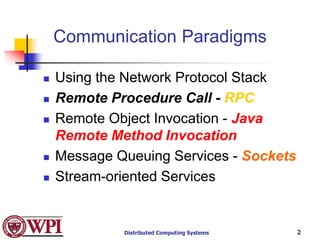
Communication Paradigms
 Using the Network Protocol Stack
 Remote Procedure Call - RPC
 Remote Object Invocation - Java
Remote Method Invocation
 Message Queuing Services - Sockets
 Stream-oriented Services
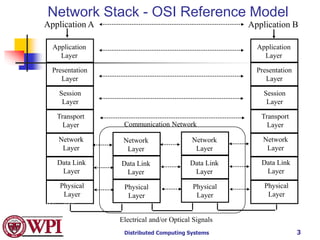
Distributed Computing Systems 3
Application
Layer
Presentation
Layer
Session
Layer
Transport
Layer
Network
Layer
Data Link
Layer
Physical
Layer
Application
Layer
Presentation
Layer
Session
Layer
Transport
Layer
Network
Layer
Data Link
Layer
Physical
Layer
Network
Layer
Electrical and/or Optical Signals
Application A Application B
Data Link
Layer
Physical
Layer
Network
Layer
Data Link
Layer
Physical
Layer
Communication Network
Figure 2.6
Leon-Garcia & Widjaja: Communication Networks
Copyright ©2000 The McGraw Hill Companies
Network Stack - OSI Reference Model
Distributed Computing Systems 4
Application
Layer
Presentation
Layer
Session
Layer
Transport
Layer
Network
Layer
Data Link
Layer
Physical
Layer
Application
Layer
Presentation
Layer
Session
Layer
Transport
Layer
Network
Layer
Data Link
Layer
Physical
Layer
Application A Application B
data
data
data
data
data
data
data
ah
ph
sh
th
nh
dh
bits
dt
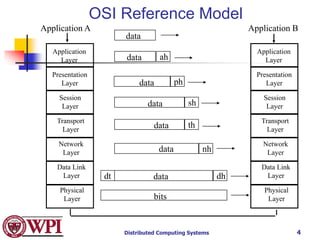
Copyright ©2000 The McGraw Hill Companies Leon-Garcia & Widjaja: Communication Networks
OSI Reference Model
Distributed Computing Systems 5
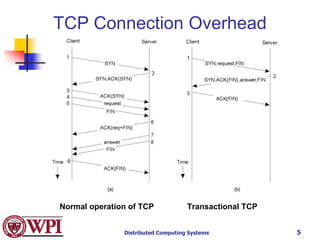
Normal operation of TCP Transactional TCP
TCP Connection Overhead
6
Remote Procedure Calls
RPC
Distributed Computing Systems 7
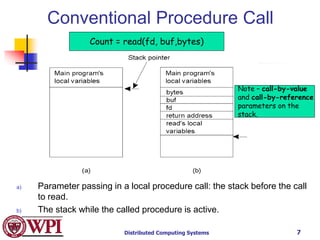
Conventional Procedure Call
a) Parameter passing in a local procedure call: the stack before the call
to read.
b) The stack while the called procedure is active.
Count = read(fd, buf,bytes)
Note – call-by-value
and call-by-reference
parameters on the
stack.
Distributed Computing Systems 8
Remote Procedure Call
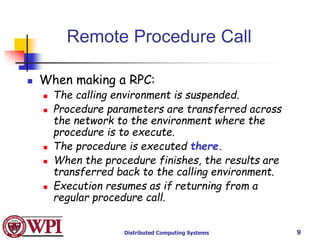
 RPC concept :: to make a remote
procedure call appear like a local
procedure call.
 The goal is to hide the details of the network
communication (namely, the sending and
receiving of messages).
 The calling procedure should not be aware
that the called procedure is executing on a
different machine.
Distributed Computing Systems 9
Remote Procedure Call
 When making a RPC:
 The calling environment is suspended.
 Procedure parameters are transferred across
the network to the environment where the
procedure is to execute.
 The procedure is executed there.
 When the procedure finishes, the results are
transferred back to the calling environment.
 Execution resumes as if returning from a
regular procedure call.
Distributed Computing Systems 10
RPC differs from OSI
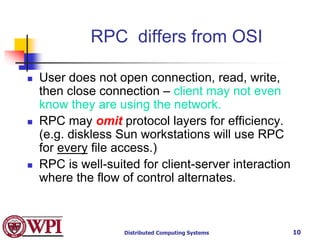
 User does not open connection, read, write,
then close connection – client may not even
know they are using the network.
 RPC may omit protocol layers for efficiency.
(e.g. diskless Sun workstations will use RPC
for every file access.)
 RPC is well-suited for client-server interaction
where the flow of control alternates.
Distributed Computing Systems 11
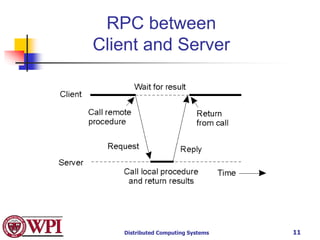
RPC between
Client and Server
Distributed Computing Systems 12
RPC Steps
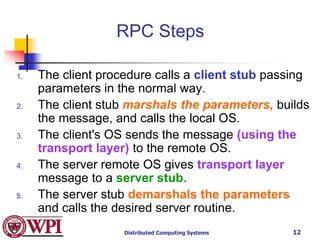
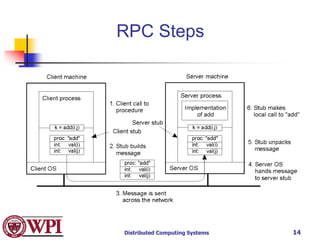
1. The client procedure calls a client stub passing
parameters in the normal way.
2. The client stub marshals the parameters, builds
the message, and calls the local OS.
3. The client's OS sends the message (using the
transport layer) to the remote OS.
4. The server remote OS gives transport layer
message to a server stub.
5. The server stub demarshals the parameters
and calls the desired server routine.
Distributed Computing Systems 13
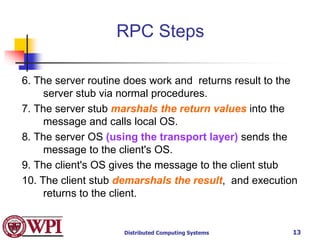
6. The server routine does work and returns result to the
server stub via normal procedures.
7. The server stub marshals the return values into the
message and calls local OS.
8. The server OS (using the transport layer) sends the
message to the client's OS.
9. The client's OS gives the message to the client stub
10. The client stub demarshals the result, and execution
returns to the client.
RPC Steps
Distributed Computing Systems 14
RPC Steps
Distributed Computing Systems 15
Passing Value Parameters
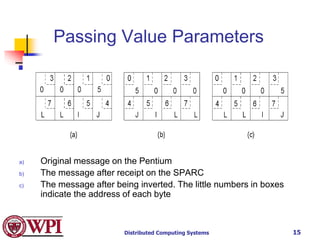
a) Original message on the Pentium
b) The message after receipt on the SPARC
c) The message after being inverted. The little numbers in boxes
indicate the address of each byte
Distributed Computing Systems 16
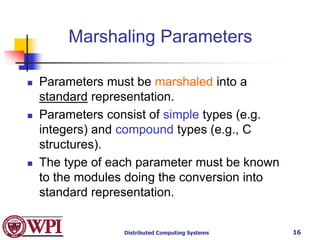
Marshaling Parameters
 Parameters must be marshaled into a
standard representation.
 Parameters consist of simple types (e.g.
integers) and compound types (e.g., C
structures).
 The type of each parameter must be known
to the modules doing the conversion into
standard representation.
Distributed Computing Systems 17
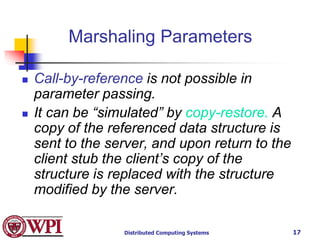
Marshaling Parameters
 Call-by-reference is not possible in
parameter passing.
 It can be “simulated” by copy-restore. A
copy of the referenced data structure is
sent to the server, and upon return to the
client stub the client’s copy of the
structure is replaced with the structure
modified by the server.
Distributed Computing Systems 18
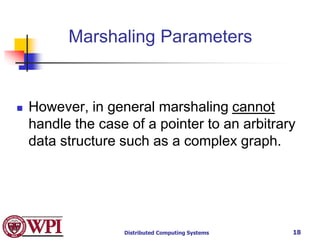
Marshaling Parameters
 However, in general marshaling cannot
handle the case of a pointer to an arbitrary
data structure such as a complex graph.
Distributed Computing Systems 19
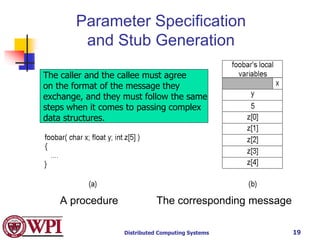
Parameter Specification
and Stub Generation
A procedure The corresponding message
The caller and the callee must agree
on the format of the message they
exchange, and they must follow the same
steps when it comes to passing complex
data structures.
Distributed Computing Systems 20
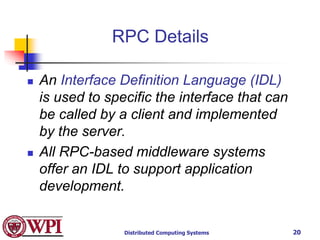
RPC Details
 An Interface Definition Language (IDL)
is used to specific the interface that can
be called by a client and implemented
by the server.
 All RPC-based middleware systems
offer an IDL to support application
development.
Distributed Computing Systems 21
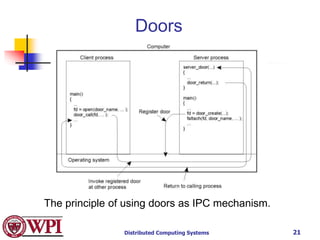
Doors
The principle of using doors as IPC mechanism.
Distributed Computing Systems 22
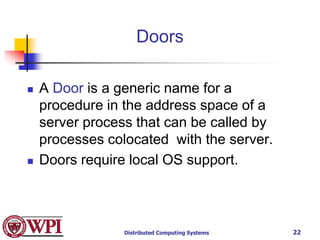
Doors
 A Door is a generic name for a
procedure in the address space of a
server process that can be called by
processes colocated with the server.
 Doors require local OS support.
Distributed Computing Systems 23
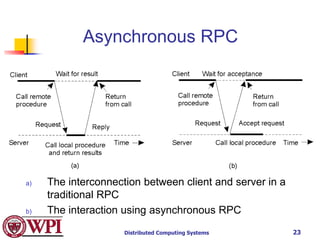
Asynchronous RPC
a) The interconnection between client and server in a
traditional RPC
b) The interaction using asynchronous RPC
2-12
Distributed Computing Systems 24
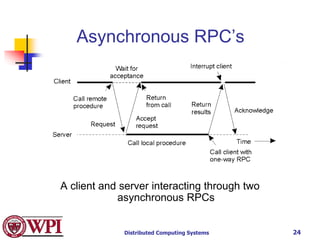
Asynchronous RPC’s
A client and server interacting through two
asynchronous RPCs

Communication in Distributed System.ppt

  • 1.
  • 2.
    Distributed Computing Systems2 Communication Paradigms  Using the Network Protocol Stack  Remote Procedure Call - RPC  Remote Object Invocation - Java Remote Method Invocation  Message Queuing Services - Sockets  Stream-oriented Services
  • 3.
    Distributed Computing Systems3 Application Layer Presentation Layer Session Layer Transport Layer Network Layer Data Link Layer Physical Layer Application Layer Presentation Layer Session Layer Transport Layer Network Layer Data Link Layer Physical Layer Network Layer Electrical and/or Optical Signals Application A Application B Data Link Layer Physical Layer Network Layer Data Link Layer Physical Layer Communication Network Figure 2.6 Leon-Garcia & Widjaja: Communication Networks Copyright ©2000 The McGraw Hill Companies Network Stack - OSI Reference Model
  • 4.
    Distributed Computing Systems4 Application Layer Presentation Layer Session Layer Transport Layer Network Layer Data Link Layer Physical Layer Application Layer Presentation Layer Session Layer Transport Layer Network Layer Data Link Layer Physical Layer Application A Application B data data data data data data data ah ph sh th nh dh bits dt Copyright ©2000 The McGraw Hill Companies Leon-Garcia & Widjaja: Communication Networks OSI Reference Model
  • 5.
    Distributed Computing Systems5 Normal operation of TCP Transactional TCP TCP Connection Overhead
  • 6.
  • 7.
    Distributed Computing Systems7 Conventional Procedure Call a) Parameter passing in a local procedure call: the stack before the call to read. b) The stack while the called procedure is active. Count = read(fd, buf,bytes) Note – call-by-value and call-by-reference parameters on the stack.
  • 8.
    Distributed Computing Systems8 Remote Procedure Call  RPC concept :: to make a remote procedure call appear like a local procedure call.  The goal is to hide the details of the network communication (namely, the sending and receiving of messages).  The calling procedure should not be aware that the called procedure is executing on a different machine.
  • 9.
    Distributed Computing Systems9 Remote Procedure Call  When making a RPC:  The calling environment is suspended.  Procedure parameters are transferred across the network to the environment where the procedure is to execute.  The procedure is executed there.  When the procedure finishes, the results are transferred back to the calling environment.  Execution resumes as if returning from a regular procedure call.
  • 10.
    Distributed Computing Systems10 RPC differs from OSI  User does not open connection, read, write, then close connection – client may not even know they are using the network.  RPC may omit protocol layers for efficiency. (e.g. diskless Sun workstations will use RPC for every file access.)  RPC is well-suited for client-server interaction where the flow of control alternates.
  • 11.
    Distributed Computing Systems11 RPC between Client and Server
  • 12.
    Distributed Computing Systems12 RPC Steps 1. The client procedure calls a client stub passing parameters in the normal way. 2. The client stub marshals the parameters, builds the message, and calls the local OS. 3. The client's OS sends the message (using the transport layer) to the remote OS. 4. The server remote OS gives transport layer message to a server stub. 5. The server stub demarshals the parameters and calls the desired server routine.
  • 13.
    Distributed Computing Systems13 6. The server routine does work and returns result to the server stub via normal procedures. 7. The server stub marshals the return values into the message and calls local OS. 8. The server OS (using the transport layer) sends the message to the client's OS. 9. The client's OS gives the message to the client stub 10. The client stub demarshals the result, and execution returns to the client. RPC Steps
  • 14.
  • 15.
    Distributed Computing Systems15 Passing Value Parameters a) Original message on the Pentium b) The message after receipt on the SPARC c) The message after being inverted. The little numbers in boxes indicate the address of each byte
  • 16.
    Distributed Computing Systems16 Marshaling Parameters  Parameters must be marshaled into a standard representation.  Parameters consist of simple types (e.g. integers) and compound types (e.g., C structures).  The type of each parameter must be known to the modules doing the conversion into standard representation.
  • 17.
    Distributed Computing Systems17 Marshaling Parameters  Call-by-reference is not possible in parameter passing.  It can be “simulated” by copy-restore. A copy of the referenced data structure is sent to the server, and upon return to the client stub the client’s copy of the structure is replaced with the structure modified by the server.
  • 18.
    Distributed Computing Systems18 Marshaling Parameters  However, in general marshaling cannot handle the case of a pointer to an arbitrary data structure such as a complex graph.
  • 19.
    Distributed Computing Systems19 Parameter Specification and Stub Generation A procedure The corresponding message The caller and the callee must agree on the format of the message they exchange, and they must follow the same steps when it comes to passing complex data structures.
  • 20.
    Distributed Computing Systems20 RPC Details  An Interface Definition Language (IDL) is used to specific the interface that can be called by a client and implemented by the server.  All RPC-based middleware systems offer an IDL to support application development.
  • 21.
    Distributed Computing Systems21 Doors The principle of using doors as IPC mechanism.
  • 22.
    Distributed Computing Systems22 Doors  A Door is a generic name for a procedure in the address space of a server process that can be called by processes colocated with the server.  Doors require local OS support.
  • 23.
    Distributed Computing Systems23 Asynchronous RPC a) The interconnection between client and server in a traditional RPC b) The interaction using asynchronous RPC 2-12
  • 24.
    Distributed Computing Systems24 Asynchronous RPC’s A client and server interacting through two asynchronous RPCs