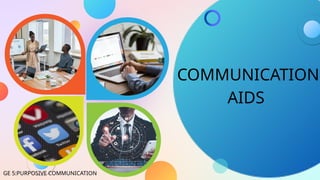
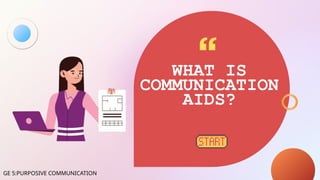
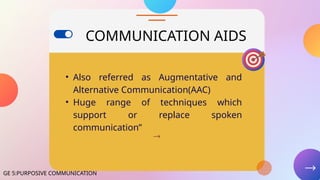
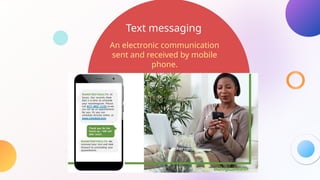
COMMUNICATION AIDS
• Alsoreferred as Augmentative and
Alternative Communication(AAC)
• Huge range of techniques which
support or replace spoken
communication”
GE 5:PURPOSIVE COMMUNICATION
4.
COMMUNICATION AIDS
• Acommunication aids are visual
support used to make presentation
interesting and effective.
5.
IMPORTANCE OF
COMMUNICATION AIDS• Improve clarity of
information being
conveyed.
• Enhance retention
of message.
• Add variety and
interest to
presentation.
• Enhance credibility
of the speaker.
6.
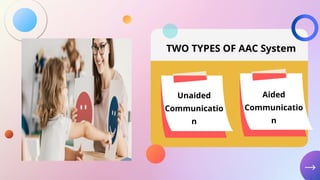
TWO TYPES OFAAC System
Unaided
Communicatio
n
Aided
Communicatio
n
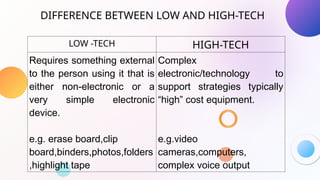
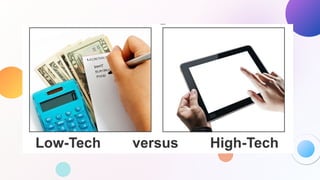
DIFFERENCE BETWEEN LOWAND HIGH-TECH
LOW -TECH HIGH-TECH
Requires something external
to the person using it that is
either non-electronic or a
very simple electronic
device.
e.g. erase board,clip
board,binders,photos,folders
,highlight tape
Complex
electronic/technology to
support strategies typically
“high” cost equipment.
e.g.video
cameras,computers,
complex voice output
10.
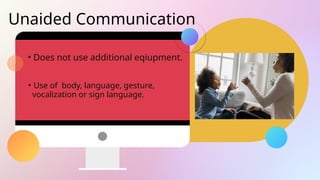
Unaided Communication
• Doesnot use additional eqiupment.
• Use of body, language, gesture,
vocalization or sign language.
11.
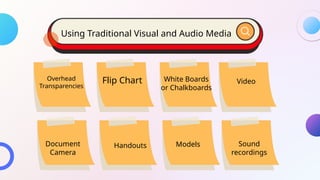
Using Traditional Visualand Audio Media
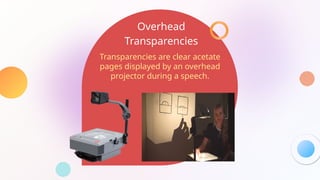
Overhead
Transparencies
Flip Chart White Boards
or Chalkboards
Video
Document
Camera
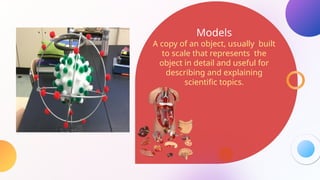
Models
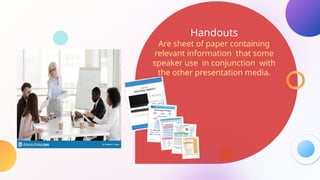
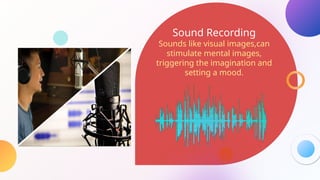
Handouts Sound
recordings
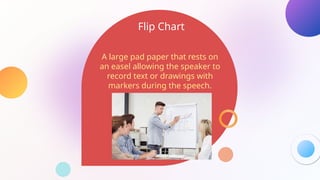
Flip Chart
A largepad paper that rests on
an easel allowing the speaker to
record text or drawings with
markers during the speech.
14.
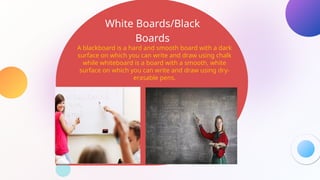
White Boards/Black
Boards
A blackboardis a hard and smooth board with a dark
surface on which you can write and draw using chalk
while whiteboard is a board with a smooth, white
surface on which you can write and draw using dry-
erasable pens.
15.
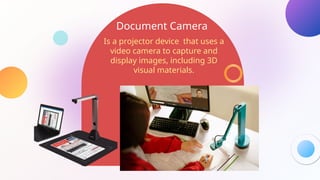
Document Camera
Is aprojector device that uses a
video camera to capture and
display images, including 3D
visual materials.
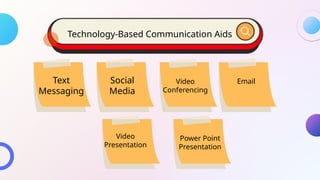
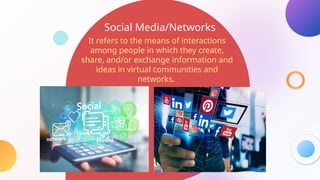
Social Media/Networks
It refersto the means of interactions
among people in which they create,
share, and/or exchange information and
ideas in virtual communities and
networks.
23.
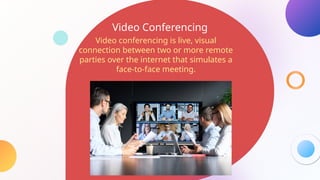
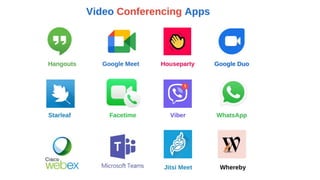
Video Conferencing
Video conferencingis live, visual
connection between two or more remote
parties over the internet that simulates a
face-to-face meeting.
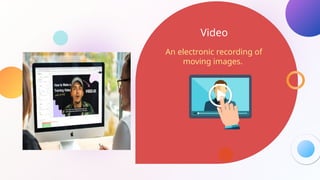
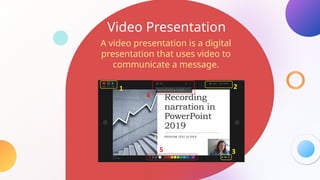
Video Presentation
A videopresentation is a digital
presentation that uses video to
communicate a message.
29.
Tips in PresentingInformation with
the Use of Technology
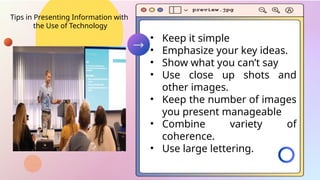
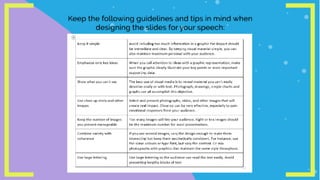
• Keep it simple
• Emphasize your key ideas.
• Show what you can’t say
• Use close up shots and
other images.
• Keep the number of images
you present manageable
• Combine variety of
coherence.
• Use large lettering.
31.
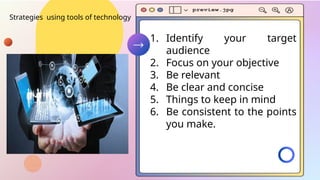
Strategies using toolsof technology
1. Identify your target
audience
2. Focus on your objective
3. Be relevant
4. Be clear and concise
5. Things to keep in mind
6. Be consistent to the points
you make.
#4 It is a great help to present the ideas clearly by highlighting the significant information.
#7 Use external products and materials to help a user get across a message
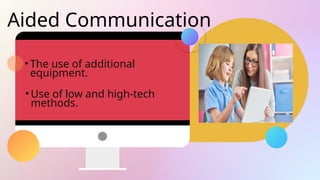
Low-tech are simple laminated book to carry around few pages of pictures or symbols
#8 LOW-TECH-these systems are methods of communicating that are not battery powered and are usually cheaper to make.
Common examples of lo-tech systems include picture exchanging, printed word boards, communication books & sign language. Also, recorded speech devices (digital) can fall into this category if battery-powered with simple short messages.
High-Tech: These systems rely on mains power & re-chargeable battery packs as they generally use lighted dynamic displays & synthesised voices.
#10 Use only the skills that are available to that individual and do not need special material or equipment
#16 Showing a video clip can elicit an emotional response from the audience and improve their recall of your speech.
#22 digital technology that facilitates the sharing of content, multimedia, and information through virtual networks
#23 Video conferencing is important because it joins people who would not normally be able to form a face-to-face connection.
#25 Video conferencing is important because it joins people who would not normally be able to form a face-to-face connection.
#28 A video presentation is a popular format of multimedia content with a duration of several seconds or minutes that shows the benefits of a product, service, or any idea with the help of interesting graphic images, concise text, and appropriate narration.