Prepared by: Rashid Shar
 Communication is the activity of conveying information.
Communication has been derived from the Latin word
"communes", meaning to share.
 In words of Louis- “Communication is the sum of all
things one person does when he wants to create
understanding in the minds of another. It involves a
systematic and continuous process of telling, listening
and understanding.
 Communication may be defined as giving, receiving or
exchanging information, opinions or ideas by writing,
speech or visual means, so that material communicated
is completely understood by everyone concerned.
3/20/2015Rashid Shar 2
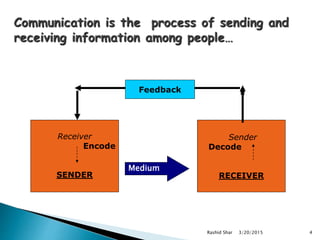
 Communication is the process of
conveying a message to others and
requires six elements: a source, a
message, a channel of
communication, a receiver, and the
processes of encoding and decoding.
3/20/2015Rashid Shar 3
hFeedback
Receiver
Encode
SENDER
Sender
Decode
RECEIVER
Medium
3/20/2015Rashid Shar 4
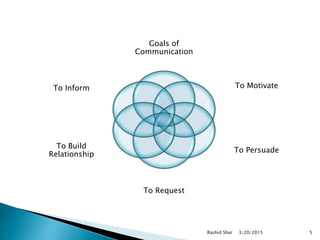
Goals of
Communication
To Motivate
To Persuade
To Request
To Build
Relationship
To Inform
3/20/2015Rashid Shar 5
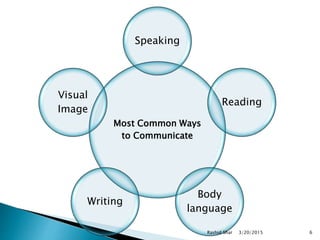
Most Common Ways
to Communicate
Speaking
Reading
Body
language
Writing
Visual
Image
3/20/2015Rashid Shar 6
 Introduction
 Communication is the exchange of thoughts,
messages or information by speech, signals, writing
or behaviour between a sender and receiver.
3/20/2015Rashid Shar 7
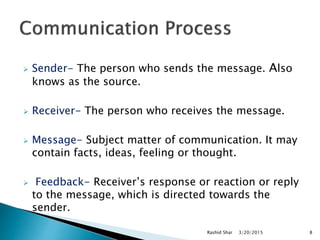
 Sender- The person who sends the message. Also
knows as the source.
 Receiver- The person who receives the message.
 Message- Subject matter of communication. It may
contain facts, ideas, feeling or thought.
 Feedback- Receiver’s response or reaction or reply
to the message, which is directed towards the
sender.
3/20/2015Rashid Shar 8
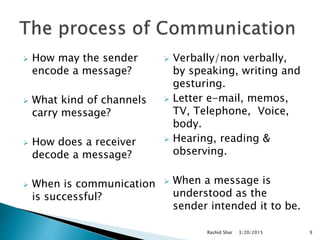
 How may the sender
encode a message?
 What kind of channels
carry message?
 How does a receiver
decode a message?
 When is communication
is successful?
 Verbally/non verbally,
by speaking, writing and
gesturing.
 Letter e-mail, memos,
TV, Telephone, Voice,
body.
 Hearing, reading &
observing.
 When a message is
understood as the
sender intended it to be.
3/20/2015Rashid Shar 9
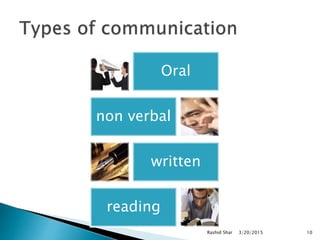
Oral
non verbal
written
reading
3/20/2015Rashid Shar 10
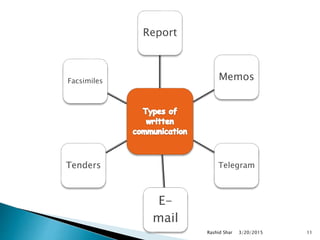
Report
Memos
Telegram
E-
mail
Tenders
Facsimiles
3/20/2015Rashid Shar 11
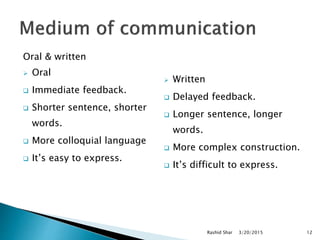
Oral & written
 Oral
 Immediate feedback.
 Shorter sentence, shorter
words.
 More colloquial language
 It’s easy to express.
 Written
 Delayed feedback.
 Longer sentence, longer
words.
 More complex construction.
 It’s difficult to express.
3/20/2015Rashid Shar 12
3/20/2015Rashid Shar 13

Communication (By Rashid Shar University of Karachi) Email: r.shar42@gamil.com

  • 1.
  • 2.
     Communication isthe activity of conveying information. Communication has been derived from the Latin word "communes", meaning to share.  In words of Louis- “Communication is the sum of all things one person does when he wants to create understanding in the minds of another. It involves a systematic and continuous process of telling, listening and understanding.  Communication may be defined as giving, receiving or exchanging information, opinions or ideas by writing, speech or visual means, so that material communicated is completely understood by everyone concerned. 3/20/2015Rashid Shar 2
  • 3.
     Communication isthe process of conveying a message to others and requires six elements: a source, a message, a channel of communication, a receiver, and the processes of encoding and decoding. 3/20/2015Rashid Shar 3
  • 4.
  • 5.
    Goals of Communication To Motivate ToPersuade To Request To Build Relationship To Inform 3/20/2015Rashid Shar 5
  • 6.
    Most Common Ways toCommunicate Speaking Reading Body language Writing Visual Image 3/20/2015Rashid Shar 6
  • 7.
     Introduction  Communicationis the exchange of thoughts, messages or information by speech, signals, writing or behaviour between a sender and receiver. 3/20/2015Rashid Shar 7
  • 8.
     Sender- Theperson who sends the message. Also knows as the source.  Receiver- The person who receives the message.  Message- Subject matter of communication. It may contain facts, ideas, feeling or thought.  Feedback- Receiver’s response or reaction or reply to the message, which is directed towards the sender. 3/20/2015Rashid Shar 8
  • 9.
     How maythe sender encode a message?  What kind of channels carry message?  How does a receiver decode a message?  When is communication is successful?  Verbally/non verbally, by speaking, writing and gesturing.  Letter e-mail, memos, TV, Telephone, Voice, body.  Hearing, reading & observing.  When a message is understood as the sender intended it to be. 3/20/2015Rashid Shar 9
  • 10.
  • 11.
  • 12.
    Oral & written Oral  Immediate feedback.  Shorter sentence, shorter words.  More colloquial language  It’s easy to express.  Written  Delayed feedback.  Longer sentence, longer words.  More complex construction.  It’s difficult to express. 3/20/2015Rashid Shar 12
  • 13.