THE COMMON CORE:
  Language Arts

   Addressing Concerns about
    the “Text Exemplar” List
              and
  “Measuring Text Complexity”
CONCERNS regarding
               the “Text Exemplar” Lists:


• Our school doesn’t have all those novels on that list!
  Is someone giving us money to buy new novels?

• The novel I’ve always taught to my 10th graders is
  now on the 9th grade list!

• Do we have to teach EVERYTHING on that list?

• Who’s going to tell those 6th grade teachers to stop
  teaching the novel I am supposed to be teaching
  now in 7th grade?
• The story I’m supposed to be teaching my 8th
  graders is in the 9th grade anthology!

• The poem I’m supposed to be teaching my 11th
  graders is in the 12th grade anthology!

• Are we getting new anthologies?

• Do I have to use those Language Arts units on the
  Common Core “Mapping” site, or are they just
  suggestions?
Everybody breathe………
•We are only in the introduction and orientation
stages of implementing the Common Core--a
process that will take several years.
•Re-aligning our school and district “text-lists” to
match the new core will be a later discussion. For
now, use what you have, and add to it when
possible!

•The samples in Appendix B (Text Exemplars)
primarily serve to exemplify the level of text
complexity and quality that the standards require.
While they would be excellent choices for you to
use with students, you are not required to teach
all of, or only, those titles from the lists or from
the suggested units on the Mapping site.
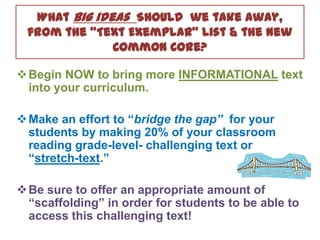
What big ideas SHOULD we take away,
 from the “Text Exemplar” List & the new
              Common Core?

 Begin NOW to bring more INFORMATIONAL text
  into your curriculum.

 Make an effort to “bridge the gap” for your
  students by making 20% of your classroom
  reading grade-level- challenging text or
  “stretch-text.”

 Be sure to offer an appropriate amount of
  “scaffolding” in order for students to be able to
  access this challenging text!
How can WE assess a
 text that we’d like to
  use in our classroom
for appropriate grade-
   level complexity?
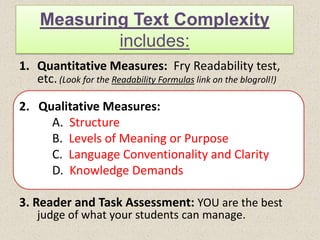
Measuring Text Complexity
             includes:
1. Quantitative Measures: Fry Readability test,
   etc. (Look for the Readability Formulas link on the blogroll!)

2. Qualitative Measures:
     A. Structure
     B. Levels of Meaning or Purpose
     C. Language Conventionality and Clarity
     D. Knowledge Demands

3. Reader and Task Assessment: YOU are the best
    judge of what your students can manage.
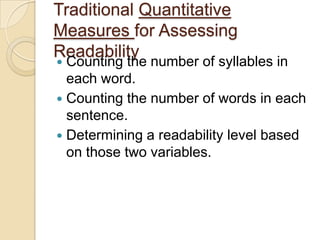
Traditional Quantitative
Measures for Assessing
Readability
 Counting the number of syllables in
  each word.
 Counting the number of words in each
  sentence.
 Determining a readability level based
  on those two variables.
Understanding
Qualitative
Measures:
Structure:
    Complicated text-structures (chronological, problem-solution, cause-effect, etc.) will
                              add to a text’s complexity level.

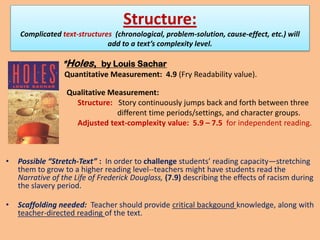
                 *Holes, by Louis Sachar
                  Quantitative Measurement: 4.9 (Fry Readability value).

                  Qualitative Measurement:
                    Structure: Story continuously jumps back and forth between three
                                different time periods/settings, and character groups.
                    Adjusted text-complexity value: 5.9 – 7.5 for independent reading.


•   Possible “Stretch-Text” : In order to challenge students’ reading capacity—stretching
    them to grow to a higher reading level--teachers might have students read the
    Narrative of the Life of Frederick Douglass, (7.9) describing the effects of racism during
    the slavery period.

•   Scaffolding needed: Teacher should provide critical backgound knowledge, along with
    teacher-directed reading of the text.
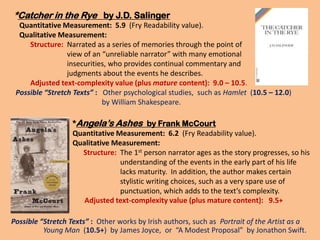
*Catcher in the Rye by J.D. Salinger
  Quantitative Measurement: 5.9 (Fry Readability value).
  Qualitative Measurement:
     Structure: Narrated as a series of memories through the point of
                 view of an “unreliable narrator” with many emotional
                 insecurities, who provides continual commentary and
                 judgments about the events he describes.
     Adjusted text-complexity value (plus mature content): 9.0 – 10.5.
 Possible “Stretch Texts” : Other psychological studies, such as Hamlet (10.5 – 12.0)
                            by William Shakespeare.

                   *Angela’s Ashes by Frank McCourt
                   Quantitative Measurement: 6.2 (Fry Readability value).
                   Qualitative Measurement:
                     Structure: The 1st person narrator ages as the story progresses, so his
                                 understanding of the events in the early part of his life
                                 lacks maturity. In addition, the author makes certain
                                 stylistic writing choices, such as a very spare use of
                                 punctuation, which adds to the text’s complexity.
                      Adjusted text-complexity value (plus mature content): 9.5+

Possible “Stretch Texts” : Other works by Irish authors, such as Portrait of the Artist as a
          Young Man (10.5+) by James Joyce, or “A Modest Proposal” by Jonathon Swift.
Levels of Meaning or Purpose:
Texts that contain multiple levels of meaning or purpose (connotative or implicit language,
  satire in narrative texts; informational texts with implicit purposes) have a greater text
                 complexity than texts with a singular meaning or purpose.

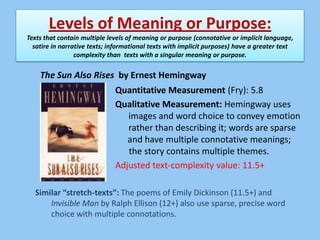
    The Sun Also Rises by Ernest Hemingway
                              Quantitative Measurement (Fry): 5.8
                              Qualitative Measurement: Hemingway uses
                                 images and word choice to convey emotion
                                 rather than describing it; words are sparse
      but                        and have multiple connotative meanings;
      the novel as a             the story contains multiple themes.
                              Adjusted text-complexity value: 11.5+

  Similar “stretch-texts”: The poems of Emily Dickinson (11.5+) and
      Invisible Man by Ralph Ellison (12+) also use sparse, precise word
      choice with multiple connotations.
Levels of Meaning or Purpose:
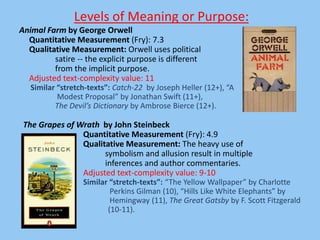
Animal Farm by George Orwell
  Quantitative Measurement (Fry): 7.3
  Qualitative Measurement: Orwell uses political
         satire -- the explicit purpose is different
         from the implicit purpose.
  Adjusted text-complexity value: 11
   Similar “stretch-texts”: Catch-22 by Joseph Heller (12+), “A
           Modest Proposal” by Jonathan Swift (11+),
          The Devil’s Dictionary by Ambrose Bierce (12+).

 The Grapes of Wrath by John Steinbeck
                Quantitative Measurement (Fry): 4.9
                Qualitative Measurement: The heavy use of
                      symbolism and allusion result in multiple
                      inferences and author commentaries.
                Adjusted text-complexity value: 9-10
                  Similar “stretch-texts”: “The Yellow Wallpaper” by Charlotte
                          Perkins Gilman (10), “Hills Like White Elephants” by
   Ernest                 Hemingway (11), The Great Gatsby by F. Scott Fitzgerald
                         (10-11).
Language Conventionality & Clarity:
Texts that rely on literal, clear, contemporary, and conversational language tend to be easier to
 read than texts that rely on figurative, ironic, ambiguous, purposefully misleading, archaic or
    otherwise unfamiliar language or on general academic and domain-specific vocabulary.


• Examples:
    – Shakespeare
    – Arcane classics
    – Medieval, Puritan, or other dialects/ language
      patterns

    The actual reading level is not difficult, but due to
      unfamiliar language patterns and old-fashioned
      language, the reading becomes more difficult.
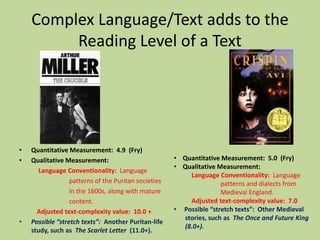
Complex Language/Text adds to the
         Reading Level of a Text


•   Quantitative Measurement: 4.9 (Fry)
•   Qualitative Measurement:                          • Quantitative Measurement: 5.0 (Fry)
                                                      • Qualitative Measurement:
       Language Conventionality: Language
                                                          Language Conventionality: Language
                  patterns of the Puritan societies                  patterns and dialects from
                  in the 1600s, along with mature                    Medieval England.
                  content.                                Adjusted text-complexity value: 7.0
      Adjusted text-complexity value: 10.0 +          • Possible “stretch texts”: Other Medieval
                                                        stories, such as The Once and Future King
•   Possible “stretch texts”: Another Puritan-life
                                                        (8.0+).
    study, such as The Scarlet Letter (11.0+).
Knowledge Demands:
“Texts that make that make few assumptions about the extent of readers’ life experiences and the depths of
their cultural/literary and content/discipline knowledge are generally less complex than are texts that make
                              many assumptions in one or more of those areas.”

*A Raisin in the Sun, by Lorraine Hansberry
           Quantitative Measurement: 6.8 (Fry Readability value).

            Qualitative Measurement:
                Knowledge Demands: To fully understand and appreciate the play, students
                                     require a knowledge of the following: assimilationist debate
                                     Pan-African Movement, the Great Migration, racial tension of
                                     the time period, race/real estate issues

                 Adjusted text-complexity value:      9-11


•   Possible “Stretch-Text” : In order to challenge students’ reading levels and “bridge
                             the gap” to the next reading level, teachers might also want
                             students to read Black Boy by Richard Wright (10-11) or
                             Black Like Me by John Griffin (10-11)

•   Scaffolding needed: Teacher should provide critical backgound knowledge along with
                         teacher-directed reading of the text.
Knowledge Demands
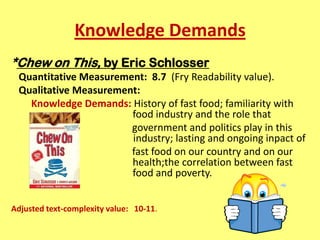
*Chew on This, by Eric Schlosser
 Quantitative Measurement: 8.7 (Fry Readability value).
 Qualitative Measurement:
   Knowledge Demands: History of fast food; familiarity with
                       food industry and the role that
                       government and politics play in this
                       industry; lasting and ongoing inpact of
                       fast food on our country and on our
                       health;the correlation between fast
                       food and poverty.


Adjusted text-complexity value: 10-11.
Knowledge Demands

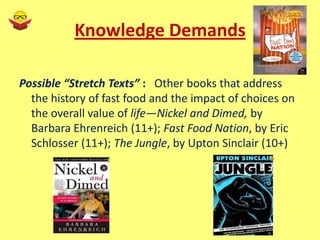
Possible “Stretch Texts” : Other books that address
  the history of fast food and the impact of choices on
  the overall value of life—Nickel and Dimed, by
  Barbara Ehrenreich (11+); Fast Food Nation, by Eric
  Schlosser (11+); The Jungle, by Upton Sinclair (10+)
Knowledge Demands
Specific examples:
•   Life Experiences/Cultural/Literary/Content & Discipline Knowledge
     – Simple theme vs. complex or sophisticated theme
     – Single theme vs. multiple themes
     – Single perspective vs. multiple perspectives
     – Perspective(s) like one’s own vs. perspective(s) unlike or in opposition to one’s
         own
     – Everyday knowledge vs. cultural and literary knowledge
     – Few allusions to other texts vs. many allusions to other texts
     – Low intertextuality (few or no references to other texts)vs. high intertextuality
         (many references or citations to other texts)
SO, Teachers…
     We hope that helps take a little of
       the confusion and trepidation
                    out of
approaching the new Common Core standards
    and utilizing them in your own classes.


     FEEL EMPOWERED!!!
                    And remember…
When determining whether a text is
      suitable for use in your class:

“Such assessments are best made
by the teachers employing their
professional judgment, experience,
and knowledge of their students and
the subject.”
Common Core
State Standards for English,
Appendix A, p. 4
Thanks for all you do!

Commoncore text-exemplars-and-measuring-text-complexity

  • 1.
    THE COMMON CORE: Language Arts Addressing Concerns about the “Text Exemplar” List and “Measuring Text Complexity”
  • 2.
    CONCERNS regarding the “Text Exemplar” Lists: • Our school doesn’t have all those novels on that list! Is someone giving us money to buy new novels? • The novel I’ve always taught to my 10th graders is now on the 9th grade list! • Do we have to teach EVERYTHING on that list? • Who’s going to tell those 6th grade teachers to stop teaching the novel I am supposed to be teaching now in 7th grade?
  • 3.
    • The storyI’m supposed to be teaching my 8th graders is in the 9th grade anthology! • The poem I’m supposed to be teaching my 11th graders is in the 12th grade anthology! • Are we getting new anthologies? • Do I have to use those Language Arts units on the Common Core “Mapping” site, or are they just suggestions?
  • 4.
  • 5.
    •We are onlyin the introduction and orientation stages of implementing the Common Core--a process that will take several years. •Re-aligning our school and district “text-lists” to match the new core will be a later discussion. For now, use what you have, and add to it when possible! •The samples in Appendix B (Text Exemplars) primarily serve to exemplify the level of text complexity and quality that the standards require. While they would be excellent choices for you to use with students, you are not required to teach all of, or only, those titles from the lists or from the suggested units on the Mapping site.
  • 6.
    What big ideasSHOULD we take away, from the “Text Exemplar” List & the new Common Core?  Begin NOW to bring more INFORMATIONAL text into your curriculum.  Make an effort to “bridge the gap” for your students by making 20% of your classroom reading grade-level- challenging text or “stretch-text.”  Be sure to offer an appropriate amount of “scaffolding” in order for students to be able to access this challenging text!
  • 7.
    How can WEassess a text that we’d like to use in our classroom for appropriate grade- level complexity?
  • 8.
    Measuring Text Complexity includes: 1. Quantitative Measures: Fry Readability test, etc. (Look for the Readability Formulas link on the blogroll!) 2. Qualitative Measures: A. Structure B. Levels of Meaning or Purpose C. Language Conventionality and Clarity D. Knowledge Demands 3. Reader and Task Assessment: YOU are the best judge of what your students can manage.
  • 9.
    Traditional Quantitative Measures forAssessing Readability  Counting the number of syllables in each word.  Counting the number of words in each sentence.  Determining a readability level based on those two variables.
  • 10.
  • 11.
    Structure: Complicated text-structures (chronological, problem-solution, cause-effect, etc.) will add to a text’s complexity level. *Holes, by Louis Sachar Quantitative Measurement: 4.9 (Fry Readability value). Qualitative Measurement: Structure: Story continuously jumps back and forth between three different time periods/settings, and character groups. Adjusted text-complexity value: 5.9 – 7.5 for independent reading. • Possible “Stretch-Text” : In order to challenge students’ reading capacity—stretching them to grow to a higher reading level--teachers might have students read the Narrative of the Life of Frederick Douglass, (7.9) describing the effects of racism during the slavery period. • Scaffolding needed: Teacher should provide critical backgound knowledge, along with teacher-directed reading of the text.
  • 12.
    *Catcher in theRye by J.D. Salinger Quantitative Measurement: 5.9 (Fry Readability value). Qualitative Measurement: Structure: Narrated as a series of memories through the point of view of an “unreliable narrator” with many emotional insecurities, who provides continual commentary and judgments about the events he describes. Adjusted text-complexity value (plus mature content): 9.0 – 10.5. Possible “Stretch Texts” : Other psychological studies, such as Hamlet (10.5 – 12.0) by William Shakespeare. *Angela’s Ashes by Frank McCourt Quantitative Measurement: 6.2 (Fry Readability value). Qualitative Measurement: Structure: The 1st person narrator ages as the story progresses, so his understanding of the events in the early part of his life lacks maturity. In addition, the author makes certain stylistic writing choices, such as a very spare use of punctuation, which adds to the text’s complexity. Adjusted text-complexity value (plus mature content): 9.5+ Possible “Stretch Texts” : Other works by Irish authors, such as Portrait of the Artist as a Young Man (10.5+) by James Joyce, or “A Modest Proposal” by Jonathon Swift.
  • 13.
    Levels of Meaningor Purpose: Texts that contain multiple levels of meaning or purpose (connotative or implicit language, satire in narrative texts; informational texts with implicit purposes) have a greater text complexity than texts with a singular meaning or purpose. The Sun Also Rises by Ernest Hemingway Quantitative Measurement (Fry): 5.8 Qualitative Measurement: Hemingway uses images and word choice to convey emotion rather than describing it; words are sparse but and have multiple connotative meanings; the novel as a the story contains multiple themes. Adjusted text-complexity value: 11.5+ Similar “stretch-texts”: The poems of Emily Dickinson (11.5+) and Invisible Man by Ralph Ellison (12+) also use sparse, precise word choice with multiple connotations.
  • 14.
    Levels of Meaningor Purpose: Animal Farm by George Orwell Quantitative Measurement (Fry): 7.3 Qualitative Measurement: Orwell uses political satire -- the explicit purpose is different from the implicit purpose. Adjusted text-complexity value: 11 Similar “stretch-texts”: Catch-22 by Joseph Heller (12+), “A Modest Proposal” by Jonathan Swift (11+), The Devil’s Dictionary by Ambrose Bierce (12+). The Grapes of Wrath by John Steinbeck Quantitative Measurement (Fry): 4.9 Qualitative Measurement: The heavy use of symbolism and allusion result in multiple inferences and author commentaries. Adjusted text-complexity value: 9-10 Similar “stretch-texts”: “The Yellow Wallpaper” by Charlotte Perkins Gilman (10), “Hills Like White Elephants” by Ernest Hemingway (11), The Great Gatsby by F. Scott Fitzgerald (10-11).
  • 15.
    Language Conventionality &Clarity: Texts that rely on literal, clear, contemporary, and conversational language tend to be easier to read than texts that rely on figurative, ironic, ambiguous, purposefully misleading, archaic or otherwise unfamiliar language or on general academic and domain-specific vocabulary. • Examples: – Shakespeare – Arcane classics – Medieval, Puritan, or other dialects/ language patterns The actual reading level is not difficult, but due to unfamiliar language patterns and old-fashioned language, the reading becomes more difficult.
  • 16.
    Complex Language/Text addsto the Reading Level of a Text • Quantitative Measurement: 4.9 (Fry) • Qualitative Measurement: • Quantitative Measurement: 5.0 (Fry) • Qualitative Measurement: Language Conventionality: Language Language Conventionality: Language patterns of the Puritan societies patterns and dialects from in the 1600s, along with mature Medieval England. content. Adjusted text-complexity value: 7.0 Adjusted text-complexity value: 10.0 + • Possible “stretch texts”: Other Medieval stories, such as The Once and Future King • Possible “stretch texts”: Another Puritan-life (8.0+). study, such as The Scarlet Letter (11.0+).
  • 17.
    Knowledge Demands: “Texts thatmake that make few assumptions about the extent of readers’ life experiences and the depths of their cultural/literary and content/discipline knowledge are generally less complex than are texts that make many assumptions in one or more of those areas.” *A Raisin in the Sun, by Lorraine Hansberry Quantitative Measurement: 6.8 (Fry Readability value). Qualitative Measurement: Knowledge Demands: To fully understand and appreciate the play, students require a knowledge of the following: assimilationist debate Pan-African Movement, the Great Migration, racial tension of the time period, race/real estate issues Adjusted text-complexity value: 9-11 • Possible “Stretch-Text” : In order to challenge students’ reading levels and “bridge the gap” to the next reading level, teachers might also want students to read Black Boy by Richard Wright (10-11) or Black Like Me by John Griffin (10-11) • Scaffolding needed: Teacher should provide critical backgound knowledge along with teacher-directed reading of the text.
  • 18.
    Knowledge Demands *Chew onThis, by Eric Schlosser Quantitative Measurement: 8.7 (Fry Readability value). Qualitative Measurement: Knowledge Demands: History of fast food; familiarity with food industry and the role that government and politics play in this industry; lasting and ongoing inpact of fast food on our country and on our health;the correlation between fast food and poverty. Adjusted text-complexity value: 10-11.
  • 19.
    Knowledge Demands Possible “StretchTexts” : Other books that address the history of fast food and the impact of choices on the overall value of life—Nickel and Dimed, by Barbara Ehrenreich (11+); Fast Food Nation, by Eric Schlosser (11+); The Jungle, by Upton Sinclair (10+)
  • 20.
    Knowledge Demands Specific examples: • Life Experiences/Cultural/Literary/Content & Discipline Knowledge – Simple theme vs. complex or sophisticated theme – Single theme vs. multiple themes – Single perspective vs. multiple perspectives – Perspective(s) like one’s own vs. perspective(s) unlike or in opposition to one’s own – Everyday knowledge vs. cultural and literary knowledge – Few allusions to other texts vs. many allusions to other texts – Low intertextuality (few or no references to other texts)vs. high intertextuality (many references or citations to other texts)
  • 21.
    SO, Teachers… We hope that helps take a little of the confusion and trepidation out of approaching the new Common Core standards and utilizing them in your own classes. FEEL EMPOWERED!!! And remember…
  • 22.
    When determining whethera text is suitable for use in your class: “Such assessments are best made by the teachers employing their professional judgment, experience, and knowledge of their students and the subject.” Common Core State Standards for English, Appendix A, p. 4
  • 23.