Discover the most common mistakes in mobile game design and learn how to avoid them. Improve user experience, optimize performance, and boost engagement for a successful mobile game. Read now!
INTRODUCTION
Why Mobile GameDesign Matters?
• Over 3 billion mobile gamers worldwide
• Highly competitive industry
• Poor design can lead to low retention and
revenue loss
Objective of this Presentation:
• Identify common mistakes
• Learn how to avoid them
3.
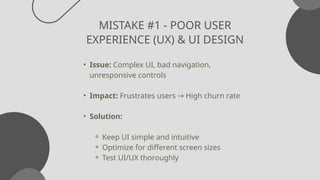
MISTAKE #1 -POOR USER
EXPERIENCE (UX) & UI DESIGN
• Issue: Complex UI, bad navigation,
unresponsive controls
• Impact: Frustrates users High churn rate
→
• Solution:
⚬ Keep UI simple and intuitive
⚬ Optimize for different screen sizes
⚬ Test UI/UX thoroughly
4.
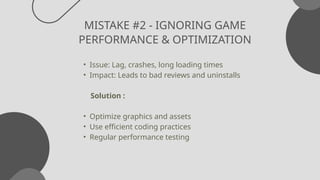
MISTAKE #2 -IGNORING GAME
PERFORMANCE & OPTIMIZATION
• Issue: Lag, crashes, long loading times
• Impact: Leads to bad reviews and uninstalls
Solution :
• Optimize graphics and assets
• Use efficient coding practices
• Regular performance testing
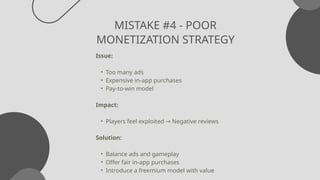
MISTAKE #4 -POOR
MONETIZATION STRATEGY
Issue:
• Too many ads
• Expensive in-app purchases
• Pay-to-win model
Impact:
• Players feel exploited Negative reviews
→
Solution:
• Balance ads and gameplay
• Offer fair in-app purchases
• Introduce a freemium model with value
7.
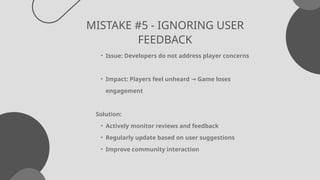
MISTAKE #5 -IGNORING USER
FEEDBACK
• Issue: Developers do not address player concerns
• Impact: Players feel unheard Game loses
→
engagement
Solution:
• Actively monitor reviews and feedback
• Regularly update based on user suggestions
• Improve community interaction
8.
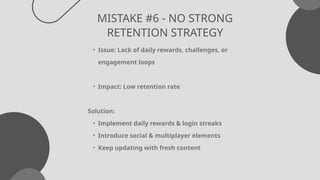
MISTAKE #6 -NO STRONG
RETENTION STRATEGY
• Issue: Lack of daily rewards, challenges, or
engagement loops
• Impact: Low retention rate
Solution:
• Implement daily rewards & login streaks
• Introduce social & multiplayer elements
• Keep updating with fresh content
9.
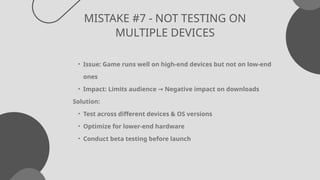
MISTAKE #7 -NOT TESTING ON
MULTIPLE DEVICES
• Issue: Game runs well on high-end devices but not on low-end
ones
• Impact: Limits audience Negative impact on downloads
→
Solution:
• Test across different devices & OS versions
• Optimize for lower-end hardware
• Conduct beta testing before launch