Common injuries : Their First aid
and management
 First aid is an immediate and temporary
care given to a victim of an accident or
sudden illness before the services of a
physician is obtained.
 Medical help that you give to somebody
who is hurt or ill before the doctor
arrives.
First Aid
 When you provide basic medical care to
someone experiencing a sudden injury or
illness, its known as first aid. In some cases,
first aid consists of to initial support
provided to someone in the middle of a
medical emergency. This support might
help them survive until professional help
arrives.
Concept of First Aid
When it comes to more serious
injuries, first aid provides an
essential role in keeping a casualty
from getting worse and helps to
stabilise their condition before
professional help can arrive.
Importance of First Aid
 REHABILITATION literally means
restoration of a normal state of health
or well being.
 On the other hand ‘TREATMENT’ in a
sports injuries usually refers to those
therapeutic measures that are used in
healing injured tissue
REHABLITATION
 Immediate and effective management.
 The progressive sports medical care for
subsequent management.
 The planned sequential stage of
rehabilitation till the recovery is
complete.
GOALS OF REHABLITATION
 Treatment by specific modalities.
 Gaining recovery of musculoskeletal
function.
 Realignment of any pre existing
weakness or imbalance
 Muscle and proprioceptive re-training.
Total Rehabilitation Includes
 Return to full activity.
NOTE: In many cases psychological aspect
of rehabilitation is more important than
physiological.
Total Rehabilitation includes
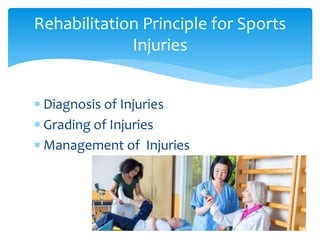
 Diagnosis of Injuries
 Grading of Injuries
 Management of Injuries
Rehabilitation Principle for Sports
Injuries
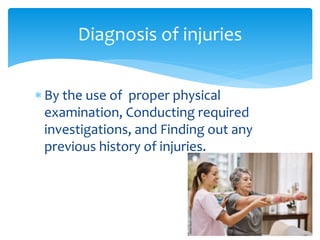
 By the use of proper physical
examination, Conducting required
investigations, and Finding out any
previous history of injuries.
Diagnosis of injuries
 Involves assessing the level of disability
(Based on Symptoms)
 His / her previous state of fitness or
ability to return to normal activity.
 His / her role in the sports.
 And his / her mental toughness.
Grading the Injuries
 Immediate management.
 Progressive active & early mobilisation.
 Passive physical treatment.
 Drug therapy.
 Psychological treatment.
 Biomechanical techniques and devises.
 Specialist opinion.
Management of Injuries
Principal of R.I.C.E. is applied
REST
ICE
COMPRESSION
ELEVATION
Immediate Management
 Strengthening Exercises
 Flexibility Exercises
 Endurance exercises
 Proprioceptive Retraining
 Functional Training
Progressive Early and Active
Mobilisation
 Injuries may occur during play or during your
daily activities, it happen in three distinctive
ways.
 They can be the result of:
 External Violence
 Internal Violence
 Over-use
COMMON SPORTS INJURIES
 External Violence
 Injuries, that are the result of the body
coming into contact with something
external to the performer.
 This can be physical contact with
another player
 Being hit by equipment or implements.
Coming into contact with the ground or
other parts of the field of play.
 Internal Violence
 This is when a part of the performer’s
body fails to cope with the stress placed
upon it.
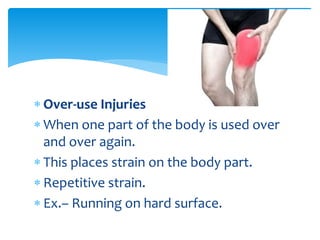
 Over-use Injuries
 When one part of the body is used over
and over again.
 This places strain on the body part.
 Repetitive strain.
 Ex.– Running on hard surface.
 Skin Injuries - Abrasion
Laceration
 Muscle Injuries - Contusion (Bruise)
Strain
 Ligament Injury - Sprain
 Bone & Joint Injuries- Fracture
Dislocation
Common Injuries
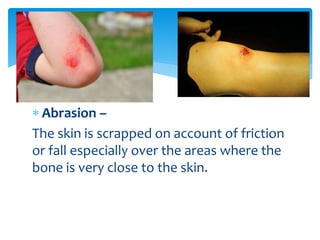
 Abrasion –
The skin is scrapped on account of friction
or fall especially over the areas where the
bone is very close to the skin.
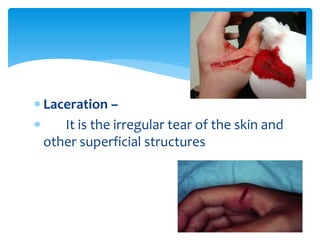
 Laceration –
 It is the irregular tear of the skin and
other superficial structures
Contusion (Bruise)–
Severe blow to the muscle can lead to
contusion.
The blood vessels in the muscle are
ruptured and collection of blood under
the thin layer of skin.
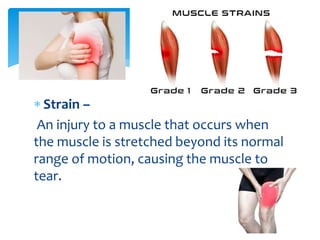
 Strain –
An injury to a muscle that occurs when
the muscle is stretched beyond its normal
range of motion, causing the muscle to
tear.
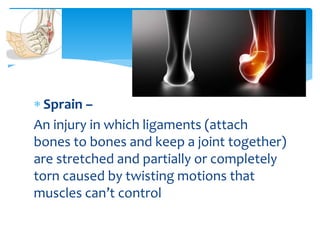
 Sprain –
An injury in which ligaments (attach
bones to bones and keep a joint together)
are stretched and partially or completely
torn caused by twisting motions that
muscles can’t control
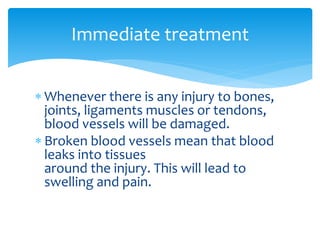
 Whenever there is any injury to bones,
joints, ligaments muscles or tendons,
blood vessels will be damaged.
 Broken blood vessels mean that blood
leaks into tissues
around the injury. This will lead to
swelling and pain.
Immediate treatment
 To combat the effects of this, follow the
method of treatment:
P+R I C E
 Protection-
 Protection of the original injury from additional
trauma.
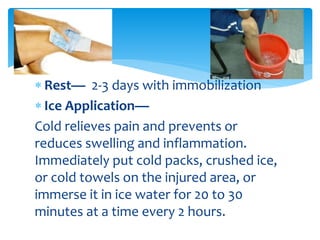
 Rest— 2-3 days with immobilization
 Ice Application—
Cold relieves pain and prevents or
reduces swelling and inflammation.
Immediately put cold packs, crushed ice,
or cold towels on the injured area, or
immerse it in ice water for 20 to 30
minutes at a time every 2 hours.
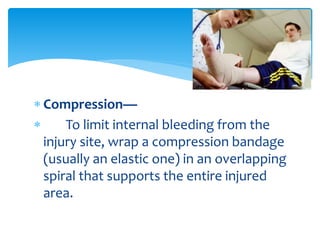
 Compression—
 To limit internal bleeding from the
injury site, wrap a compression bandage
(usually an elastic one) in an overlapping
spiral that supports the entire injured
area.
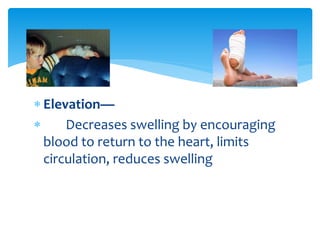
 Elevation—
 Decreases swelling by encouraging
blood to return to the heart, limits
circulation, reduces swelling
Acute injuries happen suddenly,
sure as when a person falls,
receives a blow, or twists a joint.
Chronic injuries usually result from
overuse of one area of the body
and develop gradually over time.
ACUTE AND CHRONIC INJURIES
THANK YOU

COMMON INJURIES AND FIRST AID.pptx

  • 1.
    Common injuries :Their First aid and management
  • 2.
     First aidis an immediate and temporary care given to a victim of an accident or sudden illness before the services of a physician is obtained.  Medical help that you give to somebody who is hurt or ill before the doctor arrives. First Aid
  • 3.
     When youprovide basic medical care to someone experiencing a sudden injury or illness, its known as first aid. In some cases, first aid consists of to initial support provided to someone in the middle of a medical emergency. This support might help them survive until professional help arrives. Concept of First Aid
  • 4.
    When it comesto more serious injuries, first aid provides an essential role in keeping a casualty from getting worse and helps to stabilise their condition before professional help can arrive. Importance of First Aid
  • 5.
     REHABILITATION literallymeans restoration of a normal state of health or well being.  On the other hand ‘TREATMENT’ in a sports injuries usually refers to those therapeutic measures that are used in healing injured tissue REHABLITATION
  • 6.
     Immediate andeffective management.  The progressive sports medical care for subsequent management.  The planned sequential stage of rehabilitation till the recovery is complete. GOALS OF REHABLITATION
  • 7.
     Treatment byspecific modalities.  Gaining recovery of musculoskeletal function.  Realignment of any pre existing weakness or imbalance  Muscle and proprioceptive re-training. Total Rehabilitation Includes
  • 8.
     Return tofull activity. NOTE: In many cases psychological aspect of rehabilitation is more important than physiological. Total Rehabilitation includes
  • 9.
     Diagnosis ofInjuries  Grading of Injuries  Management of Injuries Rehabilitation Principle for Sports Injuries
  • 10.
     By theuse of proper physical examination, Conducting required investigations, and Finding out any previous history of injuries. Diagnosis of injuries
  • 11.
     Involves assessingthe level of disability (Based on Symptoms)  His / her previous state of fitness or ability to return to normal activity.  His / her role in the sports.  And his / her mental toughness. Grading the Injuries
  • 12.
     Immediate management. Progressive active & early mobilisation.  Passive physical treatment.  Drug therapy.  Psychological treatment.  Biomechanical techniques and devises.  Specialist opinion. Management of Injuries
  • 13.
    Principal of R.I.C.E.is applied REST ICE COMPRESSION ELEVATION Immediate Management
  • 14.
     Strengthening Exercises Flexibility Exercises  Endurance exercises  Proprioceptive Retraining  Functional Training Progressive Early and Active Mobilisation
  • 15.
     Injuries mayoccur during play or during your daily activities, it happen in three distinctive ways.  They can be the result of:  External Violence  Internal Violence  Over-use COMMON SPORTS INJURIES
  • 16.
     External Violence Injuries, that are the result of the body coming into contact with something external to the performer.
  • 17.
     This canbe physical contact with another player  Being hit by equipment or implements. Coming into contact with the ground or other parts of the field of play.
  • 18.
     Internal Violence This is when a part of the performer’s body fails to cope with the stress placed upon it.
  • 19.
     Over-use Injuries When one part of the body is used over and over again.  This places strain on the body part.  Repetitive strain.  Ex.– Running on hard surface.
  • 20.
     Skin Injuries- Abrasion Laceration  Muscle Injuries - Contusion (Bruise) Strain  Ligament Injury - Sprain  Bone & Joint Injuries- Fracture Dislocation Common Injuries
  • 21.
     Abrasion – Theskin is scrapped on account of friction or fall especially over the areas where the bone is very close to the skin.
  • 22.
     Laceration – It is the irregular tear of the skin and other superficial structures
  • 23.
    Contusion (Bruise)– Severe blowto the muscle can lead to contusion. The blood vessels in the muscle are ruptured and collection of blood under the thin layer of skin.
  • 24.
     Strain – Aninjury to a muscle that occurs when the muscle is stretched beyond its normal range of motion, causing the muscle to tear.
  • 25.
     Sprain – Aninjury in which ligaments (attach bones to bones and keep a joint together) are stretched and partially or completely torn caused by twisting motions that muscles can’t control
  • 26.
     Whenever thereis any injury to bones, joints, ligaments muscles or tendons, blood vessels will be damaged.  Broken blood vessels mean that blood leaks into tissues around the injury. This will lead to swelling and pain. Immediate treatment
  • 27.
     To combatthe effects of this, follow the method of treatment: P+R I C E  Protection-  Protection of the original injury from additional trauma.
  • 28.
     Rest— 2-3days with immobilization  Ice Application— Cold relieves pain and prevents or reduces swelling and inflammation. Immediately put cold packs, crushed ice, or cold towels on the injured area, or immerse it in ice water for 20 to 30 minutes at a time every 2 hours.
  • 29.
     Compression—  Tolimit internal bleeding from the injury site, wrap a compression bandage (usually an elastic one) in an overlapping spiral that supports the entire injured area.
  • 30.
     Elevation—  Decreasesswelling by encouraging blood to return to the heart, limits circulation, reduces swelling
  • 31.
    Acute injuries happensuddenly, sure as when a person falls, receives a blow, or twists a joint. Chronic injuries usually result from overuse of one area of the body and develop gradually over time. ACUTE AND CHRONIC INJURIES
  • 32.