Common Electric Components Used in Industrial Units
Industrial units rely on a variety of electrical components to ensure smooth, safe, and efficient
operations. These components are integral to controlling machinery, distributing power, and
automating processes.
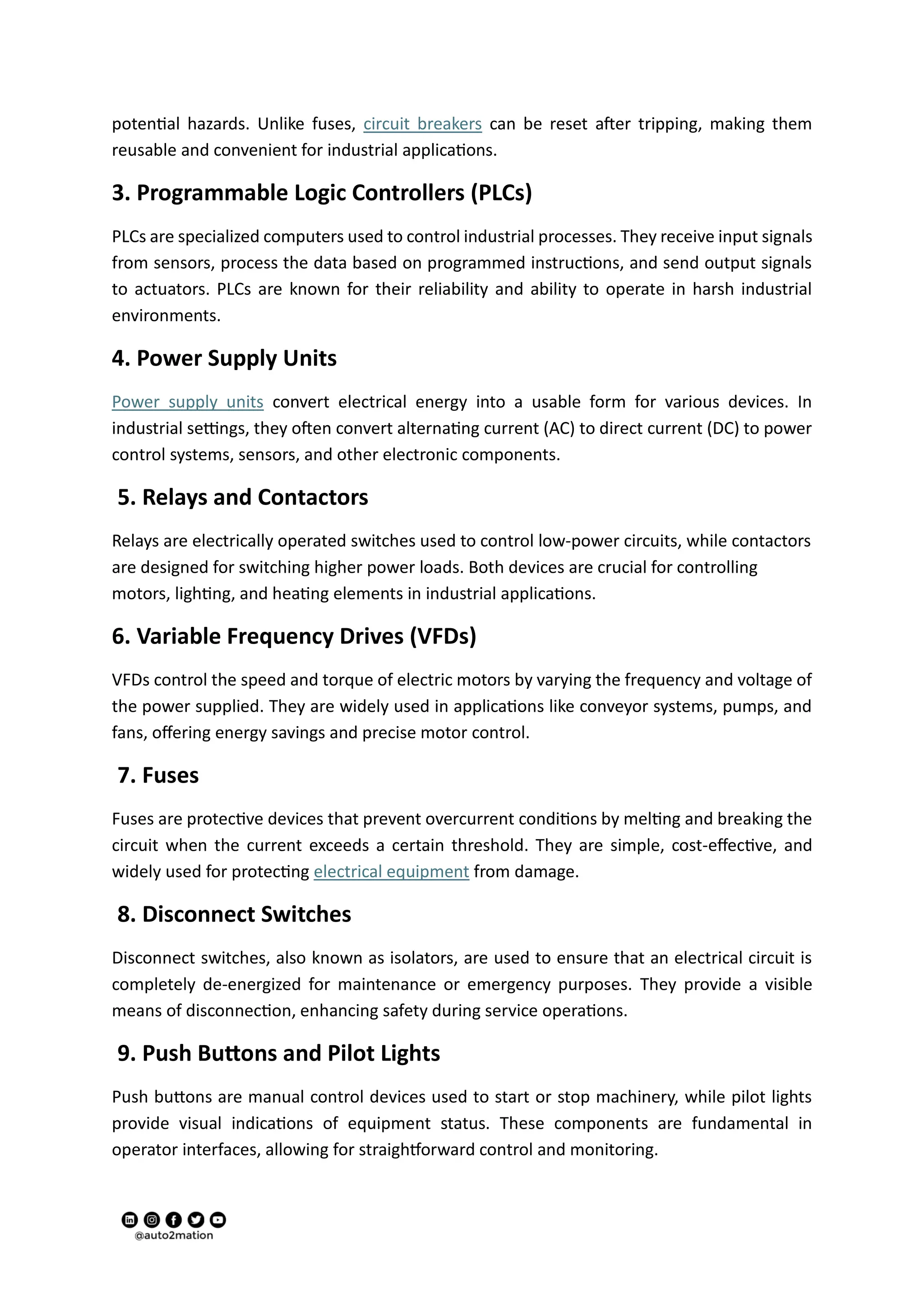
Below is an overview of some of the most commonly used electric components in industrial
settings:
1. Transformers
Transformers are essential devices that adjust voltage levels to meet the requirements of
different equipment. They can either step up or step-down voltage, ensuring that machinery
receives the appropriate power level. Additionally, transformers provide isolation between
circuits, enhancing safety and preventing electrical faults from spreading.
2. Circuit Breakers
Circuit breakers protect electrical circuits from damage caused by overloads or short circuits.
They automatically interrupt the flow of electricity when a fault is detected, preventing
potential hazards. Unlike fuses, circuit breakers can be reset after tripping, making them
reusable and convenient for industrial applications.
3. Programmable Logic Controllers (PLCs)
PLCs are specialized computers used to control industrial processes. They receive input signals
from sensors, process the data based on programmed instructions, and send output signals
to actuators. PLCs are known for their reliability and ability to operate in harsh industrial
environments.
4. Power Supply Units
Power supply units convert electrical energy into a usable form for various devices. In
industrial settings, they often convert alternating current (AC) to direct current (DC) to power
control systems, sensors, and other electronic components.
5. Relays and Contactors
Relays are electrically operated switches used to control low-power circuits, while contactors
are designed for switching higher power loads. Both devices are crucial for controlling
motors, lighting, and heating elements in industrial applications.
6. Variable Frequency Drives (VFDs)
VFDs control the speed and torque of electric motors by varying the frequency and voltage of
the power supplied. They are widely used in applications like conveyor systems, pumps, and
fans, offering energy savings and precise motor control.
7. Fuses
Fuses are protective devices that prevent overcurrent conditions by melting and breaking the
circuit when the current exceeds a certain threshold. They are simple, cost-effective, and
widely used for protecting electrical equipment from damage.
8. Disconnect Switches
Disconnect switches, also known as isolators, are used to ensure that an electrical circuit is
completely de-energized for maintenance or emergency purposes. They provide a visible
means of disconnection, enhancing safety during service operations.
9. Push Buttons and Pilot Lights
Push buttons are manual control devices used to start or stop machinery, while pilot lights
provide visual indications of equipment status. These components are fundamental in
operator interfaces, allowing for straightforward control and monitoring.
10. Terminal Blocks
Terminal blocks are modular connectors that facilitate the connection of wires within electrical
panels. They provide a safe and organized method for managing complex wiring systems,
ensuring reliable electrical connections.
11. Sensors
Sensors detect physical parameters such as temperature, pressure, proximity, and flow,
converting them into electrical signals for monitoring and control. They are integral to
automation systems, enabling real-time data acquisition and process optimization.
12. Human-Machine Interfaces (HMIs)
HMIs are user interfaces that allow operators to interact with control systems. They display
real-time data, system statuses, and alarms, facilitating efficient monitoring and control of
industrial processes.
13. Busbars
Busbars are conductive bars used to distribute power within switchboards, distribution
boards, and other electrical apparatus. They offer a compact and efficient method for
managing high-current power distribution.
14. Capacitors
Capacitors store and release electrical energy, playing a crucial role in power conditioning,
filtering, and energy storage. They help stabilize voltage and power flow in industrial electrical
systems.
15. Diodes
Diodes allow current to flow in one direction only, making them essential for converting
alternating current (AC) to direct current (DC). They are also used in voltage regulation and
signal demodulation.
16. Transistors
Transistors are semiconductor devices used to amplify or switch electronic signals. In
industrial applications, they are fundamental components in control circuits and signal
processing.
17. Inductors
Inductors, or coils, store energy in a magnetic field when electrical current flows through
them. They are used in filtering applications, energy storage, and in tuning circuits.
18. Overload Relays
Overload relays protect motors from overheating by interrupting the circuit when excessive
current is detected. They are vital for preventing motor damage due to prolonged overcurrent
conditions.
19. Motor Starters
Motor starters are devices that safely start and stop electric motors. They often include
overload protection and are essential for controlling motor operations in industrial settings.
20. Power Conditioners
Power conditioners improve the quality of power delivered to electrical equipment by
regulating voltage, suppressing noise, and protecting against surges. They ensure that
sensitive industrial equipment operates reliably.
Understanding these components is crucial for anyone involved in industrial operations,
maintenance, or design. Proper selection and maintenance of these components ensure the
safety, efficiency, and longevity of industrial systems.

Common Electric Components Used in Industrial Units.pdf

  • 1.
    Common Electric ComponentsUsed in Industrial Units Industrial units rely on a variety of electrical components to ensure smooth, safe, and efficient operations. These components are integral to controlling machinery, distributing power, and automating processes. Below is an overview of some of the most commonly used electric components in industrial settings: 1. Transformers Transformers are essential devices that adjust voltage levels to meet the requirements of different equipment. They can either step up or step-down voltage, ensuring that machinery receives the appropriate power level. Additionally, transformers provide isolation between circuits, enhancing safety and preventing electrical faults from spreading. 2. Circuit Breakers Circuit breakers protect electrical circuits from damage caused by overloads or short circuits. They automatically interrupt the flow of electricity when a fault is detected, preventing
  • 2.
    potential hazards. Unlikefuses, circuit breakers can be reset after tripping, making them reusable and convenient for industrial applications. 3. Programmable Logic Controllers (PLCs) PLCs are specialized computers used to control industrial processes. They receive input signals from sensors, process the data based on programmed instructions, and send output signals to actuators. PLCs are known for their reliability and ability to operate in harsh industrial environments. 4. Power Supply Units Power supply units convert electrical energy into a usable form for various devices. In industrial settings, they often convert alternating current (AC) to direct current (DC) to power control systems, sensors, and other electronic components. 5. Relays and Contactors Relays are electrically operated switches used to control low-power circuits, while contactors are designed for switching higher power loads. Both devices are crucial for controlling motors, lighting, and heating elements in industrial applications. 6. Variable Frequency Drives (VFDs) VFDs control the speed and torque of electric motors by varying the frequency and voltage of the power supplied. They are widely used in applications like conveyor systems, pumps, and fans, offering energy savings and precise motor control. 7. Fuses Fuses are protective devices that prevent overcurrent conditions by melting and breaking the circuit when the current exceeds a certain threshold. They are simple, cost-effective, and widely used for protecting electrical equipment from damage. 8. Disconnect Switches Disconnect switches, also known as isolators, are used to ensure that an electrical circuit is completely de-energized for maintenance or emergency purposes. They provide a visible means of disconnection, enhancing safety during service operations. 9. Push Buttons and Pilot Lights Push buttons are manual control devices used to start or stop machinery, while pilot lights provide visual indications of equipment status. These components are fundamental in operator interfaces, allowing for straightforward control and monitoring.
  • 3.
    10. Terminal Blocks Terminalblocks are modular connectors that facilitate the connection of wires within electrical panels. They provide a safe and organized method for managing complex wiring systems, ensuring reliable electrical connections. 11. Sensors Sensors detect physical parameters such as temperature, pressure, proximity, and flow, converting them into electrical signals for monitoring and control. They are integral to automation systems, enabling real-time data acquisition and process optimization. 12. Human-Machine Interfaces (HMIs) HMIs are user interfaces that allow operators to interact with control systems. They display real-time data, system statuses, and alarms, facilitating efficient monitoring and control of industrial processes. 13. Busbars Busbars are conductive bars used to distribute power within switchboards, distribution boards, and other electrical apparatus. They offer a compact and efficient method for managing high-current power distribution. 14. Capacitors Capacitors store and release electrical energy, playing a crucial role in power conditioning, filtering, and energy storage. They help stabilize voltage and power flow in industrial electrical systems. 15. Diodes Diodes allow current to flow in one direction only, making them essential for converting alternating current (AC) to direct current (DC). They are also used in voltage regulation and signal demodulation. 16. Transistors Transistors are semiconductor devices used to amplify or switch electronic signals. In industrial applications, they are fundamental components in control circuits and signal processing.
  • 4.
    17. Inductors Inductors, orcoils, store energy in a magnetic field when electrical current flows through them. They are used in filtering applications, energy storage, and in tuning circuits. 18. Overload Relays Overload relays protect motors from overheating by interrupting the circuit when excessive current is detected. They are vital for preventing motor damage due to prolonged overcurrent conditions. 19. Motor Starters Motor starters are devices that safely start and stop electric motors. They often include overload protection and are essential for controlling motor operations in industrial settings. 20. Power Conditioners Power conditioners improve the quality of power delivered to electrical equipment by regulating voltage, suppressing noise, and protecting against surges. They ensure that sensitive industrial equipment operates reliably. Understanding these components is crucial for anyone involved in industrial operations, maintenance, or design. Proper selection and maintenance of these components ensure the safety, efficiency, and longevity of industrial systems.