Commodity Derivatives
COMMODITY DERIVATIVES
COMMODITY DEFINED
 Every kind of movable good excluding money, securities
and actionable claims
 Any good that possesses a physical attribute.
 Comes from a French word “commodite” which is used
to refer to an object of utility, that offers some
convenience or useful service.
 A commodity is an economic good, tradable
good, product or article of commerce; something
for which there is an established market where the
commodity can be bought and sold in
commercial transaction between willing buyers
and sellers.
 Commodities include
 Metals (Bullion & Other Metals)
 Agro Products
 Perishable / Non Perishable
 Consumable / Non Consumable
DERIVATIVES DEFINED
 Contracts (Futures or Options) the value of
which is derived from the underlying assets are
called Derivatives.
 Derivatives are contracts that originated from
the need to minimize risk.
COMMODITY DERIVATIVES DEFINED
Derivative contracts where the underlying assets are
Commodities are called Commodity derivatives
If the underlying asset of the derivative contract is
 PRECIOUS METALS (Gold, silver, platinum etc)
 OTHER METALS (tin, copper, lead, steel, nickel etc)
 AGRO PRODUCTS (coffee, wheat, pepper, cotton)
 ENERGY PRODUCTS (crude oil, heating oil,natural gas)
then the derivative is known as a commodity
derivative..
Types of Commodities
Agricultural products
 Oil and Oil Seeds
 Spices
 Pulses
 Plantations
 Fibers
 Potato
 sugar
Industrial Metals
 Copper
 Zinc
 Aluminium
 Lead
 Tin
 Steel
 Sponge iron
Precious Metals
 Gold
 Silver
 platinum
Energy
 Crude oil
 Natural gas
 Furnace oil
 Aviation Turbine Fuel(ATF)
 power
Commodity Exchange
What is COMMODITY EXCHANGE?
 An Exchange is an institution, organisation or association
which hosts a market where stocks, bonds, options and
futures, as well as commodities are traded, and where
buyers and sellers can come together to trade during
specific hours on business days.
 A commodity exchange offers a central meeting place
where buyers and sellers meet to do business, and
where various commodities are traded.
Functions:
 Sets rules and regulations to standardise the practice of
buying and selling in the market.
 Provides the mechanism for resolution of business
disputes.
 Helps to generate and disseminate valuable signals
relating to price and market information to exchange
members, their customer and interested market
participants on a real time basis.
WHY ARE COMMODITY DERIVATIVES
REQUIRED
 India is among the top-5 producers of most of the
commodities, in addition to being a major consumer of
bullion and energy products.
 Agriculture contributes about 22% to the GDP of the
Indian economy.
 It employees around 57% of the labor force on a total of
163 million hectares of land.
 Agriculture sector is an important factor in achieving a
GDP growth of 8-10%. All this indicates that India can be
promoted as a major center for trading of commodity
derivatives.
 It is important to understand why commodity derivatives
are required and the role they can play in risk
management
 It is common knowledge that prices of commodities,
metals, shares and currencies fluctuate over time.
 The possibility of adverse price changes in future creates
risk for businesses.
 Derivatives are used to reduce or eliminate price risk
arising from unforeseen price changes
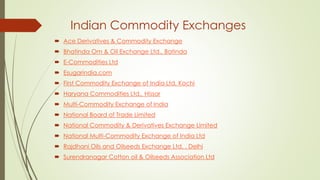
Indian Commodity Exchanges
 Ace Derivatives & Commodity Exchange
 Bhatinda Om & Oil Exchange Ltd., Batinda
 E-Commodities Ltd
 Esugarindia.com
 First Commodity Exchange of India Ltd, Kochi
 Haryana Commodities Ltd., Hissar
 Multi-Commodity Exchange of India
 National Board of Trade Limited
 National Commodity & Derivatives Exchange Limited
 National Multi-Commodity Exchange of India Ltd
 Rajdhani Oils and Oilseeds Exchange Ltd. , Delhi
 Surendranagar Cotton oil & Oilseeds Association Ltd
 The Bikaner Commodities Exchange Limited
 The Bombay Commodity Exchange Ltd
 The Bullion Association Limited
 The Central India Commercial Exchange Ltd, Gwaliar
 The Chamber of Commerce
 The East India Cotton Association
 The East India Jute & Hessian Exchange Ltd,
 The Indian Pepper and Spice Trade Association
 The Meerut Agro Commodities Exchange Co. Ltd., Meerut
 The Rajkot Seeds oil & Bullion Merchants` Association Ltd
 The Spices and Oilseeds Exchange Ltd.
 Vijay Beopar Chamber Ltd.,Muzaffarnagar
MODERN COMMODITY EXCHANGES
Multi-Commodity Exchange of India Limited (MCX)
 Inaugurated in November 2003 by Shri Mukesh Ambani
Chairman and MD Reliance Industries LTD.
 Headquarters in Mumbai
 MCX an independent and de-mutualized.
Multi commodity exchange has permanent recognition from
Government of India for facilitating online trading, clearing and
settlement operations for commodity futures markets across the
country.
Key shareholders of MCX are
 Financial Technologies (India) Ltd.,
 State Bank of India,
 NABARD,
 NSE,
 HDFC Bank,
 State Bank of Indore,
 State Bank of Hyderabad,
 State Bank of Maharashtra,
 SBI Life Insurance Co. Ltd.,
 Union Bank of India,
 Bank Of India,
 Bank Of Baroda,
 Canara Bank,
 Corporation Bank.
 MCX is led by an expert management team with deep
domain knowledge of the commodity futures markets.
Through the integration of dedicated resources, robust
technology and scalable infrastructure.
 MCX offers futures trading in the following commodity
categories:
 Agri Commodities,
 Bullion,
 Metals- Ferrous & Non-ferrous,
 Pulses,
 Oils & Oilseeds,
 Energy,
 Plantations,
 Spices and other soft commodities.
 MCX has built strategic alliances with some of the
largest players in commodities eco-system, namely,
Bombay Bullion Association, Bombay Metal Exchange,
Solvent Extractors' Association of India, Pulses Importers
Association, Shetkari Sanghatana, United Planters
Association of India and India Pepper and Spice Trade
Association.
(B)NATIONAL COMMODITY AND DERIVATIVES
EXCHANGE LIMITED (NCDEX)
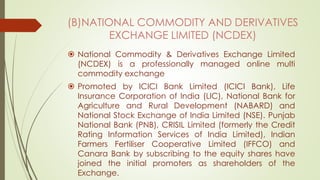
 National Commodity & Derivatives Exchange Limited
(NCDEX) is a professionally managed online multi
commodity exchange
 Promoted by ICICI Bank Limited (ICICI Bank), Life
Insurance Corporation of India (LIC), National Bank for
Agriculture and Rural Development (NABARD) and
National Stock Exchange of India Limited (NSE). Punjab
National Bank (PNB), CRISIL Limited (formerly the Credit
Rating Information Services of India Limited), Indian
Farmers Fertiliser Cooperative Limited (IFFCO) and
Canara Bank by subscribing to the equity shares have
joined the initial promoters as shareholders of the
Exchange.
 NCDEX is located in Mumbai and offers facilities to its
members in more than 390 centers throughout India.
 NCDEX currently facilitates trading of thirty six
commodities - Cashew, Castor Seed, Chana, Chilli,
Coffee, Cotton, Cotton Seed Oilcake, Crude Palm Oil,
Expeller Mustard Oil, Gold, Guar gum, Guar Seeds, Gur,
Jeera, Jute sacking bags, Mild Steel Ingot, Mulberry
Green Cocoons, Pepper, Rapeseed - Mustard Seed,
Raw Jute, RBD Palmolein, Refined Soy Oil, Rice, Rubber,
Sesame Seeds, Silk, Silver, Soy Bean, Sugar, Gur,
Turmeric, Urad (Black Matpe), Wheat, Yellow Peas,
Yellow Red Maize & Yellow Soybean Meal.
SETTLEMENTS
DAILY SETTLEMENTS
A.DAILY SETTLEMENTS:
 After the closing hours at the end of each day.
 Determine the closing price for the day
› Weekdays : 11:15 p.m. to 11:30 p.m.
› Saturday : 2:15 p.m. to 2:30 p.m.
 Mark to Market Settlement
1. For daily price fluctuations
2. All Trades are Marked to Market at daily settlement price
3. Pay In/ Pay Out required as the case maybe
 4. Daily Process at the end of each day
FINAL SETTLEMENTS
 *Cash Settlement
 *Delivery Settlement
Cash Settlement
 Settlement for all open positions on the expiry date
 Determine all open positions for all the clients
 Determine the final settlement price for the contract
 Determination of Final Settlement Price
 Underlying spot price on Expiry date
 Bootstrapping of polled prices
 Disseminated to market at end of day
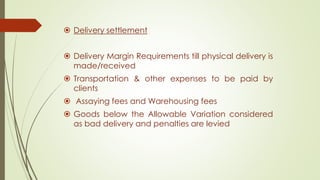
 Delivery settlement
 Delivery Margin Requirements till physical delivery is
made/received
 Transportation & other expenses to be paid by
clients
 Assaying fees and Warehousing fees
 Goods below the Allowable Variation considered
as bad delivery and penalties are levied

Commodity derivatives

  • 2.
  • 3.
    COMMODITY DERIVATIVES COMMODITY DEFINED Every kind of movable good excluding money, securities and actionable claims  Any good that possesses a physical attribute.  Comes from a French word “commodite” which is used to refer to an object of utility, that offers some convenience or useful service.
  • 4.
     A commodityis an economic good, tradable good, product or article of commerce; something for which there is an established market where the commodity can be bought and sold in commercial transaction between willing buyers and sellers.  Commodities include  Metals (Bullion & Other Metals)  Agro Products  Perishable / Non Perishable  Consumable / Non Consumable
  • 5.
    DERIVATIVES DEFINED  Contracts(Futures or Options) the value of which is derived from the underlying assets are called Derivatives.  Derivatives are contracts that originated from the need to minimize risk.
  • 6.
    COMMODITY DERIVATIVES DEFINED Derivativecontracts where the underlying assets are Commodities are called Commodity derivatives If the underlying asset of the derivative contract is  PRECIOUS METALS (Gold, silver, platinum etc)  OTHER METALS (tin, copper, lead, steel, nickel etc)  AGRO PRODUCTS (coffee, wheat, pepper, cotton)  ENERGY PRODUCTS (crude oil, heating oil,natural gas) then the derivative is known as a commodity derivative..
  • 7.
    Types of Commodities Agriculturalproducts  Oil and Oil Seeds  Spices  Pulses  Plantations  Fibers  Potato  sugar
  • 8.
    Industrial Metals  Copper Zinc  Aluminium  Lead  Tin  Steel  Sponge iron
  • 9.
  • 10.
    Energy  Crude oil Natural gas  Furnace oil  Aviation Turbine Fuel(ATF)  power
  • 11.
  • 12.
    What is COMMODITYEXCHANGE?  An Exchange is an institution, organisation or association which hosts a market where stocks, bonds, options and futures, as well as commodities are traded, and where buyers and sellers can come together to trade during specific hours on business days.  A commodity exchange offers a central meeting place where buyers and sellers meet to do business, and where various commodities are traded.
  • 13.
    Functions:  Sets rulesand regulations to standardise the practice of buying and selling in the market.  Provides the mechanism for resolution of business disputes.  Helps to generate and disseminate valuable signals relating to price and market information to exchange members, their customer and interested market participants on a real time basis.
  • 14.
    WHY ARE COMMODITYDERIVATIVES REQUIRED  India is among the top-5 producers of most of the commodities, in addition to being a major consumer of bullion and energy products.  Agriculture contributes about 22% to the GDP of the Indian economy.  It employees around 57% of the labor force on a total of 163 million hectares of land.  Agriculture sector is an important factor in achieving a GDP growth of 8-10%. All this indicates that India can be promoted as a major center for trading of commodity derivatives.
  • 15.
     It isimportant to understand why commodity derivatives are required and the role they can play in risk management  It is common knowledge that prices of commodities, metals, shares and currencies fluctuate over time.  The possibility of adverse price changes in future creates risk for businesses.  Derivatives are used to reduce or eliminate price risk arising from unforeseen price changes
  • 16.
    Indian Commodity Exchanges Ace Derivatives & Commodity Exchange  Bhatinda Om & Oil Exchange Ltd., Batinda  E-Commodities Ltd  Esugarindia.com  First Commodity Exchange of India Ltd, Kochi  Haryana Commodities Ltd., Hissar  Multi-Commodity Exchange of India  National Board of Trade Limited  National Commodity & Derivatives Exchange Limited  National Multi-Commodity Exchange of India Ltd  Rajdhani Oils and Oilseeds Exchange Ltd. , Delhi  Surendranagar Cotton oil & Oilseeds Association Ltd
  • 17.
     The BikanerCommodities Exchange Limited  The Bombay Commodity Exchange Ltd  The Bullion Association Limited  The Central India Commercial Exchange Ltd, Gwaliar  The Chamber of Commerce  The East India Cotton Association  The East India Jute & Hessian Exchange Ltd,  The Indian Pepper and Spice Trade Association  The Meerut Agro Commodities Exchange Co. Ltd., Meerut  The Rajkot Seeds oil & Bullion Merchants` Association Ltd  The Spices and Oilseeds Exchange Ltd.  Vijay Beopar Chamber Ltd.,Muzaffarnagar
  • 18.
    MODERN COMMODITY EXCHANGES Multi-CommodityExchange of India Limited (MCX)  Inaugurated in November 2003 by Shri Mukesh Ambani Chairman and MD Reliance Industries LTD.  Headquarters in Mumbai  MCX an independent and de-mutualized. Multi commodity exchange has permanent recognition from Government of India for facilitating online trading, clearing and settlement operations for commodity futures markets across the country.
  • 19.
    Key shareholders ofMCX are  Financial Technologies (India) Ltd.,  State Bank of India,  NABARD,  NSE,  HDFC Bank,  State Bank of Indore,  State Bank of Hyderabad,  State Bank of Maharashtra,  SBI Life Insurance Co. Ltd.,  Union Bank of India,  Bank Of India,  Bank Of Baroda,  Canara Bank,  Corporation Bank.
  • 20.
     MCX isled by an expert management team with deep domain knowledge of the commodity futures markets. Through the integration of dedicated resources, robust technology and scalable infrastructure.  MCX offers futures trading in the following commodity categories:  Agri Commodities,  Bullion,  Metals- Ferrous & Non-ferrous,  Pulses,  Oils & Oilseeds,  Energy,  Plantations,  Spices and other soft commodities.
  • 21.
     MCX hasbuilt strategic alliances with some of the largest players in commodities eco-system, namely, Bombay Bullion Association, Bombay Metal Exchange, Solvent Extractors' Association of India, Pulses Importers Association, Shetkari Sanghatana, United Planters Association of India and India Pepper and Spice Trade Association.
  • 22.
    (B)NATIONAL COMMODITY ANDDERIVATIVES EXCHANGE LIMITED (NCDEX)  National Commodity & Derivatives Exchange Limited (NCDEX) is a professionally managed online multi commodity exchange  Promoted by ICICI Bank Limited (ICICI Bank), Life Insurance Corporation of India (LIC), National Bank for Agriculture and Rural Development (NABARD) and National Stock Exchange of India Limited (NSE). Punjab National Bank (PNB), CRISIL Limited (formerly the Credit Rating Information Services of India Limited), Indian Farmers Fertiliser Cooperative Limited (IFFCO) and Canara Bank by subscribing to the equity shares have joined the initial promoters as shareholders of the Exchange.
  • 23.
     NCDEX islocated in Mumbai and offers facilities to its members in more than 390 centers throughout India.  NCDEX currently facilitates trading of thirty six commodities - Cashew, Castor Seed, Chana, Chilli, Coffee, Cotton, Cotton Seed Oilcake, Crude Palm Oil, Expeller Mustard Oil, Gold, Guar gum, Guar Seeds, Gur, Jeera, Jute sacking bags, Mild Steel Ingot, Mulberry Green Cocoons, Pepper, Rapeseed - Mustard Seed, Raw Jute, RBD Palmolein, Refined Soy Oil, Rice, Rubber, Sesame Seeds, Silk, Silver, Soy Bean, Sugar, Gur, Turmeric, Urad (Black Matpe), Wheat, Yellow Peas, Yellow Red Maize & Yellow Soybean Meal.
  • 24.
    SETTLEMENTS DAILY SETTLEMENTS A.DAILY SETTLEMENTS: After the closing hours at the end of each day.  Determine the closing price for the day › Weekdays : 11:15 p.m. to 11:30 p.m. › Saturday : 2:15 p.m. to 2:30 p.m.  Mark to Market Settlement 1. For daily price fluctuations 2. All Trades are Marked to Market at daily settlement price 3. Pay In/ Pay Out required as the case maybe  4. Daily Process at the end of each day
  • 25.
    FINAL SETTLEMENTS  *CashSettlement  *Delivery Settlement Cash Settlement  Settlement for all open positions on the expiry date  Determine all open positions for all the clients  Determine the final settlement price for the contract  Determination of Final Settlement Price  Underlying spot price on Expiry date  Bootstrapping of polled prices  Disseminated to market at end of day
  • 26.
     Delivery settlement Delivery Margin Requirements till physical delivery is made/received  Transportation & other expenses to be paid by clients  Assaying fees and Warehousing fees  Goods below the Allowable Variation considered as bad delivery and penalties are levied