Why Commissioning Authority
Should Complete Commissioning
C Checklists
WWW.GLOBAL-CXM.COM
• Instead of contactors, the completion of commissioning documents
should be done by the commissioning authority (CxA) – and for good
reason!
Typically the commissioning management services company is in direct
contract with the owner of the building and it acts as an independent,
3rd-party representative who ensures that the entire commissioning
phase is completely unbiased and follows best practices while working
towards achieving the project requirements of the owner.
• The commissioning authority bears the responsibility to assist the
project team during construction, acceptance and design phases, which
ensures that the project achieves success, but without being dependent
on the construction and design teams, so as to maintain objectivity.
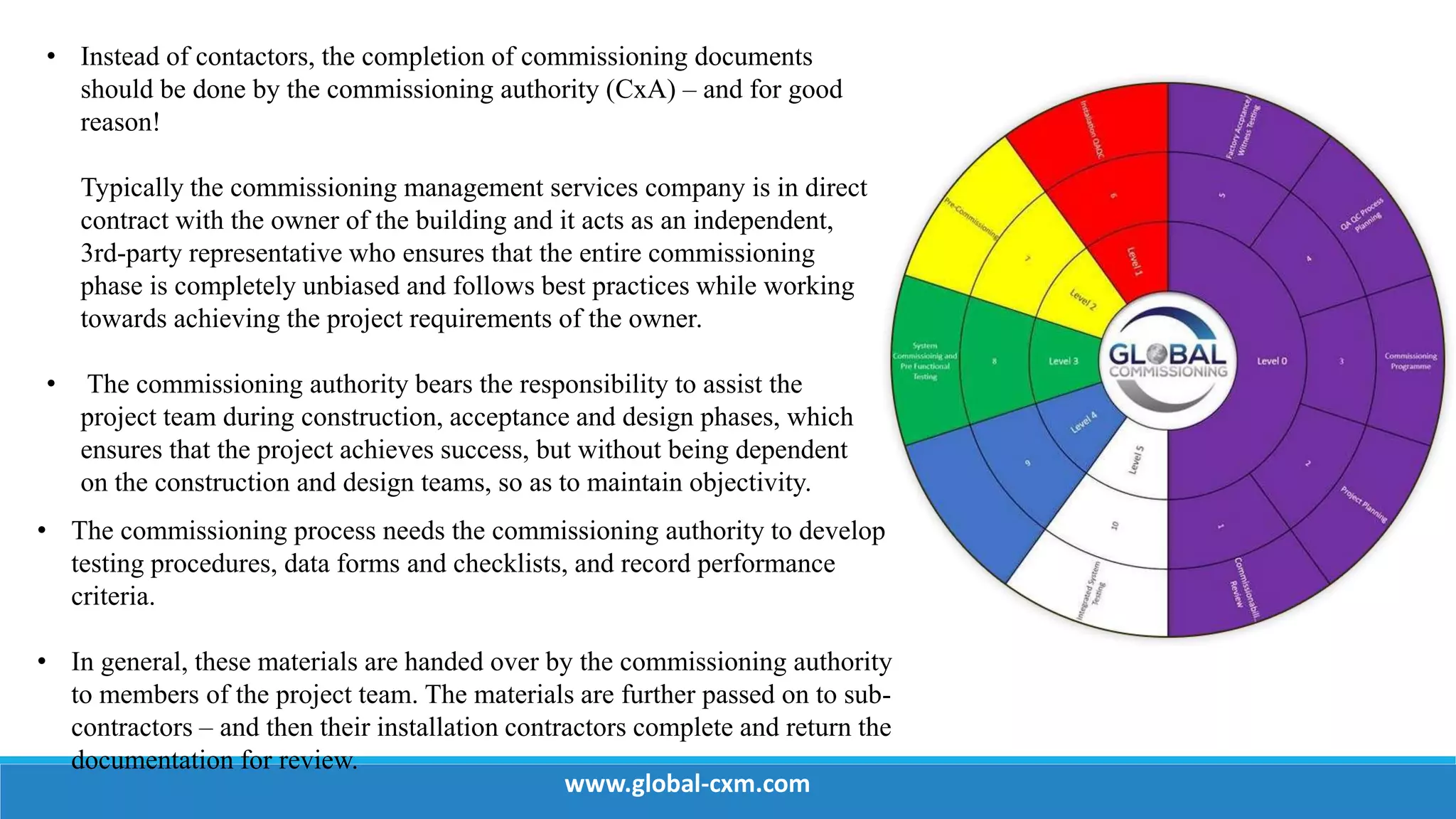
• The commissioning process needs the commissioning authority to develop
testing procedures, data forms and checklists, and record performance
criteria.
• In general, these materials are handed over by the commissioning authority
to members of the project team. The materials are further passed on to sub-
contractors – and then their installation contractors complete and return the
documentation for review.
www.global-cxm.com
Surely, Not an Unbiased Approach to Commissioning!
• This make things complicated for the commissioning authority who may
then have to approach various members of the project team for different
kinds of documents that need to be reviewed and confirmed by the
commissioning authority.
• It is important to ensure that contractors should not complete the
commissioning documentation, such as pre-functional checklists (PFC) –
obviously, because they’re not the independent commissioning authority.
• If contractors take the responsibility to complete commissioning
documentation, the building owner will not reap any benefits from the true
value of commissioning.
• When the commissioning authority are responsible for completing
commissioning documentation, they are required to completely understand
equipment specifications and choice, design details, installation
requirements from the manufacturers, identify any access limitations in
future, and describe their findings in a crisp and clear fashion.
• Also, during commissioning coordination meetings, this documentation
needs to be provided to the project team for review.
www.global-cxm.com
Appropriate Role of Contractors in the Commissioning Process
• Contactors should give the required equipment and initial
documents to the commissioning management services agency.
• They should also ensure their availability during PFC site
visits and make the required repairs, if the installation of
equipment is not in line with the design requirements, while
meeting their general contract obligations.
• When the commissioning authority works on PFC
documentation, issues can be identified and fixed quickly,
documentation offers more detail and the project team can go
into the acceptance phase confidently with unbiased quality
control offered by a good global commissioning authority.
www.global-cxm.com
Completing Commissioning Documentation Is No Mean Feat
• Completing commissioning documentation needs an exhaustive database of mechanical equipment,
including air handlers, boilers, expansion tanks, cooling towers, and every imaginable piece of MEP
equipment within a commercial setting.
• For every equipment piece, the commissioning authority requires to place the nameplate(s) to verify
manufacturers’ data accurately. This piece of information shows that the equipment conforms to the
authorised equipment submission and could be used in the equipment inventory database of the
owner.
• Once the equipment is installed completely, the commission management services firm requires to
return and check if the installation is in line with the design requirements.
• Reputed global commissioning firms make use of design details from contract drawings and follow
best installation practices for every piece of equipment.
• These may include verifying if the equipment has isolation valves for servicing, disconnects are
accessible and labelled, all pipe fittings are supported properly, piping supports coil changes and
protective shrouds are installed. The list is exhaustive for every kind of equipment and such levels of
details are also needed in functional testing documentation.
www.global-cxm.com
Completing Commissioning Documentation Is a Time-Intensive, All-Inclusive Process – Even
for the Commissioning Team!
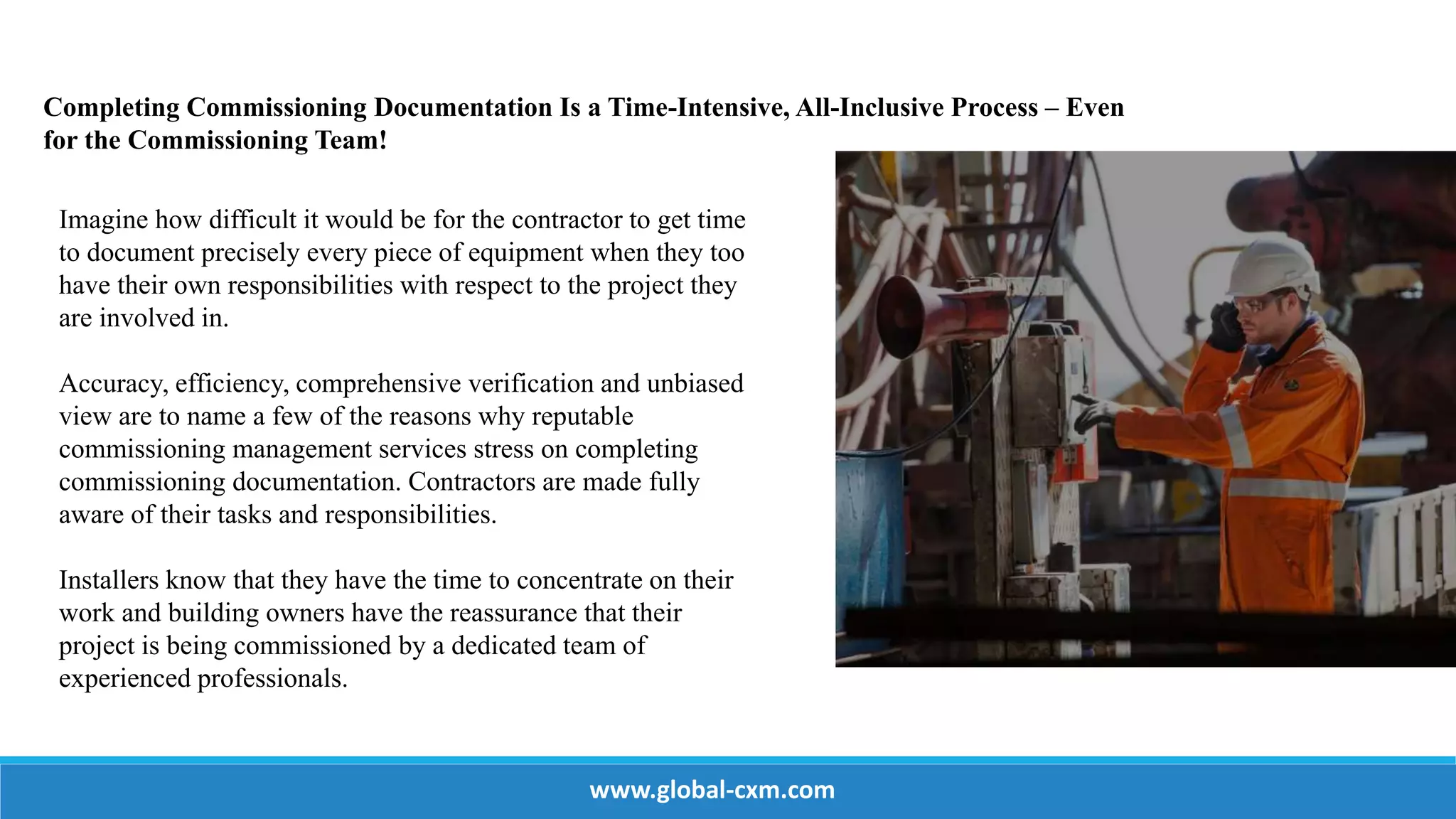
Imagine how difficult it would be for the contractor to get time
to document precisely every piece of equipment when they too
have their own responsibilities with respect to the project they
are involved in.
Accuracy, efficiency, comprehensive verification and unbiased
view are to name a few of the reasons why reputable
commissioning management services stress on completing
commissioning documentation. Contractors are made fully
aware of their tasks and responsibilities.
Installers know that they have the time to concentrate on their
work and building owners have the reassurance that their
project is being commissioned by a dedicated team of
experienced professionals.
www.global-cxm.com

Commissioning Management and Validation Services

  • 1.
    Why Commissioning Authority ShouldComplete Commissioning C Checklists WWW.GLOBAL-CXM.COM
  • 2.
    • Instead ofcontactors, the completion of commissioning documents should be done by the commissioning authority (CxA) – and for good reason! Typically the commissioning management services company is in direct contract with the owner of the building and it acts as an independent, 3rd-party representative who ensures that the entire commissioning phase is completely unbiased and follows best practices while working towards achieving the project requirements of the owner. • The commissioning authority bears the responsibility to assist the project team during construction, acceptance and design phases, which ensures that the project achieves success, but without being dependent on the construction and design teams, so as to maintain objectivity. • The commissioning process needs the commissioning authority to develop testing procedures, data forms and checklists, and record performance criteria. • In general, these materials are handed over by the commissioning authority to members of the project team. The materials are further passed on to sub- contractors – and then their installation contractors complete and return the documentation for review. www.global-cxm.com
  • 3.
    Surely, Not anUnbiased Approach to Commissioning! • This make things complicated for the commissioning authority who may then have to approach various members of the project team for different kinds of documents that need to be reviewed and confirmed by the commissioning authority. • It is important to ensure that contractors should not complete the commissioning documentation, such as pre-functional checklists (PFC) – obviously, because they’re not the independent commissioning authority. • If contractors take the responsibility to complete commissioning documentation, the building owner will not reap any benefits from the true value of commissioning. • When the commissioning authority are responsible for completing commissioning documentation, they are required to completely understand equipment specifications and choice, design details, installation requirements from the manufacturers, identify any access limitations in future, and describe their findings in a crisp and clear fashion. • Also, during commissioning coordination meetings, this documentation needs to be provided to the project team for review. www.global-cxm.com
  • 4.
    Appropriate Role ofContractors in the Commissioning Process • Contactors should give the required equipment and initial documents to the commissioning management services agency. • They should also ensure their availability during PFC site visits and make the required repairs, if the installation of equipment is not in line with the design requirements, while meeting their general contract obligations. • When the commissioning authority works on PFC documentation, issues can be identified and fixed quickly, documentation offers more detail and the project team can go into the acceptance phase confidently with unbiased quality control offered by a good global commissioning authority. www.global-cxm.com
  • 5.
    Completing Commissioning DocumentationIs No Mean Feat • Completing commissioning documentation needs an exhaustive database of mechanical equipment, including air handlers, boilers, expansion tanks, cooling towers, and every imaginable piece of MEP equipment within a commercial setting. • For every equipment piece, the commissioning authority requires to place the nameplate(s) to verify manufacturers’ data accurately. This piece of information shows that the equipment conforms to the authorised equipment submission and could be used in the equipment inventory database of the owner. • Once the equipment is installed completely, the commission management services firm requires to return and check if the installation is in line with the design requirements. • Reputed global commissioning firms make use of design details from contract drawings and follow best installation practices for every piece of equipment. • These may include verifying if the equipment has isolation valves for servicing, disconnects are accessible and labelled, all pipe fittings are supported properly, piping supports coil changes and protective shrouds are installed. The list is exhaustive for every kind of equipment and such levels of details are also needed in functional testing documentation. www.global-cxm.com
  • 6.
    Completing Commissioning DocumentationIs a Time-Intensive, All-Inclusive Process – Even for the Commissioning Team! Imagine how difficult it would be for the contractor to get time to document precisely every piece of equipment when they too have their own responsibilities with respect to the project they are involved in. Accuracy, efficiency, comprehensive verification and unbiased view are to name a few of the reasons why reputable commissioning management services stress on completing commissioning documentation. Contractors are made fully aware of their tasks and responsibilities. Installers know that they have the time to concentrate on their work and building owners have the reassurance that their project is being commissioned by a dedicated team of experienced professionals. www.global-cxm.com