EC Studies on eAccesibility Jose Angel Martínez Usero Director of International Projects High Level Group on Disability, October 13th, 2010
1.  Study on Monitoring eAccessibility in Europe  What is the problem? Objective Scope Approach Outcomes and MS cooperation
What is the problem? eAccessibility progress in Europe is still low Need of awareness about status of eAccessibility  Need of benchmarking information among MS  Need of detailed information for decision makers and researchers
Objectives Monitor the status and progress made in eAccessibility. Provide useful information tools for policy makers and researchers  Establish a direct and regular relationship with the relevant actors Define, develop and apply a benchmarking framework.
Scope - countries 12 EU + 3 Non-EU + 2 voluntary basis EU countries : United Kingdom, Ireland, Sweden, Spain, Denmark, Italy,  Germany, Hungary, Portugal, France, The  Netherlands and Czech Republic. Non-EU countries : United States, Australia and Canada. Countries participating in a voluntary basis : Norway, Greece
Scope - technologies TELEPHONY: Fixed; Mobile; Special telephones  INTERNET: Web; Mobile Web MEDIA: Digital television HOMES: Digital homes; Telecare URBAN: Digital information panels  EDUCATION: Electronic books; Elearning platforms WORK: Office technology hardware and software ASSISTIVE TECHNOLOGIES: Hardware; Software
Approach Analysis  of national experts (30 + 6) 18 technology experts (technology questionnaire) 18 policy experts (policy questionnaire) Surveys  to main stakeholders Consultation to user associations in order to get feedback on some specific issued covered by the former questionnaire Workshops  with experts Analysis of main results and feedback from decision makers.
Outcomes  Web Applications :  Website Balance Scorecard Tool  Search applications and download of raw data Reports :  Two Annual Reports  Policy Inventory by technology - countries Report on the transposition of eaccessibility articles in Telecom Directives in MS Report on the interpretation and implementation of WCAG 2.0
MS cooperation  Validation of Annual Reports Sharing of info Participation in the annual workshops
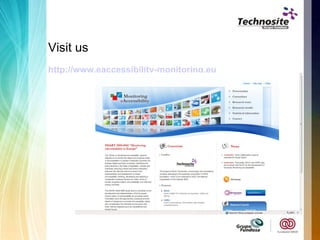
Visit us   http://www.eaccessibility-monitoring.eu
2.  Study on Economic Assessment for Improving eAccessibility Services and Products   What is the problem? Objective Scope Approach Outcomes and MS cooperation
What is the problem? People with disabilities are still not fully enjoying its benefits and opportunities provided by ICT eAccessibility is not a niche market, up to 70 million individuals:Market opportunity Need of robust evidence on cost/benefits Need of contrasted information at organisational level (decision taking) Need of strategic information and macro level (policy development)
Objectives To provide useful information on costs and benefits of eAccessibility At micro-level of analysis: Target : Managers of firms and  public sector organisations Objective : Provide evidence and a practical tool supporting investment decisions in eAccessibility At macro-level of analysis: Target :  Policy makers  Objective : Provide a view of the magnitude of potential benefits and costs for the economy and society as a whole
Scope  ICTs to be covered Web accessibility (primary focus)  Digital television ATMs and self-service electronic terminals Provide the  best practices  in legislation, policies and practices Provide  recommendations  for improvement:  Legislative, non-legislative, technical, business model and economic
Outcomes  Outcome :  The Business Case tool Instrument for ex ante evaluation in support of the decision to invest in web accessibility MS cooperation : Facilitating the access to field-level sources at micro-level E.g.  experts’ tacit knowledge, grey sources, case studies, and documents not available online, etc. MS interest : Instrument to assess the MS accessibility initiatives at micro-level.
Outcomes  Outcome :  Aggregate figures  of potential benefits and costs for the economy and society as a whole MS cooperation : Facilitating the access to: Secondary sources (e.g. official statistics, dataset produced by research, etc.) at macro-level Case studies of organisations that has carried out eAccessibility initiatives in your country MS interest : The macro-economic estimation and extrapolation may be used to support political decisions at macro-level
Outcomes  Recommendations : Legislative, non-legislative, technical, business model and economic  MS cooperation : Involvement in: Validation of the recommendations  (01/2011) The final workshop to validate and disseminate the main outcomes (04/2011) MS interest : Guidelines for policy makers to boost the initiatives supported by the macro-economic estimation and extrapolation
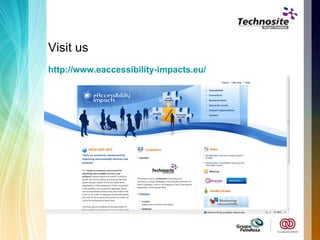
Visit us   http://www.eaccessibility-impacts.eu/
Thanks for your attention José Angel Martinez Usero Director of International Projects [email_address]

Commission studies on eaccessibility

  • 1.
    EC Studies oneAccesibility Jose Angel Martínez Usero Director of International Projects High Level Group on Disability, October 13th, 2010
  • 2.
    1. Studyon Monitoring eAccessibility in Europe What is the problem? Objective Scope Approach Outcomes and MS cooperation
  • 3.
    What is theproblem? eAccessibility progress in Europe is still low Need of awareness about status of eAccessibility Need of benchmarking information among MS Need of detailed information for decision makers and researchers
  • 4.
    Objectives Monitor thestatus and progress made in eAccessibility. Provide useful information tools for policy makers and researchers Establish a direct and regular relationship with the relevant actors Define, develop and apply a benchmarking framework.
  • 5.
    Scope - countries12 EU + 3 Non-EU + 2 voluntary basis EU countries : United Kingdom, Ireland, Sweden, Spain, Denmark, Italy, Germany, Hungary, Portugal, France, The Netherlands and Czech Republic. Non-EU countries : United States, Australia and Canada. Countries participating in a voluntary basis : Norway, Greece
  • 6.
    Scope - technologiesTELEPHONY: Fixed; Mobile; Special telephones INTERNET: Web; Mobile Web MEDIA: Digital television HOMES: Digital homes; Telecare URBAN: Digital information panels EDUCATION: Electronic books; Elearning platforms WORK: Office technology hardware and software ASSISTIVE TECHNOLOGIES: Hardware; Software
  • 7.
    Approach Analysis of national experts (30 + 6) 18 technology experts (technology questionnaire) 18 policy experts (policy questionnaire) Surveys to main stakeholders Consultation to user associations in order to get feedback on some specific issued covered by the former questionnaire Workshops with experts Analysis of main results and feedback from decision makers.
  • 8.
    Outcomes WebApplications : Website Balance Scorecard Tool Search applications and download of raw data Reports : Two Annual Reports Policy Inventory by technology - countries Report on the transposition of eaccessibility articles in Telecom Directives in MS Report on the interpretation and implementation of WCAG 2.0
  • 9.
    MS cooperation Validation of Annual Reports Sharing of info Participation in the annual workshops
  • 10.
    Visit us http://www.eaccessibility-monitoring.eu
  • 11.
    2. Studyon Economic Assessment for Improving eAccessibility Services and Products What is the problem? Objective Scope Approach Outcomes and MS cooperation
  • 12.
    What is theproblem? People with disabilities are still not fully enjoying its benefits and opportunities provided by ICT eAccessibility is not a niche market, up to 70 million individuals:Market opportunity Need of robust evidence on cost/benefits Need of contrasted information at organisational level (decision taking) Need of strategic information and macro level (policy development)
  • 13.
    Objectives To provideuseful information on costs and benefits of eAccessibility At micro-level of analysis: Target : Managers of firms and public sector organisations Objective : Provide evidence and a practical tool supporting investment decisions in eAccessibility At macro-level of analysis: Target : Policy makers Objective : Provide a view of the magnitude of potential benefits and costs for the economy and society as a whole
  • 14.
    Scope ICTsto be covered Web accessibility (primary focus) Digital television ATMs and self-service electronic terminals Provide the best practices in legislation, policies and practices Provide recommendations for improvement: Legislative, non-legislative, technical, business model and economic
  • 15.
    Outcomes Outcome: The Business Case tool Instrument for ex ante evaluation in support of the decision to invest in web accessibility MS cooperation : Facilitating the access to field-level sources at micro-level E.g. experts’ tacit knowledge, grey sources, case studies, and documents not available online, etc. MS interest : Instrument to assess the MS accessibility initiatives at micro-level.
  • 16.
    Outcomes Outcome: Aggregate figures of potential benefits and costs for the economy and society as a whole MS cooperation : Facilitating the access to: Secondary sources (e.g. official statistics, dataset produced by research, etc.) at macro-level Case studies of organisations that has carried out eAccessibility initiatives in your country MS interest : The macro-economic estimation and extrapolation may be used to support political decisions at macro-level
  • 17.
    Outcomes Recommendations: Legislative, non-legislative, technical, business model and economic MS cooperation : Involvement in: Validation of the recommendations (01/2011) The final workshop to validate and disseminate the main outcomes (04/2011) MS interest : Guidelines for policy makers to boost the initiatives supported by the macro-economic estimation and extrapolation
  • 18.
    Visit us http://www.eaccessibility-impacts.eu/
  • 19.
    Thanks for yourattention José Angel Martinez Usero Director of International Projects [email_address]