
STUDIES
IN THE
PSALMS
i
>
Other Books in the
0
0
0
0
0
e
0
0
0
0
0
0
0
0
e
0
0
0
0
0
0
0
0
0
0
0
0
BIBLE STUDY TEXTBOOK SERIES
-NEW TESTAMENT -
MATTHEW-VOLUME ONE
MARK
LUKE
JOHN
ACTS MADE ACTUAL
ROMANS REALIZED
STUDIES IN FIRST CORINTHIANS
STUDIES IN SECOND CORINTHIANS
GUIDANCE FROM GALATIANS
THE GLORIOUS CHURCH-EPHESIANS
PHILIPPIANS-COLOSSIANS-PHILEMON
THINKING THROUGH THESSALONIANS
PAUL’S LETTERS TO TIMOTHY AND TITUS
HELPS FROM H2BREWS
JEWELS FROM JAMES AND JUDE
LETTERS FROM PETER
HEREBY WE KNOW-THE EPISTLE O F JOHN
THE SEER, THE SAVIOUR AND THE SAVED IN THE BOOK
OF REVELATION
-OLD TESTAMENT -
OLD TESTAMENT HISTORY
GENESIS VOLUMES ONE, TWO AND THREE
DEUTERONOMY
STUDIES IN JOSHUATUDGES-RUTH
STUDIES IN SAMUEL
MINOR PROPHETS-HOSEA-JOEL-AMOS-OBADIAH-JONAH
-DOCTRINE -
SURVEY COURSE IN CHRISTIAN DOCTRINE VOL. I & I1
SURVEY COURSE IN CHRISTIAN DOCTRINE VOL. I11 & IV
THE CHURCH IN THE BIBLE
Other Books by C. C. Crawford
Published by College Ppess, Joplin, Missouri
Published by DeHoff Puhlicatiom, Murfreesboro, TenneSSQQ
THE PASSION OF OUR LORD
SERMON OUTLINES ON ACTS
SERMON OUTLINES ON THE RESTORATION PLEA
SERMON OUTLINES ON THE CROSS OF CHRIST
SERMON OUTLINES ON FIRST PRINCIPLES
COMMONSENSE ETHICS
Published by Wm.C. Brown Book Co., Dubuque, Iowa
..11
BIBLE STUDY TEXTBOOK SERIES
STUDIES
IN THE
PSALMS
Volume Two (73-1-50)
JOSEPH ~ R Y A N T
ROTHEIRHAM ...
(Translator of “The Emphasized B$ble”)
Paraphrase by
KENNETH N. TAYLOR
from the Livhg Psalms And Proverbs
Questions for Discussion by
DON DE WELT
College Press, Joplin, Missouri
iii
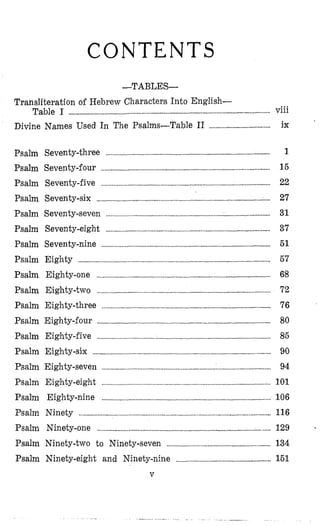
CONTENTS
-TABLES-
Transliteration of Hebrew Characters Into English-
Table I ................................................................................................................................. viii
Divine Names Used In The Psalms-Table I1 ....................................... ix
Psalm Seventy-three ......... ................................................... 1
Psalm Seventy-four ...
Psalm Seventy-five .........................................................
Psalm Seventy-six ...... ................................................... 27
Psalm Seventy-eight ..............
Psalm Seventy-nine ............................................................................................................ 51
Psalm Eighty .......................................
Psalm Eighty-one ...........................
Psalm Eighty-two .............
Psalm Eighty-three ............................................................................................................ 76
Psalm Eighty-four ......................................................................................... .......... 80
Psalm Eighty-five .................................................... .................................................. 85
Psalm Eighty-six .................................................................................................................. 90
Psalm Eighty-seven ......................................................................... 1............. 94
Psalm Eighty-eight .......... ...................... 101
Psalm Eighty-nine ............................................................................................................ 106
Psalm Ninety .....................
Psalm Ninety-one .........
Psalm Ninety-two to Ninety-seven .................................................................. 134
Psalm Ninety-eight and Ninety-nine ..................................................
Psalm Seventy-seven
V
---- ............ . . . . .
STUDIES IN PSALM,S
Psalm One Hundred ........................ ..................... 158
Psalm One Hundred and One .............................................................................. 163
Psalm One Hundred and Two .................................... ~ .......................
Psalm One Hundred and Three ......................
Psalm One Hundred and Four .............................................................................. I82
Psalm One Hundred and Five ........................................................ 190
Psalm One Hundred and Six .................................. ..................... 198
Psalm One Hundred and Seven ........................................................................... 207
Psalm One Hundred and Eight ..............................
Psalm 'One Hundred and Nine
Psalm One Hundred and Ten .............................................................................. 221
Psalm One Hundred and Eleven ........................................................................ 238
Psalm One Hundred and Twelve ................... ...................... 240
Psalm One Hundred and.Thirteen ..................................................................... 243
Psalm One Hundred and Fourteen ..............................................
Psalm One Hundred and Fifteen .......................
Psalm One Hundred and Sixteen ........................................................................ 252
Psalm One Hundred and Seventeen .................................................................. 257
Psalm One Hundred and Eighteen ................................................................ :. 259
Psalm One Hundred and Nineteen ................................. 1................................... 276
Psalm One Hundred and Twenty ........................................................................ 308
Psalm One Hundred and Twenty-one ............... ..................... 311
Psalm One Hundred and Twenty-two ............................................................ 313
Psalm One Hundred and Twenty-three .. ..................... 317
I Psalm One Hundred and Twenty-four ...................................................... 319
Psalm One Hundred and Twenty-five ............................................................ 322
Psalm One Hundred and Twenty-six ............................................................ 324
vi
CONTENTS
Psalm One Hundred and Twenty-seven ...................................................... 327
Psalm One Hundred and Twenty-eight ...................................................... 330
Psalm One Hundred and Twenty-nine ............................................................ 332
Psalm One Hundred and Thirty ........................................................................ 334
Psalm One Hundred and Thirly-one ............................................................ 338
Psalm One Hundred and Thirty-two .......................................... 340
Psalm One Hundred and Thirty-three .......................................... 346
Psalm One Hundred and Thirty-€our ........................................................... 348
Psalm One Hundred and Thirty-five .......................................................... 350
Psalm One Hundred and Thirty-six ..............................................
Psalm One Hundred and Thirty-seven .................................................
Psalm One Hundred and Thirty-eight ..................................................
Psalm One Hundred and Thirty-nine ............................................................ 368
Psalm One Hundred and Forty ................................. ........................... 381
Psalm One Hundred and Forty-one ............................................................... 384
Psalm One Hundred and Forty-two ......... .............................. 390
Psalm One Hundred and Forty-four %
Psalm One Hundred and Forty-five
Psalm One Hundred and Forty-six ........................................................... 410
Psalm One Hundred and Forty-seven ............................................................ 414
Psalm One Hundred and Forty-eight ............................................................ 417
Psalm One Hundred and Forty-nine ............................................................ 422
Psalm One Hundred and Fifty .......................................................................... 427
<
Psalm One Hundred and Forty-three
vii
.. . . . . . . . . . . . . . . . . .......... . ~
TABLES.
TABLE I.
TRANSLITERATIONOF HEBREW CHARAUTERBINTO ENGLISH.
Forin. Sign.
-
. . . . . .
soft 3 bh,v
Soft 3 gh
soft 7 dh
. . . . . .
... u
. . . . . .
. . . . . .
. . . . . .
... i
soft 3 kh
. . . . . .
-lign
-
b
g
d
h
W
2
h
t
Y
k
1
ma
,yof
eive
-
-
like th ’9,
“then.
when a
vowel
when a
vowel
-
--
as thin,,
I’thin
-,hreader
on. For
I Weasily
3 there);
2
6
26
-Na
1
2
3
4
5
0
-
r
8
D
10
11
12
-
to
exi
“ 8
an,
-43
- -
7 2
-Ya
13
14
15
10
17
I8
19
20
21
-
22
-
-Name.
-lign.
m
n
?
-
,
P
?
k
r
8
sh
t
-
-Form.
-ligii.
m
.-
n
...
...
PI1
...
...
..,
...
...
th
-En6
rcrip
I so
10 ni
aleph
beth
gin101
daletli
he
waw
zayin
heth
t6t
yodh
kaph
lamed
-
mem
nun
amecli
ayin
Pe
!adhe
kopli
res11
sin
or
shin
tau
-ise. I
1-know
rm bet
stood
ce beth
Una1 E
Rnal 1
...
...
soft D
...
...
...
...
...
soit n
-e mere
’8 Of tr1
I resh, 1
n 1311
‘he above Ta
we the simila
ple hecan I
n o h ” might ‘eep
imilarly how readili
be pnt to a o ~ n ~ e r e ~ t i n gsped;
irtsln Hebrew letters, a8 the 1
JW minute is the difference in
vi11enable
:ause of en
en daleth a
P vice-versa
160%.
where “u lifted” should ha
aph should$ave usurped the
I be pronounced 8s a in fathe]?.B.-The vowel R n and L as e in there.
TABLE 11.
DIVINENAMES,AS USED IN THE PSALMS,AND GENERALLY REGARDED ~8
OF PSALMS.INDIUATING THE FORMATION OF SUCCES8IVECOLLEUTK
-[EAOVAH
272
30
44
103
236
YAHb 1ELOHIMC1 ELOAH~1 EL*
(God) (BOB) (GOD)
ADONAI~
icv.Lord
12
18
15
1
7
--
ELYONg
doat High)
Bk. I.
(1-41)
Bk. 11.
Bk. 111.
(73-89)
Bk. IV.
Bk. V.
(107-150)
(42-72)
(90-106)
- 15 1 ’ 17
2 I 164
1 1 1 15
24
9
10
-- --Obs. 1. The choice of one or other of these Divine Names seems generally to have
been determined by intrinsic fitness. (See917,191,’, 8318, 119116).
Obs. 2.
Obs. 3.
But mcmionally shows an overruling adaptation to time, place, or u
by author or editor. (Cp. 14w. 68; 4012.17 W.70; and note all BOOR
Book I. is prevailing] Jehovistic; Book II., Elohistic; Book III.,about
equally balanced.; Jook IV., wholly Jehovistic; and Book V.,mainly
Jehovistic and Liturrrical..,
s h o p . “Yahweh.”
d Sing. of Elohim.
brlbbre. of ‘ I Yahweh.” aP1. of excellence, when absolutely used.
e Or “Mighty One.” *Conventionalpron. for Diviae name.
8 Once used of DavidicKing.
viii
STUDIES IN PSALMS
TABLE 1V.-ABBREVIATIONS
A r m . : Aramean,
A,V,: Authorized version.
Br.: Briggs.
CMm. : Chief Musician’s mark.
Cod. : Codex= written copy.
cp. : Compare.
Del. : Delitzsch.
Dr.: Driver.
ear. pt. ed.: Early printed edition of the Hebrew Bible.
G. Intro, : Ginsburg’s Introduction to his Massoretico-Critical
Gn. : Ginsburg’s notes in his Massoretico-Critical Hebrew Bible.
God =Elohim.
GOD=El.
Bible.
God=Eloah.
Gt.: Ginsburg thinlcs (a guarded opinion).
Intro. : Introduction to this work,
J.P.S,V.: Jewish Publication (Society Version) .
Kp. : Kirkpatrick.
Lm. : Librarian’s mark.
mf. : More freely.
ml. : More literally.
M.T. : Massoretic Hebrew Text. (For “Massorites” see Intro.,
Chap. I.)
Nm. : No mark-whether Librarian’s or Chief Musician’s.
9.G. : Oxford Gesenius (“B.D.B.”)
ix
TABLES
O.T.P.:Thirtle’s “Old Testament Problems.”
P.B.V.: Prayer Book version.
Per. : Perowne.
perh. : Perhaps.
P.R.I. : Public Reader’s Invitation.
prob. : Probably.
Read: In margin of M.T.
R.V. : Revised version.
Sep.: Septuagint (early Greek version).
’ shd. : Should.
sp. vr. : Special various reading (sevir) in Gn.
Syr. : Syriac.
T.G. : Tregelles’ Gesenius.
U.: Usually.
Vu].: Vulgate (Latin).
w. : with.
Written: In text of M.T.
a m : Sign for “Selah.” See Intro., Chap. III., “Selah.”
X
THE PSALMS
BOOK THE THIRD
P S A L M 7 3
DESCRIPTIVE TITLE
Temptation, arising from the Prosperity of the Lawless,
Triumphantly Overcome.
ANALYSIS
Stanza I., vers. 1-5, Under Protest, the Psalmist Confesses how Nearly he
had Fallen, by Observing the Prosperity of the Lawless. Stanza II., vers. 6-9,
The Evil Wrought in the Lawless Themselves by their Prosperity. Sranza III.,
vms. 10-14, The Evil Wrought in Others, breeding Sceptical Discontent.
Stanza IV., vers. 15-17, The Psalmist's Recoil from the Natural Effect of such
a Frank but Incomplete Statement, leads him to Seek More Light.
vers., 18-20, The Startling Picture which More Light Reveals. Sta
VII, VIII, vers. 21, 2'2; 23, 24; 25, 26, The Psalmist Shames Away his
tion in three stanzas of great power. Stanza IX., vers. 27, 28, A Fi
uast, Culminating in Public Song.
Stanza
(Lm.) Psalm-By Asaph.
1 After all God is good to Israel
to the pure in heart.
2 But as for me
my feet had well-nigh stumbled,
my steps had almost slipped;
3 For I was envious of the boasters,
at the prosperity of the lawless I kept looking.
4 For unfettered they are,
sound1and fat is their body:
1. So Gt,-Gn. Cp. O.G.359a.
1
STUDIES IN PSALMS
Of the travail of common men have they none,
nor with the earth-born are they (wontto be smitten.
Therefore a‘necklacefor them is haughtiness,
violence doth envelope them as their garment:
Their iniquityZhath proceeded from fatness,
the imaginations of the heart have overflowed :
They mock and wickedly speak oppression,
from on high they speak:
They have set in the heavens their mouth,
and their tongue marcheth through the earth.
Therefore his people turn back hither,
and waters of abundance are discoveredSby them ;
And they say-“How doth GOD know?
and is there knowledge in the Most High?
Lo! these are lawless men ;
and yet secure for an age they have attained wealth!
After all in vain have I cleansed my heart,
and bathed in pureness my palms ;4
And been smitten all the day,
and been rebuked morning by morning!”
“If” thought I “I must recount such things as these5
lo! the circle of thy sons shall I have betrayed.”
So I began to think in order to understand this,-
a travail was that in mine eyes :-
Until I could enter the great sanctuary6of GOD,
could give heed to their future.‘
After all in slippery places dost thou set them,
thou hast let them fall into ruins:
Row have they become a desolation in a moment,
come to an end been consumed in consequence of terrors!
Ams a dream by one who awakeneth
Sovereign Lord ! when thou bestirrest thyself their image
wilt thou despise.
5
6
7
8
9
10
11
12
13
14
15
16
17
18
’ 19
20
2. So it shd. be (w. Sep., Syr., Vu1.)-Gn.
3. So some cod. (w. Sep., Syr., Vu1.)-Gn. M.T.: “drained out’-Dr.
“Supped up”-Del.
4. With special allusion to bribery. “Here evidently referring to the keep-
ing of the palms clean from bribery, robbery and just those forms of violence
(ver. 6b) and oppression (ver. 8b) by which the wicked had to a great
extent gained their wealth and prosperity”-Br.
6. So, conjecturally, O.G. 466a.
6. MI. : “holy places,” or (possibly) “holy things.”
7. Cp. on 37:37, 38.
2
21
22
23
24
26
26
27
28
STUDIES IN PSALIMS
Ifmy heart should become embittered,
and in my feelings81 should be wounded
Then should I be brutish and without knowledge,
a stupid beastDshould I have become with thee.
And yet I am continually with thee,
thou hast grasped my right hand :
By thy counsel wilt thou guide me,
and afterwards gloriously take me.
Who (is there) for me in the heavens?
and with theezoI have no delight on the earth.
When have failed my flesh and my heart
the rock of my heart and my portion is God to the ages.
For lo! they who have gone far from thee shall perish,
thou wilt have exterminated every unchaste wanderer Prom
But as for me approach to God for me is blessedness.
I have fixed in Adonai Jehovah my refuge,
to tell of all thy praises
in the gates of the daughter of Zion.ll
thee.
Wm.)
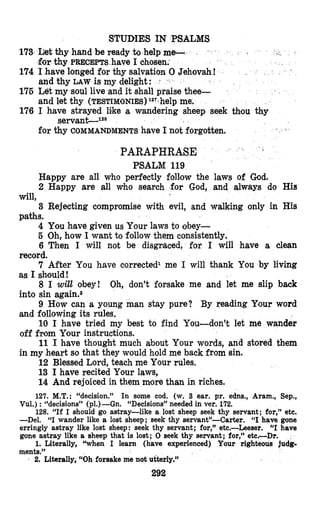
PARAPHRASE
PSALM 73
How good God is to Israel-to those whpse hearts are pure.
2 But as for me, I came so close to the edge of the cliff!
3 Flor I was enviious of the prosperity of the proud and
4 Yes, all through life their road is smooth!l They grow
6 They aren’t always in trouble and plagued with problems
6 So their pride sparkles like a jeweled necklace, and their
7 These fat cats have everything their hearts could ever
My feet were slipping and I was almost gone.
wicked.
sleek and fat.
like everyone else,
cloithing is woven of cruelty !
wish for!
8. U.: “reins.”
9. MI.: “A hippopotamus”-“a plump colossus of flesh , . . emblem of
colossal stupidity”-Del.
10. “Having thee”-Dr.
11. Thus found in Sep. and Vul., as in 9:14.
1. Or, ‘‘they never have any pains.“
3
STUDIES IN PSALMS
8 They scoff at God and threaten His people. How proudly
9 They boast against the very heavens, and their words
10 And so God’s people are dismayed and confused, and
11 “Does God realize what is going on?” they ask.
12 “Look at these men of arrogance; they never have to lift
a finger-theirs is a life of ease; and all the time their riches
multiply.”
13 Have I been wasting my time? Why take the trouble
to be pure?
14 All I get out of it is trouble and woe-every day and all
day long!
16 If I had really said that, I wodd have been a traitor to
Your people,
16 Yet it is so hard to explain it-this prosperity of those
who hate the Lord.
17 Then one day I went into God’s sanctuary to meditate,
and thought about the future of these evil men.
18 What a slippery path they are on-suddenly God will
send them sliding over the edge of the cliff and down to their
destruction :
19 An instant end to all their happiness, and eternity of
terror.
20 Their present life is ,only a dream! They will awaken
to the truth as one awakens from a dream of things that never
really were !
21 When I saw this, what turmoil filled my heart!
22 I saw myself so stupid and so ignorant; I must seem
like an animal to You, 0 God.
23 But even so, You love me! You are holding my right
hand !
24 You will keep on guiding me all my life with Your
wisdom and counsel; and afterwards receive me into the glories
of heaven !2
26 Whom have I in heaven but You? And I desire no one
on earth as much as You!
26,My health fails; my spirits droop, yet God remains! He
is the strength of my heart ;He is mine forever !
they speak!
strut through the earth.
drink it all in,
2. Or,“You will bring me unto honor.”
4
PSALM 73
27 But those refusing to worship God will perish, for He
destroys those serving other gods.
28 But as for me, I get as close to Him as I can! I have
chosen Him and I will tell everyone about the wonderful ways
He rescues me.
EXPOSITION
lt is fortunate that the uniform rendering of the expressive
particle ak, in vers. 1, 13, and 18 of this psalm, has led to such
a striking commencement of a poem which embraces a precious
mental history; since, by the combinetion, in that little word, of
an affirmative with a restrictive meaning, it so happily opens
the whole case, as ko suggest to Perowne the following amplifica-
tion: “Yes, ilt is so; after all, God is good, notwithstanding all
my doubts.” This entitles him to say of the psalmist: “That the
result of the conflict is stated before the conflict itself is de-
scribed. There is no parade of doubt merely as doubt. He
states first, and in the most natural way, the fiml conviction
of his heart.”
The next point of importance is suggested by a comparison
of 81:26 (“TOthe pure thou didst shew thyself pure”) ,with the
final clause of the psalmist’s first statementto the pure in heart.
Only a pure mind can vindicate a pure God. In confessing how
nearly he had lost his confidence in God’s goodness, the psalmist
admits that his thoughts had, in a measure, become defiled: he
had looked, he had lusted-without taking moral quality into
account, Happily, he looked again: until he saw something more
than prosperity; and that later look helped to clarify his thoughts.
But at first he lingeringly viewed the glitter and the show, until
he felt his feet slipping from under him. His attention had
clearly been arrested by fascinating examples of godless pros-
perity : examples shewing the absence of fettering restrictions,
sound health, freedom from common troubles, immunity from
providential inflictions. It should here be noted how a pre-
mature and disturbing notice of the “death” of those well-to-do
godless men is avoided, by a critical revision of the Hebrew text,
which a€ter all amounts to no more than a re-grouping of the
Hebrew letters. Premature such an.allusion would certainly be;
“for surely,” says Delitzsch, “the poet cannot begin the descrip-
tion of the prosperity of the ungodly with the painlessness of
their death, and only then come to speak of their healthfulness.”
Moreover, when afterwards, in vers. 18, 19, the psalmist does
STUDIES IN PSALM,S
undoubtedly confront the death of ‘the lawless, it is very doubtful
whether he intends to imply that it is painless. At all events,
in his first stanza he confines himself to the fascinatilon of the
godless lives to which his abtention had been repeatedly drawn.
In the second stanza, however, while the fascination still
lingers, certain repulsive features begin to obtrude themselves.
A neckkce and a flowing robe are, no doubt, signs of opulence
and social importance; but, when the former of these is haughti-
ness and the latter is vioilence, then, alas! for those who have to
suffer from them. Fatness generates iniquity : perverse imagina-
tions overflow in speech. Mocking at things sacred and divine,
such assuming and insolent men speak oppression, as their ap-
propriate dialect. With open profanity, their mouth sets divine
law at defiance, and their tongue presumes to propose laws con-
cerning all men and things in the earth to please themselves-in
their unmitigated selfishness. Such is the purport of the second
stanza. It is the result of a second look at the prosperous un-
godly. It is proof of a determination to look even worldly
fascinations full in the face. The discovery is already being
made that it is not all gold that glitters; and, as the result, the
snare is already nearly broken.
But, as stanza three shews, there is another source of danger
to be considered: “WHAT OTHER PEOPLE SAY” sometimes perverts
our own judgment. What, then, do they say? let us not fear to
examine it. That these prosperous lawless ones wield a great
influence, is, indeed, too apparent. Not only do they influence
their own ctaoz-each wealthy prince h4s gown peuple,-as some
expositors take ver. 10a to intimate; but even among His people
that is, God’s,-some there may be who are seduced into the
expectation of discovering waters of aburtdance where these
enviable wealthy men have already found them: And so these
admirers reason (themselves into scepticism. It is shallow rea-
soning, but it is taking. ‘Zook you,” say these misguided on-
lookers, “these are such as good people call ‘lawless men’; and
yet see how they get oryl: see how, f o r a life-time, they have been
secure from providential visitation, and to what wealth they have
attained! Talk of Providence-where is it? Does God-if there
be one-know anything about it?” So much for vers. 10-12 of
this stanza,
It is probably best to take vers. 13, 14 as still continuing to
describe “what other people say” who are unduly under the in-
fluence of the prosperous lawless ones: only, now, another class
6
PSALM 73
of them comes into view-namely the hitherto punctilious people,
more alive to their religious “profit and loss account” than to
abstract reasonings about the Divine Government. We need not
deny that, by voicing the precise difficulty €elt by these whining
and selfish religionists, the psalmist, at the same time, provides
that his own transient doubts of the like kind shall find expres-
sion. Suffice it, that lthe pernicious iniluence of the ungodly
rich has been amply described.
But it is time that the tables were turned, and a decisive
solution lof the problem were given; and so, here, at ver. 16, we
come to the second part of the psalm. It is observable, that the
psalmist resumes where he left off; namely, with the considera-
tion of what others would say-only now the “others” are a
very different class from those just described. He now brings
before him those whom, in their collective capacity, he terms the
circle of God’s sow, amongst whom, therefore, a sense of the
Divine Fatherhood is still preserved. “What will these say,”
he seems to ask, “if I frankly tell them of these admirations of
the godless rich, and these shallow reasonings about their ex-
ample; if, at least, I tell the story as though I for rnyseZf serilously
felt its spell? Will they not be shocked that I have so betrayed
the honour of our Divine Fatherhood?” Happy the reasoner
who has a circle of brethren from whom such a counteracting
and healing influence may be counted upon; so that, to think of
frankly telling them of his mental difficulties, is to feel those
difficulties more than half solved by anticipation. Thrice happy
was Asaph, that he was one of such a companionship of pure
hearted Israelites-the more so, because he was both a thinker
and a prophet: as a thinker, able to appreciate lthe mental travail
involved in working out a difficult problem (ver. 16); and, as a
prophet, knowing by experience how a sudden flash of light from
the Spirit of God could at once remove difficulties which no mere
thinking could solve (ver. 17). Hence, as he here intimates,
although he at once begun to think, he was nlot sanguine of the
results to be expected from that process alone: he counted much
more for success upon such a REVELATION as he felt would be
more likely to be vouchsafed amidst the oongenial influences of
the great sanctuary of God than elsewhere: the great sanctuary,
with its leisure and quiet, with its sacred associations, with its
solemn sacrifices, with its inspiring music, and especially with
its songs old and new, some of which, like 37 and 49, might be
found to have anticipated his present difficulties, or at least to
7
STUDIES IN PSALMIS
favour the making of ’fresh discoveries by his own mind. It
should be noted, however, that the psalmist’s late experience and
present ponderings are already putting him on the right track
for search; that, in fact, he knows the precise point on which he
needs illumination : namely the future of these ungodly prosperous
men: until I could consider their future. We do wisely to be
thus careful to observe precisely where this stanza breaks off-
the exact point to which it leads up; and there can be no mistake
that now the language of the psalm leads over from reflection
and resolve to that of discovery. In ver. 17 it is resolve: in ver.
18 it is discovery. The discovery is introduced by the significant
term after all, to which reference has already been made; and
the disclosure is thenceforward continued in the form of direct
address to Deity. Note the wording: thou dost set them-thou
hmt let them falGwhen thou bestirrest thyself-their image wilt
thou despise. Plainly it is now thq confident language of direct
address to Deity. Bult the language is changed, because the scene
has changed: the psalmist is now in the great sanctuary,’and feels
himself to be in the very presence of God, and by the confident
directness and assurance of his words shews that he has now
received the further light which he was resolved to seek con-
cerning the future of these ungodly prosperous men. Thus, then,
every word of the ensuing stanza demands our most careful at-
tention-and our utmost confidence.
“Afterall,”-he exclaims, in the very language of discovery:
“after all the wealth and all the power and show; after all the
admiration and envy and the vain reasoning; after all the ap-
pearance of thine indifference, as though thou knewest not how
thou wast being set at nought: after all, thou hast been very
much in this very ,thing, carrying forward thy h’oly designs. For
thou hast been setting these very men whom their fellows have
so much envied, in slippery places of uttermost peril.” We
naturally and rightly supply, in undertone, from our other and
it may be fuller knowledge of the fairness and equity of God’s
ways, the important qualification : “Thus-for sins already com-
mitted-hast ‘thou been punishing them for their presumption
in wilfully persisting in doing without thee.” And it was well,
therefore, that we detected, in the first lines sketching the image
of these men, the note of previous self-determination to evil: they
had already become unfettered,having brushed aside Divine law
and silenced the voice of conscience. “AS a punishment for this
previous course of sin and self-hardening; and (should we not
8
PSALM 73
add?) as a last Divine resort to convince them of their folly:
thou dost set them in slippery places.” Alas! in the actual
circumstances revealed to ‘the psalmist, this punishment avails
nothing for reformation, but takes effect as punishment with de-
structive effect. With startling fulness and vigour is this dis-
closure made: “Thou hast let them fall into ruins-like a bowing
wall which comes down of its own weight with a crash, its ruin
being sudden and complete.” With this revelation the psalmist’s
mind is deeply impressed-as its exclamatory form shows:
“How have they beciome u desolation in a moment-so complete!
so sudden !” The final catastrophe is further described by terms
piled up for effect: They have come to an end, ha,ve been con-
sumed,-how could complete destruction be more strongly ex-
pressed? But, to this, the significant addition is made: in
oonsequence of terrors-who shall venture to say what these
terrors are? As in Job 18:11, 14, 24:17, 27:20, 30:15, they may
be terrors within the bounds of this life, and cloping it; or, as
in Ezekiel 26:21, 27:36, 28:19, they may be terrors connected
with the Hadean continuation of existence, and ending it. That
they do terminate the being of these erewhile boasters, is the
lone thing which the disclosure makes plain, We have not yet
done with this description. Let us complete our notice of it,
before we turn back ‘to ask what it all means. With a simple
oriental audacity which has in it no particle of irreverence, the
psalmist represents the Sovereign Lord as having been asleep
while these godless rich have been indulging their lust of wealth
and pomp and power-and cruelty: by all which we understand
no more than that Adonai had interfered as little as though he
had been asleep. But, working out this figurative vein, he says:
“as a dream (is despised) by one who awakeneth, Sovereign
Lord! when thou bestirrest thyself (to deal with their case as it
demands and deserves) their image wilt thou despise?’ Here,
undoubtedly, much depends upon a right appreciaticon of the word
imuge; since, whatever it is, it is something which Adonai
despises, and it becomes us to be careful how we define an
object ‘of avowed Divine aversion! Scholars are not quite agreed
in their renderings of this instance of the Hebrew xelem. The
R.V., Perowne and Leeser follow the A.V. in translating it
“image” ; but Carter and Delitzsch represent it by “shadow,”
Driver by “semblance,” Briggs and Wellhausen (in P.B.) by
“phantom.” Now, undoubtedly, there i s one passage, namely
39:6, in which-by reason of the context-some such rendering
9
STUDIES IN PSALMS
is required: and it is further undeniable that the notion of
“shadow” lies at the root ‘of the original ‘word; for which very
reason, however, it is submitted that “image” is the better
translation in the present instance; not only as connecting his
passage with the account of man’s cpeation in Genesis (1:26, 27,
9:6), and usefully reminding us in passing that even there man’s
likeness ‘to his Maker-consisting in his capacity to rule (cp.
Exposition on Ps. 8) was after all little more than a “shadow”
of the Divine capacity and power to govern ;but more particularly
and most vitally lthat ‘the very word “image” is the term which
takes us to the heart of this most weighty passage. “Their image
-as a mere caricature of thine own, it is, 0 Sovereign Lord,
which thou wilt despise!” Assuredly, it is not the mere frailty
of man’s ordinary mortal condition, which God despises; nor is
it the attenuated semblance of man’s former self which alone
can penetrate hades “as far as the circle of his fathers” (49:19),
which God despises. Out of the former, by transformation, he
can raise up new men, mighty as angels and immortal as his
own Son; and unto the latter, as still “the work of his own
hands,” he may come to have a “longing,” as Job faintly hoped
(14:15). Therefiore it is neither of these semblances, as such,
that Adlonai despises; for despises is a strong word, and] in
neither of the above cases is it consistent with the known con-
descension of “a faithful Creator” (1 P. 4:19). No! far other
than merely these, is the object which here starts forth from
the canvas as, so t o speak, exciting the contempt of an awakened
and affronted God. It is the primary image of God, wickedly,
wantonly disfigured. Even we, under Asaph’s sympathetic guid-
ance, have, already-within the compass of this psalm-looked
on that “image” and loathed it: the unfettered free-thinker and
free-liver; the fat, sleek pamperer of his precious self; the so-
called pet of Providence, stranger alike t o ordinary and extra-
ordinary trouble; deeming it an adornment to be haughty, and
a becoming robe to be violent; whose gross mind concocts evil
schemes; whose vile mouth propounds and promotes and defends
unblushing villainies; whose tongue talks as if all the earth had
been made for his convenience-a man therefore who practically
deems himself to be his own God! alas turned devil! Have we
by this time learned to detest him? How great a ,wonder, then,
that a holy God should have left him to himself so long !
Such then, in full, is the description given by Asaph of the
revelation which he had received in the great sanctuary of God,
10
PSALM 73
concerning the future ‘of the lawless rich bearing this debased
image of God,
And now what does it all mean? Does it merely mean sudden
death; or does it rather mean totar death: an utter destruction
of personal being? If any elect to say, “Merely sudden death”;
may we not turn upon them with Itlie questifon,how mere sudden
death meets the case? Suppose we could (as we cannot, for
want of evidence) accept it as an observed fact, that such
presumptuous men do uniformly die sudden deaths ; hiow would
that alone solve this mystery of providence? Is there, after all,
any such broad distinction to be drawn between slow death and
sudden death? What does it signify so much, whether a man is
struck down in a moment, or whether he slowly wastes and wears
away? It is not at all plain that there is anything material in
the difference. Besides, it may with confidence be affirmed,
that this is not the direction in which the text points. Certainly,
suddenness is there-at least relative suddenness (in a moment).
But the point emphasized by the accumulated terms of the
passage is rather the completeness of the destruction, than the
suddenness of the death, Indeed, it looks as though the word
“death” had been carefully avoided; but while the common word
“death” is avoided, the word terrors is emphatically broughlt in,
and some scope must naturally be given in which those terrors
may be supposed to effect the terrible overthrow intended: an
overthrow so terrible and complete that before the psalm is
ended, it is termed both a peyishing and an extermination. In
fine, the impression made by the whole passage is, that it is
not what is understood as an ordinary sudden death that is
meant; but an awful infliction of the utter destructilon of the
whole being by some unendurable manifestation of Divine wrath :
as a Christian, availing himself of New Testament language,
might say,-the first and second deaths being blended in one,
and the terrors including the wrath of the Lamb (Rev, 6:16, 17).
These may be regarded as here foreshortened for the practical
purpose #of summary statement, and because the then current
knowledge of the future could not bear the introduction of de-
tails. Reverting to what the O.T. itself does teach, we may use-
fully remind ourselves of that great passage in Isaiah (57:16)
which plainly intimates that there is possible such a protracted
manifestation of Divine anger, as no man could sustain; and
though, there, the intention seems to be, to let in a hope of mercy,
yet here the intention is equally visible of excluding such hope.
11
STUDIES IN PSALMIS
Of course, if death were ordinarily to be taken as equivalent to
total extinction of personal being, all this would amount to
nothing; and our exposition would have to remain unfinished.
But, assuredly, we may, with the general consent of Bible readers,
dismiss that devastating conception of death as extravagantly un-
warrantable; and therefore may reaffirm our present conten-
tion that the utter desolation and final extinction of personal
being is the true meaning of this passage: first, because it
completely fills up the terms employed, and, second, because
it solves the providential mystery it was given to explain. After
such a revelation, who dare pray to be rich, who can desire to
be set in such slippery places? The temptation is gone; and
therefore it follows that the answer is complete. In further
confirmation of all which, as thus far advanced, suffice it t o
call attention to the broad, fundamental harmony which this ex-
position of the Psalms unfolds. In the first of this series of
psalms, 37, 49, 73, it was sribmitted that for the righteous man
there is a ficture: for transgressors there is not! The confident
assurance of the truth of that conclusion has helped us so far
through this psalm and nothing else could. That conclusion
stands as an immovable principle, Details are yet needed, but
some particulars are already being supplied. Here we see not
only the principle confirmed; but the detailed and penetrating
lesson taught, that even in this life the Divine image may be so
defaced and caricatured as to become an offence to the Almighty
and ripe for destruction, as a consequence of unknown terrors!
In ,at length advancing to Stanza VI. of this psalm (vers.
21-22), we have to express immeasurable obligation to Delitzsch
for suggesting and defending the hypothetic oolouring thrown
upon it. How disconcerting it would have been to find the
psalmist still floundering in (or, if not flloundering in, at least
lingering over) the doubts, from which the vision in the greak
sanctuary was given to deliver him! How delightful, by contrast
and by helpfulness onward, to perceive that he is now merely
shaming his former doubts into perpetual silence. “How un-
manly!’’ he is now heard saying, “to cherish such feelings any
longer! How unworthy of the name of a man, to harbour such
thoughts any more!” He had modestly assumed to be a thinker,
before he could find opportunity to go into the great sanctuary
of God. But now that he has been thither-or is still perhaps
remaining there, since his address to God is as yet unbroken-
he thinks again, and to some purpose; and his thought is, what
12
PSALM 73
“a colossus of stupidity” he would be, nlot now to be satisfied:
“I, a m,an, who can converse with thee, and receive such counsel
w thou hast now been giving me!” Furthermore, this merely
hypothetic repetition of the old temptation enables us to advance
at once, at the close of this stanza, to the natural rending of
the preposition (with thee-Gk, rough breathing ’immalca)
which has t o do such important service in the very next line,
namely the first of Stanza VII. The old doubt only hypothetic-
ally put, enables us to anticipate by saying “with thee,” here at
the close of ver, 22: “Being, as I am, with thee, how stupid
such a doubt would now appear.” And then he can fiollow on in
ver. 23 by saying, And yet I am continually with thee (’immzaka).
In contrast with the smoothness of which, how awkward and
even suspicious ito have to render the same preposition first
“before thee” (ver. 22) and then “with thee” (ver. 23). We
are thus particular down to a particle, because of the extreme
value of Delitzsch’s hypothetical translation of vers, 21 and 22:
which, thus defended, may now be dismissed.
Stanza VII. thus at once bears us along into $he midstream
of near fellowship with God and of consequent victorious confi-
dence in Him. “Thou hast grasped my right hand, by thus
disclosing io me that which for ever shames into silence my
doubts. By Thy counsel wilt thou (continue to do as thou hast
now done) guide me, And afterwards (leaving us easily t o supply
the thought, ‘after life’s journey’) glio.riously take me.” ‘ He
knows not precisely how it. will be done, but gIo/yious in the
manner of it will it assuredly be; and the decisive act done, he
says, will be to take me, even as Enoch was taken to be with
God; or, as Ps. 49:16-if just sung in “the great sanctuary”-
may have suggested, “wilt take me (out (of the hand of hades,
whether by transformation preventing death, or by resurrection
reversing death) )’ The point of this revelation clearly cannot
lie in details, which are confessedly not supplied; but in the
broad and simple fact announced, of being taken by God. Obvi-
ously all turns on the character of him who takes. Re who, as
an enemy whom I hate, captures me, makes of me a slave, and
excites my utmost fears; but he who, as a friend whom I admire
and love, captures me, at the same time enraptures me, delights
me, and excites my highest hopes, All, then, here turns on the
character of God, and of his relation to me, And of this, the
next stanza sings.
In language of extreme simplicity and brevity-like the
13
STUDIES IN PSALMS
lispings of a babe that has not yet learned to speak-and yet
of extreme beauty, because everything is suggested that is not
expressed, the psalmist (Stanza VII.) says, Who-for me-in the
heavens? And-with thee : having thee- (whether there or
here) I have no delight on the earth (where are, or have been,
all I have known and loved), Of course, the language is com-
parative, even while it shrinks from comparison; but the one
clear thing ,which it reveals is the delight in his God now felt,
as never before, by this pure-hearted Israelite. It is on the tide
of this delight in God himself that he is carried over into the
unknown, and is moved to express a conception to convey which
no exact words had yet been coined; and the approximate words
to express which amount to a contradiction in terms: When
have failed my flesh and my heart-(in other word$, my body
and my mind)-the rolck of my heart and my portion (then and
on and ever) is God age-abidingly. The mind that rests on thmat
rock cannot sink. The essential Ego will somehow survive the
wreck; if it have nothing else in which to inhere, it will inhere
in God, or else a sorry poytion would he be! But, indeed, we
have gone too far, in saying that for this conception no language
had yet been coined-although, it is true, Asaph may not have
been familiar with it: “Into thy hands I commit my,spirit” (31 :5)
probably is a prayer which exactly meets the case, and at all
events was honoured by being used by Jesus and by his first
martyr Stephen. Nevertheless, in any case, Iiove finds out how
to make itself understood; and absolute triumph over death is
here radiant as the rising sun. Perfect love to a perfect God
gives the victory: the nearest possible approach to that God
(Stanza IX.) constitutes the highest attainable blessedness, and
must ever prompt the mlost joyful songs of Zion whether earthly
or heavenly.
QUESTIONS FOR DISCUSSION
1. Read verse one and discuss whether or not the conclusion
to the problem is here stated.
2. There are several Psalms which discuss the problem of the
prosperity af the wicked. If it was
solved before, why raise the issue again? Are there dif-
ferent facets of the problem in each Psalm? Discuss.
3. If all we know about heaven was that which is contained
in the Old Testament, how easy would it be for us to endure
the arrogant prosperity of the wicked? Discuss.
(Cf. Ps. 27 and 49)
14
PSALM 73 AND 74
4. Into which “sanctuary” did the Psalmist go? Into whmat
sanctuary can we go? Is the church building a sanctuary?
Is there a better one?
6. Please be h’onest with yourself and give ‘a personal answer
to the several questions asked in the texlt: (1) “Does God
realize ,what is going on?”; (2) “Have 1 been wasting my
time?”; (3) “Why take the trouble to be pure?”; (4) “Whom
have I in heaven but You?”; ( 6 ) “Whom do 1 desire on
earth but Thee?”
6, A large part ,of the problem is in what others will see and
say about the believer-Discuss.
7. Is the problem of this Psalm larger in America or in Asia
or Africa or Europe? Discuss.
P S A L M
DESCRIPTIVE TITLE
Ruthless Injuries to the Sanctuary and Oppression in the Land
by an Enemy, call forth Expostulation with God
for his quiescence.
ANALYSIS
Stanza I,,vers. 1-3a, In Expostulation for Present Rejection, the Psalmist
Reminds God how he had Acquired, Redeemed, and Exalted His Inheritance.
Stanza 11,,vas. 3b-7, Profanation of the Sanctuary Described. Stanza III., vers.
8, 9, Extent of the Desolation. Stanza IV., vers 10, 11, Renewed Expostulation
with God.Stanzas V., VI., VII., vers, 12, 13; 14, 15; 16, 17, Divine Activities
Aforetime in History and in Creation. Stanzas VIII., IX., X., vers. 18, 19;
20,21; 22,23, Earnest Pleadings for Divine Interposition.
(Lm.) An Instructive Psalm-By Asaph.
1 Wherefore 0 God hast thou cast off utterly?
wherefore smoketh thine anger against the flock of thy
shepherding?
aforetime?
inheritance,-
2 Remember thy congregation (which) thou acquiredst
(which) thou redeemest to be the tribe of thine
Mount Zion wherein thou didst make thy habitation,
15
STUDIES IN PSALMS
which thy footsteps exalted t o perpetual dignity.l
Everything hath the enemy marred in the sanctuary:
roared have thine adversaries in the midst of thy place of
they have set up their signs for signs.
A man used to become known as one who had wielded on
in a thicket of trees axes!2
But now the doors3thereof all at once
with hatchets and hammers they smite!
They have thrust into the fire thy holy thing^,^
to the ground have they profaned the habitation of thy name.
They have said in their heart-“We will ,force them down
they have caused to cease all the festivals of God in the
Our signs (wesee not,
there is no longer a prophet;
nor is there with us one who knoweth how long.
Howlong 0 God shall an adversary reproach?
shall an enemy blaspheme thy name perpetually?
Wherefore shouldst thou draw back thy hand?
and thy right hand in the midst of thy bosom retain’?
And yet God was my king from aforetime,
working victoriess in the midst of the earth.
Thou didst divide in thy strength the sea,
didst shatter the heads of (river) monstersQupon the waters:
Thou didst crush the heads of the crocodile,
didst give him as food to the creatureslO that dwell in the
meeting,
high
altogether !”, ,
land?
deserts.
1. So Br., who says: “Requires no change in the unpointed text.”
2. Supply, perhaps, in thought: “when the sanctuary was built.”
3. So it shd. be (w. Sep., Syr., Vu1.)-Gn.
4. So in some cod. (w. 3 ear. pr. edns.)-Gn.
3
4
5
6
7
8
9
10
11
12
13
14
6 So Del.
6. So Sep. M.T.: “They have burned up all the meeting-places of God in
the land.”
7. So Br. “From the midst of thy bosom (pluck it forth) and consume.”
So Driver and others, following M.T. and supplying “pluck forth.” Ginsburg
says that kalleh, “consume,” shd. be d a h (? “lift up,” as in 68:4).
8. Or: “a great salvation” (pl. intensive).
9. So Dr.
10. Ml.:“people.” Dr. : “folk” as in Prov. 30 :25, 26.
16
15
16
17
18
19
20
21
22
23
PSALM 74
Thou didst cleave open fountain and torrent,
thlou didst dry up rivers of steady flow.
Thine is the day yea thine the night,
thou didst establish light-bearerll and sun :I2
Thou didsit set up all the bounds of the earth,
summer and autumn thou didst fashion them.
Remember this! an enemy hath reproached Jehovah,
yea the people lof a vile13 person have blasphemed thy name.
Do not give up to a wild beast the life14 of thy tuntle-dove,16
the living host of thy humbled ones do not forget perpetually.
Look well to thyla clovenant,
for filled are the dark places of the land1‘ with the
habitations of violence,
May the crushed one not turn back confounded !
the humbled and the needy let them praise thy name.
Arise! 0 God 0 plead thine own plea,
remember the reproach of thee from the vilex3person all the
Do not forget ithe voice of thine adversaries,-
the noise of them who rise up against thee ascending
(Lm.) To the Chief Musician. (CMm.) “DOnot destroy.”
day
continually.
PARAPHRASE
PSA’LM 74
0 God, why have You cast us away forever? Why is your
anger hot against us-the sheep of Your own pasture?
2 Remember that we are Your people-the ones You chose
in ancient times from slavery and made the choicest of Your
possessions.
3 Walk through the awful ruins of the city, and see what
the enemy has done to Your sanctuary.
4 There they shouted their battle cry and erected their idlols
to flaunt their victory.
You chose Jerusalem1 as Your home on earth!
11. Prob. : “moon.”
12. Sep.: “sun and moon.”
13. Or: “senseless.‘l Cp. on Ps. 14.
14. u.: “SOUI.”
15. Sep.: (‘a soul giving thanks unto thee.”
16. So it shd. be (w.Sep., Syr., Vu1.)-Gn.
17. Or: <‘earth.”Cp. Intro., Chap. III., “Earth.”
1. Literally, “Mount Zion.”
17
STUDIES IN PSALUS
5, 6 Everything lies in shambles like a forest chopped to
the ground. They came with their axes and sledgehammers and
smashed and chopped the carved paneling,
7 And set the sanetuary on fire, and razed it to the ground-
Your sanduary, Lord.
8 “Let’s wipe out every trace of God,” they said, and went
through the entire country burning down the assembly places
where we worshiped You.
9, 10 There is nothing left to show that we are Your peo-
ple. The prophets are gone, and who can say when it all will
end? How long, 0 God, will You allow our enemies to dishonor
Your name? Will You let them get away with this forever?
11 Why do You delay? Why hold back Your power? Un-
leash Your fist and give them a final blow.
12 God is my King from ages past; You have been actively
helping me everywhere throughout the land.
13, 14 Ylou divided the Red Sea with Your strength; You
crushed the sea-god’s heads! You gave him to the desert tribes
to eat!
15 Art Your command the springs burst forth to give Your
people water; and then You dried a path for them across the
everflowing Jordan.
16 Day and night alike belong to You; You made the star-
light and the sun.
17 All nature is within Your hands; You make the summer
and the winter too.
18 Lord, see how these enemies scoff at You. 0 Jehovah,
an arrogant nation has blasphemed Yonr name.
19 0 Lord, save me! Protect Your turtle-dove from the
hawks.2 Save Your beloved people from these beasts.
20 Remember Your promise! For the land is full of dark-
ness and cruel men.
21 0 Lord, don’t let Your downtrodden people be constantly
insulted. Give cause for these poor and ttieedy ones to praise
Your name!
22 Arise, 0 God, and state Your case against our enemies.
Remember the insults these rebels have hurled against You all
day long.
23 Don’t overlook the cursing of these enemies of Yours;
it grows louder and louder.
2. Literally, “the wild beasts.”
18
PSALM 74
EXPOSITION
It is clear that the composition of this psalm was occasioned
by the desecration of the Temple and the oppression of the Land
by some foreign invader; but precisely which event of this kind
is here intended, is uncertain, Some have confidently pointed to
the time ,of the Maccabees, when the temple was desecrated
under Antilochus: against which may be urged the standing un-
likelihood that any psalm had so late an origin, and yet found
its way as did this, and lthe rest, into the ancient Septuagint
version of the Old Testament; and the particular objection that
the very line in the psalm which might otherwise have seemed
to point to a Maccabean origin, viz. ver. 8, “And they have
burned up all the meeting-places of God in the land,” appears
in the Sep. in the milder fiorm, And they have mused to cease
all the festivals of God in the land. It may be true, that the
erection of synagogues cannot be traced further back than to
the time of the Maccabees; but it is inconceivable that the Greek
translators should have obliterated such an allusion, had it existed
in their Hebrew exemplars, though quite possible that later
Slopherim should have adapted the Hebrew of the old psalm, so
as to conform it to later and more startling events. Others
again, have advocated the time of the Chaldean invasion under
Nebuchadnezzar, as having probably given birth to this psalm.
And that is a possible date; although the lament over the want
of a prophet lor one who knew how long but ill agrees with the
presence of Jeremiah and Ezekiel in those days. Even if, to
avoid this awkwardness, the origin of the psalm be thrown
further down the Exile, and in favour of that time the words
be cited, “Lift up thy footsteps to the perpetual desolations,” as
showing that now the desolation of Jerusalem had lasted a long
time,-then it is at least disconcepting to note, what Briggs says,
that the same consonants, otherwise vowel-pointed, may be read
(surely mlore in harmony with the immediate context) Which
thy footsteps exalted to peipetual dignity. Under these circum-
stances, it may be questioned whether the “Speaker’s Commen-
tary” has not more nearly hit the mark in suggesting as the
probable time and occasion of origin, the invasion of the Egyp-
tian monarch Shishak in the days ‘of Rehoboam. In favour of
this comparatively early date, may be mentioned: the care which
the psalmist observes ‘to express rather a desecration than a
demolition of the temple; and the aptness of his language in
vers. 5, 6 to apply to a hime when the building of the temple
19
STUDIES IN PSALM’S
was yet a comparEtively recent event. While yet the honlour of
having lifted an axe in the Lebanon to supply cedar for the erec-
tion, of the temple was well remembered, here are profane
hatchets and hammers engaged in ruthlessly tearing off the
plates of gold which covered the dolors. It seems as though:the
psalm was writ ile this profanation was going on; and
not merely conce conflagration viewed from afar ! Given,
a psalmist well remembering the glory of the erection of the
temple; given also, the instinctive horror felt by such a man on
occasion of the first intrusion of foreign feet within the sacred
precincts;-and you have probably a more fitting psychological
condition to suit the origin of this psalm than any other that
can be imagined with due regard to known facts. It is difficult
to say why the psalm does not contain a confession of sin, ‘as
the true reason why such a foreign invasion was permitted,
especially as this is made so prominent in the history; but we
may perhaps surmise that this element lay, for the moment,
comparatively dormant in the psalmist’s mind, because of his
ignorance of ;the lengths to which the invader might be permitted
to go, and the vividness with which he saw in those broader
views of Gsod’s gracious purposes in calling Israel to be his
people and in making Mount Zion his dwelling-place, such weighty
pleas against the destruction which at the time appeared immi-
nent. Whatever the cause of this absence of confession from
the psalm, it shlould be remembered that the fact of its omission
bears as much upon one foreign invasion as another: any such
invasion-whether Egyptian, Chaldean or Syrian-must have in
reality seemed permissible only because of grievous national sin
commibted.
The course of thought which the psalm actually pursues is
noteworthy, especially in respect of the broad collateral facts in
history and in nature by which the psalmist strengthens his
pleading with God.
After reminding God of the wonderful way in which he
had made the Hebrew congregation peculiarly his own (vers.
1-3a) ; and then vividly depicting the present devastation of the
sanctuary (vers. 3b-7), and the forlorn condition of the land,
especially as regards religious privileges (vers. 8, 9 ) s ; and after
pleading with God no longer to delay his silencing of the profanity
of the invader (vers. 10, 11);-the psalmist then enlarges on
the almighty deeds of Israel’s King. He introduces the great
facts clustering around the deliverance from Egypt and the ad-
20
PSlALM 74
mission into the promised land (vers. 12-16)-facts which oonsti-
tuted an almighty handling of the powers of nature and pressing
them into the service of creating and redeeming a Nation. At
this point, in a stanza of great simplicity and beauty (vers. 16-
17) the poet passes on to a notice of the Divine relahion h
day and night, moon and sun, earth and seas, s u m e r a8 pre-
supposing sprimg and autumn as bringing after it winter. These
allusions are not only beautiful in themselves, and a poetic
relief to the mind of the reader but they are true aids to dew-
tion, and give pleasing force to the petitions which they introduce.
They suggest more than they formally articulate. They seem to
say: “Such, 0 God, are the praises, which habitually ascend to
thee from this holy place; but now, only hear the reproaches
and the defiance which are from this very spot directed against
thy Holy Name! Canst thou be the Divine King whom we thus
adlore, and not be able and willing to hearken to our prayers?”
nd then follows a volley of petitions: remember-do n o t give
do n o t forget-look weldmrise-remember-do n o t fovget.
The very cllose of the prayer is initercessionally dramatic. Instead
of. a final benediction, we hear the gentle but undaunted voice
of this petitioner making a last effort to turn the sustained
din and roar of the adversary in the sanctuary into so much
prayer for speedy Divine Intervention. Noting these things, even
Christian intercessors may learn valuable lessons from this psalm,
as to the reality, boldness and scope of pr,ayer. Moreover, it
would be upardonable to forget what we owe to Dr. Thirtle
for the collateral warrant he affiords for moving the inscription
Do n o t destroy, from the beginning of the next psalm, where its
applicability is not very evident, to the foot of this, where its
appropriateness must strike every unprejudiced mind : that has
really been the prayer of this psalm-Do n o t destroy!
1,
2.
3.
4.
QUESTIONS FOR DISCUSSION
The Temple is desecrated-but when? By whom? Give
and defend your opinion,
List the descriptive terms for the nation of Israel. Re-
member “we are the Israel of God” (Gal. 6 :16).
List the great works of Jehsovah which pnove He could over-
come these profainers of His holy Temple.
To what three attributes of God does the psalmist appeal as
reasons for the restoration !of worship in the Temple?
21
STUD,IES IN PSALMIS
5. Give at least two possible explanations as to why God
sometimes delays His blessings.
6. Notice the petitions addressed to God-which also could be
addressed to ourselves in relation to God.
P S A L M 7 5
DESCRIPTIVE TITLE
A Song, Enshrining an Oracular Assurance of Equitable
Judgment by the Judge of the Earth.
ANALYSIS
Stanza I., ver. 1, Congregationail Thanksgiving, Promising a Rehearsal of
Divine Wonders. Stanza IE., vers. 2-4, A Divine Oracle: Declaring that, at
the Right Time,Justice shall be Done; and Admonishing that Moral Prepara-
tions for Judgment be Made. Stanza III., vers. 5-7, Prophetic Exhortation
Enforcing the Oracle. Stanza IV., ver. 8, A Prophetic Warning of Coming
Wrath. Stanza V., vers. 9, 10, With Prophetic Exultation, the Psalmist, in
the Name of the Nation, Counts on being Employed in the Judicial Adjust-
ment.
(Lm.) Psalm-By Asaph-Song.
1 We give thanks to thee 0 God we give thanks to thee;
and they who call on thy name1 tell of all thy wondrous
2 “Yea! I will seize a right time,
I with equity will judge:
3 Dissolving may be the earth and all the dwellers therein,
I have adjusted the pillars thereof:
4 have said to boasters-‘Do not boast!’
and to lawless ones-‘Do not lift up a horn!’ ”
5 Do not lift up on high your horn,
nor speak against a Rock2with arrogance.
works.
1. So “read probably”-Dr. And so ( ?)-Gn.
2. So it shd. be (w. Sep.)-Gn.
PSALM 75
6 For neither from the east nor from the west,
nor from the wilderness8 (oometh) lifting up;4
7 Eor God is judge,
this one he pubteth down and that one he lifteth up,
8 For a cup is in the hand of Jehovah with wine which
foameth,
it is full of spiced-wine which he poureth o u t f r o m one to
another,s
surely the dregs thereof shall all the lawless of the eanth
drain out and drink.
9 But I will exulteto the ages,
let me make melody unto the God of Jacob!
10 And all the horns [of lawless (oneswill 1hew off,
lifted up shall be the horns of the righteous.
(Lm.) To the Chief Musician.
(CMm.) With stringed instrumentseT
PARAPHRASE
PSALM 75
How we thank You Lord! Your mighty miracles give proof
2 “Yes,” the Lord replieb, “And when I am ready, I will
3 Tbough the earth shakes and all its people live in turmoil,
4 1 warned the proud to cease their arrogance! I told the
5 And to stop being stubborn and proud.
6, 7 For promotion and power come from nowhere on earth,
but only from God.
8 In Jehovah’s hand tihere is a cup of pale and spankling
wine. It is His judgment, poured out upon the wicked of the
earth. They must drain that cup to the dregs.
3. Prob.=‘%outh.” “North” perh. omitted as quarter whence the enemy
thak You care.
punish the wicked!
yet its pillars are firm, for I have set them in place!”
wicked to lower their insolent gaze,l
He promotes one and deposes another.
was coming,
4. Heb.: Harim, generally=“mountains”; but, according to a Heb. tradi-
tion. excerkionallv here=“liftinn UTI” (as derived from Y U ~ , to be high) :
which seeks to strike the key-note bf the psalm, for which cp. vers. 4, %,’7,
10.
6. So it shd. be (w. Sep., Syr., Vu1.)-Gn.
6. So it shd. be (w. Sep.)-Gn.
7. And therefore with all the choirs in the temple,
1. Literally, “lift not up the horn.”
23
STUDIES IN PSALM’S
9 But as for me, I shall forever declare the praises of the
10 “I will cut off the strength of evil men,” says the Lord,z
God of Jacob.
“and increase the power of good men in their place.”
EXPOSITION
does, this psalm requires
exercise of the historical imagination, t o bring
effectiveness. It follows well the outcry of the previous psalm.
“How long?” by declaring that, at the right time, Divine Inter-
posititon shall come, With equal fitness, it anticipates the
exulting outburst of the psalm which follows it, already claiming
the souls of those who are yet waiting, to the sore trial of their
faith. It may thus be placed historically anywhere between the
invasion of Shishak and the loverthrow of Sennacherib the
Assyrian, and could, with fine effect, be used in temple worship
either during the days of ,trial which befell Jehoshaphat or during
those which came upon Hezekiah.
When the dramatic structure of the psalm is perceived, its
dignity and force rise to the sublime. The opening stanza reveals
the congregation giving thanks as For an answer received, and
as if in anticipation of Divine Wonders to follow.
Then, with an effective change of measure, Jehovah is repre-
sented as giving, in the first person, his assurance that in due
time he will effectively interpose. Society-and perhaps espe-
cially the society of natifons-may appear to be falling to pieces-
dissollving-for lack of ithe effective grip of the bonds of equity;
but already Jehovah prophetic declares he has adjusted the
pillars of the social structure, hat those “pillars” are to be
understood as fundamental moral principles, is at once intimaked
by the two, Divine behests-Do not bloast, Do not lift up the horn,
which two proclamations may perhaps be distributively applied :
the former to Israel and the latter to the nations ready to oppress
them; though, indeed, bolth may well be heeded by all concerned,
seeing that boasting and oppression so often go hand in hand.
It is not quite certain at what point the direot Divine ad-
dress ends; but, having regard to the propriety of letting an
oracle appear brief, and to the difficulty of carrying on the direct
address to the close of ver. 7, it is probably best to close the
quotation at the end of ver. 4. This naturally leads us to take
Standing whe
2. Implied.
24
PSALM 75
vers. 5-7 as a continuing prophetic address, by the psalmist him-
self, in enforcement of the Divine Oracle. It seems to be fittingly
left to the psa2mist to emphasize, in amplified hortatory words
(ver. sa), the previous briefer oracular words (ver. Qb); and
then that he, the psalmist, should go on (ver. 6b) to speak of
Jehovah as a Roclc, in the third person; just as, also, (in ver. 7)
he naturally refers to God, in the third person. These niceties
may not appear very important, inasmuch as they respect the
mere fomz of what must all, in substance, be regarded as a
Divine utterance ; but an approximately correct settlement of
them, sensibly contributes to the impressiveness of the psalm.
The psalmist now, in Stanza IV., gives a highly figurative
but effective reason for the urgency of his exhortations to pre-
pare for judgment. Equitable as is the Divine Rule, in the long
run, in dealing with both individuals and nations, it nevertheless
is framed upon the pattern of “times and seasons,”-“times”
of delay, in which God as judge is silent and seemingly inactive,
as though he were taking no notice of the moral quality of human
conduct; and then, “seasons” of activity, involving the principle
of bringing up arrears, and dealing all at once with long series
of actions; and implying, where wicked conduct has been in the
ascendant, an accumulation of punishment, corresponding with
the accumulation of unvisited sin. But an accumulation of pun-
ishment implies an accumulation of Divine displeasure, so far CGS
its manifestation i s colzcerned. And so we arrive at the con-
ceptilon of stored-up wrath : arrears of displeasure : intensified
punishment, involving stroke upon stroke, when it does come.
This is the revealed principle of Divine resentment of sin. No
doubt this principle could be philosophically defended : as necessi-
tated, not by infirmity in God, but by the limitation of man.
But whether or not we can account for such a method of divine
government, and successfully defend it, as probably we may; it
suffices to maintain, that such in fact is God’s governmental
method of dealing with the m ~ r a lquality of the actions of men
and of nations. This being so, that very fact lies at the root of
such representations as that which here confronts us in this
psalm : accumulated wrath breaking forth in accumulated punish-
ment, being figuratively represented as a cup in the hand of
Jehovah, a cup foaming in the activity #of its contents, mixed
as with stimulating spices in the intensity of its action, and held
€orth to the individuals who are to drink, and to be compelled
to drain their cup to its dregs. We may
25
~
Such is the figure.
STUDIES IN PSALMIS
call it oriental. But, instead of therefore under-estimating it,
our wisdom is *toaccept it as a common, and, in the East, most
natural as well as effective style of speech; and at once seek to
translate it into our own methods of thought. The following list
of passages, alluding to the wine-cwp of wrath, will shew how
familiar the figure is in the Old Testament, and will suggest
the deeper principles to which our thoughts are thereby con-
ducted: Job 21 :20, Ps. 60:3, Isa. 51 :17, Jer. 25:15, 27, 49:12,
51:7, Ob. 16.
Glancing, finally, at Stanza V. (vers. 9, lo), and connecting
it with Stanza I., as together constituting the devotional frame-
work of the psalm, we recognise the appropriateness of the ob-
servations of Delitzsch : “The prophetic picture stands upon a
lyric background ‘of gold; it rises up out of the depths of emotion
and is withdrawn again into these same depths , . . The psalm
closes as subjectively as it began. The prophetic picture is set in
a lyric frame.” This is well said. But when the same expositor,
in calling attention to the obvious fact that the psalmist in ver.
10 ascribes to himself what he tn ver. 7 sets forth as God’s
own doing, associates this human fellowship in the judicial recti-
fication with the reigning “Church,” we respectfully withhold
our consent; preferring to connect the hewing off of the h o w
of the lawless with the triumphant fiation of Israel than with
the triumphant ecclesia. The callings of the two communities
are distinct, and as such should be carefully preserved
QUESTIONS FOR DISCUSSION
1. This psalm is “a revelation of the principle of God’s govern-
ment of the world, of His action in human history”. Please
follow this line of reasoning and outline the principles sug-
gested.
2. This psalm balances well between the two psalms of before
and after-explain how.
3. There seems to be a dialogue in this psalm. Who speaks?
What is said? Discuss.
4. “Jesus who died shall be justified, God is the ruler yet”-
so wrote the song writer. There are at present millions
and millions who have never heard-now reconcile this with
the rule of God?
5. America and Israel stand together in God’s Judgment.
Explain and discuss.
26
PSALM 76
P S A L M 7 6
DESCRIPTIVE TITLE
A Song of Triumph over a Divinely-smitten Foe.
ANALYSIS
Stanza I., vers. 1-3, By reason of a Recent Interposition in behalf of
Jerusalem, God has Anew Made Himself Known there, as a Lion Dwelling
in his Lair, Stanza II., vers. 4-6, The Majesty of God and the Impotence
of the Smitten Enemy contrasted. Stanza III., vers. 7-9, God, Terrible when
Arising to Judgment. Stanza IV., vers, 10-12, The Wrath of Mankind turn-
ing to Give Thanks and Keep Festival. Counsels to Worshippers.
(Lm.) Psalm-By Asaph-Song.
God hath made himself known in Judah,
in Israel great is his name:
And his covert hahh come to be in Salem,
and his lair in Zion hath been placed
He hath shivered the flames of the bow,2
shield and sword and battlesa
Enveloped in light art thou majestic-from the mou-ntains
They let khemselves be spoiled did the valiant of heart-
And none of the men of might could find4 their hands: .
At the rebuke 0 God of Jacob-stunned were the horsemen.6
As for thee fear-inspiring thou art:
who then shall stand before thee because of the powera of
Out of the heavens proclaimedst thou sentence :
earth feared and was still
1. So Br. revocalises, shm-h, and brings back to end of this line,
2. A poetic description of arrows.
3, Comprehensively, €or all other weapons of war.
4. Far less use them, to arise and grasp their weapons.
5. So it shd. be (w. Sep., Syr., Vu1.)-Gn.
6. SOG. Intro. 144,correcting orthography.
of prey:
they slumbered their sleep,
thine anger?
27
STUDIES IN PSALMIS
9 When God arose to vindication,l
to save all the humble ob the land.s
10 Surely the wrath of mankind will thankQthee,
the residue of intenselo wrath will keep festival to theell
11 Vow and pay to Jehovah your God,
all ye around him bear along a gift to the inspirer of fear,
12 He taketh away12the spirit of nobles,
is fear-inspiring to the kings of the earth.
(Lm.) To the Chief Musician, (CMm.) Jor Jeduthun.13
PARAPHRASE
PSALM 76
God’s reputation is very great in Judah and in Israel!
2 His home is in Jerusalem! He lives upon Mount Zion.
3 There He breaks the weapons of our enemies.
4 The everlasting mountains cannot compare with You in
5 The mightiest of our enemies are conquered; they lie before
6 When You rebuked them, God of Jacob, steeds and riders
7 No wonder You are greatly feared! Who can stand
8 You pronounce sentence on them from heaven; the earth
9 You stand up to punish the evil-doers and to defend the
10 Man’s futile wrath will bring You glory! You will use
glory !
us in the sleep of death; not one can lift a hand against us.
fell.
before an angry God?
trembles and stands silent before You;
meek of the earth.
it as an ornament!
* * * * *
11 Fulfill all your vows that you have made to Jehovah your
God. Let everyone bring Him presents. He should be reverenced
and feared,
12 For He cuts down princes and does awesome things to
the kings of the earth.
7. Intro., Chap. III., “Righteousness.”
8. Or “earth.”
9. Cp. 6:6 n.
10. “The word WRATH is in the plural, denoting either wrath of every
11. So Sep., implying a difference, in Heb. exemplar, of a single letter,
12. So O.G. (“cut off=take away”) ; and SO Br. (w. Sep., Vul., Jerome),
13. Cp. 38 n.
kind, or wrath in its intensity.”-Per.
28
PSALM 76
EXPOSITION
The reference of this psalm to the overthrow of Sennacherib
is so obvious as to explain the unanimity with which expositors
find in it that allusion, Doubtless there are some minor points
in the psalm which invite discussion, and as to which a difference
of final opinion may be expected. But these are of little moment
as compared with the remarkable statement regarding the wrath
of wan which occupies the 10th verse, as to which a perplexing
amount of diversity exists, This verse stands as follows in the
,
A.V.:-
Surely the wrath of man shall praise thee,
The remainder of wrath shalt thou restrain.
The assurance thus conveyed may be said to meet with general
devout acceptance, as is evident from the frequent acquiescent
use ‘of the words in public worship. The only difficulty they
present is that scholars are unable t o find the word “restrain”
in the original of the second line, Accordingly, in the R.V., the
following innovation appears :-
The residue of wrath shalt thou gird upon thee ;
and with this rendering Dr., Per., Del., and others in the main
agree. But it is distinctly unacceptable, apparently far-fetched,
and gives rise to endless diversities when exposition is attempted.
Whose wrath does God gird about him, whether by way of orna-
ment, or for use? If his own, then why with only a “residue”?
to say nothing of the awkwardness of taking the wrath to be
human in one line and divine in the next. In short, there can be
little doubt that the Sep. has here preserved the true reading,
by the use of a word differing only by one letter from the M.T.
(h-h-g-k) instead of (h-h-g-r) will keep festival to thee. A re-
newed study of the passage-giving to it a more literal turn
and bringing it into closer touch with the contexLbrings out
the force and beauty of this ancient variation, Note then (1)
that mankind, instead of “man” (for a-dm) in the first line,
widens the outlook, and prepares us to discover that it is the
excusable wrath of the down-trodden nations directed against
the down-treading world-power, represented by Assyria, which,
when Divine interposition effects deliverance, turns to give God
thanks-“thanks” itself being more literal than “praise”-willing
thanks rather than unwilling and merely enforced and construc-
tive praise. (2) That keep festival in line 2, makes a good
29
I
.. .
STUDIES IN PSALMS
parallel with thank in line 1. (3) That the intense wmth of
line 2 prepares for the strong verb keep festival which follows
it; so that the stronger motive power produces the stronger
result, implying that there are some among the lately down-
trodden nations ushose “wrath” was so intense khat mere “thanks”
will not serve for its outlet-it moves to nothing less than the
keeping of a holy festiva2 of praise. Nate (4) how strongly this
construction works out of the foregoing context and into the
succeeding: Earth feared and was still when God arose to vindica-
tion (vers. 8, 9)-so deep was its emotion, and so potent to turn
its wrath of resentment into thanksgiving for deliverance. Will
ye, then, keep festival? Then, mind ye pay your vows (ver. 11).
All ye around him (ibid)-ye smaller neighboring nationsp who,
having shared in Israel’s peril, now share in her deliverance, bear
along, in procession, a gift to the Inspirer of fear, even Israel’s
God who has just smitten the Assyrians. It is distinctly pleasant
thus to get a glimpse of mankind lying outside the dominant
world-power, sharing in Israel’s deliverance, and fulfilling a more
hopeful part than merely contributing unwitting and unwilling
praise to the God of all the earth. Moreover, the student of
unfulfilled prophecy will not fail to observe how, by exchanging
earth for iand in ver. 9, he obtains a most significant adumbra-
tion of time yet to come when God will arise to the vindication of
the humble through all the earth.
QUESTIONS FOR DISCUSSION ’
1. The historical circumstances of this psalm is the destruction
of Sennacherib’s army in the reign of Hezekiah. Read
Isaiah, chapters 36 and 37. Why is there such a unanimity
of opinion as to what incident is here described?
2. Refer again to the three psalms of 74, 75 and 76 and show
how they fit together.
3. The poet has so well described the destruction of Senna-
cherib’s host-
“Like the leaves of the forest when summer is green,
That host with their banners at sunset were seen:
Like the leaves of the forest when autumn hath blown,
That host on the morrow lay wither’d and strown.”
What encouragement is this to us?
4. Rotherham sees a real exegetical problem with verse 10-
how is it solved? Does Taylor agree with him in the para-
phrase? Do you agree? Discuss.
30
PSALM 76 AND 77
6, When and where and how will God defend “the meek of
the earth”? (vs. 9)
P S A L M 7 7
DESCRIPTIVE TITLE
Comfort in Distress Obtained by the Study of a Song,
ANALYSIS
Stanza I,, vers. 1-3, Introductory-shewing, by quotation of Language
and Statement of Fact, that the Psalmist has been Inconsolable. Stanza II.,
4-9, In like manner, the Psalmist pursues his Study, rising to an Intense
Spirit-Search (indented). Stanza III., vers. 10-15, A second study, conducting
to a Satisfying Conclusion (indented) : God is Holy, Incomparable, Redeeming.
Stanza IV., vers. 16-19, The “StringSong” itself, on which the “Study” has
been based (divisible into four sub-stanzas-tristichs) , Stmza V., ver. 20,
Conclusion: The Flock is under the Care of a Divine Shepherd (implied).
(Lm.) By Asaph-Psalm.
1 “With my voice unto God let me cry:
with my voice unto God, and he will give ear to me.”
2 In my day of distress after Adonai I sought,
mine eye poured out and became not s1ack:l
my soul refused to be consoled :-
3 “Let me remember God though I moan,
let me soliloquise though my spirit swoon.”
4 I anticipated the night-watches with mine eyes,z
I was disturbed and could not speak:
6 I pondered on days out of aforetime:-
“The years of by-gone ages let me recall,-
6 My string-song in the night is near my heart,-3
let me soliloquise that my spirit may make diligent search.4
7 To the ages will Adonai reject?
and not again grant acceptance any more?
1. As in Lam. 3:49; and so Dr. deems probable. M.T.:“my hand by night
2. So, nearly, Br. (w. Vul. and some cod, of Sep.),
3. Or: “mind”-so that I can easily recall it.
4 N.B. : this “spirit-search” begins with the next line.
was outstretched, and grew not numb.”
31
8
9
10
11
12
13
14
15
16
17
18
19
STUDIES IN BSALMS
Hath his kindneds perpetually ceased?
is speech ended to generation and generation?
Hath GOD forgotten to be gracious?
or shut up in anger his compassions?”
And I saidS--“Now have I made a beginning:-
this changing of the right-hand of the Most High!6
I will commemorate the doings of Yah,-
yea let me recall‘out of aforetime thy wonders ;?
And talk to myself of all thy works,
and of thy deeds let me soli1oquise:-
0 God! in holinessds thy way8
who is a great GOD like unto Elohim?
Thou art the GOD that did a wonderful thing,
thou madest known among the peoples thy might:
Tbou redeemedst with thine own arms thy people;
the sons of ’Jacob and Joseph.”lQ-
Waters saw theell 0 God!
waters saw thee they were in birth-throes,12
yea perturbed were the deeps.
Clouds poured down waters,
skies uttered a voice;
yea thine arrows flew hither and thither.
The voice of thy thunder was in the whirlwind,
thyls lightnings illumined the world,
’
perturbed and in commotion was the earth.
In the sea was thy way,14
and thy path16in the mighty waters;
and thy footprints could not be known.
Wm.1
6. Renewing his “soliloquy.”
6. So after Sep. Other renderings: “This is my sickness”-“sorrow”-
7. So (pl.) (w. Aram., Sep., Syr., Vul.)-Gn.
8. Anticipating ver. 19 a.
9. So Sep. M.T.:I‘w, an arm.”
10. So far, appar., the “spirit-searching soliloquy.” Now comes the
“string-song”-confident, joyous: in tristichs which mark it off as a song in
itself. “The whole stanza [vers. 10-161 is an overture to the following hymn
of praise of God the Redeemer out of Egypt”-Del.
11. In the cloud, as thou camest up to the sea.
12, About to bring fbrth a nation of freed-men.
13. So it shd. be (w. Sep., Syr., Vu1.)-Gn.
14. “In the sea thou didst tread with thy horses’)-Br., after Hab. 8:16.
16. So to be read. Some cod. (w. 6 ear, pr. edns.) both write and read:
“cross.” Also:“The years of thy r-h,” instead of ‘khanging.”
“path” (Sing.)-Gn.
52
PS'ALM 77
Thou didst lead like a flock thy people,
by the hand of Mloses and Aaron.
PARAPHRASE
PSALM 77
20
I cry 'to the Lord; 1 call and call on Him. Oh, that He
2 I am in deep trouble and I need His help so badly. All
There
3 I think of God and moan, overwhelmed with longing for
4 I cannot sleep until You act, I am too distressed even to
5 I keep thinking of the good old days of the past, long since
6 Then my nights were filled with joyous songs. I search
7 Has the Lord rejected me forever? Will He never again
8 Is His lovingkindness gone forever? Has His promise
9 Has He forgotten to be kind to. one so undeserving?
10 And I said: This is my fate, that the blessings of God
11 I recall the many miracles He did for me so long ago.
12 Those wonderful deeds are constantly in my thoughts.
would listen.
night long I pray, lii'ting my hands to heaven, pleading,
can be no joy for me until He acts.
His help.
pray !
ended.
my soul and meditate upon the difference now.
be favorable?
failed?
Has He slammed the door in anger on His love?
have changed to hate.l
I cannot stop thinking about them,
as mighty as You?
demonstrate Your awesome power.
* * * * *
13 0 God, Your ways are holy. Where is there any other
14 You are the God of miracles and wonders? You still
''
e * * * *
15 You have redeemed us who are the sons of Jacob and of
16 When the Red Sea saw You, how it feared! It trembled
17 The clouds poured down their rain, the thunder rolled
Joseph by Your might.
to its depths!
and crackled in the sky. Your lightning flashed.
1. Literally, "that the right hand of the Moat High has changed."
33
STUDIES IN PSALMS
up the world ! The earth trembled and shook..
no one knew was there.
sheep, with Moses and Aaron as their shepherds.
18 There was thunder in the whirlwind; the lightning lighted
19 Your road led by a pathway through the sea-a pathway
20 You led Your people along that road like a flock of
EXPOSITION
This is emphatically a psalm of moods and tenses, so deli-
cately expressed in the Hebrew that only clumsily and by the aid
of quotation-marks can they be represented in English, and then
not without risk of overdoing. The key to the psalm lies in this:
That memories which ultimately yield consolation, when first
recalled aggravate present sorrow, The right hand of the Most
High: this is what, after diligent search, stays and consoles the
psalmist’s mind-a hand put forth with redeeming efficacy in
the doings that gave the nation birth. But the first apprehen-
sion concerning it is, the contrast between its former activity
and its present supineness : a contrast so painful that the psalmist,
though resolved on the contemplation, anticipates that it will cause
him to moan in anguish, even to the extent of causing his spirit
to swoo’ybto be enshrouded in mental darkness, to be able to
think no more.
A day of anguish seems to have culminated in a night of
agony. The outspoken petitions with which his prayers had
been begun, not without hope of being heard, falter on his lips,
and he can no longer pray-he can conly ponder; but those ap-
parently long-lost days Gulled out of a f o r e t h e are his theme,
and he is determined, at whatever cost, to recall them. For-
tunately, there comes back to his mind a string-song of his,
embalming mem,ories of those ancient redeeming days. He does
not start singing that song forthwith. No! he is too gloomily
critical for that; but he will recall it-he will study it-he will
soliloquise on that as a text, talking aloud to himself as the man-
ner of study then was. He can at least ask questions-his 8pirit
shall make diligent search. And then the questions follow. They
are so framed as to indicate that the psalmist’s mind is in process
of recovering its balance. The answer suggested, withsout being
expressed, is-“Surely not !” He cannot have rejected for ever!
His kindness cannot have perpetually ceased! He may have
changed his dealings; but surely He himself remains unchanged !
En-
34
He takes breath. He feels he has made a beginning.
PSALM 77
couraged, he follows it up, He looks in the face the conception
which like a spectre had projected itself besore him. “Thnk
changing of the right hamd of the Most High!” he seems t o say,
“let me examine it more closelyI” And this he does, by thinking
of its doings, its wondevs, its Z V O T ~ S , its deeds. He is gortified
to think out these topics, because he already sees that a change
of dealings by God, does not necessitate the admission of a
changed God! It is true (we may admit in passing) that the
Hebrew word sh’wth may be rendered by the word “years” as
well as by the word changing; but since the recalling of the
(‘yews of the right hand of the Most High” seems to bring
with it, as an undertone, the change made between those ancient
days of activity and the present days of inactivity, we may
continue to let our thoughs run con the thread of the Septuagint
rendering.
The study of the string-song is renewed
to such good effect, that, whereas the previous stanza culminated
in questions, this one rises to conclusions, confidently addressed
to God himself, conclusions indicating a rest of spirit in them on
the part of the psalmist. The very first word set after the
Divine name in these conclusions is reassbring: 0 Glod in holiness
is thy wuy-whether in manifest mercy or not. Again, it is
what God is which leads on to what he has done; and what he is
remains for renewed manifestation. Mloreover, what was it that
God did? Was it not to reveal himself to the nations around,
and that, as redeeming for Himself a people-the people for
whom the present petitiloner is pleading? Clearly, this is logically
the conclusion of the s~oliloquy-of the study! It is all reflective
thus far. And it is a great gain to recognise this conclusiveness
here, inasmuch as the apparent abruptness of the formal con-
clusion is thereby explained.
In fact, the four tristichs which now follow, so far from
being lout of place or a mere afterthought, are the very fore-
thought of the whole psalm: at least from the moment when
the faaouritedd string-song came up to the surface of the poet’s
memory. Happy is it for men in a storm, to recall the charm
of the still sunlit waters through which they have passed ; who
have something better than “dead selves’’ to help them to survive
the stress of present trouble. This psalmist Asaph had improved
an earlier and more auspicious time $or song-making and song-
singing and song-memorising; and now his song comes back to
him in his night of agony, and he knows it well enough to hold
36
To resume, then.
STUDIES IN PSALMS
it before his mind’s eye while he panders and reasons and ques-
tions and summarises and cancludes. And then he gives the
string-song itself-altogether and compact, and af a sufficiently
peculiar formal structure, as-without the aid of quotation marks
or altered type, of which, of course, he was innocentto make
it recognisable by us after a long lapse of ages.
The Song speaks for itself, It is too boldly and elementally
poetical to need detailed comment. Only in its final triplet
(ver. 19) does it betray as much subjectivity as to amount to
a symbolical undertone, I n the sea was thy way-as how often
it is! And thy path in the mighty waters-too mighty for US
to conturol! And thy footprints could nolt be know-and so it
ever is, something withheld, something unknown. The work
remains : the Worker disappears, When-where-how will he
next reveal his right-hand! 0 Asaph! wait: wait until the
Assyrian draws nearer, and thou shalt see!
After the four triplets of the string-song, comes a couplet
--only-in conclusion. How little it says, and yet how much:
it seems to say everything needing to be added. Under the
Divine Shepherd’s care, it starts the flock on its journey to its
home. That flock is in itself a moving appeal to its Divine
Redeemer.
With respect to the origin of this psalm, it may be added:
That while, so far as direct evidence is concerned-‘% remains
obscure what kind of nati,onal affliction it is which impels him
[the singer] to betake himself in flight from the God wh’o is at
present hidden to the Gad who was made manifest in olden
times” (Del.) : yet the earlier period of the Assyrian invasion
prabably afforded more than one conjuncture during which
prophecy was silent, and it appeared to the strained hearts of
the faithful that a n end had come to prophetic speech, and God
had forgotten to show favour. It is certainly “shown by the
comfort sought in the revelations of power and grace made in
connection with the earlier history of his people,” that it was
“an affliction shared in common with the whole of the nation.”
The place of this psalm, and the indications afforded by several
of its companions, point in this direction.
QUESTIONS FOR DISCUSSION
1. It is always a help to attempt to sunderstand the historical
circumstances of the psalm-what is it here?
36
PSALM 77 AND 78
In the many prayers for help, do you feel the petitioner had
a specific type of help in mind? Was it physical or spiritual?
Where is this man's faith? Read verses 3 and 4. Isn't this
an admission of defeat?-Discuss,
Discuss the best use of past pleasant memories.
Should we ever think-feel-believe-that God has rejected
us? Discuss.
Under two or three circumstances we can almost expect a
negative, discouraged, exaggerated response. Name at least
two and discuss.
What possible miracles were in the mind of the psalmist?
The holiness of God is such a basic belief-why?
The deliverance from bondage is an oft recurring theme.
Should not this be also true of us? Discuss.
God leads through men. Read verse 20. Is this true now?
Discuss.
2,
3.
4.
5.
6,
7.
8.
9.
10,
P S A L M 7 8
DESCRIPTIVE TITLE
A Didactic Poem, Counselling the Re-union of the Tribes.
ANALYSIS
Part 1.-THE PRELUDE
(1) An Invitation to Attend to a Series of Problems Drawn from An-
tiquitp-vers. 1, 2.
(2) An Appeal to the history-reciting instinct: sustained by the claim
that Jehovah's Might and Wonders are to be Seen in This History-vers. 3,
4.
(3) Divine Authority pleaded for such Historical Recitations-ver. 5.
( 4 ) Their Utility for the purposes of Knowing, Believing, Observing
and Avoiding: Grave Ancestral Fadts Implied-vers. 6-8.
Part 11.-THE COMPLAINT
Specially lodged against Ephraim, first named with Honour, but charged
with Disappointing Expectation-with being Unfaithful, Disobedient, and
Forgetful-vers. 9-11.
Part 111.-SUGGESTIVE HISTORICAL REMINISCENCES
(1) Divine Wonder-Working in Egypt: Deliverance-the Exodus: Guid-
ance: Provision of Water-vers. 12-16.
37
STUDIES IN PSALMS
(2) Sinful Doubts about Food, Provokingly Expressed-vers. 17-20.
(3) Divine Displeasure, yet Provision of Manna-vers. 21-25.
(4) Provision of Flesh, followed by Outburst of Divine Anger-vets.
(5) Further Sin brings Further Punishment, with Speedy but Superficial
(6) Divine Compassion and Forbearance; followed by Peop
(7) Forgetfulness, writ large: concerning the Plagues of Egypt, and the
(8) The Home-bringin
26-31.
Reformation-vers. 32-37.
causing Divine Pain-vers. 38-41.
Exodus (pxobably extracted fr
obedience in the form of Idolatry ( ? suggesting without naming the Ephrai-
mites as Chief-Offenders)-vas. 54-58.
(9) In Divine Anger, Israel is Largely Rejected, the Tent of Shiloh
Abandoned, the Ark Suffered to go into Captivity, and Priests and People
are Slain-vers. 59-64.
Summary of above details as suggesting “problems”: Time-from Moses
to the Judges; Pldce-Egypd, ‘the desk, Canaan; Freedom of D i v i e Actio-
alternations of Anger, Punishment, Mercy, Deliverance.
Part IV.-CLOSING INDIRECT APPEALS
New Divine Activity as to Enemies-vers. 65, 66; Tribe-vers. 67-68a;
Sanctuary-vers. 68b, 69; and King-vers. 70-72.
(Lm.) An Instructive Psalm-By Asaph.
(PART1.-THE PRELUDE)
1 Oh give ear my people to mine instruction,l
incline pour ear to the sayings of my mouth :
2 Let me open in a poem2my mouth,
let me pour forth problems3 out of antiquity.
3 What we have heard and come to know,
and our fathers have told us
4 We will not hide from their sons,
to an after generation telling the praises of Jehovah,
both his might and his wondrous works which he wrought;
1. U.: “law.”
2. “After the manner of an epic. The individual historical statements
3. So Sep. c‘Riddles”-Del., Dr., Leeser. “Similitudes”-Carter. “Weighty
have a gnome-like finish, and a gem-like elegance”-Del.
lessons”-P .B,
38
PSALM 78
So he raised up a testimony4 in Jacob,
and an instructionBset he in Israel ;
Which he commanded our fathers,
bmake them known to their children.
6 To the end an after generation might know,
children who should be born might raise up and tell their
7 That they might set in Elohim their confidence,
and not forget the doings of El;
but his commandments might observe;
8 And not become like their fathers
a generation rebellious and insulting,6
a generation that set not aright it,s heart,
nor faithful with God was its spirit.
(PART11.-THE COMPLAINT.)
9 The sons of Ephraim armed and shooting with the bow
turned in the day of battle:
10 Kept not the covenant of God,
and in his instruction refused to walk;
11 But forgat his doings,
and his wondrous works which he caused them to see.
(PART111.-HISTORICAL PARALLELS.)
12 Before their fathers’ wrought he wonderfullys
in khe land of Egypt the country of Zoane:
13 He clave open the sea and let them pass through
and reared up the waters as a mound;
14 Anxled them with a cloud by day,
and all the night with a light of fire.
16 He used to cleave open rocks*Oin the desert,
and let them drink as of the deeps abundantly;
16 And brought forth streams out of a cliff,
and caused waters to flow down like rivers,
5
children;
, 4. Cp. 81:5, 122:4.
I 6.U.: ‘‘law.”
6. Cp. Deu. 21:20.
7. A compliment to Ephraim.
8. Or: “he did wonders.”
9. “The district of which Zoan, ancient name for Tank was the capitai,
10. Exo. 17:6. Tense (cp. ver. 29) and number (pl.) prob, a poetic
situated on the east bank of the Tanitic arm of the Nile”-Br.
generalisation.
39
STUDIES IN PSALMIS
Yet went they on still to sin against him,
to disobeyll the Most High in a thirsty land ;
And put GOD to the proof in their heart,
by asking food to their liking12
And they spake against God they said,-
“Will @?d bp able to lay ouit a table in a desert?
lo! he hath smitten a rock
and there have gushed out waters,
and torrents roll along,-
Bread also will he be-able to give
or provide flesh fur his people?”
and a firezawas
yea even anger mounted up against Israel :
Because they believed not in God,
nor trusted in his salvation.
Yet commanded he the skies above,
and the doors of the heavens he opened;
And rained on them manna ta eat,
and the grain of the heavens gave he unto them;
And the bread of the mightyz4did they eat every one,
a supply of,foodlS sent he them to th
He put forthlSan east-wind in the heavens,
and drave onlaby his might a south-wind;
And rained on them flesh like dust,
and like the sand of the sea winged fowl ;
Which he let fall in the midst of his camp,
round about his habitations;
So they did eat and were filled to abundance,
since their desire he would bring to them:17
They were not estranged from their desire,
yet was their food in their mouth
.
Therefore Jehov nt,
17
18
19
20
21
22
23
24
26
26
27
28
29
30
11.“Defy”-Dr.
12. Dr.: “appetite.” U.: “soul.” Cp. Intro., Chap. III.,“Sou1.”
13. Cp. Num. 1l:lff.
14. “Angels’ food (Sep., Vul., Syr.) is probably a right paraphrase of
the words the bread of the mighty, though the term is nowhere applied to
the angels. But cp. 103:20”-Kp.
16. Cp. Exo. 12:39.
16. As though the elements were flocks under Divine direction.
17. Or: “he brought to them.” But, strictly, the Heb. verb is so used here
as to denote either yepetition or modality, that is, to express the feeling of
those concerned; as if to imply that the expected the supply of quails would
be repeated.
40
PSALM 78
When the anger of God mounted up against them
,andhe slew of their vigorous ones,
yea the young men of Israel bowed he down,
For all this they sinned still,
and did not believe in his wondrous works :
So he ended with a breath their days,
and their years in dismay.18
If he slew them then they inquired after him,
yea they turned and early sought GOD;
And remembered that Elohim was their Rock,
yea El Most High their Redeemer :
So they spake him fair with their mouth,
and with their tongue were ready to lie unto him;le
But their heart was not steadfast with him,
nor were they trusty in his covenant.
But he full of co’llzpassionzo
wouldz1cover2ziniquity and not destroy;
Yea mqny a time turned he back his anger,
and would not stir up all his wrath ;
But remembered that flesh they were,
breath””.departing which could not return.
How often used they to disobeyz4him in the desert,
to grieve him in the wilderness!
Yea they again put GOD to the proof,
and to the Holy One of Israel caused painaZ6
They remembered not his hand,
the day when he ransomed them from the adversary:
When he set forth in Egypt his signs,
and his wonders in the country of Zoan :-zs
When he turned into blood their Nile-streams,
and their own rivers could they not drink:
’
31
32
33
34
36
36
37
38
39
40
41
42
43
44
18. So Dr. “Made to haste away in suddenness”-Br. “in sudden haste”
19. See note on ver. 29.
20. Cp. Exo. 34:6, 7.
21. Again see note on ver. 29. Driver and others prefer to regard the
verb as expressing a standing truth: “cancelleth.” The context, however,
rather favours conception of habit at that period.
22. See 66:3 (note).
23. Or: “wind.”
24. “Defy”-Dr.
26. So O.G., w. Sep. A.V.: “limited.” Tregelles (in T.G.): “to set marks
26. Cp. ver. 12.
-Del. Cp. Num. 14.
or limits gives a good sense in the passage.’’Thrupp: “crossed.”
41
STUDIES IN PSALXS
He would send2‘ among them the gad-fly and it devoured
and the frog and it despoiled them;
And he gave to the corn-locust their produce,
and their toil to the swarming-locust:
He would killz7with hail their vine,
and their sycamores with frost.
And delivered up to hailstones their beasts,
and their cattle to pointed flames :
He would send among them the glow of his anger,-
wrath and indignation and distress,
a mission of messengers of misfortune !
He would level a path for his anger,
withheld not from death their soul,
but their life to the pestilence delivered;
And smote every first-born in Egypt,
the beginning of their strength in the tents of Ham.
And he put forthz8like sheep his own people,
and led them on like a flock in the desert;
Yea he guided them securely and they dreaded not,
and their enemies the sea covered.
So he brought them into his own holy bounds,
the mountain-range which his right-hand acquired;
And drave out from before them nations,
and allotted them by line an inheritance,
and caused to dwell in their homesz9the tribes of Israel.
But they put to the proof and disobeyed30God Most High,
and his testimonies did not observe;
But drew back and proved treacherous like their fathers,
they turned aside like a deceitful bow;
And provoked him to anger with their high-places,
and with their images used to move him to jealousy.a1
God heard and was indignant,
and largelya2rejected Israel;
And abandoned the habitation of Shiloh,
the tent he had set up among men;
them,
27. See note on ver. 29.
28. “Moved forth by stages”-Dr.
29. Ml.:“tents.”
30. “Defied”-Dr.
31. Cp.note on ver. 29.
32, M1.: “with muchness,” gen.d‘greatly.”
42
46
46
47
48
49
60
51
52
63
54
65
56
67
58
59
60
PSALM 78
And gave to captivity his
yea his glorys4into the hand of the foe;
And delivered up to the sword his people,
and with his own inheritance was indignant:
A fire devoured his young men,
and his virgins were not praised in song:
His priests by the sword did fall,
and his widows not bewail.
Then awoke as one sleeping the Sovereign Lord,
m a hero that shouteth from wine;
And smote his adversaries behind,s6
the reproach of ages laid on them ;
But rejected the tent of Joseph,
and of the tribe of Ephraim made not choice;
But chose the tribe of Judah,
the mountain of Zion which he loved;
And built like the heights his sanctuary,
insTthe earth founded it to the ages :-
And made choice of D‘a;Sidhis servant,
and took him from the folds OP the sheep;
From after suckling ewes brought him in,
to be shepherd over Jacob his people,
and over Israel his inheritance;
And he tended them according to the blamelessnessss of his
and with the discernment of his hands he guided them,
(Nm.)
(PART1V.-CLOSINiG INDIRECT APPEALS.)
heart,
61
62
63
64
66
66
67
68
69
70
71
72
PARAPHRASE
PSALM 78
0 my people, listen to my teaching. Open your ears to what
I am saying.
33. Cp. 132:8.
34. Or: “beauty.” Cp. 89:17, 96:6.
35. Cp. note on ver. 29.
36. “Backward”-Dr. ‘(God smote the Philistines most literally in pos-
teriora (LXX., Vulg., Luther), Still ver. 66 embraces all the victories gained
by Israel in the time of Samuel, Saul and David, from I Sam, 5 onwards and
still later”-Del.
37. So some cod, (w. 2 ear. pr. adns., Sep., Syr., Vu1.)-Gn. M.T.:“Like.”
38. Or : “devotion.” “singleness,” (ml.) ‘Lwholeqess.”
4.8
STUDIES IN PSALMS
2, 3 For I will show you lessons from our history, stories
handed down to us from former generations.
4 I will reveal these truths to you so that you can describe
these glorious deeds of Jehovah to your children, and tell them
about the mighty miracles He did.
5 For He gave His laws to Israel, and commanded our
fathers to teach them to their children.
6 So that they in turn could teach their children too. Thus
His laws pass down from generation to generation.
7 In this way each generation has been able to obey His
laws and to set its hope anew on God and not forget His glorious
miracles.
8 Thus they did not need to be as their fathers were-
stubborn, rebellious, unfaithful, refusing to give their hearts
to God.
9 The people of Ephraim, though fully armed, were defeated
in battle.
10 Because they didn’t obey His laws. They refused fo
follow His ways.
11, 12 And they forgot about the wonderful miracles God
had done for them, and for their fathers back in Egypt.
13 For He divided the sea before them and led them through!
The water stood banked up along both sides of %em!
14 In the daytime He led them by a cloud, and at night
by a pillar of fire.
16 He split open the rocks in the wilderness to give them
plenty of water, as though gushing from a spring.
16 Streams poured from the r&ck, flowing like a river!
17 Yet they kept on with their rebellion, sinning against
God who is above all gods.
18 They murmured and complained, demanding other food
than God was giving them.
19, 20 They even spoke against God Himself. “Why can’t
He give us decent food as well as water?” they grumbled.
21 Jehovah heard them and was angry; the fire of His
wrath burned against Israel,
22 Because they didn’t believe in God or trust in Him to
care for them.
23 Even though He commanded the skies to open-He opened
the windows of heaven-
24 And rained down manna for their food. He gave them
bread from heaven !
I
44
PSALM 78
26 They ate angels food! He gave them all thsat they
26 And He led forth the east wind and guided the south
27 He rained down birds as thick as dust, clouds of them
28 He caused the birds to fall to the ground among the tents!
29 The people ate their fill, He gave them what they asked
€or.
30 But they had hardly finished eating, and the meat was
yet in their mouths,
31 When the anger of the Lord rose against them and killed
the finest of Israel’s young men.
32 Yet even so the people kept on sinning and refused to
believe in miracles.
33 So He cut their lives short and gave them years of
terror and disaster.
34 Then at last, ,when He had ruined them, they walked
awhile behind Him; how earnestly they turned around and
followed Him!
35 Then they remembered that God was their Rock-that
their Savior was the God above all gods.
36 But it was only with their words they followed Him,
not with their hearts;
37 Their hearts were far away. They did not keep their
promises.
38 Yet He was merciful and forgave their sins and didn’t
destroy them all. Many and many a time He held back His
anger.
39 For He remembered that they were merely mortal men,
gone in a mtoment like a breath of wind.
40 Oh, how often they rebelled against Him in those desert
years and grieved His heart.
41 Again and again they turned away and tempted God to
kill them, and limited the Holy One of Israel from giving them
His blessings.
42 They forgot His power and love, and how He had rescued
them from their enemies;
43 They forgot the plagues He sent upon the Egyptians
in Tank1-
could hold.
wind by His mighty power.
like sands along the shore!
1. Literally, “the plains of Zoan.”
45
STUDIES IN PSALMS
44 How He turned their rivers inbo blood, so that no one
could drink;
45 And how He sent vast swarms of flies to fill the land,
and how the frogs had covered all of Egypt!
46 He gave their crops to caterpillars. Their harvest w m
consumed by locusts.
47 He destroyed their grapevines and their sycamores with
hail,
48 Their cattle died in the fields, mortally wounded by ice-
balls from heaven.
49 He loosed on them the fierceness of His anger, sending
sorrow and trouble. He dispatched against them a band of
destroying angels.
50 He gave free course to His anger and,
Egyptians’ lives, but handed them over to pla
51 Then He killed the eldest son2 in each
he who was the beginning of its strength and joy.
52 But He led for
them safely through the
’ 53 He kept them safe, so they were not afraid.
Sea closed in upon their enemies and overwhelmed them.
54 He brought
to this land of hills He
Their sheep were killed by lightning.
1
His own people like a flock,.guiding
But the
e border of His land of blessing,
cupying the land, and’gave
against the God above all gods, and refused to flollow His com-
mands.
57 They turned back from entering the Promised Land and
disobeyed as their fathers had. Like a crooked arrow, they
missed the target of God’s will.
58 They made Him angry by erecting idols and altars to
other gods.
59 When God saw their deeds, His wrath was strong and
He despised His people.
60 Then He abandoned His tabernacle at Shiloh, where He
had lived among mankind,
61 And allowed His ark to be captured; He surrendered
His glory into enemy hands.
62 He caused His people to be butchered because His anger
was intense.
2. Literally, “all the first-born.”
46
PSALM 78
63 Their young men were killed by fire and their girls died
64 The priests were slaughtered and their widows died
66 Then the Lord rose up as though awakening from sleep,
66 He routed His enemies and drove them back and sent
67 But He rejected Joseph's family, the tribe of Ephraim,
68 And chlose the tribe of Judah-and Mount Zion which
He loved.
69 There He built His towering temple, solid and enduring
as the heavens and the earth.
70 He chose His servant David, taking him from feeding
sheep,
71, 72 And from following the ewes and lambs; God pre-
sented David to His people as their shepherd and he cared for
them with a true heart and skillful hands.
before they were old enough to sing their wedding songs.
before they could even begin their lament.
and like a mighty man aroused by wine
them to eternal shame.
EXPOSITION
To judge aright of the design ,of this psalm, it is important to
notice both what it includes and what it omits; as well as to
observe the special adaptation of its several parts to Secure its
main purpose, The psalm was most probably composed to pro-
mote the efforts of the Good King Hezelriah to secure the reunion
of the Twelve Tribes. As Thrupp has well said, the king himself
sought to bring the Northerners to worship at Jerusalem,
modestly saying nothing of himself as their rightful monarch
(2 Ch. 30:6, 9). The psalmist goes further: claiming not only
the Divine preference of Judah over Ephraim (the leading tribe
of the north), and 'of Jerusalem over Shiloh (the first resting-
place of the ark) ; but of David as the appointed Shepherd-King
over all Israel.
It is observable that, though the psalmist goes back to the
time of Moses, he comes no further forward than to the time of
the Judges: an excellent stroke of policy, since the pericod thus
spanned was abuqdantly sufficient to afford the historical paral-
lels of which he desired to make use, while he could nevertheless
avoid irritating references to later events, of which the North-
erners had no need to be reminded. Again, the omission of
Saul and Solomon on either side of David-to whom so much
prominence is given at the close of the psalm-justifies itself
47
STUDIjES IN PSALMS
in each case as a wise omission: .of Saul, because the kingship
was taken from him and his heirs, and because the opposition
which had for a time lingered in the tribe of Benjamin (the
tribe of Saul) against the Davidic Royalty had now died away;
and of Solomon, because any allusion to him might have revived
inconvenient memories of those oppressions of his which clearly
paved the way for the great disruption. It was enough, for
the end in view, to set David high on the pedestal of Divine ap-
proval and appointment: all hearers of the psalm could in a
moment pass from David to David’s loyal and worthy son,
Hezekiah-and that was enough. But though Solomon is not
named, yet the Temple he built is brought into prominence: thus
supporting the invitation to renewed wou’ship ther
so magnificent and to all appearance so abiding.
’
Then if we pass on to nlotice the manner in which the
assumed design of the psalm is sought to be obtained, we shall
be able to detect many tokens of exquisite adaptation. Not only is
there, in the psalm, all the winsomeness of poetic form and
beauty; but a skilful appeal is at once made $0 the patriotic
sentiment which loves to hear the story of one’s ancestors,
especially as entwined around the formation of a unique nation-
ality; which appeal is made the more telling when the poet avows
that he is about to bring forth from the venerated past problems
of present-day application.
It is true that the psalmist’s serious purpose compels him to
lodge a grave complaint against one of the most powerful of the
Northern Tribes-that of Ephraim; but both the way in which
he leads up to this complaint and the terms in which he ex-
presses it, are well fitted to secure for it attention. He breathes
not a word against any single tribe, until he has first made
against the nation’s ancestors as a body an indictment expressed
in the startling terms in which parents were authorized by
Moses to bring their refractory sons as rebellious and insulting
before the elders of their city for condign punishment in the
event of continued obstinacy. Then, although he does level his
charge against the tribe of Ephraim thus early in the psalm
(vers. g-ll),-without which specification it is not easy to see
how he could have quickened the apprehensidn of the Ephrai-
mites to see their own likeness in the mirror which he was
about to hold up to their gaze,-yet it is not difficult to detect
in his allusion to their proficiency with the bow, a compliment,
and a reminiscence 0% their father Joseph which were not likely
48
PSALM 78
to be lost upon them (Gen. 49:23, 24). If their bow was no
longer “abiding in strength,” was that not due to m’oral de-
fection? If they had turned in the day of babtle (which, in
the absence of specification, one may perhaps refer broadly to bhe
day of entrance into the land under Joshua, followed by sin’ful
compromise with idolatry), were they not the more chargeable
with blame by reason of their high national aspirations?
There is no need here 210 dwell in detail on the historical
reminiscences to which attention has been called by our “Anal-
ysis.” The one obvious thing to do, if we would use the “mirror”
of history to profit, or at least perceive how the NoAherners
might be expected so to use it,-is to go back to the “prelude”
and fetch up therefrom the significant term problems (ver. 2)
as applied to the history here in Part 111. recited. In what way
does this application ,of ‘the word problems to the history furnish
a suitable appeal to the Ten Tribes? This has already been
suggested ‘by the aforesaid Analysis. High above the limitations
of “Time” and “Place” there sufficiently alluded to, stands the
great question of the “Freedom of Divine Action.” Let us
assume-as we reasonably may-that, at the time this psalm is
ciomposed and sent forth on its mission, the North has been over-
run by Assyria, and that Samaria is already in siege, or if we
would make the picture still blfacker, that that city has alrelady
capitulated,-how and where do the problems find application?
Look back over those historical details with this especial feature
in view: How did God act in those sinful and perilons times of
old? and note especially this: That the Divine action is various:
always doubtless holy, always right; yet, in its springs, gar above,
out of our sight; in its activities and modificatilons, many a time
taking us by surprise, Sometimes he is angry, ,and yet grants the
blessing; sometimes his rising displeasure is checked-he will
not stir up all his wrath; sometimes, pent-up wrath suddenly
breaks forth as if to bring up arrears of displeasure, and make a
clean sweep of the rebels whose insults can no longer be endured.
Behind all these adjustments and adlaptations, lies the great
primal fact of Divine Redemption out of Egypt; and high above
all is descried the Divine fountain-head of compassion and the
Divine remembrance of human frailty. This, God never forgets.
So that, as applied to Ephraim, the lesson briefly is this: It is
yet problemtical how Jehovah may deal with you: he may smite
and yet spare; may carry away and yet bring back. Do not
despair: Jehovah of old brought out of Egypt; and even now he
49
STUDIES IN PSALMS
can deliver from Assyria. Do not presume: beware of pent-up
wrath; do not provoke once too often. Humble yourselves AND
RETURN (2 Ch. 30:6, 9). And, in your thoughts of return,
forget not, that some forfeited honours may never be restored,
some past provisions may never be renewed, Your leadership
in Israel has been forfeited for ever, Shiloh has been abjandoned
for ever. You have lost the ark, and to you it may never return.
The Shepherd of Israel may be now leading his flock to fresh
pastures.” But this brings us up to Part IV., on which a few
words will suffice.
If we wisely avoid resenting the ,anthropomorphism which
likens Jehovah to a waking her’o, and honestly endeavour to
enter into the spirit of the teaching thereby conveyed, we shall
not fail to perceive the new tone which now makes itself mani-
fest. We have done with problems, so far as the poetic develop-
ment lof them is concerned; and are now brought face to face
with Facts-facts calculated to urge on a settlement of the great
practical problem of the then immediate future: to return o r not
to retwmz. It was time that the old enemies, ‘the Philistines, were
decisively dealt with; and so reproach was cast upon them when
they were ignominiously smitten before the very ark they had
taken captive; and later on (as we may supply) when they were
finally subjugated at the hands of a shepherd stripling that
reproach has been made notorious and age-abiding. But it was
also time that the historic claims of Joseph and his son Ephraim
were disposed of for ever by the choice of Judah, by the erection
of the temple in Jerusalem, and by the selection of David as
King for all Israel; and so ‘the psalm comes to a powerful con-
ciusion. It was left to silence, and other psalms, and other
agencies, to do the rest.
1.
2.
QUESTIONS FOR DISCUSSION
Graham Scroggie has well observed: “Some think it’was
written in David’s reign, or early in Solomon’s, because the
record does not go further than David (70-72). Others
think it was written after the disruption of the Tribes, be-
cause of the references to Ephraim and Shiloh. (9, 67, 60).
Others, again, place the Psalm in the time of Hezekiah and
Isaiah”. What is Rotherham’s preference? Why? How
supported?
Why not go any further forward in the history than the
time of the Judges?
50
PSALM 78 AND 79
3. Why is Saul and Solomon omitted?
4. How is “patriotic sentiment” appealed to? For what
purpose?
5, Ephraim is both rebuked and complimented at the same
time-explain.
6. This psalm teaches “that the action of God is conditioned
on the conduct of men; that the divine promises were not,
and are not, inalienable gifts to either Israel or the church,
but that His blessings are granted to those who willingly
cooperate with God in His moral government of the world”.
(Scroggie)
7. Notice the words describing Israel’s reaction bo God’s law:
(1) stubborn, (2) rebellious, (3) forgetful, (4) not stead-
fast, (5) rebelled, (6) tempted, (7) spoke against. Give
the seven responses of God to these seven attitudes of Israel.
8. Discuss this provocative thought: “There is an immorality
of forgetfulness”.
Give examples of this truth and discuss.
P S A L M 7 9
DESCRIPTIVE TITLE
Invasion, Desecration, Demolition, Massacre and Derision call
florth Lamentation, Ewostulation, Petition and Pleading; and
the Hope of Deliverance evokes a Promise of Perpetual Praise.
ANALYSIS
Stanza I., vers. 1-4, Lamentation; Stanza II., vers. 5-8, Expostulation and
Perition; Stanza IIL, vers. 9-12, Pleading; Stanza IV., -vet-. 13, Promise of
Perpetual Fraise.
(Lm.) Psalm-By Asaph.
1 0 God! nations1 have entered into thine inheritance,
have made unclean thy holy temple;2
have made Jerusalem heaps of ruins :s
2 have given the dead bodies of thy servants4 as food to the
bird of the heavens,
1. Or: “Gentiles.”
2. Cp.74:4-8,Lam.1:lO.
3. Mi. 3:12,Jer. 26:18.
4. Deu. 28:26, Jer. 7:33, 16:4, 19:7,34:20.
61
3
4
5
..6
7
8
9
10
11
STUDIES IN PSALM’S
the flesh of thy men of kindness5 to the wild beast of the
have poured out their blood like water
round about Jerusalem with none to bury.s
We have become a reproach to our neighbors,
a mockery and derision to them who are round about US.^
How long Jehovah wilt thou be angry utterly?
how long shall thy jealousy burn like fire?
Pour out thy wrath Ion the nations that have not known thee,
and on the kingdoms which on thy name have not, called;8
For they have9devoured Eacob,
and his homesteadlohave laid waste.
Dmo not remember against us the iniquity of former times!ll
haste thee! let thine acts of compassion come to meet us;
for we have been brought very low.
Help us 0 God of ‘our salvation, on account of the honouP
and rescue us and put a propitiatory covering overlSour sins,
Why should the nations14 say-“Where is their God?”
let the avenging of the blood of thy servants which hath been
be made known among the nations before our eyes.I6
Let the groaning of the prisoner come in before thee,
earth ;
of thy name
for the sake of thy name.
poured out
5. Heb. hasidirh. “In the age of the Macabees (B.C.168 and following
years) the term was adopted as the title of the patriotic party in Israel,
who were faithful to the national religion, and resisted the attempts that
were made to overthrow it-see 1 Macc. 2:12, 7:13, 2 Macc. 14:6 (where
‘Hasidaeans’ is the Heb. hasidim, the plural of this word. It is possible that
‘godly’ is already used in this sense in Ps. 149:1, 5, 9, if not in 116:18 as
welP-Dr.
6. Jer. 14:16, 16:4.
7. Ps. 44:13, 137:7.
8. Cp. Jer. 10:25.‘
9. M.T. ml. : “he hath.” But some cod. (w. Aram., Sep., Syr., Vul.) :
“they have.” Cp. Jer. 10:26--Gn.
10. So Dr.; “cp. Jer. 10:26.”
11. So O.G.But Dr.: “(our) forefathers.”
12. Or: “glory.”
13. (Simply) “cover”-Per. ; “expiate”-Del. ; “pardon”-Carter ; “atone
14. Or: “the Gentiles,” cp. ver. 1.
15. Deu. 32:43.
for’-Leeser ; “purge away”-Kp. ;“cancel”-Dr., cp. 66:3 (fiote),
53
PSALM 79
according to the greatness of thine arm set thou freelo the
12 And return to our neighbors-sevenfold into their bosom-
their reprolach wherewith they have reproached thee
13 So we, thy people and the flock of thy shepherdinP
will give thankslDunto thee to the ages,
to generation after generation will tell of thy praise.
(Lm.) To the Chief Musician.
(CMm.) For “Lilies of Testimony”’=the Feast of Weeks.
sons of deathel’
Sovereign Lord !
PARAPHRASE
PSALM 79
0 (God,Your land has been conquered by the heathen nations.
Your Temple is defiled and Jerusalem is a heap of ruins.
2 The bodies ‘of Your people lie exposed-food for birds and
animals.
3 The enemy has butchered the entire population of Jeru-
salem; blood has flowed like water; no one is left even to bury
them.
4 The nations all around us scoff. They heap contempt on
5 0 Jehovah, how long will You be angry with us? Forever?
Will Your jealousy burn till every hope is gone?
6 Pour out Your wrath upon the godless nations, not on
us! And on kingdoms that refuse to pray, that will not call
upon Your name!
7 For they have destroyed Your people Israel, invading
every home,
8 Oh, do not hmold us guilty for our former sins! Let Your
tenderhearted mercies meet our needs, for we are brought low
to the dust.
9 Help us, God of our salvation! Help us for the honor
of Your name! Oh, save us and forgive our sins.
10 Why should the heathen nations be allowed to scoff,
us.
16. So it shd. be (w. Aram., Syr.). Cp. 106:20, 146:7.-Gn. M.T.:“leave
17. Cp. 102:20 (2 Sam. 12:6).
18. As in 74:1; cp. 77:20, 78:62, 70. “The favourite Asaphic way of look-
19. Cp. 6:6n.
remaining.” “Reprieve”-Dr.
ing at Israel as a ilocIP-Del.
63
STUDIES IN PSALMS
“Where is their God?” Publicly avenge this slaughter of Your
people!
11 Llsten to the sighing of the prisoners and those con-
demned to die. Demonstrate the greatness of Your power by
saving them.
12 0 Lord, take sevenfold vengeance on these nations scorn-
ing You.
13 Then we Your people the sheep of Your pasture, will
thank You forever and forever, praising Your greatness from
generation to generation.
EXPOSITION
If this psalm now appears as it was first composed, its date
must be assigned to the time of the Maccabees; since the time
of the Chaldean invasion under Nebuchadnezzar does not suit all
its leading features, whereas the persecutions and profanations
of Antiochus Epiphanes, against which the Maccabean resistance
was directed, serve to supply in counterpart the finishing-touches
to this picture of Israel’s troubles. Such a late time of origin
does, indeed, leave limttle space for translation into the Septua-
gint; but, as the date usually assigned to the execution of thiis
Greek Bible does not necessarily apply to all the sacred books,
and some of them, including the Psalms, may well have been
added at a somewhat later time, candour must admit the practical
possibility of a Maccabean origin of this psalm consistently with
its appearance, in the Septuagint where it now stands, in close
conformity with its Hebrew original. The alternative theory-
that it was originally composed soon after the Chaldean invasion
and subsequently freely adapted to the later time-is not wildly
improbalble, as the known free action of the Sopherim on the
Sacred Text sufficiently shews; but, on the other hand, the unity
and symmetry of the psalm as we have it, make strongly for one
spirit working at one time in its production. In either case, an
extract or two from the first bmook of Maccabees will be accept-
able to the general reader. “And there came forth out of [‘them
the servants of Alexander the Great, who bare rule in hi,s place’]
a sinful root, Antiochus Epiphanes, son of Antiochus the king,
who had been a hostage in Rome, and he reigned in the hundred
and thirty and seventh year of the kingdom of [the Greeks,
ciroa B.C. 1761 . . . And Antiochus, after that he had smitten
Egypt, returned in the hundred and forty and third year [circa
B.c. 1701 and went up against Israel and Jerusalem with a great
54
PSALM 79
multitude, and entered presumptuously into the sanctuary, and
took the golden altar, and the candlestick of the light, and all
that pertained thereto, and the table of the shew-bread, and the
cups to pour withal, and ‘the bowls, and the golden censers, and
the veil, and the crowns, and the adorning of gold which was on
the face of the temple, and he scaled it all off. And he took
the silver and the gold and the precious vessels; and he took the
hidden treasures which he found. And when he had taken all,
he went away into his own land, and he made a great slaughter
and spake very presumptuously , , , And the land was moved for
the inhabitants thereof, and all the house of Jacob was clothed
with shame . , . And after two full years the king sent a chief
collector of tribute unto the cities of Judah, and he came unto
Jerusalem with a great multitude. And he spake words of peace
unto $hem in subtilty, and they gave him credence; and he fell
upon the city suddenly, and smote it very sore, and destroyed
much people out of Israel, And he took the spoils of the city,
and set it on fire, and pulled down the houses thereof and the
walls thereof on every side , . . And they shed innocent blood on
every side of the sanctuary, and defiled the sanctuary. And the
inhabitants of Jerusalem fled because of them . . . And on the
fifteenth day of Chislev, in the hundred and forty and fiifth year
[circa B.C. 1681, they builded an abomination of desolation upon
the altar, and in the cities of Judah on every side they builded
idol altars. And at the doors of the houses and in the streets
they burnt incense. And they rent in pieces the books of the
law which they found, and set them on fire . , , On the five
and twentieth day of the month they sacrificed on the idol altar,
which was upon the altar of God” (1 Mac, l : l O , 20-24, 29-31,
37, 38, 54-56) . . . “And Jerusalem was without inhabitant as
a wilderness, there was none of her offspring that went in or
went lout; and the sanctuary was trodden down, and the sons
of strangers were in the citadel, the Gentiles lodged therein;
and joy was taken away from Jacob, and the pipe and the harp
ceased” (3 :45).
The structure of the psalm, according to Del., followed
above, is interesting; as revealing three stanzas of nine lines each,
closed by a stimple tristich.
The course of thought running through the whole is natural
and easy to follow.
The first stanza is filled with lamentation, which takes the
obvious course of describing, step by step, Israel’s deep humilis-
55
STUDIES IN PSALMS
tion; the invasion of the lan e defiling of the temple, the
demolition of city, the massac inhabitants-especially of the
godly, the contemptuous treatment of the slaia, the disregard of
the heavy responsi’bility of shedding blood, This last might
have seemed the fitting climax; but, as in Ps. 40 there was to
be added “Many shall see, &c.” though in a totally different
strain to thcat found here; so here there fell to be added a
couplet describing the effect of Jerusalem’s humiliation upon the
onlooking neighbouring nationalities, as to the renewed reference
to whom in ver. 12, Delitzsch well says: “That the prayer comes
back in ver. 12 to the neighboring peoples, is explained by the
fact that these, seeing they might the soonest have attained to
the knowledge of the God of Israel as the one true and living
God, bear the greatest guilt on account of their reviling of Him.”
Naturally, a stanza follows, taken up with expostulation
(How long? ver. 5 ) , and petitions (Pour out-Do not remember
-Haste Chee, vers. 6-8), sustained, no doubt, by recusom, ex-
pressed and implied;3 among which may be singled out the prayer
against heathen nations, for the purpose of interposing the
caution to be careful not to exaggerate these imprecations, seeing
that the simplicity of poetically expressed Eastern thought
clearly allows us to understand “positives as amounting to Corn-
pwatives: “If thy wrath must be outpoured, let it be rather on
the nations,” &e.
followed by yet more urgent pleadings; which may usefully
remind us how much of this element is to be found in the prayers
of the faithful throughout the Holy Scriptures; as witness,
especially, the prayers of Abraham (Gen. 18), (Daniel 9) and
the writer of Ps. 119; and though, at first sight, it might appear
to have been discountenanced .by our Lord (Mt. 6:7-13), yet
both his own teaching (Lu. llS, 18:l) and example (Jn. 17,
Mk. 14:22-39) caution us to bear in mind that all repetition
need not be “vain.” Indeed it may safely be said: That he who
has not learned to plead in prayer, has not yet learned to pray
at all-especially by way of intercession (1 Tim. 2:l-8). It will
not be lost labour, if the devout reader look through this third
stanza afresh, in order to note in how many directions there is
an outgoing of sympathy to his suffering brethren, on the part
of the psalmist, prompting to a holy boldness in drawing near
to his God.
56
But these reasoned petitions, are, in the thi
PSALM 79 AND 80
QUESTIONS FOR DISCUSSION
1. Dso you accept the late date for the composition of this
psalm-Le., during the period o l the Maccabees?
2. We must associate this psalm with a desecration and de-
struction of the Temple-which one? Discuss the reasons
for your choice.
3. War has not changed. We could use the description given
here bo describe a thousand wars. Who has won by wars?
4. The writer of the psalm feels that jealousy is the cause for
the calamity. Discuss.
6. Are we t.0 assume that God acts on nations-tribes and
families as well as individuals? i.e. the sins of nations-
tribes and families accumulate over a period of time until
God brings punishment? If not this, what?
6. The personal pronoun appears very prominently: (a) your
land, (b) your Temple, (c) your people, (d) your name-
why? Did it help?
7. There is both strength and weakness in the promises of
the afflicted. Discuss.
P S A L M 8 0
DESCRIPTIVE TITLE
Prayer for the Flock and Vine of Israel.
ANALYSIS
Sranza I., vers. 1-3, By Three Significant Titles, Jehovah is besought to
interpose for Salvation, before Three Significantly Selected Tribes. Stanza
II., vers. 4-7, Remonstrance with God for the length of His Manifestation of
Displeasure. Stanza III., vers, 8-11, The Vine-Transplanted out of Egypt
and Prosperous in Canaan, Stanza IV., vers. 12-15, The Vine-Endar,gered
and Damaged: Prayer that it be Inspected and Protected. Stanza V., vers.
16-18,In order that the Destruction of the Vine may be Averted, Representa-
tion and Restoration are Besought.
(Lm.) By Asaph-Psalm.
1 Shepherd of Israel oh give ear!
leader of Joseph as a flock,
throned on the cherubim oh shine forth!
67
STUDIES IN PSALMS
Before Ephraim and Benjamin and Manasseh
oh stir up thy heroic strength,
and oh come to our salvation!
Oh God! resto/re us,
And light u p thy face,
And we shall he saved.
Jehovah God of hosts!
how long hast thou been angry1 in spite of2 the prayer of
thy people?
[How long] hast thou fed them with the bread of tears,
given them ~o drink of tears in large rneas~re?~
[How long] wilt thou make us a strife to our neighbours,
or shall our foes laugh at US?^
0 God of hosts! restore us,
And light u p thy face,-
And we shall be saved.
A vine out of Egypt thou didst lift,
didst drive out nations and plant it:
Didst clear a space before it,
so it rooted its roots and filled the land:
Covered were the mountains with its shade,
and with its boughs the cedars of GOD:
It thrust forth its branches as far as the sea,
and unto the River its shoots.6
Wherefore hast thou broken down its fences,&
so that all who pass along the way have plucked of its fruit?
The boar out of the forestTgnaweth it,
,andthe roaming beast of the field browseth on it.
0 God of hosts! return we pray thee,
look around out of the heavens and see,-
and inspect this vine;
1. MI. : “snorted” or “fumed.”
2
3
4
6
6
7
8
9
10
11
12
13
14
2. Or: “during.”
3. Ml.: “by the tierce.” “The third part of some larger measure, perhaps
the bath (Ez.46:11), and if so equivalent to nearly three gallons,-a large
measure for tears, though a small one for the earth, Is. 40:12 (‘measure’)-
Dr.
4. So some cod. (w. Sep., Syr., Vu1.)-Gn. M.T.: “laugh to themselves”
(“mock as they please”-Dr.) ,
5. Or: “suckers.”
6. Or: “wa1Is.”
7. That is=symbol of Rome. Or: “river: (=symbol of Egypt), See G.
Intro., 338-340.
58
PSALM 80
I6 And be thou the protection* of that which thy right-hand
and mover the bough@thou hast secured for thyself,
16 It is to be burned with fire it is to be cut down,
at the rebuke of thy faceTothey will perish I
17 Let thy hand be over the man of thy right hand,
over the son of mankindT1thou hast secured for thyself:
18 So shall we not draw back from thee,
th’ou wilt restore us to lifeT2and on thy name will we call.
19 Jehovah God of hosts restore us,
Light up thy face,-
And we shall be saved.
hath planted,
(Lm.) To the Chief Musician.
(CMm.) For the Wine-presses=Feast of Tabernacles.
PARAPHRASE
PSALM 80
0 Shepherd of Israel who leads Israel like a flock; 0 God
enthroned above the cherubim, bend down Your ear and listen
as I plead. Display Your power and radiant glory.
2 Let Ephnaim, Benjamin and Manasseh see YOU rouse
Yourself and use Your mighty power to rescue us.
3 Turn us again to Yourself, 0 God. Look down on us in
joy land love only then shall we be saved.
4 0 Jehovah, God of heaven’s armies, how long will You
be angry and reject our prayers?
5 You have fed us with sorrow and tears,
6 And hlave made us the scorn of the neighboring nations.
They laugh among themselves.
7 Turn us again to Yourself, 0 God of Hosts. Look down
on us in joy and 1ove;I only then shall we be saved.
8 You brought us from Egypt as though we were a tender
vine and drove away the heathen irom Your land and pllanted us.
9 You cleared the ground and tilled the soil and we took
root and filled bhe land.
8. So Del. and others.
9. Ml.: “son.” Some cod. (w.Sep., Syr., Vul.) (‘son of man (adam)”-Gn.
10. Gt.: lLmoutli”-Gn.
11. Heb.: Adam.
12. Or: “quicken us,”
1. Literally, “cause Your face to shine upon us.”
69
STUDIES IN PSALMS
10 The mountains were covered with our shadow; we were
11 Covering the entire land from the Mediterranean Sea
12 But now You have broken down our walls leaving us
I3 The boar from the forest roots around us, and the wild
j .14Come back, we beg of You, 0 God of the armies of
’ heaven, and bless us. Look down from heaven and see our
plight and care $or this Your vine!
15 Protect what You Yourself have planted, this son You
have raised for Yourself.
16 For we are chopped and burned by our enemies. May
they perish at Your frown.
17 Strengthen the man Ysou l0ve,3 the son of Your choice:
18 And we will never forsake You again. Revive us to
trust in You,
19 Turn us again to Yourself, 0 God of the armies of
heaven. Look down on us, Your face aglow with joy and love-
only then shall we be saved.
like the mighty cedar treesf2
to the Euphrates River.
without protection.
animals feed on us.
EXPOSITION
The exceeding beauty of this psalm is obvious at a glance,-
with its striking invocation, its threefold refrain, and its ex-
quisite allegory of the Vine. Its power, however, cannot be felt
to the full until its scope is observed and its spl’rit perceived.
Its ‘scope is, to reconcile all the tribes of Israel to each other
and to their God: its spirit is, on the ,one hand, one of absolute
loyalty to Jehovah, in his preference for Judlah as the leading
tribe, land to the house of David as the divinely appointed
reigning dynasty; and, on the other hand, one of tender regard
for the susceptibilities of the northern tribes. Whether Aimph,
the author of this psalm, be Asaph the Second or Asaph the
Seventh matters little, so long as we take him to have been
the prophet compeer of King Hezekiah. While the King was
inviting the tribes to come to Jerusalem, the psalmist was
singing them in to Jehovah’s royal seat.
Viewed from this standpoint, what address is discovered in
2. Literally, “the cedars of God.”
3. Literally, “the man of Your right hand.”
4. Literally, “the son of man You made strong for Yourself.”
60
PSALM 80
the opening invocation. When the term “Israel” did not mean
the whole nation, it speci~allymeant the Ten Tribes; and of
“Joseph” the same may be said, with the especial consideration
added, that as both Ephraim and Manasseh were integral mem-
bers of the northern kingdom, “Joseph” would more emphatilmlly
point “North.” So far, then, the invocation counts two for the
“North”; but when the third Divine Title is added, “Throned on
the cherubim,” then, as the holy cherubic Throne was now located
in Jerusalem, that was emphatically one for the South. So that,
while this invocation, in the order of mention, yields the leading
place to the North, and then weightily gravitates to the South,
it may be truthfully described as a tribe-uniting Invocation.
In the same spirit the psalm proceeds, with the tact of a
Divine winsomeness: “Thou who art throned in the South,
before the North shew forth thy glorious presence !” “Before
the North”: more in detail, Befoye Ephraim and Benjamin and
Manasseh,-Ephraim and Manasseh being, of course, the two
sons of Joseph; with little Benjamin placed between them, with
exquisite good taste and with striking historical reminiscences
clustering about the arrangement; first, as all being the de-
scendants of the two sons of Rachel; and second, as having been
placed in the rear of the AY‘k in the appointed order of march
through the wilderness: “Thou who are throned in the Ark
before them, before them shine forth, as thou leadest them on to
victory and glory.” Nor was this association of Benjamin with
Ephraim and Manasseh without historical propriety or hortatory
necessity. “At first sight,” says Kirkpatrick, “it may seem ’
strange that Benjamin is reckoned among the northern tribes, for
partilally at any rate it sided with Rehoboam (1 Kings 12:21,
2 Chr. 11:3, 23, 15:8, 9); but the one tribe remaining to David
was Judah (1 Kings 11:13, 32, 36), and Benjamin must be
reckoned to the Northern Kingdom to make up Ten tribes, for
Simeon had becohe merged in Judah and is not counted, The
principal Benjamite towns of Bethel, Gilgal, and Jericho be-
longed to the Northern Kingdom.” To which we may add a
sentence from Delitzsch as to these three cities: “But, like
Ramah (1 Rings 15:21f), not without being contested (cf. 2
Chr. 13:19) ; the boundaries were therefore fluctuating.”
Thus wooed into united supplication, the twelve-tribed na-
tion is led forward in impassioned pleading, as the repeated use
of the “h-paragogic” shews: Oh give ea?! Oh shine forth! Oh
stir up! “0come!”
‘
,
61
S’MJDIES IN PSALMS
The refrain too is worthy of its place as the triple crown
of the psalm. 0 God! restore us: or, bring us back-which
would especially suit those who were in banishment ;-or, b r h g
us back to our former estate, Restore us-which would suit all
who lamented their degeneracy and disunion. And light u p thy
face-with that smile which so gladdens all such as love thee.
And, thus gladdened-united-guided, we sMl be saved from
foes and dangers and sins.
To this stanza of invocation and petition, succeeds a stanza
of invocation and remonstrance. Only, now, the invocation is
shorter: Jehovah=the Becoming One; God of Hosts, with saints
and angels and elements at thy command, waiting to do thy will.
-Invocations are useful, as the natural outcome of earnestness ;
as apt reminders, to the petitioner )and his fellow-worshippers,
of the nature ,of the weighty business in hand-that we are
neither dreaming nor soliloquising, nor aimlessly wandering : we
are in the court of the Divine Presence, speaking to the Almigh’ty
-thud is our one present business. Moreover, Invocations are
turned into pleading$’by the choice of epithets to suit our need,
and by the accumulation of them as so many avenues of approach
to him whom, we worship.-How’ long? is the key-note of the
remonstrance, the spirit of which should undoubtedly be carried
through the remainder of the stanza: up to and. preparing for the
supplicatory refrain. How long hast thou been thus angry and
wilt thou continue to be? How long haat thou fed us with the
bread of team-so that our hungry lips open in vain for food,
only to taste the salt tears that fall upon them? ‘How long art
thou going still further to make us cc strife to our smaller neig-
bours, who are quarreli among themselves as to who first and
who most shall insult us in our humiliation? How long are our
more formidable foes to be permitted to turn on u8swith a scorn-
ful laugh when we groan under their unchecked atrocities?-
Thus are we permitted to interweave the element of time with
our prayers: How long? The longest may seem but “a small
moment” to Him who sees the end from the beginning; but, to
us, creatures of a day, it is a serious aggravation to our troubles
that they are so long continued. And what we are here taught
by Asaph is, that we may dare to remonstrate with God over
the almost unbearable protraction of our trials. Thus, as least,
shall we find an intensified refrain of petition welcome, as a
reilef to the burden which weighs down our spirits: 0 God of
Hosts, resbore us, And liight up thy face, And we shalt be saved.
62
PSALM 80
And now comes the Vine-the parable, the allegory of the
Vine-and let us remember that we are still, in prayer, speaking
to Him whose vine it is: its Owner, its Planter and Transplanter,
its Waterer and Fencer, its Devastator, its seeming Neglecter,
iB severe Inspector, its true and only Protector, its Redeemer
and Restorer.
It is thus that this Vine comes before us:-1. Transplanted
and Prosperous, 2. Endangered and Damaged, 3. Inspected and
Protected, 4.Represented and Restored. Although these headings
are not exactly conformed to the stanzical divisions of the psalm,
they may be help-ful as a basis of study. While paying a passing
regard to the framework of the Allegory, let us chiefly endeavour
to get at its true meaning.
1. The Vine-Israel : Transplanted and Prosperous. It began
its growth in Egypt. But in Egypt there was neither room for
its growth, nor an atmosphere to make it fruitful. Egypt was
peopled by an oppressing nationality, unfavourable to the growth
within it of a free nation; and Egypt was poisoned with idolatry,
unfitted for the development of a pure nation. Jehovah desired
a nation both free and pure: fitted to be a channel o’f blessing to
all the other nations of the earth. Therefore he transplanted his
Vine-lifted it, as a vine is lifted with its roots, or a vine-layer
is lifted, and laid in its ample bed.
The Owner
of this Vine foresaw this need and provided for it. Hence the
psalmist says: Didst clear a space befoye it. And the Divine
directions were, that the space should be cleared. The iniquity
of the Amorites was now full; and therefore, being mindful that
the space they occupied should be filled to better purpose, the
Disposer of Nations commanded them to be extirpated-a severe
but needful mandate; “severe,” because it involved the destruc-
tion of the innocent with the guilty; “needful,” because the seven
nations of Canaan had become a pest and a peril to the world.
Unmerci-ful? Verily: it would have been more merciful, if the
terrible Divine Behest of Destruction had been sternly executed.
It would have saved the lives as well as the morals of genera-
tions yet unborn,
Nevertheless, space was made; so that this Vine, trans-
planted from Egypt, grew rapidly: in the picturesque language
of the psalm, it rooted its rolots, and filled the land. As if on
purpose to recall and amplify the blessings on Joseph which fell
from his father Jacob’s lips (Gen. 49), the psalmist proceeds:
63
But it must have a cleared space to receive it.
<
STUDIES IN ,PSALMS
Covered were the mountains with its shade-the mountains of
the South, And with its boughs the cedars of Gocl-on the Leba-
non to the North, a feat which the Vine, as a climbing plant, is
accomplish; It thrust forth its branches, with the true
thrusting power of growth, as far as the sea-the Mediterranean,
to the West; and unto the River (Nahar=the Euphrates) its
shoots (or suckers). Great (outward) prosperity, nearly if not
quite realised in the days of Solomon. Is it strange that such
prosperity should not have endured? Alas! there was a worm at
the root of this Vine. Idolatry-the very thing that the God
of Israel would not tolerate-had entered and was making rapid
advances even in the days of Solomon.
2. Endangered and Damaged.-Inwardly, the danger was
Sin-flagrant national Sin, The outward danger followed. The
Owner of the Vine himself Groke down its fences. His o m
character was involved: his purposes were being thwarted :
there was a needs-be that he should interpose. Self-consistency
and truth demanded it: all this had been threatened by Moses,
and it must come. AH who passed along the way-Egypt to
meet Assyria, Assyria to meet Egypt-plucked of ibs fmit; and
verily the fruit of this Vine was luscious and tempting; as, for
example, the golden treasures of the Temple! Pity the de-
fenceless Vine! when the boar out of the forest=the wild-boar
of Assyria, Babylon, Greece or Rome, came thmat way (the Boar
was anciently the symbol of Rome). The Vine, that is the
Nation, more frequently pitied itself, than turned in true re-
pentance to its offended God. True to the life it is, that Jewish
scholars have punned on the very word which describes their
punishment, The essential letters of the Hebrew word for
forest are Y, R: if pronounced Vmr, then it means forest; but if
pronounced ye-or then it signifies river, and particularly the
Nile. Now, they did not fear the Boar of the Nile so much as
they stood in awe of the Boar of the forest east or west. The
roaming beast of the field, in the next line, may mean-either
any marauding power, or the smaller neighboring monarchs
ever ready to browse on Israel's most tender and promising
shoots.
3. Inspeated and Protected.-No wonder that the psalmist
should again and more earnestly than ever betake himself to
prayer. And, first, he prays for inspection: 0 God of hosts!
return, we pray thee look around out of the heavens-on the
64
PSALM 80
various nations; am‘ see-whether there is any other nation that
interests and concerns thee like this; and inspect this vine-
look narrowly into its condition, and see what, in thy clemency
and wisdom, can be done in its behalf, So far, we Gentiles
hearken with complacency: it is doubtless right, we are ready
to say, that this vine, on which so much culture has been lavighed
should be inspected! But are we equally prepared to follow
Asaph in the next step which he takes? And be thou the pro-
tection of that which thy right-hand hath planted. Perhaps we
are utterly and genuinely unable to say “what more” the Divine
Husbandman “could have done for his vineyard which he has
n’ot done for it” (Isa. 5 ) . But how can he protect a nation
which cannot and will not protect itself-cannot and will not
come under his protection? And so we are straitened, not in
God, but in ourselves, and in our own poverty of conception.
We think we have reached the end of HIS ways which are “past
finding tout”! Is there never a bough in this Vine, which as a
fresh layer can again be transplanted; and so a New Vine be
produced therefrom? Perhaps, even to this length, the utmost
stretch of our Gentile imaginations may extend. “Yes!” we say;
“even that may be. ‘Salvation is of the Jews.’ The Messiah
‘comes of the seed of David.’ And, only give to the Messiah a
new people: then he and his new people shall form a new Vine;
and in that new Vine the old shall live again and so be per-
petuated.” Good as far as it goes; only it does not go so far
as the Apostle Paul would conduct us; for he exclaims, in a
passage wherein Israel cannot mean the Church, “And so all
Israel shall be saved.” Therefore we must yet stand firm tu
the text of this Asaphic Psalm.
4. Represented and Restored.--It was something that at the
close of the previous stanza (ver. 15) we saw a bough that was
not likely to be destroyed, seeing that Jehovah had secured it
for himself. The Psalmist sets the peril of Israel’s national de-
struction clearly before him. The natural doom of such a Vine
is to be burned with fire; and, with a view to such a burning,
to be cut down: there is reason, in Israel’s pensistent sin, for
Divine Rebuke stern enough to leave Israel to perish. But this
apprehension on the part of the psalmist prompts to renewed
and more explicit prayer. Let thy hand be prdectingly over
the man of thy rioht hand. Is this man an individual or a
nation? There is something to be said for the opinion of some
that it may be the whole nation of Israel; even as, in ver. 16,
65
STUDIES IN PSALMS
that which thy right hand hath planted is clearly the nation.
Still, we have already had brought before us the separating con-
ception of s single bough, or s a , of the Vine; and Jehovah’B
first care is clearly to protect and preserve that bough; ,and this
is the idea which is now, in supplication, brought forward anew
-brought forward anew and amplified,-and, in the process of
repetition and amplification, more fully described and more
accurately defined. Even the phrase, the man of thy right hamd
seems irresistibly to carry us forward $0 the Messiah. But when
the duplicate phrase follows, The son of Mankind-the Son of
Adam; and the striking description is repeated, whom thou harrt
secured for thyself that conclusion is undoubtedly confirmed; SO
that we are relieved to find that even the Aramaean Targum
giving scholarly Jewish opinion in the early Christian centuries
is borne along in the same direction with its paraphrase: “And
upon Messiah the king, whom thou hast made strong for thy-
self.” Still the question recurs-Does this gravitation of the
psalm to the Messiah include or exclude the Nation? If we
still follow the psalmist’s lead,-to say nothing more now of
concurrent Scripture,-we shall undoubtedly answer in the
affirmative-It will include and not exclude the Nation. For
who are these who now join in the pleading-So shalt we noit
draw back from thee, fully and finally, On the contrary, how-
ever dead we are at present, yea even generations of our people
in Hades (Eze. 37), Thou wiEt restore us to l4fe, and as the
priestly natifon we were originally intended to be (Exo. 19) and
which prophecy clearly foretells we yet shall be (Isa. 61:6, 66 :20)
And ocn thy name will we call. Jehovah, God of hosts, restore us
-us, the nation, inheriting the name and honour of the Vine
thou didst lift out of Egypt, Light up thg face, and we, the
Vine, the Nation, shall be saved.
Recurring to the opening of the psalm, a weighty lesson
may be drawn therefrom for the guidance of such as would seek
the reunion of Christendom. There is in this realm also the un-
faithfulness which fears to tell Ephraim his sin. For these
the 78th psalm furnishes instruction : showing the possibility of
faithfully admonishing Ephraim, that he has “turned back in
the day of battle,” and yet so administering the lesson as 60
commend it to his attention. The present psalm furnishes the
hint that, besides warning Ephraim, efforts to win him may be
alternated with sterner remonstrances. Set the Ark of the
Divine Presence before him, and entreat him to follow its lead;
66
PSALM 80
at the same time endeavouring to convince him that there are
privileges to be enjoyed in Judah which Ephraim has forfeited.
Let US hold fast the honour of having first denounced Divisional-
ism in Christendom: at the same time wooing back wanderers
in a generous and winsome spirit.
1,
2,
3.
4.
6.
6.
7.
8.
9.
10.
QUESTIONS FOR DISCUSSION
There are some very meaningful figures of speech in this
psalm. List them and make application.
There seems to be a national purpose in the structure of
the psalm. Discuss.
Is it ever proper to argue with God? Is this being done in
verse 1through 7? Discuss.
The comparison of Israel to a vine is fully and beautifully
described. List the divisilons of the text as given by Rother-
ham.
God accomplished two purposes in defeating the Amorites
and giving their land to Israel. What were they?
Note the extent of the conquered land. Were not the
promises of God fulfilled as to giving Israel the land?
Discuss.
Who is “the boar of the forest”?; or is it “the boar of
the river”?
Did God ever answer the prayer of verses 14,15?
Perhaps when we fulfill the promise of verse 18, God will
answer the prayers of verses 14, 15, 17, 19.
An English poet named Mant has done such a beautiful
job poetically we wish t o share his poem with you.
Thy hands from Egypt brought a goodly vine,
And planted fair in fertile Palestine;
Clear’d for its grasping roots th’unpeopled land,
And gave it high to rise, and firm to stand.
Far o’er the eternal hills her shadow spread,
Her tendrils wreath’d the cedar’s towering head;
And, as the centre of the land she stood,
Her branches reach’d the sea, her boughs the eastern flood.
Why hast Thou now her hedges rent aw’ay,
And left her bare, the passing traveler’s prey?
The field-fed beast devours each tender shoot,
Fierce from the wood the boar assails her root.
Return, 0 God; from heaven Thine eyes incline ;
Behold, and visit thia neglected vine:
67
STUDIES IN PSALMS
Regard the plant, Phou once didst love so well,
And chief Thy pleasant branch, the hope of Israel.
Burnt though she be and rent, her haughty foe
The deathful terrors of Thy wrath shall know.
But on the man, by Thee with strength array’d,
The Son of Man by Thee for conquest made,
Thy hand shall rest; till we Thy triumphs see,
Resound Thy praise, and still remember Thee.
Turn us again, Thou God of heav’n’s high powers,
Beam with Thy radiance forth, and peace shall. still be ours.
P S A L M 8 1
DESCRIPTIVE TITLE
A Mission-Bong, to be Sung to the Northern Tribes.
ANALYSIS
Stanza I., vers. 1-5, A Festive Celebration Invoked; in which People,
Levites, and Priests can Recall the Early History of the Nation. Stanza II.,
vers. 6-l’0, The Voice of the Divine Redeemer of the Nation is H a d ;
Recounting the Deeds by which He made the Nation His Own, and Summar-
ising the Covenant into h He Entered with it. Stanza III., vers. 11-16,
Divine Lamentation over Nation’s Past Failures, with Renewed Invitations
and Promises designed to Win the People back to theit Allegiance.
(Lm.) By Asaph.
1 Ring out your joy unto God our strength,
give a sacred shout to the God of Jacob:
2 Raise ye a melody and hold forth1 the timbrel,
the lyre SO sweet with the lute :
3 Blow at the new moon the horn,
at the full moon for the day of our feast.
4 Because a statute for Israel it is,
a regulation by the God of Jacob:
6 A testimony in Joseph he appointed it,
when he went forth over the land of Egypt :
1. Or: ’‘bring hither”-leeser, Dr., Per.; “strike”-Carter ; “sound”-
Del., Kp.
68
6
7
8
9
10
11
12
13
14
16
16
PSALM 83.
the language2 of One I have not known I now hear:--8
“I have removed from the burden his shoulder,
his hands4from the basket6are set free?
In distress thou didst cry and I rescued thee,
I answered thee in the hiding-place of thunder,‘
I tried thee at the waters of Meribah
‘Rear 0 my people and 1will adjure thee,
0 Israel If thou wilt hearken to me
There must not be within thee a strange GOD,
nor mayest thou bow down to the GOD of an alien:
I Jehovah am thy God,
who brought thee up out of the land of Egypt :
Open wide thy mouth and I will fill8it.’”
But my people hearkened not to my voice,
and Israel consented not unto me:
Bo I gave them over to the stubbornness of their heart,
they might walk in their own counsels;
Oh that my people were hearkening unto me,
that Israel in my ways would walk.
Right soon their foes would I subdue,
,and against their adversaries would I turn my hand:
The haters of Jehovah would come cringing unto him?
so let their own time be to the ages:
I would feed thee with the choicestlo of the wheat,
and out of the rock with honey would I satisfy thee.ll
(Nm.)
2. Ml.: “lip.”
3. “The Psalmist, speaking in the name of the nation, says that at the
4. MI.: “palms.”
6. “Hod”-Thrupp.
6. Ml.: ‘Lpassed.”
7. “That is, in the pillar of cloud; cp. 18:11, Exo. 14:19, 24”-Dr. “The
thunder-cloud, in which he at once revealed and concealed Himself, thundering
down Israel’s foes (which is to be understood more especially of the passage
through the Red Sea; vid. 77:19)”-Del.
8. “A believing yearning, which is hungering for grace and eager for
salvation (119:131) !”-Del.
9. “Should offer €Iattery unto him”-Leeser ; “crouch to him”-Carter ;
“Their haters would have to €awn on them”-P.B.
10. MI. : “marrow-fat.”
11. Cp. Deu. 32:13.
Exodus Israel first learnt to know the voice of its Deliverer”-&.
69
STUDIES IN PSALMS
PARAPHRASE
PSALM 81
The Lord makes us strong! ’ Sing praises! Sing to Israel’s
God!
2 Sing, accompanied by drums; pluck the sweet lyre and
harp.
3 Sound the trumpet! Come to the joyous celebrations at
full moon, new moon and all the other holidays!
4 For God has given us these times of joy; they are sched-
uled in the laws of Israel.
5 He gave them as reminders of His war against Egypt
where we were slaves on foreign soil. I heard an unknown
voice that said,
6 “Now I will relieve your shoulder of its burden; I will
free your hands from their heavy tasks.’’
7 He said, “You cried to Me in trouble and I saved you;
I answered from Mount Sinail where the thunder hides. I tested
your faith at Meribah, when you complained there was no water.
8 Listen to Me, 0 My people, while I give you stern warn-
ings. 0 Israel, if you will only listen!
9 You must never womhip any oither god, nor ever have
an idol in your home.2
10 For it was I, Jehovah your ‘God, who brought you out
of the land of Egypt. Open your mouth wide
and see if I won’t fill it! You will receive every Messing you
can use!
11 But no, My people won’t listen. Israel doesn’t want
Me around.
12 So I am letting them go their blind and stubborn way,
living according to their own desires.
13 But oh, that My people would listen to Me! Oh, that
Israel would follow Me, walking in My paths!
14 How quickly then I would subdue her enemies! How
soon My hands would be upon her foes!
15 Those who hate the Lord would cringe before Him;
their desolation would last forever.
16 But He would feed you with the choicest foods. He
would satisfy you with honey for the taking4
Only test Me!3
1. Implied. Literally, “in the hiding place of thunder.”
2. Literally, “There shall no foreign god be in you.”
3. Implied.
4. Literally, “honey out of the rock.”
70
PSALM 81
EXPOSITION
The best introduction to thics psalm is the series of Asaphic
psalms which leads up to it; yet, when thus reached, this psalm
will be found to have features all its own, which immensely
add to its interest and to its instructiveness for other times.
Its adaptation to the Northern tribes is seen, in part, in the Divine
and National titles which it employs-God of Jaaob (vers. 1, 4);
Israel (vers. 4, 8, 11, 13), Joseph (ver. 5), My people (vers. 8,
11, 13) : in part also in its omission of any direct allusions CO
Judah, Jerusalem or the Temple: perhaps, moreover, in the
probability that the Feast of Trumpets would be the last to fall
out of observance among any of the tribes, It has often been
remarked how lively an interest in the Northern tribes Asaph
everywhere displays; nor is it difficult to account for this, when
we call to mind the non-localisation of the tribe of Levi, and
the distribution of the Levitical cities throughout all the land-
North as well as South, It may thus quite easily have happened
that this Asaph of Hezekiah’s days was, by dlomicile, a North-
erner, while yet loyal to the Divine preference for the South.
There needs but one touch further to make the picture live before
us; and that is, the conception of a missionary Levite traversing
the North, harp in hand, and trying to win back the wanderers
by singing to them this song. Other songs of the series there
were which he may have sung at other times, or in alternation
with this. At one time he
would gently remind Ephraim how he had “turned in the day
of battle,” and how Joseph had irrevocably lost the honour of
having the Sacred Tent within his bounds (78). At another
time he would boldly claim for Judah the supreme honour of
having the Cherubic Throne in his midst (80). But, even before
he could win attention to those messages, here was one which
would strike a winsome herald note, impinging on no suscepti-
billities save of aspostates wholly given to idolatry : containing
no allusion to the South, no mention of David. Radical reform,
it is true, would demand the declaration of fuller truth in these
regards; but all cannot be done at once-it is worth an effort,
costing self-restraint, to win the ear of the rebellious, even for
a moment, provided some essential thing can be successfully
lodged therein. And truly the most essential thing of all, for
Israelites wandering away into idolatry, is here : their covenant-
relation to Jehovah, and his inexorable claim that their obligations
under that covenant be fulfilled. From this point of view, how
71
His was a harp of many strings.
STUDIES IN PSALMS
skilfully the story is told: with all the charms of music, in-
troduced; with all the fascinations of ancient history, the famous
and irreversible past, commenced; barbed with pointed reminis-
cences of old-time refractoriness ;merged into the pathos of direct
ng to the height of positive mandate; coming down
traction of bountiful and all-comprehensive promise ;
sobered by tones of Divine lament; invigorated by rapid transi-
tion from the irredeemable past to present lingering possibilities
-Oh Chat my people were even now hearkening! hearkening to
counsels which mast still be maintained, walking in ways of
obedience that must still be trodden: oh that they were! at
they would! Right s o q would I subdue their foes: these Syrians
those Assyrians, .yonder Greeks and Romans. Is there nothing
here to give point to appeal and make it victorious? Only let
Israel RETURN (2 Ch. 30:679), and all shall yet be well. No
real blessing should then be too rich, too good to be bestowed
on obedient Israel : fattest whwt, freshest honey-nothing too
good!
1.
2.
3.
4.
5.
6.
QUESTIONS FOR DISCUSSION
Why does Riotherham feel this psalm is addressed to the
northern tribes?
Who is Asaph? Discuss.
There seems to be a large number of musical instruments
used in Israel’s worship-why ?
What feast is here celebrated?
The very worst thing that can happen to a man is described
in verse 12. What is it? Discuss.
God has promised “honey in the rock” for His people-but
upon what conditions?
P S A L M 8 2
DESCRIPTIVE TITLE
The Judgment of Unjust Judges.
ANALYSIS
Stanza I., vet. 1, Introductory Vision. Stanza II., vers. 2-7, Reprimand
of the Judges by the Judge of Judges. Stanza III., ver. 8, Closing Prayer.
?2
PSALM 82
(Lm.) Psalm-By Atsaph.
Elohim hath stationed himself in the congregation of GOD,I
in the midst of Divine messengers2 he judgeth.-
“Howlong will ye judge perversely,
and the countenances of lawless ones uplift?
“Vindicate ye the weak and the fatherless,
the humbled and the poor see ye righted:
“Deliver tlhe weak and the needy,
out of the hand of lawless ones make ye rescue!
“They know not neither can they understand,
in darkness they wander,-
all the foundations of the earth do shake.
“I myself have said ‘Divinemessengers are ye3?
yea sons of the most high are ye all’!
But indeed as mankind shall ye die,
‘andas one of the princes shall ye fall.”
Oh arise Elohim! oh judge the earth!
surely thou thyself wilt inherit all natimohs.
mm.1
PARAPHRASE
PSALM 82
~
God stands up to open heaven’s court. He pronounces judg-
2 How long will you judges refuse to listen to the evidence?
3 Give fair judgment to the poor man, the afflicted, i?he
4 Rescue the poor and needy from the grasp of evil men.
5 But you are so foolish and so ignorant! Because you are
in darkness, all the foundations of society2are shaken to the core.
6 I have called you all “gods” and “sons of the Most High.”
7 But in death you are mere men. You will fall a5 any
prince-ffior all must die.
8 Stand up, 0 God, and judge the earth. For all of it
belongs to You. All nations are in Your hands,
ment on the judgesel
Haw Icong will you shower special favors on the wicked?
fatherless, the destitute.
1. Heb.: ’El.
2. Heb.: ’elohim-as in 8 5 , 97:T.
3. Cp. Jn. 10:34.
1. Implied from verses 2-4 and 6. Literally, “He judges among the gods.”
2. Literally, “of the earth.”
73
STUDIES IN PSALMS
EXPOSITION
The introductory vision of this psalm serves the important
practical purpose of teaching the Divine authority and heavy re-
sponsibility of the office of Judge among men. Judges are here
(vers. 1, 6) designated by one of the names of Deity (elohim)
in accordance with Exo. 21 :6, 22 :9, for the purpose of teaching-
that it is from God their authority is derived; that it is his justice
they are appointed to maintaifi; and that the wrongs of men, in
being referred to them to be righted, are supposed to be referred
to Divine arbitrament, and theresore should be adjusted with
inflexible impartiality (Cp. Deu. 1:16, 17, 16:18-20,1 S. 89,
2 Ch. 195-7, Amos 5:12, 15, Mi. 7:3, Isa. 1:17, 3:13-15, Jer.
21:12). At the same time, Judges are hereby reminded, that
they themselves are under law, and are liable to be called to an
account for the manner in which they discharge the duties of
their high office. Hence the Supreme Judge here, in state,
appears in their midst, and arraigns them at his bar.
The psalm, being designed for a time of corruption, deals
exclusively with Judges who have long been negligent in their
office. The words placed in the Divine mouth ‘are weighty in
the extreme, and worthy of being prophetically attributed to the
Most High. After two lines of expostulation, asking these corrupt
Judges how long their perversion of justice is to continue (ver.
2), the Divine Speech, in four strong mandatory lines, charges
them to do their duty; which is made to consist in caring for
such as are unable to care for themselves (vers. 3, 4). The
intention of the next three lines, forming ver. 5, h’as been
variously deciphered; able expositors being of opinion that they
form a kind of Divine “aside,” in which the corrupt Judges are
given up as hopeless, and, with aversion, spoken of in the third
person. They know not, &c.; nor can it be denied, that to somei
extent the language applies to them. Nevertheless, a divergent
opinion of this verse may perhaps with good reason be main-
tained; since, on the one hand, it is not certain that these corrupt
Judges are quite unaware of the suffering they are inflicting or
of the wickedness of bheir partial and iniquitous decisions; and,
on the other hahd, an appeal to their compassion, rather than
a giving them up as hopeless, seems to constitute a more telling
climax to the Divine Expostulation. And when ver. 5 is looked
at in this light, it will be seen that every word enhances the
weight and pathos of it as a portrayal of the wrong done and
the suffering caused by unjust judicial sentences. They (the
74
PSALM 82
sufferers) know not, neither can. they unnderstand-how it is
that justice has failed them, who it is that is their enemy in
court, what are the bribes that have been tendered and accepted
to rob them of their rights. They wander from the Gate of
Justice in the darkness of despair, not knowing whither to turn
for redress. In fact, at1 the foundations of the earth-of civilised
society-seem to be trembling beneath their feet :-a circumstance
of which their flippant judges, though causing it, may be almost
wholly oblivilous, and about which, if they have knowledge, they
certainly have no solicitude. This exposition of the verse has
the further merit, that, without any such break as must other-
wise be admitted to occur between the fifth and the sixth verse,
this crowning touch of Divine Pity for the wronged and suffer-
ing, most naturally leads on, without any change of persons
addressed, to the indignant protesit which closes the Divine
Judge’s charge: “I myself said-by the mouth of my psalmist-
Divine messengers are ye, Yea sons of the Most High all of you;
nor do I withdraw the distincition which I designed to confer
upon you; save as I now denounce you as utterly unworthy of it.
As common mortals shall ‘ye die, yea as princes whom I have
overt7hrown in their rebellion shall ye ignominiously fall.” Some
think that the very next psalm supplies the needed examples.
We seem to be carried forward on the wave of a Messianic
flood as we read in the concluding couplet: As if to say, Oh
arise, Elohim, oh judge the earth-thyself, in a clearer and nearer
Divine Manifestation than at present ; no longer permitting
Justice to be perverted as now; and do this the rather that all
nations are thine by right, thine by the claim of thy birth ais
earth’s King, into the full possession of which wilt thou be pleased
soon to enter.
QUESTIONS FOR DISCUSSION
1. This is indeed a strange court-why?
2. Who is holding the count, i.e. who is the judge?
the charge?
3. Why sh~ouldthe advice here given be heeded?
4. When justice is perverted a serious problem is faced. Read
verse 5 and tell what it is.
6. The position of judge is one of great honor and responsi-
bility, but also one that will not last forever. What should
be their attitude?
Wihat is
75
STUDIES IN PSALMS
P S A L M 8 3
DESCRIPTIVE TITLE
An Appeal to God for Deliverance from an Impending Invasion,
ANALYSIS
Stanza I., vers. 1-4,Israel’s Enemies described as the Enemies of God-
their Destructive Designs. Stanza IL, vers. 5-8, The Parties to the Can-
spiracy Enumerated. Stanza III., vers. 9-12, Examples of the Overthrow
desired, taken from the Book of Judges. Stanza IV., vers. 13-16, Petitions
urged for a Complete Overthrow, for High Religious Ends. Stanza V., vers.
17, 18, Re-urged for the Sake of Revealing the Supremacy of Jehovah over
all the Earth.
(Lm.) Song-Psalm-By Asaph.
Oh God! let there be no quiet to thee,
do not be silent neither be still 0 GOD!
For lo! thy foes are tumultuous,
and they who hate thee have lifted up the head.
Against thy people make they crafty their counsel,
and conspire together against thy treasured ones.
They have said-“Come! and let us wipe them out from
being a nakion, ’
and let not the name of Israel be remembered any more.”
They have taken counsel with one heart,
Against thee a covenant would they solemnise;
the tents of Edom and the Ishmaelitesl
[the land] of Moab and the Hagrites,2
[the lords] of Ammon and Amalek,
the Philistines with the dwellers in Tyre :
even Assyria hath joined herself with them,
they have become an arm to the sons of Lot.3
Do to them ss 60 Sisera,’
as to Jabin4at the brook Kishon:
1. Gen. 25:12-16.
2. 1 Ch. 6:lO.
, 3, ‘“The Moabites and Ammonites, who seem to be singled out as the
leaders of the confederacy. Cp. 2 Ch. 20:1.”-Kp.
4. Jdg. 4:22, 23.
76
PSALM 83
Let them be destroyed as Midian at En (Harod) ,6
let them become as manure for the soil :
Make them [even] their nobles as Oreb and as Zeeb,s
and as Zebah and Zalmunna7all their princes :
Who said-“Let us take it to ourselves for a possession,
let us enjoy bhe pasitures of God!”
0 my God! make them as whirling dust,
as chaff before the wind;
As fire that burneth up a forest,
and as a flame that setteth ablaze mountains :
So mayest thou pursue them with thy tempest,
and with thy storm-wind8dismay them:
FiII thou Gheir faces with dishonour
that men may seek thy name 0 Jehovah.
Let them be put to shame and dismayed unto futurity,
and let them be abashed and perish:
That men may know that thou whose name is Jehovah-
art Most HighDover all the earth.
(Lm.)To the Chief Musician.
(CMm.) For the Wine-presses= The Feast of Tabernacles.
For the sons of korah.
thou-alone,-
10
11
12
13
14
16
16
17
18
PARAPHRASE
PSALM 83
0 God, don’t sit idly by, silent and inactive when we pray,
Answer us ! Deliver us!
2 Don’t You hear the tumult and commotion of Your
enemies? Don’t You see what they are doing, these proud men
who hate the Lord?
3 They are full of craftiness and plot against Your people,
laying plans to slay Your precious ones.
4 Come, they say, and let us wipe out Israel as a nation-
we will destroy the very memory of her existence.
5 This was their unanimous decision at their summit con-
6. Thus the text shd. be re-constructed in accordance w.Jdg. 7. M.T.:
“En-dor”4osh. 17:ll.
6. Jdg. 7:26.
7. Jdg. 8:21.
8. Amos 1:14.
9. So,in effect: R.V. (text), Kp., Dr.,Carter, Leeser.
77
STUDIES IN PSALMS
ference-they signed a treaty to ally themselves against Almighty
God-
6 These Ishmaelites and Edomites and Moabites and Hag-
rites;
7 People from the lands of Gebal, Ammon, Amalek, Philistia
and Tyre;
8 Assyria has joined them too, and is allied with the de-
scendants of L0t.l
9 Do to them as once You did to Midian, or as You did to
Sisera and Jabin at the river Kishon.
10 And as You did to Your enemies at Endor, whose de-
caying corpses fertilized the soil.
11 Mjake their mighty as Oreb did,2 and Zeeb;2
let all their princes die like Z
12 Who said, “Let us r own use these pasture-
lands of God!”
13 0 my God, blow them away like dust; like chaff before
the wind-
14 As a forest fire that roars across a mountain.
15 Chase them with Your fiery storms, tempests and
disgrace them until they recognize Your pbwer
17 Make them failures in everything they do; let them be
18 Until they learn that You alone, Jehovah, are the God
and name, 0 Lord.
ashamed and terrified
above all gods in supreme charge of all the earth.
EXPOSITION
Of the various dates proposed as suiting the origin of this
psalm, the two more probable are the time of Jehoshaphat, and
that of Jeroboam 11.:the former as represented by the narrative
in 2 Ch. 20, the latter not being formally recorded at all, but
probably conjectured from various data when brought into
historical combination. Delitzsch inclines to the days of Je-
hoshaphat, in preference to those of the Maccabees. But Thrupp,
with considerable plausilbility, suggests rather the time of Jero-
boam 11.: arguing thak the Ass&ans could not yet have reached
the zenith of their power under Pul and Tiglathpileser; that
1. The Moabites and Ammonites were among Lot’s descendants.
2. Judges 7:26.
3. Judges 8:21.
78
PSALM 83
Amdek could not yet have been destroyed by the Simeonites in
the days of Hezekiah (1 Ch. 4:39-43); and that “only at this
one period have we any indication of the Phoenicians of Tyre
being in league with the eastern enemies of the Israelites.” He
furbher thinks that “it was probably the contemporaneous
victories of Uzziah and Jeroboam that the confederacy against
which the psalmist prayed was finally broken up.’) The especial
feature in Thrupp’s view which interests us is his conclusion
“that the psalm was composed in reference to a danger which
especially threatened the kingdom of the ten tribes,” and which
he bases on the appeal in prayer being made to events in which
the northern tribes were specially interested, coupled with the
absence of any allusion to the successes of David, It is true, of
course, that Jehoshaphat’s prophetic helper was one of the sons
of Asaph (2 Ch. 20 :14), and he may have been the author of
this psalm; but, at all events, the more interested in the North-
ern Tribes the composer of this psalm was, the more this song
is thrown into line with several which have preceded it, par-
ticularly the 78th and 81st.
There is little that needs to be said with reference to the
general course and spirit of this psalm. It is obviously the
barest justice to those who thus prayed for the destruction of
their enemies to remember: That they were a miraculously re-
deemed and constituted nation; that they were the people of
Jehovah, the appointed witnesses of his holiness, power and
grace; that his honour was bound up with his people’s preserva-
tion and well-being; that the haters of Israel were the haters
of Jehovah; and that the effacement of this nation meant the
silencing of the only national testimony to Monotheism, and the
extinction of the race through whom the World’s Redeemer was
to come. More than this, the psalm contemplates the seeking of
Jehovah’s f’ace on the part of other nations, as a chief result
of the overthrow of those now in conspiracy. Besides all which,
there is the ever-present possibility,-mostly unspoken, but
always involved in Jehovah’s readiness to shew mercy to the
penitent,-that even these rebels on whom vengeance is invoked
may by prompt repentance turn away Jehovah’s wrath.
It may be added, as a matter of translating interest, that
the close of this psalm is one of the few instanced in which
both A.V. and R.V. have felt constrained to unveil for the English
reader the occurrence in the original of the oft recurring but
mostly suppressed sacred name JEHOVAH.
79
STUDIES IN PSALMS
QUESTIONS FOR DISCUSSION
1. Of the various dates proposed as suiting the origin of this
psalm which two are the more probable?
2. Read I1 Clhron. 2O:l-14 and find possible connections to
this psalm.
3. Was there any good reason or reasons for
the prayers of this psalm? If so discuss.
4. Someone suggested the thought of the defense of honor is
different than the seeking of vengeance. Which is it here?
Discuss.
P S A L M 8 4
DESCRIPTIVE TITLE
The Longing of a Levite for the Habitations of Jehovah in Zion,
with Inspiring Memories of a Fast Pilgrimage
and Exultant Joy in Renewed Service.
ANALYSIS
Stanza I., vers. 1-4, In the Intense Longing of his soul, the Psalmist
Draws a Picture from Memory of the Joyous Scene in the Temple Courts,
where Birds and Men Evermore Offer Praise. Stanza II., vers. 5-9, He traces
a Pilgrim Journey Zionwards; recalling the Cheer by the Way, the Growing
Enthusiasm, the Final Hope, and the Impassioned Prayer for the King.
Stanza III., vers. 10-12, Renewed Experience of his Levitical Duties, leads
him to Contrast his Present Pcrivileges with his Past Detention in the Tents
of the Lawless; and moves him to Admire tho Character and Gifts of the God
whom he Serves. A ,Three-fold Refrdilz Adapts the psalm to the Leuites,
to the King, and to Every Believer in Israel.
(Lm.) Psalm.
1 How greatly to be loved are thy habitations Jehovah of hosts!
2 My soul longeth yea even languisheth for the courts of
my heart and my flesh ring out their joy unto the God of
3 Even the bird hath found her a house,
and the swallow a nest for herself where she hath laid her
Jehovah,
my life.
young:
80
4
10
11
12
PSALM 84
At thine altars is praise evermore offered thee1 my King
Jehovah of hosts! how happy are they who abide in thy
Highways are in their hearts as they pass through the valley
A place of springs they make it4 yea with blessings the early
They go ‘from strength to strength5-“The God of gods will
Jehovah God of hosts! oh hear my prayer,
oh give ear thou God of Jacob!
Our shield behold thou 0 God, and look well on the face of
Jehovah of hosts! how happy the wmn whose stronghold iS
Surely better is ones day in thy courts than a thousand,
I choose to be on guard at the threshold in the house of my
rather than to be dwelling in the tents of the lawless.1o
For a sun and shield is Jehovah my God,
kindness and faithfulness he loveth,ll
grace12and glory he giveth;
Jehovah withholdeth no good thing from them who walk
Jehovah of hosts, how happy the w a n who trusteth in thee!
(Lm.) To the Chief Musician.
(CMm.) For the sons of korah =The venerables of song.lB
and my God.
courts!2
of Baca :B
rain doth enrobe it.
be seen in Zion!”s
thine Anointed !
in thee!7
God,9
without blame.
1. Two words transposed from next verse: thus avoiding too close an
2. As it is the happiness of a Levite to abide.
3. Or : “balsam-tree”; or, “weeping.”
4. Or (by changing a vowel) : “he maketh it.”
5. Or: %om battlement to battlement.”
6. So in Sep. Cp. G. Intro. 457-459; and Ps. 17:15,42:2.
7. Transposed, w. Br., from beginning of stanza; so yielding a three-
fold refrain to the psalm.
8. Found in Sep.
9. Eminently suited to a Levite.
10. Sometimes=‘Yoreigner.”
11. Found in Sep.: apparently original.
12. “Graciousness”-Dr.
13. See Intro., Chapter II., 3.
association of the birds with the altars.
81
STUDIES IN PSALMS
PARAPHRASE
PSALM 84
How lovely is Your Temple, 0 Lord of the armies of heaven.
2 I long, yes, pant with longing to be able to enter Your
courtyard and come near to the Living God.
3 Even the sparrows and swallows are welcome to come
and nest among Your altars and there have their young, 0 Lord
of heaven’s armies, my King and my God!
4 How happy are Your priests who can always be in Your
Temple, singing Your praises.
5 Happy are those who are strong in the Lord, who want
above all else to follow Your steps,
’
6 When they walk through the Valley of Weeping it will
become a place of springs where pools of blessing and refresh-
ment collect after rains!
7 They will grow constantly in strength and each of them
is invited to meet with the Lord in Zion!
8 0 Jehovah, God‘of the heavenly armies, hear my prayer!
Listen, God of Israel !
9 0 God, our Defender and our Shield, have mercy on the
one You have anointed as Your king.l
10 A single day spent in Your Temple is better than a
thoussand anywhere else! I would rather be a‘doorman of the
Temple of my God than live in palaces2 of wickedness.
He
gives us grace and glory. No good thing will He withhold from
those who walk along His pathsOa
12 0 Lord of the armies of heaven, blessed are those who
trust in You.
11 For Jehovah God is our Light and our Protector.
EXPOSITION
Probably no circumstances better suit the origin olf this
psalm than those with which the Asaphic psalms have already
made us familiar. Given-a time when the Assyrians, d t e r long
devastating the North, are in abeyance, and pilgrim-bands are
again frequenting the ways to Zion; and given-a Levite singer
and doordkeeper who has for weary years been prevented from
going up to Jerusalem to discharge his duties, but is now fondly
1. Literally, “Your anointed.”
2. Literally, “tents.”
3. Literally, “walk uprightly.”
82
PSALM 84
counting on a return to his place in the Temple courts; and
conditions are provided well fitted to the composition of this
beautiful pilgrim-song.
After an outburst o i intense love and desire for the holy
place where he has aioretime experienced so much blessing (vers.
1, 2), the writer shows his near intimacy with the courts of
Jehovah, by one o i those touches of memory which only a resident
in the Temple-chambers would have had at his command. He
had many a time of old watched the little birds building their
nests in the nooks (and crannies of the Temple courts; and per-
chance had little by little come to observe that the mnsic of the
choirs and congregation was accustomed to provoke the feathered
songsters in their own way to join in the strains, Memory brings
back the whole scene: Birds, nestling close by-and singing;
priests and Levites, officiating-and singing ; visiting wor-
shippers, bringing their offerings-and singing : all in delightful
unison. His reminiscence includes in it no awkward juxtaposi-
tion of the birds, rather than of the men, with the altar; but
simply and naturally reproduces the harmonious whole; and
excites his intense desire to share in such joy once more (vers.
3, 4).
But he is not there yet, and his mind is drawn to incidents
likely to occur in the journey thither. Many a time has he
traversed the roads leading to Zion; and he is able to clothe the
ascent with probable incidents, such as he had aforetime known,
or such as recent events would easily suggest. The highways
are in the minds of pilgrims long before they start, as they
think of the re-unions oft occurring as they go along; or, it
may be, they wonder whether the highways will now be safe,
or whether prudence may not suggest the preference of by-ways
through secluded valleys, one such coming to his mind as his
song is evolved-the memorable Valley of Baca, or Balsam-vale,
or Vale of Weeping, entered with misgiving overnight in weari-
ness and thirst, only to find that by morning the early rain has
filled the pools and covered the sterile valley with a carpet of
blessing. And, whereas, commonly, travellers become the more
wearied the farther they go, he has often noticed that as they
near their goal on this journey, enthusiasm rises, and at every
step their strength increases. The alternative rendering of this
clause is suggestive : they go from battlement to baitlememt-
from one entrenched halting-place to another : which might be
very prudent if any of the enemy were still lurking in the land.
83
STUDIES IN PSALMS
But the all-animating thought is: The God of gods will ,be si5m
in Zion!-some reflection of his shekinah glory ; and theredkh,
it may be, some new prophetic discovery of his ways with Israel,
and of his gracious purpose for the future (vers. 5-7).
But this Levite thinks of his earthly king as well as of his
heavenly; .and calling to mind how much all Israel in general
and the Levites in particular are indebted to the good King
Hezekiah who is shielding them from foreign foes and home
neglect, the .psalmist waxes importunate in his prayers for him :
Jehovah God of hosts! oh hear m y prayer, Oh give ear, thou
God of Jacob; and do this for us-Our shield behold thou, and
shield him in mercy to us, 0 God, And look*well, look intently,
and with love as thou lookest, on the face of thine Anointed.
Jehovah of hosts! how happy the man-who is like the good
king whom thou hast now given to us-who, in presence of
Sennacherib and all his hosts, has found that his stronghold is
in thee.
But events move on. Our Levite has been once more in
his office, and spent a happy day in Jehovah’s service. And he
seems to say: “How much better this than the life I have lived
of late!” Prevented from going up to Jerusalem, owning no
possessions among the tribes, and compelled, it may be, to do
menial work for a piece of bread in the tents of the invading
foreigners, he has felt all the humiliation of it, all the bitterness.
Better this-better thus-a thousand times better! And then in
the ecstasy of his joy, his soul rises up to his God, and dwells
upon the fruitful theme of his perfections. For a subgiving
heat and light, knowledge and love; amd shield-affording protec-
tion from foes without and foes within, is Jehwah m y God.
Kindness and faithfulness he loveth, because they exist in him-
self, and he would have them exist also in me; kindness, first,
without which he would not have created and redeemed, faith-
fulness also, by virtue of which he fulfils his promises and keeps
his covenant. Grace and glory he giveth: grace, now, to enable
me to resist the enticements of sinners and the clamourings of
selfishness, and so become kind and faithful like himself; and
glow, hereagter, when he has completed and perfected my char-
acter. For, truly, character he seeks, and hence would teach
me to walk uprightly, perfectly, wholeheartedly, without blame;
and from such he withholdeth no good thing: least of all the
glory of a perpetual, perfected, personal existence. And this is
Biblical Immortality. To produce this, is the end of Divine
a4
PSALM 84 AND 85
Revelation ;and the subjective instrument of its production being
faith in a Perfect God, therefore, 0 Jehozrah of hosts,-thyself
that Perfect One-how happy the man who trusteth in thee!
QUESTIONS FOR DISCUSSION
1, Rotherham describes the circumstances behind this psalm in
a most effective way. Retell them in your own words.
2, What particular desire of the heart is satisfied in the wor-
ship of God?
3. The sparrows were no distraction to the psalmist. Would
they be to others? Should they be?
4, How could we apply verse 4 to our situation?
6, Who do you know who has claimed the promise of verse 11?
P S A L M 8 5
DESCRIPTIVE TITLE
Prailse, Prayer and Prophecy lead up to the
Reconciliation of Earth and Heaven.
ANALYSIS
Stanza I., vers. 1-3, Praise to Jehovah for what he has Already Done.
Stanza IIL, vers.
Stanza IV., vers. 10-13, The
Stanza II., vers. 4-7, Prayer for what Remains to be Done.
8, 9, A Divine Ward Sought by the Prophet.
Final Reconciliation Announced.
(Lm.) Psalm.
1 Thou hast shewn favour Jehovah to thy land,
thou hast restored the fortunes1 of Jacob,
2 Thou hast forgiven2the iniquity of thy people,
thou hast covered all their sin,
3 Thou hast withdrawn all thine indignation,
thou hast turned thee from the glow of thine anger.
4 Restore us 0 God of our salvation,
and break off thy vexation with us:
6 To the ages wilt thou be angry with us?
wilt thou prolong thine anger to generation and generation?
1. Or: “turned the captivity.”
2. Or: “talcen away.”
85
6
7
8
9
10
11
12
13
STUDIES IN PSALMS
Wilt not thou thyself again give us life,
that thy people may rejoice in thee?
Shew us Jehovah thy kindness,
and thy salvation wilt thou give to us?
Let me hear what the Mighty OneS Jehovah will speak:
surely he will speak peace
unto his people
and unto his men of kindness
and unto such as turn their hearts unto him.4
Assuredly near unto such as revere him is his salvation,
so shall glory abide in our land.
Kindness and truth have met together,
Righteousness and Peace have kissed each other:
Truth out of the earth doth spring forth,
and Righteousness out of the heavens hath looked down:
Yea Jehovah giveth that which is good,
and our land yieldeth her increase :
Righteousness before him marcheth along,
and Peace hath made a path of his steps.
(Nm.1
PARAPHRASE
PSALM 85
Lord, You have poured out amazing blessings on this land!
2 And forgiven the sins of Your people-yes, covered over
3 So that all Your wrath,^ Your blazing anger, is now ended.
4 Now bring us back to loving YOU,^ 0 Lord, so that Your
5 (Or will You be always angry-on and on to distant
6 Oh, revive us! Then Your people can rejoice in You
7 Pour out Your love and kindness on us, Lord, and grant
8 I am listening carefully to all the Lord is saying-fotr He
You have restored the fortunes1 of Israel,
each one,
anger will never need rise against us again.
generations ?)
again.
us Your salvation.
3. Heb: ha el.
4. So it shd. be (w.Sep. and Vu1.)-Gn.
1. Literally, ‘(broughtback the captivity.”
2. Or,“Turn to us.”
86
PSALM 86
speaks peace to His people, His saints, if they will only stop
their sinning.
9 Surely His salvation is near to those who reverence Him;
our land will be filled with His glory!
10 Mercy and truth have met together, Grim justiceS and
peace have kissed I
11Truth rises from the earth and righteousness smiles down
from heaven.
12 Yes, the Lord pours down His blessings on the land and
it yields its bountiful crops.
13 Justice goes before Him to make a pathway for His steps.’
EXPOSITION
There is a marked difference between the Praise with which
this psalm opens and the Prayer which follows thereon. The
Praise says-Thou hast withdrawn all thine indignution; the
Pr’ayer says-How long shall thine anger colntinue? How is
this apparent contradiction to be removed? Some critics have
~ proposed a tiwe solution, by rendering-Thou hadst withdrawn
it; but (as it has returned again)-How long shall it continut??
And this is a possible reconciliation; since a season of Divine
~ favour may be followed by one of Divine displeasure, and under
the displeasure the former favour may be pleaded as a reason
~ for its restoration. But perhaps a dramatic solution may be
more commended, by supposing two parties to be Successively
represented: first those who are elated with what has already
been done by restoring mercy, and who simply give thanks; and,
second, those who are oppressed with the burden of what yet
remains to be done, and who, in view of that, can scarcely believe
that Jehovah’s displeasure has yet been turned away. To the
successive representation of these two classes-the optimists and
the pessimists-the well~known antiphonal character of the
Temple-worship would easily lend itself; and, after one Choir
had offered the Praise, another might give expression to the
Prayer, and thus both classes be assisted to address Jehovah in
the language which lay nearest their hearts, Perhaps what
chiefly commends this dramatic solution of the difficulty is, that
it thus gives occasion for a prophetic soloist to intervene with
a proposal to seek a new Divine word which shall meet the whole
present situation-Let me hew what the Mighty One, Jehovah,
3. Literally, “righteousness.”
4. Or,“set us in the way of His steps.”
87
STUDIES IN PSALMS
will speak; and then, in turn, this solo, in form as well as effect,
furnishes a strong lead up to what in any case musit be regarded
as the climax of the psalm. The soloist says in effecttilet me
hear a new Divine word to meet our present need, about which
we so greatly differ”; and then, in yer. 10, the Divine Pro-
nouncement begins-perhaps voiced by the united choirs-
Kindness and Faithfulness have met together.
It is submitted that such a setting as this sends us back
to what we have called the prophetic solo with new zest, to
admire its comprehensive fulness: Surely he will speak peace,
well-being, prosperity, (shalom) ; and that, with a graciously
manifold inclusiveness, unto his people, Israel, as a whole; And
unto his men of kindness, the Levites, in particular, in the centre
of his people, to, whom many promises await fulfilment (cp.
Intro., Chap HI., “Kindness”) ; And-thanks to Dr. Ginsburg
for the regrouping of the Hebrew letters whereby we are en-
riched with this new clause-un such as turn their hearts
unto him; including, not only the Ten Tribes, but all in any
nation who seek him, especially as the concluding description,
such as revere him, is in the New Testament the favourite phrase
for denoting the reverers of Israel’s God lying on the outside of
Israel, There is still another hint inlcluded in this significant
solo which mightily helps us upwards to the high level of the
coming climax; and it is found in the words-So shall Glory
abide in our land; as to which, we could imagine how it would
quiver on the lips of Hezekiah, Asaph, Micah and Isaiah in those
days of intense excitement, when as yet the Glory of the Divine
Presence had not departed! Right clearly then follows the
Response to the Soloist’s appeal, We seem to have reached a
land of Beulah, in which Angels are hovering around, Kind-
ness and Faithfulness have met together-as if after fulfilling
divergent missions, or serving opposing interests-have met for
friendly parlance at last. Yea righteousness-if anything, sterner
than “Faithfulness,” and Peace if anything more serene and
practical than “Kindness,” have fallen into each other’s embrace,
and kissed each other. The harmony of divergencies, the rec-
onciling of opposites, is the clear note struck, and far resound-
ing. Full many a time when Kindness has cried, “Forgive!”
Faithfulness has had to protest, “Punish! Thou hast threat-
ened!” When Righteousness reminds that there can be no peace
88
~
I
I
climax at last, which assuredly lacks nothing of sublime beauty
to render it worthy of being so regarded; namely, as the Divine
PSALM 86
while wrongs continue, Peace meekly pleads that the wrongs
be stayed, that evil be overcome of good. And here, see, these
heavenly messengers embracing and kissing each other ! There
can be no mistaking the significance of the representation.
But it may be thought: “Yea, as Divine Attributes these are
all harmonisable in God.” As if to check such a relinquishment
of the human and practical, the figure is broken, and the per-
sonification of Faithfulness is dropped, for the express purpose
of conveying the conception of the impartation of the Divine
Quality of faithfulness to the hearts and lives of men. Divine
faithfulness therefore now becomes a seed for earthly sowing
and human growth-rapid, vi.gorous growth : Faithfulness out of
the earth doth spring forth. No wonder that when this point
is reached Righteousness, the sterner brother of Faithfulness,
retaining his personality, the better to suit his intelligent survey
of the fruitful earth, looks down from heaven, with satisfied land
delighted gaze on the fair prospect. Nor is all this mere poetic
sentimentality: it is spoken to a nation which for the sins of
their souls were being punished by the overthrow of their houses
and the trampling down of their soil by the hands and feet of
invading hosts. And therefore, not to mock such a nation, in
whose history the heavenly and the earthly have ever gone hand-
in-hand, the advanicing promise condescends upon temporalities,
first in general terms, seeing that the words that which is good
will include earthly blessings as well as heavenly, political as
well as social; and seeing further that this inclusion of tem-
poralities is further made certain by the specific promise. And
our land shall yield her increase. The great Reconciling Promise
then runs onward in the further proviso, Righteousness before
him-our heavenly King-marcheth along, seeing that nothing
less can please him, nothing less durst meet his face; And Peace
-if so, with Briggs, we should respell the words-And Peace
hath made a path of his steps: so that as in this inspection of
his inheritance he shews himself to be, so all his servants must
be also: they must become imitators of Him.
A splendid climax-a worthy ideal-a practical standard-
an inspiring prophecy ! “Glory”
once essayed to dwell in the land; but there was no room for it:
it was veiled, and by the majority it was mistaken for Shame!
Such of us as have caught a glimpse of him, as the glory of
the Father, feel that all holy Reconciliation lies embosomed in
Him. His life and teaching, his Death and Resurrection, and
89
Yet, alas ! largely unfulfilled !
STUDIES IN PSALMS
Spirit-ministry from Heaven, have in them the potent charm 09
the embrace and kissing of Angels. And for the rest we are
content to work and wait.
QUESTIONS FOR DISCUSSION
1. “There is a marked difference between the Praise with
which this psalm opens and the Prayer which follows there-
on.” What is it? How can we reconcile the thoughts?
2. Discuss “the prophetic solo” as here used.
3. Graham Scroggie says of this psalm: “The psalm reflects
the feelings of Judah shortly after the return from Baby-
lonian captivity, and with it we should read Haggai and the
early part of Zechariah. The people had expected much
from their deliverance, but the harsh realities of their enter-
prise had stripped off its imaginative charm”. Discuss this
possibility.
4. Rotherham considers verses 8 through 13 as “the Divine
Response to the Soloist’s appeal’’-is this reasonable? Dis-
5. Verse six of this psalm is a request of perennial need: “Wilt
thou not revive us again; that thy people may rejoice in
Thee?” How can this prayer be answered today?
cuss.
P S A L M 8 6
DESCRIPTIVE TITLE
Prayer of a Tried and Faithful Servant of Jehovah.
ANALYSIS
The Psalmist prays to be Heard and Answered and for his Life to be
Preserved because of his Need (ver. l), his Devotion and Trust (ver. 21,
his Pleading (vers. 3, 4), Adonai‘s Goodness (vers. 5, G), and Incomparable
Character and Doings (ver. 8); which are So Great that All Nations will Come
and Worship (vers. 9, 10). Pleading for Guidance, he Promises Praise (vers.
11, 12) and Bethinks him of a Past Rescue of His Life (vet. 13), which
(life) seems to be Again in Danger from Insolent Foes (ver. 14): in view
of whom he Pleads the Character of Jehovah as set forth in “THE REFRAIN
of the Bible” (ver. 15). He prays for Favour, Strength and Salvation, in
view of his own Devotion and that of his Mother (ver. 16); asking for Such
a Token as shall Shame his Enemies (ver. 17).
90
1
2
3
4
5
6
7
8
9
10
11
12
PSALM 86
(Lm.) Prayer-By David.
Incline Jehovah thine ear, answer me ;
for humbled and needy am 1.1
Oh guard thou my life,2€or a man of kindnesss am I,
save thy servant thou my God-who ‘curneth his trust unto
Shew me favour Sovereign Lord,4
for unto thee do I cry all the day:
Rejoice the soul of thy servant,
for unto thee Sovereign Lord my soul do I lift.
For thou Sovereign Lord5 art good and ready to pardon,
and abundant in kindness to all who cry unto thee.
0 give ear Jehovah unto my prayer,
and oh attend unto the voice of my supplications.
In my day of distress I cry unto thee,
surely thou wilt answer me.
There is none like unto thee among messengers divinee
and there are none like thy works.7
All nations which thou hast made
will come in and bow down before thee Sovereign Lord,*
and give glory to thy name;
For great art thou and a doer of wondrous things,
thou art God alone.
Shew me Jehovah thy way, I would walk in thy truth:
let my heart rejoicevto revere thy name:
I would +hank thee Sovereign Lord my God with all my heart,
and would fain glorify thy name to the ages.
thee.
Sovereign Lord,
1. Cp. 40:17,70:6,109:22:all ascribed, “ToDavid.”
2. u.:“soul.”
3. Heb. hasidh=receivinp and reflecting kindness. “One whom thou
lovest”-Kp., Per. ; “Godly7~~Dr.,Del. ; “Pio<s”-Br., Leeser, P.B.; “Devoted
to thee”-Carter. N.B., no psalmist elsewhere makes this claim. Cp. Intro,
Chap. III., “Kindness.”
4. Heb. adonai; and so-rendered “Sovereign Lord”-seven times in this
psalm; “Jehovah” occurs four times. But here some cod. (w. 6 ear. pr.
edns.) : “thee Jehovah”-Gn,
6. Some cod.: “thou Jehovah’-Gn.
6. Or: ‘‘gods.” But see Ps. 8:6. Heb. ’dohim.
7. Or: “doings.”
9. So it shd. be (w. Sep., Syr., Vu1.)-Gn.
8. cp. 22:27.
Cp. O.G. 402. M.T.:“Unite
my heart”: Le., concentrate its energies, But Sep., Syr., with other vowels,
have, “Let my heart rejoice”-Dr.
91
STUDIES IN PSALMS
13 For thy kindness is great over me,
and thou hast rescued my soul from the lower hades.l0
14 0 God, insolent men have risen up against me,
and a congregation of ruthless menll have sought my
and have not set thee before them.
But thou Sovereign Lord art a God compassionate and15
gracious,
slow to anger and abundant in kindness and truth.13
16 Turn thou unto me and be gracious unto me:
oh give thy strength unto thy servant,
and oh bring salvation to the son of thy handmaidel“
17 Work with me a token15for good,
that they who hate me may see and be put to shame,-
in that thou Jehovah hast helped me and consoled me.
(CMm.) For the sons of korah.lC
PARAPHRASE .
PSALM 86
Bend down and hear my prayer, 0 Lord, and answer me,
2 Protect me from death, for I try to follow all Your laws.
3 Be merciful, 0 Lord: for I am looking up to You in
4 Give me bappiness, 0 Lord, for I worship only You.
6 0 Lord, You are so good and kind, so ready to forgive;
6 Listen closely to my prayer, 0 God. Hear my urgent cry.
7 I will call to You whenever trouble strikes, and You will
8 Where among the heathen gods is there a God like You?
9 All the nations-and You made each one-will come and
for I am deep in trouble.
Save me, for I am serving You and trusting You.
constant hope.
so full of mercy for all who ask Your aid.
help me.
Where are their miracles?
bow before You, Lord, and praise Your great and holy name.
10. “The lowest part of the interior of the earth”-Del.
11. Cp. 64:3.
12. Or: “life”; but the word is nephesh, as in ver. 13.
13. Cp. Exo.34:6,7. “The Refrain of the Bible”-Emp. Bible.
14. Cp. 116:16.
16. Or: %ign,”
16. Intro., Chap. II., 3.
“The nether
Sheo1)’-Dr. “The nethermost Sheo1”-Kp.
92
PSALM 86
10 For You are great, and do great miracles, You alone are
11 Tell me where You want me to go and I will go there.
12 With all my heart I will praise You. I will give glory
13 For You love me so much! And You are constantly so
14 0 God, proud and insolent men defy me; violent, godless
15 But You are merciful and gentle, Lord, slow in getting
16 So look down in pity and grant strength to Your servant
17 Send me.a sign of Your favor. When those who hate
God.
May every fiber of my being unite in reverence to Your name.
to Your name forever,
kind! And You have rescued me from deepest hell.
men are trying to kill me.
angry, full of constant lovingkindness and of truth;
and save me.
me see it they will lose face because You help and comfort me.
EXPOSITION
By the general consent of critics, this pslam is composite Q
such a degree as nearly to resolve itself into a mosaic, consisting
of extracts from other scriptures; yet “even this psalm is not
without a significance and beauty of its own”-Del. The
psalmist is in a situation bearing considerable resemblance to
that of David when persecuted by Saul. In other respects his
position is like that of Hezekiah. The psalm is peculiar in
having in it no fewer than seven occurrences of the Divine name
Adoaai, here rendered “Sovereign Lord’’ (as in 8:1, 9). It is
notably distinguished by containing a prophecy of the gathering
of all nations to worship. Although it takes note of mortal perils
past and to come, there i s a complete absence from it of pleadings
for vengeance: the worst thing this wronged saint desires for
his enemies is khat they may be put to shame.
3
QUESTIONS FOR DISCUSSION
1. Please notice the number of references to other psalms:
twenty psalms “are laid under contribution” in the foma-
tion of this psalm-also references from Exodus, Deuter-
onomy, Isaiah, and Jeremiah. This is a prayer, What does
it teach us as to the wording of our prayers?
2. Consider this prayer as divided into four parts; (1) 1-5;
(2) 6-10; (3) 11-13; (4) 15-17. Each is a petition: fol-
93
STUDIES IN PSALMS
lowing the petition is a reason for answer based on a
tribute of God. Find them and incorporate them into life
and prayer.
3. This prayer is “full of the Lord”; He is mentioned 16 times.
It is also full of the psalmist or David-he mentions himself
35 times. How shall we reconcile this thought?
4. “Unite my heart to fear thy name”-(vs. 116). What a
tragic loss is a divided heart, The heart is: will, conscience,
emoltions and intellect.
P S A L M 8 7
DESCRIPTIVE TITLE
The Glorious Destiny of Zion as the Metropolis of tlie Nations.
ANALYSIS
Stanza I,, vers. 1-3, Jehovah’s Preferential Love for Zion Declared.
A Chorus ofStanza II., vers. 4-6, The Glorious Things Spoken of Zion.
Exultation.
(Lm.) Psalm-Song.
1 (2) His foundation, on the Holy Mountains 2 Jehovah
the gates of Zion more than all the dwellings of Jacob.
3 Glorious things are spoken of thee 0 city of God!
4 “I will mention Rahab2 and Babylon as of them who
lo! Philistia and Tyre with Ethiopia-‘This one was born
And of Zion it shall be said-“One after another was born
and he himself will establish her as highe~t.~
6 Jehovah will record when enrolling peoples “This one was
loveth,--l
know3 me,
there !’”
in her !”
5
born there.”
1. Or: (taking previous words as an abrupt heading) carry forward
2. That is “Egypt,” as in 89:11,Isa. 30:7, 519.
3. Or: “acknowledge,” as in 1:6 and elsewhere.
4. Cp. Deu.26:19,28:1.
“Jehovahloveth” to next line.
94
PSALM 87
7 As well singing as dancing--“All my fountains are in
thee !”
(Lm.) To the Chief Musician.
(CMm.) Ffordancings to responsive songs.
PARAPHRASE
PSALM 87
High on His holy mountain stands Jerusalem,l the city of
God, the city He loves more than any other !
3 0 City of God, what wondrous tales are told of you!
4 Nowadays when I mention among my friends the names
of Egypt and Babylonia, Philistia and Tyre, or even distant
Ethiopia, someone boasts that he was born in one or another of
those countries.
5 But someday the highest honor will be to be a native of
Jerusalem! For the God above all gods will personally bless
this city.
6 When He registers her citizens He will place a checkmark
beside the names of those who were born here!
7 And in the festivals they’ll sing, “All my heart is in
Jerusalem.”
EXPOSITION
Two chiei questions here present themselves : First, what
city is this of which glorious things are said to be spoken? And,
second, what is the sum of the glorious things affirmed of her?
I. The answer to the first question is easy, to the candid
mind: The historical Jerusalem is the city meant,-whether re-
gard be had to the name she bears, to the description given of
her, to the countries with which she is here associated, or to
the book in which the psalm is found. She is called Zio-one
of the most familiar names of Jerusalem; she sits on holy rnoun-
tains-a description of the hills of Palestine on which Jerusalem
was built, and to no others; she is called the city of God, because
Jehovah there took up his symbolical abode, and made her the
seat of his Messianic King; she is brought into comparison with
the dwellings of Jacob, as more loved than they,-Jucob being
a favourite name borne by the nation of Israel; she is related
here in the psalm to Rahub (Egypt), Babylon, Philistia, Tyre,
1. Literally, “Zion.”
95
STUDIES IN PSALMS
and Ethiopia: nations known to have existed in, the day of
Jerusalem’s ancient story and to have had dealings with the
Hebrew nation. Add the fact, that this psalm is found in a
collection of Israelitish songs, and the evidence is as complete
as the most exacting could wish: That Jerusalem is the city
engemmed in this psalm.-No objection can be raised against
this conclusion, by merely alleging that the gloriow things spoken
of this city of God are too glorious ever to be made good of the
earthly Jerusalem, unless we are quite sure that the glorious
things are altogether beyond Jehovah’s power and will to make
her own. In fine, this psalm, if never yet fulfilled, itself implies
that Jerusalem has a future;-and why should she not? Numer-
ous concurrent ,prophecies plainly teach the same thing : implies
that Jerusalem will be made more glorious in the future than in
the past,-and why should she not? again, many prophecies point
to the same conclusion.
11. What then is the sum of the ~ ~ Q T ~ O U Sthings spoken of
Jerusalem?
1. Let us remember that we have here a. word for, Jehovah,
the Living God, the God of all,the earth: of whom we have
lately read: “All nations which thou hast made will come in
and bow down before thee 0 Lord, and give glory to thy name;
for great art thou, and a doer of wonders, Thou are God alone.”
It may be, then, that here we have an intimation of some of the
“wonders” which he purposes to do for and with the nations of
the earth.
2. A hint is here givell, at the outset of this psalm, to expect
something fundatmental in Jehovah’s dealings with Israel and
His foundation on the holy .mountaim Jehovah bseth.
“Foundation”-of what? Not of his Church; for that has no
eartihly foundation, and is not an earthly structure-its home is
in the heavens. But of his Kingdom-yes; seeing that “the
kingdom of the world” is to become “the Kingdom of our Lord
and of his Christ” (Rev. 11:15), The foundation-of his king-
dom-Jehovah loveth; and that foundation is Zion, the city of
God.
.3. It is clear that pre-eminence of some kind is here reserved
for %om. Other places are mentioned as well as “Zion”; but
there is a manifest intention to place “Zion” higher than the rest.
Egypt and Babylon are described as knowing or even acknowl-
edging Jehovah, and that is much. Nevertheless, it is not re-
garded as a special privilege to have been born in Egypt, Baby-
96
PSALM 87
lon, Philist&, Tyre or Ethiopia. It is quite the contrary with
Zion. For, although Jehovah is represented as taking a census
of the peoples in general, and thereby shewing an interest in
them all, yet it is only when he comes to the names of cerbain
individuals among the rest, that he exclaims-as if with the joy
of a proprietor discovering his own property, or of a father
detecting the names o€ his own children-This one was born
there. That is, not “here” in Egypt (or, as the case may be) ;
but there-in Zion. When, however, Zion herself is passed in
review, the language is intentionally difi‘erent: it is no longer
“This one”; but, more sweepingly, (lit.) M a n and man=matz
after man=one after another-was born in her. The multi-
pliaation of Zion’s children is the least that can be intended:
their indefinite multiplication, as in a series ever running on,
may very well be meant, as many critics suppose. In this con-
crete and dramatic way the preference of “Zion” to all other
cities is plainly shewn,
4. But we are not left to infenence in concluding this in-
tention to be dominant : the second half of ver. 5 appears to have
been expressly intended to put this beyond doubt. If, with most
critics, we render that clause, He himself, the Most High, will
establish her,-it i s still obvious that this is said of no other
city or nation, Even then-taking the clause at its minimum
value-it seems expressly designed to guard against the fear of
Zion’s supremacy being endangered by her very prosperity, by
the very multiplication of her children: a natural fear, surely,-
if such children are adopted children, that is, Gentile converts
counted as citizens of Zion; in which case, it might be feared
that, with so many adopted children scattered throughout the
nations of the earth, Zion herself would be de-Zionised, and made
nearly as much Gentile as any avowed Gentile city. No! says
this clause: the Most High himself will guard against that danger
-will see to it that she does not lose the pre-eminence he designs
her to have: He will establish her in it. So much, at the least,
this clause means. But it is now submitted with confidence that,
rightly rendered, it says more: it says-And he himself will set
her up (OFT establish her) as highest. This point could scarcely
have been missed if it had been observed that the same word
(‘eZyom) is not only employed of the Messianic King in David’s
line “Highest (‘elyon) of (or to) the kings of the earth” (8927)
but is actually twice used of Israel as a nation in Deu. 26:19,
28:l-“Jehovah (hath avowed) that he will set thee (‘elyon) on
97
, 5
STUDIES IN PSALMS
high, above all the nations of the earth.” There can therefore
be no reasonable doubt, especially if the order of the words here
in the psalm is considered-that this clause should be rendered:
And he himself will eeta,blbh her as highest: namely, he will do
that which the psalm as a whole attests to be his purpose; and
so he will guard against the danger of Zion’s being lowered by
the very multiplication of her citizen-converts. Jehovah intends
her to be highest; and will take care that his intention in this
respect is not frustrated.
5. But the more clearly this leading point in the psalm is
discriminated, the more urgent does it become to grasp with
firmness and tenacity a position already taken in passing: namely,
that this psalm fully and directly, in its length and breadth,
relates, not to the Church of Jesus, but more broadly to the
Kingdom of God. For, let it be well o,bserved, there is neither
Jew nor Gentile in the Church; and, in the Church, certainly
no such pre-eminence can be assigned to the literal Zion as is
here assigned to her. Let us make up our minds. Does mem-
bership in the Church of Christ constitute us citizens of the
earthly Jerusalem? So few will dare to say “Yes” to this ques-
tion, that they may safely be disregarded. Practically, all Chris-
tians, with one voice, admit and proclaim that our “new birth”
makes us citizens, not of the earthly Jerusalem, but of the
heavenly. To abide by that conclusion, is no doubt to cut our-
selves logically free from this psalm, since, as we have seen,
IT unmistakably refers to the earthly Jerusalem. To be firm
here, is to lose nothing of value, forasmuch as we can still use
the psalm by analogy as a suggestion of things in the heavens.
But, while we shall lose nothing of value, we shall lose much that
is an encumbrance, apt to lead us continually into contradicting
our heavenly standing and privileges. On the other hand, our
gain will be immense: the Church of Christ being safe in her
own New Testament rights, as based upon her peculiar promises,
we can look beyond the completion of the present Church into
the Kingdom which is to follow; and see a large territory of
blessing in those regions beyond; and humbly claim a general
right to those blessings in the name of our Heavenly Lord, who
owns earth as well as heaven; and is the Redeemer of Israel
and Jerusalem’s King-elect, as well as Head of his Eccleeia.
6.With the ground thus cleared of misconception, we can
rejoice exceedingly in the prospect of blessings, in the mming
Kingdom, which thus opens out before us. Jerusalem, restored-
98
PSALM 87
to her God, to her Messiah, io her Land-thus becomes the
spiritual Metropolis of the peoples that are spared to enter into
this latter-day comiiy of nations, Citizens of the honoured city
Jerusalem will be found scattered through the nations. Jeru-
salem will be their spiritual home: frequently will these citizen
converts go up to Jerusalem to worship: the mountain of the
Lord’s House-the Temple restored-will be lifted up above the
hills, and all nations will flow unto it. The Messiah will reign
there : his will-his law-his instructions for the guidance of the
nations-will be made known there, and propagated from thence.
To fill out the picture would require the transcription of the
prophecies in Isaiah and elsewhere. See especially Isa. 2 2-4,
4 :2-6, 19:21-24, 25 :6-9, 54, 60, 66 :7-22, Zeph. 3 :14-20: with
respect to which it should be observed-that they have only to
be taken in their natural and obvious sense to suit them for
being set in the frame-work which this psalm affords :-“their
natural and obvious sense”-as opposed on the one hand to the
purely allegorical and prematurely spiritualised interpretation,
from which nothing comes out as it goes in, nothing really means
what it appears to mean; and, on the other hand, as opposed to
the shvislzly literal, which, for example, insists that this enumer-
ation of nations (in Ps. 87) must be pressed just as it stands,
although it had of necessity to be ,fitted to the time when the
psalm was composed, and be intelligible then, and that it may
not be taken as indicating generally the larger and smaller na-
tions by whom Zion is surrounded in the latter day. Holding
thus to “the natural and obvious sense” of this psalm, and of
the prophecies which properly go with it and explain it,-we
can enter with appreciation into the concluding verse of the
psalm.
7. Though other interpretations have been put upon ver. 7,
the following appears to be its meaning. We are allowed to
catch a glimpse of a procession of Zion’s citizens-if of such as
ordinarily dwell in foreign lands so much the better-drawing
near to enter into her gates. They are full of joy: they sing
and play and dance as they move along. And, looking to the
city before them, they exclaim in their song, each speaking for
himself: ‘“All my fountains are in thee”-“all my sources of
privilege, all my springs of delight are in thee, 0 city of God.”
“Better tban the dwellings of Jacob, better than our hsomes in
Egypt, Babylon, Philistia, Tyre, Ethiopia, where we commonly
99
STUDIES IN PSALMS
live and labour,-better far than all these, art thou, 0 Ziov~,
object of Jehovah’s especial love!”
Logically, we thus close the psalm: analogically we still, for
a moment, linger over it. This earthly Jerusalem reminds us of
the heavenly; and it is the heavenly that is “our mother” (Gal.
4:96), Just as the earthly Jerusalem is constituted the Metrop-
olis of the earth, so the heavenly Jerusalem is constituted the
Metropolis of earth and heaven, brought into a higher unity,
including angels and men, We who are now being born from
above, are enrolled in Heaven (Heb. 12:23) ; we are called to
become the Bride of the Lamb: all the rights and possessions of
our espoused Lord are to be made our own. He is the Son of
God as well as the Son of David; and therefore we are to “in-
herit all things.” The earthly enrolment lingers: the heavenly
is proceeding. Earth, for the present, has refused her King;
but Heaven has given him welcome (Acts 3 :21) ; and now, for
the present, the heavenly advance has taken the precedence of
the earthly. Instead of looking forward into the future to dis-
cover our Mother-city, we look straight up into the skies, and
there by faith we behold her, with open arms waiting to receive
us. And, as we look up, we exclaim with ecstasy-All my fourc-
tains-God, Christ, the Spirit, angels, the heirship of the Uni-
verse-all my fozmtains are in thee.
QUESTIONS FOR DISCUSSION
1. Is the reference to Jerusalem to be understood only as it
means the physical city. Discuss.
2. There seems to be some strong objections to relating the
name Jerusalem (as here used) to the church-why? Dis-
3. Read Isa. 2:2-4; 4:2-6; 19:21-24; 25:6-9; Chapters 54; 60:
66:7-22; Zeph. 3:14-20 and discuss their meaning for us and
the future.
4. Is there some “Commonwealth of nations’’ suggested in
verses 4 through 7? Discuss.
5. Do you agree with Rotherham’s interpretation? Discuss.
cuss.
100
PSALM 88
P S A L M 8 8
DESCRIPTIVE TITLE
The Anguished Cry of one Smitten and Forsaken.
ANALYSIS
Stanza I., vers. 1, 2, Urgent Prayer to be Heard. Stanzas II., III., IV., V.,
vers. 3, 4; 5; 6, 7; 8, 9, The Sufferer Pleads his Pitiable Case. Stanza VI.,
vers. 10-12, The Incapacity of the Dead to know God’s Mercies and Praise
Ilim. Stanzas VII., VIIL, vers. 13-15; 16-18,Prayer Renewed and Continued,
with Further Pleadings urged.
(Lm.) An Instructive Psalm-By Herman the Ezrahite,
Jehovah God of my salvation!
by day1 I make outcry-[yea] in the night in thy presence
Let my prayer come in before thee,
For sated with misfortune is my soul,
and my life at hades hath arrived :
I am reckoned with them who are going down to the pit,
I have become like a man without help.4
Among the dead am I free,5
like the slain who are lying in the grave,-
whom thou rememberest no longer,
since they away frotm thy hand are cut off.
Thou hast laid me in the lower pit,
in dark places in the gulfs:6
Upon me hath pressed down thy wrath,
and with all thy breakers hast thou caused humiliation.
Thou hast far removed my familiar friends from me,
thou hast made me an abomination unto them,-
shut’upand I cannot come forth.
Incline thine ear to my piercing8cry. /
1. M.T. (prob. by losing a letter) : “When.”
2. “Read proably with very slight changes,-(Jehovah, my God, I cry
3. M1. : “ringing.” “Yell”-Br.
4. “Without God”-Br.
6. “That is, adrift, cut off from Jehovah’s remembrance”-0.G.
6. Or : “deeps.”
for help by day, (and) in the night my calling is before thee’”-Dr.
Some
read: “is my soul.”
“Dense darkness” (transp. letters)-Br.
101
STUDIES IN PSALMS
Mine eye hath languished by reson of humiliation,
I have cried unto thee through every day;
I have spread out unto thee my palms :-
“For the dead wilt thou do a wonder,
or shall the shades arise give thee thanks?7
Shall thy kindness be told in the grave,
thy faithfulness in destruction !*
Shall a wonder of thine be made known in the dark,
and thy righteousness in the land of forgetfulness?”
But I unto thee Jehovah have cried for help,
and in the morning my prayer cometh to meet thee.
Why Jehovah rejectest thou my soul,
hidest thy face from me?
Humbled have I been and ready to breathe my last from my
I have borne the terror of thee and am ben~mbed.~
Over me have passed thy bursts of burning anger,l0
Thine alarms have exterminated me :
They have surrounded me l?ke waters all the day,
they have come circlling against me together.
Thou hast put far from me lover and companion,
my familiar friends are-darkness!ll
youth up,
(CMm.)For the sons of korah.12
9
10
11
12
13
14
15
16
17
18
PARAPHRASE
PSALM 88
0 Jehovah, God of my salvation,. I have wept before You
2 Now hear my prayers; oh, listen to my cry,
3 Fo’r my life is full of troubles, and death draws near.
4 They say my life is ebbing out-a hopeless cgse.
5 They have left me here to die, like those slain on battle-
6 You have thrust me down to the darkest depths..
day and night.
fields, from whom Your mercies are removed.
7. Cp. 6:6 n.
8. Heb. ’abaddon; only in Job 26:6, 28:22, 31:12; Ps. 88:11; Prov. 16:11,
9. “I must be distracted”-Del. “I endure, I am brought low, I am
10. “Thy fires of wrath”-Del.
11. Some Cod. (w. Syr.) :“restraint”-Gn.
12. See Intro, Chapter II., 3.
27:20; ‘‘Place of ruin in Shsol for lost or ruined dead”-O.G.
turned backward”-Br.
102
PSALM 88
7 Your wrath lies heavy on me; wave after wave engulfs
me.
8 You have made my friends to loathe me, and they have
gone away. I am in a trap with no way out.
9 My eyes grow dim with weeping. Each day I beg Your
help; 0 Lord, I reach my pleading hands to You for mercy.
10 Soon it will be too late! Of what use are Your miracles
when I am in the grave? How can I praise You then?
11 Can those in the grave declare Your lovingkindness? Can
they proclaim Your faithfulness?
12 Can the darkness speak of Your miracles? Can anyone
in the Land of Forgetfulness talk about Your help?
13 0 Lord, I plead for my life and shall keep on pleading
day by day.
14 0 Jehovah, why have You thrown my life away? Why
are You turning Your face from me, and looking the other way?
15 From my youth I have been sickly and ready to die. I
stand helpless before Your terrors.
16 Your fierce wrath has overwhelmed me. Your terrors
have cut me off.
17 They flow around me all day long.
18 Lover, friend, acquaintance-all are gone, There is only
darkness everywhere.
EXPOSITION
This is the gloomiest psalm in the book, and one of the most
touching; if not, also, one of the most encouraging-when all
things are considered. It is an elaborate description of almost
hopeless sorrow; but its spirit is peculiarly gentle and patient.
It contains no reproaches of men, and n'o upbraidings of God.
The sufierings portrayed are not traced to man's infliction,
but exclusively to the Divine hand; and yet the psalmist does not
speak against God, far less does he turn away from him, He
still clings to him,-it may be with a slender hope, but with
evident tenacity. His hope is inarticulate; for he does not once
say what it is he hopes for. Evidently he wishes not to die;
and yet the life he has been living appears, from his own de-
sicription of it, t o have been little better than a living death-
from which he might not unnaturally have desired to be freed
once for all. But no! he unmistakably clings to life; and,-on
the principle that, while there is life there is horpe, we may
103
STUDIES IN PSALMS
fairly infer that restoration, to health is tacitly included in his
longing.
What is his affliction? Almost certainly, it is leprosy. With
this agrees his separation from his friends, whlich he most
bitterly feels; and his assertion that he has become to them an
abomiwatiory. His separation from his friends involves confine-
ment: he is shut up,and cannolt, must not, go forth. This separa-
tion moreover is complete, They treat him as dead-are every
day expecting to hear of his decease. They hold no communica-
tion with him. His leprosy is of long standing: it has plagued
him from his youth up. Yet it seems to have fluctuated in
intensity; coming back on him like surging fixe, like returning
breakers, by their violence ready to dash him in pieces. Conned-
ingdas he does and as was commonly done in his day, especially
in this disease-his affliction with the punitive hand of God, he
terms the renewed onsets of his trouble bursts of Divine anger.
They are alarming, from them there is no escape. Full many a
time he has given himself up for lost-has, to his feeling, been
extemirmted. He is at death's door now: he hlas antioipated
being dead-being in hades-nay being in the lower hades:
among those cast off and down into the lower pit of hades, among
the especfal objects of Divine indignution.
He has been accustomed to pray every
day; and especially of a morning: in the morning my prayer
regularly cometh to meet thee-on thine approach in the daylight.
And though, as regularly as he prays, he is rejected, still he prays.
And truly he has prayed to some purpose-to better purpose
than he knows. This we have already seen in his restraining him-
self from reproaching either man or God; but we have yet to
see it in the tenor of his prayer as he stands before Jehovah
with uplifted palms (vers. 10-12). He prays against Death:
but why? What is the predominating motive pervading these
six suskained interrogatories? Why does he pray against death?
Self may run through all-this was inevitable; but self never
once comes to the surface: it is Jehovah, his perfections and
works; the fear that Jehovah should lack his due praise; these
are the sentiments which animate these questions. They take
for granted that such grounds for praise exist: that Jehovah
is a doer of wonders, one who deserves thanks; a God of 7cind-
ness and faithfulness and righteousness, manifested in such acts
as can be enumerated and remembered. The psalmist clearly
craves to take part in such thanks and praise. He may even
104
And yet he prays,
PSALM 88
be credited with a hope of adding to the sum of reasons for such
praise by his own improved and brightened history. At all
events, this is the sustained feeling which inspires this series of
interrogations. He may be right, or he may be wrong, in assum-
ing that such praise cannot be given by the dead-by the shades
4 n the gruue, in destruction, in the dark, in the Land of for-
getfulness. At least, that is the view he entertains,-the ground-
work of his conclusions; and he is anxious that his God should
not be robbed of the praise due to him. And, therefore, on all
grounds-because he incriminates neither man nor God for his
lifelong sufferings, and also because he desires God to ‘be praised
-we conclude that he has not prayed in vain.
Probably he was not wholly wrong in assuming that God
can gather no harvest of praise from the dead; that is, from
the dead so long as they continue dead. What he needed was,
to have ‘(life and incorruption brought to light”-to have the
prospect of Resurrection introduced into his thoughts, and there-
with the conception of a revival of memory and a resumption of
praise. Whether, to us who live after “life and incorruption”
have been disclosed in Christ, there comes a double relief,-not
only the prospect of an end to the hadean state and light at the
end, but a decided lessening of the intermediate gloom, is an in-
teresting question. It is hard to think that those ancient saints,
so favourably commended to our respect as this great sufferer,
were wholly wrong, They may have been nearly right as far as
they were able t o go. Right: if they thought of death only as
a suspense of active memory and of public praise; the which,
combined, do not amount to a final cessation of being,-an
extreme view which few if any saints of old entertained, certainly
as regards such as revered God. But always deficient: so long
as they failed to grasp the prospect of a complete restoration
to life, and therewith the revival of active memory and the re-
sumption of the delightful duty of public praise. It is suggested
that, along lines. such as these, a complete harmonisation of Old
Testament and New may, after the vacillation and oscillation of
centuries, be reasonably expected to come. Meantime it is per-
mitted us to hope, that this ancient psalmist, who suffered so
much and knew so little, has already become conscious of Mes-
siah’s triumph over death, and has the prospect-if not yet the
realisation-of sharing therein. So chastened a sufferer as
Heman the Ezrahite will assuredly “stand in his lot at the end
of the days.”
105
. ..
STUDIES IN PSALMS
QUESTIONS FOR DISCUSSION
1. “This is one of the gloomiest psalms in the book, and one
of the most touching; if not, also, one of the most encourag-
ing”-how can this be?
2. Why is it thought the affliction of the writer is lepmsy?
3. Why does the psalmist pray against death?
4. Is it not true that the dead cannot or do not praise God?
How is it that such is stated here?
5. What hope was there for this sufferer?
P S A L M 8 9
DESCRIPTIVE TITLE
The Covenant with David Contrasted with the
Present Dishonour of David’s Heir.
’ ANALYSIS
Stanza I., vers. 1, 2, The Keynotes of the psalm-Jehovah’s Kindness and
Faithfulness. Stanza IL, vers. 3, 4, Brief Summary of Jehovah‘s Covenant with
David. Stanzas 111.-VII., vers. 5-14, The Character, Court Works and Do-
minion of the Covenant God. Stanza VIII., IX., vers. 15-18, The Happy
Estate of the Covenant People. Stanzas X.-XIX., vers. 19-37, The Provisions
of the Covenant, Poetically and Prophetically Amplified. Stanzas XX.-XXIII,
vers. 38-45, The Dishonour Permitted to David‘s Heir Pathetically Descrilkd.
Stanzas XXIV., XXV., vers, 46-51, Remonstrance against the Continuance of
this Dishonour, urged by the Shortness and Vanity of Life, the Cettainty of
Death, the Memory of Former Kindnesses, and the Unanswerable Insults
heaped on David‘s Heir-Jehovah‘s Anointed.
(Lm.) An Instructive Psalm-By Ethan the Ezrahite.
1 The kindness of Jehovah to the ages let me sing,
to generation after generation let me make known thy
2 For I have said1 “To the ages shall kindness be built up,
the heavens-thou wilt establish thy faithfulness therein.”
3 “I have solemnised a covenant for my chosen one,
I have sworn to David my servant:
,
faithfulness with my mouth.
1. Some cod. (w. Sep., Vul.) : “thou saidst”-Gn. Following this reading,
Qome begin the Divine speech here, with the necessary changes.
106
PSALM 89
‘Unto the ages will I establish thy seed,
and will build up to generation after generation thy throne.’ ”
And the heavens will confess2 thy wonder 0 Jehovah,
yea thy faithfulness in the assembly of thy holy ones.
For whom in the skies can one compare to Jehovah?
can liken to Jehovah among the sons of the mighty?8
A GOD inspiring awe4in the great circle of the holy ones,
and to be feared above all who are round about him.
Jehovah God of hosts! who like thee is potent 0 Yah?
with thy tokens of faithfulness surrounding thee?
Thou rulest the proud swelling of the sea,6
when its waves rise high thou stillest them.
Thou didst crush-as one deadly wounded-Rahab,
with thy strong arm thou didst scatter thy foes.
Thine are the heavens yea thine the earth,
’cheworld and its fulness thou didst found them:
North and south thou didst create them,
Tabor and Hermon in6 thy name ring out their joy.
Thine is an arm [endued] with might,
thou strengthenest thy hand exaltest thy right hand:
Righteousness and justice are the foundation of thy throne,
kindness and truth come to meet thy face.
How happy the people who know the sacred shout!
Jehovah! in the light of thy face they firmly march along,‘
In thy name they exult all the day,
and in thy righteousness are bhey exalted.8
For the beauty of their strengths art thou,
and by thy favour thou exaltest our horns ;lo
For to Jehovah belongeth our shield,
and to the Holy One of Israel our king.
Then spakest thou in vision to thy menll of kindness and
didst say:-
4
6
6
7
8
9
10
11
12
13
14
15
16
17
18
19
2. Or: “celebrate” (so Dr,),
3. Or: “God.” Heb.: ’e2im.
4. Or: “fear-inspiring.”
6. “It is Thou that: tamest the insolence of the sea”-Del.
6. “At”-Dr., Del,
7. “Said of walking dong in a self-assured, solemn manner”-Del.
8. Gt.: “they ring out their joy.”
9. “Their strength, which turns out, proves, to be their ornament’-Del.
10. So (pl.) in many MSS., and in 4 ear. pr. edns.; but “horn”
11. So (pl.) in many MSS., 3 ear. pr. edns., Aram., Vul.; but “man”
.
(sing.) in 7 ear. pr. edns.-Gn.
(sing.) in some cod., w. 7 ear. pr edns.-Gn.
107
20
21
22
23
24
25
26
27
28
29
30
31
32
33
34
35
36
STUDIES IN PSALMS
“I have laid he1p12on a hero,
I have exalted one chosen from the people.
‘‘Ihave found David my servant,
with my holy oil have I qnointed him:
With whom my hand shall be established,
yea mine own arm shall strengthen him.
“An enemy shall not make exactions of him,
nor a son of perversity humiliate him:
But I will shatter from before him his adversaries,
and them who hate him will I smite.
“And my faithfulness and my kindness shall be with him,
and through my name shall his horn be exalted;
And I will set on the sea his hand,
and on the rivers13his right-hand. -
“He shall cry out to me-‘My father art thou,
my GOD and my rock of salvation,’
I also will grant him to be first-born,
most high14to the kings of the earth.
“To the ages will I keep for him my kindness,
and my covenant is made sure to him;
And I will appoint to futurity his seed,
and his throne as the days of the heavens.
“If his sons forsake my law,
and in my regulations do not walk :
If my statutes they profane,
and my commandments do not keep
“Then will I visit with a rod their transgression,
and with strokes15their iniquity;
But my kindness will I not break off1Gfrom him,
nor falsify my faithfulness.
“I will not violate my covenant,
nor that which hath issued out of my lips will I change.
One thing have I sworn by my holiness,
surely unto David will I not be false:-
“His seed to the ages shall remain,
and his throne be as the sun before me :
12. Gt.: “a crown” (cp. 132:18) ; or “strength”-Gn.
13. “A poetic generalisation of the ‘River’ (i.e., the Euphrates) ; cp.
Exo. 33 :31 and Ps. 72:8”-Dr.
14. Cp. 87:5.
16. “Scourges”-Del. N.B., the word associated with leprosy: Lev, 13,
14: 2 Sain. 7:14. Pss. 38:ll (note). 39:lO. ’
16. Some cod. (w. Aram., Syr.): “take away.” Cp. 2 Sam.7:lE-Gn.
108
37
38
39
40
41
42
43
44
45
46
47
48
49
50
51
Br.
PSALM 89
As the moon be established to the ages,
and the witness in the skies i s faithiful.”
Yet thou thyself hast cast off and rejected,
thou has been indignant with thine Anointed :
Thou hast spurned the covenant of thy servant,
thou hast profaned to the ground his crown,
Thou hast broken down all Bis fences,
thou hast laid all his fortresses in ruins:
All the passers by the way have plundered him,
he hath become a reproach to his neighbours.
Thou hast exalted the right hand of his adversaries,
hast gladdened all his enemies:
Yea thou turnest back the edge of his sword,
and hast not made him stand in the battle.
Thou hast made him lose his lustre,l7
and his throne to the ground hast thou hurled:
Thou hast shortened the days of his youth,
thou hast wrapped him about with shame.
How long Jehovah wilt thou hide thyself utterly?
[ho’wlong] shall thy wrath burn like fire?
Remember Sovereign Lord1*what duration is,
for what unreality hast thou created all the sons of men!18
Who is the man that shall live and not see death,
that shall deliver his soul from the ‘hand of hades?
Where are thy former kindnesses Sovereign Lord,
which thou didst swear to David in thy faithfulness?
Remember Sovereign Lord the reproach of thy servants,2o
I have put in my bosom the insultz1 of the peoples:
Wherewith thine enemies have reproached 0 Jehovah,
wherewith they have reproached the footstepsz2of thine
17. By emendation: “Thou hast taken away the sceptre of majesty”-
Anointed !
18. So several critics, by supplying a letter. “0 remember how short my
time is”-Dr. “Remember I-how short my time is!”-Del. “Of what
duration I am”-O.G.
19. Or: “Adam.”
20. Some cod. (w. Syr.) : “servant” (sing.)-Gn.
21. SOit shd. be (w. Aram.). Cp. Eze. 36:lS-Gn.
22. “Pursue and persecute him, wherever he goes and whatever he
does”-Del.
109
STUDIES IN PSALMS
Blessed be Jehovah to the ages!23
Amen and Amen!
Wm.1
PARAPHRASE
PSALM 89
Forever and ever I will sing about the tender kindness of
the Lord! Young and old shall hear about Your blessings.
2 Your love and kindness are forever; Your truth is as en-
during as the heavens.
3, 4 The Lord God says,1 “I have made a solemn agreement
with My chosen servant David. I have taken an oath to establish
his descendants as kings forever on his throne, from now until
eternity !”
6 All heavens shall praise Your miracles, 0 Lord; myriads
of angels2will praise You for Your faithfulness.
6 For who in all of heaven can be compared with God?
What mightiest angels is anything like Him?
7 The highest of angelic powers2 stand in dread and awe of
Him. Who is as revered as He by those surrounding Him?
8 0 Jehovah, commander of the heavenly armies, where is
there any other Mighty One like You? Faithfulness is Your
very character.
9 You rule the oceans when their waves arise in fearful
storms; You speak, and they lie still.
10 You have cut haughty Egypt4 to pieces. Your enemies
are scattered by Your awesome power.
11 The heavens are Yours, the world, everything-for You
created them all.
12 You created north and south! Mount Tabor and Mount
Hermon rejoice to be signed by Your name as their maker!
13 Strong is Your a m ! Strong is Your hand! Your right
hand is lifted high in glorious strength.
14, 15 Your throne is founded on two strong pillars-the
one is Justice and the other Righteousness. Mercy and Truth
walk before You as Your attendants. Blessed are those who
23. M1. : “to concealed duration.’’
1. Implied.
2. Literally, “the assembly of the holy ones.”
3. Literally, “the sons.of the mighty.”
4. Literally, “Rahab.”
110
PSALM 89
hear the joyful blast of the trumpet, for they shall walk in the
light of Your presence.
16 They rejoice all day long in Your wonderful reputation
and in Your perfect righteousness.
17 YOU are their strength! What glory! Our power is
based on Your favor!
18 Yes, our protection is from the Lord Himself and He,
the Holy One of Israel has given us our king.
19 In a vision You spoke to Your prophet5 and said, “I have
chosen a splendid young man from the common people to be the
king-
20 He is My servant David! I have anointed him with My
holy oil.
21 I will steady him and make him strong.
22 His enemies shall not outwit him, nor shall the wicked
overpower him.
23 I will beat down his adversaries before him, and destroy
those who hate him,
24 I will protect and bless him constantly and surround
him with my love; he will be great !becauseof Me.
25 He will hold sway from the Euphrates River to the
Mediterranean Sea,
26 And he will cry to Me, ‘You are my Father, my God, and
my Rock of Salvation.’
27 I will treat him as My firstborn son, and make him the
mightiest king in all the earth,
28 I will love him forever, and be kind to him always; My
covenant with him will never end.
29 He will always have an heir; his throne will be as end-
less as the days of heaven.
30, 31, 32 If his children forsake My laws and don’t obey
them, then I will punish them.
33 But I will never completely take away My lovingkindness
from them, nor let My promise fail.
34 No, I will not break My covenant; I will not take back
one word of what I said.
35, 36 For I have sworn to David, (and a holy God can
never lie), that his dynasty will go on forever, and his throne
will continue to the end of time.O
6. Literally, “Your saint;” apparently a reference to Samuel, who was
6. Literally, “his throne as the sun before me.”
sent to anoint David as king.
111
STUDIES IN PSALMS
37 It shall be eternal as the moon, My faithful witness in
38 Then why cast me off, rejected? Why be so angry with
39 Have You renounced Your covenant with him? ‘For
40 You have broken down the walls protecting him and
41 Everyone who comes along has robbed him while his
42 You have strengthened his enemies against him and made
43 You have struck down his sword and refused to help him
44 You have ended his splendor and overturned his throne.
45 You have made him old before his time and publicly dis-
the sb!”
the one You chose as king?
You have thrown his cro’wnin the dust.
laid to ruins every fort defending him.
neigh’borsmock.
them rejoice.
in battle.
* * * * *
graced him.
46 0 Jehovah, how long will this go on? Will You hide
Yourself from me forever? How long will Your wrath burn
like fire?
47 Oh, remember how short You have made man’s lifespan.
Is it an empty, futile life You give the sons of men?
48 No man can live forever. All will die. Who can rescue
his life from the power of the grave?
49 Lord, where is the love You used to have for me? Where
is Your kindness that You promised to David with a faithful
pledge?
50 Lord, see holw all the people are despising me.
51 Your enemies joke about me, the one You anointed as
their king.
52 And yet-blessed be the Lord forever! Amen and Amen!
* * * * *
EXPOSITION
It is not difficult for the patient and thorough reader to
grasp the scope of this psalm; but very easy for anyone perusing
it in haste to miss its great argument, owing to the length of
the psalm, and to the extraordinary development given to the
Covenant made with David-a development so enthusiastic and
long sustained as scarcely to suggest that a companion picture
is to follow towards the close of the psalm, one of deep gloom,
112
PSALM 89
to which all the previous dazzling brightness is intended to serve
as a mere foil. At the lowest estimate, this long delay to reveal
the true object of the poem, springs from the consummate art of
the poet: at the higher estimate of Divine intention, it suggests
that there is more of the Plan of Redemption wrapped up in
the Davidic Covenant than Gentile Christians are apt to suppose.
Be that as it may, under patient observation this psalm discloses
not only its high poetic merit, but the power of its pleading
viewed as an Intercession, in behalf of the now Dishonored Heir
of David’s Throne.
After striking the Keynotes of the psalm-Jehovah’s Kind-
ness and Faithfulness (vers. 1, 2)-around which all the psalm-
ist’s pleadings revolve, and to the express mention of which a re-
turn is made as far on as ver. 49; and after, in vers. 3, 4,briefly
summing up the Davidic covenant as made known through Na-
than the prophet (2 Sam. 7),-the psalmist then (vers. 5-14)
eloquently enlarges on the incomparable excellences olf the Cov-
enant God, as known in heaven and on earth, as shewn in Israel’s
history and displayed in Palestine, bringing this description to a
climax by presenting as a bright constellation the four funda-
mental Divine attributes of yighteousness, justice, kindness and
faithfulness. He then (vers. 15-18) by a natural transition
passes to the enviable happiness of a people having such a God
as their God; inferring their joy in worship, the strength of their
national movements, and their sense of security under their
king, who is to them Jehovah’s shield. From this second climax,
the poet moves forward into an elaborate amplification of the
Davidic Covenant (vers. 19-37), taking especial care to empha-
sise its perpetual and unalterable character, by detailing the
Divine provision made for punishing unworthy heirs to the
Davidic Throne without abrogating the Covenant which secures
it to David’s seed in perpetuity, From the past and the normal,
the psalmist now (vers. 38-45) passes to the abnormal and per-
plexing present. It is true he does not charge God with folly,
nor at any point assert that Jehovah was shewing himself un-
faibhful to his covenant; but he goes as far in this direction
as reverence permitted leaving no feature of the pitiable condi-
tion of David’s present son unnamed. Indeed the picture given of
the existing heir is very pathetic: especially if, with many, we
think of him as being the young king Jehoiakim, who, after
reigning only three months in Jerusalem, was carried away to
Babylon. And if, in addition to his youth, he was apparently
113
STUDIES IN PSALMS
virtuous and promising, and had already drawn forth the affec-
tions of his people, the pathos of this description becomes un-
speakably touching,
It is natural enough that such a description of present
calamity should issue in expostulation and entreaty that such an
anomalous state of things should be ended; but we are scarcely
prepared to find the shortness and vanity of life and the in-
evitableness of death brought into the pleading, In truth, there
seems something flickering and uncertain in many O.T. refer-
ences to this subject, as we realised when studying Pss. 39, 49,
and others; and we can never be thankful enough for the clearer
light which we now enjoy. We have forgotten, or have never
realised, what it is to be shut up, as these ancient saints seem
to have been, to the apprehension that now OT neve7 must the
great promises of God be fulfilled.
A final word as to the extraordinary importance which this
psalm attaches to the Covenant made with David. How best
can we bring ourselves into sympathy with the undeniable fact,
that such importance is attached to it? Is it enough to say that
Jesus of Nazareth, whom we recognize as Son and Heir of David,
has redeemed these lapsed promises? Or must we not go a step
further, and discover in the Davidic Cuvenant provisions which,
though now in abeyance, are awaiting a plenary fulfilment in
the very region to which they appear to belong;-in a kingdom
not af this wmld but nevertheless in it and fw it, in which the
Messiah shall in undeniable fact be Most High to the kings of
the earth?
QUESTIONS FOR DISCUSSION ’
1. What is the predominate purpose of this psalm?
2. What is meant by Rotherham’s statement: “. . . there is
more of the Plan of Redemption wrapped up in the Davidic
Covenant than Gentile Christians are apt to suppose”.
Discuss.
3. We have a great deal in this psalm of the following attri-
butes of God: (1) Kindness; (2) Faithfulness; (3) Right-
eousness; (4) Justice;-To what purpose?
4. God’s agreement with David is here plainly said to be eternal
-what shall we say to its present fulfillment?
6. The psalmist goes as near to “charging God with folly” as he
can go-why? Was it true?
114
PSALM 89
6.,To whom does this psalm specifically apply?
7. The brevity of life and the certainty of death are here used,
The psalmist would make good present-day humanists.
Discuss.
116
THE PSALMS
BOOK THE FOURTH’
P S A L M 9 0
DESCRIPTIVE TITLE
A Prayer Against the Dominion of Death.
ANALYSIS
Stanza I., vers. 1, 2, A Foundation for Prayer, sought in the Proved
Kindness and Abiding Might of the Sovereign Lord. Stanza II., vers. 3, 4,
The Theme of the Psalm: a Two-fold Return. Stanza IIL, vex 5-12, The
Dominion of Death; described mainly in its Divine Appointment, and its
Origin in Human Sin and Divine Displeasure; and calling forth a Transi-
tianal Prayer for Divine Guidance, How to Number our Days. Stanza IV.,
vers. 13-17,A Plea for the Overthrow of Death’s Dominion.
(Lm.) Prayer-By Moses, the Man of God.
Sovereign Lord !
a dwelling place2hast thou thyself become to us
in generation after generation.
Before mountains were born,
or ever were brought forth the earth and the world-
yea, from age even unto age
Thou art the M’LGHTYONE.
Thou causest man to return even unto atoms,3
and (then) sayest-“Return! ye sons of men.”‘
1. See Table II., ante.
2. So M.T. (ma‘on), as in 91:9. Some cod. (w.Sep., Vul.): “refuge”
3. So Driver. “Dust (as pu1verised)”-O.G.
4. “Again thou sayest, Come again, ye children of men.”-P.B.V.
(ma‘oz),as in 2?:1, 28:8, 31:3, 4, Isa. 26:4, Joel 3:16, Na. 1:7.
116
PSALM 90
For a thousand years in thine eyes
are like yesterday when about to pass away,
or a watch in the night,
Thou didst flood them away with a rain-storm-a sleep they
In the morning they are like grass which sprouteth again,-
In the morning it blossometh-and hath sprouted again,
by the evening it is cut down-and hath withered!
For we waste away in thine anger,
and in thy wrath are we dismayed :
Thou dost set our iniquities before thee,
our secret near the lamp6of thy face.
For all our days decline,
in thy wrath we end our years ;
Like a murmured meditation are the ‘days of our years:6
in them are seventy years,
or if in full strength eighty years;
Yet their extent‘ is travail and trouble,-
for it passeth quickly and we have flown sway.
Who can know the strength of thine anger,
or whether like the fear of thee is thy wrath?
How to number our days so make thou known,
that we may gets a mind that hath wisdom.
Oh return thou Jehovah !-how long?
and have compassion concerning thy servants :
Satisfy us in the morning0with thy kindness,
that we may ring out our joy and be glad all our days.
Make us glad according to the days thou hast humbled us,
the years we have seen misfortune :
Shew unto thy servants thy work,l0
and bhy majestyll upon their children.12
And let the delightfulness of the Sovereign Lord our God
become,
be upon us,
4
6
6
7
8
9
10
11
12
13
14
15
16
17
5. Or: “luminary.”
6. The words of these three lines are redistributed for better balance.
7. M.T.: “pride.” More probably (reading rhb instead ~ h b ): “width,
8. Ml.: “bring in” (Le. from the field ok our study),
9. Or: “early.”
10. Some cod. (w.Aram., Sep., Syr., Vul.) : “works”-Gn.
11. Or: “state.”
12. Cp, Isa. 4:4-6.
extent”-0,G.
117
STUDIES IN PSALMS
and the work of our hands oh establish thou upon us,-
yea the work of our hands establish thou it.
(Nm.)
PARAPHRASE
PSALM 90
A Prayer of Moses, the Ma% of God
Lord, through all the generations you have been our home!
2 Before the mountains were created, before the earth was
formed, You are God without beginning or end.
3 You speak, and man turns back to dust.
4 A thousand years w e but as yesterday to You! They
are like a single hour!l
5, 6 We glide along the tides of time as swiftly as a racing
river, and vanish as quickly as a dream, We are like grass thak
is green in the morning but mowed down and withered before
the evening shadows fall.
7 We die beneath Your anger; we are overwhelmed by
Your wrath.
8 You spread out our sins before You-our secret sins-
and see them all.
9 No wonder the years are long and heavy here beneath
Your wrath. All our days are filled with sighing.
10 Seventy years are given us! And some may even live
to 80. But even the best of these years are often emptiness and
pain ;soon they disappear, and we are gone.
11 Who can realize the terrors of Your anger? Which of
us CWI fear You as he should?
12 Teach us to-number our days and recognize how few
they are; help us to spend them as we should.
13 0 Jehovah, come and bless us! How long will You
delay? Turn away Your anger from us.
14. Satisfy us in our earliest youth2 with Your lovingkind-
ness, giving us constant joy to the end of our lives.
15 Give us gladness in proportion to our former misery!
Replace the evil years with good.
16 Let us see Your miracles again; let our children see
glorious things, the kind You used to do.
17 And let the Lord our (God favor us and give us success.
1. Literally, “as a watch in the night.”
2. Literally, ‘*early.”
118
PSALM 90
EXPOSITION
That Moses the Man of God, the Leader of Israel out of
Egypt, did write this psalm according to the inscriptional head-
line, is strongly confirmed by internal evidence, especially by
the lonely sublimity and strong originality of the psalm; and
nearly all the objections against such authorship are met by
carrying back the time of its composition to the close of Moses’
sojourn in Midian, instead of assuming that he wrote it at the
end of the forty years’ wandering in the wilderness. This
modification of the opinion which adheres to the Mosaic author-
ship, not only removes the difficulty of supposing that Moses
wrote of seventy or eighty years as the common length of human
life when he himself was nearly a hundred and twenty, but
fully accounts for the absence of any allusion to the Exodus
and the marvellous incidents of the journey through the desert.
Not only so, but this slight shifting back of the presumed time
of authorship intensifies the cry of the writer, How Zolzg? (ver.
13), by placing behind it, not merely forty years” seeming delay,
but nearly four hundred. It is not likely that, in sight of Canaan,
Moses would have said, “How long?” when he very well knew,
that the crossing of the Jordan could not be much longer de-
layed; whereas, at the close of nearly forty years’ waiting in
Midian, and still no commission received to go and deliver Israel,
-nothing could have been more natural than so to express him-
self respecting the threatening flight of years. L e t thy w o ~ k
appear! would come with a hundred-fold more force from his
pen when the first step in that “work” had not as yet been
taken by the Divine Deliverer, than it would when a substantial
and irreversible portion of that “work” like that of the Exodus
had already been accomplished.
A FOUNDATIONLAID FOR PRAYER(Stanza I., vers. 1, 2),-
Most appropriately does the Divine governmental name “Adomi,
Sovereign Lord, stand as the first word in a psalm which touches
some of the weightiest problems in the Divine government of
mankind. A dwelling-place comes with peculiar pathos from a
homeless sojourner belonging to a homeless race. A sense of
being at home with God, impresses the writer with the Divine
kindness in drawing so near to him; and at the same time
brings him into conscious fellowship with the men of the past to
whom the Sovereign Lord had in like manner drawn near:
hence, most comprehensively, he says: A dwelling-place hast thou
thyself become to us in generation after generation. This is
119
STUDIES IN PSALMS
indeed a broad stepping-stone to prayer, which plants Moses, the
Exile, beside Enoch, Noah, Abraham, and other men spiritually
akin, and comprehended under the uniting pronoun OUT: OUT
dwebling-ptace. A sojoOurneramong the moundah of Arabia,
who, guided by the sacred books in his possession, head many
times pondered on the birth of the world, finds it natural to go
back-behind the race of believing servants of the Sovereign
Lord to which he belongs-to the contemplation of the Mighty
One Himself whose existence antedates both men and mountains :
Before Mountains were born, Or ever were brought forth the
eurth and the wodd (THEN Thou wast, as Thou art still) the
Mighty One. But, instead of taking two sentences to say the
two things (wast-art) , the writer,-taking advantage of the
Hebrew custom of merely implying the vevb “to be”,-crowds
into one sentence what might have made two:, Thou wwt-Thou
art. Before the mountains were born, &c., thou wast ’Gl, the
Mighty One. Yea, from ‘oEam to ‘oZaim--from son to son-from
concealed time in the past to concealed time in the future-or
(more simply) from age to age, thou art ’El, the Mighty One:
the father o$ all existing things, yea also the father of all
coming times, Thus broad and firm is a foundation here laid
for prayer.
THE THEMEOF THE PSALM(Stanza II., vers. 3, 4.)-?’hou
causest m m to return even unto atoms, And (them) savest-
“Return ye sons of men” (ver. 3). Are there here two return,
or is there only one? Is there first a “return” to dust, and
then a “return” from dust? I&other words, are the two clauses
of which the verse is composed to be regarded as synonymous,
both saying subs$antially the same thing; or as consecutive?.
With some confidence we reply, “consecutive.” There are two
“returns.” The first clause expresses a “return” to dust; and
the second, a “return” from dust. But the difference in result
is so great as to lead us to ask how we may be sure which con-
struction to prefer. Now there are two leading indications to
guide us: first, the relation of these two clauses to each other,
and then the connection between this verse and the next. First,
as to the relation between the two clauses to each other: notice
that the former clause expresses a fact, or states a Divine act,
simply something done-Thou cwsest, &c.; whereas the latter
tells, not of something done, but of something said, a Divine word
or decree: Thou sagest-Return. Mark this well: first a Divine
act, then a Divine decree. NOW,is it likely that they would
120
PSALM 90
stand in bhis order, if they both referred to the same thing?
Is it not more probable that they would have stood in the reverse
order,-first the decree, and then the act carrying out the decree?
Would it not seem very awk’ward to represent God as first doing
the act-inflicting death, and then passing the decree calling
for the infliction, The very order of the clauses, therefore,
already makes for the conclusion that there are two “returns”
in the verse-one return executed, and then another decreed.
But there is a second indication to help us; and that is, the
connection between this third verse and the one which im-
mediately follows i t t h e fourth. Evidently, there is a connec-
tion between the two, and that a logical connection; seeing that
ver. 4 opens with the important logical link For, thus shewing
that the fourth verse gives a remon for the third. Hence, if we
can seize upon the nature of this connection, we may hope to
obtain further guidance as to hcow the point before us should
be decided: namely, whether ver. 3 speaks of two “returns” or
of only one. What then, let us ask, is the general sense of ver.
4 when put into simple language? That general sense is plainly
this: That a long time in God’s sight is like a very short time
in ours. Such being the case, Does that sense of ver. 4 make
for two “returns,” or for only one, in ver. 3? Let us try these
issues one by one, Assume that there is but one “return” in
ver. 3-that it speaks of the return to dust and nothing more;
and then how does our “For” carry us forward: “Thou hast
inflicted death on man, Because ‘a long time in thy sight is as
a short time in ours’”? What reason is there in that? There
is none, that we can discover, What has length of time-longer
or shorter-to do with the one fact or process of inflicting
death? It has no relation, that we can see. The infliction of
death is going steadily on, occasioning no such sense of delay
as to call for any explanation. Therefore, if omZy the infliction
of death is comprehended in ver. 3, ver. 4 is wholly irrelevant.
Now let us try the second issue, by asking: If there are two
“returns” intended in ver. 3, will bhat create a sufficient sense
of delay, as to make welcome the soothing consideration supplied
by ver. 4? Obviously it will; seeing that, by including two great
Divine processes, the second of which has scarcely if at all been
begun, it instinctively calls forth the reflection: “Yes! but WW
a long time such a double process bids fair to demand: a first
process of causing man to return to dust is itself filling ages;
but the second process-bringing mankind back from the dust-
121
STUDIES IN PSALMS
why, it has not yet commenced, How long will it be ere it is
begun? How much longer, before it is finished? Just the very
feeling to which the consideration in ver. 4 is fitted to be ad-
dressed; because ita purport is : “A long time-perhaps thousands
of years. Yea; but no length of time involved affects the Divine
Worker: no amount of delay can either disable him or cause
him to forget!” On these sure grounds may we regard as settled
the grave point at issue: concluding with confidence, both from
the order and nature of the clauses in ver. 3, and from the logical
connection between vers. 3 and 4, That it is even so; that the
worthy theme of Moses’ mighty prayer is nothing less than a
pleading protest against the prolonged and unbroken dominion
of death. We have thus discovered the poles on which the whole
psalm turns, and are prepared to see all the remainder of the
psalm naturally resolve itself, as it does, into-The Dominion
of Death descr$bed; and, A Plea for the Overthrow of that
dominion.
THE DOMINIONOF DEATHDESCRIBED (Stanza III., vers. 5-
12).-And, first, it is Divinely caused. The “theme” itself has
already stated this: Thou causest man to return to atom. And
now, at the very entrance on this descripti’on of death’s dominion,
the same thing is reasserted: Thau didst flood them away with
a rain-storm. It matters not at all whether this is an allusion
to the Flood: the point is, that this “flooding away” is executed
by the Sovereign Lord addressed, even by him to whom a thou-
sand years are as yesterday. It will not do ta try to break the
force of these statements by reminding us that “every creature
of God is good.” True? but death is not a CREATURE: it is neither
person,‘ place nor thing-it is essentially a negation, a negation
in the sense of a withdrawal of life. It is therefore unwarranted,
and indeed reckless, to assert that God cannot withdraw life
when once he had bestowed it. It may be good for him to give
it; and yet be both good and wise for him to withdraw it, after
a time, longer or shorter. It may be good to withdraw it; either
because it has served its purpose, or because it has been abused
and forfeited. It may be just and wise and merciful, yea even
necessary, to withdraw life as a Divine protest against sin
already committed, and as a Divine prevention of further sin.
It is, therefore, as unwise as it is unwarranted to allege that
God aannot inflict death. It is taught here, and in endless other
places of Holy Writ, that, in point of fact, God does inflict death.
In the case of
122
Still, not without reason does he inflict it.
PSALM 90
other creatures, God may have other reasons for withdrawing
life-that is, inflicting death; but, in the case of man, there is
a revealed reason, and that reason is-SIN: Thou dost set our
iniquities before thee, Our secret near the lamp of thy face.
The “iniquities” here intended are the iniquities of the ’race;
since individual iniquities do not count, as witness the death of
infants and of the forgiven, In like manner, in all probability,
“our secret” is the secret of our race; which, when “Genesis”
was barely written and certainly not published, was in all likeli-
hood in the keeping of Moses alone. This may seem a great
and indeed startling thing to say; but let any man, with some
strength of historical imagination, give a more likely application
to this remarkable phrase, of which, be it observed, the plural
word “sins” forms no part. This psalm, then, itself guides us
to find the special reason for man’s death in man’s sin.
Nor is this all. Man’s sin is the occasion of God’s dis-
pleasure. With surprising strength is this taught in the present
psalm. Five times is Chis explicitly asserted during the course
of this single stanza dealing with Death’s Dominion: mger,
wrath; wrath, anger; wmth (vers. 7, 9, 11). It really appears
as though the writer gave up all attempts to measure the in-
tensity of God’s anger against man’s sin-the sin of the race-
by taking refuge in a question: Who can know the strength of
thine anger? And, if we rightly decipher the force of the
duplicate question, it abundantly confirms the first member of
the interrogatory: Or whether like (-or according-to) the fear
of thee is thy wrath. Of “the fear” which unlimited power
revealing itself by the infliction of death inspires, we all have
pome knowledge; and we can easily increase our apprehension
bhereof, either by studying ordinary histories of mankind o r by
noting this feature as seen for instance in such a dassie as the
Book of Job. Suffice it to claim that, according to this psalm,
it is very unlikely that any of us can over-estimate the intensity
of the Divine Displeasure with the sin of our race. We may
make a one-sided study of it; we may omit to pass on to view
the other side of the great complex question; we may amiably,
but quite needlessly, plead man’s frailty-which assuredly God
never forgets;-but we cannot be too deeply penetrated with the
impressively taught truth that the reason fov man’s death as a
race, iS man’s Sin as a race. The more vividly you portray the
ravages of death, the more cogently do you demonstrate God’s
anger against sour racial sin: comprehending, as that racial sin
123
STUDIES IN PSALMS
does, alike the secret offence of our first father and the resulting
iniquities of his descendants.
We might here look back, for the purpose of oibserving what
a peculiar flickering of lights and shadows is cast over vers. 5-
11 by what we might call the variations seen in the incidence
of Death: the sweeping away of masses of men, as in the flood;
the silent falling asleep of individuals who unobservedly fall out
of the living race of men; and especially the remarkable way in
which generations succeed each other. Also: we might point
out how the tra,va{land trouble of life enhance the impressive-
ness of its brevity. Life is slow and bright in coming, but swift
in departing, and shadowed in‘ retrospect, Seventy or eightv
years cqem long to the young; but to the aged they appear but
as a f e v days. Many besides Jacob when brought before Pharaoh
(Gen. 47:9) have, in the time of retrospect, been ready to ex-
claim: “Few and evil have been the days of the years of my life!”
But, instead of lingering over these details of the Stanza
before us, it is more important to give good heed to the pivot
prayer which forms the transition to the great prayer of the
psalm. This pivot prayer is the outcry of the careful scholar,
that he be not suffered to miss the main lesson for which he
came into the Divine school: How to number OUT &as, so make
thou known, That we may get a mind t h t hath wisdom. The
first point to note here is that there is an apprehended difficulty
in making the desired calculation; and the next is, that Divine
illumination is sought in order to overcome the difficulty. Let
us carefully consider these two points in successioa.
The words of this transitional little prayer do properly
suppose a difficulty; nor does it seem legitimate to tone down and
modify its point. The psalmist does not ask to be guided Do
apply his mind to a wise object : in other words, he does not say:
“Having numbered my days, and easily discovered how frail and
shortlived I am, teach me to regulate my life accordingly.2’ It is
the wise mind itself which he covets; and he seeks it in a definite
way, namely by numbering, and not by means of reflection. It
is the numbering itself which occasions his difficulty. He wishes
to know how to make the successful calculation-how to do the
necessary sum. What is it? Is it to find out what is the average
duration of human life? But he knows that already. Is it to
discover what point he has reached in the scale of possibility?
But he can find that out, if he has lost count, by domestic repute
or an appeal to the family register. Is it to know, whether he
124
PSALM 90
personally shall reach the average outside limit? But no amount
of counting can inform him of that. No man, starting from the
known average, can say: “Therefore I have ten or twenty more
years to live.” And though God could reveal it to him, that is
not at all the point of the prayer.
And yet it is true, that it is a revelation-or at least in-
struction or information-which the psalmist seeks; for he says
Make known. He clearly, then, wishes to know how to do the
successful numbering. For this he feels he needs Divine guidance,
and hopes for such guidance to be vouchsafed by way of making
known to him something which at present he does not know, or
as to which he feels uncertain.
Put these simple things together, and then see whether the
solution will not appear. The psalmist desires a wise mind:
he hopes bo gain it by a process of murnberin,g: he humbly seeks
informatiorz that he may do the numbering aright. Wha$, then,
is the information he seeks? What does he need to know?
The whole psalm is eloquent with the answer. And, first,
it is very plain that the psalmist gets his answer: the way in
which his tone at once changes and deepens, and he forthwith
‘opensup and boldly carries forward his great prayer against the
continued dominion of Death, shews this, The informal way in
which the result discloses itself, naturally suggests, that he
obtains his answer by immediate-though perhaps unconscious-
revelation. The materials for his answer already lie within the
area of his mind. He is guided to put them together correctly;
and the result is-a REVELATION: the thing he wished to know
has been made clear!
Yes! he may and should take both “returns” into account:
thedittle figures of this life and the large figures of the life to
come. His survey must take in, not only the possible sevewty
or eighty years, with the uncertainties and humiliations and
sorrows attendant an them, which are occupied in returning t o
dust, but the thousands, the thousands upon thousands, the illimi-
table ages of ages to be entered upon after returning f r o m dust.
Then and so he will indeed get a wise mind. The man who
gets no further than the seventy OYT eighty years of this life,
may, by thinking and moralising, discover a few stars of prudence
twinkling in his midnight sky; but the man who by faith leaps
forward into the renewed life that is to be, is greeted at once
with the effulgence of a sun of Divine Wisdom which illumines
all the heaven of his soul, and which will never set.
125
STUDIES IN PSALMS
A PLEA FOR THE OVERTHROW OF DEATH’SDOMINION(Stanza
IV., vers. 13-17). Oh return thou, Jehovah! how long? It only
needs that this outcry should be interpreted in the light of the
context, to perceive its amazing breadth and boldness. It is
then seen to mean no less than this: “Return from the anger
with which, during generation after generation, thou hast been
inflicting death: Reverse thy procedure, Thou hast long been
turning frail man to atoms: wilt thou not now, with effect, say
--Come again, ye soms of men? Thou hast been flooding them
away: wilt thou not bring them back as a great army? Thou
hast been putting them to sleep: wilt thou not awaken them?
Shall the iniquities of our race never be adequately covered?
Shall its secret shame and wrong never be expiated, by the
morning of glory en,oughto redound to thy praise?
“And have compctssion on thy servamts, who have all along
through these dark ages been serving thee, Pity them for their
ill requital-for their unfinished tasks-for the obloquy they
have endured. Satisfy us: we are hungry for fulfilment. We
are longing for the turn of the morning. We are lookking’for
the morning of a new day. We are expecting a day in which
thy kindness shall be as publicly demonstrated as thy wrath
has been during the long reign of death. Infants have been
taken captive by premature remwal: shall they never come
back from the land of the enemy? Thy servants have been
publicly dishonoured : they have fallen asleep unrewarded : shall
they never be &ned and crowned: We are looking for the morn-
ing that shall usher in that new day that shall make us feel we
are but beginning our existence; being ushered into which, we
shall give one long ringing shout for joy, and then go forward
with gladness unto length of days.”
Granted, that this is, to some extent, necessarily, imaginary
paraphrase: the only serious questi,on is whether, in a form we
can understand, it gives embodiment to the spirit of this prayer.
But let us humbly endeavour to be more logical.
Make us glad, according to the days thou hast humbled us,
The years we have seen misfortune. There is here a principle
involved, as the ground of petition: it is the principle of pro-
portion. Lest we should lose ourselves if we go so far afield as
to keep the ancients in view, such as Noah and Abraham,
although we ought to do that,-let us confine ourselves to the
outlook of Moses himself. When he uses this language, what
does he naturally mean? The days thou hmt humbled us: how
126
1
PSALM 90
many have they been? The years w e have seen misfortune:
how long have they now lasted? Let us say, in round numbers:
Four hundred years, Well, then, his petition cannot signify less
than this: “Make us glad, €or €our hundred years, in the good
land into which thou dost intend to bring us according to the
promises made to our fathers.” But, after all, is this the rule
of proportion between the gracious Jehovah and his loyal serv-
ants? Is it simply so much reward for so much suffering? Who
can think it, of Him who in the natural world gives to some
kernels, cast into the earth, thiriy, to some sixty, and to some a
hundred €old. Will he who takes four hundred years to form
the sons of Israel into an organized nation, be content to give
them a four hundred years’ run ,of national prosperity? No such
conclusion can commend itself.
in hand in forming this people? Is it not to make of them “a
kingdom ,of priests, a holy nation”? (Exo. 19). And is this work
never to be finished? And thy majesty upon their children.
And will the promised cloud of glory (Isa. 4) never rest upon
them? And when it does, will the fathers and founders of the
nation not be given to behold the ravishing sight?
And let the delightfulness-surely not f’or ever, the anger,
the wrath; not merely the kindness, though that is bounded only
by righteousness and is age-abiding; not alone the majesty,
though that is awe-inspiring; but the delightfulness, compre-
hending all the beauty of form that can please the eye, all the
sweetness of taste that can suggest entire mental satisfaction.
“The delightfulness” of the Sovereign LorcLwhose governmental
designs are receiving satisfying accomplishment : “the Sovereign
Lord” our Gold-approving himself to the nations of the earth,
as the God of Israel. Let this be upon us: not merely “on
them.” And the w o ~ kof our hands. When the delightfully kind
and gloriously majestic Jehovah shews his work unto his serv-
ants, his servants will be permitted to discover their own humble
share therein-Moses his leadership and laws, Joshua his vic-
tories, David his songs and the like. This work of ours, which
thou art pleased to accept as thine own: let it be established
upon us, both on our children and on ourselves. This is the
solidarity-this the fellowship-this the fruition in this abiding
kingdom, for which we pray.
In submitting the foregoing as a fair exposition of the 90th
psalm, it is deemed proper to guard against extravagant ex-
127
Shew unto thy servants thy work. What work has Jehovah“
,,_
STUDIES IN PSALMS
pectations, which can only yield disappointment. It should be
remembered: That this psalm is poetry, and not didactic teaching,
and therefore must be handled with such lightness of touch as
allows for figures of speech and dramatic changes of points of
view; That this is but a single, very early psalm, which may
naturally have left in doubt what subsequent psalms and pro’ph-
ecies have made clear; and especially That it was penned centuries
before “light and incorruption were illumined by the Gospel,”
and hence cannot be expected to have formulated a consecutive
account of that great process of Bringing Back from the dust 09
death the race of mankind which even now is, only just begun.
It is, however, claimed-and it is for the candid student to judge
whether the claim has been made good-that here, thus early
in the history of Divine Revelation, the theme of a General
Resurrection i,s effectively broached; and that the Initial Stages
of that Resurrection are clearly implied-if, at least, the recall
of Jehovah’s Servants from the dust of death bears any pledging
and causal relation to the Bringing Back e remainders of
men, That the uplifting of the Nation rael to the high
level of their national calling, is to issue in the Birth from the
Grave of the nations of the world, is now seen by independent
students to be really taught in Isaiah 26 (cp. Ps. 48 end).
Why Israel has not yet been able to respond to her call; and
why, therefore, she has not yet wrought such “deliverance in
the earth,’’ as awaits her accomplishment, are questions most
vitally at issue between Jews and Christians. When Israel finds
her Leader in the Great Return-the Coming Again-of this
psalm, she will further find that He is not only by appointment
a (sufferer, but that He is also the First, the Chief, the Leader
of an illuminating Resurrection from the dead, who proclaims
Light to bdh the people of Israel and to the remaining Nations
of the earth. So, at least, we have been taught by a Jew who
was also a Christian (in Acts 26 :23),
QUESTIONS FOR DISCU
1. The heading of this psalm attri’butes it to Moses-at what
period in hls life was it written?
2. Scroggie well says “The psalm falls naturally into three
parts, and each of these into two: Part one-1-6; God’s
Eternity and Man’s Fraility. Part two-7-12; Man’s sin
and God’s wrath. Part three-13-17; Frail and Sinful Man’s
128
PSALM 90 AND 91
appeal to the Eternal God.” Compare this with Rotherham’s
divisions. A great deal of discussion is given to bhe two
uses of the term “return” in vs. 3. Scroggie says: “Return
ye, may be a parallel thought, return to dust, or it may
refer to the rise of a new generation, answering to ge*
erations in verse.” How does this compare with Rother-
ham? Discuss.
3. Does God inflict death? If so why?
4. What is “our secret” which is set up near the lamp of God’s
face?
5. God hates sin-why?
6. What is “the pivotal prayer” of this psalm?
7. What is “the wisdom” obtained in numbering our day?
8. Read carefully verses 13-17 and relate them to Moses, Le.
as they were written. Discuss.
9. There are some tremendous lessons for living in this psalm.
List two or three for discussion.
I
P S A L M 9 1
DESCRIPTIVE TITLE
A Personal Application of the Foregoing Psalm.
ANALYSIS
Prelude, Commending the Initia’l Sentiment of Moses’ Prayer. Stanza I.,
vers. 2-8, Exhortation to Make this Sentiment One’s Own: sustained by Ex-
panding its Implied Promises. Stanza II., vers. 9-13, To One who has Obeyed
the Exhortation, a Further kpansion of the Promises is made. Stanza III.,
vers. 14-16, Jehovah, in Love, Responds to the Love Set Upon Him.
(Lm.-None.)
1 How happy2 is he t h t abideth in the hidifig-place of the
in the hia ad ow of the Almighty he twrieth!-
2 Say thous to Jehovah-“My refuge and my fastness,
my God in whom I trust.”
Most High,
1. N.B. according to rule this psalm should immediately follow the fore-
2. So Gt.-Gn.
3. According to change of vowel points advised by Dr., thereby preparing
going, without break.
for second person in ver. 3.
129
STUDIES IN PSALMS
For he will rescue thee from the trap of the fowler,
from the pestilence that engulfeth:
With his pinion will he cover thee,
and under his wings shalt thou take refuge,-
a large shield and buckler is his truth,
Thou shalt not be afraid of the dread of the night,
of the arrow that flieth by day.
Of the pestilence that in darkness doth walk,
of the destruction that despoileth at noon.
There may fall at thy side a thousand,
Yea a myriad at thy right hand,-
Unto thee shall it not draw near:
Only with thine own eyes shalt thou look on,
and the recompense of lawless ones shalt thou see.
Because thou hast said4-“Jehovah is my refuge,”
hast made the Most High thy dwelling-place5
There shall not be suffered to meet thee misfortune,
and plagues shall not draw near in thy tent.’
For his messengers will he charge concerning thee,
to keep thee in all thy ways:
On their palms will they bear thee up,
lest thou strike against a stone thy foot:
On reptiles and cobra shalt thou tread,
shalt trample on young lion and ~erpent.~
“Because on me he hath set his lovelo I will deliver him,
I will set him on high because he hath come to know my
He shall cry unto me and I will answer him,
with him will I myself be in distress :
I will rescue him and will glorify him.
With length of days will I satisfy him,
and will contentll him with my salvation.”
name :
.
Wm.1
3
4
5
6
7
8
9
10
11
12
13
14
15
16
4. So Gt.
5. As in 9O:l.
6. Or: “stroke.” Heb. nega‘. Cp. 38:ll note.
7. Some cod. (w. 1 ear. pr. ed., and Aram.) : “tents” (p1.)-Gn.
8. So Br., reading x-h-Z for sh-h-2. M.T.: “lion.”
9. Or: “dragon (as devourer), or (sea)- or (river)-monster”-O.G.
10. Or: “to me hath become attached.” Cp. 18:l and Expn.
11. Or (ml.) “saturate.” So (I.-w-h) Gt. M.T,: “let him gaze upon
my s.”
130
PSALM 93.
PARAPHRASE
PSALM 91
We live within the shadow of the Almighty, sheltered by
2 This I declare, that He alone is my refuge, my place of
3 For He rescues you from every trap, and protects you
4 He will shield you with His wings! They will shelter
5 Now you don’t need to be afraid of the dark any more,
6 Nor dread the plagues of darkness, nor disasters in the
7 Though a thousand fall at my side, though ten thousand
8 I will see how the wicked are punished but I will not share
9 For Jehovah is my refuge! I choose the God above all
10 How then can evil overtake me or any plague come near?
11 For He orders His angels to protect you wherever you
12 They will steady you with their hands to keep yo^ from
13 You can safely meet a lion or step on poisonous snakes;
14 For the Lord (says, “Because he loves Me, I will rescue
15 When he calls on Me I will answer; I will be with him
16 I will satisfy him with a full life2 and give him My
the God who is above all gods.
safety; He itsmy God, and I am trusting Him.
from the fatal plague.
you. His faithful promises are your armor.
nor fear the dangers of the day;
m0rning.l
are dying around me, the evil will not touch me.
it.
gods to shelter me.
* * * * *
* * * * *
go.
stumbling against the rocks on the trail.
yes, even trample them beneath your feet !
him; I will make him great because he trusts in My name.”
in trouble, and rescue him and honor him.
salvation.”
EXPOSITION
Two things are clear. This psalm is no part of the Prayer
All the evidenceof Moses; and yet it was occasioned thereby.
1. Literally, “at noonday.”
2. Literally, “with long life.”.
131
STUDIES IN PSALMS
that cqnfirms the Mosaic authorship of Ps. 90, turns round and
rebuts the assumption that Ps. 91 also was written by him.
The lonely grandeur is gone. The large outlook has closed.
The sweeping comprehensiveness is at an end. And yet a very
close relationship is evident. The first verse of this psalm might
have been written as a label on the previous one; and for a time
left in that form; tautologica1,-probably because incomplete; a
mere suggestion to be expanded at a more convenient season.
It is as though Samuel, or David, or Hezekiah had just perused
afresh his precious treasure, handed down from the great Law-
giver; and, impressed with its sublime beauty and poiwer afid its
fitness to be turned to practical use, had penned on it just the
two lines which now open it: which lines, by himself or some
other prophetic singer, were afterwards taken up, in hortatolry
mood, not improbably addressed to the fortunate royal possessor
himself: Say thou ((‘0my master”; or, Say thou, 0 my soul”) !
We thus reach the idea that Ps. 91 is ,strictly an Appendix to
Ps. 90: which hypothesis at once accounts for the fact that it has
no inscription above or below. It is quite easy, and not al-
together vain, to think-how aptly Nathan may have addressed
Stanza I. (vers. 2-8) to his royal master David, or how readil
David himself may thus have addressed his own soul
case naturally introducing krge shield and (smalle
It is equally feasible to think of some such poet as Isaiah adding
another stanza or two to this ‘Appendix; and, if we could imagine
him as str in at ver, 9 with Hezekiah in. view,-that would
quite well nt for the otherwise unaccountable emphadis on
the pronoun thou! As much as to say : “My royal Master ! Chine
ancestor David full well knew what it was to be preserved from
dread and arrow and pestilence and destruction-to be saved
alone while thousan& were falling by his side; and he did indeed
live to see recompense falling upon lawless wes. But thou, too,
even as he did, hast said, ‘Jehovah is my refuge.’
THOU be disappointed.” Not necessarily vain, are sue
ings, if they hover over the realm of actuality, and rebdke the
dry dogmatism that is so very sure that things hinted at could
never have happened.
There is probably a further and deeper reason why it cannot
be vain to seek to actualise such poetic writings as these; and
that is, to check the easy assumption that there can be no fulfil-
ment at all of such promises as these, unless, without break, ful-
filment runs steadily on and up to the climax of complete ac-
132
PSALM 93
complishment. A moment ago, we (suddenly pulled up in sight
of the word pllague, remembering that, literally, and for the
time, the plague did dyaw near in the tent of Hezekiah. Was
this Appendix-writer-therefore-dishonoref? ‘Surely we have
need to follow our Lord’s own example, by saying “It is written
again!” Yea, it is written again, in bhis same Appendix, He shall
c q unto me; and truly Hezekiah did cry (2 K. 20 :3, Isa. 38 :2);
and I will answer him; and truly Jehovah did answer ( 2 K.
20:5, 6, Isa. 38:4-8): in short, was with him in distress-did
rescue-did glorify. Whether the restored monarch was actually
satisfied wibh ‘his fifteen additional years and content With the
remainder of his life, history iniormeth us not. Possibly he was
nott; because nearly all such promises as these have in them an
element of extension and expansion ever ready to require more
than this life io fill to the full their accomplishment. In other
words, the length of days of these ancient Hebrew songs is ever
crying out-dumbly but really-for Resurrection and Incorrup-
tion !
In now taking a retrospect of this psalm, it is extremely
important to remark-that its promises are essentially condi-
tional: they all depend on actually making the Most High a
refuge-a hbihtion. The opening inscription of ver. 1 calls for
this. So does the injunction of ver, 2. So also does the emphatic
and extended reason given in ver. 9. And this condition, be it
carefully noted, consi,sts of a living experience: of an intention,
carried out; 04 a believing recognition of the all-encompassing
and protecting presence of the Most High. And this goes far
beyond the heathenish employment of this psalm, or any other
formula of words, as a protection from evil. It is not: He that
carries in hi,s pocket a piece of paper or parchment containing
these words, or any such words. It is not: He that carries these
words in his memory: which may be nothing more than a clever
feat of formalism. But: He that does the thing described; which
cannot mean leas than an habitual and believing walk with God.
Moreover: He who is walking with God, can neither knowingly
step aside from the path of duty; nor, uninvited, make experi-
ments with God. If God really commands his servants to prove
him, then doubtless they may obediently respond. Otherwise, they
cannot go along that path; because, in the absence of any such
Divine challenge, the prohibition comes in :-“Thou shall; not put
+he Lord thy ,Godto the proof,” Neither Satan nor the Scientific
Doubter has authority to suspend this Divine Prohibition. The
133
STUDIES IN FSALMS
Almighty does not put his power into commission, to be used
at any creature’s pleasure. It is well he does not. This is not
to deny that there is a charm in the promises of God, but it is
to protest that their true charm comes from treating them not as
mere charms, but as the living words of a living God.
But this psalm furni,shes another lesson: it puts before US,
with all the vividness of an object-lesson, the importance of
setting the various commands and promises uf Scripture side
by side, that we may gather their true sense and make of them
a legitimate application. The final stanza of this psalm comes
before us with an especial appealing, force, because it purports
to give us Jehovah’s own direct words, revealing the respmse of
his love to his servant’s love: Because o n me he hccth set his love,
Being ,at the same time the close of the psalm, it is in every
way fitting that this stanza should be invested with any explain-
ing and harmonising power needed for practical guidance. From
this point of view, note especially, that Jehovah himself prepares
his loving servants for the possibility that-after all the promises
wHich have gone before-they may yet come into distress. far
such a temporary non-fulfilment of his promises, Jehovah -holds
himself responsible-with him will I myself be, in distress. He
makes our distresses his own. Be bears the burden of his un-
fulfilled promises. He says: “Wait! and I will more than fulfil
them all.” And then to Grace he adds Glory!
QUESTIONS FOR DISCUSSION
1. “Two things are clear”. What are they?
2. Who is the possible author or writer?
3. Why say psalms 91 is an appendix to 90?
4. How was verse 7 made to apply to David? Who applied it?
5. The verses Satan applied to our Lord (Matthew 4:5-7)
Rotherham applies to someone else. Who? Why?
6. RotheY‘hamhas some good words on the superstitious use of
this psalm. What is said? Discuss.
P S A L M S 9 2 t o 9 7
DESCRIPTIVE TITLE
A Service of Song for a Sabbath Day.
134
PSALMS 92 TO 97
ANALYSIS
Psalm 92: Personal Song-Probably by a King.
Psalm 93: Jehovah Proclaimed King.
Psalm 94: Prayer for Vengeance on the Lawless.
Psalm 95: Invitation-”0 Come!” “Come in!” Warning: “Harden not
Psalm 96: The Land called upon to Sing to Jehovah, and to Proclaim
Psalm 97: Third Proclamation-Decisive Results, by way of Joy, Fear.
your Hearts!”
his Kingship ro the Nations.
Conviction, Shame, Homage, Thanks, Exhortation and Triumph.
P S A L M 9 2
(Lm.) Psalm-Song-For the Sabbath-day.
It is good to give thanks b Jehovah,
and to make melody1 unto thy name 0 Most High!
To declare in the morning thy kindness,
and thy faithfulness in the nights :2
With an instrument of ten strings and with a lute,3
with murmuring music4on a lyre.
For thou hast made me glad Jehovah by thy doings,
in the works of thy hands will I ring out my joy.
How great have grown thy works Jehovah!
how very deep have been laid thy plans !
A man that is brutish cannot get to know,
and a dullard cannot understand this :-
When the lawless bud like herbage,
and all the workers of iniquity have blossomed
It leadeth to their being destroyed for ever,
But thou art on high6to the ages 0 Jehovah!
For lo ! thine enemies Jehovah,
For lo! thine enemies shall perish,
scattered abroad shall be all the workers of iniquity.6
1. Or: “to sweep the strings.”
2. So Dr. ; “night-seasons”-Del, ; “dark night’-( plural of intensifica-
3. MI.: “with ten and with a lute.”
4. “with murmuring sound’-Dr. ; (‘with skilful music”-Del.
6. M1. : “a height.” “Exaltedness’f-Del.
6. Or: “mischief” (“naughtiness”-Dr.) . Cp. 94 :4, 16, 23.
tion)-Br.
13’6
STUDIES IN PSALMS
10 But thou wilt uplift liike those of a wild ox my horn,
I am anointed‘ with fresh oil;
11 And mine eye shall gaze on my watchful foes,
of them that rise up against me as evil-doers mine ears
12 The righteous like the palm-tree shall bud,
like a cedar in Lebanon become great.
13 Transplanted into the house of Jehovah
in the courts of our God shall they shew buds.
14 Still shall they bear fruit in old age,
full of sap and of bloom shall they be:
16 To declare that upright is Jehovah,
my Rock with no injustice in him.
shall hear,
(Nm.1
(Nm.)
1 Jehovah h t h become kilzgs-in majesty hath he clothed
himself,
Jehovah hath clothed himself-with strength hath he girded
himself:
surely he hath adjusted9 the world-it shall not be shaken.
2 Established is thy throne from of old,lo
from age-past time art thou.
3 The streams have lifted up 0 Jehovah,
the streams have lifted up their voice,
the streams lift up their crashing:
4 Beyond the voices of many waters,
more majestic than the breakers of the seaL1
Majestic on high is Jehovah.
6 Thy testimonies are confirmed with might,
to thy house befitting is holiness,-
0 Jehovah! to length of days.
(Nm.1
7. “The passage is doubtful”-O.G.
8. “Is now king”-Del. “Hath proclaimed himself king”-Kp. The same
1 Ch. 16:31; Pss.47:8,96:10, 97:1,99:1; Isa. 24:23, 62:7.
9. So it shd. be (w. Aram., Sep., Syr., Vu1.)-Gn.
10. Ml.:“from then.”
11. So Gt.
136
PSALMS 92 TO 97
P S A L M 9 4
1
2
3
4
5
6
7
8
9
10
11
12
13
14
16
16
(Nm.)
0 GOD of avengings12Jehovah !
0 GOD of avengingsle shine forth !
Lift up thyself thou judge of the earth :
bring back a recompense on the proud.
How long shall lawless ones Jehovah,
how long shall lawless ones exult?
They pour forth they speak arrogancy,
vain-glorious are all the workers of iniquity.ls
Thy people 0 Jehovah they crush,
and thine inheritance they humble ;
The widow and the sojourner they slay,
and the fatherless they murder;
And say-“Yah seeth not,”
and “The God of Jacob perceiveth not.”
Understand ye brutish among the people,
and ye dullards when will ye comprehend?
He that planteth the ear shall he not hear?
or that fashioneth the eye not look on?14
He that correcteth nations not shew what is right,-
he that teacheth men knowledge?
Jehovah knoweth the devices of men,
for they themselves are a breath!I6
How happy the man whom thou correctest 0 Yah,
and out of thy law dost instruct:
That thou mayest give him rest from the days of misfortune,
till there be digged for the lawless one a pit.
For Jehovah abandoneth not his people,
and his inheritance doth he not forsake;
For unto righteousness shall judgmentlGreturn,
and be following it all the upright in heart.
Who will rise up for me against evil-doers?
12. Or: “dire vengeance.”
13. Or: “mischief.”
14. Wave power ol sight”-O.G.
16. Or: “are vapour.”
16. Or: “sentence.”
(“Naughtiness”-Dr.), and cp. 92:9 and vers. 16, 23.
137
STUDIES IN PSALMS
who will make a stand for me against the workers-of
17 Unless Jehovah had been a help to me
soon had sunk into silence my soul!
18 If I say-“Slipped hath my foot!”
thy kindness Jehovah !stayeth me.
19 In the multitude of my disquieting within me
thy consolations delight my soul.
20 Can the throne of engulfing ruin be allied to thee,
w’hich frameth mischief by statute?l0
21 They make a raid onzothe lifeZ1 of the righteous one,
and innocent blood they condemn,
22 Nay! Jehovah hath become for me a lofty retreat,
and my God my rock of refuge.
23 Nay! he hath brought back on them’selves their iniquity,22
and through their own evil will he exterminate themJ-
exterminate them will Jehovah our God.
iniquity?lT
(Nm.)
P S A L M 9 5
Wm.1
1 0 Come! let us ring out our joy to Jehovah,
let us shout to the rock of our salvation ;zs
2 Let us come t o meet his face with thanksgiving,
with psalms let us shout unto him.
3 For a great GOD is Jehovah,
and a great king above all messengers divine:a4
4 In whose hand are the recessesz6of the earth,
and the summits of the mountains belong to him:’
5 W’hose is the sea and he made it,
and the dry land his hands formed.
17. Or: “mischief.” (“Naughtiness”--Dr.), Cp. ver. 23.
18. As in 139:23.
19. “Under the pretext of right”-Del.
20. “They gather themselves in bands againstJ’-Dr. “They rush in
21. u.: “SOU1.”
22. Or: “mischief.” (“Naughtiness”-Dr.). Cp. vel. 16
23. Dr: “our rock of safety.”
24. See 8 5 . Heb.: ’elohim.
26. “Lit. places to be ezploved; cf. Job 38:16”-Dr. Gt.: “distant parts”
uponJJ-Del.
-Gn.
138
PSALMS 92 TO 97
Come in! oh let UB bow down and bend low,
oh let us kneel before Jehovah our maker;
For he is our God,
and we are the people of his hand and the flock of his
shepherding.za
Today if to his voice ye would but hearken!
“Do not harden your heart as at Meribah,
as in the day of Massah in the desert:
When your fathers put me to the proof
tested me although they had seen my work.
For forty years loathed I thatz7generation,
and said-‘A people going astray in heart are they,
even they have not known my ways:’
So that I sware in mine anger,
‘Surely they shall not enter into my place of rest!’ ”
Wm.1
6
7
8
9
10
11
1
2
3
4
6
6
P S A L M 9 6
(Nm.1
Sing ye t o Jehovah a song that is new,
sing to Jehovah all the land:
Sing to Jehovah bless ye his name,
proclaim the glad-tidings from day to day of his victory:28
TelI among the nations his glory,
among all the peoples his wondrous works.
Eor great is Jehovah and to be highly praised,
Fear inspiring is he above all messengers divine;2e
For all the godssoof the peoples are
But Jehovah made the heavens.
Majesty and stateszare before him,
26. So Gt. Cp.79:13, 100:3. M.T.:“people of his shepherding and flock
27. So it shd. be (w.Sep. and Vu1.)-Gn.
28. Or: “salvation.”
29. Heb.: ’elohim. Cp. 8 5 . Clearly some ’e2ohrirn are more thalt
30. Heb.: ’e2ohim. The addition “of all the peoples” is deemed enough
31. “Nothingnesses”-Dr. ‘~IdolsJ’-Del. (who thus comments : “nothings
32. “Glory and grandeur”-Del.
of his hand.”
“nothings.”
to turn the scale in translating.
and good-for-nothings, without being and of no use.”)
139
STUDIES IN PSALMS
Strength and beautya3are in his sanctuary.
Ascribe unto Jehovah ye families of the peoples,
ascribe unto Jehovah glory and strength :
Ascribe unto Jehovah the glory of his name,
bring ye a presents4and come into his courts:s5
Bow dolwn unto Jehovah in the adornment of
be in birth-throes3‘ at his presence all the earth.
Say among the nations-“Jehovah hccth become king
Surely he hath adjusted the world, it shall not be shaken,
He will minister judgment unto the peoples with equity.”
Let the heavens be glad and the earth rejoice,
let the (seathunder and the fulness thereof:
Let the plain exult and all hat is therein,
Yeaaelet all the trees of the forest ring out their joy:-
BefoPe Jehovah for he is coming,4o
for he is coming41to judge the earth:
He will judge the world with righteousness,
And peoples with his faithfulness.
(Nm.)
7
8
9
10
11
12
13
1
2
3
4
P S A L M 9 7
(Nm.1
Jehowah hath become king4z-let the earth exult,
let the multitude of coastlands rejoice.
Clouds and darkness are round about him,
righteousness and justice43are t
Fire before him proceedeth,
and setteth ablaze round about his adversaries.
His lightings illumined the world,
foundations of his throne
33. “The word used here denotes glory which is also a decoration or
ornament (Is. 60:7, 19)”--Dr.
34. Heb.: minhak. “Via, to secure admission to His presence. Cf. 2 Sam.
8:2, 6, Judg. 3:18 end”-Dr.
36. Some cod. (w. Aram.) : “come in before him”-Gn.
36. Cp. 29:2.
37. Cp. 77:16.
38. See 93:1, 97:1, 99:l.
39. So Gt.
40. So (participle) Del. “Is come”-Dr. and others.
41. In some cod. this clause is not repeated. Cp. 1 Ch. 16:33-Gn.
42. As in 93:1, 96:10, 99:l.
43. Or: “judgment.”
140
PSALMS 92 TO 97
the earth Saw and was in birth-thr~es:~~
The mountains like wax melted at the presence of Jehovah,
at the presence of the Lord46of the whole earth:
The heavens declared his righteousness,
and all the peoples saw his glory.
Put to shame are all they who were serving an image,
who were boasting themtselvesin nothings :48
all messengers divine4?bow ye down to him.
Zion heard and was glad,
and the daughters of Judal? exulted,-
Because of thy righteous
For thou Jehovzh art Most High over all the earth,
greatly hast thou exalted thyself above all messengers
Ye lovers of Jehovah! hate ye wrong.
He preserveth bhe lives4Dof his men of kindness,
from the hand of lawless ones he rescueth them,
Light ha% arisePofor the righteous one,
And for such as are upright of heart gladness.
Be glad 0 ye righteous in Jehovxh,
and give thanks unto his Holy Memorial.
0 Jahovah.
divinead‘
Wm.1
6
6
7
8
9
10
11
12
PARAPHRASE
PSALM 9 2 ’
A Song To Sing On The Lord’s Davl
It is good to say, “Thank You” to the Lord, to sing praises
2 Every morning tell Him, “Thank You for Your kindness,”
3 Sing His praises, accompanied by music from the harp
to the God who is above all gods.
and every evening rejoice in all His faithfulness.
and lute and lyre.
44. Cp. 96:9.
45. Heb,: ’adon.
46. “Nothingnesses”-Dr.
47. Or: rcgods.” Heb. ‘elohim. But see 8:5, 96:4.
48. Or: “thy judgments.”
49. Or, “persons”; Heb. naphshotlz; U.: “souls.” Intro., Chap, 111.
50. So in some MSS. (w. Aram., Sep., Syr., Vul.). Cp. 112:14--Gn.
1. Literally, “for the Sabbath day.”
“Souls.”
M.T.: “is sown.”
141
STUDIES IN PSALMS
4 You have done so much for me, 0 Lord. No wonder I
5 0 Lord, what miracles you do! And how deep are Your
6 Unthinking people do not understand them! No fool
7 That although- the wicked flourish like weeds, there is
8 But the Lord continues forever, exalted in the heavens,
9 While His enemies-all evil-doers-shall be scattered.
10 But You have made me as strong as a wild bull. How
11 I have heard the doom of my enemies announced and
12 But the godly shall flourish like palm trees, and grow
13 For they are transplanted into the Lord’s own garden,
14 Even in old age they will still produce fruit and be vital
15 This honors the Lord, and exhibits His faithful care.
am glad ! I sing for joy.
thoughts !
can comprehend this :
only eternal destruction ahead of them.
refreshed I am ‘byyour blessings !2
seen them destroyed.
tall as the cedars of Lebanon.
and are under His personal care.
and green.
He is my shelter. There is nothing but goodness in Him!
PSALM 93
Jehovah is King! He is robed in majesty and strength. The
world is His Chrone.1 0 Lord, you have reigned from prehistoric
times, from the everlasting past.
3 The mighty oceans thunder Your praise.
4 You are mightier than all the breakers pounding on the
5 Your royal decrees cannot be changed. Holiness is for-
seasbores of the world !
ever the keynote of Your reign.
PSALM 94
Lord God, to whom vengeance belongs, let Your glory shine
out. Arise and judge the earth; sentence the proud to the
penalties they deserve.
3 Lord, how long shall the wicked be allowed to triumph
and exult?
2. Literally, “anointed with fresh oil.”
1. Literally, “The world is established . ., Your throne is established.”
142
PSALMS 92 TO 97
4 Hear their insolence! See their arrogance! How these
men of evil boast!
5 See them oppressing Your people, 0 Lord, aiflicting those
You love.
6, 7 They murder widows, immigrants, and orphans, for
“The Lord isn’t looking,” they say, “and besides, He1 doesn’t
care.”
8 Fools!
9 Is God deaf and blind-He who makes ears and eyes?
10 He punishes the natioas-won’t He also punish you?
He knows everything-doesn’t He also know what you are doing?
11 The Lord is fully aware of how limited and futile the
thoughts of mankind are,
12, 13 So He helps us by punishing us. This makes us
follow His paths, and gives us respite from our enemies while
God traps them and destroys them,
14 The Lord will not forsake His people, for they are His
prize,
15 Judgment will again be just and all the upright will
rejoice.
shield?
16 Who will protect me from the wicked? Who will be my
17 I would have died unless the Lord had helped me.
18 I screamed, “I’m slipping Lord!” and He was kind and
saved me.
19 Lord, when doubts fill my mind, when my heart is in
turmoil, quiet me and give me renewed hope and cheer.
20 Will You permit a corrupt government to rule under
Your protection-a government permitting wrong t o defeat right?
21, 22 Do You approve of those who condemn the innocent
to death? No! The Lord my God is my fortress-the mighty
Rock where I can hide,
23 God has made the sins of evil men to boomerang upon
them! He will destroy them by their own plans! Jehovah our
God will cut them off.
PSALM 95
Oh, come, let us sing to the Lord! Gove a joyous sihout in
2 Come before Him with thankful hearts. Let us sing Him
honor of the Rock of our salvation!
psalms of praise.
1. Literally, “the God of Jacob.”
143
STUDIES IN PSALMS
3 For the Lord is a great God, the great King of1 all gods.
4 He controls the formation of the depths of the earth and
5 He made the sea and formed the land; they too are His.
6 Come, kneel before the Lord our Maker,
7 For He is our God. We are His sheep and He is our
shepherd! Oh, that you would hear Him calling you today and
come to Him!
8 Don’t harden your hearts as Israel did in the wilderness2
at Merilbah and Massah.
9 For there your fathers doubted Me, though they had seen
so many of My miracles before. My patience was severely tried
by their complaints,
10 “For forty years I watched them in disgust,” the Lord
God says. “They were a nation whose thoughts and heart were
far away from Me. They refused to accept My laws.
11 Therefore in mighty wrath I swore that they would never
enter the Promised Land, the place of rest I planned for them.”
PSALM 96
the mightiest mountains; all are His.
Sing a new song to the Lord! Sing it everywhere around
2 Sing out His praises! Bless His name. Each day tell
3 Publish His gloriou,s acts throughout the earth. Tell
4 For the Lord is great beyond description, and greatiy-to
5 For the gods of other nations are merely idols, but our
6 Honor and majesty surround Him; strength and beauty
7 0 nations of the world, confess Chat God alone is glorious
8 Give Him the glory He deserves! Bring your offering
9 Worsthip the Lord with the beauty of holy lives.2 Let the
the world !
someone that He saves.
everyone about the amazing things He does,
be praised. Worship only Him among the gods!
God made the heavens!
are in His Temple.
and strong.
and come to worship Him.l
earth tremble before Him.
1. Literally, “above.”
2. Exodus 17:7.
1. Literally, “enter His courts.”
2. Or, “in the priestly robes.”
144
PSALMS 92 TO 97
10 Tell the nations that Jehovah reigns! He rules the
world. His power can never be overthrown, He will judge
all nations fairly,
11 Let the heavens be glad, the earth rejoice; let the vast-
ness of the roaring seas demonstrate His glory.
12 Praise Him for the growing fields, for they display His
greatness. Let the trees of the forest rustle with praise.
13 For the Lord is coming to judge the earth; He will judge
the nations fairly and with truth!
PSALM 97
Jehovah is King ! Let all the earth rejoice ! Tell the farthest
2 Clouds and darkness surround Him! Righteousness and
3 Fire goes forbh before Him and burns up all His foes.
4 His lightning flashes out across the world. The earth
sees and trembles,
5 The mountains melt like wax before the Lord of all the
earth.
6 The heavens declare His perfect righteousness; every
nation sees His glory.
7 Let those who worship idols be disgraced-all who brag
about their worthless gods-for every god must bow to Him!
8, 9 Jerusalem and all the cities of Judah have heard of
Your justice, Lord, and are glad that You reign in majesty over
the entire earth and are far greater than these other gods.
10 The Lord loves those who hate evil; He protects the lives
of His people, and rescues them from the wicked.
11 Light is sown for the godly and joy for the good.
12 May all who are godly be happy in the Lord and crown1
island to be glad.
justice are the foundation of His throne,
Him, our holy God,
EXPOSITION
It will be observed that there is but one original headline to
Pss. 92 to 97; and therefore it will be no great strain on our
credulity if, from this circumstance, we assume that these psalms,
thus undivided from each other in the Hebrew text, at a very
early period in their history formed one continuous Service of
Song for a Sabbath Day. That the series was composed of
1. Literally, ‘‘give glory to His holy name.”
145
STUDIES IN PSALMS
several distinct psalms, probably written by two or three psalm-
ists, is clear from internal evidence.
Ps. 92 is intensely persona.1: as witness the phrases hmt
made m e g l a o L I will ring out m y joy (ver. 4)--cmy horn-I am
anointed-wine eyes-my lurking f oes-my wioked assailants-
mine ears (vers. 10, 11). It is at the same time thoroughly
experimental: which is evident, not only from the above expres-
sions, but also from the writer’s thankfulness (ver. l), and from
his persuasion that he has been blessed with some insight into
Jehovah’s works and plans (ver. 5), as well as from that sense
of nearneas to God which leads him to designate him M y Rock
(ver. 15). The writer of the psalm is probably a king in the
line olf David: which accounts for his expectation that his horn
will be exalted, in spite of his unscrupulous foes (vers. 10, 11).
He is not only a king, but an enthusiastic musician: understand-
ing what it is to sweep the strings (ver. l), and appreciating
differences in musical instruments, as his selection of the deep-
toned lyre to accompany his poetic soliloquy in his royal chambers
sufficiently indicates. Out of these observations emerges the
natural conclusion, that its writer was King Hezekiah.
Ps. 93 forms a striking contral&. It is by no means personal;
but public, lofty, grand. It propounds a thesis worthy of the
most far-seeing prophetic gift: for it tells of nothing less than
an especial asfsumption of sovereignty by Jehovah himself, who
on the basis of his ancient rule and being makes a new Divine
advance to manifested kingship over the earth. The psalm is
but brief, calling sen-streams to witness to the Divine Maj.esty,
and claiming that the Divine Testimonies and Temple-worship
are confirmed by Jehovah’s Royal Proclamation. The two most
remarkable things zbout this short psalm are: first, that it gives
the key-note of the (series; in which, be it noted, Jehovah is pro-
claimed King three times, which key-note is carried over to the
abbreviated Sabbath Service of Song which we may assume to
be formed by Pss. 98, 99; so that four times in the double series
is this Proclamation made; second, another remarkable thing is
that King Hezekiah-himself a king in the royal, covenant line of
David-should have given so much prominence to such a theme,
if he prepared this Service of Song, a theme to give currency
to which looks greatly like an act of self-effacement on his part,
as though neither he nor any of his descendants could be regarded
as T h e Coming King. Not only, then, does this paalm demand a
lofty prophetic gift for its production, but it requires a prophet
146
PSALMS 92 TO 97
o€ unquestionable standing and commanding weight to secure its
insertion in this Service of Song, These conditions are remark-
ably well iulfilled in ISAIAH;especially if we may ,safely come
back-as it would appear we may-to the old-fashioned custom
of regarding him as the author of the whole of the book which
goes under his name. For, in that case, we have not only the
vision of Isaiah, chapter 6, to give a commanding place to the
concepiion of Jehovah’s becoming King of all the earth, but we
have paiterned by Isaiah himself-of course under Divine guid-
ance-in 62:7 almolst the exact formula for proclaiming Divine
Kingship which stands out so proininently in these psalms.
Isaiah is the man who has had the vision, and who is possessed
by the conception which the vision conveys, And he has the
age, the standing, and the unquestionable spiritual authority to
secure Hezekiah’s ready acceptance of Jehovah’s own Royal
proclamation of Himself as suitable for a large place in this
Sabbath Service of Song. From this point of view, the bringing
together of the two men-Isaiah and Hezekiah-under the domi-
nancy of a great expectation, throws an unexpected but most
welcome sidelight on that strange wail of disappointment issuing
from Hezekiah’s sick-room (Isaiah 38) that now-if he must at
once die-he will “not see Yah in the land of the living,” as
under Isaiah’s tuition he had conceived that he might. So that
any imagined unlikelihood that Hezekfah would make such a
theme so prominent in his Sabbath Service of Song, is completely
oveyborne by the evidence which shews how naturally he might
have done this very thing.
Ps. 94 differs from both the preceding: from 92 by not
being mainly joyous, and from 93 by rather lamenting that Je-
hovah has not become King, than by proclaiming that he has
ascended his earthly Royal Seat. This psalm, again, has a rather
strong personal note, and may very well have been written by
Hezekiah himself or at his dictaifon. If so, however, its totally
different tone would drive us to conclude that it must have been
written at another and probably an earlier time, evidently a time
of #sorenational troulble. Indeed, so predominant is the note of
lamentation throughout this psalm, that some critics have con-
cluded it to be wholly out of its place where it now stands.
Perhaps they have been hasty in their judgment, But let us
glance through the psalm. Three stanzas (vers. 1-7) suffice
to make it clear that Israel’s foes are dominant, relentless and
persecuting. That they are foreigners is already made probable
147
STUDIES IN PSALMS
by their being called lawless (ver. 3) and practically certain by
the way they speak of the God of Jacob (ver. 7). Their doings
are so wicked as to call for the vengecxnce of the Judge of all the
earth, and so protracted as to lead the sufferers to cry out How
long, 0 Jehovah! Their pride and arroigance strongly remind
us of the haughty speeches of that “villain” Rabshakeh, the
Assyrian general. Stanza IV. (vers. 8-11) induces the belief
that even some Israelites were in danger of falling away to the
foreigner, and needed to be severely reasoned with. Stanza V.
(vers. 12-15) might have been a photograph for which Hezekiah
himself sat; and goes far to persuade us that the actual writer
of this psalm was one of Hezekiah’s men, who could say of his
master what his master would scarcely have said of himself. In
Stanza V. (vers. 16-19) the voice of Hezekiah is again plainly
heard: the drawing is true to the life-Hezekiah has confronted
the silence of death-has slipped-has had disquieting thoughts
and restorative consolations. Stanza VI. (vers. 20-23) reminds
us that all the while, behind the arrogant menaces of Rabshakeh,
stood the iniquitous throne of Assyria, which, as cruel and God-
defying, could well be described by a godly Israelite as a throne
of engulfing ruin, Suffice it to remind ourselves of the signal
way in which these perfect tenses of prophetic certainty-haith
become a lofty retreat, hath brought back o n themselves their
trouble were at least typically fulfilled in the overthrow of Senna-
cherib. Such is the psalm. Is there need any longer to ask,
what it does here in this Sabbath-day Service of Song: as though
the Jewish Sabbath were not, above all things, a day of hallowed
memories? On what principle it appears so interlocked, as it
d o g here, with Jehovah’s Royal Advent, we may yet discover.
After this, we need not concern ourselves further with the ques-
tion of authorship in its bearing on this Sabbath-day Service of
Song. With Hezekiah and Isaiah at work in its production, we
are ready for any contingency which Hezekiah’s Chief Musician
could suggest; since we can conceive of no suggestion as to either
words or music, which Hezekiah and his godly helpers could not
easily supply. But let us rapidly push forward this survey to
a conclusion.
Ps. 95 is remarkable for the facility with which, after a
4-line invitation to worship, it resolves itself into two 10;line
stanzas, the former joyous, and the later admonitory. As to
the fitness of the latter to find place here,-with such waverers
in view as the previoas psalm reveals (94:8-ll), it cannot be
148
PSALMS 92 TO 97
said that the solemn warning of this psalm (95:7-11) i s in any
wise out of place. It is, fui%her, something to remember-that
this Sabbath-day’s Service of Song points onwards to a Divine
Sabbath of Sabbaths, which undoubtedly will be inaugurated by
the Coming Divine King.
Ps. 96 enriches us with fresh thoughts: by bringing us into
sight of a n e w manifestation of Divine Kingship, calling for
a song that is new; that it coininissions a particular land to
herald the gladtidings of the Coming Divine Reign to the other
nutions of the earth (vers. 2, 3, 10); that, while there are Divine
representatives (Elohim) who are real beings (ver. 4), there
are other so-called Elohim (rcgodsJ’)who have no existence (ver.
5); that even in the Corning Divine Reign, there will be a
sanctuary (ver. 6) into which the families of the peoples (ver.
7 ) can enter with their presents (ver. 8) and there woyship
(ver. 9) ; and that such a changed state of things will amount
t o ’ a N e w Birth for or a Readjustment of the world (vers. 9,
lo), wheyeat all Nature-including the heavens, the earth, the
sea, the plain, the forest-may well go into ec’stasies; for the
good reason that Jehovah is coiizing t o reign over all the peoples
of the world in IGghteousness and faithfulness (vers. 10, 13).
‘Ps. 97, the last of this longer Sabbatli-day series, is notable
in that, whatever cause for fear and trembling any of the in-
dividuals and nations of the world may have, in prospect of this
new and immediate Divine Rule, the great event itself is mainly
an occasion for joy: Let the enyth exult. Probably not without
peculiar interest to Europeans (and it may be Americans also)
the West-under the significant Biblical name of Coustlands-
is particularly called upon to reioice:-a glimpse into the future
which was, as we know, vouchsafed to Isaiah, independently of
this psalm (Isaiah 24:15, 41:1, 42:4, 49:1, 59:18, 60:9, 66:19).
Other things observable in this closing psalm of the first series
are: that the promised Divine Advent is to be, in some way,
open and palpable to the whole eaytlz; conveying its testimony
of Divine righteousness to all men’s minds (vers. 4-6); that it
will be sufficiently sudden to put some boastful idolaters to
shame (ver. 7) ; sufficiently demonstrative to cause all true
messengers divine to prostrate themselves before the world’s
Divine King (ver. 7) ; and yet sufficiently local in some phases
of its manifestati’on to give occasion t o carry the joyful tidings
thereof to Zion and the dauglatew of Judalz (ver. 8 ) . Real
divine nzessengew, such as kings and judges, will be permitted
149
STUDIES IN PSALMS
to govern longer, only on condition of being manifestly in sub-
jection to Jehovah as Most High over d l the earth (ver. 9). No
wonder that such good news as this should be finally employed
by way of admonition: Y e lovers of Jehovah! hate ye wrong
(ver. 10). They who persist in wrong will be punished. The
wronged-the imperilled-are to be preserved, to be rescued
(ver. 10). Truly we may say, light has arisen for the righteous
king Hezekiah (ver. ll),and for myriads besides who will open
their eyes. And, ye righteous, who are made glad in Jehovah,
forget not to give thanks to his Holy Memovial; with the under-
standing that “his Holy Memorial” is “his Holy Name,*’Jehovah
(Exod. 3:15, Ps. 135:l-3); that is, Yahweh; that is, the Be-
coming One; and that here, in this beautiful Sabbath Service of
Song, He hath prophetically BECOME the King of all the earth,
as unveiled to your believing and’rejoicing eyes.
For further “General Reflections,” see at the close of Ps. 99.
1.
2.
3.
1;
2.
3.
4.
1.
2.
3.
4.
QUESTIONS FOR DISCUSSION
PSALM 92
Why are these psalm,s (Le. 92 through 97) placed under one
heading?
What is meant by the thought Mat this psalm is both in-
tensely personal and also thoroughly experimental?
The writer of the psalm is a king and a musician. How do
we know this?
PSALM 93
What is the theme of this psalm?
How is the theme developed?
What are the two most remarkable things about this psalm?
Why does Rotherham feel Isaiah is probably the author of
this psalm?
PSALM 94
This psalm differs from 92 or 93.
What is the general tenure of this psalm?
Rotherham seems to have a definite set of circumstances
for the writing of this psalm. What are they? Who is
“Rabshekeh” ?
In what way is this psalm appropriate as a part of the
sabbath day service in the Temple?
In what way?
150
PSALMS 92 TO 97 AND 98 AND 99
PSALM 95
We should sing and $e thankful to God-i.e., according to
verses 1 and 2. Give at least; two reasons for doing so
according to verses 3-5.
Show how the solemn ~varningof this psalm was appropriate
when written and also today,
What are the mew thoughts introduced by this psalm?
This is called “a missionary song”. Why?
The material reign of Christ on earth in Jerusalem in a
restored Temple seems to be the suggestion of the comments
on this psalm, Discuss.
PSALM 97
Someone seems to think America and Europeans should take
a particular interest in this psalm. Why?
Read and interpret Isa. 24:15; 41:l; 42:4; 49:l; 59:18.
Discuse,
Rotherham has a marvelous ability of seeing a‘literal earthly
fulfillment of vs. 4-11. Discuss.
PSALM 96
1.
2.
1.
2.
3,
1.
2.
3.
P S A L M S 9 8 a n d 9 9
DESCRIPTIVE TITLE
A Shorter Service of Song (for a Sabbath Day).
ANALYSIS
Psalm 98: An Invitation to Sing the New Song of Jehovah’s Victory
Psalm 99: Jehovah‘s Assumption of Kingship Proclaimed: with a Re-
in behalf of the House of Israel.
newed Call to Worship.
P S A L M 9 8
(Lm.) Psalm.
Sing ye to Jehovah a song that is new,
for wondrous things hath he done)-
1
151
STUDIES IN PSALMS
2
3
4
5
6
7
8
9
1
2
3
(4) “Holy is he.-4 and strong,
a king who loveth justice.’’
Thou hast established equity,
justice and righteousness in Jacob hast thou thyself wrought.
5 Exalt ye Jehovah our God,
and bow down at his footstool:
c1H~ly3is he!
1. Or: “salvation.”
2. As in 93:1, 96:10, 97:l.
3. Some cod. (w. Sep., Vul.) : “For holy”-Gn.
152
his awn right hand and his holy arm have gotten him
Jehovah hath made known his victory,
to the eyes of the nations hath he unveiled his righteousness:
He hath remembered his kindness and his faithfulness to the
all the ends of the eahh have seen the victory‘ of our God.
Shout ye to Jehovah all the earth,
break forth and ring out your joy and make ye melody:
Make ye melody to Jehovah with the lyre,-
with the lyre and the voice of psalmody;
With trumpets and the sound of the horn
shout ye before the King-Jehovah!
Let the sea thunder and the fulness thereof,
the world and they who dwell therein:
The streams-let them clap their hands,
together the mountains-let them ring out their joy:-
Before Jehovah for he is coming to judge the earth:
he will judge the world with righteousness,
and the peoples with equity.
victory !l
house of Israel,
Wm.1
P S A L M 9 9
Wm.1
Jehovah hath become king2-let the peoples tremlble,
enthroned on cherubim-let the earth quiver.
Jehovah in Zion is great,
and high is he above all the peoples.
Let them thank thy name great and fearful:
PSALM 98 AND 99
Moses and Aaron among his priests,
and Samuel among the callers on his name,-
callers [were they] unto Jehovah and he used to answer
In a pillar of cloud used he to speak unto them:
they kept his testimonies,
and a statute he gave to them.
Jehovah our God! thou thyself didst answer them,
a forgiving GOD becamest thou unto them;
but one taking vengeance 011 ihe evil deeds of them.
Exult ye Jehova,h our God,
and bow down at his holy nzountain;
For holy is Jehovah our God.
them :
Wm.)
. PARAPHRASE
PSALM 98
Sing a new song to the Lord telling about His mighty deeds!
For He has won a mighty victory by His power and holiness.
2, 3 He has announced this victory and revealed it to every
nation by fulfilling His promise to be kind to Israel. The whole
earth has seen God’s salvation of His people.
4 That is why the earth breaks out in praise to God, and
sings for utter joy!
5 Sing your praise accompanied by music from the harp.
6 Let the cornets and trumpets shout! Make a joyful
symphony before the Lord, the King !
7 Let the sea in all its vastness roar with prai’se! Let the
earth and all those living on it shout, “Glory to the Lord.”
8, 9 Let the waves clap their hands in glee, and the hills
sing out their songs of joy before the Lord, €or He is coming to
judge the world with perfect justice,
PSALM 99
upon the cherubim. Let the whole earth shake.
of the earth.
Jehovah is King! Let the nations tremble! He is enthroned
2 Jehovah sits in majesty in Zion, supreme above all rulers
3 Let them reverence Your great and holy name.
4 This mighty Icing is determined to give justice. Fairness
is the touchstone of everything He does. He gives justice
throughout Israel.
153
STUDIES IN PSALMS
5 Exalt the Lord our holy God! Bow low before His feet.
6 When Moses and Aaron and Samuel, His prophet, cried
7 He spoke to them from the pillar of cloud and they
8 0 Jehovah our God! You answered them and forgave
9 Exalt the Lord our God, and warship at His holy moun-
to Him for help, He ans,weredthem.
followed his instrinctions.
their sins, yet punished them when they went wrong.
tain in Jerusalem, for He is holy.
EXPOSITION
The warrant for regarding Pss. 98 and 99 as a Shorter Ser-
vice of Song for Sabbath Worship is informal, but probably
sufficient. The comparative brevity of this “Service” is obvious.
Its distinctness from what has gone before is marked by the
superscribed ,word Psalm over 98. Its substantial identity of
theme with Pss. 92-97 is easily perceived; and chiefly appears
in the recurrence of the Proclamation of Jehovah’s Kingship,
sustained by similar invitations to worship, and a repetition,
in 98 :9, of the hearld note of 96 :13.
Ps. 98 opens like 96, only with a clearer statement of the
precise nature of Jehovah’s victory: that it amounts to an
urnveiling of his righteousness, by fulfilling his promises to the
house of Israel.
Ps. 99 contains a considerable amount of new matter: as,
for example, Jehovah’s occupancy of his cherubic throne;-Zion
being the especial place where his greatness is displayed; with
a tolerable clear reminder of the “trisagion” or “thrice holy”
cry of the Seraphim in Isa. 6. Again, it is very pointedly said
that Jehovah hinzself has wrought justice and righteousness in
Jacob-the use of which name, for “Israel,” offers a further
assurance that it is to the historic nation of the Twelve Tribes
that the psalm refers. It is perhaps a little difficult to determine
the motive for referring by name to Moses, Aaron and Samuel:
probably not so much to generalise, by intimating that even now
they have among them a Moses, an Aaron, and a Samuel to
intercede for them (as Kp. suggests) as to connect, in a more
general way the old history with the new, and to enjoin the
lesson of holy fear as not out of place in the coming glorious
time.
The foregoing rapid survey of the two Sabbath Services of
154
PSALM 98 AND 99
Song has been submitted for the purpose of preparing the reader
for the following,
GENERAL REFLECTIONS
on the entire twofold series of psalms whose Keynote is Jehovah
hath become King.
The first reflection is: That here we have intimated some
NEW DIVINE ACTIONbased upon bhe abiding and unalterable
Sovereignty o€ God, but in advance of it; coming into effect at
a special time and place and under special circumstances; and
furthermore leading to results so stupendous as naturally to raise
the question how far they have even yet been fulfilled. It is
satisfactory to observe with what practical unanimity Expositors
agree that such “New Divine Action” is affirmed by the great
words of proclamation four times over used in these psalms:
Yahweh malak= Jehovah hath becovne King. Thus the “Speakers’
Commentary” says: “The verb rendered ‘is (now) king’ is here
used in reference t o ‘the inauguration of the Theocracy in its
final and complete maniiestation.” Similarly Perowne : “IS
KING. More exactly, ‘hath become King,’ as if by a solemn
coronation (comp. the same expression of a new monarch
ascending the throne, 2 Sam. 15:lo, 1 Kings 1 :11, 2 Kings, 9 :13)I
He has been King from everlasting, but now His kingdom is
visibly set up, His power and His majesty fully displayed and
acknowledged.” More fully Delitzsch : “Heretofore Jahve’s rule,
seeing He has waived the use of His omnipotence, has been I
self-abasement and self-renunciation; now, however, He mani-
fests Himself in all His majesty, which soars above everything;
Re has put this on as a garment; He is King and now shows
himself to the world in His royal robe.” In like manner Thrupp:
“There is in the words themselves, as Hengstenberg just re-
marks, an allu8sionto the form used at the proclamation of the
commencement of the reign of an earthly sovereign; and hence
it follows that the language does not apply to the constant gov-
ernment of God, but to a new glorious manifestation of his do-
minion.” With equal explicitiness, Briggs : “Not the assertion
of his everlasting royal prerogative, but the joyous celebration
of the fact that He has now shown Himself to be King by a
royal advent, taking His place on His throne to govern the world
Himself, and no longer through inefiicient or wicked servants.”
(Cp. Intro., Chap. III., “Kingdom.”)
The second reflection is: That these psalms are JEHOVISTIC
155
STUDIES IN PSALMS
RATHER THAN MESSIANIC,as a glance through them Will at once
shew. No Messiah, no Son of David, is once named in them.
At first this is startling: ultimately it seems less strange. For,
let us consider: Since “No man can see God and live” (Exo.
33:20), since “No man hath seen God himself at any time”
(John 1:18), it follows that whenever men have been held to
have seen him, it can only have been through a veil. It is
well known that there are incidents and suggestions even in the
Old Testament looking in this direction, particularly with re-
gard to the Messenger in whom is the name Jehovah (Gen.
16:lO-13, 19:24, Exo. 23:20, 21, 33:14, 15). Then, too, Chris-
tians, holding Jesus of Nazareth to have been the Messiah,
consistently conceive of him as the veiled manifestation of Deity
-veiled “in self-renunciation and self-xbasement” ; and therefore
no man was compelled to see his glory; ,which glory, now, for
the present, is “hid in God” (Col. 3:3) and ready at any time
to burst forth as in these Theocratic psalms.
A third reflection naturally follows: That these psalms, for
their fulfilment, await THE MESSIAH’S SECONDADVENT. The
psalms are highly poetic, and even dramatic, as all sober in-
terpreters admit. Still, it by no means follows that they have
no clear burden to deliver; and therefore the dictate of sanctified
common sense would appear to be to say, Will the burden of
these psalms, when due allowance has been made for figures
of speech, be well met when the Messiah returns, according to
the plain sense of his own and his apostles’ sayings about his
Second Coming?
We may here strengthen these reflections by quoting the
weighty words of Delitzsch: “In addition to such psalms as
behold in anticipation the Messianic future, whether it be pro-
phetically or only typically, or typically and prophetically at
once, as the world-movercoming and world-blessing kingship of
the Anointed of Jahve, there are others, in which the perfected
theocracy as such is seen beforehand, not as the parousia of a
human king, but as the parousia of Jahve himself, as the king-
dom of God manifest in all its glory. These theocratic psalms
form along with the Christocratic two series of prophecies,
referring to the last time, which run parallel with one another.
The one has for its goal the Anointed of Jahve, who from out of
Zion rules over all peoples; while the other has Jahve, seated
above the cherubim, to whom the whole world pays homage.
Although these two series converge in the Old Testament, they
156
PSALM 98 AND 99
do not come together; it is the historical fulfilment that first
of all makes it clear that the parousia of the Anointed One
and the parousia of Jahve are one and the same, It is only at
a few climaxes of prophecy that this thought flashes forth in
the Old Testament”-Intro, to Ps. 93.
A fourth reflection is: That as soon as the ultimate blending
of the Theocratic and the Christocratic prophecies is accepted,
and information is accordingly sought in the New Testament
regarding the Messiah’s Second Coming as destined to fulfil
these psalms, particularly as to the Destruction of the Lawless
One by that Second Coming, according to 2 Thes. 2,-so soon
is THE POSITION OF PSALM94 IN THIS SABBATHSERVICEOF SONG
here is extraordinary; nor can it be doubted that the psalm itself
-both in its description of so gigantic a development of Lano-
lessness, as is portrayed therein, and in its outcries for Divine
Vengeance there-upon-readily carries us beyond Hezekiah and
beyond Sennacherib. It would surpass the wit of man t o coin
a more apt phrase for describing the COMINGLAWLESSONE, in
the awful doings to be permitted him, than as the Throne of
Engulfing Ruin framing Mischief By Statute. Given, then, the
conclusions that this Throne of Iniquity will yet prove specially
disastrous to Hezekiah’s nation; and that Jehovah’s overthrow
of that Throne will constitute the great Victory by which the
Theocracy will be visibly set up on earth, and Jehovah’s final
reign inaugurated,-then nothing could be more appropriate than
the insertion of this psalm just here in Hezekiah’s larger Sabbath-
day’s Service of Song. Indeed, only to see this, is nothing short
of discovering a new, unexpected and most welcome proof of
Jehovah’s wondrous overruling ways; and it may be forgiven any
Christian if, under such an impulse, wibh bowed head he here
sends up to heaven his welcome to YAHWEH-CHRISTas EARTH%
COMINGKING.
TRIUMPHANTLY VINDICATED. It cannot be denied that its position
QUESTIONS FOR DISCUSSION
1. What are the reasons for considering psalms 98 & 99 as
a shorter service of song for a sabbath day?
2. What is the purpose of referring to Moses, Aaron, and
Samuel by name ?
3. Rotherham makes foul. reflections on these two psalms-
shall we state and discuss the bhought of each: (a) On
the basic pre-supposition that Jehovah hath become king,
157
STUDIES IN PSALMS
What is the “new divine action”? Evidently the rule or
kingship of God has taken on a new aspect. (b) What is
meant by saying “these psalms are Jehovistic rather than
Messianic”? What is the ultimate conclusion? (e) The
fulfillment of these psalms await the return of the Messiah.
Are we to believe there is to be a literal rule of God through
Christ in Jerusalem? Discuss. (d) Psalms 94 is vindicated
-how? What does I1 Thess. 2 say about bhis? Is the
‘‘lawless one described in Psalm 99? Discuss.
P S A L M 1 0 0
DESCRIPTIVE TITLE
Invitation to All the Earth Co Come In before
Jehovah and Worship.
ANALYSIS
Stanza I., vers. 1-3, Invitation to Worship, based on Jehovah’s Claims as
Stanza IL, vers. 4, 5, Renewed Invitation, based onCreator and Shepherd.
Jehovah’s Own Perfections.
(Lm.) Psalm-For a Thank-offering (or For Thanksgiving.)
Shout ye unto Jehovah all the earth!
serve Jehovah with gladness,
come in before him with a ringing cry.
Know that Jehovah he is God,
he made us and his are we,I-
his people and the flock of his shepherding.2
Come into his gates with thank~giving,~
into his courts with praise,4-
give thanks bo him, bless his name;
For good is Jehovah
to the ages his kindness,-
and unto generation after generation his faithfulness.
(Nm.)
1. So Heb. marg. ( k v k r e a d preferred by Del., Per., Kp., Br., Dr.).
2. Cp. 79:13,96:7, (Isa.63:ll).
3. Or: “a thank-offering.”
4. Or: “a song of praise.’’
Heb. text (M.T.) : “and not we ourselves.”
158
PSALM 100
PARAPHRASE
PSALM 100
Shout with joy before the Lord, 0 earth!
2 Obey Him gladly; come beiore Him singing with joy,
3 Try to realize what this means-the Lord is God! He
made us-we are His people, the sheep of His pasture.
4 Go through His open gates with great thanksgiving; enter
His courts with praise. Give thanks to Him and bless His name.
5 For the Lord is always good. He is always loving and
kind, and His faithfulness goes on and on to each succeeding
generation.
EXPOSITION
The close connection between this psalm and those im-
mediately preceding it is evident, and at once supplies guidance
as to the breadth of the outlook which should be given to the
first line as an appeal to all the earth rather than to “all the
land.” It is true that the Hebrew word ’erex means ‘‘land”
as well as “earth,” and iurther true that once in the foregoing
series (96:l) it has here been rendered “land.” But that was
for a special passing reason; namely, because of an apparent
distinction between a particular “land” and the remaining na-
tions of the earth. Hence, as it cannot be denied that in most
of the 15 occurrences of the word in Pss. 94-100, “earth” has
far stronger claims to stand in English than the more limited
word “land,” it is submitted that “earth” is the right word
here, The dominant thought of the psalms now closing is that
Jehovah is lord of the whole earth and has now entered upon
the manifest kingship o i all the world; and that no sufficient
to limit the appeal to a smaller sphere than the whole world.
We are not just here following Asaph pleading for the reunion
of the tribes, as we were some twenty psalms back; but rather
are we under the guidance of Isaiah, who is familiar with the
conception that Jehovah’s temple in Jerusalem is to be “a house
of prayer for all peoples” (Isa. 56:7) and that Jehovah purposes
to “gather together all nations and tongues to come and see his
glory,” yea and that “all ilesh shall come in and bow down before
me, Saith Jehovah” (Isa. 66 :18, 23). Hence we may with rea-
sonable confidence give the fullest possible breadth to the opening
invitation : Shout ye unto Jehovah all the earth.
159
reason comes in here, at the opening of this new and final psalm, i
<
STUDIES IN PSALMS
The more firmly we take up this position, the more frankly
it becomes us now to submit that the language of the psalm
points to the gathering, periodic or otherwise, of all the earth
to a local centre: Come in before Jehovah-Come into his gates,
into his courts (ver. 4). And this too is in the spirit of the
psalms which have gone before, in which are many local indi-
cations: such as the house of Jehovah, the c
(92:13)-Come to meet his face, Come in, le
6)-Strength and beauty are in his sanctuary (96 :6)-Brhg
ye a present and come into his courts (96 :8)--Jehovah in Ziom
iS great (99:2)-Bow down at his footstool (99:5)-Bow down
at his holy mountain (99:9). So that it is entirely in the vein
of these Sabbath-day Services of Song to abide by the local in-
dications in the psalm now before us. These psalms deal with
Israel and the Nations. They have already carried us beyond
the present intermediate dispensation, having transported , us
beyond Messiah’s Seclond Advent into the Coming final Theoc-
racy, The Church, indeed, has no local centre, unless it is in
heaven. But here we are in touch With the final, earthly Jeru-
salem; and clearly it does not follow that because the Church
has no local, earthly centre, therefore there will be no such
centre of worship in the Oorning Kingdom, Unless we are
prepared to turn the whole Old Testament into allegory, a
hundred texts are at hand to shew that there will be such a
centre in the Final Theocracy. Still (speaking here to Chris-
tians), on the principle that “all things are ours” we can rejoice
in all that here unveils itself to our admiring eyes; and even in
the Ecclesia, we can, in the spirit of trustful antici-pation, sing
the Songs of the Kingdom, (Cp. Intro., Chap. III., “Kingdom.”)
Note, then, what it is which is here set before us: it is
nothing less than a worshipping world-a world worshipping with
unspeakable gladness, because of what at ,first sight appear as
two primordial truths, which however ultimately resolve them-
selves into one; namely the relationship to the world as both
Creator and Shepherd sustained by Jehovah. This is the in-
spiration: this the gladness: this the motive and theme of praise.
“Ye men of all the earth, know this: that Jehovah, God of the
Hebrew nation, of grace and revelation and redemption is God
of all the earth; H e made us, and His we are-His people, and
the flock of his shepherding.’” If all the earth is appealed to,
to shout with gladness and give a ringing cry,-this of necessity
is to be the burden of that (‘ringing cry”: which prophetically
160
PSALM 100
implies that when this song is sung according to its main in-
tention, all the earth will have come into line with all who know
God and.re,joice in him as their Shepherding Creator. As De-
litzsch has well said: In this announcement, He made us, and
His we are, “lies a rich store oi comi’ort and warning; for the
Creator is also the Owner; His heart clings to his creature; while
the latter owes himself entirely bo Him, without whom he would
neither have had being nor continue to exist.” It is worth while
to ensure periect correctness by observing that the Divine re-
lationships to all the earth here celebrated are essentially one.
It does not say, “He created us all, and some of us are his people
and the flock o i his shepherding.” That may be the exact truth
now; yea, and may have been the exact truth in all past ages.
But it is not the whole truth as it is to be realised and rung
out with joy in the Final Theocracy; for it is not the whole
truth as here set forth by prophetic anticipation. The “various
reading” here preierred itself carries us further: He made us,
and His are we-His people. Not merely “his creatures”; which
of itself turns the broader word made to excellent account. He
made us-what we are, His people; He made us-what we are,
His flock. This opens our eyes to see that to make here means
more than to create: it includes tending, training, forming our
characters. What he makes us to be is not mere men; but
good men, communing with him, like him; otherwise we could
not be His people, the flock of his shepherding.
Does this lofty conception, when applied to all the earth,
introduce confusion? It may: if we’make of the past an iron-
mould for the stereotyping of our thoughts; otherwise, there is
no necessity for confusion, God has already had more than one
people on the earth: the Jewish nation-now alas in a great
measure in abeyance; the Christian Church-sometimes too wise
in her own conceits, as for instance when she so far forgets
herself as to afiirm that “the’ Church Catholic has been mani-
festly revealed as that ‘mountain of the Lord’ unto which,
according to prophecy, all nations were to i10w.”~ We have
only to let in the thought that as God has had more “peoples”
than one in succession to each other, so he may yet have many
peoples simultaneously whom he may graciously acknowledge
as his own. Of this prospect we have distinct intimations both
in Old Testament and New: In the former, in such remarkable
words as these-“In that day shall Israel be a third with Egypt
~
1. Thrupp, Vol. II., 147.
161
STUDIES IN PSALMS
and with Assyria-a blessing in the midst of the earth: whom
Jehovah of hosts hath blessed saying,-Blessed be my people-
the Egyptians, and the work of my hands-the Assyrians, and
mine own inheritance-Israel” (ha. 19:24). And in the latter,
in such ravishing words as these-“Lo! the tent of God is with
men, And he will tabernacle with them, And they shall be his
peoples [mark the plural!], And he shall be God with them,
And he will wipe away every tear out of their eyes” (Rev. 21 :3,
4). Confusion disappears when the right perspective is obtained.
The glorious prospect therefore is: That in the Final Theocracy
all the earth will be able to shout-Jehovah made us and his
w e are,-his people and the flock of his shepherding.
We may perhaps revert to Israel as again singing to all the
earth in the words of the second stanza of this delightful psalm:
Come into his gates. But, in any case, we are prepared for the
final observation, that here we have “renewed invitation based
on Jehovah’s o’wnperfections” : For good is Jehovah, Age-abiding
his kindness, A n d unto generation after generation his faithful-
ness; and can weld the essential thoughts of the psalm into a
unity by observing that even Divine Crea+orship so involves
Divine Promise as to give scope to Divine faithfulness; and thus
can, with a sense of triumph, point to the harmony of scripture
with scripture, by reminding ourselves of the fact that to the
Christian Apostle Peter (I. Eph. 4:19) we are indebted far the
blended noun and adjective which yield the much forgotten but
most welcome appellation “FAITHFULCREATOR.”
QUESTIONS FOR DISCUSSION
There is some connection between this psalm and those
which precede it. What is it?
Rotherham is quite set on the opinion that here we have a
prophetic psalm of the time when “all the earth” will come
to a center (Jerusalem) and worship the Lord. How is
this opinion obtained? Is it valid? Discuss.
This is a psalm of Thanksgiving. In the two stanzas there
is a call to praise and worship the Lord and then a reason -
for doing it. Let us share this worship and discover the
reasons.
162
PSALM 101
P S A L M 1 0 1
DESCRIPTIVE TITLE
A King’s Resolve to have a pure House and Court and Royal City.
ANALYSIS
Stanza I., vers. 1-2a, The ‘Ilieme of Song Announced and Applied to
Stanza II., vers.
Stanzas 111. and IV., vers. 5-8, The
the Conduct becoming, and based upon Jehovah’s Presence.
2b-4, Persona1 BIamelessness Outlined.
Blamelessness Demanded of Others to secure a City Worthy of Jehovah.
(Lm.) By David-Psalm.
Of kindness and justice fain would I sing
to thee 0 Jehovah would I sweep the strilzgs.l
I wosild act circumspectly in n blameless way-
W h e n comest thou unto m e ?
I will behave in the blamelessness2of my heart-
in the midst of my house:
I will not set before mine eyes-
a thing that is vile : 3
The doing of swerving deeds I hate-
it shall not cleave to me;
A crooked heart shall depart from me-
wrong will I not approve.
He that slandereth in secret his friend-
him will I exterminate:
The lofty of eyes and arrogant of heart-
him will I not suffer.
Mine eyes are on the faithful of the land-
to dwell4with me,
He that walketh in a blameless way-
he shall minister unto me.
There shall not dwell6in the midst of my house-
a doer of deceit:
1. Or: “harp,” or ‘‘play.”
2. Or : “singleness,” “devotion,” (ml.) “wholeness.”
3. M1. : “an affair of Belial (The abandoned one) .”
4. Or: “to sit” (as assessors in judging) I
6. Or: “sit down” (as a guest).
163
STUDIES IN PSALMS
A speaker of falsehoods shall not be established-
before mine eyes,
Mro,rningby morning will I exterminate-
all the lawless of the land,
To cut off out of the city of Jehovah-
all the workers of iniquity.6
8
Wm.1
PARAPHRASE
PSALM 101
I will sing about Your lovingkindness and Your justice,
Lord. I will sing Your praises!
2 I will try to walk a blameless path, but how I need Your
help; especially in my own home, where I long to act as I should.
3 Help me to refuse the low and vulgar things; help me to
abhor all crooked deals of every kind, to have no part in them.
4 I will reject all selfishness and stay away from every evil.
5 I will not tolerate any slander of my neighbors; I will not
permit conceit and pride,
6 I will make the godly of the land my heroes, and invite
them to my home. Those who are truly good shall be my
examples.
7 But I will not allow those who deceive and lie to stay in
my house.
8 My daily task will be to ferret out criminals and free the
city oC God from their grip.
EXPOSITION
This psalm, it will be noticed, is attributed To David; and
there seems to be no good reason why ‘this assignment should
not be trusted. The lofty moral tone which breathes through it,
is in every way worthy of the Son of Jesse in his young and
noble days, when he came to the throne of Israel, and particularly
when he brought the Sacred Ark up to Jerusalem. The kind-
ness and justice of Jehovah’s awn character, when reflected by
a King and his Court, would call forth just such resolute purity
and nobleness of conduct as are sketched through the psalm.
We can almost feel the hand of Jehovah upon his servant David;
and can easily believe that by this time the trembling fear
6. Or: “mischief” (“naughtiness”-Dr.) .
164
PSALM 101
caused by the visitation upon Uzza is being mellowed by patience
into a longing desire that Jehovah would without further delay
come and dwell in the city of his choice. He thinks of the
scrupulous conduct which would become himself in welcoming
so Holy a Guest; and then suddenly prays for that supporting
Presence which could alone enable him to reach his ideal: When
comest thou unto me? The language vibrates between fear and
hope, Hope becoming the stronger feeling, the psalmist arises
to the occasion and promises the personal conduct which he knows
will alone please: I will behave in the blamelessness of my heart.
And first in his house-his home! in himself. His ideals shsould
be lofty; his deeds unswerving; his mind straight; his approba-
tion reserved for that only which was right. From himself he
passes to those he must have about him, He had suffered enough
from slanderers in the court of Saul to think of trusting them
now, even though they might fawn upon him. The conceited,
the assuming-these he knew he could not endure. He would
keep his eyes open and draw to himself the right men from
among the faithful of the land. Whether as assessors on the
seats of justice or as guests in his home he would call to himself
the men who would create the desirable atmosphere, guard him
from his weaknesses, gladly help on his plans: especially the
men who would tell him the truth. Probably with the early
morning tribunals in mind, and in the full consciousness of his
autocratic power, he almost alarms us by declaring that morning
by morning he will exterminate all the lawless of the land. We
may sufficiently reassure ourselves, not t o draw hasty inferences
in favour of indiscriminate autocracy, by noting well that the
sphere of this King’s action is the city of Jehovah: Jehovah’s
own representative, acting in Jehovah’s presence in Jehovah’s
city. These are not conditions that can be reproduced anywhere,
any day, by any one. In point of fact: If we have here speaking,
either David personally, or any of David’s Sons, then we have
speaking a type of the Messiah: who shall one day autocratically
govern in that Final Theocracy of which we have been recently
reading, At the same time we do well to remind ourselves that
Government, when most Divine, is least arbitrary; and that
this whole psalm, forcible as it truly is against evil-doers, is
dominated by the word with which it begins; and that the
Theocracy which Divine justice regulates Divine Kindness founds.
165
STUDIES IN PSALMS
QUESTIONS FOR DISCUSSION
1. We are again considering that “man after God’s own heart.”
What period in David’s life does this cover?
2. This little outline will help:
I The King 1-4
1. His personal desire 1, 2;
2. His relative determination 3, 4
I1 The Kingdom 5-8
1. The citizens must be worthy 5, 6
2. The center must be clean 7, 8 (Scroggie)
Relate this to David and then to yourself.
3. When God is God in our own home we will be able to make
Him God in every other place. Read verses 3, 4 and relate
to your own home as David did to his home.
P S A L M 1 0 2
DESCRIPTIVE TITLE
The Prayer of a Humbled One brings a
Threefold Answer of Peace.
ANALYSIS
Stanza I., vers. 1-11,A Humbled ‘One’sComplaint, Stanza II., vers. 12-
17, The FIRST CONCLUSION,Adapting the psalm to the Close of the Cap-
tivity in Babylon. Stanza III., vers. 18-22, The SECONDCONCLUSION,Adapt-
ing the psalm to a Future Generation. Stanza IV., vers. 23-28, The Original
Gonclusion now placed at the Close of the Composite Psalm.
(Lm.) Prayer-By the Humibled One when he fainteth and
bePore Jehovah poureth out hi&Soliloquy.’
1 Jehovah ! oh hear my prayer,
and let my cry for help unto thee come in.
2 Do not hide thy face from me,
in the day of my distress incline thine ear unto me;
in the day I keep calling haste thee answer me;
For vanished in2smoke are my days,
and my bones like a hearth are burned t h r ~ u g h . ~
3
1. Or: “murmuring,” “complaint.”
2. Some cod. (w.Aram., Sep., Vul.) : “like”-Gn.
3. So Dr., Del.
166
PSALM 102
Smitten like herbage and withered is my heart,
for I have forgotten to eat my bread.
By reason of the noise of my groaning
cleaveth my bone to my flesh.
I am like a pelican of the desert,
I am become like an owl of the ruins :
I have watched and moaned4 like a solitary bird on a roof.
All the day have mine enemies reproached me,
they who are mad against me by me have sworn6
For ashes like ]breadhave I eaten,
and my drink with my tears have I mingled,-
Because of thine indignation and thy wrath;
for thou hast lifted me up and flung me away.
My days are like a shadow that is stretched-out,
and I myself like hevbage shall dry up.
But thou Jehovah to the ages sittest (enthroned),
and thy memorialGis to generation after generation.
Thou wilt arise and have compassion upon Zion.
for it is time to shew her favourTfor the set time hath come:
For thy servants take pleasure in her stones,
and on her dust look with favour.
So will the nations revere the name of Jehovah,
and all the kings of the earth thy glory :
Because Jehovah hath built up Zion-
hath appeared in his glory,
Hath turned unto the prayer of the destitute-
and hath not despised their prayer.
Let this be written for a generation to come,
and let a people to be created offer praise unto Yah:
That he hath looked forth from his holy height,s
Jehovah from the heavens unto the earth hath directed his
To hear the groaning of the prisoner,8
to loose such as are appointed to die:1°
gaze:
4
5
6
7
8
9
10
11
12
13
14
15
16
17
18
19
20
4. So Gt. Cp. Ps. 55:17--Gn.
5. Cp. Isa. 65:15, Jer. 29:22, “He who swears by one in misfortune says
6. Cp. Exo. 3:15. Some cod. “thy throne”-Gn.
‘7. Or: “to be gracious unto her.”
8. Cp. Isa. 63:16.
9. Isa. 42:7, 61 :1,Ps. 79:ll.
10. MI.: “the sons of death.”
‘May I bear the like if I break my faith.’ ”-T.G. 802.
167
STUDIES IN PSALMS
21 That they may tell in Zion of the name of Jehovah,
and his praise in Jerusalem: 1
22 When the peoples are gathered together,ll
and the kingdoms to serve Jehovah.
23 He hath humbledl2in the way rny13strength,l*
he hath shortened my days.
24 I say-“My GOD! do not take me away in the midst of my
through the generation of generations are thy years:
25 Of old the earth thou didst found,
and the work of thy hands are in the heavens:15
26 They shall perish but thou shalt endure,
and they all like a garment shall wear out,-
as a vesture shalt thou change them and they shall vanish;
27 But thou art the Sarne,l6
and thy years shall have na end:
28 The sons of thy servants shall abide,
and their seed before thee shall be established.”
days,
Wm.1
PARAPHRASE
PSALM 102
A prayer when overwhelmed with €rouble.
Lord, hear my prayer! Listen to my plea!
2 Don’t turn away from me in this time of my distress.
Bend down Your ear and give me speedy answers,
3, 4 For my days disappear like smoke. My health is
broken and my heart is sick; it is trampled like grass and is
withered,
5 I am reduced to skin and bones because of all my groan-
ing and despair.
6 I am like a vulture in a far-off wilderness, or like an owl
alone in the desert.
7 I lie awake, lonely as a solitary sparrow on the roof.
8 My enemies taunt me day after day and curse at me.
My food is tasteless, and I have lost my appetite.
11. Isa. 60:4.
12. The Heb. word here may be either “humbled” or ‘(answered.”
13. Ancient authorities are divided between rcmy’7and ((his.”
14. For the effect of these variations see Exposition.
16. Cp. Isa. 48:13,44:24.
16. MI.: ((he” ‘‘That is He who is (as opposed to the transistory fabric
of the world)”-Dr. Cp. Deu. 32:39, Isa. 41:4, 43:10, 46:4, 48:12.
168
PSALM 102
9, 10 I eat ashes instead of bread. My tears run dotm
into my drink because of Your anger against me, because of
Your wrath,
11 My life is passing swiftly as the evening shadows. I am
withering like grass.
12 While you, Lord, are a famous King forever. Your
face will endure to every generation.
13 I know that You will come and have mercy on Jerusalem
-and now is the time to pity her-the time You promised help.
14 For Your people love every stone in her walls and feel
sympathy for every grain of dust in her streets.
15 Now let the nations and their rulers tremble before the
Lord, before His glory.
16 For Jehovah will rebuild Jerusalem! He will appear
For You have rejected me and thrown me out.
in His gl,ory!
17 He will listen to the prayers of the destitute, for He is
never too busy to heed ther requests.
18 I am recording this so that future generations will also
praise the Lord for all that He has done. And a people that
shall be created shall praise the Lord.
19 Tell them that God looked down from His Temple in
heaven,
20 And heard the groans of His people in slavery-they
were children of death-and released them,
21, 22 So that multitudes would stream to the Temple to
praise Him, and His praises were sung throughout the city of
Jerusalem; and many rulers throughout the earth came to
worship Him.
* * * * *
23 He has cut me down in middle life, shortening my days.
24 But I cried to Him, “0 God, You live forever and for-
ever ! Don’t let me die half through my years !
25 In ages past Ylou laid the foundations of the earth, and
made the heavens with Your hands!
26 They shall perish, but You go on forever. They will
grow old, like worn-out clothing, and You will change them as
a man putting on a new shirt and throwing away the old one!
27 But You Yourself never grow old. You are forever,
and Your years never end.
* * * * *
28 But our families will continue; generation after genera-
tion will be preserved by Your protection.
169
STUDIES IN PSALMS
EXPOSITION
The marked structural peculiarities of this psalm are prolb-
ably best explained by the supposition that it was at first the
soliloquy of an individual, and was afterwards adapted for na-
tional use on two successive occasilons. The first and last stanzas
(vers. 1-11 and 23-28) in all likelihood constituted the original
psalm. The former of these is mainly a prolonged complaint,
which may well have been written by or for King Hezekiah,
since it strikingly meets his case, and runs closely parallel with
his prayer as preserved in Isaiah 38. Throughout this stanza
the personal note predominates-it is Z and me all the way
through; and the observable thing is, that there is no return to
this personal note until verse 23 is reached, on the recurrence
of which, however, we are again reminded of Hezekiah,-for.
who so likely as he to have said-Take me not awwayin the midst
of my days! and although, even then, the psalm does not close
exactly as we might have expected Hezekiah to close it, yet
nothing inconsistent comes in : the personal note still prevails,
though only in the lofty strain which sets the abiding personality
of Jehovah over against the frail and fleeting personality of the
suppliant. Precisely how this contrast could have seemed to be
a pertinent Divine response to the long drawn-out wail of the
personal sufferer, it may be that a sacrificed line or phrase
would have clearly shewn. As a working hypothesis, however, we
can easily assume that these two personally dominated stanzas
formed the original Hezekian psalm.
Time rol1,s on. The great exile to Babylon for seventy years
takes place. Towards the close of this period, some gifted scribe
dbserves the striking parallel between the afflicted king and the
afflicted nation; and, to adapt the old psalm to new conditions,
especially to hearten and prepare his people for a return to the
Fatherland to restore and rebuild Jerusalem, he introduces the
present Second Stanza (vers. 12-17). It would seem to be
prejudiced and arbitrary not to suppose sone such occasion for
the touching allusions to Jerusalem's stones and dust, and
especially the inspiriting belief that the set time to compassionate
Zion had now arrived, which this stanza includes. Looking
again through this second stanza with these thoughts in mind,
we are, on the one hand, no longer surprised to find in it no
further reference to the original suppliant King; but, on the
other hand, we easily realise how perfectly in keeping it is with
the national intention suggested that the psalmist should indulge
170
PSALM 102
in a purely national outlook; a sort o i glorified forecast of the
grand things now to be expected by the redeemed and renewed
Chosen People. The poet rises to a prophetic anticipation of
those coming good things, when not only should Zion have been
re-built, but Jehovah have appeared in his glory, and in every
way have signally turned to and not despised the prayer of the
as yet destitute nation.
But as time passes, it is realised that the Return itself is
only feebly and by instalments accomplished ; and especially
that, as yet, there are no Sighs of the friendly gathering of m-
tions to witness Jehovah’s glory and to serve him which the
prophets-especially Isaiah-had led them to expect. Hence a
further addition is made to this now national psalm, by a sig-
nificant intimation that the main fulfilment of it awaits a coming
generation: even if a new Israel has to be created to witness
its complete accomplishment, the promises of Jehovah shall be
ultimately fulfilled. Jehovah, meanwhile, is not indifferent; but
wherever, under the whole heavens, there are prisoners belonging
to Israel crying to him in their misery, there his eye rests,
thence the cry comes into his ears. The prisoners are to be
released-to come to Zion-to rehearse in Jerusalem Jehovah’s
praise under circumstances most auspicious : When the peoples
are gathered together, And the kingdoms to serve Jehovah. No
doubt the picture is an ideal one: only to be made real after
unforeseen delays. For, as Kirkpatrick well says, in abatement
of our surprise that, “As a matter of fact the return was an
insignificant event, and no startling results immediately followed
it”:--“Prophecy constantly combines in one view the nearer and
the remoter future, depicting the eventual result, without idi-
cating the steps by which it is to be reached.”
Another easy movement, and the structure of the whole psalm
is accounted for. After the two additions contained in Stanzas
11. and 111. had been made, it may then have been olbserved by
a final editor that the original close of the personal psalm still
held good, furnishing a most fitting conclusion for the whole
composite psalm; which was therefore added,-quite possibly by
Ezra, with or without a finishing touch to complete the unifica-
tion of the whole as one of the Songs of Zion.
Probably there are but few present-day readers of the
psalms who cannot find assistance in some such modest theory
of -origin of this psalm as the foregoing, Better far so to appre-
hend how the psalm may have assumed its present form, than to
171
’
STUDIES IN PSALMS
be driven to the unwelcome conclusion that it is radically and
irremediably incoherent; seeing especially that such a conclusion
is likely to foster the deplorable habit of regarding Holy Scrip-
ture as a, mere fetish, whme chief value lies in a meaningless
repetition of sounds in which sense is at a discount.
The reasons for regarcling ver. 23 as originally continuous
with ver. 11will become more and more evident on examination.
Not only does the personal element then reappear after being
so long in abeyance, but it reappears with the same theme upper-
most: ver. 11 is speaking of my days, and it is to my davs that
ver. 23 returns.
It is no doubt a little disconcerting to observe that, just
where this junction reveals itself, there some difficulty should
appear as to both “rendering” and “reading.” As to “rendering,”
attention may be called to the undoubted fact that the very first
word in verse 23 (’anuh) may be rendered either “humbled,”
as in this translation, or “answered,” as in the ancient Greek
version, the Septuagint, As to “reading,” it is not to be denied
that on the length of a single down-stroke it depends whether
the affixed pronoun to the noun “strength” be “my”
“my strength” or “his strength.” If the latter were clearly ruled
out by the context, we might serenely disregard it; and, as a
fact, it is declined in this translation on the ground of a smaller
amount of probability in its favour. Yet ‘by no means so de-
cisively declined as to make it unworthy of further notice. Not
only is there the circumstance to be reckoned with that in some
Hebrew copies and in the Sep. and Vul. versions the pronoun
“his” is preferred; but there is the further stubborn fact to be
admitted that the Septuagint has woven out of the two doubtful
elements an entirely different result from that which appears
above and in our public versions (A,V., R.V., and P.B.V.);the
Septuagint rendering being as follows : “He answered him in
the way of his strength: tell me the shortness of my days. Do
not take me away,” &e. It is perhaps impossible to be quite sure
that there is nothing of importance in this ancient result;
although, of course, it may be merely an ancient mistake in con-
struing the original Hebrew text: hence it is here passed on
for the respectful consideration of candid critics; and the more
readily, because of a slight misgiving that something further
than nbw appears originally stood here-something possibly
tending to set forth Hezekiah as a type of the Messiah in re-
spect of the shortening of his duys. Suffice it to have called
172
PSALM 30%
attention to this remarkable variation; in order now to resume
a working assurance, sincerely felt, that in the “rendering”
and “reading” followed in the text of this translation, as near
an approach to absolute truth is made as our present means
admit. It may be reassuring to observe that nothing further is
here at stake than simldy the precise terms in which verse 29
should appear as the original conlinuation of verse 11. Even
the Septuagint rendering could still be said to resume the per-
sonncct strain of the psalm in respect of the drqp of the individual
sufferer, These nice points being thus disposed of, we are fairly
entitled to review thc psalm as a whole in regard to its larger
outstanding features.
The one thing which nothing can hide is the grandeur of
the psalm: the way in which it sets over against the afflictions
of the man and the afflictions of the nation, the eternity and
elevation of Jehovah. Because of the stability of his throne
and the inexhaustible resources of his being, there is hope for
the nation; and because of the eternity of his years, there is
solace for the individual-though this is implied rather than
expressed in the present psalm. It seems to be implied in the
sudden transition made by the suppliant (in ver. 24) from his
own days to the eternal years: as much as to say-“Why needest
thou, whose years run on from generation to generation, cut
down by one half my allotted days, few as they are at most?”
That, after all, the hope of the individual should be left thus,
rather implied than expressed, may be attributed to the fact that
as yet “life and incorruption have not been illumined by the
Gospel.”
No such feebleness of expression can be af,firmed of this
psalm as regards the national hope. It is marvellous how strongly
these holy men of old assert and reassert this, Zion is to be so
favoured as t o cause the nations to revere the name of Jehova,h,
and all the kings of the earth his glory. Not only will Jehovah
build u p Zion, but he himself toill appear in his glory. When
the imprisoned Israelites are released, they will come to Zion
and rehearse their story. Concurrently with this-so the psalm-
ist intimates-there will be a gathering of peoples of kingdoms-
to serve Jehovah. The significance of these assurances ought
on the face of them to be beyond dispute or doubt; especially
when viewed in the light of Isaiah’s predictions and of the
Theocratic psalms (92-99) which we have lately studied. To
allege that these foretellings are now being fulfilled in the Church,
173
STUDIES IN PSALMS
is not only to rob Israel, but it is to degrade the Church from
her heavenly calling and to throw all scripture into confusion.
It is respectfully submitted that Christian theologians ought to
know the Pauline Epistles better than thus to teach.
The above allusion to the ‘(Theocratic Psalms” suffices to
remind us that, here as well as there, what is affirmed of Je-
hovah in the psalm is in the Epistle to the Hebrews alleged to
have been spoken “of the Son.’’ Some expositors of the Psalms
have shewn solicitude to discover this reference to the Son in
this psalm as clearly as by the statement in the Epistle it might
seem it ought to be discoverable; and it was partly from sympathy
with that expectation, that care was taken to admit that all
doubt could not at present be said to have ‘been conclusively set
at rest as to the exact terms of the original resumption. of Heze-
kiah’s psalm at verse 23. One able critic, at any rate, sees in
the circumstance that the Divine name in verse 24 is El rather
than Elolhim, a probable note of transition to “the Son.” How-
ever this may be, it will probably be a relief to plain Christians
to rest in the apparently well-warranted copclusion, that the
radical signlficance of the Memorial name JehovaLas “Yah-
weh,” “the Becoming One,” renders the transition easy, when
context and circumstance require it, to Him who in the fulness
of time “became flesh and tabernacled among us.” As already
suggested when expounding the Theocratic psalms, whenever
visible Divine Manifestation is implied, then some veiling of
Absolute Deity must also be understood; and this veil Christians
already possess in Jesus on whom our Apostle Paul explicitly
teaches “was graciouly bestowed The Name which is above every
name” (Philippians 2:9).
1.
2.
3.
4.
QUESTIONS FOR DISCUSSION
Please try to appreciate the historical circumstances of this
psalm, Discuss possibilities,
Evidently at least three persons had a part in writing this
psalm and three periods in the history of Israel are con-
templated. Discuss.
“One thing which nothing can hide is the grandeur of the
psalm: “. . . just what is involved in this grandeur and
how is it expressed?
Just what is (or was) the national hope of Israel? Discuss
Rothefiam’s view point and others.
174
PSALM 102 AND 103
6. What is said of (God here is said of the Son in Hebrews,
What is the significance of this?
P S A L M 1 0 3
DESCRIPTIVE TITLE
Bless Jehovah; for He is Worthy.
ANALYSIS
Stanza I., vers. 1-5, Bless Jehovah: For his Personal Dealings. Stanza II.,
vers. 6-10, For his Revealed Character. Stanza III., vers. 11-14, For his Kind-
ness, Forgiveness, Compassion, and Considerateness. Stanza IV., vers. 15-18,
For the Continuity of his Dealings, in Contrast with Man’s Frailly. Stanza V,,
vers. 19-22, For the Permanence and Universality of his Kingdom, let All his
Creatures Bless Him.
(Lm.) By David
1 Bless Jehovah 0 m y soul,
and all within me his holy name:
2 Bless Jehovah 0 my soul,
and forget not any of his dealings :-
3 who pardoneth all thine iniquities,l
who healeth all thy diseases,
4 who redeemeth from the pit thy life,
who crowneth thee with kindness and compassions,
5 who satisfieth with good thy desire,2
thy youth reneweth itself like an eagleqs
6 A doer of acts of righteousness is Jehovah,
and acts ‘of vindication for all who are oppressed :
7 Who made known his ways to Moses.
to the sons of Israel his doings:-
8 Compassionate and gracious is Jehovah,
slow to anger and a,bundant in kindness.4
1. So (pl.) some cod, (w. 1. ear. pr. edn., Sep., Vu1.)-Gn. M.T. : “in-
iquity” (sing.) ’
2. So Sep. “Supplication”-Del. “Age”-Carter. “Spirit”-Leeser.
3. Or: “vulture.” So Dr.
4. Cp. Exo. 34:6, 7. The Refrain of the Bible (see “The Emphasised
Bible”).
175
STUDIES IN PSALMS
Not perpetually will he contend,
nor to the ages retain [anger] :
Not according to our sins hath he done to us,
nor according to our iniquities hath he dealt with us.
For as the heavens are exalted over the earth
exalted5 is his kindness over such as revere him:
As far as the east is from the west
hath he put far from us our transgressions :
Like the compassion of a father on sons
is the compassion of Jehovah on such as revere him;
For he knoweth how we are formed,6
putteth himself in mind that dust are we.
Weak man-like grass are his days,
Like the blossom 09 the field so doth he blossom :
When a wind hath passed over it then it is not,
nor acquainted with it any more is its place.
But the kindness of Jehovah is from age to age
on such as revere him,
And his righteousness is unto children’s children
unto such as keep his covenant
and unto such as remember his precepts to do them.
Jehovah-in the heavens hath he established his throne,
and his kingdom over all hath dominion.
Bless Jehovah ye7his messengers,
heroes of vigour doers of his word,-
hearkening to the voice of his word :
Bless Jehovuh all ye his hosts,
his attendants doers of his pleasure :
Bless Jehovah all ye his works,
in all places of his dominion:
Bless Jehovah 0 my soul.
Wm.1
9
10
11
12
13
14
15
16
17
18
19
20
21
22
PARAPHRASE
PSALM 103
I bless the holy name of God with all my heart.
2 Yes, I will bless the Lord and not forget the glorious
3 He forgives all my sins ! He heals me !
5. So Gt.-Gn. M.T.: “Mighty.”
6. M1. “our formation.”
7. Some cod. (w. Sep. and Vul.) : “all ye”-Gn.
things He does for me.
176
PSALM 108
4 He ransoms me from hell! He surrounds me with loving-
5 He fills my life with good things! My youth is renewed
6 He gives justice to all who are treated unfairly.
7 He revealed His will and nature to Moses and the people
8 He is merciful and tender toward those who don’t deserve
9 He never bears a grudge, nor remains angry florever.
10 He has not punished us as we deserve for all our sins,
11 For His mercy towards those Who fear and honor Him
12 He has removed our sins as far away from us as the
13 He is like a father to us, tender and sympathetic to those
14 For He knows we are but dust,
15 And that our days are few and brief, like grass, like
flowers,
16 Blown by the wind and gone forever.
17, 18 But the lovingkindness of the Lord is from everlast-
ing to everlasting, to those who reverence Him; His salvation
is to children’s children of those who are faithful to His covenant
and remember to obey Him!
19 The Lord has made the heavens His throne; from there
He rules over everything there is.
20 Bless the Lord, you mighty angels of His who carry out
His orders, listening for each of His commands.
21 Yes, bless the Lord, you armies of His angels whfo serve
Him constantly.
22 Let everything everywhere bless the Lord. And how I
bless Him too!
kindness and tender mercies !
like the eagle’s!
of Israel.
it; He is slow to get angry and full of kindness and love!
is as great as the height of the heavens above the earth,
east is from the west.
who reverence Him.
EXPOSITION
The superscription of this psalm is By David, and the few
grammatical peculiarities found in the psalm itself are probably
insufficient t o discredit this ancient literary traditi’on; since,
acoording to Chwolson, quoted by Thirtle (O.T.P. 29), those
peculiarities may be merely “genuine ancient Hebrew grammatical
forms accidentally retained.’’ By whomsoever written, this sacred
song breathes a deeply devotional and tenderly trustful spirit:
177
STUDIES IN PSALMS
whoever has sins to mourn or sorrows to carry may find therein
solace or instruction.
I. BLESSJEHOVAH,FOR HIS PEaSONAL DEALINGS.
Ver. 1. Bless, as on bended knee, Jehovah (Yahweh) “the
Becoming One,” who, out of his own Divine resources, can supply
all creature-need: 0 mg soul, my true inner self, realising thy
complete personality in and through all the parts and powers
wherewith thou art endowed. And all within me, especially
my “heart” or mind, and my “reins” or impulses; (bless) his
holy nume, as the summarised expression of his revealed person
and character.
Ver. 2. Bless Jehovah, 0 my soul; for thus again I address
thee, that is myself; “I” being subject and object, inspector and
inspected, teacher and taught in one; about to project myself
from myself, to look at and examine myself, to encourage and
admonish myself; and, therefore, by reason of the mysterious
complexity of my being, responsible for my state and conduct
before ‘God. Thou, 10 my soul, thus gifted, use the ready instru-
ment of self-discipline, thy memory: Forget wt amy of his
dealings: his benefits, if thou wilt,-but have not all his “deal-
ings” been “benefits,” though sometimes in disguise? forget not
any of his dealings, for whereas it would be difficult to forget
them “all,” be it thy care, as far as may be, that thou forget
none, since the forgotten mercy or chastisement may be that
which thou dost now most need to recall. (Cp. Intro., Chap.
III., “Soul.”)
Vers. 3-5. Who-that is Jehovah (five times repeated!). By
the help of these pronouns, catechise thyself, 0 my soul! Hour
many of these appeal to thee? Kncvwest h o u nothing of the
paTdon of thine iniquities-thus searchingly put first, as most
concerning thee? Even of the healing of thy diseases art thou
unmindful? Has thy life never been redeemed from the pit of
Hades? Have no garlands of Divine kindness and compas&om
ever decked thy brow? On what numberless occasions have not
thy lawful desires been satisfiecCdesires for food, sleep, rest
and countless other mercies; and canst thou forget Who it is
that, through all channels, has been the bountiful satisfier of
thy craving? Dost thou arise each morning a new man, still
in thy gouth right down to old age, and canst thou forget whose
recreative energy it is that thus worketh within thee?
178
PSALM 103
11. FORHIS REVEALEDCHARACTER.
He who has become
all this to thee, has revealed and made public his character; by
acts of righteousness fulfilling his promises, by acts of vindica-
tion for all who are oppreslsled, chiefly by bringing Israel out of
Egypt, approving himself of old to the confidence of his people,
making known his ways unto Moses, and his doings to the sons
of Israel; especially proclaiming himself to the former as Corn-
pussiomte and Gracious, Slow to Anger and Abundant in Kind-
ness; thereby giving occasion to “The Refrain of the Bible” (see
Emphasised Bible on Exo. 34:6, 7)--af which hast thou not
heard, 0 my soul?-a Refrain running through the Holy Scrip-
tures, and shewing how holy men remembered and pleaded it in
times of national trouble? In harmony with which Refrain,
thou mayest confidently reckon, 0 my soul, that although Je-
hovah may long complain, yet will lie Not perpetuallg contend;
although he “leave not altogether unpunished, but visiteth the
iniquity of fathers on sons and upon son’s sons unto a third
and unto a fourth generation,” yet Not age-abidingly, Not age-
without end, will he retain the sinner in being, and his anger
against the sinner; seeing that he himself has declared that be-
fore his perpetual wrath no spirit could abide (Isa. 57:16).
Therefore, be thou sure, 0 my soul, that even in his most awful
visitations he never ceases to deserve thy praise; while, as to
thyself and thy brethren, thou canst still say, Nolt according to
our sim hath he done to us, Nor according to our iniquities hath
he dealt with us. For his revealed character, then,-Bless Je-
hovah, 0 my soul.
Vers. 6-10. Nor is this all, 0 my soul.
111. FOR HIS KINDNESS,FORGIVENESS,AND CONSIDERATENESS
Ver. 11. Lift up thine eyes on high, 0 my soul, and see how
lofty are those overarching heavens : in like manner, lofty beyond
all thought and hope is Jehovah’s kindness over these who revere
him.
Ver, 12. Canst thou measure from east to west, when each
recedes as thou approachest? So neither canst thou mete the
distance to which he removes (fromthee the transgressions whioh
he forgives. “The wages of sin is death”; but “in his favour
is life”; and these can never meet and mingle.
Ver. 13. Thou knowest the compassion of a father on his
sons, how like it is to the compassion (from r-ch-m=“womb”)
179
STUDIES IN PSALMS
of a mother for her babe. Thou, then, only revere him and
such tender Divine compassion shall rest on thee.
Do thy source in dust, and thy continued kinship
therewith, ever enfeeble and hamper thee, in the service thou
wouldst fain render him; doth thy temper fail ‘becausethy nerves
are unstrung; hast thou to cease from work, even for him, be-
cause thou art weary, hungry, cold? Be of good cheer: he knows
it all, he made thee thus. He puts himself in mind that, even
where the spirit is willing, the flesh may be weak.
Ver. 14.
Iv. FORTHE CONTINUITY OF Hrs DEALINGS IN CONTRAST
WITH MAN’SFRAILTY.
Vers. 15 and 16. Art thomudiscouraged, 0 my soul, because
of the frailty of thy being and the brevity of thy daws, so like
ing gvms and the fading blossom? Shrimkest thou
nipping wind that shall cut thee off, and from the
thought that the vacancy thqu leavest will soon be filled and thomu
shalt be missed no more? Yet hear thou again.
Vers. 17, 18. Not so is the kindness of Jehovah, even with
regard to thee. It de-
scendeth from generation to generation. Thy progenitors are
gone? Yea, but leaving behind far thee a legacy of blessing,
in so far as they revered Jehovah in their day. Thou, therefore,
in like manner, mayest leave a blessing behind thee: only teach
thou thy children how to inherit it. And of this be sure: that
in the end righ8eoumem and faithfulfiess and obedience shall
prove stronger than sin.
It has perpetuating ways of its own.
Therefore still “Bless Jehovah.”
v. FORTHE PERMANENCE AND UNIVERSALITY OF HIS KINGDOM
Ver. 19,The object of thine adoration is supreme, for it is
Jehovah himself whom thon wouldst bless, Beyond him is there
none; outside his dominion is there none: in the heavens, high
above this earth, hath he established his throne; just to the
degree, therefore, to which he comes to reign on earth, he must
needs bring heaven with him. And his kingdom over all haith
dominiorz; therefore are there no beings unaccountable to him,
therefore is there no creature-freedom uncircumscribed by him,
therefore can there never be any events not subservient to his
rule. Mioral evil can only enter and stay in his dominions as
long as he permits. This, 0 my soul, is thy safety and stay.
My soul, th’au art the richer, that there are heavens, within the
compass of which are gathered subjects of thy King; for,
180
PSALM 103
although the Creator might be above all locality, yet not so the
creature; and therefore it is a joy to thee to think of inhabited
heavens, especially if and so far as they are peopled by loyal
fellow-subjects of thine, Thine emotions must needs go forth
to them. They may not hear thine appeal to them, save through
their Sovereign and thine; yet wouldst thou fain emulate or even
provoke their devotions, and feel the ecstasy of fellowship as
they bless Jehovah.
Ver. 20. Bless Jehovah, ye his messengem whose privilege
it is, when ye have entered his presence and listened to his com-
manding word, t o depart on your several errands of state, thus
making good your official name, in which alone ye appear to
delight : with swiftness ye fly, with hevoic vigour ye execute,
with loyal promptness ye return t o hearken again to your
Sovereign Lord.
Ver. 21. Bless Jehovah, all ye his waiting hosts, his a$-
tendants, abiding more continually in his presence, doers of his
pleasure, howsoever made known, by look, by hint, by perceived
need and fitness, by inward impulse-his pleasure, not your own.
Ver. 22. Bless Jehovah, all ye his works, in all places of
his dominion: whether with reason, or with instinct ; or with
neither, leaving it to more favoured ones to perceive your use
and beauty and render praise for the same, becoming interpreters
of your parts and powers, and employing you to rise the higher
towards the Divine Throne. And, both first and last, chiefly
thou, finding thyself in such large and glorious fellowship as
thou humbly tenderest thine adorations,-Btess Jehovah, 0 my
soul.
QUESTIONS FOR DISCUSSION
1. What is meant by the expression : “Bless Jeh,ovah”?
2. How is the word ‘‘soul’’used?
3. What a beautiful penetrating analysis of man is given in
the comment on verse 2. Read it again.
4. What is “the ready instrument of self-discipline”?
6. There are five areas of God’s personal dealings with us.
Please list them (as in vs. 1-5) and make personal applica-
tion.
6. In what sense is our strength renewed like an eagle?
7. In what two or three acts has Jehovah revealed His char-
acter?
181
STUDIES IN PSALMS
8. There are four personal characteristics of Jehovah. Name
them and discuss their application to Israel and to you.
9. In what way does our Lord deal with us like sons?
10. Is our frailty ever an excuse for sin?
11. The brevity of life is a great source of discouragement.
How is it overcome?
12. The heavens are peopled or populated. Of what comfort
is this to us?
13. Who are the messengers of our God? What is their min-
istry? How does i+ relate to us?
P S A L M 1 0 4
DESCRIPTIVE TITLE
A Creation Hymn.
ANALYSIS
It is difficult to frame an Analysis of this psalm. The course of thought
and observation followed therein bears Some Resemblance to the Method
Pursued in Gen. 1:l-2:3; but the Differences are Considerable. So far as
the psalm submits itself to external measurement, it may be said that 10-
line stanzas prevail; but two out of the six run up to 20 and 17 lines re-
spectively. There
is here no Superscribed Line, as to thle previous psalm there was no Sub-
scribed Line: probably furnishing evidence that the Two Psalms at an early
time became Practically One.
The chief refruin of the previous psalm is repeated here.
~~~~
(Lm. None)
1 Bless Jehovah 0 my soul!
Jehovah my God thou art exceeding great,
Majesty and state hast thou put on:
2 Wrapping thyself in light as a mantle,
stretching out the heavens as a tent-curtain :
3 who layeth in the waters the beams of his upper-chambers,
who maketh the clouds his chariot,
who walketh on the wings o€ the wind:
4 Making his messengers winds,l
his attendants fire and f1ame.l
1. Or: “Making his messengers of winds His attendants of fire and
flame.”
182
PSALM 104
He hath founded the earth on its bases,
it shall not be shaken to the ages and beyond:
With the deep as a garment hast thou covered it,
above the mountains the waters take their stand :
At thy rebuke they flee,
at the voice of thy thunder they hurry away-
Mountains rise valleys between them sink-
into the place which thou hast founded for them:
A boundary hast thou set they shall not overpass,
they shall not again cover the earth.
Who sendeth forth springs into the torrent-beds,
Between the mountains they flow along:
They give drink to all the wild beasts of the plain,
the wild asses break $heir thirst :
Above2them the bird of the heaven settleth down
from amidst the foliage they utter a voice.
He wateretha the mountains out of his upper chambers,
of the fruit of thy works the earth taketh her fill.
He causeth4grass to spring up for the cattle,
and herb for the service of man,6
that he may bring fortho bread out of the earth ;
And wine rejoiceth man’s heart,
that he may cause‘ [his] face to shine with oil;
and bread sustaineth man’s heart.
The trees of Jehovah take their fill,
the cedars of Lebanon which he hath planted :
Where the birds build their nests,
as for the stork fir treess are her house :
Mountains that are high are for the wild-goats,
the crags are a refuge for the rockabadger.B
He hath made the moon for stated seasons,
the sun knoweth his place for going in:
Cause thou darkness and it becometh night,
in it creepeth forth every wild beast of the forest :
2. Or: “Beside.”
3. Ml.: “Watering.”
4. M1.: “Causing.”
6. Or: “manlrind.”
6. Or simply: “To bring forth.”
7. Or Simply: “To cause.”
8. Or: “cypresses.”
9. So Del. (adding “rather Hyrax sy~iucus”)“Rock-rabbit”-Dr.
183
5
6
7
8
9
10
11
12
13
14
15
16
17
18
19
20
STUDIES IN PSALMS
The young lions are roaring for prey,
and seeking from GOD their food:
Let the sun arise they withdraw,
and in their 1,airsthey lay them down:
Forth goeth man to his work,
and to his labour until evening.
How many are thy works 0 Jehovah !
all of them in wisdom hast thou made;
the earth is full of thy possess.io.ns.lo
Yonder is the sea great and broad on both hands,
There are gliding things innumerable;
Living things small with great:
There ships sail along,
leviathanll which thou hast formed to play therein:1z
All of them for thee do wait,
that thou mayest give [them] their food in its season:
Thmou givest unto them they gather,
thou openest thy hand, they are satisfied with good:
Thou hidest thy face they are dismayed,
thou withdrawest their spiritla they cease to breathe.
and unto their dust do they return:
Thou sendest forth thy Spirit13they are created,
and thou renewest the face of the ground.
Let the glory of Jehovah be age-abiding,
let Jehovah rejoice in his works:
who looketh on the earth and it trembleth,
he toucheth the mountains and they smoke.
I would fain sing to Jehovah while I live,
I would harp to my God while I continue :
Pleasing unto him be my soliloquy,
I myseLf will rejoice in Jehovah.
Let sinners come to an end14out of the earth,
and lawless ones no longer exist.
Btess Jehovah 0 my soul!
(Nm.)l5
10. Or: “acquisitions.” Or (Dr.) “productions.” Some authorities have
21
22
23
24
25
26
27
28
29
30
31
32.
33
34
35
the word in the sing.
11. “Whale”-O.G. “A general term for all ‘sea-monsters’”-Per,
12. Or: “with him.”
la. Or: ‘Lbreath”-soDr. and Per. twice. Shd. be both alike.
14. “Be consumed”-Per,, Dr. “Vanish”-Del.
16. See 106 (beginning).
184
PSALM 104
PARAPHRASE
PSALM 104
I bless the Lord: 0 Lord my God, how great You are! You
are robed with honor and with majesty and light! Y.ou stretched
out the starry curtain of the heavens,
3 And hollowed out the surface of the earth to form the
seas. The clouds are His chariots! He rides upon the wings
of the wind!
4 The angels1 are His messengers-His servants of fire!
5 You bound the world together so khat it would never fall
apart.
6 You clothed the earth with floods of waters covering up
the mountains.
7, 8 You spoke, and at the sound of Your shout the water
collected into its vast ocean beds, and mountains rose and valleys
sank to the levels You decreed.
9 And then You set a boundary for the seas, so that they
would never again cover the earth.
* * * * *
* * * * *
10 He placed springs in the valleys, and streams that gush
from the mountains.
11 They gave water folr all the animals to drink. There the
wild donkeys quench their thirst,
12 And the birds nest beside the streams and sing among
the branc’hesof the trees.
13 He sends rain upon the mountains and fills the earth
with fruit.
14 The tender grass grows up at His command to feed the
cattle, and there are fruit trees, vegetables and grain for man
to cultivate,
15 ‘And wine to make him glad, and olive oil as lotion for
his skin, and bread to give him strength.
16 The Lord planted the cedars of Lebanon. They are tall
and flouri~~hing.
17 There the birds make their nests, the storks in the firs.
18 High in the mountains are pastures for the wild goats;
and rock-badgers burrow in among the rocks and find protection
there.
1. Literally, “spirits.”
185
STUDIES IN PSALMIS
19 He assigned the moon to mark the months, and the
sun to mark the days.
20 He sends the night and darkness, when all the forest
folk come out.
21 Therl the young lions roar for their food; but they are
dependent on the Lord.
22 At dawn they slink back into their dens to rest,
23 And men go off to work until the evening shadows fall
again.
24 0 Lord, what a variety You have made! And in wisdom
You have made them all! The earth is full of Your ricihes.
25 There before me lies the mighty ocean, teeming with life
of every kind, both great and small.
26 And look! See the ships! And over there, the whale
You made to play in the sea!
27 Every one of these depends on You to give them daily
food.
28 You supply it, and they gather it! You open wide Your
hand to feed them and they are satisfied with all Your bountiful
provision.
29 But if You turn away from them, then all is lost. And
when You gather up their breath, they die and turn again to
dust.
30 Then You send Your Spirit, and new life is born* to
replenish all the living of the earth.
31 Praise God forever! How He must rejoice in all His
work !
32 The earth trembles at His glance; the mountains burst
into flame at His touch.
33 I will sing to the Lord as long as I live! I will praise
God to my last breath?
34 May He be pleased by all these thoughts about Him, fo’r
He is the source of all my joy.
36 Let all sinners perish-all who refuse to praise Him.
But I will praise Him. Hallelujah!
a.
EXPOSITION
In the words of Perowne, “here we have a picture which
for truth and depth of colouring, for animation, tenderness,
beauty, has never been surpassed.” Leaving the reader to mark
and admire the poetic features of the psalm for himself, atten-
186
2. Literally, “created.”
PSALM 104
tion may be called to the weighty theological lessons here taught.
1. In the first place: Jehovah is here represented as BEFORE,
ABOVE AND BEYOND his works. The honour and majesty in which
he reveals himself are external to himself-he puts them on;
light is the maw% in which he enwraps himself. Yet there are
means by which he makes himself known; and they suggest the
idea of eyes needed to observe them, minds susceptible of being
impressed by them-they are relative terms.
2. In the next place: Jehovah is revealed as PRESENT in #he
midst of his works. The space curtained in by the outspread
heavens is his tent, wherein he dwells; for no other Presence
is suggested in that connection. Yet he is himself unseen. The
wind itself we see not, save in its effects: &ow much less can
we behold him who walks on its wings. Even this tent, indeed,
cannot contain him: he has upper chambers into whioh our eyes
cannot penetrate,
3. Nevertheless, it is HERE that the interest of the psalm is
CONCENTRATED. This sun and moon, bhese stars, these mountains,
yonder sea, together with the living creatures large and small
bhus brought under our notice: these are sufficient to impress
the psalmist with their number, with the wisdom displayed in
their formation, with the richness of their Creator in possessing
them, and with the pleasure he takes in them. It would be rash
to infer, alone from this concentration of interest, that this world
is eternal; but assuredly we are led to expect that it is destined
to become the theatre ob important Divine dealings.
4. N'oting, in passing, that the position assigned to MAN
in this psalm is-if not exactly a subordinate one-certainly one
less exalted than that assigned him in the Genesis accounLit
becomes the more observable how prominent a place is given to
the ANIMAL WORLD. It is not simply that animals are here seen
lovingly gathered around their Creator, feeding as it were out
of hk hand; but that, in them, the alternations of life and death
&reillustrated in a remarkably suggestive manner. Animals are
sentient beings; they are breabhing creatures, whose breath is
in their nostrils; and in these respects they are akin to man.
It would aqmost appear as though their kinship wibh man were
utilised to furnish object-lessons for man himself, Animals live
as long as they breathe: so do men. The breathing power of
animals is a divine gift; and, when it is withdrawn, they ceme
to breathe: so it is with men. Man's breabh or spirit, answers
to, or is correlated with God's breath or spirit. The same word
.
187
STUDIES IN PSALMS
mah expresses either “breath” or “spirit” or both. The con-
secutive use iof the term in this psaIm is profoundly suggestive;
because the law of continuity strongly operates to bring the
breath of the creature into line with the breath of the Creator;
and the breath ob the Creator is itself creative. Thou with-
drawesit their ruah they cease to brelathe: thou sendest fovth
thy ruah they are created It does not matter which English
word is used, provided the continuity is kept up., Say-“their
breath . . . thy breath,” then the phrase “thy breath” is uplifted
into the significance of “tihy life-giving spirit,” for it cannot
be less bhan that. Say-“their spirit” , , . thy spirit,’’ then
“spirit” in the former memiber of the sentence must be lowered
sufficiently to allow animals to partake of it, at least as a loan
from God. To deny “spirit” to animals is to deny them life.
To assert that, because man has “spirit,” therefore he is death-
less, is by co’nsequenceto assert far too much of animds, unless
we are prepared to affirm Chat they too are immortal. Beyond
all this lies the weighty question-How far “spirit” enters into
the individuality of animalsthe personality of men: as to which,
B3blical evidence must be elsewhere sought. But just here, in
this and similar texts, the alphabet of the subject is ‘co be found-
at least if it is Biblical psychology we seek.
5. Of like interest and value is the side-light here thrown
on the essential meaning of the word “CREATION”: Thou sendest
forth thy spirit, they are created; Thou renewest the face of
the ground. This i s startling: it is nothing less than subversive
of certain popular but very superficial views on the subject of
creation. If creation is essentially the making of something out
of Nothing, then creation denies procreation ; and assumes that
every new generation of animals comes direct from God, without
parentage after its kind; inasmuch as we have here presented,
not the original stocking of the earth with animal life, but the
renewal which is continually supplying the vacancies caused by
death. The fact is, that Cod holds all life in his own hand: all
living things “live and move and have their being in him.” If
this is true of animals, much more is it true of men. God is
“the God of the spirits of all flesh”: in every living thing save
the first, concur both procreation and creation, bhe parental
contrilbuti’on and the divine. God is the father of our spirits.
I am God’s creature, as well as my parent’s child. If to create
is to make a new thing-to embody an original idea-then
there is something new and distinctive in every creature which
188
PSALM 104
Jehovah has made, Probably no two animals were ever perfectly
alike: one may feel certain that no two men ever were. The
differentia of men shoulld amplify as well as radiate the glory
of God.
6. There is something singularly IMPRESSIVE in the last
stanza of this magnificent psalm. Therein the personality of
the psalmist starts forth afresh into bold relief. The psalm
started with em’otion, brought over from the previous psalm.
Then for a moment it flashed forth (in l b and following lines)
with a direct address bo Jehovah, so supplying an element re-
markably wanting in the foregoing psalm. But, having offered
this personal greeting to his God, the psalmist’s own personality
quietly falls into the background; and, though you follow the
pointing of his finger as he directs you to look at object after
object, (and do just perceive the vibration of his voice as he
bursts out in adoration at ver. 24, he gives you no time to turn
round and look him in the face. Now, however, at ver. 31,
pent-up feeling rises to the poet’s lips, seeking an utterance
which it scarce can find. As if apprehensive that Jehovah
might lose some of the glory whioh is his due and in some way
be grieved with his own handiwork, he adopts the language
of desiye: Let the g l o v of Jehovah be age-abiding, Let Jehovitvh
rejoice in his works. As if admonished of the lowering possi-
bility of Divine displeasure, he introduces a couplet which sounds ~
like a dark hint: who loloketh on the earth, and it trembleth;
H e toucheth the mountaim, and they m o k e . It is like the
muttering of distant thunder, while as yet the sky is all blue.
Then, as if unable to endure the thought of a hiding of Jehovah’s
face, he moves himself, by the significant “cohortative” mood,
to keep voice and harp attuned to high praise: I would fain sing
to Jehovah while I live, I would hayp to m y God while I continue.
P l e d n g umto him be m y soliloquy, I myself will rejoice in Je-
hovah,-drinking in my joy at the fount of his joy-only let
him rejoice: but are there, then, works in which he cannot
rejoice? Z myself, he says with i‘ormal emphasis, I myself will
rejoice-whatever others may do. So then, alas! there may be
-there are-others not likeminded! Out of the blue, the bolt
falls: Let sinners c o r n to an end out of the earth, And hwless
ones no longer exist, It was remtarked above that the trend
of this whole psalm seemed to betoken that this earth is designed
to be the theatre of important Divine dealings. This ominous
couplet confirms that impression: unless, indeed, we are war-
189
STUDIES IN PSALMS
ranted in thinking of sinners as merely banished to some other
place, as if there were some suclh place not included in Jehovah’s
dominions (cp. 103:19). Still, that is not what is either said or
suggested in this psalm; and it would seem dutiful to accept
the natural intrpretation of the solemn words before us. Suffice
it that “there is a future for Jthe righteous” (Ps. 37, 73); and
that the overthrow of moral evil will so be accomplished as to
call forth the self-incited refrain-Bless Jehovah, 0 my soul!
QUESTIONS FOR DISCUSSION
1.
2.
3.
4.
5.
6.
7.
8.
9.
10.
What is the theme of this psalm?
What purpose is seen in creation?
What is meant by saying “Jehovah is here represented as
before, above, and beyond his works”?
What figures of speech are used to show God is present in
His creation? Why suggested?
This, earth is made very important in this psalm. If it is
all to be burned up, why so much emphasis?
Do animals have a spirit? Are they the same as man?
Discuss.
This psalm could give a new meaning to the word ‘%rea-
tion”. Discuss.
What is impressive about the last stanza of the psalm?
There is “a dark hint” of what?
Are we to unavoidably conclude bhat this earth will be the
theatre of God’s ‘activitiesfor all future time?
P S A L M 105
. DESCRIPTIVE TITLE
A Hymn of Praise to Jehovah for ,GivingIsrael a
Covenant Land in which to Observe His Law.
ANALYSIS
The Main Design of this Psalm is clearly to Endear the Land to the
People for whom it was designed, that therein they should Observe Jehovah’s
Law. To attain this end the History of their First Fathers is traced as
Circling Round this Land, and then the Steps are Traced by which the
Nation was Brought Into the Land to Dwell There.
190
PSALM 106
(P.R.I.) Praise ye Yah!l
Give ye thanks to Jehovah proclaim his name,2
make knlownamong the peoples his doings:
Sing to him harp to him,
aoIiloquise*of all his wondrous works :
Make your boast in his holy name,
joyful be the heart of such as seek Jehovah
Search out Jehovah and his strength,
seek diligently his face at all times:
Commemorate his wondrous wonks which he hath done,
his tokens and the just decisions4of his mouth.
Ye seed of Abraham6his servants,8
ye sons of Jacob his chosen ones:
He Jehovah is our IGod,
through all the landTare his regulations.8
He remembereth to the ages his covenant,
the word he commanded to a thousand generations:
Which he solemnised with Abraham,
and his oat;ih unto Isaac;
And he confirmed it to Jacob as a statute,
unto Israel a coven’antto the ages,-
Saying “To thee will I give the land of Canaan,
the lot of your inheritance.”
While as yet theyBwere men easily counted,
indeed few1”and strangers therein :
And they wanderedll from nation unto nation,
from la kingdom unto another people :
1
2
3
4
5
6
7
8
9
10
11
12
13
1. That is, “Public Reader’s Invitation.’’ “There can hardly be a doubt,”
says Ginsburg, “that this [a sentence and not a mere single word] exhibits
the primitive reading.” Ginsburg further expresses the confident conclusion
that the phrase was originally the prelector’s [the public reader’s] invitation
to the worshipers to join in the public responses.--Gn. Intro., pp. 376-81.
Hence the omission of the phrase at end of this psalm, as there acknowl-
edged.
2. So Dr. Cp. Isa. 12:4.
3. “Compose a song”-Br. “Discourse”-Del. “Museye”-Dr.
4. Or: “judgments.”
6. Some cod.: “Israel.” Cp. I Ch. 16:13--Gn.
6. So it shd. be (w. Sep., Syr.)-Gn.
7. Or: “earth.”
8. That is, “by-laws,” “code of laws”.-as in Exo. 21-23. Or: “just
9. somecod. (w. Aram., Syr.) : “ye.” Cp. I Ch. 16:19-Gn.
10. “Caph veritatis”-O.G. 454.
11. “went to and fro”-Per.
decisions”-as in ver. 6 above.
191 c
STUDIES IN PSALMS
He suffered no son of earth to oppress them,
and rebuked for their sakes kings: [saying]
“Ye may not touch mine anointed ones,I2
nor to my prophets do ham.”
And he called a famine on the land,
all the staff of bread he brake:
He sent before them a Man,la
as a slave was he sold-[even] Joseph :
They humbled with fetters his feet,14
into iron entered his
Until the time vhen came in his word,
speech ‘ofJehovah had tested him :
A king sent and released him,
a ruler of peoples and unloosed him :
He made him lord of his house,
and ruler over all his possessions :
To bind his princes at his pleasuire,l8
and unto his elders to impart wisdom.
So Israel came into Egypt,
and Jacob sojourned in the land of Ham.
When he made his people very fruitful,
and made them stronger than their adversaries17
Their heart turned to hate his people,
to deal treacherously with his servants.
He sent Moses his servant,
Araion whom he had chosen:
HeI8among them
and his tokens in the land of Ham,
He sent darkness and made it dark,
but they rebelledz0against his threats.e1
f
threat of his signs,19
12. Cp. Intro., Chap. III., “Anointed.”
13. Almost=“great man.”
14
15
16
17
18
19
20
21
22
23
24
25
26
27
28
14. Written “feet”: read “foot.” Some cod, both read and write “foot”
-Gn.
16. “Pathetic circumlocution for personal pronoun”-Dr. Prob. not
merely his “person” physically; but all his sense of humiliation : “Joseph’s
whole sensitive personality”-Kp.
16. M1. : “according to his sou1”d‘liking.”
17. Cp. Exo. 1:7.
18. So it shd. be (w. Sep., Syr., Vul.) : Cp.78:43.
19. N.B. that the signs were threatened before they came.
20. So it shd. be (w. Sep. and Syr.)-Gn.
21. Same word as in ver. 27.
192
PSALM 106
He turned their waters into blood,
and caused their fish to die.
Their land swarmed with frogs,
in the chambers of their kings :
He spake and there came in the gadfly,22
gnats,28 in all their bounds.
He made their showers to be hail,
a fire of flcamesthroughout their land;
And smote down their vine and their figtree,
and brake in pieces the trees of their bound.
He spake and there came in lmocusts,
and young locusts without number ;
And devoured all Dhe herbage in their land,
And devoured the fruit of their ground.
And he smote all the firstborn in their land,
the beginning of all their strength :
And brought them out with silver and gold,
and there was none among his tribes that faltered.
Glad was Egypt when they went forth,
because fallen was the dread of them upon them,
He spread out a cloud for screen,
and fire to give light by night.
They askedz4and he brought in the quail,
and with the bread of heaven he used to satisfy them:
He opened a rock and there gushed forth waters,
they flowed aolng through parched places [as] a river.
For he remembered his holy word
with Abraham his servant;
And brought forth his people with gladness,
with ‘acry of joy his chosen ones;
And gave unto them the lands of the nations,
and of the toil o€ the peoples they took possession:
In order that they might observe his statutes,
and over his laws might keep watch.26
(Nm.)2o
29
30
31
32
33
34
36
36
37
38
39
40
41
42
43
44
46
22. ‘<Dog-fly”-Dr.
23. Meaning dubious-O.G.
24. So it shd. be (w. Aram.. SerJ., Vul.)-Gn. M.T.: “he asked.”
Prob. “gnats” as Exo. 8:12, 13, 14.
26. Here follows, in M.T., l‘Praiie ‘ye Yah”-prob. by erroneous anticipa-
tion of the following at the beginning of Ps. 106. See note at the beginning
of this psalm.
26. See 106 (beginning).
193
STUDIES IN PSALMS
PARAPHRASE
PSALM 105
Thank the Lord for all the glorious things He does; proclaim
2 Sing His praises and tell everyone about His miracles:
3 ‘Glory in the Lord; 0 worshipers of God, rejoice,
4 Search for Him and for His strength, and keep on
searching!
5, 6 Think of the mighty deeds He did for us, His chosen
ones-descendants of God’s servant Abraham, and of Jacab.
Remember how He destroyed our enemies.
7 He is the Lord our God. His goodness1 is seen every-
where throughout ’the land.
8 Though ea thousand generations pass He never forgets
His promise, His covenant with Abraham and Isaac,
10, 11 And confirmed with Jacob. This is His never-ending
treaty with the people of Israel:
“I will give you the land of Canaan as you^ inheritwee?’
12 He said this when they were but few in number, very
few, and were only visitors in Canaan.
13 Later they were dispersed among the nations, and were
driven from one kingdom to another;
14 But through it all He would not let one thing be done
to them apart from His decision.2 He destroyed many a king
who tried!
15 “Touch not these chosen ones of Mine,” he warned, “and
do not hurt My prophets.”
16 He called for a famine ‘on the land of ‘Canaan, cutting
o5f its food supply,
17 Then He sent Joseph as a slave to Egypt to save His
people from starvation.
18 There in prison they hurt his feet with fetters, and
plcaced his neck in an iron collar,
19 Until God’s time finally came-hmow God tested his
patience !
20 Then the king sent for him and set him free.
21 He was put in charge of all the king’s possessions.
22 At his pleasure he could imprison the king’s aides and
them to the nsations.
teach the king’s advisors.
1. Literally, “Hisjudgments.”
2. Literally, “He suffered no man to do them wrong.”
194
PSALM 106
23 Then Jacob (Israel) arrived in Egypt and lived there
24 In the years that followed, the people of Israel multiplied
26 At that point God turned the Egyptians against the
26 But God sent Moses as His representative, and Aaron
27 To call down miracles of terror upon the land of Egypt.
28 Theya followed His instructions and He sent thick dark-
29 And turned the nation’s water into blood, poisoning the
30 Then frogs invaded in enormous numbers; they were
31 When Moses spoke, the flies and other insects swarmed
32 Instead of rain He sent down murderous hail, and light-
33 Their grape vines and fig trees were ruined; all the
84 He spoke, and hordes of locusts came,
36 And ate up everything green, destroying all the crops.
36 Then He killed the oldest child in each Egyptian home,
their pride and jcoy-
37 And brought His people safely out from Egypt, loaded
with silver and gold; there were no sick and feeble folk among
them then.
38 Egypt was glad when they were gone, for the dread of
them was great.
39 He spread out a cloud above them to shield them f;om
the burning sun, and gave them a pillar of flame at night to
give them light.
40 They asked for meat and He sent them quail, and gave
them manna-bread from heaven.
41 He opened up a rock, and water gushed out to form a
river through the dry and barren land;
42 For He remembered His sacred promises to Abraham
His servant.
with his sons.
expl~osively,until they were a greater nation than their rulers.
Israeli ;they hated and enslaved them.
with him,
ness through the land,
fish.
found even in the king’s private rooms.
in vast clouds from one end of Egypt to the other.
ning flashes overwhelmed the nation.
trees lay broken on the ground.
3. Implied.
195
STUDIES IN PSALMS
43 S,o He brought His chosen ones singing into the Promised
44 He gave them the lands of the Gentiles, oomplete with
45 This was done to make them faithful and obedient to
Land.4
their growing crops; they ate what others planted.
His laws. Hallelujah!
EXPOSITION
A sense of the value of these historical psalms grows upon
us as we proceed with their study. Books were few, and com-
paratively inaccessible: hence, if history had to live for practical
ends, it must be lodged in the memories of the people; and poetry
was well adapted to effect that lodgment-especially poetry such
as we here find, with its sententious brevity of expression, its
happy use of parallelism, its abounding figures of speech, its
picturesque brightness, its easy and rapid flow. Such poetry
puts history “into the mouths” of the people (Deu. 31:19) by
fixing it in their memories, enabling them readily to repeat it,
and encouraging them to sing and harp its strains. It was a
history wurth repeating, not only because it was their history
and was unique, but because there ran through it the golden
thread of Divine interposition. If God is revealed in all history,
he is pre-eminently revealed in Israel’s, since He was ever and
anon giving them new epochs, new starting points of develop-
ment; as well as constant watchful care. But it was so full and
significant a history as to abound with lessons of a most varied
description-fitted to warn, to encourage, to move to devotion
in prayer and praise. Hence it was a task worthy of gifted
psalmists, so to select and epitomise, so to bring to the front and
leave in the background, as to point the moral as well as adorn
the tale, These historical psalms thus became national stories
told with a purpose, This becomes clear when the three leading
historioal songs (78, 105, 106) are laid side by side as to their
main scope and design, Thus the 78th gains immensely in in-
terest when viewed as an Asaphic appeal put forth in the time
of Hezekiah for the purpose of encouraging and cementing the
Reunion of the Tribes, The present psalm, the 105th, is mainly
devotional, it is true; but it clearly h’as, as its didactic purpose,
so to foster confidence in the covenant faithfulness of Jehovah,
m to encourage the spirit of obedience, and the desire on the
196
4. Implied.
PSALM 105
part of the people to dwell in their own land for the very purpose
of having perfect freedom to observe all Divine ordinances, The
psalm which immediately succeeds this, the 106th, while equally
devotional in its setting with its predecessor, is whlolly different
in its chief aim. It is, as we shall see, above all things, an
admonitory psalm: its warnings are loud (and long, and that they
should ever have been turned into measure for psalm-singing,
redounds to the everlasting praise for honesty 'of the psalmist
that durst compose it and of the people who were willing to sing
it.
Settling down for a little on the particular psalm now before
us, it is observable (vers. 1-5) with what fulness of appeal the
psalmist seeks to kindle the devotional spirit : give thanks-pro-
c h h -make known - sing - harp - soliloquise - boast -
be joyful-search-seek diligentl~-comvnemorate,-note after
note of invitation is struck till every ear is attent, and every
mind is fixed on Jehovah as the one object of worship.
Then observe, with what force of appeal (vers. 6-11), the
fathers of the nation are introduced; and how these worshippers
now addressed are reminded of the fact that they are the chil-
dren of those patriarchs, and are themselves chosen to be the
people of their father's God-that they are a covenant people,
inheritors of the covenant land,
It is needless to recapitulate the psalm. But note how atten-
tion is for awhile held on the s t o r y of their first fathers (vers.
12-15) ;then (vers. 16-23) on the providentially over-ruled famine
in Canaan, on the touching story cxf Joseph-whose name, it will
be observed, is quite dramatically introduced, and to whom are
devoted no less than twelve most effective lines. The remark-
able providences are thus displayed by which the man Jacob-
Israel, whose names become those of the nation, is brought down
into Egypt: and so at length (vers. 24, 25) the familiar story
is begun of the dangerous increase of Israel, the mission of
Moses and Aaron (ver. 26), the threatening of the plagues (too
often overlooked) as well as the inflictison of them (ver. 27)
of which a selection is then given (vers. 28ff.),-a selection
only, it is true, but sufficiently full and detailed to raise the
whole question of historicity to the high level 'of perpetual na-
tional celebration ; and to challenge the modern sceptical mind
to say whether such a story-so detailed, so significantly dove-
tailed into the history, so celebrated down to the present day-
had, afer all, no solid Eoundatioii in fact. And finally observe
197
STUDIES IN PSALMS
how the land-covenant, introduced as early 'in the psalm a+s the
eighth verse, is reintroduced as far on as at the forty-second
verse, so leading up to the unifying theme and climax of the
psalm-the LAND as the Divinely ordained sphere of the full and
unmolested observance of the LAW.
QUESTIONS FOR DISCUSSION
1. What particular value are these historical psalms?
2. Why was there a need to repeat the events of the past?
3. There seems to be several purposes in the historical psalms:
(78, 105, 106). Give the pinpose of each.
4. An intense devotional attitude can be developed by following
the appeals here made: there are eleven of them. Try two
or three and see.
5. A very strong nationalistic spirit is here generated-why?
P S A L M 1 0 6
DESCRIPTIVE TITLE
Humbled Israel Confessing Her Eins as a Nation.
ANALYSIS
Enclosed within an Introduction of Praise and Prayer, vers. 1-5, and a
Conclusion of Prayer and Doxology, vers. 47, 48, stands a National Confes-
sion of Sin, vers. 6-46, Relieved only by the Mserciful Deliverances of Jehovah,
the Intercession of Moses, ver. 23, the Interposition of Phinehas, ver. 30,
and the Compassion of Israel's Captors, ver. 46. The Sins Confessed are
chiefly the following:-Increddity, ver. 7; Murmuring for Food and Drink,
vel. 13; Rebellion against their Leaders, ver. 16; Worship of the Golden
Calf, ver. 19; Refusal of the Land, ver. 24; Worship of the Moabitish Baal,
ver, 28; Rebellion against Moses and Aaron, ver. 32; Non-Extermination
of Idolatrous Peoples, and the Taking Part in their Licentious and Cruel
Idolatry, vers. 34-40.
(P.R.I.) Praise ye Yah!'
1 Give ye thanks unto Jeh,ovah for he is good,
for to the ages is his kindness.2
1. Cp. 106 notes at beginning and end,
2. Cp. refrain of 136; also I Ch.16:34,Ezra 3:11, Jr.33:ll.
198
2
3
4
6
6
7
8
9
10
11
12
13
14
PSALM 106
Who can express the mighty deeds of Jehovah?
cause to be heard all his praise?
How happy they who observe justice,
he that doetha righteousness at all times !
Remember me4 0 Jehovah when thou favourest thy people,5
visit me6with thy salvation:
That IGmay gaze upon the good things of thy chosen ones,
may rejoice in the rejoicing of thy nation,
may glory with thine inheritance.
We have sinned?with our fathers,
we have acted perversely have been lawless :
Our fathers in Egypt heeded not thy wondrous works,
they remembered not the abundance of thy kindnesses,
but rebelled against the Most Highs at the Red-~ea.~
Yet saved he them for the sake of his name,
to make known his heroic might :
So he rebuked the Red-sea and it dried up,l0
and he led them in the deeps as a ~ i l d e r n e s s . ~ ~
Thus saved he them from the hand of a hater,
and redeemed them from the hand of a foe;
And the waters covered their adversaries,
not one from among them was left :
Sothey believed in his words,12
they sang his ~1“aise.l~
They soon forgat his works,14
they tarried not for his counsel:
But longed B longing in the desert,
and put GOD to the proof in the waste;15
3. Some cod. (w. Aram., Sep., Syr., Vul.) : “they that do”-Gn.
4. Some cod. (w. Sep., Syr., Vul.) : “us”-Gn.
6. “When thou again (cp. ver. 47) showest thyself gracioua unto them”
6. Or:(‘we” (according to the pronoun adopted above).
7. Here begins the confession of sin. Cp. I K. 8:46-63,Neh. 9
8. So Gt. Cp. 78:17,66-Gn. So also Br.
9. Cp. Exo. 14:11, 12.
11. Isa. 63:13.
12. Exo. 14:30, 31.
13. Exo. 15.
14, Or: “doings.”
16. Exo. 16,16,17;Num.11.
-Del.
10. EXO.14~21-29.
199
15
16
17
18
19
20
21
22
23
24
25
26
27
for
STUDIES IN PSALMS
And he gave them their request,
and sent them foodlato their desires1‘
And they were jealous of Moses in the camp,
of Aaron the consecrated one of Jehovah:18
Earth opened and swallowed up Dathan,
and covered the company1gof Abiram;
And a fire consumed their company,lg
a flame licked up the lawless ones.
They made a calf in Horeb,20
and bowed down to a molten image;
And changed myz1glory ’
!forthe similitude of an ox eating herbage.
They forgat GOD their saviour,
though he had donezzgreat things in Egypt,
Wondrous works in the land of Ham,
fearful things at the Red-sea.
Then would he have commanded to destroy them,
had not Moses his chosen
stood forth in the breach before him,
to turn back his wrath from inflicting ruin.
Moreover they refused the desired
they believed not his word;
And they murmured in their tents,
they hearkened not unto the voice of Jehovah.
Then lifted he his hand unto them,-
that he would let them fallz4in the desert;
And would dispersez5their seed among the nations,
and would scatter them through the lands.
16. So Br. “The most probable reading of a difficult passage” [mazon
raxon]. Maclaren, content with razon [“leanness,” “wasting”] smartly
17. M1. : “soul.” Cp. 78 :18.
18. Num. 16,17.
19. U. : “congregation.”
20. Exo. 32 ; Deu. 9 :8-12.
21. So it was originally; but was changed by the Sopherim to “their
glory.” G. Intro., 360. Cp. ante, Intro., Chap. I., Obs. 1.
22. Ml.: “Doing.”
23. Num. 13, 14.
24. The permissive hiphil.
26. So it shd. be (w. Syr.; cp. Eze. 20:23)-Gn.
says: “Full-fed flesh makes starved souls.”
There is no need to introduce active causa-
tion here.
200
PSALM 106
And they joinedZDthemselves to Baal-peor,2T
and did eat the sacrifices of the dead :
So they gave provocation by their doings,
and a plague made a breach among them.
Then stood forth Phinehas28and interposed,
and stayed was the plague;
And it was accounted to him as righteousness,
to generation after generation unto the ages.
And they gave provocation at the waters of Meribah,
and it fared ill with Moses for their sakes;
For they embittered his spirit,
and he spake rashly with his lips.2e
They did not destroy the peoples,
of whom Jehovah had spoken to them;9o
But had fellowship with the nations,
and learnt their doings.
And they served their idols,
and theya1became to them a lure;
An,d they sacrificed their sons
and their daughters unto
And they poured out innocent blood,
the blood of their sons and their daughters,-
whom they sacrificed unto the idols of ‘Canaan,
and polluted was the land with bloodshed:
And they became unclean in their deeds,
and unchaste in their practices;
And the anger of Jehovah was kindled against his people,
and he abhorred his inheritance.
So he gave them over into the hand of the nations,
and they whmo hated them ruled over them;
And their enemies oppressed them,
and they had to bow down under their hand.
Many times he rescued them,
28
29
30
31
32
33
34
36
36
37
38
39
40
41
42
43
26. Points to the prostitution with which Baal Peor, this Moabitish
Priapus, was worshipped”-Del.
27, “Baal o€ Peor”-Dr. Num.25:2-6,
28, Num. 26:7-13.
29. Num. 20:llf, Deu. 1:37, 32:61.
30. Exo. 23:32, 34:12, Deu. 7:16, Judg. 1:36.
31. Some cod. (w. Sep., Vul.) : [W-Gn.
32. “Unto Shedim”: Or: “demi-gods; mentioned besides only in Deu.
32:17JJ-Dr. Cp. Deu. 12:31.
201
44
45
46
47
48
STUDIES IN PSALMS
but they rebelled ’in their counsel,
and sa& low in their iniquity.
Then looked he on the strait they were in,
when he heard their piercings3cry;
And he rememlbered€or them his covenant,
and was moved to pity according to the abundance of his
And gave them to be objects of compassion
before all their captors.
Save us Jehovah our God,
and gather us from among the nations:
to give thanks unto thy holy name,
to make our boast of thy praise.
Blessed be Jehovah God of Israel,
from antiquity even unto futurity!Ss
and let all the people ~ay-“Amen.”~~
kindnesse~;~~
Wm.)
PARAPHRASE
PSALM 106
Hallelujah! Thank You, Lord! How good.You are! Your
2 Who can ever list the gl’oriousmiracles of God? Who can
3 Happiness comes to those who are fair to others and are
4 Remember me too, 0 Lord, while You are blessing and
5 Let me share in Your chosen ones’ prosperity and rejoice
6 Both we and our fathers have sinned so much.
7 They weren’t impressed by the wonder of Your miracles
in Egypt, and soon forgot Ysour many acts of kindness to them.
Instead they rebelled against You at the Red Sea.
love for us continues on forever.
ever praise Him half enough?
always just and good.
saving Your people.
in all their joys, and receive the glory You gave to them.
33. U.: “ringing.” “As in I, K,8:28 . . .rinnah is a loud lamentation”-
Del.
34. Authorities dividedbetween singular and plural.
36. M1. (as at the close of Book I., Ps. 41): “From the age (concealed
duration in the past) even unto the age (concealed duration in the future).”
36. M.T.: “Praise ye Yah” (not found in Sep. or Syr.-Gn.) carried for-
ward to head of next psalm. See notes at beginning and end of Pa. 106.
202
PSAL’M 106
8 Even so You saved them-to defend the honor of Your
name and demonstrate Yfourpower to all the world.
9 You commanded the Red Sea to divide, forming a dry
road acboss its bottom. Yes, as dry as any desert!
10 Thus You rescued them from their enemies.
11 Then the water returned and covered the road and
drowned their foes; not one survived.
12 Then at last His people believed Him. Then they ifinally
sang His praise.
13 Yet how quickly they forgot again! They wouldn’t wait
for Him to act,
14 But demaaded better food,l testing God’s patience to
the breaking point.
16 So He gave them their demands, but sent them leanness
in their SOU IS.^
16 They were envious of Moses; yes, and Aaron, too, the
man anointeds by God as His priest.
17 Because of this the earth opened and swal1,owed Dathan,
Abiram and his friends;
18 And fire fell from heaven to consume these wicked men.
19, 20 For they preferred a statue of an ox that eats grass,
to the glorious presence of Cod Himself.
21, 22 Thus they despised their Savior who had done such
mighty miracles in Egypt and at the Sea,
23 So the Lord declared He would destroy them. But Moses,
His chosen one, stepped into the breach between the people and
their God and begged Him to turn from His wrath, and not
destroy them.
24 They refused to enter the Promised Land, for they
wouldn’t believe His solemn oath to care $or them.
25 Instead, they pouted in their tents and mourned and de-
spised His command.
26 Therefore He swore that He would kill them in the wilder-
ness
27 And send their children away to distant lands as exiles.
28 Then our fathers joined the worshipers of Baal at Peor
and even offered sacrifices to the dead!4
29 With la11 these things they angered Him-and so a plague
broke out upon them
1. Literally, “lusted exceedingly.”
2. Or,“but sent a plague to punish them.”
3. Literally, ‘‘the holy one of Jehovah.”
4. Or, “to lifeless idols.”
203
STUDIES IN PSALMS
30 And continued until Phineas executed those whose sins
had caused the plague to start.
31 (For this good deed Phineas will be remembered for-
ever.)
32 At Meribah, too, Israel angered God, causing Moses
serious trouble,
33 For he became angry and spoke foolishly.
34 Nor did Israel destroy the nations in the Isand as God
had told them to,
35 But mingled in among the heathen and learned their
evil ways,
36 Sacrificing to their idols, and were led away from God.
37, 38 They even sacrificed their little children to the
demons-the idols of Canaan-shedding innocent blood and
polluking the land with murder.
39 Their evil deeds defiled them, for their love of idols was
adultery in the sight of God.
40 That is why Jehovah’s anger burned against His people,
and He abhorred them.
41,42 That is why He let the heathen nations crush them.
They were ruled by those who hmated them and oppressed by
their enemies.
43 Again and again He delivered them from their slavery,
but they continued to rebel against Him, and were finally de-
stroyed by their sin.
44 Yet, even so, He listened to their cries and heeded their
distress;
46 He remembered His promises to them and relented be-
cause of His great love,
46 And caused even their enemies who captured them to
pity them,
47 0 Lord God, save us! Regather us from the nations so
we can thank Your holy name and rejoice and praise You.
to everlasting. Let all the people say, “Amen!” Hallelujah!
* * * * *
48 Blessed be the Lord, the God of Israel, from everlasting
EXPOSITION
Attention has already been called to this psalm (see Ex-
position of 106) as not only one of a series of historical psalms-
and as such serving an important purpose in the training of the
people,-but especially as a national confession of sin. This
204
PSALM 106
characteristic is so marked, and morally so significant, as to be
worthy of further thought. Not only are our minds arrested
by the evident honesty of the nation, and especially its prophets,
in thus recording their own shame; but we are made to pause
and ponder in presence of this spiritual phenomenon. If we try
to conceive of this psalm as being originated earlier than the
Exile, we shall probably fail. We can easily imagine an Isaiah
or a Jeremiah charging sin home upon the people; but we find
the greatest difficulty in representing it to ourselves as possible
that they could have led the way in a national confession such
as this psalm supplies. The time was not ripe for this: the
atmosphere of public confessiton did not yet exist. As we read
the great national confession of sin preserved in Nehemiah 9,
or that Sound in the early part of Daniel 9 which though not
national in form is nevertheless intensely and intentionally na-
tional in spirit, we feel at home in the prayer and realise that
the prayer is at home in its historical and literary surroundings.
It fits in with the time: is the genuine product of the strange and
startling events which have come to pass in Israelitish history.
There had been eatrlier invasions of the holy land, and the lessons
of Divine providence had sunk deep into the best and most
thoughtful minds in Israel; but nothing like this had happened
before: that Jerusalem itself should be uzverthrown, and the
whole land permanently brought under the heel of the Foreigner.
The effect on the minds of the people must have been profound.
There was no denying the great, sad fact of Hebrew humiliation;
and thlough many of the people may have shrewdly and stoically
adapted themselves to this revoluti~onarychange in their environ-
ment, yet the moral only needed to be pointedly drawn and strongly
driven home by prophetic voices in and after the Babylonish
Exile, to carry home conviction to the average Hebrew mind.
This is not to say, that the spiritual sense of humiliation was
equally deep in all minds; but it is to say, that when prophets
declared--“Our sins as a nation have brought these evils upon
us,” the general conscience must have responded-(‘There is no
denying it!” This acquiescence in the undeniable, it was, which
created the atmosphere in which public cronfession of national
sin could live; for it should be well noted that both these elements
-that the confession is public and the sin natilonal-are involved
in the case now before us. Its being publicly made with general
consent silences cavil; and the sins being national lifts them up to
the level of undeniable notoriety. From this point of view, survey
205
STUDIES IN PSIALMS
the long catal’ogue of sins, beginning with the first protests of
incredulity in Egypt, down to the latest practices of licentious
cruelty perpetrated in Palestine. hagine the humiliation and
severe spiritual discipline involved in reciting so many national
sins in a single psalm. What spiritual authority in these Western
Isles would dare to draw up such a catalogue of national offences
against the laws of God and man? How can we picture to our-
selves oongregations throughout our land publicly humbling
themselves under the piled-up iniquities of many centuries? The
attempt to clonceive these things may open our eyes to something
of the startlingly unique spiritual phenomenon which the ancient
temple-use of this psalm presents to our view. No man can
study the Hebrew nation successfully who does not study its
solidarity; and no man can appreciate its sldidarity in the highest
realm ‘of the spirit, who does not bend his mind to the spectacle
of a nation Confessing the sins it had committed from the
Exodus to the Exile, That is the spectacle we have here.
1.
2.
3.
4.
5.
6.
7.
8.
QUESTIONS FOR DISCUSSION
What is the major emphasis of this psalm?
How is the element of honesty of the nation and their
prophets seen?
At about what time was this psalm originated?
What other texts seem to be like this psalm?
There seems to be the most profound of impressions involved
in this psalm. Why?
When the prophets said: “Our sins as a nation h,avebrought
these evils upon us”-what was the response?
Catalogue the sins of Israel and relate them to America.
What should be our attitude?
Rotherham cannot imagine the British Isles confessing their
sins in 1909. What has happened since should teach us
something. Discuss.
206
THE PSALMS
BOOK THE FIFTH1
P S A L M 107
DESCRIPTIVE TITLE
Examples of Men’s Straits, leading to Prayer;
and of Jehovah’s Deliverance, calling for Praise.
ANALYSIS
After a Summons to Thanksgiving addressed to the Redeemed, vers. 1-3,
1. Of Hungry Wanderers, vers. 4-9;
2. Of Guilty Prisoners, vers. 10-16;
3. Of Dying Transgressors,vers. 17-22;
4. Of Imperilled Sailors, vers. 23-32;
Examples are given:-
whose Straits move them to Prayer, and whose Prayer brings them from
Jehovah Deliverance. Further Examples are suggested:-
5. Of a Fruitful Land, first SteriIised, then Blessed, vers. 33-38;
6.’Of Nobles, first Diminished, then Multiplied, vers. 39-42
(These suggestions are without the Refrailzs with which the previous “Exam-
ples” are “finished.”) A Brief Admonition Closes the Psalm,
(P.R.1.) Praise ye Yah!2
1 Give ye thunks to Jehovah for he is good,
for to the ages is his kindness.
2 Let the redeemed of Jehovahs say-
whom he hath redeemed out of the hand of the adversary;
1, See Table II., ante.
2. Seenotes to Ps.106. Sep and Vul. have this “P.R.1,” here.
3. Cp. Isa. 62:12 (also Isa. 63:4, 36:9).
207
STUDIES IN PSALMS
3
4
6
6
7
8
9
10
11
12
13
14
16
16
17
18
19
And out of countries hath gathered them,-
out of the east and out of the west,
‘outofthe north and out of the south.‘
Men have wandered about in a desert in a waste,
way to a city to dwell in have they not found :
Hungry yea thirsty
their soul within them fainteth.
So they make outcry unto Jehovah i~ the strait they are in,
&hatout of their distresses he will rescue them.
And he leadeth them in a way direct,
that they may come to a city to dwell in.
Let them give thanks to Jehovahf0.r his khdness,
and his wondrous doings for the sons of men:
Because he hath satisfied the longing soul,
and the hungry soul hath filled with good.
Men are sitting in darkness and death-shade,
prisoners in humiliatilon and iron,-
Because they have &belled against the sayings of GOD,
and the counsel of the Highest have ~purned,~
And he humbleth with travail their heart,
they have staggered and there is no one to help.
So they cry out unto Jehovah in the strait they are in,
that out of their distresses he will save them.
And he leadeth them forth out of darkness and death-shade,
and their bands he bursteth asunder.s
Let t h m give thanks to Jehovah for his kindness,
and his wondrous doings for the sons of men:
Because he hath shattered the doors of bronze,
and the bars of iron hath hewn asunder.’
Foolish men because of their way of transgression,
and because of their iniquities bring on themselves
All food their soul abhorreth,
and they draw near unto the gates of death.
So they m y out unto Jehovah in the strait they are in,
that out of their distresses he will save them.
humiliation :
4. So Gt.-Gn. And so Dr. M.T.:“the sea.”
6. Or: “despised.”
6. Or: “he teareth open.”
7. Isa. 46:2.
208
20
21
j 22
23
24
26
26
27
28
29
30
31
32
33
34
35
PSALM 10’7
He sendeth forth his wordRand healeth them,
and rescueth [them] out of their pits.9
Let them, give thanks to Jehovah for his kindness,
and his wondrous doings f o r the sons of men;
And let them sacrifice sacrifices of thanksgiving,
and tell of his works1” with jubilation.11
Men go down to the sea in ships,
doing business through great waters :
They have seen the works of Jehovah,
and his wondrous doings in the deep;
And he commandeth and there ariseth l2 a tempestuous wind,
and it lifteth on high the waves thereof:
They mount the heavens they descend the deeps,
their soul by trouble dissolveth:
They reel and stagger like a drunken man,
and all their wisdom is engulfed.
So they make outcry unto Jehovah in the strait they are in,
that out of their distresses he will bring them forth.
He stilleth the storm to a whisper,ls
and silent are their waves:
Then are they glad because they subside,
and he guideth them to their desired haven,14
Let them give thanks to Jehovah for his goodness,
and his wondrous doings for the sons of men;
And let them extol him in an ,assemblyof people,
and in a seated company of elders let them praise him.
He turneth rivers into a desert,
and spkings of water into thirsty ground :
A land lof fruit into a waste of salt,-
for the wickedness of them who dwell therein.
He turneth a desert into a pool of water,
and a parched land into springs of water ;
8. Job 33:23, John 1:1.
9. “That is, their graves”-Dr. “Pitfalls”-Del. “From the pit their
10. Or: “doings.”
11. Or: ’‘aringing cry.”
12. So it shd. be (w. Sep.)-Gn.
13. “We husheth the storm to a gentle air”-Per. “He turned the storm
14. “Longed-for-haven”-Del. “Haven of their desire”-Dr. “City of
life”-Br. (conj.),
into a gentle breeze’-Del.
their desire”-O.G.
209
STUDIES IN PSALMS
And causeth to dwell there the hungry,
Nand they establish a city to dwell in;
And sow fields and plant vineyards,
and obtain fruits to be gathered in.
So doth he bless them and they multiply greatly,
and their cattle suffereth he not to be few.
He poureth contempt upon nobles,le
and letteth them wander in a pathless waste ;16
And they become few and are brought low-
by the pressure of misfortune and sorrow.1T
And he setteth the needy on high out of humiliation,
and maketh families like a flook.18
The upright see and are glad,l0
and all perverseness hath shut her mouth.2o
Who is wise?-let him observe these things,21
and diligently consider the kindness of Jehovah.
(Nm.)
36
37
38
40
39
41
42
43
PARAPHRASE
P’SALM 107
Say “Th,ank You” to the Lord for being so good, for always
being so loving and kind.
2. Has the Lord redeemed you? Then speak out ! Tell others
He has saved you ,fromyour enemies.
3 He brought the exiles back from the farthest corners of
the earth.
4 They were wandering homeless in the desert,
5 Hungry and thirsty and faint.
6 “Lord, help!” they cried, and He did!
7 He led them straight to safety and a place to live.
8 ‘Oh, that these men would praise the Lord for His loving-
9 For He satisfies the thirsty soul and fills the hungry soul
15. Vers. 39 and 40 are transposed according to the judgment of Gins-
16. Heb. tohu: cp. Gen. 1:2. Cp. Job 12:21-24.
17. So Del. “Through coercion, adversity, and sorrow”-Dr.
18. Cp. Job 21:ll.
19. Cp. Job. 5:16.
20. Cp. Job 22:19.
21. Cp.Ho.14:9.
kindness, and for all of His wonderful deeds!
with good.
burg on the inverted nun found here in the margin.
210
PSALM 107
10 Who are these who sit in darkness, in the shadow of
11 They rebelled against the Lord, scorning Him, who is the
12 That is why he broke them with hard labor; they fell
13 Then they cried to the Lord in their troubles, and We
14 He led them firom the darkness and shadow of death
15 Oh, that these men would praise the Lord for His loving-
16 For He broke down their prison gates of brass and cut
death, crushed by misery and slavery?
God above all gods.
and none could help them rise again.
rescued them !
and snapped their chains!
kindness and for all of His wonderful deeds!
apart their iron bars.
* * * * *
17 Others, the fools, were ill because of their sinful ways.
18 Their appetites were gone and death was nwr.
19 Then they cried to the Lord in their troubles, and He
20 He spoke, and they were healed-snatched from the door
21 Oh, that these men would praise the Lord for His loving-
22 Let them tell Him “Thank You” as their sacrifice, and
helped them and delivered them.
of death,
kindness and for all of His wondelrful deeds!
sing about His glorious deeds.
* * * * *
23 And then there are the sailors sailing the seven seas,
24 They, too observe the power of God in action.
25 He calls to the storm winds; the waves rise high,
26 Their ships are tossed to the heavens and sink again to
27 They reel and stagger like drunkards and are at their
28 Then they cry to the Lord in their trouble, and He saves
29 He calms the storm and stills the waves.
30 What a blessing is that stillness, as He brings them safely
31 Oh, that these men would praise the Lord for His loving-
plying the trade routes of the world.
the depths; the sailors cringe in terror,
wit’s end.
them !
into harbor !
kindness and all of His wonderful deeds!
211
STUDIES IN PSALMS
32 Let them praise Him publicly before the congregation,
and before the leaders of the nation. I >
* * * * *
38 He dries up rivers,
34 And turns the good land of the wicked into deserts of
385 Again, He turns deserts into fertile, watered valleys!
36 He brings the hungry to settle there and build their cities,
37 To sow ;their fields and plant their vineyards, and reap
38 How He blesses them! They raise big families there,
39 But others become poor through oppression, trouble and
40 For God pours contempt upon the haughty and causes
41 But He rescues the poor who are godly and gives them
42 (Goodmen everywhere will see it and be glad, while evil
43 Listen, if you are wise, to what I am saying. Think
salt.
their bumper crops!
and many cattle!
sorro8w.
princes to wander ‘amongruins;
many children and much prosperity.
men are stricken silent.
about the lovingkindness of the Lord !
EXPOSITION
This psalm stands high for its artistic beauty and for its broad
applicability to the experiences of men, as well as for the same
lofty devotion as that by which most of the psalms are dis-
tinguished. Its artistic beauty is greatly owing to the two refrains
which adorn each of is four principal stanzas, one refrain shew-
ing how trouble leads to prayer, and the other suggesting that
answered prayer calls for praise; and, though this feature is
missing from the concluding strains of the psalm (vers. 33-42),
yet this absence ceases to appear as a blemish, when once it is
apprehended that the lack was intentional, and that the super-
numerary lines were merely intended to shew, by two further
examples, in how many other ways than those above wrought
out, the prayers of men might be called for and their praises
evoked. Such”an apprehension enriches us by revealing psalmody
in the malting as well as psalmody fully prepared for public use.
We first think we can see whereabouts amidst the supplementary
lines the refrains might have been inserted, and then reflect on
the numberless other ways in which the ever-varying experiences
212
PSALM 107
of life may with equal fitness fan the flames of petition and
adoration. Let the redeemed from every other conceivable dlis-
tress say whether it is not still true of Jehovah, that he is good,
For to the ages is his kindness.
By this very suggestiveness-of other like experiences-is
the breadth of this psalm discovered; as also by the typical char-
acter of the instances actually given. In the first and fourth
refrained stanzas, we have instances of men in distress through
no apparent sin or fault of their own: in the second and third
finished stanzas, are given examples in which it was sin that
brought on the suffering. We can choose between them, ac-
cording as we apprehend our own troubles to be punitive as well
as disciplinary, or the latter ‘only. We may be passing through
trouble-not because we are bad, but that we may be better.
Besides this, some troubles read like parables of others to which
they bear a striking resemblance. Many a man seems to himself
to be like a prisoner with no imaginable way o i escape; and many
another, like the mariner whose soul by trouble dissolveth, A d
all his wisdom is engulfed. Courage, brother! HE still liveth
who can still the storm to a whisper. Sooner than thou thinkest,
thou mayest have cast anchor in thy desired haven!
Among other manifestations of the devotional spirit which
pervades the psalms in general, this psalm is delightfully con-
spicuous in that, instead of employing inferior deities, one to send
a trouble and another to remove it, all the vicissitudes of life are
traced ultimately to Jehovah’s holy will, He mercifully overrules
the troubles which he inscrutably permits: he raises the storm
which he abates. In no case are we debarred from recognising
his hand in the controlling and moulding of our lives. W h o is
wise? let him observe these things, And diligently consider the
kindness of Jehovah.
There is not $aword in the body of this psalm t o suggest a
late date for its composition; and though the Sopherim may
very well have adapted it for a post-exilic time by the prelude
which amplifies the gathering of scattered Israel, yet it should
not be forgotten that Israel suffered extensive deportations even
before Rezelri~ah’sday. Those readers who will be at the trouble
of looking up the numerous references to Job and Isaiah here
supplied will of course be struck with the coincidences thereby
brought bo light. At the same time there are two weighty con-
siderations to be borne in mind: the one is the brightening evi-
dence that the latter part of Isaiah was after all mainly written
213
STUDIES IN PSIALMS
by the man whose name it bears; and the other the much for-
gotten circumstance that the Great Return from Exile from the
four quarters of the earth is manifestly an event which has yet
to be fulfilled.
QUESTIONS FOR DISCUSSION
1. How is the artistic beauty of this psalm shown?
2. In what way can we see “psalmody in the making”?
3. There are lessons to learn from distress. Examples are
given-how do these two examples fit all men?
4. These distresses can be read like parables-how?
5. Is it true that all natural phenomena is to be attributed to
Jehovah? Can we make Him immediately and personally
responsible for the’millions who have died in famine and
flood?
6. How is the problem of the late date of this psalm answered?
P S A L M 1 0 8
DESCRIPTIVE TITLE
Two Fragments of Earlier Psalms.
ANALYSIS
Vers. 1-6 are taken from Ps.57:7-11: and vers. 6-9 from Ps. 60:5-8. For
Prolbable Occasion for this Composite Psalm:Exposition, see those psalms.
Danger from Edorn, Not so Accute as in Ps. 60.
(Lm.)-Song-Psalm-By David.
1 Steadfast is my heart 0 God!l
I would fain sing and would play,-yea my glory!a
2 Oh awake lute and lyre!
I would fain waken the dawn:
3 I would thank thee among the peoples 0 Jehovah,
I would celebrate thee in psalms among the races of men.
1. Some cod. (w. Sep., Syr., Vul.) repeat the clause: “steadfast is my
2. See Ps.16:9 note.
3. Or: “make melody unto thee.”
heart.” Cp. 67:7--Gn.
214
PSALM 108
For great above the heavens is thy kindness,
and as far as the skies4thy truth.
Be exalted above the heavens 0 god,
and above all the earth be thy glory,
To the end thy beloved may be rescued
oh save with thy right hand and answer meq6
God spake in his holiness;--
“Let me exult let me apportion Shechem,
And the Vale of Succoth will I measure out:
Mine is Gilead and mine Manasseh;
But Ephraim is the defence of my head,
Judah is my commander’s staff:
Moab is my wash-bowl,
Unto Edorn will I cast my sandal,
Over Philistia raise a shout of triumph.”
Who will conduct me to the fortified city?G
Who will lead me as far as Edom?
Hast not thou70 God rejected us?
and thou wilt not 0 God go forth with our hosts?
0grant to us help out of distress,
since unreal is a victory8by man :
In God we shall do valiantly,
he himself therefore shall8 tread down our adversaries!
(Lm.) Tgo the Chief Musician.
4
6
6
7
8
9
10
11
12
13
PARAPHRASE
PSALM 108
0 God, my heart is ready to praise You! I will sing and
2 Wake up, 0 harp and lyre! We will meet the dawn
3 I will praise You everywhere around the world, in every
4 For Y,our lovingkindness is great beyond measure, high
rejoice before You.
with song.
nation.
as the heavens! Your faithfulness reaches the skies!
4. Or: “fleecy clouds.”
6. Written “US,” but read “me;” and so most authorities,
6. Borne cod : “city entrenched,’’ exactly as Ps.60 :9.
7. Some cod. (w. Sep., Syr., Vul.) : “thou” emphatic as 6O:lO.
8 Or: “deliverance,” “salvation.”
9. Cp. on 60:12.
215
STUDIES IN PSALMS
5 His glory is far more vast than the heavens! It towers
above the earth.
6 Hear the cry of Your beloved child-come with mighty
power and rescue me.
7 God has given sacred promises; no wonder I exult! He
has promised to give us all the land of Shechem, and also Succoth
Valley !
8 “Gilead is Mine to give to you,” He says, “and Manasseh
as well; the land of Ephraim is the helmet on My head. Judah
is My scepter.
9 But Moab and Edom are despised;l and I will shout in
triumph lover the Philistines.”
10 Who but God can give me strength to conquer these
fortified cities? Who else can lead me into Edom?
11 Lord, have You thrown us away? Have You deserted
our a m y ?
12 Oh, help us fight against our enemies, for men are
useless allies.
13 But with the help of God we shall do mighty acts of
valor! For He treads down our foes.
QUESTIONS FOR DISCUSSION
1. Why is this psalm a composite of two earlier ones? Le.
what is the occasion for its composition?
2. Is there any danger here of “vain repetition”? Discuss.
Read : Phil. 4 :4; Gal. 1-9; Phil. 3 :l.
P S A L M 1 0 9
DESCRIPTIVE TITLE
David, Rehearsing how His Enemies have (Cursedhim,
Refers his Cause to Jehovah.
ANALYSIS
Stanza I., vers. 1-5, The Psalmist Entreats Jehovah to speak up for him
against his Accusers, of whose Groundless Hatred he Complains. Stanzas
11.-VI., vers. 6-15, He Records, at length, his Enemies’ Imprecations; and,
Stanza VII., vers. 16-19,Their Paise Accusations, regarding these as Permitted
1. Literally, “Moab is my washbasin; upon Edom I cast My shoe.”
216
PSALM 109
by Jehovah, In Stanzas VIII-XII., vers, 21-31, the Psalmist prays far rescue
from Troubles inflicted by Jehovah’s Own Hand, for which he Promises to
Render Public Thanks.
1
2
3
4
5
6
7
8
9
10
11
12
13
14
15
16
(Lm.)By David-Psalm.
0 God of my praise do not be silent :
For the mouth of a lawless one and a mouth of deceit
They have spoken with me with a tongue that is false;
And with vords of hatred have they compassed me about,
and have made war upon me without cause:
For my love they accuse me though I am all prayer,l
Yea they have returnedz unto me evil for good, and hatred
“Set in charge over him a lawless one,
and let an accuser take his stand at his right hand:
When he judged let him go forth condemned,
and his prayer become sinss
“Let his days become few,
His oversight let another take:
Let his children become fatherless,
and his wife a widow.
“And let his children wander and beg,
and be driven out4of their desolate homes :
Let the creditor strike in at all that he hath,
and strangers prey upon his toil.
“Let him have nlone to prolong kindness,
and be there none to be gracious unto his fatherless children :
Let his posterity6be for cutting off,
In a6generation let his‘ name be wiped out.
“Remembered be the iniquity of his fathers unto Jehovah,
and the sin of his mother-let it not be wiped out:
Let them be in the sight of Jehovah continually,
that he may cut off out of the earth their memory.
“Because he remembered not to do a kindness,
against me are open,
for my love [saying:-]
1. So Del. “But I am (given unto) prayer”-Dr. “But I (give myself
2. So it shd. be (w. Syr.)-Gn.
3. “And let the decision of his case be his guilt.”-Br.
4. So it shd be. (w.Sep. and Vu1.)-Gn. And so O.G., Br.
6. Or: “latter end.”
6. M.T.:“another.” Sep. and Vul.: “one.”
7. Some cod. (w. Sep. and Vu1.)-Gn. M.T.:“their.”
217
unto) prayer’-Per. And cp. ver. 7.
STUDIES IN PSALMS
but pursued the man who was humbled and needy,
and the downhearted was ready to slay outright,-
And loved cursing and so it hath come upon him,
and delighted not in blessing, and so it hath gone far from
And clothed himself with cursing as his outer garment
and so it hath entered like water into his inward parts,
and like oil into his bones
Be it his, as a garment he wrappeth around him,
‘andfor the girdle he at all times girdeth on.”
This is the recompense of mine accusers from Jehovah,
and of them who are bespeaking calamity upon my
But thou Jehovah Sovereign Lord deal effectually with me
fiorthe sake of thy name;
because good is thy kindness 0 rescue me:
For humbled and needy am I,
and my heart is wounded within me.
As a shadow when it stretcheth out have I vanished,
I am shaken out like a locust
My knees totter from fasting,
and my flesh hath become lean after fatness ;lo
And I have become a reproach to them,
they see me they shake their head.
Help me Jehovah my God,
save me according to thy kindness:
That they may know that thine own hand is this,-
Thou Jehovah hast done it.
They will curse but thou wilt bless,
mine assailants will be put to shame but thy servant will
Mine accusers will be clothed with confusion,
and will wrap about them as a cloak their own shame.
I will give greak thanksll unto Jehovah with my mouth,
Yea (amidstmultitudes will I praise him;
Because he taketh his stand at the right hand of the needy,
to save [him] from them who would judge his soul.
him,
rejoice :
Wm.1
8. Cp. 105:18 (note).
9. “I am shaken when the light grows stronger”-Br.
10. “And my flesh without oil is as one hasting away.”-Br.
11. So Dr., after P.B.V.
218
17
18
19
20
21
22
23
24
25
26
27
28
29
30
31
PSALM 109
PARAPHRASE
PSALM 109
0 God of my praise, don’t stand silent and aloof
2 While the wicked slander me and tell their lies.
3 They have no reason to hate and fight me, yet they do!
4 I love them, but even while I am praying for them, they
6 They return evil for good, and hatred for love!
6 Show him how it feels!1 Let lies be told about him, and
bring him to court before an unfair judge.
7 When his case is called for judgment, let him be pro-
nounced guilty! Count his prayers as sins!
8 Let his years be few ‘and brief; let others step forward
to replace him.
9, 10 May his children become fatherless and his wife a
widow, and be evicted from the ruins of their home.
11 May creditors seize his entire estate and strangers take
all he has earned.
12, 13 Let no one be kind to him; let no one pity his
,$atherless children. May they die. May his family name be
blotted out in a single generation.
14 Punish the sins of his father and mother. Don’t over-
look them.
15 Think constantly about the evil things he has done, and
cut off his name from the memory of man.
16 For he refused all kindness to others, and persecuted
those in need, and hounded brokenhearted ones to death.
17 He loved to curse others; now You curse him. He never
blessed others; now don’t You bless him.
18 Cursing is ‘as much a part of him as his clothing, or
as the water he drinks, o’rthe rich food he eats !
19 Now may those curses return and cling to him like his
clothing or his belt,
20 This is .the Lord’s punishment upon my enemies who
tell lies about me and threaten me with death.
are trying to destroy me,
* * f * *
* * * * *
21 But as for me, 0 Iiord, deal with me as Your child, as
one who bears Your name! Because You are so kind, 0 Lord,
deliver me.
1. Implied.
219
STUDIES IN PSALMS
22, 23 I am slipping down the hill to death; I am shaken
off from life as easily as a man brushes a grassh~pperfrom
his arm.
24 My knees are weak from fasting and I am skin and bones.
25 I am a symbol of failure to all mankind; when +hey see
26 Help me, 0 Lord my God! Save me because You are
27 Do it publicly, so all will see that You Yourself have
28 Then let them curse me if they like-I won’t mind that
For then all their efforts to destroy
29 Make them fail in everything they do. Clothe them
30 But I will give repeated thanks to the Lord, praising
31 For He stands beside the poor and hungry to save them
me they shake their heads,
loving and kind.
done it.
if You are blessing me!
me will fail, and I shall go right on rejoicing!
with disgrace.
Him to everyone.
from their enemies.
EXPOSITION
The key which opens this psalm to general edification is
the perception that its long string of curses are those of David’s
enemies and not his own. The considerations which lead to
this conclusion atre the following:-(l) The sudden and sus-
tained change from the plural of vers. 1-5 (they) to the singular
of vers. 6-19 (he, hh, him); the former referring to David’s
enemies, the latter referring to Dmavid himself on his accusers’
f a k e tongue. (2) The fierce and sweeping vindictiveness which
piles up imprecations against father, mother, wife, children,
possessions and memory in a manner unexampled in any other
utterance attributable to David. (3) The similarity of tone be-
tween the verses which lead up to the cursing and those which
follow after it - a tone of humble and prayerful trust
in Jehovah, whose effestual working is not only strongly urged
but patiently awaited: suggesting how unlikely it is th,at the
cursing of the middle of the psalm proceeds from the same mind
as the dignified predictions of its close. (4) The devotion to
prayer claimed by the psalmist in ver. 4 as making his enemies’
hatred without excuse, seems to be hurled back by his enemies
in mockery in ver. 7. (5) The recompense of ver. 20 seems
like a resumption of the return of evil for good mentioned in
220
PSALMS 109 AND 110
ver. 6; as much as to say: This-the long string of curses-is
how they recmpense me for my past kindness; the allusion
taking on a striking verisimilitude when the knolwn kindness of
David for the house of Saul is recalled, and when we think how
easily Shimei the Benjamite might in his bitterness have exag-
gerated some oversight on David’s part to shew his wonted kind-
ness to some member of Saul’s family: the addition from Je-
hovah. in ver. 20, being a recognition such as we have in 2 Sam,
16:8-13, that David’s enemies had been permitted by Jehovah
to do him this wrong, leaving the wrong remaining as wrong,
the cursing being still theirs and not his. (6) On the back-
ground of his enemies’ cursing there is something peculiarly
lifelike and pathetic in the unrestnained prayer which he pours
out before Jehovah as to his whole position: his position, as he
is driven from Jerusalem, is indeed desperate, and he may well
pray for rescue; he is poor and needy, and will soon be glad to
accept of hospitality from one of his subjects; his heart was
wounded within him, as well it might, with memories of Uriah
and Bathsheba recalled, the revolt of Absalom staring him in
the face, and now the cursing OP Shimei to add bitterness to
his cup. These verses, 30-25, compel us to think of David‘s
journey up the slope of Mt. Olivet. Then there is the distinct
recognition of Divine chastisement, lying behind the cursing
(ver. 27) and as we read on, They will curse, but thou wilt
bless, we feel certain that the lips that utter these words of
resignation are not the same as those which have just been
cursing so very fiercely.
1.
2.
3.
QUESTIONS FOR DISCUSSION
There is a “key which opens this psalm to general edifica-
tion“. What is it?
Give and discuss at least two of the reasons given for at-
tributing the curses to David’s enemies.
What circumstance in David’s life best fits this psalm?
P S A L M 1 1 0
DESCRIPTIVE TITLE
A Revelation, THROUGH DAVIDTO his “lord,” the Messiah.
221
STUDIES IN PSALNS
ANALYSIS
(See the lines prefixed to the Stanzas of the Psalm.)
(Lm.) By David-Psalm.
(1.David records a Revelation coiicerning his lord.)
The revelation1 of Jehovah to my lordz:-
“Sit thou at my right hand
until I make thy foes a stool for thy feet.”
(2. Foretells that a Cornmissiron will be given to his lord.)
2 Thy sceptre of strength3 will Jehovah stretch forth out of
“Rule thou in the midst of thy foes.”
(3. Describes the Appearance of the Army of his lord.)
3 Thy people are most willing4 in thy day of warfare:6
in holy adorningaout of the womb of the dawn
to thee [cometh forth] the dew of thy young men.
(4. Proclaims an Oath addressed by Jehovah to his lord.)
4 Sworn hath Jehovah and will not )regret:-
“Thou art a priest to the ages
after the manner of Melchizedek.”
1
Zion :-
(5. Portrays the Overthrow of the Foes of his lord,
and his lord’s consequent Exaltation.)
5 The Sovereign Lord7at thy right hand
hath crusheds in the day of his anger kings,
6 He judgethg among the nations-full of dead bodies!
h’athcrushed the head over a wide land :
1. “Utterance, declaration, revelation”-0.0. “Oracle”-Del., Per. “Ut-
2. Heb.: ’doni.
3. =“Thy strong sceptre:” cp. Ps. 2:9.
4. Heb. pl. abstract of intensification: “willingnesses.”
5. “Of thy power. Or, of thy host; in either case the meaning being, on
“Of thy host”-Br. “In
terance”-Br. For use and misuse of the formula, cp. Jer. 23:31-33.
the day when thy forces muster for battle”-Dr.
the day that thou warrest”-Per. “In the day of thy warfare”-Del.
6.MI.: “In stateliness of holiness.”
7. Heb. (M.T.): ’adonai. In some cod. “Jehovah”--Gn.
8. Or: “shattered.”
9. Or: “will judge.”
222
PSALM 110
7 An inheritance on the way he maketh it,l”
therefore he exalteth they1 Head,
(Nm.)I2
PARAPHRASE
PSALM 110
Jehovah said to my Lord the Messiah,l “Rule as My regen&
I will subdue Your enemies and make them bow low before You.”
2 Jehovah has established Your throne2 in Jerusalem3 to
rule over Your enemies.
3 In th’at day d Your power Your people shall come to
You willingly, diressed in holy altar And Your strength
shall be renewed day by dlay like morning dew.
4 Jehovah has taken oath, and will not rescind His vow,
that You are a priest forever like6Melchizedek.
5 God stands beside You to protect You. He will strike
down many kings in the day of His anger.
6 He will punish the nations, and fill them with their dead.
He will crush many heads.
7 But He Himself shall be refreshed from springs along
the way.
EXPO$ITION
This psalm being asmibed to David, we have a prescriptive
right to endeavour to interpret it accordingly; and the measure
of our success mlay be regarded as confirming or discrediting
this superscription,
Ver. 1. The Revelation of Jehovah to my lord.-As a
revelation, the psalm as a whole and its leading announcement
in particulmar may be expected to make a disclosure unknown
before. We already know of the choice of David in preference
to Saul; of his anointing and ascension to the throne of Israel;
of his prophetic gifts; of the covenant made with him, through
4
10. So Br. (with very slight emendations),
11. Or: “a.”
12. See Ps. 111 (beginning).
1. Implied,
2. Literally, “The Lord will send forth the rod of your strength out of
In Matthew 22:41-46, Jesus applies the words to Himself,
- .
Zion.”
3. Literally, “from Zion.”
4. Literally, “in holy array.”
6. Literally; “after the manner of.”
223
STUDIES IN PSALMS
Nathan the prophet, touching his sons as destined heirs to his
kingship : which covenant, therefore, must have made him aware
of the continuance of his kingdom under other rulers than him-
self, It was not t o be his privilege to carry the Representative
Kingship with which he was invested to its climax, by bearing
it for ever, or by himself bringing all nations into perfect obed-
ience to Jehovah. He would have to bequeath his throne to his
sons, some of whom, Nathan suggested to him, would probably
prove unworthy of that honour. He himself, in any case, was
not the Messiah. So much we knew from previous Divine com-
munications to David. But we did not ’know-however naturally
we might have conjectured i t t h a t David’s royal line would at
length be consummated in the person of one of his race to whom
he himself would own allegiance and whom he would willingly
call his “lord.” But this is implied in the first line of the psalm.
David shall have such an heir-an heir whom he can call his
“lord”; and inasmuch as a living son can exercise no lordship
over a dead father,-even as, on the other hand, a dead father
cannot give allegiance to an as yet unborn son,-we are ir-
resistibly carried forward to Resurrection days; unless, indeed,
David is not to die until this his Greater Son appears. We find
ourselves, therefore, to say the least, well within the scope of
a revelaticon-a disclosure-a discovery.
But this discovery, though made through David, directly
concerns David’s lord-his Messianic Son. This, precisely, is
what David here tells us. He does not say: The revelation of
Jehovah UNTO ME, but The Revelation of Jehovah to MY LORD;
that is, to MY SON,THE MESSIAH. In short, then, we have here
a revelation to the Messiah; and being a revelation written down
and preserved until the Messiah’s days, will it not, in the event
of his reading it, become at once a revelation for him and a
revelation to him? Jesus of Nazareth believes himself to be
D8avid’sMessianic Son: his nation are about to reject him, mean-
time this revelation comes to him-to his notice, to his reflection,
to his need. All who truly believe in the kenosis-the self-
emptying-of which the Apostle Paul (Phil. 2) speaks, cannot
fail to become aware that already the atmosphere of the psalm
has become charged with intense spiritual emotion. No wonder
that, on receiving this revelation, Jesus is so profoundly moved
that, to the Pharisees, he can only put questions!
So far we are assured that a revelation to the Messiah is
coming, but are not told what it is. Of this the next words inform
224
PSALM 110
us: Sit thou at my vight hand until I make thy foes a stod
for thy feet, This informs us that the Messiah will have foes;
but, that instead of at once contending with them and over-
coming them, he is to be taken out of their midst; to be so
taken, by being invited to a post of highest honour; in short,
to be exalted t o the right hand of Jehovah in heaven. We say,
advisedly, “in heaven,”-first, because we know thcat heaven
is the place of Jehovah’s fixed abode (1 K. 8:30, etc.); and,
secondly, because it is not easy to see how a mere elevation to
the right hand of the sacred a ~ kin Jerusalem could have the
effect of removing the Messiah from the midst of his enemies.
Here, again, it is not without emotion that we conceive of Jesus
of Nazareth receiving such an invitation from Jehovah. For
him to take in its purport, could fall nothing short of his dis-
covering something of “the joy set before him,” fitted to em-
bolden him “to endure the cross, its shame despising.”
But this elevation is not to be for ever: it is for a definite
object; and, theref’ore, for such time as the accomplishment
of that object shall require: Until I make thy foes a stool for
thy feet. It is JEHOVAHwho undertakes to reduce Messiah’s foes
to such a humiliating condition. The foes are spoken of collec-
tively and as a complete class. And the subjugation is to be
thorough. Jehovah promises that he will bring down the
Messiah’s enemies to abjeat submission to his, the Messiah’s,
will. They shall be publicly humiliated-totally crushed. They
shall be able to rise in rebellion no more, Their being made
a stool for the Messkvh’s feet cannot mean less than this,
Ver. 2. Thy sceptre of strength will Jehovah stretch f o d h
out of Zion. It is Jehovah who will place the Messiah’s enemies
under his feet; but, not necessarily and to the end of the process,
without the Messiah’s participation. Thy sceptre of strewgth is,
naturally, the Messiah’s sceptre; although, still, it is Jehovah
who stretches it forth lout of Zion, the which continued activity
of Jehovah is to be carefully borne in mind. What sceptre,
then, is this? And whence is it to be wielded? The phrase
Thy sceptre of strength is of the same meaning as “Thy strong
sceptre;” for the Hebrew tongue delights in using abstract nouns
of quality where we mostly use adjectives, Messiah, then, is to
wield “a strong sceptre;” that is, to exercise a strong rule,
to enforce obedience, to compel submission. We are entitled to
say : Messiah’s “strong sceptre” is the “iron sceptre” of Psalm
the Seaond, otherwise the practice of comparing scripture with
225
,
1
STUDIES IN PSALMS
scripture might as well cease. Now, an “iron sceptre” is the
fit em’blemof PHYSICAL FORCE. This, therefore, the Messiah will
have at command, and will employ. Yet will he do this strictly
under Jehovah’s direction, pushing his dominion through openings
which Jehovah has made, and forcing submission by means which
Jehovah will supply. It is Jehovah who is to stretch forth
Messiah’s “strong sceptre.” Moreover, also, that sceptre is to
be stretched folrth out of Ziovn. And therefore its enforcing
activity is to start from Zion, Its holder and wielder is to be
located in Zion. But what “Zion” is this? It is the earthly Zion.
And is this movement, by consequence, a descent of enforcing
power from heaven, and its centralisation on earth? It can be
nothing else;-for this sufficient reason, that never once in the
Old Testament does “Zion” mean heaven, or is “Zion” located
in heaven. No real or imaginary figurative use of “Zion” or
“Jerusalem” in the New Testament can control us .here, We
are, in this psalm, on Old Testament ground, and must there-
fore keep to the Old Testament use of words. Hence the legiti-
mate inference is, that, in the meantime, the centre of Messianic
activity has been transferred from heaven to earth. The Messiah
is now again “in the midst of his enemies;” which agrees with
the commission here given him: Rule thou in the midst of thy
foes. It would be more like a parody than a fair exegesis of
these words to make them equivalent to-(‘From thy safe retreat
in heaven, at the right hand of Jehovah, where thine enemies
cannot reach thee, nor for a moment suppose they can reach
thee, rule thou in the midst of thy foes.” The power might
be in the midst of the foes, but the Presence would not be-the
Manifested Presence ; without which-how are the unbelieving
enemies,-who, as such, do not believe that there is a Messiah
concealed in the skies,-to connect the power on the earth with
the Presence in heaven? No: plainly, the Messiah’s special
refuge-amd-waiting session at the right hand of Jehovah, in
heaven, IS AT AN END, and he is once more “in the midst of his
foes” on earth: in Zion, the historical Zion, the only Zion olf
which the Old Testament knows anything, the very Zion in
which long ago the Father declared he would enthrone him
(Ps. 2). Being in Zion, in the midst of his foes, he there wields
his iron sceptre; and Jehovah will see to it that its enforcing
activity shall be extended, at least over tu wide land; and un-
doubtedly, ere its triumphs cease, be stretched forth “from the
River unto the Ends of the earth” (Zech. 9 :lo).
226
PSALM 110
Ver. 3, But the Messiah, now seated in Zion, has a people,
who are here described in strikingly beautiful and suggestive
terms. They are most willing: they are votlunteers in the service
of Zion’s king; for, by general consent, this is the force of the
abstract plural of intensification (willingness), here employed.
They are not mercenaries; they spring to their feet with alacrity
when the time comes for them to offer their services. The season-
ableness of their volunteering is expressly noted; for they thus
come forth for service just when their services are needed, or
when at least the oifer of them seems fitting to the time: in
thy day of wayfare--“the meaning being, on the day when thy
forces muster for battle” (Dr.), David’s lord, the Messiah,
therefore, has a “people,” who with alacrity press into his
service “on his day of warfare”; Le., the day when his warfare
breaks out “in the midst of his foes.” How long they have
been his “people” is not stated: they are his people now when
his “forces muster for battle,” and they act in character as his
people by volunteering for service now that the time for warring
has come,
Their appearance is next described: that is, if we follow the
Massoretic text-they appear in holy adorning, as it we‘re in
priestly robes. If, however, with some able critics we prefer
the various reading which (substituting an “r” for a “d,” the
difference in Hebrew being very small) yields the very dissimilar
clause On the holy mountains instead of “In holy adorning,”
then we find in this phrase a notification of the place where
these volunteers gather: they gather on the holy mountains-
about Jerusalem, naturally-for we know of no other “holy
mounitains”; and this seems strikingly agreeable with the circum-
stance that the Messiah has now fixed his headquarters in Jeru-
salem, since it is from thence that his strong rule is to be “ex-
tended.” Still, it is not certain that this various reading is to be
preferred, for a reason to be given in a few moments. Hence,
for the present, we leave that an open question, by saying: If
the word is harre, then the rendering must be-On the holy
mountains; but if hadre, then the proper English is-in holy
adorning. We wish to find ‘out precisely-if we may-who
these “people,” these Messianic “volunteers,” are : does this clause
say they are a priestly people; or does it indicate the place of
their gathering? Let us follow on with the text, in the hope
of coming near to an answer.
227
STUDIES IN PSALMS
Out of the womb of the dawn, Thou hmt (or to thee cometh
forth) the dew of thy young mew. Sudden and striking,
bright and beautiful, and wholly unexpected, as a revelation of
innumerable dew-drops in the morning when the sun rises, is
the appearance of Ithis army of volunteers. They are born out
of the foregoing night. They suddehly start forth as the
Messiah% allies “on the day of his warfare,’’ when his “strong
sceptre” is about to be “stretched forth out of Zion” by Jehovah.
So ,far our text leads us. Still it does not define, beyond doubt,
who this “people” mare.
But just here comes in a remarkable text from the prophet
Micah ( 5 :7) which looks as if it might have been written as a
commentary on this verse of our psalm. The reference is to
“the Shepherd of Israel.” That this Shepherd should appear
as a deliverer from ASSYRIA,will not hinder students of prophecy
from associating him with the final deliverance ‘of Israel from
the Gentile world-power, first represented by Assyria. But
here is the language in question:-“And the remnant of Jacob
shall be in the midst of many peoples, As dew from Jehovah,
As myriad drops on plants, Which tarrieth not for man, Nor
waiteth for the sons of Adam.” Even so far, the parallel is
very striking; and already begins to make us question whether
the “volunteers” of our psalm are not this very “remnant of
Jamb in the midst of many peoples,” quietly awaiting the
auspicious morning of Messiah’s manifestation in Jerusalem.
Horw greatly the quiet deposit of them “among many peoples”
seems to add to the formidableness of their presence, provided
they are destined t o be more aggressive than. “dew”: the very
thing of which the prophet immediately proceeds to assure us:
“And the remnanit of Jacob”-the same remnant“shal1 be
among the nations”-the same position, stated in duplicate :
“among the nations, in the midst of many peoples:” in what
character? as gentle “dew” merely? nay! “as a lion among the
beasts of the jungle, As a young lion among flocks of sheep,
Who if he passeth by, both treadeth down-and teareth in pieces
-and none can deliver.” How wonderfully, though poetically,
d,o those features of the psalmist’s description here reappear,
which intimate that in spite of their “holy adorning” and their
fresh and brilliant beauty, the newly revealed army of volunteers
are volunteers of a king whose iron sceptre is now, on this “his
day of warfare,” to be “streched forth” by Jehovah “out of
Zion”! We tenaciously adhered, a little way back, to the fact
228
PSALM 110
that, although the “iron sceptre” was the Messiah’s, yet it was
JEHOVAHwho would stretch it forth from Zion to the ends of
the earth. And is not this our reward-namely, to discover in
this “remnant of Jacob’’ the very means by which Jehovah will
extend that resistless sway of which the psalmist had spoken?
Thus, then, we appear to be absolved from any need to push
further our quest after the Messiah’s volunteering people as
referred to in the third verse of our psalm. They m e the
“remnant of Jacob” “among the nations,” “in the midst of many
peoples,” sustaining the well-known characteristics of “dew”-
“that tarrieth not for man,’’ and of “lions” from whose down-
treading and tearing prowess the sheep cannot escape. If the
provision of such a people for the crisis is not a stretching forth
of Messiah’s strong sceptre out of Zion to the ends of the earth,
we should like to know by what more striking and powerful
metaphor such an idea could be conveyed. For the present, then,
we are well content with the Massoretic text, which spells with
a “d” land not with an “f’;and so are prepared to rest in the
descriptive clause “In holy adorning” as applied to the “remnant
of Jacob”; rather than “On the holy mountains,” which would
have confined their gathering to a single spot. Such volunteers
atre ‘athousand times more formidable where they are, scattered
among the nations; unnoticed, forgotten, trampled under foot ;and
yet able,-in the strength of Jehovah their God and in their new-
born enthusiasm for their Anointed King newly seated in Zion,-
to utter a roar which shall make all the continents of the world
tremble, By what means Jehovah will clothe this scattered
“remnant of Jacob” with gzrments of “holy adorning,” so that
like Jehoshaphat’s Levites of old (2 Ch. 20:19-22) they shall go
forth singing to the battlefield, perchance to find the foe already
demolished, we know not; but if Jehovah here declares that he
will so stretch forth his Messiah’s strong sceptre to the ends
of the earth, we can calmly await the fulfilment. The morning
which shall witness that army’s birth has not yet dawned. We
are the more content to abide by the “holy adorning” clause of
the Mlassoretic Hebrew text, in that, besides its immediate ap-
plication to the Messiah’s volunteers, it gives forth in (advance
something of the fragrance of the Messiah’s own Kingly priest-
hood, with the revelation of which a march has now to be stolen
upon us. The Volunteer Army is ready, so far as the psalm
itself is concerned: ready, in that with more or less of vividness
it now stands before the mental eye of the sympathetic reader.
229
STUDIES IN PSALi?LS
But meanwhile a promotion has come to the Messiah during his
absence in heaven at Jehovah’s right hand. An immeasurable
honour bas been conferred upon him.
Ver. 4. Sworn hath Jehovah, and will mot regret: THOU
art a priest to the ages After the manner of Melchkedek. Note
that this statement is not made in terms which describe a
proceeding now to take place, but in terms which express ac-
aomplishment already completed. The words are not“Jehovah
sweareth,” or “now proceedeth to swear’’; but Jehovah hath
sworn. The constituting mandate (or oath), making the Messiah
priest, has already been uttered; and, having regard to the place
occupied by this report of that mandate, we may reasonably
conclude that the priestly instalment took place in heaven, when
the Messiah sat down at Jehovah’s right hand. Of this instal-
ment, ho’wever, no details are given. They are lest over for
a Christian Writer to supply; and right worthily has the Writer
of the Epistle to the Hebrews supplied aB necessary details; as
to the grounds on which this honour was conferred on the
Messiah-how he who now is made priest had previously offered
himself as a sacrifice,-and as to the abolishing effect of this
decree on the Levitical priesthood. No such details, be it well
observed, are here given. The installing announcement alone is
here made, in briefest terms, and as of an event already ac-
complished. This last point is the matter to be empbasised here.
The new King has come to Zion; has received his commission
to subdue and humiliate his foes; and his army of volunteers
is ready. At this juncture the action of the poem is stayed, to
make way for this brief and authoritative announcement of
the accomplished fact of the installation of David’s “lord” into
a Kingly Priesthood resembling that of Melchizedek. Now, as
the action of the psalm is immediately resumed as soon as ever
this heavenly event is proclaimed; as the strong sceptre of the
Messiah is immediately stretohed forth out of Zion; and as the
foes are immediately put beneath the Messiah’s feet,-the proper
effect of the interpolated priestly announcement is to call atten-
tion to the kind of King which earth receives in now submitting
to the all-subduing Messiah. In sitting on David’s throne, which
is his own earthly throne in Zion, David‘s “lord” sits there as a
priest upon his throne: as at ionce priest and king, exercising
simultaneously and harmoniously the functions of both offices,-
perfectly representing and effectuating Jehovah’s rule over men,
and as perfectly representing and presenting men’s need to Je-
230
PSALM 110
hovah, He will thus, in his own persfon, give a strong lead to
Israel in becoming, according to her original mission (Exo. 19),
“a kingdom of priests” to all nations. I-Ie will thus become
the Antitype of the “Sign-men,” Joshua and his friends in the
prophecies of Zechariah, by permanently bearing both offices
(Zech. 3:8, 6:9-15). He will thus, far surpass his father
David, who once or twice in a passing way, served as a High
Priest to the priests of Israel (2 S. 6:5, 14, 1 Ch. 15, 16).
Especially will he thus become, to the whole earth and for ever,
what Melchizedek was Dor a short while to a small area around
Salem of old (Gen. 14).
Vers. 5-7. The climax of the whole psalm comes at last.
The climax is a crisis. The crisis is a battle which decides
the fate of the world by subduing it to the final reign on earth
of its Priestly King. The whole psalm leads up to this terrible
crisis. The first verse characterises it as the time of bringing
Messiah’s enemies beneath his feet, until which the invitation
extends to sit down at Jehovah’s right hand in heaven. The
second verse centralises the crisis in Zion. The third verse defi-
nitely names it Messiah’s “day of warfare.” The fourth verse,
as we have said, stays the action of the psalm for the purpose
of announcing an already accomplished heavenly fact. Having
done this, the fifth verse unmistakably resumes the action of
the psalm by further naming the aoming day as Jehovah’s day
of conger and by plunging inlto the actual crushing of the foes,
giving us to witness STROKE AFTER STROKE of Jehovah’s activity
in fulfilling the promise made at the outset to David’s “lord.”
The first stroke is the crushing of kings. The second stuoke
is the filling of the nations, or of the battle-field ‘of the nations,
with dead bodies. The third stroke is the crushing of an in-
dividual head, who, however, is head over a wide hnd. These
three strokes complete the down-treading ,action of the psalm-
complete the overthrow and trampling underfoot of Messiah’s
foes-complete the rescue of Messiah’s inheritance. The single
remaining verse celebrates the victory.
We have characterised this as a “terrible” crisis, and so it
is. But, unless words are to be tortured, it is THE CRISIS OF THE
PSALM: moreover, it is the crisis of the Bible-of other psalms,
as the second with its dashing in pieces, the forty-fifth with its
sharp arrows in the heart of the king’s enemies whereby peoples
fall under him, the seventy-second where the king’s enemies are
made to lick the dust; and of the prophecies generally, such as
231
STUDIES IN PSALMS
Isaiah Second, Twenty-fourth, Sixty-third, Sixty-sixth, and others
too numerous to be mentioned; of several significant places in
the Gospels and the Epistles, reappearing with an accession of
heavenly terror in the Apocalypse. It is a “terrible” crisis, but
no daring criticism can root it out of the Bible. And, though
“terrible,” it seems to be a needful crisis, For, truly, the witness
of nineteen centuries seems to declare that it may be absolutely
needful that Jehovah’s PHYSICAL FORCE through means of Mes-
siah’s iron sceptre should maintain and enforce the moral suasion
of many foregoing centuries. And, once more, though “terrible,”
thank God it will be final and efficacious. For, thereby, the
Messiah will “speak peace to the nations” in terms which will
compel war to cease and clear the way for gentler forces to
operate to the ages.
Ver. 5, Before noticing, in a little detail, the three strokes
of displeasure with which the foes of the Messiah are actually
made his foots2/ool, it is desirable to assure ourselves that those
three strokes are here attributed to JEHOVAHHIMSELF rather
than to the Messiah. Whether this is the case, turns upon the
nice and rather critical question-Who is intended by “The Ltwd
at thy right hand” lof ver. 5? Is it Mewiah on Jehovah’s right
hand, or is it Jehovah on the Messiah’s right hand? And, as
involved in this broader question, is the narrower one-Who is
the person whose right hand is here spoken of? In other words,
to whom is this line (with the following lines) addressed? If
Jehovah is addressed, then “the Lord at his right hand” will
be the Messiah-“The Messiah hath crushed kings,” &c. ; where-
as, if the Messiah is addressed, then it will be Jehovah who
crusheth kings, &e, Now, n,otwithstanding the plausibility of
the contention that the word A-D-N-I should be pronounced adhoni
(“my lord”), and so be regarded as a repetition of the word stand-
ing at the end of the first line of the psalm, yet as this would
probably necessitate another change, which neither the Hebrew
text nor the ancient versions sustain, “My lord at HIS right
hand”; we sh’all do well to pause and look well to the context,
before we decide this nice point. Now the opinion is here sub-
mitted, that the better conclusion is: That the Messiah is here di-
rectly addressed, and therefore that “the Lord at Messiah’s right
hand” is Jehovah. And, though this mlay be said to involve
a change of their relative position-so that, in ver. 1, Messiah
is seen on Jehovah’s right hand; and, in ver. 6, Jehovah is dis-
covered on the Messiah’s right hand,-yet there can be no valid
232
PSALM 110
objection to this, The scene has changed, and with it the
relative positions; and there is nothing whatever incongruous,
but rather everything befitting, that in heaven the Messiah
should be on Jehovah’s right hand, and on earth Jehovah should
be on the Messiah’s right hand; especially as this very representa-
tion has already and so lately been made as in vers. 30, 31 of
the next preceding psalm: “I will thank Jehovah . . . because
he taketh his stand at the right hand of the needy.” There
is therefore plainly nothing incongruous, if in this place, the
representation is, that Jehovah, here, on earth, on “the dau of
Messiah’s warfare,” takes his stand at the Messiah’s right hand
to direct and aid him in overthrowing his foes, and letting the
world and all future generations see that it was JEHOVAH’Shand
that did it. And as, on the one hand, there is nothing in-
congruous to be alleged against this conclusion, so on the other
there are these reasons to be urged in its favour: (1) that the
vowel-pointing of the Massoretic text can stand-AdomLSow-
ereign Lord, equivalent t o Jehovah; (2) that those codices which
actually have Jehovah (see Gn. under text) will be substantially
correct; (3) that no change further on in the line, from “thy”
to “his” will be required; land (4)-most weighty reason of all
-that coiitiiiued prominence will thereby be given to the feature
m’ade prominent at the beginning of the psalm, That it is em-
phatically JEHOVAHwho places the Messiah’s enemies beneath
his feet. He does this, because he it is who provides the Messiah
with his wonderful army o€ volunteers, he it is who crushes
kings, judges nations, crushes the head over a wide land, This
then may be regarded as provisionally settled, that the fifth
verse opens by declaring that Jehovah, on the Messiah’s right
hand, does the things that follow, to each of which we may now
devote a momenlt’s attention.
Jehovah, at the Messiah’s right hand, crushes Kings-liter-
ally bath crushed, the well-known perfect tense of prophetic
certainty. Then there are “kings” in the final opposition raised
against the Messiah’s wielding his strong sceptre out of Zion.
There are “kings” who hfave not shewn the “prudence” urged
upon them in the Second Psalm. They will have dared an im-
pious, desperate (thing: and for imt they will be “crushed.”
Jehovah, at the Messiah’s right hand, judgeth (proceedeth
t o judge, will judge) among the nations,-the tense being here
changed to the so-called “imperfect,11more exactly, the initiahive,
incipient or incomplete, precisely suited to indicate a further
233
STUDIES IN PSALMS
and perhaps prolonged process. No details, saving one, are here
supplied as to the nature of this judging among the nartions.
The one which is supplied is sufficiently startling : throughlout
the nations which are being judged, or on the battlefield to which
the nations gather, there is a filling of the places of conflict (or
the one battlefield) with the slain-the dead bodies-the corpses
-the g’wioth. Let him who dares, attempt to spiritualise and
thereby evaporise this! Beware how you minimise the Divine
wielding of Messiah’s “iron sceptre” ! This is ‘the second stroke.
The third follows.
Jehovah, at ,the Messiah’s right hand, hath crushed (again
the perfect of certainty) the helad over a wide land. The re-
bellious kings have a “head”: the infatuated natiom have a
head. That “head” has become “head”-“over a wide land,” or
has gone up to do battle, “over a wide country.” The student
of prophecy does not need to inquire who that head is, Even
the thoughtful reader who has got nlo further than this psalm
may surmise that here at last is the key ‘that unlocks the secret
of that “throne of iniquity” which so unaccountably started out
into prominence in Ps. 94: “Can the throne of engulfing ruin
be ‘allied to thee, which frameth mischief by statute?” It would
not be surprising if the instructed Bible student were to exclaim
without more delay: “Yes! I see: this other head that is to be
crushed is none else than Antichrist or the Man of Sin or the
Lawless One whom ‘the Lord Jesus is to destroy by the breath
of his lips and to paralyse with the brightness of his coming.”’
Nor would he be wrong. Nevertheless, it may be a useful
throwing of ourselves upon Old Testament testimony, if we
simply confirm our apprehension by yet another reference to
it as set forth by the prophet Isaiah (30:29-33) :-“A song shall
ye have, As in the night of h~allolwinga festival, And gladness of
heart as when one goeth with the flute To enter the mountain of
Jehovah Unto ‘theRock of Israel.” Language, this, which appears
as if -expressly framed to suit those “Volunteers,” coming forth
“out of the womb of the dawn,” “robed in holy adorning” of
which we read in the third verse of this psalm. “Then will
Jehovah cause to be heard the resounding of his voice, And the
bringing down of his arm shall be seen, In a rage of anger, And
with the flame of a devouring fire, A burst, and downpour and
a hailstone! And at the voice of Jehlovah shall Assyria be
crushed, Wifth his rod will he smite, And it shall come to pass
that every stroke of the staff of doom which Jehovah shall lay
234
PSALM 110
upon him shall be with timbrels and with lyres, when with
battles of brandished weapons he hath fought against them.
For there hath been set in order beforehand a Tophet, yea the
same €or the king hath been prepared, He hath made it deep,
made it large,-The circumference thereof is for fire and wood
in abundance, The breath of Jehovah like a torrent of brimstlone
is ready to kindle it.” Assyria first-Assyria last: that came
out in the quotaiioii from Micah. The overthrow of Sennacherib
a type-the overthrow of Antichrist the antitype. But note, as the
supreme thing in relation to our psalm, the activity of Jehovah:
Jehovah’s voice--Jehovah’s arm-Jehovah’s rage-Jehovah’s rod
Jehovah’s strokes of doom-Jehovah’s enkindling breath; and say
whether it does not read as if expressly intended to be a com-
mentary on our Psalm -on Jehovah’s opening revelation to
David’s “lord” our Messiah. Here is the king-the “head” king
of iniquity; here is the day of anger; here, the making of the
Messiah’s foes a stool for his feet. Ye forthcoming army of
volunteers, yet to spring spadclingly forth from the womb of
the dawn! get ready your flutes and timbrels and lyres; flor
although the slaughter will be terrible, yet the joy will be great,
and the songs that will be evoked will continue to resound
through the after ages.
After the battle, the restoration of the inheritance!
And so, by the help of Dr. Briggs, we read fpom a critically
emended text: An inheritance on the way he n%akethit, There-
fore he (Jehovah still, as all along so far in these concluding
verses) exalteth the Head-the true Head, the Messiah, the right-
ful Head of a ransomed and delivered world, Of course, if any-
one choose to abide still by the Massoretic Hebrew text,-down
to the last verse and to the minutest letter, including the editor-
ially supplied vowel points, he can do so with very little dis-
turbance to the general effect; and, bringing the Messiah to the
front as an exhausted w,arrior, snatching a refreshing drink of
the book by the way, and then lifting up his head to pursue
Che flying foe and so completing his conquest-to which he
will naturally give a fitting explanation. But probably a goodly
contingent even of conservative critics will prefer the more
dignified and commensurate ending suggested above, especially
when they discover the minuteness of the changes involved,
probably imperilling not more than a single consonant in the
original text, in the process of copying which such an error
might easily be made. An excellent, dignified, and adequate
235
Ver. 7.
STUDIES IN PSALMS
cronclusion to the psalm, will certainly be realised if we thus
read and expound the seventh verse. An inheritance on the way
(at once) he (Jehovah) mccketh it, (namely) the wide land
rescued from Antichrist, or even the whole earth occupied by
the nations previously mentioned as having to pass through
Jehovah’s refining judgment; handing it over to him, the Mes-
siah, in pursuance of the offer of the Sesond Psalm-“Ask of me,
and I will give nations as thine inheritance, and the uttermost
parts of the earth as thy possession.” Thus will Jehovah make
good the very last line of the psalm also: Therefore (and thus)
he (Jehovah) exaZteth the (rightful and all worldly) Head (of
the world redeemed by him, even the Messiah, David’s long-
loohed-foir lord: to whom and for whom this sublime and sig-
nificant revelation was made by the Holy Spirit speaking by
David).
The references to this psalm in the N.T. demand a brief
notice. “No psalm is more frequently quoted and alluded t o in
the N.T. It was, as we have seen, quoted by our Lord (Mat.
22:44, Mik. 12:36, Lk. 20:42, 43); and His use of its language
as recorded in 26:64 (=Mk. 14:62, Lk. 22:69) clearly involved
(since its Messianic significance was acknowledged) and asser-
tion of His Messiahship in answer to the High-priest’s adjura-
tion. Ver. 1 is applied by St. Peter to the exaltation of Christ
in his Resurrection and Ascehsion (Acts 2:34, 35) and is quoted
in Hob. 1:13 to illustrate the superiority of the Son to Angels.
Cp. also Mk. 16:19, Acts 5:31, 7:55, 56, Rom. 8:34, I Cor.
15:24ff, Eph. 1:20, (301. 3:1, Heb. 1:3, 8:1, 10:12, 13, 12:2,
I Peter 3:22, Rev. 3:21. Ver. 4 serves as the basis of the argu-
ment in Heb. 5:5ff, 6:20, 7:17ff concerning the superiority of
Christ’s priesthood to the Levitical priesthood”-Kp. in “Cam-
bridge Bible for Schools and Colleges.” In accordance with the
lofty outlook of some of these references, it would not have been
improper to render the second line of this psalm-“Sit thou
enthroned at my right hand,” only that such a prominence
given to heavenly kingship would have been a little beyond
the scope of the psalm, and was by no means demanded by the
Hebrew word employed. Carefully followed, the context suggests
no more than honour, rest, and waiting; in exact accordance
with Heb. 10:13 (“waiting henceforth”). In point of fact,
the Son of David is also the Son of God; and the heavenly
honour, rest, and waiting secured by his session at the right
hand of God, are coincident with heavenly activity, in other
236
PSALM 110
far
1.
2.
3,
4.
5.
6.
7.
8.
9.
10.
11.
12.
capacities and €or other ends than those brought into view by
the psalm. In like manner, it would probably have been pre-
mature, had we, in seeking for the “volunteers” of ver. 3, Ire-
ferred to the army seen in heaven in Rev, 19. The coincidence
is indeed striking, especially as between the “holy adorning”
seen by the psalmist and the “fine linen, white and pure” de-
scribed by the seer in Patmos. The happy medium to be desired
in adjusting the revelations of the Old and New Testaments is
to make haste slowly; not to hurry the elder scriptures into
disclosures quite beyond their scope, nor yet to overrule, and
less to suppress or make of no effect their communications.
QUESTIONS FOR DISCUSSION
This psalm is to be a “revelation”.
in the use of this word?
This revelation consists in what fact?
To whom is this revelation to be given? When? Under
what conditions? With what result?
The phrase “sit thou at my right hand until I make thy
foes a stool for thy feet” moves the Messiah from earth
to heaven, How?
Who is to conquer the enemies of the Messiah?
What is meant by the phrase “Thy sceptre of strength”?
Are we now moved from heaven back to earth? There can
be no spiritual meaning to the “Zion” here mentiloned. Do
you agree? Discuss.
King Jesus is ruling with a rod of iron out of Jerusalem
in the midst of His foes, Is this to be a real circumstance?
Discuss.
Who are “his people” as in vs. 3? Befiore you attempt an
answer discuss the three characteristics of “his people.”
These qualities should characterize “his people” today.
What a beautiful figure of speech: “out of the womb of
the dawn, Thou hast the dew of thy young men.” How do
Christians well compare with dew? i.e. real ‘‘new creatures
in Chtrist Jesus”.
A reference in Micah ( 5 :7) is used by the writer to interpret
this part of verse three. Does it fit? Discuss.
“The people of God”-indeed the “army of God” according
to Rotherham is “the remnant of Jacob”. These are scat-
tered “among the nations” -plainly put -: are these
Christian Jews who are scattered among the nations and
Just what is involved
How?
237
STUDIES IN PSALMS
who will one day be called (or caught up) to Jerusalem to
fight in the bloody battle of God? Discuss.
13. In verse five we are asked to believe that God is moved to
the Messiah’s right hand. Do you accept this thought?
Please, please, read some other commentary in addition
to this one on this point.
14. “The climax is a crisis” in this psalm, What is it? The
crisis of this psalm is the crisis of the Bible Le., according
to the writer. Discuss.
15. The three strokes orf displeasure by which the Messiah’s
foes are made the footstool of His feet are here described
(in vs. 5 ) . What are they?
16. The “crushing of head” refers to the “man of sin”. Do you
agree? Discuss,
17. What happens after this great battle? Discuss.
P S A L M 1 1 1
DESCRIPTIVE TITLE
Alphabetical Psalm in Praise of Jehovah.
ANALYSIS
The Psalm is composed of Ten Verses: vers. 1-8 have Two Olauses
each, lnitialled by 16 successive letters of the Hebrew Alphabet; and vers.
9 and 10 have Three Clauses each, Initialled by the 6 remaining letters of
the Alphsbet: thus making, in all, 22 lines; and employing the entire alphabet
as initials. The First Verse states the THEMEof the psalm, and the Last
Verse supplies rhe THEMEfor the Next Psalm; so that the Second of the
pair Begins where the First Ends.
(P.R.1.) Praise ye Yah!
1 I will thank Jehovah with a whole heart,
In the council1 of the upright and the congregation.
2 Great are the works2of Jehovah,
Studied by all who take pleasure therein.
3 Majestic and stately3is his work,
And his righteousness standeth fast for aye.
1. Or: “confidential gathering”-Dr.
2. Or: “doings.”
3. MI. or: “majesty and stateliness.”
238
PSALM 111
A memorial hath he made €or his wondrous works,
Gracious and compassionate4 is Jehovah.
Prey5hath he given to them who revere him,
He ‘rememberethto the ages his covenant,
The might o€ his works” declared he to his people,
In giving them the inheritance of the nations,
The works of his hands are truth and justice,
Trustworthy are all his precepts.
Sustained are they to futurity to the ages,
Wrought out in truth and uprightness.
Ransom sent he unto his people,
He commanded bo the ages his covenant;
Holy and to be revered is his name.
The beginning of wisdom is the reverence of Jehovah,
Excellent insight have all they who do those things,‘
His praise standeth fast for aye.
(Nm.)8
4
5
6
7
8
9
10
PARAPHRASE
PSALM 111
Hallelujah! I want to express publicly before His people
my heartfelt thanks to God for His mighty miracles! All who
are thankful should ponder them with me.
3 For His miracles demonstrate His honor, majesty, and
eternal goodness.
4 Who can forget the wonders He performs-deeds of
mercy and of grace?
5 He gives Eood to those who trust Him; He never forgets
His promises !
6 He has shown His great power to His people by giving
them the land of Israel, though it was the home of many nations
living there.
7 All He does is just and good, and all His laws are right,
8 For they are Bormed from truth and goodness, and stand
9 He has paid a full ransom for His people; now they are
firm forever.
4. Cp.Exo. 34:6.
5. Or (mf.): “food.”
6. Or:“doings.”
7. Heb.: “them.”
8. See 112 (beginning).
239
STUDIES IN PSALMS
always free to come to God (what a holy, awe-inspiring name
that is).
The only way to begin is by
reverence for God. For growth in wisdom comes from obeying
His laws. His name forever.
10 How can men be wise?
EXPOSITION
Considering how artificial is the structure of these twin
psalms, it is remarkable how little sense has been sacrificed to
form: perhaps prey (ver. 5) is the only instance in this psalm
in which a less happy word seems to have been used owing to
acrostic exigencies. It is further observable that notwikhstanding
the proverbial style of sentiment which prevails, the striking
history of Israel has, in this psalm in particular, furnished several
couplets: as probably the “passover” memorial of ver. 4; the
grant of Canaan in ver. 6; and again the deliverance out of
Egypt and aovenant at Sinai in ver. 9. An allusion to Exo. 34
(“the Refrain of the Bible”) may be detected in ver. 4. The
subtle difference between deed-thing done-and work-“thing
made”-may also repay reflection. Jehovah is worthy to be
praised both for his “deeds” and his “works.” The practical
trend of both psalms, and the especial link between the two,
clearly proclaim: “I am holy, therefore be ye holy.” It is im-
possible to exaggerate the importance of the character of the
God whom we worship.
QUESTIONS FOR DISCUSSION
1. This is a grand psalm of praise. Please find in it present-
day reasons for praise.
2. Why use an acrostic?
3. How does our consideration of the character of God aid
our worship ?
P S A L M I 1 2
DESCRIPTIVE TITLE
Alphabetical Psalm in Praise of the Man who Revereth Jehovah.
240
PSALM 112
ANALYSIS
The structure of this Psalm exactly corresponds with that of the fore-
going (of which see the “Analysis”).
1
2
3
4
6
6
7
8
9
10
(P.R.1.) Praise ye Yahf
How happy the man who revereth Jehovah,
In his commandments he delighteth greatly :
Mighty in the earth shall be his seed,
The generation of the upright shall be blessed :
Comfoyt and riches are in his house,
And his righteousness standeth fast for aye :
He hath arisen in darkness a light to the upright,
Gracious and compassionatel and righteous :
Well is it with the man who is gracious and lendeih,
He shall maintain his words in the judgment:
For to the ages shall he not be shaken,
An age-abiding remembrance shall the righteous man
Of evil tidings will he not be afraid,
Steadfast is his heart led to trust in Jehovah.
Sustained in his heart he is not afraid,
Until that he gazeth on his adversaries :
He hath scattered abroad he hath given to the needy,
His righteousness standeth fast for aye :
His horn shall be exalted with honour :
A lawless one shall see and be vexed,
His teeth shall he gnash and shall melt away ;
The desire2of lawless ones shall vanish.8
become:
(Nm)
PARAPHRASE
PSALM 112
For all who fear God and trust in HimPraise the Lord!
are blessed beyond expression. Yes, happy is the man who
delights in doing His commands.
2 His children shall be honored everywhere, for good men’s
sons have a special heritage.
1. Cp. Exo.34:6 and Ps.111:4.
2. Gt.: “The hope.” Cp. 9:18, Prov. lO:28--Gn.
3. Cp. 1:B.
4. See 113 (beginning.)
241
STUDIES IN PSALMS
3 He himself shall be wealthy, and his good deeds will
never be forgobten.1
4 When darkness overtakes him, light will come bursting
in. He is kind and merciful-
5 And all goes well for the generous man who conducts
his business fairly.
6 Such a man will not be overthrown by evil circumstances.
God’s constant care of him will make a deep impression on all
who see it.
7 He does not fear bad news, nor live in dread of what
m’ay happen. For he is settled in his mind that Jehovah will
take care of him.
8 That is why he is not afraid, but can calmly face his foes.
9 He gives generously to those in need. His deeds will
never be forgotten.l He shall have influence and honor.
IO Evil-minded men will be infuriated when they see all
this; they will gnash their teeth in anger and slink away, their
hopes thwarted.
EXPOSITION
Alsthough the course run by this psalm naturally differs
from that of its predecessor, yet the oorrespondences between
the two, both in thought and language, are numerous. Note the
identity of line ver. 3b in the two psalms; also the recurrence
of the “refrain’’ snatch in ver. 4b of this psalm as well as that;
which, in this second case, is the more remarkable, because it
probably applies to MAN that which was originally spoken by
Jehovah concerning HIMSELF:as much as to say-“I am gruciozcs
and compassionate, be ye the same.’’ Then comes the question
whether, if line b of this verse is transferred t o man, line u
also should not be applied in like manner. If so, we reach the
rather startling comparison of the Jehovah-revering MAN to
a light arising in the darkness enshrouding his afflicted but
upright brother. This is a by-no-means incredible result; and the
strong current man-ward of this whole psalm appears to warrant
our resting in it. The quotation of ver. 9 in 2 Cor. 9:9 may
usefully remind us how strongly the great exponent of justifica-
tion by faith teaches Christians, that they have been “created in
Christ Jesus upon a footing of good (and noble) works, which
God prepared beforehand, that therein we might walk” (Eph.
2:lO).
1. Literally, “his righteousness endures forever.”
242
1,
1.
1.
10.
2.
3.
4.
4.
5.
7.
8.
2.
PSALMS 112 AND 113
QUESTIONS FOR DISCUSSION
We can learn much from psalms 111 and 112 by a com-
parison and contrast, Graham Scroggie gave a very help-
ful chart on this which we reproduce here :
PSALM CXI
Praise ye the Lord,
Tho upright.
The fear of the Lord is the De-
ginning of wisdom,
Them that delight therein,
His righteousness endureth for
ever.
The Lord is gracious and full of
compassion,
He 1:ath made His wonderful
works to, be remembered.
Them that fear Him.
His commandments.
Established (stand fast).
PSALM CXII
1. Praise ye the Lord.
2. The upright.
1. Blessed is the man that feareth
the Lord.
1. Delighteth greatly in His com-
mandments,
3, 9. His righteousness endureth for
ever.
4, He is gracious, and full of com-
passion, and righteous.
6. The righteous shall be in ever-
lasting remembrance.
8. He shall not be afraid.
1. His commandments.
8. Established.
To whum do the words: “gracious and compassionate” in
vs. 4b refer? This becomes a startling thought. Why?
P S A L M 1 1 3
DESCRIPTIVE TITLE
A Song of Sublime Simplicity: reaching its Climax
by Rejoicing with a Glad Mother!
ANALYSIS
Stanza I., vers. 1-3, Praise Invited from Jehovah‘s Semnts, for All Time,
Stanza II., vers. 4-6, Jehovah‘s Incomparable Lofti-
Stanza III., vers. 7-9, The Lowly are
through All the World.
ness and Condescension in Contrast.
Exalted and the Barren Wife made Glad.
(P.R.I.) Praise ye Yah!
1 Praise 0 ye servants of Jehovah,
praise the name of Jehovah:
243
STUDIES IN PSALMS
Let the name of Jehovah be blessed
from this time forth and to the ages :
From the rising of the sun unto the going in thereof
worthy to be praised is the name of Jehovah.
High above all nations is Jehovah,
above the heavens is his glory
Who is like unto Jehovah our God,-
khat on high sitteth,
that down l’owlooketh,-
In the heavens and on the earth?
Who raiseth out of the dust the poor,
from the dunghill1uplifteth the needy :
To seat [him] with nobles,
with the nobles of his people.
Who giveth an abiding bome to the barren of the house,
[now] mother of the sons to her joy!
(Nm.)2
PARAPHRASE
PSALM 113
Hallelujah! 0 servants of Jehovah, praise His name.
2 Blessed is His name forever and forever.
3 Praise Him from sunrise to sunset!
4 For He is high above the nations; His glory is far greater
5 Who cain be compared with God enthroned on high?
6 Far below Him are the heavens and the earth; He stoops
7 And lifts the poor from the dirt, and the hungry from
8 And sets them among princes!
9 He gives children to the childless wife, so that she becomes
thlan the heavens.
to look,
the garbage dump,
a happy mother. Hallelujah ! Praise the Lord.
EXPOSITION
This is a Song of exquisite simplicity and grace. The
momentary feeling that it starts with mincing steps, quickly
gives place to the perception that its stairlike advances soon
mount from the simple to the sublime. The servants of Jehovah
1. Or: “ash-heap.”
2. See 114 (beginning).
244
PSALM 113
are the only safe custodians of his praise. But, instead of
keeping his praise to themselves, they are called upon to give
it wing through all time and to the ends of bhe ealrth. So much
already the first stanza embraces,
Jehovah is related to all nutiom, but high above them all:
indeed, above the heavens is his glory-his Messengers and
Ministers are far beneath him-his throne is ever above them.
Even in heaven, although he goeth high to sit, yet he bendeth
low to look,-which appears to settle a nice point as to the con-
struction of the second stanza, and to intimate that even in
heaven the condescension of Jehovah is recognised, and not
merely here on earth. He is therefore incomparable both in the
heavens and on the earth.
But the dust and the dunghill especially savour of earth.
It is here that patience and hiope especially need to be nursed;
and silent sorrow most strongly commands our sympathy, “De-
pressed in spirit” was Hannah, before she became the mother
of Samuel; and, in another way, more solrely tried, still, was
Mary the mother of Jesus. The praises of Israel have been
composed to help out the sorrows of sufferers into soothing and
helpful expression; and the language of both Hannah and Mary
is reflected or anticipated here, where, with stxiking significance,
the last word is joy! (Cp., for the Mother City, Isaiah 60:14-
This psalm is the first of the series called “The Halle1”-
sometimes “The Egyptian Hallel”-sung <on,beeasion of the three
great national festivals, the new moons and (portions of it) at
the commencement of the New Year. At the Passover, this psalm
and the next were sung at the beginning of the celebration, and
the remaining four psalms (115-118) after the pouring out of
the “fourth” cup. That such a psalm as this should have been
made the first of such a series is profoundly significant. Only to
think it possible that a King wrote this psalm while waiting in
patience for the birth of his Firstborn, is to catch a glimpse of
Sacred Romance.
22; 66:7-14).
QUESTIONS FOR DISCUSSION
1. What is bhe purpose and use of this psalm?
2. There must be great benefit in praise or adoration Co
Jehovah. Why isn’t it more prominent today?
3. Oulr God is both high and low. In what sense?
245
STUDIES IN PSALMS
4. This is a psalm for the expectant mother.
to Mary and Hannah-just how related?
5. Sacred Romance might be involved. How?
It is referred
P S A L M 1 1 4
DESCRIPTIVE TITLE
A Passover Song.
ANALYSIS
Stanza I., vers. 1, 2, The Deliverance out of Egypt set forth as the Basis
of Jehovah’s Worship and Reign in Israel. Stanza II., vers. 3, 4, Nature’s
Excitement over the Birth of the Nation. Stanza III., vers. 5, 6, Nature
Interrogated as to the Cause of her Excitement, Stanza IV., vers. 7, 8, The
Psalmist Answers for Nature: Jacob’s God is Nature’s Lord.
(P.R.I.)Fraise ye Yah !
When Israel came forth out of Egypt,
the house of Jacob from a people of unintelligible speech
Judah became his sanctuary,
Israel his (realm.
The sea saw and fled,
the Jordan turned backward ;
The mountains skipped like rms,
the hills like the young of the flock.
Wbat aileth thee 0 thou sea that thou fleest?
thou Jordan that thou turnest baokward ?
Ye mountains that ye skip like rams?
ye hills like the young of the flock?
At the ,presence of the Lord be in birth-throes 0 earth!
at the presence of the God of Jacob:
Who turneth the rock into a pool of water,
flint into a fountain of water.
(Nm.)
PARAPHRASE
PSALM 114
Long ago when the Israeli escaped from Egypt, from that
land of foreign tongue,
246
PSALM 114
2 Then the lands of Judah and of Israel became IGod’s new
3 The Red Sea saw them coming and quickly broke apart
The Jordan River opened up a path for them
4 The-mountains skipped like rams, the little hills like lambs!
5 What’s wrong, Red Sea, that made you cut yovrself in
two? What happened, Jordan River, to your waters? Why
were they held back?
6 Why, mountains, did you skip like rams? Why, liMe
hills, like lambs?
7 Tremble, 0 earth, at the presence of the Lord, the God
bome and kingdom.
before them!
to cross!
of Jacob.
8 For He caused gushing streams to burst from flinty rock.
EXPOSITION
The exceeding beauty of this psalm must be confessed by
all who, being able to appreciate poetry as such, at the same
time possess an historical imagination. The moment this little
poem is regarded as written for a passover celebration, and
therefore as one of a series let into the midst of historical read-
ings and accompanied by ceremonial actions,-not only is its
beauty seen, but its brevity is saved from all suspicion of bald-
ness. Each stanza says so little; and yet, for such an occasion,
there is in that little so much that is to the point. The first
stanza covers at once the birth of the nation, and its orderly
establishment in the Holy Land under David and Solomon. The
second stanza comprehends the miracles at the Red Sea and
the Jordan, and the agitations of Sinai which attended the
bringing of the nation into Covenant, In the third stanza, the
poet interrogates the Sea, the River, the Mountains and Hills,
as though he were there on the spot as a witness of their actions.
In the fourth stanza, he justifies their excitement, by charging
them to do the very things of which he has been witnessing;
only with the understanding that these things are the legitimate
concomitants of such a nation’s birth. Even this he says in
suchwise as to convey two further truths: namely, that he
Lord (Adon) od nature is the God (Eloah) of Jacob, and no
mere tribal Deity,-as moderns too hastily assume; and, by
expressing the action of Omnipotence on rock and flint by
means of a timeless participle (who turneth) fulrther intimates
247
STUDIES IN PSALMS
that such manifest control over nature’s laws merely awaits
Jehovah’s sovereign will.
This psalm being anonymous and the immediate occasion
of its composition being unknown, dogmatism is precluded; but,
if conjecture may sometimes serve useful ends, it may be asked,
-Could any author more likely than ISAIAHbe named? or
any occasion more probable be suggested than Hezekiah’s Great
Passover? Its porition in “The Hallel” could have been assigned
to it at a later date.
QUESTIONS FOR DISCUSSION
1. Show the beauty and purpose of this psalm.
2. Tnace the progressive history of ,Israel in the psalm.
3. Who was the possible author? What was the possible occa-
sion of its composition?
P S A L M 1 1 5
DESCRIPTIVE TITLE
trust in Jehovah to Shew his Superiority over Idols.
ANALYSIS
Not for Her Own Glory but for His, Israel moves herself to
Stanza I., vers. 1-3, Introductoiy appeal to Jehovah. Stanza II., vers.
4-8, Idols Disparaged. Stanza III., vers. 9-11, With Aflternate Voices, the
Choir encourages Israel to Tsust. Stanza IV., vers. 12, 13, The Congrega-
tion Proclaims its Confidence. Stanza V., vers. 14, 15, A Priest Blesses
the Congregation. Stanza VI., vers. 16-18, A United Chorus of Praise.
(No “P.R.I.” here in M.T.)
1 Not unto us Jehovah not unto us
but unto thine own name give glory,
because of thy kindness because1 of thy truth.
2 Wherefore should the nations say-
“Where pray is their God?”
3 Wlhen our God is in the heavens,
all that he pleased hath he done?
1. So M.T. (without “and”). Some cod. (w. 1ear. pr. edn., Aram., Sep.,
Syr., Vul.) : “and because”-Gn.
248
PSALM 115
Their idals are silver and gold,
the work2of the hands of men:-
A mouth have they but do not speak,
Eyes have they but do nlotsee;
Ears have they but do not hear,
A nose have they but do not smell;
Their hands! but they do not feel,
Their feet! but they do not walk,
They make no murmuring sound with their throat.
Like them shall become they who make them,
every ones whso trusteth in them.
0 Israel !4 trust thou in Jehovah,
Their6help and their shield is he!
0 house of Aaron! trust ye in Jehovah,
Their help and their shield is he!
Ye that revere Jehovah! trust in Jehovah,
Their help and their shield is he!
Jehovah hath remembered us he will bless-
will bless the house of Israel,
will bless the house of Aaron,
will bless them who revere Jehovah,
the small as well as the great.
Jehovah will add unto you-
unto you and unto vour children.
Blessed are ye of Jehovah,
maker of heavens and earth.
The heavens are the heavens of6Jehovah,.
but the earth hath he given to the sons of men.
It is not the dead who praise Yah,
nor any that go down into Silence;
But we will bless Yah,
from this time forth and to the ages.7
(Nm.)8
4
6
6
7
8
9
10
11
12
13
14
16
16
17
18
2. Some cod. (w. Sep. and Vul.) :“works” (p1.)-Gn.
3. Some cod (w. Sep., Syr., Vul.) : “And every one”-Gn.
4. Some cod. (w. Sep., Syr., Vul.) : “0house of Israel”-Gn.
5. That “our” does not stand here, as in 3 3 2 0 , “may be explained from
the antiphonal singing; so far, however, as the psalm supplicates God’s pro-
tection and help to a military expedition, the declaration of assured hope,
their Help and Shield is He, may be referred with Hitzig to the army that
has gone or is going forth”-Del.
6. “Are assigned to’-Br. (reading SiMiM instead of SHaMaiM).
7. Cp. Isa. 38:18, 19.
8. See 116 (beginning).
249
STUDIES IN PSALMS
PARAPHRASE
PSALM 116
Glorify Your name, not ours 0 Lord!
2 Why let the nations say, “Their God is dead!”l
3 Far He is in the heavens, and does as He wishes.
4 Their gods are merely man-made things of silver and of
5 They can’t talk or see, despite their eyes and mouths!
6 Nor can they hear, nor smell,
7 Nor use their hands or feet! Nor speak!
8 And those who make and worship them are just as
foolish as their idols me.
9 0 Israel, trust the Lord! Re is your helper. He is your
shield,
10 0 priests of Aaron, trust the Lord! He is your helper;
He is your Bhield.
11 All of you His people, trust in Him. He is your helper;
He is your shield.
12 Jehovah is constantly thinking about us and He will
surely bless us! He will bless the people o€ IsEael and the
priests of Aaron,
13 And all, both great and small, who reverence Him.
14 May the Lord bless you richly both you and your children.
15 Yes, Jehovah whfomade heaven and earth will personally
16 The heavens belong to the Lord, but He has given the
17 The dead cannot sing praises to Jehovah here on earth.2
18 But we can! We praise Him forever! Hallelujah!
Cause everyone to
praise Your lovingkindness and Your truth.
gold.
bless you!
earth to all mankind.
Praise the Lord!
EXPOSITION
The fact that this psalm is without head-line to divide it
from the foregoing, confilrmed as it is in many ancient authorities
by being run on as a contiriuation of that which has gone before,
is (of sufficient force to shetv at what an early date this sequence
was effected; but can scarcely prevail to over-ride internal
evidence in favour of an independent origin. In its contents
1. Literally, “Whereis their God?”
2. Implied.
250
PSALM 115
this psalm strongly asserts its individuality ; and, indeed, points
clearly to a situation so much like that formed by the league of
surrounding nations against King Jehoshaphat (2 Ch. 20), as
to throw any other theory of origin into the shade, That it came
into further use with great acceptance (at the time of the return
from the Babylonish Exile in nowise conflicts with this theory
of its original oomposition. It will be noted that the tone of the
psalm is peculiar: it is neither despairing nor triumphant. Honour
is anticipated, but rendered in advance to Jehovah himself. Idola-
try presents itself forcibly enough to call forth elaborate sar-
casm; yet it would seem as though the worshippers of Jehovah
were not out of peril, hence they encourage each other tu have
confidence-truat ye in Jehovah; but they encoutrage each other
in song-in responsive song! All the essential conditions for
this peculiar state of things may be found in the critical condi-
tion of affairs when nations of idolaters were surrounding King
Jehoshaphqt; when his army in going forth against its enemies
was assured it would not have to fight; and when bands of
singing Levites were provided, well able to raise lresponsive song
on what might have been a battlefield, for they went fortjh
before the armed men! In point of fact, we can almost see .tihe
turning point of affairs on that memorable day reflected in
the psalm itself at ver. 12. For if,-when the history records
thlat “Judah came near the watch-tower of the wilderness (and)
they turned towards the multitude, and lo! there they were, dead
bodies fallen to the earth, with none to escape;”-if, just then,
a priest had broken the silence by exclaiming in changed tense
and in a tone of triumph,-Jehovah hafh remembered us! could
anything have been more appropriate 6r more dramatic? It is
quite true that many able critics, who cannot see behind the
return from the Exile, find another and a not unsuitable crisis
of affairs, to fit in with that change of language in the psalm:
they picture a public Temple service as in progress, and that
when the sacrifice is laid on the altar and Jehovah as of old
lights the flame of acceptance on the altar, the priest then ex-
claims-Jehovah hath remembered us! But surely it would have
been ‘all the more remarkable if the language to express that
Divine manifestation had been provided some centuries earlier,
when a wide land constituted the altar and holocaust of idolaters
were the victims.
Possibly another link of connection is lying to our hand. Je-
hoshaphat lived before Hezekiah. Hezekiah, through means of
251
I
STUDIES IN PSALMS
his royal library, must have been acquainted with the songs of
his predecessors. What if,-in providing for his Great Passover,
to which he was so anxious to bring, in reunion, all Israel,-
what if he discovered and brought into passover use this song
of Jehoshaphat’s days, weaving it into the service, with probably
some of his own compositions,-would not such an appropriation
of this psalm help to fix it in the “Hallel” for ever?
QUESTIONS FOR DISCUSSION
1. What evidence of independent origin is found in this psalm?
Read I1 Chr. 20.
2. This psalm w,as used for a very special occasion-what was
it?
3. Rotherham seems very confident as to the historical circum-
stances for the original use of this song. Where and when?
4. Hezekiah could have made special use of this psalm. How?
f
P S A L M 1 1 6
DESCRIPTIVE TITLE
Individual Thanks for Deliverance from Peril of Death.
ANALYSIS
Stam I., vers. 1-4,With Profession of Love the Psalmist Describes his
Peril and Prayer. Stanza IL, vers. 5-9, In Glowing Terms describes Jehovah’s
Answer. Stanza III., vets. 10-14, Reviewing his Trial, he Desires to Return
Public Thanks. Srarua IV., vers. 15-19, The Costliness of Death Intensifies
his Desire for hblicity in Thanksgiving.
(P.R.I.) Praise ye Yah.
1 I love-
For Jehovah heareth my voice my supplications ;
2 For he hath inclined his ear unto me,
and throughout my days will I cal1.I
3 There encompassed me the meshes of death,
and the straits of hades overtook me ;
distress and sorrow I found:
1. Or: “invoke.”
252
4
6
6
, 7
‘ 8
9
10
11
12
13
14
15
16
17
18
Del.
PSALM 116
And with the name of Jehovah 1called,2
“Ah now! Jehovah !oh rescue my soul !”
Graciou~~is Jehovah and righteous,
and our God is compas~ionate;~
Preserver of the simple-minded is Jehovah :
I was brought low and to me he brought salvation.
Turn in 0 my soul to thine abiding rest,4
€or Jehovah hath dealt bountifully with thee
For he hath rescued my soul from death,
mine eyes from tears,
my foot from thrusts:6
I will walk to and fro6before Jehovah,
in the broad land7 of the living.
I have kept my faith so I will speak:
I was humbled greatly,-
I said in mine alarm:
“All mankind are a delusion
How can I repay Jehovah
all his benefits upon me?
The cup of deliverancesewill I lift,
and with the name of Jehovah will I call;
My vows to Jehovah will I pay,-
may it be before all his people!
Costly in the eyes of Jehovah
is death to his men of kindness:
Ah now! Jehovah for I am thy servant,
I am thy servant the son of thy handmaid,-
thou hast loosened my bonds.
To thee will I sacrifice a sacrifice of thanksgiving,
and with the name of Jehovah will I call.
My vows to Jehovah will I pay,
may it be before all his people!
2. Or: “involced.”
3. Exo. 34:6.
4.M1. “rests”-prob. pl. of intensification.
5. Cp. 56:13.
6, “The Hithpa, ’etlahalek denotes a free and sprightly walking along”-
7, MI. “lands.”
8. Cp. Isa. 58:6.
9. Or: ‘‘agreat salvation” (pl. intensive).
I
253
STUDIES IN PSALMS
19 In the courts of the house of Jehovah,
in the midst of thee 0 Jerusalem!
(Nm.)lo
PARAPHRASE
PSALM 116
I love the Lord because He hears my prayers and answers
2 Because He bends down and listens, 1,will pray as long
3 Death stmed me in the face-I was frightened and sad.
4 Then I cried, “Lord, save me!”
5 How kind He is! How good He is! So merciful, this
6 The Lord protects the simple and the childlike: I was
7 Now I can relax. For the Lord has done this wondeEfu1
8 He has saved me from death, my eyes from tears, my
9 I shall live! Yes, in His presence-here on earth!
10, 11 In my discouragement I thought, “They are lying
12 But now what can I offer Jehovah for all He has done
13 I will bring Him an offering of winez and praise His
14 I will publicly bring Him the sacrifice I vowed I would.
15 His loved ones are very precious to Him and He does
16 10 Lord, You have freed me from my bonds and I will
17 I will worship You and offer You a sacrifice of thanks-
18, 19 Here in the courts of the Temple in Jerusalem,
10. See Ps. 117 (beginning).
1. Literally, “the cup of salvation” i.e., the thank-offering of Wine for
2. Literally, “I said in my alarm, all men are liars.”
3. Literally, “Precious in the sight of the Lord is the death of His saints.”
them.
as I breathe!
God of ours!
facing death and then He saved me.
miracle for me.
feet from stumbling.
when they say I will recover.”1
for me?
name.
not lightly let them die.s
serve you forever.
giving.
saving me.
See context for validity of the paraphrase,
254
PSALM 116
before all the people, I will pay everything 1 vowed to the Lord,
Praise the Lord.
EXPOSIT10N
The personal note running through this psalm is so clearly
that of an individual as distinguished from the people (vers.
14, 18), and so vividly recalls the known experiences of King
Hezekiah, that we may fairly be excused from going any further
in quest of the probable author. The modernisation of the
original language to suit a later time (to which critics call atten-
ion), is so well within the editorial freedoms known to have
been taken by the ancient Sopherim, as not to raise an argument
in favour of a later origin, Starting from the presumption that
Hezekiah wrote this psalm, we soon meet with indications con-
firming this conclusion; and those indications afford help to the
more complete understanding of this deeply experimental corn-
position.
The opening line has greatly puzzled critics by reason of its
abruptness. M<aynot that abruptness,-probably amounting to
a broken construction,-be best accounted for as a manifestation
of overwhelming affection? I love, says the writer, and then as
good as says-“How MUCH I love, let the following song reveal.”
The circumstance that he presently uses language closely akin
to that which stands at the opening of Ps. 18, to which we have
already seen cause to think Hezekiah prefixed a line expressive
of tender affection, makes us the more persuaded that this psalm
is his.
Then, too, there is ,a line further on (ver. 11) which, even
as conceived in bitter disappointment, seems-as usually trans-
lated-to contribute very little to general edification. It is quite
true that either Hezekiah, or any other tried saint, might by
repeated betrayals have been tempted to conclude that “All
men are false.’’ But if we put this to the test, by asking
whether it is likely that Hezekiah, either as prince or king, had
ever been so utterly bankrupt of trusty friends as this utterance
of despair seems to imply,-we are compelled to admit it to be
very unlikely indeed. So, apprehending some error in translation,
we hail from the pen of Aglen, in Ellicott’s #Commentary, the
suggestion of quite a different turn to the passage: “In an
ecstasy of despair, I said, “The whole race of mankind is a
delusion.’ ” And again-“Once in distrust I thought that God
did not care for man, and that the whole of humanity was a
255
K
STUDIE8 IN PSALMS
failure.” Well, take this hint, and transplant it into the circum-
stances of Hezekiah; and then say, whether it does not savour
of a very possible temptation. Childless, facing death, the
Davidic heirship and covenant in peril of extinction and dis-
honour; and if the promise to D,avid fail, where will be that to
Abraham; what will become of the promise to .the Race? “IS
not the whole race of mankind a delusion?’’ Diseased thought,
illogical, gratuitous? Yes! but-as a twnptation, to be after-
shame, and only to be divulged when faith
ed,-is it not possible, with a verisimilitude
which remarkably well fits the extraordinary circumstances?
Once more: there are those singular lines-Costly in the
eyes of Jehovah Is death to his men of kindness (ver. 15). A
glimmer of theik meaning has dawned ton several commentators;
but how that meaning is intensified when the lines are put into
a Hezekian setting! “It is no light thing,” says Perowne, “in
the sight of God that his servants should perish.” With clearer
apprehension, Delitzsch observes: “The death of Hisl saints is
not cheap to God; He does not lightly suffer matters to come to
such a pass; He does not suffer His own to be torn from Him
by death.” True, in no case, can it be said that his saints are
“torn from him by death, since their spirits return to him, and
remain in his safedkeeping; nevertheless, they are certainly
“torn” from his kingdom here on earth; and the point is that
he rightly estimates the sacrifice. It is a costly process to let
them die as they do: their service is lost, their praises are
hushed, their complete personalities are in abeyance until the
Resurrection. To forget this would be to unlearn and practically
contradict the close of the psalm (115) we so lately studied; and
it would be prematurely, yea and violently, to cut ourselves
adrift from the keen and clear perception possessed by Hezekiah
himself, as seen in Isa. 38:18, 19, that it is the especial functiw
of THE LIVING--not of the dead-to praise Jehovah. Reverting
to the costliness of death in the eyes of Jehovah,-two reflections
appeal to us forcibly: How incalculable is the price which
Jehovah is paying by permitting so‘ many generatilons of his
saintly ones to die-must it not be with a view to some com-
mensurate end? And, again, if Jehovah counts costZy the
death of his ordinary, imperfect men of kindness; how Costly
does he reckon the death of Him who was the perfect reflection
of this love and who He raised from the dead?
256
PSiALlMS 116 AND 117
QUESTIONS FOR DISCUSSION
1, This is a very personal psalm, Who wrote it?
2, How has the apparent abruptness of the opening of the psalm
been explained?
3. Rotherham seems to think verse eleven expresses a thought
not comipatible with the experience of Hezekisah (or anyone
else)I Wbat is the thought? Do you agree?
4. There seems to be much indication of a lack (or at best
fluctuating) of faith in the psalms, Why so? We either
believe or we do not believe, Discuss.
5. Verse 15 offers a good proof-text for the death of some
faithful, fruitful servant of the Lord. “The death of His
saints is not cheap to God.” Discuss this beautiful thought.
Read Isa. 38:18,19.
I
P S A L M 1 1 7
DE$CRIPTIVE TITLE
All Nations Invited to Join in Israel’s Tribute of Praise.
ANALYSIS
By Synonyms of Unmistakable Universality, All Nations are Invited to
Praise Jehovah for his Kindness and Faithfulness to Israel,
(P.R.I.) Praise ye Yah!
1 Praise Jehovah all ye nations,
laud him all ye tribes of men :
2 For his kindness hath prevailed over us,
and the truth of Jehovah is to the ages.
(Nm.)
PARAPHRASE
PSALM 117
Praise the Lord, all nations everywhere. Laud Him, all the
2 For He loves us very dearly, and His truth endures.
peoples of the earth,
Praise khe Lord.
1. See Ps.118 (beginning).
267
STUDIES IN PSALMS
EXPOSITION
-
This is the shortest psalm, and it has frequently been de-
scribed as the grandest: it certainly is very significant. On the
one hand, its appeal fur universal praise to Jehovah is unequivo-
cal: in the other, the ground of that appeal is abundantly worthy,
though perhfaps not at lonce perceived to be so speci,alas it really
is. As soon, however, as due prominence is given to the un-
doubted facts-that Israel as a nation is the speaker giving
Chis invitation to the other nations of the earth; that
the invitatimon comes from the heart of a nation met in solemn
festival especially to memorialise and celebrate the Divinely
achieved triumphs of her own history; and then the precise
terms me given their proper value by which the especial reason
for universal praise is conveyed, then it must be admitted by
the candid and trained reader-trained in the history uf Israel
and in the course of the psalms hitherto-that the pronoun us
of the psalm means specifically ISRAEL.The speakers say-
His kindness huth prevailed over US, and there is no reason
to doubt that they mean exactly what they say; and though to
some minds, this conclusion may 'occasion a feeling of momentary
disappointment, that the basis of invited praise is not made
wider, 'as by saying-For His kindness hath prevailed over YOU,
yet a few moments' reflection may suffice to convert this feel-
ing into one of admiration for the very precisi'on of the reference
to Israel. There need, of course, be no apprehension-that the
nations whose mouths are to be opened to celebrate Israel's
mercies will be closed to the joyful acknowledgement of their
own. But the point of the psalm is,-and it is in every way a
triumphant point-a note worthy to be resounded through all
the earth,-that Israel belongs to the nations, that her triumph is
their triumph and benediction; that in her national history more
than in their own, the kindness and faithfulness of Jehovah will
have been displayed in a manner worthy to occasion, not only
universal, but never-ending, adoration. We of the nations to
whom the privilege has been given to anticipate th'at coming
triumph,-how can we enter into the spirit of this psalm un-
moved? By all 'our grief over Israel's long-protracted obstinacy,
and over the suffering judicially permitted for that obstinacy,-
are we moved with joy to look forward to this coming Divine
triumph : when Jehovah's kindness will-deep down in Israel's
heart, and all abroad in unmistakable openness of national demon-
stration-pREvAIL OVER ISRAEL.To look. forward to such a
258
PSALMS 117 AND 118
Vicljory of Love, is to know a feeling akin to ecstasy; and that
we should receive an invitation 60 indulge in so unselfish an
anticipation from Jewish lips, in Jewish homes and Jewish syna-
gogues, is t o be conscious of an additional satisfaction which will
one dtay be appreciated by our brethren of the Twelve-tribed-
nation, We heartily thank them for this their Fassover Invita-
tion preserved in their Hallel.
QUESTIONS FOR DISCUSSION
1, This is the shortest psalm and in some way the grandest.
In what way? Discuss.
2. Is there here a promise of the general turning of Israel to
Jehlov,ah in some future time? If so what effect is it to
have on the rest of the nations?
P S A L M 1 1 8
DESCRIPTIVE TITLE
The Passover “Hosanna”-Song.
ANALYSIS
(See bracketed Headlines let into the Psalm).
(P.R.I.) Praise ye Yah!
(PARTI.-INVITATIONS TO PRAISE.)
(First in Standing Refrain :then in Appeal to Three Classes.)
1 Give ye thmks to Jehovah for he is good,
f0.r to the ages is his kindness.
2 h a y you let Israel’ say-
For to the ages is his kindness.
3 Pray you let the house of Aaron’ say-
For to the ages is his kindness.
4 Pray you let them who revere’ Jehovah say-
For to the ages is his Icindness.
(PART11.-THE PROCESSION SONG.)
(Answer to Prayer Acknowledged.)
269
5 Out of the strait called I on Yah,
STUDIES IN PSALMS
6
7
8
9
10
11
12
13
14
15
16
Ymahanswered me with a roomy place.*
Jehovah is mine I will not fear,
what can man’ do unto me?
Jehovah is mine as my great Helper,2
so I shall gaze on them who hate me.
It is better to take refuge in Jehovah,
than to put confidence in man:
It is better to take refuge in Jehovah
than to put confidence in nobles.
(Entangling Alliances Severed.)
All nations compassed me about,-
in the name of Jehovah verily I cut them off
They compassed me about yea they encompassed me about,-
in the name of Jehovah verily I cut them off:
They compassed me about as bees (encompass) wax;
they blazed up5as the fire of thorns,-
in the name of Jehovah verily I cut them off.
(An Unnamed Enemy Addressed.)
Thou didst thrust sore at me that I might fall,
but Jehovah was my helper.
M y might and melody is Yah,
and he h t h become mine by
A voice! a ringing cry and salvation‘ in the homes* of the
“The right hand of Jehovah is doing valiantly !”
“The right hand of Jehovah is exalting itself !”
“The right hand of Jehovah is doing valiantly!”
(Sentiments Occasioned.)
(Snatch from the Song of the Exodus.)
(Jubilation in the Homes of the Righteous.)
righteous !
(A Nation’s Inference.)
1. That is, “(by granting me) a roomy place.” Cp. 18:19, 31:8. Or
2. M1.:‘‘my helpers.” Prob. pl. of intensification.
3. “Will cut them to pieces.”- “Will mow them down”-Dr. “Will
circumcise them”-O.G. Prob. better as above, and (w. Kp.) tense rendered
as a “graphic imperfect” (Cp. vers. 6, 13).
(metaph.) : “with freedom.”
4. So it shd. be (w. Sep.)-Gn.
5. So it shd. be (w. Aram., Sep., Vu1.)-Gn.
6. Cp. Exo. 15:2,Isa. 12:2.
7. Or: “victory.”
8. Ml.: “tents.”
260
PSALM 118
1’7 I shall not die but live,
and tell of the worksoof Yah.
18 Yah chastened me sore,
But unto death did not give me over.
(PART111.-REQUEST FOR ADMIBSION
INTO THE TEMPLE.) 5
19 Open unto me the gates of righteousness,
I would enter by them I would thank Yah.
20 This is the gate of1”Jehovah:
Such as are righteous may enter thereby,
(PARTV.-PRAISE IN THE TEMPLE.)
(All Israel as One Man.)
(PART1V.-REPLY FROM WITHIN,)
21 I would thank thee, that thou hast answered me,
and hast become mine by salvation.ll
(A Voice Announces.)
22 A stone the builders’ rejected
hath become head of the corner!
(The People respond.)
23 From Jehovah hath this’ come to pass:
it is wonderful in our eyes!
(A Voice)
24 This is the day Jehovah“hath made!
(The People Respond.)
-Let us rejoice and exult therein.12
(United “H~sanna”~~-Prayer.)
25 Ah pray Jehovah ! do save pray !
ah pray Jehovah ! do send success pray !
(Priest, as if Noticing the Approach of a
Distinguished Worshipper.)
(Levites, as if Welcoming his Retinue.)
26 Blessed is he that entereth in the name of Jehovah!14
9. Or: “doings.”
10. Or: “for.”
11. Cp. ver 14.
12, Or: “in him.”
13. “Hosanna” Heb. word, meaning save now! save, we prag”-Liddell
and Scott.
14. Matt. 23:39: Wntil ye say,” “Until that day, the subject of all
prophecy, when your repentant people shall turn with true and loyal Hosannas
and blessings to greet ‘Him whom they have pierced’: see Deut, 4:30, 31,
Hosea 3:4, 5, Zech. 12:10, 14:8-11. $tier well remarks, ‘He who reads not
this in the prophets, reads not yet the prophets aright’”-AIford in ZOOO.
261
STUDIES IN PSALMS
(Priest and Levites when Proceeding to Sacrifice.)
for us,-
We hlave blessed you out of the house of Jehovah !
27 Jehovah is the Mighty 0nelDand he hath lkindled a lightlS
bind the festal sacrifice with cords !-
up to the horns of the altar.
(Doxology by the People as One Man.)
28 My Mighty Onez6art thou and I will thank thee,
my Adorable OneT7I will exalt thee.
(The Temple Refrain.)
29 Give ye thanks to Jehova,h f0.r he is good,
fosto the ages is his kndness.
(Nm.1
PARAPHRASE
PSALM 118
Oh, thank the Lord, for He’s so good! His lovingkindness
is forever.
2 Let the congregation of Israel praise Him with these
same words : “His lovingkindness is forever.”
3 And let the priests of Aaron chant, “His lovingkindness
is forever.”
4 Let the Gentile converts chant, “His lovingkindness is
forever.”
5 In my distress I prayed to the Lord and He answered
6 He is for me! How can I be afraid? What can mere
7 The Lord is on my side,-He will help me. Let those who
8 It is better to trust the Lord than to put confidence in
9 It is bettpr to take refuge in Him than in the mightiest
10 Though all the nations of the world attack me, I will
11 Yes, they surround and attack me; but with His fl,ag
* * * * e
me and rescued me.
man do to me?
hate me beware.
men.
king!
march out behind His banner and destroy them.
flying above me I will cut them off.
15. Heb.: ’El.
16. Mal. 1:lO.
17. Heb.: ’Elohim.
262
PSALM 118
12 They swarm around me like bees; they blaze against
Yet beneath His flag I shall destroy
13 You did your best to kill me, 0 my enemy, but the Lord
14 Re is my strength and song in the heat of battle, and
15, 16 Songs of jloy at the news of our rescue are sung
The strong arm of the Lord has
me like a roaring flame,
them.
helped me.
now He has given me the victory.
in the homes oi the godly,
done glorious things !
17 I shall not die, but live to tell of all His deeds.
18 The Lord has punished me, but not handed me over to
19 Open the gates of the Templel-I will go in and give Him
20 Those gates are the way into the presence of the Lord,
21 0 Lord, thank you so much for answering my prayer
22 The stone rejected by the builders has now become the
23 This is the Lord’s doing, and it is marvelous to see!
24 This is the day the Lord has made. We will rejoice
26 Blessed is the One who is coming, the One sents by the
Lord. We bless You from the Temple.
27, 28 Jehovah God is ‘our light. I present to Him my
sacrifice upon the altar, for You are my God, and I shall give
You this thanks and this praise.
29 Oh, give thanks to the Lord, for He is so good! For His
lovingkindness is forever.
Death.
my thanks.
and the godly enter there.
and saving me.
capstone of the arch !2
and be glad in it.
’ 25 0 Lord, please help us. Save us. Give us success.
EXPOSITION
This psalm forms a worthy climax to the Hallel. Its leading
voice-the “I” of the psalm-appears to be that of the Restored
Nation, since no known individual wholly answers to its use
through this p,articular psalm. If any individual voice is heard
in it, it is that of Nehemiah, and that only near the beginning.
1. Literally, “the gates of righteousness.”
2. Literally, “the head of the corner.”
3, Literally, “in the name of the Lord.”
263
STUDIES IN PSALMS
As to the question of authorship,-whether or not Hezekiah or
Isaiah began to write this psalm, as the conclusion of the Pass-
over Hallel of their day,-this much is clear, that it was sat least
completed after the Exile and was expressly adapted for the
consecration of the Second Temple. Zechariah, or Haggai, or
both, may have composed it; or at least have given to it those
exquisite finishing-touches which so admirably adapt it to that
auspicious event.
It is obviously a processional psalm, and in the highest
degree dramatic. The general course of it is clear; and the
sound of several -voices can be plainly heard, though precisely
who speaks in the several divisions of the psalm is, naturally,
to some extent, a matter of conjecture. Our headlines will there-
fore be actepted as exegetical suggestions, rather than as authori-
tative determinations-which, in no case, could they pretend to-be.
Part 1.-The standing “Refrain” of Temple psalmody which
both opens and closes this psalm constitutes a remapkable testi-
mony to the good of Jehovah, as a settled conviction i
heart of the Nation. However severely Jehovah hjad dealt with
them, his abdunding and abiding goodness to them was a fixed
article of their faith.
The threefold appeai (vers. 2-4) which prolongs the na-
tional Refrain, is for several reasons interesting : partly because
this is the second instance of its occurrence, the first being
found at 115:9-11, and the third (amplified) at 135:19, 20;
partly als’o because of its recognition of proselytes, as forming
the third division, a class lying on the outside of Israel proper,
and yet (attached to them in the same general bonds of worship,-
a recognition which reappears in the New Testament (Acts
13:16, 26, 16:14, 17:17, 18:7; cp. I K. 8:41, Isa. 56:6).
Part 11.-It is not quite clear whether the strait and the
roomy place of ver. 5 are anything more than picturesque phrases
for expressing, in contrast, “distress” and “deliverance”; so that
it may be needless to ask what strait? what r o m y place? De-
liverance from the irksome conditions of captivity would in any
case justify the contrast; but, partly influenced by what has
shortly to follow in the psalm, we can scarcely avoid reflecting
how miserably hampered for want of elbow-room were the re-
turned exiles, for carrying forward the woyk of restoration.
How serious this difficulty was, and at how severe a cost it
was overcome, the psalm itself will in a little vividly remind us.
264
PSALM 118
The circumstance that, for two lines announcing the facts
of prayer and deliverance (ver. 5 ) , our song devotes eight lines
to the expression of sentiments thereby demanded (vers. 6-9)
may usefully remind us of the need there is that the Divine
facts of Redemptilon should find fruitful lodgment in apprecia-
tive hearts, Of Nehemiah, we are already reminded (in 9b).
HE had occasion for putting only a very little confidence in
mobles (Neh. 6:17).
Is it too much to say that by finding in the next stanza
(vers. 10-12) rather “the severance of entangling alliances” than
the raising of a fierce battle-cry, we avoid the rock on which
many expositions have split; and are wholly left without excuse
if we incontinently hurry down the centuries to the time of the
Maccabees to discover an atmosphere of defiance in which these
lines, as commonly understood, could have originated? In any
case, it was not until we observed, with acquiescence, Ki~k-
patrick’s suggestion, that the context is better consulted by
taking the verb variously rendered “will cut to pieces,” “will
mow down,” “will circumcise,” rather as vividly descriptive
past tenses than as threatening futures.-it was not till then
that everything in the psalm seemed naturally to fall into its
right place. “Cut off” and “circumcise” of course go hand in
hand thus far: that there is “a cutting off” in “circumcising.”
Only instead of supposing this psalmist to threaten to “circum-
cise” Israel’s enemies (or else, as the word may be otherwise
rendered, to “cut them to pieces,” or “mow them down” by the
edge of the sword),-if, rejecting these applications of the word,
we take the “circumcising”-knife as sternly turned, by penitent
Israel, against herself, in the way of cutting herself free from
the entangling alliances which nearly strangled her on her return
from captivity,-in that case, we reach a result worthy of the
best of Israel’s psalmists; worthy of Israel herself as now, at
last, profiting by the chastising hand of her God; and worthy
of being embalmed in song as a morally heroic act to be ever
afterwards imitated, especially at Passover times. Let anyone
read thrlough the book Nehemiah with this thought before him,
and he must be rather wanting in discernment if the spectacle
that most impresses him be not just this-the awful flashing of
the Pasha’s terrible circumcising-knife as he unsparingly cut off
Israel from her entangling alliances : foreign traders, foreign
wives, all must go, if Israel is to be saved! We have only to
irnagint: a poet-scribe, aware of Nehemiah’s resolute doings and
265
STUDIES IN PSALMS
in full sympathy with the spirit that actuated them, setting him-
self to memorialise them in Passover Song,-and what could be
wished for more appropriate than the wonderful stanza before
us? Those buzzing bees and lacerating thorn of would-be
helpers, anxious only to thwart and hinder,-here we have them,
photographed for all time, in this Passover Song!
It was a terrible ordeal for Israel! Nor is it at all in-
credible thlat the poeLin concentrating all the stinging of the
bees and all the piercing of the thorns into the personification
of one unnamed enemy-Thou didst thrust sore cot m e that I
might fall (ver. 13)-was thinking of an enemy, not only un-
named, but also invisible! Zechariah, at all events, knew of an
“Accuser” who durst present himself at the right hand of the
Angel of Jehovah (Zech. 3 :1); and the sore thrust at Israel’s
fidelity, which Nehemiah resisted, was probably as determined as
SATANhimself could make it.
The 8ong of Triumph, sung on Deliverance from Egypt, in
its sublimest sentiment (ver. 14), well becomes this new Triumph
for Israel. Jehovah (“the Becoming One”) having “become” the
might of his people in trial, and the melody of his people in
triumph, Israel more firmly than ever before, now becomes His
in the strong ties of gratitude: Mine by suluatjorz! It is all
there.
The jubilation of vers. 15, 16 possesses quite a fascination,
by reason of its highly dramatic record. It must be confessed,
however, that it severely taxes the power of sober exegesis. In
the first place, it is not clear whether the more literal meaning
tends should be pressed: if it should, then the thought of the
reader is carried away to an army camping out, to whom is
brought news of victory; as if achieved by a relieving force in
some other part of the field; since men actually engaged in
fighting are not found in their “tents,” and yet it would seem
that the battle is actually being waged somewhere when these
outbursts of triumph are heard in the tents alluded to-if such
be intended. It is so easy in Hebrew story to take “tents” as
simply standing for “homes” that we are tempted to simplify
in that direction. But then, again, why are the “tents” or
“homes” termed those of the righteous? Are they the homes of
the righteous “nation preserving fidelity,” of which we read in
Isa. 26:1? It may be so; and it would not be very wild so to
conclude, seeing that that phrase occurs in a song to be sung
“in the land of Judah.” Of course, those who fly from the
266
PSALM 118
nlation of Israel to the Church of Christ, for relief from every
difficulty in Old Testament interpretation, need not feel any
difficulty here. They could say: “Ah, yes! during the present
dispensation, there have been rousing outbursts of’ jubilation
in the homes of the righteous as news has arrived o€ the con-
version to Christ of the South Sea Islanders, the Chinese, etc.,
etc. And the righteous dwellers in those homes have exclaimed-
just like this in the psalm-The right hand of Jehovah is doing
valiantly!” Now we have to confess that we oould envy the
facility with which many enliven Old Testament exegesis by such
natural sallies of Evangelical fervour as this; but then we are
sharply called to account by the context, here in this psalm, and
are admonished that, after all, such imaginative applications
are not exegesis. Is it, or is it
not, “a Nation’s Inference” (vers. 17, 18), drawn from the
exploits of Jehovah’s right h a d of which they now hear, that
they, the Nation, shall not die but Eve, A n d recount the doings
of Yah? Besides: these extracts are taken from the Passover
procession-song of Israel; and as the procession slowly moves up
to the gate of the Temple to seek admission, is it not the obvious
dictate of candour to enquire, WHOM the processionists represents :
is it their own nation or is it not? At least, if we demur to
this, let us in all consistency accept the peril of nutioml extiwc-
tion and national chastening from hand of Yah, of which
the context here speaks, before we foist any Gentile nation or
Church into Israel’s place as pictured in this psalm. She has
had her centuries of humiliation and shame and sore sorrow. Of
jubilation, in the past, she confessedly has had but few and
short-lived occasions. If, therefore, it be seemly that we should
conclude that Israel as a nation will yet repent; and that there-
upon the “set time” for Jehovah to make bare his arm on her
behalf will come, let us reverently let be, and see whether, even
yet, in the future, this bright vision of national joy shall not
be filled to the full. We are not even sure that it may not be
necessary to restore the “tents” in their literality; seeing that,
according io the prophet Zechariah (12:7), Jehovah intends,
in the yet future siege of Jerusalem, “to save the tents of Judah
first,” and what precisely that may mean, perhaps only ful-
filment can shew. In spite of the outstanding grounds for
suspending (our judgments seen in this part of our psalm, let
us note well that the loud note of jubilation has in it the
following clear significance, namely: That at the very time that
267
For what is it that follows?
STUDIES IN PSALMS
these shouts of triumph are being raised in the tents or homes
of the righteous, Jehovah is glorifying his power on Israel’s
behalf. To that conclusion we are bound by the language
employed.
Parts 111. and IV. need but little commelrt. It is only dra-
matically that they come into great prominence. Still they are
not without significance for exegesis. As, just now, the “tents”
or “homes” through which victory resounded were described as
those of “the righteous,” so now the same moral quality is again
brought into prominence. The gates into which the processionists
destre to enter are frankly admitted to be gates of righteousness;
and by giving them this designation, the applicants acknowledge
that only in the character of “righteous” men can they expect
to enter; as, on the other hand, %heys a to protest that, con-
ceding them this claim, admission cannot be denied them. This
moral prerequisite is abundantly confirmed by the answer
which comes from within. This particular gate is, for some
reason, described as in an especial way belonging to Jehovmh
or as reserved for his use; and then it is added that such as are
righteous may enter thereby, no doubt implying that none others
may. All of which goes strongly to protest to Israel that her
worship makes for righteousness; that Jehovah is a, righteous
God; that sin must be put away if the worshipper is to have
any communion with Him. The interest of these verses, how-
ever, is mainly dramatic. Silence gives consent. No protest
comes from within, to the effect that the applicants cannot be
allowed to erlter; and as (in Part V., ver 21) the I of the
applying nation is resumed in the language of ‘dir’ect address
to Jehovah, the inference is that the entrance has now been
effected, and that it is within the sacred precdack of the Tempte
that this voice is raised. The llanguage is that of thanksgiving:
“I wlmld thartk thee-this is wherefore I have come into thy
presence-bat thou hast answered me; thou hast saved me-
thou hast become mine by mlvation.” And thus again the
climacteric language of the Exodus is used, now for a second
time; and as no further words are added as following in se
as part of Israel’s praise, we are perhaps entitled to say that
this Refrain from the song of the ancient’ Exodus is felt to
be too expressive to need further addition. Such, at least, is our
decipherment of these dramatic words. There can be nothing
further, for Israel than that Jehovah should have become ‘hers
by salvation: provided, always, that the salvation itself has at
268
PSALM 118
last answered to the ideal of Jehovah’s own kindness and faith-
fulness as expressed in his promises. So that, until this goal
is reached, every returning Passover should become another rung
in the Isadder of national advance,
We cannot doubt that we are justified in thus regarding
ver. 21 of our psalm as leading us up to a resting and breathiwg
place, if for no other reason than this: that the $remainder of
the psalm seems to be broken up into something like a rather
fragmentary and conversational retrospect. Henceforth the build-
ing-whether the literal Second Temple, or Israel herself under
the notion of a temple-is complete; and bhe assembled people
- give themselves up to tkie pleasure of admiring it. As they
view the FINISHED EDIFICE,a voice breaks in,-we prefer to
regard it (as a prophetic voice, the voice of a Haggai or a Zech-
ariah :
A stone the builders rejected
Hath become the head of the corner!
There it is, in situ, in its place in the building, before all eyes,
challenging examination. Can any fail to note the present prom-
inence of that S t m e , or deny its past history of rejection? Can
any word of excuse be offered to shield those mistaken builders
who Cormerly set it aside? Silence leaves those builders to bear
the blame of their mistake. But if the builders, whose province
it was to h o w and act, set aside that most magnificent Corner
Stone, Whose doing is it that it is now in its right place? The
answer comes from the beholders, with firm conviction and un-
disguised admiration :
From Jehovah hath this come to pass:
It is wonderful in our eyes!
Is all this a parable? And, if so, what does it mean?
History records no such literal incident in connection with
the building of the Second Temple. Surely then, the Temple
must be Israel! Besides, if the insertion of this Rejected Stone
in the Temple was effected by Jehovah’s own hands, apparently
without human instrumentality,-then again must we not con-
clude, for this reason also, that the Temple is the nation of
Israel? And if, by $he Temple, the Nation itself is here ulti-
mately meant, then Who was this CORNER-STONE,first rejected
then accepted?
269
STUDIES IN PSALMS
We have said that history records no such incident in con-
nection with a literal Stone. It is easy, with Thrupp and
Plumptre, to conjecture that such an incident may have hap-
pened; nor is it at all unwarranted to imagine such a thing, so
1,ong as the only object is to form clear conceptions of what
ideas the language fairly conveys. But the point of importance
just here is, to keep open the natural connection between the
literal and the metaphorical in interpretation, It is right to
cling to literal interpretations whenever they will fairly stand;
but it is also right, and at times very important, to recognise
that when the literal will not fairly stand, then the metaphorical
conception should be frankly adopted. The very
form of the saying-so terse, so telling-almost reduces it to a
proverb, convenient for conveying forcTbly the familiar occur-
rence of the promotion to power of the person or party that
had previously been set aside through prejudice or enmity. That
it is proverbial here, and so also prophetic, we have already seen
cause to conclude. The correctness of such conclusion is further
confirmed by the fact that a celebrated prophet before the Exile
(Isa. 28:16) had already familiarised the minds of the people
with this very metaphor in a most impressive manner, and for
most serious educetion,al ends: “Therefore, thus saith the Sover-
eign Lord, Jehovah,-Behold me founding in Zion a stone, a
stone of testing, a costly corner of a well-laid foundation: he
that trusteth shall not make haste.” This, be it remembered, is
said long after Solomon’s temple had been built: therefore the
foundcation here is metaphorical-one for men themselves to be
builded upon. “He that trusteth” is plainly he that comes to
rest on this foundation: therefore, again, this promised new
foundation, spoken of by Isaiah, is metaphorical. The proposal
to lay this foundation in Zion is plainly the fund’amental part
of a great moral testing, to which it is proposed th,at the
“scoffing rulers of Jerusalem” (Isa. 28 :14) shall be brought.
With all this teaching, Israel had now for centuries been familtar :
as also she had been made familiar-still under the figure of a
sacred edifice, because an ASYLUM-with “a stone to strike
against and a rock to stumble over” to the testing of “both
houses of Israel” (Isa. 8:14). To whioh may be added that
Zechariah, one of the post-exilic prophets (cp. Em. 5:1, 6:14),
is manifestly quite familiar with this metaphorical style of teach-
ing; since he knows not only of a Living foundation stone below,
but of a Living Cope or Gable-stone above-one with seven
270
It is so here.
PSALM 118
eyes! (Zech. 3:9). To come back t o our psalm, there can be
no doubt that the builders who rejected the very Stone that
Jehovah afterwards made head of the corner, were thereby them-
selvm tested and proved incompetent builders of Israel.
Yes! it is a parable, here in the psalm; and, to the Chris-
tian Expositor, its meaning is as clear $as day:-Israel, as a
nation, first rejects her own Messiah; and then, by a series of
providences whioh mark out the entire revolution as Jehovah’s
own doing, accepts him as the chief corner-stone of her national
structure, But, such is the power of this same testing-stone,
that, in the very process of reversal, Israel herself becomes a
new, a regenerated, Nation.
Here again, as in expounding Ps. 110, we come upon an
occasion of deep emotion, as we think of the mighty ministry of
the already written word to the mind of Jesus of Nazareth in
giving him solace as his Rejection drew near! (Mat. 21:42,
Mk. 12:IO, 11, Lu. 20 :17).
This is the day J e h v a h hath made! says another (or the
same) prophetic voice (ver. 24) ; meaning thereby, naturally, the
day when these things are fulfilled by the nati’onal regeneration
of Israel: to which the people-being at length the entire nation
-will respond: Let us rejoice and exult therein! well they
may!
But that day has not come yet; and until it does come, Israel
is taught, at every passover celebration, to pray with an im-
portunity of pleading touchingly expressed in the quaint words-
Ah pray Jehovah! do save, pray!
Ah p a y Jehovah! do send success, pray!
That the three English words, do save, p m y , in the above
quotation, are an exact rendering of the Hebrew compound-
word hoshiah-na which constitutes our adopted word “hosanna,”
may be news to more than a few English readers. At first, this
may seem to be a mere curiosity of literature, and of no further
importance, But further reflection will dispel this easy-going
conclusion. As reappearing in the Gospels in connection with the
story of whlat is called “the triumphal entry” of Jesus into
Jerusalem (Mat. 21:9, Mk. 11:9, Lu. 19:38, Jn. 12:13), it may
turn out to be something more than a curiosity of literature to
be inf’ormed that hosanna, instead of being a mere flourishing
banner-word of PRAISE, really constitutes a PRAYER of the most
importunate significance. For who does not see, that to cry
271
STUDIES IN PSALMS
out to .this Nazarene Claimant to the Messiahship, “Do save,
pray!” constituted a far graver offence in the Jewish rulers’ eyes
than merely to flourish a comparatively unmeaning complimenlt
of praise by way of welcoming him to the holy city? The jealous
rulers of Jerusalem may very well think: This prophet of Galilee
may be able to speak beautiful parables and‘ even to heal a
few sick folk,-but who is HE that he should be able to “save”
Israel? No wonder that those rulers were vexed beyond measure.
Not on this man, as a Corner Stone, do these “builders” desire
Israel to build!
Even in this ancient literary museum of wonders, we now
come upon a line or two of surpassing interest. We have pre-
sumed to place ver. 26 in a headline setting, which, if correct,
may cause it to burst forth with a blaze of light, by bringing it
into touch with the most thrilling bi,ography of the world. Or
rather, perhaps, it should be saimd that, with or without expllana-
tion, it already stands in vital connection with the life of Jesus
of Nazareth.
It will be remembered that, according to the scenic plan of
this Temple Procession, the main body of processionists have
already come up to the Temple Gates-requested admission-
been answered from within by the laying down of the great
oondition of entry-have gone triumphantly through those jealous
gates-and, within, have raised their final Song of Triumph.
And yet now, after thi after the Retrospective Dialogues of
prophet and people ‘as e admired Corner Stone, and as to
the New Dispensation Day that has dawned, and after the united
importunate “Hosanna” Prayer that all the Congregation of Israel
have offered,-after all this, a strange incident happens! It
would seem as though an unexpected arrival catches the High
Priest’s eye. Some distinguished Stranger has, thus late, pre-
sented Himself at the Temple Gate: to whom the observant priest
cries out in holy ecstasy-
Blessed is he that entereth in the name of Jehovah!
And then the attendant Levites, observing further that the
distinguished Stranger has with him a body of Attendanh-
with a like inspiration, but changing the singular he to the
plural you,-called for by the shifted application of the welcome,
-exclaim :
We have blessed you out of the house of Jehovah!
272
PSALM 118
Do we dream? Or are we suddenly precipitated into the Spirit-
land of the Unfulfilled? In any case, here are the words, in
their precise significance. And here is the setting of scenic crisis
in which the words fall upon our wondering ears. We have not
invented these arresting conditions. The materials for thought
have been lying, waiting, embedded, here for long centuries. Is
it possible at last to wake up io their true significance?
We must be forgiven if we avow our overwhelming con-
viction, that we do here catch a glimpse of a thrilling incident
yet, in the future, to be fulfilled; and to the certain fulfilment
of which the four Gospels in our hands give us not only the
clue but the positive assurance. The event which here casts its
shadow before, is nothing less than this: The sudden arrival
of the Lord (ha-’adhon) whom Israel all along in her better
moments has been “seeking,” “even the Messenger of that (New)
Covenant” which shall yet be solemnised with the house of Israel
and the house of Judah (Mat. 3 :1,Jer. 31 :31).
Where is our
“gospel” evidence which furnishes the link which connects these
things together? In reply, we simply point to the words of our
Lord Jesus which he spoke to the Jewish rulers when he bade
them officially his solemn farewell. “Henceforth,” said he
(Mat. 23:39), (‘yeshall not see me until ye say:-
Blessed is he that cometh in the name of the Lord!”
How come we by the courage to say this?
using the very words by which the Septuagint translates the line
in this psalm which is now engaging our attention; and which
Westcott and Hort and Nestle in their Greek Testaments print
in special O.T. quotation-type, the Ginsburg-Salkinson Hebrew
New Testament giving the identical Hebrew words that stand in
the psalm-Baruk hubba’ beshem Yahweh. So that, in point
of fact, what Jesus here says amounts to this-“Ye reject me
now: henceforth ye shall not see me until ye welcome me with
especial and official Temple Greetings !” That glad day has
yet to come; but when it does come this incident in our psalm,
we may well believe, will be fulfilled with perfect precision and
undoubtedly with an excitement which will thrill through all
earth and heaven, We must not forget that, when Jesus used
these words from the psalm (Mat. 23:39), they had already been
employed (Mat. 21:9), some days before, by the multitude and
the children, to give emphasis to their welcome of Jesus as the
Messiah. While this fact goes to show plainly that our psalm
273
STUDIES IN PSALMS
had come by that time to be regarded as undoubtedly Messimh,
-the two incidents, when set side by side, have a deeper lesson
to convey. The welcome which the multitude gave to Jesus,
the Jewish rulers took care not to extend to him. But could
Jesuls be satjsfied without receiving such an official welcome?
Could he pass the matter by as an incident of no importance?
Could he be content with the welcome of the unlettered throng,
and treat an official welcome as unnecessary? He could not.
He knew that an official welcome was what the psalm had fore-
tul’d; and he knew that what was denied him then should be
accorded him thereafter. ’Tis as if he had on occasion of his
finally leaving the temple said:-“Ye have not said these words;
but you or your successors will say them. Till then, we part:
you go your way-I go mine.” That is the lesson which this
second quotation of those words in the psalm by Jesus himself
warrants us to learn. And therefore we confidently claim that
our Master himself confirms our interpretation of this remark-
able verse (26) in our psalm, as betokening nothing less than a
natitonal welcome to the Messiah, a national acceptance of Jesus
of Nazareth as the once rejected Corner-stone.
The next section of the psalm (ver. 27 )need not detain us,
notwithstanding that endless conjectures have been offered by
expositors as to its precise meaning. We have ventured to
suggest the general conception of the veme by heading it, “Priests
and Levites when proceeding to Sacrifice”; as good as to say,
these words appear suitable for them to utter when about to
offer the Chief Sacrifice of the day. The first line is not so
very difficult; especially if we accept the suggestion of Thrupp,
in which, by reference to Mal. l : l O , he obtains for the close of
the line this allusion-“and he hath set alight the fire on our
altar which is approvingly to consume our sacrifice.” And then
this turn of line one may help us to obtain a feasible sense for
line two, which has been the most troublesome to interpreters-
“Bind the festal saarifice-which consists of many victims that
have come crowding into the temple court about the altar ready
to #beslain-Bind these with cords, so as to have all ready. The
Divine fire is even now alight in the wood; therefore, lose no
time; proceed rapidly with the immolation. Pile up the sacri-
ficial pieces up to the horns-and so to the complete circumference
-of the altar.” Or, throwing in the middle line of the verse as
parenthetical, “The fire of approval which Jehovah the Mighty
One hath kindled upon our altar hath already reached even to
274
PSALM 118
the horns; therefore pile up the victims on the altar without
delay.” To all appearance, it is a ceremonial allusion, to which
some simple act on occasion of an ordinary passover might do
sufficient justice, so as to prevent its seeming to be unmeaning.
But, if we are right in throwing the chief fulfilment of it i n b
the future; then, like the CornerBtone, this Sacrificial part of
the Great Ceremonial may prove to be wholly metaphorical, and
its Lesson be evolved in a manner which no human eye has
ever witnessed and which no imagination can conjecture. We
need not be further anxious about this confessedly puzzling
verse. Some day it may be th’at we shall simply smile at our
dullness of perception.
The conclusion of the psalm is abundantly worthy of its
main burden; and consists of a Special Doxology for the occa-
sion, and then of the standing Temple Refrain. Respecting the
former (ver. 28), our only regret is, that, owing to our not being
accustomed to discriminate, in English, between the two Hebrew
Divine names ’El and ’Elohim, we are without the 1inguiFtic
means, in strict verbal tranlslation, to give effect to the probable
climax which their parallelistic use here constitutes. Still, as
there is a perceptible ascending force in the other members of
the lines, by which thank thee is intensified into exalt thee;
we may perhaps complete the discrimination between the two
lines, if, for ’El, we say Mighty One, and for ’Elohirn, Adorable
One. The main thing to note is that now again, once more,
the whole nation is speaking as one man in language of blissful
appropriation :-
My Mighty One art thou and I will thank thee,
My Adorable One I will exalt thee.
When that Doxology is really and realisingly uttered in fulfil-
ment of the prophecy of this Passover Psalm, Heaven and Earth
will be nearer to each other than they have ever been before.
Give ye thanks to Jehovah for he is good,
F’orto the ages is his kindness.
QUESTIONS FOR DISCUSSION
1. “This psalm forms a worthy climax to the Hallel”-wh,at
is meant?
2. What was the specific occasion and author of this psalm?
275
STUDIE8 IN PSALMS
3. The three-fold appeal of verses 2-4 is interesting for at
4. What was “the strait” and “the roomlyplace” of verse 5?
5. It is more important to express our adoration and praise
than petitions. Why?
6. Rotherham’s heading : “Entangling alliances severed” is an
innovation. Why? Discuss.
7. Who is the enemy of vs. 13? How decided?
8. “Jubilation in the homes of the righteous” (vs. 15,16) offers
a real exegesis problem. What is it?
9. Rotherham firmly states “imaginative applications are not
exegesis”-with this we agree. But, we wonder who exer-
cises more imagination-the Evangelical writers or Rother-
ham? Discuss.
IO. What are the ‘(gates of righteousness’’ of verse 19? Is
there any application for us in this? Discuss.
11. From vs. 21 to the end of the ps’alm we have a different
literary form. What is it? What building is here involved?
12.. Who voices these words: “A stone the builders rejected hath
become the head of the corner”?
13. When were the above words fulfilled?
14. The figure of the cornerstone and the foundation was very
familiar to Israel. Give examples.
15. Are we to believe Jesus is the chief-once rejected-later
accepted cornerstone of the Jewish nation-or regenerated
Israel? Discuss.
16. The three English words: “do save, pray” are quite sig-
nificant when studied in-depth. Discuss.
17. Verse 26 offers a beautiful thought for discussion-please
take the time to understand the point and application here
made.
least two realsons. What are they?
18. Jesus twice fulfilled the words of vs. 26. Explain.
19. Verse 27 gives a problem. What is it? How answered?
20. This is indeed a magnificent psalm. How much of it did
the Jewish nation understand?
P S A L M 1 1 9
DESCRIPTIVE TITLE
Jehovah’s Will in Relation to Human Character and Ctonduct,
celebrated in Twenty-two Alphabetical Stanzas, and by
the aid of Eight Comprehensive Synonyms.
276
PSALM 119
ANALYSIS
(The anarlysis of rlzis Psalm may be seen in its superficial structure,
and further discovered by an examinarion of the following Table of
Synonym.)
SYNONYMS EXPRESSIVE OF JEHOVAH’SWILL IN RELATION TO ,
HUMANCONDUCTAS CELEBRATED IN PSALM119.
TABLEOF PRINCIPAL WORDS AND PHRASES USED IN
CONNECTION WITH EACHSYNONYM.
English
1. COMMANDMBNTS
2. DECISIONS
(appointments)
3. Lhw or
INSTRUCTION
Tebrew
nixwah
zishpat
torah
To. of
)e. in
M.T.
22
-
23
26
-
No.
:mended
22
22
22
look well to, 6; go astray
from, 10, 21, 110; run in way
of, 32; lead in path of, 35; de-
light in, 47, 143; keep, ( 6 6 ) ,
60; believe in, 66; understand
in order to learn, 73; are
faithfulness, 86, 151; broad,
96; make wise, 98; observe,
116; love, 47, 127; long for,
131; quicken, (156), done, 166;
not forgotten, 176.
learn, 7; rehearse of thy
mouth, 13; long for, 20; es-
teem, 30; good, 39; wait for,
43; remember, 62; thanks for,
62; better than g. and s., 72;
righteous, 76;execute on (just
decision), 84; h. and earth
stand by, 91; not turned aside
from, 102; keep, 106; afraid
of, 120; done, 121; shew fa-
vour ac. to, 132; equitable,
131; quicken ac. to, 149; right-
eous and age-abiding, 160;
praise for righteous, 164; sing
o€, 172.
walk in, 1; delight in, (16),
70, 77, 92, 114; discern won-
ders out of, 18; favour with,
29; observe, 34; Imp, 44, 136;
forsake, 53; not forgotten, 61,
109, 163; men not ac. to, 86;
love, 97, 113, 165: frustrate,. .
277
STUDIES IN PSALMS
~~
English
4. PRECEPTSor
CHARGES
6. PROMISE^^
SAYING
6. STATUTES
7. TESTIMONIES
Hebrew
pikkudh
’imrah
hok
hukkah
‘edah
‘eduth
-
No, of
oc. in
U.T.
21
19
19
23
-
No.
Cmended
22
22
22
22
126; truth (or faithfulness),
142; go far from, 150.
keep, 4, 63, 128, 134, 168; so-
liloquise in, 16, 78; obderve,
(22), 56, 69, 100;cause to un-
derstand, 27; long for, 40;
sought out, 45, 94; not for-
saken, 87, do, (112); stray
from, 118;not forgotten, 141;
know from, 162; love, 159;
choose, 173.
keep, (5), 67; treasure, 11;
not hide, (19); quicken ac. to,
(25), 107, 164; leadeth to re-
vere, 38; salvation ac. to, 41;
hath quickened, 60; shew fa-
vour ac. to, 68;comfort ac. to,
76; eyes bedimmed for, 82,
123; to gen. after gen., 90;
smooth (sweet), 103; uphold
ac. to, 116;direct footsteps in,
133; love, refined, 140; solil-
oquise in, 148; joyful over,
162; deliver ac. to, 170.
keep, 8; teach me, 12, 26, 64,
liloquise in, 23, 48; point out
to me the way of, 33; become
melodies, 64; be thorough in,
80; not forgotten, 83, 93; get
understanding out of, (104);
delight in, 117; righteous,
(144); observe, 146; not
sought after, 156;love, 163.
observe, 2; rejoice in, 14; de-
light, 23; keep close to, 31;
incline heart to, 36; speak of
bef. kings, 46; swerved from,
61, 157; turned feet to, 69;
learn, (71); know, 79; keep,
88, 146, 167; dil. consider, 95;
are soliloquy, 99; take as in-
heritance, 111; love, 119, 167;
get to know, 126; wonderful,
observe them, 129; commanded
as righteous and faithful, 138;
help me. (176).
68, (108), 124, 135, 172; SO-
278
PSALM 119
No. of
oc. in
M.T.
22
English
no,
Emended
22 walk in, (3) ; take heed ac. to,
9; keep, 17, 67, 101; mise up
ac. to, 28; quicken, 37; trust
in, 42 ; remember, on wh. hope,
49; deal well ac. to, 66; wait
for, 74, 81, 114, 147; stationed
in heavens, 89; lamp and light,
106; surety with, (122) ; open-
ing giveth light, 130; forgot-
ten, 139; not kept, (168);
stood in awe of, 161; cause
understanding ac. to, 169.
8. WORD
Hebrew
dhabhm
[l. THE EIGHTFOLD ALEPH.]
Each verse in the Hebrew beginning with the letter Aleph;
and so with the rest.
How happy the blameless in behaviour--l
who walk in the LAW of Jehovah.
How happy they who observe his TESTIMONIES-
with a whole heart do they seek after him.
Yea they have not wrought perversity-
in his WORD)^ have they walked.
Thou thyself hast commanded thy PRECEPTS-
to be keptSdiligently.
Ah !that my ways might be established-
to keep thy (PROMISE)?
Then shall I not be put to shame-
when looking well Unto all thy COMMANDMENTS.
I will thank thee with uprightness5 of heart-
when I learn thy righteous DECISIONS.
Thy STATUTES will 1 keep-
do not forsake me utterly.
1. U.: (‘way.“
2. M.T.: “ways”-not one of the eight synonyms: “word” otherwise
missing from stanza.
3. MI.: <‘tokeep.”
4. M.T. : “statutes,” in ver. 8: “promise” not otherwise in stanza.
6. Or: “straightforwardness.”
279
STUDIE8 IN PSALMS
[Z. THE EIGHTFOLD BETH.]
9 Whereby shall a young man keepepure his path?-
by taking heed according to thy WORD.^
10 With all my heart have I sought after thee-
11 In my heart have I treasured thy PROMISE-^
to the end I may not sin against thee.
12 Blessed art thou Jehovah-
13 With my lips hqve I told
of all the DECISIONS of thy mouth.
14 In the way of thy TESTIMONIES have I rejoiced-
as lover all riches.
16 In thy PRECEPTS will I sobquise-
that I may discern thy paths.
16 In thy LAW)^ will I delight myself-
I will not forget thy word.10
17 Deal bountifully with thy servant I shall live--ll
so shall I keep thy WORD.^^
18 Unveil thou mine eyes that I mvaydiiscern
wonderful things13out of thy LAW.
19 A sojourner14am I in the earth-ls
do nlot hide from me thy (PROMISE) .I6
20 Crushed is my soul with longing
for thy DECISIONS at all times.
21 Th’ouhast rebuked the insolent as accursed--17
who go astray from thy COMMANDMENTS.
kt me not go astray from thy COMMANDMENTS.
teach me thy STATUTES.
[3. THE EIGHTFOLD GIMEL.]
6. Or: “make.”
7. Some cod. (w.2 ear. pr. edns., Aram., Sep., Syr.,Vul.) : “words” (pl)
8. Some cod. (w. 1 ear. pr. edn., Aram., Sep., Syr., Vul.) : “promises”
9. M.T.:“statutes”-in %ere12: “law” not otherwise in stanza.
IO. In some cod. (w. 2 ear. pr. edns., Aram., Sep., Syr., Vul.) : “words”
11. Cp. Isa. 38:19.
12. Some cod. (w.Aram., Sep., Syr., Vul.): “words” (p1.)-Gn.
13. Cp. ver. 27.
14. Cp. ver. 64,Ps. 39:12, Gen. 47:9.
15. Or: “land.”
16. M.T.: %ommandments”-in ver. 21: “promise” not otherwise in
17. Or: “insolent-accursed are they who,” etc.
-Gn.
(pl.) -Gn.
(pl.) -Gn.
stanza.
280
PSALM 119
Roll off from me reproach and contempt-
for thy (PBECEPTS) have I observed.
Although princes have taken their seat against me have
talked-
thy servant doth soliloquisein thy STATUTES.
Yea18thy TESTIMONIES are my de1igh-G-
[they are] my couse110rs.20
My soul cleaveth unto the dust-
quicken me according to thy (PROMISE) .21
My ways I recounted and thou didst answer me-
The way of thy PRECEPTS cause thou me 210 understand-
so will I soliloquisein thy wondrous things.2z
My soul hath wept ibself away for grief-
raise me up according to thy
The way of falsehood remove from me-24
and with thy LAW be gracious unto me.26
The way of faithfulness have I chosen-
thy DECISIONS do I esteem.2u
I have kept close to thy TESTIMONIES-
Jehovah! do not put me to shame,
The way of thy COMMANDMENTS will I run-
for thou wilt enllarge my heart.27
[5. THE EIGHTFOLD HE.]
Point out to me Jehovah the way of thy STAT~TES-
and I will observe it unto the end.
[e. THE EIGHTFOLD DALETH.]
haCh Me thy STATUTES.
22
23
24
25
26
27
28
29
30
31
32
33
18. M.T.: “testimonies”4n ver. 24: “precepts” not otherwise in stanza.
19. So Dr.,Br.; also Per.; “Nevertheless” (thus connecting vers. 23, 24)
20. M1. : “my men of counsel”= “my counselmen”=“my counsellors.’’
21. M.T.: “word”-in ver. 28: $‘promise” otherwise not in stanza.
22. Cp. vers. 18, 129.
23. Some cod, (w. 1 ear. pr. edn.) : “according to thy words” (pl). But
other cod. (w. Sep., Vul.) :“in (or ‘by’)thy words” (p1.)-Gn.
24. Cp. Mt. 6:13.
26. “And favour me with Thine instruction” ("tomb not having the
notion of fixed doctrine, but that; of living empirical instruction”) -Del.
“Grant me thy law graciously”-A.V., R.V., Dr. “With thy law be gracious
to me”-Br., Per. “Bestow upon me thy law”-Carter. “Be gracious to me
according to thy law’‘-Aglen.
26. So Dr. ‘‘Have I set before me”-Del.
27. “That is, cause it to swell €or joy.” Cp. Isa. f30:ELDr. Sp. I.
Watts’hm. ‘‘My God the spring,” ver. 4.
-Del.
281
34
35
36
37
38
39
40
41
42
43
44
45
46
47
STUDIES IN PSALMS
Cause me to understand that I may observe thy LAW-
and I will keep it with a whole heart.
Lead me in the path of thy COMMANDMENTS-
for therein do I findz8pleasure.
Incline my heart unto thy TESTIMOES-
and not unto covetousness.
Cause mine eyes to pass on from beholding ~nreality-~~
by thy (WORD) 30 quicken thou me.
Confirm unto thy servant thy PROMISE-
which leadeth men to ‘reverethee.3l
Cause to pass away my reproach which I have feared-
for thy DECISIONS are good.
Lo! I bave longed for thy PRECEPTS-
in thy righteousness quicken thou me.
And let thy kindness reach me 0 Jehovah-
thy salvation according to thy PROMISE.
And I will make answer to him that reproacheth me-
forS2I trust in thy WORD.
And do not snatch away from my mouth a truthful word
because for thy DECISIONS have I waited.
And I will keep thy LAW continually-
to the agess8’aria beyond.
And I will walk to and fro in a roomy
because thy PRECEPTS bave I sought
And I will speak of thy TESTIMONIES before kings-
and shall not be put to shame.
And I will delight myself in thy COMMANDMENTS-
the which I have loved.
[6. THE EIGHTFOLD WAW.]
utterly-
28. Or: “have I found.”
29. So Dr. “Without real, Le., without divine substance; God-opposed
teaching and life”-Del. “Worthlessness”-Br, “Delusion”-Carter. “Per-
haps from looking on idok”-Aglen. And cp. Mt. 6:13.
30. M.T.: “ways”-not one of the eight: “word” not otherwise in stanza.
31. Cp. 130:4.
32. Or: “that.”
33. U.: “to times age-abiding.”
34. Cp. 18:19, 31:8, 1185.
36. Or: “studied.”
282
PSALM 119
And I will lift up mine open handssounto thy
and will solibquise in thy STATUTES.
Remember the WORDto thy servanC
seeing that thou hast oaused me to hope.
This is my comfort in my h~miliation-~~
that thy PROMISE hakh quickened me.
Insolent men have scorned me exceedingly-
from thy (TESTIMONIES) 38 have I not swerved.
I bave remembered thy DECISIONS [that have been] from
and have consoled myself.
A lranging heat hath seized me by reason of the lawless-
forsakers of thy LAW.
Melodies have thy STATUTES become to me-
in my house of ~ s o j o ~ r n , ~ ~
I have remembered in the night thy name Jehovah!
and have kept thy (COMMANDMENTS).41
This hath become mine-
that thy PRECEPTShave I observed.
My portion Jehovah !
I have said42I would keep thy WORDS.
I have sought the smile of thy
be gracious unto me according to thy PROMISE.
I thlought on my ways-
and turned my feet unto thy TESTIMONIES.
I have hastened and not delayed-
The meshes of lawless men have enclosed me-
thy LAW hiave I not forgotten.
command m e n t ~ - ~ ~
[7. THE EI’GHTFOLD ZAYLN.]
antiquity Jehovah-
[8, THE EIGHTFOLD HETH.]
with a whole heart-
to keep thy COMMANDMENTS.
48
49
50
51
52
53
54
55
56
57
68
69
60
61
36. MI.: “palms.”
37. M.T. adds: “which I have loved”-“repeated probably by error from
38. Cp. vers. 67, 71, 76, 92, 107.
39. M.T. : “law”-in yer. 63: “testimonies” not otherwise in stanza,
40. Cp. ver. 19, Ps. 39:12, Gen. 47:9.
temporary banishment? Cp. and consider Pss. 42, 43.
41. M.T.: “law”-in ver. 63: ‘‘commandments” not otherwise in stanza.
42. Or: “promised.”
Neh. 9 :23; hence ’imrah easily becomes “promise” where context favours.
43. “Lit. make the face of any one sweet pleasant”-O.G. 318b.
ver. 47”-Dr.
Or-may not the allusion be to a
Cp. 1 Ch. 27:23, 2 Ch. 21:7, Est. 4:7, 2 K. 8:19,
283
62
63
64
65
66
67
68
69
70
71.
72
73
74
STUDIES IN PSALMS
At midnight I arise to give thanks to thee-
because of thy righteous DECISIONS.
Companion am I to all who revere thee-
#andQ them who keep thy PRECEPTS.
Of thy kindness Jehovah the earth is full-
thy STATUTES 0 teach me.
C9. THE EIGHTFOLD TETH.]
Well hast thou dealt with thy ServanL
0 Jehovah according to thy WORD.
Good perception44and knowledge teach thou me-
for in thy COMMANDMENTS have I believed.
Before I was humbled45I was going astray-
but now thy PROMISE46have I kept.
Good art thou and a doer of good--“‘
teach me thy STATUTES.
Insolent men have plastered falsehood over me-48
I with ,awhole heart will observe thy PRECEPTS.
Unfeeling like fat49is their h e a r t
I in thy LAW have found delight.
Well was it for me that I was humbled-6o
to the end I might learn thy (TESTIMONIES) .61
Better to me the (DECISIONS)~~of thy mouth-s8
than thousands of gold and silver.
Thine own hands made me and established me-
cause me to understand that I rpay learn thy
They who revere thee shall see me and rejoice-
that54for thy WORD I waited6s
[lo. THE EIGHTFOLD YODH.]
COMMANDMENTS.
44. MI. : “taste”=quick moral perception,
46. Cp. refs, to ver. 60.
46. “Promise”-if understood as conditional or directory: else, %aying.”
47. Cp. Wesley’s hymn: “Good thou art.”
48. So Dr.
49. “Impervious to good influences; cp. Isa. 6:10”-Dr.
60. cp. refs. to ver. 60.
61. M.T.: “statutes”-in ver. 68: “testimonies” not otherwise in stanza.
62. M.T.:“law”-in ver. 70: “decisions” not otherwise in stanza,
63, Cp. vers. 13,88.
64, Or: “because.”
66. Cp. 36:27.
284
PSALM 119
76 I know Jehovah that righteous are thy DECISIONS-
and in faithfulness didst;thou
76 Let thy kindness pray serve to comfort me-
according ,hthy PROMISEto thy servant.
77 Let thy compassions reach me that I may live-
for thy LAW is my delight.
78 Put to be insolent men that with falsehood they
me.
deprived me of
I soliloquise in thy PRECEPTS.
79 Let those who revere thee turP unto me-
and they shallaoknow thy TESTIMONIES.
80 Let my heart be blamelesss1in thy STATUTES-
to the end I may not be put to shame.
81
82 .
83
84
85
86
87
88
[ll. THE EIGHTWLD KAPH.]
My soul languishethe2for thy salvation-
for thy WORD have I waited.
Bedimmed are mine eyes far thy P R O M I S S
saying When wilt thou comfort me?
Though I have become like a wine-skin in smoke
thy STATUTES have I not forgotten.
How many are the days of thy servant?
when wilt, thlou execute on my persecutors a
Insolent men have digged for me pits-
who are not according to thy LAW.
falsely64have they persecuted me help me !
Almost had they made an end of meG5in the land-
but I forsook not thy PRECEPTS.
According to thy kindness quicken Me-
that I may keep the TESTIMONY”~of thy mouth.
AII thy COMMANDMENTS are faithfulness-
66. Cp. refs. to ver. 60.
67. Cp. 35:26.
68. So (prob.)-O.G.
69. Or: “return.”
60. Or: “who”-ancient authorities divided.
61. Or: “thorough”; cp. ver. 113.-
62. Cp. 84:2.
63. A 110s.error for the customary “thy decisions.”
DECISION ?“
-68
- -
64. C i ver. 78: and 36:19.
66. Cp. 36:26.
66. Or: “earth.”
67. “Read ‘testimonies’ as usual”-Br.
285
89
90
91
92
93
94
95
96
STUDIES IN PSALMS
FOLD LAMEDH.]
thy WORD is stationed in the heavens.
To generation after generation is thy PROMISE-“
thou hastTiestablished the earth and it standeth.
BY IONS they stand to-day-
for are thy servants.
Unless thy LAW had been my delighb-
then should I have periished in my h~miliation.~~
To the ages will I not forget thy STATUTES-T4
for by them hast $hpu quickened me.
Thine am I 0 save me-
for thy PRECEPTS have I sought
For me have lawless men waited to destroy me-
thy TESTIMONIES do I diligently consider.
To all completeness have I seen an end-
broad is thy COMMANDMENT exceedingly.
i ’
,. .
[13. THE EIGHTFOLD MEM.]
97 Oh how I love thy LAW!-
all the day is it my soliloquy.
98 Beyond mine enemies shall thy COMMANDMENT make me
for age-abiding it is mine.
99 Beyond all my teachers have I shewn understanding-
because thy TESTIMONIESare a soliloquy to me.
100 Beyond elders do I get understanding-
because thy PRECEPTS have I observed:
101 From every path of wickedness have I restrainedT6my feet-
to the end I might keep thy WORD.
102 From thy DECISIONShave I not turned aside-
for thou thyself haist directed me.
wise-
68. U.: “To times age-abiding.”
69. “For ever is Jahve”-Del.
70. M.T. : “faithfu1ness”not a syn.: “promise” not otherwise in stanza.
71. Or: “didst.”
72. “All things”-Dr. “All beings”-Del.
73. Cp. refs. to ver. 60, and cp. Gen. 8:21,22, also Ps. 33:6-9.
74. M.T.: “precepts”-in ver. 94: “statutes” not otherwise in stanza.
76. Or: “studied.”
76. Dr. after P.B.V.: “refrained.”
286
PSALM 119
103 How pleasantT7to my palate is thy PROMISI+~*
more than honey to my mouth.
104 Out of thy (STATUTES)
therefore do I hate every path of falsehood.
do I get understanding-
[14. THE EIGHTFOLD NUN.]
105 A lamp to my foot is thy WORD-
and a light to my path.
106 I have sworn and have confirmed it-
to keep thy righteous DECISIONS.
107 I have been humbledBoexceedingly Jehovah!
quicken thou me according to thy (PROMISE)
108 The freewill offerings of my mouth accept pray Jehovah!
and thy (STATUTES) 82 teach thou me.
109 My lifesais in mine open hand8*continually-
yet thy LAW have I not forgotten.
110 The lawless set a trap for me-
yet from thy COMMANDMENTS~~I went not astray.
111 I bave taken as an inheritance thy TESTIMONIES to the ages-
for the exultation of my heart are they.
112 I have inclined my heart to do thy (PRECEPTS)-~~
a reward to the ages.
[15. THE EIGHTFOLD SAMECH.]
113 Half-hearted ones8?do I hate-
but thy LAW do I love.
114 My hiding-place and my shield art thou-
for thy WORD have I waited.
115 Depart from me ye evil-doers-
and I will observe the COMMANDMENTS of my God.
116 Uphold me according to thy PROMISE that I may live-
and do not shame me outE8of my hope.
77. MI. : “smooth.”
78. Some cod. (w.Sep., Syr., Vul.) : “are thy promises” (p1.)-Gn.
79. M.T. : “precepts”-in ver. 100: %tatutes” not otherwise in stanza
80. Cp. refs. to ver. 60.
81. M.T. : “word”-in ver. 106: “promise” not otherwise in stanza.
82. M.T, : “decisions”-in ver. 106.
83. U.: “soul.”
84. Ml.: ‘Lpalm.”
86. M.T. : L‘precepts’’-%ommandments’’ not otherwise in stanza,
86. M.T.:“statutes”-(now) in ver. 108.
87. Cp. ver. 80n.
88. Or: “on account.”
287
9 ,
44
R:
STUDIES IN PSALMS
117 Support me that I may be saved-
118 Thou hast made light of all who stray from thy
119 Dross have I accountedB1all the lawless of the land-92
120 My flesh hath bristled up from dread of thee-
THE EIGHTFOLD AYIN.]
righteous DECISIONS) -Qs
and I will delight in thy STATUTES continually.
(PRECEPTS)-8g
because of the falsehood of their decekBO
therefore do I love thy TESTIMONIES,
and of thy DECISIONS have I been afraid.
121 I have done
do not leave me to mine oppressors.
122 Be thou surety (with thy WORD)^^ for thy servant for good-
let not insolent men oppress me.
123 Mine eyes have become dim for thy salvation-
and for thy righteous PROMISE.
124 Deal with thy servant according to thy kindness-
and thy STATUTES teach thou me.
125 Thy servant m I cause me to have understanding-
so shall I get to know thy TESTIMONIES.
126 It is time for Jehovah to act-
they have frustrated thy LAW.
127 Therefore do I love thy COMMANDMENTS-
more than gold yea than fine gold.
128 Therefore all thy PRECEPTS concerning me have I kepGg6
every path of falsehoode0do I hate.
129 WonderfulQ7are thy TESTIMONIES-
therefore hath my soul observed them.
130 The ‘openingof thy WORD^* giveth light-
causing the simple to understand.
[17. THE EIGHTFOLD PE.]
89. M.T.: “statutes”4n ver. 117: “precepts” not otherwise in stanza.
90. Cp. 36:19.
91. So it shd. be (w. Sep., Vu1.)-Gn.
92. Or: “earth.”
93. M.T.: “justice and righteousness”-in which case no synonym in ver.
94. So Br. M.T.: no synonym.
96. So. Gt.
96. Cp.ver. 118, Ph. 36:lO.
97. Cp. vers. 18,27.
98. M.T.:“words” (pl.) .
288
131
I 132
133
134
136
136
I
137
138
139
140
141
142
143
PSALM 119 .
My mouth h.ave I opened wide and p a n t ~ d - ~ ~
because for thy COMMANDMENTS have I longed.
Turn to him that loveth thy name-
and according to thy DECISIONS be gracious unto me.1oo
My footsteps direct thou in thy P R O M I S G ~ ~ ~
and let nloiniqUitylo2have dominion over me,
Ransom me from the oppression of man-
and I Will keep thy PRECEPTS.
Thy face light thou up on thy servant-
and teach me thy STATUTES.
Streams1oaof water have run down mine eyes-Io4
because they have not kept thy LAW.
Righteous art thou Jehovah-
and straightforwardlo5are thy DECISIONS.
Thou hast commanded asToGTighteousness thy TESTIMONIES-
and aslo6exceeding faithfulness.
My zeal hath und,one1O7me-
for mine adversaries have forgotten thy WORD.lo*
RefinedlOgis thy PROMISE to the uttemost-
and thy servant loveth it.
YoungllO am I and despised-
thy PRECEPTS have I not forgotten.
Thy righteousness is right to the ages--lll
and thy LAW is truth.
Strait and stress have found me-
thy COMMANDMENTS are my delight.
[lS. THE EIGHTFOLD ZADHE.]
99. Cp. Pss. 42, 43.
100. Verse emended after Br., restoring synonym.
101. “Promise”-if understood to be conditional and directory: otherwise
102. “Naughtiness”-Dr.
103. “Rills”-Dr.
,
“saying.”
104. Cp. 42:3.
106. “Upright’-Dr. “Straight”-Del. Cp. 19:8.
106. Or: “in.”
107. U.: “exterminated.”
108. M.T.:“words” (pl.), Some cod. (w. 1 ear. pr. edn., Syr.): “word”
109. “Sterling metal”-Dr. Cp. Pro. 30:5. “Is very pure”-Del.
110. So Del. “Small’-Per., Kp., Br., Dr. (“or young”), “Little”-
111. U.: “to times age-abiding.”
(sing.)-Gn.
Carter. “More often of age”-O.G.
289
144
145
146
147
148
149
150
151
152
153
154
155
156
167
STUDIES IN PSALMS
Righteous are thy (STATUTES) to the ages-
give me understanding that I may live.
[19. THE EIGHTFOLD KOPH.]
I have called with ‘awhole heart answer me Jehovah!-
thy STATUTES will I observe.
I have called upon thee 0 save me!-
and I will keep thy TESTIMONIES.
I am beforehand with the morning twilight and cry for
for thy W O R D I ~ ~have I waitedr
Mine eyes forestall the night-watches-
to solibquise in thy PROMISE.
My voice 0 hear according to thy kindness-
Jehovah ! according to thy DECISIONS~~*quicken me.
They have dcawn near who persecute114 with infamous
from thy LAW have they gone far away.
Near art thou Jehovah-
and all thy COMMANDMENTS are truth.
Long have I known from thy (PRECEPTS)-~~~
that to the agePath’oudidst found them.
help-
devices-

[20. THE EIGHTFOLD RESH.]
0 see my humiliation and rescue me-
for thy LAW have I not forgotten.
Plead my oause and redeem me-
by thy PROMISE 0 quicken me.
Far from lawless men is salvation-
for thy STATUTES have they not sought 0 ~ t . l ~ ~
Thy compassions are many Jehovah-
according to thy (COMMANDMENTS)11* quicken me.
Many are my persecutors and mine adversaries-
from thy TESTIMONIES have 1not swerved.
112.
113.
114.
116.
MSS. and versions vary between “word” and 14words’’-cp.Gn.
So (pl.) in some cod. (w. 6 ear. pr edns.)-Gn. M.T. sing.
Some cod. (w. Sep., Syr., Vul.) :“persecuteme”-Gn.
M.T.: “testimonies”-in ver. 146: “precepts”otherwise not in stanza.
116. U.:“to times age-abiding.”
117. Or: “studied.”
118. M.T.: “decisions”-in ver. 160: “commandments” not otherwise in
stanza.
290
158
159
160
161
162
163
164
166
166
167
168
169
170
171
172
PSALM 119
I beheld traitors and felt loathing-
because thy WORD)^^^ had they not kept.
0 Bee that thy PRECEPTS I have loved-
Jehlovah!according to thy kinidness quicken me.
The sum of thy word i s truth-
and to the ages are thy righteous DECISIONS.
121. THE EIGHTFOLD SIN (OR SHIN).]
Princes have persecuted me without cause-
but of thy WORD^^^ hath my heart stood in awe.
Joyful am I over thy PROMISE-
like the finder of spoil in abundance.
Falsehood I hate and abhor-
thy (STATUTES)lz2 I love.
Seven times a day have I praised thee-
because of thy righteous DECISIONS.
Blessing in abundaneelz3have the lovers of thy LAW-
with nothing to make them stumble.
I have hoped for thy salvation Jehovah-
and thy COMMANDMENTS have 1 ‘done.
My soul hath kept thy TESTIMONIES-
and I have loved them greatly,
I have kept thy PRECEPTS (and thy testimonies)-124
for all my ways are before thee.
[22. THE EIGHTFOLD TAU.]
Let my ringinglZscry come near before thee Jehovah!-
according to thy WORD cause me to understand.
Let my supplications come in before thee-
aceording to thy PROMISEdeliver me.
Let my lips pour forth praise-
because thou teachest me thy STATUTES.
Let my tongue sing (in faithfulness)
of thy rightful DECISIONS.~~~
119. M.T. : “promise”-in ver. 164: “word” not otherwise in stanza.
120. Some cod. (w. Aram., Sep., Syr., Vul.) : ‘Lall”-Gn. M.T.: “is each
121. MSS.and versions vary between “word” and “words”-cp. pn.
122. M.T.: “law”-in ver. 166: “statutes” not otherwise in stanza.
123. Or: “great peace,” “great prosperity.”
124. Clearly redundant. “Implying variant readings at an early date’’-
126. Or: “piercing.”
126. M.T.:‘‘Let my tongue sing thy promise-for all thy commandments
Of.”
Br.
are righteous.” “Promise” is in ver. 170; and “commandments” in ver. 176.
291
STUDIES IN PSALMS
173 Iletthy hand be ready -to help m
-forthy PRECEPTS have I chosen;
174 I have longed for thy salvation 0 Jehovah!
and thy LAW is my delight:
175 Ut my soul live and it shall praise thee-
and let thy (TESTIMONIES)1’7-helpme.
176 I have strayed lilke a wandering sheep seek thou thy
servanC1**
for thy COMMANDMENTShave 1 not forgotten.
PARAPHRASE
PSALM 119
Happy are all who perfectly follow the laws of God.
2 Happy are all who search for God, and always do His
3 Rejecting compromise with evil, and walking only in His
4 You heave given us Your laws to obey-
5 Oh, how I want to follow them consistently.
6 Then I will not be disgnaced, for I will have a clean
record.
7 After You have corrected1 me I will thank You by living
as I should!
8 I will obey! Oh, don’t forsake me and let me slip back
into sin again.2
9 How can a young man stay pure? By reading Ylour word
and following its rules.
10 I have tried my best to find You-don’t let me wander
off from Your instructions.
11 I have thought much about Your words, and stored them
in my heart so that they would hold me back from sin.
12 Blessed Lord, teach me Your rules.
13 I have recited Your laws,
14 And rejoiced in them more than in riches.
127. M.T.: “decision.” In some cod. (w. 3 ear. pr. edns., Aram., Sep.,
Vul.) : “decisions” (p1.)-Gn. “Decisions”needed in ver. 172,
128. “If I should go astray-like a lost sheep seek thy servant; for,” etc.
-Del. “I wander like a lost sheep; seek thy servant”-Carter. “I have gone
erringly astray like lost sheep: seek thy servant; for,” etc.-Leeser. “I have
gone astray like a sheep that is lost; 0 seek thy servant; for,” etc,-Dr.
1. Literally, “when I learn (have experienced) Your righteous judg-
will,
paths.
ments.”
2. Literally, “Oh forsake me not utterly.”
292
PSALM 119
16 I will meditate upon them and give them my full reap&.
16 I will delight in them and not forget them.
17 Bless me with life8 so that I can continue to obey You,
18 Open my eyes to see wonderful things in Your word.
19 I am but a pilgrim here on earth: how I need a m@p-
20 I long for Your instructions more than I can tell.
21 You rebuke those cursed proud ones who refuse Your
22 Don’t let them scorn me for obeying You.
23 For even princes sit and talk against me, but I will
24 Your laws are both my light and my counselors.
25 I am completely discouraged-I lie in the dust. Revive
26 I told You my plans and You replied, Now give me
27 Make me understand what You want;; for then I shall
28 I weep with grief; my heart is heavy with sorrow; en-
29, 30 Keep me far from every wrong; help me, undeserving
31 I cling to Your commands and follow them as closely
32 If You will only help me to want Your will, then I will
33, 34 Just tell me what to do and I will do it, Lord. As
35 Make me walk along the right paths for I know how
36 Hel’pme to prefer obedience to making mloney!
37 Turn me away from wanting any otheF plan than Ylours.
Revive my heart toward You.
38 Reassure me that Your promises are for me; for I trust
and revere You.
39 How I dread being mocked for obeying; for Your laws
are right and good.
40, 41, 42 I long to obey them! Therefore in fairness re-
new my life, for this was Your promise-yes, Lord, to save me!
and Your commands are my chart and guide.
commands-
continue in Your plans.
me by Your Word.
Your instructions.
see Your miracles.
courage and cheer me with Your words.
as I am,to obey Your laws, for I have chosen to do right.
as I can. Lord, don’t let me make a mess of things.
f;ollowYour laws even more closely.
long as I live I’ll wholeheartedly obey.
delightful they really are.
3. Literally, “deal bountifully that I may live.”
4. Literally, “from beholding vanity.’’
’ 293
STUDIES IN PSALMS
Now spare me by Your kindness and Your love. Then I will
have an answer for those who taunt me, for I trust‘ Your
promises,
Your words; for they are my only
efiore I will keep on obeying You forever
and forever, free within the limits of Your laws. I will speak
to kings about their value, an hey will listen with interest
and respect.
47 How I love Your laws! How I enjoy Your commandg!
48 “Come, come to me,” I call to them, for I love them
and will let them fill my life.
49, 50 Never forget Your promises to me Your servant;
for they are my only hope. They give me strength in all my
troubles; how they refresh and revive me!
51 Proud men hold me in aontempt for obedience to God,
but I stand unmoved.
52 From my earliest youth I have tried to obey You; Your
Word has been my comfort.
53 I am very angry with those who spurn Eour commands.
54 For these laws of Yours have been my source of joy
and singing through all these years of mji earthly pilgrimage.
55 I obey them even at night and keep my thoughts, 0
Lord, on Ylou.
56 What a blessing this has been to me-to constantly obey.
57 Je‘hovah is mine! And I promise to obey!
58 With all my heart I want Your blessings. Be merciful
59, 60 I thought about the wrong direction in which I was
61 Evil men have tried to drag me into sin, but I am firmly
162 At midnight I will rise to give my thanks to You for
63 Anyone is my brother who fears and trusts the Lord
64 0 Lord, the earth is full of Your lovingkindness! Teach
65 Lord, I am overflowing with Your blessings, just as You
66 Now teach me good judgment as well as knowledge!
43 May I never f
just as You promised.
headed, and turned around and .came running baok to You.
anchored to Your laws.
Your good laws.
and obeys Him.
me Your good paths.
promised !
For Your laws are my guide.
294
PSALM 119
67 I used to wander off until You punished me; now I
closely folZow all You say.
68 You are good and do only good; make me Follow Your
lead !
69 Proud men have made up lies about me, but the truth
is that I obey Your laws with all my heart.
70 Their minds are dull and stupid, but I have sense enough
to folEow You.
71, 72 The punishment You gave me was the best thing
that could have happened to me, for it taught me to pay atten-
tion to Your laws, They are more valuable to me than millions
in silver and gold!
73 You made my body, Lord; now give me sense to heed
Your laws.
74 All those who fear and trust in You will weloome me
because I too am trusting in Your Word.
75, 76, 77 I know, 0 Lord, that Your decisions are right
and that Your punishment was right and did me good. Now
let Your Iovingkindness comfort me, just as You promised.
Surround me with Your tender mercies, that I may live. For
Your law is my delight.
78 Let the proud be disgraced, for they have cut me down
with all their lies. But I will concentrate my thoughts upon
Your laws.
79 Let all others join me, wbo trust and fear You, and
we will discuss Your laws.
80 Help me to love Your every wish; then I will never h,ave
to be ashamed of myself!
81 I faint for Your salvation; but I expect Your help, for
You have promised it.
82 My eyes are straining to see Your promises come true.
When will Ylou comfort me with Your help?
83 I am shriveled like a wineskin in the smoke, exhausted
with waiting. But still I cling to Your laws and obey them,
84 How long must I wait before You punish those who
persecute me?
85, 86 These proud men who hate Your truth and laws
have dug deep pits for me to fall in. Their lies have brought
me into deep trouble. Help me, for You love only truth,
87 They had almost finished me off, yet I refused to yield
and disobey Your laws.
295
STUDIES IN PSALNS
88 In Your kindness, spare my life; then I can continue
to obey You.
89 Forever, 0 Lo
90,91 Your faithfulness extends to every generation, like
the earth You created; it endures by Your decree, for)everything
serves Your plans.
92 I would have despaired and perished unless Your laws
had been my deepest delight.
93 I will never lay aside Your laws, for You have used
them to restore my joy and health.
94 I am Yours! Save me! For I have tried to live ac-
cording to Your desires.
96 Though the wicked hide along the way to kill me, I
will quietly keep my mind upon Your promises.
96 Nothing is perfect except Ylour words.
97 Oh, how I love them. I think about them all day long.
98 They make me wiser than my enemies, because they are
99 Yes, wiser than my teachers; for I am ever thinking
100 They make me even wiser than the aged.
101 I have refused to walmk the paths of evil3or I will re-
102, 103 No, I haven’t turned away from what You taught
104 And since only Your rules can give me wisdom and
106 Your words are a flashlight to light the path ahead
106 I’ve said it once and I’ll say it again and again: I will
107 I am close to death at the hands of my enemies; oh,
108 Accept my grateful thanks and teach me Ymour desires.
109 My life hangs in the balance, but I will not give up
110 The wicked have set their traps for me along Your
111 Your laws are my joyous treasure forever.
112 I am determined to obey You until I die.
113 I hate those who-are undecided whether or not to obey
ur Word stands firm in heaven.
my constant guide,
of Your rules.
main obedient to Your Word.
me: Your words are sweeter than honey.
understanding, no wonder I hate every false teaching.
of me, and keep me from stumbling.
obey these wonderful Iaws of Yours.
give me back my life again, just as You promised me.
obedience to Your laws.
path, but I will not turn aside.
You; but my choice is clehr-I love Your law.
296
PSALM 119
I 114 You are my refuge and my shield, and Your promises
are my only source of hope,
115 Begone, you evil-minded men. Don’t try to stop me
from obeying God’s commands.
116 Lord, You promised to let me live! .Never let it be
said that God failed me.
117 Hold me safe above the heads of all my enemies; then
I can continue to obey Your laws.
118 But You have rejected all who reject Your laws. They
are only fooling themselves.
119 The wicked are the scum You skim off and throw
away; no ,wonderI live to obey Your laws!
120 I tremble in fear of You; I fear Your punishments.
121 Don’t leave me to the mercy of my enemies, for I have
done what is right; I’ve been perfectly fair.
122 Commit Yourself to bless me! Don’t let the proud
oppress me!
123 My eyes grow dim with longing for You to fulfill Your
wonderful promise to rescue me.
124 Lord, deal with me in lovingkindness, and teach me,
Your servant, to obey;
125 For I am Your servant; therefore give me eommon
sense to apply Your rules to everything I do.
126 Lord, it is time fqr You to act. For these evil men
have violated Your laws,
127 While I love Your commandments more than the finest
gold.
128 Every law of God is right, whatever it concerns, I
bate every other way.
129 Your laws are wonderful; no wonder I obey them.
130 As Your plan unfolds, even the simple can understand
131 No wonder I wait expectantly for each of Your com-
132 Come and have mercy on me as is Your way with
133 Guide me with Your laws so that I will not be over-
134 Rescue me from the oppression of evil men; then I
135 Look down in love upon me and teach me dl Your laws.
136 I weep because Your laws are disobeyed.
it.
mands.
those whlo love You.
come by evil.
can obey You.
297
STUDIES IN PSALMS
137 0 Lord, You are just and Your punishments are fair.
138 Your demands are just and right.
139 I am indignant and angry because of the way my
140 I have thoroughly tested Your promises and that is
141 I am worthless and despised, but I don’t despi
142 Your justice is eternal for Your laws are perfectly fair.
143 In my distress and anguish, Your commandments com-
144 Your laws are always fair; help me to understand them
145 I am praying with great earnestness; answer me, 0
146 “Save me,” I cry, “for I am obeying.”
147 Early in the morning, before the sun is up, I was
praying and pointing out how much I trust in Ysou.
148 I stay awake through the night to think about Your
promises.
149 Because You are so loving and kind, listen to me and
make me well again.
150 Here come these lawless men to attack me;
151 But You are near, 0 Lord; all Your commandments
are based on truth.
152 I have known from earliest days that Your will never
changes.
153 Look down upon my sorrows and rescue me, far I ann
obeying Your commands.
154 Yes, rescue me and give me back my life again just as
You have promised.
155 The wicked are far from salvation for they do not care
for Your laws.
156 Lord, how great is Your mercy: oh, give me back my
life again.
157 My enemies are so many. They try to make me disobey;
but I have not swerved from Your will.
158 I loathed these traitors because they care nothing for
Your laws.
159 Lord, see how much I really love Your demands, Now
give me back my life and health because You are so kind.
enemies bave disregarded Your laws.
why I ltove them so much.
laws.
fort me.
and I shall live.
Lord, and I will obey Your laws.
298
PSALM 119
160 There is utter trust in all Your laws; Your decrees
161 Great men have persecuted me, though they have no
162 I rejoice in Your laws like one who finds a great
163 How I hate all falsehood but how I love Your laws.
164 I will praise You seven times a day because of Your
165 Those who love Your laws have great peace of heart and
166 I long for Your salvation, Lord and so I have obeyed
167 I have looked for Your commandments and I love them
168 Yes, I have searched for them. You know this because
169 0 Lord, listen to my prayers; give me the common
170 Hear my prayers; rescue me as You said You would.
171 I praise You for letting me learn Your laws.
172 I wiIl sing about their wonder, €or each of them is just.
173 Stand ready to help me because I have chosen to follow
Your will.
174 0 Lord, I have Isonged for Your salvation and Your
law is my delight.
175 If You will let me live, I will praise You; let Your
laws assist me,
176 I have wandered away like a lost sheep; come and
find me for I have not turned away from Your commandments.
are eternal,
reason to, but I stand in awe of only Your words.
treasure.
wonderful laws.
mind and do not stumble,
Your laws.
very much ;
everything I do is known to You.
sense You promised.
EXPOSITION
The “Descriptive Title” prefixed to this psalm may d e
the inadequate impression, that here we have an excessively
artificlal composition; and a cursory perusal of the psalm itself
may awaken the further apprehension, that this artificially con-
structed series of sayings is wearisomely monotonous. The
instant correction of these plausible forebodings is desirable.
The monotone, whose existence cannot be denied, is that of a
lullaby by which a troubled soul may be softly and sweetly
hushed to rest, The art is so exquisite that, when familiarised,
it not only gratifies the taste, but aids the judgment, and
299
STUDIES IN PSALMS
ministers to the hunger of the spirit. This psalm, so far 85. it
is a song at all, is one composed in mournful measure, It is,
however, a soliloquy rather than a song. It is a study set to
the murmuring of the sea. Its repetitions are like the recurring
waves of light by which new satellites are discovered. in the
ancient heavens. In truth, it reveals a soul in close communion
with God; and its art resolves itself into the measured move-
ments of an eagle’s wings by which is sustained its nearness
to the sun.
The art is undeniably there: visibly there-in the eight-fold
deph, the eight-fold beth, and so on to the end of the Hebrew
alphabet of twenty-two letters, yielding in all one hundred and
seventy-six verses; crediblg there-in the eight synonyms which
continue changefully pealing like so many bells till full measure
has been given; and possiblg there-in the closing assonances in
ka and ee which some critics deem they discover in the orfginal,
though now buried beneath numberless transpositional inad-
vertences committed by editors and copyists not sufficiently on
the alert to safeguard so many stylistic beauties.
But the art is subservient to the sense. Even the grouped
initial letters are luminous with concentrated rays of light. For
instance, the aleph bursts forth, once and again, with impassioned
benedictions on the head of the man of God-at once rebuking
those who fancy that art cannot minister to devout feeling; the
humble linguistic “peg,” waw, shews how nimbly it can suggest
logical continuity of thought; the serpent-like teth, harmless as a
dove, and full of all “goodness,” makes the dweller in its stanza
feel that it is “good” to be here; the agin has an “eye” to the
beautiful, and opens fresh “fountains” of gladness; and, to name
no more, the &he looks well to it that “righteousness” shall be
strong, and “right” on every side be done.
Then those eight synonyms-even though we have lost for
the present ,the poetry of the system by which, chorus-like, they
change places-how logically expansive and expanding they are!
They are the sworn foes of over-narrowness of definition, and
irresistibly demand that grace be permitted to temper law. For
what, let us ask, is the master-thought of the psalm? A weighty
question truly, and one to which the synonyms must be heard in
reply. The verbs-to Zdue, to hate, to run, to keep, to quicken,
etc.-all have .their quota of evidence to tender; but they cluster
about their n,euns, and chiefly about those sturdy synonyms-
hw, preceptf word, etc.-which dominate the landscape. If we
300
PSALM 119
start with ever so narrow a concept of hw,for example,-
then we have to hearken to testimony, with ita “witness” to the
love of God as well as to the duty of man. If we begin with
the written “word,” as we very well may, by starting at statute,
Prom a root meaning “to engrave,”-then the question comes-
whether we must not include the oral “word” as well, seeing that
the psalmist speaks of waiting for it (74, 81, 114, 147)) which
he would not need to do if it were already in his hand. T h
word written a& o r a l s o far, at least, we must go. But we
find the word stationed in the heavens; its synonymous promise
assuring us that Jehovah hath established the earth so tht it
standeth; and its synonymous decisiom evidently applying to all
created things in heaven and earth, and causing them all to obey
as Jehovah’s servants. We are thus uplifted to the altitude of
Jehovah’s WILc-written, oml, or effectmted only, by the silently
This conclusion at once places us at the psalmist’s own angle
of vision, and explains how it is that his whole soul is aflame
with affection for an object so variously named as by these
eight synonyms. But it does more. It justifies our adoption of
a new synonym-or at least it vindicates our search for one, so
as not to render both dabhar and ’imrah by the one English
term “word.” The presumption is that in some way they per-
ceptibly differ, or they would not both be employed. “Saying”
for ’imrah would have commended itself but for the feeling that
it leaned over too much to the sense of “familiar proverb.”
Finding, therefore, that the usage of this term has genemlly
an especially gladsome set of words in association with it (as
tracing it through the Table will shew), we have ventured on
the welcome word promise as its suitable English representative.
There is one restriction to be placed on all these synonyms; and
that is, that they must be held to have a regulative bearing on
human character and conduct, The manner of the man they
make is always an essential question throughout the psalm. The
psalmist’s one absorbing passion is to be conformed to Jehovah’s
will. The word “promise,” therefore, can only be accepted in
so far as it submits t o this limitation. But, to this rule, it
easily conforms; since divine “promises” are often, in their
very wording, directory of human conduct; and even when no
condition is expressed, one nevertheless is mostly implied. In-
deed, it may perhaps safely be said, and dutifully borne in
301
working power Of God. THE KEY-NOTE O F ALL THE SYNONYMS
IS, THEREFORE, JEHOVAH’SWILL HOWEVER MADE MANIFEST.
STUDIES IN PSALMS
mind, that as a rule Jehovah’s promises are conditional; and only
when it is distinctly protested by Himself that they are absolutely
unoonditional, can they wisely be so held. There is perhaps
not more than a single instance to be discovered in the accom-
panying Table in which the rendering of ’immh needs to be
subdued to “saying.”
Thus far our effort after exposition has been directed chiefly
to the helping of the student to use the Table of Synonyms with
pleasure and profit. It is needless to remind him that there
are several other veins of interest running through the psalm:
as, for instance the words descriptive of sacred study and medita-
tion, and those displaying the moods and tenses of affection and
devotion and holy living,
But all these lines of inquiry fall into a secondary place
when compared with the familiar question of authorship; which,
in this case, becomes one of unusual interest-unless, indeed,
it is at once vetoed as a bootless inquiry. The present writer,--
forgetting that he had already, when commenting on Pss. 1
and 19, committed himself to an opinion as to the authorship of
this psalm also,-started to deal with this extraordinary compo-
sition with an open mind as to its probable author; and could
not help being at once rather fascinated by the opinion of
Thrupp that Daniel wrote it. But, little by little, the plausibility
of this conclusion melted away before continuous meditation on
the circumstantial evidence, which, it should be noted, is in this
case unusually voluminous. Here is a man admitting us into
his closet, and permitting us to hearken to the prolonged out-
pouring of his soul before Jehovah; in the course of which he
not only reflects the oharacter and aspirations and struggles
of his own soul, but mzkes so many allusions to his enemies and
affords so many indications of his relations to them and their
attitude and endeavours regarding him, that it becomes feasible
that with due patience we shall discover with something like
moral certainty who he is. And, in point of fact, the situation
ultimately becomes so patent, that we are persuaded that only
one man in the field of sacred story fits the situation and fulfils
its many-sided demands. But, in order to make this discovery,
we need to have studied the psychology of the previous psalms
with some persistence and insight. If we have already caught
glimpses of THE MAN, without foreseeing whither they would
lead us; but now at length realise a SITUATION exactly fitted for
him, and, so far as we can judge, for no other possible writer
302
PSALM 119
of a psalm like the present, we may hope for the patience of
our readers, before the strength of our persuasion that we have
found the author, is condemned. Those fellow-students who have
accompanied us in our investigation of Pss, 31, 35; 42, 43, will
anticipate the avowal that here again we are on the track of
PRINCEHEZEKIAH.We say “prince” advisedly; for it is only
by antedating Hezekiah’s ascension to the throne; by reflecting
that he must have been prince before he became king; by assur-
ing ourselves that he must have had a history before he began
to reign, that certainly he did not burst forth from oblivion an
already strong man of God without decision of character pre-
viously formed or moral culture previously pursued ; that prob-
ably he had had a godly mother; that possibly he had quite
easily and naturally come under the tutorigl care of the prophet
Isaiah with whom we know ,he was intimate in after years; that,
almost certainly, he had long had access to the royal library in
which the archives of Israel and the psalms of David were stored;
that as a king’s son he would be well-educated, would have leisure
at command, and could easily secure assistance in m y pursuit in
which he might care to indulge;-it is only when we put these
things together, that we begin to conceive of the situation as
it really must have been formed by the circumstances and
conditions of Hezekiah’s younger days, These are by no means
all the formative influences on which we can reckon, The life
and doings of his father Ahaz are known to us: his vanity-
his timidity-his inclinations towards idolatry-his readiness
to use his priests as patrons of his apostate doings and his
ministers as the tools of his innovating designs: these khings
are well known to us. Then we have our kpowledge of human
.nature to furnish an element of guidance. We can readily con-
ceive how the pious and faithful Hezekiah would be a thorn
in his father’s side; a reflection on his father’s instabiliky; a
rebuke to the sycophantic courtiers who would be only too ready
to connive at his father’s questionable courses; and, moreover,
how, less than a word from such a father against such a son
would serve as a cloak under which those courtiers who chiefly
wished to curry favour with the reigning monarch would little
by little develop into persecutors of the pious prince and, it
may be, secure his banishment from court, or at least his re-
tirement into country life. Then, too, we must remember that
Hezekiah did not begin to reign till he was twenty-five; and if
we date his conscious manhood and perceptible self-assertion
303
STUDIES IN PSALMS
no further back than to eighteen years of age,‘ that
seven ample years for culture in music and son
leisure for searching among the library scrolls and
for writing acrostics of any length. Hezekiah, at five-an
would puactically be as old as most of his compeers at fi
If now. we bring into comparison with these conditions the
indications afforded by the psalm itself, we become more and
more amazed at the correspondence between the two sets of
circumstances. Daniel, it is true, had enemies of high Tank
(23, 161) watchful and treacherous (61,85,110, 150;118,158):
Hezekiah’s enemies were all this; and, besides, had one charac-
teristic which Daniel was not confronted with in Babylon:
Hezekiah’s enemies were faithless to the Divine Law, which &hey
nevertheless knew (118,150, 158); and this alone puts Daniel
out of court as having any claim to be considered the author
of this psalm. Not only were this writer’s enemies acquainted
with the law of Jehovah, but they were frustrators of it (126);
and it is no wonder that our author was both indignant at their
conduct (53) and deeply grieved by it (136). Hezekiah’s privi-
leged posikion, in having access to the Library of the Law, fully
justified him in promising that those who turned (or returned)
to him should know Jehovah’s testimonies (79). He could tell
them as well as any scribe. Accustomed, as prince, to enjoy
the benefit of competent counsellors, in dark days of apostacy
he would be glad to find counsellors in his much-loved sacred
books (24). His position made him well aware of the value
of wealth; and, therefore, it was no empty >comparisonwhen he
preferred the knowledge of Jehovah’s will to all khes, to thou-
sands of goJd and silver (14,36, 72, 127). If Hezekiah was
ever banished to the upper reaches of the Jordan, as appears
probable (Ps. 42), we can perceive an especial fitness in the
allusion here (54) to his “house of sojourn,” made vocal with
“melodies” in honour of Jehovah’s “statutes”; and at the same
time can appreciate his sense of distance from Jehovah’s house
which he so greatly loved (41,77). It is only needlul to add,
that in spite of the appearance of age in the author of this psalm
which has persuaded several commentators into the inference
that he was at least a middle-aged man, the balance of evidence
contained in the comparisons and positive assertion of the psalm
itself (99, 100, 141) is decidedly in favour of the conclusion
that he was still a young man when he composed it; and we
can well believe what an unspeakable solace it wm to the ban-
SO4
’
PSALM 119
ished prince Hezekiah thus to beguile the weary hours in con-
sthcting this work of sacred art-which probably, merely a8
literature, has few if any equals in the world. The references
appended to the text above, calling attention to the third stanza
of Ps. 36, will add another item of circumstantial evidence, which
tends to make the inference, that Hezekiah wrote this psalm as
well as khak stanza, well-nigh irresistible.
It was hoped to close this merely introductory “Exposition”
with the foregoing paragraph. But the psalm refuses to be
hastily dismissed. By this time it has cast over us a spell which
is not easily broken. We began with something akin to a defence
of the psalm from the suspicion of necessarily being dry, be-
cause so obviusly artificial and inevitably monotonous. But,
little by little, how completely has such an anticipation vanished.
How full the psalm is of passion; how many sidelights on
character does it convey; how gem-like many of its single
sentences have come to sparkle in our eyes, commending them-
selves as texts and mottoes, memorable words of warning and
cheer ; how charmingly its biographical contributions, profusely
scattered through its stanzas, have opened up t o us the engross-
ing incidents which probably bestudded a single good man’s
life; and especially how profound are the historical and theo-
logical problems to which it effectively introduces us. Only bo
instance a single biographical suggestion, and an unexpected
theological inquiry:-What have we before us in the way of
personality, but a young man, who at least once went astray;
whose sin seems to have become known to those who wished
him ill, who very probably magnified his offence, procuring by
their evil tongues a punishment which, directly or indirectly,
nearly cost the young prince his life: this same young man, being
led to bethink him of his ways, to turn his feet ink0 the way of
Jehovah’s testimonies, and ever after to serve his pardoning
God with an enthusiasm and thoroughness which converted his
ill-wishers into crafty and persistent persecutors. Some such
personal history as this floats before us, as the kaleidoscope of
alphabetical reminiscence continues its aphoristic suggestions.
The theological inquiry alluded to is no less profound than thak
which concerns itself with the beginnings and fluctuations of
the divine lile in the human soul. This same young man, was
he already a backslider in the divine lile when he first egregiously
went astray; or did he suddenly fall into unforeseen and un-
expected temptation and as quickly experience recovery to Divine
305
STUDIES IN PSALMS
favour, thenceforth b walk more guardedly than before in ‘ge
narrow way of Jehovah’s commandments? We cannot exactly
know; nor would we, if we could, brood over the diagnosis of
his sin. The thing that interests us is, the simple fact, that
eleven times aver in the course of this psalm is reference made
to the quickening of the spiritual life within him (namely in
vers, 25, 37, 40, 50, 88, 93,107, 149, 154, 156 and 159); which
interest is intensified into sustained wonder, that the contact
of Jehovah’s WILL, which we are so ready to denominate LAW,
and to regard as “killing’? rather than ‘‘giving life,” should
have been so largely instrumental in bringing this psalmist’s
soul into conscious nearness to God. As closely related Scripture
words often qualify each other; so it would seem do related
human experiences, though far removed in point of time and
condition, limit each other so materially as to require careful
adjustment before we finally pronounce on the whole psycho-
logical question involved. In other words: How can we har-
monise the condemnatory and slaying effects of ‘‘law’’ as por-
trayed in the ‘Seventh of Romans with the life-giving functions
discharged by “law” in the one hundred and nineteenth psalm?
Doubtless, there is perfect harmony between them: but how
seldom do we allow a steady eye on that harmony to guard us
from exaggerations when we are engrossed in either the one
sphere of thought or the other, It may be added that, intimately
entwining itself with these biographical and theological ques-
tions, is another, which, though closely related, is nevertheless
distinct : namely, the historical problem of growing spirituality
in the nation of Israel. Many writers plausibly argue that
these remarkable approximations of Old Testament spirituality
to that of New Testament times, can only have resulted from the
long and severe discipline of the Exile. Grant that assumption,
as regards the nation as a nation, does it hold good also and
equally of individuals? We need not disturb the foregone con-
clusion which goes so far to solve the mystery of pain, namely
that the highest form of goodness can be produced only from
the refining process of suffering; and yet we may discover, thak
the painful schooling of a nation is mostly or always heralded
by the stern discipline of individuals. From this point of view,
the enquiry becomes pertinent, how far the best of bhe pre-
exilic kings were perfected by suffering; or, to close in upon
the problem offered by this psalm: If we amume that such a
chastened composition as the one-hundred-and-nineteenth psalm
306
PSALM 119 ’
could only have sprung from the soil of sanctified suffering, it is
still open to us to conclude that the Young Prince Hezekiah had
himself graduated in that school; and that he, out of the
treasuries of a varied and instructive experience, stored and
wrought up into exquisite form during a period of ample leisure,
produced this unique sacred composition-which not being a
Temple Song was not earlier introduced in the Psalter, and
being in an especial sense a piece of private autobiography was
not readily placed at the public service; but which some such
discerning Scribe as Ezra has, under Divine Guidance, saved
from permanent oblivion.
QUESTIONS FOR DISCUSSION
1.
2.
3.
4.
5.
6.
7.
8.
9.
10.
11.
12.
How answer the charge that this psalm is “wearisomely
monotonous” ? Rotherham uses two or three beautiful
figures of speech to answer this charge.
There are two devises used to give art and beauty (ias well
as structure) to this psalm. What are they?
What is the “master-thought of the psalm”? How is an
answer reached to the above question?
The writer of the psalm is “aflame wiih laffecltion” for
the object of this psalm. Why so concerned
about it?
There are nine synonyms instead of eight. Why? What
is the ninkh?
The study of all 176 verses of “chis psalm is a life-long
pursuit. Consider what is said here about the study and
meditation on the word of God. What about holy living
as seen in this psalm?
There is some possibility that Daniel was the writer of
this psalm. Why rejected?
Hezekiah is the writer of the psalm with hardly a question
of doubt in the mind of Rotherham. Do you agree? Discuss.
At what time in the life of Hezekiah was khis written?
Hezekiah’s resources for writing were very good. What
were they?
The life and doings of Ahaz could relate to this psalm.
How?
Consider the details given as to the enemies of Hezekiah and
of Daniel. How compared and related to this psalm?
T*heplace of the writing is also discussed. What is said?
Discuss them.
What is it?
307
i STUDIES IN PSALMS
13. There is an intriguing biographical inference .to the autlior
in the psalm. What is it?
14. What theological question could be raised here? How an-
swered? (It is importan-ddo not ignore it!)
15. The historical problem of growing spirituality in the nation
of Israel is here mentioned. What is said about; it?
P S A L M 1 2 0
DESCRIPTIVE TITLE
Peace versus War.
ANALYSIS
(See Inserted Headlines.)
(Lm.) Song of the Steps.
(A GRATEFUL KING’S MEMORIAL.)
1 Unto Jehovah in the distress that befell me
I called and he answered me:-
2 “Jehovah! oh rescue my soul-
from .the lip of falsehood
from the tongue of deceit.”
(A BELLIGERENT COUNSELLOR’S WARLIKE SPEECH.)
3 “What shall one give to thee and what shall one add to thee,
thou tongue of deceit?
4 Arrows of a warrior-
sharpened with glowing coals of broom !’’I
6 “Ah! woe is me! bhat I sojourn with Meshech-z
that I dwell among the tents of Kedar!s
6 Full long hath my soul had her dwelling
with haters4 of peace !
(THE PEACEFUL KING’S LAMENT.)
1. “The broom shrub makes the best charcoal, and therefore the best
2. “The Moschi . , , in Assyr. times they dwelt in W. (or N.W.)
3. “Tribes of ngmads in Arabian desert”-O.G.
4. So (pl.) some cod. (w. Sep., Syr., Vu1.)-Gn. M.T.: “a hater” (sing.)
coal to burn and glow”-Br.
Armenia”-O.G.
308
PSALM 120
7 , I am peace! but when I speak
they [are] for war!”
Wm.)
PARAPHRASE
PSALM 120
In my troubles I pled with God to help me and He did!
2 Deliver me, 0 Lord, from liars.
3 0lying tongue, what shall be your fate?
4 You shall be pierced with sharp arrows and burned with
glowing c0a1s.~
6, 6 My troubles pile high among these haters of the Lord,
these men of Meshech and Kedar. I am tired of being here
among these men who hate peace.
7 I am for peace, but they are for war, and my voice goes
unheeded in their councils,
EXPOSITION
If we assume the correctness of Dr. Thirtle’s solution of the
title of the following fifteen psalms, as on broader grounds we
deem ourselves entitled to do, we ought to find the contents of the
psalms themselves continually verifying that conclusion. We
shall accordingly call attention, in the quietest way possible, 2;o
the passing indications afforded, khat the so-called “Songs of
Degrees,” or “Songs of Ascents,” more exactly Songs of the
Steps, are commemorative of the two-fold deliverance-of Ismel
from the Assyrians, and of Israel’s King from the premature
death with which he was threatened by Jehovah. We need not
suppose them all composed in celebration of the particular crisis
when the sign of the Dial-steps was vouchsafed, so long as, in
a general way, they are all such as Hezekiah might have either
written or adapted to the various events of his reign, and em-
ployed especially to commemorate its crowning deliverance.
Should two or Ohree of these psalms approve themselves as writ-
ten to celebrate Hezekiah’s great Passover-feast to which he
invited the Northern Tribes with a chequered and yet encouraging
response, so much the better; since no one can doubt that the
king would naturally desire to memorialise his efforts after the
reunion of the Tribes; and then, besides, the larger the area
from which our circumstantial evidence as to authorship is de-
309
l. Literally, iiwithcoals of the broom tree.”
STUDIES IN PSALMS
rived, the more convincing ought to be the result when the con-
verging rays of light are brought, to a focus.
It is easy to recognise the probability that, for some time
after he began to reign, Hezekiah had about him counsellors
who, without being actually disloyal to him, were quite unable
to take his exalted views of the reality of Jehovah’s protection
of Israel; and, consequently, how naturally it came about that
when, in the earlier days of the Assyrian Invasion, the King’s
whole soul was set for peace, by reason‘of his confident trust
in Jehovah, his courtiers were some of them utterly unable to
follow his counsels; and, indeed, were only moved by his pacific
assurances to fiercer denunciations of the foe. This apprehension
of the state of the atmosphere at Hezekiah’s Court, forms an
apt preparation for the first psalm in the series, Kirkpatrick’s
explanation of the strikingly figurative language employed in
the course of this psalm may usefully guard us from stumbling
at the outset.
“Meehech, mentioned in Gen. 10:2 as a son of Japheth, was
a barbarous people living between the Black Sea and the Caspian,
probably the Moschi of Herodotus (iii. 94) and Mushki of the
Assyrian inscriptions : Kedar, mentioned in Gen. 25 :13 as the
second son of Ishmael, was one of the wild tribes ;vhich roamed
through the Arabian desert, ‘whose hand was against every
man’ (Gen. 16:12). Obviously the psalmist cannot mean to
describe himself as actually living among peoples so remote
from one another, but applies these typical names of barbarian
tribes to his own compatriots, as we might speak of Turks and
Tartars.”
These “Turks and Tartars’’ were in Hezekiah’s Court, and
the king was getting weary of them. It is submitted that the
very terms of the psalm exactly suit such a situation, and not
at all the state of affairs during the Exile, or after it in the
neighborhood of Jerusalem.
QUESTIONS FOR DISCUSSION
following fifteen psalms are c
deliverance. What is it?
at place in this psalm are th
orative of a two-
llors of Hezekiah
found?
3. Who is the “Meshech” of verse 5?
4. How did Hezekiah feel God would deliver Israel? How
was Israel delivered?
310
PSALM 121
P S A L M 1 2 1
DESCRIPTIVE TITLE
Jehovah the True Helper and Keeper of Israel.
ANALYSIS
(See Inserted Headlines.)
(Lm.)Song of the Steps.
(THE KING, SEEING JERUSALEM SURROUNDED
BY AN ARMY.)
1 “I keep lifting mine eyes unto the mountains-
whence cometh my help?”
2 “Help1is from Jehovah-
(STRONG COUNSELLOR’S ASSURANCE.)
, maker of heaven and earth!”
3 “May he not2suffer thy foot to slip!
may he that keepetha thee not2slumber!”
4 “Lo! neither4will slumber nor4sleep
the Keeper of Israel.
5 Jehovah-thy Keeper-Jehovah
is thy shade on thy right hand:
6 By day the sun shall not smite thee,
nor the moon by night.
7 Jehovah will keep thee from every evil-
he will keep thy person,6
(WEAK COUNSELLOR’S PJOUS WISH.)
(STRONG COUNSELLOR’S RE-ASSURANCE.)
1. Merely omitting the suffix god from the noun for “help” converts
2. The subjective or deprecative negative is here used, and by the head-
3. N.B. how the “strong counsellor” catches up this word and repeats
4. In contrast with the negative in ver. 3, that here used is positive,
6. Heb. nepheslz: U.: “soul.” We need to be reminded how frequently
this verse into a timely positive assurance.
line is dramatically accounted for.
it five times.
and states a fact.
Izephesh means “person”-in good contrast, here, with “goings,”
311
STUDIES IN PSALMS
8 Jehovah will keep thy going out and thy coming in-
from henceforth and to the ages
(Nm.1
PARAPHRASE
PSALM 121
Shall I look to the mountain gods for help?
2 No! My help is from Jehovah who made the mountains!
3, 4 He will never let me stumble, slip or fall. For He
5 Jehovah Himself i s caring for you! He is your defender.l
6 He protects you day and night.
7 He keeps you from all evil, and preserves your life.
8 He keeps His eye upon you as you come and go, and
And the heavens too!
is always watching, never sleeping.
always guards you.
EXPOSITION
Notwithstanding his strong faith in Jehovah, Hezekiah’s
confidence would naturally be tried as the Assyrians approached
the sacred city. Jerusalem was surrounded by moun%ains; and
to these the King would instinctively lift up his eyes to see
whether the Assyrians were coming; and, in moments of distress,
might well ask-whence his help could come. Such a strong
man as Isaiah would be at hand to assure him; and ver. 2 would
be worthy of him and of the occasion. It is easy to apprehend
how a weaker counsellor might thereupon express the pious wish
that Jehovah’s help might not fail, but in such terms as tended
raljher to weaken the King’s faith than to strengthen it. The
first adviser, therefore, renews his assurances of Jehovah’s
help in more vigorous and ample terms. h!says he,-Look you!
-as of some open and manifest truth-and then he proceeds
with his re-assurance in positive terms of utmost vigour; ac-
cumulating the Divine,titles to confidence, figuratively picturing
the pervading presence of Jehovah’s protection, playing with the
word employed by his weaker friend-Keeper-till it echoes
with triumphant faith. Then, too, the very word keep is
exquisitely fitted to the position of a king who could‘not move-
6. Cp. Intro., Chap. III., “Ages,”
1. Literally, “your skqade at your right hand.”
312
PLAMLS 121 AND 122
but must wait till he should “see the salvation of God.” How
muoh easier thus to apply the words, than to force the accustomed
thought of help coming from the mountains of Judzea to bring
the returning exiles out of Babylon.
QUESTIONS FOR DISCUSSION
1, Verse one of this psalm is very much misunderstood. The
help does lzort come from the hills-from whence? Discuss.
2. Who would give help and assurance to Hezekiah? (i.e.
besides God)
3 T’here seems to be two counsellors in this psalm. What
does each say? Who are they?
P S A L M 1 2 2
DESCRIPTIVE TITLE
The Tribes Welcomed to the Passover.
ANALYSIS
(See Inserted Headlines.)
(Lm.) Song of the Bteps-By David1
(A PILGRIMS REMINISCENCE O F THE
START FROM HOME.)
1 1rejoiced with those who were saying to me:-
“TOthe house of Jehovah we go!”
(A BAND OF PILGRIMS’ OUTBURST OF
TRIUMPH ON ARRIVAL.)
2 Standing are our feet-
within thy gates-
0 Jerusalem !
(THE PILGRIMS, ADMIRING THE CITY,ARE
REMINDED O F ITS RELIGIOUS USE.)
3 Jerusalem !
She that hath been built up a veritable city,
J’oinedfor her part into a unity :
1. Some cod. (w. Aram., Sep., Vul.) omit: “By D a v i d ” 4 n .
313
STUDIES IN PSALMS
4 Whither have come up tribes-
The tribes of Yah-
A testimony to Israel-
To give thanks to the name of Jehovah.
(SURPRISED OBSERVATION OF
JUDICIAL PREPARATIONS.)
5 Surely there have they placed seats2for justice!
seats2for the house of David!
(PRAYERS SUGGESTED FOR JERUSALEM’S PEACE.)
Ask ye the peace of Jerusalem:-
“Quiet be they who love thee!
let there be peace within thy walls!
quietness within thy palaces !”
“For the sake of my brethren and my friends
do pray let me speak:-
‘Peace be within thee!
For the sake of the house o€Jehovah our God
let me seek to secure a blessing for thee.’ ”
(AN INDIVIDUAL’S EAGERNESS TO JOIN.)
(Nm.)
PARAPHRASE
PSALM 122
I was glad for the suggestion of going to Jerusalem, to the
2, 3 Now we are standing here inside the crowded city,
4 All Israel-Jehovah’s people-have come to worship as
the law requires, to thank and praise the Lord.
5 Look! There are the judges holding court beside the city
gates, deciding all the people’s arguments.
6 Pray for the peace of Jerusalem. May all who love this
city prosper.
7 0 Jerusalem, may there be peace within your walls and
prosperity in your palaces.
8 This I ask for the sake of all my brothers and my friends
who live here;
9 And may there be peace as a protection to the Temple
of the Lord.
Temple of the Lord.
2. Or: “thrones.”
314
PSALM 122
EXPOSITION
It will be noticed that some authorities omit the ascription
of this psalm to David; and, judging from internal evidence,
nothing can well be imagined more perfectly fitting, for its
primary occasion, than to view it as King Hezekiah’s welcome
to the Northern Tribes whom he had invited to join in the
celebration of his great Passover. The completeness of its
adfaptation to that memorable occasion cannot, be exaggerated.
Down to the minutest detail, it approves itself as worbhy of
the man who conceived it, and the occasion for which it was
first intended.
Imagine, then, the profouild satisfaction with which a
godly Northerner heard one after another of his neighbours
declaring his intention to respond to good King Hezekiah’s
invitation, by going up to the house of Jehovah at Jerusalem.
That gives the motif of the first brief stanza, ver. 1.
Think, further, of the feelings of a band of such pilgrims
when they first found themselves standing within the gates of
the Sacred City. Naturally, the first person singular has given
place to the first person plural-the I of isolated reception of
the news of intention to go, is exchanged for the our of com-
panionship in the triumph of actual arrival. Every word tells
exactly as written : Standing-are our feet-within thy gates-
0 Jerusalm! We can perceive the thrill of emotion with which
the feet of the pilgrims press the hallowed ground. That is our
second stanza.
The newly-arrived gaze around them in silent astonishment
and admiration, as if perchance they had hitherto only been
accustomed to the straggling houses of a country village, and
had never seen a real city before, “Jerusalem! and this is she!
-she that hath been built, compact and continuous, as a city
worthy of the m e ; every dweller in close touch with his neigh-
bour, for fellowship in need, in worship, and in mutual defence;
Jerusalem-striking symbol of unity. We, of the Tribes have
been scattered and divided,-but our beloved Jerusalem is ONE!”
$0 may we appreciate the first half of the third stanza.
Fine the tact of poetic vision, that sees the chance of here
introducing a skilful and strong reminder of the duty of the
Tribes to their Mother City. Nothing so prosy and pedagogic
as to Bay, “Whither the tribes ought regularly to come up, as
for centuries they have not done”: nothing so awkward as that
comes from the poet’s pen; but rather the gracious recognition
316
STUDIES IN PSALMS
that they have resplolnded to the King’s invitation; since here,
in fact, they are; as Northerner, having ‘already greeted North-
erner in Jerusalem, rejoices to know: Whither have come up
tribes. Moreover, these tribes that have come up, are not aliens
and rebels; oh no! but tribes o f Yah, that had a right to come-
a testimony to Ismel,>by the original ordinance, making for
national unity; and how much more telling a testimony now,
when men from all quarters are once more joining in bearing
it. They have come, not to be reprimanded for their long
absence, but to join in the soul-cementing bonds of united pmke
to Jehowabtheir ancestors’ still Living God, That excellent
stroke of poetic policy completes our third stanza.
If <anyone thing, more than another, should elicit our ad-
miration of the Divine Tact of this psalm-writer, it is the way
in which he succeeds in bringing in-as by means of a casual
observation-the most delicate of reminders that the holy people,
who are religiously one, should be judimhlhy, and therefore
civitly, one also. It is not hinted that a notice had been seen
exhibited at the street-corners, to the effect that “All coming to
Jerusalem to worship are expected to bring with them their
civil causes to be tried by the rightful present Representatives
of the Beloved King David.” No! it is-as to its actual poqtic
form-not an authoritative notice at all; but merely la sojourner’s
surprised and significant observation of something in the city
he has seen. But what has he seen? Nothing more than empty
chairs, placed in the public area set apart as forum. But those
empty chairs are eloquent; for they are chairs of state. “$uwety,
there, have they placed seats for justice: seats for the hiowe of
David!” so remarks the pilgrim as he passes by, impressed by
the sight, the profound meaning of which he thoughtfully ponders.
But a truce to object-lessons and moralisings prompted by
them. The great Feast is rapidly reaching its climax of UNITED
INTERCESSION.Here are fitting prayers suggested. The city as
a whole filling every mind, “Ask ye the peace of Jerwscclem,”
says the poet: and in so doing, such things as the following, it
will be seasonable that ye say:--“Quiet be t h y who toue thee:
may they ‘lead quiet and peaceable lives in all godliness and
gravity.’ Let there be peace within thy walls, 0 Jerusalem-
whatever storms may rage in foreign lands, And quietnms
itsetf-in purest distillation-be within thy palclces of state and
power.” All of which, the student of the psalm can amplify
according to his own sense of fitness.
316
PSALMS 122 AND 123
But the closing stanza must not be missed nor slurred over;
for, in trubh, it asks to be read with a delicate meaning dis-
covered between its lines. For who is the INDIVIDUAL that
closes the psalm? Who is he that, having so thoughtfully pro-
vided for the spiritual wants of others, now begs to be heard
for himself:-“begs,” we say, advisedly; since no scholar can
deny that a homely pmsion of importunity is there, in the
Hebrew, which sooner than let the mere English reader miss
we have ventured to represent by the quaint form of request,
“Do pray let m e Veak”? Who is this, then, with a heart so
large that he can, within the compass of two closing sentences,
take in with loving embrace his brethren m d friends and like-
wise, with worshipful concern, the house of Jehovah? Is it not
the author of the psalm himself, who can no longer be re-
stnained from speaking for himself; and who, for some of us,
by the fitness of every word of the psalm to the man and to
‘
occmion, has virtually signed his name, KING HEZEKIAH?the
1.
2.
3.
4.
5.
6.
QUESTIONS FOR DISCUSSION
What is the particular occasion of this psalm? We are
invited to use our imagination as to the circumstances.
An appreciation for the nation is obtained by this visit.
How?
There is “an excellent stroke of poetic policy in the third
stanza. What is it?
How was the religious, judicial and civil unity of Israel .
suggested?
Give several phrases as to the united intercession.
The writer of the psalm has an individual request at the
close of the psalm. What is it?
P S A L M 1 2 3
DESCRIPTIVE TITLE
The King’s Response to the Injunction to Lift up
his Eyes as High as Heaven.
ANALYSIS
Stanza I., ver. 1, An Individualistic Couplet by way of Response to the
Exhortation in Ps.121:2. Stanza IL, ver. 2, Israel unites in getting into an
317
STUDIES IN PSALMS
Attimde of Earnest Waiting on Jehovah; which, in
Finds expression in Importunate Entreaty.
Stanza III., vers. 3, 4,
(Lm.) Song of the Steps.
“Unto thee have I uplifted mine eyes,
0 thou who art enthroned in the heavens!”
Lo! as the eyes of menservants unto the hand of their lord,
as the eyes of a maidservant unto the hand of her lady
So our eyes are unto Jehovah our God,
until thrathe be gracious unto us.
“Be gracious unto us 0 Jehovah be gracious unto us,
for greatly are we sated with contempt:
Exceedingly sated on her part is our
with the scorn of the arrogant,
the contempt of bhe proudest oppressors.”
(Nm.1
PARAPHRASE
PSALM 123
0 God enthroned in heaven, I lift my eyes to You.
2 We look to Jehovah our God for His mercy and kindness
just as a servant keeps his eyes upon his master or a slave girl
watches her mistress for the slightest signal.
3, 4 Have mercy on us, Lord, have mercy. For we have had
our fill of contempt and of the scoffing of the rich and proud.
EXPOSITION
Most naturally, King Hezekiah, who is a skilful leader in
psalmody as well as a worthy example of devotion, leads off
this psalm; which comes out well as a Response to the Assurance
in 121:2--“Help is from Jehovah-maker of heaven and earth.”
The second verse gathers up into congregational expression
a representation of a waiting and watching attitude towards
Jehovah which is at once homely, beautiful and suggestive.
These worshippers, though on earth, are led to regard them-
selves as attendants in presence of their Heavenly King; full
in his view; awaiting his pleasure, As personal attendants
await in silence the slightest expression of the will of their
superior ;watching the pointing finger which says “Gb,” the open
318
1. Cp. Intro., Chap. III., “Soul.”
PSALMS 123 AND 124
palm which says “Bring,” the beckoning movement which says
“Come”; so, says the psalmist, even with such proi‘ound respect
and watchful attention are our eyes unto Jehovah our God, wnt4
that he be gracious unto us. Surely, a comparison as suggestive
as it is beautiful. Such servants know their master’s or mis-
tress’s ways-the meaning of each familiar gesture. They need
no loud word of formal command: all they require is, to catch
the sIightest hint of the superior’s WILL as the sufficient signal
for obedience, And so, the least word from Isaiah for instance,
would be intimation enough for both the King and his people:-
without (say) going to the Pentateuch, or to Mount Sinai,
for a formal “Thus saith the Lord.”
This adjustment of the mental attitude of the worshipping
nation towards Jehovah is then at once merged in importunate
entreaty. The plea is pointedly put-Be gracious unto us, 0
Jehovah,-and emphatically repeated-be gracious unto us; and
then weighted with a reason: for greatly are we sated with
contempt. “Oh! we have had enough of this vile and blas-
pheming Rabshakeh land his imperious master.” We all know
the story. Fancy the foreigner on our own soil; and ourselves
at the time in certain and miraculously attested covenant rela-
tion with the Maker of heaven and earth! and should we not
have importuned our God in some such strains as these?
QUESTIONS FOR DISCUSSION
1. This is a “response psalm”; a response ’co what?
2. A beautiful court scene is here given-Le. a scene in the
court of King Jehovah. What is involved?
3. How beautifully is obedience to ‘Godhere suggested. Discuss.
4. What is meant by the phrase “. . . greatly are we sated
with contempt”?
P S A L M 1 2 4
DESCRIPTIVE TITLE
Sudden and Complete Deliverance Acknowledged
as Jehovah’s Own Work.
ANALYSIS
Stanza I., vers. 1-5, Israel taught to Recognize and Remember the Extent
319
<
STUDIES IN PSALMS
of her Danger as figured by On-rushing Waters.
offered for Deliverance as from a Beast of Prey and from a Fowler’s Trap.
Stanza II., vers. 6-8, Praise
(Lm.)Song of the Steps.
“If it had not been Jehovah who was for us”-
oh let Israel say-
“If it had not been Jehovah who was for us,
when man rose up against us
Then alive had they swallowed us up
i.n the glow of their anger against us;
Then the waters had washed us away,
the torrent had gone over our soul;
Then had gone over our soul the waters so proud.”
Blessed be Jehovah !
who gave us not over as a prey to their teeth.
Our soul like a bird hath escaped from the trap of the
the trap is broken and we are escaped.
Our help is in the name of Jehovah,
maker of heaven and earth.
fowlers,
(Nm.)
PARAPHRASE
PSALM 124
If the Lord had not been on our side (let all Israel admit
it), if the Lord had not been on our side,
destroyed by their anger.
men’s fury and pride,
2, 3 We would have been swallowed alive by our enemies,
4, 5 We would have drowned beneath the flood of these
6 Blessed be Jehovah who has not let them devour us.
7 We have escaped with our lives as a bird from a hunter’s
8 Our help is from the Lord who made heaven and earth!
snare. The snare is broken and we are free!
EXPOSITION
Of bhe three conceivable situations which have been thought
of as originating this striking and beautiful psalm, the fir&
fits not at all, the second fits but awkwardly, the third fits
admirably-as glove to hand for which it was made, The
320
PSALM 124
first, is the deliverance from Babylon; the second, that from
the conspiracy o i the little surrounding nations to Nehemiah
and his brethren after their return to the homeland; and these,
it will be perceived, are exilic and post-exilic : of comparatively
late date €or inclusion in Israel’s Psalter, The third, is the
deliverance of Judah irom the Assyrian invader Sennacherib,
which carries back the psalm into Hezekiah’s times, and places
it alongside of its companions, the other “Songs of the Steps.”
As to the first oi these occasions, su€fice it to say that
Judah was not about being swallowed up in Babylon since they
had long sojourned there, had built houses, and practised their
religion in their foreign home; and on bhe other hand their
return irom Babylon was not in the least like being snatched
from the teeth of a beast oi prey or being set free from a
broken trcvp or snare with an instant and complete liberation.
Kirkpatrick plainly sees this, and his words are worth recording
here. “It is commonly supposed,’J says he, “to be the thanks-
giving of the returned exiles for deliverance from the Babylonian
captivity. No less event, it is urged, could have evoked such
strong emotion.” It is well that he notes this strong emotion.
“But the language of the psalm,” he continues, “points rather
to some sudden danger which had been providentially averted,
than to a hlow which had actually fallen.” And then he goes
on to emphasise “the danger which menaced the restored com-
munity when Nehemiah was rebuilding the walls of Jerusalem.”
But neither was this danger so sudden, nor was deliverance so
definite, instant, and complete as to answer to the description
of the psalm. Turn back to the deliverance from the ‘Assyrian
invasion and the Divine overthrow of Sennacherib’s army in
a single night, and then how apt and impressive the Psalmist’s
description of both danger and deliverance; how abundantly
justified the “strong emotion” which the psalm unmistakably
betrays. More tlhan this. The invasion of Palestine by Assyria
had been actually foretold by Isaiah (8:6-8) in terms precisely
similar to those of the first stanza of this psalm; so that when
the psalmist speaks of the waters so proud which had threatened
to engulf Judah, he may excusably be thought to have had the
very terms of Isaiah’s prediction in mind, as he had spoken
of “the waters strong and many of the River (Euphrates),”
rolling on throughout Judah, overflowing and passing along
“till unto the neck he shall reach.” Thirtle is amply justified
in thus commenting upon the psalm before us:-“It is all true
321
STUDIES IN PSALMS
of Hezekiah and his experiences during the Assyrian invasion.
The fir& four verses reflect the desperate character of the
situation, when there was no resource but Jehovah. David was
enabled to effect many escapes; the great escape of Hezekiah
is outlined in his remarkable story. That it was comparable
to a bird securing its freedom after being imprisoned in a cage
(ver. 7a) may be gathered from the boastful words of Senna-
cherib himself, as appearing in the well-known Taylor cylinder
(‘Records of the Past,’ Second Series, vol. vi., pp. 90, 91) :
‘Hezekiah of Judah . . . I shut up like a caged bird in Jeru-
salem, his royal city . . . He was overwhelmed by the fear of
the brightness of my lordship (lines 11-30)’ ”-Thirtle, “Old
Testament Problems,” pp. 41, 42.
QUESTIONS FOR DISCUSSION
1. What are the three possible situations for the setting of
2. Show how the first and second situations could not fit
3. Even archeology confirms Rotherham’s position on this
this psalm?
the psalm.
psalm. Discuss.
P S A L M 1 2 5
DESCRIPTIVE TITLE
Trust in Jehovah Encouraged in Presence of the Invader.
ANALYSIS
Stanza I., vers. 1, 2, Jerusalem Safe under Jehovah’s Protection. Stanza
II., ver. 3, The Sceptre of the Lawless One will be Removed. Stanza III.,
vers. 4, 5, Prayer for the Good, a Threatening for Such as Yield to the
Enemy, and a Benediction on Israel.
(Lm.) Song of the Steps.
1 They who trust in Jehovah
are like Mount Zion which cannot be shaken.
2 To the ages sitteth Jerusalem enthroned-
mountains round about her;
322
PSALM 126
And Jehovah is round about his people-
from henceforth and to the ages.
3 Surely he will not let the sceptre of the lawless one1 rest-
on the lot of the righteous,
To bhe end the righteous may not thrust forth
on perversity their hand.
4 Oh do good Jehovah unto such as are good-
even to such ,as are upright in their hearts;
5 But as for such as turn aside their crooked ways
Jehovah will lead them forth with the workers of iniquity!2
Peace upon Israel!
(Nm.)
PARAPHRASE
PSALM 125
Those who trust in the Lord are steady as Mount Zion,
2 Just as the mountains surround and protect Jerusalem, so
3 For the wicked shall not rule the godly, lest the godly
4 0 Lord, do good to those who are good, whose hearts
5 But lead evil men to execution. And let Israel have
unmoved by any circumstance.
the Lord surrounds and protects His people,
be forced to do wrong,
are right with the Lord;
quietness and peace.
EXPOSITION
Each stanza in this psalm bears witness to the presence
of the Invader. The word for trust in ver. 1 is the same as
that found in 2 Ch. 32:lO. Ver. 3 assumes that the sceptre
of the foreigner is at present resting on Israel’s inheritance;
but is a source of danger to the wavering. In ver. 5 we catch
sight of those who are coquetting with the enemy and running
into the danger of being involved in his ruin: as the Assyrians
-such as are left-are about to be led away in shame to their
own land, so let all renegades in Israel beware lest they too
be Zed forth with the authors of all this trouble. Mount Ziom
itself stands firm amidst her surrounding mountains: so let
1. So 60me cod. (w. Sep., Syr., Vu1.)-Gn. M.T.: (changing a vowel-
2. Or : “mischief” (“naughtiness”-Dr.)
point) : “lawlessness.”
323
STUDIES IN PSALMS
Jehovah’s people rest trustful under Jehovah’s strong protec-
tion. “The political situation was one which called for the
encouragement ministered by the wopds; and the conduct of
Hezekiah in the day of adversity shows the mighty influence
of Isaiah’s advice and the prevailing efficacy of his prayers”-
Thirtle, O.T.P., 44.
QUESTIONS FOR DISCUSSION
1. Read I1 Chro. 32:lO and discuss its application to this
psalm.
2. Even when Senneeharib was about to conquer Jerusalem
there were those who were “coquetting with the enemy”-
how do we know this?
3. How do the prayers of Isaiah relate to this psalm?
P S A L M 1 2 6
DESCRIPTIVE TITLE
The Invader Gone: the First Sowing Begun.
ANALYSIS
Stanza I., vers. 1-3, The Deliverance of Zion calls forth the Jubilations of
her People, and the Frank Acknowledgment of Neighbouring Nations. Stanza
II., vers. 4-6, Prayer for the Renewed Culture of the Devastated Land.
(Lm.) Song of the Steps.
1 When Jehovah turned the fortunes1 of Zion
we ‘becamelike men dreaming:
2 Then was filled with laughter our mouth,
and our tongue with ringing cries.
Then said they among the nations-
“Great things hath Jehovah done with these !”
3 Great things hath Jehovah done with us-
, we are full of joy!
4 Oh turn Jehovah our fortunes-
as channels in the south country.
5 They who are sowing wjth tears-
with ringing cries may they reap!
1. Or: (ml. though less prob.) : “the captivity”-see Exposition.
324
PSALM 126
6 Though one goeth forth and weepeth-
bearing a trail of seed2
Let him come in with ringing cries-
bringing his sheaves.
Wm.1
PARAPHRASE
PSALM 126
When Jehovah brought back His exiles to Jerusalem, it was
like a dream!
2 How we laughed and sang for joy. And the other
nations said, “What amazing things the Lord has done for them.”
3 Yes, glorious things! What wonder! What joy!
4 May we be refreshedl as by streams in bhe desert.
5 Those who sow tears shall reap joy.
6 Yes, they go out weeping, carrying seed for sowing and
return singing, carrying their sheaves.
EXPOSITION
It may readily be conceded that, if the opening line of this
psalm had been followed by a suitable sequel, the reference
might easily have been to a return from literal captivity. But
when we examine the usage of the expression “to turn cap-
tivity” in various places,-including especially Job 42 :10 and
Ezekiel 16:53, 55,-and find how “captivity” came sometimes
to mean great misfortune or misery, and “turning captivity”
to express the idea of turning the fortunes of any one to a
former condition of prosperity,-we may well hesitate long
enough to examine the context. Now it cannot be denied that
the context, in this case, points to some sudden turn of fortune,
or relief from distress, such as to appear incredible to the re-
cipients of the blessing; and, at the same time, such as to be so
patent to onlooking nations as to call forth their frank and
admiring acknowledgment of the signal interposition of Israel’s
God. We need not deny the possibility, or probability, that
when the successive companies of Jewish captives in Babylon
received permission to return to their own land, the news may
have appeared to them to be too good to be true, and they may
2. That is, a small quantity, which can ill be spared because of the want
1. Literally, “Restore our fortunes, Lord.”
at; home, bringing tears to the eyes of the sower.
325
STUDIES IN PSALMS
have seemed to themselves like men who were dreaming; never-
theless, we are not aware that we possess any historical record
to that effect, And when we further inquire into +he allusion,
supposed to be made in this psalm, as to the effect of Israelitish
emancipation on surrounding and observant nations, we must
aoknowledge that nothing in the Ezra-Nehemiah narratives in
anywise appears like a verification of this glad song. Here, in
bhis psalm, we have an apparently frank and ungrudging
acknowledgement, by foreigners, of Jehovah's interposition for
his people; and this acknowledgement is gladly repeated and
confirmed by the beneficiaries, as though with a smile of recog-
nition at the courtesy of the admission. Anything more unlike
this than the snarling and suspicious and intriguing behaviour
of Banballat and his associates cannot be imagined, There may,
of course, have been 'a brief and passing smile on the face of
the neighbouring nations, when they witnessed the arrival of
the Jews in their own land; but history is as silent as the grave
n bout it, and therefore it is hard to believe that it should have
thus become embalmed in one of Israel's songs.
A similar line of observation may be taken with respect
to the second half of the psalm. It is quite true, that returned
captives would naturally, soon after their home-coming, have
to turn their attention to the cultivation of their recovered lands;
and it is possible, that they had to go about their task with
aching hearts. But, again, we have no record of all this; and
least of all have we any reason to suppose that the returned
exiles were so nearly confronted by famine as to find it difficult
to procure seed for sowing. And yet that is precisely the view
which this psalm presents.
On both counts, therefore, we have reason to suspect the
view-point afforded by the assumption that these psalms are
post-exilic.
Take back the origin of this psalm to the days of Hezekiah,
and all is changed; both stanzas of the psalm find firm bases
of fa& on which to rest. We know that the nations honoured
Hezekiah and Israel after the overthrow of the Assyrians (2
Ch. 32 :22, 23) ; and we know that, before the deliverance, Israel
had begun to suffer severely from famine (2 Ch. 32:#11); and
that it was an anxious question how the people should be fed
unkil they could again grow their own corn (Isa. 37:30, 31).
And thus the evidence of the pre-exilic origin of these
beautiful psalms grows upon our hands.
326
PSALMS 126 AND 127
QUESTIONS FOR DISCUSSION
1. The usual historical setting for this psalm is seriously called
in question by Rotherham. He has two reasons for doing
so, Discuss them.
2. Rotherham concedes the possibility of a post-exilic date
but doubts it. Discuss.
3. Read I1 Chr. chapter 32 and Isaiah chapter 37. Discuss
your agreement (or disagreement) with Rotherham.
P S A L M 1 2 7
DESCRIPTIVE TITLE
In Relief of Domestic and Civic Anxiety.
ANALYSIS
Stanza I., vers. 1, 2, Jehovah’s Blessing Succeeds our Endeavours, Allays
our Anxieties, and Gives us Sleep. Stanza II., vess. 3-5, Children a Gift from
Jehovah.
(Lm.) Song of the Steps-By Solomon.
Except Jehovah build the house
in vain1 will its builders have toiled thereon :
Except Jehovah watch the city
in vain1will the watchman have kept awake.
It is vain1 for you who early rise who late take rest,
who eat the bread of wearisome toil :
So would he give his beloved ones2sleepas
Lo! an inheritance from Jehovah are sons,
a reward is the fruit of the womb :
As arrows in the hand of a warrior
so are the sons of the youth.
How happy the man who hath filled his quiver with them!
they shall not be put to shame,-
Surely they will speak with enemies in the gate.
(Nm.1
1. Or: ‘‘Forunrealitv.”
2. So (pl.) some cod.“(w. Sep., Syr., Vu1.)-Gn. M.T. (sing.).
3. Thus w. Per., rather than “in sleep”-preferred by O.G. 446a, Dav.
Heb. Syntax 97, Br. and others.
327
STUDIES IN PSALMS
PARAPHRASE
PSALM 127
Unless the Lord builds a house, the builders’ work is useless.
Unless the Lord protects a city, sentries do no good.
2 It is senseless for you to work so hard from early m6m-
ing until late at night, fearing you will starve to deabh; for
God wants His loved ones to get their proper rest.
3 Children are a gift from God; they are His reward.
4 Children born to a young man are like sharp arrows to
defend him.
5 Happy is the man who has his quiver full of them. That
man shall have the help he needs when arguing with his enernies.l
EXPOSITION
The object and argument of this psalm are plain. Its
object is, to allay carking care; and its argument is, *qt,
Jehovah cares for us-that the need of his blessing in order to
the prosperity of our most arduous enterprises, should lead us
to rest in him, since that is his way of leading us, bhat is how
he would have us shew our trust in him. His benefactions are
not deprecated: on the contrary, their value is picturesquely and
impressively extolled; for how could anything surpass, for
beauty and force, the picture of a yet able but ageing father,
emboldened by the rally to him of stalwart sons, ready to speak
with the enemy, either in judicial witness and plea on the forum,
or by bold parley with the foe before striking the ready blow?
Yet at the root of even this imposing tree of prosperity lay
Jehovah’s blessing. For it is thus that we grasp the unity
of the psalm, in dissent from those critics who would divide it
into two incoherent portions.
In vain, says the poet with threefold emphasis, your most
toilsome work, your most wearisome watch, your most pro-
tracted restlessness, except you have Jehovah’s blessing. It is
by teaohing you this lesson,-it is thus,-it is so,-that your
loving heavenly Father would give you sleep.
This construction of the first stanza is surely sufficiently
satisfying to lead us to acquiesce in the conclusion of A.V.,
R.V. (text), P.B.V., Perowne, Carter,-that the noun “sleep”
is What is called “the accusative of object”; in other words, that
“sleep” is the very blessing which Jehovah is here represented
328
1. Literally, “When they speak with their enemies in the gate.”
PSALM 127
as giving to his beloved ones. Nevertheless, it may be conceded
to be, not only grammatically possible, but exegetically plausible
and in a good degree satisfying, to render the word “sleep” as
an “adverbial accusative” of time or manner-& sleep,-with
R.V. (marg.), O.G., Davidson, Briggs, Leeser (during sleep) ;
since it is perfectly true that the operations of nature are many
of them still active, some of them especially active, While the
worker is asleep, and not infrequently the plans of those with
large enterprises on hand are advancing by leaps and bounds
when the busy brain that originated them is sweetly at rest.
Practically, the two constructions come nearly to the same thing;
seeing that the likeliest way to get “sleep,” is to be assured
that all is going on well “during sleep.” But are they going on
well? Who knows, except Jehovah who never slumbers or
sleeps (121:4) ? Who can effectually prosper them, save the
Maker of heaven and earth? Therefore, trust thou in Him-
and rest.
The very geniality of this psalm, makes easy its assumed
original application and intention, according to the theory fa-
voured by the expositor. Quite taking is the suggestion of those
who, from this psalm, picture the exiles rebuilding Jerusalem-
the father aided by his numerous sons, speaking with and
putting to shame or flight the troublesome Samaritans and others
at Jerusalem’s gate. Perhaps even more taking is the hint-
that this psalm was first meant to encourage the building of
an ancestral house, even the family of David, by one who had
remained unmarried or a widower until about the time this
Song of the Steps was written! This suggestion may attract
to itself an especial interest if, with Thirtle (O.T.P. 49), we
credit the Jewish tradition that King Hezekiah, after his re-
covery, married Isaiah’s daughter Hephzibah; and if we con-
jecture, as we then may (2 K. 21:1), that this good king had
yet to wait two or three years before there was born to him
an heir! Even learned critics may forget to allow $or the touch
of nature which makes the whole world kin. In any case we
have not yet felt any literary compulsion to carry the dating
of these ‘“songs of the Steps” to a period so late as the Exile.
QUESTIONS FOR DISCUSSION
1. What is the one outstanding purpose of this psalm?
2. In verses three through five we h’avea picture of sons aiding
329
STUDIES IN PSALMS
and helping their father-but under what circumstances?
How do we know this is the proper application? Discuss.
3. How does the noon “sleep” have a very prominent part in
the first half of this psalm? Discuss.
4. How related to the building of the Temple?
P S A L M 1 2 8
DESCRIPTIVE TITLE
A Happy Home and a Prosperous Commonwealth.
ANALYSIS
Stanza I., vers. 1-3, The Happy Home Described. Stanza II., vers. 4-6,
The Interest of the Commonwealth in Such a Home.
(Lm.) Song of the Steps.
1 How happy every one who revereth Jehovah-
who walketh in his ways!
2 The toil of thine own hands when thou eatest-
how happy for thee! and good for thine!
3 Thy wife-
like a fruitful vine in the recesses of thy house!
Thy children-
like plantings of olive-trees around thy table!
4 Lo! surely thus shall be blessed the man who revereth
5 May Jehovah bless thee out of Zion;
and gaze bhou upon the prosperity of Jerusalem,
6 And see thou sons to thy sons.
Peace be upon Israel!
Jehovah.
Wm.1
PARAPHRASE
PSALM 128
Blessings on all who reverence and trust the Lord-on all
2 Their reward shall be prosperity and happiness.
3 Your wife shall be contented in your home. And look at
who obey Him!
330
PSALCM 128
all those children!
vigorous and healthy as young olive trees.
Him.
as well as with human joys.2
bless Israel !
There they sit around the dinner table as
4 That is God’s reward to those who reverence and trust
6 May the Lord continually bless you with heaven’s blessings1
6 May you live to enjoy your grandchildren! And ‘may God
EXPOSITION
Every one can see how delightful a companion picture this
psalm forms to that which has immediately preceded it. It over-
flows with tender admiration for the man who, in his home,
realises to the full the richness of Jehovah’s blessing: How
happy (ml., Oh the blessedmesses of) twice exclaims the psalmislt:
first thinking of the devout mind and the well-ordered life of
the chief recipient of Jehovah’s blessing; then passing on to
bhe sturdy independence of the man in being permitted to earn
his own livelihood and that of his wife and children. No idler
is he: no mere dependent. Happy f o r thee to gain thine own
bread by thy toil, and to have loving ones to share it with thee,
and good for thine, to nestle under thy wing and multiply thy
blessings : thy wife, like a vine-graceful, dependent, fruitful-
in the recesses of thy howe, her sheltered heaven on earth, where
she prefers to be; th3 children like ptcvrtings-still young-o$
olive-trees on the way to transplantation into homes of their
own, but at present placed around thy table as its richest
ornament.
His neighbours call attention to him (Lo!)as a witness to
Jehovah’s kindness and faithfulness, and as an encouragement
to others. In fact, the State sends blessings into the Home; and
the Home-such a home returns blessings to the State. On such
homes, worshippers implore benedictions from Jehovah : out of
such homes welcoming eyes behold the prosperity of Jerusalem.
And so, back and forth, the blessing goes and comes: from thee
outwards to Jerusalem, from Jerusalem inwards and upwards
to thy gmndchildren. Out of such happiness, in giving and re-
ceiving, come finally devout good wishes for all the people:
Peace be upon IsraeJ!
1. Literally, “from Zion.”
2. Literally, “o€ Jerusalem.”
331
STUDIES IN PSALMS
QUESTIONS FOR DISCUSSION
1. It would Seem that never in history was the theme of this
psalm more needed in our nation. Discuss.
2. what prominent place does the wife have in this picture?
3. What effect upon neighboring nations would the devotion
of Israel have?
4. Are we oversimplifying to suggest that in this psalm is
the answer to our domestic and national dilemma?
P S A L M 1 2 9
DESCRIPTIVE TITLE
Israel’s Thanks for Past Deliverances, and
Prayer for Continued Vindication.
ANALYSIS
Stanza I., vers. 1-4, Israel’s Experience of Vexation and Deliverance.
Stanza IL, vers. 5-8, The Shame and Chagrin Awaiting all the Haters of Zion.
(Lm.) Song of the Steps.
“Full much have they harassed me from my youth”-
pray let Israel say:
“Full much have they harassed me from my youth-
but they have not prevailed against me.
Upon my back have ploughed the ploughers-
they have lengthened their field.1
Jehovah is righteous-
he hath cut asunder the cords of the lawless.”
Let them be put to shame and retreat backward-
all the haters of Zion!
Let them become as the grass of housetops-
which before it hath unsheathed doth wither,2
Wherewith hath filled his hand no reaper,
and his bosom no binder:
Neither have said the passers-by-
1. “Furrow-strip”-Del. A highly poetic description of the extent of
country occupied by an invader.
2. As much as to say: “As grass withered before it unsheaths its ear,
so let the Assyrians vanish before they unsheath a sword against Jerusalem.”
332
PSALM 129
“The blessing of Jehovah be unto you!”
[nor heard in reply]
“We have blessed you in the name of Jehovah.”s
Wm.)
PARAPHRASE
PSALM 129
Persecuted from my earliest youth (Israel is speaking),
2 And faced with never-ending discrimination-but not de-
stroyed! My enemies have never been able to finish me off I
3, 4 Though my back is cut to ribbons with their whips,
the Lord is good. For He has snapped the chains that evil men
had bound me with.
6 May all who hate the Jews be brought to ignominious
defeat.
6, 7 May they be as grass in shallow soil, turning sear and
yellow when half grown, ignored by the reaper, and despised
by the binder.
8 And may those passing by refuse to bless them by saying,
“Jehovah’s blessings be upon you; we bless you in Jehovah’s
name.”
EXPOSITION
The solidarity of Israel as a nation is here strikingly and
even pathetically set forth. The youth of the nation is by
implication traced back to Egypt; and her experience since then
of trouble from without is gathered up into one sad memory.
That is one aspect of the figure-the nation represented as an
individual. Then the individualised nation is identified with the
land in which she dwells; and the rude dealings of the invader
with the land are figured as the ploughing of long furrows upon
her bare back. How pathetically this latest memory pictures
the ruthless doings of Sennacherib is evident. But deliverance
has come; and the sudden liberation of the land from the invader
is vividly set forth as the cutting asunder of the cords by which
the slave had been held bound while the cruel lash was laid on.
It was emphatically JEHOVAHwho cut asunder those cords. The
deliverance was not obtained by battle, nor by long journeying
out of a foreign land.
3. “The last line should be printed as a return greeting from the reapers
-Aglen.
333
STUDIES IN PSALMS
So let all Israel’s enemies be vanquished, like these Assyri’ans,
who have been put to sharne and have retreated bachward
(comp. 2 K. 19:36). And now, further, Assyria is paid back
in her own coin: she had spoken of the nations who were un-
able to resist her might as “grass on the housetops” (2K. 1926,
Isa. 37:27); and here she is herself made the object of the
contemptuous comparison, with an additional stroke of wit at
her expense: Let the haters of 2io.n be as the gram of the home
tops, zvh;ch before it hath unsheathed doth wither. Assyria had
not unsheathed her sword against Jerusalem! And no friendly
greetings were likely to congratulate her on the harvest she
had
1.
2.
3.
reaped in Jehovah’s inheritance.
QUESTIONS FOR DISCUSSION
There is something very pathetic about this psalm-What is
it?
Why compress all the history of Israel into one sad memory
picture? i.e. What was the immediate cause for this?
Compare I1 Kings 19236; Isaiah 39:27 and show how it
relates to verses five through eight.
P S A L M 1 3 0
DESCRIPTIVE TITLE
Ransomed out of the Depths.
ANALYSIS
Stanza I., vers. 1-2, The Fact of Supplication Named. Stanza IL,
Stanza III., vers. 5-6, The
Stanza IV., vers. 7-8, An Extension
vers. 3-4, The Terms of the Supplication Stated.
Urgency of the Supplication Described.
of the Supplication Urged.
(Lm.) Song of the Steps.
1 Out of the depths called I upon thee Jehovah!
2 “Sovereign Lord oh hearken unto my voice,
let thine ears be attentive to the voice of my supplications:-
3 If iniquities thou shouldst mark1 0 Yah!
Sovereign Land!2 who could stand?
1. M1.: “watch.” “F&tainest”-Del. ; “treasure up’l-heser; “Wilt be
2. Some cod. (w. 2 ear. pr. edns.) :“Jehovah’-Gn.
extreme to mark what is done amiss”-P.B.V.
334
PSALM 130
Surely with thee is Pardon-8
to the end thou mayest be re~ered.”~
1awaited Jehovah-
my soul waited for his word:6
My soul shewed her hope for Jehovah-
more than watchers for the morning-
watchers for the morning.
Hope thou 0 Israel for Jehovah;
for with Jehovaha is Kindness,?
and plentedusly with him is there ransoming :
He himself then will ransom Israel from all his iniquities.
(Nm.)
PARAPHRASE
PSALM 130
0 Lord, from the depths of despair I cry for Your help:
2 “Hear me ! Answer ! Help me !”
3, 4 Lord, if You keep in mind our sins then who can ever
get an answer to his prayers? But You forgive! What an awe-
some thing this is!
5 That is why I wait expectantly, trusting God to help, for
He has promised.
6 I long for Him more than sentinels long for the dawn.
7 0 Israel, hope in the Lord; for He is loving and kind,
8 He Himself shall ransom Israel from her slavery to sin.
and comes to us with armloads of salvation.
EXPOSITION
This psalm is known as one of the Seven Penitential psalms.
It is in fact penitential, and therefore this classification need
not be disturbed; but it might as accurately have been described
as a Plea for Ransom, and in any case has characteristics all
its own.
The course of our Expositions hitherto has specially pre-
pared us for this psalm. Presuming that King Hezekiah wrote
or selected it for a place in his series of “Songs of the Steps,”I
3. M1.: “the pardon”-qy. supply: “which we need.”
4. Cp. 119:38. And see Exposition,
6. Here shd. be the verse division.-Gn.
6. So some cod. (w. 1ear. pr. edn.)-Gn.
7. MI. : “the kindness”-qy. supply: “on which we rely.”
336
STUDIES IN PSALMS
we have only to turn to his commemorative “Writing” preserved
in Isaiah 38, to discover a note harmonising with the present
composition, in the grateful acknowledgement there preserved :
“Thou hast cast, behind thy back, all my sin.” The “sin”
acknowledged there, prepares us for the iniquities presupposed
here. Moreover, when we were led to attribute the authorship
of Ps. 119 to Hezekiah, it was impossible not to be impressed
with the well-known phenomenon of a good man passionately
devoted to “Jehovah’s will,” and yet bearing about with him a
chastening memory of personal sin. These two lines of observa-
tion respecting Hezekiah prepare us to expect that no collection
of ps,alms would be considered by him even approximately com-
plete, that did not include at least m e penitential psalm.
Reaching the present psalm thus, by a path which quickens
our expectation of discovering something fresh and valuable, we
are not disappointed. It is indeed a remarkable composition:
simple, beautiful, profound. It says but little, but it implies
more than we can easily grasp. Its most striking feature is its
twofold reference, first to an individual, and then to a nation.
Neither of these references can justly be denied; although, in
point of fact, the former has been strangely doubted, and the
Iatter is perhaps seldom pressed home to its legitimate conclusion.
The precise nature of the junction between the national
lesson and the individual, is perhaps not demonstrably clear. Did
the psalmist leave his own petitions in the waiting stage, as re-
quests not as yet answered; and so incite his people to join him
in blended pleading for answers yet to be vouchsafed both to
him and to them? Or does he, rather, as we incline to think-
from his somewhat exuberant lingering over the watchers for
the mom.hg-give us leave to interpolate there his own implied
reception of an anSwer of peace; in the inspiring strength of
which he at once proceeds strongly to urge Israel to take heart
and plead for natiowal redemption? It is a nice point, but im-
portant to the translator; who, according to his solution of it,
may, in ver. 1, say culled, as of petitions by this time answered;
or else, “have called,” as of petitions still urged before the Divine
throne. Again, in ver. 5, he may either say Z awaited, as though
naw “awaiting” no longer, or “I have awaited”-implying the
undertone, “and am awaiting still.” Notwithstanding the fact
that thus, throughout the psalm, there are delicate shades of
meaning needing to be discriminated with unusual care, it would
336
PSALM 130
be quite a mistake to infer that there are no broad lessons plainly
conveyed.
At every turn, there are suggestions which instantly strike
and deeply impress, notwithstanding an affluence of meaning
which is not put into words. For example: the familiar term
mark referring to iniquities in ver. 3, seems to be as good a word
as can be selected; and yet it is seen by every thoughtful reader
to convey nothing less than this : “to mark, in order to remember ;
and to remember, in order to punish.”
So, again, there is an exquisite fineness of implication in the
delightful turn of the phrase with thee, which the Hebrew
emphasises by the position assigned to it: with thee Is For-
giveness, rather than, “thou dost forgive,” or “thou canst for-
give.” No, wifh thee. It is as though Jehovah had a store
of forgivenesses, as though he had a cherished delight in for-
giving; as though it were just like him, And so, in the last
stanza: with Jehovah is kindness, and plenteously with him is
there ransoming-a little awkward, perhaps, in English ; yet how
richly suggestive: it seems to tell of that, and the Like of that,
continually going on. Phases of truth, these, which penitent souls
sorely need to make their own,
Of another order, perhaps, is the profound statement of de-
sign in the Divine forgiving: to the end thou mayest be revered.
We should not have been surprised to read, “to the end thou
mayest be LOVED”; but revered !-that demands a little thought.
Is it that we poor erring ones could not think of mere Infinite
Power without hardening our hearts? As soon, however, as we
admit the concurrent conception of Infinite Pity, then we dare
think, then our adoration rises, then we revere!
Already we have caught a foreglimpse of the weighty close
of the psalm. It is indeed a worthy close. Sudden is the transi-
tion from the individual to the nation, and yet not so sudden and
strange as to throw doubt on the unity of authorship. Indeed,
it is easy to see, that bhe mind at work in the second stanza is
at wouk in the fourth; and that the Poygiueness of the second
is worthily matched by the Ransoming Kindness of the fourth.
Still, it is a climax. The forgiven individual ascends to a mighty
daring when he addresses his nation in such terms as these.
He has experience-he has faith-he has inspiration. He clearly
means his own nation; for he beholds them laden with their own
long~accumulatednational burden of iniquities. What other na-
tion under the sun would consent to be charged with those in-
337
STUDIES IN PSALMS
iquities? It is only as the poet suns himself in the conception
of ransoming -being at home with Jehovah, that he rises to the
crowning thought that Jehovah IhimseZf will ransom Israel from
all his iniquities; and, if from his iniquities,-then why not also
from his shame before the nations, his long, long exile from his
own land?
Of the two great Old Testament words for redeeming, one
(gcc’ul) “implies relationship” (Q.G. 145)’ and the other (.pa
dhah’, that used here) carries with it the “underlying thought
of payment” (O.G.804). Jehovah is Israel’s Kinsman-Redeemer ;
and he who of old gave Egypt for Israel’s ransom (Isa. 43:3)
will be able to find if he has not already “found a ransom” of
such abiding worth that-in view of it, as a public justification
-“Israel shall be saved in Jehovah with salvation to the ages”
(I=. 45:17,26).
QUESTIONS FOR DISCUSSION
1. Why include this psalm of repentance at this juncture?
2. This psalm implies much more than it says-give two
examples.
3. How is both the individual and nationla1 need preserved
and answered?
4. Why is the term “revered” used?
5. What is the climax and close of the psalm-how related
to us?
P S A L M 1 3 1
DESCRIPTIVE TITLE
The Sinlking of Self in Seeking Israel’s Welfare.
ANALYSIS
Stanza I., ver. 1, Direct Protestation of Humility. Stanza II., ver. 2,
Stanza III., ver. 3, Israel again Encouraged’The Weaning from Selfishness.
to Hope.
(Lm.) Song of the Steps-By David.
1 Jehovah! not haughty is my heart-
nor lofty are mine eyes;
338
PSALM 131
Neither have I moved among great things-
or among things too wonderful for me.
2 8urely I have soothedl and stilledz my soul-
like a weaned child concerning his mother:
Like the weaned child concerning myself is my
3 Hope 0 Israel for Jehovah-
from henceforth and unto the ages.4
(Nm.)
PARAPHRASE
PSALM 131
Lord, I am not proud and haughty. I don’t think myself
better than others. I don’t pretend to “know it all.”
2.’ I am quiet now before the Lord, just as a child who is
weaned from the breast. Yes, my begging has been stilled.
3 C Israel, you too should quietly trust in the Lord-now,
and always.
EXPOSITION
The conclusion has everything in its favour, that David
began this psalm and Hezekiah finished it. The first stanza
strongly commends itself as probably reflecting the feeling of
David in view of the unlooked-for honour conferred on him
when taken from the humble occupation of tending his father‘s
sheep to be king over Israel. He had had no thought, no ambi-
tion, for such great things: they would have appeared boolo
wonderful for him. So, we may well believe, David subsequently
wrote-and sang; though how his little song originally ended we
cannot know. Hezekiah, it would seem, discovered the uncon-
sidered trifle, and added to it an adaptation which made it
suit his own case with exqul!isite precision. If he had never felt
the stirrings of personal ambition before, he was certainly lifted
off his feet when he showed the messengers from Babyl’on all
his treasures. He ,was sternly rebuked, prospectively punished,
1. M1. : “smoothed.”
2. Some cod. (w. Sep. and Vul.) : “uplifted” (weRomamti instead of
True in itself and tempting; but., in view of context,
3. ‘‘Like a weaned upon his mother, my soul is upon me as a weaned
So, in effect, Del., Per., Kp.; but Br.: “so is bountiful dealing
4. U.: “and unto times age-abiding.”
339
weDomamti)-Gn.
not so likely.
child”-Dr.
upon my soul.”
STUDIES IN PSALMS
and-he humbled himself; but not without a struggle: he had to
be weaned from Self, and has here described the process, with
unsurpassable insight and delicacy. He had had to smooth
and soothe his ruffled soul; and wean himself from any longer
drawing sweet satisfaction from what Self could afford. Hence-
forth he must take a manlier part than nestle on the soft bosom
of Self. He was weaned. And now he would wean Israel.
Trouble awaited her in the futurethis also now he knew. But,
having in his previous song sung of ransom from iniquities,
and of Jehovah himself as Ransomer, he must needs now again
urge Israel, with tenderer pathos and with longer outlook than
before, to hope for Jehovah, from henceforth and unto the ages.
This loving call still woos Israel to hear.
QUESTIONS FOR DISCUSSION
1. How was this psalm composed?
2. David was “surprised by joy”-how?
3. There is a marvelous lesson of the life of Hezekiah described
-what is it? Discuss.
P S A L M 1 3 2
DESCRIPTIVE TITLE
The Davidic Dynasty Humbled and Exalted.
ANALYSIS
Stanza, vers. 1-10, Prayer” by the Typical Messiah. Anti-Stanza, vers.
11-18,Promise for the Antitypical Messiah.
(Lrn.1Song of the Steps.
1 Remember 0 Jehovah unto David-
all his humiliations :-
2 What he sware unto Jehovah-
vowed unto the Mighty One of Jacob :
3 “Verily I will not enter into the tent of my house-
I will not go up on the couch of my bed,
4 I will not give sleep to mine eyes-
nor to mine eyelids slumber:
340
5
6
7
8
9
10
11
12
13
14
15
16
17
18
PSALM 132
Until I find a place for Jehovah-
habitations for the Mighty One of Jacob.”
“Lo! we heard of it in Ephrathah-
we found it in the fields1 of the forest:
‘We would fain enter into his habitations !
we would bow down at his footstool!’
‘Arise!Jehovah to thy resting-place-
thou and the ark of thy strength:
Thy priests let them be clothed with righteousness-
thy men of kindness let them ring out their joy.’ ”
For the sake of David thy servant
do not turn away the face of thine Anointed One.2
Jehovah sware to David-
in truth will he not turn back from it:
“Of the fruit of thy body
will I seat on a throne for thee:
If thy sons keep my covenant
and my testimonies which I shall teach them
Even their sons unto futurity-
shall sit on a throne for thee.”
For Jehovah hath chosen Zion-
“This is my resting-place unto futurity-
here will I dwell for I have desired it :
Her provision will I abundantly bless-
her needy ones will I satisfy with bread;
Her priests also will I clothe with salvation,
and her men of kindness shall indeed ring out their joy.*
There will I cause to bud a horn unto David,
I have set in order a lamp for mine Anointed One:
His enemies will I clothe with shame-
but upon himself shall blossom his crown!”
(Nm.1
PARAPHRASE
PSALM 132
Lord, do You remember that time when my1 heart was so
2, 3, 4,5 I couldn’t rest, I couldn’t sleep, thinking how I
filled with turmoil?
1. $ome cod. (w. 3 ear. pr. edns.) : “field” (sing.)-Gn.
2. Cp. Intro., Chap. III., “Anointed.”
3. Cp. Intro., Chap. III., “Kindness.”
1. Literally, “David’s soul.”
341
STUDIES IN PSALMS
ought to build a permanent home for the Ark2 of the Lord, a
Temple for the mighty One of Israel. Then I vowed that I
would do it; I made a solemn promise to the Lord.
6 First the Ark was‘ins Ephrathah, then in the distant
countryside of Jaar.
7 But now it will be settled in the Temple, in God’s pema-
nent home here on earth. That is where we will go to worship
Him.4
8 Arise, 0 Lord, and enter Your Temple With the Ark, the
symbol of Your power.
9 We will clothe the priests in white, the symbol of all
purity. May our nation shout for joy.
* * * * *
10 Do not reject Your servant David-the king You chose
for Your people.
11 For You promised me that my son would sit on my
throne and succeed me, And surely You will never go back
on a promise!
12 You also promised that if my descendants will obey the
terms of Your contract with me, then the dynasty of David
shall never end.
13 0 Lord, You have chosen Jerusalem5 as Your home:
14 “This is My permanent home where I shall live,” You
said, “for I have always wanted it this way.
15 I will make this city prosperous and satisfy her poor
wi+h food.
1.6 I will clothe her priests with salvation; her saints shall
shout for joy.
17 David’s power shall grow, for I have decreed for him
a mighty Son.6
18 I’ll clothe His enemies with shame, but He shall be a
glorious King.”
EXPOSITION
Again are we enabled to realise how truly and helpfully
Thatprevious psalms lead us forward to what still awaits us.
2. Implied.
3. Literally, “Lo, we heard of it in Ehprathah.”
4. Literally, “We will go into His tabernacles; we will worship at His
5. Literally, “Zion.”
6. Literally, “a progeny.”
footstool.”
342
PSALM 132
little snatch of a song, in praise of humility, which we have
just dismissed,-how truly does it prepare us €or the humilia-
tions of David, with a reference to which this psalm opens.
But Jehovah humbles his loyal servants in order to fit them
for the greater things to which they may not prematurely aspire;
and if the Son of David who pens this psalm has schooled him-
self successfully into the spirit of the psalm we have just admired
for its lessons of humility, he is thereby only the better prepared
to lead us forward to the “wonderful things” to which this
psalm conducts us.
Though he now only introduces it into his series of Step
Songs, it has probably lain in his repertoire since those early
days of his reign when, having cleansed the Temple, he anew
dedicated it to the worship of Jehovah; installing priests and
Levites in the zealous discharge of their duties, taking care
suitzbly to clothe them with official garments, and bountifully
to provide for their temporal needs. We can imagine no more
congenial occasion than this, for the origin of this intensely
Messianic psalm. Everything in that occasion and in this psalm
favours their being thus brought together. Newly come to the
throne, after some years of reproach and patient waiting, and
godly self-discipline, the author cannot forget that he now stands
in covenant line with his revered ancestor David, whose songs
he has so often studied with delight. Having found vent for
his reforming zeal by cleansing the temple and restoring its
inspiring ritual, now to be renewed with accompanying songs,-
what more natural to a born poet and an anointed prophet-king
than to compose a psalm like this: B psalm in every way worthy
of such an auspicious occasion? Note, especially, in glancing
through the psalm with these incidents in view, how, notwith-
standing the unfeigned humility which restrains him from once
formally alluding to himself or indulging in so much as a first
personal pronoun, the profound consciousness of Messianic heir-
ship is upon him. For to whom but to himself can we suppose
him to refer at the close of the first stanza, when, gathering up
all that has gone before, he pleads: For the sake of David thv
s e r v a n t d o rmt turn away the face of thine Alzoiwted One.
With the fitting occasion for this prayer in our minds, we in-
stinctively supply the unspoken burden o€ it: “DO not turn away
his face, when he thus presents anew to thee thine own holy
temple, cleansed, and vocal with thy praise.”
343
STUDIES IN PSALMS
By connecting this first climax, in ver. 10, with the ‘opening
words of the psalm, we grasp the indisputztble fact that this
first stanza is a prayer: Remember , . . do not turn away. All
that comes between is pleading, As much as to say: “By all
the devotion and enthusiasm and energetic service and con-
secrating forethought of my revered ancestor David, whose
words and deeds I this day recall, and humbly mention as my
pleading before thee,-0 Jehovah, do not turn away my face.”
Once we grasp the firm logic of Chis intercession, we can
easily allow for the poetic freedom with which the details are
filled in. Whether we are to accept the allusion to Ephrrathah
as to the name of a district large enough to include Kirjath-
jearim where the ark was, or to understand David to refer to
tidings of the whereabouts of the auk with which they were
familiar in his youth in Bethlehem-ephrathah, becomes a matter
of small importance. With a like sense of freedom as to details,
we can, without distuybmance to the general sense, understand the
w e of vers. 6 and 7 as proceeding originally from David, in
recognition of the people who accompanied him when he went
to fetch up the ark to Jerusalem; and, then, again we can hear
David’s own voice of invocation in vers. 8 and 9 even though
the terms of the invocation were taken from the story of the
original journeying of the ark through the wilderness, and again
employed by Solomon on an intermediate occasion. All this
poetic and highly picturesque filling in of the argument drawn
from David and his times by no means robs this part of the
psalm of its force as a mighty plea urged by, King Hezekiah.
In like manner, the general sense of promise granted in
a w e r to prayer, becomes evident as dominating the second
half of the psalm (vers. 11-18), notwithstanding the sweep of
its contents and the loftiness of its closing aspiration. The first
half of the psalm led off with what David sware to Jehovah;
the second half begins, its response, with what Jehovah sware
to David. And therein-in that covenant-oath to David-lay
promises yet unexhausted and which guarantee to Hezekiah,
as being in the line of the covenant, all the favour he might
need for himself and for the temple he this day hallows to
Jehovah.
It is worthy of note how the interests of the throne and
of the temple here again intertwine. The covenant, through
Nathan, points to the throne (vers. 11 and 12); and then im-
mediately the temple is introduced as in some way supporting
344
PSALM 132
the throne; For Jehovah hath chosen Ziorz-hth desired it cm
a habitation for himself. Such intertwining of the two interests
has characterised the Davidic Covenant from the first; for ,was
it not just when David proposed to build a temple that Jehovah
promised him an abiding throne? Possibly there i s in this more
than meets the eye. Be that as it may, the blending of interests
goes on quite to the end of the psalm : ver. 14-place; ver. 16-
place; ver. 16-place; ver. 17-throne; ver. 18-throne and
crow%! That is the climax-crown the final word.
In these last 5 verses of 10 lines, the whole passion of the
psalm is expressed; and the expression is in every way most
beautiful and impressive. ‘As to form, it is all direct divine
speech: Jehovah’s voice alone is heard khroughout; land if the
speech as a whole was never uttered beflore, then it may be
taken as a new and complete revelation of things never before
so connectedly divulged.
The original petitions of David are hereby represented as
granted-reaffirmed-amplified. The resting-place reappears as
desired, found, perpetual. The priests and Levites are heralded
by provision in abundance and satisfied need8 oms. The very
clothing of the priests is enhanced from righteownese to salva-
tion, The official men of kindness, the Levites, do INDEED yhg
out their joy, with reduplicated emphasis. Not only is what
was asked in David’s petitions now abundantly given; but more
than was asked, at least so far as this psalm is concerned.
For again, as already observed, the temple gives place to the
throne: There (in that place) will I cause t o bud a horn unto
David-a living symbol of power. His enemies will I clothe with
shame, but upon himself shall blossowa his crown-a living symbol
of royalty. Bold metaphors truly; but for that very reason fitting
the ultimate climax of the psalm and oausing us to feel in-
stinctively that a greater than Hezekiah is here. They are,
indeed, things “too wonderful” for him; and, therefore, here
he leaves them unexplained. The THRONE in its PLACE, and the
final HEIRon the throne, would all in due time be revealed.
QUESTIONS FOR DISCUSSION
1. How does psalm 181 prepare us for psalm 132?
2. When was the psalm written? When was it used?
3. How is the term “Ephrakhah” used in verse 6?
4. What is the gist or theme of the prayer in verse one
through ten?
345
STUDIES IN PSALMS
5. What is the response or answer to the prayer as in verse
eleven through eighteen?
6. In what sense ‘or meaning is this psalm Messianic?
1
P S A L M 1 3 3
DESCRIPTIVE TITLE
Brethren in Fellowship : a Charming Spectacle.
ANALYSIS
A Glimpse of Fraternal Reunion (vet, 1) sqgests Comparison: (ver.
2) with the Descending Oil of Sacred Consecration; and (ver. 3) with the
Descending Dew of Natural Refreshing.
(Lm.) Song of the Steps-By David.
Lo! how good and how delightful-
the dwelling1of brethren all together;2
Like the precious oil upon the head-
flowing down upon ithe beard the beard of Aaron-
which floweth down over Che opening of his robe:
Like the dew of Hermon-
which floweth down over the mountains of Zion;
For there haCh Jehovah commanded the blessing-
life unto the ages!
Wm.)
PARAPHRASE
PSALM 133
How wonderful it is, how pleasant, when brothers live in
harmony!
2 For harmony is ,as precious as the fragrant anointing
oil that was poured over Aaron’s head, and ran down onto his
beard, and onto the border of his robe.
3 Harmony is as refreshing as the dew on Mount Hermon,
on the mountains of Israel. And God has pronounced this
eternal blessing on Jerusalem,l even life forevermore.
1. Or : “remaining,” “abiding.”
2. “For brethren to dwell also together”-Dr.
1. Literally, “Zion.”
346
PSALM 133
EXP0SIT10N
This beautiful psalm was maniiestly prompted by a spectacle
actually beheld. It points with the finger to some memorable
scene, whioh lingers in the poet’s mental vision. Probably
nothing so perfectly answerable to the enthusiasm of this little
snatch of song, has ever been suggested, as the Reunion of the
Tribes on the occasion of Hezekiah’s great passover. It is true
the Northern Tribes were not so extensively represented at the
feast BS was desired; but those who came were welcome; and it
is given to a seer to behold the ideal in the actual.
The stay in the sacred city was not long, but it was an
abiding while it lasted: it brought brethren face to face who
had never before seen each other; and, sweeping away prejudices
and misunderstandings, cementing holy friendships by sacred
service and song and by the giving and receiving of domes-
tic courtesies, made the participants realise how truly they were
brethren.
The comparisons employed to celebrate such reunion, con-
verge to a single point, without losing their native attributes of
many-sided suggestiveness. The precious perfumed oil, poured
on Aaron’s head, and not merely sprinkled on his garments as
in the case of his sons, would naturally retain its symbolic fitness
to suggest a gracious, delightfully fragrant, unseen influence;
and in like manner the dew of Hermon would not lose its in-
herent adaptedness to convey the subsidiary ideas of copiousness
and invigoration because of a further main point to be empha-
sised. Nevertheless, while these clustering conceptions around
the figures employed need not be stripped off them, the single
point to which both figures are directed should be firmly
grasped. That point is the expansive and diffusive descent
of the influence-of the invigoration-which is unmistakably
urged home by the threefold use of the words flowing down
or descending. The sacred oil flows down from the head to
bhe beard, from the beard to the robe, and so by implication
embraces and consecrates the whole man. The dew of the lofty
summits of Mount Hermon flows down or descends (at times)
not merely down upon that mountain’s own spurs, but further
and further down, until it reaches and rests upon the lowly
Mount Zion in the south: which last point has been distinctly
made credible by bhe observations of travelers in Switzerland
and in Palestine. So, the poet would have us observe, the real-
isation of brotherly fellowship by those who are brethren, is
347
STUDIES IN PSALMS
an expanding and descending force, however gentle and un-
observed; which reaches down far below the point of original
bestowment of the grace. By the help of these simple #analogies
the mind of the reader climbs to higher things: to the rich
influences descending from public worship into family life and
into civic communities, The Christian will be forgiven if he is
reminded df the ever descending grace which flows down from
his Head in heaven: if a poetic Christian, he may indulge in a
smile at the psalmist’s adroitness in fetching one of his similes
from the far North beyond where the Northern tribes dwelt, to
their quite legitimate gratification; and, if at the same time
he is a breezy Christian, possessing some breadth and flexibility
of apprehension,-he will be unable to restrain himself from a
feeling of ,additional pleasure that the spell of the psalmist’s
genius, having first appropriated a sacred symbol, then goes
farther afield and presses a secular symbol into his service; re-
flecting thak, even bhe dew a€Hermon may benefit Zion, even
as Christ is head over all things to his Church. Yet, when all
comes to all, lowly Zion will be loftier in his eyes than Lebanon;
for, there, in Zion, hath Jehovah commanded the blessing even
life for evemore.
QUESTIONS FOR DISCUSSION
1. What particular event seems to fit this psalm?
2. What are the motivations and methods of fellowship and
unity?
3. There are two beautiful figures of speech in this psalm-
show lhow they perfectly accomplish their purpose.
P S A L M 1 3 4
DESCRIPTIVE TITLE
The Nigh%Service in the Temple.
ANALYSIS
(&e Inserted Headlines.)
.
(Lm.) Song of the Steps.
348
PSALM 134
(ADDRESSED TO NIGHT-WATCHERS IN THE TEMPLE.)
1 bo! bless ye Jehovah all ye servants of Jehovah,
who stand in the house of Jehovah in the dark night:I
2 Lift up your hands in holiness2 and bless ye Jehovah.
(THEIR REPLY.)
3 May Jehovah bless thee out of Zion-[He who is] Maker of
heaven and earth!
(Nm.)
PARAPHRASE
PSALM 134
Oh, bless the Lord, you who serve Him as watchmen in the
2 Lift your hands in holiness and bless the Lord.
3 The Lord bless you from Zion-the Lo,rd who made heaven
Temple every night.
and earbh.
EXPOSITION
The purpose and structure of this psalm are simple and
evident. There is in the Temple a Night-service, which becomes
the occasion of a charge from the people to the Levites who
represent them, and of a benediction from the Levites on %he
people before they depart t o their homes. There is a probable
reference to such a service in 1 Ch. 9:33; and the priestly
response is after the manner of Num. 6:24. The stair-like “
movement characteristic of the previous “Step-Songs” is per-
ceptible in this psalm also, as witness the five-fold repetition of
the name Jehovah, which, reverently uttered, would impart to
this final song a suitable solemnity. That the standing in the
house of Jehovah points to the ministrations of the officials of
the Temple, is sufficiently evident from the following passages;
namely, Deu. 10:8, 18:7, 1 Ch. 23:30 and 2 Ch. 29:ll. Concern-
ing the lifting up of hands in worship, Pss. 28:2, 44:20, 63:4,
88:9, 119 :48, and 141 :2, may be profitably compared; while,
as to the accompanying words “in holiness” or “to bhe sanctuary,”
the preference of Delitzsch, with R.V. text, for the “accusative
of direction”=unto the sunctuury, is perhaps not quite so plainly ,
1. So Br. “in the niglits”-Dr.
2. Or: “unto the sanctuary.”
3. See Ps. 135 (beginning).
349
STUDIES IN PSALMS
correct as the “accusative of definition”=in holiness, with R.V.
margin; although the reason given by Aglen for the latter is
scarcely conclusive. He says: “Since the servants of Jehovah are
here addressed as standing in the sanctuary, this direction seems
unreasonable.” The unreasonzbleness disappears if we remember
that the ministrants might be already standing within the Temple
courts, and yet direct their uplifted hands toward the holy shrine.
Still, in holiness appears the more obvious rendering; which be-
comes doubly acceptable when viewed as supplying the idea of
“holy hands” in 1 Tim. 2 % It remains only to add: that the
simple structure of this psalm by no means pre-supposes the
elaborate ritual of perambulating the Temple courts during the
night, which the Talmud connects with the Second Temple. There
is nothing here which the reforming King Hezekiah might not
have arranged or restored.
QUESTIONS FOR DISCUSSION
1. This is the last of the fifteen psalms devoted to the Somg of
the Steps-it is appropriate that it be a night service in the
temple-Read I Chronicles 9:33 and Numbers 6:24 to aid
in visualizing the circumstances.
2. Delitzsch seems to see some objections to an in the temple
worship.
3. Are we to actually “lift up our hands” in the worship of
our Lord? cf. I Timothy 2%
How does Rotherham answer the objection?
P S A L M 1 3 5
DESCRIPTIVE TITLE
A Call to Temple-Worship.
ANALYSIS
Stanza I., vers. 1-4, A Charge to the Levites to Lead in the Delightful
Duty of Praise. Stanza II., vers. 5-7, A Personal Enforcement of this
Duty-based on ,the Works of Creation. Stanza III., vers. 8-12, The Same-
based on Israel’s History. Stanza IV., vers. 13, 14, Jehovah‘s Name and
Memorial a Guarantee of Future National Blessing. Stanza V., vers. 15-18,
Reproach cast on Idols. Stanza VI., vers. 19-21, Four Classes called upon
to Bless Jehovah.
350
PSALM 136
1
2
3
4
5
6
7
8
9
10
11
12
13
14
15
16
IC
(P.R.1.) Praise ye Yah.1
Praise ye the name Qf Jehovah,
praise 0 ye servants of Jehovah:
Who stand2in the house of Jehovah,
in the courts of the house of our God.
Pnaise ye Yah €or good is Y a h ~ e h , ~
make melody to his name for it is full of delight.
For Jacob hath Yah chosen for himself,
Israel as his own trea~ure.~
For I know khat great is Jehovah,
and our sovereign Lord is beyond all gods :
All that Jehovah pleased hath he done-
in the heavens and in the earth,
in the seas and all resounding deeps :
Causing vapours to ascend from the end of fjhe earth,
lightnings for the rain hath he made,
Blringingforth wind out of his treasuries.
Who smote the firstborn of Egypt-
from man unto beast,
He sent signs and wonders into thy midst 0 Egypt
on Pharaoh and on all his servants.
Who smote great nations,
and slew mighty kings:
Reaching to Eihon king of the Amorites,
and to Og king of Bashan,
and to all the kingdoms of Canaan;
And gave their land as an inheritance-
an inheritance to Israel his people.
Jehovah! thy name is to the ages,
Jehovah ! thy memorial6 is to generation after generation ;
For Jehovah will vindicate his people,
and on his servants have compassion.E
The idols of the nations are silver and gold,
the work7of the hands of men:
a mouth have they-but do not speak,
eyes have they-but do not see,
1
1. See Ps.106 headline (P.R.I.).
2. For this word, see Exp. of Ps. 134.
3. =Jehovah; both spelled thus to shew its relationship to “Yah.”
4. cp. Exo. 19:5.
6. Cp. Exo. 3:14, 15.
6. Cp. Deu. 32:36.
7. Some cod. (w. Sep,, Vul.) :“works’1 (PI.)-Gn.
361
.
STUDIES IN PSALMS
17 ears have they-but do not give ear,
nay there is no breath at all in their mouth.
18 Like them shall become they who m'ake them-
every one who trusteth in them.
19 0 house of Israel bless ye Jehovah,
0 house of 'Aaron bless ye Jehovah,
20 0 house of Levi bless ye Jehovah.
0 ye who revere Jehovah bless ye Jehovah.
21 Blessed !beJehovah out of Zion-
who inhabiteth Jerusalem.
(Nm.)*
PARAPHRASE
PSALM 135
Hallelujah! Yes, let His people praise Him, as they stand in
3 Fraise the Lord because He is so good; sing to His
4 For the Lord has chosen Israel as His personal possession.
5 I know the greatness of the Lord-that He is greater
far khan any other god.
6 He does whatever pleases Him throughout all of heaven
and earth, and in the deepest seas.
7 He m!&kesmish rise throughout lthe earth and sends the
lightning to bring down the rain; and sends the winds from
His treasuries.
8 He destroyed the eldest chmild in each Egyptian home,
along with the firs&bornof the flocks.
9 He did great miracles in Egypt before Pharaoh and all
his people.
10 He smote great nations, slaying mighty kings-
11 Sihon, king of Amorites; and Og, the king of Bashan;
and the kings of Canaan-
12 And gave their land as an eternal gift to His people
Israel.
13 0 Jehovah, Your name endures forever; Your fame is
known to every generation.
14 For Jehovah will vindicate His people, and have com-
passion on His servants.
His Temple courts.
wonderful aame.
8. See Ps. 136 (beginning).
352
PSALM 135
15 The heathen worship idols of gold and silver, made by
16 Idols with speeohless mouths and sightless eyes.
17 And ears that cannot hear; they cannot even breathe.
18 Those who make them become like them! And so do
19 0 Israel, bless Jehovah! High priests of Aaron, bless
20 0 Levite priests, bless the Lord Jehovah! Oh bless His
21 All people of Jerusalem,1 praise the Lord, for He lives
men-
all who trust in them!
His name.
name, all of you who trust and reverence Him.
here in Jerusalem. Hallelujah !
EXPOSIT10N
With this psalm, we return to the series distinctively named
“Hallels”; and may, from that circumstance, judge wibh con-
siderable probability as to the bearings of the contents we may
find in them, They are pre-eminently Temple psalms, almost
certainly composed and not merely adapted for that purpose;
and were probably written or collected and gdited by King
Hezekiah for the re-opening of the Cleansed Temple. HQWwell
-let us ask-do they answer to such an origin and design? Do
they contain any features from which fitness for such an in-
tention can fairly be inferred? Leaving these questions to re-
ceive incidental answers, let us look at the psalm now before us.
It is, as to contents,
manifestly a public psalm, appealing to the whole people. It
celebrates their favoured position (ver. 4); extols their covenant
God, both as the God of all Creation (vers. 5-7), and as Author
of tmheir national Redemption, in bringing them out of Egypt
and into the Promised Land (vers. 8-12) ; it brings up from
Mosaic times (Ex.3:14, 15), in its rich significance, the “Me-
morial” Name of their covenant God, which it sets forth in its
promissory significance (vers. 13, 14) ; ilt pours reproach upon
the idmols of the nations, in a manner fitted to impress on Israel- ‘
ites the preciousness of their knowledge of the one Living and
True God (vers. 15-18); and then, having previously at the outset,
charged the Levites to lead in such delightful worship, it closes
by solemnly calling upon the whole people, even including Gentile
proselytes, to susbain the house of Aaron and the house of Levi
in Jehovah’s praise (vers. 19-21). It is, therefore, emphatically
353
It is obviously fitted for its purpose.
1.Literally, “the Lord be blessed from Zion.”
STUDIES IN PSALMS
a national song. Indeed, it has not a private or personal allu-
sion in it-with one exception. That exception, however, is very
observable. It consists of the sudden introduction, at ver. 5, of
a personal note, on which probably no one lower than a King
would have adventured. Who is this that presumes to say-1
know that great is Jehovah? Any godly monarch in Israel, it
is true, mi’ght thus have made prominent his own individuality.
A Jehoshapbat, for example, on the one hand, or a Josiah, on
the oither, might h’avethus uuthentioated Jehovah’s praise; or, of
course, a Hezekiah-no smaller man nor less godly. Indeed, even
for HezeMah, one could almost wish for circumstantial evidence,
dating this psalm 1,ate enough to clothe the speaker with such
a strong assurance as would naturally spring from a‘recent re-
covery from sickness or a recent rescue from a foreign invader;
and it is only when we recall our late conclusions respecting
Hezekiah’s youth, and the strong presumption thence arising
that he experimentally knew Jehovah’s power,-that we became
reconciled to his thus magnificently saying “1know.” But re-
calling this, we do feel content to leave it as the greater prob-
ability that the good King did, for the occasion named, compose
this psalm: the more so, for that we have no knowledge of the
poetic and musical accomplishments of either Jehoshaphat or
Josiah.
QUESTIONS FOR DISCUSSION
1. What is meant by saying some psalms are “Hallels”?
2. What indications are in this psalm of its being a “public”
psalm?
3. This is also a “national” song. Discuss such indication.
4. There is an exception to the public ,and national aspect of
this psalm. What is it?
P S A L M 1 3 6
DESCRIPTIVE TITLE
A Second Call to Temple-Worship, with Responses Inserted.
ANALYSIS
Stanza I., vers. 1-3, A Threefold Call for Thanks, based an the three
leading Divine Names. Stanza II., vers. 4.6, the Call Continued, based on
354
PSALM 13'6
the General Wanders of Heaven and Earrh. Stanza III., vas. 7-9, On rhe
Ruling Lights of the Havens, Stanza IV., vers, 10-12, On the Exodus
from Egypt. Stanza V,, vers. 13-15, On the Passage through the Red Sea.
Stanza VI., vers. 16-22, On Guidance through the Wilderness into Israel's
Promised Inheritance. Stanza VII., vers. 23-26, On Subsequent Deliverance
from Zow Estate, Adversaries, and Famine.
1
2
3
4
5
6
7
8
9
10
11
12
13
14
16
16
17
(P.R.1.) Praise ye Yah.
Give ye thanks to Jehovah-for he i s good,
Four to the ages is his kindness.
Give ye thanks to the God oE gods,
For to the ages is his kindness.
Give ye thanks to the Sovereign Lord of lords,
For to the ages is his kindness.
To him that doeth great wonders by himself alone,
For to the ages is his kindness.
To him who made the heavens with understanding.
For to the ages is his kindness.
To him that stretched out the earth upon the waters,
For to the ages is his kindness.
To him that made great lights,
For to the ages is his kindness.
The sun to rule over the day,
For to the ages is his kindness.
The moon and stars to rule over the night,
For to the ages is his kindness.
To him that smote %heEgyptians in their firs~born,
For to the ages is his kindness.
And brought forth Israel out of their midst,
For to the ages is his kindness.
With a firm hand and an outstretched arm,
For to the ages is his kimdness.
To.him tbat divided the Red Sea into parts,
For to the ages is his kindness.
And caused Israel to pass over through the midst thereof,
For to the ages is his kindness.
And shook off Pharaoh and his army in the Red Sea,
For to the ages is his kindness.
To him that led his people in the wilderness,
For to the ages is his kindness.
To him that smote great kings,
For to the ages is his kindness.
355
STUDIES IN PSALMS
And slew majestic1 kings,
For to the ages is his kindness.
Even Sihon king of the Amorites,
For to the ages is his kindness.
Also Og king of Bashan,
For to the ages is his khdness.
An’d gave their land for an inheritance,
For to the ages is his kindness.
An inheritance to Israel his servant,
For to the ages is his k4ndness.
W o in our low estate was mindful of us,
For to the ages is his kindness.
And rescued uszfrom our adversaries,
For to the ages is his kindness.
Who giveth bread to all flesh,
For to the ages is his kindness.
Give ye thanks to the GOD of the heavens,
For to the ages is his kindness.
mm.1
18
19
20
21
22
23
24
25
26
PARAPHRASE
PSALM 136
Oh, give thanks to the Lord, fo.r He is good; His loving-
2 Give thanks to the God of gods, for His lovingkindness
3 Give thanks t o the Lord of lords, for His lovingkindness
4 Praise Him who alone does mighty miracles, for His lov-
5 Praise Him who made the heavens, €or His lovingkindness
6 Fraise Him who planted the water within the earth,l for
7 Praise Him who made the heavenly lights, for His loving-
8 The sun to rule the day, for Hlis lovingkinchess continues
kindness continues forever.
continues forever.
continues forever.
ingkindness continues forever.
continues forever.
H3s lovingkindness continues forever.
kindness continues forever ;
forever;
1. Br.: “noble.”
2. Ml.: “tare us away.”
1. Or,“who separated the earth from the oceans.”
356
PSALM 136
9 And the moon and stars at night, for His lovingkindness
continues forever.
10 Praise the God who smote the firstborn of Egy& for
His lovingkindness to Israel2continues forever.
11, 12 He brought them out with mighty power and up-
raised fist to strike their enemies, for His lovingkindness to
Israel2continues forever.
13 Praise the Lord who opened the Red Sea to make a path
before them, for His lovingkindness continues forever,
14 And led them safely ‘chrough, for His lovingkindness
continues forever-
15 But drowned Pharaoh’s army in the sea, for His loving-
luindness to Israel2continues forever.
16 Praise Him who led His people through the wilderness,
for His lovingkindness continues forever.
17 Praise Him who saved His people from the power of
mighty kings, for His lovingkindness continues forever,
18 And killed famous kings who were their enemies, for
His lovingkindness to Israel2continues forever ;
19 Sihon, king of Amorites-for God’s lovingkindness to
Israel2continues forever-
20 And Og, king of Bashan-for His lovingkindness to
Israel2 continues forever.
21 God gave the land of these kings to Israel as a gift for-
ever, for His lovingkindness to Israel2 continues forever;
22 Yes, a permanent gift to His servant Israel, for His lov-
ingkindness continues forever.
23 He remembered our utter weakness, for His lovingkind-
ness continues forever.
24 And saved us from our foes, for His lovingkindness con-
tinues forever,
25 He gives food to every living thing, for His lovingkind-
ness continues forever.
26 Oh, give thanks to the God of heaven, for His loving-
kindness continues forever.
EXPOSITION
Though, in general purpose and in leading characteristics,
this psalm is much like the preceding one, it nevertheless has
several features of its own. It is a Hallel like the foregoing:
367
2. Implied,
STUDIES IN PSALMS
that is, it is expressly adapted to Temple worship; and, like
that, broadly bases Jehovah’s claims to worship on creation and
(national) redemption. It is, however, special, in that it formally
introduces, as ground for adoration, the three leading Divine
names - Jehovah, Elohim (r4God”) and Adomi (“Sovereign
Lord”); deals with the passage $hrough the Red Sea by three
diistinct movements (dividecLcaused to pass-shook off) ; and,
after falling back on the previous psalm by way of abbreviated
quotation as to taking possession of Canaan, lastly brings for-
ward three reminiscences, which throw a welcome sidelight on
the time at which the psalm was probably composed. These three
reminiscences are concerned with : (1) u low estate, (2) a, rescue
from adversaries, and (3) a supply of bread: just these-no
others-no more: a cluster of coincidences, finding a striking
verification in bhe times of King Hezekiah. (1) The low estate
of the nation during the presence of the Assyrians in the land
is manifest (cp. 2 K. 17:19-23, 19:3, 2 Ch. 2953, 9); and is a
phrase rnore exactly fitted for that application than for the Exile
in Babylon, which surely was something more than a “low
estate.” ( 2 ) The forcible rescue from the Assyrians ‘wasunique;
and the word is more suited to allude to that event than to per-
missions to captives to return to their land of their own free
will. (3) As we have already been reminded by Ps. 126, there
was a near approach to famine when the Assyri’ans were gone;
and though the statement as to the provision of bread is here
couched in general terms, yet a recent event might well have
suggested such a grateful acknowledgement just here. Even
Delitzsch, though clinging bo a post-exilic origin to the psalm,
sees here-a reference “to a time in whioh they suffered from
famine as well as slavery.” “Invasion” and “famine” wholly
meet the case, and then there is the “forcible rescue”: respecting
which Aglen’s note is suggestive: “Redemed.-Better, as in
original, snatched us from. (Compare Ps. 7 2 , used of a lion
suddenly seizing his prey.) ” So suddenly did Jehovah seize
Sennacherib.
QUESTIONS FOR DISCUSSION
1. This psalm is much like the one preceding it but it has its
own distinctive features. Discuss the similarities and dif-
ferences.
2. Discuss the meaning and application of -the three divine
names; i.e. for our day.
358
PSALMS 136 AND 137
3, There are several triads in this psalm, three names, three
stages of crossing the Red Sea; three reminiscences. Dis-
cuss the latter.
4. Once again this psalm is linlked with a Hezekiah and Senna-
cheri’b. How?
P S A L M 1 3 7
DESCRIPTIVZ TITLE
A Returned Levite’s Memories of Babylon, Apostrophe to
Jerusalem, and Imprecations on Edom and on Babylon.
ANALYSIS
Stanza I., vers. 1-3,A Returned Captive’s Record of the Declinature
of Himself and Brethren to Sing Songs of Zion on Foreign Soil. Stanza LI.,
vers. 4-6, To his Brethen, he excuses the Refusal and Apostrophises Jeru-
salem. Stanza IIL, ver. 7, He prays for the Punishment of Edom’s Perfidy.
Stanza IV., vers, 8, 9, He Bitterly Apostrophises Babylon.
(Nm.)
By the streams of Babylon
there we sat down yea we wept-
when we remembered Zion.
On1 the poplars2in the midst thereof
we hung up our lyres.
For there asked our captors of us-
words of song!
And OUT spoilers-8
of gladness!4
“Sing to us of the Songs of Ziton.”
How could we sing the songs of Jehovah-
on a foreign soil?-
1. Or:“bv.” So Br.
2. So O.G. “arab, as is now established by botanists, denotes the Populus
Euphatica, very young specimens of which with their narrow leaves may
easily be confounded with willow underwood, upon a superficial inspection”
-Delitzsch.
3. So Gt.; and so (“prob.”) Dr.
4. Cp. ver. 6, same word. Here prob. “words” that is “of gladness” shd.
again be understood from previous line.
369
STUDIES IN PSALMS
“If I forget thee, 0 Jerusalem
let my right hand play me false!s
let my tongue cleaveto my palate-
If I lift not up Jerusalem above mine own crowning
Remember 0 Jehovah, to the sons of Edom-
the day of Jerusalem!
Who kept saying “Lay bare!” “Lay bare !”
“as far as the foundati’onwithin her!”
0 despoiling daughter of Babylon!-
how happy he who shall repay thee
the dealing which thou ‘didstdeal out to us!
how happy he who shall snatoh away-
and dash to pieces-thy children-against the crag!
gladness.”6
(Nm.1
PARAPHRASE
PSALM 137
Weeping, we sat beside the rivers of Babylon thinking of
Jerusalem.
2 We have put away our lyres, hanging them upon the
branches of the willow trees,
3, 4 For how can we sing? Yet our captors, our tormentors,
demand that we sing for them the happy
6, 6 If I forget you, 0 Jerusalem, let my bight hand forget
her skill upon the harp. If I fail to love her more than my
highest joy, let me never sing again.
7 0 Jehovah, do not forget what these Edomites did on that
day when the armies of Babylon captured Jerusalem. “Raze
her to the ground!” they yelled.
8 0 Babylon, evil beast, you shall be destroyed. Blessed is
the man who destroys you as you have destroyed us.
9 Blessed is the man who takes your babies and smashes
them against the rocks!1
5. So Gt. (ml.) “fail” or “deceive.” M.T.: ccforget.’9
6. Same word as in ver. 3; apd shd. by all means be rendered both times
alike.
7. So Gt. “Targ., Pesh. and many moderns, read (with different vowels),
thou WasteV-Dr. M.T.:“that hast been despoiled.”
1. Perhaps this COUUbe paraphrased, “Blessed is he who invades and
sacks your city.”
360
PSALM 137
EXPOSITION
Is this +he voice of a returned captive, or of one still in
Babylon? If the former, as appears the natural conclusion
fnom the references to a past time and a distant place--there
we mt down,-then the further question arises, whether this
sounds like the voice of an aged man who has dwelt nearly a
lifetime in captivity, and who is therefore old and feeble, whose
hand and tongue now falter from playing and singing the songs
of Zion as once they did; or of one who has been permitted to
reburn with vigour and delight to the crowning joys of home and
the still higher joy of Levite work in Jerusalem? To this ques-
tion also it will be easy to give the obvious answer, once we
realise the strength of the position taken up by Thirtle, when
he reminds us of the devastation of many cities of Judah by
the Assyrians in the days of King Hezekiah before Jerusalem
was approached; of the fact that the kings of Assyria were
also kings of Babylon; and of the likelihood that dwellers in the
cities of Judah would actually be deported to Babylon, long before
the great Exile in the days oi Nebuchadnezzar. For certainly it
is the obvious answer-to say, that the poet who writes this
vigorous psalm has manifestly been a captive only long enough
to realise the ‘bitterness of exile and to return to the joys of
home and the exhilaration of renewed Levitical functions in Jeru-
salem. Everything, down to the minutest shade of language and
feeling, agrees with such an outlook.
Before verifying this, we may quote from Delitzsch his
beautiful picture of the mourners by Babel’s streams. “The
psalm is evidently a song not written during the time of the
Exile, but in recollection of it. The banks of rivers, like the
shores of the sea, are a favorite haunt of such as deep grief
drives away from the tumult of men into solitude: the boundary
line of the river gives to solitude a secure background; the mo-
notonous splashing of the waves nourishes the dull, melancholy
alternation of thoughts and feelings; and at the same time the
sight of the cool, fresh water exercises a soothing influence upon
the consuming fever in the heart. The rivers of Babylon are
the Tigris and Euphrates along with the tributary streams that
feed them and the canals that connect them . , . As soon as they
sat down in the loneliness of the river’s banks they immediately
began to weep, inasmuch as, at the sight of the so totally different
nature around them, the remembrance of Zion only forced itself
upon them all the more strongly, and their sorrow at being cut
361
STUDIES IN PSALMS
off from their native land indulged itself all the more freely,
where no hostilely observant eyes repressed it.”
How easily grafts itself into this picture the persuasion that
these eaptives were Levites; and so, as practised singers, wedded
to their lyres, had them with them in the land of their banish-
ment; and were prone to use them, if only by stealth; sometimes
in snatches of Temple-songs of joy, when secure in their homes,
or otherwise, and indeed oft, for improvising dirges suited to
their sorrow. They were skilled musicians, with melodious
tongues and skilful right-hands, wherewith to lift the song and
sweep the strings. Their furtive exercises in their favourite
wonk had revealed their musical accomplishments to their heathen
neighbours; who, following them to their lonely water-side haunts,
begged of them to let them hear some of those ravishing strains
of sacred joy which- they had occasionally overheard. The re-
quest was pointed: not wailings by the water-side, was the kind
of song requested; but genuine songs of Zion, which the harpists
well knew meant the sacred songs of Jehowah’s joyful praise.
This was a form of request with which compliance was not
possible : the only answer was, with respectful but mournful
gesture, to hang up their &res on the neighbouring trees, as
emphasising decisively the impossibility of granting that pointed
request. The connecting For which opens the third verse of
the psalm sufficiently indicates that such decisive action was the
only reply then given; and, indeed, it is not easy to see how the
words of the fourth verse could have been then spoken without
needlessly provoking captor-spoilers; far less would prudent
captives there ‘and then indulge in the patriotic outbursts of
vers. 6 and 6; which, indeed, could not but have seemed to the
ears of foreign masters to breathe defiance. How unspeakably
more natural to postpone the apostrophe to Jerusalem to a point
of time after the accomplished return; and, with that transfer,
to regard the preceding question also as spoken to the sympa-
thetic ears of brethren at home, causing it to mean: “The feeling,
that compliance would have been profanation, as you brethren
can at once appreciate, is why no other answer to our captors
was possible but to hang up our lyres on the neighbouring
poplars.”
It serves as an independent confirmation of this exegesis to
rescue from dislocation the two connected occurrences of the
word gladnms as found in both ver. 3 and ver. 6. It is an
exegetical sin against continuity of thought to render the original
362
PSALM 137
word first as mirth and then as joy. It was not mere secular
“mirth” khat was requested in ver, 3; but, as the parallelism
shows, the sacred gladness audible in the songs of Zion, which
were at the same time the sowgs of Jehovah. Every sensitive
mind instinctively feels that, second only to the joy of regained
Temple worship, would be, to the psalmist, khe crowning joy
of his recovered home; and that it is something worth saying
t o aver that the supreme joy of sacred service towered above
even domestic blessedness,
This song has been described as “blended of tears and fire.”
We are easily touched by the “tears”; but the “fire” finds us
less sympafihetic. Nevertheless a strong appeal is made to our
respectful considerateness, both by the payer against Edom,
and by the apostrophe to Babylon. Edoin, the near neighbour
and blood relation of Israel, brought on herself the bitter re-
sentment of the prophets, as their piled-up reproaches attest
(Amos 1:11, Obad. lOff, Joel 3:19, Jer. 49:7ff, Lam. 4:21f,
Eze. 25:#2ff,35:12ff, Isa. 34, 63:1f), and Babylon had already
begun Chose cruelties in Israel and Judah (Jer. 60-51, Hgb. 1 :5-
11 apd others), which were yet to serve further as Jehovah’s
chastising rod on his faithless people, “The barbarous customs
of Oriental warfare spared neither women nor children in a
war of extermination. Cp. Isa. 13:16, Hos. 10:14, 13:16, Nah.
3:10, 2 Kings 8:12, Hom. 11. 22:63. The stern law of retaliation
demanded that Babylon should be treated as she had treated
Jerusalem”-Kp. We cannot wonder that the demand of “blood
for blood” had not then been hushed, when we consider how
often even now, in cases of excited racial hatred, it still makes
itself heard. The people of Jehovah had not then been led up
to those difficult heights from which alone can come the prayer,
“Father! forgive them; they know not what they do!” But
Israel’s Messiah has already led the way.
QUESTIONS FOR DISCUSSION
1. There is quite a discussion as to the historical setting of
this psalm. Just when was it written? Why?
2. The captive who wrote Chis psalm has certain distinct
characteristics. Discuss two of them.
3, It would seem the shores of a river is a good place to mourn.
Why? Why not sing-or even refuse to sing?
363
STUDIES IN PSALMS
4. Is the condemnation of Edom just? cf. Amos 1:ll; Obadiah
10:#ll;Joel 3:19.
5. How was the law of retaliation applied to Bttbylon?
P S A L M 1 3 8
DESCRIPTIVE TITLE
A King’sPublic Thanks for Advancement in Royal Dignity.
ANALYSIS
Stanza I., vers. 1-3, Public Thanks for Unexpected Advancement and
for the Lofty Feeling thereby imparted. Stanza 11,, vers. 4-6, Anticipatiod
of the Homage of Other Kings to Jehovah, which is Traced to its Moral
Cause. Stanza IIT., vets. 7-8, Assurance of the Coming Completion of
Jehovah’s Promises.
(Lm.) By David.
I will thank theel with my whole heart,
before messengers divine2 will I make melody unto thee:
I will bow down towards thy holy temple,6
and thank thy name for thy kindness and for thy
for thos hast magnified above all thy name thy promise:4
In the day that I called thou didst answer me,
didst emlbolden me in my soul with strength.s
All the kings of the earth will thank thee Jehovah,
whene they have heard the sayings of thy mouth;
And will sing of the ways of Jehovah,
because great is the glory of Jehovah:
Though lofty is Jehovah yet the lowly he kegardeth,
but the haughty afar off doth he acknowledge.
1. Some cod. (w.Aram., Sep., Vul.) add: “Jehovah”-Gn.
3. Cp. 6:7.
4. So Del.; and cp. 119 (Table) for “promise.” Well explained: “The
fulfillment of Thy promise surpasses the renown of all Thy former mercies,”
-Dr.
6. “Didst inspire me with courage-a lofty feeling permeated my 80~1”
-Del.
6. Or: “because.”
2. Cp. 8:6, 29:1, 89:6-9.
364
PSALM 138
7 If I walk in the midst of distress thou revivest me:
over the wrath of mine enemies thou stretchest forth thy
and thy right hand saveth me.
8 Jehovah will complete (all things) * on my behalf :
Jehovah thy kindness is to the ages,-
the worksg of thine own hands do not discard.
hand,7
(Lm.) to the Chief Musician.
PARAPHRASE
PSALM 138
Lord, with all my heart I thank You. I will sing Your
praises before the armies of angels1in heaven.
2 I face Your Temple as I worship, giving thanks to You
for all Your lovingkindness and Your faithfulness, for Your
promises are backed by all the honor of Your names2
3 When I pray, You answer me, and encourage me by
giving me the strength I need.
4 Every king in all the earth shall give You thanks, 0
Lord, for all of them shall hear Your voice.
5 Yes, they shall sing about Jehovah’s glorious ways, for
His glory is very great.
6 Yet though He is so great, He respects the humble; but
proud men must keep their ‘distance.
7 Though I am surrounded by troulbles, You will bring me
safely through them. You will clench Your fist against my
angry enemies! Your power will save me.
8 The Lord will work out His plans for my life-for Your
lovingkindness, Lord, continues forever. Don’t abandon me-
for You made me.
EXPOSITION
The sudden reappearance of psalms ascribed To David,
together with a survey of the literary field in which they pre-
sent themselves, suggests the obvious conclusion, that an early
psalter was concluded with the Hallel psalms 105-107; 111-118;
135-136; and 146-150;and that, subsequently, other psalms were
7. Some cod. (w. 2 ear. pr. edns. [l Rabb.], Sep.): “hands” (PI.)-Gn.
8. So Dr. Cp. Ps. 67:Z.
9. Some cod. (w. Syr.) : ‘Lwork”(sing.)-Gn.
1. Literally, “before the gods,” or “before the idols.”
2. Literally, “You have exalted Your word above all Your name.”
365
STUDIES IN PSAIJMS
inserted among them. Of these subsequently inserted psalms,
there are two groups assigned to “David”; namely, 108-110
and 138-145. Why they thus appear in two groups, rather than
in one, is uncertain; but may easily have arisen from the order
in which they were found, or the sources from which they were
taken. The more urgent question is, how they came to be so
belated in finding their way at all into the collected Praises of
Isyael.
Let us assume that we cannot now get to know this: is our
ignorance material? There are many possible reasons why such
a thing as so late a discovery of certain psalms might easily
have happened. These two groups of Davidic psalms might
have already appeared in other connections, and been regarded
as sufficiently well preserved already; or they may have been
stored at some spot or treasured in some library inacoessible
to the earlier collectors of psalms. But the important point to
note is, Chat no incident or accident of this kind is of sufficient
weight to throw the smallest doubt upon the incorporated literary
assignment of these psalms to David.
Because they are attributed to David, in closely-written and
even continuous headlines, the presumption is that they came
from his pen; and, unless we can establish the existence of an
amount of Librarian carelessness or audacity which is inherently
improbable, we ought not to set aside this presump~on,save
for good and strong cause.
Minute differences of style or orthography are seen to be
insufficient reason for such discredit, as soon as proper con-
sideration is given to the liberty known to have been taken by
the Sopherim in controlling the Sacred Text. In the one known
process of transliteration alone, they may have introduced ortho-
graphic peculiarities which it would be a great mistake to ascribe
to a higher or earlier source, so as to disturb the question of
original authorship.
Again: similarities to other psalms, may be due to such a
cause as duplicate production from the author’s own pen, who
may Fave more ‘tha ce given expression to similar sentiments,
while in the same mstances or in the same vein of feeling.
Once more: in some oif these similar strains there may be
special features which nowhere else appear :why not?
How these possibilities and cautions apply to the matter in
hand will presently be seen.
366
PSALM 138
We have here more psalms attributed to David: are they
sufficiently like him to allow us to accept them on their own
profession? Do they dovetail into what we know of him already
and into what we have from him elsewhere? In ou? many-sided
care not to be misled, may we not justly beware of being prej-
udiced against an addition to our autobiographical materials?
Let this be the spirit, then, in which we proceed to the considera-
tion of this new and important batch of psalms ascribed “To
David.”
The first of the present series, namely the 138th, strikes us
as not only (anexceedingly bright and acceptable addition to those
which have gone before; but as at once harmonising with what
we know of David, and at the same time taking us a little beyond
it.
The first stanza strikes just such a note as would be con-
genial to David’s circumstances and sentiments soon after the
communication to him of the Divine Oath by Nathan respecting
the permanent continuance in his house of the Throne of Israel
(2 Sam. 7). Just as here portrayed, he would then worship
before the newly brought-in Ark; and it commends itself to us
as eminently fitting, that such an advance in Jehovah’s self-
manifestation as was constituted by the new and unexpected
promises contained in his newly received Covenant, should have
at this time found unique expression in the line (ver. 2) :
for thou hast magnified xbove all thy name thy promise;
as to which see Driver’s excellent comment at the foot of the
text above. Corresponding with this, it is easy to conceive how
almost dangerously life-like was the enhanced sense of royal
importance as, in Delitzsch’s apt words, “a lofty feeling per-
meated his soul.”
In the second stanza of the psalm, we come upon something
which seems a t once new and apt: a sentiment not so clearly
expressed elsewhere, but which nevertheless we are glad to per-
ceive could find lodgment in David’s mind. That the kings of
the earth should do homage to David’s Heir-this we have
already perceived, as from Pss. 72 and 89; but that those kings
should, for themselves, rejoice in the sayings of Jehovah’s mouth,
and should, in the right of their own joy, sing of his way8
because of the greatness of his glory-this is peculiarly accept-
able: most of all acceptable, and of charming interest, because
of the implied peculiarity, that such enthusiasm would be roused
even in the minds of kings by Jehovah’s supreme regard for
367
STUDIES IN PSALMS
the lowly. How this strikes a note not unknown to David, be-
caulse probably taught him by Samuel, may be seen by reference
tQ18:20-27 with our Exposition thereof,
But, as the third stanza makes us feel, we have not done
with David-the historical David-who, by little turns of ex-
pression peculilarly his own, lets us know that, while he is not
yet finally out of trouble, he is confident that his covenant God
will complete all things on his behalf. As in the earlier psalms
of David which passed under Hezekiah’s eo-editing care, so this
also is well handed over to the Chief Musichn, which makes
us feel quite at home, satisfied that the choirs will be well
instructed how to deal with this addition to their Temple
treasures,
1.
2.
3.
4.
6.
6.
An
QUESTIONS FOR DISCUSSION
What is suggested by the sudden reappearance of psalms
ascribed to David?
“There are many possilble reasons” why these psalms of
David are so late in appearing. Discuss at least one
possible reason.
The literary critic is quick to see another author or re-
dactor in any difference in expression. Show how this is
a false’practice.
This psalm well illustrates I1 Ssamuel 17, How?
A new thought concerning David is found in the second
sbanza. What is it?
“He who began a good work will perfect it.” How does
this thought apply to David?
P S A L M 1 3 9
DESCRIPTIVE TITLE
Individual su’bmits Himself to Jehovah’s All-Searching Eye.
ANALYSIS
Stanza I., vers. 1-6, Jehovah’s Knowledge considered as Taking into
View every Form of Human Activity. Stanza 11.; vers. 7-12, There is No
Escaping that Knowlsedge by Distance or Darkness. Stanza IIL, vers. 13-18,
Based upon the Creatorship of each Individual, Jehovah’s Kqowledge rises
368
PSALM 139
to Precious Purposes Realisable by Fellowship with Him in a Higher Life.
Stanza IV., vers. 19-24, The Lesson thus Learned produces a Passionate
Espousal of Jehovah’s honour, which feeling, however, is Jea~loudy Guarded
by Prayer.
1
2
3
4
6
6
7
8
9
10
11
12
13
14
(Lm.) By David-Psalm.
Jehovah! thou hast searched me and knowest:-
Thou knowest my downsitting and mine uprising,
thou understandeth my purpose from afar.
My journeying and my resting hast thou traced out,l
and with all my ways art thou familiar.
When (as yet) there is no speech in my tongue
lo! Jehovah thou knowest it all.
Behind and before hast thou shut me in,
and hast laid upon me thine outspread hand.
Too wonderful is thyZknowledge for me,
inaccessible! I cannot attain to it.
Whither can I go from thy spirit?
or whither from thy face can I flee?
If I ascend the heavens there art thou,
and if I spread out hades as my couch behold thee!
I mount the wings of the d!awn,
settle down in the region behind the sea
Even there thy hand leadeth me.
and thy right hand holdeth me.
If I say-“Only let darkness shut me in,8
and the light about me be night”
Even darkness would not darken from thee,
and night like day would shine,-
so the darkness as the light.
For thou thyself didst originate the first rudiments of my
didst weave me together5 in the womb of my mother.
I thank thee that thou hast shewn thyself fearfully
h
being,*
wondrous,-6
1. So Sep. Or (Heb.) : “winnowed.”
2. “Thy” in Sep. and Vul.
3. SOGt. M.T.:“bruise me,’’
4. ML: “my reins.”
6. O r (less prob.) : “screen me.”
6. So it shd. be (w. Sep. and Syr.)-Gn.
369
STUDIES IN PSALMS
(wonderful are thy works,
and my soul knoweth [it] well.
My frame? was not hid from thee
when I was made in secret,
was skilfully wrought* in the underparts of the earth:g
Mine undeveloped substancei0 thine eyes beheld,
and in thy book all of them were written-
even days preordained,-
and for it11 one among them.
To me then how precious thy purposes 0 GOD!
how numerous have become their heads !
I would recount them-beyond the sands they multiply!
I lawake-and my continued beingi2 is with thee.
Wouldst thou ,OGod slay the lawless one!-
then ye men of bloodshed depart from me!-
Who speak of thee wiokedly,
have uttered for unreality thy name.I3
Must not I hate them who hate thee 0 Jehovah?
And them who rise up against thee must I not loathe?
With completeness of hatred do I hate them,
as enemies h,avethey become to me.
Search me 0 GOD and know my heart,
try me and know my disquietingi4thoughts ;
And see if there be any hurtful way in me,
and lead me in a way age-abiding.16
(Lm.) To khe Chief Musician.
15
16
17
18
19
20
21
22
23
24
7. MI.: rrmybone.”
8. If the initial V’in Heb. was an accidental repetition from the previous
word (wh. ends w. that letter), then we might render the word so shortened:
“I arose.” And this might convey a double allusion to race origin and in-
dividual origin.
9. “The secret laboratory of the origin of earthly existence”-(Cp. Job
1:21, Sir. 40 :1)-Del.
10. MI.: “my ball”-as yet unrolled! Br. conjectures g d (instead of
glm) “my lot.”
Ill. Namely, idformy undeveloped substance” : “one among them,” namely,
“among preordained days.” So, prob., if w. Del. we prefer the Heb. marginal
reading (in one recension) welo=waw, lamed, waw; otherwise, if we follow
M.T., welo’=waw, lamed, aleph (same pronunciation), we must say: “And
NOT one among them.”
12. Ml.: ccmycontinuance.”
13. So Gt.: cp. Exo. 205‘.
14. Cp. 94:19.
15. That is, (‘a way enduring or holding on to the ages.” In contrast
with the 6cway’’that “vanishes,” 1:6. Cp. “the path of life,” 16:ll.
370
PSALM 139
PARAPHRASE
PSALM 139
0 Lord, You have examined my heart and know everything
about me.
2 You know when I sit or stand, When far away You
know my every though‘t.
3 You chart the path ahead of me, and tell me where to
stop and rest! Every moment, You know where I am!
4 You*know what I am going to say before I even say it.
5 You both precede and follow me, and place Your hand of
6 This is too glorious, too wonderful to believe!
7 I oan Never be lost to Your Spirit! I can never get away
8 If I go up to heaven You are there; if I go down to the
9 If I ride the morning winds to the farthest oceans,
10 Even there Your hand will guide me, Your strength
will support me.
11 If I try to hide in the darkness, the night becomes light
around me!
’ 12 For‘even darkness cannot hide from God; to You the
night shines as bright as day. Darkness and light are both
alike to You.
13 You made all the delicate, inner parts of my body, and
knit them together in my mother’s womb.
14 Thank You for making me so wonderfully complex! It
is amazing Co think about, Your wollkmanship is marvelous-
and how well I know it.
15 You were there while I was being formed in utter
seclusion!
16 You saw me before I was born and scheduled each day
of my life before I began to breathe. Every day was recorded
in Your Book! = ‘
17, 18 How pfecious it is, Lord, t o realize that You are
thinking albouk me constantly! I can’t even count how many
times a day Your thoughts turn towards me!I And (when I
waken in the morning, You are still thinilring of me!
blessing on my head.
from God!
place of the dead, You are there.
- * * * * *
1. Literally, “how precious are Your thoughts to me.”
371
STUDIES IN PSALMS
19 Surely You will slay the wicked, Lord! Away, blood-
20 They blaspheme Your nkne and stand in arrogance
21 0 Lord, shouldn’t I hate those who hate You? Shoudn’t
22 Yes, I hate them, for Your enemies are my enemies too.
23 Search me, 0 God, and know my heart, test my thoughts.
24 Point out anything You find in me that makes You sad,
thirsty men ! Begone!
against You-how silly can they be?
I be grieved with them?
and lead me along the path of everlasting life.
EXPOSITION
This beautiful and heart-searching psalm may be convenient-
ly regarded as resolving itself into fdur Stanzas of six verses
each, as set forth in our Analysis.
I. Jehovah’s Knowledge considered as taking into view evev
form of human activity. A survey which includes a man’s
downsitting when his day’s work is done, his uprising when his
night’s rest is over, and his chief purpose during the twenty-
four hours; which traces his jolurneying from place to place,
his resting at noon and at night, and his wags of deporting
himself wherever he may be,-may be said to touch in general
terms on all the forms which individual activity can assume.
If, to these specifications, are added those processes of the mind
which prepare for speech, and which prompt and guide the
tongue in its utterance,-we may conclude that nothing of im-
pofiance remains uncomprehended in this brief enumeration.
Nevertheless, there is yet another aspect under which individual
activity miay be viewed; and that is, its narrow limitation.
There are on every side bounds which it cann,ot overpass; an
individual’s downsittings and uprisings can only attain a certain
number, and then they must cease; and so with all his forms of
activity, Such limitation is graphically set forth in the simplest
and most picturesque language: Behind and before hast thou
shut me in, and h t laid on me thine outspread hand. This
reflection, by so far, enhances the thoroughness of Jehovah’s
knowledge of me. He knows all the movements I can make, and
he himself strictly limits those movements; which emphasises
the main point, which is, that Jehovah knows every individual
thoroughly: knma, with first-hand knowledge; as the result of
personal search and tracing and testing; knows, by anticipation,
even the as yet unspoken words that are coming. It is not
372
PSALM 139
surprising that the psalmist realises how such knowledge sur-
passes any knowledge which he himself possesses : Too womderful *
is thy knowledge f o r me.
11. There is no Escaping that Knowledge by DisCance or
Darkness. The psalmist first tests the question, whether by
D i s h c e he can hide himself from God. No: not by distance:
whether the distant height, or the distant depth, or the distant
breadth: the distant and dazzling height of heaven; or the dim,
dark depth of hades, the underworld of the dead; or the hazy
remoteness of the Shores and islands behind the hinder Medi-
terranean Sea: escape to any of these distances will be no escape
from Jehovah; who is above, below, beyond ; present everywhere
-present, in the diffused vitality of his spirzt, presenit;, in the
personal capacity of revealing his face in wrath or love. The
poet is only testing the question in all the forms his thoughts
can appreciate. He does not say he wishes to escape: in fact,
he almost implies that he does not; for, in putting the case,
merely to test the possibility, he rather assumes the love than
the wrath of the Omnipresent One: There, thy hand leadeth me,
and thy right hand holdeth me. But, if he would escape, he
could not-that is his main point.
Having tested the question of escape from God’s knowledge
by means of “Distance,” he next propounds the question whether
by means of Darkness such escape were possible. Again he
concludes in the negative, Darkness is no darkness to Jehovah.
111. Based upon the Creatorship of Each Individual, Je-
hovah’s Knowledge rises to Precious Purposes realisable b y
Felkowship with Him in a Higher Life.
This comprehensive summary of the third stanza of our
psalm is not more comprehensive than the particulars which
it seeks to express. Nevertheless, being highly charged with
meaning, it may be helpful to draw out its main points in the
form of three distinct propositions.
1. Jehovah’s knowledge of men is based upon his creator-
ship of each individual.
2. His creatorship of each individual comprehends benevolent
purposes with respect to them.
3. His benevolent purposes with respect to each individual
require for their realisation the aldvantages of a higher life
than the present.
1. Jehovah’s knowledge of men. is based upon his creatw-
ship of each individual. The causal word Fov=Because, which
373
STUDIES IN PSALMS
opens this stanza, strictly and properly leads up to this con-
ception: “Thou hast sucih an intimate knowledge of me as
neither change of activity, nor distance, nor darkness can ob-
struct, because thou didst make me: because I am thy creature:
because thou art my creator.” This is the first strong and clear
point in this third stanza’ of our psalm. Observe that it is
clearly and strongly expressed. It is expressed by almost every
form of language by which the idea could be conveyed: H e
o.rigiwted the first rudiments of m y being. Then he carries
on the formative work so begun: He wove m e together. He
constructed my bony framework. Moreover he yet further ad-
vanced his handiwork to completion, by skilfully imparting the
whole variegated web-woyk of nerves and blood-vessels. We
need not trust too much to a single form of expression; but it
may sa’fely be said that at least three times over in this short
paragraph is Jehovah’s creatorship of the human body affirmed.
Sum them all up, and put them in their proper connection of
thought, by saying: He knows me thoroughly because he made
me. He made, not only my spirit, but my body also.
We are not going too far When we individualise, and say:
“He made me. He made m y body.” We are not going too far,
because precisely that is what the psalmist says.
But does he not also generalise, and speak of the origin of
the race under cover of the origin of the individual? The correct
answer to that plausi’ble question would seem to be this: Yes,
he does also generalise; but without withdrawing his individual-
isation. He refers to the literal mother’s womb of the individual,
as well as-probably and allusively-to the figurative mother’s
womb here glanced at under the terms underparts of the earth.
We need not deny the allusion. It is the easiest and happiest
way 0-f accounting for the introduction of that remarkable ex-
pression; which it may be observed is also found in the Septua-
gint and Vulgate: As the race was originally brought forth out
of the underparts of the earth, so the individual is, at birth,
brought forth from the maternal concealment answering thereto.
Burt such an allusion does not dominate the passage: the psalm
distinctly and repeatedly affirms the Divine Creatorship of the
body of each individual human being.
The importance of this teaching will be evident to every
thoughtful mind. The consequences which follow from it may,
without exaggeration, be described as tremendous. To say that
,
BEHIND EVERY HUMAN BIRTH DIVINE CAUSATION IS IMPLIED is to
374
PSALM 139
make a statement which may undoubtedly be abused. But, on
the other hand, still more deplorable consequences will result
from denying it, The alternative-that of cutting any single
creature adrift from its Creator-must at all costs be avoided.
Jehovah created the race : Jehovah creates every individual
of the race, Jehovah is the Father of our spirits-doubtless
with special immediateness, beautifully symbolised by the direct-
ness with which each breathing thing draws its breath fmm
God. But, though not without creaturely intervention, yet through
“the fathers of our flesh,” Jehovah’s creatorship takes effect: his
power and wisdom and love are operative in the production of
our individual bodies also. It is this which the third srtanza of
our psalm so strongly teaches, and the more thoroughly and
fearlessly we appropriate the solemn thought, the more shdl
we have ultimake cause for rejoicing,
Jehovah knows me thoroughly, because he made me; and
he made my body as well as my spirit-he made the whole man,
the entire compound psychic individual.
This is not to say that even he, at my first birth, brought
a clean thing out of an unclean; but it is to say, that my first
birth, with all its drawbacks, lays a foundation for a second:
a second birth whose very object will be to bring a clean thing
out of an unclean. Creation may be followed by destruction;
but that is nat its oibject. Creation may be followed by salvation.
2. Jehovah’s creatomhip of eaoh individual comprehends
benevolent purposes respecting each. What is it but Jehovah’s
individual creatorship which calls forth the significant line which
now comes before us?
To me, then, how precious thy purposes, 0 God!
Having employed the word “purpose,” in ver. 2, in relation
to man, we are bound in consistency to use it, now, in ver. 17,
in relation to God, the word being the same in the original.
God has not only “thoughts” about us when individually rreating
US, but purposes, and because these purposes are precious, there-
fore we must assume them to be benevolent; purposes of good
and not of evil; o’f salvation, and not of destruction. Some, in-
deed, prefer the qualifying word “weighty” here instead of
“precious”; but as “precious” is the more customary and obvious
rendering, we shall hold ourselves warranted to abide by that
more inspiring word until driven out of it. Inasmuch, however,
as the immediately following context confirms the preferred and
376
STUDIES IN PSALMS
customary rendering, we have no fear of being driven out of the
welcome conception of a benevolent Divine purpose in connec-
tion with every human birth.
It is quite true that the psalmist with great emphasis asserts
the individuality of his own appreciation of God’s benevolent
purposes in his creation. To me, then, how preciotp! and he
had every right to do this. “To me, knowing thee as I know
thee;” “To me, then, considering this matter as I have done, and
pondering deeply upon it as I have pondered,-how precious thy
purposes are!” But is this to shut others out from the same
appreciation; or, is it, rather, to invite them to follow him? Let
us beware of narrowing the ground of the exclamation so as to
cut it away from under any man’s feet. Suffice it, then, to
observethat the psalmist neither says nor implies, “Because
I am a good man, therefore are thy purposes such as they are,
therefore are they precious to me.” No! the whole spirit of
the stanza, and of the psalm hitherto, suggests the simpler and
broader ground: “Because I am a man, and because thou didst
make me to be a man, therefore are thy purposes to me as man
so precious.”
3. Jehovah’s benevolent purposes with respect tot each in-
dividual require for their realisation the advantages of a higher
life than. the present. Nearly everything here turns on the bear-
ing of the word awake; although something also turns upon the
fact that the words I am still may give place to a more literal
rendering, m y comtinuance, which more literal rendering may
justly assume the significant form, m y continued being, as we
see from Ps. 104:33: I awake-my continued being is with thee.
Chiefly, the decision turns upon the scope or intention of the
word awake. Does the psalmist intend to imply that he had
nearly or quite fallen asleep under the weight of his profound
meditation, but that when he roused himself he still found him-
self revolving the old problem,-found him with God in the
sense of still thinking about him? Or does he rather rise to a
higher thought-that of awaking to a higher life than the
present ?
We may and must dismiss the former as purely fanciful:
there is nothing sleepy about what has gone before-all is alert,
wakeful; with no indication even of weariness in the mind of
the psalmist. Besides which, there is something essentially
feeble in reducing the weighty words with thee to mean no more
376
PSALM 139
than thinking about thee; since they more properly mean in
company with thee-in thy presence.
On the other hand there are attractive parallels for investing
the word “awake” with a far richer meaning; such as, “Awake
and sing ye that dwell in the dust” (Isa. 26:19), “many of the
sleepers in the dusty ground shall awake” (Dan, 12:2), and
especially-
As for me, I shall behold thy face in righteousness,
I shall be satisfied when I awake in thy likeness.
I -Ps, 17~15.
I
Who can deny that, so to understand the words of our psalm,
is b bring its third stanza to an altogether worthy conclusion?
The whole context is strong, and favours a strong conclusion.
Particularly strong and suggestive are the two lines falling
between the two great words purposes and awake: how numer-
I ous have beclorne the heads of them, namely thy purposes; and
, -I would recount them-beyond the sands they multiply. Only
regard the pucrposes as finding final culmination in the bestow-
ment of IMMORTAL LIFE; only regard the awabihg as being the
GREAT AWAKING to that life; and then this multiplication of the
Divine “purposes” is abundantly accounted for. The “purposes”
culminating in the !Great Awaking naturally multiply on both
sides of that climax: on this side, and on that; as leading up to
it, and as carrying us beyond it. He who “purposes” to bestow
on me immortality, will he not “purpose” to prepare me for
that priceless boon? Will he not “purpose” redemption, “pur-
pose” sanctification, “purpose” the necessary discipline of suffer-
ing, “purpose” victory over temptation? So that we may well
exchim, How numerous the purposes leading m e up to the Great
Awaking! And again, will that Great Awaking not itself lead
on to further and higher and still multiplying results? Does
Jehovah “purpose” to awake me to an idle, sterile life? When
I am awakened, will there be nothing for me to do, no lost ones
to seek and save, no new worlds to conquer, no new victories to
achieve, no new songs to sing, no new book of nature’s secrets to
open? Verily, it is as the psalmist says, How the heads of
coming possibilities in the future multiply beyond ihe sands?
On every ground, therefore, are we emboldened to conclude,
that this Awaking is THE GREATAWAKINGTO IMMORTALITY.On
the ground of the utter feebleness of the alte?.rwctive view, which
fancies thah this wakeful psalmist fell asleep; on the ground
377
STUDIES IN PSALMS
of the felt preciousness of these Divine purpoaes; and on the
ground of their abundant muEtiplication, which can never so
prdtfically multiply as when clustered about Jehovah’s greatest
gifrt, age-abiding life :-on all these substantial grounds we choose
this conclusion, and rest in it, that the climax of this third
stanza does really mean-Z aw’uke to immortal l i f e 4 find
that my comtinued being is to be enjoyed in fellows’hipwith thee
my loving Creator !
IV. The lesson thus learned produces a Passionate Ewousd
of Jehovah’s honour : which feeling, however, is Jeab&
Guarded by Prayer.
That is what we really have here, in the final stanza of
our psalm: let us brush aside everything which hinders our
seeing it,
Granted that the language employed is, some of it, such as
we could not use: simply because we are not in the psalmist’s
circumstances. What were those circumstances?
As this question necessarily throws us back on the problem
of authorship, it may be permitted us to say: that this “Study”
was commenced under the impression that DAVIDHIMSELF was
the Writer of the whole of this psalm, the manifest difference
in tone ‘between the first three stanzas and the last being suf-
ficiently accounted for by the easy supposition, that three-fourths
of the psalm were written by David in his comparatively early
and untroubled days, and the last part, after his days of conflict
had set in; but that, on closer consideration of the peculiar
language of the fourth stanza and contemplation of the cir-
cumstances-the whole state of things-thereby implied, the
modified conclusion was reached, that, while David probably
wrote the major part of the psalm, namely its continuously calm
stanzas one, two, and three, being probably the whole original
psalm, and abundantly entitling the psalm as a whole to bear
his honoured name, it was his descendant HEZEKIAHwho, having
drunk in the existing psalm, in letter and spirit, then added to
it the present fourth stanza. The sufficient reason for this
modification may be allowed to stand thus: the fourth stanza
does noit exactly suit any known circumstances through which
David passed, but does exaotly and most wonderfullg fit the
peculiar condition of things which existed in the days of Heze-
kiah. So much for clearness being premised, the case may be
thus staked, looking steadfastly and with a single eye to the
exact language of this the fourth stanza of the psalm.
378
PSALM 139
These are the words of a responsible King in Israel: with
a foreign invader trampling down the land; leaving his subjects
little chance of exercising the most ordinary rights of citizen-
ship, and still less of maintaining the appointed central worship
in Jerusalem; many of the Levites being beleaguered in the cities
where are their homes, and consequently being unable to ascend
to the holy city to attend there to their sacerdotal duties. All
this, observe, simply because of this same Invader-this lawless
Eoreigner-who will, if he can, dethrone Israel’s rightful monarch,
and draw the people away from their allegiance to Jehovah him-
self. And now the question is:-If, under these circumstances,
the King prays-Wouldslt thou, 0 God, slay the lanoless one! is
he doing wrong? Deserves he to lose our sympathies? Can we
condemn him? Note, that he does not propose to slay the law-
less one himself; he merely commits him to the judgment of
God: Slay him, 0 God! Is that a wrong p’rayer for Israel’s
King, under such circumstances,
But let us be at pains to take in the whole situation. There
is a war-party in Israel, who are prepared to rush forward into
blood-slhed, with or without Jehovah’s permission. We know
them; we have met with them before: we have heard their
peace-loving King lament that he dwelt among them : bitterly
complaining of them in such terms as these, “I am peace; but
when I speak, they are for war!” (Ps. 120). These are the
men to whom the devout monarch here says threateningly in a
significant aside: then, ye m e n of blood-shed, depart from me!
As much as to say, “Once the Lawless One is slain by God’s
hand, your excuses for plunging into a wilful war (will be
silenced; and, depend upon it, I shall hasten to rid myself of
your hated presence in my Court.”
Not only was there a war-party in Israel, but that war-
pabty was composed of profane men-men who spake of Je-
hovah wickedly, who tried to maintain fabehoods by the ir-
reverent use of his holy n m e : men, in a word, who hated
Jehovah! Those are the men whom this praying, Jehovah-
loving monarch has to confront. And we ask, was he wrong
in drawing a line at them? Could he do otherwise than exclaim,
in loyalty to the God whom he adored and loved: Must I ruot
hate t h m who hate thee, 0 Jehovah? There is no paltry, per-
sonal animosity in the language. In point of fact, these men
might have been the king’s own enemies, but of that he takes
no account. Wholly on public grounds-solely for Jehovah’e
379
STUDIES IN PSALMS
sake-he accounts them as his own enemies. That-no more, no
less-is what the language expresses.
And so we claim to have brushed aside all obstructions to
the reception of the large and solemn lesson here conveyed. R
is an object-lesson; and is nothing less than this: That when
a man rightly appreciates the precious pwposes which his
Creator cherishes towards him, then is he propelled by the
highest moral compulsion to love him in return; to vindicate
his honour; and to count his Creator’s enemies as his own.
Yet, in such a passionate espousal of Jehovah’s honour, there
undoubtedly lurks a subtle danger: lest the public hate should
tqke up into itself personal animosity; let an abhorrence of men’s
godless principles and animus should overlook the yet lingering
preciousness of their personalities, not yet, it may be, wholly
corrupt and finally abandoned.
And it is submitted, that this is one of the finest things
in this matchless psalm; namely, that the psalmist is fully aware
of this danger; and makes a determined stand against it, by
voluntarily submitting himself to the searching eye of his heart-
searching God; imploring to know whether there is in him-
even, by way of mixed motives-any hurtful way; and seeking
to be Divinely led into a way-up to and through the great
Awaking-to the pure life that shall abide to the ages.
1.
2.
3.
4.
5.
6.
QUESTIONS FOR DISCUSSION
Perhaps this is the most meaningful of all the psalms.
Please read it and the exposition on it with this thought
in mind. Discuss why you believe this psalm has meaning
for you.
Someone said, “for the Christian, nothing happens in his
l?fe by accident, all is under God’s hand of intent.” The
first six verses of this psalm surely confirm this thought.
Discuss.
Not only does God know all my movements, “he himself
strictly limits those movements,’’ discuss this thought.
Does man have a strong temptation to run away and hide?
Why? Is this true of all men?
There are various attempts to get away from God . . . to
put diistance between you and God. Discuss some modern-
day applications of this.
Every fifth man in America is emotionally sick-i.e. ac-
380
PSALMS 139 AND 140
cording to some statistics-is this an attempt to escape
G d in the darkness? Discuss other forms of darkness.
Most of all; discuss not only the futileness of this effort but
the needlessness of it.
7. What a tremendous thought! Not only did God create man,
but He took a personal interest in creating each one. Dis-
cuss how very complete is the interest of our Creator
in each one of us.
8. What is involved in the expression the “underparts of the
earth”?
9. God has a plan and purpose for every life, is this taught
in this psalm? Discuss.
10. How do the first and second births relate?
11. How is the word “precilous” used in this psalm?
12. How is the word “awake” here used?
13. The multiplicity of the purposes of God is a strong argument
for immortality. How so?
14. Rotherham has an interesting thought about the writing
of the fourth stanza, Discuss.
16. Who was the “lawless one”? Why to be slain? Was this
merciful ?
16. What protection did the psalmist seek against the lawless
one?
P S A L M 1 4 0
DESCRIPTIVE TITLE
Deliverance from Slanderous and Violent Enemies
Implored and Expected.
I
ANALYSIS
Stanza I., vers. 1-3, Rescue from Violent Slanderers Besought. Stanza
Stanza IIL, vers.
Stanza
Stanza V., vers.
II., vers. 4, 5, The Plottings of the Slanderers Indicated.
6-8, Personal Relation to Jehovah and His Past Mercies Pleaded.
IV., vers. 9-11, Prayer becomes Impassioned Imprecation.
12, 13, Calm Assurance at length comes of Complete Vindication.
(Lm.) A Psalm-By David.
1 Rescue me Jehovah from evil men,
from the man of violent deeds wilt thou preserve me:
381
2
3
4
5
6
‘I
8
9
10
11
12
13
STUDIES IN PSALMS
Who have devised evil things in [their] heart,
every day they stir up wars:
They have sharpened their tongue like a serpent,
the venom of the viper1 is under their lips.
Keep me Jehovah from the hands of the lawless one,
from the man of violent deeds.wilt thou preserve me,-
who have devised to give a thrust unto my foohteps.
Proud men have hid a trap for me and nooses,
they have spread a net by the side of the traok,-
lures have they set for me.
I have said unto Jehovah-“My GOD art thou!
oh give ear, Jehovah to the voice of my supplications.
Jehovah Sovereign Lord my stronghold of salvation,
thou hast been a screen to my head in the day of arms.
Do not grant Jehovah the desires of the lawless one,
his device do not promote.’’ %omz
If they who encompass me lift up their head*
let the mischief of their own lips cover them:
Let him rain upon them4live coals,
into the fire let him cast them-
into the place of flowing waters that they rise not again.
The slanderer6 shall not be established in the land,
the man of violence let calamity hunt him in great hastens
I know that Jehovah will execute the right of the humbled,
the vindication of the needy.
Surely righteous ones shall give thaniks unto thy name,
upright ones shall dwell in thy presence.
Wm.1
PARAPHRASE
PSALM 140
0 Lord, deliver me from evil men.
2 Who plot and stir up trouble all day long.
3 Their words sting like poisonous snakes.
Preserve me from the
violent,
1. Or? “spider”-O.G. “The meaning of the Heb. word is uncertain”-Dr.
2. Cp. Intro., Chap. III., “Selah.”
3. So Del. divides the verses.
4. So Gt., cp. 11:7.
5. MI.: “man of tongue.”
6. So Del., “With thrust upon thrust.”-O.G., Dr.
382
PSALM 140
4 Keep me out of their power. Preserve me from their
violence, for they are plotting against me.
5 These proud men have set a trap to catch me, a noose to
yank me up and leave me dangling in the air; they wait in
ambush with a net to throw over and hold me helpless in its
meshes.
6, 7, 8 0 Jehovah, my Lord and Savior, my God and my
shield-hear me as I pray! Don’t let these wioked men suc-
ceed; don’t let them prosper and be proud.
9 Let their plots boomerang! Let them be destroyed by
the very evil they have planned for me.
10 Let burning coals fall down upon their heads, or throw
them into the fire, or into deep pits from which they can’t escape.
11 Don’t let liars prosper here in our land; quickly punish
them.
12 But the Lord will surely help those they persecute; He
will maintain the rights of the poor.
19 Surely the godly are thanking You, 8or they shall live
in Your presence.
,
EXPOSITION
The situation indicated by this psalm is clearly Davidic.
The very fact that slander is the primary weapon relied upon
by the writer’s enemies is enough to make us suspect who the
writer is; and when violence is seen waiting on slander, ready
to str‘ike as soon as slander has succeeded in doing its poisonous
work, we have instantly all the conditions required by the psalm
vividly brought before our minds: that is, as soon as we think
of Dmid at Saul’s court as the sufferer and Petitioner of the
psalm. There is no need to risk a unsversal negative, by denying
that any other man ever lived in whose history these peculiar
conditions met; but the doubt may be confidently expressed,
that it would be extremely difficult to imagine a second hero
able to meet the requirements here indicated. He must be a
believer in Jehovah-a man of prayer-a man who has been
under arms-a man who can point to past divine deliverances-
a man whose life is at the mercy of a slanderous tongue-and,
to f’or‘bearfurther specification, a man whose rescue from present
peril will cause righteous men to thank Jehovgh and dwell
securely in his presence. David fulfils all these conditions; and,
not knowing where to find another who does this, we may well
383
e
STUDIES IN PSALMS
hold ourselves justified in accepting the traditional ascription
of authorship to be well sustained,
The reader who pleases to turn to our exposition of Ps. 69
will see how far we are from offering an unqualified defence
of the imprecations which several of the psalms contain; but
the above considerations respecting the peculiar conditions
which met in David, may suggest in great strength the plea
that it is no wonder that, in his circumstances, he did call to
Jehovah for heavy judgments on his enemies. David-not-
withstanding his reverent and tender scruples against lifting
up a finger to injure his tyrannical master, Saul-was, after
all, looking forward to the personal OCCUpahCy of the throne
of the kingdom, and where, then, could he naturally desire these
turbulent enemies to be, if not swept away by the judicial visita-
tions of Jehovah? How else could he look forward to a king-
dom in which the humbled and needy should be viwdicated, and
men be free to dwebl in safehy and thwkfulness in Jehovah’s
presence? In those circumstances probably no man livivg is
now placed.
QUESTIONS FOR DISOUSSION
1. This is described as an “imprecatory psalm”; what is meant
by this expression? How is it to be understood?
2. Show hlow appropriate this psalm is to Dcavid’s experience.
3. In David’s circumstance we can understand his desire as
here expressed. Discuss.
P S A L M 1 4 1
DESCRIPTIVE TITLE
A Temptation to Conspiracy Shunned.
ANALYSIS
Stanza I., vers. 1-3, Prayer for Guarded Speech. Stanza II., vers. 4; 5,
Stanza III., vers. 6, 7, Guarded Ad-Danger from Proffered Hospiltalities.
missions. Stanza IV., vers. 8-10, Prayer for Personal Preservation.
(Lm.) Psalm-By David.
1 Jehovah I have called upon thee, oh haste thou unto me:
oh give ear to my voke when I call unto thee.
384
PSALM 141
Prepared be my prayer as incense before thee,
the uplifiing of my hands as the grain-offering of the
Oh set thou Jehovah a guard to my mouth,
oh watch thou over the door of my lips.
Let nlokmy heart incline unto a matter of wrong,
to practise practices in lawlessness with men who are
so shall I not taste of their dainties.
Let a righteous man smite me in kindness and rebuke me,
but the oil of the lawless let it not anoint my head;2
for still my prayer must be against their wrongs.
“When their judges have been let fall by the slide of a crag
then have they hearkened to my sayings, in that they are
“As one plougheth and furroweth the earth
scalkered are our bones at the mouth of hades.”
For unto thee Jehovah Sovereign Lord are mine eyes,
in thee have I hken refuge dlo not pour out my life.4
Keep me out of the clutches of the trap they have laid for me,
and the lures of the workers of iniq~ity.~
Let lawless men fall into the snares thereof:
I shall rejoicea while I pass by.
evening.
working iniquity+
mild
(Nm.)
2
3
4
6
6
7
8
9
10
PARAPHRASE
PSALM 141
Quick, Lord, answer me-for I have prayed, Listen when
2 Regard my prayer as my evening sacrifice and as incense
3 Help me, Lord, to keep my mouth shut and my lips sealed.
4 Take away my lust for evil things; don% let me want to
I cry to You for help!
wafting up to You.
be with sinners, doing what they do, sharing their dainties.
1. Or: ‘‘mischief” (“naughtiness”-Dr.) .
2. So Sep.: thus intelligibly leading on to what follows.
3. So Fuerst. U. : “sweet,” (‘pleasant,” “delightful.”
4. u.: ‘Lsoul.”
6. Or:“mischief” (“naughtiness”-Dr.) .
6. So Br., reading ’hd inFtead of uhd. “So by an easy emendation of a
difficult text, which varies in Heb. and Sep., and’is variously interpreted in
versions,’’
385
STUDIES IN ,PSALMS
5 Let the godly smite me! It will be a kindness! If they
reprove me, it is medicine! Don’t let me refuse it. But I am in
constant prayer against the wicked and their deeds.
6, 7 When their leaders are oondemned, and their bones
are strewn across the ground1 then these men will finally listen
to me and know that I am trying to help them.
8 I look to You for help, 0 Lord God. You are my refuge.
Don’t let them slay me.
9 Keep me out of their traps.
10 Let them fall into their own snares, while I escape.
EXPOSITION
Some close connection between this psalm and the previous
has been generally seen by Expositors, and indeed must be ad-
mitted on the evidence; but the situation has materially changed.
There-in the foregoing psalm-the danger to the psalmist arose
from the slanderous tongues of others; here, the danger appre-
hended is from an incautious use of his own tongue. And is
perceptioa helps us to seize the nature of the change which
has come over the psalmist’s enemies. Before, they wished to
ensure his downfall by falsely accusing him to his master, whose
permission they sought to employ violence towards the object
of their hatred. Now, however, a deeper plot endangers his
life, It is not for their royal master that they really care, but
for themselves; and they have clonceived the dark project of
employing David to assassinate Saul. With the assassin, indeed,
they will make short work,and place their nominee on the throne
of Israel. Such is the plot.
The evidence of it is not historic, but circumstantial, and
springs exclusively from the bhoroughness with which such a
situation accounts for the extraordlinary difficulties which attach
themselves to the language of the psalm: whose words, though
obscure in places, are by no means so difficult to decipher, as
is the connecti,on of thought which binds them together. The
psalm, in fact, is incoherent, until its main drift is detected;
but, when that is discovered, difficulties materially diminish,
There were men at Saul’s court wicked and unscrupulous
enough for any mime consistent with their own safety and
ambition: to wit, Cush the Benjamite and Doeg the Edomite.
1. Literally, “As when one plows and cleaves the earth, our bones are
scattered at the mouth of Sheol.”
386
PSALM 141
Davia m'ay have unwittingly so far put himself into their
power as unintentionally to lead them to contemplate the possi-
bility of making him wholly subservient to their nefarious de-
signs. It would be surprising if he had never betrayed, in their
presence, how sorely he felt the wvong that Saul was all along
doing him; and, in particular, the king's cruel slaughter of the
priests of Nob may have extorted from his noble soul-in his
enemies' hearing-some such identification with the sufferers
as is implied in the fraternising language of one significant
line in our psalm:-
Scarteered are our bones at the mouth of hades ;
for, in truth, the slaughter at "ob was great, and in the hasty
burial of the slain, it may easily have happened that the bones
of the victims were left to be upturned by some neighbouring
farmer as he made his furrow in the field. How easily may
David have more than once expressed so keen a regret over tihis
horrible incident, as to betray the undoubted truth, that his
sympakhies were much more with the slain than with the slayer;
and, so, how plausibly may an occasion have been given to those
whose hatred of him was very much in the proportilon of the
love of others, his friends.
Only, now, their policy is not so much the slanderous use
of their own tongues to Saul, as the inducing of David so to
add to his lamentations over his master's cruelty as to improve
their chance of inciting him to conspire against him. To this
end, they flatter and court him; they invite him to a feast, and
will undoubtedly entertain him well, not forgetting Do anoint
his hetxd as an honoured guest!
This is the plot, through which the psalmist sees; of which
he stands in ,wholesome dread; against which he prays in tones
of rhythmic passion, to which he attunes his inevitable lyre.
That, we instinctively feel, is how this psalm was produced.
Look through it carefully from this point of view and see
how naturally it yields up at least the principal portion of its
contents when set to this key-note, and how eloquently forcible
those contents, in that case, become.
Like Daniel, at a later time, David feels that he must needs
be circumspect even in his prayers; lest his enemies, overhear-
ing him, manufacture treason out of his devotions. He is there-
fore urgent in this particular request :
387
STUDIES IN PSALMS
Jehovah, I have called upon thee, oh haste thou unto me:
oh give ear to my voice when I call unto thee.
He proceeds to crave that thsere may be no unguarded word
in his devotions, but‘all be as orderly and circumspect as the
ordering of a morning or evening sacrifice.
Prepared be my prayer as incense before thee,
the uplifting of my hands as the grain-offering
of the evening.
How so? the answer immediately follows :-
Oh set thou Jehovah a guard to my mouth,
oh watch thou over bhe door o,f my lips.
The reason for this prayerful caution has already become obvious.
The second stanza id naturally a little mo’re explicit:-
Lek not my heart incline unto a matter of wrong;
and would it not be “WRONG” to take away Saul’s life? We
know how David’s soul would recoil from the thought!
Moreover, there will be foreigners in this feast whose
heathenish practices cannot for a moment be trusted. The whole
thing lis lawless; and by teachings and ceremonies of lawlessness
wi’ll it be sustained. So the psalmist apprehends, and wisely
resolves :-
“I will come under no social obligation to them.’’
So shall I not taste of their dainties.
Let a righteous man smite medit were a kindness,-
let him even rebuke me!
“It would do me no harm.”
But the oil of the lawless-let it not anoint my head!
“By such courtesies I might be overcome; and I would by no
means have it so: I cannot consent to unnerve my soul from
praying continually against the enormous wrong which they are
plotting.”
Is tht? next stanza enigmatic? It may be so; and may have
been intentionally so left,
“When their judges have been let fall by the side of a
then have they hearkened to my sayings, in that they
388
crag,
are mild.”
PSALM 141
“Did I ever say this? And do they, according to the idiom
of our tongue [as plural of intensity], take me to have meant,
that Our great Judge, Saul, might be let fall from a crag? And
do they suppose that my further meaning was: That, when
the present monarchy is removed by Divine Visitation upon
the Great Offender, then they will turn to me in approval of
my sayings; will admit that what I had repeatedly said was
well within bounds,-was reasonable,-was mild in comparison
with what I might have said?” It is conceivable, that, while
the psalmist saw how easily his enemies clould thus intensify and
exaggerate the meaning of these sayings so as to make them
appear treasonable, the Spirit of Prophecy may have prevented
his withdrawing them.
It is further possi;ble that some link of speech has fallen
out of this stanza, which, if recovered, would make easily in-
telligible the present bare four lines: of which a merely con-
jectural paraphrase has thus been submitted. And it is highly
probable, as a little ago was suggested, that the psalmist would
have frankly admitted that he had identified himself with the
priests who had so fearfully suffered for his sake at Nob.
Our admbion that this short stanza of the psalm is de-
cidedly enigmatic, and may include one or even two proverbial
sayings to which we have lost the clue, does not by any means
throw the remainder of the psalm into obscurity. In any case,
if the glimpse we have obtained of the origin of this psalm
be correct-we cannot be surprised to find the psalmist moved
by the gravity of his danger to renewed entreaties f’or Jehovah’s
protection. If his enemies could only involve him in a plot TO
TAKE &WAY SAUL’S LIFE, the pouring out of his own life would
speedily follow! Cruel, indeed were the clutches of the trup
they had laid for him. But by Jehovah’s help in keeping his
heart right, and his eyes open, and his resolve firm not to
accept of their festivities-either their anointing oil for his
head or their dainties for his palate-he could calmly heope to
pass by the danger unharmed.
Perhaps it may, without presumption, be allowable to sub-
mit in conclusion,-that the dating by some eminent critics
of the composition of this psalm within that period of David’s
life covered by the revolt of Absalom, utterly fails to find foot-
hold in the first stanza of the psalm. The fundamental pre-
suppiosition furnished by that stanza is by no means thereby
met. No such critical danger at that time attached bo any words
389
STUDIES IN PSALMS
which might fall from David's lips: no emissaries were waiting
to run and report them to Absalom; and, if there had been,
Absalom had not yet obtained any power to aven
throwing the scene back to the days of Saul, all is changed;
and the feastbility of thus obtaining a suitable sdtuation to call
forth the psalm is so patent as .to render inexcusable the resort
of some critics to a post-exilic period, and the violent expedient
of turnling the suppliant of the psalm into a nation. Leave the
individualistic feature of the psalm intact; and the natlon can
then help itself by appropriating its own ccmdit$on whatever
it finds Mkely to contribute to its edification,
QUESTIONS FOR DISCUSSION I
1. What is the definable similarity between this psalm and
the preceding one?
2. What is the dark plot of these enemies of David's?
3. What real purpose did these men have in their plmot? Who
were the possible perpetrators?
4. How had David (poss2bly) unwittingly put himself in their
power?
5. "Scattered are our bones at the mouth of hades"-how shall
we understand this expression. Discuss.
6. David feels even his devotion could be a danger to him-
how &?
7. The thought of daily personal devotions4.e. prayer and
the meditation on His Word is assured as the practice of
David and others. Are we less in need than they? Why do
we fail in this privilege?
8. What a sore temptation are slocial obligations! As with
David so with us. How shall we protect ourselves from them?
9. There seems to be an enigmatic stanza in this psalm. Where
is it? What does it mean?
10. Show how other possible solutilons as to the setting of this
psalm f d l to properly interpret it.
P S A L M 1 4 2
DESCRIPTIVE TITLE
Loud Outcries in a Cave Succeed Guarded Petitions at Court.
390
PSALM 142
ANALYSIS
Stanza I., vers. 1, 2, A Loud-Voiced Prelude. Stanzas 11. and HI.,vers.
Stanza IV., ver. 5, Pinal Prayer
Stanza VI.,
3, 4,Severity of the Late Trial at Court.
before Flight.
ver. 7, Faith Brightens the Prospect.
Stanza V., ver. 6, Want Before, Pursuers Behind.
(Lm.) An Instructive Psalm-By David-
When he was in the Cave-a Prayer.
With my voice1to Jehovah I cry,
with my voice1 bo Jehovah I make supplication :
I pour out before him my complaint,2
my distress before him I declare.
Though my spirit fainted upon me
yet thou approvedst my path:
In the way which I was accustomed to walk
they had hidden a trap for me.
I looked to the right-hand and saw-3
that there was none who for me had regard.
Escape had vanbhed from me,
there was none to care for my lifen4
I cried unto thee 0 Jehovah,
I said “Thou art my refuge,
my portion in the land of the living.”
6 Oh attend unto my piercing cry,
for I am brought very low:
Rescue me from my pursuers,
for they are stronger than I.
7 Oh bring forth out of the dungeon my soul,
lm give thanks to thy name.
For my sake will the rightelous wear crowns,6
for khou wilt deal bountifully with me.
(Nm.1
1. Or: “aloud.”
2. Or: “murmuring,” “soliloquy.”
3. “The ancient versions, nearly without exception, have here the first
person”-Per. The imperative-which Per. himself, after Jerome, approves-
brings forward the request into the cave, and thereby renders it so unmeaning
as to discredit the ancient headline. See our Exposition.
4. U.:“soul.” See Intro., Chap. III., “Soul.”
6. “On account of me the righteous shall adorn themselves with crowns,
Le., they shall triumph on account of me”-Del. “Crown themselves because
of me”-R.V. (marg.). ‘<Putout crowns because of me (ie., appear wearing
crowns, fig. for ‘triumph’)”-Dr.
391
STUDIES IN PSALMS
PARAPHRASE
PSALM 142
How I plead with God, how I implore His mercy, pouring
out my troubles before Him.
3 For I am overwhelmed and desperate, and You alone know
which way I ought to turn to miss the traps my enemies have
set for me.
4 (There’s one-just over there to the right!) No one
gives me a passing thought. No one will help me; no one cares
one whit what happens to me.
6 Then I prayed to Jehovah, “Lord,” I pled, “You are my
only place of refuge. Only You can keep me safe.
6 Hear my cry, for I am very low. Rescue me from my
persecutors, fo’rthey are too strong for me.
7 Bring me out of prison, so that I can thank You. The
godly will rejoice with me for all Your help.”
EXPOSITION
This psalm triumphantly vindicates its library head-line, both
as to author and as to occasion. The slandering of David to
his master had already done its deadly work, and probably led
to previous flights from Saul’s presence. But now, to slanders,
have succeeded flatteries, and deep-laid schemes to involve David
in conspiracy, as revealed in the previlous psalm. To aggravate
the perils of David‘s position, Jonathan seems to have been
absent from Court, probably sent on some expedi-tion which
kept him away from Saul’s right-hand, and deprived David of the
one friend at Court on whom he could rely. Under these circum-
stances, David-no doubt with a chosen band of men around
h4im-betook him to flight: this time probably to the caves of
En-gedi (1 Sam. 24), if we may assume that his resort to the
cave of Adullam (1 Sam. 22) had fallen earlier in his chequered
career. It is surprising how thoroughly this psalm yields up its
varied contents to our apprehension when once i;t is let into a
situation substantially such as is thus indicated. Each stanza
contributes something to the verisimilitude of the whole.
Stanza I. is a mere prelude, but at once affords a contrast
to the extreme caution in prayer revealed in the foregoing psalm.
That prayer, we may well believe, was uttered, not only in
circumspect words, but in subdued tones; but the caution of
that prayer now gives place to the abandon of this, and twice
392
PSALM 142
over we are assured that this psalm was uttered aloud. Far
away among the south-eastern hills, interned in the far-reaching
caves of En-gedi (according to Del., “such a labyrinthin maze
of passages and vaults, that the torches and ropes of expllorers
have nlot to the presen’t time been able to reach the end”), his
faithful scouts ready to give him warning of the least appear-
ance of danger, the psalmist could here sweep his strings with
a will and plainly reveal in words the varying moiods of his
deeply exercised mind.
Stanza 11. records from the recent past a violence of mental
disturbance consistent with an instinctive and almost unreasoned
but strong concentration of resolve, taking the short form: “Not
treason, but flight.” That plot was too infamous for parleying:
flight only could be trusted to parry the insidious blow.
Stanza 111. strikingly suggests, thlat, if only Jonathan had
been ah his father’s right,hund, the extremity of flight might
have been averted, or at least postponed. vcrho, that remained,
ca,red for the Bethlehemite’s life?
Stanza IV., which gives meaning to the flight, suggests,
by its unexpected brevity, the connecting link between the past
and the present in the form of an unexpressed sequel, furnishing
a strong lead up bo what is to follow : As much as to say:
“My flight, 0 Jehovah, is into thine own arms: because thou
art my refuge, I thus take refuge in thee; because thou art
portion in the laad of the living, my trust is, that I shall not
find these caves to be the caves of death: therefore am I here,”
Companions in arms cause
their leader anxious care. Among rocks and caves, .provisions
soon run short. Of this, David is well aware; and his trust is
in Jehovah for his men as well as himself. But the emergency
is great, and prayer becomes a piercing cry; for, says the
careful commander, I a m brought very low. Besides, discovery
by Saul’s soldiers might mean unequal battle or renewed flight.
Rescue m e from m y pursuers, for they are stronger thum I .
All is vivid: realistic. These are not
dreams.
But Stanza VI. reminds us that, in this prolonged conflict,
great moral issues are at stake. Saul stands for force and
self-will: David, for faith and the will of Jehovah. “The poet’s
way of looking at his own fate and that of his enemies in a
not merely ideal, but in a divinely ordained causal, connection
with the general end of the two powers that are opposed bo one
393
Stanza V. picks up the thread.
Thiis is no child’s play.
STUDIES IN PSALMS
another in the wo,rld, is one of the characteristic features of
Dhe Psalms of David written at the time of hmis persecution by
Saul”-Del. Hence, in passing, the importance ‘of holding fa’st
the true Davidic origin of these psalms ; hence moreover, the
cogency of the reminder, in this final stanza, that David is being
Divinely enabled to grasp the issues involved. Not without
a struggle, but with it; not without prayer, but with it ,and
through it, does David here rise to the assurance that he shall
yet be brought out of this Dungeon, for such literally it is; that,
for his deliverance, he will give thanks unto Jehovah’s name;
and that the righteous, who, though conspicuous by their absence
fflom Saul’s Court, are nevertheless to be found scattered through-
out the land, shall joyfully acknowledge how bounkifulb Jehovah
hath dea2rt with the hero who is now leading them on to the
abiding victory of faith and patience.
QUESTIONS FOR DISCUSSION
I.. Why is David in a cave? Which one?
2. Why such a loud protest?
for prayer, praise, soliloquy, instruction, etc?
personally (not congregationally) use it today?
and four.
Song becomes a grand vehicle
How do we
3. Show the connection and meaning of stanza two, three,
4. Stanza five indicates the very real danger involved. Discuss.
5. Deavid has assurance of ultimate victory, but not because
of himself-nor by his own efforts. Discuss.
P S A L M 1 4 3
DESCRIPTIVE TITLE
Continued Concealment in the Cave: its Griefs and its Gains.
ANALYSIS
Stanza I., vers. 1, 2, Remarkable Pleadings and Deprecation. Stanza
Stanza III., vers. 5, 6, How the StudentIL, wrs. 3, 4, How the Trial Tries.
Studies. Stanza IV., vers. 7-12, How the Petitioner Perseveres in Psayer.
(Lm.) Psalm-By David.
1 Jehiovah hear thou my prayer,
oh give ear unto my supplications,-
in thy faithfulness answer me in thy righteousness;
394
PSALM 143
And do not enter into judgment with thy servant,
for no one living can appear just before thee.
For a foe bath pursued my sou1,l
hath crushed bo the earth my life;
hath made me dwell in dark places-
like the ancient dead;2
And my spirit hath fainted upon me,
in the midst of me astounded is my heart.
I have remembered the days of aforetime,
I have talked to myself of all thy doings,-s
on the works4of thy hand I solciloquise:
I have spread out my hands unto thee,
my soul is like5a weary land for thee. -am
Haste thee answer me Jehovah, my spirit languisheth,-
do not hide thy face from me,
or I shall be made like them who are going down into the pit.
Let me hear in the morning thy kindness,
for in thee dlo I trust:
Let me know the vay wherein I should wzlk,
for unto thee have I uplifted my soul.
Rescue me from my foes Jehovah !
for thee have I waited.O
Teach me to do thy pleasure for thou art my God,
let thy good spirit7lead me in a level land.8
For the sake of thy name Jehlovah wilt thou revive me?
in thy righteousness wilt thou bring forth out of distress
And in thy kindness wilt thou exterminlate my foes,
and destroy all the adversaries of my soul :
because I am thy servant.
my soul?
(Nm.)
2
3
4
6
6
7
8
9
10
11
12
1. Or: “person.”
2. Or: “like the dead of (by-gone) ages.”
3. So (pl.) some cod. (w. 1 ear. pr. edn., Aram., Sep., Syr., Vu1.)-Gn.
M.T. : “doing” (sing.)
4. So (pl.) some cod. (w. 3 ear. pr. edns., Aram,, Sep., Vu1.)-Gn.
M.T. : “work” (sing.)
5. So M.T. Some cod. (w. 7 ear. pr. edns.) : “in”-Gn.
6. Or: “hoped”-so Gt. M.T. (obscure).
7. MI,: “Thy spirit a good one.”
8. Some cod, (w. 1 ear, pr. edn.): “way.” Others (w. Syr.): “path.”
Cp. 27:ll-Gn.
395
STUDIES IN PSALMS
PARAPHRASE
PSALM 143
Hear my prayer, 0 Lord; answer my plea, because Yiou are
faithful to Your promises.1
2 Don’t bring me to trial! For as compared with You,
no one is perfect.
3 My enemies chfased and caught me. They have knocked
me to the ground. They force me to live in the darkness like
those in the grave.
4 I am losing all hope; I am paralyzed with fear.
6 I remember the glorious miracles You did in days of
long ago.
6 I reach out fdr You. I thirst for You as parched land
thirsts for rain.
7 Come quickly, Lord, and ‘answer me, fop my depression
deepens; don’t turn laway from me or I shall die.
8 Let me see Your kindness to me in the morning, for I
am trusting You. Shlow me where to walk, for my prayer is
sincere.
9 Save me from my enemies, 0 Lord, I run to You to
hide me.
10 Help me to do Your will, for You are my God. Lead
me in good paths, for Your Spirit is good.
11 Lord, saving me will bring glory to Your name. Bring
me out of all this trouble because You are true to Your promises.
12 And becauge You are loving and kind to me, cut off all
my enemies and destroy those who are trying to hlarm me; for
I am Your servant.
EXPOSITION
This psalm is obviously an advance upon the previous. The
psalmist is still dwelling in dark places; but his continued hiding
among the rocks leads him to oompare himself with the ancient
dead, forgotten of their old associates. The protraction of this
state of things brings peculiar trials and special exercises of
mind. It is one thing to take flight from foes, and put forth
those active powers of mind which are roused b meet emergen-
cies as they arise; but quite another thing to remain for some
time in banishment. When long-lookeddfor deliverance is delayed,
the most heroic may become impatient; and a more lehwely
396
1. Literally, “answer me in faithfulness and righteousness.”
PSALM 143
consideration of the causes and ends of protracted trial may
favour an anxious weighing of problems not before pondered.
It is evident that Dlavid found it so; and, accordingly, this psalm
gives tokens of the stress and strain upon his mind; and, amidst
the overhanging gloom, freshness of thought is seen in exercise,
grappling with old problems in new forms and pondering ques-
tions not before considered.
Stanza I. of this psalm urges pleas which have not quite
lately come before us; and onq besides, which, when let into
David’s living and connected history, may be regarded as newly
projected into his experience. In other words, the pleas that
Jehovah would be faithful and yighteous in delivering his servant,
may on reflection be recognised as forms of thought with which
the psalter has already made us familiar. Even when blessings
sought originate in purest favour, as soon as they are held forth
in promises, the holder of the promises may plead with Jehovah
to be “faithful” to his word. And where, as in David’s case
in contrast with that of Saul, loyal devotion is regarded as
putting Jehovah to the test, to sustain the devotion he himself
has called into exercise, even a humble petitioner may wax bold
to remind Jehovah of his “righteousness,” as a reason for not
failing to rescue him from trials which fidelity has occasioned.
So far we readily recall reflections which make us feel to be
on familiar ground.
It is true that the sense of sin which shi-inks from the sever-
ity of Divine justice is, in like maanner, not at all a new concept
to the student of the psalter; for this is only the last of a series
of penitential psalms. But the point of our present reflection
is, that, though last in the order of place in the book, this
penitential psalm is probably the first in the order o i experience
in the life of the psalmist-so far as we can judge. David is
yet a young man. The great and deplorable sins of his later
life have not yet cast their shadows over his soul. But here,
in the gloom of the rocks amongst which he is hiding, the seeming
delay of Jehovah to deliver him, drives him into himself with
such heart-searching as to draw from him the protest, that,
when all comes to all, no one living cum appear just before a
holy and heart-searching God. It is well to note this psycho-
logical moving force, in estimating the contribution which the
psalter makes to our knowledge of the human soul and Jehovah’s
general dealings with the consciences of men.
397
STUDIES IN PSALMS
Stanna 11. sharply recalls us to the actual world in which
David lived. To all appearance, his foe, Saul-of whom it would
be pedantic not to think in this connection-has the upper
hand of him: it is he who is crus(hing his life to the earth and
driving him to hide in these dark places. At times his courage
forsakes him: his mind is bewildered. Was it for this that he
bad been anointed of Samuel; for this, that the Spirit of Sacred
Minstrelsy had so oft and so mightily come upon him?
Stanza 111. widens our outlook: it reveals the banished young
soldier as a man of meditation. How many of its treasures
Sacred History had laid at his feet we know not; but a sufficient
selection of them, evidently, to enable him to remember the days
of afov-etime. Some familiarity with the contents of the Book
of Exodus, would warrant him to say to Jehovah-I have talked
to myself of all thy doings; and a similar general knowledge of
the story of Genesis, complemented as it must have been by
his own open-air observations of nature by day and by night,
would naturally prepare him to add-on the works of Thy
hands I soliloquise. With oriental proneness to gesture in de-
votion, and with a shepherd’s alertness to observe when a land
lwants water and how barren it is without it,-his meditations
prompt his prayers as he adds-I have spread out m y hands
unit0 thee, m y soul is like a weary land for thee. Very natural-
if the devoutness was there, to awaken his thoughts and unseal
his lips.
We may not be too sure that the mysterious word Sehh,
which our sign ‘EJIB represents, has yet yielded up its secret;
but, assuming, as our sign by its form is intended to suggest,
that it somehow has practically the effect of at once pointing
backwards and forwards, as if to say, “These things being so,
then note well what follows,” we are entitled to note how sug-
gestive is the translation which is now made in the psalm (Cp.
Intro., Chap. III., “Selah”). All, so far, may be regarded as
preliminary ; but now, with rapid movements of desire, petition
follows petition, at the rate of two per verse, to the very end
of the psalm,-which, therefore, we’have not cared to subdivide :
Haste thee answer me-do not hide-let m e hear-let me know
-rescue -teach -lead -revive - bring forth -externinate
--destroy: each petition being sustained by a cogent reason why
it should be granted; and all wound up with the crowning reason,
which explains so much: because I arm Thy servant. There are
several salient points in this volley of petitions: among which
398
PSALM 143
should be noted the firm grip taken of facts, for, to all seeming,
David and his men were at death’s d0o.r; the care with which
conduct is placed under Divine direction--“Shall I go further
away? remain where 1 am? or hope shortly to return?” Let
m e know the way wherein I shouid wallc; and the facility with
which the psalmist’s mind ascends to the high level o i Divine
teaching, which, under the circumstances, cannot mean less
than-“So may thy spirit influence my spirit, that my ways, in
the whole scope and drift of them, may please thee; and I mean-
while may find the way of Duty to be plain and accessible.”
For the most startling thing olf all, we are by this time measur-
ably prepared: To David’s quick vision, it by this time began
plainly to appear, that either he or Saul must be slain. How
far he was, by word or deed, from himself moving a finger to
slay Saul; how far from tolerating the doing of the deadly deed
by others; all this we well know, All the same, as surely as
he knew he was Jehovah’s servafit, and his cause Jehovah’s cause,
so surely is now borne in upon him the conviction, irresistibly
intensified into a prayer: And in T h y kindness wilt thou ex-
termimte m y foes, and destroy all the adversaries of m y s o d ,
because I am thy servant. Let no man repeat this prayer until
he ig as sure as David was that no other issue is possible.
Nevertheless, let no man shrink from appropriating and adminis-
tering the spiritual tonic consisting in the assurance, soon to
come before us in the most benevolent and sympathetic of Spiri-
tual Songs: Jehovah preserveth all them who love Him-but all
the lawless H e destroyeth.
QUESTIONS FOR DISCUSSION
1. In this psalm, David is still hiding in a cave, but he has
problems here not before considered.
2. There are two concepts in stanza one with which we are
familiar and one we have not before considered. Discuss
them.
3. Saul surely seems to have the advantage, mention two or
three.
4. David evidently had a copy of the law of the Lord with him
in the cave. What indications are there that this is true?
5. The word “Elelah” seems to signal the expression of the
deepest meaning or purpose of this psalm. Discuss.
6. There is in this psalm a veritable valley of petitions. List
three or frour of them.
399
What are they?
STUDIES IN PSALMS
7. David’s basic problem was not that he was hiding in a cave.
As to his future, what did he need to know? I
8. At this time, it evidently became clear to David Chat to
overcome his foe, what must finally take place?
P S A L M 1 4 4
DESCRIPTIVE TITLE
From David’s Psalms are Selected Strains, by one of his Sons,
Emlboldening him to Plead for Deliverance from Foreigners. .
An Appendix anticipates Happy Times.
ANALYSIS
Stanza I., vers. 1, 2, Blessing rendered to Jehovah in language taken from
Psalm 18. Stanza IL, vers. 3, 4, Confession of Man’s Insignificance and
Frailty, as found in Psalms 8 and 39. Stanzas 111. and IV., vers. 7-11, Petitions
for Deliverance from Foreigners in Terms Suggested by Psalm 18 and rising
to Refmh fervour. Stanza V., vers. 12-15, An Appendix, picturing the
Temporal Benefits Resulting from the Realisation by a People that Jehovah
is Their God.
(Lm.) By David.
1 Blessed be Jehovah my rock!
who teacheth my hands to war,
my fingers to fight:
2 My kindness and my fastness,
my lofty retreat and my deliverer-mine,
my shield and he in whom I have taken refuge,
who subdueth my people’ under me.
3 Jehovah! what was an earth-born that thou shouldst
the son of a mere man that thou shouldst take account
4 An earth-born resembleth a v a p o ~ r , ~
his days are like a shadow that passeth away.
1. A sp. vr. (sevir): “subdueth peoples” (pl.), In sqme cod. (,w Aram.
2. cp. 8:4.
3. Or: “breath.”
acknowledge him ?
of him ?2
and Syr.): “peoples” is both written and read. Cp. 18:47-Gn.
400
PSALM 144
Jehovah! bow thy heavens and come down,
touch the mountains that they smoke:
Flash forth a flash and scatter them,
send out thy arrows and confuse them:
Stretch forth thy hand4from on high:-
Snatch me away and rescue me-
out of many waters,
out of the hand of the sons of a foreigner:
Whose mouth speakelh unreality,
and whose right-hand is a right,knd of fakeholod.
0 God! a song that is new would I fain sing unto thee;
with a lute of ten-strings would I fain play unto thee:-
Who giveth victory5to kings,
who snatched away David his servant; from the hurtful
Snatch m e away and rescue me
out of the hands of the sons of a foreigner:
Whose mouth speaketh unreality,
and whose right-hand is a rig,ht-hund of falsehood.
When our sons are like plants well-grown while yet young,
Our daughters like corners carved according to the
Our garners full pouring out from one kind to another,
Our flocks multiplying by thousands by myriads in the open
Our kine great with young no premature births+
With no goings forth to war and no cries of alarm in our
How h w p y the people when they have it thus!
H~owhappy the people when Jehovah is their God!
sword.
construction of a palace;
fields,
broad-ways
mm.1
6
6
7
8
9
10
11
12
13
14
15
PARAPHRASE
PSALM 144
Bless the Lord who is my immovable Rock. Re gives me
2 He is always kind and loving to me; He is my fortress,
4, So (sing.) in some cod. (w. 1 ear. pr. edn., Aram., Sep., Syr., Vul.)
-Gn. M.T.:“hands” (PI,),
6. Or : “salvation.”
6. So Br. with probable correctness.
strength and skill in battle.
401
STUDIES IN PSALMS
my tower of strength and safety, my deliverer, He stands
before me as a shield. He subdues my people under me.
3 0 Lord, what is man that You even notice him? Why
bother at all with the human race?I
4 For marl is but a breath; his days are like a passing
ghad’ow.
5 Bend down the heavens, Lord, and come. The mountains
smoke beneath Your touch.
6 Let loose Your lightning bolts, Your arrows, Lord, upon
Your enemies, and scatter them.
7 Reach down from heaven and rescue me; deliver me from
deep waters, from the power of my enemies.
8 Their mouths are filled with lies; they swear to the truth
of what is false.
9 I will sing You a new song, 0 God, with a ten-stringed
harp.
10 For You grant victory to kings! You are the one who
will rescue Your servant David from the fatal sword.
11 Save me! Deliver me from these enemies, these liars,
these treacherous men.
* * * * *
12, 13, 14, 15 Here is my description ofz a truly happy land
Sons vigorous and tall as growing plants.
Daughters of graceful beauty like the pillars of a palmace wall.
Barns full to the brim with crops of every kind.
Sheep by the thousands out in our fields.
Oxen loaded down with produce.
No enemy attacking the walls, but peace everywhere.
No crime in our streets.
Yes, happy are those whose God is Jehovah.
where Jehovah is God:
EXPOSITION
This psalm is manifestly both adapted and composite. It
is seen to be adapted: inasmuch as Stanzas I. and 11. are based
upon Davidic psalms, altered to suit a later set of circumstances
than those to which the original psalms applied; and inasmuch as
these are followed by special petitions, in Stanzas 111. and IV.,
directly springing out of those altered conditions. On the face of
it, the psalm is composite; the Appendix speaking for itself,
1. Literally, “or the son of man that You take account of him?”
2. Implied.
402
PSALM 144
as being, both in form and substance, disjointed from what has
gone before, couched in a wholly different vein, with no formal
allusions to anything which has preceded it, and not. only dis-
connected, but clearly incomplete, having no introduction of its
own : nevertheless a most pleasing and worthy Appendix, with
a reason for its present position which the thoughtful mind
can easily supply-as much as to say, “Only let our God answer
our foregoing petitions, and then we may hope for the realisation
of the happy state of things which the following extract so
beautifully portrays.”
We need not hesitate long before concluding that, in all
likelihood, King Hezekiah was the adapter-almost the author
-of vers. 1-11; inasmuch as the emergency which prompts
the prayer is evidently caused by the presence of the f o w i g n e r
in the land, Not even the gathering of the surrounding nations
against Jehoshaphat so well meets the case; for the extreme
annoyance and humiliation caused by the boastful mouth and
the tyrannous right-hand of the enemy are far more like the
experience due to a present and persistent invader like the
Assyrians, than would be the mere gathering of Moab and
Ammon, however alarming that gathering might be.
Assuming, then, that here we see the adapting hand of
Hezekiah, it is only due to him to observe how wisely and
well he has done his adapting work. If the reader of this
Exposition will only have well in mind the sources indicated
in our “Analysis” he will be able to to appreciate the verifying
observations which follow, though briefly expressed.
In Stanza I., the compiler simply pours forth adorations
which suggest that he has just been reading the great triumphal
song of his ancestor which we know as Ps. 18: adorations cal-
culated to inspire confidence in the urgent petitions he is now
about to urge.
In Stanza II., we have a singular combination of allusions,
well befitting the humility of one who realises his personal little-
ness and unworthiness, in view of the largeness of the mercies
for which he is about to ask.
In Stanza III., we come to petitions proper, the boldness of
the figures of speech in which would surprise us, even though we
know Hezekiah to be a poet, were it not that we can see he
has been dwelling on the extraordinary imagery of the 18th
Psalm : not exactly quoting its language, which indeed first
appeared as thanksgiving for victories and deliverances already
403
STUDIES IN PSALMS
vouchsafed, but remoulding it into the form of present petitions
to suit the existing dire emergency. As if conscious that he had
been drawing largely on an “old” song, the writer longs to
launch upon a new song; and instantly bounds into the present
by recognising victories heretofore granted to kings, and the
snatching away of David, his servant, from the hurtful .swom&-
a clear enough indication that it is not the language of David
himself that we are now reading, but that of another, who finds
inspiration in David’s memory.
QUESTIONS FOR DISCUSSION
1. There are three previous psalms quoted in this one. Which
ones? For what purpose?
2. Who is the author of this psalm? Why not Jehoshaphat?
3. What part of this psalm is a “new song”? Discuss its
meaning.
P S A L M 1 4 5
DESCRIPTIVE TITLE
An Alphabetical Psalm in Praise of Jehovah’s Greatness,
Goodness and Righteousness.
ANALYSIS
Naturally, this psalm falls into 21 Couplets (and Verses), the letter mn
being absent from the Hebrew Text. Further division is not easy; but by
restoring the missing letter, as indicated at the foot of ver. 13, !he psalm
might be resalved into Three Groups of Seven Couplets each, leaving the
letter tm-the twenty-second-to head an Application of the Whole Psalm
to the Psalmist himself and to All Flesh. Even so, however, this grouping
would be merely formal, and not indicated by any corresponding division
of topics. By accident rather than design, the dominant subject of each
would be Jehovah’s Greatness, Goodness, and Righteousness; and it may be
of practical service to note this.
(Lm.) Praise-By David.
I will exalt thee my God 0 king-
and would fain bless thy name to the ages and beyond.
404
1
2
3
4
5
6
7
8
9
10
11
12
13
14
15
16
17
PSALM 145
Every day will I bless thee-
and would fain praise thy name to the ages and beyond.
Great is Jehovah and to be praised exceedingly-
and his greatness is unsearchable.
Generation to generation will laud thy works-
and thy heroic deeds will they tell.
The stateliness of the glory of thy majesty will men speak-l
and of thy wonders would I fain soliloquise.
And the might of thy fearful acts will men affirm-
and of thy greatness will I tell.
The memory of the abundance of thy goodness will men
and thy righteousness will they ring out.
Gracious and compassionateis Jehovah-
slow to anger and great in kindness.
Good is Jehovah to all-
and his compassions are over all his works.
All thy works Jehovah thank thee-
and thy men of kindness bless thee.
The glory of thy kingdom they affirm-
and thy heroic might they speak.
To make known to the sons of men his heroic acts
and the glory of the stateliness of his kingdom.
Thy kingdom is a kingdom of all ages--2
and thy dominimon is over all succeeding generationsSa
Jehovah is ready to uphold all who are falling-
and to raise up all who are bowed down.
The eyes of all for thee do wait.-
and thou givest them their food in its season.
Thou openest thy hand-4
and satisfiest every living thing with good wiL6
Righteous is Jehovah in all his ways-
and kind in all his worlmG
pour forth,-
1. So it slid. be (and so the verse be divided) (w. Sep., Syr., Vu1.)-Gn.
2. So literally: “of all olainim” (pl.) .
3. In some MSS. this verse is here found:-
Faithful is Jehovah in all his words-
and kind in all his works.
and so in Sep., Syr., and Vu1.-Gn.
letter wun.
This would supply the missing initial
4. Some cod. (w. 1 ear. pr. edn., and Sep.): “hands” (p1.)-Gn.
6. So Dr. But Del.: “with favour.”
G. Or: “doings.”
405
STUDIES IN PSALMS
Near is Jehovah to all who call upon him-
to all whmo call upon him in truth.
The pleasure of them who revere him he fulfilleth-
and their cry for help he heareth and saveth them.
Jehovah preserveth all them who love him-
but all the lawless he destroyeth.
The praise of Jehovah my mouth doth speak-
and let all flesh bless his holy name
to the ages and beyond.s
Wm.1
18
19
20
21
PARAPHRASE
PSALM 145
I will praise You, my God and King, and bless Your name
3 )Great is Jehovah! Greatly praise Him! His greatness
4 Let each generation tell its children what glorious things
5 I will meditate about Your glory, splendor, majesty and
6 Your awe-inspiring deeds shall be on every tongue; I will
7 Everyone will tell about how good You are, and sing
8 Jehovah is kind and merciful, slow to get angry, full
9 He is good to everyone, and His compassion is inter-
10 All living things shall thank You, Lord, and Your people
11 They will talk together about the glory of Your king-
12 They will tell about Your miracles and about the majesty
13 For Your kingdom never ends. You rule generation
7. U.: “to times age-abiding.” &c. Many MSS. (w. 1 ear. pr. edn.)
each day and forever.
is beyond discovery !
He does.
miracles.
proclaim Your greatness.
about Your righteousness.
of love.
twined with everything He does.
will bless You.
dom and mention examples of Your power.
and glory of Your reign.
after generation.
here add:-
And we will bless Yah-
from henceforth and unto the ages-praise ye Yah.
Cp. Ps. 115:18--Gn.
406
PSALM 146
14 The Lord lifts the fallen and those bent beneath their
15 The eyes o€ all mankind look up to You €or help; You
16 You constantly satisfy the hunger and thirst of every
17 The Lord is €air in everything He does, and full of
18 He is close to all who call on Him sincerely.
19 He fulfills the desires of those who reverence and trust
20 He protects all those who love Him, but destroys the
21 I shall praise the Lord and call on all men everywhere
loads.
give them their food as they need it.
living thing.
kindness.
Him; He hears their cries for help and rescues them.
wicked.
to bless His holy name forever and forever.
EXPOSITION
This delightful psalm, by its contents reminds us of Ps. 103;
and, by both its contents and its form, of Ps. 34. It is surprising
to find how easily the psalmist follows his alphabetical initialing
of the verses without shewing constraint in his composition.
Passing on to the contents o€ the psalm, considered on their
merits, it is eminently satisfactory to observe the restraint to
which the enthusiasm of the writer supmits itself. This is no
mere adulation of the Almighty. The man that wrote this song
was not aware of the shadows which frequently throw this life
int'o gloom. He knew that the compassions of Jehovah towards
the miserable were often called into exercise: that poor footsore
and purblind travellers along life's journey were not infrequently
in danger of falling; and many times needed help to prevent
their being too long bowed down. And this is well: otherwise
the very brightness of the psalm might have dazed the eyes of
the sick and the weary.
However, behind the sympathetic tenderness of the psalm
Mere is perceptible an element of strength which is fitted to
act as a moral tonic on minds afflicted with indecision concerning
right and wrong. Jehovah is righteous as well as kind. The
very heroic acts by which Jehovah had so often delivered Israel,
had undoubtedly fallen as heavy blows on tyrants and invaders
Who richly deserved to be smitten. It would be culpable care-
essness for the singer of this song, utterly to forget the dark
'
407
STUDIES IN PSALMS
side of the cloud whose silver lining now causes him so much
genuine delight.
This psalm is noted among psalms for the universality of
its terms. Not excluding beasts from the bountiful care of their
Creator, how should it exclude men of any name or nation?
Good is Jehovah to all-and his compassions are over ail his
wovrks; not over and beyond his works-too high a!bove them bo
benefit them-but over, protectingly and for blessing. That it
should be immediately added: All thy works thank thee, seems
almost too good to be true; too favourable a verdict to be pro-
nounced upon men’s response to Jehovah’s goodness; too much
like a verdict constructively framed in their favour, beyond
their deserving. We could more easily accept the verdict if
regarded as awarded to the lower creation-to the singing of the
bird, the roaring of the lion and even the braying of the ass-
than when taken to refer to “men made in the likeness of God”;
those inferior creatures after their kind and in their own way,
may be regarded as thanking their creator for what he has
done for them ; but these intelligent creatures, called men,-
how can it be said of them-all thy w o ~ k sthank thee? As we
cannot deny their inclusion among Jehovah’s “works,” we can
only leave the statement, as a condescending construction put
by a loving Creator on the common joy which men feel in view
of the mercies which bestrew their path. Even beyond their
intention, Jehovah will count their instinctive gladness as
“thanks” rendered to him: if he can do no better with them
he will class them with those lower creatures who unconsciouly
“thank” him. He seeks for more. He would have all men to
become receivers and reflectors of his own kindness-his hasidim
-his men of lcindness, in whose hearts gratitude dwells and in
whose lives benevolence overflows; men who go beyond thanks,
men who bless Jehovah, and speak well of his name.
We confess we are amazed at the latitude of construction
to which the psalm itself thus conducts us; but it has sterner
things in store for us. There is a discipline in life that lies
behind all this. Men cannot go on for ever, receiving God’s
gifts and remaining unmoved: they must either be melted into
saints or hardened-by their own resistance-into sinners. They
are under the law of love. Let them resist that-knowingly and
persistently-and they must ultimately become lazaleas! And,
against such, the stern announcement of this benevolent. psalm
has gone forth in tones of thunder:-
408
PSALlM 14G
I Jehovah preserveth all them who love him-
but all the lawless he destroyeth.
~
That is the last word of the last stanza of the psalm. There is
ndhing beyond it, saving an application by the psalmist to
himself and to all flesh: nothing to bone this down or explain
it away: it seems and it sounds absolute and final.
It confirms other psalm-deliverances khat have gone before.
We have already learned (Ps. 37) that “there is a future for
the man of peace. But transgressors have been cut off together,
the future of lawless men hath been cut off”; and from Ps. 73
--“Lo! they who have gone far from thee shall perish, Thiou
wilt have exterminated every unchaste wanderer from thee.”
Small reason, then, is there in the Psalms as a collection, bo
blunt the prudent fear which this psalm is fitted to call into
exercise.
And the less so, rather than the more, in consequence of
the grandeur and the permanence of Jehovah’s Kingdom. Je-
hovah’s rule is all-pervading and ever-abiding. Men cannot
escape his dominion. His own character is perfect and un-
changing; his aim is to make men morally like himself-to
bring a clean thing out of an unclean, to reform, remake, renew;
to educate €or immortality, and then bestow the boon. While
h5s own chanacter is perfect and unchanging, its manifestation
to finite beings, under discipline, may require ages. To chastise
them for their sins, and yet convince them that he is love, and
to transfonm them into his own image,-this m y be the work
of ages: who can tell? Only the Infinite Searcher of Hearts
can determine when all hope is past, and nothing is left but
to destroy, to exterminate. He can create and he destroy; and
none but he. It is something, then, of incalculable moment, to
learn from his own lips what are the issues involved,
The close of this psalm goes back to its commencement. It
ends with ‘(I”-multiplied into the race, all flesh: it began
with ((I”-I will exabt, would fain bless; will bless, would fain
praise. But very significantly and instructively was this be-
ginning made; for all at once, by way of desire, the psalmist
went bounding off beyond the narrow limits of the present life:
I would fain bless and praise thy name to the ages and beyond!
“For ever and ever will the poet thus extol God and bless His
name; because the praising of God is his deepest need, in this
devotion to the ever-living King he forgets his own mortality-
this impulse of the soul, an impulse begotten by God himself,
409
STUDIES IN PSALMS
towards the praising of the God to whom the soul owes it origin,
in which praise it finds its noblest enjoyment, is indeed a prac-
tical proof of a life after death”-Del. So it is indeed, to those
in whom it exists; for see with what complete logic this one
psalm proves it. Do I really desire to bless and praise Jehovah
to the ages? Is that, in truth, my feeling towards him? Then
the desire shall be granted; for again in this psalm it is written
-The pleasure of them who revere hha he fudfilleth; amd their
cry for help he heareth and saveth them. There is, therefore,
both theoretic and practical safety in such a hope.
1.
2.
3.
4.
5.
6.
QUESTIONS FOR DISCUSSION
In this alphabetical psalm there are only 21 of the 22
letters. Why?
What are the three possible main divisions of this psalm?
This psalm can act as a tonic for certain needy persons.
Who are they?
Are we to un’dersiand from this psalm that even the lower
animals thank Jehovah? How so?
How wondrously good, kind, and righteous is our God.
What should be the response of man? What is his response?
There seems to be a grand proof of immortality in this
psalm. Discuss.
P S A L M 1 4 6
DESCRIPTIVE TITLE
Twelve Reasons for Trusting in Jshtovah.
ANALYSIS
Having, in Response to the Public Reader’s Invi,tatition, stirred up his
Own Soul to Praise Jehovah all his Life Long (vers. 1, 2), the Psalmist
urges a Caution against Trusting in Nobles (vers. 3, 4 ) ; and then (vers.
5-10) Felicitates the Man who makes the God of
Series of Twelve Reasons, which he Poetically Unfolds.
Jacob his Help-for a
(P.R.I.) Praise ye Yah.
410
1 Praise Jehovah 0 my soul!
2
‘ 3
4
6
6
7
8
9
10
PSALM 146
I would fain praise Jehovah while 1 live,
I would harp1 to my God while I have beingVz
Do not ye trust in nobles-
in a son of the earthdborn who Iiath no salvation :8,
Forth goeth his spirit“ he returneth to his ground,
in that day his thoughts6perishm6
How happy is he who hath the God of Jacob as his help,
whose hope is on Jehovah his God:
v h o made heavens and earth
the sea and all that is in them,-
the One who keepeth truth to the ages;
who executeth justice for the oppressed,
who giveth bread to the hungry;
Jehovah who releaseth the bound,
Jehov& who giveth sight to the blind,
Jehovah who lifteth up the bowed down,
Jehovah who loveth the righteous,
Jehovah who preserveth sojourners,-
fatherless and widow restoreth;
but the way of lawless ones he benddh aside.’
Jehovah reigneth to the ages,
Thy God 0 Zion to generation after generation.
(Nm.) a
PARAPHRASE
PSALM 146
Praise the Lord ! Yes, really praise Him !
2 I will praise Him as long as 1 live, yes, even with my dying
bread%.
3 Don’t look to men for help; their greatest leaders fail;
4 For every man must die. His breathing stops, life ends,
and in a moment all he planned for himself is ended.
1. Or: “make melody.”
2. Cp. 104:33.
3. Or : “deliverance.”
4. Or: “breath.” Cp. 104:29, 30,
6. “Fabrications”-Aglen; “purposes”--P.B. R.V. mgn.
6. Similarly: “Be not afraid . , , To-day he shall be lifted up, and to-
morrow he shall in nowise be found, because he is returned unto his dust, and
his thought is perished’-1 Mac. 2:63 (R.V.)
7. Thwarting it, and causing it to vanish. Cp. 1:6.
8. See 147 (beginning),
411
STUDIES IN PSALMS
5 But happy is the man yho has the God of Jacob as his
helper, [whosehope is in the Lord his God-
6 The God who made botih earth and heavea, the seas and
everything in them. He is the God who keeps every promise.
7 And gives justice to the poor and oppressed, and food
to the hungry, He frees the prisoners,
8 And opens the eyes of the blind; He lifts the burdens
from those bent down beneath their loads. For the Lord loves
good men.
9 He protects the immigrants, and cares for the orphans
and widows, But He turns topsy-turvy the plans of
10 The Lord will reign forever. 0 Jerusalem,l
is King in every generation! Hallelujah! Praise the Lord!
EXPOSITION
The indications of authorship contained in this psalm are
probably best met by supposing the principal portion of it to
'have been penned by Hezekiah, and caution against trusting
in nobles to have been added in the days of Nehemiah, Setting
aside for the moment the excepted verses (3, 4) the psalm as
a whde admirably suits the time and spirit of Hezekiah: the
individuality of the opening lines, together with the inclusion of
instrumental music, well agrees with the strongly devout and
musically accomplished personality of the good King; and so
does the enthusiasm with which Jehovah's worthiness of his
people's confidence is amplified in the later verses: we can
almost hear him saying, H a p p i is'%he man--"yea, and I am that
man"; and then, as we read on, we are not only reminded of
Hezekiah's favourite habit of alluding to Jehovah as maker of
heaven amd earth, but under nearly all the lines we can feel
pulsating the rich experience of the same monarch, not failing
to be reminded of the example which he had recently witnessed,
in the overthrow of Sennacherib, of a lawless foreigner whose
way had been bent aside into the pathless waste of destruction.
If this conclusion be accepted as sufficiently probable, then
we shall naturally conclude that the caution against trusting in
ndlSles-improlhable from the pen of Hezekiah-was added after
the exile, when, as remafied under Ps. 118, Nehemiah had good
cause to distrust the ndbles of Judah (Neh. 6:17-19).
It is a question of detail-but of some interest in exegesis
1. Literally, "Zion."
412
PSALM 146
-to ask in what relation nobles (ver. 3) stand to the common
son of the earth-born mentioned in the next line: are “nobles”
distinguished irom “common men,” or simply declared to be
themselves but “common men”-mere mortals like the rest of
mankind? If we make two classes out of the verse then “nobles”
are left without any reason assigned why they should not be
trusted. It seems better, therefore, to refrain from supplying
a “nor” with the A.V. (and R.V.) (without acknowledgment of
its being such) or an with Dr., and to regard the second
line as giving a conclusive reason why even “nobles” should ndt
be trusted: as much as to say-“each of whom is a mere mortal
like others, and what he may think to do for you, he may not
live to accomplish.”
Another question of still greater critical nicety, is whether
it is better to translate nmh in ver. 4 as breath or spirit. If
the one implies the other, as suggested by a compsrison of Gen.
2:7 with Ec. 12:7, then it does not really matter-provided the
double inclusion, by marginal alternative or otherwise, be borne
in mind,
Delitzsch well reminds us that this “How happy” of ver. 5
is the last of twenty-five occurrences of the original word (which
means that) in the psalms. He also beautifully remarks on
9c: “Only one line is devoted to this manifestation of Jmahve in
the capacity of penal judge. For He rules in love and wrath,
with most delight, however, in love.”
The critical reader will excuse the very elementary observa-
tion-submitted to help the uncritical-that it is sometimes con-
venient in the enumerations of the psalms, as elsewhere, to count
the verbs which in their rich variety impart so much life to
the composition: as for instance here:-1 made, 2. keepeth, 3.
execwteth, 4. giveth, 5. releaseth, 6. giveth sight (lit. openethz),
7. lifteth up, 8. loveth, 9. preserveth, 10, restoreth, 11. b e d e b h
aside, 12. yeigneth. So that we are (well within our right in
entitling this psalm--“Twelve reasons for trusting in Jehovah.”
And finally it may be assumed that no reader will fail to
o’bserve the keen appreciation of the gracious name Jehovah
shewn by its five-fold emphatic repetition in vers. 7-9.
QUESTIONS FOR DISCUSSION
1. This psalm has some very helpful resasons for trusting in
Jehovah, but before these are considered, the psalmist must
be in the mood for praising God, How is this achieved?
4.13
STUDIES IN PSALMS
2. Who is the author, and what is khe circumstance of this
psalm?
3. Why not trust in nobles?
4. List six of the twelve reasons for trusting in Jehovah.
Make these reasons personal.
P S A L M 1 4 7
DESCRIPTIVE TITLE
Praise for the Restoration of Jerusalem and for Israel’s Pre-
eminence: with Grateful Recognition of Rain and of Spring.
ANALYSIS
Aftes the Repetition and Expansion of the “Public Reader’s Invita-
tion” (ver. l ) , Jehovah is Praised as the Builder, Healer and Restorer of
Jerusalem (vers. 2-6); as the Sender of Rain (vers. 7-11), of Security, Peace
and Plenty, and of Winter and Spring (vers. 12-18); and as the Author of
Israel’s Pre-eminence (vers. 19, 20).
(P.R.I.) Praise ye Yah.
1 Praise ye Yahl for it is good,2
make melody3to our God for it is full of delight :
Comely is praise!
2 Builder of Jerusalem is Jehovah, ’
the outcasts of Israel he gathereth:
3 He who grantetk healing to the broken in heart
and a binding up to their wounds:
4 who counteth out a number to the stars,
to all of them names he calleth:
5 Great is our Sovereign Lord and of abounding strength,
and to his understanding there is no ~alculation.~
6 Restorer of the humble is Jehovah,
abasing lawless ones down to the ground.
7 Respond ye to Jehovah with a song of thanksgiving,
make melody to our God with the lyre:
1. Prob. a choir’s repetition of P.R.1.-see Exposition.
2. Cp. 92:l.
3. So Gt. [Le. imper. pl.] as in 136:3.
4. Or : reckoning, ml. number.
414
PSALM 147
who covereth the heavens wibh clouds,
who prepareth for the earth rain;
who causeth mountains to sprout grass;
Who giveth to cattle their food,
to young ravens when bhey call:
Not in the heroic strength of the horse doth he delight,
nor in the legs of a man hath he pleasure;
Pleased is Jehovah with them who revere him,
with them who wait for his kindness.
Laud 0 Jerusalem Jehovah,
Praise thou thy God 0 Zion,
For he hath strengthened the bars of thy gates,
haOh blessed thy children within thee:
Who placeth as thy boundary peace,
with the marrow of wheat doth satisfy thee.
Who sendeth his saying to the earth,
very swifMy runneth his word;
Who giveth snow like wool,
hoar frost like ashes he scatkereth;
Who casteth down his ice6like morsels,
Before his cold who can stand?
He sendeth forth his word and melteth them,
he causeth a blowing of his wind there’s a trickling of
Who declareth his word to Jacob,
his statutes and his decisions to Israel.
He hath not done thus to any nation,
and decisionsahe maketh not known to them.’
waters.
(Nm.)*
8
9
10
11
12
13
14
1~5
16
17
18
19
20
PARAPHRASE
PSALM 147
Halleluja‘h! Yes, praise the Lord! How good it is to sing
His praises! How delightful, and how right !
2 He is rebuilding Jerusalem and bringing back the exiles.
3 He heals the broken-hearted, binding up their wounds.
4 He counts the stars and calls them all by name.
6. “As hailstones or as sleet”-Del.
6. Cp. 119, Table.
7. So it shd. be (w. Sep., Syr., Vu1.)-Gn.
8. See 148 (beginning).
415
STUDIES IN PSALMS
5 How great He is! His power is absolute! His under-
standing is unlimited.
6 The Lord supports the humble, but brings the wicked into
the dust.
7 Sing out your thanlks to Him; sing praises to our God,
accompanied by harps.
8 He covers the heavens with clouds, sends down the
showers and makes the green grass grow in mountain pastures.
9 He feeds the wild animals and the young ravens cry to
Him for food.
10 The speed of a horse is nothing to Him. Hour 'puny
in His sight is the strength of a man.
11 But his joy is in those who reverenced Him; those who
expect Him to be loving and kind.
12 Praise Him, 0 Jerusalem!
13 For He has fortified your gates against all enemies, and
blessed your children.
14 He sends peace across your nation, and fills your barns
with plenty of the finest wheat.
16 He sends His orders to the world. How swiftly His word
flies.
16 He sends the snow in all its lovely whiteness, and
scakters bhe frost upon the ground,
17 And hurls the hail upon the earth. Who can stand be-
fore His freezing cold?
18 But then He calls for warmer weather, and the spring
winds blow and all the river ice is broken.
19 He has made known His laws and ceremonies of worship
to Israel-
20 Something He has not done wibh any other nation; they
have not known His commands.
Praise Your God, 0 Zion!
* * * * *
Hallelujah! Yes, praise the Lord!
EXPOSITION
Notwithstanding its almost certain post-exilic &ate and its
evidently composite character, this is a beautiful and useful
psalm. It would seem disingenuous not to admit that in all
probability it received its present form and some of its strains
in the post-exilic period, an'd was provided to celebrate the great
Restoration under Ezra and Nehemiah. It is almost equally
416
PSALMS 147 AND 148
certain that it was constructed, in part, of pre-existing materials :
at least, ’ohis hypothesis would best account for the incorporation
in it of what appear to be two fragments-one by way of thanks-
giving for rain after drought, and the other in grateful recogni-
tilon of the return of spring after a severe winter: both of
, which are not likely to have appeared side by side in one and
the same original psalm.
~ The opening lines are unusually suggestive as to the re-
l markzble repetition of the compound word-or rather the phrase
-“hallelujah” (properly halZe2u Yah) in connection with these
I late Hallel psalms. Some critics simply treat them as double
“hallelujah” psalms, each one beginning and ending wiih that
I word. As soon, however, as we accept Dr. Ginsburg’s opinion,
as an expert, in favour of treating Dhe word as a phrase, and
the phrase as constituting the Public Reader’s Invitation to join
in the responses, we seem to be driven to form some other con-
1 clusion as to the reduplication-for as such it appears in Dr.
1 Gins‘burg’s Hebrew Bilble. In the present instance, the simplest
theory would appear to be this: the first “halleluja’h” may be
regarded as the original invitation proper, to be sinid rather
than sung by the prelector; and the second as a choir’s taking
up and repeating of the invitation-passing it on to the people,
so to speak-at the same time expanding it into a small intro-
ductory stanza ending with Comely is Praise. The reason which
supports this suggestion is, the unlikelihood Ohat a psalm should
begin with the word FOT (as Del., Per. and Dr. begin this psalm).
I
I
1
1
I
j
I
QUESTIONS FOR DISCUSSION
1..This is one of the latest psalms. At what time was it com-
posed ? How composed?
2. Why does Ro#herham spend so much time and space on the
use of Dhe word “hallelujah”?
3. What shall we say of the present practice of attributing to
“nlature” the snowifrost-rain, etc.?
P S A L M 1 4 8
. DESCRIPTIVE TITLE
Praise Invoked from All Creation.
417
STUDIES IN PSALMS
ANALYSIS
Stanza I., vers. 1-6, AY Things in Heaven called upon to Praise Jehovah
Stanza II., vers. 7-14, All Things on Earth, in Like-for Reasons Given.
Manner: with a Specification of the Special Mercies and Duties of Israel.
1
6
7
8
9
10
11
12
13
(P.R.I.) Praise ye Yah.
Praise ye Yah.l
Praise ye Jehovah from the heavens,
praise him in the heights;
praise (himall ye his messengers,
praise him all ye his hosts;2
praise him sun and moon,
praise him all ye stars of light;
praise him ye heavens of heavens,
and ye waters above the heavens:-
Let them praise the name of Jehovah,
for he commanded and they were created ;
And he stationed $hem perpetually to the ages,-
a statute he gave and they do not transgress.
Praise ye Jehovah from the earth:
stemSand all resounding deeps;
hail snow and vapour,*
tempest executing his word;
ye mountains and all hills,
fruit-trees and all cedars;
thou wild beast and all cattle,
crawling creature and bird of wing;
kings of earth and all peoples,
rulers and all judges of earth;
young men yea even maidens,6
old men together with children:-
Let them praise the name of Jehovah,
for exalted is his name alone,-
his majesty is over earth and heavens ;
1. Possibly a repetition of “P.R.I.” by mistake. But prob. a choir’s
2. So read in cod. wh. write “host” (sing.). Some cod. both read and
repetition as suggested in Exposition of previous Psalm.
write “hosts” (ol.)-Gn..* I
3. “Dragons”-Br.
4. “Or steam, smoke (Gen. 19:28, Ps. 119:83), alluding probably to
phenomena accompanying a thunderstorm in mountain-regions”-Dr.
5. Or: “virgins.”
418
PSALM 148
14 And he hath uplifted a horn for his people,-
a theme of praise for all his men of kindness,
for the sons of Israel a people near him.
(Nm.)
PARAPHRASE
PSALM 148
Praise the Lord, 0 heavens!
2 Praise Him, all angels, all the armies of heaven.
3 Praise Him sun and moon, and all you twinkling stars.
4 Praise Him, skies above. Praise Him, vapors high above
Praise Him from the skies!
the clouds.
5 Let everything He has made give praise to Him! For
He issued His command, and they came into being;
will never be revoked.
the ocean depths.
6 He established them forever and forever. His orders
7 And praise Him down here on earth, you creatures of
8 Let fire and hail, snow, rain, wind and weather, all obey.
9 Let the mountains and hills, the fruit trees and cedars,
10 The wild animals and cattle, the snakes and birds,
11 The kings and all the people, with their rulers and their
12 Young men and maidens, old men and children-
13 All praise the Lord together. For He alone is worthy.
14 He has made His people strong, honoring His godly ones
.
judges,
His glory is far greater than all of earth and heaven.
-lhe people of Israel, the people closest to Him.
* * * * *
Hallelujas! YeF, praise the Lord!
EXPOSITION
This psalm is remarkable for its universal sweep, its un-
rivalled grandeur, and its national application. With clearly
marked consecutiveness, it appeals first to the heavens (ver.
1) and then to the earth (ver. 7). In the fewest possible words
it touches upon all things and beings above and below: poetically
investing things with the intelligence of persons, provaking the
interesting inquiry how this feature of the psalm is meant to
6. See Exposition of 147.
419
STUDIES IN PSALMS
be understood, And yet it finally gravitates to Israel, as the
appointed (earthly) leader in the praises of the universe. The
filling in of this outline gives occasion for many felicities of
order and grouping: the order observed, beginning with Dhe
heavens and then descending to the earth, by a reverse move-
ment, ascends again from the earth to the heavens (ver. 13).
The grouping shows such subtle methods as-setting a species
first, Le., messengers (ver. 2a), a spec’ies of heavenly intelli-
gences, and then hosts (ver. 2b), including both “messengers”
and “attendants” (Ps. 103‘:20, 21) ; and suoh delightful juxta-
positions as young men and maidens, (ver. 12a) and such charm-
ing contrasts as olZd men and children (ver. 12b)*:in the doing
of which, resarting to the refinements of a passing compliment
to maidenly modesty, by the delicate touch of a yea esen; as
much as to suggest that, though maidens may characteristically
dPt remain silent, yet, when Jehovah’s praises call on them to
join, they need not hesitate to respond; and by the equally deli-
cate together with of the next line, which has the effect of
summoning groups of little ones to their grandsires’ knees. Both
order and grouping are honoured by the way in which the
breathless enumerations of objects in heaven and on earth are
seve%Ily followed by deliberately drawn-out and restful reasons
why those invoked should respond in praise. In the closing of
the first stanza, the permanence of luw is made promihent: he
commandecthe stationed--a statute he gave, leading up to the
significant fact, so beneficent in its results-they do fiat trans-
gr6ss. Alas for all concerned, if they did! So used as we are to
the beneficent regularities of nature that our minds instinctively
shrink from the unimaginable crudities and endless mishaps of
“chance worlds.” “They do not transgress!” And so “the sun
knows” the “place” (and the time) of his going in-to the inch
and to the mloment; or, if ,he does not know, we know, for him
and of him, that he will not trunsgress. But when we make
the rapid run of the second stanza from monsters to men, we
begin to catoh glimpses of a still softer light. We are, doubtless,
still under the reign of law; but the law is becoming elevated
from the law that controls matter to the law that governs mind.
And mind perceives the name and fame of Jehovah. The atmos-
phere in which mind lives is appreciative knowledge. No knowl-
edge in the creature: no name for the Creator. No eye to see:
no glory seen, no praise forthcoming: no reciprocal love.
420
PSALM 148
But how of created things that are not endowed with mind?
Can they too praise? Yea, in their own way. Unconsciously;
or, at best, half-consciously: dependent on Man to interpret their
sighings and their songs. As the song of the bird is to the song-
ster’s uncomprehended ecstasy, so is the intelligent and sympa-
thetic adoration of man to the instinctive impulse of the bird:
its expression and interpretation.
This intimate relation between man who knows Jehovah’s
name and the creatures beneath him who-so far as we can tell-
know it not, is deep-seated in the divinely appointed nature of
things. As we voice -their joys, they share our sorrows. They
not only grow and sing, but they also shudder and groan. The
sparrow falls dead, leaving its unprotected brood to perish;
but not without our Father. And he has appointed that all
creation-which at present is “sighing together and travailing-
in-bihh throes together until the present~shall,at the mani-
festation of the sons of God, be freed from the bondage of
the decay into (not quite the glory, but) the freedom of the
glory of the sons of God” (Rom. 8:19-21). But everything in
its own order: the Sons of God first, and creation afterwards.
Everything in its own order: Israel first, and the nations after-
wards. Hence, not by lapse <orcollapse, this magnificent psalm
finds its climax in ISRAEL: prophetically declaring that Israel’s
God hath uplifted a horn for his people, (which constitutes) a
theme of praise for all h i s - h a s i d h k h i s m e n of kindmess;
the Levites, first; then, as represented by them, all Jehovah’s
ideal Israel-for the real will yet be transfigured into the ideal
-a people n e m him, and through whom he can act on the nations
(Cp. Intro., Chap. III., “Kindness”).
Meanwhile, where is the Church? Is that forgotten? Nay:
but, throwing our minds back into the time and atmosphere
of these “songs of Israel” before we give our answer, we reply:
The Church is at present “hidden in God”; “hidden away from
the ages and the generations” (Eph. 3) ; and, therefore, “hidden
away” from the writers of these psalms. And woe betide us if
we exegetically call the Church out of its divine concealment be-
fore its time. The presumption of so doing will be avenged
at our hands-no later on than in the very next psalm (Cp.
Intro., Chap. III., “Kingdom”).
421
STUDIES IN PSALMS
QUESTIONS FOR DISCUSSION
1. All creation is called upon to express thanks and wonder
at the goodness and greatness of our God. Is it happening?
Discuss.
2. God has comrnanded, stationtd, the physical creation. How
did it (has it) responded? What lesson for us?
3. We could not imagine a world of chance and yet this is very
much what the evolutionary concept of creation would ask
us to believe. Discuss.
4. The law of the mind is involved in the second stanza of
this psalm. Discuss.
5. There will come a time when all creation will be delivered
from the limitations now upon it. Discuss cf. Romans
8:lo-21.
P S A L M 1 4 9
DESCRIPTIVE TITLE
A New Song for Israel, which Others may Not Sing.
ANALYSIS
Stanza I., vers. 1-3, A Well-Defined People Addressed. Stanza II., vers.
Stanza III., vers. 7-9, A Well-Defined4-6, A Well-Defined Time Indicated.
Work Descrhd.
(P.R.I.) Praise ye Yah.l
1 Sing ye to Jehovah a song bhat is new,
his praise in the assembly of his men of kindness.2
2 Glad be Israel in his great Maker,
let the sons of Zion exult in their King:
3 Let them praise his name in the dance,
with timbrel and lyre let them make melody unto him.
4 Since Jehovah is taking pleasure in his people,
adorneth the humble ones with victory3
1. Apparently doubled. See Exposition of 147.
2. Cp. Intro., Chap. III., “Kindness.”
3. Or: “salvation.”
422
PSALM 149
Let the men of kindness exult with glorying,c
let them ring out their joy at their great Habitation?
Let extollings of GOD be in their throat,
and a sword of two-edges be in their hand.
To execute an avenging on the nations,
chastisements on the peoples;
To bind their kings with chains,
their honourables with fetters of iron ;
To execute on them the sentence writteno
a stateliness it is for all his men of kindness.’
(Nm.)*
PARAPHRASE
PSALM 149
Hallelujah! Yes, praise the Lord! Sing Him a new song.
Sing His praises, all His people.
2 0 Israel, rejoice in your Maker. 0 people of Jerusalem,
exult in Your King.
3 Praise His name by marching together to the Temple,l
accompanied by drums and lyre.
4, 5 For Jehovah enjoys His people; He will s’avethe humble.
Let His people rejoice in this honor. Let them sing for joy
as they lie upon their beds.
6, 7 Adore Him, 0 His people! And take a double-edged
sword 60 execute His punislhment upon the nations.
8 Bind their kings and leaders with iron chains,
9 And execute their sentences,
He is the glory of His people. Hallelujah! Praise Him!
* * * * Y
EXPOSITION
The well-defined People is the Ideal Nation of Israel; the
well-defined Time is the time of Israel’s Restoration to Jehovah’s
favour, when that people again realise that Jehovah is indeed
4. Or: “with (ascriptions of) glory’-0.G. 459. Cp. 29:D.
6. So Br. w. probability: departing by one letter from M.T.: Le., ah-k-n
6. “Vie, by prophets, in such passages as Mic. 4:13, Is, 41:16f, Joel
7. M.T. adds: “Praise ye Yah.”
8. Apparently doubled. See Exposition of 147.
1. Literally, “Let them praise His name in the dance,”
423
instead of sh-k-b.
3:12-14”-D~.
.
STUDIES IN PSALMS
their King; and the well-defined Work is the work of punishing
Gentile nations. The lines along which legitimate interpretation
should run are reasonably clear; but, by a corrupted exegesis,
the scope of this psalm has been so perverted, that the Swod
has been placed in unauthorised hands, and the earth h,as been
drenched wi+h human blood, shed without Divine Authority. The
secret of the mischief has lain in substituting the Church for
Israel; and this, again, has resulted from the corruptidn of a
Church which has forgotten her own especial calling, and mis-
takenly deemed herself to be the Kingdolm, and has vain-
gloriously vaulted herself into a place in the Prophetic Word
never designed for her.
Happily, expositors are beginning to discover the mistake,
and to trace back to it the deplorable consequences which have
ensued; though it mlay be doubted whether they can be said to
have laid the axe to the root of the tree so long as they call
the nation of Israel a “Church.” The follo,wing extract from
Delitzsch will lay bare the terrible results which have sprung
from this mistaken application of the Word of God:-
“The New Testament spiritual Church cannot pray as the
Old Testament state Church prays here. Under the delusion
that it could be used as a prayer without any spiritual trans-
formation, Psalms cxlix. has been the pass-word of the most
horrible aberrations. By means of this Psalm Caspar Scioppius
in his Classicurn belli sacri, which, as Bakius says, is written
not with ink but with blood, inflamed the Roman Cabholic princes
to the Thirty Years’ religious war. And within the Protestant
Church Thomas Munzer by means of this Psalm stirred up the
War of the Peasants. One can easily see that the Christian
cannot directly appropriate such a psalm without disavowing
the apostolic admonition: ta hopla tees strateias heemon ou sw-
kika [the weapons of our warfare are not carnal] (2 Cor. 10:4) .”
The serious question arises, whether, in view of such conse-
quences of a mistaken exegesis as are here disclosed, it would
not be better to leave off altogether the habit of speaking of
the Old Testament Nation as a CHURCH;and, instead of merely
abstaining from direct19 appropriating such a psalm as this,
would it not be more reverent and far safer to abstain altogether
from appropriating it? It is not
for us. Nevertheless, we can learn much from it. We can
gather therefrom lessons which are by no means yet exhausted;
and if some “Jewabaiting” communities would only listen to
424
Why appropriate it at all?
PSALM 149
Jehovaih’s voice ringing through it, they would not be surprised
to hear their rulers calling out to them, with genuine concern,
“Hands off !”
It may not be out of place to observe that there is enough
in this psalm to prevent even the favoured nation itself from
hastily taking up the “sword,” though it were in self-de;fence.
Let them make reasont~blysure that Jehovah is again favouring
his pe,ople, and intends to adorn the humble ones with vCdory!
When Jehovah wills them io “thresh,” he will not fail to say
unto them “Arise!” Besides which, it has yet to be emphasised,
that even upon Israel a restriction is placed which further safe-
guards the power of the “sword,” as commissiconed by this
psalm. This restriction has already been respected by the
qualifying term “ideal” in bhe phrase “ideal Israel”: it is only
to “ideal Israel” that the commission to use the “sword” is
here prophetically given. Now, as the “ideal Israel” is neces-
sarily a purified and godlike Israel-the real nation, indeed,
but the real nation as morally qualified for the stern and critical
task of punishing Gentile kings and nations,-it is important
that this restriction to the mission of the “sword” be thoroughly
grasped and tenlaciously held.
Note then, first, that the restrictjon is well in evidence here-
abouts in the Psalms. Recall how strongly it appeared at the
close of the last psalm (148). The perfect tense there may
perhaps be safely taken as the prophetic perfect of anticipa-
tion: He hath uplifted a horn for his people-the “horn” being
a well-known symbol of royal power and prowess. This “horn”
Jehowh will have given to “his people”: say,-naturally, in a
Hebrew psalm,--“to his people Israel.” But in what moral
condition are “his people” to be when this “horn” of plower is
restored to them? It is to be observed that the restoration is
to be a theme of praise foYr all Jeholvah’s m e n of kindness. It
follc~ws,that it will be an event which will fill Jehovah’s “men
of kindness” with joy.
His m e n of kindness! but who are t,hey? They are His
hasidhim: THE RECEIVERS AND REFLECTORS OF HIS OWN DIVINE
KINDNESS. It is not difficult to define them: our only misfortune
is, that we have not a single word to denote them; and, in the
last resort, that is doubtless our own fault; for if we had been
awake to the immense importiance-within the realm of $he Old
Testament-of the idea, the happy word to express it would
surely have been agreed upon before now; and English readers
425
STUDIES IN PSALMS
would not have been suffered to lase themselves amid such a
variety of renderings of this Hebrew designation as “holy ones,”
‘(pious ones,” “godly ones,” ‘(favoured ones,” &c., &e. Surely
the idea and Dhe chlaracter embodying it, should by no means
be allowed to escape us. Just here, the restriction implied is
vital.
So, then, Jehovah’s “men of kindness” will rejoice and give
“praise” when a “horn” is again “uplifted” for “his people”;
which presupposes their confidence that “his people” are r e -
pared to wield Dhe “sword” in strict accord with Jehovah’s will.
And the next line in Ps. 148 confirms this confidence; for by
the very way in which it follows on, without a conjunetion, such
as “and” . or ‘(moreover,” that line-the last of the psalm-is
turned into an expansion of the foregoing; and so implies that
“the sons of Israel,” AS A BODY, will have become ‘(men of kind-
ness”; in other words, will have become Jehovah’s “ideal nation”;
the perception of which prepares us for the splendid climax-
a people near him-morally near him, and not merely by out-
ward privilege and profession: ONLY TO SUCH A PEOPLE, hakh
Jehovah here promised to raise up a horn of power and prowess.
All of which brings us, on a full-flowing tide, over the bar
at the entrance of our present psalm, the redoubtable 149th:
Sing ye to Jehovah a song that is new; and indeed it isl (‘new,”
even to Israel,-so new and peculiar ‘chat no others than Je-
hovah’s “ideal Israel” have any right to sing it with self-
appropriatiort. The same restrictive peculiarity immediately re-
appears as the psalmist, in the second line, says: his praise in
the assembly of his men of kindness. These peculiarly godlike
men have now become an ‘(assembly”; and, from what follows,
we may infer ‘chat they are bhe whole national assembly of
humble ones who have borne the sin and the curse and the
shame of centuries: JEHOVAH’S IDEAL ISRAEL. These are the
men to whom alone it is possible, without fanaticism, to have,
at one and the same time, the extollings of God in their throat,
alnd a swovd of two edges in their hand!
With a remarkable-and indeed quite an unusual-main-
tenance of descriptive power the final stanza of this ominous
psalm conducts us steadily up to its unique and amazing climax:
To execute-chastise-bind-execzcte the sentence written (and
we thank Dr. Driver for referring us to such appropriate para-
llels for showing what that “sentence” is) is a stateliness fov
all his m e n of kindness! thus, once more and finally, holding
426
PSALMS 149 AND 150
us bo the Divinely imposed restriction of this unique commission
to smh men-to these men-und to n o othem. “A stateliness”:
a quite unusual and significant word, whose peculiar value the
psalms have recently taught us. As “glory” is an attribute of
“majesty,” so is “stateliness” an attrilbute of the “glory” of
“majesty” (Ps. 145 :5) . Such “ ~ t a t e l i n e ~ ~ ” - s ~ ~ h“magnificence,”
a;s the Sep. in some places has i b h a s Jehovah in reserve for
“his men of kindness.” Some day a relieved world will wake up
to discover how Jehovah himself has displayed his own kindness
in thus forcibly sweeping away centuries of oppression and
wrong. Let all tyrants beware!
1.
2.
3.
4.
5.
first
Ten
QUESTIONS FOR DISCUSSION
This is a most interesting psalm, at least the sometimes
tragic use made of it is of real interest, Rotherham feels
it has been very much misused. What is the basic mistake?
“There is not Church in the Old Testament”. How is this
thought to be understood. Discuss.
Rotherham evidently believed the physical nation of Israel
was to (will) be used by God. How? W e n ? Why?
Where ?
Who are “His men of kindness”? What is their work?
In the analysis of this psalm we learn of a new song for
Israel. When will they sing it? For what reason? Is there
another way of interpreting this psalm? Discuss.
P S A L M 1 5 0
DESCRIPTIVE TITLE
An Expansion and Enforcement of the “Public Reader’s
Invitation” to the People to Join in the
Responses in the Temple-Worship.
ANALYSIS
1. “The Public Reader’s Invitation”-Hullelzl-yah, “Praise ye Yah,” is
given in the Usual Way at the Head of the Psalm. 2. Then follow
Lines of Expansion: consisting of ( a ) a Ten-fold Repetition of the
Invkation hdlelzl, “praise ye”; ( b ) a Ten-fold Statement of the Object of
Prais-zby the familiar Divine Name EL, “the Mighty One,” and nine
427
STUDIES IN PSALMS
times by the use of the pronoun “him,” referring back to “IX’and virtually
repeating it; (c) a Tenifold use of the Hebrew preposition be& ‘,in” or
“with”--employed four times to denote GROUNDS OR REASONS for praise, and
six times to bring in ACCOMPANIMENTS of praise. 3. These ten steps thus
lead up to the Eleventh Line, which constitutes THE CLIMAX OR GRAND
IMPERATIVE OF THE PSALM; and consists of anather form of the verb
ballel, “to praise” (namely, the third person feminine imperfect or incipient)
agreeing with the feminine noun neshamah (literally “breath,” more freely
“breather”),, which-with its qualifying word “all” or “every”-should be
rendered, “Every one who hath breath,” “Let EVERY ONE WHO HATH BREATH
[the ‘subject’ emphatically preplaced for emphasis] praise Yah. 4. The
Twelfth Line of the psallm-whether, with M.T., consisting of one Occurrence
of the phrase hallelzl-yah, or, after Briggs’ conjecture, of three occurrences,
to fill out the line-being, as it is, a bare Repetition of the Primary Invita-
tion, makes no further demand on Exposition, as it can only enhance the
General Effect. It is only by close adherence to the true character of (i)
the Primary Invitation, and (ii) the Expanded Commentary thereon, that this
tweifcth line, in either form, is saved from being Superfluous.
(P.R.I.) Praise ye Yahl
1 Praise ye GOD for2his holines~,~
Praise ye him for the spreading out4 of his strength,
2 Praise ye him for his heroic deeds,
Praise ye him for the abundance of his greatness;
3 Praise ye him with5the blast of the horn,
Praise ye him with lute and lyre;
4 Praise ye him with timbrel and dance,
Praise ye him with strings and pipe ;“
5 Praise ye him with cymbals of clear tone,
Praise ye him with cymbals of loud clang;
6 Let every one who hath breath praise Yah.
Praise ye Yah. [Praise ye Yah. Praise ye Yah.17
Wm.1
1. Apparently doubled. See Exposition of 147.
2. N.B.: “in view of”=“for.”
3. So F.B.V. “Sanctity”-Br.
4. So Br.
5. N.B.: “In and through the accompanimentof”=“with.”
6. Or: “flute”; or “organ” in the simple sense of a collection of reeds.
7. “Should be thrice repeated for measure”-Br.
See Exposition.
428
PSALM 150
PARAPHRASE
PSALM 150
Hallelujah!’ Yes, praise the Lord! Praise Him in His
2 Praise Him for His mighty works. Praise His unequalled
3 Praise Him with the trumpet and with lute and harp.
4 Praise Him with the timbrels and processional. Praise
5 Praise Him with the cymbals, yes, loud clanging cymbals.
6 Let everything alive give praises to the Lord! You praise
Hallelujah !
Temple, and in the heavens He made with mighty powers1
greatness,
Him with stringed instruments and horns.
Him !
* * * * *
EXPOSIT10N
As this psalm is unique and makes urgent demands on
exegesis, +he reader will not be surprised if this endeavour to
interpret it extend beyond the length which the brevity of the
psalm may have led him to anticipate. For clearness, and to
enable MORE and LESS critical readers respectively to find their
own, it will be convenient to divide the Exposition into two
parts: I. A Critical Defence ,of the Title, Text and Translation;
and 11. A Practical Interpretation of the psalm as thus presented.
I. A CRITICAL DEFENCEOF THE TITLE,
TEXTAND TRANSLATION.
1. As to the TITLE here presented, it is respectfully sub-
mieed: That this psalm is mot a “Doxology,” and that the con-
tinued classiiication of it as such diverts attention from its
true character. As this conclusion rests mainly on Dr. Gins-
burg’s opinion that the phrase hallelu-yah was, originally, not
one word but two, which together constituted the “Public Reader’s
Invitation” to the People to join in the Responses in Temple
Worship (Ginsburg’s Intro., pp. 375-381), it is necessary that
this Expert Opinion be well kept in mind; since it is only when
that opinion is accepted as sufficiently valid to form a basis of
reasoning, that the character of this psalm as an Expansion and
Enforcement of that Invitation can be expected to disclose itself.
The thoroughness with which, on that assumption, it does
429
1. Literally, ‘‘in the firmament of His power.”
STUDIES IN PSALMS
vindicate itself, is the sufficient justification of the ultimate
conclusion reached as to the character of this psalm.
2. Next, as to TEXT,it is necessary to say: That the extra-
ordinary symmetry of this psalm, coupled with the notorious
confusion into which the Hebrew letters beth and kaph are
known from the ancient versions to have not infrequently
fallen, through infirmities incident to copying, conducts t o the
assured conviction that the NINE occurrences of the preposition
beth in this psalm must have been originally TEN, and that the
Syriac version is right in having preserved the ten intact. This
strong conviction is similar to that of which a critic of modern
hymns becomes conscious, when, in examining a new hymn-
book, he olbserves a hymn, otherwise perfect in its rhymes,
utterly breaking down in one particular verse. As he would
exclaim, “Impossi~bleand Incredible!” so any one with a fair
amo.unt of sensitiveness to symmetry of form and a passing
acquaintance with the incidents of textual transmission, be-
comes irresistibly possessed by the persuasion that the one
straggling kuph in this psalm is neither more nor less than
a clerical error, however ancient, and the more so, that the ir-
regularity serves no good purpose whatever, seeing that bhe
difference between “in view of,” ‘(for’) and “according to” can-
not in the circumstances be made evident to the common mind.
3. In respect of TRANSLATION,two points claim attention:
the rendering of bhe ten beths; and, that of the word neshamah
in the climax of the psalm.
(a) Manifestly, the ten beths should be rendered as uni-
formly as possible: which at once throws out the “upon” (of
A.V. and R.V.) before the two classes of “cymbals,” as a
perfectly gratuitous variation ; seeing that Jehovah may be
praised “wi-bh” as well as “upon” any musical instrument. Un-
fortunately we cannot have a perfectly uniform rendering of
beth, simply because this Hebrew preposition is broader than
our “with,” easily looking in such two directions as “in view of”
=“for” and “with” (the help or accompaniment of), but beyond
these two meanings there is, in this psalm, no need to go; as
will be seen as soon as we are prepared to deal vigorously with
lines one and two, and (with Brilggs), without change of cow
sonants, say: f0.r (his holiness, for the spreading out of his
strength. We shall then have four good, strong, uniform lines:
Praise ye GOD for his holiness,
Praise ye him for the spreading out of his strength,
430
PSALM 160
Praise ye him for his heroic acts,
Praise ye him for his abundant greatness.
Against the introduction-with many translations-of place in
the first line, may be urged: that it is first, needless; secondly,
feeble; thirdly, puzzling : Needless, inasmuch as the extension
of Jehovah’s praise through space (and place) is fully and
grandly wrought out in Ps. 148; feeble, because, if we merely
say “in his sanctuary,” no mention is made of the beings who
dwell in that sanctuary; and puzzling, because we are left in
doubt which sanctuary is intended, the earthly or the heavenly,
as to which expositors are very uncertain-at least they come to
diverse conclusions. But by accepting the four lines as a four-
fold reference to the attributes and activities of the Mighty
One, an obviously stable foundation js laid on which His praise
may rest. Praise him in view of =for-all these.
( b ) As to bhe important noun nesharnah, in the climax of
the psalm, which-preceded by the little qualifying word ?coil,
“the totality of,” “the whole of,” “all,” or “every”-is literally
“every breakh,” more freely “every breather” : the one important
question is, Does it mean “Every ONE who hath breath,” or
“Every THING that hath breath? In other words, Does it (poeti-
cally) include animals; or is it strictly and properly confined to
mankind? It will probably become evident that it does include
all mankind, and is not limited to Hebrew worshippers, even
though Temple worship is all the time in view. If we conclude
that it is confined to mankind, it will still be left over to ask, in
the second part of our Exposition, WHY this peculiar phrase is
employed to denote mankind, rather than simply “all nations,”
“all men,’’ or “all flesh.” In answer to the primary question
here submitted, it may be said, with confidence: That the word
under consideration is here confined to mankind-for the follow-
ing reasons: (i) it stands alone, and is not one of a series
which conceivzbly might leave this term over to mean animals:
.(ii) the whole context is charged to the full with the notion of
human personality. Praise ye! eleven times repeated (including
the Public Reader’s Invitation), so that, if the eleven-fold appeal
of the ye be to MEN, then the climax, which is the emphasised
sum of all that has gone before, must still mean MEN, and cannot
be poetically lavished on animals; (iii) other examples may be
found in which “every breath” or “every breather” is limited
to human kind; as for example Deu. 20:16, 18; Josh. 11:11, 14,
431
STUDIES IN PSALMS
confirmed by Isa. 57:16, wherein neslhahrnoth, the plural of the
term before us, is clearly synonymous with the “souls” of men
(not animals). We may, then safely rest in the translation:
Let every ONE who hath breath praise Yah.
11. A PRACTICAL INTERPRETATION OF THE PSALM
AS THUSPRESENTED.
We at once find ourselves in a practical atmosphere, if we
resume where just now we left off. Frankly admitting--as we
hmave already admitted-that we are (metaphorically) within the
Temple area, that we have just heard the “Public Reader” in
the Temple Courts give the “Invitation” Praise ye Yah; and that
we are now (in all probability) listening to a Levitical or
Orchestral prololngation. of the Reader’s Invitation,-granting all
this, we are constrained nevertheless to maintain that we have
been brought under no restrictive influences which can right-
fully cramp the terms “Every one who hath breath,” so that
they shall mean no more than “Every Hebrew.”
In support of this protest we offer the following reasons:-
( a ) The psalmist avoids all the many current designations by
which he could have restricted his appeal to Hebrews; sudh as
“Men of Israel,” “Sons of Zion,” “Seed of Jacob,” and the like:
instead of which he says, simply and broadly, “Every one who
hath breath.” ( b ) Previous psalms have already familiarised
us witrh a class of worshippers outside Hebrews; as where (Ps.
115:9-11, 135:19, 20)-after exhaustively classifying all Israel-
we are titken outside Israel by the familiar New Testament
designation, “Ye Chat revere God.” ( e ) Other psalms, unques-
tionably prophetic (and therefore probably carrying US beyond
the present Church dispensation into the coming age of the
Kingdom) have thrown open the Temple Courts to all natioqs,
or all vhe earth; and invited them to enter and bow down (Ps.
100 :SI-4; see “Exposition.”). (d) The prophetic word from
Isaiah’s hands (56:7) distinctly predicts that “My house, a house
of prayer shall be called, for all the peoples” (cp. Isa. 66:18-23).
For these reasons it is plainly not permissible to restrict the
description “Every one who hath breal?h” to any narrower limits
than ALLMANKIND.
But why should this peculiar description have been selected,
and not one of the more obvious phrases, such as “All nations,”
“All men,” or “All flesh”? This we now proceed to indicate
by submitting the following proposition : The praises of Jehovah
432
PSALM 160
prima&i call for Song; awl for the prolductiolz of song Byeath
is essential; hence the inherent fitness of couching the Invitation
in these terms rather than any others.
The primary appeal made by the songs 04 Israel is to ’ohe
Human Voice, to articulate them. They are not mere sounds, but
senses; they celebrate, among other things, the doings and per-
fections of Jehovah; they appeal to the mind of the listener
through his ear. No artificial sounds can articulate them. Song
is essentjial to the praise of Jehovah; and Breahh is essential 60
song.
The present psalm, which may be described as the magnified
appeal of Hebrew praise, is absolutely true to this master-
thought. The Public Reader’s appeal is not to musical instru-
ments, but to musical men. He does, indeed, call for “music,”
because he calls for “praise” in Song; and mere brute sound
is not Song; is not, cannot be, intelligent, simultaneous, har-
monious, melodious Song. Therefore he appeals to men with
minds, men capable of adoring purpose. But MEN standing first
and foremost, first and last, in his call. He calls on them for
“tuneful” breath. But they must have breath; and therefore
the Orchestral Amplification rises to its climax on that clear
note. Eleven times “Praise ye, (0 men)”: never once, “Praise
ye (0 instruments)” !
And this reduces all instrumentation to its right dimensions:
in rendering the praises of Israel, instrumentation is always,
everywhere, evermore secondary and subservient. To guide, pro-
long, sustain the HUMAN VOICE, is its only place here.
But in this, its legitimate, subservient relation to the human
voice, instrumentation is not only permitted but invited !-Di-
vinely invited. And there is this further to be said in passing:
That no musical instrument can play itself, nor play at all until
a human soul moves it to its subservient end,
According to this Divine Ideal of Sacred Song, it is Man
who is sounding the high praises of Jehovah all the while: Man
with the instrument, Man in the instrument. All good instru-
mental music throbs and thrills with human intelligence.
There is something unspeakably pathetic, and immeasurably
instructive, in this final appeal to “Every one who hath breabh.”
When a man’s “breath” departs, his power of song in this world
is at an end. When, amid the advancing infirmities of old age,
his “breath” for song fails him, and he is compelled to excuse
himself from complying with this Invitation, by pleading: ‘‘I
433
STUDIES IN PSALMS
would fain, 0 Divine Master, respond to thy call; but alas, I have
no available breath,”-may we not believe that his excuse will
be accepted? I’f he is compelled to lean on OTHERS, but still puts
his own mind into the song which he has to leave others to sing,
-will he not he accepted? If he has a HARE’, and his right
hand has not yet lost its cunning, and he throws his soul into
the strings and by them climbs to Jehovah’s throne in adora-
tion,-will he not be accepted? The very pathos of old age
illustrates and accentuates the principle. He who is aged and
infirm is, with others, invited to sing; but, if he cannot, what
theh? He is invited to play; but if he cannot, what then? Is
there in the Divine Code no such thing as a “Law of Lilberty”?
Happily, “to his own Master he standebh or falleth.” Meanwhile,
and all the while, the gracious Invitation goes on resounding
through the ages, and to earth’s remotest bounds,-Let eveq
one who hath breath praise Yah!
Before (weclose, a particularisation of $he “accompaniments”
of praise here enumerated may be acceptable :-
1.-Horn, Heb. shophar: the curved horn, prcsb. at first
a ram’s horn, which “was used by watchmen, war-
riors, etc., as well as priests”-O.G., 348. To be
dis’tinguished from the straight silver trumpets for
the use of the priests (Num. 1O:l-10, the only in-
stance of which in the Psalms is 918:6). It is re-
markable that this is the only instrument still in
use which goes back to Mosaic times.
2.-Lute, Heb. nebhel: prob. smaller than the lyre, and
occasionally more elaborate (33:2, 144:9). In O.G.
named also “portable harp, guitar.” For uniform-
ity of rendering, see under next word.
3.-Lyre, Heb. kinnor: prob. larger than the lute, and
fitted by its deeper and louder tones to accompany
the bass voices in the Temple worship (I Ch.
15:21). “Lyre” is the only name given it in O.G.
Hence, throughout this translation of the Psalm,
this distinction has been uniformly observed-”lute”
for neblheland “lyre” for kinnor.
4.-Timbrel, Heb. toph : the well-known tambourine or
hand-drum, chiefly used as an accompaniment to
434
PSALM 150
“dancing” ; and, therefore, favouring that transla-
tion of the next word.
6.-Dance, Heb. mahol: “dance” is the only meaning given
in Fuerst, T.G., and O.G.: in the last of which it
is followed by the words-“accompanied by Timbrel
(toph) and sometimes other instruments,.” Stainer
inclines to “flute” (Bible Educator, ii., 70) : in
favour of whose opinion it may be said-that there-
by absolute uniformity is secured for all six lines;
and, if EIGHT of the items specified are instruments,
and not mere accompaniments, why not the NINTH?
6.-Strings, Heb. lminruim: so O.G,; regarded by Stainer ,as
a generic name for stringed instruments (Bible
Educator, ii., 72).
7.-Pipe, Heb. ‘ugabh: in O.G., “reed pipe or flute,” or ‘‘a
Pan’s-pipe” or “organ”-“made up of several reeds
together.” Stainer evidently concludes that, al-
though the ‘ugabh may have been originally a simple
collection of reeds, a syrinx, or Pan’s-pipe, yet it
aftemards was developed into the parent of ow
modern organ, and was identical with the mgrephu
mentioned in the Talmud. “This organ,” says
Steiner, “for it is entitled to the name . . , was
capable of producing 100 sounds. These were
brought under the control of the player by means
of a clavier or key-board. Its tones were said to be
audible at a very great distance” (Bible EdumbYr,
ii., 73).
8.+Cymbals of clear tone, Heb. xilxelei-shama‘.
9,--Cymbals of loud clang, Heb. xilxelei-teru‘ah: There is a
general agreement among scholars in favour of
substantially the above distinction. It is quite con-
ceivable that the “clanging” cymbals may have
found their place in Temple worship by serving to
drown and overpower all other noises, and so
secure universal silence throughout the Temple
courts; in which case the “clear-sounding” cymbals
could be appropriated to the service of beating time,
and possibly of making other concerted signals.
435
STUDIES IN PSALMS
If the main position respecting the foregoing psalm is
correct, several corollaries follow from it: one of them is this-
That we must look elsewhme than here for &heactual response
of the people. The more sure we are that this psalm is none of
it of the nature of a response, but all of it of the n’ature of a
continued appeal for a response, the mure urgently it becomes
us to indicate the kind of thing which would constitute such a
response-in other words, which would serve as an appropriate
answer to this appeal. Fortunately, we have not to look far to
discover what we seek. The refrain of Ps. 136 is jest what we
want, On the face of it, that refrain is a people’s response.
It is in itself, not a call for ppaise, but praise: what is therein
said is evidently uttered in Jehovah’s praise, and appears in no
other light. Its brevity renders it adapted to a people’s lips.
Every one, having heard it, could remember it, Its frequent
repe‘tition indelibly engraved it on every recollection. Being
known to all, and perfectly familiar, it was available on any
occasion, at a ’moment’s notice. All could join in it. Infant
voices could lisp it; feeble voices codld utter it; faltering voices
could sustain it; uncultured voices could pronounce it. Calling
only for faith and gratitude, and of course the pure intention
of obedience to Jehovah’s claims-it called for no more, as a
condition for the appropriatioll of its lGod honouring sentiment.
It was heart-searching enough to test the deeply tried, who
would have to draw p n all their faith and patience and hope-
fulness, before they could sincerely affirm it; and at the same
time it was comprebensive and emphatic enough to suit the
bounding hearts and hopes of such as realised that they were
laden with mercies.
How popular and general it became in the praises of Israel
is evident from a comparison of such passages as I Ch. 16:24,
41, 2 Ch. 5:13, 7:3, 6, 2021, Ezr. 3:11, Pss. 106:1, 107:1,
118:1-4, 29, 135 :3-4, 136 throughout,
passages suggest that the Levites led
of this response, and nothing is inherent
people would need some signal as to the precise time when their
reply should be given; and, it may be, the indication of some
note on which they might pitch their voices. Moreover, this
hypothesis-that the people’s responses were led by the Levites
-at once very simply disposes of a difficulty which might other-
wise be raised as an objection to the general view of this psalm
here given. But for this explanation, it might have been asked
436
PSALM 160
--“How can this psalm be a continued appeal to the people? If
so, then the people are invited to play the various instruments
of music: is not that very unlikely?’~ The sufficient answer is
ready: “They are invited to do this by the hands of the Levites-
their Divinely appointed Representatives and Helpers” : which
explanation falls into line with the general teaching of the
Psalms throughout-that the Levites were the tribal embodiment
of the Ideal Israel. But none of these considerations would alter
the character of the popular response itself: it would be and
remain brief-direct-comprehensive-fundamental.
Perhaps Israel had other popular responses, worded dif-
ferently-a little expanded or a little contracted; and it is quite
possible that out of the Psalms themselves examples of such
other responses may be discriminated and commended to our
attention, Meanwhile, the above well-sustained example (from
Ps. 136) may settle beyond reasonable question the difference
between an Appeal for a Response-whether said or sung,
whether coming from one or many voices; and the Reply to
that Appeal in the form of the Response itself.
Another thing that follows from our main position respect-
ing the character of this last psalm is this: that instead of
being considered as fixed here by zouy of a doxology-a character
we have seen it does not bear-it ahould be regarded as well
placed here, indeed, for convenience having to appear some-
where,-but as being by original intention MOVABLE, adapted &o
be lifted inbo any other position where its presence might be
desired. So that, whenever and wherever the Public Reader
might give his Invitation, then and there, by means of this short
psalm, A SINGER, A CHOIR, OR THE WHOLE ORCHESTRA MIGHT
ENFORCE HIS INVITATION.
This alone would account for the twofold appearance of the
original compound hallelujah in connection with these last five
psalms; which critics have classified as, so to speak, Double
HALLELUJAHPSALMS.The so-called “Double Hallelujah’’ may
be taken either as a mistaken repetition or more probzbly as a
double putting forth of one and the same Invitation; first to be
said, and then to be sung; first to be uttered by one voice, and
then to be uttered by many voices-without change of destina-
tion or alteration of significance, its destination being, both
ways, to the people, and its significance being, both times, that
of an A p p e a G a O a l d a n Invitation for a Response. This dis-
437
STUDIES IN PSALMS
poses of all the “doublings” of the phrase hallehyah in this part
of the psalter.
In fine, the peculiar character of the last psalm is alone
sufficient to account for the appearance of halleluyah at the
end of that psalm as well as at its beginning. The psalm itself
being nothing else than an Invitation, though Expanded, there
could be no possible reason to hinder the repetition of it in
brief. It would still remain for the people to respond and say:-
For he is good,
For to the ages is his kindness.
With the disappearance of the Hebrew compound word
hallelu-yah from the end of this psalm, and from all the previous
places where it occurs, and the setting down in its stead of its
exact English equivalent, is completed a process of thoroughness
in translation in behalf of which a good defence can be made.
No one doubts that proper names should be transferred in the
process of translation; and therefore it is admittedly right-as
indeed it is absolutely necessary-to pass on into English the
abbreviated Divine Name Yah, a shortened form of Yahweh
(commonly pronounced Jehovah) ; but when this is done, there
is no more reason for reproducing the Hebrew word hdlelu
twice in this psalm than in the remaining nine (practically ten)
times of its occurrence. Now as no one dreams of saying, in
ver. 1, “Hallelu God,” and then “Hallelu him” for nine times
more in succession,-the inconsistency of retaining Hallelzl at
all becomes evident,-that is to say, becomes evident the moment
it is admitted that hallelu-yah is a phrase and not a word, a
phrase with a meaning, a meaning intended to serve a practical
purpose. Not then to TRANSLATE it, is to convert it into a flour-
ish, which may mean anything or nothing according to the fancy
of the reader; and meanwhile it is to miss, one knows not how
much guidance to the knowledge of the ancient Temple worship.
If the foregoing Exposition of this mis-named “Doxology” has
served its purpose, it has already corrected and safeguarded
several phrases in the psalm itself; and has probably further
opened the way to valuable conclusions which cannot at present
be foreseen. For one thing, it has-even within the compass
of this short psalm-emphasised the subserviency of accompani-
ments of worship, as towards worship proper, to a degree which
could not have been attained in any other way. It is only when
438
PSALM 160
we Itnow what the Public Reader’s Invitation means, that we
can see how his meaning is caught up, repeated, and empha-
sised by all that follows. Practically the appeal of the psalm
might almost as well have been addressed t o musical instruments,
instead of being addressed mainly and sustainedly, throughout,
to worshipful and musical men.
In this particular instance, as in so many others, fidelity
1 may appear to entail loss; but let us rest assured that in all
such cases, temporary loss means permanent gain, We may
lose our blessed word “Hallelu-jah”; and, after it, several other
idols may have gradually to disappear ; but lasting advantage
will more than compensate for any sacrifice, if we thereby learn
more thoroughly than ever how all aids to public devotion may
be transformed and uplifted by the devout intelligence and in-
tentions of worshipful men.
QUESTIONS FOR DISCUSSION
1, At the opening of several of the psalms is a little phrase
addressed to the “Public Reader”. Who is this person?
Why address him ?
2. If this psalm is not a doxology, what is it?
3. There seems to be some question as to the proper transla-
tion, or transmission of the text. What is it;?
4. How much importance is there (i.e. to the average reader)
in the technical discussion of the use of the Hebrew words?
Discuss.
6. To the practical use and understanding of this psalm, we
ask; “When was this psalm used? Whev‘e? If in the
Hebrew Temple are all mankind,” called upon to praise God?
6. There is a strong discussion of the use of the human voice
in singing. How shall we understand the sentence; “all
good instrumental music throbs and thrills with human in-
telligence.”
7. What of the aged man who can neither sing nor play his
praise to Jehovah?
8. There are eight (or seven) musical instruments defined by
Rotherham-in one definition we have a justification for our
present organ. Do you agree? Discuss.
9. What possible response was given to this psalm? How was
it given?
10. What suggestion was made as to the possible frequent use
of this psalm? How can we use it today?
439
Comentario Biblico Salmos vol 2

Comentario Biblico Salmos vol 2

  • 1.
  • 2.
    > Other Books inthe 0 0 0 0 0 e 0 0 0 0 0 0 0 0 e 0 0 0 0 0 0 0 0 0 0 0 0 BIBLE STUDY TEXTBOOK SERIES -NEW TESTAMENT - MATTHEW-VOLUME ONE MARK LUKE JOHN ACTS MADE ACTUAL ROMANS REALIZED STUDIES IN FIRST CORINTHIANS STUDIES IN SECOND CORINTHIANS GUIDANCE FROM GALATIANS THE GLORIOUS CHURCH-EPHESIANS PHILIPPIANS-COLOSSIANS-PHILEMON THINKING THROUGH THESSALONIANS PAUL’S LETTERS TO TIMOTHY AND TITUS HELPS FROM H2BREWS JEWELS FROM JAMES AND JUDE LETTERS FROM PETER HEREBY WE KNOW-THE EPISTLE O F JOHN THE SEER, THE SAVIOUR AND THE SAVED IN THE BOOK OF REVELATION -OLD TESTAMENT - OLD TESTAMENT HISTORY GENESIS VOLUMES ONE, TWO AND THREE DEUTERONOMY STUDIES IN JOSHUATUDGES-RUTH STUDIES IN SAMUEL MINOR PROPHETS-HOSEA-JOEL-AMOS-OBADIAH-JONAH -DOCTRINE - SURVEY COURSE IN CHRISTIAN DOCTRINE VOL. I & I1 SURVEY COURSE IN CHRISTIAN DOCTRINE VOL. I11 & IV THE CHURCH IN THE BIBLE Other Books by C. C. Crawford Published by College Ppess, Joplin, Missouri Published by DeHoff Puhlicatiom, Murfreesboro, TenneSSQQ THE PASSION OF OUR LORD SERMON OUTLINES ON ACTS SERMON OUTLINES ON THE RESTORATION PLEA SERMON OUTLINES ON THE CROSS OF CHRIST SERMON OUTLINES ON FIRST PRINCIPLES COMMONSENSE ETHICS Published by Wm.C. Brown Book Co., Dubuque, Iowa ..11
  • 3.
    BIBLE STUDY TEXTBOOKSERIES STUDIES IN THE PSALMS Volume Two (73-1-50) JOSEPH ~ R Y A N T ROTHEIRHAM ... (Translator of “The Emphasized B$ble”) Paraphrase by KENNETH N. TAYLOR from the Livhg Psalms And Proverbs Questions for Discussion by DON DE WELT College Press, Joplin, Missouri iii
  • 5.
    CONTENTS -TABLES- Transliteration of HebrewCharacters Into English- Table I ................................................................................................................................. viii Divine Names Used In The Psalms-Table I1 ....................................... ix Psalm Seventy-three ......... ................................................... 1 Psalm Seventy-four ... Psalm Seventy-five ......................................................... Psalm Seventy-six ...... ................................................... 27 Psalm Seventy-eight .............. Psalm Seventy-nine ............................................................................................................ 51 Psalm Eighty ....................................... Psalm Eighty-one ........................... Psalm Eighty-two ............. Psalm Eighty-three ............................................................................................................ 76 Psalm Eighty-four ......................................................................................... .......... 80 Psalm Eighty-five .................................................... .................................................. 85 Psalm Eighty-six .................................................................................................................. 90 Psalm Eighty-seven ......................................................................... 1............. 94 Psalm Eighty-eight .......... ...................... 101 Psalm Eighty-nine ............................................................................................................ 106 Psalm Ninety ..................... Psalm Ninety-one ......... Psalm Ninety-two to Ninety-seven .................................................................. 134 Psalm Ninety-eight and Ninety-nine .................................................. Psalm Seventy-seven V ---- ............ . . . . .
  • 6.
    STUDIES IN PSALM,S PsalmOne Hundred ........................ ..................... 158 Psalm One Hundred and One .............................................................................. 163 Psalm One Hundred and Two .................................... ~ ....................... Psalm One Hundred and Three ...................... Psalm One Hundred and Four .............................................................................. I82 Psalm One Hundred and Five ........................................................ 190 Psalm One Hundred and Six .................................. ..................... 198 Psalm One Hundred and Seven ........................................................................... 207 Psalm One Hundred and Eight .............................. Psalm 'One Hundred and Nine Psalm One Hundred and Ten .............................................................................. 221 Psalm One Hundred and Eleven ........................................................................ 238 Psalm One Hundred and Twelve ................... ...................... 240 Psalm One Hundred and.Thirteen ..................................................................... 243 Psalm One Hundred and Fourteen .............................................. Psalm One Hundred and Fifteen ....................... Psalm One Hundred and Sixteen ........................................................................ 252 Psalm One Hundred and Seventeen .................................................................. 257 Psalm One Hundred and Eighteen ................................................................ :. 259 Psalm One Hundred and Nineteen ................................. 1................................... 276 Psalm One Hundred and Twenty ........................................................................ 308 Psalm One Hundred and Twenty-one ............... ..................... 311 Psalm One Hundred and Twenty-two ............................................................ 313 Psalm One Hundred and Twenty-three .. ..................... 317 I Psalm One Hundred and Twenty-four ...................................................... 319 Psalm One Hundred and Twenty-five ............................................................ 322 Psalm One Hundred and Twenty-six ............................................................ 324 vi
  • 7.
    CONTENTS Psalm One Hundredand Twenty-seven ...................................................... 327 Psalm One Hundred and Twenty-eight ...................................................... 330 Psalm One Hundred and Twenty-nine ............................................................ 332 Psalm One Hundred and Thirty ........................................................................ 334 Psalm One Hundred and Thirly-one ............................................................ 338 Psalm One Hundred and Thirty-two .......................................... 340 Psalm One Hundred and Thirty-three .......................................... 346 Psalm One Hundred and Thirty-€our ........................................................... 348 Psalm One Hundred and Thirty-five .......................................................... 350 Psalm One Hundred and Thirty-six .............................................. Psalm One Hundred and Thirty-seven ................................................. Psalm One Hundred and Thirty-eight .................................................. Psalm One Hundred and Thirty-nine ............................................................ 368 Psalm One Hundred and Forty ................................. ........................... 381 Psalm One Hundred and Forty-one ............................................................... 384 Psalm One Hundred and Forty-two ......... .............................. 390 Psalm One Hundred and Forty-four % Psalm One Hundred and Forty-five Psalm One Hundred and Forty-six ........................................................... 410 Psalm One Hundred and Forty-seven ............................................................ 414 Psalm One Hundred and Forty-eight ............................................................ 417 Psalm One Hundred and Forty-nine ............................................................ 422 Psalm One Hundred and Fifty .......................................................................... 427 < Psalm One Hundred and Forty-three vii .. . . . . . . . . . . . . . . . . .......... . ~
  • 8.
    TABLES. TABLE I. TRANSLITERATIONOF HEBREWCHARAUTERBINTO ENGLISH. Forin. Sign. - . . . . . . soft 3 bh,v Soft 3 gh soft 7 dh . . . . . . ... u . . . . . . . . . . . . . . . . . . ... i soft 3 kh . . . . . . -lign - b g d h W 2 h t Y k 1 ma ,yof eive - - like th ’9, “then. when a vowel when a vowel - -- as thin,, I’thin -,hreader on. For I Weasily 3 there); 2 6 26 -Na 1 2 3 4 5 0 - r 8 D 10 11 12 - to exi “ 8 an, -43 - - 7 2 -Ya 13 14 15 10 17 I8 19 20 21 - 22 - -Name. -lign. m n ? - , P ? k r 8 sh t - -Form. -ligii. m .- n ... ... PI1 ... ... .., ... ... th -En6 rcrip I so 10 ni aleph beth gin101 daletli he waw zayin heth t6t yodh kaph lamed - mem nun amecli ayin Pe !adhe kopli res11 sin or shin tau -ise. I 1-know rm bet stood ce beth Una1 E Rnal 1 ... ... soft D ... ... ... ... ... soit n -e mere ’8 Of tr1 I resh, 1 n 1311 ‘he above Ta we the simila ple hecan I n o h ” might ‘eep imilarly how readili be pnt to a o ~ n ~ e r e ~ t i n gsped; irtsln Hebrew letters, a8 the 1 JW minute is the difference in vi11enable :ause of en en daleth a P vice-versa 160%. where “u lifted” should ha aph should$ave usurped the I be pronounced 8s a in fathe]?.B.-The vowel R n and L as e in there. TABLE 11. DIVINENAMES,AS USED IN THE PSALMS,AND GENERALLY REGARDED ~8 OF PSALMS.INDIUATING THE FORMATION OF SUCCES8IVECOLLEUTK -[EAOVAH 272 30 44 103 236 YAHb 1ELOHIMC1 ELOAH~1 EL* (God) (BOB) (GOD) ADONAI~ icv.Lord 12 18 15 1 7 -- ELYONg doat High) Bk. I. (1-41) Bk. 11. Bk. 111. (73-89) Bk. IV. Bk. V. (107-150) (42-72) (90-106) - 15 1 ’ 17 2 I 164 1 1 1 15 24 9 10 -- --Obs. 1. The choice of one or other of these Divine Names seems generally to have been determined by intrinsic fitness. (See917,191,’, 8318, 119116). Obs. 2. Obs. 3. But mcmionally shows an overruling adaptation to time, place, or u by author or editor. (Cp. 14w. 68; 4012.17 W.70; and note all BOOR Book I. is prevailing] Jehovistic; Book II., Elohistic; Book III.,about equally balanced.; Jook IV., wholly Jehovistic; and Book V.,mainly Jehovistic and Liturrrical.., s h o p . “Yahweh.” d Sing. of Elohim. brlbbre. of ‘ I Yahweh.” aP1. of excellence, when absolutely used. e Or “Mighty One.” *Conventionalpron. for Diviae name. 8 Once used of DavidicKing. viii
  • 9.
    STUDIES IN PSALMS TABLE1V.-ABBREVIATIONS A r m . : Aramean, A,V,: Authorized version. Br.: Briggs. CMm. : Chief Musician’s mark. Cod. : Codex= written copy. cp. : Compare. Del. : Delitzsch. Dr.: Driver. ear. pt. ed.: Early printed edition of the Hebrew Bible. G. Intro, : Ginsburg’s Introduction to his Massoretico-Critical Gn. : Ginsburg’s notes in his Massoretico-Critical Hebrew Bible. God =Elohim. GOD=El. Bible. God=Eloah. Gt.: Ginsburg thinlcs (a guarded opinion). Intro. : Introduction to this work, J.P.S,V.: Jewish Publication (Society Version) . Kp. : Kirkpatrick. Lm. : Librarian’s mark. mf. : More freely. ml. : More literally. M.T. : Massoretic Hebrew Text. (For “Massorites” see Intro., Chap. I.) Nm. : No mark-whether Librarian’s or Chief Musician’s. 9.G. : Oxford Gesenius (“B.D.B.”) ix
  • 10.
    TABLES O.T.P.:Thirtle’s “Old TestamentProblems.” P.B.V.: Prayer Book version. Per. : Perowne. perh. : Perhaps. P.R.I. : Public Reader’s Invitation. prob. : Probably. Read: In margin of M.T. R.V. : Revised version. Sep.: Septuagint (early Greek version). ’ shd. : Should. sp. vr. : Special various reading (sevir) in Gn. Syr. : Syriac. T.G. : Tregelles’ Gesenius. U.: Usually. Vu].: Vulgate (Latin). w. : with. Written: In text of M.T. a m : Sign for “Selah.” See Intro., Chap. III., “Selah.” X
  • 11.
    THE PSALMS BOOK THETHIRD P S A L M 7 3 DESCRIPTIVE TITLE Temptation, arising from the Prosperity of the Lawless, Triumphantly Overcome. ANALYSIS Stanza I., vers. 1-5, Under Protest, the Psalmist Confesses how Nearly he had Fallen, by Observing the Prosperity of the Lawless. Stanza II., vers. 6-9, The Evil Wrought in the Lawless Themselves by their Prosperity. Sranza III., vms. 10-14, The Evil Wrought in Others, breeding Sceptical Discontent. Stanza IV., vers. 15-17, The Psalmist's Recoil from the Natural Effect of such a Frank but Incomplete Statement, leads him to Seek More Light. vers., 18-20, The Startling Picture which More Light Reveals. Sta VII, VIII, vers. 21, 2'2; 23, 24; 25, 26, The Psalmist Shames Away his tion in three stanzas of great power. Stanza IX., vers. 27, 28, A Fi uast, Culminating in Public Song. Stanza (Lm.) Psalm-By Asaph. 1 After all God is good to Israel to the pure in heart. 2 But as for me my feet had well-nigh stumbled, my steps had almost slipped; 3 For I was envious of the boasters, at the prosperity of the lawless I kept looking. 4 For unfettered they are, sound1and fat is their body: 1. So Gt,-Gn. Cp. O.G.359a. 1
  • 12.
    STUDIES IN PSALMS Ofthe travail of common men have they none, nor with the earth-born are they (wontto be smitten. Therefore a‘necklacefor them is haughtiness, violence doth envelope them as their garment: Their iniquityZhath proceeded from fatness, the imaginations of the heart have overflowed : They mock and wickedly speak oppression, from on high they speak: They have set in the heavens their mouth, and their tongue marcheth through the earth. Therefore his people turn back hither, and waters of abundance are discoveredSby them ; And they say-“How doth GOD know? and is there knowledge in the Most High? Lo! these are lawless men ; and yet secure for an age they have attained wealth! After all in vain have I cleansed my heart, and bathed in pureness my palms ;4 And been smitten all the day, and been rebuked morning by morning!” “If” thought I “I must recount such things as these5 lo! the circle of thy sons shall I have betrayed.” So I began to think in order to understand this,- a travail was that in mine eyes :- Until I could enter the great sanctuary6of GOD, could give heed to their future.‘ After all in slippery places dost thou set them, thou hast let them fall into ruins: Row have they become a desolation in a moment, come to an end been consumed in consequence of terrors! Ams a dream by one who awakeneth Sovereign Lord ! when thou bestirrest thyself their image wilt thou despise. 5 6 7 8 9 10 11 12 13 14 15 16 17 18 ’ 19 20 2. So it shd. be (w. Sep., Syr., Vu1.)-Gn. 3. So some cod. (w. Sep., Syr., Vu1.)-Gn. M.T.: “drained out’-Dr. “Supped up”-Del. 4. With special allusion to bribery. “Here evidently referring to the keep- ing of the palms clean from bribery, robbery and just those forms of violence (ver. 6b) and oppression (ver. 8b) by which the wicked had to a great extent gained their wealth and prosperity”-Br. 6. So, conjecturally, O.G. 466a. 6. MI. : “holy places,” or (possibly) “holy things.” 7. Cp. on 37:37, 38. 2
  • 13.
    21 22 23 24 26 26 27 28 STUDIES IN PSALIMS Ifmyheart should become embittered, and in my feelings81 should be wounded Then should I be brutish and without knowledge, a stupid beastDshould I have become with thee. And yet I am continually with thee, thou hast grasped my right hand : By thy counsel wilt thou guide me, and afterwards gloriously take me. Who (is there) for me in the heavens? and with theezoI have no delight on the earth. When have failed my flesh and my heart the rock of my heart and my portion is God to the ages. For lo! they who have gone far from thee shall perish, thou wilt have exterminated every unchaste wanderer Prom But as for me approach to God for me is blessedness. I have fixed in Adonai Jehovah my refuge, to tell of all thy praises in the gates of the daughter of Zion.ll thee. Wm.) PARAPHRASE PSALM 73 How good God is to Israel-to those whpse hearts are pure. 2 But as for me, I came so close to the edge of the cliff! 3 Flor I was enviious of the prosperity of the proud and 4 Yes, all through life their road is smooth!l They grow 6 They aren’t always in trouble and plagued with problems 6 So their pride sparkles like a jeweled necklace, and their 7 These fat cats have everything their hearts could ever My feet were slipping and I was almost gone. wicked. sleek and fat. like everyone else, cloithing is woven of cruelty ! wish for! 8. U.: “reins.” 9. MI.: “A hippopotamus”-“a plump colossus of flesh , . . emblem of colossal stupidity”-Del. 10. “Having thee”-Dr. 11. Thus found in Sep. and Vul., as in 9:14. 1. Or, ‘‘they never have any pains.“ 3
  • 14.
    STUDIES IN PSALMS 8They scoff at God and threaten His people. How proudly 9 They boast against the very heavens, and their words 10 And so God’s people are dismayed and confused, and 11 “Does God realize what is going on?” they ask. 12 “Look at these men of arrogance; they never have to lift a finger-theirs is a life of ease; and all the time their riches multiply.” 13 Have I been wasting my time? Why take the trouble to be pure? 14 All I get out of it is trouble and woe-every day and all day long! 16 If I had really said that, I wodd have been a traitor to Your people, 16 Yet it is so hard to explain it-this prosperity of those who hate the Lord. 17 Then one day I went into God’s sanctuary to meditate, and thought about the future of these evil men. 18 What a slippery path they are on-suddenly God will send them sliding over the edge of the cliff and down to their destruction : 19 An instant end to all their happiness, and eternity of terror. 20 Their present life is ,only a dream! They will awaken to the truth as one awakens from a dream of things that never really were ! 21 When I saw this, what turmoil filled my heart! 22 I saw myself so stupid and so ignorant; I must seem like an animal to You, 0 God. 23 But even so, You love me! You are holding my right hand ! 24 You will keep on guiding me all my life with Your wisdom and counsel; and afterwards receive me into the glories of heaven !2 26 Whom have I in heaven but You? And I desire no one on earth as much as You! 26,My health fails; my spirits droop, yet God remains! He is the strength of my heart ;He is mine forever ! they speak! strut through the earth. drink it all in, 2. Or,“You will bring me unto honor.” 4
  • 15.
    PSALM 73 27 Butthose refusing to worship God will perish, for He destroys those serving other gods. 28 But as for me, I get as close to Him as I can! I have chosen Him and I will tell everyone about the wonderful ways He rescues me. EXPOSITION lt is fortunate that the uniform rendering of the expressive particle ak, in vers. 1, 13, and 18 of this psalm, has led to such a striking commencement of a poem which embraces a precious mental history; since, by the combinetion, in that little word, of an affirmative with a restrictive meaning, it so happily opens the whole case, as ko suggest to Perowne the following amplifica- tion: “Yes, ilt is so; after all, God is good, notwithstanding all my doubts.” This entitles him to say of the psalmist: “That the result of the conflict is stated before the conflict itself is de- scribed. There is no parade of doubt merely as doubt. He states first, and in the most natural way, the fiml conviction of his heart.” The next point of importance is suggested by a comparison of 81:26 (“TOthe pure thou didst shew thyself pure”) ,with the final clause of the psalmist’s first statementto the pure in heart. Only a pure mind can vindicate a pure God. In confessing how nearly he had lost his confidence in God’s goodness, the psalmist admits that his thoughts had, in a measure, become defiled: he had looked, he had lusted-without taking moral quality into account, Happily, he looked again: until he saw something more than prosperity; and that later look helped to clarify his thoughts. But at first he lingeringly viewed the glitter and the show, until he felt his feet slipping from under him. His attention had clearly been arrested by fascinating examples of godless pros- perity : examples shewing the absence of fettering restrictions, sound health, freedom from common troubles, immunity from providential inflictions. It should here be noted how a pre- mature and disturbing notice of the “death” of those well-to-do godless men is avoided, by a critical revision of the Hebrew text, which a€ter all amounts to no more than a re-grouping of the Hebrew letters. Premature such an.allusion would certainly be; “for surely,” says Delitzsch, “the poet cannot begin the descrip- tion of the prosperity of the ungodly with the painlessness of their death, and only then come to speak of their healthfulness.” Moreover, when afterwards, in vers. 18, 19, the psalmist does
  • 16.
    STUDIES IN PSALM,S undoubtedlyconfront the death of ‘the lawless, it is very doubtful whether he intends to imply that it is painless. At all events, in his first stanza he confines himself to the fascinatilon of the godless lives to which his abtention had been repeatedly drawn. In the second stanza, however, while the fascination still lingers, certain repulsive features begin to obtrude themselves. A neckkce and a flowing robe are, no doubt, signs of opulence and social importance; but, when the former of these is haughti- ness and the latter is vioilence, then, alas! for those who have to suffer from them. Fatness generates iniquity : perverse imagina- tions overflow in speech. Mocking at things sacred and divine, such assuming and insolent men speak oppression, as their ap- propriate dialect. With open profanity, their mouth sets divine law at defiance, and their tongue presumes to propose laws con- cerning all men and things in the earth to please themselves-in their unmitigated selfishness. Such is the purport of the second stanza. It is the result of a second look at the prosperous un- godly. It is proof of a determination to look even worldly fascinations full in the face. The discovery is already being made that it is not all gold that glitters; and, as the result, the snare is already nearly broken. But, as stanza three shews, there is another source of danger to be considered: “WHAT OTHER PEOPLE SAY” sometimes perverts our own judgment. What, then, do they say? let us not fear to examine it. That these prosperous lawless ones wield a great influence, is, indeed, too apparent. Not only do they influence their own ctaoz-each wealthy prince h4s gown peuple,-as some expositors take ver. 10a to intimate; but even among His people that is, God’s,-some there may be who are seduced into the expectation of discovering waters of aburtdance where these enviable wealthy men have already found them: And so these admirers reason (themselves into scepticism. It is shallow rea- soning, but it is taking. ‘Zook you,” say these misguided on- lookers, “these are such as good people call ‘lawless men’; and yet see how they get oryl: see how, f o r a life-time, they have been secure from providential visitation, and to what wealth they have attained! Talk of Providence-where is it? Does God-if there be one-know anything about it?” So much for vers. 10-12 of this stanza, It is probably best to take vers. 13, 14 as still continuing to describe “what other people say” who are unduly under the in- fluence of the prosperous lawless ones: only, now, another class 6
  • 17.
    PSALM 73 of themcomes into view-namely the hitherto punctilious people, more alive to their religious “profit and loss account” than to abstract reasonings about the Divine Government. We need not deny that, by voicing the precise difficulty €elt by these whining and selfish religionists, the psalmist, at the same time, provides that his own transient doubts of the like kind shall find expres- sion. Suffice it, that lthe pernicious iniluence of the ungodly rich has been amply described. But it is time that the tables were turned, and a decisive solution lof the problem were given; and so, here, at ver. 16, we come to the second part of the psalm. It is observable, that the psalmist resumes where he left off; namely, with the considera- tion of what others would say-only now the “others” are a very different class from those just described. He now brings before him those whom, in their collective capacity, he terms the circle of God’s sow, amongst whom, therefore, a sense of the Divine Fatherhood is still preserved. “What will these say,” he seems to ask, “if I frankly tell them of these admirations of the godless rich, and these shallow reasonings about their ex- ample; if, at least, I tell the story as though I for rnyseZf serilously felt its spell? Will they not be shocked that I have so betrayed the honour of our Divine Fatherhood?” Happy the reasoner who has a circle of brethren from whom such a counteracting and healing influence may be counted upon; so that, to think of frankly telling them of his mental difficulties, is to feel those difficulties more than half solved by anticipation. Thrice happy was Asaph, that he was one of such a companionship of pure hearted Israelites-the more so, because he was both a thinker and a prophet: as a thinker, able to appreciate lthe mental travail involved in working out a difficult problem (ver. 16); and, as a prophet, knowing by experience how a sudden flash of light from the Spirit of God could at once remove difficulties which no mere thinking could solve (ver. 17). Hence, as he here intimates, although he at once begun to think, he was nlot sanguine of the results to be expected from that process alone: he counted much more for success upon such a REVELATION as he felt would be more likely to be vouchsafed amidst the oongenial influences of the great sanctuary of God than elsewhere: the great sanctuary, with its leisure and quiet, with its sacred associations, with its solemn sacrifices, with its inspiring music, and especially with its songs old and new, some of which, like 37 and 49, might be found to have anticipated his present difficulties, or at least to 7
  • 18.
    STUDIES IN PSALMIS favourthe making of ’fresh discoveries by his own mind. It should be noted, however, that the psalmist’s late experience and present ponderings are already putting him on the right track for search; that, in fact, he knows the precise point on which he needs illumination : namely the future of these ungodly prosperous men: until I could consider their future. We do wisely to be thus careful to observe precisely where this stanza breaks off- the exact point to which it leads up; and there can be no mistake that now the language of the psalm leads over from reflection and resolve to that of discovery. In ver. 17 it is resolve: in ver. 18 it is discovery. The discovery is introduced by the significant term after all, to which reference has already been made; and the disclosure is thenceforward continued in the form of direct address to Deity. Note the wording: thou dost set them-thou hmt let them falGwhen thou bestirrest thyself-their image wilt thou despise. Plainly it is now thq confident language of direct address to Deity. Bult the language is changed, because the scene has changed: the psalmist is now in the great sanctuary,’and feels himself to be in the very presence of God, and by the confident directness and assurance of his words shews that he has now received the further light which he was resolved to seek con- cerning the future of these ungodly prosperous men. Thus, then, every word of the ensuing stanza demands our most careful at- tention-and our utmost confidence. “Afterall,”-he exclaims, in the very language of discovery: “after all the wealth and all the power and show; after all the admiration and envy and the vain reasoning; after all the ap- pearance of thine indifference, as though thou knewest not how thou wast being set at nought: after all, thou hast been very much in this very ,thing, carrying forward thy h’oly designs. For thou hast been setting these very men whom their fellows have so much envied, in slippery places of uttermost peril.” We naturally and rightly supply, in undertone, from our other and it may be fuller knowledge of the fairness and equity of God’s ways, the important qualification : “Thus-for sins already com- mitted-hast ‘thou been punishing them for their presumption in wilfully persisting in doing without thee.” And it was well, therefore, that we detected, in the first lines sketching the image of these men, the note of previous self-determination to evil: they had already become unfettered,having brushed aside Divine law and silenced the voice of conscience. “AS a punishment for this previous course of sin and self-hardening; and (should we not 8
  • 19.
    PSALM 73 add?) asa last Divine resort to convince them of their folly: thou dost set them in slippery places.” Alas! in the actual circumstances revealed to ‘the psalmist, this punishment avails nothing for reformation, but takes effect as punishment with de- structive effect. With startling fulness and vigour is this dis- closure made: “Thou hast let them fall into ruins-like a bowing wall which comes down of its own weight with a crash, its ruin being sudden and complete.” With this revelation the psalmist’s mind is deeply impressed-as its exclamatory form shows: “How have they beciome u desolation in a moment-so complete! so sudden !” The final catastrophe is further described by terms piled up for effect: They have come to an end, ha,ve been con- sumed,-how could complete destruction be more strongly ex- pressed? But, to this, the significant addition is made: in oonsequence of terrors-who shall venture to say what these terrors are? As in Job 18:11, 14, 24:17, 27:20, 30:15, they may be terrors within the bounds of this life, and cloping it; or, as in Ezekiel 26:21, 27:36, 28:19, they may be terrors connected with the Hadean continuation of existence, and ending it. That they do terminate the being of these erewhile boasters, is the lone thing which the disclosure makes plain, We have not yet done with this description. Let us complete our notice of it, before we turn back ‘to ask what it all means. With a simple oriental audacity which has in it no particle of irreverence, the psalmist represents the Sovereign Lord as having been asleep while these godless rich have been indulging their lust of wealth and pomp and power-and cruelty: by all which we understand no more than that Adonai had interfered as little as though he had been asleep. But, working out this figurative vein, he says: “as a dream (is despised) by one who awakeneth, Sovereign Lord! when thou bestirrest thyself (to deal with their case as it demands and deserves) their image wilt thou despise?’ Here, undoubtedly, much depends upon a right appreciaticon of the word imuge; since, whatever it is, it is something which Adonai despises, and it becomes us to be careful how we define an object ‘of avowed Divine aversion! Scholars are not quite agreed in their renderings of this instance of the Hebrew xelem. The R.V., Perowne and Leeser follow the A.V. in translating it “image” ; but Carter and Delitzsch represent it by “shadow,” Driver by “semblance,” Briggs and Wellhausen (in P.B.) by “phantom.” Now, undoubtedly, there i s one passage, namely 39:6, in which-by reason of the context-some such rendering 9
  • 20.
    STUDIES IN PSALMS isrequired: and it is further undeniable that the notion of “shadow” lies at the root ‘of the original ‘word; for which very reason, however, it is submitted that “image” is the better translation in the present instance; not only as connecting his passage with the account of man’s cpeation in Genesis (1:26, 27, 9:6), and usefully reminding us in passing that even there man’s likeness ‘to his Maker-consisting in his capacity to rule (cp. Exposition on Ps. 8) was after all little more than a “shadow” of the Divine capacity and power to govern ;but more particularly and most vitally lthat ‘the very word “image” is the term which takes us to the heart of this most weighty passage. “Their image -as a mere caricature of thine own, it is, 0 Sovereign Lord, which thou wilt despise!” Assuredly, it is not the mere frailty of man’s ordinary mortal condition, which God despises; nor is it the attenuated semblance of man’s former self which alone can penetrate hades “as far as the circle of his fathers” (49:19), which God despises. Out of the former, by transformation, he can raise up new men, mighty as angels and immortal as his own Son; and unto the latter, as still “the work of his own hands,” he may come to have a “longing,” as Job faintly hoped (14:15). Therefiore it is neither of these semblances, as such, that Adlonai despises; for despises is a strong word, and] in neither of the above cases is it consistent with the known con- descension of “a faithful Creator” (1 P. 4:19). No! far other than merely these, is the object which here starts forth from the canvas as, so t o speak, exciting the contempt of an awakened and affronted God. It is the primary image of God, wickedly, wantonly disfigured. Even we, under Asaph’s sympathetic guid- ance, have, already-within the compass of this psalm-looked on that “image” and loathed it: the unfettered free-thinker and free-liver; the fat, sleek pamperer of his precious self; the so- called pet of Providence, stranger alike t o ordinary and extra- ordinary trouble; deeming it an adornment to be haughty, and a becoming robe to be violent; whose gross mind concocts evil schemes; whose vile mouth propounds and promotes and defends unblushing villainies; whose tongue talks as if all the earth had been made for his convenience-a man therefore who practically deems himself to be his own God! alas turned devil! Have we by this time learned to detest him? How great a ,wonder, then, that a holy God should have left him to himself so long ! Such then, in full, is the description given by Asaph of the revelation which he had received in the great sanctuary of God, 10
  • 21.
    PSALM 73 concerning thefuture ‘of the lawless rich bearing this debased image of God, And now what does it all mean? Does it merely mean sudden death; or does it rather mean totar death: an utter destruction of personal being? If any elect to say, “Merely sudden death”; may we not turn upon them with Itlie questifon,how mere sudden death meets the case? Suppose we could (as we cannot, for want of evidence) accept it as an observed fact, that such presumptuous men do uniformly die sudden deaths ; hiow would that alone solve this mystery of providence? Is there, after all, any such broad distinction to be drawn between slow death and sudden death? What does it signify so much, whether a man is struck down in a moment, or whether he slowly wastes and wears away? It is not at all plain that there is anything material in the difference. Besides, it may with confidence be affirmed, that this is not the direction in which the text points. Certainly, suddenness is there-at least relative suddenness (in a moment). But the point emphasized by the accumulated terms of the passage is rather the completeness of the destruction, than the suddenness of the death, Indeed, it looks as though the word “death” had been carefully avoided; but while the common word “death” is avoided, the word terrors is emphatically broughlt in, and some scope must naturally be given in which those terrors may be supposed to effect the terrible overthrow intended: an overthrow so terrible and complete that before the psalm is ended, it is termed both a peyishing and an extermination. In fine, the impression made by the whole passage is, that it is not what is understood as an ordinary sudden death that is meant; but an awful infliction of the utter destructilon of the whole being by some unendurable manifestation of Divine wrath : as a Christian, availing himself of New Testament language, might say,-the first and second deaths being blended in one, and the terrors including the wrath of the Lamb (Rev, 6:16, 17). These may be regarded as here foreshortened for the practical purpose #of summary statement, and because the then current knowledge of the future could not bear the introduction of de- tails. Reverting to what the O.T. itself does teach, we may use- fully remind ourselves of that great passage in Isaiah (57:16) which plainly intimates that there is possible such a protracted manifestation of Divine anger, as no man could sustain; and though, there, the intention seems to be, to let in a hope of mercy, yet here the intention is equally visible of excluding such hope. 11
  • 22.
    STUDIES IN PSALMIS Ofcourse, if death were ordinarily to be taken as equivalent to total extinction of personal being, all this would amount to nothing; and our exposition would have to remain unfinished. But, assuredly, we may, with the general consent of Bible readers, dismiss that devastating conception of death as extravagantly un- warrantable; and therefore may reaffirm our present conten- tion that the utter desolation and final extinction of personal being is the true meaning of this passage: first, because it completely fills up the terms employed, and, second, because it solves the providential mystery it was given to explain. After such a revelation, who dare pray to be rich, who can desire to be set in such slippery places? The temptation is gone; and therefore it follows that the answer is complete. In further confirmation of all which, as thus far advanced, suffice it t o call attention to the broad, fundamental harmony which this ex- position of the Psalms unfolds. In the first of this series of psalms, 37, 49, 73, it was sribmitted that for the righteous man there is a ficture: for transgressors there is not! The confident assurance of the truth of that conclusion has helped us so far through this psalm and nothing else could. That conclusion stands as an immovable principle, Details are yet needed, but some particulars are already being supplied. Here we see not only the principle confirmed; but the detailed and penetrating lesson taught, that even in this life the Divine image may be so defaced and caricatured as to become an offence to the Almighty and ripe for destruction, as a consequence of unknown terrors! In ,at length advancing to Stanza VI. of this psalm (vers. 21-22), we have to express immeasurable obligation to Delitzsch for suggesting and defending the hypothetic oolouring thrown upon it. How disconcerting it would have been to find the psalmist still floundering in (or, if not flloundering in, at least lingering over) the doubts, from which the vision in the greak sanctuary was given to deliver him! How delightful, by contrast and by helpfulness onward, to perceive that he is now merely shaming his former doubts into perpetual silence. “How un- manly!’’ he is now heard saying, “to cherish such feelings any longer! How unworthy of the name of a man, to harbour such thoughts any more!” He had modestly assumed to be a thinker, before he could find opportunity to go into the great sanctuary of God. But now that he has been thither-or is still perhaps remaining there, since his address to God is as yet unbroken- he thinks again, and to some purpose; and his thought is, what 12
  • 23.
    PSALM 73 “a colossusof stupidity” he would be, nlot now to be satisfied: “I, a m,an, who can converse with thee, and receive such counsel w thou hast now been giving me!” Furthermore, this merely hypothetic repetition of the old temptation enables us to advance at once, at the close of this stanza, to the natural rending of the preposition (with thee-Gk, rough breathing ’immalca) which has t o do such important service in the very next line, namely the first of Stanza VII. The old doubt only hypothetic- ally put, enables us to anticipate by saying “with thee,” here at the close of ver, 22: “Being, as I am, with thee, how stupid such a doubt would now appear.” And then he can fiollow on in ver. 23 by saying, And yet I am continually with thee (’immzaka). In contrast with the smoothness of which, how awkward and even suspicious ito have to render the same preposition first “before thee” (ver. 22) and then “with thee” (ver. 23). We are thus particular down to a particle, because of the extreme value of Delitzsch’s hypothetical translation of vers, 21 and 22: which, thus defended, may now be dismissed. Stanza VII. thus at once bears us along into $he midstream of near fellowship with God and of consequent victorious confi- dence in Him. “Thou hast grasped my right hand, by thus disclosing io me that which for ever shames into silence my doubts. By Thy counsel wilt thou (continue to do as thou hast now done) guide me, And afterwards (leaving us easily t o supply the thought, ‘after life’s journey’) glio.riously take me.” ‘ He knows not precisely how it. will be done, but gIo/yious in the manner of it will it assuredly be; and the decisive act done, he says, will be to take me, even as Enoch was taken to be with God; or, as Ps. 49:16-if just sung in “the great sanctuary”- may have suggested, “wilt take me (out (of the hand of hades, whether by transformation preventing death, or by resurrection reversing death) )’ The point of this revelation clearly cannot lie in details, which are confessedly not supplied; but in the broad and simple fact announced, of being taken by God. Obvi- ously all turns on the character of him who takes. Re who, as an enemy whom I hate, captures me, makes of me a slave, and excites my utmost fears; but he who, as a friend whom I admire and love, captures me, at the same time enraptures me, delights me, and excites my highest hopes, All, then, here turns on the character of God, and of his relation to me, And of this, the next stanza sings. In language of extreme simplicity and brevity-like the 13
  • 24.
    STUDIES IN PSALMS lispingsof a babe that has not yet learned to speak-and yet of extreme beauty, because everything is suggested that is not expressed, the psalmist (Stanza VII.) says, Who-for me-in the heavens? And-with thee : having thee- (whether there or here) I have no delight on the earth (where are, or have been, all I have known and loved), Of course, the language is com- parative, even while it shrinks from comparison; but the one clear thing ,which it reveals is the delight in his God now felt, as never before, by this pure-hearted Israelite. It is on the tide of this delight in God himself that he is carried over into the unknown, and is moved to express a conception to convey which no exact words had yet been coined; and the approximate words to express which amount to a contradiction in terms: When have failed my flesh and my heart-(in other word$, my body and my mind)-the rolck of my heart and my portion (then and on and ever) is God age-abidingly. The mind that rests on thmat rock cannot sink. The essential Ego will somehow survive the wreck; if it have nothing else in which to inhere, it will inhere in God, or else a sorry poytion would he be! But, indeed, we have gone too far, in saying that for this conception no language had yet been coined-although, it is true, Asaph may not have been familiar with it: “Into thy hands I commit my,spirit” (31 :5) probably is a prayer which exactly meets the case, and at all events was honoured by being used by Jesus and by his first martyr Stephen. Nevertheless, in any case, Iiove finds out how to make itself understood; and absolute triumph over death is here radiant as the rising sun. Perfect love to a perfect God gives the victory: the nearest possible approach to that God (Stanza IX.) constitutes the highest attainable blessedness, and must ever prompt the mlost joyful songs of Zion whether earthly or heavenly. QUESTIONS FOR DISCUSSION 1. Read verse one and discuss whether or not the conclusion to the problem is here stated. 2. There are several Psalms which discuss the problem of the prosperity af the wicked. If it was solved before, why raise the issue again? Are there dif- ferent facets of the problem in each Psalm? Discuss. 3. If all we know about heaven was that which is contained in the Old Testament, how easy would it be for us to endure the arrogant prosperity of the wicked? Discuss. (Cf. Ps. 27 and 49) 14
  • 25.
    PSALM 73 AND74 4. Into which “sanctuary” did the Psalmist go? Into whmat sanctuary can we go? Is the church building a sanctuary? Is there a better one? 6. Please be h’onest with yourself and give ‘a personal answer to the several questions asked in the texlt: (1) “Does God realize ,what is going on?”; (2) “Have 1 been wasting my time?”; (3) “Why take the trouble to be pure?”; (4) “Whom have I in heaven but You?”; ( 6 ) “Whom do 1 desire on earth but Thee?” 6, A large part ,of the problem is in what others will see and say about the believer-Discuss. 7. Is the problem of this Psalm larger in America or in Asia or Africa or Europe? Discuss. P S A L M DESCRIPTIVE TITLE Ruthless Injuries to the Sanctuary and Oppression in the Land by an Enemy, call forth Expostulation with God for his quiescence. ANALYSIS Stanza I,,vers. 1-3a, In Expostulation for Present Rejection, the Psalmist Reminds God how he had Acquired, Redeemed, and Exalted His Inheritance. Stanza 11,,vas. 3b-7, Profanation of the Sanctuary Described. Stanza III., vers. 8, 9, Extent of the Desolation. Stanza IV., vers 10, 11, Renewed Expostulation with God.Stanzas V., VI., VII., vers, 12, 13; 14, 15; 16, 17, Divine Activities Aforetime in History and in Creation. Stanzas VIII., IX., X., vers. 18, 19; 20,21; 22,23, Earnest Pleadings for Divine Interposition. (Lm.) An Instructive Psalm-By Asaph. 1 Wherefore 0 God hast thou cast off utterly? wherefore smoketh thine anger against the flock of thy shepherding? aforetime? inheritance,- 2 Remember thy congregation (which) thou acquiredst (which) thou redeemest to be the tribe of thine Mount Zion wherein thou didst make thy habitation, 15
  • 26.
    STUDIES IN PSALMS whichthy footsteps exalted t o perpetual dignity.l Everything hath the enemy marred in the sanctuary: roared have thine adversaries in the midst of thy place of they have set up their signs for signs. A man used to become known as one who had wielded on in a thicket of trees axes!2 But now the doors3thereof all at once with hatchets and hammers they smite! They have thrust into the fire thy holy thing^,^ to the ground have they profaned the habitation of thy name. They have said in their heart-“We will ,force them down they have caused to cease all the festivals of God in the Our signs (wesee not, there is no longer a prophet; nor is there with us one who knoweth how long. Howlong 0 God shall an adversary reproach? shall an enemy blaspheme thy name perpetually? Wherefore shouldst thou draw back thy hand? and thy right hand in the midst of thy bosom retain’? And yet God was my king from aforetime, working victoriess in the midst of the earth. Thou didst divide in thy strength the sea, didst shatter the heads of (river) monstersQupon the waters: Thou didst crush the heads of the crocodile, didst give him as food to the creatureslO that dwell in the meeting, high altogether !”, , land? deserts. 1. So Br., who says: “Requires no change in the unpointed text.” 2. Supply, perhaps, in thought: “when the sanctuary was built.” 3. So it shd. be (w. Sep., Syr., Vu1.)-Gn. 4. So in some cod. (w. 3 ear. pr. edns.)-Gn. 3 4 5 6 7 8 9 10 11 12 13 14 6 So Del. 6. So Sep. M.T.: “They have burned up all the meeting-places of God in the land.” 7. So Br. “From the midst of thy bosom (pluck it forth) and consume.” So Driver and others, following M.T. and supplying “pluck forth.” Ginsburg says that kalleh, “consume,” shd. be d a h (? “lift up,” as in 68:4). 8. Or: “a great salvation” (pl. intensive). 9. So Dr. 10. Ml.:“people.” Dr. : “folk” as in Prov. 30 :25, 26. 16
  • 27.
    15 16 17 18 19 20 21 22 23 PSALM 74 Thou didstcleave open fountain and torrent, thlou didst dry up rivers of steady flow. Thine is the day yea thine the night, thou didst establish light-bearerll and sun :I2 Thou didsit set up all the bounds of the earth, summer and autumn thou didst fashion them. Remember this! an enemy hath reproached Jehovah, yea the people lof a vile13 person have blasphemed thy name. Do not give up to a wild beast the life14 of thy tuntle-dove,16 the living host of thy humbled ones do not forget perpetually. Look well to thyla clovenant, for filled are the dark places of the land1‘ with the habitations of violence, May the crushed one not turn back confounded ! the humbled and the needy let them praise thy name. Arise! 0 God 0 plead thine own plea, remember the reproach of thee from the vilex3person all the Do not forget ithe voice of thine adversaries,- the noise of them who rise up against thee ascending (Lm.) To the Chief Musician. (CMm.) “DOnot destroy.” day continually. PARAPHRASE PSA’LM 74 0 God, why have You cast us away forever? Why is your anger hot against us-the sheep of Your own pasture? 2 Remember that we are Your people-the ones You chose in ancient times from slavery and made the choicest of Your possessions. 3 Walk through the awful ruins of the city, and see what the enemy has done to Your sanctuary. 4 There they shouted their battle cry and erected their idlols to flaunt their victory. You chose Jerusalem1 as Your home on earth! 11. Prob. : “moon.” 12. Sep.: “sun and moon.” 13. Or: “senseless.‘l Cp. on Ps. 14. 14. u.: “SOUI.” 15. Sep.: (‘a soul giving thanks unto thee.” 16. So it shd. be (w.Sep., Syr., Vu1.)-Gn. 17. Or: <‘earth.”Cp. Intro., Chap. III., “Earth.” 1. Literally, “Mount Zion.” 17
  • 28.
    STUDIES IN PSALUS 5,6 Everything lies in shambles like a forest chopped to the ground. They came with their axes and sledgehammers and smashed and chopped the carved paneling, 7 And set the sanetuary on fire, and razed it to the ground- Your sanduary, Lord. 8 “Let’s wipe out every trace of God,” they said, and went through the entire country burning down the assembly places where we worshiped You. 9, 10 There is nothing left to show that we are Your peo- ple. The prophets are gone, and who can say when it all will end? How long, 0 God, will You allow our enemies to dishonor Your name? Will You let them get away with this forever? 11 Why do You delay? Why hold back Your power? Un- leash Your fist and give them a final blow. 12 God is my King from ages past; You have been actively helping me everywhere throughout the land. 13, 14 Ylou divided the Red Sea with Your strength; You crushed the sea-god’s heads! You gave him to the desert tribes to eat! 15 Art Your command the springs burst forth to give Your people water; and then You dried a path for them across the everflowing Jordan. 16 Day and night alike belong to You; You made the star- light and the sun. 17 All nature is within Your hands; You make the summer and the winter too. 18 Lord, see how these enemies scoff at You. 0 Jehovah, an arrogant nation has blasphemed Yonr name. 19 0 Lord, save me! Protect Your turtle-dove from the hawks.2 Save Your beloved people from these beasts. 20 Remember Your promise! For the land is full of dark- ness and cruel men. 21 0 Lord, don’t let Your downtrodden people be constantly insulted. Give cause for these poor and ttieedy ones to praise Your name! 22 Arise, 0 God, and state Your case against our enemies. Remember the insults these rebels have hurled against You all day long. 23 Don’t overlook the cursing of these enemies of Yours; it grows louder and louder. 2. Literally, “the wild beasts.” 18
  • 29.
    PSALM 74 EXPOSITION It isclear that the composition of this psalm was occasioned by the desecration of the Temple and the oppression of the Land by some foreign invader; but precisely which event of this kind is here intended, is uncertain, Some have confidently pointed to the time ,of the Maccabees, when the temple was desecrated under Antilochus: against which may be urged the standing un- likelihood that any psalm had so late an origin, and yet found its way as did this, and lthe rest, into the ancient Septuagint version of the Old Testament; and the particular objection that the very line in the psalm which might otherwise have seemed to point to a Maccabean origin, viz. ver. 8, “And they have burned up all the meeting-places of God in the land,” appears in the Sep. in the milder fiorm, And they have mused to cease all the festivals of God in the land. It may be true, that the erection of synagogues cannot be traced further back than to the time of the Maccabees; but it is inconceivable that the Greek translators should have obliterated such an allusion, had it existed in their Hebrew exemplars, though quite possible that later Slopherim should have adapted the Hebrew of the old psalm, so as to conform it to later and more startling events. Others again, have advocated the time of the Chaldean invasion under Nebuchadnezzar, as having probably given birth to this psalm. And that is a possible date; although the lament over the want of a prophet lor one who knew how long but ill agrees with the presence of Jeremiah and Ezekiel in those days. Even if, to avoid this awkwardness, the origin of the psalm be thrown further down the Exile, and in favour of that time the words be cited, “Lift up thy footsteps to the perpetual desolations,” as showing that now the desolation of Jerusalem had lasted a long time,-then it is at least disconcepting to note, what Briggs says, that the same consonants, otherwise vowel-pointed, may be read (surely mlore in harmony with the immediate context) Which thy footsteps exalted to peipetual dignity. Under these circum- stances, it may be questioned whether the “Speaker’s Commen- tary” has not more nearly hit the mark in suggesting as the probable time and occasion of origin, the invasion of the Egyp- tian monarch Shishak in the days ‘of Rehoboam. In favour of this comparatively early date, may be mentioned: the care which the psalmist observes ‘to express rather a desecration than a demolition of the temple; and the aptness of his language in vers. 5, 6 to apply to a hime when the building of the temple 19
  • 30.
    STUDIES IN PSALM’S wasyet a comparEtively recent event. While yet the honlour of having lifted an axe in the Lebanon to supply cedar for the erec- tion, of the temple was well remembered, here are profane hatchets and hammers engaged in ruthlessly tearing off the plates of gold which covered the dolors. It seems as though:the psalm was writ ile this profanation was going on; and not merely conce conflagration viewed from afar ! Given, a psalmist well remembering the glory of the erection of the temple; given also, the instinctive horror felt by such a man on occasion of the first intrusion of foreign feet within the sacred precincts;-and you have probably a more fitting psychological condition to suit the origin of this psalm than any other that can be imagined with due regard to known facts. It is difficult to say why the psalm does not contain a confession of sin, ‘as the true reason why such a foreign invasion was permitted, especially as this is made so prominent in the history; but we may perhaps surmise that this element lay, for the moment, comparatively dormant in the psalmist’s mind, because of his ignorance of ;the lengths to which the invader might be permitted to go, and the vividness with which he saw in those broader views of Gsod’s gracious purposes in calling Israel to be his people and in making Mount Zion his dwelling-place, such weighty pleas against the destruction which at the time appeared immi- nent. Whatever the cause of this absence of confession from the psalm, it shlould be remembered that the fact of its omission bears as much upon one foreign invasion as another: any such invasion-whether Egyptian, Chaldean or Syrian-must have in reality seemed permissible only because of grievous national sin commibted. The course of thought which the psalm actually pursues is noteworthy, especially in respect of the broad collateral facts in history and in nature by which the psalmist strengthens his pleading with God. After reminding God of the wonderful way in which he had made the Hebrew congregation peculiarly his own (vers. 1-3a) ; and then vividly depicting the present devastation of the sanctuary (vers. 3b-7), and the forlorn condition of the land, especially as regards religious privileges (vers. 8, 9 ) s ; and after pleading with God no longer to delay his silencing of the profanity of the invader (vers. 10, 11);-the psalmist then enlarges on the almighty deeds of Israel’s King. He introduces the great facts clustering around the deliverance from Egypt and the ad- 20
  • 31.
    PSlALM 74 mission intothe promised land (vers. 12-16)-facts which oonsti- tuted an almighty handling of the powers of nature and pressing them into the service of creating and redeeming a Nation. At this point, in a stanza of great simplicity and beauty (vers. 16- 17) the poet passes on to a notice of the Divine relahion h day and night, moon and sun, earth and seas, s u m e r a8 pre- supposing sprimg and autumn as bringing after it winter. These allusions are not only beautiful in themselves, and a poetic relief to the mind of the reader but they are true aids to dew- tion, and give pleasing force to the petitions which they introduce. They suggest more than they formally articulate. They seem to say: “Such, 0 God, are the praises, which habitually ascend to thee from this holy place; but now, only hear the reproaches and the defiance which are from this very spot directed against thy Holy Name! Canst thou be the Divine King whom we thus adlore, and not be able and willing to hearken to our prayers?” nd then follows a volley of petitions: remember-do n o t give do n o t forget-look weldmrise-remember-do n o t fovget. The very cllose of the prayer is initercessionally dramatic. Instead of. a final benediction, we hear the gentle but undaunted voice of this petitioner making a last effort to turn the sustained din and roar of the adversary in the sanctuary into so much prayer for speedy Divine Intervention. Noting these things, even Christian intercessors may learn valuable lessons from this psalm, as to the reality, boldness and scope of pr,ayer. Moreover, it would be upardonable to forget what we owe to Dr. Thirtle for the collateral warrant he affiords for moving the inscription Do n o t destroy, from the beginning of the next psalm, where its applicability is not very evident, to the foot of this, where its appropriateness must strike every unprejudiced mind : that has really been the prayer of this psalm-Do n o t destroy! 1, 2. 3. 4. QUESTIONS FOR DISCUSSION The Temple is desecrated-but when? By whom? Give and defend your opinion, List the descriptive terms for the nation of Israel. Re- member “we are the Israel of God” (Gal. 6 :16). List the great works of Jehsovah which pnove He could over- come these profainers of His holy Temple. To what three attributes of God does the psalmist appeal as reasons for the restoration !of worship in the Temple? 21
  • 32.
    STUD,IES IN PSALMIS 5.Give at least two possible explanations as to why God sometimes delays His blessings. 6. Notice the petitions addressed to God-which also could be addressed to ourselves in relation to God. P S A L M 7 5 DESCRIPTIVE TITLE A Song, Enshrining an Oracular Assurance of Equitable Judgment by the Judge of the Earth. ANALYSIS Stanza I., ver. 1, Congregationail Thanksgiving, Promising a Rehearsal of Divine Wonders. Stanza IE., vers. 2-4, A Divine Oracle: Declaring that, at the Right Time,Justice shall be Done; and Admonishing that Moral Prepara- tions for Judgment be Made. Stanza III., vers. 5-7, Prophetic Exhortation Enforcing the Oracle. Stanza IV., ver. 8, A Prophetic Warning of Coming Wrath. Stanza V., vers. 9, 10, With Prophetic Exultation, the Psalmist, in the Name of the Nation, Counts on being Employed in the Judicial Adjust- ment. (Lm.) Psalm-By Asaph-Song. 1 We give thanks to thee 0 God we give thanks to thee; and they who call on thy name1 tell of all thy wondrous 2 “Yea! I will seize a right time, I with equity will judge: 3 Dissolving may be the earth and all the dwellers therein, I have adjusted the pillars thereof: 4 have said to boasters-‘Do not boast!’ and to lawless ones-‘Do not lift up a horn!’ ” 5 Do not lift up on high your horn, nor speak against a Rock2with arrogance. works. 1. So “read probably”-Dr. And so ( ?)-Gn. 2. So it shd. be (w. Sep.)-Gn.
  • 33.
    PSALM 75 6 Forneither from the east nor from the west, nor from the wilderness8 (oometh) lifting up;4 7 Eor God is judge, this one he pubteth down and that one he lifteth up, 8 For a cup is in the hand of Jehovah with wine which foameth, it is full of spiced-wine which he poureth o u t f r o m one to another,s surely the dregs thereof shall all the lawless of the eanth drain out and drink. 9 But I will exulteto the ages, let me make melody unto the God of Jacob! 10 And all the horns [of lawless (oneswill 1hew off, lifted up shall be the horns of the righteous. (Lm.) To the Chief Musician. (CMm.) With stringed instrumentseT PARAPHRASE PSALM 75 How we thank You Lord! Your mighty miracles give proof 2 “Yes,” the Lord replieb, “And when I am ready, I will 3 Tbough the earth shakes and all its people live in turmoil, 4 1 warned the proud to cease their arrogance! I told the 5 And to stop being stubborn and proud. 6, 7 For promotion and power come from nowhere on earth, but only from God. 8 In Jehovah’s hand tihere is a cup of pale and spankling wine. It is His judgment, poured out upon the wicked of the earth. They must drain that cup to the dregs. 3. Prob.=‘%outh.” “North” perh. omitted as quarter whence the enemy thak You care. punish the wicked! yet its pillars are firm, for I have set them in place!” wicked to lower their insolent gaze,l He promotes one and deposes another. was coming, 4. Heb.: Harim, generally=“mountains”; but, according to a Heb. tradi- tion. excerkionallv here=“liftinn UTI” (as derived from Y U ~ , to be high) : which seeks to strike the key-note bf the psalm, for which cp. vers. 4, %,’7, 10. 6. So it shd. be (w. Sep., Syr., Vu1.)-Gn. 6. So it shd. be (w. Sep.)-Gn. 7. And therefore with all the choirs in the temple, 1. Literally, “lift not up the horn.” 23
  • 34.
    STUDIES IN PSALM’S 9But as for me, I shall forever declare the praises of the 10 “I will cut off the strength of evil men,” says the Lord,z God of Jacob. “and increase the power of good men in their place.” EXPOSITION does, this psalm requires exercise of the historical imagination, t o bring effectiveness. It follows well the outcry of the previous psalm. “How long?” by declaring that, at the right time, Divine Inter- posititon shall come, With equal fitness, it anticipates the exulting outburst of the psalm which follows it, already claiming the souls of those who are yet waiting, to the sore trial of their faith. It may thus be placed historically anywhere between the invasion of Shishak and the loverthrow of Sennacherib the Assyrian, and could, with fine effect, be used in temple worship either during the days of ,trial which befell Jehoshaphat or during those which came upon Hezekiah. When the dramatic structure of the psalm is perceived, its dignity and force rise to the sublime. The opening stanza reveals the congregation giving thanks as For an answer received, and as if in anticipation of Divine Wonders to follow. Then, with an effective change of measure, Jehovah is repre- sented as giving, in the first person, his assurance that in due time he will effectively interpose. Society-and perhaps espe- cially the society of natifons-may appear to be falling to pieces- dissollving-for lack of ithe effective grip of the bonds of equity; but already Jehovah prophetic declares he has adjusted the pillars of the social structure, hat those “pillars” are to be understood as fundamental moral principles, is at once intimaked by the two, Divine behests-Do not bloast, Do not lift up the horn, which two proclamations may perhaps be distributively applied : the former to Israel and the latter to the nations ready to oppress them; though, indeed, bolth may well be heeded by all concerned, seeing that boasting and oppression so often go hand in hand. It is not quite certain at what point the direot Divine ad- dress ends; but, having regard to the propriety of letting an oracle appear brief, and to the difficulty of carrying on the direct address to the close of ver. 7, it is probably best to close the quotation at the end of ver. 4. This naturally leads us to take Standing whe 2. Implied. 24
  • 35.
    PSALM 75 vers. 5-7as a continuing prophetic address, by the psalmist him- self, in enforcement of the Divine Oracle. It seems to be fittingly left to the psa2mist to emphasize, in amplified hortatory words (ver. sa), the previous briefer oracular words (ver. Qb); and then that he, the psalmist, should go on (ver. 6b) to speak of Jehovah as a Roclc, in the third person; just as, also, (in ver. 7) he naturally refers to God, in the third person. These niceties may not appear very important, inasmuch as they respect the mere fomz of what must all, in substance, be regarded as a Divine utterance ; but an approximately correct settlement of them, sensibly contributes to the impressiveness of the psalm. The psalmist now, in Stanza IV., gives a highly figurative but effective reason for the urgency of his exhortations to pre- pare for judgment. Equitable as is the Divine Rule, in the long run, in dealing with both individuals and nations, it nevertheless is framed upon the pattern of “times and seasons,”-“times” of delay, in which God as judge is silent and seemingly inactive, as though he were taking no notice of the moral quality of human conduct; and then, “seasons” of activity, involving the principle of bringing up arrears, and dealing all at once with long series of actions; and implying, where wicked conduct has been in the ascendant, an accumulation of punishment, corresponding with the accumulation of unvisited sin. But an accumulation of pun- ishment implies an accumulation of Divine displeasure, so far CGS its manifestation i s colzcerned. And so we arrive at the con- ceptilon of stored-up wrath : arrears of displeasure : intensified punishment, involving stroke upon stroke, when it does come. This is the revealed principle of Divine resentment of sin. No doubt this principle could be philosophically defended : as necessi- tated, not by infirmity in God, but by the limitation of man. But whether or not we can account for such a method of divine government, and successfully defend it, as probably we may; it suffices to maintain, that such in fact is God’s governmental method of dealing with the m ~ r a lquality of the actions of men and of nations. This being so, that very fact lies at the root of such representations as that which here confronts us in this psalm : accumulated wrath breaking forth in accumulated punish- ment, being figuratively represented as a cup in the hand of Jehovah, a cup foaming in the activity #of its contents, mixed as with stimulating spices in the intensity of its action, and held €orth to the individuals who are to drink, and to be compelled to drain their cup to its dregs. We may 25 ~ Such is the figure.
  • 36.
    STUDIES IN PSALMIS callit oriental. But, instead of therefore under-estimating it, our wisdom is *toaccept it as a common, and, in the East, most natural as well as effective style of speech; and at once seek to translate it into our own methods of thought. The following list of passages, alluding to the wine-cwp of wrath, will shew how familiar the figure is in the Old Testament, and will suggest the deeper principles to which our thoughts are thereby con- ducted: Job 21 :20, Ps. 60:3, Isa. 51 :17, Jer. 25:15, 27, 49:12, 51:7, Ob. 16. Glancing, finally, at Stanza V. (vers. 9, lo), and connecting it with Stanza I., as together constituting the devotional frame- work of the psalm, we recognise the appropriateness of the ob- servations of Delitzsch : “The prophetic picture stands upon a lyric background ‘of gold; it rises up out of the depths of emotion and is withdrawn again into these same depths , . . The psalm closes as subjectively as it began. The prophetic picture is set in a lyric frame.” This is well said. But when the same expositor, in calling attention to the obvious fact that the psalmist in ver. 10 ascribes to himself what he tn ver. 7 sets forth as God’s own doing, associates this human fellowship in the judicial recti- fication with the reigning “Church,” we respectfully withhold our consent; preferring to connect the hewing off of the h o w of the lawless with the triumphant fiation of Israel than with the triumphant ecclesia. The callings of the two communities are distinct, and as such should be carefully preserved QUESTIONS FOR DISCUSSION 1. This psalm is “a revelation of the principle of God’s govern- ment of the world, of His action in human history”. Please follow this line of reasoning and outline the principles sug- gested. 2. This psalm balances well between the two psalms of before and after-explain how. 3. There seems to be a dialogue in this psalm. Who speaks? What is said? Discuss. 4. “Jesus who died shall be justified, God is the ruler yet”- so wrote the song writer. There are at present millions and millions who have never heard-now reconcile this with the rule of God? 5. America and Israel stand together in God’s Judgment. Explain and discuss. 26
  • 37.
    PSALM 76 P SA L M 7 6 DESCRIPTIVE TITLE A Song of Triumph over a Divinely-smitten Foe. ANALYSIS Stanza I., vers. 1-3, By reason of a Recent Interposition in behalf of Jerusalem, God has Anew Made Himself Known there, as a Lion Dwelling in his Lair, Stanza II., vers. 4-6, The Majesty of God and the Impotence of the Smitten Enemy contrasted. Stanza III., vers. 7-9, God, Terrible when Arising to Judgment. Stanza IV., vers, 10-12, The Wrath of Mankind turn- ing to Give Thanks and Keep Festival. Counsels to Worshippers. (Lm.) Psalm-By Asaph-Song. God hath made himself known in Judah, in Israel great is his name: And his covert hahh come to be in Salem, and his lair in Zion hath been placed He hath shivered the flames of the bow,2 shield and sword and battlesa Enveloped in light art thou majestic-from the mou-ntains They let khemselves be spoiled did the valiant of heart- And none of the men of might could find4 their hands: . At the rebuke 0 God of Jacob-stunned were the horsemen.6 As for thee fear-inspiring thou art: who then shall stand before thee because of the powera of Out of the heavens proclaimedst thou sentence : earth feared and was still 1. So Br. revocalises, shm-h, and brings back to end of this line, 2. A poetic description of arrows. 3, Comprehensively, €or all other weapons of war. 4. Far less use them, to arise and grasp their weapons. 5. So it shd. be (w. Sep., Syr., Vu1.)-Gn. 6. SOG. Intro. 144,correcting orthography. of prey: they slumbered their sleep, thine anger? 27
  • 38.
    STUDIES IN PSALMIS 9When God arose to vindication,l to save all the humble ob the land.s 10 Surely the wrath of mankind will thankQthee, the residue of intenselo wrath will keep festival to theell 11 Vow and pay to Jehovah your God, all ye around him bear along a gift to the inspirer of fear, 12 He taketh away12the spirit of nobles, is fear-inspiring to the kings of the earth. (Lm.) To the Chief Musician, (CMm.) Jor Jeduthun.13 PARAPHRASE PSALM 76 God’s reputation is very great in Judah and in Israel! 2 His home is in Jerusalem! He lives upon Mount Zion. 3 There He breaks the weapons of our enemies. 4 The everlasting mountains cannot compare with You in 5 The mightiest of our enemies are conquered; they lie before 6 When You rebuked them, God of Jacob, steeds and riders 7 No wonder You are greatly feared! Who can stand 8 You pronounce sentence on them from heaven; the earth 9 You stand up to punish the evil-doers and to defend the 10 Man’s futile wrath will bring You glory! You will use glory ! us in the sleep of death; not one can lift a hand against us. fell. before an angry God? trembles and stands silent before You; meek of the earth. it as an ornament! * * * * * 11 Fulfill all your vows that you have made to Jehovah your God. Let everyone bring Him presents. He should be reverenced and feared, 12 For He cuts down princes and does awesome things to the kings of the earth. 7. Intro., Chap. III., “Righteousness.” 8. Or “earth.” 9. Cp. 6:6 n. 10. “The word WRATH is in the plural, denoting either wrath of every 11. So Sep., implying a difference, in Heb. exemplar, of a single letter, 12. So O.G. (“cut off=take away”) ; and SO Br. (w. Sep., Vul., Jerome), 13. Cp. 38 n. kind, or wrath in its intensity.”-Per. 28
  • 39.
    PSALM 76 EXPOSITION The referenceof this psalm to the overthrow of Sennacherib is so obvious as to explain the unanimity with which expositors find in it that allusion, Doubtless there are some minor points in the psalm which invite discussion, and as to which a difference of final opinion may be expected. But these are of little moment as compared with the remarkable statement regarding the wrath of wan which occupies the 10th verse, as to which a perplexing amount of diversity exists, This verse stands as follows in the , A.V.:- Surely the wrath of man shall praise thee, The remainder of wrath shalt thou restrain. The assurance thus conveyed may be said to meet with general devout acceptance, as is evident from the frequent acquiescent use ‘of the words in public worship. The only difficulty they present is that scholars are unable t o find the word “restrain” in the original of the second line, Accordingly, in the R.V., the following innovation appears :- The residue of wrath shalt thou gird upon thee ; and with this rendering Dr., Per., Del., and others in the main agree. But it is distinctly unacceptable, apparently far-fetched, and gives rise to endless diversities when exposition is attempted. Whose wrath does God gird about him, whether by way of orna- ment, or for use? If his own, then why with only a “residue”? to say nothing of the awkwardness of taking the wrath to be human in one line and divine in the next. In short, there can be little doubt that the Sep. has here preserved the true reading, by the use of a word differing only by one letter from the M.T. (h-h-g-k) instead of (h-h-g-r) will keep festival to thee. A re- newed study of the passage-giving to it a more literal turn and bringing it into closer touch with the contexLbrings out the force and beauty of this ancient variation, Note then (1) that mankind, instead of “man” (for a-dm) in the first line, widens the outlook, and prepares us to discover that it is the excusable wrath of the down-trodden nations directed against the down-treading world-power, represented by Assyria, which, when Divine interposition effects deliverance, turns to give God thanks-“thanks” itself being more literal than “praise”-willing thanks rather than unwilling and merely enforced and construc- tive praise. (2) That keep festival in line 2, makes a good 29 I .. .
  • 40.
    STUDIES IN PSALMS parallelwith thank in line 1. (3) That the intense wmth of line 2 prepares for the strong verb keep festival which follows it; so that the stronger motive power produces the stronger result, implying that there are some among the lately down- trodden nations ushose “wrath” was so intense khat mere “thanks” will not serve for its outlet-it moves to nothing less than the keeping of a holy festiva2 of praise. Nate (4) how strongly this construction works out of the foregoing context and into the succeeding: Earth feared and was still when God arose to vindica- tion (vers. 8, 9)-so deep was its emotion, and so potent to turn its wrath of resentment into thanksgiving for deliverance. Will ye, then, keep festival? Then, mind ye pay your vows (ver. 11). All ye around him (ibid)-ye smaller neighboring nationsp who, having shared in Israel’s peril, now share in her deliverance, bear along, in procession, a gift to the Inspirer of fear, even Israel’s God who has just smitten the Assyrians. It is distinctly pleasant thus to get a glimpse of mankind lying outside the dominant world-power, sharing in Israel’s deliverance, and fulfilling a more hopeful part than merely contributing unwitting and unwilling praise to the God of all the earth. Moreover, the student of unfulfilled prophecy will not fail to observe how, by exchanging earth for iand in ver. 9, he obtains a most significant adumbra- tion of time yet to come when God will arise to the vindication of the humble through all the earth. QUESTIONS FOR DISCUSSION ’ 1. The historical circumstances of this psalm is the destruction of Sennacherib’s army in the reign of Hezekiah. Read Isaiah, chapters 36 and 37. Why is there such a unanimity of opinion as to what incident is here described? 2. Refer again to the three psalms of 74, 75 and 76 and show how they fit together. 3. The poet has so well described the destruction of Senna- cherib’s host- “Like the leaves of the forest when summer is green, That host with their banners at sunset were seen: Like the leaves of the forest when autumn hath blown, That host on the morrow lay wither’d and strown.” What encouragement is this to us? 4. Rotherham sees a real exegetical problem with verse 10- how is it solved? Does Taylor agree with him in the para- phrase? Do you agree? Discuss. 30
  • 41.
    PSALM 76 AND77 6, When and where and how will God defend “the meek of the earth”? (vs. 9) P S A L M 7 7 DESCRIPTIVE TITLE Comfort in Distress Obtained by the Study of a Song, ANALYSIS Stanza I,, vers. 1-3, Introductory-shewing, by quotation of Language and Statement of Fact, that the Psalmist has been Inconsolable. Stanza II., 4-9, In like manner, the Psalmist pursues his Study, rising to an Intense Spirit-Search (indented). Stanza III., vers. 10-15, A second study, conducting to a Satisfying Conclusion (indented) : God is Holy, Incomparable, Redeeming. Stanza IV., vers. 16-19, The “StringSong” itself, on which the “Study” has been based (divisible into four sub-stanzas-tristichs) , Stmza V., ver. 20, Conclusion: The Flock is under the Care of a Divine Shepherd (implied). (Lm.) By Asaph-Psalm. 1 “With my voice unto God let me cry: with my voice unto God, and he will give ear to me.” 2 In my day of distress after Adonai I sought, mine eye poured out and became not s1ack:l my soul refused to be consoled :- 3 “Let me remember God though I moan, let me soliloquise though my spirit swoon.” 4 I anticipated the night-watches with mine eyes,z I was disturbed and could not speak: 6 I pondered on days out of aforetime:- “The years of by-gone ages let me recall,- 6 My string-song in the night is near my heart,-3 let me soliloquise that my spirit may make diligent search.4 7 To the ages will Adonai reject? and not again grant acceptance any more? 1. As in Lam. 3:49; and so Dr. deems probable. M.T.:“my hand by night 2. So, nearly, Br. (w. Vul. and some cod, of Sep.), 3. Or: “mind”-so that I can easily recall it. 4 N.B. : this “spirit-search” begins with the next line. was outstretched, and grew not numb.” 31
  • 42.
    8 9 10 11 12 13 14 15 16 17 18 19 STUDIES IN BSALMS Hathhis kindneds perpetually ceased? is speech ended to generation and generation? Hath GOD forgotten to be gracious? or shut up in anger his compassions?” And I saidS--“Now have I made a beginning:- this changing of the right-hand of the Most High!6 I will commemorate the doings of Yah,- yea let me recall‘out of aforetime thy wonders ;? And talk to myself of all thy works, and of thy deeds let me soli1oquise:- 0 God! in holinessds thy way8 who is a great GOD like unto Elohim? Thou art the GOD that did a wonderful thing, thou madest known among the peoples thy might: Tbou redeemedst with thine own arms thy people; the sons of ’Jacob and Joseph.”lQ- Waters saw theell 0 God! waters saw thee they were in birth-throes,12 yea perturbed were the deeps. Clouds poured down waters, skies uttered a voice; yea thine arrows flew hither and thither. The voice of thy thunder was in the whirlwind, thyls lightnings illumined the world, ’ perturbed and in commotion was the earth. In the sea was thy way,14 and thy path16in the mighty waters; and thy footprints could not be known. Wm.1 6. Renewing his “soliloquy.” 6. So after Sep. Other renderings: “This is my sickness”-“sorrow”- 7. So (pl.) (w. Aram., Sep., Syr., Vul.)-Gn. 8. Anticipating ver. 19 a. 9. So Sep. M.T.:I‘w, an arm.” 10. So far, appar., the “spirit-searching soliloquy.” Now comes the “string-song”-confident, joyous: in tristichs which mark it off as a song in itself. “The whole stanza [vers. 10-161 is an overture to the following hymn of praise of God the Redeemer out of Egypt”-Del. 11. In the cloud, as thou camest up to the sea. 12, About to bring fbrth a nation of freed-men. 13. So it shd. be (w. Sep., Syr., Vu1.)-Gn. 14. “In the sea thou didst tread with thy horses’)-Br., after Hab. 8:16. 16. So to be read. Some cod. (w. 6 ear, pr. edns.) both write and read: “cross.” Also:“The years of thy r-h,” instead of ‘khanging.” “path” (Sing.)-Gn. 52
  • 43.
    PS'ALM 77 Thou didstlead like a flock thy people, by the hand of Mloses and Aaron. PARAPHRASE PSALM 77 20 I cry 'to the Lord; 1 call and call on Him. Oh, that He 2 I am in deep trouble and I need His help so badly. All There 3 I think of God and moan, overwhelmed with longing for 4 I cannot sleep until You act, I am too distressed even to 5 I keep thinking of the good old days of the past, long since 6 Then my nights were filled with joyous songs. I search 7 Has the Lord rejected me forever? Will He never again 8 Is His lovingkindness gone forever? Has His promise 9 Has He forgotten to be kind to. one so undeserving? 10 And I said: This is my fate, that the blessings of God 11 I recall the many miracles He did for me so long ago. 12 Those wonderful deeds are constantly in my thoughts. would listen. night long I pray, lii'ting my hands to heaven, pleading, can be no joy for me until He acts. His help. pray ! ended. my soul and meditate upon the difference now. be favorable? failed? Has He slammed the door in anger on His love? have changed to hate.l I cannot stop thinking about them, as mighty as You? demonstrate Your awesome power. * * * * * 13 0 God, Your ways are holy. Where is there any other 14 You are the God of miracles and wonders? You still '' e * * * * 15 You have redeemed us who are the sons of Jacob and of 16 When the Red Sea saw You, how it feared! It trembled 17 The clouds poured down their rain, the thunder rolled Joseph by Your might. to its depths! and crackled in the sky. Your lightning flashed. 1. Literally, "that the right hand of the Moat High has changed." 33
  • 44.
    STUDIES IN PSALMS upthe world ! The earth trembled and shook.. no one knew was there. sheep, with Moses and Aaron as their shepherds. 18 There was thunder in the whirlwind; the lightning lighted 19 Your road led by a pathway through the sea-a pathway 20 You led Your people along that road like a flock of EXPOSITION This is emphatically a psalm of moods and tenses, so deli- cately expressed in the Hebrew that only clumsily and by the aid of quotation-marks can they be represented in English, and then not without risk of overdoing. The key to the psalm lies in this: That memories which ultimately yield consolation, when first recalled aggravate present sorrow, The right hand of the Most High: this is what, after diligent search, stays and consoles the psalmist’s mind-a hand put forth with redeeming efficacy in the doings that gave the nation birth. But the first apprehen- sion concerning it is, the contrast between its former activity and its present supineness : a contrast so painful that the psalmist, though resolved on the contemplation, anticipates that it will cause him to moan in anguish, even to the extent of causing his spirit to swoo’ybto be enshrouded in mental darkness, to be able to think no more. A day of anguish seems to have culminated in a night of agony. The outspoken petitions with which his prayers had been begun, not without hope of being heard, falter on his lips, and he can no longer pray-he can conly ponder; but those ap- parently long-lost days Gulled out of a f o r e t h e are his theme, and he is determined, at whatever cost, to recall them. For- tunately, there comes back to his mind a string-song of his, embalming mem,ories of those ancient redeeming days. He does not start singing that song forthwith. No! he is too gloomily critical for that; but he will recall it-he will study it-he will soliloquise on that as a text, talking aloud to himself as the man- ner of study then was. He can at least ask questions-his 8pirit shall make diligent search. And then the questions follow. They are so framed as to indicate that the psalmist’s mind is in process of recovering its balance. The answer suggested, withsout being expressed, is-“Surely not !” He cannot have rejected for ever! His kindness cannot have perpetually ceased! He may have changed his dealings; but surely He himself remains unchanged ! En- 34 He takes breath. He feels he has made a beginning.
  • 45.
    PSALM 77 couraged, hefollows it up, He looks in the face the conception which like a spectre had projected itself besore him. “Thnk changing of the right hamd of the Most High!” he seems t o say, “let me examine it more closelyI” And this he does, by thinking of its doings, its wondevs, its Z V O T ~ S , its deeds. He is gortified to think out these topics, because he already sees that a change of dealings by God, does not necessitate the admission of a changed God! It is true (we may admit in passing) that the Hebrew word sh’wth may be rendered by the word “years” as well as by the word changing; but since the recalling of the (‘yews of the right hand of the Most High” seems to bring with it, as an undertone, the change made between those ancient days of activity and the present days of inactivity, we may continue to let our thoughs run con the thread of the Septuagint rendering. The study of the string-song is renewed to such good effect, that, whereas the previous stanza culminated in questions, this one rises to conclusions, confidently addressed to God himself, conclusions indicating a rest of spirit in them on the part of the psalmist. The very first word set after the Divine name in these conclusions is reassbring: 0 Glod in holiness is thy wuy-whether in manifest mercy or not. Again, it is what God is which leads on to what he has done; and what he is remains for renewed manifestation. Mloreover, what was it that God did? Was it not to reveal himself to the nations around, and that, as redeeming for Himself a people-the people for whom the present petitiloner is pleading? Clearly, this is logically the conclusion of the s~oliloquy-of the study! It is all reflective thus far. And it is a great gain to recognise this conclusiveness here, inasmuch as the apparent abruptness of the formal con- clusion is thereby explained. In fact, the four tristichs which now follow, so far from being lout of place or a mere afterthought, are the very fore- thought of the whole psalm: at least from the moment when the faaouritedd string-song came up to the surface of the poet’s memory. Happy is it for men in a storm, to recall the charm of the still sunlit waters through which they have passed ; who have something better than “dead selves’’ to help them to survive the stress of present trouble. This psalmist Asaph had improved an earlier and more auspicious time $or song-making and song- singing and song-memorising; and now his song comes back to him in his night of agony, and he knows it well enough to hold 36 To resume, then.
  • 46.
    STUDIES IN PSALMS itbefore his mind’s eye while he panders and reasons and ques- tions and summarises and cancludes. And then he gives the string-song itself-altogether and compact, and af a sufficiently peculiar formal structure, as-without the aid of quotation marks or altered type, of which, of course, he was innocentto make it recognisable by us after a long lapse of ages. The Song speaks for itself, It is too boldly and elementally poetical to need detailed comment. Only in its final triplet (ver. 19) does it betray as much subjectivity as to amount to a symbolical undertone, I n the sea was thy way-as how often it is! And thy path in the mighty waters-too mighty for US to conturol! And thy footprints could nolt be know-and so it ever is, something withheld, something unknown. The work remains : the Worker disappears, When-where-how will he next reveal his right-hand! 0 Asaph! wait: wait until the Assyrian draws nearer, and thou shalt see! After the four triplets of the string-song, comes a couplet --only-in conclusion. How little it says, and yet how much: it seems to say everything needing to be added. Under the Divine Shepherd’s care, it starts the flock on its journey to its home. That flock is in itself a moving appeal to its Divine Redeemer. With respect to the origin of this psalm, it may be added: That while, so far as direct evidence is concerned-‘% remains obscure what kind of nati,onal affliction it is which impels him [the singer] to betake himself in flight from the God wh’o is at present hidden to the Gad who was made manifest in olden times” (Del.) : yet the earlier period of the Assyrian invasion prabably afforded more than one conjuncture during which prophecy was silent, and it appeared to the strained hearts of the faithful that a n end had come to prophetic speech, and God had forgotten to show favour. It is certainly “shown by the comfort sought in the revelations of power and grace made in connection with the earlier history of his people,” that it was “an affliction shared in common with the whole of the nation.” The place of this psalm, and the indications afforded by several of its companions, point in this direction. QUESTIONS FOR DISCUSSION 1. It is always a help to attempt to sunderstand the historical circumstances of the psalm-what is it here? 36
  • 47.
    PSALM 77 AND78 In the many prayers for help, do you feel the petitioner had a specific type of help in mind? Was it physical or spiritual? Where is this man's faith? Read verses 3 and 4. Isn't this an admission of defeat?-Discuss, Discuss the best use of past pleasant memories. Should we ever think-feel-believe-that God has rejected us? Discuss. Under two or three circumstances we can almost expect a negative, discouraged, exaggerated response. Name at least two and discuss. What possible miracles were in the mind of the psalmist? The holiness of God is such a basic belief-why? The deliverance from bondage is an oft recurring theme. Should not this be also true of us? Discuss. God leads through men. Read verse 20. Is this true now? Discuss. 2, 3. 4. 5. 6, 7. 8. 9. 10, P S A L M 7 8 DESCRIPTIVE TITLE A Didactic Poem, Counselling the Re-union of the Tribes. ANALYSIS Part 1.-THE PRELUDE (1) An Invitation to Attend to a Series of Problems Drawn from An- tiquitp-vers. 1, 2. (2) An Appeal to the history-reciting instinct: sustained by the claim that Jehovah's Might and Wonders are to be Seen in This History-vers. 3, 4. (3) Divine Authority pleaded for such Historical Recitations-ver. 5. ( 4 ) Their Utility for the purposes of Knowing, Believing, Observing and Avoiding: Grave Ancestral Fadts Implied-vers. 6-8. Part 11.-THE COMPLAINT Specially lodged against Ephraim, first named with Honour, but charged with Disappointing Expectation-with being Unfaithful, Disobedient, and Forgetful-vers. 9-11. Part 111.-SUGGESTIVE HISTORICAL REMINISCENCES (1) Divine Wonder-Working in Egypt: Deliverance-the Exodus: Guid- ance: Provision of Water-vers. 12-16. 37
  • 48.
    STUDIES IN PSALMS (2)Sinful Doubts about Food, Provokingly Expressed-vers. 17-20. (3) Divine Displeasure, yet Provision of Manna-vers. 21-25. (4) Provision of Flesh, followed by Outburst of Divine Anger-vets. (5) Further Sin brings Further Punishment, with Speedy but Superficial (6) Divine Compassion and Forbearance; followed by Peop (7) Forgetfulness, writ large: concerning the Plagues of Egypt, and the (8) The Home-bringin 26-31. Reformation-vers. 32-37. causing Divine Pain-vers. 38-41. Exodus (pxobably extracted fr obedience in the form of Idolatry ( ? suggesting without naming the Ephrai- mites as Chief-Offenders)-vas. 54-58. (9) In Divine Anger, Israel is Largely Rejected, the Tent of Shiloh Abandoned, the Ark Suffered to go into Captivity, and Priests and People are Slain-vers. 59-64. Summary of above details as suggesting “problems”: Time-from Moses to the Judges; Pldce-Egypd, ‘the desk, Canaan; Freedom of D i v i e Actio- alternations of Anger, Punishment, Mercy, Deliverance. Part IV.-CLOSING INDIRECT APPEALS New Divine Activity as to Enemies-vers. 65, 66; Tribe-vers. 67-68a; Sanctuary-vers. 68b, 69; and King-vers. 70-72. (Lm.) An Instructive Psalm-By Asaph. (PART1.-THE PRELUDE) 1 Oh give ear my people to mine instruction,l incline pour ear to the sayings of my mouth : 2 Let me open in a poem2my mouth, let me pour forth problems3 out of antiquity. 3 What we have heard and come to know, and our fathers have told us 4 We will not hide from their sons, to an after generation telling the praises of Jehovah, both his might and his wondrous works which he wrought; 1. U.: “law.” 2. “After the manner of an epic. The individual historical statements 3. So Sep. c‘Riddles”-Del., Dr., Leeser. “Similitudes”-Carter. “Weighty have a gnome-like finish, and a gem-like elegance”-Del. lessons”-P .B, 38
  • 49.
    PSALM 78 So heraised up a testimony4 in Jacob, and an instructionBset he in Israel ; Which he commanded our fathers, bmake them known to their children. 6 To the end an after generation might know, children who should be born might raise up and tell their 7 That they might set in Elohim their confidence, and not forget the doings of El; but his commandments might observe; 8 And not become like their fathers a generation rebellious and insulting,6 a generation that set not aright it,s heart, nor faithful with God was its spirit. (PART11.-THE COMPLAINT.) 9 The sons of Ephraim armed and shooting with the bow turned in the day of battle: 10 Kept not the covenant of God, and in his instruction refused to walk; 11 But forgat his doings, and his wondrous works which he caused them to see. (PART111.-HISTORICAL PARALLELS.) 12 Before their fathers’ wrought he wonderfullys in khe land of Egypt the country of Zoane: 13 He clave open the sea and let them pass through and reared up the waters as a mound; 14 Anxled them with a cloud by day, and all the night with a light of fire. 16 He used to cleave open rocks*Oin the desert, and let them drink as of the deeps abundantly; 16 And brought forth streams out of a cliff, and caused waters to flow down like rivers, 5 children; , 4. Cp. 81:5, 122:4. I 6.U.: ‘‘law.” 6. Cp. Deu. 21:20. 7. A compliment to Ephraim. 8. Or: “he did wonders.” 9. “The district of which Zoan, ancient name for Tank was the capitai, 10. Exo. 17:6. Tense (cp. ver. 29) and number (pl.) prob, a poetic situated on the east bank of the Tanitic arm of the Nile”-Br. generalisation. 39
  • 50.
    STUDIES IN PSALMIS Yetwent they on still to sin against him, to disobeyll the Most High in a thirsty land ; And put GOD to the proof in their heart, by asking food to their liking12 And they spake against God they said,- “Will @?d bp able to lay ouit a table in a desert? lo! he hath smitten a rock and there have gushed out waters, and torrents roll along,- Bread also will he be-able to give or provide flesh fur his people?” and a firezawas yea even anger mounted up against Israel : Because they believed not in God, nor trusted in his salvation. Yet commanded he the skies above, and the doors of the heavens he opened; And rained on them manna ta eat, and the grain of the heavens gave he unto them; And the bread of the mightyz4did they eat every one, a supply of,foodlS sent he them to th He put forthlSan east-wind in the heavens, and drave onlaby his might a south-wind; And rained on them flesh like dust, and like the sand of the sea winged fowl ; Which he let fall in the midst of his camp, round about his habitations; So they did eat and were filled to abundance, since their desire he would bring to them:17 They were not estranged from their desire, yet was their food in their mouth . Therefore Jehov nt, 17 18 19 20 21 22 23 24 26 26 27 28 29 30 11.“Defy”-Dr. 12. Dr.: “appetite.” U.: “soul.” Cp. Intro., Chap. III.,“Sou1.” 13. Cp. Num. 1l:lff. 14. “Angels’ food (Sep., Vul., Syr.) is probably a right paraphrase of the words the bread of the mighty, though the term is nowhere applied to the angels. But cp. 103:20”-Kp. 16. Cp. Exo. 12:39. 16. As though the elements were flocks under Divine direction. 17. Or: “he brought to them.” But, strictly, the Heb. verb is so used here as to denote either yepetition or modality, that is, to express the feeling of those concerned; as if to imply that the expected the supply of quails would be repeated. 40
  • 51.
    PSALM 78 When theanger of God mounted up against them ,andhe slew of their vigorous ones, yea the young men of Israel bowed he down, For all this they sinned still, and did not believe in his wondrous works : So he ended with a breath their days, and their years in dismay.18 If he slew them then they inquired after him, yea they turned and early sought GOD; And remembered that Elohim was their Rock, yea El Most High their Redeemer : So they spake him fair with their mouth, and with their tongue were ready to lie unto him;le But their heart was not steadfast with him, nor were they trusty in his covenant. But he full of co’llzpassionzo wouldz1cover2ziniquity and not destroy; Yea mqny a time turned he back his anger, and would not stir up all his wrath ; But remembered that flesh they were, breath””.departing which could not return. How often used they to disobeyz4him in the desert, to grieve him in the wilderness! Yea they again put GOD to the proof, and to the Holy One of Israel caused painaZ6 They remembered not his hand, the day when he ransomed them from the adversary: When he set forth in Egypt his signs, and his wonders in the country of Zoan :-zs When he turned into blood their Nile-streams, and their own rivers could they not drink: ’ 31 32 33 34 36 36 37 38 39 40 41 42 43 44 18. So Dr. “Made to haste away in suddenness”-Br. “in sudden haste” 19. See note on ver. 29. 20. Cp. Exo. 34:6, 7. 21. Again see note on ver. 29. Driver and others prefer to regard the verb as expressing a standing truth: “cancelleth.” The context, however, rather favours conception of habit at that period. 22. See 66:3 (note). 23. Or: “wind.” 24. “Defy”-Dr. 26. So O.G., w. Sep. A.V.: “limited.” Tregelles (in T.G.): “to set marks 26. Cp. ver. 12. -Del. Cp. Num. 14. or limits gives a good sense in the passage.’’Thrupp: “crossed.” 41
  • 52.
    STUDIES IN PSALXS Hewould send2‘ among them the gad-fly and it devoured and the frog and it despoiled them; And he gave to the corn-locust their produce, and their toil to the swarming-locust: He would killz7with hail their vine, and their sycamores with frost. And delivered up to hailstones their beasts, and their cattle to pointed flames : He would send among them the glow of his anger,- wrath and indignation and distress, a mission of messengers of misfortune ! He would level a path for his anger, withheld not from death their soul, but their life to the pestilence delivered; And smote every first-born in Egypt, the beginning of their strength in the tents of Ham. And he put forthz8like sheep his own people, and led them on like a flock in the desert; Yea he guided them securely and they dreaded not, and their enemies the sea covered. So he brought them into his own holy bounds, the mountain-range which his right-hand acquired; And drave out from before them nations, and allotted them by line an inheritance, and caused to dwell in their homesz9the tribes of Israel. But they put to the proof and disobeyed30God Most High, and his testimonies did not observe; But drew back and proved treacherous like their fathers, they turned aside like a deceitful bow; And provoked him to anger with their high-places, and with their images used to move him to jealousy.a1 God heard and was indignant, and largelya2rejected Israel; And abandoned the habitation of Shiloh, the tent he had set up among men; them, 27. See note on ver. 29. 28. “Moved forth by stages”-Dr. 29. Ml.:“tents.” 30. “Defied”-Dr. 31. Cp.note on ver. 29. 32, M1.: “with muchness,” gen.d‘greatly.” 42 46 46 47 48 49 60 51 52 63 54 65 56 67 58 59 60
  • 53.
    PSALM 78 And gaveto captivity his yea his glorys4into the hand of the foe; And delivered up to the sword his people, and with his own inheritance was indignant: A fire devoured his young men, and his virgins were not praised in song: His priests by the sword did fall, and his widows not bewail. Then awoke as one sleeping the Sovereign Lord, m a hero that shouteth from wine; And smote his adversaries behind,s6 the reproach of ages laid on them ; But rejected the tent of Joseph, and of the tribe of Ephraim made not choice; But chose the tribe of Judah, the mountain of Zion which he loved; And built like the heights his sanctuary, insTthe earth founded it to the ages :- And made choice of D‘a;Sidhis servant, and took him from the folds OP the sheep; From after suckling ewes brought him in, to be shepherd over Jacob his people, and over Israel his inheritance; And he tended them according to the blamelessnessss of his and with the discernment of his hands he guided them, (Nm.) (PART1V.-CLOSINiG INDIRECT APPEALS.) heart, 61 62 63 64 66 66 67 68 69 70 71 72 PARAPHRASE PSALM 78 0 my people, listen to my teaching. Open your ears to what I am saying. 33. Cp. 132:8. 34. Or: “beauty.” Cp. 89:17, 96:6. 35. Cp. note on ver. 29. 36. “Backward”-Dr. ‘(God smote the Philistines most literally in pos- teriora (LXX., Vulg., Luther), Still ver. 66 embraces all the victories gained by Israel in the time of Samuel, Saul and David, from I Sam, 5 onwards and still later”-Del. 37. So some cod, (w. 2 ear. pr. adns., Sep., Syr., Vu1.)-Gn. M.T.:“Like.” 38. Or : “devotion.” “singleness,” (ml.) ‘Lwholeqess.” 4.8
  • 54.
    STUDIES IN PSALMS 2,3 For I will show you lessons from our history, stories handed down to us from former generations. 4 I will reveal these truths to you so that you can describe these glorious deeds of Jehovah to your children, and tell them about the mighty miracles He did. 5 For He gave His laws to Israel, and commanded our fathers to teach them to their children. 6 So that they in turn could teach their children too. Thus His laws pass down from generation to generation. 7 In this way each generation has been able to obey His laws and to set its hope anew on God and not forget His glorious miracles. 8 Thus they did not need to be as their fathers were- stubborn, rebellious, unfaithful, refusing to give their hearts to God. 9 The people of Ephraim, though fully armed, were defeated in battle. 10 Because they didn’t obey His laws. They refused fo follow His ways. 11, 12 And they forgot about the wonderful miracles God had done for them, and for their fathers back in Egypt. 13 For He divided the sea before them and led them through! The water stood banked up along both sides of %em! 14 In the daytime He led them by a cloud, and at night by a pillar of fire. 16 He split open the rocks in the wilderness to give them plenty of water, as though gushing from a spring. 16 Streams poured from the r&ck, flowing like a river! 17 Yet they kept on with their rebellion, sinning against God who is above all gods. 18 They murmured and complained, demanding other food than God was giving them. 19, 20 They even spoke against God Himself. “Why can’t He give us decent food as well as water?” they grumbled. 21 Jehovah heard them and was angry; the fire of His wrath burned against Israel, 22 Because they didn’t believe in God or trust in Him to care for them. 23 Even though He commanded the skies to open-He opened the windows of heaven- 24 And rained down manna for their food. He gave them bread from heaven ! I 44
  • 55.
    PSALM 78 26 Theyate angels food! He gave them all thsat they 26 And He led forth the east wind and guided the south 27 He rained down birds as thick as dust, clouds of them 28 He caused the birds to fall to the ground among the tents! 29 The people ate their fill, He gave them what they asked €or. 30 But they had hardly finished eating, and the meat was yet in their mouths, 31 When the anger of the Lord rose against them and killed the finest of Israel’s young men. 32 Yet even so the people kept on sinning and refused to believe in miracles. 33 So He cut their lives short and gave them years of terror and disaster. 34 Then at last, ,when He had ruined them, they walked awhile behind Him; how earnestly they turned around and followed Him! 35 Then they remembered that God was their Rock-that their Savior was the God above all gods. 36 But it was only with their words they followed Him, not with their hearts; 37 Their hearts were far away. They did not keep their promises. 38 Yet He was merciful and forgave their sins and didn’t destroy them all. Many and many a time He held back His anger. 39 For He remembered that they were merely mortal men, gone in a mtoment like a breath of wind. 40 Oh, how often they rebelled against Him in those desert years and grieved His heart. 41 Again and again they turned away and tempted God to kill them, and limited the Holy One of Israel from giving them His blessings. 42 They forgot His power and love, and how He had rescued them from their enemies; 43 They forgot the plagues He sent upon the Egyptians in Tank1- could hold. wind by His mighty power. like sands along the shore! 1. Literally, “the plains of Zoan.” 45
  • 56.
    STUDIES IN PSALMS 44How He turned their rivers inbo blood, so that no one could drink; 45 And how He sent vast swarms of flies to fill the land, and how the frogs had covered all of Egypt! 46 He gave their crops to caterpillars. Their harvest w m consumed by locusts. 47 He destroyed their grapevines and their sycamores with hail, 48 Their cattle died in the fields, mortally wounded by ice- balls from heaven. 49 He loosed on them the fierceness of His anger, sending sorrow and trouble. He dispatched against them a band of destroying angels. 50 He gave free course to His anger and, Egyptians’ lives, but handed them over to pla 51 Then He killed the eldest son2 in each he who was the beginning of its strength and joy. 52 But He led for them safely through the ’ 53 He kept them safe, so they were not afraid. Sea closed in upon their enemies and overwhelmed them. 54 He brought to this land of hills He Their sheep were killed by lightning. 1 His own people like a flock,.guiding But the e border of His land of blessing, cupying the land, and’gave against the God above all gods, and refused to flollow His com- mands. 57 They turned back from entering the Promised Land and disobeyed as their fathers had. Like a crooked arrow, they missed the target of God’s will. 58 They made Him angry by erecting idols and altars to other gods. 59 When God saw their deeds, His wrath was strong and He despised His people. 60 Then He abandoned His tabernacle at Shiloh, where He had lived among mankind, 61 And allowed His ark to be captured; He surrendered His glory into enemy hands. 62 He caused His people to be butchered because His anger was intense. 2. Literally, “all the first-born.” 46
  • 57.
    PSALM 78 63 Theiryoung men were killed by fire and their girls died 64 The priests were slaughtered and their widows died 66 Then the Lord rose up as though awakening from sleep, 66 He routed His enemies and drove them back and sent 67 But He rejected Joseph's family, the tribe of Ephraim, 68 And chlose the tribe of Judah-and Mount Zion which He loved. 69 There He built His towering temple, solid and enduring as the heavens and the earth. 70 He chose His servant David, taking him from feeding sheep, 71, 72 And from following the ewes and lambs; God pre- sented David to His people as their shepherd and he cared for them with a true heart and skillful hands. before they were old enough to sing their wedding songs. before they could even begin their lament. and like a mighty man aroused by wine them to eternal shame. EXPOSITION To judge aright of the design ,of this psalm, it is important to notice both what it includes and what it omits; as well as to observe the special adaptation of its several parts to Secure its main purpose, The psalm was most probably composed to pro- mote the efforts of the Good King Hezelriah to secure the reunion of the Twelve Tribes. As Thrupp has well said, the king himself sought to bring the Northerners to worship at Jerusalem, modestly saying nothing of himself as their rightful monarch (2 Ch. 30:6, 9). The psalmist goes further: claiming not only the Divine preference of Judah over Ephraim (the leading tribe of the north), and 'of Jerusalem over Shiloh (the first resting- place of the ark) ; but of David as the appointed Shepherd-King over all Israel. It is observable that, though the psalmist goes back to the time of Moses, he comes no further forward than to the time of the Judges: an excellent stroke of policy, since the pericod thus spanned was abuqdantly sufficient to afford the historical paral- lels of which he desired to make use, while he could nevertheless avoid irritating references to later events, of which the North- erners had no need to be reminded. Again, the omission of Saul and Solomon on either side of David-to whom so much prominence is given at the close of the psalm-justifies itself 47
  • 58.
    STUDIjES IN PSALMS ineach case as a wise omission: .of Saul, because the kingship was taken from him and his heirs, and because the opposition which had for a time lingered in the tribe of Benjamin (the tribe of Saul) against the Davidic Royalty had now died away; and of Solomon, because any allusion to him might have revived inconvenient memories of those oppressions of his which clearly paved the way for the great disruption. It was enough, for the end in view, to set David high on the pedestal of Divine ap- proval and appointment: all hearers of the psalm could in a moment pass from David to David’s loyal and worthy son, Hezekiah-and that was enough. But though Solomon is not named, yet the Temple he built is brought into prominence: thus supporting the invitation to renewed wou’ship ther so magnificent and to all appearance so abiding. ’ Then if we pass on to nlotice the manner in which the assumed design of the psalm is sought to be obtained, we shall be able to detect many tokens of exquisite adaptation. Not only is there, in the psalm, all the winsomeness of poetic form and beauty; but a skilful appeal is at once made $0 the patriotic sentiment which loves to hear the story of one’s ancestors, especially as entwined around the formation of a unique nation- ality; which appeal is made the more telling when the poet avows that he is about to bring forth from the venerated past problems of present-day application. It is true that the psalmist’s serious purpose compels him to lodge a grave complaint against one of the most powerful of the Northern Tribes-that of Ephraim; but both the way in which he leads up to this complaint and the terms in which he ex- presses it, are well fitted to secure for it attention. He breathes not a word against any single tribe, until he has first made against the nation’s ancestors as a body an indictment expressed in the startling terms in which parents were authorized by Moses to bring their refractory sons as rebellious and insulting before the elders of their city for condign punishment in the event of continued obstinacy. Then, although he does level his charge against the tribe of Ephraim thus early in the psalm (vers. g-ll),-without which specification it is not easy to see how he could have quickened the apprehensidn of the Ephrai- mites to see their own likeness in the mirror which he was about to hold up to their gaze,-yet it is not difficult to detect in his allusion to their proficiency with the bow, a compliment, and a reminiscence 0% their father Joseph which were not likely 48
  • 59.
    PSALM 78 to belost upon them (Gen. 49:23, 24). If their bow was no longer “abiding in strength,” was that not due to m’oral de- fection? If they had turned in the day of babtle (which, in the absence of specification, one may perhaps refer broadly to bhe day of entrance into the land under Joshua, followed by sin’ful compromise with idolatry), were they not the more chargeable with blame by reason of their high national aspirations? There is no need here 210 dwell in detail on the historical reminiscences to which attention has been called by our “Anal- ysis.” The one obvious thing to do, if we would use the “mirror” of history to profit, or at least perceive how the NoAherners might be expected so to use it,-is to go back to the “prelude” and fetch up therefrom the significant term problems (ver. 2) as applied to the history here in Part 111. recited. In what way does this application ,of ‘the word problems to the history furnish a suitable appeal to the Ten Tribes? This has already been suggested ‘by the aforesaid Analysis. High above the limitations of “Time” and “Place” there sufficiently alluded to, stands the great question of the “Freedom of Divine Action.” Let us assume-as we reasonably may-that, at the time this psalm is ciomposed and sent forth on its mission, the North has been over- run by Assyria, and that Samaria is already in siege, or if we would make the picture still blfacker, that that city has alrelady capitulated,-how and where do the problems find application? Look back over those historical details with this especial feature in view: How did God act in those sinful and perilons times of old? and note especially this: That the Divine action is various: always doubtless holy, always right; yet, in its springs, gar above, out of our sight; in its activities and modificatilons, many a time taking us by surprise, Sometimes he is angry, ,and yet grants the blessing; sometimes his rising displeasure is checked-he will not stir up all his wrath; sometimes, pent-up wrath suddenly breaks forth as if to bring up arrears of displeasure, and make a clean sweep of the rebels whose insults can no longer be endured. Behind all these adjustments and adlaptations, lies the great primal fact of Divine Redemption out of Egypt; and high above all is descried the Divine fountain-head of compassion and the Divine remembrance of human frailty. This, God never forgets. So that, as applied to Ephraim, the lesson briefly is this: It is yet problemtical how Jehovah may deal with you: he may smite and yet spare; may carry away and yet bring back. Do not despair: Jehovah of old brought out of Egypt; and even now he 49
  • 60.
    STUDIES IN PSALMS candeliver from Assyria. Do not presume: beware of pent-up wrath; do not provoke once too often. Humble yourselves AND RETURN (2 Ch. 30:6, 9). And, in your thoughts of return, forget not, that some forfeited honours may never be restored, some past provisions may never be renewed, Your leadership in Israel has been forfeited for ever, Shiloh has been abjandoned for ever. You have lost the ark, and to you it may never return. The Shepherd of Israel may be now leading his flock to fresh pastures.” But this brings us up to Part IV., on which a few words will suffice. If we wisely avoid resenting the ,anthropomorphism which likens Jehovah to a waking her’o, and honestly endeavour to enter into the spirit of the teaching thereby conveyed, we shall not fail to perceive the new tone which now makes itself mani- fest. We have done with problems, so far as the poetic develop- ment lof them is concerned; and are now brought face to face with Facts-facts calculated to urge on a settlement of the great practical problem of the then immediate future: to return o r not to retwmz. It was time that the old enemies, ‘the Philistines, were decisively dealt with; and so reproach was cast upon them when they were ignominiously smitten before the very ark they had taken captive; and later on (as we may supply) when they were finally subjugated at the hands of a shepherd stripling that reproach has been made notorious and age-abiding. But it was also time that the historic claims of Joseph and his son Ephraim were disposed of for ever by the choice of Judah, by the erection of the temple in Jerusalem, and by the selection of David as King for all Israel; and so ‘the psalm comes to a powerful con- ciusion. It was left to silence, and other psalms, and other agencies, to do the rest. 1. 2. QUESTIONS FOR DISCUSSION Graham Scroggie has well observed: “Some think it’was written in David’s reign, or early in Solomon’s, because the record does not go further than David (70-72). Others think it was written after the disruption of the Tribes, be- cause of the references to Ephraim and Shiloh. (9, 67, 60). Others, again, place the Psalm in the time of Hezekiah and Isaiah”. What is Rotherham’s preference? Why? How supported? Why not go any further forward in the history than the time of the Judges? 50
  • 61.
    PSALM 78 AND79 3. Why is Saul and Solomon omitted? 4. How is “patriotic sentiment” appealed to? For what purpose? 5, Ephraim is both rebuked and complimented at the same time-explain. 6. This psalm teaches “that the action of God is conditioned on the conduct of men; that the divine promises were not, and are not, inalienable gifts to either Israel or the church, but that His blessings are granted to those who willingly cooperate with God in His moral government of the world”. (Scroggie) 7. Notice the words describing Israel’s reaction bo God’s law: (1) stubborn, (2) rebellious, (3) forgetful, (4) not stead- fast, (5) rebelled, (6) tempted, (7) spoke against. Give the seven responses of God to these seven attitudes of Israel. 8. Discuss this provocative thought: “There is an immorality of forgetfulness”. Give examples of this truth and discuss. P S A L M 7 9 DESCRIPTIVE TITLE Invasion, Desecration, Demolition, Massacre and Derision call florth Lamentation, Ewostulation, Petition and Pleading; and the Hope of Deliverance evokes a Promise of Perpetual Praise. ANALYSIS Stanza I., vers. 1-4, Lamentation; Stanza II., vers. 5-8, Expostulation and Perition; Stanza IIL, vers. 9-12, Pleading; Stanza IV., -vet-. 13, Promise of Perpetual Fraise. (Lm.) Psalm-By Asaph. 1 0 God! nations1 have entered into thine inheritance, have made unclean thy holy temple;2 have made Jerusalem heaps of ruins :s 2 have given the dead bodies of thy servants4 as food to the bird of the heavens, 1. Or: “Gentiles.” 2. Cp.74:4-8,Lam.1:lO. 3. Mi. 3:12,Jer. 26:18. 4. Deu. 28:26, Jer. 7:33, 16:4, 19:7,34:20. 61
  • 62.
    3 4 5 ..6 7 8 9 10 11 STUDIES IN PSALM’S theflesh of thy men of kindness5 to the wild beast of the have poured out their blood like water round about Jerusalem with none to bury.s We have become a reproach to our neighbors, a mockery and derision to them who are round about US.^ How long Jehovah wilt thou be angry utterly? how long shall thy jealousy burn like fire? Pour out thy wrath Ion the nations that have not known thee, and on the kingdoms which on thy name have not, called;8 For they have9devoured Eacob, and his homesteadlohave laid waste. Dmo not remember against us the iniquity of former times!ll haste thee! let thine acts of compassion come to meet us; for we have been brought very low. Help us 0 God of ‘our salvation, on account of the honouP and rescue us and put a propitiatory covering overlSour sins, Why should the nations14 say-“Where is their God?” let the avenging of the blood of thy servants which hath been be made known among the nations before our eyes.I6 Let the groaning of the prisoner come in before thee, earth ; of thy name for the sake of thy name. poured out 5. Heb. hasidirh. “In the age of the Macabees (B.C.168 and following years) the term was adopted as the title of the patriotic party in Israel, who were faithful to the national religion, and resisted the attempts that were made to overthrow it-see 1 Macc. 2:12, 7:13, 2 Macc. 14:6 (where ‘Hasidaeans’ is the Heb. hasidim, the plural of this word. It is possible that ‘godly’ is already used in this sense in Ps. 149:1, 5, 9, if not in 116:18 as welP-Dr. 6. Jer. 14:16, 16:4. 7. Ps. 44:13, 137:7. 8. Cp. Jer. 10:25.‘ 9. M.T. ml. : “he hath.” But some cod. (w. Aram., Sep., Syr., Vul.) : “they have.” Cp. Jer. 10:26--Gn. 10. So Dr.; “cp. Jer. 10:26.” 11. So O.G.But Dr.: “(our) forefathers.” 12. Or: “glory.” 13. (Simply) “cover”-Per. ; “expiate”-Del. ; “pardon”-Carter ; “atone 14. Or: “the Gentiles,” cp. ver. 1. 15. Deu. 32:43. for’-Leeser ; “purge away”-Kp. ;“cancel”-Dr., cp. 66:3 (fiote), 53
  • 63.
    PSALM 79 according tothe greatness of thine arm set thou freelo the 12 And return to our neighbors-sevenfold into their bosom- their reprolach wherewith they have reproached thee 13 So we, thy people and the flock of thy shepherdinP will give thankslDunto thee to the ages, to generation after generation will tell of thy praise. (Lm.) To the Chief Musician. (CMm.) For “Lilies of Testimony”’=the Feast of Weeks. sons of deathel’ Sovereign Lord ! PARAPHRASE PSALM 79 0 (God,Your land has been conquered by the heathen nations. Your Temple is defiled and Jerusalem is a heap of ruins. 2 The bodies ‘of Your people lie exposed-food for birds and animals. 3 The enemy has butchered the entire population of Jeru- salem; blood has flowed like water; no one is left even to bury them. 4 The nations all around us scoff. They heap contempt on 5 0 Jehovah, how long will You be angry with us? Forever? Will Your jealousy burn till every hope is gone? 6 Pour out Your wrath upon the godless nations, not on us! And on kingdoms that refuse to pray, that will not call upon Your name! 7 For they have destroyed Your people Israel, invading every home, 8 Oh, do not hmold us guilty for our former sins! Let Your tenderhearted mercies meet our needs, for we are brought low to the dust. 9 Help us, God of our salvation! Help us for the honor of Your name! Oh, save us and forgive our sins. 10 Why should the heathen nations be allowed to scoff, us. 16. So it shd. be (w. Aram., Syr.). Cp. 106:20, 146:7.-Gn. M.T.:“leave 17. Cp. 102:20 (2 Sam. 12:6). 18. As in 74:1; cp. 77:20, 78:62, 70. “The favourite Asaphic way of look- 19. Cp. 6:6n. remaining.” “Reprieve”-Dr. ing at Israel as a ilocIP-Del. 63
  • 64.
    STUDIES IN PSALMS “Whereis their God?” Publicly avenge this slaughter of Your people! 11 Llsten to the sighing of the prisoners and those con- demned to die. Demonstrate the greatness of Your power by saving them. 12 0 Lord, take sevenfold vengeance on these nations scorn- ing You. 13 Then we Your people the sheep of Your pasture, will thank You forever and forever, praising Your greatness from generation to generation. EXPOSITION If this psalm now appears as it was first composed, its date must be assigned to the time of the Maccabees; since the time of the Chaldean invasion under Nebuchadnezzar does not suit all its leading features, whereas the persecutions and profanations of Antiochus Epiphanes, against which the Maccabean resistance was directed, serve to supply in counterpart the finishing-touches to this picture of Israel’s troubles. Such a late time of origin does, indeed, leave limttle space for translation into the Septua- gint; but, as the date usually assigned to the execution of thiis Greek Bible does not necessarily apply to all the sacred books, and some of them, including the Psalms, may well have been added at a somewhat later time, candour must admit the practical possibility of a Maccabean origin of this psalm consistently with its appearance, in the Septuagint where it now stands, in close conformity with its Hebrew original. The alternative theory- that it was originally composed soon after the Chaldean invasion and subsequently freely adapted to the later time-is not wildly improbalble, as the known free action of the Sopherim on the Sacred Text sufficiently shews; but, on the other hand, the unity and symmetry of the psalm as we have it, make strongly for one spirit working at one time in its production. In either case, an extract or two from the first bmook of Maccabees will be accept- able to the general reader. “And there came forth out of [‘them the servants of Alexander the Great, who bare rule in hi,s place’] a sinful root, Antiochus Epiphanes, son of Antiochus the king, who had been a hostage in Rome, and he reigned in the hundred and thirty and seventh year of the kingdom of [the Greeks, ciroa B.C. 1761 . . . And Antiochus, after that he had smitten Egypt, returned in the hundred and forty and third year [circa B.c. 1701 and went up against Israel and Jerusalem with a great 54
  • 65.
    PSALM 79 multitude, andentered presumptuously into the sanctuary, and took the golden altar, and the candlestick of the light, and all that pertained thereto, and the table of the shew-bread, and the cups to pour withal, and ‘the bowls, and the golden censers, and the veil, and the crowns, and the adorning of gold which was on the face of the temple, and he scaled it all off. And he took the silver and the gold and the precious vessels; and he took the hidden treasures which he found. And when he had taken all, he went away into his own land, and he made a great slaughter and spake very presumptuously , , , And the land was moved for the inhabitants thereof, and all the house of Jacob was clothed with shame . , . And after two full years the king sent a chief collector of tribute unto the cities of Judah, and he came unto Jerusalem with a great multitude. And he spake words of peace unto $hem in subtilty, and they gave him credence; and he fell upon the city suddenly, and smote it very sore, and destroyed much people out of Israel, And he took the spoils of the city, and set it on fire, and pulled down the houses thereof and the walls thereof on every side , . . And they shed innocent blood on every side of the sanctuary, and defiled the sanctuary. And the inhabitants of Jerusalem fled because of them . . . And on the fifteenth day of Chislev, in the hundred and forty and fiifth year [circa B.C. 1681, they builded an abomination of desolation upon the altar, and in the cities of Judah on every side they builded idol altars. And at the doors of the houses and in the streets they burnt incense. And they rent in pieces the books of the law which they found, and set them on fire . , , On the five and twentieth day of the month they sacrificed on the idol altar, which was upon the altar of God” (1 Mac, l : l O , 20-24, 29-31, 37, 38, 54-56) . . . “And Jerusalem was without inhabitant as a wilderness, there was none of her offspring that went in or went lout; and the sanctuary was trodden down, and the sons of strangers were in the citadel, the Gentiles lodged therein; and joy was taken away from Jacob, and the pipe and the harp ceased” (3 :45). The structure of the psalm, according to Del., followed above, is interesting; as revealing three stanzas of nine lines each, closed by a stimple tristich. The course of thought running through the whole is natural and easy to follow. The first stanza is filled with lamentation, which takes the obvious course of describing, step by step, Israel’s deep humilis- 55
  • 66.
    STUDIES IN PSALMS tion;the invasion of the lan e defiling of the temple, the demolition of city, the massac inhabitants-especially of the godly, the contemptuous treatment of the slaia, the disregard of the heavy responsi’bility of shedding blood, This last might have seemed the fitting climax; but, as in Ps. 40 there was to be added “Many shall see, &c.” though in a totally different strain to thcat found here; so here there fell to be added a couplet describing the effect of Jerusalem’s humiliation upon the onlooking neighbouring nationalities, as to the renewed reference to whom in ver. 12, Delitzsch well says: “That the prayer comes back in ver. 12 to the neighboring peoples, is explained by the fact that these, seeing they might the soonest have attained to the knowledge of the God of Israel as the one true and living God, bear the greatest guilt on account of their reviling of Him.” Naturally, a stanza follows, taken up with expostulation (How long? ver. 5 ) , and petitions (Pour out-Do not remember -Haste Chee, vers. 6-8), sustained, no doubt, by recusom, ex- pressed and implied;3 among which may be singled out the prayer against heathen nations, for the purpose of interposing the caution to be careful not to exaggerate these imprecations, seeing that the simplicity of poetically expressed Eastern thought clearly allows us to understand “positives as amounting to Corn- pwatives: “If thy wrath must be outpoured, let it be rather on the nations,” &e. followed by yet more urgent pleadings; which may usefully remind us how much of this element is to be found in the prayers of the faithful throughout the Holy Scriptures; as witness, especially, the prayers of Abraham (Gen. 18), (Daniel 9) and the writer of Ps. 119; and though, at first sight, it might appear to have been discountenanced .by our Lord (Mt. 6:7-13), yet both his own teaching (Lu. llS, 18:l) and example (Jn. 17, Mk. 14:22-39) caution us to bear in mind that all repetition need not be “vain.” Indeed it may safely be said: That he who has not learned to plead in prayer, has not yet learned to pray at all-especially by way of intercession (1 Tim. 2:l-8). It will not be lost labour, if the devout reader look through this third stanza afresh, in order to note in how many directions there is an outgoing of sympathy to his suffering brethren, on the part of the psalmist, prompting to a holy boldness in drawing near to his God. 56 But these reasoned petitions, are, in the thi
  • 67.
    PSALM 79 AND80 QUESTIONS FOR DISCUSSION 1. Dso you accept the late date for the composition of this psalm-Le., during the period o l the Maccabees? 2. We must associate this psalm with a desecration and de- struction of the Temple-which one? Discuss the reasons for your choice. 3. War has not changed. We could use the description given here bo describe a thousand wars. Who has won by wars? 4. The writer of the psalm feels that jealousy is the cause for the calamity. Discuss. 6. Are we t.0 assume that God acts on nations-tribes and families as well as individuals? i.e. the sins of nations- tribes and families accumulate over a period of time until God brings punishment? If not this, what? 6. The personal pronoun appears very prominently: (a) your land, (b) your Temple, (c) your people, (d) your name- why? Did it help? 7. There is both strength and weakness in the promises of the afflicted. Discuss. P S A L M 8 0 DESCRIPTIVE TITLE Prayer for the Flock and Vine of Israel. ANALYSIS Sranza I., vers. 1-3, By Three Significant Titles, Jehovah is besought to interpose for Salvation, before Three Significantly Selected Tribes. Stanza II., vers. 4-7, Remonstrance with God for the length of His Manifestation of Displeasure. Stanza III., vers, 8-11, The Vine-Transplanted out of Egypt and Prosperous in Canaan, Stanza IV., vers. 12-15, The Vine-Endar,gered and Damaged: Prayer that it be Inspected and Protected. Stanza V., vers. 16-18,In order that the Destruction of the Vine may be Averted, Representa- tion and Restoration are Besought. (Lm.) By Asaph-Psalm. 1 Shepherd of Israel oh give ear! leader of Joseph as a flock, throned on the cherubim oh shine forth! 67
  • 68.
    STUDIES IN PSALMS BeforeEphraim and Benjamin and Manasseh oh stir up thy heroic strength, and oh come to our salvation! Oh God! resto/re us, And light u p thy face, And we shall he saved. Jehovah God of hosts! how long hast thou been angry1 in spite of2 the prayer of thy people? [How long] hast thou fed them with the bread of tears, given them ~o drink of tears in large rneas~re?~ [How long] wilt thou make us a strife to our neighbours, or shall our foes laugh at US?^ 0 God of hosts! restore us, And light u p thy face,- And we shall be saved. A vine out of Egypt thou didst lift, didst drive out nations and plant it: Didst clear a space before it, so it rooted its roots and filled the land: Covered were the mountains with its shade, and with its boughs the cedars of GOD: It thrust forth its branches as far as the sea, and unto the River its shoots.6 Wherefore hast thou broken down its fences,& so that all who pass along the way have plucked of its fruit? The boar out of the forestTgnaweth it, ,andthe roaming beast of the field browseth on it. 0 God of hosts! return we pray thee, look around out of the heavens and see,- and inspect this vine; 1. MI. : “snorted” or “fumed.” 2 3 4 6 6 7 8 9 10 11 12 13 14 2. Or: “during.” 3. Ml.: “by the tierce.” “The third part of some larger measure, perhaps the bath (Ez.46:11), and if so equivalent to nearly three gallons,-a large measure for tears, though a small one for the earth, Is. 40:12 (‘measure’)- Dr. 4. So some cod. (w. Sep., Syr., Vu1.)-Gn. M.T.: “laugh to themselves” (“mock as they please”-Dr.) , 5. Or: “suckers.” 6. Or: “wa1Is.” 7. That is=symbol of Rome. Or: “river: (=symbol of Egypt), See G. Intro., 338-340. 58
  • 69.
    PSALM 80 I6 Andbe thou the protection* of that which thy right-hand and mover the bough@thou hast secured for thyself, 16 It is to be burned with fire it is to be cut down, at the rebuke of thy faceTothey will perish I 17 Let thy hand be over the man of thy right hand, over the son of mankindT1thou hast secured for thyself: 18 So shall we not draw back from thee, th’ou wilt restore us to lifeT2and on thy name will we call. 19 Jehovah God of hosts restore us, Light up thy face,- And we shall be saved. hath planted, (Lm.) To the Chief Musician. (CMm.) For the Wine-presses=Feast of Tabernacles. PARAPHRASE PSALM 80 0 Shepherd of Israel who leads Israel like a flock; 0 God enthroned above the cherubim, bend down Your ear and listen as I plead. Display Your power and radiant glory. 2 Let Ephnaim, Benjamin and Manasseh see YOU rouse Yourself and use Your mighty power to rescue us. 3 Turn us again to Yourself, 0 God. Look down on us in joy land love only then shall we be saved. 4 0 Jehovah, God of heaven’s armies, how long will You be angry and reject our prayers? 5 You have fed us with sorrow and tears, 6 And hlave made us the scorn of the neighboring nations. They laugh among themselves. 7 Turn us again to Yourself, 0 God of Hosts. Look down on us in joy and 1ove;I only then shall we be saved. 8 You brought us from Egypt as though we were a tender vine and drove away the heathen irom Your land and pllanted us. 9 You cleared the ground and tilled the soil and we took root and filled bhe land. 8. So Del. and others. 9. Ml.: “son.” Some cod. (w.Sep., Syr., Vul.) (‘son of man (adam)”-Gn. 10. Gt.: lLmoutli”-Gn. 11. Heb.: Adam. 12. Or: “quicken us,” 1. Literally, “cause Your face to shine upon us.” 69
  • 70.
    STUDIES IN PSALMS 10The mountains were covered with our shadow; we were 11 Covering the entire land from the Mediterranean Sea 12 But now You have broken down our walls leaving us I3 The boar from the forest roots around us, and the wild j .14Come back, we beg of You, 0 God of the armies of ’ heaven, and bless us. Look down from heaven and see our plight and care $or this Your vine! 15 Protect what You Yourself have planted, this son You have raised for Yourself. 16 For we are chopped and burned by our enemies. May they perish at Your frown. 17 Strengthen the man Ysou l0ve,3 the son of Your choice: 18 And we will never forsake You again. Revive us to trust in You, 19 Turn us again to Yourself, 0 God of the armies of heaven. Look down on us, Your face aglow with joy and love- only then shall we be saved. like the mighty cedar treesf2 to the Euphrates River. without protection. animals feed on us. EXPOSITION The exceeding beauty of this psalm is obvious at a glance,- with its striking invocation, its threefold refrain, and its ex- quisite allegory of the Vine. Its power, however, cannot be felt to the full until its scope is observed and its spl’rit perceived. Its ‘scope is, to reconcile all the tribes of Israel to each other and to their God: its spirit is, on the ,one hand, one of absolute loyalty to Jehovah, in his preference for Judlah as the leading tribe, land to the house of David as the divinely appointed reigning dynasty; and, on the other hand, one of tender regard for the susceptibilities of the northern tribes. Whether Aimph, the author of this psalm, be Asaph the Second or Asaph the Seventh matters little, so long as we take him to have been the prophet compeer of King Hezekiah. While the King was inviting the tribes to come to Jerusalem, the psalmist was singing them in to Jehovah’s royal seat. Viewed from this standpoint, what address is discovered in 2. Literally, “the cedars of God.” 3. Literally, “the man of Your right hand.” 4. Literally, “the son of man You made strong for Yourself.” 60
  • 71.
    PSALM 80 the openinginvocation. When the term “Israel” did not mean the whole nation, it speci~allymeant the Ten Tribes; and of “Joseph” the same may be said, with the especial consideration added, that as both Ephraim and Manasseh were integral mem- bers of the northern kingdom, “Joseph” would more emphatilmlly point “North.” So far, then, the invocation counts two for the “North”; but when the third Divine Title is added, “Throned on the cherubim,” then, as the holy cherubic Throne was now located in Jerusalem, that was emphatically one for the South. So that, while this invocation, in the order of mention, yields the leading place to the North, and then weightily gravitates to the South, it may be truthfully described as a tribe-uniting Invocation. In the same spirit the psalm proceeds, with the tact of a Divine winsomeness: “Thou who art throned in the South, before the North shew forth thy glorious presence !” “Before the North”: more in detail, Befoye Ephraim and Benjamin and Manasseh,-Ephraim and Manasseh being, of course, the two sons of Joseph; with little Benjamin placed between them, with exquisite good taste and with striking historical reminiscences clustering about the arrangement; first, as all being the de- scendants of the two sons of Rachel; and second, as having been placed in the rear of the AY‘k in the appointed order of march through the wilderness: “Thou who are throned in the Ark before them, before them shine forth, as thou leadest them on to victory and glory.” Nor was this association of Benjamin with Ephraim and Manasseh without historical propriety or hortatory necessity. “At first sight,” says Kirkpatrick, “it may seem ’ strange that Benjamin is reckoned among the northern tribes, for partilally at any rate it sided with Rehoboam (1 Kings 12:21, 2 Chr. 11:3, 23, 15:8, 9); but the one tribe remaining to David was Judah (1 Kings 11:13, 32, 36), and Benjamin must be reckoned to the Northern Kingdom to make up Ten tribes, for Simeon had becohe merged in Judah and is not counted, The principal Benjamite towns of Bethel, Gilgal, and Jericho be- longed to the Northern Kingdom.” To which we may add a sentence from Delitzsch as to these three cities: “But, like Ramah (1 Rings 15:21f), not without being contested (cf. 2 Chr. 13:19) ; the boundaries were therefore fluctuating.” Thus wooed into united supplication, the twelve-tribed na- tion is led forward in impassioned pleading, as the repeated use of the “h-paragogic” shews: Oh give ea?! Oh shine forth! Oh stir up! “0come!” ‘ , 61
  • 72.
    S’MJDIES IN PSALMS Therefrain too is worthy of its place as the triple crown of the psalm. 0 God! restore us: or, bring us back-which would especially suit those who were in banishment ;-or, b r h g us back to our former estate, Restore us-which would suit all who lamented their degeneracy and disunion. And light u p thy face-with that smile which so gladdens all such as love thee. And, thus gladdened-united-guided, we sMl be saved from foes and dangers and sins. To this stanza of invocation and petition, succeeds a stanza of invocation and remonstrance. Only, now, the invocation is shorter: Jehovah=the Becoming One; God of Hosts, with saints and angels and elements at thy command, waiting to do thy will. -Invocations are useful, as the natural outcome of earnestness ; as apt reminders, to the petitioner )and his fellow-worshippers, of the nature ,of the weighty business in hand-that we are neither dreaming nor soliloquising, nor aimlessly wandering : we are in the court of the Divine Presence, speaking to the Almigh’ty -thud is our one present business. Moreover, Invocations are turned into pleading$’by the choice of epithets to suit our need, and by the accumulation of them as so many avenues of approach to him whom, we worship.-How’ long? is the key-note of the remonstrance, the spirit of which should undoubtedly be carried through the remainder of the stanza: up to and. preparing for the supplicatory refrain. How long hast thou been thus angry and wilt thou continue to be? How long haat thou fed us with the bread of team-so that our hungry lips open in vain for food, only to taste the salt tears that fall upon them? ‘How long art thou going still further to make us cc strife to our smaller neig- bours, who are quarreli among themselves as to who first and who most shall insult us in our humiliation? How long are our more formidable foes to be permitted to turn on u8swith a scorn- ful laugh when we groan under their unchecked atrocities?- Thus are we permitted to interweave the element of time with our prayers: How long? The longest may seem but “a small moment” to Him who sees the end from the beginning; but, to us, creatures of a day, it is a serious aggravation to our troubles that they are so long continued. And what we are here taught by Asaph is, that we may dare to remonstrate with God over the almost unbearable protraction of our trials. Thus, as least, shall we find an intensified refrain of petition welcome, as a reilef to the burden which weighs down our spirits: 0 God of Hosts, resbore us, And liight up thy face, And we shalt be saved. 62
  • 73.
    PSALM 80 And nowcomes the Vine-the parable, the allegory of the Vine-and let us remember that we are still, in prayer, speaking to Him whose vine it is: its Owner, its Planter and Transplanter, its Waterer and Fencer, its Devastator, its seeming Neglecter, iB severe Inspector, its true and only Protector, its Redeemer and Restorer. It is thus that this Vine comes before us:-1. Transplanted and Prosperous, 2. Endangered and Damaged, 3. Inspected and Protected, 4.Represented and Restored. Although these headings are not exactly conformed to the stanzical divisions of the psalm, they may be help-ful as a basis of study. While paying a passing regard to the framework of the Allegory, let us chiefly endeavour to get at its true meaning. 1. The Vine-Israel : Transplanted and Prosperous. It began its growth in Egypt. But in Egypt there was neither room for its growth, nor an atmosphere to make it fruitful. Egypt was peopled by an oppressing nationality, unfavourable to the growth within it of a free nation; and Egypt was poisoned with idolatry, unfitted for the development of a pure nation. Jehovah desired a nation both free and pure: fitted to be a channel o’f blessing to all the other nations of the earth. Therefore he transplanted his Vine-lifted it, as a vine is lifted with its roots, or a vine-layer is lifted, and laid in its ample bed. The Owner of this Vine foresaw this need and provided for it. Hence the psalmist says: Didst clear a space befoye it. And the Divine directions were, that the space should be cleared. The iniquity of the Amorites was now full; and therefore, being mindful that the space they occupied should be filled to better purpose, the Disposer of Nations commanded them to be extirpated-a severe but needful mandate; “severe,” because it involved the destruc- tion of the innocent with the guilty; “needful,” because the seven nations of Canaan had become a pest and a peril to the world. Unmerci-ful? Verily: it would have been more merciful, if the terrible Divine Behest of Destruction had been sternly executed. It would have saved the lives as well as the morals of genera- tions yet unborn, Nevertheless, space was made; so that this Vine, trans- planted from Egypt, grew rapidly: in the picturesque language of the psalm, it rooted its rolots, and filled the land. As if on purpose to recall and amplify the blessings on Joseph which fell from his father Jacob’s lips (Gen. 49), the psalmist proceeds: 63 But it must have a cleared space to receive it. <
  • 74.
    STUDIES IN ,PSALMS Coveredwere the mountains with its shade-the mountains of the South, And with its boughs the cedars of Gocl-on the Leba- non to the North, a feat which the Vine, as a climbing plant, is accomplish; It thrust forth its branches, with the true thrusting power of growth, as far as the sea-the Mediterranean, to the West; and unto the River (Nahar=the Euphrates) its shoots (or suckers). Great (outward) prosperity, nearly if not quite realised in the days of Solomon. Is it strange that such prosperity should not have endured? Alas! there was a worm at the root of this Vine. Idolatry-the very thing that the God of Israel would not tolerate-had entered and was making rapid advances even in the days of Solomon. 2. Endangered and Damaged.-Inwardly, the danger was Sin-flagrant national Sin, The outward danger followed. The Owner of the Vine himself Groke down its fences. His o m character was involved: his purposes were being thwarted : there was a needs-be that he should interpose. Self-consistency and truth demanded it: all this had been threatened by Moses, and it must come. AH who passed along the way-Egypt to meet Assyria, Assyria to meet Egypt-plucked of ibs fmit; and verily the fruit of this Vine was luscious and tempting; as, for example, the golden treasures of the Temple! Pity the de- fenceless Vine! when the boar out of the forest=the wild-boar of Assyria, Babylon, Greece or Rome, came thmat way (the Boar was anciently the symbol of Rome). The Vine, that is the Nation, more frequently pitied itself, than turned in true re- pentance to its offended God. True to the life it is, that Jewish scholars have punned on the very word which describes their punishment, The essential letters of the Hebrew word for forest are Y, R: if pronounced Vmr, then it means forest; but if pronounced ye-or then it signifies river, and particularly the Nile. Now, they did not fear the Boar of the Nile so much as they stood in awe of the Boar of the forest east or west. The roaming beast of the field, in the next line, may mean-either any marauding power, or the smaller neighboring monarchs ever ready to browse on Israel's most tender and promising shoots. 3. Inspeated and Protected.-No wonder that the psalmist should again and more earnestly than ever betake himself to prayer. And, first, he prays for inspection: 0 God of hosts! return, we pray thee look around out of the heavens-on the 64
  • 75.
    PSALM 80 various nations;am‘ see-whether there is any other nation that interests and concerns thee like this; and inspect this vine- look narrowly into its condition, and see what, in thy clemency and wisdom, can be done in its behalf, So far, we Gentiles hearken with complacency: it is doubtless right, we are ready to say, that this vine, on which so much culture has been lavighed should be inspected! But are we equally prepared to follow Asaph in the next step which he takes? And be thou the pro- tection of that which thy right-hand hath planted. Perhaps we are utterly and genuinely unable to say “what more” the Divine Husbandman “could have done for his vineyard which he has n’ot done for it” (Isa. 5 ) . But how can he protect a nation which cannot and will not protect itself-cannot and will not come under his protection? And so we are straitened, not in God, but in ourselves, and in our own poverty of conception. We think we have reached the end of HIS ways which are “past finding tout”! Is there never a bough in this Vine, which as a fresh layer can again be transplanted; and so a New Vine be produced therefrom? Perhaps, even to this length, the utmost stretch of our Gentile imaginations may extend. “Yes!” we say; “even that may be. ‘Salvation is of the Jews.’ The Messiah ‘comes of the seed of David.’ And, only give to the Messiah a new people: then he and his new people shall form a new Vine; and in that new Vine the old shall live again and so be per- petuated.” Good as far as it goes; only it does not go so far as the Apostle Paul would conduct us; for he exclaims, in a passage wherein Israel cannot mean the Church, “And so all Israel shall be saved.” Therefore we must yet stand firm tu the text of this Asaphic Psalm. 4. Represented and Restored.--It was something that at the close of the previous stanza (ver. 15) we saw a bough that was not likely to be destroyed, seeing that Jehovah had secured it for himself. The Psalmist sets the peril of Israel’s national de- struction clearly before him. The natural doom of such a Vine is to be burned with fire; and, with a view to such a burning, to be cut down: there is reason, in Israel’s pensistent sin, for Divine Rebuke stern enough to leave Israel to perish. But this apprehension on the part of the psalmist prompts to renewed and more explicit prayer. Let thy hand be prdectingly over the man of thy rioht hand. Is this man an individual or a nation? There is something to be said for the opinion of some that it may be the whole nation of Israel; even as, in ver. 16, 65
  • 76.
    STUDIES IN PSALMS thatwhich thy right hand hath planted is clearly the nation. Still, we have already had brought before us the separating con- ception of s single bough, or s a , of the Vine; and Jehovah’B first care is clearly to protect and preserve that bough; ,and this is the idea which is now, in supplication, brought forward anew -brought forward anew and amplified,-and, in the process of repetition and amplification, more fully described and more accurately defined. Even the phrase, the man of thy right hamd seems irresistibly to carry us forward $0 the Messiah. But when the duplicate phrase follows, The son of Mankind-the Son of Adam; and the striking description is repeated, whom thou harrt secured for thyself that conclusion is undoubtedly confirmed; SO that we are relieved to find that even the Aramaean Targum giving scholarly Jewish opinion in the early Christian centuries is borne along in the same direction with its paraphrase: “And upon Messiah the king, whom thou hast made strong for thy- self.” Still the question recurs-Does this gravitation of the psalm to the Messiah include or exclude the Nation? If we still follow the psalmist’s lead,-to say nothing more now of concurrent Scripture,-we shall undoubtedly answer in the affirmative-It will include and not exclude the Nation. For who are these who now join in the pleading-So shalt we noit draw back from thee, fully and finally, On the contrary, how- ever dead we are at present, yea even generations of our people in Hades (Eze. 37), Thou wiEt restore us to l4fe, and as the priestly natifon we were originally intended to be (Exo. 19) and which prophecy clearly foretells we yet shall be (Isa. 61:6, 66 :20) And ocn thy name will we call. Jehovah, God of hosts, restore us -us, the nation, inheriting the name and honour of the Vine thou didst lift out of Egypt, Light up thg face, and we, the Vine, the Nation, shall be saved. Recurring to the opening of the psalm, a weighty lesson may be drawn therefrom for the guidance of such as would seek the reunion of Christendom. There is in this realm also the un- faithfulness which fears to tell Ephraim his sin. For these the 78th psalm furnishes instruction : showing the possibility of faithfully admonishing Ephraim, that he has “turned back in the day of battle,” and yet so administering the lesson as 60 commend it to his attention. The present psalm furnishes the hint that, besides warning Ephraim, efforts to win him may be alternated with sterner remonstrances. Set the Ark of the Divine Presence before him, and entreat him to follow its lead; 66
  • 77.
    PSALM 80 at thesame time endeavouring to convince him that there are privileges to be enjoyed in Judah which Ephraim has forfeited. Let US hold fast the honour of having first denounced Divisional- ism in Christendom: at the same time wooing back wanderers in a generous and winsome spirit. 1, 2, 3. 4. 6. 6. 7. 8. 9. 10. QUESTIONS FOR DISCUSSION There are some very meaningful figures of speech in this psalm. List them and make application. There seems to be a national purpose in the structure of the psalm. Discuss. Is it ever proper to argue with God? Is this being done in verse 1through 7? Discuss. The comparison of Israel to a vine is fully and beautifully described. List the divisilons of the text as given by Rother- ham. God accomplished two purposes in defeating the Amorites and giving their land to Israel. What were they? Note the extent of the conquered land. Were not the promises of God fulfilled as to giving Israel the land? Discuss. Who is “the boar of the forest”?; or is it “the boar of the river”? Did God ever answer the prayer of verses 14,15? Perhaps when we fulfill the promise of verse 18, God will answer the prayers of verses 14, 15, 17, 19. An English poet named Mant has done such a beautiful job poetically we wish t o share his poem with you. Thy hands from Egypt brought a goodly vine, And planted fair in fertile Palestine; Clear’d for its grasping roots th’unpeopled land, And gave it high to rise, and firm to stand. Far o’er the eternal hills her shadow spread, Her tendrils wreath’d the cedar’s towering head; And, as the centre of the land she stood, Her branches reach’d the sea, her boughs the eastern flood. Why hast Thou now her hedges rent aw’ay, And left her bare, the passing traveler’s prey? The field-fed beast devours each tender shoot, Fierce from the wood the boar assails her root. Return, 0 God; from heaven Thine eyes incline ; Behold, and visit thia neglected vine: 67
  • 78.
    STUDIES IN PSALMS Regardthe plant, Phou once didst love so well, And chief Thy pleasant branch, the hope of Israel. Burnt though she be and rent, her haughty foe The deathful terrors of Thy wrath shall know. But on the man, by Thee with strength array’d, The Son of Man by Thee for conquest made, Thy hand shall rest; till we Thy triumphs see, Resound Thy praise, and still remember Thee. Turn us again, Thou God of heav’n’s high powers, Beam with Thy radiance forth, and peace shall. still be ours. P S A L M 8 1 DESCRIPTIVE TITLE A Mission-Bong, to be Sung to the Northern Tribes. ANALYSIS Stanza I., vers. 1-5, A Festive Celebration Invoked; in which People, Levites, and Priests can Recall the Early History of the Nation. Stanza II., vers. 6-l’0, The Voice of the Divine Redeemer of the Nation is H a d ; Recounting the Deeds by which He made the Nation His Own, and Summar- ising the Covenant into h He Entered with it. Stanza III., vers. 11-16, Divine Lamentation over Nation’s Past Failures, with Renewed Invitations and Promises designed to Win the People back to theit Allegiance. (Lm.) By Asaph. 1 Ring out your joy unto God our strength, give a sacred shout to the God of Jacob: 2 Raise ye a melody and hold forth1 the timbrel, the lyre SO sweet with the lute : 3 Blow at the new moon the horn, at the full moon for the day of our feast. 4 Because a statute for Israel it is, a regulation by the God of Jacob: 6 A testimony in Joseph he appointed it, when he went forth over the land of Egypt : 1. Or: ’‘bring hither”-leeser, Dr., Per.; “strike”-Carter ; “sound”- Del., Kp. 68
  • 79.
    6 7 8 9 10 11 12 13 14 16 16 PSALM 83. the language2of One I have not known I now hear:--8 “I have removed from the burden his shoulder, his hands4from the basket6are set free? In distress thou didst cry and I rescued thee, I answered thee in the hiding-place of thunder,‘ I tried thee at the waters of Meribah ‘Rear 0 my people and 1will adjure thee, 0 Israel If thou wilt hearken to me There must not be within thee a strange GOD, nor mayest thou bow down to the GOD of an alien: I Jehovah am thy God, who brought thee up out of the land of Egypt : Open wide thy mouth and I will fill8it.’” But my people hearkened not to my voice, and Israel consented not unto me: Bo I gave them over to the stubbornness of their heart, they might walk in their own counsels; Oh that my people were hearkening unto me, that Israel in my ways would walk. Right soon their foes would I subdue, ,and against their adversaries would I turn my hand: The haters of Jehovah would come cringing unto him? so let their own time be to the ages: I would feed thee with the choicestlo of the wheat, and out of the rock with honey would I satisfy thee.ll (Nm.) 2. Ml.: “lip.” 3. “The Psalmist, speaking in the name of the nation, says that at the 4. MI.: “palms.” 6. “Hod”-Thrupp. 6. Ml.: ‘Lpassed.” 7. “That is, in the pillar of cloud; cp. 18:11, Exo. 14:19, 24”-Dr. “The thunder-cloud, in which he at once revealed and concealed Himself, thundering down Israel’s foes (which is to be understood more especially of the passage through the Red Sea; vid. 77:19)”-Del. 8. “A believing yearning, which is hungering for grace and eager for salvation (119:131) !”-Del. 9. “Should offer €Iattery unto him”-Leeser ; “crouch to him”-Carter ; “Their haters would have to €awn on them”-P.B. 10. MI. : “marrow-fat.” 11. Cp. Deu. 32:13. Exodus Israel first learnt to know the voice of its Deliverer”-&. 69
  • 80.
    STUDIES IN PSALMS PARAPHRASE PSALM81 The Lord makes us strong! ’ Sing praises! Sing to Israel’s God! 2 Sing, accompanied by drums; pluck the sweet lyre and harp. 3 Sound the trumpet! Come to the joyous celebrations at full moon, new moon and all the other holidays! 4 For God has given us these times of joy; they are sched- uled in the laws of Israel. 5 He gave them as reminders of His war against Egypt where we were slaves on foreign soil. I heard an unknown voice that said, 6 “Now I will relieve your shoulder of its burden; I will free your hands from their heavy tasks.’’ 7 He said, “You cried to Me in trouble and I saved you; I answered from Mount Sinail where the thunder hides. I tested your faith at Meribah, when you complained there was no water. 8 Listen to Me, 0 My people, while I give you stern warn- ings. 0 Israel, if you will only listen! 9 You must never womhip any oither god, nor ever have an idol in your home.2 10 For it was I, Jehovah your ‘God, who brought you out of the land of Egypt. Open your mouth wide and see if I won’t fill it! You will receive every Messing you can use! 11 But no, My people won’t listen. Israel doesn’t want Me around. 12 So I am letting them go their blind and stubborn way, living according to their own desires. 13 But oh, that My people would listen to Me! Oh, that Israel would follow Me, walking in My paths! 14 How quickly then I would subdue her enemies! How soon My hands would be upon her foes! 15 Those who hate the Lord would cringe before Him; their desolation would last forever. 16 But He would feed you with the choicest foods. He would satisfy you with honey for the taking4 Only test Me!3 1. Implied. Literally, “in the hiding place of thunder.” 2. Literally, “There shall no foreign god be in you.” 3. Implied. 4. Literally, “honey out of the rock.” 70
  • 81.
    PSALM 81 EXPOSITION The bestintroduction to thics psalm is the series of Asaphic psalms which leads up to it; yet, when thus reached, this psalm will be found to have features all its own, which immensely add to its interest and to its instructiveness for other times. Its adaptation to the Northern tribes is seen, in part, in the Divine and National titles which it employs-God of Jaaob (vers. 1, 4); Israel (vers. 4, 8, 11, 13), Joseph (ver. 5), My people (vers. 8, 11, 13) : in part also in its omission of any direct allusions CO Judah, Jerusalem or the Temple: perhaps, moreover, in the probability that the Feast of Trumpets would be the last to fall out of observance among any of the tribes, It has often been remarked how lively an interest in the Northern tribes Asaph everywhere displays; nor is it difficult to account for this, when we call to mind the non-localisation of the tribe of Levi, and the distribution of the Levitical cities throughout all the land- North as well as South, It may thus quite easily have happened that this Asaph of Hezekiah’s days was, by dlomicile, a North- erner, while yet loyal to the Divine preference for the South. There needs but one touch further to make the picture live before us; and that is, the conception of a missionary Levite traversing the North, harp in hand, and trying to win back the wanderers by singing to them this song. Other songs of the series there were which he may have sung at other times, or in alternation with this. At one time he would gently remind Ephraim how he had “turned in the day of battle,” and how Joseph had irrevocably lost the honour of having the Sacred Tent within his bounds (78). At another time he would boldly claim for Judah the supreme honour of having the Cherubic Throne in his midst (80). But, even before he could win attention to those messages, here was one which would strike a winsome herald note, impinging on no suscepti- billities save of aspostates wholly given to idolatry : containing no allusion to the South, no mention of David. Radical reform, it is true, would demand the declaration of fuller truth in these regards; but all cannot be done at once-it is worth an effort, costing self-restraint, to win the ear of the rebellious, even for a moment, provided some essential thing can be successfully lodged therein. And truly the most essential thing of all, for Israelites wandering away into idolatry, is here : their covenant- relation to Jehovah, and his inexorable claim that their obligations under that covenant be fulfilled. From this point of view, how 71 His was a harp of many strings.
  • 82.
    STUDIES IN PSALMS skilfullythe story is told: with all the charms of music, in- troduced; with all the fascinations of ancient history, the famous and irreversible past, commenced; barbed with pointed reminis- cences of old-time refractoriness ;merged into the pathos of direct ng to the height of positive mandate; coming down traction of bountiful and all-comprehensive promise ; sobered by tones of Divine lament; invigorated by rapid transi- tion from the irredeemable past to present lingering possibilities -Oh Chat my people were even now hearkening! hearkening to counsels which mast still be maintained, walking in ways of obedience that must still be trodden: oh that they were! at they would! Right s o q would I subdue their foes: these Syrians those Assyrians, .yonder Greeks and Romans. Is there nothing here to give point to appeal and make it victorious? Only let Israel RETURN (2 Ch. 30:679), and all shall yet be well. No real blessing should then be too rich, too good to be bestowed on obedient Israel : fattest whwt, freshest honey-nothing too good! 1. 2. 3. 4. 5. 6. QUESTIONS FOR DISCUSSION Why does Riotherham feel this psalm is addressed to the northern tribes? Who is Asaph? Discuss. There seems to be a large number of musical instruments used in Israel’s worship-why ? What feast is here celebrated? The very worst thing that can happen to a man is described in verse 12. What is it? Discuss. God has promised “honey in the rock” for His people-but upon what conditions? P S A L M 8 2 DESCRIPTIVE TITLE The Judgment of Unjust Judges. ANALYSIS Stanza I., vet. 1, Introductory Vision. Stanza II., vers. 2-7, Reprimand of the Judges by the Judge of Judges. Stanza III., ver. 8, Closing Prayer. ?2
  • 83.
    PSALM 82 (Lm.) Psalm-ByAtsaph. Elohim hath stationed himself in the congregation of GOD,I in the midst of Divine messengers2 he judgeth.- “Howlong will ye judge perversely, and the countenances of lawless ones uplift? “Vindicate ye the weak and the fatherless, the humbled and the poor see ye righted: “Deliver tlhe weak and the needy, out of the hand of lawless ones make ye rescue! “They know not neither can they understand, in darkness they wander,- all the foundations of the earth do shake. “I myself have said ‘Divinemessengers are ye3? yea sons of the most high are ye all’! But indeed as mankind shall ye die, ‘andas one of the princes shall ye fall.” Oh arise Elohim! oh judge the earth! surely thou thyself wilt inherit all natimohs. mm.1 PARAPHRASE PSALM 82 ~ God stands up to open heaven’s court. He pronounces judg- 2 How long will you judges refuse to listen to the evidence? 3 Give fair judgment to the poor man, the afflicted, i?he 4 Rescue the poor and needy from the grasp of evil men. 5 But you are so foolish and so ignorant! Because you are in darkness, all the foundations of society2are shaken to the core. 6 I have called you all “gods” and “sons of the Most High.” 7 But in death you are mere men. You will fall a5 any prince-ffior all must die. 8 Stand up, 0 God, and judge the earth. For all of it belongs to You. All nations are in Your hands, ment on the judgesel Haw Icong will you shower special favors on the wicked? fatherless, the destitute. 1. Heb.: ’El. 2. Heb.: ’elohim-as in 8 5 , 97:T. 3. Cp. Jn. 10:34. 1. Implied from verses 2-4 and 6. Literally, “He judges among the gods.” 2. Literally, “of the earth.” 73
  • 84.
    STUDIES IN PSALMS EXPOSITION Theintroductory vision of this psalm serves the important practical purpose of teaching the Divine authority and heavy re- sponsibility of the office of Judge among men. Judges are here (vers. 1, 6) designated by one of the names of Deity (elohim) in accordance with Exo. 21 :6, 22 :9, for the purpose of teaching- that it is from God their authority is derived; that it is his justice they are appointed to maintaifi; and that the wrongs of men, in being referred to them to be righted, are supposed to be referred to Divine arbitrament, and theresore should be adjusted with inflexible impartiality (Cp. Deu. 1:16, 17, 16:18-20,1 S. 89, 2 Ch. 195-7, Amos 5:12, 15, Mi. 7:3, Isa. 1:17, 3:13-15, Jer. 21:12). At the same time, Judges are hereby reminded, that they themselves are under law, and are liable to be called to an account for the manner in which they discharge the duties of their high office. Hence the Supreme Judge here, in state, appears in their midst, and arraigns them at his bar. The psalm, being designed for a time of corruption, deals exclusively with Judges who have long been negligent in their office. The words placed in the Divine mouth ‘are weighty in the extreme, and worthy of being prophetically attributed to the Most High. After two lines of expostulation, asking these corrupt Judges how long their perversion of justice is to continue (ver. 2), the Divine Speech, in four strong mandatory lines, charges them to do their duty; which is made to consist in caring for such as are unable to care for themselves (vers. 3, 4). The intention of the next three lines, forming ver. 5, h’as been variously deciphered; able expositors being of opinion that they form a kind of Divine “aside,” in which the corrupt Judges are given up as hopeless, and, with aversion, spoken of in the third person. They know not, &c.; nor can it be denied, that to somei extent the language applies to them. Nevertheless, a divergent opinion of this verse may perhaps with good reason be main- tained; since, on the one hand, it is not certain that these corrupt Judges are quite unaware of the suffering they are inflicting or of the wickedness of bheir partial and iniquitous decisions; and, on the other hahd, an appeal to their compassion, rather than a giving them up as hopeless, seems to constitute a more telling climax to the Divine Expostulation. And when ver. 5 is looked at in this light, it will be seen that every word enhances the weight and pathos of it as a portrayal of the wrong done and the suffering caused by unjust judicial sentences. They (the 74
  • 85.
    PSALM 82 sufferers) knownot, neither can. they unnderstand-how it is that justice has failed them, who it is that is their enemy in court, what are the bribes that have been tendered and accepted to rob them of their rights. They wander from the Gate of Justice in the darkness of despair, not knowing whither to turn for redress. In fact, at1 the foundations of the earth-of civilised society-seem to be trembling beneath their feet :-a circumstance of which their flippant judges, though causing it, may be almost wholly oblivilous, and about which, if they have knowledge, they certainly have no solicitude. This exposition of the verse has the further merit, that, without any such break as must other- wise be admitted to occur between the fifth and the sixth verse, this crowning touch of Divine Pity for the wronged and suffer- ing, most naturally leads on, without any change of persons addressed, to the indignant protesit which closes the Divine Judge’s charge: “I myself said-by the mouth of my psalmist- Divine messengers are ye, Yea sons of the Most High all of you; nor do I withdraw the distincition which I designed to confer upon you; save as I now denounce you as utterly unworthy of it. As common mortals shall ‘ye die, yea as princes whom I have overt7hrown in their rebellion shall ye ignominiously fall.” Some think that the very next psalm supplies the needed examples. We seem to be carried forward on the wave of a Messianic flood as we read in the concluding couplet: As if to say, Oh arise, Elohim, oh judge the earth-thyself, in a clearer and nearer Divine Manifestation than at present ; no longer permitting Justice to be perverted as now; and do this the rather that all nations are thine by right, thine by the claim of thy birth ais earth’s King, into the full possession of which wilt thou be pleased soon to enter. QUESTIONS FOR DISCUSSION 1. This is indeed a strange court-why? 2. Who is holding the count, i.e. who is the judge? the charge? 3. Why sh~ouldthe advice here given be heeded? 4. When justice is perverted a serious problem is faced. Read verse 5 and tell what it is. 6. The position of judge is one of great honor and responsi- bility, but also one that will not last forever. What should be their attitude? Wihat is 75
  • 86.
    STUDIES IN PSALMS PS A L M 8 3 DESCRIPTIVE TITLE An Appeal to God for Deliverance from an Impending Invasion, ANALYSIS Stanza I., vers. 1-4,Israel’s Enemies described as the Enemies of God- their Destructive Designs. Stanza IL, vers. 5-8, The Parties to the Can- spiracy Enumerated. Stanza III., vers. 9-12, Examples of the Overthrow desired, taken from the Book of Judges. Stanza IV., vers. 13-16, Petitions urged for a Complete Overthrow, for High Religious Ends. Stanza V., vers. 17, 18, Re-urged for the Sake of Revealing the Supremacy of Jehovah over all the Earth. (Lm.) Song-Psalm-By Asaph. Oh God! let there be no quiet to thee, do not be silent neither be still 0 GOD! For lo! thy foes are tumultuous, and they who hate thee have lifted up the head. Against thy people make they crafty their counsel, and conspire together against thy treasured ones. They have said-“Come! and let us wipe them out from being a nakion, ’ and let not the name of Israel be remembered any more.” They have taken counsel with one heart, Against thee a covenant would they solemnise; the tents of Edom and the Ishmaelitesl [the land] of Moab and the Hagrites,2 [the lords] of Ammon and Amalek, the Philistines with the dwellers in Tyre : even Assyria hath joined herself with them, they have become an arm to the sons of Lot.3 Do to them ss 60 Sisera,’ as to Jabin4at the brook Kishon: 1. Gen. 25:12-16. 2. 1 Ch. 6:lO. , 3, ‘“The Moabites and Ammonites, who seem to be singled out as the leaders of the confederacy. Cp. 2 Ch. 20:1.”-Kp. 4. Jdg. 4:22, 23. 76
  • 87.
    PSALM 83 Let thembe destroyed as Midian at En (Harod) ,6 let them become as manure for the soil : Make them [even] their nobles as Oreb and as Zeeb,s and as Zebah and Zalmunna7all their princes : Who said-“Let us take it to ourselves for a possession, let us enjoy bhe pasitures of God!” 0 my God! make them as whirling dust, as chaff before the wind; As fire that burneth up a forest, and as a flame that setteth ablaze mountains : So mayest thou pursue them with thy tempest, and with thy storm-wind8dismay them: FiII thou Gheir faces with dishonour that men may seek thy name 0 Jehovah. Let them be put to shame and dismayed unto futurity, and let them be abashed and perish: That men may know that thou whose name is Jehovah- art Most HighDover all the earth. (Lm.)To the Chief Musician. (CMm.) For the Wine-presses= The Feast of Tabernacles. For the sons of korah. thou-alone,- 10 11 12 13 14 16 16 17 18 PARAPHRASE PSALM 83 0 God, don’t sit idly by, silent and inactive when we pray, Answer us ! Deliver us! 2 Don’t You hear the tumult and commotion of Your enemies? Don’t You see what they are doing, these proud men who hate the Lord? 3 They are full of craftiness and plot against Your people, laying plans to slay Your precious ones. 4 Come, they say, and let us wipe out Israel as a nation- we will destroy the very memory of her existence. 5 This was their unanimous decision at their summit con- 6. Thus the text shd. be re-constructed in accordance w.Jdg. 7. M.T.: “En-dor”4osh. 17:ll. 6. Jdg. 7:26. 7. Jdg. 8:21. 8. Amos 1:14. 9. So,in effect: R.V. (text), Kp., Dr.,Carter, Leeser. 77
  • 88.
    STUDIES IN PSALMS ference-theysigned a treaty to ally themselves against Almighty God- 6 These Ishmaelites and Edomites and Moabites and Hag- rites; 7 People from the lands of Gebal, Ammon, Amalek, Philistia and Tyre; 8 Assyria has joined them too, and is allied with the de- scendants of L0t.l 9 Do to them as once You did to Midian, or as You did to Sisera and Jabin at the river Kishon. 10 And as You did to Your enemies at Endor, whose de- caying corpses fertilized the soil. 11 Mjake their mighty as Oreb did,2 and Zeeb;2 let all their princes die like Z 12 Who said, “Let us r own use these pasture- lands of God!” 13 0 my God, blow them away like dust; like chaff before the wind- 14 As a forest fire that roars across a mountain. 15 Chase them with Your fiery storms, tempests and disgrace them until they recognize Your pbwer 17 Make them failures in everything they do; let them be 18 Until they learn that You alone, Jehovah, are the God and name, 0 Lord. ashamed and terrified above all gods in supreme charge of all the earth. EXPOSITION Of the various dates proposed as suiting the origin of this psalm, the two more probable are the time of Jehoshaphat, and that of Jeroboam 11.:the former as represented by the narrative in 2 Ch. 20, the latter not being formally recorded at all, but probably conjectured from various data when brought into historical combination. Delitzsch inclines to the days of Je- hoshaphat, in preference to those of the Maccabees. But Thrupp, with considerable plausilbility, suggests rather the time of Jero- boam 11.: arguing thak the Ass&ans could not yet have reached the zenith of their power under Pul and Tiglathpileser; that 1. The Moabites and Ammonites were among Lot’s descendants. 2. Judges 7:26. 3. Judges 8:21. 78
  • 89.
    PSALM 83 Amdek couldnot yet have been destroyed by the Simeonites in the days of Hezekiah (1 Ch. 4:39-43); and that “only at this one period have we any indication of the Phoenicians of Tyre being in league with the eastern enemies of the Israelites.” He furbher thinks that “it was probably the contemporaneous victories of Uzziah and Jeroboam that the confederacy against which the psalmist prayed was finally broken up.’) The especial feature in Thrupp’s view which interests us is his conclusion “that the psalm was composed in reference to a danger which especially threatened the kingdom of the ten tribes,” and which he bases on the appeal in prayer being made to events in which the northern tribes were specially interested, coupled with the absence of any allusion to the successes of David, It is true, of course, that Jehoshaphat’s prophetic helper was one of the sons of Asaph (2 Ch. 20 :14), and he may have been the author of this psalm; but, at all events, the more interested in the North- ern Tribes the composer of this psalm was, the more this song is thrown into line with several which have preceded it, par- ticularly the 78th and 81st. There is little that needs to be said with reference to the general course and spirit of this psalm. It is obviously the barest justice to those who thus prayed for the destruction of their enemies to remember: That they were a miraculously re- deemed and constituted nation; that they were the people of Jehovah, the appointed witnesses of his holiness, power and grace; that his honour was bound up with his people’s preserva- tion and well-being; that the haters of Israel were the haters of Jehovah; and that the effacement of this nation meant the silencing of the only national testimony to Monotheism, and the extinction of the race through whom the World’s Redeemer was to come. More than this, the psalm contemplates the seeking of Jehovah’s f’ace on the part of other nations, as a chief result of the overthrow of those now in conspiracy. Besides all which, there is the ever-present possibility,-mostly unspoken, but always involved in Jehovah’s readiness to shew mercy to the penitent,-that even these rebels on whom vengeance is invoked may by prompt repentance turn away Jehovah’s wrath. It may be added, as a matter of translating interest, that the close of this psalm is one of the few instanced in which both A.V. and R.V. have felt constrained to unveil for the English reader the occurrence in the original of the oft recurring but mostly suppressed sacred name JEHOVAH. 79
  • 90.
    STUDIES IN PSALMS QUESTIONSFOR DISCUSSION 1. Of the various dates proposed as suiting the origin of this psalm which two are the more probable? 2. Read I1 Clhron. 2O:l-14 and find possible connections to this psalm. 3. Was there any good reason or reasons for the prayers of this psalm? If so discuss. 4. Someone suggested the thought of the defense of honor is different than the seeking of vengeance. Which is it here? Discuss. P S A L M 8 4 DESCRIPTIVE TITLE The Longing of a Levite for the Habitations of Jehovah in Zion, with Inspiring Memories of a Fast Pilgrimage and Exultant Joy in Renewed Service. ANALYSIS Stanza I., vers. 1-4, In the Intense Longing of his soul, the Psalmist Draws a Picture from Memory of the Joyous Scene in the Temple Courts, where Birds and Men Evermore Offer Praise. Stanza II., vers. 5-9, He traces a Pilgrim Journey Zionwards; recalling the Cheer by the Way, the Growing Enthusiasm, the Final Hope, and the Impassioned Prayer for the King. Stanza III., vers. 10-12, Renewed Experience of his Levitical Duties, leads him to Contrast his Present Pcrivileges with his Past Detention in the Tents of the Lawless; and moves him to Admire tho Character and Gifts of the God whom he Serves. A ,Three-fold Refrdilz Adapts the psalm to the Leuites, to the King, and to Every Believer in Israel. (Lm.) Psalm. 1 How greatly to be loved are thy habitations Jehovah of hosts! 2 My soul longeth yea even languisheth for the courts of my heart and my flesh ring out their joy unto the God of 3 Even the bird hath found her a house, and the swallow a nest for herself where she hath laid her Jehovah, my life. young: 80
  • 91.
    4 10 11 12 PSALM 84 At thinealtars is praise evermore offered thee1 my King Jehovah of hosts! how happy are they who abide in thy Highways are in their hearts as they pass through the valley A place of springs they make it4 yea with blessings the early They go ‘from strength to strength5-“The God of gods will Jehovah God of hosts! oh hear my prayer, oh give ear thou God of Jacob! Our shield behold thou 0 God, and look well on the face of Jehovah of hosts! how happy the wmn whose stronghold iS Surely better is ones day in thy courts than a thousand, I choose to be on guard at the threshold in the house of my rather than to be dwelling in the tents of the lawless.1o For a sun and shield is Jehovah my God, kindness and faithfulness he loveth,ll grace12and glory he giveth; Jehovah withholdeth no good thing from them who walk Jehovah of hosts, how happy the w a n who trusteth in thee! (Lm.) To the Chief Musician. (CMm.) For the sons of korah =The venerables of song.lB and my God. courts!2 of Baca :B rain doth enrobe it. be seen in Zion!”s thine Anointed ! in thee!7 God,9 without blame. 1. Two words transposed from next verse: thus avoiding too close an 2. As it is the happiness of a Levite to abide. 3. Or : “balsam-tree”; or, “weeping.” 4. Or (by changing a vowel) : “he maketh it.” 5. Or: %om battlement to battlement.” 6. So in Sep. Cp. G. Intro. 457-459; and Ps. 17:15,42:2. 7. Transposed, w. Br., from beginning of stanza; so yielding a three- fold refrain to the psalm. 8. Found in Sep. 9. Eminently suited to a Levite. 10. Sometimes=‘Yoreigner.” 11. Found in Sep.: apparently original. 12. “Graciousness”-Dr. 13. See Intro., Chapter II., 3. association of the birds with the altars. 81
  • 92.
    STUDIES IN PSALMS PARAPHRASE PSALM84 How lovely is Your Temple, 0 Lord of the armies of heaven. 2 I long, yes, pant with longing to be able to enter Your courtyard and come near to the Living God. 3 Even the sparrows and swallows are welcome to come and nest among Your altars and there have their young, 0 Lord of heaven’s armies, my King and my God! 4 How happy are Your priests who can always be in Your Temple, singing Your praises. 5 Happy are those who are strong in the Lord, who want above all else to follow Your steps, ’ 6 When they walk through the Valley of Weeping it will become a place of springs where pools of blessing and refresh- ment collect after rains! 7 They will grow constantly in strength and each of them is invited to meet with the Lord in Zion! 8 0 Jehovah, God‘of the heavenly armies, hear my prayer! Listen, God of Israel ! 9 0 God, our Defender and our Shield, have mercy on the one You have anointed as Your king.l 10 A single day spent in Your Temple is better than a thoussand anywhere else! I would rather be a‘doorman of the Temple of my God than live in palaces2 of wickedness. He gives us grace and glory. No good thing will He withhold from those who walk along His pathsOa 12 0 Lord of the armies of heaven, blessed are those who trust in You. 11 For Jehovah God is our Light and our Protector. EXPOSITION Probably no circumstances better suit the origin olf this psalm than those with which the Asaphic psalms have already made us familiar. Given-a time when the Assyrians, d t e r long devastating the North, are in abeyance, and pilgrim-bands are again frequenting the ways to Zion; and given-a Levite singer and doordkeeper who has for weary years been prevented from going up to Jerusalem to discharge his duties, but is now fondly 1. Literally, “Your anointed.” 2. Literally, “tents.” 3. Literally, “walk uprightly.” 82
  • 93.
    PSALM 84 counting ona return to his place in the Temple courts; and conditions are provided well fitted to the composition of this beautiful pilgrim-song. After an outburst o i intense love and desire for the holy place where he has aioretime experienced so much blessing (vers. 1, 2), the writer shows his near intimacy with the courts of Jehovah, by one o i those touches of memory which only a resident in the Temple-chambers would have had at his command. He had many a time of old watched the little birds building their nests in the nooks (and crannies of the Temple courts; and per- chance had little by little come to observe that the mnsic of the choirs and congregation was accustomed to provoke the feathered songsters in their own way to join in the strains, Memory brings back the whole scene: Birds, nestling close by-and singing; priests and Levites, officiating-and singing ; visiting wor- shippers, bringing their offerings-and singing : all in delightful unison. His reminiscence includes in it no awkward juxtaposi- tion of the birds, rather than of the men, with the altar; but simply and naturally reproduces the harmonious whole; and excites his intense desire to share in such joy once more (vers. 3, 4). But he is not there yet, and his mind is drawn to incidents likely to occur in the journey thither. Many a time has he traversed the roads leading to Zion; and he is able to clothe the ascent with probable incidents, such as he had aforetime known, or such as recent events would easily suggest. The highways are in the minds of pilgrims long before they start, as they think of the re-unions oft occurring as they go along; or, it may be, they wonder whether the highways will now be safe, or whether prudence may not suggest the preference of by-ways through secluded valleys, one such coming to his mind as his song is evolved-the memorable Valley of Baca, or Balsam-vale, or Vale of Weeping, entered with misgiving overnight in weari- ness and thirst, only to find that by morning the early rain has filled the pools and covered the sterile valley with a carpet of blessing. And, whereas, commonly, travellers become the more wearied the farther they go, he has often noticed that as they near their goal on this journey, enthusiasm rises, and at every step their strength increases. The alternative rendering of this clause is suggestive : they go from battlement to baitlememt- from one entrenched halting-place to another : which might be very prudent if any of the enemy were still lurking in the land. 83
  • 94.
    STUDIES IN PSALMS Butthe all-animating thought is: The God of gods will ,be si5m in Zion!-some reflection of his shekinah glory ; and theredkh, it may be, some new prophetic discovery of his ways with Israel, and of his gracious purpose for the future (vers. 5-7). But this Levite thinks of his earthly king as well as of his heavenly; .and calling to mind how much all Israel in general and the Levites in particular are indebted to the good King Hezekiah who is shielding them from foreign foes and home neglect, the .psalmist waxes importunate in his prayers for him : Jehovah God of hosts! oh hear m y prayer, Oh give ear, thou God of Jacob; and do this for us-Our shield behold thou, and shield him in mercy to us, 0 God, And look*well, look intently, and with love as thou lookest, on the face of thine Anointed. Jehovah of hosts! how happy the man-who is like the good king whom thou hast now given to us-who, in presence of Sennacherib and all his hosts, has found that his stronghold is in thee. But events move on. Our Levite has been once more in his office, and spent a happy day in Jehovah’s service. And he seems to say: “How much better this than the life I have lived of late!” Prevented from going up to Jerusalem, owning no possessions among the tribes, and compelled, it may be, to do menial work for a piece of bread in the tents of the invading foreigners, he has felt all the humiliation of it, all the bitterness. Better this-better thus-a thousand times better! And then in the ecstasy of his joy, his soul rises up to his God, and dwells upon the fruitful theme of his perfections. For a subgiving heat and light, knowledge and love; amd shield-affording protec- tion from foes without and foes within, is Jehwah m y God. Kindness and faithfulness he loveth, because they exist in him- self, and he would have them exist also in me; kindness, first, without which he would not have created and redeemed, faith- fulness also, by virtue of which he fulfils his promises and keeps his covenant. Grace and glory he giveth: grace, now, to enable me to resist the enticements of sinners and the clamourings of selfishness, and so become kind and faithful like himself; and glow, hereagter, when he has completed and perfected my char- acter. For, truly, character he seeks, and hence would teach me to walk uprightly, perfectly, wholeheartedly, without blame; and from such he withholdeth no good thing: least of all the glory of a perpetual, perfected, personal existence. And this is Biblical Immortality. To produce this, is the end of Divine a4
  • 95.
    PSALM 84 AND85 Revelation ;and the subjective instrument of its production being faith in a Perfect God, therefore, 0 Jehozrah of hosts,-thyself that Perfect One-how happy the man who trusteth in thee! QUESTIONS FOR DISCUSSION 1, Rotherham describes the circumstances behind this psalm in a most effective way. Retell them in your own words. 2, What particular desire of the heart is satisfied in the wor- ship of God? 3. The sparrows were no distraction to the psalmist. Would they be to others? Should they be? 4, How could we apply verse 4 to our situation? 6, Who do you know who has claimed the promise of verse 11? P S A L M 8 5 DESCRIPTIVE TITLE Prailse, Prayer and Prophecy lead up to the Reconciliation of Earth and Heaven. ANALYSIS Stanza I., vers. 1-3, Praise to Jehovah for what he has Already Done. Stanza IIL, vers. Stanza IV., vers. 10-13, The Stanza II., vers. 4-7, Prayer for what Remains to be Done. 8, 9, A Divine Ward Sought by the Prophet. Final Reconciliation Announced. (Lm.) Psalm. 1 Thou hast shewn favour Jehovah to thy land, thou hast restored the fortunes1 of Jacob, 2 Thou hast forgiven2the iniquity of thy people, thou hast covered all their sin, 3 Thou hast withdrawn all thine indignation, thou hast turned thee from the glow of thine anger. 4 Restore us 0 God of our salvation, and break off thy vexation with us: 6 To the ages wilt thou be angry with us? wilt thou prolong thine anger to generation and generation? 1. Or: “turned the captivity.” 2. Or: “talcen away.” 85
  • 96.
    6 7 8 9 10 11 12 13 STUDIES IN PSALMS Wiltnot thou thyself again give us life, that thy people may rejoice in thee? Shew us Jehovah thy kindness, and thy salvation wilt thou give to us? Let me hear what the Mighty OneS Jehovah will speak: surely he will speak peace unto his people and unto his men of kindness and unto such as turn their hearts unto him.4 Assuredly near unto such as revere him is his salvation, so shall glory abide in our land. Kindness and truth have met together, Righteousness and Peace have kissed each other: Truth out of the earth doth spring forth, and Righteousness out of the heavens hath looked down: Yea Jehovah giveth that which is good, and our land yieldeth her increase : Righteousness before him marcheth along, and Peace hath made a path of his steps. (Nm.1 PARAPHRASE PSALM 85 Lord, You have poured out amazing blessings on this land! 2 And forgiven the sins of Your people-yes, covered over 3 So that all Your wrath,^ Your blazing anger, is now ended. 4 Now bring us back to loving YOU,^ 0 Lord, so that Your 5 (Or will You be always angry-on and on to distant 6 Oh, revive us! Then Your people can rejoice in You 7 Pour out Your love and kindness on us, Lord, and grant 8 I am listening carefully to all the Lord is saying-fotr He You have restored the fortunes1 of Israel, each one, anger will never need rise against us again. generations ?) again. us Your salvation. 3. Heb: ha el. 4. So it shd. be (w.Sep. and Vu1.)-Gn. 1. Literally, ‘(broughtback the captivity.” 2. Or,“Turn to us.” 86
  • 97.
    PSALM 86 speaks peaceto His people, His saints, if they will only stop their sinning. 9 Surely His salvation is near to those who reverence Him; our land will be filled with His glory! 10 Mercy and truth have met together, Grim justiceS and peace have kissed I 11Truth rises from the earth and righteousness smiles down from heaven. 12 Yes, the Lord pours down His blessings on the land and it yields its bountiful crops. 13 Justice goes before Him to make a pathway for His steps.’ EXPOSITION There is a marked difference between the Praise with which this psalm opens and the Prayer which follows thereon. The Praise says-Thou hast withdrawn all thine indignution; the Pr’ayer says-How long shall thine anger colntinue? How is this apparent contradiction to be removed? Some critics have ~ proposed a tiwe solution, by rendering-Thou hadst withdrawn it; but (as it has returned again)-How long shall it continut?? And this is a possible reconciliation; since a season of Divine ~ favour may be followed by one of Divine displeasure, and under the displeasure the former favour may be pleaded as a reason ~ for its restoration. But perhaps a dramatic solution may be more commended, by supposing two parties to be Successively represented: first those who are elated with what has already been done by restoring mercy, and who simply give thanks; and, second, those who are oppressed with the burden of what yet remains to be done, and who, in view of that, can scarcely believe that Jehovah’s displeasure has yet been turned away. To the successive representation of these two classes-the optimists and the pessimists-the well~known antiphonal character of the Temple-worship would easily lend itself; and, after one Choir had offered the Praise, another might give expression to the Prayer, and thus both classes be assisted to address Jehovah in the language which lay nearest their hearts, Perhaps what chiefly commends this dramatic solution of the difficulty is, that it thus gives occasion for a prophetic soloist to intervene with a proposal to seek a new Divine word which shall meet the whole present situation-Let me hew what the Mighty One, Jehovah, 3. Literally, “righteousness.” 4. Or,“set us in the way of His steps.” 87
  • 98.
    STUDIES IN PSALMS willspeak; and then, in turn, this solo, in form as well as effect, furnishes a strong lead up to what in any case musit be regarded as the climax of the psalm. The soloist says in effecttilet me hear a new Divine word to meet our present need, about which we so greatly differ”; and then, in yer. 10, the Divine Pro- nouncement begins-perhaps voiced by the united choirs- Kindness and Faithfulness have met together. It is submitted that such a setting as this sends us back to what we have called the prophetic solo with new zest, to admire its comprehensive fulness: Surely he will speak peace, well-being, prosperity, (shalom) ; and that, with a graciously manifold inclusiveness, unto his people, Israel, as a whole; And unto his men of kindness, the Levites, in particular, in the centre of his people, to, whom many promises await fulfilment (cp. Intro., Chap HI., “Kindness”) ; And-thanks to Dr. Ginsburg for the regrouping of the Hebrew letters whereby we are en- riched with this new clause-un such as turn their hearts unto him; including, not only the Ten Tribes, but all in any nation who seek him, especially as the concluding description, such as revere him, is in the New Testament the favourite phrase for denoting the reverers of Israel’s God lying on the outside of Israel, There is still another hint inlcluded in this significant solo which mightily helps us upwards to the high level of the coming climax; and it is found in the words-So shall Glory abide in our land; as to which, we could imagine how it would quiver on the lips of Hezekiah, Asaph, Micah and Isaiah in those days of intense excitement, when as yet the Glory of the Divine Presence had not departed! Right clearly then follows the Response to the Soloist’s appeal, We seem to have reached a land of Beulah, in which Angels are hovering around, Kind- ness and Faithfulness have met together-as if after fulfilling divergent missions, or serving opposing interests-have met for friendly parlance at last. Yea righteousness-if anything, sterner than “Faithfulness,” and Peace if anything more serene and practical than “Kindness,” have fallen into each other’s embrace, and kissed each other. The harmony of divergencies, the rec- onciling of opposites, is the clear note struck, and far resound- ing. Full many a time when Kindness has cried, “Forgive!” Faithfulness has had to protest, “Punish! Thou hast threat- ened!” When Righteousness reminds that there can be no peace 88 ~ I I climax at last, which assuredly lacks nothing of sublime beauty to render it worthy of being so regarded; namely, as the Divine
  • 99.
    PSALM 86 while wrongscontinue, Peace meekly pleads that the wrongs be stayed, that evil be overcome of good. And here, see, these heavenly messengers embracing and kissing each other ! There can be no mistaking the significance of the representation. But it may be thought: “Yea, as Divine Attributes these are all harmonisable in God.” As if to check such a relinquishment of the human and practical, the figure is broken, and the per- sonification of Faithfulness is dropped, for the express purpose of conveying the conception of the impartation of the Divine Quality of faithfulness to the hearts and lives of men. Divine faithfulness therefore now becomes a seed for earthly sowing and human growth-rapid, vi.gorous growth : Faithfulness out of the earth doth spring forth. No wonder that when this point is reached Righteousness, the sterner brother of Faithfulness, retaining his personality, the better to suit his intelligent survey of the fruitful earth, looks down from heaven, with satisfied land delighted gaze on the fair prospect. Nor is all this mere poetic sentimentality: it is spoken to a nation which for the sins of their souls were being punished by the overthrow of their houses and the trampling down of their soil by the hands and feet of invading hosts. And therefore, not to mock such a nation, in whose history the heavenly and the earthly have ever gone hand- in-hand, the advanicing promise condescends upon temporalities, first in general terms, seeing that the words that which is good will include earthly blessings as well as heavenly, political as well as social; and seeing further that this inclusion of tem- poralities is further made certain by the specific promise. And our land shall yield her increase. The great Reconciling Promise then runs onward in the further proviso, Righteousness before him-our heavenly King-marcheth along, seeing that nothing less can please him, nothing less durst meet his face; And Peace -if so, with Briggs, we should respell the words-And Peace hath made a path of his steps: so that as in this inspection of his inheritance he shews himself to be, so all his servants must be also: they must become imitators of Him. A splendid climax-a worthy ideal-a practical standard- an inspiring prophecy ! “Glory” once essayed to dwell in the land; but there was no room for it: it was veiled, and by the majority it was mistaken for Shame! Such of us as have caught a glimpse of him, as the glory of the Father, feel that all holy Reconciliation lies embosomed in Him. His life and teaching, his Death and Resurrection, and 89 Yet, alas ! largely unfulfilled !
  • 100.
    STUDIES IN PSALMS Spirit-ministryfrom Heaven, have in them the potent charm 09 the embrace and kissing of Angels. And for the rest we are content to work and wait. QUESTIONS FOR DISCUSSION 1. “There is a marked difference between the Praise with which this psalm opens and the Prayer which follows there- on.” What is it? How can we reconcile the thoughts? 2. Discuss “the prophetic solo” as here used. 3. Graham Scroggie says of this psalm: “The psalm reflects the feelings of Judah shortly after the return from Baby- lonian captivity, and with it we should read Haggai and the early part of Zechariah. The people had expected much from their deliverance, but the harsh realities of their enter- prise had stripped off its imaginative charm”. Discuss this possibility. 4. Rotherham considers verses 8 through 13 as “the Divine Response to the Soloist’s appeal’’-is this reasonable? Dis- 5. Verse six of this psalm is a request of perennial need: “Wilt thou not revive us again; that thy people may rejoice in Thee?” How can this prayer be answered today? cuss. P S A L M 8 6 DESCRIPTIVE TITLE Prayer of a Tried and Faithful Servant of Jehovah. ANALYSIS The Psalmist prays to be Heard and Answered and for his Life to be Preserved because of his Need (ver. l), his Devotion and Trust (ver. 21, his Pleading (vers. 3, 4), Adonai‘s Goodness (vers. 5, G), and Incomparable Character and Doings (ver. 8); which are So Great that All Nations will Come and Worship (vers. 9, 10). Pleading for Guidance, he Promises Praise (vers. 11, 12) and Bethinks him of a Past Rescue of His Life (vet. 13), which (life) seems to be Again in Danger from Insolent Foes (ver. 14): in view of whom he Pleads the Character of Jehovah as set forth in “THE REFRAIN of the Bible” (ver. 15). He prays for Favour, Strength and Salvation, in view of his own Devotion and that of his Mother (ver. 16); asking for Such a Token as shall Shame his Enemies (ver. 17). 90
  • 101.
    1 2 3 4 5 6 7 8 9 10 11 12 PSALM 86 (Lm.) Prayer-ByDavid. Incline Jehovah thine ear, answer me ; for humbled and needy am 1.1 Oh guard thou my life,2€or a man of kindnesss am I, save thy servant thou my God-who ‘curneth his trust unto Shew me favour Sovereign Lord,4 for unto thee do I cry all the day: Rejoice the soul of thy servant, for unto thee Sovereign Lord my soul do I lift. For thou Sovereign Lord5 art good and ready to pardon, and abundant in kindness to all who cry unto thee. 0 give ear Jehovah unto my prayer, and oh attend unto the voice of my supplications. In my day of distress I cry unto thee, surely thou wilt answer me. There is none like unto thee among messengers divinee and there are none like thy works.7 All nations which thou hast made will come in and bow down before thee Sovereign Lord,* and give glory to thy name; For great art thou and a doer of wondrous things, thou art God alone. Shew me Jehovah thy way, I would walk in thy truth: let my heart rejoicevto revere thy name: I would +hank thee Sovereign Lord my God with all my heart, and would fain glorify thy name to the ages. thee. Sovereign Lord, 1. Cp. 40:17,70:6,109:22:all ascribed, “ToDavid.” 2. u.:“soul.” 3. Heb. hasidh=receivinp and reflecting kindness. “One whom thou lovest”-Kp., Per. ; “Godly7~~Dr.,Del. ; “Pio<s”-Br., Leeser, P.B.; “Devoted to thee”-Carter. N.B., no psalmist elsewhere makes this claim. Cp. Intro, Chap. III., “Kindness.” 4. Heb. adonai; and so-rendered “Sovereign Lord”-seven times in this psalm; “Jehovah” occurs four times. But here some cod. (w. 6 ear. pr. edns.) : “thee Jehovah”-Gn, 6. Some cod.: “thou Jehovah’-Gn. 6. Or: ‘‘gods.” But see Ps. 8:6. Heb. ’dohim. 7. Or: “doings.” 9. So it shd. be (w. Sep., Syr., Vu1.)-Gn. 8. cp. 22:27. Cp. O.G. 402. M.T.:“Unite my heart”: Le., concentrate its energies, But Sep., Syr., with other vowels, have, “Let my heart rejoice”-Dr. 91
  • 102.
    STUDIES IN PSALMS 13For thy kindness is great over me, and thou hast rescued my soul from the lower hades.l0 14 0 God, insolent men have risen up against me, and a congregation of ruthless menll have sought my and have not set thee before them. But thou Sovereign Lord art a God compassionate and15 gracious, slow to anger and abundant in kindness and truth.13 16 Turn thou unto me and be gracious unto me: oh give thy strength unto thy servant, and oh bring salvation to the son of thy handmaidel“ 17 Work with me a token15for good, that they who hate me may see and be put to shame,- in that thou Jehovah hast helped me and consoled me. (CMm.) For the sons of korah.lC PARAPHRASE . PSALM 86 Bend down and hear my prayer, 0 Lord, and answer me, 2 Protect me from death, for I try to follow all Your laws. 3 Be merciful, 0 Lord: for I am looking up to You in 4 Give me bappiness, 0 Lord, for I worship only You. 6 0 Lord, You are so good and kind, so ready to forgive; 6 Listen closely to my prayer, 0 God. Hear my urgent cry. 7 I will call to You whenever trouble strikes, and You will 8 Where among the heathen gods is there a God like You? 9 All the nations-and You made each one-will come and for I am deep in trouble. Save me, for I am serving You and trusting You. constant hope. so full of mercy for all who ask Your aid. help me. Where are their miracles? bow before You, Lord, and praise Your great and holy name. 10. “The lowest part of the interior of the earth”-Del. 11. Cp. 64:3. 12. Or: “life”; but the word is nephesh, as in ver. 13. 13. Cp. Exo.34:6,7. “The Refrain of the Bible”-Emp. Bible. 14. Cp. 116:16. 16. Or: %ign,” 16. Intro., Chap. II., 3. “The nether Sheo1)’-Dr. “The nethermost Sheo1”-Kp. 92
  • 103.
    PSALM 86 10 ForYou are great, and do great miracles, You alone are 11 Tell me where You want me to go and I will go there. 12 With all my heart I will praise You. I will give glory 13 For You love me so much! And You are constantly so 14 0 God, proud and insolent men defy me; violent, godless 15 But You are merciful and gentle, Lord, slow in getting 16 So look down in pity and grant strength to Your servant 17 Send me.a sign of Your favor. When those who hate God. May every fiber of my being unite in reverence to Your name. to Your name forever, kind! And You have rescued me from deepest hell. men are trying to kill me. angry, full of constant lovingkindness and of truth; and save me. me see it they will lose face because You help and comfort me. EXPOSITION By the general consent of critics, this pslam is composite Q such a degree as nearly to resolve itself into a mosaic, consisting of extracts from other scriptures; yet “even this psalm is not without a significance and beauty of its own”-Del. The psalmist is in a situation bearing considerable resemblance to that of David when persecuted by Saul. In other respects his position is like that of Hezekiah. The psalm is peculiar in having in it no fewer than seven occurrences of the Divine name Adoaai, here rendered “Sovereign Lord’’ (as in 8:1, 9). It is notably distinguished by containing a prophecy of the gathering of all nations to worship. Although it takes note of mortal perils past and to come, there i s a complete absence from it of pleadings for vengeance: the worst thing this wronged saint desires for his enemies is khat they may be put to shame. 3 QUESTIONS FOR DISCUSSION 1. Please notice the number of references to other psalms: twenty psalms “are laid under contribution” in the foma- tion of this psalm-also references from Exodus, Deuter- onomy, Isaiah, and Jeremiah. This is a prayer, What does it teach us as to the wording of our prayers? 2. Consider this prayer as divided into four parts; (1) 1-5; (2) 6-10; (3) 11-13; (4) 15-17. Each is a petition: fol- 93
  • 104.
    STUDIES IN PSALMS lowingthe petition is a reason for answer based on a tribute of God. Find them and incorporate them into life and prayer. 3. This prayer is “full of the Lord”; He is mentioned 16 times. It is also full of the psalmist or David-he mentions himself 35 times. How shall we reconcile this thought? 4. “Unite my heart to fear thy name”-(vs. 116). What a tragic loss is a divided heart, The heart is: will, conscience, emoltions and intellect. P S A L M 8 7 DESCRIPTIVE TITLE The Glorious Destiny of Zion as the Metropolis of tlie Nations. ANALYSIS Stanza I,, vers. 1-3, Jehovah’s Preferential Love for Zion Declared. A Chorus ofStanza II., vers. 4-6, The Glorious Things Spoken of Zion. Exultation. (Lm.) Psalm-Song. 1 (2) His foundation, on the Holy Mountains 2 Jehovah the gates of Zion more than all the dwellings of Jacob. 3 Glorious things are spoken of thee 0 city of God! 4 “I will mention Rahab2 and Babylon as of them who lo! Philistia and Tyre with Ethiopia-‘This one was born And of Zion it shall be said-“One after another was born and he himself will establish her as highe~t.~ 6 Jehovah will record when enrolling peoples “This one was loveth,--l know3 me, there !’” in her !” 5 born there.” 1. Or: (taking previous words as an abrupt heading) carry forward 2. That is “Egypt,” as in 89:11,Isa. 30:7, 519. 3. Or: “acknowledge,” as in 1:6 and elsewhere. 4. Cp. Deu.26:19,28:1. “Jehovahloveth” to next line. 94
  • 105.
    PSALM 87 7 Aswell singing as dancing--“All my fountains are in thee !” (Lm.) To the Chief Musician. (CMm.) Ffordancings to responsive songs. PARAPHRASE PSALM 87 High on His holy mountain stands Jerusalem,l the city of God, the city He loves more than any other ! 3 0 City of God, what wondrous tales are told of you! 4 Nowadays when I mention among my friends the names of Egypt and Babylonia, Philistia and Tyre, or even distant Ethiopia, someone boasts that he was born in one or another of those countries. 5 But someday the highest honor will be to be a native of Jerusalem! For the God above all gods will personally bless this city. 6 When He registers her citizens He will place a checkmark beside the names of those who were born here! 7 And in the festivals they’ll sing, “All my heart is in Jerusalem.” EXPOSITION Two chiei questions here present themselves : First, what city is this of which glorious things are said to be spoken? And, second, what is the sum of the glorious things affirmed of her? I. The answer to the first question is easy, to the candid mind: The historical Jerusalem is the city meant,-whether re- gard be had to the name she bears, to the description given of her, to the countries with which she is here associated, or to the book in which the psalm is found. She is called Zio-one of the most familiar names of Jerusalem; she sits on holy rnoun- tains-a description of the hills of Palestine on which Jerusalem was built, and to no others; she is called the city of God, because Jehovah there took up his symbolical abode, and made her the seat of his Messianic King; she is brought into comparison with the dwellings of Jacob, as more loved than they,-Jucob being a favourite name borne by the nation of Israel; she is related here in the psalm to Rahub (Egypt), Babylon, Philistia, Tyre, 1. Literally, “Zion.” 95
  • 106.
    STUDIES IN PSALMS andEthiopia: nations known to have existed in, the day of Jerusalem’s ancient story and to have had dealings with the Hebrew nation. Add the fact, that this psalm is found in a collection of Israelitish songs, and the evidence is as complete as the most exacting could wish: That Jerusalem is the city engemmed in this psalm.-No objection can be raised against this conclusion, by merely alleging that the gloriow things spoken of this city of God are too glorious ever to be made good of the earthly Jerusalem, unless we are quite sure that the glorious things are altogether beyond Jehovah’s power and will to make her own. In fine, this psalm, if never yet fulfilled, itself implies that Jerusalem has a future;-and why should she not? Numer- ous concurrent ,prophecies plainly teach the same thing : implies that Jerusalem will be made more glorious in the future than in the past,-and why should she not? again, many prophecies point to the same conclusion. 11. What then is the sum of the ~ ~ Q T ~ O U Sthings spoken of Jerusalem? 1. Let us remember that we have here a. word for, Jehovah, the Living God, the God of all,the earth: of whom we have lately read: “All nations which thou hast made will come in and bow down before thee 0 Lord, and give glory to thy name; for great art thou, and a doer of wonders, Thou are God alone.” It may be, then, that here we have an intimation of some of the “wonders” which he purposes to do for and with the nations of the earth. 2. A hint is here givell, at the outset of this psalm, to expect something fundatmental in Jehovah’s dealings with Israel and His foundation on the holy .mountaim Jehovah bseth. “Foundation”-of what? Not of his Church; for that has no eartihly foundation, and is not an earthly structure-its home is in the heavens. But of his Kingdom-yes; seeing that “the kingdom of the world” is to become “the Kingdom of our Lord and of his Christ” (Rev. 11:15), The foundation-of his king- dom-Jehovah loveth; and that foundation is Zion, the city of God. .3. It is clear that pre-eminence of some kind is here reserved for %om. Other places are mentioned as well as “Zion”; but there is a manifest intention to place “Zion” higher than the rest. Egypt and Babylon are described as knowing or even acknowl- edging Jehovah, and that is much. Nevertheless, it is not re- garded as a special privilege to have been born in Egypt, Baby- 96
  • 107.
    PSALM 87 lon, Philist&,Tyre or Ethiopia. It is quite the contrary with Zion. For, although Jehovah is represented as taking a census of the peoples in general, and thereby shewing an interest in them all, yet it is only when he comes to the names of cerbain individuals among the rest, that he exclaims-as if with the joy of a proprietor discovering his own property, or of a father detecting the names o€ his own children-This one was born there. That is, not “here” in Egypt (or, as the case may be) ; but there-in Zion. When, however, Zion herself is passed in review, the language is intentionally difi‘erent: it is no longer “This one”; but, more sweepingly, (lit.) M a n and man=matz after man=one after another-was born in her. The multi- pliaation of Zion’s children is the least that can be intended: their indefinite multiplication, as in a series ever running on, may very well be meant, as many critics suppose. In this con- crete and dramatic way the preference of “Zion” to all other cities is plainly shewn, 4. But we are not left to infenence in concluding this in- tention to be dominant : the second half of ver. 5 appears to have been expressly intended to put this beyond doubt. If, with most critics, we render that clause, He himself, the Most High, will establish her,-it i s still obvious that this is said of no other city or nation, Even then-taking the clause at its minimum value-it seems expressly designed to guard against the fear of Zion’s supremacy being endangered by her very prosperity, by the very multiplication of her children: a natural fear, surely,- if such children are adopted children, that is, Gentile converts counted as citizens of Zion; in which case, it might be feared that, with so many adopted children scattered throughout the nations of the earth, Zion herself would be de-Zionised, and made nearly as much Gentile as any avowed Gentile city. No! says this clause: the Most High himself will guard against that danger -will see to it that she does not lose the pre-eminence he designs her to have: He will establish her in it. So much, at the least, this clause means. But it is now submitted with confidence that, rightly rendered, it says more: it says-And he himself will set her up (OFT establish her) as highest. This point could scarcely have been missed if it had been observed that the same word (‘eZyom) is not only employed of the Messianic King in David’s line “Highest (‘elyon) of (or to) the kings of the earth” (8927) but is actually twice used of Israel as a nation in Deu. 26:19, 28:l-“Jehovah (hath avowed) that he will set thee (‘elyon) on 97 , 5
  • 108.
    STUDIES IN PSALMS high,above all the nations of the earth.” There can therefore be no reasonable doubt, especially if the order of the words here in the psalm is considered-that this clause should be rendered: And he himself will eeta,blbh her as highest: namely, he will do that which the psalm as a whole attests to be his purpose; and so he will guard against the danger of Zion’s being lowered by the very multiplication of her citizen-converts. Jehovah intends her to be highest; and will take care that his intention in this respect is not frustrated. 5. But the more clearly this leading point in the psalm is discriminated, the more urgent does it become to grasp with firmness and tenacity a position already taken in passing: namely, that this psalm fully and directly, in its length and breadth, relates, not to the Church of Jesus, but more broadly to the Kingdom of God. For, let it be well o,bserved, there is neither Jew nor Gentile in the Church; and, in the Church, certainly no such pre-eminence can be assigned to the literal Zion as is here assigned to her. Let us make up our minds. Does mem- bership in the Church of Christ constitute us citizens of the earthly Jerusalem? So few will dare to say “Yes” to this ques- tion, that they may safely be disregarded. Practically, all Chris- tians, with one voice, admit and proclaim that our “new birth” makes us citizens, not of the earthly Jerusalem, but of the heavenly. To abide by that conclusion, is no doubt to cut our- selves logically free from this psalm, since, as we have seen, IT unmistakably refers to the earthly Jerusalem. To be firm here, is to lose nothing of value, forasmuch as we can still use the psalm by analogy as a suggestion of things in the heavens. But, while we shall lose nothing of value, we shall lose much that is an encumbrance, apt to lead us continually into contradicting our heavenly standing and privileges. On the other hand, our gain will be immense: the Church of Christ being safe in her own New Testament rights, as based upon her peculiar promises, we can look beyond the completion of the present Church into the Kingdom which is to follow; and see a large territory of blessing in those regions beyond; and humbly claim a general right to those blessings in the name of our Heavenly Lord, who owns earth as well as heaven; and is the Redeemer of Israel and Jerusalem’s King-elect, as well as Head of his Eccleeia. 6.With the ground thus cleared of misconception, we can rejoice exceedingly in the prospect of blessings, in the mming Kingdom, which thus opens out before us. Jerusalem, restored- 98
  • 109.
    PSALM 87 to herGod, to her Messiah, io her Land-thus becomes the spiritual Metropolis of the peoples that are spared to enter into this latter-day comiiy of nations, Citizens of the honoured city Jerusalem will be found scattered through the nations. Jeru- salem will be their spiritual home: frequently will these citizen converts go up to Jerusalem to worship: the mountain of the Lord’s House-the Temple restored-will be lifted up above the hills, and all nations will flow unto it. The Messiah will reign there : his will-his law-his instructions for the guidance of the nations-will be made known there, and propagated from thence. To fill out the picture would require the transcription of the prophecies in Isaiah and elsewhere. See especially Isa. 2 2-4, 4 :2-6, 19:21-24, 25 :6-9, 54, 60, 66 :7-22, Zeph. 3 :14-20: with respect to which it should be observed-that they have only to be taken in their natural and obvious sense to suit them for being set in the frame-work which this psalm affords :-“their natural and obvious sense”-as opposed on the one hand to the purely allegorical and prematurely spiritualised interpretation, from which nothing comes out as it goes in, nothing really means what it appears to mean; and, on the other hand, as opposed to the shvislzly literal, which, for example, insists that this enumer- ation of nations (in Ps. 87) must be pressed just as it stands, although it had of necessity to be ,fitted to the time when the psalm was composed, and be intelligible then, and that it may not be taken as indicating generally the larger and smaller na- tions by whom Zion is surrounded in the latter day. Holding thus to “the natural and obvious sense” of this psalm, and of the prophecies which properly go with it and explain it,-we can enter with appreciation into the concluding verse of the psalm. 7. Though other interpretations have been put upon ver. 7, the following appears to be its meaning. We are allowed to catch a glimpse of a procession of Zion’s citizens-if of such as ordinarily dwell in foreign lands so much the better-drawing near to enter into her gates. They are full of joy: they sing and play and dance as they move along. And, looking to the city before them, they exclaim in their song, each speaking for himself: ‘“All my fountains are in thee”-“all my sources of privilege, all my springs of delight are in thee, 0 city of God.” “Better tban the dwellings of Jacob, better than our hsomes in Egypt, Babylon, Philistia, Tyre, Ethiopia, where we commonly 99
  • 110.
    STUDIES IN PSALMS liveand labour,-better far than all these, art thou, 0 Ziov~, object of Jehovah’s especial love!” Logically, we thus close the psalm: analogically we still, for a moment, linger over it. This earthly Jerusalem reminds us of the heavenly; and it is the heavenly that is “our mother” (Gal. 4:96), Just as the earthly Jerusalem is constituted the Metrop- olis of the earth, so the heavenly Jerusalem is constituted the Metropolis of earth and heaven, brought into a higher unity, including angels and men, We who are now being born from above, are enrolled in Heaven (Heb. 12:23) ; we are called to become the Bride of the Lamb: all the rights and possessions of our espoused Lord are to be made our own. He is the Son of God as well as the Son of David; and therefore we are to “in- herit all things.” The earthly enrolment lingers: the heavenly is proceeding. Earth, for the present, has refused her King; but Heaven has given him welcome (Acts 3 :21) ; and now, for the present, the heavenly advance has taken the precedence of the earthly. Instead of looking forward into the future to dis- cover our Mother-city, we look straight up into the skies, and there by faith we behold her, with open arms waiting to receive us. And, as we look up, we exclaim with ecstasy-All my fourc- tains-God, Christ, the Spirit, angels, the heirship of the Uni- verse-all my fozmtains are in thee. QUESTIONS FOR DISCUSSION 1. Is the reference to Jerusalem to be understood only as it means the physical city. Discuss. 2. There seems to be some strong objections to relating the name Jerusalem (as here used) to the church-why? Dis- 3. Read Isa. 2:2-4; 4:2-6; 19:21-24; 25:6-9; Chapters 54; 60: 66:7-22; Zeph. 3:14-20 and discuss their meaning for us and the future. 4. Is there some “Commonwealth of nations’’ suggested in verses 4 through 7? Discuss. 5. Do you agree with Rotherham’s interpretation? Discuss. cuss. 100
  • 111.
    PSALM 88 P SA L M 8 8 DESCRIPTIVE TITLE The Anguished Cry of one Smitten and Forsaken. ANALYSIS Stanza I., vers. 1, 2, Urgent Prayer to be Heard. Stanzas II., III., IV., V., vers. 3, 4; 5; 6, 7; 8, 9, The Sufferer Pleads his Pitiable Case. Stanza VI., vers. 10-12, The Incapacity of the Dead to know God’s Mercies and Praise Ilim. Stanzas VII., VIIL, vers. 13-15; 16-18,Prayer Renewed and Continued, with Further Pleadings urged. (Lm.) An Instructive Psalm-By Herman the Ezrahite, Jehovah God of my salvation! by day1 I make outcry-[yea] in the night in thy presence Let my prayer come in before thee, For sated with misfortune is my soul, and my life at hades hath arrived : I am reckoned with them who are going down to the pit, I have become like a man without help.4 Among the dead am I free,5 like the slain who are lying in the grave,- whom thou rememberest no longer, since they away frotm thy hand are cut off. Thou hast laid me in the lower pit, in dark places in the gulfs:6 Upon me hath pressed down thy wrath, and with all thy breakers hast thou caused humiliation. Thou hast far removed my familiar friends from me, thou hast made me an abomination unto them,- shut’upand I cannot come forth. Incline thine ear to my piercing8cry. / 1. M.T. (prob. by losing a letter) : “When.” 2. “Read proably with very slight changes,-(Jehovah, my God, I cry 3. M1. : “ringing.” “Yell”-Br. 4. “Without God”-Br. 6. “That is, adrift, cut off from Jehovah’s remembrance”-0.G. 6. Or : “deeps.” for help by day, (and) in the night my calling is before thee’”-Dr. Some read: “is my soul.” “Dense darkness” (transp. letters)-Br. 101
  • 112.
    STUDIES IN PSALMS Mineeye hath languished by reson of humiliation, I have cried unto thee through every day; I have spread out unto thee my palms :- “For the dead wilt thou do a wonder, or shall the shades arise give thee thanks?7 Shall thy kindness be told in the grave, thy faithfulness in destruction !* Shall a wonder of thine be made known in the dark, and thy righteousness in the land of forgetfulness?” But I unto thee Jehovah have cried for help, and in the morning my prayer cometh to meet thee. Why Jehovah rejectest thou my soul, hidest thy face from me? Humbled have I been and ready to breathe my last from my I have borne the terror of thee and am ben~mbed.~ Over me have passed thy bursts of burning anger,l0 Thine alarms have exterminated me : They have surrounded me l?ke waters all the day, they have come circlling against me together. Thou hast put far from me lover and companion, my familiar friends are-darkness!ll youth up, (CMm.)For the sons of korah.12 9 10 11 12 13 14 15 16 17 18 PARAPHRASE PSALM 88 0 Jehovah, God of my salvation,. I have wept before You 2 Now hear my prayers; oh, listen to my cry, 3 Fo’r my life is full of troubles, and death draws near. 4 They say my life is ebbing out-a hopeless cgse. 5 They have left me here to die, like those slain on battle- 6 You have thrust me down to the darkest depths.. day and night. fields, from whom Your mercies are removed. 7. Cp. 6:6 n. 8. Heb. ’abaddon; only in Job 26:6, 28:22, 31:12; Ps. 88:11; Prov. 16:11, 9. “I must be distracted”-Del. “I endure, I am brought low, I am 10. “Thy fires of wrath”-Del. 11. Some Cod. (w. Syr.) :“restraint”-Gn. 12. See Intro, Chapter II., 3. 27:20; ‘‘Place of ruin in Shsol for lost or ruined dead”-O.G. turned backward”-Br. 102
  • 113.
    PSALM 88 7 Yourwrath lies heavy on me; wave after wave engulfs me. 8 You have made my friends to loathe me, and they have gone away. I am in a trap with no way out. 9 My eyes grow dim with weeping. Each day I beg Your help; 0 Lord, I reach my pleading hands to You for mercy. 10 Soon it will be too late! Of what use are Your miracles when I am in the grave? How can I praise You then? 11 Can those in the grave declare Your lovingkindness? Can they proclaim Your faithfulness? 12 Can the darkness speak of Your miracles? Can anyone in the Land of Forgetfulness talk about Your help? 13 0 Lord, I plead for my life and shall keep on pleading day by day. 14 0 Jehovah, why have You thrown my life away? Why are You turning Your face from me, and looking the other way? 15 From my youth I have been sickly and ready to die. I stand helpless before Your terrors. 16 Your fierce wrath has overwhelmed me. Your terrors have cut me off. 17 They flow around me all day long. 18 Lover, friend, acquaintance-all are gone, There is only darkness everywhere. EXPOSITION This is the gloomiest psalm in the book, and one of the most touching; if not, also, one of the most encouraging-when all things are considered. It is an elaborate description of almost hopeless sorrow; but its spirit is peculiarly gentle and patient. It contains no reproaches of men, and n'o upbraidings of God. The sufierings portrayed are not traced to man's infliction, but exclusively to the Divine hand; and yet the psalmist does not speak against God, far less does he turn away from him, He still clings to him,-it may be with a slender hope, but with evident tenacity. His hope is inarticulate; for he does not once say what it is he hopes for. Evidently he wishes not to die; and yet the life he has been living appears, from his own de- sicription of it, t o have been little better than a living death- from which he might not unnaturally have desired to be freed once for all. But no! he unmistakably clings to life; and,-on the principle that, while there is life there is horpe, we may 103
  • 114.
    STUDIES IN PSALMS fairlyinfer that restoration, to health is tacitly included in his longing. What is his affliction? Almost certainly, it is leprosy. With this agrees his separation from his friends, whlich he most bitterly feels; and his assertion that he has become to them an abomiwatiory. His separation from his friends involves confine- ment: he is shut up,and cannolt, must not, go forth. This separa- tion moreover is complete, They treat him as dead-are every day expecting to hear of his decease. They hold no communica- tion with him. His leprosy is of long standing: it has plagued him from his youth up. Yet it seems to have fluctuated in intensity; coming back on him like surging fixe, like returning breakers, by their violence ready to dash him in pieces. Conned- ingdas he does and as was commonly done in his day, especially in this disease-his affliction with the punitive hand of God, he terms the renewed onsets of his trouble bursts of Divine anger. They are alarming, from them there is no escape. Full many a time he has given himself up for lost-has, to his feeling, been extemirmted. He is at death's door now: he hlas antioipated being dead-being in hades-nay being in the lower hades: among those cast off and down into the lower pit of hades, among the especfal objects of Divine indignution. He has been accustomed to pray every day; and especially of a morning: in the morning my prayer regularly cometh to meet thee-on thine approach in the daylight. And though, as regularly as he prays, he is rejected, still he prays. And truly he has prayed to some purpose-to better purpose than he knows. This we have already seen in his restraining him- self from reproaching either man or God; but we have yet to see it in the tenor of his prayer as he stands before Jehovah with uplifted palms (vers. 10-12). He prays against Death: but why? What is the predominating motive pervading these six suskained interrogatories? Why does he pray against death? Self may run through all-this was inevitable; but self never once comes to the surface: it is Jehovah, his perfections and works; the fear that Jehovah should lack his due praise; these are the sentiments which animate these questions. They take for granted that such grounds for praise exist: that Jehovah is a doer of wonders, one who deserves thanks; a God of 7cind- ness and faithfulness and righteousness, manifested in such acts as can be enumerated and remembered. The psalmist clearly craves to take part in such thanks and praise. He may even 104 And yet he prays,
  • 115.
    PSALM 88 be creditedwith a hope of adding to the sum of reasons for such praise by his own improved and brightened history. At all events, this is the sustained feeling which inspires this series of interrogations. He may be right, or he may be wrong, in assum- ing that such praise cannot be given by the dead-by the shades 4 n the gruue, in destruction, in the dark, in the Land of for- getfulness. At least, that is the view he entertains,-the ground- work of his conclusions; and he is anxious that his God should not be robbed of the praise due to him. And, therefore, on all grounds-because he incriminates neither man nor God for his lifelong sufferings, and also because he desires God to ‘be praised -we conclude that he has not prayed in vain. Probably he was not wholly wrong in assuming that God can gather no harvest of praise from the dead; that is, from the dead so long as they continue dead. What he needed was, to have ‘(life and incorruption brought to light”-to have the prospect of Resurrection introduced into his thoughts, and there- with the conception of a revival of memory and a resumption of praise. Whether, to us who live after “life and incorruption” have been disclosed in Christ, there comes a double relief,-not only the prospect of an end to the hadean state and light at the end, but a decided lessening of the intermediate gloom, is an in- teresting question. It is hard to think that those ancient saints, so favourably commended to our respect as this great sufferer, were wholly wrong, They may have been nearly right as far as they were able t o go. Right: if they thought of death only as a suspense of active memory and of public praise; the which, combined, do not amount to a final cessation of being,-an extreme view which few if any saints of old entertained, certainly as regards such as revered God. But always deficient: so long as they failed to grasp the prospect of a complete restoration to life, and therewith the revival of active memory and the re- sumption of the delightful duty of public praise. It is suggested that, along lines. such as these, a complete harmonisation of Old Testament and New may, after the vacillation and oscillation of centuries, be reasonably expected to come. Meantime it is per- mitted us to hope, that this ancient psalmist, who suffered so much and knew so little, has already become conscious of Mes- siah’s triumph over death, and has the prospect-if not yet the realisation-of sharing therein. So chastened a sufferer as Heman the Ezrahite will assuredly “stand in his lot at the end of the days.” 105 . ..
  • 116.
    STUDIES IN PSALMS QUESTIONSFOR DISCUSSION 1. “This is one of the gloomiest psalms in the book, and one of the most touching; if not, also, one of the most encourag- ing”-how can this be? 2. Why is it thought the affliction of the writer is lepmsy? 3. Why does the psalmist pray against death? 4. Is it not true that the dead cannot or do not praise God? How is it that such is stated here? 5. What hope was there for this sufferer? P S A L M 8 9 DESCRIPTIVE TITLE The Covenant with David Contrasted with the Present Dishonour of David’s Heir. ’ ANALYSIS Stanza I., vers. 1, 2, The Keynotes of the psalm-Jehovah’s Kindness and Faithfulness. Stanza IL, vers. 3, 4, Brief Summary of Jehovah‘s Covenant with David. Stanzas 111.-VII., vers. 5-14, The Character, Court Works and Do- minion of the Covenant God. Stanza VIII., IX., vers. 15-18, The Happy Estate of the Covenant People. Stanzas X.-XIX., vers. 19-37, The Provisions of the Covenant, Poetically and Prophetically Amplified. Stanzas XX.-XXIII, vers. 38-45, The Dishonour Permitted to David‘s Heir Pathetically Descrilkd. Stanzas XXIV., XXV., vers, 46-51, Remonstrance against the Continuance of this Dishonour, urged by the Shortness and Vanity of Life, the Cettainty of Death, the Memory of Former Kindnesses, and the Unanswerable Insults heaped on David‘s Heir-Jehovah‘s Anointed. (Lm.) An Instructive Psalm-By Ethan the Ezrahite. 1 The kindness of Jehovah to the ages let me sing, to generation after generation let me make known thy 2 For I have said1 “To the ages shall kindness be built up, the heavens-thou wilt establish thy faithfulness therein.” 3 “I have solemnised a covenant for my chosen one, I have sworn to David my servant: , faithfulness with my mouth. 1. Some cod. (w. Sep., Vul.) : “thou saidst”-Gn. Following this reading, Qome begin the Divine speech here, with the necessary changes. 106
  • 117.
    PSALM 89 ‘Unto theages will I establish thy seed, and will build up to generation after generation thy throne.’ ” And the heavens will confess2 thy wonder 0 Jehovah, yea thy faithfulness in the assembly of thy holy ones. For whom in the skies can one compare to Jehovah? can liken to Jehovah among the sons of the mighty?8 A GOD inspiring awe4in the great circle of the holy ones, and to be feared above all who are round about him. Jehovah God of hosts! who like thee is potent 0 Yah? with thy tokens of faithfulness surrounding thee? Thou rulest the proud swelling of the sea,6 when its waves rise high thou stillest them. Thou didst crush-as one deadly wounded-Rahab, with thy strong arm thou didst scatter thy foes. Thine are the heavens yea thine the earth, ’cheworld and its fulness thou didst found them: North and south thou didst create them, Tabor and Hermon in6 thy name ring out their joy. Thine is an arm [endued] with might, thou strengthenest thy hand exaltest thy right hand: Righteousness and justice are the foundation of thy throne, kindness and truth come to meet thy face. How happy the people who know the sacred shout! Jehovah! in the light of thy face they firmly march along,‘ In thy name they exult all the day, and in thy righteousness are bhey exalted.8 For the beauty of their strengths art thou, and by thy favour thou exaltest our horns ;lo For to Jehovah belongeth our shield, and to the Holy One of Israel our king. Then spakest thou in vision to thy menll of kindness and didst say:- 4 6 6 7 8 9 10 11 12 13 14 15 16 17 18 19 2. Or: “celebrate” (so Dr,), 3. Or: “God.” Heb.: ’e2im. 4. Or: “fear-inspiring.” 6. “It is Thou that: tamest the insolence of the sea”-Del. 6. “At”-Dr., Del, 7. “Said of walking dong in a self-assured, solemn manner”-Del. 8. Gt.: “they ring out their joy.” 9. “Their strength, which turns out, proves, to be their ornament’-Del. 10. So (pl.) in many MSS., and in 4 ear. pr. edns.; but “horn” 11. So (pl.) in many MSS., 3 ear. pr. edns., Aram., Vul.; but “man” . (sing.) in 7 ear. pr. edns.-Gn. (sing.) in some cod., w. 7 ear. pr edns.-Gn. 107
  • 118.
    20 21 22 23 24 25 26 27 28 29 30 31 32 33 34 35 36 STUDIES IN PSALMS “Ihave laid he1p12on a hero, I have exalted one chosen from the people. ‘‘Ihave found David my servant, with my holy oil have I qnointed him: With whom my hand shall be established, yea mine own arm shall strengthen him. “An enemy shall not make exactions of him, nor a son of perversity humiliate him: But I will shatter from before him his adversaries, and them who hate him will I smite. “And my faithfulness and my kindness shall be with him, and through my name shall his horn be exalted; And I will set on the sea his hand, and on the rivers13his right-hand. - “He shall cry out to me-‘My father art thou, my GOD and my rock of salvation,’ I also will grant him to be first-born, most high14to the kings of the earth. “To the ages will I keep for him my kindness, and my covenant is made sure to him; And I will appoint to futurity his seed, and his throne as the days of the heavens. “If his sons forsake my law, and in my regulations do not walk : If my statutes they profane, and my commandments do not keep “Then will I visit with a rod their transgression, and with strokes15their iniquity; But my kindness will I not break off1Gfrom him, nor falsify my faithfulness. “I will not violate my covenant, nor that which hath issued out of my lips will I change. One thing have I sworn by my holiness, surely unto David will I not be false:- “His seed to the ages shall remain, and his throne be as the sun before me : 12. Gt.: “a crown” (cp. 132:18) ; or “strength”-Gn. 13. “A poetic generalisation of the ‘River’ (i.e., the Euphrates) ; cp. Exo. 33 :31 and Ps. 72:8”-Dr. 14. Cp. 87:5. 16. “Scourges”-Del. N.B., the word associated with leprosy: Lev, 13, 14: 2 Sain. 7:14. Pss. 38:ll (note). 39:lO. ’ 16. Some cod. (w. Aram., Syr.): “take away.” Cp. 2 Sam.7:lE-Gn. 108
  • 119.
    37 38 39 40 41 42 43 44 45 46 47 48 49 50 51 Br. PSALM 89 As themoon be established to the ages, and the witness in the skies i s faithiful.” Yet thou thyself hast cast off and rejected, thou has been indignant with thine Anointed : Thou hast spurned the covenant of thy servant, thou hast profaned to the ground his crown, Thou hast broken down all Bis fences, thou hast laid all his fortresses in ruins: All the passers by the way have plundered him, he hath become a reproach to his neighbours. Thou hast exalted the right hand of his adversaries, hast gladdened all his enemies: Yea thou turnest back the edge of his sword, and hast not made him stand in the battle. Thou hast made him lose his lustre,l7 and his throne to the ground hast thou hurled: Thou hast shortened the days of his youth, thou hast wrapped him about with shame. How long Jehovah wilt thou hide thyself utterly? [ho’wlong] shall thy wrath burn like fire? Remember Sovereign Lord1*what duration is, for what unreality hast thou created all the sons of men!18 Who is the man that shall live and not see death, that shall deliver his soul from the ‘hand of hades? Where are thy former kindnesses Sovereign Lord, which thou didst swear to David in thy faithfulness? Remember Sovereign Lord the reproach of thy servants,2o I have put in my bosom the insultz1 of the peoples: Wherewith thine enemies have reproached 0 Jehovah, wherewith they have reproached the footstepsz2of thine 17. By emendation: “Thou hast taken away the sceptre of majesty”- Anointed ! 18. So several critics, by supplying a letter. “0 remember how short my time is”-Dr. “Remember I-how short my time is!”-Del. “Of what duration I am”-O.G. 19. Or: “Adam.” 20. Some cod. (w. Syr.) : “servant” (sing.)-Gn. 21. SOit shd. be (w. Aram.). Cp. Eze. 36:lS-Gn. 22. “Pursue and persecute him, wherever he goes and whatever he does”-Del. 109
  • 120.
    STUDIES IN PSALMS Blessedbe Jehovah to the ages!23 Amen and Amen! Wm.1 PARAPHRASE PSALM 89 Forever and ever I will sing about the tender kindness of the Lord! Young and old shall hear about Your blessings. 2 Your love and kindness are forever; Your truth is as en- during as the heavens. 3, 4 The Lord God says,1 “I have made a solemn agreement with My chosen servant David. I have taken an oath to establish his descendants as kings forever on his throne, from now until eternity !” 6 All heavens shall praise Your miracles, 0 Lord; myriads of angels2will praise You for Your faithfulness. 6 For who in all of heaven can be compared with God? What mightiest angels is anything like Him? 7 The highest of angelic powers2 stand in dread and awe of Him. Who is as revered as He by those surrounding Him? 8 0 Jehovah, commander of the heavenly armies, where is there any other Mighty One like You? Faithfulness is Your very character. 9 You rule the oceans when their waves arise in fearful storms; You speak, and they lie still. 10 You have cut haughty Egypt4 to pieces. Your enemies are scattered by Your awesome power. 11 The heavens are Yours, the world, everything-for You created them all. 12 You created north and south! Mount Tabor and Mount Hermon rejoice to be signed by Your name as their maker! 13 Strong is Your a m ! Strong is Your hand! Your right hand is lifted high in glorious strength. 14, 15 Your throne is founded on two strong pillars-the one is Justice and the other Righteousness. Mercy and Truth walk before You as Your attendants. Blessed are those who 23. M1. : “to concealed duration.’’ 1. Implied. 2. Literally, “the assembly of the holy ones.” 3. Literally, “the sons.of the mighty.” 4. Literally, “Rahab.” 110
  • 121.
    PSALM 89 hear thejoyful blast of the trumpet, for they shall walk in the light of Your presence. 16 They rejoice all day long in Your wonderful reputation and in Your perfect righteousness. 17 YOU are their strength! What glory! Our power is based on Your favor! 18 Yes, our protection is from the Lord Himself and He, the Holy One of Israel has given us our king. 19 In a vision You spoke to Your prophet5 and said, “I have chosen a splendid young man from the common people to be the king- 20 He is My servant David! I have anointed him with My holy oil. 21 I will steady him and make him strong. 22 His enemies shall not outwit him, nor shall the wicked overpower him. 23 I will beat down his adversaries before him, and destroy those who hate him, 24 I will protect and bless him constantly and surround him with my love; he will be great !becauseof Me. 25 He will hold sway from the Euphrates River to the Mediterranean Sea, 26 And he will cry to Me, ‘You are my Father, my God, and my Rock of Salvation.’ 27 I will treat him as My firstborn son, and make him the mightiest king in all the earth, 28 I will love him forever, and be kind to him always; My covenant with him will never end. 29 He will always have an heir; his throne will be as end- less as the days of heaven. 30, 31, 32 If his children forsake My laws and don’t obey them, then I will punish them. 33 But I will never completely take away My lovingkindness from them, nor let My promise fail. 34 No, I will not break My covenant; I will not take back one word of what I said. 35, 36 For I have sworn to David, (and a holy God can never lie), that his dynasty will go on forever, and his throne will continue to the end of time.O 6. Literally, “Your saint;” apparently a reference to Samuel, who was 6. Literally, “his throne as the sun before me.” sent to anoint David as king. 111
  • 122.
    STUDIES IN PSALMS 37It shall be eternal as the moon, My faithful witness in 38 Then why cast me off, rejected? Why be so angry with 39 Have You renounced Your covenant with him? ‘For 40 You have broken down the walls protecting him and 41 Everyone who comes along has robbed him while his 42 You have strengthened his enemies against him and made 43 You have struck down his sword and refused to help him 44 You have ended his splendor and overturned his throne. 45 You have made him old before his time and publicly dis- the sb!” the one You chose as king? You have thrown his cro’wnin the dust. laid to ruins every fort defending him. neigh’borsmock. them rejoice. in battle. * * * * * graced him. 46 0 Jehovah, how long will this go on? Will You hide Yourself from me forever? How long will Your wrath burn like fire? 47 Oh, remember how short You have made man’s lifespan. Is it an empty, futile life You give the sons of men? 48 No man can live forever. All will die. Who can rescue his life from the power of the grave? 49 Lord, where is the love You used to have for me? Where is Your kindness that You promised to David with a faithful pledge? 50 Lord, see holw all the people are despising me. 51 Your enemies joke about me, the one You anointed as their king. 52 And yet-blessed be the Lord forever! Amen and Amen! * * * * * EXPOSITION It is not difficult for the patient and thorough reader to grasp the scope of this psalm; but very easy for anyone perusing it in haste to miss its great argument, owing to the length of the psalm, and to the extraordinary development given to the Covenant made with David-a development so enthusiastic and long sustained as scarcely to suggest that a companion picture is to follow towards the close of the psalm, one of deep gloom, 112
  • 123.
    PSALM 89 to whichall the previous dazzling brightness is intended to serve as a mere foil. At the lowest estimate, this long delay to reveal the true object of the poem, springs from the consummate art of the poet: at the higher estimate of Divine intention, it suggests that there is more of the Plan of Redemption wrapped up in the Davidic Covenant than Gentile Christians are apt to suppose. Be that as it may, under patient observation this psalm discloses not only its high poetic merit, but the power of its pleading viewed as an Intercession, in behalf of the now Dishonored Heir of David’s Throne. After striking the Keynotes of the psalm-Jehovah’s Kind- ness and Faithfulness (vers. 1, 2)-around which all the psalm- ist’s pleadings revolve, and to the express mention of which a re- turn is made as far on as ver. 49; and after, in vers. 3, 4,briefly summing up the Davidic covenant as made known through Na- than the prophet (2 Sam. 7),-the psalmist then (vers. 5-14) eloquently enlarges on the incomparable excellences olf the Cov- enant God, as known in heaven and on earth, as shewn in Israel’s history and displayed in Palestine, bringing this description to a climax by presenting as a bright constellation the four funda- mental Divine attributes of yighteousness, justice, kindness and faithfulness. He then (vers. 15-18) by a natural transition passes to the enviable happiness of a people having such a God as their God; inferring their joy in worship, the strength of their national movements, and their sense of security under their king, who is to them Jehovah’s shield. From this second climax, the poet moves forward into an elaborate amplification of the Davidic Covenant (vers. 19-37), taking especial care to empha- sise its perpetual and unalterable character, by detailing the Divine provision made for punishing unworthy heirs to the Davidic Throne without abrogating the Covenant which secures it to David’s seed in perpetuity, From the past and the normal, the psalmist now (vers. 38-45) passes to the abnormal and per- plexing present. It is true he does not charge God with folly, nor at any point assert that Jehovah was shewing himself un- faibhful to his covenant; but he goes as far in this direction as reverence permitted leaving no feature of the pitiable condi- tion of David’s present son unnamed. Indeed the picture given of the existing heir is very pathetic: especially if, with many, we think of him as being the young king Jehoiakim, who, after reigning only three months in Jerusalem, was carried away to Babylon. And if, in addition to his youth, he was apparently 113
  • 124.
    STUDIES IN PSALMS virtuousand promising, and had already drawn forth the affec- tions of his people, the pathos of this description becomes un- speakably touching, It is natural enough that such a description of present calamity should issue in expostulation and entreaty that such an anomalous state of things should be ended; but we are scarcely prepared to find the shortness and vanity of life and the in- evitableness of death brought into the pleading, In truth, there seems something flickering and uncertain in many O.T. refer- ences to this subject, as we realised when studying Pss. 39, 49, and others; and we can never be thankful enough for the clearer light which we now enjoy. We have forgotten, or have never realised, what it is to be shut up, as these ancient saints seem to have been, to the apprehension that now OT neve7 must the great promises of God be fulfilled. A final word as to the extraordinary importance which this psalm attaches to the Covenant made with David. How best can we bring ourselves into sympathy with the undeniable fact, that such importance is attached to it? Is it enough to say that Jesus of Nazareth, whom we recognize as Son and Heir of David, has redeemed these lapsed promises? Or must we not go a step further, and discover in the Davidic Cuvenant provisions which, though now in abeyance, are awaiting a plenary fulfilment in the very region to which they appear to belong;-in a kingdom not af this wmld but nevertheless in it and fw it, in which the Messiah shall in undeniable fact be Most High to the kings of the earth? QUESTIONS FOR DISCUSSION ’ 1. What is the predominate purpose of this psalm? 2. What is meant by Rotherham’s statement: “. . . there is more of the Plan of Redemption wrapped up in the Davidic Covenant than Gentile Christians are apt to suppose”. Discuss. 3. We have a great deal in this psalm of the following attri- butes of God: (1) Kindness; (2) Faithfulness; (3) Right- eousness; (4) Justice;-To what purpose? 4. God’s agreement with David is here plainly said to be eternal -what shall we say to its present fulfillment? 6. The psalmist goes as near to “charging God with folly” as he can go-why? Was it true? 114
  • 125.
    PSALM 89 6.,To whomdoes this psalm specifically apply? 7. The brevity of life and the certainty of death are here used, The psalmist would make good present-day humanists. Discuss. 116
  • 126.
    THE PSALMS BOOK THEFOURTH’ P S A L M 9 0 DESCRIPTIVE TITLE A Prayer Against the Dominion of Death. ANALYSIS Stanza I., vers. 1, 2, A Foundation for Prayer, sought in the Proved Kindness and Abiding Might of the Sovereign Lord. Stanza II., vers. 3, 4, The Theme of the Psalm: a Two-fold Return. Stanza IIL, vex 5-12, The Dominion of Death; described mainly in its Divine Appointment, and its Origin in Human Sin and Divine Displeasure; and calling forth a Transi- tianal Prayer for Divine Guidance, How to Number our Days. Stanza IV., vers. 13-17,A Plea for the Overthrow of Death’s Dominion. (Lm.) Prayer-By Moses, the Man of God. Sovereign Lord ! a dwelling place2hast thou thyself become to us in generation after generation. Before mountains were born, or ever were brought forth the earth and the world- yea, from age even unto age Thou art the M’LGHTYONE. Thou causest man to return even unto atoms,3 and (then) sayest-“Return! ye sons of men.”‘ 1. See Table II., ante. 2. So M.T. (ma‘on), as in 91:9. Some cod. (w.Sep., Vul.): “refuge” 3. So Driver. “Dust (as pu1verised)”-O.G. 4. “Again thou sayest, Come again, ye children of men.”-P.B.V. (ma‘oz),as in 2?:1, 28:8, 31:3, 4, Isa. 26:4, Joel 3:16, Na. 1:7. 116
  • 127.
    PSALM 90 For athousand years in thine eyes are like yesterday when about to pass away, or a watch in the night, Thou didst flood them away with a rain-storm-a sleep they In the morning they are like grass which sprouteth again,- In the morning it blossometh-and hath sprouted again, by the evening it is cut down-and hath withered! For we waste away in thine anger, and in thy wrath are we dismayed : Thou dost set our iniquities before thee, our secret near the lamp6of thy face. For all our days decline, in thy wrath we end our years ; Like a murmured meditation are the ‘days of our years:6 in them are seventy years, or if in full strength eighty years; Yet their extent‘ is travail and trouble,- for it passeth quickly and we have flown sway. Who can know the strength of thine anger, or whether like the fear of thee is thy wrath? How to number our days so make thou known, that we may gets a mind that hath wisdom. Oh return thou Jehovah !-how long? and have compassion concerning thy servants : Satisfy us in the morning0with thy kindness, that we may ring out our joy and be glad all our days. Make us glad according to the days thou hast humbled us, the years we have seen misfortune : Shew unto thy servants thy work,l0 and bhy majestyll upon their children.12 And let the delightfulness of the Sovereign Lord our God become, be upon us, 4 6 6 7 8 9 10 11 12 13 14 15 16 17 5. Or: “luminary.” 6. The words of these three lines are redistributed for better balance. 7. M.T.: “pride.” More probably (reading rhb instead ~ h b ): “width, 8. Ml.: “bring in” (Le. from the field ok our study), 9. Or: “early.” 10. Some cod. (w.Aram., Sep., Syr., Vul.) : “works”-Gn. 11. Or: “state.” 12. Cp, Isa. 4:4-6. extent”-0,G. 117
  • 128.
    STUDIES IN PSALMS andthe work of our hands oh establish thou upon us,- yea the work of our hands establish thou it. (Nm.) PARAPHRASE PSALM 90 A Prayer of Moses, the Ma% of God Lord, through all the generations you have been our home! 2 Before the mountains were created, before the earth was formed, You are God without beginning or end. 3 You speak, and man turns back to dust. 4 A thousand years w e but as yesterday to You! They are like a single hour!l 5, 6 We glide along the tides of time as swiftly as a racing river, and vanish as quickly as a dream, We are like grass thak is green in the morning but mowed down and withered before the evening shadows fall. 7 We die beneath Your anger; we are overwhelmed by Your wrath. 8 You spread out our sins before You-our secret sins- and see them all. 9 No wonder the years are long and heavy here beneath Your wrath. All our days are filled with sighing. 10 Seventy years are given us! And some may even live to 80. But even the best of these years are often emptiness and pain ;soon they disappear, and we are gone. 11 Who can realize the terrors of Your anger? Which of us CWI fear You as he should? 12 Teach us to-number our days and recognize how few they are; help us to spend them as we should. 13 0 Jehovah, come and bless us! How long will You delay? Turn away Your anger from us. 14. Satisfy us in our earliest youth2 with Your lovingkind- ness, giving us constant joy to the end of our lives. 15 Give us gladness in proportion to our former misery! Replace the evil years with good. 16 Let us see Your miracles again; let our children see glorious things, the kind You used to do. 17 And let the Lord our (God favor us and give us success. 1. Literally, “as a watch in the night.” 2. Literally, ‘*early.” 118
  • 129.
    PSALM 90 EXPOSITION That Mosesthe Man of God, the Leader of Israel out of Egypt, did write this psalm according to the inscriptional head- line, is strongly confirmed by internal evidence, especially by the lonely sublimity and strong originality of the psalm; and nearly all the objections against such authorship are met by carrying back the time of its composition to the close of Moses’ sojourn in Midian, instead of assuming that he wrote it at the end of the forty years’ wandering in the wilderness. This modification of the opinion which adheres to the Mosaic author- ship, not only removes the difficulty of supposing that Moses wrote of seventy or eighty years as the common length of human life when he himself was nearly a hundred and twenty, but fully accounts for the absence of any allusion to the Exodus and the marvellous incidents of the journey through the desert. Not only so, but this slight shifting back of the presumed time of authorship intensifies the cry of the writer, How Zolzg? (ver. 13), by placing behind it, not merely forty years” seeming delay, but nearly four hundred. It is not likely that, in sight of Canaan, Moses would have said, “How long?” when he very well knew, that the crossing of the Jordan could not be much longer de- layed; whereas, at the close of nearly forty years’ waiting in Midian, and still no commission received to go and deliver Israel, -nothing could have been more natural than so to express him- self respecting the threatening flight of years. L e t thy w o ~ k appear! would come with a hundred-fold more force from his pen when the first step in that “work” had not as yet been taken by the Divine Deliverer, than it would when a substantial and irreversible portion of that “work” like that of the Exodus had already been accomplished. A FOUNDATIONLAID FOR PRAYER(Stanza I., vers. 1, 2),- Most appropriately does the Divine governmental name “Adomi, Sovereign Lord, stand as the first word in a psalm which touches some of the weightiest problems in the Divine government of mankind. A dwelling-place comes with peculiar pathos from a homeless sojourner belonging to a homeless race. A sense of being at home with God, impresses the writer with the Divine kindness in drawing so near to him; and at the same time brings him into conscious fellowship with the men of the past to whom the Sovereign Lord had in like manner drawn near: hence, most comprehensively, he says: A dwelling-place hast thou thyself become to us in generation after generation. This is 119
  • 130.
    STUDIES IN PSALMS indeeda broad stepping-stone to prayer, which plants Moses, the Exile, beside Enoch, Noah, Abraham, and other men spiritually akin, and comprehended under the uniting pronoun OUT: OUT dwebling-ptace. A sojoOurneramong the moundah of Arabia, who, guided by the sacred books in his possession, head many times pondered on the birth of the world, finds it natural to go back-behind the race of believing servants of the Sovereign Lord to which he belongs-to the contemplation of the Mighty One Himself whose existence antedates both men and mountains : Before Mountains were born, Or ever were brought forth the eurth and the wodd (THEN Thou wast, as Thou art still) the Mighty One. But, instead of taking two sentences to say the two things (wast-art) , the writer,-taking advantage of the Hebrew custom of merely implying the vevb “to be”,-crowds into one sentence what might have made two:, Thou wwt-Thou art. Before the mountains were born, &c., thou wast ’Gl, the Mighty One. Yea, from ‘oEam to ‘oZaim--from son to son-from concealed time in the past to concealed time in the future-or (more simply) from age to age, thou art ’El, the Mighty One: the father o$ all existing things, yea also the father of all coming times, Thus broad and firm is a foundation here laid for prayer. THE THEMEOF THE PSALM(Stanza II., vers. 3, 4.)-?’hou causest m m to return even unto atoms, And (them) savest- “Return ye sons of men” (ver. 3). Are there here two return, or is there only one? Is there first a “return” to dust, and then a “return” from dust? I&other words, are the two clauses of which the verse is composed to be regarded as synonymous, both saying subs$antially the same thing; or as consecutive?. With some confidence we reply, “consecutive.” There are two “returns.” The first clause expresses a “return” to dust; and the second, a “return” from dust. But the difference in result is so great as to lead us to ask how we may be sure which con- struction to prefer. Now there are two leading indications to guide us: first, the relation of these two clauses to each other, and then the connection between this verse and the next. First, as to the relation between the two clauses to each other: notice that the former clause expresses a fact, or states a Divine act, simply something done-Thou cwsest, &c.; whereas the latter tells, not of something done, but of something said, a Divine word or decree: Thou sagest-Return. Mark this well: first a Divine act, then a Divine decree. NOW,is it likely that they would 120
  • 131.
    PSALM 90 stand inbhis order, if they both referred to the same thing? Is it not more probable that they would have stood in the reverse order,-first the decree, and then the act carrying out the decree? Would it not seem very awk’ward to represent God as first doing the act-inflicting death, and then passing the decree calling for the infliction, The very order of the clauses, therefore, already makes for the conclusion that there are two “returns” in the verse-one return executed, and then another decreed. But there is a second indication to help us; and that is, the connection between this third verse and the one which im- mediately follows i t t h e fourth. Evidently, there is a connec- tion between the two, and that a logical connection; seeing that ver. 4 opens with the important logical link For, thus shewing that the fourth verse gives a remon for the third. Hence, if we can seize upon the nature of this connection, we may hope to obtain further guidance as to hcow the point before us should be decided: namely, whether ver. 3 speaks of two “returns” or of only one. What then, let us ask, is the general sense of ver. 4 when put into simple language? That general sense is plainly this: That a long time in God’s sight is like a very short time in ours. Such being the case, Does that sense of ver. 4 make for two “returns,” or for only one, in ver. 3? Let us try these issues one by one, Assume that there is but one “return” in ver. 3-that it speaks of the return to dust and nothing more; and then how does our “For” carry us forward: “Thou hast inflicted death on man, Because ‘a long time in thy sight is as a short time in ours’”? What reason is there in that? There is none, that we can discover, What has length of time-longer or shorter-to do with the one fact or process of inflicting death? It has no relation, that we can see. The infliction of death is going steadily on, occasioning no such sense of delay as to call for any explanation. Therefore, if omZy the infliction of death is comprehended in ver. 3, ver. 4 is wholly irrelevant. Now let us try the second issue, by asking: If there are two “returns” intended in ver. 3, will bhat create a sufficient sense of delay, as to make welcome the soothing consideration supplied by ver. 4? Obviously it will; seeing that, by including two great Divine processes, the second of which has scarcely if at all been begun, it instinctively calls forth the reflection: “Yes! but WW a long time such a double process bids fair to demand: a first process of causing man to return to dust is itself filling ages; but the second process-bringing mankind back from the dust- 121
  • 132.
    STUDIES IN PSALMS why,it has not yet commenced, How long will it be ere it is begun? How much longer, before it is finished? Just the very feeling to which the consideration in ver. 4 is fitted to be ad- dressed; because ita purport is : “A long time-perhaps thousands of years. Yea; but no length of time involved affects the Divine Worker: no amount of delay can either disable him or cause him to forget!” On these sure grounds may we regard as settled the grave point at issue: concluding with confidence, both from the order and nature of the clauses in ver. 3, and from the logical connection between vers. 3 and 4, That it is even so; that the worthy theme of Moses’ mighty prayer is nothing less than a pleading protest against the prolonged and unbroken dominion of death. We have thus discovered the poles on which the whole psalm turns, and are prepared to see all the remainder of the psalm naturally resolve itself, as it does, into-The Dominion of Death descr$bed; and, A Plea for the Overthrow of that dominion. THE DOMINIONOF DEATHDESCRIBED (Stanza III., vers. 5- 12).-And, first, it is Divinely caused. The “theme” itself has already stated this: Thou causest man to return to atom. And now, at the very entrance on this descripti’on of death’s dominion, the same thing is reasserted: Thau didst flood them away with a rain-storm. It matters not at all whether this is an allusion to the Flood: the point is, that this “flooding away” is executed by the Sovereign Lord addressed, even by him to whom a thou- sand years are as yesterday. It will not do ta try to break the force of these statements by reminding us that “every creature of God is good.” True? but death is not a CREATURE: it is neither person,‘ place nor thing-it is essentially a negation, a negation in the sense of a withdrawal of life. It is therefore unwarranted, and indeed reckless, to assert that God cannot withdraw life when once he had bestowed it. It may be good for him to give it; and yet be both good and wise for him to withdraw it, after a time, longer or shorter. It may be good to withdraw it; either because it has served its purpose, or because it has been abused and forfeited. It may be just and wise and merciful, yea even necessary, to withdraw life as a Divine protest against sin already committed, and as a Divine prevention of further sin. It is, therefore, as unwise as it is unwarranted to allege that God aannot inflict death. It is taught here, and in endless other places of Holy Writ, that, in point of fact, God does inflict death. In the case of 122 Still, not without reason does he inflict it.
  • 133.
    PSALM 90 other creatures,God may have other reasons for withdrawing life-that is, inflicting death; but, in the case of man, there is a revealed reason, and that reason is-SIN: Thou dost set our iniquities before thee, Our secret near the lamp of thy face. The “iniquities” here intended are the iniquities of the ’race; since individual iniquities do not count, as witness the death of infants and of the forgiven, In like manner, in all probability, “our secret” is the secret of our race; which, when “Genesis” was barely written and certainly not published, was in all likeli- hood in the keeping of Moses alone. This may seem a great and indeed startling thing to say; but let any man, with some strength of historical imagination, give a more likely application to this remarkable phrase, of which, be it observed, the plural word “sins” forms no part. This psalm, then, itself guides us to find the special reason for man’s death in man’s sin. Nor is this all. Man’s sin is the occasion of God’s dis- pleasure. With surprising strength is this taught in the present psalm. Five times is Chis explicitly asserted during the course of this single stanza dealing with Death’s Dominion: mger, wrath; wrath, anger; wmth (vers. 7, 9, 11). It really appears as though the writer gave up all attempts to measure the in- tensity of God’s anger against man’s sin-the sin of the race- by taking refuge in a question: Who can know the strength of thine anger? And, if we rightly decipher the force of the duplicate question, it abundantly confirms the first member of the interrogatory: Or whether like (-or according-to) the fear of thee is thy wrath. Of “the fear” which unlimited power revealing itself by the infliction of death inspires, we all have pome knowledge; and we can easily increase our apprehension bhereof, either by studying ordinary histories of mankind o r by noting this feature as seen for instance in such a dassie as the Book of Job. Suffice it to claim that, according to this psalm, it is very unlikely that any of us can over-estimate the intensity of the Divine Displeasure with the sin of our race. We may make a one-sided study of it; we may omit to pass on to view the other side of the great complex question; we may amiably, but quite needlessly, plead man’s frailty-which assuredly God never forgets;-but we cannot be too deeply penetrated with the impressively taught truth that the reason fov man’s death as a race, iS man’s Sin as a race. The more vividly you portray the ravages of death, the more cogently do you demonstrate God’s anger against sour racial sin: comprehending, as that racial sin 123
  • 134.
    STUDIES IN PSALMS does,alike the secret offence of our first father and the resulting iniquities of his descendants. We might here look back, for the purpose of oibserving what a peculiar flickering of lights and shadows is cast over vers. 5- 11 by what we might call the variations seen in the incidence of Death: the sweeping away of masses of men, as in the flood; the silent falling asleep of individuals who unobservedly fall out of the living race of men; and especially the remarkable way in which generations succeed each other. Also: we might point out how the tra,va{land trouble of life enhance the impressive- ness of its brevity. Life is slow and bright in coming, but swift in departing, and shadowed in‘ retrospect, Seventy or eightv years cqem long to the young; but to the aged they appear but as a f e v days. Many besides Jacob when brought before Pharaoh (Gen. 47:9) have, in the time of retrospect, been ready to ex- claim: “Few and evil have been the days of the years of my life!” But, instead of lingering over these details of the Stanza before us, it is more important to give good heed to the pivot prayer which forms the transition to the great prayer of the psalm. This pivot prayer is the outcry of the careful scholar, that he be not suffered to miss the main lesson for which he came into the Divine school: How to number OUT &as, so make thou known, That we may get a mind t h t hath wisdom. The first point to note here is that there is an apprehended difficulty in making the desired calculation; and the next is, that Divine illumination is sought in order to overcome the difficulty. Let us carefully consider these two points in successioa. The words of this transitional little prayer do properly suppose a difficulty; nor does it seem legitimate to tone down and modify its point. The psalmist does not ask to be guided Do apply his mind to a wise object : in other words, he does not say: “Having numbered my days, and easily discovered how frail and shortlived I am, teach me to regulate my life accordingly.2’ It is the wise mind itself which he covets; and he seeks it in a definite way, namely by numbering, and not by means of reflection. It is the numbering itself which occasions his difficulty. He wishes to know how to make the successful calculation-how to do the necessary sum. What is it? Is it to find out what is the average duration of human life? But he knows that already. Is it to discover what point he has reached in the scale of possibility? But he can find that out, if he has lost count, by domestic repute or an appeal to the family register. Is it to know, whether he 124
  • 135.
    PSALM 90 personally shallreach the average outside limit? But no amount of counting can inform him of that. No man, starting from the known average, can say: “Therefore I have ten or twenty more years to live.” And though God could reveal it to him, that is not at all the point of the prayer. And yet it is true, that it is a revelation-or at least in- struction or information-which the psalmist seeks; for he says Make known. He clearly, then, wishes to know how to do the successful numbering. For this he feels he needs Divine guidance, and hopes for such guidance to be vouchsafed by way of making known to him something which at present he does not know, or as to which he feels uncertain. Put these simple things together, and then see whether the solution will not appear. The psalmist desires a wise mind: he hopes bo gain it by a process of murnberin,g: he humbly seeks informatiorz that he may do the numbering aright. Wha$, then, is the information he seeks? What does he need to know? The whole psalm is eloquent with the answer. And, first, it is very plain that the psalmist gets his answer: the way in which his tone at once changes and deepens, and he forthwith ‘opensup and boldly carries forward his great prayer against the continued dominion of Death, shews this, The informal way in which the result discloses itself, naturally suggests, that he obtains his answer by immediate-though perhaps unconscious- revelation. The materials for his answer already lie within the area of his mind. He is guided to put them together correctly; and the result is-a REVELATION: the thing he wished to know has been made clear! Yes! he may and should take both “returns” into account: thedittle figures of this life and the large figures of the life to come. His survey must take in, not only the possible sevewty or eighty years, with the uncertainties and humiliations and sorrows attendant an them, which are occupied in returning t o dust, but the thousands, the thousands upon thousands, the illimi- table ages of ages to be entered upon after returning f r o m dust. Then and so he will indeed get a wise mind. The man who gets no further than the seventy OYT eighty years of this life, may, by thinking and moralising, discover a few stars of prudence twinkling in his midnight sky; but the man who by faith leaps forward into the renewed life that is to be, is greeted at once with the effulgence of a sun of Divine Wisdom which illumines all the heaven of his soul, and which will never set. 125
  • 136.
    STUDIES IN PSALMS APLEA FOR THE OVERTHROW OF DEATH’SDOMINION(Stanza IV., vers. 13-17). Oh return thou, Jehovah! how long? It only needs that this outcry should be interpreted in the light of the context, to perceive its amazing breadth and boldness. It is then seen to mean no less than this: “Return from the anger with which, during generation after generation, thou hast been inflicting death: Reverse thy procedure, Thou hast long been turning frail man to atoms: wilt thou not now, with effect, say --Come again, ye soms of men? Thou hast been flooding them away: wilt thou not bring them back as a great army? Thou hast been putting them to sleep: wilt thou not awaken them? Shall the iniquities of our race never be adequately covered? Shall its secret shame and wrong never be expiated, by the morning of glory en,oughto redound to thy praise? “And have compctssion on thy servamts, who have all along through these dark ages been serving thee, Pity them for their ill requital-for their unfinished tasks-for the obloquy they have endured. Satisfy us: we are hungry for fulfilment. We are longing for the turn of the morning. We are lookking’for the morning of a new day. We are expecting a day in which thy kindness shall be as publicly demonstrated as thy wrath has been during the long reign of death. Infants have been taken captive by premature remwal: shall they never come back from the land of the enemy? Thy servants have been publicly dishonoured : they have fallen asleep unrewarded : shall they never be &ned and crowned: We are looking for the morn- ing that shall usher in that new day that shall make us feel we are but beginning our existence; being ushered into which, we shall give one long ringing shout for joy, and then go forward with gladness unto length of days.” Granted, that this is, to some extent, necessarily, imaginary paraphrase: the only serious questi,on is whether, in a form we can understand, it gives embodiment to the spirit of this prayer. But let us humbly endeavour to be more logical. Make us glad, according to the days thou hast humbled us, The years we have seen misfortune. There is here a principle involved, as the ground of petition: it is the principle of pro- portion. Lest we should lose ourselves if we go so far afield as to keep the ancients in view, such as Noah and Abraham, although we ought to do that,-let us confine ourselves to the outlook of Moses himself. When he uses this language, what does he naturally mean? The days thou hmt humbled us: how 126 1
  • 137.
    PSALM 90 many havethey been? The years w e have seen misfortune: how long have they now lasted? Let us say, in round numbers: Four hundred years, Well, then, his petition cannot signify less than this: “Make us glad, €or €our hundred years, in the good land into which thou dost intend to bring us according to the promises made to our fathers.” But, after all, is this the rule of proportion between the gracious Jehovah and his loyal serv- ants? Is it simply so much reward for so much suffering? Who can think it, of Him who in the natural world gives to some kernels, cast into the earth, thiriy, to some sixty, and to some a hundred €old. Will he who takes four hundred years to form the sons of Israel into an organized nation, be content to give them a four hundred years’ run ,of national prosperity? No such conclusion can commend itself. in hand in forming this people? Is it not to make of them “a kingdom ,of priests, a holy nation”? (Exo. 19). And is this work never to be finished? And thy majesty upon their children. And will the promised cloud of glory (Isa. 4) never rest upon them? And when it does, will the fathers and founders of the nation not be given to behold the ravishing sight? And let the delightfulness-surely not f’or ever, the anger, the wrath; not merely the kindness, though that is bounded only by righteousness and is age-abiding; not alone the majesty, though that is awe-inspiring; but the delightfulness, compre- hending all the beauty of form that can please the eye, all the sweetness of taste that can suggest entire mental satisfaction. “The delightfulness” of the Sovereign LorcLwhose governmental designs are receiving satisfying accomplishment : “the Sovereign Lord” our Gold-approving himself to the nations of the earth, as the God of Israel. Let this be upon us: not merely “on them.” And the w o ~ kof our hands. When the delightfully kind and gloriously majestic Jehovah shews his work unto his serv- ants, his servants will be permitted to discover their own humble share therein-Moses his leadership and laws, Joshua his vic- tories, David his songs and the like. This work of ours, which thou art pleased to accept as thine own: let it be established upon us, both on our children and on ourselves. This is the solidarity-this the fellowship-this the fruition in this abiding kingdom, for which we pray. In submitting the foregoing as a fair exposition of the 90th psalm, it is deemed proper to guard against extravagant ex- 127 Shew unto thy servants thy work. What work has Jehovah“ ,,_
  • 138.
    STUDIES IN PSALMS pectations,which can only yield disappointment. It should be remembered: That this psalm is poetry, and not didactic teaching, and therefore must be handled with such lightness of touch as allows for figures of speech and dramatic changes of points of view; That this is but a single, very early psalm, which may naturally have left in doubt what subsequent psalms and pro’ph- ecies have made clear; and especially That it was penned centuries before “light and incorruption were illumined by the Gospel,” and hence cannot be expected to have formulated a consecutive account of that great process of Bringing Back from the dust 09 death the race of mankind which even now is, only just begun. It is, however, claimed-and it is for the candid student to judge whether the claim has been made good-that here, thus early in the history of Divine Revelation, the theme of a General Resurrection i,s effectively broached; and that the Initial Stages of that Resurrection are clearly implied-if, at least, the recall of Jehovah’s Servants from the dust of death bears any pledging and causal relation to the Bringing Back e remainders of men, That the uplifting of the Nation rael to the high level of their national calling, is to issue in the Birth from the Grave of the nations of the world, is now seen by independent students to be really taught in Isaiah 26 (cp. Ps. 48 end). Why Israel has not yet been able to respond to her call; and why, therefore, she has not yet wrought such “deliverance in the earth,’’ as awaits her accomplishment, are questions most vitally at issue between Jews and Christians. When Israel finds her Leader in the Great Return-the Coming Again-of this psalm, she will further find that He is not only by appointment a (sufferer, but that He is also the First, the Chief, the Leader of an illuminating Resurrection from the dead, who proclaims Light to bdh the people of Israel and to the remaining Nations of the earth. So, at least, we have been taught by a Jew who was also a Christian (in Acts 26 :23), QUESTIONS FOR DISCU 1. The heading of this psalm attri’butes it to Moses-at what period in hls life was it written? 2. Scroggie well says “The psalm falls naturally into three parts, and each of these into two: Part one-1-6; God’s Eternity and Man’s Fraility. Part two-7-12; Man’s sin and God’s wrath. Part three-13-17; Frail and Sinful Man’s 128
  • 139.
    PSALM 90 AND91 appeal to the Eternal God.” Compare this with Rotherham’s divisions. A great deal of discussion is given to bhe two uses of the term “return” in vs. 3. Scroggie says: “Return ye, may be a parallel thought, return to dust, or it may refer to the rise of a new generation, answering to ge* erations in verse.” How does this compare with Rother- ham? Discuss. 3. Does God inflict death? If so why? 4. What is “our secret” which is set up near the lamp of God’s face? 5. God hates sin-why? 6. What is “the pivotal prayer” of this psalm? 7. What is “the wisdom” obtained in numbering our day? 8. Read carefully verses 13-17 and relate them to Moses, Le. as they were written. Discuss. 9. There are some tremendous lessons for living in this psalm. List two or three for discussion. I P S A L M 9 1 DESCRIPTIVE TITLE A Personal Application of the Foregoing Psalm. ANALYSIS Prelude, Commending the Initia’l Sentiment of Moses’ Prayer. Stanza I., vers. 2-8, Exhortation to Make this Sentiment One’s Own: sustained by Ex- panding its Implied Promises. Stanza II., vers. 9-13, To One who has Obeyed the Exhortation, a Further kpansion of the Promises is made. Stanza III., vers. 14-16, Jehovah, in Love, Responds to the Love Set Upon Him. (Lm.-None.) 1 How happy2 is he t h t abideth in the hidifig-place of the in the hia ad ow of the Almighty he twrieth!- 2 Say thous to Jehovah-“My refuge and my fastness, my God in whom I trust.” Most High, 1. N.B. according to rule this psalm should immediately follow the fore- 2. So Gt.-Gn. 3. According to change of vowel points advised by Dr., thereby preparing going, without break. for second person in ver. 3. 129
  • 140.
    STUDIES IN PSALMS Forhe will rescue thee from the trap of the fowler, from the pestilence that engulfeth: With his pinion will he cover thee, and under his wings shalt thou take refuge,- a large shield and buckler is his truth, Thou shalt not be afraid of the dread of the night, of the arrow that flieth by day. Of the pestilence that in darkness doth walk, of the destruction that despoileth at noon. There may fall at thy side a thousand, Yea a myriad at thy right hand,- Unto thee shall it not draw near: Only with thine own eyes shalt thou look on, and the recompense of lawless ones shalt thou see. Because thou hast said4-“Jehovah is my refuge,” hast made the Most High thy dwelling-place5 There shall not be suffered to meet thee misfortune, and plagues shall not draw near in thy tent.’ For his messengers will he charge concerning thee, to keep thee in all thy ways: On their palms will they bear thee up, lest thou strike against a stone thy foot: On reptiles and cobra shalt thou tread, shalt trample on young lion and ~erpent.~ “Because on me he hath set his lovelo I will deliver him, I will set him on high because he hath come to know my He shall cry unto me and I will answer him, with him will I myself be in distress : I will rescue him and will glorify him. With length of days will I satisfy him, and will contentll him with my salvation.” name : . Wm.1 3 4 5 6 7 8 9 10 11 12 13 14 15 16 4. So Gt. 5. As in 9O:l. 6. Or: “stroke.” Heb. nega‘. Cp. 38:ll note. 7. Some cod. (w. 1 ear. pr. ed., and Aram.) : “tents” (p1.)-Gn. 8. So Br., reading x-h-Z for sh-h-2. M.T.: “lion.” 9. Or: “dragon (as devourer), or (sea)- or (river)-monster”-O.G. 10. Or: “to me hath become attached.” Cp. 18:l and Expn. 11. Or (ml.) “saturate.” So (I.-w-h) Gt. M.T,: “let him gaze upon my s.” 130
  • 141.
    PSALM 93. PARAPHRASE PSALM 91 Welive within the shadow of the Almighty, sheltered by 2 This I declare, that He alone is my refuge, my place of 3 For He rescues you from every trap, and protects you 4 He will shield you with His wings! They will shelter 5 Now you don’t need to be afraid of the dark any more, 6 Nor dread the plagues of darkness, nor disasters in the 7 Though a thousand fall at my side, though ten thousand 8 I will see how the wicked are punished but I will not share 9 For Jehovah is my refuge! I choose the God above all 10 How then can evil overtake me or any plague come near? 11 For He orders His angels to protect you wherever you 12 They will steady you with their hands to keep yo^ from 13 You can safely meet a lion or step on poisonous snakes; 14 For the Lord (says, “Because he loves Me, I will rescue 15 When he calls on Me I will answer; I will be with him 16 I will satisfy him with a full life2 and give him My the God who is above all gods. safety; He itsmy God, and I am trusting Him. from the fatal plague. you. His faithful promises are your armor. nor fear the dangers of the day; m0rning.l are dying around me, the evil will not touch me. it. gods to shelter me. * * * * * * * * * * go. stumbling against the rocks on the trail. yes, even trample them beneath your feet ! him; I will make him great because he trusts in My name.” in trouble, and rescue him and honor him. salvation.” EXPOSITION Two things are clear. This psalm is no part of the Prayer All the evidenceof Moses; and yet it was occasioned thereby. 1. Literally, “at noonday.” 2. Literally, “with long life.”. 131
  • 142.
    STUDIES IN PSALMS thatcqnfirms the Mosaic authorship of Ps. 90, turns round and rebuts the assumption that Ps. 91 also was written by him. The lonely grandeur is gone. The large outlook has closed. The sweeping comprehensiveness is at an end. And yet a very close relationship is evident. The first verse of this psalm might have been written as a label on the previous one; and for a time left in that form; tautologica1,-probably because incomplete; a mere suggestion to be expanded at a more convenient season. It is as though Samuel, or David, or Hezekiah had just perused afresh his precious treasure, handed down from the great Law- giver; and, impressed with its sublime beauty and poiwer afid its fitness to be turned to practical use, had penned on it just the two lines which now open it: which lines, by himself or some other prophetic singer, were afterwards taken up, in hortatolry mood, not improbably addressed to the fortunate royal possessor himself: Say thou ((‘0my master”; or, Say thou, 0 my soul”) ! We thus reach the idea that Ps. 91 is ,strictly an Appendix to Ps. 90: which hypothesis at once accounts for the fact that it has no inscription above or below. It is quite easy, and not al- together vain, to think-how aptly Nathan may have addressed Stanza I. (vers. 2-8) to his royal master David, or how readil David himself may thus have addressed his own soul case naturally introducing krge shield and (smalle It is equally feasible to think of some such poet as Isaiah adding another stanza or two to this ‘Appendix; and, if we could imagine him as str in at ver, 9 with Hezekiah in. view,-that would quite well nt for the otherwise unaccountable emphadis on the pronoun thou! As much as to say : “My royal Master ! Chine ancestor David full well knew what it was to be preserved from dread and arrow and pestilence and destruction-to be saved alone while thousan& were falling by his side; and he did indeed live to see recompense falling upon lawless wes. But thou, too, even as he did, hast said, ‘Jehovah is my refuge.’ THOU be disappointed.” Not necessarily vain, are sue ings, if they hover over the realm of actuality, and rebdke the dry dogmatism that is so very sure that things hinted at could never have happened. There is probably a further and deeper reason why it cannot be vain to seek to actualise such poetic writings as these; and that is, to check the easy assumption that there can be no fulfil- ment at all of such promises as these, unless, without break, ful- filment runs steadily on and up to the climax of complete ac- 132
  • 143.
    PSALM 93 complishment. Amoment ago, we (suddenly pulled up in sight of the word pllague, remembering that, literally, and for the time, the plague did dyaw near in the tent of Hezekiah. Was this Appendix-writer-therefore-dishonoref? ‘Surely we have need to follow our Lord’s own example, by saying “It is written again!” Yea, it is written again, in bhis same Appendix, He shall c q unto me; and truly Hezekiah did cry (2 K. 20 :3, Isa. 38 :2); and I will answer him; and truly Jehovah did answer ( 2 K. 20:5, 6, Isa. 38:4-8): in short, was with him in distress-did rescue-did glorify. Whether the restored monarch was actually satisfied wibh ‘his fifteen additional years and content With the remainder of his life, history iniormeth us not. Possibly he was nott; because nearly all such promises as these have in them an element of extension and expansion ever ready to require more than this life io fill to the full their accomplishment. In other words, the length of days of these ancient Hebrew songs is ever crying out-dumbly but really-for Resurrection and Incorrup- tion ! In now taking a retrospect of this psalm, it is extremely important to remark-that its promises are essentially condi- tional: they all depend on actually making the Most High a refuge-a hbihtion. The opening inscription of ver. 1 calls for this. So does the injunction of ver, 2. So also does the emphatic and extended reason given in ver. 9. And this condition, be it carefully noted, consi,sts of a living experience: of an intention, carried out; 04 a believing recognition of the all-encompassing and protecting presence of the Most High. And this goes far beyond the heathenish employment of this psalm, or any other formula of words, as a protection from evil. It is not: He that carries in hi,s pocket a piece of paper or parchment containing these words, or any such words. It is not: He that carries these words in his memory: which may be nothing more than a clever feat of formalism. But: He that does the thing described; which cannot mean leas than an habitual and believing walk with God. Moreover: He who is walking with God, can neither knowingly step aside from the path of duty; nor, uninvited, make experi- ments with God. If God really commands his servants to prove him, then doubtless they may obediently respond. Otherwise, they cannot go along that path; because, in the absence of any such Divine challenge, the prohibition comes in :-“Thou shall; not put +he Lord thy ,Godto the proof,” Neither Satan nor the Scientific Doubter has authority to suspend this Divine Prohibition. The 133
  • 144.
    STUDIES IN FSALMS Almightydoes not put his power into commission, to be used at any creature’s pleasure. It is well he does not. This is not to deny that there is a charm in the promises of God, but it is to protest that their true charm comes from treating them not as mere charms, but as the living words of a living God. But this psalm furni,shes another lesson: it puts before US, with all the vividness of an object-lesson, the importance of setting the various commands and promises uf Scripture side by side, that we may gather their true sense and make of them a legitimate application. The final stanza of this psalm comes before us with an especial appealing, force, because it purports to give us Jehovah’s own direct words, revealing the respmse of his love to his servant’s love: Because o n me he hccth set his love, Being ,at the same time the close of the psalm, it is in every way fitting that this stanza should be invested with any explain- ing and harmonising power needed for practical guidance. From this point of view, note especially, that Jehovah himself prepares his loving servants for the possibility that-after all the promises wHich have gone before-they may yet come into distress. far such a temporary non-fulfilment of his promises, Jehovah -holds himself responsible-with him will I myself be, in distress. He makes our distresses his own. Be bears the burden of his un- fulfilled promises. He says: “Wait! and I will more than fulfil them all.” And then to Grace he adds Glory! QUESTIONS FOR DISCUSSION 1. “Two things are clear”. What are they? 2. Who is the possible author or writer? 3. Why say psalms 91 is an appendix to 90? 4. How was verse 7 made to apply to David? Who applied it? 5. The verses Satan applied to our Lord (Matthew 4:5-7) Rotherham applies to someone else. Who? Why? 6. RotheY‘hamhas some good words on the superstitious use of this psalm. What is said? Discuss. P S A L M S 9 2 t o 9 7 DESCRIPTIVE TITLE A Service of Song for a Sabbath Day. 134
  • 145.
    PSALMS 92 TO97 ANALYSIS Psalm 92: Personal Song-Probably by a King. Psalm 93: Jehovah Proclaimed King. Psalm 94: Prayer for Vengeance on the Lawless. Psalm 95: Invitation-”0 Come!” “Come in!” Warning: “Harden not Psalm 96: The Land called upon to Sing to Jehovah, and to Proclaim Psalm 97: Third Proclamation-Decisive Results, by way of Joy, Fear. your Hearts!” his Kingship ro the Nations. Conviction, Shame, Homage, Thanks, Exhortation and Triumph. P S A L M 9 2 (Lm.) Psalm-Song-For the Sabbath-day. It is good to give thanks b Jehovah, and to make melody1 unto thy name 0 Most High! To declare in the morning thy kindness, and thy faithfulness in the nights :2 With an instrument of ten strings and with a lute,3 with murmuring music4on a lyre. For thou hast made me glad Jehovah by thy doings, in the works of thy hands will I ring out my joy. How great have grown thy works Jehovah! how very deep have been laid thy plans ! A man that is brutish cannot get to know, and a dullard cannot understand this :- When the lawless bud like herbage, and all the workers of iniquity have blossomed It leadeth to their being destroyed for ever, But thou art on high6to the ages 0 Jehovah! For lo ! thine enemies Jehovah, For lo! thine enemies shall perish, scattered abroad shall be all the workers of iniquity.6 1. Or: “to sweep the strings.” 2. So Dr. ; “night-seasons”-Del, ; “dark night’-( plural of intensifica- 3. MI.: “with ten and with a lute.” 4. “with murmuring sound’-Dr. ; (‘with skilful music”-Del. 6. M1. : “a height.” “Exaltedness’f-Del. 6. Or: “mischief” (“naughtiness”-Dr.) . Cp. 94 :4, 16, 23. tion)-Br. 13’6
  • 146.
    STUDIES IN PSALMS 10But thou wilt uplift liike those of a wild ox my horn, I am anointed‘ with fresh oil; 11 And mine eye shall gaze on my watchful foes, of them that rise up against me as evil-doers mine ears 12 The righteous like the palm-tree shall bud, like a cedar in Lebanon become great. 13 Transplanted into the house of Jehovah in the courts of our God shall they shew buds. 14 Still shall they bear fruit in old age, full of sap and of bloom shall they be: 16 To declare that upright is Jehovah, my Rock with no injustice in him. shall hear, (Nm.1 (Nm.) 1 Jehovah h t h become kilzgs-in majesty hath he clothed himself, Jehovah hath clothed himself-with strength hath he girded himself: surely he hath adjusted9 the world-it shall not be shaken. 2 Established is thy throne from of old,lo from age-past time art thou. 3 The streams have lifted up 0 Jehovah, the streams have lifted up their voice, the streams lift up their crashing: 4 Beyond the voices of many waters, more majestic than the breakers of the seaL1 Majestic on high is Jehovah. 6 Thy testimonies are confirmed with might, to thy house befitting is holiness,- 0 Jehovah! to length of days. (Nm.1 7. “The passage is doubtful”-O.G. 8. “Is now king”-Del. “Hath proclaimed himself king”-Kp. The same 1 Ch. 16:31; Pss.47:8,96:10, 97:1,99:1; Isa. 24:23, 62:7. 9. So it shd. be (w. Aram., Sep., Syr., Vu1.)-Gn. 10. Ml.:“from then.” 11. So Gt. 136
  • 147.
    PSALMS 92 TO97 P S A L M 9 4 1 2 3 4 5 6 7 8 9 10 11 12 13 14 16 16 (Nm.) 0 GOD of avengings12Jehovah ! 0 GOD of avengingsle shine forth ! Lift up thyself thou judge of the earth : bring back a recompense on the proud. How long shall lawless ones Jehovah, how long shall lawless ones exult? They pour forth they speak arrogancy, vain-glorious are all the workers of iniquity.ls Thy people 0 Jehovah they crush, and thine inheritance they humble ; The widow and the sojourner they slay, and the fatherless they murder; And say-“Yah seeth not,” and “The God of Jacob perceiveth not.” Understand ye brutish among the people, and ye dullards when will ye comprehend? He that planteth the ear shall he not hear? or that fashioneth the eye not look on?14 He that correcteth nations not shew what is right,- he that teacheth men knowledge? Jehovah knoweth the devices of men, for they themselves are a breath!I6 How happy the man whom thou correctest 0 Yah, and out of thy law dost instruct: That thou mayest give him rest from the days of misfortune, till there be digged for the lawless one a pit. For Jehovah abandoneth not his people, and his inheritance doth he not forsake; For unto righteousness shall judgmentlGreturn, and be following it all the upright in heart. Who will rise up for me against evil-doers? 12. Or: “dire vengeance.” 13. Or: “mischief.” 14. Wave power ol sight”-O.G. 16. Or: “are vapour.” 16. Or: “sentence.” (“Naughtiness”-Dr.), and cp. 92:9 and vers. 16, 23. 137
  • 148.
    STUDIES IN PSALMS whowill make a stand for me against the workers-of 17 Unless Jehovah had been a help to me soon had sunk into silence my soul! 18 If I say-“Slipped hath my foot!” thy kindness Jehovah !stayeth me. 19 In the multitude of my disquieting within me thy consolations delight my soul. 20 Can the throne of engulfing ruin be allied to thee, w’hich frameth mischief by statute?l0 21 They make a raid onzothe lifeZ1 of the righteous one, and innocent blood they condemn, 22 Nay! Jehovah hath become for me a lofty retreat, and my God my rock of refuge. 23 Nay! he hath brought back on them’selves their iniquity,22 and through their own evil will he exterminate themJ- exterminate them will Jehovah our God. iniquity?lT (Nm.) P S A L M 9 5 Wm.1 1 0 Come! let us ring out our joy to Jehovah, let us shout to the rock of our salvation ;zs 2 Let us come t o meet his face with thanksgiving, with psalms let us shout unto him. 3 For a great GOD is Jehovah, and a great king above all messengers divine:a4 4 In whose hand are the recessesz6of the earth, and the summits of the mountains belong to him:’ 5 W’hose is the sea and he made it, and the dry land his hands formed. 17. Or: “mischief.” (“Naughtiness”--Dr.), Cp. ver. 23. 18. As in 139:23. 19. “Under the pretext of right”-Del. 20. “They gather themselves in bands againstJ’-Dr. “They rush in 21. u.: “SOU1.” 22. Or: “mischief.” (“Naughtiness”-Dr.). Cp. vel. 16 23. Dr: “our rock of safety.” 24. See 8 5 . Heb.: ’elohim. 26. “Lit. places to be ezploved; cf. Job 38:16”-Dr. Gt.: “distant parts” uponJJ-Del. -Gn. 138
  • 149.
    PSALMS 92 TO97 Come in! oh let UB bow down and bend low, oh let us kneel before Jehovah our maker; For he is our God, and we are the people of his hand and the flock of his shepherding.za Today if to his voice ye would but hearken! “Do not harden your heart as at Meribah, as in the day of Massah in the desert: When your fathers put me to the proof tested me although they had seen my work. For forty years loathed I thatz7generation, and said-‘A people going astray in heart are they, even they have not known my ways:’ So that I sware in mine anger, ‘Surely they shall not enter into my place of rest!’ ” Wm.1 6 7 8 9 10 11 1 2 3 4 6 6 P S A L M 9 6 (Nm.1 Sing ye t o Jehovah a song that is new, sing to Jehovah all the land: Sing to Jehovah bless ye his name, proclaim the glad-tidings from day to day of his victory:28 TelI among the nations his glory, among all the peoples his wondrous works. Eor great is Jehovah and to be highly praised, Fear inspiring is he above all messengers divine;2e For all the godssoof the peoples are But Jehovah made the heavens. Majesty and stateszare before him, 26. So Gt. Cp.79:13, 100:3. M.T.:“people of his shepherding and flock 27. So it shd. be (w.Sep. and Vu1.)-Gn. 28. Or: “salvation.” 29. Heb.: ’elohim. Cp. 8 5 . Clearly some ’e2ohrirn are more thalt 30. Heb.: ’e2ohim. The addition “of all the peoples” is deemed enough 31. “Nothingnesses”-Dr. ‘~IdolsJ’-Del. (who thus comments : “nothings 32. “Glory and grandeur”-Del. of his hand.” “nothings.” to turn the scale in translating. and good-for-nothings, without being and of no use.”) 139
  • 150.
    STUDIES IN PSALMS Strengthand beautya3are in his sanctuary. Ascribe unto Jehovah ye families of the peoples, ascribe unto Jehovah glory and strength : Ascribe unto Jehovah the glory of his name, bring ye a presents4and come into his courts:s5 Bow dolwn unto Jehovah in the adornment of be in birth-throes3‘ at his presence all the earth. Say among the nations-“Jehovah hccth become king Surely he hath adjusted the world, it shall not be shaken, He will minister judgment unto the peoples with equity.” Let the heavens be glad and the earth rejoice, let the (seathunder and the fulness thereof: Let the plain exult and all hat is therein, Yeaaelet all the trees of the forest ring out their joy:- BefoPe Jehovah for he is coming,4o for he is coming41to judge the earth: He will judge the world with righteousness, And peoples with his faithfulness. (Nm.) 7 8 9 10 11 12 13 1 2 3 4 P S A L M 9 7 (Nm.1 Jehowah hath become king4z-let the earth exult, let the multitude of coastlands rejoice. Clouds and darkness are round about him, righteousness and justice43are t Fire before him proceedeth, and setteth ablaze round about his adversaries. His lightings illumined the world, foundations of his throne 33. “The word used here denotes glory which is also a decoration or ornament (Is. 60:7, 19)”--Dr. 34. Heb.: minhak. “Via, to secure admission to His presence. Cf. 2 Sam. 8:2, 6, Judg. 3:18 end”-Dr. 36. Some cod. (w. Aram.) : “come in before him”-Gn. 36. Cp. 29:2. 37. Cp. 77:16. 38. See 93:1, 97:1, 99:l. 39. So Gt. 40. So (participle) Del. “Is come”-Dr. and others. 41. In some cod. this clause is not repeated. Cp. 1 Ch. 16:33-Gn. 42. As in 93:1, 96:10, 99:l. 43. Or: “judgment.” 140
  • 151.
    PSALMS 92 TO97 the earth Saw and was in birth-thr~es:~~ The mountains like wax melted at the presence of Jehovah, at the presence of the Lord46of the whole earth: The heavens declared his righteousness, and all the peoples saw his glory. Put to shame are all they who were serving an image, who were boasting themtselvesin nothings :48 all messengers divine4?bow ye down to him. Zion heard and was glad, and the daughters of Judal? exulted,- Because of thy righteous For thou Jehovzh art Most High over all the earth, greatly hast thou exalted thyself above all messengers Ye lovers of Jehovah! hate ye wrong. He preserveth bhe lives4Dof his men of kindness, from the hand of lawless ones he rescueth them, Light ha% arisePofor the righteous one, And for such as are upright of heart gladness. Be glad 0 ye righteous in Jehovxh, and give thanks unto his Holy Memorial. 0 Jahovah. divinead‘ Wm.1 6 6 7 8 9 10 11 12 PARAPHRASE PSALM 9 2 ’ A Song To Sing On The Lord’s Davl It is good to say, “Thank You” to the Lord, to sing praises 2 Every morning tell Him, “Thank You for Your kindness,” 3 Sing His praises, accompanied by music from the harp to the God who is above all gods. and every evening rejoice in all His faithfulness. and lute and lyre. 44. Cp. 96:9. 45. Heb,: ’adon. 46. “Nothingnesses”-Dr. 47. Or: rcgods.” Heb. ‘elohim. But see 8:5, 96:4. 48. Or: “thy judgments.” 49. Or, “persons”; Heb. naphshotlz; U.: “souls.” Intro., Chap, 111. 50. So in some MSS. (w. Aram., Sep., Syr., Vul.). Cp. 112:14--Gn. 1. Literally, “for the Sabbath day.” “Souls.” M.T.: “is sown.” 141
  • 152.
    STUDIES IN PSALMS 4You have done so much for me, 0 Lord. No wonder I 5 0 Lord, what miracles you do! And how deep are Your 6 Unthinking people do not understand them! No fool 7 That although- the wicked flourish like weeds, there is 8 But the Lord continues forever, exalted in the heavens, 9 While His enemies-all evil-doers-shall be scattered. 10 But You have made me as strong as a wild bull. How 11 I have heard the doom of my enemies announced and 12 But the godly shall flourish like palm trees, and grow 13 For they are transplanted into the Lord’s own garden, 14 Even in old age they will still produce fruit and be vital 15 This honors the Lord, and exhibits His faithful care. am glad ! I sing for joy. thoughts ! can comprehend this : only eternal destruction ahead of them. refreshed I am ‘byyour blessings !2 seen them destroyed. tall as the cedars of Lebanon. and are under His personal care. and green. He is my shelter. There is nothing but goodness in Him! PSALM 93 Jehovah is King! He is robed in majesty and strength. The world is His Chrone.1 0 Lord, you have reigned from prehistoric times, from the everlasting past. 3 The mighty oceans thunder Your praise. 4 You are mightier than all the breakers pounding on the 5 Your royal decrees cannot be changed. Holiness is for- seasbores of the world ! ever the keynote of Your reign. PSALM 94 Lord God, to whom vengeance belongs, let Your glory shine out. Arise and judge the earth; sentence the proud to the penalties they deserve. 3 Lord, how long shall the wicked be allowed to triumph and exult? 2. Literally, “anointed with fresh oil.” 1. Literally, “The world is established . ., Your throne is established.” 142
  • 153.
    PSALMS 92 TO97 4 Hear their insolence! See their arrogance! How these men of evil boast! 5 See them oppressing Your people, 0 Lord, aiflicting those You love. 6, 7 They murder widows, immigrants, and orphans, for “The Lord isn’t looking,” they say, “and besides, He1 doesn’t care.” 8 Fools! 9 Is God deaf and blind-He who makes ears and eyes? 10 He punishes the natioas-won’t He also punish you? He knows everything-doesn’t He also know what you are doing? 11 The Lord is fully aware of how limited and futile the thoughts of mankind are, 12, 13 So He helps us by punishing us. This makes us follow His paths, and gives us respite from our enemies while God traps them and destroys them, 14 The Lord will not forsake His people, for they are His prize, 15 Judgment will again be just and all the upright will rejoice. shield? 16 Who will protect me from the wicked? Who will be my 17 I would have died unless the Lord had helped me. 18 I screamed, “I’m slipping Lord!” and He was kind and saved me. 19 Lord, when doubts fill my mind, when my heart is in turmoil, quiet me and give me renewed hope and cheer. 20 Will You permit a corrupt government to rule under Your protection-a government permitting wrong t o defeat right? 21, 22 Do You approve of those who condemn the innocent to death? No! The Lord my God is my fortress-the mighty Rock where I can hide, 23 God has made the sins of evil men to boomerang upon them! He will destroy them by their own plans! Jehovah our God will cut them off. PSALM 95 Oh, come, let us sing to the Lord! Gove a joyous sihout in 2 Come before Him with thankful hearts. Let us sing Him honor of the Rock of our salvation! psalms of praise. 1. Literally, “the God of Jacob.” 143
  • 154.
    STUDIES IN PSALMS 3For the Lord is a great God, the great King of1 all gods. 4 He controls the formation of the depths of the earth and 5 He made the sea and formed the land; they too are His. 6 Come, kneel before the Lord our Maker, 7 For He is our God. We are His sheep and He is our shepherd! Oh, that you would hear Him calling you today and come to Him! 8 Don’t harden your hearts as Israel did in the wilderness2 at Merilbah and Massah. 9 For there your fathers doubted Me, though they had seen so many of My miracles before. My patience was severely tried by their complaints, 10 “For forty years I watched them in disgust,” the Lord God says. “They were a nation whose thoughts and heart were far away from Me. They refused to accept My laws. 11 Therefore in mighty wrath I swore that they would never enter the Promised Land, the place of rest I planned for them.” PSALM 96 the mightiest mountains; all are His. Sing a new song to the Lord! Sing it everywhere around 2 Sing out His praises! Bless His name. Each day tell 3 Publish His gloriou,s acts throughout the earth. Tell 4 For the Lord is great beyond description, and greatiy-to 5 For the gods of other nations are merely idols, but our 6 Honor and majesty surround Him; strength and beauty 7 0 nations of the world, confess Chat God alone is glorious 8 Give Him the glory He deserves! Bring your offering 9 Worsthip the Lord with the beauty of holy lives.2 Let the the world ! someone that He saves. everyone about the amazing things He does, be praised. Worship only Him among the gods! God made the heavens! are in His Temple. and strong. and come to worship Him.l earth tremble before Him. 1. Literally, “above.” 2. Exodus 17:7. 1. Literally, “enter His courts.” 2. Or, “in the priestly robes.” 144
  • 155.
    PSALMS 92 TO97 10 Tell the nations that Jehovah reigns! He rules the world. His power can never be overthrown, He will judge all nations fairly, 11 Let the heavens be glad, the earth rejoice; let the vast- ness of the roaring seas demonstrate His glory. 12 Praise Him for the growing fields, for they display His greatness. Let the trees of the forest rustle with praise. 13 For the Lord is coming to judge the earth; He will judge the nations fairly and with truth! PSALM 97 Jehovah is King ! Let all the earth rejoice ! Tell the farthest 2 Clouds and darkness surround Him! Righteousness and 3 Fire goes forbh before Him and burns up all His foes. 4 His lightning flashes out across the world. The earth sees and trembles, 5 The mountains melt like wax before the Lord of all the earth. 6 The heavens declare His perfect righteousness; every nation sees His glory. 7 Let those who worship idols be disgraced-all who brag about their worthless gods-for every god must bow to Him! 8, 9 Jerusalem and all the cities of Judah have heard of Your justice, Lord, and are glad that You reign in majesty over the entire earth and are far greater than these other gods. 10 The Lord loves those who hate evil; He protects the lives of His people, and rescues them from the wicked. 11 Light is sown for the godly and joy for the good. 12 May all who are godly be happy in the Lord and crown1 island to be glad. justice are the foundation of His throne, Him, our holy God, EXPOSITION It will be observed that there is but one original headline to Pss. 92 to 97; and therefore it will be no great strain on our credulity if, from this circumstance, we assume that these psalms, thus undivided from each other in the Hebrew text, at a very early period in their history formed one continuous Service of Song for a Sabbath Day. That the series was composed of 1. Literally, ‘‘give glory to His holy name.” 145
  • 156.
    STUDIES IN PSALMS severaldistinct psalms, probably written by two or three psalm- ists, is clear from internal evidence. Ps. 92 is intensely persona.1: as witness the phrases hmt made m e g l a o L I will ring out m y joy (ver. 4)--cmy horn-I am anointed-wine eyes-my lurking f oes-my wioked assailants- mine ears (vers. 10, 11). It is at the same time thoroughly experimental: which is evident, not only from the above expres- sions, but also from the writer’s thankfulness (ver. l), and from his persuasion that he has been blessed with some insight into Jehovah’s works and plans (ver. 5), as well as from that sense of nearneas to God which leads him to designate him M y Rock (ver. 15). The writer of the psalm is probably a king in the line olf David: which accounts for his expectation that his horn will be exalted, in spite of his unscrupulous foes (vers. 10, 11). He is not only a king, but an enthusiastic musician: understand- ing what it is to sweep the strings (ver. l), and appreciating differences in musical instruments, as his selection of the deep- toned lyre to accompany his poetic soliloquy in his royal chambers sufficiently indicates. Out of these observations emerges the natural conclusion, that its writer was King Hezekiah. Ps. 93 forms a striking contral&. It is by no means personal; but public, lofty, grand. It propounds a thesis worthy of the most far-seeing prophetic gift: for it tells of nothing less than an especial asfsumption of sovereignty by Jehovah himself, who on the basis of his ancient rule and being makes a new Divine advance to manifested kingship over the earth. The psalm is but brief, calling sen-streams to witness to the Divine Maj.esty, and claiming that the Divine Testimonies and Temple-worship are confirmed by Jehovah’s Royal Proclamation. The two most remarkable things zbout this short psalm are: first, that it gives the key-note of the (series; in which, be it noted, Jehovah is pro- claimed King three times, which key-note is carried over to the abbreviated Sabbath Service of Song which we may assume to be formed by Pss. 98, 99; so that four times in the double series is this Proclamation made; second, another remarkable thing is that King Hezekiah-himself a king in the royal, covenant line of David-should have given so much prominence to such a theme, if he prepared this Service of Song, a theme to give currency to which looks greatly like an act of self-effacement on his part, as though neither he nor any of his descendants could be regarded as T h e Coming King. Not only, then, does this paalm demand a lofty prophetic gift for its production, but it requires a prophet 146
  • 157.
    PSALMS 92 TO97 o€ unquestionable standing and commanding weight to secure its insertion in this Service of Song, These conditions are remark- ably well iulfilled in ISAIAH;especially if we may ,safely come back-as it would appear we may-to the old-fashioned custom of regarding him as the author of the whole of the book which goes under his name. For, in that case, we have not only the vision of Isaiah, chapter 6, to give a commanding place to the concepiion of Jehovah’s becoming King of all the earth, but we have paiterned by Isaiah himself-of course under Divine guid- ance-in 62:7 almolst the exact formula for proclaiming Divine Kingship which stands out so proininently in these psalms. Isaiah is the man who has had the vision, and who is possessed by the conception which the vision conveys, And he has the age, the standing, and the unquestionable spiritual authority to secure Hezekiah’s ready acceptance of Jehovah’s own Royal proclamation of Himself as suitable for a large place in this Sabbath Service of Song. From this point of view, the bringing together of the two men-Isaiah and Hezekiah-under the domi- nancy of a great expectation, throws an unexpected but most welcome sidelight on that strange wail of disappointment issuing from Hezekiah’s sick-room (Isaiah 38) that now-if he must at once die-he will “not see Yah in the land of the living,” as under Isaiah’s tuition he had conceived that he might. So that any imagined unlikelihood that Hezekfah would make such a theme so prominent in his Sabbath Service of Song, is completely oveyborne by the evidence which shews how naturally he might have done this very thing. Ps. 94 differs from both the preceding: from 92 by not being mainly joyous, and from 93 by rather lamenting that Je- hovah has not become King, than by proclaiming that he has ascended his earthly Royal Seat. This psalm, again, has a rather strong personal note, and may very well have been written by Hezekiah himself or at his dictaifon. If so, however, its totally different tone would drive us to conclude that it must have been written at another and probably an earlier time, evidently a time of #sorenational troulble. Indeed, so predominant is the note of lamentation throughout this psalm, that some critics have con- cluded it to be wholly out of its place where it now stands. Perhaps they have been hasty in their judgment, But let us glance through the psalm. Three stanzas (vers. 1-7) suffice to make it clear that Israel’s foes are dominant, relentless and persecuting. That they are foreigners is already made probable 147
  • 158.
    STUDIES IN PSALMS bytheir being called lawless (ver. 3) and practically certain by the way they speak of the God of Jacob (ver. 7). Their doings are so wicked as to call for the vengecxnce of the Judge of all the earth, and so protracted as to lead the sufferers to cry out How long, 0 Jehovah! Their pride and arroigance strongly remind us of the haughty speeches of that “villain” Rabshakeh, the Assyrian general. Stanza IV. (vers. 8-11) induces the belief that even some Israelites were in danger of falling away to the foreigner, and needed to be severely reasoned with. Stanza V. (vers. 12-15) might have been a photograph for which Hezekiah himself sat; and goes far to persuade us that the actual writer of this psalm was one of Hezekiah’s men, who could say of his master what his master would scarcely have said of himself. In Stanza V. (vers. 16-19) the voice of Hezekiah is again plainly heard: the drawing is true to the life-Hezekiah has confronted the silence of death-has slipped-has had disquieting thoughts and restorative consolations. Stanza VI. (vers. 20-23) reminds us that all the while, behind the arrogant menaces of Rabshakeh, stood the iniquitous throne of Assyria, which, as cruel and God- defying, could well be described by a godly Israelite as a throne of engulfing ruin, Suffice it to remind ourselves of the signal way in which these perfect tenses of prophetic certainty-haith become a lofty retreat, hath brought back o n themselves their trouble were at least typically fulfilled in the overthrow of Senna- cherib. Such is the psalm. Is there need any longer to ask, what it does here in this Sabbath-day Service of Song: as though the Jewish Sabbath were not, above all things, a day of hallowed memories? On what principle it appears so interlocked, as it d o g here, with Jehovah’s Royal Advent, we may yet discover. After this, we need not concern ourselves further with the ques- tion of authorship in its bearing on this Sabbath-day Service of Song. With Hezekiah and Isaiah at work in its production, we are ready for any contingency which Hezekiah’s Chief Musician could suggest; since we can conceive of no suggestion as to either words or music, which Hezekiah and his godly helpers could not easily supply. But let us rapidly push forward this survey to a conclusion. Ps. 95 is remarkable for the facility with which, after a 4-line invitation to worship, it resolves itself into two 10;line stanzas, the former joyous, and the later admonitory. As to the fitness of the latter to find place here,-with such waverers in view as the previoas psalm reveals (94:8-ll), it cannot be 148
  • 159.
    PSALMS 92 TO97 said that the solemn warning of this psalm (95:7-11) i s in any wise out of place. It is, fui%her, something to remember-that this Sabbath-day’s Service of Song points onwards to a Divine Sabbath of Sabbaths, which undoubtedly will be inaugurated by the Coming Divine King. Ps. 96 enriches us with fresh thoughts: by bringing us into sight of a n e w manifestation of Divine Kingship, calling for a song that is new; that it coininissions a particular land to herald the gladtidings of the Coming Divine Reign to the other nutions of the earth (vers. 2, 3, 10); that, while there are Divine representatives (Elohim) who are real beings (ver. 4), there are other so-called Elohim (rcgodsJ’)who have no existence (ver. 5); that even in the Corning Divine Reign, there will be a sanctuary (ver. 6) into which the families of the peoples (ver. 7 ) can enter with their presents (ver. 8) and there woyship (ver. 9) ; and that such a changed state of things will amount t o ’ a N e w Birth for or a Readjustment of the world (vers. 9, lo), wheyeat all Nature-including the heavens, the earth, the sea, the plain, the forest-may well go into ec’stasies; for the good reason that Jehovah is coiizing t o reign over all the peoples of the world in IGghteousness and faithfulness (vers. 10, 13). ‘Ps. 97, the last of this longer Sabbatli-day series, is notable in that, whatever cause for fear and trembling any of the in- dividuals and nations of the world may have, in prospect of this new and immediate Divine Rule, the great event itself is mainly an occasion for joy: Let the enyth exult. Probably not without peculiar interest to Europeans (and it may be Americans also) the West-under the significant Biblical name of Coustlands- is particularly called upon to reioice:-a glimpse into the future which was, as we know, vouchsafed to Isaiah, independently of this psalm (Isaiah 24:15, 41:1, 42:4, 49:1, 59:18, 60:9, 66:19). Other things observable in this closing psalm of the first series are: that the promised Divine Advent is to be, in some way, open and palpable to the whole eaytlz; conveying its testimony of Divine righteousness to all men’s minds (vers. 4-6); that it will be sufficiently sudden to put some boastful idolaters to shame (ver. 7) ; sufficiently demonstrative to cause all true messengers divine to prostrate themselves before the world’s Divine King (ver. 7) ; and yet sufficiently local in some phases of its manifestati’on to give occasion t o carry the joyful tidings thereof to Zion and the dauglatew of Judalz (ver. 8 ) . Real divine nzessengew, such as kings and judges, will be permitted 149
  • 160.
    STUDIES IN PSALMS togovern longer, only on condition of being manifestly in sub- jection to Jehovah as Most High over d l the earth (ver. 9). No wonder that such good news as this should be finally employed by way of admonition: Y e lovers of Jehovah! hate ye wrong (ver. 10). They who persist in wrong will be punished. The wronged-the imperilled-are to be preserved, to be rescued (ver. 10). Truly we may say, light has arisen for the righteous king Hezekiah (ver. ll),and for myriads besides who will open their eyes. And, ye righteous, who are made glad in Jehovah, forget not to give thanks to his Holy Memovial; with the under- standing that “his Holy Memorial” is “his Holy Name,*’Jehovah (Exod. 3:15, Ps. 135:l-3); that is, Yahweh; that is, the Be- coming One; and that here, in this beautiful Sabbath Service of Song, He hath prophetically BECOME the King of all the earth, as unveiled to your believing and’rejoicing eyes. For further “General Reflections,” see at the close of Ps. 99. 1. 2. 3. 1; 2. 3. 4. 1. 2. 3. 4. QUESTIONS FOR DISCUSSION PSALM 92 Why are these psalm,s (Le. 92 through 97) placed under one heading? What is meant by the thought Mat this psalm is both in- tensely personal and also thoroughly experimental? The writer of the psalm is a king and a musician. How do we know this? PSALM 93 What is the theme of this psalm? How is the theme developed? What are the two most remarkable things about this psalm? Why does Rotherham feel Isaiah is probably the author of this psalm? PSALM 94 This psalm differs from 92 or 93. What is the general tenure of this psalm? Rotherham seems to have a definite set of circumstances for the writing of this psalm. What are they? Who is “Rabshekeh” ? In what way is this psalm appropriate as a part of the sabbath day service in the Temple? In what way? 150
  • 161.
    PSALMS 92 TO97 AND 98 AND 99 PSALM 95 We should sing and $e thankful to God-i.e., according to verses 1 and 2. Give at least; two reasons for doing so according to verses 3-5. Show how the solemn ~varningof this psalm was appropriate when written and also today, What are the mew thoughts introduced by this psalm? This is called “a missionary song”. Why? The material reign of Christ on earth in Jerusalem in a restored Temple seems to be the suggestion of the comments on this psalm, Discuss. PSALM 97 Someone seems to think America and Europeans should take a particular interest in this psalm. Why? Read and interpret Isa. 24:15; 41:l; 42:4; 49:l; 59:18. Discuse, Rotherham has a marvelous ability of seeing a‘literal earthly fulfillment of vs. 4-11. Discuss. PSALM 96 1. 2. 1. 2. 3, 1. 2. 3. P S A L M S 9 8 a n d 9 9 DESCRIPTIVE TITLE A Shorter Service of Song (for a Sabbath Day). ANALYSIS Psalm 98: An Invitation to Sing the New Song of Jehovah’s Victory Psalm 99: Jehovah‘s Assumption of Kingship Proclaimed: with a Re- in behalf of the House of Israel. newed Call to Worship. P S A L M 9 8 (Lm.) Psalm. Sing ye to Jehovah a song that is new, for wondrous things hath he done)- 1 151
  • 162.
    STUDIES IN PSALMS 2 3 4 5 6 7 8 9 1 2 3 (4)“Holy is he.-4 and strong, a king who loveth justice.’’ Thou hast established equity, justice and righteousness in Jacob hast thou thyself wrought. 5 Exalt ye Jehovah our God, and bow down at his footstool: c1H~ly3is he! 1. Or: “salvation.” 2. As in 93:1, 96:10, 97:l. 3. Some cod. (w. Sep., Vul.) : “For holy”-Gn. 152 his awn right hand and his holy arm have gotten him Jehovah hath made known his victory, to the eyes of the nations hath he unveiled his righteousness: He hath remembered his kindness and his faithfulness to the all the ends of the eahh have seen the victory‘ of our God. Shout ye to Jehovah all the earth, break forth and ring out your joy and make ye melody: Make ye melody to Jehovah with the lyre,- with the lyre and the voice of psalmody; With trumpets and the sound of the horn shout ye before the King-Jehovah! Let the sea thunder and the fulness thereof, the world and they who dwell therein: The streams-let them clap their hands, together the mountains-let them ring out their joy:- Before Jehovah for he is coming to judge the earth: he will judge the world with righteousness, and the peoples with equity. victory !l house of Israel, Wm.1 P S A L M 9 9 Wm.1 Jehovah hath become king2-let the peoples tremlble, enthroned on cherubim-let the earth quiver. Jehovah in Zion is great, and high is he above all the peoples. Let them thank thy name great and fearful:
  • 163.
    PSALM 98 AND99 Moses and Aaron among his priests, and Samuel among the callers on his name,- callers [were they] unto Jehovah and he used to answer In a pillar of cloud used he to speak unto them: they kept his testimonies, and a statute he gave to them. Jehovah our God! thou thyself didst answer them, a forgiving GOD becamest thou unto them; but one taking vengeance 011 ihe evil deeds of them. Exult ye Jehova,h our God, and bow down at his holy nzountain; For holy is Jehovah our God. them : Wm.) . PARAPHRASE PSALM 98 Sing a new song to the Lord telling about His mighty deeds! For He has won a mighty victory by His power and holiness. 2, 3 He has announced this victory and revealed it to every nation by fulfilling His promise to be kind to Israel. The whole earth has seen God’s salvation of His people. 4 That is why the earth breaks out in praise to God, and sings for utter joy! 5 Sing your praise accompanied by music from the harp. 6 Let the cornets and trumpets shout! Make a joyful symphony before the Lord, the King ! 7 Let the sea in all its vastness roar with prai’se! Let the earth and all those living on it shout, “Glory to the Lord.” 8, 9 Let the waves clap their hands in glee, and the hills sing out their songs of joy before the Lord, €or He is coming to judge the world with perfect justice, PSALM 99 upon the cherubim. Let the whole earth shake. of the earth. Jehovah is King! Let the nations tremble! He is enthroned 2 Jehovah sits in majesty in Zion, supreme above all rulers 3 Let them reverence Your great and holy name. 4 This mighty Icing is determined to give justice. Fairness is the touchstone of everything He does. He gives justice throughout Israel. 153
  • 164.
    STUDIES IN PSALMS 5Exalt the Lord our holy God! Bow low before His feet. 6 When Moses and Aaron and Samuel, His prophet, cried 7 He spoke to them from the pillar of cloud and they 8 0 Jehovah our God! You answered them and forgave 9 Exalt the Lord our God, and warship at His holy moun- to Him for help, He ans,weredthem. followed his instrinctions. their sins, yet punished them when they went wrong. tain in Jerusalem, for He is holy. EXPOSITION The warrant for regarding Pss. 98 and 99 as a Shorter Ser- vice of Song for Sabbath Worship is informal, but probably sufficient. The comparative brevity of this “Service” is obvious. Its distinctness from what has gone before is marked by the superscribed ,word Psalm over 98. Its substantial identity of theme with Pss. 92-97 is easily perceived; and chiefly appears in the recurrence of the Proclamation of Jehovah’s Kingship, sustained by similar invitations to worship, and a repetition, in 98 :9, of the hearld note of 96 :13. Ps. 98 opens like 96, only with a clearer statement of the precise nature of Jehovah’s victory: that it amounts to an urnveiling of his righteousness, by fulfilling his promises to the house of Israel. Ps. 99 contains a considerable amount of new matter: as, for example, Jehovah’s occupancy of his cherubic throne;-Zion being the especial place where his greatness is displayed; with a tolerable clear reminder of the “trisagion” or “thrice holy” cry of the Seraphim in Isa. 6. Again, it is very pointedly said that Jehovah hinzself has wrought justice and righteousness in Jacob-the use of which name, for “Israel,” offers a further assurance that it is to the historic nation of the Twelve Tribes that the psalm refers. It is perhaps a little difficult to determine the motive for referring by name to Moses, Aaron and Samuel: probably not so much to generalise, by intimating that even now they have among them a Moses, an Aaron, and a Samuel to intercede for them (as Kp. suggests) as to connect, in a more general way the old history with the new, and to enjoin the lesson of holy fear as not out of place in the coming glorious time. The foregoing rapid survey of the two Sabbath Services of 154
  • 165.
    PSALM 98 AND99 Song has been submitted for the purpose of preparing the reader for the following, GENERAL REFLECTIONS on the entire twofold series of psalms whose Keynote is Jehovah hath become King. The first reflection is: That here we have intimated some NEW DIVINE ACTIONbased upon bhe abiding and unalterable Sovereignty o€ God, but in advance of it; coming into effect at a special time and place and under special circumstances; and furthermore leading to results so stupendous as naturally to raise the question how far they have even yet been fulfilled. It is satisfactory to observe with what practical unanimity Expositors agree that such “New Divine Action” is affirmed by the great words of proclamation four times over used in these psalms: Yahweh malak= Jehovah hath becovne King. Thus the “Speakers’ Commentary” says: “The verb rendered ‘is (now) king’ is here used in reference t o ‘the inauguration of the Theocracy in its final and complete maniiestation.” Similarly Perowne : “IS KING. More exactly, ‘hath become King,’ as if by a solemn coronation (comp. the same expression of a new monarch ascending the throne, 2 Sam. 15:lo, 1 Kings 1 :11, 2 Kings, 9 :13)I He has been King from everlasting, but now His kingdom is visibly set up, His power and His majesty fully displayed and acknowledged.” More fully Delitzsch : “Heretofore Jahve’s rule, seeing He has waived the use of His omnipotence, has been I self-abasement and self-renunciation; now, however, He mani- fests Himself in all His majesty, which soars above everything; Re has put this on as a garment; He is King and now shows himself to the world in His royal robe.” In like manner Thrupp: “There is in the words themselves, as Hengstenberg just re- marks, an allu8sionto the form used at the proclamation of the commencement of the reign of an earthly sovereign; and hence it follows that the language does not apply to the constant gov- ernment of God, but to a new glorious manifestation of his do- minion.” With equal explicitiness, Briggs : “Not the assertion of his everlasting royal prerogative, but the joyous celebration of the fact that He has now shown Himself to be King by a royal advent, taking His place on His throne to govern the world Himself, and no longer through inefiicient or wicked servants.” (Cp. Intro., Chap. III., “Kingdom.”) The second reflection is: That these psalms are JEHOVISTIC 155
  • 166.
    STUDIES IN PSALMS RATHERTHAN MESSIANIC,as a glance through them Will at once shew. No Messiah, no Son of David, is once named in them. At first this is startling: ultimately it seems less strange. For, let us consider: Since “No man can see God and live” (Exo. 33:20), since “No man hath seen God himself at any time” (John 1:18), it follows that whenever men have been held to have seen him, it can only have been through a veil. It is well known that there are incidents and suggestions even in the Old Testament looking in this direction, particularly with re- gard to the Messenger in whom is the name Jehovah (Gen. 16:lO-13, 19:24, Exo. 23:20, 21, 33:14, 15). Then, too, Chris- tians, holding Jesus of Nazareth to have been the Messiah, consistently conceive of him as the veiled manifestation of Deity -veiled “in self-renunciation and self-xbasement” ; and therefore no man was compelled to see his glory; ,which glory, now, for the present, is “hid in God” (Col. 3:3) and ready at any time to burst forth as in these Theocratic psalms. A third reflection naturally follows: That these psalms, for their fulfilment, await THE MESSIAH’S SECONDADVENT. The psalms are highly poetic, and even dramatic, as all sober in- terpreters admit. Still, it by no means follows that they have no clear burden to deliver; and therefore the dictate of sanctified common sense would appear to be to say, Will the burden of these psalms, when due allowance has been made for figures of speech, be well met when the Messiah returns, according to the plain sense of his own and his apostles’ sayings about his Second Coming? We may here strengthen these reflections by quoting the weighty words of Delitzsch: “In addition to such psalms as behold in anticipation the Messianic future, whether it be pro- phetically or only typically, or typically and prophetically at once, as the world-movercoming and world-blessing kingship of the Anointed of Jahve, there are others, in which the perfected theocracy as such is seen beforehand, not as the parousia of a human king, but as the parousia of Jahve himself, as the king- dom of God manifest in all its glory. These theocratic psalms form along with the Christocratic two series of prophecies, referring to the last time, which run parallel with one another. The one has for its goal the Anointed of Jahve, who from out of Zion rules over all peoples; while the other has Jahve, seated above the cherubim, to whom the whole world pays homage. Although these two series converge in the Old Testament, they 156
  • 167.
    PSALM 98 AND99 do not come together; it is the historical fulfilment that first of all makes it clear that the parousia of the Anointed One and the parousia of Jahve are one and the same, It is only at a few climaxes of prophecy that this thought flashes forth in the Old Testament”-Intro, to Ps. 93. A fourth reflection is: That as soon as the ultimate blending of the Theocratic and the Christocratic prophecies is accepted, and information is accordingly sought in the New Testament regarding the Messiah’s Second Coming as destined to fulfil these psalms, particularly as to the Destruction of the Lawless One by that Second Coming, according to 2 Thes. 2,-so soon is THE POSITION OF PSALM94 IN THIS SABBATHSERVICEOF SONG here is extraordinary; nor can it be doubted that the psalm itself -both in its description of so gigantic a development of Lano- lessness, as is portrayed therein, and in its outcries for Divine Vengeance there-upon-readily carries us beyond Hezekiah and beyond Sennacherib. It would surpass the wit of man t o coin a more apt phrase for describing the COMINGLAWLESSONE, in the awful doings to be permitted him, than as the Throne of Engulfing Ruin framing Mischief By Statute. Given, then, the conclusions that this Throne of Iniquity will yet prove specially disastrous to Hezekiah’s nation; and that Jehovah’s overthrow of that Throne will constitute the great Victory by which the Theocracy will be visibly set up on earth, and Jehovah’s final reign inaugurated,-then nothing could be more appropriate than the insertion of this psalm just here in Hezekiah’s larger Sabbath- day’s Service of Song. Indeed, only to see this, is nothing short of discovering a new, unexpected and most welcome proof of Jehovah’s wondrous overruling ways; and it may be forgiven any Christian if, under such an impulse, wibh bowed head he here sends up to heaven his welcome to YAHWEH-CHRISTas EARTH% COMINGKING. TRIUMPHANTLY VINDICATED. It cannot be denied that its position QUESTIONS FOR DISCUSSION 1. What are the reasons for considering psalms 98 & 99 as a shorter service of song for a sabbath day? 2. What is the purpose of referring to Moses, Aaron, and Samuel by name ? 3. Rotherham makes foul. reflections on these two psalms- shall we state and discuss the bhought of each: (a) On the basic pre-supposition that Jehovah hath become king, 157
  • 168.
    STUDIES IN PSALMS Whatis the “new divine action”? Evidently the rule or kingship of God has taken on a new aspect. (b) What is meant by saying “these psalms are Jehovistic rather than Messianic”? What is the ultimate conclusion? (e) The fulfillment of these psalms await the return of the Messiah. Are we to believe there is to be a literal rule of God through Christ in Jerusalem? Discuss. (d) Psalms 94 is vindicated -how? What does I1 Thess. 2 say about bhis? Is the ‘‘lawless one described in Psalm 99? Discuss. P S A L M 1 0 0 DESCRIPTIVE TITLE Invitation to All the Earth Co Come In before Jehovah and Worship. ANALYSIS Stanza I., vers. 1-3, Invitation to Worship, based on Jehovah’s Claims as Stanza IL, vers. 4, 5, Renewed Invitation, based onCreator and Shepherd. Jehovah’s Own Perfections. (Lm.) Psalm-For a Thank-offering (or For Thanksgiving.) Shout ye unto Jehovah all the earth! serve Jehovah with gladness, come in before him with a ringing cry. Know that Jehovah he is God, he made us and his are we,I- his people and the flock of his shepherding.2 Come into his gates with thank~giving,~ into his courts with praise,4- give thanks bo him, bless his name; For good is Jehovah to the ages his kindness,- and unto generation after generation his faithfulness. (Nm.) 1. So Heb. marg. ( k v k r e a d preferred by Del., Per., Kp., Br., Dr.). 2. Cp. 79:13,96:7, (Isa.63:ll). 3. Or: “a thank-offering.” 4. Or: “a song of praise.’’ Heb. text (M.T.) : “and not we ourselves.” 158
  • 169.
    PSALM 100 PARAPHRASE PSALM 100 Shoutwith joy before the Lord, 0 earth! 2 Obey Him gladly; come beiore Him singing with joy, 3 Try to realize what this means-the Lord is God! He made us-we are His people, the sheep of His pasture. 4 Go through His open gates with great thanksgiving; enter His courts with praise. Give thanks to Him and bless His name. 5 For the Lord is always good. He is always loving and kind, and His faithfulness goes on and on to each succeeding generation. EXPOSITION The close connection between this psalm and those im- mediately preceding it is evident, and at once supplies guidance as to the breadth of the outlook which should be given to the first line as an appeal to all the earth rather than to “all the land.” It is true that the Hebrew word ’erex means ‘‘land” as well as “earth,” and iurther true that once in the foregoing series (96:l) it has here been rendered “land.” But that was for a special passing reason; namely, because of an apparent distinction between a particular “land” and the remaining na- tions of the earth. Hence, as it cannot be denied that in most of the 15 occurrences of the word in Pss. 94-100, “earth” has far stronger claims to stand in English than the more limited word “land,” it is submitted that “earth” is the right word here, The dominant thought of the psalms now closing is that Jehovah is lord of the whole earth and has now entered upon the manifest kingship o i all the world; and that no sufficient to limit the appeal to a smaller sphere than the whole world. We are not just here following Asaph pleading for the reunion of the tribes, as we were some twenty psalms back; but rather are we under the guidance of Isaiah, who is familiar with the conception that Jehovah’s temple in Jerusalem is to be “a house of prayer for all peoples” (Isa. 56:7) and that Jehovah purposes to “gather together all nations and tongues to come and see his glory,” yea and that “all ilesh shall come in and bow down before me, Saith Jehovah” (Isa. 66 :18, 23). Hence we may with rea- sonable confidence give the fullest possible breadth to the opening invitation : Shout ye unto Jehovah all the earth. 159 reason comes in here, at the opening of this new and final psalm, i <
  • 170.
    STUDIES IN PSALMS Themore firmly we take up this position, the more frankly it becomes us now to submit that the language of the psalm points to the gathering, periodic or otherwise, of all the earth to a local centre: Come in before Jehovah-Come into his gates, into his courts (ver. 4). And this too is in the spirit of the psalms which have gone before, in which are many local indi- cations: such as the house of Jehovah, the c (92:13)-Come to meet his face, Come in, le 6)-Strength and beauty are in his sanctuary (96 :6)-Brhg ye a present and come into his courts (96 :8)--Jehovah in Ziom iS great (99:2)-Bow down at his footstool (99:5)-Bow down at his holy mountain (99:9). So that it is entirely in the vein of these Sabbath-day Services of Song to abide by the local in- dications in the psalm now before us. These psalms deal with Israel and the Nations. They have already carried us beyond the present intermediate dispensation, having transported , us beyond Messiah’s Seclond Advent into the Coming final Theoc- racy, The Church, indeed, has no local centre, unless it is in heaven. But here we are in touch With the final, earthly Jeru- salem; and clearly it does not follow that because the Church has no local, earthly centre, therefore there will be no such centre of worship in the Oorning Kingdom, Unless we are prepared to turn the whole Old Testament into allegory, a hundred texts are at hand to shew that there will be such a centre in the Final Theocracy. Still (speaking here to Chris- tians), on the principle that “all things are ours” we can rejoice in all that here unveils itself to our admiring eyes; and even in the Ecclesia, we can, in the spirit of trustful antici-pation, sing the Songs of the Kingdom, (Cp. Intro., Chap. III., “Kingdom.”) Note, then, what it is which is here set before us: it is nothing less than a worshipping world-a world worshipping with unspeakable gladness, because of what at ,first sight appear as two primordial truths, which however ultimately resolve them- selves into one; namely the relationship to the world as both Creator and Shepherd sustained by Jehovah. This is the in- spiration: this the gladness: this the motive and theme of praise. “Ye men of all the earth, know this: that Jehovah, God of the Hebrew nation, of grace and revelation and redemption is God of all the earth; H e made us, and His we are-His people, and the flock of his shepherding.’” If all the earth is appealed to, to shout with gladness and give a ringing cry,-this of necessity is to be the burden of that (‘ringing cry”: which prophetically 160
  • 171.
    PSALM 100 implies thatwhen this song is sung according to its main in- tention, all the earth will have come into line with all who know God and.re,joice in him as their Shepherding Creator. As De- litzsch has well said: In this announcement, He made us, and His we are, “lies a rich store oi comi’ort and warning; for the Creator is also the Owner; His heart clings to his creature; while the latter owes himself entirely bo Him, without whom he would neither have had being nor continue to exist.” It is worth while to ensure periect correctness by observing that the Divine re- lationships to all the earth here celebrated are essentially one. It does not say, “He created us all, and some of us are his people and the flock o i his shepherding.” That may be the exact truth now; yea, and may have been the exact truth in all past ages. But it is not the whole truth as it is to be realised and rung out with joy in the Final Theocracy; for it is not the whole truth as here set forth by prophetic anticipation. The “various reading” here preierred itself carries us further: He made us, and His are we-His people. Not merely “his creatures”; which of itself turns the broader word made to excellent account. He made us-what we are, His people; He made us-what we are, His flock. This opens our eyes to see that to make here means more than to create: it includes tending, training, forming our characters. What he makes us to be is not mere men; but good men, communing with him, like him; otherwise we could not be His people, the flock of his shepherding. Does this lofty conception, when applied to all the earth, introduce confusion? It may: if we’make of the past an iron- mould for the stereotyping of our thoughts; otherwise, there is no necessity for confusion, God has already had more than one people on the earth: the Jewish nation-now alas in a great measure in abeyance; the Christian Church-sometimes too wise in her own conceits, as for instance when she so far forgets herself as to afiirm that “the’ Church Catholic has been mani- festly revealed as that ‘mountain of the Lord’ unto which, according to prophecy, all nations were to i10w.”~ We have only to let in the thought that as God has had more “peoples” than one in succession to each other, so he may yet have many peoples simultaneously whom he may graciously acknowledge as his own. Of this prospect we have distinct intimations both in Old Testament and New: In the former, in such remarkable words as these-“In that day shall Israel be a third with Egypt ~ 1. Thrupp, Vol. II., 147. 161
  • 172.
    STUDIES IN PSALMS andwith Assyria-a blessing in the midst of the earth: whom Jehovah of hosts hath blessed saying,-Blessed be my people- the Egyptians, and the work of my hands-the Assyrians, and mine own inheritance-Israel” (ha. 19:24). And in the latter, in such ravishing words as these-“Lo! the tent of God is with men, And he will tabernacle with them, And they shall be his peoples [mark the plural!], And he shall be God with them, And he will wipe away every tear out of their eyes” (Rev. 21 :3, 4). Confusion disappears when the right perspective is obtained. The glorious prospect therefore is: That in the Final Theocracy all the earth will be able to shout-Jehovah made us and his w e are,-his people and the flock of his shepherding. We may perhaps revert to Israel as again singing to all the earth in the words of the second stanza of this delightful psalm: Come into his gates. But, in any case, we are prepared for the final observation, that here we have “renewed invitation based on Jehovah’s o’wnperfections” : For good is Jehovah, Age-abiding his kindness, A n d unto generation after generation his faithful- ness; and can weld the essential thoughts of the psalm into a unity by observing that even Divine Crea+orship so involves Divine Promise as to give scope to Divine faithfulness; and thus can, with a sense of triumph, point to the harmony of scripture with scripture, by reminding ourselves of the fact that to the Christian Apostle Peter (I. Eph. 4:19) we are indebted far the blended noun and adjective which yield the much forgotten but most welcome appellation “FAITHFULCREATOR.” QUESTIONS FOR DISCUSSION There is some connection between this psalm and those which precede it. What is it? Rotherham is quite set on the opinion that here we have a prophetic psalm of the time when “all the earth” will come to a center (Jerusalem) and worship the Lord. How is this opinion obtained? Is it valid? Discuss. This is a psalm of Thanksgiving. In the two stanzas there is a call to praise and worship the Lord and then a reason - for doing it. Let us share this worship and discover the reasons. 162
  • 173.
    PSALM 101 P SA L M 1 0 1 DESCRIPTIVE TITLE A King’s Resolve to have a pure House and Court and Royal City. ANALYSIS Stanza I., vers. 1-2a, The ‘Ilieme of Song Announced and Applied to Stanza II., vers. Stanzas 111. and IV., vers. 5-8, The the Conduct becoming, and based upon Jehovah’s Presence. 2b-4, Persona1 BIamelessness Outlined. Blamelessness Demanded of Others to secure a City Worthy of Jehovah. (Lm.) By David-Psalm. Of kindness and justice fain would I sing to thee 0 Jehovah would I sweep the strilzgs.l I wosild act circumspectly in n blameless way- W h e n comest thou unto m e ? I will behave in the blamelessness2of my heart- in the midst of my house: I will not set before mine eyes- a thing that is vile : 3 The doing of swerving deeds I hate- it shall not cleave to me; A crooked heart shall depart from me- wrong will I not approve. He that slandereth in secret his friend- him will I exterminate: The lofty of eyes and arrogant of heart- him will I not suffer. Mine eyes are on the faithful of the land- to dwell4with me, He that walketh in a blameless way- he shall minister unto me. There shall not dwell6in the midst of my house- a doer of deceit: 1. Or: “harp,” or ‘‘play.” 2. Or : “singleness,” “devotion,” (ml.) “wholeness.” 3. M1. : “an affair of Belial (The abandoned one) .” 4. Or: “to sit” (as assessors in judging) I 6. Or: “sit down” (as a guest). 163
  • 174.
    STUDIES IN PSALMS Aspeaker of falsehoods shall not be established- before mine eyes, Mro,rningby morning will I exterminate- all the lawless of the land, To cut off out of the city of Jehovah- all the workers of iniquity.6 8 Wm.1 PARAPHRASE PSALM 101 I will sing about Your lovingkindness and Your justice, Lord. I will sing Your praises! 2 I will try to walk a blameless path, but how I need Your help; especially in my own home, where I long to act as I should. 3 Help me to refuse the low and vulgar things; help me to abhor all crooked deals of every kind, to have no part in them. 4 I will reject all selfishness and stay away from every evil. 5 I will not tolerate any slander of my neighbors; I will not permit conceit and pride, 6 I will make the godly of the land my heroes, and invite them to my home. Those who are truly good shall be my examples. 7 But I will not allow those who deceive and lie to stay in my house. 8 My daily task will be to ferret out criminals and free the city oC God from their grip. EXPOSITION This psalm, it will be noticed, is attributed To David; and there seems to be no good reason why ‘this assignment should not be trusted. The lofty moral tone which breathes through it, is in every way worthy of the Son of Jesse in his young and noble days, when he came to the throne of Israel, and particularly when he brought the Sacred Ark up to Jerusalem. The kind- ness and justice of Jehovah’s awn character, when reflected by a King and his Court, would call forth just such resolute purity and nobleness of conduct as are sketched through the psalm. We can almost feel the hand of Jehovah upon his servant David; and can easily believe that by this time the trembling fear 6. Or: “mischief” (“naughtiness”-Dr.) . 164
  • 175.
    PSALM 101 caused bythe visitation upon Uzza is being mellowed by patience into a longing desire that Jehovah would without further delay come and dwell in the city of his choice. He thinks of the scrupulous conduct which would become himself in welcoming so Holy a Guest; and then suddenly prays for that supporting Presence which could alone enable him to reach his ideal: When comest thou unto me? The language vibrates between fear and hope, Hope becoming the stronger feeling, the psalmist arises to the occasion and promises the personal conduct which he knows will alone please: I will behave in the blamelessness of my heart. And first in his house-his home! in himself. His ideals shsould be lofty; his deeds unswerving; his mind straight; his approba- tion reserved for that only which was right. From himself he passes to those he must have about him, He had suffered enough from slanderers in the court of Saul to think of trusting them now, even though they might fawn upon him. The conceited, the assuming-these he knew he could not endure. He would keep his eyes open and draw to himself the right men from among the faithful of the land. Whether as assessors on the seats of justice or as guests in his home he would call to himself the men who would create the desirable atmosphere, guard him from his weaknesses, gladly help on his plans: especially the men who would tell him the truth. Probably with the early morning tribunals in mind, and in the full consciousness of his autocratic power, he almost alarms us by declaring that morning by morning he will exterminate all the lawless of the land. We may sufficiently reassure ourselves, not t o draw hasty inferences in favour of indiscriminate autocracy, by noting well that the sphere of this King’s action is the city of Jehovah: Jehovah’s own representative, acting in Jehovah’s presence in Jehovah’s city. These are not conditions that can be reproduced anywhere, any day, by any one. In point of fact: If we have here speaking, either David personally, or any of David’s Sons, then we have speaking a type of the Messiah: who shall one day autocratically govern in that Final Theocracy of which we have been recently reading, At the same time we do well to remind ourselves that Government, when most Divine, is least arbitrary; and that this whole psalm, forcible as it truly is against evil-doers, is dominated by the word with which it begins; and that the Theocracy which Divine justice regulates Divine Kindness founds. 165
  • 176.
    STUDIES IN PSALMS QUESTIONSFOR DISCUSSION 1. We are again considering that “man after God’s own heart.” What period in David’s life does this cover? 2. This little outline will help: I The King 1-4 1. His personal desire 1, 2; 2. His relative determination 3, 4 I1 The Kingdom 5-8 1. The citizens must be worthy 5, 6 2. The center must be clean 7, 8 (Scroggie) Relate this to David and then to yourself. 3. When God is God in our own home we will be able to make Him God in every other place. Read verses 3, 4 and relate to your own home as David did to his home. P S A L M 1 0 2 DESCRIPTIVE TITLE The Prayer of a Humbled One brings a Threefold Answer of Peace. ANALYSIS Stanza I., vers. 1-11,A Humbled ‘One’sComplaint, Stanza II., vers. 12- 17, The FIRST CONCLUSION,Adapting the psalm to the Close of the Cap- tivity in Babylon. Stanza III., vers. 18-22, The SECONDCONCLUSION,Adapt- ing the psalm to a Future Generation. Stanza IV., vers. 23-28, The Original Gonclusion now placed at the Close of the Composite Psalm. (Lm.) Prayer-By the Humibled One when he fainteth and bePore Jehovah poureth out hi&Soliloquy.’ 1 Jehovah ! oh hear my prayer, and let my cry for help unto thee come in. 2 Do not hide thy face from me, in the day of my distress incline thine ear unto me; in the day I keep calling haste thee answer me; For vanished in2smoke are my days, and my bones like a hearth are burned t h r ~ u g h . ~ 3 1. Or: “murmuring,” “complaint.” 2. Some cod. (w.Aram., Sep., Vul.) : “like”-Gn. 3. So Dr., Del. 166
  • 177.
    PSALM 102 Smitten likeherbage and withered is my heart, for I have forgotten to eat my bread. By reason of the noise of my groaning cleaveth my bone to my flesh. I am like a pelican of the desert, I am become like an owl of the ruins : I have watched and moaned4 like a solitary bird on a roof. All the day have mine enemies reproached me, they who are mad against me by me have sworn6 For ashes like ]breadhave I eaten, and my drink with my tears have I mingled,- Because of thine indignation and thy wrath; for thou hast lifted me up and flung me away. My days are like a shadow that is stretched-out, and I myself like hevbage shall dry up. But thou Jehovah to the ages sittest (enthroned), and thy memorialGis to generation after generation. Thou wilt arise and have compassion upon Zion. for it is time to shew her favourTfor the set time hath come: For thy servants take pleasure in her stones, and on her dust look with favour. So will the nations revere the name of Jehovah, and all the kings of the earth thy glory : Because Jehovah hath built up Zion- hath appeared in his glory, Hath turned unto the prayer of the destitute- and hath not despised their prayer. Let this be written for a generation to come, and let a people to be created offer praise unto Yah: That he hath looked forth from his holy height,s Jehovah from the heavens unto the earth hath directed his To hear the groaning of the prisoner,8 to loose such as are appointed to die:1° gaze: 4 5 6 7 8 9 10 11 12 13 14 15 16 17 18 19 20 4. So Gt. Cp. Ps. 55:17--Gn. 5. Cp. Isa. 65:15, Jer. 29:22, “He who swears by one in misfortune says 6. Cp. Exo. 3:15. Some cod. “thy throne”-Gn. ‘7. Or: “to be gracious unto her.” 8. Cp. Isa. 63:16. 9. Isa. 42:7, 61 :1,Ps. 79:ll. 10. MI.: “the sons of death.” ‘May I bear the like if I break my faith.’ ”-T.G. 802. 167
  • 178.
    STUDIES IN PSALMS 21That they may tell in Zion of the name of Jehovah, and his praise in Jerusalem: 1 22 When the peoples are gathered together,ll and the kingdoms to serve Jehovah. 23 He hath humbledl2in the way rny13strength,l* he hath shortened my days. 24 I say-“My GOD! do not take me away in the midst of my through the generation of generations are thy years: 25 Of old the earth thou didst found, and the work of thy hands are in the heavens:15 26 They shall perish but thou shalt endure, and they all like a garment shall wear out,- as a vesture shalt thou change them and they shall vanish; 27 But thou art the Sarne,l6 and thy years shall have na end: 28 The sons of thy servants shall abide, and their seed before thee shall be established.” days, Wm.1 PARAPHRASE PSALM 102 A prayer when overwhelmed with €rouble. Lord, hear my prayer! Listen to my plea! 2 Don’t turn away from me in this time of my distress. Bend down Your ear and give me speedy answers, 3, 4 For my days disappear like smoke. My health is broken and my heart is sick; it is trampled like grass and is withered, 5 I am reduced to skin and bones because of all my groan- ing and despair. 6 I am like a vulture in a far-off wilderness, or like an owl alone in the desert. 7 I lie awake, lonely as a solitary sparrow on the roof. 8 My enemies taunt me day after day and curse at me. My food is tasteless, and I have lost my appetite. 11. Isa. 60:4. 12. The Heb. word here may be either “humbled” or ‘(answered.” 13. Ancient authorities are divided between rcmy’7and ((his.” 14. For the effect of these variations see Exposition. 16. Cp. Isa. 48:13,44:24. 16. MI.: ((he” ‘‘That is He who is (as opposed to the transistory fabric of the world)”-Dr. Cp. Deu. 32:39, Isa. 41:4, 43:10, 46:4, 48:12. 168
  • 179.
    PSALM 102 9, 10I eat ashes instead of bread. My tears run dotm into my drink because of Your anger against me, because of Your wrath, 11 My life is passing swiftly as the evening shadows. I am withering like grass. 12 While you, Lord, are a famous King forever. Your face will endure to every generation. 13 I know that You will come and have mercy on Jerusalem -and now is the time to pity her-the time You promised help. 14 For Your people love every stone in her walls and feel sympathy for every grain of dust in her streets. 15 Now let the nations and their rulers tremble before the Lord, before His glory. 16 For Jehovah will rebuild Jerusalem! He will appear For You have rejected me and thrown me out. in His gl,ory! 17 He will listen to the prayers of the destitute, for He is never too busy to heed ther requests. 18 I am recording this so that future generations will also praise the Lord for all that He has done. And a people that shall be created shall praise the Lord. 19 Tell them that God looked down from His Temple in heaven, 20 And heard the groans of His people in slavery-they were children of death-and released them, 21, 22 So that multitudes would stream to the Temple to praise Him, and His praises were sung throughout the city of Jerusalem; and many rulers throughout the earth came to worship Him. * * * * * 23 He has cut me down in middle life, shortening my days. 24 But I cried to Him, “0 God, You live forever and for- ever ! Don’t let me die half through my years ! 25 In ages past Ylou laid the foundations of the earth, and made the heavens with Your hands! 26 They shall perish, but You go on forever. They will grow old, like worn-out clothing, and You will change them as a man putting on a new shirt and throwing away the old one! 27 But You Yourself never grow old. You are forever, and Your years never end. * * * * * 28 But our families will continue; generation after genera- tion will be preserved by Your protection. 169
  • 180.
    STUDIES IN PSALMS EXPOSITION Themarked structural peculiarities of this psalm are prolb- ably best explained by the supposition that it was at first the soliloquy of an individual, and was afterwards adapted for na- tional use on two successive occasilons. The first and last stanzas (vers. 1-11 and 23-28) in all likelihood constituted the original psalm. The former of these is mainly a prolonged complaint, which may well have been written by or for King Hezekiah, since it strikingly meets his case, and runs closely parallel with his prayer as preserved in Isaiah 38. Throughout this stanza the personal note predominates-it is Z and me all the way through; and the observable thing is, that there is no return to this personal note until verse 23 is reached, on the recurrence of which, however, we are again reminded of Hezekiah,-for. who so likely as he to have said-Take me not awwayin the midst of my days! and although, even then, the psalm does not close exactly as we might have expected Hezekiah to close it, yet nothing inconsistent comes in : the personal note still prevails, though only in the lofty strain which sets the abiding personality of Jehovah over against the frail and fleeting personality of the suppliant. Precisely how this contrast could have seemed to be a pertinent Divine response to the long drawn-out wail of the personal sufferer, it may be that a sacrificed line or phrase would have clearly shewn. As a working hypothesis, however, we can easily assume that these two personally dominated stanzas formed the original Hezekian psalm. Time rol1,s on. The great exile to Babylon for seventy years takes place. Towards the close of this period, some gifted scribe dbserves the striking parallel between the afflicted king and the afflicted nation; and, to adapt the old psalm to new conditions, especially to hearten and prepare his people for a return to the Fatherland to restore and rebuild Jerusalem, he introduces the present Second Stanza (vers. 12-17). It would seem to be prejudiced and arbitrary not to suppose sone such occasion for the touching allusions to Jerusalem's stones and dust, and especially the inspiriting belief that the set time to compassionate Zion had now arrived, which this stanza includes. Looking again through this second stanza with these thoughts in mind, we are, on the one hand, no longer surprised to find in it no further reference to the original suppliant King; but, on the other hand, we easily realise how perfectly in keeping it is with the national intention suggested that the psalmist should indulge 170
  • 181.
    PSALM 102 in apurely national outlook; a sort o i glorified forecast of the grand things now to be expected by the redeemed and renewed Chosen People. The poet rises to a prophetic anticipation of those coming good things, when not only should Zion have been re-built, but Jehovah have appeared in his glory, and in every way have signally turned to and not despised the prayer of the as yet destitute nation. But as time passes, it is realised that the Return itself is only feebly and by instalments accomplished ; and especially that, as yet, there are no Sighs of the friendly gathering of m- tions to witness Jehovah’s glory and to serve him which the prophets-especially Isaiah-had led them to expect. Hence a further addition is made to this now national psalm, by a sig- nificant intimation that the main fulfilment of it awaits a coming generation: even if a new Israel has to be created to witness its complete accomplishment, the promises of Jehovah shall be ultimately fulfilled. Jehovah, meanwhile, is not indifferent; but wherever, under the whole heavens, there are prisoners belonging to Israel crying to him in their misery, there his eye rests, thence the cry comes into his ears. The prisoners are to be released-to come to Zion-to rehearse in Jerusalem Jehovah’s praise under circumstances most auspicious : When the peoples are gathered together, And the kingdoms to serve Jehovah. No doubt the picture is an ideal one: only to be made real after unforeseen delays. For, as Kirkpatrick well says, in abatement of our surprise that, “As a matter of fact the return was an insignificant event, and no startling results immediately followed it”:--“Prophecy constantly combines in one view the nearer and the remoter future, depicting the eventual result, without idi- cating the steps by which it is to be reached.” Another easy movement, and the structure of the whole psalm is accounted for. After the two additions contained in Stanzas 11. and 111. had been made, it may then have been olbserved by a final editor that the original close of the personal psalm still held good, furnishing a most fitting conclusion for the whole composite psalm; which was therefore added,-quite possibly by Ezra, with or without a finishing touch to complete the unifica- tion of the whole as one of the Songs of Zion. Probably there are but few present-day readers of the psalms who cannot find assistance in some such modest theory of -origin of this psalm as the foregoing, Better far so to appre- hend how the psalm may have assumed its present form, than to 171 ’
  • 182.
    STUDIES IN PSALMS bedriven to the unwelcome conclusion that it is radically and irremediably incoherent; seeing especially that such a conclusion is likely to foster the deplorable habit of regarding Holy Scrip- ture as a, mere fetish, whme chief value lies in a meaningless repetition of sounds in which sense is at a discount. The reasons for regarcling ver. 23 as originally continuous with ver. 11will become more and more evident on examination. Not only does the personal element then reappear after being so long in abeyance, but it reappears with the same theme upper- most: ver. 11 is speaking of my days, and it is to my davs that ver. 23 returns. It is no doubt a little disconcerting to observe that, just where this junction reveals itself, there some difficulty should appear as to both “rendering” and “reading.” As to “rendering,” attention may be called to the undoubted fact that the very first word in verse 23 (’anuh) may be rendered either “humbled,” as in this translation, or “answered,” as in the ancient Greek version, the Septuagint, As to “reading,” it is not to be denied that on the length of a single down-stroke it depends whether the affixed pronoun to the noun “strength” be “my” “my strength” or “his strength.” If the latter were clearly ruled out by the context, we might serenely disregard it; and, as a fact, it is declined in this translation on the ground of a smaller amount of probability in its favour. Yet ‘by no means so de- cisively declined as to make it unworthy of further notice. Not only is there the circumstance to be reckoned with that in some Hebrew copies and in the Sep. and Vul. versions the pronoun “his” is preferred; but there is the further stubborn fact to be admitted that the Septuagint has woven out of the two doubtful elements an entirely different result from that which appears above and in our public versions (A,V., R.V., and P.B.V.);the Septuagint rendering being as follows : “He answered him in the way of his strength: tell me the shortness of my days. Do not take me away,” &e. It is perhaps impossible to be quite sure that there is nothing of importance in this ancient result; although, of course, it may be merely an ancient mistake in con- struing the original Hebrew text: hence it is here passed on for the respectful consideration of candid critics; and the more readily, because of a slight misgiving that something further than nbw appears originally stood here-something possibly tending to set forth Hezekiah as a type of the Messiah in re- spect of the shortening of his duys. Suffice it to have called 172
  • 183.
    PSALM 30% attention tothis remarkable variation; in order now to resume a working assurance, sincerely felt, that in the “rendering” and “reading” followed in the text of this translation, as near an approach to absolute truth is made as our present means admit. It may be reassuring to observe that nothing further is here at stake than simldy the precise terms in which verse 29 should appear as the original conlinuation of verse 11. Even the Septuagint rendering could still be said to resume the per- sonncct strain of the psalm in respect of the drqp of the individual sufferer, These nice points being thus disposed of, we are fairly entitled to review thc psalm as a whole in regard to its larger outstanding features. The one thing which nothing can hide is the grandeur of the psalm: the way in which it sets over against the afflictions of the man and the afflictions of the nation, the eternity and elevation of Jehovah. Because of the stability of his throne and the inexhaustible resources of his being, there is hope for the nation; and because of the eternity of his years, there is solace for the individual-though this is implied rather than expressed in the present psalm. It seems to be implied in the sudden transition made by the suppliant (in ver. 24) from his own days to the eternal years: as much as to say-“Why needest thou, whose years run on from generation to generation, cut down by one half my allotted days, few as they are at most?” That, after all, the hope of the individual should be left thus, rather implied than expressed, may be attributed to the fact that as yet “life and incorruption have not been illumined by the Gospel.” No such feebleness of expression can be af,firmed of this psalm as regards the national hope. It is marvellous how strongly these holy men of old assert and reassert this, Zion is to be so favoured as t o cause the nations to revere the name of Jehova,h, and all the kings of the earth his glory. Not only will Jehovah build u p Zion, but he himself toill appear in his glory. When the imprisoned Israelites are released, they will come to Zion and rehearse their story. Concurrently with this-so the psalm- ist intimates-there will be a gathering of peoples of kingdoms- to serve Jehovah. The significance of these assurances ought on the face of them to be beyond dispute or doubt; especially when viewed in the light of Isaiah’s predictions and of the Theocratic psalms (92-99) which we have lately studied. To allege that these foretellings are now being fulfilled in the Church, 173
  • 184.
    STUDIES IN PSALMS isnot only to rob Israel, but it is to degrade the Church from her heavenly calling and to throw all scripture into confusion. It is respectfully submitted that Christian theologians ought to know the Pauline Epistles better than thus to teach. The above allusion to the ‘(Theocratic Psalms” suffices to remind us that, here as well as there, what is affirmed of Je- hovah in the psalm is in the Epistle to the Hebrews alleged to have been spoken “of the Son.’’ Some expositors of the Psalms have shewn solicitude to discover this reference to the Son in this psalm as clearly as by the statement in the Epistle it might seem it ought to be discoverable; and it was partly from sympathy with that expectation, that care was taken to admit that all doubt could not at present be said to have ‘been conclusively set at rest as to the exact terms of the original resumption. of Heze- kiah’s psalm at verse 23. One able critic, at any rate, sees in the circumstance that the Divine name in verse 24 is El rather than Elolhim, a probable note of transition to “the Son.” How- ever this may be, it will probably be a relief to plain Christians to rest in the apparently well-warranted copclusion, that the radical signlficance of the Memorial name JehovaLas “Yah- weh,” “the Becoming One,” renders the transition easy, when context and circumstance require it, to Him who in the fulness of time “became flesh and tabernacled among us.” As already suggested when expounding the Theocratic psalms, whenever visible Divine Manifestation is implied, then some veiling of Absolute Deity must also be understood; and this veil Christians already possess in Jesus on whom our Apostle Paul explicitly teaches “was graciouly bestowed The Name which is above every name” (Philippians 2:9). 1. 2. 3. 4. QUESTIONS FOR DISCUSSION Please try to appreciate the historical circumstances of this psalm, Discuss possibilities, Evidently at least three persons had a part in writing this psalm and three periods in the history of Israel are con- templated. Discuss. “One thing which nothing can hide is the grandeur of the psalm: “. . . just what is involved in this grandeur and how is it expressed? Just what is (or was) the national hope of Israel? Discuss Rothefiam’s view point and others. 174
  • 185.
    PSALM 102 AND103 6. What is said of (God here is said of the Son in Hebrews, What is the significance of this? P S A L M 1 0 3 DESCRIPTIVE TITLE Bless Jehovah; for He is Worthy. ANALYSIS Stanza I., vers. 1-5, Bless Jehovah: For his Personal Dealings. Stanza II., vers. 6-10, For his Revealed Character. Stanza III., vers. 11-14, For his Kind- ness, Forgiveness, Compassion, and Considerateness. Stanza IV., vers. 15-18, For the Continuity of his Dealings, in Contrast with Man’s Frailly. Stanza V,, vers. 19-22, For the Permanence and Universality of his Kingdom, let All his Creatures Bless Him. (Lm.) By David 1 Bless Jehovah 0 m y soul, and all within me his holy name: 2 Bless Jehovah 0 my soul, and forget not any of his dealings :- 3 who pardoneth all thine iniquities,l who healeth all thy diseases, 4 who redeemeth from the pit thy life, who crowneth thee with kindness and compassions, 5 who satisfieth with good thy desire,2 thy youth reneweth itself like an eagleqs 6 A doer of acts of righteousness is Jehovah, and acts ‘of vindication for all who are oppressed : 7 Who made known his ways to Moses. to the sons of Israel his doings:- 8 Compassionate and gracious is Jehovah, slow to anger and a,bundant in kindness.4 1. So (pl.) some cod, (w. 1. ear. pr. edn., Sep., Vu1.)-Gn. M.T. : “in- iquity” (sing.) ’ 2. So Sep. “Supplication”-Del. “Age”-Carter. “Spirit”-Leeser. 3. Or: “vulture.” So Dr. 4. Cp. Exo. 34:6, 7. The Refrain of the Bible (see “The Emphasised Bible”). 175
  • 186.
    STUDIES IN PSALMS Notperpetually will he contend, nor to the ages retain [anger] : Not according to our sins hath he done to us, nor according to our iniquities hath he dealt with us. For as the heavens are exalted over the earth exalted5 is his kindness over such as revere him: As far as the east is from the west hath he put far from us our transgressions : Like the compassion of a father on sons is the compassion of Jehovah on such as revere him; For he knoweth how we are formed,6 putteth himself in mind that dust are we. Weak man-like grass are his days, Like the blossom 09 the field so doth he blossom : When a wind hath passed over it then it is not, nor acquainted with it any more is its place. But the kindness of Jehovah is from age to age on such as revere him, And his righteousness is unto children’s children unto such as keep his covenant and unto such as remember his precepts to do them. Jehovah-in the heavens hath he established his throne, and his kingdom over all hath dominion. Bless Jehovah ye7his messengers, heroes of vigour doers of his word,- hearkening to the voice of his word : Bless Jehovuh all ye his hosts, his attendants doers of his pleasure : Bless Jehovah all ye his works, in all places of his dominion: Bless Jehovah 0 my soul. Wm.1 9 10 11 12 13 14 15 16 17 18 19 20 21 22 PARAPHRASE PSALM 103 I bless the holy name of God with all my heart. 2 Yes, I will bless the Lord and not forget the glorious 3 He forgives all my sins ! He heals me ! 5. So Gt.-Gn. M.T.: “Mighty.” 6. M1. “our formation.” 7. Some cod. (w. Sep. and Vul.) : “all ye”-Gn. things He does for me. 176
  • 187.
    PSALM 108 4 Heransoms me from hell! He surrounds me with loving- 5 He fills my life with good things! My youth is renewed 6 He gives justice to all who are treated unfairly. 7 He revealed His will and nature to Moses and the people 8 He is merciful and tender toward those who don’t deserve 9 He never bears a grudge, nor remains angry florever. 10 He has not punished us as we deserve for all our sins, 11 For His mercy towards those Who fear and honor Him 12 He has removed our sins as far away from us as the 13 He is like a father to us, tender and sympathetic to those 14 For He knows we are but dust, 15 And that our days are few and brief, like grass, like flowers, 16 Blown by the wind and gone forever. 17, 18 But the lovingkindness of the Lord is from everlast- ing to everlasting, to those who reverence Him; His salvation is to children’s children of those who are faithful to His covenant and remember to obey Him! 19 The Lord has made the heavens His throne; from there He rules over everything there is. 20 Bless the Lord, you mighty angels of His who carry out His orders, listening for each of His commands. 21 Yes, bless the Lord, you armies of His angels whfo serve Him constantly. 22 Let everything everywhere bless the Lord. And how I bless Him too! kindness and tender mercies ! like the eagle’s! of Israel. it; He is slow to get angry and full of kindness and love! is as great as the height of the heavens above the earth, east is from the west. who reverence Him. EXPOSITION The superscription of this psalm is By David, and the few grammatical peculiarities found in the psalm itself are probably insufficient t o discredit this ancient literary traditi’on; since, acoording to Chwolson, quoted by Thirtle (O.T.P. 29), those peculiarities may be merely “genuine ancient Hebrew grammatical forms accidentally retained.’’ By whomsoever written, this sacred song breathes a deeply devotional and tenderly trustful spirit: 177
  • 188.
    STUDIES IN PSALMS whoeverhas sins to mourn or sorrows to carry may find therein solace or instruction. I. BLESSJEHOVAH,FOR HIS PEaSONAL DEALINGS. Ver. 1. Bless, as on bended knee, Jehovah (Yahweh) “the Becoming One,” who, out of his own Divine resources, can supply all creature-need: 0 mg soul, my true inner self, realising thy complete personality in and through all the parts and powers wherewith thou art endowed. And all within me, especially my “heart” or mind, and my “reins” or impulses; (bless) his holy nume, as the summarised expression of his revealed person and character. Ver. 2. Bless Jehovah, 0 my soul; for thus again I address thee, that is myself; “I” being subject and object, inspector and inspected, teacher and taught in one; about to project myself from myself, to look at and examine myself, to encourage and admonish myself; and, therefore, by reason of the mysterious complexity of my being, responsible for my state and conduct before ‘God. Thou, 10 my soul, thus gifted, use the ready instru- ment of self-discipline, thy memory: Forget wt amy of his dealings: his benefits, if thou wilt,-but have not all his “deal- ings” been “benefits,” though sometimes in disguise? forget not any of his dealings, for whereas it would be difficult to forget them “all,” be it thy care, as far as may be, that thou forget none, since the forgotten mercy or chastisement may be that which thou dost now most need to recall. (Cp. Intro., Chap. III., “Soul.”) Vers. 3-5. Who-that is Jehovah (five times repeated!). By the help of these pronouns, catechise thyself, 0 my soul! Hour many of these appeal to thee? Kncvwest h o u nothing of the paTdon of thine iniquities-thus searchingly put first, as most concerning thee? Even of the healing of thy diseases art thou unmindful? Has thy life never been redeemed from the pit of Hades? Have no garlands of Divine kindness and compas&om ever decked thy brow? On what numberless occasions have not thy lawful desires been satisfiecCdesires for food, sleep, rest and countless other mercies; and canst thou forget Who it is that, through all channels, has been the bountiful satisfier of thy craving? Dost thou arise each morning a new man, still in thy gouth right down to old age, and canst thou forget whose recreative energy it is that thus worketh within thee? 178
  • 189.
    PSALM 103 11. FORHISREVEALEDCHARACTER. He who has become all this to thee, has revealed and made public his character; by acts of righteousness fulfilling his promises, by acts of vindica- tion for all who are oppreslsled, chiefly by bringing Israel out of Egypt, approving himself of old to the confidence of his people, making known his ways unto Moses, and his doings to the sons of Israel; especially proclaiming himself to the former as Corn- pussiomte and Gracious, Slow to Anger and Abundant in Kind- ness; thereby giving occasion to “The Refrain of the Bible” (see Emphasised Bible on Exo. 34:6, 7)--af which hast thou not heard, 0 my soul?-a Refrain running through the Holy Scrip- tures, and shewing how holy men remembered and pleaded it in times of national trouble? In harmony with which Refrain, thou mayest confidently reckon, 0 my soul, that although Je- hovah may long complain, yet will lie Not perpetuallg contend; although he “leave not altogether unpunished, but visiteth the iniquity of fathers on sons and upon son’s sons unto a third and unto a fourth generation,” yet Not age-abidingly, Not age- without end, will he retain the sinner in being, and his anger against the sinner; seeing that he himself has declared that be- fore his perpetual wrath no spirit could abide (Isa. 57:16). Therefore, be thou sure, 0 my soul, that even in his most awful visitations he never ceases to deserve thy praise; while, as to thyself and thy brethren, thou canst still say, Nolt according to our sim hath he done to us, Nor according to our iniquities hath he dealt with us. For his revealed character, then,-Bless Je- hovah, 0 my soul. Vers. 6-10. Nor is this all, 0 my soul. 111. FOR HIS KINDNESS,FORGIVENESS,AND CONSIDERATENESS Ver. 11. Lift up thine eyes on high, 0 my soul, and see how lofty are those overarching heavens : in like manner, lofty beyond all thought and hope is Jehovah’s kindness over these who revere him. Ver, 12. Canst thou measure from east to west, when each recedes as thou approachest? So neither canst thou mete the distance to which he removes (fromthee the transgressions whioh he forgives. “The wages of sin is death”; but “in his favour is life”; and these can never meet and mingle. Ver. 13. Thou knowest the compassion of a father on his sons, how like it is to the compassion (from r-ch-m=“womb”) 179
  • 190.
    STUDIES IN PSALMS ofa mother for her babe. Thou, then, only revere him and such tender Divine compassion shall rest on thee. Do thy source in dust, and thy continued kinship therewith, ever enfeeble and hamper thee, in the service thou wouldst fain render him; doth thy temper fail ‘becausethy nerves are unstrung; hast thou to cease from work, even for him, be- cause thou art weary, hungry, cold? Be of good cheer: he knows it all, he made thee thus. He puts himself in mind that, even where the spirit is willing, the flesh may be weak. Ver. 14. Iv. FORTHE CONTINUITY OF Hrs DEALINGS IN CONTRAST WITH MAN’SFRAILTY. Vers. 15 and 16. Art thomudiscouraged, 0 my soul, because of the frailty of thy being and the brevity of thy daws, so like ing gvms and the fading blossom? Shrimkest thou nipping wind that shall cut thee off, and from the thought that the vacancy thqu leavest will soon be filled and thomu shalt be missed no more? Yet hear thou again. Vers. 17, 18. Not so is the kindness of Jehovah, even with regard to thee. It de- scendeth from generation to generation. Thy progenitors are gone? Yea, but leaving behind far thee a legacy of blessing, in so far as they revered Jehovah in their day. Thou, therefore, in like manner, mayest leave a blessing behind thee: only teach thou thy children how to inherit it. And of this be sure: that in the end righ8eoumem and faithfulfiess and obedience shall prove stronger than sin. It has perpetuating ways of its own. Therefore still “Bless Jehovah.” v. FORTHE PERMANENCE AND UNIVERSALITY OF HIS KINGDOM Ver. 19,The object of thine adoration is supreme, for it is Jehovah himself whom thon wouldst bless, Beyond him is there none; outside his dominion is there none: in the heavens, high above this earth, hath he established his throne; just to the degree, therefore, to which he comes to reign on earth, he must needs bring heaven with him. And his kingdom over all haith dominiorz; therefore are there no beings unaccountable to him, therefore is there no creature-freedom uncircumscribed by him, therefore can there never be any events not subservient to his rule. Mioral evil can only enter and stay in his dominions as long as he permits. This, 0 my soul, is thy safety and stay. My soul, th’au art the richer, that there are heavens, within the compass of which are gathered subjects of thy King; for, 180
  • 191.
    PSALM 103 although theCreator might be above all locality, yet not so the creature; and therefore it is a joy to thee to think of inhabited heavens, especially if and so far as they are peopled by loyal fellow-subjects of thine, Thine emotions must needs go forth to them. They may not hear thine appeal to them, save through their Sovereign and thine; yet wouldst thou fain emulate or even provoke their devotions, and feel the ecstasy of fellowship as they bless Jehovah. Ver. 20. Bless Jehovah, ye his messengem whose privilege it is, when ye have entered his presence and listened to his com- manding word, t o depart on your several errands of state, thus making good your official name, in which alone ye appear to delight : with swiftness ye fly, with hevoic vigour ye execute, with loyal promptness ye return t o hearken again to your Sovereign Lord. Ver. 21. Bless Jehovah, all ye his waiting hosts, his a$- tendants, abiding more continually in his presence, doers of his pleasure, howsoever made known, by look, by hint, by perceived need and fitness, by inward impulse-his pleasure, not your own. Ver. 22. Bless Jehovah, all ye his works, in all places of his dominion: whether with reason, or with instinct ; or with neither, leaving it to more favoured ones to perceive your use and beauty and render praise for the same, becoming interpreters of your parts and powers, and employing you to rise the higher towards the Divine Throne. And, both first and last, chiefly thou, finding thyself in such large and glorious fellowship as thou humbly tenderest thine adorations,-Btess Jehovah, 0 my soul. QUESTIONS FOR DISCUSSION 1. What is meant by the expression : “Bless Jeh,ovah”? 2. How is the word ‘‘soul’’used? 3. What a beautiful penetrating analysis of man is given in the comment on verse 2. Read it again. 4. What is “the ready instrument of self-discipline”? 6. There are five areas of God’s personal dealings with us. Please list them (as in vs. 1-5) and make personal applica- tion. 6. In what sense is our strength renewed like an eagle? 7. In what two or three acts has Jehovah revealed His char- acter? 181
  • 192.
    STUDIES IN PSALMS 8.There are four personal characteristics of Jehovah. Name them and discuss their application to Israel and to you. 9. In what way does our Lord deal with us like sons? 10. Is our frailty ever an excuse for sin? 11. The brevity of life is a great source of discouragement. How is it overcome? 12. The heavens are peopled or populated. Of what comfort is this to us? 13. Who are the messengers of our God? What is their min- istry? How does i+ relate to us? P S A L M 1 0 4 DESCRIPTIVE TITLE A Creation Hymn. ANALYSIS It is difficult to frame an Analysis of this psalm. The course of thought and observation followed therein bears Some Resemblance to the Method Pursued in Gen. 1:l-2:3; but the Differences are Considerable. So far as the psalm submits itself to external measurement, it may be said that 10- line stanzas prevail; but two out of the six run up to 20 and 17 lines re- spectively. There is here no Superscribed Line, as to thle previous psalm there was no Sub- scribed Line: probably furnishing evidence that the Two Psalms at an early time became Practically One. The chief refruin of the previous psalm is repeated here. ~~~~ (Lm. None) 1 Bless Jehovah 0 my soul! Jehovah my God thou art exceeding great, Majesty and state hast thou put on: 2 Wrapping thyself in light as a mantle, stretching out the heavens as a tent-curtain : 3 who layeth in the waters the beams of his upper-chambers, who maketh the clouds his chariot, who walketh on the wings o€ the wind: 4 Making his messengers winds,l his attendants fire and f1ame.l 1. Or: “Making his messengers of winds His attendants of fire and flame.” 182
  • 193.
    PSALM 104 He hathfounded the earth on its bases, it shall not be shaken to the ages and beyond: With the deep as a garment hast thou covered it, above the mountains the waters take their stand : At thy rebuke they flee, at the voice of thy thunder they hurry away- Mountains rise valleys between them sink- into the place which thou hast founded for them: A boundary hast thou set they shall not overpass, they shall not again cover the earth. Who sendeth forth springs into the torrent-beds, Between the mountains they flow along: They give drink to all the wild beasts of the plain, the wild asses break $heir thirst : Above2them the bird of the heaven settleth down from amidst the foliage they utter a voice. He wateretha the mountains out of his upper chambers, of the fruit of thy works the earth taketh her fill. He causeth4grass to spring up for the cattle, and herb for the service of man,6 that he may bring fortho bread out of the earth ; And wine rejoiceth man’s heart, that he may cause‘ [his] face to shine with oil; and bread sustaineth man’s heart. The trees of Jehovah take their fill, the cedars of Lebanon which he hath planted : Where the birds build their nests, as for the stork fir treess are her house : Mountains that are high are for the wild-goats, the crags are a refuge for the rockabadger.B He hath made the moon for stated seasons, the sun knoweth his place for going in: Cause thou darkness and it becometh night, in it creepeth forth every wild beast of the forest : 2. Or: “Beside.” 3. Ml.: “Watering.” 4. M1.: “Causing.” 6. Or: “manlrind.” 6. Or simply: “To bring forth.” 7. Or Simply: “To cause.” 8. Or: “cypresses.” 9. So Del. (adding “rather Hyrax sy~iucus”)“Rock-rabbit”-Dr. 183 5 6 7 8 9 10 11 12 13 14 15 16 17 18 19 20
  • 194.
    STUDIES IN PSALMS Theyoung lions are roaring for prey, and seeking from GOD their food: Let the sun arise they withdraw, and in their 1,airsthey lay them down: Forth goeth man to his work, and to his labour until evening. How many are thy works 0 Jehovah ! all of them in wisdom hast thou made; the earth is full of thy possess.io.ns.lo Yonder is the sea great and broad on both hands, There are gliding things innumerable; Living things small with great: There ships sail along, leviathanll which thou hast formed to play therein:1z All of them for thee do wait, that thou mayest give [them] their food in its season: Thmou givest unto them they gather, thou openest thy hand, they are satisfied with good: Thou hidest thy face they are dismayed, thou withdrawest their spiritla they cease to breathe. and unto their dust do they return: Thou sendest forth thy Spirit13they are created, and thou renewest the face of the ground. Let the glory of Jehovah be age-abiding, let Jehovah rejoice in his works: who looketh on the earth and it trembleth, he toucheth the mountains and they smoke. I would fain sing to Jehovah while I live, I would harp to my God while I continue : Pleasing unto him be my soliloquy, I myseLf will rejoice in Jehovah. Let sinners come to an end14out of the earth, and lawless ones no longer exist. Btess Jehovah 0 my soul! (Nm.)l5 10. Or: “acquisitions.” Or (Dr.) “productions.” Some authorities have 21 22 23 24 25 26 27 28 29 30 31 32. 33 34 35 the word in the sing. 11. “Whale”-O.G. “A general term for all ‘sea-monsters’”-Per, 12. Or: “with him.” la. Or: ‘Lbreath”-soDr. and Per. twice. Shd. be both alike. 14. “Be consumed”-Per,, Dr. “Vanish”-Del. 16. See 106 (beginning). 184
  • 195.
    PSALM 104 PARAPHRASE PSALM 104 Ibless the Lord: 0 Lord my God, how great You are! You are robed with honor and with majesty and light! Y.ou stretched out the starry curtain of the heavens, 3 And hollowed out the surface of the earth to form the seas. The clouds are His chariots! He rides upon the wings of the wind! 4 The angels1 are His messengers-His servants of fire! 5 You bound the world together so khat it would never fall apart. 6 You clothed the earth with floods of waters covering up the mountains. 7, 8 You spoke, and at the sound of Your shout the water collected into its vast ocean beds, and mountains rose and valleys sank to the levels You decreed. 9 And then You set a boundary for the seas, so that they would never again cover the earth. * * * * * * * * * * 10 He placed springs in the valleys, and streams that gush from the mountains. 11 They gave water folr all the animals to drink. There the wild donkeys quench their thirst, 12 And the birds nest beside the streams and sing among the branc’hesof the trees. 13 He sends rain upon the mountains and fills the earth with fruit. 14 The tender grass grows up at His command to feed the cattle, and there are fruit trees, vegetables and grain for man to cultivate, 15 ‘And wine to make him glad, and olive oil as lotion for his skin, and bread to give him strength. 16 The Lord planted the cedars of Lebanon. They are tall and flouri~~hing. 17 There the birds make their nests, the storks in the firs. 18 High in the mountains are pastures for the wild goats; and rock-badgers burrow in among the rocks and find protection there. 1. Literally, “spirits.” 185
  • 196.
    STUDIES IN PSALMIS 19He assigned the moon to mark the months, and the sun to mark the days. 20 He sends the night and darkness, when all the forest folk come out. 21 Therl the young lions roar for their food; but they are dependent on the Lord. 22 At dawn they slink back into their dens to rest, 23 And men go off to work until the evening shadows fall again. 24 0 Lord, what a variety You have made! And in wisdom You have made them all! The earth is full of Your ricihes. 25 There before me lies the mighty ocean, teeming with life of every kind, both great and small. 26 And look! See the ships! And over there, the whale You made to play in the sea! 27 Every one of these depends on You to give them daily food. 28 You supply it, and they gather it! You open wide Your hand to feed them and they are satisfied with all Your bountiful provision. 29 But if You turn away from them, then all is lost. And when You gather up their breath, they die and turn again to dust. 30 Then You send Your Spirit, and new life is born* to replenish all the living of the earth. 31 Praise God forever! How He must rejoice in all His work ! 32 The earth trembles at His glance; the mountains burst into flame at His touch. 33 I will sing to the Lord as long as I live! I will praise God to my last breath? 34 May He be pleased by all these thoughts about Him, fo’r He is the source of all my joy. 36 Let all sinners perish-all who refuse to praise Him. But I will praise Him. Hallelujah! a. EXPOSITION In the words of Perowne, “here we have a picture which for truth and depth of colouring, for animation, tenderness, beauty, has never been surpassed.” Leaving the reader to mark and admire the poetic features of the psalm for himself, atten- 186 2. Literally, “created.”
  • 197.
    PSALM 104 tion maybe called to the weighty theological lessons here taught. 1. In the first place: Jehovah is here represented as BEFORE, ABOVE AND BEYOND his works. The honour and majesty in which he reveals himself are external to himself-he puts them on; light is the maw% in which he enwraps himself. Yet there are means by which he makes himself known; and they suggest the idea of eyes needed to observe them, minds susceptible of being impressed by them-they are relative terms. 2. In the next place: Jehovah is revealed as PRESENT in #he midst of his works. The space curtained in by the outspread heavens is his tent, wherein he dwells; for no other Presence is suggested in that connection. Yet he is himself unseen. The wind itself we see not, save in its effects: &ow much less can we behold him who walks on its wings. Even this tent, indeed, cannot contain him: he has upper chambers into whioh our eyes cannot penetrate, 3. Nevertheless, it is HERE that the interest of the psalm is CONCENTRATED. This sun and moon, bhese stars, these mountains, yonder sea, together with the living creatures large and small bhus brought under our notice: these are sufficient to impress the psalmist with their number, with the wisdom displayed in their formation, with the richness of their Creator in possessing them, and with the pleasure he takes in them. It would be rash to infer, alone from this concentration of interest, that this world is eternal; but assuredly we are led to expect that it is destined to become the theatre ob important Divine dealings. 4. N'oting, in passing, that the position assigned to MAN in this psalm is-if not exactly a subordinate one-certainly one less exalted than that assigned him in the Genesis accounLit becomes the more observable how prominent a place is given to the ANIMAL WORLD. It is not simply that animals are here seen lovingly gathered around their Creator, feeding as it were out of hk hand; but that, in them, the alternations of life and death &reillustrated in a remarkably suggestive manner. Animals are sentient beings; they are breabhing creatures, whose breath is in their nostrils; and in these respects they are akin to man. It would aqmost appear as though their kinship wibh man were utilised to furnish object-lessons for man himself, Animals live as long as they breathe: so do men. The breathing power of animals is a divine gift; and, when it is withdrawn, they ceme to breathe: so it is with men. Man's breabh or spirit, answers to, or is correlated with God's breath or spirit. The same word . 187
  • 198.
    STUDIES IN PSALMS mahexpresses either “breath” or “spirit” or both. The con- secutive use iof the term in this psaIm is profoundly suggestive; because the law of continuity strongly operates to bring the breath of the creature into line with the breath of the Creator; and the breath ob the Creator is itself creative. Thou with- drawesit their ruah they cease to brelathe: thou sendest fovth thy ruah they are created It does not matter which English word is used, provided the continuity is kept up., Say-“their breath . . . thy breath,” then the phrase “thy breath” is uplifted into the significance of “tihy life-giving spirit,” for it cannot be less bhan that. Say-“their spirit” , , . thy spirit,’’ then “spirit” in the former memiber of the sentence must be lowered sufficiently to allow animals to partake of it, at least as a loan from God. To deny “spirit” to animals is to deny them life. To assert that, because man has “spirit,” therefore he is death- less, is by co’nsequenceto assert far too much of animds, unless we are prepared to affirm Chat they too are immortal. Beyond all this lies the weighty question-How far “spirit” enters into the individuality of animalsthe personality of men: as to which, B3blical evidence must be elsewhere sought. But just here, in this and similar texts, the alphabet of the subject is ‘co be found- at least if it is Biblical psychology we seek. 5. Of like interest and value is the side-light here thrown on the essential meaning of the word “CREATION”: Thou sendest forth thy spirit, they are created; Thou renewest the face of the ground. This i s startling: it is nothing less than subversive of certain popular but very superficial views on the subject of creation. If creation is essentially the making of something out of Nothing, then creation denies procreation ; and assumes that every new generation of animals comes direct from God, without parentage after its kind; inasmuch as we have here presented, not the original stocking of the earth with animal life, but the renewal which is continually supplying the vacancies caused by death. The fact is, that Cod holds all life in his own hand: all living things “live and move and have their being in him.” If this is true of animals, much more is it true of men. God is “the God of the spirits of all flesh”: in every living thing save the first, concur both procreation and creation, bhe parental contrilbuti’on and the divine. God is the father of our spirits. I am God’s creature, as well as my parent’s child. If to create is to make a new thing-to embody an original idea-then there is something new and distinctive in every creature which 188
  • 199.
    PSALM 104 Jehovah hasmade, Probably no two animals were ever perfectly alike: one may feel certain that no two men ever were. The differentia of men shoulld amplify as well as radiate the glory of God. 6. There is something singularly IMPRESSIVE in the last stanza of this magnificent psalm. Therein the personality of the psalmist starts forth afresh into bold relief. The psalm started with em’otion, brought over from the previous psalm. Then for a moment it flashed forth (in l b and following lines) with a direct address bo Jehovah, so supplying an element re- markably wanting in the foregoing psalm. But, having offered this personal greeting to his God, the psalmist’s own personality quietly falls into the background; and, though you follow the pointing of his finger as he directs you to look at object after object, (and do just perceive the vibration of his voice as he bursts out in adoration at ver. 24, he gives you no time to turn round and look him in the face. Now, however, at ver. 31, pent-up feeling rises to the poet’s lips, seeking an utterance which it scarce can find. As if apprehensive that Jehovah might lose some of the glory whioh is his due and in some way be grieved with his own handiwork, he adopts the language of desiye: Let the g l o v of Jehovah be age-abiding, Let Jehovitvh rejoice in his works. As if admonished of the lowering possi- bility of Divine displeasure, he introduces a couplet which sounds ~ like a dark hint: who loloketh on the earth, and it trembleth; H e toucheth the mountaim, and they m o k e . It is like the muttering of distant thunder, while as yet the sky is all blue. Then, as if unable to endure the thought of a hiding of Jehovah’s face, he moves himself, by the significant “cohortative” mood, to keep voice and harp attuned to high praise: I would fain sing to Jehovah while I live, I would hayp to m y God while I continue. P l e d n g umto him be m y soliloquy, I myself will rejoice in Je- hovah,-drinking in my joy at the fount of his joy-only let him rejoice: but are there, then, works in which he cannot rejoice? Z myself, he says with i‘ormal emphasis, I myself will rejoice-whatever others may do. So then, alas! there may be -there are-others not likeminded! Out of the blue, the bolt falls: Let sinners c o r n to an end out of the earth, And hwless ones no longer exist, It was remtarked above that the trend of this whole psalm seemed to betoken that this earth is designed to be the theatre of important Divine dealings. This ominous couplet confirms that impression: unless, indeed, we are war- 189
  • 200.
    STUDIES IN PSALMS rantedin thinking of sinners as merely banished to some other place, as if there were some suclh place not included in Jehovah’s dominions (cp. 103:19). Still, that is not what is either said or suggested in this psalm; and it would seem dutiful to accept the natural intrpretation of the solemn words before us. Suffice it that “there is a future for Jthe righteous” (Ps. 37, 73); and that the overthrow of moral evil will so be accomplished as to call forth the self-incited refrain-Bless Jehovah, 0 my soul! QUESTIONS FOR DISCUSSION 1. 2. 3. 4. 5. 6. 7. 8. 9. 10. What is the theme of this psalm? What purpose is seen in creation? What is meant by saying “Jehovah is here represented as before, above, and beyond his works”? What figures of speech are used to show God is present in His creation? Why suggested? This, earth is made very important in this psalm. If it is all to be burned up, why so much emphasis? Do animals have a spirit? Are they the same as man? Discuss. This psalm could give a new meaning to the word ‘%rea- tion”. Discuss. What is impressive about the last stanza of the psalm? There is “a dark hint” of what? Are we to unavoidably conclude bhat this earth will be the theatre of God’s ‘activitiesfor all future time? P S A L M 105 . DESCRIPTIVE TITLE A Hymn of Praise to Jehovah for ,GivingIsrael a Covenant Land in which to Observe His Law. ANALYSIS The Main Design of this Psalm is clearly to Endear the Land to the People for whom it was designed, that therein they should Observe Jehovah’s Law. To attain this end the History of their First Fathers is traced as Circling Round this Land, and then the Steps are Traced by which the Nation was Brought Into the Land to Dwell There. 190
  • 201.
    PSALM 106 (P.R.I.) Praiseye Yah!l Give ye thanks to Jehovah proclaim his name,2 make knlownamong the peoples his doings: Sing to him harp to him, aoIiloquise*of all his wondrous works : Make your boast in his holy name, joyful be the heart of such as seek Jehovah Search out Jehovah and his strength, seek diligently his face at all times: Commemorate his wondrous wonks which he hath done, his tokens and the just decisions4of his mouth. Ye seed of Abraham6his servants,8 ye sons of Jacob his chosen ones: He Jehovah is our IGod, through all the landTare his regulations.8 He remembereth to the ages his covenant, the word he commanded to a thousand generations: Which he solemnised with Abraham, and his oat;ih unto Isaac; And he confirmed it to Jacob as a statute, unto Israel a coven’antto the ages,- Saying “To thee will I give the land of Canaan, the lot of your inheritance.” While as yet theyBwere men easily counted, indeed few1”and strangers therein : And they wanderedll from nation unto nation, from la kingdom unto another people : 1 2 3 4 5 6 7 8 9 10 11 12 13 1. That is, “Public Reader’s Invitation.’’ “There can hardly be a doubt,” says Ginsburg, “that this [a sentence and not a mere single word] exhibits the primitive reading.” Ginsburg further expresses the confident conclusion that the phrase was originally the prelector’s [the public reader’s] invitation to the worshipers to join in the public responses.--Gn. Intro., pp. 376-81. Hence the omission of the phrase at end of this psalm, as there acknowl- edged. 2. So Dr. Cp. Isa. 12:4. 3. “Compose a song”-Br. “Discourse”-Del. “Museye”-Dr. 4. Or: “judgments.” 6. Some cod.: “Israel.” Cp. I Ch. 16:13--Gn. 6. So it shd. be (w. Sep., Syr.)-Gn. 7. Or: “earth.” 8. That is, “by-laws,” “code of laws”.-as in Exo. 21-23. Or: “just 9. somecod. (w. Aram., Syr.) : “ye.” Cp. I Ch. 16:19-Gn. 10. “Caph veritatis”-O.G. 454. 11. “went to and fro”-Per. decisions”-as in ver. 6 above. 191 c
  • 202.
    STUDIES IN PSALMS Hesuffered no son of earth to oppress them, and rebuked for their sakes kings: [saying] “Ye may not touch mine anointed ones,I2 nor to my prophets do ham.” And he called a famine on the land, all the staff of bread he brake: He sent before them a Man,la as a slave was he sold-[even] Joseph : They humbled with fetters his feet,14 into iron entered his Until the time vhen came in his word, speech ‘ofJehovah had tested him : A king sent and released him, a ruler of peoples and unloosed him : He made him lord of his house, and ruler over all his possessions : To bind his princes at his pleasuire,l8 and unto his elders to impart wisdom. So Israel came into Egypt, and Jacob sojourned in the land of Ham. When he made his people very fruitful, and made them stronger than their adversaries17 Their heart turned to hate his people, to deal treacherously with his servants. He sent Moses his servant, Araion whom he had chosen: HeI8among them and his tokens in the land of Ham, He sent darkness and made it dark, but they rebelledz0against his threats.e1 f threat of his signs,19 12. Cp. Intro., Chap. III., “Anointed.” 13. Almost=“great man.” 14 15 16 17 18 19 20 21 22 23 24 25 26 27 28 14. Written “feet”: read “foot.” Some cod, both read and write “foot” -Gn. 16. “Pathetic circumlocution for personal pronoun”-Dr. Prob. not merely his “person” physically; but all his sense of humiliation : “Joseph’s whole sensitive personality”-Kp. 16. M1. : “according to his sou1”d‘liking.” 17. Cp. Exo. 1:7. 18. So it shd. be (w. Sep., Syr., Vul.) : Cp.78:43. 19. N.B. that the signs were threatened before they came. 20. So it shd. be (w. Sep. and Syr.)-Gn. 21. Same word as in ver. 27. 192
  • 203.
    PSALM 106 He turnedtheir waters into blood, and caused their fish to die. Their land swarmed with frogs, in the chambers of their kings : He spake and there came in the gadfly,22 gnats,28 in all their bounds. He made their showers to be hail, a fire of flcamesthroughout their land; And smote down their vine and their figtree, and brake in pieces the trees of their bound. He spake and there came in lmocusts, and young locusts without number ; And devoured all Dhe herbage in their land, And devoured the fruit of their ground. And he smote all the firstborn in their land, the beginning of all their strength : And brought them out with silver and gold, and there was none among his tribes that faltered. Glad was Egypt when they went forth, because fallen was the dread of them upon them, He spread out a cloud for screen, and fire to give light by night. They askedz4and he brought in the quail, and with the bread of heaven he used to satisfy them: He opened a rock and there gushed forth waters, they flowed aolng through parched places [as] a river. For he remembered his holy word with Abraham his servant; And brought forth his people with gladness, with ‘acry of joy his chosen ones; And gave unto them the lands of the nations, and of the toil o€ the peoples they took possession: In order that they might observe his statutes, and over his laws might keep watch.26 (Nm.)2o 29 30 31 32 33 34 36 36 37 38 39 40 41 42 43 44 46 22. ‘<Dog-fly”-Dr. 23. Meaning dubious-O.G. 24. So it shd. be (w. Aram.. SerJ., Vul.)-Gn. M.T.: “he asked.” Prob. “gnats” as Exo. 8:12, 13, 14. 26. Here follows, in M.T., l‘Praiie ‘ye Yah”-prob. by erroneous anticipa- tion of the following at the beginning of Ps. 106. See note at the beginning of this psalm. 26. See 106 (beginning). 193
  • 204.
    STUDIES IN PSALMS PARAPHRASE PSALM105 Thank the Lord for all the glorious things He does; proclaim 2 Sing His praises and tell everyone about His miracles: 3 ‘Glory in the Lord; 0 worshipers of God, rejoice, 4 Search for Him and for His strength, and keep on searching! 5, 6 Think of the mighty deeds He did for us, His chosen ones-descendants of God’s servant Abraham, and of Jacab. Remember how He destroyed our enemies. 7 He is the Lord our God. His goodness1 is seen every- where throughout ’the land. 8 Though ea thousand generations pass He never forgets His promise, His covenant with Abraham and Isaac, 10, 11 And confirmed with Jacob. This is His never-ending treaty with the people of Israel: “I will give you the land of Canaan as you^ inheritwee?’ 12 He said this when they were but few in number, very few, and were only visitors in Canaan. 13 Later they were dispersed among the nations, and were driven from one kingdom to another; 14 But through it all He would not let one thing be done to them apart from His decision.2 He destroyed many a king who tried! 15 “Touch not these chosen ones of Mine,” he warned, “and do not hurt My prophets.” 16 He called for a famine ‘on the land of ‘Canaan, cutting o5f its food supply, 17 Then He sent Joseph as a slave to Egypt to save His people from starvation. 18 There in prison they hurt his feet with fetters, and plcaced his neck in an iron collar, 19 Until God’s time finally came-hmow God tested his patience ! 20 Then the king sent for him and set him free. 21 He was put in charge of all the king’s possessions. 22 At his pleasure he could imprison the king’s aides and them to the nsations. teach the king’s advisors. 1. Literally, “Hisjudgments.” 2. Literally, “He suffered no man to do them wrong.” 194
  • 205.
    PSALM 106 23 ThenJacob (Israel) arrived in Egypt and lived there 24 In the years that followed, the people of Israel multiplied 26 At that point God turned the Egyptians against the 26 But God sent Moses as His representative, and Aaron 27 To call down miracles of terror upon the land of Egypt. 28 Theya followed His instructions and He sent thick dark- 29 And turned the nation’s water into blood, poisoning the 30 Then frogs invaded in enormous numbers; they were 31 When Moses spoke, the flies and other insects swarmed 32 Instead of rain He sent down murderous hail, and light- 33 Their grape vines and fig trees were ruined; all the 84 He spoke, and hordes of locusts came, 36 And ate up everything green, destroying all the crops. 36 Then He killed the oldest child in each Egyptian home, their pride and jcoy- 37 And brought His people safely out from Egypt, loaded with silver and gold; there were no sick and feeble folk among them then. 38 Egypt was glad when they were gone, for the dread of them was great. 39 He spread out a cloud above them to shield them f;om the burning sun, and gave them a pillar of flame at night to give them light. 40 They asked for meat and He sent them quail, and gave them manna-bread from heaven. 41 He opened up a rock, and water gushed out to form a river through the dry and barren land; 42 For He remembered His sacred promises to Abraham His servant. with his sons. expl~osively,until they were a greater nation than their rulers. Israeli ;they hated and enslaved them. with him, ness through the land, fish. found even in the king’s private rooms. in vast clouds from one end of Egypt to the other. ning flashes overwhelmed the nation. trees lay broken on the ground. 3. Implied. 195
  • 206.
    STUDIES IN PSALMS 43S,o He brought His chosen ones singing into the Promised 44 He gave them the lands of the Gentiles, oomplete with 45 This was done to make them faithful and obedient to Land.4 their growing crops; they ate what others planted. His laws. Hallelujah! EXPOSITION A sense of the value of these historical psalms grows upon us as we proceed with their study. Books were few, and com- paratively inaccessible: hence, if history had to live for practical ends, it must be lodged in the memories of the people; and poetry was well adapted to effect that lodgment-especially poetry such as we here find, with its sententious brevity of expression, its happy use of parallelism, its abounding figures of speech, its picturesque brightness, its easy and rapid flow. Such poetry puts history “into the mouths” of the people (Deu. 31:19) by fixing it in their memories, enabling them readily to repeat it, and encouraging them to sing and harp its strains. It was a history wurth repeating, not only because it was their history and was unique, but because there ran through it the golden thread of Divine interposition. If God is revealed in all history, he is pre-eminently revealed in Israel’s, since He was ever and anon giving them new epochs, new starting points of develop- ment; as well as constant watchful care. But it was so full and significant a history as to abound with lessons of a most varied description-fitted to warn, to encourage, to move to devotion in prayer and praise. Hence it was a task worthy of gifted psalmists, so to select and epitomise, so to bring to the front and leave in the background, as to point the moral as well as adorn the tale, These historical psalms thus became national stories told with a purpose, This becomes clear when the three leading historioal songs (78, 105, 106) are laid side by side as to their main scope and design, Thus the 78th gains immensely in in- terest when viewed as an Asaphic appeal put forth in the time of Hezekiah for the purpose of encouraging and cementing the Reunion of the Tribes, The present psalm, the 105th, is mainly devotional, it is true; but it clearly h’as, as its didactic purpose, so to foster confidence in the covenant faithfulness of Jehovah, m to encourage the spirit of obedience, and the desire on the 196 4. Implied.
  • 207.
    PSALM 105 part ofthe people to dwell in their own land for the very purpose of having perfect freedom to observe all Divine ordinances, The psalm which immediately succeeds this, the 106th, while equally devotional in its setting with its predecessor, is whlolly different in its chief aim. It is, as we shall see, above all things, an admonitory psalm: its warnings are loud (and long, and that they should ever have been turned into measure for psalm-singing, redounds to the everlasting praise for honesty 'of the psalmist that durst compose it and of the people who were willing to sing it. Settling down for a little on the particular psalm now before us, it is observable (vers. 1-5) with what fulness of appeal the psalmist seeks to kindle the devotional spirit : give thanks-pro- c h h -make known - sing - harp - soliloquise - boast - be joyful-search-seek diligentl~-comvnemorate,-note after note of invitation is struck till every ear is attent, and every mind is fixed on Jehovah as the one object of worship. Then observe, with what force of appeal (vers. 6-11), the fathers of the nation are introduced; and how these worshippers now addressed are reminded of the fact that they are the chil- dren of those patriarchs, and are themselves chosen to be the people of their father's God-that they are a covenant people, inheritors of the covenant land, It is needless to recapitulate the psalm. But note how atten- tion is for awhile held on the s t o r y of their first fathers (vers. 12-15) ;then (vers. 16-23) on the providentially over-ruled famine in Canaan, on the touching story cxf Joseph-whose name, it will be observed, is quite dramatically introduced, and to whom are devoted no less than twelve most effective lines. The remark- able providences are thus displayed by which the man Jacob- Israel, whose names become those of the nation, is brought down into Egypt: and so at length (vers. 24, 25) the familiar story is begun of the dangerous increase of Israel, the mission of Moses and Aaron (ver. 26), the threatening of the plagues (too often overlooked) as well as the inflictison of them (ver. 27) of which a selection is then given (vers. 28ff.),-a selection only, it is true, but sufficiently full and detailed to raise the whole question of historicity to the high level 'of perpetual na- tional celebration ; and to challenge the modern sceptical mind to say whether such a story-so detailed, so significantly dove- tailed into the history, so celebrated down to the present day- had, afer all, no solid Eoundatioii in fact. And finally observe 197
  • 208.
    STUDIES IN PSALMS howthe land-covenant, introduced as early 'in the psalm a+s the eighth verse, is reintroduced as far on as at the forty-second verse, so leading up to the unifying theme and climax of the psalm-the LAND as the Divinely ordained sphere of the full and unmolested observance of the LAW. QUESTIONS FOR DISCUSSION 1. What particular value are these historical psalms? 2. Why was there a need to repeat the events of the past? 3. There seems to be several purposes in the historical psalms: (78, 105, 106). Give the pinpose of each. 4. An intense devotional attitude can be developed by following the appeals here made: there are eleven of them. Try two or three and see. 5. A very strong nationalistic spirit is here generated-why? P S A L M 1 0 6 DESCRIPTIVE TITLE Humbled Israel Confessing Her Eins as a Nation. ANALYSIS Enclosed within an Introduction of Praise and Prayer, vers. 1-5, and a Conclusion of Prayer and Doxology, vers. 47, 48, stands a National Confes- sion of Sin, vers. 6-46, Relieved only by the Mserciful Deliverances of Jehovah, the Intercession of Moses, ver. 23, the Interposition of Phinehas, ver. 30, and the Compassion of Israel's Captors, ver. 46. The Sins Confessed are chiefly the following:-Increddity, ver. 7; Murmuring for Food and Drink, vel. 13; Rebellion against their Leaders, ver. 16; Worship of the Golden Calf, ver. 19; Refusal of the Land, ver. 24; Worship of the Moabitish Baal, ver, 28; Rebellion against Moses and Aaron, ver. 32; Non-Extermination of Idolatrous Peoples, and the Taking Part in their Licentious and Cruel Idolatry, vers. 34-40. (P.R.I.) Praise ye Yah!' 1 Give ye thanks unto Jeh,ovah for he is good, for to the ages is his kindness.2 1. Cp. 106 notes at beginning and end, 2. Cp. refrain of 136; also I Ch.16:34,Ezra 3:11, Jr.33:ll. 198
  • 209.
    2 3 4 6 6 7 8 9 10 11 12 13 14 PSALM 106 Who canexpress the mighty deeds of Jehovah? cause to be heard all his praise? How happy they who observe justice, he that doetha righteousness at all times ! Remember me4 0 Jehovah when thou favourest thy people,5 visit me6with thy salvation: That IGmay gaze upon the good things of thy chosen ones, may rejoice in the rejoicing of thy nation, may glory with thine inheritance. We have sinned?with our fathers, we have acted perversely have been lawless : Our fathers in Egypt heeded not thy wondrous works, they remembered not the abundance of thy kindnesses, but rebelled against the Most Highs at the Red-~ea.~ Yet saved he them for the sake of his name, to make known his heroic might : So he rebuked the Red-sea and it dried up,l0 and he led them in the deeps as a ~ i l d e r n e s s . ~ ~ Thus saved he them from the hand of a hater, and redeemed them from the hand of a foe; And the waters covered their adversaries, not one from among them was left : Sothey believed in his words,12 they sang his ~1“aise.l~ They soon forgat his works,14 they tarried not for his counsel: But longed B longing in the desert, and put GOD to the proof in the waste;15 3. Some cod. (w. Aram., Sep., Syr., Vul.) : “they that do”-Gn. 4. Some cod. (w. Sep., Syr., Vul.) : “us”-Gn. 6. “When thou again (cp. ver. 47) showest thyself gracioua unto them” 6. Or:(‘we” (according to the pronoun adopted above). 7. Here begins the confession of sin. Cp. I K. 8:46-63,Neh. 9 8. So Gt. Cp. 78:17,66-Gn. So also Br. 9. Cp. Exo. 14:11, 12. 11. Isa. 63:13. 12. Exo. 14:30, 31. 13. Exo. 15. 14, Or: “doings.” 16. Exo. 16,16,17;Num.11. -Del. 10. EXO.14~21-29. 199
  • 210.
    15 16 17 18 19 20 21 22 23 24 25 26 27 for STUDIES IN PSALMS Andhe gave them their request, and sent them foodlato their desires1‘ And they were jealous of Moses in the camp, of Aaron the consecrated one of Jehovah:18 Earth opened and swallowed up Dathan, and covered the company1gof Abiram; And a fire consumed their company,lg a flame licked up the lawless ones. They made a calf in Horeb,20 and bowed down to a molten image; And changed myz1glory ’ !forthe similitude of an ox eating herbage. They forgat GOD their saviour, though he had donezzgreat things in Egypt, Wondrous works in the land of Ham, fearful things at the Red-sea. Then would he have commanded to destroy them, had not Moses his chosen stood forth in the breach before him, to turn back his wrath from inflicting ruin. Moreover they refused the desired they believed not his word; And they murmured in their tents, they hearkened not unto the voice of Jehovah. Then lifted he his hand unto them,- that he would let them fallz4in the desert; And would dispersez5their seed among the nations, and would scatter them through the lands. 16. So Br. “The most probable reading of a difficult passage” [mazon raxon]. Maclaren, content with razon [“leanness,” “wasting”] smartly 17. M1. : “soul.” Cp. 78 :18. 18. Num. 16,17. 19. U. : “congregation.” 20. Exo. 32 ; Deu. 9 :8-12. 21. So it was originally; but was changed by the Sopherim to “their glory.” G. Intro., 360. Cp. ante, Intro., Chap. I., Obs. 1. 22. Ml.: “Doing.” 23. Num. 13, 14. 24. The permissive hiphil. 26. So it shd. be (w. Syr.; cp. Eze. 20:23)-Gn. says: “Full-fed flesh makes starved souls.” There is no need to introduce active causa- tion here. 200
  • 211.
    PSALM 106 And theyjoinedZDthemselves to Baal-peor,2T and did eat the sacrifices of the dead : So they gave provocation by their doings, and a plague made a breach among them. Then stood forth Phinehas28and interposed, and stayed was the plague; And it was accounted to him as righteousness, to generation after generation unto the ages. And they gave provocation at the waters of Meribah, and it fared ill with Moses for their sakes; For they embittered his spirit, and he spake rashly with his lips.2e They did not destroy the peoples, of whom Jehovah had spoken to them;9o But had fellowship with the nations, and learnt their doings. And they served their idols, and theya1became to them a lure; An,d they sacrificed their sons and their daughters unto And they poured out innocent blood, the blood of their sons and their daughters,- whom they sacrificed unto the idols of ‘Canaan, and polluted was the land with bloodshed: And they became unclean in their deeds, and unchaste in their practices; And the anger of Jehovah was kindled against his people, and he abhorred his inheritance. So he gave them over into the hand of the nations, and they whmo hated them ruled over them; And their enemies oppressed them, and they had to bow down under their hand. Many times he rescued them, 28 29 30 31 32 33 34 36 36 37 38 39 40 41 42 43 26. Points to the prostitution with which Baal Peor, this Moabitish Priapus, was worshipped”-Del. 27, “Baal o€ Peor”-Dr. Num.25:2-6, 28, Num. 26:7-13. 29. Num. 20:llf, Deu. 1:37, 32:61. 30. Exo. 23:32, 34:12, Deu. 7:16, Judg. 1:36. 31. Some cod. (w. Sep., Vul.) : [W-Gn. 32. “Unto Shedim”: Or: “demi-gods; mentioned besides only in Deu. 32:17JJ-Dr. Cp. Deu. 12:31. 201
  • 212.
    44 45 46 47 48 STUDIES IN PSALMS butthey rebelled ’in their counsel, and sa& low in their iniquity. Then looked he on the strait they were in, when he heard their piercings3cry; And he rememlbered€or them his covenant, and was moved to pity according to the abundance of his And gave them to be objects of compassion before all their captors. Save us Jehovah our God, and gather us from among the nations: to give thanks unto thy holy name, to make our boast of thy praise. Blessed be Jehovah God of Israel, from antiquity even unto futurity!Ss and let all the people ~ay-“Amen.”~~ kindnesse~;~~ Wm.) PARAPHRASE PSALM 106 Hallelujah! Thank You, Lord! How good.You are! Your 2 Who can ever list the gl’oriousmiracles of God? Who can 3 Happiness comes to those who are fair to others and are 4 Remember me too, 0 Lord, while You are blessing and 5 Let me share in Your chosen ones’ prosperity and rejoice 6 Both we and our fathers have sinned so much. 7 They weren’t impressed by the wonder of Your miracles in Egypt, and soon forgot Ysour many acts of kindness to them. Instead they rebelled against You at the Red Sea. love for us continues on forever. ever praise Him half enough? always just and good. saving Your people. in all their joys, and receive the glory You gave to them. 33. U.: “ringing.” “As in I, K,8:28 . . .rinnah is a loud lamentation”- Del. 34. Authorities dividedbetween singular and plural. 36. M1. (as at the close of Book I., Ps. 41): “From the age (concealed duration in the past) even unto the age (concealed duration in the future).” 36. M.T.: “Praise ye Yah” (not found in Sep. or Syr.-Gn.) carried for- ward to head of next psalm. See notes at beginning and end of Pa. 106. 202
  • 213.
    PSAL’M 106 8 Evenso You saved them-to defend the honor of Your name and demonstrate Yfourpower to all the world. 9 You commanded the Red Sea to divide, forming a dry road acboss its bottom. Yes, as dry as any desert! 10 Thus You rescued them from their enemies. 11 Then the water returned and covered the road and drowned their foes; not one survived. 12 Then at last His people believed Him. Then they ifinally sang His praise. 13 Yet how quickly they forgot again! They wouldn’t wait for Him to act, 14 But demaaded better food,l testing God’s patience to the breaking point. 16 So He gave them their demands, but sent them leanness in their SOU IS.^ 16 They were envious of Moses; yes, and Aaron, too, the man anointeds by God as His priest. 17 Because of this the earth opened and swal1,owed Dathan, Abiram and his friends; 18 And fire fell from heaven to consume these wicked men. 19, 20 For they preferred a statue of an ox that eats grass, to the glorious presence of Cod Himself. 21, 22 Thus they despised their Savior who had done such mighty miracles in Egypt and at the Sea, 23 So the Lord declared He would destroy them. But Moses, His chosen one, stepped into the breach between the people and their God and begged Him to turn from His wrath, and not destroy them. 24 They refused to enter the Promised Land, for they wouldn’t believe His solemn oath to care $or them. 25 Instead, they pouted in their tents and mourned and de- spised His command. 26 Therefore He swore that He would kill them in the wilder- ness 27 And send their children away to distant lands as exiles. 28 Then our fathers joined the worshipers of Baal at Peor and even offered sacrifices to the dead!4 29 With la11 these things they angered Him-and so a plague broke out upon them 1. Literally, “lusted exceedingly.” 2. Or,“but sent a plague to punish them.” 3. Literally, ‘‘the holy one of Jehovah.” 4. Or, “to lifeless idols.” 203
  • 214.
    STUDIES IN PSALMS 30And continued until Phineas executed those whose sins had caused the plague to start. 31 (For this good deed Phineas will be remembered for- ever.) 32 At Meribah, too, Israel angered God, causing Moses serious trouble, 33 For he became angry and spoke foolishly. 34 Nor did Israel destroy the nations in the Isand as God had told them to, 35 But mingled in among the heathen and learned their evil ways, 36 Sacrificing to their idols, and were led away from God. 37, 38 They even sacrificed their little children to the demons-the idols of Canaan-shedding innocent blood and polluking the land with murder. 39 Their evil deeds defiled them, for their love of idols was adultery in the sight of God. 40 That is why Jehovah’s anger burned against His people, and He abhorred them. 41,42 That is why He let the heathen nations crush them. They were ruled by those who hmated them and oppressed by their enemies. 43 Again and again He delivered them from their slavery, but they continued to rebel against Him, and were finally de- stroyed by their sin. 44 Yet, even so, He listened to their cries and heeded their distress; 46 He remembered His promises to them and relented be- cause of His great love, 46 And caused even their enemies who captured them to pity them, 47 0 Lord God, save us! Regather us from the nations so we can thank Your holy name and rejoice and praise You. to everlasting. Let all the people say, “Amen!” Hallelujah! * * * * * 48 Blessed be the Lord, the God of Israel, from everlasting EXPOSITION Attention has already been called to this psalm (see Ex- position of 106) as not only one of a series of historical psalms- and as such serving an important purpose in the training of the people,-but especially as a national confession of sin. This 204
  • 215.
    PSALM 106 characteristic isso marked, and morally so significant, as to be worthy of further thought. Not only are our minds arrested by the evident honesty of the nation, and especially its prophets, in thus recording their own shame; but we are made to pause and ponder in presence of this spiritual phenomenon. If we try to conceive of this psalm as being originated earlier than the Exile, we shall probably fail. We can easily imagine an Isaiah or a Jeremiah charging sin home upon the people; but we find the greatest difficulty in representing it to ourselves as possible that they could have led the way in a national confession such as this psalm supplies. The time was not ripe for this: the atmosphere of public confessiton did not yet exist. As we read the great national confession of sin preserved in Nehemiah 9, or that Sound in the early part of Daniel 9 which though not national in form is nevertheless intensely and intentionally na- tional in spirit, we feel at home in the prayer and realise that the prayer is at home in its historical and literary surroundings. It fits in with the time: is the genuine product of the strange and startling events which have come to pass in Israelitish history. There had been eatrlier invasions of the holy land, and the lessons of Divine providence had sunk deep into the best and most thoughtful minds in Israel; but nothing like this had happened before: that Jerusalem itself should be uzverthrown, and the whole land permanently brought under the heel of the Foreigner. The effect on the minds of the people must have been profound. There was no denying the great, sad fact of Hebrew humiliation; and thlough many of the people may have shrewdly and stoically adapted themselves to this revoluti~onarychange in their environ- ment, yet the moral only needed to be pointedly drawn and strongly driven home by prophetic voices in and after the Babylonish Exile, to carry home conviction to the average Hebrew mind. This is not to say, that the spiritual sense of humiliation was equally deep in all minds; but it is to say, that when prophets declared--“Our sins as a nation have brought these evils upon us,” the general conscience must have responded-(‘There is no denying it!” This acquiescence in the undeniable, it was, which created the atmosphere in which public cronfession of national sin could live; for it should be well noted that both these elements -that the confession is public and the sin natilonal-are involved in the case now before us. Its being publicly made with general consent silences cavil; and the sins being national lifts them up to the level of undeniable notoriety. From this point of view, survey 205
  • 216.
    STUDIES IN PSIALMS thelong catal’ogue of sins, beginning with the first protests of incredulity in Egypt, down to the latest practices of licentious cruelty perpetrated in Palestine. hagine the humiliation and severe spiritual discipline involved in reciting so many national sins in a single psalm. What spiritual authority in these Western Isles would dare to draw up such a catalogue of national offences against the laws of God and man? How can we picture to our- selves oongregations throughout our land publicly humbling themselves under the piled-up iniquities of many centuries? The attempt to clonceive these things may open our eyes to something of the startlingly unique spiritual phenomenon which the ancient temple-use of this psalm presents to our view. No man can study the Hebrew nation successfully who does not study its solidarity; and no man can appreciate its sldidarity in the highest realm ‘of the spirit, who does not bend his mind to the spectacle of a nation Confessing the sins it had committed from the Exodus to the Exile, That is the spectacle we have here. 1. 2. 3. 4. 5. 6. 7. 8. QUESTIONS FOR DISCUSSION What is the major emphasis of this psalm? How is the element of honesty of the nation and their prophets seen? At about what time was this psalm originated? What other texts seem to be like this psalm? There seems to be the most profound of impressions involved in this psalm. Why? When the prophets said: “Our sins as a nation h,avebrought these evils upon us”-what was the response? Catalogue the sins of Israel and relate them to America. What should be our attitude? Rotherham cannot imagine the British Isles confessing their sins in 1909. What has happened since should teach us something. Discuss. 206
  • 217.
    THE PSALMS BOOK THEFIFTH1 P S A L M 107 DESCRIPTIVE TITLE Examples of Men’s Straits, leading to Prayer; and of Jehovah’s Deliverance, calling for Praise. ANALYSIS After a Summons to Thanksgiving addressed to the Redeemed, vers. 1-3, 1. Of Hungry Wanderers, vers. 4-9; 2. Of Guilty Prisoners, vers. 10-16; 3. Of Dying Transgressors,vers. 17-22; 4. Of Imperilled Sailors, vers. 23-32; Examples are given:- whose Straits move them to Prayer, and whose Prayer brings them from Jehovah Deliverance. Further Examples are suggested:- 5. Of a Fruitful Land, first SteriIised, then Blessed, vers. 33-38; 6.’Of Nobles, first Diminished, then Multiplied, vers. 39-42 (These suggestions are without the Refrailzs with which the previous “Exam- ples” are “finished.”) A Brief Admonition Closes the Psalm, (P.R.1.) Praise ye Yah!2 1 Give ye thunks to Jehovah for he is good, for to the ages is his kindness. 2 Let the redeemed of Jehovahs say- whom he hath redeemed out of the hand of the adversary; 1, See Table II., ante. 2. Seenotes to Ps.106. Sep and Vul. have this “P.R.1,” here. 3. Cp. Isa. 62:12 (also Isa. 63:4, 36:9). 207
  • 218.
    STUDIES IN PSALMS 3 4 6 6 7 8 9 10 11 12 13 14 16 16 17 18 19 Andout of countries hath gathered them,- out of the east and out of the west, ‘outofthe north and out of the south.‘ Men have wandered about in a desert in a waste, way to a city to dwell in have they not found : Hungry yea thirsty their soul within them fainteth. So they make outcry unto Jehovah i~ the strait they are in, &hatout of their distresses he will rescue them. And he leadeth them in a way direct, that they may come to a city to dwell in. Let them give thanks to Jehovahf0.r his khdness, and his wondrous doings for the sons of men: Because he hath satisfied the longing soul, and the hungry soul hath filled with good. Men are sitting in darkness and death-shade, prisoners in humiliatilon and iron,- Because they have &belled against the sayings of GOD, and the counsel of the Highest have ~purned,~ And he humbleth with travail their heart, they have staggered and there is no one to help. So they cry out unto Jehovah in the strait they are in, that out of their distresses he will save them. And he leadeth them forth out of darkness and death-shade, and their bands he bursteth asunder.s Let t h m give thanks to Jehovah for his kindness, and his wondrous doings for the sons of men: Because he hath shattered the doors of bronze, and the bars of iron hath hewn asunder.’ Foolish men because of their way of transgression, and because of their iniquities bring on themselves All food their soul abhorreth, and they draw near unto the gates of death. So they m y out unto Jehovah in the strait they are in, that out of their distresses he will save them. humiliation : 4. So Gt.-Gn. And so Dr. M.T.:“the sea.” 6. Or: “despised.” 6. Or: “he teareth open.” 7. Isa. 46:2. 208
  • 219.
    20 21 j 22 23 24 26 26 27 28 29 30 31 32 33 34 35 PSALM 10’7 Hesendeth forth his wordRand healeth them, and rescueth [them] out of their pits.9 Let them, give thanks to Jehovah for his kindness, and his wondrous doings f o r the sons of men; And let them sacrifice sacrifices of thanksgiving, and tell of his works1” with jubilation.11 Men go down to the sea in ships, doing business through great waters : They have seen the works of Jehovah, and his wondrous doings in the deep; And he commandeth and there ariseth l2 a tempestuous wind, and it lifteth on high the waves thereof: They mount the heavens they descend the deeps, their soul by trouble dissolveth: They reel and stagger like a drunken man, and all their wisdom is engulfed. So they make outcry unto Jehovah in the strait they are in, that out of their distresses he will bring them forth. He stilleth the storm to a whisper,ls and silent are their waves: Then are they glad because they subside, and he guideth them to their desired haven,14 Let them give thanks to Jehovah for his goodness, and his wondrous doings for the sons of men; And let them extol him in an ,assemblyof people, and in a seated company of elders let them praise him. He turneth rivers into a desert, and spkings of water into thirsty ground : A land lof fruit into a waste of salt,- for the wickedness of them who dwell therein. He turneth a desert into a pool of water, and a parched land into springs of water ; 8. Job 33:23, John 1:1. 9. “That is, their graves”-Dr. “Pitfalls”-Del. “From the pit their 10. Or: “doings.” 11. Or: ’‘aringing cry.” 12. So it shd. be (w. Sep.)-Gn. 13. “We husheth the storm to a gentle air”-Per. “He turned the storm 14. “Longed-for-haven”-Del. “Haven of their desire”-Dr. “City of life”-Br. (conj.), into a gentle breeze’-Del. their desire”-O.G. 209
  • 220.
    STUDIES IN PSALMS Andcauseth to dwell there the hungry, Nand they establish a city to dwell in; And sow fields and plant vineyards, and obtain fruits to be gathered in. So doth he bless them and they multiply greatly, and their cattle suffereth he not to be few. He poureth contempt upon nobles,le and letteth them wander in a pathless waste ;16 And they become few and are brought low- by the pressure of misfortune and sorrow.1T And he setteth the needy on high out of humiliation, and maketh families like a flook.18 The upright see and are glad,l0 and all perverseness hath shut her mouth.2o Who is wise?-let him observe these things,21 and diligently consider the kindness of Jehovah. (Nm.) 36 37 38 40 39 41 42 43 PARAPHRASE P’SALM 107 Say “Th,ank You” to the Lord for being so good, for always being so loving and kind. 2. Has the Lord redeemed you? Then speak out ! Tell others He has saved you ,fromyour enemies. 3 He brought the exiles back from the farthest corners of the earth. 4 They were wandering homeless in the desert, 5 Hungry and thirsty and faint. 6 “Lord, help!” they cried, and He did! 7 He led them straight to safety and a place to live. 8 ‘Oh, that these men would praise the Lord for His loving- 9 For He satisfies the thirsty soul and fills the hungry soul 15. Vers. 39 and 40 are transposed according to the judgment of Gins- 16. Heb. tohu: cp. Gen. 1:2. Cp. Job 12:21-24. 17. So Del. “Through coercion, adversity, and sorrow”-Dr. 18. Cp. Job 21:ll. 19. Cp. Job. 5:16. 20. Cp. Job 22:19. 21. Cp.Ho.14:9. kindness, and for all of His wonderful deeds! with good. burg on the inverted nun found here in the margin. 210
  • 221.
    PSALM 107 10 Whoare these who sit in darkness, in the shadow of 11 They rebelled against the Lord, scorning Him, who is the 12 That is why he broke them with hard labor; they fell 13 Then they cried to the Lord in their troubles, and We 14 He led them firom the darkness and shadow of death 15 Oh, that these men would praise the Lord for His loving- 16 For He broke down their prison gates of brass and cut death, crushed by misery and slavery? God above all gods. and none could help them rise again. rescued them ! and snapped their chains! kindness and for all of His wonderful deeds! apart their iron bars. * * * * * 17 Others, the fools, were ill because of their sinful ways. 18 Their appetites were gone and death was nwr. 19 Then they cried to the Lord in their troubles, and He 20 He spoke, and they were healed-snatched from the door 21 Oh, that these men would praise the Lord for His loving- 22 Let them tell Him “Thank You” as their sacrifice, and helped them and delivered them. of death, kindness and for all of His wondelrful deeds! sing about His glorious deeds. * * * * * 23 And then there are the sailors sailing the seven seas, 24 They, too observe the power of God in action. 25 He calls to the storm winds; the waves rise high, 26 Their ships are tossed to the heavens and sink again to 27 They reel and stagger like drunkards and are at their 28 Then they cry to the Lord in their trouble, and He saves 29 He calms the storm and stills the waves. 30 What a blessing is that stillness, as He brings them safely 31 Oh, that these men would praise the Lord for His loving- plying the trade routes of the world. the depths; the sailors cringe in terror, wit’s end. them ! into harbor ! kindness and all of His wonderful deeds! 211
  • 222.
    STUDIES IN PSALMS 32Let them praise Him publicly before the congregation, and before the leaders of the nation. I > * * * * * 38 He dries up rivers, 34 And turns the good land of the wicked into deserts of 385 Again, He turns deserts into fertile, watered valleys! 36 He brings the hungry to settle there and build their cities, 37 To sow ;their fields and plant their vineyards, and reap 38 How He blesses them! They raise big families there, 39 But others become poor through oppression, trouble and 40 For God pours contempt upon the haughty and causes 41 But He rescues the poor who are godly and gives them 42 (Goodmen everywhere will see it and be glad, while evil 43 Listen, if you are wise, to what I am saying. Think salt. their bumper crops! and many cattle! sorro8w. princes to wander ‘amongruins; many children and much prosperity. men are stricken silent. about the lovingkindness of the Lord ! EXPOSITION This psalm stands high for its artistic beauty and for its broad applicability to the experiences of men, as well as for the same lofty devotion as that by which most of the psalms are dis- tinguished. Its artistic beauty is greatly owing to the two refrains which adorn each of is four principal stanzas, one refrain shew- ing how trouble leads to prayer, and the other suggesting that answered prayer calls for praise; and, though this feature is missing from the concluding strains of the psalm (vers. 33-42), yet this absence ceases to appear as a blemish, when once it is apprehended that the lack was intentional, and that the super- numerary lines were merely intended to shew, by two further examples, in how many other ways than those above wrought out, the prayers of men might be called for and their praises evoked. Such”an apprehension enriches us by revealing psalmody in the malting as well as psalmody fully prepared for public use. We first think we can see whereabouts amidst the supplementary lines the refrains might have been inserted, and then reflect on the numberless other ways in which the ever-varying experiences 212
  • 223.
    PSALM 107 of lifemay with equal fitness fan the flames of petition and adoration. Let the redeemed from every other conceivable dlis- tress say whether it is not still true of Jehovah, that he is good, For to the ages is his kindness. By this very suggestiveness-of other like experiences-is the breadth of this psalm discovered; as also by the typical char- acter of the instances actually given. In the first and fourth refrained stanzas, we have instances of men in distress through no apparent sin or fault of their own: in the second and third finished stanzas, are given examples in which it was sin that brought on the suffering. We can choose between them, ac- cording as we apprehend our own troubles to be punitive as well as disciplinary, or the latter ‘only. We may be passing through trouble-not because we are bad, but that we may be better. Besides this, some troubles read like parables of others to which they bear a striking resemblance. Many a man seems to himself to be like a prisoner with no imaginable way o i escape; and many another, like the mariner whose soul by trouble dissolveth, A d all his wisdom is engulfed. Courage, brother! HE still liveth who can still the storm to a whisper. Sooner than thou thinkest, thou mayest have cast anchor in thy desired haven! Among other manifestations of the devotional spirit which pervades the psalms in general, this psalm is delightfully con- spicuous in that, instead of employing inferior deities, one to send a trouble and another to remove it, all the vicissitudes of life are traced ultimately to Jehovah’s holy will, He mercifully overrules the troubles which he inscrutably permits: he raises the storm which he abates. In no case are we debarred from recognising his hand in the controlling and moulding of our lives. W h o is wise? let him observe these things, And diligently consider the kindness of Jehovah. There is not $aword in the body of this psalm t o suggest a late date for its composition; and though the Sopherim may very well have adapted it for a post-exilic time by the prelude which amplifies the gathering of scattered Israel, yet it should not be forgotten that Israel suffered extensive deportations even before Rezelri~ah’sday. Those readers who will be at the trouble of looking up the numerous references to Job and Isaiah here supplied will of course be struck with the coincidences thereby brought bo light. At the same time there are two weighty con- siderations to be borne in mind: the one is the brightening evi- dence that the latter part of Isaiah was after all mainly written 213
  • 224.
    STUDIES IN PSIALMS bythe man whose name it bears; and the other the much for- gotten circumstance that the Great Return from Exile from the four quarters of the earth is manifestly an event which has yet to be fulfilled. QUESTIONS FOR DISCUSSION 1. How is the artistic beauty of this psalm shown? 2. In what way can we see “psalmody in the making”? 3. There are lessons to learn from distress. Examples are given-how do these two examples fit all men? 4. These distresses can be read like parables-how? 5. Is it true that all natural phenomena is to be attributed to Jehovah? Can we make Him immediately and personally responsible for the’millions who have died in famine and flood? 6. How is the problem of the late date of this psalm answered? P S A L M 1 0 8 DESCRIPTIVE TITLE Two Fragments of Earlier Psalms. ANALYSIS Vers. 1-6 are taken from Ps.57:7-11: and vers. 6-9 from Ps. 60:5-8. For Prolbable Occasion for this Composite Psalm:Exposition, see those psalms. Danger from Edorn, Not so Accute as in Ps. 60. (Lm.)-Song-Psalm-By David. 1 Steadfast is my heart 0 God!l I would fain sing and would play,-yea my glory!a 2 Oh awake lute and lyre! I would fain waken the dawn: 3 I would thank thee among the peoples 0 Jehovah, I would celebrate thee in psalms among the races of men. 1. Some cod. (w. Sep., Syr., Vul.) repeat the clause: “steadfast is my 2. See Ps.16:9 note. 3. Or: “make melody unto thee.” heart.” Cp. 67:7--Gn. 214
  • 225.
    PSALM 108 For greatabove the heavens is thy kindness, and as far as the skies4thy truth. Be exalted above the heavens 0 god, and above all the earth be thy glory, To the end thy beloved may be rescued oh save with thy right hand and answer meq6 God spake in his holiness;-- “Let me exult let me apportion Shechem, And the Vale of Succoth will I measure out: Mine is Gilead and mine Manasseh; But Ephraim is the defence of my head, Judah is my commander’s staff: Moab is my wash-bowl, Unto Edorn will I cast my sandal, Over Philistia raise a shout of triumph.” Who will conduct me to the fortified city?G Who will lead me as far as Edom? Hast not thou70 God rejected us? and thou wilt not 0 God go forth with our hosts? 0grant to us help out of distress, since unreal is a victory8by man : In God we shall do valiantly, he himself therefore shall8 tread down our adversaries! (Lm.) Tgo the Chief Musician. 4 6 6 7 8 9 10 11 12 13 PARAPHRASE PSALM 108 0 God, my heart is ready to praise You! I will sing and 2 Wake up, 0 harp and lyre! We will meet the dawn 3 I will praise You everywhere around the world, in every 4 For Y,our lovingkindness is great beyond measure, high rejoice before You. with song. nation. as the heavens! Your faithfulness reaches the skies! 4. Or: “fleecy clouds.” 6. Written “US,” but read “me;” and so most authorities, 6. Borne cod : “city entrenched,’’ exactly as Ps.60 :9. 7. Some cod. (w. Sep., Syr., Vul.) : “thou” emphatic as 6O:lO. 8 Or: “deliverance,” “salvation.” 9. Cp. on 60:12. 215
  • 226.
    STUDIES IN PSALMS 5His glory is far more vast than the heavens! It towers above the earth. 6 Hear the cry of Your beloved child-come with mighty power and rescue me. 7 God has given sacred promises; no wonder I exult! He has promised to give us all the land of Shechem, and also Succoth Valley ! 8 “Gilead is Mine to give to you,” He says, “and Manasseh as well; the land of Ephraim is the helmet on My head. Judah is My scepter. 9 But Moab and Edom are despised;l and I will shout in triumph lover the Philistines.” 10 Who but God can give me strength to conquer these fortified cities? Who else can lead me into Edom? 11 Lord, have You thrown us away? Have You deserted our a m y ? 12 Oh, help us fight against our enemies, for men are useless allies. 13 But with the help of God we shall do mighty acts of valor! For He treads down our foes. QUESTIONS FOR DISCUSSION 1. Why is this psalm a composite of two earlier ones? Le. what is the occasion for its composition? 2. Is there any danger here of “vain repetition”? Discuss. Read : Phil. 4 :4; Gal. 1-9; Phil. 3 :l. P S A L M 1 0 9 DESCRIPTIVE TITLE David, Rehearsing how His Enemies have (Cursedhim, Refers his Cause to Jehovah. ANALYSIS Stanza I., vers. 1-5, The Psalmist Entreats Jehovah to speak up for him against his Accusers, of whose Groundless Hatred he Complains. Stanzas 11.-VI., vers. 6-15, He Records, at length, his Enemies’ Imprecations; and, Stanza VII., vers. 16-19,Their Paise Accusations, regarding these as Permitted 1. Literally, “Moab is my washbasin; upon Edom I cast My shoe.” 216
  • 227.
    PSALM 109 by Jehovah,In Stanzas VIII-XII., vers, 21-31, the Psalmist prays far rescue from Troubles inflicted by Jehovah’s Own Hand, for which he Promises to Render Public Thanks. 1 2 3 4 5 6 7 8 9 10 11 12 13 14 15 16 (Lm.)By David-Psalm. 0 God of my praise do not be silent : For the mouth of a lawless one and a mouth of deceit They have spoken with me with a tongue that is false; And with vords of hatred have they compassed me about, and have made war upon me without cause: For my love they accuse me though I am all prayer,l Yea they have returnedz unto me evil for good, and hatred “Set in charge over him a lawless one, and let an accuser take his stand at his right hand: When he judged let him go forth condemned, and his prayer become sinss “Let his days become few, His oversight let another take: Let his children become fatherless, and his wife a widow. “And let his children wander and beg, and be driven out4of their desolate homes : Let the creditor strike in at all that he hath, and strangers prey upon his toil. “Let him have nlone to prolong kindness, and be there none to be gracious unto his fatherless children : Let his posterity6be for cutting off, In a6generation let his‘ name be wiped out. “Remembered be the iniquity of his fathers unto Jehovah, and the sin of his mother-let it not be wiped out: Let them be in the sight of Jehovah continually, that he may cut off out of the earth their memory. “Because he remembered not to do a kindness, against me are open, for my love [saying:-] 1. So Del. “But I am (given unto) prayer”-Dr. “But I (give myself 2. So it shd. be (w. Syr.)-Gn. 3. “And let the decision of his case be his guilt.”-Br. 4. So it shd be. (w.Sep. and Vu1.)-Gn. And so O.G., Br. 6. Or: “latter end.” 6. M.T.:“another.” Sep. and Vul.: “one.” 7. Some cod. (w. Sep. and Vu1.)-Gn. M.T.:“their.” 217 unto) prayer’-Per. And cp. ver. 7.
  • 228.
    STUDIES IN PSALMS butpursued the man who was humbled and needy, and the downhearted was ready to slay outright,- And loved cursing and so it hath come upon him, and delighted not in blessing, and so it hath gone far from And clothed himself with cursing as his outer garment and so it hath entered like water into his inward parts, and like oil into his bones Be it his, as a garment he wrappeth around him, ‘andfor the girdle he at all times girdeth on.” This is the recompense of mine accusers from Jehovah, and of them who are bespeaking calamity upon my But thou Jehovah Sovereign Lord deal effectually with me fiorthe sake of thy name; because good is thy kindness 0 rescue me: For humbled and needy am I, and my heart is wounded within me. As a shadow when it stretcheth out have I vanished, I am shaken out like a locust My knees totter from fasting, and my flesh hath become lean after fatness ;lo And I have become a reproach to them, they see me they shake their head. Help me Jehovah my God, save me according to thy kindness: That they may know that thine own hand is this,- Thou Jehovah hast done it. They will curse but thou wilt bless, mine assailants will be put to shame but thy servant will Mine accusers will be clothed with confusion, and will wrap about them as a cloak their own shame. I will give greak thanksll unto Jehovah with my mouth, Yea (amidstmultitudes will I praise him; Because he taketh his stand at the right hand of the needy, to save [him] from them who would judge his soul. him, rejoice : Wm.1 8. Cp. 105:18 (note). 9. “I am shaken when the light grows stronger”-Br. 10. “And my flesh without oil is as one hasting away.”-Br. 11. So Dr., after P.B.V. 218 17 18 19 20 21 22 23 24 25 26 27 28 29 30 31
  • 229.
    PSALM 109 PARAPHRASE PSALM 109 0God of my praise, don’t stand silent and aloof 2 While the wicked slander me and tell their lies. 3 They have no reason to hate and fight me, yet they do! 4 I love them, but even while I am praying for them, they 6 They return evil for good, and hatred for love! 6 Show him how it feels!1 Let lies be told about him, and bring him to court before an unfair judge. 7 When his case is called for judgment, let him be pro- nounced guilty! Count his prayers as sins! 8 Let his years be few ‘and brief; let others step forward to replace him. 9, 10 May his children become fatherless and his wife a widow, and be evicted from the ruins of their home. 11 May creditors seize his entire estate and strangers take all he has earned. 12, 13 Let no one be kind to him; let no one pity his ,$atherless children. May they die. May his family name be blotted out in a single generation. 14 Punish the sins of his father and mother. Don’t over- look them. 15 Think constantly about the evil things he has done, and cut off his name from the memory of man. 16 For he refused all kindness to others, and persecuted those in need, and hounded brokenhearted ones to death. 17 He loved to curse others; now You curse him. He never blessed others; now don’t You bless him. 18 Cursing is ‘as much a part of him as his clothing, or as the water he drinks, o’rthe rich food he eats ! 19 Now may those curses return and cling to him like his clothing or his belt, 20 This is .the Lord’s punishment upon my enemies who tell lies about me and threaten me with death. are trying to destroy me, * * f * * * * * * * 21 But as for me, 0 Iiord, deal with me as Your child, as one who bears Your name! Because You are so kind, 0 Lord, deliver me. 1. Implied. 219
  • 230.
    STUDIES IN PSALMS 22,23 I am slipping down the hill to death; I am shaken off from life as easily as a man brushes a grassh~pperfrom his arm. 24 My knees are weak from fasting and I am skin and bones. 25 I am a symbol of failure to all mankind; when +hey see 26 Help me, 0 Lord my God! Save me because You are 27 Do it publicly, so all will see that You Yourself have 28 Then let them curse me if they like-I won’t mind that For then all their efforts to destroy 29 Make them fail in everything they do. Clothe them 30 But I will give repeated thanks to the Lord, praising 31 For He stands beside the poor and hungry to save them me they shake their heads, loving and kind. done it. if You are blessing me! me will fail, and I shall go right on rejoicing! with disgrace. Him to everyone. from their enemies. EXPOSITION The key which opens this psalm to general edification is the perception that its long string of curses are those of David’s enemies and not his own. The considerations which lead to this conclusion atre the following:-(l) The sudden and sus- tained change from the plural of vers. 1-5 (they) to the singular of vers. 6-19 (he, hh, him); the former referring to David’s enemies, the latter referring to Dmavid himself on his accusers’ f a k e tongue. (2) The fierce and sweeping vindictiveness which piles up imprecations against father, mother, wife, children, possessions and memory in a manner unexampled in any other utterance attributable to David. (3) The similarity of tone be- tween the verses which lead up to the cursing and those which follow after it - a tone of humble and prayerful trust in Jehovah, whose effestual working is not only strongly urged but patiently awaited: suggesting how unlikely it is th,at the cursing of the middle of the psalm proceeds from the same mind as the dignified predictions of its close. (4) The devotion to prayer claimed by the psalmist in ver. 4 as making his enemies’ hatred without excuse, seems to be hurled back by his enemies in mockery in ver. 7. (5) The recompense of ver. 20 seems like a resumption of the return of evil for good mentioned in 220
  • 231.
    PSALMS 109 AND110 ver. 6; as much as to say: This-the long string of curses-is how they recmpense me for my past kindness; the allusion taking on a striking verisimilitude when the knolwn kindness of David for the house of Saul is recalled, and when we think how easily Shimei the Benjamite might in his bitterness have exag- gerated some oversight on David’s part to shew his wonted kind- ness to some member of Saul’s family: the addition from Je- hovah. in ver. 20, being a recognition such as we have in 2 Sam, 16:8-13, that David’s enemies had been permitted by Jehovah to do him this wrong, leaving the wrong remaining as wrong, the cursing being still theirs and not his. (6) On the back- ground of his enemies’ cursing there is something peculiarly lifelike and pathetic in the unrestnained prayer which he pours out before Jehovah as to his whole position: his position, as he is driven from Jerusalem, is indeed desperate, and he may well pray for rescue; he is poor and needy, and will soon be glad to accept of hospitality from one of his subjects; his heart was wounded within him, as well it might, with memories of Uriah and Bathsheba recalled, the revolt of Absalom staring him in the face, and now the cursing OP Shimei to add bitterness to his cup. These verses, 30-25, compel us to think of David‘s journey up the slope of Mt. Olivet. Then there is the distinct recognition of Divine chastisement, lying behind the cursing (ver. 27) and as we read on, They will curse, but thou wilt bless, we feel certain that the lips that utter these words of resignation are not the same as those which have just been cursing so very fiercely. 1. 2. 3. QUESTIONS FOR DISCUSSION There is a “key which opens this psalm to general edifica- tion“. What is it? Give and discuss at least two of the reasons given for at- tributing the curses to David’s enemies. What circumstance in David’s life best fits this psalm? P S A L M 1 1 0 DESCRIPTIVE TITLE A Revelation, THROUGH DAVIDTO his “lord,” the Messiah. 221
  • 232.
    STUDIES IN PSALNS ANALYSIS (Seethe lines prefixed to the Stanzas of the Psalm.) (Lm.) By David-Psalm. (1.David records a Revelation coiicerning his lord.) The revelation1 of Jehovah to my lordz:- “Sit thou at my right hand until I make thy foes a stool for thy feet.” (2. Foretells that a Cornmissiron will be given to his lord.) 2 Thy sceptre of strength3 will Jehovah stretch forth out of “Rule thou in the midst of thy foes.” (3. Describes the Appearance of the Army of his lord.) 3 Thy people are most willing4 in thy day of warfare:6 in holy adorningaout of the womb of the dawn to thee [cometh forth] the dew of thy young men. (4. Proclaims an Oath addressed by Jehovah to his lord.) 4 Sworn hath Jehovah and will not )regret:- “Thou art a priest to the ages after the manner of Melchizedek.” 1 Zion :- (5. Portrays the Overthrow of the Foes of his lord, and his lord’s consequent Exaltation.) 5 The Sovereign Lord7at thy right hand hath crusheds in the day of his anger kings, 6 He judgethg among the nations-full of dead bodies! h’athcrushed the head over a wide land : 1. “Utterance, declaration, revelation”-0.0. “Oracle”-Del., Per. “Ut- 2. Heb.: ’doni. 3. =“Thy strong sceptre:” cp. Ps. 2:9. 4. Heb. pl. abstract of intensification: “willingnesses.” 5. “Of thy power. Or, of thy host; in either case the meaning being, on “Of thy host”-Br. “In terance”-Br. For use and misuse of the formula, cp. Jer. 23:31-33. the day when thy forces muster for battle”-Dr. the day that thou warrest”-Per. “In the day of thy warfare”-Del. 6.MI.: “In stateliness of holiness.” 7. Heb. (M.T.): ’adonai. In some cod. “Jehovah”--Gn. 8. Or: “shattered.” 9. Or: “will judge.” 222
  • 233.
    PSALM 110 7 Aninheritance on the way he maketh it,l” therefore he exalteth they1 Head, (Nm.)I2 PARAPHRASE PSALM 110 Jehovah said to my Lord the Messiah,l “Rule as My regen& I will subdue Your enemies and make them bow low before You.” 2 Jehovah has established Your throne2 in Jerusalem3 to rule over Your enemies. 3 In th’at day d Your power Your people shall come to You willingly, diressed in holy altar And Your strength shall be renewed day by dlay like morning dew. 4 Jehovah has taken oath, and will not rescind His vow, that You are a priest forever like6Melchizedek. 5 God stands beside You to protect You. He will strike down many kings in the day of His anger. 6 He will punish the nations, and fill them with their dead. He will crush many heads. 7 But He Himself shall be refreshed from springs along the way. EXPO$ITION This psalm being asmibed to David, we have a prescriptive right to endeavour to interpret it accordingly; and the measure of our success mlay be regarded as confirming or discrediting this superscription, Ver. 1. The Revelation of Jehovah to my lord.-As a revelation, the psalm as a whole and its leading announcement in particulmar may be expected to make a disclosure unknown before. We already know of the choice of David in preference to Saul; of his anointing and ascension to the throne of Israel; of his prophetic gifts; of the covenant made with him, through 4 10. So Br. (with very slight emendations), 11. Or: “a.” 12. See Ps. 111 (beginning). 1. Implied, 2. Literally, “The Lord will send forth the rod of your strength out of In Matthew 22:41-46, Jesus applies the words to Himself, - . Zion.” 3. Literally, “from Zion.” 4. Literally, “in holy array.” 6. Literally; “after the manner of.” 223
  • 234.
    STUDIES IN PSALMS Nathanthe prophet, touching his sons as destined heirs to his kingship : which covenant, therefore, must have made him aware of the continuance of his kingdom under other rulers than him- self, It was not t o be his privilege to carry the Representative Kingship with which he was invested to its climax, by bearing it for ever, or by himself bringing all nations into perfect obed- ience to Jehovah. He would have to bequeath his throne to his sons, some of whom, Nathan suggested to him, would probably prove unworthy of that honour. He himself, in any case, was not the Messiah. So much we knew from previous Divine com- munications to David. But we did not ’know-however naturally we might have conjectured i t t h a t David’s royal line would at length be consummated in the person of one of his race to whom he himself would own allegiance and whom he would willingly call his “lord.” But this is implied in the first line of the psalm. David shall have such an heir-an heir whom he can call his “lord”; and inasmuch as a living son can exercise no lordship over a dead father,-even as, on the other hand, a dead father cannot give allegiance to an as yet unborn son,-we are ir- resistibly carried forward to Resurrection days; unless, indeed, David is not to die until this his Greater Son appears. We find ourselves, therefore, to say the least, well within the scope of a revelaticon-a disclosure-a discovery. But this discovery, though made through David, directly concerns David’s lord-his Messianic Son. This, precisely, is what David here tells us. He does not say: The revelation of Jehovah UNTO ME, but The Revelation of Jehovah to MY LORD; that is, to MY SON,THE MESSIAH. In short, then, we have here a revelation to the Messiah; and being a revelation written down and preserved until the Messiah’s days, will it not, in the event of his reading it, become at once a revelation for him and a revelation to him? Jesus of Nazareth believes himself to be D8avid’sMessianic Son: his nation are about to reject him, mean- time this revelation comes to him-to his notice, to his reflection, to his need. All who truly believe in the kenosis-the self- emptying-of which the Apostle Paul (Phil. 2) speaks, cannot fail to become aware that already the atmosphere of the psalm has become charged with intense spiritual emotion. No wonder that, on receiving this revelation, Jesus is so profoundly moved that, to the Pharisees, he can only put questions! So far we are assured that a revelation to the Messiah is coming, but are not told what it is. Of this the next words inform 224
  • 235.
    PSALM 110 us: Sitthou at my vight hand until I make thy foes a stod for thy feet, This informs us that the Messiah will have foes; but, that instead of at once contending with them and over- coming them, he is to be taken out of their midst; to be so taken, by being invited to a post of highest honour; in short, to be exalted t o the right hand of Jehovah in heaven. We say, advisedly, “in heaven,”-first, because we know thcat heaven is the place of Jehovah’s fixed abode (1 K. 8:30, etc.); and, secondly, because it is not easy to see how a mere elevation to the right hand of the sacred a ~ kin Jerusalem could have the effect of removing the Messiah from the midst of his enemies. Here, again, it is not without emotion that we conceive of Jesus of Nazareth receiving such an invitation from Jehovah. For him to take in its purport, could fall nothing short of his dis- covering something of “the joy set before him,” fitted to em- bolden him “to endure the cross, its shame despising.” But this elevation is not to be for ever: it is for a definite object; and, theref’ore, for such time as the accomplishment of that object shall require: Until I make thy foes a stool for thy feet. It is JEHOVAHwho undertakes to reduce Messiah’s foes to such a humiliating condition. The foes are spoken of collec- tively and as a complete class. And the subjugation is to be thorough. Jehovah promises that he will bring down the Messiah’s enemies to abjeat submission to his, the Messiah’s, will. They shall be publicly humiliated-totally crushed. They shall be able to rise in rebellion no more, Their being made a stool for the Messkvh’s feet cannot mean less than this, Ver. 2. Thy sceptre of strength will Jehovah stretch f o d h out of Zion. It is Jehovah who will place the Messiah’s enemies under his feet; but, not necessarily and to the end of the process, without the Messiah’s participation. Thy sceptre of strewgth is, naturally, the Messiah’s sceptre; although, still, it is Jehovah who stretches it forth lout of Zion, the which continued activity of Jehovah is to be carefully borne in mind. What sceptre, then, is this? And whence is it to be wielded? The phrase Thy sceptre of strength is of the same meaning as “Thy strong sceptre;” for the Hebrew tongue delights in using abstract nouns of quality where we mostly use adjectives, Messiah, then, is to wield “a strong sceptre;” that is, to exercise a strong rule, to enforce obedience, to compel submission. We are entitled to say : Messiah’s “strong sceptre” is the “iron sceptre” of Psalm the Seaond, otherwise the practice of comparing scripture with 225 , 1
  • 236.
    STUDIES IN PSALMS scripturemight as well cease. Now, an “iron sceptre” is the fit em’blemof PHYSICAL FORCE. This, therefore, the Messiah will have at command, and will employ. Yet will he do this strictly under Jehovah’s direction, pushing his dominion through openings which Jehovah has made, and forcing submission by means which Jehovah will supply. It is Jehovah who is to stretch forth Messiah’s “strong sceptre.” Moreover, also, that sceptre is to be stretched folrth out of Ziovn. And therefore its enforcing activity is to start from Zion, Its holder and wielder is to be located in Zion. But what “Zion” is this? It is the earthly Zion. And is this movement, by consequence, a descent of enforcing power from heaven, and its centralisation on earth? It can be nothing else;-for this sufficient reason, that never once in the Old Testament does “Zion” mean heaven, or is “Zion” located in heaven. No real or imaginary figurative use of “Zion” or “Jerusalem” in the New Testament can control us .here, We are, in this psalm, on Old Testament ground, and must there- fore keep to the Old Testament use of words. Hence the legiti- mate inference is, that, in the meantime, the centre of Messianic activity has been transferred from heaven to earth. The Messiah is now again “in the midst of his enemies;” which agrees with the commission here given him: Rule thou in the midst of thy foes. It would be more like a parody than a fair exegesis of these words to make them equivalent to-(‘From thy safe retreat in heaven, at the right hand of Jehovah, where thine enemies cannot reach thee, nor for a moment suppose they can reach thee, rule thou in the midst of thy foes.” The power might be in the midst of the foes, but the Presence would not be-the Manifested Presence ; without which-how are the unbelieving enemies,-who, as such, do not believe that there is a Messiah concealed in the skies,-to connect the power on the earth with the Presence in heaven? No: plainly, the Messiah’s special refuge-amd-waiting session at the right hand of Jehovah, in heaven, IS AT AN END, and he is once more “in the midst of his foes” on earth: in Zion, the historical Zion, the only Zion olf which the Old Testament knows anything, the very Zion in which long ago the Father declared he would enthrone him (Ps. 2). Being in Zion, in the midst of his foes, he there wields his iron sceptre; and Jehovah will see to it that its enforcing activity shall be extended, at least over tu wide land; and un- doubtedly, ere its triumphs cease, be stretched forth “from the River unto the Ends of the earth” (Zech. 9 :lo). 226
  • 237.
    PSALM 110 Ver. 3,But the Messiah, now seated in Zion, has a people, who are here described in strikingly beautiful and suggestive terms. They are most willing: they are votlunteers in the service of Zion’s king; for, by general consent, this is the force of the abstract plural of intensification (willingness), here employed. They are not mercenaries; they spring to their feet with alacrity when the time comes for them to offer their services. The season- ableness of their volunteering is expressly noted; for they thus come forth for service just when their services are needed, or when at least the oifer of them seems fitting to the time: in thy day of wayfare--“the meaning being, on the day when thy forces muster for battle” (Dr.), David’s lord, the Messiah, therefore, has a “people,” who with alacrity press into his service “on his day of warfare”; Le., the day when his warfare breaks out “in the midst of his foes.” How long they have been his “people” is not stated: they are his people now when his “forces muster for battle,” and they act in character as his people by volunteering for service now that the time for warring has come, Their appearance is next described: that is, if we follow the Massoretic text-they appear in holy adorning, as it we‘re in priestly robes. If, however, with some able critics we prefer the various reading which (substituting an “r” for a “d,” the difference in Hebrew being very small) yields the very dissimilar clause On the holy mountains instead of “In holy adorning,” then we find in this phrase a notification of the place where these volunteers gather: they gather on the holy mountains- about Jerusalem, naturally-for we know of no other “holy mounitains”; and this seems strikingly agreeable with the circum- stance that the Messiah has now fixed his headquarters in Jeru- salem, since it is from thence that his strong rule is to be “ex- tended.” Still, it is not certain that this various reading is to be preferred, for a reason to be given in a few moments. Hence, for the present, we leave that an open question, by saying: If the word is harre, then the rendering must be-On the holy mountains; but if hadre, then the proper English is-in holy adorning. We wish to find ‘out precisely-if we may-who these “people,” these Messianic “volunteers,” are : does this clause say they are a priestly people; or does it indicate the place of their gathering? Let us follow on with the text, in the hope of coming near to an answer. 227
  • 238.
    STUDIES IN PSALMS Outof the womb of the dawn, Thou hmt (or to thee cometh forth) the dew of thy young mew. Sudden and striking, bright and beautiful, and wholly unexpected, as a revelation of innumerable dew-drops in the morning when the sun rises, is the appearance of Ithis army of volunteers. They are born out of the foregoing night. They suddehly start forth as the Messiah% allies “on the day of his warfare,’’ when his “strong sceptre” is about to be “stretched forth out of Zion” by Jehovah. So ,far our text leads us. Still it does not define, beyond doubt, who this “people” mare. But just here comes in a remarkable text from the prophet Micah ( 5 :7) which looks as if it might have been written as a commentary on this verse of our psalm. The reference is to “the Shepherd of Israel.” That this Shepherd should appear as a deliverer from ASSYRIA,will not hinder students of prophecy from associating him with the final deliverance ‘of Israel from the Gentile world-power, first represented by Assyria. But here is the language in question:-“And the remnant of Jacob shall be in the midst of many peoples, As dew from Jehovah, As myriad drops on plants, Which tarrieth not for man, Nor waiteth for the sons of Adam.” Even so far, the parallel is very striking; and already begins to make us question whether the “volunteers” of our psalm are not this very “remnant of Jamb in the midst of many peoples,” quietly awaiting the auspicious morning of Messiah’s manifestation in Jerusalem. Horw greatly the quiet deposit of them “among many peoples” seems to add to the formidableness of their presence, provided they are destined t o be more aggressive than. “dew”: the very thing of which the prophet immediately proceeds to assure us: “And the remnanit of Jacob”-the same remnant“shal1 be among the nations”-the same position, stated in duplicate : “among the nations, in the midst of many peoples:” in what character? as gentle “dew” merely? nay! “as a lion among the beasts of the jungle, As a young lion among flocks of sheep, Who if he passeth by, both treadeth down-and teareth in pieces -and none can deliver.” How wonderfully, though poetically, d,o those features of the psalmist’s description here reappear, which intimate that in spite of their “holy adorning” and their fresh and brilliant beauty, the newly revealed army of volunteers are volunteers of a king whose iron sceptre is now, on this “his day of warfare,” to be “streched forth” by Jehovah “out of Zion”! We tenaciously adhered, a little way back, to the fact 228
  • 239.
    PSALM 110 that, althoughthe “iron sceptre” was the Messiah’s, yet it was JEHOVAHwho would stretch it forth from Zion to the ends of the earth. And is not this our reward-namely, to discover in this “remnant of Jacob’’ the very means by which Jehovah will extend that resistless sway of which the psalmist had spoken? Thus, then, we appear to be absolved from any need to push further our quest after the Messiah’s volunteering people as referred to in the third verse of our psalm. They m e the “remnant of Jacob” “among the nations,” “in the midst of many peoples,” sustaining the well-known characteristics of “dew”- “that tarrieth not for man,’’ and of “lions” from whose down- treading and tearing prowess the sheep cannot escape. If the provision of such a people for the crisis is not a stretching forth of Messiah’s strong sceptre out of Zion to the ends of the earth, we should like to know by what more striking and powerful metaphor such an idea could be conveyed. For the present, then, we are well content with the Massoretic text, which spells with a “d” land not with an “f’;and so are prepared to rest in the descriptive clause “In holy adorning” as applied to the “remnant of Jacob”; rather than “On the holy mountains,” which would have confined their gathering to a single spot. Such volunteers atre ‘athousand times more formidable where they are, scattered among the nations; unnoticed, forgotten, trampled under foot ;and yet able,-in the strength of Jehovah their God and in their new- born enthusiasm for their Anointed King newly seated in Zion,- to utter a roar which shall make all the continents of the world tremble, By what means Jehovah will clothe this scattered “remnant of Jacob” with gzrments of “holy adorning,” so that like Jehoshaphat’s Levites of old (2 Ch. 20:19-22) they shall go forth singing to the battlefield, perchance to find the foe already demolished, we know not; but if Jehovah here declares that he will so stretch forth his Messiah’s strong sceptre to the ends of the earth, we can calmly await the fulfilment. The morning which shall witness that army’s birth has not yet dawned. We are the more content to abide by the “holy adorning” clause of the Mlassoretic Hebrew text, in that, besides its immediate ap- plication to the Messiah’s volunteers, it gives forth in (advance something of the fragrance of the Messiah’s own Kingly priest- hood, with the revelation of which a march has now to be stolen upon us. The Volunteer Army is ready, so far as the psalm itself is concerned: ready, in that with more or less of vividness it now stands before the mental eye of the sympathetic reader. 229
  • 240.
    STUDIES IN PSALi?LS Butmeanwhile a promotion has come to the Messiah during his absence in heaven at Jehovah’s right hand. An immeasurable honour bas been conferred upon him. Ver. 4. Sworn hath Jehovah, and will mot regret: THOU art a priest to the ages After the manner of Melchkedek. Note that this statement is not made in terms which describe a proceeding now to take place, but in terms which express ac- aomplishment already completed. The words are not“Jehovah sweareth,” or “now proceedeth to swear’’; but Jehovah hath sworn. The constituting mandate (or oath), making the Messiah priest, has already been uttered; and, having regard to the place occupied by this report of that mandate, we may reasonably conclude that the priestly instalment took place in heaven, when the Messiah sat down at Jehovah’s right hand. Of this instal- ment, ho’wever, no details are given. They are lest over for a Christian Writer to supply; and right worthily has the Writer of the Epistle to the Hebrews supplied aB necessary details; as to the grounds on which this honour was conferred on the Messiah-how he who now is made priest had previously offered himself as a sacrifice,-and as to the abolishing effect of this decree on the Levitical priesthood. No such details, be it well observed, are here given. The installing announcement alone is here made, in briefest terms, and as of an event already ac- complished. This last point is the matter to be empbasised here. The new King has come to Zion; has received his commission to subdue and humiliate his foes; and his army of volunteers is ready. At this juncture the action of the poem is stayed, to make way for this brief and authoritative announcement of the accomplished fact of the installation of David’s “lord” into a Kingly Priesthood resembling that of Melchizedek. Now, as the action of the psalm is immediately resumed as soon as ever this heavenly event is proclaimed; as the strong sceptre of the Messiah is immediately stretohed forth out of Zion; and as the foes are immediately put beneath the Messiah’s feet,-the proper effect of the interpolated priestly announcement is to call atten- tion to the kind of King which earth receives in now submitting to the all-subduing Messiah. In sitting on David’s throne, which is his own earthly throne in Zion, David‘s “lord” sits there as a priest upon his throne: as at ionce priest and king, exercising simultaneously and harmoniously the functions of both offices,- perfectly representing and effectuating Jehovah’s rule over men, and as perfectly representing and presenting men’s need to Je- 230
  • 241.
    PSALM 110 hovah, Hewill thus, in his own persfon, give a strong lead to Israel in becoming, according to her original mission (Exo. 19), “a kingdom of priests” to all nations. I-Ie will thus become the Antitype of the “Sign-men,” Joshua and his friends in the prophecies of Zechariah, by permanently bearing both offices (Zech. 3:8, 6:9-15). He will thus, far surpass his father David, who once or twice in a passing way, served as a High Priest to the priests of Israel (2 S. 6:5, 14, 1 Ch. 15, 16). Especially will he thus become, to the whole earth and for ever, what Melchizedek was Dor a short while to a small area around Salem of old (Gen. 14). Vers. 5-7. The climax of the whole psalm comes at last. The climax is a crisis. The crisis is a battle which decides the fate of the world by subduing it to the final reign on earth of its Priestly King. The whole psalm leads up to this terrible crisis. The first verse characterises it as the time of bringing Messiah’s enemies beneath his feet, until which the invitation extends to sit down at Jehovah’s right hand in heaven. The second verse centralises the crisis in Zion. The third verse defi- nitely names it Messiah’s “day of warfare.” The fourth verse, as we have said, stays the action of the psalm for the purpose of announcing an already accomplished heavenly fact. Having done this, the fifth verse unmistakably resumes the action of the psalm by further naming the aoming day as Jehovah’s day of conger and by plunging inlto the actual crushing of the foes, giving us to witness STROKE AFTER STROKE of Jehovah’s activity in fulfilling the promise made at the outset to David’s “lord.” The first stroke is the crushing of kings. The second stuoke is the filling of the nations, or of the battle-field ‘of the nations, with dead bodies. The third stroke is the crushing of an in- dividual head, who, however, is head over a wide hnd. These three strokes complete the down-treading ,action of the psalm- complete the overthrow and trampling underfoot of Messiah’s foes-complete the rescue of Messiah’s inheritance. The single remaining verse celebrates the victory. We have characterised this as a “terrible” crisis, and so it is. But, unless words are to be tortured, it is THE CRISIS OF THE PSALM: moreover, it is the crisis of the Bible-of other psalms, as the second with its dashing in pieces, the forty-fifth with its sharp arrows in the heart of the king’s enemies whereby peoples fall under him, the seventy-second where the king’s enemies are made to lick the dust; and of the prophecies generally, such as 231
  • 242.
    STUDIES IN PSALMS IsaiahSecond, Twenty-fourth, Sixty-third, Sixty-sixth, and others too numerous to be mentioned; of several significant places in the Gospels and the Epistles, reappearing with an accession of heavenly terror in the Apocalypse. It is a “terrible” crisis, but no daring criticism can root it out of the Bible. And, though “terrible,” it seems to be a needful crisis, For, truly, the witness of nineteen centuries seems to declare that it may be absolutely needful that Jehovah’s PHYSICAL FORCE through means of Mes- siah’s iron sceptre should maintain and enforce the moral suasion of many foregoing centuries. And, once more, though “terrible,” thank God it will be final and efficacious. For, thereby, the Messiah will “speak peace to the nations” in terms which will compel war to cease and clear the way for gentler forces to operate to the ages. Ver. 5, Before noticing, in a little detail, the three strokes of displeasure with which the foes of the Messiah are actually made his foots2/ool, it is desirable to assure ourselves that those three strokes are here attributed to JEHOVAHHIMSELF rather than to the Messiah. Whether this is the case, turns upon the nice and rather critical question-Who is intended by “The Ltwd at thy right hand” lof ver. 5? Is it Mewiah on Jehovah’s right hand, or is it Jehovah on the Messiah’s right hand? And, as involved in this broader question, is the narrower one-Who is the person whose right hand is here spoken of? In other words, to whom is this line (with the following lines) addressed? If Jehovah is addressed, then “the Lord at his right hand” will be the Messiah-“The Messiah hath crushed kings,” &c. ; where- as, if the Messiah is addressed, then it will be Jehovah who crusheth kings, &e, Now, n,otwithstanding the plausibility of the contention that the word A-D-N-I should be pronounced adhoni (“my lord”), and so be regarded as a repetition of the word stand- ing at the end of the first line of the psalm, yet as this would probably necessitate another change, which neither the Hebrew text nor the ancient versions sustain, “My lord at HIS right hand”; we sh’all do well to pause and look well to the context, before we decide this nice point. Now the opinion is here sub- mitted, that the better conclusion is: That the Messiah is here di- rectly addressed, and therefore that “the Lord at Messiah’s right hand” is Jehovah. And, though this mlay be said to involve a change of their relative position-so that, in ver. 1, Messiah is seen on Jehovah’s right hand; and, in ver. 6, Jehovah is dis- covered on the Messiah’s right hand,-yet there can be no valid 232
  • 243.
    PSALM 110 objection tothis, The scene has changed, and with it the relative positions; and there is nothing whatever incongruous, but rather everything befitting, that in heaven the Messiah should be on Jehovah’s right hand, and on earth Jehovah should be on the Messiah’s right hand; especially as this very representa- tion has already and so lately been made as in vers. 30, 31 of the next preceding psalm: “I will thank Jehovah . . . because he taketh his stand at the right hand of the needy.” There is therefore plainly nothing incongruous, if in this place, the representation is, that Jehovah, here, on earth, on “the dau of Messiah’s warfare,” takes his stand at the Messiah’s right hand to direct and aid him in overthrowing his foes, and letting the world and all future generations see that it was JEHOVAH’Shand that did it. And as, on the one hand, there is nothing in- congruous to be alleged against this conclusion, so on the other there are these reasons to be urged in its favour: (1) that the vowel-pointing of the Massoretic text can stand-AdomLSow- ereign Lord, equivalent t o Jehovah; (2) that those codices which actually have Jehovah (see Gn. under text) will be substantially correct; (3) that no change further on in the line, from “thy” to “his” will be required; land (4)-most weighty reason of all -that coiitiiiued prominence will thereby be given to the feature m’ade prominent at the beginning of the psalm, That it is em- phatically JEHOVAHwho places the Messiah’s enemies beneath his feet. He does this, because he it is who provides the Messiah with his wonderful army o€ volunteers, he it is who crushes kings, judges nations, crushes the head over a wide land, This then may be regarded as provisionally settled, that the fifth verse opens by declaring that Jehovah, on the Messiah’s right hand, does the things that follow, to each of which we may now devote a momenlt’s attention. Jehovah, at the Messiah’s right hand, crushes Kings-liter- ally bath crushed, the well-known perfect tense of prophetic certainty. Then there are “kings” in the final opposition raised against the Messiah’s wielding his strong sceptre out of Zion. There are “kings” who hfave not shewn the “prudence” urged upon them in the Second Psalm. They will have dared an im- pious, desperate (thing: and for imt they will be “crushed.” Jehovah, at the Messiah’s right hand, judgeth (proceedeth t o judge, will judge) among the nations,-the tense being here changed to the so-called “imperfect,11more exactly, the initiahive, incipient or incomplete, precisely suited to indicate a further 233
  • 244.
    STUDIES IN PSALMS andperhaps prolonged process. No details, saving one, are here supplied as to the nature of this judging among the nartions. The one which is supplied is sufficiently startling : throughlout the nations which are being judged, or on the battlefield to which the nations gather, there is a filling of the places of conflict (or the one battlefield) with the slain-the dead bodies-the corpses -the g’wioth. Let him who dares, attempt to spiritualise and thereby evaporise this! Beware how you minimise the Divine wielding of Messiah’s “iron sceptre” ! This is ‘the second stroke. The third follows. Jehovah, at ,the Messiah’s right hand, hath crushed (again the perfect of certainty) the helad over a wide land. The re- bellious kings have a “head”: the infatuated natiom have a head. That “head” has become “head”-“over a wide land,” or has gone up to do battle, “over a wide country.” The student of prophecy does not need to inquire who that head is, Even the thoughtful reader who has got nlo further than this psalm may surmise that here at last is the key ‘that unlocks the secret of that “throne of iniquity” which so unaccountably started out into prominence in Ps. 94: “Can the throne of engulfing ruin be ‘allied to thee, which frameth mischief by statute?” It would not be surprising if the instructed Bible student were to exclaim without more delay: “Yes! I see: this other head that is to be crushed is none else than Antichrist or the Man of Sin or the Lawless One whom ‘the Lord Jesus is to destroy by the breath of his lips and to paralyse with the brightness of his coming.”’ Nor would he be wrong. Nevertheless, it may be a useful throwing of ourselves upon Old Testament testimony, if we simply confirm our apprehension by yet another reference to it as set forth by the prophet Isaiah (30:29-33) :-“A song shall ye have, As in the night of h~allolwinga festival, And gladness of heart as when one goeth with the flute To enter the mountain of Jehovah Unto ‘theRock of Israel.” Language, this, which appears as if -expressly framed to suit those “Volunteers,” coming forth “out of the womb of the dawn,” “robed in holy adorning” of which we read in the third verse of this psalm. “Then will Jehovah cause to be heard the resounding of his voice, And the bringing down of his arm shall be seen, In a rage of anger, And with the flame of a devouring fire, A burst, and downpour and a hailstone! And at the voice of Jehlovah shall Assyria be crushed, Wifth his rod will he smite, And it shall come to pass that every stroke of the staff of doom which Jehovah shall lay 234
  • 245.
    PSALM 110 upon himshall be with timbrels and with lyres, when with battles of brandished weapons he hath fought against them. For there hath been set in order beforehand a Tophet, yea the same €or the king hath been prepared, He hath made it deep, made it large,-The circumference thereof is for fire and wood in abundance, The breath of Jehovah like a torrent of brimstlone is ready to kindle it.” Assyria first-Assyria last: that came out in the quotaiioii from Micah. The overthrow of Sennacherib a type-the overthrow of Antichrist the antitype. But note, as the supreme thing in relation to our psalm, the activity of Jehovah: Jehovah’s voice--Jehovah’s arm-Jehovah’s rage-Jehovah’s rod Jehovah’s strokes of doom-Jehovah’s enkindling breath; and say whether it does not read as if expressly intended to be a com- mentary on our Psalm -on Jehovah’s opening revelation to David’s “lord” our Messiah. Here is the king-the “head” king of iniquity; here is the day of anger; here, the making of the Messiah’s foes a stool for his feet. Ye forthcoming army of volunteers, yet to spring spadclingly forth from the womb of the dawn! get ready your flutes and timbrels and lyres; flor although the slaughter will be terrible, yet the joy will be great, and the songs that will be evoked will continue to resound through the after ages. After the battle, the restoration of the inheritance! And so, by the help of Dr. Briggs, we read fpom a critically emended text: An inheritance on the way he n%akethit, There- fore he (Jehovah still, as all along so far in these concluding verses) exalteth the Head-the true Head, the Messiah, the right- ful Head of a ransomed and delivered world, Of course, if any- one choose to abide still by the Massoretic Hebrew text,-down to the last verse and to the minutest letter, including the editor- ially supplied vowel points, he can do so with very little dis- turbance to the general effect; and, bringing the Messiah to the front as an exhausted w,arrior, snatching a refreshing drink of the book by the way, and then lifting up his head to pursue Che flying foe and so completing his conquest-to which he will naturally give a fitting explanation. But probably a goodly contingent even of conservative critics will prefer the more dignified and commensurate ending suggested above, especially when they discover the minuteness of the changes involved, probably imperilling not more than a single consonant in the original text, in the process of copying which such an error might easily be made. An excellent, dignified, and adequate 235 Ver. 7.
  • 246.
    STUDIES IN PSALMS cronclusionto the psalm, will certainly be realised if we thus read and expound the seventh verse. An inheritance on the way (at once) he (Jehovah) mccketh it, (namely) the wide land rescued from Antichrist, or even the whole earth occupied by the nations previously mentioned as having to pass through Jehovah’s refining judgment; handing it over to him, the Mes- siah, in pursuance of the offer of the Sesond Psalm-“Ask of me, and I will give nations as thine inheritance, and the uttermost parts of the earth as thy possession.” Thus will Jehovah make good the very last line of the psalm also: Therefore (and thus) he (Jehovah) exaZteth the (rightful and all worldly) Head (of the world redeemed by him, even the Messiah, David’s long- loohed-foir lord: to whom and for whom this sublime and sig- nificant revelation was made by the Holy Spirit speaking by David). The references to this psalm in the N.T. demand a brief notice. “No psalm is more frequently quoted and alluded t o in the N.T. It was, as we have seen, quoted by our Lord (Mat. 22:44, Mik. 12:36, Lk. 20:42, 43); and His use of its language as recorded in 26:64 (=Mk. 14:62, Lk. 22:69) clearly involved (since its Messianic significance was acknowledged) and asser- tion of His Messiahship in answer to the High-priest’s adjura- tion. Ver. 1 is applied by St. Peter to the exaltation of Christ in his Resurrection and Ascehsion (Acts 2:34, 35) and is quoted in Hob. 1:13 to illustrate the superiority of the Son to Angels. Cp. also Mk. 16:19, Acts 5:31, 7:55, 56, Rom. 8:34, I Cor. 15:24ff, Eph. 1:20, (301. 3:1, Heb. 1:3, 8:1, 10:12, 13, 12:2, I Peter 3:22, Rev. 3:21. Ver. 4 serves as the basis of the argu- ment in Heb. 5:5ff, 6:20, 7:17ff concerning the superiority of Christ’s priesthood to the Levitical priesthood”-Kp. in “Cam- bridge Bible for Schools and Colleges.” In accordance with the lofty outlook of some of these references, it would not have been improper to render the second line of this psalm-“Sit thou enthroned at my right hand,” only that such a prominence given to heavenly kingship would have been a little beyond the scope of the psalm, and was by no means demanded by the Hebrew word employed. Carefully followed, the context suggests no more than honour, rest, and waiting; in exact accordance with Heb. 10:13 (“waiting henceforth”). In point of fact, the Son of David is also the Son of God; and the heavenly honour, rest, and waiting secured by his session at the right hand of God, are coincident with heavenly activity, in other 236
  • 247.
    PSALM 110 far 1. 2. 3, 4. 5. 6. 7. 8. 9. 10. 11. 12. capacities and€or other ends than those brought into view by the psalm. In like manner, it would probably have been pre- mature, had we, in seeking for the “volunteers” of ver. 3, Ire- ferred to the army seen in heaven in Rev, 19. The coincidence is indeed striking, especially as between the “holy adorning” seen by the psalmist and the “fine linen, white and pure” de- scribed by the seer in Patmos. The happy medium to be desired in adjusting the revelations of the Old and New Testaments is to make haste slowly; not to hurry the elder scriptures into disclosures quite beyond their scope, nor yet to overrule, and less to suppress or make of no effect their communications. QUESTIONS FOR DISCUSSION This psalm is to be a “revelation”. in the use of this word? This revelation consists in what fact? To whom is this revelation to be given? When? Under what conditions? With what result? The phrase “sit thou at my right hand until I make thy foes a stool for thy feet” moves the Messiah from earth to heaven, How? Who is to conquer the enemies of the Messiah? What is meant by the phrase “Thy sceptre of strength”? Are we now moved from heaven back to earth? There can be no spiritual meaning to the “Zion” here mentiloned. Do you agree? Discuss. King Jesus is ruling with a rod of iron out of Jerusalem in the midst of His foes, Is this to be a real circumstance? Discuss. Who are “his people” as in vs. 3? Befiore you attempt an answer discuss the three characteristics of “his people.” These qualities should characterize “his people” today. What a beautiful figure of speech: “out of the womb of the dawn, Thou hast the dew of thy young men.” How do Christians well compare with dew? i.e. real ‘‘new creatures in Chtrist Jesus”. A reference in Micah ( 5 :7) is used by the writer to interpret this part of verse three. Does it fit? Discuss. “The people of God”-indeed the “army of God” according to Rotherham is “the remnant of Jacob”. These are scat- tered “among the nations” -plainly put -: are these Christian Jews who are scattered among the nations and Just what is involved How? 237
  • 248.
    STUDIES IN PSALMS whowill one day be called (or caught up) to Jerusalem to fight in the bloody battle of God? Discuss. 13. In verse five we are asked to believe that God is moved to the Messiah’s right hand. Do you accept this thought? Please, please, read some other commentary in addition to this one on this point. 14. “The climax is a crisis” in this psalm, What is it? The crisis of this psalm is the crisis of the Bible Le., according to the writer. Discuss. 15. The three strokes orf displeasure by which the Messiah’s foes are made the footstool of His feet are here described (in vs. 5 ) . What are they? 16. The “crushing of head” refers to the “man of sin”. Do you agree? Discuss, 17. What happens after this great battle? Discuss. P S A L M 1 1 1 DESCRIPTIVE TITLE Alphabetical Psalm in Praise of Jehovah. ANALYSIS The Psalm is composed of Ten Verses: vers. 1-8 have Two Olauses each, lnitialled by 16 successive letters of the Hebrew Alphabet; and vers. 9 and 10 have Three Clauses each, Initialled by the 6 remaining letters of the Alphsbet: thus making, in all, 22 lines; and employing the entire alphabet as initials. The First Verse states the THEMEof the psalm, and the Last Verse supplies rhe THEMEfor the Next Psalm; so that the Second of the pair Begins where the First Ends. (P.R.1.) Praise ye Yah! 1 I will thank Jehovah with a whole heart, In the council1 of the upright and the congregation. 2 Great are the works2of Jehovah, Studied by all who take pleasure therein. 3 Majestic and stately3is his work, And his righteousness standeth fast for aye. 1. Or: “confidential gathering”-Dr. 2. Or: “doings.” 3. MI. or: “majesty and stateliness.” 238
  • 249.
    PSALM 111 A memorialhath he made €or his wondrous works, Gracious and compassionate4 is Jehovah. Prey5hath he given to them who revere him, He ‘rememberethto the ages his covenant, The might o€ his works” declared he to his people, In giving them the inheritance of the nations, The works of his hands are truth and justice, Trustworthy are all his precepts. Sustained are they to futurity to the ages, Wrought out in truth and uprightness. Ransom sent he unto his people, He commanded bo the ages his covenant; Holy and to be revered is his name. The beginning of wisdom is the reverence of Jehovah, Excellent insight have all they who do those things,‘ His praise standeth fast for aye. (Nm.)8 4 5 6 7 8 9 10 PARAPHRASE PSALM 111 Hallelujah! I want to express publicly before His people my heartfelt thanks to God for His mighty miracles! All who are thankful should ponder them with me. 3 For His miracles demonstrate His honor, majesty, and eternal goodness. 4 Who can forget the wonders He performs-deeds of mercy and of grace? 5 He gives Eood to those who trust Him; He never forgets His promises ! 6 He has shown His great power to His people by giving them the land of Israel, though it was the home of many nations living there. 7 All He does is just and good, and all His laws are right, 8 For they are Bormed from truth and goodness, and stand 9 He has paid a full ransom for His people; now they are firm forever. 4. Cp.Exo. 34:6. 5. Or (mf.): “food.” 6. Or:“doings.” 7. Heb.: “them.” 8. See 112 (beginning). 239
  • 250.
    STUDIES IN PSALMS alwaysfree to come to God (what a holy, awe-inspiring name that is). The only way to begin is by reverence for God. For growth in wisdom comes from obeying His laws. His name forever. 10 How can men be wise? EXPOSITION Considering how artificial is the structure of these twin psalms, it is remarkable how little sense has been sacrificed to form: perhaps prey (ver. 5) is the only instance in this psalm in which a less happy word seems to have been used owing to acrostic exigencies. It is further observable that notwikhstanding the proverbial style of sentiment which prevails, the striking history of Israel has, in this psalm in particular, furnished several couplets: as probably the “passover” memorial of ver. 4; the grant of Canaan in ver. 6; and again the deliverance out of Egypt and aovenant at Sinai in ver. 9. An allusion to Exo. 34 (“the Refrain of the Bible”) may be detected in ver. 4. The subtle difference between deed-thing done-and work-“thing made”-may also repay reflection. Jehovah is worthy to be praised both for his “deeds” and his “works.” The practical trend of both psalms, and the especial link between the two, clearly proclaim: “I am holy, therefore be ye holy.” It is im- possible to exaggerate the importance of the character of the God whom we worship. QUESTIONS FOR DISCUSSION 1. This is a grand psalm of praise. Please find in it present- day reasons for praise. 2. Why use an acrostic? 3. How does our consideration of the character of God aid our worship ? P S A L M I 1 2 DESCRIPTIVE TITLE Alphabetical Psalm in Praise of the Man who Revereth Jehovah. 240
  • 251.
    PSALM 112 ANALYSIS The structureof this Psalm exactly corresponds with that of the fore- going (of which see the “Analysis”). 1 2 3 4 6 6 7 8 9 10 (P.R.1.) Praise ye Yahf How happy the man who revereth Jehovah, In his commandments he delighteth greatly : Mighty in the earth shall be his seed, The generation of the upright shall be blessed : Comfoyt and riches are in his house, And his righteousness standeth fast for aye : He hath arisen in darkness a light to the upright, Gracious and compassionatel and righteous : Well is it with the man who is gracious and lendeih, He shall maintain his words in the judgment: For to the ages shall he not be shaken, An age-abiding remembrance shall the righteous man Of evil tidings will he not be afraid, Steadfast is his heart led to trust in Jehovah. Sustained in his heart he is not afraid, Until that he gazeth on his adversaries : He hath scattered abroad he hath given to the needy, His righteousness standeth fast for aye : His horn shall be exalted with honour : A lawless one shall see and be vexed, His teeth shall he gnash and shall melt away ; The desire2of lawless ones shall vanish.8 become: (Nm) PARAPHRASE PSALM 112 For all who fear God and trust in HimPraise the Lord! are blessed beyond expression. Yes, happy is the man who delights in doing His commands. 2 His children shall be honored everywhere, for good men’s sons have a special heritage. 1. Cp. Exo.34:6 and Ps.111:4. 2. Gt.: “The hope.” Cp. 9:18, Prov. lO:28--Gn. 3. Cp. 1:B. 4. See 113 (beginning.) 241
  • 252.
    STUDIES IN PSALMS 3He himself shall be wealthy, and his good deeds will never be forgobten.1 4 When darkness overtakes him, light will come bursting in. He is kind and merciful- 5 And all goes well for the generous man who conducts his business fairly. 6 Such a man will not be overthrown by evil circumstances. God’s constant care of him will make a deep impression on all who see it. 7 He does not fear bad news, nor live in dread of what m’ay happen. For he is settled in his mind that Jehovah will take care of him. 8 That is why he is not afraid, but can calmly face his foes. 9 He gives generously to those in need. His deeds will never be forgotten.l He shall have influence and honor. IO Evil-minded men will be infuriated when they see all this; they will gnash their teeth in anger and slink away, their hopes thwarted. EXPOSITION Alsthough the course run by this psalm naturally differs from that of its predecessor, yet the oorrespondences between the two, both in thought and language, are numerous. Note the identity of line ver. 3b in the two psalms; also the recurrence of the “refrain’’ snatch in ver. 4b of this psalm as well as that; which, in this second case, is the more remarkable, because it probably applies to MAN that which was originally spoken by Jehovah concerning HIMSELF:as much as to say-“I am gruciozcs and compassionate, be ye the same.’’ Then comes the question whether, if line b of this verse is transferred t o man, line u also should not be applied in like manner. If so, we reach the rather startling comparison of the Jehovah-revering MAN to a light arising in the darkness enshrouding his afflicted but upright brother. This is a by-no-means incredible result; and the strong current man-ward of this whole psalm appears to warrant our resting in it. The quotation of ver. 9 in 2 Cor. 9:9 may usefully remind us how strongly the great exponent of justifica- tion by faith teaches Christians, that they have been “created in Christ Jesus upon a footing of good (and noble) works, which God prepared beforehand, that therein we might walk” (Eph. 2:lO). 1. Literally, “his righteousness endures forever.” 242
  • 253.
    1, 1. 1. 10. 2. 3. 4. 4. 5. 7. 8. 2. PSALMS 112 AND113 QUESTIONS FOR DISCUSSION We can learn much from psalms 111 and 112 by a com- parison and contrast, Graham Scroggie gave a very help- ful chart on this which we reproduce here : PSALM CXI Praise ye the Lord, Tho upright. The fear of the Lord is the De- ginning of wisdom, Them that delight therein, His righteousness endureth for ever. The Lord is gracious and full of compassion, He 1:ath made His wonderful works to, be remembered. Them that fear Him. His commandments. Established (stand fast). PSALM CXII 1. Praise ye the Lord. 2. The upright. 1. Blessed is the man that feareth the Lord. 1. Delighteth greatly in His com- mandments, 3, 9. His righteousness endureth for ever. 4, He is gracious, and full of com- passion, and righteous. 6. The righteous shall be in ever- lasting remembrance. 8. He shall not be afraid. 1. His commandments. 8. Established. To whum do the words: “gracious and compassionate” in vs. 4b refer? This becomes a startling thought. Why? P S A L M 1 1 3 DESCRIPTIVE TITLE A Song of Sublime Simplicity: reaching its Climax by Rejoicing with a Glad Mother! ANALYSIS Stanza I., vers. 1-3, Praise Invited from Jehovah‘s Semnts, for All Time, Stanza II., vers. 4-6, Jehovah‘s Incomparable Lofti- Stanza III., vers. 7-9, The Lowly are through All the World. ness and Condescension in Contrast. Exalted and the Barren Wife made Glad. (P.R.I.) Praise ye Yah! 1 Praise 0 ye servants of Jehovah, praise the name of Jehovah: 243
  • 254.
    STUDIES IN PSALMS Letthe name of Jehovah be blessed from this time forth and to the ages : From the rising of the sun unto the going in thereof worthy to be praised is the name of Jehovah. High above all nations is Jehovah, above the heavens is his glory Who is like unto Jehovah our God,- khat on high sitteth, that down l’owlooketh,- In the heavens and on the earth? Who raiseth out of the dust the poor, from the dunghill1uplifteth the needy : To seat [him] with nobles, with the nobles of his people. Who giveth an abiding bome to the barren of the house, [now] mother of the sons to her joy! (Nm.)2 PARAPHRASE PSALM 113 Hallelujah! 0 servants of Jehovah, praise His name. 2 Blessed is His name forever and forever. 3 Praise Him from sunrise to sunset! 4 For He is high above the nations; His glory is far greater 5 Who cain be compared with God enthroned on high? 6 Far below Him are the heavens and the earth; He stoops 7 And lifts the poor from the dirt, and the hungry from 8 And sets them among princes! 9 He gives children to the childless wife, so that she becomes thlan the heavens. to look, the garbage dump, a happy mother. Hallelujah ! Praise the Lord. EXPOSITION This is a Song of exquisite simplicity and grace. The momentary feeling that it starts with mincing steps, quickly gives place to the perception that its stairlike advances soon mount from the simple to the sublime. The servants of Jehovah 1. Or: “ash-heap.” 2. See 114 (beginning). 244
  • 255.
    PSALM 113 are theonly safe custodians of his praise. But, instead of keeping his praise to themselves, they are called upon to give it wing through all time and to the ends of bhe ealrth. So much already the first stanza embraces, Jehovah is related to all nutiom, but high above them all: indeed, above the heavens is his glory-his Messengers and Ministers are far beneath him-his throne is ever above them. Even in heaven, although he goeth high to sit, yet he bendeth low to look,-which appears to settle a nice point as to the con- struction of the second stanza, and to intimate that even in heaven the condescension of Jehovah is recognised, and not merely here on earth. He is therefore incomparable both in the heavens and on the earth. But the dust and the dunghill especially savour of earth. It is here that patience and hiope especially need to be nursed; and silent sorrow most strongly commands our sympathy, “De- pressed in spirit” was Hannah, before she became the mother of Samuel; and, in another way, more solrely tried, still, was Mary the mother of Jesus. The praises of Israel have been composed to help out the sorrows of sufferers into soothing and helpful expression; and the language of both Hannah and Mary is reflected or anticipated here, where, with stxiking significance, the last word is joy! (Cp., for the Mother City, Isaiah 60:14- This psalm is the first of the series called “The Halle1”- sometimes “The Egyptian Hallel”-sung <on,beeasion of the three great national festivals, the new moons and (portions of it) at the commencement of the New Year. At the Passover, this psalm and the next were sung at the beginning of the celebration, and the remaining four psalms (115-118) after the pouring out of the “fourth” cup. That such a psalm as this should have been made the first of such a series is profoundly significant. Only to think it possible that a King wrote this psalm while waiting in patience for the birth of his Firstborn, is to catch a glimpse of Sacred Romance. 22; 66:7-14). QUESTIONS FOR DISCUSSION 1. What is bhe purpose and use of this psalm? 2. There must be great benefit in praise or adoration Co Jehovah. Why isn’t it more prominent today? 3. Oulr God is both high and low. In what sense? 245
  • 256.
    STUDIES IN PSALMS 4.This is a psalm for the expectant mother. to Mary and Hannah-just how related? 5. Sacred Romance might be involved. How? It is referred P S A L M 1 1 4 DESCRIPTIVE TITLE A Passover Song. ANALYSIS Stanza I., vers. 1, 2, The Deliverance out of Egypt set forth as the Basis of Jehovah’s Worship and Reign in Israel. Stanza II., vers. 3, 4, Nature’s Excitement over the Birth of the Nation. Stanza III., vers. 5, 6, Nature Interrogated as to the Cause of her Excitement, Stanza IV., vers. 7, 8, The Psalmist Answers for Nature: Jacob’s God is Nature’s Lord. (P.R.I.)Fraise ye Yah ! When Israel came forth out of Egypt, the house of Jacob from a people of unintelligible speech Judah became his sanctuary, Israel his (realm. The sea saw and fled, the Jordan turned backward ; The mountains skipped like rms, the hills like the young of the flock. Wbat aileth thee 0 thou sea that thou fleest? thou Jordan that thou turnest baokward ? Ye mountains that ye skip like rams? ye hills like the young of the flock? At the ,presence of the Lord be in birth-throes 0 earth! at the presence of the God of Jacob: Who turneth the rock into a pool of water, flint into a fountain of water. (Nm.) PARAPHRASE PSALM 114 Long ago when the Israeli escaped from Egypt, from that land of foreign tongue, 246
  • 257.
    PSALM 114 2 Thenthe lands of Judah and of Israel became IGod’s new 3 The Red Sea saw them coming and quickly broke apart The Jordan River opened up a path for them 4 The-mountains skipped like rams, the little hills like lambs! 5 What’s wrong, Red Sea, that made you cut yovrself in two? What happened, Jordan River, to your waters? Why were they held back? 6 Why, mountains, did you skip like rams? Why, liMe hills, like lambs? 7 Tremble, 0 earth, at the presence of the Lord, the God bome and kingdom. before them! to cross! of Jacob. 8 For He caused gushing streams to burst from flinty rock. EXPOSITION The exceeding beauty of this psalm must be confessed by all who, being able to appreciate poetry as such, at the same time possess an historical imagination. The moment this little poem is regarded as written for a passover celebration, and therefore as one of a series let into the midst of historical read- ings and accompanied by ceremonial actions,-not only is its beauty seen, but its brevity is saved from all suspicion of bald- ness. Each stanza says so little; and yet, for such an occasion, there is in that little so much that is to the point. The first stanza covers at once the birth of the nation, and its orderly establishment in the Holy Land under David and Solomon. The second stanza comprehends the miracles at the Red Sea and the Jordan, and the agitations of Sinai which attended the bringing of the nation into Covenant, In the third stanza, the poet interrogates the Sea, the River, the Mountains and Hills, as though he were there on the spot as a witness of their actions. In the fourth stanza, he justifies their excitement, by charging them to do the very things of which he has been witnessing; only with the understanding that these things are the legitimate concomitants of such a nation’s birth. Even this he says in suchwise as to convey two further truths: namely, that he Lord (Adon) od nature is the God (Eloah) of Jacob, and no mere tribal Deity,-as moderns too hastily assume; and, by expressing the action of Omnipotence on rock and flint by means of a timeless participle (who turneth) fulrther intimates 247
  • 258.
    STUDIES IN PSALMS thatsuch manifest control over nature’s laws merely awaits Jehovah’s sovereign will. This psalm being anonymous and the immediate occasion of its composition being unknown, dogmatism is precluded; but, if conjecture may sometimes serve useful ends, it may be asked, -Could any author more likely than ISAIAHbe named? or any occasion more probable be suggested than Hezekiah’s Great Passover? Its porition in “The Hallel” could have been assigned to it at a later date. QUESTIONS FOR DISCUSSION 1. Show the beauty and purpose of this psalm. 2. Tnace the progressive history of ,Israel in the psalm. 3. Who was the possible author? What was the possible occa- sion of its composition? P S A L M 1 1 5 DESCRIPTIVE TITLE trust in Jehovah to Shew his Superiority over Idols. ANALYSIS Not for Her Own Glory but for His, Israel moves herself to Stanza I., vers. 1-3, Introductoiy appeal to Jehovah. Stanza II., vers. 4-8, Idols Disparaged. Stanza III., vers. 9-11, With Aflternate Voices, the Choir encourages Israel to Tsust. Stanza IV., vers. 12, 13, The Congrega- tion Proclaims its Confidence. Stanza V., vers. 14, 15, A Priest Blesses the Congregation. Stanza VI., vers. 16-18, A United Chorus of Praise. (No “P.R.I.” here in M.T.) 1 Not unto us Jehovah not unto us but unto thine own name give glory, because of thy kindness because1 of thy truth. 2 Wherefore should the nations say- “Where pray is their God?” 3 Wlhen our God is in the heavens, all that he pleased hath he done? 1. So M.T. (without “and”). Some cod. (w. 1ear. pr. edn., Aram., Sep., Syr., Vul.) : “and because”-Gn. 248
  • 259.
    PSALM 115 Their idalsare silver and gold, the work2of the hands of men:- A mouth have they but do not speak, Eyes have they but do nlotsee; Ears have they but do not hear, A nose have they but do not smell; Their hands! but they do not feel, Their feet! but they do not walk, They make no murmuring sound with their throat. Like them shall become they who make them, every ones whso trusteth in them. 0 Israel !4 trust thou in Jehovah, Their6help and their shield is he! 0 house of Aaron! trust ye in Jehovah, Their help and their shield is he! Ye that revere Jehovah! trust in Jehovah, Their help and their shield is he! Jehovah hath remembered us he will bless- will bless the house of Israel, will bless the house of Aaron, will bless them who revere Jehovah, the small as well as the great. Jehovah will add unto you- unto you and unto vour children. Blessed are ye of Jehovah, maker of heavens and earth. The heavens are the heavens of6Jehovah,. but the earth hath he given to the sons of men. It is not the dead who praise Yah, nor any that go down into Silence; But we will bless Yah, from this time forth and to the ages.7 (Nm.)8 4 6 6 7 8 9 10 11 12 13 14 16 16 17 18 2. Some cod. (w. Sep. and Vul.) :“works” (p1.)-Gn. 3. Some cod (w. Sep., Syr., Vul.) : “And every one”-Gn. 4. Some cod. (w. Sep., Syr., Vul.) : “0house of Israel”-Gn. 5. That “our” does not stand here, as in 3 3 2 0 , “may be explained from the antiphonal singing; so far, however, as the psalm supplicates God’s pro- tection and help to a military expedition, the declaration of assured hope, their Help and Shield is He, may be referred with Hitzig to the army that has gone or is going forth”-Del. 6. “Are assigned to’-Br. (reading SiMiM instead of SHaMaiM). 7. Cp. Isa. 38:18, 19. 8. See 116 (beginning). 249
  • 260.
    STUDIES IN PSALMS PARAPHRASE PSALM116 Glorify Your name, not ours 0 Lord! 2 Why let the nations say, “Their God is dead!”l 3 Far He is in the heavens, and does as He wishes. 4 Their gods are merely man-made things of silver and of 5 They can’t talk or see, despite their eyes and mouths! 6 Nor can they hear, nor smell, 7 Nor use their hands or feet! Nor speak! 8 And those who make and worship them are just as foolish as their idols me. 9 0 Israel, trust the Lord! Re is your helper. He is your shield, 10 0 priests of Aaron, trust the Lord! He is your helper; He is your Bhield. 11 All of you His people, trust in Him. He is your helper; He is your shield. 12 Jehovah is constantly thinking about us and He will surely bless us! He will bless the people o€ IsEael and the priests of Aaron, 13 And all, both great and small, who reverence Him. 14 May the Lord bless you richly both you and your children. 15 Yes, Jehovah whfomade heaven and earth will personally 16 The heavens belong to the Lord, but He has given the 17 The dead cannot sing praises to Jehovah here on earth.2 18 But we can! We praise Him forever! Hallelujah! Cause everyone to praise Your lovingkindness and Your truth. gold. bless you! earth to all mankind. Praise the Lord! EXPOSITION The fact that this psalm is without head-line to divide it from the foregoing, confilrmed as it is in many ancient authorities by being run on as a contiriuation of that which has gone before, is (of sufficient force to shetv at what an early date this sequence was effected; but can scarcely prevail to over-ride internal evidence in favour of an independent origin. In its contents 1. Literally, “Whereis their God?” 2. Implied. 250
  • 261.
    PSALM 115 this psalmstrongly asserts its individuality ; and, indeed, points clearly to a situation so much like that formed by the league of surrounding nations against King Jehoshaphat (2 Ch. 20), as to throw any other theory of origin into the shade, That it came into further use with great acceptance (at the time of the return from the Babylonish Exile in nowise conflicts with this theory of its original oomposition. It will be noted that the tone of the psalm is peculiar: it is neither despairing nor triumphant. Honour is anticipated, but rendered in advance to Jehovah himself. Idola- try presents itself forcibly enough to call forth elaborate sar- casm; yet it would seem as though the worshippers of Jehovah were not out of peril, hence they encourage each other tu have confidence-truat ye in Jehovah; but they encoutrage each other in song-in responsive song! All the essential conditions for this peculiar state of things may be found in the critical condi- tion of affairs when nations of idolaters were surrounding King Jehoshaphqt; when his army in going forth against its enemies was assured it would not have to fight; and when bands of singing Levites were provided, well able to raise lresponsive song on what might have been a battlefield, for they went fortjh before the armed men! In point of fact, we can almost see .tihe turning point of affairs on that memorable day reflected in the psalm itself at ver. 12. For if,-when the history records thlat “Judah came near the watch-tower of the wilderness (and) they turned towards the multitude, and lo! there they were, dead bodies fallen to the earth, with none to escape;”-if, just then, a priest had broken the silence by exclaiming in changed tense and in a tone of triumph,-Jehovah hafh remembered us! could anything have been more appropriate 6r more dramatic? It is quite true that many able critics, who cannot see behind the return from the Exile, find another and a not unsuitable crisis of affairs, to fit in with that change of language in the psalm: they picture a public Temple service as in progress, and that when the sacrifice is laid on the altar and Jehovah as of old lights the flame of acceptance on the altar, the priest then ex- claims-Jehovah hath remembered us! But surely it would have been ‘all the more remarkable if the language to express that Divine manifestation had been provided some centuries earlier, when a wide land constituted the altar and holocaust of idolaters were the victims. Possibly another link of connection is lying to our hand. Je- hoshaphat lived before Hezekiah. Hezekiah, through means of 251 I
  • 262.
    STUDIES IN PSALMS hisroyal library, must have been acquainted with the songs of his predecessors. What if,-in providing for his Great Passover, to which he was so anxious to bring, in reunion, all Israel,- what if he discovered and brought into passover use this song of Jehoshaphat’s days, weaving it into the service, with probably some of his own compositions,-would not such an appropriation of this psalm help to fix it in the “Hallel” for ever? QUESTIONS FOR DISCUSSION 1. What evidence of independent origin is found in this psalm? Read I1 Chr. 20. 2. This psalm w,as used for a very special occasion-what was it? 3. Rotherham seems very confident as to the historical circum- stances for the original use of this song. Where and when? 4. Hezekiah could have made special use of this psalm. How? f P S A L M 1 1 6 DESCRIPTIVE TITLE Individual Thanks for Deliverance from Peril of Death. ANALYSIS Stam I., vers. 1-4,With Profession of Love the Psalmist Describes his Peril and Prayer. Stanza IL, vers. 5-9, In Glowing Terms describes Jehovah’s Answer. Stanza III., vets. 10-14, Reviewing his Trial, he Desires to Return Public Thanks. Srarua IV., vers. 15-19, The Costliness of Death Intensifies his Desire for hblicity in Thanksgiving. (P.R.I.) Praise ye Yah. 1 I love- For Jehovah heareth my voice my supplications ; 2 For he hath inclined his ear unto me, and throughout my days will I cal1.I 3 There encompassed me the meshes of death, and the straits of hades overtook me ; distress and sorrow I found: 1. Or: “invoke.” 252
  • 263.
    4 6 6 , 7 ‘ 8 9 10 11 12 13 14 15 16 17 18 Del. PSALM116 And with the name of Jehovah 1called,2 “Ah now! Jehovah !oh rescue my soul !” Graciou~~is Jehovah and righteous, and our God is compas~ionate;~ Preserver of the simple-minded is Jehovah : I was brought low and to me he brought salvation. Turn in 0 my soul to thine abiding rest,4 €or Jehovah hath dealt bountifully with thee For he hath rescued my soul from death, mine eyes from tears, my foot from thrusts:6 I will walk to and fro6before Jehovah, in the broad land7 of the living. I have kept my faith so I will speak: I was humbled greatly,- I said in mine alarm: “All mankind are a delusion How can I repay Jehovah all his benefits upon me? The cup of deliverancesewill I lift, and with the name of Jehovah will I call; My vows to Jehovah will I pay,- may it be before all his people! Costly in the eyes of Jehovah is death to his men of kindness: Ah now! Jehovah for I am thy servant, I am thy servant the son of thy handmaid,- thou hast loosened my bonds. To thee will I sacrifice a sacrifice of thanksgiving, and with the name of Jehovah will I call. My vows to Jehovah will I pay, may it be before all his people! 2. Or: “involced.” 3. Exo. 34:6. 4.M1. “rests”-prob. pl. of intensification. 5. Cp. 56:13. 6, “The Hithpa, ’etlahalek denotes a free and sprightly walking along”- 7, MI. “lands.” 8. Cp. Isa. 58:6. 9. Or: ‘‘agreat salvation” (pl. intensive). I 253
  • 264.
    STUDIES IN PSALMS 19In the courts of the house of Jehovah, in the midst of thee 0 Jerusalem! (Nm.)lo PARAPHRASE PSALM 116 I love the Lord because He hears my prayers and answers 2 Because He bends down and listens, 1,will pray as long 3 Death stmed me in the face-I was frightened and sad. 4 Then I cried, “Lord, save me!” 5 How kind He is! How good He is! So merciful, this 6 The Lord protects the simple and the childlike: I was 7 Now I can relax. For the Lord has done this wondeEfu1 8 He has saved me from death, my eyes from tears, my 9 I shall live! Yes, in His presence-here on earth! 10, 11 In my discouragement I thought, “They are lying 12 But now what can I offer Jehovah for all He has done 13 I will bring Him an offering of winez and praise His 14 I will publicly bring Him the sacrifice I vowed I would. 15 His loved ones are very precious to Him and He does 16 10 Lord, You have freed me from my bonds and I will 17 I will worship You and offer You a sacrifice of thanks- 18, 19 Here in the courts of the Temple in Jerusalem, 10. See Ps. 117 (beginning). 1. Literally, “the cup of salvation” i.e., the thank-offering of Wine for 2. Literally, “I said in my alarm, all men are liars.” 3. Literally, “Precious in the sight of the Lord is the death of His saints.” them. as I breathe! God of ours! facing death and then He saved me. miracle for me. feet from stumbling. when they say I will recover.”1 for me? name. not lightly let them die.s serve you forever. giving. saving me. See context for validity of the paraphrase, 254
  • 265.
    PSALM 116 before allthe people, I will pay everything 1 vowed to the Lord, Praise the Lord. EXPOSIT10N The personal note running through this psalm is so clearly that of an individual as distinguished from the people (vers. 14, 18), and so vividly recalls the known experiences of King Hezekiah, that we may fairly be excused from going any further in quest of the probable author. The modernisation of the original language to suit a later time (to which critics call atten- ion), is so well within the editorial freedoms known to have been taken by the ancient Sopherim, as not to raise an argument in favour of a later origin, Starting from the presumption that Hezekiah wrote this psalm, we soon meet with indications con- firming this conclusion; and those indications afford help to the more complete understanding of this deeply experimental corn- position. The opening line has greatly puzzled critics by reason of its abruptness. M<aynot that abruptness,-probably amounting to a broken construction,-be best accounted for as a manifestation of overwhelming affection? I love, says the writer, and then as good as says-“How MUCH I love, let the following song reveal.” The circumstance that he presently uses language closely akin to that which stands at the opening of Ps. 18, to which we have already seen cause to think Hezekiah prefixed a line expressive of tender affection, makes us the more persuaded that this psalm is his. Then, too, there is ,a line further on (ver. 11) which, even as conceived in bitter disappointment, seems-as usually trans- lated-to contribute very little to general edification. It is quite true that either Hezekiah, or any other tried saint, might by repeated betrayals have been tempted to conclude that “All men are false.’’ But if we put this to the test, by asking whether it is likely that Hezekiah, either as prince or king, had ever been so utterly bankrupt of trusty friends as this utterance of despair seems to imply,-we are compelled to admit it to be very unlikely indeed. So, apprehending some error in translation, we hail from the pen of Aglen, in Ellicott’s #Commentary, the suggestion of quite a different turn to the passage: “In an ecstasy of despair, I said, “The whole race of mankind is a delusion.’ ” And again-“Once in distrust I thought that God did not care for man, and that the whole of humanity was a 255 K
  • 266.
    STUDIE8 IN PSALMS failure.”Well, take this hint, and transplant it into the circum- stances of Hezekiah; and then say, whether it does not savour of a very possible temptation. Childless, facing death, the Davidic heirship and covenant in peril of extinction and dis- honour; and if the promise to D,avid fail, where will be that to Abraham; what will become of the promise to .the Race? “IS not the whole race of mankind a delusion?’’ Diseased thought, illogical, gratuitous? Yes! but-as a twnptation, to be after- shame, and only to be divulged when faith ed,-is it not possible, with a verisimilitude which remarkably well fits the extraordinary circumstances? Once more: there are those singular lines-Costly in the eyes of Jehovah Is death to his men of kindness (ver. 15). A glimmer of theik meaning has dawned ton several commentators; but how that meaning is intensified when the lines are put into a Hezekian setting! “It is no light thing,” says Perowne, “in the sight of God that his servants should perish.” With clearer apprehension, Delitzsch observes: “The death of Hisl saints is not cheap to God; He does not lightly suffer matters to come to such a pass; He does not suffer His own to be torn from Him by death.” True, in no case, can it be said that his saints are “torn from him by death, since their spirits return to him, and remain in his safedkeeping; nevertheless, they are certainly “torn” from his kingdom here on earth; and the point is that he rightly estimates the sacrifice. It is a costly process to let them die as they do: their service is lost, their praises are hushed, their complete personalities are in abeyance until the Resurrection. To forget this would be to unlearn and practically contradict the close of the psalm (115) we so lately studied; and it would be prematurely, yea and violently, to cut ourselves adrift from the keen and clear perception possessed by Hezekiah himself, as seen in Isa. 38:18, 19, that it is the especial functiw of THE LIVING--not of the dead-to praise Jehovah. Reverting to the costliness of death in the eyes of Jehovah,-two reflections appeal to us forcibly: How incalculable is the price which Jehovah is paying by permitting so‘ many generatilons of his saintly ones to die-must it not be with a view to some com- mensurate end? And, again, if Jehovah counts costZy the death of his ordinary, imperfect men of kindness; how Costly does he reckon the death of Him who was the perfect reflection of this love and who He raised from the dead? 256
  • 267.
    PSiALlMS 116 AND117 QUESTIONS FOR DISCUSSION 1, This is a very personal psalm, Who wrote it? 2, How has the apparent abruptness of the opening of the psalm been explained? 3. Rotherham seems to think verse eleven expresses a thought not comipatible with the experience of Hezekisah (or anyone else)I Wbat is the thought? Do you agree? 4. There seems to be much indication of a lack (or at best fluctuating) of faith in the psalms, Why so? We either believe or we do not believe, Discuss. 5. Verse 15 offers a good proof-text for the death of some faithful, fruitful servant of the Lord. “The death of His saints is not cheap to God.” Discuss this beautiful thought. Read Isa. 38:18,19. I P S A L M 1 1 7 DE$CRIPTIVE TITLE All Nations Invited to Join in Israel’s Tribute of Praise. ANALYSIS By Synonyms of Unmistakable Universality, All Nations are Invited to Praise Jehovah for his Kindness and Faithfulness to Israel, (P.R.I.) Praise ye Yah! 1 Praise Jehovah all ye nations, laud him all ye tribes of men : 2 For his kindness hath prevailed over us, and the truth of Jehovah is to the ages. (Nm.) PARAPHRASE PSALM 117 Praise the Lord, all nations everywhere. Laud Him, all the 2 For He loves us very dearly, and His truth endures. peoples of the earth, Praise khe Lord. 1. See Ps.118 (beginning). 267
  • 268.
    STUDIES IN PSALMS EXPOSITION - Thisis the shortest psalm, and it has frequently been de- scribed as the grandest: it certainly is very significant. On the one hand, its appeal fur universal praise to Jehovah is unequivo- cal: in the other, the ground of that appeal is abundantly worthy, though perhfaps not at lonce perceived to be so speci,alas it really is. As soon, however, as due prominence is given to the un- doubted facts-that Israel as a nation is the speaker giving Chis invitation to the other nations of the earth; that the invitatimon comes from the heart of a nation met in solemn festival especially to memorialise and celebrate the Divinely achieved triumphs of her own history; and then the precise terms me given their proper value by which the especial reason for universal praise is conveyed, then it must be admitted by the candid and trained reader-trained in the history uf Israel and in the course of the psalms hitherto-that the pronoun us of the psalm means specifically ISRAEL.The speakers say- His kindness huth prevailed over US, and there is no reason to doubt that they mean exactly what they say; and though to some minds, this conclusion may 'occasion a feeling of momentary disappointment, that the basis of invited praise is not made wider, 'as by saying-For His kindness hath prevailed over YOU, yet a few moments' reflection may suffice to convert this feel- ing into one of admiration for the very precisi'on of the reference to Israel. There need, of course, be no apprehension-that the nations whose mouths are to be opened to celebrate Israel's mercies will be closed to the joyful acknowledgement of their own. But the point of the psalm is,-and it is in every way a triumphant point-a note worthy to be resounded through all the earth,-that Israel belongs to the nations, that her triumph is their triumph and benediction; that in her national history more than in their own, the kindness and faithfulness of Jehovah will have been displayed in a manner worthy to occasion, not only universal, but never-ending, adoration. We of the nations to whom the privilege has been given to anticipate th'at coming triumph,-how can we enter into the spirit of this psalm un- moved? By all 'our grief over Israel's long-protracted obstinacy, and over the suffering judicially permitted for that obstinacy,- are we moved with joy to look forward to this coming Divine triumph : when Jehovah's kindness will-deep down in Israel's heart, and all abroad in unmistakable openness of national demon- stration-pREvAIL OVER ISRAEL.To look. forward to such a 258
  • 269.
    PSALMS 117 AND118 Vicljory of Love, is to know a feeling akin to ecstasy; and that we should receive an invitation 60 indulge in so unselfish an anticipation from Jewish lips, in Jewish homes and Jewish syna- gogues, is t o be conscious of an additional satisfaction which will one dtay be appreciated by our brethren of the Twelve-tribed- nation, We heartily thank them for this their Fassover Invita- tion preserved in their Hallel. QUESTIONS FOR DISCUSSION 1, This is the shortest psalm and in some way the grandest. In what way? Discuss. 2. Is there here a promise of the general turning of Israel to Jehlov,ah in some future time? If so what effect is it to have on the rest of the nations? P S A L M 1 1 8 DESCRIPTIVE TITLE The Passover “Hosanna”-Song. ANALYSIS (See bracketed Headlines let into the Psalm). (P.R.I.) Praise ye Yah! (PARTI.-INVITATIONS TO PRAISE.) (First in Standing Refrain :then in Appeal to Three Classes.) 1 Give ye thmks to Jehovah for he is good, f0.r to the ages is his kindness. 2 h a y you let Israel’ say- For to the ages is his kindness. 3 Pray you let the house of Aaron’ say- For to the ages is his kindness. 4 Pray you let them who revere’ Jehovah say- For to the ages is his Icindness. (PART11.-THE PROCESSION SONG.) (Answer to Prayer Acknowledged.) 269 5 Out of the strait called I on Yah,
  • 270.
    STUDIES IN PSALMS 6 7 8 9 10 11 12 13 14 15 16 Ymahansweredme with a roomy place.* Jehovah is mine I will not fear, what can man’ do unto me? Jehovah is mine as my great Helper,2 so I shall gaze on them who hate me. It is better to take refuge in Jehovah, than to put confidence in man: It is better to take refuge in Jehovah than to put confidence in nobles. (Entangling Alliances Severed.) All nations compassed me about,- in the name of Jehovah verily I cut them off They compassed me about yea they encompassed me about,- in the name of Jehovah verily I cut them off: They compassed me about as bees (encompass) wax; they blazed up5as the fire of thorns,- in the name of Jehovah verily I cut them off. (An Unnamed Enemy Addressed.) Thou didst thrust sore at me that I might fall, but Jehovah was my helper. M y might and melody is Yah, and he h t h become mine by A voice! a ringing cry and salvation‘ in the homes* of the “The right hand of Jehovah is doing valiantly !” “The right hand of Jehovah is exalting itself !” “The right hand of Jehovah is doing valiantly!” (Sentiments Occasioned.) (Snatch from the Song of the Exodus.) (Jubilation in the Homes of the Righteous.) righteous ! (A Nation’s Inference.) 1. That is, “(by granting me) a roomy place.” Cp. 18:19, 31:8. Or 2. M1.:‘‘my helpers.” Prob. pl. of intensification. 3. “Will cut them to pieces.”- “Will mow them down”-Dr. “Will circumcise them”-O.G. Prob. better as above, and (w. Kp.) tense rendered as a “graphic imperfect” (Cp. vers. 6, 13). (metaph.) : “with freedom.” 4. So it shd. be (w. Sep.)-Gn. 5. So it shd. be (w. Aram., Sep., Vu1.)-Gn. 6. Cp. Exo. 15:2,Isa. 12:2. 7. Or: “victory.” 8. Ml.: “tents.” 260
  • 271.
    PSALM 118 1’7 Ishall not die but live, and tell of the worksoof Yah. 18 Yah chastened me sore, But unto death did not give me over. (PART111.-REQUEST FOR ADMIBSION INTO THE TEMPLE.) 5 19 Open unto me the gates of righteousness, I would enter by them I would thank Yah. 20 This is the gate of1”Jehovah: Such as are righteous may enter thereby, (PARTV.-PRAISE IN THE TEMPLE.) (All Israel as One Man.) (PART1V.-REPLY FROM WITHIN,) 21 I would thank thee, that thou hast answered me, and hast become mine by salvation.ll (A Voice Announces.) 22 A stone the builders’ rejected hath become head of the corner! (The People respond.) 23 From Jehovah hath this’ come to pass: it is wonderful in our eyes! (A Voice) 24 This is the day Jehovah“hath made! (The People Respond.) -Let us rejoice and exult therein.12 (United “H~sanna”~~-Prayer.) 25 Ah pray Jehovah ! do save pray ! ah pray Jehovah ! do send success pray ! (Priest, as if Noticing the Approach of a Distinguished Worshipper.) (Levites, as if Welcoming his Retinue.) 26 Blessed is he that entereth in the name of Jehovah!14 9. Or: “doings.” 10. Or: “for.” 11. Cp. ver 14. 12, Or: “in him.” 13. “Hosanna” Heb. word, meaning save now! save, we prag”-Liddell and Scott. 14. Matt. 23:39: Wntil ye say,” “Until that day, the subject of all prophecy, when your repentant people shall turn with true and loyal Hosannas and blessings to greet ‘Him whom they have pierced’: see Deut, 4:30, 31, Hosea 3:4, 5, Zech. 12:10, 14:8-11. $tier well remarks, ‘He who reads not this in the prophets, reads not yet the prophets aright’”-AIford in ZOOO. 261
  • 272.
    STUDIES IN PSALMS (Priestand Levites when Proceeding to Sacrifice.) for us,- We hlave blessed you out of the house of Jehovah ! 27 Jehovah is the Mighty 0nelDand he hath lkindled a lightlS bind the festal sacrifice with cords !- up to the horns of the altar. (Doxology by the People as One Man.) 28 My Mighty Onez6art thou and I will thank thee, my Adorable OneT7I will exalt thee. (The Temple Refrain.) 29 Give ye thanks to Jehova,h f0.r he is good, fosto the ages is his kndness. (Nm.1 PARAPHRASE PSALM 118 Oh, thank the Lord, for He’s so good! His lovingkindness is forever. 2 Let the congregation of Israel praise Him with these same words : “His lovingkindness is forever.” 3 And let the priests of Aaron chant, “His lovingkindness is forever.” 4 Let the Gentile converts chant, “His lovingkindness is forever.” 5 In my distress I prayed to the Lord and He answered 6 He is for me! How can I be afraid? What can mere 7 The Lord is on my side,-He will help me. Let those who 8 It is better to trust the Lord than to put confidence in 9 It is bettpr to take refuge in Him than in the mightiest 10 Though all the nations of the world attack me, I will 11 Yes, they surround and attack me; but with His fl,ag * * * * e me and rescued me. man do to me? hate me beware. men. king! march out behind His banner and destroy them. flying above me I will cut them off. 15. Heb.: ’El. 16. Mal. 1:lO. 17. Heb.: ’Elohim. 262
  • 273.
    PSALM 118 12 Theyswarm around me like bees; they blaze against Yet beneath His flag I shall destroy 13 You did your best to kill me, 0 my enemy, but the Lord 14 Re is my strength and song in the heat of battle, and 15, 16 Songs of jloy at the news of our rescue are sung The strong arm of the Lord has me like a roaring flame, them. helped me. now He has given me the victory. in the homes oi the godly, done glorious things ! 17 I shall not die, but live to tell of all His deeds. 18 The Lord has punished me, but not handed me over to 19 Open the gates of the Templel-I will go in and give Him 20 Those gates are the way into the presence of the Lord, 21 0 Lord, thank you so much for answering my prayer 22 The stone rejected by the builders has now become the 23 This is the Lord’s doing, and it is marvelous to see! 24 This is the day the Lord has made. We will rejoice 26 Blessed is the One who is coming, the One sents by the Lord. We bless You from the Temple. 27, 28 Jehovah God is ‘our light. I present to Him my sacrifice upon the altar, for You are my God, and I shall give You this thanks and this praise. 29 Oh, give thanks to the Lord, for He is so good! For His lovingkindness is forever. Death. my thanks. and the godly enter there. and saving me. capstone of the arch !2 and be glad in it. ’ 25 0 Lord, please help us. Save us. Give us success. EXPOSITION This psalm forms a worthy climax to the Hallel. Its leading voice-the “I” of the psalm-appears to be that of the Restored Nation, since no known individual wholly answers to its use through this p,articular psalm. If any individual voice is heard in it, it is that of Nehemiah, and that only near the beginning. 1. Literally, “the gates of righteousness.” 2. Literally, “the head of the corner.” 3, Literally, “in the name of the Lord.” 263
  • 274.
    STUDIES IN PSALMS Asto the question of authorship,-whether or not Hezekiah or Isaiah began to write this psalm, as the conclusion of the Pass- over Hallel of their day,-this much is clear, that it was sat least completed after the Exile and was expressly adapted for the consecration of the Second Temple. Zechariah, or Haggai, or both, may have composed it; or at least have given to it those exquisite finishing-touches which so admirably adapt it to that auspicious event. It is obviously a processional psalm, and in the highest degree dramatic. The general course of it is clear; and the sound of several -voices can be plainly heard, though precisely who speaks in the several divisions of the psalm is, naturally, to some extent, a matter of conjecture. Our headlines will there- fore be actepted as exegetical suggestions, rather than as authori- tative determinations-which, in no case, could they pretend to-be. Part 1.-The standing “Refrain” of Temple psalmody which both opens and closes this psalm constitutes a remapkable testi- mony to the good of Jehovah, as a settled conviction i heart of the Nation. However severely Jehovah hjad dealt with them, his abdunding and abiding goodness to them was a fixed article of their faith. The threefold appeai (vers. 2-4) which prolongs the na- tional Refrain, is for several reasons interesting : partly because this is the second instance of its occurrence, the first being found at 115:9-11, and the third (amplified) at 135:19, 20; partly als’o because of its recognition of proselytes, as forming the third division, a class lying on the outside of Israel proper, and yet (attached to them in the same general bonds of worship,- a recognition which reappears in the New Testament (Acts 13:16, 26, 16:14, 17:17, 18:7; cp. I K. 8:41, Isa. 56:6). Part 11.-It is not quite clear whether the strait and the roomy place of ver. 5 are anything more than picturesque phrases for expressing, in contrast, “distress” and “deliverance”; so that it may be needless to ask what strait? what r o m y place? De- liverance from the irksome conditions of captivity would in any case justify the contrast; but, partly influenced by what has shortly to follow in the psalm, we can scarcely avoid reflecting how miserably hampered for want of elbow-room were the re- turned exiles, for carrying forward the woyk of restoration. How serious this difficulty was, and at how severe a cost it was overcome, the psalm itself will in a little vividly remind us. 264
  • 275.
    PSALM 118 The circumstancethat, for two lines announcing the facts of prayer and deliverance (ver. 5 ) , our song devotes eight lines to the expression of sentiments thereby demanded (vers. 6-9) may usefully remind us of the need there is that the Divine facts of Redemptilon should find fruitful lodgment in apprecia- tive hearts, Of Nehemiah, we are already reminded (in 9b). HE had occasion for putting only a very little confidence in mobles (Neh. 6:17). Is it too much to say that by finding in the next stanza (vers. 10-12) rather “the severance of entangling alliances” than the raising of a fierce battle-cry, we avoid the rock on which many expositions have split; and are wholly left without excuse if we incontinently hurry down the centuries to the time of the Maccabees to discover an atmosphere of defiance in which these lines, as commonly understood, could have originated? In any case, it was not until we observed, with acquiescence, Ki~k- patrick’s suggestion, that the context is better consulted by taking the verb variously rendered “will cut to pieces,” “will mow down,” “will circumcise,” rather as vividly descriptive past tenses than as threatening futures.-it was not till then that everything in the psalm seemed naturally to fall into its right place. “Cut off” and “circumcise” of course go hand in hand thus far: that there is “a cutting off” in “circumcising.” Only instead of supposing this psalmist to threaten to “circum- cise” Israel’s enemies (or else, as the word may be otherwise rendered, to “cut them to pieces,” or “mow them down” by the edge of the sword),-if, rejecting these applications of the word, we take the “circumcising”-knife as sternly turned, by penitent Israel, against herself, in the way of cutting herself free from the entangling alliances which nearly strangled her on her return from captivity,-in that case, we reach a result worthy of the best of Israel’s psalmists; worthy of Israel herself as now, at last, profiting by the chastising hand of her God; and worthy of being embalmed in song as a morally heroic act to be ever afterwards imitated, especially at Passover times. Let anyone read thrlough the book Nehemiah with this thought before him, and he must be rather wanting in discernment if the spectacle that most impresses him be not just this-the awful flashing of the Pasha’s terrible circumcising-knife as he unsparingly cut off Israel from her entangling alliances : foreign traders, foreign wives, all must go, if Israel is to be saved! We have only to irnagint: a poet-scribe, aware of Nehemiah’s resolute doings and 265
  • 276.
    STUDIES IN PSALMS infull sympathy with the spirit that actuated them, setting him- self to memorialise them in Passover Song,-and what could be wished for more appropriate than the wonderful stanza before us? Those buzzing bees and lacerating thorn of would-be helpers, anxious only to thwart and hinder,-here we have them, photographed for all time, in this Passover Song! It was a terrible ordeal for Israel! Nor is it at all in- credible thlat the poeLin concentrating all the stinging of the bees and all the piercing of the thorns into the personification of one unnamed enemy-Thou didst thrust sore cot m e that I might fall (ver. 13)-was thinking of an enemy, not only un- named, but also invisible! Zechariah, at all events, knew of an “Accuser” who durst present himself at the right hand of the Angel of Jehovah (Zech. 3 :1); and the sore thrust at Israel’s fidelity, which Nehemiah resisted, was probably as determined as SATANhimself could make it. The 8ong of Triumph, sung on Deliverance from Egypt, in its sublimest sentiment (ver. 14), well becomes this new Triumph for Israel. Jehovah (“the Becoming One”) having “become” the might of his people in trial, and the melody of his people in triumph, Israel more firmly than ever before, now becomes His in the strong ties of gratitude: Mine by suluatjorz! It is all there. The jubilation of vers. 15, 16 possesses quite a fascination, by reason of its highly dramatic record. It must be confessed, however, that it severely taxes the power of sober exegesis. In the first place, it is not clear whether the more literal meaning tends should be pressed: if it should, then the thought of the reader is carried away to an army camping out, to whom is brought news of victory; as if achieved by a relieving force in some other part of the field; since men actually engaged in fighting are not found in their “tents,” and yet it would seem that the battle is actually being waged somewhere when these outbursts of triumph are heard in the tents alluded to-if such be intended. It is so easy in Hebrew story to take “tents” as simply standing for “homes” that we are tempted to simplify in that direction. But then, again, why are the “tents” or “homes” termed those of the righteous? Are they the homes of the righteous “nation preserving fidelity,” of which we read in Isa. 26:1? It may be so; and it would not be very wild so to conclude, seeing that that phrase occurs in a song to be sung “in the land of Judah.” Of course, those who fly from the 266
  • 277.
    PSALM 118 nlation ofIsrael to the Church of Christ, for relief from every difficulty in Old Testament interpretation, need not feel any difficulty here. They could say: “Ah, yes! during the present dispensation, there have been rousing outbursts of’ jubilation in the homes of the righteous as news has arrived o€ the con- version to Christ of the South Sea Islanders, the Chinese, etc., etc. And the righteous dwellers in those homes have exclaimed- just like this in the psalm-The right hand of Jehovah is doing valiantly!” Now we have to confess that we oould envy the facility with which many enliven Old Testament exegesis by such natural sallies of Evangelical fervour as this; but then we are sharply called to account by the context, here in this psalm, and are admonished that, after all, such imaginative applications are not exegesis. Is it, or is it not, “a Nation’s Inference” (vers. 17, 18), drawn from the exploits of Jehovah’s right h a d of which they now hear, that they, the Nation, shall not die but Eve, A n d recount the doings of Yah? Besides: these extracts are taken from the Passover procession-song of Israel; and as the procession slowly moves up to the gate of the Temple to seek admission, is it not the obvious dictate of candour to enquire, WHOM the processionists represents : is it their own nation or is it not? At least, if we demur to this, let us in all consistency accept the peril of nutioml extiwc- tion and national chastening from hand of Yah, of which the context here speaks, before we foist any Gentile nation or Church into Israel’s place as pictured in this psalm. She has had her centuries of humiliation and shame and sore sorrow. Of jubilation, in the past, she confessedly has had but few and short-lived occasions. If, therefore, it be seemly that we should conclude that Israel as a nation will yet repent; and that there- upon the “set time” for Jehovah to make bare his arm on her behalf will come, let us reverently let be, and see whether, even yet, in the future, this bright vision of national joy shall not be filled to the full. We are not even sure that it may not be necessary to restore the “tents” in their literality; seeing that, according io the prophet Zechariah (12:7), Jehovah intends, in the yet future siege of Jerusalem, “to save the tents of Judah first,” and what precisely that may mean, perhaps only ful- filment can shew. In spite of the outstanding grounds for suspending (our judgments seen in this part of our psalm, let us note well that the loud note of jubilation has in it the following clear significance, namely: That at the very time that 267 For what is it that follows?
  • 278.
    STUDIES IN PSALMS theseshouts of triumph are being raised in the tents or homes of the righteous, Jehovah is glorifying his power on Israel’s behalf. To that conclusion we are bound by the language employed. Parts 111. and IV. need but little commelrt. It is only dra- matically that they come into great prominence. Still they are not without significance for exegesis. As, just now, the “tents” or “homes” through which victory resounded were described as those of “the righteous,” so now the same moral quality is again brought into prominence. The gates into which the processionists destre to enter are frankly admitted to be gates of righteousness; and by giving them this designation, the applicants acknowledge that only in the character of “righteous” men can they expect to enter; as, on the other hand, %heys a to protest that, con- ceding them this claim, admission cannot be denied them. This moral prerequisite is abundantly confirmed by the answer which comes from within. This particular gate is, for some reason, described as in an especial way belonging to Jehovmh or as reserved for his use; and then it is added that such as are righteous may enter thereby, no doubt implying that none others may. All of which goes strongly to protest to Israel that her worship makes for righteousness; that Jehovah is a, righteous God; that sin must be put away if the worshipper is to have any communion with Him. The interest of these verses, how- ever, is mainly dramatic. Silence gives consent. No protest comes from within, to the effect that the applicants cannot be allowed to erlter; and as (in Part V., ver 21) the I of the applying nation is resumed in the language of ‘dir’ect address to Jehovah, the inference is that the entrance has now been effected, and that it is within the sacred precdack of the Tempte that this voice is raised. The llanguage is that of thanksgiving: “I wlmld thartk thee-this is wherefore I have come into thy presence-bat thou hast answered me; thou hast saved me- thou hast become mine by mlvation.” And thus again the climacteric language of the Exodus is used, now for a second time; and as no further words are added as following in se as part of Israel’s praise, we are perhaps entitled to say that this Refrain from the song of the ancient’ Exodus is felt to be too expressive to need further addition. Such, at least, is our decipherment of these dramatic words. There can be nothing further, for Israel than that Jehovah should have become ‘hers by salvation: provided, always, that the salvation itself has at 268
  • 279.
    PSALM 118 last answeredto the ideal of Jehovah’s own kindness and faith- fulness as expressed in his promises. So that, until this goal is reached, every returning Passover should become another rung in the Isadder of national advance, We cannot doubt that we are justified in thus regarding ver. 21 of our psalm as leading us up to a resting and breathiwg place, if for no other reason than this: that the $remainder of the psalm seems to be broken up into something like a rather fragmentary and conversational retrospect. Henceforth the build- ing-whether the literal Second Temple, or Israel herself under the notion of a temple-is complete; and bhe assembled people - give themselves up to tkie pleasure of admiring it. As they view the FINISHED EDIFICE,a voice breaks in,-we prefer to regard it (as a prophetic voice, the voice of a Haggai or a Zech- ariah : A stone the builders rejected Hath become the head of the corner! There it is, in situ, in its place in the building, before all eyes, challenging examination. Can any fail to note the present prom- inence of that S t m e , or deny its past history of rejection? Can any word of excuse be offered to shield those mistaken builders who Cormerly set it aside? Silence leaves those builders to bear the blame of their mistake. But if the builders, whose province it was to h o w and act, set aside that most magnificent Corner Stone, Whose doing is it that it is now in its right place? The answer comes from the beholders, with firm conviction and un- disguised admiration : From Jehovah hath this come to pass: It is wonderful in our eyes! Is all this a parable? And, if so, what does it mean? History records no such literal incident in connection with the building of the Second Temple. Surely then, the Temple must be Israel! Besides, if the insertion of this Rejected Stone in the Temple was effected by Jehovah’s own hands, apparently without human instrumentality,-then again must we not con- clude, for this reason also, that the Temple is the nation of Israel? And if, by $he Temple, the Nation itself is here ulti- mately meant, then Who was this CORNER-STONE,first rejected then accepted? 269
  • 280.
    STUDIES IN PSALMS Wehave said that history records no such incident in con- nection with a literal Stone. It is easy, with Thrupp and Plumptre, to conjecture that such an incident may have hap- pened; nor is it at all unwarranted to imagine such a thing, so 1,ong as the only object is to form clear conceptions of what ideas the language fairly conveys. But the point of importance just here is, to keep open the natural connection between the literal and the metaphorical in interpretation, It is right to cling to literal interpretations whenever they will fairly stand; but it is also right, and at times very important, to recognise that when the literal will not fairly stand, then the metaphorical conception should be frankly adopted. The very form of the saying-so terse, so telling-almost reduces it to a proverb, convenient for conveying forcTbly the familiar occur- rence of the promotion to power of the person or party that had previously been set aside through prejudice or enmity. That it is proverbial here, and so also prophetic, we have already seen cause to conclude. The correctness of such conclusion is further confirmed by the fact that a celebrated prophet before the Exile (Isa. 28:16) had already familiarised the minds of the people with this very metaphor in a most impressive manner, and for most serious educetion,al ends: “Therefore, thus saith the Sover- eign Lord, Jehovah,-Behold me founding in Zion a stone, a stone of testing, a costly corner of a well-laid foundation: he that trusteth shall not make haste.” This, be it remembered, is said long after Solomon’s temple had been built: therefore the foundcation here is metaphorical-one for men themselves to be builded upon. “He that trusteth” is plainly he that comes to rest on this foundation: therefore, again, this promised new foundation, spoken of by Isaiah, is metaphorical. The proposal to lay this foundation in Zion is plainly the fund’amental part of a great moral testing, to which it is proposed th,at the “scoffing rulers of Jerusalem” (Isa. 28 :14) shall be brought. With all this teaching, Israel had now for centuries been familtar : as also she had been made familiar-still under the figure of a sacred edifice, because an ASYLUM-with “a stone to strike against and a rock to stumble over” to the testing of “both houses of Israel” (Isa. 8:14). To whioh may be added that Zechariah, one of the post-exilic prophets (cp. Em. 5:1, 6:14), is manifestly quite familiar with this metaphorical style of teach- ing; since he knows not only of a Living foundation stone below, but of a Living Cope or Gable-stone above-one with seven 270 It is so here.
  • 281.
    PSALM 118 eyes! (Zech.3:9). To come back t o our psalm, there can be no doubt that the builders who rejected the very Stone that Jehovah afterwards made head of the corner, were thereby them- selvm tested and proved incompetent builders of Israel. Yes! it is a parable, here in the psalm; and, to the Chris- tian Expositor, its meaning is as clear $as day:-Israel, as a nation, first rejects her own Messiah; and then, by a series of providences whioh mark out the entire revolution as Jehovah’s own doing, accepts him as the chief corner-stone of her national structure, But, such is the power of this same testing-stone, that, in the very process of reversal, Israel herself becomes a new, a regenerated, Nation. Here again, as in expounding Ps. 110, we come upon an occasion of deep emotion, as we think of the mighty ministry of the already written word to the mind of Jesus of Nazareth in giving him solace as his Rejection drew near! (Mat. 21:42, Mk. 12:IO, 11, Lu. 20 :17). This is the day J e h v a h hath made! says another (or the same) prophetic voice (ver. 24) ; meaning thereby, naturally, the day when these things are fulfilled by the nati’onal regeneration of Israel: to which the people-being at length the entire nation -will respond: Let us rejoice and exult therein! well they may! But that day has not come yet; and until it does come, Israel is taught, at every passover celebration, to pray with an im- portunity of pleading touchingly expressed in the quaint words- Ah pray Jehovah! do save, pray! Ah p a y Jehovah! do send success, pray! That the three English words, do save, p m y , in the above quotation, are an exact rendering of the Hebrew compound- word hoshiah-na which constitutes our adopted word “hosanna,” may be news to more than a few English readers. At first, this may seem to be a mere curiosity of literature, and of no further importance, But further reflection will dispel this easy-going conclusion. As reappearing in the Gospels in connection with the story of whlat is called “the triumphal entry” of Jesus into Jerusalem (Mat. 21:9, Mk. 11:9, Lu. 19:38, Jn. 12:13), it may turn out to be something more than a curiosity of literature to be inf’ormed that hosanna, instead of being a mere flourishing banner-word of PRAISE, really constitutes a PRAYER of the most importunate significance. For who does not see, that to cry 271
  • 282.
    STUDIES IN PSALMS outto .this Nazarene Claimant to the Messiahship, “Do save, pray!” constituted a far graver offence in the Jewish rulers’ eyes than merely to flourish a comparatively unmeaning complimenlt of praise by way of welcoming him to the holy city? The jealous rulers of Jerusalem may very well think: This prophet of Galilee may be able to speak beautiful parables and‘ even to heal a few sick folk,-but who is HE that he should be able to “save” Israel? No wonder that those rulers were vexed beyond measure. Not on this man, as a Corner Stone, do these “builders” desire Israel to build! Even in this ancient literary museum of wonders, we now come upon a line or two of surpassing interest. We have pre- sumed to place ver. 26 in a headline setting, which, if correct, may cause it to burst forth with a blaze of light, by bringing it into touch with the most thrilling bi,ography of the world. Or rather, perhaps, it should be saimd that, with or without expllana- tion, it already stands in vital connection with the life of Jesus of Nazareth. It will be remembered that, according to the scenic plan of this Temple Procession, the main body of processionists have already come up to the Temple Gates-requested admission- been answered from within by the laying down of the great oondition of entry-have gone triumphantly through those jealous gates-and, within, have raised their final Song of Triumph. And yet now, after thi after the Retrospective Dialogues of prophet and people ‘as e admired Corner Stone, and as to the New Dispensation Day that has dawned, and after the united importunate “Hosanna” Prayer that all the Congregation of Israel have offered,-after all this, a strange incident happens! It would seem as though an unexpected arrival catches the High Priest’s eye. Some distinguished Stranger has, thus late, pre- sented Himself at the Temple Gate: to whom the observant priest cries out in holy ecstasy- Blessed is he that entereth in the name of Jehovah! And then the attendant Levites, observing further that the distinguished Stranger has with him a body of Attendanh- with a like inspiration, but changing the singular he to the plural you,-called for by the shifted application of the welcome, -exclaim : We have blessed you out of the house of Jehovah! 272
  • 283.
    PSALM 118 Do wedream? Or are we suddenly precipitated into the Spirit- land of the Unfulfilled? In any case, here are the words, in their precise significance. And here is the setting of scenic crisis in which the words fall upon our wondering ears. We have not invented these arresting conditions. The materials for thought have been lying, waiting, embedded, here for long centuries. Is it possible at last to wake up io their true significance? We must be forgiven if we avow our overwhelming con- viction, that we do here catch a glimpse of a thrilling incident yet, in the future, to be fulfilled; and to the certain fulfilment of which the four Gospels in our hands give us not only the clue but the positive assurance. The event which here casts its shadow before, is nothing less than this: The sudden arrival of the Lord (ha-’adhon) whom Israel all along in her better moments has been “seeking,” “even the Messenger of that (New) Covenant” which shall yet be solemnised with the house of Israel and the house of Judah (Mat. 3 :1,Jer. 31 :31). Where is our “gospel” evidence which furnishes the link which connects these things together? In reply, we simply point to the words of our Lord Jesus which he spoke to the Jewish rulers when he bade them officially his solemn farewell. “Henceforth,” said he (Mat. 23:39), (‘yeshall not see me until ye say:- Blessed is he that cometh in the name of the Lord!” How come we by the courage to say this? using the very words by which the Septuagint translates the line in this psalm which is now engaging our attention; and which Westcott and Hort and Nestle in their Greek Testaments print in special O.T. quotation-type, the Ginsburg-Salkinson Hebrew New Testament giving the identical Hebrew words that stand in the psalm-Baruk hubba’ beshem Yahweh. So that, in point of fact, what Jesus here says amounts to this-“Ye reject me now: henceforth ye shall not see me until ye welcome me with especial and official Temple Greetings !” That glad day has yet to come; but when it does come this incident in our psalm, we may well believe, will be fulfilled with perfect precision and undoubtedly with an excitement which will thrill through all earth and heaven, We must not forget that, when Jesus used these words from the psalm (Mat. 23:39), they had already been employed (Mat. 21:9), some days before, by the multitude and the children, to give emphasis to their welcome of Jesus as the Messiah. While this fact goes to show plainly that our psalm 273
  • 284.
    STUDIES IN PSALMS hadcome by that time to be regarded as undoubtedly Messimh, -the two incidents, when set side by side, have a deeper lesson to convey. The welcome which the multitude gave to Jesus, the Jewish rulers took care not to extend to him. But could Jesuls be satjsfied without receiving such an official welcome? Could he pass the matter by as an incident of no importance? Could he be content with the welcome of the unlettered throng, and treat an official welcome as unnecessary? He could not. He knew that an official welcome was what the psalm had fore- tul’d; and he knew that what was denied him then should be accorded him thereafter. ’Tis as if he had on occasion of his finally leaving the temple said:-“Ye have not said these words; but you or your successors will say them. Till then, we part: you go your way-I go mine.” That is the lesson which this second quotation of those words in the psalm by Jesus himself warrants us to learn. And therefore we confidently claim that our Master himself confirms our interpretation of this remark- able verse (26) in our psalm, as betokening nothing less than a natitonal welcome to the Messiah, a national acceptance of Jesus of Nazareth as the once rejected Corner-stone. The next section of the psalm (ver. 27 )need not detain us, notwithstanding that endless conjectures have been offered by expositors as to its precise meaning. We have ventured to suggest the general conception of the veme by heading it, “Priests and Levites when proceeding to Sacrifice”; as good as to say, these words appear suitable for them to utter when about to offer the Chief Sacrifice of the day. The first line is not so very difficult; especially if we accept the suggestion of Thrupp, in which, by reference to Mal. l : l O , he obtains for the close of the line this allusion-“and he hath set alight the fire on our altar which is approvingly to consume our sacrifice.” And then this turn of line one may help us to obtain a feasible sense for line two, which has been the most troublesome to interpreters- “Bind the festal saarifice-which consists of many victims that have come crowding into the temple court about the altar ready to #beslain-Bind these with cords, so as to have all ready. The Divine fire is even now alight in the wood; therefore, lose no time; proceed rapidly with the immolation. Pile up the sacri- ficial pieces up to the horns-and so to the complete circumference -of the altar.” Or, throwing in the middle line of the verse as parenthetical, “The fire of approval which Jehovah the Mighty One hath kindled upon our altar hath already reached even to 274
  • 285.
    PSALM 118 the horns;therefore pile up the victims on the altar without delay.” To all appearance, it is a ceremonial allusion, to which some simple act on occasion of an ordinary passover might do sufficient justice, so as to prevent its seeming to be unmeaning. But, if we are right in throwing the chief fulfilment of it i n b the future; then, like the CornerBtone, this Sacrificial part of the Great Ceremonial may prove to be wholly metaphorical, and its Lesson be evolved in a manner which no human eye has ever witnessed and which no imagination can conjecture. We need not be further anxious about this confessedly puzzling verse. Some day it may be th’at we shall simply smile at our dullness of perception. The conclusion of the psalm is abundantly worthy of its main burden; and consists of a Special Doxology for the occa- sion, and then of the standing Temple Refrain. Respecting the former (ver. 28), our only regret is, that, owing to our not being accustomed to discriminate, in English, between the two Hebrew Divine names ’El and ’Elohim, we are without the 1inguiFtic means, in strict verbal tranlslation, to give effect to the probable climax which their parallelistic use here constitutes. Still, as there is a perceptible ascending force in the other members of the lines, by which thank thee is intensified into exalt thee; we may perhaps complete the discrimination between the two lines, if, for ’El, we say Mighty One, and for ’Elohirn, Adorable One. The main thing to note is that now again, once more, the whole nation is speaking as one man in language of blissful appropriation :- My Mighty One art thou and I will thank thee, My Adorable One I will exalt thee. When that Doxology is really and realisingly uttered in fulfil- ment of the prophecy of this Passover Psalm, Heaven and Earth will be nearer to each other than they have ever been before. Give ye thanks to Jehovah for he is good, F’orto the ages is his kindness. QUESTIONS FOR DISCUSSION 1. “This psalm forms a worthy climax to the Hallel”-wh,at is meant? 2. What was the specific occasion and author of this psalm? 275
  • 286.
    STUDIE8 IN PSALMS 3.The three-fold appeal of verses 2-4 is interesting for at 4. What was “the strait” and “the roomlyplace” of verse 5? 5. It is more important to express our adoration and praise than petitions. Why? 6. Rotherham’s heading : “Entangling alliances severed” is an innovation. Why? Discuss. 7. Who is the enemy of vs. 13? How decided? 8. “Jubilation in the homes of the righteous” (vs. 15,16) offers a real exegesis problem. What is it? 9. Rotherham firmly states “imaginative applications are not exegesis”-with this we agree. But, we wonder who exer- cises more imagination-the Evangelical writers or Rother- ham? Discuss. IO. What are the ‘(gates of righteousness’’ of verse 19? Is there any application for us in this? Discuss. 11. From vs. 21 to the end of the ps’alm we have a different literary form. What is it? What building is here involved? 12.. Who voices these words: “A stone the builders rejected hath become the head of the corner”? 13. When were the above words fulfilled? 14. The figure of the cornerstone and the foundation was very familiar to Israel. Give examples. 15. Are we to believe Jesus is the chief-once rejected-later accepted cornerstone of the Jewish nation-or regenerated Israel? Discuss. 16. The three English words: “do save, pray” are quite sig- nificant when studied in-depth. Discuss. 17. Verse 26 offers a beautiful thought for discussion-please take the time to understand the point and application here made. least two realsons. What are they? 18. Jesus twice fulfilled the words of vs. 26. Explain. 19. Verse 27 gives a problem. What is it? How answered? 20. This is indeed a magnificent psalm. How much of it did the Jewish nation understand? P S A L M 1 1 9 DESCRIPTIVE TITLE Jehovah’s Will in Relation to Human Character and Ctonduct, celebrated in Twenty-two Alphabetical Stanzas, and by the aid of Eight Comprehensive Synonyms. 276
  • 287.
    PSALM 119 ANALYSIS (The anarlysisof rlzis Psalm may be seen in its superficial structure, and further discovered by an examinarion of the following Table of Synonym.) SYNONYMS EXPRESSIVE OF JEHOVAH’SWILL IN RELATION TO , HUMANCONDUCTAS CELEBRATED IN PSALM119. TABLEOF PRINCIPAL WORDS AND PHRASES USED IN CONNECTION WITH EACHSYNONYM. English 1. COMMANDMBNTS 2. DECISIONS (appointments) 3. Lhw or INSTRUCTION Tebrew nixwah zishpat torah To. of )e. in M.T. 22 - 23 26 - No. :mended 22 22 22 look well to, 6; go astray from, 10, 21, 110; run in way of, 32; lead in path of, 35; de- light in, 47, 143; keep, ( 6 6 ) , 60; believe in, 66; understand in order to learn, 73; are faithfulness, 86, 151; broad, 96; make wise, 98; observe, 116; love, 47, 127; long for, 131; quicken, (156), done, 166; not forgotten, 176. learn, 7; rehearse of thy mouth, 13; long for, 20; es- teem, 30; good, 39; wait for, 43; remember, 62; thanks for, 62; better than g. and s., 72; righteous, 76;execute on (just decision), 84; h. and earth stand by, 91; not turned aside from, 102; keep, 106; afraid of, 120; done, 121; shew fa- vour ac. to, 132; equitable, 131; quicken ac. to, 149; right- eous and age-abiding, 160; praise for righteous, 164; sing o€, 172. walk in, 1; delight in, (16), 70, 77, 92, 114; discern won- ders out of, 18; favour with, 29; observe, 34; Imp, 44, 136; forsake, 53; not forgotten, 61, 109, 163; men not ac. to, 86; love, 97, 113, 165: frustrate,. . 277
  • 288.
    STUDIES IN PSALMS ~~ English 4.PRECEPTSor CHARGES 6. PROMISE^^ SAYING 6. STATUTES 7. TESTIMONIES Hebrew pikkudh ’imrah hok hukkah ‘edah ‘eduth - No, of oc. in U.T. 21 19 19 23 - No. Cmended 22 22 22 22 126; truth (or faithfulness), 142; go far from, 150. keep, 4, 63, 128, 134, 168; so- liloquise in, 16, 78; obderve, (22), 56, 69, 100;cause to un- derstand, 27; long for, 40; sought out, 45, 94; not for- saken, 87, do, (112); stray from, 118;not forgotten, 141; know from, 162; love, 159; choose, 173. keep, (5), 67; treasure, 11; not hide, (19); quicken ac. to, (25), 107, 164; leadeth to re- vere, 38; salvation ac. to, 41; hath quickened, 60; shew fa- vour ac. to, 68;comfort ac. to, 76; eyes bedimmed for, 82, 123; to gen. after gen., 90; smooth (sweet), 103; uphold ac. to, 116;direct footsteps in, 133; love, refined, 140; solil- oquise in, 148; joyful over, 162; deliver ac. to, 170. keep, 8; teach me, 12, 26, 64, liloquise in, 23, 48; point out to me the way of, 33; become melodies, 64; be thorough in, 80; not forgotten, 83, 93; get understanding out of, (104); delight in, 117; righteous, (144); observe, 146; not sought after, 156;love, 163. observe, 2; rejoice in, 14; de- light, 23; keep close to, 31; incline heart to, 36; speak of bef. kings, 46; swerved from, 61, 157; turned feet to, 69; learn, (71); know, 79; keep, 88, 146, 167; dil. consider, 95; are soliloquy, 99; take as in- heritance, 111; love, 119, 167; get to know, 126; wonderful, observe them, 129; commanded as righteous and faithful, 138; help me. (176). 68, (108), 124, 135, 172; SO- 278
  • 289.
    PSALM 119 No. of oc.in M.T. 22 English no, Emended 22 walk in, (3) ; take heed ac. to, 9; keep, 17, 67, 101; mise up ac. to, 28; quicken, 37; trust in, 42 ; remember, on wh. hope, 49; deal well ac. to, 66; wait for, 74, 81, 114, 147; stationed in heavens, 89; lamp and light, 106; surety with, (122) ; open- ing giveth light, 130; forgot- ten, 139; not kept, (168); stood in awe of, 161; cause understanding ac. to, 169. 8. WORD Hebrew dhabhm [l. THE EIGHTFOLD ALEPH.] Each verse in the Hebrew beginning with the letter Aleph; and so with the rest. How happy the blameless in behaviour--l who walk in the LAW of Jehovah. How happy they who observe his TESTIMONIES- with a whole heart do they seek after him. Yea they have not wrought perversity- in his WORD)^ have they walked. Thou thyself hast commanded thy PRECEPTS- to be keptSdiligently. Ah !that my ways might be established- to keep thy (PROMISE)? Then shall I not be put to shame- when looking well Unto all thy COMMANDMENTS. I will thank thee with uprightness5 of heart- when I learn thy righteous DECISIONS. Thy STATUTES will 1 keep- do not forsake me utterly. 1. U.: (‘way.“ 2. M.T.: “ways”-not one of the eight synonyms: “word” otherwise missing from stanza. 3. MI.: <‘tokeep.” 4. M.T. : “statutes,” in ver. 8: “promise” not otherwise in stanza. 6. Or: “straightforwardness.” 279
  • 290.
    STUDIE8 IN PSALMS [Z.THE EIGHTFOLD BETH.] 9 Whereby shall a young man keepepure his path?- by taking heed according to thy WORD.^ 10 With all my heart have I sought after thee- 11 In my heart have I treasured thy PROMISE-^ to the end I may not sin against thee. 12 Blessed art thou Jehovah- 13 With my lips hqve I told of all the DECISIONS of thy mouth. 14 In the way of thy TESTIMONIES have I rejoiced- as lover all riches. 16 In thy PRECEPTS will I sobquise- that I may discern thy paths. 16 In thy LAW)^ will I delight myself- I will not forget thy word.10 17 Deal bountifully with thy servant I shall live--ll so shall I keep thy WORD.^^ 18 Unveil thou mine eyes that I mvaydiiscern wonderful things13out of thy LAW. 19 A sojourner14am I in the earth-ls do nlot hide from me thy (PROMISE) .I6 20 Crushed is my soul with longing for thy DECISIONS at all times. 21 Th’ouhast rebuked the insolent as accursed--17 who go astray from thy COMMANDMENTS. kt me not go astray from thy COMMANDMENTS. teach me thy STATUTES. [3. THE EIGHTFOLD GIMEL.] 6. Or: “make.” 7. Some cod. (w.2 ear. pr. edns., Aram., Sep., Syr.,Vul.) : “words” (pl) 8. Some cod. (w. 1 ear. pr. edn., Aram., Sep., Syr., Vul.) : “promises” 9. M.T.:“statutes”-in %ere12: “law” not otherwise in stanza. IO. In some cod. (w. 2 ear. pr. edns., Aram., Sep., Syr., Vul.) : “words” 11. Cp. Isa. 38:19. 12. Some cod. (w.Aram., Sep., Syr., Vul.): “words” (p1.)-Gn. 13. Cp. ver. 27. 14. Cp. ver. 64,Ps. 39:12, Gen. 47:9. 15. Or: “land.” 16. M.T.: %ommandments”-in ver. 21: “promise” not otherwise in 17. Or: “insolent-accursed are they who,” etc. -Gn. (pl.) -Gn. (pl.) -Gn. stanza. 280
  • 291.
    PSALM 119 Roll offfrom me reproach and contempt- for thy (PBECEPTS) have I observed. Although princes have taken their seat against me have talked- thy servant doth soliloquisein thy STATUTES. Yea18thy TESTIMONIES are my de1igh-G- [they are] my couse110rs.20 My soul cleaveth unto the dust- quicken me according to thy (PROMISE) .21 My ways I recounted and thou didst answer me- The way of thy PRECEPTS cause thou me 210 understand- so will I soliloquisein thy wondrous things.2z My soul hath wept ibself away for grief- raise me up according to thy The way of falsehood remove from me-24 and with thy LAW be gracious unto me.26 The way of faithfulness have I chosen- thy DECISIONS do I esteem.2u I have kept close to thy TESTIMONIES- Jehovah! do not put me to shame, The way of thy COMMANDMENTS will I run- for thou wilt enllarge my heart.27 [5. THE EIGHTFOLD HE.] Point out to me Jehovah the way of thy STAT~TES- and I will observe it unto the end. [e. THE EIGHTFOLD DALETH.] haCh Me thy STATUTES. 22 23 24 25 26 27 28 29 30 31 32 33 18. M.T.: “testimonies”4n ver. 24: “precepts” not otherwise in stanza. 19. So Dr.,Br.; also Per.; “Nevertheless” (thus connecting vers. 23, 24) 20. M1. : “my men of counsel”= “my counselmen”=“my counsellors.’’ 21. M.T.: “word”-in ver. 28: $‘promise” otherwise not in stanza. 22. Cp. vers. 18, 129. 23. Some cod, (w. 1 ear. pr. edn.) : “according to thy words” (pl). But other cod. (w. Sep., Vul.) :“in (or ‘by’)thy words” (p1.)-Gn. 24. Cp. Mt. 6:13. 26. “And favour me with Thine instruction” ("tomb not having the notion of fixed doctrine, but that; of living empirical instruction”) -Del. “Grant me thy law graciously”-A.V., R.V., Dr. “With thy law be gracious to me”-Br., Per. “Bestow upon me thy law”-Carter. “Be gracious to me according to thy law’‘-Aglen. 26. So Dr. ‘‘Have I set before me”-Del. 27. “That is, cause it to swell €or joy.” Cp. Isa. f30:ELDr. Sp. I. Watts’hm. ‘‘My God the spring,” ver. 4. -Del. 281
  • 292.
    34 35 36 37 38 39 40 41 42 43 44 45 46 47 STUDIES IN PSALMS Causeme to understand that I may observe thy LAW- and I will keep it with a whole heart. Lead me in the path of thy COMMANDMENTS- for therein do I findz8pleasure. Incline my heart unto thy TESTIMOES- and not unto covetousness. Cause mine eyes to pass on from beholding ~nreality-~~ by thy (WORD) 30 quicken thou me. Confirm unto thy servant thy PROMISE- which leadeth men to ‘reverethee.3l Cause to pass away my reproach which I have feared- for thy DECISIONS are good. Lo! I bave longed for thy PRECEPTS- in thy righteousness quicken thou me. And let thy kindness reach me 0 Jehovah- thy salvation according to thy PROMISE. And I will make answer to him that reproacheth me- forS2I trust in thy WORD. And do not snatch away from my mouth a truthful word because for thy DECISIONS have I waited. And I will keep thy LAW continually- to the agess8’aria beyond. And I will walk to and fro in a roomy because thy PRECEPTS bave I sought And I will speak of thy TESTIMONIES before kings- and shall not be put to shame. And I will delight myself in thy COMMANDMENTS- the which I have loved. [6. THE EIGHTFOLD WAW.] utterly- 28. Or: “have I found.” 29. So Dr. “Without real, Le., without divine substance; God-opposed teaching and life”-Del. “Worthlessness”-Br, “Delusion”-Carter. “Per- haps from looking on idok”-Aglen. And cp. Mt. 6:13. 30. M.T.: “ways”-not one of the eight: “word” not otherwise in stanza. 31. Cp. 130:4. 32. Or: “that.” 33. U.: “to times age-abiding.” 34. Cp. 18:19, 31:8, 1185. 36. Or: “studied.” 282
  • 293.
    PSALM 119 And Iwill lift up mine open handssounto thy and will solibquise in thy STATUTES. Remember the WORDto thy servanC seeing that thou hast oaused me to hope. This is my comfort in my h~miliation-~~ that thy PROMISE hakh quickened me. Insolent men have scorned me exceedingly- from thy (TESTIMONIES) 38 have I not swerved. I bave remembered thy DECISIONS [that have been] from and have consoled myself. A lranging heat hath seized me by reason of the lawless- forsakers of thy LAW. Melodies have thy STATUTES become to me- in my house of ~ s o j o ~ r n , ~ ~ I have remembered in the night thy name Jehovah! and have kept thy (COMMANDMENTS).41 This hath become mine- that thy PRECEPTShave I observed. My portion Jehovah ! I have said42I would keep thy WORDS. I have sought the smile of thy be gracious unto me according to thy PROMISE. I thlought on my ways- and turned my feet unto thy TESTIMONIES. I have hastened and not delayed- The meshes of lawless men have enclosed me- thy LAW hiave I not forgotten. command m e n t ~ - ~ ~ [7. THE EI’GHTFOLD ZAYLN.] antiquity Jehovah- [8, THE EIGHTFOLD HETH.] with a whole heart- to keep thy COMMANDMENTS. 48 49 50 51 52 53 54 55 56 57 68 69 60 61 36. MI.: “palms.” 37. M.T. adds: “which I have loved”-“repeated probably by error from 38. Cp. vers. 67, 71, 76, 92, 107. 39. M.T. : “law”-in yer. 63: “testimonies” not otherwise in stanza, 40. Cp. ver. 19, Ps. 39:12, Gen. 47:9. temporary banishment? Cp. and consider Pss. 42, 43. 41. M.T.: “law”-in ver. 63: ‘‘commandments” not otherwise in stanza. 42. Or: “promised.” Neh. 9 :23; hence ’imrah easily becomes “promise” where context favours. 43. “Lit. make the face of any one sweet pleasant”-O.G. 318b. ver. 47”-Dr. Or-may not the allusion be to a Cp. 1 Ch. 27:23, 2 Ch. 21:7, Est. 4:7, 2 K. 8:19, 283
  • 294.
    62 63 64 65 66 67 68 69 70 71. 72 73 74 STUDIES IN PSALMS Atmidnight I arise to give thanks to thee- because of thy righteous DECISIONS. Companion am I to all who revere thee- #andQ them who keep thy PRECEPTS. Of thy kindness Jehovah the earth is full- thy STATUTES 0 teach me. C9. THE EIGHTFOLD TETH.] Well hast thou dealt with thy ServanL 0 Jehovah according to thy WORD. Good perception44and knowledge teach thou me- for in thy COMMANDMENTS have I believed. Before I was humbled45I was going astray- but now thy PROMISE46have I kept. Good art thou and a doer of good--“‘ teach me thy STATUTES. Insolent men have plastered falsehood over me-48 I with ,awhole heart will observe thy PRECEPTS. Unfeeling like fat49is their h e a r t I in thy LAW have found delight. Well was it for me that I was humbled-6o to the end I might learn thy (TESTIMONIES) .61 Better to me the (DECISIONS)~~of thy mouth-s8 than thousands of gold and silver. Thine own hands made me and established me- cause me to understand that I rpay learn thy They who revere thee shall see me and rejoice- that54for thy WORD I waited6s [lo. THE EIGHTFOLD YODH.] COMMANDMENTS. 44. MI. : “taste”=quick moral perception, 46. Cp. refs, to ver. 60. 46. “Promise”-if understood as conditional or directory: else, %aying.” 47. Cp. Wesley’s hymn: “Good thou art.” 48. So Dr. 49. “Impervious to good influences; cp. Isa. 6:10”-Dr. 60. cp. refs. to ver. 60. 61. M.T.: “statutes”-in ver. 68: “testimonies” not otherwise in stanza. 62. M.T.:“law”-in ver. 70: “decisions” not otherwise in stanza, 63, Cp. vers. 13,88. 64, Or: “because.” 66. Cp. 36:27. 284
  • 295.
    PSALM 119 76 Iknow Jehovah that righteous are thy DECISIONS- and in faithfulness didst;thou 76 Let thy kindness pray serve to comfort me- according ,hthy PROMISEto thy servant. 77 Let thy compassions reach me that I may live- for thy LAW is my delight. 78 Put to be insolent men that with falsehood they me. deprived me of I soliloquise in thy PRECEPTS. 79 Let those who revere thee turP unto me- and they shallaoknow thy TESTIMONIES. 80 Let my heart be blamelesss1in thy STATUTES- to the end I may not be put to shame. 81 82 . 83 84 85 86 87 88 [ll. THE EIGHTWLD KAPH.] My soul languishethe2for thy salvation- for thy WORD have I waited. Bedimmed are mine eyes far thy P R O M I S S saying When wilt thou comfort me? Though I have become like a wine-skin in smoke thy STATUTES have I not forgotten. How many are the days of thy servant? when wilt, thlou execute on my persecutors a Insolent men have digged for me pits- who are not according to thy LAW. falsely64have they persecuted me help me ! Almost had they made an end of meG5in the land- but I forsook not thy PRECEPTS. According to thy kindness quicken Me- that I may keep the TESTIMONY”~of thy mouth. AII thy COMMANDMENTS are faithfulness- 66. Cp. refs. to ver. 60. 67. Cp. 35:26. 68. So (prob.)-O.G. 69. Or: “return.” 60. Or: “who”-ancient authorities divided. 61. Or: “thorough”; cp. ver. 113.- 62. Cp. 84:2. 63. A 110s.error for the customary “thy decisions.” DECISION ?“ -68 - - 64. C i ver. 78: and 36:19. 66. Cp. 36:26. 66. Or: “earth.” 67. “Read ‘testimonies’ as usual”-Br. 285
  • 296.
    89 90 91 92 93 94 95 96 STUDIES IN PSALMS FOLDLAMEDH.] thy WORD is stationed in the heavens. To generation after generation is thy PROMISE-“ thou hastTiestablished the earth and it standeth. BY IONS they stand to-day- for are thy servants. Unless thy LAW had been my delighb- then should I have periished in my h~miliation.~~ To the ages will I not forget thy STATUTES-T4 for by them hast $hpu quickened me. Thine am I 0 save me- for thy PRECEPTS have I sought For me have lawless men waited to destroy me- thy TESTIMONIES do I diligently consider. To all completeness have I seen an end- broad is thy COMMANDMENT exceedingly. i ’ ,. . [13. THE EIGHTFOLD MEM.] 97 Oh how I love thy LAW!- all the day is it my soliloquy. 98 Beyond mine enemies shall thy COMMANDMENT make me for age-abiding it is mine. 99 Beyond all my teachers have I shewn understanding- because thy TESTIMONIESare a soliloquy to me. 100 Beyond elders do I get understanding- because thy PRECEPTS have I observed: 101 From every path of wickedness have I restrainedT6my feet- to the end I might keep thy WORD. 102 From thy DECISIONShave I not turned aside- for thou thyself haist directed me. wise- 68. U.: “To times age-abiding.” 69. “For ever is Jahve”-Del. 70. M.T. : “faithfu1ness”not a syn.: “promise” not otherwise in stanza. 71. Or: “didst.” 72. “All things”-Dr. “All beings”-Del. 73. Cp. refs. to ver. 60, and cp. Gen. 8:21,22, also Ps. 33:6-9. 74. M.T.: “precepts”-in ver. 94: “statutes” not otherwise in stanza. 76. Or: “studied.” 76. Dr. after P.B.V.: “refrained.” 286
  • 297.
    PSALM 119 103 HowpleasantT7to my palate is thy PROMISI+~* more than honey to my mouth. 104 Out of thy (STATUTES) therefore do I hate every path of falsehood. do I get understanding- [14. THE EIGHTFOLD NUN.] 105 A lamp to my foot is thy WORD- and a light to my path. 106 I have sworn and have confirmed it- to keep thy righteous DECISIONS. 107 I have been humbledBoexceedingly Jehovah! quicken thou me according to thy (PROMISE) 108 The freewill offerings of my mouth accept pray Jehovah! and thy (STATUTES) 82 teach thou me. 109 My lifesais in mine open hand8*continually- yet thy LAW have I not forgotten. 110 The lawless set a trap for me- yet from thy COMMANDMENTS~~I went not astray. 111 I bave taken as an inheritance thy TESTIMONIES to the ages- for the exultation of my heart are they. 112 I have inclined my heart to do thy (PRECEPTS)-~~ a reward to the ages. [15. THE EIGHTFOLD SAMECH.] 113 Half-hearted ones8?do I hate- but thy LAW do I love. 114 My hiding-place and my shield art thou- for thy WORD have I waited. 115 Depart from me ye evil-doers- and I will observe the COMMANDMENTS of my God. 116 Uphold me according to thy PROMISE that I may live- and do not shame me outE8of my hope. 77. MI. : “smooth.” 78. Some cod. (w.Sep., Syr., Vul.) : “are thy promises” (p1.)-Gn. 79. M.T. : “precepts”-in ver. 100: %tatutes” not otherwise in stanza 80. Cp. refs. to ver. 60. 81. M.T. : “word”-in ver. 106: “promise” not otherwise in stanza. 82. M.T, : “decisions”-in ver. 106. 83. U.: “soul.” 84. Ml.: ‘Lpalm.” 86. M.T. : L‘precepts’’-%ommandments’’ not otherwise in stanza, 86. M.T.:“statutes”-(now) in ver. 108. 87. Cp. ver. 80n. 88. Or: “on account.” 287 9 , 44 R:
  • 298.
    STUDIES IN PSALMS 117Support me that I may be saved- 118 Thou hast made light of all who stray from thy 119 Dross have I accountedB1all the lawless of the land-92 120 My flesh hath bristled up from dread of thee- THE EIGHTFOLD AYIN.] righteous DECISIONS) -Qs and I will delight in thy STATUTES continually. (PRECEPTS)-8g because of the falsehood of their decekBO therefore do I love thy TESTIMONIES, and of thy DECISIONS have I been afraid. 121 I have done do not leave me to mine oppressors. 122 Be thou surety (with thy WORD)^^ for thy servant for good- let not insolent men oppress me. 123 Mine eyes have become dim for thy salvation- and for thy righteous PROMISE. 124 Deal with thy servant according to thy kindness- and thy STATUTES teach thou me. 125 Thy servant m I cause me to have understanding- so shall I get to know thy TESTIMONIES. 126 It is time for Jehovah to act- they have frustrated thy LAW. 127 Therefore do I love thy COMMANDMENTS- more than gold yea than fine gold. 128 Therefore all thy PRECEPTS concerning me have I kepGg6 every path of falsehoode0do I hate. 129 WonderfulQ7are thy TESTIMONIES- therefore hath my soul observed them. 130 The ‘openingof thy WORD^* giveth light- causing the simple to understand. [17. THE EIGHTFOLD PE.] 89. M.T.: “statutes”4n ver. 117: “precepts” not otherwise in stanza. 90. Cp. 36:19. 91. So it shd. be (w. Sep., Vu1.)-Gn. 92. Or: “earth.” 93. M.T.: “justice and righteousness”-in which case no synonym in ver. 94. So Br. M.T.: no synonym. 96. So. Gt. 96. Cp.ver. 118, Ph. 36:lO. 97. Cp. vers. 18,27. 98. M.T.:“words” (pl.) . 288
  • 299.
    131 I 132 133 134 136 136 I 137 138 139 140 141 142 143 PSALM 119. My mouth h.ave I opened wide and p a n t ~ d - ~ ~ because for thy COMMANDMENTS have I longed. Turn to him that loveth thy name- and according to thy DECISIONS be gracious unto me.1oo My footsteps direct thou in thy P R O M I S G ~ ~ ~ and let nloiniqUitylo2have dominion over me, Ransom me from the oppression of man- and I Will keep thy PRECEPTS. Thy face light thou up on thy servant- and teach me thy STATUTES. Streams1oaof water have run down mine eyes-Io4 because they have not kept thy LAW. Righteous art thou Jehovah- and straightforwardlo5are thy DECISIONS. Thou hast commanded asToGTighteousness thy TESTIMONIES- and aslo6exceeding faithfulness. My zeal hath und,one1O7me- for mine adversaries have forgotten thy WORD.lo* RefinedlOgis thy PROMISE to the uttemost- and thy servant loveth it. YoungllO am I and despised- thy PRECEPTS have I not forgotten. Thy righteousness is right to the ages--lll and thy LAW is truth. Strait and stress have found me- thy COMMANDMENTS are my delight. [lS. THE EIGHTFOLD ZADHE.] 99. Cp. Pss. 42, 43. 100. Verse emended after Br., restoring synonym. 101. “Promise”-if understood to be conditional and directory: otherwise 102. “Naughtiness”-Dr. 103. “Rills”-Dr. , “saying.” 104. Cp. 42:3. 106. “Upright’-Dr. “Straight”-Del. Cp. 19:8. 106. Or: “in.” 107. U.: “exterminated.” 108. M.T.:“words” (pl.), Some cod. (w. 1 ear. pr. edn., Syr.): “word” 109. “Sterling metal”-Dr. Cp. Pro. 30:5. “Is very pure”-Del. 110. So Del. “Small’-Per., Kp., Br., Dr. (“or young”), “Little”- 111. U.: “to times age-abiding.” (sing.)-Gn. Carter. “More often of age”-O.G. 289
  • 300.
    144 145 146 147 148 149 150 151 152 153 154 155 156 167 STUDIES IN PSALMS Righteousare thy (STATUTES) to the ages- give me understanding that I may live. [19. THE EIGHTFOLD KOPH.] I have called with ‘awhole heart answer me Jehovah!- thy STATUTES will I observe. I have called upon thee 0 save me!- and I will keep thy TESTIMONIES. I am beforehand with the morning twilight and cry for for thy W O R D I ~ ~have I waitedr Mine eyes forestall the night-watches- to solibquise in thy PROMISE. My voice 0 hear according to thy kindness- Jehovah ! according to thy DECISIONS~~*quicken me. They have dcawn near who persecute114 with infamous from thy LAW have they gone far away. Near art thou Jehovah- and all thy COMMANDMENTS are truth. Long have I known from thy (PRECEPTS)-~~~ that to the agePath’oudidst found them. help- devices- [20. THE EIGHTFOLD RESH.] 0 see my humiliation and rescue me- for thy LAW have I not forgotten. Plead my oause and redeem me- by thy PROMISE 0 quicken me. Far from lawless men is salvation- for thy STATUTES have they not sought 0 ~ t . l ~ ~ Thy compassions are many Jehovah- according to thy (COMMANDMENTS)11* quicken me. Many are my persecutors and mine adversaries- from thy TESTIMONIES have 1not swerved. 112. 113. 114. 116. MSS. and versions vary between “word” and 14words’’-cp.Gn. So (pl.) in some cod. (w. 6 ear. pr edns.)-Gn. M.T. sing. Some cod. (w. Sep., Syr., Vul.) :“persecuteme”-Gn. M.T.: “testimonies”-in ver. 146: “precepts”otherwise not in stanza. 116. U.:“to times age-abiding.” 117. Or: “studied.” 118. M.T.: “decisions”-in ver. 160: “commandments” not otherwise in stanza. 290
  • 301.
    158 159 160 161 162 163 164 166 166 167 168 169 170 171 172 PSALM 119 I beheldtraitors and felt loathing- because thy WORD)^^^ had they not kept. 0 Bee that thy PRECEPTS I have loved- Jehlovah!according to thy kinidness quicken me. The sum of thy word i s truth- and to the ages are thy righteous DECISIONS. 121. THE EIGHTFOLD SIN (OR SHIN).] Princes have persecuted me without cause- but of thy WORD^^^ hath my heart stood in awe. Joyful am I over thy PROMISE- like the finder of spoil in abundance. Falsehood I hate and abhor- thy (STATUTES)lz2 I love. Seven times a day have I praised thee- because of thy righteous DECISIONS. Blessing in abundaneelz3have the lovers of thy LAW- with nothing to make them stumble. I have hoped for thy salvation Jehovah- and thy COMMANDMENTS have 1 ‘done. My soul hath kept thy TESTIMONIES- and I have loved them greatly, I have kept thy PRECEPTS (and thy testimonies)-124 for all my ways are before thee. [22. THE EIGHTFOLD TAU.] Let my ringinglZscry come near before thee Jehovah!- according to thy WORD cause me to understand. Let my supplications come in before thee- aceording to thy PROMISEdeliver me. Let my lips pour forth praise- because thou teachest me thy STATUTES. Let my tongue sing (in faithfulness) of thy rightful DECISIONS.~~~ 119. M.T. : “promise”-in ver. 164: “word” not otherwise in stanza. 120. Some cod. (w. Aram., Sep., Syr., Vul.) : ‘Lall”-Gn. M.T.: “is each 121. MSS.and versions vary between “word” and “words”-cp. pn. 122. M.T.: “law”-in ver. 166: “statutes” not otherwise in stanza. 123. Or: “great peace,” “great prosperity.” 124. Clearly redundant. “Implying variant readings at an early date’’- 126. Or: “piercing.” 126. M.T.:‘‘Let my tongue sing thy promise-for all thy commandments Of.” Br. are righteous.” “Promise” is in ver. 170; and “commandments” in ver. 176. 291
  • 302.
    STUDIES IN PSALMS 173Iletthy hand be ready -to help m -forthy PRECEPTS have I chosen; 174 I have longed for thy salvation 0 Jehovah! and thy LAW is my delight: 175 Ut my soul live and it shall praise thee- and let thy (TESTIMONIES)1’7-helpme. 176 I have strayed lilke a wandering sheep seek thou thy servanC1** for thy COMMANDMENTShave 1 not forgotten. PARAPHRASE PSALM 119 Happy are all who perfectly follow the laws of God. 2 Happy are all who search for God, and always do His 3 Rejecting compromise with evil, and walking only in His 4 You heave given us Your laws to obey- 5 Oh, how I want to follow them consistently. 6 Then I will not be disgnaced, for I will have a clean record. 7 After You have corrected1 me I will thank You by living as I should! 8 I will obey! Oh, don’t forsake me and let me slip back into sin again.2 9 How can a young man stay pure? By reading Ylour word and following its rules. 10 I have tried my best to find You-don’t let me wander off from Your instructions. 11 I have thought much about Your words, and stored them in my heart so that they would hold me back from sin. 12 Blessed Lord, teach me Your rules. 13 I have recited Your laws, 14 And rejoiced in them more than in riches. 127. M.T.: “decision.” In some cod. (w. 3 ear. pr. edns., Aram., Sep., Vul.) : “decisions” (p1.)-Gn. “Decisions”needed in ver. 172, 128. “If I should go astray-like a lost sheep seek thy servant; for,” etc. -Del. “I wander like a lost sheep; seek thy servant”-Carter. “I have gone erringly astray like lost sheep: seek thy servant; for,” etc.-Leeser. “I have gone astray like a sheep that is lost; 0 seek thy servant; for,” etc,-Dr. 1. Literally, “when I learn (have experienced) Your righteous judg- will, paths. ments.” 2. Literally, “Oh forsake me not utterly.” 292
  • 303.
    PSALM 119 16 Iwill meditate upon them and give them my full reap&. 16 I will delight in them and not forget them. 17 Bless me with life8 so that I can continue to obey You, 18 Open my eyes to see wonderful things in Your word. 19 I am but a pilgrim here on earth: how I need a m@p- 20 I long for Your instructions more than I can tell. 21 You rebuke those cursed proud ones who refuse Your 22 Don’t let them scorn me for obeying You. 23 For even princes sit and talk against me, but I will 24 Your laws are both my light and my counselors. 25 I am completely discouraged-I lie in the dust. Revive 26 I told You my plans and You replied, Now give me 27 Make me understand what You want;; for then I shall 28 I weep with grief; my heart is heavy with sorrow; en- 29, 30 Keep me far from every wrong; help me, undeserving 31 I cling to Your commands and follow them as closely 32 If You will only help me to want Your will, then I will 33, 34 Just tell me what to do and I will do it, Lord. As 35 Make me walk along the right paths for I know how 36 Hel’pme to prefer obedience to making mloney! 37 Turn me away from wanting any otheF plan than Ylours. Revive my heart toward You. 38 Reassure me that Your promises are for me; for I trust and revere You. 39 How I dread being mocked for obeying; for Your laws are right and good. 40, 41, 42 I long to obey them! Therefore in fairness re- new my life, for this was Your promise-yes, Lord, to save me! and Your commands are my chart and guide. commands- continue in Your plans. me by Your Word. Your instructions. see Your miracles. courage and cheer me with Your words. as I am,to obey Your laws, for I have chosen to do right. as I can. Lord, don’t let me make a mess of things. f;ollowYour laws even more closely. long as I live I’ll wholeheartedly obey. delightful they really are. 3. Literally, “deal bountifully that I may live.” 4. Literally, “from beholding vanity.’’ ’ 293
  • 304.
    STUDIES IN PSALMS Nowspare me by Your kindness and Your love. Then I will have an answer for those who taunt me, for I trust‘ Your promises, Your words; for they are my only efiore I will keep on obeying You forever and forever, free within the limits of Your laws. I will speak to kings about their value, an hey will listen with interest and respect. 47 How I love Your laws! How I enjoy Your commandg! 48 “Come, come to me,” I call to them, for I love them and will let them fill my life. 49, 50 Never forget Your promises to me Your servant; for they are my only hope. They give me strength in all my troubles; how they refresh and revive me! 51 Proud men hold me in aontempt for obedience to God, but I stand unmoved. 52 From my earliest youth I have tried to obey You; Your Word has been my comfort. 53 I am very angry with those who spurn Eour commands. 54 For these laws of Yours have been my source of joy and singing through all these years of mji earthly pilgrimage. 55 I obey them even at night and keep my thoughts, 0 Lord, on Ylou. 56 What a blessing this has been to me-to constantly obey. 57 Je‘hovah is mine! And I promise to obey! 58 With all my heart I want Your blessings. Be merciful 59, 60 I thought about the wrong direction in which I was 61 Evil men have tried to drag me into sin, but I am firmly 162 At midnight I will rise to give my thanks to You for 63 Anyone is my brother who fears and trusts the Lord 64 0 Lord, the earth is full of Your lovingkindness! Teach 65 Lord, I am overflowing with Your blessings, just as You 66 Now teach me good judgment as well as knowledge! 43 May I never f just as You promised. headed, and turned around and .came running baok to You. anchored to Your laws. Your good laws. and obeys Him. me Your good paths. promised ! For Your laws are my guide. 294
  • 305.
    PSALM 119 67 Iused to wander off until You punished me; now I closely folZow all You say. 68 You are good and do only good; make me Follow Your lead ! 69 Proud men have made up lies about me, but the truth is that I obey Your laws with all my heart. 70 Their minds are dull and stupid, but I have sense enough to folEow You. 71, 72 The punishment You gave me was the best thing that could have happened to me, for it taught me to pay atten- tion to Your laws, They are more valuable to me than millions in silver and gold! 73 You made my body, Lord; now give me sense to heed Your laws. 74 All those who fear and trust in You will weloome me because I too am trusting in Your Word. 75, 76, 77 I know, 0 Lord, that Your decisions are right and that Your punishment was right and did me good. Now let Your Iovingkindness comfort me, just as You promised. Surround me with Your tender mercies, that I may live. For Your law is my delight. 78 Let the proud be disgraced, for they have cut me down with all their lies. But I will concentrate my thoughts upon Your laws. 79 Let all others join me, wbo trust and fear You, and we will discuss Your laws. 80 Help me to love Your every wish; then I will never h,ave to be ashamed of myself! 81 I faint for Your salvation; but I expect Your help, for You have promised it. 82 My eyes are straining to see Your promises come true. When will Ylou comfort me with Your help? 83 I am shriveled like a wineskin in the smoke, exhausted with waiting. But still I cling to Your laws and obey them, 84 How long must I wait before You punish those who persecute me? 85, 86 These proud men who hate Your truth and laws have dug deep pits for me to fall in. Their lies have brought me into deep trouble. Help me, for You love only truth, 87 They had almost finished me off, yet I refused to yield and disobey Your laws. 295
  • 306.
    STUDIES IN PSALNS 88In Your kindness, spare my life; then I can continue to obey You. 89 Forever, 0 Lo 90,91 Your faithfulness extends to every generation, like the earth You created; it endures by Your decree, for)everything serves Your plans. 92 I would have despaired and perished unless Your laws had been my deepest delight. 93 I will never lay aside Your laws, for You have used them to restore my joy and health. 94 I am Yours! Save me! For I have tried to live ac- cording to Your desires. 96 Though the wicked hide along the way to kill me, I will quietly keep my mind upon Your promises. 96 Nothing is perfect except Ylour words. 97 Oh, how I love them. I think about them all day long. 98 They make me wiser than my enemies, because they are 99 Yes, wiser than my teachers; for I am ever thinking 100 They make me even wiser than the aged. 101 I have refused to walmk the paths of evil3or I will re- 102, 103 No, I haven’t turned away from what You taught 104 And since only Your rules can give me wisdom and 106 Your words are a flashlight to light the path ahead 106 I’ve said it once and I’ll say it again and again: I will 107 I am close to death at the hands of my enemies; oh, 108 Accept my grateful thanks and teach me Ymour desires. 109 My life hangs in the balance, but I will not give up 110 The wicked have set their traps for me along Your 111 Your laws are my joyous treasure forever. 112 I am determined to obey You until I die. 113 I hate those who-are undecided whether or not to obey ur Word stands firm in heaven. my constant guide, of Your rules. main obedient to Your Word. me: Your words are sweeter than honey. understanding, no wonder I hate every false teaching. of me, and keep me from stumbling. obey these wonderful Iaws of Yours. give me back my life again, just as You promised me. obedience to Your laws. path, but I will not turn aside. You; but my choice is clehr-I love Your law. 296
  • 307.
    PSALM 119 I 114You are my refuge and my shield, and Your promises are my only source of hope, 115 Begone, you evil-minded men. Don’t try to stop me from obeying God’s commands. 116 Lord, You promised to let me live! .Never let it be said that God failed me. 117 Hold me safe above the heads of all my enemies; then I can continue to obey Your laws. 118 But You have rejected all who reject Your laws. They are only fooling themselves. 119 The wicked are the scum You skim off and throw away; no ,wonderI live to obey Your laws! 120 I tremble in fear of You; I fear Your punishments. 121 Don’t leave me to the mercy of my enemies, for I have done what is right; I’ve been perfectly fair. 122 Commit Yourself to bless me! Don’t let the proud oppress me! 123 My eyes grow dim with longing for You to fulfill Your wonderful promise to rescue me. 124 Lord, deal with me in lovingkindness, and teach me, Your servant, to obey; 125 For I am Your servant; therefore give me eommon sense to apply Your rules to everything I do. 126 Lord, it is time fqr You to act. For these evil men have violated Your laws, 127 While I love Your commandments more than the finest gold. 128 Every law of God is right, whatever it concerns, I bate every other way. 129 Your laws are wonderful; no wonder I obey them. 130 As Your plan unfolds, even the simple can understand 131 No wonder I wait expectantly for each of Your com- 132 Come and have mercy on me as is Your way with 133 Guide me with Your laws so that I will not be over- 134 Rescue me from the oppression of evil men; then I 135 Look down in love upon me and teach me dl Your laws. 136 I weep because Your laws are disobeyed. it. mands. those whlo love You. come by evil. can obey You. 297
  • 308.
    STUDIES IN PSALMS 1370 Lord, You are just and Your punishments are fair. 138 Your demands are just and right. 139 I am indignant and angry because of the way my 140 I have thoroughly tested Your promises and that is 141 I am worthless and despised, but I don’t despi 142 Your justice is eternal for Your laws are perfectly fair. 143 In my distress and anguish, Your commandments com- 144 Your laws are always fair; help me to understand them 145 I am praying with great earnestness; answer me, 0 146 “Save me,” I cry, “for I am obeying.” 147 Early in the morning, before the sun is up, I was praying and pointing out how much I trust in Ysou. 148 I stay awake through the night to think about Your promises. 149 Because You are so loving and kind, listen to me and make me well again. 150 Here come these lawless men to attack me; 151 But You are near, 0 Lord; all Your commandments are based on truth. 152 I have known from earliest days that Your will never changes. 153 Look down upon my sorrows and rescue me, far I ann obeying Your commands. 154 Yes, rescue me and give me back my life again just as You have promised. 155 The wicked are far from salvation for they do not care for Your laws. 156 Lord, how great is Your mercy: oh, give me back my life again. 157 My enemies are so many. They try to make me disobey; but I have not swerved from Your will. 158 I loathed these traitors because they care nothing for Your laws. 159 Lord, see how much I really love Your demands, Now give me back my life and health because You are so kind. enemies bave disregarded Your laws. why I ltove them so much. laws. fort me. and I shall live. Lord, and I will obey Your laws. 298
  • 309.
    PSALM 119 160 Thereis utter trust in all Your laws; Your decrees 161 Great men have persecuted me, though they have no 162 I rejoice in Your laws like one who finds a great 163 How I hate all falsehood but how I love Your laws. 164 I will praise You seven times a day because of Your 165 Those who love Your laws have great peace of heart and 166 I long for Your salvation, Lord and so I have obeyed 167 I have looked for Your commandments and I love them 168 Yes, I have searched for them. You know this because 169 0 Lord, listen to my prayers; give me the common 170 Hear my prayers; rescue me as You said You would. 171 I praise You for letting me learn Your laws. 172 I wiIl sing about their wonder, €or each of them is just. 173 Stand ready to help me because I have chosen to follow Your will. 174 0 Lord, I have Isonged for Your salvation and Your law is my delight. 175 If You will let me live, I will praise You; let Your laws assist me, 176 I have wandered away like a lost sheep; come and find me for I have not turned away from Your commandments. are eternal, reason to, but I stand in awe of only Your words. treasure. wonderful laws. mind and do not stumble, Your laws. very much ; everything I do is known to You. sense You promised. EXPOSITION The “Descriptive Title” prefixed to this psalm may d e the inadequate impression, that here we have an excessively artificlal composition; and a cursory perusal of the psalm itself may awaken the further apprehension, that this artificially con- structed series of sayings is wearisomely monotonous. The instant correction of these plausible forebodings is desirable. The monotone, whose existence cannot be denied, is that of a lullaby by which a troubled soul may be softly and sweetly hushed to rest, The art is so exquisite that, when familiarised, it not only gratifies the taste, but aids the judgment, and 299
  • 310.
    STUDIES IN PSALMS ministersto the hunger of the spirit. This psalm, so far 85. it is a song at all, is one composed in mournful measure, It is, however, a soliloquy rather than a song. It is a study set to the murmuring of the sea. Its repetitions are like the recurring waves of light by which new satellites are discovered. in the ancient heavens. In truth, it reveals a soul in close communion with God; and its art resolves itself into the measured move- ments of an eagle’s wings by which is sustained its nearness to the sun. The art is undeniably there: visibly there-in the eight-fold deph, the eight-fold beth, and so on to the end of the Hebrew alphabet of twenty-two letters, yielding in all one hundred and seventy-six verses; crediblg there-in the eight synonyms which continue changefully pealing like so many bells till full measure has been given; and possiblg there-in the closing assonances in ka and ee which some critics deem they discover in the orfginal, though now buried beneath numberless transpositional inad- vertences committed by editors and copyists not sufficiently on the alert to safeguard so many stylistic beauties. But the art is subservient to the sense. Even the grouped initial letters are luminous with concentrated rays of light. For instance, the aleph bursts forth, once and again, with impassioned benedictions on the head of the man of God-at once rebuking those who fancy that art cannot minister to devout feeling; the humble linguistic “peg,” waw, shews how nimbly it can suggest logical continuity of thought; the serpent-like teth, harmless as a dove, and full of all “goodness,” makes the dweller in its stanza feel that it is “good” to be here; the agin has an “eye” to the beautiful, and opens fresh “fountains” of gladness; and, to name no more, the &he looks well to it that “righteousness” shall be strong, and “right” on every side be done. Then those eight synonyms-even though we have lost for the present ,the poetry of the system by which, chorus-like, they change places-how logically expansive and expanding they are! They are the sworn foes of over-narrowness of definition, and irresistibly demand that grace be permitted to temper law. For what, let us ask, is the master-thought of the psalm? A weighty question truly, and one to which the synonyms must be heard in reply. The verbs-to Zdue, to hate, to run, to keep, to quicken, etc.-all have .their quota of evidence to tender; but they cluster about their n,euns, and chiefly about those sturdy synonyms- hw, preceptf word, etc.-which dominate the landscape. If we 300
  • 311.
    PSALM 119 start withever so narrow a concept of hw,for example,- then we have to hearken to testimony, with ita “witness” to the love of God as well as to the duty of man. If we begin with the written “word,” as we very well may, by starting at statute, Prom a root meaning “to engrave,”-then the question comes- whether we must not include the oral “word” as well, seeing that the psalmist speaks of waiting for it (74, 81, 114, 147)) which he would not need to do if it were already in his hand. T h word written a& o r a l s o far, at least, we must go. But we find the word stationed in the heavens; its synonymous promise assuring us that Jehovah hath established the earth so tht it standeth; and its synonymous decisiom evidently applying to all created things in heaven and earth, and causing them all to obey as Jehovah’s servants. We are thus uplifted to the altitude of Jehovah’s WILc-written, oml, or effectmted only, by the silently This conclusion at once places us at the psalmist’s own angle of vision, and explains how it is that his whole soul is aflame with affection for an object so variously named as by these eight synonyms. But it does more. It justifies our adoption of a new synonym-or at least it vindicates our search for one, so as not to render both dabhar and ’imrah by the one English term “word.” The presumption is that in some way they per- ceptibly differ, or they would not both be employed. “Saying” for ’imrah would have commended itself but for the feeling that it leaned over too much to the sense of “familiar proverb.” Finding, therefore, that the usage of this term has genemlly an especially gladsome set of words in association with it (as tracing it through the Table will shew), we have ventured on the welcome word promise as its suitable English representative. There is one restriction to be placed on all these synonyms; and that is, that they must be held to have a regulative bearing on human character and conduct, The manner of the man they make is always an essential question throughout the psalm. The psalmist’s one absorbing passion is to be conformed to Jehovah’s will. The word “promise,” therefore, can only be accepted in so far as it submits t o this limitation. But, to this rule, it easily conforms; since divine “promises” are often, in their very wording, directory of human conduct; and even when no condition is expressed, one nevertheless is mostly implied. In- deed, it may perhaps safely be said, and dutifully borne in 301 working power Of God. THE KEY-NOTE O F ALL THE SYNONYMS IS, THEREFORE, JEHOVAH’SWILL HOWEVER MADE MANIFEST.
  • 312.
    STUDIES IN PSALMS mind,that as a rule Jehovah’s promises are conditional; and only when it is distinctly protested by Himself that they are absolutely unoonditional, can they wisely be so held. There is perhaps not more than a single instance to be discovered in the accom- panying Table in which the rendering of ’immh needs to be subdued to “saying.” Thus far our effort after exposition has been directed chiefly to the helping of the student to use the Table of Synonyms with pleasure and profit. It is needless to remind him that there are several other veins of interest running through the psalm: as, for instance the words descriptive of sacred study and medita- tion, and those displaying the moods and tenses of affection and devotion and holy living, But all these lines of inquiry fall into a secondary place when compared with the familiar question of authorship; which, in this case, becomes one of unusual interest-unless, indeed, it is at once vetoed as a bootless inquiry. The present writer,-- forgetting that he had already, when commenting on Pss. 1 and 19, committed himself to an opinion as to the authorship of this psalm also,-started to deal with this extraordinary compo- sition with an open mind as to its probable author; and could not help being at once rather fascinated by the opinion of Thrupp that Daniel wrote it. But, little by little, the plausibility of this conclusion melted away before continuous meditation on the circumstantial evidence, which, it should be noted, is in this case unusually voluminous. Here is a man admitting us into his closet, and permitting us to hearken to the prolonged out- pouring of his soul before Jehovah; in the course of which he not only reflects the oharacter and aspirations and struggles of his own soul, but mzkes so many allusions to his enemies and affords so many indications of his relations to them and their attitude and endeavours regarding him, that it becomes feasible that with due patience we shall discover with something like moral certainty who he is. And, in point of fact, the situation ultimately becomes so patent, that we are persuaded that only one man in the field of sacred story fits the situation and fulfils its many-sided demands. But, in order to make this discovery, we need to have studied the psychology of the previous psalms with some persistence and insight. If we have already caught glimpses of THE MAN, without foreseeing whither they would lead us; but now at length realise a SITUATION exactly fitted for him, and, so far as we can judge, for no other possible writer 302
  • 313.
    PSALM 119 of apsalm like the present, we may hope for the patience of our readers, before the strength of our persuasion that we have found the author, is condemned. Those fellow-students who have accompanied us in our investigation of Pss, 31, 35; 42, 43, will anticipate the avowal that here again we are on the track of PRINCEHEZEKIAH.We say “prince” advisedly; for it is only by antedating Hezekiah’s ascension to the throne; by reflecting that he must have been prince before he became king; by assur- ing ourselves that he must have had a history before he began to reign, that certainly he did not burst forth from oblivion an already strong man of God without decision of character pre- viously formed or moral culture previously pursued ; that prob- ably he had had a godly mother; that possibly he had quite easily and naturally come under the tutorigl care of the prophet Isaiah with whom we know ,he was intimate in after years; that, almost certainly, he had long had access to the royal library in which the archives of Israel and the psalms of David were stored; that as a king’s son he would be well-educated, would have leisure at command, and could easily secure assistance in m y pursuit in which he might care to indulge;-it is only when we put these things together, that we begin to conceive of the situation as it really must have been formed by the circumstances and conditions of Hezekiah’s younger days, These are by no means all the formative influences on which we can reckon, The life and doings of his father Ahaz are known to us: his vanity- his timidity-his inclinations towards idolatry-his readiness to use his priests as patrons of his apostate doings and his ministers as the tools of his innovating designs: these khings are well known to us. Then we have our kpowledge of human .nature to furnish an element of guidance. We can readily con- ceive how the pious and faithful Hezekiah would be a thorn in his father’s side; a reflection on his father’s instabiliky; a rebuke to the sycophantic courtiers who would be only too ready to connive at his father’s questionable courses; and, moreover, how, less than a word from such a father against such a son would serve as a cloak under which those courtiers who chiefly wished to curry favour with the reigning monarch would little by little develop into persecutors of the pious prince and, it may be, secure his banishment from court, or at least his re- tirement into country life. Then, too, we must remember that Hezekiah did not begin to reign till he was twenty-five; and if we date his conscious manhood and perceptible self-assertion 303
  • 314.
    STUDIES IN PSALMS nofurther back than to eighteen years of age,‘ that seven ample years for culture in music and son leisure for searching among the library scrolls and for writing acrostics of any length. Hezekiah, at five-an would puactically be as old as most of his compeers at fi If now. we bring into comparison with these conditions the indications afforded by the psalm itself, we become more and more amazed at the correspondence between the two sets of circumstances. Daniel, it is true, had enemies of high Tank (23, 161) watchful and treacherous (61,85,110, 150;118,158): Hezekiah’s enemies were all this; and, besides, had one charac- teristic which Daniel was not confronted with in Babylon: Hezekiah’s enemies were faithless to the Divine Law, which &hey nevertheless knew (118,150, 158); and this alone puts Daniel out of court as having any claim to be considered the author of this psalm. Not only were this writer’s enemies acquainted with the law of Jehovah, but they were frustrators of it (126); and it is no wonder that our author was both indignant at their conduct (53) and deeply grieved by it (136). Hezekiah’s privi- leged posikion, in having access to the Library of the Law, fully justified him in promising that those who turned (or returned) to him should know Jehovah’s testimonies (79). He could tell them as well as any scribe. Accustomed, as prince, to enjoy the benefit of competent counsellors, in dark days of apostacy he would be glad to find counsellors in his much-loved sacred books (24). His position made him well aware of the value of wealth; and, therefore, it was no empty >comparisonwhen he preferred the knowledge of Jehovah’s will to all khes, to thou- sands of goJd and silver (14,36, 72, 127). If Hezekiah was ever banished to the upper reaches of the Jordan, as appears probable (Ps. 42), we can perceive an especial fitness in the allusion here (54) to his “house of sojourn,” made vocal with “melodies” in honour of Jehovah’s “statutes”; and at the same time can appreciate his sense of distance from Jehovah’s house which he so greatly loved (41,77). It is only needlul to add, that in spite of the appearance of age in the author of this psalm which has persuaded several commentators into the inference that he was at least a middle-aged man, the balance of evidence contained in the comparisons and positive assertion of the psalm itself (99, 100, 141) is decidedly in favour of the conclusion that he was still a young man when he composed it; and we can well believe what an unspeakable solace it wm to the ban- SO4 ’
  • 315.
    PSALM 119 ished princeHezekiah thus to beguile the weary hours in con- sthcting this work of sacred art-which probably, merely a8 literature, has few if any equals in the world. The references appended to the text above, calling attention to the third stanza of Ps. 36, will add another item of circumstantial evidence, which tends to make the inference, that Hezekiah wrote this psalm as well as khak stanza, well-nigh irresistible. It was hoped to close this merely introductory “Exposition” with the foregoing paragraph. But the psalm refuses to be hastily dismissed. By this time it has cast over us a spell which is not easily broken. We began with something akin to a defence of the psalm from the suspicion of necessarily being dry, be- cause so obviusly artificial and inevitably monotonous. But, little by little, how completely has such an anticipation vanished. How full the psalm is of passion; how many sidelights on character does it convey; how gem-like many of its single sentences have come to sparkle in our eyes, commending them- selves as texts and mottoes, memorable words of warning and cheer ; how charmingly its biographical contributions, profusely scattered through its stanzas, have opened up t o us the engross- ing incidents which probably bestudded a single good man’s life; and especially how profound are the historical and theo- logical problems to which it effectively introduces us. Only bo instance a single biographical suggestion, and an unexpected theological inquiry:-What have we before us in the way of personality, but a young man, who at least once went astray; whose sin seems to have become known to those who wished him ill, who very probably magnified his offence, procuring by their evil tongues a punishment which, directly or indirectly, nearly cost the young prince his life: this same young man, being led to bethink him of his ways, to turn his feet ink0 the way of Jehovah’s testimonies, and ever after to serve his pardoning God with an enthusiasm and thoroughness which converted his ill-wishers into crafty and persistent persecutors. Some such personal history as this floats before us, as the kaleidoscope of alphabetical reminiscence continues its aphoristic suggestions. The theological inquiry alluded to is no less profound than thak which concerns itself with the beginnings and fluctuations of the divine lile in the human soul. This same young man, was he already a backslider in the divine lile when he first egregiously went astray; or did he suddenly fall into unforeseen and un- expected temptation and as quickly experience recovery to Divine 305
  • 316.
    STUDIES IN PSALMS favour,thenceforth b walk more guardedly than before in ‘ge narrow way of Jehovah’s commandments? We cannot exactly know; nor would we, if we could, brood over the diagnosis of his sin. The thing that interests us is, the simple fact, that eleven times aver in the course of this psalm is reference made to the quickening of the spiritual life within him (namely in vers, 25, 37, 40, 50, 88, 93,107, 149, 154, 156 and 159); which interest is intensified into sustained wonder, that the contact of Jehovah’s WILL, which we are so ready to denominate LAW, and to regard as “killing’? rather than ‘‘giving life,” should have been so largely instrumental in bringing this psalmist’s soul into conscious nearness to God. As closely related Scripture words often qualify each other; so it would seem do related human experiences, though far removed in point of time and condition, limit each other so materially as to require careful adjustment before we finally pronounce on the whole psycho- logical question involved. In other words: How can we har- monise the condemnatory and slaying effects of ‘‘law’’ as por- trayed in the ‘Seventh of Romans with the life-giving functions discharged by “law” in the one hundred and nineteenth psalm? Doubtless, there is perfect harmony between them: but how seldom do we allow a steady eye on that harmony to guard us from exaggerations when we are engrossed in either the one sphere of thought or the other, It may be added that, intimately entwining itself with these biographical and theological ques- tions, is another, which, though closely related, is nevertheless distinct : namely, the historical problem of growing spirituality in the nation of Israel. Many writers plausibly argue that these remarkable approximations of Old Testament spirituality to that of New Testament times, can only have resulted from the long and severe discipline of the Exile. Grant that assumption, as regards the nation as a nation, does it hold good also and equally of individuals? We need not disturb the foregone con- clusion which goes so far to solve the mystery of pain, namely that the highest form of goodness can be produced only from the refining process of suffering; and yet we may discover, thak the painful schooling of a nation is mostly or always heralded by the stern discipline of individuals. From this point of view, the enquiry becomes pertinent, how far the best of bhe pre- exilic kings were perfected by suffering; or, to close in upon the problem offered by this psalm: If we amume that such a chastened composition as the one-hundred-and-nineteenth psalm 306
  • 317.
    PSALM 119 ’ couldonly have sprung from the soil of sanctified suffering, it is still open to us to conclude that the Young Prince Hezekiah had himself graduated in that school; and that he, out of the treasuries of a varied and instructive experience, stored and wrought up into exquisite form during a period of ample leisure, produced this unique sacred composition-which not being a Temple Song was not earlier introduced in the Psalter, and being in an especial sense a piece of private autobiography was not readily placed at the public service; but which some such discerning Scribe as Ezra has, under Divine Guidance, saved from permanent oblivion. QUESTIONS FOR DISCUSSION 1. 2. 3. 4. 5. 6. 7. 8. 9. 10. 11. 12. How answer the charge that this psalm is “wearisomely monotonous” ? Rotherham uses two or three beautiful figures of speech to answer this charge. There are two devises used to give art and beauty (ias well as structure) to this psalm. What are they? What is the “master-thought of the psalm”? How is an answer reached to the above question? The writer of the psalm is “aflame wiih laffecltion” for the object of this psalm. Why so concerned about it? There are nine synonyms instead of eight. Why? What is the ninkh? The study of all 176 verses of “chis psalm is a life-long pursuit. Consider what is said here about the study and meditation on the word of God. What about holy living as seen in this psalm? There is some possibility that Daniel was the writer of this psalm. Why rejected? Hezekiah is the writer of the psalm with hardly a question of doubt in the mind of Rotherham. Do you agree? Discuss. At what time in the life of Hezekiah was khis written? Hezekiah’s resources for writing were very good. What were they? The life and doings of Ahaz could relate to this psalm. How? Consider the details given as to the enemies of Hezekiah and of Daniel. How compared and related to this psalm? T*heplace of the writing is also discussed. What is said? Discuss them. What is it? 307
  • 318.
    i STUDIES INPSALMS 13. There is an intriguing biographical inference .to the autlior in the psalm. What is it? 14. What theological question could be raised here? How an- swered? (It is importan-ddo not ignore it!) 15. The historical problem of growing spirituality in the nation of Israel is here mentioned. What is said about; it? P S A L M 1 2 0 DESCRIPTIVE TITLE Peace versus War. ANALYSIS (See Inserted Headlines.) (Lm.) Song of the Steps. (A GRATEFUL KING’S MEMORIAL.) 1 Unto Jehovah in the distress that befell me I called and he answered me:- 2 “Jehovah! oh rescue my soul- from .the lip of falsehood from the tongue of deceit.” (A BELLIGERENT COUNSELLOR’S WARLIKE SPEECH.) 3 “What shall one give to thee and what shall one add to thee, thou tongue of deceit? 4 Arrows of a warrior- sharpened with glowing coals of broom !’’I 6 “Ah! woe is me! bhat I sojourn with Meshech-z that I dwell among the tents of Kedar!s 6 Full long hath my soul had her dwelling with haters4 of peace ! (THE PEACEFUL KING’S LAMENT.) 1. “The broom shrub makes the best charcoal, and therefore the best 2. “The Moschi . , , in Assyr. times they dwelt in W. (or N.W.) 3. “Tribes of ngmads in Arabian desert”-O.G. 4. So (pl.) some cod. (w. Sep., Syr., Vu1.)-Gn. M.T.: “a hater” (sing.) coal to burn and glow”-Br. Armenia”-O.G. 308
  • 319.
    PSALM 120 7 ,I am peace! but when I speak they [are] for war!” Wm.) PARAPHRASE PSALM 120 In my troubles I pled with God to help me and He did! 2 Deliver me, 0 Lord, from liars. 3 0lying tongue, what shall be your fate? 4 You shall be pierced with sharp arrows and burned with glowing c0a1s.~ 6, 6 My troubles pile high among these haters of the Lord, these men of Meshech and Kedar. I am tired of being here among these men who hate peace. 7 I am for peace, but they are for war, and my voice goes unheeded in their councils, EXPOSITION If we assume the correctness of Dr. Thirtle’s solution of the title of the following fifteen psalms, as on broader grounds we deem ourselves entitled to do, we ought to find the contents of the psalms themselves continually verifying that conclusion. We shall accordingly call attention, in the quietest way possible, 2;o the passing indications afforded, khat the so-called “Songs of Degrees,” or “Songs of Ascents,” more exactly Songs of the Steps, are commemorative of the two-fold deliverance-of Ismel from the Assyrians, and of Israel’s King from the premature death with which he was threatened by Jehovah. We need not suppose them all composed in celebration of the particular crisis when the sign of the Dial-steps was vouchsafed, so long as, in a general way, they are all such as Hezekiah might have either written or adapted to the various events of his reign, and em- ployed especially to commemorate its crowning deliverance. Should two or Ohree of these psalms approve themselves as writ- ten to celebrate Hezekiah’s great Passover-feast to which he invited the Northern Tribes with a chequered and yet encouraging response, so much the better; since no one can doubt that the king would naturally desire to memorialise his efforts after the reunion of the Tribes; and then, besides, the larger the area from which our circumstantial evidence as to authorship is de- 309 l. Literally, iiwithcoals of the broom tree.”
  • 320.
    STUDIES IN PSALMS rived,the more convincing ought to be the result when the con- verging rays of light are brought, to a focus. It is easy to recognise the probability that, for some time after he began to reign, Hezekiah had about him counsellors who, without being actually disloyal to him, were quite unable to take his exalted views of the reality of Jehovah’s protection of Israel; and, consequently, how naturally it came about that when, in the earlier days of the Assyrian Invasion, the King’s whole soul was set for peace, by reason‘of his confident trust in Jehovah, his courtiers were some of them utterly unable to follow his counsels; and, indeed, were only moved by his pacific assurances to fiercer denunciations of the foe. This apprehension of the state of the atmosphere at Hezekiah’s Court, forms an apt preparation for the first psalm in the series, Kirkpatrick’s explanation of the strikingly figurative language employed in the course of this psalm may usefully guard us from stumbling at the outset. “Meehech, mentioned in Gen. 10:2 as a son of Japheth, was a barbarous people living between the Black Sea and the Caspian, probably the Moschi of Herodotus (iii. 94) and Mushki of the Assyrian inscriptions : Kedar, mentioned in Gen. 25 :13 as the second son of Ishmael, was one of the wild tribes ;vhich roamed through the Arabian desert, ‘whose hand was against every man’ (Gen. 16:12). Obviously the psalmist cannot mean to describe himself as actually living among peoples so remote from one another, but applies these typical names of barbarian tribes to his own compatriots, as we might speak of Turks and Tartars.” These “Turks and Tartars’’ were in Hezekiah’s Court, and the king was getting weary of them. It is submitted that the very terms of the psalm exactly suit such a situation, and not at all the state of affairs during the Exile, or after it in the neighborhood of Jerusalem. QUESTIONS FOR DISCUSSION following fifteen psalms are c deliverance. What is it? at place in this psalm are th orative of a two- llors of Hezekiah found? 3. Who is the “Meshech” of verse 5? 4. How did Hezekiah feel God would deliver Israel? How was Israel delivered? 310
  • 321.
    PSALM 121 P SA L M 1 2 1 DESCRIPTIVE TITLE Jehovah the True Helper and Keeper of Israel. ANALYSIS (See Inserted Headlines.) (Lm.)Song of the Steps. (THE KING, SEEING JERUSALEM SURROUNDED BY AN ARMY.) 1 “I keep lifting mine eyes unto the mountains- whence cometh my help?” 2 “Help1is from Jehovah- (STRONG COUNSELLOR’S ASSURANCE.) , maker of heaven and earth!” 3 “May he not2suffer thy foot to slip! may he that keepetha thee not2slumber!” 4 “Lo! neither4will slumber nor4sleep the Keeper of Israel. 5 Jehovah-thy Keeper-Jehovah is thy shade on thy right hand: 6 By day the sun shall not smite thee, nor the moon by night. 7 Jehovah will keep thee from every evil- he will keep thy person,6 (WEAK COUNSELLOR’S PJOUS WISH.) (STRONG COUNSELLOR’S RE-ASSURANCE.) 1. Merely omitting the suffix god from the noun for “help” converts 2. The subjective or deprecative negative is here used, and by the head- 3. N.B. how the “strong counsellor” catches up this word and repeats 4. In contrast with the negative in ver. 3, that here used is positive, 6. Heb. nepheslz: U.: “soul.” We need to be reminded how frequently this verse into a timely positive assurance. line is dramatically accounted for. it five times. and states a fact. Izephesh means “person”-in good contrast, here, with “goings,” 311
  • 322.
    STUDIES IN PSALMS 8Jehovah will keep thy going out and thy coming in- from henceforth and to the ages (Nm.1 PARAPHRASE PSALM 121 Shall I look to the mountain gods for help? 2 No! My help is from Jehovah who made the mountains! 3, 4 He will never let me stumble, slip or fall. For He 5 Jehovah Himself i s caring for you! He is your defender.l 6 He protects you day and night. 7 He keeps you from all evil, and preserves your life. 8 He keeps His eye upon you as you come and go, and And the heavens too! is always watching, never sleeping. always guards you. EXPOSITION Notwithstanding his strong faith in Jehovah, Hezekiah’s confidence would naturally be tried as the Assyrians approached the sacred city. Jerusalem was surrounded by moun%ains; and to these the King would instinctively lift up his eyes to see whether the Assyrians were coming; and, in moments of distress, might well ask-whence his help could come. Such a strong man as Isaiah would be at hand to assure him; and ver. 2 would be worthy of him and of the occasion. It is easy to apprehend how a weaker counsellor might thereupon express the pious wish that Jehovah’s help might not fail, but in such terms as tended raljher to weaken the King’s faith than to strengthen it. The first adviser, therefore, renews his assurances of Jehovah’s help in more vigorous and ample terms. h!says he,-Look you! -as of some open and manifest truth-and then he proceeds with his re-assurance in positive terms of utmost vigour; ac- cumulating the Divine,titles to confidence, figuratively picturing the pervading presence of Jehovah’s protection, playing with the word employed by his weaker friend-Keeper-till it echoes with triumphant faith. Then, too, the very word keep is exquisitely fitted to the position of a king who could‘not move- 6. Cp. Intro., Chap. III., “Ages,” 1. Literally, “your skqade at your right hand.” 312
  • 323.
    PLAMLS 121 AND122 but must wait till he should “see the salvation of God.” How muoh easier thus to apply the words, than to force the accustomed thought of help coming from the mountains of Judzea to bring the returning exiles out of Babylon. QUESTIONS FOR DISCUSSION 1, Verse one of this psalm is very much misunderstood. The help does lzort come from the hills-from whence? Discuss. 2. Who would give help and assurance to Hezekiah? (i.e. besides God) 3 T’here seems to be two counsellors in this psalm. What does each say? Who are they? P S A L M 1 2 2 DESCRIPTIVE TITLE The Tribes Welcomed to the Passover. ANALYSIS (See Inserted Headlines.) (Lm.) Song of the Bteps-By David1 (A PILGRIMS REMINISCENCE O F THE START FROM HOME.) 1 1rejoiced with those who were saying to me:- “TOthe house of Jehovah we go!” (A BAND OF PILGRIMS’ OUTBURST OF TRIUMPH ON ARRIVAL.) 2 Standing are our feet- within thy gates- 0 Jerusalem ! (THE PILGRIMS, ADMIRING THE CITY,ARE REMINDED O F ITS RELIGIOUS USE.) 3 Jerusalem ! She that hath been built up a veritable city, J’oinedfor her part into a unity : 1. Some cod. (w. Aram., Sep., Vul.) omit: “By D a v i d ” 4 n . 313
  • 324.
    STUDIES IN PSALMS 4Whither have come up tribes- The tribes of Yah- A testimony to Israel- To give thanks to the name of Jehovah. (SURPRISED OBSERVATION OF JUDICIAL PREPARATIONS.) 5 Surely there have they placed seats2for justice! seats2for the house of David! (PRAYERS SUGGESTED FOR JERUSALEM’S PEACE.) Ask ye the peace of Jerusalem:- “Quiet be they who love thee! let there be peace within thy walls! quietness within thy palaces !” “For the sake of my brethren and my friends do pray let me speak:- ‘Peace be within thee! For the sake of the house o€Jehovah our God let me seek to secure a blessing for thee.’ ” (AN INDIVIDUAL’S EAGERNESS TO JOIN.) (Nm.) PARAPHRASE PSALM 122 I was glad for the suggestion of going to Jerusalem, to the 2, 3 Now we are standing here inside the crowded city, 4 All Israel-Jehovah’s people-have come to worship as the law requires, to thank and praise the Lord. 5 Look! There are the judges holding court beside the city gates, deciding all the people’s arguments. 6 Pray for the peace of Jerusalem. May all who love this city prosper. 7 0 Jerusalem, may there be peace within your walls and prosperity in your palaces. 8 This I ask for the sake of all my brothers and my friends who live here; 9 And may there be peace as a protection to the Temple of the Lord. Temple of the Lord. 2. Or: “thrones.” 314
  • 325.
    PSALM 122 EXPOSITION It willbe noticed that some authorities omit the ascription of this psalm to David; and, judging from internal evidence, nothing can well be imagined more perfectly fitting, for its primary occasion, than to view it as King Hezekiah’s welcome to the Northern Tribes whom he had invited to join in the celebration of his great Passover. The completeness of its adfaptation to that memorable occasion cannot, be exaggerated. Down to the minutest detail, it approves itself as worbhy of the man who conceived it, and the occasion for which it was first intended. Imagine, then, the profouild satisfaction with which a godly Northerner heard one after another of his neighbours declaring his intention to respond to good King Hezekiah’s invitation, by going up to the house of Jehovah at Jerusalem. That gives the motif of the first brief stanza, ver. 1. Think, further, of the feelings of a band of such pilgrims when they first found themselves standing within the gates of the Sacred City. Naturally, the first person singular has given place to the first person plural-the I of isolated reception of the news of intention to go, is exchanged for the our of com- panionship in the triumph of actual arrival. Every word tells exactly as written : Standing-are our feet-within thy gates- 0 Jerusalm! We can perceive the thrill of emotion with which the feet of the pilgrims press the hallowed ground. That is our second stanza. The newly-arrived gaze around them in silent astonishment and admiration, as if perchance they had hitherto only been accustomed to the straggling houses of a country village, and had never seen a real city before, “Jerusalem! and this is she! -she that hath been built, compact and continuous, as a city worthy of the m e ; every dweller in close touch with his neigh- bour, for fellowship in need, in worship, and in mutual defence; Jerusalem-striking symbol of unity. We, of the Tribes have been scattered and divided,-but our beloved Jerusalem is ONE!” $0 may we appreciate the first half of the third stanza. Fine the tact of poetic vision, that sees the chance of here introducing a skilful and strong reminder of the duty of the Tribes to their Mother City. Nothing so prosy and pedagogic as to Bay, “Whither the tribes ought regularly to come up, as for centuries they have not done”: nothing so awkward as that comes from the poet’s pen; but rather the gracious recognition 316
  • 326.
    STUDIES IN PSALMS thatthey have resplolnded to the King’s invitation; since here, in fact, they are; as Northerner, having ‘already greeted North- erner in Jerusalem, rejoices to know: Whither have come up tribes. Moreover, these tribes that have come up, are not aliens and rebels; oh no! but tribes o f Yah, that had a right to come- a testimony to Ismel,>by the original ordinance, making for national unity; and how much more telling a testimony now, when men from all quarters are once more joining in bearing it. They have come, not to be reprimanded for their long absence, but to join in the soul-cementing bonds of united pmke to Jehowabtheir ancestors’ still Living God, That excellent stroke of poetic policy completes our third stanza. If <anyone thing, more than another, should elicit our ad- miration of the Divine Tact of this psalm-writer, it is the way in which he succeeds in bringing in-as by means of a casual observation-the most delicate of reminders that the holy people, who are religiously one, should be judimhlhy, and therefore civitly, one also. It is not hinted that a notice had been seen exhibited at the street-corners, to the effect that “All coming to Jerusalem to worship are expected to bring with them their civil causes to be tried by the rightful present Representatives of the Beloved King David.” No! it is-as to its actual poqtic form-not an authoritative notice at all; but merely la sojourner’s surprised and significant observation of something in the city he has seen. But what has he seen? Nothing more than empty chairs, placed in the public area set apart as forum. But those empty chairs are eloquent; for they are chairs of state. “$uwety, there, have they placed seats for justice: seats for the hiowe of David!” so remarks the pilgrim as he passes by, impressed by the sight, the profound meaning of which he thoughtfully ponders. But a truce to object-lessons and moralisings prompted by them. The great Feast is rapidly reaching its climax of UNITED INTERCESSION.Here are fitting prayers suggested. The city as a whole filling every mind, “Ask ye the peace of Jerwscclem,” says the poet: and in so doing, such things as the following, it will be seasonable that ye say:--“Quiet be t h y who toue thee: may they ‘lead quiet and peaceable lives in all godliness and gravity.’ Let there be peace within thy walls, 0 Jerusalem- whatever storms may rage in foreign lands, And quietnms itsetf-in purest distillation-be within thy palclces of state and power.” All of which, the student of the psalm can amplify according to his own sense of fitness. 316
  • 327.
    PSALMS 122 AND123 But the closing stanza must not be missed nor slurred over; for, in trubh, it asks to be read with a delicate meaning dis- covered between its lines. For who is the INDIVIDUAL that closes the psalm? Who is he that, having so thoughtfully pro- vided for the spiritual wants of others, now begs to be heard for himself:-“begs,” we say, advisedly; since no scholar can deny that a homely pmsion of importunity is there, in the Hebrew, which sooner than let the mere English reader miss we have ventured to represent by the quaint form of request, “Do pray let m e Veak”? Who is this, then, with a heart so large that he can, within the compass of two closing sentences, take in with loving embrace his brethren m d friends and like- wise, with worshipful concern, the house of Jehovah? Is it not the author of the psalm himself, who can no longer be re- stnained from speaking for himself; and who, for some of us, by the fitness of every word of the psalm to the man and to ‘ occmion, has virtually signed his name, KING HEZEKIAH?the 1. 2. 3. 4. 5. 6. QUESTIONS FOR DISCUSSION What is the particular occasion of this psalm? We are invited to use our imagination as to the circumstances. An appreciation for the nation is obtained by this visit. How? There is “an excellent stroke of poetic policy in the third stanza. What is it? How was the religious, judicial and civil unity of Israel . suggested? Give several phrases as to the united intercession. The writer of the psalm has an individual request at the close of the psalm. What is it? P S A L M 1 2 3 DESCRIPTIVE TITLE The King’s Response to the Injunction to Lift up his Eyes as High as Heaven. ANALYSIS Stanza I., ver. 1, An Individualistic Couplet by way of Response to the Exhortation in Ps.121:2. Stanza IL, ver. 2, Israel unites in getting into an 317
  • 328.
    STUDIES IN PSALMS Attimdeof Earnest Waiting on Jehovah; which, in Finds expression in Importunate Entreaty. Stanza III., vers. 3, 4, (Lm.) Song of the Steps. “Unto thee have I uplifted mine eyes, 0 thou who art enthroned in the heavens!” Lo! as the eyes of menservants unto the hand of their lord, as the eyes of a maidservant unto the hand of her lady So our eyes are unto Jehovah our God, until thrathe be gracious unto us. “Be gracious unto us 0 Jehovah be gracious unto us, for greatly are we sated with contempt: Exceedingly sated on her part is our with the scorn of the arrogant, the contempt of bhe proudest oppressors.” (Nm.1 PARAPHRASE PSALM 123 0 God enthroned in heaven, I lift my eyes to You. 2 We look to Jehovah our God for His mercy and kindness just as a servant keeps his eyes upon his master or a slave girl watches her mistress for the slightest signal. 3, 4 Have mercy on us, Lord, have mercy. For we have had our fill of contempt and of the scoffing of the rich and proud. EXPOSITION Most naturally, King Hezekiah, who is a skilful leader in psalmody as well as a worthy example of devotion, leads off this psalm; which comes out well as a Response to the Assurance in 121:2--“Help is from Jehovah-maker of heaven and earth.” The second verse gathers up into congregational expression a representation of a waiting and watching attitude towards Jehovah which is at once homely, beautiful and suggestive. These worshippers, though on earth, are led to regard them- selves as attendants in presence of their Heavenly King; full in his view; awaiting his pleasure, As personal attendants await in silence the slightest expression of the will of their superior ;watching the pointing finger which says “Gb,” the open 318 1. Cp. Intro., Chap. III., “Soul.”
  • 329.
    PSALMS 123 AND124 palm which says “Bring,” the beckoning movement which says “Come”; so, says the psalmist, even with such proi‘ound respect and watchful attention are our eyes unto Jehovah our God, wnt4 that he be gracious unto us. Surely, a comparison as suggestive as it is beautiful. Such servants know their master’s or mis- tress’s ways-the meaning of each familiar gesture. They need no loud word of formal command: all they require is, to catch the sIightest hint of the superior’s WILL as the sufficient signal for obedience, And so, the least word from Isaiah for instance, would be intimation enough for both the King and his people:- without (say) going to the Pentateuch, or to Mount Sinai, for a formal “Thus saith the Lord.” This adjustment of the mental attitude of the worshipping nation towards Jehovah is then at once merged in importunate entreaty. The plea is pointedly put-Be gracious unto us, 0 Jehovah,-and emphatically repeated-be gracious unto us; and then weighted with a reason: for greatly are we sated with contempt. “Oh! we have had enough of this vile and blas- pheming Rabshakeh land his imperious master.” We all know the story. Fancy the foreigner on our own soil; and ourselves at the time in certain and miraculously attested covenant rela- tion with the Maker of heaven and earth! and should we not have importuned our God in some such strains as these? QUESTIONS FOR DISCUSSION 1. This is a “response psalm”; a response ’co what? 2. A beautiful court scene is here given-Le. a scene in the court of King Jehovah. What is involved? 3. How beautifully is obedience to ‘Godhere suggested. Discuss. 4. What is meant by the phrase “. . . greatly are we sated with contempt”? P S A L M 1 2 4 DESCRIPTIVE TITLE Sudden and Complete Deliverance Acknowledged as Jehovah’s Own Work. ANALYSIS Stanza I., vers. 1-5, Israel taught to Recognize and Remember the Extent 319 <
  • 330.
    STUDIES IN PSALMS ofher Danger as figured by On-rushing Waters. offered for Deliverance as from a Beast of Prey and from a Fowler’s Trap. Stanza II., vers. 6-8, Praise (Lm.)Song of the Steps. “If it had not been Jehovah who was for us”- oh let Israel say- “If it had not been Jehovah who was for us, when man rose up against us Then alive had they swallowed us up i.n the glow of their anger against us; Then the waters had washed us away, the torrent had gone over our soul; Then had gone over our soul the waters so proud.” Blessed be Jehovah ! who gave us not over as a prey to their teeth. Our soul like a bird hath escaped from the trap of the the trap is broken and we are escaped. Our help is in the name of Jehovah, maker of heaven and earth. fowlers, (Nm.) PARAPHRASE PSALM 124 If the Lord had not been on our side (let all Israel admit it), if the Lord had not been on our side, destroyed by their anger. men’s fury and pride, 2, 3 We would have been swallowed alive by our enemies, 4, 5 We would have drowned beneath the flood of these 6 Blessed be Jehovah who has not let them devour us. 7 We have escaped with our lives as a bird from a hunter’s 8 Our help is from the Lord who made heaven and earth! snare. The snare is broken and we are free! EXPOSITION Of bhe three conceivable situations which have been thought of as originating this striking and beautiful psalm, the fir& fits not at all, the second fits but awkwardly, the third fits admirably-as glove to hand for which it was made, The 320
  • 331.
    PSALM 124 first, isthe deliverance from Babylon; the second, that from the conspiracy o i the little surrounding nations to Nehemiah and his brethren after their return to the homeland; and these, it will be perceived, are exilic and post-exilic : of comparatively late date €or inclusion in Israel’s Psalter, The third, is the deliverance of Judah irom the Assyrian invader Sennacherib, which carries back the psalm into Hezekiah’s times, and places it alongside of its companions, the other “Songs of the Steps.” As to the first oi these occasions, su€fice it to say that Judah was not about being swallowed up in Babylon since they had long sojourned there, had built houses, and practised their religion in their foreign home; and on bhe other hand their return irom Babylon was not in the least like being snatched from the teeth of a beast oi prey or being set free from a broken trcvp or snare with an instant and complete liberation. Kirkpatrick plainly sees this, and his words are worth recording here. “It is commonly supposed,’J says he, “to be the thanks- giving of the returned exiles for deliverance from the Babylonian captivity. No less event, it is urged, could have evoked such strong emotion.” It is well that he notes this strong emotion. “But the language of the psalm,” he continues, “points rather to some sudden danger which had been providentially averted, than to a hlow which had actually fallen.” And then he goes on to emphasise “the danger which menaced the restored com- munity when Nehemiah was rebuilding the walls of Jerusalem.” But neither was this danger so sudden, nor was deliverance so definite, instant, and complete as to answer to the description of the psalm. Turn back to the deliverance from the ‘Assyrian invasion and the Divine overthrow of Sennacherib’s army in a single night, and then how apt and impressive the Psalmist’s description of both danger and deliverance; how abundantly justified the “strong emotion” which the psalm unmistakably betrays. More tlhan this. The invasion of Palestine by Assyria had been actually foretold by Isaiah (8:6-8) in terms precisely similar to those of the first stanza of this psalm; so that when the psalmist speaks of the waters so proud which had threatened to engulf Judah, he may excusably be thought to have had the very terms of Isaiah’s prediction in mind, as he had spoken of “the waters strong and many of the River (Euphrates),” rolling on throughout Judah, overflowing and passing along “till unto the neck he shall reach.” Thirtle is amply justified in thus commenting upon the psalm before us:-“It is all true 321
  • 332.
    STUDIES IN PSALMS ofHezekiah and his experiences during the Assyrian invasion. The fir& four verses reflect the desperate character of the situation, when there was no resource but Jehovah. David was enabled to effect many escapes; the great escape of Hezekiah is outlined in his remarkable story. That it was comparable to a bird securing its freedom after being imprisoned in a cage (ver. 7a) may be gathered from the boastful words of Senna- cherib himself, as appearing in the well-known Taylor cylinder (‘Records of the Past,’ Second Series, vol. vi., pp. 90, 91) : ‘Hezekiah of Judah . . . I shut up like a caged bird in Jeru- salem, his royal city . . . He was overwhelmed by the fear of the brightness of my lordship (lines 11-30)’ ”-Thirtle, “Old Testament Problems,” pp. 41, 42. QUESTIONS FOR DISCUSSION 1. What are the three possible situations for the setting of 2. Show how the first and second situations could not fit 3. Even archeology confirms Rotherham’s position on this this psalm? the psalm. psalm. Discuss. P S A L M 1 2 5 DESCRIPTIVE TITLE Trust in Jehovah Encouraged in Presence of the Invader. ANALYSIS Stanza I., vers. 1, 2, Jerusalem Safe under Jehovah’s Protection. Stanza II., ver. 3, The Sceptre of the Lawless One will be Removed. Stanza III., vers. 4, 5, Prayer for the Good, a Threatening for Such as Yield to the Enemy, and a Benediction on Israel. (Lm.) Song of the Steps. 1 They who trust in Jehovah are like Mount Zion which cannot be shaken. 2 To the ages sitteth Jerusalem enthroned- mountains round about her; 322
  • 333.
    PSALM 126 And Jehovahis round about his people- from henceforth and to the ages. 3 Surely he will not let the sceptre of the lawless one1 rest- on the lot of the righteous, To bhe end the righteous may not thrust forth on perversity their hand. 4 Oh do good Jehovah unto such as are good- even to such ,as are upright in their hearts; 5 But as for such as turn aside their crooked ways Jehovah will lead them forth with the workers of iniquity!2 Peace upon Israel! (Nm.) PARAPHRASE PSALM 125 Those who trust in the Lord are steady as Mount Zion, 2 Just as the mountains surround and protect Jerusalem, so 3 For the wicked shall not rule the godly, lest the godly 4 0 Lord, do good to those who are good, whose hearts 5 But lead evil men to execution. And let Israel have unmoved by any circumstance. the Lord surrounds and protects His people, be forced to do wrong, are right with the Lord; quietness and peace. EXPOSITION Each stanza in this psalm bears witness to the presence of the Invader. The word for trust in ver. 1 is the same as that found in 2 Ch. 32:lO. Ver. 3 assumes that the sceptre of the foreigner is at present resting on Israel’s inheritance; but is a source of danger to the wavering. In ver. 5 we catch sight of those who are coquetting with the enemy and running into the danger of being involved in his ruin: as the Assyrians -such as are left-are about to be led away in shame to their own land, so let all renegades in Israel beware lest they too be Zed forth with the authors of all this trouble. Mount Ziom itself stands firm amidst her surrounding mountains: so let 1. So 60me cod. (w. Sep., Syr., Vu1.)-Gn. M.T.: (changing a vowel- 2. Or : “mischief” (“naughtiness”-Dr.) point) : “lawlessness.” 323
  • 334.
    STUDIES IN PSALMS Jehovah’speople rest trustful under Jehovah’s strong protec- tion. “The political situation was one which called for the encouragement ministered by the wopds; and the conduct of Hezekiah in the day of adversity shows the mighty influence of Isaiah’s advice and the prevailing efficacy of his prayers”- Thirtle, O.T.P., 44. QUESTIONS FOR DISCUSSION 1. Read I1 Chro. 32:lO and discuss its application to this psalm. 2. Even when Senneeharib was about to conquer Jerusalem there were those who were “coquetting with the enemy”- how do we know this? 3. How do the prayers of Isaiah relate to this psalm? P S A L M 1 2 6 DESCRIPTIVE TITLE The Invader Gone: the First Sowing Begun. ANALYSIS Stanza I., vers. 1-3, The Deliverance of Zion calls forth the Jubilations of her People, and the Frank Acknowledgment of Neighbouring Nations. Stanza II., vers. 4-6, Prayer for the Renewed Culture of the Devastated Land. (Lm.) Song of the Steps. 1 When Jehovah turned the fortunes1 of Zion we ‘becamelike men dreaming: 2 Then was filled with laughter our mouth, and our tongue with ringing cries. Then said they among the nations- “Great things hath Jehovah done with these !” 3 Great things hath Jehovah done with us- , we are full of joy! 4 Oh turn Jehovah our fortunes- as channels in the south country. 5 They who are sowing wjth tears- with ringing cries may they reap! 1. Or: (ml. though less prob.) : “the captivity”-see Exposition. 324
  • 335.
    PSALM 126 6 Thoughone goeth forth and weepeth- bearing a trail of seed2 Let him come in with ringing cries- bringing his sheaves. Wm.1 PARAPHRASE PSALM 126 When Jehovah brought back His exiles to Jerusalem, it was like a dream! 2 How we laughed and sang for joy. And the other nations said, “What amazing things the Lord has done for them.” 3 Yes, glorious things! What wonder! What joy! 4 May we be refreshedl as by streams in bhe desert. 5 Those who sow tears shall reap joy. 6 Yes, they go out weeping, carrying seed for sowing and return singing, carrying their sheaves. EXPOSITION It may readily be conceded that, if the opening line of this psalm had been followed by a suitable sequel, the reference might easily have been to a return from literal captivity. But when we examine the usage of the expression “to turn cap- tivity” in various places,-including especially Job 42 :10 and Ezekiel 16:53, 55,-and find how “captivity” came sometimes to mean great misfortune or misery, and “turning captivity” to express the idea of turning the fortunes of any one to a former condition of prosperity,-we may well hesitate long enough to examine the context. Now it cannot be denied that the context, in this case, points to some sudden turn of fortune, or relief from distress, such as to appear incredible to the re- cipients of the blessing; and, at the same time, such as to be so patent to onlooking nations as to call forth their frank and admiring acknowledgment of the signal interposition of Israel’s God. We need not deny the possibility, or probability, that when the successive companies of Jewish captives in Babylon received permission to return to their own land, the news may have appeared to them to be too good to be true, and they may 2. That is, a small quantity, which can ill be spared because of the want 1. Literally, “Restore our fortunes, Lord.” at; home, bringing tears to the eyes of the sower. 325
  • 336.
    STUDIES IN PSALMS haveseemed to themselves like men who were dreaming; never- theless, we are not aware that we possess any historical record to that effect, And when we further inquire into +he allusion, supposed to be made in this psalm, as to the effect of Israelitish emancipation on surrounding and observant nations, we must aoknowledge that nothing in the Ezra-Nehemiah narratives in anywise appears like a verification of this glad song. Here, in bhis psalm, we have an apparently frank and ungrudging acknowledgement, by foreigners, of Jehovah's interposition for his people; and this acknowledgement is gladly repeated and confirmed by the beneficiaries, as though with a smile of recog- nition at the courtesy of the admission. Anything more unlike this than the snarling and suspicious and intriguing behaviour of Banballat and his associates cannot be imagined, There may, of course, have been 'a brief and passing smile on the face of the neighbouring nations, when they witnessed the arrival of the Jews in their own land; but history is as silent as the grave n bout it, and therefore it is hard to believe that it should have thus become embalmed in one of Israel's songs. A similar line of observation may be taken with respect to the second half of the psalm. It is quite true, that returned captives would naturally, soon after their home-coming, have to turn their attention to the cultivation of their recovered lands; and it is possible, that they had to go about their task with aching hearts. But, again, we have no record of all this; and least of all have we any reason to suppose that the returned exiles were so nearly confronted by famine as to find it difficult to procure seed for sowing. And yet that is precisely the view which this psalm presents. On both counts, therefore, we have reason to suspect the view-point afforded by the assumption that these psalms are post-exilic. Take back the origin of this psalm to the days of Hezekiah, and all is changed; both stanzas of the psalm find firm bases of fa& on which to rest. We know that the nations honoured Hezekiah and Israel after the overthrow of the Assyrians (2 Ch. 32 :22, 23) ; and we know that, before the deliverance, Israel had begun to suffer severely from famine (2 Ch. 32:#11); and that it was an anxious question how the people should be fed unkil they could again grow their own corn (Isa. 37:30, 31). And thus the evidence of the pre-exilic origin of these beautiful psalms grows upon our hands. 326
  • 337.
    PSALMS 126 AND127 QUESTIONS FOR DISCUSSION 1. The usual historical setting for this psalm is seriously called in question by Rotherham. He has two reasons for doing so, Discuss them. 2. Rotherham concedes the possibility of a post-exilic date but doubts it. Discuss. 3. Read I1 Chr. chapter 32 and Isaiah chapter 37. Discuss your agreement (or disagreement) with Rotherham. P S A L M 1 2 7 DESCRIPTIVE TITLE In Relief of Domestic and Civic Anxiety. ANALYSIS Stanza I., vers. 1, 2, Jehovah’s Blessing Succeeds our Endeavours, Allays our Anxieties, and Gives us Sleep. Stanza II., vess. 3-5, Children a Gift from Jehovah. (Lm.) Song of the Steps-By Solomon. Except Jehovah build the house in vain1 will its builders have toiled thereon : Except Jehovah watch the city in vain1will the watchman have kept awake. It is vain1 for you who early rise who late take rest, who eat the bread of wearisome toil : So would he give his beloved ones2sleepas Lo! an inheritance from Jehovah are sons, a reward is the fruit of the womb : As arrows in the hand of a warrior so are the sons of the youth. How happy the man who hath filled his quiver with them! they shall not be put to shame,- Surely they will speak with enemies in the gate. (Nm.1 1. Or: ‘‘Forunrealitv.” 2. So (pl.) some cod.“(w. Sep., Syr., Vu1.)-Gn. M.T. (sing.). 3. Thus w. Per., rather than “in sleep”-preferred by O.G. 446a, Dav. Heb. Syntax 97, Br. and others. 327
  • 338.
    STUDIES IN PSALMS PARAPHRASE PSALM127 Unless the Lord builds a house, the builders’ work is useless. Unless the Lord protects a city, sentries do no good. 2 It is senseless for you to work so hard from early m6m- ing until late at night, fearing you will starve to deabh; for God wants His loved ones to get their proper rest. 3 Children are a gift from God; they are His reward. 4 Children born to a young man are like sharp arrows to defend him. 5 Happy is the man who has his quiver full of them. That man shall have the help he needs when arguing with his enernies.l EXPOSITION The object and argument of this psalm are plain. Its object is, to allay carking care; and its argument is, *qt, Jehovah cares for us-that the need of his blessing in order to the prosperity of our most arduous enterprises, should lead us to rest in him, since that is his way of leading us, bhat is how he would have us shew our trust in him. His benefactions are not deprecated: on the contrary, their value is picturesquely and impressively extolled; for how could anything surpass, for beauty and force, the picture of a yet able but ageing father, emboldened by the rally to him of stalwart sons, ready to speak with the enemy, either in judicial witness and plea on the forum, or by bold parley with the foe before striking the ready blow? Yet at the root of even this imposing tree of prosperity lay Jehovah’s blessing. For it is thus that we grasp the unity of the psalm, in dissent from those critics who would divide it into two incoherent portions. In vain, says the poet with threefold emphasis, your most toilsome work, your most wearisome watch, your most pro- tracted restlessness, except you have Jehovah’s blessing. It is by teaohing you this lesson,-it is thus,-it is so,-that your loving heavenly Father would give you sleep. This construction of the first stanza is surely sufficiently satisfying to lead us to acquiesce in the conclusion of A.V., R.V. (text), P.B.V., Perowne, Carter,-that the noun “sleep” is What is called “the accusative of object”; in other words, that “sleep” is the very blessing which Jehovah is here represented 328 1. Literally, “When they speak with their enemies in the gate.”
  • 339.
    PSALM 127 as givingto his beloved ones. Nevertheless, it may be conceded to be, not only grammatically possible, but exegetically plausible and in a good degree satisfying, to render the word “sleep” as an “adverbial accusative” of time or manner-& sleep,-with R.V. (marg.), O.G., Davidson, Briggs, Leeser (during sleep) ; since it is perfectly true that the operations of nature are many of them still active, some of them especially active, While the worker is asleep, and not infrequently the plans of those with large enterprises on hand are advancing by leaps and bounds when the busy brain that originated them is sweetly at rest. Practically, the two constructions come nearly to the same thing; seeing that the likeliest way to get “sleep,” is to be assured that all is going on well “during sleep.” But are they going on well? Who knows, except Jehovah who never slumbers or sleeps (121:4) ? Who can effectually prosper them, save the Maker of heaven and earth? Therefore, trust thou in Him- and rest. The very geniality of this psalm, makes easy its assumed original application and intention, according to the theory fa- voured by the expositor. Quite taking is the suggestion of those who, from this psalm, picture the exiles rebuilding Jerusalem- the father aided by his numerous sons, speaking with and putting to shame or flight the troublesome Samaritans and others at Jerusalem’s gate. Perhaps even more taking is the hint- that this psalm was first meant to encourage the building of an ancestral house, even the family of David, by one who had remained unmarried or a widower until about the time this Song of the Steps was written! This suggestion may attract to itself an especial interest if, with Thirtle (O.T.P. 49), we credit the Jewish tradition that King Hezekiah, after his re- covery, married Isaiah’s daughter Hephzibah; and if we con- jecture, as we then may (2 K. 21:1), that this good king had yet to wait two or three years before there was born to him an heir! Even learned critics may forget to allow $or the touch of nature which makes the whole world kin. In any case we have not yet felt any literary compulsion to carry the dating of these ‘“songs of the Steps” to a period so late as the Exile. QUESTIONS FOR DISCUSSION 1. What is the one outstanding purpose of this psalm? 2. In verses three through five we h’avea picture of sons aiding 329
  • 340.
    STUDIES IN PSALMS andhelping their father-but under what circumstances? How do we know this is the proper application? Discuss. 3. How does the noon “sleep” have a very prominent part in the first half of this psalm? Discuss. 4. How related to the building of the Temple? P S A L M 1 2 8 DESCRIPTIVE TITLE A Happy Home and a Prosperous Commonwealth. ANALYSIS Stanza I., vers. 1-3, The Happy Home Described. Stanza II., vers. 4-6, The Interest of the Commonwealth in Such a Home. (Lm.) Song of the Steps. 1 How happy every one who revereth Jehovah- who walketh in his ways! 2 The toil of thine own hands when thou eatest- how happy for thee! and good for thine! 3 Thy wife- like a fruitful vine in the recesses of thy house! Thy children- like plantings of olive-trees around thy table! 4 Lo! surely thus shall be blessed the man who revereth 5 May Jehovah bless thee out of Zion; and gaze bhou upon the prosperity of Jerusalem, 6 And see thou sons to thy sons. Peace be upon Israel! Jehovah. Wm.1 PARAPHRASE PSALM 128 Blessings on all who reverence and trust the Lord-on all 2 Their reward shall be prosperity and happiness. 3 Your wife shall be contented in your home. And look at who obey Him! 330
  • 341.
    PSALCM 128 all thosechildren! vigorous and healthy as young olive trees. Him. as well as with human joys.2 bless Israel ! There they sit around the dinner table as 4 That is God’s reward to those who reverence and trust 6 May the Lord continually bless you with heaven’s blessings1 6 May you live to enjoy your grandchildren! And ‘may God EXPOSITION Every one can see how delightful a companion picture this psalm forms to that which has immediately preceded it. It over- flows with tender admiration for the man who, in his home, realises to the full the richness of Jehovah’s blessing: How happy (ml., Oh the blessedmesses of) twice exclaims the psalmislt: first thinking of the devout mind and the well-ordered life of the chief recipient of Jehovah’s blessing; then passing on to bhe sturdy independence of the man in being permitted to earn his own livelihood and that of his wife and children. No idler is he: no mere dependent. Happy f o r thee to gain thine own bread by thy toil, and to have loving ones to share it with thee, and good for thine, to nestle under thy wing and multiply thy blessings : thy wife, like a vine-graceful, dependent, fruitful- in the recesses of thy howe, her sheltered heaven on earth, where she prefers to be; th3 children like ptcvrtings-still young-o$ olive-trees on the way to transplantation into homes of their own, but at present placed around thy table as its richest ornament. His neighbours call attention to him (Lo!)as a witness to Jehovah’s kindness and faithfulness, and as an encouragement to others. In fact, the State sends blessings into the Home; and the Home-such a home returns blessings to the State. On such homes, worshippers implore benedictions from Jehovah : out of such homes welcoming eyes behold the prosperity of Jerusalem. And so, back and forth, the blessing goes and comes: from thee outwards to Jerusalem, from Jerusalem inwards and upwards to thy gmndchildren. Out of such happiness, in giving and re- ceiving, come finally devout good wishes for all the people: Peace be upon IsraeJ! 1. Literally, “from Zion.” 2. Literally, “o€ Jerusalem.” 331
  • 342.
    STUDIES IN PSALMS QUESTIONSFOR DISCUSSION 1. It would Seem that never in history was the theme of this psalm more needed in our nation. Discuss. 2. what prominent place does the wife have in this picture? 3. What effect upon neighboring nations would the devotion of Israel have? 4. Are we oversimplifying to suggest that in this psalm is the answer to our domestic and national dilemma? P S A L M 1 2 9 DESCRIPTIVE TITLE Israel’s Thanks for Past Deliverances, and Prayer for Continued Vindication. ANALYSIS Stanza I., vers. 1-4, Israel’s Experience of Vexation and Deliverance. Stanza IL, vers. 5-8, The Shame and Chagrin Awaiting all the Haters of Zion. (Lm.) Song of the Steps. “Full much have they harassed me from my youth”- pray let Israel say: “Full much have they harassed me from my youth- but they have not prevailed against me. Upon my back have ploughed the ploughers- they have lengthened their field.1 Jehovah is righteous- he hath cut asunder the cords of the lawless.” Let them be put to shame and retreat backward- all the haters of Zion! Let them become as the grass of housetops- which before it hath unsheathed doth wither,2 Wherewith hath filled his hand no reaper, and his bosom no binder: Neither have said the passers-by- 1. “Furrow-strip”-Del. A highly poetic description of the extent of country occupied by an invader. 2. As much as to say: “As grass withered before it unsheaths its ear, so let the Assyrians vanish before they unsheath a sword against Jerusalem.” 332
  • 343.
    PSALM 129 “The blessingof Jehovah be unto you!” [nor heard in reply] “We have blessed you in the name of Jehovah.”s Wm.) PARAPHRASE PSALM 129 Persecuted from my earliest youth (Israel is speaking), 2 And faced with never-ending discrimination-but not de- stroyed! My enemies have never been able to finish me off I 3, 4 Though my back is cut to ribbons with their whips, the Lord is good. For He has snapped the chains that evil men had bound me with. 6 May all who hate the Jews be brought to ignominious defeat. 6, 7 May they be as grass in shallow soil, turning sear and yellow when half grown, ignored by the reaper, and despised by the binder. 8 And may those passing by refuse to bless them by saying, “Jehovah’s blessings be upon you; we bless you in Jehovah’s name.” EXPOSITION The solidarity of Israel as a nation is here strikingly and even pathetically set forth. The youth of the nation is by implication traced back to Egypt; and her experience since then of trouble from without is gathered up into one sad memory. That is one aspect of the figure-the nation represented as an individual. Then the individualised nation is identified with the land in which she dwells; and the rude dealings of the invader with the land are figured as the ploughing of long furrows upon her bare back. How pathetically this latest memory pictures the ruthless doings of Sennacherib is evident. But deliverance has come; and the sudden liberation of the land from the invader is vividly set forth as the cutting asunder of the cords by which the slave had been held bound while the cruel lash was laid on. It was emphatically JEHOVAHwho cut asunder those cords. The deliverance was not obtained by battle, nor by long journeying out of a foreign land. 3. “The last line should be printed as a return greeting from the reapers -Aglen. 333
  • 344.
    STUDIES IN PSALMS Solet all Israel’s enemies be vanquished, like these Assyri’ans, who have been put to sharne and have retreated bachward (comp. 2 K. 19:36). And now, further, Assyria is paid back in her own coin: she had spoken of the nations who were un- able to resist her might as “grass on the housetops” (2K. 1926, Isa. 37:27); and here she is herself made the object of the contemptuous comparison, with an additional stroke of wit at her expense: Let the haters of 2io.n be as the gram of the home tops, zvh;ch before it hath unsheathed doth wither. Assyria had not unsheathed her sword against Jerusalem! And no friendly greetings were likely to congratulate her on the harvest she had 1. 2. 3. reaped in Jehovah’s inheritance. QUESTIONS FOR DISCUSSION There is something very pathetic about this psalm-What is it? Why compress all the history of Israel into one sad memory picture? i.e. What was the immediate cause for this? Compare I1 Kings 19236; Isaiah 39:27 and show how it relates to verses five through eight. P S A L M 1 3 0 DESCRIPTIVE TITLE Ransomed out of the Depths. ANALYSIS Stanza I., vers. 1-2, The Fact of Supplication Named. Stanza IL, Stanza III., vers. 5-6, The Stanza IV., vers. 7-8, An Extension vers. 3-4, The Terms of the Supplication Stated. Urgency of the Supplication Described. of the Supplication Urged. (Lm.) Song of the Steps. 1 Out of the depths called I upon thee Jehovah! 2 “Sovereign Lord oh hearken unto my voice, let thine ears be attentive to the voice of my supplications:- 3 If iniquities thou shouldst mark1 0 Yah! Sovereign Land!2 who could stand? 1. M1.: “watch.” “F&tainest”-Del. ; “treasure up’l-heser; “Wilt be 2. Some cod. (w. 2 ear. pr. edns.) :“Jehovah’-Gn. extreme to mark what is done amiss”-P.B.V. 334
  • 345.
    PSALM 130 Surely withthee is Pardon-8 to the end thou mayest be re~ered.”~ 1awaited Jehovah- my soul waited for his word:6 My soul shewed her hope for Jehovah- more than watchers for the morning- watchers for the morning. Hope thou 0 Israel for Jehovah; for with Jehovaha is Kindness,? and plentedusly with him is there ransoming : He himself then will ransom Israel from all his iniquities. (Nm.) PARAPHRASE PSALM 130 0 Lord, from the depths of despair I cry for Your help: 2 “Hear me ! Answer ! Help me !” 3, 4 Lord, if You keep in mind our sins then who can ever get an answer to his prayers? But You forgive! What an awe- some thing this is! 5 That is why I wait expectantly, trusting God to help, for He has promised. 6 I long for Him more than sentinels long for the dawn. 7 0 Israel, hope in the Lord; for He is loving and kind, 8 He Himself shall ransom Israel from her slavery to sin. and comes to us with armloads of salvation. EXPOSITION This psalm is known as one of the Seven Penitential psalms. It is in fact penitential, and therefore this classification need not be disturbed; but it might as accurately have been described as a Plea for Ransom, and in any case has characteristics all its own. The course of our Expositions hitherto has specially pre- pared us for this psalm. Presuming that King Hezekiah wrote or selected it for a place in his series of “Songs of the Steps,”I 3. M1.: “the pardon”-qy. supply: “which we need.” 4. Cp. 119:38. And see Exposition, 6. Here shd. be the verse division.-Gn. 6. So some cod. (w. 1ear. pr. edn.)-Gn. 7. MI. : “the kindness”-qy. supply: “on which we rely.” 336
  • 346.
    STUDIES IN PSALMS wehave only to turn to his commemorative “Writing” preserved in Isaiah 38, to discover a note harmonising with the present composition, in the grateful acknowledgement there preserved : “Thou hast cast, behind thy back, all my sin.” The “sin” acknowledged there, prepares us for the iniquities presupposed here. Moreover, when we were led to attribute the authorship of Ps. 119 to Hezekiah, it was impossible not to be impressed with the well-known phenomenon of a good man passionately devoted to “Jehovah’s will,” and yet bearing about with him a chastening memory of personal sin. These two lines of observa- tion respecting Hezekiah prepare us to expect that no collection of ps,alms would be considered by him even approximately com- plete, that did not include at least m e penitential psalm. Reaching the present psalm thus, by a path which quickens our expectation of discovering something fresh and valuable, we are not disappointed. It is indeed a remarkable composition: simple, beautiful, profound. It says but little, but it implies more than we can easily grasp. Its most striking feature is its twofold reference, first to an individual, and then to a nation. Neither of these references can justly be denied; although, in point of fact, the former has been strangely doubted, and the Iatter is perhaps seldom pressed home to its legitimate conclusion. The precise nature of the junction between the national lesson and the individual, is perhaps not demonstrably clear. Did the psalmist leave his own petitions in the waiting stage, as re- quests not as yet answered; and so incite his people to join him in blended pleading for answers yet to be vouchsafed both to him and to them? Or does he, rather, as we incline to think- from his somewhat exuberant lingering over the watchers for the mom.hg-give us leave to interpolate there his own implied reception of an anSwer of peace; in the inspiring strength of which he at once proceeds strongly to urge Israel to take heart and plead for natiowal redemption? It is a nice point, but im- portant to the translator; who, according to his solution of it, may, in ver. 1, say culled, as of petitions by this time answered; or else, “have called,” as of petitions still urged before the Divine throne. Again, in ver. 5, he may either say Z awaited, as though naw “awaiting” no longer, or “I have awaited”-implying the undertone, “and am awaiting still.” Notwithstanding the fact that thus, throughout the psalm, there are delicate shades of meaning needing to be discriminated with unusual care, it would 336
  • 347.
    PSALM 130 be quitea mistake to infer that there are no broad lessons plainly conveyed. At every turn, there are suggestions which instantly strike and deeply impress, notwithstanding an affluence of meaning which is not put into words. For example: the familiar term mark referring to iniquities in ver. 3, seems to be as good a word as can be selected; and yet it is seen by every thoughtful reader to convey nothing less than this : “to mark, in order to remember ; and to remember, in order to punish.” So, again, there is an exquisite fineness of implication in the delightful turn of the phrase with thee, which the Hebrew emphasises by the position assigned to it: with thee Is For- giveness, rather than, “thou dost forgive,” or “thou canst for- give.” No, wifh thee. It is as though Jehovah had a store of forgivenesses, as though he had a cherished delight in for- giving; as though it were just like him, And so, in the last stanza: with Jehovah is kindness, and plenteously with him is there ransoming-a little awkward, perhaps, in English ; yet how richly suggestive: it seems to tell of that, and the Like of that, continually going on. Phases of truth, these, which penitent souls sorely need to make their own, Of another order, perhaps, is the profound statement of de- sign in the Divine forgiving: to the end thou mayest be revered. We should not have been surprised to read, “to the end thou mayest be LOVED”; but revered !-that demands a little thought. Is it that we poor erring ones could not think of mere Infinite Power without hardening our hearts? As soon, however, as we admit the concurrent conception of Infinite Pity, then we dare think, then our adoration rises, then we revere! Already we have caught a foreglimpse of the weighty close of the psalm. It is indeed a worthy close. Sudden is the transi- tion from the individual to the nation, and yet not so sudden and strange as to throw doubt on the unity of authorship. Indeed, it is easy to see, that bhe mind at work in the second stanza is at wouk in the fourth; and that the Poygiueness of the second is worthily matched by the Ransoming Kindness of the fourth. Still, it is a climax. The forgiven individual ascends to a mighty daring when he addresses his nation in such terms as these. He has experience-he has faith-he has inspiration. He clearly means his own nation; for he beholds them laden with their own long~accumulatednational burden of iniquities. What other na- tion under the sun would consent to be charged with those in- 337
  • 348.
    STUDIES IN PSALMS iquities?It is only as the poet suns himself in the conception of ransoming -being at home with Jehovah, that he rises to the crowning thought that Jehovah IhimseZf will ransom Israel from all his iniquities; and, if from his iniquities,-then why not also from his shame before the nations, his long, long exile from his own land? Of the two great Old Testament words for redeeming, one (gcc’ul) “implies relationship” (Q.G. 145)’ and the other (.pa dhah’, that used here) carries with it the “underlying thought of payment” (O.G.804). Jehovah is Israel’s Kinsman-Redeemer ; and he who of old gave Egypt for Israel’s ransom (Isa. 43:3) will be able to find if he has not already “found a ransom” of such abiding worth that-in view of it, as a public justification -“Israel shall be saved in Jehovah with salvation to the ages” (I=. 45:17,26). QUESTIONS FOR DISCUSSION 1. Why include this psalm of repentance at this juncture? 2. This psalm implies much more than it says-give two examples. 3. How is both the individual and nationla1 need preserved and answered? 4. Why is the term “revered” used? 5. What is the climax and close of the psalm-how related to us? P S A L M 1 3 1 DESCRIPTIVE TITLE The Sinlking of Self in Seeking Israel’s Welfare. ANALYSIS Stanza I., ver. 1, Direct Protestation of Humility. Stanza II., ver. 2, Stanza III., ver. 3, Israel again Encouraged’The Weaning from Selfishness. to Hope. (Lm.) Song of the Steps-By David. 1 Jehovah! not haughty is my heart- nor lofty are mine eyes; 338
  • 349.
    PSALM 131 Neither haveI moved among great things- or among things too wonderful for me. 2 8urely I have soothedl and stilledz my soul- like a weaned child concerning his mother: Like the weaned child concerning myself is my 3 Hope 0 Israel for Jehovah- from henceforth and unto the ages.4 (Nm.) PARAPHRASE PSALM 131 Lord, I am not proud and haughty. I don’t think myself better than others. I don’t pretend to “know it all.” 2.’ I am quiet now before the Lord, just as a child who is weaned from the breast. Yes, my begging has been stilled. 3 C Israel, you too should quietly trust in the Lord-now, and always. EXPOSITION The conclusion has everything in its favour, that David began this psalm and Hezekiah finished it. The first stanza strongly commends itself as probably reflecting the feeling of David in view of the unlooked-for honour conferred on him when taken from the humble occupation of tending his father‘s sheep to be king over Israel. He had had no thought, no ambi- tion, for such great things: they would have appeared boolo wonderful for him. So, we may well believe, David subsequently wrote-and sang; though how his little song originally ended we cannot know. Hezekiah, it would seem, discovered the uncon- sidered trifle, and added to it an adaptation which made it suit his own case with exqul!isite precision. If he had never felt the stirrings of personal ambition before, he was certainly lifted off his feet when he showed the messengers from Babyl’on all his treasures. He ,was sternly rebuked, prospectively punished, 1. M1. : “smoothed.” 2. Some cod. (w. Sep. and Vul.) : “uplifted” (weRomamti instead of True in itself and tempting; but., in view of context, 3. ‘‘Like a weaned upon his mother, my soul is upon me as a weaned So, in effect, Del., Per., Kp.; but Br.: “so is bountiful dealing 4. U.: “and unto times age-abiding.” 339 weDomamti)-Gn. not so likely. child”-Dr. upon my soul.”
  • 350.
    STUDIES IN PSALMS and-hehumbled himself; but not without a struggle: he had to be weaned from Self, and has here described the process, with unsurpassable insight and delicacy. He had had to smooth and soothe his ruffled soul; and wean himself from any longer drawing sweet satisfaction from what Self could afford. Hence- forth he must take a manlier part than nestle on the soft bosom of Self. He was weaned. And now he would wean Israel. Trouble awaited her in the futurethis also now he knew. But, having in his previous song sung of ransom from iniquities, and of Jehovah himself as Ransomer, he must needs now again urge Israel, with tenderer pathos and with longer outlook than before, to hope for Jehovah, from henceforth and unto the ages. This loving call still woos Israel to hear. QUESTIONS FOR DISCUSSION 1. How was this psalm composed? 2. David was “surprised by joy”-how? 3. There is a marvelous lesson of the life of Hezekiah described -what is it? Discuss. P S A L M 1 3 2 DESCRIPTIVE TITLE The Davidic Dynasty Humbled and Exalted. ANALYSIS Stanza, vers. 1-10, Prayer” by the Typical Messiah. Anti-Stanza, vers. 11-18,Promise for the Antitypical Messiah. (Lrn.1Song of the Steps. 1 Remember 0 Jehovah unto David- all his humiliations :- 2 What he sware unto Jehovah- vowed unto the Mighty One of Jacob : 3 “Verily I will not enter into the tent of my house- I will not go up on the couch of my bed, 4 I will not give sleep to mine eyes- nor to mine eyelids slumber: 340
  • 351.
    5 6 7 8 9 10 11 12 13 14 15 16 17 18 PSALM 132 Until Ifind a place for Jehovah- habitations for the Mighty One of Jacob.” “Lo! we heard of it in Ephrathah- we found it in the fields1 of the forest: ‘We would fain enter into his habitations ! we would bow down at his footstool!’ ‘Arise!Jehovah to thy resting-place- thou and the ark of thy strength: Thy priests let them be clothed with righteousness- thy men of kindness let them ring out their joy.’ ” For the sake of David thy servant do not turn away the face of thine Anointed One.2 Jehovah sware to David- in truth will he not turn back from it: “Of the fruit of thy body will I seat on a throne for thee: If thy sons keep my covenant and my testimonies which I shall teach them Even their sons unto futurity- shall sit on a throne for thee.” For Jehovah hath chosen Zion- “This is my resting-place unto futurity- here will I dwell for I have desired it : Her provision will I abundantly bless- her needy ones will I satisfy with bread; Her priests also will I clothe with salvation, and her men of kindness shall indeed ring out their joy.* There will I cause to bud a horn unto David, I have set in order a lamp for mine Anointed One: His enemies will I clothe with shame- but upon himself shall blossom his crown!” (Nm.1 PARAPHRASE PSALM 132 Lord, do You remember that time when my1 heart was so 2, 3, 4,5 I couldn’t rest, I couldn’t sleep, thinking how I filled with turmoil? 1. $ome cod. (w. 3 ear. pr. edns.) : “field” (sing.)-Gn. 2. Cp. Intro., Chap. III., “Anointed.” 3. Cp. Intro., Chap. III., “Kindness.” 1. Literally, “David’s soul.” 341
  • 352.
    STUDIES IN PSALMS oughtto build a permanent home for the Ark2 of the Lord, a Temple for the mighty One of Israel. Then I vowed that I would do it; I made a solemn promise to the Lord. 6 First the Ark was‘ins Ephrathah, then in the distant countryside of Jaar. 7 But now it will be settled in the Temple, in God’s pema- nent home here on earth. That is where we will go to worship Him.4 8 Arise, 0 Lord, and enter Your Temple With the Ark, the symbol of Your power. 9 We will clothe the priests in white, the symbol of all purity. May our nation shout for joy. * * * * * 10 Do not reject Your servant David-the king You chose for Your people. 11 For You promised me that my son would sit on my throne and succeed me, And surely You will never go back on a promise! 12 You also promised that if my descendants will obey the terms of Your contract with me, then the dynasty of David shall never end. 13 0 Lord, You have chosen Jerusalem5 as Your home: 14 “This is My permanent home where I shall live,” You said, “for I have always wanted it this way. 15 I will make this city prosperous and satisfy her poor wi+h food. 1.6 I will clothe her priests with salvation; her saints shall shout for joy. 17 David’s power shall grow, for I have decreed for him a mighty Son.6 18 I’ll clothe His enemies with shame, but He shall be a glorious King.” EXPOSITION Again are we enabled to realise how truly and helpfully Thatprevious psalms lead us forward to what still awaits us. 2. Implied. 3. Literally, “Lo, we heard of it in Ehprathah.” 4. Literally, “We will go into His tabernacles; we will worship at His 5. Literally, “Zion.” 6. Literally, “a progeny.” footstool.” 342
  • 353.
    PSALM 132 little snatchof a song, in praise of humility, which we have just dismissed,-how truly does it prepare us €or the humilia- tions of David, with a reference to which this psalm opens. But Jehovah humbles his loyal servants in order to fit them for the greater things to which they may not prematurely aspire; and if the Son of David who pens this psalm has schooled him- self successfully into the spirit of the psalm we have just admired for its lessons of humility, he is thereby only the better prepared to lead us forward to the “wonderful things” to which this psalm conducts us. Though he now only introduces it into his series of Step Songs, it has probably lain in his repertoire since those early days of his reign when, having cleansed the Temple, he anew dedicated it to the worship of Jehovah; installing priests and Levites in the zealous discharge of their duties, taking care suitzbly to clothe them with official garments, and bountifully to provide for their temporal needs. We can imagine no more congenial occasion than this, for the origin of this intensely Messianic psalm. Everything in that occasion and in this psalm favours their being thus brought together. Newly come to the throne, after some years of reproach and patient waiting, and godly self-discipline, the author cannot forget that he now stands in covenant line with his revered ancestor David, whose songs he has so often studied with delight. Having found vent for his reforming zeal by cleansing the temple and restoring its inspiring ritual, now to be renewed with accompanying songs,- what more natural to a born poet and an anointed prophet-king than to compose a psalm like this: B psalm in every way worthy of such an auspicious occasion? Note, especially, in glancing through the psalm with these incidents in view, how, notwith- standing the unfeigned humility which restrains him from once formally alluding to himself or indulging in so much as a first personal pronoun, the profound consciousness of Messianic heir- ship is upon him. For to whom but to himself can we suppose him to refer at the close of the first stanza, when, gathering up all that has gone before, he pleads: For the sake of David thv s e r v a n t d o rmt turn away the face of thine Alzoiwted One. With the fitting occasion for this prayer in our minds, we in- stinctively supply the unspoken burden o€ it: “DO not turn away his face, when he thus presents anew to thee thine own holy temple, cleansed, and vocal with thy praise.” 343
  • 354.
    STUDIES IN PSALMS Byconnecting this first climax, in ver. 10, with the ‘opening words of the psalm, we grasp the indisputztble fact that this first stanza is a prayer: Remember , . . do not turn away. All that comes between is pleading, As much as to say: “By all the devotion and enthusiasm and energetic service and con- secrating forethought of my revered ancestor David, whose words and deeds I this day recall, and humbly mention as my pleading before thee,-0 Jehovah, do not turn away my face.” Once we grasp the firm logic of Chis intercession, we can easily allow for the poetic freedom with which the details are filled in. Whether we are to accept the allusion to Ephrrathah as to the name of a district large enough to include Kirjath- jearim where the ark was, or to understand David to refer to tidings of the whereabouts of the auk with which they were familiar in his youth in Bethlehem-ephrathah, becomes a matter of small importance. With a like sense of freedom as to details, we can, without distuybmance to the general sense, understand the w e of vers. 6 and 7 as proceeding originally from David, in recognition of the people who accompanied him when he went to fetch up the ark to Jerusalem; and, then, again we can hear David’s own voice of invocation in vers. 8 and 9 even though the terms of the invocation were taken from the story of the original journeying of the ark through the wilderness, and again employed by Solomon on an intermediate occasion. All this poetic and highly picturesque filling in of the argument drawn from David and his times by no means robs this part of the psalm of its force as a mighty plea urged by, King Hezekiah. In like manner, the general sense of promise granted in a w e r to prayer, becomes evident as dominating the second half of the psalm (vers. 11-18), notwithstanding the sweep of its contents and the loftiness of its closing aspiration. The first half of the psalm led off with what David sware to Jehovah; the second half begins, its response, with what Jehovah sware to David. And therein-in that covenant-oath to David-lay promises yet unexhausted and which guarantee to Hezekiah, as being in the line of the covenant, all the favour he might need for himself and for the temple he this day hallows to Jehovah. It is worthy of note how the interests of the throne and of the temple here again intertwine. The covenant, through Nathan, points to the throne (vers. 11 and 12); and then im- mediately the temple is introduced as in some way supporting 344
  • 355.
    PSALM 132 the throne;For Jehovah hath chosen Ziorz-hth desired it cm a habitation for himself. Such intertwining of the two interests has characterised the Davidic Covenant from the first; for ,was it not just when David proposed to build a temple that Jehovah promised him an abiding throne? Possibly there i s in this more than meets the eye. Be that as it may, the blending of interests goes on quite to the end of the psalm : ver. 14-place; ver. 16- place; ver. 16-place; ver. 17-throne; ver. 18-throne and crow%! That is the climax-crown the final word. In these last 5 verses of 10 lines, the whole passion of the psalm is expressed; and the expression is in every way most beautiful and impressive. ‘As to form, it is all direct divine speech: Jehovah’s voice alone is heard khroughout; land if the speech as a whole was never uttered beflore, then it may be taken as a new and complete revelation of things never before so connectedly divulged. The original petitions of David are hereby represented as granted-reaffirmed-amplified. The resting-place reappears as desired, found, perpetual. The priests and Levites are heralded by provision in abundance and satisfied need8 oms. The very clothing of the priests is enhanced from righteownese to salva- tion, The official men of kindness, the Levites, do INDEED yhg out their joy, with reduplicated emphasis. Not only is what was asked in David’s petitions now abundantly given; but more than was asked, at least so far as this psalm is concerned. For again, as already observed, the temple gives place to the throne: There (in that place) will I cause t o bud a horn unto David-a living symbol of power. His enemies will I clothe with shame, but upon himself shall blossowa his crown-a living symbol of royalty. Bold metaphors truly; but for that very reason fitting the ultimate climax of the psalm and oausing us to feel in- stinctively that a greater than Hezekiah is here. They are, indeed, things “too wonderful” for him; and, therefore, here he leaves them unexplained. The THRONE in its PLACE, and the final HEIRon the throne, would all in due time be revealed. QUESTIONS FOR DISCUSSION 1. How does psalm 181 prepare us for psalm 132? 2. When was the psalm written? When was it used? 3. How is the term “Ephrakhah” used in verse 6? 4. What is the gist or theme of the prayer in verse one through ten? 345
  • 356.
    STUDIES IN PSALMS 5.What is the response or answer to the prayer as in verse eleven through eighteen? 6. In what sense ‘or meaning is this psalm Messianic? 1 P S A L M 1 3 3 DESCRIPTIVE TITLE Brethren in Fellowship : a Charming Spectacle. ANALYSIS A Glimpse of Fraternal Reunion (vet, 1) sqgests Comparison: (ver. 2) with the Descending Oil of Sacred Consecration; and (ver. 3) with the Descending Dew of Natural Refreshing. (Lm.) Song of the Steps-By David. Lo! how good and how delightful- the dwelling1of brethren all together;2 Like the precious oil upon the head- flowing down upon ithe beard the beard of Aaron- which floweth down over Che opening of his robe: Like the dew of Hermon- which floweth down over the mountains of Zion; For there haCh Jehovah commanded the blessing- life unto the ages! Wm.) PARAPHRASE PSALM 133 How wonderful it is, how pleasant, when brothers live in harmony! 2 For harmony is ,as precious as the fragrant anointing oil that was poured over Aaron’s head, and ran down onto his beard, and onto the border of his robe. 3 Harmony is as refreshing as the dew on Mount Hermon, on the mountains of Israel. And God has pronounced this eternal blessing on Jerusalem,l even life forevermore. 1. Or : “remaining,” “abiding.” 2. “For brethren to dwell also together”-Dr. 1. Literally, “Zion.” 346
  • 357.
    PSALM 133 EXP0SIT10N This beautifulpsalm was maniiestly prompted by a spectacle actually beheld. It points with the finger to some memorable scene, whioh lingers in the poet’s mental vision. Probably nothing so perfectly answerable to the enthusiasm of this little snatch of song, has ever been suggested, as the Reunion of the Tribes on the occasion of Hezekiah’s great passover. It is true the Northern Tribes were not so extensively represented at the feast BS was desired; but those who came were welcome; and it is given to a seer to behold the ideal in the actual. The stay in the sacred city was not long, but it was an abiding while it lasted: it brought brethren face to face who had never before seen each other; and, sweeping away prejudices and misunderstandings, cementing holy friendships by sacred service and song and by the giving and receiving of domes- tic courtesies, made the participants realise how truly they were brethren. The comparisons employed to celebrate such reunion, con- verge to a single point, without losing their native attributes of many-sided suggestiveness. The precious perfumed oil, poured on Aaron’s head, and not merely sprinkled on his garments as in the case of his sons, would naturally retain its symbolic fitness to suggest a gracious, delightfully fragrant, unseen influence; and in like manner the dew of Hermon would not lose its in- herent adaptedness to convey the subsidiary ideas of copiousness and invigoration because of a further main point to be empha- sised. Nevertheless, while these clustering conceptions around the figures employed need not be stripped off them, the single point to which both figures are directed should be firmly grasped. That point is the expansive and diffusive descent of the influence-of the invigoration-which is unmistakably urged home by the threefold use of the words flowing down or descending. The sacred oil flows down from the head to bhe beard, from the beard to the robe, and so by implication embraces and consecrates the whole man. The dew of the lofty summits of Mount Hermon flows down or descends (at times) not merely down upon that mountain’s own spurs, but further and further down, until it reaches and rests upon the lowly Mount Zion in the south: which last point has been distinctly made credible by bhe observations of travelers in Switzerland and in Palestine. So, the poet would have us observe, the real- isation of brotherly fellowship by those who are brethren, is 347
  • 358.
    STUDIES IN PSALMS anexpanding and descending force, however gentle and un- observed; which reaches down far below the point of original bestowment of the grace. By the help of these simple #analogies the mind of the reader climbs to higher things: to the rich influences descending from public worship into family life and into civic communities, The Christian will be forgiven if he is reminded df the ever descending grace which flows down from his Head in heaven: if a poetic Christian, he may indulge in a smile at the psalmist’s adroitness in fetching one of his similes from the far North beyond where the Northern tribes dwelt, to their quite legitimate gratification; and, if at the same time he is a breezy Christian, possessing some breadth and flexibility of apprehension,-he will be unable to restrain himself from a feeling of ,additional pleasure that the spell of the psalmist’s genius, having first appropriated a sacred symbol, then goes farther afield and presses a secular symbol into his service; re- flecting thak, even bhe dew a€Hermon may benefit Zion, even as Christ is head over all things to his Church. Yet, when all comes to all, lowly Zion will be loftier in his eyes than Lebanon; for, there, in Zion, hath Jehovah commanded the blessing even life for evemore. QUESTIONS FOR DISCUSSION 1. What particular event seems to fit this psalm? 2. What are the motivations and methods of fellowship and unity? 3. There are two beautiful figures of speech in this psalm- show lhow they perfectly accomplish their purpose. P S A L M 1 3 4 DESCRIPTIVE TITLE The Nigh%Service in the Temple. ANALYSIS (&e Inserted Headlines.) . (Lm.) Song of the Steps. 348
  • 359.
    PSALM 134 (ADDRESSED TONIGHT-WATCHERS IN THE TEMPLE.) 1 bo! bless ye Jehovah all ye servants of Jehovah, who stand in the house of Jehovah in the dark night:I 2 Lift up your hands in holiness2 and bless ye Jehovah. (THEIR REPLY.) 3 May Jehovah bless thee out of Zion-[He who is] Maker of heaven and earth! (Nm.) PARAPHRASE PSALM 134 Oh, bless the Lord, you who serve Him as watchmen in the 2 Lift your hands in holiness and bless the Lord. 3 The Lord bless you from Zion-the Lo,rd who made heaven Temple every night. and earbh. EXPOSITION The purpose and structure of this psalm are simple and evident. There is in the Temple a Night-service, which becomes the occasion of a charge from the people to the Levites who represent them, and of a benediction from the Levites on %he people before they depart t o their homes. There is a probable reference to such a service in 1 Ch. 9:33; and the priestly response is after the manner of Num. 6:24. The stair-like “ movement characteristic of the previous “Step-Songs” is per- ceptible in this psalm also, as witness the five-fold repetition of the name Jehovah, which, reverently uttered, would impart to this final song a suitable solemnity. That the standing in the house of Jehovah points to the ministrations of the officials of the Temple, is sufficiently evident from the following passages; namely, Deu. 10:8, 18:7, 1 Ch. 23:30 and 2 Ch. 29:ll. Concern- ing the lifting up of hands in worship, Pss. 28:2, 44:20, 63:4, 88:9, 119 :48, and 141 :2, may be profitably compared; while, as to the accompanying words “in holiness” or “to bhe sanctuary,” the preference of Delitzsch, with R.V. text, for the “accusative of direction”=unto the sunctuury, is perhaps not quite so plainly , 1. So Br. “in the niglits”-Dr. 2. Or: “unto the sanctuary.” 3. See Ps. 135 (beginning). 349
  • 360.
    STUDIES IN PSALMS correctas the “accusative of definition”=in holiness, with R.V. margin; although the reason given by Aglen for the latter is scarcely conclusive. He says: “Since the servants of Jehovah are here addressed as standing in the sanctuary, this direction seems unreasonable.” The unreasonzbleness disappears if we remember that the ministrants might be already standing within the Temple courts, and yet direct their uplifted hands toward the holy shrine. Still, in holiness appears the more obvious rendering; which be- comes doubly acceptable when viewed as supplying the idea of “holy hands” in 1 Tim. 2 % It remains only to add: that the simple structure of this psalm by no means pre-supposes the elaborate ritual of perambulating the Temple courts during the night, which the Talmud connects with the Second Temple. There is nothing here which the reforming King Hezekiah might not have arranged or restored. QUESTIONS FOR DISCUSSION 1. This is the last of the fifteen psalms devoted to the Somg of the Steps-it is appropriate that it be a night service in the temple-Read I Chronicles 9:33 and Numbers 6:24 to aid in visualizing the circumstances. 2. Delitzsch seems to see some objections to an in the temple worship. 3. Are we to actually “lift up our hands” in the worship of our Lord? cf. I Timothy 2% How does Rotherham answer the objection? P S A L M 1 3 5 DESCRIPTIVE TITLE A Call to Temple-Worship. ANALYSIS Stanza I., vers. 1-4, A Charge to the Levites to Lead in the Delightful Duty of Praise. Stanza II., vers. 5-7, A Personal Enforcement of this Duty-based on ,the Works of Creation. Stanza III., vers. 8-12, The Same- based on Israel’s History. Stanza IV., vers. 13, 14, Jehovah‘s Name and Memorial a Guarantee of Future National Blessing. Stanza V., vers. 15-18, Reproach cast on Idols. Stanza VI., vers. 19-21, Four Classes called upon to Bless Jehovah. 350
  • 361.
    PSALM 136 1 2 3 4 5 6 7 8 9 10 11 12 13 14 15 16 IC (P.R.1.) Praiseye Yah.1 Praise ye the name Qf Jehovah, praise 0 ye servants of Jehovah: Who stand2in the house of Jehovah, in the courts of the house of our God. Pnaise ye Yah €or good is Y a h ~ e h , ~ make melody to his name for it is full of delight. For Jacob hath Yah chosen for himself, Israel as his own trea~ure.~ For I know khat great is Jehovah, and our sovereign Lord is beyond all gods : All that Jehovah pleased hath he done- in the heavens and in the earth, in the seas and all resounding deeps : Causing vapours to ascend from the end of fjhe earth, lightnings for the rain hath he made, Blringingforth wind out of his treasuries. Who smote the firstborn of Egypt- from man unto beast, He sent signs and wonders into thy midst 0 Egypt on Pharaoh and on all his servants. Who smote great nations, and slew mighty kings: Reaching to Eihon king of the Amorites, and to Og king of Bashan, and to all the kingdoms of Canaan; And gave their land as an inheritance- an inheritance to Israel his people. Jehovah! thy name is to the ages, Jehovah ! thy memorial6 is to generation after generation ; For Jehovah will vindicate his people, and on his servants have compassion.E The idols of the nations are silver and gold, the work7of the hands of men: a mouth have they-but do not speak, eyes have they-but do not see, 1 1. See Ps.106 headline (P.R.I.). 2. For this word, see Exp. of Ps. 134. 3. =Jehovah; both spelled thus to shew its relationship to “Yah.” 4. cp. Exo. 19:5. 6. Cp. Exo. 3:14, 15. 6. Cp. Deu. 32:36. 7. Some cod. (w. Sep,, Vul.) :“works’1 (PI.)-Gn. 361 .
  • 362.
    STUDIES IN PSALMS 17ears have they-but do not give ear, nay there is no breath at all in their mouth. 18 Like them shall become they who m'ake them- every one who trusteth in them. 19 0 house of Israel bless ye Jehovah, 0 house of 'Aaron bless ye Jehovah, 20 0 house of Levi bless ye Jehovah. 0 ye who revere Jehovah bless ye Jehovah. 21 Blessed !beJehovah out of Zion- who inhabiteth Jerusalem. (Nm.)* PARAPHRASE PSALM 135 Hallelujah! Yes, let His people praise Him, as they stand in 3 Fraise the Lord because He is so good; sing to His 4 For the Lord has chosen Israel as His personal possession. 5 I know the greatness of the Lord-that He is greater far khan any other god. 6 He does whatever pleases Him throughout all of heaven and earth, and in the deepest seas. 7 He m!&kesmish rise throughout lthe earth and sends the lightning to bring down the rain; and sends the winds from His treasuries. 8 He destroyed the eldest chmild in each Egyptian home, along with the firs&bornof the flocks. 9 He did great miracles in Egypt before Pharaoh and all his people. 10 He smote great nations, slaying mighty kings- 11 Sihon, king of Amorites; and Og, the king of Bashan; and the kings of Canaan- 12 And gave their land as an eternal gift to His people Israel. 13 0 Jehovah, Your name endures forever; Your fame is known to every generation. 14 For Jehovah will vindicate His people, and have com- passion on His servants. His Temple courts. wonderful aame. 8. See Ps. 136 (beginning). 352
  • 363.
    PSALM 135 15 Theheathen worship idols of gold and silver, made by 16 Idols with speeohless mouths and sightless eyes. 17 And ears that cannot hear; they cannot even breathe. 18 Those who make them become like them! And so do 19 0 Israel, bless Jehovah! High priests of Aaron, bless 20 0 Levite priests, bless the Lord Jehovah! Oh bless His 21 All people of Jerusalem,1 praise the Lord, for He lives men- all who trust in them! His name. name, all of you who trust and reverence Him. here in Jerusalem. Hallelujah ! EXPOSIT10N With this psalm, we return to the series distinctively named “Hallels”; and may, from that circumstance, judge wibh con- siderable probability as to the bearings of the contents we may find in them, They are pre-eminently Temple psalms, almost certainly composed and not merely adapted for that purpose; and were probably written or collected and gdited by King Hezekiah for the re-opening of the Cleansed Temple. HQWwell -let us ask-do they answer to such an origin and design? Do they contain any features from which fitness for such an in- tention can fairly be inferred? Leaving these questions to re- ceive incidental answers, let us look at the psalm now before us. It is, as to contents, manifestly a public psalm, appealing to the whole people. It celebrates their favoured position (ver. 4); extols their covenant God, both as the God of all Creation (vers. 5-7), and as Author of tmheir national Redemption, in bringing them out of Egypt and into the Promised Land (vers. 8-12) ; it brings up from Mosaic times (Ex.3:14, 15), in its rich significance, the “Me- morial” Name of their covenant God, which it sets forth in its promissory significance (vers. 13, 14) ; ilt pours reproach upon the idmols of the nations, in a manner fitted to impress on Israel- ‘ ites the preciousness of their knowledge of the one Living and True God (vers. 15-18); and then, having previously at the outset, charged the Levites to lead in such delightful worship, it closes by solemnly calling upon the whole people, even including Gentile proselytes, to susbain the house of Aaron and the house of Levi in Jehovah’s praise (vers. 19-21). It is, therefore, emphatically 353 It is obviously fitted for its purpose. 1.Literally, “the Lord be blessed from Zion.”
  • 364.
    STUDIES IN PSALMS anational song. Indeed, it has not a private or personal allu- sion in it-with one exception. That exception, however, is very observable. It consists of the sudden introduction, at ver. 5, of a personal note, on which probably no one lower than a King would have adventured. Who is this that presumes to say-1 know that great is Jehovah? Any godly monarch in Israel, it is true, mi’ght thus have made prominent his own individuality. A Jehoshapbat, for example, on the one hand, or a Josiah, on the oither, might h’avethus uuthentioated Jehovah’s praise; or, of course, a Hezekiah-no smaller man nor less godly. Indeed, even for HezeMah, one could almost wish for circumstantial evidence, dating this psalm 1,ate enough to clothe the speaker with such a strong assurance as would naturally spring from a‘recent re- covery from sickness or a recent rescue from a foreign invader; and it is only when we recall our late conclusions respecting Hezekiah’s youth, and the strong presumption thence arising that he experimentally knew Jehovah’s power,-that we became reconciled to his thus magnificently saying “1know.” But re- calling this, we do feel content to leave it as the greater prob- ability that the good King did, for the occasion named, compose this psalm: the more so, for that we have no knowledge of the poetic and musical accomplishments of either Jehoshaphat or Josiah. QUESTIONS FOR DISCUSSION 1. What is meant by saying some psalms are “Hallels”? 2. What indications are in this psalm of its being a “public” psalm? 3. This is also a “national” song. Discuss such indication. 4. There is an exception to the public ,and national aspect of this psalm. What is it? P S A L M 1 3 6 DESCRIPTIVE TITLE A Second Call to Temple-Worship, with Responses Inserted. ANALYSIS Stanza I., vers. 1-3, A Threefold Call for Thanks, based an the three leading Divine Names. Stanza II., vers. 4.6, the Call Continued, based on 354
  • 365.
    PSALM 13'6 the GeneralWanders of Heaven and Earrh. Stanza III., vas. 7-9, On rhe Ruling Lights of the Havens, Stanza IV., vers, 10-12, On the Exodus from Egypt. Stanza V,, vers. 13-15, On the Passage through the Red Sea. Stanza VI., vers. 16-22, On Guidance through the Wilderness into Israel's Promised Inheritance. Stanza VII., vers. 23-26, On Subsequent Deliverance from Zow Estate, Adversaries, and Famine. 1 2 3 4 5 6 7 8 9 10 11 12 13 14 16 16 17 (P.R.1.) Praise ye Yah. Give ye thanks to Jehovah-for he i s good, Four to the ages is his kindness. Give ye thanks to the God oE gods, For to the ages is his kindness. Give ye thanks to the Sovereign Lord of lords, For to the ages is his kindness. To him that doeth great wonders by himself alone, For to the ages is his kindness. To him who made the heavens with understanding. For to the ages is his kindness. To him that stretched out the earth upon the waters, For to the ages is his kindness. To him that made great lights, For to the ages is his kindness. The sun to rule over the day, For to the ages is his kindness. The moon and stars to rule over the night, For to the ages is his kindness. To him that smote %heEgyptians in their firs~born, For to the ages is his kindness. And brought forth Israel out of their midst, For to the ages is his kindness. With a firm hand and an outstretched arm, For to the ages is his kimdness. To.him tbat divided the Red Sea into parts, For to the ages is his kindness. And caused Israel to pass over through the midst thereof, For to the ages is his kindness. And shook off Pharaoh and his army in the Red Sea, For to the ages is his kindness. To him that led his people in the wilderness, For to the ages is his kindness. To him that smote great kings, For to the ages is his kindness. 355
  • 366.
    STUDIES IN PSALMS Andslew majestic1 kings, For to the ages is his kindness. Even Sihon king of the Amorites, For to the ages is his kindness. Also Og king of Bashan, For to the ages is his khdness. An’d gave their land for an inheritance, For to the ages is his kindness. An inheritance to Israel his servant, For to the ages is his k4ndness. W o in our low estate was mindful of us, For to the ages is his kindness. And rescued uszfrom our adversaries, For to the ages is his kindness. Who giveth bread to all flesh, For to the ages is his kindness. Give ye thanks to the GOD of the heavens, For to the ages is his kindness. mm.1 18 19 20 21 22 23 24 25 26 PARAPHRASE PSALM 136 Oh, give thanks to the Lord, fo.r He is good; His loving- 2 Give thanks to the God of gods, for His lovingkindness 3 Give thanks t o the Lord of lords, for His lovingkindness 4 Praise Him who alone does mighty miracles, for His lov- 5 Praise Him who made the heavens, €or His lovingkindness 6 Fraise Him who planted the water within the earth,l for 7 Praise Him who made the heavenly lights, for His loving- 8 The sun to rule the day, for Hlis lovingkinchess continues kindness continues forever. continues forever. continues forever. ingkindness continues forever. continues forever. H3s lovingkindness continues forever. kindness continues forever ; forever; 1. Br.: “noble.” 2. Ml.: “tare us away.” 1. Or,“who separated the earth from the oceans.” 356
  • 367.
    PSALM 136 9 Andthe moon and stars at night, for His lovingkindness continues forever. 10 Praise the God who smote the firstborn of Egy& for His lovingkindness to Israel2continues forever. 11, 12 He brought them out with mighty power and up- raised fist to strike their enemies, for His lovingkindness to Israel2continues forever. 13 Praise the Lord who opened the Red Sea to make a path before them, for His lovingkindness continues forever, 14 And led them safely ‘chrough, for His lovingkindness continues forever- 15 But drowned Pharaoh’s army in the sea, for His loving- luindness to Israel2continues forever. 16 Praise Him who led His people through the wilderness, for His lovingkindness continues forever. 17 Praise Him who saved His people from the power of mighty kings, for His lovingkindness continues forever, 18 And killed famous kings who were their enemies, for His lovingkindness to Israel2continues forever ; 19 Sihon, king of Amorites-for God’s lovingkindness to Israel2continues forever- 20 And Og, king of Bashan-for His lovingkindness to Israel2 continues forever. 21 God gave the land of these kings to Israel as a gift for- ever, for His lovingkindness to Israel2 continues forever; 22 Yes, a permanent gift to His servant Israel, for His lov- ingkindness continues forever. 23 He remembered our utter weakness, for His lovingkind- ness continues forever. 24 And saved us from our foes, for His lovingkindness con- tinues forever, 25 He gives food to every living thing, for His lovingkind- ness continues forever. 26 Oh, give thanks to the God of heaven, for His loving- kindness continues forever. EXPOSITION Though, in general purpose and in leading characteristics, this psalm is much like the preceding one, it nevertheless has several features of its own. It is a Hallel like the foregoing: 367 2. Implied,
  • 368.
    STUDIES IN PSALMS thatis, it is expressly adapted to Temple worship; and, like that, broadly bases Jehovah’s claims to worship on creation and (national) redemption. It is, however, special, in that it formally introduces, as ground for adoration, the three leading Divine names - Jehovah, Elohim (r4God”) and Adomi (“Sovereign Lord”); deals with the passage $hrough the Red Sea by three diistinct movements (dividecLcaused to pass-shook off) ; and, after falling back on the previous psalm by way of abbreviated quotation as to taking possession of Canaan, lastly brings for- ward three reminiscences, which throw a welcome sidelight on the time at which the psalm was probably composed. These three reminiscences are concerned with : (1) u low estate, (2) a, rescue from adversaries, and (3) a supply of bread: just these-no others-no more: a cluster of coincidences, finding a striking verification in bhe times of King Hezekiah. (1) The low estate of the nation during the presence of the Assyrians in the land is manifest (cp. 2 K. 17:19-23, 19:3, 2 Ch. 2953, 9); and is a phrase rnore exactly fitted for that application than for the Exile in Babylon, which surely was something more than a “low estate.” ( 2 ) The forcible rescue from the Assyrians ‘wasunique; and the word is more suited to allude to that event than to per- missions to captives to return to their land of their own free will. (3) As we have already been reminded by Ps. 126, there was a near approach to famine when the Assyri’ans were gone; and though the statement as to the provision of bread is here couched in general terms, yet a recent event might well have suggested such a grateful acknowledgement just here. Even Delitzsch, though clinging bo a post-exilic origin to the psalm, sees here-a reference “to a time in whioh they suffered from famine as well as slavery.” “Invasion” and “famine” wholly meet the case, and then there is the “forcible rescue”: respecting which Aglen’s note is suggestive: “Redemed.-Better, as in original, snatched us from. (Compare Ps. 7 2 , used of a lion suddenly seizing his prey.) ” So suddenly did Jehovah seize Sennacherib. QUESTIONS FOR DISCUSSION 1. This psalm is much like the one preceding it but it has its own distinctive features. Discuss the similarities and dif- ferences. 2. Discuss the meaning and application of -the three divine names; i.e. for our day. 358
  • 369.
    PSALMS 136 AND137 3, There are several triads in this psalm, three names, three stages of crossing the Red Sea; three reminiscences. Dis- cuss the latter. 4. Once again this psalm is linlked with a Hezekiah and Senna- cheri’b. How? P S A L M 1 3 7 DESCRIPTIVZ TITLE A Returned Levite’s Memories of Babylon, Apostrophe to Jerusalem, and Imprecations on Edom and on Babylon. ANALYSIS Stanza I., vers. 1-3,A Returned Captive’s Record of the Declinature of Himself and Brethren to Sing Songs of Zion on Foreign Soil. Stanza LI., vers. 4-6, To his Brethen, he excuses the Refusal and Apostrophises Jeru- salem. Stanza IIL, ver. 7, He prays for the Punishment of Edom’s Perfidy. Stanza IV., vers, 8, 9, He Bitterly Apostrophises Babylon. (Nm.) By the streams of Babylon there we sat down yea we wept- when we remembered Zion. On1 the poplars2in the midst thereof we hung up our lyres. For there asked our captors of us- words of song! And OUT spoilers-8 of gladness!4 “Sing to us of the Songs of Ziton.” How could we sing the songs of Jehovah- on a foreign soil?- 1. Or:“bv.” So Br. 2. So O.G. “arab, as is now established by botanists, denotes the Populus Euphatica, very young specimens of which with their narrow leaves may easily be confounded with willow underwood, upon a superficial inspection” -Delitzsch. 3. So Gt.; and so (“prob.”) Dr. 4. Cp. ver. 6, same word. Here prob. “words” that is “of gladness” shd. again be understood from previous line. 369
  • 370.
    STUDIES IN PSALMS “IfI forget thee, 0 Jerusalem let my right hand play me false!s let my tongue cleaveto my palate- If I lift not up Jerusalem above mine own crowning Remember 0 Jehovah, to the sons of Edom- the day of Jerusalem! Who kept saying “Lay bare!” “Lay bare !” “as far as the foundati’onwithin her!” 0 despoiling daughter of Babylon!- how happy he who shall repay thee the dealing which thou ‘didstdeal out to us! how happy he who shall snatoh away- and dash to pieces-thy children-against the crag! gladness.”6 (Nm.1 PARAPHRASE PSALM 137 Weeping, we sat beside the rivers of Babylon thinking of Jerusalem. 2 We have put away our lyres, hanging them upon the branches of the willow trees, 3, 4 For how can we sing? Yet our captors, our tormentors, demand that we sing for them the happy 6, 6 If I forget you, 0 Jerusalem, let my bight hand forget her skill upon the harp. If I fail to love her more than my highest joy, let me never sing again. 7 0 Jehovah, do not forget what these Edomites did on that day when the armies of Babylon captured Jerusalem. “Raze her to the ground!” they yelled. 8 0 Babylon, evil beast, you shall be destroyed. Blessed is the man who destroys you as you have destroyed us. 9 Blessed is the man who takes your babies and smashes them against the rocks!1 5. So Gt. (ml.) “fail” or “deceive.” M.T.: ccforget.’9 6. Same word as in ver. 3; apd shd. by all means be rendered both times alike. 7. So Gt. “Targ., Pesh. and many moderns, read (with different vowels), thou WasteV-Dr. M.T.:“that hast been despoiled.” 1. Perhaps this COUUbe paraphrased, “Blessed is he who invades and sacks your city.” 360
  • 371.
    PSALM 137 EXPOSITION Is this+he voice of a returned captive, or of one still in Babylon? If the former, as appears the natural conclusion fnom the references to a past time and a distant place--there we mt down,-then the further question arises, whether this sounds like the voice of an aged man who has dwelt nearly a lifetime in captivity, and who is therefore old and feeble, whose hand and tongue now falter from playing and singing the songs of Zion as once they did; or of one who has been permitted to reburn with vigour and delight to the crowning joys of home and the still higher joy of Levite work in Jerusalem? To this ques- tion also it will be easy to give the obvious answer, once we realise the strength of the position taken up by Thirtle, when he reminds us of the devastation of many cities of Judah by the Assyrians in the days of King Hezekiah before Jerusalem was approached; of the fact that the kings of Assyria were also kings of Babylon; and of the likelihood that dwellers in the cities of Judah would actually be deported to Babylon, long before the great Exile in the days oi Nebuchadnezzar. For certainly it is the obvious answer-to say, that the poet who writes this vigorous psalm has manifestly been a captive only long enough to realise the ‘bitterness of exile and to return to the joys of home and the exhilaration of renewed Levitical functions in Jeru- salem. Everything, down to the minutest shade of language and feeling, agrees with such an outlook. Before verifying this, we may quote from Delitzsch his beautiful picture of the mourners by Babel’s streams. “The psalm is evidently a song not written during the time of the Exile, but in recollection of it. The banks of rivers, like the shores of the sea, are a favorite haunt of such as deep grief drives away from the tumult of men into solitude: the boundary line of the river gives to solitude a secure background; the mo- notonous splashing of the waves nourishes the dull, melancholy alternation of thoughts and feelings; and at the same time the sight of the cool, fresh water exercises a soothing influence upon the consuming fever in the heart. The rivers of Babylon are the Tigris and Euphrates along with the tributary streams that feed them and the canals that connect them . , . As soon as they sat down in the loneliness of the river’s banks they immediately began to weep, inasmuch as, at the sight of the so totally different nature around them, the remembrance of Zion only forced itself upon them all the more strongly, and their sorrow at being cut 361
  • 372.
    STUDIES IN PSALMS offfrom their native land indulged itself all the more freely, where no hostilely observant eyes repressed it.” How easily grafts itself into this picture the persuasion that these eaptives were Levites; and so, as practised singers, wedded to their lyres, had them with them in the land of their banish- ment; and were prone to use them, if only by stealth; sometimes in snatches of Temple-songs of joy, when secure in their homes, or otherwise, and indeed oft, for improvising dirges suited to their sorrow. They were skilled musicians, with melodious tongues and skilful right-hands, wherewith to lift the song and sweep the strings. Their furtive exercises in their favourite wonk had revealed their musical accomplishments to their heathen neighbours; who, following them to their lonely water-side haunts, begged of them to let them hear some of those ravishing strains of sacred joy which- they had occasionally overheard. The re- quest was pointed: not wailings by the water-side, was the kind of song requested; but genuine songs of Zion, which the harpists well knew meant the sacred songs of Jehowah’s joyful praise. This was a form of request with which compliance was not possible : the only answer was, with respectful but mournful gesture, to hang up their &res on the neighbouring trees, as emphasising decisively the impossibility of granting that pointed request. The connecting For which opens the third verse of the psalm sufficiently indicates that such decisive action was the only reply then given; and, indeed, it is not easy to see how the words of the fourth verse could have been then spoken without needlessly provoking captor-spoilers; far less would prudent captives there ‘and then indulge in the patriotic outbursts of vers. 6 and 6; which, indeed, could not but have seemed to the ears of foreign masters to breathe defiance. How unspeakably more natural to postpone the apostrophe to Jerusalem to a point of time after the accomplished return; and, with that transfer, to regard the preceding question also as spoken to the sympa- thetic ears of brethren at home, causing it to mean: “The feeling, that compliance would have been profanation, as you brethren can at once appreciate, is why no other answer to our captors was possible but to hang up our lyres on the neighbouring poplars.” It serves as an independent confirmation of this exegesis to rescue from dislocation the two connected occurrences of the word gladnms as found in both ver. 3 and ver. 6. It is an exegetical sin against continuity of thought to render the original 362
  • 373.
    PSALM 137 word firstas mirth and then as joy. It was not mere secular “mirth” khat was requested in ver, 3; but, as the parallelism shows, the sacred gladness audible in the songs of Zion, which were at the same time the sowgs of Jehovah. Every sensitive mind instinctively feels that, second only to the joy of regained Temple worship, would be, to the psalmist, khe crowning joy of his recovered home; and that it is something worth saying t o aver that the supreme joy of sacred service towered above even domestic blessedness, This song has been described as “blended of tears and fire.” We are easily touched by the “tears”; but the “fire” finds us less sympafihetic. Nevertheless a strong appeal is made to our respectful considerateness, both by the payer against Edom, and by the apostrophe to Babylon. Edoin, the near neighbour and blood relation of Israel, brought on herself the bitter re- sentment of the prophets, as their piled-up reproaches attest (Amos 1:11, Obad. lOff, Joel 3:19, Jer. 49:7ff, Lam. 4:21f, Eze. 25:#2ff,35:12ff, Isa. 34, 63:1f), and Babylon had already begun Chose cruelties in Israel and Judah (Jer. 60-51, Hgb. 1 :5- 11 apd others), which were yet to serve further as Jehovah’s chastising rod on his faithless people, “The barbarous customs of Oriental warfare spared neither women nor children in a war of extermination. Cp. Isa. 13:16, Hos. 10:14, 13:16, Nah. 3:10, 2 Kings 8:12, Hom. 11. 22:63. The stern law of retaliation demanded that Babylon should be treated as she had treated Jerusalem”-Kp. We cannot wonder that the demand of “blood for blood” had not then been hushed, when we consider how often even now, in cases of excited racial hatred, it still makes itself heard. The people of Jehovah had not then been led up to those difficult heights from which alone can come the prayer, “Father! forgive them; they know not what they do!” But Israel’s Messiah has already led the way. QUESTIONS FOR DISCUSSION 1. There is quite a discussion as to the historical setting of this psalm. Just when was it written? Why? 2. The captive who wrote Chis psalm has certain distinct characteristics. Discuss two of them. 3, It would seem the shores of a river is a good place to mourn. Why? Why not sing-or even refuse to sing? 363
  • 374.
    STUDIES IN PSALMS 4.Is the condemnation of Edom just? cf. Amos 1:ll; Obadiah 10:#ll;Joel 3:19. 5. How was the law of retaliation applied to Bttbylon? P S A L M 1 3 8 DESCRIPTIVE TITLE A King’sPublic Thanks for Advancement in Royal Dignity. ANALYSIS Stanza I., vers. 1-3, Public Thanks for Unexpected Advancement and for the Lofty Feeling thereby imparted. Stanza 11,, vers. 4-6, Anticipatiod of the Homage of Other Kings to Jehovah, which is Traced to its Moral Cause. Stanza IIT., vets. 7-8, Assurance of the Coming Completion of Jehovah’s Promises. (Lm.) By David. I will thank theel with my whole heart, before messengers divine2 will I make melody unto thee: I will bow down towards thy holy temple,6 and thank thy name for thy kindness and for thy for thos hast magnified above all thy name thy promise:4 In the day that I called thou didst answer me, didst emlbolden me in my soul with strength.s All the kings of the earth will thank thee Jehovah, whene they have heard the sayings of thy mouth; And will sing of the ways of Jehovah, because great is the glory of Jehovah: Though lofty is Jehovah yet the lowly he kegardeth, but the haughty afar off doth he acknowledge. 1. Some cod. (w.Aram., Sep., Vul.) add: “Jehovah”-Gn. 3. Cp. 6:7. 4. So Del.; and cp. 119 (Table) for “promise.” Well explained: “The fulfillment of Thy promise surpasses the renown of all Thy former mercies,” -Dr. 6. “Didst inspire me with courage-a lofty feeling permeated my 80~1” -Del. 6. Or: “because.” 2. Cp. 8:6, 29:1, 89:6-9. 364
  • 375.
    PSALM 138 7 IfI walk in the midst of distress thou revivest me: over the wrath of mine enemies thou stretchest forth thy and thy right hand saveth me. 8 Jehovah will complete (all things) * on my behalf : Jehovah thy kindness is to the ages,- the worksg of thine own hands do not discard. hand,7 (Lm.) to the Chief Musician. PARAPHRASE PSALM 138 Lord, with all my heart I thank You. I will sing Your praises before the armies of angels1in heaven. 2 I face Your Temple as I worship, giving thanks to You for all Your lovingkindness and Your faithfulness, for Your promises are backed by all the honor of Your names2 3 When I pray, You answer me, and encourage me by giving me the strength I need. 4 Every king in all the earth shall give You thanks, 0 Lord, for all of them shall hear Your voice. 5 Yes, they shall sing about Jehovah’s glorious ways, for His glory is very great. 6 Yet though He is so great, He respects the humble; but proud men must keep their ‘distance. 7 Though I am surrounded by troulbles, You will bring me safely through them. You will clench Your fist against my angry enemies! Your power will save me. 8 The Lord will work out His plans for my life-for Your lovingkindness, Lord, continues forever. Don’t abandon me- for You made me. EXPOSITION The sudden reappearance of psalms ascribed To David, together with a survey of the literary field in which they pre- sent themselves, suggests the obvious conclusion, that an early psalter was concluded with the Hallel psalms 105-107; 111-118; 135-136; and 146-150;and that, subsequently, other psalms were 7. Some cod. (w. 2 ear. pr. edns. [l Rabb.], Sep.): “hands” (PI.)-Gn. 8. So Dr. Cp. Ps. 67:Z. 9. Some cod. (w. Syr.) : ‘Lwork”(sing.)-Gn. 1. Literally, “before the gods,” or “before the idols.” 2. Literally, “You have exalted Your word above all Your name.” 365
  • 376.
    STUDIES IN PSAIJMS insertedamong them. Of these subsequently inserted psalms, there are two groups assigned to “David”; namely, 108-110 and 138-145. Why they thus appear in two groups, rather than in one, is uncertain; but may easily have arisen from the order in which they were found, or the sources from which they were taken. The more urgent question is, how they came to be so belated in finding their way at all into the collected Praises of Isyael. Let us assume that we cannot now get to know this: is our ignorance material? There are many possible reasons why such a thing as so late a discovery of certain psalms might easily have happened. These two groups of Davidic psalms might have already appeared in other connections, and been regarded as sufficiently well preserved already; or they may have been stored at some spot or treasured in some library inacoessible to the earlier collectors of psalms. But the important point to note is, Chat no incident or accident of this kind is of sufficient weight to throw the smallest doubt upon the incorporated literary assignment of these psalms to David. Because they are attributed to David, in closely-written and even continuous headlines, the presumption is that they came from his pen; and, unless we can establish the existence of an amount of Librarian carelessness or audacity which is inherently improbable, we ought not to set aside this presump~on,save for good and strong cause. Minute differences of style or orthography are seen to be insufficient reason for such discredit, as soon as proper con- sideration is given to the liberty known to have been taken by the Sopherim in controlling the Sacred Text. In the one known process of transliteration alone, they may have introduced ortho- graphic peculiarities which it would be a great mistake to ascribe to a higher or earlier source, so as to disturb the question of original authorship. Again: similarities to other psalms, may be due to such a cause as duplicate production from the author’s own pen, who may Fave more ‘tha ce given expression to similar sentiments, while in the same mstances or in the same vein of feeling. Once more: in some oif these similar strains there may be special features which nowhere else appear :why not? How these possibilities and cautions apply to the matter in hand will presently be seen. 366
  • 377.
    PSALM 138 We havehere more psalms attributed to David: are they sufficiently like him to allow us to accept them on their own profession? Do they dovetail into what we know of him already and into what we have from him elsewhere? In ou? many-sided care not to be misled, may we not justly beware of being prej- udiced against an addition to our autobiographical materials? Let this be the spirit, then, in which we proceed to the considera- tion of this new and important batch of psalms ascribed “To David.” The first of the present series, namely the 138th, strikes us as not only (anexceedingly bright and acceptable addition to those which have gone before; but as at once harmonising with what we know of David, and at the same time taking us a little beyond it. The first stanza strikes just such a note as would be con- genial to David’s circumstances and sentiments soon after the communication to him of the Divine Oath by Nathan respecting the permanent continuance in his house of the Throne of Israel (2 Sam. 7). Just as here portrayed, he would then worship before the newly brought-in Ark; and it commends itself to us as eminently fitting, that such an advance in Jehovah’s self- manifestation as was constituted by the new and unexpected promises contained in his newly received Covenant, should have at this time found unique expression in the line (ver. 2) : for thou hast magnified xbove all thy name thy promise; as to which see Driver’s excellent comment at the foot of the text above. Corresponding with this, it is easy to conceive how almost dangerously life-like was the enhanced sense of royal importance as, in Delitzsch’s apt words, “a lofty feeling per- meated his soul.” In the second stanza of the psalm, we come upon something which seems a t once new and apt: a sentiment not so clearly expressed elsewhere, but which nevertheless we are glad to per- ceive could find lodgment in David’s mind. That the kings of the earth should do homage to David’s Heir-this we have already perceived, as from Pss. 72 and 89; but that those kings should, for themselves, rejoice in the sayings of Jehovah’s mouth, and should, in the right of their own joy, sing of his way8 because of the greatness of his glory-this is peculiarly accept- able: most of all acceptable, and of charming interest, because of the implied peculiarity, that such enthusiasm would be roused even in the minds of kings by Jehovah’s supreme regard for 367
  • 378.
    STUDIES IN PSALMS thelowly. How this strikes a note not unknown to David, be- caulse probably taught him by Samuel, may be seen by reference tQ18:20-27 with our Exposition thereof, But, as the third stanza makes us feel, we have not done with David-the historical David-who, by little turns of ex- pression peculilarly his own, lets us know that, while he is not yet finally out of trouble, he is confident that his covenant God will complete all things on his behalf. As in the earlier psalms of David which passed under Hezekiah’s eo-editing care, so this also is well handed over to the Chief Musichn, which makes us feel quite at home, satisfied that the choirs will be well instructed how to deal with this addition to their Temple treasures, 1. 2. 3. 4. 6. 6. An QUESTIONS FOR DISCUSSION What is suggested by the sudden reappearance of psalms ascribed to David? “There are many possilble reasons” why these psalms of David are so late in appearing. Discuss at least one possible reason. The literary critic is quick to see another author or re- dactor in any difference in expression. Show how this is a false’practice. This psalm well illustrates I1 Ssamuel 17, How? A new thought concerning David is found in the second sbanza. What is it? “He who began a good work will perfect it.” How does this thought apply to David? P S A L M 1 3 9 DESCRIPTIVE TITLE Individual su’bmits Himself to Jehovah’s All-Searching Eye. ANALYSIS Stanza I., vers. 1-6, Jehovah’s Knowledge considered as Taking into View every Form of Human Activity. Stanza 11.; vers. 7-12, There is No Escaping that Knowlsedge by Distance or Darkness. Stanza IIL, vers. 13-18, Based upon the Creatorship of each Individual, Jehovah’s Kqowledge rises 368
  • 379.
    PSALM 139 to PreciousPurposes Realisable by Fellowship with Him in a Higher Life. Stanza IV., vers. 19-24, The Lesson thus Learned produces a Passionate Espousal of Jehovah’s honour, which feeling, however, is Jea~loudy Guarded by Prayer. 1 2 3 4 6 6 7 8 9 10 11 12 13 14 (Lm.) By David-Psalm. Jehovah! thou hast searched me and knowest:- Thou knowest my downsitting and mine uprising, thou understandeth my purpose from afar. My journeying and my resting hast thou traced out,l and with all my ways art thou familiar. When (as yet) there is no speech in my tongue lo! Jehovah thou knowest it all. Behind and before hast thou shut me in, and hast laid upon me thine outspread hand. Too wonderful is thyZknowledge for me, inaccessible! I cannot attain to it. Whither can I go from thy spirit? or whither from thy face can I flee? If I ascend the heavens there art thou, and if I spread out hades as my couch behold thee! I mount the wings of the d!awn, settle down in the region behind the sea Even there thy hand leadeth me. and thy right hand holdeth me. If I say-“Only let darkness shut me in,8 and the light about me be night” Even darkness would not darken from thee, and night like day would shine,- so the darkness as the light. For thou thyself didst originate the first rudiments of my didst weave me together5 in the womb of my mother. I thank thee that thou hast shewn thyself fearfully h being,* wondrous,-6 1. So Sep. Or (Heb.) : “winnowed.” 2. “Thy” in Sep. and Vul. 3. SOGt. M.T.:“bruise me,’’ 4. ML: “my reins.” 6. O r (less prob.) : “screen me.” 6. So it shd. be (w. Sep. and Syr.)-Gn. 369
  • 380.
    STUDIES IN PSALMS (wonderfulare thy works, and my soul knoweth [it] well. My frame? was not hid from thee when I was made in secret, was skilfully wrought* in the underparts of the earth:g Mine undeveloped substancei0 thine eyes beheld, and in thy book all of them were written- even days preordained,- and for it11 one among them. To me then how precious thy purposes 0 GOD! how numerous have become their heads ! I would recount them-beyond the sands they multiply! I lawake-and my continued beingi2 is with thee. Wouldst thou ,OGod slay the lawless one!- then ye men of bloodshed depart from me!- Who speak of thee wiokedly, have uttered for unreality thy name.I3 Must not I hate them who hate thee 0 Jehovah? And them who rise up against thee must I not loathe? With completeness of hatred do I hate them, as enemies h,avethey become to me. Search me 0 GOD and know my heart, try me and know my disquietingi4thoughts ; And see if there be any hurtful way in me, and lead me in a way age-abiding.16 (Lm.) To khe Chief Musician. 15 16 17 18 19 20 21 22 23 24 7. MI.: rrmybone.” 8. If the initial V’in Heb. was an accidental repetition from the previous word (wh. ends w. that letter), then we might render the word so shortened: “I arose.” And this might convey a double allusion to race origin and in- dividual origin. 9. “The secret laboratory of the origin of earthly existence”-(Cp. Job 1:21, Sir. 40 :1)-Del. 10. MI.: “my ball”-as yet unrolled! Br. conjectures g d (instead of glm) “my lot.” Ill. Namely, idformy undeveloped substance” : “one among them,” namely, “among preordained days.” So, prob., if w. Del. we prefer the Heb. marginal reading (in one recension) welo=waw, lamed, waw; otherwise, if we follow M.T., welo’=waw, lamed, aleph (same pronunciation), we must say: “And NOT one among them.” 12. Ml.: ccmycontinuance.” 13. So Gt.: cp. Exo. 205‘. 14. Cp. 94:19. 15. That is, (‘a way enduring or holding on to the ages.” In contrast with the 6cway’’that “vanishes,” 1:6. Cp. “the path of life,” 16:ll. 370
  • 381.
    PSALM 139 PARAPHRASE PSALM 139 0Lord, You have examined my heart and know everything about me. 2 You know when I sit or stand, When far away You know my every though‘t. 3 You chart the path ahead of me, and tell me where to stop and rest! Every moment, You know where I am! 4 You*know what I am going to say before I even say it. 5 You both precede and follow me, and place Your hand of 6 This is too glorious, too wonderful to believe! 7 I oan Never be lost to Your Spirit! I can never get away 8 If I go up to heaven You are there; if I go down to the 9 If I ride the morning winds to the farthest oceans, 10 Even there Your hand will guide me, Your strength will support me. 11 If I try to hide in the darkness, the night becomes light around me! ’ 12 For‘even darkness cannot hide from God; to You the night shines as bright as day. Darkness and light are both alike to You. 13 You made all the delicate, inner parts of my body, and knit them together in my mother’s womb. 14 Thank You for making me so wonderfully complex! It is amazing Co think about, Your wollkmanship is marvelous- and how well I know it. 15 You were there while I was being formed in utter seclusion! 16 You saw me before I was born and scheduled each day of my life before I began to breathe. Every day was recorded in Your Book! = ‘ 17, 18 How pfecious it is, Lord, t o realize that You are thinking albouk me constantly! I can’t even count how many times a day Your thoughts turn towards me!I And (when I waken in the morning, You are still thinilring of me! blessing on my head. from God! place of the dead, You are there. - * * * * * 1. Literally, “how precious are Your thoughts to me.” 371
  • 382.
    STUDIES IN PSALMS 19Surely You will slay the wicked, Lord! Away, blood- 20 They blaspheme Your nkne and stand in arrogance 21 0 Lord, shouldn’t I hate those who hate You? Shoudn’t 22 Yes, I hate them, for Your enemies are my enemies too. 23 Search me, 0 God, and know my heart, test my thoughts. 24 Point out anything You find in me that makes You sad, thirsty men ! Begone! against You-how silly can they be? I be grieved with them? and lead me along the path of everlasting life. EXPOSITION This beautiful and heart-searching psalm may be convenient- ly regarded as resolving itself into fdur Stanzas of six verses each, as set forth in our Analysis. I. Jehovah’s Knowledge considered as taking into view evev form of human activity. A survey which includes a man’s downsitting when his day’s work is done, his uprising when his night’s rest is over, and his chief purpose during the twenty- four hours; which traces his jolurneying from place to place, his resting at noon and at night, and his wags of deporting himself wherever he may be,-may be said to touch in general terms on all the forms which individual activity can assume. If, to these specifications, are added those processes of the mind which prepare for speech, and which prompt and guide the tongue in its utterance,-we may conclude that nothing of im- pofiance remains uncomprehended in this brief enumeration. Nevertheless, there is yet another aspect under which individual activity miay be viewed; and that is, its narrow limitation. There are on every side bounds which it cann,ot overpass; an individual’s downsittings and uprisings can only attain a certain number, and then they must cease; and so with all his forms of activity, Such limitation is graphically set forth in the simplest and most picturesque language: Behind and before hast thou shut me in, and h t laid on me thine outspread hand. This reflection, by so far, enhances the thoroughness of Jehovah’s knowledge of me. He knows all the movements I can make, and he himself strictly limits those movements; which emphasises the main point, which is, that Jehovah knows every individual thoroughly: knma, with first-hand knowledge; as the result of personal search and tracing and testing; knows, by anticipation, even the as yet unspoken words that are coming. It is not 372
  • 383.
    PSALM 139 surprising thatthe psalmist realises how such knowledge sur- passes any knowledge which he himself possesses : Too womderful * is thy knowledge f o r me. 11. There is no Escaping that Knowledge by DisCance or Darkness. The psalmist first tests the question, whether by D i s h c e he can hide himself from God. No: not by distance: whether the distant height, or the distant depth, or the distant breadth: the distant and dazzling height of heaven; or the dim, dark depth of hades, the underworld of the dead; or the hazy remoteness of the Shores and islands behind the hinder Medi- terranean Sea: escape to any of these distances will be no escape from Jehovah; who is above, below, beyond ; present everywhere -present, in the diffused vitality of his spirzt, presenit;, in the personal capacity of revealing his face in wrath or love. The poet is only testing the question in all the forms his thoughts can appreciate. He does not say he wishes to escape: in fact, he almost implies that he does not; for, in putting the case, merely to test the possibility, he rather assumes the love than the wrath of the Omnipresent One: There, thy hand leadeth me, and thy right hand holdeth me. But, if he would escape, he could not-that is his main point. Having tested the question of escape from God’s knowledge by means of “Distance,” he next propounds the question whether by means of Darkness such escape were possible. Again he concludes in the negative, Darkness is no darkness to Jehovah. 111. Based upon the Creatorship of Each Individual, Je- hovah’s Knowledge rises to Precious Purposes realisable b y Felkowship with Him in a Higher Life. This comprehensive summary of the third stanza of our psalm is not more comprehensive than the particulars which it seeks to express. Nevertheless, being highly charged with meaning, it may be helpful to draw out its main points in the form of three distinct propositions. 1. Jehovah’s knowledge of men is based upon his creator- ship of each individual. 2. His creatorship of each individual comprehends benevolent purposes with respect to them. 3. His benevolent purposes with respect to each individual require for their realisation the aldvantages of a higher life than the present. 1. Jehovah’s knowledge of men. is based upon his creatw- ship of each individual. The causal word Fov=Because, which 373
  • 384.
    STUDIES IN PSALMS opensthis stanza, strictly and properly leads up to this con- ception: “Thou hast sucih an intimate knowledge of me as neither change of activity, nor distance, nor darkness can ob- struct, because thou didst make me: because I am thy creature: because thou art my creator.” This is the first strong and clear point in this third stanza’ of our psalm. Observe that it is clearly and strongly expressed. It is expressed by almost every form of language by which the idea could be conveyed: H e o.rigiwted the first rudiments of m y being. Then he carries on the formative work so begun: He wove m e together. He constructed my bony framework. Moreover he yet further ad- vanced his handiwork to completion, by skilfully imparting the whole variegated web-woyk of nerves and blood-vessels. We need not trust too much to a single form of expression; but it may sa’fely be said that at least three times over in this short paragraph is Jehovah’s creatorship of the human body affirmed. Sum them all up, and put them in their proper connection of thought, by saying: He knows me thoroughly because he made me. He made, not only my spirit, but my body also. We are not going too far When we individualise, and say: “He made me. He made m y body.” We are not going too far, because precisely that is what the psalmist says. But does he not also generalise, and speak of the origin of the race under cover of the origin of the individual? The correct answer to that plausi’ble question would seem to be this: Yes, he does also generalise; but without withdrawing his individual- isation. He refers to the literal mother’s womb of the individual, as well as-probably and allusively-to the figurative mother’s womb here glanced at under the terms underparts of the earth. We need not deny the allusion. It is the easiest and happiest way 0-f accounting for the introduction of that remarkable ex- pression; which it may be observed is also found in the Septua- gint and Vulgate: As the race was originally brought forth out of the underparts of the earth, so the individual is, at birth, brought forth from the maternal concealment answering thereto. Burt such an allusion does not dominate the passage: the psalm distinctly and repeatedly affirms the Divine Creatorship of the body of each individual human being. The importance of this teaching will be evident to every thoughtful mind. The consequences which follow from it may, without exaggeration, be described as tremendous. To say that , BEHIND EVERY HUMAN BIRTH DIVINE CAUSATION IS IMPLIED is to 374
  • 385.
    PSALM 139 make astatement which may undoubtedly be abused. But, on the other hand, still more deplorable consequences will result from denying it, The alternative-that of cutting any single creature adrift from its Creator-must at all costs be avoided. Jehovah created the race : Jehovah creates every individual of the race, Jehovah is the Father of our spirits-doubtless with special immediateness, beautifully symbolised by the direct- ness with which each breathing thing draws its breath fmm God. But, though not without creaturely intervention, yet through “the fathers of our flesh,” Jehovah’s creatorship takes effect: his power and wisdom and love are operative in the production of our individual bodies also. It is this which the third srtanza of our psalm so strongly teaches, and the more thoroughly and fearlessly we appropriate the solemn thought, the more shdl we have ultimake cause for rejoicing, Jehovah knows me thoroughly, because he made me; and he made my body as well as my spirit-he made the whole man, the entire compound psychic individual. This is not to say that even he, at my first birth, brought a clean thing out of an unclean; but it is to say, that my first birth, with all its drawbacks, lays a foundation for a second: a second birth whose very object will be to bring a clean thing out of an unclean. Creation may be followed by destruction; but that is nat its oibject. Creation may be followed by salvation. 2. Jehovah’s creatomhip of eaoh individual comprehends benevolent purposes respecting each. What is it but Jehovah’s individual creatorship which calls forth the significant line which now comes before us? To me, then, how precious thy purposes, 0 God! Having employed the word “purpose,” in ver. 2, in relation to man, we are bound in consistency to use it, now, in ver. 17, in relation to God, the word being the same in the original. God has not only “thoughts” about us when individually rreating US, but purposes, and because these purposes are precious, there- fore we must assume them to be benevolent; purposes of good and not of evil; o’f salvation, and not of destruction. Some, in- deed, prefer the qualifying word “weighty” here instead of “precious”; but as “precious” is the more customary and obvious rendering, we shall hold ourselves warranted to abide by that more inspiring word until driven out of it. Inasmuch, however, as the immediately following context confirms the preferred and 376
  • 386.
    STUDIES IN PSALMS customaryrendering, we have no fear of being driven out of the welcome conception of a benevolent Divine purpose in connec- tion with every human birth. It is quite true that the psalmist with great emphasis asserts the individuality of his own appreciation of God’s benevolent purposes in his creation. To me, then, how preciotp! and he had every right to do this. “To me, knowing thee as I know thee;” “To me, then, considering this matter as I have done, and pondering deeply upon it as I have pondered,-how precious thy purposes are!” But is this to shut others out from the same appreciation; or, is it, rather, to invite them to follow him? Let us beware of narrowing the ground of the exclamation so as to cut it away from under any man’s feet. Suffice it, then, to observethat the psalmist neither says nor implies, “Because I am a good man, therefore are thy purposes such as they are, therefore are they precious to me.” No! the whole spirit of the stanza, and of the psalm hitherto, suggests the simpler and broader ground: “Because I am a man, and because thou didst make me to be a man, therefore are thy purposes to me as man so precious.” 3. Jehovah’s benevolent purposes with respect tot each in- dividual require for their realisation the advantages of a higher life than. the present. Nearly everything here turns on the bear- ing of the word awake; although something also turns upon the fact that the words I am still may give place to a more literal rendering, m y comtinuance, which more literal rendering may justly assume the significant form, m y continued being, as we see from Ps. 104:33: I awake-my continued being is with thee. Chiefly, the decision turns upon the scope or intention of the word awake. Does the psalmist intend to imply that he had nearly or quite fallen asleep under the weight of his profound meditation, but that when he roused himself he still found him- self revolving the old problem,-found him with God in the sense of still thinking about him? Or does he rather rise to a higher thought-that of awaking to a higher life than the present ? We may and must dismiss the former as purely fanciful: there is nothing sleepy about what has gone before-all is alert, wakeful; with no indication even of weariness in the mind of the psalmist. Besides which, there is something essentially feeble in reducing the weighty words with thee to mean no more 376
  • 387.
    PSALM 139 than thinkingabout thee; since they more properly mean in company with thee-in thy presence. On the other hand there are attractive parallels for investing the word “awake” with a far richer meaning; such as, “Awake and sing ye that dwell in the dust” (Isa. 26:19), “many of the sleepers in the dusty ground shall awake” (Dan, 12:2), and especially- As for me, I shall behold thy face in righteousness, I shall be satisfied when I awake in thy likeness. I -Ps, 17~15. I Who can deny that, so to understand the words of our psalm, is b bring its third stanza to an altogether worthy conclusion? The whole context is strong, and favours a strong conclusion. Particularly strong and suggestive are the two lines falling between the two great words purposes and awake: how numer- I ous have beclorne the heads of them, namely thy purposes; and , -I would recount them-beyond the sands they multiply. Only regard the pucrposes as finding final culmination in the bestow- ment of IMMORTAL LIFE; only regard the awabihg as being the GREAT AWAKING to that life; and then this multiplication of the Divine “purposes” is abundantly accounted for. The “purposes” culminating in the !Great Awaking naturally multiply on both sides of that climax: on this side, and on that; as leading up to it, and as carrying us beyond it. He who “purposes” to bestow on me immortality, will he not “purpose” to prepare me for that priceless boon? Will he not “purpose” redemption, “pur- pose” sanctification, “purpose” the necessary discipline of suffer- ing, “purpose” victory over temptation? So that we may well exchim, How numerous the purposes leading m e up to the Great Awaking! And again, will that Great Awaking not itself lead on to further and higher and still multiplying results? Does Jehovah “purpose” to awake me to an idle, sterile life? When I am awakened, will there be nothing for me to do, no lost ones to seek and save, no new worlds to conquer, no new victories to achieve, no new songs to sing, no new book of nature’s secrets to open? Verily, it is as the psalmist says, How the heads of coming possibilities in the future multiply beyond ihe sands? On every ground, therefore, are we emboldened to conclude, that this Awaking is THE GREATAWAKINGTO IMMORTALITY.On the ground of the utter feebleness of the alte?.rwctive view, which fancies thah this wakeful psalmist fell asleep; on the ground 377
  • 388.
    STUDIES IN PSALMS ofthe felt preciousness of these Divine purpoaes; and on the ground of their abundant muEtiplication, which can never so prdtfically multiply as when clustered about Jehovah’s greatest gifrt, age-abiding life :-on all these substantial grounds we choose this conclusion, and rest in it, that the climax of this third stanza does really mean-Z aw’uke to immortal l i f e 4 find that my comtinued being is to be enjoyed in fellows’hipwith thee my loving Creator ! IV. The lesson thus learned produces a Passionate Ewousd of Jehovah’s honour : which feeling, however, is Jeab& Guarded by Prayer. That is what we really have here, in the final stanza of our psalm: let us brush aside everything which hinders our seeing it, Granted that the language employed is, some of it, such as we could not use: simply because we are not in the psalmist’s circumstances. What were those circumstances? As this question necessarily throws us back on the problem of authorship, it may be permitted us to say: that this “Study” was commenced under the impression that DAVIDHIMSELF was the Writer of the whole of this psalm, the manifest difference in tone ‘between the first three stanzas and the last being suf- ficiently accounted for by the easy supposition, that three-fourths of the psalm were written by David in his comparatively early and untroubled days, and the last part, after his days of conflict had set in; but that, on closer consideration of the peculiar language of the fourth stanza and contemplation of the cir- cumstances-the whole state of things-thereby implied, the modified conclusion was reached, that, while David probably wrote the major part of the psalm, namely its continuously calm stanzas one, two, and three, being probably the whole original psalm, and abundantly entitling the psalm as a whole to bear his honoured name, it was his descendant HEZEKIAHwho, having drunk in the existing psalm, in letter and spirit, then added to it the present fourth stanza. The sufficient reason for this modification may be allowed to stand thus: the fourth stanza does noit exactly suit any known circumstances through which David passed, but does exaotly and most wonderfullg fit the peculiar condition of things which existed in the days of Heze- kiah. So much for clearness being premised, the case may be thus staked, looking steadfastly and with a single eye to the exact language of this the fourth stanza of the psalm. 378
  • 389.
    PSALM 139 These arethe words of a responsible King in Israel: with a foreign invader trampling down the land; leaving his subjects little chance of exercising the most ordinary rights of citizen- ship, and still less of maintaining the appointed central worship in Jerusalem; many of the Levites being beleaguered in the cities where are their homes, and consequently being unable to ascend to the holy city to attend there to their sacerdotal duties. All this, observe, simply because of this same Invader-this lawless Eoreigner-who will, if he can, dethrone Israel’s rightful monarch, and draw the people away from their allegiance to Jehovah him- self. And now the question is:-If, under these circumstances, the King prays-Wouldslt thou, 0 God, slay the lanoless one! is he doing wrong? Deserves he to lose our sympathies? Can we condemn him? Note, that he does not propose to slay the law- less one himself; he merely commits him to the judgment of God: Slay him, 0 God! Is that a wrong p’rayer for Israel’s King, under such circumstances, But let us be at pains to take in the whole situation. There is a war-party in Israel, who are prepared to rush forward into blood-slhed, with or without Jehovah’s permission. We know them; we have met with them before: we have heard their peace-loving King lament that he dwelt among them : bitterly complaining of them in such terms as these, “I am peace; but when I speak, they are for war!” (Ps. 120). These are the men to whom the devout monarch here says threateningly in a significant aside: then, ye m e n of blood-shed, depart from me! As much as to say, “Once the Lawless One is slain by God’s hand, your excuses for plunging into a wilful war (will be silenced; and, depend upon it, I shall hasten to rid myself of your hated presence in my Court.” Not only was there a war-party in Israel, but that war- pabty was composed of profane men-men who spake of Je- hovah wickedly, who tried to maintain fabehoods by the ir- reverent use of his holy n m e : men, in a word, who hated Jehovah! Those are the men whom this praying, Jehovah- loving monarch has to confront. And we ask, was he wrong in drawing a line at them? Could he do otherwise than exclaim, in loyalty to the God whom he adored and loved: Must I ruot hate t h m who hate thee, 0 Jehovah? There is no paltry, per- sonal animosity in the language. In point of fact, these men might have been the king’s own enemies, but of that he takes no account. Wholly on public grounds-solely for Jehovah’e 379
  • 390.
    STUDIES IN PSALMS sake-heaccounts them as his own enemies. That-no more, no less-is what the language expresses. And so we claim to have brushed aside all obstructions to the reception of the large and solemn lesson here conveyed. R is an object-lesson; and is nothing less than this: That when a man rightly appreciates the precious pwposes which his Creator cherishes towards him, then is he propelled by the highest moral compulsion to love him in return; to vindicate his honour; and to count his Creator’s enemies as his own. Yet, in such a passionate espousal of Jehovah’s honour, there undoubtedly lurks a subtle danger: lest the public hate should tqke up into itself personal animosity; let an abhorrence of men’s godless principles and animus should overlook the yet lingering preciousness of their personalities, not yet, it may be, wholly corrupt and finally abandoned. And it is submitted, that this is one of the finest things in this matchless psalm; namely, that the psalmist is fully aware of this danger; and makes a determined stand against it, by voluntarily submitting himself to the searching eye of his heart- searching God; imploring to know whether there is in him- even, by way of mixed motives-any hurtful way; and seeking to be Divinely led into a way-up to and through the great Awaking-to the pure life that shall abide to the ages. 1. 2. 3. 4. 5. 6. QUESTIONS FOR DISCUSSION Perhaps this is the most meaningful of all the psalms. Please read it and the exposition on it with this thought in mind. Discuss why you believe this psalm has meaning for you. Someone said, “for the Christian, nothing happens in his l?fe by accident, all is under God’s hand of intent.” The first six verses of this psalm surely confirm this thought. Discuss. Not only does God know all my movements, “he himself strictly limits those movements,’’ discuss this thought. Does man have a strong temptation to run away and hide? Why? Is this true of all men? There are various attempts to get away from God . . . to put diistance between you and God. Discuss some modern- day applications of this. Every fifth man in America is emotionally sick-i.e. ac- 380
  • 391.
    PSALMS 139 AND140 cording to some statistics-is this an attempt to escape G d in the darkness? Discuss other forms of darkness. Most of all; discuss not only the futileness of this effort but the needlessness of it. 7. What a tremendous thought! Not only did God create man, but He took a personal interest in creating each one. Dis- cuss how very complete is the interest of our Creator in each one of us. 8. What is involved in the expression the “underparts of the earth”? 9. God has a plan and purpose for every life, is this taught in this psalm? Discuss. 10. How do the first and second births relate? 11. How is the word “precilous” used in this psalm? 12. How is the word “awake” here used? 13. The multiplicity of the purposes of God is a strong argument for immortality. How so? 14. Rotherham has an interesting thought about the writing of the fourth stanza, Discuss. 16. Who was the “lawless one”? Why to be slain? Was this merciful ? 16. What protection did the psalmist seek against the lawless one? P S A L M 1 4 0 DESCRIPTIVE TITLE Deliverance from Slanderous and Violent Enemies Implored and Expected. I ANALYSIS Stanza I., vers. 1-3, Rescue from Violent Slanderers Besought. Stanza Stanza IIL, vers. Stanza Stanza V., vers. II., vers. 4, 5, The Plottings of the Slanderers Indicated. 6-8, Personal Relation to Jehovah and His Past Mercies Pleaded. IV., vers. 9-11, Prayer becomes Impassioned Imprecation. 12, 13, Calm Assurance at length comes of Complete Vindication. (Lm.) A Psalm-By David. 1 Rescue me Jehovah from evil men, from the man of violent deeds wilt thou preserve me: 381
  • 392.
    2 3 4 5 6 ‘I 8 9 10 11 12 13 STUDIES IN PSALMS Whohave devised evil things in [their] heart, every day they stir up wars: They have sharpened their tongue like a serpent, the venom of the viper1 is under their lips. Keep me Jehovah from the hands of the lawless one, from the man of violent deeds.wilt thou preserve me,- who have devised to give a thrust unto my foohteps. Proud men have hid a trap for me and nooses, they have spread a net by the side of the traok,- lures have they set for me. I have said unto Jehovah-“My GOD art thou! oh give ear, Jehovah to the voice of my supplications. Jehovah Sovereign Lord my stronghold of salvation, thou hast been a screen to my head in the day of arms. Do not grant Jehovah the desires of the lawless one, his device do not promote.’’ %omz If they who encompass me lift up their head* let the mischief of their own lips cover them: Let him rain upon them4live coals, into the fire let him cast them- into the place of flowing waters that they rise not again. The slanderer6 shall not be established in the land, the man of violence let calamity hunt him in great hastens I know that Jehovah will execute the right of the humbled, the vindication of the needy. Surely righteous ones shall give thaniks unto thy name, upright ones shall dwell in thy presence. Wm.1 PARAPHRASE PSALM 140 0 Lord, deliver me from evil men. 2 Who plot and stir up trouble all day long. 3 Their words sting like poisonous snakes. Preserve me from the violent, 1. Or? “spider”-O.G. “The meaning of the Heb. word is uncertain”-Dr. 2. Cp. Intro., Chap. III., “Selah.” 3. So Del. divides the verses. 4. So Gt., cp. 11:7. 5. MI.: “man of tongue.” 6. So Del., “With thrust upon thrust.”-O.G., Dr. 382
  • 393.
    PSALM 140 4 Keepme out of their power. Preserve me from their violence, for they are plotting against me. 5 These proud men have set a trap to catch me, a noose to yank me up and leave me dangling in the air; they wait in ambush with a net to throw over and hold me helpless in its meshes. 6, 7, 8 0 Jehovah, my Lord and Savior, my God and my shield-hear me as I pray! Don’t let these wioked men suc- ceed; don’t let them prosper and be proud. 9 Let their plots boomerang! Let them be destroyed by the very evil they have planned for me. 10 Let burning coals fall down upon their heads, or throw them into the fire, or into deep pits from which they can’t escape. 11 Don’t let liars prosper here in our land; quickly punish them. 12 But the Lord will surely help those they persecute; He will maintain the rights of the poor. 19 Surely the godly are thanking You, 8or they shall live in Your presence. , EXPOSITION The situation indicated by this psalm is clearly Davidic. The very fact that slander is the primary weapon relied upon by the writer’s enemies is enough to make us suspect who the writer is; and when violence is seen waiting on slander, ready to str‘ike as soon as slander has succeeded in doing its poisonous work, we have instantly all the conditions required by the psalm vividly brought before our minds: that is, as soon as we think of Dmid at Saul’s court as the sufferer and Petitioner of the psalm. There is no need to risk a unsversal negative, by denying that any other man ever lived in whose history these peculiar conditions met; but the doubt may be confidently expressed, that it would be extremely difficult to imagine a second hero able to meet the requirements here indicated. He must be a believer in Jehovah-a man of prayer-a man who has been under arms-a man who can point to past divine deliverances- a man whose life is at the mercy of a slanderous tongue-and, to f’or‘bearfurther specification, a man whose rescue from present peril will cause righteous men to thank Jehovgh and dwell securely in his presence. David fulfils all these conditions; and, not knowing where to find another who does this, we may well 383 e
  • 394.
    STUDIES IN PSALMS holdourselves justified in accepting the traditional ascription of authorship to be well sustained, The reader who pleases to turn to our exposition of Ps. 69 will see how far we are from offering an unqualified defence of the imprecations which several of the psalms contain; but the above considerations respecting the peculiar conditions which met in David, may suggest in great strength the plea that it is no wonder that, in his circumstances, he did call to Jehovah for heavy judgments on his enemies. David-not- withstanding his reverent and tender scruples against lifting up a finger to injure his tyrannical master, Saul-was, after all, looking forward to the personal OCCUpahCy of the throne of the kingdom, and where, then, could he naturally desire these turbulent enemies to be, if not swept away by the judicial visita- tions of Jehovah? How else could he look forward to a king- dom in which the humbled and needy should be viwdicated, and men be free to dwebl in safehy and thwkfulness in Jehovah’s presence? In those circumstances probably no man livivg is now placed. QUESTIONS FOR DISOUSSION 1. This is described as an “imprecatory psalm”; what is meant by this expression? How is it to be understood? 2. Show hlow appropriate this psalm is to Dcavid’s experience. 3. In David’s circumstance we can understand his desire as here expressed. Discuss. P S A L M 1 4 1 DESCRIPTIVE TITLE A Temptation to Conspiracy Shunned. ANALYSIS Stanza I., vers. 1-3, Prayer for Guarded Speech. Stanza II., vers. 4; 5, Stanza III., vers. 6, 7, Guarded Ad-Danger from Proffered Hospiltalities. missions. Stanza IV., vers. 8-10, Prayer for Personal Preservation. (Lm.) Psalm-By David. 1 Jehovah I have called upon thee, oh haste thou unto me: oh give ear to my voke when I call unto thee. 384
  • 395.
    PSALM 141 Prepared bemy prayer as incense before thee, the uplifiing of my hands as the grain-offering of the Oh set thou Jehovah a guard to my mouth, oh watch thou over the door of my lips. Let nlokmy heart incline unto a matter of wrong, to practise practices in lawlessness with men who are so shall I not taste of their dainties. Let a righteous man smite me in kindness and rebuke me, but the oil of the lawless let it not anoint my head;2 for still my prayer must be against their wrongs. “When their judges have been let fall by the slide of a crag then have they hearkened to my sayings, in that they are “As one plougheth and furroweth the earth scalkered are our bones at the mouth of hades.” For unto thee Jehovah Sovereign Lord are mine eyes, in thee have I hken refuge dlo not pour out my life.4 Keep me out of the clutches of the trap they have laid for me, and the lures of the workers of iniq~ity.~ Let lawless men fall into the snares thereof: I shall rejoicea while I pass by. evening. working iniquity+ mild (Nm.) 2 3 4 6 6 7 8 9 10 PARAPHRASE PSALM 141 Quick, Lord, answer me-for I have prayed, Listen when 2 Regard my prayer as my evening sacrifice and as incense 3 Help me, Lord, to keep my mouth shut and my lips sealed. 4 Take away my lust for evil things; don% let me want to I cry to You for help! wafting up to You. be with sinners, doing what they do, sharing their dainties. 1. Or: ‘‘mischief” (“naughtiness”-Dr.) . 2. So Sep.: thus intelligibly leading on to what follows. 3. So Fuerst. U. : “sweet,” (‘pleasant,” “delightful.” 4. u.: ‘Lsoul.” 6. Or:“mischief” (“naughtiness”-Dr.) . 6. So Br., reading ’hd inFtead of uhd. “So by an easy emendation of a difficult text, which varies in Heb. and Sep., and’is variously interpreted in versions,’’ 385
  • 396.
    STUDIES IN ,PSALMS 5Let the godly smite me! It will be a kindness! If they reprove me, it is medicine! Don’t let me refuse it. But I am in constant prayer against the wicked and their deeds. 6, 7 When their leaders are oondemned, and their bones are strewn across the ground1 then these men will finally listen to me and know that I am trying to help them. 8 I look to You for help, 0 Lord God. You are my refuge. Don’t let them slay me. 9 Keep me out of their traps. 10 Let them fall into their own snares, while I escape. EXPOSITION Some close connection between this psalm and the previous has been generally seen by Expositors, and indeed must be ad- mitted on the evidence; but the situation has materially changed. There-in the foregoing psalm-the danger to the psalmist arose from the slanderous tongues of others; here, the danger appre- hended is from an incautious use of his own tongue. And is perceptioa helps us to seize the nature of the change which has come over the psalmist’s enemies. Before, they wished to ensure his downfall by falsely accusing him to his master, whose permission they sought to employ violence towards the object of their hatred. Now, however, a deeper plot endangers his life, It is not for their royal master that they really care, but for themselves; and they have clonceived the dark project of employing David to assassinate Saul. With the assassin, indeed, they will make short work,and place their nominee on the throne of Israel. Such is the plot. The evidence of it is not historic, but circumstantial, and springs exclusively from the bhoroughness with which such a situation accounts for the extraordlinary difficulties which attach themselves to the language of the psalm: whose words, though obscure in places, are by no means so difficult to decipher, as is the connecti,on of thought which binds them together. The psalm, in fact, is incoherent, until its main drift is detected; but, when that is discovered, difficulties materially diminish, There were men at Saul’s court wicked and unscrupulous enough for any mime consistent with their own safety and ambition: to wit, Cush the Benjamite and Doeg the Edomite. 1. Literally, “As when one plows and cleaves the earth, our bones are scattered at the mouth of Sheol.” 386
  • 397.
    PSALM 141 Davia m'ayhave unwittingly so far put himself into their power as unintentionally to lead them to contemplate the possi- bility of making him wholly subservient to their nefarious de- signs. It would be surprising if he had never betrayed, in their presence, how sorely he felt the wvong that Saul was all along doing him; and, in particular, the king's cruel slaughter of the priests of Nob may have extorted from his noble soul-in his enemies' hearing-some such identification with the sufferers as is implied in the fraternising language of one significant line in our psalm:- Scarteered are our bones at the mouth of hades ; for, in truth, the slaughter at "ob was great, and in the hasty burial of the slain, it may easily have happened that the bones of the victims were left to be upturned by some neighbouring farmer as he made his furrow in the field. How easily may David have more than once expressed so keen a regret over tihis horrible incident, as to betray the undoubted truth, that his sympakhies were much more with the slain than with the slayer; and, so, how plausibly may an occasion have been given to those whose hatred of him was very much in the proportilon of the love of others, his friends. Only, now, their policy is not so much the slanderous use of their own tongues to Saul, as the inducing of David so to add to his lamentations over his master's cruelty as to improve their chance of inciting him to conspire against him. To this end, they flatter and court him; they invite him to a feast, and will undoubtedly entertain him well, not forgetting Do anoint his hetxd as an honoured guest! This is the plot, through which the psalmist sees; of which he stands in ,wholesome dread; against which he prays in tones of rhythmic passion, to which he attunes his inevitable lyre. That, we instinctively feel, is how this psalm was produced. Look through it carefully from this point of view and see how naturally it yields up at least the principal portion of its contents when set to this key-note, and how eloquently forcible those contents, in that case, become. Like Daniel, at a later time, David feels that he must needs be circumspect even in his prayers; lest his enemies, overhear- ing him, manufacture treason out of his devotions. He is there- fore urgent in this particular request : 387
  • 398.
    STUDIES IN PSALMS Jehovah,I have called upon thee, oh haste thou unto me: oh give ear to my voice when I call unto thee. He proceeds to crave that thsere may be no unguarded word in his devotions, but‘all be as orderly and circumspect as the ordering of a morning or evening sacrifice. Prepared be my prayer as incense before thee, the uplifting of my hands as the grain-offering of the evening. How so? the answer immediately follows :- Oh set thou Jehovah a guard to my mouth, oh watch thou over bhe door o,f my lips. The reason for this prayerful caution has already become obvious. The second stanza id naturally a little mo’re explicit:- Lek not my heart incline unto a matter of wrong; and would it not be “WRONG” to take away Saul’s life? We know how David’s soul would recoil from the thought! Moreover, there will be foreigners in this feast whose heathenish practices cannot for a moment be trusted. The whole thing lis lawless; and by teachings and ceremonies of lawlessness wi’ll it be sustained. So the psalmist apprehends, and wisely resolves :- “I will come under no social obligation to them.’’ So shall I not taste of their dainties. Let a righteous man smite medit were a kindness,- let him even rebuke me! “It would do me no harm.” But the oil of the lawless-let it not anoint my head! “By such courtesies I might be overcome; and I would by no means have it so: I cannot consent to unnerve my soul from praying continually against the enormous wrong which they are plotting.” Is tht? next stanza enigmatic? It may be so; and may have been intentionally so left, “When their judges have been let fall by the side of a then have they hearkened to my sayings, in that they 388 crag, are mild.”
  • 399.
    PSALM 141 “Did Iever say this? And do they, according to the idiom of our tongue [as plural of intensity], take me to have meant, that Our great Judge, Saul, might be let fall from a crag? And do they suppose that my further meaning was: That, when the present monarchy is removed by Divine Visitation upon the Great Offender, then they will turn to me in approval of my sayings; will admit that what I had repeatedly said was well within bounds,-was reasonable,-was mild in comparison with what I might have said?” It is conceivable, that, while the psalmist saw how easily his enemies clould thus intensify and exaggerate the meaning of these sayings so as to make them appear treasonable, the Spirit of Prophecy may have prevented his withdrawing them. It is further possi;ble that some link of speech has fallen out of this stanza, which, if recovered, would make easily in- telligible the present bare four lines: of which a merely con- jectural paraphrase has thus been submitted. And it is highly probable, as a little ago was suggested, that the psalmist would have frankly admitted that he had identified himself with the priests who had so fearfully suffered for his sake at Nob. Our admbion that this short stanza of the psalm is de- cidedly enigmatic, and may include one or even two proverbial sayings to which we have lost the clue, does not by any means throw the remainder of the psalm into obscurity. In any case, if the glimpse we have obtained of the origin of this psalm be correct-we cannot be surprised to find the psalmist moved by the gravity of his danger to renewed entreaties f’or Jehovah’s protection. If his enemies could only involve him in a plot TO TAKE &WAY SAUL’S LIFE, the pouring out of his own life would speedily follow! Cruel, indeed were the clutches of the trup they had laid for him. But by Jehovah’s help in keeping his heart right, and his eyes open, and his resolve firm not to accept of their festivities-either their anointing oil for his head or their dainties for his palate-he could calmly heope to pass by the danger unharmed. Perhaps it may, without presumption, be allowable to sub- mit in conclusion,-that the dating by some eminent critics of the composition of this psalm within that period of David’s life covered by the revolt of Absalom, utterly fails to find foot- hold in the first stanza of the psalm. The fundamental pre- suppiosition furnished by that stanza is by no means thereby met. No such critical danger at that time attached bo any words 389
  • 400.
    STUDIES IN PSALMS whichmight fall from David's lips: no emissaries were waiting to run and report them to Absalom; and, if there had been, Absalom had not yet obtained any power to aven throwing the scene back to the days of Saul, all is changed; and the feastbility of thus obtaining a suitable sdtuation to call forth the psalm is so patent as .to render inexcusable the resort of some critics to a post-exilic period, and the violent expedient of turnling the suppliant of the psalm into a nation. Leave the individualistic feature of the psalm intact; and the natlon can then help itself by appropriating its own ccmdit$on whatever it finds Mkely to contribute to its edification, QUESTIONS FOR DISCUSSION I 1. What is the definable similarity between this psalm and the preceding one? 2. What is the dark plot of these enemies of David's? 3. What real purpose did these men have in their plmot? Who were the possible perpetrators? 4. How had David (poss2bly) unwittingly put himself in their power? 5. "Scattered are our bones at the mouth of hades"-how shall we understand this expression. Discuss. 6. David feels even his devotion could be a danger to him- how &? 7. The thought of daily personal devotions4.e. prayer and the meditation on His Word is assured as the practice of David and others. Are we less in need than they? Why do we fail in this privilege? 8. What a sore temptation are slocial obligations! As with David so with us. How shall we protect ourselves from them? 9. There seems to be an enigmatic stanza in this psalm. Where is it? What does it mean? 10. Show how other possible solutilons as to the setting of this psalm f d l to properly interpret it. P S A L M 1 4 2 DESCRIPTIVE TITLE Loud Outcries in a Cave Succeed Guarded Petitions at Court. 390
  • 401.
    PSALM 142 ANALYSIS Stanza I.,vers. 1, 2, A Loud-Voiced Prelude. Stanzas 11. and HI.,vers. Stanza IV., ver. 5, Pinal Prayer Stanza VI., 3, 4,Severity of the Late Trial at Court. before Flight. ver. 7, Faith Brightens the Prospect. Stanza V., ver. 6, Want Before, Pursuers Behind. (Lm.) An Instructive Psalm-By David- When he was in the Cave-a Prayer. With my voice1to Jehovah I cry, with my voice1 bo Jehovah I make supplication : I pour out before him my complaint,2 my distress before him I declare. Though my spirit fainted upon me yet thou approvedst my path: In the way which I was accustomed to walk they had hidden a trap for me. I looked to the right-hand and saw-3 that there was none who for me had regard. Escape had vanbhed from me, there was none to care for my lifen4 I cried unto thee 0 Jehovah, I said “Thou art my refuge, my portion in the land of the living.” 6 Oh attend unto my piercing cry, for I am brought very low: Rescue me from my pursuers, for they are stronger than I. 7 Oh bring forth out of the dungeon my soul, lm give thanks to thy name. For my sake will the rightelous wear crowns,6 for khou wilt deal bountifully with me. (Nm.1 1. Or: “aloud.” 2. Or: “murmuring,” “soliloquy.” 3. “The ancient versions, nearly without exception, have here the first person”-Per. The imperative-which Per. himself, after Jerome, approves- brings forward the request into the cave, and thereby renders it so unmeaning as to discredit the ancient headline. See our Exposition. 4. U.:“soul.” See Intro., Chap. III., “Soul.” 6. “On account of me the righteous shall adorn themselves with crowns, Le., they shall triumph on account of me”-Del. “Crown themselves because of me”-R.V. (marg.). ‘<Putout crowns because of me (ie., appear wearing crowns, fig. for ‘triumph’)”-Dr. 391
  • 402.
    STUDIES IN PSALMS PARAPHRASE PSALM142 How I plead with God, how I implore His mercy, pouring out my troubles before Him. 3 For I am overwhelmed and desperate, and You alone know which way I ought to turn to miss the traps my enemies have set for me. 4 (There’s one-just over there to the right!) No one gives me a passing thought. No one will help me; no one cares one whit what happens to me. 6 Then I prayed to Jehovah, “Lord,” I pled, “You are my only place of refuge. Only You can keep me safe. 6 Hear my cry, for I am very low. Rescue me from my persecutors, fo’rthey are too strong for me. 7 Bring me out of prison, so that I can thank You. The godly will rejoice with me for all Your help.” EXPOSITION This psalm triumphantly vindicates its library head-line, both as to author and as to occasion. The slandering of David to his master had already done its deadly work, and probably led to previous flights from Saul’s presence. But now, to slanders, have succeeded flatteries, and deep-laid schemes to involve David in conspiracy, as revealed in the previlous psalm. To aggravate the perils of David‘s position, Jonathan seems to have been absent from Court, probably sent on some expedi-tion which kept him away from Saul’s right-hand, and deprived David of the one friend at Court on whom he could rely. Under these circum- stances, David-no doubt with a chosen band of men around h4im-betook him to flight: this time probably to the caves of En-gedi (1 Sam. 24), if we may assume that his resort to the cave of Adullam (1 Sam. 22) had fallen earlier in his chequered career. It is surprising how thoroughly this psalm yields up its varied contents to our apprehension when once i;t is let into a situation substantially such as is thus indicated. Each stanza contributes something to the verisimilitude of the whole. Stanza I. is a mere prelude, but at once affords a contrast to the extreme caution in prayer revealed in the foregoing psalm. That prayer, we may well believe, was uttered, not only in circumspect words, but in subdued tones; but the caution of that prayer now gives place to the abandon of this, and twice 392
  • 403.
    PSALM 142 over weare assured that this psalm was uttered aloud. Far away among the south-eastern hills, interned in the far-reaching caves of En-gedi (according to Del., “such a labyrinthin maze of passages and vaults, that the torches and ropes of expllorers have nlot to the presen’t time been able to reach the end”), his faithful scouts ready to give him warning of the least appear- ance of danger, the psalmist could here sweep his strings with a will and plainly reveal in words the varying moiods of his deeply exercised mind. Stanza 11. records from the recent past a violence of mental disturbance consistent with an instinctive and almost unreasoned but strong concentration of resolve, taking the short form: “Not treason, but flight.” That plot was too infamous for parleying: flight only could be trusted to parry the insidious blow. Stanza 111. strikingly suggests, thlat, if only Jonathan had been ah his father’s right,hund, the extremity of flight might have been averted, or at least postponed. vcrho, that remained, ca,red for the Bethlehemite’s life? Stanza IV., which gives meaning to the flight, suggests, by its unexpected brevity, the connecting link between the past and the present in the form of an unexpressed sequel, furnishing a strong lead up bo what is to follow : As much as to say: “My flight, 0 Jehovah, is into thine own arms: because thou art my refuge, I thus take refuge in thee; because thou art portion in the laad of the living, my trust is, that I shall not find these caves to be the caves of death: therefore am I here,” Companions in arms cause their leader anxious care. Among rocks and caves, .provisions soon run short. Of this, David is well aware; and his trust is in Jehovah for his men as well as himself. But the emergency is great, and prayer becomes a piercing cry; for, says the careful commander, I a m brought very low. Besides, discovery by Saul’s soldiers might mean unequal battle or renewed flight. Rescue m e from m y pursuers, for they are stronger thum I . All is vivid: realistic. These are not dreams. But Stanza VI. reminds us that, in this prolonged conflict, great moral issues are at stake. Saul stands for force and self-will: David, for faith and the will of Jehovah. “The poet’s way of looking at his own fate and that of his enemies in a not merely ideal, but in a divinely ordained causal, connection with the general end of the two powers that are opposed bo one 393 Stanza V. picks up the thread. Thiis is no child’s play.
  • 404.
    STUDIES IN PSALMS anotherin the wo,rld, is one of the characteristic features of Dhe Psalms of David written at the time of hmis persecution by Saul”-Del. Hence, in passing, the importance ‘of holding fa’st the true Davidic origin of these psalms ; hence moreover, the cogency of the reminder, in this final stanza, that David is being Divinely enabled to grasp the issues involved. Not without a struggle, but with it; not without prayer, but with it ,and through it, does David here rise to the assurance that he shall yet be brought out of this Dungeon, for such literally it is; that, for his deliverance, he will give thanks unto Jehovah’s name; and that the righteous, who, though conspicuous by their absence fflom Saul’s Court, are nevertheless to be found scattered through- out the land, shall joyfully acknowledge how bounkifulb Jehovah hath dea2rt with the hero who is now leading them on to the abiding victory of faith and patience. QUESTIONS FOR DISCUSSION I.. Why is David in a cave? Which one? 2. Why such a loud protest? for prayer, praise, soliloquy, instruction, etc? personally (not congregationally) use it today? and four. Song becomes a grand vehicle How do we 3. Show the connection and meaning of stanza two, three, 4. Stanza five indicates the very real danger involved. Discuss. 5. Deavid has assurance of ultimate victory, but not because of himself-nor by his own efforts. Discuss. P S A L M 1 4 3 DESCRIPTIVE TITLE Continued Concealment in the Cave: its Griefs and its Gains. ANALYSIS Stanza I., vers. 1, 2, Remarkable Pleadings and Deprecation. Stanza Stanza III., vers. 5, 6, How the StudentIL, wrs. 3, 4, How the Trial Tries. Studies. Stanza IV., vers. 7-12, How the Petitioner Perseveres in Psayer. (Lm.) Psalm-By David. 1 Jehiovah hear thou my prayer, oh give ear unto my supplications,- in thy faithfulness answer me in thy righteousness; 394
  • 405.
    PSALM 143 And donot enter into judgment with thy servant, for no one living can appear just before thee. For a foe bath pursued my sou1,l hath crushed bo the earth my life; hath made me dwell in dark places- like the ancient dead;2 And my spirit hath fainted upon me, in the midst of me astounded is my heart. I have remembered the days of aforetime, I have talked to myself of all thy doings,-s on the works4of thy hand I solciloquise: I have spread out my hands unto thee, my soul is like5a weary land for thee. -am Haste thee answer me Jehovah, my spirit languisheth,- do not hide thy face from me, or I shall be made like them who are going down into the pit. Let me hear in the morning thy kindness, for in thee dlo I trust: Let me know the vay wherein I should wzlk, for unto thee have I uplifted my soul. Rescue me from my foes Jehovah ! for thee have I waited.O Teach me to do thy pleasure for thou art my God, let thy good spirit7lead me in a level land.8 For the sake of thy name Jehlovah wilt thou revive me? in thy righteousness wilt thou bring forth out of distress And in thy kindness wilt thou exterminlate my foes, and destroy all the adversaries of my soul : because I am thy servant. my soul? (Nm.) 2 3 4 6 6 7 8 9 10 11 12 1. Or: “person.” 2. Or: “like the dead of (by-gone) ages.” 3. So (pl.) some cod. (w. 1 ear. pr. edn., Aram., Sep., Syr., Vu1.)-Gn. M.T. : “doing” (sing.) 4. So (pl.) some cod. (w. 3 ear. pr. edns., Aram,, Sep., Vu1.)-Gn. M.T. : “work” (sing.) 5. So M.T. Some cod. (w. 7 ear. pr. edns.) : “in”-Gn. 6. Or: “hoped”-so Gt. M.T. (obscure). 7. MI,: “Thy spirit a good one.” 8. Some cod, (w. 1 ear, pr. edn.): “way.” Others (w. Syr.): “path.” Cp. 27:ll-Gn. 395
  • 406.
    STUDIES IN PSALMS PARAPHRASE PSALM143 Hear my prayer, 0 Lord; answer my plea, because Yiou are faithful to Your promises.1 2 Don’t bring me to trial! For as compared with You, no one is perfect. 3 My enemies chfased and caught me. They have knocked me to the ground. They force me to live in the darkness like those in the grave. 4 I am losing all hope; I am paralyzed with fear. 6 I remember the glorious miracles You did in days of long ago. 6 I reach out fdr You. I thirst for You as parched land thirsts for rain. 7 Come quickly, Lord, and ‘answer me, fop my depression deepens; don’t turn laway from me or I shall die. 8 Let me see Your kindness to me in the morning, for I am trusting You. Shlow me where to walk, for my prayer is sincere. 9 Save me from my enemies, 0 Lord, I run to You to hide me. 10 Help me to do Your will, for You are my God. Lead me in good paths, for Your Spirit is good. 11 Lord, saving me will bring glory to Your name. Bring me out of all this trouble because You are true to Your promises. 12 And becauge You are loving and kind to me, cut off all my enemies and destroy those who are trying to hlarm me; for I am Your servant. EXPOSITION This psalm is obviously an advance upon the previous. The psalmist is still dwelling in dark places; but his continued hiding among the rocks leads him to oompare himself with the ancient dead, forgotten of their old associates. The protraction of this state of things brings peculiar trials and special exercises of mind. It is one thing to take flight from foes, and put forth those active powers of mind which are roused b meet emergen- cies as they arise; but quite another thing to remain for some time in banishment. When long-lookeddfor deliverance is delayed, the most heroic may become impatient; and a more lehwely 396 1. Literally, “answer me in faithfulness and righteousness.”
  • 407.
    PSALM 143 consideration ofthe causes and ends of protracted trial may favour an anxious weighing of problems not before pondered. It is evident that Dlavid found it so; and, accordingly, this psalm gives tokens of the stress and strain upon his mind; and, amidst the overhanging gloom, freshness of thought is seen in exercise, grappling with old problems in new forms and pondering ques- tions not before considered. Stanza I. of this psalm urges pleas which have not quite lately come before us; and onq besides, which, when let into David’s living and connected history, may be regarded as newly projected into his experience. In other words, the pleas that Jehovah would be faithful and yighteous in delivering his servant, may on reflection be recognised as forms of thought with which the psalter has already made us familiar. Even when blessings sought originate in purest favour, as soon as they are held forth in promises, the holder of the promises may plead with Jehovah to be “faithful” to his word. And where, as in David’s case in contrast with that of Saul, loyal devotion is regarded as putting Jehovah to the test, to sustain the devotion he himself has called into exercise, even a humble petitioner may wax bold to remind Jehovah of his “righteousness,” as a reason for not failing to rescue him from trials which fidelity has occasioned. So far we readily recall reflections which make us feel to be on familiar ground. It is true that the sense of sin which shi-inks from the sever- ity of Divine justice is, in like maanner, not at all a new concept to the student of the psalter; for this is only the last of a series of penitential psalms. But the point of our present reflection is, that, though last in the order of place in the book, this penitential psalm is probably the first in the order o i experience in the life of the psalmist-so far as we can judge. David is yet a young man. The great and deplorable sins of his later life have not yet cast their shadows over his soul. But here, in the gloom of the rocks amongst which he is hiding, the seeming delay of Jehovah to deliver him, drives him into himself with such heart-searching as to draw from him the protest, that, when all comes to all, no one living cum appear just before a holy and heart-searching God. It is well to note this psycho- logical moving force, in estimating the contribution which the psalter makes to our knowledge of the human soul and Jehovah’s general dealings with the consciences of men. 397
  • 408.
    STUDIES IN PSALMS Stanna11. sharply recalls us to the actual world in which David lived. To all appearance, his foe, Saul-of whom it would be pedantic not to think in this connection-has the upper hand of him: it is he who is crus(hing his life to the earth and driving him to hide in these dark places. At times his courage forsakes him: his mind is bewildered. Was it for this that he bad been anointed of Samuel; for this, that the Spirit of Sacred Minstrelsy had so oft and so mightily come upon him? Stanza 111. widens our outlook: it reveals the banished young soldier as a man of meditation. How many of its treasures Sacred History had laid at his feet we know not; but a sufficient selection of them, evidently, to enable him to remember the days of afov-etime. Some familiarity with the contents of the Book of Exodus, would warrant him to say to Jehovah-I have talked to myself of all thy doings; and a similar general knowledge of the story of Genesis, complemented as it must have been by his own open-air observations of nature by day and by night, would naturally prepare him to add-on the works of Thy hands I soliloquise. With oriental proneness to gesture in de- votion, and with a shepherd’s alertness to observe when a land lwants water and how barren it is without it,-his meditations prompt his prayers as he adds-I have spread out m y hands unit0 thee, m y soul is like a weary land for thee. Very natural- if the devoutness was there, to awaken his thoughts and unseal his lips. We may not be too sure that the mysterious word Sehh, which our sign ‘EJIB represents, has yet yielded up its secret; but, assuming, as our sign by its form is intended to suggest, that it somehow has practically the effect of at once pointing backwards and forwards, as if to say, “These things being so, then note well what follows,” we are entitled to note how sug- gestive is the translation which is now made in the psalm (Cp. Intro., Chap. III., “Selah”). All, so far, may be regarded as preliminary ; but now, with rapid movements of desire, petition follows petition, at the rate of two per verse, to the very end of the psalm,-which, therefore, we’have not cared to subdivide : Haste thee answer me-do not hide-let m e hear-let me know -rescue -teach -lead -revive - bring forth -externinate --destroy: each petition being sustained by a cogent reason why it should be granted; and all wound up with the crowning reason, which explains so much: because I arm Thy servant. There are several salient points in this volley of petitions: among which 398
  • 409.
    PSALM 143 should benoted the firm grip taken of facts, for, to all seeming, David and his men were at death’s d0o.r; the care with which conduct is placed under Divine direction--“Shall I go further away? remain where 1 am? or hope shortly to return?” Let m e know the way wherein I shouid wallc; and the facility with which the psalmist’s mind ascends to the high level o i Divine teaching, which, under the circumstances, cannot mean less than-“So may thy spirit influence my spirit, that my ways, in the whole scope and drift of them, may please thee; and I mean- while may find the way of Duty to be plain and accessible.” For the most startling thing olf all, we are by this time measur- ably prepared: To David’s quick vision, it by this time began plainly to appear, that either he or Saul must be slain. How far he was, by word or deed, from himself moving a finger to slay Saul; how far from tolerating the doing of the deadly deed by others; all this we well know, All the same, as surely as he knew he was Jehovah’s servafit, and his cause Jehovah’s cause, so surely is now borne in upon him the conviction, irresistibly intensified into a prayer: And in T h y kindness wilt thou ex- termimte m y foes, and destroy all the adversaries of m y s o d , because I am thy servant. Let no man repeat this prayer until he ig as sure as David was that no other issue is possible. Nevertheless, let no man shrink from appropriating and adminis- tering the spiritual tonic consisting in the assurance, soon to come before us in the most benevolent and sympathetic of Spiri- tual Songs: Jehovah preserveth all them who love Him-but all the lawless H e destroyeth. QUESTIONS FOR DISCUSSION 1. In this psalm, David is still hiding in a cave, but he has problems here not before considered. 2. There are two concepts in stanza one with which we are familiar and one we have not before considered. Discuss them. 3. Saul surely seems to have the advantage, mention two or three. 4. David evidently had a copy of the law of the Lord with him in the cave. What indications are there that this is true? 5. The word “Elelah” seems to signal the expression of the deepest meaning or purpose of this psalm. Discuss. 6. There is in this psalm a veritable valley of petitions. List three or frour of them. 399 What are they?
  • 410.
    STUDIES IN PSALMS 7.David’s basic problem was not that he was hiding in a cave. As to his future, what did he need to know? I 8. At this time, it evidently became clear to David Chat to overcome his foe, what must finally take place? P S A L M 1 4 4 DESCRIPTIVE TITLE From David’s Psalms are Selected Strains, by one of his Sons, Emlboldening him to Plead for Deliverance from Foreigners. . An Appendix anticipates Happy Times. ANALYSIS Stanza I., vers. 1, 2, Blessing rendered to Jehovah in language taken from Psalm 18. Stanza IL, vers. 3, 4, Confession of Man’s Insignificance and Frailty, as found in Psalms 8 and 39. Stanzas 111. and IV., vers. 7-11, Petitions for Deliverance from Foreigners in Terms Suggested by Psalm 18 and rising to Refmh fervour. Stanza V., vers. 12-15, An Appendix, picturing the Temporal Benefits Resulting from the Realisation by a People that Jehovah is Their God. (Lm.) By David. 1 Blessed be Jehovah my rock! who teacheth my hands to war, my fingers to fight: 2 My kindness and my fastness, my lofty retreat and my deliverer-mine, my shield and he in whom I have taken refuge, who subdueth my people’ under me. 3 Jehovah! what was an earth-born that thou shouldst the son of a mere man that thou shouldst take account 4 An earth-born resembleth a v a p o ~ r , ~ his days are like a shadow that passeth away. 1. A sp. vr. (sevir): “subdueth peoples” (pl.), In sqme cod. (,w Aram. 2. cp. 8:4. 3. Or: “breath.” acknowledge him ? of him ?2 and Syr.): “peoples” is both written and read. Cp. 18:47-Gn. 400
  • 411.
    PSALM 144 Jehovah! bowthy heavens and come down, touch the mountains that they smoke: Flash forth a flash and scatter them, send out thy arrows and confuse them: Stretch forth thy hand4from on high:- Snatch me away and rescue me- out of many waters, out of the hand of the sons of a foreigner: Whose mouth speakelh unreality, and whose right-hand is a right,knd of fakeholod. 0 God! a song that is new would I fain sing unto thee; with a lute of ten-strings would I fain play unto thee:- Who giveth victory5to kings, who snatched away David his servant; from the hurtful Snatch m e away and rescue me out of the hands of the sons of a foreigner: Whose mouth speaketh unreality, and whose right-hand is a rig,ht-hund of falsehood. When our sons are like plants well-grown while yet young, Our daughters like corners carved according to the Our garners full pouring out from one kind to another, Our flocks multiplying by thousands by myriads in the open Our kine great with young no premature births+ With no goings forth to war and no cries of alarm in our How h w p y the people when they have it thus! H~owhappy the people when Jehovah is their God! sword. construction of a palace; fields, broad-ways mm.1 6 6 7 8 9 10 11 12 13 14 15 PARAPHRASE PSALM 144 Bless the Lord who is my immovable Rock. Re gives me 2 He is always kind and loving to me; He is my fortress, 4, So (sing.) in some cod. (w. 1 ear. pr. edn., Aram., Sep., Syr., Vul.) -Gn. M.T.:“hands” (PI,), 6. Or : “salvation.” 6. So Br. with probable correctness. strength and skill in battle. 401
  • 412.
    STUDIES IN PSALMS mytower of strength and safety, my deliverer, He stands before me as a shield. He subdues my people under me. 3 0 Lord, what is man that You even notice him? Why bother at all with the human race?I 4 For marl is but a breath; his days are like a passing ghad’ow. 5 Bend down the heavens, Lord, and come. The mountains smoke beneath Your touch. 6 Let loose Your lightning bolts, Your arrows, Lord, upon Your enemies, and scatter them. 7 Reach down from heaven and rescue me; deliver me from deep waters, from the power of my enemies. 8 Their mouths are filled with lies; they swear to the truth of what is false. 9 I will sing You a new song, 0 God, with a ten-stringed harp. 10 For You grant victory to kings! You are the one who will rescue Your servant David from the fatal sword. 11 Save me! Deliver me from these enemies, these liars, these treacherous men. * * * * * 12, 13, 14, 15 Here is my description ofz a truly happy land Sons vigorous and tall as growing plants. Daughters of graceful beauty like the pillars of a palmace wall. Barns full to the brim with crops of every kind. Sheep by the thousands out in our fields. Oxen loaded down with produce. No enemy attacking the walls, but peace everywhere. No crime in our streets. Yes, happy are those whose God is Jehovah. where Jehovah is God: EXPOSITION This psalm is manifestly both adapted and composite. It is seen to be adapted: inasmuch as Stanzas I. and 11. are based upon Davidic psalms, altered to suit a later set of circumstances than those to which the original psalms applied; and inasmuch as these are followed by special petitions, in Stanzas 111. and IV., directly springing out of those altered conditions. On the face of it, the psalm is composite; the Appendix speaking for itself, 1. Literally, “or the son of man that You take account of him?” 2. Implied. 402
  • 413.
    PSALM 144 as being,both in form and substance, disjointed from what has gone before, couched in a wholly different vein, with no formal allusions to anything which has preceded it, and not. only dis- connected, but clearly incomplete, having no introduction of its own : nevertheless a most pleasing and worthy Appendix, with a reason for its present position which the thoughtful mind can easily supply-as much as to say, “Only let our God answer our foregoing petitions, and then we may hope for the realisation of the happy state of things which the following extract so beautifully portrays.” We need not hesitate long before concluding that, in all likelihood, King Hezekiah was the adapter-almost the author -of vers. 1-11; inasmuch as the emergency which prompts the prayer is evidently caused by the presence of the f o w i g n e r in the land, Not even the gathering of the surrounding nations against Jehoshaphat so well meets the case; for the extreme annoyance and humiliation caused by the boastful mouth and the tyrannous right-hand of the enemy are far more like the experience due to a present and persistent invader like the Assyrians, than would be the mere gathering of Moab and Ammon, however alarming that gathering might be. Assuming, then, that here we see the adapting hand of Hezekiah, it is only due to him to observe how wisely and well he has done his adapting work. If the reader of this Exposition will only have well in mind the sources indicated in our “Analysis” he will be able to to appreciate the verifying observations which follow, though briefly expressed. In Stanza I., the compiler simply pours forth adorations which suggest that he has just been reading the great triumphal song of his ancestor which we know as Ps. 18: adorations cal- culated to inspire confidence in the urgent petitions he is now about to urge. In Stanza II., we have a singular combination of allusions, well befitting the humility of one who realises his personal little- ness and unworthiness, in view of the largeness of the mercies for which he is about to ask. In Stanza III., we come to petitions proper, the boldness of the figures of speech in which would surprise us, even though we know Hezekiah to be a poet, were it not that we can see he has been dwelling on the extraordinary imagery of the 18th Psalm : not exactly quoting its language, which indeed first appeared as thanksgiving for victories and deliverances already 403
  • 414.
    STUDIES IN PSALMS vouchsafed,but remoulding it into the form of present petitions to suit the existing dire emergency. As if conscious that he had been drawing largely on an “old” song, the writer longs to launch upon a new song; and instantly bounds into the present by recognising victories heretofore granted to kings, and the snatching away of David, his servant, from the hurtful .swom&- a clear enough indication that it is not the language of David himself that we are now reading, but that of another, who finds inspiration in David’s memory. QUESTIONS FOR DISCUSSION 1. There are three previous psalms quoted in this one. Which ones? For what purpose? 2. Who is the author of this psalm? Why not Jehoshaphat? 3. What part of this psalm is a “new song”? Discuss its meaning. P S A L M 1 4 5 DESCRIPTIVE TITLE An Alphabetical Psalm in Praise of Jehovah’s Greatness, Goodness and Righteousness. ANALYSIS Naturally, this psalm falls into 21 Couplets (and Verses), the letter mn being absent from the Hebrew Text. Further division is not easy; but by restoring the missing letter, as indicated at the foot of ver. 13, !he psalm might be resalved into Three Groups of Seven Couplets each, leaving the letter tm-the twenty-second-to head an Application of the Whole Psalm to the Psalmist himself and to All Flesh. Even so, however, this grouping would be merely formal, and not indicated by any corresponding division of topics. By accident rather than design, the dominant subject of each would be Jehovah’s Greatness, Goodness, and Righteousness; and it may be of practical service to note this. (Lm.) Praise-By David. I will exalt thee my God 0 king- and would fain bless thy name to the ages and beyond. 404 1
  • 415.
    2 3 4 5 6 7 8 9 10 11 12 13 14 15 16 17 PSALM 145 Every daywill I bless thee- and would fain praise thy name to the ages and beyond. Great is Jehovah and to be praised exceedingly- and his greatness is unsearchable. Generation to generation will laud thy works- and thy heroic deeds will they tell. The stateliness of the glory of thy majesty will men speak-l and of thy wonders would I fain soliloquise. And the might of thy fearful acts will men affirm- and of thy greatness will I tell. The memory of the abundance of thy goodness will men and thy righteousness will they ring out. Gracious and compassionateis Jehovah- slow to anger and great in kindness. Good is Jehovah to all- and his compassions are over all his works. All thy works Jehovah thank thee- and thy men of kindness bless thee. The glory of thy kingdom they affirm- and thy heroic might they speak. To make known to the sons of men his heroic acts and the glory of the stateliness of his kingdom. Thy kingdom is a kingdom of all ages--2 and thy dominimon is over all succeeding generationsSa Jehovah is ready to uphold all who are falling- and to raise up all who are bowed down. The eyes of all for thee do wait.- and thou givest them their food in its season. Thou openest thy hand-4 and satisfiest every living thing with good wiL6 Righteous is Jehovah in all his ways- and kind in all his worlmG pour forth,- 1. So it slid. be (and so the verse be divided) (w. Sep., Syr., Vu1.)-Gn. 2. So literally: “of all olainim” (pl.) . 3. In some MSS. this verse is here found:- Faithful is Jehovah in all his words- and kind in all his works. and so in Sep., Syr., and Vu1.-Gn. letter wun. This would supply the missing initial 4. Some cod. (w. 1 ear. pr. edn., and Sep.): “hands” (p1.)-Gn. 6. So Dr. But Del.: “with favour.” G. Or: “doings.” 405
  • 416.
    STUDIES IN PSALMS Nearis Jehovah to all who call upon him- to all whmo call upon him in truth. The pleasure of them who revere him he fulfilleth- and their cry for help he heareth and saveth them. Jehovah preserveth all them who love him- but all the lawless he destroyeth. The praise of Jehovah my mouth doth speak- and let all flesh bless his holy name to the ages and beyond.s Wm.1 18 19 20 21 PARAPHRASE PSALM 145 I will praise You, my God and King, and bless Your name 3 )Great is Jehovah! Greatly praise Him! His greatness 4 Let each generation tell its children what glorious things 5 I will meditate about Your glory, splendor, majesty and 6 Your awe-inspiring deeds shall be on every tongue; I will 7 Everyone will tell about how good You are, and sing 8 Jehovah is kind and merciful, slow to get angry, full 9 He is good to everyone, and His compassion is inter- 10 All living things shall thank You, Lord, and Your people 11 They will talk together about the glory of Your king- 12 They will tell about Your miracles and about the majesty 13 For Your kingdom never ends. You rule generation 7. U.: “to times age-abiding.” &c. Many MSS. (w. 1 ear. pr. edn.) each day and forever. is beyond discovery ! He does. miracles. proclaim Your greatness. about Your righteousness. of love. twined with everything He does. will bless You. dom and mention examples of Your power. and glory of Your reign. after generation. here add:- And we will bless Yah- from henceforth and unto the ages-praise ye Yah. Cp. Ps. 115:18--Gn. 406
  • 417.
    PSALM 146 14 TheLord lifts the fallen and those bent beneath their 15 The eyes o€ all mankind look up to You €or help; You 16 You constantly satisfy the hunger and thirst of every 17 The Lord is €air in everything He does, and full of 18 He is close to all who call on Him sincerely. 19 He fulfills the desires of those who reverence and trust 20 He protects all those who love Him, but destroys the 21 I shall praise the Lord and call on all men everywhere loads. give them their food as they need it. living thing. kindness. Him; He hears their cries for help and rescues them. wicked. to bless His holy name forever and forever. EXPOSITION This delightful psalm, by its contents reminds us of Ps. 103; and, by both its contents and its form, of Ps. 34. It is surprising to find how easily the psalmist follows his alphabetical initialing of the verses without shewing constraint in his composition. Passing on to the contents o€ the psalm, considered on their merits, it is eminently satisfactory to observe the restraint to which the enthusiasm of the writer supmits itself. This is no mere adulation of the Almighty. The man that wrote this song was not aware of the shadows which frequently throw this life int'o gloom. He knew that the compassions of Jehovah towards the miserable were often called into exercise: that poor footsore and purblind travellers along life's journey were not infrequently in danger of falling; and many times needed help to prevent their being too long bowed down. And this is well: otherwise the very brightness of the psalm might have dazed the eyes of the sick and the weary. However, behind the sympathetic tenderness of the psalm Mere is perceptible an element of strength which is fitted to act as a moral tonic on minds afflicted with indecision concerning right and wrong. Jehovah is righteous as well as kind. The very heroic acts by which Jehovah had so often delivered Israel, had undoubtedly fallen as heavy blows on tyrants and invaders Who richly deserved to be smitten. It would be culpable care- essness for the singer of this song, utterly to forget the dark ' 407
  • 418.
    STUDIES IN PSALMS sideof the cloud whose silver lining now causes him so much genuine delight. This psalm is noted among psalms for the universality of its terms. Not excluding beasts from the bountiful care of their Creator, how should it exclude men of any name or nation? Good is Jehovah to all-and his compassions are over ail his wovrks; not over and beyond his works-too high a!bove them bo benefit them-but over, protectingly and for blessing. That it should be immediately added: All thy works thank thee, seems almost too good to be true; too favourable a verdict to be pro- nounced upon men’s response to Jehovah’s goodness; too much like a verdict constructively framed in their favour, beyond their deserving. We could more easily accept the verdict if regarded as awarded to the lower creation-to the singing of the bird, the roaring of the lion and even the braying of the ass- than when taken to refer to “men made in the likeness of God”; those inferior creatures after their kind and in their own way, may be regarded as thanking their creator for what he has done for them ; but these intelligent creatures, called men,- how can it be said of them-all thy w o ~ k sthank thee? As we cannot deny their inclusion among Jehovah’s “works,” we can only leave the statement, as a condescending construction put by a loving Creator on the common joy which men feel in view of the mercies which bestrew their path. Even beyond their intention, Jehovah will count their instinctive gladness as “thanks” rendered to him: if he can do no better with them he will class them with those lower creatures who unconsciouly “thank” him. He seeks for more. He would have all men to become receivers and reflectors of his own kindness-his hasidim -his men of lcindness, in whose hearts gratitude dwells and in whose lives benevolence overflows; men who go beyond thanks, men who bless Jehovah, and speak well of his name. We confess we are amazed at the latitude of construction to which the psalm itself thus conducts us; but it has sterner things in store for us. There is a discipline in life that lies behind all this. Men cannot go on for ever, receiving God’s gifts and remaining unmoved: they must either be melted into saints or hardened-by their own resistance-into sinners. They are under the law of love. Let them resist that-knowingly and persistently-and they must ultimately become lazaleas! And, against such, the stern announcement of this benevolent. psalm has gone forth in tones of thunder:- 408
  • 419.
    PSALlM 14G I Jehovahpreserveth all them who love him- but all the lawless he destroyeth. ~ That is the last word of the last stanza of the psalm. There is ndhing beyond it, saving an application by the psalmist to himself and to all flesh: nothing to bone this down or explain it away: it seems and it sounds absolute and final. It confirms other psalm-deliverances khat have gone before. We have already learned (Ps. 37) that “there is a future for the man of peace. But transgressors have been cut off together, the future of lawless men hath been cut off”; and from Ps. 73 --“Lo! they who have gone far from thee shall perish, Thiou wilt have exterminated every unchaste wanderer from thee.” Small reason, then, is there in the Psalms as a collection, bo blunt the prudent fear which this psalm is fitted to call into exercise. And the less so, rather than the more, in consequence of the grandeur and the permanence of Jehovah’s Kingdom. Je- hovah’s rule is all-pervading and ever-abiding. Men cannot escape his dominion. His own character is perfect and un- changing; his aim is to make men morally like himself-to bring a clean thing out of an unclean, to reform, remake, renew; to educate €or immortality, and then bestow the boon. While h5s own chanacter is perfect and unchanging, its manifestation to finite beings, under discipline, may require ages. To chastise them for their sins, and yet convince them that he is love, and to transfonm them into his own image,-this m y be the work of ages: who can tell? Only the Infinite Searcher of Hearts can determine when all hope is past, and nothing is left but to destroy, to exterminate. He can create and he destroy; and none but he. It is something, then, of incalculable moment, to learn from his own lips what are the issues involved, The close of this psalm goes back to its commencement. It ends with ‘(I”-multiplied into the race, all flesh: it began with ((I”-I will exabt, would fain bless; will bless, would fain praise. But very significantly and instructively was this be- ginning made; for all at once, by way of desire, the psalmist went bounding off beyond the narrow limits of the present life: I would fain bless and praise thy name to the ages and beyond! “For ever and ever will the poet thus extol God and bless His name; because the praising of God is his deepest need, in this devotion to the ever-living King he forgets his own mortality- this impulse of the soul, an impulse begotten by God himself, 409
  • 420.
    STUDIES IN PSALMS towardsthe praising of the God to whom the soul owes it origin, in which praise it finds its noblest enjoyment, is indeed a prac- tical proof of a life after death”-Del. So it is indeed, to those in whom it exists; for see with what complete logic this one psalm proves it. Do I really desire to bless and praise Jehovah to the ages? Is that, in truth, my feeling towards him? Then the desire shall be granted; for again in this psalm it is written -The pleasure of them who revere hha he fudfilleth; amd their cry for help he heareth and saveth them. There is, therefore, both theoretic and practical safety in such a hope. 1. 2. 3. 4. 5. 6. QUESTIONS FOR DISCUSSION In this alphabetical psalm there are only 21 of the 22 letters. Why? What are the three possible main divisions of this psalm? This psalm can act as a tonic for certain needy persons. Who are they? Are we to un’dersiand from this psalm that even the lower animals thank Jehovah? How so? How wondrously good, kind, and righteous is our God. What should be the response of man? What is his response? There seems to be a grand proof of immortality in this psalm. Discuss. P S A L M 1 4 6 DESCRIPTIVE TITLE Twelve Reasons for Trusting in Jshtovah. ANALYSIS Having, in Response to the Public Reader’s Invi,tatition, stirred up his Own Soul to Praise Jehovah all his Life Long (vers. 1, 2), the Psalmist urges a Caution against Trusting in Nobles (vers. 3, 4 ) ; and then (vers. 5-10) Felicitates the Man who makes the God of Series of Twelve Reasons, which he Poetically Unfolds. Jacob his Help-for a (P.R.I.) Praise ye Yah. 410 1 Praise Jehovah 0 my soul!
  • 421.
    2 ‘ 3 4 6 6 7 8 9 10 PSALM 146 Iwould fain praise Jehovah while 1 live, I would harp1 to my God while I have beingVz Do not ye trust in nobles- in a son of the earthdborn who Iiath no salvation :8, Forth goeth his spirit“ he returneth to his ground, in that day his thoughts6perishm6 How happy is he who hath the God of Jacob as his help, whose hope is on Jehovah his God: v h o made heavens and earth the sea and all that is in them,- the One who keepeth truth to the ages; who executeth justice for the oppressed, who giveth bread to the hungry; Jehovah who releaseth the bound, Jehov& who giveth sight to the blind, Jehovah who lifteth up the bowed down, Jehovah who loveth the righteous, Jehovah who preserveth sojourners,- fatherless and widow restoreth; but the way of lawless ones he benddh aside.’ Jehovah reigneth to the ages, Thy God 0 Zion to generation after generation. (Nm.) a PARAPHRASE PSALM 146 Praise the Lord ! Yes, really praise Him ! 2 I will praise Him as long as 1 live, yes, even with my dying bread%. 3 Don’t look to men for help; their greatest leaders fail; 4 For every man must die. His breathing stops, life ends, and in a moment all he planned for himself is ended. 1. Or: “make melody.” 2. Cp. 104:33. 3. Or : “deliverance.” 4. Or: “breath.” Cp. 104:29, 30, 6. “Fabrications”-Aglen; “purposes”--P.B. R.V. mgn. 6. Similarly: “Be not afraid . , , To-day he shall be lifted up, and to- morrow he shall in nowise be found, because he is returned unto his dust, and his thought is perished’-1 Mac. 2:63 (R.V.) 7. Thwarting it, and causing it to vanish. Cp. 1:6. 8. See 147 (beginning), 411
  • 422.
    STUDIES IN PSALMS 5But happy is the man yho has the God of Jacob as his helper, [whosehope is in the Lord his God- 6 The God who made botih earth and heavea, the seas and everything in them. He is the God who keeps every promise. 7 And gives justice to the poor and oppressed, and food to the hungry, He frees the prisoners, 8 And opens the eyes of the blind; He lifts the burdens from those bent down beneath their loads. For the Lord loves good men. 9 He protects the immigrants, and cares for the orphans and widows, But He turns topsy-turvy the plans of 10 The Lord will reign forever. 0 Jerusalem,l is King in every generation! Hallelujah! Praise the Lord! EXPOSITION The indications of authorship contained in this psalm are probably best met by supposing the principal portion of it to 'have been penned by Hezekiah, and caution against trusting in nobles to have been added in the days of Nehemiah, Setting aside for the moment the excepted verses (3, 4) the psalm as a whde admirably suits the time and spirit of Hezekiah: the individuality of the opening lines, together with the inclusion of instrumental music, well agrees with the strongly devout and musically accomplished personality of the good King; and so does the enthusiasm with which Jehovah's worthiness of his people's confidence is amplified in the later verses: we can almost hear him saying, H a p p i is'%he man--"yea, and I am that man"; and then, as we read on, we are not only reminded of Hezekiah's favourite habit of alluding to Jehovah as maker of heaven amd earth, but under nearly all the lines we can feel pulsating the rich experience of the same monarch, not failing to be reminded of the example which he had recently witnessed, in the overthrow of Sennacherib, of a lawless foreigner whose way had been bent aside into the pathless waste of destruction. If this conclusion be accepted as sufficiently probable, then we shall naturally conclude that the caution against trusting in ndlSles-improlhable from the pen of Hezekiah-was added after the exile, when, as remafied under Ps. 118, Nehemiah had good cause to distrust the ndbles of Judah (Neh. 6:17-19). It is a question of detail-but of some interest in exegesis 1. Literally, "Zion." 412
  • 423.
    PSALM 146 -to askin what relation nobles (ver. 3) stand to the common son of the earth-born mentioned in the next line: are “nobles” distinguished irom “common men,” or simply declared to be themselves but “common men”-mere mortals like the rest of mankind? If we make two classes out of the verse then “nobles” are left without any reason assigned why they should not be trusted. It seems better, therefore, to refrain from supplying a “nor” with the A.V. (and R.V.) (without acknowledgment of its being such) or an with Dr., and to regard the second line as giving a conclusive reason why even “nobles” should ndt be trusted: as much as to say-“each of whom is a mere mortal like others, and what he may think to do for you, he may not live to accomplish.” Another question of still greater critical nicety, is whether it is better to translate nmh in ver. 4 as breath or spirit. If the one implies the other, as suggested by a compsrison of Gen. 2:7 with Ec. 12:7, then it does not really matter-provided the double inclusion, by marginal alternative or otherwise, be borne in mind, Delitzsch well reminds us that this “How happy” of ver. 5 is the last of twenty-five occurrences of the original word (which means that) in the psalms. He also beautifully remarks on 9c: “Only one line is devoted to this manifestation of Jmahve in the capacity of penal judge. For He rules in love and wrath, with most delight, however, in love.” The critical reader will excuse the very elementary observa- tion-submitted to help the uncritical-that it is sometimes con- venient in the enumerations of the psalms, as elsewhere, to count the verbs which in their rich variety impart so much life to the composition: as for instance here:-1 made, 2. keepeth, 3. execwteth, 4. giveth, 5. releaseth, 6. giveth sight (lit. openethz), 7. lifteth up, 8. loveth, 9. preserveth, 10, restoreth, 11. b e d e b h aside, 12. yeigneth. So that we are (well within our right in entitling this psalm--“Twelve reasons for trusting in Jehovah.” And finally it may be assumed that no reader will fail to o’bserve the keen appreciation of the gracious name Jehovah shewn by its five-fold emphatic repetition in vers. 7-9. QUESTIONS FOR DISCUSSION 1. This psalm has some very helpful resasons for trusting in Jehovah, but before these are considered, the psalmist must be in the mood for praising God, How is this achieved? 4.13
  • 424.
    STUDIES IN PSALMS 2.Who is the author, and what is khe circumstance of this psalm? 3. Why not trust in nobles? 4. List six of the twelve reasons for trusting in Jehovah. Make these reasons personal. P S A L M 1 4 7 DESCRIPTIVE TITLE Praise for the Restoration of Jerusalem and for Israel’s Pre- eminence: with Grateful Recognition of Rain and of Spring. ANALYSIS Aftes the Repetition and Expansion of the “Public Reader’s Invita- tion” (ver. l ) , Jehovah is Praised as the Builder, Healer and Restorer of Jerusalem (vers. 2-6); as the Sender of Rain (vers. 7-11), of Security, Peace and Plenty, and of Winter and Spring (vers. 12-18); and as the Author of Israel’s Pre-eminence (vers. 19, 20). (P.R.I.) Praise ye Yah. 1 Praise ye Yahl for it is good,2 make melody3to our God for it is full of delight : Comely is praise! 2 Builder of Jerusalem is Jehovah, ’ the outcasts of Israel he gathereth: 3 He who grantetk healing to the broken in heart and a binding up to their wounds: 4 who counteth out a number to the stars, to all of them names he calleth: 5 Great is our Sovereign Lord and of abounding strength, and to his understanding there is no ~alculation.~ 6 Restorer of the humble is Jehovah, abasing lawless ones down to the ground. 7 Respond ye to Jehovah with a song of thanksgiving, make melody to our God with the lyre: 1. Prob. a choir’s repetition of P.R.1.-see Exposition. 2. Cp. 92:l. 3. So Gt. [Le. imper. pl.] as in 136:3. 4. Or : reckoning, ml. number. 414
  • 425.
    PSALM 147 who covereththe heavens wibh clouds, who prepareth for the earth rain; who causeth mountains to sprout grass; Who giveth to cattle their food, to young ravens when bhey call: Not in the heroic strength of the horse doth he delight, nor in the legs of a man hath he pleasure; Pleased is Jehovah with them who revere him, with them who wait for his kindness. Laud 0 Jerusalem Jehovah, Praise thou thy God 0 Zion, For he hath strengthened the bars of thy gates, haOh blessed thy children within thee: Who placeth as thy boundary peace, with the marrow of wheat doth satisfy thee. Who sendeth his saying to the earth, very swifMy runneth his word; Who giveth snow like wool, hoar frost like ashes he scatkereth; Who casteth down his ice6like morsels, Before his cold who can stand? He sendeth forth his word and melteth them, he causeth a blowing of his wind there’s a trickling of Who declareth his word to Jacob, his statutes and his decisions to Israel. He hath not done thus to any nation, and decisionsahe maketh not known to them.’ waters. (Nm.)* 8 9 10 11 12 13 14 1~5 16 17 18 19 20 PARAPHRASE PSALM 147 Halleluja‘h! Yes, praise the Lord! How good it is to sing His praises! How delightful, and how right ! 2 He is rebuilding Jerusalem and bringing back the exiles. 3 He heals the broken-hearted, binding up their wounds. 4 He counts the stars and calls them all by name. 6. “As hailstones or as sleet”-Del. 6. Cp. 119, Table. 7. So it shd. be (w. Sep., Syr., Vu1.)-Gn. 8. See 148 (beginning). 415
  • 426.
    STUDIES IN PSALMS 5How great He is! His power is absolute! His under- standing is unlimited. 6 The Lord supports the humble, but brings the wicked into the dust. 7 Sing out your thanlks to Him; sing praises to our God, accompanied by harps. 8 He covers the heavens with clouds, sends down the showers and makes the green grass grow in mountain pastures. 9 He feeds the wild animals and the young ravens cry to Him for food. 10 The speed of a horse is nothing to Him. Hour 'puny in His sight is the strength of a man. 11 But his joy is in those who reverenced Him; those who expect Him to be loving and kind. 12 Praise Him, 0 Jerusalem! 13 For He has fortified your gates against all enemies, and blessed your children. 14 He sends peace across your nation, and fills your barns with plenty of the finest wheat. 16 He sends His orders to the world. How swiftly His word flies. 16 He sends the snow in all its lovely whiteness, and scakters bhe frost upon the ground, 17 And hurls the hail upon the earth. Who can stand be- fore His freezing cold? 18 But then He calls for warmer weather, and the spring winds blow and all the river ice is broken. 19 He has made known His laws and ceremonies of worship to Israel- 20 Something He has not done wibh any other nation; they have not known His commands. Praise Your God, 0 Zion! * * * * * Hallelujah! Yes, praise the Lord! EXPOSITION Notwithstanding its almost certain post-exilic &ate and its evidently composite character, this is a beautiful and useful psalm. It would seem disingenuous not to admit that in all probability it received its present form and some of its strains in the post-exilic period, an'd was provided to celebrate the great Restoration under Ezra and Nehemiah. It is almost equally 416
  • 427.
    PSALMS 147 AND148 certain that it was constructed, in part, of pre-existing materials : at least, ’ohis hypothesis would best account for the incorporation in it of what appear to be two fragments-one by way of thanks- giving for rain after drought, and the other in grateful recogni- tilon of the return of spring after a severe winter: both of , which are not likely to have appeared side by side in one and the same original psalm. ~ The opening lines are unusually suggestive as to the re- l markzble repetition of the compound word-or rather the phrase -“hallelujah” (properly halZe2u Yah) in connection with these I late Hallel psalms. Some critics simply treat them as double “hallelujah” psalms, each one beginning and ending wiih that I word. As soon, however, as we accept Dr. Ginsburg’s opinion, as an expert, in favour of treating Dhe word as a phrase, and the phrase as constituting the Public Reader’s Invitation to join in the responses, we seem to be driven to form some other con- 1 clusion as to the reduplication-for as such it appears in Dr. 1 Gins‘burg’s Hebrew Bilble. In the present instance, the simplest theory would appear to be this: the first “halleluja’h” may be regarded as the original invitation proper, to be sinid rather than sung by the prelector; and the second as a choir’s taking up and repeating of the invitation-passing it on to the people, so to speak-at the same time expanding it into a small intro- ductory stanza ending with Comely is Praise. The reason which supports this suggestion is, the unlikelihood Ohat a psalm should begin with the word FOT (as Del., Per. and Dr. begin this psalm). I I 1 1 I j I QUESTIONS FOR DISCUSSION 1..This is one of the latest psalms. At what time was it com- posed ? How composed? 2. Why does Ro#herham spend so much time and space on the use of Dhe word “hallelujah”? 3. What shall we say of the present practice of attributing to “nlature” the snowifrost-rain, etc.? P S A L M 1 4 8 . DESCRIPTIVE TITLE Praise Invoked from All Creation. 417
  • 428.
    STUDIES IN PSALMS ANALYSIS StanzaI., vers. 1-6, AY Things in Heaven called upon to Praise Jehovah Stanza II., vers. 7-14, All Things on Earth, in Like-for Reasons Given. Manner: with a Specification of the Special Mercies and Duties of Israel. 1 6 7 8 9 10 11 12 13 (P.R.I.) Praise ye Yah. Praise ye Yah.l Praise ye Jehovah from the heavens, praise him in the heights; praise (himall ye his messengers, praise him all ye his hosts;2 praise him sun and moon, praise him all ye stars of light; praise him ye heavens of heavens, and ye waters above the heavens:- Let them praise the name of Jehovah, for he commanded and they were created ; And he stationed $hem perpetually to the ages,- a statute he gave and they do not transgress. Praise ye Jehovah from the earth: stemSand all resounding deeps; hail snow and vapour,* tempest executing his word; ye mountains and all hills, fruit-trees and all cedars; thou wild beast and all cattle, crawling creature and bird of wing; kings of earth and all peoples, rulers and all judges of earth; young men yea even maidens,6 old men together with children:- Let them praise the name of Jehovah, for exalted is his name alone,- his majesty is over earth and heavens ; 1. Possibly a repetition of “P.R.I.” by mistake. But prob. a choir’s 2. So read in cod. wh. write “host” (sing.). Some cod. both read and repetition as suggested in Exposition of previous Psalm. write “hosts” (ol.)-Gn..* I 3. “Dragons”-Br. 4. “Or steam, smoke (Gen. 19:28, Ps. 119:83), alluding probably to phenomena accompanying a thunderstorm in mountain-regions”-Dr. 5. Or: “virgins.” 418
  • 429.
    PSALM 148 14 Andhe hath uplifted a horn for his people,- a theme of praise for all his men of kindness, for the sons of Israel a people near him. (Nm.) PARAPHRASE PSALM 148 Praise the Lord, 0 heavens! 2 Praise Him, all angels, all the armies of heaven. 3 Praise Him sun and moon, and all you twinkling stars. 4 Praise Him, skies above. Praise Him, vapors high above Praise Him from the skies! the clouds. 5 Let everything He has made give praise to Him! For He issued His command, and they came into being; will never be revoked. the ocean depths. 6 He established them forever and forever. His orders 7 And praise Him down here on earth, you creatures of 8 Let fire and hail, snow, rain, wind and weather, all obey. 9 Let the mountains and hills, the fruit trees and cedars, 10 The wild animals and cattle, the snakes and birds, 11 The kings and all the people, with their rulers and their 12 Young men and maidens, old men and children- 13 All praise the Lord together. For He alone is worthy. 14 He has made His people strong, honoring His godly ones . judges, His glory is far greater than all of earth and heaven. -lhe people of Israel, the people closest to Him. * * * * * Hallelujas! YeF, praise the Lord! EXPOSITION This psalm is remarkable for its universal sweep, its un- rivalled grandeur, and its national application. With clearly marked consecutiveness, it appeals first to the heavens (ver. 1) and then to the earth (ver. 7). In the fewest possible words it touches upon all things and beings above and below: poetically investing things with the intelligence of persons, provaking the interesting inquiry how this feature of the psalm is meant to 6. See Exposition of 147. 419
  • 430.
    STUDIES IN PSALMS beunderstood, And yet it finally gravitates to Israel, as the appointed (earthly) leader in the praises of the universe. The filling in of this outline gives occasion for many felicities of order and grouping: the order observed, beginning with Dhe heavens and then descending to the earth, by a reverse move- ment, ascends again from the earth to the heavens (ver. 13). The grouping shows such subtle methods as-setting a species first, Le., messengers (ver. 2a), a spec’ies of heavenly intelli- gences, and then hosts (ver. 2b), including both “messengers” and “attendants” (Ps. 103‘:20, 21) ; and suoh delightful juxta- positions as young men and maidens, (ver. 12a) and such charm- ing contrasts as olZd men and children (ver. 12b)*:in the doing of which, resarting to the refinements of a passing compliment to maidenly modesty, by the delicate touch of a yea esen; as much as to suggest that, though maidens may characteristically dPt remain silent, yet, when Jehovah’s praises call on them to join, they need not hesitate to respond; and by the equally deli- cate together with of the next line, which has the effect of summoning groups of little ones to their grandsires’ knees. Both order and grouping are honoured by the way in which the breathless enumerations of objects in heaven and on earth are seve%Ily followed by deliberately drawn-out and restful reasons why those invoked should respond in praise. In the closing of the first stanza, the permanence of luw is made promihent: he commandecthe stationed--a statute he gave, leading up to the significant fact, so beneficent in its results-they do fiat trans- gr6ss. Alas for all concerned, if they did! So used as we are to the beneficent regularities of nature that our minds instinctively shrink from the unimaginable crudities and endless mishaps of “chance worlds.” “They do not transgress!” And so “the sun knows” the “place” (and the time) of his going in-to the inch and to the mloment; or, if ,he does not know, we know, for him and of him, that he will not trunsgress. But when we make the rapid run of the second stanza from monsters to men, we begin to catoh glimpses of a still softer light. We are, doubtless, still under the reign of law; but the law is becoming elevated from the law that controls matter to the law that governs mind. And mind perceives the name and fame of Jehovah. The atmos- phere in which mind lives is appreciative knowledge. No knowl- edge in the creature: no name for the Creator. No eye to see: no glory seen, no praise forthcoming: no reciprocal love. 420
  • 431.
    PSALM 148 But howof created things that are not endowed with mind? Can they too praise? Yea, in their own way. Unconsciously; or, at best, half-consciously: dependent on Man to interpret their sighings and their songs. As the song of the bird is to the song- ster’s uncomprehended ecstasy, so is the intelligent and sympa- thetic adoration of man to the instinctive impulse of the bird: its expression and interpretation. This intimate relation between man who knows Jehovah’s name and the creatures beneath him who-so far as we can tell- know it not, is deep-seated in the divinely appointed nature of things. As we voice -their joys, they share our sorrows. They not only grow and sing, but they also shudder and groan. The sparrow falls dead, leaving its unprotected brood to perish; but not without our Father. And he has appointed that all creation-which at present is “sighing together and travailing- in-bihh throes together until the present~shall,at the mani- festation of the sons of God, be freed from the bondage of the decay into (not quite the glory, but) the freedom of the glory of the sons of God” (Rom. 8:19-21). But everything in its own order: the Sons of God first, and creation afterwards. Everything in its own order: Israel first, and the nations after- wards. Hence, not by lapse <orcollapse, this magnificent psalm finds its climax in ISRAEL: prophetically declaring that Israel’s God hath uplifted a horn for his people, (which constitutes) a theme of praise for all h i s - h a s i d h k h i s m e n of kindmess; the Levites, first; then, as represented by them, all Jehovah’s ideal Israel-for the real will yet be transfigured into the ideal -a people n e m him, and through whom he can act on the nations (Cp. Intro., Chap. III., “Kindness”). Meanwhile, where is the Church? Is that forgotten? Nay: but, throwing our minds back into the time and atmosphere of these “songs of Israel” before we give our answer, we reply: The Church is at present “hidden in God”; “hidden away from the ages and the generations” (Eph. 3) ; and, therefore, “hidden away” from the writers of these psalms. And woe betide us if we exegetically call the Church out of its divine concealment be- fore its time. The presumption of so doing will be avenged at our hands-no later on than in the very next psalm (Cp. Intro., Chap. III., “Kingdom”). 421
  • 432.
    STUDIES IN PSALMS QUESTIONSFOR DISCUSSION 1. All creation is called upon to express thanks and wonder at the goodness and greatness of our God. Is it happening? Discuss. 2. God has comrnanded, stationtd, the physical creation. How did it (has it) responded? What lesson for us? 3. We could not imagine a world of chance and yet this is very much what the evolutionary concept of creation would ask us to believe. Discuss. 4. The law of the mind is involved in the second stanza of this psalm. Discuss. 5. There will come a time when all creation will be delivered from the limitations now upon it. Discuss cf. Romans 8:lo-21. P S A L M 1 4 9 DESCRIPTIVE TITLE A New Song for Israel, which Others may Not Sing. ANALYSIS Stanza I., vers. 1-3, A Well-Defined People Addressed. Stanza II., vers. Stanza III., vers. 7-9, A Well-Defined4-6, A Well-Defined Time Indicated. Work Descrhd. (P.R.I.) Praise ye Yah.l 1 Sing ye to Jehovah a song bhat is new, his praise in the assembly of his men of kindness.2 2 Glad be Israel in his great Maker, let the sons of Zion exult in their King: 3 Let them praise his name in the dance, with timbrel and lyre let them make melody unto him. 4 Since Jehovah is taking pleasure in his people, adorneth the humble ones with victory3 1. Apparently doubled. See Exposition of 147. 2. Cp. Intro., Chap. III., “Kindness.” 3. Or: “salvation.” 422
  • 433.
    PSALM 149 Let themen of kindness exult with glorying,c let them ring out their joy at their great Habitation? Let extollings of GOD be in their throat, and a sword of two-edges be in their hand. To execute an avenging on the nations, chastisements on the peoples; To bind their kings with chains, their honourables with fetters of iron ; To execute on them the sentence writteno a stateliness it is for all his men of kindness.’ (Nm.)* PARAPHRASE PSALM 149 Hallelujah! Yes, praise the Lord! Sing Him a new song. Sing His praises, all His people. 2 0 Israel, rejoice in your Maker. 0 people of Jerusalem, exult in Your King. 3 Praise His name by marching together to the Temple,l accompanied by drums and lyre. 4, 5 For Jehovah enjoys His people; He will s’avethe humble. Let His people rejoice in this honor. Let them sing for joy as they lie upon their beds. 6, 7 Adore Him, 0 His people! And take a double-edged sword 60 execute His punislhment upon the nations. 8 Bind their kings and leaders with iron chains, 9 And execute their sentences, He is the glory of His people. Hallelujah! Praise Him! * * * * Y EXPOSITION The well-defined People is the Ideal Nation of Israel; the well-defined Time is the time of Israel’s Restoration to Jehovah’s favour, when that people again realise that Jehovah is indeed 4. Or: “with (ascriptions of) glory’-0.G. 459. Cp. 29:D. 6. So Br. w. probability: departing by one letter from M.T.: Le., ah-k-n 6. “Vie, by prophets, in such passages as Mic. 4:13, Is, 41:16f, Joel 7. M.T. adds: “Praise ye Yah.” 8. Apparently doubled. See Exposition of 147. 1. Literally, “Let them praise His name in the dance,” 423 instead of sh-k-b. 3:12-14”-D~. .
  • 434.
    STUDIES IN PSALMS theirKing; and the well-defined Work is the work of punishing Gentile nations. The lines along which legitimate interpretation should run are reasonably clear; but, by a corrupted exegesis, the scope of this psalm has been so perverted, that the Swod has been placed in unauthorised hands, and the earth h,as been drenched wi+h human blood, shed without Divine Authority. The secret of the mischief has lain in substituting the Church for Israel; and this, again, has resulted from the corruptidn of a Church which has forgotten her own especial calling, and mis- takenly deemed herself to be the Kingdolm, and has vain- gloriously vaulted herself into a place in the Prophetic Word never designed for her. Happily, expositors are beginning to discover the mistake, and to trace back to it the deplorable consequences which have ensued; though it mlay be doubted whether they can be said to have laid the axe to the root of the tree so long as they call the nation of Israel a “Church.” The follo,wing extract from Delitzsch will lay bare the terrible results which have sprung from this mistaken application of the Word of God:- “The New Testament spiritual Church cannot pray as the Old Testament state Church prays here. Under the delusion that it could be used as a prayer without any spiritual trans- formation, Psalms cxlix. has been the pass-word of the most horrible aberrations. By means of this Psalm Caspar Scioppius in his Classicurn belli sacri, which, as Bakius says, is written not with ink but with blood, inflamed the Roman Cabholic princes to the Thirty Years’ religious war. And within the Protestant Church Thomas Munzer by means of this Psalm stirred up the War of the Peasants. One can easily see that the Christian cannot directly appropriate such a psalm without disavowing the apostolic admonition: ta hopla tees strateias heemon ou sw- kika [the weapons of our warfare are not carnal] (2 Cor. 10:4) .” The serious question arises, whether, in view of such conse- quences of a mistaken exegesis as are here disclosed, it would not be better to leave off altogether the habit of speaking of the Old Testament Nation as a CHURCH;and, instead of merely abstaining from direct19 appropriating such a psalm as this, would it not be more reverent and far safer to abstain altogether from appropriating it? It is not for us. Nevertheless, we can learn much from it. We can gather therefrom lessons which are by no means yet exhausted; and if some “Jewabaiting” communities would only listen to 424 Why appropriate it at all?
  • 435.
    PSALM 149 Jehovaih’s voiceringing through it, they would not be surprised to hear their rulers calling out to them, with genuine concern, “Hands off !” It may not be out of place to observe that there is enough in this psalm to prevent even the favoured nation itself from hastily taking up the “sword,” though it were in self-de;fence. Let them make reasont~blysure that Jehovah is again favouring his pe,ople, and intends to adorn the humble ones with vCdory! When Jehovah wills them io “thresh,” he will not fail to say unto them “Arise!” Besides which, it has yet to be emphasised, that even upon Israel a restriction is placed which further safe- guards the power of the “sword,” as commissiconed by this psalm. This restriction has already been respected by the qualifying term “ideal” in bhe phrase “ideal Israel”: it is only to “ideal Israel” that the commission to use the “sword” is here prophetically given. Now, as the “ideal Israel” is neces- sarily a purified and godlike Israel-the real nation, indeed, but the real nation as morally qualified for the stern and critical task of punishing Gentile kings and nations,-it is important that this restriction to the mission of the “sword” be thoroughly grasped and tenlaciously held. Note then, first, that the restrictjon is well in evidence here- abouts in the Psalms. Recall how strongly it appeared at the close of the last psalm (148). The perfect tense there may perhaps be safely taken as the prophetic perfect of anticipa- tion: He hath uplifted a horn for his people-the “horn” being a well-known symbol of royal power and prowess. This “horn” Jehowh will have given to “his people”: say,-naturally, in a Hebrew psalm,--“to his people Israel.” But in what moral condition are “his people” to be when this “horn” of plower is restored to them? It is to be observed that the restoration is to be a theme of praise foYr all Jeholvah’s m e n of kindness. It follc~ws,that it will be an event which will fill Jehovah’s “men of kindness” with joy. His m e n of kindness! but who are t,hey? They are His hasidhim: THE RECEIVERS AND REFLECTORS OF HIS OWN DIVINE KINDNESS. It is not difficult to define them: our only misfortune is, that we have not a single word to denote them; and, in the last resort, that is doubtless our own fault; for if we had been awake to the immense importiance-within the realm of $he Old Testament-of the idea, the happy word to express it would surely have been agreed upon before now; and English readers 425
  • 436.
    STUDIES IN PSALMS wouldnot have been suffered to lase themselves amid such a variety of renderings of this Hebrew designation as “holy ones,” ‘(pious ones,” “godly ones,” ‘(favoured ones,” &c., &e. Surely the idea and Dhe chlaracter embodying it, should by no means be allowed to escape us. Just here, the restriction implied is vital. So, then, Jehovah’s “men of kindness” will rejoice and give “praise” when a “horn” is again “uplifted” for “his people”; which presupposes their confidence that “his people” are r e - pared to wield Dhe “sword” in strict accord with Jehovah’s will. And the next line in Ps. 148 confirms this confidence; for by the very way in which it follows on, without a conjunetion, such as “and” . or ‘(moreover,” that line-the last of the psalm-is turned into an expansion of the foregoing; and so implies that “the sons of Israel,” AS A BODY, will have become ‘(men of kind- ness”; in other words, will have become Jehovah’s “ideal nation”; the perception of which prepares us for the splendid climax- a people near him-morally near him, and not merely by out- ward privilege and profession: ONLY TO SUCH A PEOPLE, hakh Jehovah here promised to raise up a horn of power and prowess. All of which brings us, on a full-flowing tide, over the bar at the entrance of our present psalm, the redoubtable 149th: Sing ye to Jehovah a song that is new; and indeed it isl (‘new,” even to Israel,-so new and peculiar ‘chat no others than Je- hovah’s “ideal Israel” have any right to sing it with self- appropriatiort. The same restrictive peculiarity immediately re- appears as the psalmist, in the second line, says: his praise in the assembly of his men of kindness. These peculiarly godlike men have now become an ‘(assembly”; and, from what follows, we may infer ‘chat they are bhe whole national assembly of humble ones who have borne the sin and the curse and the shame of centuries: JEHOVAH’S IDEAL ISRAEL. These are the men to whom alone it is possible, without fanaticism, to have, at one and the same time, the extollings of God in their throat, alnd a swovd of two edges in their hand! With a remarkable-and indeed quite an unusual-main- tenance of descriptive power the final stanza of this ominous psalm conducts us steadily up to its unique and amazing climax: To execute-chastise-bind-execzcte the sentence written (and we thank Dr. Driver for referring us to such appropriate para- llels for showing what that “sentence” is) is a stateliness fov all his m e n of kindness! thus, once more and finally, holding 426
  • 437.
    PSALMS 149 AND150 us bo the Divinely imposed restriction of this unique commission to smh men-to these men-und to n o othem. “A stateliness”: a quite unusual and significant word, whose peculiar value the psalms have recently taught us. As “glory” is an attribute of “majesty,” so is “stateliness” an attrilbute of the “glory” of “majesty” (Ps. 145 :5) . Such “ ~ t a t e l i n e ~ ~ ” - s ~ ~ h“magnificence,” a;s the Sep. in some places has i b h a s Jehovah in reserve for “his men of kindness.” Some day a relieved world will wake up to discover how Jehovah himself has displayed his own kindness in thus forcibly sweeping away centuries of oppression and wrong. Let all tyrants beware! 1. 2. 3. 4. 5. first Ten QUESTIONS FOR DISCUSSION This is a most interesting psalm, at least the sometimes tragic use made of it is of real interest, Rotherham feels it has been very much misused. What is the basic mistake? “There is not Church in the Old Testament”. How is this thought to be understood. Discuss. Rotherham evidently believed the physical nation of Israel was to (will) be used by God. How? W e n ? Why? Where ? Who are “His men of kindness”? What is their work? In the analysis of this psalm we learn of a new song for Israel. When will they sing it? For what reason? Is there another way of interpreting this psalm? Discuss. P S A L M 1 5 0 DESCRIPTIVE TITLE An Expansion and Enforcement of the “Public Reader’s Invitation” to the People to Join in the Responses in the Temple-Worship. ANALYSIS 1. “The Public Reader’s Invitation”-Hullelzl-yah, “Praise ye Yah,” is given in the Usual Way at the Head of the Psalm. 2. Then follow Lines of Expansion: consisting of ( a ) a Ten-fold Repetition of the Invkation hdlelzl, “praise ye”; ( b ) a Ten-fold Statement of the Object of Prais-zby the familiar Divine Name EL, “the Mighty One,” and nine 427
  • 438.
    STUDIES IN PSALMS timesby the use of the pronoun “him,” referring back to “IX’and virtually repeating it; (c) a Tenifold use of the Hebrew preposition be& ‘,in” or “with”--employed four times to denote GROUNDS OR REASONS for praise, and six times to bring in ACCOMPANIMENTS of praise. 3. These ten steps thus lead up to the Eleventh Line, which constitutes THE CLIMAX OR GRAND IMPERATIVE OF THE PSALM; and consists of anather form of the verb ballel, “to praise” (namely, the third person feminine imperfect or incipient) agreeing with the feminine noun neshamah (literally “breath,” more freely “breather”),, which-with its qualifying word “all” or “every”-should be rendered, “Every one who hath breath,” “Let EVERY ONE WHO HATH BREATH [the ‘subject’ emphatically preplaced for emphasis] praise Yah. 4. The Twelfth Line of the psallm-whether, with M.T., consisting of one Occurrence of the phrase hallelzl-yah, or, after Briggs’ conjecture, of three occurrences, to fill out the line-being, as it is, a bare Repetition of the Primary Invita- tion, makes no further demand on Exposition, as it can only enhance the General Effect. It is only by close adherence to the true character of (i) the Primary Invitation, and (ii) the Expanded Commentary thereon, that this tweifcth line, in either form, is saved from being Superfluous. (P.R.I.) Praise ye Yahl 1 Praise ye GOD for2his holines~,~ Praise ye him for the spreading out4 of his strength, 2 Praise ye him for his heroic deeds, Praise ye him for the abundance of his greatness; 3 Praise ye him with5the blast of the horn, Praise ye him with lute and lyre; 4 Praise ye him with timbrel and dance, Praise ye him with strings and pipe ;“ 5 Praise ye him with cymbals of clear tone, Praise ye him with cymbals of loud clang; 6 Let every one who hath breath praise Yah. Praise ye Yah. [Praise ye Yah. Praise ye Yah.17 Wm.1 1. Apparently doubled. See Exposition of 147. 2. N.B.: “in view of”=“for.” 3. So F.B.V. “Sanctity”-Br. 4. So Br. 5. N.B.: “In and through the accompanimentof”=“with.” 6. Or: “flute”; or “organ” in the simple sense of a collection of reeds. 7. “Should be thrice repeated for measure”-Br. See Exposition. 428
  • 439.
    PSALM 150 PARAPHRASE PSALM 150 Hallelujah!’Yes, praise the Lord! Praise Him in His 2 Praise Him for His mighty works. Praise His unequalled 3 Praise Him with the trumpet and with lute and harp. 4 Praise Him with the timbrels and processional. Praise 5 Praise Him with the cymbals, yes, loud clanging cymbals. 6 Let everything alive give praises to the Lord! You praise Hallelujah ! Temple, and in the heavens He made with mighty powers1 greatness, Him with stringed instruments and horns. Him ! * * * * * EXPOSIT10N As this psalm is unique and makes urgent demands on exegesis, +he reader will not be surprised if this endeavour to interpret it extend beyond the length which the brevity of the psalm may have led him to anticipate. For clearness, and to enable MORE and LESS critical readers respectively to find their own, it will be convenient to divide the Exposition into two parts: I. A Critical Defence ,of the Title, Text and Translation; and 11. A Practical Interpretation of the psalm as thus presented. I. A CRITICAL DEFENCEOF THE TITLE, TEXTAND TRANSLATION. 1. As to the TITLE here presented, it is respectfully sub- mieed: That this psalm is mot a “Doxology,” and that the con- tinued classiiication of it as such diverts attention from its true character. As this conclusion rests mainly on Dr. Gins- burg’s opinion that the phrase hallelu-yah was, originally, not one word but two, which together constituted the “Public Reader’s Invitation” to the People to join in the Responses in Temple Worship (Ginsburg’s Intro., pp. 375-381), it is necessary that this Expert Opinion be well kept in mind; since it is only when that opinion is accepted as sufficiently valid to form a basis of reasoning, that the character of this psalm as an Expansion and Enforcement of that Invitation can be expected to disclose itself. The thoroughness with which, on that assumption, it does 429 1. Literally, ‘‘in the firmament of His power.”
  • 440.
    STUDIES IN PSALMS vindicateitself, is the sufficient justification of the ultimate conclusion reached as to the character of this psalm. 2. Next, as to TEXT,it is necessary to say: That the extra- ordinary symmetry of this psalm, coupled with the notorious confusion into which the Hebrew letters beth and kaph are known from the ancient versions to have not infrequently fallen, through infirmities incident to copying, conducts t o the assured conviction that the NINE occurrences of the preposition beth in this psalm must have been originally TEN, and that the Syriac version is right in having preserved the ten intact. This strong conviction is similar to that of which a critic of modern hymns becomes conscious, when, in examining a new hymn- book, he olbserves a hymn, otherwise perfect in its rhymes, utterly breaking down in one particular verse. As he would exclaim, “Impossi~bleand Incredible!” so any one with a fair amo.unt of sensitiveness to symmetry of form and a passing acquaintance with the incidents of textual transmission, be- comes irresistibly possessed by the persuasion that the one straggling kuph in this psalm is neither more nor less than a clerical error, however ancient, and the more so, that the ir- regularity serves no good purpose whatever, seeing that bhe difference between “in view of,” ‘(for’) and “according to” can- not in the circumstances be made evident to the common mind. 3. In respect of TRANSLATION,two points claim attention: the rendering of bhe ten beths; and, that of the word neshamah in the climax of the psalm. (a) Manifestly, the ten beths should be rendered as uni- formly as possible: which at once throws out the “upon” (of A.V. and R.V.) before the two classes of “cymbals,” as a perfectly gratuitous variation ; seeing that Jehovah may be praised “wi-bh” as well as “upon” any musical instrument. Un- fortunately we cannot have a perfectly uniform rendering of beth, simply because this Hebrew preposition is broader than our “with,” easily looking in such two directions as “in view of” =“for” and “with” (the help or accompaniment of), but beyond these two meanings there is, in this psalm, no need to go; as will be seen as soon as we are prepared to deal vigorously with lines one and two, and (with Brilggs), without change of cow sonants, say: f0.r (his holiness, for the spreading out of his strength. We shall then have four good, strong, uniform lines: Praise ye GOD for his holiness, Praise ye him for the spreading out of his strength, 430
  • 441.
    PSALM 160 Praise yehim for his heroic acts, Praise ye him for his abundant greatness. Against the introduction-with many translations-of place in the first line, may be urged: that it is first, needless; secondly, feeble; thirdly, puzzling : Needless, inasmuch as the extension of Jehovah’s praise through space (and place) is fully and grandly wrought out in Ps. 148; feeble, because, if we merely say “in his sanctuary,” no mention is made of the beings who dwell in that sanctuary; and puzzling, because we are left in doubt which sanctuary is intended, the earthly or the heavenly, as to which expositors are very uncertain-at least they come to diverse conclusions. But by accepting the four lines as a four- fold reference to the attributes and activities of the Mighty One, an obviously stable foundation js laid on which His praise may rest. Praise him in view of =for-all these. ( b ) As to bhe important noun nesharnah, in the climax of the psalm, which-preceded by the little qualifying word ?coil, “the totality of,” “the whole of,” “all,” or “every”-is literally “every breakh,” more freely “every breather” : the one important question is, Does it mean “Every ONE who hath breath,” or “Every THING that hath breath? In other words, Does it (poeti- cally) include animals; or is it strictly and properly confined to mankind? It will probably become evident that it does include all mankind, and is not limited to Hebrew worshippers, even though Temple worship is all the time in view. If we conclude that it is confined to mankind, it will still be left over to ask, in the second part of our Exposition, WHY this peculiar phrase is employed to denote mankind, rather than simply “all nations,” “all men,’’ or “all flesh.” In answer to the primary question here submitted, it may be said, with confidence: That the word under consideration is here confined to mankind-for the follow- ing reasons: (i) it stands alone, and is not one of a series which conceivzbly might leave this term over to mean animals: .(ii) the whole context is charged to the full with the notion of human personality. Praise ye! eleven times repeated (including the Public Reader’s Invitation), so that, if the eleven-fold appeal of the ye be to MEN, then the climax, which is the emphasised sum of all that has gone before, must still mean MEN, and cannot be poetically lavished on animals; (iii) other examples may be found in which “every breath” or “every breather” is limited to human kind; as for example Deu. 20:16, 18; Josh. 11:11, 14, 431
  • 442.
    STUDIES IN PSALMS confirmedby Isa. 57:16, wherein neslhahrnoth, the plural of the term before us, is clearly synonymous with the “souls” of men (not animals). We may, then safely rest in the translation: Let every ONE who hath breath praise Yah. 11. A PRACTICAL INTERPRETATION OF THE PSALM AS THUSPRESENTED. We at once find ourselves in a practical atmosphere, if we resume where just now we left off. Frankly admitting--as we hmave already admitted-that we are (metaphorically) within the Temple area, that we have just heard the “Public Reader” in the Temple Courts give the “Invitation” Praise ye Yah; and that we are now (in all probability) listening to a Levitical or Orchestral prololngation. of the Reader’s Invitation,-granting all this, we are constrained nevertheless to maintain that we have been brought under no restrictive influences which can right- fully cramp the terms “Every one who hath breath,” so that they shall mean no more than “Every Hebrew.” In support of this protest we offer the following reasons:- ( a ) The psalmist avoids all the many current designations by which he could have restricted his appeal to Hebrews; sudh as “Men of Israel,” “Sons of Zion,” “Seed of Jacob,” and the like: instead of which he says, simply and broadly, “Every one who hath breath.” ( b ) Previous psalms have already familiarised us witrh a class of worshippers outside Hebrews; as where (Ps. 115:9-11, 135:19, 20)-after exhaustively classifying all Israel- we are titken outside Israel by the familiar New Testament designation, “Ye Chat revere God.” ( e ) Other psalms, unques- tionably prophetic (and therefore probably carrying US beyond the present Church dispensation into the coming age of the Kingdom) have thrown open the Temple Courts to all natioqs, or all vhe earth; and invited them to enter and bow down (Ps. 100 :SI-4; see “Exposition.”). (d) The prophetic word from Isaiah’s hands (56:7) distinctly predicts that “My house, a house of prayer shall be called, for all the peoples” (cp. Isa. 66:18-23). For these reasons it is plainly not permissible to restrict the description “Every one who hath breal?h” to any narrower limits than ALLMANKIND. But why should this peculiar description have been selected, and not one of the more obvious phrases, such as “All nations,” “All men,” or “All flesh”? This we now proceed to indicate by submitting the following proposition : The praises of Jehovah 432
  • 443.
    PSALM 160 prima&i callfor Song; awl for the prolductiolz of song Byeath is essential; hence the inherent fitness of couching the Invitation in these terms rather than any others. The primary appeal made by the songs 04 Israel is to ’ohe Human Voice, to articulate them. They are not mere sounds, but senses; they celebrate, among other things, the doings and per- fections of Jehovah; they appeal to the mind of the listener through his ear. No artificial sounds can articulate them. Song is essentjial to the praise of Jehovah; and Breahh is essential 60 song. The present psalm, which may be described as the magnified appeal of Hebrew praise, is absolutely true to this master- thought. The Public Reader’s appeal is not to musical instru- ments, but to musical men. He does, indeed, call for “music,” because he calls for “praise” in Song; and mere brute sound is not Song; is not, cannot be, intelligent, simultaneous, har- monious, melodious Song. Therefore he appeals to men with minds, men capable of adoring purpose. But MEN standing first and foremost, first and last, in his call. He calls on them for “tuneful” breath. But they must have breath; and therefore the Orchestral Amplification rises to its climax on that clear note. Eleven times “Praise ye, (0 men)”: never once, “Praise ye (0 instruments)” ! And this reduces all instrumentation to its right dimensions: in rendering the praises of Israel, instrumentation is always, everywhere, evermore secondary and subservient. To guide, pro- long, sustain the HUMAN VOICE, is its only place here. But in this, its legitimate, subservient relation to the human voice, instrumentation is not only permitted but invited !-Di- vinely invited. And there is this further to be said in passing: That no musical instrument can play itself, nor play at all until a human soul moves it to its subservient end, According to this Divine Ideal of Sacred Song, it is Man who is sounding the high praises of Jehovah all the while: Man with the instrument, Man in the instrument. All good instru- mental music throbs and thrills with human intelligence. There is something unspeakably pathetic, and immeasurably instructive, in this final appeal to “Every one who hath breabh.” When a man’s “breath” departs, his power of song in this world is at an end. When, amid the advancing infirmities of old age, his “breath” for song fails him, and he is compelled to excuse himself from complying with this Invitation, by pleading: ‘‘I 433
  • 444.
    STUDIES IN PSALMS wouldfain, 0 Divine Master, respond to thy call; but alas, I have no available breath,”-may we not believe that his excuse will be accepted? I’f he is compelled to lean on OTHERS, but still puts his own mind into the song which he has to leave others to sing, -will he not he accepted? If he has a HARE’, and his right hand has not yet lost its cunning, and he throws his soul into the strings and by them climbs to Jehovah’s throne in adora- tion,-will he not be accepted? The very pathos of old age illustrates and accentuates the principle. He who is aged and infirm is, with others, invited to sing; but, if he cannot, what theh? He is invited to play; but if he cannot, what then? Is there in the Divine Code no such thing as a “Law of Lilberty”? Happily, “to his own Master he standebh or falleth.” Meanwhile, and all the while, the gracious Invitation goes on resounding through the ages, and to earth’s remotest bounds,-Let eveq one who hath breath praise Yah! Before (weclose, a particularisation of $he “accompaniments” of praise here enumerated may be acceptable :- 1.-Horn, Heb. shophar: the curved horn, prcsb. at first a ram’s horn, which “was used by watchmen, war- riors, etc., as well as priests”-O.G., 348. To be dis’tinguished from the straight silver trumpets for the use of the priests (Num. 1O:l-10, the only in- stance of which in the Psalms is 918:6). It is re- markable that this is the only instrument still in use which goes back to Mosaic times. 2.-Lute, Heb. nebhel: prob. smaller than the lyre, and occasionally more elaborate (33:2, 144:9). In O.G. named also “portable harp, guitar.” For uniform- ity of rendering, see under next word. 3.-Lyre, Heb. kinnor: prob. larger than the lute, and fitted by its deeper and louder tones to accompany the bass voices in the Temple worship (I Ch. 15:21). “Lyre” is the only name given it in O.G. Hence, throughout this translation of the Psalm, this distinction has been uniformly observed-”lute” for neblheland “lyre” for kinnor. 4.-Timbrel, Heb. toph : the well-known tambourine or hand-drum, chiefly used as an accompaniment to 434
  • 445.
    PSALM 150 “dancing” ;and, therefore, favouring that transla- tion of the next word. 6.-Dance, Heb. mahol: “dance” is the only meaning given in Fuerst, T.G., and O.G.: in the last of which it is followed by the words-“accompanied by Timbrel (toph) and sometimes other instruments,.” Stainer inclines to “flute” (Bible Educator, ii., 70) : in favour of whose opinion it may be said-that there- by absolute uniformity is secured for all six lines; and, if EIGHT of the items specified are instruments, and not mere accompaniments, why not the NINTH? 6.-Strings, Heb. lminruim: so O.G,; regarded by Stainer ,as a generic name for stringed instruments (Bible Educator, ii., 72). 7.-Pipe, Heb. ‘ugabh: in O.G., “reed pipe or flute,” or ‘‘a Pan’s-pipe” or “organ”-“made up of several reeds together.” Stainer evidently concludes that, al- though the ‘ugabh may have been originally a simple collection of reeds, a syrinx, or Pan’s-pipe, yet it aftemards was developed into the parent of ow modern organ, and was identical with the mgrephu mentioned in the Talmud. “This organ,” says Steiner, “for it is entitled to the name . . , was capable of producing 100 sounds. These were brought under the control of the player by means of a clavier or key-board. Its tones were said to be audible at a very great distance” (Bible EdumbYr, ii., 73). 8.+Cymbals of clear tone, Heb. xilxelei-shama‘. 9,--Cymbals of loud clang, Heb. xilxelei-teru‘ah: There is a general agreement among scholars in favour of substantially the above distinction. It is quite con- ceivable that the “clanging” cymbals may have found their place in Temple worship by serving to drown and overpower all other noises, and so secure universal silence throughout the Temple courts; in which case the “clear-sounding” cymbals could be appropriated to the service of beating time, and possibly of making other concerted signals. 435
  • 446.
    STUDIES IN PSALMS Ifthe main position respecting the foregoing psalm is correct, several corollaries follow from it: one of them is this- That we must look elsewhme than here for &heactual response of the people. The more sure we are that this psalm is none of it of the nature of a response, but all of it of the n’ature of a continued appeal for a response, the mure urgently it becomes us to indicate the kind of thing which would constitute such a response-in other words, which would serve as an appropriate answer to this appeal. Fortunately, we have not to look far to discover what we seek. The refrain of Ps. 136 is jest what we want, On the face of it, that refrain is a people’s response. It is in itself, not a call for ppaise, but praise: what is therein said is evidently uttered in Jehovah’s praise, and appears in no other light. Its brevity renders it adapted to a people’s lips. Every one, having heard it, could remember it, Its frequent repe‘tition indelibly engraved it on every recollection. Being known to all, and perfectly familiar, it was available on any occasion, at a ’moment’s notice. All could join in it. Infant voices could lisp it; feeble voices codld utter it; faltering voices could sustain it; uncultured voices could pronounce it. Calling only for faith and gratitude, and of course the pure intention of obedience to Jehovah’s claims-it called for no more, as a condition for the appropriatioll of its lGod honouring sentiment. It was heart-searching enough to test the deeply tried, who would have to draw p n all their faith and patience and hope- fulness, before they could sincerely affirm it; and at the same time it was comprebensive and emphatic enough to suit the bounding hearts and hopes of such as realised that they were laden with mercies. How popular and general it became in the praises of Israel is evident from a comparison of such passages as I Ch. 16:24, 41, 2 Ch. 5:13, 7:3, 6, 2021, Ezr. 3:11, Pss. 106:1, 107:1, 118:1-4, 29, 135 :3-4, 136 throughout, passages suggest that the Levites led of this response, and nothing is inherent people would need some signal as to the precise time when their reply should be given; and, it may be, the indication of some note on which they might pitch their voices. Moreover, this hypothesis-that the people’s responses were led by the Levites -at once very simply disposes of a difficulty which might other- wise be raised as an objection to the general view of this psalm here given. But for this explanation, it might have been asked 436
  • 447.
    PSALM 160 --“How canthis psalm be a continued appeal to the people? If so, then the people are invited to play the various instruments of music: is not that very unlikely?’~ The sufficient answer is ready: “They are invited to do this by the hands of the Levites- their Divinely appointed Representatives and Helpers” : which explanation falls into line with the general teaching of the Psalms throughout-that the Levites were the tribal embodiment of the Ideal Israel. But none of these considerations would alter the character of the popular response itself: it would be and remain brief-direct-comprehensive-fundamental. Perhaps Israel had other popular responses, worded dif- ferently-a little expanded or a little contracted; and it is quite possible that out of the Psalms themselves examples of such other responses may be discriminated and commended to our attention, Meanwhile, the above well-sustained example (from Ps. 136) may settle beyond reasonable question the difference between an Appeal for a Response-whether said or sung, whether coming from one or many voices; and the Reply to that Appeal in the form of the Response itself. Another thing that follows from our main position respect- ing the character of this last psalm is this: that instead of being considered as fixed here by zouy of a doxology-a character we have seen it does not bear-it ahould be regarded as well placed here, indeed, for convenience having to appear some- where,-but as being by original intention MOVABLE, adapted &o be lifted inbo any other position where its presence might be desired. So that, whenever and wherever the Public Reader might give his Invitation, then and there, by means of this short psalm, A SINGER, A CHOIR, OR THE WHOLE ORCHESTRA MIGHT ENFORCE HIS INVITATION. This alone would account for the twofold appearance of the original compound hallelujah in connection with these last five psalms; which critics have classified as, so to speak, Double HALLELUJAHPSALMS.The so-called “Double Hallelujah’’ may be taken either as a mistaken repetition or more probzbly as a double putting forth of one and the same Invitation; first to be said, and then to be sung; first to be uttered by one voice, and then to be uttered by many voices-without change of destina- tion or alteration of significance, its destination being, both ways, to the people, and its significance being, both times, that of an A p p e a G a O a l d a n Invitation for a Response. This dis- 437
  • 448.
    STUDIES IN PSALMS posesof all the “doublings” of the phrase hallehyah in this part of the psalter. In fine, the peculiar character of the last psalm is alone sufficient to account for the appearance of halleluyah at the end of that psalm as well as at its beginning. The psalm itself being nothing else than an Invitation, though Expanded, there could be no possible reason to hinder the repetition of it in brief. It would still remain for the people to respond and say:- For he is good, For to the ages is his kindness. With the disappearance of the Hebrew compound word hallelu-yah from the end of this psalm, and from all the previous places where it occurs, and the setting down in its stead of its exact English equivalent, is completed a process of thoroughness in translation in behalf of which a good defence can be made. No one doubts that proper names should be transferred in the process of translation; and therefore it is admittedly right-as indeed it is absolutely necessary-to pass on into English the abbreviated Divine Name Yah, a shortened form of Yahweh (commonly pronounced Jehovah) ; but when this is done, there is no more reason for reproducing the Hebrew word hdlelu twice in this psalm than in the remaining nine (practically ten) times of its occurrence. Now as no one dreams of saying, in ver. 1, “Hallelu God,” and then “Hallelu him” for nine times more in succession,-the inconsistency of retaining Hallelzl at all becomes evident,-that is to say, becomes evident the moment it is admitted that hallelu-yah is a phrase and not a word, a phrase with a meaning, a meaning intended to serve a practical purpose. Not then to TRANSLATE it, is to convert it into a flour- ish, which may mean anything or nothing according to the fancy of the reader; and meanwhile it is to miss, one knows not how much guidance to the knowledge of the ancient Temple worship. If the foregoing Exposition of this mis-named “Doxology” has served its purpose, it has already corrected and safeguarded several phrases in the psalm itself; and has probably further opened the way to valuable conclusions which cannot at present be foreseen. For one thing, it has-even within the compass of this short psalm-emphasised the subserviency of accompani- ments of worship, as towards worship proper, to a degree which could not have been attained in any other way. It is only when 438
  • 449.
    PSALM 160 we Itnowwhat the Public Reader’s Invitation means, that we can see how his meaning is caught up, repeated, and empha- sised by all that follows. Practically the appeal of the psalm might almost as well have been addressed t o musical instruments, instead of being addressed mainly and sustainedly, throughout, to worshipful and musical men. In this particular instance, as in so many others, fidelity 1 may appear to entail loss; but let us rest assured that in all such cases, temporary loss means permanent gain, We may lose our blessed word “Hallelu-jah”; and, after it, several other idols may have gradually to disappear ; but lasting advantage will more than compensate for any sacrifice, if we thereby learn more thoroughly than ever how all aids to public devotion may be transformed and uplifted by the devout intelligence and in- tentions of worshipful men. QUESTIONS FOR DISCUSSION 1, At the opening of several of the psalms is a little phrase addressed to the “Public Reader”. Who is this person? Why address him ? 2. If this psalm is not a doxology, what is it? 3. There seems to be some question as to the proper transla- tion, or transmission of the text. What is it;? 4. How much importance is there (i.e. to the average reader) in the technical discussion of the use of the Hebrew words? Discuss. 6. To the practical use and understanding of this psalm, we ask; “When was this psalm used? Whev‘e? If in the Hebrew Temple are all mankind,” called upon to praise God? 6. There is a strong discussion of the use of the human voice in singing. How shall we understand the sentence; “all good instrumental music throbs and thrills with human in- telligence.” 7. What of the aged man who can neither sing nor play his praise to Jehovah? 8. There are eight (or seven) musical instruments defined by Rotherham-in one definition we have a justification for our present organ. Do you agree? Discuss. 9. What possible response was given to this psalm? How was it given? 10. What suggestion was made as to the possible frequent use of this psalm? How can we use it today? 439