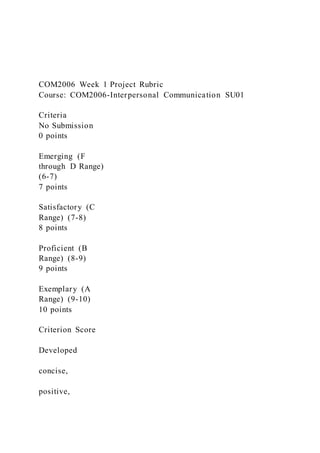
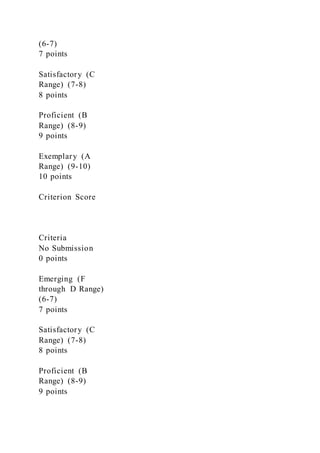
COM2006 Week 1 Project Rubric
Course: COM2006-Interpersonal Communication SU01
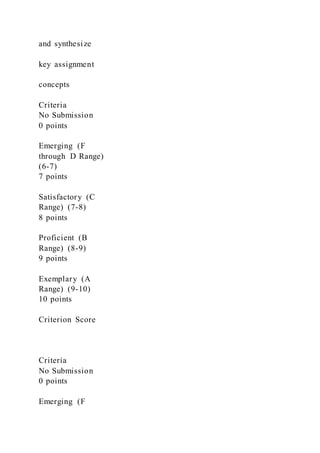
Criteria
No Submission
0 points
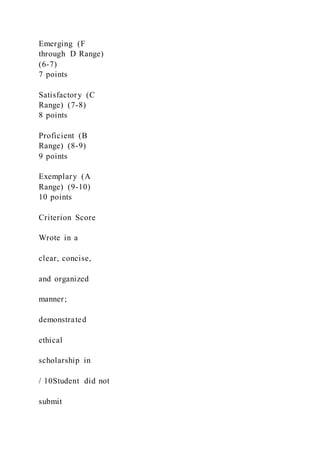
Emerging (F
through D Range)
(6-7)
7 points
Satisfactory (C
Range) (7-8)
8 points
Proficient (B
Range) (8-9)
9 points
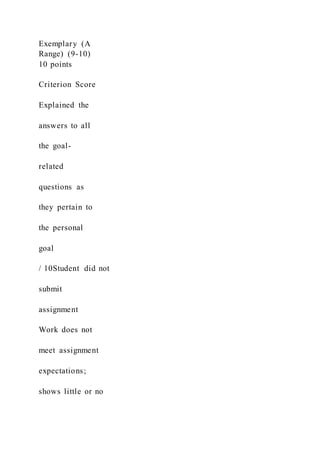
Exemplary (A
Range) (9-10)
10 points
Criterion Score
Developed
concise,
positive,
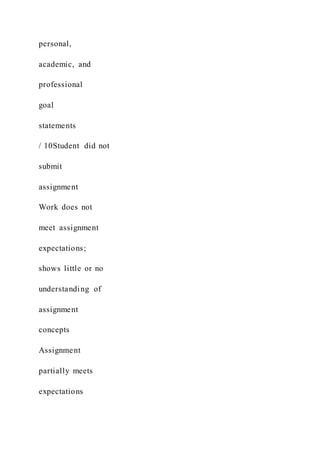
personal,
academic, and
professional
goal
statements
/ 10Student did not
submit
assignment
Work does not
meet assignment
expectations;
shows little or no
understanding of
assignment
concepts
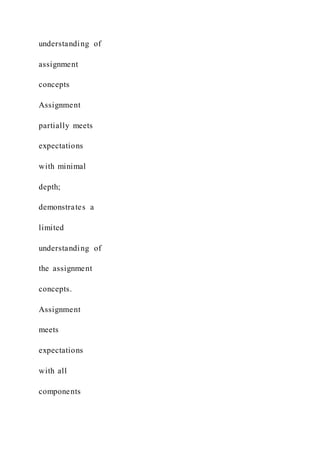
Assignment
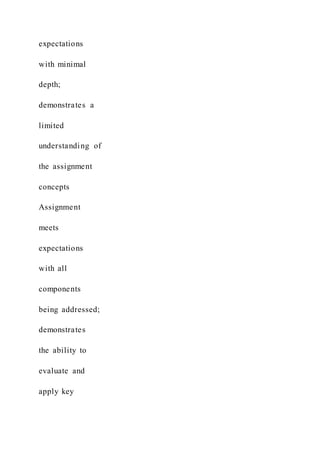
partially meets
expectations
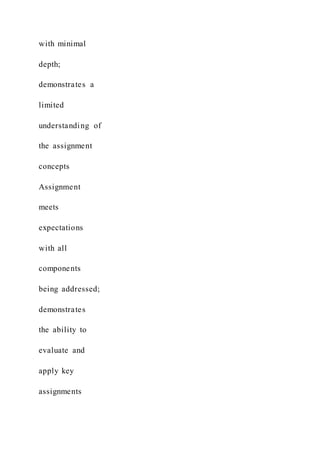
with minimal
depth;
demonstrates a
limited
understanding of
the assignment
concepts
Assignment
meets
expectations
with all
components
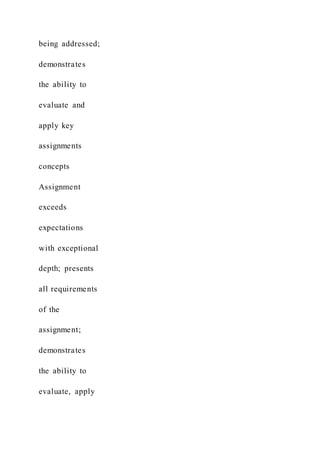
being addressed;
demonstrates
the ability to
evaluate and
apply key
assignments
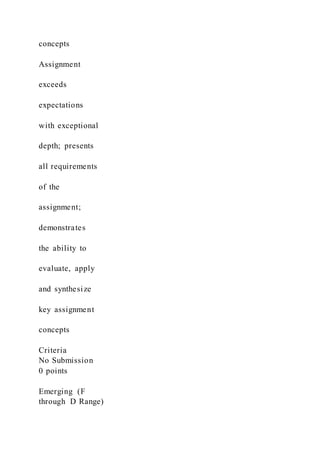
concepts
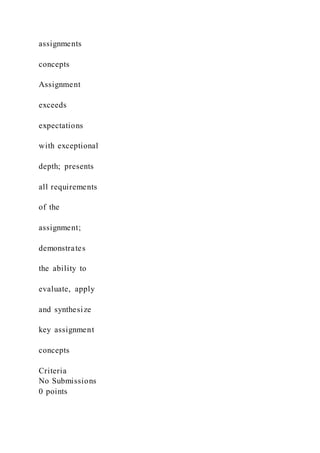
Assignment
exceeds
expectations
with exceptional
depth; presents
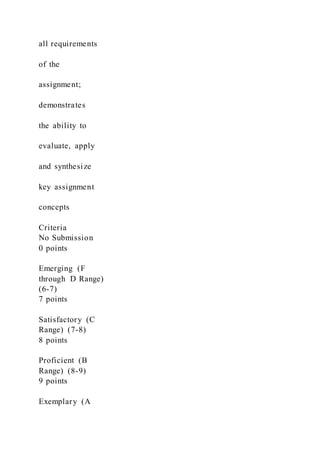
all requirements
of the
assignment;
demonstrates
the ability to
evaluate, apply
and synthesize
key assignment
concepts
Criteria
No Submission
0 points
Emerging (F
through D Range)
(6-7)
7 points
Satisfactory (C
Range) (7-8)
8 points
Proficient (B
Range) (8-9)
9 points
Exemplary (A
Range) (9-10)
10 points
Criterion Score
Criteria
No Submission
0 points
Emerging (F
through D Range)
(6-7)
7 points
Satisfactory (C
Range) (7-8)
8 points
Proficient (B
Range) (8-9)
9 points
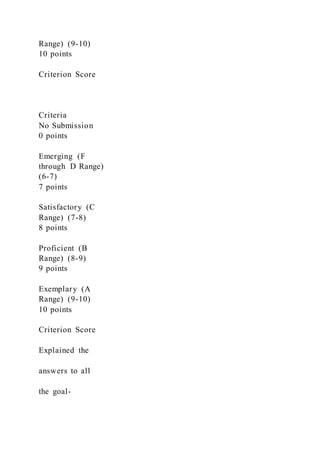
Exemplary (A
Range) (9-10)
10 points
Criterion Score
Explained the
answers to all
the goal-
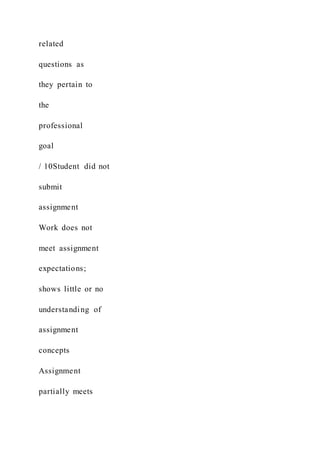
related
questions as
they pertain to
the personal
goal
/ 10Student did not
submit
assignment
Work does not
meet assignment
expectations;
shows little or no
understanding of
assignment
concepts
Assignment
partially meets
expectations
with minimal
depth;
demonstrates a
limited
understanding of
the assignment
concepts.
Assignment
meets
expectations
with all
components
being addressed;
demonstrates
the ability to
evaluate and
apply key
assignments
concepts
Assignment
exceeds
expectations
with exceptional
depth; presents
all requirements
of the
assignment;
demonstrates
the ability to
evaluate, apply
and synthesize
key assignment
concepts
Criteria
No Submission
0 points
Emerging (F
through D Range)
(6-7)
7 points
Satisfactory (C
Range) (7-8)
8 points
Proficient (B
Range) (8-9)
9 points
Exemplary (A
Range) (9-10)
10 points
Criterion Score
Criteria
No Submission
0 points
Emerging (F
through D Range)
(6-7)
7 points
Satisfactory (C
Range) (7-8)
8 points
Proficient (B
Range) (8-9)
9 points
Exemplary (A
Range) (9-10)
10 points
Criterion Score
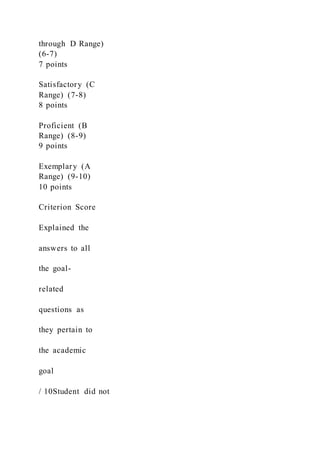
Explained the
answers to all
the goal-
related
questions as
they pertain to
the academic
goal
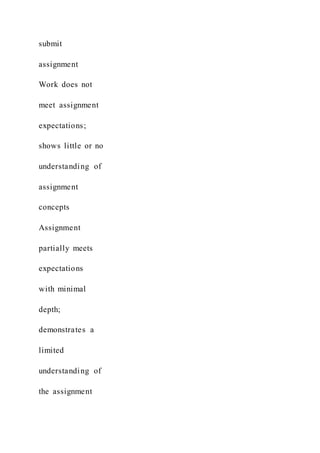
/ 10Student did not
submit
assignment
Work does not
meet assignment
expectations;
shows little or no
understanding of
assignment
concepts
Assignment
partially meets
expectations
with minimal
depth;
demonstrates a
limited
understanding of
the assignment
concepts
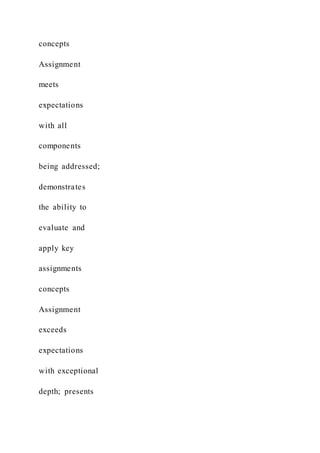
Assignment
meets
expectations
with all
components
being addressed;
demonstrates
the ability to
evaluate and
apply key
assignments
concepts
Assignment
exceeds
expectations
with exceptional
depth; presents
all requirements
of the
assignment;
demonstrates
the ability to
evaluate, apply
and synthesize
key assignment
concepts
Criteria
No Submission
0 points
Emerging (F
through D Range)
(6-7)
7 points
Satisfactory (C
Range) (7-8)
8 points
Proficient (B
Range) (8-9)
9 points
Exemplary (A
Range) (9-10)
10 points
Criterion Score
Criteria
No Submission
0 points
Emerging (F
through D Range)
(6-7)
7 points
Satisfactory (C
Range) (7-8)
8 points
Proficient (B
Range) (8-9)
9 points
Exemplary (A
Range) (9-10)
10 points
Criterion Score
Explained the
answers to all
the goal-
related
questions as
they pertain to
the
professional
goal
/ 10Student did not
submit
assignment
Work does not
meet assignment
expectations;
shows little or no
understanding of
assignment
concepts
Assignment
partially meets
expectations
with minimal
depth;
demonstrates a
limited
understanding of
the assignment
concepts
Assignment
meets
expectations
with all
components
being addressed;
demonstrates
the ability to
evaluate and
apply key
assignments
concepts
Assignment
exceeds
expectations
with exceptional
depth; presents
all requirements
of the
assignment;
demonstrates
the ability to
evaluate, apply
and synthesize
key assignment
concepts
Criteria
No Submissions
0 points
Emerging (F
through D Range)
(6-7)
7 points
Satisfactory (C
Range) (7-8)
8 points
Proficient (B
Range) (8-9)
9 points
Exemplary (A
Range) (9-10)
10 points
Criterion Score
Wrote in a
clear, concise,
and organized
manner;
demonstrated
ethical
scholarship in
/ 10Student did not
submit
assignment
Numerous issues
in any of the
following:
grammar,
mechanics,
spelling, use of
slang, and
Some spelling,
grammatical,
and/or structural
errors. Some
errors in APA
formatting
(citations and
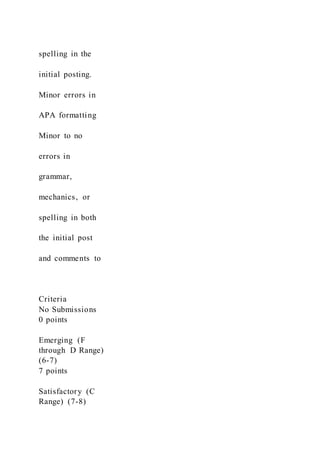
Minor errors in
grammar,
mechanics, or
spelling in the
initial posting.
Minor errors in
APA formatting
Minor to no
errors in
grammar,
mechanics, or
spelling in both
the initial post
and comments to
Criteria
No Submissions
0 points
Emerging (F
through D Range)
(6-7)
7 points
Satisfactory (C
Range) (7-8)
8 points
Proficient (B
Range) (8-9)
9 points
Exemplary (A
Range) (9-10)
10 points
Criterion Score
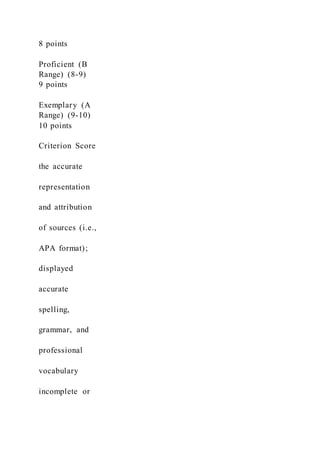
the accurate
representation
and attribution
of sources (i.e.,
APA format);
displayed
accurate
spelling,
grammar, and
professional
vocabulary
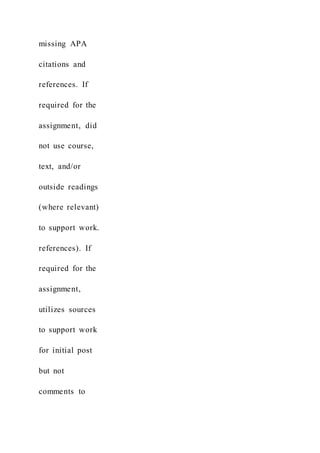
incomplete or
missing APA
citations and
references. If
required for the
assignment, did
not use course,
text, and/or
outside readings
(where relevant)
to support work.
references). If
required for the
assignment,
utilizes sources
to support work
for initial post
but not
comments to
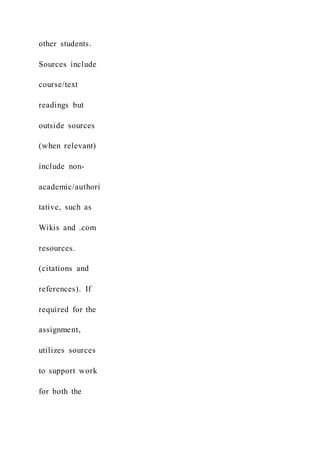
other students.
Sources include
course/text
readings but
outside sources
(when relevant)
include non-
academic/authori
tative, such as
Wikis and .com
resources.
(citations and
references). If
required for the
assignment,
utilizes sources
to support work
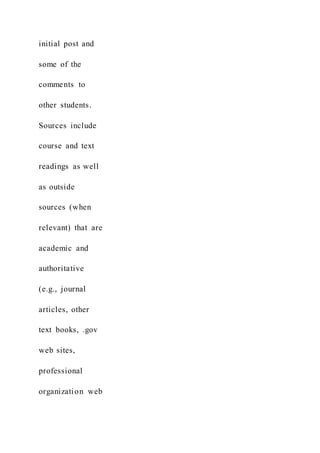
for both the
initial post and
some of the
comments to
other students.
Sources include
course and text
readings as well
as outside
sources (when
relevant) that are
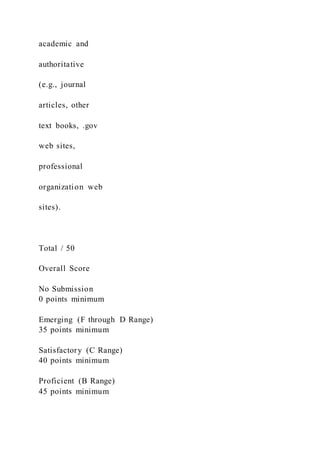
academic and
authoritative
(e.g., journal
articles, other
text books, .gov
web sites,
professional
organization web
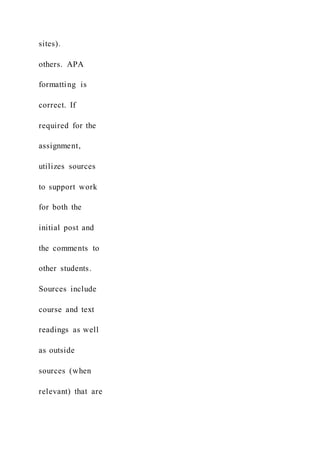
sites).
others. APA
formatting is
correct. If
required for the
assignment,
utilizes sources
to support work
for both the
initial post and
the comments to
other students.
Sources include
course and text
readings as well
as outside
sources (when
relevant) that are
academic and
authoritative
(e.g., journal
articles, other
text books, .gov
web sites,
professional
organization web
sites).
Total / 50
Overall Score
No Submission
0 points minimum
Emerging (F through D Range)
35 points minimum
Satisfactory (C Range)
40 points minimum
Proficient (B Range)
45 points minimum
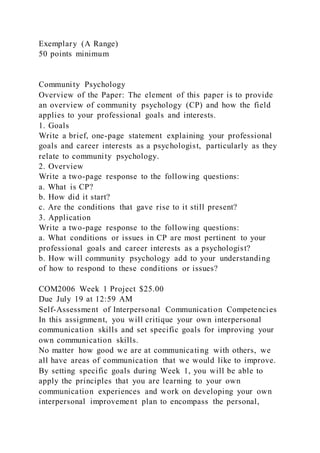
Exemplary (A Range)
50 points minimum
Community Psychology
Overview of the Paper: The element of this paper is to provide
an overview of community psychology (CP) and how the field
applies to your professional goals and interests.
1. Goals
Write a brief, one-page statement explaining your professional
goals and career interests as a psychologist, particularly as they
relate to community psychology.
2. Overview
Write a two-page response to the following questions:
a. What is CP?
b. How did it start?
c. Are the conditions that gave rise to it still present?
3. Application
Write a two-page response to the following questions:
a. What conditions or issues in CP are most pertinent to your
professional goals and career interests as a psychologist?
b. How will community psychology add to your understanding
of how to respond to these conditions or issues?
COM2006 Week 1 Project $25.00
Due July 19 at 12:59 AM
Self-Assessment of Interpersonal Communication Competencies
In this assignment, you will critique your own interpersonal
communication skills and set specific goals for improving your
own communication skills.
No matter how good we are at communicating with others, we
all have areas of communication that we would like to improve.
By setting specific goals during Week 1, you will be able to
apply the principles that you are learning to your own
communication experiences and work on developing your own
interpersonal improvement plan to encompass the personal,
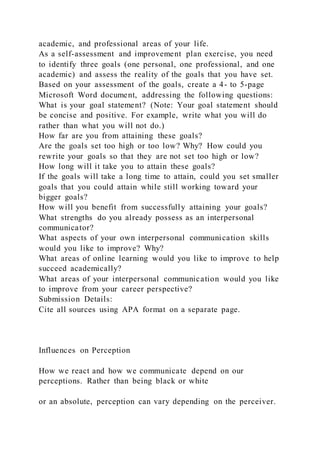
academic, and professional areas of your life.
As a self-assessment and improvement plan exercise, you need
to identify three goals (one personal, one professional, and one
academic) and assess the reality of the goals that you have set.
Based on your assessment of the goals, create a 4- to 5-page
Microsoft Word document, addressing the following questions:
What is your goal statement? (Note: Your goal statement should
be concise and positive. For example, write what you will do
rather than what you will not do.)
How far are you from attaining these goals?
Are the goals set too high or too low? Why? How could you
rewrite your goals so that they are not set too high or low?
How long will it take you to attain these goals?
If the goals will take a long time to attain, could you set smaller
goals that you could attain while still working toward your
bigger goals?
How will you benefit from successfully attaining your goals?
What strengths do you already possess as an interpersonal
communicator?
What aspects of your own interpersonal communication skills
would you like to improve? Why?
What areas of online learning would you like to improve to help
succeed academically?
What areas of your interpersonal communication would you like
to improve from your career perspective?
Submission Details:
Cite all sources using APA format on a separate page.
Influences on Perception
How we react and how we communicate depend on our
perceptions. Rather than being black or white
or an absolute, perception can vary depending on the perceiver.
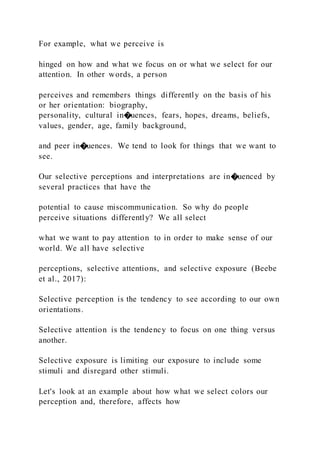
For example, what we perceive is
hinged on how and what we focus on or what we select for our
attention. In other words, a person
perceives and remembers things differently on the basis of his
or her orientation: biography,
personality, cultural in�uences, fears, hopes, dreams, beliefs,
values, gender, age, family background,
and peer in�uences. We tend to look for things that we want to
see.
Our selective perceptions and interpretations are in�uenced by
several practices that have the
potential to cause miscommunication. So why do people
perceive situations differently? We all select
what we want to pay attention to in order to make sense of our
world. We all have selective
perceptions, selective attentions, and selective exposure (Beebe
et al., 2017):
Selective perception is the tendency to see according to our own
orientations.
Selective attention is the tendency to focus on one thing versus
another.
Selective exposure is limiting our exposure to include some
stimuli and disregard other stimuli.
Let's look at an example about how what we select colors our
perception and, therefore, affects how
we communicate.
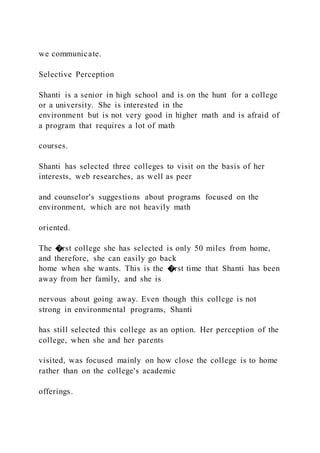
Selective Perception
Shanti is a senior in high school and is on the hunt for a college
or a university. She is interested in the
environment but is not very good in higher math and is afraid of
a program that requires a lot of math
courses.
Shanti has selected three colleges to visit on the basis of her
interests, web researches, as well as peer
and counselor's suggestions about programs focused on the
environment, which are not heavily math
oriented.
The �rst college she has selected is only 50 miles from home,
and therefore, she can easily go back
home when she wants. This is the �rst time that Shanti has been
away from her family, and she is
nervous about going away. Even though this college is not
strong in environmental programs, Shanti
has still selected this college as an option. Her perception of the
college, when she and her parents
visited, was focused mainly on how close the college is to home
rather than on the college's academic
offerings.
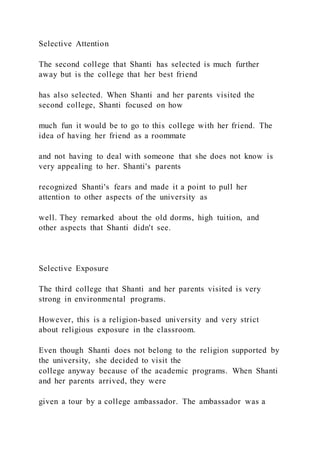
Selective Attention
The second college that Shanti has selected is much further
away but is the college that her best friend
has also selected. When Shanti and her parents visited the
second college, Shanti focused on how
much fun it would be to go to this college with her friend. The
idea of having her friend as a roommate
and not having to deal with someone that she does not know is
very appealing to her. Shanti's parents
recognized Shanti's fears and made it a point to pull her
attention to other aspects of the university as
well. They remarked about the old dorms, high tuition, and
other aspects that Shanti didn't see.
Selective Exposure
The third college that Shanti and her parents visited is very
strong in environmental programs.
However, this is a religion-based university and very strict
about religious exposure in the classroom.
Even though Shanti does not belong to the religion supported by
the university, she decided to visit the
college anyway because of the academic programs. When Shanti
and her parents arrived, they were
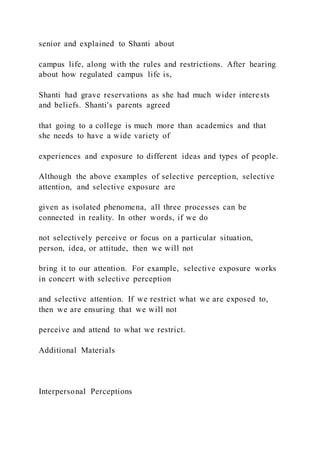
given a tour by a college ambassador. The ambassador was a
senior and explained to Shanti about
campus life, along with the rules and restrictions. After hearing
about how regulated campus life is,
Shanti had grave reservations as she had much wider interests
and beliefs. Shanti's parents agreed
that going to a college is much more than academics and that
she needs to have a wide variety of
experiences and exposure to different ideas and types of people.
Although the above examples of selective perception, selective
attention, and selective exposure are
given as isolated phenomena, all three processes can be
connected in reality. In other words, if we do
not selectively perceive or focus on a particular situation,
person, idea, or attitude, then we will not
bring it to our attention. For example, selective exposure works
in concert with selective perception
and selective attention. If we restrict what we are exposed to,
then we are ensuring that we will not
perceive and attend to what we restrict.
Additional Materials
Interpersonal Perceptions
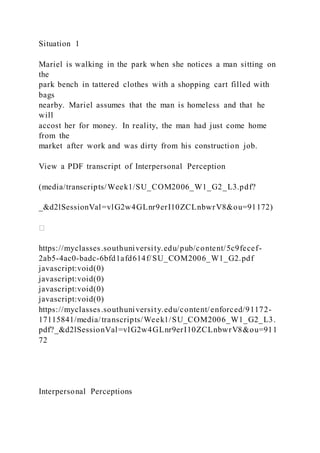
Situation 1
Mariel is walking in the park when she notices a man sitting on
the
park bench in tattered clothes with a shopping cart filled with
bags
nearby. Mariel assumes that the man is homeless and that he
will
accost her for money. In reality, the man had just come home
from the
market after work and was dirty from his construction job.
View a PDF transcript of Interpersonal Perception
(media/transcripts/Week1/SU_COM2006_W1_G2_L3.pdf?
_&d2lSessionVal=vlG2w4GLnr9erI10ZCLnbwrV8&ou=91172)
https://myclasses.southuniversity.edu/pub/content/5c9fecef-
2ab5-4ac0-badc-6bfd1afd614f/SU_COM2006_W1_G2.pdf
javascript:void(0)
javascript:void(0)
javascript:void(0)
javascript:void(0)
https://myclasses.southuniversity.edu/content/enforced/91172-
17115841/media/transcripts/Week1/SU_COM2006_W1_G2_L3.
pdf?_&d2lSessionVal=vlG2w4GLnr9erI10ZCLnbwrV8&ou=911
72
Interpersonal Perceptions
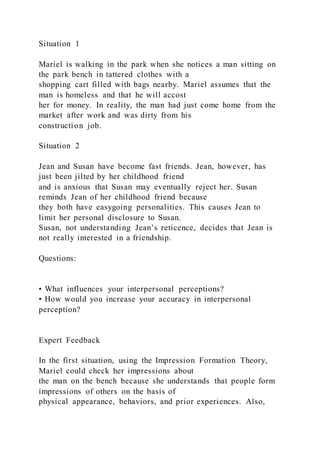
Situation 1
Mariel is walking in the park when she notices a man sitting on
the park bench in tattered clothes with a
shopping cart filled with bags nearby. Mariel assumes that the
man is homeless and that he will accost
her for money. In reality, the man had just come home from the
market after work and was dirty from his
construction job.
Situation 2
Jean and Susan have become fast friends. Jean, however, has
just been jilted by her childhood friend
and is anxious that Susan may eventually reject her. Susan
reminds Jean of her childhood friend because
they both have easygoing personalities. This causes Jean to
limit her personal disclosure to Susan.
Susan, not understanding Jean’s reticence, decides that Jean is
not really interested in a friendship.
Questions:
• What influences your interpersonal perceptions?
• How would you increase your accuracy in interpersonal
perception?
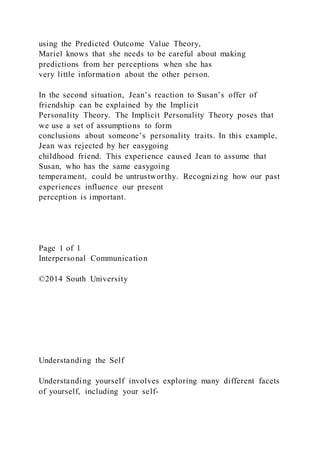
Expert Feedback
In the first situation, using the Impression Formation Theory,
Mariel could check her impressions about
the man on the bench because she understands that people form
impressions of others on the basis of
physical appearance, behaviors, and prior experiences. Also,
using the Predicted Outcome Value Theory,
Mariel knows that she needs to be careful about making
predictions from her perceptions when she has
very little information about the other person.
In the second situation, Jean’s reaction to Susan’s offer of
friendship can be explained by the Implicit
Personality Theory. The Implicit Personality Theory poses that
we use a set of assumptions to form
conclusions about someone’s personality traits. In this example,
Jean was rejected by her easygoing
childhood friend. This experience caused Jean to assume that
Susan, who has the same easygoing
temperament, could be untrustworthy. Recognizing how our past
experiences influence our present
perception is important.
Page 1 of 1
Interpersonal Communication
©2014 South University
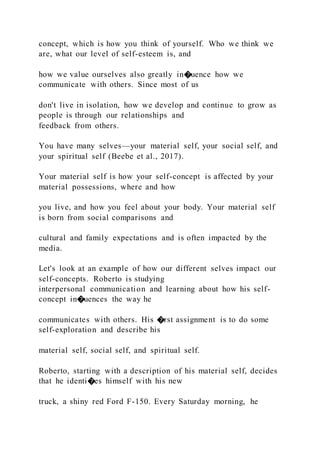
Understanding the Self
Understanding yourself involves exploring many different facets
of yourself, including your self-
concept, which is how you think of yourself. Who we think we
are, what our level of self-esteem is, and
how we value ourselves also greatly in�uence how we
communicate with others. Since most of us
don't live in isolation, how we develop and continue to grow as
people is through our relationships and
feedback from others.
You have many selves—your material self, your social self, and
your spiritual self (Beebe et al., 2017).
Your material self is how your self-concept is affected by your
material possessions, where and how
you live, and how you feel about your body. Your material self
is born from social comparisons and
cultural and family expectations and is often impacted by the
media.
Let's look at an example of how our different selves impact our
self-concepts. Roberto is studying
interpersonal communication and learning about how his self-
concept in�uences the way he
communicates with others. His �rst assignment is to do some
self-exploration and describe his
material self, social self, and spiritual self.
Roberto, starting with a description of his material self, decides
that he identi�es himself with his new
truck, a shiny red Ford F-150. Every Saturday morning, he
washes his truck so that he can go cruising
with his friends that evening. He is proud of his truck,
especially when he feels others are admiring it.
He is also conscious that his new truck has helped give him a
better reputation as a guy who is more
successful. Roberto used to own an old, used car and was very
self-conscious about people seeing him
drive this car. He shares his friends' beliefs that what you drive
is important. His old, battered car made
Roberto feel like a loser. Now that he owns his new truck,
Roberto believes people are admiring him
and, therefore, feels like a winner. Roberto is more con�dent
now, especially when dating new girls.
The second part of Roberto's assignment is to describe his
social self. He �nds this part harder than the
previous one. Since Roberto is the middle child and has four
older sisters and three younger brothers,
he grew up feeling that his opinions and ideas did not matter.
His siblings almost always took center
stage; and at family parties, it was hard to get into the
conversation. As a consequence, Roberto was
usually quiet in group situations and was often labeled as being
shy by his family and relatives. On the
other hand, when Roberto was with his three best friends, he
was more con�dent about sharing his
ideas and opinions, especially since his friends listened to him.
The sum of Roberto's experience
impacted his estimation of his social self, directing him to
develop con�dence when speaking one-on-
one with friends and with close peers but restraining him from
participating in group conversations,
especially with those who tend to dominate the conversation.
Although Roberto unconsciously dealt
with both aspects of his social self, now that he is going to
college and needs to speak up in classroom
discussions, he needs to think about how to remedy his shyness
in group situations.
Finally, Roberto needs to describe his spiritual self. His �rst
thought is that he needs to describe
whether or not he goes to church. As a Hispanic American, he
has been going to church with his family
ever since he was a young child. However, Roberto is confused
about why this will in�uence his self-
concept and how he communicates. After reading Interpersonal
Communication: Relating to Others
(Beebe et al., 2017), Roberto understands that his spiritual self
is about his beliefs and values. Because
Roberto was raised Catholic and continued to practice his
religion, he re�ected on how Catholicism
has affected his beliefs and values. Roberto realizes that his
Catholicism is a strong core in his life.
When he was a youth, Roberto felt like religion was imposed on
him. Now that he is older, Roberto
realizes that he believes in the values that he was taught as a
young boy and tries to live accordingly.
He strongly believes that you should treat others the same way
you would like them to treat you, and
this belief has in�uenced his sense of integrity. Therefore,
Roberto is conscious about how he acts and
communicates with others.
Even though at �rst Roberto was reluctant to elaborate on this
assignment, he found that exploring his
ideas of who he thinks he is was a good experience. Now, he
can see how the different aspects of his
material self, social self, and spiritual self have developed and
how these have impacted his
relationships.
The Competent Communicator
© 2014 South University
2
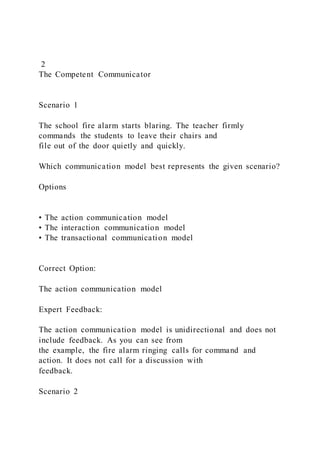
The Competent Communicator
Scenario 1
The school fire alarm starts blaring. The teacher firmly
commands the students to leave their chairs and
file out of the door quietly and quickly.
Which communication model best represents the given scenario?
Options
• The action communication model
• The interaction communication model
• The transactional communication model
Correct Option:
The action communication model
Expert Feedback:
The action communication model is unidirectional and does not
include feedback. As you can see from
the example, the fire alarm ringing calls for command and
action. It does not call for a discussion with
feedback.
Scenario 2
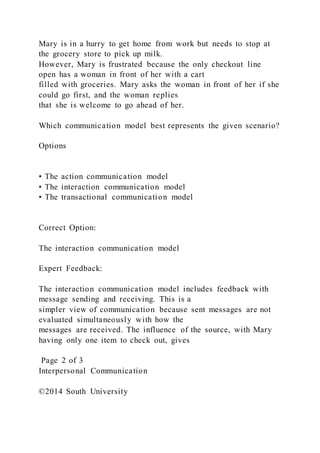
Mary is in a hurry to get home from work but needs to stop at
the grocery store to pick up milk.
However, Mary is frustrated because the only checkout line
open has a woman in front of her with a cart
filled with groceries. Mary asks the woman in front of her if she
could go first, and the woman replies
that she is welcome to go ahead of her.
Which communication model best represents the given scenario?
Options
• The action communication model
• The interaction communication model
• The transactional communication model
Correct Option:
The interaction communication model
Expert Feedback:
The interaction communication model includes feedback with
message sending and receiving. This is a
simpler view of communication because sent messages are not
evaluated simultaneously with how the
messages are received. The influence of the source, with Mary
having only one item to check out, gives
Page 2 of 3
Interpersonal Communication
©2014 South University
3
The Competent Communicator
the conversation its context; but since the relationship between
Mary and the other woman is
impersonal, there is little need to evaluate how the messages are
received.
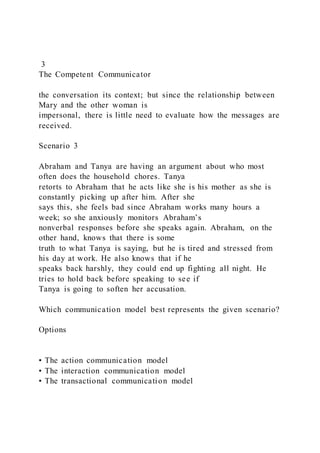
Scenario 3
Abraham and Tanya are having an argument about who most
often does the household chores. Tanya
retorts to Abraham that he acts like she is his mother as she is
constantly picking up after him. After she
says this, she feels bad since Abraham works many hours a
week; so she anxiously monitors Abraham’s
nonverbal responses before she speaks again. Abraham, on the
other hand, knows that there is some
truth to what Tanya is saying, but he is tired and stressed from
his day at work. He also knows that if he
speaks back harshly, they could end up fighting all night. He
tries to hold back before speaking to see if
Tanya is going to soften her accusation.
Which communication model best represents the given scenario?
Options
• The action communication model
• The interaction communication model
• The transactional communication model
Correct Option:
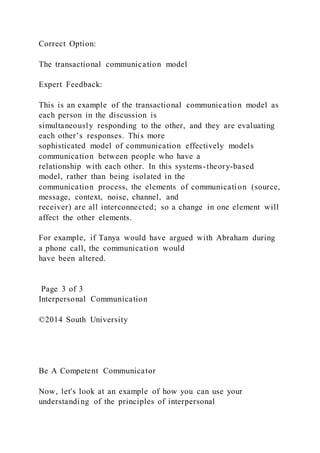
The transactional communication model
Expert Feedback:
This is an example of the transactional communication model as
each person in the discussion is
simultaneously responding to the other, and they are evaluating
each other’s responses. This more
sophisticated model of communication effectively models
communication between people who have a
relationship with each other. In this systems-theory-based
model, rather than being isolated in the
communication process, the elements of communication (source,
message, context, noise, channel, and
receiver) are all interconnected; so a change in one element will
affect the other elements.
For example, if Tanya would have argued with Abraham during
a phone call, the communication would
have been altered.
Page 3 of 3
Interpersonal Communication
©2014 South University
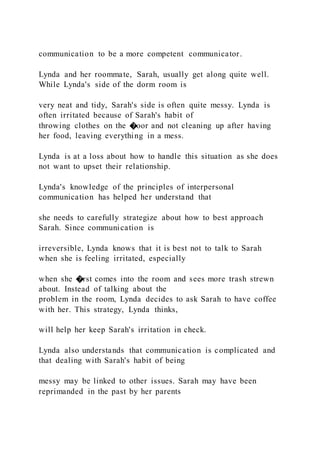
Be A Competent Communicator
Now, let's look at an example of how you can use your
understanding of the principles of interpersonal
communication to be a more competent communicator.
Lynda and her roommate, Sarah, usually get along quite well.
While Lynda's side of the dorm room is
very neat and tidy, Sarah's side is often quite messy. Lynda is
often irritated because of Sarah's habit of
throwing clothes on the �oor and not cleaning up after having
her food, leaving everything in a mess.
Lynda is at a loss about how to handle this situation as she does
not want to upset their relationship.
Lynda's knowledge of the principles of interpersonal
communication has helped her understand that
she needs to carefully strategize about how to best approach
Sarah. Since communication is
irreversible, Lynda knows that it is best not to talk to Sarah
when she is feeling irritated, especially
when she �rst comes into the room and sees more trash strewn
about. Instead of talking about the
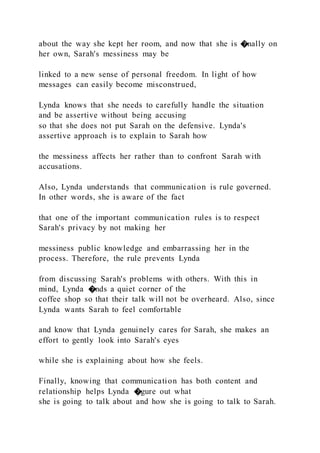
problem in the room, Lynda decides to ask Sarah to have coffee
with her. This strategy, Lynda thinks,
will help her keep Sarah's irritation in check.
Lynda also understands that communication is complicated and
that dealing with Sarah's habit of being
messy may be linked to other issues. Sarah may have been
reprimanded in the past by her parents
about the way she kept her room, and now that she is �nally on
her own, Sarah's messiness may be
linked to a new sense of personal freedom. In light of how
messages can easily become misconstrued,
Lynda knows that she needs to carefully handle the situation
and be assertive without being accusing
so that she does not put Sarah on the defensive. Lynda's
assertive approach is to explain to Sarah how
the messiness affects her rather than to confront Sarah with
accusations.
Also, Lynda understands that communication is rule governed.
In other words, she is aware of the fact
that one of the important communication rules is to respect
Sarah's privacy by not making her
messiness public knowledge and embarrassing her in the
process. Therefore, the rule prevents Lynda
from discussing Sarah's problems with others. With this in
mind, Lynda �nds a quiet corner of the
coffee shop so that their talk will not be overheard. Also, since
Lynda wants Sarah to feel comfortable
and know that Lynda genuinely cares for Sarah, she makes an
effort to gently look into Sarah's eyes
while she is explaining about how she feels.
Finally, knowing that communication has both content and
relationship helps Lynda �gure out what
she is going to talk about and how she is going to talk to Sarah.
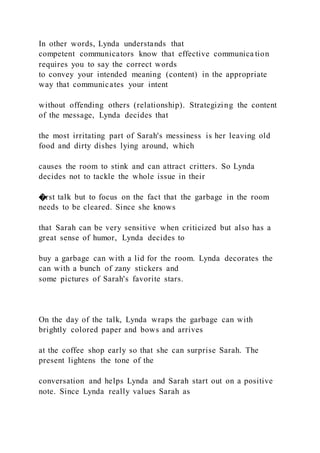
In other words, Lynda understands that
competent communicators know that effective communica tion
requires you to say the correct words
to convey your intended meaning (content) in the appropriate
way that communicates your intent
without offending others (relationship). Strategizing the content
of the message, Lynda decides that
the most irritating part of Sarah's messiness is her leaving old
food and dirty dishes lying around, which
causes the room to stink and can attract critters. So Lynda
decides not to tackle the whole issue in their
�rst talk but to focus on the fact that the garbage in the room
needs to be cleared. Since she knows
that Sarah can be very sensitive when criticized but also has a
great sense of humor, Lynda decides to
buy a garbage can with a lid for the room. Lynda decorates the
can with a bunch of zany stickers and
some pictures of Sarah's favorite stars.
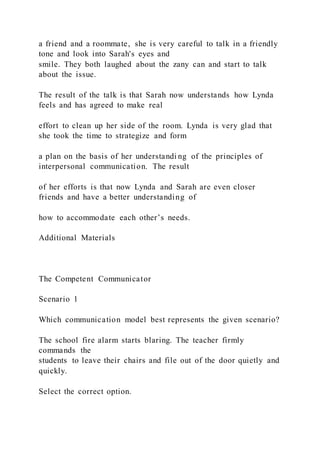
On the day of the talk, Lynda wraps the garbage can with
brightly colored paper and bows and arrives
at the coffee shop early so that she can surprise Sarah. The
present lightens the tone of the
conversation and helps Lynda and Sarah start out on a positive
note. Since Lynda really values Sarah as
a friend and a roommate, she is very careful to talk in a friendly
tone and look into Sarah's eyes and
smile. They both laughed about the zany can and start to talk
about the issue.
The result of the talk is that Sarah now understands how Lynda
feels and has agreed to make real
effort to clean up her side of the room. Lynda is very glad that
she took the time to strategize and form
a plan on the basis of her understandi ng of the principles of
interpersonal communication. The result
of her efforts is that now Lynda and Sarah are even closer
friends and have a better understanding of
how to accommodate each other’s needs.
Additional Materials
The Competent Communicator
Scenario 1
Which communication model best represents the given scenario?
The school fire alarm starts blaring. The teacher firmly
commands the
students to leave their chairs and file out of the door quietly and
quickly.
Select the correct option.
The action communication model
The interaction communication model
The transactional communication model
View a PDF Transcript of The Competent Communicator
(media/transcripts/Week1/SU_COM2006_W1_G1_L1.pdf?
_&d2lSessionVal=vlG2w4GLnr9erI10ZCLnbwrV8&ou=91172)
https://myclasses.southuniversity.edu/pub/content/a7354800-
af0e-4e76-8260-e73eea2b508b/SU_COM2006_W1_G1.pdf
javascript:void(0)
javascript:void(0)
javascript:void(0)
https://myclasses.southuniversity.edu/content/enforced/91172-
17115841/media/transcripts/Week1/SU_COM2006_W1_G1_L1.
pdf?_&d2lSessionVal=vlG2w4GLnr9erI10ZCLnbwrV8&ou=911
72

COM2006 Week 1 Project RubricCourse COM2006-Interpersonal C

  • 1.
    COM2006 Week 1Project Rubric Course: COM2006-Interpersonal Communication SU01 Criteria No Submission 0 points Emerging (F through D Range) (6-7) 7 points Satisfactory (C Range) (7-8) 8 points Proficient (B Range) (8-9) 9 points Exemplary (A Range) (9-10) 10 points Criterion Score Developed concise, positive,
  • 2.
    personal, academic, and professional goal statements / 10Studentdid not submit assignment Work does not meet assignment expectations; shows little or no understanding of assignment concepts Assignment partially meets expectations
  • 3.
    with minimal depth; demonstrates a limited understandingof the assignment concepts Assignment meets expectations with all components being addressed; demonstrates the ability to evaluate and apply key assignments
  • 4.
    concepts Assignment exceeds expectations with exceptional depth; presents allrequirements of the assignment; demonstrates the ability to evaluate, apply and synthesize key assignment concepts Criteria No Submission 0 points Emerging (F through D Range)
  • 5.
    (6-7) 7 points Satisfactory (C Range)(7-8) 8 points Proficient (B Range) (8-9) 9 points Exemplary (A Range) (9-10) 10 points Criterion Score Criteria No Submission 0 points Emerging (F through D Range) (6-7) 7 points Satisfactory (C Range) (7-8) 8 points Proficient (B Range) (8-9) 9 points
  • 6.
    Exemplary (A Range) (9-10) 10points Criterion Score Explained the answers to all the goal- related questions as they pertain to the personal goal / 10Student did not submit assignment Work does not meet assignment expectations; shows little or no
  • 7.
    understanding of assignment concepts Assignment partially meets expectations withminimal depth; demonstrates a limited understanding of the assignment concepts. Assignment meets expectations with all components
  • 8.
    being addressed; demonstrates the abilityto evaluate and apply key assignments concepts Assignment exceeds expectations with exceptional depth; presents all requirements of the assignment; demonstrates the ability to evaluate, apply
  • 9.
    and synthesize key assignment concepts Criteria NoSubmission 0 points Emerging (F through D Range) (6-7) 7 points Satisfactory (C Range) (7-8) 8 points Proficient (B Range) (8-9) 9 points Exemplary (A Range) (9-10) 10 points Criterion Score Criteria No Submission 0 points Emerging (F
  • 10.
    through D Range) (6-7) 7points Satisfactory (C Range) (7-8) 8 points Proficient (B Range) (8-9) 9 points Exemplary (A Range) (9-10) 10 points Criterion Score Explained the answers to all the goal- related questions as they pertain to the academic goal / 10Student did not
  • 11.
    submit assignment Work does not meetassignment expectations; shows little or no understanding of assignment concepts Assignment partially meets expectations with minimal depth; demonstrates a limited understanding of the assignment
  • 12.
    concepts Assignment meets expectations with all components being addressed; demonstrates theability to evaluate and apply key assignments concepts Assignment exceeds expectations with exceptional depth; presents
  • 13.
    all requirements of the assignment; demonstrates theability to evaluate, apply and synthesize key assignment concepts Criteria No Submission 0 points Emerging (F through D Range) (6-7) 7 points Satisfactory (C Range) (7-8) 8 points Proficient (B Range) (8-9) 9 points Exemplary (A
  • 14.
    Range) (9-10) 10 points CriterionScore Criteria No Submission 0 points Emerging (F through D Range) (6-7) 7 points Satisfactory (C Range) (7-8) 8 points Proficient (B Range) (8-9) 9 points Exemplary (A Range) (9-10) 10 points Criterion Score Explained the answers to all the goal-
  • 15.
    related questions as they pertainto the professional goal / 10Student did not submit assignment Work does not meet assignment expectations; shows little or no understanding of assignment concepts Assignment partially meets
  • 16.
    expectations with minimal depth; demonstrates a limited understandingof the assignment concepts Assignment meets expectations with all components being addressed; demonstrates the ability to evaluate and apply key
  • 17.
    assignments concepts Assignment exceeds expectations with exceptional depth; presents allrequirements of the assignment; demonstrates the ability to evaluate, apply and synthesize key assignment concepts Criteria No Submissions 0 points
  • 18.
    Emerging (F through DRange) (6-7) 7 points Satisfactory (C Range) (7-8) 8 points Proficient (B Range) (8-9) 9 points Exemplary (A Range) (9-10) 10 points Criterion Score Wrote in a clear, concise, and organized manner; demonstrated ethical scholarship in / 10Student did not submit
  • 19.
    assignment Numerous issues in anyof the following: grammar, mechanics, spelling, use of slang, and Some spelling, grammatical, and/or structural errors. Some errors in APA formatting (citations and Minor errors in grammar, mechanics, or
  • 20.
    spelling in the initialposting. Minor errors in APA formatting Minor to no errors in grammar, mechanics, or spelling in both the initial post and comments to Criteria No Submissions 0 points Emerging (F through D Range) (6-7) 7 points Satisfactory (C Range) (7-8)
  • 21.
    8 points Proficient (B Range)(8-9) 9 points Exemplary (A Range) (9-10) 10 points Criterion Score the accurate representation and attribution of sources (i.e., APA format); displayed accurate spelling, grammar, and professional vocabulary incomplete or
  • 22.
    missing APA citations and references.If required for the assignment, did not use course, text, and/or outside readings (where relevant) to support work. references). If required for the assignment, utilizes sources to support work for initial post but not comments to
  • 23.
    other students. Sources include course/text readingsbut outside sources (when relevant) include non- academic/authori tative, such as Wikis and .com resources. (citations and references). If required for the assignment, utilizes sources to support work for both the
  • 24.
    initial post and someof the comments to other students. Sources include course and text readings as well as outside sources (when relevant) that are academic and authoritative (e.g., journal articles, other text books, .gov web sites, professional organization web
  • 25.
    sites). others. APA formatting is correct.If required for the assignment, utilizes sources to support work for both the initial post and the comments to other students. Sources include course and text readings as well as outside sources (when relevant) that are
  • 26.
    academic and authoritative (e.g., journal articles,other text books, .gov web sites, professional organization web sites). Total / 50 Overall Score No Submission 0 points minimum Emerging (F through D Range) 35 points minimum Satisfactory (C Range) 40 points minimum Proficient (B Range) 45 points minimum
  • 27.
    Exemplary (A Range) 50points minimum Community Psychology Overview of the Paper: The element of this paper is to provide an overview of community psychology (CP) and how the field applies to your professional goals and interests. 1. Goals Write a brief, one-page statement explaining your professional goals and career interests as a psychologist, particularly as they relate to community psychology. 2. Overview Write a two-page response to the following questions: a. What is CP? b. How did it start? c. Are the conditions that gave rise to it still present? 3. Application Write a two-page response to the following questions: a. What conditions or issues in CP are most pertinent to your professional goals and career interests as a psychologist? b. How will community psychology add to your understanding of how to respond to these conditions or issues? COM2006 Week 1 Project $25.00 Due July 19 at 12:59 AM Self-Assessment of Interpersonal Communication Competencies In this assignment, you will critique your own interpersonal communication skills and set specific goals for improving your own communication skills. No matter how good we are at communicating with others, we all have areas of communication that we would like to improve. By setting specific goals during Week 1, you will be able to apply the principles that you are learning to your own communication experiences and work on developing your own interpersonal improvement plan to encompass the personal,
  • 28.
    academic, and professionalareas of your life. As a self-assessment and improvement plan exercise, you need to identify three goals (one personal, one professional, and one academic) and assess the reality of the goals that you have set. Based on your assessment of the goals, create a 4- to 5-page Microsoft Word document, addressing the following questions: What is your goal statement? (Note: Your goal statement should be concise and positive. For example, write what you will do rather than what you will not do.) How far are you from attaining these goals? Are the goals set too high or too low? Why? How could you rewrite your goals so that they are not set too high or low? How long will it take you to attain these goals? If the goals will take a long time to attain, could you set smaller goals that you could attain while still working toward your bigger goals? How will you benefit from successfully attaining your goals? What strengths do you already possess as an interpersonal communicator? What aspects of your own interpersonal communication skills would you like to improve? Why? What areas of online learning would you like to improve to help succeed academically? What areas of your interpersonal communication would you like to improve from your career perspective? Submission Details: Cite all sources using APA format on a separate page. Influences on Perception How we react and how we communicate depend on our perceptions. Rather than being black or white or an absolute, perception can vary depending on the perceiver.
  • 29.
    For example, whatwe perceive is hinged on how and what we focus on or what we select for our attention. In other words, a person perceives and remembers things differently on the basis of his or her orientation: biography, personality, cultural in�uences, fears, hopes, dreams, beliefs, values, gender, age, family background, and peer in�uences. We tend to look for things that we want to see. Our selective perceptions and interpretations are in�uenced by several practices that have the potential to cause miscommunication. So why do people perceive situations differently? We all select what we want to pay attention to in order to make sense of our world. We all have selective perceptions, selective attentions, and selective exposure (Beebe et al., 2017): Selective perception is the tendency to see according to our own orientations. Selective attention is the tendency to focus on one thing versus another. Selective exposure is limiting our exposure to include some stimuli and disregard other stimuli. Let's look at an example about how what we select colors our perception and, therefore, affects how
  • 30.
    we communicate. Selective Perception Shantiis a senior in high school and is on the hunt for a college or a university. She is interested in the environment but is not very good in higher math and is afraid of a program that requires a lot of math courses. Shanti has selected three colleges to visit on the basis of her interests, web researches, as well as peer and counselor's suggestions about programs focused on the environment, which are not heavily math oriented. The �rst college she has selected is only 50 miles from home, and therefore, she can easily go back home when she wants. This is the �rst time that Shanti has been away from her family, and she is nervous about going away. Even though this college is not strong in environmental programs, Shanti has still selected this college as an option. Her perception of the college, when she and her parents visited, was focused mainly on how close the college is to home rather than on the college's academic offerings.
  • 31.
    Selective Attention The secondcollege that Shanti has selected is much further away but is the college that her best friend has also selected. When Shanti and her parents visited the second college, Shanti focused on how much fun it would be to go to this college with her friend. The idea of having her friend as a roommate and not having to deal with someone that she does not know is very appealing to her. Shanti's parents recognized Shanti's fears and made it a point to pull her attention to other aspects of the university as well. They remarked about the old dorms, high tuition, and other aspects that Shanti didn't see. Selective Exposure The third college that Shanti and her parents visited is very strong in environmental programs. However, this is a religion-based university and very strict about religious exposure in the classroom. Even though Shanti does not belong to the religion supported by the university, she decided to visit the college anyway because of the academic programs. When Shanti and her parents arrived, they were given a tour by a college ambassador. The ambassador was a
  • 32.
    senior and explainedto Shanti about campus life, along with the rules and restrictions. After hearing about how regulated campus life is, Shanti had grave reservations as she had much wider interests and beliefs. Shanti's parents agreed that going to a college is much more than academics and that she needs to have a wide variety of experiences and exposure to different ideas and types of people. Although the above examples of selective perception, selective attention, and selective exposure are given as isolated phenomena, all three processes can be connected in reality. In other words, if we do not selectively perceive or focus on a particular situation, person, idea, or attitude, then we will not bring it to our attention. For example, selective exposure works in concert with selective perception and selective attention. If we restrict what we are exposed to, then we are ensuring that we will not perceive and attend to what we restrict. Additional Materials Interpersonal Perceptions
  • 33.
    Situation 1 Mariel iswalking in the park when she notices a man sitting on the park bench in tattered clothes with a shopping cart filled with bags nearby. Mariel assumes that the man is homeless and that he will accost her for money. In reality, the man had just come home from the market after work and was dirty from his construction job. View a PDF transcript of Interpersonal Perception (media/transcripts/Week1/SU_COM2006_W1_G2_L3.pdf? _&d2lSessionVal=vlG2w4GLnr9erI10ZCLnbwrV8&ou=91172) https://myclasses.southuniversity.edu/pub/content/5c9fecef- 2ab5-4ac0-badc-6bfd1afd614f/SU_COM2006_W1_G2.pdf javascript:void(0) javascript:void(0) javascript:void(0) javascript:void(0) https://myclasses.southuniversity.edu/content/enforced/91172- 17115841/media/transcripts/Week1/SU_COM2006_W1_G2_L3. pdf?_&d2lSessionVal=vlG2w4GLnr9erI10ZCLnbwrV8&ou=911 72 Interpersonal Perceptions
  • 34.
    Situation 1 Mariel iswalking in the park when she notices a man sitting on the park bench in tattered clothes with a shopping cart filled with bags nearby. Mariel assumes that the man is homeless and that he will accost her for money. In reality, the man had just come home from the market after work and was dirty from his construction job. Situation 2 Jean and Susan have become fast friends. Jean, however, has just been jilted by her childhood friend and is anxious that Susan may eventually reject her. Susan reminds Jean of her childhood friend because they both have easygoing personalities. This causes Jean to limit her personal disclosure to Susan. Susan, not understanding Jean’s reticence, decides that Jean is not really interested in a friendship. Questions: • What influences your interpersonal perceptions? • How would you increase your accuracy in interpersonal perception? Expert Feedback In the first situation, using the Impression Formation Theory, Mariel could check her impressions about the man on the bench because she understands that people form impressions of others on the basis of physical appearance, behaviors, and prior experiences. Also,
  • 35.
    using the PredictedOutcome Value Theory, Mariel knows that she needs to be careful about making predictions from her perceptions when she has very little information about the other person. In the second situation, Jean’s reaction to Susan’s offer of friendship can be explained by the Implicit Personality Theory. The Implicit Personality Theory poses that we use a set of assumptions to form conclusions about someone’s personality traits. In this example, Jean was rejected by her easygoing childhood friend. This experience caused Jean to assume that Susan, who has the same easygoing temperament, could be untrustworthy. Recognizing how our past experiences influence our present perception is important. Page 1 of 1 Interpersonal Communication ©2014 South University Understanding the Self Understanding yourself involves exploring many different facets of yourself, including your self-
  • 36.
    concept, which ishow you think of yourself. Who we think we are, what our level of self-esteem is, and how we value ourselves also greatly in�uence how we communicate with others. Since most of us don't live in isolation, how we develop and continue to grow as people is through our relationships and feedback from others. You have many selves—your material self, your social self, and your spiritual self (Beebe et al., 2017). Your material self is how your self-concept is affected by your material possessions, where and how you live, and how you feel about your body. Your material self is born from social comparisons and cultural and family expectations and is often impacted by the media. Let's look at an example of how our different selves impact our self-concepts. Roberto is studying interpersonal communication and learning about how his self- concept in�uences the way he communicates with others. His �rst assignment is to do some self-exploration and describe his material self, social self, and spiritual self. Roberto, starting with a description of his material self, decides that he identi�es himself with his new truck, a shiny red Ford F-150. Every Saturday morning, he
  • 37.
    washes his truckso that he can go cruising with his friends that evening. He is proud of his truck, especially when he feels others are admiring it. He is also conscious that his new truck has helped give him a better reputation as a guy who is more successful. Roberto used to own an old, used car and was very self-conscious about people seeing him drive this car. He shares his friends' beliefs that what you drive is important. His old, battered car made Roberto feel like a loser. Now that he owns his new truck, Roberto believes people are admiring him and, therefore, feels like a winner. Roberto is more con�dent now, especially when dating new girls. The second part of Roberto's assignment is to describe his social self. He �nds this part harder than the previous one. Since Roberto is the middle child and has four older sisters and three younger brothers, he grew up feeling that his opinions and ideas did not matter. His siblings almost always took center stage; and at family parties, it was hard to get into the conversation. As a consequence, Roberto was usually quiet in group situations and was often labeled as being shy by his family and relatives. On the other hand, when Roberto was with his three best friends, he was more con�dent about sharing his
  • 38.
    ideas and opinions,especially since his friends listened to him. The sum of Roberto's experience impacted his estimation of his social self, directing him to develop con�dence when speaking one-on- one with friends and with close peers but restraining him from participating in group conversations, especially with those who tend to dominate the conversation. Although Roberto unconsciously dealt with both aspects of his social self, now that he is going to college and needs to speak up in classroom discussions, he needs to think about how to remedy his shyness in group situations. Finally, Roberto needs to describe his spiritual self. His �rst thought is that he needs to describe whether or not he goes to church. As a Hispanic American, he has been going to church with his family ever since he was a young child. However, Roberto is confused about why this will in�uence his self- concept and how he communicates. After reading Interpersonal Communication: Relating to Others (Beebe et al., 2017), Roberto understands that his spiritual self is about his beliefs and values. Because Roberto was raised Catholic and continued to practice his religion, he re�ected on how Catholicism has affected his beliefs and values. Roberto realizes that his
  • 39.
    Catholicism is astrong core in his life. When he was a youth, Roberto felt like religion was imposed on him. Now that he is older, Roberto realizes that he believes in the values that he was taught as a young boy and tries to live accordingly. He strongly believes that you should treat others the same way you would like them to treat you, and this belief has in�uenced his sense of integrity. Therefore, Roberto is conscious about how he acts and communicates with others. Even though at �rst Roberto was reluctant to elaborate on this assignment, he found that exploring his ideas of who he thinks he is was a good experience. Now, he can see how the different aspects of his material self, social self, and spiritual self have developed and how these have impacted his relationships. The Competent Communicator © 2014 South University
  • 40.
    2 The Competent Communicator Scenario1 The school fire alarm starts blaring. The teacher firmly commands the students to leave their chairs and file out of the door quietly and quickly. Which communication model best represents the given scenario? Options • The action communication model • The interaction communication model • The transactional communication model Correct Option: The action communication model Expert Feedback: The action communication model is unidirectional and does not include feedback. As you can see from the example, the fire alarm ringing calls for command and action. It does not call for a discussion with feedback. Scenario 2
  • 41.
    Mary is ina hurry to get home from work but needs to stop at the grocery store to pick up milk. However, Mary is frustrated because the only checkout line open has a woman in front of her with a cart filled with groceries. Mary asks the woman in front of her if she could go first, and the woman replies that she is welcome to go ahead of her. Which communication model best represents the given scenario? Options • The action communication model • The interaction communication model • The transactional communication model Correct Option: The interaction communication model Expert Feedback: The interaction communication model includes feedback with message sending and receiving. This is a simpler view of communication because sent messages are not evaluated simultaneously with how the messages are received. The influence of the source, with Mary having only one item to check out, gives Page 2 of 3 Interpersonal Communication ©2014 South University
  • 42.
    3 The Competent Communicator theconversation its context; but since the relationship between Mary and the other woman is impersonal, there is little need to evaluate how the messages are received. Scenario 3 Abraham and Tanya are having an argument about who most often does the household chores. Tanya retorts to Abraham that he acts like she is his mother as she is constantly picking up after him. After she says this, she feels bad since Abraham works many hours a week; so she anxiously monitors Abraham’s nonverbal responses before she speaks again. Abraham, on the other hand, knows that there is some truth to what Tanya is saying, but he is tired and stressed from his day at work. He also knows that if he speaks back harshly, they could end up fighting all night. He tries to hold back before speaking to see if Tanya is going to soften her accusation. Which communication model best represents the given scenario? Options • The action communication model • The interaction communication model • The transactional communication model
  • 43.
    Correct Option: The transactionalcommunication model Expert Feedback: This is an example of the transactional communication model as each person in the discussion is simultaneously responding to the other, and they are evaluating each other’s responses. This more sophisticated model of communication effectively models communication between people who have a relationship with each other. In this systems-theory-based model, rather than being isolated in the communication process, the elements of communication (source, message, context, noise, channel, and receiver) are all interconnected; so a change in one element will affect the other elements. For example, if Tanya would have argued with Abraham during a phone call, the communication would have been altered. Page 3 of 3 Interpersonal Communication ©2014 South University Be A Competent Communicator Now, let's look at an example of how you can use your understanding of the principles of interpersonal
  • 44.
    communication to bea more competent communicator. Lynda and her roommate, Sarah, usually get along quite well. While Lynda's side of the dorm room is very neat and tidy, Sarah's side is often quite messy. Lynda is often irritated because of Sarah's habit of throwing clothes on the �oor and not cleaning up after having her food, leaving everything in a mess. Lynda is at a loss about how to handle this situation as she does not want to upset their relationship. Lynda's knowledge of the principles of interpersonal communication has helped her understand that she needs to carefully strategize about how to best approach Sarah. Since communication is irreversible, Lynda knows that it is best not to talk to Sarah when she is feeling irritated, especially when she �rst comes into the room and sees more trash strewn about. Instead of talking about the problem in the room, Lynda decides to ask Sarah to have coffee with her. This strategy, Lynda thinks, will help her keep Sarah's irritation in check. Lynda also understands that communication is complicated and that dealing with Sarah's habit of being messy may be linked to other issues. Sarah may have been reprimanded in the past by her parents
  • 45.
    about the wayshe kept her room, and now that she is �nally on her own, Sarah's messiness may be linked to a new sense of personal freedom. In light of how messages can easily become misconstrued, Lynda knows that she needs to carefully handle the situation and be assertive without being accusing so that she does not put Sarah on the defensive. Lynda's assertive approach is to explain to Sarah how the messiness affects her rather than to confront Sarah with accusations. Also, Lynda understands that communication is rule governed. In other words, she is aware of the fact that one of the important communication rules is to respect Sarah's privacy by not making her messiness public knowledge and embarrassing her in the process. Therefore, the rule prevents Lynda from discussing Sarah's problems with others. With this in mind, Lynda �nds a quiet corner of the coffee shop so that their talk will not be overheard. Also, since Lynda wants Sarah to feel comfortable and know that Lynda genuinely cares for Sarah, she makes an effort to gently look into Sarah's eyes while she is explaining about how she feels. Finally, knowing that communication has both content and relationship helps Lynda �gure out what she is going to talk about and how she is going to talk to Sarah.
  • 46.
    In other words,Lynda understands that competent communicators know that effective communica tion requires you to say the correct words to convey your intended meaning (content) in the appropriate way that communicates your intent without offending others (relationship). Strategizing the content of the message, Lynda decides that the most irritating part of Sarah's messiness is her leaving old food and dirty dishes lying around, which causes the room to stink and can attract critters. So Lynda decides not to tackle the whole issue in their �rst talk but to focus on the fact that the garbage in the room needs to be cleared. Since she knows that Sarah can be very sensitive when criticized but also has a great sense of humor, Lynda decides to buy a garbage can with a lid for the room. Lynda decorates the can with a bunch of zany stickers and some pictures of Sarah's favorite stars. On the day of the talk, Lynda wraps the garbage can with brightly colored paper and bows and arrives at the coffee shop early so that she can surprise Sarah. The present lightens the tone of the conversation and helps Lynda and Sarah start out on a positive note. Since Lynda really values Sarah as
  • 47.
    a friend anda roommate, she is very careful to talk in a friendly tone and look into Sarah's eyes and smile. They both laughed about the zany can and start to talk about the issue. The result of the talk is that Sarah now understands how Lynda feels and has agreed to make real effort to clean up her side of the room. Lynda is very glad that she took the time to strategize and form a plan on the basis of her understandi ng of the principles of interpersonal communication. The result of her efforts is that now Lynda and Sarah are even closer friends and have a better understanding of how to accommodate each other’s needs. Additional Materials The Competent Communicator Scenario 1 Which communication model best represents the given scenario? The school fire alarm starts blaring. The teacher firmly commands the students to leave their chairs and file out of the door quietly and quickly. Select the correct option.
  • 48.
    The action communicationmodel The interaction communication model The transactional communication model View a PDF Transcript of The Competent Communicator (media/transcripts/Week1/SU_COM2006_W1_G1_L1.pdf? _&d2lSessionVal=vlG2w4GLnr9erI10ZCLnbwrV8&ou=91172) https://myclasses.southuniversity.edu/pub/content/a7354800- af0e-4e76-8260-e73eea2b508b/SU_COM2006_W1_G1.pdf javascript:void(0) javascript:void(0) javascript:void(0) https://myclasses.southuniversity.edu/content/enforced/91172- 17115841/media/transcripts/Week1/SU_COM2006_W1_G1_L1. pdf?_&d2lSessionVal=vlG2w4GLnr9erI10ZCLnbwrV8&ou=911 72