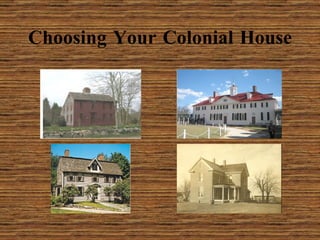
Choosing Your Colonial House
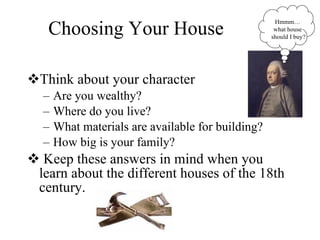
Choosing Your House Think about your character Are you wealthy? Where do you live?  What materials are available for building? How big is your family?  Keep these answers in mind when you learn about the different houses of the 18th century. Hmmm… what house should I buy?
New England Characteristics Wooden houses Timber frames covered with wooden boards and shingles
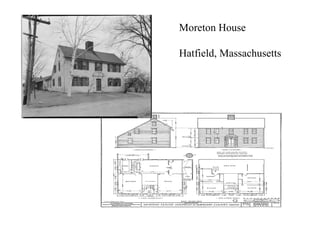
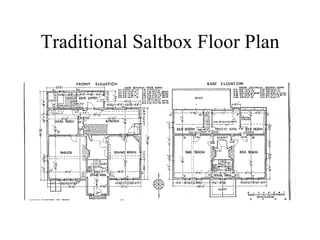
The “Saltbox” Style 1620-1740 Central chimney Central wooden  door 3-4 rooms on ground floor Equal number of windows  on either side  of the door 2 1/2 rooms second floor
Moreton House Hatfield, Massachusetts
Traditional Saltbox Floor Plan
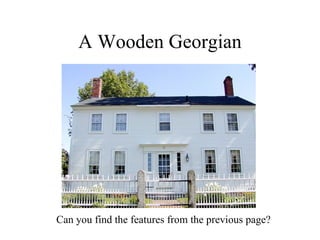
The Georgian Design 1700-1780 Chimneys on the ends Made of  both brick  and wood Paneled central door with decorative crown Symmetrical window design This house was  built in 1760 by Captain Richard Derby of Salem, MA. Brick was rare in New England; this  shows how wealthy  of a merchant he was.  It was a  gift to his son.  This style was  found in all 13 colonies with various  differences
A Wooden Georgian Can you find the features from the previous page?
Georgian Floor Plan 4 rooms upstairs 4 rooms downstairs Central hallway - allows public and private space Kitchen 3 rooms downstairs used as work rooms, entertaining rooms, or eating spaces. Second story rooms were mainly used for sleeping and storage
The Mid Atlantic States Mostly stone or brick Look more like New England houses rather than Southern houses A lot of Dutch and German influence
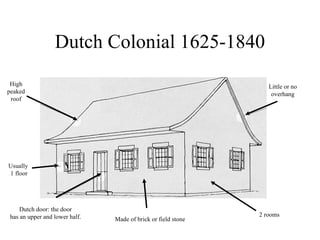
Dutch Colonial 1625-1840 Little or no overhang Usually 1 floor Dutch door: the door has an upper and lower half. High peaked roof Made of brick or field stone 2 rooms
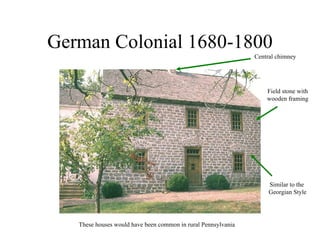
German Colonial 1680-1800 Central chimney Field stone with wooden framing Similar to the Georgian Style These houses would have been common in rural Pennsylvania
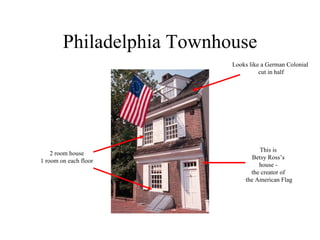
Philadelphia Townhouse Looks like a German Colonial cut in half 2 room house 1 room on each floor This is  Betsy Ross’s  house -  the creator of  the American Flag
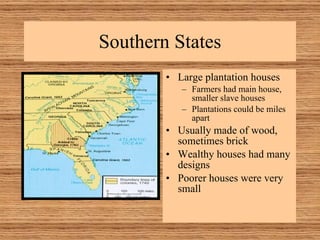
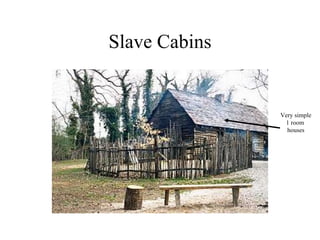
Southern States Large plantation houses Farmers had main house, smaller slave houses Plantations could be miles apart Usually made of wood, sometimes brick Wealthy houses had many designs Poorer houses were very small
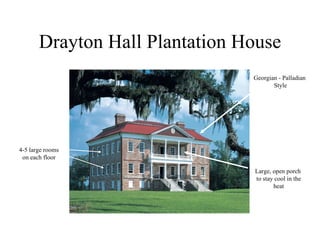
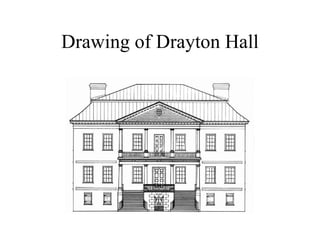
Drayton Hall Plantation House Large, open porch  to stay cool in the heat 4-5 large rooms on each floor Georgian - Palladian  Style
Drawing of Drayton Hall
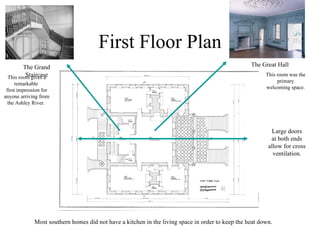
First Floor Plan Large doors at both ends allow for cross ventilation. The Grand Staircase This room gives a remarkable  first impression for anyone arriving from the Ashley River.  The Great Hall This room was the primary welcoming space. Most southern homes did not have a kitchen in the living space in order to keep the heat down.
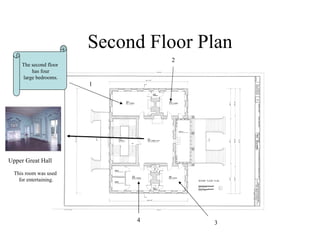
Second Floor Plan The second floor has four large bedrooms. Upper Great Hall This room was used  for entertaining. 1 2 3 4
Outside Drayton Hall Guests would  have arrived from the  Ashley River. Most work houses would have been separate from the  main house.
Slave Cabins Very simple 1 room  houses
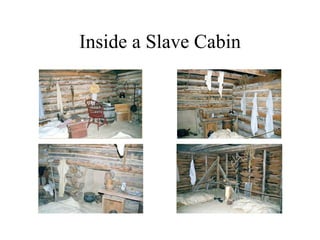
Inside a Slave Cabin
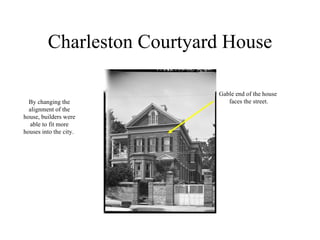
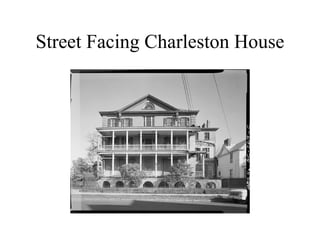
Charleston Courtyard House Gable end of the house faces the street. By changing the alignment of the house, builders were able to fit more houses into the city.
Charleston Courtyard House  Side View Long piazzas (porches) on every floor 1-2 rooms  on the second floor 1 room and a kitchen  on the first floor.
Street Facing Charleston House
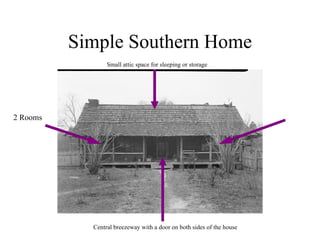
Simple Southern Home 2 Rooms Central breezeway with a door on both sides of the house Small attic space for sleeping or storage
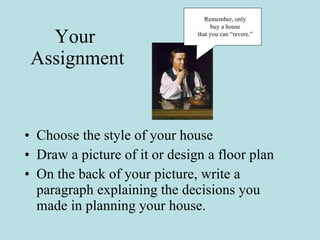
Your  Assignment Choose the style of your house Draw a picture of it or design a floor plan On the back of your picture, write a paragraph explaining the decisions you made in planning your house.  Remember, only  buy a house  that you can “revere.”

Colonial Houses

  • 1.
  • 2.
    Choosing Your HouseThink about your character Are you wealthy? Where do you live? What materials are available for building? How big is your family? Keep these answers in mind when you learn about the different houses of the 18th century. Hmmm… what house should I buy?
  • 3.
    New England CharacteristicsWooden houses Timber frames covered with wooden boards and shingles
  • 4.
    The “Saltbox” Style1620-1740 Central chimney Central wooden door 3-4 rooms on ground floor Equal number of windows on either side of the door 2 1/2 rooms second floor
  • 5.
  • 6.
  • 7.
    The Georgian Design1700-1780 Chimneys on the ends Made of both brick and wood Paneled central door with decorative crown Symmetrical window design This house was built in 1760 by Captain Richard Derby of Salem, MA. Brick was rare in New England; this shows how wealthy of a merchant he was. It was a gift to his son. This style was found in all 13 colonies with various differences
  • 8.
    A Wooden GeorgianCan you find the features from the previous page?
  • 9.
    Georgian Floor Plan4 rooms upstairs 4 rooms downstairs Central hallway - allows public and private space Kitchen 3 rooms downstairs used as work rooms, entertaining rooms, or eating spaces. Second story rooms were mainly used for sleeping and storage
  • 10.
    The Mid AtlanticStates Mostly stone or brick Look more like New England houses rather than Southern houses A lot of Dutch and German influence
  • 11.
    Dutch Colonial 1625-1840Little or no overhang Usually 1 floor Dutch door: the door has an upper and lower half. High peaked roof Made of brick or field stone 2 rooms
  • 12.
    German Colonial 1680-1800Central chimney Field stone with wooden framing Similar to the Georgian Style These houses would have been common in rural Pennsylvania
  • 13.
    Philadelphia Townhouse Lookslike a German Colonial cut in half 2 room house 1 room on each floor This is Betsy Ross’s house - the creator of the American Flag
  • 14.
    Southern States Largeplantation houses Farmers had main house, smaller slave houses Plantations could be miles apart Usually made of wood, sometimes brick Wealthy houses had many designs Poorer houses were very small
  • 15.
    Drayton Hall PlantationHouse Large, open porch to stay cool in the heat 4-5 large rooms on each floor Georgian - Palladian Style
  • 16.
  • 17.
    First Floor PlanLarge doors at both ends allow for cross ventilation. The Grand Staircase This room gives a remarkable first impression for anyone arriving from the Ashley River. The Great Hall This room was the primary welcoming space. Most southern homes did not have a kitchen in the living space in order to keep the heat down.
  • 18.
    Second Floor PlanThe second floor has four large bedrooms. Upper Great Hall This room was used for entertaining. 1 2 3 4
  • 19.
    Outside Drayton HallGuests would have arrived from the Ashley River. Most work houses would have been separate from the main house.
  • 20.
    Slave Cabins Verysimple 1 room houses
  • 21.
  • 22.
    Charleston Courtyard HouseGable end of the house faces the street. By changing the alignment of the house, builders were able to fit more houses into the city.
  • 23.
    Charleston Courtyard House Side View Long piazzas (porches) on every floor 1-2 rooms on the second floor 1 room and a kitchen on the first floor.
  • 24.
  • 25.
    Simple Southern Home2 Rooms Central breezeway with a door on both sides of the house Small attic space for sleeping or storage
  • 26.
    Your AssignmentChoose the style of your house Draw a picture of it or design a floor plan On the back of your picture, write a paragraph explaining the decisions you made in planning your house. Remember, only buy a house that you can “revere.”