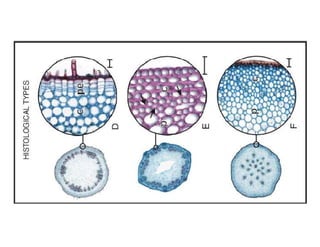
Introduction
Collenchyma: a
living tissueproviding
mechanical support
& elasticity.
Lies beneath the
epidermis in young
stems and petioles.
Extra deposition of
pectin on cell wall.
3.
Definition
Greek: Colla =glue, enchyma
= infusion.
Definition: Collenchyma is a
living mechanical tissue with
unevenly thickened primary
cell walls, providing support
to growing plant organs.
4.
General
Characteristics
Made of elongatedliving cells.
Cell wall thickened at corners with
cellulose, hemicellulose & pectin.
Usually without lignin (unlike
sclerenchyma).
Cells tightly packed, no intercellular
spaces.
Found in dicot stems, petioles,
leaves; absent in monocots.
5.
Structure of
Collenchyma Cells
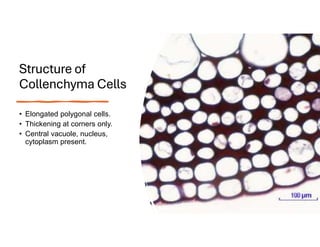
•Elongated polygonal cells.
• Thickening at corners only.
• Central vacuole, nucleus,
cytoplasm present.
6.
Types of
Collenchyma
(Based onWall
Thickening)
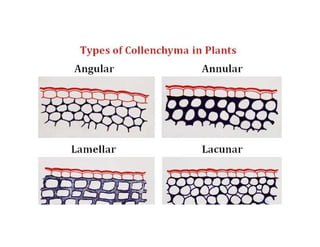
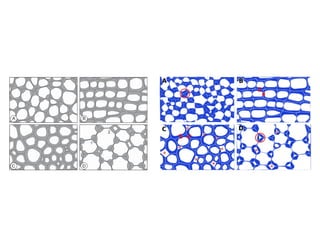
• Thickening at cell corners.
• Most common type.
Angular Collenchyma
• Thickening on tangential walls.
• Found in stems of Helianthus.
Lamellar Collenchyma
• Thickening around intercellular spaces.
• Found in Cucurbita.
Lacunar Collenchyma
• Uniform thickening on all walls.
Annular Collenchyma (rare)
9.
Distribution in
Plant Body
Hypodermisof dicot stems –
sunflower, tomato, pumpkin.
Leaf midrib and petiole –
celery, spinach.
Rare in roots; absent in
monocots.
10.
Functions of
Collenchyma
Mechanical Support– resists bending
forces.
Flexibility – allows organs to bend without
breaking (petioles, young stems).
Elasticity – tissue stretches and returns
to original position.
Photosynthesis – when chloroplasts are
present (chloroplast-rich collenchyma).
Protection – supports growing regions
without restricting growth.
11.
Adaptive
Significance
Provides support duringgrowth
(unlike sclerenchyma which is rigid).
Helps in withstanding wind and
mechanical stress.
Important in climbers and
herbaceous plants.