Internal assessment tasks—SL and HL 
 
Task 4: Collaborative project 
SL 35%, HL 25% 
 
Introduction 
Students at HL and SL collaboratively create and present an original piece of                         
theatre (lasting 13–15 minutes) to a specified target audience from a starting point                         
selected by the ensemble. They submit a process portfolio (15 pages maximum)                       
which documents their own individual approaches and skills, the exploration of the                       
starting point selected by the ensemble, the nature of the collaboration and the                         
student’s individual contribution to the creation and presentation of the piece of                       
theatre. The student submits a video recording (4 minutes maximum) in support of                         
the process portfolio which the student selects from the unedited video recording                       
of the created piece. 
 
Perspective​—all students approach this task in the role of collaborative creators 
of original theatre within an ensemble. 
 
Aim​—the aim of this task is for students to: 
 
• participate in the collaborative process of creating an original theatre                     
piece for presentation 
• examine and research processes of collaboratively creating original pieces of                     
theatre 
• examine their own skills and           
approaches 
• analyse their contributions, artistic choices and contributions to the collaborative                     
process of creating and staging a piece of original theatre. 
 
             Understandings​—through this exploration students will understand: 
 
• the importance of research to inspire and develop an original theatre piece                         
from a starting point 
•    the nature of collaboration in theatre 
•  the artistic processes and skills necessary to collaboratively create original                   
theatre and how these are realized in production 
•  the impact of their individual contributions and artistic choices. 
 
1 
 
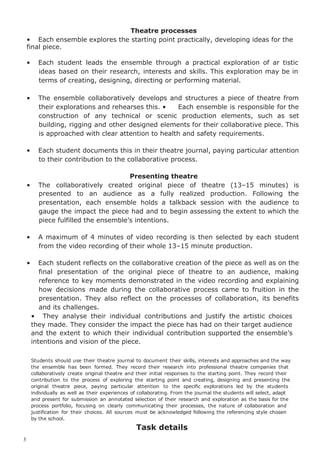
Preparation process 
In preparation for this task within the core syllabus students at SL and HL must 
have had experience of: 
 
  THEATRE IN CONTEXT  THEATRE PROCESSES  PRESENTING THEATRE 


Collaborativ
ely creating 
original 
theatre 
Reflecting on their own 
personal approaches, interests 
and skills in theatre. 
Researching and examining at 
least one starting point and 
the approaches employed 
by one appropriate professional 
theatre company and 
considering how this might 
influence their own personal 
approaches. 


Responding to at least one 
starting point and engaging 
with the process of 
transforming it 
collaboratively into an 
original piece of theatre. 


Participation in at least 
one production of a 
collaboratively 
created piece of original 
theatre, created from a 
starting point, which is 
presented to others. 
 
Assessing this task 
Students then undertake the following process for assessment. 
 
Theatre in context 
• Each student reflects on their own personal context, identifying their own                     
approaches, interests and skills in theatre, with a view to using this information                         
to determine who they will collaborate with for this project. 
 
• Each student researches the work of a professional company that creates and                       
stages original pieces of theatre (not already studied in depth as part of the                           
theatre course) and examines the approaches employed by the professional                   
company. This research may take a variety of forms, such as websites,                       
published articles, direct communication with the company, interviews and                 
experiences of practical workshops, for example. 
 
• In light of the process above, students form groups (ensembles) of no more                         
than six people with whom to collaboratively create. Each ensemble                   
collaboratively selects a starting point (idea, issue, theme, non­dramatic text,                   
music, object, image, event or site) that they feel has potential for                       
development into an original piece of theatre. 
 
• Each student researches the selected starting point, identifying its theatrical                   
possibilities and presenting this to the ensemble. 
 
• The ensemble uses the research to formulate their intentions for the piece.                       
They select a target audience and identify their intended impact on this target                         
audience. 
 
• Each student documents this in their theatre journal, paying particular                   
attention to their individual approach, research and contribution to the                   
collaborative process. 
 
 
2 
 
 
Theatre processes 
• Each ensemble explores the starting point practically, developing ideas for the 
final piece. 
 
• Each student leads the ensemble through a practical exploration of ar tistic                       
ideas based on their research, interests and skills. This exploration may be in                         
terms of creating, designing, directing or performing material. 
 
• The ensemble collaboratively develops and structures a piece of theatre from                     
their explorations and rehearses this. • Each ensemble is responsible for the           
construction of any technical or scenic production elements, such as set                     
building, rigging and other designed elements for their collaborative piece. This                     
is approached with clear attention to health and safety requirements. 
 
• Each student documents this in their theatre journal, paying particular attention                     
to their contribution to the collaborative process. 
 
Presenting theatre 
• The collaboratively created original piece of theatre (13–15 minutes) is                   
presented to an audience as a fully realized production. Following the                     
presentation, each ensemble holds a talkback session with the audience to                     
gauge the impact the piece had and to begin assessing the extent to which the                             
piece fulfilled the ensemble’s intentions. 
 
• A maximum of 4 minutes of video recording is then selected by each student                           
from the video recording of their whole 13–15 minute production. 
 
• Each student reflects on the collaborative creation of the piece as well as on the                             
final presentation of the original piece of theatre to an audience, making                       
reference to key moments demonstrated in the video recording and explaining                     
how decisions made during the collaborative process came to fruition in the                       
presentation. They also reflect on the processes of collaboration, its benefits                     
and its challenges. 
• They analyse their individual contributions and justify the artistic choices                   
they made. They consider the impact the piece has had on their target audience                           
and the extent to which their individual contribution supported the ensemble’s                     
intentions and vision of the piece.  
Theatre Journal 
Students should use their theatre journal to document their skills, interests and approaches and the way                               
the ensemble has been formed. They record their research into professional theatre companies that                           
collaboratively create original theatre and their initial responses to the starting point. They record their                             
contribution to the process of exploring the starting point and creating, designing and presenting the                             
original theatre piece, paying particular attention to the specific explorations led by the students                           
individually as well as their experiences of collaborating. From the journal the students will select, adapt                               
and present for submission an annotated selection of their research and exploration as the basis for the                                 
process portfolio, focusing on clearly communicating their processes, the nature of collaboration and                         
justification for their choices. All sources must be acknowledged following the referencing style chosen                           
by the school. 
Task details 
3 
 
The nature of collaboration 
This is a collaborative project and students must work with at least one other                           
person and with no more than five other students (making a maximum ensemble                         
size of six). In instances where there are fewer than two students, students may                           
work with peers that are not in the theatre class, such as theatre students from the                               
year below, or others who are not taking the IB Diploma Programme theatre                         
course (as long as the ensemble size does not exceed six). 
 
Each student begins the process by identifying their own personal contexts,                     
individually reflecting on their own personal approaches, interests and skills in                     
theatre. This is essentially an audit of the experiences each student has had during                           
the theatre course to date, and a process of identifying where each individual is at                             
the start of the project and what they are able to bring to the task. Students then                                 
use the outcome of this process to identify who they want to work with or how                               
they will work together with others. The ensemble may be formed of either                         
like­minded individuals who share a common interest or be made up of diverse                         
individuals who bring different ideas and approaches to the process of creation and                         
presentation.  
The formation of the ensemble is therefore a key part of this task and teachers                             
should give time for this where appropriate or feasible. 
 
Each student carries out research on an unfamiliar professional company that                     
collaboratively creates and presents original theatre. This research may take a                     
variety of forms and may involve websites, published articles, direct                   
communication with the company, interviews or experiences of practical                 
workshops, for example. Students examine the approaches employed by the                   
professional company and consider how this research might influence their own                     
personal approach to the process of collaborative theatre making. 
Identifying the starting point 
The ensemble selects a starting point from which to begin the process of creation.                           
Students should have little or no previous experience of researching or practically                       
engaging with the starting point they collaboratively select for this project. 
 
The starting point must be selected from one of the following: 
 
•         an event 
•         idea, issue, question or theme 
•         image or photograph 
•         non­dramatic text 
•         object 
•         person 
•         piece of music 
•         site 
•         street art, graphic novel or comic strip. 
 
The project must not be based on an existing piece of theatre or published​ play text. 
4 
 
Exploring the starting point and structuring the piece of theatre 
Although the process of creation and presentation is collaborative, each student                     
should take responsibility for some aspect of the group exploration during the                       
process of creating. This artistic exploration involves leading the group in practical                       
exercises based on their own research into the starting points and their interests,                         
skills and approaches, perhaps from their research into the work of a professional                         
company that creates and stages original pieces of theatre, for example. This                       
artistic exploration may be in terms of creating, designing, directing or performing                       
material. Students need to be aware that not all explorations make it into the final                             
piece and that the process of exploration should be undertaken in the spirit of play                             
and experimentation to test ideas. 
 
Once ideas have been tested and played with, the group collaboratively decides on                         
the structure of the piece and begins a process of rehearsal and production,                         
preparing the piece for an audience. 
 
Requirements of the video recording 
For this internal assessment the teacher marking the work assesses the selected                       
extracts of video recorded work on screen rather than the live presentation itself.                         
It is crucial that the video recording captures the full 13–15 minute piece of                           
theatre. This must be a continuous, unedited record and must capture the full                         
presentation of the piece. The video camera must not be switched off at any point                             
during the presentation of the piece. More information and guidance on the video                         
recording of internal and external assessments can be found in the ​Handbook of                         
procedures for the Diploma Programme​. 
 
Selecting extracts from the video recording 
Each student is then required to submit up to 4 minutes of footage selected from                             
this continuous video recording. The selected footage (up to 4 minutes maximum)                       
must be chosen by the student and must demonstrate the contributions and                       
artistic choices made by the student. 
 
The footage selected by the student (up to 4 minutes maximum) can be ​either                           
one continuous shot or can be from two different moments (maximum) in the                         
presentation of the piece. The combined total submitted must not exceed 4                       
minutes of footage for each student. 
 
It is expected that students will be judicious when selecting their footage for 
assessment. Students may wish to select up to 4 minutes of sustained action from 
the recording or two contrasting moments from the video recording to analyse, 
evaluate and illustrate their contributions and artistic choices.  
 
Structuring the process portfolio 
The process portfolio may be up to 15 pages in length and can contain a variety of                                 
materials in different formats (such as text, visuals, diagrams and so on)                       
depending on the nature of the project. It should demonstrate the dynamic stages                         
of a creative process​; preparation, action, reflection. 
5 
 
 
Any illustrations, charts, mind maps, visuals, diagrams or designs used within the                       
process portfolio must be clearly annotated and appropriately referenced to                   
acknowledge the source, following the referencing style chosen by the school.                     
When students include any of their own photographs or images in the portfolio,                         
these must also be identified and acknowledged in the same way. ​There is no lower                             
limit on the number of pages a student can submit and teachers are encouraged to                             
remind students that their work will be assessed on how it best fulfills the                           
assessment criteria for the task and not judged on how many pages are submitted. 
 
The process portfolio should contain a table of contents (which is excluded from                         
the page count) and all pages should be numbered.  
 
The main body of the process portfolio should be structured using the following                         
subheadings: 
 
• My personal context and my research into a professional company​ that 
creates and stages original pieces of theatre 
 
• The formation of my group and our exploration of the starting poin​t 
(including our target audience and intentions for the piece) 
 
• Reflections on the collaborative development of our piece and the                       
specific explorations led by me 
 
• My contribution to the final 13–15 minute presentation​, the impact on 
the audience and my artistic choices (as seen in the video) 
 
Students are required to submit a separate list of all sources cited. 
 
All sources must be acknowledged following the protocol of the referencing style chosen by the                             
school. If a student uses work, ideas or images belonging to another person in the collaboratively                               
created piece or the process portfolio, the student must acknowledge the source using a                           
standard style of referencing in a consistent manner. A student’s failure to acknowledge a source                             
will be investigated by the IB as a potential breach of regulations that may result in a penalty                                   
imposed by the IB final award committee. 
 
 
6 
 
Formal requirements of this task 
Each student submits for assessment: 
 
•         a process portfolio (15 pages maximum) which includes: 
 
– the student’s identification of their own approaches, interests and skills in                     
theatre and research into the approaches used by a professional company                     
that creates and stages original pieces of theatre (not already studied in                       
depth as part of the theatre course) 
 
– the student’s account of the formation of the ensemble and the exploration                       
of the starting point selected by the ensemble, which includes identifying                     
the target audience and intentions for the piece 
 
– the student’s reflections on the collaborative development, structuring and                 
preparation of the piece for presentation and the specific artistic                   
explorations led by the student 
 
– the student’s evaluation of their own contribution to the final 13–15 minute                       
presentation, the extent to which the piece fulfilled its intentions, the                     
impact it had on the audience and the analysis and justification of their                         
specific artistic choices (as evidenced in the video recording outlined below) 
 
• a video recording (4 minutes maximum) evidencing the student’s contribution                   
to the presentation of the collaboratively created piece; the selected footage                     
must be chosen by the student and must demonstrate artistic choices made by                         
the student; it can be either one continuous shot or can be from two different                             
moments (maximum) in the presentation; the combined total submitted must                   
not exceed 4 minutes of footage for each student 
 
•         a list of all sources cited. 
 
The size and format of pages submitted for assessment is not prescribed to enable                           
students to be creative with how they record and present their work. Submitted                         
materials are assessed on screen and students must ensure that their work is clear                           
and legible when presented in a digital, on­screen format. To ensure that                       
examiners are able to gain an overall and legible impression of each page without                           
excessive scrolling, students are recommended to use common page sizes (such as                       
legal, A4 or folio). Overcrowded or illegible materials may result in assessors being                         
unable to interpret and understand the intentions of the work 
 
The procedure for submitting the assessment materials can be found in the ​Handbook of                           
procedures for the Diploma Programme​. Students are required to indicate the number of                         
pages used and the length of the video recording when the materials are submitted.                           
Where submitted materials exceed the prescribed page or time limits assessors are                       
instructed to base their assessment solely on the materials that appear within the limits 
7 
 
Internal assessment details—SL and HL 
Summary 
Part 4: Collaborative project  Mark
s 
Total 
A  Theatre in context: The personal context and research into a professional 
company 
8   
32 
 
B 
Theatre in context: The formation of the group and exploration of the 
starting point (including target audience and intentions for the piece) 
 
8 
 
 
C 
Theatre processes: Reflections on the development of the piece and the 
specific explorations led by the student 
 
8 
 
 
D 
Presenting theatre: Evaluation of the student’s contribution to the final 
13–15 minute performance and their artistic choices (as seen in the video) 
 
8 
 
 
Criteria 
A. Theatre in context: The personal context and research into a professional 
company 
Evidence: process portfolio 
• ​To what extent does the student present their own personal context and outline their own 
approaches, interests and skills in theatre? 
• To what extent does the student present their research into the approaches used by a 
professional company that creates and stages original pieces of theatre? 
 
Mark  Descriptor 
0  The work does not reach a standard described by the descriptors below. 


1​–​2 
This work is ​inconsistent​: 
• the student lists their own personal approaches, interests and skills in theatre 
• the student lists the creative approaches employed by an appropriate                   
professional company that creates and stages original pieces of theatre, with                     
little consideration of how this research may influence their approach to                     
collaborative theatre making. 


3​–​4 
This work is ​underdeveloped​: 
• the student outlines their own personal approaches, interests and skills in 
theatre 
• the student outlines the creative approaches employed by an appropriate                   
professional company that creates and stages original pieces of theatre, with                     
some consideration of how this may influence their approach to collaborative                     
theatre making. 


5​–​6 
This work is ​good​: 
• the student describes their own personal approaches, interests and skills in 
theatre 
• the student describes the creative approaches employed by an appropriate 
professional company that creates and stages original pieces of theatre, with 
consideration of how this may influence their approach to collaborative theatre
making. 


7​–​8 
This work is ​excellent​: 
• the student explains their own personal approaches, interests and skills in 
theatre 
• the student explains the creative approaches employed by an appropriate 
professional company that creates and stages original pieces of theatre, clearly
and fully 
considering how this may influence their approach to collaborative theatre 
making. 
8 
 
 
B. Theatre in context: The formation of the group and exploration of the starting 
point 
(including target audience and intentions for the piece) 
 
 
Evidence: process portfolio 
 
• ​To what extent does the student reflect on the process involved in forming the 
collaborative group? 
 
• To what extent does the student explain how the group went about exploring the 
starting point, which includes identifying the target audience and intentions for the 
group? 
 
 
Mark  Descriptor 
0  The work does not reach a standard described by the descriptors below. 


1–2 
This work is ​inconsistent​: 
 
• the student lists milestones in forming the collaborative group, 
showing little or no awareness of the challenges and benefits of 
collaboration 
• the student lists milestones in the collaborative exploration of the 
starting point, with little consideration of how the target audience or 
artistic intentions were identified. 


3–4 
This work is ​underdeveloped​: 
 
• the student outlines the process of forming the collaborative group, 
showing some awareness of the challenges and benefits of 
collaboration 
• the student outlines how and why the ensemble collaboratively 
explored the starting point, with some consideration of how the 
target audience and artistic intentions were identified. 


5–6 
This work is ​good​: 
 
• the student describes the process of forming the collaborative group, 
reflecting on the challenges and benefits of collaboration 
• the student describes how and why the ensemble collaboratively 
explored the starting point, with consideration of how the target 
audience and artistic intentions were identified. 


7–8 
This work is ​excellent​: 
 
• the student explains the process of forming the collaborative group, 
clearly and effectively reflecting on the challenges and benefits of 
collaboration 
• the student explains how and why the ensemble collaboratively 
explored the starting point, with clear consideration of how the 
target audience and artistic intentions were identified. 
 
 
9 
 
 
C. Theatre processes: Reflections on the development of the piece and the 
specific explorations led by the student 
 
Evidence: process portfolio 
 
• ​To what extent does the student reflect on the collaborative process employed to 
develop, structure and prepare the original theatre piece for presentation? 
 
• To what extent does the student reflect on the specific explorations they led with the 
group and the contribution this made to the shaping of the production? 
 
Mark  Descriptor 
0  The work does not reach a standard described by the descriptors below. 


1–2 
This work is ​inconsistent​: 
 
• the student lists key milestones in how the group practically developed, 
structured and prepared the original piece for presentation, with little 
identification of their contribution to this process 
• the student lists the specific artistic explorations they led with the group. 


3–4 
This work is ​underdeveloped​: 
 
• The student outlines how the group practically developed, structured 
and prepared the original piece for presentation, with some 
identification of their contribution to this process 
• the student outlines the specific artistic explorations they led with the 
group and state how this contribution helped shape the final 
production. 


5–6 
This work is ​good​: 
 
• the student describes how the group practically developed, structured 
and prepared the original piece for presentation, identifying their own 
contribution to this process 
• the student describes the specific artistic explorations they led with the 
group and reflect on how this contribution helped shape the final 
production. 


7–8 
This work is ​excellent​: 
 
• the student clearly explains how the group practically developed, 
structured and prepared the original piece for presentation, clearly 
identifying their own contribution to this process 
• the student provides insightful reflection on the specific artistic 
explorations 
they led with the group and explain how this contribution helped 
shape the final production. 
 
   
10 


D. Presenting theatre: Evaluation of the student’s contribution to the final 
13–15 minute performance and their artistic choices (as seen in the video) 
 
Evidence: process portfolio and video recording 
 
• ​To what extent does the student evaluate the presentation of the original 13–15 
minute theatre piece, the extent to which the piece fulfilled its intentions and the 
impact it had on the audience? 
 
• To what extent does the student analyse and justify their artistic choices (as 
evidenced in the selected video recording)? 
 
Mark  Descriptor 
0  The work does not reach a standard described by the descriptors below. 


1​–​2 
This work is ​inconsistent​: 
 
• the student attempts to evaluate the presentation of the original 
piece, listing ways in which the piece fulfilled its intentions and the 
extent to which it achieved its impact on the audience, but this is 
superficial or inconsistent 
• the student lists the ways in which their own specific artistic choices 
were made as evidenced in the selected video recording. 


3​–​4 
This work is ​underdeveloped​: 
 
• the student provides a clear evaluation of the presentation of the 
original piece, outlining how the piece fulfilled its intentions and the 
extent to which it achieved its impact on the audience 
• the student outlines their own specific artistic choices as evidenced in 
the selected video recording. 


5​–​6 
This work is ​good​: 
 
• the student provides a clear and effective evaluation of the 
presentation of the original piece, describing how the piece fulfilled 
its intentions and the extent to which it achieved its impact on the 
audience 
• the student describes their own specific artistic choices as evidenced 
in the selected video recording. 


7​–​8 
This work is ​excellent​: 
 
• the student provides a clear, effective and sophisticated evaluation 
of the presentation of the original piece, explaining how the piece 
fulfilled its intentions and the extent to which it achieved its impact 
on the audience 
• the student explains their own specific artistic choices as evidenced in 
the selected video recording. 
 
11 

Collaborative project new guide whole

  • 1.
      Internal assessment tasks—SL and HL    Task 4: Collaborative project  SL 35%, HL 25%    Introduction  Students at HLand SL collaboratively create and present an original piece of                          theatre (lasting 13–15 minutes) to a specified target audience from a starting point                          selected by the ensemble. They submit a process portfolio (15 pages maximum)                        which documents their own individual approaches and skills, the exploration of the                        starting point selected by the ensemble, the nature of the collaboration and the                          student’s individual contribution to the creation and presentation of the piece of                        theatre. The student submits a video recording (4 minutes maximum) in support of                          the process portfolio which the student selects from the unedited video recording                        of the created piece.    Perspective​—all students approach this task in the role of collaborative creators  of original theatre within an ensemble.    Aim​—the aim of this task is for students to:    • participate in the collaborative process of creating an original theatre                      piece for presentation  • examine and research processes of collaboratively creating original pieces of                      theatre  • examine their own skills and            approaches  • analyse their contributions, artistic choices and contributions to the collaborative                      process of creating and staging a piece of original theatre.                 Understandings​—through this exploration students will understand:    • the importance of research to inspire and develop an original theatre piece                          from a starting point  •    the nature of collaboration in theatre  •  the artistic processes and skills necessary to collaboratively create original                    theatre and how these are realized in production  •  the impact of their individual contributions and artistic choices.    1 
  • 2.
      Preparation process  In preparation for this task within the core syllabus students at SL and HL must  have had experience of:      THEATRE IN CONTEXT  THEATRE PROCESSES PRESENTING THEATRE                Collaborativ ely creating  original  theatre  Reflecting on their own  personal approaches, interests  and skills in theatre.  Researching and examining at  least one starting point and  the approaches employed  by one appropriate professional  theatre company and  considering how this might  influence their own personal  approaches.            Responding to at least one  starting point and engaging  with the process of  transforming it  collaboratively into an  original piece of theatre.          Participation in at least  one production of a  collaboratively  created piece of original  theatre, created from a  starting point, which is  presented to others.    Assessing this task  Students then undertake the following process for assessment.    Theatre in context  • Each student reflects on their own personal context, identifying their own                      approaches, interests and skills in theatre, with a view to using this information                          to determine who they will collaborate with for this project.    • Each student researches the work of a professional company that creates and                        stages original pieces of theatre (not already studied in depth as part of the                            theatre course) and examines the approaches employed by the professional                    company. This research may take a variety of forms, such as websites,                        published articles, direct communication with the company, interviews and                  experiences of practical workshops, for example.    • In light of the process above, students form groups (ensembles) of no more                          than six people with whom to collaboratively create. Each ensemble                    collaboratively selects a starting point (idea, issue, theme, non­dramatic text,                    music, object, image, event or site) that they feel has potential for                        development into an original piece of theatre.    • Each student researches the selected starting point, identifying its theatrical                    possibilities and presenting this to the ensemble.    • The ensemble uses the research to formulate their intentions for the piece.                        They select a target audience and identify their intended impact on this target                          audience.    • Each student documents this in their theatre journal, paying particular                    attention to their individual approach, research and contribution to the                    collaborative process.      2 
  • 3.
        Theatre processes  • Each ensemble explores the starting point practically, developing ideas for the  final piece.    • Eachstudent leads the ensemble through a practical exploration of ar tistic                        ideas based on their research, interests and skills. This exploration may be in                          terms of creating, designing, directing or performing material.    • The ensemble collaboratively develops and structures a piece of theatre from                      their explorations and rehearses this. • Each ensemble is responsible for the            construction of any technical or scenic production elements, such as set                      building, rigging and other designed elements for their collaborative piece. This                      is approached with clear attention to health and safety requirements.    • Each student documents this in their theatre journal, paying particular attention                      to their contribution to the collaborative process.    Presenting theatre  • The collaboratively created original piece of theatre (13–15 minutes) is                    presented to an audience as a fully realized production. Following the                      presentation, each ensemble holds a talkback session with the audience to                      gauge the impact the piece had and to begin assessing the extent to which the                              piece fulfilled the ensemble’s intentions.    • A maximum of 4 minutes of video recording is then selected by each student                            from the video recording of their whole 13–15 minute production.    • Each student reflects on the collaborative creation of the piece as well as on the                              final presentation of the original piece of theatre to an audience, making                        reference to key moments demonstrated in the video recording and explaining                      how decisions made during the collaborative process came to fruition in the                        presentation. They also reflect on the processes of collaboration, its benefits                      and its challenges.  • They analyse their individual contributions and justify the artistic choices                    they made. They consider the impact the piece has had on their target audience                            and the extent to which their individual contribution supported the ensemble’s                      intentions and vision of the piece.   Theatre Journal  Students should use their theatre journal to document their skills, interests and approaches and the way                                the ensemble has been formed. They record their research into professional theatre companies that                            collaboratively create original theatre and their initial responses to the starting point. They record their                              contribution to the process of exploring the starting point and creating, designing and presenting the                              original theatre piece, paying particular attention to the specific explorations led by the students                            individually as well as their experiences of collaborating. From the journal the students will select, adapt                                and present for submission an annotated selection of their research and exploration as the basis for the                                  process portfolio, focusing on clearly communicating their processes, the nature of collaboration and                          justification for their choices. All sources must be acknowledged following the referencing style chosen                            by the school.  Task details  3 
  • 4.
      The nature of collaboration  This is acollaborative project and students must work with at least one other                            person and with no more than five other students (making a maximum ensemble                          size of six). In instances where there are fewer than two students, students may                            work with peers that are not in the theatre class, such as theatre students from the                                year below, or others who are not taking the IB Diploma Programme theatre                          course (as long as the ensemble size does not exceed six).    Each student begins the process by identifying their own personal contexts,                      individually reflecting on their own personal approaches, interests and skills in                      theatre. This is essentially an audit of the experiences each student has had during                            the theatre course to date, and a process of identifying where each individual is at                              the start of the project and what they are able to bring to the task. Students then                                  use the outcome of this process to identify who they want to work with or how                                they will work together with others. The ensemble may be formed of either                          like­minded individuals who share a common interest or be made up of diverse                          individuals who bring different ideas and approaches to the process of creation and                          presentation.   The formation of the ensemble is therefore a key part of this task and teachers                              should give time for this where appropriate or feasible.    Each student carries out research on an unfamiliar professional company that                      collaboratively creates and presents original theatre. This research may take a                      variety of forms and may involve websites, published articles, direct                    communication with the company, interviews or experiences of practical                  workshops, for example. Students examine the approaches employed by the                    professional company and consider how this research might influence their own                      personal approach to the process of collaborative theatre making.  Identifying the starting point  The ensemble selects a starting point from which to begin the process of creation.                            Students should have little or no previous experience of researching or practically                        engaging with the starting point they collaboratively select for this project.    The starting point must be selected from one of the following:    •         an event  •         idea, issue, question or theme  •         image or photograph  •         non­dramatic text  •         object  •         person  •         piece of music  •         site  •         street art, graphic novel or comic strip.    The project must not be based on an existing piece of theatre or published​ play text.  4 
  • 5.
      Exploring the starting point and structuring the piece of theatre  Although the processof creation and presentation is collaborative, each student                      should take responsibility for some aspect of the group exploration during the                        process of creating. This artistic exploration involves leading the group in practical                        exercises based on their own research into the starting points and their interests,                          skills and approaches, perhaps from their research into the work of a professional                          company that creates and stages original pieces of theatre, for example. This                        artistic exploration may be in terms of creating, designing, directing or performing                        material. Students need to be aware that not all explorations make it into the final                              piece and that the process of exploration should be undertaken in the spirit of play                              and experimentation to test ideas.    Once ideas have been tested and played with, the group collaboratively decides on                          the structure of the piece and begins a process of rehearsal and production,                          preparing the piece for an audience.    Requirements of the video recording  For this internal assessment the teacher marking the work assesses the selected                        extracts of video recorded work on screen rather than the live presentation itself.                          It is crucial that the video recording captures the full 13–15 minute piece of                            theatre. This must be a continuous, unedited record and must capture the full                          presentation of the piece. The video camera must not be switched off at any point                              during the presentation of the piece. More information and guidance on the video                          recording of internal and external assessments can be found in the ​Handbook of                          procedures for the Diploma Programme​.    Selecting extracts from the video recording  Each student is then required to submit up to 4 minutes of footage selected from                              this continuous video recording. The selected footage (up to 4 minutes maximum)                        must be chosen by the student and must demonstrate the contributions and                        artistic choices made by the student.    The footage selected by the student (up to 4 minutes maximum) can be ​either                            one continuous shot or can be from two different moments (maximum) in the                          presentation of the piece. The combined total submitted must not exceed 4                        minutes of footage for each student.    It is expected that students will be judicious when selecting their footage for  assessment. Students may wish to select up to 4 minutes of sustained action from  the recording or two contrasting moments from the video recording to analyse,  evaluate and illustrate their contributions and artistic choices.     Structuring the process portfolio  The process portfolio may be up to 15 pages in length and can contain a variety of                                  materials in different formats (such as text, visuals, diagrams and so on)                        depending on the nature of the project. It should demonstrate the dynamic stages                          of a creative process​; preparation, action, reflection.  5 
  • 6.
        Any illustrations, charts,mind maps, visuals, diagrams or designs used within the                        process portfolio must be clearly annotated and appropriately referenced to                    acknowledge the source, following the referencing style chosen by the school.                      When students include any of their own photographs or images in the portfolio,                          these must also be identified and acknowledged in the same way. ​There is no lower                              limit on the number of pages a student can submit and teachers are encouraged to                              remind students that their work will be assessed on how it best fulfills the                            assessment criteria for the task and not judged on how many pages are submitted.    The process portfolio should contain a table of contents (which is excluded from                          the page count) and all pages should be numbered.     The main body of the process portfolio should be structured using the following                          subheadings:    • My personal context and my research into a professional company​ that  creates and stages original pieces of theatre    • The formation of my group and our exploration of the starting poin​t  (including our target audience and intentions for the piece)    • Reflections on the collaborative development of our piece and the                        specific explorations led by me    • My contribution to the final 13–15 minute presentation​, the impact on  the audience and my artistic choices (as seen in the video)    Students are required to submit a separate list of all sources cited.    All sources must be acknowledged following the protocol of the referencing style chosen by the                              school. If a student uses work, ideas or images belonging to another person in the collaboratively                                created piece or the process portfolio, the student must acknowledge the source using a                            standard style of referencing in a consistent manner. A student’s failure to acknowledge a source                              will be investigated by the IB as a potential breach of regulations that may result in a penalty                                    imposed by the IB final award committee.      6 
  • 7.
      Formal requirements of this task  Each student submits for assessment:    •         a process portfolio (15 pages maximum) which includes:    – the student’sidentification of their own approaches, interests and skills in                      theatre and research into the approaches used by a professional company                      that creates and stages original pieces of theatre (not already studied in                        depth as part of the theatre course)    – the student’s account of the formation of the ensemble and the exploration                        of the starting point selected by the ensemble, which includes identifying                      the target audience and intentions for the piece    – the student’s reflections on the collaborative development, structuring and                  preparation of the piece for presentation and the specific artistic                    explorations led by the student    – the student’s evaluation of their own contribution to the final 13–15 minute                        presentation, the extent to which the piece fulfilled its intentions, the                      impact it had on the audience and the analysis and justification of their                          specific artistic choices (as evidenced in the video recording outlined below)    • a video recording (4 minutes maximum) evidencing the student’s contribution                    to the presentation of the collaboratively created piece; the selected footage                      must be chosen by the student and must demonstrate artistic choices made by                          the student; it can be either one continuous shot or can be from two different                              moments (maximum) in the presentation; the combined total submitted must                    not exceed 4 minutes of footage for each student    •         a list of all sources cited.    The size and format of pages submitted for assessment is not prescribed to enable                            students to be creative with how they record and present their work. Submitted                          materials are assessed on screen and students must ensure that their work is clear                            and legible when presented in a digital, on­screen format. To ensure that                        examiners are able to gain an overall and legible impression of each page without                            excessive scrolling, students are recommended to use common page sizes (such as                        legal, A4 or folio). Overcrowded or illegible materials may result in assessors being                          unable to interpret and understand the intentions of the work    The procedure for submitting the assessment materials can be found in the ​Handbook of                            procedures for the Diploma Programme​. Students are required to indicate the number of                          pages used and the length of the video recording when the materials are submitted.                            Where submitted materials exceed the prescribed page or time limits assessors are                        instructed to base their assessment solely on the materials that appear within the limits  7 
  • 8.
      Internal assessment details—SL and HL  Summary  Part 4: Collaborative project  Mark s  Total  A  Theatre in context: The personal context and research into a professional  company  8   32    B  Theatre in context: The formation of the group and exploration of the  starting point (including target audience and intentions for the piece)    8      C  Theatre processes: Reflections on the development of the piece and the  specific explorations led by the student    8      D  Presenting theatre: Evaluation of the student’s contribution to the final  13–15 minute performance and their artistic choices (as seen in the video)    8      Criteria  A. Theatre in context: The personal context and research into a professional  company  Evidence: process portfolio  • ​To what extent does the student present their own personal context and outline their own  approaches, interests and skills in theatre?  • To what extent does the student present their research into the approaches used by a  professional company that creates and stages original pieces of theatre?    Mark  Descriptor  0  The work does not reach a standard described by the descriptors below.        1​–​2  This work is ​inconsistent​:  • the student lists their own personal approaches, interests and skills in theatre  • the student lists the creative approaches employed by an appropriate                    professional company that creates and stages original pieces of theatre, with                      little consideration of how this research may influence their approach to                      collaborative theatre making.        3​–​4  This work is ​underdeveloped​:  • the student outlines their own personal approaches, interests and skills in  theatre  • the student outlines the creative approaches employed by an appropriate                    professional company that creates and stages original pieces of theatre, with                      some consideration of how this may influence their approach to collaborative                      theatre making.        5​–​6  This work is ​good​:  • the student describes their own personal approaches, interests and skills in  theatre  • the student describes the creative approaches employed by an appropriate  professional company that creates and stages original pieces of theatre, with  consideration of how this may influence their approach to collaborative theatre making.        7​–​8  This work is ​excellent​:  • the student explains their own personal approaches, interests and skills in  theatre  • the student explains the creative approaches employed by an appropriate  professional company that creates and stages original pieces of theatre, clearly and fully  considering how this may influence their approach to collaborative theatre  making.  8 
  • 9.
        B. Theatre in context: The formation of the group and exploration of the starting  point  (including target audience and intentions for the piece)      Evidence: process portfolio    • ​To what extent does the student reflect on the process involved in forming the  collaborative group?    • To what extent does the student explain how the group went about exploring the  starting point, which includes identifying the target audience and intentions for the  group?      Mark Descriptor  0  The work does not reach a standard described by the descriptors below.          1–2  This work is ​inconsistent​:    • the student lists milestones in forming the collaborative group,  showing little or no awareness of the challenges and benefits of  collaboration  • the student lists milestones in the collaborative exploration of the  starting point, with little consideration of how the target audience or  artistic intentions were identified.          3–4  This work is ​underdeveloped​:    • the student outlines the process of forming the collaborative group,  showing some awareness of the challenges and benefits of  collaboration  • the student outlines how and why the ensemble collaboratively  explored the starting point, with some consideration of how the  target audience and artistic intentions were identified.          5–6  This work is ​good​:    • the student describes the process of forming the collaborative group,  reflecting on the challenges and benefits of collaboration  • the student describes how and why the ensemble collaboratively  explored the starting point, with consideration of how the target  audience and artistic intentions were identified.          7–8  This work is ​excellent​:    • the student explains the process of forming the collaborative group,  clearly and effectively reflecting on the challenges and benefits of  collaboration  • the student explains how and why the ensemble collaboratively  explored the starting point, with clear consideration of how the  target audience and artistic intentions were identified.      9 
  • 10.
        C. Theatre processes: Reflections on the development of the piece and the  specific explorations led by the student    Evidence: process portfolio    • ​To what extent does the student reflect on the collaborative process employed to  develop, structure and prepare the original theatre piece for presentation?    • To what extent does the student reflect on the specific explorations they led with the  group and the contribution this made to the shaping of the production?    Mark Descriptor  0  The work does not reach a standard described by the descriptors below.        1–2  This work is ​inconsistent​:    • the student lists key milestones in how the group practically developed,  structured and prepared the original piece for presentation, with little  identification of their contribution to this process  • the student lists the specific artistic explorations they led with the group.          3–4  This work is ​underdeveloped​:    • The student outlines how the group practically developed, structured  and prepared the original piece for presentation, with some  identification of their contribution to this process  • the student outlines the specific artistic explorations they led with the  group and state how this contribution helped shape the final  production.          5–6  This work is ​good​:    • the student describes how the group practically developed, structured  and prepared the original piece for presentation, identifying their own  contribution to this process  • the student describes the specific artistic explorations they led with the  group and reflect on how this contribution helped shape the final  production.            7–8  This work is ​excellent​:    • the student clearly explains how the group practically developed,  structured and prepared the original piece for presentation, clearly  identifying their own contribution to this process  • the student provides insightful reflection on the specific artistic  explorations  they led with the group and explain how this contribution helped  shape the final production.        10 
  • 11.
          D. Presenting theatre: Evaluation of the student’s contribution to the final  13–15 minute performance and their artistic choices (as seen in the video)    Evidence: process portfolio and video recording    • ​To what extent does the student evaluate the presentation of the original 13–15  minute theatre piece, the extent to which the piece fulfilled its intentions and the  impact it had on the audience?    • To what extent does the student analyse and justify their artistic choices (as  evidenced in the selected video recording)?    Mark Descriptor  0  The work does not reach a standard described by the descriptors below.          1​–​2  This work is ​inconsistent​:    • the student attempts to evaluate the presentation of the original  piece, listing ways in which the piece fulfilled its intentions and the  extent to which it achieved its impact on the audience, but this is  superficial or inconsistent  • the student lists the ways in which their own specific artistic choices  were made as evidenced in the selected video recording.          3​–​4  This work is ​underdeveloped​:    • the student provides a clear evaluation of the presentation of the  original piece, outlining how the piece fulfilled its intentions and the  extent to which it achieved its impact on the audience  • the student outlines their own specific artistic choices as evidenced in  the selected video recording.          5​–​6  This work is ​good​:    • the student provides a clear and effective evaluation of the  presentation of the original piece, describing how the piece fulfilled  its intentions and the extent to which it achieved its impact on the  audience  • the student describes their own specific artistic choices as evidenced  in the selected video recording.          7​–​8  This work is ​excellent​:    • the student provides a clear, effective and sophisticated evaluation  of the presentation of the original piece, explaining how the piece  fulfilled its intentions and the extent to which it achieved its impact  on the audience  • the student explains their own specific artistic choices as evidenced in  the selected video recording.    11