Collaboration
No, seriously
Why bother?
More people
Source: OFM
hare of total growth was 58 percent and 62 percent, respectively. This is the third consecutive year
hat migration has exceeded the prior decade average of 45,000.
Figure 1. State Population Change and Components of Change
-20,000
0
20,000
40,000
60,000
80,000
100,000
120,000
140,000
160,000
1980 1985 1990 1995 2000 2005 2010 2015
Population Change
Natural Increase
Net Migration
Need more services
1,260,000
1,270,000
1,280,000
1,290,000
1,300,000
1,310,000
1,320,000
1,330,000
1,340,000
500,000
550,000
600,000
650,000
700,000
750,000
800,000
850,000
Aged 65+
School age (5-19)
Source: OFM
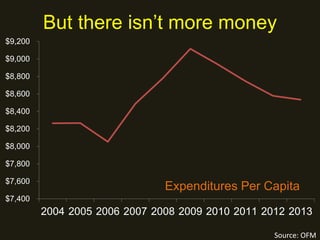
But there isn’t more money
Source: OFM
$7,400
$7,600
$7,800
$8,000
$8,200
$8,400
$8,600
$8,800
$9,000
$9,200
2004 2005 2006 2007 2008 2009 2010 2011 2012 2013
Expenditures Per Capita
So, what are your options?
Process Improvements
Increased Leverage
“Give me a lever, and a place to
stand, and I will move the earth.”
Archimedes
Collaborating Across
Governments
Washington’s Master
Addressing Services
Because
Underlying Problem
• 100K+ people in 2015
• 35K housing units
• State spent $618K per year on data
with 20-30% errors in locating
addresses
We’re not on the same page!
Impact of the Problem
• Emergency Services may not
respond to the correct location
• Local taxes are not collected properly.
People lose confidence in government
Impact of the Problem
• Emergency Services may not
respond to the correct location
• Local taxes are not collected properly.
People lose confidence in government
Solving the Problem
• 12 agencies collaborated to find a
solution
• Needed the right platform
– Web-based tools (Kerika), not
SharePoint
• Kanban and Scrum methodologies
– Fast process improvements
And it was worth it…
• 18 agencies and tribal entities already
benefiting
• 34.8 million records processed
• $138,000 in direct savings already
–$15million projected
ROI within 3 months of launch
Collaborating Across Entities
The Washington Statewide
Trails Project
Because
Underlying Problem
• 12,000 miles of trails
– Hiking, biking, riding…
• Multiple jurisdictions
– DNR, USFS, Parks, Counties…
No single view into the wonders of
Washington’s Parks
Impact of the Problem
• Many agencies use trails data
• A single state trails database didn’t
exist
No common way for us to do our jobs
Solving the Problem
• Need collaboration tools that are in
the cloud
• Need the right participants
And it was worth it…
• Public/Private partnerships
strengthened
• Better coordination between state &
local government
Trails work incorporated in the National
Map!
Collaborating Across Agency
Management
OCIO Policy & Standards
Because
Underlying Problem
• Stakeholder coordination and
outreach is a challenge
–Traditional tools work for some but
not all agencies
–Technical & management
engagement styles are different
–Building consensus is critical
The Impact of the Problem
• We need to reach a balance on
technical issues
If we can’t get buy-in than adoption is
impacted!
Solving the Problem
• 27 Agencies have to collaborate!
Which means we need
• Easy ways to communicate
• Easy ways to update versioned
documents
And it was worth it…
• The standards development and
review process works
– Updated and created 5 new
standards that agencies needed
• And is streamlined
Trails work incorporated in the National
Map!
Three Essentials
1. An inspiring reason
2. The right timing
1. A confident team
Inspiring Reason (Vision)
• Everyone needs an affirmative reason
to do something
• Something that promotes and
sustains interest and enthusiasm.
Don’t do it just out of fear.
Timing
• People need to feel the pain.
– It hurts already.
– It will hurt for a long time.
Not every project is ready, now.
Confident Team
• Strength comes from confidence.
– In yourself
– In your team
• Self-managing people
No hierarchy to fall back upon: it’s up to
you to get the job done.
Easy, sure
Three Hurdles
1. Your old habits.
2. Your old rivalries.
3. Your old-style sponsor.
Your old habits
• Don’t include people who hate
change, on a change project.
– An expert with the wrong attitude
can squelch the team.
– Check your own behavioral
expectations at the door.
Agree to change
Your old rivalries
• Forget the history between
departments, agencies, managers.
• Don’t bring a knife to a gun fight.
• Don’t bring a gun to a knife fight.
This isn’t a fight at all.
Your old-style Sponsor
• Need a Sponsor that will embrace
change.
• And think big.
• And think broad.
Old-style Sponsorship will clip your
wings.
How to Get Started
• Talk to your peers
– Yes, there’s someone in your
agency who has done this
• Talk to the Wise Lady
– She will connect you
• Get the right tools
– Kerika, Box, WebEx
Tools & Resources
Yes, we walked this talk…
Questions?
Arun @ Kerika.com
Joy.Paulus @ ocio.wa.gov

Collaboration across boundaries

  • 1.
  • 2.
  • 3.
    More people Source: OFM hareof total growth was 58 percent and 62 percent, respectively. This is the third consecutive year hat migration has exceeded the prior decade average of 45,000. Figure 1. State Population Change and Components of Change -20,000 0 20,000 40,000 60,000 80,000 100,000 120,000 140,000 160,000 1980 1985 1990 1995 2000 2005 2010 2015 Population Change Natural Increase Net Migration
  • 4.
  • 5.
    But there isn’tmore money Source: OFM $7,400 $7,600 $7,800 $8,000 $8,200 $8,400 $8,600 $8,800 $9,000 $9,200 2004 2005 2006 2007 2008 2009 2010 2011 2012 2013 Expenditures Per Capita
  • 6.
    So, what areyour options?
  • 7.
  • 8.
  • 9.
    “Give me alever, and a place to stand, and I will move the earth.” Archimedes
  • 10.
  • 11.
  • 12.
    Underlying Problem • 100K+people in 2015 • 35K housing units • State spent $618K per year on data with 20-30% errors in locating addresses We’re not on the same page!
  • 13.
    Impact of theProblem • Emergency Services may not respond to the correct location • Local taxes are not collected properly. People lose confidence in government
  • 14.
    Impact of theProblem • Emergency Services may not respond to the correct location • Local taxes are not collected properly. People lose confidence in government
  • 15.
    Solving the Problem •12 agencies collaborated to find a solution • Needed the right platform – Web-based tools (Kerika), not SharePoint • Kanban and Scrum methodologies – Fast process improvements
  • 16.
    And it wasworth it… • 18 agencies and tribal entities already benefiting • 34.8 million records processed • $138,000 in direct savings already –$15million projected ROI within 3 months of launch
  • 17.
    Collaborating Across Entities TheWashington Statewide Trails Project
  • 18.
  • 19.
    Underlying Problem • 12,000miles of trails – Hiking, biking, riding… • Multiple jurisdictions – DNR, USFS, Parks, Counties… No single view into the wonders of Washington’s Parks
  • 20.
    Impact of theProblem • Many agencies use trails data • A single state trails database didn’t exist No common way for us to do our jobs
  • 21.
    Solving the Problem •Need collaboration tools that are in the cloud • Need the right participants
  • 22.
    And it wasworth it… • Public/Private partnerships strengthened • Better coordination between state & local government Trails work incorporated in the National Map!
  • 23.
  • 24.
  • 25.
    Underlying Problem • Stakeholdercoordination and outreach is a challenge –Traditional tools work for some but not all agencies –Technical & management engagement styles are different –Building consensus is critical
  • 26.
    The Impact ofthe Problem • We need to reach a balance on technical issues If we can’t get buy-in than adoption is impacted!
  • 27.
    Solving the Problem •27 Agencies have to collaborate! Which means we need • Easy ways to communicate • Easy ways to update versioned documents
  • 28.
    And it wasworth it… • The standards development and review process works – Updated and created 5 new standards that agencies needed • And is streamlined Trails work incorporated in the National Map!
  • 29.
    Three Essentials 1. Aninspiring reason 2. The right timing 1. A confident team
  • 30.
    Inspiring Reason (Vision) •Everyone needs an affirmative reason to do something • Something that promotes and sustains interest and enthusiasm. Don’t do it just out of fear.
  • 31.
    Timing • People needto feel the pain. – It hurts already. – It will hurt for a long time. Not every project is ready, now.
  • 32.
    Confident Team • Strengthcomes from confidence. – In yourself – In your team • Self-managing people No hierarchy to fall back upon: it’s up to you to get the job done.
  • 33.
  • 34.
    Three Hurdles 1. Yourold habits. 2. Your old rivalries. 3. Your old-style sponsor.
  • 35.
    Your old habits •Don’t include people who hate change, on a change project. – An expert with the wrong attitude can squelch the team. – Check your own behavioral expectations at the door. Agree to change
  • 36.
    Your old rivalries •Forget the history between departments, agencies, managers. • Don’t bring a knife to a gun fight. • Don’t bring a gun to a knife fight. This isn’t a fight at all.
  • 37.
    Your old-style Sponsor •Need a Sponsor that will embrace change. • And think big. • And think broad. Old-style Sponsorship will clip your wings.
  • 38.
    How to GetStarted • Talk to your peers – Yes, there’s someone in your agency who has done this • Talk to the Wise Lady – She will connect you • Get the right tools – Kerika, Box, WebEx
  • 39.
  • 40.
    Yes, we walkedthis talk…
  • 41.
  • 42.

Editor's Notes

  • #2 Hi folks, My name is Arun Kumar, and this is Joy Paulus. I am the founder and CEO of Kerika; our product meets all the work management needs of distributed, Lean and Agile teams. Joy is a long-time public servant, and is currently the state’s Chief GIS Officer in the Office of the CIO. Our talk today is about collaboration across boundaries: organizational boundaries, geographic boundaries, and even across the public, nonprofit and private sectors.
  • #3 Collaboration across organizational and geographic boundaries is hard, and different, so: why bother? Is there a compelling reason for us to work differently – to take on the new challenges presented by cross-organizational collaboration?
  • #4 From the perspective of this audience, which is almost entirely people working in state, county and city government in Washington, here are some sobering figures that I sourced from the Office of Financial Management. This chart shows how the population of Washington State has been changing over the past 35 years. Note that this represents increases in population: not total population. So while the rate of increase has occasionally dipped – most recently during the Great Recession – the total population has been rising steadily. The red line represents the “natural increase”: what you would expect simply from births among people already living in the state. The big swing is the “net migration”: the relative attractiveness of Washington State as a place to migrate to, whether you are already living in the United States or immigrating from abroad.
  • #5 If we dig into the OFM data a little more, we can get a better idea of how this growing population needs more services. The blue line here represents the senior segment of the population, and as you can see it has been rising steadily over the years. The red line represents the school-age population: it too has been rising fairly steeply, with some leveling off in the past few years. So: not only do we have more people living in the state, but we have more people who need more services from the state.
  • #6 At the same time, if we look at per-capita expenditure by the state, it’s a pretty gloomy picture! Per-capita expenditure by the state fell in the Great Recession, and the best-case outlook seems to be that it will remain flat – certainly no one in Olympia expects per-capita expenditures to rise much in the coming years. This, then, is the squeeze that makes it imperative for all of us to start embracing cross-organizational collaboration: we have more people, with expectations of what the state will do for them ratcheting upwards (never downwards!), and a declining amount of money with which to meet those expectations.
  • #7 Apart from Utopia, that is…
  • #8 Much of this conference is already devoted to process improvements, Kaizen, etc., so we are not going to talk about that in our session.
  • #9 Instead, we will focus on the concept of leverage, and argue that cross-organizational collaboration can provide the leverage needed to to meeting the rising expectations of an increasing population, without having more money to do so.
  • #12 This sort of press, unfortunately, highlight our inability to get it right sometime… Marcy found that she was being taxed a King Co transit tax when she actually lived in Pierce County A business applied for a Thurston County license and they misidentified them as living in Lewis County Both examples of how misplacing a person in the wrong location can have financial ramifications to citizens So, why does this matter… because we’re in the limelight more often than we’d like and its because our addresses are wrong and have resulted in bad decisions and even worse results.
  • #15 The Oso mudslide, the Bellingham Pipeline explosion, the Howard Hansen Dam leak --- all examples of emergency situations where knowing where people lived was important But, when governmental entities maintain various client databases of addresses we’re all working from different pages of a playlist. Having a master list of addresses and their correct location on a map is critical!
  • #20 In 2006 the Legislature asked Recreation & Conservation Office (RCO) to create a trails data and gave them ~ $135K In January 2007 they completed a feasibility study and the report indicated it would cost an estimated $1.7-2.3 million dollars to collect and integrate the data from across the various entities Fast forward to 2014, lots of technology changes since then… This initially began as a volunteer project Received grant funding from the Recreation & Conservation Office in September 2014 We began collecting trails data from over 25 different entities – it took a lot of coordination and collaboration
  • #21 Joy Many agencies use trails data Different agencies use different database designs We end up with a…. Disjointed picture of the resources opportunities in WA Frustration at not being able to compare trails across jurisdictions The public ends up not sure what or if trails link up with each other and end up having to go to numerous sites to find what they’re looking for.
  • #22 Joy We aggregate data from wherever we could get it Our team was distributed with folks in Bellingham, Poulsbo, & Olympia. The “Cloud” enabled our success ArcGIS On-line Amazon Web Services Kerika WebEx Reach out to different agencies Data search lasted 6 months
  • #23 We migrated data to the federal standard. We fostered federal, state, local, and private partnerships Using one standard design saves time and resources when we integrate this information the next time The data is out there People want to get involved to continue to improve it We're doing the second update presently Remember that Legislative trails report? We did this project for 1/10th the cost
  • #26 It also has the obvious pitfalls as we try to implement sound, flexible and valuable guidance around information technology. And we don’t always get it right which I’m sure we can all point to examples of this….
  • #27 But clearly, policy and standards are the best way we have make sure we’re all moving in a similar direction in state government. That way we can easily share information that’s collected Without them we get anarchy
  • #28 Within the geospatial community we’ve seen success in doing this. Our governance body includes some of the largest state agencies And we leverage technology to get it done so its easy for everyone – even those who aren’t on the SGN Using these tools and approaches, we updated & created 5 new standards as asked for by the agencies Remember the trails project? OCIO now requires that this standard be used by all state agencies who collect trails data and was adopted by the user community.
  • #35 Arun
  • #36 Arun
  • #37 Arun
  • #41 And, by the way, we live what we preach. Joy works for the state government in Olympia, and Arun works for a private company (Kerika) in Issaquah. To put together this presentation, from initial brainstorming to final product, we used Kerika – here’s what our board looked like as we built this talk together.
  • #43 Feel free to reach out to both of us if you would like to chat more on this topic!