www.journalistethics.com
Ethical Journalism Template Yes No
1. Fair. Uses hateful or degrading speech
Exploits disempowered persons/groups
2. Lawful. Abides by civil and statutory laws
3. Organization's publication charter is adhered to
4. Accuracy. Provides relevant context
Uses misleading or deceptive language
Emphasizes facts and avoids speculation
Triangulates and validates data sources
Explores reasonable counter arguments
Offers stakeholders the right to reply
Title reflects the substance of the content
Apologizes for and corrects prior inaccuracies
5. Transparency. Discloses conflicts-of-interest
Discloses primary and secondary sources
Pursues a non-disclosed or biased agenda
Employs psychological manipulation ('psy-ops')
6. Safety and health of stakeholders are respected
7. Freedom of speech and thought is promoted
8. Acknowledgement. Recognition of contributors
9. Independence. Content reflects author's opinion
10. Responsibility. Expert contributors are qualified
Emphasizes negativity, despair, defeatism
Signed: Journalist/s Approved: Editor/s
………………………………………………………………………………… …………………………………………….
www.journalistethics.com
Annex 1
Ethical Journalism: Fairness
Guideline Yes No
1. Uses hateful or degrading speech. *
2. Exploits disempowered persons/groups. *
3. Obtains permission to quote sources. *
4. Respects the dignity of others; avoids undue
humiliation, shaming and embarrassment.
*
5. Avoids pigeon-holing people by mentioning their
residential suburb, occupation, gender, age etc.
when this is not relevant to the issues reported.
*
6. Allows stories that are resolved to rest-in-peace. *
7. Content connects crimes and controversial actions
of private citizens to their friends, family and
associates, when there is no known connection to
these other parties.
*
Annex 2
Ethical Journalism: Legal Compliance
Guideline Yes No
1. Abides by Criminal Laws e.g. harassment. *
2. Abides by Statutory Laws e.g. false advertising. *
3. Abides by Common Laws e.g. property rights. *
4. Minimizes exposure to Tortious Laws,
e.g. Negligence, Defamation, Passing-off.
*
5. Honors contractual obligations. *
6. Abides by International Law. *
7. Uses SPAM to disseminate content. *
8. Offers an unsubscribe option for e-mail
recipients and other recipients.
*
www.journalistethics.com
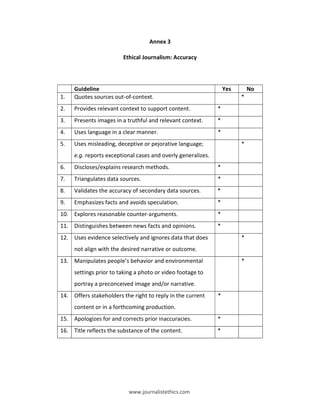
Annex 3
Ethical Journalism: Accuracy
Guideline Yes No
1. Quotes sources out-of-context. *
2. Provides relevant context to support content. *
3. Presents images in a truthful and relevant context. *
4. Uses language in a clear manner. *
5. Uses misleading, deceptive or pejorative language;
e.g. reports exceptional cases and overly generalizes.
*
6. Discloses/explains research methods. *
7. Triangulates data sources. *
8. Validates the accuracy of secondary data sources. *
9. Emphasizes facts and avoids speculation. *
10. Explores reasonable counter-arguments. *
11. Distinguishes between news facts and opinions. *
12. Uses evidence selectively and ignores data that does
not align with the desired narrative or outcome.
*
13. Manipulates people’s behavior and environmental
settings prior to taking a photo or video footage to
portray a preconceived image and/or narrative.
*
14. Offers stakeholders the right to reply in the current
content or in a forthcoming production.
*
15. Apologizes for and corrects prior inaccuracies. *
16. Title reflects the substance of the content. *
www.journalistethics.com
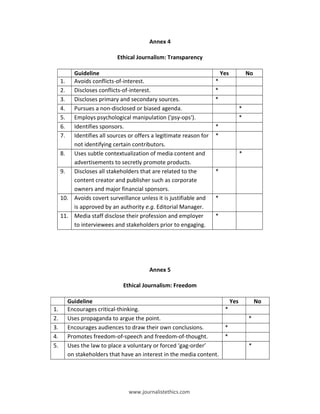
Annex 4
Ethical Journalism: Transparency
Guideline Yes No
1. Avoids conflicts-of-interest. *
2. Discloses conflicts-of-interest. *
3. Discloses primary and secondary sources. *
4. Pursues a non-disclosed or biased agenda. *
5. Employs psychological manipulation ('psy-ops'). *
6. Identifies sponsors. *
7. Identifies all sources or offers a legitimate reason for
not identifying certain contributors.
*
8. Uses subtle contextualization of media content and
advertisements to secretly promote products.
*
9. Discloses all stakeholders that are related to the
content creator and publisher such as corporate
owners and major financial sponsors.
*
10. Avoids covert surveillance unless it is justifiable and
is approved by an authority e.g. Editorial Manager.
*
11. Media staff disclose their profession and employer
to interviewees and stakeholders prior to engaging.
*
Annex 5
Ethical Journalism: Freedom
Guideline Yes No
1. Encourages critical-thinking. *
2. Uses propaganda to argue the point. *
3. Encourages audiences to draw their own conclusions. *
4. Promotes freedom-of-speech and freedom-of-thought. *
5. Uses the law to place a voluntary or forced ‘gag-order’
on stakeholders that have an interest in the media content.
*
www.journalistethics.com
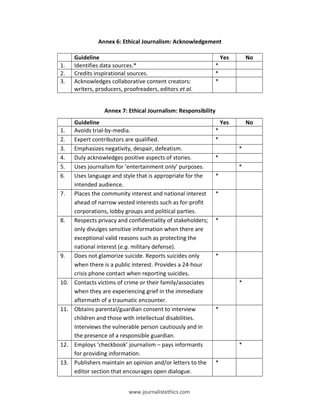
Annex 6: Ethical Journalism: Acknowledgement
Guideline Yes No
1. Identifies data sources.* *
2. Credits inspirational sources. *
3. Acknowledges collaborative content creators:
writers, producers, proofreaders, editors et al.
*
Annex 7: Ethical Journalism: Responsibility
Guideline Yes No
1. Avoids trial-by-media. *
2. Expert contributors are qualified. *
3. Emphasizes negativity, despair, defeatism. *
4. Duly acknowledges positive aspects of stories. *
5. Uses journalism for ‘entertainment only’ purposes. *
6. Uses language and style that is appropriate for the
intended audience.
*
7. Places the community interest and national interest
ahead of narrow vested interests such as for-profit
corporations, lobby groups and political parties.
*
8. Respects privacy and confidentiality of stakeholders;
only divulges sensitive information when there are
exceptional valid reasons such as protecting the
national interest (e.g. military defense).
*
9. Does not glamorize suicide. Reports suicides only
when there is a public interest. Provides a 24-hour
crisis phone contact when reporting suicides.
*
10. Contacts victims of crime or their family/associates
when they are experiencing grief in the immediate
aftermath of a traumatic encounter.
*
11. Obtains parental/guardian consent to interview
children and those with intellectual disabilities.
Interviews the vulnerable person cautiously and in
the presence of a responsible guardian.
*
12. Employs ‘checkbook’ journalism – pays informants
for providing information.
*
13. Publishers maintain an opinion and/or letters to the
editor section that encourages open dialogue.
*

Journalism Ethics - Editors Checklist

  • 1.
    www.journalistethics.com Ethical Journalism TemplateYes No 1. Fair. Uses hateful or degrading speech Exploits disempowered persons/groups 2. Lawful. Abides by civil and statutory laws 3. Organization's publication charter is adhered to 4. Accuracy. Provides relevant context Uses misleading or deceptive language Emphasizes facts and avoids speculation Triangulates and validates data sources Explores reasonable counter arguments Offers stakeholders the right to reply Title reflects the substance of the content Apologizes for and corrects prior inaccuracies 5. Transparency. Discloses conflicts-of-interest Discloses primary and secondary sources Pursues a non-disclosed or biased agenda Employs psychological manipulation ('psy-ops') 6. Safety and health of stakeholders are respected 7. Freedom of speech and thought is promoted 8. Acknowledgement. Recognition of contributors 9. Independence. Content reflects author's opinion 10. Responsibility. Expert contributors are qualified Emphasizes negativity, despair, defeatism Signed: Journalist/s Approved: Editor/s ………………………………………………………………………………… …………………………………………….
  • 2.
    www.journalistethics.com Annex 1 Ethical Journalism:Fairness Guideline Yes No 1. Uses hateful or degrading speech. * 2. Exploits disempowered persons/groups. * 3. Obtains permission to quote sources. * 4. Respects the dignity of others; avoids undue humiliation, shaming and embarrassment. * 5. Avoids pigeon-holing people by mentioning their residential suburb, occupation, gender, age etc. when this is not relevant to the issues reported. * 6. Allows stories that are resolved to rest-in-peace. * 7. Content connects crimes and controversial actions of private citizens to their friends, family and associates, when there is no known connection to these other parties. * Annex 2 Ethical Journalism: Legal Compliance Guideline Yes No 1. Abides by Criminal Laws e.g. harassment. * 2. Abides by Statutory Laws e.g. false advertising. * 3. Abides by Common Laws e.g. property rights. * 4. Minimizes exposure to Tortious Laws, e.g. Negligence, Defamation, Passing-off. * 5. Honors contractual obligations. * 6. Abides by International Law. * 7. Uses SPAM to disseminate content. * 8. Offers an unsubscribe option for e-mail recipients and other recipients. *
  • 3.
    www.journalistethics.com Annex 3 Ethical Journalism:Accuracy Guideline Yes No 1. Quotes sources out-of-context. * 2. Provides relevant context to support content. * 3. Presents images in a truthful and relevant context. * 4. Uses language in a clear manner. * 5. Uses misleading, deceptive or pejorative language; e.g. reports exceptional cases and overly generalizes. * 6. Discloses/explains research methods. * 7. Triangulates data sources. * 8. Validates the accuracy of secondary data sources. * 9. Emphasizes facts and avoids speculation. * 10. Explores reasonable counter-arguments. * 11. Distinguishes between news facts and opinions. * 12. Uses evidence selectively and ignores data that does not align with the desired narrative or outcome. * 13. Manipulates people’s behavior and environmental settings prior to taking a photo or video footage to portray a preconceived image and/or narrative. * 14. Offers stakeholders the right to reply in the current content or in a forthcoming production. * 15. Apologizes for and corrects prior inaccuracies. * 16. Title reflects the substance of the content. *
  • 4.
    www.journalistethics.com Annex 4 Ethical Journalism:Transparency Guideline Yes No 1. Avoids conflicts-of-interest. * 2. Discloses conflicts-of-interest. * 3. Discloses primary and secondary sources. * 4. Pursues a non-disclosed or biased agenda. * 5. Employs psychological manipulation ('psy-ops'). * 6. Identifies sponsors. * 7. Identifies all sources or offers a legitimate reason for not identifying certain contributors. * 8. Uses subtle contextualization of media content and advertisements to secretly promote products. * 9. Discloses all stakeholders that are related to the content creator and publisher such as corporate owners and major financial sponsors. * 10. Avoids covert surveillance unless it is justifiable and is approved by an authority e.g. Editorial Manager. * 11. Media staff disclose their profession and employer to interviewees and stakeholders prior to engaging. * Annex 5 Ethical Journalism: Freedom Guideline Yes No 1. Encourages critical-thinking. * 2. Uses propaganda to argue the point. * 3. Encourages audiences to draw their own conclusions. * 4. Promotes freedom-of-speech and freedom-of-thought. * 5. Uses the law to place a voluntary or forced ‘gag-order’ on stakeholders that have an interest in the media content. *
  • 5.
    www.journalistethics.com Annex 6: EthicalJournalism: Acknowledgement Guideline Yes No 1. Identifies data sources.* * 2. Credits inspirational sources. * 3. Acknowledges collaborative content creators: writers, producers, proofreaders, editors et al. * Annex 7: Ethical Journalism: Responsibility Guideline Yes No 1. Avoids trial-by-media. * 2. Expert contributors are qualified. * 3. Emphasizes negativity, despair, defeatism. * 4. Duly acknowledges positive aspects of stories. * 5. Uses journalism for ‘entertainment only’ purposes. * 6. Uses language and style that is appropriate for the intended audience. * 7. Places the community interest and national interest ahead of narrow vested interests such as for-profit corporations, lobby groups and political parties. * 8. Respects privacy and confidentiality of stakeholders; only divulges sensitive information when there are exceptional valid reasons such as protecting the national interest (e.g. military defense). * 9. Does not glamorize suicide. Reports suicides only when there is a public interest. Provides a 24-hour crisis phone contact when reporting suicides. * 10. Contacts victims of crime or their family/associates when they are experiencing grief in the immediate aftermath of a traumatic encounter. * 11. Obtains parental/guardian consent to interview children and those with intellectual disabilities. Interviews the vulnerable person cautiously and in the presence of a responsible guardian. * 12. Employs ‘checkbook’ journalism – pays informants for providing information. * 13. Publishers maintain an opinion and/or letters to the editor section that encourages open dialogue. *