Copyright © 2013, Oracle and/or its affiliates. All rights reserved.
Insert Picture Here
1
Developing for Node.JS with
MySQL and NoSQL
 J.D. Duncan, john.duncan@oracle.com
 Craig Russell, craig.russell@oracle.com
Copyright © 2013, Oracle and/or its affiliates. All rights reserved.2
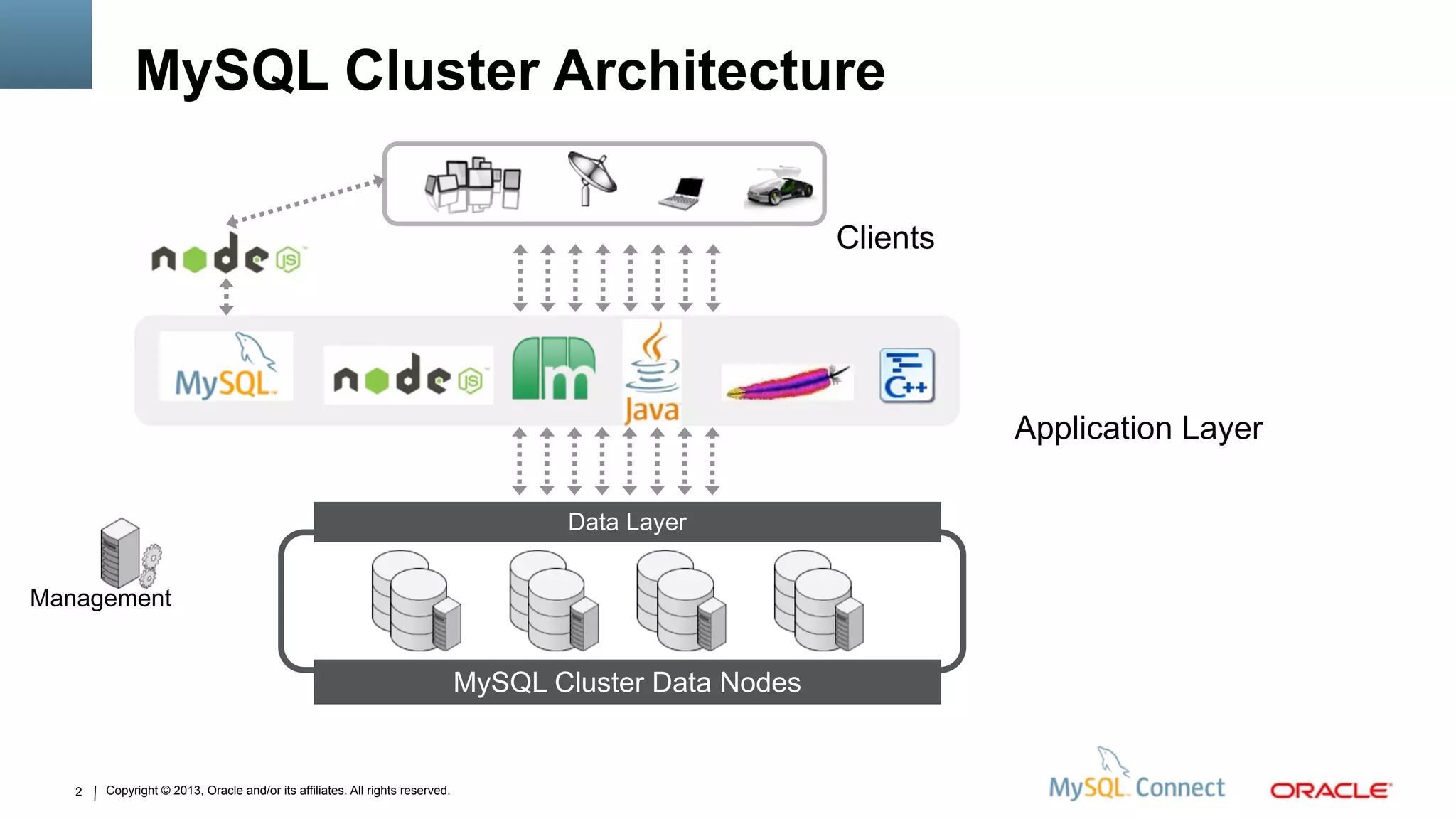
MySQL Cluster Architecture
MySQL Cluster Data Nodes
Data Layer
Clients
Application Layer
Management
Copyright © 2013, Oracle and/or its affiliates. All rights reserved.3
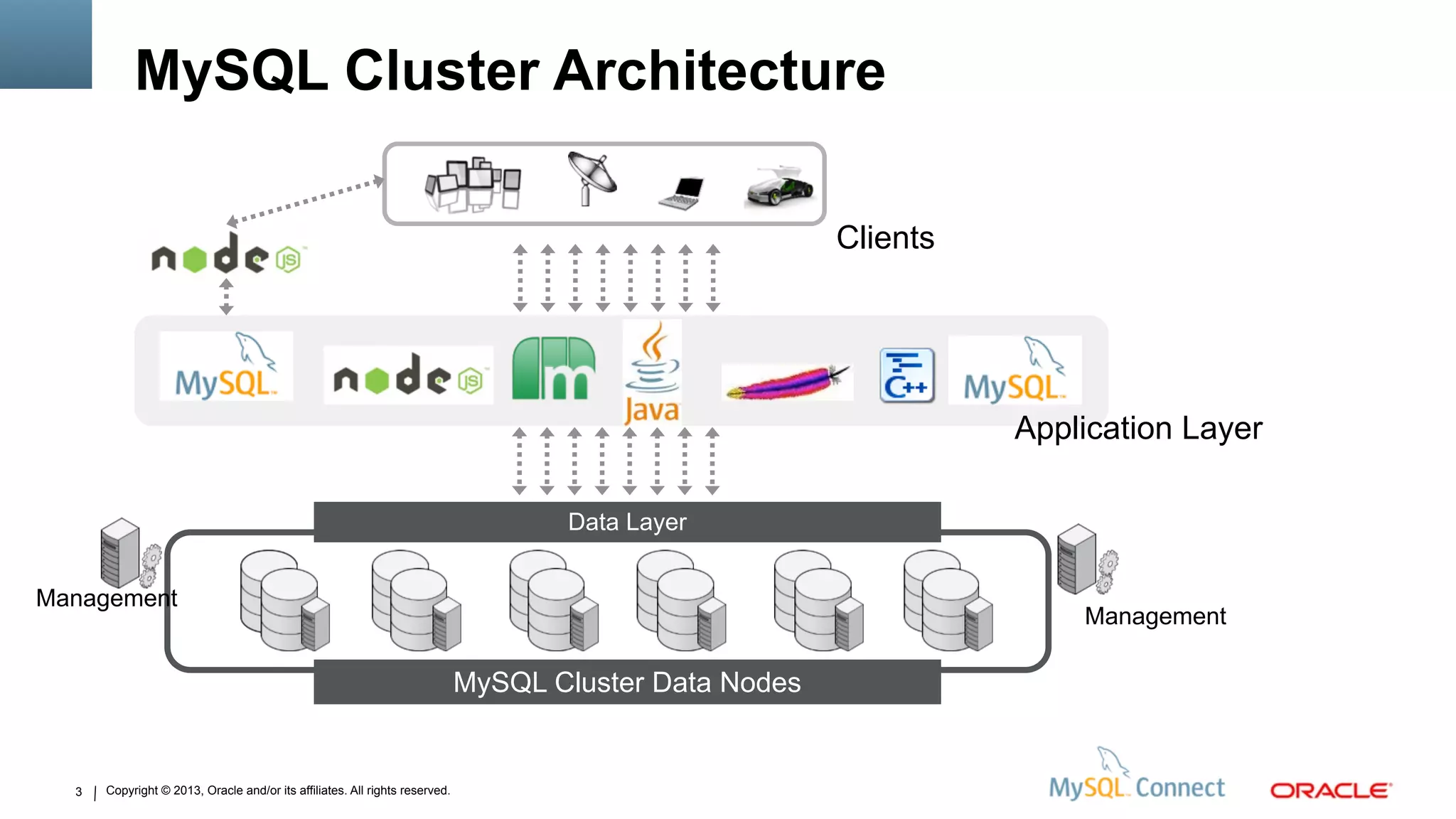
MySQL Cluster Architecture
MySQL Cluster Data Nodes
Data Layer
Clients
Application Layer
Management
Management
Copyright © 2013, Oracle and/or its affiliates. All rights reserved.4
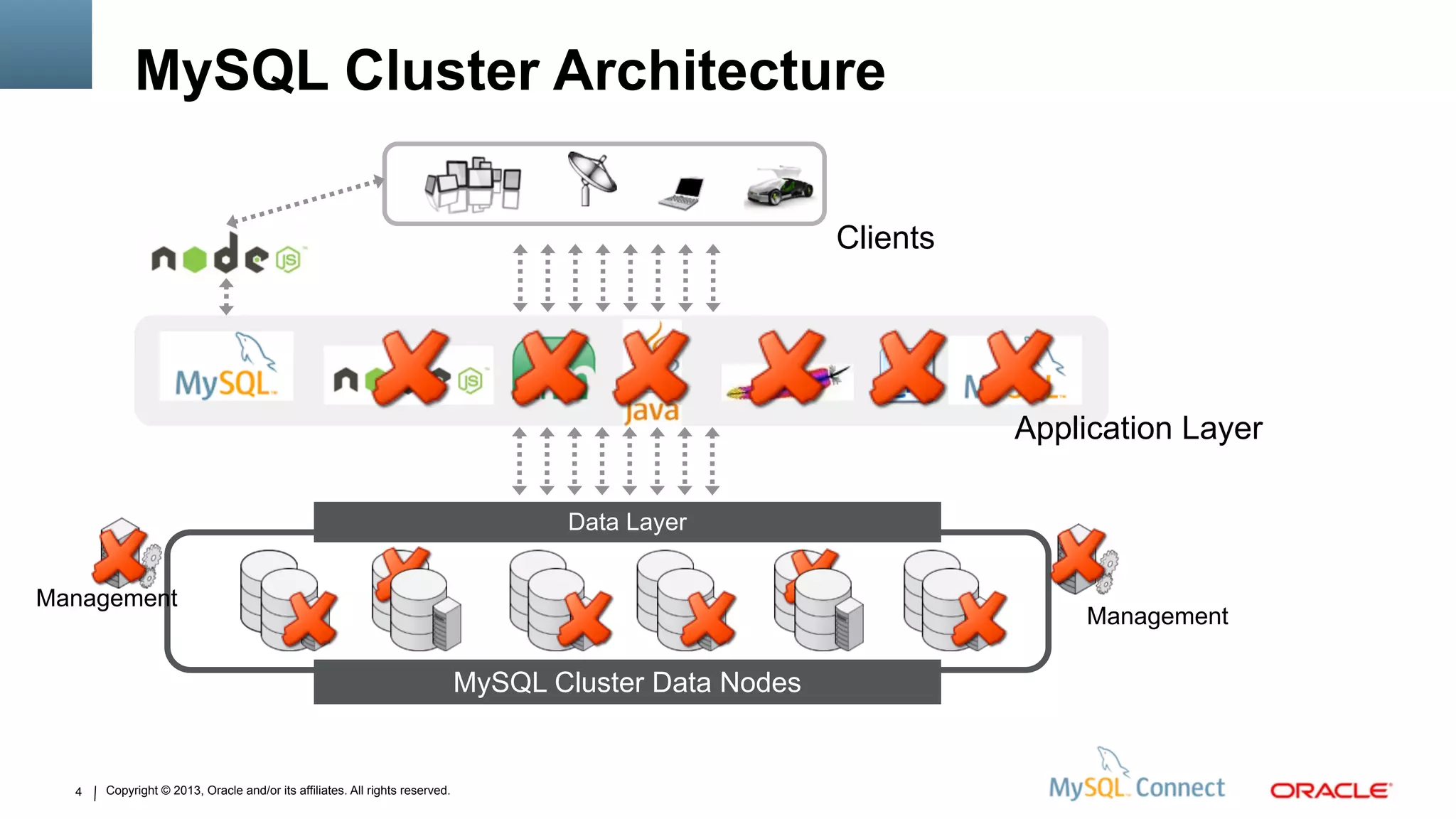
MySQL Cluster Architecture
MySQL Cluster Data Nodes
Data Layer
Application Layer
Management
Management
Clients
Copyright © 2013, Oracle and/or its affiliates. All rights reserved.5
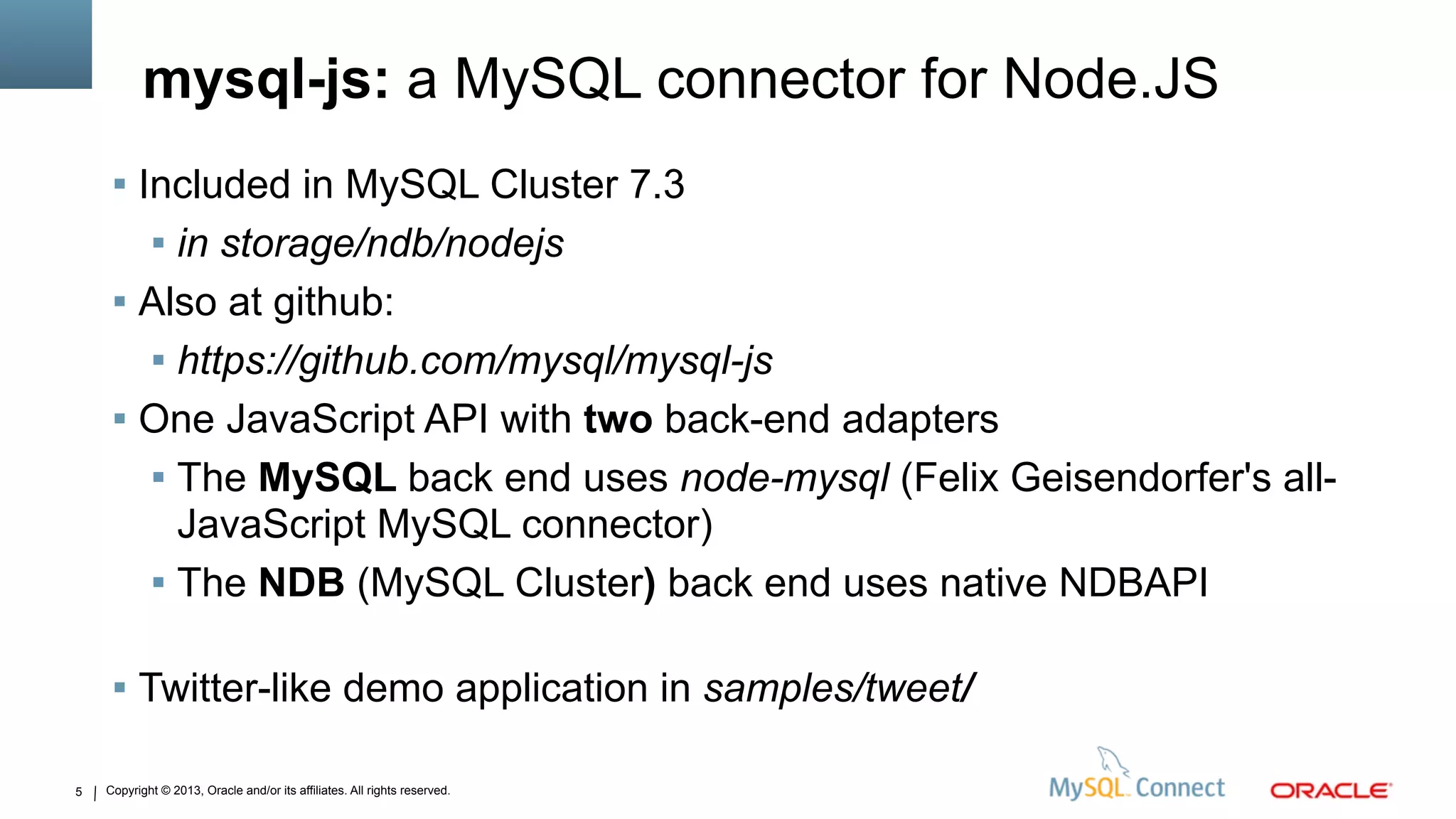
mysql-js: a MySQL connector for Node.JS
 Included in MySQL Cluster 7.3
 in storage/ndb/nodejs
 Also at github:
 https://github.com/mysql/mysql-js
 One JavaScript API with two back-end adapters
 The MySQL back end uses node-mysql (Felix Geisendorfer's all-
JavaScript MySQL connector)
 The NDB (MySQL Cluster) back end uses native NDBAPI
 Twitter-like demo application in samples/tweet/
Copyright © 2013, Oracle and/or its affiliates. All rights reserved.6
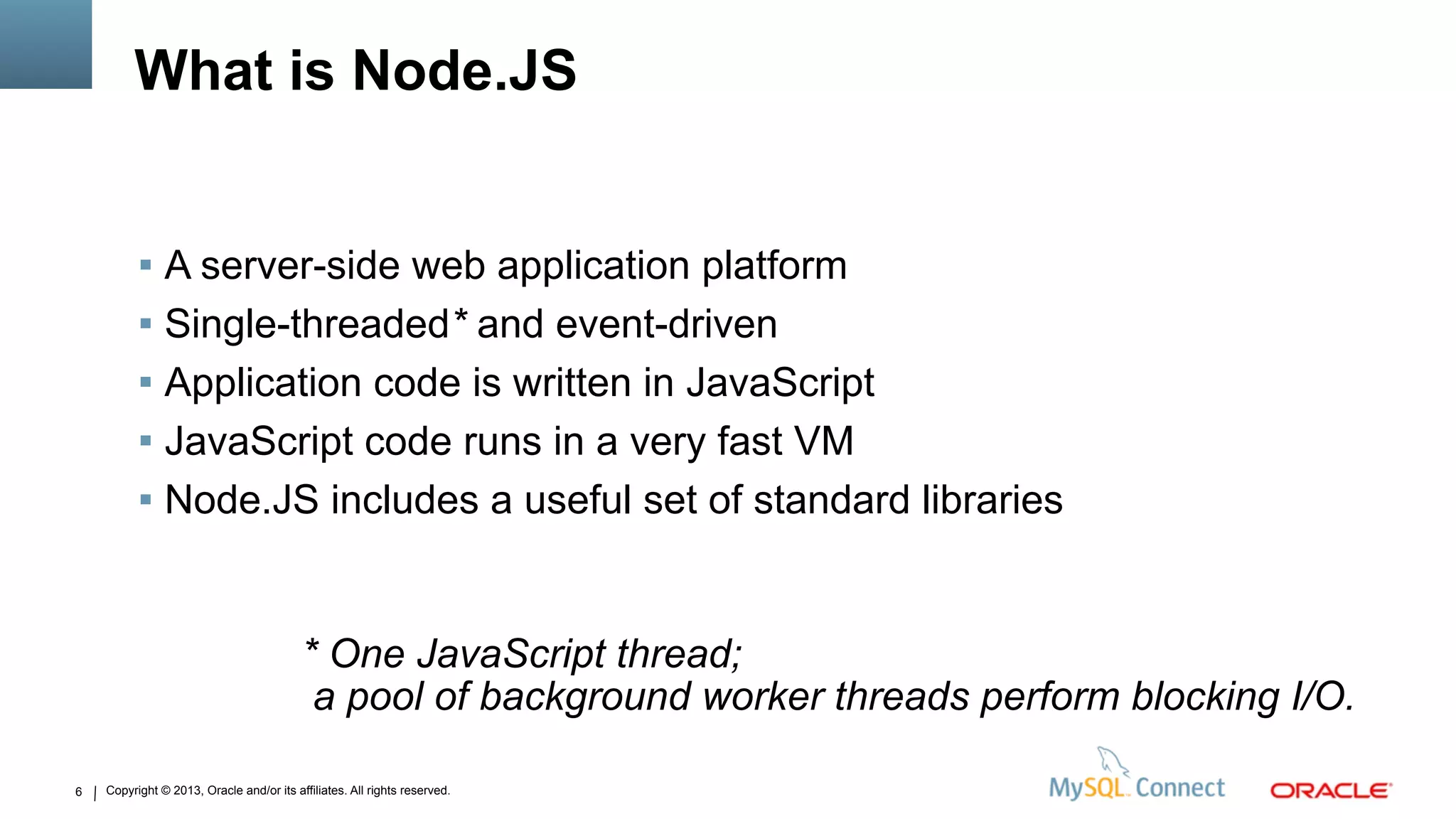
What is Node.JS
 A server-side web application platform
 Single-threaded* and event-driven
 Application code is written in JavaScript
 JavaScript code runs in a very fast VM
 Node.JS includes a useful set of standard libraries
* One JavaScript thread;
a pool of background worker threads perform blocking I/O.
Copyright © 2013, Oracle and/or its affiliates. All rights reserved.7
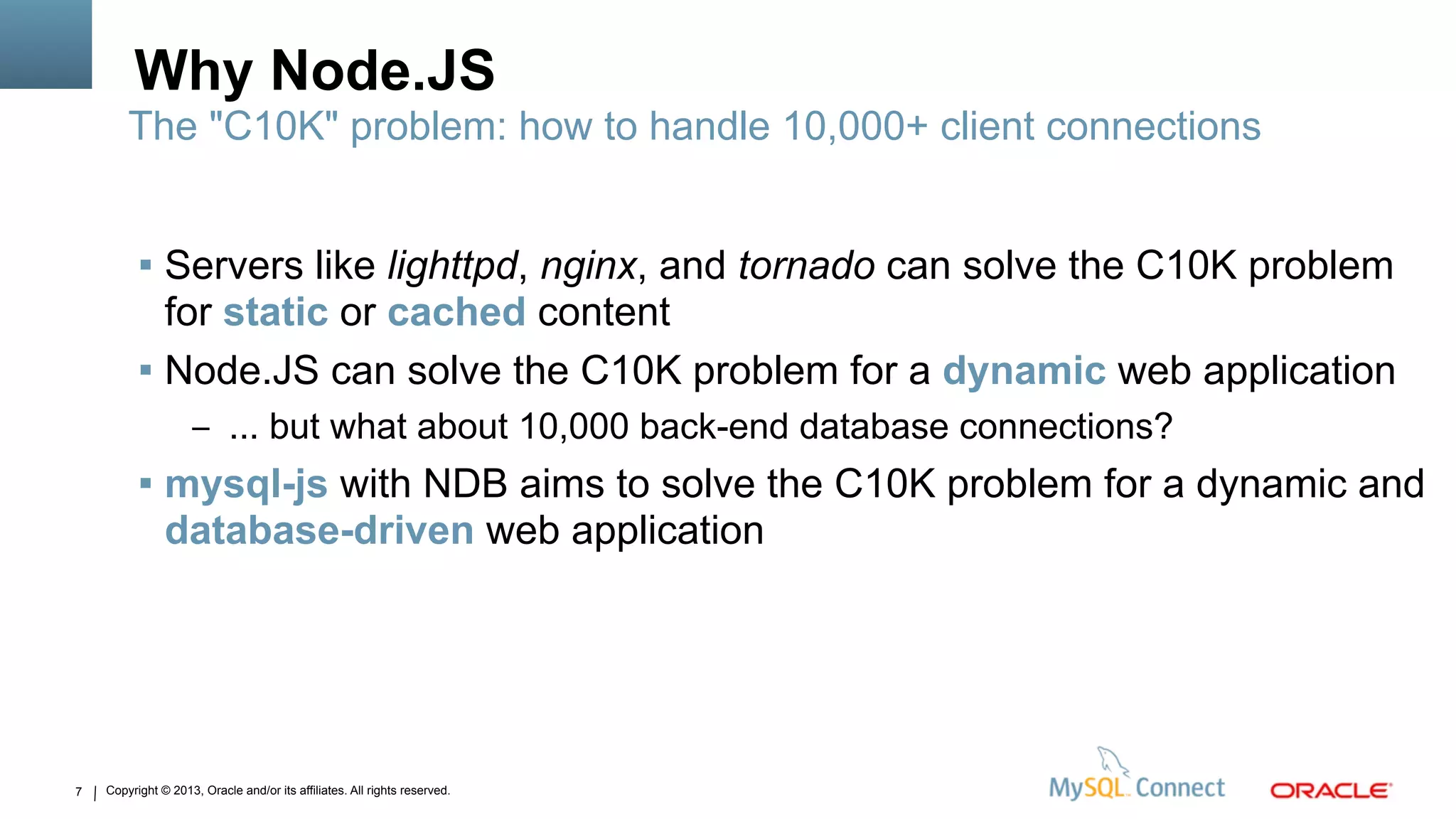
Why Node.JS
 Servers like lighttpd, nginx, and tornado can solve the C10K problem
for static or cached content
 Node.JS can solve the C10K problem for a dynamic web application
– ... but what about 10,000 back-end database connections?
 mysql-js with NDB aims to solve the C10K problem for a dynamic and
database-driven web application
The "C10K" problem: how to handle 10,000+ client connections
Copyright © 2013, Oracle and/or its affiliates. All rights reserved.8
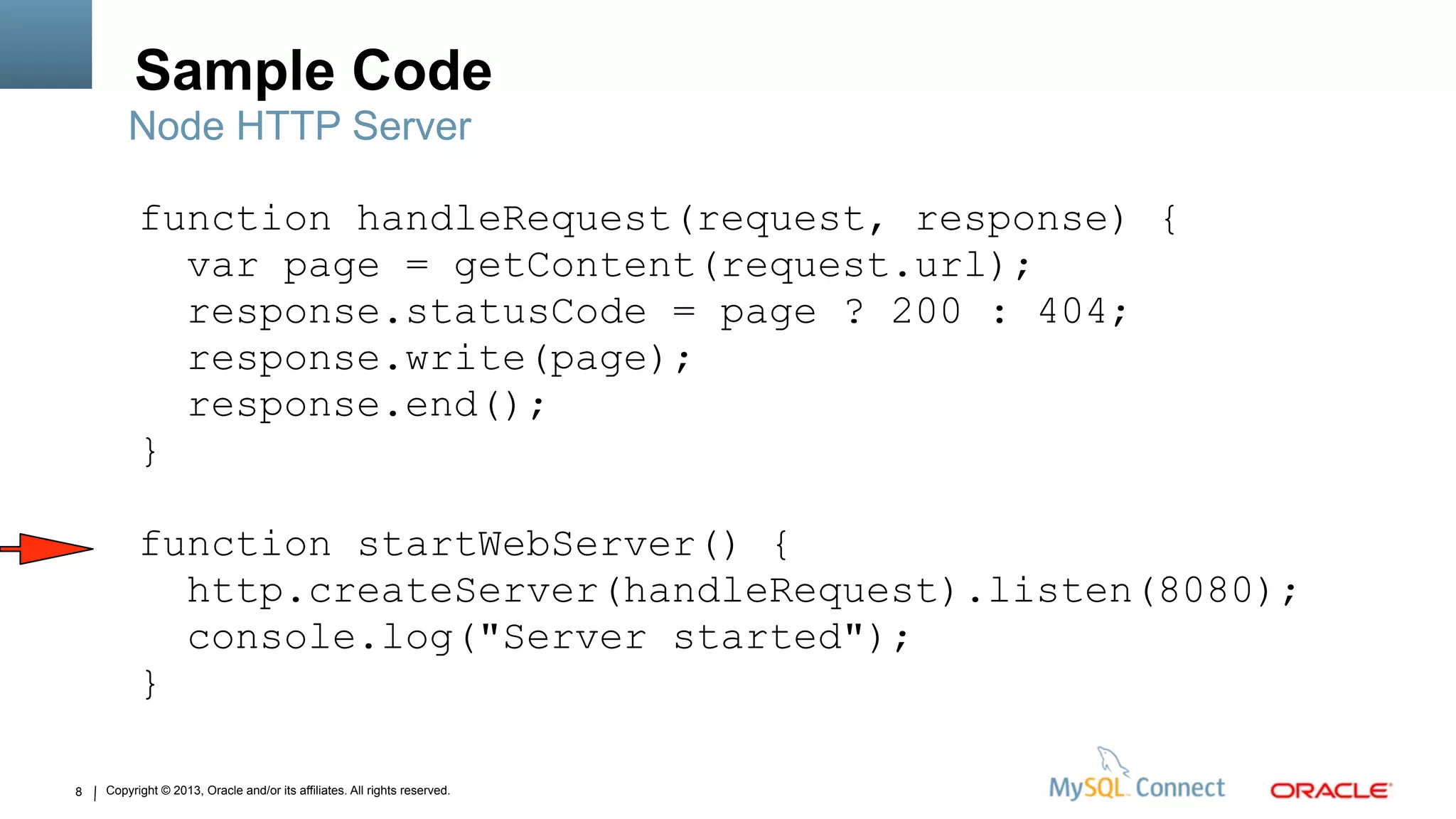
Sample Code
Node HTTP Server
function handleRequest(request, response) {
var page = getContent(request.url);
response.statusCode = page ? 200 : 404;
response.write(page);
response.end();
}
function startWebServer() {
http.createServer(handleRequest).listen(8080);
console.log("Server started");
}
Copyright © 2013, Oracle and/or its affiliates. All rights reserved.9
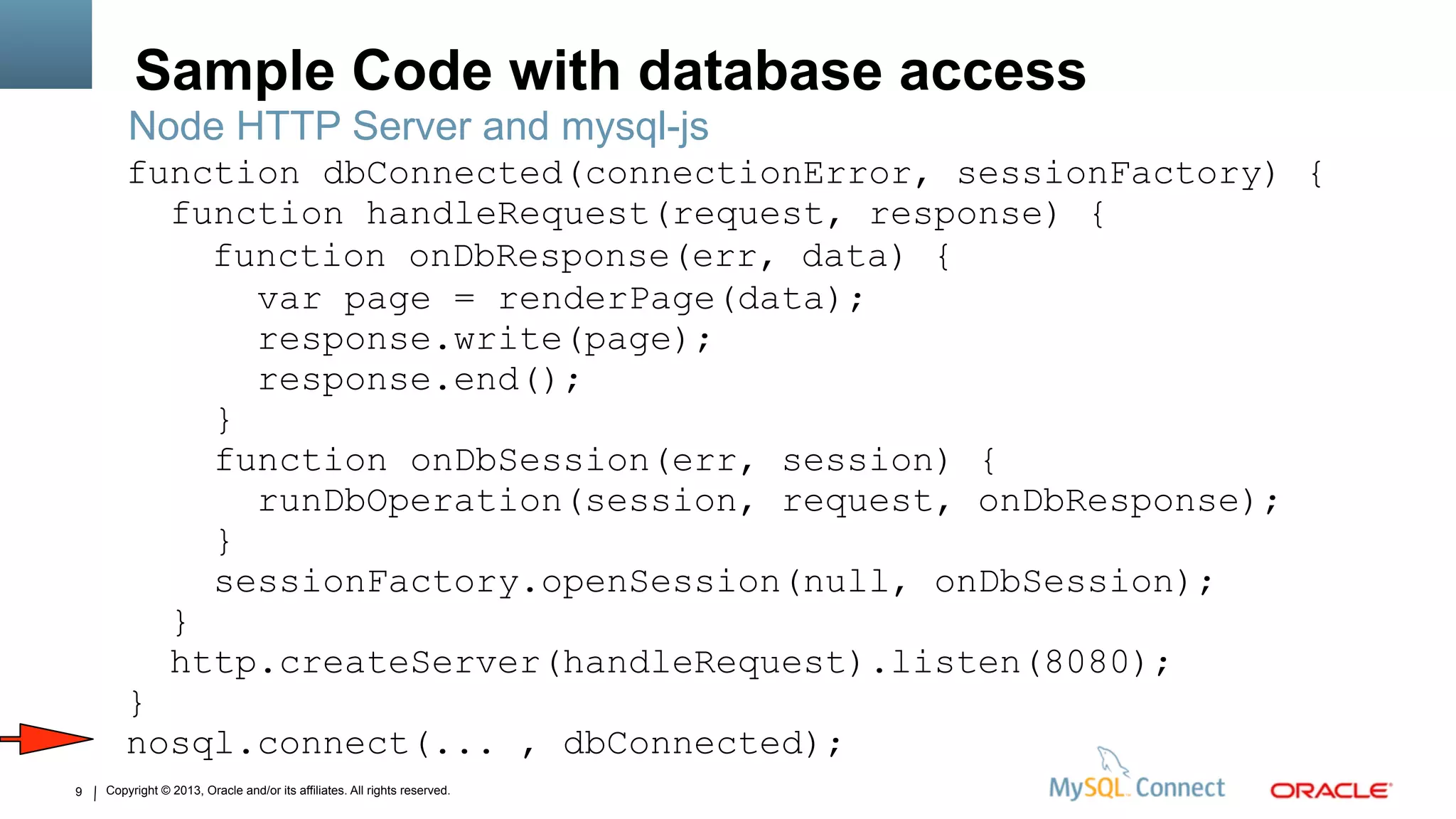
Sample Code with database access
Node HTTP Server and mysql-js
function dbConnected(connectionError, sessionFactory) {
function handleRequest(request, response) {
function onDbResponse(err, data) {
var page = renderPage(data);
response.write(page);
response.end();
}
function onDbSession(err, session) {
runDbOperation(session, request, onDbResponse);
}
sessionFactory.openSession(null, onDbSession);
}
http.createServer(handleRequest).listen(8080);
}
nosql.connect(... , dbConnected);
Copyright © 2013, Oracle and/or its affiliates. All rights reserved.
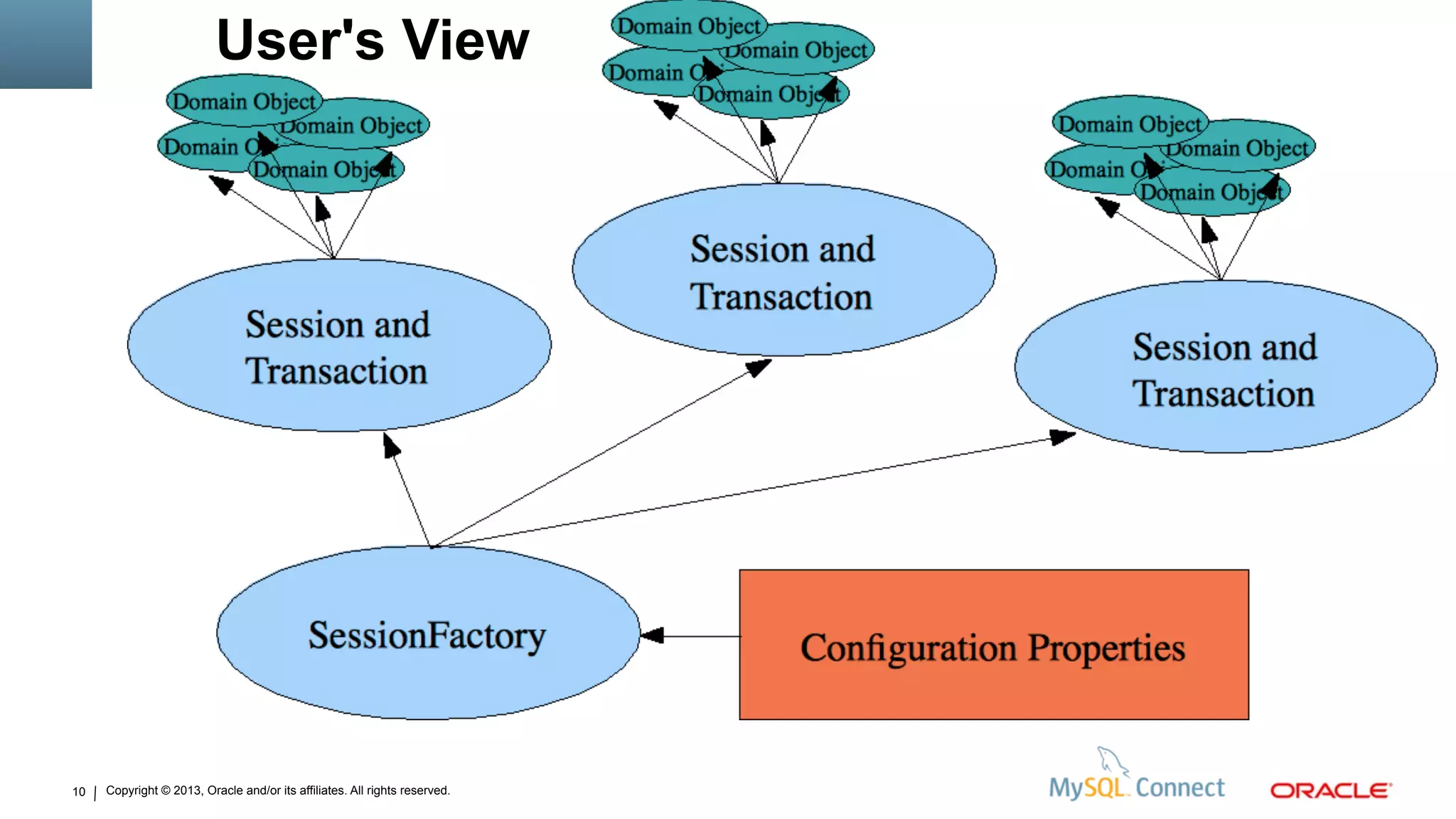
User's View
10
Copyright © 2013, Oracle and/or its affiliates. All rights reserved.
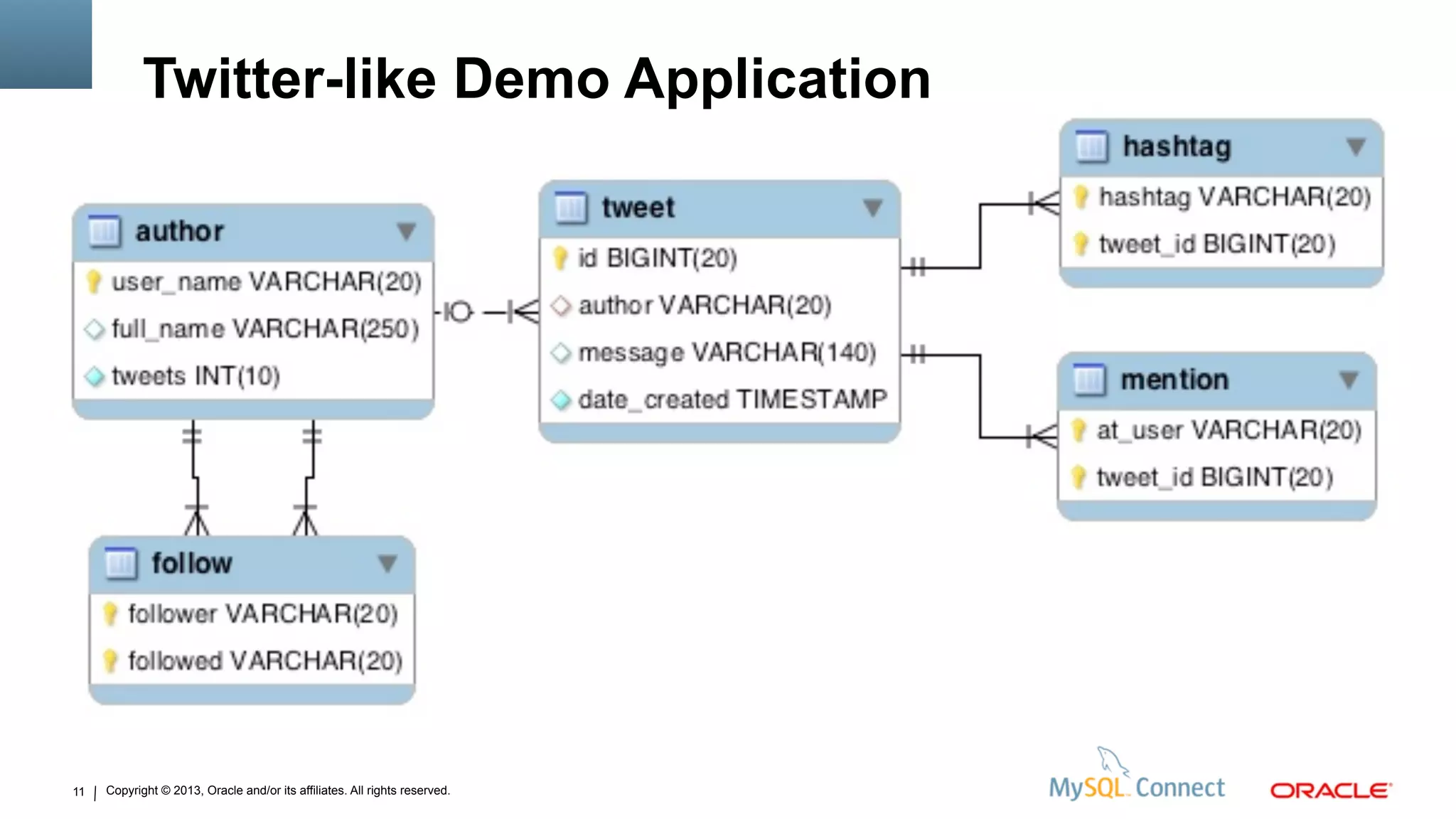
Twitter-like Demo Application
11
Copyright © 2013, Oracle and/or its affiliates. All rights reserved.
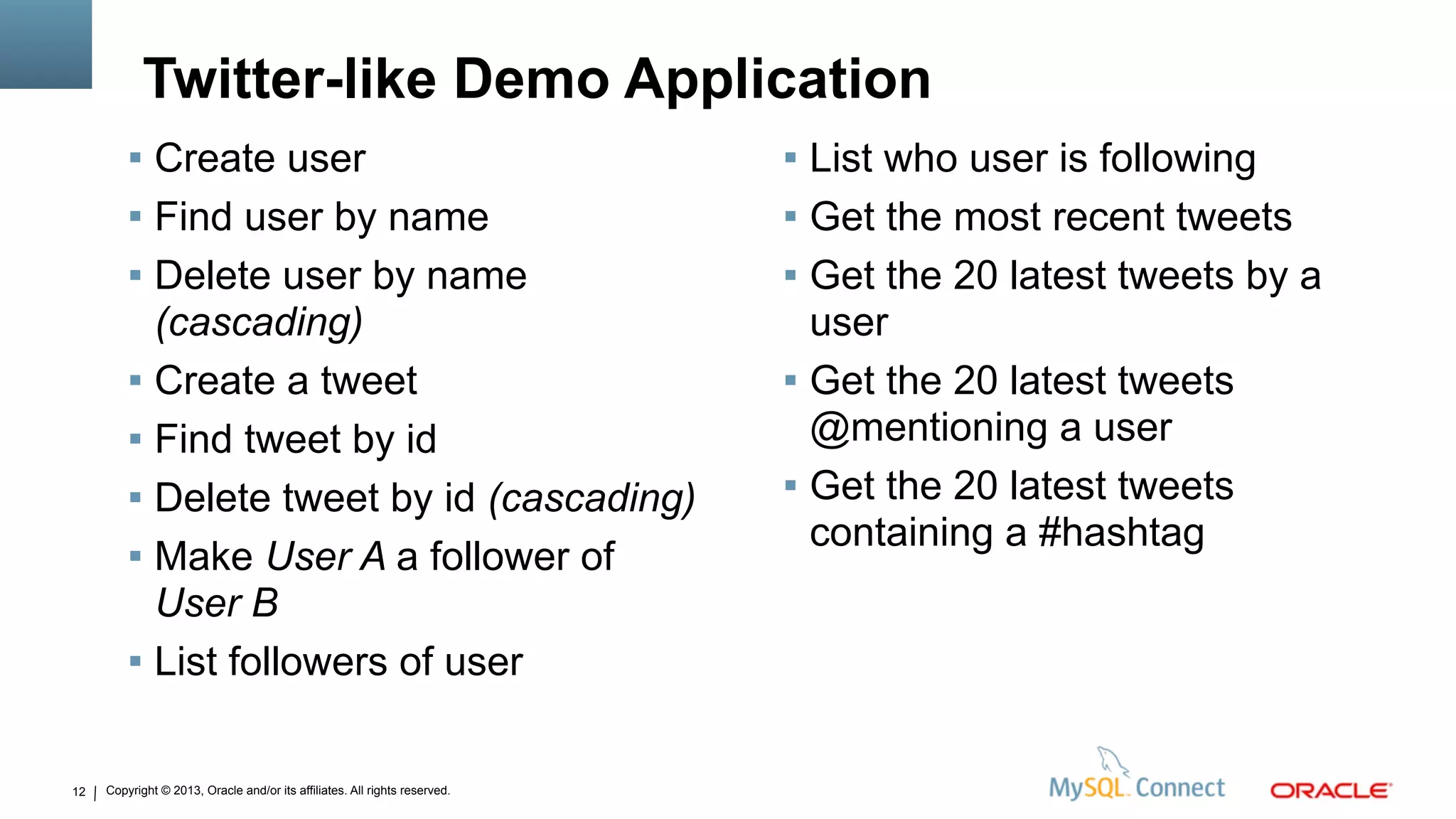
Twitter-like Demo Application
12
 Create user
 Find user by name
 Delete user by name
(cascading)
 Create a tweet
 Find tweet by id
 Delete tweet by id (cascading)
 Make User A a follower of
User B
 List followers of user
 List who user is following
 Get the most recent tweets
 Get the 20 latest tweets by a
user
 Get the 20 latest tweets
@mentioning a user
 Get the 20 latest tweets
containing a #hashtag
Copyright © 2013, Oracle and/or its affiliates. All rights reserved.13
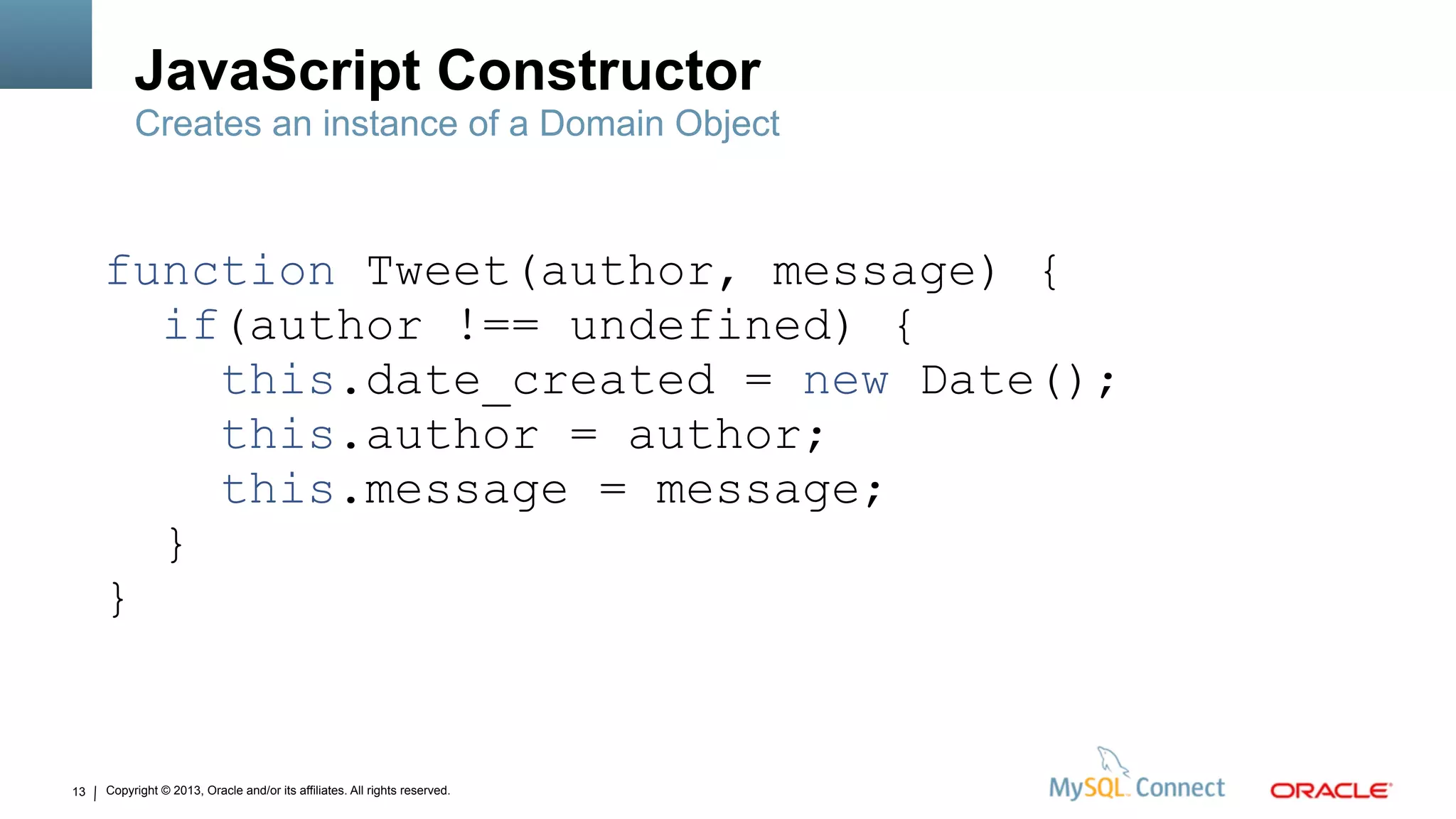
JavaScript Constructor
function Tweet(author, message) {
if(author !== undefined) {
this.date_created = new Date();
this.author = author;
this.message = message;
}
}
Creates an instance of a Domain Object
Copyright © 2013, Oracle and/or its affiliates. All rights reserved.14
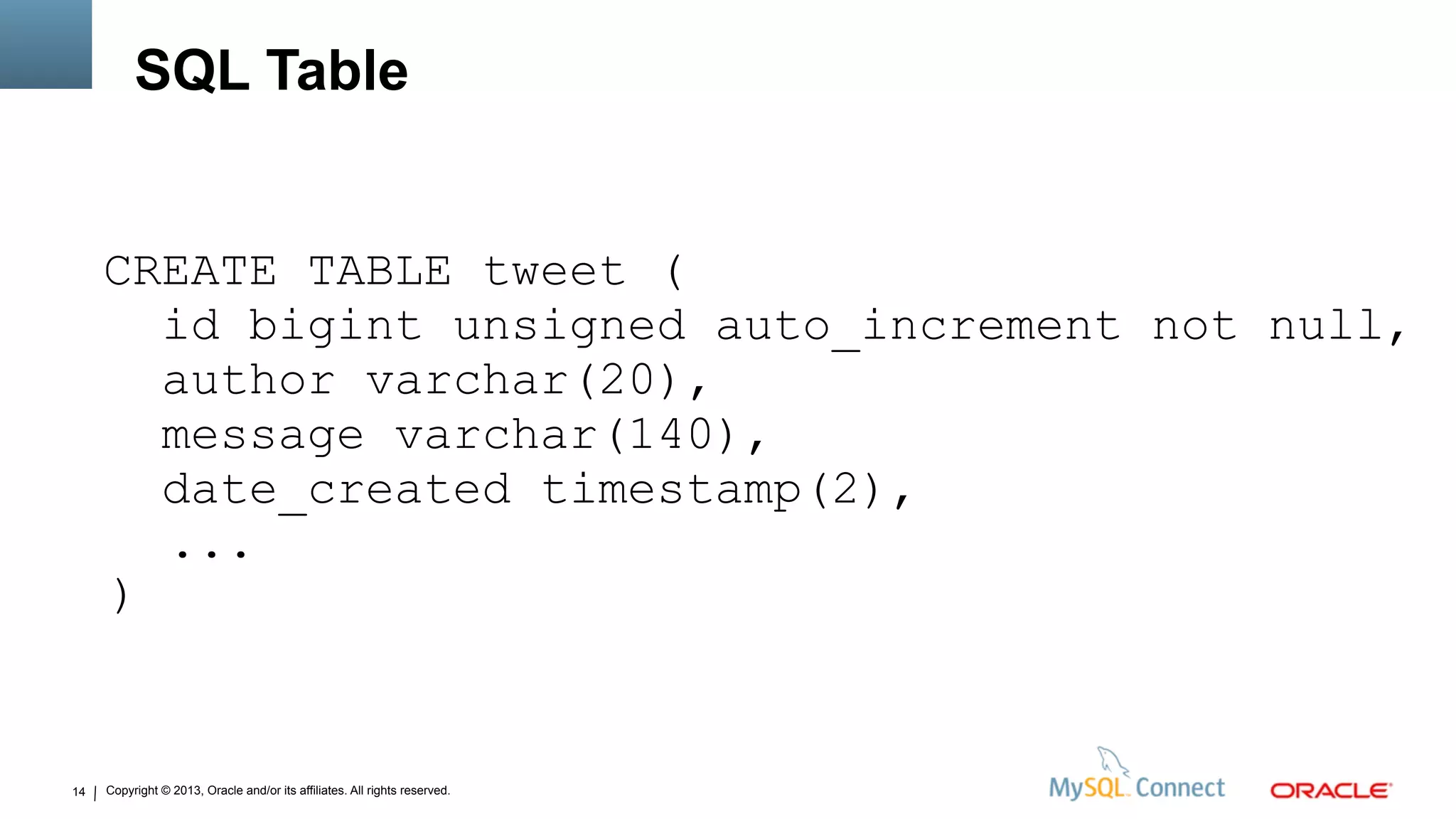
SQL Table
CREATE TABLE tweet (
id bigint unsigned auto_increment not null,
author varchar(20),
message varchar(140),
date_created timestamp(2),
...
)
Copyright © 2013, Oracle and/or its affiliates. All rights reserved.15
Mapping
var nosql = require("../mysql-js");
// Map SQL Tables to JS Constructors
var mappings = [];
mappings.push(
new nosql.TableMapping('tweet').
applyToClass(Tweet)
);
Copyright © 2013, Oracle and/or its affiliates. All rights reserved.16
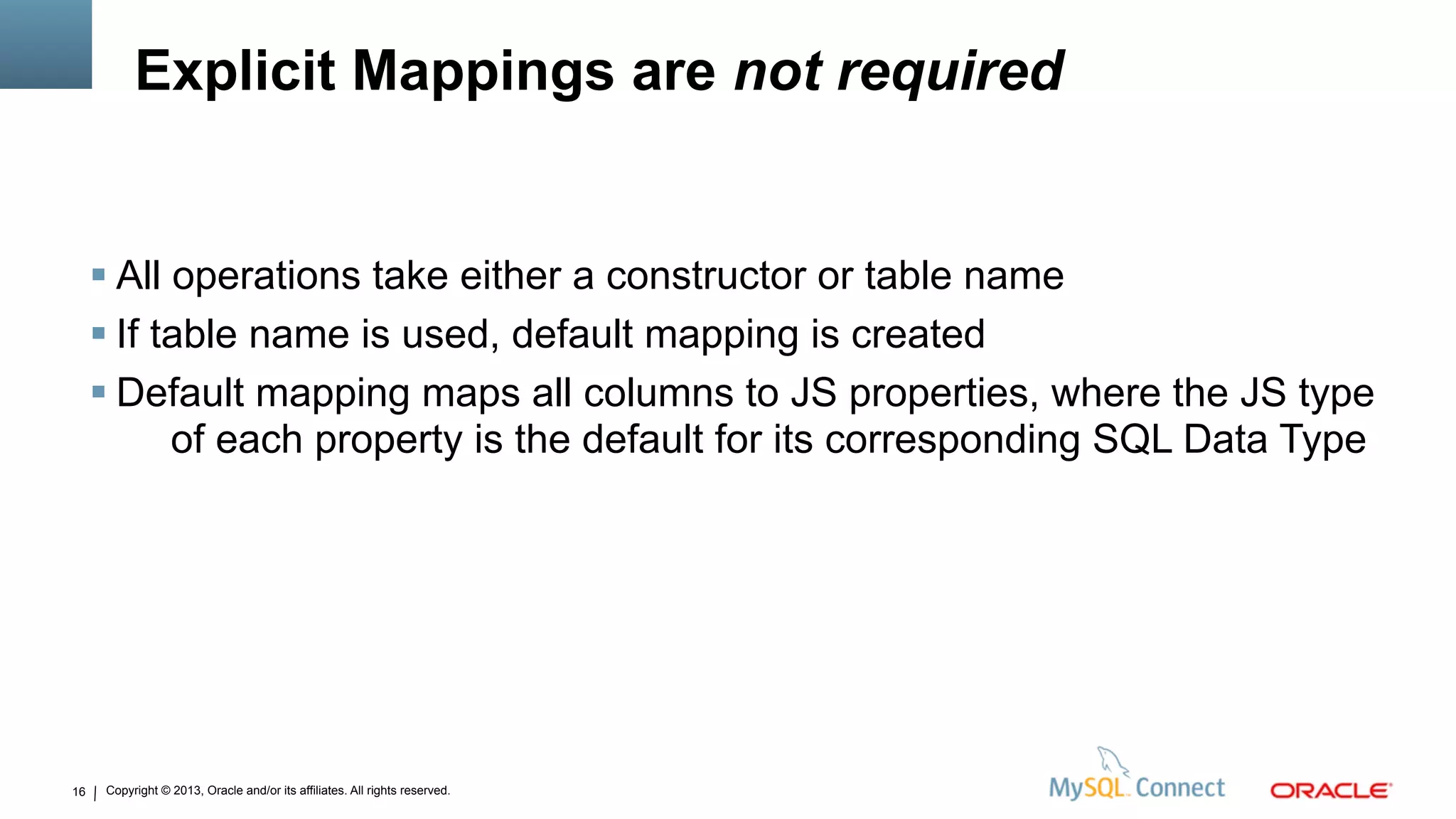
Explicit Mappings are not required
 All operations take either a constructor or table name
 If table name is used, default mapping is created
 Default mapping maps all columns to JS properties, where the JS type
of each property is the default for its corresponding SQL Data Type
Copyright © 2013, Oracle and/or its affiliates. All rights reserved.17
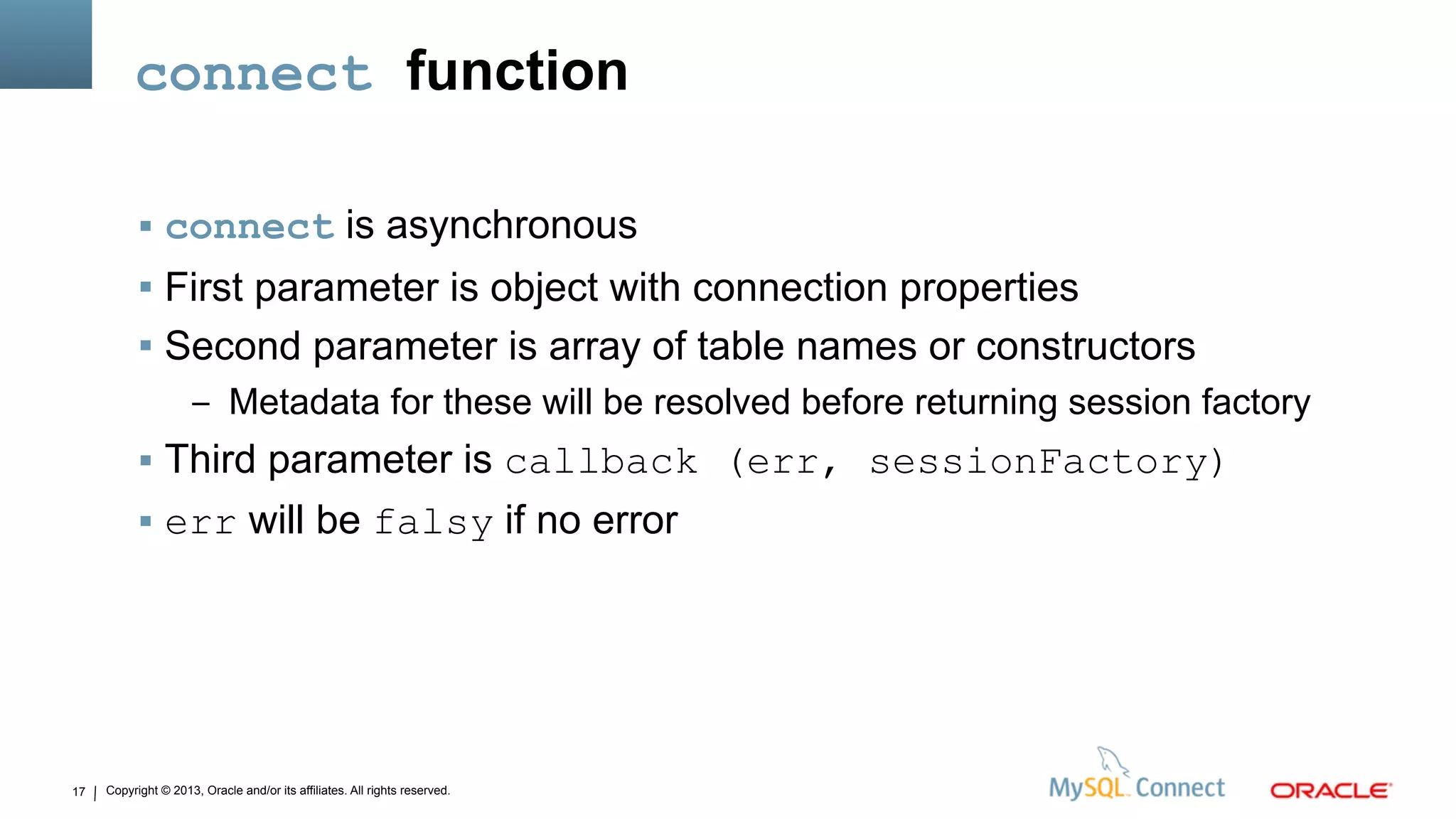
connect function
 connect is asynchronous
 First parameter is object with connection properties
 Second parameter is array of table names or constructors
– Metadata for these will be resolved before returning session factory
 Third parameter is callback (err, sessionFactory)
 err will be falsy if no error
Copyright © 2013, Oracle and/or its affiliates. All rights reserved.18
connect Example
/* Connection Properties */
dbProperties = {
adapter : "ndb",
ndb_connectstring : "localhost:1186"
};
// Map SQL Tables to JS Constructors
mappings = [];
mappings.push(new nosql.TableMapping('tweet').
applyToClass(Tweet));
// Connect
nosql.connect(dbProperties, mappings,
runCmdlineOperation, operation);
Copyright © 2013, Oracle and/or its affiliates. All rights reserved.19
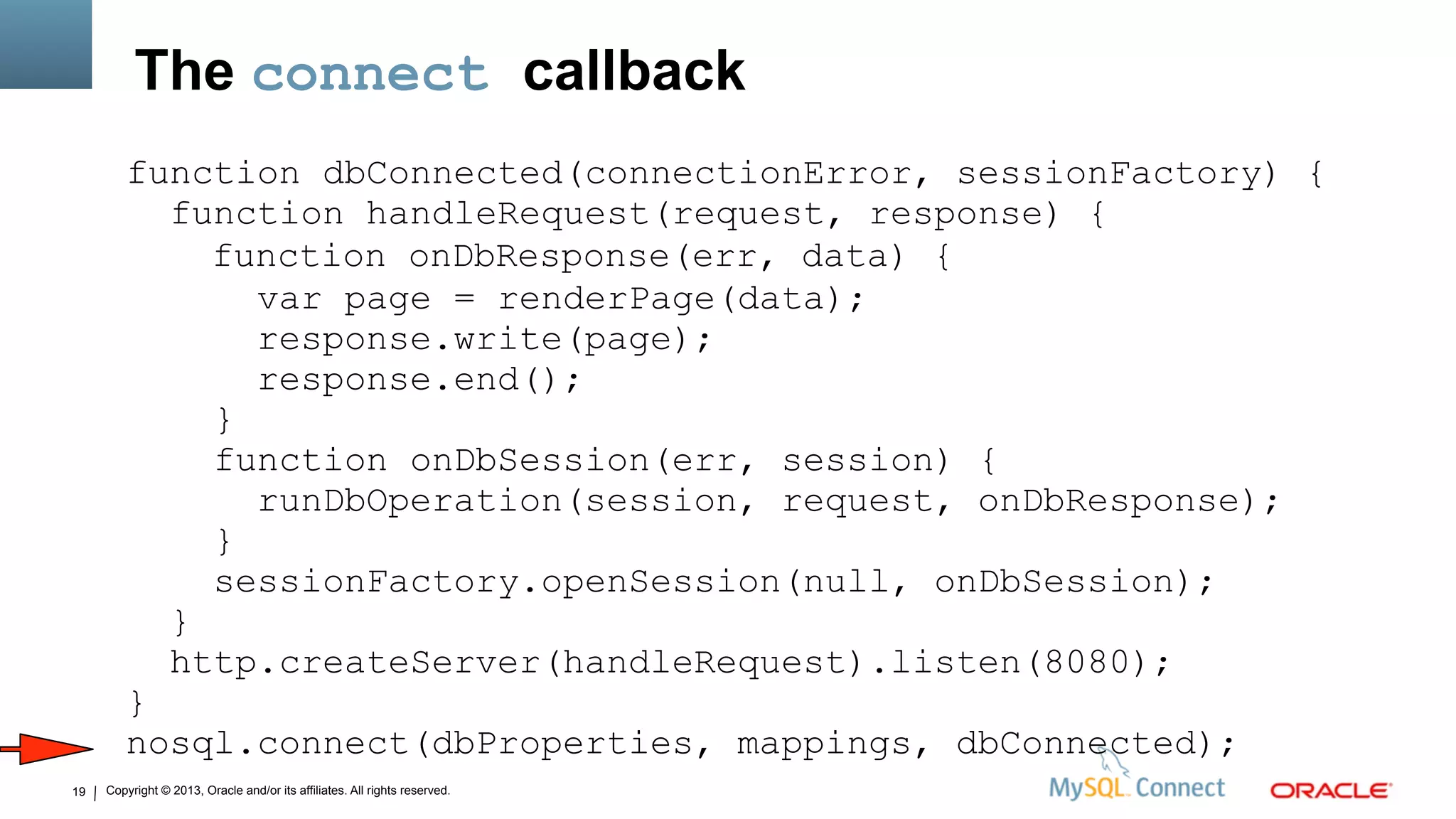
The connect callback
function dbConnected(connectionError, sessionFactory) {
function handleRequest(request, response) {
function onDbResponse(err, data) {
var page = renderPage(data);
response.write(page);
response.end();
}
function onDbSession(err, session) {
runDbOperation(session, request, onDbResponse);
}
sessionFactory.openSession(null, onDbSession);
}
http.createServer(handleRequest).listen(8080);
}
nosql.connect(dbProperties, mappings, dbConnected);
Copyright © 2013, Oracle and/or its affiliates. All rights reserved.20
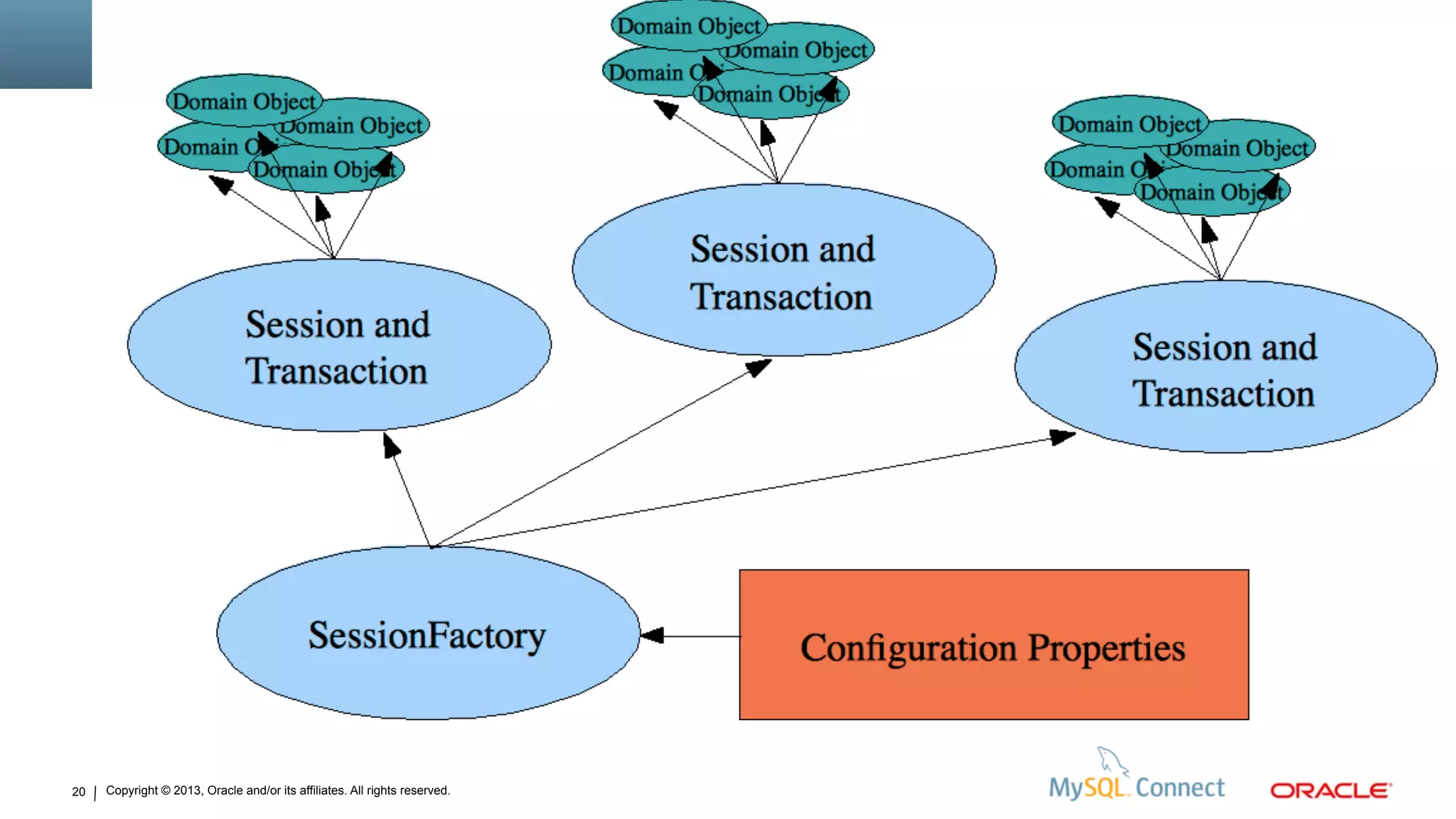
Copyright © 2013, Oracle and/or its affiliates. All rights reserved.21
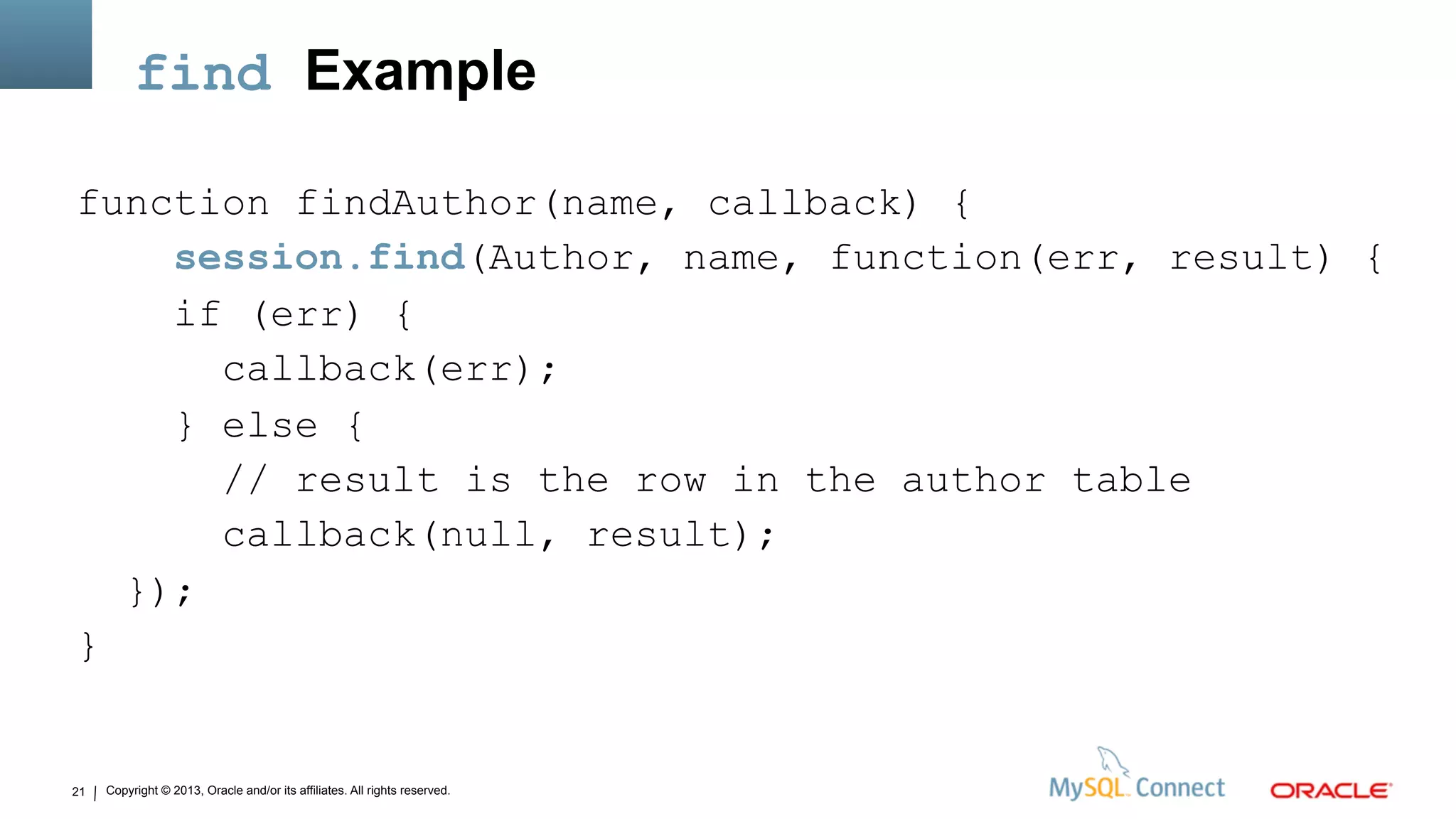
find Example
function findAuthor(name, callback) {
session.find(Author, name, function(err, result) {
if (err) {
callback(err);
} else {
// result is the row in the author table
callback(null, result);
});
}
Copyright © 2013, Oracle and/or its affiliates. All rights reserved.22
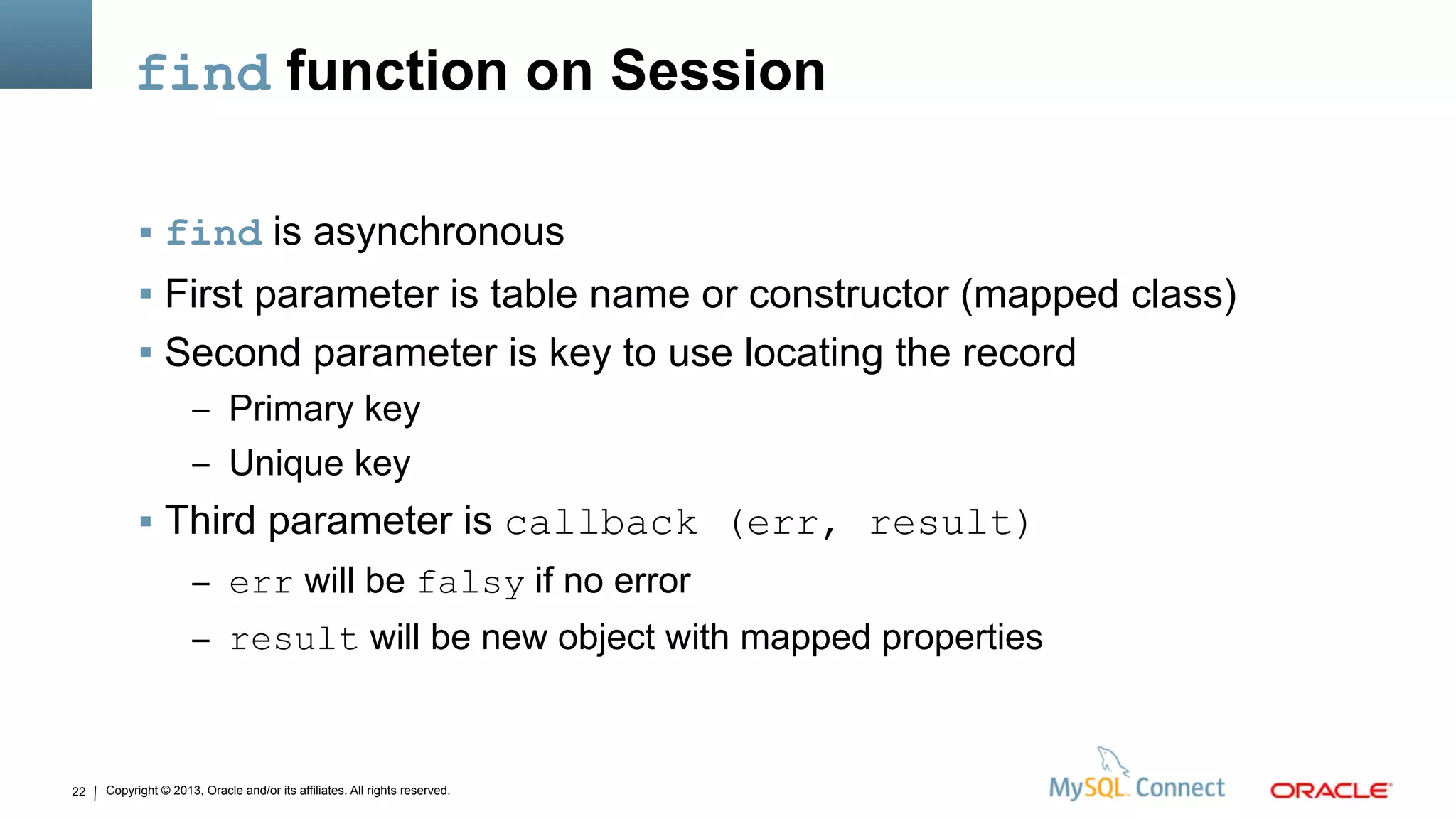
find function on Session
 find is asynchronous
 First parameter is table name or constructor (mapped class)
 Second parameter is key to use locating the record
– Primary key
– Unique key
 Third parameter is callback (err, result)
– err will be falsy if no error
– result will be new object with mapped properties
Copyright © 2013, Oracle and/or its affiliates. All rights reserved.23
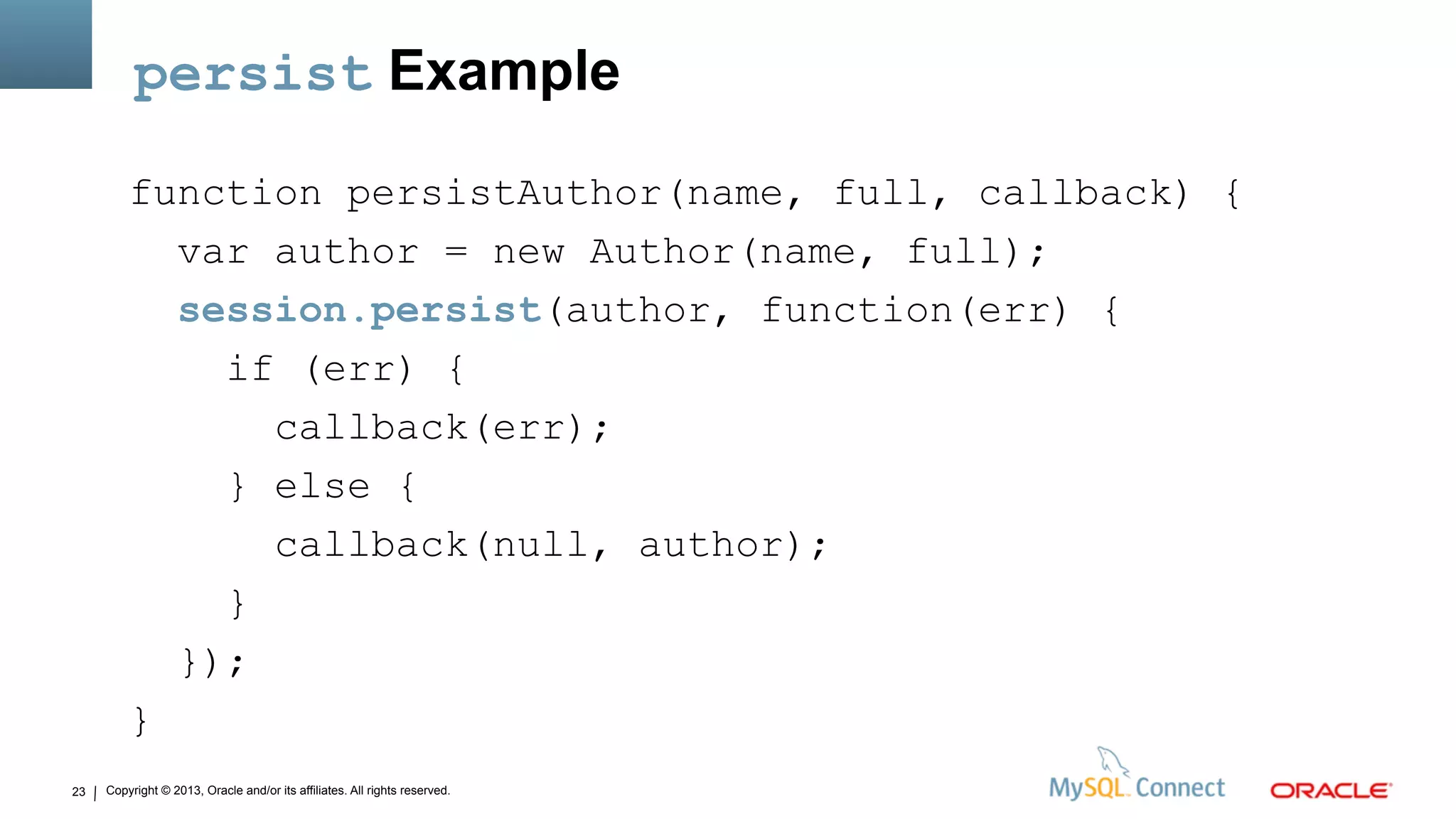
persist Example
function persistAuthor(name, full, callback) {
var author = new Author(name, full);
session.persist(author, function(err) {
if (err) {
callback(err);
} else {
callback(null, author);
}
});
}
Copyright © 2013, Oracle and/or its affiliates. All rights reserved.24
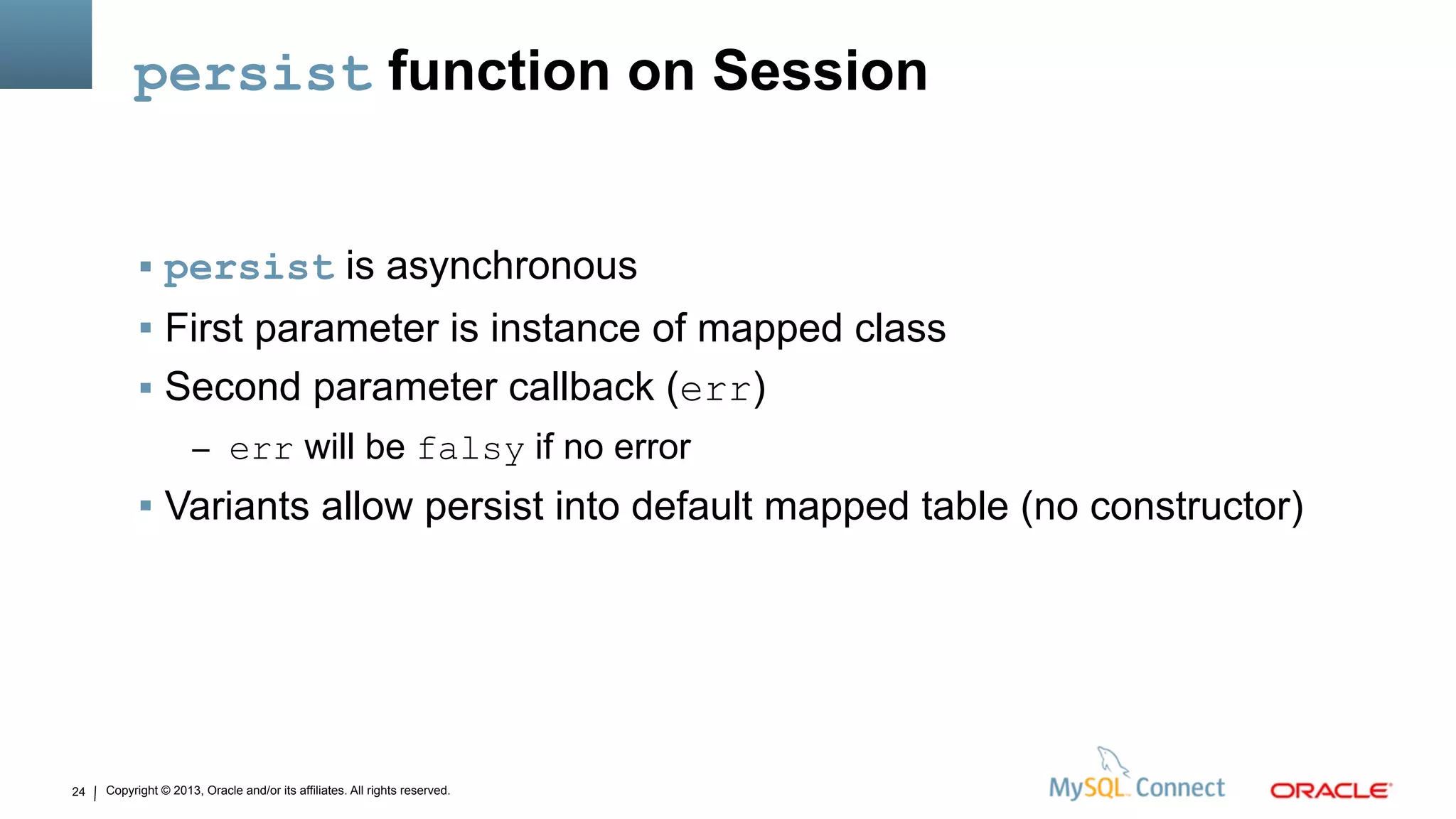
persist function on Session
 persist is asynchronous
 First parameter is instance of mapped class
 Second parameter callback (err)
– err will be falsy if no error
 Variants allow persist into default mapped table (no constructor)
Copyright © 2013, Oracle and/or its affiliates. All rights reserved.25
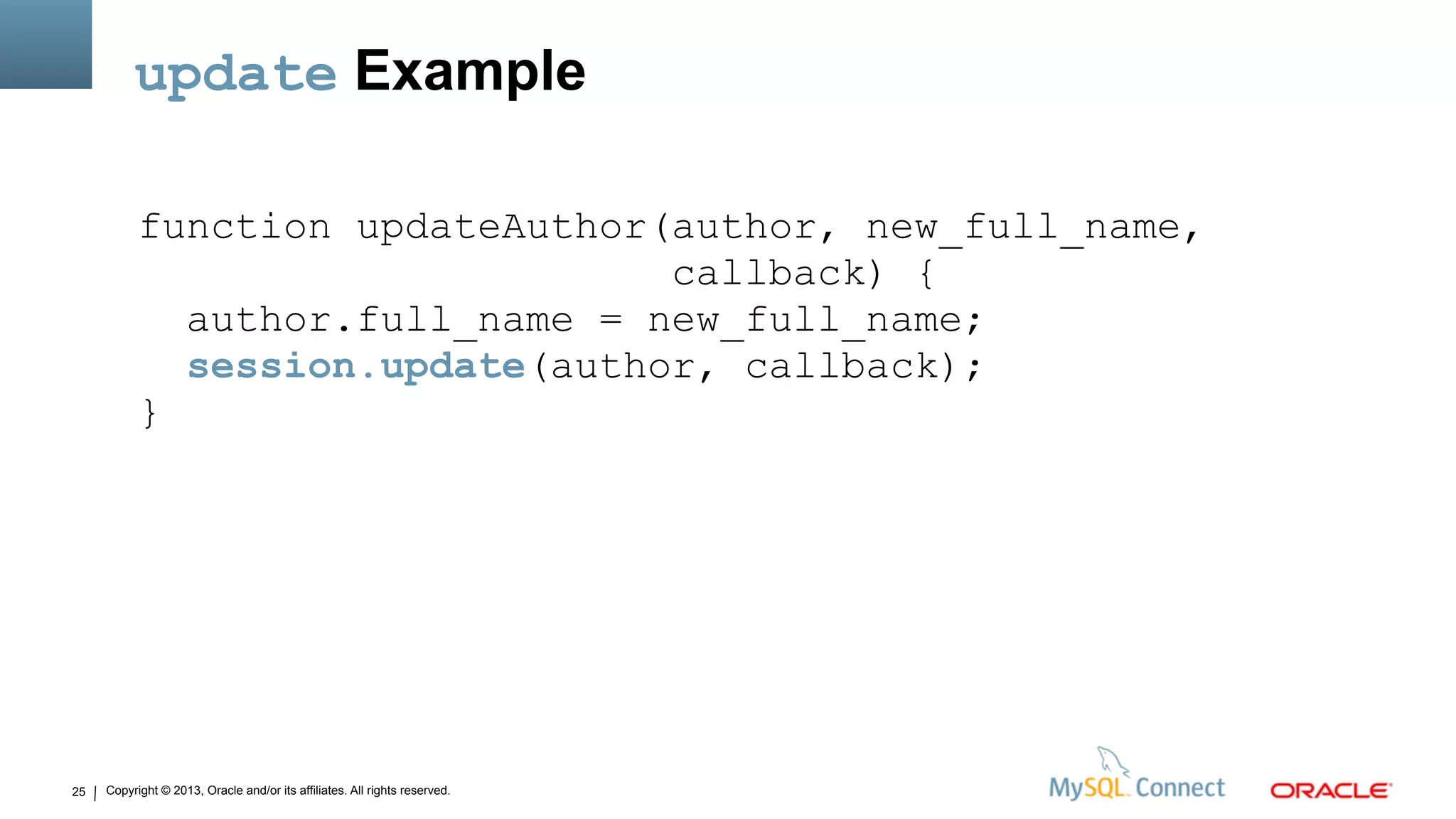
update Example
function updateAuthor(author, new_full_name,
callback) {
author.full_name = new_full_name;
session.update(author, callback);
}
Copyright © 2013, Oracle and/or its affiliates. All rights reserved.26
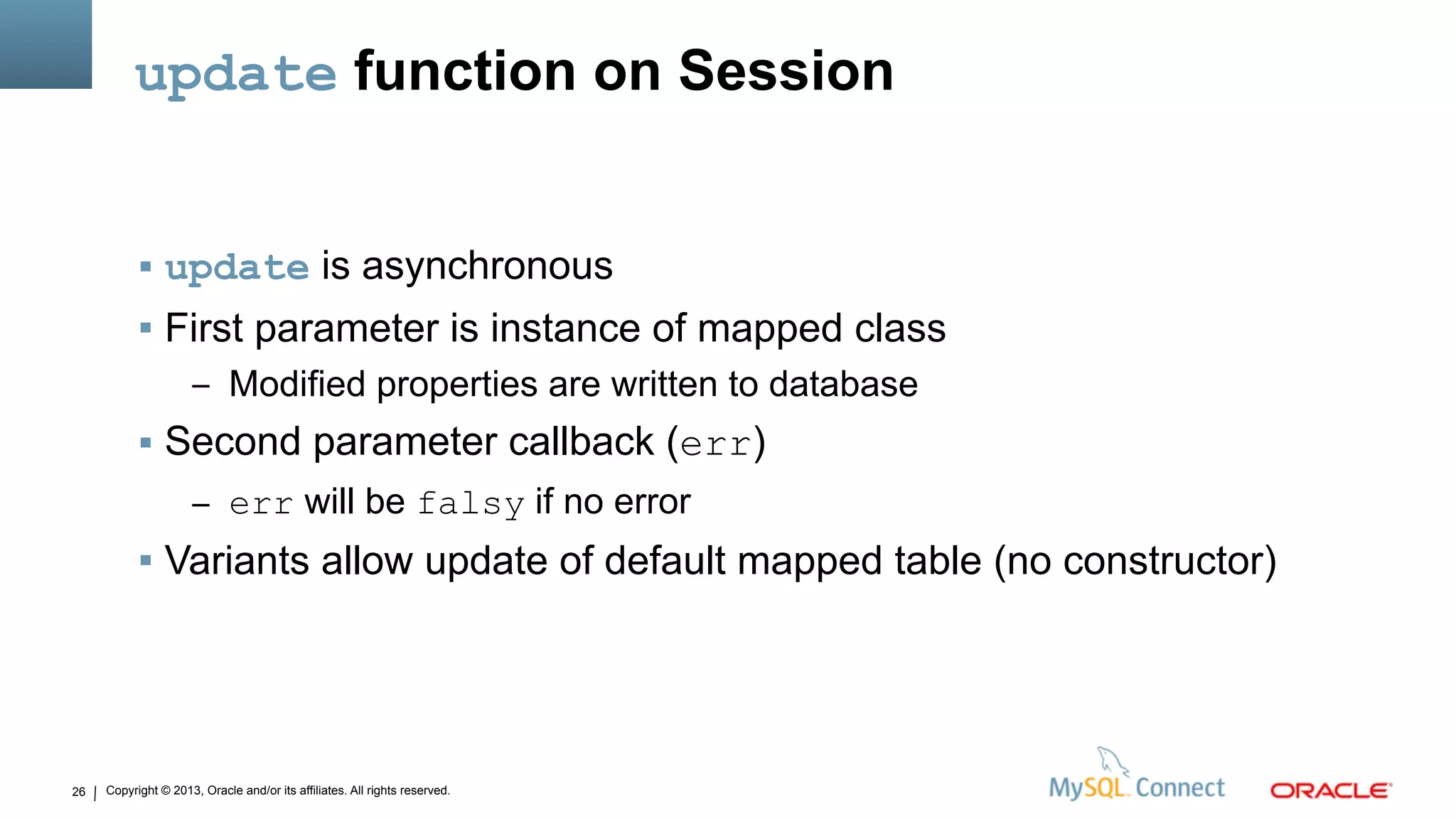
update function on Session
 update is asynchronous
 First parameter is instance of mapped class
– Modified properties are written to database
 Second parameter callback (err)
– err will be falsy if no error
 Variants allow update of default mapped table (no constructor)
Copyright © 2013, Oracle and/or its affiliates. All rights reserved.27
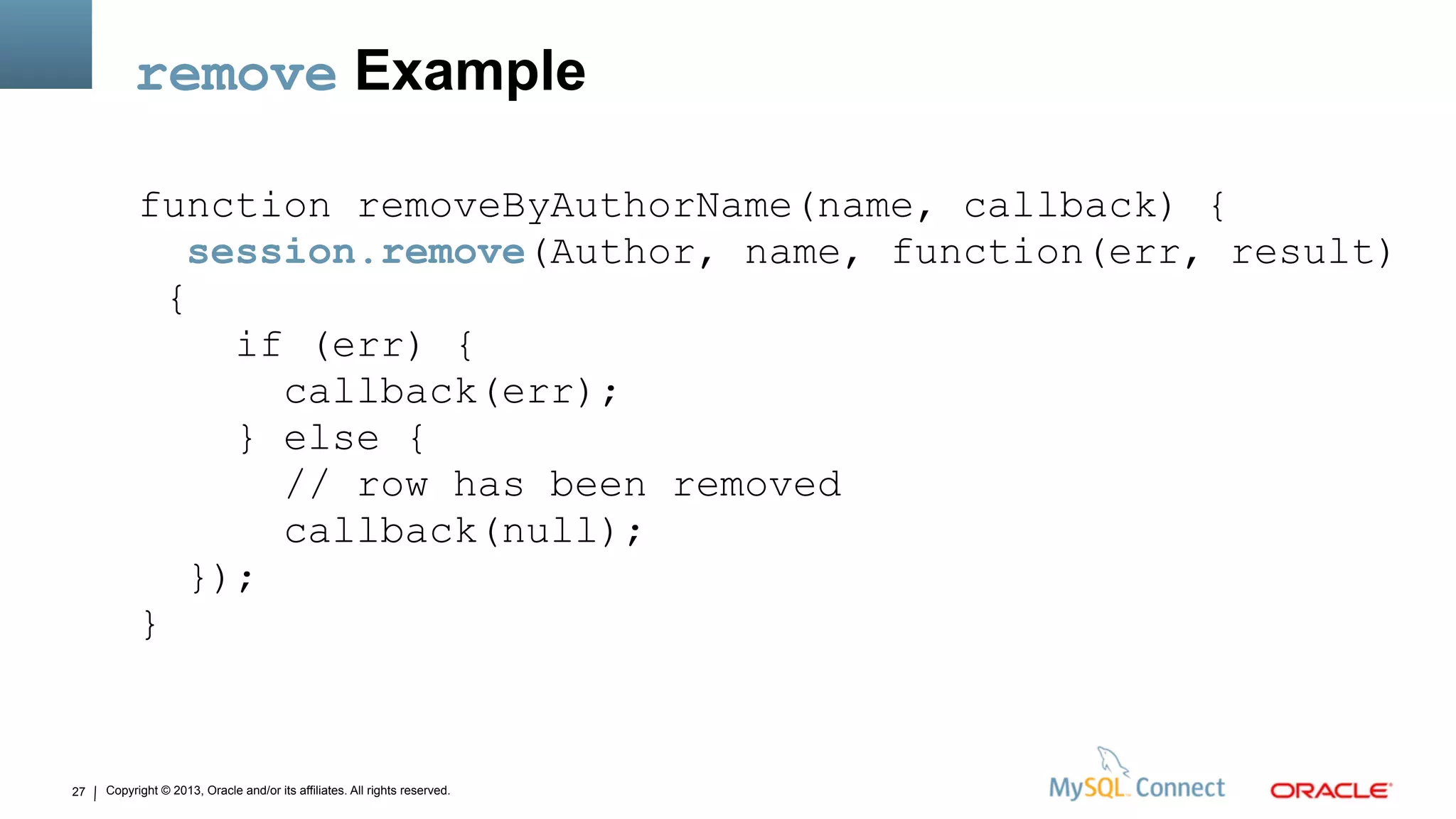
remove Example
function removeByAuthorName(name, callback) {
session.remove(Author, name, function(err, result)
{
if (err) {
callback(err);
} else {
// row has been removed
callback(null);
});
}
Copyright © 2013, Oracle and/or its affiliates. All rights reserved.28
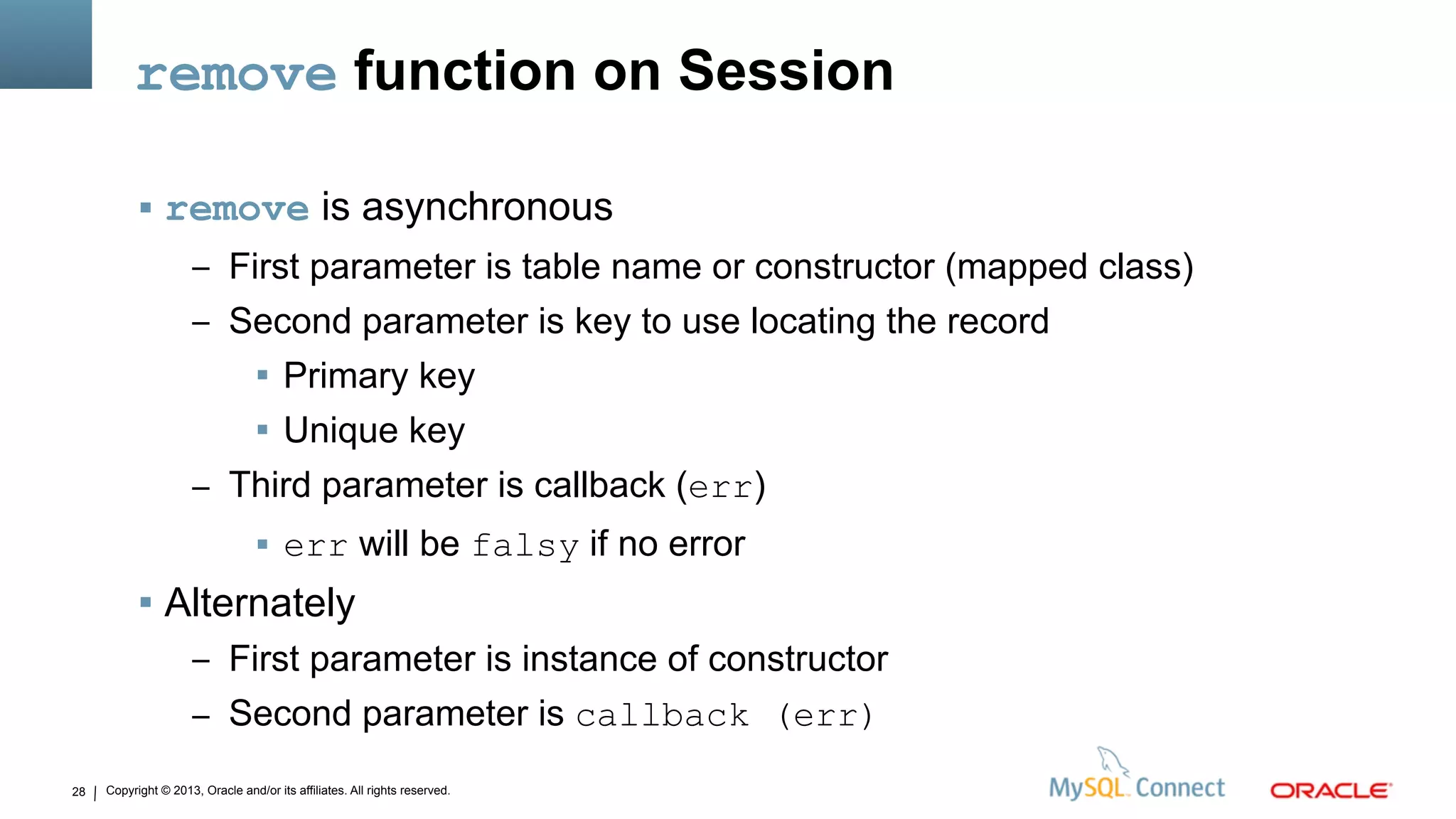
remove function on Session
 remove is asynchronous
– First parameter is table name or constructor (mapped class)
– Second parameter is key to use locating the record
 Primary key
 Unique key
– Third parameter is callback (err)
 err will be falsy if no error
 Alternately
– First parameter is instance of constructor
– Second parameter is callback (err)
Copyright © 2013, Oracle and/or its affiliates. All rights reserved.29
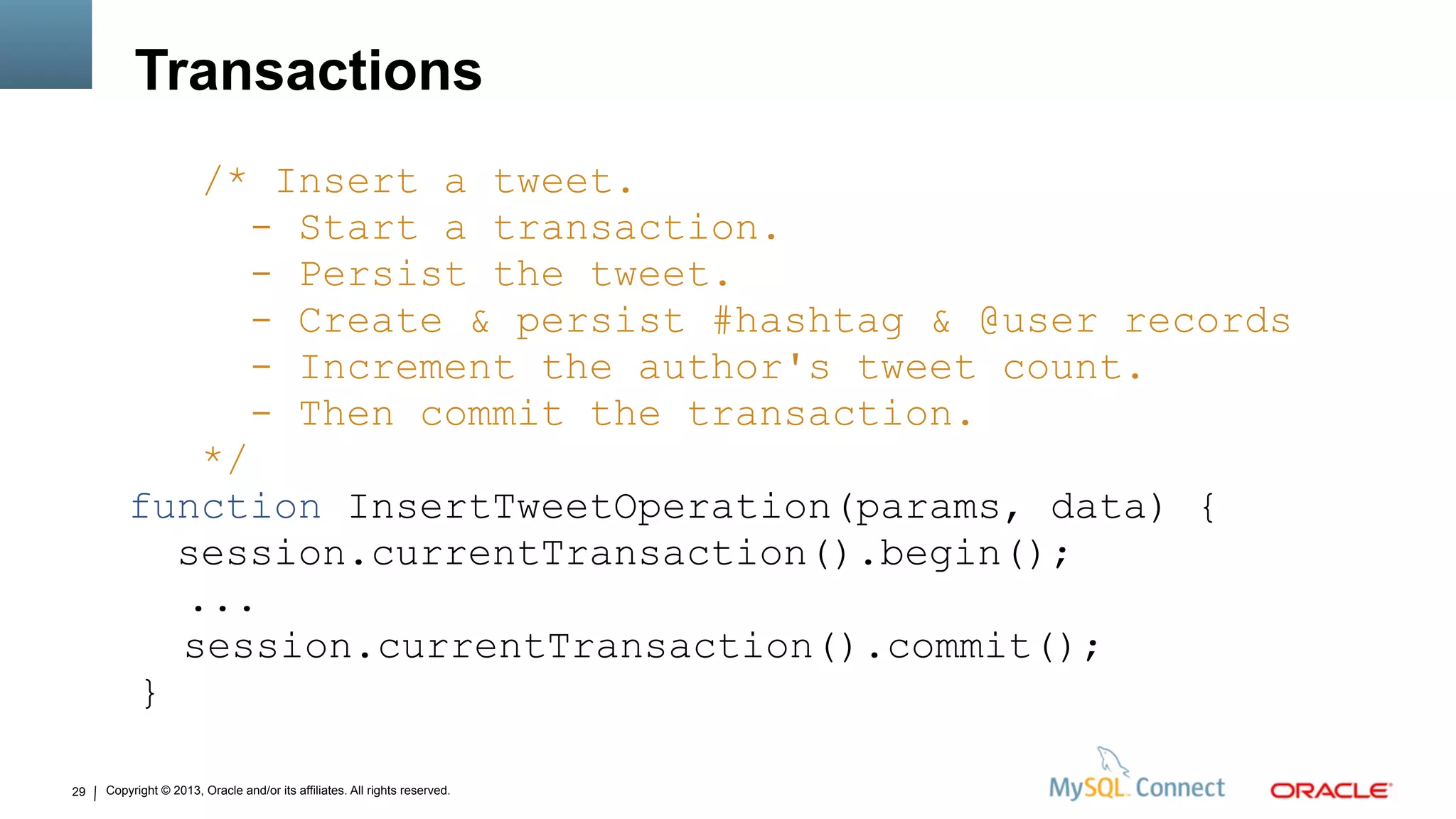
Transactions
/* Insert a tweet.
- Start a transaction.
- Persist the tweet.
- Create & persist #hashtag & @user records
- Increment the author's tweet count.
- Then commit the transaction.
*/
function InsertTweetOperation(params, data) {
session.currentTransaction().begin();
...
session.currentTransaction().commit();
}
Copyright © 2013, Oracle and/or its affiliates. All rights reserved.30
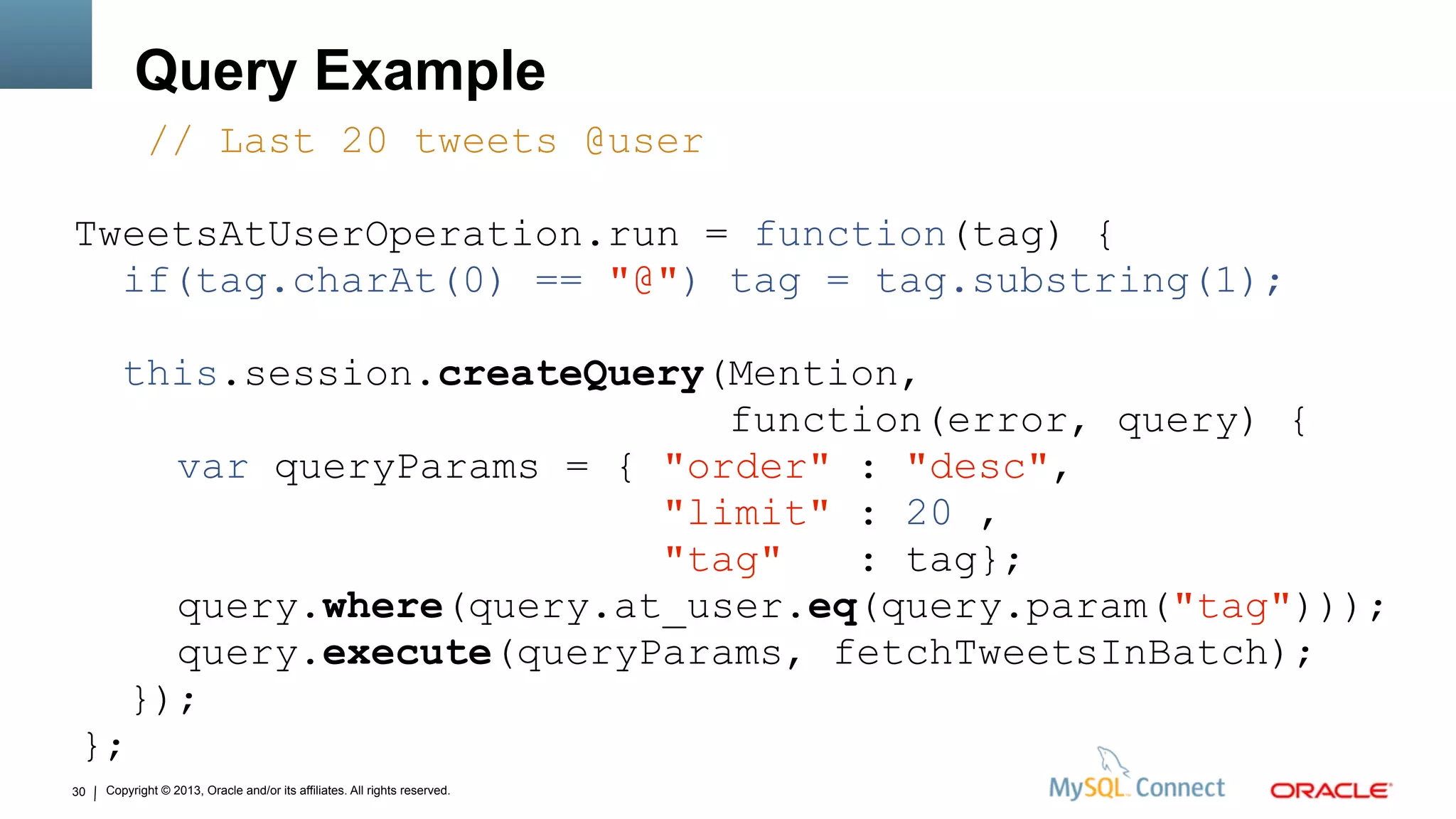
Query Example
// Last 20 tweets @user
TweetsAtUserOperation.run = function(tag) {
if(tag.charAt(0) == "@") tag = tag.substring(1);
this.session.createQuery(Mention,
function(error, query) {
var queryParams = { "order" : "desc",
"limit" : 20 ,
"tag" : tag};
query.where(query.at_user.eq(query.param("tag")));
query.execute(queryParams, fetchTweetsInBatch);
});
};
Copyright © 2013, Oracle and/or its affiliates. All rights reserved.31
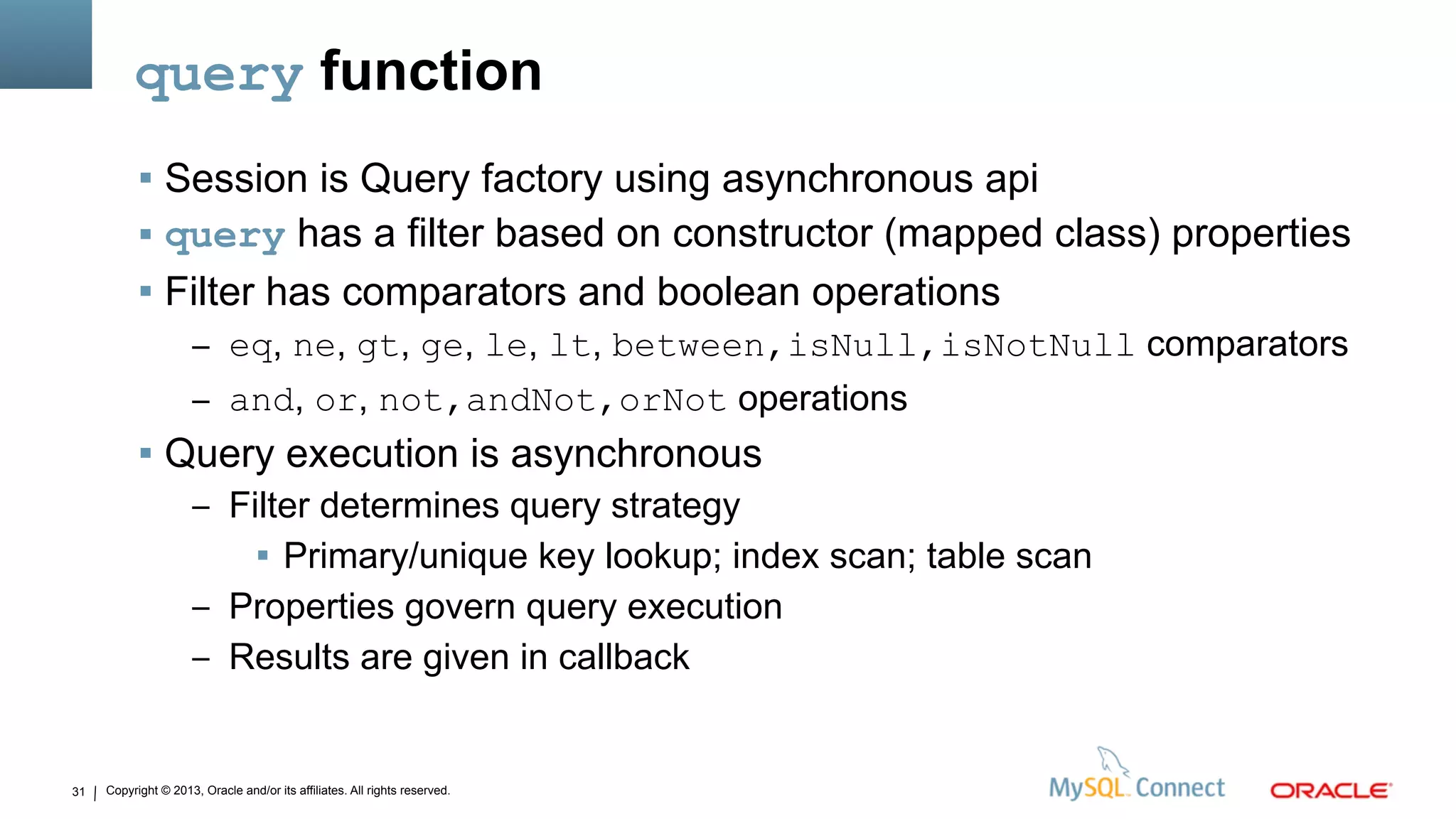
query function
 Session is Query factory using asynchronous api
 query has a filter based on constructor (mapped class) properties
 Filter has comparators and boolean operations
– eq, ne, gt, ge, le, lt, between,isNull,isNotNull comparators
– and, or, not,andNot,orNot operations
 Query execution is asynchronous
– Filter determines query strategy
 Primary/unique key lookup; index scan; table scan
– Properties govern query execution
– Results are given in callback
Copyright © 2013, Oracle and/or its affiliates. All rights reserved.32
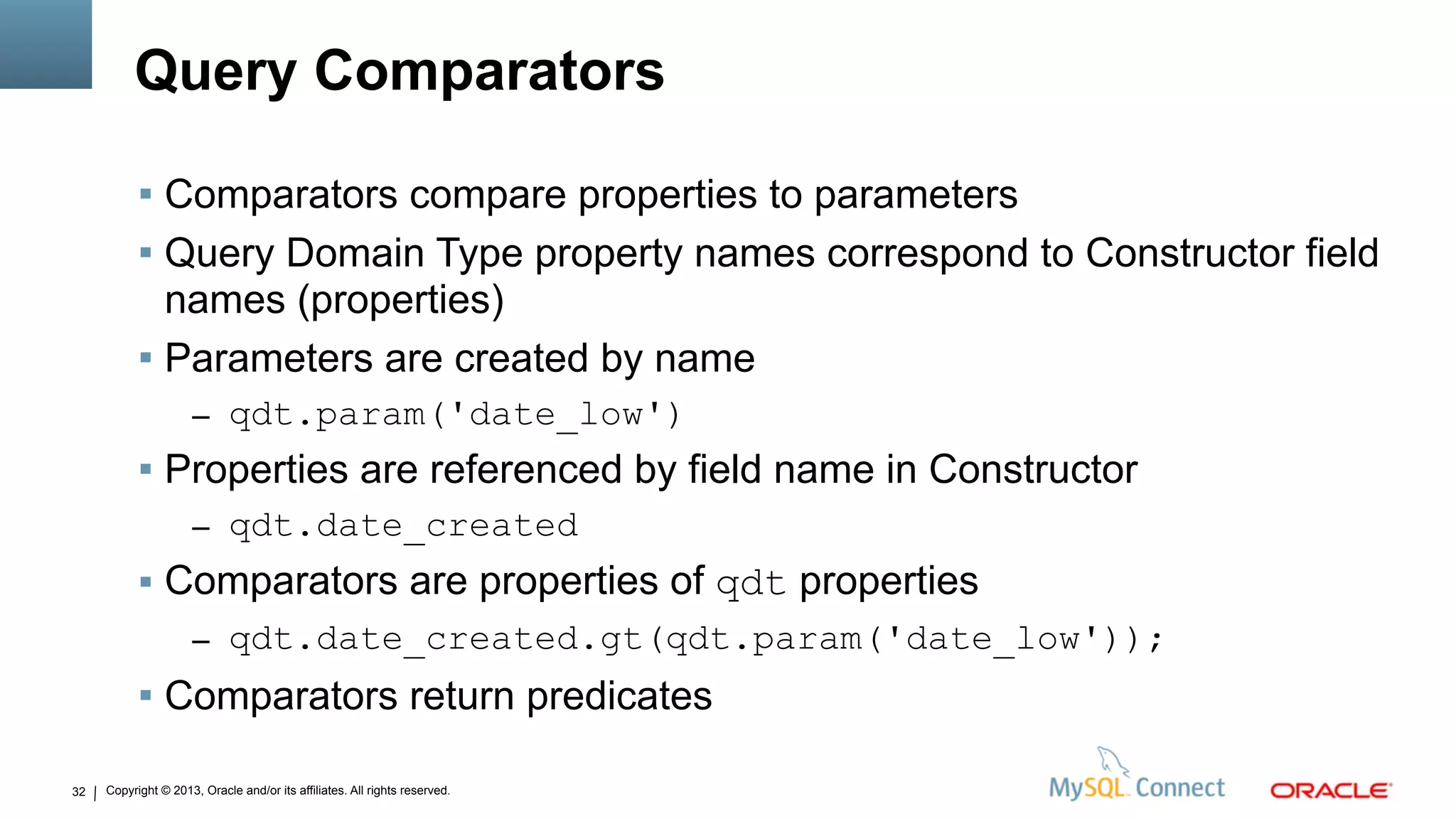
Query Comparators
 Comparators compare properties to parameters
 Query Domain Type property names correspond to Constructor field
names (properties)
 Parameters are created by name
– qdt.param('date_low')
 Properties are referenced by field name in Constructor
– qdt.date_created
 Comparators are properties of qdt properties
– qdt.date_created.gt(qdt.param('date_low'));
 Comparators return predicates
Copyright © 2013, Oracle and/or its affiliates. All rights reserved.33
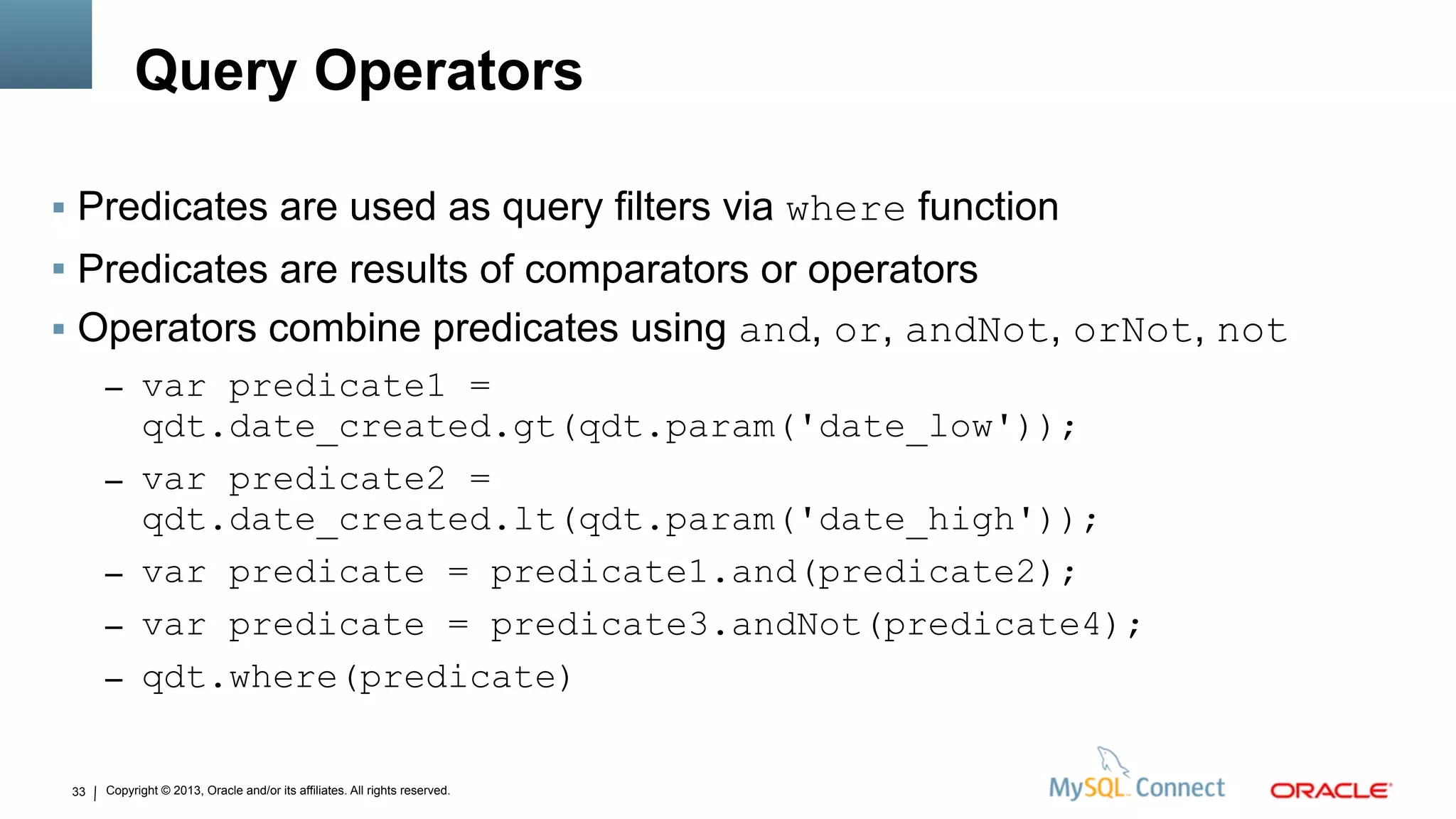
Query Operators
 Predicates are used as query filters via where function
 Predicates are results of comparators or operators
 Operators combine predicates using and, or, andNot, orNot, not
– var predicate1 =
qdt.date_created.gt(qdt.param('date_low'));
– var predicate2 =
qdt.date_created.lt(qdt.param('date_high'));
– var predicate = predicate1.and(predicate2);
– var predicate = predicate3.andNot(predicate4);
– qdt.where(predicate)
Copyright © 2013, Oracle and/or its affiliates. All rights reserved.34
Batching
function fetchTweetsInBatch(error, mentions,
finalCallback) {
var resultData = [];
function addTweetToResults(err, tweet) {
if(tweet && ! err) resultData.push(tweet);
}
var batch = session.createBatch();
while(var mention = mentions.pop());
batch.find(Tweet, mention.id, addTweetToResults);
batch.execute(finalCallback, resultData);
}
Copyright © 2013, Oracle and/or its affiliates. All rights reserved.35
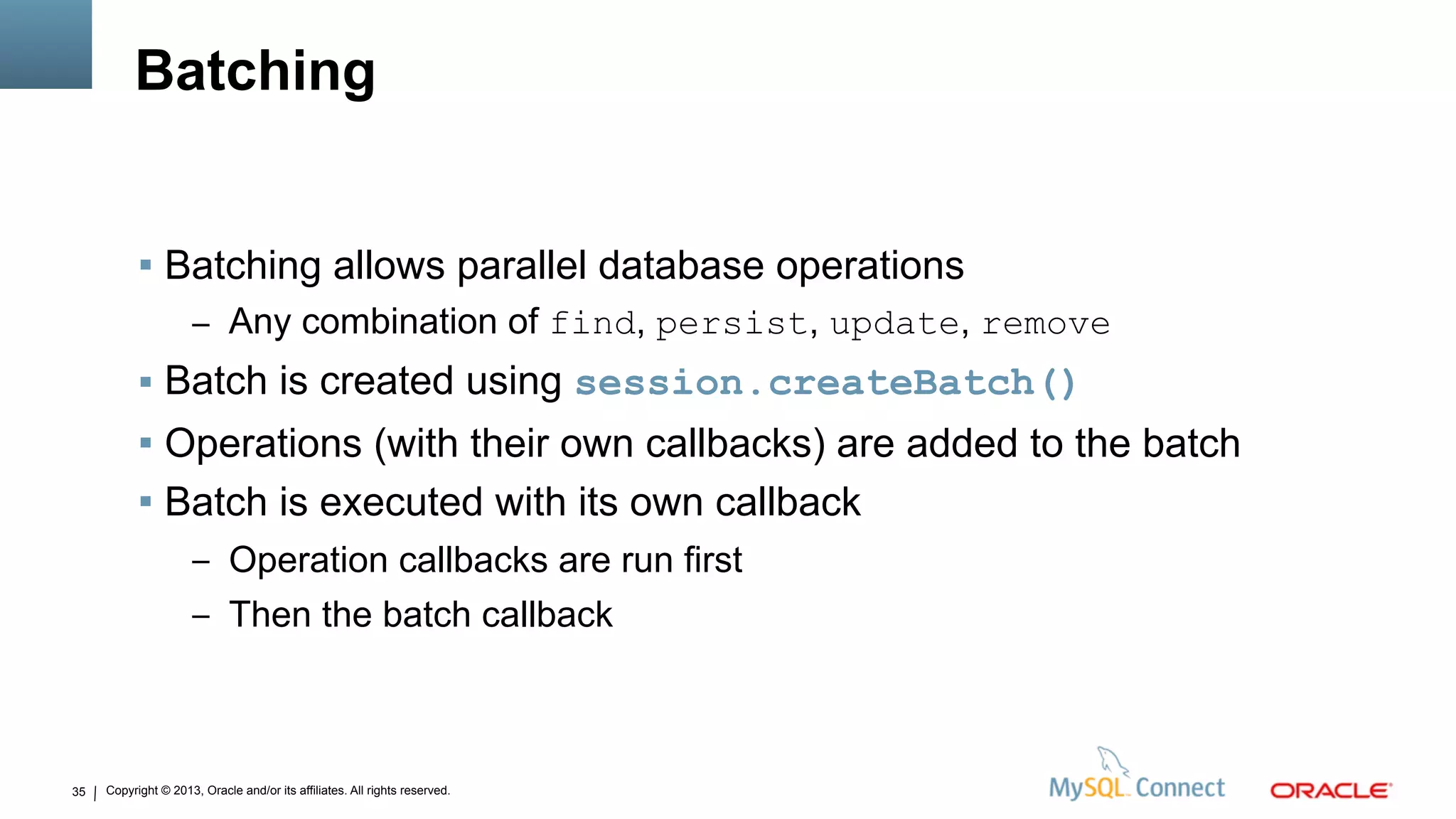
Batching
 Batching allows parallel database operations
– Any combination of find, persist, update, remove
 Batch is created using session.createBatch()
 Operations (with their own callbacks) are added to the batch
 Batch is executed with its own callback
– Operation callbacks are run first
– Then the batch callback
Copyright © 2013, Oracle and/or its affiliates. All rights reserved.36
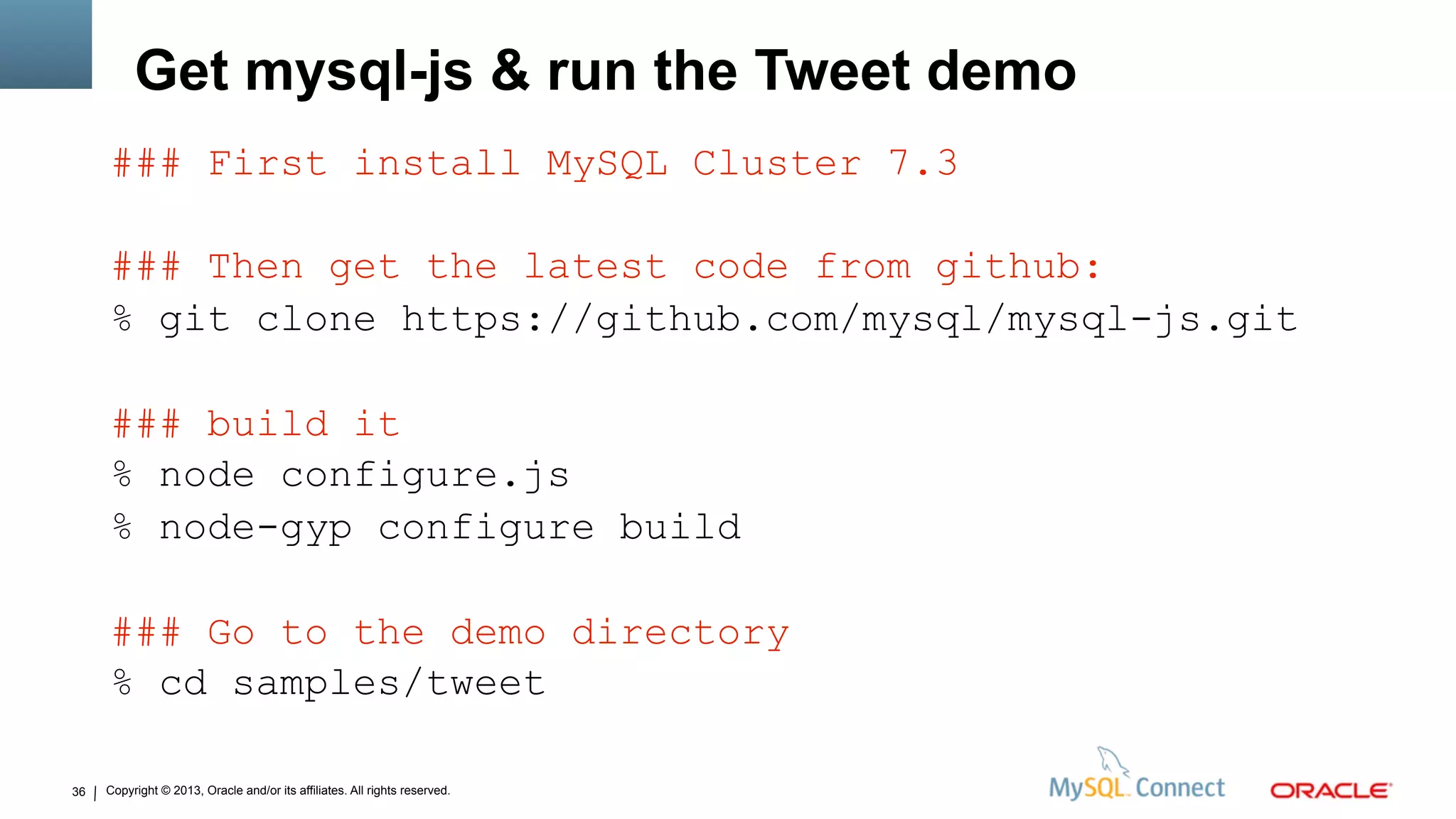
Get mysql-js & run the Tweet demo
### First install MySQL Cluster 7.3
### Then get the latest code from github:
% git clone https://github.com/mysql/mysql-js.git
### build it
% node configure.js
% node-gyp configure build
### Go to the demo directory
% cd samples/tweet
Copyright © 2013, Oracle and/or its affiliates. All rights reserved.37
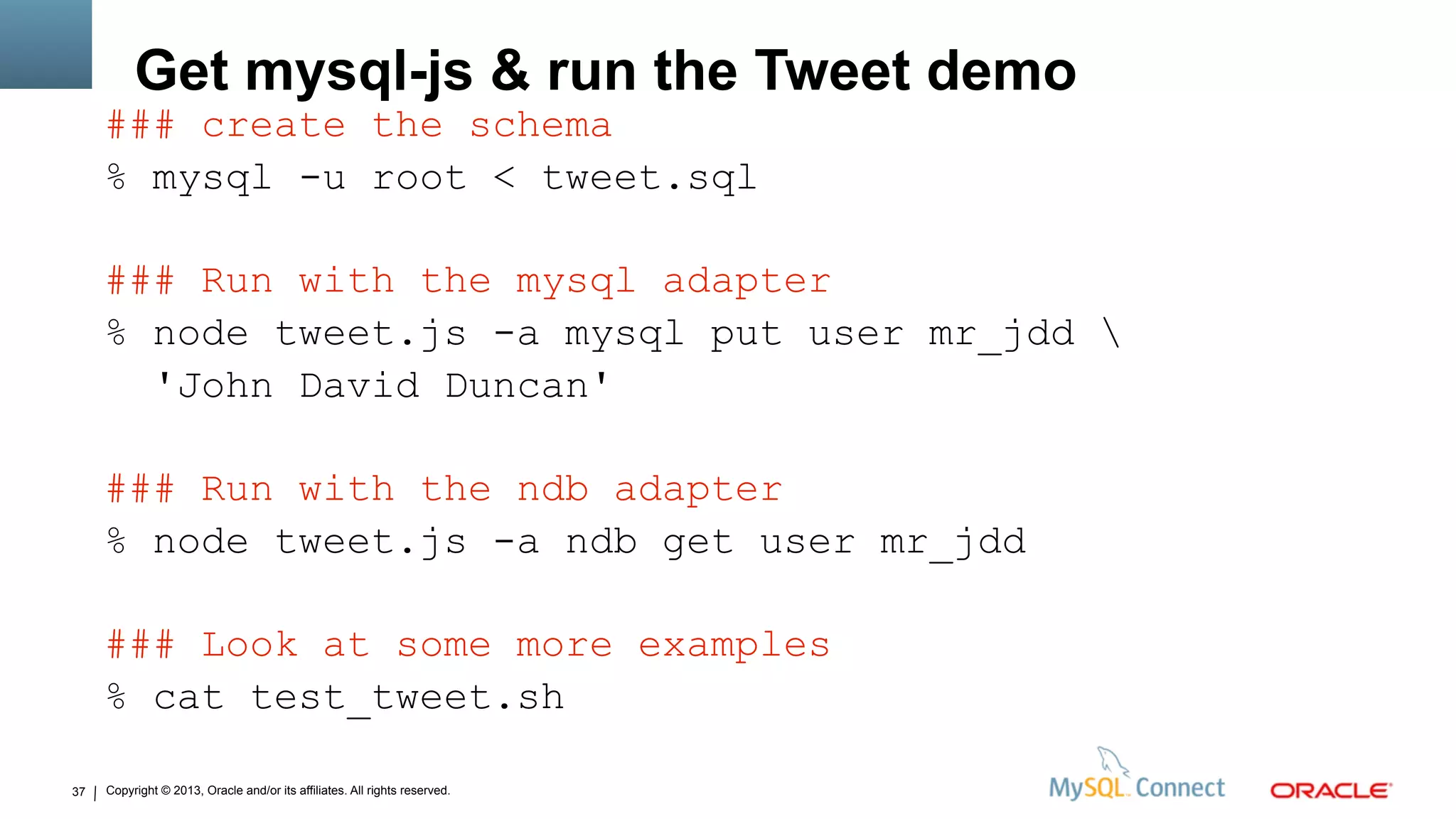
Get mysql-js & run the Tweet demo
### create the schema
% mysql -u root < tweet.sql
### Run with the mysql adapter
% node tweet.js -a mysql put user mr_jdd 
'John David Duncan'
### Run with the ndb adapter
% node tweet.js -a ndb get user mr_jdd
### Look at some more examples
% cat test_tweet.sh

Developing for Node.JS with MySQL and NoSQL

  • 1.
    Copyright © 2013,Oracle and/or its affiliates. All rights reserved. Insert Picture Here 1 Developing for Node.JS with MySQL and NoSQL  J.D. Duncan, john.duncan@oracle.com  Craig Russell, craig.russell@oracle.com
  • 2.
    Copyright © 2013,Oracle and/or its affiliates. All rights reserved.2 MySQL Cluster Architecture MySQL Cluster Data Nodes Data Layer Clients Application Layer Management
  • 3.
    Copyright © 2013,Oracle and/or its affiliates. All rights reserved.3 MySQL Cluster Architecture MySQL Cluster Data Nodes Data Layer Clients Application Layer Management Management
  • 4.
    Copyright © 2013,Oracle and/or its affiliates. All rights reserved.4 MySQL Cluster Architecture MySQL Cluster Data Nodes Data Layer Application Layer Management Management Clients
  • 5.
    Copyright © 2013,Oracle and/or its affiliates. All rights reserved.5 mysql-js: a MySQL connector for Node.JS  Included in MySQL Cluster 7.3  in storage/ndb/nodejs  Also at github:  https://github.com/mysql/mysql-js  One JavaScript API with two back-end adapters  The MySQL back end uses node-mysql (Felix Geisendorfer's all- JavaScript MySQL connector)  The NDB (MySQL Cluster) back end uses native NDBAPI  Twitter-like demo application in samples/tweet/
  • 6.
    Copyright © 2013,Oracle and/or its affiliates. All rights reserved.6 What is Node.JS  A server-side web application platform  Single-threaded* and event-driven  Application code is written in JavaScript  JavaScript code runs in a very fast VM  Node.JS includes a useful set of standard libraries * One JavaScript thread; a pool of background worker threads perform blocking I/O.
  • 7.
    Copyright © 2013,Oracle and/or its affiliates. All rights reserved.7 Why Node.JS  Servers like lighttpd, nginx, and tornado can solve the C10K problem for static or cached content  Node.JS can solve the C10K problem for a dynamic web application – ... but what about 10,000 back-end database connections?  mysql-js with NDB aims to solve the C10K problem for a dynamic and database-driven web application The "C10K" problem: how to handle 10,000+ client connections
  • 8.
    Copyright © 2013,Oracle and/or its affiliates. All rights reserved.8 Sample Code Node HTTP Server function handleRequest(request, response) { var page = getContent(request.url); response.statusCode = page ? 200 : 404; response.write(page); response.end(); } function startWebServer() { http.createServer(handleRequest).listen(8080); console.log("Server started"); }
  • 9.
    Copyright © 2013,Oracle and/or its affiliates. All rights reserved.9 Sample Code with database access Node HTTP Server and mysql-js function dbConnected(connectionError, sessionFactory) { function handleRequest(request, response) { function onDbResponse(err, data) { var page = renderPage(data); response.write(page); response.end(); } function onDbSession(err, session) { runDbOperation(session, request, onDbResponse); } sessionFactory.openSession(null, onDbSession); } http.createServer(handleRequest).listen(8080); } nosql.connect(... , dbConnected);
  • 10.
    Copyright © 2013,Oracle and/or its affiliates. All rights reserved. User's View 10
  • 11.
    Copyright © 2013,Oracle and/or its affiliates. All rights reserved. Twitter-like Demo Application 11
  • 12.
    Copyright © 2013,Oracle and/or its affiliates. All rights reserved. Twitter-like Demo Application 12  Create user  Find user by name  Delete user by name (cascading)  Create a tweet  Find tweet by id  Delete tweet by id (cascading)  Make User A a follower of User B  List followers of user  List who user is following  Get the most recent tweets  Get the 20 latest tweets by a user  Get the 20 latest tweets @mentioning a user  Get the 20 latest tweets containing a #hashtag
  • 13.
    Copyright © 2013,Oracle and/or its affiliates. All rights reserved.13 JavaScript Constructor function Tweet(author, message) { if(author !== undefined) { this.date_created = new Date(); this.author = author; this.message = message; } } Creates an instance of a Domain Object
  • 14.
    Copyright © 2013,Oracle and/or its affiliates. All rights reserved.14 SQL Table CREATE TABLE tweet ( id bigint unsigned auto_increment not null, author varchar(20), message varchar(140), date_created timestamp(2), ... )
  • 15.
    Copyright © 2013,Oracle and/or its affiliates. All rights reserved.15 Mapping var nosql = require("../mysql-js"); // Map SQL Tables to JS Constructors var mappings = []; mappings.push( new nosql.TableMapping('tweet'). applyToClass(Tweet) );
  • 16.
    Copyright © 2013,Oracle and/or its affiliates. All rights reserved.16 Explicit Mappings are not required  All operations take either a constructor or table name  If table name is used, default mapping is created  Default mapping maps all columns to JS properties, where the JS type of each property is the default for its corresponding SQL Data Type
  • 17.
    Copyright © 2013,Oracle and/or its affiliates. All rights reserved.17 connect function  connect is asynchronous  First parameter is object with connection properties  Second parameter is array of table names or constructors – Metadata for these will be resolved before returning session factory  Third parameter is callback (err, sessionFactory)  err will be falsy if no error
  • 18.
    Copyright © 2013,Oracle and/or its affiliates. All rights reserved.18 connect Example /* Connection Properties */ dbProperties = { adapter : "ndb", ndb_connectstring : "localhost:1186" }; // Map SQL Tables to JS Constructors mappings = []; mappings.push(new nosql.TableMapping('tweet'). applyToClass(Tweet)); // Connect nosql.connect(dbProperties, mappings, runCmdlineOperation, operation);
  • 19.
    Copyright © 2013,Oracle and/or its affiliates. All rights reserved.19 The connect callback function dbConnected(connectionError, sessionFactory) { function handleRequest(request, response) { function onDbResponse(err, data) { var page = renderPage(data); response.write(page); response.end(); } function onDbSession(err, session) { runDbOperation(session, request, onDbResponse); } sessionFactory.openSession(null, onDbSession); } http.createServer(handleRequest).listen(8080); } nosql.connect(dbProperties, mappings, dbConnected);
  • 20.
    Copyright © 2013,Oracle and/or its affiliates. All rights reserved.20
  • 21.
    Copyright © 2013,Oracle and/or its affiliates. All rights reserved.21 find Example function findAuthor(name, callback) { session.find(Author, name, function(err, result) { if (err) { callback(err); } else { // result is the row in the author table callback(null, result); }); }
  • 22.
    Copyright © 2013,Oracle and/or its affiliates. All rights reserved.22 find function on Session  find is asynchronous  First parameter is table name or constructor (mapped class)  Second parameter is key to use locating the record – Primary key – Unique key  Third parameter is callback (err, result) – err will be falsy if no error – result will be new object with mapped properties
  • 23.
    Copyright © 2013,Oracle and/or its affiliates. All rights reserved.23 persist Example function persistAuthor(name, full, callback) { var author = new Author(name, full); session.persist(author, function(err) { if (err) { callback(err); } else { callback(null, author); } }); }
  • 24.
    Copyright © 2013,Oracle and/or its affiliates. All rights reserved.24 persist function on Session  persist is asynchronous  First parameter is instance of mapped class  Second parameter callback (err) – err will be falsy if no error  Variants allow persist into default mapped table (no constructor)
  • 25.
    Copyright © 2013,Oracle and/or its affiliates. All rights reserved.25 update Example function updateAuthor(author, new_full_name, callback) { author.full_name = new_full_name; session.update(author, callback); }
  • 26.
    Copyright © 2013,Oracle and/or its affiliates. All rights reserved.26 update function on Session  update is asynchronous  First parameter is instance of mapped class – Modified properties are written to database  Second parameter callback (err) – err will be falsy if no error  Variants allow update of default mapped table (no constructor)
  • 27.
    Copyright © 2013,Oracle and/or its affiliates. All rights reserved.27 remove Example function removeByAuthorName(name, callback) { session.remove(Author, name, function(err, result) { if (err) { callback(err); } else { // row has been removed callback(null); }); }
  • 28.
    Copyright © 2013,Oracle and/or its affiliates. All rights reserved.28 remove function on Session  remove is asynchronous – First parameter is table name or constructor (mapped class) – Second parameter is key to use locating the record  Primary key  Unique key – Third parameter is callback (err)  err will be falsy if no error  Alternately – First parameter is instance of constructor – Second parameter is callback (err)
  • 29.
    Copyright © 2013,Oracle and/or its affiliates. All rights reserved.29 Transactions /* Insert a tweet. - Start a transaction. - Persist the tweet. - Create & persist #hashtag & @user records - Increment the author's tweet count. - Then commit the transaction. */ function InsertTweetOperation(params, data) { session.currentTransaction().begin(); ... session.currentTransaction().commit(); }
  • 30.
    Copyright © 2013,Oracle and/or its affiliates. All rights reserved.30 Query Example // Last 20 tweets @user TweetsAtUserOperation.run = function(tag) { if(tag.charAt(0) == "@") tag = tag.substring(1); this.session.createQuery(Mention, function(error, query) { var queryParams = { "order" : "desc", "limit" : 20 , "tag" : tag}; query.where(query.at_user.eq(query.param("tag"))); query.execute(queryParams, fetchTweetsInBatch); }); };
  • 31.
    Copyright © 2013,Oracle and/or its affiliates. All rights reserved.31 query function  Session is Query factory using asynchronous api  query has a filter based on constructor (mapped class) properties  Filter has comparators and boolean operations – eq, ne, gt, ge, le, lt, between,isNull,isNotNull comparators – and, or, not,andNot,orNot operations  Query execution is asynchronous – Filter determines query strategy  Primary/unique key lookup; index scan; table scan – Properties govern query execution – Results are given in callback
  • 32.
    Copyright © 2013,Oracle and/or its affiliates. All rights reserved.32 Query Comparators  Comparators compare properties to parameters  Query Domain Type property names correspond to Constructor field names (properties)  Parameters are created by name – qdt.param('date_low')  Properties are referenced by field name in Constructor – qdt.date_created  Comparators are properties of qdt properties – qdt.date_created.gt(qdt.param('date_low'));  Comparators return predicates
  • 33.
    Copyright © 2013,Oracle and/or its affiliates. All rights reserved.33 Query Operators  Predicates are used as query filters via where function  Predicates are results of comparators or operators  Operators combine predicates using and, or, andNot, orNot, not – var predicate1 = qdt.date_created.gt(qdt.param('date_low')); – var predicate2 = qdt.date_created.lt(qdt.param('date_high')); – var predicate = predicate1.and(predicate2); – var predicate = predicate3.andNot(predicate4); – qdt.where(predicate)
  • 34.
    Copyright © 2013,Oracle and/or its affiliates. All rights reserved.34 Batching function fetchTweetsInBatch(error, mentions, finalCallback) { var resultData = []; function addTweetToResults(err, tweet) { if(tweet && ! err) resultData.push(tweet); } var batch = session.createBatch(); while(var mention = mentions.pop()); batch.find(Tweet, mention.id, addTweetToResults); batch.execute(finalCallback, resultData); }
  • 35.
    Copyright © 2013,Oracle and/or its affiliates. All rights reserved.35 Batching  Batching allows parallel database operations – Any combination of find, persist, update, remove  Batch is created using session.createBatch()  Operations (with their own callbacks) are added to the batch  Batch is executed with its own callback – Operation callbacks are run first – Then the batch callback
  • 36.
    Copyright © 2013,Oracle and/or its affiliates. All rights reserved.36 Get mysql-js & run the Tweet demo ### First install MySQL Cluster 7.3 ### Then get the latest code from github: % git clone https://github.com/mysql/mysql-js.git ### build it % node configure.js % node-gyp configure build ### Go to the demo directory % cd samples/tweet
  • 37.
    Copyright © 2013,Oracle and/or its affiliates. All rights reserved.37 Get mysql-js & run the Tweet demo ### create the schema % mysql -u root < tweet.sql ### Run with the mysql adapter % node tweet.js -a mysql put user mr_jdd 'John David Duncan' ### Run with the ndb adapter % node tweet.js -a ndb get user mr_jdd ### Look at some more examples % cat test_tweet.sh

Editor's Notes

  • #16 JS is prototypal Constructor is like a class Creates
  • #19 runCmdlineOperation is a callback function that will get the connection operation is an extra argument
  • #20 And the pattern continues ... another callback