Task 1:
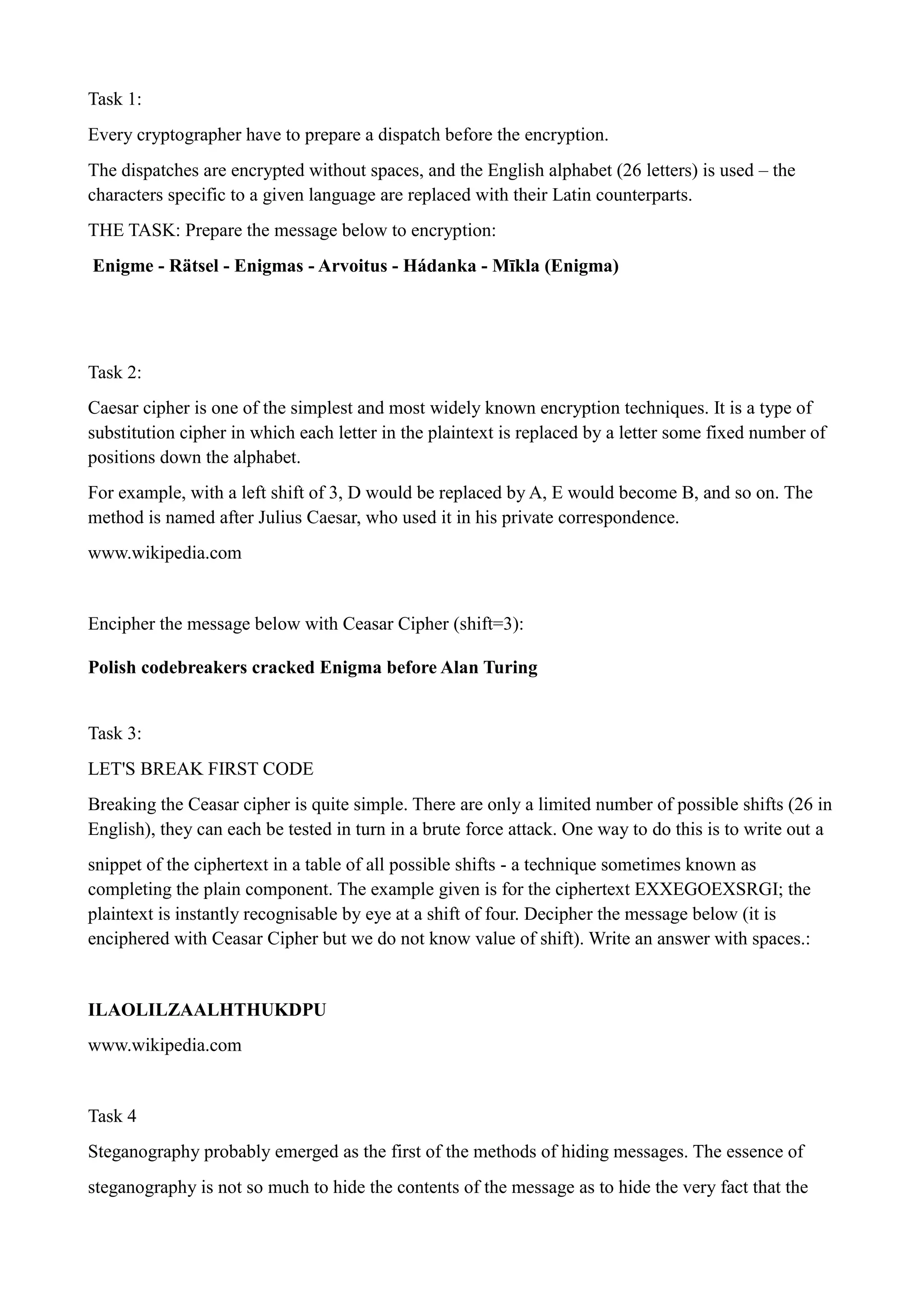
Every cryptographer have to prepare a dispatch before the encryption.
The dispatches are encrypted without spaces, and the English alphabet (26 letters) is used – the
characters specific to a given language are replaced with their Latin counterparts.
THE TASK: Prepare the message below to encryption:
Enigme - Rätsel - Enigmas - Arvoitus - Hádanka - Mīkla (Enigma)
Task 2:
Caesar cipher is one of the simplest and most widely known encryption techniques. It is a type of
substitution cipher in which each letter in the plaintext is replaced by a letter some fixed number of
positions down the alphabet.
For example, with a left shift of 3, D would be replaced by A, E would become B, and so on. The
method is named after Julius Caesar, who used it in his private correspondence.
www.wikipedia.com
Encipher the message below with Ceasar Cipher (shift=3):
Polish codebreakers cracked Enigma before Alan Turing
Task 3:
LET'S BREAK FIRST CODE
Breaking the Ceasar cipher is quite simple. There are only a limited number of possible shifts (26 in
English), they can each be tested in turn in a brute force attack. One way to do this is to write out a
snippet of the ciphertext in a table of all possible shifts - a technique sometimes known as
completing the plain component. The example given is for the ciphertext EXXEGOEXSRGI; the
plaintext is instantly recognisable by eye at a shift of four. Decipher the message below (it is
enciphered with Ceasar Cipher but we do not know value of shift). Write an answer with spaces.:
ILAOLILZAALHTHUKDPU
www.wikipedia.com
Task 4
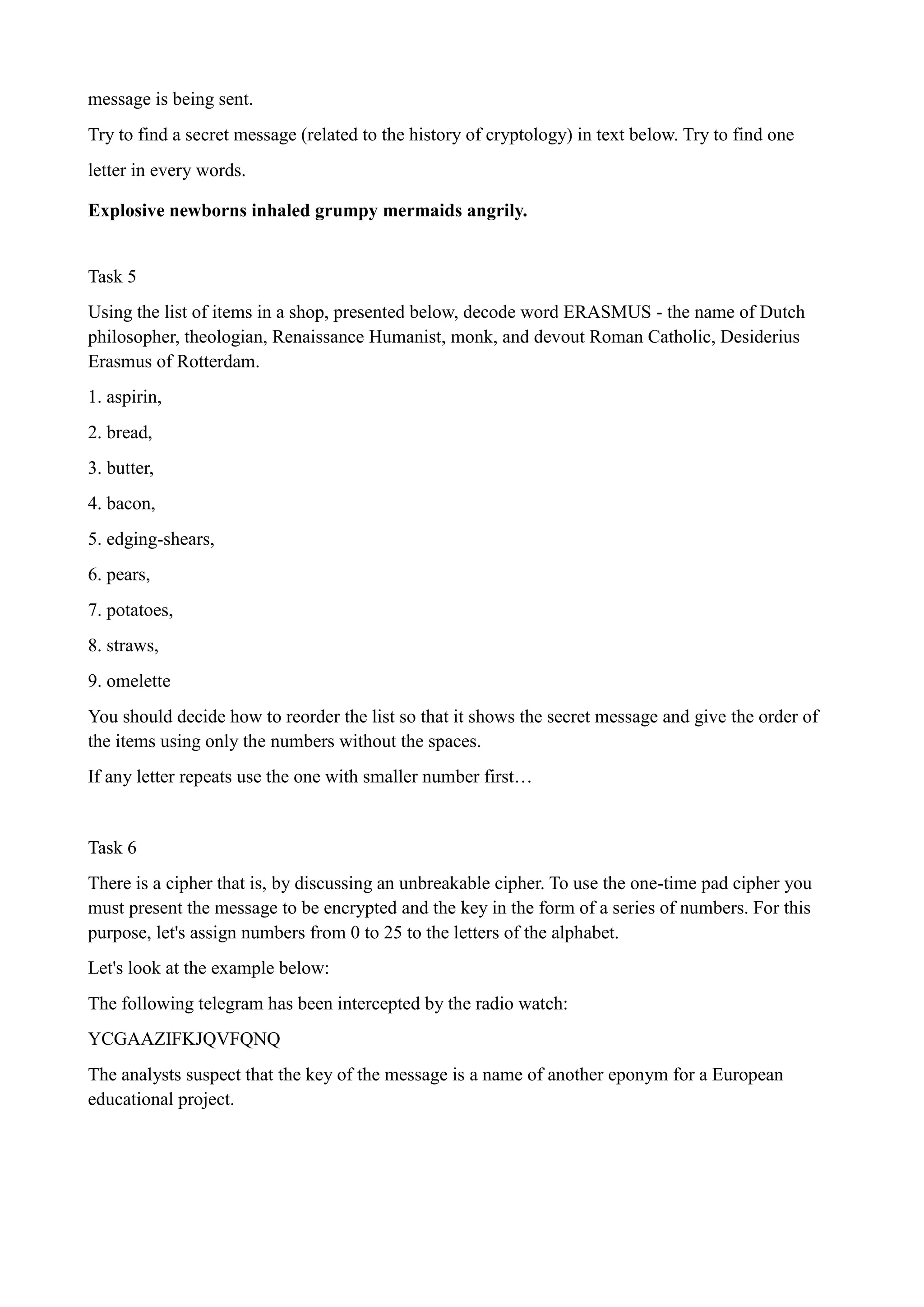
Steganography probably emerged as the first of the methods of hiding messages. The essence of
steganography is not so much to hide the contents of the message as to hide the very fact that the
message is being sent.
Try to find a secret message (related to the history of cryptology) in text below. Try to find one
letter in every words.
Explosive newborns inhaled grumpy mermaids angrily.
Task 5
Using the list of items in a shop, presented below, decode word ERASMUS - the name of Dutch
philosopher, theologian, Renaissance Humanist, monk, and devout Roman Catholic, Desiderius
Erasmus of Rotterdam.
1. aspirin,
2. bread,
3. butter,
4. bacon,
5. edging-shears,
6. pears,
7. potatoes,
8. straws,
9. omelette
You should decide how to reorder the list so that it shows the secret message and give the order of
the items using only the numbers without the spaces.
If any letter repeats use the one with smaller number first…
Task 6
There is a cipher that is, by discussing an unbreakable cipher. To use the one-time pad cipher you
must present the message to be encrypted and the key in the form of a series of numbers. For this
purpose, let's assign numbers from 0 to 25 to the letters of the alphabet.
Let's look at the example below:
The following telegram has been intercepted by the radio watch:
YCGAAZIFKJQVFQNQ
The analysts suspect that the key of the message is a name of another eponym for a European
educational project.

Codebreakers

  • 1.
    Task 1: Every cryptographerhave to prepare a dispatch before the encryption. The dispatches are encrypted without spaces, and the English alphabet (26 letters) is used – the characters specific to a given language are replaced with their Latin counterparts. THE TASK: Prepare the message below to encryption: Enigme - Rätsel - Enigmas - Arvoitus - Hádanka - Mīkla (Enigma) Task 2: Caesar cipher is one of the simplest and most widely known encryption techniques. It is a type of substitution cipher in which each letter in the plaintext is replaced by a letter some fixed number of positions down the alphabet. For example, with a left shift of 3, D would be replaced by A, E would become B, and so on. The method is named after Julius Caesar, who used it in his private correspondence. www.wikipedia.com Encipher the message below with Ceasar Cipher (shift=3): Polish codebreakers cracked Enigma before Alan Turing Task 3: LET'S BREAK FIRST CODE Breaking the Ceasar cipher is quite simple. There are only a limited number of possible shifts (26 in English), they can each be tested in turn in a brute force attack. One way to do this is to write out a snippet of the ciphertext in a table of all possible shifts - a technique sometimes known as completing the plain component. The example given is for the ciphertext EXXEGOEXSRGI; the plaintext is instantly recognisable by eye at a shift of four. Decipher the message below (it is enciphered with Ceasar Cipher but we do not know value of shift). Write an answer with spaces.: ILAOLILZAALHTHUKDPU www.wikipedia.com Task 4 Steganography probably emerged as the first of the methods of hiding messages. The essence of steganography is not so much to hide the contents of the message as to hide the very fact that the
  • 2.
    message is beingsent. Try to find a secret message (related to the history of cryptology) in text below. Try to find one letter in every words. Explosive newborns inhaled grumpy mermaids angrily. Task 5 Using the list of items in a shop, presented below, decode word ERASMUS - the name of Dutch philosopher, theologian, Renaissance Humanist, monk, and devout Roman Catholic, Desiderius Erasmus of Rotterdam. 1. aspirin, 2. bread, 3. butter, 4. bacon, 5. edging-shears, 6. pears, 7. potatoes, 8. straws, 9. omelette You should decide how to reorder the list so that it shows the secret message and give the order of the items using only the numbers without the spaces. If any letter repeats use the one with smaller number first… Task 6 There is a cipher that is, by discussing an unbreakable cipher. To use the one-time pad cipher you must present the message to be encrypted and the key in the form of a series of numbers. For this purpose, let's assign numbers from 0 to 25 to the letters of the alphabet. Let's look at the example below: The following telegram has been intercepted by the radio watch: YCGAAZIFKJQVFQNQ The analysts suspect that the key of the message is a name of another eponym for a European educational project.