CODE COMPLIANCE and EXECUTION
CEILING STRUCTURE
DCTS
july 2014
SOURCES: BASED ON DETAILED PROJECTS AND NATIONAL AND ONTERNATIONAL REGULATIONS 1
Earthquake Damage
A survey of 25 damaged commercial buildings following the 1971 San Fernando Earthquake
revealed the following breakdown of property losses:
A similar survey of 50 damaged high-rise buildings, which were far enough away from the
earthquake fault rupture to experience only mild shaking, showed that none had major structural
damage but major nonstructural damages:
3 7
34
56
structural damage
electrical and
mechanical
exterior finishes
interior finishes
43
18
15
8 drywall or plaster
partitions
elevators
broken windows
air-conditioning
systems
SOURCES: BASED ON FEMA E 74/2011 2
Distribution of Costs
SOURCES: TAGHAVI AND MIRANDA 2003 3
20
13 8
62
70
48
18 17
44
0%
10%
20%
30%
40%
50%
60%
70%
80%
90%
100%
Office Hotel Hospital
Structural
Non Structural
Contents
Within the nonstructural components
category, the interior construction,
to witch the suspended ceilings belong,
represents the largest source
of costs – 30%.
Impact
- Economic impact: losses of inventory and business income;
- Threat to life safety: injuries and death;
- Loss of function.
4
CODE COMPLIANCE
SOURCES: P100-1/2013 – ROMANIAN SEISMIC DESIGN CODE 5
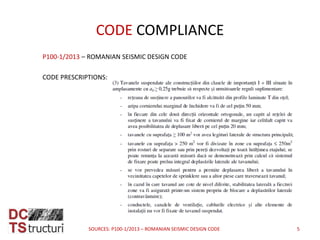
P100-1/2013 – ROMANIAN SEISMIC DESIGN CODE
CODE PRESCRIPTIONS:
The suspended ceilings of I÷III importance class buildings situated on ag>0.25g sites need to
respect the following additional rules:
- the panel support grid is to be made of laminated T-shaped steel profiles;
- the closing marginal L-shape’s flange is to be of at least 50 mm;
- on each of the 2 orthogonal horizontal directions, one end of the support grid of
the ceiling is to be fastened to the end L-shape and the other end will have at least a 20 mm
free displacement;
- ceilings with the surface >100sqm will have lateral connections to the main
structure;
- ceilings with the surface >250sqm will be divided into surface areas <250sqm by
means of separating joints or by walls on the entire height of the storey; one can discard this
measure if it can by proven by calculation that the fixing system can fully bear the lateral
displacements of the ceiling;
- measures will be taken to allow the free displacement of the ceiling in the
vicinity of sprinklers and/or other pieces that run through the ceiling;
- in case the ceiling has different height levels, the lateral stability of each area is
to be assured by means of a self-locking system of the lateral displacements (bracing);
- pipes, ventilation ducts, electrical wiring and other installation elements will not
be fixed to the suspended ceiling.
CODE COMPLIANCE
SOURCES: P100-1/2013 – ROMANIAN SEISMIC DESIGN CODE 6
P100-1/2013 – ROMANIAN SEISMIC DESIGN CODE
CODE PRESCRIPTIONS:
The partition walls fixed at the suspended ceiling level, as well as any other partition walls taller
than 2.00 m, regardless of the material they are made of, are to be laterally fastened to the main structure,
independently of the suspended ceiling fixing system. In case of framed structure buildings, the connections
will not favor the creation of short-wall situations.
The plan layout of lateral fixing elements and their dimensioning is to be done so that the lateral
displacements of the top ends of walls are compatible with the lateral displacements of the suspended ceiling
in that room.
1
CODE COMPLIANCE
SOURCES: P100-1/2013 – ROMANIAN SEISMIC DESIGN CODE 7
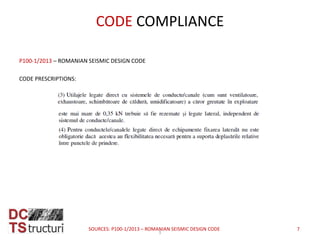
P100-1/2013 – ROMANIAN SEISMIC DESIGN CODE
CODE PRESCRIPTIONS:
The equipments connected directly to the ducting system (such as fans, dust blowers,
heat changers, humidifiers) that have an exploitation weight greater than 0.35kN/35kg must be
propped and connected laterally, independently from the pipeline system.
For pipes/ducts connected directly to the equipment, the lateral fixing is not
mandatory if they have the necessary flexibility to undergo relative displacements with respect to
the attachment points.
1
EXPERIMENTAL RESEARCH
SOURCES: P100-1/2013 – ROMANIAN SEISMIC DESIGN CODE 8
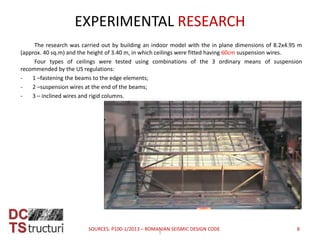
The research was carried out by building an indoor model with the in plane dimensions of 8.2x4.95 m
(approx. 40 sq.m) and the height of 3.40 m, in which ceilings were fitted having 60cm suspension wires.
Four types of ceilings were tested using combinations of the 3 ordinary means of suspension
recommended by the US regulations:
- 1 –fastening the beams to the edge elements;
- 2 –suspension wires at the end of the beams;
- 3 – inclined wires and rigid columns.
EXPERIMENTAL RESEARCH
SOURCES: ARMSTRONG SEISMIC CEILING DESIGN 9
CEILING ON SITE
10
EXPERIMENTAL RESEARCH
SOURCES: ARMSTRONG SEISMIC CEILING DESIGN 11
RESEARCH RESULTS
SOURCES: P100-1/2013 – ROMANIAN SEISMIC DESIGN CODE 12
The “A”-type composition corresponds to the ASTM E580-96 US regulations and the “D”-type to
the common practice in non seismic areas.
Ceiling type Fasteners
Failure
acceleration
Failure mode
1 2 3
A Yes Yes Yes >1.5g Virtually no failure.
B Yes Yes No 1.5g
The beams were separated from the edge elements;
several cracked panels and a few beam ends deformed
due to contact with the end wall.
C Yes No No 0.8g
The beams began to rupture and fall. Most panels
cracked at 0.8g. At 1.5g the ceiling collapse occurred.
D No No No 0.25g
The beams were separated from the edge elements;
the end beams began to rupture and fall at 0.4g.
WORLD PLATE TECTONICS
13
WHY FOREIGN NORMS and REGULATION
FIRS ROMANIAN SEISMIC DESIGN CODE FOR STRUCTURES WAS IMPLEMENTED IN 1963 – P13-63.
IN 1973 United States of America HAD A SPECIFIC REGULATION SUSPENDED CEILINGS – UBC 1973.
AFTER THE EARTHQUAKE OF L’AQUILA IN 2009 ITALY STARTED PAYING ATTENTION TO THE NON STRUCTURAL
ELEMENTS AS THE ECONOMIC LOSSES WHERE SIGNIFICANT.
IN 2014 NEW ZEELAND PROPOSED REVISION OF THE SEISMIC DESIGN CODE FOR SUSPENDED CEILINGS DUE TO
ECONOMICAL LOSSES PRODUCED BY THE CANTERBURY EARTHQUAKE FROM 2010. THEY PERFORMED
ADDITIONAL RESEARCH EXPERIMENTS AND THEY DISCOVERED THAT BOTH CODE AND EXPERIMENTAL
RESEARCH WHERE CORESPONDING AND THE DAMAGES OCCURRED DUE TO EXECUTION AND DESIGN LEVEL OF
PERFORMANCE.
SOURCES: A.POURALI, R.P.DHAKAL & G.A.MACRAE – Seismic performance of suspended ceilings:
Critical review of current design practice 14
CEILING LEVEL OF DUCTILITY
The point where the system loses its originally intended operation – SLS – and the
point where it loses integrity and undergoes collapse, thereby endagering occupants –
ULS – are rather close.
SOURCES: A.POURALI, R.P.DHAKAL & G.A.MACRAE – Seismic performance of suspended ceilings:
Critical review of current design practice 15
LEVELS OF PERFORMANCE
SOURCES: P100-1/2013 – ROMANIAN SEISMIC DESIGN CODE 16
P100-1/2013 – ROMANIAN SEISMIC DESIGN CODE
CODE PRESCRIPTIONS:
The general behavior description of the CNS subassembly, for each of the four levels of seismic performance (NPS) of
the building, was made as following:
I.Completely functional/operational: Only minor damage is produced to CNS, that keeps on functioning and the
building is available for normal use. (Refitting, locally and isolated, if necessary, can be done at the beneficiary’s will.
Meeting this level depends also on the equipment characteristics – seismic qualification – and on the execution
quality. Sometimes the existence of backup electrical supply is necessary.)
II.Functional: CNS is safe and, if the power supplies are available, most of them can function. Vital systems (Life
Safety Systems) are operational. (Minor damage to some CNS is produced, some windows are smashed and some
equipment may fail. Access paths and life safety equipment are generally available and functional – if the power
supply exists. Refitting, at times more numerous, can be done at the beneficiary’s will. The risk of injuring/life loss
due to CNS damage is very low. If the structure does not present major damage, the occupants can remain safely in
the building but, sometimes, under reduced comfort conditions.
III.Life protection: Significant damage to the CNS is produced. These are safe from the stability and strength point of
view but there is a possibility, in most cases, for the installation and equipment to stop working. (Extended and costly
damage to the CNS are produced, that require a long period of time to repair, but no dislocation or systematic
failures are produced. Access paths can be partially blocked by rubble or by fallen construction elements. Significant
degradation of the building. People can be wounded by falling of CNS but the risk of life loss is, generally, very low,
both inside and outside of the building.
IV.Pre collapse: It is possible that several CNS to be displaced or to present damaged/ruptured connections and for
this reason to represent a major risk of collapse and, hence, danger for life safety. (In the correctly designed
buildings, the heavy/massive elements that represent major danger in case of collapse are assured and do not fall in
areas of possible people congestions. For this damage level one cannot assure the protection of access routes,
neither the equipment that to assure life safety ( fire extinguish installation, for example.)
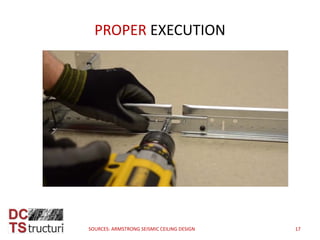
PROPER EXECUTION
SOURCES: ARMSTRONG SEISMIC CEILING DESIGN 17
PROPER EXECUTION
SOURCES: ARMSTRONG SEISMIC CEILING DESIGN 18
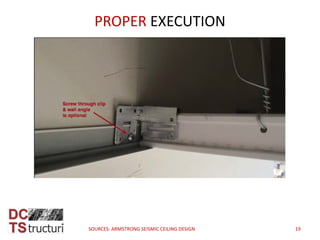
PROPER EXECUTION
SOURCES: ARMSTRONG SEISMIC CEILING DESIGN 19
PROPER EXECUTION
SOURCES: ARMSTRONG SEISMIC CEILING DESIGN 20
PROPER EXECUTION
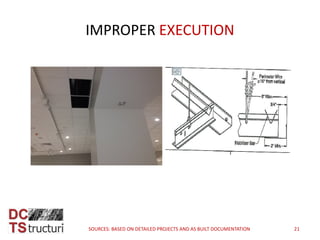
SOURCES: ARMSTRONG SEISMIC CEILING DESIGN 21
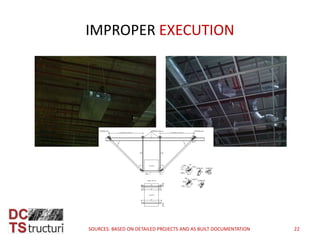
IMPROPER EXECUTION
SOURCES: BASED ON DETAILED PROJECTS AND AS BUILT DOCUMENTATION 22
IMPROPER EXECUTION
SOURCES: BASED ON DETAILED PROJECTS AND AS BUILT DOCUMENTATION 23
IMPROPER EXECUTION
SOURCES: BASED ON DETAILED PROJECTS AND AS BUILT DOCUMENTATION 24
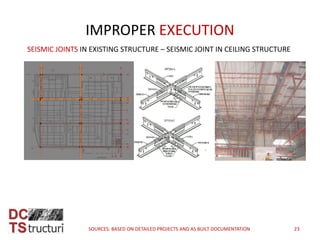
SEISMIC JOINTS IN EXISTING STRUCTURE – SEISMIC JOINT IN CEILING STRUCTURE
IMPROPER EXECUTION
CEILING BRACEINGS
SOURCES: BASED ON DETAILED PROJECTS AND AS BUILT DOCUMENTATION 25
SEISMIC KNAUF
RIGID SUSPENSION
SOURCES: KNAUF SEISMIC DESIGN Edition 08/2004 New Zeeland 26
STELL STRUCTURE OVERVIEW
SOURCES: BASED ON DETAILED PROJECTS AND AS BUILT DOCUMENTATION 27
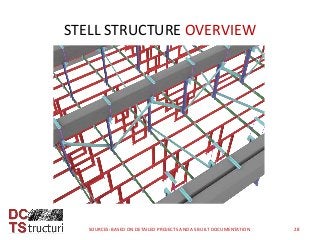
STELL STRUCTURE OVERVIEW
SOURCES: BASED ON DETAILED PROJECTS AND AS BUILT DOCUMENTATION 28
CEILING CRASHES IN ROMANIA
SOURCES: adevarul.ro stirileprotv.ro a1.ro zf.ro realitatea.net 29
City Park Mall Constanta: Adidas - 2013, B&B Collection - 2008
Galleria Arad - 2012
Cora Lujerului - 2014
Mall Vitan – 2010
Comercial Centrum Vitantis - 2010
Ploiesti Shoping City - 2013
AFI Palace Cotroceni - 2013
Financial Administration 5th District - 2014
Restaurant Targoviste - 2011
Underground Unirea 2 – 2011
Iulius Mall Cluj, Timisoara - ploi
FOR FURTHER INFORMATION PLEASE CONTACT ANA-MARIA POPA AT:
30
anamaria.popa@dcts.ro
+40 721 308 407
www.dcts.ro

Code Compliance and Execution

  • 1.
    CODE COMPLIANCE andEXECUTION CEILING STRUCTURE DCTS july 2014 SOURCES: BASED ON DETAILED PROJECTS AND NATIONAL AND ONTERNATIONAL REGULATIONS 1
  • 2.
    Earthquake Damage A surveyof 25 damaged commercial buildings following the 1971 San Fernando Earthquake revealed the following breakdown of property losses: A similar survey of 50 damaged high-rise buildings, which were far enough away from the earthquake fault rupture to experience only mild shaking, showed that none had major structural damage but major nonstructural damages: 3 7 34 56 structural damage electrical and mechanical exterior finishes interior finishes 43 18 15 8 drywall or plaster partitions elevators broken windows air-conditioning systems SOURCES: BASED ON FEMA E 74/2011 2
  • 3.
    Distribution of Costs SOURCES:TAGHAVI AND MIRANDA 2003 3 20 13 8 62 70 48 18 17 44 0% 10% 20% 30% 40% 50% 60% 70% 80% 90% 100% Office Hotel Hospital Structural Non Structural Contents Within the nonstructural components category, the interior construction, to witch the suspended ceilings belong, represents the largest source of costs – 30%.
  • 4.
    Impact - Economic impact:losses of inventory and business income; - Threat to life safety: injuries and death; - Loss of function. 4
  • 5.
    CODE COMPLIANCE SOURCES: P100-1/2013– ROMANIAN SEISMIC DESIGN CODE 5 P100-1/2013 – ROMANIAN SEISMIC DESIGN CODE CODE PRESCRIPTIONS: The suspended ceilings of I÷III importance class buildings situated on ag>0.25g sites need to respect the following additional rules: - the panel support grid is to be made of laminated T-shaped steel profiles; - the closing marginal L-shape’s flange is to be of at least 50 mm; - on each of the 2 orthogonal horizontal directions, one end of the support grid of the ceiling is to be fastened to the end L-shape and the other end will have at least a 20 mm free displacement; - ceilings with the surface >100sqm will have lateral connections to the main structure; - ceilings with the surface >250sqm will be divided into surface areas <250sqm by means of separating joints or by walls on the entire height of the storey; one can discard this measure if it can by proven by calculation that the fixing system can fully bear the lateral displacements of the ceiling; - measures will be taken to allow the free displacement of the ceiling in the vicinity of sprinklers and/or other pieces that run through the ceiling; - in case the ceiling has different height levels, the lateral stability of each area is to be assured by means of a self-locking system of the lateral displacements (bracing); - pipes, ventilation ducts, electrical wiring and other installation elements will not be fixed to the suspended ceiling.
  • 6.
    CODE COMPLIANCE SOURCES: P100-1/2013– ROMANIAN SEISMIC DESIGN CODE 6 P100-1/2013 – ROMANIAN SEISMIC DESIGN CODE CODE PRESCRIPTIONS: The partition walls fixed at the suspended ceiling level, as well as any other partition walls taller than 2.00 m, regardless of the material they are made of, are to be laterally fastened to the main structure, independently of the suspended ceiling fixing system. In case of framed structure buildings, the connections will not favor the creation of short-wall situations. The plan layout of lateral fixing elements and their dimensioning is to be done so that the lateral displacements of the top ends of walls are compatible with the lateral displacements of the suspended ceiling in that room.
  • 7.
    1 CODE COMPLIANCE SOURCES: P100-1/2013– ROMANIAN SEISMIC DESIGN CODE 7 P100-1/2013 – ROMANIAN SEISMIC DESIGN CODE CODE PRESCRIPTIONS: The equipments connected directly to the ducting system (such as fans, dust blowers, heat changers, humidifiers) that have an exploitation weight greater than 0.35kN/35kg must be propped and connected laterally, independently from the pipeline system. For pipes/ducts connected directly to the equipment, the lateral fixing is not mandatory if they have the necessary flexibility to undergo relative displacements with respect to the attachment points.
  • 8.
    1 EXPERIMENTAL RESEARCH SOURCES: P100-1/2013– ROMANIAN SEISMIC DESIGN CODE 8 The research was carried out by building an indoor model with the in plane dimensions of 8.2x4.95 m (approx. 40 sq.m) and the height of 3.40 m, in which ceilings were fitted having 60cm suspension wires. Four types of ceilings were tested using combinations of the 3 ordinary means of suspension recommended by the US regulations: - 1 –fastening the beams to the edge elements; - 2 –suspension wires at the end of the beams; - 3 – inclined wires and rigid columns.
  • 9.
  • 10.
  • 11.
  • 12.
    RESEARCH RESULTS SOURCES: P100-1/2013– ROMANIAN SEISMIC DESIGN CODE 12 The “A”-type composition corresponds to the ASTM E580-96 US regulations and the “D”-type to the common practice in non seismic areas. Ceiling type Fasteners Failure acceleration Failure mode 1 2 3 A Yes Yes Yes >1.5g Virtually no failure. B Yes Yes No 1.5g The beams were separated from the edge elements; several cracked panels and a few beam ends deformed due to contact with the end wall. C Yes No No 0.8g The beams began to rupture and fall. Most panels cracked at 0.8g. At 1.5g the ceiling collapse occurred. D No No No 0.25g The beams were separated from the edge elements; the end beams began to rupture and fall at 0.4g.
  • 13.
  • 14.
    WHY FOREIGN NORMSand REGULATION FIRS ROMANIAN SEISMIC DESIGN CODE FOR STRUCTURES WAS IMPLEMENTED IN 1963 – P13-63. IN 1973 United States of America HAD A SPECIFIC REGULATION SUSPENDED CEILINGS – UBC 1973. AFTER THE EARTHQUAKE OF L’AQUILA IN 2009 ITALY STARTED PAYING ATTENTION TO THE NON STRUCTURAL ELEMENTS AS THE ECONOMIC LOSSES WHERE SIGNIFICANT. IN 2014 NEW ZEELAND PROPOSED REVISION OF THE SEISMIC DESIGN CODE FOR SUSPENDED CEILINGS DUE TO ECONOMICAL LOSSES PRODUCED BY THE CANTERBURY EARTHQUAKE FROM 2010. THEY PERFORMED ADDITIONAL RESEARCH EXPERIMENTS AND THEY DISCOVERED THAT BOTH CODE AND EXPERIMENTAL RESEARCH WHERE CORESPONDING AND THE DAMAGES OCCURRED DUE TO EXECUTION AND DESIGN LEVEL OF PERFORMANCE. SOURCES: A.POURALI, R.P.DHAKAL & G.A.MACRAE – Seismic performance of suspended ceilings: Critical review of current design practice 14
  • 15.
    CEILING LEVEL OFDUCTILITY The point where the system loses its originally intended operation – SLS – and the point where it loses integrity and undergoes collapse, thereby endagering occupants – ULS – are rather close. SOURCES: A.POURALI, R.P.DHAKAL & G.A.MACRAE – Seismic performance of suspended ceilings: Critical review of current design practice 15
  • 16.
    LEVELS OF PERFORMANCE SOURCES:P100-1/2013 – ROMANIAN SEISMIC DESIGN CODE 16 P100-1/2013 – ROMANIAN SEISMIC DESIGN CODE CODE PRESCRIPTIONS: The general behavior description of the CNS subassembly, for each of the four levels of seismic performance (NPS) of the building, was made as following: I.Completely functional/operational: Only minor damage is produced to CNS, that keeps on functioning and the building is available for normal use. (Refitting, locally and isolated, if necessary, can be done at the beneficiary’s will. Meeting this level depends also on the equipment characteristics – seismic qualification – and on the execution quality. Sometimes the existence of backup electrical supply is necessary.) II.Functional: CNS is safe and, if the power supplies are available, most of them can function. Vital systems (Life Safety Systems) are operational. (Minor damage to some CNS is produced, some windows are smashed and some equipment may fail. Access paths and life safety equipment are generally available and functional – if the power supply exists. Refitting, at times more numerous, can be done at the beneficiary’s will. The risk of injuring/life loss due to CNS damage is very low. If the structure does not present major damage, the occupants can remain safely in the building but, sometimes, under reduced comfort conditions. III.Life protection: Significant damage to the CNS is produced. These are safe from the stability and strength point of view but there is a possibility, in most cases, for the installation and equipment to stop working. (Extended and costly damage to the CNS are produced, that require a long period of time to repair, but no dislocation or systematic failures are produced. Access paths can be partially blocked by rubble or by fallen construction elements. Significant degradation of the building. People can be wounded by falling of CNS but the risk of life loss is, generally, very low, both inside and outside of the building. IV.Pre collapse: It is possible that several CNS to be displaced or to present damaged/ruptured connections and for this reason to represent a major risk of collapse and, hence, danger for life safety. (In the correctly designed buildings, the heavy/massive elements that represent major danger in case of collapse are assured and do not fall in areas of possible people congestions. For this damage level one cannot assure the protection of access routes, neither the equipment that to assure life safety ( fire extinguish installation, for example.)
  • 17.
    PROPER EXECUTION SOURCES: ARMSTRONGSEISMIC CEILING DESIGN 17
  • 18.
    PROPER EXECUTION SOURCES: ARMSTRONGSEISMIC CEILING DESIGN 18
  • 19.
    PROPER EXECUTION SOURCES: ARMSTRONGSEISMIC CEILING DESIGN 19
  • 20.
    PROPER EXECUTION SOURCES: ARMSTRONGSEISMIC CEILING DESIGN 20
  • 21.
    PROPER EXECUTION SOURCES: ARMSTRONGSEISMIC CEILING DESIGN 21
  • 22.
    IMPROPER EXECUTION SOURCES: BASEDON DETAILED PROJECTS AND AS BUILT DOCUMENTATION 22
  • 23.
    IMPROPER EXECUTION SOURCES: BASEDON DETAILED PROJECTS AND AS BUILT DOCUMENTATION 23
  • 24.
    IMPROPER EXECUTION SOURCES: BASEDON DETAILED PROJECTS AND AS BUILT DOCUMENTATION 24 SEISMIC JOINTS IN EXISTING STRUCTURE – SEISMIC JOINT IN CEILING STRUCTURE
  • 25.
    IMPROPER EXECUTION CEILING BRACEINGS SOURCES:BASED ON DETAILED PROJECTS AND AS BUILT DOCUMENTATION 25
  • 26.
    SEISMIC KNAUF RIGID SUSPENSION SOURCES:KNAUF SEISMIC DESIGN Edition 08/2004 New Zeeland 26
  • 27.
    STELL STRUCTURE OVERVIEW SOURCES:BASED ON DETAILED PROJECTS AND AS BUILT DOCUMENTATION 27
  • 28.
    STELL STRUCTURE OVERVIEW SOURCES:BASED ON DETAILED PROJECTS AND AS BUILT DOCUMENTATION 28
  • 29.
    CEILING CRASHES INROMANIA SOURCES: adevarul.ro stirileprotv.ro a1.ro zf.ro realitatea.net 29 City Park Mall Constanta: Adidas - 2013, B&B Collection - 2008 Galleria Arad - 2012 Cora Lujerului - 2014 Mall Vitan – 2010 Comercial Centrum Vitantis - 2010 Ploiesti Shoping City - 2013 AFI Palace Cotroceni - 2013 Financial Administration 5th District - 2014 Restaurant Targoviste - 2011 Underground Unirea 2 – 2011 Iulius Mall Cluj, Timisoara - ploi
  • 30.
    FOR FURTHER INFORMATIONPLEASE CONTACT ANA-MARIA POPA AT: 30 anamaria.popa@dcts.ro +40 721 308 407 www.dcts.ro