790 Cochabamba Water Wars
Cochabamba
Water Wars
Luis A. Gómez
Recognized as the twenty-first century’s first
anti-globalization victory, Cochabamba Bolivia’s
Water War is also considered to be the beginning
of a new revolutionary cycle, from 2000 to 2005,
in Bolivia. Under the rallying cry “The Water
Is Ours” this city’s (and surrounding country-
side’s) citizens resisted the privatization of their
potable water and basic services, enabled by the
Hugo Banzer Suárez administration to Aguas del
Tunari, a subsidiary of the Bechtel corporation.
Workers, homemakers, farmers, professionals,
coca growers, and other social sectors united
under the horizontally structured Coordinadora
de Defensa del Agua y de la Vida (Coalition in
Defense of Water and Life, or the Coordinadora).
Founded on November 12, 1999, the Coordin-
adora was the political response of people’s frus-
tration with an economic model that after almost
15 years of ransacking their resources and limit-
ing their rights, had just privatized their water.
According to Law 2029 passed on October 29,
1999, all pre-privatization natural water sources
and water-related infrastructure and services
(including that which was communal and/or
cooperative) were at risk of being placed under
private control.
Access in Cochabamba was always problematic,
and for decades the people had been organizing
and using their own resources and technology –
without state intervention – to dig their own com-
munity wells and construct communal sewage
and water distribution systems. Additionally,
others felt threatened by the contracts signed
between the Banzer government, the mayor of
Cochabamba Manfred Reyes Villa, and Bechtel.
Many of the farming communities who used
traditional water access and irrigation methods
were also under Bechtel’s “areas of concession.”
Cochabamba wasn’t the only place handed
over to the transnationals. And over the follow-
ing months, there were blockades and deaths in
.
International Encyclopedia of Revolution and Protest, ed. Immanuel Ness, Blackwell Publishing, 2009, pp. 790–792
c03.qxd 3/18/09 4:43 PM Page 790
Cochabamba Water Wars 791
the western Aymara highland region. However,
Bechtel was met with the most resistance,
triggered partially by the company’s own actions.
Not only did Aguas del Tunari attempt to control
the streams, wells, and tanks, but also it began
charging excessively (rate increases sometimes
neared 1000 percent) and cutting off or suspend-
ing service for those who couldn’t pay their
bills.
In response, the Coordinadora combined
diverse protest tactics such as road blockades
and marches with concrete political questioning. At
the same time, its first leaders not only encour-
aged but insisted on collective decision-making
and open, transparent deliberation within the
organization. These practices, as factory union
leader Oscar Olivera put it, allowed the people
to “recuperate their dignity and their voice.”
Some of the best examples of this period’s
rebellious spirit are the Coordinadora’s com-
muniqués and manifestos. More than a call to
action, these documents became assembly debate
guidelines and were clear demonstrations of a
new way of doing politics.
On January 10, 2000, just before the first
largescale blockade and general strike, the
Coordinadora concluded its manifesto with this
message: “Rights are not earned by begging.
They are won by fighting. No one is going to
fight for what is ours. We must therefore fight, or
submit to humiliation by those who govern us.”
During this time, the Water Warriors began
appearing. They were people of all ages and
social class who were the first line of defense
in the hundreds of barricades during those
months. These Warriors were the first to confront
the police’s tear gas, attack dogs, and bullets.
Varying forms of solidarity were manifested.
Friday, February 4 marked the largest and
most diverse peaceful march in Cochabamba’s
history. When the police offensive came, the
people held their ground, forcing the government
to concede several demands such as an end to rate
hikes and the modification of Law 2029.
“The other great accomplishment of this
mobilization,” read the Coordinadora’s com-
muniqué 14,
is that we lost our fear. We left our houses and
communities in order to speak to one another,
to get to know each other, to learn how once again
to trust one another. We took over the streets
because they in fact belong to us. And we did
it with our own strength. . . . For us – the
working people of this city and countryside – this
is the real meaning of democracy: we decide
and we act, we discuss and we execute. We
risk our lives in order to carry out that which we
consider just. Democracy is people’s sovereignty
and that is what we have done.
By the beginning of April, the repression
and mobilization reached a climax which the
Coordinadora called the Final Battle. From
April 4 on, the people fought in the streets,
demanding the end to Aguas del Tunari’s contract.
The government of former-dictator Banzer began
losing ground, above all when young Víctor Hugo
Daza was killed by an army sniper.
On the afternoon of April 9 – with the
city paralyzed and the main plaza inundated with
calls for his resignation – President Banzer
announced the revocation of Bechtel’s contract.
International Encyclopedia of Revolution and Protest, ed. Immanuel Ness, Blackwell Publishing, 2009, pp. 790–792
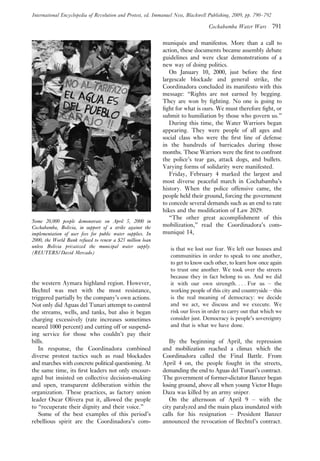
Some 20,000 people demonstrate on April 5, 2000 in
Cochabamba, Bolivia, in support of a strike against the
implementation of user fees for public water supplies. In
2000, the World Bank refused to renew a $25 million loan
unless Bolivia privatized the municipal water supply.
(REUTERS/David Mercado)
c03.qxd 3/18/09 4:43 PM Page 791
792 Cohn-Bendit, Daniel (b. 1945)
In the days that followed Aguas del Tunari
executives fled the city and the people took over
the company’s installations.
Over the five months of struggle for their
water, the people of Cochabamba called into
question not only the ownership of the world’s
most valuable resource, but also conventional
forms of political representation, decision-making,
and even the state’s own structure. All of this
would have a determining influence over future
mobilizations concerning water in Bolivia and
throughout the world.
SEE ALSO: Bolivia, Protest and Repression, 1964–
2000; Bolivian Neoliberalism, Social Mobilization,
and Revolution from Below, 2003 and 2005; Cocaleros
Peasant Uprising; Katarismo and Indigenous Popular
Mobilization, Bolivia, 1970s–Present; Morales, Evo
(b. 1959)
References and Suggested Readings
Crespo, C., Fernández, O., & Peredo, C. (2005) Los
regantes de Cochabamba en la Guerra del Agua.
Cochabamba: CESU-UMSS.
García, A., Gutiérrez, R., Prada, R., & Tapia, L.
(2000) El retorno de la Bolivia plebeya. La Paz:
Muela del Diablo Editores.
García, A., Gutiérrez, R., Prada, R., & Tapia, L.
(2001) Tiempos de rebelión. La Paz: Muela del
Diablo Editores.
Olivera, O. (2004) Cochabamba!. Cambridge, MA:
South End Press.
International Encyclopedia of Revolution and Protest, ed. Immanuel Ness, Blackwell Publishing, 2009, pp. 790–792
c03.qxd 3/18/09 4:43 PM Page 792

Cochabamba Water Wars

  • 1.
    790 Cochabamba WaterWars Cochabamba Water Wars Luis A. Gómez Recognized as the twenty-first century’s first anti-globalization victory, Cochabamba Bolivia’s Water War is also considered to be the beginning of a new revolutionary cycle, from 2000 to 2005, in Bolivia. Under the rallying cry “The Water Is Ours” this city’s (and surrounding country- side’s) citizens resisted the privatization of their potable water and basic services, enabled by the Hugo Banzer Suárez administration to Aguas del Tunari, a subsidiary of the Bechtel corporation. Workers, homemakers, farmers, professionals, coca growers, and other social sectors united under the horizontally structured Coordinadora de Defensa del Agua y de la Vida (Coalition in Defense of Water and Life, or the Coordinadora). Founded on November 12, 1999, the Coordin- adora was the political response of people’s frus- tration with an economic model that after almost 15 years of ransacking their resources and limit- ing their rights, had just privatized their water. According to Law 2029 passed on October 29, 1999, all pre-privatization natural water sources and water-related infrastructure and services (including that which was communal and/or cooperative) were at risk of being placed under private control. Access in Cochabamba was always problematic, and for decades the people had been organizing and using their own resources and technology – without state intervention – to dig their own com- munity wells and construct communal sewage and water distribution systems. Additionally, others felt threatened by the contracts signed between the Banzer government, the mayor of Cochabamba Manfred Reyes Villa, and Bechtel. Many of the farming communities who used traditional water access and irrigation methods were also under Bechtel’s “areas of concession.” Cochabamba wasn’t the only place handed over to the transnationals. And over the follow- ing months, there were blockades and deaths in . International Encyclopedia of Revolution and Protest, ed. Immanuel Ness, Blackwell Publishing, 2009, pp. 790–792 c03.qxd 3/18/09 4:43 PM Page 790
  • 2.
    Cochabamba Water Wars791 the western Aymara highland region. However, Bechtel was met with the most resistance, triggered partially by the company’s own actions. Not only did Aguas del Tunari attempt to control the streams, wells, and tanks, but also it began charging excessively (rate increases sometimes neared 1000 percent) and cutting off or suspend- ing service for those who couldn’t pay their bills. In response, the Coordinadora combined diverse protest tactics such as road blockades and marches with concrete political questioning. At the same time, its first leaders not only encour- aged but insisted on collective decision-making and open, transparent deliberation within the organization. These practices, as factory union leader Oscar Olivera put it, allowed the people to “recuperate their dignity and their voice.” Some of the best examples of this period’s rebellious spirit are the Coordinadora’s com- muniqués and manifestos. More than a call to action, these documents became assembly debate guidelines and were clear demonstrations of a new way of doing politics. On January 10, 2000, just before the first largescale blockade and general strike, the Coordinadora concluded its manifesto with this message: “Rights are not earned by begging. They are won by fighting. No one is going to fight for what is ours. We must therefore fight, or submit to humiliation by those who govern us.” During this time, the Water Warriors began appearing. They were people of all ages and social class who were the first line of defense in the hundreds of barricades during those months. These Warriors were the first to confront the police’s tear gas, attack dogs, and bullets. Varying forms of solidarity were manifested. Friday, February 4 marked the largest and most diverse peaceful march in Cochabamba’s history. When the police offensive came, the people held their ground, forcing the government to concede several demands such as an end to rate hikes and the modification of Law 2029. “The other great accomplishment of this mobilization,” read the Coordinadora’s com- muniqué 14, is that we lost our fear. We left our houses and communities in order to speak to one another, to get to know each other, to learn how once again to trust one another. We took over the streets because they in fact belong to us. And we did it with our own strength. . . . For us – the working people of this city and countryside – this is the real meaning of democracy: we decide and we act, we discuss and we execute. We risk our lives in order to carry out that which we consider just. Democracy is people’s sovereignty and that is what we have done. By the beginning of April, the repression and mobilization reached a climax which the Coordinadora called the Final Battle. From April 4 on, the people fought in the streets, demanding the end to Aguas del Tunari’s contract. The government of former-dictator Banzer began losing ground, above all when young Víctor Hugo Daza was killed by an army sniper. On the afternoon of April 9 – with the city paralyzed and the main plaza inundated with calls for his resignation – President Banzer announced the revocation of Bechtel’s contract. International Encyclopedia of Revolution and Protest, ed. Immanuel Ness, Blackwell Publishing, 2009, pp. 790–792 Some 20,000 people demonstrate on April 5, 2000 in Cochabamba, Bolivia, in support of a strike against the implementation of user fees for public water supplies. In 2000, the World Bank refused to renew a $25 million loan unless Bolivia privatized the municipal water supply. (REUTERS/David Mercado) c03.qxd 3/18/09 4:43 PM Page 791
  • 3.
    792 Cohn-Bendit, Daniel(b. 1945) In the days that followed Aguas del Tunari executives fled the city and the people took over the company’s installations. Over the five months of struggle for their water, the people of Cochabamba called into question not only the ownership of the world’s most valuable resource, but also conventional forms of political representation, decision-making, and even the state’s own structure. All of this would have a determining influence over future mobilizations concerning water in Bolivia and throughout the world. SEE ALSO: Bolivia, Protest and Repression, 1964– 2000; Bolivian Neoliberalism, Social Mobilization, and Revolution from Below, 2003 and 2005; Cocaleros Peasant Uprising; Katarismo and Indigenous Popular Mobilization, Bolivia, 1970s–Present; Morales, Evo (b. 1959) References and Suggested Readings Crespo, C., Fernández, O., & Peredo, C. (2005) Los regantes de Cochabamba en la Guerra del Agua. Cochabamba: CESU-UMSS. García, A., Gutiérrez, R., Prada, R., & Tapia, L. (2000) El retorno de la Bolivia plebeya. La Paz: Muela del Diablo Editores. García, A., Gutiérrez, R., Prada, R., & Tapia, L. (2001) Tiempos de rebelión. La Paz: Muela del Diablo Editores. Olivera, O. (2004) Cochabamba!. Cambridge, MA: South End Press. International Encyclopedia of Revolution and Protest, ed. Immanuel Ness, Blackwell Publishing, 2009, pp. 790–792 c03.qxd 3/18/09 4:43 PM Page 792