Indigenous Protest in the Andes Neil Hughes  Languages and International Studies
Indigenous Protest in the Andes Intro Core concepts Andean Region Indigenous  Neoliberalism
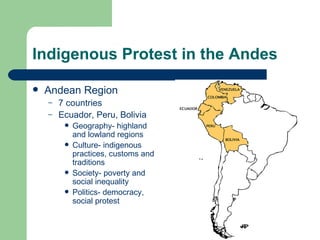
Indigenous Protest in the Andes Andean Region 7 countries Ecuador, Peru, Bolivia Geography- highland and lowland regions Culture- indigenous practices, customs and traditions Society- poverty and social inequality Politics- democracy, social protest
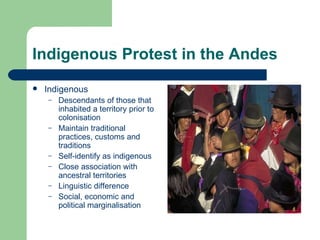
Indigenous Protest in the Andes Indigenous Descendants of those that inhabited a territory prior to colonisation Maintain traditional practices, customs and traditions Self-identify as indigenous Close association with ancestral territories Linguistic difference Social, economic and political marginalisation
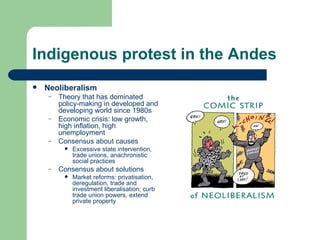
Indigenous protest in the Andes Neoliberalism Theory that has dominated policy-making in developed and developing world since 1980s Economic crisis: low growth, high inflation, high unemployment Consensus about causes Excessive state intervention, trade unions, anachronistic social practices Consensus about solutions Market reforms: privatisation, deregulation, trade and investment liberalisation; curb trade union powers, extend private property
Indigenous Protest in the Andes Benefits: growth, employment, consumer choice Milton Friedman: democratic governance Criticism: Stiglitz, Harvey, Klein According to Harvey “the process of neoliberalisation has entailed much creative destruction, not only of prior institutional frameworks and powers but also of divisions of labour, social relations, welfare provisions, technological mixes, ways of life and thought, reproductive activities, attachments to the land and habits of the heart”
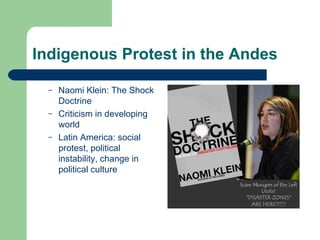
Indigenous Protest in the Andes Naomi Klein: The Shock Doctrine Criticism in developing world Latin America: social protest, political instability, change in political culture
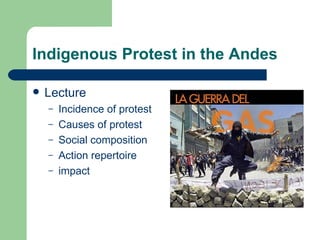
Indigenous Protest in the Andes Lecture Incidence of protest Causes of protest Social composition  Action repertoire impact
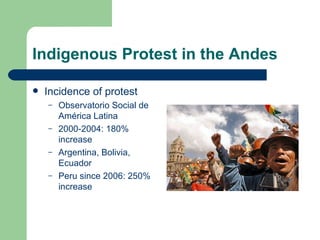
Indigenous Protest in the Andes Incidence of protest Observatorio Social de América Latina 2000-2004: 180% increase Argentina,  Bolivia,  Ecuador Peru since 2006: 250% increase
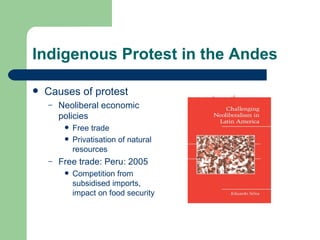
Indigenous Protest in the Andes Causes of protest Neoliberal economic policies Free trade Privatisation of natural resources Free trade: Peru: 2005 Competition from subsidised imports, impact on food security
Indigenous Protest in the Andes Resource privatisation Bolivia 2000: Water War Cochabamba Aguas de Tunari: price increases of up to 150% Protest involving: “rural peasant irrigators, local water collectives, urban workers, middle classes, elderly men and women, shantytown dwellers, the traditional left, and anybody unhappy with the established order and its corruption and inefficiency” (Silva, 2009, p.127) Cocaleros: Evo Morales Bolivian Rural Workers’ Union: Felipe Quispe
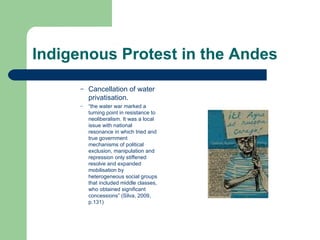
Indigenous Protest in the Andes Cancellation of water privatisation. “ the water war marked a turning point in resistance to neoliberalism. It was a local issue with national resonance in which tried and true government mechanisms of political exclusion, manipulation and repression only stiffened resolve and expanded mobilisation by heterogeneous social groups that included middle classes, who obtained significant concessions” (Silva, 2009, p.131)
Indigenous Protest in the Andes Peruvian Amazon 2008/9: AIDESEP International Law: Convention 169 of the International Labour Organisation Brian Keane (Land is Life) “International agreements and inter-American human rights law recognise indigenous peoples’ rights to their lands, and explicitly prohibit the granting of concessions to exploit natural resources in their territories without their free, prior and informed consent”
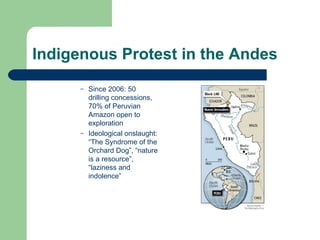
Indigenous Protest in the Andes Since 2006: 50 drilling concessions, 70% of Peruvian Amazon open to exploration Ideological onslaught: “The Syndrome of the Orchard Dog”, “nature is a resource”, “laziness and indolence”
Indigenous Protest in the Andes Social Composition Indigenous and peasant organisations Ecuador: Donna Lee Van Cott (2005, p.138): “by the mid 1990’s, the indigenous movements had become the most powerful Ecuadorian collective social actor and the object of increasingly favourable public opinion” CONAIE: 80% of indigenous population Bolivia: Cocaleros, Rural Workers’ Union Peru: AIDESEP, Peruvian Peasants’ Federation
Indigenous Protest in the Andes Action Repertoire Direct action : demonstrations, strikes, sit-ins, occupations Road blockades: poor transport infrastructure, effective, violent confrontations El Alto, Bolivia, 2003: 67 protestors killed Civil Action in  US courts  Protest marches; Bolivia 2000, Chapare to la Paz Electoral Politics Ecuador: Pachakutik Bolivia: Movimiento al Socialismo (MAS) Evo Morales first indigenous head of state
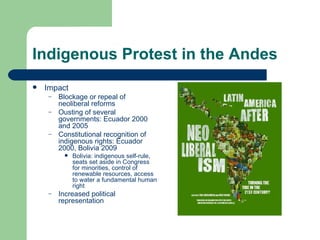
Indigenous Protest in the Andes Impact Blockage or repeal of neoliberal reforms Ousting of several governments: Ecuador 2000 and 2005 Constitutional recognition of indigenous rights: Ecuador 2000, Bolivia 2009 Bolivia: indigenous self-rule, seats set aside in Congress for minorities, control of renewable resources, access to water a fundamental human right Increased political representation
Indigenous Protest in the Andes Impact Blockage or repeal of indigenous reforms Ousting of several governments: Ecuador 2000 and 2005 Constituional recognition of indigenous rights: Ecuador 2000, Bolivia 2009 Bolivia: indigenous self-rule, seats set aside in Congress for minorities, control of renewable resources, access to water a fundamental human right Increased political representation
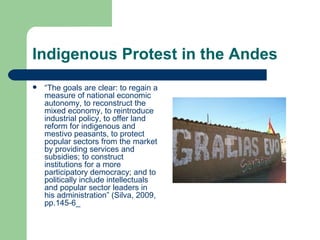
Indigenous Protest in the Andes “ The goals are clear: to regain a measure of national economic autonomy, to reconstruct the mixed economy, to reintroduce industrial policy, to offer land reform for indigenous and mestivo peasants, to protect popular sectors from the market by providing services and subsidies; to construct institutions for a more participatory democracy; and to politically include intellectuals and popular sector leaders in his administration” (Silva, 2009, pp.145-6_

111

  • 1.
    Indigenous Protest inthe Andes Neil Hughes Languages and International Studies
  • 2.
    Indigenous Protest inthe Andes Intro Core concepts Andean Region Indigenous Neoliberalism
  • 3.
    Indigenous Protest inthe Andes Andean Region 7 countries Ecuador, Peru, Bolivia Geography- highland and lowland regions Culture- indigenous practices, customs and traditions Society- poverty and social inequality Politics- democracy, social protest
  • 4.
    Indigenous Protest inthe Andes Indigenous Descendants of those that inhabited a territory prior to colonisation Maintain traditional practices, customs and traditions Self-identify as indigenous Close association with ancestral territories Linguistic difference Social, economic and political marginalisation
  • 5.
    Indigenous protest inthe Andes Neoliberalism Theory that has dominated policy-making in developed and developing world since 1980s Economic crisis: low growth, high inflation, high unemployment Consensus about causes Excessive state intervention, trade unions, anachronistic social practices Consensus about solutions Market reforms: privatisation, deregulation, trade and investment liberalisation; curb trade union powers, extend private property
  • 6.
    Indigenous Protest inthe Andes Benefits: growth, employment, consumer choice Milton Friedman: democratic governance Criticism: Stiglitz, Harvey, Klein According to Harvey “the process of neoliberalisation has entailed much creative destruction, not only of prior institutional frameworks and powers but also of divisions of labour, social relations, welfare provisions, technological mixes, ways of life and thought, reproductive activities, attachments to the land and habits of the heart”
  • 7.
    Indigenous Protest inthe Andes Naomi Klein: The Shock Doctrine Criticism in developing world Latin America: social protest, political instability, change in political culture
  • 8.
    Indigenous Protest inthe Andes Lecture Incidence of protest Causes of protest Social composition Action repertoire impact
  • 9.
    Indigenous Protest inthe Andes Incidence of protest Observatorio Social de América Latina 2000-2004: 180% increase Argentina, Bolivia, Ecuador Peru since 2006: 250% increase
  • 10.
    Indigenous Protest inthe Andes Causes of protest Neoliberal economic policies Free trade Privatisation of natural resources Free trade: Peru: 2005 Competition from subsidised imports, impact on food security
  • 11.
    Indigenous Protest inthe Andes Resource privatisation Bolivia 2000: Water War Cochabamba Aguas de Tunari: price increases of up to 150% Protest involving: “rural peasant irrigators, local water collectives, urban workers, middle classes, elderly men and women, shantytown dwellers, the traditional left, and anybody unhappy with the established order and its corruption and inefficiency” (Silva, 2009, p.127) Cocaleros: Evo Morales Bolivian Rural Workers’ Union: Felipe Quispe
  • 12.
    Indigenous Protest inthe Andes Cancellation of water privatisation. “ the water war marked a turning point in resistance to neoliberalism. It was a local issue with national resonance in which tried and true government mechanisms of political exclusion, manipulation and repression only stiffened resolve and expanded mobilisation by heterogeneous social groups that included middle classes, who obtained significant concessions” (Silva, 2009, p.131)
  • 13.
    Indigenous Protest inthe Andes Peruvian Amazon 2008/9: AIDESEP International Law: Convention 169 of the International Labour Organisation Brian Keane (Land is Life) “International agreements and inter-American human rights law recognise indigenous peoples’ rights to their lands, and explicitly prohibit the granting of concessions to exploit natural resources in their territories without their free, prior and informed consent”
  • 14.
    Indigenous Protest inthe Andes Since 2006: 50 drilling concessions, 70% of Peruvian Amazon open to exploration Ideological onslaught: “The Syndrome of the Orchard Dog”, “nature is a resource”, “laziness and indolence”
  • 15.
    Indigenous Protest inthe Andes Social Composition Indigenous and peasant organisations Ecuador: Donna Lee Van Cott (2005, p.138): “by the mid 1990’s, the indigenous movements had become the most powerful Ecuadorian collective social actor and the object of increasingly favourable public opinion” CONAIE: 80% of indigenous population Bolivia: Cocaleros, Rural Workers’ Union Peru: AIDESEP, Peruvian Peasants’ Federation
  • 16.
    Indigenous Protest inthe Andes Action Repertoire Direct action : demonstrations, strikes, sit-ins, occupations Road blockades: poor transport infrastructure, effective, violent confrontations El Alto, Bolivia, 2003: 67 protestors killed Civil Action in US courts Protest marches; Bolivia 2000, Chapare to la Paz Electoral Politics Ecuador: Pachakutik Bolivia: Movimiento al Socialismo (MAS) Evo Morales first indigenous head of state
  • 17.
    Indigenous Protest inthe Andes Impact Blockage or repeal of neoliberal reforms Ousting of several governments: Ecuador 2000 and 2005 Constitutional recognition of indigenous rights: Ecuador 2000, Bolivia 2009 Bolivia: indigenous self-rule, seats set aside in Congress for minorities, control of renewable resources, access to water a fundamental human right Increased political representation
  • 18.
    Indigenous Protest inthe Andes Impact Blockage or repeal of indigenous reforms Ousting of several governments: Ecuador 2000 and 2005 Constituional recognition of indigenous rights: Ecuador 2000, Bolivia 2009 Bolivia: indigenous self-rule, seats set aside in Congress for minorities, control of renewable resources, access to water a fundamental human right Increased political representation
  • 19.
    Indigenous Protest inthe Andes “ The goals are clear: to regain a measure of national economic autonomy, to reconstruct the mixed economy, to reintroduce industrial policy, to offer land reform for indigenous and mestivo peasants, to protect popular sectors from the market by providing services and subsidies; to construct institutions for a more participatory democracy; and to politically include intellectuals and popular sector leaders in his administration” (Silva, 2009, pp.145-6_