CO2 Relationship to Benefit-Cost Test
Jamie Fitzke
Policy Associate, Lighting Consultant
July 26. 2016
Pg. 2
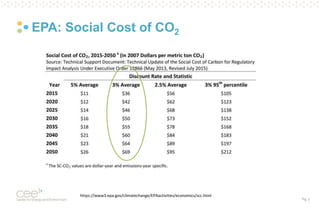
EPA: Social Cost of CO2
https://www3.epa.gov/climatechange/EPAactivities/economics/scc.html
Pg. 3
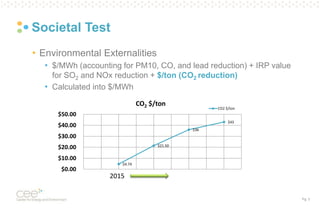
Societal Test
• Environmental Externalities
• $/MWh (accounting for PM10, CO, and lead reduction) + IRP value
for SO2 and NOx reduction + $/ton (CO2 reduction)
• Calculated into $/MWh
$4.74
$21.50
$36
$43
$0.00
$10.00
$20.00
$30.00
$40.00
$50.00
CO2 $/ton
CO2 $/ton
2015
Pg. 4
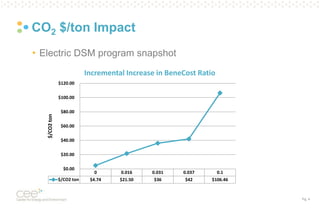
CO2 $/ton Impact
• Electric DSM program snapshot
0 0.016 0.031 0.037 0.1
$/CO2 ton $4.74 $21.50 $36 $42 $106.46
$0.00
$20.00
$40.00
$60.00
$80.00
$100.00
$120.00
$/CO2ton
Incremental Increase in BeneCost Ratio
Pg. 5
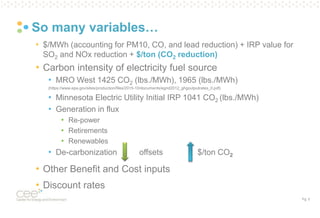
So many variables…
• $/MWh (accounting for PM10, CO, and lead reduction) + IRP value for
SO2 and NOx reduction + $/ton (CO2 reduction)
• Carbon intensity of electricity fuel source
• MRO West 1425 CO2 (lbs./MWh), 1965 (lbs./MWh)
(https://www.epa.gov/sites/production/files/2015-10/documents/egrid2012_ghgoutputrates_0.pdf)
• Minnesota Electric Utility Initial IRP 1041 CO2 (lbs./MWh)
• Generation in flux
• Re-power
• Retirements
• Renewables
• De-carbonization offsets $/ton CO2
• Other Benefit and Cost inputs
• Discount rates
CO2 Relationship to Benefit-Cost Test

CO2 Relationship to Benefit-Cost Test

  • 1.
    CO2 Relationship toBenefit-Cost Test Jamie Fitzke Policy Associate, Lighting Consultant July 26. 2016
  • 2.
    Pg. 2 EPA: SocialCost of CO2 https://www3.epa.gov/climatechange/EPAactivities/economics/scc.html
  • 3.
    Pg. 3 Societal Test •Environmental Externalities • $/MWh (accounting for PM10, CO, and lead reduction) + IRP value for SO2 and NOx reduction + $/ton (CO2 reduction) • Calculated into $/MWh $4.74 $21.50 $36 $43 $0.00 $10.00 $20.00 $30.00 $40.00 $50.00 CO2 $/ton CO2 $/ton 2015
  • 4.
    Pg. 4 CO2 $/tonImpact • Electric DSM program snapshot 0 0.016 0.031 0.037 0.1 $/CO2 ton $4.74 $21.50 $36 $42 $106.46 $0.00 $20.00 $40.00 $60.00 $80.00 $100.00 $120.00 $/CO2ton Incremental Increase in BeneCost Ratio
  • 5.
    Pg. 5 So manyvariables… • $/MWh (accounting for PM10, CO, and lead reduction) + IRP value for SO2 and NOx reduction + $/ton (CO2 reduction) • Carbon intensity of electricity fuel source • MRO West 1425 CO2 (lbs./MWh), 1965 (lbs./MWh) (https://www.epa.gov/sites/production/files/2015-10/documents/egrid2012_ghgoutputrates_0.pdf) • Minnesota Electric Utility Initial IRP 1041 CO2 (lbs./MWh) • Generation in flux • Re-power • Retirements • Renewables • De-carbonization offsets $/ton CO2 • Other Benefit and Cost inputs • Discount rates

Editor's Notes

  • #3 Net Present Value CAFE standards, appliance standards, and possibly MN investor owned utilities.
  • #4 Utilities use software (such as Strategist) to determine Env. Ext. value. Based on assumptions in Resource Plans and avoided costs (marginal environmental externality costs (MECC)). MECC is calculated by the change in total annual environmental externality costs between the two runs (portfolio and portfolio + 1 additional MW) divided by the annual MWh total that the 1 MW of additional load represents. This results in a $/MWh for environmental externalities attributable to DSM.
  • #5 Electric DSM program and their Societal Test B/C ratio influenced by the cost of CO2, holding all other variables constant, which isn’t realistic when forecasting future impact, but isolates CO2 value for this example. Improves ratios, but not significantly. CO2 valued at $106 to improve B/C ratio by 1/10th
  • #6 Repower: Black Dog, Retirement: Sherco, Renewables: how much, how soon, and displaces what? Rebates are pass through, other benefit variables have significantly greater impact, & cost variables Discount rate 3% (how NPV is calculated) can have as much impact or more than an increased market value of CO2