Content Marketing and Data Intelligence 2015 27
Once upon a time, in the not-so-distant past, content
marketers put most of their energy into creating copy
crammed with the best search keywords at the lowest
possible price. However, Google found that businesses
were writing pages of (often meaningless) content purely
to please web crawlers, rather than human beings.
As a result, the search engine encouraged marketers
to change their ways. Content now needs to be valuable,
relevant and compelling – satisfying the people who are
consuming it and encouraging them to take action. But is
it really possible to please all of the people all of the time?
Yes, this is where data comes in. It is staggering how
much data being generated online has increased over
such a relatively short time. Search interactions provide
insight into intent while interests can be uncovered
from social media interactions. Both generate significant
volumes of data that can ultimately provide valuable
insights for content marketers.
Search data
Search data is one of the best indicators of user intent
online and if you understand the user’s intentions, then
you can adapt your content to suit their needs. It is,
therefore, one of the most crucial pieces of information in
helping inform a content strategy.
Essentially, then, an important aspect of search data
analysis is the art of detecting a need. By looking at
website analytics and investigating which keywords are
driving traffic, content marketers can uncover potential
opportunities to create content that the audience really
wants and needs.
User intent can determine your content marketing
success, but it’s important to keep this customer-
centric approach in mind at all times: write for the user,
not for the search engine. Even though higher quality
traffic comes from long-tail keywords, you should still
remember to focus more on producing helpful and
relevant information relating to these major keywords,
than the exact keyword phrases themselves.
Social data
Data generated from people’s insatiable appetite for
social media over the past decade has provided a treasure
trove of insights for content marketers. Social signals
include: the profile of the user and their interests; what
they are sharing, ‘liking’ and commenting on (earned
media activity); hashtags, which enable marketers to
track specific topics that can help with their overall social
content strategy; and a user’s online contacts, which can
dramatically increase a brand’s exposure.
It can also help your brand’s bottom line. In a recent
study, social data and sharing tool ShareThis revealed that
products which had had positive reviews shared online
saw a 9.5% lift in purchase incidence.
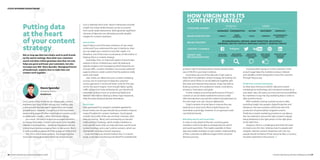
Social data was one of the data sets Virgin used to
help inform its website’s content strategy. By looking into
what its users follow on social platforms together with
the views and interests they express, Virgin was able to
build up a picture of its audience’s needs, motivations,
emotions, frustrations and goals.
Further analysis around the performance of Virgin’s
content on social media enabled the brand to make
informed decisions around the content and placement on
the new virgin.com site. (Source: @beyond).
Virgin’s analysis of social data to improve the user
experience is smart and a fairly simple thing to do.
Somewhat surprisingly, however, it’s an approach used
very little by brands.
Blending search and social data
In order to stay ahead of the ever-evolving game,
marketers need to be able to strategically pair search
and social signal data. The insights available in these
data sets enable marketers to get a better understanding
of their customers at different stages of the customer
decision journey.
Knowing what’s going on in the customer’s mind
at each stage helps the marketer produce relevant
and valuable content designed to move the customer
through the journey.
Predictive content marketing
So what does the future hold for data and content
marketing? As technology and innovation evolves at an
ever faster rate, this opens up more and more possibilities
for marketers to tap into big marketing data in order to
dial up performance.
With marketers having constant access to data,
providing insight into people’s digital footprints and
behaviour, the next evolution will be the real-time
production of personalised, targeted content.
Predictive content marketing promises to use data as
the raw material to ensure the right content is always
being delivered to the right person in the right place
at the right time.
However, there is a challenge and brands will need
to tread a very thin line. Getting closer to people with
valuable, relevant content should be a win-win, but
people should not feel as if their personal data, or privacy,
has been exploited in the process.
CUSTOMER JOURNEY
HOW VIRGIN SETS ITS
CONTENT STRATEGY
WHAT GETS
YOU NOTICED?
BRAND PENETRATION
BRAND STRATEGY
CONTENT CHANNELS
INSIGHT AND
RECOMMENDATIONS
WHAT DRIVES
CONSIDERATION?
WHAT DRIVES
REFERRALS AND
ACTIONS?
WHAT MAKES
YOUR BRAND
LOVED?
WHAT GETS YOUR
ADVOCATES
EXCITED?
RICHARD BRANSON, HERITAGE, SMART DISRUPTION, DELIGHTFULLY
SURPRISING, RED HOT, FAIR PLAY, INSATIABLE CURIOSITY, HEARTFELT SERVICE
AWARENESS ACTION
PRE-PURCHASE CUSTOMER
VISIBILITY
BRAND
ATTRIBUTES CHOICE EXPERIENCE RECOMMENDATION
AND LOYALTY
CONSIDERATION ADVOCACYENJOYMENT
26 Content Marketing and Data Intelligence 2015
Steve Sponder
Managing Director
Headstream
Not so long ago data was simply used to push brands
up the search rankings. Now what your customers
search and share online generates data that not only
helps you grow and know your customers, but also
increases your ROI. Steve Sponder, Managing Director
of Headstream, explains how to make data and
content work together
Putting data
at the heart
of your content
strategy
STEVE SPONDER/HEADSTREAM

Putting data at the heart of your content strategy

  • 1.
    Content Marketing andData Intelligence 2015 27 Once upon a time, in the not-so-distant past, content marketers put most of their energy into creating copy crammed with the best search keywords at the lowest possible price. However, Google found that businesses were writing pages of (often meaningless) content purely to please web crawlers, rather than human beings. As a result, the search engine encouraged marketers to change their ways. Content now needs to be valuable, relevant and compelling – satisfying the people who are consuming it and encouraging them to take action. But is it really possible to please all of the people all of the time? Yes, this is where data comes in. It is staggering how much data being generated online has increased over such a relatively short time. Search interactions provide insight into intent while interests can be uncovered from social media interactions. Both generate significant volumes of data that can ultimately provide valuable insights for content marketers. Search data Search data is one of the best indicators of user intent online and if you understand the user’s intentions, then you can adapt your content to suit their needs. It is, therefore, one of the most crucial pieces of information in helping inform a content strategy. Essentially, then, an important aspect of search data analysis is the art of detecting a need. By looking at website analytics and investigating which keywords are driving traffic, content marketers can uncover potential opportunities to create content that the audience really wants and needs. User intent can determine your content marketing success, but it’s important to keep this customer- centric approach in mind at all times: write for the user, not for the search engine. Even though higher quality traffic comes from long-tail keywords, you should still remember to focus more on producing helpful and relevant information relating to these major keywords, than the exact keyword phrases themselves. Social data Data generated from people’s insatiable appetite for social media over the past decade has provided a treasure trove of insights for content marketers. Social signals include: the profile of the user and their interests; what they are sharing, ‘liking’ and commenting on (earned media activity); hashtags, which enable marketers to track specific topics that can help with their overall social content strategy; and a user’s online contacts, which can dramatically increase a brand’s exposure. It can also help your brand’s bottom line. In a recent study, social data and sharing tool ShareThis revealed that products which had had positive reviews shared online saw a 9.5% lift in purchase incidence. Social data was one of the data sets Virgin used to help inform its website’s content strategy. By looking into what its users follow on social platforms together with the views and interests they express, Virgin was able to build up a picture of its audience’s needs, motivations, emotions, frustrations and goals. Further analysis around the performance of Virgin’s content on social media enabled the brand to make informed decisions around the content and placement on the new virgin.com site. (Source: @beyond). Virgin’s analysis of social data to improve the user experience is smart and a fairly simple thing to do. Somewhat surprisingly, however, it’s an approach used very little by brands. Blending search and social data In order to stay ahead of the ever-evolving game, marketers need to be able to strategically pair search and social signal data. The insights available in these data sets enable marketers to get a better understanding of their customers at different stages of the customer decision journey. Knowing what’s going on in the customer’s mind at each stage helps the marketer produce relevant and valuable content designed to move the customer through the journey. Predictive content marketing So what does the future hold for data and content marketing? As technology and innovation evolves at an ever faster rate, this opens up more and more possibilities for marketers to tap into big marketing data in order to dial up performance. With marketers having constant access to data, providing insight into people’s digital footprints and behaviour, the next evolution will be the real-time production of personalised, targeted content. Predictive content marketing promises to use data as the raw material to ensure the right content is always being delivered to the right person in the right place at the right time. However, there is a challenge and brands will need to tread a very thin line. Getting closer to people with valuable, relevant content should be a win-win, but people should not feel as if their personal data, or privacy, has been exploited in the process. CUSTOMER JOURNEY HOW VIRGIN SETS ITS CONTENT STRATEGY WHAT GETS YOU NOTICED? BRAND PENETRATION BRAND STRATEGY CONTENT CHANNELS INSIGHT AND RECOMMENDATIONS WHAT DRIVES CONSIDERATION? WHAT DRIVES REFERRALS AND ACTIONS? WHAT MAKES YOUR BRAND LOVED? WHAT GETS YOUR ADVOCATES EXCITED? RICHARD BRANSON, HERITAGE, SMART DISRUPTION, DELIGHTFULLY SURPRISING, RED HOT, FAIR PLAY, INSATIABLE CURIOSITY, HEARTFELT SERVICE AWARENESS ACTION PRE-PURCHASE CUSTOMER VISIBILITY BRAND ATTRIBUTES CHOICE EXPERIENCE RECOMMENDATION AND LOYALTY CONSIDERATION ADVOCACYENJOYMENT 26 Content Marketing and Data Intelligence 2015 Steve Sponder Managing Director Headstream Not so long ago data was simply used to push brands up the search rankings. Now what your customers search and share online generates data that not only helps you grow and know your customers, but also increases your ROI. Steve Sponder, Managing Director of Headstream, explains how to make data and content work together Putting data at the heart of your content strategy STEVE SPONDER/HEADSTREAM