The Content Management
   Interoperability Services (CMIS)
              Standard
          What is it and Where is it Going?

     Saravanan Rajan                     Laurence Hart
    Vice President, CM Pros         Chair, CMIS Group, CM Pros
     CTO, COSI Consulting       Director, Washington Consulting, Inc.
saravanan@cmprofessionals.org        lhart@cmprofessionals.org
Overview
•   Introduction
•   What is the CMIS Standard?
•   How CMIS can be used
•   Benefits of CMIS
•   Industry support
•   Future of CMIS
Thanks to Our Host -


Developers of


Learn more at BridgelineDigital.com
About CM Pros
• Helps over 15,000 associate members all over the
  world to enhance their knowledge and expertise
• Provides a collaborative community of practice
  advancing the field of content management
• Enhances the knowledge and expertise of our
  community by sharing practices, providing
  leadership and connecting members
• Offers online and offline opportunities to interact
  with members through our website, LinkedIn,
  webinars, events and seminars
• http://www.cmprofessionals.org/
You’ve probably heard of CMIS
Content            Defines a domain model
                   and set of bindings, such
Management
                      as Web Service and
Interoperability    REST/Atom, that can be
Services            used by applications to
                    work with one or more
                     Content Management
                     repositories/systems.
Basic History
• 2005 – iECM Committee begins discussing need for a new standard
   – ODMA: Desktop dependent
   – WebDAV: Limited capability
   – Java Content Repository: Technology specific, API-base
• 2006 – EMC, IBM, and Microsoft leave the iECM Committee and
  begin developing CMIS
• 2008 – Initial proposal drafted by EMC, IBM & Microsoft
   – Reviewed by Alfresco, Open Text, Oracle, SAP
   – Draft was unveiled and released to OASIS
• 2008 – The OASIS CMIS Technical Committee formed
• 2009 – CMIS 1.0 released for public comment
• 2010 – CMIS became an official standard
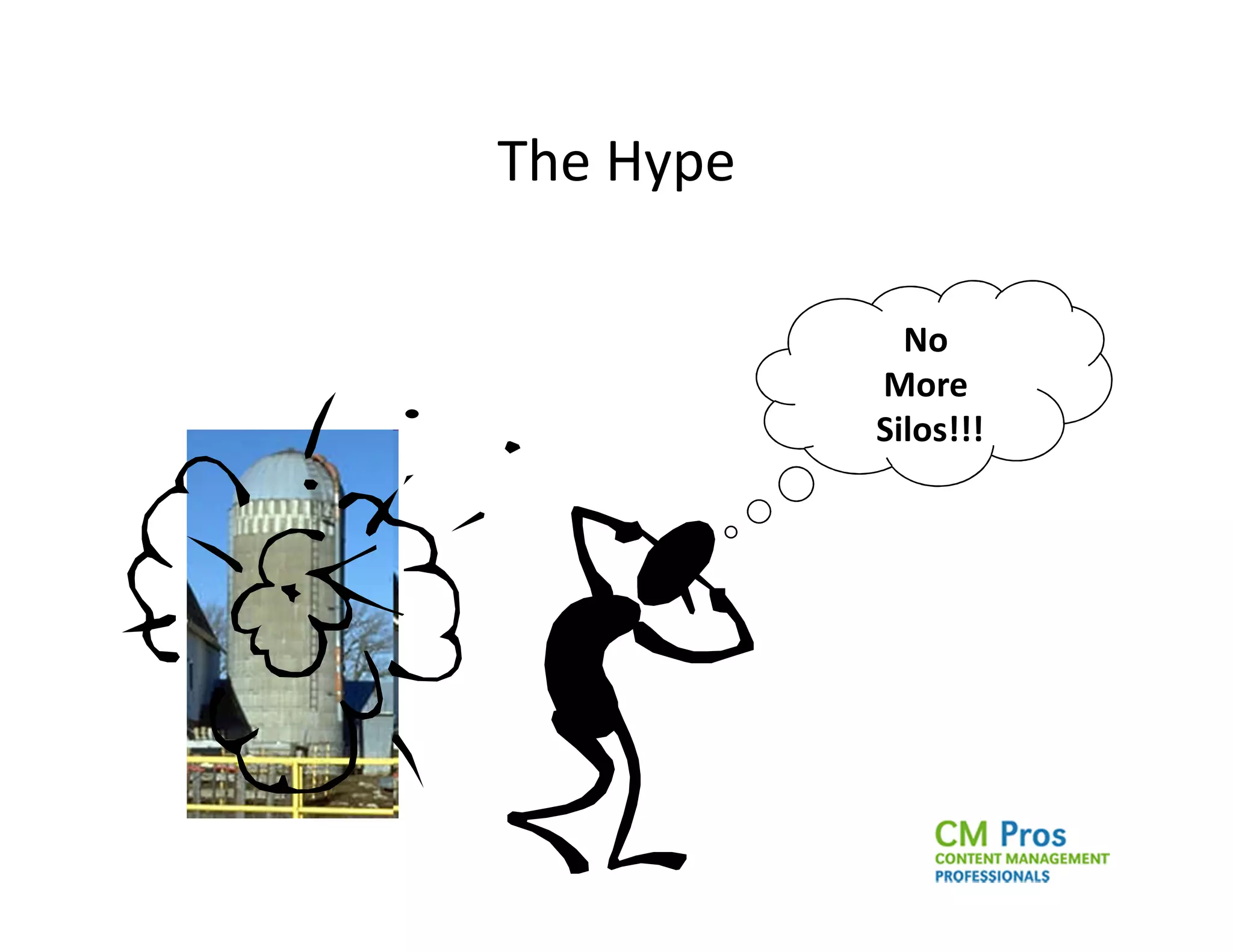
The Hype

             No
           More
           Silos!!!
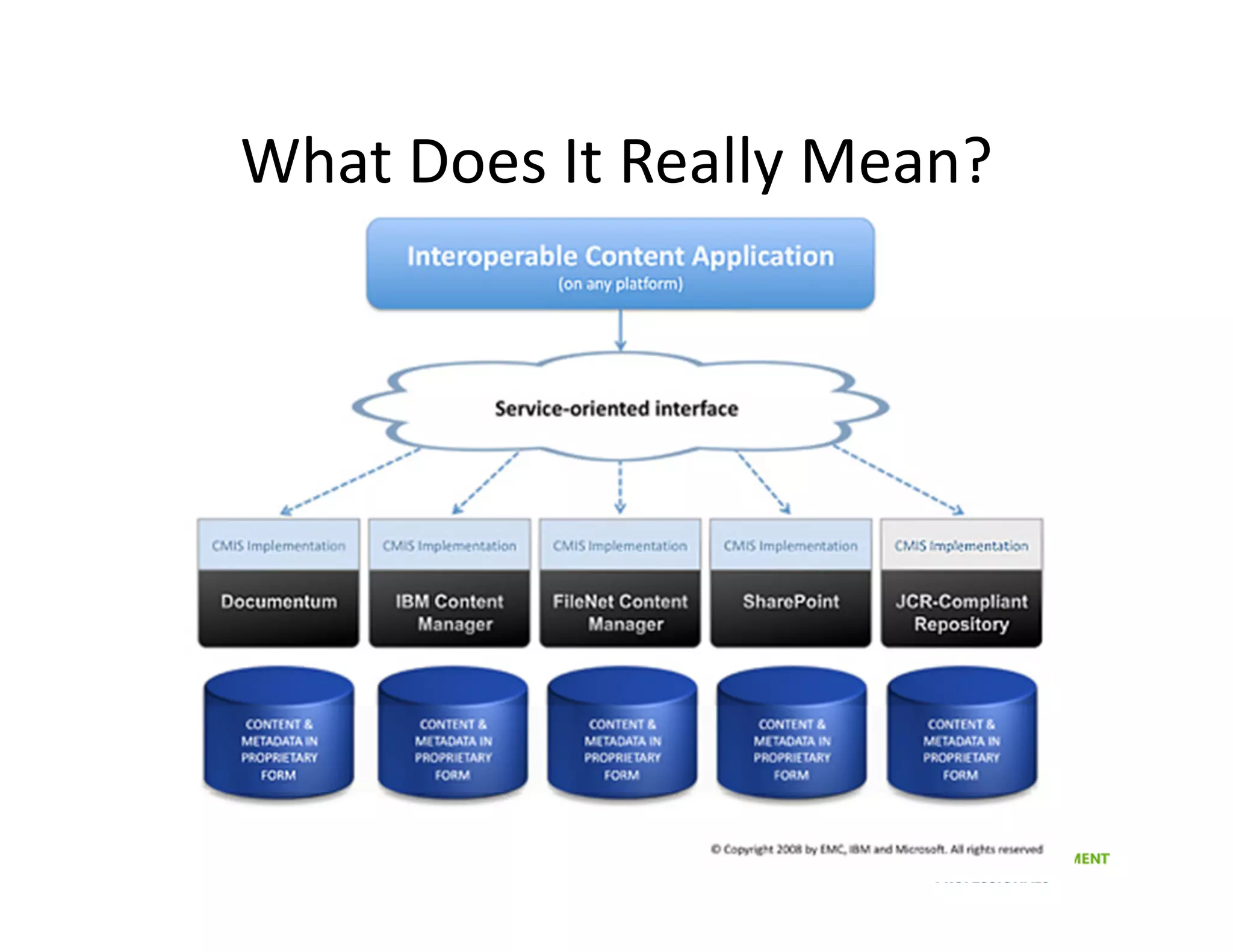
What Does It Really Mean?
Three Fundamental Use Cases
• Repository to Repository
• Application to Repository
• Federated Repository
Repository to Repository

   There are times you want to talk directly
        between content repositories

• Publish a document from one system into
  another
• Manage records from one centralized system
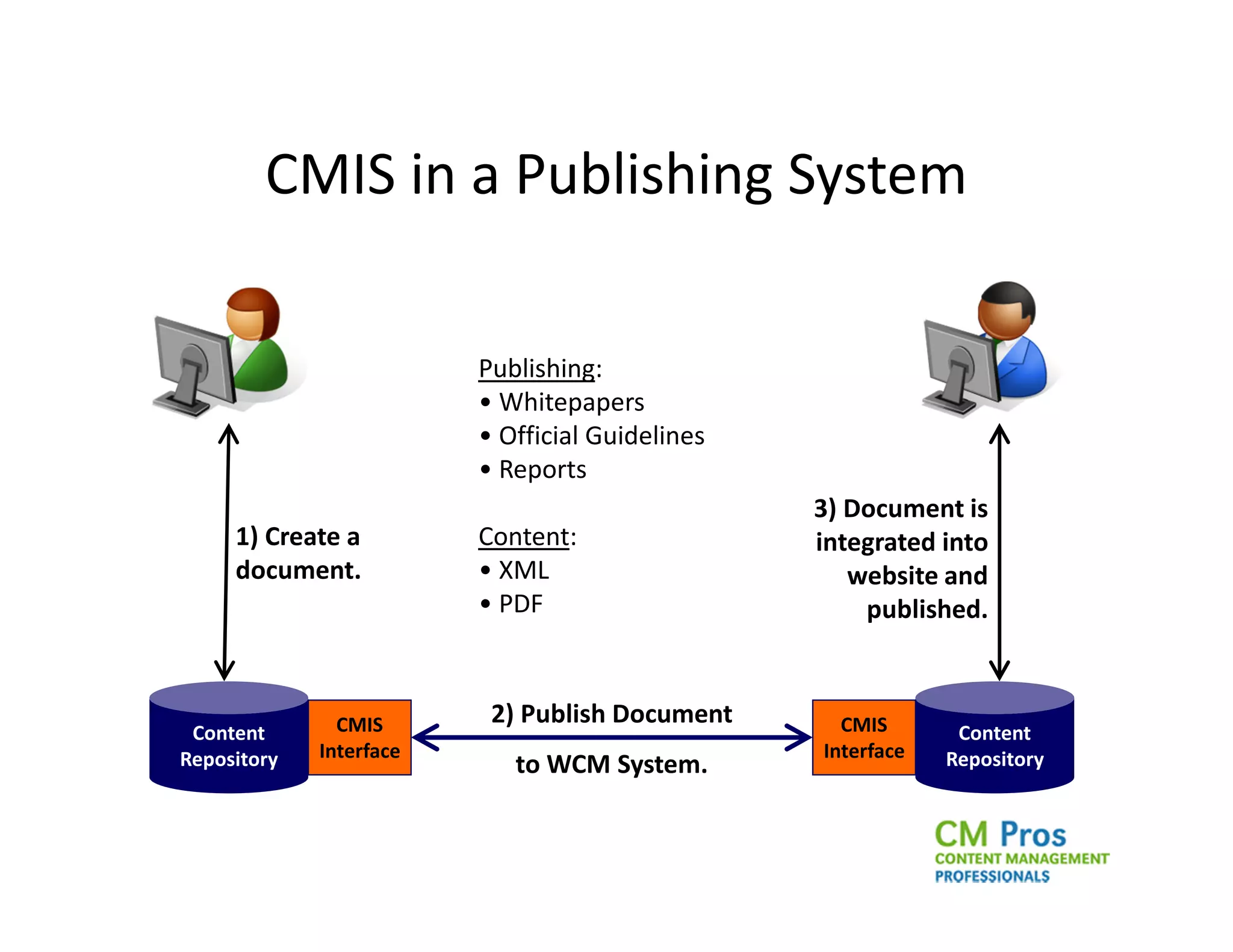
CMIS in a Publishing System

                         Publishing:
                         • Whitepapers
                         • Official Guidelines
                         • Reports
                                                 3) Document is
     1) Create a         Content:                integrated into
     document.           • XML                      website and
                         • PDF                       published.


               CMIS       2) Publish Document      CMIS
 Content                                                      Content
Repository   Interface                           Interface   Repository
                            to WCM System.
Application to Repository
• Sharing Content across applications
• Collaboration/Enterprise 2.0 Applications
  – SharePoint as an interface, not repository
  – Content in collaborative platorms
• Enterprise Software Applications
• Generic Content Management Applications
• Composite Content Applications (CCAs)
Composite Content Applications
• What is a CCA?
  – Formerly known as CEVA
  – Electronic Medical Records
  – Case Management System
  – Correspondence Tracking System
• Vendors with domain expertise build the
  applications with the business rules and plug
  into an Content Management System
In all cases, it is using the best
content application for the job
   against a shared Content
    Management System...

…not shuffling content between
            systems
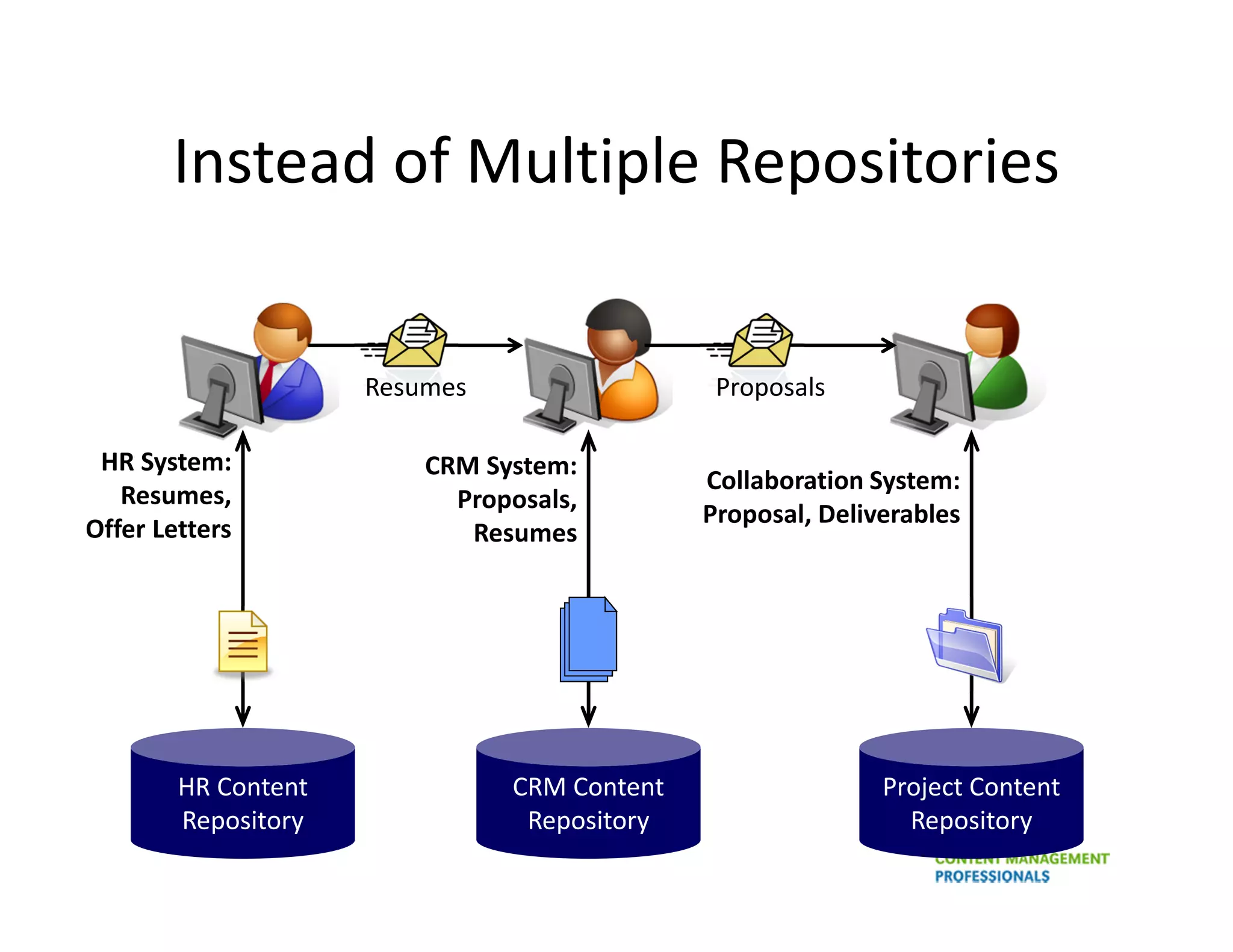
Instead of Multiple Repositories


                     Resumes                  Proposals

 HR System:              CRM System:
                                             Collaboration System:
   Resumes,                Proposals,
                                             Proposal, Deliverables
Offer Letters               Resumes


        HR Content             CRM Content                  Project Content
        Repository              Repository                    Repository
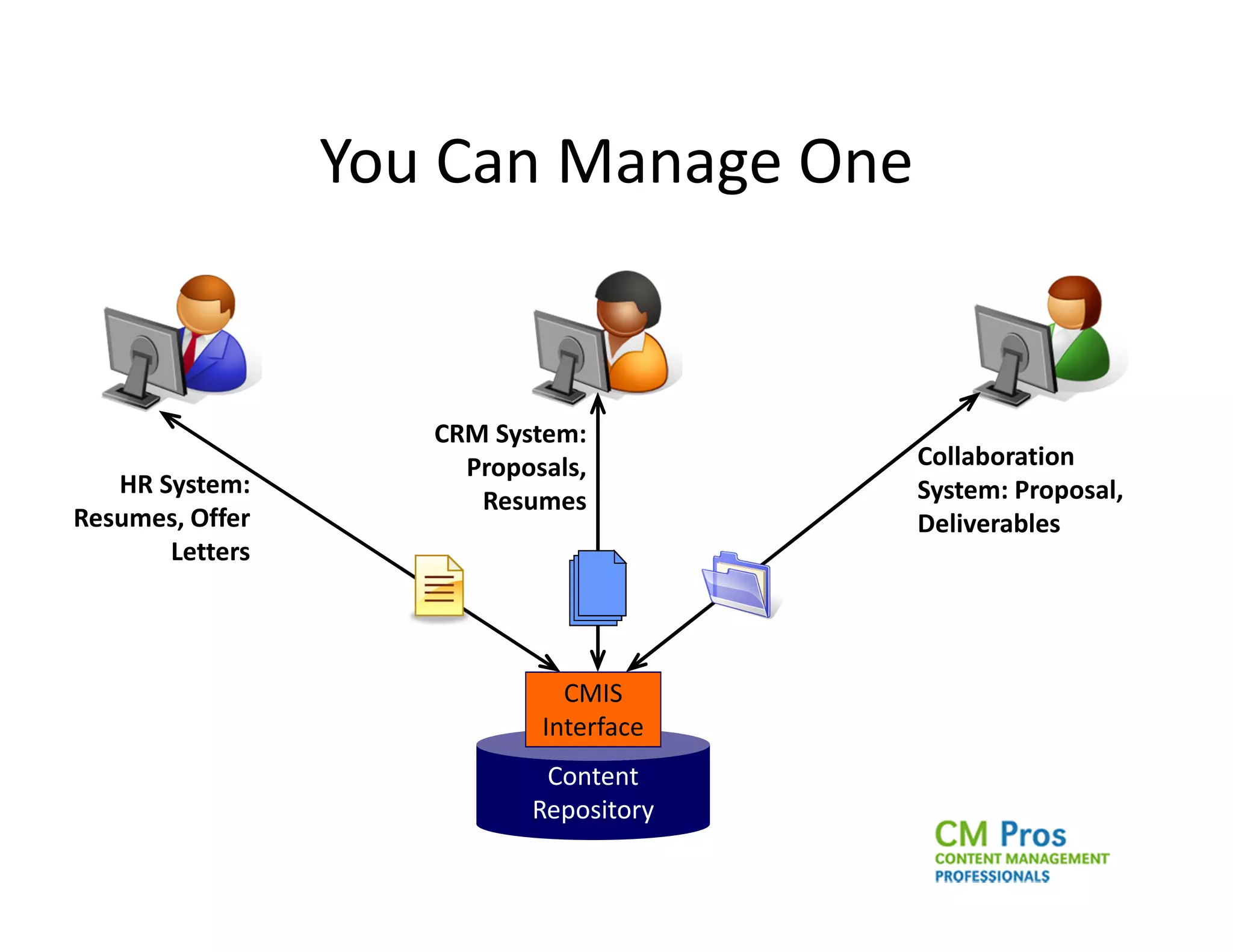
You Can Manage One


                    CRM System:
                      Proposals,        Collaboration
   HR System:                           System: Proposal,
                       Resumes
Resumes, Offer                          Deliverables
       Letters


                              CMIS
                            Interface
                            Content
                           Repository
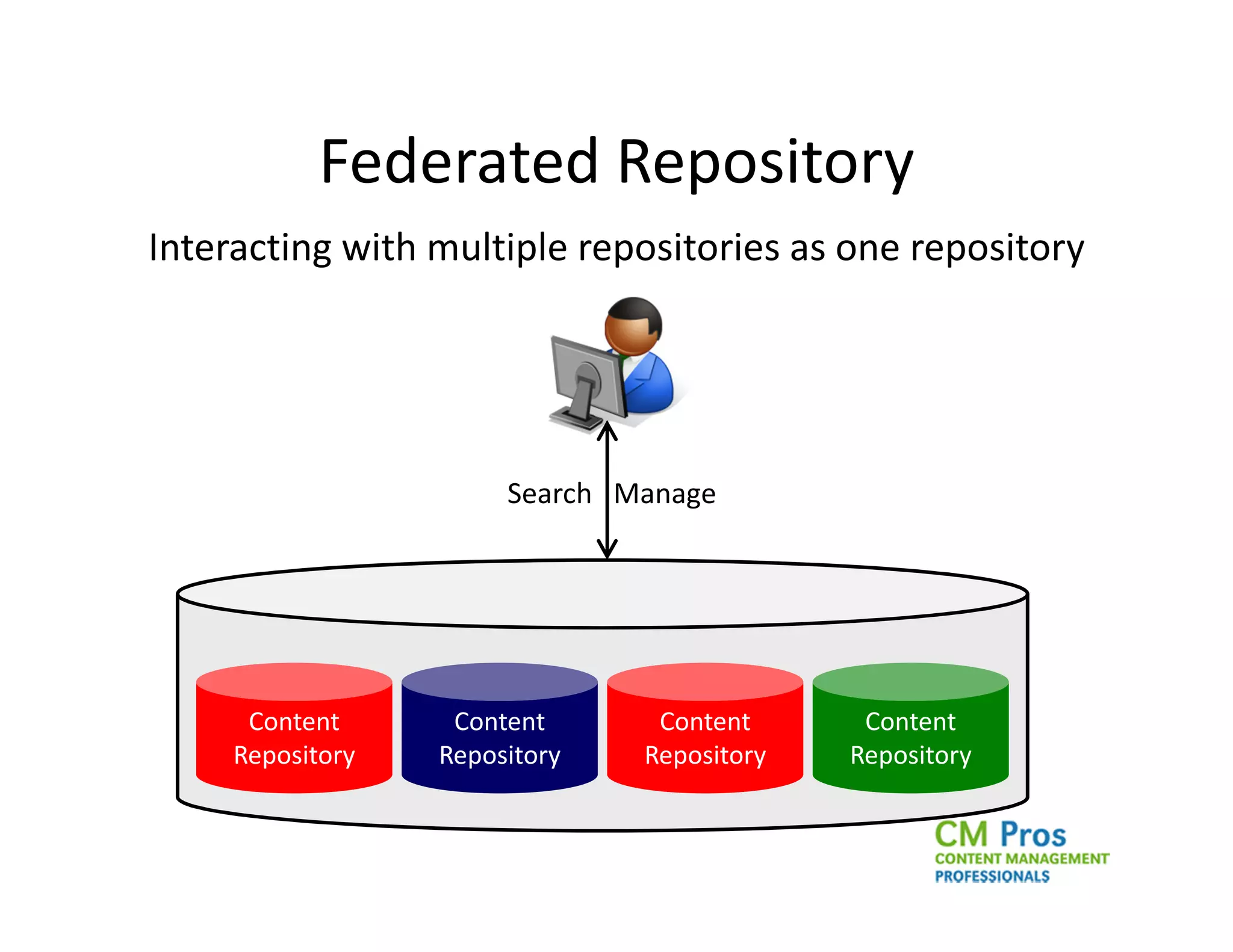
Federated Repository
Interacting with multiple repositories as one repository


                       Search Manage


      Content      Content      Content      Content
     Repository   Repository   Repository   Repository
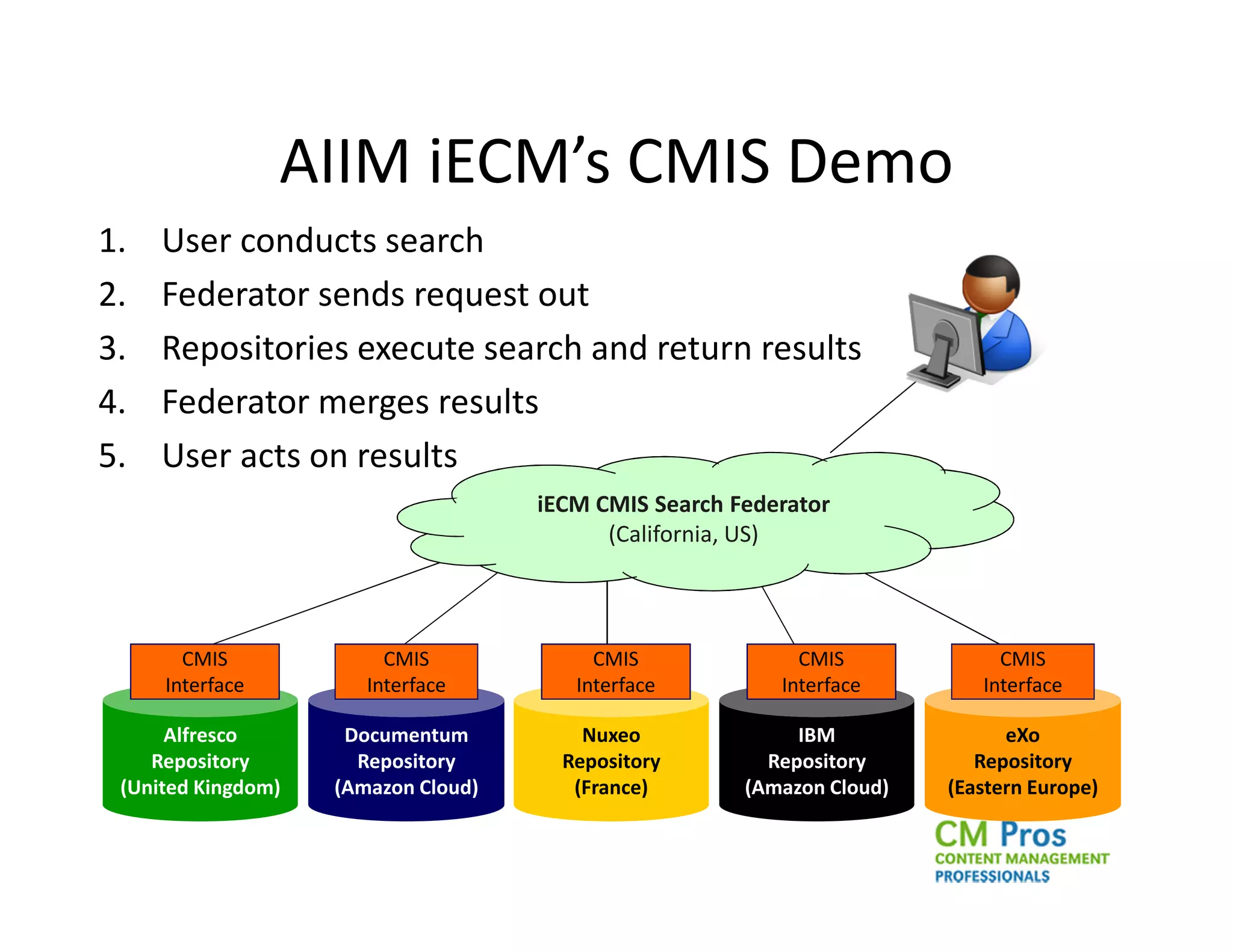
AIIM iECM’s CMIS Demo
1.   User conducts search
2.   Federator sends request out
3.   Repositories execute search and return results
4.   Federator merges results
5.   User acts on results
                                     iECM CMIS Search Federator
                                           (California, US)


       CMIS              CMIS             CMIS              CMIS             CMIS
     Interface         Interface        Interface         Interface        Interface

      Alfresco       Documentum          Nuxeo              IBM               eXo
    Repository        Repository       Repository        Repository        Repository
 (United Kingdom)   (Amazon Cloud)      (France)       (Amazon Cloud)   (Eastern Europe)
Industry Support
• Large Content Management vendor support base
   – Support: IBM, EMC, Open Text, Microsoft, and Alfresco
   – Missing (so far): Hyland and Autonomy
• Microsoft support
   – SharePoint 2010 as both a repository and application
   – Released as part of SharePoint Administrator Toolkit
• Open Source Content Management support
   – Chemistry project provided open source implementation
   – All supporters of previous Java Content Repository
     standard will be able to claim CMIS compliance
• Next step is application builders
Future of CMIS
• Version 1.1
  – Type Mutability
  – Browser binding (JSON)
• Version 2.0
  – Increased Records Management support
  – Support for Semantic functionality
  – Ability to have domain models
Getting Involved
• CM Pros is working to improve CMIS
  – Educate the Content Management world
  – Collect real-world experiences
  – Suggest areas for improvement
• Interested in joining the CM Pros CMIS Group?
  – Contact Laurence Hart
  – Email: lhart@cmprofessionals.org
  – Twitter: piewords
Summary
• Content Management Interoperability Services
   – Official OASIS standard now
   – Planned evolution to stay relevant
• Defines Content Management Domain Model
   – Content model the same across all
     bindings/implementations
   – Web Services and Atom bindings are ways to access model,
     not defining part of standard
• CMIS is not the lowest common denominator
   – Defines functionality that is needed
   – Some parts are optional to provide for a greater ecosystem
• It is in use now
More Information
• OASIS CMIS Technical Committee
  – http://www.oasis-open.org/committees/tc_home.php?wg_abbrev=cmis

• Apache Chemistry Incubator
  – http://incubator.apache.org/projects/chemistry.html

• CMIS Developer Resources
  – http://www.cmisdev.org/cmis/

• CMIS SQL Details
  – http://www.open-source-ecm.com/2009/08/cmis-tutorial-cmis-sql.html
Thank You


                    Laurence Hart
            http://wordofpie.com
                      @piewords
About the Speaker
 Laurence Hart is a Director of Technology Solutions for
 Washington Consulting, Inc. and the author of the blog
  "Word of Pie". Over his 15+ years in the Information
Management industry, he has led a wide-range of efforts
  including content digitization, Records Management,
  BPM, and Collaboration for both the commercial and
 public sectors. Recently, Laurence has been focused on
helping organizations in assessing, defining, and building
 their Information and Content Management strategies.
  As an active member of AIIM and the Chair of the CM
Pros CMIS Group, Laurence has focused on educating the
Content Management industry on the standards needed
                  for successful growth.

CM Pros CMIS Overview - Jan 2011

  • 1.
    The Content Management Interoperability Services (CMIS) Standard What is it and Where is it Going? Saravanan Rajan Laurence Hart Vice President, CM Pros Chair, CMIS Group, CM Pros CTO, COSI Consulting Director, Washington Consulting, Inc. saravanan@cmprofessionals.org lhart@cmprofessionals.org
  • 2.
    Overview • Introduction • What is the CMIS Standard? • How CMIS can be used • Benefits of CMIS • Industry support • Future of CMIS
  • 3.
    Thanks to OurHost - Developers of Learn more at BridgelineDigital.com
  • 4.
    About CM Pros •Helps over 15,000 associate members all over the world to enhance their knowledge and expertise • Provides a collaborative community of practice advancing the field of content management • Enhances the knowledge and expertise of our community by sharing practices, providing leadership and connecting members • Offers online and offline opportunities to interact with members through our website, LinkedIn, webinars, events and seminars • http://www.cmprofessionals.org/
  • 5.
    You’ve probably heardof CMIS Content Defines a domain model and set of bindings, such Management as Web Service and Interoperability REST/Atom, that can be Services used by applications to work with one or more Content Management repositories/systems.
  • 6.
    Basic History • 2005– iECM Committee begins discussing need for a new standard – ODMA: Desktop dependent – WebDAV: Limited capability – Java Content Repository: Technology specific, API-base • 2006 – EMC, IBM, and Microsoft leave the iECM Committee and begin developing CMIS • 2008 – Initial proposal drafted by EMC, IBM & Microsoft – Reviewed by Alfresco, Open Text, Oracle, SAP – Draft was unveiled and released to OASIS • 2008 – The OASIS CMIS Technical Committee formed • 2009 – CMIS 1.0 released for public comment • 2010 – CMIS became an official standard
  • 7.
    The Hype No More Silos!!!
  • 8.
    What Does ItReally Mean?
  • 9.
    Three Fundamental UseCases • Repository to Repository • Application to Repository • Federated Repository
  • 10.
    Repository to Repository There are times you want to talk directly between content repositories • Publish a document from one system into another • Manage records from one centralized system
  • 11.
    CMIS in aPublishing System Publishing: • Whitepapers • Official Guidelines • Reports 3) Document is 1) Create a Content: integrated into document. • XML website and • PDF published. CMIS 2) Publish Document CMIS Content Content Repository Interface Interface Repository to WCM System.
  • 12.
    Application to Repository •Sharing Content across applications • Collaboration/Enterprise 2.0 Applications – SharePoint as an interface, not repository – Content in collaborative platorms • Enterprise Software Applications • Generic Content Management Applications • Composite Content Applications (CCAs)
  • 13.
    Composite Content Applications •What is a CCA? – Formerly known as CEVA – Electronic Medical Records – Case Management System – Correspondence Tracking System • Vendors with domain expertise build the applications with the business rules and plug into an Content Management System
  • 14.
    In all cases,it is using the best content application for the job against a shared Content Management System... …not shuffling content between systems
  • 15.
    Instead of MultipleRepositories Resumes Proposals HR System: CRM System: Collaboration System: Resumes, Proposals, Proposal, Deliverables Offer Letters Resumes HR Content CRM Content Project Content Repository Repository Repository
  • 16.
    You Can ManageOne CRM System: Proposals, Collaboration HR System: System: Proposal, Resumes Resumes, Offer Deliverables Letters CMIS Interface Content Repository
  • 17.
    Federated Repository Interacting withmultiple repositories as one repository Search Manage Content Content Content Content Repository Repository Repository Repository
  • 18.
    AIIM iECM’s CMISDemo 1. User conducts search 2. Federator sends request out 3. Repositories execute search and return results 4. Federator merges results 5. User acts on results iECM CMIS Search Federator (California, US) CMIS CMIS CMIS CMIS CMIS Interface Interface Interface Interface Interface Alfresco Documentum Nuxeo IBM eXo Repository Repository Repository Repository Repository (United Kingdom) (Amazon Cloud) (France) (Amazon Cloud) (Eastern Europe)
  • 19.
    Industry Support • LargeContent Management vendor support base – Support: IBM, EMC, Open Text, Microsoft, and Alfresco – Missing (so far): Hyland and Autonomy • Microsoft support – SharePoint 2010 as both a repository and application – Released as part of SharePoint Administrator Toolkit • Open Source Content Management support – Chemistry project provided open source implementation – All supporters of previous Java Content Repository standard will be able to claim CMIS compliance • Next step is application builders
  • 20.
    Future of CMIS •Version 1.1 – Type Mutability – Browser binding (JSON) • Version 2.0 – Increased Records Management support – Support for Semantic functionality – Ability to have domain models
  • 21.
    Getting Involved • CMPros is working to improve CMIS – Educate the Content Management world – Collect real-world experiences – Suggest areas for improvement • Interested in joining the CM Pros CMIS Group? – Contact Laurence Hart – Email: lhart@cmprofessionals.org – Twitter: piewords
  • 22.
    Summary • Content ManagementInteroperability Services – Official OASIS standard now – Planned evolution to stay relevant • Defines Content Management Domain Model – Content model the same across all bindings/implementations – Web Services and Atom bindings are ways to access model, not defining part of standard • CMIS is not the lowest common denominator – Defines functionality that is needed – Some parts are optional to provide for a greater ecosystem • It is in use now
  • 23.
    More Information • OASISCMIS Technical Committee – http://www.oasis-open.org/committees/tc_home.php?wg_abbrev=cmis • Apache Chemistry Incubator – http://incubator.apache.org/projects/chemistry.html • CMIS Developer Resources – http://www.cmisdev.org/cmis/ • CMIS SQL Details – http://www.open-source-ecm.com/2009/08/cmis-tutorial-cmis-sql.html
  • 24.
    Thank You Laurence Hart http://wordofpie.com @piewords
  • 25.
    About the Speaker Laurence Hart is a Director of Technology Solutions for Washington Consulting, Inc. and the author of the blog "Word of Pie". Over his 15+ years in the Information Management industry, he has led a wide-range of efforts including content digitization, Records Management, BPM, and Collaboration for both the commercial and public sectors. Recently, Laurence has been focused on helping organizations in assessing, defining, and building their Information and Content Management strategies. As an active member of AIIM and the Chair of the CM Pros CMIS Group, Laurence has focused on educating the Content Management industry on the standards needed for successful growth.