Eick: Introduction toClustering 1
2011 Clustering in Machine
Learning
Topic 7: K-Means, Mixtures of Gaussian and EM
1. Brief Introduction to Clustering
2. Eick/Alpaydin transparencies on clustering
3. A little more on EM
Topic 9: Density-based clustering
2.
Eick: Introduction toClustering 3
Motivation: Why Clustering?
Problem: Identify (a small number of) groups of
similar objects in a given (large) set of object.
Goals:
Find representatives for homogeneous groups
Data Compression
Find “natural” clusters and describe their
properties ”natural” Data Types
Find suitable and useful grouping ”useful”
Data Classes
Find unusual data object Outlier Detection
Eick: Introduction toClustering 5
Major Clustering Approaches
Partitioning algorithms/Representative-based/Prototype-based
Clustering Algorithm: Construct and search various partitions and
then evaluate them by some criterion or fitness function Kmeans
Hierarchical algorithms: Create a hierarchical decomposition of the
set of data (or objects) using some criterion
Density-based: based on connectivity and density functions
DBSCAN, DENCLUE,…
Grid-based: based on a multiple-level granularity structure
Graph-based: constructs a graph and then clusters the graph SNN
Model-based: A model is hypothesized for each of the clusters and
the idea is to find the best fit of that model to each other EM
5.
Eick: Introduction toClustering 6
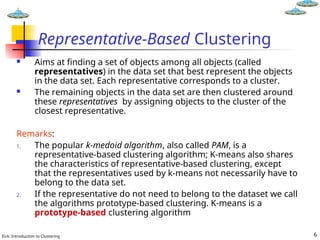
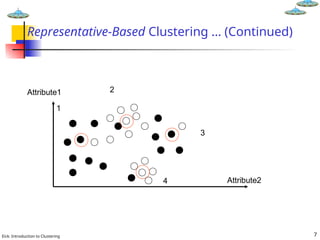
Representative-Based Clustering
Aims at finding a set of objects among all objects (called
representatives) in the data set that best represent the objects
in the data set. Each representative corresponds to a cluster.
The remaining objects in the data set are then clustered around
these representatives by assigning objects to the cluster of the
closest representative.
Remarks:
1. The popular k-medoid algorithm, also called PAM, is a
representative-based clustering algorithm; K-means also shares
the characteristics of representative-based clustering, except
that the representatives used by k-means not necessarily have to
belong to the data set.
2. If the representative do not need to belong to the dataset we call
the algorithms prototype-based clustering. K-means is a
prototype-based clustering algorithm
Eick: Introduction toClustering 8
Representative-Based Supervised Clustering …
(continued)
Attribute2
Attribute1
1
2
3
4
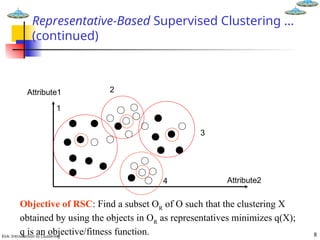
Objective of RSC: Find a subset OR
of O such that the clustering X
obtained by using the objects in OR
as representatives minimizes q(X);
q is an objective/fitness function.
8.
Eick: Introduction toClustering 9
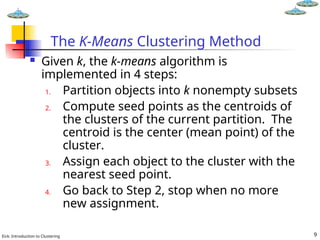
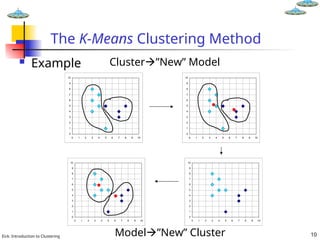
The K-Means Clustering Method
Given k, the k-means algorithm is
implemented in 4 steps:
1. Partition objects into k nonempty subsets
2. Compute seed points as the centroids of
the clusters of the current partition. The
centroid is the center (mean point) of the
cluster.
3. Assign each object to the cluster with the
nearest seed point.
4. Go back to Step 2, stop when no more
new assignment.
Eick: Introduction toClustering 11
Comments on K-Means
Strength
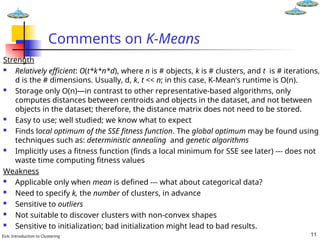
Relatively efficient: O(t*k*n*d), where n is # objects, k is # clusters, and t is # iterations,
d is the # dimensions. Usually, d, k, t << n; in this case, K-Mean’s runtime is O(n).
Storage only O(n)—in contrast to other representative-based algorithms, only
computes distances between centroids and objects in the dataset, and not between
objects in the dataset; therefore, the distance matrix does not need to be stored.
Easy to use; well studied; we know what to expect
Finds local optimum of the SSE fitness function. The global optimum may be found using
techniques such as: deterministic annealing and genetic algorithms
Implicitly uses a fitness function (finds a local minimum for SSE see later) --- does not
waste time computing fitness values
Weakness
Applicable only when mean is defined --- what about categorical data?
Need to specify k, the number of clusters, in advance
Sensitive to outliers
Not suitable to discover clusters with non-convex shapes
Sensitive to initialization; bad initialization might lead to bad results.
11.
Eick: Introduction toClustering
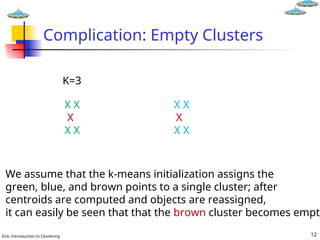
Complication: Empty Clusters
12
X X X X
X X
X X X X
We assume that the k-means initialization assigns the
green, blue, and brown points to a single cluster; after
centroids are computed and objects are reassigned,
it can easily be seen that that the brown cluster becomes empty
K=3
12.
Eick: Introduction toClustering 13
Convex Shape Cluster
Convex Shape: if we take two points belonging to a
cluster then all the points on a direct line
connecting these two points must also in the
cluster.
Shape of K-means/K-mediods clusters are convex
polygons Convex Shape.
Shapes of clusters of a representative-based
clustering algorithm can be computed as a Voronoi
diagram for the set of cluster representatives.
Voronoi cells are always convex, but there are
convex shapes that a different from those of
Voronoi cells.
13.
Eick: Introduction toClustering 14
Voronoi Diagram for a
Representative-based Clustering
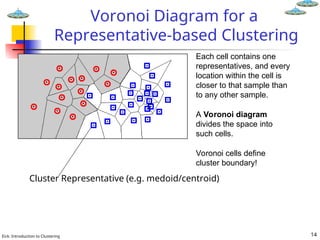
Each cell contains one
representatives, and every
location within the cell is
closer to that sample than
to any other sample.
A Voronoi diagram
divides the space into
such cells.
Voronoi cells define
cluster boundary!
Cluster Representative (e.g. medoid/centroid)
14.
Eick: Introduction toClustering August 8, 2025
EM — Expectation Maximization
EM — A popular iterative refinement algorithm
Uses k-Gaussians; one for each cluster
An extension to k-means
Assign each object to a cluster according to a weight (prob. distribution)
New means/covariances are computed based on weighted measures
General idea
Starts with an initial estimate of the parameter vector
Iteratively rescores the patterns against the mixture density produced by
the parameter vector
The rescored patterns are used to update the parameter updates
Patterns belonging to the same cluster, if they are placed by their scores
in a particular component
Algorithm converges fast but may not be in global optima
15.
Eick: Introduction toClustering
The EM (Expectation Maximization)
Algorithm
Initially, randomly assign k cluster centers
Iteratively refine the clusters based on two steps
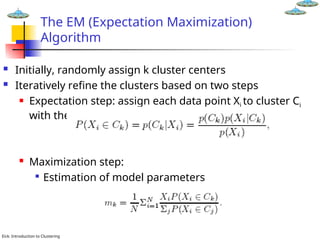
Expectation step: assign each data point Xi to cluster Ci
with the following probability
Maximization step:
Estimation of model parameters
Editor's Notes
#6 There are many possible supervised clustering algorithm. In our work, we investigate representative-based supervised clustering algorithms that aim
#8 The objective of representative-based supervised clustering is…