vs
High-Level Comparison of Public Clouds
Experience the automated Cloud
Supported Platforms
Java, PHP, Ruby, Node.js, Python, Docker and .NET
Python -
Experience the automated Cloud
Cloudjiffy is an easy-to-use Platform-as-a-Service for deploying, scaling, managing web
applications’ lifecycle and services developed with Java, .NET, PHP, Node.js, Python, Ruby, .NET,
and Docker. Customers create in a few clicks via GUI environment with any desired application
servers / databases topology. Cloudjiffy doesn’t require any code changes to be deployed in the
cloud and is cloud agnostic - you won’t be chained to a platform forever. If application runs on
your local machine, it will run in the cloud.
Platform takes care of failover, high availability and autoscaling your applications without
necessity to request operations’ help - it handles all actions starting from auto configuring servers
during environment creation and finishing complex automated DevOps processes available in
several clicks. Cloudjiffy is the fully automated platform that simplifies DevOps workflow and
speeds up applications’ delivery to end-users.
It is targeted on developers that don’t have Ops experience and want manage they apps like if
they had DevOps expertise.
Cloudjiffy Use Cases
Experience the automated Cloud
AWS OpsWorks is a flexible configuration management solution with automation tools that
enable you to model and control your applications and their supporting infrastructure. AWS
OpsWorks makes it easy to manage the complete application lifecycle, including resource
provisioning, configuration management, application deployment, software updates, monitoring,
and access control. AWS OpsWorks is designed for IT administrators and ops-minded developers
who want an easy way to manage applications using CHEF recipes.
AWS OpsWorks is targeted at DevOps users who want better management and automation tools
to help them customize and control their environments.
OpsWorks Use Cases
Experience the automated Cloud
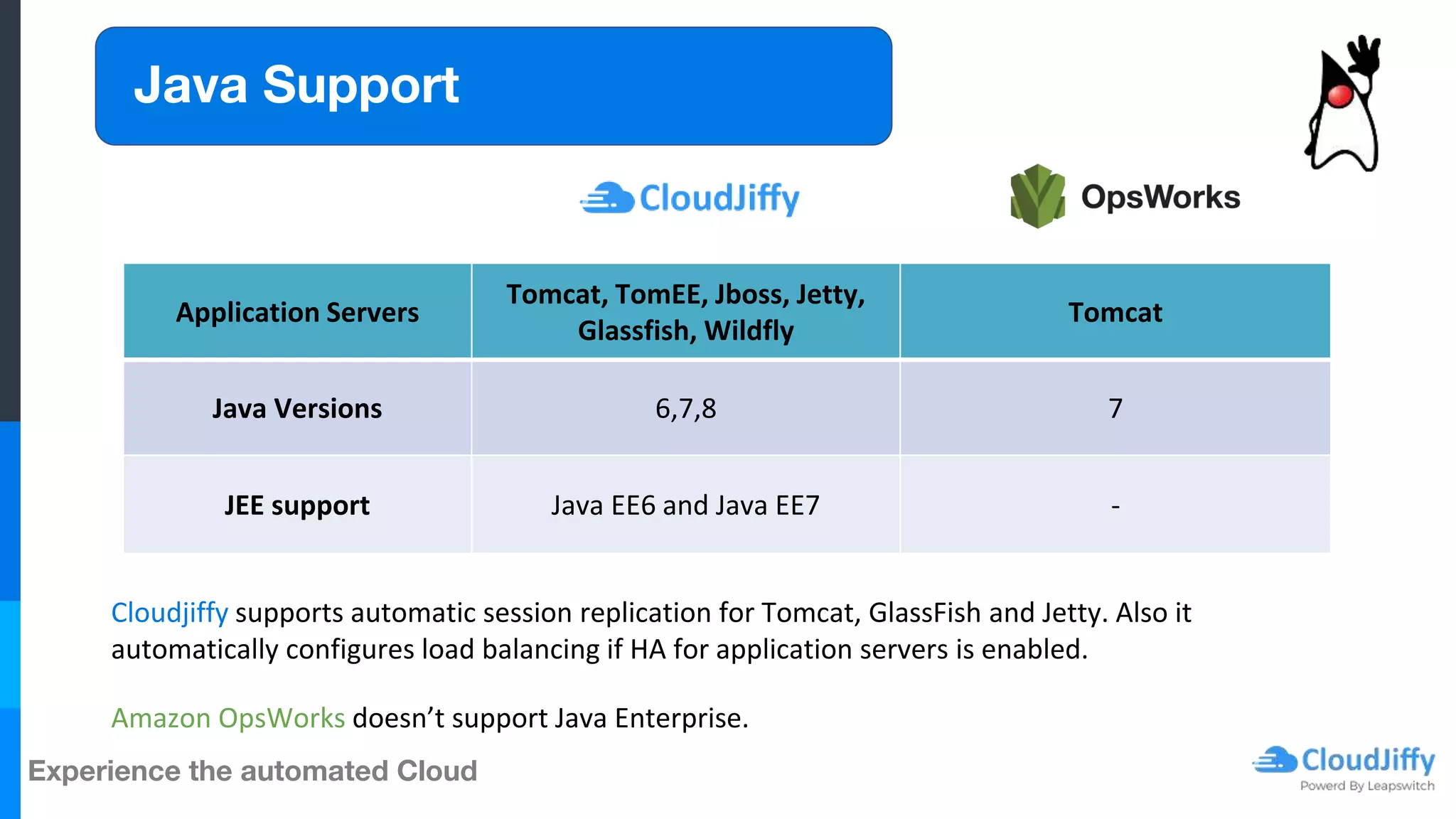
Java Support
Cloudjiffy supports automatic session replication for Tomcat, GlassFish and Jetty. Also it
automatically configures load balancing if HA for application servers is enabled.
Amazon OpsWorks doesn’t support Java Enterprise.
Application Servers
Tomcat, TomEE, Jboss, Jetty,
Glassfish, Wildfly
Tomcat
Java Versions 6,7,8 7
JEE support Java EE6 and Java EE7 -
Experience the automated Cloud
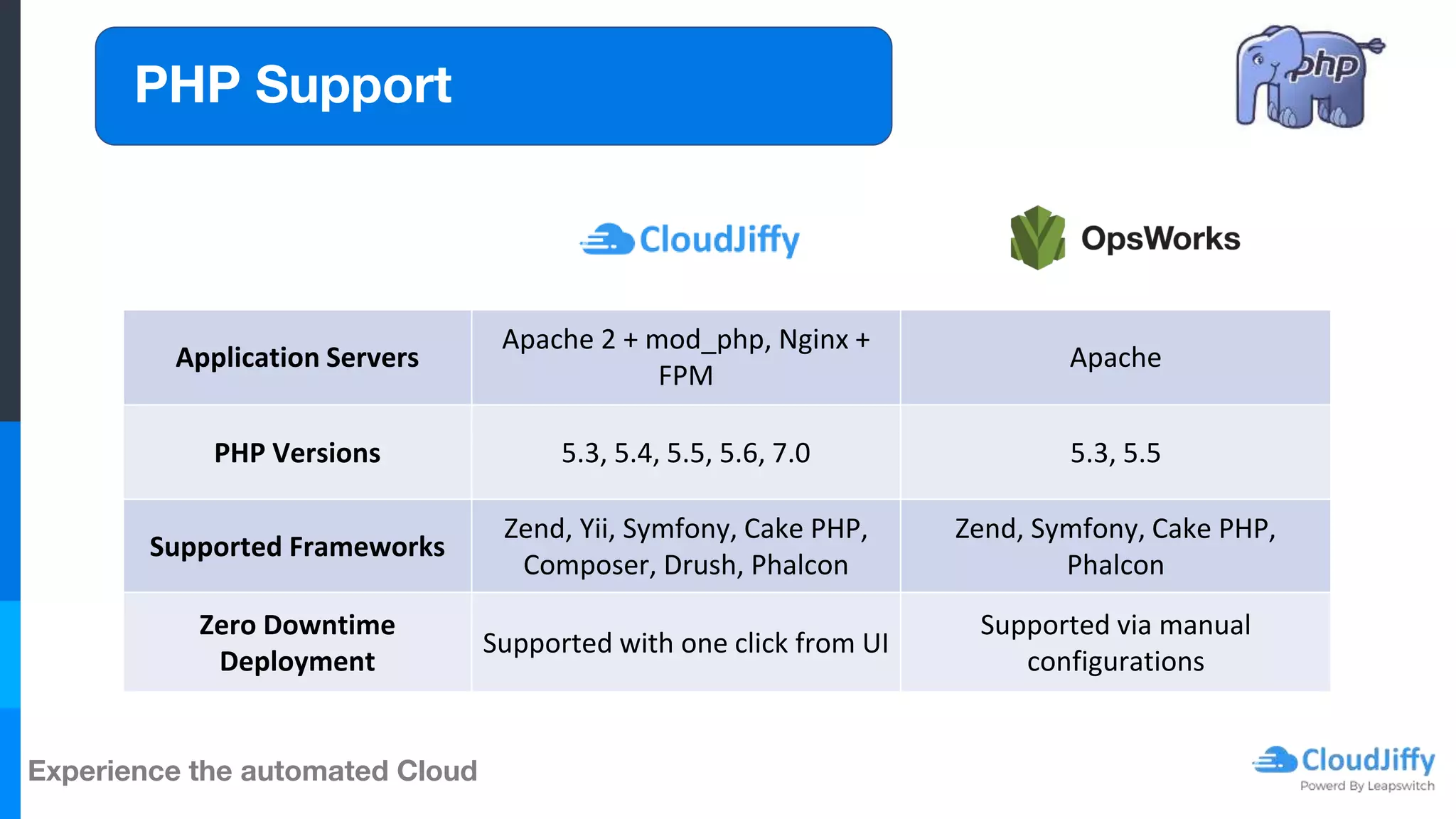
PHP Support
Application Servers
Apache 2 + mod_php, Nginx +
FPM
Apache
PHP Versions 5.3, 5.4, 5.5, 5.6, 7.0 5.3, 5.5
Supported Frameworks
Zend, Yii, Symfony, Cake PHP,
Composer, Drush, Phalcon
Zend, Symfony, Cake PHP,
Phalcon
Zero Downtime
Deployment
Supported with one click from UI
Supported via manual
configurations
Experience the automated Cloud
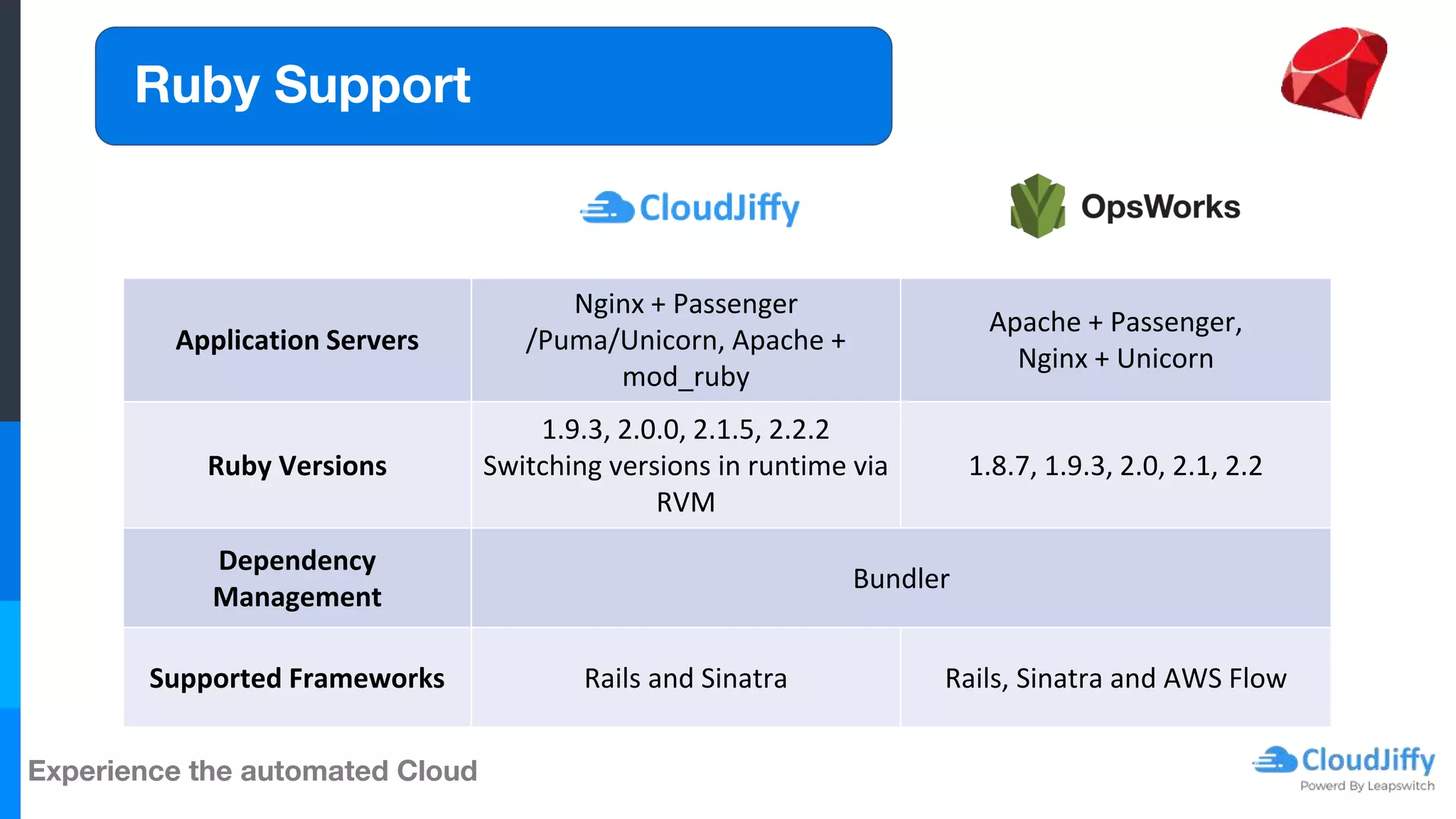
Ruby Support
Application Servers
Nginx + Passenger
/Puma/Unicorn, Apache +
mod_ruby
Apache + Passenger,
Nginx + Unicorn
Ruby Versions
1.9.3, 2.0.0, 2.1.5, 2.2.2
Switching versions in runtime via
RVM
1.8.7, 1.9.3, 2.0, 2.1, 2.2
Dependency
Management
Bundler
Supported Frameworks Rails and Sinatra Rails, Sinatra and AWS Flow
Experience the automated Cloud
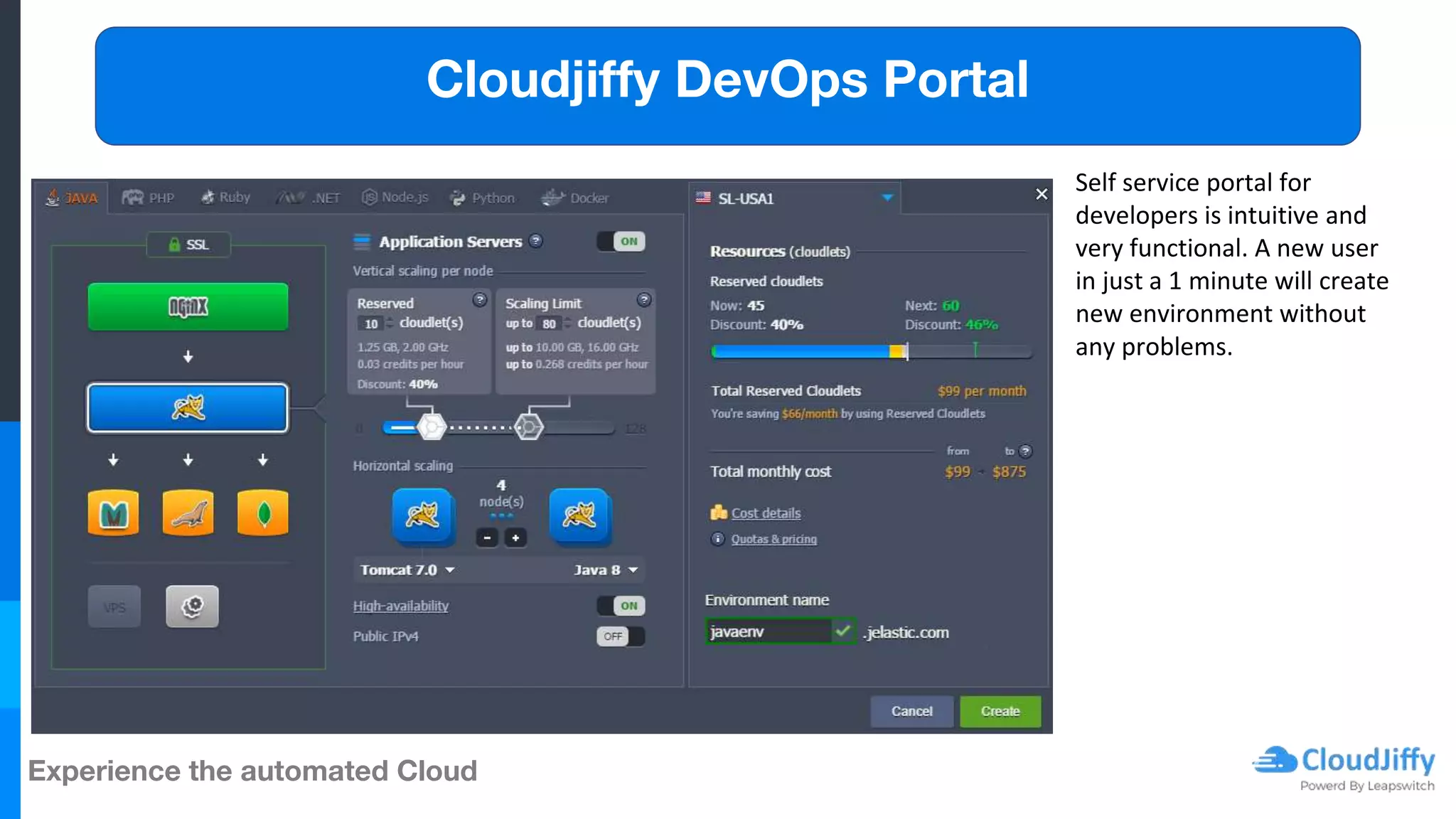
Cloudjiffy DevOps Portal
Self service portal for
developers is intuitive and
very functional. A new user
in just a 1 minute will create
new environment without
any problems.
Experience the automated Cloud
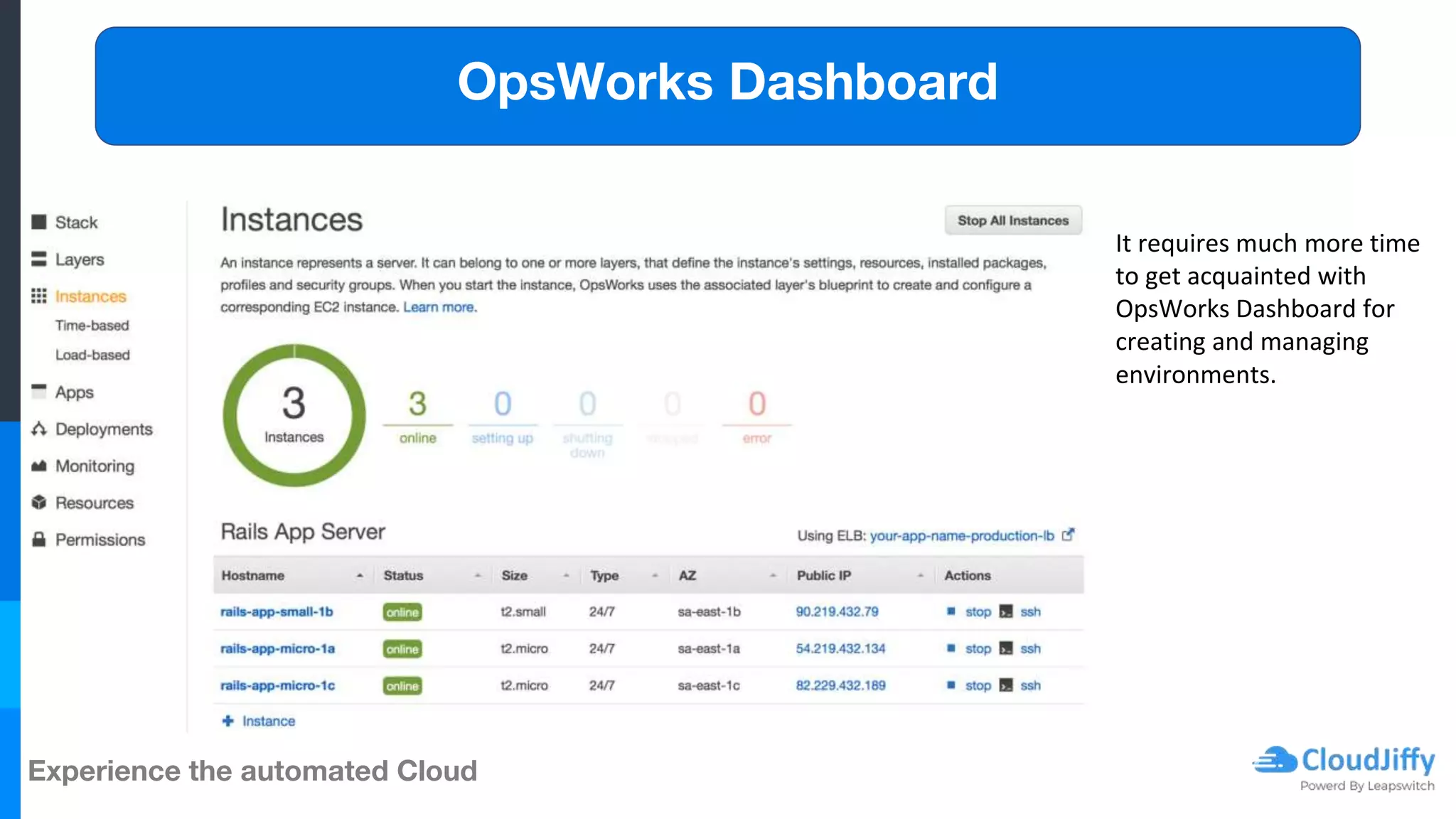
OpsWorks Dashboard
It requires much more time
to get acquainted with
OpsWorks Dashboard for
creating and managing
environments.
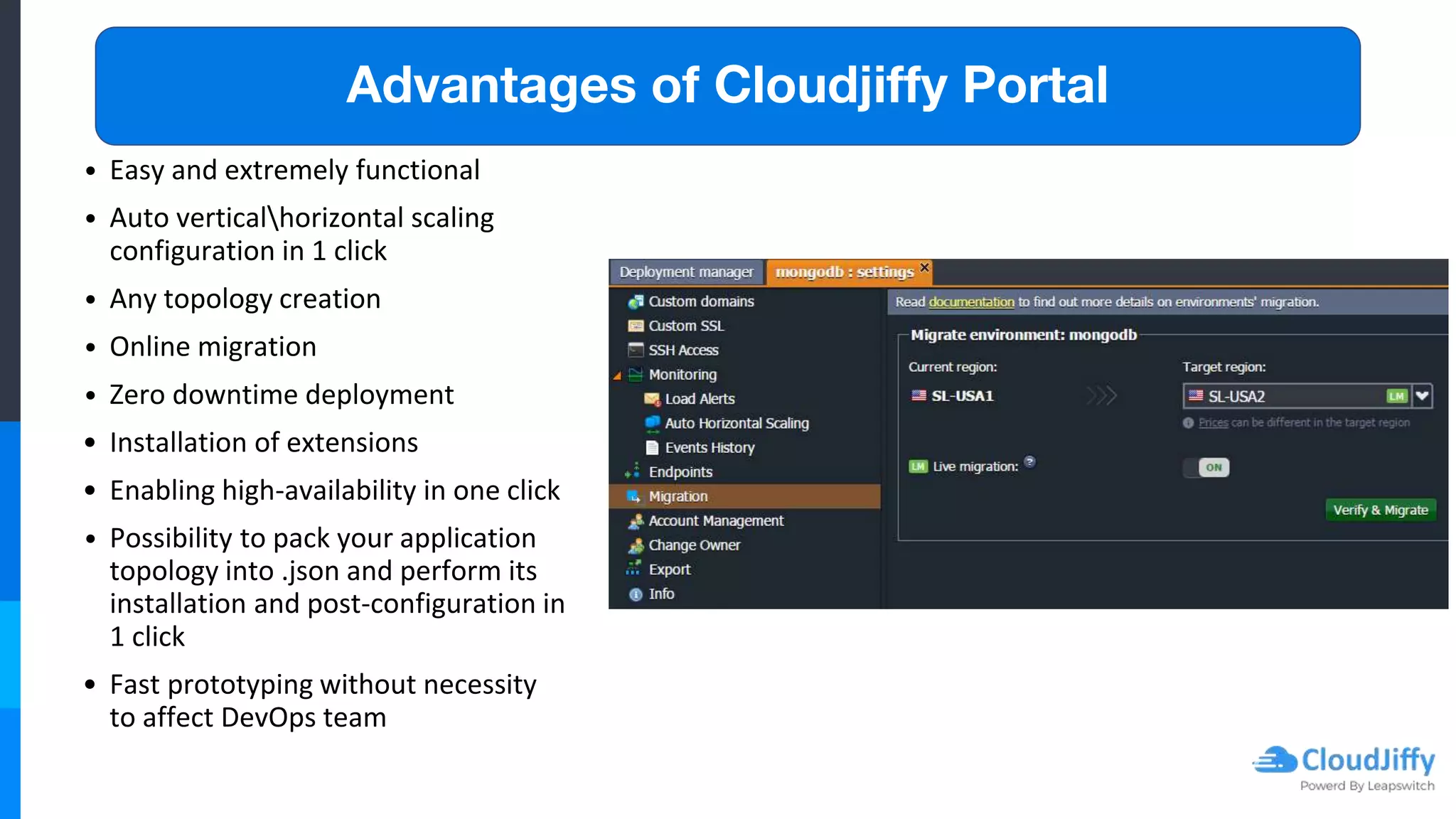
Advantages of Cloudjiffy Portal
• Easy and extremely functional
• Auto verticalhorizontal scaling
configuration in 1 click
• Any topology creation
• Online migration
• Zero downtime deployment
• Installation of extensions
• Enabling high-availability in one click
• Possibility to pack your application
topology into .json and perform its
installation and post-configuration in
1 click
• Fast prototyping without necessity
to affect DevOps team
Experience the automated Cloud
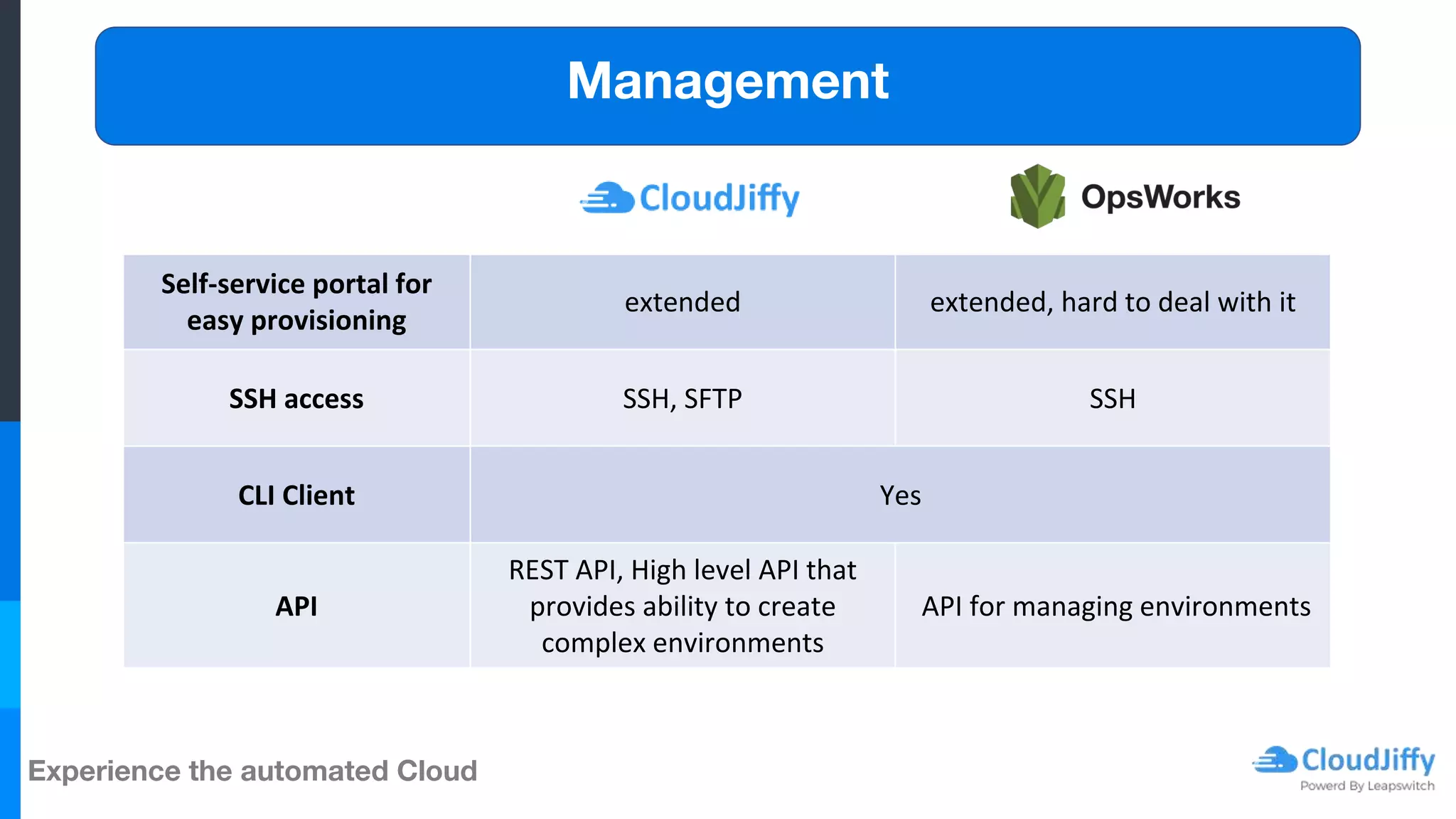
Management
Self-service portal for
easy provisioning
extended extended, hard to deal with it
SSH access SSH, SFTP SSH
CLI Client Yes
API
REST API, High level API that
provides ability to create
complex environments
API for managing environments
Experience the automated Cloud
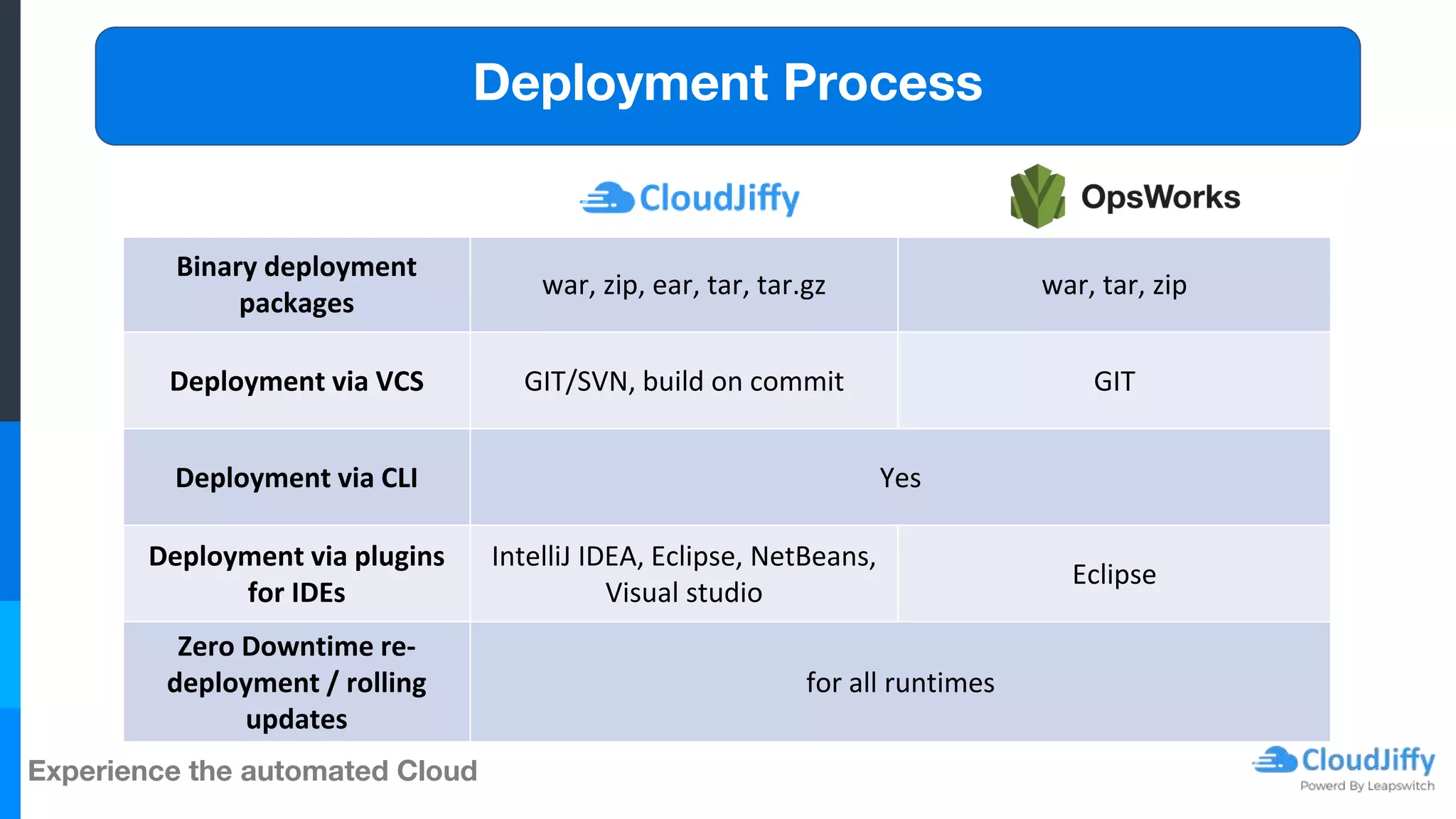
Deployment Process
Binary deployment
packages
war, zip, ear, tar, tar.gz war, tar, zip
Deployment via VCS GIT/SVN, build on commit GIT
Deployment via CLI Yes
Deployment via plugins
for IDEs
IntelliJ IDEA, Eclipse, NetBeans,
Visual studio
Eclipse
Zero Downtime re-
deployment / rolling
updates
for all runtimes
Experience the automated Cloud
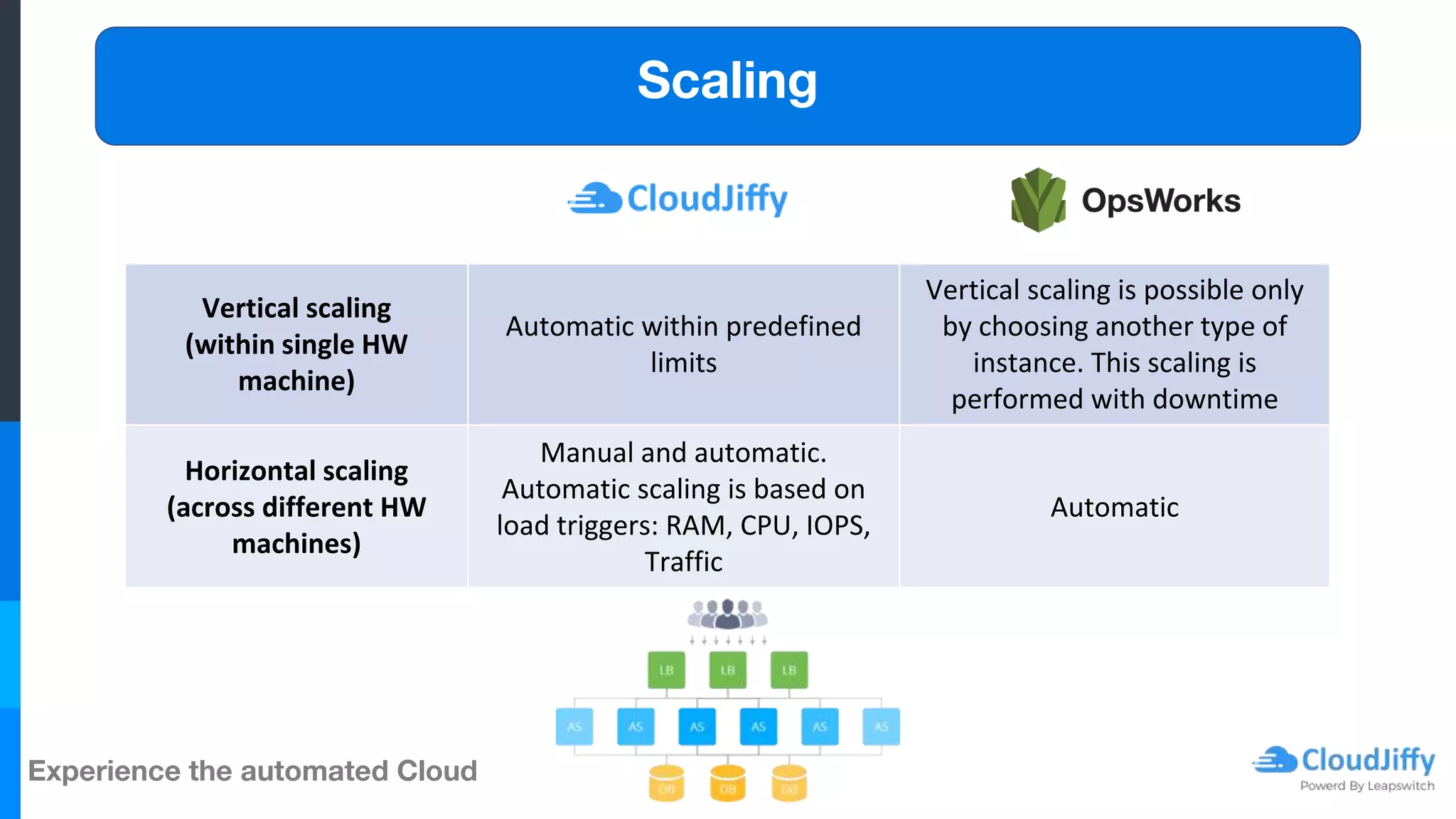
Vertical scaling
(within single HW
machine)
Automatic within predefined
limits
Vertical scaling is possible only
by choosing another type of
instance. This scaling is
performed with downtime
Horizontal scaling
(across different HW
machines)
Manual and automatic.
Automatic scaling is based on
load triggers: RAM, CPU, IOPS,
Traffic
Automatic
Scaling
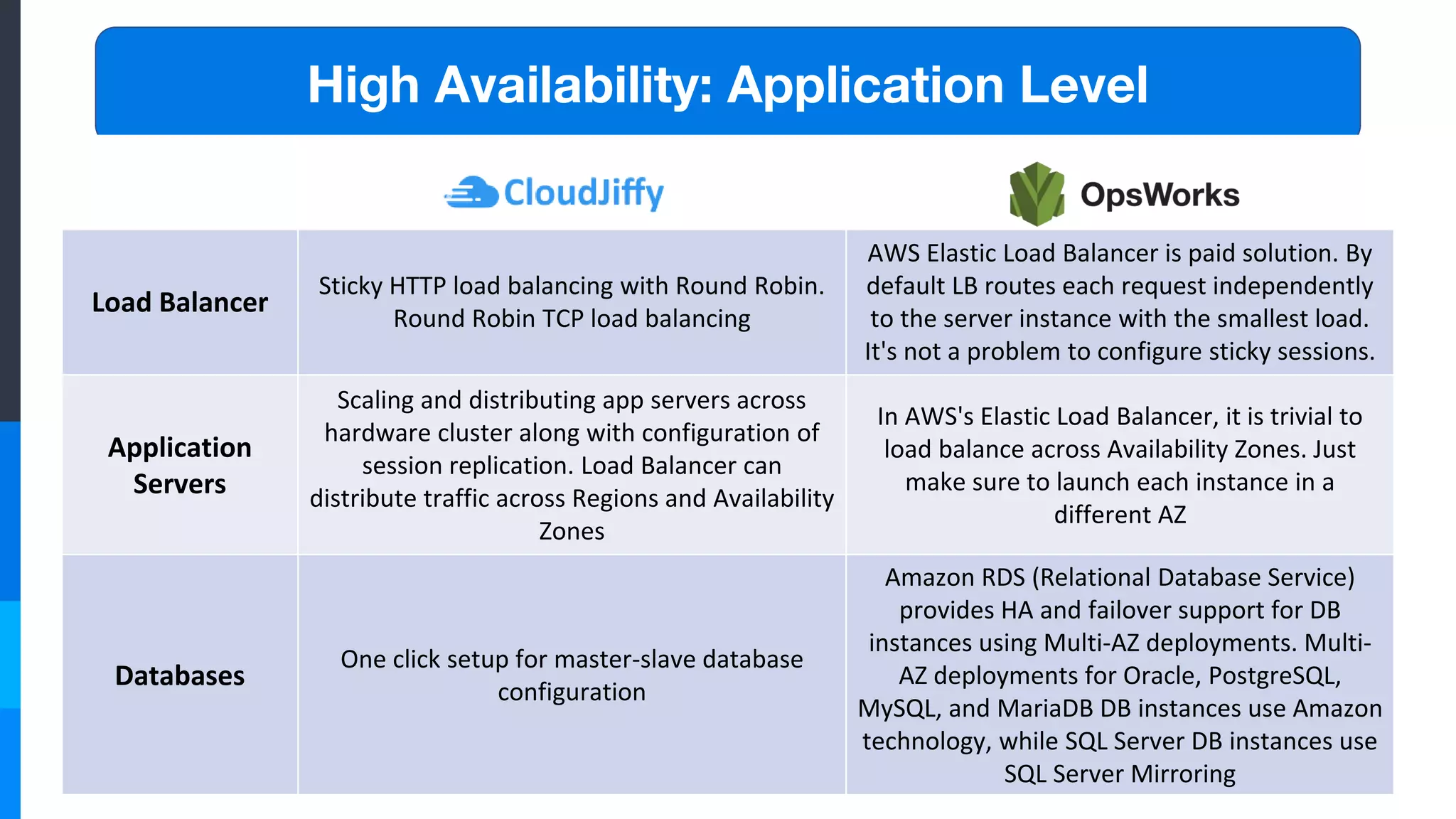
Load Balancer
Sticky HTTP load balancing with Round Robin.
Round Robin TCP load balancing
AWS Elastic Load Balancer is paid solution. By
default LB routes each request independently
to the server instance with the smallest load.
It's not a problem to configure sticky sessions.
Application
Servers
Scaling and distributing app servers across
hardware cluster along with configuration of
session replication. Load Balancer can
distribute traffic across Regions and Availability
Zones
In AWS's Elastic Load Balancer, it is trivial to
load balance across Availability Zones. Just
make sure to launch each instance in a
different AZ
Databases
One click setup for master-slave database
configuration
Amazon RDS (Relational Database Service)
provides HA and failover support for DB
instances using Multi-AZ deployments. Multi-
AZ deployments for Oracle, PostgreSQL,
MySQL, and MariaDB DB instances use Amazon
technology, while SQL Server DB instances use
SQL Server Mirroring
High Availability: Application Level
Experience the automated Cloud
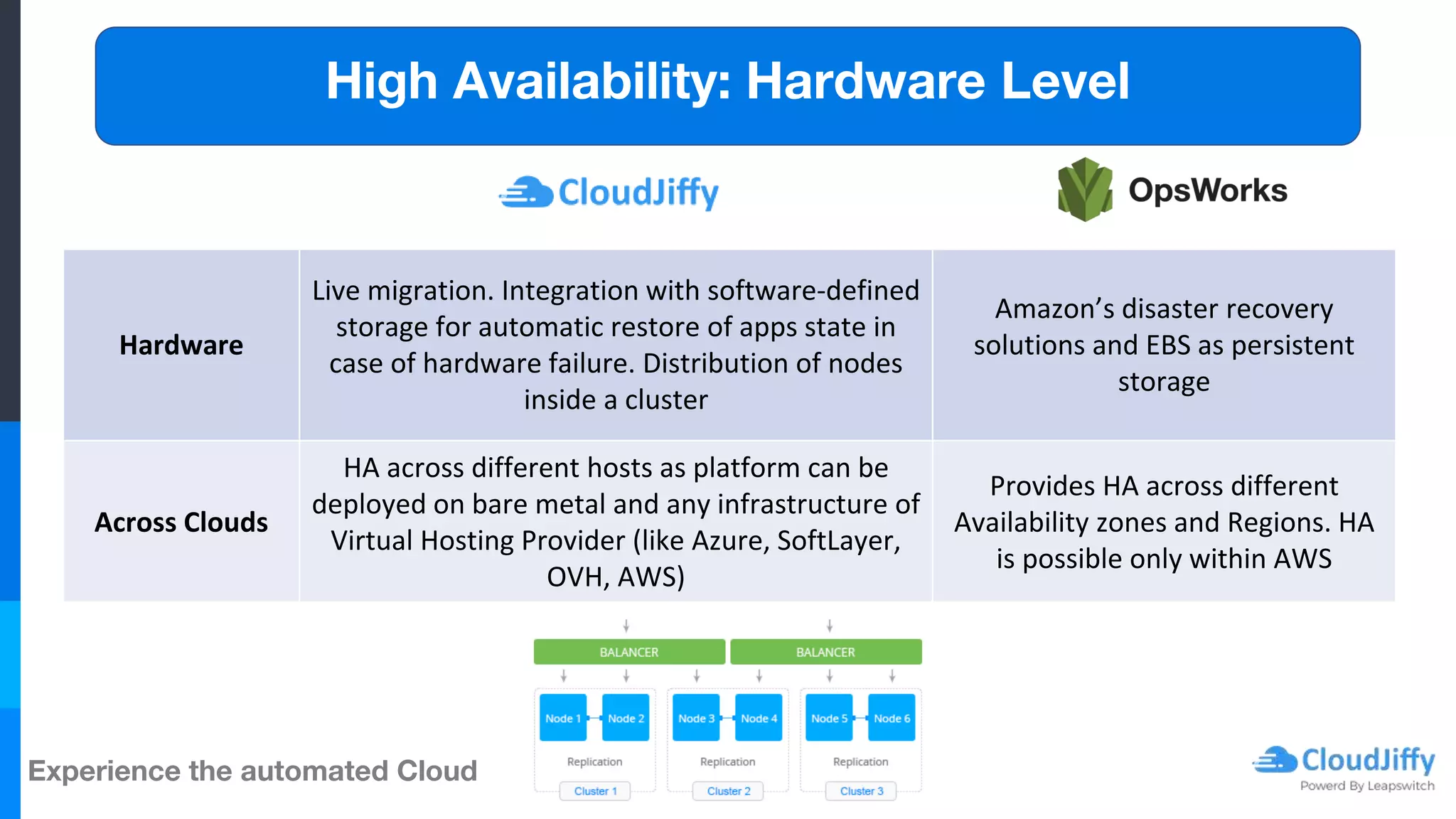
Hardware
Live migration. Integration with software-defined
storage for automatic restore of apps state in
case of hardware failure. Distribution of nodes
inside a cluster
Amazon’s disaster recovery
solutions and EBS as persistent
storage
Across Clouds
HA across different hosts as platform can be
deployed on bare metal and any infrastructure of
Virtual Hosting Provider (like Azure, SoftLayer,
OVH, AWS)
Provides HA across different
Availability zones and Regions. HA
is possible only within AWS
High Availability: Hardware Level
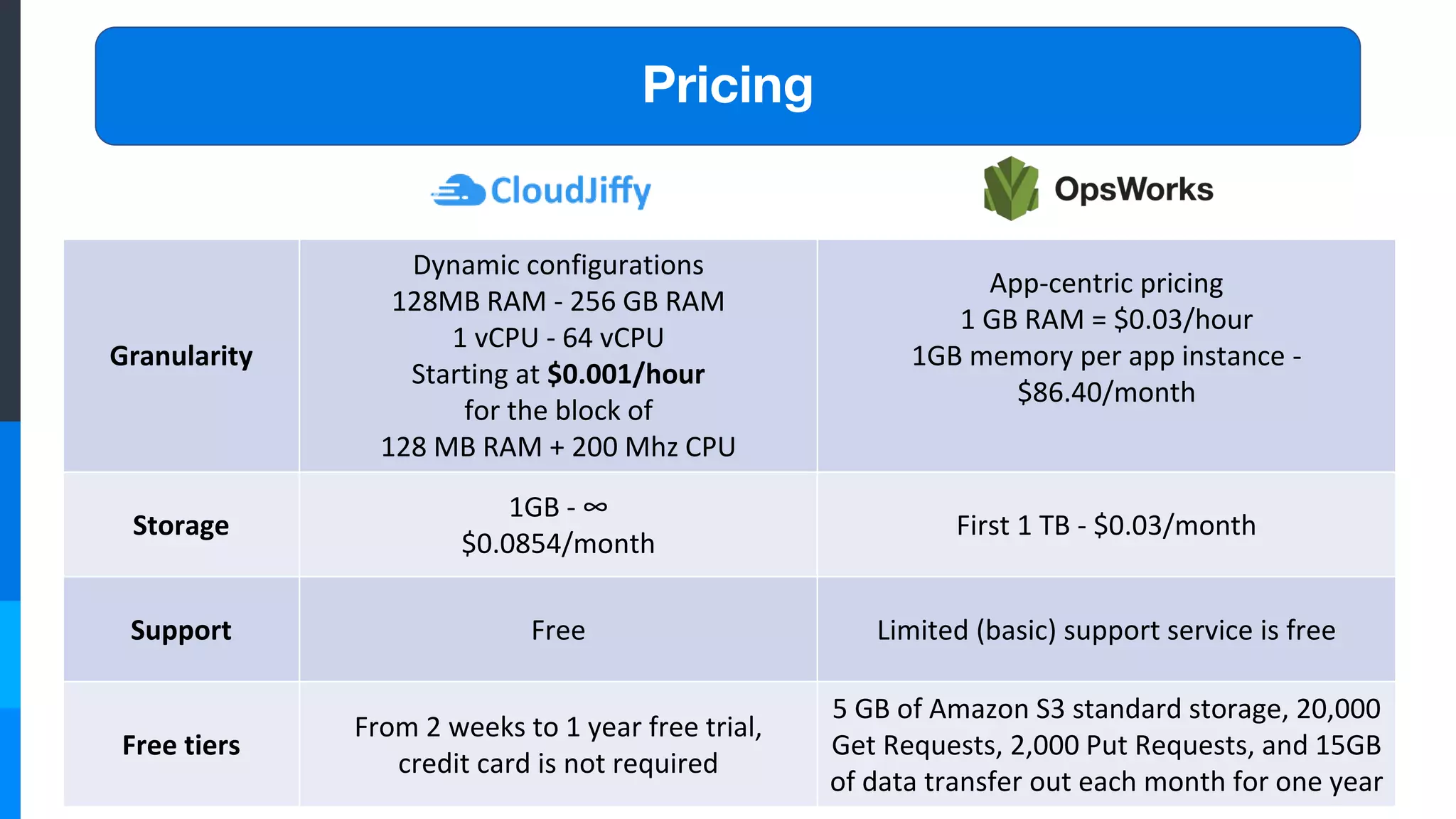
Granularity
Dynamic configurations
128MB RAM - 256 GB RAM
1 vCPU - 64 vCPU
Starting at $0.001/hour
for the block of
128 MB RAM + 200 Mhz CPU
App-centric pricing
1 GB RAM = $0.03/hour
1GB memory per app instance -
$86.40/month
Storage
1GB - ∞
$0.0854/month
First 1 TB - $0.03/month
Support Free Limited (basic) support service is free
Free tiers
From 2 weeks to 1 year free trial,
credit card is not required
5 GB of Amazon S3 standard storage, 20,000
Get Requests, 2,000 Put Requests, and 15GB
of data transfer out each month for one year
Pricing
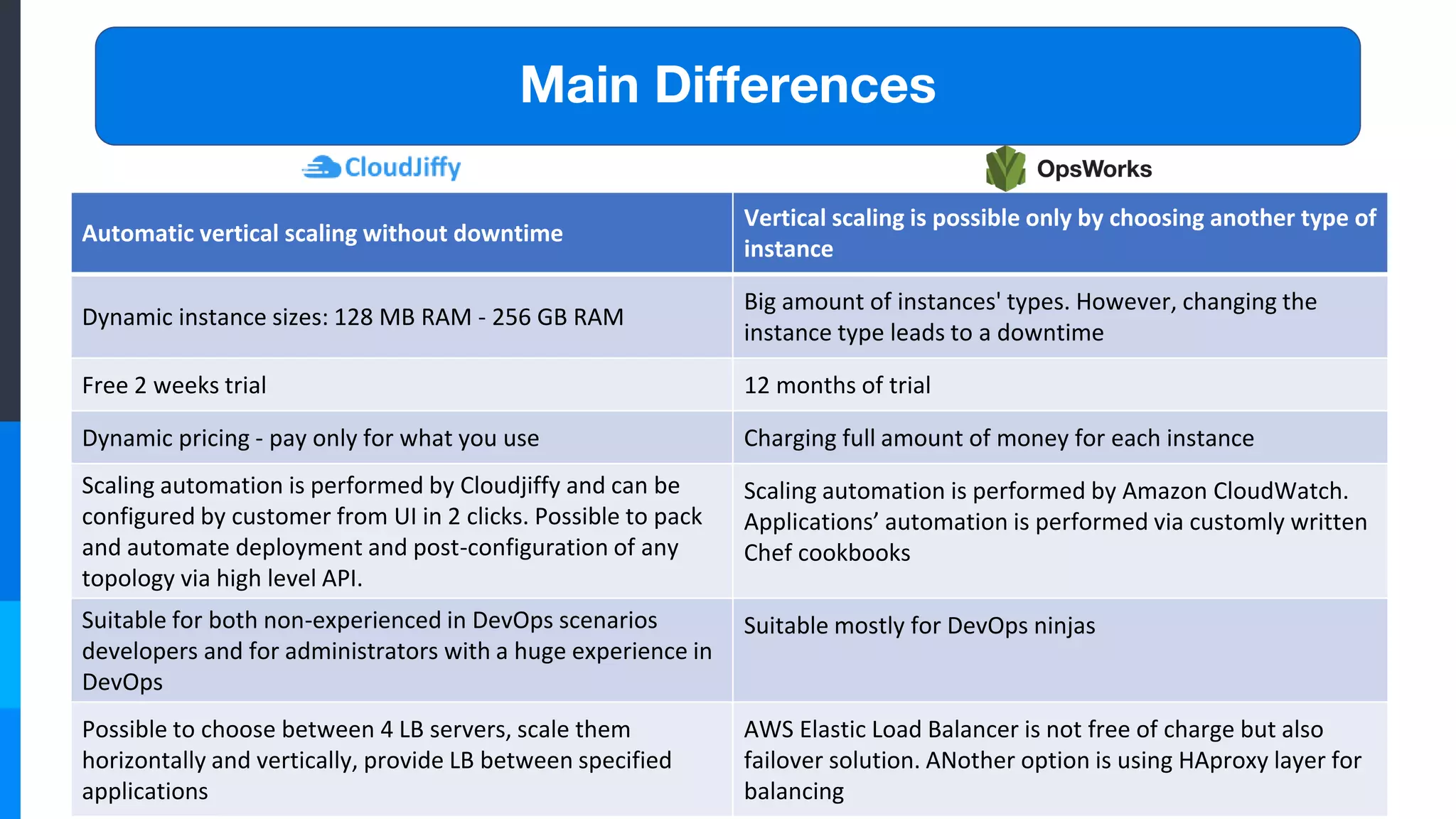
Automatic vertical scaling without downtime
Vertical scaling is possible only by choosing another type of
instance
Dynamic instance sizes: 128 MB RAM - 256 GB RAM
Big amount of instances' types. However, changing the
instance type leads to a downtime
Free 2 weeks trial 12 months of trial
Dynamic pricing - pay only for what you use Charging full amount of money for each instance
Scaling automation is performed by Cloudjiffy and can be
configured by customer from UI in 2 clicks. Possible to pack
and automate deployment and post-configuration of any
topology via high level API.
Scaling automation is performed by Amazon CloudWatch.
Applications’ automation is performed via customly written
Chef cookbooks
Suitable for both non-experienced in DevOps scenarios
developers and for administrators with a huge experience in
DevOps
Suitable mostly for DevOps ninjas
Possible to choose between 4 LB servers, scale them
horizontally and vertically, provide LB between specified
applications
AWS Elastic Load Balancer is not free of charge but also
failover solution. ANother option is using HAproxy layer for
balancing
Main Differences
Experience the automated Cloud
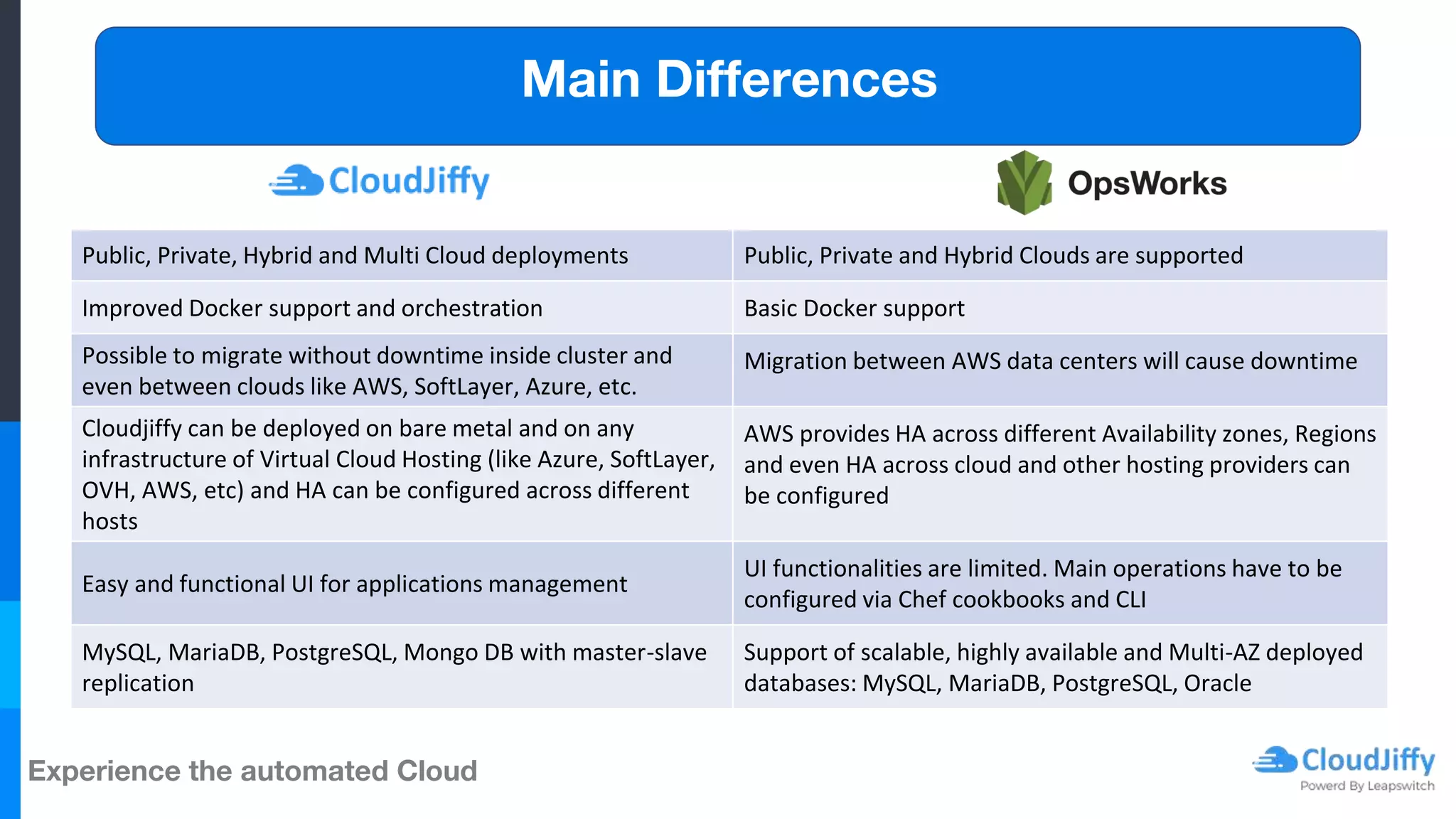
Public, Private, Hybrid and Multi Cloud deployments Public, Private and Hybrid Clouds are supported
Improved Docker support and orchestration Basic Docker support
Possible to migrate without downtime inside cluster and
even between clouds like AWS, SoftLayer, Azure, etc.
Migration between AWS data centers will cause downtime
Cloudjiffy can be deployed on bare metal and on any
infrastructure of Virtual Cloud Hosting (like Azure, SoftLayer,
OVH, AWS, etc) and HA can be configured across different
hosts
AWS provides HA across different Availability zones, Regions
and even HA across cloud and other hosting providers can
be configured
Easy and functional UI for applications management
UI functionalities are limited. Main operations have to be
configured via Chef cookbooks and CLI
MySQL, MariaDB, PostgreSQL, Mongo DB with master-slave
replication
Support of scalable, highly available and Multi-AZ deployed
databases: MySQL, MariaDB, PostgreSQL, Oracle
Main Differences
Thank You!
Contact us for more information
info@cloudjiffy.com

Cloudjiffy vs AWS ops works

  • 1.
  • 2.
    Experience the automatedCloud Supported Platforms Java, PHP, Ruby, Node.js, Python, Docker and .NET Python -
  • 3.
    Experience the automatedCloud Cloudjiffy is an easy-to-use Platform-as-a-Service for deploying, scaling, managing web applications’ lifecycle and services developed with Java, .NET, PHP, Node.js, Python, Ruby, .NET, and Docker. Customers create in a few clicks via GUI environment with any desired application servers / databases topology. Cloudjiffy doesn’t require any code changes to be deployed in the cloud and is cloud agnostic - you won’t be chained to a platform forever. If application runs on your local machine, it will run in the cloud. Platform takes care of failover, high availability and autoscaling your applications without necessity to request operations’ help - it handles all actions starting from auto configuring servers during environment creation and finishing complex automated DevOps processes available in several clicks. Cloudjiffy is the fully automated platform that simplifies DevOps workflow and speeds up applications’ delivery to end-users. It is targeted on developers that don’t have Ops experience and want manage they apps like if they had DevOps expertise. Cloudjiffy Use Cases
  • 4.
    Experience the automatedCloud AWS OpsWorks is a flexible configuration management solution with automation tools that enable you to model and control your applications and their supporting infrastructure. AWS OpsWorks makes it easy to manage the complete application lifecycle, including resource provisioning, configuration management, application deployment, software updates, monitoring, and access control. AWS OpsWorks is designed for IT administrators and ops-minded developers who want an easy way to manage applications using CHEF recipes. AWS OpsWorks is targeted at DevOps users who want better management and automation tools to help them customize and control their environments. OpsWorks Use Cases
  • 5.
    Experience the automatedCloud Java Support Cloudjiffy supports automatic session replication for Tomcat, GlassFish and Jetty. Also it automatically configures load balancing if HA for application servers is enabled. Amazon OpsWorks doesn’t support Java Enterprise. Application Servers Tomcat, TomEE, Jboss, Jetty, Glassfish, Wildfly Tomcat Java Versions 6,7,8 7 JEE support Java EE6 and Java EE7 -
  • 6.
    Experience the automatedCloud PHP Support Application Servers Apache 2 + mod_php, Nginx + FPM Apache PHP Versions 5.3, 5.4, 5.5, 5.6, 7.0 5.3, 5.5 Supported Frameworks Zend, Yii, Symfony, Cake PHP, Composer, Drush, Phalcon Zend, Symfony, Cake PHP, Phalcon Zero Downtime Deployment Supported with one click from UI Supported via manual configurations
  • 7.
    Experience the automatedCloud Ruby Support Application Servers Nginx + Passenger /Puma/Unicorn, Apache + mod_ruby Apache + Passenger, Nginx + Unicorn Ruby Versions 1.9.3, 2.0.0, 2.1.5, 2.2.2 Switching versions in runtime via RVM 1.8.7, 1.9.3, 2.0, 2.1, 2.2 Dependency Management Bundler Supported Frameworks Rails and Sinatra Rails, Sinatra and AWS Flow
  • 8.
    Experience the automatedCloud Cloudjiffy DevOps Portal Self service portal for developers is intuitive and very functional. A new user in just a 1 minute will create new environment without any problems.
  • 9.
    Experience the automatedCloud OpsWorks Dashboard It requires much more time to get acquainted with OpsWorks Dashboard for creating and managing environments.
  • 10.
    Advantages of CloudjiffyPortal • Easy and extremely functional • Auto verticalhorizontal scaling configuration in 1 click • Any topology creation • Online migration • Zero downtime deployment • Installation of extensions • Enabling high-availability in one click • Possibility to pack your application topology into .json and perform its installation and post-configuration in 1 click • Fast prototyping without necessity to affect DevOps team
  • 11.
    Experience the automatedCloud Management Self-service portal for easy provisioning extended extended, hard to deal with it SSH access SSH, SFTP SSH CLI Client Yes API REST API, High level API that provides ability to create complex environments API for managing environments
  • 12.
    Experience the automatedCloud Deployment Process Binary deployment packages war, zip, ear, tar, tar.gz war, tar, zip Deployment via VCS GIT/SVN, build on commit GIT Deployment via CLI Yes Deployment via plugins for IDEs IntelliJ IDEA, Eclipse, NetBeans, Visual studio Eclipse Zero Downtime re- deployment / rolling updates for all runtimes
  • 13.
    Experience the automatedCloud Vertical scaling (within single HW machine) Automatic within predefined limits Vertical scaling is possible only by choosing another type of instance. This scaling is performed with downtime Horizontal scaling (across different HW machines) Manual and automatic. Automatic scaling is based on load triggers: RAM, CPU, IOPS, Traffic Automatic Scaling
  • 14.
    Load Balancer Sticky HTTPload balancing with Round Robin. Round Robin TCP load balancing AWS Elastic Load Balancer is paid solution. By default LB routes each request independently to the server instance with the smallest load. It's not a problem to configure sticky sessions. Application Servers Scaling and distributing app servers across hardware cluster along with configuration of session replication. Load Balancer can distribute traffic across Regions and Availability Zones In AWS's Elastic Load Balancer, it is trivial to load balance across Availability Zones. Just make sure to launch each instance in a different AZ Databases One click setup for master-slave database configuration Amazon RDS (Relational Database Service) provides HA and failover support for DB instances using Multi-AZ deployments. Multi- AZ deployments for Oracle, PostgreSQL, MySQL, and MariaDB DB instances use Amazon technology, while SQL Server DB instances use SQL Server Mirroring High Availability: Application Level
  • 15.
    Experience the automatedCloud Hardware Live migration. Integration with software-defined storage for automatic restore of apps state in case of hardware failure. Distribution of nodes inside a cluster Amazon’s disaster recovery solutions and EBS as persistent storage Across Clouds HA across different hosts as platform can be deployed on bare metal and any infrastructure of Virtual Hosting Provider (like Azure, SoftLayer, OVH, AWS) Provides HA across different Availability zones and Regions. HA is possible only within AWS High Availability: Hardware Level
  • 16.
    Granularity Dynamic configurations 128MB RAM- 256 GB RAM 1 vCPU - 64 vCPU Starting at $0.001/hour for the block of 128 MB RAM + 200 Mhz CPU App-centric pricing 1 GB RAM = $0.03/hour 1GB memory per app instance - $86.40/month Storage 1GB - ∞ $0.0854/month First 1 TB - $0.03/month Support Free Limited (basic) support service is free Free tiers From 2 weeks to 1 year free trial, credit card is not required 5 GB of Amazon S3 standard storage, 20,000 Get Requests, 2,000 Put Requests, and 15GB of data transfer out each month for one year Pricing
  • 17.
    Automatic vertical scalingwithout downtime Vertical scaling is possible only by choosing another type of instance Dynamic instance sizes: 128 MB RAM - 256 GB RAM Big amount of instances' types. However, changing the instance type leads to a downtime Free 2 weeks trial 12 months of trial Dynamic pricing - pay only for what you use Charging full amount of money for each instance Scaling automation is performed by Cloudjiffy and can be configured by customer from UI in 2 clicks. Possible to pack and automate deployment and post-configuration of any topology via high level API. Scaling automation is performed by Amazon CloudWatch. Applications’ automation is performed via customly written Chef cookbooks Suitable for both non-experienced in DevOps scenarios developers and for administrators with a huge experience in DevOps Suitable mostly for DevOps ninjas Possible to choose between 4 LB servers, scale them horizontally and vertically, provide LB between specified applications AWS Elastic Load Balancer is not free of charge but also failover solution. ANother option is using HAproxy layer for balancing Main Differences
  • 18.
    Experience the automatedCloud Public, Private, Hybrid and Multi Cloud deployments Public, Private and Hybrid Clouds are supported Improved Docker support and orchestration Basic Docker support Possible to migrate without downtime inside cluster and even between clouds like AWS, SoftLayer, Azure, etc. Migration between AWS data centers will cause downtime Cloudjiffy can be deployed on bare metal and on any infrastructure of Virtual Cloud Hosting (like Azure, SoftLayer, OVH, AWS, etc) and HA can be configured across different hosts AWS provides HA across different Availability zones, Regions and even HA across cloud and other hosting providers can be configured Easy and functional UI for applications management UI functionalities are limited. Main operations have to be configured via Chef cookbooks and CLI MySQL, MariaDB, PostgreSQL, Mongo DB with master-slave replication Support of scalable, highly available and Multi-AZ deployed databases: MySQL, MariaDB, PostgreSQL, Oracle Main Differences
  • 19.
    Thank You! Contact usfor more information info@cloudjiffy.com