Cloud Computing กับ
    วิชาชีพสารสนเทศ

    พิมพ์ ราไพ เปรมสมิทธ์
Cloud Computing

“Cloud computing is a model for enabling
  ubiquitous, convenient, on-demand network
  access to a shared pool of configurable
  computing resources (e.g., networks,
  servers, storage, applications and services)
  that can be rapidly provisioned and
  released with minimal management effort or
  service provider interaction.” (NIST 2011)
                    http://www.nist.gov/itl/csd/cloud-102511.cfm
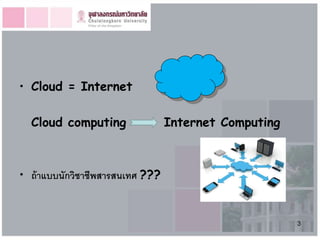
• Cloud = Internet

  Cloud computing                 Internet Computing


• ถ้ าแบบนักวิชาชีพสารสนเทศ ???


                                                       3
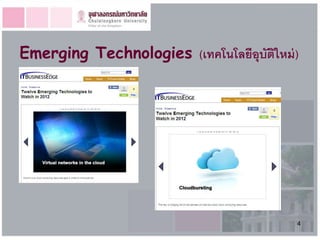
Emerging Technologies (เทคโนโลยีอุบัตใหม่ )
                                     ิ


                                          4
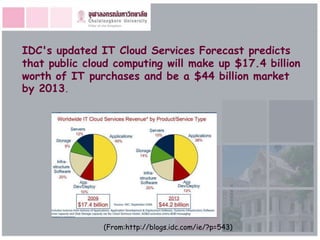
IDC's updated IT Cloud Services Forecast predicts
that public cloud computing will make up $17.4 billion
worth of IT purchases and be a $44 billion market
by 2013.


               (From:http://blogs.idc.com/ie/?p=543)
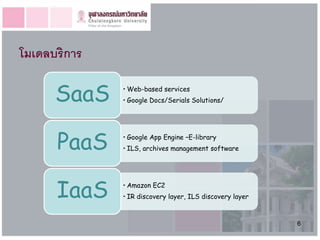
โมเดลบริการ

      SaaS    • Web-based services
              • Google Docs/Serials Solutions/


      PaaS    • Google App Engine –E-library
              • ILS, archives management software


      IaaS    • Amazon EC2
              • IR discovery layer, ILS discovery layer


                                                          6
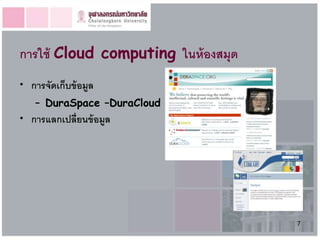
การใช้ Cloud computing ในห้ องสมุด
• การจัดเก็บข้ อมูล
    – DuraSpace –DuraCloud
• การแลกเปลี่ยนข้ อมูล


                                     7
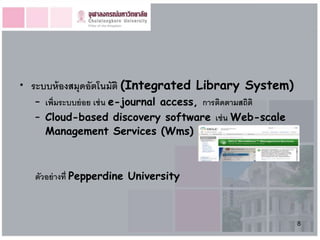
• ระบบห้ องสมุดอัตโนมัติ (Integrated Library System)
   – เพิ่มระบบย่ อย เช่ น e-journal access, การติดตามสถิติ
   – Cloud-based discovery software เช่ น Web-scale
     Management Services (Wms)


   ตัวอย่ างที่ Pepperdine University


                                                             8
Cloud-based services

• Access to cloud-based ILS and IR.

• Value-added service via mobile apps.


                                         9
ข้ อดี
• การประหยัดค่ าใช้ จ่าย
• การปรั บเปลี่ยนการใช้ งานให้ ทันสมัย
• ประสิทธิผลของระบบ
    – flexibility
    – scalability
• การจัดเก็บข้ อมูล
• การขยายการให้ บริการ
• การปรั บปรุ งการทางาน
                                         10
ข้ อด้ อย/ข้ อจากัด
• ความเป็ นส่ วนตัว
• การเป็ นเจ้ าของ / ความปลอดภัยของข้ อมูล
• การควบคุมเรื่องโครงสร้ างพืนฐานทางเทคโนโลยี
                             ้


                                                11
ก่ อนที่จะใช้ cloud services
•   ข้ อตกลงกับผู้ให้ บริการ
•   ค่ าใช้ จ่าย
•   ประเด็นทางกฎหมาย และ ประเด็นเรื่ ององค์ กร
•   ความรู้ ความสามารถของบุคลากร


                                                 12
การสารวจเรื่อง cloud computing ของ OCLC
เดือน มีนาคม 2011
• ส่ งแบบสอบถาม ให้ บรรณารั กษ์ ห้องสมุดสถาบันอุดมศึกษา ห้ องสมุด
  ประชาชน ห้ องสมุดภาครั ฐและเอกชน จานวน 2700 คน ตอบกลับ
  ประมาณ 300 คน
• ต้ องการทราบว่ ามีความรู้ เกี่ยวกับเรื่ อง cloud computing และมี
  การใช้ มากน้ อยเพียงไร


                                                                     13
ผลการสารวจ
• บรรณารั กษ์ เพียงร้ อยละ 5 ที่เริ่มใช้ cloud-based
  infrastructure เช่ น Amazon EC2
• ร้ อยละ 13 ใช้ การจัดเก็บ/การสารองข้ อมูล เช่ น Dropbox
• ร้ อยละ 55 ใช้ cloud applications คือ Google Docs,
  Google Calendar และ Gmail
• ร้ อยละ 66 ใช้ sharing applications คือ Facebook,
  Twitter, Flickr และYoutube ตามลาดับ
• ร้ อยละ 19 (57 คน) ระบุว่าสร้ าง library-related
  application แต่ มีเพียง 5 คน ที่ระบุว่านาไปวางตลาดเช่ น Apple
  Store                                                        14
ส่ วนอีก 52 คนระบุว่านาขึนไว้ ท่ ีเว็บไซต์ ของห้ องสมุด หรื อ เพจของ
                          ้
     Facebook
• เหตุผลในการใช้ (ร้ อยละ 70 ที่ระบุว่าเคยใช้ บริการอย่ างน้ อย 1 บริการ)
    –   เพิ่มประสิทธิภาพ ร้ อยละ 20
    –   มีโอกาสในการสร้ างความร่ วมมือ ร้ อยละ 16
    –   ช่ วยลดความต้ องการความเชี่ยวชาญทางเทคนิค ร้ อยละ 9
    –   ประหยัดค่ าใช้ จ่าย ร้ อยละ 7
    –   ........

                                                                            15
• สิ่งที่เป็ นกังวล
    –   ความปลอดภัยของข้ อมูล ร้ อยละ 35
    –   ความมั่นคงระยะยาวของบริษัทผู้จดจาหน่ าย ร้ อยละ 31
                                           ั
    –   ความเป็ นส่ วนตัว ร้ อยละ 13
    –   ความเป็ นเจ้ าของข้ อมูล ร้ อยละ 7


                                                             16
สิ่งที่ห้องสมุดจะได้ รับจากการใช้
• เทคโนโลยี
    – การสร้ างโปรแกรม
    – การแบ่ งปั นนวัตกรรม
• ข้ อมูล
    – การรวบรวมข้ อมูล
    – การให้ บริการข้ อมูล
• ชุมชน
    – การแบ่ งปั นทรัพยากร
    – ความร่ วมมือ
                                    17
2010 top ten trends in academic
libraries
• Technology will continue to change services
  and required skills. Cloud computing,
  augmented and virtual reality, discovery
  tools, open content, open source software,
  and new social networking tools are some of
  the most important technological changes
  affecting academic libraries. As with mobile
  applications, these developments will affect
  nearly all library operations.
     http://crln.acrl.org/content/71/6/286.full   18
ทักษะเป็ นที่ต้องการ

• The company counted more than 3,400 job
  ads for IT professionals that required
  cloud computing skills in February 2012, a
  99 percent increase over February 2011
• "People who understand cloud operations
  and how to deploy cloud solutions are really
  sought after right now,"
  http://www.cio.com/article/704046/Cloud_Computing_Skills_Shortage_Forces_CIOs_to_

  Grow_Their_Own   _
                                                                                 19
Multidisciplinary – A New 21st
Century Librarianship Skill
• multidisciplinary librarianship means that
  the librarian takes elements from all
  applicable areas of study as they relate to
  librarianship, and combines them into a
  practice that takes advantage of those
  interrelations, interactions and synergies
  from all disciplines, not just two.

•   http://21stcenturylibrary.com/2012/04/03/multidisciplinary-a-new-21st-century-
    librarianship-skill/
                                                                                     20
• a highly effective library director (or any
  librarian in any position), in addition to
  understanding the “science” of their
  profession, needs to understand and be
  able to practice leadership, management,
  organizational dynamics, politics, and all
  the other new skills;


                                                21
•   Business Acumen
•   Cloud Computing
•   Crowd sourcing
•   Customer Targeting
•   Digital Discovery
•   Discontinuous Thinking
•   Gaming ………
    ..................

                             22
“Emerging Technology Librarian”

• ETL - a professional librarian whose “main
   role is to explore, evaluate, promote, and
   implement various emerging technologies”.


http://hlwiki.slais.ubc.ca/index.php/Emerging_technology_librarians

                                                                      23
Emerging technology librarians
•   as part of reference/instruction teams, ETLs provide technological
    know-how in public service environments
•   enthusiastic about technologies and exploring emerging technologies
    for use in library settings
•   explore, develop, promote, and assess innovative online tools
    including social networking and other services for library learners
•   create and implement online learning modules to support information
    literacy, reference and web-based library programs
•   knowledge of instructional design principles and the ability to teach
    in online and face-to-face environments
•   delivery innovative and adventurous services as technologies are
    evaluated and new ways are found to apply them
•   familiar with the range of social tools, such as IM, social
    networking, blogs, wikis, eLearning software, and open content
                                                                        24
• advanced skills in technologies, and web development skills
  such as PHP, Javascript, XML, and SQL
• leadership skills in libraries regarding innovative, technology-
  based services
• creating, promoting, and facilitating use of electronic
  resources and services
• work effectively in a collaborative environment, take
  initiative, self-directed, and committed to innovation and
  creativity
• an ability to talk about emerging technologies with others at
  all skill levels

                                                                 25
ขอขอบคุณ


           26

Cloudcomputing4librarian

  • 1.
    Cloud Computing กับ วิชาชีพสารสนเทศ พิมพ์ ราไพ เปรมสมิทธ์
  • 2.
    Cloud Computing “Cloud computingis a model for enabling ubiquitous, convenient, on-demand network access to a shared pool of configurable computing resources (e.g., networks, servers, storage, applications and services) that can be rapidly provisioned and released with minimal management effort or service provider interaction.” (NIST 2011) http://www.nist.gov/itl/csd/cloud-102511.cfm
  • 3.
    • Cloud =Internet Cloud computing Internet Computing • ถ้ าแบบนักวิชาชีพสารสนเทศ ??? 3
  • 4.
  • 5.
    IDC's updated ITCloud Services Forecast predicts that public cloud computing will make up $17.4 billion worth of IT purchases and be a $44 billion market by 2013. (From:http://blogs.idc.com/ie/?p=543)
  • 6.
    โมเดลบริการ SaaS • Web-based services • Google Docs/Serials Solutions/ PaaS • Google App Engine –E-library • ILS, archives management software IaaS • Amazon EC2 • IR discovery layer, ILS discovery layer 6
  • 7.
    การใช้ Cloud computingในห้ องสมุด • การจัดเก็บข้ อมูล – DuraSpace –DuraCloud • การแลกเปลี่ยนข้ อมูล 7
  • 8.
    • ระบบห้ องสมุดอัตโนมัติ(Integrated Library System) – เพิ่มระบบย่ อย เช่ น e-journal access, การติดตามสถิติ – Cloud-based discovery software เช่ น Web-scale Management Services (Wms) ตัวอย่ างที่ Pepperdine University 8
  • 9.
    Cloud-based services • Accessto cloud-based ILS and IR. • Value-added service via mobile apps. 9
  • 10.
    ข้ อดี • การประหยัดค่าใช้ จ่าย • การปรั บเปลี่ยนการใช้ งานให้ ทันสมัย • ประสิทธิผลของระบบ – flexibility – scalability • การจัดเก็บข้ อมูล • การขยายการให้ บริการ • การปรั บปรุ งการทางาน 10
  • 11.
    ข้ อด้ อย/ข้อจากัด • ความเป็ นส่ วนตัว • การเป็ นเจ้ าของ / ความปลอดภัยของข้ อมูล • การควบคุมเรื่องโครงสร้ างพืนฐานทางเทคโนโลยี ้ 11
  • 12.
    ก่ อนที่จะใช้ cloudservices • ข้ อตกลงกับผู้ให้ บริการ • ค่ าใช้ จ่าย • ประเด็นทางกฎหมาย และ ประเด็นเรื่ ององค์ กร • ความรู้ ความสามารถของบุคลากร 12
  • 13.
    การสารวจเรื่อง cloud computingของ OCLC เดือน มีนาคม 2011 • ส่ งแบบสอบถาม ให้ บรรณารั กษ์ ห้องสมุดสถาบันอุดมศึกษา ห้ องสมุด ประชาชน ห้ องสมุดภาครั ฐและเอกชน จานวน 2700 คน ตอบกลับ ประมาณ 300 คน • ต้ องการทราบว่ ามีความรู้ เกี่ยวกับเรื่ อง cloud computing และมี การใช้ มากน้ อยเพียงไร 13
  • 14.
    ผลการสารวจ • บรรณารั กษ์เพียงร้ อยละ 5 ที่เริ่มใช้ cloud-based infrastructure เช่ น Amazon EC2 • ร้ อยละ 13 ใช้ การจัดเก็บ/การสารองข้ อมูล เช่ น Dropbox • ร้ อยละ 55 ใช้ cloud applications คือ Google Docs, Google Calendar และ Gmail • ร้ อยละ 66 ใช้ sharing applications คือ Facebook, Twitter, Flickr และYoutube ตามลาดับ • ร้ อยละ 19 (57 คน) ระบุว่าสร้ าง library-related application แต่ มีเพียง 5 คน ที่ระบุว่านาไปวางตลาดเช่ น Apple Store 14
  • 15.
    ส่ วนอีก 52คนระบุว่านาขึนไว้ ท่ ีเว็บไซต์ ของห้ องสมุด หรื อ เพจของ ้ Facebook • เหตุผลในการใช้ (ร้ อยละ 70 ที่ระบุว่าเคยใช้ บริการอย่ างน้ อย 1 บริการ) – เพิ่มประสิทธิภาพ ร้ อยละ 20 – มีโอกาสในการสร้ างความร่ วมมือ ร้ อยละ 16 – ช่ วยลดความต้ องการความเชี่ยวชาญทางเทคนิค ร้ อยละ 9 – ประหยัดค่ าใช้ จ่าย ร้ อยละ 7 – ........ 15
  • 16.
    • สิ่งที่เป็ นกังวล – ความปลอดภัยของข้ อมูล ร้ อยละ 35 – ความมั่นคงระยะยาวของบริษัทผู้จดจาหน่ าย ร้ อยละ 31 ั – ความเป็ นส่ วนตัว ร้ อยละ 13 – ความเป็ นเจ้ าของข้ อมูล ร้ อยละ 7 16
  • 17.
    สิ่งที่ห้องสมุดจะได้ รับจากการใช้ • เทคโนโลยี – การสร้ างโปรแกรม – การแบ่ งปั นนวัตกรรม • ข้ อมูล – การรวบรวมข้ อมูล – การให้ บริการข้ อมูล • ชุมชน – การแบ่ งปั นทรัพยากร – ความร่ วมมือ 17
  • 18.
    2010 top tentrends in academic libraries • Technology will continue to change services and required skills. Cloud computing, augmented and virtual reality, discovery tools, open content, open source software, and new social networking tools are some of the most important technological changes affecting academic libraries. As with mobile applications, these developments will affect nearly all library operations. http://crln.acrl.org/content/71/6/286.full 18
  • 19.
    ทักษะเป็ นที่ต้องการ • Thecompany counted more than 3,400 job ads for IT professionals that required cloud computing skills in February 2012, a 99 percent increase over February 2011 • "People who understand cloud operations and how to deploy cloud solutions are really sought after right now," http://www.cio.com/article/704046/Cloud_Computing_Skills_Shortage_Forces_CIOs_to_ Grow_Their_Own _ 19
  • 20.
    Multidisciplinary – ANew 21st Century Librarianship Skill • multidisciplinary librarianship means that the librarian takes elements from all applicable areas of study as they relate to librarianship, and combines them into a practice that takes advantage of those interrelations, interactions and synergies from all disciplines, not just two. • http://21stcenturylibrary.com/2012/04/03/multidisciplinary-a-new-21st-century- librarianship-skill/ 20
  • 21.
    • a highlyeffective library director (or any librarian in any position), in addition to understanding the “science” of their profession, needs to understand and be able to practice leadership, management, organizational dynamics, politics, and all the other new skills; 21
  • 22.
    Business Acumen • Cloud Computing • Crowd sourcing • Customer Targeting • Digital Discovery • Discontinuous Thinking • Gaming ……… .................. 22
  • 23.
    “Emerging Technology Librarian” •ETL - a professional librarian whose “main role is to explore, evaluate, promote, and implement various emerging technologies”. http://hlwiki.slais.ubc.ca/index.php/Emerging_technology_librarians 23
  • 24.
    Emerging technology librarians • as part of reference/instruction teams, ETLs provide technological know-how in public service environments • enthusiastic about technologies and exploring emerging technologies for use in library settings • explore, develop, promote, and assess innovative online tools including social networking and other services for library learners • create and implement online learning modules to support information literacy, reference and web-based library programs • knowledge of instructional design principles and the ability to teach in online and face-to-face environments • delivery innovative and adventurous services as technologies are evaluated and new ways are found to apply them • familiar with the range of social tools, such as IM, social networking, blogs, wikis, eLearning software, and open content 24
  • 25.
    • advanced skillsin technologies, and web development skills such as PHP, Javascript, XML, and SQL • leadership skills in libraries regarding innovative, technology- based services • creating, promoting, and facilitating use of electronic resources and services • work effectively in a collaborative environment, take initiative, self-directed, and committed to innovation and creativity • an ability to talk about emerging technologies with others at all skill levels 25
  • 26.