CLOTHING
BUYING
BEHAVIOUR
Hi! My name is Constantinos
Pantidos and I believe that
companies could improve
people’s lives even more
effectively if they had
deeper human insight.
Using a multidisciplinary
approach, BRAND AVIATORS™
has captured and presents, for
the first time, the fundamental
human motives underpinning
buying behaviour relative to
clothes at the deepest levels of
their deployment …
… all the way from:
• their biological value
• to the neurosystems they engage
• to the cognitive operations and
psychological states they activate
• to the major social reinforcers they
cause and
• to the rich hierarchy of inherent
concepts they infuse into our
everyday life
This methodology helps marketers
develop Intrinsically Engaging
Narratives™
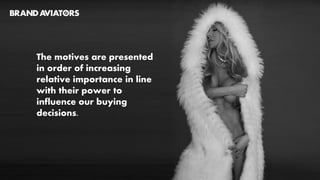
The motives are presented
in order of increasing
relative importance in line
with their power to
influence our buying
decisions.
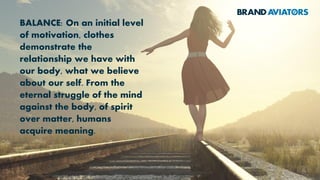
BALANCE: On an initial level
of motivation, clothes
demonstrate the
relationship we have with
our body, what we believe
about our self. From the
eternal struggle of the mind
against the body, of spirit
over matter, humans
acquire meaning.
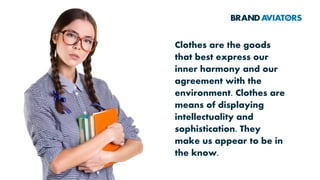
Clothes are the goods
that best express our
inner harmony and our
agreement with the
environment. Clothes are
means of displaying
intellectuality and
sophistication. They
make us appear to be in
the know.
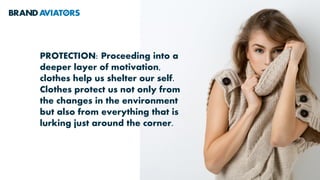
PROTECTION: Proceeding into a
deeper layer of motivation,
clothes help us shelter our self.
Clothes protect us not only from
the changes in the environment
but also from everything that is
lurking just around the corner.
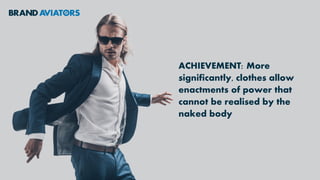
ACHIEVEMENT: More
significantly, clothes allow
enactments of power that
cannot be realised by the
naked body
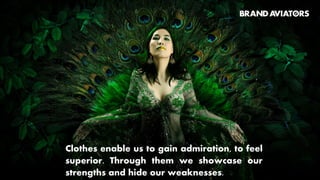
Clothes enable us to gain admiration, to feel
superior. Through them we showcase our
strengths and hide our weaknesses.
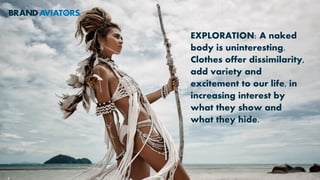
EXPLORATION: A naked
body is uninteresting.
Clothes offer dissimilarity,
add variety and
excitement to our life, in
increasing interest by
what they show and
what they hide.
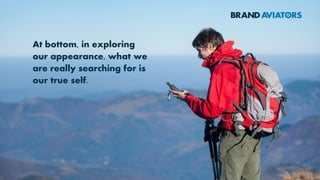
At bottom, in exploring
our appearance, what we
are really searching for is
our true self.
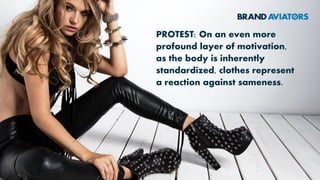
PROTEST: On an even more
profound layer of motivation,
as the body is inherently
standardized, clothes represent
a reaction against sameness.
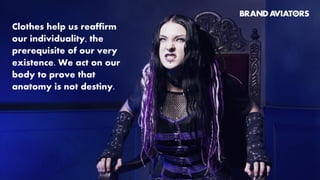
Clothes help us reaffirm
our individuality, the
prerequisite of our very
existence. We act on our
body to prove that
anatomy is not destiny.
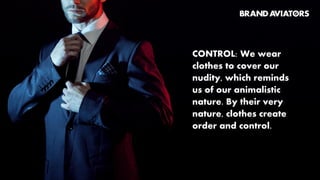
CONTROL: We wear
clothes to cover our
nudity, which reminds
us of our animalistic
nature. By their very
nature, clothes create
order and control.
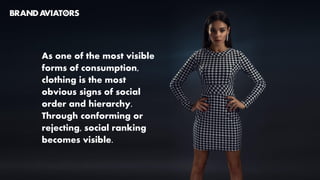
As one of the most visible
forms of consumption,
clothing is the most
obvious signs of social
order and hierarchy.
Through conforming or
rejecting, social ranking
becomes visible.
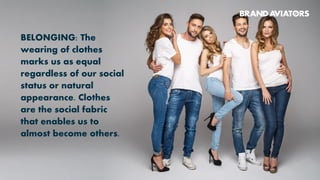
BELONGING: The
wearing of clothes
marks us as equal
regardless of our social
status or natural
appearance. Clothes
are the social fabric
that enables us to
almost become others.
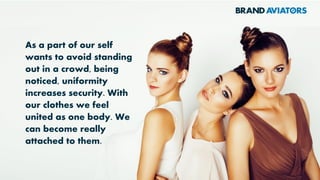
As a part of our self
wants to avoid standing
out in a crowd, being
noticed, uniformity
increases security. With
our clothes we feel
united as one body. We
can become really
attached to them.
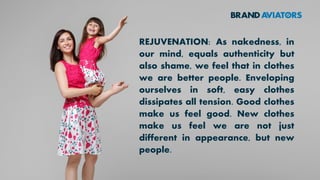
REJUVENATION: As nakedness, in
our mind, equals authenticity but
also shame, we feel that in clothes
we are better people. Enveloping
ourselves in soft, easy clothes
dissipates all tension. Good clothes
make us feel good. New clothes
make us feel we are not just
different in appearance, but new
people.
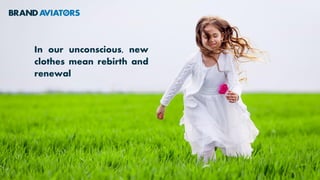
In our unconscious, new
clothes mean rebirth and
renewal
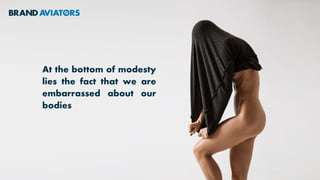
At the bottom of modesty
lies the fact that we are
embarrassed about our
bodies
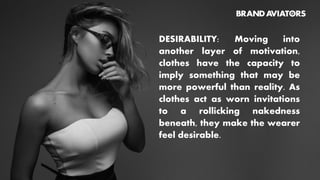
DESIRABILITY: Moving into
another layer of motivation,
clothes have the capacity to
imply something that may be
more powerful than reality. As
clothes act as worn invitations
to a rollicking nakedness
beneath, they make the wearer
feel desirable.
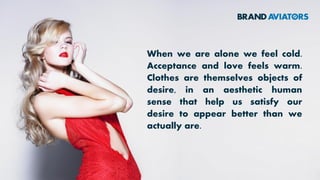
When we are alone we feel cold.
Acceptance and love feels warm.
Clothes are themselves objects of
desire, in an aesthetic human
sense that help us satisfy our
desire to appear better than we
actually are.
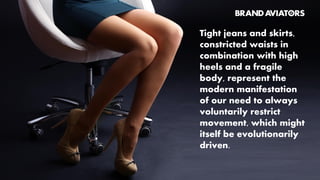
Tight jeans and skirts,
constricted waists in
combination with high
heels and a fragile
body, represent the
modern manifestation
of our need to always
voluntarily restrict
movement, which might
itself be evolutionarily
driven.
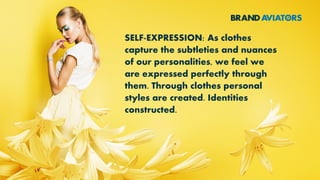
SELF-EXPRESSION: As clothes
capture the subtleties and nuances
of our personalities, we feel we
are expressed perfectly through
them. Through clothes personal
styles are created. Identities
constructed.
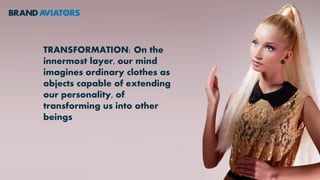
TRANSFORMATION: On the
innermost layer, our mind
imagines ordinary clothes as
objects capable of extending
our personality, of
transforming us into other
beings
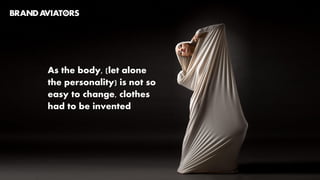
As the body, (let alone
the personality) is not so
easy to change, clothes
had to be invented
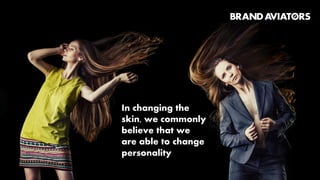
In changing the
skin, we commonly
believe that we
are able to change
personality
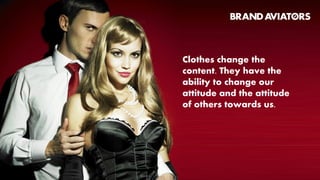
Clothes change the
content. They have the
ability to change our
attitude and the attitude
of others towards us.
In a powerful seductive game of advancing and retreating,
the being is transformed into an array of essences
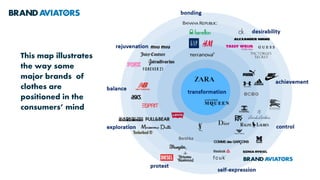
This map illustrates
the way some
major brands of
clothes are
positioned in the
consumers’ mind
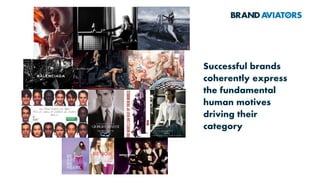
Successful brands
coherently express
the fundamental
human motives
driving their
category
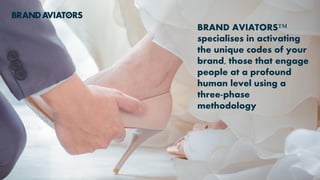
BRAND AVIATORS™
specialises in activating
the unique codes of your
brand, those that engage
people at a profound
human level using a
three-phase
methodology
Phase 1: Map the territory
The first phase of the methodology
deconstructs the fundamental human
motives driving the sales and profit of the
category, establishes the relevant
psychographic territories and reveals the way
that the brands are mapped in people’s mind
Phase 2: Give soul to your
brand
To be authentic and engaging,
narratives must always be sourced
from the core of the brand. The
second phase captures the core of
the brand, and mobilises its
genuine codes in order to satisfy
our common motivations relative
to the category.
Phase 3: Enrich people’s lives
Powerful strategies require
effective articulation. In this third
phase, the consumer proposition
is translated into ownable
experiences written in the
language that uses our primary
emotions as structural elements to
appeal to everyone.
BRAND AVIATORS™ are trusted by some of the world’s
leading companies:
(Re)define your brand through the
human fundamentals if you seek
to:
• Deeply engage people locally
and across cultures
• Develop genuine concepts that
work year after year after
year
• Align all brand communications
under one master idea
• Increase the ROI of all your
brand activities
My mission is to help clients
around the world build
brands that liberate the very
forces of life. Contact me now
for a free discovery audit by
clicking on the icon:

Clothing Buying Behaviour

  • 1.
  • 2.
    Hi! My nameis Constantinos Pantidos and I believe that companies could improve people’s lives even more effectively if they had deeper human insight.
  • 3.
    Using a multidisciplinary approach,BRAND AVIATORS™ has captured and presents, for the first time, the fundamental human motives underpinning buying behaviour relative to clothes at the deepest levels of their deployment …
  • 4.
    … all theway from: • their biological value • to the neurosystems they engage • to the cognitive operations and psychological states they activate • to the major social reinforcers they cause and • to the rich hierarchy of inherent concepts they infuse into our everyday life
  • 5.
    This methodology helpsmarketers develop Intrinsically Engaging Narratives™
  • 6.
    The motives arepresented in order of increasing relative importance in line with their power to influence our buying decisions.
  • 7.
    BALANCE: On aninitial level of motivation, clothes demonstrate the relationship we have with our body, what we believe about our self. From the eternal struggle of the mind against the body, of spirit over matter, humans acquire meaning.
  • 8.
    Clothes are thegoods that best express our inner harmony and our agreement with the environment. Clothes are means of displaying intellectuality and sophistication. They make us appear to be in the know.
  • 9.
    PROTECTION: Proceeding intoa deeper layer of motivation, clothes help us shelter our self. Clothes protect us not only from the changes in the environment but also from everything that is lurking just around the corner.
  • 10.
    ACHIEVEMENT: More significantly, clothesallow enactments of power that cannot be realised by the naked body
  • 11.
    Clothes enable usto gain admiration, to feel superior. Through them we showcase our strengths and hide our weaknesses.
  • 12.
    EXPLORATION: A naked bodyis uninteresting. Clothes offer dissimilarity, add variety and excitement to our life, in increasing interest by what they show and what they hide.
  • 13.
    At bottom, inexploring our appearance, what we are really searching for is our true self.
  • 14.
    PROTEST: On aneven more profound layer of motivation, as the body is inherently standardized, clothes represent a reaction against sameness.
  • 15.
    Clothes help usreaffirm our individuality, the prerequisite of our very existence. We act on our body to prove that anatomy is not destiny.
  • 16.
    CONTROL: We wear clothesto cover our nudity, which reminds us of our animalistic nature. By their very nature, clothes create order and control.
  • 17.
    As one ofthe most visible forms of consumption, clothing is the most obvious signs of social order and hierarchy. Through conforming or rejecting, social ranking becomes visible.
  • 18.
    BELONGING: The wearing ofclothes marks us as equal regardless of our social status or natural appearance. Clothes are the social fabric that enables us to almost become others.
  • 19.
    As a partof our self wants to avoid standing out in a crowd, being noticed, uniformity increases security. With our clothes we feel united as one body. We can become really attached to them.
  • 20.
    REJUVENATION: As nakedness,in our mind, equals authenticity but also shame, we feel that in clothes we are better people. Enveloping ourselves in soft, easy clothes dissipates all tension. Good clothes make us feel good. New clothes make us feel we are not just different in appearance, but new people.
  • 21.
    In our unconscious,new clothes mean rebirth and renewal
  • 22.
    At the bottomof modesty lies the fact that we are embarrassed about our bodies
  • 23.
    DESIRABILITY: Moving into anotherlayer of motivation, clothes have the capacity to imply something that may be more powerful than reality. As clothes act as worn invitations to a rollicking nakedness beneath, they make the wearer feel desirable.
  • 24.
    When we arealone we feel cold. Acceptance and love feels warm. Clothes are themselves objects of desire, in an aesthetic human sense that help us satisfy our desire to appear better than we actually are.
  • 25.
    Tight jeans andskirts, constricted waists in combination with high heels and a fragile body, represent the modern manifestation of our need to always voluntarily restrict movement, which might itself be evolutionarily driven.
  • 26.
    SELF-EXPRESSION: As clothes capturethe subtleties and nuances of our personalities, we feel we are expressed perfectly through them. Through clothes personal styles are created. Identities constructed.
  • 27.
    TRANSFORMATION: On the innermostlayer, our mind imagines ordinary clothes as objects capable of extending our personality, of transforming us into other beings
  • 28.
    As the body,(let alone the personality) is not so easy to change, clothes had to be invented
  • 29.
    In changing the skin,we commonly believe that we are able to change personality
  • 30.
    Clothes change the content.They have the ability to change our attitude and the attitude of others towards us.
  • 31.
    In a powerfulseductive game of advancing and retreating, the being is transformed into an array of essences
  • 32.
    This map illustrates theway some major brands of clothes are positioned in the consumers’ mind
  • 33.
    Successful brands coherently express thefundamental human motives driving their category
  • 34.
    BRAND AVIATORS™ specialises inactivating the unique codes of your brand, those that engage people at a profound human level using a three-phase methodology
  • 35.
    Phase 1: Mapthe territory The first phase of the methodology deconstructs the fundamental human motives driving the sales and profit of the category, establishes the relevant psychographic territories and reveals the way that the brands are mapped in people’s mind
  • 36.
    Phase 2: Givesoul to your brand To be authentic and engaging, narratives must always be sourced from the core of the brand. The second phase captures the core of the brand, and mobilises its genuine codes in order to satisfy our common motivations relative to the category.
  • 37.
    Phase 3: Enrichpeople’s lives Powerful strategies require effective articulation. In this third phase, the consumer proposition is translated into ownable experiences written in the language that uses our primary emotions as structural elements to appeal to everyone.
  • 38.
    BRAND AVIATORS™ aretrusted by some of the world’s leading companies:
  • 39.
    (Re)define your brandthrough the human fundamentals if you seek to: • Deeply engage people locally and across cultures • Develop genuine concepts that work year after year after year • Align all brand communications under one master idea • Increase the ROI of all your brand activities
  • 40.
    My mission isto help clients around the world build brands that liberate the very forces of life. Contact me now for a free discovery audit by clicking on the icon: